EP1929689B1 - Apparatus and method for error correction in mobile wireless applications incorporating multi-level and adaptive erasure data - Google Patents
Apparatus and method for error correction in mobile wireless applications incorporating multi-level and adaptive erasure data Download PDFInfo
- Publication number
- EP1929689B1 EP1929689B1 EP06821117.6A EP06821117A EP1929689B1 EP 1929689 B1 EP1929689 B1 EP 1929689B1 EP 06821117 A EP06821117 A EP 06821117A EP 1929689 B1 EP1929689 B1 EP 1929689B1
- Authority
- EP
- European Patent Office
- Prior art keywords
- erasure
- counter value
- continuity counter
- datagrams
- decoder
- Prior art date
- Legal status (The legal status is an assumption and is not a legal conclusion. Google has not performed a legal analysis and makes no representation as to the accuracy of the status listed.)
- Active
Links
- 238000000034 method Methods 0.000 title claims description 37
- 238000012937 correction Methods 0.000 title claims description 20
- 230000003044 adaptive effect Effects 0.000 title claims description 9
- 238000004891 communication Methods 0.000 claims description 12
- 238000012545 processing Methods 0.000 claims description 10
- 238000009877 rendering Methods 0.000 claims description 3
- 230000008569 process Effects 0.000 description 5
- 230000005540 biological transmission Effects 0.000 description 4
- 230000006870 function Effects 0.000 description 4
- 230000006978 adaptation Effects 0.000 description 3
- 238000005516 engineering process Methods 0.000 description 3
- 239000011159 matrix material Substances 0.000 description 3
- 239000012634 fragment Substances 0.000 description 2
- 230000002035 prolonged effect Effects 0.000 description 2
- 238000013459 approach Methods 0.000 description 1
- 230000008859 change Effects 0.000 description 1
- 238000007796 conventional method Methods 0.000 description 1
- 125000004122 cyclic group Chemical group 0.000 description 1
- 238000005538 encapsulation Methods 0.000 description 1
- 238000013467 fragmentation Methods 0.000 description 1
- 238000006062 fragmentation reaction Methods 0.000 description 1
- 238000002955 isolation Methods 0.000 description 1
- 238000004519 manufacturing process Methods 0.000 description 1
- 238000012986 modification Methods 0.000 description 1
- 230000004048 modification Effects 0.000 description 1
- 238000007781 pre-processing Methods 0.000 description 1
- 239000004065 semiconductor Substances 0.000 description 1
- 230000011664 signaling Effects 0.000 description 1
Images




Classifications
-
- H—ELECTRICITY
- H04—ELECTRIC COMMUNICATION TECHNIQUE
- H04L—TRANSMISSION OF DIGITAL INFORMATION, e.g. TELEGRAPHIC COMMUNICATION
- H04L1/00—Arrangements for detecting or preventing errors in the information received
- H04L1/004—Arrangements for detecting or preventing errors in the information received by using forward error control
- H04L1/0045—Arrangements at the receiver end
- H04L1/0052—Realisations of complexity reduction techniques, e.g. pipelining or use of look-up tables
- H04L1/0053—Realisations of complexity reduction techniques, e.g. pipelining or use of look-up tables specially adapted for power saving
-
- H—ELECTRICITY
- H04—ELECTRIC COMMUNICATION TECHNIQUE
- H04L—TRANSMISSION OF DIGITAL INFORMATION, e.g. TELEGRAPHIC COMMUNICATION
- H04L1/00—Arrangements for detecting or preventing errors in the information received
- H04L1/004—Arrangements for detecting or preventing errors in the information received by using forward error control
- H04L1/0056—Systems characterized by the type of code used
- H04L1/0057—Block codes
-
- H—ELECTRICITY
- H04—ELECTRIC COMMUNICATION TECHNIQUE
- H04L—TRANSMISSION OF DIGITAL INFORMATION, e.g. TELEGRAPHIC COMMUNICATION
- H04L1/00—Arrangements for detecting or preventing errors in the information received
- H04L1/004—Arrangements for detecting or preventing errors in the information received by using forward error control
- H04L1/0056—Systems characterized by the type of code used
- H04L1/0067—Rate matching
- H04L1/0068—Rate matching by puncturing
Definitions
- Wireless environments provide a challenge for high quality communication.
- the invention relates to techniques for improving error correction in mobile wireless applications while reducing memory, computational and power consumption requirements.
- the required amount of memory has become particularly large in some of the sophisticated processing algorithms that operate on large amount of input data and produce several output data, including intermediate results, which are stored for subsequent processing.
- WO 2004/079982 discloses a system wherein a two dimensional array or the like is used for data transmission and reception. Characteristic values are determined with respect to the data to be transmitted and transmitted along with the data. This characteristic value may be forward error correction data.
- a device supporting error correction comprising: a receiver configured to receive data over a communications link; a decapsulator coupled to the receiver and configured to create datagrams and erasure attributes associated with the datagrams; a decoder coupled to the decapsulator and configured to store the datagrams in a frame table and track the progression thereof to create codewords, the decoder storing the datagrams in table columns to create codewords in table rows, and configured to store the erasure attributes in an erasure table; and a user interface coupled to the decoder and configured to render images corresponding with the datagrams on the user interface, wherein the decoder is configured to assign erasure attributes to maximize the number of correctable errors in each codeword.
- a method of processing error correction comprising: receiving data over a communications link; decapsulating the data to create datagrams and erasure attributes associated with the datagrams; decoding the datagrams by storing the datagrams in a frame table and track the progression thereof to create codewords, storing the datagrams in table columns to create codewords in table rows, and to storing the erasure attributes in an erasure table; and rendering images on a user interface corresponding with the datagrams on the user interface, wherein the decoding step includes the step of assigning erasure attributes to maximize the number of correctable errors in each codeword.
- Some embodiments may provide an apparatus and method for improving the quality of reception in wireless devices.
- An exemplary embodiment is a device that supports error correction.
- a receiver is configured to receive data over a communications link.
- a decapsulator is coupled to the receiver and configured to create datagrams and erasure attributes associated with the datagrams.
- a decoder is coupled to the decapsulator and configured to store the datagrams in a frame table and track the progression thereof to create codewords, the decoder storing the datagrams in table columns to create codewords in table rows, and configured to store the erasure attributes in an erasure table.
- a user interface is coupled to the decoder and configured to render images corresponding with the datagrams on the user interface. Advantages include the improved signal reception and processing, and prolonged battery life in mobile wireless devices.
- the erasure table includes a plurality of entries each of which is associated with a column in the frame table.
- the progress attributes include a continuity counter value and the erasure attributes include a multi-bit erasure value.
- the decoder is configured to receive each datagram and to check the continuity counter value associated with each datagram, and when the continuity counter is not consistent with predefined continuity count to discard the packet and mark the packet as an erasure.
- the decoder is configured to assign erasure attributes to maximize the number of correctable errors in each codeword.
- the decoder is configured to assign erasure attributes in an adaptive manner to maximize the number of correctable errors in each codeword.
- the decoder is configured to check a packet ID and discard packets that do not match a predetermined packed ID. In one aspect , the decoder is configured to check the continuity counter value and determine if the continuity counter value is properly incremented, and when not, to discard the data associated with the improperly incremented continuity counter value.
- the communications link is a wireless link and the data is digital television data.
- Advantages may include improved signal reception and signal processing, and prolonged battery life in mobile wireless devices.
- Figure 1 depicts an exemplary wireless network 100 showing a broadcast station 110 and a number of wireless devices 112a-112b receiving a signal from the broadcast station. These devices have the ability to communicate with one another.
- the devices 112a-112b are, for example, television receivers, but could also be other mobile devices such as telephones, personal digital assistants (PDAs), laptop computers or other electronic devices. Moreover, some of these devices may be on battery power while others may be powered by an available power outlet. In some cases, the devices can also be connected to the network through a wired network e.g. Ethernet or cable connection.
- a wired network e.g. Ethernet or cable connection.
- Figure 2A depicts an exemplary device 112 according to an embodiment of the invention.
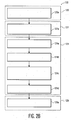
- Figure 2B depicts a flowchart showing methods performed in the exemplary device.
- a receiver and demodulator 120 receives an inbound signal, transforms the signal to a lower frequency, and creates a Transport Stream to make the signal available for processing.
- the receiver includes an error correction circuit that performs initial error correction on the demodulated packets and sets a Transport Error Indicator (TEI) if the TS packet is bad and cannot be corrected.
- TEI Transport Error Indicator
- An IP Decapsulater 122 performs initial processing on transport packets by decoding the inbound information into multi-protocol forward error correction (MPE-FEC) sections along with erasure information and parsing through the MPE-FEC sections to extract the raw IP datagrams.
- MPE-FEC decoder 124 receives the MPE-FEC sections and processes the Reed-Solomon codewords according to embodiments of the invention, resulting in corrected IP datagrams.
- a user interface 126 e.g. source decoding and rendering circuit, processes the information for display on a user interface, e.g. television display.
- an exemplary, embodiment uses Reed-Solomon codes.
- a Reed-Solomon encoder takes a block of digital data and adds extra "redundant" bits. Errors occur during transmission or storage for a number of reasons (for example noise or interference, scratches on a CD, etc).
- the Reed-Solomon decoder processes each block and attempts to correct errors and recover the original data. The number and type of errors that can be corrected depends on the characteristics of the Reed-Solomon code.
- a Reed-Solomon code is specified as RS (n, k) with s-bit symbols. This means that the encoder takes k data symbols of s bits each and adds parity symbols to make an n symbol codeword. These are n-k parity symbols of s bits each.
- Figure 3A depicts a Reed-Solomon codeword according to an embodiment of the invention.
- the maximum length of a code with 8-bit symbols is 255 bytes.
- the amount of processing power required to encode and decode Reed-Solomon codes is related to the number of parity symbols per codeword.
- a large value of t means that a large number of errors can be corrected but requires more computational power than a small value of t.
- One symbol error occurs when any number of bits in a symbol are wrong.
- Reed-Solomon algebraic decoding procedures can correct errors and erasures.
- An erasure occurs when the position of an erred symbol is known.
- a decoder can correct up to t errors or up to 2t erasures.
- erasure information is estimated and manipulated to assist in identifying received symbols that are likely to contain errors.
- Figures 3B-C depicts the relationship between the transport packets and the MPE-FEC packets according to an embodiment of the invention (not to scale).
- the formats for the transport stream (TS) packet and the datagram section are shown in Table 1 and Table 2, respectively.
- Note in Figure 3A that there does not need to be a direct correspondence between the TS packet and the MPE packet, and an MPE packet can cross the boundary between one or more TS packets.
- One aspect of the invention is how to reconcile and reconstruct the MPE-FEC frame table 400 shown in Figure 4A under all conditions.
- Table 1 - Transport packet format (in the order in which they appear in the transport packet. The first row, i.e. sync byte occurs first). Name Number of bits Description Sync byte 8 Fixed value of 0x47.
- Transport error indicator (TEI) 1 A value of '0' indicates no error. A value of '1' indicates that at least 1 bit error in the transport packet.
- Payload unit start indicator (PUSI) 1 A value of '1' indicates there is at least an MPE section header in the payload of this transport packet. A value of '0' indicates there is no MPE section header in the payload of this transport packet.
- Transp. priority 1 PID 13 0x0000: PAT; 0x0001: CAT; 0x0010-0x1FFFE: network, program map-, elementary-PID or other. 0x1FFF: null.
- Transport scrambling control 2 00 Adaptation field 2 00: reserved; control 01: no adapt field, payload only; 10: adapt field only, no payload; 11: adapt field and payload.
- Continuity counter 4 Adaptation field 0 or 8 Adaptation + stuffing Payload 183 or 184 PES packets or PSI sections or packet stuffing bytes or private data.
- Table 2 - MPE section format Name Number of bits Description Table ID 8 0x3E indicates DSM CC section with private data (table 9-3 in ISO/IEC 138 18-6) Section syntax indicator 1 1: presence of CRC_32 field. Private indicator 1 0 Reserve 2 11 Section length 12 The number of remaining bytes in the MPE section immediately following this field up to the end of the MPE section.
- MAC address (bytes 6 and 5) 16 Reserve 2 Payload scrambling control 2 00 Address scrambling control 2 00 LLC SNAP flag 1 A value of '0' indicates that section carries an IP datagram without LLC SNAP encapsulation (mandated by IP datacast docs) Current next indicator 1 Always 1. Section number 8 0: no fragmentation of payload over multiple MPE sections 1 ... 255: fragment sequence number. Last section number 8 Sequence number of the section carrying the last payload fragment. MAC address (bytes 4 to 1) 32 Data payload (IP datagram) Section stuffing bytes CRC_32
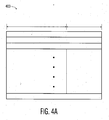
- Figures 4A-B depict a memory frame table 400 according to an embodiment of the invention.
- the table includes a number of rows corresponding with the desired size of the table in memory.
- the MPE-FEC frame table which stores the input data of the MPE-FEC decoder, is structured as a matrix with 255 columns and a flexible number of rows.
- the maximum allowed value for no_of_rows (RowN) is 1024, which makes the total MPE-FEC frame size almost 2 M bits.
- Each position in the matrix hosts an information byte.
- the last part of the MPE-FEC frame consisting of the 191 leftmost columns, is dedicated for IP datagrams and possible padding, and is called the application data table.
- the right part of the MPE-FEC frame consisting of the 64 rightmost columns, is dedicated for the parity information of the FEC code and is called the Reed-Solomon (RS) data table.
- RS Reed-Solomon
- Figure 4A shows an MPE portion and a FEC portion of the memory 400 for each codeword to be reconstructed by the invention.
- Figure 4B shows how the IP datagrams are received and compiled into columns of the frame table 400.
- IP datagrams are extracted, they are introduced datagram-by-datagram, starting with the first byte of the first datagram in the upper left, corner of the matrix and going downwards to the first column.
- the length of the datagram may vary arbitrarily from datagram to datagram. Immediately after the end of one datagram the following datagram starts. If a datagram does not end precisely at the end of a column, it continues at the top of the following column.
- any unfilled byte positions are padded with zero bytes, which make the leftmost 191 columns completely filled.
- the 64 parity bytes are filled to the MPE-FEC frame.
- the code used is Reed-Solomon RS (255, 191).
- Each row of the MPE-FEC table then contains one RS codeword.
- Some of the rightmost columns of the RS data table may be discarded and hence not transmitted, to enable puncturing, as shown in Figure 4C .
- the exact number of punctured RS columns does not need to be explicitly signaled and may change dynamically between frames. With this also the RS data table is completely filled and the MPE-FEC frame is completed.
- the MPE portion can include padding bytes that are transmitted in the TS to fill the portion of the table, which may occur at a variable length since the MPE section lengths are variable.
- the FEC section packets are normally full length since they are intended to be inserted into the FEC portion of the table as efficiently as possible.
- the FEC portion can include puncturing bytes, which are not transmitted, to fill the FEC portion of the table.
- the Reed-Solomon encoding RS (255, 191), which is the exemplary MPE-FEC decoding function specified by the DVB-H standard, can correct up to 32 errors in a 255 bytes codeword. If erasures are provided, however, RS (255, 191) can correct up to 64 erasures. Erasures indicate which bytes of the codeword are considered erroneous. Therefore, using erasure attributes can substantially increase the error correction capability of Reed-Solomon decoder.
- MPE-FEC decoding begins when the MPE-FEC frame table 400 is filled, a memory of at least 2 Megabits is used in the exemplary embodiment to store the MPE-FFEC frame data alone, but other sizes may be used. If a handover function is supported, the MPE-FEC frame data memory size is doubled.
- the decapsulator is configured to generate at least three levels of erasure attributes associated with the datagrams as shown in Table 3, which results in 2 bit erasure attributes.
- the decoder may be configured to selectively process codewords to create corrected codewords, wherein the selection is based at least in part on the attributes stored in the erasure table.
- the decoder may be configured to selectively bypass codewords that the erasure table identifies as correct or having too many errors to correct.
- a concept of soft-erasures is introduced. A soft-erasure describes the likelihood of a symbol in a codeword being erroneous.
- the soft-erasure value of each symbol in the codeword can be extracted, for example, from the received transport packet. For instance, if the TEI (transmission error indicator) bit of the transport packet is set to 1, the soft-erasure value of the payload in the transport packet can be assigned to 2, while the soft- erasure value is assigned to 1 if the TEI bit is set to 0. For padding bytes of the MPE application data table, or payload of the transport packets that pass CRC (cyclic redundancy checksum) check, for example, a soft-erasure value of 0 is assigned. For puncturing bytes of the MPE-FEC Reed-Solomon data table, for example, a soft-erasure value of 3 is assigned.
- CRC cyclic redundancy checksum
- the soft-erasure values may be determined.
- the continuity count bits of a transport packet can be used to determine whether there are any packets dropped.
- the soft-erasure value of the whole packet can be assigned to 3, as it is certain that all symbols are erroneous.
- the table be constructed in such a way that hard-erasures can be generated for each codeword and to minimize the table size.
- a simplified hard-erasure generator and small soft-erasure table translate to reduced cost and power consumption.
- hard-erasures are generated after the MPE-FEC frame is completely constructed and the soft-erasure table is filled.
- Hard-erasure value is binary. When its value is 1, it indicates the current symbol of the codeword is an erasure. When its value is 0, it indicates that the current symbol of the codeword is not an erasure.
- the hard-erasure is subsequently used by the Reed-Solomon decoder.
- the present invention is not limited to a specific Reed-Solomon decoder implementation.
- the hard-erasure generator is normally related to how the soft erasure table is constructed.
- the hard-erasure generator produces hard-erasures for one complete codeword per execution.
- the hard-erasure generator determines that no Reed-Solomon decoding is necessary if either of the following conditions is met: (a) the hard-erasure of every symbol in the codeword is 0; or (b) the number of symbols whose hard-erasure is 1 exceeds the limitation of the Reed-Solomon decoder, i.e. 64 in the case of DVB-H.
- the first condition is met if and only if the soft-erasures of all symbols in a codeword are 0, and the second condition is met if and only if the soft-erasures of at least 65 (in the case of DVB-H) symbols in a codeword are not 0.
- the present invention also works with Reed-Solomon decoding that does not use erasures.
- the sole function of the hard-erasure generator is to determine whether or not Reed-Solomon Decoding is required. No hard-erasures are output to the Reed-Solomon decoding sub-module.
- Figure 4C depicts an erasure table 450 according to an embodiment of the invention
- the decapsulator is configured to generate erasure atttributes associated with the datagrams and the decoder is configured to store the erasure attributes in an erasure table.
- the decoder is configured to selectively process codewords to create corrected codewords, wherein the selection is based at least in part on the attributes stored in the erasure table.
- the decoder is configured to selectively bypass codewords that the erasure table identifies as correct.
- erasure information is extracted.
- the erasure table is implemented to store the erasure information for a whole MPE-FEC frame.
- FIGS 5A-B depict a flowchart 500 according to an embodiment of the invention.
- TEI transport error indicator
- the packet actually may or may not have a PID match. This is determined later by checking the continuity counter of the packet and following packet in the sequence starting in step 510.
- PUSI payload unit start indicator
- CC continuity counter
- PUSI payload unit start indicator
- the invention is able to mark the reliability information in an adaptive manner, thereby improving the performance of the MPE-FEC.
- MPE-FEC module would have to handle only the transport packet with MPE sections carrying IP datagram. All the other transport packets carrying PAT, PMT information should be handled by a higher layer module.
- the invention includes several key features including hierarchical marking and adaptive marking of erasures.
- Hierarchical marking of erasures means that we classify the transport stream packets into four categories: (1) packets that are definitely not erasures; (2) packets that are definitely erasures; (3) packets that are unlikely to be erasures and (4) packets that are likely to be erasures. For these categories, we assign a two-bit erasure level of "00", “11", “01”, and “11”, respectively. The erasure levels of "01” and "10" can be adjusted as more information is gathered from the following transport stream packets.
- Adaptive marking means that we know that for Reed-Solomon decoder, we can only mark up to 64 erasures for each codeword. If the number of transport stream packets with erasure level "11" reaches certain threshold (programmable) for a codeword, we re-mark the packets with original erasure levels "10" or "01" to "00". At least, when the codeword is passed to the Reed-Solomon decoder, packets with erasure level "11” are regarded as erasures (unreliable), while packets with erasure level "00” are regarded as “non-erasures” (reliable).
- the hierarchical marking can achieve higher reliability than a straightforward marking which simply uses each transport stream packet in isolation.
- the hierarchical marking takes advantages of the packet sequence number and continuity counter and can thus improve the reliability.
- the invention can adaptively provide correction of maximum number of errors for correction. By using adaptive marking, our algorithm can mark the most number of erasures available for each codeword, and maximum erasures makes it possible to correct maximum number of errors
Landscapes
- Engineering & Computer Science (AREA)
- Computer Networks & Wireless Communication (AREA)
- Signal Processing (AREA)
- Error Detection And Correction (AREA)
- Detection And Prevention Of Errors In Transmission (AREA)
- Circuits Of Receivers In General (AREA)
- Mobile Radio Communication Systems (AREA)
Description
- Wireless environments provide a challenge for high quality communication. The invention relates to techniques for improving error correction in mobile wireless applications while reducing memory, computational and power consumption requirements.
- Advances in semiconductor manufacturing technologies and digital system architectures have resulted in very highly integrated circuits, which contain millions of transistors, along with various other components and interconnections. The integrated circuits that result from the aforementioned advances provide significant computational resources at relatively low costs. In turn, the availability of such integrated circuits has given rise to growth in the capabilities and varieties of consumer electronic products, and particularly mobile wireless products. One particular aspect of consumer electronic products is mobile and portable TV receivers.
- Because of the ever-increasing demand for improved reception quality, more and more complex technologies have been employed in state-of-the-art mobile and portable TV receiver products that incorporate, or include, error correction functionality, or capability. Use of these complex technologies often results in undesirable consequences in terms of both cost and power consumption. For example, such signal processing capabilities typically require a large amount of memory in which to store input data, and farther typically require fast computational resources. The extra memory and the high speed computational resources add to the cost and the power consumption of the products into which the error correction capabilities are incorporated.
- The required amount of memory has become particularly large in some of the sophisticated processing algorithms that operate on large amount of input data and produce several output data, including intermediate results, which are stored for subsequent processing.
- What is needed are methods and apparatus for providing error correction capabilities while reducing the cost and power consumption of products in which such capabilities are incorporated.
-
WO 2004/079982 discloses a system wherein a two dimensional array or the like is used for data transmission and reception. Characteristic values are determined with respect to the data to be transmitted and transmitted along with the data. This characteristic value may be forward error correction data. - According to a first aspect, there is provided a device supporting error correction, comprising: a receiver configured to receive data over a communications link; a decapsulator coupled to the receiver and configured to create datagrams and erasure attributes associated with the datagrams; a decoder coupled to the decapsulator and configured to store the datagrams in a frame table and track the progression thereof to create codewords, the decoder storing the datagrams in table columns to create codewords in table rows, and configured to store the erasure attributes in an erasure table; and a user interface coupled to the decoder and configured to render images corresponding with the datagrams on the user interface, wherein the decoder is configured to assign erasure attributes to maximize the number of correctable errors in each codeword.
- According to a second aspect, there is provided a method of processing error correction, comprising: receiving data over a communications link; decapsulating the data to create datagrams and erasure attributes associated with the datagrams; decoding the datagrams by storing the datagrams in a frame table and track the progression thereof to create codewords, storing the datagrams in table columns to create codewords in table rows, and to storing the erasure attributes in an erasure table; and rendering images on a user interface corresponding with the datagrams on the user interface, wherein the decoding step includes the step of assigning erasure attributes to maximize the number of correctable errors in each codeword.
- Some embodiments may provide an apparatus and method for improving the quality of reception in wireless devices.
- An exemplary embodiment is a device that supports error correction. A receiver is configured to receive data over a communications link. A decapsulator is coupled to the receiver and configured to create datagrams and erasure attributes associated with the datagrams. A decoder is coupled to the decapsulator and configured to store the datagrams in a frame table and track the progression thereof to create codewords, the decoder storing the datagrams in table columns to create codewords in table rows, and configured to store the erasure attributes in an erasure table. A user interface is coupled to the decoder and configured to render images corresponding with the datagrams on the user interface. Advantages include the improved signal reception and processing, and prolonged battery life in mobile wireless devices.
- In one aspect, the erasure table includes a plurality of entries each of which is associated with a column in the frame table. In one aspect , the progress attributes include a continuity counter value and the erasure attributes include a multi-bit erasure value. In one aspect , the decoder is configured to receive each datagram and to check the continuity counter value associated with each datagram, and when the continuity counter is not consistent with predefined continuity count to discard the packet and mark the packet as an erasure. In one aspect , the decoder is configured to assign erasure attributes to maximize the number of correctable errors in each codeword. In one aspect , the decoder is configured to assign erasure attributes in an adaptive manner to maximize the number of correctable errors in each codeword. In one aspect, the decoder is configured to check a packet ID and discard packets that do not match a predetermined packed ID. In one aspect , the decoder is configured to check the continuity counter value and determine if the continuity counter value is properly incremented, and when not, to discard the data associated with the improperly incremented continuity counter value. In one aspect , the communications link is a wireless link and the data is digital television data.
- Advantages may include improved signal reception and signal processing, and prolonged battery life in mobile wireless devices.
- Embodiments of the invention is described with reference to the following figures.
-
Figure 1 depicts an exemplary wireless network according to an embodiment of the invention. -
Figure 2A depicts an exemplary device according to an embodiment of the invention. -
Figure 2B depicts a flowchart showing methods performed in the exemplary device according to an embodiment of the invention. -
Figure 3A depicts a Reed-Solomon codeword according to an embodiment of the invention. -
Figure 3B-C depict the relationship between the transport packets and the MPE-FEC sections according to an embodiment of the invention. -
Figures 4A-B depict a memory table according to an embodiment of the invention. -
Figure 4C depicts an erasure table according to an embodiment of the invention. -
Figures 5A-B depict a flowchart according to an embodiment of the invention. - The invention is described with reference to specific embodiments. Those skilled in the art will recognize that the description is for illustration and to provide the best mode of practicing the invention. While references are made to specific wireless devices and protocols, the invention is applicable to many different types of communication mediums, devices and protocols. For example, while a wireless protocol is described herein, the invention is applicable to other protocols and communication techniques such as wireline communication, as well as analog and digital variations. Likewise, while Reed-Solomon error correction is described, other error correction techniques can be implemented in the invention. Additionally, while specific parameters such as packet size and memory size are described here, these are for purposes of example only since the invention may be used with other packet sizes, memory sizes, and so forth.
-
Figure 1 depicts an exemplarywireless network 100 showing abroadcast station 110 and a number ofwireless devices 112a-112b receiving a signal from the broadcast station. These devices have the ability to communicate with one another. Thedevices 112a-112b are, for example, television receivers, but could also be other mobile devices such as telephones, personal digital assistants (PDAs), laptop computers or other electronic devices. Moreover, some of these devices may be on battery power while others may be powered by an available power outlet. In some cases, the devices can also be connected to the network through a wired network e.g. Ethernet or cable connection. -
Figure 2A depicts anexemplary device 112 according to an embodiment of the invention.Figure 2B depicts a flowchart showing methods performed in the exemplary device. A receiver anddemodulator 120 receives an inbound signal, transforms the signal to a lower frequency, and creates a Transport Stream to make the signal available for processing. In one aspect, the receiver includes an error correction circuit that performs initial error correction on the demodulated packets and sets a Transport Error Indicator (TEI) if the TS packet is bad and cannot be corrected. AnIP Decapsulater 122 performs initial processing on transport packets by decoding the inbound information into multi-protocol forward error correction (MPE-FEC) sections along with erasure information and parsing through the MPE-FEC sections to extract the raw IP datagrams. An MPE-FEC decoder 124 receives the MPE-FEC sections and processes the Reed-Solomon codewords according to embodiments of the invention, resulting in corrected IP datagrams. Auser interface 126, e.g. source decoding and rendering circuit, processes the information for display on a user interface, e.g. television display. - For error correction, an exemplary, embodiment uses Reed-Solomon codes. A Reed-Solomon encoder takes a block of digital data and adds extra "redundant" bits. Errors occur during transmission or storage for a number of reasons (for example noise or interference, scratches on a CD, etc). The Reed-Solomon decoder processes each block and attempts to correct errors and recover the original data. The number and type of errors that can be corrected depends on the characteristics of the Reed-Solomon code.
- A Reed-Solomon code is specified as RS (n, k) with s-bit symbols. This means that the encoder takes k data symbols of s bits each and adds parity symbols to make an n symbol codeword. These are n-k parity symbols of s bits each. A Reed-Solomon decoder can correct up to t symbols that contain errors in a codeword, where 2t = n - k.
-
Figure 3A depicts a Reed-Solomon codeword according to an embodiment of the invention. The Reed-Solomon codes used in the MPE-FEC is specified as RS (255, 191) with 8-bit symbols. This means that each codeword contains 255 code word bytes, of which 191 bytes are data and 64 bytes are parity. That is: n = 255, k = 191, s = 8, 2t = 64 and t = 32. The decoder can correct any 32 symbol errors in the code word: i.e., errors in up to 32 bytes anywhere in the codeword can be automatically corrected. Given a symbol size s, the maximum codeword length n for a Reed-Solomon code is n = 2s - 1. For example, the maximum length of a code with 8-bit symbols (s = 8) is 255 bytes. The amount of processing power required to encode and decode Reed-Solomon codes is related to the number of parity symbols per codeword. A large value of t means that a large number of errors can be corrected but requires more computational power than a small value of t. One symbol error occurs when any number of bits in a symbol are wrong. - Reed-Solomon algebraic decoding procedures can correct errors and erasures. An erasure occurs when the position of an erred symbol is known. A decoder can correct up to t errors or up to 2t erasures. In the exemplary embodiment, erasure information is estimated and manipulated to assist in identifying received symbols that are likely to contain errors. When a codeword is decoded, if 2x + y < 2t (x errors, y erasures) then the original transmitted codeword can be recovered.
- It is noted that the more erasures are known, the more errors can be corrected. Therefore, it is desirable that as many erasure as possible (up to 64, of course) can be identified prior to Reed-Solomon decoding. On the other hand, if symbols are wrongly marked as erasures, it will reduce the number of errors that Reed-Solomon decoder can correct. For example, suppose that there are 8 erasures, of which 6 are not error codes and are hence wrongly identified as erasures. The Reed-Solomon decoder can only correct (64 - 8) /2 = 28 errors and 2 erasures. On the other hand, if there are only 2 erasures identified in the first place, Reed-Solomon can then correct (64 - 2) / 2 = 31 errors and 2 erasures. Therefore, it is desirable to provide a sound algorithm to reliably mark erasures.
-
Figures 3B-C depicts the relationship between the transport packets and the MPE-FEC packets according to an embodiment of the invention (not to scale). The formats for the transport stream (TS) packet and the datagram section are shown in Table 1 and Table 2, respectively. Note inFigure 3A that there does not need to be a direct correspondence between the TS packet and the MPE packet, and an MPE packet can cross the boundary between one or more TS packets. One aspect of the invention is how to reconcile and reconstruct the MPE-FEC frame table 400 shown inFigure 4A under all conditions.Table 1 - Transport packet format (in the order in which they appear in the transport packet. The first row, i.e. sync byte occurs first). Name Number of bits Description Sync byte 8 Fixed value of 0x47. Transport error indicator (TEI) 1 A value of '0' indicates no error. A value of '1' indicates that at least 1 bit error in the transport packet. Payload unit start indicator (PUSI) 1 A value of '1' indicates there is at least an MPE section header in the payload of this transport packet. A value of '0' indicates there is no MPE section header in the payload of this transport packet. Transp. priority 1 PID 13 0x0000: PAT; 0x0001: CAT; 0x0010-0x1FFFE: network, program map-, elementary-PID or other. 0x1FFF: null. Transport scrambling control 2 00 Adaptation field 2 00: reserved; control 01: no adapt field, payload only; 10: adapt field only, no payload; 11: adapt field and payload. Continuity counter 4 Adaptation field 0 or 8 Adaptation + stuffing Payload 183 or 184 PES packets or PSI sections or packet stuffing bytes or private data. Table 2 - MPE section format. Name Number of bits Description Table ID 8 0x3E indicates DSM CC section with private data (table 9-3 in ISO/IEC 138 18-6) Section syntax indicator 1 1: presence of CRC_32 field. Private indicator 1 0 Reserve 2 11 Section length 12 The number of remaining bytes in the MPE section immediately following this field up to the end of the MPE section. MAC address (bytes 6 and 5) 16 Reserve 2 Payload scrambling control 2 00 Address scrambling control 2 00 LLC SNAP flag 1 A value of '0' indicates that section carries an IP datagram without LLC SNAP encapsulation (mandated by IP datacast docs) Current next indicator 1 Always 1. Section number 8 0: no fragmentation of payload over multiple MPE sections 1 ... 255: fragment sequence number. Last section number 8 Sequence number of the section carrying the last payload fragment. MAC address (bytes 4 to 1) 32 Data payload (IP datagram) Section stuffing bytes CRC_32 -
Figures 4A-B depict a memory frame table 400 according to an embodiment of the invention. The memory table includes a number of columns corresponding to the length of the desired codeword, which in this case is N = 255 Bytes. The table includes a number of rows corresponding with the desired size of the table in memory. - The MPE-FEC frame table, which stores the input data of the MPE-FEC decoder, is structured as a matrix with 255 columns and a flexible number of rows. In one embodiment designed for the digital television DVB-H (digital video broadcasting-handhelds) transmission parameter signaling (TPS), the maximum allowed value for no_of_rows (RowN) is 1024, which makes the total MPE-FEC frame size almost 2 M bits.
- Each position in the matrix hosts an information byte. The last part of the MPE-FEC frame, consisting of the 191 leftmost columns, is dedicated for IP datagrams and possible padding, and is called the application data table. The right part of the MPE-FEC frame, consisting of the 64 rightmost columns, is dedicated for the parity information of the FEC code and is called the Reed-Solomon (RS) data table. Each byte position in the application data table has an address ranging from 0 to 191 x RowN. In the same way, each byte position in the RS data table has an address ranging from 0 to 64 x RowN.
-
Figure 4A shows an MPE portion and a FEC portion of thememory 400 for each codeword to be reconstructed by the invention.Figure 4B shows how the IP datagrams are received and compiled into columns of the frame table 400. - As IP datagrams are extracted, they are introduced datagram-by-datagram, starting with the first byte of the first datagram in the upper left, corner of the matrix and going downwards to the first column. The length of the datagram may vary arbitrarily from datagram to datagram. Immediately after the end of one datagram the following datagram starts. If a datagram does not end precisely at the end of a column, it continues at the top of the following column. When all datagrams have entered the application data table, any unfilled byte positions are padded with zero bytes, which make the leftmost 191 columns completely filled.
- After all the leftmost 191 columns filled, the 64 parity bytes are filled to the MPE-FEC frame. The code used is Reed-Solomon RS (255, 191). Each row of the MPE-FEC table then contains one RS codeword. Some of the rightmost columns of the RS data table may be discarded and hence not transmitted, to enable puncturing, as shown in
Figure 4C . The exact number of punctured RS columns does not need to be explicitly signaled and may change dynamically between frames. With this also the RS data table is completely filled and the MPE-FEC frame is completed. - The MPE portion can include padding bytes that are transmitted in the TS to fill the portion of the table, which may occur at a variable length since the MPE section lengths are variable. The FEC section packets are normally full length since they are intended to be inserted into the FEC portion of the table as efficiently as possible. The FEC portion can include puncturing bytes, which are not transmitted, to fill the FEC portion of the table.
- Regarding Erasures, the Reed-Solomon encoding RS (255, 191), which is the exemplary MPE-FEC decoding function specified by the DVB-H standard, can correct up to 32 errors in a 255 bytes codeword. If erasures are provided, however, RS (255, 191) can correct up to 64 erasures. Erasures indicate which bytes of the codeword are considered erroneous. Therefore, using erasure attributes can substantially increase the error correction capability of Reed-Solomon decoder.
- Since MPE-FEC decoding begins when the MPE-FEC frame table 400 is filled, a memory of at least 2 Megabits is used in the exemplary embodiment to store the MPE-FFEC frame data alone, but other sizes may be used. If a handover function is supported, the MPE-FEC frame data memory size is doubled.
- To store erasure information for each byte of the codeword in the MPE-FEC frame, a straightforward or conventional method stores at least 1 bit ('0' indicates non-erasure and '1' indicates erasure) for each byte of the codeword. That means, for the erasure table, a memory size of 255 x 1024 bits = 255 K bits is used at the minimum. 510 K bits of memory is used if two bits are used (in order for erasure pre-processing as described later) to represent the erasure for each byte of the codeword. Again, if a handover function is supported, the amount of memory is doubled for the erasure table.
- In one aspect, the decapsulator is configured to generate at least three levels of erasure attributes associated with the datagrams as shown in Table 3, which results in 2 bit erasure attributes. In this aspect, the decoder may be configured to selectively process codewords to create corrected codewords, wherein the selection is based at least in part on the attributes stored in the erasure table. Again, the decoder may be configured to selectively bypass codewords that the erasure table identifies as correct or having too many errors to correct. In this aspect, a concept of soft-erasures is introduced. A soft-erasure describes the likelihood of a symbol in a codeword being erroneous.
Table 3 - Soft-Erasure Attributes Soft-Erasure Value Description 0 (00) The probability of the symbol being erroneous is 0. 1 (01) The probability of the symbol being erroneous is less than 0.5. 2 (10) The probability of the symbol being erroneous is more than 0.5. 3 (11) The probability of the symbol being erroneous is 1. - The soft-erasure value of each symbol in the codeword can be extracted, for example, from the received transport packet. For instance, if the TEI (transmission error indicator) bit of the transport packet is set to 1, the soft-erasure value of the payload in the transport packet can be assigned to 2, while the soft- erasure value is assigned to 1 if the TEI bit is set to 0. For padding bytes of the MPE application data table, or payload of the transport packets that pass CRC (cyclic redundancy checksum) check, for example, a soft-erasure value of 0 is assigned. For puncturing bytes of the MPE-FEC Reed-Solomon data table, for example, a soft-erasure value of 3 is assigned.
- These examples show how the soft-erasure values may be determined. Other scenarios are possible for the soft-erasure value. For instance, the continuity count bits of a transport packet can be used to determine whether there are any packets dropped. In case a packet is dropped, the soft-erasure value of the whole packet can be assigned to 3, as it is certain that all symbols are erroneous.
- While there are a number of techniques to construct the soft-erasure table, it is useful that the table be constructed in such a way that hard-erasures can be generated for each codeword and to minimize the table size. A simplified hard-erasure generator and small soft-erasure table translate to reduced cost and power consumption.
- In one aspect of the current invention, hard-erasures are generated after the MPE-FEC frame is completely constructed and the soft-erasure table is filled. Hard-erasure value is binary. When its value is 1, it indicates the current symbol of the codeword is an erasure. When its value is 0, it indicates that the current symbol of the codeword is not an erasure. The hard-erasure is subsequently used by the Reed-Solomon decoder. The present invention, however, is not limited to a specific Reed-Solomon decoder implementation.
- The hard-erasure generator is normally related to how the soft erasure table is constructed. In one aspect of the current invention, the hard-erasure generator produces hard-erasures for one complete codeword per execution. At the end of an execution, the hard-erasure generator determines that no Reed-Solomon decoding is necessary if either of the following conditions is met: (a) the hard-erasure of every symbol in the codeword is 0; or (b) the number of symbols whose hard-erasure is 1 exceeds the limitation of the Reed-Solomon decoder, i.e. 64 in the case of DVB-H. Normally, the first condition is met if and only if the soft-erasures of all symbols in a codeword are 0, and the second condition is met if and only if the soft-erasures of at least 65 (in the case of DVB-H) symbols in a codeword are not 0.
- Note that the present invention also works with Reed-Solomon decoding that does not use erasures. In that case, the sole function of the hard-erasure generator is to determine whether or not Reed-Solomon Decoding is required. No hard-erasures are output to the Reed-Solomon decoding sub-module.
-
Figure 4C depicts an erasure table 450 according to an embodiment of the invention One aspect of the invention is that the decapsulator is configured to generate erasure atttributes associated with the datagrams and the decoder is configured to store the erasure attributes in an erasure table. The decoder is configured to selectively process codewords to create corrected codewords, wherein the selection is based at least in part on the attributes stored in the erasure table. The decoder is configured to selectively bypass codewords that the erasure table identifies as correct. - As IP datagrams are decapsulated from the incoming transport stream packets, erasure information is extracted. The erasure table is implemented to store the erasure information for a whole MPE-FEC frame.
-
Figures 5A-B depict aflowchart 500 according to an embodiment of the invention. Referring toFigure 5A , instep 502, the transport streams (TS) are received by theIP decapsulator 122. If the transport error indicator (TEI) is 1 (not 0), then the packet is deemed not necessarily valid bystep 504 and step 506 checks whether the MPE section is pending. If it's not pending, then step 506 returns the method to step 502. When a TS is not necessarily valid (TEI=1) but still pending,step 506 assumes that the packet has a PID match and step 508 stores the transport packet payload in the contiguous bytes of the MPE-FEC frame 400. In this case, the erasure table 450 makes a note of this write with erasure level = "01" or "10" (reliability of this data and address lies in between but not including 0 and 1). The packet actually may or may not have a PID match. This is determined later by checking the continuity counter of the packet and following packet in the sequence starting instep 510. - If the TEI is 1, then step 510 attempts to match the packet ID (PID) with the programmed ID. If the PID does not match, then the packet was not intended for the receiver (i.e. destined for a different receiver) and the packet is discarded and the method returns to step 502. If the PID does match, the method continues to step 512 to determine if the packet is pending. If not, then step 514 checks the payload unit start indicator (PUSI) to see if it is true (e.g. =1), and if not, returns the method to step 502. If PUSI=1, then step 516 checks the continuity counter to ensure that it is properly incremented by 1. If not, step 518 sets the hole detected register (hole_det). If so,
step 520 goes to the start of the MPE section. In either event, the method continues to bubble A. - If the section is still pending in
step 512, then step 522 checks the continuity counter (CC) to ensure that it is properly incremented (by 1 or within CC limits). If the CC is erroneous, step 524 sets the hole detected register (hole_det) and returns the method to step 502. If not, step 526 stores the IP packet in memory. Step 528 checks whether the prior TS had a TEI=1, and if so, writes the erasure table with a level="00" for the recently written addresses. In either event, the method continues to bubble B. - Referring to
Figure 5B , bubble B continues to step 532 which checks the payload unit start indicator (PUSI) to see if it is true (e.g. =1), and if not, step 534 checks whether the IF datagram is complete. If the IP datagram is complete, step 536 sets section pending negative (section_pending=0) and skips the CRC and stuff bytes. In either event, the method returns to step 502 via bubble C. - If
step 532 is true, or if the method is continuing from bubble A,step 540 checks whether there is a hole detected. If so, step 542 writes the erasure table with level="II" for the current stored addresses. In either event, step 544 sets section pending affirmative (section_pending=1) and defines the CC limits based on length (if length not available set CC limits to undefined). Step 546 checks whether the TS is over, and if so, returns the method to step 502 via bubble C. If the TS is not over,step 548 writes the subsequent IP datagram in memory from the saved address until the end of the datagram of end of TS, whichever comes first. Then step 550 checks whether the TS is over, and if so, returns the method to step 502 via bubble C. If not, the method continues back to step 544 with the section pending and continues until the TS is over. - By following the aforementioned approach, the invention is able to mark the reliability information in an adaptive manner, thereby improving the performance of the MPE-FEC.
- Note that it is assumed that the MPE-FEC module would have to handle only the transport packet with MPE sections carrying IP datagram. All the other transport packets carrying PAT, PMT information should be handled by a higher layer module.
- The invention includes several key features including hierarchical marking and adaptive marking of erasures.
- Hierarchical marking of erasures means that we classify the transport stream packets into four categories: (1) packets that are definitely not erasures; (2) packets that are definitely erasures; (3) packets that are unlikely to be erasures and (4) packets that are likely to be erasures. For these categories, we assign a two-bit erasure level of "00", "11", "01", and "11", respectively. The erasure levels of "01" and "10" can be adjusted as more information is gathered from the following transport stream packets.
- Adaptive marking means that we know that for Reed-Solomon decoder, we can only mark up to 64 erasures for each codeword. If the number of transport stream packets with erasure level "11" reaches certain threshold (programmable) for a codeword, we re-mark the packets with original erasure levels "10" or "01" to "00". At least, when the codeword is passed to the Reed-Solomon decoder, packets with erasure level "11" are regarded as erasures (unreliable), while packets with erasure level "00" are regarded as "non-erasures" (reliable).
- Advantages of such hierarchical and adaptive marking of erasures include several aspects. The hierarchical marking can achieve higher reliability than a straightforward marking which simply uses each transport stream packet in isolation. The hierarchical marking takes advantages of the packet sequence number and continuity counter and can thus improve the reliability. The invention can adaptively provide correction of maximum number of errors for correction. By using adaptive marking, our algorithm can mark the most number of erasures available for each codeword, and maximum erasures makes it possible to correct maximum number of errors
- Having disclosed exemplary embodiments and the best mode, modifications and variations may be made to the disclosed embodiments while remaining within the subject of the invention as defined by the following claims.
Claims (18)
- A device supporting error correction, comprising: a receiver (120) configured to receive data over a communications link; a decapsulator (122) coupled to the receiver and configured to create datagrams and erasure attributes associated with the datagrams; a decoder (124) coupled to the decapsulator (122) and configured to store the datagrams in a frame table (400) and track the progression thereof to create codewords, the decoder storing the datagrams in table columns to create codewords in table rows, and configured to store the erasure attributes in an erasure table; and a user interface (126) coupled to the decoder (124) and configured to render images corresponding with the datagrams on the user interface, wherein the decoder (124) is configured to assign erasure attributes to maximize the number of correctable errors in each codeword.
- The device of claim 1, wherein the erasure table includes a plurality of entries each of which is associated with a column in the frame table (400).
- The device of claim 1, wherein the progress attributes include a continuity counter value and the erasure attributes include a multi-bit erasure value.
- The device of claim 3, wherein the decoder (124) is configured to receive each datagram and to check the continuity counter value associated with each datagram, and when the continuity counter is not consistent with predefined continuity count to discard the packet and mark the packet as an erasure.
- The device of claim 1, wherein the decoder (124) is configured to assign erasure attributes in an adaptive manner to maximize the number of correctable errors in each codeword.
- The device of claim 1, wherein the decoder (124) is configured to check a packet ID and discard packets that do not match a predetermined packed ID.
- The device of claim 3, wherein the decoder (124) is configured to check the continuity counter value and determine if the continuity counter value is properly incremented, and when not, to discard the data associated with the improperly incremented continuity counter value.
- The device of claim 3, wherein the decoder (124) is configured to check the continuity counter value and determine if the continuity counter value is properly incremented, and when not, to assign a hole attribute to the data associated with the improperly incremented continuity counter value.
- The device of claim 1, wherein the communications link is a wireless link and the data is digital television data.
- A method of processing error correction, comprising: receiving data over a communications link; decapsulating the data to create datagrams and erasure attributes associated with the datagrams; decoding the datagrams by storing the datagrams in a frame table (400) and track the progression thereof to create codewords, storing the datagrams in table columns to create codewords in table rows, and to storing the erasure attributes in an erasure table; and rendering images on a user interface (126) corresponding with the datagrams on the user interface, wherein the decoding step includes the step of assigning erasure attributes to maximize the number of correctable errors in each codeword.
- The method claim 10, wherein the erasure table includes a plurality of entries each of which is associated with a column in the frame table.
- The method of claim 10, wherein the progress attributes include a continuity counter value and the erasure attributes include a multi-bit erasure value.
- The method of claim 12, wherein the decoding step includes the steps of receiving each datagram and checking the continuity counter value associated with each datagram, and when the continuity counter is not consistent with predefined continuity count discarding the packet and mark the packet as an erasure.
- The method of claim 10, wherein the decoding step includes the step of assigning erasure attributes in an adaptive manner to maximize the number of correctable errors in each codeword.
- The method of claim 10, wherein the decoding step includes the steps of checking a packet ID and discarding packets that do not match a predetermined packed ID.
- The method of claim 12, wherein the decoding step includes the steps of checking the continuity counter value and determining if the continuity counter value is properly incremented, and when not, discarding the data associated with the improperly incremented continuity counter value.
- The method of claim 12, wherein the decoding step includes the step of checking the continuity counter value and determining if the continuity counter value is properly incremented, and when not, assigning a hole attribute to the data associated with the improperly incremented continuity counter value.
- The method of claim 10, wherein the communications link is a wireless link and the data is digital television data.
Applications Claiming Priority (2)
| Application Number | Priority Date | Filing Date | Title |
|---|---|---|---|
| US71887205P | 2005-09-19 | 2005-09-19 | |
| PCT/IB2006/053381 WO2007034418A2 (en) | 2005-09-19 | 2006-09-19 | Apparatus and method for error correction in mobile wireless applications incorporating multi-level and adaptive erasure data |
Publications (2)
| Publication Number | Publication Date |
|---|---|
| EP1929689A2 EP1929689A2 (en) | 2008-06-11 |
| EP1929689B1 true EP1929689B1 (en) | 2013-08-14 |
Family
ID=37889225
Family Applications (1)
| Application Number | Title | Priority Date | Filing Date |
|---|---|---|---|
| EP06821117.6A Active EP1929689B1 (en) | 2005-09-19 | 2006-09-19 | Apparatus and method for error correction in mobile wireless applications incorporating multi-level and adaptive erasure data |
Country Status (6)
| Country | Link |
|---|---|
| US (1) | US8185804B2 (en) |
| EP (1) | EP1929689B1 (en) |
| JP (1) | JP2009509390A (en) |
| CN (1) | CN101268646B (en) |
| TW (1) | TWI401910B (en) |
| WO (1) | WO2007034418A2 (en) |
Families Citing this family (8)
| Publication number | Priority date | Publication date | Assignee | Title |
|---|---|---|---|---|
| KR100819302B1 (en) * | 2006-12-01 | 2008-04-02 | 삼성전자주식회사 | Data transmission / reception method for multicast and broadcast service of broadband wireless access system |
| US20090003370A1 (en) * | 2007-06-26 | 2009-01-01 | Broadcom Corporation | System and method for improved performance by a dvb-h receiver |
| KR20100042652A (en) * | 2007-08-15 | 2010-04-26 | 맥스리니어 인코포레이티드 | Method and apparatus for preserving deinterleaving erasure information of block interleaved coded signal |
| US8358687B2 (en) * | 2007-09-07 | 2013-01-22 | Qualcomm Incorporated | Method and apparatus for receiving multiple simultaneous stream bursts with limited DVB receiver memory |
| JP5031503B2 (en) * | 2007-09-29 | 2012-09-19 | Kddi株式会社 | Re-transmission device, facility system, program and method for re-transmitting broadcast packet |
| US8250441B2 (en) * | 2007-12-11 | 2012-08-21 | Wi-Lan Inc. | Outer coding framework for application packet error rate minimization |
| US20100303156A1 (en) * | 2009-05-29 | 2010-12-02 | Advanced Micro Devices, Inc. | Method and Apparatus for Providing Precise Transport Stream Packet Ordering and Erasure Optimization for Digital Video Decoder |
| JP5523144B2 (en) * | 2010-02-25 | 2014-06-18 | キヤノン株式会社 | Information processing apparatus, control method thereof, program, and storage medium |
Family Cites Families (14)
| Publication number | Priority date | Publication date | Assignee | Title |
|---|---|---|---|---|
| US6308328B1 (en) * | 1997-01-17 | 2001-10-23 | Scientific-Atlanta, Inc. | Usage statistics collection for a cable data delivery system |
| US7151754B1 (en) * | 2000-09-22 | 2006-12-19 | Lucent Technologies Inc. | Complete user datagram protocol (CUDP) for wireless multimedia packet networks using improved packet level forward error correction (FEC) coding |
| UA84557C2 (en) * | 2003-03-05 | 2008-11-10 | Нокіа Корпорейшн | Method and assembly for data transmission/receive (versions), an apparatus for data transmission |
| BRPI0408066A (en) * | 2003-03-05 | 2006-02-14 | Nokia Corp | data transmission and reception method, data transmitting node, data receiving node, and data transmission apparatus |
| SE0300832D0 (en) * | 2003-03-25 | 2003-03-25 | Teracom Ab | Data Transmisson system |
| GB2402307A (en) | 2003-05-30 | 2004-12-01 | Nokia Corp | Encapsulating irregular burst transmissions with overhead information specifying the timing interval to the next burst |
| GB2406483A (en) * | 2003-09-29 | 2005-03-30 | Nokia Corp | Burst transmission |
| GB2407946A (en) | 2003-11-05 | 2005-05-11 | Nokia Corp | Forward Error Correction decoder suitable for use with data comprising variable padding |
| JP2005229587A (en) * | 2004-01-15 | 2005-08-25 | Matsushita Electric Ind Co Ltd | Multiplexing conversion device |
| GB2415873A (en) | 2004-06-30 | 2006-01-04 | Nokia Corp | Erasure information generation in Forward Error Correction decoding |
| GB0420540D0 (en) * | 2004-09-15 | 2004-10-20 | Nokia Corp | Burst transmission in a digital broadcasting network |
| US8166355B2 (en) | 2005-02-10 | 2012-04-24 | Siano Mobile Silicon Ltd. | System and method for mitigating memory requirements |
| WO2006125157A2 (en) | 2005-05-18 | 2006-11-23 | Telegent Systems, Inc. | Erasure generation in a forward-error-correcting communication system |
| TWI415416B (en) | 2005-09-19 | 2013-11-11 | St Ericsson Sa | Apparatus and method for error correction in mobile wireless applications incorporating erasure table data |
-
2006
- 2006-09-15 TW TW095134151A patent/TWI401910B/en not_active IP Right Cessation
- 2006-09-19 CN CN2006800342233A patent/CN101268646B/en not_active Expired - Fee Related
- 2006-09-19 JP JP2008530735A patent/JP2009509390A/en active Pending
- 2006-09-19 EP EP06821117.6A patent/EP1929689B1/en active Active
- 2006-09-19 US US12/067,074 patent/US8185804B2/en not_active Expired - Fee Related
- 2006-09-19 WO PCT/IB2006/053381 patent/WO2007034418A2/en not_active Ceased
Also Published As
| Publication number | Publication date |
|---|---|
| US8185804B2 (en) | 2012-05-22 |
| TWI401910B (en) | 2013-07-11 |
| CN101268646A (en) | 2008-09-17 |
| JP2009509390A (en) | 2009-03-05 |
| CN101268646B (en) | 2011-11-02 |
| WO2007034418A2 (en) | 2007-03-29 |
| EP1929689A2 (en) | 2008-06-11 |
| TW200729805A (en) | 2007-08-01 |
| US20090259920A1 (en) | 2009-10-15 |
| WO2007034418A3 (en) | 2007-07-19 |
Similar Documents
| Publication | Publication Date | Title |
|---|---|---|
| US8286057B2 (en) | Iterative decoding of packet data | |
| JP2002501707A (en) | Method and apparatus for error protection of wireless file transfer | |
| CN1981469A (en) | Forward error correction decoders | |
| US20100211854A1 (en) | Methods and systems for providing different data loss protection | |
| US8185804B2 (en) | Apparatus and method for error correction in mobile wireless applications incorporating multi-level and adaptive erasure data | |
| CN101662339A (en) | Method and device for verifying data recovered by forward error correction | |
| US8095856B2 (en) | Method and apparatus for mitigating memory requirements of erasure decoding processing | |
| EP1932242B1 (en) | Memory efficient erasure information table for decoding of mpe-fec frames | |
| CN100581268C (en) | Forward Error Correction Decoder | |
| US20080209477A1 (en) | Promotion and Degradation of Soft Erasure Information Using Crc and Proceding Decoder Information | |
| US8296621B2 (en) | Integrated circuit comprising error correction logic, and a method of error correction | |
| US8707140B2 (en) | Apparatus and method for error correction in mobile wireless applications incorporating correction bypass | |
| US7856587B2 (en) | Memory reduction in DVB-H applications | |
| KR20070081907A (en) | Method and apparatus for decoding multi-protocol encapsulation forward error correction frame in digital video broadcasting system | |
| MXPA99011042A (en) | Method and apparatus for providing error protection for over the air file transfer |
Legal Events
| Date | Code | Title | Description |
|---|---|---|---|
| PUAI | Public reference made under article 153(3) epc to a published international application that has entered the european phase |
Free format text: ORIGINAL CODE: 0009012 |
|
| 17P | Request for examination filed |
Effective date: 20080421 |
|
| AK | Designated contracting states |
Kind code of ref document: A2 Designated state(s): AT BE BG CH CY CZ DE DK EE ES FI FR GB GR HU IE IS IT LI LT LU LV MC NL PL PT RO SE SI SK TR |
|
| AX | Request for extension of the european patent |
Extension state: AL BA HR MK RS |
|
| 17Q | First examination report despatched |
Effective date: 20120905 |
|
| GRAP | Despatch of communication of intention to grant a patent |
Free format text: ORIGINAL CODE: EPIDOSNIGR1 |
|
| INTG | Intention to grant announced |
Effective date: 20130408 |
|
| GRAS | Grant fee paid |
Free format text: ORIGINAL CODE: EPIDOSNIGR3 |
|
| GRAA | (expected) grant |
Free format text: ORIGINAL CODE: 0009210 |
|
| AK | Designated contracting states |
Kind code of ref document: B1 Designated state(s): AT BE BG CH CY CZ DE DK EE ES FI FR GB GR HU IE IS IT LI LT LU LV MC NL PL PT RO SE SI SK TR |
|
| AX | Request for extension of the european patent |
Extension state: AL BA HR MK RS |
|
| RAP1 | Party data changed (applicant data changed or rights of an application transferred) |
Owner name: ST-ERICSSON SA |
|
| REG | Reference to a national code |
Ref country code: GB Ref legal event code: FG4D |
|
| REG | Reference to a national code |
Ref country code: CH Ref legal event code: EP Ref country code: AT Ref legal event code: REF Ref document number: 627353 Country of ref document: AT Kind code of ref document: T Effective date: 20130815 |
|
| REG | Reference to a national code |
Ref country code: IE Ref legal event code: FG4D |
|
| REG | Reference to a national code |
Ref country code: DE Ref legal event code: R096 Ref document number: 602006037882 Country of ref document: DE Effective date: 20131010 |
|
| REG | Reference to a national code |
Ref country code: NL Ref legal event code: VDEP Effective date: 20130814 Ref country code: AT Ref legal event code: MK05 Ref document number: 627353 Country of ref document: AT Kind code of ref document: T Effective date: 20130814 |
|
| REG | Reference to a national code |
Ref country code: LT Ref legal event code: MG4D |
|
| PG25 | Lapsed in a contracting state [announced via postgrant information from national office to epo] |
Ref country code: IS Free format text: LAPSE BECAUSE OF FAILURE TO SUBMIT A TRANSLATION OF THE DESCRIPTION OR TO PAY THE FEE WITHIN THE PRESCRIBED TIME-LIMIT Effective date: 20131214 Ref country code: LT Free format text: LAPSE BECAUSE OF FAILURE TO SUBMIT A TRANSLATION OF THE DESCRIPTION OR TO PAY THE FEE WITHIN THE PRESCRIBED TIME-LIMIT Effective date: 20130814 Ref country code: CY Free format text: LAPSE BECAUSE OF FAILURE TO SUBMIT A TRANSLATION OF THE DESCRIPTION OR TO PAY THE FEE WITHIN THE PRESCRIBED TIME-LIMIT Effective date: 20130724 Ref country code: PT Free format text: LAPSE BECAUSE OF FAILURE TO SUBMIT A TRANSLATION OF THE DESCRIPTION OR TO PAY THE FEE WITHIN THE PRESCRIBED TIME-LIMIT Effective date: 20131216 Ref country code: AT Free format text: LAPSE BECAUSE OF FAILURE TO SUBMIT A TRANSLATION OF THE DESCRIPTION OR TO PAY THE FEE WITHIN THE PRESCRIBED TIME-LIMIT Effective date: 20130814 Ref country code: SE Free format text: LAPSE BECAUSE OF FAILURE TO SUBMIT A TRANSLATION OF THE DESCRIPTION OR TO PAY THE FEE WITHIN THE PRESCRIBED TIME-LIMIT Effective date: 20130814 |
|
| PG25 | Lapsed in a contracting state [announced via postgrant information from national office to epo] |
Ref country code: GR Free format text: LAPSE BECAUSE OF FAILURE TO SUBMIT A TRANSLATION OF THE DESCRIPTION OR TO PAY THE FEE WITHIN THE PRESCRIBED TIME-LIMIT Effective date: 20131115 Ref country code: SI Free format text: LAPSE BECAUSE OF FAILURE TO SUBMIT A TRANSLATION OF THE DESCRIPTION OR TO PAY THE FEE WITHIN THE PRESCRIBED TIME-LIMIT Effective date: 20130814 Ref country code: FI Free format text: LAPSE BECAUSE OF FAILURE TO SUBMIT A TRANSLATION OF THE DESCRIPTION OR TO PAY THE FEE WITHIN THE PRESCRIBED TIME-LIMIT Effective date: 20130814 Ref country code: LV Free format text: LAPSE BECAUSE OF FAILURE TO SUBMIT A TRANSLATION OF THE DESCRIPTION OR TO PAY THE FEE WITHIN THE PRESCRIBED TIME-LIMIT Effective date: 20130814 Ref country code: PL Free format text: LAPSE BECAUSE OF FAILURE TO SUBMIT A TRANSLATION OF THE DESCRIPTION OR TO PAY THE FEE WITHIN THE PRESCRIBED TIME-LIMIT Effective date: 20130814 Ref country code: BE Free format text: LAPSE BECAUSE OF FAILURE TO SUBMIT A TRANSLATION OF THE DESCRIPTION OR TO PAY THE FEE WITHIN THE PRESCRIBED TIME-LIMIT Effective date: 20130814 |
|
| PG25 | Lapsed in a contracting state [announced via postgrant information from national office to epo] |
Ref country code: CY Free format text: LAPSE BECAUSE OF FAILURE TO SUBMIT A TRANSLATION OF THE DESCRIPTION OR TO PAY THE FEE WITHIN THE PRESCRIBED TIME-LIMIT Effective date: 20130814 |
|
| PG25 | Lapsed in a contracting state [announced via postgrant information from national office to epo] |
Ref country code: NL Free format text: LAPSE BECAUSE OF FAILURE TO SUBMIT A TRANSLATION OF THE DESCRIPTION OR TO PAY THE FEE WITHIN THE PRESCRIBED TIME-LIMIT Effective date: 20130814 Ref country code: CZ Free format text: LAPSE BECAUSE OF FAILURE TO SUBMIT A TRANSLATION OF THE DESCRIPTION OR TO PAY THE FEE WITHIN THE PRESCRIBED TIME-LIMIT Effective date: 20130814 Ref country code: RO Free format text: LAPSE BECAUSE OF FAILURE TO SUBMIT A TRANSLATION OF THE DESCRIPTION OR TO PAY THE FEE WITHIN THE PRESCRIBED TIME-LIMIT Effective date: 20130814 Ref country code: EE Free format text: LAPSE BECAUSE OF FAILURE TO SUBMIT A TRANSLATION OF THE DESCRIPTION OR TO PAY THE FEE WITHIN THE PRESCRIBED TIME-LIMIT Effective date: 20130814 Ref country code: DK Free format text: LAPSE BECAUSE OF FAILURE TO SUBMIT A TRANSLATION OF THE DESCRIPTION OR TO PAY THE FEE WITHIN THE PRESCRIBED TIME-LIMIT Effective date: 20130814 Ref country code: SK Free format text: LAPSE BECAUSE OF FAILURE TO SUBMIT A TRANSLATION OF THE DESCRIPTION OR TO PAY THE FEE WITHIN THE PRESCRIBED TIME-LIMIT Effective date: 20130814 |
|
| REG | Reference to a national code |
Ref country code: CH Ref legal event code: PL |
|
| PG25 | Lapsed in a contracting state [announced via postgrant information from national office to epo] |
Ref country code: ES Free format text: LAPSE BECAUSE OF FAILURE TO SUBMIT A TRANSLATION OF THE DESCRIPTION OR TO PAY THE FEE WITHIN THE PRESCRIBED TIME-LIMIT Effective date: 20130814 Ref country code: MC Free format text: LAPSE BECAUSE OF FAILURE TO SUBMIT A TRANSLATION OF THE DESCRIPTION OR TO PAY THE FEE WITHIN THE PRESCRIBED TIME-LIMIT Effective date: 20130814 Ref country code: IT Free format text: LAPSE BECAUSE OF FAILURE TO SUBMIT A TRANSLATION OF THE DESCRIPTION OR TO PAY THE FEE WITHIN THE PRESCRIBED TIME-LIMIT Effective date: 20130814 |
|
| PLBE | No opposition filed within time limit |
Free format text: ORIGINAL CODE: 0009261 |
|
| STAA | Information on the status of an ep patent application or granted ep patent |
Free format text: STATUS: NO OPPOSITION FILED WITHIN TIME LIMIT |
|
| REG | Reference to a national code |
Ref country code: DE Ref legal event code: R119 Ref document number: 602006037882 Country of ref document: DE Effective date: 20140401 |
|
| REG | Reference to a national code |
Ref country code: FR Ref legal event code: ST Effective date: 20140530 |
|
| REG | Reference to a national code |
Ref country code: IE Ref legal event code: MM4A |
|
| 26N | No opposition filed |
Effective date: 20140515 |
|
| PG25 | Lapsed in a contracting state [announced via postgrant information from national office to epo] |
Ref country code: CH Free format text: LAPSE BECAUSE OF NON-PAYMENT OF DUE FEES Effective date: 20130930 Ref country code: IE Free format text: LAPSE BECAUSE OF NON-PAYMENT OF DUE FEES Effective date: 20130919 Ref country code: LI Free format text: LAPSE BECAUSE OF NON-PAYMENT OF DUE FEES Effective date: 20130930 |
|
| PG25 | Lapsed in a contracting state [announced via postgrant information from national office to epo] |
Ref country code: FR Free format text: LAPSE BECAUSE OF NON-PAYMENT OF DUE FEES Effective date: 20131014 Ref country code: DE Free format text: LAPSE BECAUSE OF NON-PAYMENT OF DUE FEES Effective date: 20140401 |
|
| PG25 | Lapsed in a contracting state [announced via postgrant information from national office to epo] |
Ref country code: TR Free format text: LAPSE BECAUSE OF FAILURE TO SUBMIT A TRANSLATION OF THE DESCRIPTION OR TO PAY THE FEE WITHIN THE PRESCRIBED TIME-LIMIT Effective date: 20130814 |
|
| PG25 | Lapsed in a contracting state [announced via postgrant information from national office to epo] |
Ref country code: BG Free format text: LAPSE BECAUSE OF FAILURE TO SUBMIT A TRANSLATION OF THE DESCRIPTION OR TO PAY THE FEE WITHIN THE PRESCRIBED TIME-LIMIT Effective date: 20130814 Ref country code: LU Free format text: LAPSE BECAUSE OF NON-PAYMENT OF DUE FEES Effective date: 20130919 Ref country code: HU Free format text: LAPSE BECAUSE OF FAILURE TO SUBMIT A TRANSLATION OF THE DESCRIPTION OR TO PAY THE FEE WITHIN THE PRESCRIBED TIME-LIMIT; INVALID AB INITIO Effective date: 20060919 |
|
| PGFP | Annual fee paid to national office [announced via postgrant information from national office to epo] |
Ref country code: GB Payment date: 20170821 Year of fee payment: 12 |
|
| GBPC | Gb: european patent ceased through non-payment of renewal fee |
Effective date: 20180919 |
|
| PG25 | Lapsed in a contracting state [announced via postgrant information from national office to epo] |
Ref country code: GB Free format text: LAPSE BECAUSE OF NON-PAYMENT OF DUE FEES Effective date: 20180919 |