EP1928451B1 - Methods for treating substance-related disorders - Google Patents
Methods for treating substance-related disorders Download PDFInfo
- Publication number
- EP1928451B1 EP1928451B1 EP05775692A EP05775692A EP1928451B1 EP 1928451 B1 EP1928451 B1 EP 1928451B1 EP 05775692 A EP05775692 A EP 05775692A EP 05775692 A EP05775692 A EP 05775692A EP 1928451 B1 EP1928451 B1 EP 1928451B1
- Authority
- EP
- European Patent Office
- Prior art keywords
- enantiomer
- formula
- sub
- predominates
- enantiomeric mixture
- Prior art date
- Legal status (The legal status is an assumption and is not a legal conclusion. Google has not performed a legal analysis and makes no representation as to the accuracy of the status listed.)
- Expired - Lifetime
Links
- RIMIOWVIORDYJJ-SECBINFHSA-N Cc1cc(Cl)c([C@@H](CO[NH+](N)[O-])O)cc1 Chemical compound Cc1cc(Cl)c([C@@H](CO[NH+](N)[O-])O)cc1 RIMIOWVIORDYJJ-SECBINFHSA-N 0.000 description 1
- 0 Cc1ccc(C(COC(N(*)*)=O)O)cc1 Chemical compound Cc1ccc(C(COC(N(*)*)=O)O)cc1 0.000 description 1
Classifications
-
- A—HUMAN NECESSITIES
- A61—MEDICAL OR VETERINARY SCIENCE; HYGIENE
- A61K—PREPARATIONS FOR MEDICAL, DENTAL OR TOILETRY PURPOSES
- A61K31/00—Medicinal preparations containing organic active ingredients
- A61K31/325—Carbamic acids; Thiocarbamic acids; Anhydrides or salts thereof
-
- A—HUMAN NECESSITIES
- A61—MEDICAL OR VETERINARY SCIENCE; HYGIENE
- A61P—SPECIFIC THERAPEUTIC ACTIVITY OF CHEMICAL COMPOUNDS OR MEDICINAL PREPARATIONS
- A61P15/00—Drugs for genital or sexual disorders; Contraceptives
- A61P15/10—Drugs for genital or sexual disorders; Contraceptives for impotence
-
- A—HUMAN NECESSITIES
- A61—MEDICAL OR VETERINARY SCIENCE; HYGIENE
- A61P—SPECIFIC THERAPEUTIC ACTIVITY OF CHEMICAL COMPOUNDS OR MEDICINAL PREPARATIONS
- A61P25/00—Drugs for disorders of the nervous system
- A61P25/18—Antipsychotics, i.e. neuroleptics; Drugs for mania or schizophrenia
-
- A—HUMAN NECESSITIES
- A61—MEDICAL OR VETERINARY SCIENCE; HYGIENE
- A61P—SPECIFIC THERAPEUTIC ACTIVITY OF CHEMICAL COMPOUNDS OR MEDICINAL PREPARATIONS
- A61P25/00—Drugs for disorders of the nervous system
- A61P25/20—Hypnotics; Sedatives
-
- A—HUMAN NECESSITIES
- A61—MEDICAL OR VETERINARY SCIENCE; HYGIENE
- A61P—SPECIFIC THERAPEUTIC ACTIVITY OF CHEMICAL COMPOUNDS OR MEDICINAL PREPARATIONS
- A61P25/00—Drugs for disorders of the nervous system
- A61P25/22—Anxiolytics
-
- A—HUMAN NECESSITIES
- A61—MEDICAL OR VETERINARY SCIENCE; HYGIENE
- A61P—SPECIFIC THERAPEUTIC ACTIVITY OF CHEMICAL COMPOUNDS OR MEDICINAL PREPARATIONS
- A61P25/00—Drugs for disorders of the nervous system
- A61P25/28—Drugs for disorders of the nervous system for treating neurodegenerative disorders of the central nervous system, e.g. nootropic agents, cognition enhancers, drugs for treating Alzheimer's disease or other forms of dementia
-
- A—HUMAN NECESSITIES
- A61—MEDICAL OR VETERINARY SCIENCE; HYGIENE
- A61P—SPECIFIC THERAPEUTIC ACTIVITY OF CHEMICAL COMPOUNDS OR MEDICINAL PREPARATIONS
- A61P25/00—Drugs for disorders of the nervous system
- A61P25/30—Drugs for disorders of the nervous system for treating abuse or dependence
-
- A—HUMAN NECESSITIES
- A61—MEDICAL OR VETERINARY SCIENCE; HYGIENE
- A61P—SPECIFIC THERAPEUTIC ACTIVITY OF CHEMICAL COMPOUNDS OR MEDICINAL PREPARATIONS
- A61P25/00—Drugs for disorders of the nervous system
- A61P25/30—Drugs for disorders of the nervous system for treating abuse or dependence
- A61P25/32—Alcohol-abuse
-
- A—HUMAN NECESSITIES
- A61—MEDICAL OR VETERINARY SCIENCE; HYGIENE
- A61P—SPECIFIC THERAPEUTIC ACTIVITY OF CHEMICAL COMPOUNDS OR MEDICINAL PREPARATIONS
- A61P25/00—Drugs for disorders of the nervous system
- A61P25/30—Drugs for disorders of the nervous system for treating abuse or dependence
- A61P25/34—Tobacco-abuse
-
- A—HUMAN NECESSITIES
- A61—MEDICAL OR VETERINARY SCIENCE; HYGIENE
- A61P—SPECIFIC THERAPEUTIC ACTIVITY OF CHEMICAL COMPOUNDS OR MEDICINAL PREPARATIONS
- A61P25/00—Drugs for disorders of the nervous system
- A61P25/30—Drugs for disorders of the nervous system for treating abuse or dependence
- A61P25/36—Opioid-abuse
-
- A—HUMAN NECESSITIES
- A61—MEDICAL OR VETERINARY SCIENCE; HYGIENE
- A61P—SPECIFIC THERAPEUTIC ACTIVITY OF CHEMICAL COMPOUNDS OR MEDICINAL PREPARATIONS
- A61P43/00—Drugs for specific purposes, not provided for in groups A61P1/00-A61P41/00
Definitions
- This invention is directed to methods for preventing, treating or ameliorating Substance-Related Disorders. More particularly, this invention is directed to the use of certain halogenated 2-phenyl-1, 2-ethanediol monocarbamate or dicarbamate compounds, either alone or in combination with other medications, for preventing, treating or ameliorating Substance-Related Disorders, including Substance Dependence, Abuse and Substance - Induced Disorders.
- Substance-Related Disorders include disorders related to the taking of a drug of abuse and include Substance Use Disorders such as Substance Dependence and Abuse and Substance-Induced Disorders such as Substance Withdrawal syndromes and Substance Induced Psychosis and Mood Disorders.
- Substance Dependence is a cluster of cognitive, behavioral and physiological symptoms the essential feature of which is that the individual affected continues the use of the substance despite significant substance-related problems.
- Opiates such as heroin, opium, morphine and the like
- sympathomimetics such as cocaine, amphetamines, methamphetamines and the like
- sedative-hypnotics such as ethanol, benzodiazepines, barbiturates, inhalants, phencyclidines and the like
- those with a combination of opioid and sympathomimetic effects such as nicotine and the like are considered to be drugs that cause dependence or physical and/or psychological addiction.
- Substance Dependence or addiction is characterized by a craving or compulsion for taking the substance and an inability to limit its intake. Additionally, drug dependence is associated with drug tolerance, the loss of effect of the drug following repeated administration, and withdrawal, the appearance of physical and behavioral symptoms when the drug is not consumed. Sensitization occurs if repeated administration of a drug leads to an increased response to each dose. Tolerance, sensitization and withdrawal are phenomena evidencing a change in the central nervous system resulting from continued use of drugs that cause addiction. Such changes motivate the addicted individual to continue consuming the drug despite serious social, legal, physical and/or professional consequences.
- Dopamine is a monoamine neurotransmitter that physiologically functions in the forebrain's integration of information in sensory, limbic and motor systems. Since reduced dopaminergic functions have been found in individuals with a minor allele of the dopamine receptor, the dopamine receptor appears to be a reinforcement or reward gene. Variants of the dopamine receptor gene have been associated with alcoholism, obesity, pathological gambling, attention deficit hyperactivity disorder, Tourette syndrome, cocaine dependence, nicotine dependence, polysubstance abuse and other drug dependencies.
- Attempts to treat Substance Dependence have included pharmaceutical and behavioral intervention.
- Treatment has included administering pharmacologic agents (e.g. bupropion, naltrexone, acamprosate and the like) either alone or with other agents to variously block dopamine reuptake or enhance dopamine release.
- Drug treatment has also been optionally coextensive with behavior modification therapies to treat addiction.
- pharmacologic agents e.g. bupropion, naltrexone, acamprosate and the like
- Drug treatment has also been optionally coextensive with behavior modification therapies to treat addiction.
- Substance Abuse is a maladaptive pattern of substance use manifested by recurrent and significant adverse consequences related to the repeated use of the substance. These problems occur repeatedly for at least a 12 month period.
- Substance-Induced Disorders refers to a wide variety of temporary or more chronic syndromes due to the physiological effects of the substance on the central nervous system. Such disorders may develop during or shortly after use of the substance. These include; acute intoxication and withdrawal, and a variety of substance-induced mental disorders such as; delirium, persisting dementia, persisting amnestic disorder, psychotic disorder, mood disorder, anxiety disorder, sexual dysfunction and sleep disorder.
- Substance-Related Disorders resulting from the different classes of abusable drugs.
- small molecule compounds that may be readily synthesized, that are potent and stabilizing mediators and restorative agents for neurotransmitter pathways and are useful for preventing, treating or ameliorating Substance-Related Disorders including Substance Use Disorders such as Substance Dependence (drug addiction and Substance Abuse and Substance-Induced Disorders, including but not limited to; acute intoxication and withdrawal, and substance-induced mental disorders such as; delirium, persisting dementia, persisting amnestic disorder, psychotic disorder, mood disorder, anxiety disorder, sexual dysfunction and sleep disorder.
- Substance Use Disorders such as Substance Dependence (drug addiction and Substance Abuse and Substance-Induced Disorders, including but not limited to; acute intoxication and withdrawal, and substance-induced mental disorders such as; delirium, persisting dementia, persisting amnestic disorder, psychotic disorder, mood disorder, anxiety disorder, sexual dysfunction and sleep disorder.
- Carbamate compounds have been disclosed in WO02/067927 for the treatment of psychotic disorders, in US2004/171679 for the treatment of neurodegenerative disorders in US3313692 for the treatment of the nervous system and in WO02/067926 for the treatment of movement disorders.
- Substituted phenyl alkyl carbamate compounds have been described in US Pat. 3,265,728 to Bossinger, et al as useful in treating the central nervous system, having tranquilization, sedation and muscle relaxation properties of the formula: wherein R 1 is either carbamate or alkyl carbamate containing from 1 to 3 carbon atoms in the alkyl group; R 2 is either hydrogen, hydroxy, alkyl or hydroxy alkyl containing from 1 to 2 carbons; R 3 is either hydrogen or alkyl containing from 1 to 2 carbons; and X can be halogen, methyl, methoxy, phenyl, nitro or amino.
- the present invention is directed to a carbamate compound or enantiomer selected from: or pharmaceutically acceptable crystalline or polymorphic forms thereof, wherein all variables are as described herein for in use in preventing, treating or ameliorating substance-related disorders as claimed in claim 1
- the present invention is also directed to a method for use of a compound of Formula (I) or Formula (II) for preventing, treating or ameliorating substance-induced disorders or diseases and disorders as claimed in claim 1 resulting from the use of dependence inducing or addictive drugs.
- the method of the present invention includes the use of a compound of Formula (I) or Formula (II) for modulating the effect of substance dependence or addiction associated diseases and disorders and symptoms thereof or the effect of physiologic events associated with such diseases and disorders, i.e., substance-induced disorders, as claimed in claim 1.
- the present invention describes a method for preventing, treating or ameliorating Substance-Related Disorders in a subject in need thereof comprising administering to the subject an effective amount of a compound selected from Formula (I) or Formula (II): or pharmaceutically acceptable forms thereof, wherein
- the present invention describes a method for preventing, treating or ameliorating substance-related disorders including substance dependence or drug addiction in a subject in need thereof comprising administering to the subject an effective amount of a pharmaceutical composition comprising a pharmaceutically acceptable carrier and a compound selected from Formula (I) or Formula (II).
- the present invention describes methods for preventing, treating or ameliorating substance-induced disorders or diseases and disorders resulting from the use of addictive drugs and for modulating the effect of addiction associated diseases and disorders and symptoms thereof or the effect of physiologic events associated with such diseases and disorders in a subject in need thereof comprising administering to the subject an effective amount of a compound selected from Formula (I) or Formula (II) or administering to the subject an effective amount of a pharmaceutical composition comprising a pharmaceutically acceptable carrier and a compound selected from Formula (I) or Formula (II).
- the present invention describes methods for the preventing, treating or ameliorating substance-induced disorders including substance dependence comprising administering to a subject, in need of such treatment, an effective amount of a combination product having a compound selected from Formula (I) or Formula (II) or a pharmaceutical composition comprising a pharmaceutically acceptable carrier and a compound selected from Formula (I) or Formula (II) in combination with an effective amount of one or more compounds known to treat substance-related disorders.
- Compounds known to treat substance-related disorders include, but are not limited to; naltrexone, naloxone or other opioid receptor antagonists, fluoxetine or other SSRI antidepressants, thyrotropin-releasing hormone analogues, venlafaxine or other SNRI antidepressants, MAO Inhibitors antidepressants, tricyclic antidepressants, bupropion, lithium carbonate, anticonvulsants, acamprosate, disulfiram (antabuse), calcium channel blockers, serotonin antagonists, GABA-altering drugs, dopaminergic drugs, an N-methyl-D-aspartic acid (NMDA) glutamate receptor modulator and the like.
- NMDA N-methyl-D-aspartic acid
- the methods of the present invention further describe preventing, treating or ameliorating substance-induced disorders in a subject in need thereof comprising administering an effective amount of a compound of the present invention and a pharmaceutical composition or combination product thereof in a therapy regimen coextensive with behavior modification.
- This invention includes the use of a compound selected from Formula (I) or Formula (II) or pharmaceutical composition thereof for the preparation of a medicament for preventing, treating or ameliorating substance-related disorders such as substance dependence and abuse and substance induced disorders.
- Examples of a compound selected from Formula (I) for use in the present method include an enantiomer of Formula (I) or an enantiomer of Formula (I) in an enantiomeric mixture wherein one enantiomer predominates.
- Examples of a compound selected from Formula (II) for use in the present method include an enantiomer of Formula (II) or an enantiomer of Formula (II) in an enantiomeric mixture wherein one enantiomer predominates.
- the enantiomer predominates to the extent of about 90% or greater.
- examples of the present invention also include enantiomeric mixtures wherein said enantiomer predominates to the extent of about 98% or greater.
- Examples of said compound of Formula (I) or Formula (II) include compounds wherein X is chlorine, wherein X is substituted at the ortho position of the phenyl ring of Formula (I) or Formula (II) and, wherein R 1 , R 2 , R 3 , R 4 , R 5 and R 6 are hydrogen.
- An example of the present method includes the use of an enantiomer selected from Formula (I) or Formula (II) or an enantiomeric mixture thereof wherein one enantiomer predominates, wherein X is chlorine and, wherein X is substituted at the ortho position of the phenyl ring.
- the present method also includes the use of an enantiomer selected from Formula (I) or Formula (II) or an enantiomeric mixture thereof wherein one enantiomer predominates and, wherein R 1 , R 2 , R 3 , R 4 , R 5 and R 6 are hydrogen.
- enantiomeric mixtures wherein one enantiomer selected from Formula (I) or Formula (II) predominates, said enantiomer predominates to the extent of about 90% or greater.
- Enantiomeric mixtures within the scope of the present invention also include those wherein said enantiomer predominates to the extent of about 98% or greater.
- the present invention describes a method for preventing, treating or ameliorating substance related disorders in a subject in need thereof comprising administering to the subject an effective amount of an enantiomer selected from Formula (Ia) or Formula (IIa) or an enantiomeric mixture of Formula (Ia) or Formula (IIa) wherein one enantiomer predominates: or pharmaceutically acceptable forms thereof, wherein
- Examples of the present method include the use of an enantiomer selected from Formula (Ia) or Formula (IIa) or an enantiomeric mixture thereof wherein one enantiomer predominates, wherein X is chlorine and, wherein X is substituted at the ortho position of the phenyl ring.
- the present method also includes the use of an enantiomer selected from Formula (Ia) or Formula (IIa) or enantiomeric mixture thereof wherein one enantiomer predominates and, wherein R 1 , R 2 , R 3 , R 4 , R 5 and R 6 are hydrogen.
- enantiomeric mixtures wherein one enantiomer selected from Formula (Ia) or Formula (IIa) predominates, said enantiomer predominates to the extent of about 90% or greater.
- Enantiomeric mixtures within the scope of the present invention include those wherein said enantiomer predominates to the extent of about 98% or greater.
- the present invention describes a method for preventing, treating or ameliorating substance related disorders in a subject in need thereof comprising administering to the subject an effective amount of an enantiomer selected from Formula (Ib) or Formula (IIb) or an enantiomeric mixture of Formula (Ib) or Formula (IIb) wherein one enantiomer predominates:
- enantiomeric mixtures wherein one enantiomer selected from Formula (Ib) or Formula (IIb) predominates, said enantiomer predominates to the extent of about 90% or greater.
- Enantiomeric mixtures within the scope of the present invention include those wherein said enantiomer predominates to the extent of about 98% or greater.
- the present invention is directed to compounds of Formula (I) or Formula (II) or pharmaceutically acceptable crystalline or polymorphic forms thereof.
- isomers refers to compounds that have the same composition and molecular weight but differ in physical and/or chemical properties. Such substances have the same number and kind of atoms but differ in structure. The structural difference may be in constitution (geometric isomers) or in an ability to rotate the plane of polarized light (stereoisomers).
- stereoisomer refers to isomers of identical constitution that differ in the arrangement of their atoms in space. Enantiomers and diastereomers are stereoisomers wherein an asymmetrically substituted carbon atom acts as a chiral center.
- chiral refers to a molecule that is not superposable on its mirror image, implying the absence of an axis and a plane or center of symmetry.
- a carbamate enantiomer selected from Formula (I), Formula (II), Formula (Ia), Formula (IIa), Formula (Ib) or Formula (IIb) contains an asymmetric chiral carbon atom at the benzylic position, which is the aliphatic carbon adjacent to the phenyl ring (represented by the asterisk in the structural formulae).
- racemate or “racemic mixture” refers to a compound of equimolar quantities of two enantiomeric species, wherein the compound is devoid of optical activity.
- optical activity refers to the degree to which a chiral molecule or nonracemic mixture of chiral molecules rotates the plane of polarized light.
- enantiomer refers to one of a pair of molecular species that are mirror images of each other and are not superposable.
- diastereomer refers to stereoisomers that are not related as mirror images.
- R and S represent the configuration of substituents around a chiral carbon atom(s).
- R* and S* denote the relative configurations of of substituents around a chiral carbon atom(s).
- the present invention provides a method for preventing, treating or ameliorating substance dependence in a subject in need thereof comprising administering to the subject an effective amount of a compound selected from Formula (I) or Formula (II).
- the present invention also provides a method for use of a compound of Formula (I) or Formula (II) in preventing, treating or ameliorating substance induced disorders.
- the method of the present invention includes the use of said compound for modulating the effect of substance dependence associated diseases and disorders and symptoms thereof or the effect of physiologic events associated with such diseases and disorders.
- the methods of the present invention further include the use of said compound, wherein said compound is an enantiomer of a compound selected from Formula (I) or Formula (II); or, wherein said compound is an enantiomer selected from Formula (Ia), Formula (IIa), Formula (Ib) or Formula (IIb); or, wherein said compound is an enantiomer of a compound selected from Formula (I) or Formula (II) in an enantiomeric mixture wherein said enantiomer predominates; or, wherein said compound is an enantiomer selected from Formula (Ia), Formula (IIa), Formula (Ib) or Formula (IIb) in an enantiomeric mixture wherein said enantiomer predominates.
- the present methods also include the use of a pharmaceutical composition comprising a pharmaceutically acceptable carrier and a compound selected from Formula (I) or Formula (II) for preventing, treating or ameliorating substance related disorders including diseases and disorders resulting from the use of addictive drugs or for modulating the effect of addiction associated diseases and disorders and symptoms thereof or the effect of physiologic events associated with such diseases and disorders in a subject in need thereof in a subject in need thereof.
- a pharmaceutical composition comprising a pharmaceutically acceptable carrier and a compound selected from Formula (I) or Formula (II) for preventing, treating or ameliorating substance related disorders including diseases and disorders resulting from the use of addictive drugs or for modulating the effect of addiction associated diseases and disorders and symptoms thereof or the effect of physiologic events associated with such diseases and disorders in a subject in need thereof in a subject in need thereof.
- These methods include the use of a compound selected from Formula (I) or Formula (II) for the preparation of a medicament for preventing, treating or ameliorating substance related disorders including diseases and disorders resulting from the use of addictive drugs or for modulating the effect of addiction associated diseases and disorders and symptoms thereof or the effect of physiologic events associated with such diseases and disorders in a subject in need thereof.
- salts are organic acid addition salts formed with acids which form a physiological acceptable anion, for example, tosylate, methanesulfonate, acetate, citrate, malonate, tartarate, succinate, benzoate, ascorbate, alpha-ketoglutarate and alpha-glycerophosphate.
- Suitable inorganic salts may also be formed, including hydrochloride, sulfate, nitrate bicarbonate and carbonate salts.
- salts may be obtained using standard procedures well known in the art, for example by reacting a sufficiently basic compound such as an amine with a suitable acid affording a physiologically acceptable anion.
- a sufficiently basic compound such as an amine
- a suitable acid affording a physiologically acceptable anion.
- Alkali metal for example; sodium, potassium or lithium, or alkaline earth metals, for example calcium salts of carboxylic acids can also be made.
- the method of the present invention is also directed to a method for preventing, treating or ameliorating substance related disorders including drug addiction, diseases and disorders resulting from the use of addictive drugs or for modulating the effect of addiction associated diseases and disorders and symptoms thereof or the effect of physiologic events associated with such diseases and disorders in a subject in need thereof comprising administering to the subject an effective amount of a compound of Formula (I) or Formula (II), a pharmaceutical composition thereof, a pharmaceutical composition containing one or more of said compounds or a pharmaceutical composition containing one or more of said compounds and a safe and effective amount of one or more additional agents.
- drug addiction also referred to as “drug addiction” refers to physical and/or psychological addiction to opiates (such as heroin, opium, morphine and the like), sympathomimetics (such as cocaine, amphetamines, methamphetamines and the like), sedative-hypnotics (such as ethanol, benzodiazepines, barbiturates, phencyclidines and the like), those with a combination of effects (such as nicotine and the like) and the like or mixtures thereof.
- opiates such as heroin, opium, morphine and the like
- sympathomimetics such as cocaine, amphetamines, methamphetamines and the like
- sedative-hypnotics such as ethanol, benzodiazepines, barbiturates, phencyclidines and the like
- those with a combination of effects such as nicotine and the like and the like or mixtures thereof.
- substance related disorders also referred to as “diseases and disorders resulting from the use of addictive drugs” and “addiction associated diseases and disorders and symptoms thereof” and “physiologic events associated with such diseases and disorders” refer to drug withdrawal disorders such as alcohol withdrawal (with or without perceptual disturbances and/or delirium), amphetamine withdrawal, cocaine withdrawal, nicotine withdrawal, opioid withdrawal, sedative withdrawal, hypnotic withdrawal, anxiolytic withdrawal (with or without perceptual disturbances and/or delirium), nicotine withdrawal (with or without disturbances associated with smoking cessation) and withdrawal symptoms due to other substances, substance-induced anxiety disorder with onset during withdrawal; vulnerability even after long periods of absence to environmental trigger induced craving; substance-induced mood disorder with onset during withdrawal; and substance-induced sleep disorder with onset during withdrawal and other substance-induced disorders, including but not limited to; acute intoxication and withdrawal, and substance-induced mental disorders such as; delirium, persisting dementia, persisting amnestic disorder, psychotic disorder, mood disorder, anxiety disorder, sexual dysfunction and sleep
- preventing, treating or ameliorating refers to (i) preventing a disease, disorder or condition from occurring in an animal which may be predisposed to the disease or disorder and/or effects thereof but has not yet been diagnosed as having it; (ii) inhibiting or arresting the development of the disease, disorder or condition and (iii) relieving or causing regression of the disease, disorder or condition.
- preventing, treating or ameliorating also refers to suppressing the psychological addiction or physical tolerance to the drug of abuse, and relieving or preventing a withdrawal syndrome resulting from the drug dependence.
- administering refers to a means for preventing, treating or ameliorating substance dependence, preventing, treating or ameliorating diseases and disorders resulting from the use of addictive drugs or modulating the effect of addiction associated diseases and disorders and symptoms thereof or the effect of physiologic events associated with such diseases and disorders with an instant compound.
- Such means include therapeutically or prophylactically administering an effective amount of a compound, composition or medicament of the present invention at different times during the course of a therapy or concurrently in a combination form.
- Prophylactic administration can occur prior to the manifestation of symptoms characteristic of drug addiction such that diseases and disorders resulting from the use of addictive drugs or the effect of addiction associated diseases and disorders and symptoms thereof or the effect of physiologic events associated with such diseases and disorders is prevented, treated, ameliorated or, alternatively, delayed in its progression.
- the methods of the present invention are further to be understood as embracing all possible therapeutic or prophylatic treatment regimens to be imagined by those skilled in the art.
- subject refers to an animal, preferably a mammal, most preferably a human, who has been the object of treatment, observation or experiment.
- an effective amount refers to that amount of active compound or pharmaceutical agent that elicits the biological or medicinal response in a tissue system, animal or human, that is being sough by a researcher, veterinarian, medical doctor, or other clinician, which includes therapeutic alleviation of the symptoms of the disease or disorder being treated and prophylactic.
- the effective amount of a compound selected from Formula (I) or Formula (II) or pharmaceutical composition thereof may be from about 0.01 ⁇ g/Kg/dose to about 300 mg/Kg/dose. Effective amounts may also be from about 0.01 ⁇ g/Kg/dose to about 100 mg/Kg/dose. An effective amount also contemplated may be from about 0.05 ⁇ g/Kg/dose to about 10 mg/Kg/dose. Another effective amount includes from about 0.1 ⁇ g/Kg/dose to about 5 mg/Kg/dose.
- the effective amount of the active ingredient contained per dosage unit e.g., tablet, capsule, powder, injection, suppository, teaspoonful and the like
- the effective amount of the active ingredient contained per dosage unit may be in a range of from about 700 ng/dose to about 21 g/dose for a subject having a weight of about 70 Kg.
- composition refers to a product containing a compound of the present invention (such as a product comprising the specified ingredients in the specified amounts, as well as any product which results, directly or indirectly, from such combinations of the specified ingredients in the specified amounts).
- the term “medicament” refers to a product for use in preventing, treating or ameliorating substance related disorders such as substance dependence, substance abuse or substance induced disorders in a subject in need thereof.
- compositions or medicaments that are of sufficient purity and quality for use in the formulation of a composition or medicament of the present invention. Since both human use (clinical and over-the-counter) and veterinary use are equally included within the scope of the present invention, a formulation would include a composition or medicament for either human or veterinary use.
- pharmaceutically acceptable salt thereof refers to an acid or basic salt of the compounds of the invention that are of sufficient purity and quality for use in the formulation of a composition or medicament of the present invention and are tolerated and sufficiently non toxic to be used in a pharmaceutical preparation.
- a compound selected from Formula (I) or Formula (II) or pharmaceutical composition thereof or a pharmaceutically acceptable salt thereof may be administered by any conventional route of administration including, but not limited to oral, pulmonary, intraperitoneal, intravenous, intramuscular, subcutaneous, transdermal, buccal, nasal, sublingual, ocular, rectal and vaginal.
- administration directly to the nervous system includes, and is not limited by present technology to, intracerebral, intraventricular, intracerebroventricular, intrathecal, intracisternal, intraspinal or peri-spinal delivery or by delivery via intracranial or intravertebral needles or catheters with or without pump devices.
- Dosage regimens may be varied depending upon the requirement of the subjects (including factors associated with the particular subject being treated, including subject age, weight and diet, strength of the preparation, the advancement of the disease condition and the mode and time of administration) and the use of a particular compound of Formula (I) or Formula (II) or pharmaceutical composition thereof or a pharmaceutically acceptable salt thereof.
- Optimal dosages to be administered may be readily determined by those skilled in the art and will result in the need to adjust the dose to an appropriate therapeutic or prophylactic level. The use of either daily administration or post-periodic dosing may be employed.
- a compound of Formula (I) or Formula (II) or pharmaceutical composition thereof or a pharmaceutically acceptable salt thereof for preventing, treating or ameliorating substance related disorders such as substance dependence, substance abuse or substance induced disorders in a subject in need thereof is administered orally or parenterally.
- a compound of Formula (I) or Formula (II) or pharmaceutical composition thereof described herein or a pharmaceutically acceptable salt thereof may be administered separately, at different times during the course of therapy or concurrently in divided combination or single combination forms.
- a compound selected from Formula (I) or Formula (II) or pharmaceutical compositions thereof may be administered in a single daily dose or the total daily dosage may be administered via continuous delivery or in divided doses of two, three or four times daily.
- the instant invention is therefore to be understood as embracing all such methods and regimes of continuous, simultaneous or alternating treatment and the term "administering" is to be interpreted accordingly.
- a compound of Formula (I) or Formula (II) as the active ingredient or a pharmaceutically acceptable salt thereof is intimately admixed with a pharmaceutical carrier according to conventional pharmaceutical compounding techniques, which carrier may take a wide variety of forms depending of the form of preparation desired for administration (e.g. oral or parenteral).
- Suitable pharmaceutically acceptable carriers are well known in the art. Descriptions of various pharmaceutically acceptable carriers may be found in The Handbook of Pharmaceutical Excipients, published by the American Pharmaceutical Association and the Pharmaceutical Society of Great Brita in.
- a pharmaceutical composition is in a unit dosage form such as a tablet, pill, capsule, caplet, gelcap, lozenge, granule, powder, sterile parenteral solution or suspension, metered aerosol or liquid spray, drop, ampoule, autoinjector device or suppository for administration by oral, intranasal, sublingual, intraocular, transdermal, parenteral, rectal, vaginal, inhalation or insufflation means.
- the composition may be presented in a form suitable for once-weekly or once-monthly administration or may be adapted to provide a preparation for intramuscular injection.
- suitable carriers and additives include but are not limited to diluents, granulating agents, lubricants, binders, glidants, disintegrating agents and the like. If desired, tablets may be sugar coated, gelatin coated, film coated or enteric coated by standard techniques.
- the principal active ingredient is mixed with a pharmaceutical carrier (e.g. conventional tableting ingredients such as diluents, binders, adhesives, disintegrants, lubricants, antiadherents and glidants).
- a pharmaceutical carrier e.g. conventional tableting ingredients such as diluents, binders, adhesives, disintegrants, lubricants, antiadherents and glidants.
- Sweeteners and flavorants may be added to chewable solid dosage forms to improve the palatability of the oral dosage form.
- colorants and coatings may be added or applied to the solid dosage form for ease of identification of the drug or for aesthetic purposes.
- These carriers are formulated with the pharmaceutical active to provide an accurate, appropriate dose of the pharmaceutical active with a therapeutic release profile.
- any of the usual pharmaceutical media or excipients may be employed.
- suitable carriers and additives include but are not limited to pharmaceutically acceptable wetting agents, dispersants, flocculation agents, thickeners, pH control agents (i.e. buffers), osmotic agents, coloring agents, flavors, fragrances, preservatives (i.e. to control microbial growth, etc.) and a liquid vehicle may be employed. Not all of the components listed above will be required for each liquid dosage form.
- liquid forms in which the novel compositions of the present invention may be incorporated for administration orally or by injection include, but are not limited to aqueous solutions, suitably flavored syrups, aqueous or oil suspensions, and flavored emulsions with edible oils such as cottonseed oil, sesame oil, coconut oil or peanut oil, as well as elixirs and similar pharmaceutical vehicles.
- a compound of the present invention was tested in ethanol preferring rats, a model for acute and chronic drug addiction in humans using an adaptation of a published method (See, Rezvani, AH et al. Alcohol & Alcoholism, Vol. 25, No. 5, pp. 573-575, 1990 , Rezvani AH, et al., Alcohol and Alcoholism (Oxford), 2000, 35(1), 76-83 ).
- An enantiomer of Formula (Ib) was orally administered in a dose range of from about 10 to about 90 mg/kg in test and control treatment groups of 10 rats per group over a period of 14 days.
- Test conditions reflected approaches for evaluating patterns of drinking (e.g., single or multiple events).
- P rats Male selectively-bred alcohol preferring (P) rats were used.
- the selectively-bred alcohol-preferring (P) rats have been characterized and have been widely used to study the effects of different compounds on voluntary alcohol intake (Rezvani et al, 1990, 1991, 1992a, 1992b, 1999, 2000, 2002; 2003; Murphy et al, 1988; Overstreet et al., 1992, 1999; Li and McBride, 1995).
- Rats were housed individually in wire mesh cages under a constant room temperature of 22 +1 oC and 12:12 light-dark cycle (8:00-20:00, dark). Animal were fed Agway Prolab Rat/Mouse/ Hamster 3000 formula and water ad libitum.
- Alcohol intake was determined using a standard two-bottle choice method (as described in Murphy et al. 1988; McBride et al. 1990; Rezvani et al. 1990, 1991, 1993, 1995, 1997, Rezvani and Grady, 1994).
- rats were daily administered (via gavage tube) at the same time each day with either vehicle or one of the three doses (10, 30 and 90 mg/kg) of the compound using a random treatment order.
- the interval between treatment administration was at least 3 days.
- Alcohol and water intake was recorded 6 and 24 h after treatment administration and food intake was recorded at 24 hr.
- a total of 8-10 animals per group were used. All animals completed the acute administration study phase.
- test compound The effect of chronic administration of a test compound on alcohol intake and tolerance to the anti-craving effects of the test compound was tested in na ⁇ ve rats treated (via gavage tube) once a day either vehicle or test compound.
- a test compound dose of 45 mg/Kg was selected as an effective dose for chronic administration based on the results of the acute administration study phase. Themost effective dose was then used for the chronic adminstiration phase and administered for 14 consecutive days. Alcohol and water intake was recorded 6 and 24 h after each treatment administration and food intake was recorded at 24 hr.
- Alcohol intake (g/kg) was calculated by multiplying the volume of alcohol consumed in mL by 10% and 0.7893 (a factor representing ethanol density)/body weight in kg. Alcohol preference, expressed as percentage, was calculated as follows (volume of alcohol consumed (mL)/total fluid intake (mL)) x 100 (as described in Rezvani and Grady,. 1994; Rezvani et al., 1997). Statistical differences between treatment and control groups were determined by using ANOVA and Turkey Student's t test for multiple comparisons.
- Table 1 provides data for the treatment groups demonstrating the effect of the test compound on acute ethanol and water intake. At a dose of about 45 mg/kg and up, the test compound had a significant effect on alcohol intake without developing a tolerance for the test compound's affect on ethanol intake.
- Table 1 Day Alcohol Intake (g/Kg) Water Intake (g/Kg) Alcohol Pref (%) Total Fluid Intake (mL/Kg) Body Weight (g) Veh Drug Veh Drug Veh Drug Veh Drug BL 5.30 5.30 30 30 71 71 97 97 384 384 1 3.70 1.61 36 62 58 28 82 82 412 418 2 4.00 1.31 31 60 64 24 82 76 414 415 3 4.70 1.37 19 60 76 24 78 77 417 413 4 4.80 1.03 27 68 71 16 88 81 418 415 5 5.20 1.24 27 68 72 21 94 83 421 419 6 5.30 1.10 20 61 78 21 87 75 425 421 7 5.30 1.85 21 48 77 34 89 71 428 424 8 5.60 2.21 20 52 79 35 91 80 432 426 9 5.40 2.19 18 40 81 45 86 67 436 429 10 6.00 3.06 17 44 83 52 93 83 437
Landscapes
- Health & Medical Sciences (AREA)
- Animal Behavior & Ethology (AREA)
- Bioinformatics & Cheminformatics (AREA)
- Chemical & Material Sciences (AREA)
- Veterinary Medicine (AREA)
- Public Health (AREA)
- Medicinal Chemistry (AREA)
- Engineering & Computer Science (AREA)
- General Health & Medical Sciences (AREA)
- Pharmacology & Pharmacy (AREA)
- Life Sciences & Earth Sciences (AREA)
- Nuclear Medicine, Radiotherapy & Molecular Imaging (AREA)
- General Chemical & Material Sciences (AREA)
- Chemical Kinetics & Catalysis (AREA)
- Organic Chemistry (AREA)
- Biomedical Technology (AREA)
- Neurology (AREA)
- Neurosurgery (AREA)
- Addiction (AREA)
- Psychiatry (AREA)
- Epidemiology (AREA)
- Hospice & Palliative Care (AREA)
- Gynecology & Obstetrics (AREA)
- Endocrinology (AREA)
- Reproductive Health (AREA)
- Anesthesiology (AREA)
- Acyclic And Carbocyclic Compounds In Medicinal Compositions (AREA)
- Pharmaceuticals Containing Other Organic And Inorganic Compounds (AREA)
- Medicines That Contain Protein Lipid Enzymes And Other Medicines (AREA)
- Cephalosporin Compounds (AREA)
- Medicines Containing Material From Animals Or Micro-Organisms (AREA)
Abstract
Description
- This invention is directed to methods for preventing, treating or ameliorating Substance-Related Disorders. More particularly, this invention is directed to the use of certain halogenated 2-phenyl-1, 2-ethanediol monocarbamate or dicarbamate compounds, either alone or in combination with other medications, for preventing, treating or ameliorating Substance-Related Disorders, including Substance Dependence, Abuse and Substance - Induced Disorders.
- Substance-Related Disorders include disorders related to the taking of a drug of abuse and include Substance Use Disorders such as Substance Dependence and Abuse and Substance-Induced Disorders such as Substance Withdrawal syndromes and Substance Induced Psychosis and Mood Disorders. Substance Dependence is a cluster of cognitive, behavioral and physiological symptoms the essential feature of which is that the individual affected continues the use of the substance despite significant substance-related problems.
- Many drugs can cause dependence or physical and/or psychological addiction. Opiates (such as heroin, opium, morphine and the like), sympathomimetics (such as cocaine, amphetamines, methamphetamines and the like), sedative-hypnotics (such as ethanol, benzodiazepines, barbiturates, inhalants, phencyclidines and the like) and those with a combination of opioid and sympathomimetic effects (such as nicotine and the like) are considered to be drugs that cause dependence or physical and/or psychological addiction.
- Substance Dependence or addiction is characterized by a craving or compulsion for taking the substance and an inability to limit its intake. Additionally, drug dependence is associated with drug tolerance, the loss of effect of the drug following repeated administration, and withdrawal, the appearance of physical and behavioral symptoms when the drug is not consumed. Sensitization occurs if repeated administration of a drug leads to an increased response to each dose. Tolerance, sensitization and withdrawal are phenomena evidencing a change in the central nervous system resulting from continued use of drugs that cause addiction. Such changes motivate the addicted individual to continue consuming the drug despite serious social, legal, physical and/or professional consequences.
- Direct, indirect or trans-synaptic changes to dopamine release and/or reuptake have been implicated in disorders resulting from addictive behaviors and in rewarding and/or reinforcing drug use, as in a "Reward Deficiency Syndrome." Dopamine is a monoamine neurotransmitter that physiologically functions in the forebrain's integration of information in sensory, limbic and motor systems. Since reduced dopaminergic functions have been found in individuals with a minor allele of the dopamine receptor, the dopamine receptor appears to be a reinforcement or reward gene. Variants of the dopamine receptor gene have been associated with alcoholism, obesity, pathological gambling, attention deficit hyperactivity disorder, Tourette syndrome, cocaine dependence, nicotine dependence, polysubstance abuse and other drug dependencies.
- Attempts to treat Substance Dependence have included pharmaceutical and behavioral intervention. Treatment has included administering pharmacologic agents (e.g. bupropion, naltrexone, acamprosate and the like) either alone or with other agents to variously block dopamine reuptake or enhance dopamine release. Drug treatment has also been optionally coextensive with behavior modification therapies to treat addiction. (See, Hoffman et al., Front. Neuroendocrinol., 1998, 19(3):187-231; Hitri et al., Clin. Pharmacol., 1994, 17:1-22; Noble, Alcohol Supp., 1994, 2:35-43; Blum et al., Pharmacogenetics, 1995, 5:121-141;
US Pat. 5, 039,680 ,US Pat. 5,075,341 ,US Pat. 5,232,934 ,US Pat. 5,556,837 ,US Pat. 5,556,838 ,US Pat. 5,574,052 ,US Pat. 5,762,925 ,US Pat. 6,593,367 ,US Pat. 6,109,269 ,US Pat. 6,716,868 ,US Pat. App. 20030144271 ,PCT App. WO0141763 - Substance Abuse is a maladaptive pattern of substance use manifested by recurrent and significant adverse consequences related to the repeated use of the substance. These problems occur repeatedly for at least a 12 month period.
- Substance-Induced Disorders refers to a wide variety of temporary or more chronic syndromes due to the physiological effects of the substance on the central nervous system. Such disorders may develop during or shortly after use of the substance. These include; acute intoxication and withdrawal, and a variety of substance-induced mental disorders such as; delirium, persisting dementia, persisting amnestic disorder, psychotic disorder, mood disorder, anxiety disorder, sexual dysfunction and sleep disorder.
- See, Diagnostic And Statistical Manual of Mental Disorders, Fourth Edition, (DSM-IV) Pages 175-272, Published by The American Psychiatric Association, Washington, DC (1994).
- There remains a need for effective pharmacologic therapies to prevent, treat or ameliorate Substance-Related Disorders resulting from the different classes of abusable drugs. In particular, there is a need for small molecule compounds that may be readily synthesized, that are potent and stabilizing mediators and restorative agents for neurotransmitter pathways and are useful for preventing, treating or ameliorating Substance-Related Disorders including Substance Use Disorders such as Substance Dependence (drug addiction and Substance Abuse and Substance-Induced Disorders, including but not limited to; acute intoxication and withdrawal, and substance-induced mental disorders such as; delirium, persisting dementia, persisting amnestic disorder, psychotic disorder, mood disorder, anxiety disorder, sexual dysfunction and sleep disorder.
- Carbamate compounds have been disclosed in
WO02/067927 US2004/171679 for the treatment of neurodegenerative disorders inUS3313692 for the treatment of the nervous system and inWO02/067926 - Substituted phenyl alkyl carbamate compounds have been described in
US Pat. 3,265,728 to Bossinger, et al as useful in treating the central nervous system, having tranquilization, sedation and muscle relaxation properties of the formula:
- A method for inducing calming and muscle relaxation with carbamates has been described in
US Pat. 3,313,692 to Bossinger, et al by administering a compound of the formula:

- Optically pure forms of substituted phenyl alkyl carbamate compounds have been described in
US Pat. 6,103,759 to Choi, et al as effective for treating and preventing central nervous system disorders including convulsions, epilepsy, stroke and muscle spasm and as useful in the treatment of central nervous system diseases, particularly as anticonvulsants, antiepileptics, neuroprotective agents and centrally acting muscle relaxants and, in particular, as halogen substituted 2-phenyl-1,2-ethanediol monocarbamate and dicarbamate compounds of the formulae:
- Recent preclinical studies have revealed previously unrecognized pharmacological properties which suggest that a form of a substituted phenyl alkyl carbamate compound is useful in preventing, treating or ameliorating a wide variety of substance-related disorders. Such monocarbamate and dicarbamate compounds thereof have not been previously described as useful for preventing, treating or ameliorating substance-related disorders such as substance dependence and the many Substance-Induced Disorders
- The present invention is directed to a carbamate compound or enantiomer selected from:

- The present invention is also directed to a method for use of a compound of Formula (I) or Formula (II) for preventing, treating or ameliorating substance-induced disorders or diseases and disorders as claimed in claim 1 resulting from the use of dependence inducing or addictive drugs.
- The method of the present invention includes the use of a compound of Formula (I) or Formula (II) for modulating the effect of substance dependence or addiction associated diseases and disorders and symptoms thereof or the effect of physiologic events associated with such diseases and disorders, i.e., substance-induced disorders, as claimed in claim 1.
- The present invention describes a method for preventing, treating or ameliorating Substance-Related Disorders in a subject in need thereof comprising administering to the subject an effective amount of a compound selected from Formula (I) or Formula (II):

- phenyl is substituted at X with one to five halogen atoms selected from the group consisting of fluorine, chlorine, bromine and iodine, and
- R1, R2, R3, R4, R5 and R6 are independently selected from the group consisting of hydrogen and C1-C4 alkyl, wherein C1-C4 alkyl is optionally substituted with phenyl (and, wherein phenyl is optionally substituted with substituents independently selected from the group consisting of halogen, C1-C4 alkyl, C1-C4 alkoxy, amino, nitro and cyano).
- The present invention describes a method for preventing, treating or ameliorating substance-related disorders including substance dependence or drug addiction in a subject in need thereof comprising administering to the subject an effective amount of a pharmaceutical composition comprising a pharmaceutically acceptable carrier and a compound selected from Formula (I) or Formula (II).
- The present invention describes methods for preventing, treating or ameliorating substance-induced disorders or diseases and disorders resulting from the use of addictive drugs and for modulating the effect of addiction associated diseases and disorders and symptoms thereof or the effect of physiologic events associated with such diseases and disorders in a subject in need thereof comprising administering to the subject an effective amount of a compound selected from Formula (I) or Formula (II) or administering to the subject an effective amount of a pharmaceutical composition comprising a pharmaceutically acceptable carrier and a compound selected from Formula (I) or Formula (II).
- The present invention describes methods for the preventing, treating or ameliorating substance-induced disorders including substance dependence comprising administering to a subject, in need of such treatment, an effective amount of a combination product having a compound selected from Formula (I) or Formula (II) or a pharmaceutical composition comprising a pharmaceutically acceptable carrier and a compound selected from Formula (I) or Formula (II) in combination with an effective amount of one or more compounds known to treat substance-related disorders. Compounds known to treat substance-related disorders include, but are not limited to; naltrexone, naloxone or other opioid receptor antagonists, fluoxetine or other SSRI antidepressants, thyrotropin-releasing hormone analogues, venlafaxine or other SNRI antidepressants, MAO Inhibitors antidepressants, tricyclic antidepressants, bupropion, lithium carbonate, anticonvulsants, acamprosate, disulfiram (antabuse), calcium channel blockers, serotonin antagonists, GABA-altering drugs, dopaminergic drugs, an N-methyl-D-aspartic acid (NMDA) glutamate receptor modulator and the like.
- The methods of the present invention further describe preventing, treating or ameliorating substance-induced disorders in a subject in need thereof comprising administering an effective amount of a compound of the present invention and a pharmaceutical composition or combination product thereof in a therapy regimen coextensive with behavior modification.
- This invention includes the use of a compound selected from Formula (I) or Formula (II) or pharmaceutical composition thereof for the preparation of a medicament for preventing, treating or ameliorating substance-related disorders such as substance dependence and abuse and substance induced disorders.
- Examples of a compound selected from Formula (I) for use in the present method include an enantiomer of Formula (I) or an enantiomer of Formula (I) in an enantiomeric mixture wherein one enantiomer predominates.
- Examples of a compound selected from Formula (II) for use in the present method include an enantiomer of Formula (II) or an enantiomer of Formula (II) in an enantiomeric mixture wherein one enantiomer predominates.
- For an enantiomeric mixture of Formula (I) or Formula (II) wherein one enantiomer predominates, the enantiomer predominates to the extent of about 90% or greater. Examples of the present invention also include enantiomeric mixtures wherein said enantiomer predominates to the extent of about 98% or greater.
- Other examples of said compound of Formula (I) or Formula (II) include compounds wherein X is chlorine, wherein X is substituted at the ortho position of the phenyl ring of Formula (I) or Formula (II) and, wherein R1, R2, R3, R4, R5 and R6 are hydrogen.
- An example of the present method includes the use of an enantiomer selected from Formula (I) or Formula (II) or an enantiomeric mixture thereof wherein one enantiomer predominates, wherein X is chlorine and, wherein X is substituted at the ortho position of the phenyl ring.
- The present method also includes the use of an enantiomer selected from Formula (I) or Formula (II) or an enantiomeric mixture thereof wherein one enantiomer predominates and, wherein R1, R2, R3, R4, R5 and R6 are hydrogen.
- For enantiomeric mixtures wherein one enantiomer selected from Formula (I) or Formula (II) predominates, said enantiomer predominates to the extent of about 90% or greater. Enantiomeric mixtures within the scope of the present invention also include those wherein said enantiomer predominates to the extent of about 98% or greater.
- The present invention describes a method for preventing, treating or ameliorating substance related disorders in a subject in need thereof comprising administering to the subject an effective amount of an enantiomer selected from Formula (Ia) or Formula (IIa) or an enantiomeric mixture of Formula (Ia) or Formula (IIa) wherein one enantiomer predominates:
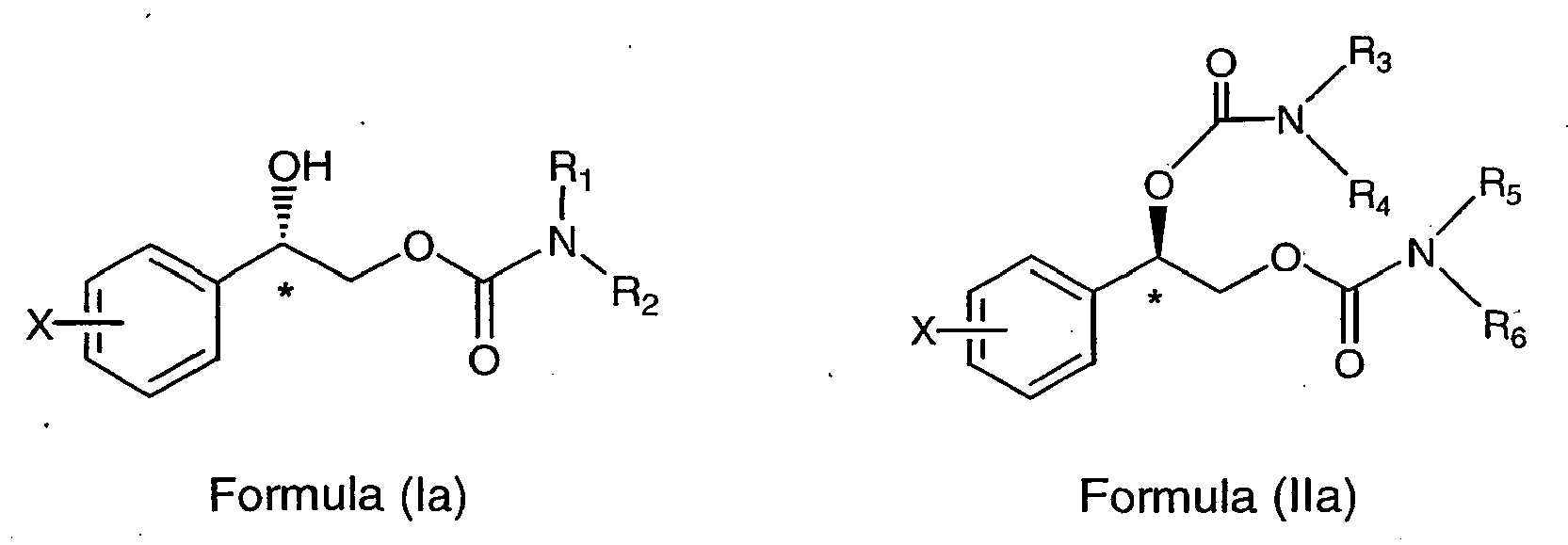
- phenyl is substituted at X. with one to five halogen atoms selected from the group consisting of fluorine, chlorine, bromine and iodine, and
- R1, R2, R3, R4, R5 and R6 are independently selected from the group consisting of hydrogen and C1-C4 alkyl, wherein C1-C4 alkyl is optionally substituted with phenyl (and, wherein phenyl is optionally substituted with substituents independently selected from the group consisting of halogen, C1-C4 alkyl, C1-C4 alkoxy, amino, nitro and cyano).
- Examples of the present method include the use of an enantiomer selected from Formula (Ia) or Formula (IIa) or an enantiomeric mixture thereof wherein one enantiomer predominates, wherein X is chlorine and, wherein X is substituted at the ortho position of the phenyl ring.
- The present method also includes the use of an enantiomer selected from Formula (Ia) or Formula (IIa) or enantiomeric mixture thereof wherein one enantiomer predominates and, wherein R1, R2, R3, R4, R5 and R6 are hydrogen.
- For enantiomeric mixtures wherein one enantiomer selected from Formula (Ia) or Formula (IIa) predominates, said enantiomer predominates to the extent of about 90% or greater. Enantiomeric mixtures within the scope of the present invention include those wherein said enantiomer predominates to the extent of about 98% or greater.
- The present invention describes a method for preventing, treating or ameliorating substance related disorders in a subject in need thereof comprising administering to the subject an effective amount of an enantiomer selected from Formula (Ib) or Formula (IIb) or an enantiomeric mixture of Formula (Ib) or Formula (IIb) wherein one enantiomer predominates:

- For enantiomeric mixtures wherein one enantiomer selected from Formula (Ib) or Formula (IIb) predominates, said enantiomer predominates to the extent of about 90% or greater. Enantiomeric mixtures within the scope of the present invention include those wherein said enantiomer predominates to the extent of about 98% or greater.
- The present invention is directed to compounds of Formula (I) or Formula (II) or pharmaceutically acceptable crystalline or polymorphic forms thereof.
- The term "isomer" refers to compounds that have the same composition and molecular weight but differ in physical and/or chemical properties. Such substances have the same number and kind of atoms but differ in structure. The structural difference may be in constitution (geometric isomers) or in an ability to rotate the plane of polarized light (stereoisomers). The term "stereoisomer" refers to isomers of identical constitution that differ in the arrangement of their atoms in space. Enantiomers and diastereomers are stereoisomers wherein an asymmetrically substituted carbon atom acts as a chiral center. The term "chiral" refers to a molecule that is not superposable on its mirror image, implying the absence of an axis and a plane or center of symmetry.
- It is apparent to those skilled in the art that the compounds of the invention are present as racemates, enantiomers and enantiomeric mixtures thereof. A carbamate enantiomer selected from Formula (I), Formula (II), Formula (Ia), Formula (IIa), Formula (Ib) or Formula (IIb) contains an asymmetric chiral carbon atom at the benzylic position, which is the aliphatic carbon adjacent to the phenyl ring (represented by the asterisk in the structural formulae).
- The term "racemate" or "racemic mixture" refers to a compound of equimolar quantities of two enantiomeric species, wherein the compound is devoid of optical activity. The term "optical activity" refers to the degree to which a chiral molecule or nonracemic mixture of chiral molecules rotates the plane of polarized light.
- The term "enantiomer" refers to one of a pair of molecular species that are mirror images of each other and are not superposable. The term "diastereomer" refers to stereoisomers that are not related as mirror images. The symbols "R" and "S" represent the configuration of substituents around a chiral carbon atom(s). The symbols "R*" and "S*" denote the relative configurations of of substituents around a chiral carbon atom(s)..
- The isomeric descriptors "R," "S," "S*" or "R*" are used as described herein for indicating atom configuration(s) relative to a core molecule and are intended to be used as defined in the literature (IUPAC Recommendations for Fundamental Stereochemistry (Section E), Pure Appl. Chem., 1976, 45:13-30)(incorporated by reference herein).
- Compounds of the present invention may be prepared as described in Bossinger '728, Bossinger '692 and Choi '759 . It is understood that substituents and substitution patterns on the compounds of this invention can be selected by one of ordinary skill in the art to provide compounds that are chemically stable and that can be readily synthesized by techniques known in the art as well as those methods set forth herein.
- The present invention provides a method for preventing, treating or ameliorating substance dependence in a subject in need thereof comprising administering to the subject an effective amount of a compound selected from Formula (I) or Formula (II).
- The present invention also provides a method for use of a compound of Formula (I) or Formula (II) in preventing, treating or ameliorating substance induced disorders.
- The method of the present invention includes the use of said compound for modulating the effect of substance dependence associated diseases and disorders and symptoms thereof or the effect of physiologic events associated with such diseases and disorders.
- The methods of the present invention further include the use of said compound, wherein said compound is an enantiomer of a compound selected from Formula (I) or Formula (II); or, wherein said compound is an enantiomer selected from Formula (Ia), Formula (IIa), Formula (Ib) or Formula (IIb); or, wherein said compound is an enantiomer of a compound selected from Formula (I) or Formula (II) in an enantiomeric mixture wherein said enantiomer predominates; or, wherein said compound is an enantiomer selected from Formula (Ia), Formula (IIa), Formula (Ib) or Formula (IIb) in an enantiomeric mixture wherein said enantiomer predominates.
- The present methods also include the use of a pharmaceutical composition comprising a pharmaceutically acceptable carrier and a compound selected from Formula (I) or Formula (II) for preventing, treating or ameliorating substance related disorders including diseases and disorders resulting from the use of addictive drugs or for modulating the effect of addiction associated diseases and disorders and symptoms thereof or the effect of physiologic events associated with such diseases and disorders in a subject in need thereof in a subject in need thereof.
- These methods include the use of a compound selected from Formula (I) or Formula (II) for the preparation of a medicament for preventing, treating or ameliorating substance related disorders including diseases and disorders resulting from the use of addictive drugs or for modulating the effect of addiction associated diseases and disorders and symptoms thereof or the effect of physiologic events associated with such diseases and disorders in a subject in need thereof.
- In cases where compounds are sufficiently basic or acidic to form stable nontoxic acid or base salts, administration of the compounds as salts may be appropriate. Examples of pharmaceutically acceptable salts are organic acid addition salts formed with acids which form a physiological acceptable anion, for example, tosylate, methanesulfonate, acetate, citrate, malonate, tartarate, succinate, benzoate, ascorbate, alpha-ketoglutarate and alpha-glycerophosphate. Suitable inorganic salts may also be formed, including hydrochloride, sulfate, nitrate bicarbonate and carbonate salts.
- Pharmaceutically acceptable salts may be obtained using standard procedures well known in the art, for example by reacting a sufficiently basic compound such as an amine with a suitable acid affording a physiologically acceptable anion. Alkali metal, for example; sodium, potassium or lithium, or alkaline earth metals, for example calcium salts of carboxylic acids can also be made.
- The method of the present invention is also directed to a method for preventing, treating or ameliorating substance related disorders including drug addiction, diseases and disorders resulting from the use of addictive drugs or for modulating the effect of addiction associated diseases and disorders and symptoms thereof or the effect of physiologic events associated with such diseases and disorders in a subject in need thereof comprising administering to the subject an effective amount of a compound of Formula (I) or Formula (II), a pharmaceutical composition thereof, a pharmaceutical composition containing one or more of said compounds or a pharmaceutical composition containing one or more of said compounds and a safe and effective amount of one or more additional agents.
- The term "substance dependence" also referred to as "drug addiction" refers to physical and/or psychological addiction to opiates (such as heroin, opium, morphine and the like), sympathomimetics (such as cocaine, amphetamines, methamphetamines and the like), sedative-hypnotics (such as ethanol, benzodiazepines, barbiturates, phencyclidines and the like), those with a combination of effects (such as nicotine and the like) and the like or mixtures thereof.
- The phrases "substance related disorders" also referred to as "diseases and disorders resulting from the use of addictive drugs" and "addiction associated diseases and disorders and symptoms thereof" and "physiologic events associated with such diseases and disorders" refer to drug withdrawal disorders such as alcohol withdrawal (with or without perceptual disturbances and/or delirium), amphetamine withdrawal, cocaine withdrawal, nicotine withdrawal, opioid withdrawal, sedative withdrawal, hypnotic withdrawal, anxiolytic withdrawal (with or without perceptual disturbances and/or delirium), nicotine withdrawal (with or without disturbances associated with smoking cessation) and withdrawal symptoms due to other substances, substance-induced anxiety disorder with onset during withdrawal; vulnerability even after long periods of absence to environmental trigger induced craving; substance-induced mood disorder with onset during withdrawal; and substance-induced sleep disorder with onset during withdrawal and other substance-induced disorders, including but not limited to; acute intoxication and withdrawal, and substance-induced mental disorders such as; delirium, persisting dementia, persisting amnestic disorder, psychotic disorder, mood disorder, anxiety disorder, sexual dysfunction and sleep disorder.
- The term "preventing, treating or ameliorating" refers to (i) preventing a disease, disorder or condition from occurring in an animal which may be predisposed to the disease or disorder and/or effects thereof but has not yet been diagnosed as having it; (ii) inhibiting or arresting the development of the disease, disorder or condition and (iii) relieving or causing regression of the disease, disorder or condition.
- In relation to substance-related disorders , the term "preventing, treating or ameliorating" also refers to suppressing the psychological addiction or physical tolerance to the drug of abuse, and relieving or preventing a withdrawal syndrome resulting from the drug dependence.
- The term "administering" refers to a means for preventing, treating or ameliorating substance dependence, preventing, treating or ameliorating diseases and disorders resulting from the use of addictive drugs or modulating the effect of addiction associated diseases and disorders and symptoms thereof or the effect of physiologic events associated with such diseases and disorders with an instant compound. Such means include therapeutically or prophylactically administering an effective amount of a compound, composition or medicament of the present invention at different times during the course of a therapy or concurrently in a combination form. Prophylactic administration can occur prior to the manifestation of symptoms characteristic of drug addiction such that diseases and disorders resulting from the use of addictive drugs or the effect of addiction associated diseases and disorders and symptoms thereof or the effect of physiologic events associated with such diseases and disorders is prevented, treated, ameliorated or, alternatively, delayed in its progression. The methods of the present invention are further to be understood as embracing all possible therapeutic or prophylatic treatment regimens to be imagined by those skilled in the art.
- The term "subject" refers to an animal, preferably a mammal, most preferably a human, who has been the object of treatment, observation or experiment.
- The term "effective amount" refers to that amount of active compound or pharmaceutical agent that elicits the biological or medicinal response in a tissue system, animal or human, that is being sough by a researcher, veterinarian, medical doctor, or other clinician, which includes therapeutic alleviation of the symptoms of the disease or disorder being treated and prophylactic.
- The effective amount of a compound selected from Formula (I) or Formula (II) or pharmaceutical composition thereof may be from about 0.01 µg/Kg/dose to about 300 mg/Kg/dose. Effective amounts may also be from about 0.01 µg/Kg/dose to about 100 mg/Kg/dose. An effective amount also contemplated may be from about 0.05 µg/Kg/dose to about 10 mg/Kg/dose. Another effective amount includes from about 0.1 µg/Kg/dose to about 5 mg/Kg/dose. Therefore, the effective amount of the active ingredient contained per dosage unit (e.g., tablet, capsule, powder, injection, suppository, teaspoonful and the like) as described herein may be in a range of from about 700 ng/dose to about 21 g/dose for a subject having a weight of about 70 Kg.
- The term "composition" refers to a product containing a compound of the present invention (such as a product comprising the specified ingredients in the specified amounts, as well as any product which results, directly or indirectly, from such combinations of the specified ingredients in the specified amounts).
- The term "medicament" refers to a product for use in preventing, treating or ameliorating substance related disorders such as substance dependence, substance abuse or substance induced disorders in a subject in need thereof.
- The term "pharmaceutically acceptable" refers to molecular entities and compositions that are of sufficient purity and quality for use in the formulation of a composition or medicament of the present invention. Since both human use (clinical and over-the-counter) and veterinary use are equally included within the scope of the present invention, a formulation would include a composition or medicament for either human or veterinary use.
- The term "pharmaceutically acceptable salt thereof" refers to an acid or basic salt of the compounds of the invention that are of sufficient purity and quality for use in the formulation of a composition or medicament of the present invention and are tolerated and sufficiently non toxic to be used in a pharmaceutical preparation.
- A compound selected from Formula (I) or Formula (II) or pharmaceutical composition thereof or a pharmaceutically acceptable salt thereof may be administered by any conventional route of administration including, but not limited to oral, pulmonary, intraperitoneal, intravenous, intramuscular, subcutaneous, transdermal, buccal, nasal, sublingual, ocular, rectal and vaginal. In addition, administration directly to the nervous system includes, and is not limited by present technology to, intracerebral, intraventricular, intracerebroventricular, intrathecal, intracisternal, intraspinal or peri-spinal delivery or by delivery via intracranial or intravertebral needles or catheters with or without pump devices.
- It will be readily apparent to those skilled in the art that any dose or frequency of administration that provides the therapeutic or prophylactic effect described herein is suitable for use in the present invention.
- Dosage regimens may be varied depending upon the requirement of the subjects (including factors associated with the particular subject being treated, including subject age, weight and diet, strength of the preparation, the advancement of the disease condition and the mode and time of administration) and the use of a particular compound of Formula (I) or Formula (II) or pharmaceutical composition thereof or a pharmaceutically acceptable salt thereof. Optimal dosages to be administered may be readily determined by those skilled in the art and will result in the need to adjust the dose to an appropriate therapeutic or prophylactic level. The use of either daily administration or post-periodic dosing may be employed.
- Preferably, a compound of Formula (I) or Formula (II) or pharmaceutical composition thereof or a pharmaceutically acceptable salt thereof for preventing, treating or ameliorating substance related disorders such as substance dependence, substance abuse or substance induced disorders in a subject in need thereof is administered orally or parenterally.
- In accordance with the methods of the present invention, a compound of Formula (I) or Formula (II) or pharmaceutical composition thereof described herein or a pharmaceutically acceptable salt thereof may be administered separately, at different times during the course of therapy or concurrently in divided combination or single combination forms. Advantageously, a compound selected from Formula (I) or Formula (II) or pharmaceutical compositions thereof may be administered in a single daily dose or the total daily dosage may be administered via continuous delivery or in divided doses of two, three or four times daily. The instant invention is therefore to be understood as embracing all such methods and regimes of continuous, simultaneous or alternating treatment and the term "administering" is to be interpreted accordingly.
- To prepare a pharmaceutical composition of the present invention, a compound of Formula (I) or Formula (II) as the active ingredient or a pharmaceutically acceptable salt thereof is intimately admixed with a pharmaceutical carrier according to conventional pharmaceutical compounding techniques, which carrier may take a wide variety of forms depending of the form of preparation desired for administration (e.g. oral or parenteral).
- Suitable pharmaceutically acceptable carriers are well known in the art. Descriptions of various pharmaceutically acceptable carriers may be found in The Handbook of Pharmaceutical Excipients, published by the American Pharmaceutical Association and the Pharmaceutical Society of Great Britain.
- Methods of formulating pharmaceutical compositions have been described in numerous publications such as Pharmaceutical Dosage Forms: Tablets, Second Edition, Revised and Expanded, Volumes 1-3, edited by Lieberman et al; Pharmaceutical Dosage Forms: Parenteral Medications, Volumes 1-2, edited by Avis et al; and Pharmaceutical Dosage Forms: Disperse Systems, Volumes 1-2, edited by Lieberman et al; published by Marcel Dekker, Inc.
- Preferably, a pharmaceutical composition is in a unit dosage form such as a tablet, pill, capsule, caplet, gelcap, lozenge, granule, powder, sterile parenteral solution or suspension, metered aerosol or liquid spray, drop, ampoule, autoinjector device or suppository for administration by oral, intranasal, sublingual, intraocular, transdermal, parenteral, rectal, vaginal, inhalation or insufflation means. Alternatively, the composition may be presented in a form suitable for once-weekly or once-monthly administration or may be adapted to provide a preparation for intramuscular injection.
- In preparing a pharmaceutical composition having a solid dosage form for oral administration, such as a tablet, pill, capsule, caplet, gelcap, lozenge, granule or powder (each including immediate release, timed release and sustained release formulations), suitable carriers and additives include but are not limited to diluents, granulating agents, lubricants, binders, glidants, disintegrating agents and the like. If desired, tablets may be sugar coated, gelatin coated, film coated or enteric coated by standard techniques.
- For preparing a solid dosage form, the principal active ingredient is mixed with a pharmaceutical carrier (e.g. conventional tableting ingredients such as diluents, binders, adhesives, disintegrants, lubricants, antiadherents and glidants). Sweeteners and flavorants may be added to chewable solid dosage forms to improve the palatability of the oral dosage form. Additionally, colorants and coatings may be added or applied to the solid dosage form for ease of identification of the drug or for aesthetic purposes. These carriers are formulated with the pharmaceutical active to provide an accurate, appropriate dose of the pharmaceutical active with a therapeutic release profile.
- In preparing a pharmaceutical composition having a liquid dosage form for oral, topical and parenteral administration, any of the usual pharmaceutical media or excipients may be employed. Thus, for liquid unit dosage forms, such as suspensions (i.e. colloids, emulsions and dispersions) and solutions, suitable carriers and additives include but are not limited to pharmaceutically acceptable wetting agents, dispersants, flocculation agents, thickeners, pH control agents (i.e. buffers), osmotic agents, coloring agents, flavors, fragrances, preservatives (i.e. to control microbial growth, etc.) and a liquid vehicle may be employed. Not all of the components listed above will be required for each liquid dosage form. The liquid forms in which the novel compositions of the present invention may be incorporated for administration orally or by injection include, but are not limited to aqueous solutions, suitably flavored syrups, aqueous or oil suspensions, and flavored emulsions with edible oils such as cottonseed oil, sesame oil, coconut oil or peanut oil, as well as elixirs and similar pharmaceutical vehicles.
- The activities of a compound of the present invention for use in preventing, treating or ameliorating substance related disorders, diseases and disorders resulting from the use of addictive drugs or for modulating the effect of addiction associated diseases and disorders and symptoms thereof or the effect of physiologic events associated with such diseases and disorders were evaluated in the following experimental example which is intended to be a way of illustrating but not limiting the invention.
- A compound of the present invention was tested in ethanol preferring rats, a model for acute and chronic drug addiction in humans using an adaptation of a published method (See, Rezvani, AH et al. Alcohol & Alcoholism, Vol. 25, No. 5, pp. 573-575, 1990, Rezvani AH, et al., Alcohol and Alcoholism (Oxford), 2000, 35(1), 76-83).
- An enantiomer of Formula (Ib) was orally administered in a dose range of from about 10 to about 90 mg/kg in test and control treatment groups of 10 rats per group over a period of 14 days. Test conditions reflected approaches for evaluating patterns of drinking (e.g., single or multiple events).
- Adult male selectively-bred alcohol preferring (P) rats were used. The selectively-bred alcohol-preferring (P) rats have been characterized and have been widely used to study the effects of different compounds on voluntary alcohol intake (Rezvani et al, 1990, 1991, 1992a, 1992b, 1999, 2000, 2002; 2003; Murphy et al, 1988; Overstreet et al., 1992, 1999; Li and McBride, 1995).
- Rats were housed individually in wire mesh cages under a constant room temperature of 22 +1 oC and 12:12 light-dark cycle (8:00-20:00, dark). Animal were fed Agway Prolab Rat/Mouse/ Hamster 3000 formula and water ad libitum.
- Establishment of baseline alcohol intake: Alcohol intake was determined using a standard two-bottle choice method (as described in Murphy et al. 1988; McBride et al. 1990; Rezvani et al. 1990, 1991, 1993, 1995, 1997, Rezvani and Grady, 1994).
- Animals were first given free access to water in a graduated Richter tube for 1 day. After the first day, the animals were given access to only a solution of 10% (v/v) ethanol for 3 consecutive days. During this period animals became accustomed to drinking from Richter tubes and to the taste and pharmacological effects of alcohol. Thereafter, they were given free access to both water and a solution of 10% alcohol for at least 3 consecutive weeks and throughout of the period of study. The rats had free access to food. Water and alcohol intake was recorded at 6 and 24 hour after the treatment, food intake was measured at 24 hour. Animal body weight was measured every day.
- After establishment of a stable baseline for alcohol, food, and water intake, rats were daily administered (via gavage tube) at the same time each day with either vehicle or one of the three doses (10, 30 and 90 mg/kg) of the compound using a random treatment order. The interval between treatment administration was at least 3 days. Alcohol and water intake was recorded 6 and 24 h after treatment administration and food intake was recorded at 24 hr. A total of 8-10 animals per group were used. All animals completed the acute administration study phase.
- The effect of chronic administration of a test compound on alcohol intake and tolerance to the anti-craving effects of the test compound was tested in naïve rats treated (via gavage tube) once a day either vehicle or test compound. A test compound dose of 45 mg/Kg was selected as an effective dose for chronic administration based on the results of the acute administration study phase. Themost effective dose was then used for the chronic adminstiration phase and administered for 14 consecutive days. Alcohol and water intake was recorded 6 and 24 h after each treatment administration and food intake was recorded at 24 hr.
- The results were presented as means ±SEM (Standard Error of the Means). Alcohol intake (g/kg) was calculated by multiplying the volume of alcohol consumed in mL by 10% and 0.7893 (a factor representing ethanol density)/body weight in kg. Alcohol preference, expressed as percentage, was calculated as follows (volume of alcohol consumed (mL)/total fluid intake (mL)) x 100 (as described in Rezvani and Grady,. 1994; Rezvani et al., 1997). Statistical differences between treatment and control groups were determined by using ANOVA and Turkey Student's t test for multiple comparisons.
- Table 1 provides data for the treatment groups demonstrating the effect of the test compound on acute ethanol and water intake. At a dose of about 45 mg/kg and up, the test compound had a significant effect on alcohol intake without developing a tolerance for the test compound's affect on ethanol intake.
Table 1 Day Alcohol Intake (g/Kg) Water Intake (g/Kg) Alcohol Pref (%) Total Fluid Intake (mL/Kg) Body Weight (g) Veh Drug Veh Drug Veh Drug Veh Drug Veh Drug BL 5.30 5.30 30 30 71 71 97 97 384 384 1 3.70 1.61 36 62 58 28 82 82 412 418 2 4.00 1.31 31 60 64 24 82 76 414 415 3 4.70 1.37 19 60 76 24 78 77 417 413 4 4.80 1.03 27 68 71 16 88 81 418 415 5 5.20 1.24 27 68 72 21 94 83 421 419 6 5.30 1.10 20 61 78 21 87 75 425 421 7 5.30 1.85 21 48 77 34 89 71 428 424 8 5.60 2.21 20 52 79 35 91 80 432 426 9 5.40 2.19 18 40 81 45 86 67 436 429 10 6.00 3.06 17 44 83 52 93 83 437 431 11 5.40 2.93 16 30 82 57 86 67 440 435 12 4.20 2.67 20 27 73 58 73 60 442 436 13 4.40 2.37 31 48 65 42 87 78 439 431 14 4.40 2.32 46 54 59 40 102 83 448 437 -
- 1. Cowen M.S., Rezvani A.H., Jarrett B., and Lawrence A.J. Ethanol consumption by Fawn-Hooded rats following abstinence: Effects of naltrexone and changes in u-upload receptors density. Alcohol: Clint. Exp. Res. 23:1008-1014, 1999.
- 2. Fare C.K., Rezvani A.H., Overstreet D.H., and O'Malley S. Combination pharmacotherapy in alcoholism: A novel treatment approach. CNS Spectrums 5:70-76, 2000.
- 3. Johnson B.A., Ait-daoud N., Bowden C.L., DiClemente, Roche J.D., Lawson K. Oral topiramate for treatment of alcohol dependence: a randomized controlled trial. The Lancet 361:1677-1685, 2003.
- 4. Li T.K., McBride W.J. Pharmacogenetic models of alcoholism. Alcoholism: Clin. Exp. Res. 3: 182-185, 1995.
- 5. McBride W.J., Murphy J.M, Lumeng L. and Li T.K. Serotonin, dopamine and GABA involvement in alcohol drinking of selectively bred rats. Alcohol 7: 199-205, 1990.
- 6. Murphy J.M., McBride W.J. Lumeng L. and Li T.K. Effects of serotonin and dopamine agents on ethanol intake of alcohol-preferring P rats. Alcoholism: Clin. Exp. Res. 12: 306, 1988.
- 7. Overstreet D.H. Kampov-Polevoy A.B. Rezvani A.H. Braun C. Bartus R.T. and Crews FT. Suppression of alcohol intake by chronic naloxone treatment in P rats: tolerance development and elevation of opiate receptor binding. Alcohol: Clin. Exp. Res. 23: 1761-1771, 1999.
- 8. Overstreet, D.H:, Rezvani, A.H., Janowsky, D.S. Genetic animal models of depression and ethanol preference provide support for cholinergic and serotonergic involvement in depression and alcoholism. Biol. Psychiat 31:919-936, 1992.
- 9. Overstreet D,H, Keung W.M., Rezvani A.H., Massi M., Lee D.Y. Herbal remedies for alcoholism: Promises and possible pitfalls. Alcol. Clin. Exp. Res. 27:177-185, 2003.
- 10. Rezvani, A.H., D.H. Overstreet and D.S. Janowsky. Genetic serotonin deficiency and alcohol preference in the fawn hooded rats. Alcohol and Alcoholism, 25:573-575, 1990.
- 11. Rezvani, A.H., D.H. Overstreet and D.S. Janowsky. Drug-induced reductions in ethanol intake in alcohol preferring and Fawn-Hooded rats. Alcohol and Alcoholism, Suppl. 1:433-437, 1991.
- 12. Rezvani, A.H., Garbutt, J.C., Shimoda, K., Garges, P.L., Janowsky, D.S., Mason, G.A. Attenuation of alcohol preference in alcohol preferring rats by a novel TRH analogue TA-0910. Alcoholism Clin Exp Res 16:326-330, 1992a.
- 13. Rezvani, A.H., Garges, P.L., Miller, D. and Christopher J. Gordon. Attenuation of alcohol consumption by MDMA in two strains of alcohol drinking rats. Pharmacol Biochem Behav 43:103-107, 1992b.
- 14. Rezvani, A.H., Grady, D.R. and Olgierd Pucilowski. Nimodipine, a Ca2+ channel antagonist, attenuates alcohol preference in alcohol preferring rats. Drugs in Development 2:143-151, 1993.
- 15. Rezvani, A.H. and Grady, D.R. Suppression of alcohol consumption by fenfluramine in Fawn-Hooded rats with serotonin dysfunction. Pharmacol Biochem Behav 48:105-110, 1994.
- 16. Rezvani, A.H., Peek, A.E., Grady, D.R. and O. Pucilowski. Inhibition of nitric oxide (NO) synthesis attenuated alcohol consumption in two strains of alcohol preferring rats. Pharmacol Biochem Behav 50:265-270, 1995.
- 17. Rezvani A.H., Overstreet D.H., Ying Y. and Clark Jr. E. Attenuation of alcohol intake by the extract of hypericum perforatum (St. John's Wort) in two strains of alcohol preferring rats. Alcohol & . Alcoholism 34:699-705, 1999.
- 18. Rezvani A.H. Overstreet D.H., Mason G.A., Janowsky D.S., Hamedi M., Clark Jr. and Ying Y. Combination pharmacotherapy: A mixture of small doses of naltrexone, fluoxetine, and a TRH analog reduces alcohol intake in three strains of alcohol preferring rats. Alcohol & Alcoholism: 35:76-83, 2000.
- 19. Rezvani A.H., Overstreet D.H., Perfumi M, Massi M. Plant derivatives in the treatment of alcohol dependency. Pharmacol. Biochem. Behav. 75:593-606, 2003.
Claims (24)
- A carbamate compound or enantiomer selected from:
 phenyl is substituted at X with one to five halogen atoms selected from the group consisting of fluorine, chlorine, bromine and iodine; and,R1, R2, R3, R4, R5 and R6 are independently selected from the group consisting of hydrogen and C1-C4 alkyl; wherein C1-C4 alkyl is optionally substituted with phenyl and, wherein phenyl is optionally substituted with substituents independently selected from the group consisting of halogen, C1-C4 alkyl, C1-C4 alkoxy, amino, nitro and cyano.
 - The enantiomer of claim 1, wherein the enantiomer selected from Formula (I) or Formula (II) is an enantiomer selected from Formula (Ia) or Formula (IIa) or an enantiomer selected from Formula (Ia) or Formula (IIa) in an enantiomeric mixture wherein one enantiomer predominates:
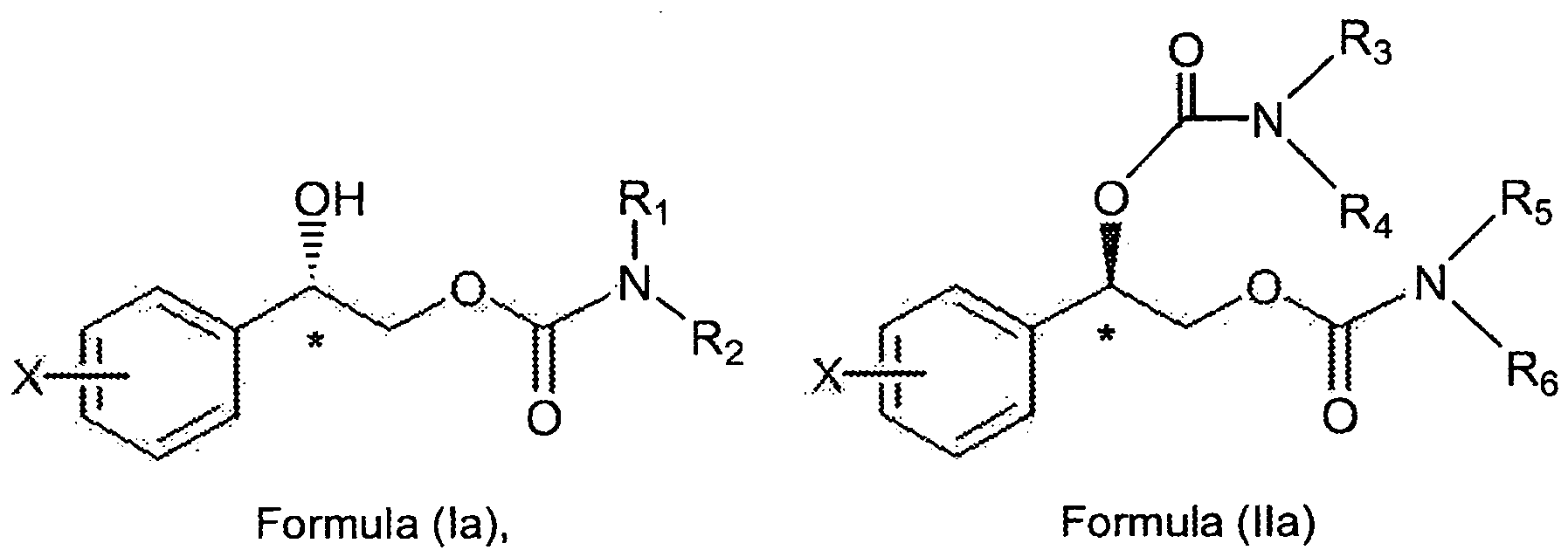 phenyl is substituted at X with one to five halogen atoms selected from the group consisting of fluorine, chlorine, bromine and iodine; and,R1, R2, R3, R4, R5 and R6 are independently selected from the group consisting of hydrogen and C1-C4 alkyl; wherein C1-C4 alkyl is optionally substituted with phenyl (and, wherein phenyl is optionally substituted with substituents independently selected from the group consisting of halogen, C1-C4 alkyl, C1-C4 alkoxy, amino, nitro and cyano).
 - The carbamate compound of claim 1 or the enantiomer of claim 1 or 2, wherein X is chlorine.
- The carbamate compound of claim 1 or the enantiomer of claim 1 or 2, wherein X is substituted at the ortho position of the phenyl ring.
- The carbamate compound of claim 1 or the enantiomer of claim 1 or 2, wherein R1, R2, R3, R4, R5 and R6 are hydrogen.
- The carbamate compound of claim 1, wherein the compound of Formula (I) is selected from an enantiomer of Formula (I), or an enantiomer of Formula (I) in an enantiomeric mixture wherein one enantiomer predominates.
- The carbamate compound of claim 6, or the enantiomer of claim 1, wherein the enantiomer of Formula (I) in an enantiomeric mixture predominates to the extent of about 90% or greater.
- The carbamate compound or enantiomer of claim 7, wherein the enantiomer of Formula (I) in an enantiomeric mixture predominates to the extent of about 98% or greater.
- The carbamate compound of claim 1 wherein the compound of Formula (II) is selected from an enantiomer of Formula (II), or an enantiomer of Formula (II) in an enantiomeric mixture wherein one enantiomer predominates.
- The carbamate compound of claim 9 or the enantiomer of claim 1, wherein the enantiomer of Formula (II) in an enantiomeric mixture predominates to the extent of about 90% or greater.
- The carbamate compound or enantiomer of claim 10, wherein the enantiomer of Formula (II) in an enantiomeric mixture predominates to the extent of about 98% or greater.
- The enantiomer of claim 1, wherein the enantiomer selected from Formula (I) or Formula (II) is an enantiomer selected from Formula (Ib) or Formula (IIb) or an enantiomer selected from Formula (Ib) or Formula (IIb) in an enantiomeric mixture wherein one enantiomer predominates:

- The carbamate compound of claim 1 or the enantiomer of any of claims 1, 2 and 12, wherein the carbamate compound or enantiomer further comprises co-administrating a combination product, wherein the combination product is selected from a compound of claim 1 or an enantiomer of any of claims 1, 2 and 12, or a pharmaceutical composition comprising a pharmaceutically acceptable carrier and a compound of claim 1 or an enantiomer of any of claims 1, 2 and 12 and one or more compounds known to treat substance-induced disorders.
- The carbamate compound or the enantiomer of claim 13, wherein the compound known to treat substance-induced disorders is one or more compounds selected from the group consisting of; naltrexone, naloxone or other opioid receptor antagonists, fluoxetine or other SSRI antidepressants, thyrotropin-releasing hormone analogues, venlafaxine or other SNRI antidepressants, MAO Inhibitor antidepressants, tricyclic antidepressants, bupropion, lithium carbonate, anticonvulsants, acamprosate, disulfiram (antabuse), calcium channel blockers, serotonin antagonists, GABA-altering drugs, dopaminergic drugs, and N-methyl-D-aspartic acid (NMDA) glutamate receptor modulators.
- The carbamate compound or the enantiomer of claim 13, wherein the compound known to treat substance-induced disorders is one or more compounds selected from the group consisting of acamprosate, naltrexone, naloxone and disulfiram.
- The carbamate compound of claim 1 or the enantiomer of any of claims 1, 2 and 12, wherein said carbamate compound or enantiomer is administered in an amount of from 0.01 µg/Kg/dose to 300 mg/Kg/dose.
- The enantiomer of claim 2, wherein the enantiomer of Formula (Ia) in an enantiomeric mixture predominates to the extent of about 90% or greater.
- The enantiomer of claim 17, wherein the enantiomer of Formula (Ia) in an enantiomeric mixture predominates to the extent of about 98% or greater.
- The enantiomer of claim 2, wherein the enantiomer of Formula (IIa) in an enantiomeric mixture predominates to the extent of about 90% or greater.
- The enantiomer of claim 19, wherein the enantiomer of Formula (IIa) in an enantiomeric mixture predominates to the extent of about 98% or greater.
- The enantiomer of claim 12, wherein the enantiomer of Formula (Ib) in an enantiomeric mixture predominates to the extent of about 90% or greater.
- The enantiomer of claim 21, wherein the enantiomer of Formula (Ib) in an enantiomeric mixture predominates to the extent of about 98% or greater.
- The enantiomer of claim 12, wherein the enantiomer of Formula (IIb) in an enantiomeric mixture predominates to the extent of about 90% or greater.
- The enantiomer of claim 23, wherein the enantiomer of Formula (IIb) in an enantiomeric mixture predominates to the extent of about 98% or greater.
Applications Claiming Priority (1)
| Application Number | Priority Date | Filing Date | Title |
|---|---|---|---|
| PCT/US2005/026439 WO2007018496A1 (en) | 2005-07-26 | 2005-07-26 | Methods for treating substance-related disorders |
Publications (2)
| Publication Number | Publication Date |
|---|---|
| EP1928451A1 EP1928451A1 (en) | 2008-06-11 |
| EP1928451B1 true EP1928451B1 (en) | 2011-12-28 |
Family
ID=35064669
Family Applications (1)
| Application Number | Title | Priority Date | Filing Date |
|---|---|---|---|
| EP05775692A Expired - Lifetime EP1928451B1 (en) | 2005-07-26 | 2005-07-26 | Methods for treating substance-related disorders |
Country Status (13)
| Country | Link |
|---|---|
| EP (1) | EP1928451B1 (en) |
| JP (1) | JP5094720B2 (en) |
| KR (1) | KR101199499B1 (en) |
| CN (1) | CN101272776B (en) |
| AT (1) | ATE538784T1 (en) |
| AU (1) | AU2005335241B9 (en) |
| BR (1) | BRPI0520451A2 (en) |
| CA (1) | CA2616721C (en) |
| EA (1) | EA019935B1 (en) |
| ES (1) | ES2385087T3 (en) |
| IL (1) | IL189003A0 (en) |
| NO (1) | NO20080877L (en) |
| WO (1) | WO2007018496A1 (en) |
Families Citing this family (13)
| Publication number | Priority date | Publication date | Assignee | Title |
|---|---|---|---|---|
| AU2006254899B2 (en) | 2005-06-08 | 2011-11-24 | Sk Biopharmaceuticals Co., Ltd. | Treatment of sleep-wake disorders |
| RU2567801C2 (en) | 2009-06-22 | 2015-11-10 | Ск Биофармасъютиклс Ко., Лтд. | Methods for treating and preventing fatigue |
| US8232315B2 (en) * | 2009-06-26 | 2012-07-31 | Sk Biopharmaceuticals Co., Ltd. | Methods for treating drug addiction and improving addiction-related behavior |
| WO2011055944A2 (en) | 2009-11-06 | 2011-05-12 | Sk Holdings Co., Ltd. | Methods for treating fibromyalgia syndrome |
| KR101783632B1 (en) | 2009-11-06 | 2017-10-10 | 에스케이바이오팜 주식회사 | Methods for treating Attention-Deficit/Hyperactivity Disorder |
| US9610274B2 (en) | 2010-06-30 | 2017-04-04 | Sk Biopharmaceuticals Co., Ltd. | Methods for treating bipolar disorder |
| US8609849B1 (en) | 2010-11-30 | 2013-12-17 | Fox Chase Chemical Diversity Center, Inc. | Hydroxylated sulfamides exhibiting neuroprotective action and their method of use |
| US9359290B2 (en) | 2013-03-13 | 2016-06-07 | Jazz Pharmaceuticals International Iii Limited | Treatment of cataplexy |
| PL3021838T3 (en) | 2013-07-18 | 2021-03-08 | Jazz Pharmaceuticals Ireland Limited | Treatment for obesity |
| US10195151B2 (en) | 2016-09-06 | 2019-02-05 | Jazz Pharmaceuticals International Iii Limited | Formulations of (R)-2-amino-3-phenylpropyl carbamate |
| EP3630072A4 (en) | 2017-06-02 | 2021-03-10 | Jazz Pharmaceuticals Ireland Limited | METHODS AND COMPOSITIONS FOR THE TREATMENT OF EXCESSIVE DROWSINESS |
| WO2020262317A1 (en) * | 2019-06-27 | 2020-12-30 | Numan Labo合同会社 | Drug for treating and preventing dementia |
| US10940133B1 (en) | 2020-03-19 | 2021-03-09 | Jazz Pharmaceuticals Ireland Limited | Methods of providing solriamfetol therapy to subjects with impaired renal function |
Family Cites Families (6)
| Publication number | Priority date | Publication date | Assignee | Title |
|---|---|---|---|---|
| US3313692A (en) * | 1958-04-21 | 1967-04-11 | Armour Pharma | Method of inducing calming and muscle relaxation with carbamates |
| HUP0303261A3 (en) * | 2001-02-27 | 2012-07-30 | Ortho Mcneil Pharm Inc | Carbamate compounds for use in preventing or treating bipolar disorder |
| IL157591A0 (en) * | 2001-02-27 | 2004-03-28 | Ortho Mcneil Pharm Inc | Carbamate compounds for use in preventing or treating neurodegenerative disorders |
| DE60216457T2 (en) * | 2001-02-27 | 2007-09-20 | Ortho-Mcneil Pharmaceutical, Inc. | CARBAMATE COMPOUNDS FOR THE TREATMENT OR PREPARATION OF PSYCHOTIC DISEASES |
| DE60221670T2 (en) * | 2001-02-27 | 2008-04-30 | Ortho-Mcneil Pharmaceutical, Inc. | CARBAMATE COMPOUNDS FOR PREVENTING AND TREATING MOTION FLUCTUATIONS |
| US20070021500A1 (en) * | 2005-07-12 | 2007-01-25 | Twyman Roy E | Methods for neuroprotection |
-
2005
- 2005-07-26 CA CA2616721A patent/CA2616721C/en not_active Expired - Lifetime
- 2005-07-26 CN CN200580051664XA patent/CN101272776B/en not_active Expired - Fee Related
- 2005-07-26 ES ES05775692T patent/ES2385087T3/en not_active Expired - Lifetime
- 2005-07-26 WO PCT/US2005/026439 patent/WO2007018496A1/en not_active Ceased
- 2005-07-26 AT AT05775692T patent/ATE538784T1/en active
- 2005-07-26 EP EP05775692A patent/EP1928451B1/en not_active Expired - Lifetime
- 2005-07-26 AU AU2005335241A patent/AU2005335241B9/en not_active Ceased
- 2005-07-26 BR BRPI0520451-8A patent/BRPI0520451A2/en not_active Application Discontinuation
- 2005-07-26 KR KR1020087004533A patent/KR101199499B1/en not_active Expired - Lifetime
- 2005-07-26 EA EA200800422A patent/EA019935B1/en not_active IP Right Cessation
- 2005-07-26 JP JP2008523847A patent/JP5094720B2/en not_active Expired - Fee Related
-
2008
- 2008-01-24 IL IL189003A patent/IL189003A0/en unknown
- 2008-02-19 NO NO20080877A patent/NO20080877L/en not_active Application Discontinuation
Also Published As
| Publication number | Publication date |
|---|---|
| IL189003A0 (en) | 2008-11-03 |
| ES2385087T3 (en) | 2012-07-18 |
| KR101199499B1 (en) | 2012-11-09 |
| JP2009502914A (en) | 2009-01-29 |
| NO20080877L (en) | 2008-02-19 |
| CA2616721A1 (en) | 2007-02-15 |
| EP1928451A1 (en) | 2008-06-11 |
| AU2005335241A1 (en) | 2007-02-15 |
| EA019935B1 (en) | 2014-07-30 |
| EA200800422A1 (en) | 2008-10-30 |
| CA2616721C (en) | 2014-01-21 |
| BRPI0520451A2 (en) | 2009-05-12 |
| ATE538784T1 (en) | 2012-01-15 |
| KR20080037055A (en) | 2008-04-29 |
| CN101272776A (en) | 2008-09-24 |
| CN101272776B (en) | 2012-10-03 |
| JP5094720B2 (en) | 2012-12-12 |
| AU2005335241B9 (en) | 2012-12-20 |
| WO2007018496A1 (en) | 2007-02-15 |
| AU2005335241B2 (en) | 2012-11-15 |
Similar Documents
| Publication | Publication Date | Title |
|---|---|---|
| EP3552604B1 (en) | Compositions for treating drug addiction and improving addiction-related behavior | |
| JP5901528B2 (en) | Treatment for fibromyalgia syndrome | |
| KR101783632B1 (en) | Methods for treating Attention-Deficit/Hyperactivity Disorder | |
| AU2005335241B2 (en) | Methods for treating substance-related disorders | |
| KR100858232B1 (en) | Pharmaceutical composition for preventing or treating a behavioral disorder comprising a carbamate compound | |
| JP2004533415A (en) | Carbamate compounds for use in the prevention or treatment of bipolar disorder | |
| NZ565188A (en) | The use of carbamate derivatives to treat drug withdrawal disorders | |
| EP1408954B1 (en) | Carbamate compounds for use in preventing or treating neuropathic pain | |
| AU2002322442B2 (en) | Carbamate compounds for use in preventing or treating neuropathic pain and cluster and migraine headache-associated pain | |
| HK1209058B (en) | Compositions for treating drug addiction and improving addiction-related behavior | |
| HK1176285B (en) | Compositions for treating drug addiction and improving addiction-related behavior | |
| HK1063435B (en) | Carbamate compounds for use in preventing or treating neuropathic pain |
Legal Events
| Date | Code | Title | Description |
|---|---|---|---|
| PUAI | Public reference made under article 153(3) epc to a published international application that has entered the european phase |
Free format text: ORIGINAL CODE: 0009012 |
|
| 17P | Request for examination filed |
Effective date: 20080226 |
|
| AK | Designated contracting states |
Kind code of ref document: A1 Designated state(s): AT BE BG CH CY CZ DE DK EE ES FI FR GB GR HU IE IS IT LI LT LU LV MC NL PL PT RO SE SI SK TR |
|
| AX | Request for extension of the european patent |
Extension state: AL BA HR MK YU |
|
| 17Q | First examination report despatched |
Effective date: 20080812 |
|
| GRAP | Despatch of communication of intention to grant a patent |
Free format text: ORIGINAL CODE: EPIDOSNIGR1 |
|
| RAP1 | Party data changed (applicant data changed or rights of an application transferred) |
Owner name: SK BIOPHARMACEUTICALS CO., LTD |
|
| GRAS | Grant fee paid |
Free format text: ORIGINAL CODE: EPIDOSNIGR3 |
|
| GRAA | (expected) grant |
Free format text: ORIGINAL CODE: 0009210 |
|
| AK | Designated contracting states |
Kind code of ref document: B1 Designated state(s): AT BE BG CH CY CZ DE DK EE ES FI FR GB GR HU IE IS IT LI LT LU LV MC NL PL PT RO SE SI SK TR |
|
| AX | Request for extension of the european patent |
Extension state: AL BA HR MK YU |
|
| REG | Reference to a national code |
Ref country code: GB Ref legal event code: FG4D |
|
| REG | Reference to a national code |
Ref country code: CH Ref legal event code: EP |
|
| REG | Reference to a national code |
Ref country code: AT Ref legal event code: REF Ref document number: 538784 Country of ref document: AT Kind code of ref document: T Effective date: 20120115 |
|
| REG | Reference to a national code |
Ref country code: IE Ref legal event code: FG4D |
|
| REG | Reference to a national code |
Ref country code: DE Ref legal event code: R096 Ref document number: 602005031904 Country of ref document: DE Effective date: 20120308 |
|
| REG | Reference to a national code |
Ref country code: NL Ref legal event code: VDEP Effective date: 20111228 |
|
| PG25 | Lapsed in a contracting state [announced via postgrant information from national office to epo] |
Ref country code: LT Free format text: LAPSE BECAUSE OF FAILURE TO SUBMIT A TRANSLATION OF THE DESCRIPTION OR TO PAY THE FEE WITHIN THE PRESCRIBED TIME-LIMIT Effective date: 20111228 |
|
| REG | Reference to a national code |
Ref country code: CH Ref legal event code: NV Representative=s name: E. BLUM & CO. AG PATENT- UND MARKENANWAELTE VSP |
|
| LTIE | Lt: invalidation of european patent or patent extension |
Effective date: 20111228 |
|
| PG25 | Lapsed in a contracting state [announced via postgrant information from national office to epo] |
Ref country code: GR Free format text: LAPSE BECAUSE OF FAILURE TO SUBMIT A TRANSLATION OF THE DESCRIPTION OR TO PAY THE FEE WITHIN THE PRESCRIBED TIME-LIMIT Effective date: 20120329 Ref country code: LV Free format text: LAPSE BECAUSE OF FAILURE TO SUBMIT A TRANSLATION OF THE DESCRIPTION OR TO PAY THE FEE WITHIN THE PRESCRIBED TIME-LIMIT Effective date: 20111228 Ref country code: SE Free format text: LAPSE BECAUSE OF FAILURE TO SUBMIT A TRANSLATION OF THE DESCRIPTION OR TO PAY THE FEE WITHIN THE PRESCRIBED TIME-LIMIT Effective date: 20111228 Ref country code: SI Free format text: LAPSE BECAUSE OF FAILURE TO SUBMIT A TRANSLATION OF THE DESCRIPTION OR TO PAY THE FEE WITHIN THE PRESCRIBED TIME-LIMIT Effective date: 20111228 |
|
| PG25 | Lapsed in a contracting state [announced via postgrant information from national office to epo] |
Ref country code: CY Free format text: LAPSE BECAUSE OF FAILURE TO SUBMIT A TRANSLATION OF THE DESCRIPTION OR TO PAY THE FEE WITHIN THE PRESCRIBED TIME-LIMIT Effective date: 20111228 |
|
| REG | Reference to a national code |
Ref country code: ES Ref legal event code: FG2A Ref document number: 2385087 Country of ref document: ES Kind code of ref document: T3 Effective date: 20120718 |
|
| PG25 | Lapsed in a contracting state [announced via postgrant information from national office to epo] |
Ref country code: SK Free format text: LAPSE BECAUSE OF FAILURE TO SUBMIT A TRANSLATION OF THE DESCRIPTION OR TO PAY THE FEE WITHIN THE PRESCRIBED TIME-LIMIT Effective date: 20111228 Ref country code: BG Free format text: LAPSE BECAUSE OF FAILURE TO SUBMIT A TRANSLATION OF THE DESCRIPTION OR TO PAY THE FEE WITHIN THE PRESCRIBED TIME-LIMIT Effective date: 20120328 Ref country code: EE Free format text: LAPSE BECAUSE OF FAILURE TO SUBMIT A TRANSLATION OF THE DESCRIPTION OR TO PAY THE FEE WITHIN THE PRESCRIBED TIME-LIMIT Effective date: 20111228 Ref country code: NL Free format text: LAPSE BECAUSE OF FAILURE TO SUBMIT A TRANSLATION OF THE DESCRIPTION OR TO PAY THE FEE WITHIN THE PRESCRIBED TIME-LIMIT Effective date: 20111228 Ref country code: IS Free format text: LAPSE BECAUSE OF FAILURE TO SUBMIT A TRANSLATION OF THE DESCRIPTION OR TO PAY THE FEE WITHIN THE PRESCRIBED TIME-LIMIT Effective date: 20120428 Ref country code: CZ Free format text: LAPSE BECAUSE OF FAILURE TO SUBMIT A TRANSLATION OF THE DESCRIPTION OR TO PAY THE FEE WITHIN THE PRESCRIBED TIME-LIMIT Effective date: 20111228 |
|
| PG25 | Lapsed in a contracting state [announced via postgrant information from national office to epo] |
Ref country code: PT Free format text: LAPSE BECAUSE OF FAILURE TO SUBMIT A TRANSLATION OF THE DESCRIPTION OR TO PAY THE FEE WITHIN THE PRESCRIBED TIME-LIMIT Effective date: 20120430 Ref country code: PL Free format text: LAPSE BECAUSE OF FAILURE TO SUBMIT A TRANSLATION OF THE DESCRIPTION OR TO PAY THE FEE WITHIN THE PRESCRIBED TIME-LIMIT Effective date: 20111228 Ref country code: RO Free format text: LAPSE BECAUSE OF FAILURE TO SUBMIT A TRANSLATION OF THE DESCRIPTION OR TO PAY THE FEE WITHIN THE PRESCRIBED TIME-LIMIT Effective date: 20111228 |
|
| REG | Reference to a national code |
Ref country code: AT Ref legal event code: MK05 Ref document number: 538784 Country of ref document: AT Kind code of ref document: T Effective date: 20111228 |
|
| PG25 | Lapsed in a contracting state [announced via postgrant information from national office to epo] |
Ref country code: DK Free format text: LAPSE BECAUSE OF FAILURE TO SUBMIT A TRANSLATION OF THE DESCRIPTION OR TO PAY THE FEE WITHIN THE PRESCRIBED TIME-LIMIT Effective date: 20111228 |
|
| PLBE | No opposition filed within time limit |
Free format text: ORIGINAL CODE: 0009261 |
|
| STAA | Information on the status of an ep patent application or granted ep patent |
Free format text: STATUS: NO OPPOSITION FILED WITHIN TIME LIMIT |
|
| 26N | No opposition filed |
Effective date: 20121001 |
|
| REG | Reference to a national code |
Ref country code: DE Ref legal event code: R097 Ref document number: 602005031904 Country of ref document: DE Effective date: 20121001 |
|
| PG25 | Lapsed in a contracting state [announced via postgrant information from national office to epo] |
Ref country code: AT Free format text: LAPSE BECAUSE OF FAILURE TO SUBMIT A TRANSLATION OF THE DESCRIPTION OR TO PAY THE FEE WITHIN THE PRESCRIBED TIME-LIMIT Effective date: 20111228 |
|
| PG25 | Lapsed in a contracting state [announced via postgrant information from national office to epo] |
Ref country code: MC Free format text: LAPSE BECAUSE OF NON-PAYMENT OF DUE FEES Effective date: 20120731 |
|
| REG | Reference to a national code |
Ref country code: IE Ref legal event code: MM4A |
|
| PG25 | Lapsed in a contracting state [announced via postgrant information from national office to epo] |
Ref country code: FI Free format text: LAPSE BECAUSE OF FAILURE TO SUBMIT A TRANSLATION OF THE DESCRIPTION OR TO PAY THE FEE WITHIN THE PRESCRIBED TIME-LIMIT Effective date: 20111228 |
|
| PG25 | Lapsed in a contracting state [announced via postgrant information from national office to epo] |
Ref country code: IE Free format text: LAPSE BECAUSE OF NON-PAYMENT OF DUE FEES Effective date: 20120726 |
|
| PG25 | Lapsed in a contracting state [announced via postgrant information from national office to epo] |
Ref country code: TR Free format text: LAPSE BECAUSE OF FAILURE TO SUBMIT A TRANSLATION OF THE DESCRIPTION OR TO PAY THE FEE WITHIN THE PRESCRIBED TIME-LIMIT Effective date: 20111228 |
|
| PG25 | Lapsed in a contracting state [announced via postgrant information from national office to epo] |
Ref country code: LU Free format text: LAPSE BECAUSE OF NON-PAYMENT OF DUE FEES Effective date: 20120726 |
|
| PG25 | Lapsed in a contracting state [announced via postgrant information from national office to epo] |
Ref country code: HU Free format text: LAPSE BECAUSE OF FAILURE TO SUBMIT A TRANSLATION OF THE DESCRIPTION OR TO PAY THE FEE WITHIN THE PRESCRIBED TIME-LIMIT Effective date: 20050726 |
|
| REG | Reference to a national code |
Ref country code: FR Ref legal event code: PLFP Year of fee payment: 12 |
|
| REG | Reference to a national code |
Ref country code: FR Ref legal event code: PLFP Year of fee payment: 13 |
|
| REG | Reference to a national code |
Ref country code: FR Ref legal event code: PLFP Year of fee payment: 14 |
|
| P01 | Opt-out of the competence of the unified patent court (upc) registered |
Effective date: 20230525 |
|
| PGFP | Annual fee paid to national office [announced via postgrant information from national office to epo] |
Ref country code: IT Payment date: 20230612 Year of fee payment: 19 Ref country code: FR Payment date: 20230620 Year of fee payment: 19 |
|
| PGFP | Annual fee paid to national office [announced via postgrant information from national office to epo] |
Ref country code: BE Payment date: 20230616 Year of fee payment: 19 |
|
| PGFP | Annual fee paid to national office [announced via postgrant information from national office to epo] |
Ref country code: GB Payment date: 20230601 Year of fee payment: 19 Ref country code: ES Payment date: 20230808 Year of fee payment: 19 Ref country code: CH Payment date: 20230802 Year of fee payment: 19 |
|
| PGFP | Annual fee paid to national office [announced via postgrant information from national office to epo] |
Ref country code: DE Payment date: 20230531 Year of fee payment: 19 |
|
| REG | Reference to a national code |
Ref country code: DE Ref legal event code: R119 Ref document number: 602005031904 Country of ref document: DE |
|
| REG | Reference to a national code |
Ref country code: CH Ref legal event code: PL |
|
| GBPC | Gb: european patent ceased through non-payment of renewal fee |
Effective date: 20240726 |
|
| PG25 | Lapsed in a contracting state [announced via postgrant information from national office to epo] |
Ref country code: DE Free format text: LAPSE BECAUSE OF NON-PAYMENT OF DUE FEES Effective date: 20250201 |
|
| PG25 | Lapsed in a contracting state [announced via postgrant information from national office to epo] |
Ref country code: CH Free format text: LAPSE BECAUSE OF NON-PAYMENT OF DUE FEES Effective date: 20240731 Ref country code: BE Free format text: LAPSE BECAUSE OF NON-PAYMENT OF DUE FEES Effective date: 20240731 |
|
| PG25 | Lapsed in a contracting state [announced via postgrant information from national office to epo] |
Ref country code: FR Free format text: LAPSE BECAUSE OF NON-PAYMENT OF DUE FEES Effective date: 20240731 |
|
| PG25 | Lapsed in a contracting state [announced via postgrant information from national office to epo] |
Ref country code: GB Free format text: LAPSE BECAUSE OF NON-PAYMENT OF DUE FEES Effective date: 20240726 |
|
| REG | Reference to a national code |
Ref country code: BE Ref legal event code: MM Effective date: 20240731 |
|
| PG25 | Lapsed in a contracting state [announced via postgrant information from national office to epo] |
Ref country code: IT Free format text: LAPSE BECAUSE OF NON-PAYMENT OF DUE FEES Effective date: 20240726 |
|
| REG | Reference to a national code |
Ref country code: ES Ref legal event code: FD2A Effective date: 20250829 |
|
| PG25 | Lapsed in a contracting state [announced via postgrant information from national office to epo] |
Ref country code: ES Free format text: LAPSE BECAUSE OF NON-PAYMENT OF DUE FEES Effective date: 20240727 |