EP1928069A1 - Device and method for controlling power flow in a power network - Google Patents
Device and method for controlling power flow in a power network Download PDFInfo
- Publication number
- EP1928069A1 EP1928069A1 EP06405501A EP06405501A EP1928069A1 EP 1928069 A1 EP1928069 A1 EP 1928069A1 EP 06405501 A EP06405501 A EP 06405501A EP 06405501 A EP06405501 A EP 06405501A EP 1928069 A1 EP1928069 A1 EP 1928069A1
- Authority
- EP
- European Patent Office
- Prior art keywords
- module
- variable resistance
- resistance
- driver
- power flow
- Prior art date
- Legal status (The legal status is an assumption and is not a legal conclusion. Google has not performed a legal analysis and makes no representation as to the accuracy of the status listed.)
- Withdrawn
Links
Images


Classifications
-
- H—ELECTRICITY
- H02—GENERATION; CONVERSION OR DISTRIBUTION OF ELECTRIC POWER
- H02J—ELECTRIC POWER NETWORKS; CIRCUIT ARRANGEMENTS OR SYSTEMS FOR SUPPLYING OR DISTRIBUTING ELECTRIC POWER; SYSTEMS FOR STORING ELECTRIC ENERGY
- H02J3/00—Circuit arrangements for AC mains or AC distribution networks
- H02J3/18—Arrangements for adjusting, eliminating or compensating reactive power in networks
- H02J3/1807—Arrangements for adjusting, eliminating or compensating reactive power in networks using series compensators, e.g. thyristor-controlled series capacitors [TCSC]
-
- H—ELECTRICITY
- H01—ELECTRIC ELEMENTS
- H01C—RESISTORS
- H01C10/00—Adjustable resistors
-
- H—ELECTRICITY
- H01—ELECTRIC ELEMENTS
- H01C—RESISTORS
- H01C10/00—Adjustable resistors
- H01C10/30—Adjustable resistors the contact sliding along resistive element
-
- Y—GENERAL TAGGING OF NEW TECHNOLOGICAL DEVELOPMENTS; GENERAL TAGGING OF CROSS-SECTIONAL TECHNOLOGIES SPANNING OVER SEVERAL SECTIONS OF THE IPC; TECHNICAL SUBJECTS COVERED BY FORMER USPC CROSS-REFERENCE ART COLLECTIONS [XRACs] AND DIGESTS
- Y02—TECHNOLOGIES OR APPLICATIONS FOR MITIGATION OR ADAPTATION AGAINST CLIMATE CHANGE
- Y02E—REDUCTION OF GREENHOUSE GAS [GHG] EMISSIONS, RELATED TO ENERGY GENERATION, TRANSMISSION OR DISTRIBUTION
- Y02E40/00—Technologies for an efficient electrical power generation, transmission or distribution
- Y02E40/30—Reactive power compensation
Definitions
- the present invention relates to a device and a method for controlling power flow in a power network. Specifically, the invention relates to a device and a method for controlling power flow in a transmission line of a meshed power network.
- a fundamental characteristic of electric power systems is the difficulty to control a power flow along a specific "contract path".
- the corresponding sources and loads determine active and reactive power flow through each single transmission line. It can occur that "loop flows" may take power far away from the most direct route from a generator to a load centre and affect all interconnected undertakings, even though they are not parties to an intended transaction. For example, a significant portion of power scheduled from the Netherlands to Austria flows via the French, Swiss and Italian transmission networks, because of the availability of a large number of low impedance transmission lines along that loop. In such circumstances, certain lines may carry an overload where others are still insufficiently loaded. In this case it is desirable, to actively influence the power flow distribution in the network.
- P active power flow
- U terminal bus voltages
- ⁇ relative phase angle
- X line impedance
- a voltage angle difference is not limited as heavily to such restrictions and provides a practical option for power flow control.
- a variation of the "electric length" of the transmission line is achieved by connecting in series to the line a continuously adjustable impedance (e.g. a series capacitor or reactance).
- phase-shifting transformer PST
- series compensation i.e. control of series capacitance and/or inductance
- modem power systems require more frequent switching of compensation devices, e.g. 10-20 times per day, owing to more frequent and sometimes unpredictable variations of power system parameters.
- this increases costs and complexity of electro-mechanically controlled compensation devices.
- FACTS Flexible AC Transmission Systems
- the above-mentioned objects are particularly achieved in that, for controlling power flow in a meshed power network, at least one variable resistance module is inserted into a transmission line of the power network.
- an external driver galvanically separated from the variable resistance module which in turn is on line potential, an external control effort is produced and applied to the variable resistance module for causing a change of resistance of the variable resistance module.
- a High Temperature Superconductor module is used as the variable resistance module.
- a heater or a magnetic field inductor is used as a driver for causing a change of resistance of the variable resistance module.
- the driver uses a heater and/or a magnetic field inductor for moving operating characteristics of the High Temperature Superconductor module by a magnetic field or heat, respectively, from short circuit current to nominal current range, and for causing a change of resistance of the High Temperature Superconductor module.
- the driver uses a magnetic field inductor for moving, by means of a magnetic field, operating characteristics of a Liquid Metal Current Limiter module from fault current to nominal current range, and for causing a change of resistance of the Liquid Metal Current Limiter module.
- a resistor having two or more electrodes separated by displaceable solid conductive connectors defining a current path comprising the contact areas between the electrodes and connectors can be employed as a variable resistance.
- Brush contacts may be used at the contact area of such a variable resistance module.
- the movement of a liquid metal connector or solid connector between fixed electrodes may well be driven by other drivers than electromagnetic forces, i.e. by means of a mechanical lever, a spring or a pressurized dielectric fluid.
- a control module computes set-points of the variable resistance module based on measured power flow parameters, e.g. the line current and the line to ground voltage.
- the control module controls the driver such that the resistance of the variable resistance module is changed according to the set-points.
- the set-points are determined such that the resistance of the variable resistance module is varied gradually to a maximum resistance when the power flow in the transmission line exceeds a specified power limit.
- the control module controls the driver such that the resistance of the variable resistance module is set instantaneously to the maximum resistance when a fault current limit is reached.
- a series reactance is connected in parallel to the variable resistance module.
- variable resistance modules are inserted in series into the transmission line, a series reactance module being connected in parallel to each of the multiple variable resistance modules.
- the variable resistance modules are controlled selectively through drivers associated with the variable resistance modules.
- Fig. 1 shows a block diagram illustrating schematically a simplified segment of a meshed power network 30 and a device 1 for controlling power flow in the power network 30, e.g. a meshed network for distribution of electrical power.
- the segment comprises a transmission line 3 with impedance Z 1 and a transmission line 3' with impedance Z 2 .
- device 1 comprises a variable resistance module 11 inserted into transmission line 3 of the power network 30.
- device 1 comprises a control module 12 connected to a driver 13 that is arranged external to and galvanically separated from the variable resistance module 11.
- control module 12 is configured to compute set points of the variable resistance module 11 based on power flow parameters, particularly based on measured values of line current I 1 and line to ground voltage V 1 .
- control module 12 controls driver 13 to produce an external control effort 14, e.g. a magnetic field and/or heat, for causing the resistance of the variable resistance module 11 to change.
- Control module 12 is implemented as a programmed logic module, e.g. as a programmed software module controlling a processor, or as an electronic circuit, fully in hardware. In case of a short circuit, the fault current is limited by switching instantaneously the resistance of the variable resistance module 11 to its maximum value R max .
- variable resistance module 11 is configured differently.
- the variable resistance module 11 comprises, by way of example, two solid conductive electrodes 111, 112 that are conductively connected in series by means of a movable connector 113.
- the latter may be a liquid metal connector or, as depicted, a further solid conductor, and is moved by means of electromagnetic forces, a mechanical lever, a spring or a pressurized dielectric fluid.
- variable resistance VR may vary gradually from 0 to R max , in response to the line power flow exceeding a specified maximum limit of power quantity, and be switched instantaneously to R max for a fault current limit.
- Fig. 3 illustrates a second configuration suitable for power networks with high reactance to resistance ratio X/R ratio, i.e. with X/R > 5, and stiff voltage profiles, i.e. where all bus voltages remain within ⁇ 5% of their reference values.
- the variable resistance module 11 comprises a variable resistance VR connected in parallel to a series reactance X SR .
- the variable resistance VR inserts and removes the reactance X from the transmission line 3 and can be operated in gradual or switching control modes. In normal operating mode, the reactance X SR branch is invisible to the power network 30 from an active power perspective (low losses), as it is bypassed by the variable resistance VR branch (R ⁇ 0).
- variable resistance VR branch provides high resistance and moves the power flow to the reactance X SR branch. Finally, a reduction of power flow through the transmission line 3 is achieved and power is transferred to parallel paths, e.g. transmission line 3'.
- the reactance X SR branch can be inserted and removed in a stepwise or gradual fashion using several of the modules 4 illustrated in Fig. 3 . Each module 4 comprises a reactance X SR that can be bypassed individually by its associated variable resistance VR. It is thus possible for the central control module 2 to place (switch) selectively in series the reactance X SR of all modules 4, to achieve a maximum compensation level, or to remove the reactance X SR of all modules 4.
- a third configuration (not illustrated), based on the second configuration and suitable for power networks with high reactance to resistance ratio X/R ratio and low voltage profiles, i.e. where bus voltages may deviate by more than ⁇ 10% from their reference values, comprises additionally in the reactance X SR branch a shunt compensation for voltage drop.
- variable resistance module 11 comprises a High Temperature Superconductor (HTS) module R HTS , illustrated in Fig. 4 , or a Liquid Metal Current Limiter (LM) module R LM , illustrated in Fig. 5 , as the variable resistance.
- HTS High Temperature Superconductor
- LM Liquid Metal Current Limiter
- HTS fault-current limiters have a pronounced non-linear resistive characteristic depending on the line current I 1 .
- the HTS module R HTS does not add resistance to the circuit during normal operation and, therefore, appears "invisible" in the power network 30. It reacts only on a very high short-circuit current which increases sharply the temperature of the superconductor (through resistive heating I 2 R caused by the fault current) and consequently its resistivity p.
- the HTS module R HTS has an operating principle that is suited excellently for short circuit current limiting applications.
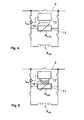
- a continuous power flow control mode in the nominal current range of a transmission line is not possible, unless an external heating system 13' is used as a driver 13 (in combination with sensors) to move the operating characteristics through heat energy 14' from short circuit operating characteristics L FC ( Fig. 6 ) to nominal current range operating characteristics L VR ( Fig. 6 ), as illustrated in the configuration of Fig. 4 .
- a magnetic field inductor can be used as a driver 13 to apply a magnetic field to the HTS module R HTS for suppressing superconductivity.
- a Liquid Metal Current Limiter module R LM was described in J. Tepper, S. Schoft, "Fault Current Limitation by means of Liquid Metal Technology”; 23 International Conference on Electrical Contacts, Sendai, Japan, June 6-9, 2006 .
- the Liquid Metal Current Limiter module R LM comprises solid metal electrodes, for connecting the module to a transmission line 3, and multiple channels filled with movable liquid metal electrodes. These electrodes are guided automatically along resistive material elements for the current limiting path by an overcurrent-dependent Lorenz force (F mag ). In normal operation, a continuous, inner conductive connection exists between the solid electrodes via the liquid metal electrodes. In the current-limiting event, the liquid metal electrodes are displaced from the connecting channels.
- F mag overcurrent-dependent Lorenz force
- the jump in fluid height interrupts the electrical connection of the solid electrodes via the liquid metal, resulting in a strong increase of the total electric resistance and current limiting action of the module. Subsequent to clearing or eliminating the short circuit, the connecting channels refill with liquid metal without any external action, whereupon the current-limiting module is operational again - a "self healing" property.
- the operating characteristic of the Liquid Metal Current Limiter module R LM is the same as shown in Fig. 6 (L FC ).
- an external magnetic field inductor 13" (in combination with sensors) is used as a driver 13 to induce a magnetic field 14" for displacing liquid metal electrodes, as illustrated in the configuration of Fig. 5 .
- the Liquid Metal Current Limiter module R LM can be used for continuous power flow control or power flow blocking based on the measured line current I 1 .
- the line current I 1 can be moved from a resistive to an inductive branch when the line power flow is high, i.e. when it exceeds a specified limit, and vice versa.
- the Liquid Metal Current Limiter module R LM returns back to its initial state when the external magnetic field is switched-off. It has an on/off switching time less than 1 second.
- Fig. 7 illustrates total ohmic losses and power flow variation for various technologies for power flow control.
- Line L LM+SR is representative of using a Liquid Metal Current Limiter module R LM as the variable resistance VR and connecting a series reactance X SR in parallel thereto.
- Lines L PST , L SC and L Fixed SR are representative of using a Phase Shifting Transformer (PST), a Series Capacitor (SC) or a fixed series reactance (SR), respectively.
- PST Phase Shifting Transformer
- SC Series Capacitor
- SR fixed series reactance
- Line L LM+4SR is representative of using four modules 4 of Liquid Metal Current Limiter modules R LM , each having a series reactance X SR connected in parallel thereto. As can be seen, while the four modules 4 provide the same level of power flow deviation (consequent switching) as one large series reactance X SR , the total losses are very low.
- Four modules 4 of 72 ⁇ show the same performance as one module of 720 ⁇ for a commutation of one large series reactance X SR .
- the four modules 4 make it possible to provide a continuous power flow regulation in the whole range, from 380 to 315 MW, without a big impact on power losses.
- the proposed device 1 can be used for power flow control and fault current limitation as a stand alone device in power distribution networks with low reactance to resistance ratio X/R; as a switch (step wise control) connected in parallel to a large series reactive element (large resistance is required) in power transmission and distribution networks with high reactance to resistance ratio X/R and stiff voltage profiles; as a regulator (gradual control) connected in a parallel to a small reactive element (small resistance is required) in transmission and distribution networks with stiff voltage profiles, several regulator/reactance modules being connected in series; and in networks with low voltage profiles, configured as in the two previous cases with additional shunt compensation.
Landscapes
- Engineering & Computer Science (AREA)
- Microelectronics & Electronic Packaging (AREA)
- Power Engineering (AREA)
- Emergency Protection Circuit Devices (AREA)
Abstract
For controlling power flow in meshed power network (30), at least one variable resistance module (11) is inserted into a transmission line (3) of the power network (30). In an external driver (13) an external control effort (14) is produced and applied to the variable resistance module (11) for causing a change of its resistance. For example, a High Temperature Superconductor module or a Liquid Metal Current Limiter module is used as the variable resistance module (11). Accordingly, a heater or a magnetic field inductor is used as a driver (13) for causing a change of resistance of the variable resistance module (11). Using a variable resistance module (11) makes it possible to control power flow in a power network (30) with less wear of components than in conventional electro-mechanical switching compensation and with lower costs than with flexible AC transmission systems devices.
Description
- The present invention relates to a device and a method for controlling power flow in a power network. Specifically, the invention relates to a device and a method for controlling power flow in a transmission line of a meshed power network.
- While profound changes sweep the electric utility industry, the likelihood of power transactions is expected to increase. Potentially, this leads to considerable redistribution of existing power flows and to occurrence of heavy loaded corridors in transmission networks because existing networks were not designed to meet the needs of transaction-oriented markets. Furthermore, transmission companies will face serious problems, because, for a variety of environmental and political reasons, it has become almost impossible to build new high voltage transmission lines. Therefore, transmission networks operate close to their limits. This stress can be reduced with a more effective utilization of existing transmission network capacity using power flow control. Therefore, a network based control for redirection and uniform redistribution of power flows in the transmission system, without rescheduling or topological changes, has become a very important instrument in the hands of independent system operators.
- A fundamental characteristic of electric power systems is the difficulty to control a power flow along a specific "contract path". In the absence of any active control elements, the corresponding sources and loads determine active and reactive power flow through each single transmission line. It can occur that "loop flows" may take power far away from the most direct route from a generator to a load centre and affect all interconnected undertakings, even though they are not parties to an intended transaction. For example, a significant portion of power scheduled from the Netherlands to Austria flows via the French, Swiss and Italian transmission networks, because of the availability of a large number of low impedance transmission lines along that loop. In such circumstances, certain lines may carry an overload where others are still insufficiently loaded. In this case it is desirable, to actively influence the power flow distribution in the network.
- For any transmission line, three key parameters determine an active power flow (P): terminal bus voltages (U), relative phase angle (Δ) between the sending and receiving ends, and line impedance (X).
- On one hand, voltage magnitudes cannot be varied significantly since they must be kept within regulated limits providing limited scope for power flow control. On the other hand, a voltage angle difference is not limited as heavily to such restrictions and provides a practical option for power flow control. Alternatively, a variation of the "electric length" of the transmission line is achieved by connecting in series to the line a continuously adjustable impedance (e.g. a series capacitor or reactance).
- To modify a phase angle difference or line impedance, a variety of electro-mechanically switched compensation devices with limited commutation capabilities (1-2 times per day) are generally used, e.g. a phase-shifting transformer (PST) and solutions based on series compensation (i.e. control of series capacitance and/or inductance). However, modem power systems require more frequent switching of compensation devices, e.g. 10-20 times per day, owing to more frequent and sometimes unpredictable variations of power system parameters. However, this increases costs and complexity of electro-mechanically controlled compensation devices.
- Due to the rapid development of power electronics in the last two decades, a new family of devices, so called Flexible AC Transmission Systems (FACTS), are becoming available. FACTS devices are based on power electronics semiconductor components (operated by way of drivers on line potential producing internal control signals) and do not rely on mechanical switches for their main function, to enable a fast, continuous response time in the millisecond range. However, power electronics components (e.g. thyristors, transistors, diodes, etc.) are costly, thus making FACTS devices expensive. Consequently, when compared to more than 250 mechanically switched series compensation devices in operation, only a few thyristor controlled series compensation devices are installed worldwide.
- Conventional methods of controlling power flow, relying on electro-mechanical and thyristor switches, do not have unlimited commutation capabilities, maintenance free operation or simultaneous fault current limitation, and the required devices often cannot be manufactured at low cost.
- It is therefore an objective of the present invention to provide an alternative device and method for controlling power flow in a power network, which device and method are not as costly as FACTS devices but show less wear than components used in conventional electro-mechanical switching compensation.
- This objective is achieved by a device according to
claim 1 and a method of controlling power flow according toclaim 6. Further preferred embodiments are evident from the dependent claims. - According to the present invention, the above-mentioned objects are particularly achieved in that, for controlling power flow in a meshed power network, at least one variable resistance module is inserted into a transmission line of the power network. In an external driver, galvanically separated from the variable resistance module which in turn is on line potential, an external control effort is produced and applied to the variable resistance module for causing a change of resistance of the variable resistance module.
- Preferably, a High Temperature Superconductor module is used as the variable resistance module. Accordingly, a heater or a magnetic field inductor is used as a driver for causing a change of resistance of the variable resistance module. In other words, the driver uses a heater and/or a magnetic field inductor for moving operating characteristics of the High Temperature Superconductor module by a magnetic field or heat, respectively, from short circuit current to nominal current range, and for causing a change of resistance of the High Temperature Superconductor module.
- Alternatively, the driver uses a magnetic field inductor for moving, by means of a magnetic field, operating characteristics of a Liquid Metal Current Limiter module from fault current to nominal current range, and for causing a change of resistance of the Liquid Metal Current Limiter module.
- Alternatively, a resistor having two or more electrodes separated by displaceable solid conductive connectors defining a current path comprising the contact areas between the electrodes and connectors can be employed as a variable resistance. Brush contacts may be used at the contact area of such a variable resistance module.
- For the latter two alternatives, if the focus is on regular switching operations and not on short current limiting actions, the speed of the resistance change is of less concern. Accordingly, the movement of a liquid metal connector or solid connector between fixed electrodes may well be driven by other drivers than electromagnetic forces, i.e. by means of a mechanical lever, a spring or a pressurized dielectric fluid.
- In an embodiment, a control module computes set-points of the variable resistance module based on measured power flow parameters, e.g. the line current and the line to ground voltage. The control module controls the driver such that the resistance of the variable resistance module is changed according to the set-points.
- Preferably, the set-points are determined such that the resistance of the variable resistance module is varied gradually to a maximum resistance when the power flow in the transmission line exceeds a specified power limit. Furthermore, the control module controls the driver such that the resistance of the variable resistance module is set instantaneously to the maximum resistance when a fault current limit is reached.
- In an embodiment, a series reactance is connected in parallel to the variable resistance module.
- In a further embodiment, multiple variable resistance modules are inserted in series into the transmission line, a series reactance module being connected in parallel to each of the multiple variable resistance modules. The variable resistance modules are controlled selectively through drivers associated with the variable resistance modules.
- The present invention will be explained in more detail, by way of example, with reference to the drawings in which:
-
Fig. 1 shows a device for controlling power flow with a variable resistance module inserted into a transmission line, -
Fig. 2 shows a variable resistance module configured for insertion into a transmission line, -
Fig. 3 shows a variable resistance module having a series reactance connected in parallel thereto, -
Fig. 4 shows a High Temperature Superconductor module with an external heater element or a magnetic field inductor coupled thereto, -
Fig. 5 shows a Liquid Metal Current Limiter module with an external magnetic field inductor coupled thereto, -
Fig. 6 shows a graph illustrating operating characteristics of a High Temperature Superconductor module, and -
Fig. 7 shows a graph illustrating total ohmic losses and power flow variation as a function of a set point of variable resistance with series reactance, fixed series reactance, Phase Shifting Transformer and series capacitor. -
Fig. 1 shows a block diagram illustrating schematically a simplified segment of ameshed power network 30 and adevice 1 for controlling power flow in thepower network 30, e.g. a meshed network for distribution of electrical power. The segment comprises atransmission line 3 with impedance Z1 and a transmission line 3' with impedance Z2. As shown inFig. 1 ,device 1 comprises avariable resistance module 11 inserted intotransmission line 3 of thepower network 30. Moreover,device 1 comprises acontrol module 12 connected to adriver 13 that is arranged external to and galvanically separated from thevariable resistance module 11. To control the quantity of power flow throughtransmission line 3 by varying the net impedance of thetransmission line 3, thecontrol module 12 is configured to compute set points of thevariable resistance module 11 based on power flow parameters, particularly based on measured values of line current I1 and line to ground voltage V1. In accordance with the set-points,control module 12controls driver 13 to produce anexternal control effort 14, e.g. a magnetic field and/or heat, for causing the resistance of thevariable resistance module 11 to change.Control module 12 is implemented as a programmed logic module, e.g. as a programmed software module controlling a processor, or as an electronic circuit, fully in hardware. In case of a short circuit, the fault current is limited by switching instantaneously the resistance of thevariable resistance module 11 to its maximum value Rmax. - Depending on parameters of the
power network 30, thevariable resistance module 11 is configured differently. -
Fig. 2 illustrates a first configuration suitable for power networks with low reactance to resistance ratio X/R (Z1=Rline+iXline), i.e. with X/R<2. Thevariable resistance module 11 comprises, by way of example, two solidconductive electrodes movable connector 113. The latter may be a liquid metal connector or, as depicted, a further solid conductor, and is moved by means of electromagnetic forces, a mechanical lever, a spring or a pressurized dielectric fluid. Depending on the position of themovable conductor 113 with respect to theelectrodes -
Fig. 3 illustrates a second configuration suitable for power networks with high reactance to resistance ratio X/R ratio, i.e. with X/R > 5, and stiff voltage profiles, i.e. where all bus voltages remain within ± 5% of their reference values. Thevariable resistance module 11 comprises a variable resistance VR connected in parallel to a series reactance XSR. The variable resistance VR inserts and removes the reactance X from thetransmission line 3 and can be operated in gradual or switching control modes. In normal operating mode, the reactance XSR branch is invisible to thepower network 30 from an active power perspective (low losses), as it is bypassed by the variable resistance VR branch (R≈0). During overload conditions, the variable resistance VR branch provides high resistance and moves the power flow to the reactance XSR branch. Finally, a reduction of power flow through thetransmission line 3 is achieved and power is transferred to parallel paths, e.g. transmission line 3'. The reactance XSR branch can be inserted and removed in a stepwise or gradual fashion using several of the modules 4 illustrated inFig. 3 . Each module 4 comprises a reactance XSR that can be bypassed individually by its associated variable resistance VR. It is thus possible for thecentral control module 2 to place (switch) selectively in series the reactance XSR of all modules 4, to achieve a maximum compensation level, or to remove the reactance XSR of all modules 4. - A third configuration (not illustrated), based on the second configuration and suitable for power networks with high reactance to resistance ratio X/R ratio and low voltage profiles, i.e. where bus voltages may deviate by more than ±10% from their reference values, comprises additionally in the reactance XSR branch a shunt compensation for voltage drop.
- Depending on the embodiment, the
variable resistance module 11 comprises a High Temperature Superconductor (HTS) module RHTS, illustrated inFig. 4 , or a Liquid Metal Current Limiter (LM) module RLM, illustrated inFig. 5 , as the variable resistance. - HTS fault-current limiters have a pronounced non-linear resistive characteristic depending on the line current I1. The HTS module RHTS does not add resistance to the circuit during normal operation and, therefore, appears "invisible" in the
power network 30. It reacts only on a very high short-circuit current which increases sharply the temperature of the superconductor (through resistive heating I2R caused by the fault current) and consequently its resistivity p. Thus, the HTS module RHTS has an operating principle that is suited excellently for short circuit current limiting applications. However, a continuous power flow control mode in the nominal current range of a transmission line is not possible, unless an external heating system 13' is used as a driver 13 (in combination with sensors) to move the operating characteristics through heat energy 14' from short circuit operating characteristics LFC (Fig. 6 ) to nominal current range operating characteristics LVR (Fig. 6 ), as illustrated in the configuration ofFig. 4 . Alternatively, a magnetic field inductor can be used as adriver 13 to apply a magnetic field to the HTS module RHTS for suppressing superconductivity. The response time of the heater 13' may vary between a few seconds and a few minutes depending on k:
- When moved to the nominal current range operating characteristics LVR, the HTS module RHTS can be used as a static switch for a commutation of a series reactance XSR, which will partly block power flow through the controlled
transmission line 3, making the line impedance Z1=Xline+XSR. Consequently, the configuration shown inFig. 4 limits advantageously the energy that must be absorbed by the HTS module RHTS. However, the current limiting effect acts only at a high (short-circuit) current level, with approximately k≥3..4. - A Liquid Metal Current Limiter module RLM was described in J. Tepper, S. Schoft, "Fault Current Limitation by means of Liquid Metal Technology"; 23 International Conference on Electrical Contacts, Sendai, Japan, June 6-9, 2006. The Liquid Metal Current Limiter module RLM comprises solid metal electrodes, for connecting the module to a
transmission line 3, and multiple channels filled with movable liquid metal electrodes. These electrodes are guided automatically along resistive material elements for the current limiting path by an overcurrent-dependent Lorenz force (Fmag). In normal operation, a continuous, inner conductive connection exists between the solid electrodes via the liquid metal electrodes. In the current-limiting event, the liquid metal electrodes are displaced from the connecting channels. The jump in fluid height interrupts the electrical connection of the solid electrodes via the liquid metal, resulting in a strong increase of the total electric resistance and current limiting action of the module. Subsequent to clearing or eliminating the short circuit, the connecting channels refill with liquid metal without any external action, whereupon the current-limiting module is operational again - a "self healing" property. - The operating characteristic of the Liquid Metal Current Limiter module RLM is the same as shown in
Fig. 6 (LFC). In order to overcome the low sensitivity of the Liquid Metal Current Limiter module RLM to a variation of the line current I1 around the nominal value, an externalmagnetic field inductor 13" (in combination with sensors) is used as adriver 13 to induce amagnetic field 14" for displacing liquid metal electrodes, as illustrated in the configuration ofFig. 5 . Thus, the Liquid Metal Current Limiter module RLM can be used for continuous power flow control or power flow blocking based on the measured line current I1. - The line current I1 can be moved from a resistive to an inductive branch when the line power flow is high, i.e. when it exceeds a specified limit, and vice versa. The Liquid Metal Current Limiter module RLM returns back to its initial state when the external magnetic field is switched-off. It has an on/off switching time less than 1 second.
-
Fig. 7 illustrates total ohmic losses and power flow variation for various technologies for power flow control. Line LLM+SR is representative of using a Liquid Metal Current Limiter module RLM as the variable resistance VR and connecting a series reactance XSR in parallel thereto. Lines LPST , LSC and LFixed SR are representative of using a Phase Shifting Transformer (PST), a Series Capacitor (SC) or a fixed series reactance (SR), respectively. As can be seen, at the moment when the series reactance XSR is fully commutated by the Liquid Metal Current Limiter module RLM, the final total losses have practically the same value as PST, SC or the fixed SR of the same rating. Line LLM+4SR is representative of using four modules 4 of Liquid Metal Current Limiter modules RLM, each having a series reactance XSR connected in parallel thereto. As can be seen, while the four modules 4 provide the same level of power flow deviation (consequent switching) as one large series reactance XSR, the total losses are very low. Four modules 4 of 72Ω show the same performance as one module of 720Ω for a commutation of one large series reactance XSR. In addition, the four modules 4 make it possible to provide a continuous power flow regulation in the whole range, from 380 to 315 MW, without a big impact on power losses. - The proposed
device 1 can be used for power flow control and fault current limitation as a stand alone device in power distribution networks with low reactance to resistance ratio X/R; as a switch (step wise control) connected in parallel to a large series reactive element (large resistance is required) in power transmission and distribution networks with high reactance to resistance ratio X/R and stiff voltage profiles; as a regulator (gradual control) connected in a parallel to a small reactive element (small resistance is required) in transmission and distribution networks with stiff voltage profiles, several regulator/reactance modules being connected in series; and in networks with low voltage profiles, configured as in the two previous cases with additional shunt compensation.
Claims (10)
- A device (1) for controlling power flow in a transmission line (3) of meshed power network (30), comprising:at least one variable resistance module (11) configured for insertion into the transmission line (3); anda driver (13) configured to produce an external control effort (14, 14', 14") and arranged to apply the external control effort (14, 14', 14") to the variable resistance module (11) for causing a change in resistance of the variable resistance module (11).
- The device (1) of claim 1, further comprising a series reactance (XSR) connected in parallel to the variable resistance module (11).
- The device (1) of claim 1, wherein the variable resistance module (11) comprises a High Temperature Superconductor module (RHTS), and wherein the driver (13) comprises one of a heater (13') and a magnetic field inductor for causing a change of resistance of the High Temperature Superconductor module (RHTS) by a magnetic field or heat (14'), respectively.
- The device (1) of claim 1, wherein the variable resistance module (11) comprises a Liquid Metal Current Limiter module (RLM), and wherein the driver (13) comprises a magnetic field inductor (13") for causing a change of resistance of the Liquid Metal Current Limiter module (RLM) by a magnetic field (14").
- The device (1) of claim 1, wherein the variable resistance module (11) comprises two solid conductive electrodes (111, 112) and a movable connector (113) defining a current path with a variable resistance depending on a position of the movable connector (113).
- A method of controlling power flow in meshed power network (30), comprising:inserting at least one variable resistance module (11) into a transmission line (3) of the power network (30);producing in a driver (13) an external control effort (14, 14', 14"); andapplying the external control effort (14, 14', 14") to the variable resistance module (11) for causing a change of resistance of the variable resistance module (11).
- The method of claim 6, further comprising computing in a control module (12) set-points of the variable resistance module (11) based on measured power flow parameters (I1, V1), and controlling the driver (13) such that the resistance of the variable resistance module (11) is changed according to the set-points.
- The method of claim 7, wherein the set-points are determined such that the resistance of the variable resistance module (11) is varied gradually to a maximum resistance when the power flow in the transmission line (3) exceeds a specified power limit, and wherein the driver (13) is controlled such that the resistance of the variable resistance module (11) is set instantaneously to the maximum resistance when a fault current limit is reached.
- The method of claim 6, further comprising connecting a series reactance (XSR) in parallel to the variable resistance module (11).
- The method of claim 6, wherein multiple variable resistance modules (11) are inserted into the transmission line (3); and wherein a series reactance (XSR) module is connected in parallel to each of the multiple variable resistance modules (11), the method comprising controlling selectively the variable resistance modules (11) through drivers (13) associated with the variable resistance modules (11).
Priority Applications (2)
| Application Number | Priority Date | Filing Date | Title |
|---|---|---|---|
| EP06405501A EP1928069A1 (en) | 2006-11-30 | 2006-11-30 | Device and method for controlling power flow in a power network |
| PCT/CH2007/000600 WO2008064509A1 (en) | 2006-11-30 | 2007-11-30 | Device and method for controlling power flow in a power network |
Applications Claiming Priority (1)
| Application Number | Priority Date | Filing Date | Title |
|---|---|---|---|
| EP06405501A EP1928069A1 (en) | 2006-11-30 | 2006-11-30 | Device and method for controlling power flow in a power network |
Publications (1)
| Publication Number | Publication Date |
|---|---|
| EP1928069A1 true EP1928069A1 (en) | 2008-06-04 |
Family
ID=37969690
Family Applications (1)
| Application Number | Title | Priority Date | Filing Date |
|---|---|---|---|
| EP06405501A Withdrawn EP1928069A1 (en) | 2006-11-30 | 2006-11-30 | Device and method for controlling power flow in a power network |
Country Status (2)
| Country | Link |
|---|---|
| EP (1) | EP1928069A1 (en) |
| WO (1) | WO2008064509A1 (en) |
Cited By (3)
| Publication number | Priority date | Publication date | Assignee | Title |
|---|---|---|---|---|
| CN104934973A (en) * | 2015-06-24 | 2015-09-23 | 济南大学 | Power line loss calculation method considering temperature |
| CN107069422A (en) * | 2017-04-28 | 2017-08-18 | 安徽师范大学 | A kind of electric current continuously adjustabe type laser diode drive module |
| CN109324619A (en) * | 2018-09-25 | 2019-02-12 | 苏州大学 | Liquid metal electric drive car and its motion control method |
Families Citing this family (1)
| Publication number | Priority date | Publication date | Assignee | Title |
|---|---|---|---|---|
| US8339803B2 (en) | 2009-12-04 | 2012-12-25 | International Business Machine Corporation | High-speed ceramic modules with hybrid referencing scheme for improved performance and reduced cost |
Citations (2)
| Publication number | Priority date | Publication date | Assignee | Title |
|---|---|---|---|---|
| WO1987004538A1 (en) * | 1986-01-22 | 1987-07-30 | Vithayathil John J | Scheme for rapid adjustment of network impedance |
| DE19939709A1 (en) * | 1999-08-18 | 2001-02-22 | Siemens Ag | Switchable impedance for connection between AC voltage supply network and electric consumer or generator |
-
2006
- 2006-11-30 EP EP06405501A patent/EP1928069A1/en not_active Withdrawn
-
2007
- 2007-11-30 WO PCT/CH2007/000600 patent/WO2008064509A1/en not_active Ceased
Patent Citations (2)
| Publication number | Priority date | Publication date | Assignee | Title |
|---|---|---|---|---|
| WO1987004538A1 (en) * | 1986-01-22 | 1987-07-30 | Vithayathil John J | Scheme for rapid adjustment of network impedance |
| DE19939709A1 (en) * | 1999-08-18 | 2001-02-22 | Siemens Ag | Switchable impedance for connection between AC voltage supply network and electric consumer or generator |
Non-Patent Citations (2)
| Title |
|---|
| ANIL R DUGGAL: "An Upper Limit for High Power Switching with a Polymer Current Limiter Device", IEEE TRANSACTIONS ON COMPONENTS AND PACKAGING TECHNOLOGIES, IEEE SERVICE CENTER, PISCATAWAY, NJ, US, vol. 23, no. 3, September 2000 (2000-09-01), XP011008150, ISSN: 1521-3331 * |
| MARTEN SJÖSTRÖMSJOSTROM ET AL: "Technical and Economical Impacts on a Power System by Introducing an HTS FCL", IEEE TRANSACTIONS ON APPLIED SUPERCONDUCTIVITY, IEEE SERVICE CENTER, LOS ALAMITOS, CA, US, vol. 11, no. 1, March 2001 (2001-03-01), pages 2042 - 2045, XP011090741, ISSN: 1051-8223 * |
Cited By (4)
| Publication number | Priority date | Publication date | Assignee | Title |
|---|---|---|---|---|
| CN104934973A (en) * | 2015-06-24 | 2015-09-23 | 济南大学 | Power line loss calculation method considering temperature |
| CN104934973B (en) * | 2015-06-24 | 2017-05-17 | 国网山东省电力公司德州市陵城区供电公司 | Power line loss calculation method considering temperature |
| CN107069422A (en) * | 2017-04-28 | 2017-08-18 | 安徽师范大学 | A kind of electric current continuously adjustabe type laser diode drive module |
| CN109324619A (en) * | 2018-09-25 | 2019-02-12 | 苏州大学 | Liquid metal electric drive car and its motion control method |
Also Published As
| Publication number | Publication date |
|---|---|
| WO2008064509A1 (en) | 2008-06-05 |
Similar Documents
| Publication | Publication Date | Title |
|---|---|---|
| AU2005223211B2 (en) | Dynamic reactive compensation system and method | |
| RU2479058C2 (en) | Transformer winding stages switch with semiconductor switching elements | |
| CA2193477C (en) | Load tap changer | |
| KR101416787B1 (en) | Method for switching without any interruption between winding taps on a tap-changing transformer | |
| CN1249861A (en) | Protective device against excessive currents, in particular for resettable protection of controlled switch | |
| CN103299544A (en) | Circuit arrangements for electronically controlled DC networks | |
| EP3289676B1 (en) | Ac network power flow control | |
| WO2008064509A1 (en) | Device and method for controlling power flow in a power network | |
| CN201388061Y (en) | High-voltage-to-low-voltage reactive power compensation flexible switching device | |
| CN101039091A (en) | Method and apparatus for realizing load voltage regulation with a plurality of switching elements | |
| WO1999017415A1 (en) | Power breaker for power supply and distribution | |
| JP2004350337A (en) | Power flow control device with current limiting function | |
| JP3674419B2 (en) | Commutation type DC circuit breaker | |
| CN2625948Y (en) | Noncontact compensating power stabilizer | |
| EP3613124B1 (en) | Uninterruptible power supply | |
| EP1138108B1 (en) | Device for energizing a voltage-source converter | |
| Arora | Internet of Things-Based Arduino Controlled On-Load Tap Changer Distribution Transformer | |
| KR20180099431A (en) | Double quench current limiting device for direct current and alternating current | |
| RU2374738C1 (en) | Current limiting device of electric network | |
| US7737667B2 (en) | 3-phase electronic tap changer commutation and device | |
| RU2858724C1 (en) | Three-phase balancing device | |
| RU2804403C1 (en) | Method for controlling power of static reactive power compensator operating in sinusoidal alternating voltage network | |
| EP4485736A1 (en) | Transformer | |
| RU2541380C2 (en) | Superconductive circuit breaker | |
| SU1046834A1 (en) | Device for limiting transient process current when starting |
Legal Events
| Date | Code | Title | Description |
|---|---|---|---|
| PUAI | Public reference made under article 153(3) epc to a published international application that has entered the european phase |
Free format text: ORIGINAL CODE: 0009012 |
|
| AK | Designated contracting states |
Kind code of ref document: A1 Designated state(s): AT BE BG CH CY CZ DE DK EE ES FI FR GB GR HU IE IS IT LI LT LU LV MC NL PL PT RO SE SI SK TR |
|
| AX | Request for extension of the european patent |
Extension state: AL BA HR MK RS |
|
| AKX | Designation fees paid | ||
| REG | Reference to a national code |
Ref country code: DE Ref legal event code: 8566 |
|
| STAA | Information on the status of an ep patent application or granted ep patent |
Free format text: STATUS: THE APPLICATION IS DEEMED TO BE WITHDRAWN |
|
| 18D | Application deemed to be withdrawn |
Effective date: 20081205 |