EP1927981A1 - Spectral refinement of audio signals - Google Patents
Spectral refinement of audio signals Download PDFInfo
- Publication number
- EP1927981A1 EP1927981A1 EP06024940A EP06024940A EP1927981A1 EP 1927981 A1 EP1927981 A1 EP 1927981A1 EP 06024940 A EP06024940 A EP 06024940A EP 06024940 A EP06024940 A EP 06024940A EP 1927981 A1 EP1927981 A1 EP 1927981A1
- Authority
- EP
- European Patent Office
- Prior art keywords
- sub
- time
- short
- spectra
- band
- Prior art date
- Legal status (The legal status is an assumption and is not a legal conclusion. Google has not performed a legal analysis and makes no representation as to the accuracy of the status listed.)
- Granted
Links
- 230000005236 sound signal Effects 0.000 title claims abstract description 70
- 230000003595 spectral effect Effects 0.000 title claims abstract description 57
- 238000001228 spectrum Methods 0.000 claims abstract description 190
- 238000001914 filtration Methods 0.000 claims abstract description 80
- 238000000034 method Methods 0.000 claims abstract description 62
- 238000012545 processing Methods 0.000 claims abstract description 46
- 230000004044 response Effects 0.000 claims abstract description 15
- 230000001131 transforming effect Effects 0.000 claims abstract description 8
- 230000009467 reduction Effects 0.000 claims description 44
- 230000037433 frameshift Effects 0.000 claims description 8
- 230000002708 enhancing effect Effects 0.000 claims description 6
- 238000007670 refining Methods 0.000 claims description 5
- 230000002194 synthesizing effect Effects 0.000 claims description 3
- 238000004590 computer program Methods 0.000 claims description 2
- 239000011159 matrix material Substances 0.000 description 18
- 230000006870 function Effects 0.000 description 11
- 230000003190 augmentative effect Effects 0.000 description 6
- 238000004891 communication Methods 0.000 description 5
- 239000013598 vector Substances 0.000 description 5
- 230000008901 benefit Effects 0.000 description 4
- 230000015572 biosynthetic process Effects 0.000 description 4
- 238000013461 design Methods 0.000 description 4
- 238000003786 synthesis reaction Methods 0.000 description 4
- 230000008569 process Effects 0.000 description 3
- 238000013016 damping Methods 0.000 description 2
- 230000006866 deterioration Effects 0.000 description 2
- 230000017105 transposition Effects 0.000 description 2
- 230000003044 adaptive effect Effects 0.000 description 1
- 230000015556 catabolic process Effects 0.000 description 1
- 230000008859 change Effects 0.000 description 1
- 230000003111 delayed effect Effects 0.000 description 1
- 238000011161 development Methods 0.000 description 1
- 230000018109 developmental process Effects 0.000 description 1
- 238000002592 echocardiography Methods 0.000 description 1
- 238000005516 engineering process Methods 0.000 description 1
- 238000002474 experimental method Methods 0.000 description 1
- 238000010348 incorporation Methods 0.000 description 1
- 238000013507 mapping Methods 0.000 description 1
- 238000005070 sampling Methods 0.000 description 1
- 238000010183 spectrum analysis Methods 0.000 description 1
- 230000001629 suppression Effects 0.000 description 1
Images


Classifications
-
- G—PHYSICS
- G10—MUSICAL INSTRUMENTS; ACOUSTICS
- G10L—SPEECH ANALYSIS TECHNIQUES OR SPEECH SYNTHESIS; SPEECH RECOGNITION; SPEECH OR VOICE PROCESSING TECHNIQUES; SPEECH OR AUDIO CODING OR DECODING
- G10L19/00—Speech or audio signals analysis-synthesis techniques for redundancy reduction, e.g. in vocoders; Coding or decoding of speech or audio signals, using source filter models or psychoacoustic analysis
- G10L19/02—Speech or audio signals analysis-synthesis techniques for redundancy reduction, e.g. in vocoders; Coding or decoding of speech or audio signals, using source filter models or psychoacoustic analysis using spectral analysis, e.g. transform vocoders or subband vocoders
- G10L19/0204—Speech or audio signals analysis-synthesis techniques for redundancy reduction, e.g. in vocoders; Coding or decoding of speech or audio signals, using source filter models or psychoacoustic analysis using spectral analysis, e.g. transform vocoders or subband vocoders using subband decomposition
-
- G—PHYSICS
- G10—MUSICAL INSTRUMENTS; ACOUSTICS
- G10L—SPEECH ANALYSIS TECHNIQUES OR SPEECH SYNTHESIS; SPEECH RECOGNITION; SPEECH OR VOICE PROCESSING TECHNIQUES; SPEECH OR AUDIO CODING OR DECODING
- G10L21/00—Speech or voice signal processing techniques to produce another audible or non-audible signal, e.g. visual or tactile, in order to modify its quality or its intelligibility
- G10L21/02—Speech enhancement, e.g. noise reduction or echo cancellation
-
- G—PHYSICS
- G10—MUSICAL INSTRUMENTS; ACOUSTICS
- G10L—SPEECH ANALYSIS TECHNIQUES OR SPEECH SYNTHESIS; SPEECH RECOGNITION; SPEECH OR VOICE PROCESSING TECHNIQUES; SPEECH OR AUDIO CODING OR DECODING
- G10L25/00—Speech or voice analysis techniques not restricted to a single one of groups G10L15/00 - G10L21/00
- G10L25/03—Speech or voice analysis techniques not restricted to a single one of groups G10L15/00 - G10L21/00 characterised by the type of extracted parameters
- G10L25/18—Speech or voice analysis techniques not restricted to a single one of groups G10L15/00 - G10L21/00 characterised by the type of extracted parameters the extracted parameters being spectral information of each sub-band
-
- G—PHYSICS
- G10—MUSICAL INSTRUMENTS; ACOUSTICS
- G10L—SPEECH ANALYSIS TECHNIQUES OR SPEECH SYNTHESIS; SPEECH RECOGNITION; SPEECH OR VOICE PROCESSING TECHNIQUES; SPEECH OR AUDIO CODING OR DECODING
- G10L25/00—Speech or voice analysis techniques not restricted to a single one of groups G10L15/00 - G10L21/00
- G10L25/27—Speech or voice analysis techniques not restricted to a single one of groups G10L15/00 - G10L21/00 characterised by the analysis technique
Definitions
- the present invention relates to audio signal processing, in particular, the analysis and enhancement of speech signals in communication systems.
- the invention relates to the spectral refinement of a short-time Fourier spectrum of a speech signal.
- Background noise in noisy environments can severely affect the quality and intelligibility of voice conversation, e.g., by means of mobile phones or hands-free telephone sets, and can, in the worst case, lead to a complete breakdown of the communication.
- some echo compensation might be employed in order to improve the quality of an audio signal.
- the suppression of signals of the remote subscriber which are emitted by the loudspeakers and therefore received again by the microphone(s) is of particular importance, since otherwise unpleasant echoes can severely affect the quality and intelligibility of voice conversation.
- a linear or non-linear adaptive filtering means a replica of acoustic feedback is synthesized and a compensation signal is obtained from the received signal of the loudspeakers. This compensation signal is subtracted from the microphone thereby generating a resulting signal to be sent to the remote subscriber.
- Audio signal processing for noise/echo reduction can be performed either in the time or the frequency domain.
- processing in the frequency domain comprises the division of an audio input signal in overlapping blocks that are transformed into the frequency domain by filter banks or a Discrete Fourier Transform (DFT).
- the blocks are multiplied by a window function before the transform, i.e., in fact, a Short-Time Fourier Transform is performed.
- a Hann window that exhibits relatively good aliasing qualities and that allows for an error-free re-synthesization is commonly chosen as the window function.
- the frequency response of a Hann window is characterized by a significant overlap of sub-bands and, thus, adjacent pitch trajectories are sometimes hard to separate which is crucial for speech enhancement.
- the corresponding increase of the frequency resolution results, however, in a decrease in time resolution of the processed audio signal.
- N 512 results in a time delay that is not tolerable according to the above mentioned standards.
- This method for the processing of an audio input signal ( x (n)) for spectral refinement of a short-time spectrum ( X (e j ⁇ ,n)) of the audio input signal ( x (n)) consisting of sub-band short-time spectra (X(e j ⁇ ⁇ ,n)), comprises the steps of short-time Fourier transforming the audio input signal ( x (n)) to obtain the sub-band short-time spectra (X(e j ⁇ ⁇ ,n)) for a predetermined number of sub-bands ( ⁇ ⁇ ); time-delay filtering at least one of the sub-band short-time spectra (X(e j ⁇ ⁇ ,n)) to obtain a predetermined number (M) of time-delayed sub-band short-time spectra (X(e j ⁇ ⁇ ,n-(M-1)r)) for at least one of the predetermined
- an audio signal x (n) [x(n), x(n-1), .., x(n-N+1)] T of the length N, where the upper index T denotes the transposition operation, is windowed by a suitable window function, e.g.
- These sub-band signals X(e j ⁇ ⁇ ,n) are sub-band short-time spectra of the audio signal x (n).
- the short-time spectrum X (e j ⁇ ,n) [X(e j ⁇ 0 ,n), .., X(e j ⁇ N-1 ,n)] T is refined (augmented) by refining one or more sub-band short-time spectra X(e j ⁇ ⁇ ,n). It is noted that this is not the only way of refinement of the short-time spectrum X(e j ⁇ ,n) (see description below).
- DFT discrete Fourier transform
- a principle idea of the present invention is to refine a short-time spectrum comprising a relatively small number of nodes by using this spectrum and a number of time-delayed spectra with the same number of nodes without the need for any expensive DFT of higher order (> N).
- This is achieved by the claimed process of filtering of at least one sub-band short-time spectrum to obtain a refined sub-band short-time spectrum and, thus, a refined short-time spectrum.
- the filtering is preferably performed by a Finite Impulse Response (FIR) filtering means that guarantees linear phase responses and stability.
- FIR Finite Impulse Response
- Infinite Response Filters may alternatively be used that require less computing power.
- the disclosed method allows for an efficient way of spectral refinement that is rather inexpensive in terms of processor loads, memory resources, etc., since only a relatively small number of low-level algebraic operations is necessary.
- Refinement of the short-time spectrum X (e j ⁇ ,n) of the audio signal x (n) can include the determination of sub-band short time spectra for sub-bands that are not included in the short-time spectrum X (e j ⁇ ,n) that is to be refined.
- the steps recited in claim 1 are supplemented by the steps of selecting a number of neighbored sub-bands ( ⁇ ⁇ ); filtering for each pair of the selected number of sub-bands ( ⁇ ⁇ ):
- the short-time spectrum X (e j ⁇ ,n) of the audio signal x (n) can very efficiently be refined by sub-band short time spectra obtained by interpolation between frequency nodes present in the short-time spectrum X (e j ⁇ ,n) that is to be refined.
- the newly introduced sub-band short time spectra are weighted sums of the sub-band short time spectra that were already present in the short-time spectrum X (e j ⁇ ,n).
- spectral refinement may only be considered necessary in the low-frequency regime below 1500 Hz, more particularly, below 1000 Hz.
- spectral refinement may only be considered necessary in the low-frequency regime below 1500 Hz, more particularly, below 1000 Hz.
- sub-band short time spectra for the frequency range below these thresholds might be refined and/or additional sub-band short time spectra in this frequency range are generated.
- the overall processor load can significantly reduced by selection of a particular frequency range for spectral refinement rather than processing the entire audio signal x (n).
- the herein disclosed method for spectral refinement can be employed in a variety of audio signal processing applications.
- a method for noise reduction of an audio signal comprising processing the audio input signal ( x (n)) for spectral refinement of a short-time spectrum ( X (e j ⁇ ,n)) of the audio input signal ( x (n)) according to one of the above-described examples of the method for processing an audio signal for spectral refinement and filtering the at least one refined sub-band short-time spectrum (X ⁇ (e j ⁇ ⁇ ,n)) obtained by one of above examples of the methods for spectral refinement by a noise reduction filtering.
- Sub-band short-time spectrum that are not refined can also be filtered for noise reduction (and usually will).
- the noise reduction can be performed by a noise reduction filtering means known in the art.
- some kind of a (modified) Wiener filter characteristic may be chosen according to which noise reduction is performed on the basis of the estimated short-time power density of noise that is present in the processed audio signal and the short-time power density of the input signal.
- the latter can be estimated more accurately when the short-time spectrum is refined according to the above-described examples.
- the refined spectrogram i.e. the squared magnitude of the refined short-time spectrum
- the method for noise reduction of an audio signal ( x (n)) may particularly comprise the steps
- the noise reduction will be performed on the basis of the refined short-time spectrum, only if the audio signal exhibits at least a predetermined stationarity.
- the advantage of such a conditional performance of the spectral refinement is that if the time delay introduced in the signal path by the spectral refinement is tolerable in the actual application, the spectral refinement will be performed and otherwise not.
- the standards of the International Telecommunication Union and the European Telecommunication Standards Institute have to be met by any actual telephone equipment, which demands for some degree of stationarity of the audio signal when spectral refinement shall be performed.
- Echo compensation can profit from the disclosed method for spectral refinement.
- Echo compensation e.g., may be performed by spectral subtraction based upon refined short-time spectra obtained by one of the above-described examples.
- a method for echo compensating an audio signal comprising processing the audio input signal ( x (n)) for spectral refinement of a short-time spectrum ( X (e j ⁇ ,n)) of the audio input signal ( x (n)) according to one of the above-described examples of the herein disclosed method for spectral refinement and filtering the at least one refined sub-band short-time spectrum (X ⁇ (e j ⁇ ⁇ ,n)) obtained by such an example by an echo compensation filtering means.
- the method for echo reduction of an audio signal comprises the steps of
- echo compensation thus, might only be performed on the basis of the refined short-time spectrum, if the audio signal exhibits at least a predetermined stationarity in order to avoid time delay of the processed audio signal, if such a delay cannot be accepted for technical or conventional reasons.
- the above-described examples of the method for spectral refinement can also advantageously be applied to the technique of speech recognition and speech synthesis and, in particular, to the processing of a speech signal in order to estimate the (voice) pitch.
- Estimation of the pitch is usually based on the short-time power density or on the short-time spectrogram of the speech signal in each sub-band (the short-time spectrogram for the frequency node ⁇ ⁇ is defined by
- a refined short-time spectrum results in a refined short-time power density or spectrogram and, thus, it is provided an improved method for estimating the pitch of a speech signal ( x (n)), comprising processing the speech input signal ( x (n)) for spectral refinement of a short-time spectrum ( X (e j ⁇ ,n)) of the audio input signal ( x (n)) according to one of the above-described examples of the herein disclosed method for spectral refinement; determining the short-time spectrogram of the at least one refined sub-band short-time spectrum (X ⁇ (e j ⁇ ⁇ ,n)) obtained by such an example of the method for spectral refinement; and estimating the pitch on the basis of the at least one determined short-time spectrogram.
- the present invention also provides a computer program product, comprising one or more computer readable media having computer-executable instructions for performing the steps of an example of one of the above-described methods.
- a signal processing means comprising a short-time Fourier transform means (1) configured to short-time Fourier transform an audio signal ( x (n)) to obtain sub-band short-time spectra (X(e j ⁇ ⁇ ,n)) for a predetermined number of sub-bands; a time-delay filtering means configured to time-delay at least one of the sub-band short-time spectra (X(e j ⁇ ⁇ ,n)) to obtain a predetermined number (M) of time-delayed sub-band short-time spectra (X(e j ⁇ ⁇ ,n-(M-1)r)) for at least one of the predetermined number of sub-bands; a spectral refining means (2) configured to refine the at least one of the sub-band short-time spectra (X(e j ⁇ ⁇ ,n)), wherein the spectral refining means (2) comprises a filtering means, in particular, a Finite Impulse Response filtering means
- the signal processing means may further comprise a selection means that is configured to select a number of neighbored sub-bands ( ⁇ ⁇ ).
- the filtering means is configured to filter for each pair of the selected number of sub-bands ( ⁇ ⁇ ):
- the signal processing means can be incorporated in a device that is configured to enhance the quality of an audio signal ( x (n)), in particular, a speech signal, and that further comprises a noise reduction filtering mean and/or an echo compensation filtering means configured to noise reduce and/or to echo reduce the audio signal ( x (n)) on the basis of the at least one refined sub-band short-time spectrum (X ⁇ (e j ⁇ ⁇ ,n)) obtained by above-mentioned signal processing means.
- the signal processing means can be incorporated in a pitch estimating means for estimating the pitch of a speech signal ( x (n)) and also comprising an analysis means configured to determine the short-time power density spectrum of the speech signal ( x (n)) based on the at least one refined sub-band short-time spectrum (X ⁇ (e j ⁇ ⁇ ,n)) obtained by the signal processing means mentioned above and to estimate the pitch based on the determined short-time power density spectrum of the speech signal ( x (n)).
- the short-time power density spectrum of the speech signal ( x (n)) can be derived from the short-time spectrogram of the speech signal.
- the signal analyzed for the pitch may be previously noise and/or echo reduced.
- the pitch estimating means may also comprise one of the above-mentioned reduction filtering mean and/or an echo compensation filtering means.
- Particularly preferred applications of the present invention relate to the technology of hands-free telephony and speech recognition that both are very sensible to the deterioration of audio signals by noise and can, thus, significantly benefit from an enhanced signal quality resulting from spectral refinement.
- a hands-free telephony system comprising the above-mentioned signal processing means and/or the signal enhancing means and/or the pitch estimating means comprising the signal processing means.
- the present invention provides a speech recognition means comprising the signal enhancing means (configured for noise reduction and/or echo reduction of an audio signal) mentioned-above and/or the above-mentioned pitch estimating means.
- This speech recognition means can also be incorporated in a speech dialog system or voice control system.
- the refinement matrix S is, thus, calculated without any need for a DFT of higher order than the originally used (i.e. with an order higher than N) and has the size ⁇ x N M, where M is the number of the used sub-band short time spectra X (e j ⁇ ,n), .., X (e j ⁇ ,n-(M-1)r).
- the refined spectrum X ⁇ (e j ⁇ ,n) is calculated from a number M or previous input spectra X (e j ⁇ ,n) that are respectively shifted one by the other by the integer r (frame shift): X (e j ⁇ ,n-r), X (e j ⁇ ,n-2r), .., X (e j ⁇ ,n-(M-1)r).
- the refinement matrix S is determined observing the following constraint for the window function h ⁇ :
- each k 0 -th row of S is sparsely populated, i.e. the elements of each k 0 -th row are zero with the exception of the column indices that are multiples of N. If N is chosen to be 2 r or 4 r, these elements are real or imaginary.
- FIR Finite Impulse Response
- an input signal x(n) is windowed and discrete Fourier transformed (short-time Fourier transformed) to obtain sub-band signals X(e j ⁇ ⁇ ,n), i.e. sub-band short-time spectra, constituting a short-time spectrum X (e j ⁇ ,n) that is to be refined.
- sub-band short-time spectra constituting a short-time spectrum X (e j ⁇ ,n) that is to be refined.
- a Hann window can be used for the window function.
- For each of the sub-band short-time spectra a number of time-delayed short-time spectra is generated (as indicated by ⁇ r).
- the frequency nodes of the refined spectra are multiples of the original spectra.
- Audio signal processing often includes enhancement of the audio signals by noise reduction and/or echo compensation.
- Noise reduction and/or echo compensation in the sub-band regime is achieved by filtering the audio signals by adaptable filter coefficients (damping factors) V(e j ⁇ ⁇ ,n) that are usually determined on the basis of the short-time power density or the spectrogram of the audio input signal and the estimated short-time power density of the background noise (echo).
- V(e j ⁇ ⁇ ,n) that are usually determined on the basis of the short-time power density or the spectrogram of the audio input signal and the estimated short-time power density of the background noise (echo).
- the damping factors for signal portions between adjacent pitch lines (amplitude maxima) are often adapted to too small magnitudes, since the spectral resolution of the employed window functions are too low and due to the overlap of sub-bands produced, e.g., by a Hann window. Therefore, the above-explained method for spectral refinement can advantageously be applied to the art of noise
- An audio signal x(n) is transformed by a DFT means 1 into sub-band signals (sub-band short-time spectra). With the help of a stationarity detecting means 3 it is detected whether the sub-band signals X(e j ⁇ ⁇ ,n) change significantly over some signal frames. If the input spectrum is stationary within some predetermined limits it is input in a spectral refiner 3. If it is non-stationary the spectral refinement is omitted in order not to exceed the maximum allowable signal delay times as demanded for by, e.g., the standards of the International Telecommunication Union and the European Telecommunication Standards Institute.
- the spectral refiner 3 performs the above-explained spectral refinement of the input spectrum X (e j ⁇ ,n) in order to obtain a refined spectrum X ⁇ (e j ⁇ ,n).
- a speech input signal x(n) it might be preferred to refine only a portion of the input spectrum X (e j ⁇ ,n), say for frequencies below 1000 Hz.
- an IDFT means 5 After synthesis by an IDFT means 5 a full band enhanced audio signal is obtained.
Landscapes
- Engineering & Computer Science (AREA)
- Physics & Mathematics (AREA)
- Human Computer Interaction (AREA)
- Signal Processing (AREA)
- Health & Medical Sciences (AREA)
- Audiology, Speech & Language Pathology (AREA)
- Computational Linguistics (AREA)
- Acoustics & Sound (AREA)
- Multimedia (AREA)
- Quality & Reliability (AREA)
- Spectroscopy & Molecular Physics (AREA)
- Compression, Expansion, Code Conversion, And Decoders (AREA)
- Stereophonic System (AREA)
Abstract
Description
- The present invention relates to audio signal processing, in particular, the analysis and enhancement of speech signals in communication systems. In particular, the invention relates to the spectral refinement of a short-time Fourier spectrum of a speech signal.
- Two-way speech communication of two parties mutually transmitting and receiving audio signals, in particular, speech signals, often suffers from deterioration of the quality of the audio signals by background noise. Background noise in noisy environments can severely affect the quality and intelligibility of voice conversation, e.g., by means of mobile phones or hands-free telephone sets, and can, in the worst case, lead to a complete breakdown of the communication.
- Consequently, some noise reduction must be employed in order to improve the intelligibility of transmitted speech signals. In the art, single channel noise reduction methods employing spectral subtraction are well known. These methods, however, are limited to (almost) stationary noise perturbations and positive signal-to-noise distances. The processed speech signals are distorted, since according to these methods perturbations are not eliminated but rather spectral components that are affected by noise are damped. The intelligibility of speech signals is, thus, normally not improved sufficiently.
- In addition to noise reduction some echo compensation might be employed in order to improve the quality of an audio signal. In communication systems the suppression of signals of the remote subscriber which are emitted by the loudspeakers and therefore received again by the microphone(s) is of particular importance, since otherwise unpleasant echoes can severely affect the quality and intelligibility of voice conversation. By means of a linear or non-linear adaptive filtering means a replica of acoustic feedback is synthesized and a compensation signal is obtained from the received signal of the loudspeakers. This compensation signal is subtracted from the microphone thereby generating a resulting signal to be sent to the remote subscriber.
- Audio signal processing for noise/echo reduction can be performed either in the time or the frequency domain. In many designs processing in the frequency domain comprises the division of an audio input signal in overlapping blocks that are transformed into the frequency domain by filter banks or a Discrete Fourier Transform (DFT). The blocks are multiplied by a window function before the transform, i.e., in fact, a Short-Time Fourier Transform is performed. A Hann window that exhibits relatively good aliasing qualities and that allows for an error-free re-synthesization is commonly chosen as the window function.
- However, the frequency response of a Hann window is characterized by a significant overlap of sub-bands and, thus, adjacent pitch trajectories are sometimes hard to separate which is crucial for speech enhancement. The noise reduction in frequency ranges adjacent to a frequency ranges that are dominated by a wanted signal, e.g., are not sufficiently damped. In order to reduce the overlap the order of the DFT might be increased (e.g., from a standard of N = 256 to N = 512 nodes of the Fourier transform). The corresponding increase of the frequency resolution results, however, in a decrease in time resolution of the processed audio signal.
- This may give raise to severe problems, since, e.g., the standards of the International Telecommunication Union and the European Telecommunication Standards Institute have to be met by any actual telephone equipment. For a sampling frequency of 11025 Hz, N = 512 results in a time delay that is not tolerable according to the above mentioned standards.
- Moreover, a variety of filter designs for each sub-band has been proposed in order to optimize the short time power density spectrum of a windowed signal (see, e.g., D. Schlichthärle, "Digital Filters - Basics and Design", Springer, Berlin, 2000. Present filter designs, however, fail in obtaining a sufficiently short impulse response that avoids smearing in time.
- It is, therefore, a problem underlying the present invention to provide an improved method and system for the processing of an audio signal including a more effective windowing and particularly including a reduced overlapping of signal blocks in the frequency response of a windowing function employed in Short-Time Fourier transform (STFT).
- Despite the recent developments and improvements, improving the quality of audio signals by an effective noise reduction / echo compensation in audio/speech signal processing, in particular, in hands-free communication is still a major challenge. It is therefore another problem underlying the present invention to overcome the above-mentioned drawbacks and to provide a system and a method for audio signal processing with an improved noise reduction / echo compensation of the processed audio signal.
- The above-mentioned problems are solved by a method for audio signal processing according to
claim 1. This method for the processing of an audio input signal (x(n)) for spectral refinement of a short-time spectrum (X(ejΩ ,n)) of the audio input signal (x(n)) consisting of sub-band short-time spectra (X(ejΩµ ,n)), comprises the steps of
short-time Fourier transforming the audio input signal (x(n)) to obtain the sub-band short-time spectra (X(ejΩµ ,n)) for a predetermined number of sub-bands (Ωµ);
time-delay filtering at least one of the sub-band short-time spectra (X(ejΩµ ,n)) to obtain a predetermined number (M) of time-delayed sub-band short-time spectra (X(ejΩµ ,n-(M-1)r)) for at least one of the predetermined number of sub-bands (Ωµ); and
filtering for the at least one of the predetermined number of sub-bands (Ωµ) the respective sub-band short-time spectrum (X(ejΩµ ,n)) and the corresponding time-delayed sub-band short-time spectra (X(ejΩµ ,n-(M-1)r)) by a filtering means, in particular, by a Finite Impulse Response filtering means (g), to obtain a refined sub-band short-time spectrum (X̃(ejΩµ ,n)) for the at least one of the predetermined number of sub-bands (Ωµ). - According to this method an audio signal x(n) = [x(n), x(n-1), .., x(n-N+1)]T of the length N, where the upper index T denotes the transposition operation, is windowed by a suitable window function, e.g. a Hann window, a Hamming window or a Gaussian window, with window coefficients hk and discrete Fourier transformed in order to obtain sub-band signals

µ ,n) are sub-band short-time spectra of the audio signal x(n). The short-time spectrum X(ejΩ,n) = [X(ejΩ0 ,n), .., X(ejΩN-1 ,n)]T is refined (augmented) by refining one or more sub-band short-time spectra X(ejΩµ ,n). It is noted that this is not the only way of refinement of the short-time spectrum X(ejΩ,n) (see description below). A refined sub-band short-time spectrum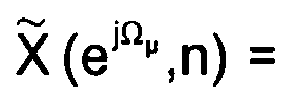

- However, a principle idea of the present invention is to refine a short-time spectrum comprising a relatively small number of nodes by using this spectrum and a number of time-delayed spectra with the same number of nodes without the need for any expensive DFT of higher order (> N). This is achieved by the claimed process of filtering of at least one sub-band short-time spectrum to obtain a refined sub-band short-time spectrum and, thus, a refined short-time spectrum. The filtering is preferably performed by a Finite Impulse Response (FIR) filtering means that guarantees linear phase responses and stability. However, Infinite Response Filters may alternatively be used that require less computing power.
- The filtering means is configured to realize the mathematic operation

- Thus, the disclosed method allows for an efficient way of spectral refinement that is rather inexpensive in terms of processor loads, memory resources, etc., since only a relatively small number of low-level algebraic operations is necessary.
- The filter coefficients of the filtering means for the i-th sub-band g i,ik
0 = [gi,ik0 ,0, gi,ik0 ,1 ,.., gi,ik0 ,M-1]T can be determined by gi,ik0 ,m = S(ik0, i+mN) with
µ ,n-(M-1)r), N being the length on the input signal x(n), and I = [0, 1, ..,N-1] and r denotes the frame shift of the time-delayed sub-band short-time spectra X(ejΩµ ,n-(M-1)r). For N = 256 a frame shift of, e.g., r = 64 might be chosen. - Thus, a sparse refinement matrix S has to be calculated which can be performed very fast and efficiently in terms of memory space as it is known in the art.
- Refinement of the short-time spectrum X(ejΩ,n) of the audio signal x(n) can include the determination of sub-band short time spectra for sub-bands that are not included in the short-time spectrum X(ejΩ,n) that is to be refined. In such a case, according to an embodiment of the inventive method the steps recited in
claim 1 are supplemented by the steps of
selecting a number of neighbored sub-bands (Ωµ);
filtering for each pair of the selected number of sub-bands (Ωµ): - a) the respective sub-band short-time spectrum (X(ejΩ
µ ,n)) and the corresponding time-delayed sub-band short-time spectra (X(ejΩµ ,n-(M-1)r)) of one of the neighbored sub-bands once more by the filtering means (g) to obtain a first additional filtered spectrum and - b) the respective sub-band short-time spectrum (X(ejΩ
µ ,n)) and the corresponding time-delayed sub-band short-time spectra (X(ejΩµ ,n-(M-1)r)) of the other one of the neighbored sub-bands once more by the filtering means (g) to obtain a second additional filtered spectrum; and - In detail, the sub-band short-time spectrum X(ejΩ
µ ,n) and the corresponding time-delayed sub-band short-time spectra X(ejΩµ ,n-(M-1)r) are filtered to obtain refined short-time spectra X̃(ejΩi ,n) as

µ ,n-(M-1)r), N being the length on the input signal x(n), and l = [0, 1, .., N-1], with Ñ = k0 N = N + r (M-1), and r denotes the frame shift of the time-delayed sub-band short-time spectra X(ejΩµ ,n-(M-1)r). - Thus, the short-time spectrum X(ejΩ,n) of the audio signal x(n) can very efficiently be refined by sub-band short time spectra obtained by interpolation between frequency nodes present in the short-time spectrum X(ejΩ,n) that is to be refined. In other words, the newly introduced sub-band short time spectra are weighted sums of the sub-band short time spectra that were already present in the short-time spectrum X(ejΩ,n).
- In particular applications it might be preferred to restrict the spectral refinement according to one of the above-described examples to a particular frequency range. For example, in the context of speech signal processing spectral refinement may only be considered necessary in the low-frequency regime below 1500 Hz, more particularly, below 1000 Hz. Thus, only sub-band short time spectra for the frequency range below these thresholds might be refined and/or additional sub-band short time spectra in this frequency range are generated. The overall processor load can significantly reduced by selection of a particular frequency range for spectral refinement rather than processing the entire audio signal x(n).
- The herein disclosed method for spectral refinement can be employed in a variety of audio signal processing applications. For example, it is provided a method for noise reduction of an audio signal, in particular a speech signal, comprising processing the audio input signal (x(n)) for spectral refinement of a short-time spectrum (X(ejΩ ,n)) of the audio input signal (x(n)) according to one of the above-described examples of the method for processing an audio signal for spectral refinement and filtering the at least one refined sub-band short-time spectrum (X̃(ejΩ
µ ,n)) obtained by one of above examples of the methods for spectral refinement by a noise reduction filtering. Sub-band short-time spectrum that are not refined can also be filtered for noise reduction (and usually will). - The noise reduction can be performed by a noise reduction filtering means known in the art. In particular, some kind of a (modified) Wiener filter characteristic may be chosen according to which noise reduction is performed on the basis of the estimated short-time power density of noise that is present in the processed audio signal and the short-time power density of the input signal. The latter can be estimated more accurately when the short-time spectrum is refined according to the above-described examples. In particular, the refined spectrogram (i.e. the squared magnitude of the refined short-time spectrum) can advantageously be employed for the noise reduction processing.
- The method for noise reduction of an audio signal (x(n)) may particularly comprise the steps
- i) determining the degree of stationarity of the audio signal (x(n));
- ii) if the determined degree of stationarity of the audio signal (x(n)) is below a predetermined threshold, then
filtering the audio signal (x(n)) by a noise reduction filtering means to obtain filtered sub-band spectra (Ŝ(ejΩ ,n)); or
if the determined degree of stationarity of the audio signal (x(n)) is equal to or exceeds the predetermined threshold, then- a) processing the audio input signal (x(n)) for spectral refinement of a short-time spectrum (X(ejΩ ,n)) of the audio input signal (x(n)) according to one of the examples of the method for processing an audio signal for spectral refinement; and
- b) filtering the at least one refined sub-band short-time spectrum (X̃(ejΩ
µ ,n)) obtained by one of examples of the method for processing an audio signal for spectral refinement by the noise reduction filtering means and, if present, non-refined sub-band short-time spectra (X(ejΩµ ,n)) to obtain filtered sub-band spectra (Ŝ(ejΩ,n));
- iii) inverse Discrete Fourier transforming and synthesizing (for example, by means of a synthesis filter bank) the filtered sub-band spectra (Ŝ(ejΩ ,n)) to obtain a noise reduced audio signal.
- Thus, the noise reduction will be performed on the basis of the refined short-time spectrum, only if the audio signal exhibits at least a predetermined stationarity. The advantage of such a conditional performance of the spectral refinement is that if the time delay introduced in the signal path by the spectral refinement is tolerable in the actual application, the spectral refinement will be performed and otherwise not. For example, in the context of telephony the standards of the International Telecommunication Union and the European Telecommunication Standards Institute have to be met by any actual telephone equipment, which demands for some degree of stationarity of the audio signal when spectral refinement shall be performed.
- Similar to noise reduction of an audio signal, echo compensation can profit from the disclosed method for spectral refinement. Echo compensation, e.g., may be performed by spectral subtraction based upon refined short-time spectra obtained by one of the above-described examples. According to one embodiment it is provided a method for echo compensating an audio signal, in particular, a speech signal, comprising processing the audio input signal (x(n)) for spectral refinement of a short-time spectrum (X(ejΩ ,n)) of the audio input signal (x(n)) according to one of the above-described examples of the herein disclosed method for spectral refinement and filtering the at least one refined sub-band short-time spectrum (X̃(ejΩ
µ ,n)) obtained by such an example by an echo compensation filtering means. - In one embodiment, the method for echo reduction of an audio signal (x(n)) comprises the steps of
- i) determining the degree of stationarity of the audio signal (x(n));
- ii) if the determined degree of stationarity of the audio signal (x(n)) is below a predetermined threshold, then
filtering the audio signal (x(n)) by an echo reduction filtering means to obtain filtered sub-band spectra (Ŝ(ejΩ ,n)); or
if the determined degree of stationarity of the audio signal (x(n)) is equal to or exceeds the predetermined threshold, then- a) processing the audio input signal (x(n)) for spectral refinement of a short-time spectrum (X(ejΩ ,n)) of the audio input signal (x(n)) according to one of the above-described examples of the herein disclosed method for spectral refinement; and
- b) filtering the at least one refined sub-band short-time spectrum (X̃(ejΩ
µ ,n)) obtained by such an example of the method for spectral refinement and, if present, non-refined sub-band short-time spectra (X(ejΩµ ,n)) by the echo reduction filtering means to obtain filtered sub-band spectra (Ŝ(ejΩ ,n));
- iii) inverse Discrete Fourier transforming the filtered sub-band spectra (Ŝ(ejΩ ,n)) to obtain an echo reduced audio signal.
- As in the case of the noise reduction, echo compensation, thus, might only be performed on the basis of the refined short-time spectrum, if the audio signal exhibits at least a predetermined stationarity in order to avoid time delay of the processed audio signal, if such a delay cannot be accepted for technical or conventional reasons.
- The above-described examples of the method for spectral refinement can also advantageously be applied to the technique of speech recognition and speech synthesis and, in particular, to the processing of a speech signal in order to estimate the (voice) pitch. Estimation of the pitch is usually based on the short-time power density or on the short-time spectrogram of the speech signal in each sub-band (the short-time spectrogram for the frequency node Ωµ is defined by |X(ejΩ
µ ,n)|2). A refined short-time spectrum results in a refined short-time power density or spectrogram and, thus, it is provided an improved method for estimating the pitch of a speech signal (x(n)), comprising
processing the speech input signal (x(n)) for spectral refinement of a short-time spectrum (X(ejΩ ,n)) of the audio input signal (x(n)) according to one of the above-described examples of the herein disclosed method for spectral refinement;
determining the short-time spectrogram of the at least one refined sub-band short-time spectrum (X̃(ejΩµ ,n)) obtained by such an example of the method for spectral refinement; and
estimating the pitch on the basis of the at least one determined short-time spectrogram. - The present invention also provides a computer program product, comprising one or more computer readable media having computer-executable instructions for performing the steps of an example of one of the above-described methods.
- Moreover, it is provided a signal processing means, comprising
a short-time Fourier transform means (1) configured to short-time Fourier transform an audio signal (x(n)) to obtain sub-band short-time spectra (X(ejΩµ ,n)) for a predetermined number of sub-bands;
a time-delay filtering means configured to time-delay at least one of the sub-band short-time spectra (X(ejΩµ ,n)) to obtain a predetermined number (M) of time-delayed sub-band short-time spectra (X(ejΩµ ,n-(M-1)r)) for at least one of the predetermined number of sub-bands;
a spectral refining means (2) configured to refine the at least one of the sub-band short-time spectra (X(ejΩµ ,n)), wherein the spectral refining means (2) comprises a filtering means, in particular, a Finite Impulse Response filtering means, configured to filter for the at least one of the predetermined number of sub-bands the respective sub-band short-time spectrum (X(ejΩµ ,n)) and the corresponding time-delayed sub-band short-time spectra (X(ejΩµ ,n-(M-1)r)) by a filtering means, in particular, by a Finite Impulse Response filtering means (g), to obtain at least one refined sub-band short-time spectrum (X̃(ejΩµ ,n)) for the at least one of the of the predetermined number of sub-bands. - The signal processing means may further comprise a selection means that is configured to select a number of neighbored sub-bands (Ωµ). In this case, the filtering means is configured to filter for each pair of the selected number of sub-bands (Ωµ):
- a) the respective sub-band short-time spectrum (X(ejΩ
µ ,n)) and the corresponding time-delayed sub-band short-time spectra (X(ejΩµ ,n-(M-1)r)) of one of the neighbored sub-bands once more by the filtering means (g) to obtain a first additional filtered spectrum and - b) the respective sub-band short-time spectrum (X(ejΩ
µ ,n)) and the corresponding time-delayed sub-band short-time spectra (X(ejΩµ ,n-(M-1)r)) of the other one of the neighbored sub-bands once more by the filtering means (g) to obtain a second additional filtered spectrum; and - The signal processing means can be incorporated in a device that is configured to enhance the quality of an audio signal (x(n)), in particular, a speech signal, and that further comprises a noise reduction filtering mean and/or an echo compensation filtering means configured to noise reduce and/or to echo reduce the audio signal (x(n)) on the basis of the at least one refined sub-band short-time spectrum (X̃(ejΩ
µ ,n)) obtained by above-mentioned signal processing means. - Furthermore, the signal processing means can be incorporated in a pitch estimating means for estimating the pitch of a speech signal (x(n)) and also comprising an analysis means configured to determine the short-time power density spectrum of the speech signal (x(n)) based on the at least one refined sub-band short-time spectrum (X̃(ejΩ
µ ,n)) obtained by the signal processing means mentioned above and to estimate the pitch based on the determined short-time power density spectrum of the speech signal (x(n)). Here, the short-time power density spectrum of the speech signal (x(n)) can be derived from the short-time spectrogram of the speech signal. The signal analyzed for the pitch may be previously noise and/or echo reduced. Thus, the pitch estimating means may also comprise one of the above-mentioned reduction filtering mean and/or an echo compensation filtering means. - Particularly preferred applications of the present invention relate to the technology of hands-free telephony and speech recognition that both are very sensible to the deterioration of audio signals by noise and can, thus, significantly benefit from an enhanced signal quality resulting from spectral refinement.
- It is provided a hands-free telephony system, comprising the above-mentioned signal processing means and/or the signal enhancing means and/or the pitch estimating means comprising the signal processing means.
- In addition, the present invention provides a speech recognition means comprising the signal enhancing means (configured for noise reduction and/or echo reduction of an audio signal) mentioned-above and/or the above-mentioned pitch estimating means. This speech recognition means can also be incorporated in a speech dialog system or voice control system.
- Additional features and advantages of the invention will be described with reference to the drawings:
-
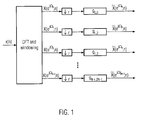
Figure 1 illustrates spectral refinement according to an example of the herein disclosed method comprising FIR filtering. -
Figure 2 illustrates spectral refinement according to an example of the herein disclosed method comprising FIR filtering to obtain an augmented spectrum comprising nodes in addition to the ones of the refined spectrum. -
Figure 3 shows an example for the incorporation of the method for spectral refinement in an echo compensation and noise reduction processing branch. - In the following the herein disclosed spectral refinement method is explained in detail. According to this method the short-time spectrum consisting of the sub-band signals

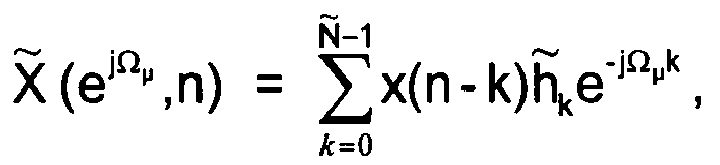
- The refinement is achieved by means of a refinement matrix S:

0 ,n), .., X(ejΩN-1 ,n)]T and X̃(ejΩ,n) = [X̃ (ejΩ0 ,n), .., X̃(ejΩN-1 ,n)]T, that are calculated by means of the DFT matrix D L by X(ejΩ,n) = D N H x(n) and X̃(ejΩ,n) = DÑ H̃ x̃(n), respectively, where the diagonal matrices and the DFT matrix read


where x̃(n) is the augmented signal vector x̃(n) = [x(n), x(n-1), .., x(n-N+1), .., x(n-Ñ+1)]T. - The refinement matrix S is, thus, calculated without any need for a DFT of higher order than the originally used (i.e. with an order higher than N) and has the size Ñ x N M, where M is the number of the used sub-band short time spectra X(ejΩ,n), .., X(ejΩ,n-(M-1)r).
- With this refinement matrix S the refined spectrum X̃(ejΩ,n) is calculated from a number M or previous input spectra X(ejΩ,n) that are respectively shifted one by the other by the integer r (frame shift): X(ejΩ,n-r), X(ejΩ,n-2r), .., X(ejΩ,n-(M-1)r).
- The refinement matrix S is determined observing the following constraint for the window function h̃:

- Making use of the block diagonal DFT matrix


- With the above-mentioned constraint this can be re-written as


- The coefficients of the refinement matrix read


where am are the coefficients of the matrix A (m=0, .., M-1; see above) and I ∈ {0,1,..,N-1} and Z denotes the set of integers. - Thus, each k0-th row of S is sparsely populated, i.e. the elements of each k0-th row are zero with the exception of the column indices that are multiples of N. If N is chosen to be 2 r or 4 r, these elements are real or imaginary.
- For a refinement of the original frequency resolution only each k0-th node of the vector X̃(ejΩ,n) is to be calculated. Since the matrix S is a sparse matrix the spectral refinement can readily be realized by short Finite Impulse Response (FIR) filters applied in each sub-band with g i,ik
0 = [gi,ik0 ,0, gi,ik0 ,1, .., gi,ik0 ,M-1]T in the i-th sub-band as it is shown inFigure 1 for the example of k0=2. - According to the embodiment of
Figure 1 an input signal x(n) is windowed and discrete Fourier transformed (short-time Fourier transformed) to obtain sub-band signals X(ejΩµ ,n), i.e. sub-band short-time spectra, constituting a short-time spectrum X(ejΩ,n) that is to be refined. For the window function, e.g., a Hann window can be used. For each of the sub-band short-time spectra a number of time-delayed short-time spectra is generated (as indicated by ↓ r). According to the example shown inFigure 1 the refined spectrum for the i-the sub-band is obtained by
Figure 2 . Pairs of coefficients of the populated rows are used to approximate the target frequency by means of the original frequency nodes
- Important applications for the above-described spectral refinement are noise reduction of audio and speech signals as well as the estimation of the (voice) pitch frequency of a speech signal. Experiments have shown that the estimation of the pitch frequency, in particular, in cases in which adjacent amplitude maxima are close to each other, analysis of a power density spectrum derived from a refined spectrum obtained as described above significantly improves pitch estimations and thereby speech recognition or synthesis results based on the pitch estimation.
- Audio signal processing often includes enhancement of the audio signals by noise reduction and/or echo compensation. Noise reduction and/or echo compensation in the sub-band regime is achieved by filtering the audio signals by adaptable filter coefficients (damping factors) V(ejΩ
µ ,n) that are usually determined on the basis of the short-time power density or the spectrogram of the audio input signal and the estimated short-time power density of the background noise (echo). In the art the damping factors for signal portions between adjacent pitch lines (amplitude maxima) are often adapted to too small magnitudes, since the spectral resolution of the employed window functions are too low and due to the overlap of sub-bands produced, e.g., by a Hann window. Therefore, the above-explained method for spectral refinement can advantageously be applied to the art of noise reduction and echo compensation. - An example for the employment of the above-described method of spectral analysis for echo compensation and/or noise reduction of an audio signal, in particular, a speech signal, is illustrated in
Figure 3 . - An audio signal x(n) is transformed by a DFT means 1 into sub-band signals (sub-band short-time spectra). With the help of a stationarity detecting means 3 it is detected whether the sub-band signals X(ejΩ
µ ,n) change significantly over some signal frames. If the input spectrum is stationary within some predetermined limits it is input in a spectral refiner 3. If it is non-stationary the spectral refinement is omitted in order not to exceed the maximum allowable signal delay times as demanded for by, e.g., the standards of the International Telecommunication Union and the European Telecommunication Standards Institute. - The spectral refiner 3 performs the above-explained spectral refinement of the input spectrum X(ejΩ ,n) in order to obtain a refined spectrum X̃(ejΩ,n). In the case of a speech input signal x(n) it might be preferred to refine only a portion of the input spectrum X(ejΩ ,n), say for frequencies below 1000 Hz. The refined spectrum X̃(ejΩ,n) is, then, subject to processing by an echo compensation and noise reduction means 4 as known in the art with an impulse response V to obtain an enhanced spectrum with the sub-band signals Ŝ(ejΩ
µ ,n) = V(ejΩµ ,n) X(ejΩµ ,n). After synthesis by an IDFT means 5 a full band enhanced audio signal is obtained. - All previously discussed embodiments are not intended as limitations but serve as examples illustrating features and advantages of the invention. It is to be understood that some or all of the above described features can also be combined in different ways.
Claims (19)
- Method for processing an audio input signal (x(n)) for spectral refinement of a short-time spectrum (X(ejΩ,n)) of the audio input signal (x(n)) consisting of sub-band short-time spectra (X(ejΩ
µ ,n)), comprising
short-time Fourier transforming the audio input signal (x(n)) to obtain the sub-band short-time spectra (X(ejΩµ ,n)) for a predetermined number of sub-bands;
time-delay filtering at least one of the sub-band short-time spectra (X(ejΩµ ,n)) to obtain a predetermined number (M) of time-delayed sub-band short-time spectra (X(ejΩµ ,n-(M-1)r)) for at least one of the predetermined number of sub-bands;
filtering for the at least one of the predetermined number of sub-bands the respective sub-band short-time spectrum (X(ejΩµ ,n)) and the corresponding time-delayed sub-band short-time spectra (X(ejΩµ ,n-(M-1)r)) by a filtering means, in particular, by a Finite Impulse Response filtering means (g), to obtain a refined sub-band short-time spectrum (X̃(ejΩµ ,n)) for the at least one of the predetermined number of sub-bands. - The method according to claim 1, wherein the filter coefficients of the filtering means for the i-th sub-band g i,ik
0 = [gi,ik0 ,0, gi,ik0 ,1 ,.., gi,ik0 ,M-1]T are determined by

µ ,n-(M-1)r), N being the length on the input signal x(n), and l = [0, 1, ..,N-1] and r denotes the frame shift of the time-delayed sub-band short-time spectra X(ejΩµ ,n-(M-1)r). - The method according to claim 1 or 2, further comprising
selecting a number of neighbored sub-bands;
filtering for each pair of the selected number of sub-bands:a) the respective sub-band short-time spectrum (X(ejΩµ ,n)) and the corresponding time-delayed sub-band short-time spectra (X(ejΩµ ,n-(M-1)r)) of one of the neighbored sub-bands once more by the filtering means (g) to obtain a first additional filtered spectrum andb) the respective sub-band short-time spectrum (X(jΩadding the first and the second additional filtered spectra in order to obtain one additional sub-band short-time spectrum (X̃(ejΩµ ,n)) and the corresponding time-delayed sub-band short-time spectra (X(ejΩµ ,n-(M-1)r)) of the other one of the neighbored sub-bands once more by the filtering means (g) to obtain a second additional filtered spectrum; andµ ,n)) for each of the pairs of the selected number of sub-bands. - The method according to claim 3, wherein the sub-band short-time spectrum (X(ejΩ
µ ,n)) and the corresponding time-delayed sub-band short-time spectra (X(ejΩµ n-(M-1)r)) are filtered according to
where └ ┘ and ┌ ┐ denote rounding to the next smaller integer and to the next larger integer, respectively, and g(i,l,m) = S(l, i+mN) and
µ ,n-(M-1)r), N being the length on the input signal x(n), and l = [0, 1, .., N-1], with Ñ = k0 N = N + r (M-1), and r denotes the frame shift of the time-delayed sub-band short-time spectra X(ejΩµ ,n-(M-1)r). - The method according to one of the preceding claims, wherein the spectral refinement of the input short-time spectrum (X(ejΩ ,n)) of the audio input signal (x(n)) is performed for frequencies below 1500 Hz, in particular, below 1000 Hz.
- The method according to one of the preceding claims, wherein the short-time Fourier transforming of the audio input signal (x(n)) is performed by means of a Hann window or a Hamming window or a Gauss window.
- Method for noise reduction of an audio signal (x(n)), comprising processing the audio input signal (x(n)) for spectral refinement of a short-time spectrum (X(ejΩ ,n)) of the audio input signal (x(n)) according to one of the methods of claims 1 to 6 and filtering the at least one refined sub-band short-time spectrum (X̃(ejΩ
µ ,n)) obtained by one of the methods of claims 1 to 6 by a noise reduction filtering. - The method for noise reduction of an audio signal (x(n)) according to claim 7, comprisingi) determining the degree of stationarity of the audio signal (x(n));ii) if the determined degree of stationarity of the audio signal (x(n)) is below a predetermined threshold, then
filtering the audio signal (x(n)) by a noise reduction filtering means to obtain filtered sub-band short-time spectra (Ŝ(ejΩ ,n)); or
if the determined degree of stationarity of the audio signal (x(n)) is equal to or exceeds the predetermined threshold, thena) processing the audio input signal (x(n)) for spectral refinement of a short-time spectrum (X(ejΩ ,n)) of the audio input signal (x(n)) according to one of the methods of claims 1 to 6; andb) filtering the at least one refined sub-band short-time spectrum (X̃(ejΩandµ ,n)) obtained by one of the methods of claims 1 to 6 by the noise reduction filtering means and, if present, non-refined sub-band short-time spectra (X(ejΩµ ,n)) to obtain filtered sub-band spectra (Ŝ(ejΩ ,n));iii) inverse Discrete Fourier transforming and synthesizing the filtered sub-band short-time spectra (Ŝ(ejΩ ,n)) to obtain a noise reduced audio signal. - Method for echo reduction of an audio signal (x(n)), comprising
processing the audio input signal (x(n)) for spectral refinement of a short-time spectrum (X(ejΩ ,n)) of the audio input signal (x(n)) according to one of the methods of claims 1 to 6 and filtering the at least one refined sub-band short-time spectrum (X̃(ejΩµ ,n)) obtained by one of the methods of claims 1 to 6 by an echo compensation filtering means. - The method for echo reduction of an audio signal (x(n)) according to claim 9, comprisingi) determining the degree of stationarity of the audio signal (x(n));ii) if the determined degree of stationarity of the audio signal (x(n)) is below a predetermined threshold, then
filtering the audio signal (x(n)) by an echo reduction filtering means to obtain filtered sub-band spectra (Ŝ(ejΩ ,n)); or
if the determined degree of stationarity of the audio signal (x(n)) is equal to or exceeds the predetermined threshold, thena) processing the audio input signal (x(n)) for spectral refinement of a short-time spectrum (X(ejΩ ,n)) of the audio input signal (x(n)) according to one of the methods of claims 1 to 6; andb) filtering the at least one refined sub-band short-time spectrum (X̃(ejΩandµ ,n)) obtained by one of the methods of claims 1 to 6 and, if present, non-refined sub-band short-time spectra (X(ejΩµ ,n)) by the echo reduction filtering means to obtain filtered sub-band spectra (Ŝ(ejΩ ,n));iii) inverse Discrete Fourier transforming and synthesizing the filtered sub-band spectra (Ŝ(ejΩ ,n)) to obtain an echo reduced audio signal. - Method for estimating the pitch of a speech signal (x(n)), comprising
processing the speech input signal (x(n)) for spectral refinement of a short-time spectrum (X(ejΩ ,n)) of the audio input signal (x(n)) according to one of the methods of claims 1 to 6;
determining the short-time spectrogram of the at least one refined sub-band short-time spectrum (X̃(ejΩµ ,n)) obtained by one of the methods of claims 1 to 6; and
estimating the pitch on the basis of the at least one determined short-time spectrogram. - Computer program product, comprising one or more computer readable media having computer-executable instructions for performing the steps of the method according to one of the Claims 1 to 11.
- Signal processing means, comprising
a short-time Fourier transform means (1) configured to short-time Fourier transform an audio signal (x(n)) to obtain sub-band short-time spectra (X(ejΩµ ,n)) for a predetermined number of sub-bands;
a time-delay filtering means configured to time-delay at least one of the sub-band short-time spectra (X(ejΩµ ,n)) to obtain a predetermined number (M) of time-delayed sub-band short-time spectra (X(ejΩµ ,n-(M-1)r)) for at least one of the predetermined number of sub-bands;
a spectral refining means (2) configured to refine the at least one of the sub-band short-time spectra (X(ejΩµ ,n)), wherein the spectral refining means (2) comprises a filtering means, in particular, a Finite Impulse Response filtering means, configured to filter for the at least one of the predetermined number of sub-bands the respective sub-band short-time spectrum (X(ejΩµ ,n)) and the corresponding time-delayed sub-band short-time spectra (X(ejΩµ ,n-(M-1)r)) by a filtering means, in particular, by a Finite Impulse Response filtering means (g), to obtain at least one refined sub-band short-time spectrum (X̃(ejΩµ ,n)) for the at least one of the of the predetermined number of sub-bands. - The signal processing means according to claim 13, further comprising a selection means configured to select a number of neighbored sub-bands; and wherein the filtering means is configured to filter for each pair of the selected number of sub-bands:a) the respective sub-band short-time spectrum (X(ejΩ
µ ,n)) and the corresponding time-delayed sub-band short-time spectra (X(ejΩµ,n-(M-1)r)) of one of the neighbored sub-bands once more by the filtering means (g) to obtain a first additional filtered spectrum andb) the respective sub-band short-time spectrum (X(ejΩfurther comprising an adder configured to add the first and the second additional spectra in order to obtain an additional refined sub-band short-time spectrum (X̃(ejΩµ ,n)) and the corresponding time-delayed sub-band short-time spectra (X(ejΩµ ,n-(M-1)r)) of the other one of the neighbored sub-bands once more by the filtering means (g) to obtain a second additional filtered spectrum; andµ ,n)) for each of the pairs of the selected number of sub-bands. - Signal enhancing means for enhancing the quality of an audio signal (x(n)), comprising the signal processing means according to claim 13 or 14 and further comprising a noise reduction filtering mean and/or an echo compensation filtering means configured to noise reduce and/or to echo reduce the audio signal (x(n)) on the basis of the at least one refined sub-band short-time spectrum (X̃(ejΩ
µ ,n)) obtained by the signal processing means according to claim 13 or 14. - Pitch estimating means for estimating the pitch of a speech signal (x(n)), comprising the signal processing means according to claim 13 or 14 and further comprising an analysis means configured to determine the short-time power density spectrum of the speech signal (x(n)) based on the at least one refined sub-band short-time spectrum (X̃(ejΩ
µ ,n)) obtained by the signal processing means according to claim 13 or 14 and to estimate the pitch based on the determined short-time power density spectrum of the speech signal (x(n)). - Hands-free telephony system, comprising the signal processing means according to claim 13 or 14 and/or the signal enhancing means according to claim 15 and/or the pitch estimating means according to claim 16.
- Speech recognition means comprising the signal enhancing means according to claim 15 and/or the pitch estimating means according to claim 16.
- Speech dialog system or voice control system comprising the speech recognition means according to claim 18.
Priority Applications (2)
| Application Number | Priority Date | Filing Date | Title |
|---|---|---|---|
| EP06024940A EP1927981B1 (en) | 2006-12-01 | 2006-12-01 | Spectral refinement of audio signals |
| US11/948,137 US8190426B2 (en) | 2006-12-01 | 2007-11-30 | Spectral refinement system |
Applications Claiming Priority (1)
| Application Number | Priority Date | Filing Date | Title |
|---|---|---|---|
| EP06024940A EP1927981B1 (en) | 2006-12-01 | 2006-12-01 | Spectral refinement of audio signals |
Publications (2)
| Publication Number | Publication Date |
|---|---|
| EP1927981A1 true EP1927981A1 (en) | 2008-06-04 |
| EP1927981B1 EP1927981B1 (en) | 2013-02-20 |
Family
ID=37913604
Family Applications (1)
| Application Number | Title | Priority Date | Filing Date |
|---|---|---|---|
| EP06024940A Not-in-force EP1927981B1 (en) | 2006-12-01 | 2006-12-01 | Spectral refinement of audio signals |
Country Status (2)
| Country | Link |
|---|---|
| US (1) | US8190426B2 (en) |
| EP (1) | EP1927981B1 (en) |
Cited By (2)
| Publication number | Priority date | Publication date | Assignee | Title |
|---|---|---|---|---|
| EP2562751A1 (en) | 2011-08-22 | 2013-02-27 | Svox AG | Temporal interpolation of adjacent spectra |
| PT105880A (en) * | 2011-09-06 | 2013-03-06 | Univ Do Algarve | CONTROLLED CANCELLATION OF PREDOMINANTLY MULTIPLICATIVE NOISE IN SIGNALS IN TIME-FREQUENCY SPACE |
Families Citing this family (6)
| Publication number | Priority date | Publication date | Assignee | Title |
|---|---|---|---|---|
| WO2008112539A1 (en) * | 2007-03-09 | 2008-09-18 | Fortemedia, Inc. | Method and apparatus for voice communication |
| WO2010085189A1 (en) * | 2009-01-26 | 2010-07-29 | Telefonaktiebolaget L M Ericsson (Publ) | Aligning scheme for audio signals |
| CN103258539B (en) * | 2012-02-15 | 2015-09-23 | 展讯通信(上海)有限公司 | A kind of transform method of voice signal characteristic and device |
| US9524733B2 (en) * | 2012-05-10 | 2016-12-20 | Google Inc. | Objective speech quality metric |
| US9552825B2 (en) * | 2013-04-17 | 2017-01-24 | Honeywell International Inc. | Noise cancellation for voice activation |
| EP3118851B1 (en) * | 2015-07-01 | 2021-01-06 | Oticon A/s | Enhancement of noisy speech based on statistical speech and noise models |
Citations (3)
| Publication number | Priority date | Publication date | Assignee | Title |
|---|---|---|---|---|
| EP0767462A2 (en) * | 1995-10-05 | 1997-04-09 | France Telecom | Process for reducing the pre-echoes or post-echoes affecting audio recordings |
| EP1160977A2 (en) * | 2000-06-02 | 2001-12-05 | Agere Systems Guardian Corporation | Method and apparatus for reducing aliasing in cascaded filter banks |
| US6947509B1 (en) * | 1999-11-30 | 2005-09-20 | Verance Corporation | Oversampled filter bank for subband processing |
Family Cites Families (9)
| Publication number | Priority date | Publication date | Assignee | Title |
|---|---|---|---|---|
| US5504833A (en) * | 1991-08-22 | 1996-04-02 | George; E. Bryan | Speech approximation using successive sinusoidal overlap-add models and pitch-scale modifications |
| US6850252B1 (en) * | 1999-10-05 | 2005-02-01 | Steven M. Hoffberg | Intelligent electronic appliance system and method |
| AU4686993A (en) * | 1992-07-30 | 1994-03-03 | Temple University - Of The Commonwealth System Of Higher Education | Direct manual cardiac compression device and method of use thereof |
| US5699404A (en) * | 1995-06-26 | 1997-12-16 | Motorola, Inc. | Apparatus for time-scaling in communication products |
| US5774837A (en) * | 1995-09-13 | 1998-06-30 | Voxware, Inc. | Speech coding system and method using voicing probability determination |
| SE512719C2 (en) * | 1997-06-10 | 2000-05-02 | Lars Gustaf Liljeryd | A method and apparatus for reducing data flow based on harmonic bandwidth expansion |
| US6377916B1 (en) * | 1999-11-29 | 2002-04-23 | Digital Voice Systems, Inc. | Multiband harmonic transform coder |
| FR2849727B1 (en) * | 2003-01-08 | 2005-03-18 | France Telecom | METHOD FOR AUDIO CODING AND DECODING AT VARIABLE FLOW |
| CA2457988A1 (en) * | 2004-02-18 | 2005-08-18 | Voiceage Corporation | Methods and devices for audio compression based on acelp/tcx coding and multi-rate lattice vector quantization |
-
2006
- 2006-12-01 EP EP06024940A patent/EP1927981B1/en not_active Not-in-force
-
2007
- 2007-11-30 US US11/948,137 patent/US8190426B2/en active Active
Patent Citations (3)
| Publication number | Priority date | Publication date | Assignee | Title |
|---|---|---|---|---|
| EP0767462A2 (en) * | 1995-10-05 | 1997-04-09 | France Telecom | Process for reducing the pre-echoes or post-echoes affecting audio recordings |
| US6947509B1 (en) * | 1999-11-30 | 2005-09-20 | Verance Corporation | Oversampled filter bank for subband processing |
| EP1160977A2 (en) * | 2000-06-02 | 2001-12-05 | Agere Systems Guardian Corporation | Method and apparatus for reducing aliasing in cascaded filter banks |
Non-Patent Citations (1)
| Title |
|---|
| GRBIC N ET AL: "Design of oversampled uniform DFT filter banks with reduced inband aliasing and delay constraints", SIGNAL PROCESSING AND ITS APPICATIONS, SIXTH INTERNATIONAL, SYMPOSIUM ON. 2001 AUG. 16-16, 2001, PISCATAWAY, NJ, USA,IEEE, vol. 1, 13 August 2001 (2001-08-13), pages 104 - 107, XP010557192, ISBN: 0-7803-6703-0 * |
Cited By (5)
| Publication number | Priority date | Publication date | Assignee | Title |
|---|---|---|---|---|
| EP2562751A1 (en) | 2011-08-22 | 2013-02-27 | Svox AG | Temporal interpolation of adjacent spectra |
| US9076455B2 (en) | 2011-08-22 | 2015-07-07 | Nuance Communications, Inc. | Temporal interpolation of adjacent spectra |
| US9129608B2 (en) | 2011-08-22 | 2015-09-08 | Nuance Communications, Inc. | Temporal interpolation of adjacent spectra |
| PT105880A (en) * | 2011-09-06 | 2013-03-06 | Univ Do Algarve | CONTROLLED CANCELLATION OF PREDOMINANTLY MULTIPLICATIVE NOISE IN SIGNALS IN TIME-FREQUENCY SPACE |
| PT105880B (en) * | 2011-09-06 | 2014-04-17 | Univ Do Algarve | CONTROLLED CANCELLATION OF PREDOMINANTLY MULTIPLICATIVE NOISE IN SIGNALS IN TIME-FREQUENCY SPACE |
Also Published As
| Publication number | Publication date |
|---|---|
| US8190426B2 (en) | 2012-05-29 |
| EP1927981B1 (en) | 2013-02-20 |
| US20080195382A1 (en) | 2008-08-14 |
Similar Documents
| Publication | Publication Date | Title |
|---|---|---|
| EP1806739B1 (en) | Noise suppressor | |
| EP2045801B1 (en) | Efficient audio signal processing in the sub-band regime, method, system and associated computer program | |
| EP1855457B1 (en) | Multi channel echo compensation using a decorrelation stage | |
| EP1936939B1 (en) | Low complexity echo compensation | |
| EP2026597B1 (en) | Noise reduction by combined beamforming and post-filtering | |
| TWI388190B (en) | Apparatus and method for computing filter coefficients for echo suppression | |
| EP1918910B1 (en) | Model-based enhancement of speech signals | |
| CN104520925B (en) | Percentile filtering for noise reduction gain | |
| US8170226B2 (en) | Acoustic echo cancellation and adaptive filters | |
| EP2444967A1 (en) | Echo suppression comprising modeling of late reverberation components | |
| EP2562751B1 (en) | Temporal interpolation of adjacent spectra | |
| CN101719969A (en) | Method and system for judging double-end conversation and method and system for eliminating echo | |
| US20070174050A1 (en) | High frequency compression integration | |
| EP3829151A1 (en) | Echo suppression device, echo suppression method, and echo suppression program | |
| US8190426B2 (en) | Spectral refinement system | |
| EP1892703B1 (en) | Method and system for providing an acoustic signal with extended bandwidth | |
| Löllmann et al. | Low delay filter-banks for speech and audio processing | |
| EP4064726A1 (en) | Sound pick-up device, sound pick-up method and sound pick-up program | |
| Hendriks et al. | Adaptive time segmentation for improved speech enhancement | |
| CN102598128A (en) | Signal processing method, information processing device and storage medium for storing signal processing program | |
| Fingscheidt et al. | Towards objective quality assessment of speech enhancement systems in a black box approach | |
| Krini et al. | Refinement and Temporal Interpolation of Short-Term Spectra: Theory and Applications | |
| Zhao et al. | SDAEC: Signal Decoupling for Advancing Acoustic Echo Cancellation. | |
| Krini et al. | Spectral refinement and its application to fundamental frequency estimation | |
| Thieling et al. | Beyond Clean Phase: Using Silence-Generating Phase for DNN-Based Speech Enhancement |
Legal Events
| Date | Code | Title | Description |
|---|---|---|---|
| PUAI | Public reference made under article 153(3) epc to a published international application that has entered the european phase |
Free format text: ORIGINAL CODE: 0009012 |
|
| AK | Designated contracting states |
Kind code of ref document: A1 Designated state(s): AT BE BG CH CY CZ DE DK EE ES FI FR GB GR HU IE IS IT LI LT LU LV MC NL PL PT RO SE SI SK TR |
|
| AX | Request for extension of the european patent |
Extension state: AL BA HR MK RS |
|
| 17P | Request for examination filed |
Effective date: 20080625 |
|
| AKX | Designation fees paid |
Designated state(s): AT BE BG CH CY CZ DE DK EE ES FI FR GB GR HU IE IS IT LI LT LU LV MC NL PL PT RO SE SI SK TR |
|
| RAP1 | Party data changed (applicant data changed or rights of an application transferred) |
Owner name: NUANCE COMMUNICATIONS, INC. |
|
| GRAP | Despatch of communication of intention to grant a patent |
Free format text: ORIGINAL CODE: EPIDOSNIGR1 |
|
| GRAS | Grant fee paid |
Free format text: ORIGINAL CODE: EPIDOSNIGR3 |
|
| GRAA | (expected) grant |
Free format text: ORIGINAL CODE: 0009210 |
|
| AK | Designated contracting states |
Kind code of ref document: B1 Designated state(s): AT BE BG CH CY CZ DE DK EE ES FI FR GB GR HU IE IS IT LI LT LU LV MC NL PL PT RO SE SI SK TR |
|
| REG | Reference to a national code |
Ref country code: GB Ref legal event code: FG4D |
|
| REG | Reference to a national code |
Ref country code: CH Ref legal event code: EP |
|
| REG | Reference to a national code |
Ref country code: AT Ref legal event code: REF Ref document number: 597823 Country of ref document: AT Kind code of ref document: T Effective date: 20130315 |
|
| REG | Reference to a national code |
Ref country code: IE Ref legal event code: FG4D |
|
| REG | Reference to a national code |
Ref country code: DE Ref legal event code: R096 Ref document number: 602006034598 Country of ref document: DE Effective date: 20130418 |
|
| REG | Reference to a national code |
Ref country code: AT Ref legal event code: MK05 Ref document number: 597823 Country of ref document: AT Kind code of ref document: T Effective date: 20130220 |
|
| REG | Reference to a national code |
Ref country code: NL Ref legal event code: VDEP Effective date: 20130220 |
|
| REG | Reference to a national code |
Ref country code: LT Ref legal event code: MG4D |
|
| PG25 | Lapsed in a contracting state [announced via postgrant information from national office to epo] |
Ref country code: SE Free format text: LAPSE BECAUSE OF FAILURE TO SUBMIT A TRANSLATION OF THE DESCRIPTION OR TO PAY THE FEE WITHIN THE PRESCRIBED TIME-LIMIT Effective date: 20130220 Ref country code: AT Free format text: LAPSE BECAUSE OF FAILURE TO SUBMIT A TRANSLATION OF THE DESCRIPTION OR TO PAY THE FEE WITHIN THE PRESCRIBED TIME-LIMIT Effective date: 20130220 Ref country code: IS Free format text: LAPSE BECAUSE OF FAILURE TO SUBMIT A TRANSLATION OF THE DESCRIPTION OR TO PAY THE FEE WITHIN THE PRESCRIBED TIME-LIMIT Effective date: 20130620 Ref country code: BG Free format text: LAPSE BECAUSE OF FAILURE TO SUBMIT A TRANSLATION OF THE DESCRIPTION OR TO PAY THE FEE WITHIN THE PRESCRIBED TIME-LIMIT Effective date: 20130520 Ref country code: LT Free format text: LAPSE BECAUSE OF FAILURE TO SUBMIT A TRANSLATION OF THE DESCRIPTION OR TO PAY THE FEE WITHIN THE PRESCRIBED TIME-LIMIT Effective date: 20130220 Ref country code: ES Free format text: LAPSE BECAUSE OF FAILURE TO SUBMIT A TRANSLATION OF THE DESCRIPTION OR TO PAY THE FEE WITHIN THE PRESCRIBED TIME-LIMIT Effective date: 20130531 |
|
| PG25 | Lapsed in a contracting state [announced via postgrant information from national office to epo] |
Ref country code: SI Free format text: LAPSE BECAUSE OF FAILURE TO SUBMIT A TRANSLATION OF THE DESCRIPTION OR TO PAY THE FEE WITHIN THE PRESCRIBED TIME-LIMIT Effective date: 20130220 Ref country code: PT Free format text: LAPSE BECAUSE OF FAILURE TO SUBMIT A TRANSLATION OF THE DESCRIPTION OR TO PAY THE FEE WITHIN THE PRESCRIBED TIME-LIMIT Effective date: 20130620 Ref country code: LV Free format text: LAPSE BECAUSE OF FAILURE TO SUBMIT A TRANSLATION OF THE DESCRIPTION OR TO PAY THE FEE WITHIN THE PRESCRIBED TIME-LIMIT Effective date: 20130220 Ref country code: BE Free format text: LAPSE BECAUSE OF FAILURE TO SUBMIT A TRANSLATION OF THE DESCRIPTION OR TO PAY THE FEE WITHIN THE PRESCRIBED TIME-LIMIT Effective date: 20130220 Ref country code: FI Free format text: LAPSE BECAUSE OF FAILURE TO SUBMIT A TRANSLATION OF THE DESCRIPTION OR TO PAY THE FEE WITHIN THE PRESCRIBED TIME-LIMIT Effective date: 20130220 Ref country code: GR Free format text: LAPSE BECAUSE OF FAILURE TO SUBMIT A TRANSLATION OF THE DESCRIPTION OR TO PAY THE FEE WITHIN THE PRESCRIBED TIME-LIMIT Effective date: 20130521 Ref country code: PL Free format text: LAPSE BECAUSE OF FAILURE TO SUBMIT A TRANSLATION OF THE DESCRIPTION OR TO PAY THE FEE WITHIN THE PRESCRIBED TIME-LIMIT Effective date: 20130220 |
|
| PG25 | Lapsed in a contracting state [announced via postgrant information from national office to epo] |
Ref country code: DK Free format text: LAPSE BECAUSE OF FAILURE TO SUBMIT A TRANSLATION OF THE DESCRIPTION OR TO PAY THE FEE WITHIN THE PRESCRIBED TIME-LIMIT Effective date: 20130220 Ref country code: NL Free format text: LAPSE BECAUSE OF FAILURE TO SUBMIT A TRANSLATION OF THE DESCRIPTION OR TO PAY THE FEE WITHIN THE PRESCRIBED TIME-LIMIT Effective date: 20130220 Ref country code: RO Free format text: LAPSE BECAUSE OF FAILURE TO SUBMIT A TRANSLATION OF THE DESCRIPTION OR TO PAY THE FEE WITHIN THE PRESCRIBED TIME-LIMIT Effective date: 20130220 Ref country code: EE Free format text: LAPSE BECAUSE OF FAILURE TO SUBMIT A TRANSLATION OF THE DESCRIPTION OR TO PAY THE FEE WITHIN THE PRESCRIBED TIME-LIMIT Effective date: 20130220 Ref country code: SK Free format text: LAPSE BECAUSE OF FAILURE TO SUBMIT A TRANSLATION OF THE DESCRIPTION OR TO PAY THE FEE WITHIN THE PRESCRIBED TIME-LIMIT Effective date: 20130220 Ref country code: CZ Free format text: LAPSE BECAUSE OF FAILURE TO SUBMIT A TRANSLATION OF THE DESCRIPTION OR TO PAY THE FEE WITHIN THE PRESCRIBED TIME-LIMIT Effective date: 20130220 |
|
| PG25 | Lapsed in a contracting state [announced via postgrant information from national office to epo] |
Ref country code: CY Free format text: LAPSE BECAUSE OF FAILURE TO SUBMIT A TRANSLATION OF THE DESCRIPTION OR TO PAY THE FEE WITHIN THE PRESCRIBED TIME-LIMIT Effective date: 20130220 |
|
| PLBE | No opposition filed within time limit |
Free format text: ORIGINAL CODE: 0009261 |
|
| STAA | Information on the status of an ep patent application or granted ep patent |
Free format text: STATUS: NO OPPOSITION FILED WITHIN TIME LIMIT |
|
| PG25 | Lapsed in a contracting state [announced via postgrant information from national office to epo] |
Ref country code: IT Free format text: LAPSE BECAUSE OF FAILURE TO SUBMIT A TRANSLATION OF THE DESCRIPTION OR TO PAY THE FEE WITHIN THE PRESCRIBED TIME-LIMIT Effective date: 20130220 |
|
| 26N | No opposition filed |
Effective date: 20131121 |
|
| REG | Reference to a national code |
Ref country code: DE Ref legal event code: R097 Ref document number: 602006034598 Country of ref document: DE Effective date: 20131121 |
|
| REG | Reference to a national code |
Ref country code: CH Ref legal event code: PL |
|
| PG25 | Lapsed in a contracting state [announced via postgrant information from national office to epo] |
Ref country code: MC Free format text: LAPSE BECAUSE OF FAILURE TO SUBMIT A TRANSLATION OF THE DESCRIPTION OR TO PAY THE FEE WITHIN THE PRESCRIBED TIME-LIMIT Effective date: 20130220 Ref country code: LU Free format text: LAPSE BECAUSE OF FAILURE TO SUBMIT A TRANSLATION OF THE DESCRIPTION OR TO PAY THE FEE WITHIN THE PRESCRIBED TIME-LIMIT Effective date: 20131201 |
|
| REG | Reference to a national code |
Ref country code: IE Ref legal event code: MM4A |
|
| PG25 | Lapsed in a contracting state [announced via postgrant information from national office to epo] |
Ref country code: IE Free format text: LAPSE BECAUSE OF NON-PAYMENT OF DUE FEES Effective date: 20131201 Ref country code: CH Free format text: LAPSE BECAUSE OF NON-PAYMENT OF DUE FEES Effective date: 20131231 Ref country code: LI Free format text: LAPSE BECAUSE OF NON-PAYMENT OF DUE FEES Effective date: 20131231 |
|
| PG25 | Lapsed in a contracting state [announced via postgrant information from national office to epo] |
Ref country code: TR Free format text: LAPSE BECAUSE OF FAILURE TO SUBMIT A TRANSLATION OF THE DESCRIPTION OR TO PAY THE FEE WITHIN THE PRESCRIBED TIME-LIMIT Effective date: 20130220 |
|
| PG25 | Lapsed in a contracting state [announced via postgrant information from national office to epo] |
Ref country code: HU Free format text: LAPSE BECAUSE OF FAILURE TO SUBMIT A TRANSLATION OF THE DESCRIPTION OR TO PAY THE FEE WITHIN THE PRESCRIBED TIME-LIMIT; INVALID AB INITIO Effective date: 20061201 |
|
| REG | Reference to a national code |
Ref country code: FR Ref legal event code: PLFP Year of fee payment: 10 |
|
| PGFP | Annual fee paid to national office [announced via postgrant information from national office to epo] |
Ref country code: GB Payment date: 20151125 Year of fee payment: 10 Ref country code: DE Payment date: 20151125 Year of fee payment: 10 |
|
| PGFP | Annual fee paid to national office [announced via postgrant information from national office to epo] |
Ref country code: FR Payment date: 20151110 Year of fee payment: 10 |
|
| REG | Reference to a national code |
Ref country code: DE Ref legal event code: R119 Ref document number: 602006034598 Country of ref document: DE |
|
| GBPC | Gb: european patent ceased through non-payment of renewal fee |
Effective date: 20161201 |
|
| REG | Reference to a national code |
Ref country code: FR Ref legal event code: ST Effective date: 20170831 |
|
| PG25 | Lapsed in a contracting state [announced via postgrant information from national office to epo] |
Ref country code: FR Free format text: LAPSE BECAUSE OF NON-PAYMENT OF DUE FEES Effective date: 20170102 |
|
| PG25 | Lapsed in a contracting state [announced via postgrant information from national office to epo] |
Ref country code: GB Free format text: LAPSE BECAUSE OF NON-PAYMENT OF DUE FEES Effective date: 20161201 Ref country code: DE Free format text: LAPSE BECAUSE OF NON-PAYMENT OF DUE FEES Effective date: 20170701 |