EP1927889A1 - Lithographic printing plate precursor - Google Patents
Lithographic printing plate precursor Download PDFInfo
- Publication number
- EP1927889A1 EP1927889A1 EP07024393A EP07024393A EP1927889A1 EP 1927889 A1 EP1927889 A1 EP 1927889A1 EP 07024393 A EP07024393 A EP 07024393A EP 07024393 A EP07024393 A EP 07024393A EP 1927889 A1 EP1927889 A1 EP 1927889A1
- Authority
- EP
- European Patent Office
- Prior art keywords
- group
- acid
- polymer
- printing plate
- propen
- Prior art date
- Legal status (The legal status is an assumption and is not a legal conclusion. Google has not performed a legal analysis and makes no representation as to the accuracy of the status listed.)
- Granted
Links
- 238000007639 printing Methods 0.000 title claims abstract description 99
- 239000002243 precursor Substances 0.000 title claims abstract description 77
- 150000001875 compounds Chemical class 0.000 claims abstract description 160
- 229920000642 polymer Polymers 0.000 claims abstract description 111
- XAGFODPZIPBFFR-UHFFFAOYSA-N aluminium Chemical compound [Al] XAGFODPZIPBFFR-UHFFFAOYSA-N 0.000 claims abstract description 70
- 229910052782 aluminium Inorganic materials 0.000 claims abstract description 69
- 239000010410 layer Substances 0.000 claims abstract description 68
- 239000011229 interlayer Substances 0.000 claims abstract description 52
- 239000003999 initiator Substances 0.000 claims abstract description 24
- 229920005596 polymer binder Polymers 0.000 claims abstract description 9
- 239000002491 polymer binding agent Substances 0.000 claims abstract description 9
- 239000000178 monomer Substances 0.000 claims description 62
- 229920001577 copolymer Polymers 0.000 claims description 34
- 239000002253 acid Substances 0.000 claims description 32
- 229910052757 nitrogen Inorganic materials 0.000 claims description 22
- 125000004433 nitrogen atom Chemical group N* 0.000 claims description 17
- 125000005647 linker group Chemical group 0.000 claims description 11
- 125000001072 heteroaryl group Chemical group 0.000 claims description 9
- KOMDZQSPRDYARS-UHFFFAOYSA-N cyclopenta-1,3-diene titanium Chemical compound [Ti].C1C=CC=C1.C1C=CC=C1 KOMDZQSPRDYARS-UHFFFAOYSA-N 0.000 claims 2
- 125000002091 cationic group Chemical group 0.000 abstract description 65
- QGZKDVFQNNGYKY-UHFFFAOYSA-O Ammonium Chemical compound [NH4+] QGZKDVFQNNGYKY-UHFFFAOYSA-O 0.000 abstract description 4
- 150000003254 radicals Chemical group 0.000 description 91
- -1 phosphoric acid compound Chemical class 0.000 description 75
- 238000000034 method Methods 0.000 description 62
- 239000000243 solution Substances 0.000 description 41
- 239000002585 base Substances 0.000 description 37
- OKKJLVBELUTLKV-UHFFFAOYSA-N Methanol Chemical compound OC OKKJLVBELUTLKV-UHFFFAOYSA-N 0.000 description 36
- 239000000203 mixture Substances 0.000 description 32
- XLYOFNOQVPJJNP-UHFFFAOYSA-N water Substances O XLYOFNOQVPJJNP-UHFFFAOYSA-N 0.000 description 31
- HEMHJVSKTPXQMS-UHFFFAOYSA-M Sodium hydroxide Chemical compound [OH-].[Na+] HEMHJVSKTPXQMS-UHFFFAOYSA-M 0.000 description 30
- 125000004432 carbon atom Chemical group C* 0.000 description 30
- 125000001424 substituent group Chemical group 0.000 description 30
- 125000000217 alkyl group Chemical group 0.000 description 25
- XEKOWRVHYACXOJ-UHFFFAOYSA-N Ethyl acetate Chemical compound CCOC(C)=O XEKOWRVHYACXOJ-UHFFFAOYSA-N 0.000 description 24
- 238000000576 coating method Methods 0.000 description 24
- 239000011248 coating agent Substances 0.000 description 22
- 239000000975 dye Substances 0.000 description 22
- NIXOWILDQLNWCW-UHFFFAOYSA-N acrylic acid group Chemical group C(C=C)(=O)O NIXOWILDQLNWCW-UHFFFAOYSA-N 0.000 description 21
- 238000003756 stirring Methods 0.000 description 21
- 238000011161 development Methods 0.000 description 20
- 238000006243 chemical reaction Methods 0.000 description 19
- ZWEHNKRNPOVVGH-UHFFFAOYSA-N 2-Butanone Chemical compound CCC(C)=O ZWEHNKRNPOVVGH-UHFFFAOYSA-N 0.000 description 18
- 238000004132 cross linking Methods 0.000 description 18
- 125000003118 aryl group Chemical group 0.000 description 17
- 230000015572 biosynthetic process Effects 0.000 description 17
- 239000011734 sodium Substances 0.000 description 17
- LFQSCWFLJHTTHZ-UHFFFAOYSA-N Ethanol Chemical compound CCO LFQSCWFLJHTTHZ-UHFFFAOYSA-N 0.000 description 16
- 238000006116 polymerization reaction Methods 0.000 description 16
- 238000011282 treatment Methods 0.000 description 16
- KWYUFKZDYYNOTN-UHFFFAOYSA-M Potassium hydroxide Chemical compound [OH-].[K+] KWYUFKZDYYNOTN-UHFFFAOYSA-M 0.000 description 15
- 239000011230 binding agent Substances 0.000 description 15
- 238000007334 copolymerization reaction Methods 0.000 description 15
- 238000003786 synthesis reaction Methods 0.000 description 15
- CERQOIWHTDAKMF-UHFFFAOYSA-N Methacrylic acid Chemical class CC(=C)C(O)=O CERQOIWHTDAKMF-UHFFFAOYSA-N 0.000 description 14
- 150000001732 carboxylic acid derivatives Chemical class 0.000 description 14
- 239000011241 protective layer Substances 0.000 description 14
- 230000035945 sensitivity Effects 0.000 description 14
- 239000000126 substance Substances 0.000 description 14
- 125000000524 functional group Chemical group 0.000 description 13
- 238000010992 reflux Methods 0.000 description 13
- 239000000654 additive Substances 0.000 description 12
- 239000007864 aqueous solution Substances 0.000 description 12
- 125000002887 hydroxy group Chemical group [H]O* 0.000 description 12
- 238000012360 testing method Methods 0.000 description 12
- 239000004372 Polyvinyl alcohol Substances 0.000 description 11
- 125000003277 amino group Chemical group 0.000 description 11
- QVGXLLKOCUKJST-UHFFFAOYSA-N atomic oxygen Chemical compound [O] QVGXLLKOCUKJST-UHFFFAOYSA-N 0.000 description 11
- 125000003178 carboxy group Chemical group [H]OC(*)=O 0.000 description 11
- 239000007810 chemical reaction solvent Substances 0.000 description 11
- 229910052760 oxygen Inorganic materials 0.000 description 11
- 239000001301 oxygen Substances 0.000 description 11
- 229920002451 polyvinyl alcohol Polymers 0.000 description 11
- 239000002244 precipitate Substances 0.000 description 11
- 150000003839 salts Chemical class 0.000 description 11
- 229910052708 sodium Inorganic materials 0.000 description 11
- FBPFZTCFMRRESA-FSIIMWSLSA-N D-Glucitol Natural products OC[C@H](O)[C@H](O)[C@@H](O)[C@H](O)CO FBPFZTCFMRRESA-FSIIMWSLSA-N 0.000 description 10
- DGAQECJNVWCQMB-PUAWFVPOSA-M Ilexoside XXIX Chemical compound C[C@@H]1CC[C@@]2(CC[C@@]3(C(=CC[C@H]4[C@]3(CC[C@@H]5[C@@]4(CC[C@@H](C5(C)C)OS(=O)(=O)[O-])C)C)[C@@H]2[C@]1(C)O)C)C(=O)O[C@H]6[C@@H]([C@H]([C@@H]([C@H](O6)CO)O)O)O.[Na+] DGAQECJNVWCQMB-PUAWFVPOSA-M 0.000 description 10
- 125000004435 hydrogen atom Chemical group [H]* 0.000 description 10
- 239000003112 inhibitor Substances 0.000 description 10
- 239000003960 organic solvent Substances 0.000 description 10
- 239000000049 pigment Substances 0.000 description 10
- FBCQUCJYYPMKRO-UHFFFAOYSA-N prop-2-enyl 2-methylprop-2-enoate Chemical compound CC(=C)C(=O)OCC=C FBCQUCJYYPMKRO-UHFFFAOYSA-N 0.000 description 10
- 159000000000 sodium salts Chemical class 0.000 description 10
- 239000000600 sorbitol Substances 0.000 description 10
- 229910052717 sulfur Inorganic materials 0.000 description 10
- 229910019142 PO4 Inorganic materials 0.000 description 9
- 125000003545 alkoxy group Chemical group 0.000 description 9
- 150000001412 amines Chemical class 0.000 description 9
- 239000010452 phosphate Substances 0.000 description 9
- 238000007788 roughening Methods 0.000 description 9
- IJGRMHOSHXDMSA-UHFFFAOYSA-N Atomic nitrogen Chemical compound N#N IJGRMHOSHXDMSA-UHFFFAOYSA-N 0.000 description 8
- VEXZGXHMUGYJMC-UHFFFAOYSA-N Hydrochloric acid Chemical compound Cl VEXZGXHMUGYJMC-UHFFFAOYSA-N 0.000 description 8
- 239000003513 alkali Substances 0.000 description 8
- 229910000272 alkali metal oxide Inorganic materials 0.000 description 8
- 150000001408 amides Chemical class 0.000 description 8
- PESYEWKSBIWTAK-UHFFFAOYSA-N cyclopenta-1,3-diene;titanium(2+) Chemical compound [Ti+2].C=1C=C[CH-]C=1.C=1C=C[CH-]C=1 PESYEWKSBIWTAK-UHFFFAOYSA-N 0.000 description 8
- 230000000694 effects Effects 0.000 description 8
- 150000002148 esters Chemical class 0.000 description 8
- 238000010438 heat treatment Methods 0.000 description 8
- 150000002430 hydrocarbons Chemical group 0.000 description 8
- 230000000977 initiatory effect Effects 0.000 description 8
- 239000011347 resin Substances 0.000 description 8
- 229920005989 resin Polymers 0.000 description 8
- 125000004434 sulfur atom Chemical group 0.000 description 8
- MUBZPKHOEPUJKR-UHFFFAOYSA-N Oxalic acid Chemical compound OC(=O)C(O)=O MUBZPKHOEPUJKR-UHFFFAOYSA-N 0.000 description 7
- ZLMJMSJWJFRBEC-UHFFFAOYSA-N Potassium Chemical group [K] ZLMJMSJWJFRBEC-UHFFFAOYSA-N 0.000 description 7
- 235000010724 Wisteria floribunda Nutrition 0.000 description 7
- 230000001070 adhesive effect Effects 0.000 description 7
- 239000003795 chemical substances by application Substances 0.000 description 7
- 125000001188 haloalkyl group Chemical group 0.000 description 7
- 239000000463 material Substances 0.000 description 7
- 230000003647 oxidation Effects 0.000 description 7
- 238000007254 oxidation reaction Methods 0.000 description 7
- 125000001997 phenyl group Chemical group [H]C1=C([H])C([H])=C(*)C([H])=C1[H] 0.000 description 7
- 125000002467 phosphate group Chemical group [H]OP(=O)(O[H])O[*] 0.000 description 7
- 239000011591 potassium Chemical group 0.000 description 7
- 229910052700 potassium Inorganic materials 0.000 description 7
- 229960003975 potassium Drugs 0.000 description 7
- 159000000001 potassium salts Chemical class 0.000 description 7
- 239000000758 substrate Substances 0.000 description 7
- 125000000391 vinyl group Chemical group [H]C([*])=C([H])[H] 0.000 description 7
- 229920002554 vinyl polymer Polymers 0.000 description 7
- SMZOUWXMTYCWNB-UHFFFAOYSA-N 2-(2-methoxy-5-methylphenyl)ethanamine Chemical compound COC1=CC=C(C)C=C1CCN SMZOUWXMTYCWNB-UHFFFAOYSA-N 0.000 description 6
- UPMLOUAZCHDJJD-UHFFFAOYSA-N 4,4'-Diphenylmethane Diisocyanate Chemical compound C1=CC(N=C=O)=CC=C1CC1=CC=C(N=C=O)C=C1 UPMLOUAZCHDJJD-UHFFFAOYSA-N 0.000 description 6
- CSCPPACGZOOCGX-UHFFFAOYSA-N Acetone Chemical compound CC(C)=O CSCPPACGZOOCGX-UHFFFAOYSA-N 0.000 description 6
- 239000004925 Acrylic resin Substances 0.000 description 6
- 229920000178 Acrylic resin Polymers 0.000 description 6
- 239000005057 Hexamethylene diisocyanate Substances 0.000 description 6
- WMFOQBRAJBCJND-UHFFFAOYSA-M Lithium hydroxide Chemical compound [Li+].[OH-] WMFOQBRAJBCJND-UHFFFAOYSA-M 0.000 description 6
- JUJWROOIHBZHMG-UHFFFAOYSA-N Pyridine Chemical compound C1=CC=NC=C1 JUJWROOIHBZHMG-UHFFFAOYSA-N 0.000 description 6
- PPBRXRYQALVLMV-UHFFFAOYSA-N Styrene Chemical compound C=CC1=CC=CC=C1 PPBRXRYQALVLMV-UHFFFAOYSA-N 0.000 description 6
- ZMANZCXQSJIPKH-UHFFFAOYSA-N Triethylamine Chemical compound CCN(CC)CC ZMANZCXQSJIPKH-UHFFFAOYSA-N 0.000 description 6
- XSCHRSMBECNVNS-UHFFFAOYSA-N benzopyrazine Natural products N1=CC=NC2=CC=CC=C21 XSCHRSMBECNVNS-UHFFFAOYSA-N 0.000 description 6
- 239000003086 colorant Substances 0.000 description 6
- 230000000052 comparative effect Effects 0.000 description 6
- 238000007598 dipping method Methods 0.000 description 6
- 125000005843 halogen group Chemical group 0.000 description 6
- RRAMGCGOFNQTLD-UHFFFAOYSA-N hexamethylene diisocyanate Chemical compound O=C=NCCCCCCN=C=O RRAMGCGOFNQTLD-UHFFFAOYSA-N 0.000 description 6
- RAXXELZNTBOGNW-UHFFFAOYSA-N imidazole Natural products C1=CNC=N1 RAXXELZNTBOGNW-UHFFFAOYSA-N 0.000 description 6
- 230000001965 increasing effect Effects 0.000 description 6
- 239000012948 isocyanate Substances 0.000 description 6
- 150000002513 isocyanates Chemical class 0.000 description 6
- 229920003145 methacrylic acid copolymer Polymers 0.000 description 6
- 125000004430 oxygen atom Chemical group O* 0.000 description 6
- 230000001235 sensitizing effect Effects 0.000 description 6
- 238000004448 titration Methods 0.000 description 6
- XNWFRZJHXBZDAG-UHFFFAOYSA-N 2-METHOXYETHANOL Chemical compound COCCO XNWFRZJHXBZDAG-UHFFFAOYSA-N 0.000 description 5
- HRPVXLWXLXDGHG-UHFFFAOYSA-N Acrylamide Chemical group NC(=O)C=C HRPVXLWXLXDGHG-UHFFFAOYSA-N 0.000 description 5
- OKTJSMMVPCPJKN-UHFFFAOYSA-N Carbon Chemical compound [C] OKTJSMMVPCPJKN-UHFFFAOYSA-N 0.000 description 5
- FBPFZTCFMRRESA-JGWLITMVSA-N D-glucitol Chemical compound OC[C@H](O)[C@@H](O)[C@H](O)[C@H](O)CO FBPFZTCFMRRESA-JGWLITMVSA-N 0.000 description 5
- OFOBLEOULBTSOW-UHFFFAOYSA-N Malonic acid Chemical compound OC(=O)CC(O)=O OFOBLEOULBTSOW-UHFFFAOYSA-N 0.000 description 5
- GRYLNZFGIOXLOG-UHFFFAOYSA-N Nitric acid Chemical compound O[N+]([O-])=O GRYLNZFGIOXLOG-UHFFFAOYSA-N 0.000 description 5
- BPQQTUXANYXVAA-UHFFFAOYSA-N Orthosilicate Chemical compound [O-][Si]([O-])([O-])[O-] BPQQTUXANYXVAA-UHFFFAOYSA-N 0.000 description 5
- 125000001931 aliphatic group Chemical group 0.000 description 5
- 239000003945 anionic surfactant Substances 0.000 description 5
- 125000003710 aryl alkyl group Chemical group 0.000 description 5
- 125000004429 atom Chemical group 0.000 description 5
- 229910052799 carbon Inorganic materials 0.000 description 5
- 125000002915 carbonyl group Chemical group [*:2]C([*:1])=O 0.000 description 5
- 238000004040 coloring Methods 0.000 description 5
- 125000005842 heteroatom Chemical group 0.000 description 5
- XEEYBQQBJWHFJM-UHFFFAOYSA-N iron Substances [Fe] XEEYBQQBJWHFJM-UHFFFAOYSA-N 0.000 description 5
- 229940117841 methacrylic acid copolymer Drugs 0.000 description 5
- 125000002496 methyl group Chemical group [H]C([H])([H])* 0.000 description 5
- 238000002156 mixing Methods 0.000 description 5
- 229910017604 nitric acid Inorganic materials 0.000 description 5
- NWVVVBRKAWDGAB-UHFFFAOYSA-N p-methoxyphenol Chemical compound COC1=CC=C(O)C=C1 NWVVVBRKAWDGAB-UHFFFAOYSA-N 0.000 description 5
- NBIIXXVUZAFLBC-UHFFFAOYSA-N phosphoric acid Substances OP(O)(O)=O NBIIXXVUZAFLBC-UHFFFAOYSA-N 0.000 description 5
- 230000000379 polymerizing effect Effects 0.000 description 5
- 238000012545 processing Methods 0.000 description 5
- 230000009257 reactivity Effects 0.000 description 5
- 239000007787 solid Substances 0.000 description 5
- 125000003011 styrenyl group Chemical group [H]\C(*)=C(/[H])C1=C([H])C([H])=C([H])C([H])=C1[H] 0.000 description 5
- 239000004094 surface-active agent Substances 0.000 description 5
- 150000003573 thiols Chemical class 0.000 description 5
- 125000003903 2-propenyl group Chemical group [H]C([*])([H])C([H])=C([H])[H] 0.000 description 4
- KDCGOANMDULRCW-UHFFFAOYSA-N 7H-purine Chemical compound N1=CNC2=NC=NC2=C1 KDCGOANMDULRCW-UHFFFAOYSA-N 0.000 description 4
- UJOBWOGCFQCDNV-UHFFFAOYSA-N 9H-carbazole Chemical compound C1=CC=C2C3=CC=CC=C3NC2=C1 UJOBWOGCFQCDNV-UHFFFAOYSA-N 0.000 description 4
- RTZKZFJDLAIYFH-UHFFFAOYSA-N Diethyl ether Chemical compound CCOCC RTZKZFJDLAIYFH-UHFFFAOYSA-N 0.000 description 4
- IAZDPXIOMUYVGZ-UHFFFAOYSA-N Dimethylsulphoxide Chemical compound CS(C)=O IAZDPXIOMUYVGZ-UHFFFAOYSA-N 0.000 description 4
- SIKJAQJRHWYJAI-UHFFFAOYSA-N Indole Chemical compound C1=CC=C2NC=CC2=C1 SIKJAQJRHWYJAI-UHFFFAOYSA-N 0.000 description 4
- ABLZXFCXXLZCGV-UHFFFAOYSA-N Phosphorous acid Chemical compound OP(O)=O ABLZXFCXXLZCGV-UHFFFAOYSA-N 0.000 description 4
- KYQCOXFCLRTKLS-UHFFFAOYSA-N Pyrazine Chemical compound C1=CN=CC=N1 KYQCOXFCLRTKLS-UHFFFAOYSA-N 0.000 description 4
- KAESVJOAVNADME-UHFFFAOYSA-N Pyrrole Chemical compound C=1C=CNC=1 KAESVJOAVNADME-UHFFFAOYSA-N 0.000 description 4
- SMWDFEZZVXVKRB-UHFFFAOYSA-N Quinoline Chemical compound N1=CC=CC2=CC=CC=C21 SMWDFEZZVXVKRB-UHFFFAOYSA-N 0.000 description 4
- 206010070834 Sensitisation Diseases 0.000 description 4
- VYPSYNLAJGMNEJ-UHFFFAOYSA-N Silicium dioxide Chemical compound O=[Si]=O VYPSYNLAJGMNEJ-UHFFFAOYSA-N 0.000 description 4
- 239000004902 Softening Agent Substances 0.000 description 4
- QAOWNCQODCNURD-UHFFFAOYSA-N Sulfuric acid Chemical compound OS(O)(=O)=O QAOWNCQODCNURD-UHFFFAOYSA-N 0.000 description 4
- GSEJCLTVZPLZKY-UHFFFAOYSA-N Triethanolamine Chemical compound OCCN(CCO)CCO GSEJCLTVZPLZKY-UHFFFAOYSA-N 0.000 description 4
- QYKIQEUNHZKYBP-UHFFFAOYSA-N Vinyl ether Chemical group C=COC=C QYKIQEUNHZKYBP-UHFFFAOYSA-N 0.000 description 4
- YRKCREAYFQTBPV-UHFFFAOYSA-N acetylacetone Chemical compound CC(=O)CC(C)=O YRKCREAYFQTBPV-UHFFFAOYSA-N 0.000 description 4
- 230000002378 acidificating effect Effects 0.000 description 4
- DZBUGLKDJFMEHC-UHFFFAOYSA-N acridine Chemical compound C1=CC=CC2=CC3=CC=CC=C3N=C21 DZBUGLKDJFMEHC-UHFFFAOYSA-N 0.000 description 4
- 125000005396 acrylic acid ester group Chemical group 0.000 description 4
- 125000003342 alkenyl group Chemical group 0.000 description 4
- 125000004390 alkyl sulfonyl group Chemical group 0.000 description 4
- 125000000304 alkynyl group Chemical group 0.000 description 4
- XXROGKLTLUQVRX-UHFFFAOYSA-N allyl alcohol Chemical compound OCC=C XXROGKLTLUQVRX-UHFFFAOYSA-N 0.000 description 4
- IOJUPLGTWVMSFF-UHFFFAOYSA-N benzothiazole Chemical compound C1=CC=C2SC=NC2=C1 IOJUPLGTWVMSFF-UHFFFAOYSA-N 0.000 description 4
- AOJOEFVRHOZDFN-UHFFFAOYSA-N benzyl 2-methylprop-2-enoate Chemical compound CC(=C)C(=O)OCC1=CC=CC=C1 AOJOEFVRHOZDFN-UHFFFAOYSA-N 0.000 description 4
- 238000007385 chemical modification Methods 0.000 description 4
- 125000004122 cyclic group Chemical group 0.000 description 4
- 239000006185 dispersion Substances 0.000 description 4
- 238000001035 drying Methods 0.000 description 4
- 125000003700 epoxy group Chemical group 0.000 description 4
- 238000005755 formation reaction Methods 0.000 description 4
- 229910052736 halogen Inorganic materials 0.000 description 4
- 239000008233 hard water Substances 0.000 description 4
- 229910052739 hydrogen Inorganic materials 0.000 description 4
- 239000001257 hydrogen Substances 0.000 description 4
- 229910052742 iron Inorganic materials 0.000 description 4
- AWJUIBRHMBBTKR-UHFFFAOYSA-N isoquinoline Chemical compound C1=NC=CC2=CC=CC=C21 AWJUIBRHMBBTKR-UHFFFAOYSA-N 0.000 description 4
- PSGAAPLEWMOORI-PEINSRQWSA-N medroxyprogesterone acetate Chemical compound C([C@@]12C)CC(=O)C=C1[C@@H](C)C[C@@H]1[C@@H]2CC[C@]2(C)[C@@](OC(C)=O)(C(C)=O)CC[C@H]21 PSGAAPLEWMOORI-PEINSRQWSA-N 0.000 description 4
- QSHDDOUJBYECFT-UHFFFAOYSA-N mercury Chemical compound [Hg] QSHDDOUJBYECFT-UHFFFAOYSA-N 0.000 description 4
- 229910052753 mercury Inorganic materials 0.000 description 4
- 229910052751 metal Inorganic materials 0.000 description 4
- 239000002184 metal Substances 0.000 description 4
- 125000005397 methacrylic acid ester group Chemical group 0.000 description 4
- 125000001476 phosphono group Chemical group [H]OP(*)(=O)O[H] 0.000 description 4
- 239000004014 plasticizer Substances 0.000 description 4
- 238000005498 polishing Methods 0.000 description 4
- 239000003505 polymerization initiator Substances 0.000 description 4
- 229920001451 polypropylene glycol Polymers 0.000 description 4
- 230000008569 process Effects 0.000 description 4
- 230000008313 sensitization Effects 0.000 description 4
- 238000001308 synthesis method Methods 0.000 description 4
- JYEUMXHLPRZUAT-UHFFFAOYSA-N 1,2,3-triazine Chemical compound C1=CN=NN=C1 JYEUMXHLPRZUAT-UHFFFAOYSA-N 0.000 description 3
- MYWOJODOMFBVCB-UHFFFAOYSA-N 1,2,6-trimethylphenanthrene Chemical compound CC1=CC=C2C3=CC(C)=CC=C3C=CC2=C1C MYWOJODOMFBVCB-UHFFFAOYSA-N 0.000 description 3
- WSLDOOZREJYCGB-UHFFFAOYSA-N 1,2-Dichloroethane Chemical compound ClCCCl WSLDOOZREJYCGB-UHFFFAOYSA-N 0.000 description 3
- ARXJGSRGQADJSQ-UHFFFAOYSA-N 1-methoxypropan-2-ol Chemical compound COCC(C)O ARXJGSRGQADJSQ-UHFFFAOYSA-N 0.000 description 3
- HZAXFHJVJLSVMW-UHFFFAOYSA-N 2-Aminoethan-1-ol Chemical compound NCCO HZAXFHJVJLSVMW-UHFFFAOYSA-N 0.000 description 3
- WYGWHHGCAGTUCH-UHFFFAOYSA-N 2-[(2-cyano-4-methylpentan-2-yl)diazenyl]-2,4-dimethylpentanenitrile Chemical compound CC(C)CC(C)(C#N)N=NC(C)(C#N)CC(C)C WYGWHHGCAGTUCH-UHFFFAOYSA-N 0.000 description 3
- CCTFMNIEFHGTDU-UHFFFAOYSA-N 3-methoxypropyl acetate Chemical compound COCCCOC(C)=O CCTFMNIEFHGTDU-UHFFFAOYSA-N 0.000 description 3
- WEVYAHXRMPXWCK-UHFFFAOYSA-N Acetonitrile Chemical compound CC#N WEVYAHXRMPXWCK-UHFFFAOYSA-N 0.000 description 3
- XDTMQSROBMDMFD-UHFFFAOYSA-N Cyclohexane Chemical compound C1CCCCC1 XDTMQSROBMDMFD-UHFFFAOYSA-N 0.000 description 3
- YLQBMQCUIZJEEH-UHFFFAOYSA-N Furan Chemical compound C=1C=COC=1 YLQBMQCUIZJEEH-UHFFFAOYSA-N 0.000 description 3
- ZMXDDKWLCZADIW-UHFFFAOYSA-N N,N-Dimethylformamide Chemical compound CN(C)C=O ZMXDDKWLCZADIW-UHFFFAOYSA-N 0.000 description 3
- 239000004111 Potassium silicate Substances 0.000 description 3
- 229910006069 SO3H Inorganic materials 0.000 description 3
- 239000004115 Sodium Silicate Substances 0.000 description 3
- QAOWNCQODCNURD-UHFFFAOYSA-L Sulfate Chemical compound [O-]S([O-])(=O)=O QAOWNCQODCNURD-UHFFFAOYSA-L 0.000 description 3
- YXFVVABEGXRONW-UHFFFAOYSA-N Toluene Chemical compound CC1=CC=CC=C1 YXFVVABEGXRONW-UHFFFAOYSA-N 0.000 description 3
- 238000002441 X-ray diffraction Methods 0.000 description 3
- 150000001252 acrylic acid derivatives Chemical class 0.000 description 3
- 230000009471 action Effects 0.000 description 3
- 238000007259 addition reaction Methods 0.000 description 3
- 229910052910 alkali metal silicate Inorganic materials 0.000 description 3
- 229910052784 alkaline earth metal Inorganic materials 0.000 description 3
- 125000003282 alkyl amino group Chemical group 0.000 description 3
- 229910000147 aluminium phosphate Inorganic materials 0.000 description 3
- 125000004391 aryl sulfonyl group Chemical group 0.000 description 3
- 125000004104 aryloxy group Chemical group 0.000 description 3
- 125000001797 benzyl group Chemical group [H]C1=C([H])C([H])=C(C([H])=C1[H])C([H])([H])* 0.000 description 3
- 125000000484 butyl group Chemical group [H]C([*])([H])C([H])([H])C([H])([H])C([H])([H])[H] 0.000 description 3
- 150000001244 carboxylic acid anhydrides Chemical class 0.000 description 3
- 150000001733 carboxylic acid esters Chemical class 0.000 description 3
- 239000007795 chemical reaction product Substances 0.000 description 3
- 125000001309 chloro group Chemical group Cl* 0.000 description 3
- KRKNYBCHXYNGOX-UHFFFAOYSA-N citric acid Chemical compound OC(=O)CC(O)(C(O)=O)CC(O)=O KRKNYBCHXYNGOX-UHFFFAOYSA-N 0.000 description 3
- 238000009833 condensation Methods 0.000 description 3
- 230000005494 condensation Effects 0.000 description 3
- 239000013078 crystal Substances 0.000 description 3
- UAOMVDZJSHZZME-UHFFFAOYSA-N diisopropylamine Chemical compound CC(C)NC(C)C UAOMVDZJSHZZME-UHFFFAOYSA-N 0.000 description 3
- 238000005868 electrolysis reaction Methods 0.000 description 3
- 238000005516 engineering process Methods 0.000 description 3
- 238000005886 esterification reaction Methods 0.000 description 3
- 125000002534 ethynyl group Chemical group [H]C#C* 0.000 description 3
- 230000005764 inhibitory process Effects 0.000 description 3
- 239000011976 maleic acid Substances 0.000 description 3
- FPYJFEHAWHCUMM-UHFFFAOYSA-N maleic anhydride Chemical compound O=C1OC(=O)C=C1 FPYJFEHAWHCUMM-UHFFFAOYSA-N 0.000 description 3
- 238000004519 manufacturing process Methods 0.000 description 3
- LVHBHZANLOWSRM-UHFFFAOYSA-N methylenebutanedioic acid Natural products OC(=O)CC(=C)C(O)=O LVHBHZANLOWSRM-UHFFFAOYSA-N 0.000 description 3
- VLKZOEOYAKHREP-UHFFFAOYSA-N n-Hexane Chemical compound CCCCCC VLKZOEOYAKHREP-UHFFFAOYSA-N 0.000 description 3
- 125000000449 nitro group Chemical group [O-][N+](*)=O 0.000 description 3
- 229920001778 nylon Polymers 0.000 description 3
- NBIIXXVUZAFLBC-UHFFFAOYSA-K phosphate Chemical compound [O-]P([O-])([O-])=O NBIIXXVUZAFLBC-UHFFFAOYSA-K 0.000 description 3
- 229910052698 phosphorus Inorganic materials 0.000 description 3
- NNHHDJVEYQHLHG-UHFFFAOYSA-N potassium silicate Chemical compound [K+].[K+].[O-][Si]([O-])=O NNHHDJVEYQHLHG-UHFFFAOYSA-N 0.000 description 3
- 229910052913 potassium silicate Inorganic materials 0.000 description 3
- 235000019353 potassium silicate Nutrition 0.000 description 3
- 238000001556 precipitation Methods 0.000 description 3
- UMJSCPRVCHMLSP-UHFFFAOYSA-N pyridine Natural products COC1=CC=CN=C1 UMJSCPRVCHMLSP-UHFFFAOYSA-N 0.000 description 3
- NTHWMYGWWRZVTN-UHFFFAOYSA-N sodium silicate Chemical compound [Na+].[Na+].[O-][Si]([O-])=O NTHWMYGWWRZVTN-UHFFFAOYSA-N 0.000 description 3
- 229910052911 sodium silicate Inorganic materials 0.000 description 3
- 238000004381 surface treatment Methods 0.000 description 3
- 238000012719 thermal polymerization Methods 0.000 description 3
- VZCYOOQTPOCHFL-UHFFFAOYSA-N trans-butenedioic acid Natural products OC(=O)C=CC(O)=O VZCYOOQTPOCHFL-UHFFFAOYSA-N 0.000 description 3
- LDHQCZJRKDOVOX-UHFFFAOYSA-N trans-crotonic acid Natural products CC=CC(O)=O LDHQCZJRKDOVOX-UHFFFAOYSA-N 0.000 description 3
- 238000005406 washing Methods 0.000 description 3
- 229920003169 water-soluble polymer Polymers 0.000 description 3
- QQVDJLLNRSOCEL-UHFFFAOYSA-N (2-aminoethyl)phosphonic acid Chemical compound [NH3+]CCP(O)([O-])=O QQVDJLLNRSOCEL-UHFFFAOYSA-N 0.000 description 2
- KTZQTRPPVKQPFO-UHFFFAOYSA-N 1,2-benzoxazole Chemical compound C1=CC=C2C=NOC2=C1 KTZQTRPPVKQPFO-UHFFFAOYSA-N 0.000 description 2
- BCMCBBGGLRIHSE-UHFFFAOYSA-N 1,3-benzoxazole Chemical compound C1=CC=C2OC=NC2=C1 BCMCBBGGLRIHSE-UHFFFAOYSA-N 0.000 description 2
- NOYHYERPVOPITN-UHFFFAOYSA-N 1-(4-methylphenyl)-3-phenylprop-2-en-1-ol Chemical compound C1=CC(C)=CC=C1C(O)C=CC1=CC=CC=C1 NOYHYERPVOPITN-UHFFFAOYSA-N 0.000 description 2
- FCEHBMOGCRZNNI-UHFFFAOYSA-N 1-benzothiophene Chemical compound C1=CC=C2SC=CC2=C1 FCEHBMOGCRZNNI-UHFFFAOYSA-N 0.000 description 2
- IEYUGSMRAPGEPG-UHFFFAOYSA-N 1-ethenyl-2-methylsulfanylbenzene Chemical compound CSC1=CC=CC=C1C=C IEYUGSMRAPGEPG-UHFFFAOYSA-N 0.000 description 2
- BAXOFTOLAUCFNW-UHFFFAOYSA-N 1H-indazole Chemical compound C1=CC=C2C=NNC2=C1 BAXOFTOLAUCFNW-UHFFFAOYSA-N 0.000 description 2
- PTBDIHRZYDMNKB-UHFFFAOYSA-N 2,2-Bis(hydroxymethyl)propionic acid Chemical compound OCC(C)(CO)C(O)=O PTBDIHRZYDMNKB-UHFFFAOYSA-N 0.000 description 2
- FDIWLEOZUNUOCT-UHFFFAOYSA-N 2-(3-hydroxyprop-1-enyl)phenol Chemical compound OCC=CC1=CC=CC=C1O FDIWLEOZUNUOCT-UHFFFAOYSA-N 0.000 description 2
- INQDDHNZXOAFFD-UHFFFAOYSA-N 2-[2-(2-prop-2-enoyloxyethoxy)ethoxy]ethyl prop-2-enoate Chemical compound C=CC(=O)OCCOCCOCCOC(=O)C=C INQDDHNZXOAFFD-UHFFFAOYSA-N 0.000 description 2
- HCLJOFJIQIJXHS-UHFFFAOYSA-N 2-[2-[2-(2-prop-2-enoyloxyethoxy)ethoxy]ethoxy]ethyl prop-2-enoate Chemical compound C=CC(=O)OCCOCCOCCOCCOC(=O)C=C HCLJOFJIQIJXHS-UHFFFAOYSA-N 0.000 description 2
- TXBCBTDQIULDIA-UHFFFAOYSA-N 2-[[3-hydroxy-2,2-bis(hydroxymethyl)propoxy]methyl]-2-(hydroxymethyl)propane-1,3-diol Chemical compound OCC(CO)(CO)COCC(CO)(CO)CO TXBCBTDQIULDIA-UHFFFAOYSA-N 0.000 description 2
- CDZAAIHWZYWBSS-UHFFFAOYSA-N 2-bromoethyl prop-2-enoate Chemical compound BrCCOC(=O)C=C CDZAAIHWZYWBSS-UHFFFAOYSA-N 0.000 description 2
- MDFFZNIQPLKQSG-UHFFFAOYSA-N 2-bromoprop-2-en-1-ol Chemical compound OCC(Br)=C MDFFZNIQPLKQSG-UHFFFAOYSA-N 0.000 description 2
- OSCXYTRISGREIM-UHFFFAOYSA-N 2-chloroprop-2-en-1-ol Chemical compound OCC(Cl)=C OSCXYTRISGREIM-UHFFFAOYSA-N 0.000 description 2
- WRMNZCZEMHIOCP-UHFFFAOYSA-N 2-phenylethanol Chemical compound OCCC1=CC=CC=C1 WRMNZCZEMHIOCP-UHFFFAOYSA-N 0.000 description 2
- KUDUQBURMYMBIJ-UHFFFAOYSA-N 2-prop-2-enoyloxyethyl prop-2-enoate Chemical compound C=CC(=O)OCCOC(=O)C=C KUDUQBURMYMBIJ-UHFFFAOYSA-N 0.000 description 2
- YQUVCSBJEUQKSH-UHFFFAOYSA-N 3,4-dihydroxybenzoic acid Chemical compound OC(=O)C1=CC=C(O)C(O)=C1 YQUVCSBJEUQKSH-UHFFFAOYSA-N 0.000 description 2
- ZCKDCRKBURQZPT-UHFFFAOYSA-N 3-(3,4-Dihydroxyphenyl)-2-propen-1-ol Natural products OCC=CC1=CC=C(O)C(O)=C1 ZCKDCRKBURQZPT-UHFFFAOYSA-N 0.000 description 2
- VAJVDSVGBWFCLW-UHFFFAOYSA-N 3-Phenyl-1-propanol Chemical compound OCCCC1=CC=CC=C1 VAJVDSVGBWFCLW-UHFFFAOYSA-N 0.000 description 2
- RUROFEVDCUGKHD-UHFFFAOYSA-N 3-bromoprop-1-enylbenzene Chemical compound BrCC=CC1=CC=CC=C1 RUROFEVDCUGKHD-UHFFFAOYSA-N 0.000 description 2
- IWTYTFSSTWXZFU-UHFFFAOYSA-N 3-chloroprop-1-enylbenzene Chemical compound ClCC=CC1=CC=CC=C1 IWTYTFSSTWXZFU-UHFFFAOYSA-N 0.000 description 2
- HTSABYAWKQAHBT-UHFFFAOYSA-N 3-methylcyclohexanol Chemical compound CC1CCCC(O)C1 HTSABYAWKQAHBT-UHFFFAOYSA-N 0.000 description 2
- YEJRWHAVMIAJKC-UHFFFAOYSA-N 4-Butyrolactone Chemical compound O=C1CCCO1 YEJRWHAVMIAJKC-UHFFFAOYSA-N 0.000 description 2
- MQWCXKGKQLNYQG-UHFFFAOYSA-N 4-methylcyclohexan-1-ol Chemical compound CC1CCC(O)CC1 MQWCXKGKQLNYQG-UHFFFAOYSA-N 0.000 description 2
- CDSULTPOCMWJCM-UHFFFAOYSA-N 4h-chromene-2,3-dione Chemical compound C1=CC=C2OC(=O)C(=O)CC2=C1 CDSULTPOCMWJCM-UHFFFAOYSA-N 0.000 description 2
- NIXOWILDQLNWCW-UHFFFAOYSA-M Acrylate Chemical compound [O-]C(=O)C=C NIXOWILDQLNWCW-UHFFFAOYSA-M 0.000 description 2
- NLHHRLWOUZZQLW-UHFFFAOYSA-N Acrylonitrile Chemical group C=CC#N NLHHRLWOUZZQLW-UHFFFAOYSA-N 0.000 description 2
- QGZKDVFQNNGYKY-UHFFFAOYSA-N Ammonia Chemical compound N QGZKDVFQNNGYKY-UHFFFAOYSA-N 0.000 description 2
- ATRRKUHOCOJYRX-UHFFFAOYSA-N Ammonium bicarbonate Chemical group [NH4+].OC([O-])=O ATRRKUHOCOJYRX-UHFFFAOYSA-N 0.000 description 2
- WKBOTKDWSSQWDR-UHFFFAOYSA-N Bromine atom Chemical group [Br] WKBOTKDWSSQWDR-UHFFFAOYSA-N 0.000 description 2
- SOGAXMICEFXMKE-UHFFFAOYSA-N Butylmethacrylate Chemical compound CCCCOC(=O)C(C)=C SOGAXMICEFXMKE-UHFFFAOYSA-N 0.000 description 2
- XWWMDGRWVAQYFJ-UHFFFAOYSA-N CCOC(N)=O.CC(=C)C(O)=O.CC(=C)C(O)=O.OCC(O)CO.O=C=NCCCCCCN=C=O Chemical compound CCOC(N)=O.CC(=C)C(O)=O.CC(=C)C(O)=O.OCC(O)CO.O=C=NCCCCCCN=C=O XWWMDGRWVAQYFJ-UHFFFAOYSA-N 0.000 description 2
- UBJVUCKUDDKUJF-UHFFFAOYSA-N Diallyl sulfide Chemical compound C=CCSCC=C UBJVUCKUDDKUJF-UHFFFAOYSA-N 0.000 description 2
- XTHFKEDIFFGKHM-UHFFFAOYSA-N Dimethoxyethane Chemical compound COCCOC XTHFKEDIFFGKHM-UHFFFAOYSA-N 0.000 description 2
- ROSDSFDQCJNGOL-UHFFFAOYSA-N Dimethylamine Chemical compound CNC ROSDSFDQCJNGOL-UHFFFAOYSA-N 0.000 description 2
- KCXVZYZYPLLWCC-UHFFFAOYSA-N EDTA Chemical compound OC(=O)CN(CC(O)=O)CCN(CC(O)=O)CC(O)=O KCXVZYZYPLLWCC-UHFFFAOYSA-N 0.000 description 2
- 239000004593 Epoxy Substances 0.000 description 2
- IMROMDMJAWUWLK-UHFFFAOYSA-N Ethenol Chemical group OC=C IMROMDMJAWUWLK-UHFFFAOYSA-N 0.000 description 2
- QUSNBJAOOMFDIB-UHFFFAOYSA-N Ethylamine Chemical compound CCN QUSNBJAOOMFDIB-UHFFFAOYSA-N 0.000 description 2
- LYCAIKOWRPUZTN-UHFFFAOYSA-N Ethylene glycol Chemical compound OCCO LYCAIKOWRPUZTN-UHFFFAOYSA-N 0.000 description 2
- DHMQDGOQFOQNFH-UHFFFAOYSA-N Glycine Chemical compound NCC(O)=O DHMQDGOQFOQNFH-UHFFFAOYSA-N 0.000 description 2
- 229920000084 Gum arabic Polymers 0.000 description 2
- UFHFLCQGNIYNRP-UHFFFAOYSA-N Hydrogen Chemical compound [H][H] UFHFLCQGNIYNRP-UHFFFAOYSA-N 0.000 description 2
- QIGBRXMKCJKVMJ-UHFFFAOYSA-N Hydroquinone Chemical compound OC1=CC=C(O)C=C1 QIGBRXMKCJKVMJ-UHFFFAOYSA-N 0.000 description 2
- BAPJBEWLBFYGME-UHFFFAOYSA-N Methyl acrylate Chemical compound COC(=O)C=C BAPJBEWLBFYGME-UHFFFAOYSA-N 0.000 description 2
- BAVYZALUXZFZLV-UHFFFAOYSA-N Methylamine Chemical compound NC BAVYZALUXZFZLV-UHFFFAOYSA-N 0.000 description 2
- KWYHDKDOAIKMQN-UHFFFAOYSA-N N,N,N',N'-tetramethylethylenediamine Chemical compound CN(C)CCN(C)C KWYHDKDOAIKMQN-UHFFFAOYSA-N 0.000 description 2
- JYXGIOKAKDAARW-UHFFFAOYSA-N N-(2-hydroxyethyl)iminodiacetic acid Chemical compound OCCN(CC(O)=O)CC(O)=O JYXGIOKAKDAARW-UHFFFAOYSA-N 0.000 description 2
- KKCBUQHMOMHUOY-UHFFFAOYSA-N Na2O Inorganic materials [O-2].[Na+].[Na+] KKCBUQHMOMHUOY-UHFFFAOYSA-N 0.000 description 2
- PXHVJJICTQNCMI-UHFFFAOYSA-N Nickel Chemical compound [Ni] PXHVJJICTQNCMI-UHFFFAOYSA-N 0.000 description 2
- 239000004677 Nylon Substances 0.000 description 2
- 229910004727 OSO3H Inorganic materials 0.000 description 2
- ZCQWOFVYLHDMMC-UHFFFAOYSA-N Oxazole Chemical compound C1=COC=N1 ZCQWOFVYLHDMMC-UHFFFAOYSA-N 0.000 description 2
- 229910018830 PO3H Inorganic materials 0.000 description 2
- PCNDJXKNXGMECE-UHFFFAOYSA-N Phenazine Natural products C1=CC=CC2=NC3=CC=CC=C3N=C21 PCNDJXKNXGMECE-UHFFFAOYSA-N 0.000 description 2
- 229920003171 Poly (ethylene oxide) Polymers 0.000 description 2
- WTKZEGDFNFYCGP-UHFFFAOYSA-N Pyrazole Chemical compound C=1C=NNC=1 WTKZEGDFNFYCGP-UHFFFAOYSA-N 0.000 description 2
- CZPWVGJYEJSRLH-UHFFFAOYSA-N Pyrimidine Chemical compound C1=CN=CN=C1 CZPWVGJYEJSRLH-UHFFFAOYSA-N 0.000 description 2
- 241000978776 Senegalia senegal Species 0.000 description 2
- CDBYLPFSWZWCQE-UHFFFAOYSA-L Sodium Carbonate Chemical group [Na+].[Na+].[O-]C([O-])=O CDBYLPFSWZWCQE-UHFFFAOYSA-L 0.000 description 2
- UIIMBOGNXHQVGW-UHFFFAOYSA-M Sodium bicarbonate Chemical group [Na+].OC([O-])=O UIIMBOGNXHQVGW-UHFFFAOYSA-M 0.000 description 2
- NINIDFKCEFEMDL-UHFFFAOYSA-N Sulfur Chemical compound [S] NINIDFKCEFEMDL-UHFFFAOYSA-N 0.000 description 2
- WYURNTSHIVDZCO-UHFFFAOYSA-N Tetrahydrofuran Chemical compound C1CCOC1 WYURNTSHIVDZCO-UHFFFAOYSA-N 0.000 description 2
- FZWLAAWBMGSTSO-UHFFFAOYSA-N Thiazole Chemical compound C1=CSC=N1 FZWLAAWBMGSTSO-UHFFFAOYSA-N 0.000 description 2
- YTPLMLYBLZKORZ-UHFFFAOYSA-N Thiophene Chemical compound C=1C=CSC=1 YTPLMLYBLZKORZ-UHFFFAOYSA-N 0.000 description 2
- ATJFFYVFTNAWJD-UHFFFAOYSA-N Tin Chemical compound [Sn] ATJFFYVFTNAWJD-UHFFFAOYSA-N 0.000 description 2
- RTAQQCXQSZGOHL-UHFFFAOYSA-N Titanium Chemical compound [Ti] RTAQQCXQSZGOHL-UHFFFAOYSA-N 0.000 description 2
- DGEZNRSVGBDHLK-UHFFFAOYSA-N [1,10]phenanthroline Chemical compound C1=CN=C2C3=NC=CC=C3C=CC2=C1 DGEZNRSVGBDHLK-UHFFFAOYSA-N 0.000 description 2
- 239000000205 acacia gum Substances 0.000 description 2
- 235000010489 acacia gum Nutrition 0.000 description 2
- 238000012644 addition polymerization Methods 0.000 description 2
- 239000000853 adhesive Substances 0.000 description 2
- 125000004453 alkoxycarbonyl group Chemical group 0.000 description 2
- 125000001118 alkylidene group Chemical group 0.000 description 2
- 229910045601 alloy Inorganic materials 0.000 description 2
- 239000000956 alloy Substances 0.000 description 2
- BHELZAPQIKSEDF-UHFFFAOYSA-N allyl bromide Chemical compound BrCC=C BHELZAPQIKSEDF-UHFFFAOYSA-N 0.000 description 2
- 238000007112 amidation reaction Methods 0.000 description 2
- 125000003368 amide group Chemical group 0.000 description 2
- 239000001099 ammonium carbonate Chemical group 0.000 description 2
- 239000007900 aqueous suspension Substances 0.000 description 2
- 125000001769 aryl amino group Chemical group 0.000 description 2
- IWOUKMZUPDVPGQ-UHFFFAOYSA-N barium nitrate Chemical compound [Ba+2].[O-][N+]([O-])=O.[O-][N+]([O-])=O IWOUKMZUPDVPGQ-UHFFFAOYSA-N 0.000 description 2
- WPYMKLBDIGXBTP-UHFFFAOYSA-N benzoic acid Chemical compound OC(=O)C1=CC=CC=C1 WPYMKLBDIGXBTP-UHFFFAOYSA-N 0.000 description 2
- UCMIRNVEIXFBKS-UHFFFAOYSA-N beta-alanine Chemical compound NCCC(O)=O UCMIRNVEIXFBKS-UHFFFAOYSA-N 0.000 description 2
- IISBACLAFKSPIT-UHFFFAOYSA-N bisphenol A Chemical compound C=1C=C(O)C=CC=1C(C)(C)C1=CC=C(O)C=C1 IISBACLAFKSPIT-UHFFFAOYSA-N 0.000 description 2
- 125000001246 bromo group Chemical group Br* 0.000 description 2
- HQABUPZFAYXKJW-UHFFFAOYSA-N butan-1-amine Chemical compound CCCCN HQABUPZFAYXKJW-UHFFFAOYSA-N 0.000 description 2
- GKRVGTLVYRYCFR-UHFFFAOYSA-N butane-1,4-diol;2-methylidenebutanedioic acid Chemical compound OCCCCO.OC(=O)CC(=C)C(O)=O.OC(=O)CC(=C)C(O)=O GKRVGTLVYRYCFR-UHFFFAOYSA-N 0.000 description 2
- ZCCIPPOKBCJFDN-UHFFFAOYSA-N calcium nitrate Chemical compound [Ca+2].[O-][N+]([O-])=O.[O-][N+]([O-])=O ZCCIPPOKBCJFDN-UHFFFAOYSA-N 0.000 description 2
- 125000002843 carboxylic acid group Chemical group 0.000 description 2
- 235000010980 cellulose Nutrition 0.000 description 2
- 229920002678 cellulose Polymers 0.000 description 2
- 239000012986 chain transfer agent Substances 0.000 description 2
- 229910052801 chlorine Inorganic materials 0.000 description 2
- 229910052681 coesite Inorganic materials 0.000 description 2
- XCJYREBRNVKWGJ-UHFFFAOYSA-N copper(II) phthalocyanine Chemical compound [Cu+2].C12=CC=CC=C2C(N=C2[N-]C(C3=CC=CC=C32)=N2)=NC1=NC([C]1C=CC=CC1=1)=NC=1N=C1[C]3C=CC=CC3=C2[N-]1 XCJYREBRNVKWGJ-UHFFFAOYSA-N 0.000 description 2
- 229910052906 cristobalite Inorganic materials 0.000 description 2
- LDHQCZJRKDOVOX-NSCUHMNNSA-N crotonic acid Chemical compound C\C=C\C(O)=O LDHQCZJRKDOVOX-NSCUHMNNSA-N 0.000 description 2
- 125000004093 cyano group Chemical group *C#N 0.000 description 2
- JHIVVAPYMSGYDF-UHFFFAOYSA-N cyclohexanone Chemical compound O=C1CCCCC1 JHIVVAPYMSGYDF-UHFFFAOYSA-N 0.000 description 2
- 125000000113 cyclohexyl group Chemical group [H]C1([H])C([H])([H])C([H])([H])C([H])(*)C([H])([H])C1([H])[H] 0.000 description 2
- 230000007423 decrease Effects 0.000 description 2
- SWXVUIWOUIDPGS-UHFFFAOYSA-N diacetone alcohol Chemical compound CC(=O)CC(C)(C)O SWXVUIWOUIDPGS-UHFFFAOYSA-N 0.000 description 2
- TXCDCPKCNAJMEE-UHFFFAOYSA-N dibenzofuran Chemical compound C1=CC=C2C3=CC=CC=C3OC2=C1 TXCDCPKCNAJMEE-UHFFFAOYSA-N 0.000 description 2
- IYYZUPMFVPLQIF-UHFFFAOYSA-N dibenzothiophene Chemical compound C1=CC=C2C3=CC=CC=C3SC2=C1 IYYZUPMFVPLQIF-UHFFFAOYSA-N 0.000 description 2
- 235000014113 dietary fatty acids Nutrition 0.000 description 2
- 125000005442 diisocyanate group Chemical group 0.000 description 2
- 150000002009 diols Chemical class 0.000 description 2
- WJJMNDUMQPNECX-UHFFFAOYSA-N dipicolinic acid Chemical compound OC(=O)C1=CC=CC(C(O)=O)=N1 WJJMNDUMQPNECX-UHFFFAOYSA-N 0.000 description 2
- 238000010494 dissociation reaction Methods 0.000 description 2
- 230000005593 dissociations Effects 0.000 description 2
- UKMSUNONTOPOIO-UHFFFAOYSA-N docosanoic acid Chemical compound CCCCCCCCCCCCCCCCCCCCCC(O)=O UKMSUNONTOPOIO-UHFFFAOYSA-N 0.000 description 2
- 230000005611 electricity Effects 0.000 description 2
- 239000008151 electrolyte solution Substances 0.000 description 2
- LZCLXQDLBQLTDK-UHFFFAOYSA-N ethyl 2-hydroxypropanoate Chemical compound CCOC(=O)C(C)O LZCLXQDLBQLTDK-UHFFFAOYSA-N 0.000 description 2
- 125000001495 ethyl group Chemical group [H]C([H])([H])C([H])([H])* 0.000 description 2
- XLLIQLLCWZCATF-UHFFFAOYSA-N ethylene glycol monomethyl ether acetate Natural products COCCOC(C)=O XLLIQLLCWZCATF-UHFFFAOYSA-N 0.000 description 2
- 239000000194 fatty acid Substances 0.000 description 2
- 229930195729 fatty acid Natural products 0.000 description 2
- 150000004665 fatty acids Chemical class 0.000 description 2
- LNTHITQWFMADLM-UHFFFAOYSA-N gallic acid Chemical compound OC(=O)C1=CC(O)=C(O)C(O)=C1 LNTHITQWFMADLM-UHFFFAOYSA-N 0.000 description 2
- 239000000499 gel Substances 0.000 description 2
- 150000004820 halides Chemical class 0.000 description 2
- BXWNKGSJHAJOGX-UHFFFAOYSA-N hexadecan-1-ol Chemical compound CCCCCCCCCCCCCCCCO BXWNKGSJHAJOGX-UHFFFAOYSA-N 0.000 description 2
- PZOUSPYUWWUPPK-UHFFFAOYSA-N indole Natural products CC1=CC=CC2=C1C=CN2 PZOUSPYUWWUPPK-UHFFFAOYSA-N 0.000 description 2
- RKJUIXBNRJVNHR-UHFFFAOYSA-N indolenine Natural products C1=CC=C2CC=NC2=C1 RKJUIXBNRJVNHR-UHFFFAOYSA-N 0.000 description 2
- LDHQCZJRKDOVOX-IHWYPQMZSA-N isocrotonic acid Chemical compound C\C=C/C(O)=O LDHQCZJRKDOVOX-IHWYPQMZSA-N 0.000 description 2
- CTAPFRYPJLPFDF-UHFFFAOYSA-N isoxazole Chemical compound C=1C=NOC=1 CTAPFRYPJLPFDF-UHFFFAOYSA-N 0.000 description 2
- YIXJRHPUWRPCBB-UHFFFAOYSA-N magnesium nitrate Chemical compound [Mg+2].[O-][N+]([O-])=O.[O-][N+]([O-])=O YIXJRHPUWRPCBB-UHFFFAOYSA-N 0.000 description 2
- 230000007246 mechanism Effects 0.000 description 2
- DZVCFNFOPIZQKX-LTHRDKTGSA-M merocyanine Chemical compound [Na+].O=C1N(CCCC)C(=O)N(CCCC)C(=O)C1=C\C=C\C=C/1N(CCCS([O-])(=O)=O)C2=CC=CC=C2O\1 DZVCFNFOPIZQKX-LTHRDKTGSA-M 0.000 description 2
- FQPSGWSUVKBHSU-UHFFFAOYSA-N methacrylamide Chemical compound CC(=C)C(N)=O FQPSGWSUVKBHSU-UHFFFAOYSA-N 0.000 description 2
- 239000012046 mixed solvent Substances 0.000 description 2
- QNILTEGFHQSKFF-UHFFFAOYSA-N n-propan-2-ylprop-2-enamide Chemical compound CC(C)NC(=O)C=C QNILTEGFHQSKFF-UHFFFAOYSA-N 0.000 description 2
- 125000001971 neopentyl group Chemical group [H]C([*])([H])C(C([H])([H])[H])(C([H])([H])[H])C([H])([H])[H] 0.000 description 2
- 238000006386 neutralization reaction Methods 0.000 description 2
- MGFYIUFZLHCRTH-UHFFFAOYSA-N nitrilotriacetic acid Chemical compound OC(=O)CN(CC(O)=O)CC(O)=O MGFYIUFZLHCRTH-UHFFFAOYSA-N 0.000 description 2
- 239000012299 nitrogen atmosphere Substances 0.000 description 2
- 230000000269 nucleophilic effect Effects 0.000 description 2
- 150000001451 organic peroxides Chemical class 0.000 description 2
- 235000006408 oxalic acid Nutrition 0.000 description 2
- CMOAHYOGLLEOGO-UHFFFAOYSA-N oxozirconium;dihydrochloride Chemical compound Cl.Cl.[Zr]=O CMOAHYOGLLEOGO-UHFFFAOYSA-N 0.000 description 2
- 229960003330 pentetic acid Drugs 0.000 description 2
- WVDDGKGOMKODPV-ZQBYOMGUSA-N phenyl(114C)methanol Chemical compound O[14CH2]C1=CC=CC=C1 WVDDGKGOMKODPV-ZQBYOMGUSA-N 0.000 description 2
- 150000003009 phosphonic acids Chemical class 0.000 description 2
- 125000004437 phosphorous atom Chemical group 0.000 description 2
- LFSXCDWNBUNEEM-UHFFFAOYSA-N phthalazine Chemical compound C1=NN=CC2=CC=CC=C21 LFSXCDWNBUNEEM-UHFFFAOYSA-N 0.000 description 2
- 229920006122 polyamide resin Polymers 0.000 description 2
- 229920000728 polyester Polymers 0.000 description 2
- 229920001225 polyester resin Polymers 0.000 description 2
- 239000004645 polyester resin Substances 0.000 description 2
- 229920005749 polyurethane resin Polymers 0.000 description 2
- 229920000036 polyvinylpyrrolidone Polymers 0.000 description 2
- 239000001267 polyvinylpyrrolidone Substances 0.000 description 2
- 235000013855 polyvinylpyrrolidone Nutrition 0.000 description 2
- BWHMMNNQKKPAPP-UHFFFAOYSA-L potassium carbonate Chemical group [K+].[K+].[O-]C([O-])=O BWHMMNNQKKPAPP-UHFFFAOYSA-L 0.000 description 2
- 238000002203 pretreatment Methods 0.000 description 2
- 125000002924 primary amino group Chemical group [H]N([H])* 0.000 description 2
- 239000000047 product Substances 0.000 description 2
- YORCIIVHUBAYBQ-UHFFFAOYSA-N propargyl bromide Chemical compound BrCC#C YORCIIVHUBAYBQ-UHFFFAOYSA-N 0.000 description 2
- CPNGPNLZQNNVQM-UHFFFAOYSA-N pteridine Chemical compound N1=CN=CC2=NC=CN=C21 CPNGPNLZQNNVQM-UHFFFAOYSA-N 0.000 description 2
- 239000008262 pumice Substances 0.000 description 2
- PBMFSQRYOILNGV-UHFFFAOYSA-N pyridazine Chemical compound C1=CC=NN=C1 PBMFSQRYOILNGV-UHFFFAOYSA-N 0.000 description 2
- WQGWDDDVZFFDIG-UHFFFAOYSA-N pyrogallol Chemical compound OC1=CC=CC(O)=C1O WQGWDDDVZFFDIG-UHFFFAOYSA-N 0.000 description 2
- JWVCLYRUEFBMGU-UHFFFAOYSA-N quinazoline Chemical compound N1=CN=CC2=CC=CC=C21 JWVCLYRUEFBMGU-UHFFFAOYSA-N 0.000 description 2
- YGSDEFSMJLZEOE-UHFFFAOYSA-N salicylic acid Chemical compound OC(=O)C1=CC=CC=C1O YGSDEFSMJLZEOE-UHFFFAOYSA-N 0.000 description 2
- 238000007127 saponification reaction Methods 0.000 description 2
- 229910052710 silicon Inorganic materials 0.000 description 2
- 239000000377 silicon dioxide Substances 0.000 description 2
- 239000002904 solvent Substances 0.000 description 2
- 229910052682 stishovite Inorganic materials 0.000 description 2
- 239000004575 stone Substances 0.000 description 2
- 238000003860 storage Methods 0.000 description 2
- DHEQXMRUPNDRPG-UHFFFAOYSA-N strontium nitrate Chemical compound [Sr+2].[O-][N+]([O-])=O.[O-][N+]([O-])=O DHEQXMRUPNDRPG-UHFFFAOYSA-N 0.000 description 2
- 150000005846 sugar alcohols Polymers 0.000 description 2
- 125000000020 sulfo group Chemical group O=S(=O)([*])O[H] 0.000 description 2
- 150000003460 sulfonic acids Chemical class 0.000 description 2
- 239000011593 sulfur Substances 0.000 description 2
- 230000003746 surface roughness Effects 0.000 description 2
- 229920002803 thermoplastic polyurethane Polymers 0.000 description 2
- VLLMWSRANPNYQX-UHFFFAOYSA-N thiadiazole Chemical compound C1=CSN=N1.C1=CSN=N1 VLLMWSRANPNYQX-UHFFFAOYSA-N 0.000 description 2
- 125000003396 thiol group Chemical group [H]S* 0.000 description 2
- 229910052718 tin Inorganic materials 0.000 description 2
- 229910052719 titanium Inorganic materials 0.000 description 2
- 239000010936 titanium Substances 0.000 description 2
- 150000003852 triazoles Chemical class 0.000 description 2
- 229910052905 tridymite Inorganic materials 0.000 description 2
- GETQZCLCWQTVFV-UHFFFAOYSA-N trimethylamine Chemical compound CN(C)C GETQZCLCWQTVFV-UHFFFAOYSA-N 0.000 description 2
- XUJHKPSBHDQIOD-UHFFFAOYSA-N (2-bromo-7,7-dimethyl-3-oxo-4-bicyclo[2.2.1]heptanyl)methanesulfonic acid Chemical compound C1CC2(CS(O)(=O)=O)C(=O)C(Br)C1C2(C)C XUJHKPSBHDQIOD-UHFFFAOYSA-N 0.000 description 1
- DARXXLYVIJQRNT-UHFFFAOYSA-N (2-hydroxy-3-piperidin-1-ylpropyl) prop-2-enoate Chemical compound C=CC(=O)OCC(O)CN1CCCCC1 DARXXLYVIJQRNT-UHFFFAOYSA-N 0.000 description 1
- WYLYBQSHRJMURN-UHFFFAOYSA-N (2-methoxyphenyl)methanol Chemical compound COC1=CC=CC=C1CO WYLYBQSHRJMURN-UHFFFAOYSA-N 0.000 description 1
- HZDDMDAKGIRCPP-UHFFFAOYSA-N (2E)-3-(3',4',5'-trimethoxyphenyl)prop-2-en-1-ol Natural products COC1=CC(C=CCO)=CC(OC)=C1OC HZDDMDAKGIRCPP-UHFFFAOYSA-N 0.000 description 1
- CXIYBDIJKQJUMN-QMMMGPOBSA-N (2s)-2-anilino-3-hydroxypropanoic acid Chemical compound OC[C@@H](C(O)=O)NC1=CC=CC=C1 CXIYBDIJKQJUMN-QMMMGPOBSA-N 0.000 description 1
- RSGSRVZMECOJNA-UHFFFAOYSA-M (4-ethenylphenyl)methyl-triethylazanium;chloride Chemical compound [Cl-].CC[N+](CC)(CC)CC1=CC=C(C=C)C=C1 RSGSRVZMECOJNA-UHFFFAOYSA-M 0.000 description 1
- OAKFFVBGTSPYEG-UHFFFAOYSA-N (4-prop-2-enoyloxycyclohexyl) prop-2-enoate Chemical compound C=CC(=O)OC1CCC(OC(=O)C=C)CC1 OAKFFVBGTSPYEG-UHFFFAOYSA-N 0.000 description 1
- GFBKHVGZMMNDMA-UHFFFAOYSA-N (7-amino-3,7-dimethyloctyl) 2-methylprop-2-enoate Chemical compound CC(N)(C)CCCC(C)CCOC(=O)C(C)=C GFBKHVGZMMNDMA-UHFFFAOYSA-N 0.000 description 1
- OOCCDEMITAIZTP-QPJJXVBHSA-N (E)-cinnamyl alcohol Chemical compound OC\C=C\C1=CC=CC=C1 OOCCDEMITAIZTP-QPJJXVBHSA-N 0.000 description 1
- FGTUGLXGCCYKPJ-SPIKMXEPSA-N (Z)-but-2-enedioic acid 2-[2-(2-hydroxyethoxy)ethoxy]ethanol Chemical compound OC(=O)\C=C/C(O)=O.OC(=O)\C=C/C(O)=O.OCCOCCOCCO FGTUGLXGCCYKPJ-SPIKMXEPSA-N 0.000 description 1
- IDYCJOKDHJLCGO-UHFFFAOYSA-N (amino-phenyl-phosphonomethyl)phosphonic acid Chemical compound OP(=O)(O)C(P(O)(O)=O)(N)C1=CC=CC=C1 IDYCJOKDHJLCGO-UHFFFAOYSA-N 0.000 description 1
- YLIUMDDAXJLBRG-WUKNDPDISA-N (e)-1,1,3-triphenylprop-2-en-1-ol Chemical compound C=1C=CC=CC=1C(C=1C=CC=CC=1)(O)\C=C\C1=CC=CC=C1 YLIUMDDAXJLBRG-WUKNDPDISA-N 0.000 description 1
- ORACYDGVNJGDMI-VAWYXSNFSA-N (e)-1,3-diphenylprop-2-en-1-ol Chemical compound C=1C=CC=CC=1C(O)\C=C\C1=CC=CC=C1 ORACYDGVNJGDMI-VAWYXSNFSA-N 0.000 description 1
- LLNAMUJRIZIXHF-VQHVLOKHSA-N (e)-2-methyl-3-phenylprop-2-en-1-ol Chemical compound OCC(/C)=C/C1=CC=CC=C1 LLNAMUJRIZIXHF-VQHVLOKHSA-N 0.000 description 1
- VSDGYZONTQWZIN-HWKANZROSA-N (e)-3-(2-chlorophenyl)prop-2-en-1-ol Chemical compound OC\C=C\C1=CC=CC=C1Cl VSDGYZONTQWZIN-HWKANZROSA-N 0.000 description 1
- JQDUHQARXQIRHF-HWKANZROSA-N (e)-3-(2-nitrophenyl)prop-2-en-1-ol Chemical compound OC\C=C\C1=CC=CC=C1[N+]([O-])=O JQDUHQARXQIRHF-HWKANZROSA-N 0.000 description 1
- WKUYJSAYZXQXSD-DUXPYHPUSA-N (e)-3-(3-chlorophenyl)prop-2-en-1-ol Chemical compound OC\C=C\C1=CC=CC(Cl)=C1 WKUYJSAYZXQXSD-DUXPYHPUSA-N 0.000 description 1
- HFMHVOCTLZMPRY-OWOJBTEDSA-N (e)-3-(4-chlorophenyl)prop-2-en-1-ol Chemical compound OC\C=C\C1=CC=C(Cl)C=C1 HFMHVOCTLZMPRY-OWOJBTEDSA-N 0.000 description 1
- DRXICXADZKJOTI-NSCUHMNNSA-N (e)-3-(4-methylphenyl)prop-2-en-1-ol Chemical compound CC1=CC=C(\C=C\CO)C=C1 DRXICXADZKJOTI-NSCUHMNNSA-N 0.000 description 1
- KBOBWBOCWNTNSX-VBKFSLOCSA-N (e)-3-[4-(dimethylamino)phenyl]-2-(4-methoxyphenyl)prop-2-enenitrile Chemical compound C1=CC(OC)=CC=C1C(\C#N)=C/C1=CC=C(N(C)C)C=C1 KBOBWBOCWNTNSX-VBKFSLOCSA-N 0.000 description 1
- JVADCGLQZLOZJL-OWOJBTEDSA-N (e)-3-bromoprop-2-en-1-ol Chemical compound OC\C=C\Br JVADCGLQZLOZJL-OWOJBTEDSA-N 0.000 description 1
- WMKYSVJWQJOFAN-IWQZZHSRSA-N (z)-2,3-dibromoprop-2-en-1-ol Chemical compound OC\C(Br)=C\Br WMKYSVJWQJOFAN-IWQZZHSRSA-N 0.000 description 1
- SORHAFXJCOXOIC-CCAGOZQPSA-N (z)-4-[2-[(z)-3-carboxyprop-2-enoyl]oxyethoxy]-4-oxobut-2-enoic acid Chemical compound OC(=O)\C=C/C(=O)OCCOC(=O)\C=C/C(O)=O SORHAFXJCOXOIC-CCAGOZQPSA-N 0.000 description 1
- SHXHPUAKLCCLDV-UHFFFAOYSA-N 1,1,1-trifluoropentane-2,4-dione Chemical compound CC(=O)CC(=O)C(F)(F)F SHXHPUAKLCCLDV-UHFFFAOYSA-N 0.000 description 1
- AVCCPSVWIFKZQH-UHFFFAOYSA-N 1,1,3,3-tetraphenylprop-2-en-1-ol Chemical compound C=1C=CC=CC=1C(C=1C=CC=CC=1)(O)C=C(C=1C=CC=CC=1)C1=CC=CC=C1 AVCCPSVWIFKZQH-UHFFFAOYSA-N 0.000 description 1
- MIEJJPMWKRBCBH-UHFFFAOYSA-N 1,1-bis(4-chlorophenyl)prop-2-en-1-ol Chemical compound C=1C=C(Cl)C=CC=1C(C=C)(O)C1=CC=C(Cl)C=C1 MIEJJPMWKRBCBH-UHFFFAOYSA-N 0.000 description 1
- PXOZUSYYHXTUGQ-UHFFFAOYSA-N 1,1-bis[4-(dimethylamino)phenyl]-3-phenylprop-2-en-1-ol Chemical compound C1=CC(N(C)C)=CC=C1C(O)(C=1C=CC(=CC=1)N(C)C)C=CC1=CC=CC=C1 PXOZUSYYHXTUGQ-UHFFFAOYSA-N 0.000 description 1
- QMCPCLHQCXJHSB-UHFFFAOYSA-N 1,2,3-triphenylprop-2-en-1-ol Chemical compound C=1C=CC=CC=1C(O)C(C=1C=CC=CC=1)=CC1=CC=CC=C1 QMCPCLHQCXJHSB-UHFFFAOYSA-N 0.000 description 1
- KQBHVEFIKNQCPU-UHFFFAOYSA-N 1,2-diphenylprop-2-en-1-ol Chemical compound C=1C=CC=CC=1C(O)C(=C)C1=CC=CC=C1 KQBHVEFIKNQCPU-UHFFFAOYSA-N 0.000 description 1
- VDYWHVQKENANGY-UHFFFAOYSA-N 1,3-Butyleneglycol dimethacrylate Chemical compound CC(=C)C(=O)OC(C)CCOC(=O)C(C)=C VDYWHVQKENANGY-UHFFFAOYSA-N 0.000 description 1
- DSXPUMXBTAQNFQ-UHFFFAOYSA-N 1,3-bis(2-nitrophenyl)prop-2-en-1-ol Chemical compound C=1C=CC=C([N+]([O-])=O)C=1C(O)C=CC1=CC=CC=C1[N+]([O-])=O DSXPUMXBTAQNFQ-UHFFFAOYSA-N 0.000 description 1
- CCTGLZXOXSJDDU-UHFFFAOYSA-N 1,3-bis(4-chlorophenyl)prop-2-en-1-ol Chemical compound C=1C=C(Cl)C=CC=1C(O)C=CC1=CC=C(Cl)C=C1 CCTGLZXOXSJDDU-UHFFFAOYSA-N 0.000 description 1
- YHMYGUUIMTVXNW-UHFFFAOYSA-N 1,3-dihydrobenzimidazole-2-thione Chemical class C1=CC=C2NC(S)=NC2=C1 YHMYGUUIMTVXNW-UHFFFAOYSA-N 0.000 description 1
- AZQWKYJCGOJGHM-UHFFFAOYSA-N 1,4-benzoquinone Chemical compound O=C1C=CC(=O)C=C1 AZQWKYJCGOJGHM-UHFFFAOYSA-N 0.000 description 1
- CDWGRQFKGMMWLQ-UHFFFAOYSA-N 1,7-dihydroxy-4-sulfonaphthalene-2-carboxylic acid Chemical compound C1=CC(O)=CC2=C(O)C(C(=O)O)=CC(S(O)(=O)=O)=C21 CDWGRQFKGMMWLQ-UHFFFAOYSA-N 0.000 description 1
- FLBAYUMRQUHISI-UHFFFAOYSA-N 1,8-naphthyridine Chemical compound N1=CC=CC2=CC=CN=C21 FLBAYUMRQUHISI-UHFFFAOYSA-N 0.000 description 1
- LEWMUNHKWOGMOP-UHFFFAOYSA-N 1-(1-phenylprop-2-enyl)piperidine Chemical compound C=1C=CC=CC=1C(C=C)N1CCCCC1 LEWMUNHKWOGMOP-UHFFFAOYSA-N 0.000 description 1
- DYCTXJYVOMXGDW-UHFFFAOYSA-N 1-(2-ethenoxyethyl)pyrrolidine Chemical compound C=COCCN1CCCC1 DYCTXJYVOMXGDW-UHFFFAOYSA-N 0.000 description 1
- OGBWMWKMTUSNKE-UHFFFAOYSA-N 1-(2-methylprop-2-enoyloxy)hexyl 2-methylprop-2-enoate Chemical compound CCCCCC(OC(=O)C(C)=C)OC(=O)C(C)=C OGBWMWKMTUSNKE-UHFFFAOYSA-N 0.000 description 1
- RAGXWJJMFGGDKJ-UHFFFAOYSA-N 1-(3-ethenoxypropylsulfanyl)-2,2-dimethylpropane Chemical compound CC(C)(C)CSCCCOC=C RAGXWJJMFGGDKJ-UHFFFAOYSA-N 0.000 description 1
- GOVMCUYLTRFDIV-UHFFFAOYSA-N 1-(4-methoxyphenyl)-3-phenylprop-2-en-1-ol Chemical compound C1=CC(OC)=CC=C1C(O)C=CC1=CC=CC=C1 GOVMCUYLTRFDIV-UHFFFAOYSA-N 0.000 description 1
- ZRZHXNCATOYMJH-UHFFFAOYSA-N 1-(chloromethyl)-4-ethenylbenzene Chemical compound ClCC1=CC=C(C=C)C=C1 ZRZHXNCATOYMJH-UHFFFAOYSA-N 0.000 description 1
- JMIRTRGJNXANJU-UHFFFAOYSA-N 1-(furan-3-yl)prop-2-en-1-ol Chemical compound C=CC(O)C=1C=COC=1 JMIRTRGJNXANJU-UHFFFAOYSA-N 0.000 description 1
- RPUJTMFKJTXSHW-UHFFFAOYSA-N 1-(methoxymethoxy)ethanol Chemical compound COCOC(C)O RPUJTMFKJTXSHW-UHFFFAOYSA-N 0.000 description 1
- KBPLFHHGFOOTCA-UHFFFAOYSA-N 1-Octanol Chemical compound CCCCCCCCO KBPLFHHGFOOTCA-UHFFFAOYSA-N 0.000 description 1
- WKSQNRGNGXZZAL-UHFFFAOYSA-N 1-[4-(dimethylamino)phenyl]-3-phenylprop-2-en-1-ol Chemical compound C1=CC(N(C)C)=CC=C1C(O)C=CC1=CC=CC=C1 WKSQNRGNGXZZAL-UHFFFAOYSA-N 0.000 description 1
- HXKKHQJGJAFBHI-UHFFFAOYSA-N 1-aminopropan-2-ol Chemical compound CC(O)CN HXKKHQJGJAFBHI-UHFFFAOYSA-N 0.000 description 1
- PPUZXOKAOIOPIE-UHFFFAOYSA-N 1-bromo-2-ethenoxyethane Chemical compound BrCCOC=C PPUZXOKAOIOPIE-UHFFFAOYSA-N 0.000 description 1
- LNNXOEHOXSYWLD-UHFFFAOYSA-N 1-bromobut-2-yne Chemical compound CC#CCBr LNNXOEHOXSYWLD-UHFFFAOYSA-N 0.000 description 1
- FXLJHFCTYDFUER-UHFFFAOYSA-N 1-bromoprop-2-enylbenzene Chemical compound C=CC(Br)C1=CC=CC=C1 FXLJHFCTYDFUER-UHFFFAOYSA-N 0.000 description 1
- 125000004973 1-butenyl group Chemical group C(=CCC)* 0.000 description 1
- 125000004972 1-butynyl group Chemical group [H]C([H])([H])C([H])([H])C#C* 0.000 description 1
- BRZYZVXYQQVYNT-UHFFFAOYSA-N 1-cyclohexylprop-2-en-1-ol Chemical compound C=CC(O)C1CCCCC1 BRZYZVXYQQVYNT-UHFFFAOYSA-N 0.000 description 1
- SCSOWYGHTLNPIG-UHFFFAOYSA-N 1-dodecylsulfonyl-3-phenylprop-2-en-1-ol Chemical compound CCCCCCCCCCCCS(=O)(=O)C(O)C=CC1=CC=CC=C1 SCSOWYGHTLNPIG-UHFFFAOYSA-N 0.000 description 1
- AAOKKJCPGNXYLC-UHFFFAOYSA-N 1-ethenoxy-2-methylsulfanylethane Chemical compound CSCCOC=C AAOKKJCPGNXYLC-UHFFFAOYSA-N 0.000 description 1
- VVZKSCNUHGDSAC-UHFFFAOYSA-N 1-ethenoxy-3-iodopropane Chemical compound ICCCOC=C VVZKSCNUHGDSAC-UHFFFAOYSA-N 0.000 description 1
- LPMQKRCYERGQAM-UHFFFAOYSA-N 1-ethenoxy-6-iodohexane Chemical compound ICCCCCCOC=C LPMQKRCYERGQAM-UHFFFAOYSA-N 0.000 description 1
- GCQZUXYTGRNLMB-UHFFFAOYSA-N 1-ethenyl-2-ethynylbenzene Chemical group C=CC1=CC=CC=C1C#C GCQZUXYTGRNLMB-UHFFFAOYSA-N 0.000 description 1
- RRQYJINTUHWNHW-UHFFFAOYSA-N 1-ethoxy-2-(2-ethoxyethoxy)ethane Chemical compound CCOCCOCCOCC RRQYJINTUHWNHW-UHFFFAOYSA-N 0.000 description 1
- JOLQKTGDSGKSKJ-UHFFFAOYSA-N 1-ethoxypropan-2-ol Chemical compound CCOCC(C)O JOLQKTGDSGKSKJ-UHFFFAOYSA-N 0.000 description 1
- LIPRQQHINVWJCH-UHFFFAOYSA-N 1-ethoxypropan-2-yl acetate Chemical compound CCOCC(C)OC(C)=O LIPRQQHINVWJCH-UHFFFAOYSA-N 0.000 description 1
- 125000006019 1-methyl-1-propenyl group Chemical group 0.000 description 1
- BMWDVRSGEWXRCF-UHFFFAOYSA-N 1-naphthalen-1-yloxynaphthalene;sulfuric acid Chemical compound OS(O)(=O)=O.C1=CC=C2C(OC=3C4=CC=CC=C4C=CC=3)=CC=CC2=C1 BMWDVRSGEWXRCF-UHFFFAOYSA-N 0.000 description 1
- JAAOEFACSIEADI-UHFFFAOYSA-N 1-phenoxyprop-2-en-1-ol Chemical compound C=CC(O)OC1=CC=CC=C1 JAAOEFACSIEADI-UHFFFAOYSA-N 0.000 description 1
- CVBUKMMMRLOKQR-UHFFFAOYSA-N 1-phenylbutane-1,3-dione Chemical compound CC(=O)CC(=O)C1=CC=CC=C1 CVBUKMMMRLOKQR-UHFFFAOYSA-N 0.000 description 1
- WAPNOHKVXSQRPX-UHFFFAOYSA-N 1-phenylethanol Chemical compound CC(O)C1=CC=CC=C1 WAPNOHKVXSQRPX-UHFFFAOYSA-N 0.000 description 1
- MHHJQVRGRPHIMR-UHFFFAOYSA-N 1-phenylprop-2-en-1-ol Chemical compound C=CC(O)C1=CC=CC=C1 MHHJQVRGRPHIMR-UHFFFAOYSA-N 0.000 description 1
- VOBUAPTXJKMNCT-UHFFFAOYSA-N 1-prop-2-enoyloxyhexyl prop-2-enoate Chemical compound CCCCCC(OC(=O)C=C)OC(=O)C=C VOBUAPTXJKMNCT-UHFFFAOYSA-N 0.000 description 1
- 125000006017 1-propenyl group Chemical group 0.000 description 1
- 125000000530 1-propynyl group Chemical group [H]C([H])([H])C#C* 0.000 description 1
- HYZJCKYKOHLVJF-UHFFFAOYSA-N 1H-benzimidazole Chemical compound C1=CC=C2NC=NC2=C1 HYZJCKYKOHLVJF-UHFFFAOYSA-N 0.000 description 1
- UUYWHZBLUYIDST-UHFFFAOYSA-N 1h-benzimidazole;1h-indazole Chemical compound C1=CC=C2NC=NC2=C1.C1=CC=C2C=NNC2=C1 UUYWHZBLUYIDST-UHFFFAOYSA-N 0.000 description 1
- KGRVJHAUYBGFFP-UHFFFAOYSA-N 2,2'-Methylenebis(4-methyl-6-tert-butylphenol) Chemical compound CC(C)(C)C1=CC(C)=CC(CC=2C(=C(C=C(C)C=2)C(C)(C)C)O)=C1O KGRVJHAUYBGFFP-UHFFFAOYSA-N 0.000 description 1
- YRAJNWYBUCUFBD-UHFFFAOYSA-N 2,2,6,6-tetramethylheptane-3,5-dione Chemical compound CC(C)(C)C(=O)CC(=O)C(C)(C)C YRAJNWYBUCUFBD-UHFFFAOYSA-N 0.000 description 1
- COPGINBBZFHBRB-UHFFFAOYSA-N 2,3,3-triphenylprop-2-en-1-ol Chemical compound C=1C=CC=CC=1C(CO)=C(C=1C=CC=CC=1)C1=CC=CC=C1 COPGINBBZFHBRB-UHFFFAOYSA-N 0.000 description 1
- OVBGFYAIYFIJNL-UHFFFAOYSA-N 2,3-dibromo-4-hydroxybut-2-enoic acid Chemical compound OCC(Br)=C(Br)C(O)=O OVBGFYAIYFIJNL-UHFFFAOYSA-N 0.000 description 1
- OGDCGPJYEBFECC-UHFFFAOYSA-N 2,3-diphenylprop-2-en-1-ol Chemical compound C=1C=CC=CC=1C(CO)=CC1=CC=CC=C1 OGDCGPJYEBFECC-UHFFFAOYSA-N 0.000 description 1
- QWQNFXDYOCUEER-UHFFFAOYSA-N 2,3-ditert-butyl-4-methylphenol Chemical compound CC1=CC=C(O)C(C(C)(C)C)=C1C(C)(C)C QWQNFXDYOCUEER-UHFFFAOYSA-N 0.000 description 1
- COXCGWKSEPPDAA-UHFFFAOYSA-N 2,4-dimethylpentanenitrile Chemical compound CC(C)CC(C)C#N COXCGWKSEPPDAA-UHFFFAOYSA-N 0.000 description 1
- VFWJIRZNZHAGOS-UHFFFAOYSA-N 2-(2-ethenoxyethylamino)ethanol Chemical compound OCCNCCOC=C VFWJIRZNZHAGOS-UHFFFAOYSA-N 0.000 description 1
- SBASXUCJHJRPEV-UHFFFAOYSA-N 2-(2-methoxyethoxy)ethanol Chemical compound COCCOCCO SBASXUCJHJRPEV-UHFFFAOYSA-N 0.000 description 1
- YRJSLCBKZMMEPB-UHFFFAOYSA-N 2-(2-methylpropyl)naphthalene-1-sulfonic acid Chemical compound C1=CC=CC2=C(S(O)(=O)=O)C(CC(C)C)=CC=C21 YRJSLCBKZMMEPB-UHFFFAOYSA-N 0.000 description 1
- TURINPJWTLEELW-UHFFFAOYSA-N 2-(3-cyclohexyl-3-hydroxyprop-1-enyl)cyclohexan-1-ol Chemical compound C1CCCCC1C(O)C=CC1CCCCC1O TURINPJWTLEELW-UHFFFAOYSA-N 0.000 description 1
- JAHNSTQSQJOJLO-UHFFFAOYSA-N 2-(3-fluorophenyl)-1h-imidazole Chemical compound FC1=CC=CC(C=2NC=CN=2)=C1 JAHNSTQSQJOJLO-UHFFFAOYSA-N 0.000 description 1
- PRKURIJCKIRTAB-UHFFFAOYSA-N 2-(3-hydroxyprop-1-enyl)-5-methylphenol Chemical compound CC1=CC=C(C=CCO)C(O)=C1 PRKURIJCKIRTAB-UHFFFAOYSA-N 0.000 description 1
- WNNZOJYVMCYPRO-UHFFFAOYSA-N 2-(5-ethylpyridin-2-yl)ethyl prop-2-enoate Chemical compound CCC1=CC=C(CCOC(=O)C=C)N=C1 WNNZOJYVMCYPRO-UHFFFAOYSA-N 0.000 description 1
- BMDRNHUEACEKFP-UHFFFAOYSA-N 2-(dicyclohexylamino)ethyl 2-methylprop-2-enoate Chemical compound C1CCCCC1N(CCOC(=O)C(=C)C)C1CCCCC1 BMDRNHUEACEKFP-UHFFFAOYSA-N 0.000 description 1
- SJIXRGNQPBQWMK-UHFFFAOYSA-N 2-(diethylamino)ethyl 2-methylprop-2-enoate Chemical compound CCN(CC)CCOC(=O)C(C)=C SJIXRGNQPBQWMK-UHFFFAOYSA-N 0.000 description 1
- JKNCOURZONDCGV-UHFFFAOYSA-N 2-(dimethylamino)ethyl 2-methylprop-2-enoate Chemical compound CN(C)CCOC(=O)C(C)=C JKNCOURZONDCGV-UHFFFAOYSA-N 0.000 description 1
- DPBJAVGHACCNRL-UHFFFAOYSA-N 2-(dimethylamino)ethyl prop-2-enoate Chemical compound CN(C)CCOC(=O)C=C DPBJAVGHACCNRL-UHFFFAOYSA-N 0.000 description 1
- YABIRQWDGVZHLL-UHFFFAOYSA-N 2-(hydroxymethyl)-3-phenylprop-2-enenitrile Chemical compound OCC(C#N)=CC1=CC=CC=C1 YABIRQWDGVZHLL-UHFFFAOYSA-N 0.000 description 1
- AAMTXHVZOHPPQR-UHFFFAOYSA-N 2-(hydroxymethyl)prop-2-enoic acid Chemical compound OCC(=C)C(O)=O AAMTXHVZOHPPQR-UHFFFAOYSA-N 0.000 description 1
- WCASXYBKJHWFMY-NSCUHMNNSA-N 2-Buten-1-ol Chemical compound C\C=C\CO WCASXYBKJHWFMY-NSCUHMNNSA-N 0.000 description 1
- APJRQJNSYFWQJD-GGWOSOGESA-N 2-[(e)-but-2-enoyl]oxyethyl (e)-but-2-enoate Chemical compound C\C=C\C(=O)OCCOC(=O)\C=C\C APJRQJNSYFWQJD-GGWOSOGESA-N 0.000 description 1
- APJRQJNSYFWQJD-GLIMQPGKSA-N 2-[(z)-but-2-enoyl]oxyethyl (z)-but-2-enoate Chemical compound C\C=C/C(=O)OCCOC(=O)\C=C/C APJRQJNSYFWQJD-GLIMQPGKSA-N 0.000 description 1
- YJGHMLJGPSVSLF-UHFFFAOYSA-N 2-[2-(2-octanoyloxyethoxy)ethoxy]ethyl octanoate Chemical compound CCCCCCCC(=O)OCCOCCOCCOC(=O)CCCCCCC YJGHMLJGPSVSLF-UHFFFAOYSA-N 0.000 description 1
- HWSSEYVMGDIFMH-UHFFFAOYSA-N 2-[2-[2-(2-methylprop-2-enoyloxy)ethoxy]ethoxy]ethyl 2-methylprop-2-enoate Chemical compound CC(=C)C(=O)OCCOCCOCCOC(=O)C(C)=C HWSSEYVMGDIFMH-UHFFFAOYSA-N 0.000 description 1
- URDCARMUOSMFFI-UHFFFAOYSA-N 2-[2-[bis(carboxymethyl)amino]ethyl-(2-hydroxyethyl)amino]acetic acid Chemical compound OCCN(CC(O)=O)CCN(CC(O)=O)CC(O)=O URDCARMUOSMFFI-UHFFFAOYSA-N 0.000 description 1
- RNMCCPMYXUKHAZ-UHFFFAOYSA-N 2-[3,3-diamino-1,2,2-tris(carboxymethyl)cyclohexyl]acetic acid Chemical compound NC1(N)CCCC(CC(O)=O)(CC(O)=O)C1(CC(O)=O)CC(O)=O RNMCCPMYXUKHAZ-UHFFFAOYSA-N 0.000 description 1
- DMQQXDPCRUGSQB-UHFFFAOYSA-N 2-[3-[bis(carboxymethyl)amino]propyl-(carboxymethyl)amino]acetic acid Chemical compound OC(=O)CN(CC(O)=O)CCCN(CC(O)=O)CC(O)=O DMQQXDPCRUGSQB-UHFFFAOYSA-N 0.000 description 1
- VIYWVRIBDZTTMH-UHFFFAOYSA-N 2-[4-[2-[4-[2-(2-methylprop-2-enoyloxy)ethoxy]phenyl]propan-2-yl]phenoxy]ethyl 2-methylprop-2-enoate Chemical compound C1=CC(OCCOC(=O)C(=C)C)=CC=C1C(C)(C)C1=CC=C(OCCOC(=O)C(C)=C)C=C1 VIYWVRIBDZTTMH-UHFFFAOYSA-N 0.000 description 1
- WYMDDFRYORANCC-UHFFFAOYSA-N 2-[[3-[bis(carboxymethyl)amino]-2-hydroxypropyl]-(carboxymethyl)amino]acetic acid Chemical compound OC(=O)CN(CC(O)=O)CC(O)CN(CC(O)=O)CC(O)=O WYMDDFRYORANCC-UHFFFAOYSA-N 0.000 description 1
- OGODTFKKGYRAQJ-UHFFFAOYSA-N 2-[carboxymethyl-[[2-hydroxy-5-[3-(4-hydroxy-3-methylphenyl)-1,1-dioxo-2,1$l^{6}-benzoxathiol-3-yl]-3-methylphenyl]methyl]amino]acetic acid Chemical compound C1=C(O)C(C)=CC(C2(C3=CC=CC=C3S(=O)(=O)O2)C=2C=C(CN(CC(O)=O)CC(O)=O)C(O)=C(C)C=2)=C1 OGODTFKKGYRAQJ-UHFFFAOYSA-N 0.000 description 1
- BWQKZCYUNQKJRW-UHFFFAOYSA-N 2-aminoprop-2-en-1-ol Chemical compound NC(=C)CO BWQKZCYUNQKJRW-UHFFFAOYSA-N 0.000 description 1
- DYGRPJWAYXRMQZ-UHFFFAOYSA-N 2-aminopropan-2-ylphosphonic acid Chemical compound CC(C)(N)P(O)(O)=O DYGRPJWAYXRMQZ-UHFFFAOYSA-N 0.000 description 1
- LJMZHDXHOSDIKX-UHFFFAOYSA-N 2-benzylidene-1-phenylbutan-1-ol Chemical compound C=1C=CC=CC=1C(O)C(CC)=CC1=CC=CC=C1 LJMZHDXHOSDIKX-UHFFFAOYSA-N 0.000 description 1
- AFCDISCXJYNYGZ-UHFFFAOYSA-N 2-benzylprop-2-en-1-ol Chemical compound OCC(=C)CC1=CC=CC=C1 AFCDISCXJYNYGZ-UHFFFAOYSA-N 0.000 description 1
- JMXHLSYOEZEGMQ-UHFFFAOYSA-N 2-bromo-3,3-difluoroprop-2-en-1-ol Chemical compound OCC(Br)=C(F)F JMXHLSYOEZEGMQ-UHFFFAOYSA-N 0.000 description 1
- ULKKEMJPUUVWBM-UHFFFAOYSA-N 2-bromo-3-(4-nitrophenyl)prop-2-en-1-ol Chemical compound OCC(Br)=CC1=CC=C([N+]([O-])=O)C=C1 ULKKEMJPUUVWBM-UHFFFAOYSA-N 0.000 description 1
- NCOYMHGVQKSELR-UHFFFAOYSA-N 2-bromo-3-phenylprop-2-en-1-ol Chemical compound OCC(Br)=CC1=CC=CC=C1 NCOYMHGVQKSELR-UHFFFAOYSA-N 0.000 description 1
- OYZMKBLTDMKRHK-UHFFFAOYSA-N 2-bromo-4-hydroxybut-2-enoic acid Chemical compound OCC=C(Br)C(O)=O OYZMKBLTDMKRHK-UHFFFAOYSA-N 0.000 description 1
- NQBXSWAWVZHKBZ-UHFFFAOYSA-N 2-butoxyethyl acetate Chemical compound CCCCOCCOC(C)=O NQBXSWAWVZHKBZ-UHFFFAOYSA-N 0.000 description 1
- FJBLIQNHNWAQQY-UHFFFAOYSA-N 2-chloro-3,3-difluoroprop-2-en-1-ol Chemical compound OCC(Cl)=C(F)F FJBLIQNHNWAQQY-UHFFFAOYSA-N 0.000 description 1
- YQICOKCBYTXHGX-UHFFFAOYSA-N 2-chloro-3-phenylprop-2-en-1-ol Chemical compound OCC(Cl)=CC1=CC=CC=C1 YQICOKCBYTXHGX-UHFFFAOYSA-N 0.000 description 1
- PGWIETAKNLNHNW-UHFFFAOYSA-N 2-chlorobut-2-en-1-ol Chemical compound CC=C(Cl)CO PGWIETAKNLNHNW-UHFFFAOYSA-N 0.000 description 1
- JWCDUUFOAZFFMX-UHFFFAOYSA-N 2-ethenoxy-n,n-dimethylethanamine Chemical compound CN(C)CCOC=C JWCDUUFOAZFFMX-UHFFFAOYSA-N 0.000 description 1
- LBVVNECDYULMAG-UHFFFAOYSA-N 2-ethenoxyethylsulfanylbenzene Chemical compound C=COCCSC1=CC=CC=C1 LBVVNECDYULMAG-UHFFFAOYSA-N 0.000 description 1
- LCFYCLRCIJDYQD-UHFFFAOYSA-N 2-ethenyl-5-methylpyridine Chemical compound CC1=CC=C(C=C)N=C1 LCFYCLRCIJDYQD-UHFFFAOYSA-N 0.000 description 1
- PSJUNRMNBMGMGA-UHFFFAOYSA-N 2-ethoxy-3-phenylprop-2-en-1-ol Chemical compound CCOC(CO)=CC1=CC=CC=C1 PSJUNRMNBMGMGA-UHFFFAOYSA-N 0.000 description 1
- ZNQVEEAIQZEUHB-UHFFFAOYSA-N 2-ethoxyethanol Chemical compound CCOCCO ZNQVEEAIQZEUHB-UHFFFAOYSA-N 0.000 description 1
- SVONRAPFKPVNKG-UHFFFAOYSA-N 2-ethoxyethyl acetate Chemical compound CCOCCOC(C)=O SVONRAPFKPVNKG-UHFFFAOYSA-N 0.000 description 1
- WCARUVPOFGHMHS-UHFFFAOYSA-N 2-ethoxyprop-2-en-1-ol Chemical compound CCOC(=C)CO WCARUVPOFGHMHS-UHFFFAOYSA-N 0.000 description 1
- DWYWKQKDWNNSDO-UHFFFAOYSA-N 2-fluoro-3-(4-methoxyphenyl)prop-2-en-1-ol Chemical compound COC1=CC=C(C=C(F)CO)C=C1 DWYWKQKDWNNSDO-UHFFFAOYSA-N 0.000 description 1
- QFLAMGBPLJTYNC-UHFFFAOYSA-N 2-fluoro-3-phenylprop-2-en-1-ol Chemical compound OCC(F)=CC1=CC=CC=C1 QFLAMGBPLJTYNC-UHFFFAOYSA-N 0.000 description 1
- WKFMHXZXCCJSJK-UHFFFAOYSA-N 2-hydroxybut-3-enenitrile Chemical compound C=CC(O)C#N WKFMHXZXCCJSJK-UHFFFAOYSA-N 0.000 description 1
- VBWPSWWDYVWZKA-UHFFFAOYSA-N 2-hydroxybut-3-enoic acid Chemical compound C=CC(O)C(O)=O VBWPSWWDYVWZKA-UHFFFAOYSA-N 0.000 description 1
- AKXFVHOXDAJSMM-UHFFFAOYSA-N 2-hydroxypent-3-enenitrile Chemical compound CC=CC(O)C#N AKXFVHOXDAJSMM-UHFFFAOYSA-N 0.000 description 1
- CISWUHBXRKFIDA-UHFFFAOYSA-N 2-hydroxypent-3-enoic acid Chemical compound CC=CC(O)C(O)=O CISWUHBXRKFIDA-UHFFFAOYSA-N 0.000 description 1
- ZGYBYYJGIKPBFD-UHFFFAOYSA-N 2-methyl-1-phenylprop-2-en-1-ol Chemical compound CC(=C)C(O)C1=CC=CC=C1 ZGYBYYJGIKPBFD-UHFFFAOYSA-N 0.000 description 1
- 125000006049 2-methyl-2-pentenyl group Chemical group 0.000 description 1
- AUQTWQKQFQORGZ-UHFFFAOYSA-N 2-methyl-3,3-diphenylprop-2-en-1-ol Chemical compound C=1C=CC=CC=1C(=C(CO)C)C1=CC=CC=C1 AUQTWQKQFQORGZ-UHFFFAOYSA-N 0.000 description 1
- WMRRNDVJTGEYOG-UHFFFAOYSA-N 2-methyl-3-(4-nitrophenyl)prop-2-en-1-ol Chemical compound OCC(C)=CC1=CC=C([N+]([O-])=O)C=C1 WMRRNDVJTGEYOG-UHFFFAOYSA-N 0.000 description 1
- TURITJIWSQEMDB-UHFFFAOYSA-N 2-methyl-n-[(2-methylprop-2-enoylamino)methyl]prop-2-enamide Chemical compound CC(=C)C(=O)NCNC(=O)C(C)=C TURITJIWSQEMDB-UHFFFAOYSA-N 0.000 description 1
- YBKWKURHPIBUEM-UHFFFAOYSA-N 2-methyl-n-[6-(2-methylprop-2-enoylamino)hexyl]prop-2-enamide Chemical compound CC(=C)C(=O)NCCCCCCNC(=O)C(C)=C YBKWKURHPIBUEM-UHFFFAOYSA-N 0.000 description 1
- GROXSGRIVDMIEN-UHFFFAOYSA-N 2-methyl-n-prop-2-enylprop-2-enamide Chemical compound CC(=C)C(=O)NCC=C GROXSGRIVDMIEN-UHFFFAOYSA-N 0.000 description 1
- NDVWOBYBJYUSMF-UHFFFAOYSA-N 2-methylcyclohexan-1-ol Chemical compound CC1CCCCC1O NDVWOBYBJYUSMF-UHFFFAOYSA-N 0.000 description 1
- 125000003229 2-methylhexyl group Chemical group [H]C([H])([H])C([H])([H])C([H])([H])C([H])([H])C([H])(C([H])([H])[H])C([H])([H])* 0.000 description 1
- GDHSRTFITZTMMP-UHFFFAOYSA-N 2-methylidenebutanedioic acid;propane-1,2-diol Chemical compound CC(O)CO.OC(=O)CC(=C)C(O)=O.OC(=O)CC(=C)C(O)=O GDHSRTFITZTMMP-UHFFFAOYSA-N 0.000 description 1
- BYDRTKVGBRTTIT-UHFFFAOYSA-N 2-methylprop-2-en-1-ol Chemical compound CC(=C)CO BYDRTKVGBRTTIT-UHFFFAOYSA-N 0.000 description 1
- KMBICUOTOWQGIN-UHFFFAOYSA-N 2-nitro-3-phenylprop-2-en-1-ol Chemical compound OCC([N+]([O-])=O)=CC1=CC=CC=C1 KMBICUOTOWQGIN-UHFFFAOYSA-N 0.000 description 1
- VQRGPUCFCCYRCH-UHFFFAOYSA-N 2-nitroprop-2-en-1-ol Chemical compound OCC(=C)[N+]([O-])=O VQRGPUCFCCYRCH-UHFFFAOYSA-N 0.000 description 1
- 125000004135 2-norbornyl group Chemical group [H]C1([H])C([H])([H])C2([H])C([H])([H])C1([H])C([H])([H])C2([H])* 0.000 description 1
- KPGXRSRHYNQIFN-UHFFFAOYSA-N 2-oxoglutaric acid Chemical compound OC(=O)CCC(=O)C(O)=O KPGXRSRHYNQIFN-UHFFFAOYSA-N 0.000 description 1
- UMNGRRUQHFCWGR-UHFFFAOYSA-N 2-oxopropyl 2-methylprop-2-enoate Chemical compound CC(=O)COC(=O)C(C)=C UMNGRRUQHFCWGR-UHFFFAOYSA-N 0.000 description 1
- GWBZGUVBRHFUCN-UHFFFAOYSA-N 2-phenoxy-3-phenylprop-2-en-1-ol Chemical compound C=1C=CC=CC=1C=C(CO)OC1=CC=CC=C1 GWBZGUVBRHFUCN-UHFFFAOYSA-N 0.000 description 1
- GAOFSPAZESJCOA-UHFFFAOYSA-N 2-phenoxyethanol Chemical compound OCCOC1=CC=CC=C1.OCCOC1=CC=CC=C1 GAOFSPAZESJCOA-UHFFFAOYSA-N 0.000 description 1
- UWRZIZXBOLBCON-UHFFFAOYSA-N 2-phenylethenamine Chemical compound NC=CC1=CC=CC=C1 UWRZIZXBOLBCON-UHFFFAOYSA-N 0.000 description 1
- 125000000094 2-phenylethyl group Chemical group [H]C1=C([H])C([H])=C(C([H])=C1[H])C([H])([H])C([H])([H])* 0.000 description 1
- CUZKCNWZBXLAJX-UHFFFAOYSA-N 2-phenylmethoxyethanol Chemical compound OCCOCC1=CC=CC=C1 CUZKCNWZBXLAJX-UHFFFAOYSA-N 0.000 description 1
- GLULCKCBVYGUDD-UHFFFAOYSA-N 2-phosphonobutane-1,1,1-tricarboxylic acid Chemical compound CCC(P(O)(O)=O)C(C(O)=O)(C(O)=O)C(O)=O GLULCKCBVYGUDD-UHFFFAOYSA-N 0.000 description 1
- VFZKVQVQOMDJEG-UHFFFAOYSA-N 2-prop-2-enoyloxypropyl prop-2-enoate Chemical compound C=CC(=O)OC(C)COC(=O)C=C VFZKVQVQOMDJEG-UHFFFAOYSA-N 0.000 description 1
- HCGFUIQPSOCUHI-UHFFFAOYSA-N 2-propan-2-yloxyethanol Chemical compound CC(C)OCCO HCGFUIQPSOCUHI-UHFFFAOYSA-N 0.000 description 1
- HXIQYSLFEXIOAV-UHFFFAOYSA-N 2-tert-butyl-4-(5-tert-butyl-4-hydroxy-2-methylphenyl)sulfanyl-5-methylphenol Chemical compound CC1=CC(O)=C(C(C)(C)C)C=C1SC1=CC(C(C)(C)C)=C(O)C=C1C HXIQYSLFEXIOAV-UHFFFAOYSA-N 0.000 description 1
- KGIGUEBEKRSTEW-UHFFFAOYSA-N 2-vinylpyridine Chemical compound C=CC1=CC=CC=N1 KGIGUEBEKRSTEW-UHFFFAOYSA-N 0.000 description 1
- VDZJHCQPPWSRFX-UHFFFAOYSA-N 3,3-diphenylprop-2-en-1-ol Chemical compound C=1C=CC=CC=1C(=CCO)C1=CC=CC=C1 VDZJHCQPPWSRFX-UHFFFAOYSA-N 0.000 description 1
- HZDDMDAKGIRCPP-SNAWJCMRSA-N 3,4,5-trimethoxy cinnamyl alcohol Chemical compound COC1=CC(\C=C\CO)=CC(OC)=C1OC HZDDMDAKGIRCPP-SNAWJCMRSA-N 0.000 description 1
- LTPDITOEDOAWRU-UHFFFAOYSA-N 3,4-dihydroxybenzenesulfonic acid Chemical compound OC1=CC=C(S(O)(=O)=O)C=C1O LTPDITOEDOAWRU-UHFFFAOYSA-N 0.000 description 1
- YBEQJFZNOBLHMJ-UHFFFAOYSA-N 3,4-dihydroxynaphthalene-1-sulfonic acid Chemical compound C1=CC=CC2=C(O)C(O)=CC(S(O)(=O)=O)=C21 YBEQJFZNOBLHMJ-UHFFFAOYSA-N 0.000 description 1
- OYICGYUCCHVYRR-ONEGZZNKSA-N 3,4-dimethoxycinnamyl alcohol Chemical compound COC1=CC=C(\C=C\CO)C=C1OC OYICGYUCCHVYRR-ONEGZZNKSA-N 0.000 description 1
- WGKMCUWLHLGXLB-UHFFFAOYSA-N 3-(2,4,6-trimethoxyphenyl)prop-2-en-1-ol Chemical compound COC1=CC(OC)=C(C=CCO)C(OC)=C1 WGKMCUWLHLGXLB-UHFFFAOYSA-N 0.000 description 1
- UDPMVWJTVXNMOD-UHFFFAOYSA-N 3-(2,4-dichlorophenyl)prop-2-en-1-ol Chemical compound OCC=CC1=CC=C(Cl)C=C1Cl UDPMVWJTVXNMOD-UHFFFAOYSA-N 0.000 description 1
- FJCHNTCMJBJULO-UHFFFAOYSA-N 3-(2,4-dimethylphenyl)prop-2-en-1-ol Chemical compound CC1=CC=C(C=CCO)C(C)=C1 FJCHNTCMJBJULO-UHFFFAOYSA-N 0.000 description 1
- GZGNPOOSJRVAAL-UHFFFAOYSA-N 3-(2-bromophenyl)prop-2-en-1-ol Chemical compound OCC=CC1=CC=CC=C1Br GZGNPOOSJRVAAL-UHFFFAOYSA-N 0.000 description 1
- VSDGYZONTQWZIN-UHFFFAOYSA-N 3-(2-chlorophenyl)prop-2-en-1-ol Chemical compound OCC=CC1=CC=CC=C1Cl VSDGYZONTQWZIN-UHFFFAOYSA-N 0.000 description 1
- KUTPOMPODAJKBF-UHFFFAOYSA-N 3-(2-methoxyphenyl)prop-2-en-1-ol Chemical compound COC1=CC=CC=C1C=CCO KUTPOMPODAJKBF-UHFFFAOYSA-N 0.000 description 1
- LFTULPAVNUDILJ-UHFFFAOYSA-N 3-(2-methylphenyl)prop-2-en-1-ol Chemical compound CC1=CC=CC=C1C=CCO LFTULPAVNUDILJ-UHFFFAOYSA-N 0.000 description 1
- JQDUHQARXQIRHF-UHFFFAOYSA-N 3-(2-nitrophenyl)prop-2-en-1-ol Chemical compound OCC=CC1=CC=CC=C1[N+]([O-])=O JQDUHQARXQIRHF-UHFFFAOYSA-N 0.000 description 1
- GXPYEBXQALOKTO-UHFFFAOYSA-N 3-(3-amino-4-methoxyphenyl)sulfonylprop-2-en-1-ol Chemical compound COC1=CC=C(S(=O)(=O)C=CCO)C=C1N GXPYEBXQALOKTO-UHFFFAOYSA-N 0.000 description 1
- YZKVLNRJHHHUMC-UHFFFAOYSA-N 3-(3-methoxy-4-phenylmethoxyphenyl)prop-2-en-1-ol Chemical compound COC1=CC(C=CCO)=CC=C1OCC1=CC=CC=C1 YZKVLNRJHHHUMC-UHFFFAOYSA-N 0.000 description 1
- KEYDLXAGRURAKA-UHFFFAOYSA-N 3-(3-methoxy-4-propoxyphenyl)prop-2-en-1-ol Chemical compound CCCOC1=CC=C(C=CCO)C=C1OC KEYDLXAGRURAKA-UHFFFAOYSA-N 0.000 description 1
- LWGKDLJRCGOSQY-UHFFFAOYSA-N 3-(3-methylphenoxy)prop-2-en-1-ol Chemical compound CC1=CC=CC(OC=CCO)=C1 LWGKDLJRCGOSQY-UHFFFAOYSA-N 0.000 description 1
- DOYXRXMTMCVACB-UHFFFAOYSA-N 3-(3-nitrophenyl)prop-2-en-1-ol Chemical compound OCC=CC1=CC=CC([N+]([O-])=O)=C1 DOYXRXMTMCVACB-UHFFFAOYSA-N 0.000 description 1
- NYICIIFSBJOBKE-NSCUHMNNSA-N 3-(4-Methoxyphenyl)-2-propen-1-ol Chemical compound COC1=CC=C(\C=C\CO)C=C1 NYICIIFSBJOBKE-NSCUHMNNSA-N 0.000 description 1
- YFDCPYIRORRRBR-UHFFFAOYSA-N 3-(4-aminophenyl)-2-methylprop-2-en-1-ol Chemical compound OCC(C)=CC1=CC=C(N)C=C1 YFDCPYIRORRRBR-UHFFFAOYSA-N 0.000 description 1
- MGRIOFUMFJJBRY-UHFFFAOYSA-N 3-(4-chlorophenyl)-2-methylprop-2-en-1-ol Chemical compound OCC(C)=CC1=CC=C(Cl)C=C1 MGRIOFUMFJJBRY-UHFFFAOYSA-N 0.000 description 1
- GFSWFUCBLILOSX-UHFFFAOYSA-N 3-(4-ethoxyphenyl)prop-2-en-1-ol Chemical compound CCOC1=CC=C(C=CCO)C=C1 GFSWFUCBLILOSX-UHFFFAOYSA-N 0.000 description 1
- CLHFQGXGDCYRMY-UHFFFAOYSA-N 3-(4-methoxyphenyl)-1-phenylprop-2-en-1-ol Chemical compound C1=CC(OC)=CC=C1C=CC(O)C1=CC=CC=C1 CLHFQGXGDCYRMY-UHFFFAOYSA-N 0.000 description 1
- KYXORSQDCSEJGP-UHFFFAOYSA-N 3-(4-methoxyphenyl)-2-methylprop-2-en-1-ol Chemical compound COC1=CC=C(C=C(C)CO)C=C1 KYXORSQDCSEJGP-UHFFFAOYSA-N 0.000 description 1
- BAFYQBCJSFCLIO-UHFFFAOYSA-N 3-(4-methylphenyl)-1-phenylprop-2-en-1-ol Chemical compound C1=CC(C)=CC=C1C=CC(O)C1=CC=CC=C1 BAFYQBCJSFCLIO-UHFFFAOYSA-N 0.000 description 1
- YRBIHJBBARCHGG-UHFFFAOYSA-N 3-(4-methylphenyl)-3-phenylprop-2-en-1-ol Chemical compound C1=CC(C)=CC=C1C(=CCO)C1=CC=CC=C1 YRBIHJBBARCHGG-UHFFFAOYSA-N 0.000 description 1
- AYZRKHJQRPFEKB-UHFFFAOYSA-N 3-(4-methylphenyl)sulfonylprop-2-en-1-ol Chemical compound CC1=CC=C(S(=O)(=O)C=CCO)C=C1 AYZRKHJQRPFEKB-UHFFFAOYSA-N 0.000 description 1
- ZBJXEQXJDRWMMY-UHFFFAOYSA-N 3-(4-nitrophenyl)-1-phenylprop-2-en-1-ol Chemical compound C=1C=CC=CC=1C(O)C=CC1=CC=C([N+]([O-])=O)C=C1 ZBJXEQXJDRWMMY-UHFFFAOYSA-N 0.000 description 1
- LGXXEDSIJZHDBN-UHFFFAOYSA-N 3-(4-nitrophenyl)prop-2-en-1-ol Chemical compound OCC=CC1=CC=C([N+]([O-])=O)C=C1 LGXXEDSIJZHDBN-UHFFFAOYSA-N 0.000 description 1
- SKXRXAPGRWZOLD-UHFFFAOYSA-N 3-(benzenesulfonyl)prop-2-en-1-ol Chemical compound OCC=CS(=O)(=O)C1=CC=CC=C1 SKXRXAPGRWZOLD-UHFFFAOYSA-N 0.000 description 1
- UHGGDUDRLNBDSN-UHFFFAOYSA-N 3-(naphthalen-1-ylamino)prop-2-en-1-ol Chemical compound C1=CC=C2C(NC=CCO)=CC=CC2=C1 UHGGDUDRLNBDSN-UHFFFAOYSA-N 0.000 description 1
- ALKYHXVLJMQRLQ-UHFFFAOYSA-N 3-Hydroxy-2-naphthoate Chemical compound C1=CC=C2C=C(O)C(C(=O)O)=CC2=C1 ALKYHXVLJMQRLQ-UHFFFAOYSA-N 0.000 description 1
- IIGNZLVHOZEOPV-UHFFFAOYSA-N 3-Methoxybenzyl alcohol Chemical compound COC1=CC=CC(CO)=C1 IIGNZLVHOZEOPV-UHFFFAOYSA-N 0.000 description 1
- UTEGROOMJASZAW-UHFFFAOYSA-N 3-[4-(dimethylamino)phenyl]-1-phenylprop-2-en-1-ol Chemical compound C1=CC(N(C)C)=CC=C1C=CC(O)C1=CC=CC=C1 UTEGROOMJASZAW-UHFFFAOYSA-N 0.000 description 1
- BIVOEKZXGCZUMV-UHFFFAOYSA-N 3-anilinoprop-2-en-1-ol Chemical compound OCC=CNC1=CC=CC=C1 BIVOEKZXGCZUMV-UHFFFAOYSA-N 0.000 description 1
- MGIYZRUCYJXMSA-UHFFFAOYSA-N 3-benzylsulfonylprop-2-en-1-ol Chemical compound OCC=CS(=O)(=O)CC1=CC=CC=C1 MGIYZRUCYJXMSA-UHFFFAOYSA-N 0.000 description 1
- VFZCSFMDONRPQB-UHFFFAOYSA-N 3-bromo-2-methylprop-2-en-1-ol Chemical compound OCC(C)=CBr VFZCSFMDONRPQB-UHFFFAOYSA-N 0.000 description 1
- WEXVGSBBXZZOAJ-UHFFFAOYSA-N 3-bromo-3-phenylprop-2-en-1-ol Chemical compound OCC=C(Br)C1=CC=CC=C1 WEXVGSBBXZZOAJ-UHFFFAOYSA-N 0.000 description 1
- ZPDPNVDWYSQHOT-UHFFFAOYSA-N 3-bromo-5-ethenylpyridine Chemical compound BrC1=CN=CC(C=C)=C1 ZPDPNVDWYSQHOT-UHFFFAOYSA-N 0.000 description 1
- GKLFTEJMOWRVAG-UHFFFAOYSA-N 3-butoxyprop-2-en-1-ol Chemical compound CCCCOC=CCO GKLFTEJMOWRVAG-UHFFFAOYSA-N 0.000 description 1
- IJSJSUCUHRELHM-UHFFFAOYSA-N 3-chloro-2-fluoroprop-2-en-1-ol Chemical compound OCC(F)=CCl IJSJSUCUHRELHM-UHFFFAOYSA-N 0.000 description 1
- HIAHUGCGQSZTQU-UHFFFAOYSA-N 3-chloro-2-methylprop-2-en-1-ol Chemical compound OCC(C)=CCl HIAHUGCGQSZTQU-UHFFFAOYSA-N 0.000 description 1
- GNAYSCGBBLBAGN-UHFFFAOYSA-N 3-chloro-2-nitro-3-phenylprop-2-en-1-ol Chemical compound OCC([N+]([O-])=O)=C(Cl)C1=CC=CC=C1 GNAYSCGBBLBAGN-UHFFFAOYSA-N 0.000 description 1
- MYSCSJNOTUZRNR-UHFFFAOYSA-N 3-chloro-3-phenylprop-2-en-1-ol Chemical compound OCC=C(Cl)C1=CC=CC=C1 MYSCSJNOTUZRNR-UHFFFAOYSA-N 0.000 description 1
- SKMUYYVJCDNFGM-UHFFFAOYSA-N 3-hydroxy-5,7-disulfonaphthalene-2-carboxylic acid Chemical compound OS(=O)(=O)C1=CC(S(O)(=O)=O)=C2C=C(O)C(C(=O)O)=CC2=C1 SKMUYYVJCDNFGM-UHFFFAOYSA-N 0.000 description 1
- NZJXVZBWNVXRHJ-UHFFFAOYSA-N 3-hydroxy-7-sulfonaphthalene-2-carboxylic acid Chemical compound OS(=O)(=O)C1=CC=C2C=C(O)C(C(=O)O)=CC2=C1 NZJXVZBWNVXRHJ-UHFFFAOYSA-N 0.000 description 1
- QQVKIDMTTXJFSE-UHFFFAOYSA-N 3-hydroxy-n-(4-methoxyphenyl)prop-1-ene-1-sulfonamide Chemical compound COC1=CC=C(NS(=O)(=O)C=CCO)C=C1 QQVKIDMTTXJFSE-UHFFFAOYSA-N 0.000 description 1
- MPGBORHXVMIGIY-UHFFFAOYSA-N 3-hydroxy-n-phenylprop-1-ene-1-sulfonamide Chemical compound OCC=CS(=O)(=O)NC1=CC=CC=C1 MPGBORHXVMIGIY-UHFFFAOYSA-N 0.000 description 1
- SMLUSBSEZKNHEG-UHFFFAOYSA-N 3-hydroxyprop-1-ene-1-sulfonic acid Chemical compound OCC=CS(O)(=O)=O SMLUSBSEZKNHEG-UHFFFAOYSA-N 0.000 description 1
- JDFDHBSESGTDAL-UHFFFAOYSA-N 3-methoxypropan-1-ol Chemical compound COCCCO JDFDHBSESGTDAL-UHFFFAOYSA-N 0.000 description 1
- OFNISBHGPNMTMS-UHFFFAOYSA-N 3-methylideneoxolane-2,5-dione Chemical compound C=C1CC(=O)OC1=O OFNISBHGPNMTMS-UHFFFAOYSA-N 0.000 description 1
- MZIIJPYYFBYING-UHFFFAOYSA-N 3-phenoxy-3-phenylprop-2-en-1-ol Chemical compound C=1C=CC=CC=1C(=CCO)OC1=CC=CC=C1 MZIIJPYYFBYING-UHFFFAOYSA-N 0.000 description 1
- VKXIDQVDUOXVQT-UHFFFAOYSA-N 3-phenoxyprop-2-en-1-ol Chemical compound OCC=COC1=CC=CC=C1 VKXIDQVDUOXVQT-UHFFFAOYSA-N 0.000 description 1
- NTOOYWSQYSWTJE-UHFFFAOYSA-N 3-phenyl-3-(2,4,6-trimethylphenyl)prop-2-en-1-ol Chemical compound CC1=CC(C)=CC(C)=C1C(=CCO)C1=CC=CC=C1 NTOOYWSQYSWTJE-UHFFFAOYSA-N 0.000 description 1
- RDAFNSMYPSHCBK-UHFFFAOYSA-N 3-phenylprop-2-en-1-amine Chemical compound NCC=CC1=CC=CC=C1 RDAFNSMYPSHCBK-UHFFFAOYSA-N 0.000 description 1
- ATVJXMYDOSMEPO-UHFFFAOYSA-N 3-prop-2-enoxyprop-1-ene Chemical compound C=CCOCC=C ATVJXMYDOSMEPO-UHFFFAOYSA-N 0.000 description 1
- FQMIAEWUVYWVNB-UHFFFAOYSA-N 3-prop-2-enoyloxybutyl prop-2-enoate Chemical compound C=CC(=O)OC(C)CCOC(=O)C=C FQMIAEWUVYWVNB-UHFFFAOYSA-N 0.000 description 1
- JIGUICYYOYEXFS-UHFFFAOYSA-N 3-tert-butylbenzene-1,2-diol Chemical compound CC(C)(C)C1=CC=CC(O)=C1O JIGUICYYOYEXFS-UHFFFAOYSA-N 0.000 description 1
- KYCOHOVPRZPLEG-UHFFFAOYSA-N 4-(1-phenylprop-2-enyl)morpholine Chemical compound C=1C=CC=CC=1C(C=C)N1CCOCC1 KYCOHOVPRZPLEG-UHFFFAOYSA-N 0.000 description 1
- XOJWAAUYNWGQAU-UHFFFAOYSA-N 4-(2-methylprop-2-enoyloxy)butyl 2-methylprop-2-enoate Chemical compound CC(=C)C(=O)OCCCCOC(=O)C(C)=C XOJWAAUYNWGQAU-UHFFFAOYSA-N 0.000 description 1
- JMFRWRFFLBVWSI-UHFFFAOYSA-N 4-(3-hydroxyprop-1-enyl)-2-methoxyphenol Chemical compound COC1=CC(C=CCO)=CC=C1O JMFRWRFFLBVWSI-UHFFFAOYSA-N 0.000 description 1
- DNAFPMHFCCWACS-UHFFFAOYSA-N 4-(3-hydroxyprop-1-enyl)benzene-1,3-diol Chemical compound OCC=CC1=CC=C(O)C=C1O DNAFPMHFCCWACS-UHFFFAOYSA-N 0.000 description 1
- MSHFRERJPWKJFX-UHFFFAOYSA-N 4-Methoxybenzyl alcohol Chemical compound COC1=CC=C(CO)C=C1 MSHFRERJPWKJFX-UHFFFAOYSA-N 0.000 description 1
- KTZOPXAHXBBDBX-FCXRPNKRSA-N 4-[(e)-but-2-enoyl]oxybutyl (e)-but-2-enoate Chemical compound C\C=C\C(=O)OCCCCOC(=O)\C=C\C KTZOPXAHXBBDBX-FCXRPNKRSA-N 0.000 description 1
- DBCAQXHNJOFNGC-UHFFFAOYSA-N 4-bromo-1,1,1-trifluorobutane Chemical compound FC(F)(F)CCCBr DBCAQXHNJOFNGC-UHFFFAOYSA-N 0.000 description 1
- LKYKTTJZSMGJRK-UHFFFAOYSA-N 4-chloro-2-hydroxypent-3-enoic acid Chemical compound CC(Cl)=CC(O)C(O)=O LKYKTTJZSMGJRK-UHFFFAOYSA-N 0.000 description 1
- BYNQILVEFANFGH-UHFFFAOYSA-N 4-ethenyl-2-nitroaniline Chemical compound NC1=CC=C(C=C)C=C1[N+]([O-])=O BYNQILVEFANFGH-UHFFFAOYSA-N 0.000 description 1
- IRQWEODKXLDORP-UHFFFAOYSA-N 4-ethenylbenzoic acid Chemical compound OC(=O)C1=CC=C(C=C)C=C1 IRQWEODKXLDORP-UHFFFAOYSA-N 0.000 description 1
- OBXRVJGNADQUPU-UHFFFAOYSA-N 4-hydroxy-2,3-diiodobut-2-enoic acid Chemical compound OCC(I)=C(I)C(O)=O OBXRVJGNADQUPU-UHFFFAOYSA-N 0.000 description 1
- RMQJECWPWQIIPW-UHFFFAOYSA-N 4-hydroxycrotonic acid Chemical compound OCC=CC(O)=O RMQJECWPWQIIPW-UHFFFAOYSA-N 0.000 description 1
- YANJKPZKTWMMOF-UHFFFAOYSA-N 4-hydroxypent-2-enoic acid Chemical compound CC(O)C=CC(O)=O YANJKPZKTWMMOF-UHFFFAOYSA-N 0.000 description 1
- CBYAPCMTYUIARL-UHFFFAOYSA-N 4-phenylbut-3-en-1-amine Chemical compound NCCC=CC1=CC=CC=C1 CBYAPCMTYUIARL-UHFFFAOYSA-N 0.000 description 1
- LDZLXQFDGRCELX-UHFFFAOYSA-N 4-phenylbutan-1-ol Chemical compound OCCCCC1=CC=CC=C1 LDZLXQFDGRCELX-UHFFFAOYSA-N 0.000 description 1
- JHWGFJBTMHEZME-UHFFFAOYSA-N 4-prop-2-enoyloxybutyl prop-2-enoate Chemical compound C=CC(=O)OCCCCOC(=O)C=C JHWGFJBTMHEZME-UHFFFAOYSA-N 0.000 description 1
- CFDQTIYLRZCZNA-UHFFFAOYSA-N 5-(3-hydroxyprop-1-enyl)benzene-1,2,3-triol Chemical compound OCC=CC1=CC(O)=C(O)C(O)=C1 CFDQTIYLRZCZNA-UHFFFAOYSA-N 0.000 description 1
- NPNAJGCZQBQWQZ-UHFFFAOYSA-N 5-hydroxyconiferyl alcohol Chemical compound COC1=CC(C=CCO)=CC(O)=C1O NPNAJGCZQBQWQZ-UHFFFAOYSA-N 0.000 description 1
- YCPXWRQRBFJBPZ-UHFFFAOYSA-N 5-sulfosalicylic acid Chemical compound OC(=O)C1=CC(S(O)(=O)=O)=CC=C1O YCPXWRQRBFJBPZ-UHFFFAOYSA-N 0.000 description 1
- SQNZLBOJCWQLGQ-UHFFFAOYSA-N 6,6,7,7,8,8,8-heptafluoro-2,2-dimethyloctane-3,5-dione Chemical compound CC(C)(C)C(=O)CC(=O)C(F)(F)C(F)(F)C(F)(F)F SQNZLBOJCWQLGQ-UHFFFAOYSA-N 0.000 description 1
- DKJVSIITPZVTRO-UHFFFAOYSA-N 6,7-dihydroxynaphthalene-2-sulfonic acid Chemical compound C1=C(S(O)(=O)=O)C=C2C=C(O)C(O)=CC2=C1 DKJVSIITPZVTRO-UHFFFAOYSA-N 0.000 description 1
- WIYVVIUBKNTNKG-UHFFFAOYSA-N 6,7-dimethoxy-3,4-dihydronaphthalene-2-carboxylic acid Chemical compound C1CC(C(O)=O)=CC2=C1C=C(OC)C(OC)=C2 WIYVVIUBKNTNKG-UHFFFAOYSA-N 0.000 description 1
- WDNFOERVYIUQPG-UHFFFAOYSA-N 6-bromohex-1-yne Chemical compound BrCCCCC#C WDNFOERVYIUQPG-UHFFFAOYSA-N 0.000 description 1
- ZCYVEMRRCGMTRW-UHFFFAOYSA-N 7553-56-2 Chemical group [I] ZCYVEMRRCGMTRW-UHFFFAOYSA-N 0.000 description 1
- LGDFHDKSYGVKDC-UHFFFAOYSA-N 8-hydroxyquinoline-5-sulfonic acid Chemical compound C1=CN=C2C(O)=CC=C(S(O)(=O)=O)C2=C1 LGDFHDKSYGVKDC-UHFFFAOYSA-N 0.000 description 1
- LPEKGGXMPWTOCB-UHFFFAOYSA-N 8beta-(2,3-epoxy-2-methylbutyryloxy)-14-acetoxytithifolin Natural products COC(=O)C(C)O LPEKGGXMPWTOCB-UHFFFAOYSA-N 0.000 description 1
- QTBSBXVTEAMEQO-UHFFFAOYSA-M Acetate Chemical compound CC([O-])=O QTBSBXVTEAMEQO-UHFFFAOYSA-M 0.000 description 1
- 229920002126 Acrylic acid copolymer Polymers 0.000 description 1
- 229910000838 Al alloy Inorganic materials 0.000 description 1
- 229910000013 Ammonium bicarbonate Inorganic materials 0.000 description 1
- VHUUQVKOLVNVRT-UHFFFAOYSA-N Ammonium hydroxide Chemical group [NH4+].[OH-] VHUUQVKOLVNVRT-UHFFFAOYSA-N 0.000 description 1
- 241000490494 Arabis Species 0.000 description 1
- 241001120493 Arene Species 0.000 description 1
- 229910017048 AsF6 Inorganic materials 0.000 description 1
- NOWKCMXCCJGMRR-UHFFFAOYSA-N Aziridine Chemical compound C1CN1 NOWKCMXCCJGMRR-UHFFFAOYSA-N 0.000 description 1
- 235000021357 Behenic acid Nutrition 0.000 description 1
- 239000005711 Benzoic acid Substances 0.000 description 1
- LSNNMFCWUKXFEE-UHFFFAOYSA-M Bisulfite Chemical compound OS([O-])=O LSNNMFCWUKXFEE-UHFFFAOYSA-M 0.000 description 1
- BTBUEUYNUDRHOZ-UHFFFAOYSA-N Borate Chemical compound [O-]B([O-])[O-] BTBUEUYNUDRHOZ-UHFFFAOYSA-N 0.000 description 1
- LRHPLDYGYMQRHN-UHFFFAOYSA-N Butanol Natural products CCCCO LRHPLDYGYMQRHN-UHFFFAOYSA-N 0.000 description 1
- LAKGQRZUKPZJDH-GLIMQPGKSA-N C\C=C/C(=O)OCC(CO)(CO)COC(=O)\C=C/C Chemical compound C\C=C/C(=O)OCC(CO)(CO)COC(=O)\C=C/C LAKGQRZUKPZJDH-GLIMQPGKSA-N 0.000 description 1
- 229920002134 Carboxymethyl cellulose Polymers 0.000 description 1
- 150000000703 Cerium Chemical class 0.000 description 1
- ZAMOUSCENKQFHK-UHFFFAOYSA-N Chlorine atom Chemical compound [Cl] ZAMOUSCENKQFHK-UHFFFAOYSA-N 0.000 description 1
- VYZAMTAEIAYCRO-UHFFFAOYSA-N Chromium Chemical compound [Cr] VYZAMTAEIAYCRO-UHFFFAOYSA-N 0.000 description 1
- RYGMFSIKBFXOCR-UHFFFAOYSA-N Copper Chemical compound [Cu] RYGMFSIKBFXOCR-UHFFFAOYSA-N 0.000 description 1
- FCKYPQBAHLOOJQ-UHFFFAOYSA-N Cyclohexane-1,2-diaminetetraacetic acid Chemical compound OC(=O)CN(CC(O)=O)C1CCCCC1N(CC(O)=O)CC(O)=O FCKYPQBAHLOOJQ-UHFFFAOYSA-N 0.000 description 1
- 239000004375 Dextrin Substances 0.000 description 1
- 229920001353 Dextrin Polymers 0.000 description 1
- FEWJPZIEWOKRBE-JCYAYHJZSA-N Dextrotartaric acid Chemical compound OC(=O)[C@H](O)[C@@H](O)C(O)=O FEWJPZIEWOKRBE-JCYAYHJZSA-N 0.000 description 1
- MQIUGAXCHLFZKX-UHFFFAOYSA-N Di-n-octyl phthalate Natural products CCCCCCCCOC(=O)C1=CC=CC=C1C(=O)OCCCCCCCC MQIUGAXCHLFZKX-UHFFFAOYSA-N 0.000 description 1
- PYGXAGIECVVIOZ-UHFFFAOYSA-N Dibutyl decanedioate Chemical compound CCCCOC(=O)CCCCCCCCC(=O)OCCCC PYGXAGIECVVIOZ-UHFFFAOYSA-N 0.000 description 1
- QEVGZEDELICMKH-UHFFFAOYSA-N Diglycolic acid Chemical compound OC(=O)COCC(O)=O QEVGZEDELICMKH-UHFFFAOYSA-N 0.000 description 1
- ORAWFNKFUWGRJG-UHFFFAOYSA-N Docosanamide Chemical compound CCCCCCCCCCCCCCCCCCCCCC(N)=O ORAWFNKFUWGRJG-UHFFFAOYSA-N 0.000 description 1
- BRLQWZUYTZBJKN-UHFFFAOYSA-N Epichlorohydrin Chemical compound ClCC1CO1 BRLQWZUYTZBJKN-UHFFFAOYSA-N 0.000 description 1
- VGGSQFUCUMXWEO-UHFFFAOYSA-N Ethene Chemical compound C=C VGGSQFUCUMXWEO-UHFFFAOYSA-N 0.000 description 1
- JIGUQPWFLRLWPJ-UHFFFAOYSA-N Ethyl acrylate Chemical compound CCOC(=O)C=C JIGUQPWFLRLWPJ-UHFFFAOYSA-N 0.000 description 1
- 239000005977 Ethylene Substances 0.000 description 1
- PIICEJLVQHRZGT-UHFFFAOYSA-N Ethylenediamine Chemical compound NCCN PIICEJLVQHRZGT-UHFFFAOYSA-N 0.000 description 1
- DBVJJBKOTRCVKF-UHFFFAOYSA-N Etidronic acid Chemical compound OP(=O)(O)C(O)(C)P(O)(O)=O DBVJJBKOTRCVKF-UHFFFAOYSA-N 0.000 description 1
- 108010010803 Gelatin Proteins 0.000 description 1
- WHUUTDBJXJRKMK-UHFFFAOYSA-N Glutamic acid Natural products OC(=O)C(N)CCC(O)=O WHUUTDBJXJRKMK-UHFFFAOYSA-N 0.000 description 1
- 239000004471 Glycine Substances 0.000 description 1
- WOBHKFSMXKNTIM-UHFFFAOYSA-N Hydroxyethyl methacrylate Chemical compound CC(=C)C(=O)OCCO WOBHKFSMXKNTIM-UHFFFAOYSA-N 0.000 description 1
- AVXURJPOCDRRFD-UHFFFAOYSA-N Hydroxylamine Chemical compound ON AVXURJPOCDRRFD-UHFFFAOYSA-N 0.000 description 1
- WHUUTDBJXJRKMK-VKHMYHEASA-N L-glutamic acid Chemical compound OC(=O)[C@@H](N)CCC(O)=O WHUUTDBJXJRKMK-VKHMYHEASA-N 0.000 description 1
- FYYHWMGAXLPEAU-UHFFFAOYSA-N Magnesium Chemical compound [Mg] FYYHWMGAXLPEAU-UHFFFAOYSA-N 0.000 description 1
- PEEHTFAAVSWFBL-UHFFFAOYSA-N Maleimide Chemical compound O=C1NC(=O)C=C1 PEEHTFAAVSWFBL-UHFFFAOYSA-N 0.000 description 1
- CERQOIWHTDAKMF-UHFFFAOYSA-M Methacrylate Chemical compound CC(=C)C([O-])=O CERQOIWHTDAKMF-UHFFFAOYSA-M 0.000 description 1
- VVQNEPGJFQJSBK-UHFFFAOYSA-N Methyl methacrylate Chemical compound COC(=O)C(C)=C VVQNEPGJFQJSBK-UHFFFAOYSA-N 0.000 description 1
- 229920000881 Modified starch Polymers 0.000 description 1
- FXHOOIRPVKKKFG-UHFFFAOYSA-N N,N-Dimethylacetamide Chemical compound CN(C)C(C)=O FXHOOIRPVKKKFG-UHFFFAOYSA-N 0.000 description 1
- FSVCELGFZIQNCK-UHFFFAOYSA-N N,N-bis(2-hydroxyethyl)glycine Chemical compound OCCN(CCO)CC(O)=O FSVCELGFZIQNCK-UHFFFAOYSA-N 0.000 description 1
- QPCDCPDFJACHGM-UHFFFAOYSA-N N,N-bis{2-[bis(carboxymethyl)amino]ethyl}glycine Chemical compound OC(=O)CN(CC(O)=O)CCN(CC(=O)O)CCN(CC(O)=O)CC(O)=O QPCDCPDFJACHGM-UHFFFAOYSA-N 0.000 description 1
- 125000005118 N-alkylcarbamoyl group Chemical group 0.000 description 1
- NPKSPKHJBVJUKB-UHFFFAOYSA-N N-phenylglycine Chemical class OC(=O)CNC1=CC=CC=C1 NPKSPKHJBVJUKB-UHFFFAOYSA-N 0.000 description 1
- BZQFBWGGLXLEPQ-UHFFFAOYSA-N O-phosphoryl-L-serine Natural products OC(=O)C(N)COP(O)(O)=O BZQFBWGGLXLEPQ-UHFFFAOYSA-N 0.000 description 1
- ZYLCPTMNQFCRRI-UHFFFAOYSA-N OC(=O)C(N)CP(=O)=O Chemical compound OC(=O)C(N)CP(=O)=O ZYLCPTMNQFCRRI-UHFFFAOYSA-N 0.000 description 1
- YDMUKYUKJKCOEE-SPIKMXEPSA-N OC(=O)\C=C/C(O)=O.OC(=O)\C=C/C(O)=O.OCC(CO)(CO)CO Chemical compound OC(=O)\C=C/C(O)=O.OC(=O)\C=C/C(O)=O.OCC(CO)(CO)CO YDMUKYUKJKCOEE-SPIKMXEPSA-N 0.000 description 1
- BEAWHIRRACSRDJ-UHFFFAOYSA-N OCC(CO)(CO)CO.OC(=O)CC(=C)C(O)=O.OC(=O)CC(=C)C(O)=O Chemical compound OCC(CO)(CO)CO.OC(=O)CC(=C)C(O)=O.OC(=O)CC(=C)C(O)=O BEAWHIRRACSRDJ-UHFFFAOYSA-N 0.000 description 1
- AMFGWXWBFGVCKG-UHFFFAOYSA-N Panavia opaque Chemical compound C1=CC(OCC(O)COC(=O)C(=C)C)=CC=C1C(C)(C)C1=CC=C(OCC(O)COC(=O)C(C)=C)C=C1 AMFGWXWBFGVCKG-UHFFFAOYSA-N 0.000 description 1
- 206010034960 Photophobia Diseases 0.000 description 1
- 229920002845 Poly(methacrylic acid) Polymers 0.000 description 1
- 229920000388 Polyphosphate Polymers 0.000 description 1
- 241000490025 Schefflera digitata Species 0.000 description 1
- 229910007157 Si(OH)3 Inorganic materials 0.000 description 1
- XUIMIQQOPSSXEZ-UHFFFAOYSA-N Silicon Chemical compound [Si] XUIMIQQOPSSXEZ-UHFFFAOYSA-N 0.000 description 1
- 238000003723 Smelting Methods 0.000 description 1
- 229920002125 Sokalan® Polymers 0.000 description 1
- KDYFGRWQOYBRFD-UHFFFAOYSA-N Succinic acid Natural products OC(=O)CCC(O)=O KDYFGRWQOYBRFD-UHFFFAOYSA-N 0.000 description 1
- UCKMPCXJQFINFW-UHFFFAOYSA-N Sulphide Chemical compound [S-2] UCKMPCXJQFINFW-UHFFFAOYSA-N 0.000 description 1
- YSMRWXYRXBRSND-UHFFFAOYSA-N TOTP Chemical compound CC1=CC=CC=C1OP(=O)(OC=1C(=CC=CC=1)C)OC1=CC=CC=C1C YSMRWXYRXBRSND-UHFFFAOYSA-N 0.000 description 1
- FEWJPZIEWOKRBE-UHFFFAOYSA-N Tartaric acid Natural products [H+].[H+].[O-]C(=O)C(O)C(O)C([O-])=O FEWJPZIEWOKRBE-UHFFFAOYSA-N 0.000 description 1
- GWEVSGVZZGPLCZ-UHFFFAOYSA-N Titan oxide Chemical compound O=[Ti]=O GWEVSGVZZGPLCZ-UHFFFAOYSA-N 0.000 description 1
- ZJCCRDAZUWHFQH-UHFFFAOYSA-N Trimethylolpropane Chemical compound CCC(CO)(CO)CO ZJCCRDAZUWHFQH-UHFFFAOYSA-N 0.000 description 1
- DAKWPKUUDNSNPN-UHFFFAOYSA-N Trimethylolpropane triacrylate Chemical compound C=CC(=O)OCC(CC)(COC(=O)C=C)COC(=O)C=C DAKWPKUUDNSNPN-UHFFFAOYSA-N 0.000 description 1
- OKKRPWIIYQTPQF-UHFFFAOYSA-N Trimethylolpropane trimethacrylate Chemical compound CC(=C)C(=O)OCC(CC)(COC(=O)C(C)=C)COC(=O)C(C)=C OKKRPWIIYQTPQF-UHFFFAOYSA-N 0.000 description 1
- HCHKCACWOHOZIP-UHFFFAOYSA-N Zinc Chemical compound [Zn] HCHKCACWOHOZIP-UHFFFAOYSA-N 0.000 description 1
- MCMNRKCIXSYSNV-UHFFFAOYSA-N ZrO2 Inorganic materials O=[Zr]=O MCMNRKCIXSYSNV-UHFFFAOYSA-N 0.000 description 1
- GQPVFBDWIUVLHG-UHFFFAOYSA-N [2,2-bis(hydroxymethyl)-3-(2-methylprop-2-enoyloxy)propyl] 2-methylprop-2-enoate Chemical compound CC(=C)C(=O)OCC(CO)(CO)COC(=O)C(C)=C GQPVFBDWIUVLHG-UHFFFAOYSA-N 0.000 description 1
- CQHKDHVZYZUZMJ-UHFFFAOYSA-N [2,2-bis(hydroxymethyl)-3-prop-2-enoyloxypropyl] prop-2-enoate Chemical compound C=CC(=O)OCC(CO)(CO)COC(=O)C=C CQHKDHVZYZUZMJ-UHFFFAOYSA-N 0.000 description 1
- ULQMPOIOSDXIGC-UHFFFAOYSA-N [2,2-dimethyl-3-(2-methylprop-2-enoyloxy)propyl] 2-methylprop-2-enoate Chemical compound CC(=C)C(=O)OCC(C)(C)COC(=O)C(C)=C ULQMPOIOSDXIGC-UHFFFAOYSA-N 0.000 description 1
- ULKSJUHREFNNEO-UHFFFAOYSA-N [2-(dimethylamino)-2-methylpropyl] prop-2-enoate Chemical compound CN(C)C(C)(C)COC(=O)C=C ULKSJUHREFNNEO-UHFFFAOYSA-N 0.000 description 1
- JUDXBRVLWDGRBC-UHFFFAOYSA-N [2-(hydroxymethyl)-3-(2-methylprop-2-enoyloxy)-2-(2-methylprop-2-enoyloxymethyl)propyl] 2-methylprop-2-enoate Chemical compound CC(=C)C(=O)OCC(CO)(COC(=O)C(C)=C)COC(=O)C(C)=C JUDXBRVLWDGRBC-UHFFFAOYSA-N 0.000 description 1
- HVVWZTWDBSEWIH-UHFFFAOYSA-N [2-(hydroxymethyl)-3-prop-2-enoyloxy-2-(prop-2-enoyloxymethyl)propyl] prop-2-enoate Chemical compound C=CC(=O)OCC(CO)(COC(=O)C=C)COC(=O)C=C HVVWZTWDBSEWIH-UHFFFAOYSA-N 0.000 description 1
- LAKGQRZUKPZJDH-GGWOSOGESA-N [2-[[(e)-but-2-enoyl]oxymethyl]-3-hydroxy-2-(hydroxymethyl)propyl] (e)-but-2-enoate Chemical compound C\C=C\C(=O)OCC(CO)(CO)COC(=O)\C=C\C LAKGQRZUKPZJDH-GGWOSOGESA-N 0.000 description 1
- SWHLOXLFJPTYTL-UHFFFAOYSA-N [2-methyl-3-(2-methylprop-2-enoyloxy)-2-(2-methylprop-2-enoyloxymethyl)propyl] 2-methylprop-2-enoate Chemical compound CC(=C)C(=O)OCC(C)(COC(=O)C(C)=C)COC(=O)C(C)=C SWHLOXLFJPTYTL-UHFFFAOYSA-N 0.000 description 1
- HSZUHSXXAOWGQY-UHFFFAOYSA-N [2-methyl-3-prop-2-enoyloxy-2-(prop-2-enoyloxymethyl)propyl] prop-2-enoate Chemical compound C=CC(=O)OCC(C)(COC(=O)C=C)COC(=O)C=C HSZUHSXXAOWGQY-UHFFFAOYSA-N 0.000 description 1
- MCUSVUGKVLTTBA-UHFFFAOYSA-N [3-(dimethylamino)phenyl] prop-2-enoate Chemical compound CN(C)C1=CC=CC(OC(=O)C=C)=C1 MCUSVUGKVLTTBA-UHFFFAOYSA-N 0.000 description 1
- MPIAGWXWVAHQBB-UHFFFAOYSA-N [3-prop-2-enoyloxy-2-[[3-prop-2-enoyloxy-2,2-bis(prop-2-enoyloxymethyl)propoxy]methyl]-2-(prop-2-enoyloxymethyl)propyl] prop-2-enoate Chemical compound C=CC(=O)OCC(COC(=O)C=C)(COC(=O)C=C)COCC(COC(=O)C=C)(COC(=O)C=C)COC(=O)C=C MPIAGWXWVAHQBB-UHFFFAOYSA-N 0.000 description 1
- YDONNITUKPKTIG-UHFFFAOYSA-N [Nitrilotris(methylene)]trisphosphonic acid Chemical compound OP(O)(=O)CN(CP(O)(O)=O)CP(O)(O)=O YDONNITUKPKTIG-UHFFFAOYSA-N 0.000 description 1
- UKLDJPRMSDWDSL-UHFFFAOYSA-L [dibutyl(dodecanoyloxy)stannyl] dodecanoate Chemical compound CCCCCCCCCCCC(=O)O[Sn](CCCC)(CCCC)OC(=O)CCCCCCCCCCC UKLDJPRMSDWDSL-UHFFFAOYSA-L 0.000 description 1
- 238000005299 abrasion Methods 0.000 description 1
- 125000004062 acenaphthenyl group Chemical group C1(CC2=CC=CC3=CC=CC1=C23)* 0.000 description 1
- DHKHKXVYLBGOIT-UHFFFAOYSA-N acetaldehyde Diethyl Acetal Natural products CCOC(C)OCC DHKHKXVYLBGOIT-UHFFFAOYSA-N 0.000 description 1
- 150000001241 acetals Chemical class 0.000 description 1
- CKJBFEQMHZICJP-UHFFFAOYSA-N acetic acid;1,3-diaminopropan-2-ol Chemical compound CC(O)=O.CC(O)=O.CC(O)=O.CC(O)=O.NCC(O)CN CKJBFEQMHZICJP-UHFFFAOYSA-N 0.000 description 1
- STWHDNSRIOHYPG-UHFFFAOYSA-N acetic acid;2-methoxyethanol Chemical compound CC(O)=O.COCCO STWHDNSRIOHYPG-UHFFFAOYSA-N 0.000 description 1
- RRUDCFGSUDOHDG-UHFFFAOYSA-N acetohydroxamic acid Chemical compound CC(O)=NO RRUDCFGSUDOHDG-UHFFFAOYSA-N 0.000 description 1
- 229960001171 acetohydroxamic acid Drugs 0.000 description 1
- 150000007513 acids Chemical class 0.000 description 1
- 239000013543 active substance Substances 0.000 description 1
- 125000002252 acyl group Chemical group 0.000 description 1
- 125000004442 acylamino group Chemical group 0.000 description 1
- 125000004423 acyloxy group Chemical group 0.000 description 1
- 125000005035 acylthio group Chemical group 0.000 description 1
- 230000000996 additive effect Effects 0.000 description 1
- 125000004466 alkoxycarbonylamino group Chemical group 0.000 description 1
- 125000005370 alkoxysilyl group Chemical group 0.000 description 1
- 125000005138 alkoxysulfonyl group Chemical group 0.000 description 1
- 125000005250 alkyl acrylate group Chemical group 0.000 description 1
- 125000004644 alkyl sulfinyl group Chemical group 0.000 description 1
- 125000005332 alkyl sulfoxy group Chemical group 0.000 description 1
- 125000004414 alkyl thio group Chemical group 0.000 description 1
- HFEHLDPGIKPNKL-UHFFFAOYSA-N allyl iodide Chemical compound ICC=C HFEHLDPGIKPNKL-UHFFFAOYSA-N 0.000 description 1
- OOCCDEMITAIZTP-UHFFFAOYSA-N allylic benzylic alcohol Natural products OCC=CC1=CC=CC=C1 OOCCDEMITAIZTP-UHFFFAOYSA-N 0.000 description 1
- HSFWRNGVRCDJHI-UHFFFAOYSA-N alpha-acetylene Chemical group C#C HSFWRNGVRCDJHI-UHFFFAOYSA-N 0.000 description 1
- XPNGNIFUDRPBFJ-UHFFFAOYSA-N alpha-methylbenzylalcohol Natural products CC1=CC=CC=C1CO XPNGNIFUDRPBFJ-UHFFFAOYSA-N 0.000 description 1
- 235000001014 amino acid Nutrition 0.000 description 1
- 150000001413 amino acids Chemical class 0.000 description 1
- 125000004397 aminosulfonyl group Chemical group NS(=O)(=O)* 0.000 description 1
- 229910021529 ammonia Inorganic materials 0.000 description 1
- 235000012538 ammonium bicarbonate Nutrition 0.000 description 1
- 235000012501 ammonium carbonate Nutrition 0.000 description 1
- 239000000908 ammonium hydroxide Chemical group 0.000 description 1
- 150000003863 ammonium salts Chemical class 0.000 description 1
- 125000002490 anilino group Chemical group [H]N(*)C1=C([H])C([H])=C([H])C([H])=C1[H] 0.000 description 1
- 125000000129 anionic group Chemical group 0.000 description 1
- 150000001450 anions Chemical class 0.000 description 1
- 239000010407 anodic oxide Substances 0.000 description 1
- 125000005427 anthranyl group Chemical group 0.000 description 1
- 125000005428 anthryl group Chemical group [H]C1=C([H])C([H])=C2C([H])=C3C(*)=C([H])C([H])=C([H])C3=C([H])C2=C1[H] 0.000 description 1
- 239000002518 antifoaming agent Substances 0.000 description 1
- 125000001204 arachidyl group Chemical group [H]C([*])([H])C([H])([H])C([H])([H])C([H])([H])C([H])([H])C([H])([H])C([H])([H])C([H])([H])C([H])([H])C([H])([H])C([H])([H])C([H])([H])C([H])([H])C([H])([H])C([H])([H])C([H])([H])C([H])([H])C([H])([H])C([H])([H])C([H])([H])[H] 0.000 description 1
- 125000005162 aryl oxy carbonyl amino group Chemical group 0.000 description 1
- 125000005161 aryl oxy carbonyl group Chemical group 0.000 description 1
- 125000005142 aryl oxy sulfonyl group Chemical group 0.000 description 1
- 125000005135 aryl sulfinyl group Chemical group 0.000 description 1
- 125000005110 aryl thio group Chemical group 0.000 description 1
- 150000001540 azides Chemical class 0.000 description 1
- 125000005235 azinium group Chemical group 0.000 description 1
- 229940116226 behenic acid Drugs 0.000 description 1
- RFRXIWQYSOIBDI-UHFFFAOYSA-N benzarone Chemical compound CCC=1OC2=CC=CC=C2C=1C(=O)C1=CC=C(O)C=C1 RFRXIWQYSOIBDI-UHFFFAOYSA-N 0.000 description 1
- 235000010233 benzoic acid Nutrition 0.000 description 1
- 150000001562 benzopyrans Chemical group 0.000 description 1
- QRUDEWIWKLJBPS-UHFFFAOYSA-N benzotriazole Chemical compound C1=CC=C2N[N][N]C2=C1 QRUDEWIWKLJBPS-UHFFFAOYSA-N 0.000 description 1
- 239000012964 benzotriazole Substances 0.000 description 1
- GCTPMLUUWLLESL-UHFFFAOYSA-N benzyl prop-2-enoate Chemical compound C=CC(=O)OCC1=CC=CC=C1 GCTPMLUUWLLESL-UHFFFAOYSA-N 0.000 description 1
- NDKBVBUGCNGSJJ-UHFFFAOYSA-M benzyltrimethylammonium hydroxide Chemical compound [OH-].C[N+](C)(C)CC1=CC=CC=C1 NDKBVBUGCNGSJJ-UHFFFAOYSA-M 0.000 description 1
- 229940000635 beta-alanine Drugs 0.000 description 1
- 230000001588 bifunctional effect Effects 0.000 description 1
- BJQHLKABXJIVAM-UHFFFAOYSA-N bis(2-ethylhexyl) phthalate Chemical compound CCCCC(CC)COC(=O)C1=CC=CC=C1C(=O)OCC(CC)CCCC BJQHLKABXJIVAM-UHFFFAOYSA-N 0.000 description 1
- HSUIVCLOAAJSRE-UHFFFAOYSA-N bis(2-methoxyethyl) benzene-1,2-dicarboxylate Chemical compound COCCOC(=O)C1=CC=CC=C1C(=O)OCCOC HSUIVCLOAAJSRE-UHFFFAOYSA-N 0.000 description 1
- ZFMQKOWCDKKBIF-UHFFFAOYSA-N bis(3,5-difluorophenyl)phosphane Chemical compound FC1=CC(F)=CC(PC=2C=C(F)C=C(F)C=2)=C1 ZFMQKOWCDKKBIF-UHFFFAOYSA-N 0.000 description 1
- 229910052797 bismuth Inorganic materials 0.000 description 1
- JCXGWMGPZLAOME-UHFFFAOYSA-N bismuth atom Chemical compound [Bi] JCXGWMGPZLAOME-UHFFFAOYSA-N 0.000 description 1
- 229920001400 block copolymer Polymers 0.000 description 1
- 229910021538 borax Inorganic materials 0.000 description 1
- KGBXLFKZBHKPEV-UHFFFAOYSA-N boric acid Chemical compound OB(O)O KGBXLFKZBHKPEV-UHFFFAOYSA-N 0.000 description 1
- 239000004327 boric acid Substances 0.000 description 1
- 150000001642 boronic acid derivatives Chemical class 0.000 description 1
- GDTBXPJZTBHREO-UHFFFAOYSA-N bromine Substances BrBr GDTBXPJZTBHREO-UHFFFAOYSA-N 0.000 description 1
- 229910052794 bromium Inorganic materials 0.000 description 1
- WPGNHXPIVDREIR-UHFFFAOYSA-N but-3-ynyl prop-2-enoate Chemical compound C=CC(=O)OCCC#C WPGNHXPIVDREIR-UHFFFAOYSA-N 0.000 description 1
- OZQCLFIWZYVKKK-UHFFFAOYSA-N butane-1,3-diol 2-methylidenebutanedioic acid Chemical compound CC(O)CCO.OC(=O)CC(=C)C(O)=O.OC(=O)CC(=C)C(O)=O OZQCLFIWZYVKKK-UHFFFAOYSA-N 0.000 description 1
- KDYFGRWQOYBRFD-NUQCWPJISA-N butanedioic acid Chemical compound O[14C](=O)CC[14C](O)=O KDYFGRWQOYBRFD-NUQCWPJISA-N 0.000 description 1
- CQEYYJKEWSMYFG-UHFFFAOYSA-N butyl acrylate Chemical compound CCCCOC(=O)C=C CQEYYJKEWSMYFG-UHFFFAOYSA-N 0.000 description 1
- 125000003917 carbamoyl group Chemical group [H]N([H])C(*)=O 0.000 description 1
- 125000001951 carbamoylamino group Chemical group C(N)(=O)N* 0.000 description 1
- 150000001721 carbon Chemical group 0.000 description 1
- 239000006229 carbon black Substances 0.000 description 1
- 239000011203 carbon fibre reinforced carbon Substances 0.000 description 1
- 239000001768 carboxy methyl cellulose Substances 0.000 description 1
- 235000010948 carboxy methyl cellulose Nutrition 0.000 description 1
- 150000001735 carboxylic acids Chemical class 0.000 description 1
- 125000002057 carboxymethyl group Chemical group [H]OC(=O)C([H])([H])[*] 0.000 description 1
- 239000008112 carboxymethyl-cellulose Substances 0.000 description 1
- 239000003054 catalyst Substances 0.000 description 1
- 239000001913 cellulose Substances 0.000 description 1
- 229960000541 cetyl alcohol Drugs 0.000 description 1
- 230000008859 change Effects 0.000 description 1
- BEQIIZJSZSVJJK-UHFFFAOYSA-M chembl2028372 Chemical compound [Na+].OC1=CC=C(S([O-])(=O)=O)C=C1N=NC1=C(O)C=CC2=CC=CC=C12 BEQIIZJSZSVJJK-UHFFFAOYSA-M 0.000 description 1
- 238000003486 chemical etching Methods 0.000 description 1
- 238000001311 chemical methods and process Methods 0.000 description 1
- 239000007809 chemical reaction catalyst Substances 0.000 description 1
- 239000003153 chemical reaction reagent Substances 0.000 description 1
- 239000000460 chlorine Substances 0.000 description 1
- 229910001914 chlorine tetroxide Inorganic materials 0.000 description 1
- KRVSOGSZCMJSLX-UHFFFAOYSA-L chromic acid Substances O[Cr](O)(=O)=O KRVSOGSZCMJSLX-UHFFFAOYSA-L 0.000 description 1
- 229910052804 chromium Inorganic materials 0.000 description 1
- 239000011651 chromium Substances 0.000 description 1
- 238000003776 cleavage reaction Methods 0.000 description 1
- 239000002131 composite material Substances 0.000 description 1
- 238000006482 condensation reaction Methods 0.000 description 1
- 238000010276 construction Methods 0.000 description 1
- 238000007796 conventional method Methods 0.000 description 1
- 238000001816 cooling Methods 0.000 description 1
- 239000013256 coordination polymer Substances 0.000 description 1
- 229910052802 copper Inorganic materials 0.000 description 1
- 239000010949 copper Substances 0.000 description 1
- 239000003431 cross linking reagent Substances 0.000 description 1
- 238000007766 curtain coating Methods 0.000 description 1
- 238000005520 cutting process Methods 0.000 description 1
- 125000006165 cyclic alkyl group Chemical group 0.000 description 1
- HPXRVTGHNJAIIH-UHFFFAOYSA-N cyclohexanol Chemical compound OC1CCCCC1 HPXRVTGHNJAIIH-UHFFFAOYSA-N 0.000 description 1
- 125000004956 cyclohexylene group Chemical group 0.000 description 1
- 125000001511 cyclopentyl group Chemical group [H]C1([H])C([H])([H])C([H])([H])C([H])(*)C1([H])[H] 0.000 description 1
- 125000002704 decyl group Chemical group [H]C([H])([H])C([H])([H])C([H])([H])C([H])([H])C([H])([H])C([H])([H])C([H])([H])C([H])([H])C([H])([H])C([H])([H])* 0.000 description 1
- 230000007547 defect Effects 0.000 description 1
- 238000005238 degreasing Methods 0.000 description 1
- 230000018044 dehydration Effects 0.000 description 1
- 238000006297 dehydration reaction Methods 0.000 description 1
- 230000006866 deterioration Effects 0.000 description 1
- 229950006137 dexfosfoserine Drugs 0.000 description 1
- 235000019425 dextrin Nutrition 0.000 description 1
- 125000005520 diaryliodonium group Chemical group 0.000 description 1
- NZZIMKJIVMHWJC-UHFFFAOYSA-N dibenzoylmethane Chemical compound C=1C=CC=CC=1C(=O)CC(=O)C1=CC=CC=C1 NZZIMKJIVMHWJC-UHFFFAOYSA-N 0.000 description 1
- PUFGCEQWYLJYNJ-UHFFFAOYSA-N didodecyl benzene-1,2-dicarboxylate Chemical compound CCCCCCCCCCCCOC(=O)C1=CC=CC=C1C(=O)OCCCCCCCCCCCC PUFGCEQWYLJYNJ-UHFFFAOYSA-N 0.000 description 1
- ZBCBWPMODOFKDW-UHFFFAOYSA-N diethanolamine Chemical compound OCCNCCO ZBCBWPMODOFKDW-UHFFFAOYSA-N 0.000 description 1
- HPNMFZURTQLUMO-UHFFFAOYSA-N diethylamine Chemical compound CCNCC HPNMFZURTQLUMO-UHFFFAOYSA-N 0.000 description 1
- 229940019778 diethylene glycol diethyl ether Drugs 0.000 description 1
- XXJWXESWEXIICW-UHFFFAOYSA-N diethylene glycol monoethyl ether Chemical compound CCOCCOCCO XXJWXESWEXIICW-UHFFFAOYSA-N 0.000 description 1
- 229940075557 diethylene glycol monoethyl ether Drugs 0.000 description 1
- SBZXBUIDTXKZTM-UHFFFAOYSA-N diglyme Chemical compound COCCOCCOC SBZXBUIDTXKZTM-UHFFFAOYSA-N 0.000 description 1
- HRKQOINLCJTGBK-UHFFFAOYSA-N dihydroxidosulfur Chemical compound OSO HRKQOINLCJTGBK-UHFFFAOYSA-N 0.000 description 1
- LVTYICIALWPMFW-UHFFFAOYSA-N diisopropanolamine Chemical compound CC(O)CNCC(C)O LVTYICIALWPMFW-UHFFFAOYSA-N 0.000 description 1
- 229940043276 diisopropanolamine Drugs 0.000 description 1
- 229940043279 diisopropylamine Drugs 0.000 description 1
- 239000000539 dimer Substances 0.000 description 1
- 235000019329 dioctyl sodium sulphosuccinate Nutrition 0.000 description 1
- UHWHMHPXHWHWPX-UHFFFAOYSA-J dipotassium;oxalate;oxotitanium(2+) Chemical compound [K+].[K+].[Ti+2]=O.[O-]C(=O)C([O-])=O.[O-]C(=O)C([O-])=O UHWHMHPXHWHWPX-UHFFFAOYSA-J 0.000 description 1
- RZMWTGFSAMRLQH-UHFFFAOYSA-L disodium;2,2-dihexyl-3-sulfobutanedioate Chemical compound [Na+].[Na+].CCCCCCC(C([O-])=O)(C(C([O-])=O)S(O)(=O)=O)CCCCCC RZMWTGFSAMRLQH-UHFFFAOYSA-L 0.000 description 1
- YHAIUSTWZPMYGG-UHFFFAOYSA-L disodium;2,2-dioctyl-3-sulfobutanedioate Chemical compound [Na+].[Na+].CCCCCCCCC(C([O-])=O)(C(C([O-])=O)S(O)(=O)=O)CCCCCCCC YHAIUSTWZPMYGG-UHFFFAOYSA-L 0.000 description 1
- 238000006073 displacement reaction Methods 0.000 description 1
- 125000002228 disulfide group Chemical group 0.000 description 1
- LQZZUXJYWNFBMV-UHFFFAOYSA-N dodecan-1-ol Chemical compound CCCCCCCCCCCCO LQZZUXJYWNFBMV-UHFFFAOYSA-N 0.000 description 1
- 125000003438 dodecyl group Chemical group [H]C([H])([H])C([H])([H])C([H])([H])C([H])([H])C([H])([H])C([H])([H])C([H])([H])C([H])([H])C([H])([H])C([H])([H])C([H])([H])C([H])([H])* 0.000 description 1
- ODQWQRRAPPTVAG-GZTJUZNOSA-N doxepin Chemical compound C1OC2=CC=CC=C2C(=C/CCN(C)C)/C2=CC=CC=C21 ODQWQRRAPPTVAG-GZTJUZNOSA-N 0.000 description 1
- 238000004070 electrodeposition Methods 0.000 description 1
- 230000003028 elevating effect Effects 0.000 description 1
- 239000000839 emulsion Substances 0.000 description 1
- ZSWFCLXCOIISFI-UHFFFAOYSA-N endo-cyclopentadiene Natural products C1C=CC=C1 ZSWFCLXCOIISFI-UHFFFAOYSA-N 0.000 description 1
- SEACYXSIPDVVMV-UHFFFAOYSA-L eosin Y Chemical compound [Na+].[Na+].[O-]C(=O)C1=CC=CC=C1C1=C2C=C(Br)C(=O)C(Br)=C2OC2=C(Br)C([O-])=C(Br)C=C21 SEACYXSIPDVVMV-UHFFFAOYSA-L 0.000 description 1
- 239000003822 epoxy resin Substances 0.000 description 1
- IINNWAYUJNWZRM-UHFFFAOYSA-L erythrosin B Chemical compound [Na+].[Na+].[O-]C(=O)C1=CC=CC=C1C1=C2C=C(I)C(=O)C(I)=C2OC2=C(I)C([O-])=C(I)C=C21 IINNWAYUJNWZRM-UHFFFAOYSA-L 0.000 description 1
- 229940011411 erythrosine Drugs 0.000 description 1
- 239000004174 erythrosine Substances 0.000 description 1
- 235000012732 erythrosine Nutrition 0.000 description 1
- DAOJMFXILKTYRL-UHFFFAOYSA-N ethane-1,2-diol;2-methylidenebutanedioic acid Chemical compound OCCO.OC(=O)CC(=C)C(O)=O.OC(=O)CC(=C)C(O)=O DAOJMFXILKTYRL-UHFFFAOYSA-N 0.000 description 1
- 150000002169 ethanolamines Chemical class 0.000 description 1
- 238000006266 etherification reaction Methods 0.000 description 1
- SYGAXBISYRORDR-UHFFFAOYSA-N ethyl 2-(hydroxymethyl)prop-2-enoate Chemical compound CCOC(=O)C(=C)CO SYGAXBISYRORDR-UHFFFAOYSA-N 0.000 description 1
- DWOUCAHXTXVZFQ-UHFFFAOYSA-N ethyl 2-ethyl-3-hydroxypent-4-enoate Chemical compound CCOC(=O)C(CC)C(O)C=C DWOUCAHXTXVZFQ-UHFFFAOYSA-N 0.000 description 1
- SUPCQIBBMFXVTL-UHFFFAOYSA-N ethyl 2-methylprop-2-enoate Chemical compound CCOC(=O)C(C)=C SUPCQIBBMFXVTL-UHFFFAOYSA-N 0.000 description 1
- FRBLIEWYWRNUIJ-UHFFFAOYSA-N ethyl 3-hydroxy-2-methylhex-4-enoate Chemical compound CCOC(=O)C(C)C(O)C=CC FRBLIEWYWRNUIJ-UHFFFAOYSA-N 0.000 description 1
- HMGQRDAVBRVWBQ-UHFFFAOYSA-N ethyl 3-hydroxyhexa-2,4-dienoate Chemical compound CCOC(=O)C=C(O)C=CC HMGQRDAVBRVWBQ-UHFFFAOYSA-N 0.000 description 1
- JXGLFRKSZBCOML-UHFFFAOYSA-N ethyl 4-chloro-2-hydroxypent-3-enoate Chemical compound CCOC(=O)C(O)C=C(C)Cl JXGLFRKSZBCOML-UHFFFAOYSA-N 0.000 description 1
- UHESRSKEBRADOO-UHFFFAOYSA-N ethyl carbamate;prop-2-enoic acid Chemical class OC(=O)C=C.CCOC(N)=O UHESRSKEBRADOO-UHFFFAOYSA-N 0.000 description 1
- 229940116333 ethyl lactate Drugs 0.000 description 1
- HNPDNOZNULJJDL-UHFFFAOYSA-N ethyl n-ethenylcarbamate Chemical class CCOC(=O)NC=C HNPDNOZNULJJDL-UHFFFAOYSA-N 0.000 description 1
- JVICFMRAVNKDOE-UHFFFAOYSA-M ethyl violet Chemical compound [Cl-].C1=CC(N(CC)CC)=CC=C1C(C=1C=CC(=CC=1)N(CC)CC)=C1C=CC(=[N+](CC)CC)C=C1 JVICFMRAVNKDOE-UHFFFAOYSA-M 0.000 description 1
- DEFVIWRASFVYLL-UHFFFAOYSA-N ethylene glycol bis(2-aminoethyl)tetraacetic acid Chemical compound OC(=O)CN(CC(O)=O)CCOCCOCCN(CC(O)=O)CC(O)=O DEFVIWRASFVYLL-UHFFFAOYSA-N 0.000 description 1
- STVZJERGLQHEKB-UHFFFAOYSA-N ethylene glycol dimethacrylate Substances CC(=C)C(=O)OCCOC(=O)C(C)=C STVZJERGLQHEKB-UHFFFAOYSA-N 0.000 description 1
- KTWOOEGAPBSYNW-UHFFFAOYSA-N ferrocene Chemical compound [Fe+2].C=1C=C[CH-]C=1.C=1C=C[CH-]C=1 KTWOOEGAPBSYNW-UHFFFAOYSA-N 0.000 description 1
- 125000003983 fluorenyl group Chemical group C1(=CC=CC=2C3=CC=CC=C3CC12)* 0.000 description 1
- 229910052731 fluorine Inorganic materials 0.000 description 1
- 125000001153 fluoro group Chemical group F* 0.000 description 1
- 125000002485 formyl group Chemical group [H]C(*)=O 0.000 description 1
- 230000006870 function Effects 0.000 description 1
- AWJWCTOOIBYHON-UHFFFAOYSA-N furo[3,4-b]pyrazine-5,7-dione Chemical compound C1=CN=C2C(=O)OC(=O)C2=N1 AWJWCTOOIBYHON-UHFFFAOYSA-N 0.000 description 1
- 125000002541 furyl group Chemical group 0.000 description 1
- 229940074391 gallic acid Drugs 0.000 description 1
- 235000004515 gallic acid Nutrition 0.000 description 1
- WCASXYBKJHWFMY-UHFFFAOYSA-N gamma-methylallyl alcohol Natural products CC=CCO WCASXYBKJHWFMY-UHFFFAOYSA-N 0.000 description 1
- 229920000159 gelatin Polymers 0.000 description 1
- 239000008273 gelatin Substances 0.000 description 1
- 235000019322 gelatine Nutrition 0.000 description 1
- 235000011852 gelatine desserts Nutrition 0.000 description 1
- 239000004220 glutamic acid Substances 0.000 description 1
- 235000013922 glutamic acid Nutrition 0.000 description 1
- VOZRXNHHFUQHIL-UHFFFAOYSA-N glycidyl methacrylate Chemical compound CC(=C)C(=O)OCC1CO1 VOZRXNHHFUQHIL-UHFFFAOYSA-N 0.000 description 1
- XDDAORKBJWWYJS-UHFFFAOYSA-N glyphosate Chemical compound OC(=O)CNCP(O)(O)=O XDDAORKBJWWYJS-UHFFFAOYSA-N 0.000 description 1
- 229920000578 graft copolymer Polymers 0.000 description 1
- 229920000591 gum Polymers 0.000 description 1
- 150000002366 halogen compounds Chemical class 0.000 description 1
- 150000002367 halogens Chemical class 0.000 description 1
- 125000003187 heptyl group Chemical group [H]C([*])([H])C([H])([H])C([H])([H])C([H])([H])C([H])([H])C([H])([H])C([H])([H])[H] 0.000 description 1
- QAMFBRUWYYMMGJ-UHFFFAOYSA-N hexafluoroacetylacetone Chemical compound FC(F)(F)C(=O)CC(=O)C(F)(F)F QAMFBRUWYYMMGJ-UHFFFAOYSA-N 0.000 description 1
- 125000004051 hexyl group Chemical group [H]C([H])([H])C([H])([H])C([H])([H])C([H])([H])C([H])([H])C([H])([H])* 0.000 description 1
- 230000007062 hydrolysis Effects 0.000 description 1
- 238000006460 hydrolysis reaction Methods 0.000 description 1
- 229920001477 hydrophilic polymer Polymers 0.000 description 1
- XLYOFNOQVPJJNP-UHFFFAOYSA-M hydroxide Chemical compound [OH-] XLYOFNOQVPJJNP-UHFFFAOYSA-M 0.000 description 1
- WGCNASOHLSPBMP-UHFFFAOYSA-N hydroxyacetaldehyde Natural products OCC=O WGCNASOHLSPBMP-UHFFFAOYSA-N 0.000 description 1
- 150000003949 imides Chemical class 0.000 description 1
- NBZBKCUXIYYUSX-UHFFFAOYSA-N iminodiacetic acid Chemical compound OC(=O)CNCC(O)=O NBZBKCUXIYYUSX-UHFFFAOYSA-N 0.000 description 1
- 125000003454 indenyl group Chemical group C1(C=CC2=CC=CC=C12)* 0.000 description 1
- 239000011256 inorganic filler Substances 0.000 description 1
- 229910003475 inorganic filler Inorganic materials 0.000 description 1
- 229910010272 inorganic material Inorganic materials 0.000 description 1
- 239000011147 inorganic material Substances 0.000 description 1
- 238000007689 inspection Methods 0.000 description 1
- 230000003993 interaction Effects 0.000 description 1
- 238000011835 investigation Methods 0.000 description 1
- PNDPGZBMCMUPRI-UHFFFAOYSA-N iodine Chemical compound II PNDPGZBMCMUPRI-UHFFFAOYSA-N 0.000 description 1
- 229910052740 iodine Inorganic materials 0.000 description 1
- 125000000959 isobutyl group Chemical group [H]C([H])([H])C([H])(C([H])([H])[H])C([H])([H])* 0.000 description 1
- IQPQWNKOIGAROB-UHFFFAOYSA-N isocyanate group Chemical group [N-]=C=O IQPQWNKOIGAROB-UHFFFAOYSA-N 0.000 description 1
- ZFSLODLOARCGLH-UHFFFAOYSA-N isocyanuric acid Chemical compound OC1=NC(O)=NC(O)=N1 ZFSLODLOARCGLH-UHFFFAOYSA-N 0.000 description 1
- 125000004491 isohexyl group Chemical group C(CCC(C)C)* 0.000 description 1
- 125000001972 isopentyl group Chemical group [H]C([H])([H])C([H])(C([H])([H])[H])C([H])([H])C([H])([H])* 0.000 description 1
- 125000001449 isopropyl group Chemical group [H]C([H])([H])C([H])(*)C([H])([H])[H] 0.000 description 1
- ZLTPDFXIESTBQG-UHFFFAOYSA-N isothiazole Chemical compound C=1C=NSC=1 ZLTPDFXIESTBQG-UHFFFAOYSA-N 0.000 description 1
- 150000002576 ketones Chemical class 0.000 description 1
- 239000003446 ligand Substances 0.000 description 1
- 230000031700 light absorption Effects 0.000 description 1
- 208000013469 light sensitivity Diseases 0.000 description 1
- CDOSHBSSFJOMGT-UHFFFAOYSA-N linalool Chemical compound CC(C)=CCCC(C)(O)C=C CDOSHBSSFJOMGT-UHFFFAOYSA-N 0.000 description 1
- PAZHGORSDKKUPI-UHFFFAOYSA-N lithium metasilicate Chemical compound [Li+].[Li+].[O-][Si]([O-])=O PAZHGORSDKKUPI-UHFFFAOYSA-N 0.000 description 1
- 229910052912 lithium silicate Inorganic materials 0.000 description 1
- 235000015250 liver sausages Nutrition 0.000 description 1
- ZBJWWKFMHOAPNS-UHFFFAOYSA-N loretin Chemical compound C1=CN=C2C(O)=C(I)C=C(S(O)(=O)=O)C2=C1 ZBJWWKFMHOAPNS-UHFFFAOYSA-N 0.000 description 1
- 229910052749 magnesium Inorganic materials 0.000 description 1
- 239000011777 magnesium Substances 0.000 description 1
- VZCYOOQTPOCHFL-UPHRSURJSA-N maleic acid Chemical compound OC(=O)\C=C/C(O)=O VZCYOOQTPOCHFL-UPHRSURJSA-N 0.000 description 1
- 150000002689 maleic acids Chemical class 0.000 description 1
- WPBNNNQJVZRUHP-UHFFFAOYSA-L manganese(2+);methyl n-[[2-(methoxycarbonylcarbamothioylamino)phenyl]carbamothioyl]carbamate;n-[2-(sulfidocarbothioylamino)ethyl]carbamodithioate Chemical compound [Mn+2].[S-]C(=S)NCCNC([S-])=S.COC(=O)NC(=S)NC1=CC=CC=C1NC(=S)NC(=O)OC WPBNNNQJVZRUHP-UHFFFAOYSA-L 0.000 description 1
- 150000002734 metacrylic acid derivatives Chemical class 0.000 description 1
- 229910001507 metal halide Inorganic materials 0.000 description 1
- 150000005309 metal halides Chemical class 0.000 description 1
- 125000005641 methacryl group Chemical group 0.000 description 1
- RBQRWNWVPQDTJJ-UHFFFAOYSA-N methacryloyloxyethyl isocyanate Chemical compound CC(=C)C(=O)OCCN=C=O RBQRWNWVPQDTJJ-UHFFFAOYSA-N 0.000 description 1
- YDKNBNOOCSNPNS-UHFFFAOYSA-N methyl 1,3-benzoxazole-2-carboxylate Chemical compound C1=CC=C2OC(C(=O)OC)=NC2=C1 YDKNBNOOCSNPNS-UHFFFAOYSA-N 0.000 description 1
- 229940057867 methyl lactate Drugs 0.000 description 1
- IHBKAGRPNRKYAO-UHFFFAOYSA-M methyl sulfate;trimethyl-[2-(2-methylprop-2-enoyloxy)ethyl]azanium Chemical compound COS([O-])(=O)=O.CC(=C)C(=O)OCC[N+](C)(C)C IHBKAGRPNRKYAO-UHFFFAOYSA-M 0.000 description 1
- 125000004674 methylcarbonyl group Chemical class CC(=O)* 0.000 description 1
- 125000000325 methylidene group Chemical group [H]C([H])=* 0.000 description 1
- SNVLJLYUUXKWOJ-UHFFFAOYSA-N methylidenecarbene Chemical compound C=[C] SNVLJLYUUXKWOJ-UHFFFAOYSA-N 0.000 description 1
- 150000007522 mineralic acids Chemical class 0.000 description 1
- 230000004048 modification Effects 0.000 description 1
- 238000012986 modification Methods 0.000 description 1
- 235000019426 modified starch Nutrition 0.000 description 1
- LNOPIUAQISRISI-UHFFFAOYSA-N n'-hydroxy-2-propan-2-ylsulfonylethanimidamide Chemical compound CC(C)S(=O)(=O)CC(N)=NO LNOPIUAQISRISI-UHFFFAOYSA-N 0.000 description 1
- ZIUHHBKFKCYYJD-UHFFFAOYSA-N n,n'-methylenebisacrylamide Chemical compound C=CC(=O)NCNC(=O)C=C ZIUHHBKFKCYYJD-UHFFFAOYSA-N 0.000 description 1
- UQADNXUWLBEGLY-UHFFFAOYSA-N n,n-diethyl-4-phenylbut-3-en-1-amine Chemical compound CCN(CC)CCC=CC1=CC=CC=C1 UQADNXUWLBEGLY-UHFFFAOYSA-N 0.000 description 1
- CCPQRIDOJLAISB-UHFFFAOYSA-N n,n-diethylhex-1-yn-1-amine Chemical compound CCCCC#CN(CC)CC CCPQRIDOJLAISB-UHFFFAOYSA-N 0.000 description 1
- SDYRIBONPHEWCT-UHFFFAOYSA-N n,n-dimethyl-2-phenylethenamine Chemical compound CN(C)C=CC1=CC=CC=C1 SDYRIBONPHEWCT-UHFFFAOYSA-N 0.000 description 1
- VNXSCDYDNAHTLE-UHFFFAOYSA-N n-(2-ethenoxyethyl)aniline Chemical compound C=COCCNC1=CC=CC=C1 VNXSCDYDNAHTLE-UHFFFAOYSA-N 0.000 description 1
- HKLPOBRVSAUJSG-UHFFFAOYSA-N n-(4-anilinophenyl)prop-2-enamide Chemical compound C1=CC(NC(=O)C=C)=CC=C1NC1=CC=CC=C1 HKLPOBRVSAUJSG-UHFFFAOYSA-N 0.000 description 1
- AJDUTMFFZHIJEM-UHFFFAOYSA-N n-(9,10-dioxoanthracen-1-yl)-4-[4-[[4-[4-[(9,10-dioxoanthracen-1-yl)carbamoyl]phenyl]phenyl]diazenyl]phenyl]benzamide Chemical compound O=C1C2=CC=CC=C2C(=O)C2=C1C=CC=C2NC(=O)C(C=C1)=CC=C1C(C=C1)=CC=C1N=NC(C=C1)=CC=C1C(C=C1)=CC=C1C(=O)NC1=CC=CC2=C1C(=O)C1=CC=CC=C1C2=O AJDUTMFFZHIJEM-UHFFFAOYSA-N 0.000 description 1
- VIAPGVLSJAGIPY-UHFFFAOYSA-N n-(trimethylsilylmethyl)aniline Chemical class C[Si](C)(C)CNC1=CC=CC=C1 VIAPGVLSJAGIPY-UHFFFAOYSA-N 0.000 description 1
- DCBBWYIVFRLKCD-UHFFFAOYSA-N n-[2-(dimethylamino)ethyl]-2-methylprop-2-enamide Chemical compound CN(C)CCNC(=O)C(C)=C DCBBWYIVFRLKCD-UHFFFAOYSA-N 0.000 description 1
- WDQKICIMIPUDBL-UHFFFAOYSA-N n-[2-(dimethylamino)ethyl]prop-2-enamide Chemical compound CN(C)CCNC(=O)C=C WDQKICIMIPUDBL-UHFFFAOYSA-N 0.000 description 1
- GFOCCLOYMMHTIU-UHFFFAOYSA-N n-[3-(diethylamino)propyl]prop-2-enamide Chemical compound CCN(CC)CCCNC(=O)C=C GFOCCLOYMMHTIU-UHFFFAOYSA-N 0.000 description 1
- BYXHXBCFNMHZGY-UHFFFAOYSA-N n-[3-(dimethylamino)-2,2-dimethylpropyl]-2-methylprop-2-enamide Chemical compound CN(C)CC(C)(C)CNC(=O)C(C)=C BYXHXBCFNMHZGY-UHFFFAOYSA-N 0.000 description 1
- OCMFIRSRLNISHF-UHFFFAOYSA-N n-[4-(dimethylamino)-2-methylbutan-2-yl]prop-2-enamide Chemical compound CN(C)CCC(C)(C)NC(=O)C=C OCMFIRSRLNISHF-UHFFFAOYSA-N 0.000 description 1
- YQCFXPARMSSRRK-UHFFFAOYSA-N n-[6-(prop-2-enoylamino)hexyl]prop-2-enamide Chemical compound C=CC(=O)NCCCCCCNC(=O)C=C YQCFXPARMSSRRK-UHFFFAOYSA-N 0.000 description 1
- 125000001280 n-hexyl group Chemical group C(CCCCC)* 0.000 description 1
- DAHPIMYBWVSMKQ-UHFFFAOYSA-N n-hydroxy-n-phenylnitrous amide Chemical compound O=NN(O)C1=CC=CC=C1 DAHPIMYBWVSMKQ-UHFFFAOYSA-N 0.000 description 1
- SQDFHQJTAWCFIB-UHFFFAOYSA-N n-methylidenehydroxylamine Chemical compound ON=C SQDFHQJTAWCFIB-UHFFFAOYSA-N 0.000 description 1
- 125000000740 n-pentyl group Chemical group [H]C([H])([H])C([H])([H])C([H])([H])C([H])([H])C([H])([H])* 0.000 description 1
- CNPHCSFIDKZQAK-UHFFFAOYSA-N n-prop-2-enylprop-2-enamide Chemical compound C=CCNC(=O)C=C CNPHCSFIDKZQAK-UHFFFAOYSA-N 0.000 description 1
- 125000001624 naphthyl group Chemical group 0.000 description 1
- 125000005184 naphthylamino group Chemical group C1(=CC=CC2=CC=CC=C12)N* 0.000 description 1
- 230000007935 neutral effect Effects 0.000 description 1
- 229910052759 nickel Inorganic materials 0.000 description 1
- 150000002823 nitrates Chemical class 0.000 description 1
- 150000004767 nitrides Chemical class 0.000 description 1
- 125000001400 nonyl group Chemical group [H]C([*])([H])C([H])([H])C([H])([H])C([H])([H])C([H])([H])C([H])([H])C([H])([H])C([H])([H])C([H])([H])[H] 0.000 description 1
- 125000002347 octyl group Chemical group [H]C([*])([H])C([H])([H])C([H])([H])C([H])([H])C([H])([H])C([H])([H])C([H])([H])C([H])([H])[H] 0.000 description 1
- 150000004010 onium ions Chemical class 0.000 description 1
- 150000007524 organic acids Chemical class 0.000 description 1
- 229920000620 organic polymer Polymers 0.000 description 1
- WCPAKWJPBJAGKN-UHFFFAOYSA-N oxadiazole Chemical compound C1=CON=N1 WCPAKWJPBJAGKN-UHFFFAOYSA-N 0.000 description 1
- 239000007800 oxidant agent Substances 0.000 description 1
- 125000004043 oxo group Chemical group O=* 0.000 description 1
- DCKVFVYPWDKYDN-UHFFFAOYSA-L oxygen(2-);titanium(4+);sulfate Chemical compound [O-2].[Ti+4].[O-]S([O-])(=O)=O DCKVFVYPWDKYDN-UHFFFAOYSA-L 0.000 description 1
- RVTZCBVAJQQJTK-UHFFFAOYSA-N oxygen(2-);zirconium(4+) Chemical compound [O-2].[O-2].[Zr+4] RVTZCBVAJQQJTK-UHFFFAOYSA-N 0.000 description 1
- NYICIIFSBJOBKE-UHFFFAOYSA-N p-methoxycinnamyl alcohol Natural products COC1=CC=C(C=CCO)C=C1 NYICIIFSBJOBKE-UHFFFAOYSA-N 0.000 description 1
- 125000000913 palmityl group Chemical group [H]C([*])([H])C([H])([H])C([H])([H])C([H])([H])C([H])([H])C([H])([H])C([H])([H])C([H])([H])C([H])([H])C([H])([H])C([H])([H])C([H])([H])C([H])([H])C([H])([H])C([H])([H])C([H])([H])[H] 0.000 description 1
- FJKROLUGYXJWQN-UHFFFAOYSA-N papa-hydroxy-benzoic acid Natural products OC(=O)C1=CC=C(O)C=C1 FJKROLUGYXJWQN-UHFFFAOYSA-N 0.000 description 1
- QSGNIZYSOOADSE-UHFFFAOYSA-N penta-1,4-dienylbenzene Chemical compound C=CCC=CC1=CC=CC=C1 QSGNIZYSOOADSE-UHFFFAOYSA-N 0.000 description 1
- 125000001147 pentyl group Chemical group C(CCCC)* 0.000 description 1
- PNJWIWWMYCMZRO-UHFFFAOYSA-N pent‐4‐en‐2‐one Natural products CC(=O)CC=C PNJWIWWMYCMZRO-UHFFFAOYSA-N 0.000 description 1
- VLTRZXGMWDSKGL-UHFFFAOYSA-M perchlorate Chemical compound [O-]Cl(=O)(=O)=O VLTRZXGMWDSKGL-UHFFFAOYSA-M 0.000 description 1
- 125000005010 perfluoroalkyl group Chemical group 0.000 description 1
- 125000005005 perfluorohexyl group Chemical group FC(F)(F)C(F)(F)C(F)(F)C(F)(F)C(F)(F)C(F)(F)* 0.000 description 1
- 230000000737 periodic effect Effects 0.000 description 1
- 230000035699 permeability Effects 0.000 description 1
- 239000012466 permeate Substances 0.000 description 1
- 150000002978 peroxides Chemical class 0.000 description 1
- 238000005191 phase separation Methods 0.000 description 1
- 125000005561 phenanthryl group Chemical group 0.000 description 1
- 150000002989 phenols Chemical class 0.000 description 1
- 229960005323 phenoxyethanol Drugs 0.000 description 1
- 125000003170 phenylsulfonyl group Chemical group C1(=CC=CC=C1)S(=O)(=O)* 0.000 description 1
- 235000021317 phosphate Nutrition 0.000 description 1
- BZQFBWGGLXLEPQ-REOHCLBHSA-N phosphoserine Chemical compound OC(=O)[C@@H](N)COP(O)(O)=O BZQFBWGGLXLEPQ-REOHCLBHSA-N 0.000 description 1
- 238000006552 photochemical reaction Methods 0.000 description 1
- 230000000704 physical effect Effects 0.000 description 1
- 239000002985 plastic film Substances 0.000 description 1
- 229920006255 plastic film Polymers 0.000 description 1
- 229920000075 poly(4-vinylpyridine) Polymers 0.000 description 1
- 239000004584 polyacrylic acid Substances 0.000 description 1
- 229920000647 polyepoxide Polymers 0.000 description 1
- 229920000570 polyether Polymers 0.000 description 1
- 239000005056 polyisocyanate Substances 0.000 description 1
- 229920001228 polyisocyanate Polymers 0.000 description 1
- 239000001205 polyphosphate Substances 0.000 description 1
- 235000011176 polyphosphates Nutrition 0.000 description 1
- 239000011736 potassium bicarbonate Chemical group 0.000 description 1
- 235000015497 potassium bicarbonate Nutrition 0.000 description 1
- 229910000028 potassium bicarbonate Inorganic materials 0.000 description 1
- 229910000027 potassium carbonate Inorganic materials 0.000 description 1
- 235000011181 potassium carbonates Nutrition 0.000 description 1
- TYJJADVDDVDEDZ-UHFFFAOYSA-M potassium hydrogencarbonate Chemical group [K+].OC([O-])=O TYJJADVDDVDEDZ-UHFFFAOYSA-M 0.000 description 1
- 229940086066 potassium hydrogencarbonate Drugs 0.000 description 1
- SQTLECAKIMBJGK-UHFFFAOYSA-I potassium;titanium(4+);pentafluoride Chemical compound [F-].[F-].[F-].[F-].[F-].[K+].[Ti+4] SQTLECAKIMBJGK-UHFFFAOYSA-I 0.000 description 1
- 238000002360 preparation method Methods 0.000 description 1
- QTECDUFMBMSHKR-UHFFFAOYSA-N prop-2-enyl prop-2-enoate Chemical compound C=CCOC(=O)C=C QTECDUFMBMSHKR-UHFFFAOYSA-N 0.000 description 1
- WPBNLDNIZUGLJL-UHFFFAOYSA-N prop-2-ynyl prop-2-enoate Chemical compound C=CC(=O)OCC#C WPBNLDNIZUGLJL-UHFFFAOYSA-N 0.000 description 1
- 125000001436 propyl group Chemical group [H]C([*])([H])C([H])([H])C([H])([H])[H] 0.000 description 1
- LLHKCFNBLRBOGN-UHFFFAOYSA-N propylene glycol methyl ether acetate Chemical compound COCC(C)OC(C)=O LLHKCFNBLRBOGN-UHFFFAOYSA-N 0.000 description 1
- 238000010926 purge Methods 0.000 description 1
- 125000001725 pyrenyl group Chemical group 0.000 description 1
- 229940079877 pyrogallol Drugs 0.000 description 1
- MCJGNVYPOGVAJF-UHFFFAOYSA-N quinolin-8-ol Chemical compound C1=CN=C2C(O)=CC=CC2=C1 MCJGNVYPOGVAJF-UHFFFAOYSA-N 0.000 description 1
- 229920005604 random copolymer Polymers 0.000 description 1
- 239000000376 reactant Substances 0.000 description 1
- 230000009467 reduction Effects 0.000 description 1
- KIWUVOGUEXMXSV-UHFFFAOYSA-N rhodanine Chemical group O=C1CSC(=S)N1 KIWUVOGUEXMXSV-UHFFFAOYSA-N 0.000 description 1
- 238000007142 ring opening reaction Methods 0.000 description 1
- 239000012487 rinsing solution Substances 0.000 description 1
- 239000010731 rolling oil Substances 0.000 description 1
- 229960004889 salicylic acid Drugs 0.000 description 1
- 230000007017 scission Effects 0.000 description 1
- 125000002914 sec-butyl group Chemical group [H]C([H])([H])C([H])([H])C([H])(*)C([H])([H])[H] 0.000 description 1
- 125000003548 sec-pentyl group Chemical group [H]C([H])([H])C([H])([H])C([H])([H])C([H])(*)C([H])([H])[H] 0.000 description 1
- 239000004065 semiconductor Substances 0.000 description 1
- 239000010703 silicon Substances 0.000 description 1
- LZFOPEXOUVTGJS-UHFFFAOYSA-N sinapyl alcohol Chemical compound COC1=CC(C=CCO)=CC(OC)=C1O LZFOPEXOUVTGJS-UHFFFAOYSA-N 0.000 description 1
- 150000003384 small molecules Chemical class 0.000 description 1
- 229910000030 sodium bicarbonate Inorganic materials 0.000 description 1
- 235000017557 sodium bicarbonate Nutrition 0.000 description 1
- 229910000029 sodium carbonate Inorganic materials 0.000 description 1
- 235000017550 sodium carbonate Nutrition 0.000 description 1
- GCLGEJMYGQKIIW-UHFFFAOYSA-H sodium hexametaphosphate Chemical compound [Na]OP1(=O)OP(=O)(O[Na])OP(=O)(O[Na])OP(=O)(O[Na])OP(=O)(O[Na])OP(=O)(O[Na])O1 GCLGEJMYGQKIIW-UHFFFAOYSA-H 0.000 description 1
- 229940045919 sodium polymetaphosphate Drugs 0.000 description 1
- 235000010339 sodium tetraborate Nutrition 0.000 description 1
- HFQQZARZPUDIFP-UHFFFAOYSA-M sodium;2-dodecylbenzenesulfonate Chemical compound [Na+].CCCCCCCCCCCCC1=CC=CC=C1S([O-])(=O)=O HFQQZARZPUDIFP-UHFFFAOYSA-M 0.000 description 1
- AZXQLMRILCCVDW-UHFFFAOYSA-M sodium;5-propan-2-ylnaphthalene-1-sulfonate Chemical compound [Na+].C1=CC=C2C(C(C)C)=CC=CC2=C1S([O-])(=O)=O AZXQLMRILCCVDW-UHFFFAOYSA-M 0.000 description 1
- 238000005507 spraying Methods 0.000 description 1
- 125000004079 stearyl group Chemical group [H]C([*])([H])C([H])([H])C([H])([H])C([H])([H])C([H])([H])C([H])([H])C([H])([H])C([H])([H])C([H])([H])C([H])([H])C([H])([H])C([H])([H])C([H])([H])C([H])([H])C([H])([H])C([H])([H])C([H])([H])C([H])([H])[H] 0.000 description 1
- 238000005728 strengthening Methods 0.000 description 1
- 150000003440 styrenes Chemical class 0.000 description 1
- 238000006467 substitution reaction Methods 0.000 description 1
- 239000011975 tartaric acid Substances 0.000 description 1
- 235000002906 tartaric acid Nutrition 0.000 description 1
- 125000000999 tert-butyl group Chemical group [H]C([H])([H])C(*)(C([H])([H])[H])C([H])([H])[H] 0.000 description 1
- 150000003536 tetrazoles Chemical class 0.000 description 1
- 238000005979 thermal decomposition reaction Methods 0.000 description 1
- 230000008719 thickening Effects 0.000 description 1
- 150000007970 thio esters Chemical class 0.000 description 1
- 125000000101 thioether group Chemical group 0.000 description 1
- 229930192474 thiophene Natural products 0.000 description 1
- OGIDPMRJRNCKJF-UHFFFAOYSA-N titanium oxide Inorganic materials [Ti]=O OGIDPMRJRNCKJF-UHFFFAOYSA-N 0.000 description 1
- 229910000348 titanium sulfate Inorganic materials 0.000 description 1
- XJDNKRIXUMDJCW-UHFFFAOYSA-J titanium tetrachloride Chemical compound Cl[Ti](Cl)(Cl)Cl XJDNKRIXUMDJCW-UHFFFAOYSA-J 0.000 description 1
- NLLZTRMHNHVXJJ-UHFFFAOYSA-J titanium tetraiodide Chemical compound I[Ti](I)(I)I NLLZTRMHNHVXJJ-UHFFFAOYSA-J 0.000 description 1
- YONPGGFAJWQGJC-UHFFFAOYSA-K titanium(iii) chloride Chemical compound Cl[Ti](Cl)Cl YONPGGFAJWQGJC-UHFFFAOYSA-K 0.000 description 1
- 125000005424 tosyloxy group Chemical group S(=O)(=O)(C1=CC=C(C)C=C1)O* 0.000 description 1
- HJGHXDNIPAWLLE-OWOJBTEDSA-N trans-3-chloroprop-2-en-1-ol Chemical compound OC\C=C\Cl HJGHXDNIPAWLLE-OWOJBTEDSA-N 0.000 description 1
- 238000002834 transmittance Methods 0.000 description 1
- URAYPUMNDPQOKB-UHFFFAOYSA-N triacetin Chemical compound CC(=O)OCC(OC(C)=O)COC(C)=O URAYPUMNDPQOKB-UHFFFAOYSA-N 0.000 description 1
- 229960002622 triacetin Drugs 0.000 description 1
- VPYJNCGUESNPMV-UHFFFAOYSA-N triallylamine Chemical compound C=CCN(CC=C)CC=C VPYJNCGUESNPMV-UHFFFAOYSA-N 0.000 description 1
- 125000005409 triarylsulfonium group Chemical group 0.000 description 1
- WYXIGTJNYDDFFH-UHFFFAOYSA-Q triazanium;borate Chemical group [NH4+].[NH4+].[NH4+].[O-]B([O-])[O-] WYXIGTJNYDDFFH-UHFFFAOYSA-Q 0.000 description 1
- KQTIIICEAUMSDG-UHFFFAOYSA-N tricarballylic acid Chemical compound OC(=O)CC(C(O)=O)CC(O)=O KQTIIICEAUMSDG-UHFFFAOYSA-N 0.000 description 1
- 125000002889 tridecyl group Chemical group [H]C([*])([H])C([H])([H])C([H])([H])C([H])([H])C([H])([H])C([H])([H])C([H])([H])C([H])([H])C([H])([H])C([H])([H])C([H])([H])C([H])([H])C([H])([H])[H] 0.000 description 1
- RKBCYCFRFCNLTO-UHFFFAOYSA-N triisopropylamine Chemical compound CC(C)N(C(C)C)C(C)C RKBCYCFRFCNLTO-UHFFFAOYSA-N 0.000 description 1
- 239000013638 trimer Substances 0.000 description 1
- 125000000026 trimethylsilyl group Chemical group [H]C([H])([H])[Si]([*])(C([H])([H])[H])C([H])([H])[H] 0.000 description 1
- WUUHFRRPHJEEKV-UHFFFAOYSA-N tripotassium borate Chemical group [K+].[K+].[K+].[O-]B([O-])[O-] WUUHFRRPHJEEKV-UHFFFAOYSA-N 0.000 description 1
- BSVBQGMMJUBVOD-UHFFFAOYSA-N trisodium borate Chemical group [Na+].[Na+].[Na+].[O-]B([O-])[O-] BSVBQGMMJUBVOD-UHFFFAOYSA-N 0.000 description 1
- WFKWXMTUELFFGS-UHFFFAOYSA-N tungsten Chemical compound [W] WFKWXMTUELFFGS-UHFFFAOYSA-N 0.000 description 1
- 229910052721 tungsten Inorganic materials 0.000 description 1
- 239000010937 tungsten Substances 0.000 description 1
- WBPYTXDJUQJLPQ-LLMNDNAOSA-N tylosin Chemical compound O=CCC1CC(C)C(=O)\C=C\C(\C)=C\C(COC2C(C(OC)C(O)C(C)O2)OC)C(CC)OC(=O)CC(O)C(C)C1OC(C(C1N(C)C)O)OC(C)C1OC1CC(C)(O)C(O)C(C)O1 WBPYTXDJUQJLPQ-LLMNDNAOSA-N 0.000 description 1
- 125000002948 undecyl group Chemical group [H]C([*])([H])C([H])([H])C([H])([H])C([H])([H])C([H])([H])C([H])([H])C([H])([H])C([H])([H])C([H])([H])C([H])([H])C([H])([H])[H] 0.000 description 1
- JOYRKODLDBILNP-UHFFFAOYSA-N urethane group Chemical group NC(=O)OCC JOYRKODLDBILNP-UHFFFAOYSA-N 0.000 description 1
- 150000003673 urethanes Chemical class 0.000 description 1
- 229920001567 vinyl ester resin Polymers 0.000 description 1
- 239000001018 xanthene dye Substances 0.000 description 1
- 229910052724 xenon Inorganic materials 0.000 description 1
- FHNFHKCVQCLJFQ-UHFFFAOYSA-N xenon atom Chemical compound [Xe] FHNFHKCVQCLJFQ-UHFFFAOYSA-N 0.000 description 1
- 239000001043 yellow dye Substances 0.000 description 1
- 229910052725 zinc Inorganic materials 0.000 description 1
- 239000011701 zinc Substances 0.000 description 1
- DUNKXUFBGCUVQW-UHFFFAOYSA-J zirconium tetrachloride Chemical compound Cl[Zr](Cl)(Cl)Cl DUNKXUFBGCUVQW-UHFFFAOYSA-J 0.000 description 1
Classifications
-
- G—PHYSICS
- G03—PHOTOGRAPHY; CINEMATOGRAPHY; ANALOGOUS TECHNIQUES USING WAVES OTHER THAN OPTICAL WAVES; ELECTROGRAPHY; HOLOGRAPHY
- G03F—PHOTOMECHANICAL PRODUCTION OF TEXTURED OR PATTERNED SURFACES, e.g. FOR PRINTING, FOR PROCESSING OF SEMICONDUCTOR DEVICES; MATERIALS THEREFOR; ORIGINALS THEREFOR; APPARATUS SPECIALLY ADAPTED THEREFOR
- G03F7/00—Photomechanical, e.g. photolithographic, production of textured or patterned surfaces, e.g. printing surfaces; Materials therefor, e.g. comprising photoresists; Apparatus specially adapted therefor
- G03F7/004—Photosensitive materials
- G03F7/09—Photosensitive materials characterised by structural details, e.g. supports, auxiliary layers
- G03F7/11—Photosensitive materials characterised by structural details, e.g. supports, auxiliary layers having cover layers or intermediate layers, e.g. subbing layers
-
- G—PHYSICS
- G03—PHOTOGRAPHY; CINEMATOGRAPHY; ANALOGOUS TECHNIQUES USING WAVES OTHER THAN OPTICAL WAVES; ELECTROGRAPHY; HOLOGRAPHY
- G03F—PHOTOMECHANICAL PRODUCTION OF TEXTURED OR PATTERNED SURFACES, e.g. FOR PRINTING, FOR PROCESSING OF SEMICONDUCTOR DEVICES; MATERIALS THEREFOR; ORIGINALS THEREFOR; APPARATUS SPECIALLY ADAPTED THEREFOR
- G03F7/00—Photomechanical, e.g. photolithographic, production of textured or patterned surfaces, e.g. printing surfaces; Materials therefor, e.g. comprising photoresists; Apparatus specially adapted therefor
- G03F7/004—Photosensitive materials
- G03F7/09—Photosensitive materials characterised by structural details, e.g. supports, auxiliary layers
- G03F7/094—Multilayer resist systems, e.g. planarising layers
Definitions
- the present invention relates to a lithographic printing plate precursor, more specifically, the present invention relates to a lithographic printing plate precursor suitable for the drawing of an image by a laser ray.
- a PS plate comprising a hydrophilic support having provided thereon an ink-receptive photosensitive resin layer has heretofore been widely used.
- a plate is subjected to mask exposure (surface exposure) through a lith film and then the non-image area is dissolved and removed to obtain a desired printing plate.
- a constitution where a layer containing a photopolymerizable composition having excellent photosensitive speed is provided as a lipophilic (ink-receptive) photosensitive resin layer (hereinafter also called photosensitive layer) provided on a hydrophilic support and further an oxygen-cutting protective layer is provided has been proposed and this is already available on the market.
- the lithographic printing plate precursor having such a constitution is facilitated in the development processing and can provide a printing plate having desired printing capabilities such as high resolution, good inking property and long press life.
- the printing plate produced from this conventional high-sensitivity photopolymerization-type lithographic printing plate precursor has a problem in that due to insufficient adhesion between the image area and the support, the image area is slipped or thinned when a large number of sheets are printed, though this may vary depending on the use conditions.
- JP-A-7-159983 discloses a sol-gel interlayer containing a polymerizable group and JP-A-9-269593 discloses a sol-gel interlayer having further added thereto a phenolic compound or a phosphoric acid compound. These may surely give good adhesion but depending on the development conditions or the like, there is still a problem that the non-image area is scummed.
- the object of the present invention is to provide a lithographic printing plate precursor which can overcome the above-described defects of conventional techniques and ensure both high adhesion and excellent scum resistance, particularly a lithographic printing plate precursor suitable for the drawing of an image by a laser ray.
- this object can be attained by providing an interlayer containing a polymer having a cationic group and a radical reactive group or an interlayer containing a compound capable of forming a complex with aluminum, between a support and a photopolymerizable photosensitive layer of a lithographic printing plate precursor.
- the present invention has been accomplished based on this finding.
- the present invention provides:
- One of the characteristic features of the lithographic printing plate precursor of the present invention is to provide an interlayer containing a polymer having a cationic group and a radical reactive group or an interlayer containing a compound capable of forming a complex with aluminum, so as to improve the adhesion between the photosensitive layer and the support.
- the lithographic printing plate precursor of the present invention can provide a printing plate favored with both long press life and excellent scumming resistance as compared with conventional printing plates using an interlayer containing an organic phosphoric acid-base compound or the like.
- the effect of the polymer having a cationic group and a radial reactive group is not yet clearly known, however, the following reasons may be considered.
- the polymer used in the interlayer has a cationic group, therefore, interacts with the anionic inorganic material on the substrate surface to exert firm adhesion to the substrate.
- the cationic group itself is hydrophilic and can be substantially removed by an aqueous developer, therefore, complete removal thereof can be attained on the unexposed area and no scumming is generated.
- the radical reactive group forms a molecular bond with the photopolymerizable photosensitive layer and/or the radial reactive group itself due to the action of a radical generated upon exposure, therefore, the exposed area is gelled and cannot be removed by the developer and the high adhesion by the cationic group ensures a sufficiently long press life. From the standpoint of imparting sufficiently high adhesion and long press life, it is important in the present invention to use the compound having a cationic group and a radical reactive group as a polymer but not as a low molecular weight compound or oligomer.
- the effect of the compound capable of forming a complex with aluminum is not yet elucidated, however, the following reasons may be presumed.
- the compound used in the interlayer coordinates to the aluminum on the substrate and forms a complex, whereby coordination to the aluminum metal on the substrate surface is attained and firm adhesion to the substrate is realized.
- the compound capable of forming a complex with aluminum adheres to the aluminum substrate by an interaction such as Coulomb force, therefore, can be substantially removed by an aqueous developer. In the unexposed area, the compound is completely removed, so that scumming does not occur. In the exposed area, the photosensitive composition of the upper layer is photocured and the developer does not permeate into the interlayer, so that the firm adhesion can be maintained.
- the interlayer as a characteristic feature of the lithographic printing plate precursor of the present invention is described below.
- the interlayer of the lithographic printing plate precursor of the present invention contains at least one polymer having a cationic group and a radical reactive group.
- the main chain structure is preferably (1) acrylic resin, styrene-type resin or a copolymer thereof, (2) urethane resin, (3) polyester resin or (4) polyamide resin.
- the main chain structure is preferably (1) acrylic resin, styrene-type resin or a copolymer thereof.
- the molecular weight may be freely selected according to the capability designed for the lithographic printing plate precursor. When the weight-average molecular is low, good results may be obtained in view of the scumming resistance, whereas when it is high, a long press life can be obtained.
- the weight-average molecular weight is preferably from 2,000 to 1,000,000, more preferably from 5,000 to 100,000.
- cationic group examples include cationic groups comprising an atom belonging to Group V or Group VI of the Periodic Table. Among these, preferred are cationic groups comprising nitrogen atom, phosphorus atom or sulfur atom, more preferred is a cationic group comprising nitrogen atom.
- radical reactive group examples include addition-polymerizable unsaturated bonds (e.g., (meth)-acryloyl group, (meth)acrylamide group, (meth)acrylonitrile group, allyl group, styrene structure, vinyl ether structure, acetylene structure), -SH, -PH, SiH, -GeH and disulfide structures.
- addition-polymerizable unsaturated bonds e.g., (meth)-acryloyl group, (meth)acrylamide group, (meth)acrylonitrile group, allyl group, styrene structure, vinyl ether structure, acetylene structure
- -SH styrene structure
- vinyl ether structure vinyl ether structure
- acetylene structure acetylene structure
- the photopolymerizable photosensitive layer (hereinafter sometimes simply referred to as "photosensitive layer") provided on the inter layer contains as essential components a photopolymerization initiator, a compound having an addition-polymerizable ethylenically unsaturated bond and a polymer binder, and if desired, contains various additives such as co-sensitizer, colorant, plasticizer and thermal polymerization inhibitor.
- the addition polymerizable compound having at least one ethylenically unsaturated double bond which is used in the photosensitive layer of the lithographic printing plate precursor of the present invention is selected from the compounds having at least one, preferably two or more ethylenically unsaturated terminal bonds.
- Such compounds are widely known in this industrial field and those known compounds all can be used in the present invention without any limit.
- This compound has a chemical form of, for example, monomer, prepolymer, more specifically, dimer, trimer or oligomer, a mixture thereof or a copolymer thereof.
- Examples of the monomer and its copolymer include unsaturated carboxylic acids (e.g., acrylic acid, methacrylic acid, itaconic acid, crotonic acid, isocrotonic acid, maleic acid), and esters and amides thereof.
- unsaturated carboxylic acids e.g., acrylic acid, methacrylic acid, itaconic acid, crotonic acid, isocrotonic acid, maleic acid
- esters and amides thereof are preferred.
- addition reaction products of an unsaturated carboxylic acid ester or amide having a nucleophilic substituent such as a hydroxyl group, an amino group or a mercapto group with a monofunctional or polyfunctional isocyanate or epoxy, and dehydration condensation reactants with a monofunctional or polyfunctional carboxylic acid are suitably used.
- reaction products of an unsaturated carboxylic acid ester or amide having a electrophilic substituent such as an isocyanate or an epoxy group with a monofunctional or polyfunctional alcohol, amine or thiol, and substitution reaction products of an unsaturated carboxylic acid ester or amide having a splitting-off substituent such as a halogen group or tosyloxy group with a monofunctional or polyfunctional alcohol, amine or thiol are also suitably used.
- the compounds where the above-described unsaturated compound is replaced by unsaturated phosphonic acid, styrene, vinyl ether or the like may also be used.
- ester monomer of an aliphatic polyhydric alcohol compound with an unsaturated carboxylic acid include acrylic acid esters such as ethylene glycol diacrylate, triethylene glycol diacrylate, 1,3-butanediol diacrylate, tetramethylene glycol diacrylate, propylene glycol diacrylate, neopentyl glycol diacrylate, trimethylolpropane triacrylate, trimethylolpropane tri-(acryloyloxypropyl) ether, trimethylolethane triacrylate, hexanediol diacrylate, 1,4-cyclohexanediol diacrylate, tetraethylene glycol diacrylate, pentaerythritol diacrylate, pentaerythritol triacrylate, pentaerythritol tetraacrylate, dipentaerythritol diacrylate, dipentaerythritol hexaacrylate,
- esters examples include aliphatic alcohol-base esters described in JP-B-46-27926 (the term "JP-B” as used herein means an "examined Japanese patent publication", JP-B-51-47334 and JP-A-57-196231 , those having an aromatic-type skeleton described in JP-A-59-5240 , JP-A-59-5241 and JP-A-2-226149 , and those containing an amino group described in JP-A-1-165613 .
- ester monomers may also be used as a mixture of two or more thereof.
- amide monomer of an aliphatic polyhydric amine compound with an unsaturated carboxylic acid examples include methylenebis-acrylamide, methylenebismethacrylamide, 1,6-hexamethylenebis-acrylamide, 1,6-hexamethylenebis-methacrylamide, diethylenetriaminetrisacrylamide, xylylenebis-acrylamide and xylylenebismethacrylamide.
- amide-type monomer examples include those having a cyclohexylene structure described in JP-B-54-21726 .
- urethane acrylates described in JP-A-51-37193 , JP-B-2-32293 and JP-B-2-16765 and urethane compounds having an ethylene oxide-type skeleton described in JP-B-58-49860 , JP-B-56-17654 , JP-B-62-39417 and JP-B-62-39418 are also suitably used.
- addition polymerizable compounds having an amino or sulfide structure within the molecule described in JP-A-63-277653 , JP-A-63-260909 and JP-A-1-105238 may be used and by using such a compound, a photopolymerizable composition having a very excellent light sensitization speed can be obtained.
- polyfunctional acrylates and methacrylates such as polyester acrylates described in JP-A-48-64183 , JP-B-49-43191 and JP-B-52-30490 and epoxy acrylates obtained by reacting an epoxy resin with a (meth) acrylic acid.
- specific unsaturated compounds described in JP-B-46-43946 , JP-B-1-40337 and JP-B-1-40336 , and vinyl phosphonic acid-base compounds described in JP-A-2-25493 may be used.
- structures containing a perfluoroalkyl group described in JP-A-61-22048 are suitably used.
- those described as a photocurable monomer or oligomer in Nippon Secchaku Kyokaishi Journal of Japan Adhesive Society), Vol. 20, No. 7, pp. 300-308 (1984) may also be used.
- the structure, the use form, namely, sole use or combination use, the amount added and the details in use method of the addition polymerizable compound can be freely selected according to the intended capability of the final lithographic printing plate precursor. For example, the following points are taken account of. From the standpoint of light sensitization speed, structures having a large unsaturated group content per molecule are preferred and in many cases, bifunctional or greater functional compounds are preferred.
- trifunctional or greater functional compounds are preferred and a method of using the compound in combination with a different polymerizable group different in the function number (for example, an acrylic acid ester, a methacrylic acid ester, a styrene-base compound or a vinyl ether-base compound) to control both the sensitivity and the strength is also effective.
- a different polymerizable group different in the function number for example, an acrylic acid ester, a methacrylic acid ester, a styrene-base compound or a vinyl ether-base compound
- the compounds having a large molecular weight or high hydrophobicity are excellent in the light sensitization speed or film strength but in some cases, these are disadvantageous in view of the development speed or because the compound precipitates in the developer.
- the selection and use method of the addition polymerizable compound affect the compatibility and dispersibility with other components (for example, binder, polymer, initiator, colorant and the like) in the photosensitive layer and these are important factors. For example, by using a low purity compound or using two or more compounds in combination, the compatibility is sometimes improved. for the purpose of improving the adhesive property of the above-described interlayer or the overcoat layer which is described later, a specific structure may be selected.
- the blended ratio is preferably from 5 to 80 wt%, more preferably from 25 to 75 wt%, based on all components in the photosensitive layer composition. These may be used individually or in combination of two or more thereof.
- appropriate structure, blending and amount added can be freely selected by taking account of the degree of polymerization inhibition to oxygen, the resolution, the fogging property, the change in refractive index, the surface tackiness and the like.
- a layer structure and a coating method, such as undercoating and overcoating may be employed.
- photopolymerization initiator various photopolymerization initiators known in patents or publications or a combination system of two or more photopolymerization initiators (photopolymerization initiation system) may be selected and used according to the wavelength of the light source used.
- various photopolymerization initiators (initiation systems) have been proposed. Examples thereof include a system of using a combination of a certain kind of a photoreducing dye such as Rose Bengal, eosine and erythrosine, or a dye with an initiator described in U.S.
- Patent 2,850,445 a composite initiation system, for example, of a dye and an amine (see, JP-B-44-20189 ), a combination system of hexaarylbiimidazole, a radical generating agent and a dye (see, JP-B-45-37377 ), a system of hexaarylbiimidazole and p-dialkylaminobenzylidene ketone (see, JP-B-47-2528 , JP-A-54-155292 ), a system of a cyclic cis- ⁇ -dicarbonyl compound and a dye (see, JP-A-48-84183 ), a system of a cyclic triazine and a merocyanine dye (see, JP-A-54-151024 ), a system of 3-ketocoumarin and an active agent (see, JP-A-52-112681 and JP-A-58-15503 ), a system of biimi
- Patent 4,766,055 a system of a dye and an active halogen compound (see, JP-A-63-1718105 , JP-A-63-258903 and Japanese Patent Application No. 2-63054 ), a system of a dye and a borate compound (see, JP-A-62-143044 , JP-A-62-150242 , JP-A-64-13140 , JP-A-64-13141 , JP-A-64-13142 , JP-A-64-13143 , JP-A-64-13144 , JP-A-64-17048 , JP-A-1-229003 , JP-A-1-298348 and JP-A-1-138204 ), a system of a dye having a rhodanine ring and a radical generating agent (see, JP-A-2-179643 and JP-A-2-244050 ), a system of titanocene and a 3-ketocoumarin dye (see, JP-
- the photopolymerization initiator (initiation system) for use in the photosensitive layer of the lithographic printing plate precursor of the present invention is preferably contains at least one titanocene.
- the titanocene compound used as the photopolymerization initiator (initiation system) in the present invention may be any as long as it is a titanocene compound capable of generating an active radical under irradiation with light in the presence of other sensitizing dye together, and for example, known compounds described in JP-A-59-152396 , JP-A-61-151197 , JP-A-63-41483 , JP-A-63-41484 , JP-A-2-249 , JP-A-2-241 , JP-A-3-27393 , JP-A-3-12403 and JP-A-6-41170 may be appropriately selected and used.
- dicyclopentadienyl-Ti-dichloride dicyclopentadienyl-Ti-bisphenyl
- dicyclopentadienyl-Ti-bis-2,3,4,5,6-pentafluorophen-1-yl hereinafter sometimes referred to as "T-1"
- dicyclopentadienyl-Ti-bis-2,3,5,6-tetrafluorophen-1-yl dicyclopentadienyl-Ti-bis-2,4,6-trifluorophen-1-yl
- dicyclopentadienyl-Ti-bis-2,6-difluorophen-1-yl dicyclopentadienyl-Ti-bis-2,4-difluorophen-1-yl
- dimethylcyclopentadienyl-Ti-bis-2,3,4,5,6-pentafluorophen-1-yl dimethylcyclopentadienyl-Ti-bis-2,3,4,5,
- the titanocene compound may be subjected to various chemical modifications so as to improve the properties of the photosensitive layer.
- chemical modification which can be used include the methods such as bonding with a sensitizing dye, an addition polymerizable unsaturated compound or other radical-generating part, introduction of a hydrophilic site, introduction of a substituent to improve the compatibility or prevent the precipitation of crystal, introduction of a substituent capable of improving the adhesive property, and polymer formation.
- the use method of the titanocene compound may also be appropriately and freely selected according to the intended capability of the lithographic printing plate precursor.
- the compatibility with the photosensitive layer can be elevated.
- the titanocene compound is advantageously used in a large amount in view of the light sensitivity and by using it in an amount of 0.5 to 80 parts by weight, preferably from 1 to 50 parts by weight, per 100 parts of the components in the photosensitive layer, sufficiently high sensitivity can be obtained.
- the titanocene is preferably used in a small amount in view of the fogging property due to light in the vicinity of 500 nm, and by using titanocene in combination with other sensitizing dye, sufficiently high sensitivity can be obtained even if the amount used is reduced to 6 parts by weight or less, more reduced to 1.9 parts by weight or less, still more reduced to 1.4 parts by weight or less.
- the polymer binder (also called “binder polymer”) for use in the photosensitive layer of the lithographic printing plate precursor of the present invention is preferably a linear organic high molecular polymer.
- the "linear organic high molecular polymer” may be any polymer.
- a water- or alkalescent water-soluble or swellable linear organic high molecular polymer capable of water development or alkalescent water development is preferably selected.
- the linear organic high molecular polymer is used not only as a film forming agent of the composition but also as a developer by appropriately selecting it according to the case where water, alkalescent water or organic solvent is used. For example, when a water-soluble organic high molecular polymer is used, water development can be performed.
- this linear organic high molecular polymer includes addition polymers having a carboxylic acid group on the side chain such as methacrylic acid copolymer, acrylic acid copolymer, itaconic acid copolymer, crotonic acid copolymer, maleic acid copolymer and partially esterified maleic acid copolymer, described in JP-A-59-44615 , JP-B-54-34327 , JP-B-58-12577 , JP-B-54-25957 , JP-A-54-92723 , JP-A-59-53836 and JP-A-59-71048 .
- acidic cellulose derivatives having a carboxylic acid group similarly on the side chain may be used.
- those obtained by adding a cyclic acid anhydride to an addition polymer having a hydroxyl group are also useful.
- copolymers of [benzyl (meth)-acrylate/(meth)acrylic acid/other addition polymerizable vinyl monomer, if desired] and copolymers of [allyl (meth)acrylate/(meth)acrylic acid/other addition polymerizable vinyl monomer, if desired] are preferred because of good balance among film strength, sensitivity and developability.
- the urethane-base binder polymers containing an acid group described in JP-B-7-12004 , JP-B-7-120041 , JP-B-7-120042 , JP-B-8-12424 , JP-A-63-287944 , JP-A-63-287947 , and JP-A-1-271741 have very excellent strength, therefore, these are advantageous in view of press life and low exposure suitability.
- the binder having an amide group described in Japanese Patent Application No. 9-363195 is preferred because it has both excellent developability and high film strength.
- polyvinyl pyrrolidone and polyethylene oxide are useful as the water-soluble linear organic polymer.
- alcohol-soluble nylons and polyethers of 2,2-bis(4-hydroxyphenyl)propane with epichlorohydrin are also useful.
- the most preferred binder has a cross-linking group (also called an "unsaturated group”) and a carboxyl group on the side chain by itself, where the cross-linking group is represented by the following formula [II] : wherein R 16 to R 20 each is a group selected from hydrogen, halogeno, carboxyl, sulfo, nitro, cyano, amido, amino, and alkyl, aryl, alkoxy, aryloxy, alkylamino, arylamino, cyclic alkyl, alkylsulfonyl and arylsulfonyl which each may have a substituent, and L is selected from oxygen, sulfur, NH and NR 21 (wherein R 21 is an alkyl group).
- the alkyl group represented by R 16 to R 20 which may be linear, branched or cyclic, is preferably an alkyl group having from 1 to 7 carbon atoms and the alkyl group may have a substituent such as an alkoxy group having 1 or 2 carbon atoms, an alkoxycarbonyl group having from 1 to 3 carbon atoms, a phenyl group or a hydroxy group.
- the aryl group represented by R 16 to R 20 is preferably a phenyl group or a furyl group, which may have a substituent such as a halogeno group (e.g., chloro, bromo), a hydroxyl group, an alkyl group having from 1 to 7 carbon atoms, an aryl group (e.g., phenyl, methoxyphenyl), an alkoxy group having from 1 to 7 carbon atoms, a nitro group, an amino group or an N,N-dialkylamino group.
- a halogeno group e.g., chloro, bromo
- the alkoxy group represented by R 16 to R 20 is preferably an alkoxy group having from 1 to 7 carbon atoms, and the aryloxy group is preferably a phenyloxy group which may have a substituent such as an alkyl or alkoxy group having from 1 to 7 carbon atoms.
- the alkylamino group represented by R 16 to R 20 is preferably an alkylamino group having from 1 to 15 carbon atoms, and the arylamino group is preferably a phenylamino group or a naphthylamino group.
- the alkylsulfonyl group represented by R 16 to R 20 is preferably an alkylsulfonyl group having from 1 to 15 carbon atoms, and the arylsulfonyl group is preferably a phenylsulfonyl group which may have a substituent such as an alkyl group having from 1 to 15 carbon atoms, an alkoxy group having from 1 to 5 carbon toms or an amino group.
- the polymer having a cross-linking group on the side chain used as binder in the photosensitive layer of the lithographic printing plate precursor of the present invention is known in U.S. Patents 3,376,138 , 3,556,792 and 3,556,793 , where, however; the polymer itself is used as the photo-crosslinking resist.
- the use method clearly differs from the present invention where the polymer is used as a binder of the composition for the photosensitive layer of the lithographic printing plate precursor.
- the synthesis method of the polymer roughly includes the following two methods.
- the trunk polymer examples include copolymers of an acrylic acid or a methacrylic acid, and copolymers obtained by forming the copolymer into an acid halide by the polymeric reaction. Also, copolymers of maleic acid anhydride, itaconic acid anhydride or the like may be used.
- the comonomer copolymerized include styrene and alkylsubstituted derivatives thereof, acrylic acid alkyl esters, acrylic acid aryl esters, methacrylic acid alkyl esters, methacrylic acid aryl esters and aliphatic vinyl esters.
- the copolymer include copolymers of an acrylic or methacrylic acid with methyl acrylate, ethyl acrylate, butyl acrylate, benzyl acrylate, methyl methacrylate, ethyl methacrylate, butyl methacrylate or benzyl methacrylate.
- the cross-linking group can be introduced into the copolymer by mixing and dissolving a cross-linking alcohol, amine, thiol or halide represented by formula [II-a] with the copolymer in a reaction solvent under predetermined reaction conditions, adding a reaction catalyst and a polymerization inhibitor, and heating the mixture. This is specifically described below by referring to a copolymer of methacrylic acid with benzyl methacrylate as an example.
- methyl ethyl ketone was added and free quaternary salts were removed. Furthermore, methanol was added to dilute the residue and the resulting solution was poured into diluted hydrochloric acid to cause precipitation. The precipitate was washed with water, filtered by suction and vacuum dried, as a result, a polymer obtained in a yield of 13.6 g.
- the allyl group is introduced in a ratio of 35% based on the carboxylic acid of the trunk polymer.
- the synthesis of introducing the cross-linking group into a copolymer of maleic acid anhydride can be performed by the method described in U.S. Patent 2,047,398 , where an unsaturated ester, amide, thioester or the like with the maleic acid anhydride moiety being ring-opened is introduced.
- JP-A-48-82902 describes a similar example, however, according to this method, the cross-linking group is bonded to the nitrogen atom of maleic acid imide, therefore, the compound clearly differs from the above-described polymer and can be differentiated from the polymer having a cross-linking group on the side chain for use in the present invention.
- the method B is described in detail below.
- the monomer containing the cross-linking group and at least two or more carbon-carbon double bonds can be synthesized by a condensation reaction of an alcohol, amine or thiol having the cross-linking group with an unsaturated carboxylic acid, preferably an acrylic or methacrylic acid, according to a known synthesis method.
- an unsaturated carboxylic acid preferably an acrylic or methacrylic acid
- the monomer copolymerized may be copolymerized, in addition to the unsaturated carboxylic acid, with another monomer and examples of this another monomer include alkyl acrylate, alkyl methacrylate, benzyl methacrylate, 2-hydroxyethyl methacrylate and acrylonitrile.
- Representative examples of the compound represented by formula [II-a] include allyl alcohol, 2-methylallyl alcohol, crotyl alcohol, 3-chloro-2-propen-1-ol, 3-phenyl-2-propen-1-ol, 3-(hydroxyphenyl)-2-propen-1-ol, 3-(2-hydroxyphenyl)-2-propen-1-ol, 3-(3,4-dihydroxyphenyl)-2-propen-1-ol, 3-(2,4-dihydroxyphenyl)-2-propen-1-ol, 3-(3,4,5-trihydroxyphenyl)-2-propen-1-ol, 3-(3-methoxy-4-hydroxyphenyl)-2-propen-1-ol, 3-(3,4-dihydroxy-5-methoxyphenyl)-2-propen-1-ol, 3-(3,5-dimethoxy-4-hydroxyphenyl)-2-propen-1-ol, 3-(2-hydroxy-4-methylphenyl)-2-propen-1-ol, 3-(4-meth
- the contents of respective cross-linking groups in the polymer are preferably, in terms of the copolymerization molar ratio, from 10 to 90 mol% and from 5 to 60 mol%, more preferably from 20 to 70 mol% and from 10 to 40 mol%.
- the organic high molecular polymer may be mixed in the entire composition of the photosensitive layer components in any amount. However, if the amount mixed exceeds 90 wt%, disadvantageous results may be caused in view of the strength of an image formed and the like.
- the amount mixed is preferably from 10 to 90%, more preferably from 30 to 80%.
- the weight ratio of the photopolymerizable ethylenically unsaturated compound to the organic high molecular polymer is preferably from 1/9 to 9/1, more preferably from 2/8 to 8/2, still more preferably from 3/7 to 7/3.
- the acid value is preferably from 0.4 to 1.6 meq/g, more preferably from 0.6 to 1.3 meq/g
- the molecular weight is preferably from 10,000 to 300,000, more preferably from 20,000 to 200,000.
- the photosensitive layer of the lithographic printing plate precursor of the present invention may appropriately contain, in addition to the above-described basic components, other components suitable for the use end, the production method and the like. Examples of the preferred additives are described below.
- the sensitivity of the photosensitive layer can be more improved.
- the operation mechanism therefor is not clearly known, however, the following chemical process is estimated to greatly contribute thereto. That is, the co-sensitizer is considered to react with various intermediate active seeds (e.g., radical, peroxide, oxidizing agent, reducing gent) generated during the process of photochemical reaction initiated upon light absorption of the photopolymerization initiator (initiation system) and subsequent addition polymerization reaction, to generate new active radicals.
- various intermediate active seeds e.g., radical, peroxide, oxidizing agent, reducing gent
- the intermediate active seeds can be roughly classified into (a) those which are reduced to produce active radicals, (b) those which are oxidized to produce active radicals and (c) those which react with a low active radical to convert into a radical having higher activity or act as a chain transfer agent.
- active radicals those which are reduced to produce active radicals
- oxidized to produce active radicals those which react with a low active radical to convert into a radical having higher activity or act as a chain transfer agent.
- the carbon-halogen bond is considered to reductively cleaved to thereby generate an active radical.
- trihalomethyl-s-triazines, trihlomethyloxadiazoles and the like can be suitably used.
- the nitrogen-nitrogen bond is considered to reductively cleaved to thereby generate an active radical.
- hexaarylbiimidazoles and the like can be suitably used.
- the oxygen-oxygen bond is considered to reductively cleaved to thereby generate an active radical.
- organic peroxides and the like can be suitably used.
- the carbon-hetero bond or oxygen-nitrogen bond is considered to reductively cleave to thereby generate an active radical.
- diaryliodonium salts, triarylsulfonium salts, N-alkoxypyridinium (azinium) salts and the like can be suitably used.
- An active radical is reductively produced.
- the carbon-hetero bond is considered to oxidatively cleave to thereby produce an active radical.
- triarylalkyl borates can be suitably used.
- the C-X bond on the carbon adjacent to nitrogen is considered to cleave by the oxidation to thereby produce an active radical.
- X is suitably hydrogen tom, a carboxyl group, a trimethylsilyl group or a benzyl group.
- Specific examples of this compound include ethanolamines, N-phenylglycines and N-trimethylsilylmethylanilines.
- An active radical is reductively produced.
- Specific examples include sodium arylsulfinate.
- co-sensitizers include a large number of compounds described as an additive for improving the sensitivity in JP-A-9-236913 and the like. Some of those compounds are set forth below, however, the co-sensitizer which can be used in the photosensitive layer of the lithographic printing plate precursor of the present invention is by no means limited thereto.
- the co-sensitizer can also be subjected to various chemical modifications so as to improve the properties of the photosensitive layer.
- chemical modification which can be used include the methods such as bonding with a sensitizing dye, titanocene, an addition polymerizable unsaturated compound or other radical-generating part, introduction of a hydrophilic site, introduction of a substituent to improve the compatibility or prevent the precipitation of crystal, introduction of a substituent capable of improving the adhesive property, and polymer formation.
- co-sensitizers can be used individually or in combination of two or more thereof.
- the amount of the co-sensitizer used is suitably from 0.05 to 100 parts by weight, preferably from 1 to 80 parts by weight, more preferably from 3 to 50 parts by weight, per 100 parts by weight of the compound having an ethylenically unsaturated double bond.
- thermopolymerization inhibitor In the photosensitive layer of the lithographic printing plate precursor of the present invention, a slight amount of a thermopolymerization inhibitor is preferably added so as to inhibit unnecessary thermopolymerization of the polymerizable compound having an ethylenically unsaturated double bond during preparation or storage of the photosensitive composition.
- Suitable examples of the thermopolymerization inhibitor include hydroquinone, p-methoxyphenol, di-t-butyl-p-cresol, pyrogallol, t-butyl catechol, benzoquinone, 4,4'-thiobis(3-methyl-6-t-butylphenol), 2,2'-methylenebis(4-methyl-6-t-butylphenol) and N-nitrosophenylhydroxyamine primary cerium salt.
- the amount of the thermopolymerization inhibitor added is preferably from about 0.01 wt% to about 5 wt% based on the weight of the entire composition.
- a higher fatty acid derivative such as behenic acid or behenic acid amide may be added and allowed to localize on the surface of the photosensitive layer in the process of drying after the coating, so as to prevent polymerization inhibition by oxygen.
- the amount of the higher fatty acid derivative added is preferably from about 0.5 to about 10 wt% based on the entire composition.
- a dyestuff or a pigment may be added to the photosensitive layer for the purpose of coloring the photosensitive layer.
- the colorant so-called suitability for plate inspection, such as visibility after the plate-making or aptitude for image density measuring machine, can be improved.
- a pigment is preferably used as the colorant.
- the colorant include pigments such as phthalocyanine-type pigment, azo-type pigment, carbon black and titanium oxide, and dyestuffs such as Ethyl Violet, Crystal Violet, azo-type dye, anthraquinone-type dye and cyanine-type dye.
- the amount of the dyestuff or pigment added is preferably from about 0.5 to about 5 wt% based on the entire composition.
- an inorganic filler or other known additives such as plasticizer and ink receptivity agent capable of improving the inking property on the surface of the photosensitive layer may also be added.
- plasticizer examples include dioctyl phthalate, didodecyl phthalate, triethylene glycol dicaprylate, dimethyl glycol phthalate, tricresyl phosphate, dioctyl adipate, dibutyl sebacate and triacetyl glycerin, and when a binder is used, the plasticizer may be added in an amount of 10 wt% or less based on the total weight of the compound having an ethylenically unsaturated double bond and the binder.
- a UV initiator or a thermal cross-linking agent may also be added to intensify the effect of heating or exposure after the development.
- a photopolymerizable composition containing the components for the photosensitive layer is dissolved in an organic solvent of various types and then coated on the interlayer.
- the solvent used here include acetone, methyl ethyl ketone, cyclohexane, ethyl acetate, ethylene dichloride, tetrahydrofuran, toluene, ethylene glycol monomethyl ether, ethylene glycol monoethyl ether, ethylene glycol dimethyl ether, propylene glycol monomethyl ether, propylene glycol monoethyl ether, acetylacetone, cyclohexanone, diacetone alcohol, ethylene glycol monomethyl ether acetate, ethylene glycol ethyl ether acetate, ethylene glycol monoisopropyl ether, ethylene glycol monobutyl ether acetate, 3-methoxypropanol, methoxymethoxyethanol, diethylene glycol
- the coverage of the photosensitive layer has an effect mainly on the sensitivity and developability of the photosensitive layer and the strength and press life of the exposed film, therefore, an appropriate coverage is preferably selected according to the use. If the coverage is too small, a sufficiently long press life cannot be obtained, whereas if it is too large, the sensitivity decreases, the exposure takes a time and the development processing disadvantageously takes a long time.
- the coverage of the photosensitive layer is, in terms of the weight after drying, preferably from about 0.1 to about 10 g/m 2 , more preferably from 0.5 to 5 g/m 2 .
- the aluminum support used is preferably a dimensionally stable plate-like material and the aluminum plate is suitably a pure aluminum plate or an alloy plate mainly comprising aluminum and containing a slight amount of dissimilar elements.
- a plastic film laminated with or having evaporated thereon aluminum may be used.
- the dissimilar element contained in the aluminum alloy include silicon, iron, manganese, copper, magnesium, chromium, zinc, bismuth, nickel and titanium.
- the dissimilar element content in the alloy is 10 wt% or less.
- the aluminum plate for use in the present invention cannot be specified about its composition and may be appropriately selected from the aluminum plates comprising conventionally known and commonly used materials.
- the aluminum plate for use in the present invention has a thickness of approximately from 0.1 to 0.6 mm, preferably from 0.15 to 0.4 mm, more preferably from 0.2 to 0.3 mm.
- the aluminum support for use in the present invention is preferably subjected to a surface treatment such as surface roughening (graining) or anodic oxidation.
- the surface roughening of the aluminum plate is performed by various methods, for example, by a method of mechanically roughening the surface, a method of electrochemically dissolving and roughening the surface or a method of chemically dissolving the selected surface.
- a method of mechanically roughening the surface a known method such as ball polishing, brush polishing, blast polishing or buff polishing may be used.
- the electrochemical surface roughening may be performed by passing an alternating current or direct current through the electrolytic solution such as hydrochloric acid or nitric acid. Both of these surface roughening treatments may be used in combination as disclosed in JP-A-54-63902 .
- a degreasing treatment with, for example, a surfactant, an organic solvent or an alkaline aqueous solution may be performed, if desired, to remove the rolling oil on the surface.
- the anodic oxidation is performed by passing a current using the aluminum plate as an anode in an electrolytic solution comprising, for example, an aqueous or non-aqueous solution of an inorganic acid such as phosphoric acid, chromic acid, sulfuric acid or boric acid, or an organic acid such as oxalic acid or sulfamic acid.
- the surface treatment where the above-described anodic oxidation treatment is combined with a support subjected to electrolysis graining, disclosed in JP-B-46-27481 , JP-A-52-58602 and JP-A-52-30503 is also effective. Furthermore, a support sequentially subjected to mechanical surface roughening, chemical etching, electrolysis graining and anodic oxidation disclosed in JP-A-56-28893 is also suitably used.
- hydrophilization treatment of the support surface various known methods may be used and among those, preferred is a method of hydrophilizing the support by silicate, polyvinyl phosphonic acid or the like.
- the film is formed using Si or P element in an amount of 2 to 40 mg/m 2 , preferably from 4 to 30 mg/m 2 .
- the amount coated can be measured by the fluorescent X-ray analysis method.
- the aluminum substrate having formed hereon an anodic oxide film is dipped in an aqueous solution having a pH at 25°C of 10 to 13 and containing the alkali metal silicate or polyvinyl phosphonic acid in an amount of 1 to 30 wt%, preferably from 2 to 15 wt%, for example, at a temperature of 15 to 80°C for 0.5 to 120 seconds.
- alkali metal silicate for use in the hydrophilization treatment examples include sodium silicate, potassium silicate and lithium silicate.
- hydroxide used for elevating the pH of the aqueous alkali metal silicate solution examples include sodium hydroxide, potassium hydroxide and lithium hydroxide.
- an alkaline earth metal salt or a Group IVB (or Group 4) metal salt may also be blended.
- alkaline earth metal salt examples include nitrates such as calcium nitrate, strontium nitrate, magnesium nitrate and barium nitrate, and water-soluble salts such as sulfate, hydrochloride, phosphate, acetate, oxalate and borate.
- Group IVB metal salt examples include titanium tetrachloride, titanium trichloride, potassium titanium fluoride, potassium titanium oxalate, titanium sulfate, titanium tetraiodide, zirconium chloride oxide, zirconium dioxide, zirconium oxychloride and zirconium tetrachloride.
- the alkaline earth metal salts and the Group IVB metal salts may be used individually or in combination of two or more thereof.
- the metal salt is preferably used in an amount of 0.01 to 10 wt%, more preferably from 0.05 to 5.0 wt%.
- the silicate electrodeposition described in U.S. Patent 3,658,662 is also effective. Furthermore, the surface treatment where a support subjected to electrolysis graining is combined with the above-described anodic oxidation and hydrophilization treatment, disclosed in JP-B-46-27481 , JP-A-52-58602 and JP-A-52-30503 is also effective.
- a protective layer is preferably further provided on the photosensitive layer.
- the protective layer prevents a low molecular compound such as oxygen or basic substance present in air, which inhibits the image formation reaction caused by the exposure in the photosensitive layer, from mixing into the photosensitive layer and thereby enables the exposure in air.
- the protective layer is required to have a low permeability to low molecular compounds such as oxygen.
- the protective layer does not substantially inhibit the transmittance of light used for the exposure, has excellent adhesion to the photosensitive layer and can be easily removed at the development after the exposure.
- the material which can be used for the protective layer is preferably a water-soluble polymer compound having relatively excellent crystallinity.
- water-soluble polymers such as polyvinyl alcohol, polyvinyl pyrrolidone, acidic celluloses, gelatin, gum arabi and polyacrylic acid are known.
- polyvinyl alcohol when polyvinyl alcohol is used as a main component, most preferred effects can be attained in view of the fundamental properties such as oxygen intercepting property or development separability.
- the polyvinyl alcohol for use in the protective layer has required oxygen intercepting property and water solubility, accordingly, as far as an unsubstituted vinyl alcohol unit is contained, the polyvinyl alcohol may be partially substituted by an ester, ether or acetal. Also, the polyvinyl alcohol may partially have another copolymer component. Examples of the polyvinyl alcohol include those hydrolyzed at a ratio of from 71 to 100% and having a molecular weight of 300 to 2,400.
- PVA-105 PVA-110, PVA-117, PVA-117H, PVA-120, PVA-124, PVA-124H, PVA-CS, PVA-CST, PVA-HC, PVA-203, PVA-204, PVA-205, PVA-210, PVA-217, PVA-220, PVA-224, PVA-217EE, PVA-217E, PVA-220E, PVA-22E, PVA-405, PVA-420, PVA-613 and L-8, all produced by Kuraray.
- the components (selection of PVA, use of additives) and coated amount of the protective layer are selected by taking account of the oxygen intercepting property, development separability, fogging property, adhesion and scratch resistance.
- the oxygen intercepting property is more intensified and this is advantageous in view of sensitivity.
- an unnecessary polymerization reaction takes place during the production or stock storage or undesired fogging or thickening of the line image is disadvantageously caused.
- the adhesion to the image area and the scratch resistance are also very important in view of handling of the plate.
- U.S. Patent 292,501 discloses a technique of mixing from 20 to 60 wt% of an acrylic emulsion or a water-insoluble vinyl pyrrolidonevinyl acetate copolymer in a hydrophilic polymer mainly comprising polyvinyl alcohol and coating it on a photosensitive layer, thereby obtaining sufficiently high adhesive property. Any of these known techniques can be applied to the present invention.
- the coating method of such a protective layer is described in detail, for example, in U.S. Patent 3,458,311 and JP-A-55-49729 .
- the entire surface may be heated, if desired, before or during the exposure or between the exposure and the development.
- This heating is advantageous in that the image formation reaction in the photosensitive layer is accelerated, the sensitivity and press life are improved, and the sensitivity is stabilized.
- it is effective to subject the entire surface of the developed image to post-heating or exposure.
- the heating before the development is preferably performed under a mild condition of 150°C or less. If the temperature is excessively high, even the non-image area is disadvantageously fogged.
- the heating after the development uses a very severe condition of usually from 200 to 500°C. If the temperature is low, a sufficiently high effect of strengthening the image cannot be obtained, whereas if it is excessively high, there arise problems such as deterioration of the support or thermal decomposition of the image area.
- the light source preferably has a wavelength of 350 to 650 nm, specifically, various laser light sources are suitably used.
- the exposure may be in any mechanism of inner surface drum system, outer surface drum system, flat bed system and the like.
- the components used for the photosensitive layer of the lithographic printing plate precursor of the present invention may have high water-solubility and by using such components, the photosensitive layer can be made soluble in neutral water or alkalescent water and also, the lithographic printing plate precursor having such a construction can be loaded in a printer and then exposed and developed under running.
- the lithographic printing plate precursor of the present invention is developed after the exposure.
- the developer for use in the development is preferably an aqueous alkali solution having a pH of 14 or less, more preferably an aqueous alkali solution containing an anionic surfactant and having a pH of 8 to 12.
- an inorganic alkali agent such as sodium tertiary phosphate, potassium tertiary phosphate, ammonium tertiary phosphate, sodium secondary phosphate, potassium secondary phosphate, ammonium secondary phosphate, sodium carbonate, potassium carbonate, ammonium carbonate, sodium hydrogencarbonate, potassium hydrogencarbonate, ammonium hydrogencarbonate, sodium borate, potassium borate, ammonium borate, sodium hydroxide, ammonium hydroxide, potassium hydroxide and lithium hydroxide, may be used.
- an organic alkali agent such as monomethylamine, dimethylamine, trimethylamine, monoethylamine, diethylamine, triethylamine, monoisoproylamine, diisopropylamine, triisopropylamine, n-butylamine, monoethanolamine, diethanolamine, triethanolamine, monoisopropanolamine, diisopropanolamine, ethyleneimine, ethylenediamine and pyridine, may also be used.
- alkali agents are used individually or in combination of two or more thereof.
- an anionic surfactant is added to the developer in an amount of 1 to 20 wt%, preferably from 3 to 10 wt%. If the amount added is too small, the developability deteriorates, whereas if it is excessively large, the strength such as abrasion resistance of the image disadvantageously decreases.
- anionic surfactant examples include higher alcohol sulfates having from 8 to 22 carbon atoms, such as sodium salt of lauryl alcohol sulfate, ammonium salt of lauryl alcohol sulfate, sodium salt of octyl alcohol sulfate, alkyl aryl sulfonic acid salts (e.g., sodium salt of isopropylnaphthalene sulfonic acid, sodium salt of isobutylnaphthalenesulfonic acid, sodium salt of polyoxyethylene glycol mononaphthylether sulfate, sodium salt of dodecylbenzenesulfonic acid, sodium salt of metanitrobenzenesulfonic acid) and secondary sodium alkyl sulfate; aliphatic alcohol phosphate salts such as sodium salt of cetyl alcohol phosphate; sulfonic acid salts of alkylamide, such as C 17 H 33 CON(CH 3 )CH 2 CH 2 SO 3 Na; and
- an organic solvent capable of mixing with water such as benzyl alcohol
- the organic developer suitably has a water solubility of about 10 wt% or less, preferably 5 wt% or less.
- Examples thereof include 1-phenylethanol, 2-phenylethanol, 3-phenylpropanol, 1,4-phenylbutanol, 2,2-phenyl butanol, 1,2-phenoxyethanol, 2-benzyloxyethanol, o-methoxybenzyl alcohol, m-methoxybenzyl alcohol, p-methoxybenzyl alcohol, benzyl alcohol, cyclohexanol, 2-methylcyclohexanol, 4-methylcyclohexanol and 3-methylcyclohexanol.
- the organic solvent content is suitably from 1 to 5 wt% based on the total weight of the developer on use.
- the amount used has close relationship with the amount of surfactant used and as the amount of the organic solvent is increased, the amount of the anionic surfactant is preferably increased, because if the organic solvent is used in a large amount in the state of the anionic surfactant being in a small amount, the organic solvent does not dissolve and good developability cannot be ensured.
- additives such as defoaming agent and softening agent for hard water may be contained.
- the softening agent for hard water include polyphosphates such as Na 2 P 2 O 7 , Na 5 P 3 O 3 , Na 3 P 3 O 9 , Na 2 O 4 P(NaO 3 P)PO 3 Na 2 and Calgon (sodium polymetaphosphate) ; aminopolycarboxylic acids such as ethylenediaminetetraacetic acid (including sodium and potassium salts thereof), diethylenetriaminepentaacetic acid (including sodium and potassium salts thereof), triethylenetetraminehexaacetic acid (including sodium and potassium salts thereof), hydroxyethylethylenediaminetriacetic acid (including sodium and potassium salts thereof), nitrilotriacetic acid (including sodium and potassium salts thereof), 1,2-diaminocyclohexanetetraacetic acid (including sodium and potassium salts thereof) and 1,3-diamino-2-propanol-
- the optimal amount of the softening agent for hard water varies depending on the hardness and amount of the hard water used, but the softening agent is generally contained in an amount of 0.01 to 5 wt%, preferably from 0.01 to 0.5 wt%, based on the developer on use.
- the replenisher or fresh developer is preferably supplied by the method described in U.S. Patent 4,882,246 .
- JP-A-50-26601 , JP-A-58-54341 , JP-B-56-39464 , JP-B-56-42860 and JP-B-57-7427 are also preferably used.
- the developed lithographic printing plate precursor is after-treated with washing water, rinsing solution containing a surfactant and the like, and desensitizing solution containing gum arabic, starch derivative or the like.
- these treatments may be used in various combinations.
- the lithographic printing plate obtained through such treatments is mounted on an off-set printer and subjected to printing a large number of sheets.
- a plate cleaner For removing scumming on the plate at the printing, a plate cleaner is used and conventionally known plate cleaners for PS plates may be used. Examples thereof include CL-1, CL-2, CP, CN-4, CN, CG-1, PC-1, SR and IC (all produced by Fuji Photo Film Co., Ltd.).
- Lithographic printing plate precursors were manufactured according to the following procedure and evaluated on the printing capability. The results are shown in Table 2.
- a 0.3 mm-thick aluminum plate (constructive material: 1S) was subjected to surface graining using a nylon blush No. 8 and a water suspension of 800-mesh pumice stone and then thoroughly washed with water.
- the support treated as above was dipped in an aqueous solution containing 2.5 wt% of sodium silicate No. 3 (SiO 2 : 28 to 30%, Na 2 O: 9 to 10%, Fe: 0.02% or less) at a pH of 11.2 and 70°C for 13 seconds and then washed with water. From the amount of Si element determined by the fluorescent X-ray analysis of the surface, the surface silicate amount was found to be 10 mg/m 2 .
- a coating solution having a composition (A) or (B) shown below was prepared, coated on the surface of the hydrophilized support by a wheeler at 180 rpm such that the amount of non-volatile components coated was from 10 to 35 mg/m 2 , and then dried at 80°C for 30 seconds.
- a photosensitive solution having the following composition was prepared, coated by a wheeler on the support having provided thereon the interlayer such that the coated amount of non-volatile components was from 1.0 to 2.0 g/m 2 , and dried at 100°C for 1 minute.
- Photosensitive Solution Addition polymerizable compound (compound shown in Table 1) 1.5 g Binder polymer (compound shown in Table 1) 2.0 g Sensitizing dye (compound shown in Table 1) 0.2 g Photopolymerization initiator (compound shown in Table 1) 0.4 g Co-sensitizer (compound shown in Table 1) 0.4 g Coloring pigment dispersion (having the composition shown below) 2.0 g Thermal polymerization inhibitor (N-nitrosophenylhydroxylamine aluminum salt) 0.01 g Surfactant (Megafac F-177, produced by Dai-Nippon Ink & Chemicals, Inc.) 0.02 g Methyl ethyl ketone 20.0 g Polypropylene glycol monomethyl ether 20.0
- aqueous solution containing 3 wt% of polyvinyl alcohol (saponification degree: 98 mol%, polymerization degree: 550) was coated on the photosensitive layer provided above to have a dry coated weight of 2 g/m 2 , and then dried at 100°C for 2 minutes.
- the thus-obtained lithographic printing plate precursor was subjected to a solid image exposure or a halftone image exposure (2540 dpi, 175 lines/inch, from 1 to 99% in units of 1%) using an FD-YAG (532 nm) laser exposing machine (Plate Setter: Gutenberg, manufactured by Heiderberg) by controlling the exposure power to give an exposure energy density of 200 ⁇ J/cm 2 on the plate surface.
- FD-YAG (532 nm) laser exposing machine Platinum Setter: Gutenberg, manufactured by Heiderberg
- a predetermined developer and Finisher FP-2W produced by Fuji Photo Film Co., Ltd. were charged into an automatic developing machine LP-850 manufactured by Fuji Photo Film Co., Ltd., and the exposed plate was developed/processed for plate-making at a developer temperature of 30°C for a development time of 18 seconds to obtain a lithographic printing plate.
- Lithographic printing plate precursor shown in Table 3 were evaluated on the capability in the same manner as in Examples 1 to 6.
- TABLE 4 Printing Performance Press Life of Image Area (sheets) Press Life of Halftone Area Scumming Resistance of Non-Image Area
- Example 7 160,000 good very good 8 180,000 good very good 9 250,000 good good 10 160,000 good very good 11 170,000 good good 12 150,000 good very good 13 170,000 good very good 14 130,000 good very good 15 120,000 good very good Comparative Example 4 40,000 plate slipping good 5 40,000 good slightly scummed 6 60,000 good scummed
- Pentaerythritol tetraacrylate (NK Ester A-TMMT, produced by Shin Nakamura Kagaku Kogyo K.K.)
- Glycerin dimethacrylate hexamethylene diisocyanate urethane prepolymer (UA101H, produced by Kyoeisha Kagaku K.K.)
- An aqueous solution having a pH of 10 comprising the following composition: Monoethanolamine 0.1 part by weight Triethanolamine 1.5 parts by weight Compound of formula 1 shown below 4.0 parts by weight Compound of formula 2 shown below 2.5 parts by weight Compound of formula 3 shown below 0.2 part by weight Water 91.7 parts by weight
- R 21 represents hydrogen atom or a butyl group.
- An aqueous solution comprising the following composition 1K Potassium silicate 3.0 parts by weight Potassium hydroxide 1.5 parts by weight Compound of formula 3 above: 0.2 part by weight Water 95.3 parts by weight
- Lithographic printing plate precursors were manufactured according to the following procedure and evaluated on the printing capability. The results are shown in Table 1'.
- a 0.3 mm-thick aluminum plate (constructive material: IS) was subjected to surface graining using a nylon blush No. 8 and a water suspension of 800-mesh pumice stone and then thoroughly washed with water.
- the support treated as above was dipped in an aqueous solution containing 2.5 wt% of sodium silicate No. 3 (SiO 2 : 28 to 30%, Na 2 O: 9 to 10%, Fe: 0.02% or less) at a pH of 11.2 and 70°C for 13 seconds and then washed with water. From the amount of Si element determined by the fluorescent X-ray analysis of the surface, the surface silicate amount was found to be 10 mg/m 2 This support was designated as AS-2.
- sodium silicate No. 3 SiO 2 : 28 to 30%, Na 2 O: 9 to 10%, Fe: 0.02% or less
- a coating solution having a composition (A) or (B) shown below was prepared, coated on the surface of the support prepared above by a wheeler to have a dry coated weight of from 10 to 35 mg/m 2 , and then dried at 80°C for 30 seconds.
- (Coating Solution A for Interlayer) Compound capable of forming a complex with aluminum (compound shown in Table 1' below) 0.75 g
- (Coating Solution B for Interlayer) Compound capable of forming a complex with aluminum (compound shown in Table 1' below) 0.75 g
- Water 100 g (Coating Solution C for Interlayer) Compound capable of forming a complex with aluminum (compound shown in Table 1' below) 0.75 g
- a photosensitive solution having the following composition was coated by a wheeler on the support having provided thereon the interlayer to have a dry coated weight of 1.0 to 2.0 g/m 2 , and then dried at 100°C for 1 minute.
- Photosensitive Solution Addition polymerizable compound (compound shown in Table 1') 1.5 g Binder polymer (compound shown in Table 1') 2.0 g Sensitizing dye (compound shown in Table 1') 0.2 g Photopolymerization initiator (compound shown in Table 1') 0.4 g Co-sensitizer (compound shown in Table 1') 0.4 g Coloring pigment dispersion (having the composition shown below) 2.0 g Thermal polymerization inhibitor (N-nitrosophenylhydroxylamine aluminum salt) 0.01 g Surfactant (Megafac F-177, produced by Dai-Nippon Ink & Chemicals, Inc.) 0.02 g Methyl ethyl ketone 20.0 g Polypropylene glycol monomethyl ether
- aqueous solution containing 3 wt% of polyvinyl alcohol (saponification degree: 98 mol%, polymerization degree: 550) was coated on the photosensitive layer provided above to have a dry coated weight of 2 g/m 2 , and then dried at 100°C for 2 minutes.
- the thus-obtained lithographic printing plate precursor was subjected to a solid image exposure or a halftone image exposure (2540 dpi, 175 lines/inch, from 1 to 99% in units of 1%) using an FD-YAG (532 nm) laser exposing machine (Plate Setter: Gutenberg, manufactured by Heiderberg) by controlling the exposure power to give an exposure energy density of 200 ⁇ J/cm 2 on the plate surface.
- FD-YAG (532 nm) laser exposing machine Platinum Setter: Gutenberg, manufactured by Heiderberg
- a predetermined developer and Finisher FP-2W produced by Fuji Photo Film Co., Ltd. were charged into an automatic developing machine FLP-813 manufactured by Fuji Photo Film Co., Ltd., and the exposed plate was developed/processed for plate-making at a developer temperature of 30°C for a development time of 18 seconds to obtain a lithographic printing plate.
- Lithographic printing plate precursor shown in Table 2' were evaluated on the capability in the same manner as in Examples 1' to 6'.
- Pentaerythritol tetraacrylate (NK Ester A-TMMT, produced by Shin Nakamura Kagaku Kogyo K.K.)
- Glycerin dimethacrylate hexamethylene diisocyanate urethane prepolymer (UA101H, produced by Kyoeisha Kagaku K.K.)
- An aqueous solution having a pH of 10 comprising the following composition: Monoethanolamine 0.1 part by weight Triethanolamine 1.5 parts by weight Compound of formula 1 shown below 4.0 parts by weight Compound of formula 2 shown below 2.5 parts by weight Compound of formula 3 shown below 0.2 part by weight Water 91.7 parts by weight
- R 8 represents hydrogen atom or a butyl group.
- An aqueous solution comprising the following composition 1K Potassium silicate 3.0 parts by weight Potassium hydroxide 1.5 parts by weight Compound of formula 3 above: 0.2 part by weight Water 95.3 parts by weight
- the lithographic printing plate precursor of the present invention has an interlayer containing a cationic group and a radical reactive group between the support and the photosensitive layer, so that very excellent press life and scumming resistance can be provided. Furthermore, the lithographic printing plate precursor of the present invention exhibits sufficiently high practical sensitivity in the scanning exposure by a laser ray.
Landscapes
- Engineering & Computer Science (AREA)
- Architecture (AREA)
- Structural Engineering (AREA)
- Physics & Mathematics (AREA)
- General Physics & Mathematics (AREA)
- Materials For Photolithography (AREA)
- Photosensitive Polymer And Photoresist Processing (AREA)
Abstract
Description
- The present invention relates to a lithographic printing plate precursor, more specifically, the present invention relates to a lithographic printing plate precursor suitable for the drawing of an image by a laser ray.
- For the lithographic printing plate precursor, a PS plate comprising a hydrophilic support having provided thereon an ink-receptive photosensitive resin layer has heretofore been widely used. According to the plate-making process therefor, a plate is subjected to mask exposure (surface exposure) through a lith film and then the non-image area is dissolved and removed to obtain a desired printing plate.
- In recent years, digitization technologies of electrically processing, storing and outputting image information using a computer have been widespread. To cope with this digitization technology, various new methods for outputting an image have been proposed and put into practical use. In pace with this tendency, demands are increasing for a computer-to-plate (CTP) technique capable of directly producing a printing plate by scanning a ray having high directivity, such as laser ray, according to the digitized image information without any intervention of a lithographic film. Thus, it is an important technical matter to obtain a printing plate precursor suitable therefor.
- As one system for obtaining a lithographic printing plate precursor by scanning exposure, a constitution where a layer containing a photopolymerizable composition having excellent photosensitive speed is provided as a lipophilic (ink-receptive) photosensitive resin layer (hereinafter also called photosensitive layer) provided on a hydrophilic support and further an oxygen-cutting protective layer is provided, has been proposed and this is already available on the market. The lithographic printing plate precursor having such a constitution is facilitated in the development processing and can provide a printing plate having desired printing capabilities such as high resolution, good inking property and long press life.
- However, the printing plate produced from this conventional high-sensitivity photopolymerization-type lithographic printing plate precursor has a problem in that due to insufficient adhesion between the image area and the support, the image area is slipped or thinned when a large number of sheets are printed, though this may vary depending on the use conditions.
- Heretofore, for improving the adhesion between the support and a photopolymerizable photosensitive layer of a lithographic printing plate precursor, a method of providing an interlayer containing an organic phosphoric acid-base compound is widely known, but this is not sufficient in view of the press life.
-
JP-A-7-159983 JP-A-9-269593 - Accordingly, the object of the present invention is to provide a lithographic printing plate precursor which can overcome the above-described defects of conventional techniques and ensure both high adhesion and excellent scum resistance, particularly a lithographic printing plate precursor suitable for the drawing of an image by a laser ray.
- As a result of extensive investigations to attain the above-described object, the present inventors have found that this object can be attained by providing an interlayer containing a polymer having a cationic group and a radical reactive group or an interlayer containing a compound capable of forming a complex with aluminum, between a support and a photopolymerizable photosensitive layer of a lithographic printing plate precursor. The present invention has been accomplished based on this finding.
- More specifically, the present invention provides:
- (1) A lithographic printing plate precursor comprising a hydrophilized aluminum support having provided thereon in sequence an interlayer and a photopolymerizable photosensitive layer, the interlayer containing a polymer having a cationic group and a radical reactive group and the photopolymerizable photosensitive layer containing a photopolymerization initiator, a compound having an addition polymerizable ethylenically unsaturated bond, and a polymer binder;
- (2) A lithographic printing plate precursor comprising a hydrophilized aluminum support having provided thereon in sequence an interlayer containing a compound capable of forming a complex with aluminum and a photopolymerizable photosensitive layer containing a photopolymerization initiator, a compound having an addition polymerizable ethylenically unsaturated bond, and a polymer binder, the compound capable of forming a complex with aluminum giving a stability constant in the aluminum complex such that the common logarithmic value thereof is 3 or more;
- (3) A lithographic printing plate precursor comprising a hydrophilized aluminum support having provided thereon in sequence an interlayer containing a compound capable of forming a complex with aluminum and a photopolymerizable photosensitive layer containing a photopolymerization initiator, a compound having an addition polymerizable ethylenically unsaturated bond, and a polymer binder, the compound capable of forming a complex with aluminum being a polymer; and
- (4) The lithographic printing plate precursor as described in (3) above, wherein the compound capable of forming a complex with aluminum is a polymer having a structure represented by formula (I) or (II) on the side chain:

Y-Ar (II)
wherein R represents a hydrocarbon group having from 1 to 30 carbon atoms, which may have a substituent, Y represents a linking group to the polymer main chain skeleton, and Ar represents a heteroaryl group having one or more nitrogen atom, which may have a substituent. - One of the characteristic features of the lithographic printing plate precursor of the present invention is to provide an interlayer containing a polymer having a cationic group and a radical reactive group or an interlayer containing a compound capable of forming a complex with aluminum, so as to improve the adhesion between the photosensitive layer and the support. The lithographic printing plate precursor of the present invention can provide a printing plate favored with both long press life and excellent scumming resistance as compared with conventional printing plates using an interlayer containing an organic phosphoric acid-base compound or the like. The effect of the polymer having a cationic group and a radial reactive group is not yet clearly known, however, the following reasons may be considered. The polymer used in the interlayer has a cationic group, therefore, interacts with the anionic inorganic material on the substrate surface to exert firm adhesion to the substrate. The cationic group itself is hydrophilic and can be substantially removed by an aqueous developer, therefore, complete removal thereof can be attained on the unexposed area and no scumming is generated. On the other hand, on the exposed area, the radical reactive group forms a molecular bond with the photopolymerizable photosensitive layer and/or the radial reactive group itself due to the action of a radical generated upon exposure, therefore, the exposed area is gelled and cannot be removed by the developer and the high adhesion by the cationic group ensures a sufficiently long press life. From the standpoint of imparting sufficiently high adhesion and long press life, it is important in the present invention to use the compound having a cationic group and a radical reactive group as a polymer but not as a low molecular weight compound or oligomer.
- The effect of the compound capable of forming a complex with aluminum is not yet elucidated, however, the following reasons may be presumed. The compound used in the interlayer coordinates to the aluminum on the substrate and forms a complex, whereby coordination to the aluminum metal on the substrate surface is attained and firm adhesion to the substrate is realized. The compound capable of forming a complex with aluminum adheres to the aluminum substrate by an interaction such as Coulomb force, therefore, can be substantially removed by an aqueous developer. In the unexposed area, the compound is completely removed, so that scumming does not occur. In the exposed area, the photosensitive composition of the upper layer is photocured and the developer does not permeate into the interlayer, so that the firm adhesion can be maintained.
- The interlayer as a characteristic feature of the lithographic printing plate precursor of the present invention is described below.
- In one embodiment of the present invention, the interlayer of the lithographic printing plate precursor of the present invention contains at least one polymer having a cationic group and a radical reactive group.
- In the polymer of the present invention, the main chain structure is preferably (1) acrylic resin, styrene-type resin or a copolymer thereof, (2) urethane resin, (3) polyester resin or (4) polyamide resin. In view of the press life and synthesis aptitude, the main chain structure is preferably (1) acrylic resin, styrene-type resin or a copolymer thereof. The molecular weight may be freely selected according to the capability designed for the lithographic printing plate precursor. When the weight-average molecular is low, good results may be obtained in view of the scumming resistance, whereas when it is high, a long press life can be obtained. The weight-average molecular weight is preferably from 2,000 to 1,000,000, more preferably from 5,000 to 100,000.
- Examples of the cationic group include cationic groups comprising an atom belonging to Group V or Group VI of the Periodic Table. Among these, preferred are cationic groups comprising nitrogen atom, phosphorus atom or sulfur atom, more preferred is a cationic group comprising nitrogen atom.
- Examples of the radical reactive group include addition-polymerizable unsaturated bonds (e.g., (meth)-acryloyl group, (meth)acrylamide group, (meth)acrylonitrile group, allyl group, styrene structure, vinyl ether structure, acetylene structure), -SH, -PH, SiH, -GeH and disulfide structures. Among these, preferred in view of the press life are addition-polymerizable unsaturated bonds. The term "(meth)acryl group" as used herein means an acryl group or a methacryl group.
- Specific examples of the synthesis method of the polymer having a cationic group and a radical reactive group for use in the present invention are described below, however, the present invention is not limited thereto.
- For introducing a cationic group and a radical reactive group into acrylic resin, styrene-base resin or a copolymer thereof, the following methods (1)-1) to (1)-5) may be used.
- (1)-1) A method of copolymerizing an acrylic or styrene-base monomer having a cationic group with an acrylic or styrene-base monomer having at least one reactive functional group to form a polymer having the reactive group on the side chain and reacting the polymer obtained with a compound simultaneously having a group capable of reacting with the reactive functional group and a radical reactive group to introduce the radical reactive group.
Examples of the acrylic or styrene-base monomer having a cationic group include the compounds represented by the following formulae (1) to (3):


R2 may be an arbitrary substituent comprising a nonmetallic atom and preferred examples of the substituent include a halogen atom (e.g., fluorine atom, chlorine atom, bromine atom, iodine atom), an alkyl group having from 1 to 5 carbon atoms, which may have a substituent, and an alkoxy group.
R3 represents an alkyl group having from 1 to 20 carbon atoms, which may have a substituent, or an aralkyl group and specific preferred examples thereof include a methyl group, an ethyl group, an n-pentyl group, an i-pentyl group, a neopentyl group, an n-hexyl group, a cyclohexyl group, a methoxyethyl group, a 2-hydroxypropyl group, a carboxymethyl group, a 1,2-epoxypropyl group, a 2-methylthioethyl group, 2-(methoxycarbonyl)ethyl group, a 4-chlorohexyl group, a 2-methyl-2-pentenyl group, a perfluorohexyl group, -CH2CH2SO3 - (in this case, Z- is not necessary), a tetrahydrofurfuryl group, a benzyl group, a 4-(t-butyl)benzyl group, a 3,5-bis(trifluoromethyl)benzyl group, a naphth-2-ylmethyl group and a phenethyl group.
J represents a single bond or a divalent linking group. The divalent linking group may be an arbitrary linking group comprising a nonmetallic atom. The linking group is preferably a divalent hydrocarbon group having from 1 to 20 carbon atoms, which may have a substituent and may have one or more interruptions by a group selected from the group consisting of -O-, -S-, -NR4-, -CO-, -SO2-, -NR4CO-, -NR4COO- and -NR4CONR4 (wherein R4 has the same meaning as defined in formula (1), provided that when a plurality of R4 are present, they may be the same or different), more preferably a hydrocarbon group having from 1 to 20 carbon atoms, which is neither interrupted nor substituted.
D represents a cationic group and specific examples thereof include the cationic groups represented by the following formulae (4) to (6):


Among the cationic groups represented by formulae (4) to (6), preferred are the cationic groups represented by formulae (4) and (5) where Y1 is nitrogen atom.
Specific examples of the acrylic or styrene-base monomer having a cationic group are set forth below, however, the present invention is by no means limited thereto.
(Specific Examples of Monomer Having Cationic Group)


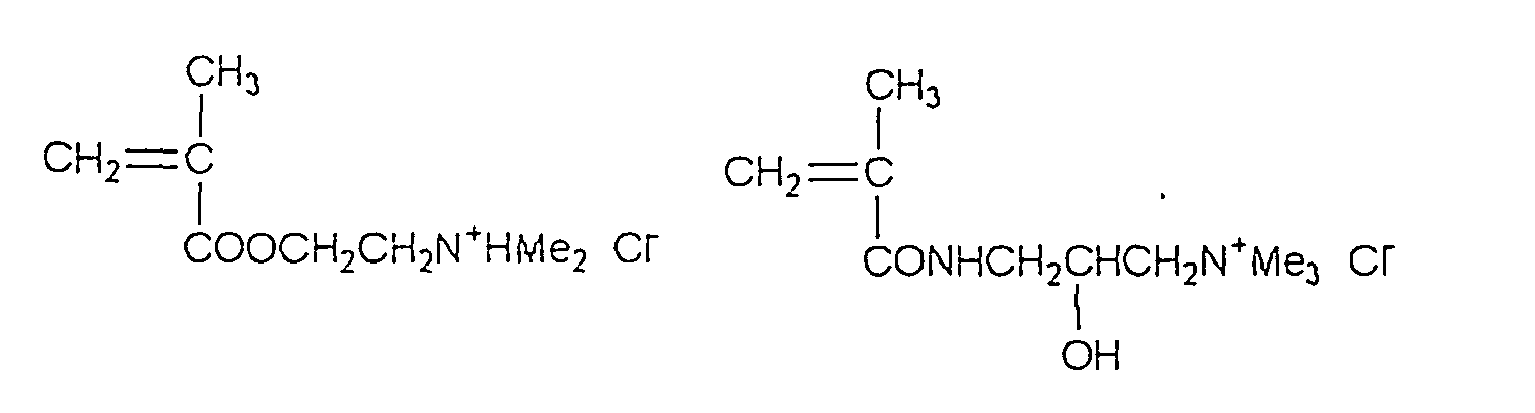


Specific examples of the acrylic or styrene-base monomer having at least one reactive functional group include acrylic acid, methacrylic acid derivatives, acrylic acid ester derivatives, methacrylic acid ester derivatives, acrylamide and methacrylamide derivatives, having a reactive functional group selected from the group consisting of a hydroxyl group, a carbonyl halogenide group, a carboxyl group and a salt thereof, an amino group, an epoxy group and a haloalkyl group described in Kobunshi Data Handbook -Kiso Hen- (Polymer Data Handbook -Fundamental-), compiled by Konbunshi Gakkai, Baifukan (1986).
In the case where an acrylic or styrene-base monomer having at least one reactive functional group and an acrylic or styrene-base monomer having a cationic group are copolymerized to prepare a polymer having the reactive functional group on the side chain, the acrylic or styrene-base monomer having at least one reactive functional group may be used solely or in combination of two or more thereof. Also, the acrylic or styrene-base monomer having a cationic group may be used solely or in combination of.two or more thereof.
If desired, one or more other monomer may be copolymerized in combination to form a tertiary or greater copolymer. The monomer used here is preferably a monomer having an acid group from the standpoint of imparting alkali developability to the interlayer. The acid group is preferably an acid group having an acid dissociation constant (pKa) or 7 or less, more preferably -COOH-, -SO3H , -OSO3H, -PO3H2, -OPO3H2, -CONHSO2- or -SO2NHSO2-. Specific examples of such a monomer include those described inJP-A-11-84674
For the copolymerization, a conventionally known polymerization method may be used. The form of the polymer is preferably a random copolymer, a block copolymer or a graft copolymer.
The thus-obtained polymer having a reactive functional group on the side chain is subjected to a polymer reaction with a compound simultaneously having a group capable of reacting with the reactive functional group and a radical reactive group using a method selected from the reactions described below to introduce the radical reactive group, thereby preparing a polymer having a cationic group and a radical reactive group for use in the present invention.- a) A urethane-forming reaction of the hydroxyl group on the polymer side chain using an isocyanate having a radical reactive group;
- b) an esterification reaction of the hydroxyl group on the polymer side chain using a carboxylic acid, carboxylic acid halide, sulfonic acid halide or carboxylic acid anhydride having a radical reactive group;
- c) an esterification reaction of the carboxyl group or a salt thereof on the polymer side chain using an isocyanate having a radical reactive group;
- d) an esterification reaction of the carbonyl halogenide on the polymer side chain using an alcohol having a carboxyl group or a salt thereof and a radical reactive group;
- e) an amidation reaction of the carbonyl halogenide on the polymer side chain using an amine having a carboxyl group or a salt thereof and a radical reactive group;
- f) a urea-forming reaction of the amino group on the polymer side chain using an isocyanate having a radical reactive group;
- g) an amidation reaction of the amino group on the polymer side chain using a carboxylic acid, carboxylic acid halide, sulfonic acid halide or carboxylic acid anhydride having a radical reactive group;
- h) a ring-opening reaction of the epoxy group on the polymer side chain using various nucleophilic compounds having a radical reactive group; and
- i) an etherification reaction of the haloalkyl group on the polymer side chain using an alcohol having a radical reactive group.
- (1)-2) A method of polymerizing a monomer represented by the following formula (9) to (11) to form a polymer and reacting it with a compound simultaneously having a haloalkyl group and a radical reactive group to simultaneously introduce a cationic group and a radical reactive group at the same time:


-Y2-R5 (13)
wherein R5, R6, Y1 and Y2 have the same meanings a defined in formulae (4) to (6), and R5 and R6 may be combined with each other or with a part of J to form a ring.
Among the groups represented by formulae (12) and (13), groups where Y1 is nitrogen atom are preferred because the synthesis is easy.
Specific examples of the monomers represented by formula (9) to (11) include 7-amino-3,7-dimethyloctyl methacrylate, 2-(5-ethyl-2-pyridyl)ethyl acrylate, 2-(dimethylamino)ethyl acrylate, 3-(dimethylamino)phenyl acrylate, 2-(dimethylamino)-2-methylpropyl acrylate, 2-hydroxy-3-piperidinopropyl acrylate, (2-diethylamino)ethyl methacrylate, (dicyclohexylamino)ethyl methacrylate, N-(2-dimethylaminoethyl)acrylamide, N-2-(morpholinoethyl)acrylamide, N-(3-diethylaminopropyl)acrylamide, N-(1,1-dimethyl-3-dimethylaminopropyl)acrylamide, N-(1,3-dimethylmorpholinobutyl)-acrylamide, N-(1,3-dimethylpyrrolidinobutyl)acrylamide, N-[4-(phenylamino)phenyl]acrylamide, N-(2-dimethylaminoethyl)methacrylamide, N-(2,2-dimethyl-3-dimethylaminopropyl)methacrylamide, aminostyrene, N,N-dimethylaminostyrene, 4-amino-3-nitrostyrene, (aminomethyl)styrene, vinylbenzylallylamine, N-(vinylbenzyl)piperidine, N-(vinylbenzyl)morpholine, (2-aminoethyl)styrene, (diethylaminoethyl) styrene, (vinylphenyl)methylsulfide, (vinylphenyl)-methylsulfide, vinylpyridine, 2-vinyl-5-methylpyridine, 5-ethyl-2-vinylpyrridine and 5-bromo-3-vinylpyridine.
The monomer represented by formula (8) or (9) may be used solely or in combination of two or more thereof.
If desired, one or more other monomer may be copolymerized in combination to form binary or greater copolymer. The monomer used here is preferably a monomer having an acid group described above.
By reacting the polymer thus obtained by polymerizing the monomer represented by formulae (9) to (11) with a compound simultaneously having a haloalkyl group and a radical reactive group, a cationic group and a radical reactive group can be introduced at the same time and the polymer having a cationic group and a radical reactive group for use in the present invention can be obtained. At this time, the compound simultaneously having a haloalkyl group and a radical reactive group may be used solely or in combination of two or more thereof.
Specific examples of the compound simultaneously having a haloalkyl group and a radical reactive group include 3-bromo-1-propyne, 1-bromo-2-butyne, 6-bromo-1-hexyne, 2-bromoethyl vinyl ether, 3-iodopropyl vinyl ether, 6-iodohexyl vinyl ether, 2-bromoethyl acrylate, cinnamyl bromide, chloromethylstyrene, vinyl benzyl bromide, allyl bromide and allyl iodide. - (1)-3) A method of polymerizing a monomer represented by the following formula (14) or (15) to prepare a polymer having -CH2X group on the side chain and reacting therewith a compound represented by any one of the following formulae (16) to (18) to simultaneously introduce a cationic group and a radical reactive group:


M-J-Y1-R5 (17)

Specific examples of the compound represented by formula (14) or (15) include 2-bromoethyl acrylate, chloromethylsytrene and bromomethylstyrene.
The monomer represented by formula (14) or (15) may be used solely or in combination of two or more thereof.
If desired, one or more other monomer may be copolymerized in combination to form sbinary or greater copolymer. The monomer used here is preferably a monomer having an acid group described above.
By reacting the polymer having a -CH2X group on the side chain, obtained by polymerizing the monomer represented by formula (14) or (15), with the compound simultaneously having a group capable of reacting with the -CH2X group to produce a cationic group and a radical reactive group, represented by formulae (16) to (18), the polymer having a cationic group and a radical reactive group for use in the present invention can be obtained.
Specific examples of the compounds represented by formulae (16) to (18) include, in addition to the compounds described as specific examples of the monomers represented by formulae (9) to (11), 1-diethylamino-1-hexyne, 2-dimethylaminoethyl vinyl ether, diethanolamine monovinyl ether, 2-phenylaminoethyl vinyl ether, 2-pyrrolidylethyl monovinyl ether, 2-methylthioethyl vinyl ether, 2-allylthioethyl vinyl ether, 3-neopentylthiopropyl vinyl ether, 3-benzylthiorpopyl vinyl ether, 2-phenylthioethyl vinyl ether, triallylamine, 3-(4-dimethylaminophenyl)-2-(4-methoxyphenyl)acrylonitrile, diallylsulfide and pyridylacetylene.
Among the compounds represented by formulae (16) to (18), the compounds represented by formulae (16) and (17) where Y1 is nitrogen atom, and the compound represented by formula (18) are preferred because of easy synthesis. The compound represented by formula (16) or (17) can be used solely or in combination of two or more thereof. - (1)-4) A method of copolymerizing a monomer having a cationic group with an acrylic or styrene-base monomer having a radical reactive group relatively low in the reaction rate.
Examples of the monomer having a cationic group include those represented by formulae (1) to (3).
Examples of the acrylic or styrene-base monomer having a radical reactive group relatively low in the reaction rate include monomers having an acrylic or styrene structure for forming a main chain skeleton by the polymerization and an unsaturated bond lower in the addition polymerizability than the structure (for example, an allyl group or an acetylene group).
This monomer has at least two radical reactive groups different in the reactivity within the molecule but due to the high radical reactivity of the acryl or styrene structure, the radical reactive group relatively low in the reaction rate does not participate in the polymerization at the copolymerization with the monomer having a cationic group. Accordingly, the radical reactive group can be introduced into the side chain without causing gelling and thereby the polymer having a cationic group and a radical reactive group for use in the present invention can be obtained.
Specific preferred examples of the acrylic or styrene-base monomer having a radical reactive group relatively low in the reaction rate include allyl acrylate, allyl methacrylate, allyloxymethyl methacrylate, acetylmethyl methacrylate, 2-propynyl acrylate, 2-methyl-2-propynyl acrylate, 3-butynyl acrylate, N-allyl acrylamide, N-allyl methacrylamide, allylstyrene, (vinylphenyl)allyl ether and (vinylphenyl)acetylene.
The monomer having a cationic group and the monomer having a radical reactive group relatively low in the reaction rate each may be used solely or in combination of two or more thereof.
If desired, one or more other monomer may be copolymerized in combination to form a ternary or greater copolymer. The monomer used here is preferably a monomer having an acid group described above from the standpoint of imparting alkali developability to the interlayer. - (1)-5) A method of polymerizing a monomer simultaneously having a radical reactive group relatively low in the reaction rate and a cationic group.
Examples of the monomer simultaneously having a radical reactive group relatively low in the reaction rate and a cationic group include the compounds represented by the following formulae (19) to (21):


Among the cationic groups represented by formulae (22) to (24), preferred are the groups represented by formulae (22) and (23) where Y1 is nitrogen atom.
Specific examples of the monomer simultaneously having a radical reactive group relatively low in the reaction rate and a cationic group are set forth below, however, the present invention is by no means limited thereto.


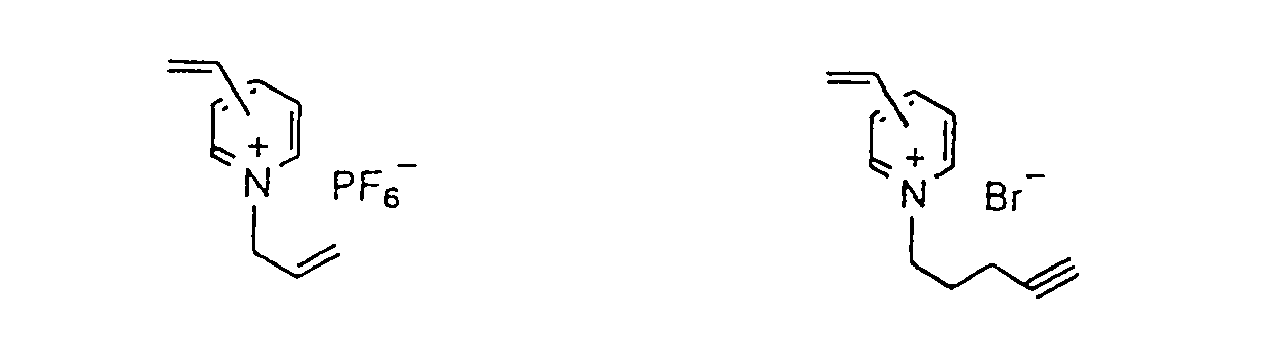

The compound capable of forming a complex with aluminum preferably forms an aluminum complex of the compound capable of forming a complex with aluminum, such that the common logarithmic value at 25°C of the aluminum complex stability constant is 3 or more. If the common logarithmic value of the aluminum complex stability constant is less than 3, sufficiently long press life cannot be obtained.
Specific examples of the compound capable of forming a complex with aluminum include benzoic acid, iminodiacetic acid, N-(2-hydroxyethyl)iminodiacetic acid, pyridine-2,6-dicarboxylic acid, 7-iodo-8-hydroxyquinoline-5-sulfonic acid, 2-amino-2-propylphosphonic acid, 1,2-dihydroxybenzene-4-sulfonic acid, tylon, Solochrome violet R, 3-hydroxy-2-naphthoic acid, oxalic acid, oxydiacetic acid, salicylic acid, 5-sulfosalicylic acid, 8-hydroxy-7-(arylazo)-quinoline-5-sulfonic acid, phenylserine, acetohydroxamic acid, 3-hydroxy-5,7-disulfo-2-naphthoic acid, 2,3-dihydroxynaphthalene-6-sulfonic acid, sulfoxine, oxine, acetylacetone, hexafluoroacetylacetone, benzoylacetone, 6,6,7,7,8,8,8-heptafluoro-2,2-dimethyl-3,5-octanedione, trifluoroacetylacetone, dibenzoylmethane, dipivaloylmethane, malonic acid, succinic acid, 3,4-dihydroxybenzoic acid, gallic acid, 2-(3,4-dihydroxyphenyl)-2-(1,1-benzopyrane)-3,5,7-triol, 3-hydroxy-7-sulfo-2-naphthoic acid, 1,2-dihydroxynaphthalene-4-sulfonic acid, N,N-bis(2-hydroxyethyl)glycine, N-(phosphonomethyl)-iminodiacetic aid, N-(2-hydroxyethyl)-iminodiacetic acid, iminobis(methylenephosphonic acid), tartaric acid, 1-oxopropane-1,3-dicarboxylic acid, propane-1,2,3-tricarboxylic aid, citric acid, desferriferrioxamine-B, 1,7-dihydroxy-4-sulfo-2-naphthoic acid, glutamic acid, pyridoxal-5-(dihydrophosphate), nitrilotriacetic acid, amino(phenyl)methylene-diphosphonic acid, ethylenebis-[imino-(2-hydroxyphenyl)methylene(methyl)-phosphonic acid], N-(2-hydroxyethyl)-ethylenedinitrilo-N,N',N'-triacetic acid, ethylenediaminetetraacetic acid, trimethylenedinitrilotetraacetic acid, cyclohexanediaminetetraacetic acid, (2-hydroxytrimethylene)-dinitrilotetraacetic acid, ethylene-bis (oxyethylenenitrilo) tetraacetic acid, N,N,N',N",N"-diethylenetriaminepentaacetic acid, N,N,N',N",N"',N"'-tetraethylenetetraminehexaacetic acid, semi-xylenol orange, semi-methyl thymol blue, 3-hydroxyglutamic acid, phosphoserine, amino-3-phosphopropionic acid and glyphosphate.
Among these compounds capable of forming a complex with aluminum, preferred are the compounds which form an aluminum complex of the compound capable of forming a complex with aluminum such that the common logarithmic value of the aluminum complex stability constant at 25°C is 5 or more, more preferably 8 or more.
In the present invention, the case where the compound capable of a complex with aluminum is a polymer is also preferred. The polymer has a group capable of coordinating to aluminum on the side chain and for the group capable of coordinating to aluminum, functional groups widely and commonly known as the ligand can be used without any limitation, such as nitride, imide, amide, azide, oxo, peroxo, phosphide, phosphite, phosphate, sulfide, dioxosulfate and π-aryl groups.
In the present invention, among the polymer compounds capable of forming a complex with aluminum, polymers having a structure represented by formula (I) and/or (II) on the side chain are preferred.
Y-Ar (II)
(wherein R represents a hydrocarbon group having from 1 to 30 carbon atoms, which may have a substituent, Y represents a linking group to the polymer main chain skeleton, and Ar represents a heteroaryl group having at least one nitrogen atom, which may have a substituent).
Examples of the hydrocarbon group having from 1 to 30 carbon atoms include an alkyl group, an alkenyl group, an alkynyl group, an aryl group and a heteroaryl group containing one or more heteroatom selected from the group consisting of nitrogen atom, oxygen atom and sulfur atom.
Specific examples of the alkyl group include a linear, branched or cyclic alkyl group having from 1 to 30 carbon atoms, such as methyl group, ethyl group, propyl group, butyl group, pentyl group, hexyl group, heptyl group, octyl group, nonyl group, decyl group, undecyl group, dodecyl group, tridecyl group, hexadecyl group, octadecyl group, eicosyl group, isopropyl group, isobutyl group, sec-butyl group, tert-butyl group, isopentyl group, neopentyl group, 1-methylbutyl group, isohexyl group, 2-ethylhexyl group, 2-methylhexyl group, cyclohexyl group, cyclopentyl group, 1-adamantyl group and 2-norbornyl group.
Specific examples of the alkenyl group include a linear, branched or cyclic alkenyl group having from 1 to 30 carbon atoms, such as vinyl group, 1-propenyl group, 1-butenyl group, 1-methyl-1-propenyl group, 1-cyclopentenyl group and 1-cyclohexenyl group.
Specific examples of the alkynyl group include an alkynyl group having from 1 to 30 carbon atoms, such as ethynyl group, 1-propynyl group, 1-butynyl group and 1-octynyl group.
Examples of the aryl group include an aryl group where a condensed ring is formed by 1. to 4 benzene rings, and an aryl group where a condensed ring is formed by a benzene ring and an unsaturated 5-membered ring. Specific examples thereof include an aryl group having from 1 to 30 carbon atoms, such as phenyl group, naphthyl group, anthryl group, phenanthryl group, indenyl group, acenaphthenyl group, fluorenyl group and pyrenyl group.
Examples of the heteroaryl group containing one or more hetero atom selected from the group consisting of nitrogen atom, oxygen atom and sulfur atom include a heteroaryl group resulting from eliminating one hydrogen atom on a heteroaromatic ring containing one or more hetero atom selected from the group consisting of nitrogen atom, oxygen atom and sulfur atom. Specific examples of the heteroaromatic ring containing one or more hetero atom selected from the group consisting of nitrogen atom, oxygen atom and sulfur atom include pyrrole, furan, thiophene, pyrazole, imidazole, triazole, oxazole, isooxazole, oxadiazole, thiazole, thiadiazole, indole, carbazole, benzofuran, dibenzofuran, thianaphthene, dibenzothiophene, indazole benzimidazole, anthranyl, benzisooxazole, benzoxazole, benzothiazole, purine, pyridine, pyridazine, pyrimidine, pyrazine, triazine, quinoline, acridine, isoquinoline, phthalazine, quinazoline, quinoxaline, naphthylidine, phenanthroline and pteridine.
The hydrocarbon group having from 1 to 30 carbon atoms may be substituted by one or more arbitrary substituent. Examples of the substituent include monovalent non-metallic atom groups except for hydrogen, such as a halogen atom (e.g., -F, -Br, -Cl, -I), a hydroxyl group, an alkoxy group, an aryloxy group, a mercapto group, an alkylthio group, an arylthio group, an alkyldithio group, an aryldithio group, an amino group, an N-alkylamino group, an N,N-dialkylamino group, an N-arylamino group, an N,N-diarylamino group, an N-alkyl-N-arylamino group, an acyloxy group, a carbamoyloxy group, an N-alkylcarbamoyloxy group, an N-arylcarbamoyloxy group, an N,N-dialkylcarbamoyloxy group, an N,N-diarylcarbamoyloxy group, an N-alkyl-N-arylcarbamoyloxy group, an alkylsulfoxy group, an arylsulfoxy group, an acylthio group, an acylamino group, an N-alkylacylamino group, an N-arylacylamino group, a ureido group, an N'-alkylureido group, an N',N'-dialkylureido group, an N'-arylureido group, an N',N'-diarylureido group, an N'-alkyl-N'-arylureido group, an N-alkylureido group, an N-arylureido group, an N'-alkyl-N-alkylureido group, an N'-alkyl-N-arylureido group, an N',N'-dialkyl-N-alkylureido group, an N',N'-dialkyl-N-arylureido group, an N'-aryl-N-alkylureido group, an N'-aryl-N-arylureido group, an N',N'-diaryl-N-alkylureido group, an N',N'-diaryl-N-arylureido group, an N'-alkyl-N'-aryl-N-alkylureido group, an N'-alkyl-N'-aryl-N-arylureido group, an alkoxycarbonylamino group, an aryloxycarbonylamino group, an N-alkyl-N-alkoxycarbonylamino group, an N-alkyl-N-aryloxycarbonylamino group, an N-aryl-N-alkoxycarbonylamino group, an N-aryl-N-aryloxycarbonylamino group, a formyl group, an acyl group, a carboxyl group and a conjugate base thereof, an alkoxycarbonyl group, an aryloxycarbonyl group, a carbamoyl group, an N-alkylcarbamoyl group, an N,N-dialkylcarbamoyl group, an N-arylcarbamoyl group, an N,N-diarylcarbamoyl group, an N-alkyl-N-arylcarbamoyl group, an alkylsulfinyl group, an arylsulfinyl group, an alkylsulfonyl group, an arylsulfonyl group, a sulfo group (-SO3H) and a conjugate base group thereof, an alkoxysulfonyl group, an aryloxysulfonyl group, a sulfinamoyl group, an N-alkylsulfinamoyl group, an N,N-dialkylsulfinamoyl group, an N-arylsulfinamoyl group, an N,N-diarylsulfinamoyl group, an N-alkyl-N-arylsulfinamoyl group, a sulfamoyl group, an N-alkylsulfamoyl group, an N,N-dialkylsulfamoyl group, an N-arylsulfamoyl group, an N,N-diarylsulfamoyl group, an N-alkyl-N-arylsulfamoyl group, an N-acylsulfamoyl group and a conjugate base group thereof, N-alkylsulfonylsulfamoyl group (-SO2NESO2(alkyl)) and a conjugate base group thereof, an N-arylsulfonylsulfamoyl group (-SO2NHSO2(aryl)) and a conjugate base group thereof, an N-alkylsulfonylcarbamoyl group (-CONHSO2(alkyl)) and a conjugate base group thereof, an N-arylsulfonylcarbamoyl group (-CONHSO2(aryl)) and a conjugate base group thereof, an alkoxysilyl group (-Si(Oalkyl)3), an aryloxysilyl group (-Si(Oaryl)3), a hydroxysilyl group (-Si(OH)3) and conjugate base group thereof, a phosphono group (-PO3H2) and a conjugate base group thereof, a dialkylphosphono group (-PO3(alkyl)2), a diarylphosphono group (-PO3(aryl)2), an alkylarylphosphono group (-PO3(alkyl)(aryl)), a monoalkylphosphono group (-PO3H(alkyl)) and a conjugate base group thereof, a monoarylphosphono group (-PO3H(aryl)) and a conjugate base group thereof, a phosphonooxy group (-OPO3H2) and a conjugate base group thereof, a dialkylphosphonooxy group (-OPO3(alkyl)2), a diarylphosphonooxy group (-OPO3(aryl)2), an alkylarylphosphonooxy group (-OPO3(alkyl)(aryl)), a monoalkylphosphonooxy group (-OPO3H(alkyl)) and a conjugate base group thereof, a monoarylphosphonooxy group (-OPO3H(aryl)) and a conjugate base group thereof, a cyano group, a nitro group, an aryl group, an alkyl group, an alkenyl group and an alkynyl group.
Examples of the linking group represented by Y include a substituted or unsubstituted divalent hydrocarbon group having from 1 to 30 carbon atoms, which may be interrupted once or more by a functional group containing one or more hetero atom selected from the group consisting of oxygen atom, nitrogen atom and sulfur atom.
Ar is a heteroaryl group having one or more nitrogen tom and specific examples thereof include those resulting from eliminating one hydrogen atom on the carbon atom constituting a nitrogen-containing heteroaromatic ring and forming a monovalent group, such as pyrrole, pyridine, pyrazole, imidazole, triazole, tetrazole, isooxazole, oxazole, isothiazole, thiazole, thiadiazole, indole, carbazole, azaindole, indazole, benzimidazole, benzotriazole, benzisooxazole, benzoxazole, benzothiazole, purine, pyridazine, pyrimidine, pyrazine, triazine, quinoline, isoquinoline, acridine, phthalazine, quinazoline, quinoxaline, naphthyridine, phenanthroline and pteridine.
If desired, the polymer compound capable of forming a complex with aluminum for use in the present invention may be combined with one or more other copolymerization component to form a binary or greater copolymer. From the standpoint of imparting sufficiently high alkali developability to the interlayer, the copolymerization component preferably has an acid group. The acid group is preferably an acid group having an acid dissociation constant (pKa) of 7 or less, more preferably -COOH, - SO3H, -OSO3H, -PO3H2, -OPO3H2, -CONHSO2- or -SO2NHSO2-. Specific examples of this copolymerization component include those described inJP-A-11-84674
The content of the structural unit having a group capable of coordinating to aluminum in the copolymer can be freely selected according to the intended capability of the lithographic printing plate precursor. With a high content, good results are given in view of the press life, and with a low content, good scumming resistance is obtained. The content is preferably 10 mol% or more, more preferably 30 mol% or more, still more preferably 50 mol% or more. The main chain structure of the polymer is not particularly limited but preferably (1) acrylic resin, styrene-type resin or a copolymer thereof, (2) urethane resin, (3) polyester resin or (4) polyamide resin.
Among these, preferred in view of the press life and the synthesis aptitude is (1) acrylic resin, styrene-type resin or a copolymer thereof. The molecular weight can be also freely selected according to the intended capability of the lithographic printing plate precursor. With a low molecular weight, good results are given in view of the scumming resistance, and with a high molecular weight, a long press life can be obtained. The molecular weight is preferably from 2,000 to 1,000,000, more preferably from 5,000 to 200, 000.
Specific preferred examples of the polymer capable of forming a complex with aluminum for use in the present invention are set forth below, however, the present invention is not limited thereto.

The interlayer of the lithographic printing plate precursor of the present invention can be provided by the following method. A method of coating a solution obtained by dissolving the polymer having a cationic group and a radical reactive group in water, an organic solvent such as methanol or ethanol, or a mixed solvent thereof on an aluminum support subjected to a hydrophilization treatment and then drying it to provide an interlayer, and a method of dipping an aluminum support subjected to a hydrophilization treatment in a solution obtained by dissolving the polymer having a cationic group and a radical reactive group in water, an organic solvent such as methanol or ethanol, or a mixed solvent thereof to adsorb the polymer having a cationic group and a radical reactive group to the support, washing it with water or the like and drying it to provide an interlayer may be used. In the former method, a coating solution obtained by dissolving the polymer having a cationic group and radical reactive group in concentration of 0.005 to 10 wt% can be coated by various methods. For example, any method of bar coater coating, rotary coating, spray coating, curtain coating and the like may be used. In the method of dipping the support in a solution having dissolved therein the compounds of the present invention and then washing it with water or the like, the concentration of the solution is from 0.01 to 20 wt%, preferably from 0.05 to 5 wt%, the dipping temperature is from 20 to 90°C, preferably from 25 to 50°C, and the dipping time is from 0.1 second to 20 minutes, preferably from 2 seconds to 1 minute.
The dry coverage of the interlayer is suitably form 2 to 200 mg/m2, preferably from 5 to 100 mg/m2, more preferably from 5 to 50 mg/m2.
If this coverage is less than 2 mg/m2 or exceeds 200 mg/m2, sufficiently high printing capability cannot be obtained.
The solution used at the time of providing the interlayer of the lithographic printing plate precursor of the present invention can used by adjusting the pH thereof using a basic substance such as ammonia, triethylamine and potassium hydroxide or an acidic substance such as hydrochloric acid, sulfuric acid, phosphoric acid, sulfonic acid and carboxylic acid to the range of 1 to 12. The adhesion can be more increased by providing the interlayer under acidic conditions or by previously treating the silicate with an acid and these are described inJP-A-7-314937 JP-5-278362
In the interlayer of the lithographic printing plate precursor of the present invention, a known compound may be mixed, for example, a phosphonic acid having an amino group, such as carboxymethyl cellulose, dextrin, gum arabic and 2-aminoethylphosphonic acid, an amino acid such as glycine and β-alanine, a hydrochloride of amine having a hydroxy group, such as hydrochloride of triethanolamine. The interlayer of the present invention preferably contains the polymer having a cationic group and a radical reactive group in an amount of 20 wt% or more, more preferably 50 wt% or more, most preferably 80 wt% or more.
The interlayer may also be a mixture with other components (e.g., binder polymer, photopolymerizable compound, photoinitiator) described inJP-A-9-34104 JP-A-10-260536
The portions other than the interlayer of the lithographic printing plate precursor of the present invention are described below. - In the lithographic printing plate precursor of the present invention, the photopolymerizable photosensitive layer (hereinafter sometimes simply referred to as "photosensitive layer") provided on the inter layer contains as essential components a photopolymerization initiator, a compound having an addition-polymerizable ethylenically unsaturated bond and a polymer binder, and if desired, contains various additives such as co-sensitizer, colorant, plasticizer and thermal polymerization inhibitor.
- The addition polymerizable compound having at least one ethylenically unsaturated double bond, which is used in the photosensitive layer of the lithographic printing plate precursor of the present invention is selected from the compounds having at least one, preferably two or more ethylenically unsaturated terminal bonds. Such compounds are widely known in this industrial field and those known compounds all can be used in the present invention without any limit. This compound has a chemical form of, for example, monomer, prepolymer, more specifically, dimer, trimer or oligomer, a mixture thereof or a copolymer thereof. Examples of the monomer and its copolymer include unsaturated carboxylic acids (e.g., acrylic acid, methacrylic acid, itaconic acid, crotonic acid, isocrotonic acid, maleic acid), and esters and amides thereof. Among these, preferred are esters of an unsaturated carboxylic acid with an aliphatic polyhydric alcohol compound, and amides of an unsaturated carboxylic acid with an aliphatic polyhydric amine compound. Also, addition reaction products of an unsaturated carboxylic acid ester or amide having a nucleophilic substituent such as a hydroxyl group, an amino group or a mercapto group with a monofunctional or polyfunctional isocyanate or epoxy, and dehydration condensation reactants with a monofunctional or polyfunctional carboxylic acid are suitably used. Furthermore, addition reaction products of an unsaturated carboxylic acid ester or amide having a electrophilic substituent such as an isocyanate or an epoxy group with a monofunctional or polyfunctional alcohol, amine or thiol, and substitution reaction products of an unsaturated carboxylic acid ester or amide having a splitting-off substituent such as a halogen group or tosyloxy group with a monofunctional or polyfunctional alcohol, amine or thiol are also suitably used. In addition, the compounds where the above-described unsaturated compound is replaced by unsaturated phosphonic acid, styrene, vinyl ether or the like may also be used.
- Specific examples of the ester monomer of an aliphatic polyhydric alcohol compound with an unsaturated carboxylic acid include acrylic acid esters such as ethylene glycol diacrylate, triethylene glycol diacrylate, 1,3-butanediol diacrylate, tetramethylene glycol diacrylate, propylene glycol diacrylate, neopentyl glycol diacrylate, trimethylolpropane triacrylate, trimethylolpropane tri-(acryloyloxypropyl) ether, trimethylolethane triacrylate, hexanediol diacrylate, 1,4-cyclohexanediol diacrylate, tetraethylene glycol diacrylate, pentaerythritol diacrylate, pentaerythritol triacrylate, pentaerythritol tetraacrylate, dipentaerythritol diacrylate, dipentaerythritol hexaacrylate, sorbitol triacrylate, sorbitol tetraacrylate, sorbitol pentaacrylate, sorbitol hexaacrylate, tri-(acryloyloxyethyl)isocyanurate and polyester acrylate oligomer;
methacrylic acid esters such as tetramethylene glycol dimethacrylate, triethylene glycol dimethacrylate, neopentyl glycol dimethacrylate, trimethylolpropane trimethacrylate, trimethylolethane trimethacrylate, ethylene glycol dimethacrylate, 1,3-butanediol dimethacrylate, hexanediol dimethacrylate, pentaerythritol dimethacrylate, pentaerythritol trimethacrylate, pentaerythritol tetramethacrylate, dipentaerythritol dimethacrylate, dipentaerythritol hexamethacrylate, sorbitol trimethacrylate, sorbitol tetramethacrylate, bis[p-(3-methacryloxy-2-hydroxypropoxy)phenyl]dimethylmethane and bis[p-(methacryloxyethoxy)phenyl]dimethylmethane;
itaconic acid esters such as ethylene glycol diitaconate, propylene glycol diitaconate, 1,3-butanediol diitaconate, 1,4-butanediol diitaconate, tetramethylene glycol diitaconate, pentaerythritol diitaconate and sorbitol tetraitaconate;
crotonic acid esters such as ethylene glycol dicrotonate, tetramethylene glycol dicrotonate, pentaerythritol dicrotonate and sorbitol tetradicrotonate;
isocrotonic acid esters such as ethylene glycol diisocrotonate, pentaerythritol diisocrotonate and sorbitol tetraisocrotonate; and
maleic acid esters such as ethylene glycol dimaleate, triethylene glycol dimaleate, pentaerythritol dimaleate and sorbitol tetramaleate. - Examples of other esters include aliphatic alcohol-base esters described in
JP-B-46-27926 JP-B-51-47334 JP-A-57-196231 JP-A-59-5240 JP-A-59-5241 JP-A-2-226149 JP-A-1-165613 - The above-described ester monomers may also be used as a mixture of two or more thereof.
- Specific examples of the amide monomer of an aliphatic polyhydric amine compound with an unsaturated carboxylic acid include methylenebis-acrylamide, methylenebismethacrylamide, 1,6-hexamethylenebis-acrylamide, 1,6-hexamethylenebis-methacrylamide, diethylenetriaminetrisacrylamide, xylylenebis-acrylamide and xylylenebismethacrylamide.
- Other preferred examples of the amide-type monomer include those having a cyclohexylene structure described in
JP-B-54-21726 - A urethane-base addition polymerizable compounds produced by using an addition reaction of isocyanate and a hydroxyl group is also suitably used and specific examples thereof include vinyl urethane compounds having two or more polymerizable vinyl groups in one molecule described in
JP-B-48-41708
CH2=C (R14) COOCH2CH (R15) OH (A)
(wherein R14 and R15 each represents H or CH3) . - Also, urethane acrylates described in
JP-A-51-37193 JP-B-2-32293 JP-B-2-16765 JP-B-58-49860 JP-B-56-17654 JP-B-62-39417 JP-B-62-39418 - Furthermore, addition polymerizable compounds having an amino or sulfide structure within the molecule described in
JP-A-63-277653 JP-A-63-260909 JP-A-1-105238 - Other examples include polyfunctional acrylates and methacrylates such as polyester acrylates described in
JP-A-48-64183 JP-B-49-43191 JP-B-52-30490 JP-B-46-43946 JP-B-1-40337 JP-B-1-40336 JP-A-2-25493 JP-A-61-22048 - The structure, the use form, namely, sole use or combination use, the amount added and the details in use method of the addition polymerizable compound can be freely selected according to the intended capability of the final lithographic printing plate precursor. For example, the following points are taken account of. From the standpoint of light sensitization speed, structures having a large unsaturated group content per molecule are preferred and in many cases, bifunctional or greater functional compounds are preferred. In the case of increasing the strength of the image area, namely, cured film, trifunctional or greater functional compounds are preferred and a method of using the compound in combination with a different polymerizable group different in the function number (for example, an acrylic acid ester, a methacrylic acid ester, a styrene-base compound or a vinyl ether-base compound) to control both the sensitivity and the strength is also effective. The compounds having a large molecular weight or high hydrophobicity are excellent in the light sensitization speed or film strength but in some cases, these are disadvantageous in view of the development speed or because the compound precipitates in the developer. The selection and use method of the addition polymerizable compound affect the compatibility and dispersibility with other components (for example, binder, polymer, initiator, colorant and the like) in the photosensitive layer and these are important factors. For example, by using a low purity compound or using two or more compounds in combination, the compatibility is sometimes improved. for the purpose of improving the adhesive property of the above-described interlayer or the overcoat layer which is described later, a specific structure may be selected. A higher ratio of the addition polymerizable compound blended in the photosensitive layer is advantageous in view of the sensitivity, however, if the blended ratio is excessively high, there may arise problems, for example, phase separation takes place, troubles occur in the production process due to the tackiness of the photosensitive layer, or the compound precipitates from the developer. Therefore, in many cases, the blended ratio is preferably from 5 to 80 wt%, more preferably from 25 to 75 wt%, based on all components in the photosensitive layer composition. These may be used individually or in combination of two or more thereof. With respect to the use method of the addition polymerizable compound, appropriate structure, blending and amount added can be freely selected by taking account of the degree of polymerization inhibition to oxygen, the resolution, the fogging property, the change in refractive index, the surface tackiness and the like. Depending on the case, a layer structure and a coating method, such as undercoating and overcoating, may be employed.
- For the photopolymerization initiator, various photopolymerization initiators known in patents or publications or a combination system of two or more photopolymerization initiators (photopolymerization initiation system) may be selected and used according to the wavelength of the light source used.
- In the case of using visible ray, Ar laser, second harmonic of semiconductor laser or SHG-YG laser as the light source, various photopolymerization initiators (initiation systems) have been proposed. Examples thereof include a system of using a combination of a certain kind of a photoreducing dye such as Rose Bengal, eosine and erythrosine, or a dye with an initiator described in
U.S. Patent 2,850,445 , a composite initiation system, for example, of a dye and an amine (see,JP-B-44-20189 JP-B-45-37377 JP-B-47-2528 JP-A-54-155292 JP-A-48-84183 JP-A-54-151024 JP-A-52-112681 JP-A-58-15503 JP-A-59-140203 JP-A-59-1504 JP-A-59-140203 JP-A-59-189340 JP-A-62-174203 JP-B-62-1641 U.S. Patent 4,766,055 ), a system of a dye and an active halogen compound (see,JP-A-63-1718105 JP-A-63-258903 Japanese Patent Application No. 2-63054 JP-A-62-143044 JP-A-62-150242 JP-A-64-13140 JP-A-64-13141 JP-A-64-13142 JP-A-64-13143 JP-A-64-13144 JP-A-64-17048 JP-A-1-229003 JP-A-1-298348 JP-A-1-138204 JP-A-2-179643 JP-A-2-244050 JP-A-63-221110 JP-A-4-221958 JP-A-4-219756 JP-A-6-295061 JP-A-8-334897 - The photopolymerization initiator (initiation system) for use in the photosensitive layer of the lithographic printing plate precursor of the present invention is preferably contains at least one titanocene.
- The titanocene compound used as the photopolymerization initiator (initiation system) in the present invention may be any as long as it is a titanocene compound capable of generating an active radical under irradiation with light in the presence of other sensitizing dye together, and for example, known compounds described in
JP-A-59-152396 JP-A-61-151197 JP-A-63-41483 JP-A-63-41484 JP-A-2-249 JP-A-2-241 JP-A-3-27393 JP-A-3-12403 JP-A-6-41170 - Specific examples thereof include dicyclopentadienyl-Ti-dichloride, dicyclopentadienyl-Ti-bisphenyl, dicyclopentadienyl-Ti-bis-2,3,4,5,6-pentafluorophen-1-yl (hereinafter sometimes referred to as "T-1"), dicyclopentadienyl-Ti-bis-2,3,5,6-tetrafluorophen-1-yl, dicyclopentadienyl-Ti-bis-2,4,6-trifluorophen-1-yl, dicyclopentadienyl-Ti-bis-2,6-difluorophen-1-yl, dicyclopentadienyl-Ti-bis-2,4-difluorophen-1-yl, dimethylcyclopentadienyl-Ti-bis-2,3,4,5,6-pentafluorophen-1-yl, dimethylcyclopentadienyl-Ti-bis-2,3,5,6-tetrafluorophen-1-yl, dimethylcyclopentadienyl-Ti-bis-2,4-difluorophen-1-yl and bis(cyclopentadienyl)bis(2,6-difluoro-3-(pyr-1-yl)phenyl)titanium (hereinafter sometimes referred to as "T-2").
- The titanocene compound may be subjected to various chemical modifications so as to improve the properties of the photosensitive layer. Examples of the chemical modification which can be used include the methods such as bonding with a sensitizing dye, an addition polymerizable unsaturated compound or other radical-generating part, introduction of a hydrophilic site, introduction of a substituent to improve the compatibility or prevent the precipitation of crystal, introduction of a substituent capable of improving the adhesive property, and polymer formation.
- Likewise the above-described addition polymerizable compound, the use method of the titanocene compound may also be appropriately and freely selected according to the intended capability of the lithographic printing plate precursor. For example, when two or more compounds are used, the compatibility with the photosensitive layer can be elevated. The titanocene compound is advantageously used in a large amount in view of the light sensitivity and by using it in an amount of 0.5 to 80 parts by weight, preferably from 1 to 50 parts by weight, per 100 parts of the components in the photosensitive layer, sufficiently high sensitivity can be obtained. On the other hand, in the case of use under a white lamp such as yellow, which is a principal object of the present invention, the titanocene is preferably used in a small amount in view of the fogging property due to light in the vicinity of 500 nm, and by using titanocene in combination with other sensitizing dye, sufficiently high sensitivity can be obtained even if the amount used is reduced to 6 parts by weight or less, more reduced to 1.9 parts by weight or less, still more reduced to 1.4 parts by weight or less.
- The polymer binder (also called "binder polymer") for use in the photosensitive layer of the lithographic printing plate precursor of the present invention is preferably a linear organic high molecular polymer. The "linear organic high molecular polymer" may be any polymer. A water- or alkalescent water-soluble or swellable linear organic high molecular polymer capable of water development or alkalescent water development is preferably selected. The linear organic high molecular polymer is used not only as a film forming agent of the composition but also as a developer by appropriately selecting it according to the case where water, alkalescent water or organic solvent is used. For example, when a water-soluble organic high molecular polymer is used, water development can be performed. Examples of this linear organic high molecular polymer includes addition polymers having a carboxylic acid group on the side chain such as methacrylic acid copolymer, acrylic acid copolymer, itaconic acid copolymer, crotonic acid copolymer, maleic acid copolymer and partially esterified maleic acid copolymer, described in
JP-A-59-44615 JP-B-54-34327 JP-B-58-12577 JP-B-54-25957 JP-A-54-92723 JP-A-59-53836 JP-A-59-71048 - Among these, copolymers of [benzyl (meth)-acrylate/(meth)acrylic acid/other addition polymerizable vinyl monomer, if desired] and copolymers of [allyl (meth)acrylate/(meth)acrylic acid/other addition polymerizable vinyl monomer, if desired] are preferred because of good balance among film strength, sensitivity and developability.
- The urethane-base binder polymers containing an acid group described in
JP-B-7-12004 JP-B-7-120041 JP-B-7-120042 JP-B-8-12424 JP-A-63-287944 JP-A-63-287947 JP-A-1-271741 Japanese Patent Application No. 9-363195 - Other than these, polyvinyl pyrrolidone and polyethylene oxide are useful as the water-soluble linear organic polymer. For increasing the strength of the cured film, alcohol-soluble nylons and polyethers of 2,2-bis(4-hydroxyphenyl)propane with epichlorohydrin are also useful.
- In the present invention, the most preferred binder has a cross-linking group (also called an "unsaturated group") and a carboxyl group on the side chain by itself, where the cross-linking group is represented by the following formula [II] :

- In formula [II], the alkyl group represented by R16 to R20, which may be linear, branched or cyclic, is preferably an alkyl group having from 1 to 7 carbon atoms and the alkyl group may have a substituent such as an alkoxy group having 1 or 2 carbon atoms, an alkoxycarbonyl group having from 1 to 3 carbon atoms, a phenyl group or a hydroxy group. The aryl group represented by R16 to R20 is preferably a phenyl group or a furyl group, which may have a substituent such as a halogeno group (e.g., chloro, bromo), a hydroxyl group, an alkyl group having from 1 to 7 carbon atoms, an aryl group (e.g., phenyl, methoxyphenyl), an alkoxy group having from 1 to 7 carbon atoms, a nitro group, an amino group or an N,N-dialkylamino group. The alkoxy group represented by R16 to R20 is preferably an alkoxy group having from 1 to 7 carbon atoms, and the aryloxy group is preferably a phenyloxy group which may have a substituent such as an alkyl or alkoxy group having from 1 to 7 carbon atoms. The alkylamino group represented by R16 to R20 is preferably an alkylamino group having from 1 to 15 carbon atoms, and the arylamino group is preferably a phenylamino group or a naphthylamino group. The alkylsulfonyl group represented by R16 to R20 is preferably an alkylsulfonyl group having from 1 to 15 carbon atoms, and the arylsulfonyl group is preferably a phenylsulfonyl group which may have a substituent such as an alkyl group having from 1 to 15 carbon atoms, an alkoxy group having from 1 to 5 carbon toms or an amino group.
- The polymer having a cross-linking group on the side chain used as binder in the photosensitive layer of the lithographic printing plate precursor of the present invention is known in
U.S. Patents 3,376,138 ,3,556,792 and3,556,793 , where, however; the polymer itself is used as the photo-crosslinking resist. Thus, the use method clearly differs from the present invention where the polymer is used as a binder of the composition for the photosensitive layer of the lithographic printing plate precursor. - The synthesis method of the polymer roughly includes the following two methods.
- A method of causing a polymeric reaction of a trunk polymer having a carboxylic acid, a carboxylic acid halide or a carboxylic acid anhydride group as the side chain with a compound represented by the following formula [II-a]:

to introduce a cross-linking group represented by the following formula [II-b]:
through a linking group of -COO-, -COS-, -CONH- or -CONR21-(wherein R21 is an alkyl group). - A method of copolymerizing a monomer having a cross-linking group represented by formula [II] and an ethylenically unsaturated group abundant in the addition polymerization reactivity higher than the cross-linking group with an unsaturated carboxylic acid to obtain a polymer.
- The method A is described in more detail. Examples of the trunk polymer include copolymers of an acrylic acid or a methacrylic acid, and copolymers obtained by forming the copolymer into an acid halide by the polymeric reaction. Also, copolymers of maleic acid anhydride, itaconic acid anhydride or the like may be used. Examples of the comonomer copolymerized include styrene and alkylsubstituted derivatives thereof, acrylic acid alkyl esters, acrylic acid aryl esters, methacrylic acid alkyl esters, methacrylic acid aryl esters and aliphatic vinyl esters. Preferred examples of the copolymer include copolymers of an acrylic or methacrylic acid with methyl acrylate, ethyl acrylate, butyl acrylate, benzyl acrylate, methyl methacrylate, ethyl methacrylate, butyl methacrylate or benzyl methacrylate. The cross-linking group can be introduced into the copolymer by mixing and dissolving a cross-linking alcohol, amine, thiol or halide represented by formula [II-a] with the copolymer in a reaction solvent under predetermined reaction conditions, adding a reaction catalyst and a polymerization inhibitor, and heating the mixture. This is specifically described below by referring to a copolymer of methacrylic acid with benzyl methacrylate as an example.
- Into a 300 ml-volume three-neck flask equipped with a stirring bar, a stirring blade, a reflux condenser and a thermometer, 19.8 g of poly(methacrylic acid/benzyl methacrylate) (27/73 by mol), 40.2 g of acetic acid ethylene glycol monomethyl ether as a reaction solvent, 6.0 g of allyl bromide as a reagent containing a cross-linking group, 10.4 g of trimethylbenzylammonium hydroxide as a catalyst and 0.01 g of paramethoxyphenol as a polymerization inhibitor were charged, mixed, dissolved and heated at 70°C for 13 hours in a nitrogen atmosphere. After cooling, methyl ethyl ketone was added and free quaternary salts were removed. Furthermore, methanol was added to dilute the residue and the resulting solution was poured into diluted hydrochloric acid to cause precipitation. The precipitate was washed with water, filtered by suction and vacuum dried, as a result, a polymer obtained in a yield of 13.6 g. The allyl group is introduced in a ratio of 35% based on the carboxylic acid of the trunk polymer.
- At this time, the viscosity at 30°C in methyl ethyl ketone was [η]=0.161.
- The synthesis of introducing the cross-linking group into a copolymer of maleic acid anhydride can be performed by the method described in
U.S. Patent 2,047,398 , where an unsaturated ester, amide, thioester or the like with the maleic acid anhydride moiety being ring-opened is introduced. With respect to the method for introducing a cross-linking group into a maleic acid anhydride copolymer,JP-A-48-82902 - The method B is described in detail below. The monomer containing the cross-linking group and at least two or more carbon-carbon double bonds can be synthesized by a condensation reaction of an alcohol, amine or thiol having the cross-linking group with an unsaturated carboxylic acid, preferably an acrylic or methacrylic acid, according to a known synthesis method. By copolymerizing this monomer having two or more unsaturated groups with an unsaturated carboxylic acid, preferably an acrylic acid or methacrylic acid, a copolymer having the cross-linking group is obtained. The monomer copolymerized may be copolymerized, in addition to the unsaturated carboxylic acid, with another monomer and examples of this another monomer include alkyl acrylate, alkyl methacrylate, benzyl methacrylate, 2-hydroxyethyl methacrylate and acrylonitrile.
- A copolymerization example of an allyl methacrylate with a methacrylic acid is described below. A similar synthesis method is described in
U.S. Patent 2,047,398 . - Into a 3 ℓ-volume four-neck flask equipped with a stirring bar, a stirring blade, a reflux condenser, a dropping funnel and a thermometer, 1.68 ℓ of 1,2-dichloroethane as a reaction solvent was charged and heated at 70°C while purging with nitrogen. Into the dropping funnel 100.8 g of allyl methacrylate, 7.6 g of methacrylic acid and 1.68 g of 2,2'-azobis(2,4-dimethylvaleronitrile) as a polymerization initiator, which were dissolved in 0.44 ℓ of 1,2-dichloroethane, was charged and this mixture solution was dropped into the flask while stirring over 2 hours.
- After the completion of dropping, the solution was stirred at a reaction temperature of 70°C for 5 hours to compete the reaction. After the completion of the heating, 0.04 g of paramethoxyphenol as a polymerization inhibitor was added and the reaction solution was condensed to 500 ml. This condensed solution was added to 4 ℓ of hexane, precipitated and then vacuum dried, as a result, 61 g (yield: 56%) of a copolymerized polymer was obtained. At this time, the viscosity at 30°C in methyl ethyl ketone was [η]=0.068.
- Representative examples of the compound represented by formula [II-a] include allyl alcohol, 2-methylallyl alcohol, crotyl alcohol, 3-chloro-2-propen-1-ol, 3-phenyl-2-propen-1-ol, 3-(hydroxyphenyl)-2-propen-1-ol, 3-(2-hydroxyphenyl)-2-propen-1-ol, 3-(3,4-dihydroxyphenyl)-2-propen-1-ol, 3-(2,4-dihydroxyphenyl)-2-propen-1-ol, 3-(3,4,5-trihydroxyphenyl)-2-propen-1-ol, 3-(3-methoxy-4-hydroxyphenyl)-2-propen-1-ol, 3-(3,4-dihydroxy-5-methoxyphenyl)-2-propen-1-ol, 3-(3,5-dimethoxy-4-hydroxyphenyl)-2-propen-1-ol, 3-(2-hydroxy-4-methylphenyl)-2-propen-1-ol, 3-(4-methoxyphenyl)-2-propen-1-ol, 3-(4-ethoxyphenyl)-2-propen-1-ol, 3-(2-methoxyphenyl)-2-propen-1-ol, 3-(3,4-dimethoxyphenyl)-2-propen-1-ol, 3-(3-methoxy-4-propoxyphenyl)-2-propen-1-ol, 3-(2,4,6-trimethoxyphenyl)-2-propen-1-ol, 3-(3-methoxy-4-benzyloxyphenyl)-2-propen-1-ol, 3-1-(3'-methoxyphenyl)-4-benzyloxyphenyl)-2-propen-1-ol, 3-phenoxy-3-phenyl-2-propen-1-ol, 3-(3,4,5-trimethoxyphenyl)-2-propen-1-ol, 3-(4-methylphenyl)-2-propen-1-ol, 3-phenyl-3-(2,4,6-trimethylphenyl)-2-propen-1-ol, 3,3-{di-(2,4,6-trimethylphenyl)}-2-propen-1-ol, 3-phenyl-3-(4-methylphenyl)-2-propen-1-ol, 3,3-diphenyl-2-propen-1-ol, 3-(2-chlorophenyl)-2-propen-1-ol, 3-(3-chlorophenyl)-2-propen-1-ol, 3-(4-chlorophenyl)-2-propen-1-ol, 3-(2,4-dichlorophenyl)-2-propen-1-ol, 3-(2-bromophenyl)-2-propen-1-ol, 3-bromo-3-phenyl-2-propen-1-ol, 3-chloro-3-phenyl-2-propen-1-ol, 3-(4-nitrophenyl)-2-propen-1-ol, 3-(2-nitrophenyl)-2-propen-1-ol, 3-(3-nitrophenyl)-2-propen-1-ol, 2-methyl-3-phenyl-2-propen-1-ol, 2-methyl-3-(4-chlorophenyl)-2-propen-1-ol, 2-methyl-3-(4-nitrophenyl)-2-propen-1-ol, 2-methyl-3-(4-aminophenyl)-2-propen-1-ol, 2-methyl-3,3-diphenyl-2-propen-1-ol, 2-ethyl-1,3-diphenyl-2-propen-1-ol, 2-ethoxymethylene-3-phenyl-2-propen-1-ol, 2-phenoxy-3-phenyl-2-propen-1-ol, 2-methyl-3-(4-methoxyphenyl)-2-propen-1-ol, 2,3-diphenyl-2-propen-1-ol, 1,2,3-triphenyl-2-propen-l-ol, 2,3,3-triphenyl-2-propen-1-ol, 2-ethoxy-3-phenyl-2-propen-1-ol, 1,3-diphenyl-2-propen-1-ol, 1-(4-methylphenyl)-3-phenyl-2-propen-1-ol, 1-phenyl-3-(4-methylphenyl)-2-propen-1-ol, 1-phenyl-3-(4-methoxyphenyl)-2-propen-1-ol, 1-(4-methoxyphenyl)-3-phenyl-2-propen-1-ol, 1,3-di(4-chlorophenyl)-2-propen-1-ol, 1-(4-bormophenyl)-3-phenyl-2-propen-1-ol, 1-phenyl-3-(4-nitrophenyl)-2-propen-1-ol, 1,3-di(2-nitrophenyl)-2-propen-1-ol, 1-(4-dimethylaminophenyl)-3-phenyl-2-propen-1-ol, 1-phenyl-3-(4-dimethylaminophenyl)-2-propen-1-ol, 1,1-di(4-dimethylaminophenyl)-3-phenyl-2-propen-1-ol, 1,1,3-triphenyl-2-propen-1-ol, 1,1,3,3-tetraphenyl-2-propen-1-ol, 1-(4-methylphenyl)-3-phenyl-2-propen-1-ol, 1-(dodecylsulfonyl)-3-phenyl-2-propen-1-ol, 1-phenyl-2-propen-1-ol, 1,2-diphenyl-2-propen-1-ol, 1-phenyl-2-methyl-2-propen-1-ol, 1-cyclohexyl-2-propen-1-ol, 1-phenoxy-2-propen-1-ol, 2-benzyl-2-propen-1-ol, 1,1-di(4-chlorophenyl)-2-propen-1-ol, 1-carboxy-2-propen-1-ol, 1-carboxyamido-2-propen-1-ol, 1-cyano-2-propen-1-ol, 1-sulfo-2-propen-1-01, 2-ethoxy-2-propen-1-ol, 2-amino-2-propen-1-ol, 3-(3-amino-4-methoxyphenylsulfonyl)-2-propen-1-ol, 3-(4-methylphenylsulfonyl)-2-propen-1-ol, 3-phenylsulfonyl-2-propen-1-ol, 3-benzylsulfonyl-2-propen-1-ol, 3-anilinosulfonyl-2-propen-1-ol, 3-(4-methoxyanilinosulfonyl)-2-propen-1-ol, 3-anilino-2-propen-1-ol, 3-naphthylamino-2-propen-1-ol, 3-phenoxy-2-propen-1-ol, 3-(2-methylphenyl)-2-propen-1-ol, 3-(3-methylphenoxy)-2-propen-1-ol, 3-(2,4-dimethylphenyl)-2-propen-1-ol, 1-methyl-3-carboxy-2-propen-1-ol, 3-carboxy-2-propen-1-ol, 3-bromo-3-carboxy-2-propen-1-ol, 1-carboxy-3-chloro-3-methyl-2-propen-1-ol, 1-carboxy-3-methyl-2-propen-1-ol, 1-(2-carbethoxyisopropyl)-3-methyl-2-propene-1-ol, 1-(1-carbethoxypropyl)-2-propen-1-ol, 1-(1-carbethoxyethyl)-3-methyl-2-propen-1-ol, 1-carbethoxy-3-chloro-3-methyl-2-propen-1-ol, 1-carbethoxymethylene-3-methyl-2-propen-1-ol, 1-amido-2,3-dimethyl-2-propen-1-ol, 1-cyano-3-methyl-2-propen-1-ol, 3-sulfo-2-propen-1-ol, 3-butoxy-2-propen-1-ol, 1-cyclohexyl-3-(2-hydroxycyclohexyl)-2-propen-1-ol, 3-cyclobenzyl-2-propen-1-ol, 3-furyl-2-propen-1-ol, 3-chromo-2-propen-1-ol, 3-bromo-2-propen-1-ol, 2-methyl-3-chloro-2-propen-1-ol, 2-methyl-3-bromo-2-propen-1-ol, 1-carboisobutoxy-3-chloro-3-methyl-2-propen-1-ol, 2-chloro-3-phenyl-2-propen-1-ol (2-chlorocinnamyl alcohol), 2-bromo-3-phenyl-2-propen-1-ol (2-bromocinnamyl alcohol), 2-bromo-3-(4-nitrophenyl)-2-propen-1-ol, 2-fluoro-3-phenyl-2-propen-1-ol (2-fluorocinnamyl alcohol), 2-fluoro-3-(4-methoxyphenyl)-2-propen-1-ol, 2-nitro-3-chloro-3-phenyl-2-propen-1-ol, 2-nitro-3-phenyl-2-propen-1-ol (2-nitrocinnamyl alcohol), 2-cyano-3-phenyl-2-propen-1-ol (2-cyanocinnamyl alcohol), 2-chloro-2-propen-1-ol (2-chloroallyl alcohol), 2-bromo-2-propen-1-ol (2-bromoallyl alcohol), 2-carboxy-2-propen-1-ol (2-carboxyallyl alcohol), 2-carbethoxy-2-propen-1-ol (2-carbethoxyallyl alcohol), 2-sulfonic acid-2-propen-1-ol (2-sulfonic acid allyl alcohol), 2-nitro-2-propen-1-ol (2-nitroallyl alcohol), 2-bromo-3,3-difluoro-2-propen-1-ol, 2-chloro-3,3-difluoro-2-propen-1-ol, 2-fluoro-3-chloro-2-propen-1-ol, 2,3-dibromo-3-carboxy-2-propen-1-ol, 2,3-diiodo-3-carboxy-2-propen-1-ol, 2,3-dibromo-2-propen-1-ol and 2-chloro-3-methyl-2-propen-1-ol. Needless to say, in these specific examples, the compounds where the alcohol at the 1-position is substituted by a thioalcohol, amine or halogen may be also used.
- The contents of respective cross-linking groups in the polymer are preferably, in terms of the copolymerization molar ratio, from 10 to 90 mol% and from 5 to 60 mol%, more preferably from 20 to 70 mol% and from 10 to 40 mol%.
- The organic high molecular polymer may be mixed in the entire composition of the photosensitive layer components in any amount. However, if the amount mixed exceeds 90 wt%, disadvantageous results may be caused in view of the strength of an image formed and the like. The amount mixed is preferably from 10 to 90%, more preferably from 30 to 80%. The weight ratio of the photopolymerizable ethylenically unsaturated compound to the organic high molecular polymer is preferably from 1/9 to 9/1, more preferably from 2/8 to 8/2, still more preferably from 3/7 to 7/3.
- The ratio of the acid value/molecular weight of the binder polymer greatly affects the image strength and the developability and in the present invention, the acid value is preferably from 0.4 to 1.6 meq/g, more preferably from 0.6 to 1.3 meq/g, and the molecular weight is preferably from 10,000 to 300,000, more preferably from 20,000 to 200,000.
- The photosensitive layer of the lithographic printing plate precursor of the present invention may appropriately contain, in addition to the above-described basic components, other components suitable for the use end, the production method and the like. Examples of the preferred additives are described below.
- By using a co-sensitizer in the photosensitive layer of the lithographic printing plate precursor of the present invention, the sensitivity of the photosensitive layer can be more improved. The operation mechanism therefor is not clearly known, however, the following chemical process is estimated to greatly contribute thereto. That is, the co-sensitizer is considered to react with various intermediate active seeds (e.g., radical, peroxide, oxidizing agent, reducing gent) generated during the process of photochemical reaction initiated upon light absorption of the photopolymerization initiator (initiation system) and subsequent addition polymerization reaction, to generate new active radicals. The intermediate active seeds can be roughly classified into (a) those which are reduced to produce active radicals, (b) those which are oxidized to produce active radicals and (c) those which react with a low active radical to convert into a radical having higher activity or act as a chain transfer agent. However, there is not established a common view in many cases on the class to which individual compounds belong.
- The carbon-halogen bond is considered to reductively cleaved to thereby generate an active radical. Specifically, for example, trihalomethyl-s-triazines, trihlomethyloxadiazoles and the like can be suitably used.
- The nitrogen-nitrogen bond is considered to reductively cleaved to thereby generate an active radical. Specifically, hexaarylbiimidazoles and the like can be suitably used.
- The oxygen-oxygen bond is considered to reductively cleaved to thereby generate an active radical. Specifically, for example, organic peroxides and the like can be suitably used.
- The carbon-hetero bond or oxygen-nitrogen bond is considered to reductively cleave to thereby generate an active radical. Specifically, for example, diaryliodonium salts, triarylsulfonium salts, N-alkoxypyridinium (azinium) salts and the like can be suitably used.
- An active radical is reductively produced.
- The carbon-hetero bond is considered to oxidatively cleave to thereby produce an active radical. Specifically, for example, triarylalkyl borates can be suitably used.
- The C-X bond on the carbon adjacent to nitrogen is considered to cleave by the oxidation to thereby produce an active radical. X is suitably hydrogen tom, a carboxyl group, a trimethylsilyl group or a benzyl group. Specific examples of this compound include ethanolamines, N-phenylglycines and N-trimethylsilylmethylanilines.
- These compounds are resulting from the displacement of the nitrogen atom of the above-described amines by sulfur atom or tin atom, and an active radical is produced by the same action. Also, for the compounds having an S-S bond, sensitization due to the cleavage of S-S bond is known.
- By the oxidation, the bond between carbonyl-α carbon is cleaved and thereby an active radical is produced. The compounds where the carbonyl is converted into an oxime ether exhibit the same action. Specific examples include 2-alkyl-1-[4-(alkylthio)phenyl]2-morpholinopronone-1 compounds and oxime ethers obtained by reacting the compound with a hydroxyamine and etherifying the N-OH. Sulfinates:
- An active radical is reductively produced. Specific examples include sodium arylsulfinate.
- Compounds having, for example, SH, PH, SiH or GeH within the molecule are used. These provide hydrogen to a low active radical seed to produce a radical or are oxidized and then remove the proton to produce a radical. Specific examples include 2-mercaptobenzimidazoles.
- More specific examples of these co-sensitizers include a large number of compounds described as an additive for improving the sensitivity in
JP-A-9-236913 


- The co-sensitizer can also be subjected to various chemical modifications so as to improve the properties of the photosensitive layer. Examples of the chemical modification which can be used include the methods such as bonding with a sensitizing dye, titanocene, an addition polymerizable unsaturated compound or other radical-generating part, introduction of a hydrophilic site, introduction of a substituent to improve the compatibility or prevent the precipitation of crystal, introduction of a substituent capable of improving the adhesive property, and polymer formation.
- These co-sensitizers can be used individually or in combination of two or more thereof. The amount of the co-sensitizer used is suitably from 0.05 to 100 parts by weight, preferably from 1 to 80 parts by weight, more preferably from 3 to 50 parts by weight, per 100 parts by weight of the compound having an ethylenically unsaturated double bond.
- In the photosensitive layer of the lithographic printing plate precursor of the present invention, a slight amount of a thermopolymerization inhibitor is preferably added so as to inhibit unnecessary thermopolymerization of the polymerizable compound having an ethylenically unsaturated double bond during preparation or storage of the photosensitive composition. Suitable examples of the thermopolymerization inhibitor include hydroquinone, p-methoxyphenol, di-t-butyl-p-cresol, pyrogallol, t-butyl catechol, benzoquinone, 4,4'-thiobis(3-methyl-6-t-butylphenol), 2,2'-methylenebis(4-methyl-6-t-butylphenol) and N-nitrosophenylhydroxyamine primary cerium salt. The amount of the thermopolymerization inhibitor added is preferably from about 0.01 wt% to about 5 wt% based on the weight of the entire composition. If desired, a higher fatty acid derivative such as behenic acid or behenic acid amide may be added and allowed to localize on the surface of the photosensitive layer in the process of drying after the coating, so as to prevent polymerization inhibition by oxygen. The amount of the higher fatty acid derivative added is preferably from about 0.5 to about 10 wt% based on the entire composition.
- Furthermore, a dyestuff or a pigment may be added to the photosensitive layer for the purpose of coloring the photosensitive layer. By adding the colorant, so-called suitability for plate inspection, such as visibility after the plate-making or aptitude for image density measuring machine, can be improved. Many dyestuffs cause reduction in the sensitivity of a photopolymerization-system photosensitive layer, therefore, a pigment is preferably used as the colorant. Specific examples of the colorant include pigments such as phthalocyanine-type pigment, azo-type pigment, carbon black and titanium oxide, and dyestuffs such as Ethyl Violet, Crystal Violet, azo-type dye, anthraquinone-type dye and cyanine-type dye. The amount of the dyestuff or pigment added is preferably from about 0.5 to about 5 wt% based on the entire composition.
- In addition, in order to improve the physical properties of the cured film, an inorganic filler or other known additives such as plasticizer and ink receptivity agent capable of improving the inking property on the surface of the photosensitive layer may also be added.
- Examples of the plasticizer include dioctyl phthalate, didodecyl phthalate, triethylene glycol dicaprylate, dimethyl glycol phthalate, tricresyl phosphate, dioctyl adipate, dibutyl sebacate and triacetyl glycerin, and when a binder is used, the plasticizer may be added in an amount of 10 wt% or less based on the total weight of the compound having an ethylenically unsaturated double bond and the binder.
- Furthermore, for the purpose of improving the film strength (press life) which is described later, a UV initiator or a thermal cross-linking agent may also be added to intensify the effect of heating or exposure after the development.
- In providing the photosensitive layer on the interlayer, a photopolymerizable composition containing the components for the photosensitive layer is dissolved in an organic solvent of various types and then coated on the interlayer. Examples of the solvent used here include acetone, methyl ethyl ketone, cyclohexane, ethyl acetate, ethylene dichloride, tetrahydrofuran, toluene, ethylene glycol monomethyl ether, ethylene glycol monoethyl ether, ethylene glycol dimethyl ether, propylene glycol monomethyl ether, propylene glycol monoethyl ether, acetylacetone, cyclohexanone, diacetone alcohol, ethylene glycol monomethyl ether acetate, ethylene glycol ethyl ether acetate, ethylene glycol monoisopropyl ether, ethylene glycol monobutyl ether acetate, 3-methoxypropanol, methoxymethoxyethanol, diethylene glycol monomethyl ether, diethylene glycol monoethyl ether, diethylene glycol dimethyl ether, diethylene glycol diethyl ether, propylene glycol monomethyl ether acetate, propylene glycol monoethyl ether acetate, 3-methoxypropyl acetate, N,N-dimethylformamide, dimethyl sulfoxide, γ-butyrolactone, methyl lactate and ethyl lactate. These solvents may be used individually or in combination. The solid concentration in the coating solution is suitably from 2 to 50% by weight.
- The coverage of the photosensitive layer has an effect mainly on the sensitivity and developability of the photosensitive layer and the strength and press life of the exposed film, therefore, an appropriate coverage is preferably selected according to the use. If the coverage is too small, a sufficiently long press life cannot be obtained, whereas if it is too large, the sensitivity decreases, the exposure takes a time and the development processing disadvantageously takes a long time. In the lithographic printing plate precursor for scan exposure, which is a principal object of the present invention, the coverage of the photosensitive layer is, in terms of the weight after drying, preferably from about 0.1 to about 10 g/m2, more preferably from 0.5 to 5 g/m2.
- For the support of the lithographic printing plate precursor of the present invention, conventionally known aluminum supports subjected to a hydrophilization treatment for use in lithographic printing plate precursors can be used without any limitation. The aluminum support used is preferably a dimensionally stable plate-like material and the aluminum plate is suitably a pure aluminum plate or an alloy plate mainly comprising aluminum and containing a slight amount of dissimilar elements. Also, a plastic film laminated with or having evaporated thereon aluminum may be used. Examples of the dissimilar element contained in the aluminum alloy include silicon, iron, manganese, copper, magnesium, chromium, zinc, bismuth, nickel and titanium. The dissimilar element content in the alloy is 10 wt% or less. In the present invention, pure aluminum is preferred, however, it is difficult in view of the smelting technology to produce a completely pure aluminum and therefore, an aluminum containing a trace amount of dissimilar elements may be used. As such, the aluminum plate for use in the present invention cannot be specified about its composition and may be appropriately selected from the aluminum plates comprising conventionally known and commonly used materials. The aluminum plate for use in the present invention has a thickness of approximately from 0.1 to 0.6 mm, preferably from 0.15 to 0.4 mm, more preferably from 0.2 to 0.3 mm.
- The aluminum support for use in the present invention is preferably subjected to a surface treatment such as surface roughening (graining) or anodic oxidation.
- The surface roughening of the aluminum plate is performed by various methods, for example, by a method of mechanically roughening the surface, a method of electrochemically dissolving and roughening the surface or a method of chemically dissolving the selected surface. In the mechanical surface roughening, a known method such as ball polishing, brush polishing, blast polishing or buff polishing may be used. The electrochemical surface roughening may be performed by passing an alternating current or direct current through the electrolytic solution such as hydrochloric acid or nitric acid. Both of these surface roughening treatments may be used in combination as disclosed in
JP-A-54-63902 JP-B-46-27481 JP-A-52-58602 JP-A-52-30503 JP-A-56-28893 - For the hydrophilization treatment of the support surface, various known methods may be used and among those, preferred is a method of hydrophilizing the support by silicate, polyvinyl phosphonic acid or the like. The film is formed using Si or P element in an amount of 2 to 40 mg/m2, preferably from 4 to 30 mg/m2.
- The amount coated can be measured by the fluorescent X-ray analysis method.
- In the above-described hydrophilization treatment, the aluminum substrate having formed hereon an anodic oxide film is dipped in an aqueous solution having a pH at 25°C of 10 to 13 and containing the alkali metal silicate or polyvinyl phosphonic acid in an amount of 1 to 30 wt%, preferably from 2 to 15 wt%, for example, at a temperature of 15 to 80°C for 0.5 to 120 seconds.
- Examples of the alkali metal silicate for use in the hydrophilization treatment include sodium silicate, potassium silicate and lithium silicate. Examples of the hydroxide used for elevating the pH of the aqueous alkali metal silicate solution include sodium hydroxide, potassium hydroxide and lithium hydroxide.
- In this processing solution, an alkaline earth metal salt or a Group IVB (or Group 4) metal salt may also be blended.
- Examples of the alkaline earth metal salt include nitrates such as calcium nitrate, strontium nitrate, magnesium nitrate and barium nitrate, and water-soluble salts such as sulfate, hydrochloride, phosphate, acetate, oxalate and borate.
- Examples of the Group IVB metal salt include titanium tetrachloride, titanium trichloride, potassium titanium fluoride, potassium titanium oxalate, titanium sulfate, titanium tetraiodide, zirconium chloride oxide, zirconium dioxide, zirconium oxychloride and zirconium tetrachloride.
- The alkaline earth metal salts and the Group IVB metal salts may be used individually or in combination of two or more thereof. The metal salt is preferably used in an amount of 0.01 to 10 wt%, more preferably from 0.05 to 5.0 wt%.
- The silicate electrodeposition described in
U.S. Patent 3,658,662 is also effective. Furthermore, the surface treatment where a support subjected to electrolysis graining is combined with the above-described anodic oxidation and hydrophilization treatment, disclosed inJP-B-46-27481 JP-A-52-58602 JP-A-52-30503 - In a preferred embodiment of the lithographic printing plate precursor of the present invention, the exposure is usually performed in air, therefore, a protective layer is preferably further provided on the photosensitive layer. The protective layer prevents a low molecular compound such as oxygen or basic substance present in air, which inhibits the image formation reaction caused by the exposure in the photosensitive layer, from mixing into the photosensitive layer and thereby enables the exposure in air. To this purpose, the protective layer is required to have a low permeability to low molecular compounds such as oxygen. Furthermore, it is preferred that the protective layer does not substantially inhibit the transmittance of light used for the exposure, has excellent adhesion to the photosensitive layer and can be easily removed at the development after the exposure. Techniques for obtaining such a protective layer have heretofore been proposed and are described in detail, for example, in
U.S. Patent 3,458,311 andJP-A-55-49729 - The components (selection of PVA, use of additives) and coated amount of the protective layer are selected by taking account of the oxygen intercepting property, development separability, fogging property, adhesion and scratch resistance. In general, as the hydrolysis ratio of PVA used (namely, the content of unsubstituted vinyl alcohol unit in the protective layer) is higher and the layer thickness is larger, the oxygen intercepting property is more intensified and this is advantageous in view of sensitivity. However, if the oxygen intercepting property is intensified to an extreme extent, an unnecessary polymerization reaction takes place during the production or stock storage or undesired fogging or thickening of the line image is disadvantageously caused. The adhesion to the image area and the scratch resistance are also very important in view of handling of the plate. More specifically, when a hydrophilic layer comprising a water-soluble polymer is laminated on the ink-receptive photosensitive layer, the coating is readily stripped off due to the insufficient adhesive strength and the area from which the coating is stripped causes faults such as curing failure due to polymerization inhibition by oxygen. To solve this problem, various proposals have been made with an attempt to improve the adhesive property between these two layers. For example,
U.S. Patent 292,501 discloses a technique of mixing from 20 to 60 wt% of an acrylic emulsion or a water-insoluble vinyl pyrrolidonevinyl acetate copolymer in a hydrophilic polymer mainly comprising polyvinyl alcohol and coating it on a photosensitive layer, thereby obtaining sufficiently high adhesive property. Any of these known techniques can be applied to the present invention. The coating method of such a protective layer is described in detail, for example, inU.S. Patent 3,458,311 andJP-A-55-49729 - In the plate-making process for producing a lithographic printing plate from the lithographic printing plate precursor of the present invention, the entire surface may be heated, if desired, before or during the exposure or between the exposure and the development. This heating is advantageous in that the image formation reaction in the photosensitive layer is accelerated, the sensitivity and press life are improved, and the sensitivity is stabilized. Furthermore, for the purpose of improving the image strength and press life, it is effective to subject the entire surface of the developed image to post-heating or exposure. Usually, the heating before the development is preferably performed under a mild condition of 150°C or less. If the temperature is excessively high, even the non-image area is disadvantageously fogged. The heating after the development uses a very severe condition of usually from 200 to 500°C. If the temperature is low, a sufficiently high effect of strengthening the image cannot be obtained, whereas if it is excessively high, there arise problems such as deterioration of the support or thermal decomposition of the image area.
- For the exposure of the lithographic printing plate precursor of the present invention, known methods can be used without any limitation. The light source preferably has a wavelength of 350 to 650 nm, specifically, various laser light sources are suitably used. The exposure may be in any mechanism of inner surface drum system, outer surface drum system, flat bed system and the like. The components used for the photosensitive layer of the lithographic printing plate precursor of the present invention may have high water-solubility and by using such components, the photosensitive layer can be made soluble in neutral water or alkalescent water and also, the lithographic printing plate precursor having such a construction can be loaded in a printer and then exposed and developed under running.
- Other examples of the light source which can be used in the exposure of the lithographic printing plate precursor of the present invention include an ultrahigh-pressure mercury lamp, a high-pressure mercury lamp, a medium-pressure mercury lamp, a low-pressure mercury lamp, a chemical lamp, a carbon arc lamp, a xenon lamp, a metal halide lamp, a visible or ultraviolet laser lamp of various types, a fluorescent lamp, a tungsten lamp and sunlight.
- The lithographic printing plate precursor of the present invention is developed after the exposure.
- The developer for use in the development is preferably an aqueous alkali solution having a pH of 14 or less, more preferably an aqueous alkali solution containing an anionic surfactant and having a pH of 8 to 12. For example, an inorganic alkali agent such as sodium tertiary phosphate, potassium tertiary phosphate, ammonium tertiary phosphate, sodium secondary phosphate, potassium secondary phosphate, ammonium secondary phosphate, sodium carbonate, potassium carbonate, ammonium carbonate, sodium hydrogencarbonate, potassium hydrogencarbonate, ammonium hydrogencarbonate, sodium borate, potassium borate, ammonium borate, sodium hydroxide, ammonium hydroxide, potassium hydroxide and lithium hydroxide, may be used. In addition, an organic alkali agent such as monomethylamine, dimethylamine, trimethylamine, monoethylamine, diethylamine, triethylamine, monoisoproylamine, diisopropylamine, triisopropylamine, n-butylamine, monoethanolamine, diethanolamine, triethanolamine, monoisopropanolamine, diisopropanolamine, ethyleneimine, ethylenediamine and pyridine, may also be used.
- These alkali agents are used individually or in combination of two or more thereof.
- In the development of the lithographic printing plate precursor of the present invention, an anionic surfactant is added to the developer in an amount of 1 to 20 wt%, preferably from 3 to 10 wt%. If the amount added is too small, the developability deteriorates, whereas if it is excessively large, the strength such as abrasion resistance of the image disadvantageously decreases.
- Examples of the anionic surfactant include higher alcohol sulfates having from 8 to 22 carbon atoms, such as sodium salt of lauryl alcohol sulfate, ammonium salt of lauryl alcohol sulfate, sodium salt of octyl alcohol sulfate, alkyl aryl sulfonic acid salts (e.g., sodium salt of isopropylnaphthalene sulfonic acid, sodium salt of isobutylnaphthalenesulfonic acid, sodium salt of polyoxyethylene glycol mononaphthylether sulfate, sodium salt of dodecylbenzenesulfonic acid, sodium salt of metanitrobenzenesulfonic acid) and secondary sodium alkyl sulfate; aliphatic alcohol phosphate salts such as sodium salt of cetyl alcohol phosphate; sulfonic acid salts of alkylamide, such as C17H33CON(CH3)CH2CH2SO3Na; and sulfonic acid salts of dibasic aliphatic ester, such as sodium dioctyl sulfosuccinate and sodium dihexyl sulfosuccinate.
- If desired, an organic solvent capable of mixing with water, such as benzyl alcohol, may be added to the developer. The organic developer suitably has a water solubility of about 10 wt% or less, preferably 5 wt% or less. Examples thereof include 1-phenylethanol, 2-phenylethanol, 3-phenylpropanol, 1,4-phenylbutanol, 2,2-phenyl butanol, 1,2-phenoxyethanol, 2-benzyloxyethanol, o-methoxybenzyl alcohol, m-methoxybenzyl alcohol, p-methoxybenzyl alcohol, benzyl alcohol, cyclohexanol, 2-methylcyclohexanol, 4-methylcyclohexanol and 3-methylcyclohexanol. The organic solvent content is suitably from 1 to 5 wt% based on the total weight of the developer on use. The amount used has close relationship with the amount of surfactant used and as the amount of the organic solvent is increased, the amount of the anionic surfactant is preferably increased, because if the organic solvent is used in a large amount in the state of the anionic surfactant being in a small amount, the organic solvent does not dissolve and good developability cannot be ensured.
- Furthermore, if desired, additives such as defoaming agent and softening agent for hard water may be contained. Examples of the softening agent for hard water include polyphosphates such as Na2P2O7, Na5P3O3, Na3P3O9, Na2O4P(NaO3P)PO3Na2 and Calgon (sodium polymetaphosphate) ; aminopolycarboxylic acids such as ethylenediaminetetraacetic acid (including sodium and potassium salts thereof), diethylenetriaminepentaacetic acid (including sodium and potassium salts thereof), triethylenetetraminehexaacetic acid (including sodium and potassium salts thereof), hydroxyethylethylenediaminetriacetic acid (including sodium and potassium salts thereof), nitrilotriacetic acid (including sodium and potassium salts thereof), 1,2-diaminocyclohexanetetraacetic acid (including sodium and potassium salts thereof) and 1,3-diamino-2-propanol-tetraacetic acid (including sodium and potassium salts thereof); and organic phosphonic acids such as 2-phosphonobutanetricarboxylic acid-1,2,4 (including potassium and sodium salts thereof), 2-phosphonobutanonetricarboxylic acid-2,3,4 (including potassium and sodium salts thereof), 1-phosphonoethanetricarboxylic acid-1,2,2 (including potassium and sodium salts thereof), 1-hydroxyethane-1,1-diphosphonic acid (including potassium and sodium salts thereof) and aminotri(methylenephosphonic acid) (including potassium and sodium salts thereof). The optimal amount of the softening agent for hard water varies depending on the hardness and amount of the hard water used, but the softening agent is generally contained in an amount of 0.01 to 5 wt%, preferably from 0.01 to 0.5 wt%, based on the developer on use.
- In the case of developing the lithographic printing plate precursor using an automatic developing machine, the developer becomes exhausted according to the amount processed, therefore, the processing ability thereof may be recovered using a replenisher or a fresh developer. In this case, the replenisher or fresh developer is preferably supplied by the method described in
U.S. Patent 4,882,246 . - The developers described in
JP-A-50-26601 JP-A-58-54341 JP-B-56-39464 JP-B-56-42860 JP-B-57-7427 - The developed lithographic printing plate precursor is after-treated with washing water, rinsing solution containing a surfactant and the like, and desensitizing solution containing gum arabic, starch derivative or the like. In the after-treatment of the lithographic printing plate precursor of the present invention, these treatments may be used in various combinations.
- The lithographic printing plate obtained through such treatments is mounted on an off-set printer and subjected to printing a large number of sheets.
- For removing scumming on the plate at the printing, a plate cleaner is used and conventionally known plate cleaners for PS plates may be used. Examples thereof include CL-1, CL-2, CP, CN-4, CN, CG-1, PC-1, SR and IC (all produced by Fuji Photo Film Co., Ltd.).
- The present invention is described in greater detail below by referring to the Examples, however, the present invention should not be construed as being limited to these
- Into a 200 ml-volume three-neck flask equipped with a stirring bar, a stirring blade, a reflux condenser and a thermometer, 70 g of 2-methoxyethanol as a reaction solvent, 21.3 g of (4-vinylbenzyl) triethylammonium chloride and 8.3 g of 4-vinylbenzoic acid were charged, and the mixture was stirred at 50°C for 30 minutes in a nitrogen atmosphere to form a uniform solution. Thereto, 1.04 g of 2,2'-azobis(2,4-dimethylvaleronitrile) as a polymerization initiator was added, and the mixture was stirred at 80°C for 7 hours to perform the polymerization. The resulting solution was poured into 500 ml of ethyl acetate and the precipitate obtained was vacuum dried to obtain 29.5 g of a polymer having a cationic group and a reactive group. This polymer had an acid value of 1.85 meq/g.
- Into a 300 ml-volume three-neck flask equipped with a stirring bar, a stirring blade, a reflux condenser and a thermometer, 150 g of methanol as a reaction solvent and 9.5 g of the polymer having a cationic group and a reactive group obtained above were charged and dissolved. Thereto, 1.3 g of glycidyl methacrylate was added and heated under reflux for 5 hours. The resulting solution was poured into 1,000 ml of ethyl acetate and the precipitate obtained was vacuum dried to obtain 10.1 g of Polymer (P-1) having a cationic group and a radical reactive group according to the present invention. This polymer had an acid value of 0.79 meq/g.
- Into a 300 ml-volume three-neck flask equipped with a stirring bar, a stirring blade, a reflux condenser and a thermometer, 150 g of dimethylsulfoxide as a reaction solvent and 9.5 g of the polymer having a cationic group and a reactive group obtained in Synthesis Example 1 were charged and dissolved. Thereto, 1.4 g of 2-(methacryloyloxy)ethyl isocyanate and 3 drops of di-n-butyltin dilaurate were added and stirred under heating at 50°C for 5 hours. The resulting solution was poured into 1,000 ml of ethyl acetate and the precipitate obtained was vacuum dried to obtain 10.3 g of Polymer (P-2) having a cationic group and a radical reactive group according to the present invention. This polymer had an acid value of 0.84 meq/g.
- Into a 200 ml-volume three-neck flask equipped with a stirring bar, a stirring blade, a reflux condenser and a thermometer, 150 g of methanol as a reaction solvent and 10.5 g of poly(4-vinylpyridine) (weight-average molecular weight: 20,000) were charged and dissolved. Thereto, 6.1 g of 4-(chloromethyl)styrene was added and heated under reflux for 8 hours. The resulting solution was poured into 8,000 ml of ethyl acetate and the precipitate obtained was vacuum dried to obtain 15.4 g of Polymer (P-3) having a cationic group and a radical reactive group according to the present invention.
- Into a 200 ml-volume three-neck flask equipped with a stirring bar, a stirring blade, a reflux condenser and a thermometer, 50 g of methanol as a reaction solvent and 15.7 g of poly[(dimethylamino)ethyl methacrylate] (weight-average molecular weight: 78,000) were charged and dissolved. Thereto, 12.0 g of propargyl bromide was added and heated under reflux for 8 hours. The resulting solution was poured into 800 ml of ethyl acetate and the precipitate obtained was vacuum dried to obtain 21.3 g of Polymer (P-4) having a cationic group and a radical reactive group according to the present invention.
- Into a 200 ml-volume three-neck flask equipped with a stirring bar, a stirring blade, a reflux condenser and a thermometer, 80 ml of methanol and 20 ml of acetone as reaction solvents and 7.6 g of poly (chloromethylstyrene) (weight-average molecular weight: 24,000) were charged and dissolved. Thereto, 1.6 g of 2-(dimethylamino)ethyl methacrylate was added and heated at 40°C for 3 hours. Further, 6.6 g of N-n-butylamine was added thereto and heated at 40°C for 3 hours. The resulting solution was poured into 500 ml of ethyl acetate and the precipitate obtained was vacuum dried to obtain 12.4 g of Polymer (P-5) having a cationic group and a radical reactive group according to the present invention.
- Into a 200 ml-volume three-neck flask equipped with a stirring bar, a stirring blade, a reflux condenser and a thermometer, 90 g of 2-methoxyethanol as a reaction solvent, 17.7 g of [2-(methacryloyloxy)ethyl]trimethylammonium methyl sulfate (80 wt% aqueous solution), 3.8 g of allyl methacrylate and 1.7 g of methacrylic acid were charged and stirred at 50°C for 30 minutes in a nitrogen stream to give a uniform solution. Thereto, 1.24 g of 2,2'-azobis(2,4-dimethylvaleronitrile) as a polymerization initiator was added and stirred at 80°C for 8 hours to perform the polymerization. The resulting solution was poured into 1,000 ml of ethyl acetate and the precipitate obtained was vacuum dried to obtain 19.6 g of Polymer (P-6) having a cationic group and a radical reactive group according to the present invention. This polymer had an acid value of 0.96 meq/g.
- Into a 200 ml-volume three-neck flask equipped with a stirring bar, a stirring blade, a reflux condenser and a thermometer, 50 g of N,N-dimethylacetamide as a reaction solvent and 12.0 g of (4-vinylbenzyl)triallylammonium hexafluorophosphate were charged and stirred at 50°C for 30 minutes to give a uniform solution. Thereto, 0.15 g of 2,2'-azaobis(2,4-dimethylvaleronitrile) as a polymerization initiator was added and stirred at 80°C for 7 hours to perform the polymerization. The resulting solution was poured into 1,000 ml of water and the precipitate obtained was vacuum dried to obtain 10.3 g of Polymer (P-7) having a cationic group and a radical reactive group according to the present invention.
- Lithographic printing plate precursors were manufactured according to the following procedure and evaluated on the printing capability. The results are shown in Table 2.
- A 0.3 mm-thick aluminum plate (constructive material: 1S) was subjected to surface graining using a nylon blush No. 8 and a water suspension of 800-mesh pumice stone and then thoroughly washed with water. This plate was etched by dipping it in a 10 wt% sodium hydroxide at 70°C for 60 seconds, washed with running water, neutralization washed with 20% nitric acid, and again washed with water. Thereafter, the plate was subjected to an electrolytic surface roughing treatment using a sine wave alternating electric current in a 1 wt% aqueous nitric acid solution with an anode time electricity of 300 coulombs/dm2 under the condition of VA =12.7 V. The surface roughness was measured and found to be 0.45 µm (Ra indication according to JIS B0601).
- The support treated as above was dipped in an aqueous solution containing 2.5 wt% of sodium silicate No. 3 (SiO2: 28 to 30%, Na2O: 9 to 10%, Fe: 0.02% or less) at a pH of 11.2 and 70°C for 13 seconds and then washed with water. From the amount of Si element determined by the fluorescent X-ray analysis of the surface, the surface silicate amount was found to be 10 mg/m2.
- A coating solution having a composition (A) or (B) shown below was prepared, coated on the surface of the hydrophilized support by a wheeler at 180 rpm such that the amount of non-volatile components coated was from 10 to 35 mg/m2, and then dried at 80°C for 30 seconds.
(Coating Solution A for Interlayer) Polymer having a cationic group and a radical reactive group according to the present invention synthesized in Synthesis Examples 1 to 7 (compound shown in Table 1 below) 0.07 to 1.4 g Additives (compounds shown in Table 1 below) (based on the polymer having a cationic group and a radical reactive group) 2 to 100 wt% Methanol 200 g (Coating Solution B for Interlayer) Polymer having a cationic group and a radical reactive group according to the present invention synthesized in Synthesis Examples 1 to 7 (compound shown in Table 1 below) 0.07 to 1.4 g Additives (compounds shown in Table 1 below) (based on the polymer having a cationic group and a radical reactive group) 20 to 100 wt% Methanol 100 g Water 100 g - A photosensitive solution having the following composition was prepared, coated by a wheeler on the support having provided thereon the interlayer such that the coated amount of non-volatile components was from 1.0 to 2.0 g/m2, and dried at 100°C for 1 minute.
(Photosensitive Solution) Addition polymerizable compound (compound shown in Table 1) 1.5 g Binder polymer (compound shown in Table 1) 2.0 g Sensitizing dye (compound shown in Table 1) 0.2 g Photopolymerization initiator (compound shown in Table 1) 0.4 g Co-sensitizer (compound shown in Table 1) 0.4 g Coloring pigment dispersion (having the composition shown below) 2.0 g Thermal polymerization inhibitor (N-nitrosophenylhydroxylamine aluminum salt) 0.01 g Surfactant (Megafac F-177, produced by Dai-Nippon Ink & Chemicals, Inc.) 0.02 g Methyl ethyl ketone 20.0 g Polypropylene glycol monomethyl ether 20.0 g Composition of the coloring pigment dispersion: Pigment Blue 15:6 15 parts by weight Allyl methacrylate/methacrylic acid copolymer (copolymerization molar ratio: 83/17) 10 parts by weight Cyclohexane 15 parts by weight Methoxypropyl acetate 20 parts by weight Propylene glycol monomethyl ether 40 parts by weight - An aqueous solution containing 3 wt% of polyvinyl alcohol (saponification degree: 98 mol%, polymerization degree: 550) was coated on the photosensitive layer provided above to have a dry coated weight of 2 g/m2, and then dried at 100°C for 2 minutes.
- The thus-obtained lithographic printing plate precursor was subjected to a solid image exposure or a halftone image exposure (2540 dpi, 175 lines/inch, from 1 to 99% in units of 1%) using an FD-YAG (532 nm) laser exposing machine (Plate Setter: Gutenberg, manufactured by Heiderberg) by controlling the exposure power to give an exposure energy density of 200 µJ/cm2 on the plate surface.
- A predetermined developer and Finisher FP-2W produced by Fuji Photo Film Co., Ltd. were charged into an automatic developing machine LP-850 manufactured by Fuji Photo Film Co., Ltd., and the exposed plate was developed/processed for plate-making at a developer temperature of 30°C for a development time of 18 seconds to obtain a lithographic printing plate.
- Using a printer R201 manufactured by Rholand and an ink GEOS-G(N) produced by Dai-Nippon Ink & Chemicals, Inc., the test was performed. The printed matter of the solid image area was observed and the press life was evaluated by the number of sheets when the image began thinning. A larger numeral reveals a longer press life.
- Using a printer R201 manufactured by Rholand and an ink GEOS-G(N) produced by Dai-Nippon Ink & Chemicals, Inc., the test was performed. At the 5,000th sheet from the initiation of printing, the halftone area was wiped off with a printing sponge impregnated with PS plate cleaner CL-2 produced by Fuji Photo Film Col., Ltd. to wash the ink on the plate surface. Thereafter, 10,000 sheets were printed and the presence or absence of the plate slipping in the halftone area on the printed matter was observed with an eye.
- Using a printer R201 manufactured by Rholand and an ink GEOS-G(S) produced by Dai-Nippon Ink & Chemicals, Inc., the test was performed. The non-image area of the printed matter was observed and the scumming resistance was evaluated.

TABLE 2 Printing Performance Press Life of Image Area (sheets) Press Life of Halftone Area Scumming Resistance of Non-Image Area Example 1 160,000 good good 2 120,000 good very good 3 150,000 good very good 4 200,000 good good 5 160,000 good very good 6 220,000 good very good Comparative Example 1 5,000 plate slipping good 2 2,000 plate slipping very good 3 80,000 plate slipping good - Lithographic printing plate precursor shown in Table 3 were evaluated on the capability in the same manner as in Examples 1 to 6.

TABLE 4 Printing Performance Press Life of Image Area (sheets) Press Life of Halftone Area Scumming Resistance of Non-Image Area Example 7 160,000 good very good 8 180,000 good very good 9 250,000 good good 10 160,000 good very good 11 170,000 good good 12 150,000 good very good 13 170,000 good very good 14 130,000 good very good 15 120,000 good very good Comparative Example 4 40,000 plate slipping good 5 40,000 good slightly scummed 6 60,000 good scummed - As is apparent from Tables 2 and 4, the lithographic printing plate precursor where an interlayer containing a polymer having a cationic group and a radical reactive group was provided was verified to ensure very excellent press life and scumming resistance.
- The compounds described in Tables 1 and 3 are shown below.
-

-
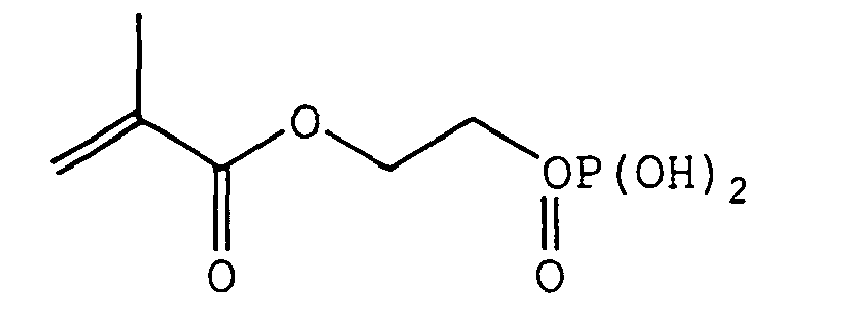
-

- Pentaerythritol tetraacrylate
(NK Ester A-TMMT, produced by Shin Nakamura Kagaku Kogyo K.K.) - Glycerin dimethacrylate hexamethylene diisocyanate urethane prepolymer
(UA101H, produced by Kyoeisha Kagaku K.K.) -

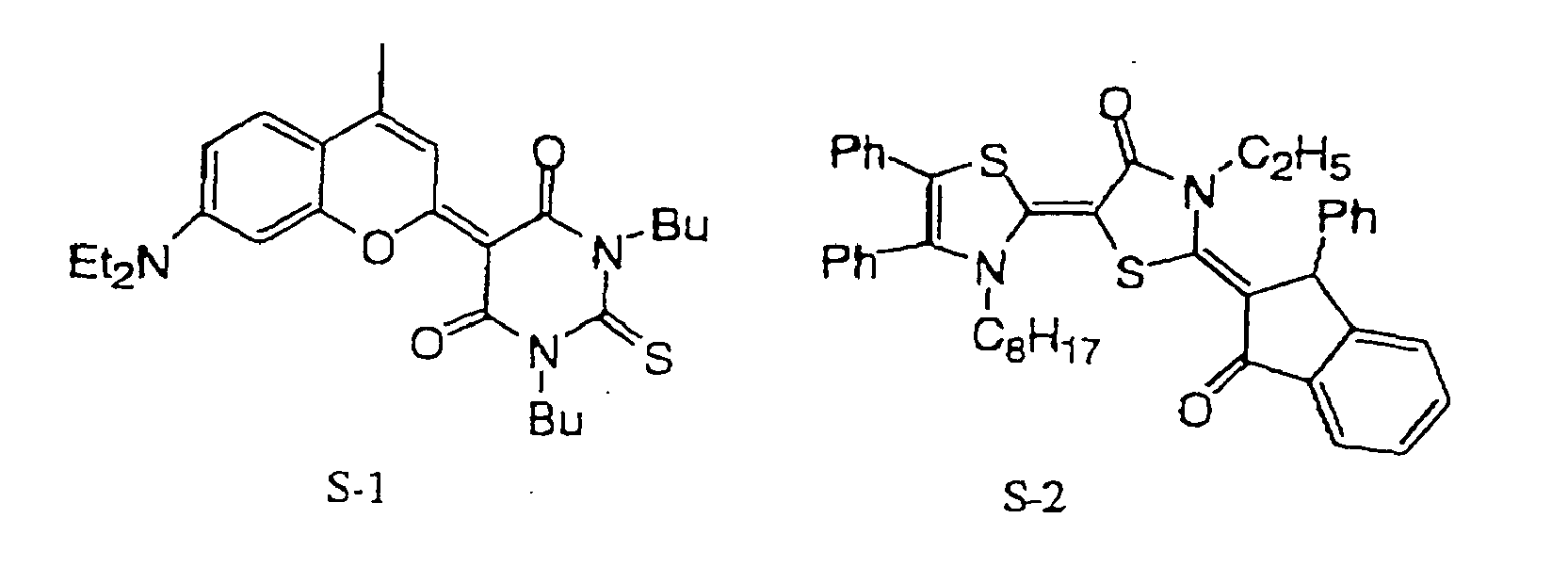

- Allyl methacrylate/methacrylic acid/N-isopropylacrylamide (copolymerization molar ratio: 67/13/20)
Actual acid value determined by NaOH titration: 1.15 meq/g
Weight-average molecular weight determined by GPC: 130,000 - Allyl methacrylate/methacrylic acid copolymer (copolymerization molar ratio: 83/17)
Actual acid value determined by NaOH titration: 1.55 meq/g
Weight-average molecular weight determined by GPC: 125,000 - Polyurethane resin as a condensation polymerized product of the following diisocyanate and diol: 4,4'-diphenylmethane diisocyanate (MDI), hexamethylene diisocyanate (HMDI),
polypropylene glycol (weight-average molecular weight: 1,000) (PPG1000), and
2,2-bis(hydroxymethyl)propionic acid (DMPA) copolymerization molar ratio (MDI/HMDI/PPG1000/DMPA): 40/10/15/35
Actual acid value determined by NaOH titration: 1.05 meq/g
Weight-average molecular weight determined by GPC: 45,000 - An aqueous solution having a pH of 10 comprising the following composition:
Monoethanolamine 0.1 part by weight Triethanolamine 1.5 parts by weight Compound of formula 1 shown below 4.0 parts by weight Compound of formula 2 shown below 2.5 parts by weight Compound of formula 3 shown below 0.2 part by weight Water 91.7 parts by weight 

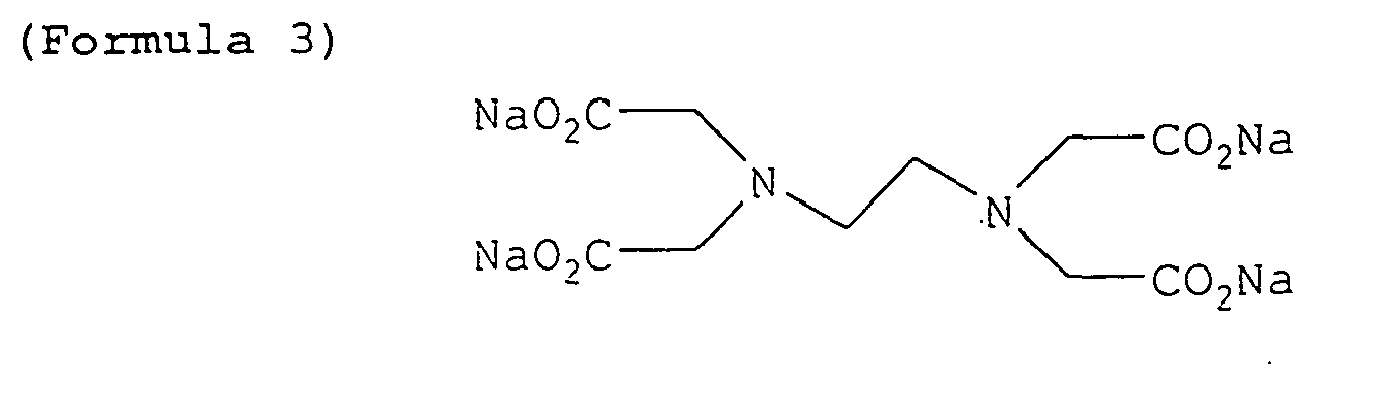
- In (formula 1) above, R21 represents hydrogen atom or a butyl group.
- An aqueous solution comprising the following composition
1K Potassium silicate 3.0 parts by weight Potassium hydroxide 1.5 parts by weight Compound of formula 3 above: 0.2 part by weight Water 95.3 parts by weight - Lithographic printing plate precursors were manufactured according to the following procedure and evaluated on the printing capability. The results are shown in Table 1'.
- A 0.3 mm-thick aluminum plate (constructive material: IS) was subjected to surface graining using a nylon blush No. 8 and a water suspension of 800-mesh pumice stone and then thoroughly washed with water. This plate was etched by dipping it in a 10 wt% sodium hydroxide at 70°C for 60 seconds, washed with running water, neutralization washed with 20% nitric acid, and again washed with water. Thereafter, the plate was subjected to an electrolytic surface roughing treatment using a sine wave alternating electric current in a 1 wt% aqueous nitric acid solution with an anode time electricity of 300 coulombs/dm2 under the condition of VA =12.7 V. The surface roughness was measured and found to be 0.45 µm (Ra indication according to JIS B0601). This support was designated as AS-1.
- The support treated as above was dipped in an aqueous solution containing 2.5 wt% of sodium silicate No. 3 (SiO2: 28 to 30%, Na2O: 9 to 10%, Fe: 0.02% or less) at a pH of 11.2 and 70°C for 13 seconds and then washed with water. From the amount of Si element determined by the fluorescent X-ray analysis of the surface, the surface silicate amount was found to be 10 mg/m 2 This support was designated as AS-2.
- A coating solution having a composition (A) or (B) shown below was prepared, coated on the surface of the support prepared above by a wheeler to have a dry coated weight of from 10 to 35 mg/m2, and then dried at 80°C for 30 seconds.
(Coating Solution A for Interlayer) Compound capable of forming a complex with aluminum (compound shown in Table 1' below) 0.75 g Additives (compounds shown in Table 1' below) based on the compound capable of a complex with aluminum 20 to 100 wt% Methanol 200 g (Coating Solution B for Interlayer) Compound capable of forming a complex with aluminum (compound shown in Table 1' below) 0.75 g Additives (compounds shown in Table 1' below) based on the compound capable of forming a complex with aluminum 20 to 100 wt% Methanol 100 g Water 100 g (Coating Solution C for Interlayer) Compound capable of forming a complex with aluminum (compound shown in Table 1' below) 0.75 g Additives (compounds shown in Table 1' below) based on the compound capable of forming a complex with aluminum 20 to 100 wt% Methanol 100 g Acetonitrile 100 g - A photosensitive solution having the following composition was coated by a wheeler on the support having provided thereon the interlayer to have a dry coated weight of 1.0 to 2.0 g/m2 , and then dried at 100°C for 1 minute.
(Photosensitive Solution) Addition polymerizable compound (compound shown in Table 1') 1.5 g Binder polymer (compound shown in Table 1') 2.0 g Sensitizing dye (compound shown in Table 1') 0.2 g Photopolymerization initiator (compound shown in Table 1') 0.4 g Co-sensitizer (compound shown in Table 1') 0.4 g Coloring pigment dispersion (having the composition shown below) 2.0 g Thermal polymerization inhibitor (N-nitrosophenylhydroxylamine aluminum salt) 0.01 g Surfactant (Megafac F-177, produced by Dai-Nippon Ink & Chemicals, Inc.) 0.02 g Methyl ethyl ketone 20.0 g Polypropylene glycol monomethyl ether 20.0 g Composition of the coloring pigment dispersion: Pigment Blue 15:6 15 parts by weight Allyl methacrylate/methacrylic acid copolymer (copolymerization molar ratio: 83/17) 10 parts by weight Cyclohexane 15 parts by weight Methoxypropyl acetate 20 parts by weight Propylene glycol monomethyl ether 40 parts by weight - An aqueous solution containing 3 wt% of polyvinyl alcohol (saponification degree: 98 mol%, polymerization degree: 550) was coated on the photosensitive layer provided above to have a dry coated weight of 2 g/m2, and then dried at 100°C for 2 minutes.
- The thus-obtained lithographic printing plate precursor was subjected to a solid image exposure or a halftone image exposure (2540 dpi, 175 lines/inch, from 1 to 99% in units of 1%) using an FD-YAG (532 nm) laser exposing machine (Plate Setter: Gutenberg, manufactured by Heiderberg) by controlling the exposure power to give an exposure energy density of 200 µJ/cm2 on the plate surface.
- A predetermined developer and Finisher FP-2W produced by Fuji Photo Film Co., Ltd. were charged into an automatic developing machine FLP-813 manufactured by Fuji Photo Film Co., Ltd., and the exposed plate was developed/processed for plate-making at a developer temperature of 30°C for a development time of 18 seconds to obtain a lithographic printing plate.
- Using a printer R201 manufactured by Rholand and an ink GEOS-G(N) produced by Dai-Nippon Ink & Chemicals, Inc., the test was performed. The printed matter of the solid image area was observed and the press life was evaluated by the number of sheets when the image began thinning. A larger numeral reveals a longer press life.
- Using a printer R201 manufactured by Rholand and an ink GEOS-G(N) produced by Dai-Nippon Ink & Chemicals, Inc., the test was performed. At the 5,000th sheet from the initiation of printing, the halftone area was wiped off with a printing sponge impregnated with PS plate cleaner CL-2 produced by Fuji Photo Film Co., Ltd. to wash the ink on the plate surface. Thereafter, 10,000 sheets were printed and the presence or absence of the plate slipping in the halftone area on the printed matter was observed with an eye.
- Using a printer R201 manufactured by Rholand and an ink GEOS-G(S) produced by Dai-Nippon Ink & Chemicals, Inc., the test was performed. The non-image area of the printed matter was observed and the scumming resistance was evaluated.


- Lithographic printing plate precursor shown in Table 2' were evaluated on the capability in the same manner as in Examples 1' to 6'.


- As clearly seen from Tables 1' and 2', the lithographic printing plate precursor in which an interlayer containing a compound capable of forming a complex with aluminum was verified to ensure highly excellent press life and scumming resistance.
- The compounds described in Tables 1' and 2' are shown below.
-


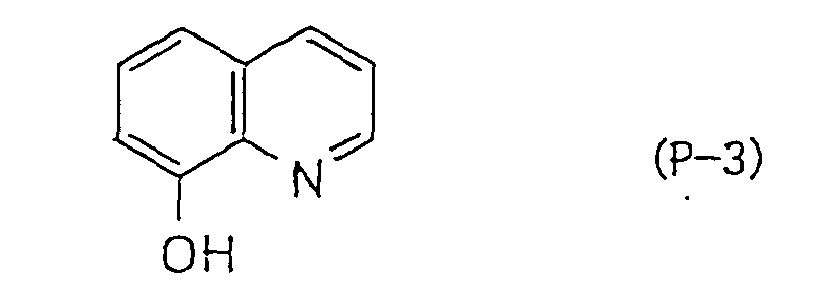


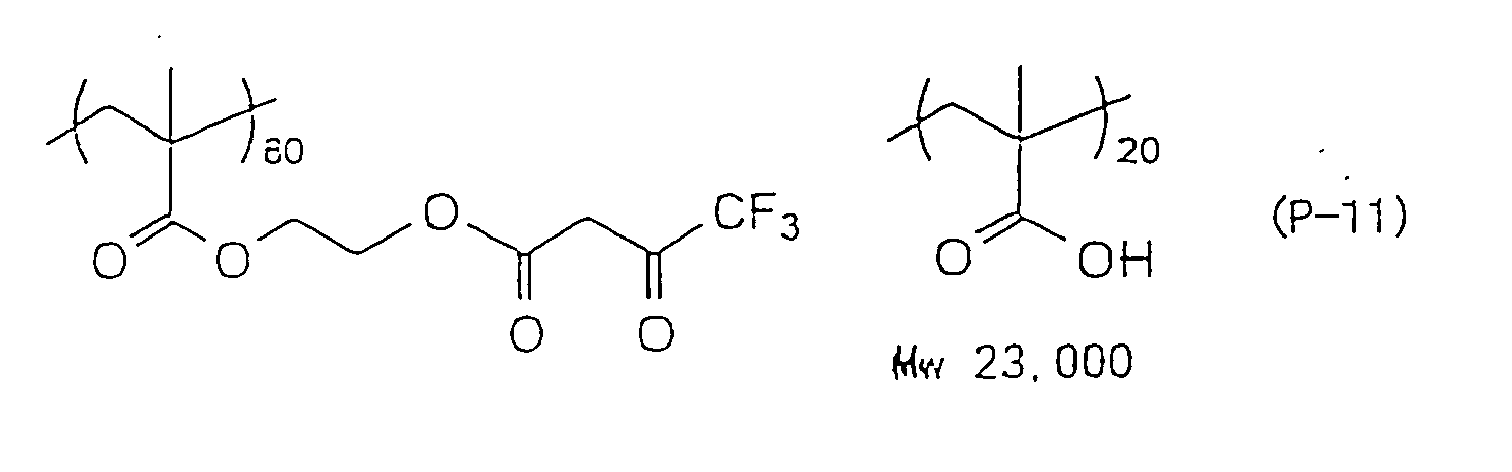
-

-

-

- Pentaerythritol tetraacrylate
(NK Ester A-TMMT, produced by Shin Nakamura Kagaku Kogyo K.K.) - Glycerin dimethacrylate hexamethylene diisocyanate urethane prepolymer
(UA101H, produced by Kyoeisha Kagaku K.K.) -


- Allyl methacrylate/methacrylic acid/N-isopropylacrylamide (copolymerization molar ratio: 67/13/20)
Actual acid value determined by NaOH titration: 1.15 meq/g
Weight-average molecular weight determined by GPC: 130,000 - Allyl methacrylate/methacrylic acid copolymer (copolymerization molar ratio: 83/17)
Actual acid value determined by NaOH titration: 1.55 meq/g
Weight-average molecular weight determined by GPC: 125,000 - Polyurethane resin as a condensation polymerized product of the following diisocyanate and diol: 4,4'-diphenylmethane diisocyanate (MDI), hexamethylene diisocyanate (HMDI),
polypropylene glycol (weight-average molecular weight: 1,000) (PPG1000), and
2,2-bis(hydroxymethyl)propionic acid (DMPA) copolymerization molar ratio (MDI/HMDI/PPG1000/DMPA) : 40/10/15/35
Actual acid value determined by NaOH titration: 1.05 meq/g
Weight-average molecular weight determined by GPC: 45,000 - An aqueous solution having a pH of 10 comprising the following composition:
Monoethanolamine 0.1 part by weight Triethanolamine 1.5 parts by weight Compound of formula 1 shown below 4.0 parts by weight Compound of formula 2 shown below 2.5 parts by weight Compound of formula 3 shown below 0.2 part by weight Water 91.7 parts by weight 


- In (formula 1) above, R8 represents hydrogen atom or a butyl group.
- An aqueous solution comprising the following composition
1K Potassium silicate 3.0 parts by weight Potassium hydroxide 1.5 parts by weight Compound of formula 3 above: 0.2 part by weight Water 95.3 parts by weight - As described in the foregoing pates, the lithographic printing plate precursor of the present invention has an interlayer containing a cationic group and a radical reactive group between the support and the photosensitive layer, so that very excellent press life and scumming resistance can be provided. Furthermore, the lithographic printing plate precursor of the present invention exhibits sufficiently high practical sensitivity in the scanning exposure by a laser ray.
- While the invention has been described in detail and with reference to specific embodiments thereof, it will be apparent to one skilled in the art that various changes and modifications can be made therein without departing from the spirit and scope thereof.
- This application is based on
Japanese patent applications No. Hei-11-284091 filed on October 5, 1999 No. Hei-11-322641 filed on November 12, 1999 No. 2000-14697 filed on January 24, 2000
Claims (9)
- A lithographic printing plate precursor comprising in this order(i) a hydrophilized aluminum support;(ii) an interlayer containing a compound (b) capable of forming a complex with aluminum, which compound gives a stability constant in the aluminum complex, in terms of the common logarithmic value, of ≥ 3; and(iii) a photopolymerizable photosensitive layer containing- a photopolymerization initiator,- a compound having an addition polymerizable ethylenically unsaturated bond, and- a polymer binder;
- The printing plate precursor of claim 1, wherein the stability constant is ≥ 5.
- The printing plate precursor of claim 2, wherein the stability constant is ≥ 8.
- The printing plate precursor of any of claims 1-3, wherein the photopolymerization initiator comprises a titanocene.
- A lithographic printing plate precursor comprising in this order(i) a hydrophilized aluminum support;(ii) an interlayer containing a polymer (c) capable of forming a complex with aluminum; and(iii) a photopolymerizable photosensitive layer containing- a photopolymerization initiator,- a compound having an addition polymerizable ethylenically unsaturated bond, and- a polymer binder;
- The printing plate precursor of claim 5, wherein the polymer (c) has a structure of formula (I) on the side chain:

- The printing plate precursor of claim 5, wherein the polymer (c) has a structure of formula (II) on the side chain:
Y-Ar (II)
wherein Y is a linking group to the polymer main chain skeleton, and Ar is an optionally substituted heteroaryl group having one or more nitrogen atom(s). - The printing plate precursor of claim 5, wherein the polymer (c) is a copolymer comprising a monomer having an acid group having a pKa of ≤ 7.
- The printing plate precursor of any of claims 5-8, wherein the photopolymerization initiator comprises a titanocene.
Applications Claiming Priority (4)
| Application Number | Priority Date | Filing Date | Title |
|---|---|---|---|
| JP28409199 | 1999-10-05 | ||
| JP32264199A JP3893818B2 (en) | 1999-10-05 | 1999-11-12 | Master for lithographic printing plate |
| JP2000014697A JP4139540B2 (en) | 2000-01-24 | 2000-01-24 | Master for lithographic printing plate |
| EP00121271A EP1091251B1 (en) | 1999-10-05 | 2000-10-05 | Lithographic printing plate precursor |
Related Parent Applications (1)
| Application Number | Title | Priority Date | Filing Date |
|---|---|---|---|
| EP00121271A Division EP1091251B1 (en) | 1999-10-05 | 2000-10-05 | Lithographic printing plate precursor |
Publications (2)
| Publication Number | Publication Date |
|---|---|
| EP1927889A1 true EP1927889A1 (en) | 2008-06-04 |
| EP1927889B1 EP1927889B1 (en) | 2014-06-25 |
Family
ID=27337056
Family Applications (2)
| Application Number | Title | Priority Date | Filing Date |
|---|---|---|---|
| EP07024393.6A Expired - Lifetime EP1927889B1 (en) | 1999-10-05 | 2000-10-05 | Lithographic printing plate precursor |
| EP00121271A Expired - Lifetime EP1091251B1 (en) | 1999-10-05 | 2000-10-05 | Lithographic printing plate precursor |
Family Applications After (1)
| Application Number | Title | Priority Date | Filing Date |
|---|---|---|---|
| EP00121271A Expired - Lifetime EP1091251B1 (en) | 1999-10-05 | 2000-10-05 | Lithographic printing plate precursor |
Country Status (3)
| Country | Link |
|---|---|
| US (1) | US6558873B1 (en) |
| EP (2) | EP1927889B1 (en) |
| AT (1) | ATE536566T1 (en) |
Families Citing this family (39)
| Publication number | Priority date | Publication date | Assignee | Title |
|---|---|---|---|---|
| EP1172699B1 (en) * | 2000-07-14 | 2013-09-11 | FUJIFILM Corporation | Method for making lithographic printing plates |
| JP4418714B2 (en) * | 2003-07-10 | 2010-02-24 | 富士フイルム株式会社 | Planographic printing plate precursor and planographic printing method |
| DE602004030519D1 (en) * | 2003-07-22 | 2011-01-27 | Fujifilm Corp | Planographic printing plate precursor and lithographic printing method |
| JP4815113B2 (en) * | 2003-09-24 | 2011-11-16 | 富士フイルム株式会社 | Planographic printing plate precursor and planographic printing method |
| US20070144384A1 (en) * | 2004-05-19 | 2007-06-28 | Fuji Photo Film Co., Ltd | Image recording method |
| EP1787166A1 (en) * | 2004-09-01 | 2007-05-23 | Kodak Polychrome Graphics, LLC | Interlayer for lithographic printing plates |
| JP4574506B2 (en) * | 2005-03-23 | 2010-11-04 | 富士フイルム株式会社 | Planographic printing plate precursor and its plate making method |
| ATE422253T1 (en) * | 2005-11-18 | 2009-02-15 | Agfa Graphics Nv | METHOD FOR PRODUCING A LITHOGRAPHIC PRINTING FORM |
| EP1788434B2 (en) | 2005-11-18 | 2019-01-02 | Agfa Nv | Method of making a lithographic printing plate |
| PL1788442T3 (en) | 2005-11-18 | 2011-01-31 | Agfa Graphics Nv | Method of making a lithographic printing plate |
| DE602005026136D1 (en) | 2005-11-18 | 2011-03-10 | Agfa Graphics Nv | Process for producing a lithographic printing plate |
| ES2346320T3 (en) | 2005-11-18 | 2010-10-14 | Agfa Graphics N.V. | METHOD OF MANUFACTURE OF A LITHOGRAPHIC PRINT IRON. |
| US8088559B2 (en) | 2005-11-18 | 2012-01-03 | Agfa Graphics Nv | Method of making a photopolymer printing plate |
| ATE426191T1 (en) | 2005-11-18 | 2009-04-15 | Agfa Graphics Nv | METHOD FOR PRODUCING A LITHOGRAPHIC PRINTING PLATE |
| EP2772805A1 (en) | 2005-11-18 | 2014-09-03 | Agfa Graphics Nv | Method of making a lithographic printing plate |
| EP1788431B1 (en) | 2005-11-18 | 2009-01-28 | Agfa Graphics N.V. | Method of making a lithographic printing plate |
| EP1788429B1 (en) | 2005-11-18 | 2009-03-18 | Agfa Graphics N.V. | Method of making a lithographic printing plate |
| EP1788449A1 (en) | 2005-11-21 | 2007-05-23 | Agfa Graphics N.V. | Method for making a lithographic printing plate |
| EP1788435B1 (en) | 2005-11-21 | 2013-05-01 | Agfa Graphics N.V. | Method of making a lithographic printing plate |
| ATE430330T1 (en) | 2005-11-21 | 2009-05-15 | Agfa Graphics Nv | METHOD FOR PRODUCING A LITHOGRAPHIC PRINTING FORM |
| JP2007233071A (en) * | 2006-03-01 | 2007-09-13 | Fujifilm Corp | Planographic printing plate preparation method and planographic printing plate precursor |
| DE602007009344D1 (en) * | 2006-07-25 | 2010-11-04 | Fujifilm Corp | Lithographic printing plate precursor and method of making a lithographic printing plate |
| US8445176B2 (en) | 2007-05-25 | 2013-05-21 | Agfa Graphics Nv | Lithographic printing plate precursor |
| US8415087B2 (en) | 2007-11-16 | 2013-04-09 | Agfa Graphics Nv | Method of making a lithographic printing plate |
| ATE555903T1 (en) | 2008-10-23 | 2012-05-15 | Agfa Graphics Nv | LITHOGRAPH PRINTING PLATE |
| ES2588075T3 (en) | 2013-01-11 | 2016-10-28 | Agfa Graphics Nv | Method of manufacturing a lithographic printing plate |
| EP2916171B1 (en) | 2014-03-03 | 2017-05-31 | Agfa Graphics Nv | A method for making a lithographic printing plate precursor |
| CN108351606A (en) * | 2015-11-19 | 2018-07-31 | Az电子材料(卢森堡)有限公司 | Composition for forming fine resist pattern and pattern forming method using same |
| EP3327544B1 (en) * | 2016-11-25 | 2021-06-23 | Nokia Technologies Oy | Apparatus, associated method and associated computer readable medium |
| EP3441223B1 (en) | 2017-08-07 | 2024-02-21 | Eco3 Bv | A lithographic printing plate precursor |
| EP3474073B1 (en) | 2017-10-17 | 2022-12-07 | Agfa Offset Bv | A method for making a printing plate |
| ES2881270T3 (en) | 2017-12-08 | 2021-11-29 | Agfa Nv | Manufacturing process of a lithographic printing plate |
| EP3650938A1 (en) | 2018-11-09 | 2020-05-13 | Agfa Nv | A lithographic printing plate precursor |
| WO2020120400A1 (en) | 2018-12-10 | 2020-06-18 | Agfa Nv | A lithographic printing plate precursor |
| EP3922462B1 (en) | 2020-06-08 | 2023-03-01 | Agfa Offset Bv | Lithographic photopolymer printing plate precursor with improved daylight stability |
| US12065573B2 (en) | 2020-07-31 | 2024-08-20 | Canon Kabushiki Kaisha | Photocurable composition |
| EP3960455B1 (en) | 2020-08-31 | 2025-08-06 | Eco3 Bv | A lithographic printing plate precursor, a method for making a lithographic printing plate precursor and a method for making a lithographic printing plate |
| EP4225582B1 (en) | 2020-10-09 | 2024-08-28 | Eco3 Bv | A lithographic printing plate precursor |
| EP4129682B1 (en) | 2021-08-05 | 2025-10-01 | Eco3 Bv | A lithographic printing plate precursor |
Citations (10)
| Publication number | Priority date | Publication date | Assignee | Title |
|---|---|---|---|---|
| US3617411A (en) * | 1969-01-14 | 1971-11-02 | Ibm | Process for etching a pattern of closely spaced conducting lines in an integrated circuit |
| US4956261A (en) | 1986-12-23 | 1990-09-11 | Hoechst Aktiengesellschaft | Photosensitive diazo and photopolymerizable recording material with a photosensitive diazo intermediate layer |
| DE4105887A1 (en) | 1990-03-09 | 1991-09-12 | Fuji Photo Film Co Ltd | Photosensitive lithographic plate with hydrophilic coat - contg. amino phosphoric acid or phosphonic or phosphinic acid or salt, preventing stating and soiling |
| DE4023268A1 (en) | 1990-07-21 | 1992-01-23 | Hoechst Ag | HYDROPHILIC MIXED POLYMERS AND THEIR USE IN REPROGRAPHY |
| JPH07159983A (en) | 1993-12-03 | 1995-06-23 | Fuji Photo Film Co Ltd | Photosensitive printing plate |
| US5476754A (en) | 1990-02-19 | 1995-12-19 | Fuji Photo Film Co., Ltd. | Process for preparing a lithographic printing plate |
| EP0727714A1 (en) | 1995-02-15 | 1996-08-21 | Agfa-Gevaert N.V. | A diazo based imaging element having improved resistance against physical damage |
| JPH09269593A (en) | 1996-04-01 | 1997-10-14 | Fuji Photo Film Co Ltd | Photosensitive planographic printing plate |
| EP0871070A2 (en) | 1997-04-08 | 1998-10-14 | Fuji Photo Film Co., Ltd. | Positive working photosensitive lithographic printing plate |
| EP0965887A1 (en) | 1998-06-17 | 1999-12-22 | Fuji Photo Film Co., Ltd. | Photosensitive lithographic printing plate |
Family Cites Families (13)
| Publication number | Priority date | Publication date | Assignee | Title |
|---|---|---|---|---|
| US4463112A (en) * | 1980-02-13 | 1984-07-31 | Leistner William E | Phenylethylidene-substituted phenyl polyphosphites |
| US4388156A (en) * | 1981-12-23 | 1983-06-14 | American Hoechst Corporation | Aluminum electrolysis in non-aqueous monomeric organic acid |
| JPS6250760A (en) | 1985-08-29 | 1987-03-05 | Fuji Photo Film Co Ltd | Photosensitive lithographic printing plate requiring no dampening water |
| US4640886A (en) * | 1985-10-10 | 1987-02-03 | Eastman Kodak Company | Subbed lithographic printing plate |
| JPH0682214B2 (en) | 1986-12-26 | 1994-10-19 | 東レ株式会社 | Waterless planographic printing plate |
| US4886731A (en) * | 1987-01-05 | 1989-12-12 | Cookson Graphics Inc. | Multilayer photopolymeric printing plates with photoreactive diazo compounds and photopolymerizable compositions |
| JPH03122647A (en) | 1989-10-05 | 1991-05-24 | Hitachi Chem Co Ltd | Photosensitive resin composition and photosensitive film using this composition |
| DE4415607A1 (en) * | 1994-05-04 | 1995-11-09 | Hoechst Ag | Photosensitive material and method of making planographic printing plates |
| DE4423140A1 (en) * | 1994-07-01 | 1996-01-04 | Hoechst Ag | Hydrophilized carrier material and recording material produced therewith |
| JP3589360B2 (en) * | 1995-03-22 | 2004-11-17 | 富士写真フイルム株式会社 | Photosensitive printing plate |
| JP3830114B2 (en) | 1997-09-29 | 2006-10-04 | 富士写真フイルム株式会社 | Positive photosensitive lithographic printing plate |
| JP3122647B2 (en) | 1999-01-08 | 2001-01-09 | 大日本印刷株式会社 | Information recording medium and information recording / reproducing method |
| US6258517B1 (en) * | 2000-06-06 | 2001-07-10 | Eastman Kodak Company | Imaged element with improved wet abrasion resistance |
-
2000
- 2000-10-04 US US09/678,738 patent/US6558873B1/en not_active Expired - Lifetime
- 2000-10-05 EP EP07024393.6A patent/EP1927889B1/en not_active Expired - Lifetime
- 2000-10-05 EP EP00121271A patent/EP1091251B1/en not_active Expired - Lifetime
- 2000-10-05 AT AT00121271T patent/ATE536566T1/en active
Patent Citations (10)
| Publication number | Priority date | Publication date | Assignee | Title |
|---|---|---|---|---|
| US3617411A (en) * | 1969-01-14 | 1971-11-02 | Ibm | Process for etching a pattern of closely spaced conducting lines in an integrated circuit |
| US4956261A (en) | 1986-12-23 | 1990-09-11 | Hoechst Aktiengesellschaft | Photosensitive diazo and photopolymerizable recording material with a photosensitive diazo intermediate layer |
| US5476754A (en) | 1990-02-19 | 1995-12-19 | Fuji Photo Film Co., Ltd. | Process for preparing a lithographic printing plate |
| DE4105887A1 (en) | 1990-03-09 | 1991-09-12 | Fuji Photo Film Co Ltd | Photosensitive lithographic plate with hydrophilic coat - contg. amino phosphoric acid or phosphonic or phosphinic acid or salt, preventing stating and soiling |
| DE4023268A1 (en) | 1990-07-21 | 1992-01-23 | Hoechst Ag | HYDROPHILIC MIXED POLYMERS AND THEIR USE IN REPROGRAPHY |
| JPH07159983A (en) | 1993-12-03 | 1995-06-23 | Fuji Photo Film Co Ltd | Photosensitive printing plate |
| EP0727714A1 (en) | 1995-02-15 | 1996-08-21 | Agfa-Gevaert N.V. | A diazo based imaging element having improved resistance against physical damage |
| JPH09269593A (en) | 1996-04-01 | 1997-10-14 | Fuji Photo Film Co Ltd | Photosensitive planographic printing plate |
| EP0871070A2 (en) | 1997-04-08 | 1998-10-14 | Fuji Photo Film Co., Ltd. | Positive working photosensitive lithographic printing plate |
| EP0965887A1 (en) | 1998-06-17 | 1999-12-22 | Fuji Photo Film Co., Ltd. | Photosensitive lithographic printing plate |
Also Published As
| Publication number | Publication date |
|---|---|
| ATE536566T1 (en) | 2011-12-15 |
| EP1091251A3 (en) | 2002-07-03 |
| EP1091251B1 (en) | 2011-12-07 |
| EP1091251A2 (en) | 2001-04-11 |
| EP1927889B1 (en) | 2014-06-25 |
| US6558873B1 (en) | 2003-05-06 |
Similar Documents
| Publication | Publication Date | Title |
|---|---|---|
| US6558873B1 (en) | Lithographic printing plate precursor | |
| JP4248137B2 (en) | Negative photosensitive lithographic printing plate | |
| JP4291638B2 (en) | Alkali-soluble polymer and planographic printing plate precursor using the same | |
| JP2002139828A (en) | Photosensitive planographic printing plate | |
| JP2002107918A (en) | Photosensitive planographic printing plate | |
| JP2002040652A (en) | Negative photosensitive planographic printing plate | |
| JP4139540B2 (en) | Master for lithographic printing plate | |
| JP2000235254A (en) | Master plate for planographic printing plate and production of planographic printing plate using same | |
| JP3969898B2 (en) | Master for lithographic printing plate | |
| JP3976110B2 (en) | Photopolymerization planographic printing plate | |
| JP2005234385A (en) | Photopolymerizable composition and lithographic printing plate precursor | |
| JP3893818B2 (en) | Master for lithographic printing plate | |
| JP2001356474A (en) | Original plate for planographic printing plate | |
| JP2005043724A (en) | Photopolymerizable planographic printing plate | |
| JP4457030B2 (en) | Planographic printing plate precursor and lithographic printing plate manufacturing method | |
| US20060024611A1 (en) | Photosensitive composition and lithographic printing plate precursor | |
| JP4452575B2 (en) | Photosensitive composition | |
| US7306894B2 (en) | Polymerizable composition, photopolymerizing method and process for producing lithographic printing plate using the polymerizable composition | |
| EP1564590A2 (en) | Photosensitive composition | |
| JP2004300315A (en) | Polymerizable composition | |
| JP2000081711A (en) | Manufacture of planographic printing plate | |
| JP4243045B2 (en) | Planographic printing plate making method | |
| JP2004309897A (en) | Polymerizable composition and negative image recording material | |
| JP2005215399A (en) | Photosensitive lithographic printing plate | |
| JP2001022078A (en) | Photopolymerization type planographic printing plate |
Legal Events
| Date | Code | Title | Description |
|---|---|---|---|
| PUAI | Public reference made under article 153(3) epc to a published international application that has entered the european phase |
Free format text: ORIGINAL CODE: 0009012 |
|
| 17P | Request for examination filed |
Effective date: 20071217 |
|
| AC | Divisional application: reference to earlier application |
Ref document number: 1091251 Country of ref document: EP Kind code of ref document: P |
|
| AK | Designated contracting states |
Kind code of ref document: A1 Designated state(s): AT BE CH CY DE DK ES FI FR GB GR IE IT LI LU MC NL PT SE |
|
| AKX | Designation fees paid |
Designated state(s): AT BE CH CY DE DK ES FI FR GB GR IE IT LI LU MC NL PT SE |
|
| 17Q | First examination report despatched |
Effective date: 20120118 |
|
| REG | Reference to a national code |
Ref country code: DE Ref legal event code: R079 Ref document number: 60048633 Country of ref document: DE Free format text: PREVIOUS MAIN CLASS: G03F0007095000 Ipc: G03F0007090000 |
|
| RIC1 | Information provided on ipc code assigned before grant |
Ipc: G03F 7/09 20060101AFI20131202BHEP Ipc: G03F 7/11 20060101ALI20131202BHEP |
|
| GRAP | Despatch of communication of intention to grant a patent |
Free format text: ORIGINAL CODE: EPIDOSNIGR1 |
|
| INTG | Intention to grant announced |
Effective date: 20140206 |
|
| INTG | Intention to grant announced |
Effective date: 20140212 |
|
| GRAS | Grant fee paid |
Free format text: ORIGINAL CODE: EPIDOSNIGR3 |
|
| GRAA | (expected) grant |
Free format text: ORIGINAL CODE: 0009210 |
|
| AC | Divisional application: reference to earlier application |
Ref document number: 1091251 Country of ref document: EP Kind code of ref document: P |
|
| AK | Designated contracting states |
Kind code of ref document: B1 Designated state(s): AT BE CH CY DE DK ES FI FR GB GR IE IT LI LU MC NL PT SE |
|
| REG | Reference to a national code |
Ref country code: GB Ref legal event code: FG4D |
|
| REG | Reference to a national code |
Ref country code: CH Ref legal event code: EP |
|
| REG | Reference to a national code |
Ref country code: AT Ref legal event code: REF Ref document number: 675036 Country of ref document: AT Kind code of ref document: T Effective date: 20140715 |
|
| REG | Reference to a national code |
Ref country code: IE Ref legal event code: FG4D |
|
| REG | Reference to a national code |
Ref country code: DE Ref legal event code: R096 Ref document number: 60048633 Country of ref document: DE Effective date: 20140807 |
|
| PG25 | Lapsed in a contracting state [announced via postgrant information from national office to epo] |
Ref country code: FI Free format text: LAPSE BECAUSE OF FAILURE TO SUBMIT A TRANSLATION OF THE DESCRIPTION OR TO PAY THE FEE WITHIN THE PRESCRIBED TIME-LIMIT Effective date: 20140625 Ref country code: CY Free format text: LAPSE BECAUSE OF FAILURE TO SUBMIT A TRANSLATION OF THE DESCRIPTION OR TO PAY THE FEE WITHIN THE PRESCRIBED TIME-LIMIT Effective date: 20140625 Ref country code: GR Free format text: LAPSE BECAUSE OF FAILURE TO SUBMIT A TRANSLATION OF THE DESCRIPTION OR TO PAY THE FEE WITHIN THE PRESCRIBED TIME-LIMIT Effective date: 20140926 |
|
| REG | Reference to a national code |
Ref country code: AT Ref legal event code: MK05 Ref document number: 675036 Country of ref document: AT Kind code of ref document: T Effective date: 20140625 |
|
| REG | Reference to a national code |
Ref country code: NL Ref legal event code: VDEP Effective date: 20140625 |
|
| PG25 | Lapsed in a contracting state [announced via postgrant information from national office to epo] |
Ref country code: SE Free format text: LAPSE BECAUSE OF FAILURE TO SUBMIT A TRANSLATION OF THE DESCRIPTION OR TO PAY THE FEE WITHIN THE PRESCRIBED TIME-LIMIT Effective date: 20140625 |
|
| PG25 | Lapsed in a contracting state [announced via postgrant information from national office to epo] |
Ref country code: ES Free format text: LAPSE BECAUSE OF FAILURE TO SUBMIT A TRANSLATION OF THE DESCRIPTION OR TO PAY THE FEE WITHIN THE PRESCRIBED TIME-LIMIT Effective date: 20140625 Ref country code: PT Free format text: LAPSE BECAUSE OF FAILURE TO SUBMIT A TRANSLATION OF THE DESCRIPTION OR TO PAY THE FEE WITHIN THE PRESCRIBED TIME-LIMIT Effective date: 20141027 |
|
| PG25 | Lapsed in a contracting state [announced via postgrant information from national office to epo] |
Ref country code: NL Free format text: LAPSE BECAUSE OF FAILURE TO SUBMIT A TRANSLATION OF THE DESCRIPTION OR TO PAY THE FEE WITHIN THE PRESCRIBED TIME-LIMIT Effective date: 20140625 Ref country code: AT Free format text: LAPSE BECAUSE OF FAILURE TO SUBMIT A TRANSLATION OF THE DESCRIPTION OR TO PAY THE FEE WITHIN THE PRESCRIBED TIME-LIMIT Effective date: 20140625 |
|
| REG | Reference to a national code |
Ref country code: DE Ref legal event code: R097 Ref document number: 60048633 Country of ref document: DE |
|
| PG25 | Lapsed in a contracting state [announced via postgrant information from national office to epo] |
Ref country code: IT Free format text: LAPSE BECAUSE OF FAILURE TO SUBMIT A TRANSLATION OF THE DESCRIPTION OR TO PAY THE FEE WITHIN THE PRESCRIBED TIME-LIMIT Effective date: 20140625 Ref country code: DK Free format text: LAPSE BECAUSE OF FAILURE TO SUBMIT A TRANSLATION OF THE DESCRIPTION OR TO PAY THE FEE WITHIN THE PRESCRIBED TIME-LIMIT Effective date: 20140625 |
|
| PLBE | No opposition filed within time limit |
Free format text: ORIGINAL CODE: 0009261 |
|
| STAA | Information on the status of an ep patent application or granted ep patent |
Free format text: STATUS: NO OPPOSITION FILED WITHIN TIME LIMIT |
|
| PG25 | Lapsed in a contracting state [announced via postgrant information from national office to epo] |
Ref country code: MC Free format text: LAPSE BECAUSE OF FAILURE TO SUBMIT A TRANSLATION OF THE DESCRIPTION OR TO PAY THE FEE WITHIN THE PRESCRIBED TIME-LIMIT Effective date: 20140625 Ref country code: LU Free format text: LAPSE BECAUSE OF FAILURE TO SUBMIT A TRANSLATION OF THE DESCRIPTION OR TO PAY THE FEE WITHIN THE PRESCRIBED TIME-LIMIT Effective date: 20141005 |
|
| REG | Reference to a national code |
Ref country code: CH Ref legal event code: PL |
|
| 26N | No opposition filed |
Effective date: 20150326 |
|
| REG | Reference to a national code |
Ref country code: IE Ref legal event code: MM4A |
|
| PG25 | Lapsed in a contracting state [announced via postgrant information from national office to epo] |
Ref country code: CH Free format text: LAPSE BECAUSE OF NON-PAYMENT OF DUE FEES Effective date: 20141031 Ref country code: LI Free format text: LAPSE BECAUSE OF NON-PAYMENT OF DUE FEES Effective date: 20141031 |
|
| REG | Reference to a national code |
Ref country code: FR Ref legal event code: ST Effective date: 20150630 |
|
| PG25 | Lapsed in a contracting state [announced via postgrant information from national office to epo] |
Ref country code: FR Free format text: LAPSE BECAUSE OF NON-PAYMENT OF DUE FEES Effective date: 20141031 |
|
| PG25 | Lapsed in a contracting state [announced via postgrant information from national office to epo] |
Ref country code: IE Free format text: LAPSE BECAUSE OF NON-PAYMENT OF DUE FEES Effective date: 20141005 |
|
| PG25 | Lapsed in a contracting state [announced via postgrant information from national office to epo] |
Ref country code: BE Free format text: LAPSE BECAUSE OF FAILURE TO SUBMIT A TRANSLATION OF THE DESCRIPTION OR TO PAY THE FEE WITHIN THE PRESCRIBED TIME-LIMIT Effective date: 20140625 |
|
| PGFP | Annual fee paid to national office [announced via postgrant information from national office to epo] |
Ref country code: DE Payment date: 20170927 Year of fee payment: 18 |
|
| PGFP | Annual fee paid to national office [announced via postgrant information from national office to epo] |
Ref country code: GB Payment date: 20171004 Year of fee payment: 18 |
|
| REG | Reference to a national code |
Ref country code: DE Ref legal event code: R119 Ref document number: 60048633 Country of ref document: DE |
|
| GBPC | Gb: european patent ceased through non-payment of renewal fee |
Effective date: 20181005 |
|
| PG25 | Lapsed in a contracting state [announced via postgrant information from national office to epo] |
Ref country code: DE Free format text: LAPSE BECAUSE OF NON-PAYMENT OF DUE FEES Effective date: 20190501 |
|
| PG25 | Lapsed in a contracting state [announced via postgrant information from national office to epo] |
Ref country code: GB Free format text: LAPSE BECAUSE OF NON-PAYMENT OF DUE FEES Effective date: 20181005 |