EP1927591A1 - Polymorphic Forms of Deferasirox (ICL670) - Google Patents
Polymorphic Forms of Deferasirox (ICL670) Download PDFInfo
- Publication number
- EP1927591A1 EP1927591A1 EP06125002A EP06125002A EP1927591A1 EP 1927591 A1 EP1927591 A1 EP 1927591A1 EP 06125002 A EP06125002 A EP 06125002A EP 06125002 A EP06125002 A EP 06125002A EP 1927591 A1 EP1927591 A1 EP 1927591A1
- Authority
- EP
- European Patent Office
- Prior art keywords
- triazol
- bis
- hydroxyphenyl
- benzoic acid
- crystalline form
- Prior art date
- Legal status (The legal status is an assumption and is not a legal conclusion. Google has not performed a legal analysis and makes no representation as to the accuracy of the status listed.)
- Ceased
Links
- BOFQWVMAQOTZIW-UHFFFAOYSA-N deferasirox Chemical compound C1=CC(C(=O)O)=CC=C1N1C(C=2C(=CC=CC=2)O)=NC(C=2C(=CC=CC=2)O)=N1 BOFQWVMAQOTZIW-UHFFFAOYSA-N 0.000 title claims description 121
- FMSOAWSKCWYLBB-VBGLAJCLSA-N deferasirox Chemical compound C1=CC(C(=O)O)=CC=C1N(N\C(N\1)=C\2C(C=CC=C/2)=O)C/1=C\1C(=O)C=CC=C/1 FMSOAWSKCWYLBB-VBGLAJCLSA-N 0.000 title 1
- 229960001489 deferasirox Drugs 0.000 title 1
- 239000000203 mixture Substances 0.000 claims abstract description 54
- 238000002360 preparation method Methods 0.000 claims abstract description 26
- 239000007787 solid Substances 0.000 claims description 30
- 150000001875 compounds Chemical class 0.000 claims description 25
- 239000008194 pharmaceutical composition Substances 0.000 claims description 20
- 238000002441 X-ray diffraction Methods 0.000 claims description 10
- 239000003937 drug carrier Substances 0.000 claims description 7
- 239000003085 diluting agent Substances 0.000 claims description 4
- 239000002552 dosage form Substances 0.000 claims description 3
- 239000002831 pharmacologic agent Substances 0.000 claims description 2
- 206010028980 Neoplasm Diseases 0.000 claims 1
- 238000000034 method Methods 0.000 abstract description 27
- 230000008569 process Effects 0.000 abstract description 17
- 241000282414 Homo sapiens Species 0.000 abstract description 8
- 239000003814 drug Substances 0.000 abstract description 8
- 238000004519 manufacturing process Methods 0.000 abstract description 2
- 239000004480 active ingredient Substances 0.000 description 24
- YXFVVABEGXRONW-UHFFFAOYSA-N Toluene Chemical compound CC1=CC=CC=C1 YXFVVABEGXRONW-UHFFFAOYSA-N 0.000 description 18
- WYURNTSHIVDZCO-UHFFFAOYSA-N Tetrahydrofuran Chemical compound C1CCOC1 WYURNTSHIVDZCO-UHFFFAOYSA-N 0.000 description 17
- LFQSCWFLJHTTHZ-UHFFFAOYSA-N Ethanol Chemical compound CCO LFQSCWFLJHTTHZ-UHFFFAOYSA-N 0.000 description 15
- XEEYBQQBJWHFJM-UHFFFAOYSA-N Iron Chemical compound [Fe] XEEYBQQBJWHFJM-UHFFFAOYSA-N 0.000 description 14
- 241001465754 Metazoa Species 0.000 description 11
- 239000002609 medium Substances 0.000 description 11
- 238000009472 formulation Methods 0.000 description 10
- 230000004048 modification Effects 0.000 description 10
- 238000012986 modification Methods 0.000 description 10
- 238000000634 powder X-ray diffraction Methods 0.000 description 10
- 239000000243 solution Substances 0.000 description 10
- XLYOFNOQVPJJNP-UHFFFAOYSA-N water Substances O XLYOFNOQVPJJNP-UHFFFAOYSA-N 0.000 description 10
- WEVYAHXRMPXWCK-UHFFFAOYSA-N Acetonitrile Chemical compound CC#N WEVYAHXRMPXWCK-UHFFFAOYSA-N 0.000 description 9
- OKKJLVBELUTLKV-UHFFFAOYSA-N Methanol Chemical compound OC OKKJLVBELUTLKV-UHFFFAOYSA-N 0.000 description 9
- 239000013078 crystal Substances 0.000 description 9
- 208000037265 diseases, disorders, signs and symptoms Diseases 0.000 description 9
- 239000000825 pharmaceutical preparation Substances 0.000 description 9
- 239000000725 suspension Substances 0.000 description 9
- 239000000546 pharmaceutical excipient Substances 0.000 description 8
- 239000000843 powder Substances 0.000 description 8
- 239000000126 substance Substances 0.000 description 8
- YLQBMQCUIZJEEH-UHFFFAOYSA-N tetrahydrofuran Natural products C=1C=COC=1 YLQBMQCUIZJEEH-UHFFFAOYSA-N 0.000 description 8
- 229910052742 iron Inorganic materials 0.000 description 7
- 239000007788 liquid Substances 0.000 description 7
- 239000002904 solvent Substances 0.000 description 7
- 239000003826 tablet Substances 0.000 description 7
- RTZKZFJDLAIYFH-UHFFFAOYSA-N Diethyl ether Chemical compound CCOCC RTZKZFJDLAIYFH-UHFFFAOYSA-N 0.000 description 6
- 238000010438 heat treatment Methods 0.000 description 6
- 239000004615 ingredient Substances 0.000 description 6
- VLKZOEOYAKHREP-UHFFFAOYSA-N n-Hexane Chemical compound CCCCCC VLKZOEOYAKHREP-UHFFFAOYSA-N 0.000 description 6
- 206010043391 Thalassaemia beta Diseases 0.000 description 5
- 239000002775 capsule Substances 0.000 description 5
- 239000000969 carrier Substances 0.000 description 5
- 201000010099 disease Diseases 0.000 description 5
- 239000003960 organic solvent Substances 0.000 description 5
- 238000007911 parenteral administration Methods 0.000 description 5
- 229920001223 polyethylene glycol Polymers 0.000 description 5
- 150000003839 salts Chemical class 0.000 description 5
- IJGRMHOSHXDMSA-UHFFFAOYSA-N Atomic nitrogen Chemical compound N#N IJGRMHOSHXDMSA-UHFFFAOYSA-N 0.000 description 4
- 238000001237 Raman spectrum Methods 0.000 description 4
- 229920002472 Starch Polymers 0.000 description 4
- 208000007502 anemia Diseases 0.000 description 4
- 238000001816 cooling Methods 0.000 description 4
- 238000010586 diagram Methods 0.000 description 4
- 208000035475 disorder Diseases 0.000 description 4
- 239000008298 dragée Substances 0.000 description 4
- 229940079593 drug Drugs 0.000 description 4
- 239000000945 filler Substances 0.000 description 4
- 239000000463 material Substances 0.000 description 4
- 229910052751 metal Inorganic materials 0.000 description 4
- 239000002184 metal Substances 0.000 description 4
- 150000002739 metals Chemical class 0.000 description 4
- BDAGIHXWWSANSR-UHFFFAOYSA-N methanoic acid Natural products OC=O BDAGIHXWWSANSR-UHFFFAOYSA-N 0.000 description 4
- 229940127557 pharmaceutical product Drugs 0.000 description 4
- 235000019698 starch Nutrition 0.000 description 4
- 239000007940 sugar coated tablet Substances 0.000 description 4
- CXBDYQVECUFKRK-UHFFFAOYSA-N 1-methoxybutane Chemical compound CCCCOC CXBDYQVECUFKRK-UHFFFAOYSA-N 0.000 description 3
- FBPFZTCFMRRESA-FSIIMWSLSA-N D-Glucitol Natural products OC[C@H](O)[C@H](O)[C@@H](O)[C@H](O)CO FBPFZTCFMRRESA-FSIIMWSLSA-N 0.000 description 3
- FBPFZTCFMRRESA-JGWLITMVSA-N D-glucitol Chemical compound OC[C@H](O)[C@@H](O)[C@H](O)[C@H](O)CO FBPFZTCFMRRESA-JGWLITMVSA-N 0.000 description 3
- 108010010803 Gelatin Proteins 0.000 description 3
- PEDCQBHIVMGVHV-UHFFFAOYSA-N Glycerine Chemical compound OCC(O)CO PEDCQBHIVMGVHV-UHFFFAOYSA-N 0.000 description 3
- GUBGYTABKSRVRQ-QKKXKWKRSA-N Lactose Natural products OC[C@H]1O[C@@H](O[C@H]2[C@H](O)[C@@H](O)C(O)O[C@@H]2CO)[C@H](O)[C@@H](O)[C@H]1O GUBGYTABKSRVRQ-QKKXKWKRSA-N 0.000 description 3
- 239000000010 aprotic solvent Substances 0.000 description 3
- 238000006243 chemical reaction Methods 0.000 description 3
- 238000000576 coating method Methods 0.000 description 3
- 230000000694 effects Effects 0.000 description 3
- 239000008273 gelatin Substances 0.000 description 3
- 229920000159 gelatin Polymers 0.000 description 3
- 229940014259 gelatin Drugs 0.000 description 3
- 235000019322 gelatine Nutrition 0.000 description 3
- 235000011852 gelatine desserts Nutrition 0.000 description 3
- 239000008187 granular material Substances 0.000 description 3
- 239000008101 lactose Substances 0.000 description 3
- HQKMJHAJHXVSDF-UHFFFAOYSA-L magnesium stearate Substances [Mg+2].CCCCCCCCCCCCCCCCCC([O-])=O.CCCCCCCCCCCCCCCCCC([O-])=O HQKMJHAJHXVSDF-UHFFFAOYSA-L 0.000 description 3
- 239000001267 polyvinylpyrrolidone Substances 0.000 description 3
- 235000013855 polyvinylpyrrolidone Nutrition 0.000 description 3
- 229920000036 polyvinylpyrrolidone Polymers 0.000 description 3
- 238000001953 recrystallisation Methods 0.000 description 3
- 239000000600 sorbitol Substances 0.000 description 3
- 239000003381 stabilizer Substances 0.000 description 3
- 239000000829 suppository Substances 0.000 description 3
- 239000000454 talc Substances 0.000 description 3
- 229910052623 talc Inorganic materials 0.000 description 3
- 235000012222 talc Nutrition 0.000 description 3
- 150000003626 triacylglycerols Chemical class 0.000 description 3
- KBPLFHHGFOOTCA-UHFFFAOYSA-N 1-Octanol Chemical compound CCCCCCCCO KBPLFHHGFOOTCA-UHFFFAOYSA-N 0.000 description 2
- OSWFIVFLDKOXQC-UHFFFAOYSA-N 4-(3-methoxyphenyl)aniline Chemical compound COC1=CC=CC(C=2C=CC(N)=CC=2)=C1 OSWFIVFLDKOXQC-UHFFFAOYSA-N 0.000 description 2
- VTLYFUHAOXGGBS-UHFFFAOYSA-N Fe3+ Chemical compound [Fe+3] VTLYFUHAOXGGBS-UHFFFAOYSA-N 0.000 description 2
- 208000018565 Hemochromatosis Diseases 0.000 description 2
- 241000282412 Homo Species 0.000 description 2
- 206010065973 Iron Overload Diseases 0.000 description 2
- 239000002202 Polyethylene glycol Substances 0.000 description 2
- GWEVSGVZZGPLCZ-UHFFFAOYSA-N Titan oxide Chemical compound O=[Ti]=O GWEVSGVZZGPLCZ-UHFFFAOYSA-N 0.000 description 2
- 238000004458 analytical method Methods 0.000 description 2
- 239000012296 anti-solvent Substances 0.000 description 2
- 239000012736 aqueous medium Substances 0.000 description 2
- 239000003125 aqueous solvent Substances 0.000 description 2
- 239000011230 binding agent Substances 0.000 description 2
- 239000008280 blood Substances 0.000 description 2
- 210000004369 blood Anatomy 0.000 description 2
- 239000001506 calcium phosphate Substances 0.000 description 2
- 239000001913 cellulose Substances 0.000 description 2
- 229920002678 cellulose Polymers 0.000 description 2
- 239000003153 chemical reaction reagent Substances 0.000 description 2
- KRKNYBCHXYNGOX-UHFFFAOYSA-N citric acid Natural products OC(=O)CC(O)(C(O)=O)CC(O)=O KRKNYBCHXYNGOX-UHFFFAOYSA-N 0.000 description 2
- 239000011248 coating agent Substances 0.000 description 2
- 229960004132 diethyl ether Drugs 0.000 description 2
- 238000000113 differential scanning calorimetry Methods 0.000 description 2
- 238000001938 differential scanning calorimetry curve Methods 0.000 description 2
- 239000007919 dispersible tablet Substances 0.000 description 2
- -1 elixirs Substances 0.000 description 2
- 238000001704 evaporation Methods 0.000 description 2
- 230000008020 evaporation Effects 0.000 description 2
- 239000010685 fatty oil Substances 0.000 description 2
- 238000001914 filtration Methods 0.000 description 2
- 235000019253 formic acid Nutrition 0.000 description 2
- 210000001035 gastrointestinal tract Anatomy 0.000 description 2
- 239000007903 gelatin capsule Substances 0.000 description 2
- 229930195733 hydrocarbon Natural products 0.000 description 2
- 150000002430 hydrocarbons Chemical class 0.000 description 2
- 238000002347 injection Methods 0.000 description 2
- 239000007924 injection Substances 0.000 description 2
- 239000000543 intermediate Substances 0.000 description 2
- 235000019359 magnesium stearate Nutrition 0.000 description 2
- 238000002844 melting Methods 0.000 description 2
- 230000008018 melting Effects 0.000 description 2
- 238000002156 mixing Methods 0.000 description 2
- 229910052757 nitrogen Inorganic materials 0.000 description 2
- 231100000252 nontoxic Toxicity 0.000 description 2
- 230000003000 nontoxic effect Effects 0.000 description 2
- 239000012188 paraffin wax Substances 0.000 description 2
- FDPIMTJIUBPUKL-UHFFFAOYSA-N pentan-3-one Chemical compound CCC(=O)CC FDPIMTJIUBPUKL-UHFFFAOYSA-N 0.000 description 2
- 230000000704 physical effect Effects 0.000 description 2
- 230000002265 prevention Effects 0.000 description 2
- 239000003586 protic polar solvent Substances 0.000 description 2
- 230000005855 radiation Effects 0.000 description 2
- YGSDEFSMJLZEOE-UHFFFAOYSA-N salicylic acid Chemical compound OC(=O)C1=CC=CC=C1O YGSDEFSMJLZEOE-UHFFFAOYSA-N 0.000 description 2
- 239000008107 starch Substances 0.000 description 2
- 235000000346 sugar Nutrition 0.000 description 2
- 239000002511 suppository base Substances 0.000 description 2
- QORWJWZARLRLPR-UHFFFAOYSA-H tricalcium bis(phosphate) Chemical class [Ca+2].[Ca+2].[Ca+2].[O-]P([O-])([O-])=O.[O-]P([O-])([O-])=O QORWJWZARLRLPR-UHFFFAOYSA-H 0.000 description 2
- RYHBNJHYFVUHQT-UHFFFAOYSA-N 1,4-Dioxane Chemical compound C1COCCO1 RYHBNJHYFVUHQT-UHFFFAOYSA-N 0.000 description 1
- IXPNQXFRVYWDDI-UHFFFAOYSA-N 1-methyl-2,4-dioxo-1,3-diazinane-5-carboximidamide Chemical compound CN1CC(C(N)=N)C(=O)NC1=O IXPNQXFRVYWDDI-UHFFFAOYSA-N 0.000 description 1
- HZLCGUXUOFWCCN-UHFFFAOYSA-N 2-hydroxynonadecane-1,2,3-tricarboxylic acid Chemical compound CCCCCCCCCCCCCCCCC(C(O)=O)C(O)(C(O)=O)CC(O)=O HZLCGUXUOFWCCN-UHFFFAOYSA-N 0.000 description 1
- PXRKCOCTEMYUEG-UHFFFAOYSA-N 5-aminoisoindole-1,3-dione Chemical compound NC1=CC=C2C(=O)NC(=O)C2=C1 PXRKCOCTEMYUEG-UHFFFAOYSA-N 0.000 description 1
- 244000215068 Acacia senegal Species 0.000 description 1
- 229920001817 Agar Polymers 0.000 description 1
- GUBGYTABKSRVRQ-XLOQQCSPSA-N Alpha-Lactose Chemical compound O[C@@H]1[C@@H](O)[C@@H](O)[C@@H](CO)O[C@H]1O[C@@H]1[C@@H](CO)O[C@H](O)[C@H](O)[C@H]1O GUBGYTABKSRVRQ-XLOQQCSPSA-N 0.000 description 1
- 208000024827 Alzheimer disease Diseases 0.000 description 1
- 241000416162 Astragalus gummifer Species 0.000 description 1
- 208000014644 Brain disease Diseases 0.000 description 1
- FBPFZTCFMRRESA-KVTDHHQDSA-N D-Mannitol Chemical compound OC[C@@H](O)[C@@H](O)[C@H](O)[C@H](O)CO FBPFZTCFMRRESA-KVTDHHQDSA-N 0.000 description 1
- 229920002307 Dextran Polymers 0.000 description 1
- FEWJPZIEWOKRBE-JCYAYHJZSA-N Dextrotartaric acid Chemical compound OC(=O)[C@H](O)[C@@H](O)C(O)=O FEWJPZIEWOKRBE-JCYAYHJZSA-N 0.000 description 1
- ZAFNJMIOTHYJRJ-UHFFFAOYSA-N Diisopropyl ether Chemical compound CC(C)OC(C)C ZAFNJMIOTHYJRJ-UHFFFAOYSA-N 0.000 description 1
- LVGKNOAMLMIIKO-UHFFFAOYSA-N Elaidinsaeure-aethylester Natural products CCCCCCCCC=CCCCCCCCC(=O)OCC LVGKNOAMLMIIKO-UHFFFAOYSA-N 0.000 description 1
- 208000032274 Encephalopathy Diseases 0.000 description 1
- 229920000084 Gum arabic Polymers 0.000 description 1
- 208000031856 Haemosiderosis Diseases 0.000 description 1
- 229920002153 Hydroxypropyl cellulose Polymers 0.000 description 1
- FYYHWMGAXLPEAU-UHFFFAOYSA-N Magnesium Chemical compound [Mg] FYYHWMGAXLPEAU-UHFFFAOYSA-N 0.000 description 1
- 229930195725 Mannitol Natural products 0.000 description 1
- 240000007594 Oryza sativa Species 0.000 description 1
- 235000007164 Oryza sativa Nutrition 0.000 description 1
- 238000001069 Raman spectroscopy Methods 0.000 description 1
- DBMJMQXJHONAFJ-UHFFFAOYSA-M Sodium laurylsulphate Chemical compound [Na+].CCCCCCCCCCCCOS([O-])(=O)=O DBMJMQXJHONAFJ-UHFFFAOYSA-M 0.000 description 1
- 235000021355 Stearic acid Nutrition 0.000 description 1
- 229930006000 Sucrose Natural products 0.000 description 1
- CZMRCDWAGMRECN-UGDNZRGBSA-N Sucrose Chemical compound O[C@H]1[C@H](O)[C@@H](CO)O[C@@]1(CO)O[C@@H]1[C@H](O)[C@@H](O)[C@H](O)[C@@H](CO)O1 CZMRCDWAGMRECN-UGDNZRGBSA-N 0.000 description 1
- FEWJPZIEWOKRBE-UHFFFAOYSA-N Tartaric acid Natural products [H+].[H+].[O-]C(=O)C(O)C(O)C([O-])=O FEWJPZIEWOKRBE-UHFFFAOYSA-N 0.000 description 1
- 208000002903 Thalassemia Diseases 0.000 description 1
- 229920001615 Tragacanth Polymers 0.000 description 1
- 235000021307 Triticum Nutrition 0.000 description 1
- 244000098338 Triticum aestivum Species 0.000 description 1
- 240000008042 Zea mays Species 0.000 description 1
- 235000016383 Zea mays subsp huehuetenangensis Nutrition 0.000 description 1
- 235000002017 Zea mays subsp mays Nutrition 0.000 description 1
- SMEGJBVQLJJKKX-HOTMZDKISA-N [(2R,3S,4S,5R,6R)-5-acetyloxy-3,4,6-trihydroxyoxan-2-yl]methyl acetate Chemical compound CC(=O)OC[C@@H]1[C@H]([C@@H]([C@H]([C@@H](O1)O)OC(=O)C)O)O SMEGJBVQLJJKKX-HOTMZDKISA-N 0.000 description 1
- 238000010521 absorption reaction Methods 0.000 description 1
- 235000010489 acacia gum Nutrition 0.000 description 1
- 239000000205 acacia gum Substances 0.000 description 1
- DPXJVFZANSGRMM-UHFFFAOYSA-N acetic acid;2,3,4,5,6-pentahydroxyhexanal;sodium Chemical compound [Na].CC(O)=O.OCC(O)C(O)C(O)C(O)C=O DPXJVFZANSGRMM-UHFFFAOYSA-N 0.000 description 1
- 229940081735 acetylcellulose Drugs 0.000 description 1
- 239000002253 acid Substances 0.000 description 1
- 230000009471 action Effects 0.000 description 1
- 239000013543 active substance Substances 0.000 description 1
- 239000000443 aerosol Substances 0.000 description 1
- 239000008272 agar Substances 0.000 description 1
- 235000010419 agar Nutrition 0.000 description 1
- 229940040563 agaric acid Drugs 0.000 description 1
- 230000002776 aggregation Effects 0.000 description 1
- 238000004220 aggregation Methods 0.000 description 1
- 235000010443 alginic acid Nutrition 0.000 description 1
- 239000000783 alginic acid Substances 0.000 description 1
- 229920000615 alginic acid Polymers 0.000 description 1
- 229960001126 alginic acid Drugs 0.000 description 1
- 150000004781 alginic acids Chemical class 0.000 description 1
- 239000004411 aluminium Substances 0.000 description 1
- 229910052782 aluminium Inorganic materials 0.000 description 1
- XAGFODPZIPBFFR-UHFFFAOYSA-N aluminium Chemical compound [Al] XAGFODPZIPBFFR-UHFFFAOYSA-N 0.000 description 1
- 239000007864 aqueous solution Substances 0.000 description 1
- 230000008901 benefit Effects 0.000 description 1
- WPYMKLBDIGXBTP-UHFFFAOYSA-N benzoic acid group Chemical group C(C1=CC=CC=C1)(=O)O WPYMKLBDIGXBTP-UHFFFAOYSA-N 0.000 description 1
- 230000015572 biosynthetic process Effects 0.000 description 1
- 230000037396 body weight Effects 0.000 description 1
- FUFJGUQYACFECW-UHFFFAOYSA-L calcium hydrogenphosphate Chemical compound [Ca+2].OP([O-])([O-])=O FUFJGUQYACFECW-UHFFFAOYSA-L 0.000 description 1
- 235000011010 calcium phosphates Nutrition 0.000 description 1
- CJZGTCYPCWQAJB-UHFFFAOYSA-L calcium stearate Chemical compound [Ca+2].CCCCCCCCCCCCCCCCCC([O-])=O.CCCCCCCCCCCCCCCCCC([O-])=O CJZGTCYPCWQAJB-UHFFFAOYSA-L 0.000 description 1
- 239000008116 calcium stearate Substances 0.000 description 1
- 235000013539 calcium stearate Nutrition 0.000 description 1
- 239000001768 carboxy methyl cellulose Substances 0.000 description 1
- 125000002057 carboxymethyl group Chemical group [H]OC(=O)C([H])([H])[*] 0.000 description 1
- 229920002301 cellulose acetate Polymers 0.000 description 1
- OEUUFNIKLCFNLN-LLVKDONJSA-N chembl432481 Chemical compound OC(=O)[C@@]1(C)CSC(C=2C(=CC(O)=CC=2)O)=N1 OEUUFNIKLCFNLN-LLVKDONJSA-N 0.000 description 1
- 230000001055 chewing effect Effects 0.000 description 1
- 239000003086 colorant Substances 0.000 description 1
- 230000000536 complexating effect Effects 0.000 description 1
- 238000010668 complexation reaction Methods 0.000 description 1
- 238000002425 crystallisation Methods 0.000 description 1
- 230000001419 dependent effect Effects 0.000 description 1
- 238000002405 diagnostic procedure Methods 0.000 description 1
- 238000000502 dialysis Methods 0.000 description 1
- 235000019700 dicalcium phosphate Nutrition 0.000 description 1
- 235000014113 dietary fatty acids Nutrition 0.000 description 1
- 239000007884 disintegrant Substances 0.000 description 1
- 238000010494 dissociation reaction Methods 0.000 description 1
- 230000005593 dissociations Effects 0.000 description 1
- 238000004090 dissolution Methods 0.000 description 1
- 239000007938 effervescent tablet Substances 0.000 description 1
- 239000000839 emulsion Substances 0.000 description 1
- 239000002702 enteric coating Substances 0.000 description 1
- 238000009505 enteric coating Methods 0.000 description 1
- IDGUHHHQCWSQLU-UHFFFAOYSA-N ethanol;hydrate Chemical compound O.CCO IDGUHHHQCWSQLU-UHFFFAOYSA-N 0.000 description 1
- NJSUFZNXBBXAAC-UHFFFAOYSA-N ethanol;toluene Chemical compound CCO.CC1=CC=CC=C1 NJSUFZNXBBXAAC-UHFFFAOYSA-N 0.000 description 1
- LVGKNOAMLMIIKO-QXMHVHEDSA-N ethyl oleate Chemical compound CCCCCCCC\C=C/CCCCCCCC(=O)OCC LVGKNOAMLMIIKO-QXMHVHEDSA-N 0.000 description 1
- 229940093471 ethyl oleate Drugs 0.000 description 1
- 230000029142 excretion Effects 0.000 description 1
- 239000000194 fatty acid Substances 0.000 description 1
- 229930195729 fatty acid Natural products 0.000 description 1
- 239000000796 flavoring agent Substances 0.000 description 1
- 239000000499 gel Substances 0.000 description 1
- 230000009395 genetic defect Effects 0.000 description 1
- 230000009477 glass transition Effects 0.000 description 1
- 238000005469 granulation Methods 0.000 description 1
- 230000003179 granulation Effects 0.000 description 1
- 239000001863 hydroxypropyl cellulose Substances 0.000 description 1
- 235000010977 hydroxypropyl cellulose Nutrition 0.000 description 1
- 239000001866 hydroxypropyl methyl cellulose Substances 0.000 description 1
- 235000010979 hydroxypropyl methyl cellulose Nutrition 0.000 description 1
- 229920003088 hydroxypropyl methyl cellulose Polymers 0.000 description 1
- UFVKGYZPFZQRLF-UHFFFAOYSA-N hydroxypropyl methyl cellulose Chemical compound OC1C(O)C(OC)OC(CO)C1OC1C(O)C(O)C(OC2C(C(O)C(OC3C(C(O)C(O)C(CO)O3)O)C(CO)O2)O)C(CO)O1 UFVKGYZPFZQRLF-UHFFFAOYSA-N 0.000 description 1
- 229920003132 hydroxypropyl methylcellulose phthalate Polymers 0.000 description 1
- 229940031704 hydroxypropyl methylcellulose phthalate Drugs 0.000 description 1
- 239000012535 impurity Substances 0.000 description 1
- 208000000509 infertility Diseases 0.000 description 1
- 230000036512 infertility Effects 0.000 description 1
- 208000021267 infertility disease Diseases 0.000 description 1
- 230000003993 interaction Effects 0.000 description 1
- 238000007918 intramuscular administration Methods 0.000 description 1
- 238000001990 intravenous administration Methods 0.000 description 1
- 229940057995 liquid paraffin Drugs 0.000 description 1
- 239000007937 lozenge Substances 0.000 description 1
- 239000000314 lubricant Substances 0.000 description 1
- 238000012792 lyophilization process Methods 0.000 description 1
- 229910052749 magnesium Inorganic materials 0.000 description 1
- 235000009973 maize Nutrition 0.000 description 1
- 201000004792 malaria Diseases 0.000 description 1
- 239000000594 mannitol Substances 0.000 description 1
- 235000010355 mannitol Nutrition 0.000 description 1
- 230000000873 masking effect Effects 0.000 description 1
- 239000000155 melt Substances 0.000 description 1
- GRWIABMEEKERFV-UHFFFAOYSA-N methanol;oxolane Chemical compound OC.C1CCOC1 GRWIABMEEKERFV-UHFFFAOYSA-N 0.000 description 1
- 229920000609 methyl cellulose Polymers 0.000 description 1
- 239000001923 methylcellulose Substances 0.000 description 1
- 235000010981 methylcellulose Nutrition 0.000 description 1
- 229960002900 methylcellulose Drugs 0.000 description 1
- 244000005700 microbiome Species 0.000 description 1
- 238000010899 nucleation Methods 0.000 description 1
- 239000007764 o/w emulsion Substances 0.000 description 1
- QIQXTHQIDYTFRH-UHFFFAOYSA-N octadecanoic acid Chemical compound CCCCCCCCCCCCCCCCCC(O)=O QIQXTHQIDYTFRH-UHFFFAOYSA-N 0.000 description 1
- OQCDKBAXFALNLD-UHFFFAOYSA-N octadecanoic acid Natural products CCCCCCCC(C)CCCCCCCCC(O)=O OQCDKBAXFALNLD-UHFFFAOYSA-N 0.000 description 1
- 239000002674 ointment Substances 0.000 description 1
- 239000003791 organic solvent mixture Substances 0.000 description 1
- 208000005368 osteomalacia Diseases 0.000 description 1
- FJKROLUGYXJWQN-UHFFFAOYSA-N papa-hydroxy-benzoic acid Natural products OC(=O)C1=CC=C(O)C=C1 FJKROLUGYXJWQN-UHFFFAOYSA-N 0.000 description 1
- 244000045947 parasite Species 0.000 description 1
- 229940124531 pharmaceutical excipient Drugs 0.000 description 1
- XNGIFLGASWRNHJ-UHFFFAOYSA-L phthalate(2-) Chemical compound [O-]C(=O)C1=CC=CC=C1C([O-])=O XNGIFLGASWRNHJ-UHFFFAOYSA-L 0.000 description 1
- 239000000049 pigment Substances 0.000 description 1
- 239000004014 plasticizer Substances 0.000 description 1
- 229950008882 polysorbate Drugs 0.000 description 1
- 229920000136 polysorbate Polymers 0.000 description 1
- 229920001592 potato starch Polymers 0.000 description 1
- 229940116317 potato starch Drugs 0.000 description 1
- 238000010791 quenching Methods 0.000 description 1
- 230000000171 quenching effect Effects 0.000 description 1
- 230000009467 reduction Effects 0.000 description 1
- 235000009566 rice Nutrition 0.000 description 1
- 229940100486 rice starch Drugs 0.000 description 1
- 229960004889 salicylic acid Drugs 0.000 description 1
- 239000008159 sesame oil Substances 0.000 description 1
- 235000011803 sesame oil Nutrition 0.000 description 1
- 208000007056 sickle cell anemia Diseases 0.000 description 1
- 235000010413 sodium alginate Nutrition 0.000 description 1
- 239000000661 sodium alginate Substances 0.000 description 1
- 229940005550 sodium alginate Drugs 0.000 description 1
- 235000019812 sodium carboxymethyl cellulose Nutrition 0.000 description 1
- 229920001027 sodium carboxymethylcellulose Polymers 0.000 description 1
- 235000019333 sodium laurylsulphate Nutrition 0.000 description 1
- 239000007901 soft capsule Substances 0.000 description 1
- 239000007909 solid dosage form Substances 0.000 description 1
- 239000012453 solvate Substances 0.000 description 1
- 239000008117 stearic acid Substances 0.000 description 1
- 238000007920 subcutaneous administration Methods 0.000 description 1
- 239000005720 sucrose Substances 0.000 description 1
- 150000008163 sugars Chemical class 0.000 description 1
- 208000024891 symptom Diseases 0.000 description 1
- 239000006188 syrup Substances 0.000 description 1
- 235000020357 syrup Nutrition 0.000 description 1
- 238000009492 tablet coating Methods 0.000 description 1
- 239000011975 tartaric acid Substances 0.000 description 1
- 235000002906 tartaric acid Nutrition 0.000 description 1
- 230000001225 therapeutic effect Effects 0.000 description 1
- 239000004408 titanium dioxide Substances 0.000 description 1
- 230000000699 topical effect Effects 0.000 description 1
- 235000010487 tragacanth Nutrition 0.000 description 1
- 239000000196 tragacanth Substances 0.000 description 1
- 229940116362 tragacanth Drugs 0.000 description 1
- 229940078499 tricalcium phosphate Drugs 0.000 description 1
- 235000019731 tricalcium phosphate Nutrition 0.000 description 1
- 229910000391 tricalcium phosphate Inorganic materials 0.000 description 1
- 239000003981 vehicle Substances 0.000 description 1
- 239000007762 w/o emulsion Substances 0.000 description 1
- 229940100445 wheat starch Drugs 0.000 description 1
Images


Classifications
-
- C—CHEMISTRY; METALLURGY
- C07—ORGANIC CHEMISTRY
- C07D—HETEROCYCLIC COMPOUNDS
- C07D249/00—Heterocyclic compounds containing five-membered rings having three nitrogen atoms as the only ring hetero atoms
- C07D249/02—Heterocyclic compounds containing five-membered rings having three nitrogen atoms as the only ring hetero atoms not condensed with other rings
- C07D249/08—1,2,4-Triazoles; Hydrogenated 1,2,4-triazoles
-
- A—HUMAN NECESSITIES
- A61—MEDICAL OR VETERINARY SCIENCE; HYGIENE
- A61P—SPECIFIC THERAPEUTIC ACTIVITY OF CHEMICAL COMPOUNDS OR MEDICINAL PREPARATIONS
- A61P7/00—Drugs for disorders of the blood or the extracellular fluid
Definitions
- the invention relates to a new crystalline forms of 4-[3,5-bis(2-hydroxyphenyl)-[1,2,4]triazol-1-yl]benzoic acid; the processes for preparation of these crystalline forms, compositions containing these crystalline forms, and the use of these crystalline forms in diagnostic methods or therapeutic treatment of warm-blooded animals, especially humans.
- the drug 4-[3,5-bis(2-hydroxyphenyl)-[1,2,4]triazol-1-yl]benzoic acid is an orally active iron chelator that is indicated in the treatment of iron overload in transfusion dependent anemias, in particular thalassemia major, thalassemia intermediate and in sickle cell disease to reduce iron-related morbidity and mortality.
- 4-[3,5-bis(2-hydroxyphenyl)-[1,2,4]triazol-1-yl]benzoic acid can also be used in the treatment of hemochromatosis.
- the preparation of 4-[3,5-bis(2-hydroxyphenyl)-[1,2,4]triazol-1-yl]benzoic acid is known in the art.
- the invention provides a crystalline form A of 4-[3,5-bis(2-hydroxyphenyl)-[1,2,4]triazol-1-yl]benzoic acid.
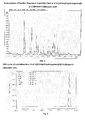
- the crystalline form A of 4-[3,5-bis(2-hydroxyphenyl)-[1,2,4]triazol-1-yl]benzoic acid has an X-ray diffraction pattern with a peak at an angle of refraction 2 theta ( ⁇ ) of 10.0°, 10.5°, 14.1°, 16.6°, 23.1°, 25.1°, 25.7°, 26.2° ⁇ 0.2° as depicted in Figure 1 .
- the crystalline form A of 4-[3,5-bis(2-hydroxyphenyl)-[1,2,4]triazol-1-yl]benzoic acid has a Raman spectrum with significant bands 3083, 1623, 1609, 1517, 1458, 1352, 991cm -1 ⁇ 0.3 cm -1 as depicted in Figure 3 .
- the invention provides a composition that contains 4-[3,5-bis(2-hydroxyphenyl)-[1,2,4]triazol-1-yl]benzoic acid in a solid form, wherein at least 80% by weight of the solid 4-[3,5-bis(2-hydroxyphenyl)-[1,2,4]triazol-1-yl]benzoic acid is its crystalline form A having an X-ray diffraction pattern with a peak at an angle of refraction 2 ⁇ of 10.0°, 10.5 °, 14.1°, 16.6°, 23.1 °, 25.1°, 25.7°, 26.2° ⁇ 0.2° as depicted in Figure 1 .
- Various embodiments and variants are provided.
- the invention provides a pharmaceutical composition that includes crystalline form A of 4-[3,5-bis(2-hydroxyphenyl)-[1,2,4]triazol-1-yl]benzoic acid and a pharmaceutically acceptable carrier or diluent.
- the pharmaceutical composition is for oral administration.
- the invention provides a process for making the crystalline form A of 4-[3,5-bis(2-hydroxyphenyl)-[1,2,4]triazol-1-yl]benzoic acid, the process including:
- the invention provides a crystalline form B of 4-[3,5-bis(2-hydroxyphenyl)-[1,2,4]triazol-1-yl]benzoic acid.
- the crystalline form B of 4-[3,5-bis(2-hydroxyphenyl)-[1,2,4]triazol-1-yl]benzoic acid has an X-ray diffraction pattern with a peak at an angle of refraction 2 theta ( ⁇ ) of 6.5°, 7.4°, 10.8°, 13.4°, 14.8°, 19.2°, 21.7°, 26.1° ⁇ 0.2° as depicted in Figure 4 .
- the invention provides a composition that contains 4-[3,5-bis(2-hydroxyphenyl)-[1,2,4]triazol-1-yl]benzoic acid in a solid form, wherein at least 80% by weight of the solid 4-[3,5-bis(2-hydroxyphenyl)-[1,2,4]triazol-1-yl]benzoic acid is its crystalline form B having an X-ray diffraction pattern with a peak at an angle of refraction 2 ⁇ of 6.5°, 7.4°, 10.8°, 13.4°, 14.8°, 19.2°, 21.7°, 26.1° ⁇ 0.2° as depicted in Figure 4 .
- the invention provides a pharmaceutical composition that includes crystalline form B of 4-[3,5-bis(2-hydroxyphenyl)-[1,2,4]triazol-1-yl]benzoic acid and a pharmaceutically acceptable carrier or diluent.
- the pharmaceutical composition is for oral administration.
- One aspect of the present invention relates to a process for making the crystalline form B of 4-[3,5-bis(2-hydroxyphenyl)-[1,2,4]triazol-1-yl]benzoic acid, the process including:
- the invention pertains to the amorphous form of 4-[3,5-bis(2-hydroxyphenyl)-[1,2,4]triazol-1-yl]benzoic acid and compositions containing the amorphous form of 4-[3,5-bis(2-hydroxyphenyl)-[1,2,4]triazol-1-yl]benzoic acid.
- the amorphous form of 4-[3,5-bis(2-hydroxyphenyl)-[1,2,4]triazol-1-yl]benzoic acid has a Raman spectrum with significant bands 3079, 1624, 1608, 1519, 1496, 1472, 1460, 1362, 1316, 997, 991 cm -1 ⁇ 3 cm -1 as depicted in Figure 7 .
- the amorphous form of 4-[3,5-bis(2-hydroxyphenyl)-[1,2,4]triazol-1-yl]benzoic acid shows on RAMAN spectroscopy bands at 1496, 1472, 1362, 1316 cm -1 ⁇ 3 cm -1
- the invention pertains to a process for making the amorphous form of 4-[3,5-bis(2-hydroxyphenyl)-[1,2,4]triazol-1-yl]benzoic acid, said process comprises the following steps:
- the invention also pertains to an alternative process for making the amorphous form of 4-[3,5-bis(2-hydroxyphenyl)-[1,2,4]triazol-1-yl]benzoic acid, said process comprises the following steps:
- the advantageous property of the amorphous form is its highest solubility, e.g. as compared to the crystalline form A or B.
- Another aspect of the invention relates to a crystalline form S A of 4-[3,5-bis(2-hydroxyphenyl)-[1,2,4]triazol-1-yl]benzoic acid.
- the crystalline form S A of 4-[3,5-bis(2-hydroxyphenyl)-[1,2,4]triazol-1-yl]benzoic acid has an X-ray diffraction pattern as depicted in Figure 8 .
- the crystalline form S A of 4-[3,5-bis(2-hydroxyphenyl)-[1,2,4]triazol-1-yl]benzoic acid has the advantage that it is more stable than the crystalline form A of 4-[3,5-bis(2-hydroxyphenyl)-[1,2,4]triazol-1-yl]benzoic acid.
- the crystalline compound designated herein as "crystalline form A" and referred to hereinafter as crystalline form A of 4-[3,5-bis(2-hydroxyphenyl)-[1,2,4]triazol-1-yl]benzoic acid, is a new crystalline polymorph of 4-[3,5-bis(2-hydroxyphenyl)-[1,2,4]triazol-1-yl]benzoic acid different from known polymorphs. It is characterized via X-ray powder diffraction and DSC. It is further described below.
- crystalline form B The crystalline compound, designated herein as "crystalline form B" and referred to hereinafter as crystalline form B of 4-[3,5-bis(2-hydroxyphenyl)-[1,2,4]triazol-1-yl]benzoic acid, is a new crystalline polymorph of 4-[3,5-bis(2-hydroxyphenyl)-[1,2,4]triazol-1-yl]benzoic acid different from known polymorphs. It is characterized via X-ray powder diffraction and DSC. It is further described below.
- 4-[3,5-bis(2-hydroxyphenyl)-[1,2,4]triazol-1-yl]benzoic acid can also be in the amorphous form.
- composition means that which is useful in preparing a pharmaceutical composition that is generally non-toxic and is not biologically undesirable and includes that which is acceptable for veterinary use and/or human pharmaceutical use.
- composition includes, but is not limited to, a powder, a solution, a suspension, a gel, an ointment, an emulsion and/or mixtures thereof.
- composition is intended to encompass a product containing the specified ingredients in the specified amounts, as well as any product, which results, directly or indirectly, from combination of the specified ingredients in the specified amounts.
- a “composition” may contain a single compound or a mixture of compounds.
- a “compound” is a chemical substance that includes molecules of the same chemical structure.
- composition is intended to encompass a product comprising the active ingredient(s), pharmaceutically acceptable excipients that make up the carrier, as well as any product which results, directly or indirectly, from combination, complexation or aggregation of any two or more of the ingredients, or from dissociation of one or more of the ingredients, or from other types of reactions or interactions of one or more of the ingredients.
- pharmaceutical compositions of the present invention encompass any composition made by admixing the active ingredient, additional active ingredient(s) and pharmaceutically acceptable excipients.
- excipient means a component of a pharmaceutical product that is not the active ingredient, such as filler, diluent and carrier.
- excipients that are useful in preparing a pharmaceutical composition are preferably generally safe, non-toxic and neither biologically nor otherwise undesirable, and are acceptable for veterinary use, as well as human pharmaceutical use.
- a pharmaceutically acceptable excipient includes both one and more than one such excipient.
- “Therapeutically effective amount” means the amount of a compound that, when administered for treating or preventing a disease, is sufficient to effect such treatment or prevention for the disease.
- the “therapeutically effective amount” will vary depending on the compound, the disease and its severity and the age, weight, etc., of the patient to be treated.
- the terms “treating”, “contacting” and “reacting” are used interchangeably herein and refer to adding or mixing two or more reagents under appropriate conditions to produce the indicated and/or desired product. It should be appreciated that the reaction which produces the indicated and/or desired product may not necessarily result directly from the combination of two reagents which were initially added, i.e., there may be one or more intermediates which are produced in the mixture which ultimately leads to the formation of the indicated and/or desired product.
- essentially pure is understood in the context of the present invention to mean especially that at least 90%, preferably at least 95% by weight of the crystals of an acid addition salt of formula (I) are present in the crystal form according to the invention.
- the invention relates to a crystalline form A of 4-[3,5-bis(2-hydroxyphenyl)-[1,2,4]triazol-1-yl]benzoic acid, to a crystalline form B of 4-[3,5-bis(2-hydroxyphenyl)-[1,2,4]triazol-1-yl]benzoic acid and to an amorphous form of 4-[3,5-bis(2-hydroxyphenyl)-[1,2,4]triazol-1-yl]benzoic acid.
- X-ray powder diffraction patterns was measured on a Scintag X1 with CuK alpha radiation source, e.g. using a wavelength of 0.15406 nm. The X-ray diffraction pattern depicted in FIG. 1 is summarized in Table 1. Table 1.
- the crystalline form A of 4-[3,5-bis(2-hydroxyphenyl)-[1,2,4]triazol-1-yl]benzoic acid may be also characterized by Differential Scanning Calorimeter (DSC).
- the crystalline form A exhibits a characteristic pattern in Differential Scanning Calorimeter (DSC) analysis as depicted in Figure 2 .
- DSC analysis was measured on a Perkin Elmer DSC7 at a heating rate of 10 K/min.
- the crystalline form A of 4-[3,5-bis(2-hydroxyphenyl)-[1,2,4]triazol-1-yl]benzoic acid has a characteristic peak at about 261°C, e.g. at 261°C.
- Some margin of error is present in each of the characteristic peak reported herein.
- the assigned margin of error is approximately +/-2K, but can be larger, e.g. in particular lower if impurities are present.
- One or more of physical properties and/or spectroscopic properties can be the basis for characterizing the crystal or polymorphic forms of 4-[3,5-bis(2-hydroxyphenyl)-[1,2,4]triazol-1-yl]benzoic acid.
- the invention also provides a composition containing solid 4-[3,5-bis(2-hydroxyphenyl)-[1,2,4]triazol-1-yl]benzoic acid, which is at least 80%, by total weight of the solid 4-[3,5-bis(2-hydroxyphenyl)-[1,2,4]triazol-1-yl]benzoic acid in the composition, its crystalline form A.
- the preferred form of this composition is solid 4-[3,5-bis(2-hydroxyphenyl)-[1,2,4]triazol-1-yl]benzoic acid powder suitable for use as active ingredient in formulating pharmaceutical products.
- the remainder of the solid 4-[3,5-bis(2-hydroxyphenyl)-[1,2,4]triazol-1-yl]benzoic acid in the composition i.e., 20% or less of the total weight of 4-[3,5-bis(2-hydroxyphenyl)-[1,2,4]triazol-1-yl]benzoic acid may be, e.g., other crystalline forms of 4-[3,5-bis(2-hydroxyphenyl)-[1,2,4]triazol-1-yl]benzoic acid.
- the composition contains at least 90% of the crystalline form A of 4-[3,5-bis(2-hydroxyphenyl)-[1,2,4]triazol-1-yl]benzoic acid with respect to the total weight of the solid 4-[3,5-bis(2-hydroxyphenyl)-[1,2,4]triazol-1-yl]benzoic acid in the composition. In another specific embodiment, the composition contains at least 95% of the crystalline form A with respect to total weight of the solid 4-[3,5-bis(2-hydroxyphenyl)-[1,2,4]triazol-1-yl]benzoic acid in the composition.
- a process for the preparation of crystalline form A of 4-[3,5-bis(2-hydroxyphenyl)-[1,2,4]triazol-1-yl]benzoic acid is also provided. The process involves:
- Non-limiting examples of the protic or aprotic solvents are listed in the Table below: Examples THF (tetrahydrofuran) /Ethanol Toluene/THF Methanol/THF Formic acid/ethanol Water HXF
- 4-[3,5-bis(2-hydroxyphenyl)-[1,2,4]triazol-1-yl]benzoic acid is dissolved in THF/Ethanol and heated to a temperature to obtain the crystalline form A of 4-[3,5-bis(2-hydroxyphenyl)-[1,2,4]triazol-1-yl]benzoic acid.
- This process is highly-reproducible and the resulting crystalline product has good filtration.
- the crystalline form B of 4-[3,5-bis(2-hydroxyphenyl)-[1,2,4]triazol-1-yl]benzoic acid may be also characterized by Differential Scanning Calorimeter (DSC).
- the crystalline form B exhibits a characteristic pattern in Differential Scanning Calorimeter (DSC) analysis as depicted in Figure 4 .
- DSC analysis was measured on a Perkin Elmer DSC7.
- the crystalline form B of 4-[3,5-bis(2-hydroxyphenyl)-[1,2,4]triazol-1-yl]benzoic acid has a characteristic peak at 226°C. Some margin of error is present in each of the characteristic peak reported herein. The assigned margin of error is +/-2K, but can be larger, e.g. in particular lower if purities are present.
- One or more of physical properties and/or spectroscopic properties can be the basis for characterizing the crystal or polymorphic forms of 4-[3,5-bis(2-hydroxyphenyl)-[1,2,4]triazol-1-yl]benzoic acid.
- the invention also provides a composition containing solid 4-[3,5-bis(2-hydroxyphenyl)-[1,2,4]triazol-1-yl]benzoic acid, which is at least 80%, by total weight of the solid 4-[3,5-bis(2-hydroxyphenyl)-[1,2,4]triazol-1-yl]benzoic acid in the composition, its crystalline form B.
- the preferred form of this composition is solid 4-[3,5-bis(2-hydroxyphenyl)-[1,2,4]triazol-1-yl]benzoic acid powder suitable for use as active ingredient in formulating pharmaceutical products.
- the remainder of the solid 4-[3,5-bis(2-hydroxyphenyl)-[1,2,4]triazol-1-yl]benzoic acid in the composition i.e., 20% or less of the total weight of 4-[3,5-bis(2-hydroxyphenyl)-[1,2,4]triazol-1-yl]benzoic acid may be, e.g., other crystalline forms of 4-[3,5-bis(2-hydroxyphenyl)-[1,2,4]triazol-1-yl]benzoic acid.
- the composition contains at least 90% of the crystalline form B of 4-[3,5-bis(2-hydroxyphenyl)-[1,2,4]triazol-1-yl]benzoic acid with respect to the total weight of the solid 4-[3,5-bis(2-hydroxyphenyl)-[1,2,4]triazol-1-yl]benzoic acid in the composition. In another specific embodiment, the composition contains at least 95% of the crystalline form B with respect to total weight of the solid 4-[3,5-bis(2-hydroxyphenyl)-[1,2,4]triazol-1-yl]benzoic acid in the composition.
- 4-[3,5-bis(2-hydroxyphenyl)-[1,2,4]triazol-1-yl]benzoic acid is dissolved in THF/ethanol, precipitated by addition of seeding crystals of the crystalline form B of 4-[3,5-bis(2-hydroxyphenyl)-[1,2,4]triazol-1-yl]benzoic acid and addition of ethanol as the anti-solvent, and crystalline form B of 4-[3,5-bis(2-hydroxyphenyl)-[1,2,4]triazol-1-yl]benzoic acid is obtained.
- a process for the preparation of crystalline form B of 4-[3,5-bis(2-hydroxyphenyl)-[1,2,4]triazol-1-yl]benzoic acid involves the following steps:
- a process for the preparation of the amorphous form of 4-[3,5-bis(2-hydroxyphenyl)-[1,2,4]triazol-1-yl]benzoic acid comprises the following steps:
- the preferred form of this composition is solid 4-[3,5-bis(2-hydroxyphenyl)-[1,2,4]triazol-1-yl]benzoic acid powder suitable for use as an active ingredient in formulating pharmaceutical products.
- the reminder of the solid 4-[3,5-bis(2-hydroxyphenyl)-[1,2,4]triazol-1-yl]benzoic acid in the composition i.e., 20% or less of the total weight of 4-[3,5-bis(2-hydroxyphenyl)-[1,2,4]triazol-1-yl]benzoic acid may be, e.g., crystalline forms of 4-[3,5-bis(2-hydroxyphenyl)-[1,2,4]triazol-1-yl]benzoic acid.
- pharmaceutical compositions containing a crystalline form A of 4-[3,5-bis(2-hydroxyphenyl)-[1,2,4]triazol-1-yl]benzoic acid and a pharmaceutically acceptable carrier.
- compositions containing a crystalline form B of 4-[3,5-bis(2-hydroxyphenyl)-[1,2,4]triazol-1-yl]benzoic acid and a pharmaceutically acceptable carrier.
- the pharmaceutical composition include one or more pharmaceutically acceptable carriers, also known as excipients, which ordinarily lack pharmaceutical activity, but have various useful properties which may, e.g., enhance the stability, sterility, bioavailability and ease of formulation of a pharmaceutical composition.
- These carriers are pharmaceutically acceptable, meaning that they are not harmful to humans or animals when taken appropriately and are compatible with other ingredients in a given formulation.
- the carriers may be solid, semi-solid or liquid, and may be formulated with the compound in bulk, but ultimately in the form of a unit-dose formulation, i.e., a physically discrete until containing a specific amount of active ingredient, such as a tablet or capsule.
- the pharmaceutical compositions may include, in addition to a compound of this invention, one or more active pharmaceutical compounds.
- the pharmaceutical compositions may be in the form of suspensions, solutions, elixirs, aerosols or solid dosage forms.
- compositions are contemplated in various formulations suitable for various modes of administration including, but not limited to, inhalation, oral, rectal, parenteral (including subcutaneous, intradermal, intramuscular and intravenous), implantable and transdermal administration.
- the most suitable route of administration in an given case depends on the duration of the subject's condition, the length of treatment desired, the nature and severity of the condition being treated, and the particular formulation that is being used.
- the formulations may be in bulk or in unit dosage form, and may be prepared by methods well-known in the art for a given formulation.
- the amount of active ingredient included in a unit dosage form depends on the type of formulation in which the active ingredient is presented.
- a pharmaceutical composition will generally contain about 0.1 % by weight to about 99% by weight of the active ingredient, preferably about 1% by weight to 50% by weight for oral administration and about 0.2% by weight to about 20% by weight for parenteral administration.
- Formulations suitable for oral administration include capsules (hard and soft), cachets, lozenges, syrups, suppositories and tablets, each containing a predetermined amount of the active compound; as a powder or granules, as a solution or a suspension in an aqueous or non-aqueous liquid; or as an oil-in-water or water-in-oil emulsion.
- Such formulations may be prepared by any suitable method of pharmacy that includes the step of bringing into association the active compound and a suitable carrier or carriers.
- the invention also provides methods of treatment using the compounds and the pharmaceutical compositions of this invention.
- the compounds and compositions of this invention may be administered to a subject in an amount effective to be used for the treatment of an excess of iron in the human or animal body.
- the present invention relates especially to crystalline form A and crystalline form B 4-[3,5-bis(2-hydroxyphenyl)-[1,2,4]triazol-1-yl]benzoic acid disclosed herein for the treatment of one of the said disorders or in the preparation of a pharmacological agent for the treatment thereof.
- Various disorders of warm-blooded animals are linked with an excess of metals, in particular trivalent metals, in the body tissues.
- metals in particular trivalent metals
- aluminium in dialysis encephalopathy and osteomalacia as well as in Alzheimer's disease.
- an excess of iron occurs in the various tissues. This is designated as iron overload (formerly haemosiderosis).
- a reduction in the iron(III) concentration is also of interest for the treatment of disorders due to iron(III)-dependent microorganisms and parasites, which is of key importance not only in human medicine, such as in particular in malaria, but also in veterinary medicine.
- Complexing of other metals, in particular trivalent metals, can also be used for excretion thereof from the organism.
- the invention relates also to a process for the treatment of warm-blooded animals suffering from said disorders wherein a quantity of the crystalline form A of 4-[3,5-bis(2-hydroxyphenyl)-[1,2,4]triazol-1-yl]benzoic acid and/or crystalline form B of 4-[3,5-bis(2-hydroxyphenyl)-[1,2,4]triazol-1-yl]benzoic acid, which is effective against the disease concerned is administered to warm-blooded animals in need of such treatment.
- the invention relates moreover to the use of the crystalline form A of 4-[3,5-bis(2-hydroxyphenyl)-[1,2,4]triazol-1-yl]benzoic acid and/or crystalline form B of 4-[3,5-bis(2-hydroxyphenyl)-[1,2,4]triazol-1-yl]benzoic acid for the treatment of an excess of iron in the human or animal body, or for the preparation of pharmaceutical compositions for use in treating the human or animal body.
- the dosage of the active ingredient can depend on various factors, such as activity and duration of action of the active ingredient, severity of the illness to be treated or its symptoms, manner of administration, warm-blooded animal species, sex, age, weight and/or individual condition of the warm-blooded animal.
- the doses to be administered daily in the case of oral administration are between 10 and approximately 120 mg/kg, in particular 20 and approximately 80 mg/kg, and for a warm-blooded animal having a body weight of approximately 40 kg, preferably between approximately 400 mg and approximately 4,800 mg, in particular approximately 800 mg to 3,200 mg, which is expediently divided into 2 to 12 individual doses.
- the invention relates also to pharmaceutical preparations which contain an effective amount, especially an effective amount for prevention or treatment of one of the said diseases, of the crystalline form A of 4-[3,5-bis(2-hydroxyphenyl)-[1,2,4]triazol-1-yl]benzoic acid and/or crystalline form B of 4-[3,5-bis(2-hydroxyphenyl)-[1,2,4]triazol-1-yl]benzoic acid, together with pharmaceutically acceptable carriers which are suitable for topical; enteral, e.g. oral or rectal; or parenteral administration and may be inorganic or organic and solid or liquid.
- compositions for enteral or parenteral administration are, for example, those in unit dose forms, such as sugar-coated tablets, tablets, dispersible tablets, effervescent tablets, capsules, suspendable powders, suspensions or suppositories, or ampoules. These are prepared in a manner known per se, e.g. by means of conventional pan-coating, mixing, granulation or lyophilization processes. Pharmaceutical preparations for oral administration can thus be obtained by combining the active ingredient with solid carriers, if desired granulating a mixture obtained and processing the mixture or granules, if desired or necessary, after addition of suitable adjuncts to give tablets or sugar-coated tablet cores.
- Suitable carriers are, in particular, fillers such as sugars, e.g. lactose, sucrose, mannitol or sorbitol, cellulose preparations and/or calcium phosphates, e.g. tricalcium phosphate or calcium hydrogen phosphate, furthermore binders, such as starch pastes, using, for example, maize, wheat, rice or potato starch, gelatin, tragacanth, methylcellulose and/or polyvinylpyrrolidone, and, if desired, disintegrants, such as the abovementioned starches, furthermore carboxymethyl starch, crosslinked polyvinylpyrrolidone, agar or alginic acid or a salt thereof, such as sodium alginate.
- fillers such as sugars, e.g. lactose, sucrose, mannitol or sorbitol, cellulose preparations and/or calcium phosphates, e.g. tricalcium phosphate or calcium hydrogen phosphate, further
- Adjuncts are primarily flow-regulating and lubricating agents, e.g. salicylic acid, talc, stearic acid or salts thereof, such as magnesium or calcium stearate, and/or polyethylene glycol.
- Sugar-coated tablet cores are provided with suitable, if desired enteric, coatings, using, inter alia, concentrated sugar solutions which, if desired, contain gum arabic, talc, polyvinylpyrrolidone, polyethylene glycol and/or titanium dioxide, coating solutions in suitable organic solvents or solvent mixtures or, for the preparation of enteric coatings, solutions of suitable cellulose preparations, such as acetylcellulose phthalate or hydroxypropylmethylcellulose phthalate.
- Colorants or pigments e.g. for the identification or the marking of various doses of active ingredient, can be added to the tablets or sugar-coated tablet coatings.
- Dispersible tablets are tablets which rapidly disintegrate in a comparatively small amount of liquid, e.g. water, and which, if desired, contain flavourings or substances for masking the taste of the active ingredient. They can advantageously be employed for the oral administration of large individual doses, in which the amount of active ingredient to be administered is so large that on administration as a tablet which is to be swallowed in undivided form or without chewing that it can no longer be conveniently ingested, in particular by children.
- Further orally administrable pharmaceutical preparations are hard gelatin capsules and also soft, closed capsules of gelatin and a plasticizer, such as glycerol or sorbitol. The hard gelatin capsules can contain the active ingredient in the form of granules, e.g.
- the active ingredient is preferably dissolved or suspended in suitable liquids, such as fatty oils, liquid paraffin or liquid polyethylene glycols, it also being possible to add stabilizers.
- suspendable powders e.g. those which are described as “powder in bottle”, abbreviated “PIB”, or ready-to-drink suspensions
- the active ingredient is mixed, for example, with pharmaceutically acceptable surface-active substances, for example, sodium lauryl sulfate or polysorbate, suspending auxiliaries, e.g. hydroxypropylcellulose, hydroxypropylmethylcellulose or another known from the prior art and previously described, for example, in "Handbook of Pharmaceutical Excipients", pH regulators, such as citric or tartaric acid and their salts or a USP buffer and, if desired, fillers, e.g.
- lactose, and further auxiliaries and dispensed into suitable vessels, advantageously single-dose bottles or ampoules.
- suitable vessels advantageously single-dose bottles or ampoules.
- a specific amount of water is added and the suspension is prepared by shaking. Alternatively, the water can also be added even before dispensing.
- Rectally administrable pharmaceutical preparations are, for example, suppositories which consist of a combination of the active ingredient with a suppository base.
- a suitable suppository base is, for example, natural or synthetic triglycerides, paraffin hydrocarbons, polyethylene glycols or higher alkanols.
- Gelatin rectal capsules can also be used which contain a combination of the active ingredient with a base substance.
- Possible base substances are, for example, liquid triglycerides, polyethylene glycols or paraffin hydrocarbons.
- aqueous solutions of an active ingredient in water-soluble form e.g.
- a water-soluble salt are primarily suitable; furthermore suspensions of the active ingredient, such as appropriate oily injection suspensions, suitable lipophilic solvents or vehicles, such as fatty oils, e.g. sesame oil, or synthetic fatty acid esters, e.g. ethyl oleate or triglycerides, being used, or aqueous injection suspensions which contain viscosity-increasing substances, e.g. sodium carboxymethylcellulose, sorbitol and/or dextran, and, if desired, also stabilizers.
- the invention is further defined by reference to the following examples describing in detail the preparation of the compound and the compositions of the present invention, as well as their utility.
Landscapes
- Chemical & Material Sciences (AREA)
- Organic Chemistry (AREA)
- Health & Medical Sciences (AREA)
- Medicinal Chemistry (AREA)
- Engineering & Computer Science (AREA)
- Diabetes (AREA)
- Chemical Kinetics & Catalysis (AREA)
- General Chemical & Material Sciences (AREA)
- Bioinformatics & Cheminformatics (AREA)
- Nuclear Medicine, Radiotherapy & Molecular Imaging (AREA)
- Hematology (AREA)
- Pharmacology & Pharmacy (AREA)
- Life Sciences & Earth Sciences (AREA)
- Animal Behavior & Ethology (AREA)
- General Health & Medical Sciences (AREA)
- Public Health (AREA)
- Veterinary Medicine (AREA)
- Pharmaceuticals Containing Other Organic And Inorganic Compounds (AREA)
Abstract
The invention relates to crystalline forms of 4-[3,5-bis(2-hydroxypheny1)-[1,2,4]triazol-1-yl]benzoic acid and to its amorphous form, to processes for the preparation thereof, to compositions containing the same and their uses for the manufacture of a medicament for the treatment of the human body. Normal text
Description
- The invention relates to a new crystalline forms of 4-[3,5-bis(2-hydroxyphenyl)-[1,2,4]triazol-1-yl]benzoic acid; the processes for preparation of these crystalline forms, compositions containing these crystalline forms, and the use of these crystalline forms in diagnostic methods or therapeutic treatment of warm-blooded animals, especially humans.
- The drug 4-[3,5-bis(2-hydroxyphenyl)-[1,2,4]triazol-1-yl]benzoic acid is an orally active iron chelator that is indicated in the treatment of iron overload in transfusion dependent anemias, in particular thalassemia major, thalassemia intermediate and in sickle cell disease to reduce iron-related morbidity and mortality. 4-[3,5-bis(2-hydroxyphenyl)-[1,2,4]triazol-1-yl]benzoic acid can also be used in the treatment of hemochromatosis. In general, the preparation of 4-[3,5-bis(2-hydroxyphenyl)-[1,2,4]triazol-1-yl]benzoic acid is known in the art. However, it is also known that different crystalline forms of the same drug may have substantial differences in certain pharmaceutically important properties. Therefore, there is a continuing need for new solid forms of 4-[3,5-bis(2-hydroxyphenyl)-[1,2,4]triazol-1-yl]benzoic acid and new methods of preparation.
- In accordance with one aspect, the invention provides a crystalline form A of 4-[3,5-bis(2-hydroxyphenyl)-[1,2,4]triazol-1-yl]benzoic acid. Preferably, the crystalline form A of 4-[3,5-bis(2-hydroxyphenyl)-[1,2,4]triazol-1-yl]benzoic acid has an X-ray diffraction pattern with a peak at an angle of
refraction 2 theta (θ) of 10.0°, 10.5°, 14.1°, 16.6°, 23.1°, 25.1°, 25.7°, 26.2°±0.2° as depicted inFigure 1 . Preferably, the crystalline form A of 4-[3,5-bis(2-hydroxyphenyl)-[1,2,4]triazol-1-yl]benzoic acid has a Raman spectrum with significant bands 3083, 1623, 1609, 1517, 1458, 1352, 991cm-1 ± 0.3 cm-1 as depicted inFigure 3 . - In accordance with yet another aspect, the invention provides a composition that contains 4-[3,5-bis(2-hydroxyphenyl)-[1,2,4]triazol-1-yl]benzoic acid in a solid form, wherein at least 80% by weight of the solid 4-[3,5-bis(2-hydroxyphenyl)-[1,2,4]triazol-1-yl]benzoic acid is its crystalline form A having an X-ray diffraction pattern with a peak at an angle of
refraction 2 θ of 10.0°, 10.5 °, 14.1°, 16.6°, 23.1 °, 25.1°, 25.7°, 26.2° ± 0.2° as depicted inFigure 1 . Various embodiments and variants are provided. - In accordance with yet another aspect, the invention provides a pharmaceutical composition that includes crystalline form A of 4-[3,5-bis(2-hydroxyphenyl)-[1,2,4]triazol-1-yl]benzoic acid and a pharmaceutically acceptable carrier or diluent. Preferably, the pharmaceutical composition is for oral administration.
- In accordance with yet another aspect, the invention provides a process for making the crystalline form A of 4-[3,5-bis(2-hydroxyphenyl)-[1,2,4]triazol-1-yl]benzoic acid, the process including:
- (a) providing a solution of 4-[3,5-bis(2-hydroxyphenyl)-[1,2,4]triazol-1-yl]benzoic acid e.g. in amorphous form, in either a protic or an aprotic solvent;
- (b) cooling the solution to form the crystalline form A of 4-[3,5-bis(2-hydroxyphenyl)-[1,2,4]triazol-1-yl]benzoic acid; and
- (c) isolating the crystalline form A of 4-[3,5-bis(2-hydroxyphenyl)-[1,2,4]triazol-1-yl]benzoic acid. Various embodiments and variants are provided.
- In accordance with one aspect, the invention provides a crystalline form B of 4-[3,5-bis(2-hydroxyphenyl)-[1,2,4]triazol-1-yl]benzoic acid. Preferably, the crystalline form B of 4-[3,5-bis(2-hydroxyphenyl)-[1,2,4]triazol-1-yl]benzoic acid has an X-ray diffraction pattern with a peak at an angle of
refraction 2 theta (θ) of 6.5°, 7.4°, 10.8°, 13.4°, 14.8°, 19.2°, 21.7°, 26.1°±0.2° as depicted inFigure 4 . - In accordance with yet another aspect, the invention provides a composition that contains 4-[3,5-bis(2-hydroxyphenyl)-[1,2,4]triazol-1-yl]benzoic acid in a solid form, wherein at least 80% by weight of the solid 4-[3,5-bis(2-hydroxyphenyl)-[1,2,4]triazol-1-yl]benzoic acid is its crystalline form B having an X-ray diffraction pattern with a peak at an angle of
refraction 2 θ of 6.5°, 7.4°, 10.8°, 13.4°, 14.8°, 19.2°, 21.7°, 26.1° ± 0.2° as depicted inFigure 4 . - In accordance with yet another aspect, the invention provides a pharmaceutical composition that includes crystalline form B of 4-[3,5-bis(2-hydroxyphenyl)-[1,2,4]triazol-1-yl]benzoic acid and a pharmaceutically acceptable carrier or diluent. Preferably, the pharmaceutical composition is for oral administration.
- One aspect of the present invention relates to a process for making the crystalline form B of 4-[3,5-bis(2-hydroxyphenyl)-[1,2,4]triazol-1-yl]benzoic acid, the process including:
- (a) heating the amorphous material above the glass transition temperature, e.g. above 95°C, e.g. above 95°C or until a temperature equal to 105°C,
- (b) starting the crystallisation by further heating at a temperature of, e.g. 150°C until a temperature equal to about 190°C, e.g. equal to 190°C,
- (c) isolating the crystals of crystalline form B of 4-[3,5-bis(2-hydroxyphenyl)-[1,2,4]triazol-1-yl]benzoic acid.
- In a further embodiment the invention pertains to the amorphous form of 4-[3,5-bis(2-hydroxyphenyl)-[1,2,4]triazol-1-yl]benzoic acid and compositions containing the amorphous form of 4-[3,5-bis(2-hydroxyphenyl)-[1,2,4]triazol-1-yl]benzoic acid. Preferably, the amorphous form of 4-[3,5-bis(2-hydroxyphenyl)-[1,2,4]triazol-1-yl]benzoic acid has a Raman spectrum with significant bands 3079, 1624, 1608, 1519, 1496, 1472, 1460, 1362, 1316, 997, 991 cm-1 ± 3 cm-1 as depicted in
Figure 7 . Preferably, the amorphous form of 4-[3,5-bis(2-hydroxyphenyl)-[1,2,4]triazol-1-yl]benzoic acid shows on RAMAN spectroscopy bands at 1496, 1472, 1362, 1316 cm-1 ± 3 cm-1 - The invention pertains to a process for making the amorphous form of 4-[3,5-bis(2-hydroxyphenyl)-[1,2,4]triazol-1-yl]benzoic acid, said process comprises the following steps:
- (a) heating, e.g. the crystalline form of modification A or modification B, e.g. above its melting point of 261°C for the crystalline form of modification A,
- (b) quenching to a temperature of about 20-25°C or below rapidly to obtain the amorphous form.
- The invention also pertains to an alternative process for making the amorphous form of 4-[3,5-bis(2-hydroxyphenyl)-[1,2,4]triazol-1-yl]benzoic acid, said process comprises the following steps:
- (a) dissolving the crystalline form of modification A or modification B of 4-[3,5-bis(2-hydroxyphenyl)-[1,2,4]triazol-1-yl]benzoic acid in a solvent, e.g. an aqueous solvent, e.g. water, or in a mixture of 50% organic solvent /50% aqueous medium, e.g. 50% water/ 50% methylbutylether, or 50% water/50% diethylether, or in a mixture of organic solvents, e.g. 50% 3 pentanone/50%methylbutylether, 50%1-octanol/50% toluene, or 50% dioxane/50% toluene, or 50%toluene/50% diisopropylether, or 50% n-hexane/50% acetonitrile
- (b) fast evaporation of the solvent, e.g. under a stream of nitrogen
- (c) isolating the amorphous solid
- The advantageous property of the amorphous form is its highest solubility, e.g. as compared to the crystalline form A or B.
- Another aspect of the invention relates to a crystalline form SA of 4-[3,5-bis(2-hydroxyphenyl)-[1,2,4]triazol-1-yl]benzoic acid. Preferably, the crystalline form SA of 4-[3,5-bis(2-hydroxyphenyl)-[1,2,4]triazol-1-yl]benzoic acid has an X-ray diffraction pattern as depicted in
Figure 8 . - The crystalline form SA of 4-[3,5-bis(2-hydroxyphenyl)-[1,2,4]triazol-1-yl]benzoic acid has the advantage that it is more stable than the crystalline form A of 4-[3,5-bis(2-hydroxyphenyl)-[1,2,4]triazol-1-yl]benzoic acid.
-
-
FIG. 1 shows the X-ray powder diffraction diagram of crystalline form A of 4-[3,5-bis(2-hydroxyphenyl)-[1,2,4]triazol-1-yl]benzoic acid. -
FIG. 2 shows the DSC curve of crystalline form A of 4-[3,5-bis(2-hydroxyphenyl)-[1,2,4]triazol-1-yl]benzoic acid. -
FIG. 3 shows the Raman spectrum crystalline form A of 4-[3,5-bis(2-hydroxyphenyl)-[1,2,4]triazol-1-yl]benzoic acid. -
FIG. 4 shows the X-ray powder diffraction diagram of crystalline form B of 4-[3,5-bis(2-hydroxyphenyl)-[1,2,4]triazol-1-yl]benzoic acid. -
FIG. 5 shows the DSC curve of crystalline form B of 4-[3,5-bis(2-hydroxyphenyl)-[1,2,4]triazol-1-yl]benzoic acid. -
FIG. 6 shows the X-ray powder diffraction diagram of amorphous 4-[3,5-bis(2-hydroxyphenyl)-[1,2,4]triazol-1-yl]benzoic acid. -
FIG. 7 shows the Raman spectrum of amorphous 4-[3,5-bis(2-hydroxyphenyl)-[1,2,4]triazol-1-yl]benzoic acid. -
FIG. 8 shows the X-ray powder diffraction diagram of solvate form SA 4-[3,5-bis(2-hydroxyphenyl)-[1,2,4]triazol-1-yl]benzoic acid. - Unless defined otherwise, all technical and scientific terms used herein have the same meaning as commonly understood by one of ordinary skill in the art to which this invention belongs. Although any methods and materials similar or equivalent to those described herein can be used in the practice or testing of the present invention, the preferred methods and materials are described.
- For the purposes of the present invention, the following terms are defined below.
The crystalline compound, designated herein as "crystalline form A" and referred to hereinafter as crystalline form A of 4-[3,5-bis(2-hydroxyphenyl)-[1,2,4]triazol-1-yl]benzoic acid, is a new crystalline polymorph of 4-[3,5-bis(2-hydroxyphenyl)-[1,2,4]triazol-1-yl]benzoic acid different from known polymorphs. It is characterized via X-ray powder diffraction and DSC. It is further described below. - The crystalline compound, designated herein as "crystalline form B" and referred to hereinafter as crystalline form B of 4-[3,5-bis(2-hydroxyphenyl)-[1,2,4]triazol-1-yl]benzoic acid, is a new crystalline polymorph of 4-[3,5-bis(2-hydroxyphenyl)-[1,2,4]triazol-1-yl]benzoic acid different from known polymorphs. It is characterized via X-ray powder diffraction and DSC. It is further described below.
- 4-[3,5-bis(2-hydroxyphenyl)-[1,2,4]triazol-1-yl]benzoic acid can also be in the amorphous form.
- "Pharmaceutically acceptable" means that which is useful in preparing a pharmaceutical composition that is generally non-toxic and is not biologically undesirable and includes that which is acceptable for veterinary use and/or human pharmaceutical use.
The term "composition" includes, but is not limited to, a powder, a solution, a suspension, a gel, an ointment, an emulsion and/or mixtures thereof. The term composition is intended to encompass a product containing the specified ingredients in the specified amounts, as well as any product, which results, directly or indirectly, from combination of the specified ingredients in the specified amounts. A "composition" may contain a single compound or a mixture of compounds. A "compound" is a chemical substance that includes molecules of the same chemical structure.
The term "pharmaceutical composition" is intended to encompass a product comprising the active ingredient(s), pharmaceutically acceptable excipients that make up the carrier, as well as any product which results, directly or indirectly, from combination, complexation or aggregation of any two or more of the ingredients, or from dissociation of one or more of the ingredients, or from other types of reactions or interactions of one or more of the ingredients. Accordingly, the pharmaceutical compositions of the present invention encompass any composition made by admixing the active ingredient, additional active ingredient(s) and pharmaceutically acceptable excipients.
The term "excipient" means a component of a pharmaceutical product that is not the active ingredient, such as filler, diluent and carrier. The excipients that are useful in preparing a pharmaceutical composition are preferably generally safe, non-toxic and neither biologically nor otherwise undesirable, and are acceptable for veterinary use, as well as human pharmaceutical use. "A pharmaceutically acceptable excipient", as used in the specification and claims, includes both one and more than one such excipient. - "Therapeutically effective amount" means the amount of a compound that, when administered for treating or preventing a disease, is sufficient to effect such treatment or prevention for the disease.
The "therapeutically effective amount" will vary depending on the compound, the disease and its severity and the age, weight, etc., of the patient to be treated. - When referring to a chemical reaction, the terms "treating", "contacting" and "reacting" are used interchangeably herein and refer to adding or mixing two or more reagents under appropriate conditions to produce the indicated and/or desired product. It should be appreciated that the reaction which produces the indicated and/or desired product may not necessarily result directly from the combination of two reagents which were initially added, i.e., there may be one or more intermediates which are produced in the mixture which ultimately leads to the formation of the indicated and/or desired product.
- The term "substantially free of" in reference to a composition, as used herein, means that the substance form which the composition is free of cannot be detected by methods known to those skilled in the art.
- The term "essentially pure" is understood in the context of the present invention to mean especially that at least 90%, preferably at least 95% by weight of the crystals of an acid addition salt of formula (I) are present in the crystal form according to the invention.
- 4-[3,5-bis(2-hydroxyphenyl)-[1,2,4]triazol-1-yl]benzoic acid has the following chemical structure:

- 4-[3,5-bis(2-hydroxyphenyl)-[1,2,4]triazol-1-yl]benzoic acid is described in example 5 of the granted
European Patent EP 0914118 . - The invention relates to a crystalline form A of 4-[3,5-bis(2-hydroxyphenyl)-[1,2,4]triazol-1-yl]benzoic acid, to a crystalline form B of 4-[3,5-bis(2-hydroxyphenyl)-[1,2,4]triazol-1-yl]benzoic acid and to an amorphous form of 4-[3,5-bis(2-hydroxyphenyl)-[1,2,4]triazol-1-yl]benzoic acid.
- Different solid forms of the same drug may exhibit different properties, including characteristics that have functional implications with respect to their use as drug may have substantial differences in such pharmaceutically important properties as dissolution rates and bioavailability. Likewise, different polymorphs may have different processing properties, such as hydroscopisity, flowability and the like, which could affect their suitability as active pharmaceuticals for commercial production.
X-ray powder diffraction patterns was measured on a Scintag X1 with CuK alpha radiation source, e.g. using a wavelength of 0.15406 nm. The X-ray diffraction pattern depicted inFIG. 1 is summarized in Table 1.Table 1. Powder X-Ray Diffraction Peaks for the Form A Crystal Modification of 4-[3,5-bis(2-hydroxyphenyl)-[1,2,4]triazol-1-yl]benzoic acid ° deg 2 θd-space /Å Relative intensity 10.0 8.20 medium 10.5 8.45 medium 14.1 6.32 medium 16.6 5.39 strong 23.1 3.93 medium 25.1 3.63 medium 25.7 3.55 medium 26.2 3.49 low - It should be kept in mind that slight variations in observed 2θ angles or d-spacing values are expected based on the specific diffractometer employed, the analyst and the sample preparation technique.
More variation is expected for the relative peak intensities. - Identification of the exact crystalline form of a compound should be based primarily on observed 2 θ angles with lesser importance attributed to relative peak intensities.
Some margin of error is present in each of the 2θ angle assignments reported herein. The assigned margin of error, in a preferred variant, the crystalline form A of 4-[3,5-bis(2-hydroxyphenyl)-[1,2,4]triazol-1-yl]benzoic acid is approximately ± 0.2° for each of the peak assignments. - The crystalline form A of 4-[3,5-bis(2-hydroxyphenyl)-[1,2,4]triazol-1-yl]benzoic acid may be also characterized by Differential Scanning Calorimeter (DSC). The crystalline form A exhibits a characteristic pattern in Differential Scanning Calorimeter (DSC) analysis as depicted in
Figure 2 . DSC analysis was measured on a Perkin Elmer DSC7 at a heating rate of 10 K/min. The crystalline form A of 4-[3,5-bis(2-hydroxyphenyl)-[1,2,4]triazol-1-yl]benzoic acid has a characteristic peak at about 261°C, e.g. at 261°C. Some margin of error is present in each of the characteristic peak reported herein. The assigned margin of error is approximately +/-2K, but can be larger, e.g. in particular lower if impurities are present. - One or more of physical properties and/or spectroscopic properties can be the basis for characterizing the crystal or polymorphic forms of 4-[3,5-bis(2-hydroxyphenyl)-[1,2,4]triazol-1-yl]benzoic acid.
- The invention also provides a composition containing solid 4-[3,5-bis(2-hydroxyphenyl)-[1,2,4]triazol-1-yl]benzoic acid, which is at least 80%, by total weight of the solid 4-[3,5-bis(2-hydroxyphenyl)-[1,2,4]triazol-1-yl]benzoic acid in the composition, its crystalline form A. The preferred form of this composition is solid 4-[3,5-bis(2-hydroxyphenyl)-[1,2,4]triazol-1-yl]benzoic acid powder suitable for use as active ingredient in formulating pharmaceutical products. The remainder of the solid 4-[3,5-bis(2-hydroxyphenyl)-[1,2,4]triazol-1-yl]benzoic acid in the composition, i.e., 20% or less of the total weight of 4-[3,5-bis(2-hydroxyphenyl)-[1,2,4]triazol-1-yl]benzoic acid may be, e.g., other crystalline forms of 4-[3,5-bis(2-hydroxyphenyl)-[1,2,4]triazol-1-yl]benzoic acid. In one specific embodiment, the composition contains at least 90% of the crystalline form A of 4-[3,5-bis(2-hydroxyphenyl)-[1,2,4]triazol-1-yl]benzoic acid with respect to the total weight of the solid 4-[3,5-bis(2-hydroxyphenyl)-[1,2,4]triazol-1-yl]benzoic acid in the composition. In another specific embodiment, the composition contains at least 95% of the crystalline form A with respect to total weight of the solid 4-[3,5-bis(2-hydroxyphenyl)-[1,2,4]triazol-1-yl]benzoic acid in the composition.
- A process for the preparation of crystalline form A of 4-[3,5-bis(2-hydroxyphenyl)-[1,2,4]triazol-1-yl]benzoic acid is also provided. The process involves:
- (a) providing a solution 4-[3,5-bis(2-hydroxyphenyl)-[1,2,4]triazol-1-yl]benzoic acid in either a protic or aprotic solvent, e.g. using the amorphous form of 4-[3,5-bis(2-hydroxyphenyl)-[1,2,4]triazol-1-yl]benzoic acid ;
- (b) cooling the solution to form crystalline form A of 4-[3,5-bis(2-hydroxyphenyl)-[1,2,4]triazol-1-yl]benzoic acid; and
- (c) isolating the crystalline form A of 4-[3,5-bis(2-hydroxyphenyl)-[1,2,4]triazol-1-yl]benzoic acid.
- Non-limiting examples of the protic or aprotic solvents are listed in the Table below:
Examples THF (tetrahydrofuran) /Ethanol Toluene/THF Methanol/THF Formic acid/ethanol Water HXF - In one embodiment, 4-[3,5-bis(2-hydroxyphenyl)-[1,2,4]triazol-1-yl]benzoic acid is dissolved in THF/Ethanol and heated to a temperature to obtain the crystalline form A of 4-[3,5-bis(2-hydroxyphenyl)-[1,2,4]triazol-1-yl]benzoic acid. This process is highly-reproducible and the resulting crystalline product has good filtration.
- The above conditions on the selective preparation of the individual crystal forms are not conclusive.
In general, e.g., it is possible to vary parameters such as the weight ratio of the compound of formula (I) to the solvent and anti-solvent.
X-ray powder diffraction patterns was measured on a Scintag X1 with CuK alpha radiation source. The X-ray diffraction pattern depicted inFIG. 4 is summarized in Table 2.Table 2. Powder X-Ray Diffraction Peaks for the Form B Crystal Modification of 4-[3,5-bis(2-hydroxyphenyl)-[1,2,4]triazol-1-yl]benzoic acid ° deg 2 θd-space / Å Relative intensity 6.5 13.67 medium 7.4 11.93 medium 10.8 8.16 strong 13.4 6.60 medium 14.8 5.97 medium 19.2 4.61 low 21.7 4.08 medium 26.1 3.41 low - It should be kept in mind that slight variations in observed 2 θ angles or d-spacing values are expected based on the specific diffractometer employed, the analyst and the sample preparation technique. More variation is expected for the relative peak intensities. Identification of the exact crystalline form of a compound should be based primarily on observed 2 θ angles with lesser importance attributed to relative peak intensities.
Some margin of error is present in each of the 2 θ angle assignments reported herein. The assigned margin of error, in a preferred variant, the crystalline form B of 4-[3,5-bis(2-hydroxyphenyl)-[1,2,4]triazol-1-yl]benzoic acid is approximately ± 0.2° for each of the peak assignments. - The crystalline form B of 4-[3,5-bis(2-hydroxyphenyl)-[1,2,4]triazol-1-yl]benzoic acid may be also characterized by Differential Scanning Calorimeter (DSC). The crystalline form B exhibits a characteristic pattern in Differential Scanning Calorimeter (DSC) analysis as depicted in
Figure 4 . DSC analysis was measured on a Perkin Elmer DSC7. The crystalline form B of 4-[3,5-bis(2-hydroxyphenyl)-[1,2,4]triazol-1-yl]benzoic acid has a characteristic peak at 226°C. Some margin of error is present in each of the characteristic peak reported herein. The assigned margin of error is +/-2K, but can be larger, e.g. in particular lower if purities are present. - One or more of physical properties and/or spectroscopic properties can be the basis for characterizing the crystal or polymorphic forms of 4-[3,5-bis(2-hydroxyphenyl)-[1,2,4]triazol-1-yl]benzoic acid.
- The invention also provides a composition containing solid 4-[3,5-bis(2-hydroxyphenyl)-[1,2,4]triazol-1-yl]benzoic acid, which is at least 80%, by total weight of the solid 4-[3,5-bis(2-hydroxyphenyl)-[1,2,4]triazol-1-yl]benzoic acid in the composition, its crystalline form B. The preferred form of this composition is solid 4-[3,5-bis(2-hydroxyphenyl)-[1,2,4]triazol-1-yl]benzoic acid powder suitable for use as active ingredient in formulating pharmaceutical products. The remainder of the solid 4-[3,5-bis(2-hydroxyphenyl)-[1,2,4]triazol-1-yl]benzoic acid in the composition, i.e., 20% or less of the total weight of 4-[3,5-bis(2-hydroxyphenyl)-[1,2,4]triazol-1-yl]benzoic acid may be, e.g., other crystalline forms of 4-[3,5-bis(2-hydroxyphenyl)-[1,2,4]triazol-1-yl]benzoic acid. In one specific embodiment, the composition contains at least 90% of the crystalline form B of 4-[3,5-bis(2-hydroxyphenyl)-[1,2,4]triazol-1-yl]benzoic acid with respect to the total weight of the solid 4-[3,5-bis(2-hydroxyphenyl)-[1,2,4]triazol-1-yl]benzoic acid in the composition. In another specific embodiment, the composition contains at least 95% of the crystalline form B with respect to total weight of the solid 4-[3,5-bis(2-hydroxyphenyl)-[1,2,4]triazol-1-yl]benzoic acid in the composition.
- In one embodiment, 4-[3,5-bis(2-hydroxyphenyl)-[1,2,4]triazol-1-yl]benzoic acid is dissolved in THF/ethanol, precipitated by addition of seeding crystals of the crystalline form B of 4-[3,5-bis(2-hydroxyphenyl)-[1,2,4]triazol-1-yl]benzoic acid and addition of ethanol as the anti-solvent, and crystalline form B of 4-[3,5-bis(2-hydroxyphenyl)-[1,2,4]triazol-1-yl]benzoic acid is obtained.
- A process for the preparation of crystalline form B of 4-[3,5-bis(2-hydroxyphenyl)-[1,2,4]triazol-1-yl]benzoic acid involves the following steps:
- (a) heating the crystalline form A of 4-[3,5-bis(2-hydroxyphenyl)-[1,2,4]triazol-1-yl]benzoic acid to above its melting point of about 261°C,
- (b) cooling the melt of 4-[3,5-bis(2-hydroxyphenyl)-[1,2,4]triazol-1-yl]benzoic of step (a) to about room temperature or below to obtain the amorphous form,
- (c) recrystallization of the amorphous form of 4-[3,5-bis(2-hydroxyphenyl)-[1,2,4]triazol-1-yl] into crystalline form B upon heating to a temperature above 95°C, preferably to above 190°C,
- (d) crystalline form B of 4-[3,5-bis(2-hydroxyphenyl)-[1,2,4]triazol-1-yl] can be isolated by cooling to room temperature.
- This process is highly-reproducible and the resulting crystalline product has good filtration.
A process for the preparation of the amorphous form of 4-[3,5-bis(2-hydroxyphenyl)-[1,2,4]triazol-1-yl]benzoic acid comprises the following steps: - (a) dissolving the crystalline form of modification A or modification B of 4-[3,5-bis(2-hydroxyphenyl)-[1,2,4]triazol-1-yl]benzoic acid in a solvent, e.g. an aqueous solvent, e.g. water, or in a mixture of 50% organic solvent /50% aqueous medium, e.g. 50% water/ 50% methylbutylether, or 50% water/50% diethylether, or in a mixture of organic solvents, e.g. 50% toluene/50%acetonitrile, 50%n-hexane/50% toluene, or or 50% n-hexane/50% acetonitrile
- (b) fast evaporation of the solvent, e.g. under a stream of nitrogen
- (c) isolating the amorphous solid.
- The above conditions on the selective preparation of the individual crystal forms and the amorphous form are not conclusive. In general, e.g., it is possible to vary parameters such as the weight ratio of the compound of formula (I) to the solvent.
- The preferred form of this composition is solid 4-[3,5-bis(2-hydroxyphenyl)-[1,2,4]triazol-1-yl]benzoic acid powder suitable for use as an active ingredient in formulating pharmaceutical products. The reminder of the solid 4-[3,5-bis(2-hydroxyphenyl)-[1,2,4]triazol-1-yl]benzoic acid in the composition, i.e., 20% or less of the total weight of 4-[3,5-bis(2-hydroxyphenyl)-[1,2,4]triazol-1-yl]benzoic acid may be, e.g., crystalline forms of 4-[3,5-bis(2-hydroxyphenyl)-[1,2,4]triazol-1-yl]benzoic acid.
Also provided are pharmaceutical compositions containing a crystalline form A of 4-[3,5-bis(2-hydroxyphenyl)-[1,2,4]triazol-1-yl]benzoic acid and a pharmaceutically acceptable carrier. - Also provided are pharmaceutical compositions containing a crystalline form B of 4-[3,5-bis(2-hydroxyphenyl)-[1,2,4]triazol-1-yl]benzoic acid and a pharmaceutically acceptable carrier.
- In addition to the active compound, the pharmaceutical composition include one or more pharmaceutically acceptable carriers, also known as excipients, which ordinarily lack pharmaceutical activity, but have various useful properties which may, e.g., enhance the stability, sterility, bioavailability and ease of formulation of a pharmaceutical composition. These carriers are pharmaceutically acceptable, meaning that they are not harmful to humans or animals when taken appropriately and are compatible with other ingredients in a given formulation. The carriers may be solid, semi-solid or liquid, and may be formulated with the compound in bulk, but ultimately in the form of a unit-dose formulation, i.e., a physically discrete until containing a specific amount of active ingredient, such as a tablet or capsule. The pharmaceutical compositions may include, in addition to a compound of this invention, one or more active pharmaceutical compounds.
The pharmaceutical compositions may be in the form of suspensions, solutions, elixirs, aerosols or solid dosage forms. - The pharmaceutical compositions are contemplated in various formulations suitable for various modes of administration including, but not limited to, inhalation, oral, rectal, parenteral (including subcutaneous, intradermal, intramuscular and intravenous), implantable and transdermal administration. The most suitable route of administration in an given case depends on the duration of the subject's condition, the length of treatment desired, the nature and severity of the condition being treated, and the particular formulation that is being used. The formulations may be in bulk or in unit dosage form, and may be prepared by methods well-known in the art for a given formulation.
The amount of active ingredient included in a unit dosage form depends on the type of formulation in which the active ingredient is presented. A pharmaceutical composition will generally contain about 0.1 % by weight to about 99% by weight of the active ingredient, preferably about 1% by weight to 50% by weight for oral administration and about 0.2% by weight to about 20% by weight for parenteral administration.
Formulations suitable for oral administration include capsules (hard and soft), cachets, lozenges, syrups, suppositories and tablets, each containing a predetermined amount of the active compound; as a powder or granules, as a solution or a suspension in an aqueous or non-aqueous liquid; or as an oil-in-water or water-in-oil emulsion. Such formulations may be prepared by any suitable method of pharmacy that includes the step of bringing into association the active compound and a suitable carrier or carriers.
In another aspect, the invention also provides methods of treatment using the compounds and the pharmaceutical compositions of this invention.
The compounds and compositions of this invention may be administered to a subject in an amount effective to be used for the treatment of an excess of iron in the human or animal body. - The present invention relates especially to crystalline form A and crystalline form B 4-[3,5-bis(2-hydroxyphenyl)-[1,2,4]triazol-1-yl]benzoic acid disclosed herein for the treatment of one of the said disorders or in the preparation of a pharmacological agent for the treatment thereof. Various disorders of warm-blooded animals are linked with an excess of metals, in particular trivalent metals, in the body tissues. For example aluminium in dialysis encephalopathy and osteomalacia, as well as in Alzheimer's disease. In other illnesses, in particular of man, an excess of iron occurs in the various tissues. This is designated as iron overload (formerly haemosiderosis). It occurs, for example, after parenteral administration of iron (especially repeated blood transfusions) or after increased uptake of iron from the gastrointestinal tract. Repeated transfusions are necessary in serious anaemias, especially in thalassaemia major, the severe form of β-thalassaemia, but also in other anaemias. Increased iron absorption from the gastrointestinal tract either takes place primarily, e.g. on account of a genetic defect (so-called haemochromatosis), or secondarily, such as after anaemias in which blood transfusions are not necessary, for example thalassaemia intermedia, a milder form of β-thalassaemia. A reduction in the iron(III) concentration is also of interest for the treatment of disorders due to iron(III)-dependent microorganisms and parasites, which is of key importance not only in human medicine, such as in particular in malaria, but also in veterinary medicine. Complexing of other metals, in particular trivalent metals, can also be used for excretion thereof from the organism.
- The invention relates also to a process for the treatment of warm-blooded animals suffering from said disorders wherein a quantity of the crystalline form A of 4-[3,5-bis(2-hydroxyphenyl)-[1,2,4]triazol-1-yl]benzoic acid and/or crystalline form B of 4-[3,5-bis(2-hydroxyphenyl)-[1,2,4]triazol-1-yl]benzoic acid, which is effective against the disease concerned is administered to warm-blooded animals in need of such treatment.
- The invention relates moreover to the use of the crystalline form A of 4-[3,5-bis(2-hydroxyphenyl)-[1,2,4]triazol-1-yl]benzoic acid and/or crystalline form B of 4-[3,5-bis(2-hydroxyphenyl)-[1,2,4]triazol-1-yl]benzoic acid for the treatment of an excess of iron in the human or animal body, or for the preparation of pharmaceutical compositions for use in treating the human or animal body.
- The dosage of the active ingredient can depend on various factors, such as activity and duration of action of the active ingredient, severity of the illness to be treated or its symptoms, manner of administration, warm-blooded animal species, sex, age, weight and/or individual condition of the warm-blooded animal. The doses to be administered daily in the case of oral administration are between 10 and approximately 120 mg/kg, in particular 20 and approximately 80 mg/kg, and for a warm-blooded animal having a body weight of approximately 40 kg, preferably between approximately 400 mg and approximately 4,800 mg, in particular approximately 800 mg to 3,200 mg, which is expediently divided into 2 to 12 individual doses.
- The invention relates also to pharmaceutical preparations which contain an effective amount, especially an effective amount for prevention or treatment of one of the said diseases, of the crystalline form A of 4-[3,5-bis(2-hydroxyphenyl)-[1,2,4]triazol-1-yl]benzoic acid and/or crystalline form B of 4-[3,5-bis(2-hydroxyphenyl)-[1,2,4]triazol-1-yl]benzoic acid, together with pharmaceutically acceptable carriers which are suitable for topical; enteral, e.g. oral or rectal; or parenteral administration and may be inorganic or organic and solid or liquid. Pharmaceutical preparations for enteral or parenteral administration are, for example, those in unit dose forms, such as sugar-coated tablets, tablets, dispersible tablets, effervescent tablets, capsules, suspendable powders, suspensions or suppositories, or ampoules. These are prepared in a manner known per se, e.g. by means of conventional pan-coating, mixing, granulation or lyophilization processes. Pharmaceutical preparations for oral administration can thus be obtained by combining the active ingredient with solid carriers, if desired granulating a mixture obtained and processing the mixture or granules, if desired or necessary, after addition of suitable adjuncts to give tablets or sugar-coated tablet cores.
- Suitable carriers are, in particular, fillers such as sugars, e.g. lactose, sucrose, mannitol or sorbitol, cellulose preparations and/or calcium phosphates, e.g. tricalcium phosphate or calcium hydrogen phosphate, furthermore binders, such as starch pastes, using, for example, maize, wheat, rice or potato starch, gelatin, tragacanth, methylcellulose and/or polyvinylpyrrolidone, and, if desired, disintegrants, such as the abovementioned starches, furthermore carboxymethyl starch, crosslinked polyvinylpyrrolidone, agar or alginic acid or a salt thereof, such as sodium alginate. Adjuncts are primarily flow-regulating and lubricating agents, e.g. salicylic acid, talc, stearic acid or salts thereof, such as magnesium or calcium stearate, and/or polyethylene glycol. Sugar-coated tablet cores are provided with suitable, if desired enteric, coatings, using, inter alia, concentrated sugar solutions which, if desired, contain gum arabic, talc, polyvinylpyrrolidone, polyethylene glycol and/or titanium dioxide, coating solutions in suitable organic solvents or solvent mixtures or, for the preparation of enteric coatings, solutions of suitable cellulose preparations, such as acetylcellulose phthalate or hydroxypropylmethylcellulose phthalate. Colorants or pigments, e.g. for the identification or the marking of various doses of active ingredient, can be added to the tablets or sugar-coated tablet coatings.
- Dispersible tablets are tablets which rapidly disintegrate in a comparatively small amount of liquid, e.g. water, and which, if desired, contain flavourings or substances for masking the taste of the active ingredient. They can advantageously be employed for the oral administration of large individual doses, in which the amount of active ingredient to be administered is so large that on administration as a tablet which is to be swallowed in undivided form or without chewing that it can no longer be conveniently ingested, in particular by children. Further orally administrable pharmaceutical preparations are hard gelatin capsules and also soft, closed capsules of gelatin and a plasticizer, such as glycerol or sorbitol. The hard gelatin capsules can contain the active ingredient in the form of granules, e.g. as a mixture with fillers, such as lactose, binders, such as starches, and/or glidants, such as talc or magnesium stearate, and, if desired, stabilizers. In soft capsules, the active ingredient is preferably dissolved or suspended in suitable liquids, such as fatty oils, liquid paraffin or liquid polyethylene glycols, it also being possible to add stabilizers.
- Moreover, suspendable powders, e.g. those which are described as "powder in bottle", abbreviated "PIB", or ready-to-drink suspensions, are suitable for an oral administration form. For this form, the active ingredient is mixed, for example, with pharmaceutically acceptable surface-active substances, for example, sodium lauryl sulfate or polysorbate, suspending auxiliaries, e.g. hydroxypropylcellulose, hydroxypropylmethylcellulose or another known from the prior art and previously described, for example, in "Handbook of Pharmaceutical Excipients", pH regulators, such as citric or tartaric acid and their salts or a USP buffer and, if desired, fillers, e.g. lactose, and further auxiliaries, and dispensed into suitable vessels, advantageously single-dose bottles or ampoules. Immediately before use, a specific amount of water is added and the suspension is prepared by shaking. Alternatively, the water can also be added even before dispensing.
- Rectally administrable pharmaceutical preparations are, for example, suppositories which consist of a combination of the active ingredient with a suppository base. A suitable suppository base is, for example, natural or synthetic triglycerides, paraffin hydrocarbons, polyethylene glycols or higher alkanols. Gelatin rectal capsules can also be used which contain a combination of the active ingredient with a base substance. Possible base substances are, for example, liquid triglycerides, polyethylene glycols or paraffin hydrocarbons.
For parenteral administration, aqueous solutions of an active ingredient in water-soluble form, e.g. of a water-soluble salt, are primarily suitable; furthermore suspensions of the active ingredient, such as appropriate oily injection suspensions, suitable lipophilic solvents or vehicles, such as fatty oils, e.g. sesame oil, or synthetic fatty acid esters, e.g. ethyl oleate or triglycerides, being used, or aqueous injection suspensions which contain viscosity-increasing substances, e.g. sodium carboxymethylcellulose, sorbitol and/or dextran, and, if desired, also stabilizers.
The invention is further defined by reference to the following examples describing in detail the preparation of the compound and the compositions of the present invention, as well as their utility. It will be apparent to those skilled in the art, that many modifications, both to materials, and methods, may be practiced with out departing from the purpose and interest of this invention. The examples that follow are not intended to limit the scope of the invention as defined hereinabove or as claimed below. -
- Example 1 Preparation of crystalline form A of 4-[3,5-bis(2-hydroxyphenyl)-[1,2,4]triazol-1-yl]benzoic acid using THF/ethanol and HXF.
- Example 2 Preparation of crystalline form A of 4-[3,5-bis(2-hydroxyphenyl)-[1,2,4]triazol-1-yl]benzoic acid using toluene and THF.
- Example 3 Preparation of crystalline form A of 4-[3,5-bis(2-hydroxyphenyl)-[1,2,4]triazol-1-yl]benzoic acid using Methanol/THF.
- Example 4 Preparation of crystalline form A of 4-[3,5-bis(2-hydroxyphenyl)-[1,2,4]triazol-1-yl]benzoic acid using formic acid and ethanol.
- Example 5 Preparation of crystalline form A of 4-[3,5-bis(2-hydroxyphenyl)-[1,2,4]triazol-1-yl]benzoic acid using methanol/THF and water.
- Example 6 Preparation of crystalline form A of 4-[3,5-bis(2-hydroxyphenyl)-[1,2,4]triazol-1-yl]benzoic acid using methanol/THF and HXF.
- Example 7 Preparation of crystalline form B of 4-[3,5-bis(2-hydroxyphenyl)-[1,2,4]triazol-1-yl]benzoic acid from recrystallization of the amorphous form at temperature above 100°C.
- Example 8 Preparation of crystalline form B of 4-[3,5-bis(2-hydroxyphenyl)-[1,2,4]triazol-1-yl]benzoic acid from recrystallization of the amorphous form at temperature above 140°C.
Claims (10)
- A compound which is a crystalline form B of 4-[3,5-bis(2-hydroxyphenyl)-[1,2,4]triazol-1-yl]benzoic acid.
- The compound according to 1, which shows on X-ray diffraction a peak at an angle of refraction 2 theta (θ), of 6.5° and 7.4° ± 0.2° degrees.
- The compound according to 2, having an x-ray diffraction pattern, expressed in terms of 2 θ angles, that includes five or more peaks selected from the group of peaks at 6.5°, 7.4°, 10.8°, 13.4°, 14.8°, 19.2°, 21.7°, 26.1° ± 0.2° degrees.
- The compound according to anyone of claims 1, 2 or 3, having substantially the same X-ray diffraction pattern as shown in Figure 4.
- A composition comprising 4-[3,5-bis(2-hydroxyphenyl)-[1,2,4]triazol-1-yl]benzoic acid as a solid, wherein at least 80% by weight of said solid 4-[3,5-bis(2-hydroxyphenyl)-[1,2,4]triazol-1-yl]benzoic acid its crystalline form B according to anyone of claims 2 to 4.
- The composition according to claim 5, wherein at least 90% by weight of said solid 4-[3,5-bis(2-hydroxyphenyl)-[1,2,4]triazol-1-yl]benzoic acid is the crystalline form B.
- The composition according to claim 6, wherein at least 95% by weight of said solid 4-[3,5-bis(2-hydroxyphenyl)-[1,2,4]triazol-1-yl]benzoic acid is the crystalline form B.
- A pharmaceutical composition comprising:(a) the compound of any of claims 1 to 4; and(b) a pharmaceutically acceptable carrier or diluent.
- The pharmaceutical composition according to claim 8 or 9, which is a dosage form suitable for oral administration.
- Use of crystalline form B of 4-[3,5-bis(2-hydroxyphenyl)-[1,2,4]triazol-1-yl]benzoic acid according to any one of the claims 1 to 4, for the preparation of a pharmacological agent for the treatment of a tumor disease.
Priority Applications (17)
| Application Number | Priority Date | Filing Date | Title |
|---|---|---|---|
| EP06125002A EP1927591A1 (en) | 2006-11-29 | 2006-11-29 | Polymorphic Forms of Deferasirox (ICL670) |
| MX2009005619A MX2009005619A (en) | 2006-11-29 | 2007-11-27 | Polymorphic forms of deferasirox ( icl670a). |
| US12/515,743 US8153672B2 (en) | 2006-11-29 | 2007-11-27 | Polymorphic forms of deferasirox (ICL670A) |
| EP07847428A EP2099775A2 (en) | 2006-11-29 | 2007-11-27 | Polymorphic forms of deferasirox (icl670a) |
| AU2007327585A AU2007327585B2 (en) | 2006-11-29 | 2007-11-27 | Polymorphic forms of deferasirox ( ICL670A) |
| KR20157009360A KR20150046369A (en) | 2006-11-29 | 2007-11-27 | Polymorphic forms of deferasirox (icl670a) |
| CA2670313A CA2670313C (en) | 2006-11-29 | 2007-11-27 | Polymorphic forms of deferasirox (icl670a) |
| JP2009538698A JP2010511012A (en) | 2006-11-29 | 2007-11-27 | Deferasirox (ICL670A) polymorphic form |
| BRPI0720793-0A BRPI0720793A2 (en) | 2006-11-29 | 2007-11-27 | CRYSTALLINE SALTS AND FORMS OF 4- [3,5-BIS (2-HYDROXY PHENYL) - [1,2,4] triazole-1-IL] BENZOIC |
| CN200780044050.8A CN101541769B (en) | 2006-11-29 | 2007-11-27 | Polymorphs of DEFERASIROX (ICL670A) |
| KR1020097010941A KR20090085081A (en) | 2006-11-29 | 2007-11-27 | Polymorphic Form of Deferasirox (ICCL660) |
| RU2009124593/04A RU2468015C2 (en) | 2006-11-29 | 2007-11-27 | Polymorphic forms of deferasirox (icl670a) |
| PCT/EP2007/062903 WO2008065123A2 (en) | 2006-11-29 | 2007-11-27 | Polymorphic forms of deferasirox ( icl670a) |
| IN2961DE2009 IN2009DE02961A (en) | 2006-11-29 | 2009-05-04 | |
| US13/405,428 US8436030B2 (en) | 2006-11-29 | 2012-02-27 | Polymorphic forms of deferasirox (ICL670A) |
| US13/855,132 US8946272B2 (en) | 2006-11-29 | 2013-04-02 | Plymorphic forms of deferasirox (ICL670A) |
| JP2013228491A JP2014051517A (en) | 2006-11-29 | 2013-11-01 | Polymorphic form of deferasirox(icl670a) |
Applications Claiming Priority (1)
| Application Number | Priority Date | Filing Date | Title |
|---|---|---|---|
| EP06125002A EP1927591A1 (en) | 2006-11-29 | 2006-11-29 | Polymorphic Forms of Deferasirox (ICL670) |
Publications (1)
| Publication Number | Publication Date |
|---|---|
| EP1927591A1 true EP1927591A1 (en) | 2008-06-04 |
Family
ID=37964102
Family Applications (1)
| Application Number | Title | Priority Date | Filing Date |
|---|---|---|---|
| EP06125002A Ceased EP1927591A1 (en) | 2006-11-29 | 2006-11-29 | Polymorphic Forms of Deferasirox (ICL670) |
Country Status (2)
| Country | Link |
|---|---|
| EP (1) | EP1927591A1 (en) |
| CN (1) | CN101541769B (en) |
Cited By (3)
| Publication number | Priority date | Publication date | Assignee | Title |
|---|---|---|---|---|
| US20110097413A1 (en) * | 2008-04-21 | 2011-04-28 | Actavis Group Ptc Ehf | Solid state forms of deferasirox salts and process for the preparation thereof |
| US20110171138A1 (en) * | 2008-06-02 | 2011-07-14 | Actavis Group Ptc Ehf | Substantially pure deferasirox and processes for the preparation thereof |
| WO2012069946A1 (en) * | 2010-11-24 | 2012-05-31 | Alembic Pharmaceuticals Limited | Process for the preparation of deferasirox |
Citations (3)
| Publication number | Priority date | Publication date | Assignee | Title |
|---|---|---|---|---|
| EP0914118A1 (en) * | 1996-06-25 | 1999-05-12 | Novartis AG | Substituted 3,5-diphenyl-1,2,4-triazoles and their use as pharmaceutical metal chelators |
| WO2006084683A1 (en) * | 2005-02-10 | 2006-08-17 | Novartis Ag | Methods for improving drug disposition |
| WO2006130532A2 (en) * | 2005-05-31 | 2006-12-07 | Novartis Ag | Treatment of liver diseases in which iron plays a role in pathogenesis |
-
2006
- 2006-11-29 EP EP06125002A patent/EP1927591A1/en not_active Ceased
-
2007
- 2007-11-27 CN CN200780044050.8A patent/CN101541769B/en active Active
Patent Citations (3)
| Publication number | Priority date | Publication date | Assignee | Title |
|---|---|---|---|---|
| EP0914118A1 (en) * | 1996-06-25 | 1999-05-12 | Novartis AG | Substituted 3,5-diphenyl-1,2,4-triazoles and their use as pharmaceutical metal chelators |
| WO2006084683A1 (en) * | 2005-02-10 | 2006-08-17 | Novartis Ag | Methods for improving drug disposition |
| WO2006130532A2 (en) * | 2005-05-31 | 2006-12-07 | Novartis Ag | Treatment of liver diseases in which iron plays a role in pathogenesis |
Non-Patent Citations (1)
| Title |
|---|
| STEFAN STEINHAUSER, ET AL.: "Complex Formation of ICL670 and Related Ligands with FeIII and FeII", EUROPEAN JOURNAL OF INORGANIC CHEMISTRY, vol. 21, 2004, pages 4177 - 4192, XP002431758 * |
Cited By (4)
| Publication number | Priority date | Publication date | Assignee | Title |
|---|---|---|---|---|
| US20110097413A1 (en) * | 2008-04-21 | 2011-04-28 | Actavis Group Ptc Ehf | Solid state forms of deferasirox salts and process for the preparation thereof |
| US20110171138A1 (en) * | 2008-06-02 | 2011-07-14 | Actavis Group Ptc Ehf | Substantially pure deferasirox and processes for the preparation thereof |
| WO2012069946A1 (en) * | 2010-11-24 | 2012-05-31 | Alembic Pharmaceuticals Limited | Process for the preparation of deferasirox |
| US9018389B2 (en) | 2010-11-24 | 2015-04-28 | Alembic Pharmaceuticals, Ltd. | Process for the preparation of Deferasirox |
Also Published As
| Publication number | Publication date |
|---|---|
| CN101541769A (en) | 2009-09-23 |
| CN101541769B (en) | 2014-03-05 |
Similar Documents
| Publication | Publication Date | Title |
|---|---|---|
| US8946272B2 (en) | Plymorphic forms of deferasirox (ICL670A) | |
| JP7660604B2 (en) | Process and intermediates for the large scale preparation of 2,4,6-trifluoro-N-[6-(1-methyl-piperidine-4-carbonyl)-pyridin-2-yl]-benzamide hemisuccinate and preparation of 2,4,6-trifluoro-N-[6-(1-methyl-piperidine-4-carbonyl)-pyridin-2-yl]-benzamide acetate | |
| EP3272748B1 (en) | Pharmaceutical formulations comprising crystalline forms of (r)-7-chloro-n-(quinuclidin-3-yl)benzo(b)thiophene-2-carboxamide hydrochloride monohydrate | |
| EP1908757A1 (en) | Choline salt crystal of azulene compound | |
| EP2272850B1 (en) | Process for purifying staurosporine | |
| RU2719484C2 (en) | Sodium salt of the uric acid transporter inhibitor and its crystalline form | |
| EP3315493B1 (en) | Phenyl amino pyrimidine compound or polymorph of salt thereof | |
| AU2009309575B2 (en) | Choline and tromethamine salt of Licofelone | |
| EP1838716B1 (en) | Olanzapine pamoate dihydrate | |
| CN101541769B (en) | Polymorphs of DEFERASIROX (ICL670A) | |
| JPS6219577A (en) | Novel benzylpiperazine derivative and drug composition comprising same as active ingredient | |
| CN106866653A (en) | A kind of preparation method and application of jateorrhizine derivant hydrochloric acid salt | |
| TWI885324B (en) | Crystalline form of cyclohexenone compounds | |
| EP1163217B1 (en) | New salt of (2r,3r,4r)-3,4-dihydroxy-2-hydroxymethylpyrrolidine | |
| US6316489B1 (en) | Salt of (2R,3R,4R)-3,4-dihydroxy-2-hydroxymethylpyrrolidine | |
| US6239163B1 (en) | Salt of (2R,3R,4R)-3,4-dihydroxy-2-hydroxymethylpyrrolidine | |
| EP2784065B1 (en) | Glycine reuptake inhibitor and use thereof | |
| WO2020156150A1 (en) | Polymorph of pomalidomide prodrug salt | |
| WO2022143907A1 (en) | Salt form of tetra-substituted olefin compound, crystal, and preparation method therefor | |
| CN111320589A (en) | Febuxostat sodium salt crystal form A and preparation method and application thereof | |
| EP1979357A1 (en) | Solid forms of a pyrrolopyrimidine derivative and their use as anti-tumor agents | |
| US20100256199A1 (en) | Crystalline form of an Antimalarial Compound |
Legal Events
| Date | Code | Title | Description |
|---|---|---|---|
| PUAI | Public reference made under article 153(3) epc to a published international application that has entered the european phase |
Free format text: ORIGINAL CODE: 0009012 |
|
| AK | Designated contracting states |
Kind code of ref document: A1 Designated state(s): AT BE BG CH CY CZ DE DK EE ES FI FR GB GR HU IE IS IT LI LT LU LV MC NL PL PT RO SE SI SK TR |
|
| AX | Request for extension of the european patent |
Extension state: AL BA HR MK RS |
|
| STAA | Information on the status of an ep patent application or granted ep patent |
Free format text: STATUS: THE APPLICATION HAS BEEN REFUSED |
|
| 18R | Application refused |
Effective date: 20080329 |