EP1926710B1 - 4-Substituted pyrrolidin-2-ones and their use - Google Patents
4-Substituted pyrrolidin-2-ones and their use Download PDFInfo
- Publication number
- EP1926710B1 EP1926710B1 EP06791987.8A EP06791987A EP1926710B1 EP 1926710 B1 EP1926710 B1 EP 1926710B1 EP 06791987 A EP06791987 A EP 06791987A EP 1926710 B1 EP1926710 B1 EP 1926710B1
- Authority
- EP
- European Patent Office
- Prior art keywords
- formula
- compound
- pyrrolidin
- alkyl
- substituted
- Prior art date
- Legal status (The legal status is an assumption and is not a legal conclusion. Google has not performed a legal analysis and makes no representation as to the accuracy of the status listed.)
- Active
Links
- 0 CCC[C@@](C*1[C@@](CC)C(S)=O)CC1=O Chemical compound CCC[C@@](C*1[C@@](CC)C(S)=O)CC1=O 0.000 description 9
- YRKRGYRYEQYTOH-UHFFFAOYSA-N CC(C1)CNC1=O Chemical compound CC(C1)CNC1=O YRKRGYRYEQYTOH-UHFFFAOYSA-N 0.000 description 1
- KGNXUCPQHHTMLM-JTQLQIEISA-N COc1ccc(CN(C[C@H](C2)C=C(F)F)C2=O)c(OC)c1 Chemical compound COc1ccc(CN(C[C@H](C2)C=C(F)F)C2=O)c(OC)c1 KGNXUCPQHHTMLM-JTQLQIEISA-N 0.000 description 1
Classifications
-
- C—CHEMISTRY; METALLURGY
- C07—ORGANIC CHEMISTRY
- C07D—HETEROCYCLIC COMPOUNDS
- C07D207/00—Heterocyclic compounds containing five-membered rings not condensed with other rings, with one nitrogen atom as the only ring hetero atom
- C07D207/02—Heterocyclic compounds containing five-membered rings not condensed with other rings, with one nitrogen atom as the only ring hetero atom with only hydrogen or carbon atoms directly attached to the ring nitrogen atom
- C07D207/18—Heterocyclic compounds containing five-membered rings not condensed with other rings, with one nitrogen atom as the only ring hetero atom with only hydrogen or carbon atoms directly attached to the ring nitrogen atom having one double bond between ring members or between a ring member and a non-ring member
- C07D207/22—Heterocyclic compounds containing five-membered rings not condensed with other rings, with one nitrogen atom as the only ring hetero atom with only hydrogen or carbon atoms directly attached to the ring nitrogen atom having one double bond between ring members or between a ring member and a non-ring member with hetero atoms or with carbon atoms having three bonds to hetero atoms with at the most one bond to halogen, e.g. ester or nitrile radicals, directly attached to ring carbon atoms
- C07D207/24—Oxygen or sulfur atoms
- C07D207/26—2-Pyrrolidones
-
- C—CHEMISTRY; METALLURGY
- C07—ORGANIC CHEMISTRY
- C07D—HETEROCYCLIC COMPOUNDS
- C07D207/00—Heterocyclic compounds containing five-membered rings not condensed with other rings, with one nitrogen atom as the only ring hetero atom
- C07D207/02—Heterocyclic compounds containing five-membered rings not condensed with other rings, with one nitrogen atom as the only ring hetero atom with only hydrogen or carbon atoms directly attached to the ring nitrogen atom
- C07D207/18—Heterocyclic compounds containing five-membered rings not condensed with other rings, with one nitrogen atom as the only ring hetero atom with only hydrogen or carbon atoms directly attached to the ring nitrogen atom having one double bond between ring members or between a ring member and a non-ring member
- C07D207/22—Heterocyclic compounds containing five-membered rings not condensed with other rings, with one nitrogen atom as the only ring hetero atom with only hydrogen or carbon atoms directly attached to the ring nitrogen atom having one double bond between ring members or between a ring member and a non-ring member with hetero atoms or with carbon atoms having three bonds to hetero atoms with at the most one bond to halogen, e.g. ester or nitrile radicals, directly attached to ring carbon atoms
- C07D207/24—Oxygen or sulfur atoms
- C07D207/26—2-Pyrrolidones
- C07D207/263—2-Pyrrolidones with only hydrogen atoms or radicals containing only hydrogen and carbon atoms directly attached to other ring carbon atoms
- C07D207/267—2-Pyrrolidones with only hydrogen atoms or radicals containing only hydrogen and carbon atoms directly attached to other ring carbon atoms with only hydrogen atoms or radicals containing only hydrogen and carbon atoms directly attached to the ring nitrogen atom
-
- C—CHEMISTRY; METALLURGY
- C07—ORGANIC CHEMISTRY
- C07D—HETEROCYCLIC COMPOUNDS
- C07D207/00—Heterocyclic compounds containing five-membered rings not condensed with other rings, with one nitrogen atom as the only ring hetero atom
- C07D207/02—Heterocyclic compounds containing five-membered rings not condensed with other rings, with one nitrogen atom as the only ring hetero atom with only hydrogen or carbon atoms directly attached to the ring nitrogen atom
- C07D207/18—Heterocyclic compounds containing five-membered rings not condensed with other rings, with one nitrogen atom as the only ring hetero atom with only hydrogen or carbon atoms directly attached to the ring nitrogen atom having one double bond between ring members or between a ring member and a non-ring member
- C07D207/22—Heterocyclic compounds containing five-membered rings not condensed with other rings, with one nitrogen atom as the only ring hetero atom with only hydrogen or carbon atoms directly attached to the ring nitrogen atom having one double bond between ring members or between a ring member and a non-ring member with hetero atoms or with carbon atoms having three bonds to hetero atoms with at the most one bond to halogen, e.g. ester or nitrile radicals, directly attached to ring carbon atoms
- C07D207/24—Oxygen or sulfur atoms
- C07D207/26—2-Pyrrolidones
- C07D207/263—2-Pyrrolidones with only hydrogen atoms or radicals containing only hydrogen and carbon atoms directly attached to other ring carbon atoms
- C07D207/27—2-Pyrrolidones with only hydrogen atoms or radicals containing only hydrogen and carbon atoms directly attached to other ring carbon atoms with substituted hydrocarbon radicals directly attached to the ring nitrogen atom
Definitions
- the present invention relates to 4-substituted-pyrrolidin-2-ones and their uses for the manufacture of 2-oxo-pyrrolidin-1-yl derivatives.
- 2-oxo-pyrrolidin-1-yl derivatives such as (2S)-2-[(4R)-2-oxo-4-propyl-pyrrolidin-1-yl] butanamide (I) and (2S)-2-[(4S)-4-(2,2-difluorovinyl)-2-oxopyrrolidin-1-yl]butanamide (II), known respectively under the international non propriety names of brivaracetam (I) and seletracetam (II), as well as their processes and uses as pharmaceuticals are described in the international patent application having publication number WO 01/62726 . These derivatives are particularly suited for treating neurological disorders.
- optically enriched 4-substituted-pyrrolidin-2-ones or optically pure 4-substituted-pyrrolidin-2-ones may be used as starting materials for the synthesis of 2-oxo-pyrrolidin-1-yl derivatives.
- the present invention relates to optically enriched 4-substituted-pyrrolidin-2-ones of formula (III), wherein R 1 is ethyl, n-propyl, a C 1-3 alkyl substituted by at least one halogen or a C 2-4 alkenyl.
- alkyl is a group which represents saturated, monovalent hydrocarbon radicals having straight (unbranched), branched or cyclic moieties, or combinations thereof. Preferred alkyl comprises 1-3 carbons.
- alkyl groups may be substituted by 1 to 5 substituents independently selected from the group consisting of halogen, hydroxy, alkoxy, ester, acyl, cyano, acyloxy, acid, amide or amino group.
- Preferred alkyl groups are methyl, ethyl, n-propyl, optionally substituted by at least one halogen atom.
- alkenyl as used herein represents unsubstituted or substituted branched, unbranched or cyclic hydrocarbon radicals or combinations thereof having at least one double bond. Preferred alkenyl comprises 2 to 4 carbons. "Alkenyl” moieties may be optionally substituted by 1 to 5 substituents independently selected from the group consisting of halogen, hydroxy, alkoxy, ester, acyl, cyano, acyloxy, carboxylic acid, amide or amino group.
- Preferred alkenyl is substituted by at least one halogen. More preferred alkenyl is substituted by at least two halogens. Most preferred alkenyl is 2,2-difluorovinyl.
- halogen represents an atom of fluorine, chlorine, bromine, or iodine. Preferred halogen is fluorine or bromine.
- hydroxy represents a group of formula -OH.
- alkoxy represents a group of formula -OR a wherein R a is C 1-4 alkyl as defined above
- acyl as used herein, represents a group of formula R b CO-, wherein R b represents a C 1-4 alkyl as defined above.
- esters represents a group of formula -COOR c wherein R c represents a C 1-4 alkyl as defined above.
- cyano as used herein represents a group of formula -CN.
- acyloxy as used herein represents a group of formula -O-COR d , wherein R d is a C 1-4 alkyl as defined above or an aryl group.
- aryl represents an organic radical derived from an aromatic hydrocarbon by removal of one hydrogen, for example a phenyl.
- carboxylic acid as used herein represents a group a group of formula - COOH.
- amino group represents a group of formula -NH 2 , NHR e or NR f R e wherein R e and R f are alkyl groups as defined above in the specification.
- amide refers to a group of formula-NH 2 -CO-, -NHR g , or -NR g R h -CO, wherein R g and R h are alkyl groups as defined above in the specification.
- Stereogenic center in their structure which is indicated by (1*).
- the stereogenic center may be present in R or S configuration, said R and S notation being used in accordance with the rules described in Pure. Appl. Chem., 45 (1976) 11-30 .
- optically enriched when referring to a particular compound means that more than 50%, preferably more than 75%, more preferably more than 85%, most preferably more than 94% of the compound has the stereogenic center indicated by (1*) in a given configuration (R) or (S).
- the present invention relates to substantially optically pure 4-substituted-pyrrolidin-2-ones of formula (III), wherein R 1 is ethyl, n-propyl, a C 1-3 alkyl substituted by at least one halogen or a C 2-4 alkenyl.
- substantially optically pure as used herein when referring to a particular compound means that at least 95%, preferably at least 96%, more preferably at least 97%, most preferably at least 98%, even most preferably at least 99% of the compound has the stereogenic center indicated by (1*) in a given configuration (R) or (S).
- Optically enriched or substantially optically pure 4-substituted-pyrrolidin-2-ones are particularly useful for the synthesis of 2-oxo-pyrrolidin-1-yl derivatives that may be used for the treatment, or used for the manufacture of a medicament for the treatment of various diseases.
- R 1 is n-propyl or a C 2-4 alkenyl.
- R 1 is n-propyl or a C 2-4 alkenyl, said C 2-4 alkenyl being substituted by at least one halogen.
- R 1 is n-propyl or a C 2 alkenyl, said C 2 alkenyl being substituted by at least one halogen.
- R 1 is n-propyl or a C 2 alkenyl, said C 2 alkenyl being substituted by at least two halogens.
- R 1 is n-propyl or 2,2-difluorovinyl.
- R 1 is n-propyl
- at least 95%, preferably at least 96%, more preferably at least 97%, most preferably at least 98%, even most preferably at least 99% of the compound of formula (III) has the stereogenic center indicated by (1*) in configuration (R).
- R 1 is 2,2-difluorovinyl
- at least 95%, preferably at least 96%, more preferably at least 97%, most preferably at least 98%, even most preferably at least 99% of the compound of formula (III) has the stereogenic center indicated by (1*) in configuration (S).
- the present invention relates to compound (R)-4-propyl-pyrrolidin-2-one of formula (IIIa):
- compound (IIIa) is substantially optically pure.
- the present invention relates to compound (S)-4-(2,2-difluoro-vinyl)-pyrrolidin-2-one of formula (IIIb).
- compound (IIIa) is substantially optically pure.
- Substantially optically pure 4-substituted-pyrrolidin-2-ones (IIIa) and (IIIb) are particularly useful for the synthesis respectively of brivaracetam (I) and seletracetam (II).
- Substantially optically pure 4-substituted-pyrrolidin-2-ones of formula (III) may be obtained by chiral separation of corresponding racemic 4-substituted-pyrrolidin-2-ones.
- a stationary phase selected from the group consiting of CHIRALPAK® AD, CHIRALPAK® AD-H, CHIRALCEL® OD, CHIRALCEL® OD-H, CHIRALCEL® OJ, CHIRALCEL® OJ-H, CHIRALCEL® OG, CHIRALCEL® OG-H, CHIRALCEL® OB-H which are commercially available from Daicel Chemical Industries, Ltd. (Japan).
- eluting solvents are alkanes, alcohols and mixtures thereof.
- mixtures of these solvents are used in a ratio which depends upon the type of column which is used and upon the 4-substituted-pyrrolidin-2-one to be separated.
- mixtures of alkanes/alcohols in a ratio 90/10, 85/15 or 50/50 are used depending on the 4-substituted-pyrrolidin-2-one to be separated.
- the alkane is selected from n-hexane, 2-methyl-pentane, n-heptane, or mixtures therof and the alcohol is selected from methanol, ethanol, isopropanol, n-propanol or mixtures thereof.
- Preferred mixtures of alcohols are n-propanol/ethanol in a ratio of 75/25 or 50/50 and n-propanol/methanol in a ratio of 75/25 or 50/50.
- the separation step may occur on protected 2-oxo-pyrrolidin-1-yl derivatives, for example on 2-oxo-pyrrolidin-1-yl derivatives of general formula (IIIc), to afford protected susbtantially optically pure 2-oxo-pyrrolidin-1-yl derivatives of general formulae (IIId) and (IIIe) which are subsequentely deprotected to afford the desired substantially optically pure 4-substituted-pyrrolidin-2-ones of formula (III).
- Separation of (IIIc) is generally achieved using a mixture alkane/alcohol in a ratio 50/50, preferably a mixture of hexane or heptane with ethanol, isopropanol or n-propanol in a ratio 50/50, most preferably with a mixture of heptane/isopropanol in a ratio 50/50.
- Deprotection may occur by reacting 2-oxo-pyrrolidin-1-yl derivatives of general formulae (IIId) and (IIIe) with an acid, preferably trifluroacetic acid, according to conventional methods known to the person skilled in the art.
- Racemic 4-substituted-pyrrolidin-2-ones may be prepared according to conventional methods known to the man skilled in the art, for example as described in Gouliaev A. H., Monster J. B., Vedso M., Senning A., Org. Prep. Proceed. Int. (1995), 27, 273-303 or in international patent application published under number WO 2005/054188 .
- the present invention concerns a process for the preparation of 2-oxo-pyrrolidin-1-yl derivatives of formula (IV) wherein
- the present invention concerns a process for the preparation of 2-oxo-pyrrolidin-1-yl derivatives of formula (IV) wherein
- the process for the preparation of 2-oxo-pyrrolidin-1-yl derivatives of formula (IV) comprises reacting a substantially optically pure 4-substituted-pyrrolidin-2-ones of formula (III).
- leaving group has the same meaning by the person skilled in the art ( Advanced Organic Chemistry: reactions, mechanisms and structure - Third Edition by Jerry March, John Wiley and Sons Ed.; 1985 page 179 ) and represents a group which is part of and attached to a substrate molecule; in a reaction where the substrate molecule undergoes a displacement reaction (with for example a nucleophile), the leaving group is then displaced.
- sulfonate group represents a group of formula -O-SO 2 -R i wherein R i is an alkyl or an aryl as defined hereabove in the specification.
- Preferred sulfonate groups are methanesulfonate, para -toluenesulfonate group or trifluoromethanesulfonate.
- Compound of formula (V) wherein Y is -N 2 + may be generated in situ from the corresponding amino group, by reaction with NaNO 2 in the presence of an acid according to methods described, for example, in the following references: J. Chem. Soc. Chem. Commun. 1976,234 ; J. Am. Chem. Soc. 1949, 71, 1096 ; J. Am. Chem. Soc. 1990, 112(17), 6388 ; Helv. Chem. Acta, 1963, 46, 927 or according to any conventional methods known to the person skilled in the art
- Reaction of compound (III) with compound (V) occurs in the presence of a base in a solvent.
- Preferred base is selected from the group consisting of potassium hydride, sodium hydride, sodium methoxide, potassium methoxide, sodium isopropoxide, sodium tert-butoxide and potassium tert-butoxide.
- Preferred solvent is selected from the group consisting of isopropanol, tert-butanol, dimethoxyethane and toluene.
- the reaction generally occurs at a temperature comprised between 0 and 25°C.
- R 1 is n-propyl or a C 2-4 alkenyl. More preferably, R1 is n-propyl or a C 2-4 alkenyl, said C 2-4 alkenyl being substituted by at least one halogen. Most preferably, R 1 is n-propyl or a C 2 alkenyl, said C 2 alkenyl being substituted by at least one halogen. Particularly, R 1 is n-propyl or a C 2 alkenyl, said C 2 alkenyl being substituted by at least two halogens. Best R 1 is n-propyl or difluorovinyl.
- R 2 is a C 1-4 alkyl. More preferably, R 2 is ethyl.
- X is -CONR 3 R 4
- R 3 is hydrogen
- R 4 is hydrogen
- X 1 is COOR 5 .
- R 5 is C 1-4 alkyl. More preferably R 5 is methyl.
- Y is halogen or a sulfonate group. More preferably, according to the present invention, Y is halogen. Most preferably, according to the present invention, Y is bromine.
- optically enriched or substantially optically pure 4-substituted-pyrrolidin-2-ones presents the advantages of reducing the proportion of undesired stereoisomers of 2-oxo-pyrrolidin-1-yl derivatives (IV) and (VI) generated in the course of reaction, thereby increasing productivity of the overall process.
- R 5 is methyl
- ammonolysis may be performed according to conditions described in international patent application n° WO 03/014080 or according to any other conventional method known to the person skilled in the art.
- Stereogenic centers in their structure which are indicated by (1*) and (2*).
- the stereogenic centers may be present in R or S configuration, said R and S notation being used in accordance with the rules described in Pure. Appl. Chem., 45 (1976) 11-30 .
- compounds of formula (IV) and compounds of formula (VI) are independently a mixture of epimers.
- compounds of formula (IV) and compounds of formula (VI) are independently a mixture of epimers with respect to stereogenic center (2*).
- Said mixture may comprise the epimers in a ratio equal to 1.
- said mixture comprises epimers in a ratio different from 1.
- Preferred epimer of compounds of formula (IV) and preferred epimer of compounds of formula (VI) is epimer having stereogenic center (2*) in (S) configuration.
- compounds of formula (IV) and compounds of formula (VI) according to the present invention are diastereoisomerically enriched.
- diastereoisomerically enriched as used herein when referring to a particular compound means that at least 95%, preferably at least 96%, more preferably at least 97%, most preferably at least 98%, even most preferably at least 99% of the compound has the stereogenic center indicated by (1*) in a given configuration (R) or (S) and that more than 50%, preferably more than 75%, more preferably more than 85%, most preferably more than 94% of the compound has the stereogenic center indicated by (2*) in a given configuration (R) or (S).
- compounds of formula (IV) and compounds of formula (VI) according to the present invention are substantially diastereoisomerically pure.
- substantially diastereoisomerically pure as used herein when referring to a particular compound means that at least 95%, preferably at least 96%, more preferably at least 97%, most preferably at least 98%, even most preferably at least 99% of the compound has the stereogenic center indicated by (1*) in a given configuration (R) or (S) and that at least 95%, preferably at least 96%, more preferably at least 97%, most preferably at least 98%, even most preferably at least 99% of the compound has the stereogenic center indicated by (2*) in a given configuration (R) or (S).
- the ammonolysis may be performed on a mixture of diastereoisomers of compounds of formula (VI), on a mixture of epimers of compounds of formula (VI), on diastereoisomerically enriched compounds of formula (VI) or on diastereoisomerically pure compounds of formula (VI).
- the ammonolysis is achieved on the mixture of epimers of compounds of formula (VI).
- stereogenic center (1*) and configuration of stereogenic center (2*) of compounds of formula (IV) is the same as respectively stereogenic center (1*) and stereogenic center (2*) of compounds of formula (VI).
- Substantially diastereoisomerically pure compounds of formula (IV) and diastereoisomerically pure compounds of formula (VI) may be obtained respectively by separation of the mixture of diastereoisomers of compounds of formula (IV) or of compounds of formula (VI), or alternatively by separation of respectively the mixture of epimers of compounds of formula (IV) or of compounds of formula (VI) by any conventional technique known to the man skilled in the art.
- said separation is achieved by chromatography, using either an achiral or a chiral stationary phase according to conventional methods known to the person skilled in the art.
- Diastereoisomerically enriched compounds of formula (IV) and diastereoisomerically enriched compounds of formula (VI) may be converted respectively to substantially diastereoisomerically pure compounds of formula (IV) and substantially diastereoisomerically pure compounds of formula (VI) according to conventional techniques known to the person skilled in the art. This may be achieved for example by separation or recrystallisation according to conventional methods known to the person skilled in the art.
- substantially diastereoisomerically pure compounds of formula (IV) and substantially diastereoisomerically pure compounds of formula (VI) are obtained by separation respectively of diastereoisomerically enriched compounds of formula (IV) and diastereoisomerically enriched compounds of formula (VI).
- the process according to the present invention comprises a separation step.
- Configuration of stereogenic center (1*) and configuration of stereogenic center (2*) of compounds of formula (IV) and of compounds of formula (VI) may be the same or different.
- Preferred configuration of stereogenic center (2*) of compounds of formula (IV) and of compounds of formula (VI) is (S).
- substantially diastereoisomerically pure compounds of formula (IV) and substantially diastereoisomerically pure compounds of formula (VI) have at least 95%, preferably at least 96%, more preferably at least 97%, most preferably at least 98%, even most preferably at least 99% of the stereogenic center indicated by (2*) in a configuration (S).
- Substantially diastereoisomerically pure compounds of formula (IV) and substantially diastereoisomerically pure compounds of formula (VI) may undergo an epimerisation to afford respectively a mixture of epimers of compounds of formula (IV) or of compounds of formula (VI) as defined here above. Said mixture of epimers may be further separated to afford substantially diatereoisomerically pure compounds of formula (IV) or substantially diastereoisomerically pure compounds of formula (VI).
- said epimerisation affords a mixture of epimers.
- the ratio of epimers is less than 100, preferably less than 3, more preferably less than 2 and most preferably equal to 1.
- the process according to the present invention preferably further comprises an epimerisation step.
- the epimerisation is achieved on the substantially diastereoisomerically pure compound of formula (IV) or on the substantially diastereoisomerically pure compound of formula (VI) which has the stereogenic center (2*) in the undesired configuration.
- the epimerisation step is achieved on substantially diastereoisomerically pure compounds of formula (IV) or on substantially diastereoisomerically pure compounds of formula (VI) wherein the stereogenic center (2*) has configuration (R).
- said epimerisation is achieved on substantially diastereoisomerically pure compounds of formula (IV) in which the stereogenic center (2*) has configuration (R).
- said epimerisation is achieved on substantially diastereoisomerically pure compounds of formula (IV), wherein X is -CONH 2 , and in which the stereogenic center (2*) has configuration (R).
- Said epimerisation step may enable recycling of the undesired substantially diastereoisomerically pure compounds of formula (IV) or of formula (VI), thereby reducing waste on an industrial scale and thus increasing yield of production.
- the epimerisation is generally achieved by reaction of a substantially diastereoisomerically pure compound of formula (IV) or a substantially diastereoisomerically pure compound of formula (VI) with a base in a solvent.
- the base is selected from the group consisting of potassium hydride, sodium hydride, sodium methoxide, potassium methoxide, sodium isopropoxide, sodium tert-butoxide and potassium tert-butoxide.
- R 1 is a C 2-4 alkenyl
- the base is preferably sodium isopropoxide, sodium tert-butoxide and potassium tert-butoxide. These bases avoid the obtention of undesirable by-products which may result from the addition of the base to the C 2-4 alkenyl.
- Preferred solvent is selected from the group consisting of isopropanol, tert-butanol, dimethoxyethane and toluene. More preferred solvent is isopropanol.
- the present invention concerns the use of optically enriched 4-substituted-pyrrolidin-2-ones of formula (III) as synthetic intermediates.
- the present invention concerns the use of substantially optically pure 4-substituted-pyrrolidin-2-ones of formula (III) as synthetic intermediates.
- the present invention concerns the use of substantially optically pure or optically enriched 4-substituted-pyrrolidin-2-ones of formula (III) for the synthesis of diastereoisomerically enriched compounds of formula (IVa) or (VIa).
- the present invention concerns the use of substantially optically pure or optically enriched 4-substituted-pyrrolidin-2-ones of formula (III) for the synthesis of diastereoisomerically enriched compounds of formula (IVb) or (VIb).
- R 5 is as defined here above in the specification.
- the present invention concerns the use of 4-propyl-pyrrolidin-2-one for the synthesis of brivaracetam (I).
- the present invention concerns the use of optically enriched 4-propyl-pyrrolidin-2-one for the synthesis of brivaracetam (I).
- the present invention concerns the use of substantially optically pure 4-propyl-pyrrolidin-2-one for the synthesis of brivaracetam (I).
- the present invention concerns the use of (R)-4-propyl-pyrrolidin-2-one for the synthesis of brivaracetam (I).
- the present invention concerns the use of 4-(2,2-difluoro-vinyl)-pyrrolidin-2-one for the synthesis of seletracetam (II).
- the present invention concerns the use of optically enriched 4-(2,2-difluoro-vinyl)-pyrrolidin-2-one for the synthesis of seletracetam (II).
- the present invention concerns the use of substantially optically pure 4-(2,2-difluoro-vinyl)-pyrrolidin-2-one for the synthesis of seletracetam (II).
- the present invention concerns the use of (S)-4-(2,2-difluorovinyl)-pyrrolidin-2-one for the synthesis of seletracetam (II).
- the present invention concerns a process for the preparation of brivaracetam (I) said process comprising reacting substantially optically pure (R)-4-propyl-pyrrolidin-2-one (IIIa).
- the present invention concerns a process for the preparation of brivaracetam (I), said process comprising reaction of substantially optically pure (R)-4-propyl-pyrrolidin-2-one (IIIa) with a compound of formula (V), wherein
- R 5 is methyl
- Y is halogen or a sulfonate group.
- Y is halogen. Most preferably, according to the present invention, Y is bromine.
- the process of preparation of brivaracetam (I) further comprises ammonolysis of compound of formula (VIa) wherein R 5 is a C 1-4 alkyl to afford a mixture of brivaracetam (I) and of compound (VII)
- R 5 is preferably a methyl.
- the process of preparation of brivaracetam (I) further comprises a separation of brivaracetam (I) and of compound (VII) as defined here above.
- the process of preparation of brivaracetam (I) further comprises an epimerisation of compound of formula (VII) into a mixture of brivaracetam (I) and of compound of formula (VII) as defined here above, said epimerisation being followed by another separation step.
- the process of preparation of brivaracetam (I) comprises iteration of said epimerisation and said another separation step.
- the present invention concerns a process for the preparation of seletracetam (II) said process comprising reacting substantially optically pure (S)-4-(2,2-difluoro-vinyl)- pyrrolidin-2-one (IIIb).
- the present invention concerns a process for the preparation of seletracetam (II), said process comprising reaction of substantially optically pure (S)-4-(2,2-(difluoro-vinyl)-pyrrolidin-2-one with a compound of formula (V), wherein
- R 5 is methyl
- Y is halogen or a sulfonate group. More preferably, according to the present invention, Y is halogen. Most preferably, according to the present invention, Y is bromine
- the process of preparation of seletracetam (II), further comprises amonolysis of compound of formula (VIb) wherein R 5 is a C 1-4 alkyl to afford a mixture of seletracetam (II) and of compound (VIII)
- R 5 is preferably a methyl.
- the process of preparation of seletracetam (II) further comprises a separation of seletracetam (II) and of compound of formula (VIII) as defined here above.
- the process of preparation of seletracetam (II) further comprises an epimerisation of compound of formula (VIII) into a mixture of seletracetam (I) and compound of formula (VIII) as defined here above, said epimerisation being followed by another separation step.
- the process of preparation of seletracetam (II) comprises iteration of said epimerisation and said another separation step.
- HPLC High Performance Liquid Chromatograpy
- the gradient ran from 100 % solvent A (acetonitrile, water, TFA (10/90/0.1, v/v/v)) to 100 % solvent B (acetonitrile, water, TFA (90/10/0.1, v/v/v)) in 7 min with a hold at 100 % B of 4 min.
- the flow rate is set at 2.5 ml/min and a split of 1/25 is used just before API source.
- API spectra (+ or -) are performed using a FINNIGAN (San Jose, CA, USA) LCQ ion trap mass spectrometer.
- APCI source operated at 450 °C and the capillary heater at 160 °C.
- ESI source operated at 3.5 kV and the capillary heater at 210 °C.
- Mass spectrometric measurements in DIP/EI mode are performed as follows: samples are vaporized by heating the probe from 50 °C to 250 °C in 5 min. EI (Electron Impact) spectra are recorded using a FINNIGAN (San Jose, CA, USA) TSQ 700 tandem quadrupole mass spectrometer. The source temperature is set at 150 °C.
- Mass spectrometric measurements on a TSQ 700 tandem quadrupole mass spectrometer (Finnigan MAT, San Jose, CA, USA) in GC/MS mode are performed with a gas chromatograph model 3400 (Varian, Walnut Creek, CA, USA) fitted with a split/splitless injector and a DB-5MS fused-silica column (15 m x 0.25 mm I.D., 1 ⁇ m) from J&W Scientific (Folsom, CA, USA). Helium (purity 99.999 %) is used as carrier gas.
- the injector (CTC A200S autosampler) and the transfer line operate at 290 and 250 °C, respectively.
- Sample (1 ⁇ l) is injected in splitless mode and the oven temperature is programmed as follows: 50 °C for 5 min., increasing to 280 °C (23 °C/min) and holding for 10 min.
- the TSQ 700 spectrometer operates in electron impact (EI) or chemical ionization (CI/CH 4 ) mode (mass range 33 - 800, scan time 1.00 sec).
- the source temperature is set at 150 °C.
- Preparative chromatographic separations are performed on silicagel 60 Merck, particle size 15-40 ⁇ m, reference 1.15111.9025, using Novasep axial compression columns (80 mm i.d.), flow rates between 70 and 150 ml/min. Amount of silicagel and solvent mixtures as described in individual procedures.
- Preparative Chiral Chromatographic separations are performed on a DAICEL CHIRALPAK® AD 20 ⁇ m, 100*500 mm column using an in-house build instrument with various mixtures of lower alcohols and C 5 to C 8 linear, branched or cyclic alkanes at ⁇ 350 ml/min. Solvent mixtures as described in individual procedures.
- High Performance Liquid Chromatography (HPLC) spectra are recorded on an Alliance Waters 2695 equiped with a Sunfire C18 (3.5 um 2.1x150mm) column.
- GRAD 90/10 is a gradient method in which the gradient ran from starting solvents composition (solvent A (H 2 O, 80% v/v), solvent B (CH 3 CN, 10% v/v) and solvent C (H 2 O + 1% H 3 PO 4 v/v, 10% v/v) to the final solvent composition (solvent A (H 2 O, 0% v/v), solvent B (CH 3 CN, 90% v/v) and solvent C (H 2 O + 1% H 3 PO 4 v/v, 10% v/v)) in 10 minutes and it is followed by a re-equilibration period of 5 minutes in the starting solvents composition.
- MS Mass spectroscopy
- reaction mixture is monitored by GC and stirred at room temperature overnight.
- a solution of p-toluenesulfonyl chloride (950g, 4.98mol) in toluene (3L) is slowly added dropwise at a rate such that the temperature is maintained below 25°C.
- reaction mixture is stirred at 0°C until maximum conversion of starting material and the reaction mixture is then allowed to warm to room temperature and diluted with water (20 mL). Tetrahydrofuran is removed by evaporation and the residue is extracted with isopropyl acetate (20 ml + 10 mL). The combined organic layers are dried on anhydrous magnesium sulfate and evaporated to afford 3g (13.2 mmol, 86 %) of a mixture of epimers of compound (VIa), as a mixture respectively of epimer (VIaa) and epimer (VIab).
- reaction mixture is stirred at 0°C for 4.5 h then the reaction mixture is allowed to warm to room temperature and diluted with water (15 mL). Tetrahydrofuran is removed by evaporation and the residue is extracted with isopropyl acetate (2x10 mL). The combined organic layers are dried over anhydrous magnesium sulfate and evaporated to afford 3g (12.1 mmol, 89 %) of compound (VIb), as a mixture respectively of epimer (VIba) and epimer (VIbb).
Landscapes
- Chemical & Material Sciences (AREA)
- Organic Chemistry (AREA)
- Pyrrole Compounds (AREA)
- Pharmaceuticals Containing Other Organic And Inorganic Compounds (AREA)
- Plural Heterocyclic Compounds (AREA)
Description
- The present invention relates to 4-substituted-pyrrolidin-2-ones and their uses for the manufacture of 2-oxo-pyrrolidin-1-yl derivatives.
- 2-oxo-pyrrolidin-1-yl derivatives, such as (2S)-2-[(4R)-2-oxo-4-propyl-pyrrolidin-1-yl] butanamide (I) and (2S)-2-[(4S)-4-(2,2-difluorovinyl)-2-oxopyrrolidin-1-yl]butanamide (II), known respectively under the international non propriety names of brivaracetam (I) and seletracetam (II), as well as their processes and uses as pharmaceuticals are described in the international patent application having publication number
WO 01/62726 
- International patent applications published respectively under number
WO 01/64637 WO 03/014080 - We have now surprisingly found that optically enriched 4-substituted-pyrrolidin-2-ones or optically pure 4-substituted-pyrrolidin-2-ones may be used as starting materials for the synthesis of 2-oxo-pyrrolidin-1-yl derivatives.
- In one aspect the present invention relates to optically enriched 4-substituted-pyrrolidin-2-ones of formula (III),

- The term "alkyl", as used herein, is a group which represents saturated, monovalent hydrocarbon radicals having straight (unbranched), branched or cyclic moieties, or combinations thereof. Preferred alkyl comprises 1-3 carbons. Optionally, alkyl groups may be substituted by 1 to 5 substituents independently selected from the group consisting of halogen, hydroxy, alkoxy, ester, acyl, cyano, acyloxy, acid, amide or amino group. Preferred alkyl groups are methyl, ethyl, n-propyl, optionally substituted by at least one halogen atom.
- The term "alkenyl" as used herein represents unsubstituted or substituted branched, unbranched or cyclic hydrocarbon radicals or combinations thereof having at least one double bond. Preferred alkenyl comprises 2 to 4 carbons. "Alkenyl" moieties may be optionally substituted by 1 to 5 substituents independently selected from the group consisting of halogen, hydroxy, alkoxy, ester, acyl, cyano, acyloxy, carboxylic acid, amide or amino group.
- Preferred alkenyl is substituted by at least one halogen. More preferred alkenyl is substituted by at least two halogens. Most preferred alkenyl is 2,2-difluorovinyl.
- The term "halogen", as used herein, represents an atom of fluorine, chlorine, bromine, or iodine. Preferred halogen is fluorine or bromine.
- The term "hydroxy", as used herein, represents a group of formula -OH.
- The term "alkoxy", as used herein, represents a group of formula -ORa wherein Ra is C1-4 alkyl as defined above
- The term "acyl" as used herein, represents a group of formula RbCO-, wherein Rb represents a C1-4 alkyl as defined above.
- The term "ester", as used herein, represents a group of formula -COORc wherein Rc represents a C1-4 alkyl as defined above.
- The term "cyano" as used herein represents a group of formula -CN.
- The term "acyloxy" as used herein represents a group of formula -O-CORd, wherein Rd is a C1-4 alkyl as defined above or an aryl group.
- The term "aryl" as used herein, represents an organic radical derived from an aromatic hydrocarbon by removal of one hydrogen, for example a phenyl.
- The term "carboxylic acid" as used herein represents a group a group of formula - COOH.
- The term "amino group", as used herein, represents a group of formula -NH2, NHRe or NRfRe wherein Re and Rf are alkyl groups as defined above in the specification.
- The term "amide", as used herein, refers to a group of formula-NH2-CO-, -NHRg, or -NRgRh-CO, wherein Rg and Rh are alkyl groups as defined above in the specification.
- Compounds of formula (III) have at least one stereogenic center in their structure which is indicated by (1*). The stereogenic center may be present in R or S configuration, said R and S notation being used in accordance with the rules described in Pure. Appl. Chem., 45 (1976) 11-30.
- The expression "optically enriched" as used herein when referring to a particular compound means that more than 50%, preferably more than 75%, more preferably more than 85%, most preferably more than 94% of the compound has the stereogenic center indicated by (1*) in a given configuration (R) or (S).
- In a preferred embodiment, the present invention relates to substantially optically pure 4-substituted-pyrrolidin-2-ones of formula (III),

- The expression "substantially optically pure" as used herein when referring to a particular compound means that at least 95%, preferably at least 96%, more preferably at least 97%, most preferably at least 98%, even most preferably at least 99% of the compound has the stereogenic center indicated by (1*) in a given configuration (R) or (S).
- Optically enriched or substantially optically pure 4-substituted-pyrrolidin-2-ones are particularly useful for the synthesis of 2-oxo-pyrrolidin-1-yl derivatives that may be used for the treatment, or used for the manufacture of a medicament for the treatment of various diseases.
- Preferably, R1 is n-propyl or a C2-4 alkenyl.
- More preferably, R1 is n-propyl or a C2-4 alkenyl, said C2-4 alkenyl being substituted by at least one halogen.
- Most preferably, R1 is n-propyl or a C2 alkenyl, said C2 alkenyl being substituted by at least one halogen.
- In a particular embodiment, R1 is n-propyl or a C2 alkenyl, said C2 alkenyl being substituted by at least two halogens.
- Best R1 is n-propyl or 2,2-difluorovinyl.
- Preferably, when R1 is n-propyl, at least 95%, preferably at least 96%, more preferably at least 97%, most preferably at least 98%, even most preferably at least 99% of the compound of formula (III) has the stereogenic center indicated by (1*) in configuration (R).
- Preferably, when R1 is 2,2-difluorovinyl, at least 95%, preferably at least 96%, more preferably at least 97%, most preferably at least 98%, even most preferably at least 99% of the compound of formula (III) has the stereogenic center indicated by (1*) in configuration (S).
- In a particular embodiment, the present invention relates to compound (R)-4-propyl-pyrrolidin-2-one of formula (IIIa):

- Preferably, compound (IIIa) is substantially optically pure.
- In another particular embodiment, the present invention relates to compound (S)-4-(2,2-difluoro-vinyl)-pyrrolidin-2-one of formula (IIIb).

- Preferably, compound (IIIa) is substantially optically pure.
- Substantially optically pure 4-substituted-pyrrolidin-2-ones (IIIa) and (IIIb) are particularly useful for the synthesis respectively of brivaracetam (I) and seletracetam (II).
- Substantially optically pure 4-substituted-pyrrolidin-2-ones of formula (III) may be obtained by chiral separation of corresponding racemic 4-substituted-pyrrolidin-2-ones. Preferably, such chiral separation is achieved on a stationary phase selected from the group consiting of CHIRALPAK® AD, CHIRALPAK® AD-H, CHIRALCEL® OD, CHIRALCEL® OD-H, CHIRALCEL® OJ, CHIRALCEL® OJ-H, CHIRALCEL® OG, CHIRALCEL® OG-H, CHIRALCEL® OB-H which are commercially available from Daicel Chemical Industries, Ltd. (Japan).
- Separation of racemic 4-substituted-pyrrolidin-2-ones may be achieved with a variety of eluting solvents. Examples of eluting solvents are alkanes, alcohols and mixtures thereof. Usually, according to the present invention, mixtures of these solvents are used in a ratio which depends upon the type of column which is used and upon the 4-substituted-pyrrolidin-2-one to be separated.
- Preferably, mixtures of alkanes/alcohols in a ratio 90/10, 85/15 or 50/50 are used depending on the 4-substituted-pyrrolidin-2-one to be separated. More preferably, the alkane is selected from n-hexane, 2-methyl-pentane, n-heptane, or mixtures therof and the alcohol is selected from methanol, ethanol, isopropanol, n-propanol or mixtures thereof. Preferred mixtures of alcohols are n-propanol/ethanol in a ratio of 75/25 or 50/50 and n-propanol/methanol in a ratio of 75/25 or 50/50.
- Generally, the choice of solvent and of stationary phase will be apparent to the person skilled in the art depending on the substrate to be separated.
- Alternatively, the separation step may occur on protected 2-oxo-pyrrolidin-1-yl derivatives, for example on 2-oxo-pyrrolidin-1-yl derivatives of general formula (IIIc), to afford protected susbtantially optically pure 2-oxo-pyrrolidin-1-yl derivatives of general formulae (IIId) and (IIIe) which are subsequentely deprotected to afford the desired substantially optically pure 4-substituted-pyrrolidin-2-ones of formula (III).

- Separation of (IIIc) is generally achieved using a mixture alkane/alcohol in a ratio 50/50, preferably a mixture of hexane or heptane with ethanol, isopropanol or n-propanol in a ratio 50/50, most preferably with a mixture of heptane/isopropanol in a ratio 50/50.
- Deprotection may occur by reacting 2-oxo-pyrrolidin-1-yl derivatives of general formulae (IIId) and (IIIe) with an acid, preferably trifluroacetic acid, according to conventional methods known to the person skilled in the art.
- A great variety of protecting groups may be used, the choice of which will be apparent to the skilled person in the art.
- Racemic 4-substituted-pyrrolidin-2-ones may be prepared according to conventional methods known to the man skilled in the art, for example as described in Gouliaev A. H., Monster J. B., Vedso M., Senning A., Org. Prep. Proceed. Int. (1995), 27, 273-303 or in international patent application published under number
WO 2005/054188 . - In one aspect, the present invention concerns a process for the preparation of 2-oxo-pyrrolidin-1-yl derivatives of formula (IV)

- R1 is ethyl, n-propyl, a C1-3 alkyl substituted by at least one halogen or a C2-4 alkenyl;
- R2 is C1-4 alkyl or C2-4 alkenyl.
- X is -CONR3R4, -COOR5 or -CN;
- R3 is hydrogen or C1-4 alkyl;
- R4 is hydrogen or C1-4 alkyl; and
- R5 is hydrogen or C1-4 alkyl;
comprising reacting an optically enriched 4-substituted-pyrrolidin-2-one of formula (III),
- In a particular embodiment, the present invention concerns a process for the preparation of 2-oxo-pyrrolidin-1-yl derivatives of formula (IV)

- R1 is ethyl, n-propyl, a C1-3 alkyl substituted by at least one halogen or a C2-4 alkenyl;
- R2 is C1-4 alkyl or C2-4 alkenyl.
- X is -CONR3R4, -COOR5 or -CN;
- R3 is hydrogen or C1-4 alkyl;
- R4 is hydrogen or C1-4 alkyl;
- R5 is hydrogen or C1-4 alkyl;
- R2 is C1-4 alkyl or C2-4 alkenyl.
- X1 is -CONR3R4, -COOR5 or -CN;
- R3 is hydrogen or C1-4 alkyl;
- R4 is hydrogen or C1-4 alkyl;
- R5 is hydrogen or C1-4 alkyl; and
- Y is a leaving group selected from halogen, sulfonate group or -N2 +.
- Preferably, the process for the preparation of 2-oxo-pyrrolidin-1-yl derivatives of formula (IV) according to the present invention comprises reacting a substantially optically pure 4-substituted-pyrrolidin-2-ones of formula (III).
- The term "leaving group", as used herein, has the same meaning by the person skilled in the art (Advanced Organic Chemistry: reactions, mechanisms and structure - Third Edition by Jerry March, John Wiley and Sons Ed.; 1985 page 179) and represents a group which is part of and attached to a substrate molecule; in a reaction where the substrate molecule undergoes a displacement reaction (with for example a nucleophile), the leaving group is then displaced.
- The term "sulfonate group" as used herein represents a group of formula -O-SO2-Ri wherein Ri is an alkyl or an aryl as defined hereabove in the specification. Preferred sulfonate groups are methanesulfonate, para-toluenesulfonate group or trifluoromethanesulfonate.
- Compound of formula (V) wherein Y is -N2 + may be generated in situ from the corresponding amino group, by reaction with NaNO2 in the presence of an acid according to methods described, for example, in the following references: J. Chem. Soc. Chem. Commun. 1976,234; J. Am. Chem. Soc. 1949, 71, 1096; J. Am. Chem. Soc. 1990, 112(17), 6388; Helv. Chem. Acta, 1963, 46, 927 or according to any conventional methods known to the person skilled in the art
- Reaction of compound (III) with compound (V) occurs in the presence of a base in a solvent. Preferred base is selected from the group consisting of potassium hydride, sodium hydride, sodium methoxide, potassium methoxide, sodium isopropoxide, sodium tert-butoxide and potassium tert-butoxide.
- Preferred solvent is selected from the group consisting of isopropanol, tert-butanol, dimethoxyethane and toluene.
- The reaction generally occurs at a temperature comprised between 0 and 25°C.
- Reaction of optically enriched or substantially optically pure 4-substituted-pyrrolidin-2-ones of formula (III) with compound of formula (V) usually affords compounds of formula (VI)

- R1 is ethyl, n-propyl, a C1-3 alkyl substituted by at least one halogen or a C2-4 alkenyl;
- R2 is C1-4 alkyl or C2-4 alkenyl.
- X1 is-CONR3R4, -COOR5 or -CN;
- R3 is hydrogen or alkyl;
- R4 is hydrogen or C1-4 alkyl; and
- R5 is hydrogen or C1-4 alkyl.
- In compounds (III), (IV), (V) and (VI) according to the present invention, preferably R1 is n-propyl or a C2-4 alkenyl. More preferably, R1 is n-propyl or a C2-4 alkenyl, said C2-4 alkenyl being substituted by at least one halogen. Most preferably, R1 is n-propyl or a C2 alkenyl, said C2 alkenyl being substituted by at least one halogen. Particularly, R1 is n-propyl or a C2 alkenyl, said C2 alkenyl being substituted by at least two halogens. Best R1 is n-propyl or difluorovinyl.
- Preferably, R2 is a C1-4 alkyl. More preferably, R2 is ethyl.
- Preferably, X is -CONR3R4
- Preferably, R3 is hydrogen.
- Preferably, R4 is hydrogen.
- Preferably, X1 is COOR5.
- Preferably, R5 is C1-4 alkyl. More preferably R5 is methyl.
- Preferably, according to the present invention, Y is halogen or a sulfonate group. More preferably, according to the present invention, Y is halogen. Most preferably, according to the present invention, Y is bromine.
- Using optically enriched or substantially optically pure 4-substituted-pyrrolidin-2-ones presents the advantages of reducing the proportion of undesired stereoisomers of 2-oxo-pyrrolidin-1-yl derivatives (IV) and (VI) generated in the course of reaction, thereby increasing productivity of the overall process.
- Advantageously, the process of preparation of 2-oxo-pyrrolidin-1-yl derivatives of formula (IV) according to the present invention

- X is -CONR3R4, and R3 and R4 are hydrogen
- further comprises ammonolysis of compounds of formula (VI),

- Preferably, R5 is methyl.
- The ammonolysis may be performed according to conditions described in international patent application n°
WO 03/014080 - Compounds of formula (IV) and compounds of formula (VI) have at least two stereogenic centers in their structure which are indicated by (1*) and (2*). The stereogenic centers may be present in R or S configuration, said R and S notation being used in accordance with the rules described in Pure. Appl. Chem., 45 (1976) 11-30.
- Compounds of formula (IV) and compounds of formula (VI) may be independently a mixture of diastereoisomers.
- Preferably, compounds of formula (IV) and compounds of formula (VI) are independently a mixture of epimers.
- The term "epimers" as used herein, when referring to diastereoisomers, is defined as two diastereoisomers having only one stereogenic center in a different configuration one from another.
- Most preferably compounds of formula (IV) and compounds of formula (VI) are independently a mixture of epimers with respect to stereogenic center (2*).
- Said mixture may comprise the epimers in a ratio equal to 1. Advantageously, said mixture comprises epimers in a ratio different from 1.
- Preferred epimer of compounds of formula (IV) and preferred epimer of compounds of formula (VI) is epimer having stereogenic center (2*) in (S) configuration.
- In a particular embodiment, compounds of formula (IV) and compounds of formula (VI) according to the present invention are diastereoisomerically enriched.
- The expression "diastereoisomerically enriched" as used herein when referring to a particular compound means that at least 95%, preferably at least 96%, more preferably at least 97%, most preferably at least 98%, even most preferably at least 99% of the compound has the stereogenic center indicated by (1*) in a given configuration (R) or (S) and that more than 50%, preferably more than 75%, more preferably more than 85%, most preferably more than 94% of the compound has the stereogenic center indicated by (2*) in a given configuration (R) or (S).
- More preferably, compounds of formula (IV) and compounds of formula (VI) according to the present invention are substantially diastereoisomerically pure.
- The expression "substantially diastereoisomerically pure" as used herein when referring to a particular compound means that at least 95%, preferably at least 96%, more preferably at least 97%, most preferably at least 98%, even most preferably at least 99% of the compound has the stereogenic center indicated by (1*) in a given configuration (R) or (S) and that at least 95%, preferably at least 96%, more preferably at least 97%, most preferably at least 98%, even most preferably at least 99% of the compound has the stereogenic center indicated by (2*) in a given configuration (R) or (S).
- The ammonolysis may be performed on a mixture of diastereoisomers of compounds of formula (VI), on a mixture of epimers of compounds of formula (VI), on diastereoisomerically enriched compounds of formula (VI) or on diastereoisomerically pure compounds of formula (VI).
- Usually, ammonolysis of diastereoisomerically enriched compounds of formula (VI) affords diastereoisomerically enriched compounds of formula (IV).
- Usually, ammonolysis of susbtantially diastereoisomerically pure compounds of formula (VI) affords diastereoisomerically pure compounds of formula (IV).
- Preferably, the ammonolysis is achieved on the mixture of epimers of compounds of formula (VI).
- Generally, configuration of stereogenic center (1*) and configuration of stereogenic center (2*) of compounds of formula (IV) is the same as respectively stereogenic center (1*) and stereogenic center (2*) of compounds of formula (VI).
- Substantially diastereoisomerically pure compounds of formula (IV) and diastereoisomerically pure compounds of formula (VI) may be obtained respectively by separation of the mixture of diastereoisomers of compounds of formula (IV) or of compounds of formula (VI), or alternatively by separation of respectively the mixture of epimers of compounds of formula (IV) or of compounds of formula (VI) by any conventional technique known to the man skilled in the art.
- Preferably, said separation is achieved by chromatography, using either an achiral or a chiral stationary phase according to conventional methods known to the person skilled in the art.
- Diastereoisomerically enriched compounds of formula (IV) and diastereoisomerically enriched compounds of formula (VI) may be converted respectively to substantially diastereoisomerically pure compounds of formula (IV) and substantially diastereoisomerically pure compounds of formula (VI) according to conventional techniques known to the person skilled in the art. This may be achieved for example by separation or recrystallisation according to conventional methods known to the person skilled in the art.
- Preferably, substantially diastereoisomerically pure compounds of formula (IV) and substantially diastereoisomerically pure compounds of formula (VI) are obtained by separation respectively of diastereoisomerically enriched compounds of formula (IV) and diastereoisomerically enriched compounds of formula (VI).
- Thus, in a further aspect the process according to the present invention comprises a separation step.
- Configuration of stereogenic center (1*) and configuration of stereogenic center (2*) of compounds of formula (IV) and of compounds of formula (VI) may be the same or different. Preferred configuration of stereogenic center (2*) of compounds of formula (IV) and of compounds of formula (VI) is (S).
- Most preferably, substantially diastereoisomerically pure compounds of formula (IV) and substantially diastereoisomerically pure compounds of formula (VI) have at least 95%, preferably at least 96%, more preferably at least 97%, most preferably at least 98%, even most preferably at least 99% of the stereogenic center indicated by (2*) in a configuration (S).
- Substantially diastereoisomerically pure compounds of formula (IV) and substantially diastereoisomerically pure compounds of formula (VI) may undergo an epimerisation to afford respectively a mixture of epimers of compounds of formula (IV) or of compounds of formula (VI) as defined here above. Said mixture of epimers may be further separated to afford substantially diatereoisomerically pure compounds of formula (IV) or substantially diastereoisomerically pure compounds of formula (VI).
- Generally, according to the present invention, said epimerisation affords a mixture of epimers. Usually, the ratio of epimers is less than 100, preferably less than 3, more preferably less than 2 and most preferably equal to 1.
- Thus, the process according to the present invention preferably further comprises an epimerisation step.
- Generally the epimerisation is achieved on the substantially diastereoisomerically pure compound of formula (IV) or on the substantially diastereoisomerically pure compound of formula (VI) which has the stereogenic center (2*) in the undesired configuration.
- Therefore, preferably, the epimerisation step is achieved on substantially diastereoisomerically pure compounds of formula (IV) or on substantially diastereoisomerically pure compounds of formula (VI) wherein the stereogenic center (2*) has configuration (R).
- More preferably, said epimerisation is achieved on substantially diastereoisomerically pure compounds of formula (IV) in which the stereogenic center (2*) has configuration (R).
- Most preferably, said epimerisation is achieved on substantially diastereoisomerically pure compounds of formula (IV), wherein X is -CONH2, and in which the stereogenic center (2*) has configuration (R).
- Said epimerisation step may enable recycling of the undesired substantially diastereoisomerically pure compounds of formula (IV) or of formula (VI), thereby reducing waste on an industrial scale and thus increasing yield of production.
- The epimerisation is generally achieved by reaction of a substantially diastereoisomerically pure compound of formula (IV) or a substantially diastereoisomerically pure compound of formula (VI) with a base in a solvent.
- Usually, the base is selected from the group consisting of potassium hydride, sodium hydride, sodium methoxide, potassium methoxide, sodium isopropoxide, sodium tert-butoxide and potassium tert-butoxide.
- When R1 is a C2-4 alkenyl, the base is preferably sodium isopropoxide, sodium tert-butoxide and potassium tert-butoxide. These bases avoid the obtention of undesirable by-products which may result from the addition of the base to the C2-4 alkenyl.
- It has surprisingly been found that such an addition may occur, for example, when sodium methoxide or potassium methoxide are reacted with a compound of formula (IV) or a compound of formula (VI) wherein R1 is a C2-4 alkenyl, particularly 2,2-difluorovinyl.
- Preferred solvent is selected from the group consisting of isopropanol, tert-butanol, dimethoxyethane and toluene. More preferred solvent is isopropanol.
- In a particular embodiment, the present invention concerns the use of optically enriched 4-substituted-pyrrolidin-2-ones of formula (III) as synthetic intermediates.
- In a further particular embodiment, the present invention concerns the use of substantially optically pure 4-substituted-pyrrolidin-2-ones of formula (III) as synthetic intermediates.
- In another aspect, the present invention concerns the use of substantially optically pure or optically enriched 4-substituted-pyrrolidin-2-ones of formula (III) for the synthesis of diastereoisomerically enriched compounds of formula (IVa) or (VIa).

- In another aspect, the present invention concerns the use of substantially optically pure or optically enriched 4-substituted-pyrrolidin-2-ones of formula (III) for the synthesis of diastereoisomerically enriched compounds of formula (IVb) or (VIb).

- In compounds (VIa) and (VIb), R5 is as defined here above in the specification.
- Particularly, the present invention concerns the use of 4-propyl-pyrrolidin-2-one for the synthesis of brivaracetam (I).
- Preferably, the present invention concerns the use of optically enriched 4-propyl-pyrrolidin-2-one for the synthesis of brivaracetam (I).
- More preferably, the present invention concerns the use of substantially optically pure 4-propyl-pyrrolidin-2-one for the synthesis of brivaracetam (I).
- Most preferably, the present invention concerns the use of (R)-4-propyl-pyrrolidin-2-one for the synthesis of brivaracetam (I).
- In another aspect, the present invention concerns the use of 4-(2,2-difluoro-vinyl)-pyrrolidin-2-one for the synthesis of seletracetam (II).
- Preferably, the present invention concerns the use of optically enriched 4-(2,2-difluoro-vinyl)-pyrrolidin-2-one for the synthesis of seletracetam (II).
- More preferably, the present invention concerns the use of substantially optically pure 4-(2,2-difluoro-vinyl)-pyrrolidin-2-one for the synthesis of seletracetam (II).
- Most preferably, the present invention concerns the use of (S)-4-(2,2-difluorovinyl)-pyrrolidin-2-one for the synthesis of seletracetam (II).
- In a particular embodiment, the present invention concerns a process for the preparation of brivaracetam (I)

- In a further particular embodiment, the present invention concerns a process for the preparation of brivaracetam (I), said process comprising reaction of substantially optically pure (R)-4-propyl-pyrrolidin-2-one (IIIa) with a compound of formula (V),

- Y is a leaving group selected from halogen, sulfonate group or -N2 +,
- R2 is ethyl
- X1 is COOR5 and
- R5 is a C1-4 alkyl.
- Preferably R5 is methyl.
- Preferably, according to the present invention, Y is halogen or a sulfonate group.
- More preferably, according to the present invention, Y is halogen. Most preferably, according to the present invention, Y is bromine.
- Preferably, the process of preparation of brivaracetam (I), further comprises ammonolysis of compound of formula (VIa)

R5 is a C1-4 alkyl
to afford a mixture of brivaracetam (I) and of compound (VII)
- In compound (VIa), R5 is preferably a methyl.
- More preferably, the process of preparation of brivaracetam (I) further comprises a separation of brivaracetam (I) and of compound (VII) as defined here above.
- Most preferably, the process of preparation of brivaracetam (I) further comprises an epimerisation of compound of formula (VII) into a mixture of brivaracetam (I) and of compound of formula (VII) as defined here above, said epimerisation being followed by another separation step.
- In an even more preferred embodiment, the process of preparation of brivaracetam (I) comprises iteration of said epimerisation and said another separation step.
- In another particular embodiment, the present invention concerns a process for the preparation of seletracetam (II)

- In a further particular embodiment, the present invention concerns a process for the preparation of seletracetam (II), said process comprising reaction of substantially optically pure (S)-4-(2,2-(difluoro-vinyl)-pyrrolidin-2-one with a compound of formula (V),

- Y is a leaving group selected from halogen, sulfonate group and -N2 +
- R2 is ethyl
- X1 is COOR5 and
- R5 is a C1-4 alkyl.
- Preferably R5 is methyl.
- Preferably, according to the present invention, Y is halogen or a sulfonate group. More preferably, according to the present invention, Y is halogen. Most preferably, according to the present invention, Y is bromine
- Preferably, the process of preparation of seletracetam (II), further comprises amonolysis of compound of formula (VIb)

R5 is a C1-4 alkyl
to afford a mixture of seletracetam (II) and of compound (VIII)
- In compound (VIb), R5 is preferably a methyl.
- More preferably, the process of preparation of seletracetam (II) further comprises a separation of seletracetam (II) and of compound of formula (VIII) as defined here above.
- Most preferably, the process of preparation of seletracetam (II) further comprises an epimerisation of compound of formula (VIII) into a mixture of seletracetam (I) and compound of formula (VIII) as defined here above, said epimerisation being followed by another separation step.
- In an even more preferred embodiment, the process of preparation of seletracetam (II) comprises iteration of said epimerisation and said another separation step.
- The following examples are provided for illustrative purposes only.
- Characterization of compounds of examples 1 and 2 is achieved using the following techniques and conditions:
- NMR spectra are recorded on a Bruker AC 250 Fourier Transform NMR Spectrometer fitted with an Aspect 3000 computer and a 5mm 1H/13C dual probehead or Bruker DRX 400 FT NMR fitted with a SG Indigo2 computer and a 5 mm inverse geometry 1H/13C/15N triple probehead. The compound is studied in DMSO-d6 (or CDCl3) solution at a probe temperature of 313 K or 300 K and at a concentration of 20 mg/ml. The instrument is locked on the deuterium signal of DMSO-d6 (or CDCl3). Chemical shifts are given in ppm downfield from TMS taken as internal standard.
- High Performance Liquid Chromatograpy (HPLC) analyses are performed using one of the following systems:
- an Agilent 1100 series HPLC system mounted with an INERTSIL ODS 3 C18, DP 5 µm, 250 X 4.6 mm column. The gradient ran from 100 % solvent A (acetonitrile, water, H3PO4 (5/95/0.001, v/v/v)) to 100 % solvent B (acetonitrile, water, H3PO4 (95/5/0.001, v/v/v)) in 6 min with a hold at 100 % B of 4 min. The flow rate is set at 2.5 ml/min. The chromatography is carried out at 35 °C.
- a HP 1090 series HPLC system mounted with a HPLC Waters Symetry C18, 250 X 4.6 mm column. The gradient ran from 100 % solvent A (MeOH, water, H3PO4 (15/85/0.001M, v/v/M)) to 100% solvent B (MeOH, water, H3PO4 (85/15/0.001 M, v/v/M)) in 10 min with a hold at 100 % B of 10 min. The flow rate is set at 1 ml/min. The chromatography is carried out at 40 °C.
- Mass spectrometric measurements in LC/MS mode are performed as follows:
- Analyses are performed using a WATERS Alliance HPLC system mounted with an INERTSIL ODS 3, DP 5 µm, 250 X 4.6 mm column.
- The gradient ran from 100 % solvent A (acetonitrile, water, TFA (10/90/0.1, v/v/v)) to 100 % solvent B (acetonitrile, water, TFA (90/10/0.1, v/v/v)) in 7 min with a hold at 100 % B of 4 min. The flow rate is set at 2.5 ml/min and a split of 1/25 is used just before API source.
- Samples are dissolved in acetonitrile/water, 70/30, v/v at the concentration of about 250 µgr/ml. API spectra (+ or -) are performed using a FINNIGAN (San Jose, CA, USA) LCQ ion trap mass spectrometer. APCI source operated at 450 °C and the capillary heater at 160 °C. ESI source operated at 3.5 kV and the capillary heater at 210 °C.
- Mass spectrometric measurements in DIP/EI mode are performed as follows: samples are vaporized by heating the probe from 50 °C to 250 °C in 5 min. EI (Electron Impact) spectra are recorded using a FINNIGAN (San Jose, CA, USA) TSQ 700 tandem quadrupole mass spectrometer. The source temperature is set at 150 °C.
- Mass spectrometric measurements on a TSQ 700 tandem quadrupole mass spectrometer (Finnigan MAT, San Jose, CA, USA) in GC/MS mode are performed with a gas chromatograph model 3400 (Varian, Walnut Creek, CA, USA) fitted with a split/splitless injector and a DB-5MS fused-silica column (15 m x 0.25 mm I.D., 1 µm) from J&W Scientific (Folsom, CA, USA). Helium (purity 99.999 %) is used as carrier gas. The injector (CTC A200S autosampler) and the transfer line operate at 290 and 250 °C, respectively. Sample (1 µl) is injected in splitless mode and the oven temperature is programmed as follows: 50 °C for 5 min., increasing to 280 °C (23 °C/min) and holding for 10 min. The TSQ 700 spectrometer operates in electron impact (EI) or chemical ionization (CI/CH4) mode (mass range 33 - 800, scan time 1.00 sec). The source temperature is set at 150 °C.
- Specific rotation is recorded on a Perkin-Elmer 341 polarimeter. The angle of rotation is recorded at 25 °C on 1 % solutions in MeOH. For some molecules, the solvent is CH2Cl2 or DMSO, due to solubility problems.
- Melting points are determined on a Büchi 535 or 545 Tottoli-type fusionometre, and are not corrected, or by the onset temperature on a Perkin Elmer DSC 7.
- Preparative chromatographic separations are performed on silicagel 60 Merck, particle size 15-40 µm, reference 1.15111.9025, using Novasep axial compression columns (80 mm i.d.), flow rates between 70 and 150 ml/min. Amount of silicagel and solvent mixtures as described in individual procedures.
- Preparative Chiral Chromatographic separations are performed on a DAICEL CHIRALPAK® AD 20 µm, 100*500 mm column using an in-house build instrument with various mixtures of lower alcohols and C5 to C8 linear, branched or cyclic alkanes at ± 350 ml/min. Solvent mixtures as described in individual procedures.
- Characterization of compounds of examples 3 and 4 is achieved using the following techniques and conditions:
- NMR spectra are recorded on a Bruker 400 MHz spectrometer as solutions in deuterated chloroform (CDCl3). Chemical shifts are expressed in parts per million (ppm, δ) downfield from tetramethylsilane and are referenced to the deuterated solvent (CDCl3).
- 1H NMR data were reported in the order of chemical shift, multiplicity (s, singlet; d, doublet; t, triplet; q, quartet; m, multiplet; app, apparent and/or multiple resonance), coupling constant (J) in hertz (Hz) and number of protons.
- High Performance Liquid Chromatography (HPLC) spectra are recorded on an Alliance Waters 2695 equiped with a Sunfire C18 (3.5 um 2.1x150mm) column. GRAD 90/10 is a gradient method in which the gradient ran from starting solvents composition (solvent A (H2O, 80% v/v), solvent B (CH3CN, 10% v/v) and solvent C (H2O + 1% H3PO4 v/v, 10% v/v) to the final solvent composition (solvent A (H2O, 0% v/v), solvent B (CH3CN, 90% v/v) and solvent C (H2O + 1% H3PO4 v/v, 10% v/v)) in 10 minutes and it is followed by a re-equilibration period of 5 minutes in the starting solvents composition. ISO80 in an isocratic method in which the composition of the eluent is : solvent A (H2O + 1% H3PO4 v/v, 80 % v/v) and solvent B (CH3CN + 1% H3PO4 v/v, 20 % v/v). ISO85 in an isocratic method in which the composition of the eluent is : solvent A (H2O + 1% H3PO4 v/v, 85 % v/v) and solvent B (CH3CN + 1% H3PO4 v/v, 15 % v/v).
- Gas chromatography spectra are recorded on an Agilent 6890 series equipped with an Altech GC DB-5MS (15mx0.25mm) column.
- Mass spectroscopy (MS) : API spectra were performed using a FINNIGAN (San Jose, CA, USA) LCQ ion trap mass spectrometer. APCI source operated at 450°C and the capillary heater at 160°C. The ESI source operated at 3.5 kV and the capillary heater at 210°C.
- Melting points are recorded on a DSC Perkin Elmer Pyris 1.
-

- To a stirred solution of hex-2-enoic acid ethyl ester (A) (450g, 3.164mol,1eq) in nitromethane (858ml, 15.822 mol, 5 eq) cooled at 0°C, is added dropwise, under nitrogen, 481.8g (3.164 mol, 1eq.) of 1.8-diazabicyclo[5.4.0]undec-7-ene (DBU). The reaction mixture is allowed to react at room temperature for 3h and is quenched with a 6M aqueous hydrogen chloride solution to obtain pH = 4. The solution is extracted with diethyl ether (500ml + 2 x 300ml). The organic layers are dried with MgSO4, filtered and concentrated to obtain an oil residue (672.13g, HPLC purity = 78.9%) which is purified by liquid chromatography eluting with dichloromethane. 639.41g of 3-nitromethyl-hexanoic acid ethyl ester (B) are obtained (yield = 99.4%).
GC/MS : MH+ = 204 -

GC/MS : M+ = 127
1H NMR δ0.90 (t, 11.22 Hz, 3 H), 1.35 (m, 4 H), 1.97 (m, 1 H), 2.42 (m, 2 H), 2.99 (dd, 15.13, 10.74 Hz, 1 H), 3.46 (m, 1 H), 6.43 (m, 1 H) -

Chiral HPLC (solvent mixture : n-propanol/ethanol: 80/20)
(IIIg) : retention time = 6.65 minutes
(IIIa) : retention time = 7.81 minutes
150.4 g of (IIIg) are isolated (yield = 43%)
146.0 g of (IIIa) are isolated (yield = 42.5 %)
[α]D of compound of formula (IIIa) = +2.33°
[α]D of compound of formula (IIIg) = -2.16° -

- A solution of sodium hydroxide (524g, 13.1mol) in water (2L) and benzyltriethylammonium bromide (88g, 0.32 mol) are added to a stirred solution of acetic acid-4,4,4-trifluorobut-2-enyl-ester (D) (882g, 5.25mol) in toluene (2.8L) at room temperature.
- The reaction mixture is monitored by GC and stirred at room temperature overnight. A solution of p-toluenesulfonyl chloride (950g, 4.98mol) in toluene (3L) is slowly added dropwise at a rate such that the temperature is maintained below 25°C.
- The reaction mixture is stirred for 4 hours at room temperature and is washed with water. The organic layer is dried over anhydrous MgSO4 and concentrated to dryness to give 1380g of (E) (yield = 94%)
GC/MS : M+ 280 -

- A solution of toluene-4-sulfonic acid-4,4,4-trifluoro-but-2-enyl ester (E) (642g, 2.29mol) in toluene (2L) is slowly added to a stirred reaction mixture of 2,4-dimethoxybenzylamine (401g, 2.40mol) and potassium carbonate (700g, 5.06mol) in toluene (4L) at 65°c. The mixture is stirred at 65°C overnight and extracted with a solution of HCl (2x5L, 1N).
- To the acid aqueous layer washed with toluene (4x7L) is added potassium carbonate to until a pH>8 is measured in this layer. This layer is extracted with toluene (2x7L).
- The organic layer is dried over anhydrous MgSO4 and concentrated to give 495g of (F) (yield = 78%)
LC/MS : MH+ = 276 -

- Concentrated sulfuric acid (344g, 3.5mol) is added dropwise to potassium-monoethylmalonate (695g, 4.08mol) in acetonitrile (7L) at 0°C. The solution is stirred for 30 minutes at 0°C. N,N'-carbonyldiimidazole (659g, 4.06mol) is added at 0°C to the reaction mixture.The mixture is stirred for 30 minutes at 0°C and (F) (625g, 2.27mol) is added. After 30 minutes at 0°C, the insoluble precipitate is removed by filtration. The filtrate is concentrated to dryness. To the residue is added toluene and this solution is washed with water and with a solution of HCl (1N). The organic layer is dried over anhydrous MgSO4 and concentrated to give 888g of (G) (yield = 100%)
LC/MS : MH+ = 376 -

- Benzyltriethylammonium bromide (92g, 1.04mol) and potassium carbonate (188g, 1.36mol) are added to a stirred refluxed solution of (G) (779g, 2.00mol) in acetone (4L).
- After 4 hours, 200 g of potassium carbonate is added. The reaction mixture is stirred and refluxed overnight. 200g of potassium carbonate is added twice (every 4 hours) .The insoluble precipitate is removed by filtration. The filtrate is dried over anhydrous MgSO4 and concentrated to give 748g of (H). The product is used as such in the next reaction.
LC/MS : MH+ = 370 (two peaks) -

- A solution of potassium carbonate (581g, 4.20mol) in water (4L) is added to a stirred refluxed solution of (H) in methanol (1L). The mixture is stirred for 18h, washed with toluene (2x5L) and acidified to a pH<2 with concentrated HCl (750mL). The aqueous layer is extracted with ethyl acetate. This organic layer is washed with water, dried over anhydrous MgSO4 and concentrated to give 615g of (K) (yield = 89%)
LC/MS : MH+ = 342 (two peaks) -

- A suspension of (K) in methyl isobutyl ketone (MIBK-5L) is heated at 116°C overnight. Evaporation of the solvent gives 564g of (IIIc). The product is used in the next reaction without further purification.
LC/MS : MH+ = 298
1H NMR: δ 2.20 (dd, 16.60, 8.05 Hz, 1H), 2.62 (dd, 16.60, 8.80 Hz, 1 H), 2.98 (dd, 9.81, 7.04 Hz, 1 H), 3.09 (d, 8.05 Hz, 1 H), 3.44 (m, 1 H), 3.79 (s, 3 H), 3.81 (s, 3 H) 4.18 (m, 1H), 4.41 (s, 2 H), 6.45 (m, 2 H), 7.14 (m, 1 H) -

Chiral HPLC : (IIId) : retention time = 14.65 minutes; [α]D : +4.37°
(IIIe) : retention time = 22.56 minutes; [α]D : -3.76° -

- 21.69 g (73 mmol) of (IIIe) is refluxed in 100 ml of trifluoroacetic acid (TFA) at 80°C for 1 hour. The reaction mixture is then cooled to room temperature under a flow of nitrogen. The solvent is removed under reduced pressure. The residue is poured into water (250ml) and quenched with sodium hydrogenocarbonate until a pH = 8 is obtained. The resulting heterogeneous mixture is filtered and the aqueous phase extracted with dichloromethane (4x250 ml). The resulting organic phase is dried over MgSO4 filtered and the volatiles removed under reduced pressure. The residue is purified using silica gel column chromatography (dichloromethane/methanol 98.5/1.5 as eluting solvent) to give 6.2 g (yield = 58%) of (IIIb).
NMR 1H: δ 2.20 (dd, 16.60, 8.05 Hz, 1H), 2.62 (dd, 16.60, 8.80 Hz, 1H), 2.98 (dd, 9.81, 7.04 Hz, 1 H), 3.09 (d, 8.05 Hz, 1 H), 3.44 (m, 1 H), 3.79 (s, 3 H), 3.81 (s, 3 H) 4.18 (m, 1 H), 4.41 (s, 2 H), 6.45 (m, 2 H), 7.14 (m, 1 H)
(IIIb): retention time = 8.9 minutes; [α]D = -6.51° -

NMR1H: δ 2.20 (dd, 16.60, 8.05 Hz, 1 H), 2.62 (dd, 16.60, 8.80 Hz, 1 H), 2.98 (dd, 9.81, 7.04 Hz, 1 H), 3.09 (d, 8.05 Hz, 1 H), 3.44 (m, 1 H), 3.79 (s, 3 H), 3.81 (s, 3 H) 4.18 (m, 1 H), 4.41 (s, 2 H), 6.45 (m, 2 H), 7.14 (m, 1 H)
(IIIf): retention time = 10.1 minutes; [α]D = + 6.64° -

- A slurry of 60% sodium hydride suspension in mineral oil (0.94g, 23.4 mmol) in tetrahydrofuran (30 mL) is cooled at 0°C under a nitrogen atmosphere. A solution of substantially optically pure (R)-4-propyl-pyrrolidin-2-one (IIIa) (2g, 15.7 mmol) in tetrahydrofuran (2 mL) is added over a 15 minutes period. The reaction mixture is stirred 10 min at 0°C then a solution of methyl-2-bromo-butyric acid methyl ester (V) (3.69g, 20.4 mmol) in tetrahydrofuran (2mL) was added over a 20 minutes period. The reaction mixture is stirred at 0°C until maximum conversion of starting material and the reaction mixture is then allowed to warm to room temperature and diluted with water (20 mL). Tetrahydrofuran is removed by evaporation and the residue is extracted with isopropyl acetate (20 ml + 10 mL). The combined organic layers are dried on anhydrous magnesium sulfate and evaporated to afford 3g (13.2 mmol, 86 %) of a mixture of epimers of compound (VIa), as a mixture respectively of epimer (VIaa) and epimer (VIab).
1H NMR(400 MHz, CDCl3) of the mixture of epimers (VIaa) and (VIab): δ = 4.68 (dd, J = 10.8, J = 5.1, 2x1H) ; 3.71 (s, 2x3H); 3.60 (t app, J = 8.2, 1H); 3.42 (t app, J = 8.7, 1H); 313 (dd, J = 9.2, J = 6.8, 1 H); 2.95 (dd, J = 9.2, J = 6.8, 1H); 2.56 (dd, J = 16.6, J = 8.7, 2x1H); 2.37 (dm, 2x1H); 2.10 (m, 2x1H); 2.00 (m, 2x1H); 1.68 (m, 2x1H); 1.46 (m, 2x2H); 1.36 (m, 2x2H); 0.92 (m, 2x6H).
13C NMR (400 MHz, CDCl3) of the mixture of epimers (VIaa) and (VIab) : δ = 175.9; 175.2; 171.9; 55.3; 52.4; 49.8; 49.5; 38.0; 37.8; 37.3; 36.9; 32.5; 32.2; 22.6; 22.4; 21.0; 14.4; 11.2; 11.1
HPLC (GRAD 90/10) of the mixture of epimers (VIaa) and (VIab): retention time= 9.84 minutes (100 %)
GC of the mixture of epimers (VIaa) and (VIab): retention time = 13.33 minutes (98.9 %)
MS of the mixture of epimers (VIaa) and (VIab) (ESI) : 228 MH+ -

- A solution of (VIaa) and (VIab) obtained in previous reaction step (1.46g, 6.4 mmol) in aqueous ammonia 50 % w/w (18 mL) at 0°C is stirred at room temperature for 5.5hours. A white precipitate that appears during the reaction, is filtered off, is washed with water and is dried to give 0.77g (3.6 mmol, yield = 56 %) of white solid which is a mixture of brivaracetam (I) and of compound (VII) in a 1:1 ratio.
1H NMR of the mixture (I) and (VII) (400 MHz, CDCl3) : δ = 6.36 (s, broad, 1H); 5.66 (s, broad, 1H); 4.45 (m, 1H); 3.53 (ddd, J= 28.8, J = 9.7, J = 8.1, 1H); 3.02 (m, 1H); 2.55 (m, 1H); 2.35 (m, 1 H); 2.11 (m, 1H); 1.96 (m, 1 H); 1.68 (m, 1H); 1.38 (dm, 4H); 0.92 (m, 6H).
13C NMR of the mixture (I) and (VII) (400 MHz, CDCl3) : δ = 176.0; 175.9; 172.8; 172.5; 56.4; 56.3; 50.0; 49.9; 38.3; 38.1; 37.3; 37.0; 32.3; 32.2; 21.4; 21.3; 21.0; 20.9; 14.4; 10.9; 10.8
HPLC (GRAD 90/10) of the mixture of (I) and (VII) retention time= 7.67 minutes (100 %)
Melting point of the mixture of (1) and (VII) = 104.9°C (heat from 40°C to 120°C at 10°C/min) - Compounds (I) and (VII) are separated according to conventional techniques known to the skilled person in the art. A typical preparative separation is performed on a 11.7g scale of a 1:1 mixture of compounds (I) and (VII) : DAICEL CHIRALPAK® AD 20 µm, 100*500 mm column at 30°C with a 300 mL/minutes debit, 50 % EtOH - 50 % Heptane. The separation affords 5.28g (45 %) of compound (VII), retention time = 14 minutes and 5.20g (44 %) of compounds (I), retention time = 23 minutes.
1H NMR of compound (I) (400 MHz, CDCl3): δ = 6.17 (s, broad, 1H); 5.32 (s, broad, 1H); 4.43 (dd, J= 8.6, J= 7.1, 1H); 3.49 (dd, J= 9.8, J= 8.1, 1H); 3.01 (dd, J= 9.8, J = 7.1, 1H); 2.59 (dd, J = 16.8, J = 8.7, 1H); 2.34 (m, 1H); 2.08 (dd, J = 16.8, J= 7.9, 1H); 1.95 (m, 1H); 1.70 (m, 1H); 1.47-1.28 (m, 4H); 0.91 (dt, J= 7.2, J= 2.1, 6H)
HPLC (GRAD 90/10) of compound (I) : retention time = 7.78 minutes
1H NMR of compound (VII) (400 MHz, CDCl3): δ = 6.14 (s, broad, 1H); 5.27 (s, broad, 1 H); 4.43 (t app, J = 8.1, 1H); 3.53 (t app, J = 9.1, 1 H); 3.01 (t app, J = 7.8, 1H); 2.53 (dd, J = 16.5, J = 8.8, 1H); 2.36 (m, 1H); 2.14 (dd, J = 16.5, J = 8.1, 1H); 1.97 (m, 1H); 1.68 (m, 1H); 1.43 (m, 2H); 1.34 (m, 2H); 0.92 (m, 6H) - Compound (VII) (200 mg, 0.94 mmol) is added to a solution of sodium tert-butoxide (20 mg, 10 % w/w) in isopropanol (2 mL) at room temperature. The reaction mixture is stirred at room temperature for 18h. The solvent is evaporated to afford 200 mg (0.94 mmol, 100 %) of a white solid. Said white solid is a mixture of brivaracetam (I) and of (VII) in a ratio 49.3 / 50.7.
- HPLC (ISO80): retention time= 7.45 min (49.3%) brivaracetam (I); retention time= 8.02 minutes (50.7%) compound (VII).
-

- A slurry of 60% sodium hydride suspension in mineral oil (0.80g, 20.4 mmol) in tetrahydrofuran (28 mL) is cooled at 0°C under a nitrogen atmosphere. A solution of substantially optically pure (S)-4-(2,2-difluoro-vinyl)-pyrrolidin-2-one (IIIb) (2g, 13.6 mmol) in tetrahydrofuran (8 mL) is added over a 30 minutes period. The reaction mixture is stirred 10 minutes at 0°C then a solution of 2-bromo-butyric acid methyl ester (V) (3.20g, 17.6 mmol) in tetrahydrofuran (2 mL) is added over a 15 minutes period. The reaction mixture is stirred at 0°C for 4.5 h then the reaction mixture is allowed to warm to room temperature and diluted with water (15 mL). Tetrahydrofuran is removed by evaporation and the residue is extracted with isopropyl acetate (2x10 mL). The combined organic layers are dried over anhydrous magnesium sulfate and evaporated to afford 3g (12.1 mmol, 89 %) of compound (VIb), as a mixture respectively of epimer (VIba) and epimer (VIbb).
1H NMR of the mixture of epimers (VIba) and (VIbb) (400 MHz, CDCl3):δ = 4.69 (dd, J = 10.8, J = 5.2; 2x1H); 4.31 (m, 2x1H); 3.72 (s, 2x3H); 3.75-3.70 (m, 1H); 3.51 (t app, J = 8.3, 1H); 3.30-3.05 (m, 2x2H); 2.67 (ddd, J = 16.7, J = 8.5, J = 3.3, 2x1H); 2.26 (dd app, J = 16.7, J= 7.9, 2x1H); 2.02 (m, 2x1H); 1.67 (m, 2x1H); 0.93 (t, J= 7.6, 2x3H).
13C NMR of the mixture of epimers (VIba) and (VIbb) (400 MHz, CDCl3) : δ = 174.6; 174.4; 171.8; 80.7; 80.6; 80.5; 80.4; 80.3; 80.2; 80.1; 55.4; 55.3; 52.5; 49.9; 49.4; 38.2; 38.0; 27.5; 27.4; 27.3; 27.2; 22.7; 22.5; 11.2
HPLC (GRAD 90/10) of the mixture of epimers (VIba) and (VIbb): retention time= 9.07 minutes (99.1 %)
GC of the mixture of epimers (VIba) and (VIbb): retention time= 13.33 minutes (98.9 %)
MS (APCI) of the mixture of epimers (VIba) and (VIbb): 248 MH+ -

- A solution of (VIba) and (VIbb) obtained in previous reaction step (1.8g, 7.3 mmol) in aqueous ammonia 50 % w/w (3 mL) at 0°C is stirred at room temperature for 6.5h. A white precipitate, appeared during the reaction, is filtered off, is washed with water and is dried to give 1.0g (4.3 mmol, 59 %) of white solid which is a mixture of seletracetam (II) and of compound (VIII) in a 1:1 ratio.
- 1H NMR of the mixture of epimers (II) and (VIII) (400 MHz, CDCl3) : δ = 6.30 (s, broad, 1H); 5.62 (s, broad, 1H); 4.47 (t, J = 7.4, 1 H); 4.26 (dm, J = 24.1, 1H); 3.65 (dt app, J= 52.4, J= 8.7, 1H); 3.18 (m, 2H); 2.67 (m, 1H); 2.26 m, 1H); 1.96 (m, 1H); 1.69 (m, 1H); 0.92 (t, J = 7.4, 3H).
13C NMR of the mixture of epimers (II) and (VIII) (400 MHz, CDCl3) : δ = 174.8; 174.6; 172.6; 172.4; 80.5; 80.3; 79.9; 56.3; 50.0; 49.8; 38.4; 38.2; 27.4; 27.2; 21.7; 21.6; 11.0; 10.9
Melting point of the mixture (II) and (VIII) = 132.6°C (heat from 35°C to 220°C at 10°C/min) - Compounds (II) and (VIII) are separated according to conventional techniques known to the skilled person in the art. A typical preparative separation is performed on a 7.4g scale of a 1:1 mixture of compounds (II) and (VIII) : DAICEL CHIRALPAK® AD 20 µm, 100*500 mm column at 30°C with a 300 mL/minutes debit, 50 % EtOH - 50 % Heptane. The separation affords 3.70g (50 %) of compound (VIII), retention time = 20 minutes and 3.65g (49 %) of compounds (II), retention time = 31 minutes.
1H NMR of compound (II) (400 MHz, CDCl3): δ = 6.13 (s, broad, 1H); 5.37 (s, broad, 1H); 4.45 (t app, J= 8.6, 1H); 4.24 (dd, J = 24.5, J = 8.8, 1H); 3.58 (m, 1H); 3.18 (m, 2H); 2.69 (dd, J = 17.4, J = 8.7, 1H); 2.23 (dd, J =16.5, J = 8.7, 1H; 1.95 (m, 1H); 1.71 (m, 1H); 0.93 (t, J=6.8, 3H).
1H NMR of compound (VIII) (400 MHz, CDCl3): δ = 6.09 (s, broad, 1H); 5.33 (s, broad, 1H); 4.45 (t app, J = 8.6, 1 H); 4.25 (dd, J = 24.1, J = 9.7, 1H); 3.68 (t app, J = 8.6, 1H); 3.18 (m, 1H); 3.13 (m, 1H); 2.65 (dd, J = 17.2, J = 8.6, 1H); 2.29 (dd, J = 17.2, J = 8.0, 1H); 1.97 (m, 1H); 1.68 (m, 1H); 0.93 (t, J = 6.9, 3H). - Compound of formula (VIII) (500 mg, 2.16 mmol) is added to a solution of sodium tert-butoxide (50 mg, 10 % w/w) in isopropanol (5 mL) at room temperature. The reaction mixture is stirred at room temperature for 6h and a white precipitate appears during the reaction. The slurry is cooled to 5°C and stirred for 30 minutes at 5°C. The precipitate is filtered off and dried to afford 150 mg (0.65 mmol, 30 %) of a white solid. Said white solid is a mixture of seletracetam (II) and of compound (VIII) in a ratio 47.9 / 52.1.
- HPLC (ISO85): retention time = 7.66 min (52.1%) compound (VIII); retention time = 8.23 min (47.9%) seletracetam (II).
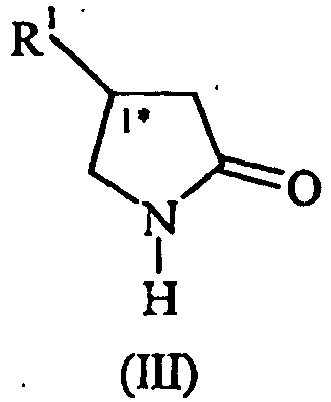
with a compound of formula (V)

X1 is -COOR5 and R5 is C1-4 alkyl.
Claims (14)
- Substantially optically pure 4-substituted-pyrrolidin-2-ones of formula (III),

- 4-substituted-pyrrolidin-2-ones of formula (III) according to claim 1 wherein R1 is n-propyl.
- 4-substituted-pyrrolidin-2-ones of formula (III) according to claim 2 wherein R1 is 2,2-difluorovinyl.
- 4-substituted-pyrrolidin-2-ones of formula (III) according to claim 2 wherein stereogenic center (1*) has configuration (R)
- 4-substituted-pyrrolidin-2-ones of formula (III) according to claim 3 wherein stereogenic center (I*) has configuration (S)
- Compound (R)-4-propyl-pyrrolidin-2-one of formula (IIIa)

- Compound (S)-4-(2,2-difluoro-vinyl)-pyrrolidin-2-one of formula (IIIb)

- Compound according to claim 6 or to claim 7 which is substantially optically pure.
- A process for the preparation of substantially diastereoisomerically pure 2-oxo-pyrrolidin-1-yl derivatives of formula (IV)
 R1 is ethyl, n-propyl, a C1-3 alkyl substituted by at least one halogen or a C2-4 alkenyl substituted by 1 to 5 halogen atoms;R2 is C1-4 alkyl or C2-4 alkenyl;X is -CONR3R4, -COOR5 or -CN;R3 is hydrogen or C1-4 alkyl;R4 is hydrogen or C1-4 alkyl; andR5 is hydrogen or C1-4 alkyl; comprising(i) reacting substantially optically pure 4-substituted- pyrrolidin-2-one of formula (III),
with a compound of formula (V)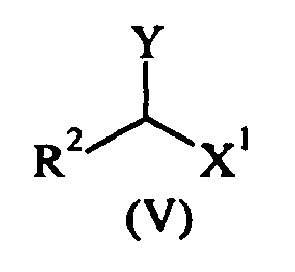 R2 is C1-4 alkyl or C2-4 alkenyl;X1 is -CONR3R4, -COOR5 or -CN;R3 is hydrogen or C1-4 alkyl;R4 is hydrogen or C1-4 alkyl;R5 is hydrogen or C1-4 alkyl; andY is a leaving group selected from halogen, sulfonate group or -N2 +;
in the presence of a base selected from the group consisting of potassium hydride, sodium hydride, sodium methoxide, potassium methoxide, sodium isopropoxide, sodium tert-butoxide and potassium tert-butoxide and in a solvent selected from the group consisting of isopropanol, tert-butanol, dimethoxyethane and toluene; and(ii) separating the mixture of epimers of compounds of formula (IV) obtained as a result of step (i). - A process for the preparation of substantially diastereoisomerically pure 2-oxo-pyrrolidin-1-yl derivatives of formula (IV) according to claim 9

in which the mixture of epimers of compound of formula (IV) obtained as a results of step (i) is a mixture of epimers of compound of formula (VI) R1 is ethyl, n-propyl, a C1-3 alkyl substituted by at least one halogen or a C2-4 alkenyl substituted by 1 to 5 halogen atoms;R2 is C1-4 alkyl or C2-4 alkenyl;X1 is COOR5;
andR5 is hydrogen or C1-4 alkyl. - A process according to claim 10 which comprises ammonolysis of the mixture of epimers of compound of formula (VI).
- A process according to any one of claims 9 to 11 wherein said mixture of epimers comprises the epimers in a ratio equal to 1.
- A process for the preparation of brivaracetam (I)
 (i) reacting substantially optically pure (R)-4-propyl-pyrrolidin-2-one (IIIa)with a compound of formula (V),
 Y is a leaving group selected from halogen, sulfonate group or -N2 +,R2 is ethylX1 is COOR5 andR5 is a C1-4 alkyl,
in the presence of a base selected from the group consisting of potassium hydride, sodium hydride, sodium methoxide, potassium methoxide, sodium isopropoxide, sodium tert-butoxide and potassium tert-butoxide and in a solvent selected from the group consisting of isopropanol, tert-butanol, dimethoxyethane and toluene; and(ii) performing ammonolysis of the mixture of epimers of compound of formula (VIa) obtained as a results of step (i); and(iii) separating brivaracetam (I) and compound (VII) obtained as result of step (ii).
- A process according to claim 13 which comprises epimerisation of the compound of formula (VII), into a mixture of brivaracetam (I) and compound of formula (VII), by reacting compound of formula (VII) with a base selected from the group consisting of potassium hydride, sodium hydride, sodium methoxide, potassium methoxide, sodium isopropoxide, sodium tert-butoxide and potassium tert-butoxide.
Priority Applications (1)
| Application Number | Priority Date | Filing Date | Title |
|---|---|---|---|
| EP06791987.8A EP1926710B1 (en) | 2005-09-15 | 2006-09-12 | 4-Substituted pyrrolidin-2-ones and their use |
Applications Claiming Priority (4)
| Application Number | Priority Date | Filing Date | Title |
|---|---|---|---|
| EP05020080 | 2005-09-15 | ||
| EP05023133 | 2005-10-24 | ||
| EP06791987.8A EP1926710B1 (en) | 2005-09-15 | 2006-09-12 | 4-Substituted pyrrolidin-2-ones and their use |
| PCT/EP2006/008852 WO2007031263A1 (en) | 2005-09-15 | 2006-09-12 | 4-substituted pyrr0lidin-2-0nes and their use |
Publications (2)
| Publication Number | Publication Date |
|---|---|
| EP1926710A1 EP1926710A1 (en) | 2008-06-04 |
| EP1926710B1 true EP1926710B1 (en) | 2014-11-12 |
Family
ID=37671936
Family Applications (1)
| Application Number | Title | Priority Date | Filing Date |
|---|---|---|---|
| EP06791987.8A Active EP1926710B1 (en) | 2005-09-15 | 2006-09-12 | 4-Substituted pyrrolidin-2-ones and their use |
Country Status (15)
| Country | Link |
|---|---|
| US (1) | US8957226B2 (en) |
| EP (1) | EP1926710B1 (en) |
| JP (1) | JP2009507870A (en) |
| KR (1) | KR101207529B1 (en) |
| CN (1) | CN101263113B (en) |
| AU (1) | AU2006291524B2 (en) |
| BR (1) | BRPI0615830A2 (en) |
| CA (1) | CA2620243C (en) |
| EA (1) | EA016518B1 (en) |
| ES (1) | ES2530398T3 (en) |
| IL (1) | IL189609A (en) |
| MX (1) | MX2008003428A (en) |
| MY (1) | MY143249A (en) |
| NZ (1) | NZ566240A (en) |
| WO (1) | WO2007031263A1 (en) |
Families Citing this family (25)
| Publication number | Priority date | Publication date | Assignee | Title |
|---|---|---|---|---|
| WO2016075082A1 (en) | 2014-11-10 | 2016-05-19 | Sandoz Ag | Stereoselective reductive amination of alpha-chiral aldehydes using omega-transaminases for the synthesis of precursors of pregabalin and brivaracetam |
| CN106279074B (en) * | 2015-05-25 | 2018-06-26 | 苏州鹏旭医药科技有限公司 | A compound, its preparation method and its use in the synthesis of Buvaracetam |
| US10221134B2 (en) * | 2015-05-25 | 2019-03-05 | Esteve Quimica S.A. | Processes to produce brivaracetam |
| CN106748748B (en) * | 2015-11-10 | 2021-08-24 | 成都国为生物医药有限公司 | A kind of preparation method of brivaracetam and intermediate thereof |
| CN105646319B (en) * | 2015-12-30 | 2018-05-18 | 佛山市隆信医药科技有限公司 | A kind of preparation method of Bu Waxitan |
| CN108218757A (en) * | 2016-12-14 | 2018-06-29 | 上海医药集团股份有限公司 | To the method for splitting of 2- (4- propyl pyrrole alkane -2- ketone)-butyramide diastereoisomer |
| CN108503573B (en) * | 2017-02-24 | 2019-11-22 | 北京艾百诺医药股份有限公司 | A kind of new preparation method of Bu Waxitan |
| CN108503609B (en) * | 2017-02-24 | 2019-12-24 | 北京艾百诺医药股份有限公司 | Method for preparing optically pure (R) -4-n-propyl-dihydrofuran-2 (3H) -ketone |
| CN108689903B (en) * | 2017-04-06 | 2019-12-24 | 北京艾百诺医药股份有限公司 | Novel preparation method of brivaracetam |
| ES2912612T3 (en) | 2017-12-12 | 2022-05-26 | UCB Biopharma SRL | 2-oxo-1-pyrrolidinyl imidazothiadiazole derivatives |
| CN108101824B (en) * | 2018-02-13 | 2020-04-03 | 扬州奥锐特药业有限公司 | Preparation method of lactam intermediate with high chiral purity and brivaracetam |
| CN108101823A (en) * | 2018-02-13 | 2018-06-01 | 扬州奥锐特药业有限公司 | A kind of preparation method of high chiral purity lactam intermediate and Bu Waxitan |
| CN109678752B (en) * | 2018-12-27 | 2021-11-16 | 南京红杉生物科技有限公司 | Method for synthesizing L-2-aminobutanamide hydrochloride by asymmetric transformation |
| CN112154140B (en) * | 2019-01-09 | 2023-11-24 | 福建海西新药创制股份有限公司 | Compounds and their use in the synthesis of Brivaracetam API |
| CN109932442A (en) * | 2019-03-04 | 2019-06-25 | 成都美域高制药有限公司 | A kind of detection method of Bu Waxitan isomers |
| CN110357839A (en) * | 2019-08-29 | 2019-10-22 | 重庆经致制药技术开发有限公司 | The preparation method of Bu Waxitan chiral intermediate |
| US10781170B1 (en) | 2019-10-21 | 2020-09-22 | Divi's Laboratories Ltd. | Process for preparing Brivaracetam |
| CN111122736B (en) * | 2019-12-30 | 2021-03-12 | 北京鑫开元医药科技有限公司海南分公司 | A kind of method for detecting enantiomer in brivaracetam intermediate |
| CN112834674A (en) * | 2020-12-29 | 2021-05-25 | 浙江和泽医药科技股份有限公司 | Method for detecting brivaracetam and isomers thereof |
| US11400074B1 (en) | 2021-02-01 | 2022-08-02 | Divi's Laboratories Ltd. | Enzymatic process for the preparation of (2S)-2-[(4R)-2-oxo-4-propyl-pyrrolidin-1-yl]butyric acid and its conversion into brivaracetam |
| WO2023100110A1 (en) | 2021-12-02 | 2023-06-08 | Macfarlan Smith Limited | Process for preparing brivaracetam |
| US11884623B2 (en) | 2022-05-23 | 2024-01-30 | Divi's Laboratories Ltd. | Process for the preparation of (R)-4-propyl pyrrolidine-2-one, a key intermediate for synthesis of brivaracetam |
| CN115340482B (en) * | 2022-08-25 | 2024-05-14 | 四川诺非特生物药业科技有限公司 | Synthesis method of brivaracetam |
| CN115851866A (en) * | 2022-12-22 | 2023-03-28 | 浙江普洛家园药业有限公司 | Preparation method of brivaracetam and intermediate thereof |
| CN116459225B (en) * | 2023-04-26 | 2023-11-10 | 东莞市金美济药业有限公司 | Alagox sodium tablet and preparation process thereof |
Family Cites Families (12)
| Publication number | Priority date | Publication date | Assignee | Title |
|---|---|---|---|---|
| EP0252885A1 (en) * | 1986-07-10 | 1988-01-13 | Ciba-Geigy Ag | Bicyclic thiaaza compounds |
| US5858736A (en) * | 1996-05-17 | 1999-01-12 | E. I. Du Pont De Nemours And Company | Preparation of lactams from aliphatic α,ω-dinitriles |
| CA2374755C (en) * | 1999-06-10 | 2010-03-30 | Warner-Lambert Company | Mono- and disubstituted 3-propyl gamma-aminobutyric acids |
| US7164034B2 (en) * | 1999-06-10 | 2007-01-16 | Pfizer Inc. | Alpha2delta ligands for fibromyalgia and other disorders |
| GB0004297D0 (en) * | 2000-02-23 | 2000-04-12 | Ucb Sa | 2-oxo-1 pyrrolidine derivatives process for preparing them and their uses |
| US7476688B2 (en) * | 2001-04-19 | 2009-01-13 | Eisai R&D Management Co., Ltd. | Cyclic amidine derivatives |
| ES2314090T3 (en) * | 2001-08-10 | 2009-03-16 | Ucb Pharma S.A. | OXOPIRROLIDINE COMPOUNDS, PREPARATION OF SUCH COMPOUNDS AND USE OF THE SAME IN THE MANUFACTURE OF LEVETIRACETAM AND ITS ANALOGS. |
| NO315997B1 (en) | 2001-11-06 | 2003-11-24 | Thomas Wahl Gjersoee | Solar collector comprising an energy coating and water heating system |
| WO2003094913A1 (en) * | 2002-05-14 | 2003-11-20 | Ucb, S.A. | Use of 2-oxo-1-pyrrolidone derivatives for the preparation of a drug |
| CN1156444C (en) * | 2002-07-04 | 2004-07-07 | 中国科学院昆明植物研究所 | Optical breaking process of d1-trans-4-phenyl-5-O-chlorobenzyl pyrrolidone-2 |
| PL1667967T3 (en) * | 2003-09-24 | 2012-11-30 | Ucb Pharma Sa | Process for preparing 2-oxo-1-pyrrolidine derivatives |
| WO2005054188A1 (en) * | 2003-12-02 | 2005-06-16 | Ucb, S.A. | Imidazole derivatives, processes for preparing them and their uses |
-
2006
- 2006-09-12 NZ NZ566240A patent/NZ566240A/en unknown
- 2006-09-12 MX MX2008003428A patent/MX2008003428A/en active IP Right Grant
- 2006-09-12 MY MYPI20080609A patent/MY143249A/en unknown
- 2006-09-12 ES ES06791987T patent/ES2530398T3/en active Active
- 2006-09-12 JP JP2008530400A patent/JP2009507870A/en active Pending
- 2006-09-12 CN CN2006800338454A patent/CN101263113B/en not_active Expired - Fee Related
- 2006-09-12 AU AU2006291524A patent/AU2006291524B2/en not_active Ceased
- 2006-09-12 US US11/992,065 patent/US8957226B2/en not_active Expired - Fee Related
- 2006-09-12 EA EA200800701A patent/EA016518B1/en not_active IP Right Cessation
- 2006-09-12 BR BRPI0615830-7A patent/BRPI0615830A2/en not_active IP Right Cessation
- 2006-09-12 CA CA2620243A patent/CA2620243C/en not_active Expired - Fee Related
- 2006-09-12 KR KR1020087009002A patent/KR101207529B1/en not_active Expired - Fee Related
- 2006-09-12 EP EP06791987.8A patent/EP1926710B1/en active Active
- 2006-09-12 WO PCT/EP2006/008852 patent/WO2007031263A1/en not_active Ceased
-
2008
- 2008-02-19 IL IL189609A patent/IL189609A/en not_active IP Right Cessation
Also Published As
| Publication number | Publication date |
|---|---|
| AU2006291524B2 (en) | 2012-01-12 |
| EP1926710A1 (en) | 2008-06-04 |
| EA200800701A1 (en) | 2008-10-30 |
| CN101263113B (en) | 2012-06-13 |
| MX2008003428A (en) | 2008-03-27 |
| ES2530398T3 (en) | 2015-03-02 |
| US8957226B2 (en) | 2015-02-17 |
| IL189609A0 (en) | 2008-06-05 |
| EA016518B1 (en) | 2012-05-30 |
| JP2009507870A (en) | 2009-02-26 |
| AU2006291524A1 (en) | 2007-03-22 |
| CA2620243A1 (en) | 2007-03-22 |
| WO2007031263A1 (en) | 2007-03-22 |
| CA2620243C (en) | 2015-01-20 |
| KR101207529B1 (en) | 2012-12-04 |
| CN101263113A (en) | 2008-09-10 |
| MY143249A (en) | 2011-04-15 |
| BRPI0615830A2 (en) | 2012-12-18 |
| US20090318708A1 (en) | 2009-12-24 |
| HK1120498A1 (en) | 2009-04-03 |
| NZ566240A (en) | 2011-05-27 |
| IL189609A (en) | 2015-08-31 |
| KR20080046733A (en) | 2008-05-27 |
Similar Documents
| Publication | Publication Date | Title |
|---|---|---|
| AU2006291524B2 (en) | 4-substituted pyrrolidin-2-ones and their use | |
| EP1806339B1 (en) | Process for the preparation of 2-oxo-1-pyrrolidine derivatives | |
| JP4334344B2 (en) | Oxopyrrolidine compounds, preparation of such compounds, and use of the compounds in the manufacture of levetiracetam and analogs | |
| AU2002329233A1 (en) | Oxopyrrolidine compounds, preparation of said compounds and their use in the manufacturing of levetiracetam and analogues | |
| Brenner et al. | Enantioselective preparation of γ‐amino acids and γ‐lactams from nitro olefins and carboxylic acids, with the valine‐derived 4‐Isopropyl‐5, 5‐diphenyl‐1, 3‐oxazolidin‐2‐one as an auxiliary | |
| WO2016191435A1 (en) | Processes to produce brivaracetam | |
| CN101918411A (en) | A kind of method for preparing asenapine and intermediate product used in the method | |
| WO2008012268A1 (en) | Process for the preparation of levetiracetam | |
| Karlsson et al. | trans-3, 4-Disubstituted pyrrolidines by 1, 3-dipolar cycloaddition: enantioselective approaches and their limitations | |
| EP2173698A2 (en) | Process for the synthesis of intermediates of renin inhibitors such as aliskiren | |
| Debache et al. | Belokon's Ni (II) complex as a chiral masked glycine for the diastereoselective synthesis of 2-substituted 1-aminocyclopropane carboxylic acids | |
| EP1993998B1 (en) | 3-carboxy- 2-oxo-1 -pyrrolidine derivatives and their uses | |
| HK1120498B (en) | 4-substituted pyrrolidin-2-ones and their use | |
| EP1340743A1 (en) | Optically active amine derivative and method of synthesis | |
| JPH11228574A (en) | Preparationof bicyclic amidine, diazacycloalkene and its preparation | |
| CA2984832C (en) | Processes to produce brivaracetam | |
| WO2006056166A2 (en) | Method for the addition of amides ureas lactams and carbamates to alkynes | |
| JP2012508780A (en) | Enantioselective synthesis of γ-amino-α, β-unsaturated carboxylic acid derivatives |
Legal Events
| Date | Code | Title | Description |
|---|---|---|---|
| PUAI | Public reference made under article 153(3) epc to a published international application that has entered the european phase |
Free format text: ORIGINAL CODE: 0009012 |
|
| 17P | Request for examination filed |
Effective date: 20080415 |
|
| AK | Designated contracting states |
Kind code of ref document: A1 Designated state(s): AT BE BG CH CY CZ DE DK EE ES FI FR GB GR HU IE IS IT LI LT LU LV MC NL PL PT RO SE SI SK TR |
|
| AX | Request for extension of the european patent |
Extension state: AL BA HR MK RS |
|
| GRAP | Despatch of communication of intention to grant a patent |
Free format text: ORIGINAL CODE: EPIDOSNIGR1 |
|
| GRAP | Despatch of communication of intention to grant a patent |
Free format text: ORIGINAL CODE: EPIDOSNIGR1 |
|
| INTG | Intention to grant announced |
Effective date: 20131115 |
|
| RAP1 | Party data changed (applicant data changed or rights of an application transferred) |
Owner name: UCB PHARMA S.A. |
|
| GRAP | Despatch of communication of intention to grant a patent |
Free format text: ORIGINAL CODE: EPIDOSNIGR1 |
|
| INTG | Intention to grant announced |
Effective date: 20140603 |
|
| GRAS | Grant fee paid |
Free format text: ORIGINAL CODE: EPIDOSNIGR3 |
|
| GRAA | (expected) grant |
Free format text: ORIGINAL CODE: 0009210 |
|
| AK | Designated contracting states |
Kind code of ref document: B1 Designated state(s): AT BE BG CH CY CZ DE DK EE ES FI FR GB GR HU IE IS IT LI LT LU LV MC NL PL PT RO SE SI SK TR |
|
| AX | Request for extension of the european patent |
Extension state: AL BA HR MK RS |
|
| REG | Reference to a national code |
Ref country code: GB Ref legal event code: FG4D |
|
| REG | Reference to a national code |
Ref country code: CH Ref legal event code: EP |
|
| REG | Reference to a national code |
Ref country code: AT Ref legal event code: REF Ref document number: 695640 Country of ref document: AT Kind code of ref document: T Effective date: 20141115 |
|
| REG | Reference to a national code |
Ref country code: IE Ref legal event code: FG4D |
|
| REG | Reference to a national code |
Ref country code: DE Ref legal event code: R096 Ref document number: 602006043652 Country of ref document: DE Effective date: 20141224 |
|
| REG | Reference to a national code |
Ref country code: ES Ref legal event code: FG2A Ref document number: 2530398 Country of ref document: ES Kind code of ref document: T3 Effective date: 20150302 |
|
| REG | Reference to a national code |
Ref country code: NL Ref legal event code: VDEP Effective date: 20141112 |
|
| REG | Reference to a national code |
Ref country code: AT Ref legal event code: MK05 Ref document number: 695640 Country of ref document: AT Kind code of ref document: T Effective date: 20141112 |
|
| PG25 | Lapsed in a contracting state [announced via postgrant information from national office to epo] |
Ref country code: FI Free format text: LAPSE BECAUSE OF FAILURE TO SUBMIT A TRANSLATION OF THE DESCRIPTION OR TO PAY THE FEE WITHIN THE PRESCRIBED TIME-LIMIT Effective date: 20141112 Ref country code: NL Free format text: LAPSE BECAUSE OF FAILURE TO SUBMIT A TRANSLATION OF THE DESCRIPTION OR TO PAY THE FEE WITHIN THE PRESCRIBED TIME-LIMIT Effective date: 20141112 Ref country code: IS Free format text: LAPSE BECAUSE OF FAILURE TO SUBMIT A TRANSLATION OF THE DESCRIPTION OR TO PAY THE FEE WITHIN THE PRESCRIBED TIME-LIMIT Effective date: 20150312 Ref country code: PT Free format text: LAPSE BECAUSE OF FAILURE TO SUBMIT A TRANSLATION OF THE DESCRIPTION OR TO PAY THE FEE WITHIN THE PRESCRIBED TIME-LIMIT Effective date: 20150312 Ref country code: LT Free format text: LAPSE BECAUSE OF FAILURE TO SUBMIT A TRANSLATION OF THE DESCRIPTION OR TO PAY THE FEE WITHIN THE PRESCRIBED TIME-LIMIT Effective date: 20141112 |
|
| PG25 | Lapsed in a contracting state [announced via postgrant information from national office to epo] |
Ref country code: PL Free format text: LAPSE BECAUSE OF FAILURE TO SUBMIT A TRANSLATION OF THE DESCRIPTION OR TO PAY THE FEE WITHIN THE PRESCRIBED TIME-LIMIT Effective date: 20141112 Ref country code: AT Free format text: LAPSE BECAUSE OF FAILURE TO SUBMIT A TRANSLATION OF THE DESCRIPTION OR TO PAY THE FEE WITHIN THE PRESCRIBED TIME-LIMIT Effective date: 20141112 Ref country code: LV Free format text: LAPSE BECAUSE OF FAILURE TO SUBMIT A TRANSLATION OF THE DESCRIPTION OR TO PAY THE FEE WITHIN THE PRESCRIBED TIME-LIMIT Effective date: 20141112 Ref country code: SE Free format text: LAPSE BECAUSE OF FAILURE TO SUBMIT A TRANSLATION OF THE DESCRIPTION OR TO PAY THE FEE WITHIN THE PRESCRIBED TIME-LIMIT Effective date: 20141112 Ref country code: GR Free format text: LAPSE BECAUSE OF FAILURE TO SUBMIT A TRANSLATION OF THE DESCRIPTION OR TO PAY THE FEE WITHIN THE PRESCRIBED TIME-LIMIT Effective date: 20150213 Ref country code: CY Free format text: LAPSE BECAUSE OF FAILURE TO SUBMIT A TRANSLATION OF THE DESCRIPTION OR TO PAY THE FEE WITHIN THE PRESCRIBED TIME-LIMIT Effective date: 20141112 |
|
| REG | Reference to a national code |
Ref country code: FR Ref legal event code: PLFP Year of fee payment: 10 |
|
| PG25 | Lapsed in a contracting state [announced via postgrant information from national office to epo] |
Ref country code: RO Free format text: LAPSE BECAUSE OF FAILURE TO SUBMIT A TRANSLATION OF THE DESCRIPTION OR TO PAY THE FEE WITHIN THE PRESCRIBED TIME-LIMIT Effective date: 20141112 Ref country code: DK Free format text: LAPSE BECAUSE OF FAILURE TO SUBMIT A TRANSLATION OF THE DESCRIPTION OR TO PAY THE FEE WITHIN THE PRESCRIBED TIME-LIMIT Effective date: 20141112 Ref country code: CZ Free format text: LAPSE BECAUSE OF FAILURE TO SUBMIT A TRANSLATION OF THE DESCRIPTION OR TO PAY THE FEE WITHIN THE PRESCRIBED TIME-LIMIT Effective date: 20141112 Ref country code: SK Free format text: LAPSE BECAUSE OF FAILURE TO SUBMIT A TRANSLATION OF THE DESCRIPTION OR TO PAY THE FEE WITHIN THE PRESCRIBED TIME-LIMIT Effective date: 20141112 Ref country code: EE Free format text: LAPSE BECAUSE OF FAILURE TO SUBMIT A TRANSLATION OF THE DESCRIPTION OR TO PAY THE FEE WITHIN THE PRESCRIBED TIME-LIMIT Effective date: 20141112 |
|
| REG | Reference to a national code |
Ref country code: DE Ref legal event code: R097 Ref document number: 602006043652 Country of ref document: DE |
|
| PLBE | No opposition filed within time limit |
Free format text: ORIGINAL CODE: 0009261 |
|
| STAA | Information on the status of an ep patent application or granted ep patent |
Free format text: STATUS: NO OPPOSITION FILED WITHIN TIME LIMIT |
|
| 26N | No opposition filed |
Effective date: 20150813 |
|
| PG25 | Lapsed in a contracting state [announced via postgrant information from national office to epo] |
Ref country code: SI Free format text: LAPSE BECAUSE OF FAILURE TO SUBMIT A TRANSLATION OF THE DESCRIPTION OR TO PAY THE FEE WITHIN THE PRESCRIBED TIME-LIMIT Effective date: 20141112 |
|
| PG25 | Lapsed in a contracting state [announced via postgrant information from national office to epo] |
Ref country code: LU Free format text: LAPSE BECAUSE OF FAILURE TO SUBMIT A TRANSLATION OF THE DESCRIPTION OR TO PAY THE FEE WITHIN THE PRESCRIBED TIME-LIMIT Effective date: 20150912 Ref country code: MC Free format text: LAPSE BECAUSE OF FAILURE TO SUBMIT A TRANSLATION OF THE DESCRIPTION OR TO PAY THE FEE WITHIN THE PRESCRIBED TIME-LIMIT Effective date: 20141112 |
|
| PG25 | Lapsed in a contracting state [announced via postgrant information from national office to epo] |
Ref country code: IE Free format text: LAPSE BECAUSE OF NON-PAYMENT OF DUE FEES Effective date: 20150912 |
|
| REG | Reference to a national code |
Ref country code: FR Ref legal event code: PLFP Year of fee payment: 11 |
|
| PGFP | Annual fee paid to national office [announced via postgrant information from national office to epo] |
Ref country code: IT Payment date: 20160921 Year of fee payment: 11 Ref country code: CH Payment date: 20160914 Year of fee payment: 11 Ref country code: GB Payment date: 20160907 Year of fee payment: 11 Ref country code: DE Payment date: 20160907 Year of fee payment: 11 |
|
| PGFP | Annual fee paid to national office [announced via postgrant information from national office to epo] |
Ref country code: FR Payment date: 20160816 Year of fee payment: 11 |
|
| PGFP | Annual fee paid to national office [announced via postgrant information from national office to epo] |
Ref country code: ES Payment date: 20160811 Year of fee payment: 11 |
|
| PG25 | Lapsed in a contracting state [announced via postgrant information from national office to epo] |
Ref country code: BG Free format text: LAPSE BECAUSE OF FAILURE TO SUBMIT A TRANSLATION OF THE DESCRIPTION OR TO PAY THE FEE WITHIN THE PRESCRIBED TIME-LIMIT Effective date: 20141112 Ref country code: HU Free format text: LAPSE BECAUSE OF FAILURE TO SUBMIT A TRANSLATION OF THE DESCRIPTION OR TO PAY THE FEE WITHIN THE PRESCRIBED TIME-LIMIT; INVALID AB INITIO Effective date: 20060912 |
|
| PG25 | Lapsed in a contracting state [announced via postgrant information from national office to epo] |
Ref country code: TR Free format text: LAPSE BECAUSE OF FAILURE TO SUBMIT A TRANSLATION OF THE DESCRIPTION OR TO PAY THE FEE WITHIN THE PRESCRIBED TIME-LIMIT Effective date: 20141112 |
|
| PG25 | Lapsed in a contracting state [announced via postgrant information from national office to epo] |
Ref country code: BE Free format text: LAPSE BECAUSE OF FAILURE TO SUBMIT A TRANSLATION OF THE DESCRIPTION OR TO PAY THE FEE WITHIN THE PRESCRIBED TIME-LIMIT Effective date: 20141112 |
|
| REG | Reference to a national code |
Ref country code: DE Ref legal event code: R119 Ref document number: 602006043652 Country of ref document: DE |
|
| REG | Reference to a national code |
Ref country code: CH Ref legal event code: PL |
|
| GBPC | Gb: european patent ceased through non-payment of renewal fee |
Effective date: 20170912 |
|
| REG | Reference to a national code |
Ref country code: FR Ref legal event code: ST Effective date: 20180531 |
|
| PG25 | Lapsed in a contracting state [announced via postgrant information from national office to epo] |
Ref country code: DE Free format text: LAPSE BECAUSE OF NON-PAYMENT OF DUE FEES Effective date: 20180404 Ref country code: LI Free format text: LAPSE BECAUSE OF NON-PAYMENT OF DUE FEES Effective date: 20170930 Ref country code: CH Free format text: LAPSE BECAUSE OF NON-PAYMENT OF DUE FEES Effective date: 20170930 Ref country code: GB Free format text: LAPSE BECAUSE OF NON-PAYMENT OF DUE FEES Effective date: 20170912 |
|
| PG25 | Lapsed in a contracting state [announced via postgrant information from national office to epo] |
Ref country code: FR Free format text: LAPSE BECAUSE OF NON-PAYMENT OF DUE FEES Effective date: 20171002 Ref country code: IT Free format text: LAPSE BECAUSE OF NON-PAYMENT OF DUE FEES Effective date: 20170912 |
|
| REG | Reference to a national code |
Ref country code: ES Ref legal event code: FD2A Effective date: 20181024 |
|
| PG25 | Lapsed in a contracting state [announced via postgrant information from national office to epo] |
Ref country code: ES Free format text: LAPSE BECAUSE OF NON-PAYMENT OF DUE FEES Effective date: 20170913 |