EP1925619A1 - Preparation of 4-substituted 2-amino-benzo[4,5]furo[3,2-d]pyrimidine derivatives - Google Patents
Preparation of 4-substituted 2-amino-benzo[4,5]furo[3,2-d]pyrimidine derivatives Download PDFInfo
- Publication number
- EP1925619A1 EP1925619A1 EP06124539A EP06124539A EP1925619A1 EP 1925619 A1 EP1925619 A1 EP 1925619A1 EP 06124539 A EP06124539 A EP 06124539A EP 06124539 A EP06124539 A EP 06124539A EP 1925619 A1 EP1925619 A1 EP 1925619A1
- Authority
- EP
- European Patent Office
- Prior art keywords
- alkyl
- group
- formula
- compound
- halogen
- Prior art date
- Legal status (The legal status is an assumption and is not a legal conclusion. Google has not performed a legal analysis and makes no representation as to the accuracy of the status listed.)
- Withdrawn
Links
- 238000002360 preparation method Methods 0.000 title claims abstract description 12
- -1 4-substituted 2-amino-benzo[4,5]furo[3,2-d]pyrimidine Chemical class 0.000 title description 10
- 229940083082 pyrimidine derivative acting on arteriolar smooth muscle Drugs 0.000 title description 4
- 150000001875 compounds Chemical class 0.000 claims abstract description 51
- 238000000034 method Methods 0.000 claims abstract description 29
- 125000004178 (C1-C4) alkyl group Chemical group 0.000 claims description 52
- 229910052736 halogen Inorganic materials 0.000 claims description 26
- 125000005843 halogen group Chemical group 0.000 claims description 24
- 229910052739 hydrogen Inorganic materials 0.000 claims description 22
- 238000006243 chemical reaction Methods 0.000 claims description 13
- 150000003839 salts Chemical class 0.000 claims description 13
- 125000005913 (C3-C6) cycloalkyl group Chemical group 0.000 claims description 12
- RYTLGWCJESCDMY-UHFFFAOYSA-N carbamimidoyl chloride Chemical compound NC(Cl)=N RYTLGWCJESCDMY-UHFFFAOYSA-N 0.000 claims description 11
- 125000006239 protecting group Chemical group 0.000 claims description 11
- 239000002904 solvent Substances 0.000 claims description 11
- IAZDPXIOMUYVGZ-UHFFFAOYSA-N Dimethylsulphoxide Chemical compound CS(C)=O IAZDPXIOMUYVGZ-UHFFFAOYSA-N 0.000 claims description 9
- 125000000217 alkyl group Chemical group 0.000 claims description 9
- JFDZBHWFFUWGJE-UHFFFAOYSA-N benzenecarbonitrile Natural products N#CC1=CC=CC=C1 JFDZBHWFFUWGJE-UHFFFAOYSA-N 0.000 claims description 8
- XHXFXVLFKHQFAL-UHFFFAOYSA-N phosphoryl trichloride Chemical compound ClP(Cl)(Cl)=O XHXFXVLFKHQFAL-UHFFFAOYSA-N 0.000 claims description 8
- 239000000203 mixture Substances 0.000 claims description 7
- LYCAIKOWRPUZTN-UHFFFAOYSA-N Ethylene glycol Chemical compound OCCO LYCAIKOWRPUZTN-UHFFFAOYSA-N 0.000 claims description 6
- MTHSVFCYNBDYFN-UHFFFAOYSA-N diethylene glycol Chemical compound OCCOCCO MTHSVFCYNBDYFN-UHFFFAOYSA-N 0.000 claims description 6
- 230000018044 dehydration Effects 0.000 claims description 4
- 238000006297 dehydration reaction Methods 0.000 claims description 4
- HXJUTPCZVOIRIF-UHFFFAOYSA-N sulfolane Chemical compound O=S1(=O)CCCC1 HXJUTPCZVOIRIF-UHFFFAOYSA-N 0.000 claims description 4
- 229910019213 POCl3 Inorganic materials 0.000 claims description 3
- ZIBGPFATKBEMQZ-UHFFFAOYSA-N triethylene glycol Chemical compound OCCOCCOCCO ZIBGPFATKBEMQZ-UHFFFAOYSA-N 0.000 claims description 2
- YFNKIDBQEZZDLK-UHFFFAOYSA-N triglyme Chemical compound COCCOCCOCCOC YFNKIDBQEZZDLK-UHFFFAOYSA-N 0.000 claims description 2
- JFDZBHWFFUWGJE-KWCOIAHCSA-N benzonitrile Chemical group N#[11C]C1=CC=CC=C1 JFDZBHWFFUWGJE-KWCOIAHCSA-N 0.000 claims 1
- 239000000543 intermediate Substances 0.000 abstract description 4
- OKKJLVBELUTLKV-UHFFFAOYSA-N Methanol Chemical compound OC OKKJLVBELUTLKV-UHFFFAOYSA-N 0.000 description 18
- 230000015572 biosynthetic process Effects 0.000 description 13
- KFZMGEQAYNKOFK-UHFFFAOYSA-N Isopropanol Chemical compound CC(C)O KFZMGEQAYNKOFK-UHFFFAOYSA-N 0.000 description 12
- 238000003786 synthesis reaction Methods 0.000 description 12
- IAZDPXIOMUYVGZ-WFGJKAKNSA-N Dimethyl sulfoxide Chemical compound [2H]C([2H])([2H])S(=O)C([2H])([2H])[2H] IAZDPXIOMUYVGZ-WFGJKAKNSA-N 0.000 description 10
- 239000007787 solid Substances 0.000 description 9
- 239000011541 reaction mixture Substances 0.000 description 8
- 238000005160 1H NMR spectroscopy Methods 0.000 description 7
- HEDRZPFGACZZDS-MICDWDOJSA-N Trichloro(2H)methane Chemical compound [2H]C(Cl)(Cl)Cl HEDRZPFGACZZDS-MICDWDOJSA-N 0.000 description 7
- RTZKZFJDLAIYFH-UHFFFAOYSA-N ether Substances CCOCC RTZKZFJDLAIYFH-UHFFFAOYSA-N 0.000 description 7
- WEVYAHXRMPXWCK-UHFFFAOYSA-N Acetonitrile Chemical compound CC#N WEVYAHXRMPXWCK-UHFFFAOYSA-N 0.000 description 6
- WYURNTSHIVDZCO-UHFFFAOYSA-N Tetrahydrofuran Chemical compound C1CCOC1 WYURNTSHIVDZCO-UHFFFAOYSA-N 0.000 description 6
- 125000001309 chloro group Chemical group Cl* 0.000 description 6
- 125000001153 fluoro group Chemical group F* 0.000 description 6
- 230000035484 reaction time Effects 0.000 description 6
- XLYOFNOQVPJJNP-UHFFFAOYSA-N water Substances O XLYOFNOQVPJJNP-UHFFFAOYSA-N 0.000 description 6
- YMWUJEATGCHHMB-UHFFFAOYSA-N Dichloromethane Chemical compound ClCCl YMWUJEATGCHHMB-UHFFFAOYSA-N 0.000 description 5
- ZMXDDKWLCZADIW-UHFFFAOYSA-N N,N-Dimethylformamide Chemical compound CN(C)C=O ZMXDDKWLCZADIW-UHFFFAOYSA-N 0.000 description 5
- 239000000725 suspension Substances 0.000 description 5
- QGZKDVFQNNGYKY-UHFFFAOYSA-N Ammonia Chemical compound N QGZKDVFQNNGYKY-UHFFFAOYSA-N 0.000 description 4
- VEXZGXHMUGYJMC-UHFFFAOYSA-N Hydrochloric acid Chemical compound Cl VEXZGXHMUGYJMC-UHFFFAOYSA-N 0.000 description 4
- BAVYZALUXZFZLV-UHFFFAOYSA-N Methylamine Chemical compound NC BAVYZALUXZFZLV-UHFFFAOYSA-N 0.000 description 4
- 239000003814 drug Substances 0.000 description 4
- 150000002367 halogens Chemical class 0.000 description 4
- IXCSERBJSXMMFS-UHFFFAOYSA-N hydrogen chloride Substances Cl.Cl IXCSERBJSXMMFS-UHFFFAOYSA-N 0.000 description 4
- 229910000041 hydrogen chloride Inorganic materials 0.000 description 4
- 125000002887 hydroxy group Chemical group [H]O* 0.000 description 4
- 239000000047 product Substances 0.000 description 4
- 238000010992 reflux Methods 0.000 description 4
- FYSNRJHAOHDILO-UHFFFAOYSA-N thionyl chloride Chemical compound ClS(Cl)=O FYSNRJHAOHDILO-UHFFFAOYSA-N 0.000 description 4
- IDEJASFMRDRSEB-UHFFFAOYSA-N 2-amino-8-chloro-1h-[1]benzofuro[3,2-d]pyrimidin-4-one Chemical compound O1C2=CC=C(Cl)C=C2C2=C1C(=O)N=C(N)N2 IDEJASFMRDRSEB-UHFFFAOYSA-N 0.000 description 3
- QTBSBXVTEAMEQO-UHFFFAOYSA-N Acetic acid Chemical compound CC(O)=O QTBSBXVTEAMEQO-UHFFFAOYSA-N 0.000 description 3
- OPKJUOPHMMPAPX-UHFFFAOYSA-N methyl 2-(2-carbamoyl-4-chlorophenoxy)acetate Chemical compound COC(=O)COC1=CC=C(Cl)C=C1C(N)=O OPKJUOPHMMPAPX-UHFFFAOYSA-N 0.000 description 3
- DMJUBSYNHMIRCN-UHFFFAOYSA-N methyl 2-(4-chloro-2-cyanophenoxy)acetate Chemical compound COC(=O)COC1=CC=C(Cl)C=C1C#N DMJUBSYNHMIRCN-UHFFFAOYSA-N 0.000 description 3
- XYNXXUPOYQPUJY-UHFFFAOYSA-N methyl 3-amino-5-chloro-1-benzofuran-2-carboxylate Chemical compound C1=C(Cl)C=C2C(N)=C(C(=O)OC)OC2=C1 XYNXXUPOYQPUJY-UHFFFAOYSA-N 0.000 description 3
- KJWHRMZKJXOWFC-UHFFFAOYSA-N methyl 5-chloro-2-hydroxybenzoate Chemical compound COC(=O)C1=CC(Cl)=CC=C1O KJWHRMZKJXOWFC-UHFFFAOYSA-N 0.000 description 3
- 150000002825 nitriles Chemical class 0.000 description 3
- LPNYRYFBWFDTMA-UHFFFAOYSA-N potassium tert-butoxide Chemical compound [K+].CC(C)(C)[O-] LPNYRYFBWFDTMA-UHFFFAOYSA-N 0.000 description 3
- 125000001424 substituent group Chemical group 0.000 description 3
- 238000006467 substitution reaction Methods 0.000 description 3
- YLQBMQCUIZJEEH-UHFFFAOYSA-N tetrahydrofuran Natural products C=1C=COC=1 YLQBMQCUIZJEEH-UHFFFAOYSA-N 0.000 description 3
- BUTTVUBNXIIXRH-UHFFFAOYSA-N 1-(cyclopropylmethyl)pyrazole-4-carbaldehyde Chemical compound C1=C(C=O)C=NN1CC1CC1 BUTTVUBNXIIXRH-UHFFFAOYSA-N 0.000 description 2
- 125000004575 3-pyrrolidinyl group Chemical group [H]N1C([H])([H])C([H])([H])C([H])(*)C1([H])[H] 0.000 description 2
- NNHMQZBVJPQCAK-UHFFFAOYSA-N 5-chloro-2-hydroxybenzamide Chemical compound NC(=O)C1=CC(Cl)=CC=C1O NNHMQZBVJPQCAK-UHFFFAOYSA-N 0.000 description 2
- KXDAEFPNCMNJSK-UHFFFAOYSA-N Benzamide Chemical compound NC(=O)C1=CC=CC=C1 KXDAEFPNCMNJSK-UHFFFAOYSA-N 0.000 description 2
- XZMCDFZZKTWFGF-UHFFFAOYSA-N Cyanamide Chemical compound NC#N XZMCDFZZKTWFGF-UHFFFAOYSA-N 0.000 description 2
- JNCMHMUGTWEVOZ-UHFFFAOYSA-N F[CH]F Chemical compound F[CH]F JNCMHMUGTWEVOZ-UHFFFAOYSA-N 0.000 description 2
- 102000004187 Histamine H4 receptors Human genes 0.000 description 2
- 108090000796 Histamine H4 receptors Proteins 0.000 description 2
- JGFZNNIVVJXRND-UHFFFAOYSA-N N,N-Diisopropylethylamine (DIPEA) Chemical compound CCN(C(C)C)C(C)C JGFZNNIVVJXRND-UHFFFAOYSA-N 0.000 description 2
- SKZKKFZAGNVIMN-UHFFFAOYSA-N Salicilamide Chemical compound NC(=O)C1=CC=CC=C1O SKZKKFZAGNVIMN-UHFFFAOYSA-N 0.000 description 2
- CDBYLPFSWZWCQE-UHFFFAOYSA-L Sodium Carbonate Chemical compound [Na+].[Na+].[O-]C([O-])=O CDBYLPFSWZWCQE-UHFFFAOYSA-L 0.000 description 2
- DTQVDTLACAAQTR-UHFFFAOYSA-N Trifluoroacetic acid Chemical compound OC(=O)C(F)(F)F DTQVDTLACAAQTR-UHFFFAOYSA-N 0.000 description 2
- 150000001408 amides Chemical class 0.000 description 2
- 125000003277 amino group Chemical group 0.000 description 2
- 229910021529 ammonia Inorganic materials 0.000 description 2
- 238000009835 boiling Methods 0.000 description 2
- 125000001246 bromo group Chemical group Br* 0.000 description 2
- 239000003795 chemical substances by application Substances 0.000 description 2
- 125000001559 cyclopropyl group Chemical group [H]C1([H])C([H])([H])C1([H])* 0.000 description 2
- 229960004132 diethyl ether Drugs 0.000 description 2
- 125000001495 ethyl group Chemical group [H]C([H])([H])C([H])([H])* 0.000 description 2
- VUWZPRWSIVNGKG-UHFFFAOYSA-N fluoromethane Chemical compound F[CH2] VUWZPRWSIVNGKG-UHFFFAOYSA-N 0.000 description 2
- 239000005457 ice water Substances 0.000 description 2
- 125000002346 iodo group Chemical group I* 0.000 description 2
- 239000000463 material Substances 0.000 description 2
- 230000007246 mechanism Effects 0.000 description 2
- 230000001404 mediated effect Effects 0.000 description 2
- 125000002496 methyl group Chemical group [H]C([H])([H])* 0.000 description 2
- QJGQUHMNIGDVPM-UHFFFAOYSA-N nitrogen group Chemical group [N] QJGQUHMNIGDVPM-UHFFFAOYSA-N 0.000 description 2
- 125000006340 pentafluoro ethyl group Chemical group FC(F)(F)C(F)(F)* 0.000 description 2
- BWHMMNNQKKPAPP-UHFFFAOYSA-L potassium carbonate Chemical compound [K+].[K+].[O-]C([O-])=O BWHMMNNQKKPAPP-UHFFFAOYSA-L 0.000 description 2
- 239000002244 precipitate Substances 0.000 description 2
- 230000002265 prevention Effects 0.000 description 2
- 125000000714 pyrimidinyl group Chemical group 0.000 description 2
- 238000007363 ring formation reaction Methods 0.000 description 2
- 125000002023 trifluoromethyl group Chemical group FC(F)(F)* 0.000 description 2
- KYEIZQOHPZWFER-UHFFFAOYSA-N 4,8-dichloro-[1]benzofuro[3,2-d]pyrimidin-2-amine Chemical compound C1=C(Cl)C=C2C3=NC(N)=NC(Cl)=C3OC2=C1 KYEIZQOHPZWFER-UHFFFAOYSA-N 0.000 description 1
- NKBASRXWGAGQDP-UHFFFAOYSA-N 5-chlorosalicylic acid Chemical compound OC(=O)C1=CC(Cl)=CC=C1O NKBASRXWGAGQDP-UHFFFAOYSA-N 0.000 description 1
- USVZHTBPMMSRHY-UHFFFAOYSA-N 8-[(6-bromo-1,3-benzodioxol-5-yl)sulfanyl]-9-[2-(2-chlorophenyl)ethyl]purin-6-amine Chemical compound C=1C=2OCOC=2C=C(Br)C=1SC1=NC=2C(N)=NC=NC=2N1CCC1=CC=CC=C1Cl USVZHTBPMMSRHY-UHFFFAOYSA-N 0.000 description 1
- 0 CC1/C=C2/Oc3c(*)nc(N)nc3/C2=C/*(C)/C=C1 Chemical compound CC1/C=C2/Oc3c(*)nc(N)nc3/C2=C/*(C)/C=C1 0.000 description 1
- OKIZCWYLBDKLSU-UHFFFAOYSA-M N,N,N-Trimethylmethanaminium chloride Chemical compound [Cl-].C[N+](C)(C)C OKIZCWYLBDKLSU-UHFFFAOYSA-M 0.000 description 1
- 239000007832 Na2SO4 Substances 0.000 description 1
- 206010028980 Neoplasm Diseases 0.000 description 1
- 108091000080 Phosphotransferase Proteins 0.000 description 1
- PMZURENOXWZQFD-UHFFFAOYSA-L Sodium Sulfate Chemical compound [Na+].[Na+].[O-]S([O-])(=O)=O PMZURENOXWZQFD-UHFFFAOYSA-L 0.000 description 1
- UIIMBOGNXHQVGW-UHFFFAOYSA-M Sodium bicarbonate Chemical class [Na+].OC([O-])=O UIIMBOGNXHQVGW-UHFFFAOYSA-M 0.000 description 1
- 230000004913 activation Effects 0.000 description 1
- 229940045988 antineoplastic drug protein kinase inhibitors Drugs 0.000 description 1
- 125000006615 aromatic heterocyclic group Chemical group 0.000 description 1
- 239000006227 byproduct Substances 0.000 description 1
- 201000011510 cancer Diseases 0.000 description 1
- 229940089960 chloroacetate Drugs 0.000 description 1
- WBLIXGSTEMXDSM-UHFFFAOYSA-N chloromethane Chemical compound Cl[CH2] WBLIXGSTEMXDSM-UHFFFAOYSA-N 0.000 description 1
- 239000012043 crude product Substances 0.000 description 1
- 125000001995 cyclobutyl group Chemical group [H]C1([H])C([H])([H])C([H])(*)C1([H])[H] 0.000 description 1
- 125000000582 cycloheptyl group Chemical group [H]C1([H])C([H])([H])C([H])([H])C([H])([H])C([H])(*)C([H])([H])C1([H])[H] 0.000 description 1
- 125000000113 cyclohexyl group Chemical group [H]C1([H])C([H])([H])C([H])([H])C([H])(*)C([H])([H])C1([H])[H] 0.000 description 1
- 125000001511 cyclopentyl group Chemical group [H]C1([H])C([H])([H])C([H])([H])C([H])(*)C1([H])[H] 0.000 description 1
- 230000009849 deactivation Effects 0.000 description 1
- 230000001419 dependent effect Effects 0.000 description 1
- 238000010511 deprotection reaction Methods 0.000 description 1
- 238000001212 derivatisation Methods 0.000 description 1
- 230000008034 disappearance Effects 0.000 description 1
- 150000002148 esters Chemical class 0.000 description 1
- 150000002170 ethers Chemical class 0.000 description 1
- 229940052303 ethers for general anesthesia Drugs 0.000 description 1
- 238000001704 evaporation Methods 0.000 description 1
- 230000008020 evaporation Effects 0.000 description 1
- 125000000524 functional group Chemical group 0.000 description 1
- 150000002334 glycols Chemical class 0.000 description 1
- 125000000623 heterocyclic group Chemical group 0.000 description 1
- 150000003840 hydrochlorides Chemical class 0.000 description 1
- 208000027866 inflammatory disease Diseases 0.000 description 1
- 238000003402 intramolecular cyclocondensation reaction Methods 0.000 description 1
- 125000000959 isobutyl group Chemical group [H]C([H])([H])C([H])(C([H])([H])[H])C([H])([H])* 0.000 description 1
- 125000001449 isopropyl group Chemical group [H]C([H])([H])C([H])(*)C([H])([H])[H] 0.000 description 1
- 125000000468 ketone group Chemical group 0.000 description 1
- 238000004895 liquid chromatography mass spectrometry Methods 0.000 description 1
- 230000014759 maintenance of location Effects 0.000 description 1
- QABLOFMHHSOFRJ-UHFFFAOYSA-N methyl 2-chloroacetate Chemical compound COC(=O)CCl QABLOFMHHSOFRJ-UHFFFAOYSA-N 0.000 description 1
- 125000004108 n-butyl group Chemical group [H]C([H])([H])C([H])([H])C([H])([H])C([H])([H])* 0.000 description 1
- 125000004123 n-propyl group Chemical group [H]C([H])([H])C([H])([H])C([H])([H])* 0.000 description 1
- 239000012044 organic layer Substances 0.000 description 1
- 102000020233 phosphotransferase Human genes 0.000 description 1
- 229920005862 polyol Polymers 0.000 description 1
- 150000003077 polyols Chemical class 0.000 description 1
- 229910000027 potassium carbonate Inorganic materials 0.000 description 1
- 239000000651 prodrug Substances 0.000 description 1
- 229940002612 prodrug Drugs 0.000 description 1
- 239000003909 protein kinase inhibitor Substances 0.000 description 1
- 238000000746 purification Methods 0.000 description 1
- SBMSLRMNBSMKQC-UHFFFAOYSA-N pyrrolidin-1-amine Chemical compound NN1CCCC1 SBMSLRMNBSMKQC-UHFFFAOYSA-N 0.000 description 1
- 102000005962 receptors Human genes 0.000 description 1
- 108020003175 receptors Proteins 0.000 description 1
- 229960000581 salicylamide Drugs 0.000 description 1
- 150000003870 salicylic acids Chemical class 0.000 description 1
- 229920006395 saturated elastomer Polymers 0.000 description 1
- 125000002914 sec-butyl group Chemical group [H]C([H])([H])C([H])([H])C([H])(*)C([H])([H])[H] 0.000 description 1
- 229910000029 sodium carbonate Inorganic materials 0.000 description 1
- 229910052938 sodium sulfate Inorganic materials 0.000 description 1
- 239000011343 solid material Substances 0.000 description 1
- 239000007858 starting material Substances 0.000 description 1
- 125000000999 tert-butyl group Chemical group [H]C([H])([H])C(*)(C([H])([H])[H])C([H])([H])[H] 0.000 description 1
- 125000005931 tert-butyloxycarbonyl group Chemical group [H]C([H])([H])C(OC(*)=O)(C([H])([H])[H])C([H])([H])[H] 0.000 description 1
- 125000000876 trifluoromethoxy group Chemical group FC(F)(F)O* 0.000 description 1
Classifications
-
- C—CHEMISTRY; METALLURGY
- C07—ORGANIC CHEMISTRY
- C07D—HETEROCYCLIC COMPOUNDS
- C07D491/00—Heterocyclic compounds containing in the condensed ring system both one or more rings having oxygen atoms as the only ring hetero atoms and one or more rings having nitrogen atoms as the only ring hetero atoms, not provided for by groups C07D451/00 - C07D459/00, C07D463/00, C07D477/00 or C07D489/00
- C07D491/02—Heterocyclic compounds containing in the condensed ring system both one or more rings having oxygen atoms as the only ring hetero atoms and one or more rings having nitrogen atoms as the only ring hetero atoms, not provided for by groups C07D451/00 - C07D459/00, C07D463/00, C07D477/00 or C07D489/00 in which the condensed system contains two hetero rings
- C07D491/04—Ortho-condensed systems
Definitions
- selected compounds of this class are histamine H4 receptor modulators and therefore useful for the preparation of a medicament for the treatment or prevention of conditions mediated by said receptor. This includes the treatment of inflammatory disorders.
- selected compounds of this class are protein kinase inhibitors and therefore useful for the preparation of a medicament for the treatment or prevention of conditions mediated by said kinases. This includes the treatment of cancer.
- WO-A 2005/037825 discloses different classes of compounds including 4-substituted 2-amino-benzo[4,5]furo[3,2-d]pyrimidine derivatives. However, no synthesis is described in detail for this group of compounds.
- a key step in the synthesis of said compounds is the formation of the tricycle having a pyrimidine ring with an amino group in 2-position, which is already functionalized at the 4-position as an anchor for the addition of further substituents, like nitrogen containing heterocycles.
- this tricycle can be formed by the intramolecular cyclization of the corresponding 4-substituted 2-amino-5-bromo-6-(2-hydroxyphenyl)-pyrimidine derivative.
- an object of the present invention is to provide a process for the preparation of 4-substituted 2-amino-benzo[4,5]furo[3,2-d]pyrimidine derivatives to form compounds suitable as key intermediates for the preparation of the aforementioned active compounds or to form these active compounds.
- the present invention provides a process for the preparation of a compound of formula (I) wherein
- Compounds of formula (I) may also appear at least in part in the keto form.
- R 1 , R 2 are independently selected from the group consisting of H; F; Cl; Br; C 1-4 alkyl; and OC 1-4 alkyl.
- C 1-4 alkyl is methyl, ethyl, n-propyl, i-propyl, n-butyl, i-butyl, sec-butyl or tert-butyl.
- C 1-4 alkyl is methyl or ethyl.
- R 1 , R 2 the C 1-4 alkyl or OC 1-4 alkyl group is optionally substituted with one or more halogen. In case more halogen atoms are present these can be the same or different.
- halogen means fluoro, chloro, bromo or iodo, preferably halogen is fluoro or chloro, especially fluoro.
- halogenated groups for R 1 , R 2 are CH 2 F, CH 2 Cl, CHF 2 , CF 3 , CF 2 CF 3 , OCF 3 .
- step (a 0 ) of the process according to the present invention a compound of formula (II) is reacted with chloroformamidine or a salt thereof.
- Suitable salts are known in the art and include hydrohalides, like hydrochlorides.
- a convenient method for the preparation of the chloroformamidine includes the reaction of cyanamide with a solution containing hydrogen chloride or with gaseous hydrogen chloride.
- the chloroformamidine or a salt thereof is added in step (a 0 ) to a solution of the compound of formula (II) in a solvent.
- the cholorformamidine or a salt thereof is added at a temperature in the range of 50°C to 150°C. It is possible that the temperature varies during the addition. However it is preferred that the temperature is constant. Preferably the temperature is in the range of 80°C to 120°C and even more preferred the temperature is about 100°C ⁇ 10°C, preferably ⁇ 5°C.
- the temperature for the remaining reaction time is preferably in the range of 125°C to 185°C. It is possible that the temperature varies during the remaining reaction time. However it is preferred that the temperature is constant after having reached the desired temperature. Preferably the temperature is in the range of 140°C to 180°C and even more preferred the temperature is about 160°C ⁇ 10°C, preferably ⁇ 5°C.
- the temperature during the addition of the chloroformamidine or salt thereof and the temperature for the remaining reaction time may be the same of different. It is preferred that the temperatures are different. Preferably, the difference is at least 10°C, more preferred at least 25°C and even more preferred at least 50°C, wherein the temperature during the addition is the lower one.
- the solvent which can be used to solve the compound of formula (II) can be selected to have a boiling point which is high enough to carry out the reaction for the desired temperature.
- Suitable solvents are glycols and polyols which optionally include ether bridges and ethers thereof and other high boiling solvents. Solvents with only one component can be used as well as mixtures of different solvents. Examples of suitable solvents are benzonitrile, ethylene glycol, diethylene glycol, triethylene glycol, triethylene glycol dimethyl ether, dimethylsulfoxide, sulfolane or a mixture of at least two of them. It is also possible to use a mixture of three, four or more components of the solvent. A preferred solvent is sulfolane.
- the reaction time may vary and is dependent upon the amount of added chloroformamidine or salt thereof. Normally, a reaction time in the range of 5 minutes to 24 hours is sufficient.
- reaction time is less than 12 hours, more preferred less than 6 hours, even more preferred less than 3 hours.
- the compound of formula (II) may be prepared by the cyclization of the respective alkoxycarbonylmethoxy benzonitrile.
- the compound of formula (II) is prepared in a preceding step of
- a preferred process according to the present invention comprises the steps (a -1 ) and (a 0 ).
- the cyclization can be carried out by methods generally known in the art. Normally a strong base is used, like alkoxylate salts, e.g. KO t Bu.
- the compound of formula (III) may be prepared by the dehydration of the respective acid amide.
- the compound of formula (III) is prepared in a preceding step of
- a preferred process according to the present invention comprises the steps (a -2 ), (a -1 ) and (a o).
- dehydration agent it is preferred to use POCl 3 .
- POCl 3 As a dehydration agent it is preferred to use POCl 3 .
- suitable dehydration agents are applicable and known in the art for the general conversion of an acid amide to a nitrile. Examples are described in March, Jerry; Advanced Organic Chemistry; Reactions, Mechanisms, and Structure; Wiley 1992; chapter 17, reaction 7-39 .
- the 2-hydroxybenzamides may be commercially available or readily prepared starting with the corresponding salicylic acids or esters thereof.
- the preparation of methyl 5-chlorosalicylate is, e.g., described by R.D. Youssefyeh et al., J. Med. Chem. 35 (1992), 895-903 .
- step (a 0 ) of the process according to the present application can be prepared in step (a 0 ) of the process according to the present application.
- These compounds have a hydroxyl group in 4-position to introduce other substituents by way of substitution.
- the process according to the present invention further comprises the step of
- a preferred process according to the present invention comprises the steps (a 0 ) and (a 1 ). Yet another preferred process according to the present invention comprises the steps of (a -1 ), (a 0 ) and (a 1 ). Yet another preferred process according to the present invention comprises the steps of (a -2 ), (a -1 ), (a 0 ) and (a 1 ).
- the process according to the present invention further comprises the steps of
- a preferred process according to the present invention comprises the steps (a 0 ), (a 1 ), (a 2 ) and optionally (a 3 ). Yet another preferred process according to the present invention comprises the steps of (a - 1 ), (a 0 ), (a 1 ), (a 2 ) and optionally (a 3 ). Yet another preferred process according to the present invention comprises the steps of (a -2 ), (a -1 ), (a 0 ), (a 1 ), (a 2 ) and optionally (a 3 ).
- R 4 , R 5 are independently selected from the group consisting of H; C 1-4 alkyl; and C 3-6 cycloalkyl.
- C 3-6 cycloalkyl is cyclopropyl, cyclobutyl, cyclopentyl, cyclohexyl or cycloheptyl.
- C 3-6 cycloalkyl is cyclopropyl.
- R 4 the C 1-4 alkyl or C 3-6 cycloalkyl group is optionally substituted with one or more halogen. In case more halogen atoms are present these can be the same or different.
- halogen means fluoro, chloro, bromo or iodo, preferably halogen is fluoro or chloro, especially fluoro.
- halogenated groups for R 4 , R 5 are CH 2 F, CH 2 CI, CHF 2 , CF 3 , CF 2 CF 3 , or 2-fluoro-cycloprop-1-yl.
- At least one of R 4 , R 5 is a protective group resistant to the reaction conditions of step (a 2 ).
- Suitable protective groups for an amino group are known in the art and described in, e.g., Greene, Theodora W; Wuts, Peter G; Protective Groups in Organic Synthesis; Wiley 1999 .
- An example for a suitable protective group is the tert.-butyloxycarbonyl (BOC) group.
- step (a 2 ) is followed by an additional step (a 3 ) to remove the protective group, if desired.
- Compounds of formula (VI) are suitable as histamine H4 receptor modulators.
- thionyl chloride (165.0 ml, 269.11 g, 2.26 mol, 1.3 eq) dropwise maintaining the temperature within the range from (+15)-(+20) °C.
- the solution is treated with 5-chlorosalicylic acid (300 g, 1.74 mol, 1.0 eq) and heated at reflux overnight and a small amount of thionyl chloride (16.5 ml, 26.91 g, 226.13 mmol, 0.13 eq) is added to reach full conversion and stirred further at reflux temperature for an hour.
- the cooled reaction mixture is concentrated under vacuum to give a beige solid.
- This material is used in the next step without purification.
- a light purple solid (6.95 g, 30.80 mmol, 69.49%) is obtained, mp.: 152.7-153 °C.
- a solution of cyanamide (50.0g, 1.19 mol, 1 eq) in diethylether (900 ml) is cooled to 0 °C and then hydrogen chloride in diethyl ether (450 g, 29%) is added maintaining the temperature below +5 °C. After the addition is complete, the obtained white suspension is stirred further at room temperature for a short time, the white precipitate is filtered off and dried in vacuo at 30 °C. A white solid (132.66 g, 1.15 mol, 96.64%) is obtained.
- reaction mixture is evaporated to dryness, the residue is dissolved in DCM (300 ml) and washed with water (200 ml), saturated NaHCO 3 solution (200 ml) and water (200 ml), the organic layer is dried over Na 2 SO4 and evaporated to give a reddish solid (53.60 g, 128.26 mmol, 93. 7%).
Landscapes
- Chemical & Material Sciences (AREA)
- Organic Chemistry (AREA)
- Pharmaceuticals Containing Other Organic And Inorganic Compounds (AREA)
- Nitrogen Condensed Heterocyclic Rings (AREA)
Abstract
The present invention is directed to a process for the preparation of a compound of formula (I)
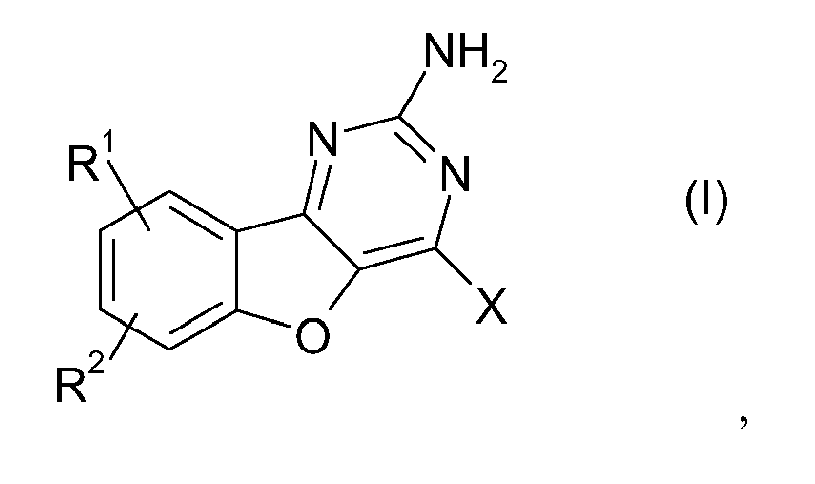
wherein R1, R2 and X have the meaning as indicated in the description and claims. Said compounds are useful as key intermediates for the preparation of the related pharmaceutically active compounds or as active compounds.
Description
- 4-Substituted 2-amino-benzo[4,5]furo[3,2-d]pyrimidine derivatives are potential active compounds useful as medicament or prodrug.
- For example selected compounds of this class are histamine H4 receptor modulators and therefore useful for the preparation of a medicament for the treatment or prevention of conditions mediated by said receptor. This includes the treatment of inflammatory disorders.
- The European patent application with the filing number
06101510.3 - Furthermore selected compounds of this class are protein kinase inhibitors and therefore useful for the preparation of a medicament for the treatment or prevention of conditions mediated by said kinases. This includes the treatment of cancer.
-
WO-A 2005/037825 discloses different classes of compounds including 4-substituted 2-amino-benzo[4,5]furo[3,2-d]pyrimidine derivatives. However, no synthesis is described in detail for this group of compounds. - A key step in the synthesis of said compounds is the formation of the tricycle having a pyrimidine ring with an amino group in 2-position, which is already functionalized at the 4-position as an anchor for the addition of further substituents, like nitrogen containing heterocycles.
- In principle, this tricycle can be formed by the intramolecular cyclization of the corresponding 4-substituted 2-amino-5-bromo-6-(2-hydroxyphenyl)-pyrimidine derivative.
- However there is a need for alternative routes for the formation of said tricycles, which are more convenient with regard to overall yield, purity and the like.
- Thus, an object of the present invention is to provide a process for the preparation of 4-substituted 2-amino-benzo[4,5]furo[3,2-d]pyrimidine derivatives to form compounds suitable as key intermediates for the preparation of the aforementioned active compounds or to form these active compounds.
- Accordingly, the present invention provides a process for the preparation of a compound of formula (I)

- R1, R2 are independently selected from the group consisting of H; F; Cl; Br; C1-4 alkyl; and OC1-4alkyl, wherein each C1-4 alkyl is optionally substituted with one or more halogen; and
- X is OH;
- (a0) reacting a compound of formula (II)

- R1, R2 are independently selected from the group consisting of H; F; Cl; Br; C1-4 alkyl; and OC1-4 alkyl, wherein each C1-4 alkyl is optionally substituted with one or more halogen; and
- R3 is C1-4 alkyl;
- It was found, that the reaction of compounds of formula (II) with chloroformamidine (H2NC(NH)Cl) or a salt thereof gives the desired 4-substituted tricycle in good yield and purity, wherein the substituent in 4-position is a hydroxyl group which is suitable for further derivatization.
- Compounds of formula (I) may also appear at least in part in the keto form.
- The groups R1, R2 are independently selected from the group consisting of H; F; Cl; Br; C1-4 alkyl; and OC1-4alkyl.
- Within the meaning of the present invention C1-4 alkyl is methyl, ethyl, n-propyl, i-propyl, n-butyl, i-butyl, sec-butyl or tert-butyl. Preferably C1-4 alkyl is methyl or ethyl.
- For R1, R2 the C1-4 alkyl or OC1-4 alkyl group is optionally substituted with one or more halogen. In case more halogen atoms are present these can be the same or different.
- Within the meaning of the present invention halogen means fluoro, chloro, bromo or iodo, preferably halogen is fluoro or chloro, especially fluoro.
- Examples for halogenated groups for R1, R2 are CH2F, CH2Cl, CHF2, CF3, CF2CF3, OCF3.
- In step (a0) of the process according to the present invention a compound of formula (II) is reacted with chloroformamidine or a salt thereof. Suitable salts are known in the art and include hydrohalides, like hydrochlorides. A convenient method for the preparation of the chloroformamidine includes the reaction of cyanamide with a solution containing hydrogen chloride or with gaseous hydrogen chloride.
- In a preferred embodiment the chloroformamidine or a salt thereof is added in step (a 0) to a solution of the compound of formula (II) in a solvent.
- Furthermore it is preferred that the cholorformamidine or a salt thereof is added at a temperature in the range of 50°C to 150°C. It is possible that the temperature varies during the addition. However it is preferred that the temperature is constant. Preferably the temperature is in the range of 80°C to 120°C and even more preferred the temperature is about 100°C ± 10°C, preferably ± 5°C.
- After completion of the addition the temperature for the remaining reaction time is preferably in the range of 125°C to 185°C. It is possible that the temperature varies during the remaining reaction time. However it is preferred that the temperature is constant after having reached the desired temperature. Preferably the temperature is in the range of 140°C to 180°C and even more preferred the temperature is about 160°C ± 10°C, preferably ± 5°C.
- The temperature during the addition of the chloroformamidine or salt thereof and the temperature for the remaining reaction time may be the same of different. It is preferred that the temperatures are different. Preferably, the difference is at least 10°C, more preferred at least 25°C and even more preferred at least 50°C, wherein the temperature during the addition is the lower one.
- The solvent which can be used to solve the compound of formula (II) can be selected to have a boiling point which is high enough to carry out the reaction for the desired temperature.
- Suitable solvents are glycols and polyols which optionally include ether bridges and ethers thereof and other high boiling solvents. Solvents with only one component can be used as well as mixtures of different solvents. Examples of suitable solvents are benzonitrile, ethylene glycol, diethylene glycol, triethylene glycol, triethylene glycol dimethyl ether, dimethylsulfoxide, sulfolane or a mixture of at least two of them. It is also possible to use a mixture of three, four or more components of the solvent. A preferred solvent is sulfolane.
- The reaction time may vary and is dependent upon the amount of added chloroformamidine or salt thereof. Normally, a reaction time in the range of 5 minutes to 24 hours is sufficient.
- Preferably the reaction time is less than 12 hours, more preferred less than 6 hours, even more preferred less than 3 hours.
- The compound of formula (II) may be prepared by the cyclization of the respective alkoxycarbonylmethoxy benzonitrile.
- Accordingly, in a preferred embodiment the compound of formula (II) is prepared in a preceding step of
- (a -1) cyclizing of a compound of formula (III)

- R1, R2 are independently selected from the group consisting of H; F; Cl; Br; C1-4 alkyl; and OC1-4 alkyl, wherein each C1-4 alkyl is optionally substituted with one or more halogen; and
- R3 is C1-4 alkyl.
- Thus, a preferred process according to the present invention comprises the steps (a -1) and (a 0).
- The cyclization can be carried out by methods generally known in the art. Normally a strong base is used, like alkoxylate salts, e.g. KOtBu.
- The compound of formula (III) may be prepared by the dehydration of the respective acid amide.
- Accordingly, in a preferred embodiment the compound of formula (III) is prepared in a preceding step of
- (a -2) dehydrating of a compound of formula (IV)

- R1, R2 are independently selected from the group consisting of H; F; Cl; Br; C1-4 alkyl; and OC1-4alkyl, wherein each C1-4 alkyl is optionally substituted with one or more halogen; and
- R3 is C1-4 alkyl.
- Thus, a preferred process according to the present invention comprises the steps (a -2), (a -1) and (a o).
- As a dehydration agent it is preferred to use POCl3. However other suitable dehydration agents are applicable and known in the art for the general conversion of an acid amide to a nitrile. Examples are described in March, Jerry; Advanced Organic Chemistry; Reactions, Mechanisms, and Structure; Wiley 1992; chapter 17, reaction 7-39.
- Compounds of formula (IV) are available by reacting the appropriately 2-hydroxybenzamide with alkyl chloroacetate.
- It was found that the introduction of the alkoxycarbonylmethoxy group is more convenient when reacting the benzamide with the choroacetate rather than using the corresponding nitrile.
- The 2-hydroxybenzamides may be commercially available or readily prepared starting with the corresponding salicylic acids or esters thereof. The preparation of methyl 5-chlorosalicylate is, e.g., described by R.D. Youssefyeh et al., J. Med. Chem. 35 (1992), 895-903.
- As mentioned above the key intermediate of formula (I) can be prepared in step (a 0) of the process according to the present application. These compounds have a hydroxyl group in 4-position to introduce other substituents by way of substitution.
- In a preferred embodiment the hydroxyl group in 4-position of the compound of formula (I) (X = OH) is converted into the chloro derivative using POCl3. This is advantageous for the introduction of nitrogen containing heterocycles via a nitrogen ring atom.
- Accordingly, in a preferred embodiment the process according to the present invention further comprises the step of
- (a 1) reacting a compound of formula (I)

- R1, R2 are independently selected from the group consisting of H; F; Cl; Br; C1-4 alkyl; and OC1-4alkyl, wherein each C1-4 alkyl is optionally substituted with one or more halogen; and
- X is OH;

- R1, R2 are independently selected from the group consisting of H; F; Cl; Br; C1-4 alkyl; and OC1-4 alkyl, wherein each C1-4 alkyl is optionally substituted with one or more halogen; and
- XisCl.
- Thus, a preferred process according to the present invention comprises the steps (a 0) and (a 1). Yet another preferred process according to the present invention comprises the steps of (a -1), (a 0) and (a 1). Yet another preferred process according to the present invention comprises the steps of (a -2), (a -1), (a0) and (a 1).
- The substitution of the hydroxyl group by a chloro group for comparable heterocyclic aromatic systems (activated systems) is known in the art and described in, e.g., March, Jerry; Advanced Organic Chemistry; Reactions, Mechanisms, and Structure; Wiley 1992; chapter 13, reaction 3-8.
- Compounds of formula (I), wherein X is chloro are suitable intermediates to introduce nitrogen containing heterocycles by way of substitution. This may lead to active compounds, probably after activation/deactivation and/or protection/deprotection of functional groups which are suitable for the preparation of a medicament.
- Accordingly, in a preferred embodiment the process according to the present invention further comprises the steps of
- (a2) reacting a compound of formula (I)

- R1, R2 are independently selected from the group consisting of H; F; Cl; Br; C1-4 alkyl; and OC1-4 alkyl, wherein each C1-4 alkyl is optionally substituted with one or more halogen; and
- X is Cl;

- R4, R5 are independently selected from the group consisting of H; C1-4 alkyl; and C3-6 cycloalkyl, wherein each C1-4 alkyl, C3-6 cycloalkyl is optionally substituted with one or more halogen;
- Optionally at least one of R4, R5 is a protective group resistant to the reaction conditions of step (a2);
- n is 1 or 2;
- m is 0, 1 or 2; and
- (a 3) optionally removing the protective group;
- R1, R2 are independently selected from the group consisting of H; F; Cl; Br; C1-4 alkyl; and OC1-4alkyl, wherein each C1-4 alkyl is optionally substituted with one or more halogen; and
- R4, R5 are independently selected from the group consisting of H; C1-4 alkyl; and C3-6 cycloalkyl, wherein each C1-4 alkyl, C3-6 cycloalkyl is optionally substituted with one or more halogen;
- n is 1 or 2; and
- m is 0, 1 or 2.
- Thus, a preferred process according to the present invention comprises the steps (a 0), (a 1), (a 2) and optionally (a 3). Yet another preferred process according to the present invention comprises the steps of (a -1), (a 0), (a 1), (a 2) and optionally (a 3). Yet another preferred process according to the present invention comprises the steps of (a -2), (a -1), (a 0), (a1), (a 2) and optionally (a 3).
- The groups R4, R5 are independently selected from the group consisting of H; C1-4 alkyl; and C3-6 cycloalkyl.
- Within the meaning of the present invention C3-6 cycloalkyl is cyclopropyl, cyclobutyl, cyclopentyl, cyclohexyl or cycloheptyl. Preferably C3-6 cycloalkyl is cyclopropyl.
- For R4, R5 the C1-4 alkyl or C3-6 cycloalkyl group is optionally substituted with one or more halogen. In case more halogen atoms are present these can be the same or different.
- Within the meaning of the present invention halogen means fluoro, chloro, bromo or iodo, preferably halogen is fluoro or chloro, especially fluoro.
- Examples for halogenated groups for R4, R5 are CH2F, CH2CI, CHF2, CF3, CF2CF3, or 2-fluoro-cycloprop-1-yl.
- Optionally at least one of R4, R5 is a protective group resistant to the reaction conditions of step (a2). Suitable protective groups for an amino group are known in the art and described in, e.g., Greene, Theodora W; Wuts, Peter G; Protective Groups in Organic Synthesis; Wiley 1999. An example for a suitable protective group is the tert.-butyloxycarbonyl (BOC) group.
- In case a protective group is used step (a2) is followed by an additional step (a3) to remove the protective group, if desired.
- Compounds of formula (VI) are suitable as histamine H4 receptor modulators.
-

- To 750 ml methanol (MeOH) is added thionyl chloride (165.0 ml, 269.11 g, 2.26 mol, 1.3 eq) dropwise maintaining the temperature within the range from (+15)-(+20) °C. After the addition is complete, the solution is treated with 5-chlorosalicylic acid (300 g, 1.74 mol, 1.0 eq) and heated at reflux overnight and a small amount of thionyl chloride (16.5 ml, 26.91 g, 226.13 mmol, 0.13 eq) is added to reach full conversion and stirred further at reflux temperature for an hour. The cooled reaction mixture is concentrated under vacuum to give a beige solid.
- This material is used in the next step without purification.
-

- To a solution of ammonia (400 ml, 25%) is added methyl 5-chlorosalicylate (87.7 g, 470.0 mmol, 1 eq) in few portions between (0)-(+10) °C. Thus obtained white suspension is stirred further at room temperature overnight, a clear solution is obtained which is cooled down and acidified to pH=6 with acetic acid (300 ml). The precipitated material is filtered off, washed with water and dried in vacuo at 60 °C to almost dryness then suspended in 2-propanol (200 ml), filtered and dried (vacuo, 60°C), a beige solid is obtained (58.6 g, 341.53 mmol, 72.67%).
- 1H NMR (DMSO-d6): 6.92 (d, 1H), 7.43 (dd, 1H), 7.95 (d, 1H), 8.05 (br s, 1H), 8.47 (br s, 1H); DMSO = dimethylsulfoxide
-
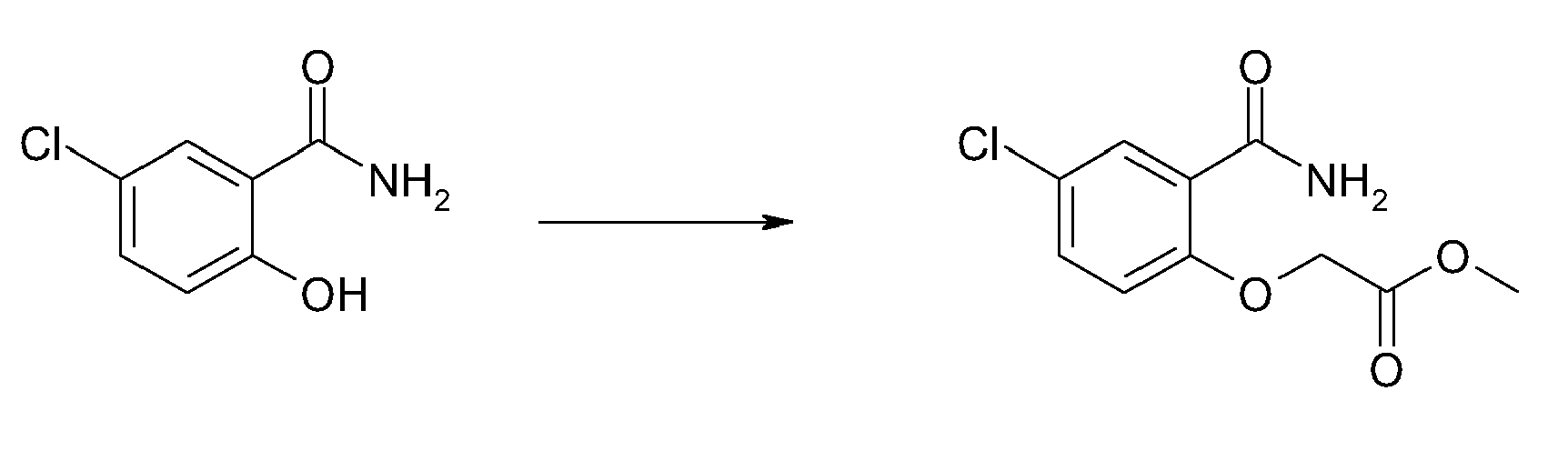
- 5-Chloro-2-hydroxybenzamide (87.31 g, 508.86 mmol, 1 eq) is dissolved in 330 ml of dry N,N-dimethyl formamide (DMF) K2CO3 (105.5 g, 763.33 mmol, 1.5 eq) then methyl chloroacetate (48.98 ml, 60.64 g, 558.79 mmol, 1.1 eq) is added at room temperature. The reaction mixture is stirred overnight; then it is poured onto ice-water (1200 ml) and the precipitate is filtered, washed with 2-propanol and dried in vacuo at 60 °C. A white solid is obtained (80.61 g, 330.84 mmol, 65.02%).
- 1H NMR (DMSO-d6): 3.73 (s, 3H), 4.98 (s, 2H), 7.15 (d, 1H), 7.52 (dd, 1H), 7.82 (m, 2H), 7.99 (brs, 1H)
-

- To a suspension of 5-chloro-2-(methoxycarbonylmethoxy)benzamide (80.61 g, 330.84 mmol, 1 eq) in acetonitrile (250 ml) is added POC13 (47.8 ml, 78.63 g, 496.62 mmol, 1.5 eq) at reflux temperature and the reaction mixture is heated at reflux for half an hour. The cooled reaction mixture is poured into ice-water (300 ml), the precipitated white product is filtered, washed with water (2x100 ml) and dried in vacuo at 65 °C. The nitrile (63.2 g, 280.10 mmol, 84.66 %) is obtained as a white crystalline compound.
- 1H NMR (DMSO-d6): 3.71 (s, 3H), 5.06 (s, 2H), 7.23 (d, 1H), 7.69 (dd, 1H), 7.93 (d, 1H)
-

- To a suspension of potassium tert.-butanolate (KOtBu) (5.22 g, 46.52 mmol, 1.05 eq) in 200 ml dry tetrahydrofuran (THF) is added carefully a solution of 5-chloro-2-(methoxycarbonylmethoxy)benzonitrile (10.00 g, 44.32 mmol, 1.0 eq) in dry THF (200 ml) over a period of half an hour maintining the temperature at 0-10 °C. After the addition is complete, the progress of the reaction is monitored by TLC until it is complete. The reaction mixture is poured onto ice (400 g), acidified with 2M HCl solution to pH=7 and diluted with water (1600 ml), the product is precipitated and filtered off. A light purple solid (6.95 g, 30.80 mmol, 69.49%) is obtained, mp.: 152.7-153 °C.
- 1H NMR (CDCl3): 3.97 (s, 3H), 4.98 (br s, 2H), 7.38 (m, 2H), 7.54 (m, 1H); CDCl3 = chloroform-d1
-

- A solution of cyanamide (50.0g, 1.19 mol, 1 eq) in diethylether (900 ml) is cooled to 0 °C and then hydrogen chloride in diethyl ether (450 g, 29%) is added maintaining the temperature below +5 °C. After the addition is complete, the obtained white suspension is stirred further at room temperature for a short time, the white precipitate is filtered off and dried in vacuo at 30 °C. A white solid (132.66 g, 1.15 mol, 96.64%) is obtained.
-

- To a solution of 3-amino-5-chlorobenzofuran-2-carboxylic acid methyl ester (5.0 g, 22.16 mmol, 1 eq) in sulfolane (25 ml) is added chloroformamidine hydrochloride (3.82 g, 33.24 mmol, 4.5 eq) at 100 °C and the reaction mixture is stirred further at 160 °C for an hour, it is cooled down to 50 °C and diluted with methanol (75 ml), the precipitated product is filtered off, dried in vacuo at 80°C. A yellowish solid (3.85 g, 16.34 mmol, 73.73%) is obtained.
- 1H NMR (DMSO-d6): 7.67 (dd, 1H), 7.82 (d, 1H), 8.06 (d, 1H)
-

- 2-Amino-8-chloro-3H-benzo[4,5]furo[3,2-d]pyrimidin-4-one (5.0 g, 21.2 mmol, 1.0 eq) and tetramethylammonium chloride (3.6 g, 31.8 mmol, 1.5 eq) are suspended in acetonitrile (90 ml), cooled to 15°C and phosphorus oxychloride (11.8 ml, 19.3 g, 125.8 mmol, 5.9 eq) is added at 15-20°C (10 min). The resulting mixture is refluxed for 3 hrs. After disappearance of the starting material (montoring by TLC) the reaction mixture is poured onto a mixture of crushed ice and 45 saturated aq. Na2CO3 solution (45 ml) and the pH was adjusted to 6-7. The precipitated product is filtered, washed with water, suspended in 2-propanol (20 ml), stirred for 10 min then filtered, the solid material is washed with 2-propanol (10 ml) and dried in vacuo at 30°C. A yellowish solid (4.7 g, 87.7%) is obtained.
-

- A suspension of2-amino-4,8-dichlorobenzo[4,5]furo[3,2-d]pyrimidine (34.79 g, 136.92 mmol, 1.0 eq) in IPA (550 ml) is treated with N,N-diisopropylethylamine (47.70 ml, 35.39 g, 273.83 mmol, 2.0 eq) followed by a solution of (R)-3-[(N-tert-butoxycarbonyl)-N-methyl] aminopyrrolidine (31.53 g, 137.90 mmol, 1.0 eq, 87.6%) and stirred at room temperature overnight. The reaction mixture is evaporated to dryness, the residue is dissolved in DCM (300 ml) and washed with water (200 ml), saturated NaHCO3 solution (200 ml) and water (200 ml), the organic layer is dried over Na2SO4 and evaporated to give a reddish solid (53.60 g, 128.26 mmol, 93. 7%).
- 1H NMR (CDCl3): d 1.5 (s, 9H), 2.1 (m, 1H), 2.2 (m, 1H), 2.85 (s, 3H), 3.75 (br, 2H), 4.1 (br, 2H), 4.8-5.0 (br, 3H), 7.45 (d, 1H), 7.5 (dd, 1H), 8.0 (d, 1H).
-

- A solution of tert-butyl [(R)-1-(2-amino-8-chlorobenzo[4,5]furo[3,2-d]pyrimidin-4-yl)pyrrolidin-3-yl] N-methyl carbamate (2.59g) and trifluoroacetic acid (40mL) in dichloromethane (70mL) is stirred at room temperature overnight. The mixture is evaporated to dryness and the residue is dissolved in methanol and loaded onto an Isolute® SCX-2 column eluting with methanol to remove the unwanted by-products then with a solution of ammonia in methanol (2M) to give the crude product. After evaporation, the residue is recrystallised from IMS to give [(R)-1-(2-amino-8-chlorobenzo[4,5]furo[3,2-d]-pyrimidin-4-yl)pyrrolidin-3-yl] N-methyl amine as an off-white solid.
- 1H NMR (DMSO-d6 80°C): d 1.8 (m, 1H), 2.1 (m, 1H), 2.35 (s, 3H), 3.3 (m, 1H), 3.6 (m, 1H), 3.8 (m, 1H), 3.9 (m, 2H), 5.7 (br s, 2H), 7.55 (dd, 1H), 7.65 (d, 1H), 7.85 (d, 1H).
LCMS (method A): retention time 3.92 minutes (M+H+) 318.

Claims (11)
- A process for the preparation of a compound of formula (I)
 R1, R2 are independently selected from the group consisting of H; F; Cl; Br; C1-4 alkyl; and OC1-4 alkyl, wherein each C1-4 alkyl is optionally substituted with one or more halogen; andX is OH;comprising the step of(a0) reacting a compound of formula (II)with chloroformamidine or a salt thereof.
 R1, R2 are independently selected from the group consisting of H; F; Cl; Br; C1-4 alkyl; and OC1-4alkyl, wherein each C1-4 alkyl is optionally substituted with one or more halogen; andR3 is C1-4 alkyl;
 - The process according to claim 1, wherein the chloroformamidine or a salt thereof is added in step (a0) to a solution of the compound of formula (II) in a solvent.
- The process according to claim 2, wherein the chloroformamidine or a salt thereof is added at a temperature in the range of 50°C to 150°C.
- The process according to claim 2 or 3, wherein the reacting after having completely added the chloroformamidine or a salt thereof is carried out at temperature in the range of 125°C to 185°C.
- The process according any one of claims 2 to 4, wherein the solvent is benzonitrile, ethylene glycol, diethylene glycol, triethylene glycol, triethylene glycol dimethyl ether, dimethylsulfoxide, sulfolane or a mixture of at least two of them.
- The process according to any one of claims 1 to 5, wherein the compound of formula (II) is prepared in a preceding step of(a -1) cyclizing of a compound of formula (III)
 R1, R2 are independently selected from the group consisting of H; F; Cl; Br; C1-4 alkyl; and OC1-4alkyl, wherein each C1-4 alkyl is optionally substituted with one or more halogen; andR3 is C1-4 alkyl.
 - The process according to claim 6, wherein the compound of formula (III) is prepared in a preceding step of(a -2) dehydrating of a compound of formula (IV)
 R1, R2 are independently selected from the group consisting of H; F; Cl; Br; C1-4 alkyl; and OC1-4alkyl, wherein each C1-4 alkyl is optionally substituted with one or more halogen; andR3 is C1-4 alkyl.
 - The process according to claim 7, wherein the dehydration is carried out using POC13.
- The process according to any one of claims 1 to 8, further comprising the step of(a1) reacting a compound of formula (I)with POCl3 to give a compound of formula (I)
 R1, R2 are independently selected from the group consisting of H; F; Cl; Br; C1-4 alkyl; and OC1-4 alkyl, wherein each C1-4 alkyl is optionally substituted with one or more halogen; andX is OH;
 R1, R2 are independently selected from the group consisting of H; F; Cl; Br; C1-4 alkyl; and OC1-4 alkyl, wherein each C1-4 alkyl is optionally substituted with one or more halogen; andX is Cl.
 - The process according to claim 9 further comprising the steps of(a 2) reacting a compound of formula (I)
 R1, R2 are independently selected from the group consisting of H; F; Cl; Br; C1-4 alkyl; and OC1-4alkyl, wherein each C1-4 alkyl is optionally substituted with one or more halogen; andX is Cl;with a compound of the formula (V)
 R4, R5 are independently selected from the group consisting of H; C1-4 alkyl; and C3-6 cycloalkyl, wherein each C1-4 alkyl, C3-6 cycloalkyl is optionally substituted with one or more halogen;Optionally at least one of R4, R5 is a protective group resistant to the reaction conditions of step (a2);n is 1 or 2;m is 0, 1 or 2; and(a3)optionally removing the protective group; to give a compound of formula (VI)
 R1, R2 are independently selected from the group consisting of H; F; Cl; Br; C1-4 alkyl; and OC1-4 alkyl, wherein each C1-4 alkyl is optionally substituted with one or more halogen; andR4, R5 are independently selected from the group consisting of H; C1-4 alkyl; and C3-6 cycloalkyl, wherein each C1-4 alkyl, C3-6 cycloalkyl is optionally substituted with one or more halogen;n is 1 or 2; andm is 0, 1 or 2.
 - The process according to claim 10, wherein the protective group is the tert.-butyloxycarbonyl group.
Priority Applications (3)
| Application Number | Priority Date | Filing Date | Title |
|---|---|---|---|
| EP06124539A EP1925619A1 (en) | 2006-11-22 | 2006-11-22 | Preparation of 4-substituted 2-amino-benzo[4,5]furo[3,2-d]pyrimidine derivatives |
| PCT/EP2007/062632 WO2008062013A1 (en) | 2006-11-22 | 2007-11-21 | Preparation of 4-substituted 2-amino-benzo[4,5]furo [3,2-d]pyrimidine derivatives |
| TW96144005A TW200837066A (en) | 2006-11-22 | 2007-11-21 | Preparation of 4-substituted 2-amino-benzo [4, 5]furo[3, 2-d]pyrimidine derivatives |
Applications Claiming Priority (1)
| Application Number | Priority Date | Filing Date | Title |
|---|---|---|---|
| EP06124539A EP1925619A1 (en) | 2006-11-22 | 2006-11-22 | Preparation of 4-substituted 2-amino-benzo[4,5]furo[3,2-d]pyrimidine derivatives |
Publications (1)
| Publication Number | Publication Date |
|---|---|
| EP1925619A1 true EP1925619A1 (en) | 2008-05-28 |
Family
ID=37891597
Family Applications (1)
| Application Number | Title | Priority Date | Filing Date |
|---|---|---|---|
| EP06124539A Withdrawn EP1925619A1 (en) | 2006-11-22 | 2006-11-22 | Preparation of 4-substituted 2-amino-benzo[4,5]furo[3,2-d]pyrimidine derivatives |
Country Status (3)
| Country | Link |
|---|---|
| EP (1) | EP1925619A1 (en) |
| TW (1) | TW200837066A (en) |
| WO (1) | WO2008062013A1 (en) |
-
2006
- 2006-11-22 EP EP06124539A patent/EP1925619A1/en not_active Withdrawn
-
2007
- 2007-11-21 WO PCT/EP2007/062632 patent/WO2008062013A1/en not_active Ceased
- 2007-11-21 TW TW96144005A patent/TW200837066A/en unknown
Non-Patent Citations (7)
| Title |
|---|
| DENNIS J. MCNAMARA, ELLEN M. BERMAN, DAVID W. FRY, LESLIE M. WERBEL: "Potent inhibition of thymidylate synthase by two series of nonclassical quinazolines", J. MED. CHEM., vol. 33, 1990, pages 2045 - 2051, XP002429217 * |
| EMMANUEL A. MEYER, MAYA FURLER, FRANCOIS DIEDERICH: "Synthesis and in vitro evaluation of 2-aminoquinazolin-4(3H)-one-based inhibitors for tRNA-guanine transglycosylase (TGT)", HELVETICA CHIMICA ACTA, vol. 87, 2004, pages 1333 - 1356, XP002429218 * |
| RONALD A. FORSCH, JOEL E. WRIGHT, ANDRE ROSOWSKY: "Synthesis and in vitro antitumour activity of thiophene analogues of 5-chloro-5,8-dideazafolic acid and 2-methyl-2-desamino-5-chloro-5,6-dideazafolic acid", BIOORGANIC & MEDICINAL CHEMISTRY, vol. 10, 2002, pages 2067 - 2076, XP002429216 * |
| STEPHEN E. WEBBER, TED M. BLECKMAN, JOHN ATTARD, JUDITH G. DEAL, VINIT KATHARDEKAR, KATHERINE M WELSH ET AL.: "Design of thymidylate synthase inhibitors using protein crystal structures: The synthesis and biological evaluation of a novel class of 5-substituted quinazolinones", J. MED. CHEM., vol. 36, 1993, pages 733 - 746, XP002429215 * |
| TERENCE R. JONES, RICHARD F. BETTERIDGE, DAVID R. NEWELL, ANN L. JACKMAN: "Synthesis and biological properties of 3-methyl-10-propargyl-5,8-dideazafolic acid", J. HETEROCYCLIC CHEM., vol. 26, 1989, pages 1501 - 1507, XP002429214 * |
| WAGNER G ET AL: "ERSTMALIGE SYNTHESE VON PYRIDO-FURO-PYRIMIDINEN MIT AM PYRIMIDINRING ANNELLIERTEN IMIDAZOLIN-REST FIRST SYNTHESIS OF PYRIDO-FURO-PYRIMIDINES WITH AN IMIDAZOLE RESIDUE ANNELLATED TO THE PYRIMIDINE RING", PHARMAZIE, DIE, GOVI VERLAG, ESCHBORN, DE, vol. 47, no. 11, 1992, pages 825 - 828, XP001207549, ISSN: 0031-7144 * |
| YADAV BODKE, S. S. SANGAPURE: "Synthesis and biological activity of some benzofuro[3,2-d]pyrimidines", J. INDIAN CHEM. SOC., vol. 80, 2003, pages 187 - 189, XP009081801 * |
Also Published As
| Publication number | Publication date |
|---|---|
| WO2008062013A1 (en) | 2008-05-29 |
| TW200837066A (en) | 2008-09-16 |
Similar Documents
| Publication | Publication Date | Title |
|---|---|---|
| CA2131680C (en) | Process for preparing imidazopyridine derivatives | |
| AU2015341788B2 (en) | Synthesis of copanlisib and its dihydrochloride salt | |
| CA2961984C (en) | Novel chiral synthesis of n-acyl-(3-substituted)-(8-substituted)-5,6-dihydro-[1,2,4]triazolo[4,3-a]pyrazines | |
| CA3219259A1 (en) | A novel process for the preparation of anthranilic diamides | |
| JP2002037787A (en) | Method for producing [1,2,4] triazolo [1,5-c] pyrimidine derivative | |
| Cho et al. | Synthesis of 4-unsubstituted dihydropyrimidines. Nucleophilic substitution at position-2 of dihydropyrimidines | |
| EP3827005B1 (en) | Pyridopyrimidines as histamine h4-receptor inhibitors | |
| US10562889B2 (en) | Process for the preparation of 1-(arylmethyl)quinazoline-2,4(1H,3H)-diones | |
| ZA200407821B (en) | Compounds useful in preparing camptothecin derivatives. | |
| EP1925619A1 (en) | Preparation of 4-substituted 2-amino-benzo[4,5]furo[3,2-d]pyrimidine derivatives | |
| Acero-Alarcón et al. | Unusual ring closure reaction of amides with pyrimidines: Novel stereoselective synthesis of hexahydroimidazo [1, 2-c] pyrimidines | |
| Ali et al. | Synthesis and reactions of 2, 6-bis [3-oxo-3-propanenitrile-2-(N, N-dimethylamino) methylene] pyridine | |
| AU2020397222B2 (en) | Process and intermediates for the production of formula (i) | |
| Miyamoto | Synthesis of nitrogen‐containing heterocycles 10. Reaction of 2‐amino‐1h‐imidazole derivatives with ethoxymethylene compounds | |
| Basyouni | Synthesis of novel substituted [1, 2, 4] triazolo [1, 5-a] pyridines and their related pyrano [2, 3-d] imidazole derivativs | |
| TWI719620B (en) | 6-AMINOPYRAZOLO[3,4-d]PYRIMIDINES AND PROCESSES FOR THEIR PREPARATION | |
| US20030114414A1 (en) | Methods for synthesizing substituted pyrimidines | |
| CN111989331B (en) | Synthesis method of 2- [ (2S) -1-azabicyclo [2.2.2] oct-2-yl ] -6- (3-methyl-1H-pyrazol-4-yl) thieno [3,2-d ] pyrimidine-4 (3H) -ketone | |
| Carr et al. | A novel approach to functionalised 5, 7, 8, 9-tetrahydropyrimido [4, 5-b][1, 4] diazepin-6-ones using intramolecular palladium-catalysed amidation | |
| Guillard et al. | Synthesis and Biological Evaluations of New Pyrrolo (2, 3-b) pyrimidine as SDI Analogs | |
| Barsy | Studies on Polyfunctionalised Heteroaromatics: Synthesis of Several New Cinnoline and Pyrido [3, 4‐c] pyridazine Derivatives | |
| WO2002102769A2 (en) | Methods for synthesizing substituted pyrimidines | |
| Arava et al. | New reagents from “N, N-Dimethylaminomethoxy methylenium methyl sulphate”-Synthesis of 3-Amino-4-cyano pyrazole | |
| Biagi et al. | New C (2)‐substituted 8‐alkylsulfanyl‐9‐phenylmethyl‐hypoxanthines III | |
| EA044615B1 (en) | PYRIDO PYRIMIDINES AS H4-HISTAMINE RECEPTOR INHIBITORS |
Legal Events
| Date | Code | Title | Description |
|---|---|---|---|
| PUAI | Public reference made under article 153(3) epc to a published international application that has entered the european phase |
Free format text: ORIGINAL CODE: 0009012 |
|
| AK | Designated contracting states |
Kind code of ref document: A1 Designated state(s): AT BE BG CH CY CZ DE DK EE ES FI FR GB GR HU IE IS IT LI LT LU LV MC NL PL PT RO SE SI SK TR |
|
| AX | Request for extension of the european patent |
Extension state: AL BA HR MK RS |
|
| AKX | Designation fees paid | ||
| STAA | Information on the status of an ep patent application or granted ep patent |
Free format text: STATUS: THE APPLICATION IS DEEMED TO BE WITHDRAWN |
|
| 18D | Application deemed to be withdrawn |
Effective date: 20081129 |
|
| REG | Reference to a national code |
Ref country code: DE Ref legal event code: 8566 |