EP1925615A1 - Method of fluorine-18 labelling of tropane derivatives - Google Patents
Method of fluorine-18 labelling of tropane derivatives Download PDFInfo
- Publication number
- EP1925615A1 EP1925615A1 EP20060291762 EP06291762A EP1925615A1 EP 1925615 A1 EP1925615 A1 EP 1925615A1 EP 20060291762 EP20060291762 EP 20060291762 EP 06291762 A EP06291762 A EP 06291762A EP 1925615 A1 EP1925615 A1 EP 1925615A1
- Authority
- EP
- European Patent Office
- Prior art keywords
- compound
- formula
- alkyl
- fluoride
- oso
- Prior art date
- Legal status (The legal status is an assumption and is not a legal conclusion. Google has not performed a legal analysis and makes no representation as to the accuracy of the status listed.)
- Granted
Links
- 0 CCC(CC1c2ccc(C)c(Cl)c2)N(C)*[C@@]1C=NOC Chemical compound CCC(CC1c2ccc(C)c(Cl)c2)N(C)*[C@@]1C=NOC 0.000 description 4
- LGSJMLROCNJIFK-IKFPGUIZSA-N Cc1ccc([C@@H](CC2N(C/C=C/CCl)C3CC2)C3C(OC)=O)cc1 Chemical compound Cc1ccc([C@@H](CC2N(C/C=C/CCl)C3CC2)C3C(OC)=O)cc1 LGSJMLROCNJIFK-IKFPGUIZSA-N 0.000 description 1
Classifications
-
- C—CHEMISTRY; METALLURGY
- C07—ORGANIC CHEMISTRY
- C07D—HETEROCYCLIC COMPOUNDS
- C07D451/00—Heterocyclic compounds containing 8-azabicyclo [3.2.1] octane, 9-azabicyclo [3.3.1] nonane, or 3-oxa-9-azatricyclo [3.3.1.0<2,4>] nonane ring systems, e.g. tropane or granatane alkaloids, scopolamine; Cyclic acetals thereof
- C07D451/02—Heterocyclic compounds containing 8-azabicyclo [3.2.1] octane, 9-azabicyclo [3.3.1] nonane, or 3-oxa-9-azatricyclo [3.3.1.0<2,4>] nonane ring systems, e.g. tropane or granatane alkaloids, scopolamine; Cyclic acetals thereof containing not further condensed 8-azabicyclo [3.2.1] octane or 3-oxa-9-azatricyclo [3.3.1.0<2,4>] nonane ring systems, e.g. tropane; Cyclic acetals thereof
Definitions
- the invention relates to a one-step [ 18 F]radiolabelling process of tropanamine derivatives which are useful for imaging the neuronal dopamine transporter (DAT) with Positron Emission Tomography (PET).
- DAT neuronal dopamine transporter
- PET Positron Emission Tomography
- the neuronal dopamine transporter a membrane-bound presynaptically located protein, plays a key role in regulating the synaptic concentration of dopamine at nerve terminals and thus dopamine neurotransmission in the brain.
- DAT density can be considered as a marker of the integrity and number of presynaptic striatal dopamine-producing neurons
- considerable efforts have been spent in recent years on the design and development of DAT-selective radioligands as in vivo Positron Emission Tomography (PET) imaging tools for the study of these illnesses and disorders as well as the evaluation of the degree of success of their treatment.
- PET Positron Emission Tomography
- Certain tropane-type derivatives including cocaine represent today the largest class of molecules ever developed for imaging the DAT with PET and therefore labelled with a positron-emitting radioisotope.
- fluorine-18 displays simple decay- and emission properties with a high 97% positron abundance.
- fluorine-18 has a relatively low positron energy (maximum 635 keV) and the shortest positron linear range in tissue (2.3 mm), resulting in the highest resolution in PET imaging. Its half-life (109.8 min) is long enough to give access to relatively extended imaging protocols compared to what is possible with carbon-11, therefore facilitating kinetic studies and high-quality plasma metabolite analysis.
- fluorine-18 allows for multi-step synthetic approaches that can be extended over hours.
- fluorine-18 can be reliably and routinely produced at the multi-Curie level, using the well-characterized (p,n) nuclear reaction on an oxygen-18-enriched water target on widely implemented biomedical cyclotrons of a relatively low-energy proton beam (e.g., 18 MeV).
- This distinctive advantage combined with its favourable half-life, permits the transport and the use of fluorine-18-labelled radiopharmaceuticals (such as the archetype [ 18 F]FDG) at 'satellite' PET units without an on-site cyclotron production facility.
- LBT-999 (1,8-((E)-4-fluoro-but-2-enyl)-3 ⁇ -p-tolyl-8-aza-bicyclo[3.2.1]octane-2 ⁇ -carboxylic acid methyl ester) is a cocaine derivative belonging to a new generation of highly selective dopamine transporter (DAT) ligands (K D : 9 nM and IC50 > 1000 nM for the serotonine and norepinephrine transporters).
- DAT dopamine transporter
- LBT-999 has been successfully labelled with the positron-emitter carbon-11 (half-life: 20.38 min) at its methyl ester function from the corresponding carboxylic acid precursor and the methylation reagent [ 11 C]methyl triflate (Dollé F. et al., 2006), permitting preliminary in vivo pharmacological evaluation of this radiotracer by both biodistributions in rodents and brain imaging in non-human primates with positron emission tomography (PET) (Chalon S. et al., 2006). Taken together, the results so far obtained demonstrate that LBT-999 is a highly promising candidate for in vivo exploration in humans of DAT, using PET (Chalon S. et al., 2006).
- LBT-999 permits also its labelling at its fluoromethylvinyl moiety with fluorine-18 (half-life: 109.8 min), today one of the most attractive positron-emitting radioisotopes for radiopharmaceutical chemistry.
- the robust and reliable pathway frequently proposed for the labelling with fluorine-18 of such molecules is a two-step radiochemical process, involving first the preparation of an appropriate halogeno or better sulphonyloxy [ 18 F]reagent.
- the radiosynthesis of n-bromo-, n-tosyloxy- and n-mesyloxy 1-[ 18 F]fluoroalkanes (n 1-3) from the corresponding bifunctional alkanes by nucleophilic aliphatic substitution with no-carrier-added [ 18 F]fluoride as its activated K[ 18 F]F-Kryptofix ® 222 complex (Coenen H.H.
- tropane derivatives (compound A-G, Table 2), like for example [ 18 F]FECNT and ⁇ -[ 18 F]CIT-FP. More recently, the radiosynthesis of both ( E )- and ( Z )-1-[ 18 F]fluoro-4-tosyloxybut-2-ene has also been briefly described and used for the first time for the preparation of ( E )-and (Z)-[ 18 F]FBCINT (compound H, Table 2) (Chen P. et al., 1999 ; Goodman M.M. et al., 2002).
- compounds of formula (II) are useful agents for preparing the [ 18 F]radioactively labelled compounds of formula (I). More specifically, these compounds allow to obtain the radiolabelled compounds of formula (I) in only one-step radiochemical process, with high radiolabelling yields and high radiochemical purity.
- the one-step radiochemical process referred herein also brings the following advantages, when compared to the classical two-step process described above. It first allows to use only one precursor for labelling (compounds of formula II) instead of two precursors for labelling. Further, these precursors of formula (II) may be used in limited amounts (typically 2-5 mg) as compared to the two-step radiochemical process disclosed in the prior art which generally both requires a large excess and high amounts (typically ⁇ 20 mg) of the nortropamine derivative. Therefore, it also reduces the level of impurities in the radiolabelled compounds of formula (I). This one-step process also makes the synthesis of compounds of formula (I) easier and faster, allowing a more robust automation. This one-step process also makes the synthesis of compounds of formula (I) safer by reducing notably the exposure to the radioactivity.
- this one-step process allows to prepare [ 18 F]radiolabelled compounds of formula (I) with an higher radioactivity level, which is particularly useful for PET imaging.
- the invention is directed to the compounds of formula (II): wherein:
- the leaving group X may be a OSO 2 R 5 group, preferably selected from OSO 2 -C 6 H 4 -CH 3 , OSO 2 -C 6 H 4 -Br, OSO 2 -C 6 H 4 -NO 2 , OSO 2 -CH 3 , OSO 2 -CF 3 , OSO 2 -C 4 F 9 or OSO 2 -CH 2 -CF 3 .
- OSO 2 -C 6 H 4 -CH 3 , OSO 2 -CF 3 , OSO 2 -CH 3 commonly designates as tolyloxy (OTs), mesyloxy (OMs) and trifyloxy (OTf) respectively, are particularly preferred.
- X is Cl, Br, I, more preferably X is Cl.
- R 1 and R 2 are independently selected from H and C 1 -C 4 alkyl, notably methyl or ethyl. More preferably, R 1 and R 2 are H.
- Z is trans (E).
- m is 1.
- n 1
- the invention relates to compounds of formula (IIa): wherein X, R 3 , R 4 and p are as defined above.
- R 3 is C 1 -C 4 alkyl, more preferably methyl, ethyl or isopropyl, most preferably methyl.
- R 4 may be C 1 -C 6 alkyl, more preferably C 1 -C 4 alkyl, notably a methyl group.
- p is 1 and R 4 is located in the para position on the phenyl ring.
- the compound of formula (IIa) is the N-( E -4-chloro-but-2-enyl)-3 ⁇ -(4-methylphenyl)nortropane-2 ⁇ -carboxylic methyl ester.
- the invention also relates to a method for preparing a [ 18 F]radiolabelled compound of formula (I): wherein, Z, R 3 , R 4 , m, n and p are as defined above, comprising the steps of:
- sources of 18 F anions there is no particular restriction on the nature of the sources of 18 F anions to be used in this reaction, and any sources of 18 F anions conventionally used in reactions of this type may equally be used here, provided that it has no adverse effect on other parts of the molecule.
- suitable sources of 18 F anions include: alkali metal [ 18 F]fluorides, such as sodium [ 18 F]fluoride, potassium [ 18 F]fluoride, cesium [ 18 F]fluoride; ammonium [ 18 F]fluoride, tetraalkylammonium [ 18 F]fluorides, such as tetrabutylammonium [ 18 F]fluoride.
- alkali metal [ 18 F]fluorides such as sodium [ 18 F]fluoride, potassium [ 18 F]fluoride, cesium [ 18 F]fluoride
- ammonium [ 18 F]fluoride such as sodium [ 18 F]fluoride
- potassium [ 18 F]fluoride cesium [ 18 F]fluoride
- ammonium [ 18 F]fluoride such as sodium [ 18 F]fluoride
- potassium [ 18 F]fluoride cesium [ 18 F]fluoride
- ammonium [ 18 F]fluoride such as sodium [ 18 F]fluoride
- the source of 18 F anions may be activated by the presence of a ligand able to complex the counter cationic species of the source of 18 F anions.
- the ligand may be notably a cyclic or polycyclic multidentate ligand.
- Suitable ligands include notably crown ethers such as 1,4,7,10,13-pentaoxacyclooctadecane (18C6) or cryptands such as 4,7,13,16, 21,24-hexaoxa-1,10-diazabicyclo-[8,8,8]hexacosane sold under the name K222 ® .
- the source of 18 F anions is an alkaline metal [ 18 F]fluoride-cryptate complex, notably a potassium [ 18 F]fluoride-cryptate complex, preferably the potassium [ 18 F]fluoride - 4,7,13,16,21,24-hexaoxa-1,10-diazabicyclo-[8,8,8]hexacosane (K[ 18 F]/K222).
- the complex K[ 18 F]/K222 ® may be prepared by any conventional methods, for example as disclosed in F. Dollé et al., 1999; L. Dolci et al., 1999.
- the method for preparing the [ 18 F]radiolabelled compound of formula (I) can take place over a wide range of temperatures, and the precise reaction temperature is not critical to the invention. In general, it is convenient to carry out the reaction at a temperature of from about 50°C to about 150°C (more preferably, from about 80°C to about 100°C).
- the time required for the reaction may also vary widely, depending on many factors, notably the reaction temperature and the nature of the reagents. However, provided that the reaction is effected under the preferred conditions outlined above, a period of from about 5 minutes to about 15 minutes will usually suffice.
- the compound thus prepared may be recovered from the reaction mixture by conventional means.
- the compounds may be recovered by filtration on a pre-packed separation column.
- the product can, if desired, be further purified by various well known techniques, such as chromatography techniques, notably High Performance Liquid Chromatography (HPLC).
- chromatography techniques notably High Performance Liquid Chromatography (HPLC).
- the invention also relates to a method for preparing a compound of formula (II) as defined above, comprising the steps of:
- bases there is no particular restriction on the nature of the base to be used in this reaction, and any base conventionally used in reactions of this type may equally be used here, provided that it has no adverse effect on other parts of the molecule.
- suitable bases include alkylamines, such as triethylamine.
- solvents there is no particular restriction on the nature of the solvent to be employed, provided that it has no adverse effect on the reaction or on the reagents involved.
- appropriate solvents include notably polar solvents such as acetonitrile.
- the invention relates to a compound of formula (IIIa): wherein X is Cl, Br, I and Y is OSO 2 R 5 , R 5 , m and n being as defined above.
- m and n are 1.
- the stereochemistry of (IIIa) is trans.
- Y is OSO 2 (C 6 H 4 )CH 3 (tolyloxy), notably p-tolyloxy.
- X is Cl.
- the compound of formula (IIIa) is the E-1-chloro-4-tosyloxy-2-butene.
- the invention also relates to the use of a compound of formula (II) as defined above for preparing a compound of formula (I) as defined above.
- the invention also relates to a kit for the preparation of a [ 18 F]radioactively labelled compound of formula (I), comprising:
- the kit can include items of apparatus, such as a reaction vessel, device for transferring isotopic material to the reaction vessel, pre-packed separation column for separating product from excess reactants, shielding and the like, as known in the art.
- apparatus such as a reaction vessel, device for transferring isotopic material to the reaction vessel, pre-packed separation column for separating product from excess reactants, shielding and the like, as known in the art.
- alkyl refers to a straight-chain, or branched alkyl group having 1 to 6 carbon atoms, such as methyl, ethyl, propyl, isopropyl, butyl, isobutyl, sec-butyl, tert-butyl, pentyl, isoamyl, neopentyl, 1-ethylpropyl, 3-methylpentyl, 2,2-dimethylbutyl, 2,3-dimethylbutyl, hexyl, etc.
- Preferred alkyl groups are those which contain 1 to 4 carbons.
- a designation such as "C 1 -C 4 alkyl” refers to an alkyl radical containing from 1 to 4 carbon atoms.
- cycloalkyl refers to a saturated or partially saturated mono- or bicyclic alkyl ring system containing 3 to 8 carbon atoms.
- a designation such as “C 5 -C 7 cycloalkyl” refers to a cycloalkyl radical containing from 5 to 7 ring carbon atoms.
- Preferred cycloalkyl groups include those containing 5 or 6 ring carbon atoms. Examples of cycloalkyl groups include such groups as cyclopropyl, cyclobutyl, cyclopentyl, cyclohexyl, cycloheptyl, cyclooctyl.
- aryl refers to a substituted or unsubstituted, mono- or bicyclic hydrocarbon aromatic ring system having 6 to 12 ring carbon atoms. Examples include phenyl and naphthyl. Preferred aryl groups include unsubstituted or substituted phenyl and naphthyl groups.
- stable compound or “stable structure” refers to a compound that is sufficiently robust to survive isolation to a useful degree of purity from a reaction mixture.
- stereoisomeric forms refers notably to the cis and trans isomeric forms.
- the starting materials and intermediates of compounds useful according to the invention may be prepared by the application or adaptation of known methods, for example methods as described in the Examples or their obvious chemical equivalents.
- the strategy of synthesis was the reaction between the 3 ⁇ -(4-methylphenyl)-nortropane-2 ⁇ -carboxylic methyl ester (4) and a sulphonate derivative.
- the 2-butyne-1,4-diol (5) was reduced to the E -2-butene-1,4-diol (6) by LiAlH 4 according to the procedure described by Kayaleh et al., 2000).
- the E -2-butene-1,4-diol (6) was refluxed in CCl 4 in presence of triphenylphosphine to give the mono chlorinated derivative (7) which was transformed to the tosylate derivative (8).
- This compound reacted with the nortropane derivative (4) to give the chloro derivative (9).
- the reaction vessel was cooled (ice-water bath) and the remaining radioactivity was measured, which was 96% to over 99% of the initial radioactivity.
- the radiochemical yields of fluorine-18 incorporation calculated from the TLC-radiochromatogram and defined as the ratio of radioactivity area of [ 18 F]- 10 over total fluorine-18 radioactivity area, were about 30% to 40%.
- [ 18 F]- 10 ( t R : 12.5-13.5 minutes) could be obtained with a >95% chemically and radiochemically purity and was ideally separated within a short total purification time (less than 20 minutes) from the non-labelled chloro-derivative 9 ( t R : 15.5-17.5 minutes), as well as from an unidentified fluorine-18-labelled impurity at t R : 14.0-15.0 minutes (up to 10% compared to [ 18 F]-10).
- the highly selective dopamine transporter ligand LBT-999 ( 10 , 8-(( E )-4-fluoro-but-2-enyl)-3 ⁇ - p -tolyl-8-aza-bicyclo[3.2.1]octane-2 ⁇ -carboxylic acid methyl ester) has been labelled in one radiochemical step with fluorine-18 at its fluoromethylvinyl moiety.
- No-carrier-added aqueous [ 18 F]fluoride ion was produced via the [18O(p,n) 18 F] nuclear reaction by irradiation of a 2 mL [ 18 O]water (> 97%-enriched, CortecNet, Paris, France) target on a IBA Cyclone-18/9 cyclotron (18 MeV proton beam) and was transferred to the appropriate hot cell.
- Target hardware commercial, 2-mL, two-port, stainless steel target holder equipped with a domed-end niobium cylinder insert.
- Target to hot cell liquid-transfer system 60 m PTFE line (0.8 mm internal diameter ; 1/16 inch external diameter), 2.0 bar He drive pressure, transfer time 3-6 min.
- the 2 mL of aqueous [ 18 F]fluoride from the target holder were passed through an anion exchange resin (Sep-pak ® Light Waters Accell TM Plus QMA cartridge (initially in the chloride form, then washed with aq. 1M NaHCO 3 (2 mL) and rinsed with water (20 mL) and CH 3 CN (10 mL)) by helium pressure (1.5-2.0 bar). Helium was blown through the column to maximally extract the last traces of [ 18 O]water. The [ 18 F]fluoride ion was then eluted from the resin, using an aq.
- anion exchange resin Sep-pak ® Light Waters Accell TM Plus QMA cartridge (initially in the chloride form, then washed with aq. 1M NaHCO 3 (2 mL) and rinsed with water (20 mL) and CH 3 CN (10 mL)
- Helium pressure 1.5-2.0 bar
- K 2 CO 3 solution (1.0 mL of a 1.0 mg/mL solution), into a Vacutainer ® tube containing Kryptofix ® 222 (K 222 : 4,7,13,16,21,24-hexaoxa-1,10-diazabicyclo[8.8.8] hexacosane, 12.0 to 15.0 mg).
- K 222 4,7,13,16,21,24-hexaoxa-1,10-diazabicyclo[8.8.8] hexacosane, 12.0 to 15.0 mg.
- the resulting solution was then gently concentrated to dryness at 145-150°C under a nitrogen stream for 10 min to give no-carrier-added K[ 18 F]F-K 222 complex as a white semi-solid residue.
- the reaction vessel was then cooled using an ice-water bath, the remaining radioactivity measured (which was 96% to over 99% of the initial radioactivity) and the reaction mixture analyzed by radio-TLC.
- the reaction yield was calculated from the TLC-radiochromatogram and defined as the ratio of radioactivity area of [ 18 F]LBT-999 ([ 18 F]- 10 ) over total fluorine-18 radioactivity area (SiO 2 -TLC (EtOAc) : R f : [ 18 F]- 10 : 0.5 and R f : [ 18 F]fluoride ion : 0.0).
- the reaction mixture was diluted with water (1 mL) and transferred onto a C18 Sep-Pak cartridge (PrepSep TM R-C18 Extraction Column, Fisher Scientific, activated beforehand with EtOH (2 mL) and then rinsed with water (10 mL)), pre-filled with water (2 mL).
- the tube was rinsed twice with water (1 mL), which was also transferred and added to the diluted reaction mixture on top of the cartridge (0.5-1.5% of the total radioactivity amount engaged in the fluorination process was lost in the initial tube). An additional portion of water (2 mL) was further added to the diluted reaction mixture on top of the cartridge.
- Procedure using microwave activation Same as procedure A, but instead of the heating block a dedicated microwave oven (at 100 Watt, for 2 min) was used.
- Formulation of [ 18 F]LBT-999 ([ 18 F]- 10 ).
- Formulation of the labelled product for i.v. injection was effected as follows: The HPLC-collected fraction containing the radiotracer was diluted with water (50 mL). The resulting solution was passed through a Sep-pak ® Plus C18 cartridge (Waters, washed with 2 mL of EtOH and then rinsed with 10 mL of water prior to use). The cartridge was washed with water (10 mL) and partially dried by applying a nitrogen stream for 10 s.
- the radiotracer was eluted with 2 mL of EtOH (less than 10% of the total radioactivity was left on the cartridge) followed by 8 mL of physiological saline and filtered on a 0.22 ⁇ m GS-Millipore filter (vented). Finally, physiological saline was added to lower the EtOH concentration below 10%. This whole process was performed using a remote-controlled dedicated home-made device based on a literature procedure (Lemaire C. et al., 1999).
- Specific radioactivity of the radiotracer was calculated from three consecutive HPLC (HPLC D) analyses (average) and determined as follows: The area of the UV absorbance peak corresponding to the radiolabelled product was measured (integrated) on the HPLC chromatogram and compared to a standard curve relating mass to UV absorbance.
Landscapes
- Chemical & Material Sciences (AREA)
- Organic Chemistry (AREA)
- Medicines Containing Antibodies Or Antigens For Use As Internal Diagnostic Agents (AREA)
- Organic Low-Molecular-Weight Compounds And Preparation Thereof (AREA)
Abstract
Description
- The invention relates to a one-step [18F]radiolabelling process of tropanamine derivatives which are useful for imaging the neuronal dopamine transporter (DAT) with Positron Emission Tomography (PET).
- Several affections, including Parkinson's disease, schizophrenia, attention deficit disorder or drug abuse, are related to abnormalities within the brain's dopamine system. In particular, the neuronal dopamine transporter, a membrane-bound presynaptically located protein, plays a key role in regulating the synaptic concentration of dopamine at nerve terminals and thus dopamine neurotransmission in the brain. Taking into account that DAT density can be considered as a marker of the integrity and number of presynaptic striatal dopamine-producing neurons, considerable efforts have been spent in recent years on the design and development of DAT-selective radioligands as in vivo Positron Emission Tomography (PET) imaging tools for the study of these illnesses and disorders as well as the evaluation of the degree of success of their treatment.
- Certain tropane-type derivatives including cocaine represent today the largest class of molecules ever developed for imaging the DAT with PET and therefore labelled with a positron-emitting radioisotope.
- From a radiochemical point of view, many of these derivatives have been labelled with the short-lived radioisotope carbon-11 (half-life: 20.38 min) at their N-methyl group or methyl ester function using [11C]methyl iodide or [11C]methyl triflate (for example, β-CIT or β-CCT). Also, a relatively large number of these derivatives have been labelled with fluorine-18 (half-life: 109.8 min), today the most widely used positron-emitting radioisotope, by aliphatic nucleophilic fluorination (for example, FE-CNT or β-FE-CCT) or aromatic electrophilic fluorination (β-CFT). Finally, a few of these derivatives have been labelled with bromine-76, a longer-lived positron-emitter (half-life: 16.1 h), by electrophilic bromination (for example, CBT) (Table 1).
Table 1 
Code R1 R2 R3 R4 R5 β-CFT (WIN 35,428) [11C]CH3 [11C]CH3 [18F]F H H β-CIT (RTI-55) [11C]CH3 [11C]CH3 I H H β-CCT (RTI-31) CH3 [11C]CH3 Cl H H β-CMT (RTI-32) CH3 [11C]CH3 CH3 H H FECNT CH2CH2[18F]F CH3 Cl H H β-CCT-FP (β-FPCT) (CH2)2CH2[18F]F CH3 Cl H H β-CBT CH3 CH3 [76Br]Br H H β-FECT (β-FE-CCT) CH3 CH2CH2[18F]F Cl H H β-FETT (β-FE-CMT) CH3 CH2CH2[18F]F CH3 H H β-FIPCT (β-FiP-CCT) CH3 CH(CH3)CH2[18F]F Cl H H β-CFT-FE CH2CH2[18F]F CH3 F H H β-CFT-FP (CH2)2CH2[18F]F CH3 F H H β-CBT-FE CH2CH2F CH3 [76Br]Br H H β-CIT-FP (FP-CIT) (CH2)2CH2[18F]F [11C]CH3 I H H β-CMT-FP (FP-CMT) (CH2)2CH2[18F]F CH3 CH3 H H β-CBT-FP (FP-CBT) (CH2)2CH2[18F]F CH3 [76Br]Br H H β-CDCT CH3 [11C]CH3 Cl Cl H β-IP-CIT (RTI-121) [11C]CH3 CH(CH3)2 I H H NS-2214 (BMS-204756) [11C]CH3 see below (a) Cl Cl H β-CIT-FE CH2CH2F [11C]CH3 I H H β-CpFMT CH3 CH3 CH2[18F]F H H β-CmFMT CH3 CH3 H CH2[18F]F H β-CoFMT (o-FWIN) CH3 CH3 H H CH2[18F]F β-CPPIT [11C]CH3 see below (b) Cl H H FCT 4-[18F]FBn CH2CH3 Cl H H E-IACFT (Altropane) CH2CH=CHl [11C]CH3 F H H MCL301 CH3 CH2CH2[18F]F I H H MCL322 CH3 CH2CH2[18F]F Br H H FE@CIT CH3 CH2CH2[18F]F I H H FBCINT CH2(CH=CH)CH2[18F]F CH3 Cl H H FE-3FPT CH2CH2[18F]F CH3 3'-furyl H H PE21 CH2CH=CHl [11C]CH3 CH3 H H 
- Today, fluorine-18, beyond its adequate physical and nuclear characteristics, appears as the most attractive positron-emitting radioisotope for radiopharmaceutical chemistry and PET imaging, part of this continuous growing interest probably due to the successful use in clinical oncology of [18F]FDG, actually the most widely used PET-radiopharmaceutical.
- Briefly, fluorine-18 displays simple decay- and emission properties with a high 97% positron abundance. Compared with the other conventional short-lived positron-emitting radionuclides carbon-11, nitrogen-13 and oxygen-15, fluorine-18 has a relatively low positron energy (maximum 635 keV) and the shortest positron linear range in tissue (2.3 mm), resulting in the highest resolution in PET imaging. Its half-life (109.8 min) is long enough to give access to relatively extended imaging protocols compared to what is possible with carbon-11, therefore facilitating kinetic studies and high-quality plasma metabolite analysis. Moreover, from a chemical point of view, fluorine-18 allows for multi-step synthetic approaches that can be extended over hours. Finally, fluorine-18 can be reliably and routinely produced at the multi-Curie level, using the well-characterized (p,n) nuclear reaction on an oxygen-18-enriched water target on widely implemented biomedical cyclotrons of a relatively low-energy proton beam (e.g., 18 MeV). This distinctive advantage, combined with its favourable half-life, permits the transport and the use of fluorine-18-labelled radiopharmaceuticals (such as the archetype [18F]FDG) at 'satellite' PET units without an on-site cyclotron production facility.
- LBT-999 (1,8-((E)-4-fluoro-but-2-enyl)-3β-p-tolyl-8-aza-bicyclo[3.2.1]octane-2β-carboxylic acid methyl ester) is a cocaine derivative belonging to a new generation of highly selective dopamine transporter (DAT) ligands (KD : 9 nM and IC50 > 1000 nM for the serotonine and norepinephrine transporters).

- Recently, LBT-999 has been successfully labelled with the positron-emitter carbon-11 (half-life: 20.38 min) at its methyl ester function from the corresponding carboxylic acid precursor and the methylation reagent [11C]methyl triflate (Dollé F. et al., 2006), permitting preliminary in vivo pharmacological evaluation of this radiotracer by both biodistributions in rodents and brain imaging in non-human primates with positron emission tomography (PET) (Chalon S. et al., 2006). Taken together, the results so far obtained demonstrate that LBT-999 is a highly promising candidate for in vivo exploration in humans of DAT, using PET (Chalon S. et al., 2006).
- The chemical structure of LBT-999 permits also its labelling at its fluoromethylvinyl moiety with fluorine-18 (half-life: 109.8 min), today one of the most attractive positron-emitting radioisotopes for radiopharmaceutical chemistry.
Table 2 
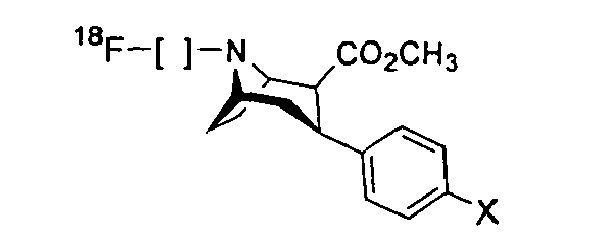
X [ ] A Cl -CH2CH2- [18F]FECNT B F -CH2CH2- β-[18F]CFT-FE C 3'-furyl -CH2CH2- [18F]FE-3FPT D I -CH2CH2CH2- β-[18F]CIT-FP E Me -CH2CH2CH2- β-[18F]CMT-FP F Br -CH2CH2CH2- β-[18F]CBT-FP G F -CH2CH2CH2- β-[18F]CFT-FP H Cl -CH2(CH=CH)CH2- (E/Z)-[18F]FBCINT - The robust and reliable pathway frequently proposed for the labelling with fluorine-18 of such molecules is a two-step radiochemical process, involving first the preparation of an appropriate halogeno or better sulphonyloxy [18F]reagent. The radiosynthesis of n-bromo-, n-tosyloxy- and n-mesyloxy 1-[18F]fluoroalkanes (n = 1-3) from the corresponding bifunctional alkanes by nucleophilic aliphatic substitution with no-carrier-added [18F]fluoride as its activated K[18F]F-Kryptofix®222 complex (Coenen H.H. et al., 1986; Hamacher K., et al., 1986) has been extensively studied (Block D. et al., 1987). This methodology has been applied with success to the preparation of several [18 F]fluoroethyl- (Goodman M.M. et al., 1994; Firnau G. et al., 1995; Goodman M.M. et al., 2000; Deterding T.A. et al., 2001; Votaw J.R. et al., 2002; Wilcox K.M. et al., 2002; Davis M.R. et al., 2003; Votaw J.R. et al., 2003; Votaw J.R. et al., 2004; Lindsey K.P. et al., 2004; Harada N. et al., 2004; Stehouwer J.S. et al., 2005) and [18F]fluoropropyl- (Goodman M.M. et al., 1994; Firnau G. et al., 1995; Chaly T. et al., 1996; Goodman M.M. et al., 1997; Kazumata K. et al., 1998; Ma Y. et al., 2002; Chaly T. et al., 2004) tropane derivatives (compound A-G, Table 2), like for example [18F]FECNT and β-[18F]CIT-FP. More recently, the radiosynthesis of both (E)- and (Z)-1-[18F]fluoro-4-tosyloxybut-2-ene has also been briefly described and used for the first time for the preparation of (E)-and (Z)-[18F]FBCINT (compound H, Table 2) (Chen P. et al., 1999 ; Goodman M.M. et al., 2002).
- It has now been discovered that a class of compounds, referred to herein as compounds of formula (II), are useful agents for preparing the [18F]radioactively labelled compounds of formula (I). More specifically, these compounds allow to obtain the radiolabelled compounds of formula (I) in only one-step radiochemical process, with high radiolabelling yields and high radiochemical purity.
- The one-step radiochemical process referred herein also brings the following advantages, when compared to the classical two-step process described above. It first allows to use only one precursor for labelling (compounds of formula II) instead of two precursors for labelling. Further, these precursors of formula (II) may be used in limited amounts (typically 2-5 mg) as compared to the two-step radiochemical process disclosed in the prior art which generally both requires a large excess and high amounts (typically ≥ 20 mg) of the nortropamine derivative. Therefore, it also reduces the level of impurities in the radiolabelled compounds of formula (I). This one-step process also makes the synthesis of compounds of formula (I) easier and faster, allowing a more robust automation. This one-step process also makes the synthesis of compounds of formula (I) safer by reducing notably the exposure to the radioactivity.
- Further, this one-step process allows to prepare [18F]radiolabelled compounds of formula (I) with an higher radioactivity level, which is particularly useful for PET imaging.
- Thus, in one aspect, the invention is directed to the compounds of formula (II):

- X is Cl, Br, I, or a group OSO2R5;
- Z is C-C, R1C=CR2 or C ≡ C ;
- R1, R2 are each independently H, C1-C6 alkyl, C6-C10 aryl, wherein said alkyl or aryl groups are optionally substituted by one to three R6 groups;
- R3 is H or C1-C6 alkyl, wherein said alkyl group is optionally substituted by one to three R6 groups;
- p is 1, 2 or 3 ;
- R4 is/are independently H, Cl, Br, I, F, or C1-C6 alkyl, wherein said alkyl group is/are optionally substituted by one to three R6 groups;
- R5 is a C1-C6 alkyl, preferably C1-C4 alkyl, said alkyl being optionally mono-, poly- or perhalogenated, a C3-C8 cycloalkyl or a C6-C12 aryl, wherein said alkyl, cycloalkyl and aryl are optionally substituted by one to three C1-C4 alkyl groups or F, Cl, Br, NO2, or CN;
- R6 is OH, F, Cl, Br, phenyl or methyl,
- m is 1, 2, 3 or 4, and
- n is 1, 2, 3 or 4,
- The leaving group X may be a OSO2R5 group, preferably selected from OSO2-C6H4-CH3, OSO2-C6H4-Br, OSO2-C6H4-NO2, OSO2-CH3, OSO2-CF3, OSO2-C4F9 or OSO2-CH2-CF3. Of these, OSO2-C6H4-CH3, OSO2-CF3, OSO2-CH3, commonly designates as tolyloxy (OTs), mesyloxy (OMs) and trifyloxy (OTf) respectively, are particularly preferred.
- Preferably, X is Cl, Br, I, more preferably X is Cl.
- Preferably, Z is R1C=CR2 or C≡C, R1C=CR2 being particularly preferred.
- Advantageously, when Z is trans R1C=CR2 or C≡C, the leaving group X does not undergo an intramolecular nucleophilic substitution by the nitrogen atom of the tropane. These compounds of formula (II) are thus relatively stable under normal conditions of temperature and pressure.
- Preferably, R1 and R2 are independently selected from H and C1-C4 alkyl, notably methyl or ethyl. More preferably, R1 and R2 are H.
- Preferably, Z is trans (E).
- Preferably, m is 1.
- Preferably, n is 1.
- In a preferred embodiment of the invention, the invention relates to compounds of formula (IIa):

- Preferably, R3 is C1-C4 alkyl, more preferably methyl, ethyl or isopropyl, most preferably methyl.
- R4 may be C1-C6 alkyl, more preferably C1-C4 alkyl, notably a methyl group.
- Preferably, p is 1 and R4 is located in the para position on the phenyl ring.
- Preferably, the compound of formula (IIa) is the N-(E-4-chloro-but-2-enyl)-3β-(4-methylphenyl)nortropane-2β-carboxylic methyl ester.
- In another aspect, the invention also relates to a method for preparing a [18F]radiolabelled compound of formula (I):

- i) contacting a compound of formula (II) as defined above, with a source of 18F anion in an appropriate solvent; and optionally
- ii) recovering the obtained [18F]radiolabelled compound of formula (I).
- There is no particular restriction on the nature of the sources of 18F anions to be used in this reaction, and any sources of 18F anions conventionally used in reactions of this type may equally be used here, provided that it has no adverse effect on other parts of the molecule.
- Examples of suitable sources of 18F anions include: alkali metal [18F]fluorides, such as sodium [18F]fluoride, potassium [18F]fluoride, cesium [18F]fluoride; ammonium [18F]fluoride, tetraalkylammonium [18F]fluorides, such as tetrabutylammonium [18F]fluoride. Of these, the alkali metal [18F]fluorides, and notably a potassium fluoride, are preferred.
- The source of 18F anions may be activated by the presence of a ligand able to complex the counter cationic species of the source of 18F anions. The ligand may be notably a cyclic or polycyclic multidentate ligand.
- Examples of suitable ligands include notably crown ethers such as 1,4,7,10,13-pentaoxacyclooctadecane (18C6) or cryptands such as 4,7,13,16, 21,24-hexaoxa-1,10-diazabicyclo-[8,8,8]hexacosane sold under the name K222®.
- Preferably, the source of 18F anions is an alkaline metal [18F]fluoride-cryptate complex, notably a potassium [18F]fluoride-cryptate complex, preferably the potassium [18F]fluoride - 4,7,13,16,21,24-hexaoxa-1,10-diazabicyclo-[8,8,8]hexacosane (K[18F]/K222).
- The complex K[18F]/K222® may be prepared by any conventional methods, for example as disclosed in F. Dollé et al., 1999; L. Dolci et al., 1999.
- The method for preparing the [18F]radiolabelled compound of formula (I) can take place over a wide range of temperatures, and the precise reaction temperature is not critical to the invention. In general, it is convenient to carry out the reaction at a temperature of from about 50°C to about 150°C (more preferably, from about 80°C to about 100°C).
- The time required for the reaction may also vary widely, depending on many factors, notably the reaction temperature and the nature of the reagents. However, provided that the reaction is effected under the preferred conditions outlined above, a period of from about 5 minutes to about 15 minutes will usually suffice.
- The compound thus prepared may be recovered from the reaction mixture by conventional means. For example, the compounds may be recovered by filtration on a pre-packed separation column.
- Additionally, the product can, if desired, be further purified by various well known techniques, such as chromatography techniques, notably High Performance Liquid Chromatography (HPLC).
- In another aspect, the invention also relates to a method for preparing a compound of formula (II) as defined above, comprising the steps of:
- i) reacting a compound of formula (III)
X-(CH2)m-Z-(CH2)n-Y
wherein Y is Cl, Br, I or OSO2R5, X, Z, R5, m and n being as defined above, with a compound of formula (IV)
in the presence of a base in an appropriate solvent; and optionally - ii) recovering the obtained compound of formula (II).
- There is no particular restriction on the nature of the base to be used in this reaction, and any base conventionally used in reactions of this type may equally be used here, provided that it has no adverse effect on other parts of the molecule. Examples of suitable bases include alkylamines, such as triethylamine.
- There is no particular restriction on the nature of the solvent to be employed, provided that it has no adverse effect on the reaction or on the reagents involved. Examples of appropriate solvents include notably polar solvents such as acetonitrile.
- In a still further aspect, the invention relates to a compound of formula (IIIa):

- Preferably, m and n are 1.
- Preferably, the stereochemistry of (IIIa) is trans.
- Preferably, Y is OSO2(C6H4)CH3 (tolyloxy), notably p-tolyloxy.
- Preferably, X is Cl.
- Preferably, the compound of formula (IIIa) is the E-1-chloro-4-tosyloxy-2-butene.
- Compounds of formula (IIIa) useful according to the invention may be prepared by the application or adaptation of known methods, by which is meant methods used heretofore or described in the literature, for example those described by R. C. Larock in Comprehensive Organic Transformations, VCH Publishers, 1989.
- The invention also relates to the use of a compound of formula (II) as defined above for preparing a compound of formula (I) as defined above.
- In a further aspect, the invention also relates to a kit for the preparation of a [18F]radioactively labelled compound of formula (I), comprising:
- (a) a compound of formula (II), as defined above ; and
- (b) a source of 18F anions.
- Optionally, the kit can include items of apparatus, such as a reaction vessel, device for transferring isotopic material to the reaction vessel, pre-packed separation column for separating product from excess reactants, shielding and the like, as known in the art.
- The following terms and expressions contained herein are defined as follows:
- As used herein, the term "alkyl" refers to a straight-chain, or branched alkyl group having 1 to 6 carbon atoms, such as methyl, ethyl, propyl, isopropyl, butyl, isobutyl, sec-butyl, tert-butyl, pentyl, isoamyl, neopentyl, 1-ethylpropyl, 3-methylpentyl, 2,2-dimethylbutyl, 2,3-dimethylbutyl, hexyl, etc. Preferred alkyl groups are those which contain 1 to 4 carbons. A designation such as "C1-C4 alkyl" refers to an alkyl radical containing from 1 to 4 carbon atoms.
- As used herein, the term "cycloalkyl" refers to a saturated or partially saturated mono- or bicyclic alkyl ring system containing 3 to 8 carbon atoms. A designation such as "C5-C7 cycloalkyl" refers to a cycloalkyl radical containing from 5 to 7 ring carbon atoms. Preferred cycloalkyl groups include those containing 5 or 6 ring carbon atoms. Examples of cycloalkyl groups include such groups as cyclopropyl, cyclobutyl, cyclopentyl, cyclohexyl, cycloheptyl, cyclooctyl.
- As used herein, the term "aryl" refers to a substituted or unsubstituted, mono- or bicyclic hydrocarbon aromatic ring system having 6 to 12 ring carbon atoms. Examples include phenyl and naphthyl. Preferred aryl groups include unsubstituted or substituted phenyl and naphthyl groups.
- As used herein, "stable compound" or "stable structure" refers to a compound that is sufficiently robust to survive isolation to a useful degree of purity from a reaction mixture.
- As used herein, "stereoisomeric forms" refers notably to the cis and trans isomeric forms.
- The starting materials and intermediates of compounds useful according to the invention may be prepared by the application or adaptation of known methods, for example methods as described in the Examples or their obvious chemical equivalents.
- The following examples are presented as an illustration only and are not to be considered as limiting the invention in its scope.
-

- The strategy of synthesis was the reaction between the 3β-(4-methylphenyl)-nortropane-2β-carboxylic methyl ester (4) and a sulphonate derivative.

- The 2β-carbomethoxy-3β-(4-methylphenyl)nortropane (4) has been synthesized according to the procedures already published :

- Milius R.A. et al, J. Med. Chem., 1991, 34, 1728-1731.
- Blough B.E. et al, J. Med. Chem., 1996, 39, 4027-4035.
- Emond P. et al, J. Med. Chem., 1997, 40, 1366-1371.
-

- The 2-butyne-1,4-diol (5) was reduced to the E-2-butene-1,4-diol (6) by LiAlH4 according to the procedure described by Kayaleh et al., 2000). The E-2-butene-1,4-diol (6) was refluxed in CCl4 in presence of triphenylphosphine to give the mono chlorinated derivative (7) which was transformed to the tosylate derivative (8). This compound reacted with the nortropane derivative (4) to give the chloro derivative (9).
- A solution of LAH (300 mmoles / 400 mL) was cooled to 0°C under nitrogen atmosphere. A solution of 2-butyne-1,4-diol (5) (21.5 g, 250 mmoles, 1 eq) in 200 mL of anhydrous THF was added dropwise over 90 min maintaining the temperature under 0°C. Following complete addition of (5), the reaction mixture was refluxed for 3 hours. 3M NaOH aq. solution was added slowly at 0°C until no gas evolution was observed. The solution was filtrated. The precipitate was washed by THF (3 x 100 mL). The organic layers were combined, dried on MgSO4 and the solvent was removed under reduced pressure to give the crude product (6). 14.5 g (yield 66%).
1H NMR (D2O) : 3.94 (broad s, 4H), 4.67 (broad s, 2H), 5.69 (broad s, 2H).
13C NMR (D2O) : 61.63, 129.77. - 10 g (114 mmoles) of E-2-butene-1,4-diol (6) and 33.3 g (127 mmoles, 1.1 eq) of triphenylphosphines were stirred vigorously in CCl4 (100 mL) and refluxed for 4 hours. CH2Cl2 (200 mL) was added and the organic layer was washed with H2O (2 x 100 mL), dried on MgSO4 and the solvent was removed under reduced pressure to give the crude product (7) which was purified by silica gel column chromatography (CH2Cl2). 3.3 g (yield 27%).
1H NMR (CDCl3) : 4.06 (dd, J3 = 4.84 Hz, J4 = 0.97 Hz, 2H), 4.06 (d, J3 = 3.55 Hz, 2H), 5.69 (broad s, 2H), 5.88 (m, 2H).
13C NMR (CDCl3) 44.45, 62.49, 126.95, 133.84. - 2 g (18.8 mmoles) of E-1-chloro-4-ol-2-butene (7) and 220 mg (0.94 mmoles, 0.05 eq) of benzyltriethylammonium chloride were placed in CH2Cl2 (40 mL) and KOH aq. 50% (40 mL) and the mixture was cooled to 0°C. A solution of p-toluenesulfonyl chloride (3.93 g, 20.7 mmoles, 1.1 eq) in CH2Cl2 (40 mL) was added dropwise maintaining the temperature under 0°C. The reaction mixture was stirred 4 hours at 0°C, and diluted with H2O (40 mL). Aqueous layer was extracted by CH2Cl2 (2 x 80 mL). The organic layers were combined, washed with brine and dried over MgSO4 and the solvent was evaporated under reduced pressure to afford the crude product (8) which was used without purification. 3.43 g (yield 75%).
1H NMR (CDCl3) : 2.45 (s, 3H), 3.99 (d, J3 = 5.6 Hz, 2H), 4.55 (d, J3 = 5.1 Hz, 2H), 5.82(m, 2H), 7.79 (d, J3 = 8.2 Hz), 7.79 (d, J3 = 8.2 Hz, 2H).
13C NMR (CDCl3) : 21.72, 43.46, 69.37, 126.36, 127.99, 130.06, 131.66. - 1.5 g (5.8 mmoles, 1.5 eq) of E-1-chloro-4-tosyloxy-2-butene (8) and 800 µL (5.8 mmoles, 1.5 eq) of triethylamine in 10 mL of CH3CN were cooled to 0°C. A solution of 3β-(4-methylphenyl)nortropane-2β-carboxylic acid methyl ester (4) in (1 g, 1 eq) CH3CN (20 mL) was added dropwise maintaining temperature under 0°C. Then the reaction mixture was stirred at room temperature overnight. CH3CN was evaporated under reduced pressure and the crude product was purified by alumina gel column chromatography (Pentane/CH2Cl2 50/50 to 0/100). 3.3 g (yield 18%).
1H NMR (CDCl3) : 1.69 (m, 3H), 2.03 (m, 2H), 2.29 (s, 3H), 2.60 (td, J3 = 12.6 Hz, J3 = 2.6 Hz 1 H), 2.94 (m, 4H), 3.41 (m, 1 H), 3.51 (s, 3H), 3.66 (1 H), 4.05 (d, J3 = 3.12 Hz, 2H), 5.75 (m, 2H), 7.08 (d, J3 = 8.2 Hz, 2H), 7.16 (d, J3 = 8.2 Hz, 2H).
13C NMR (CDCl3) : 21.06, 26.02, 26.14, 33.95, 34.23, 44.88, 51.09, 52.88, 54.92, 61.46, 62.44, 127.31, 127.59, 128.75, 133.69, 135.31, 139.97, 172.07. ES-MS (MH+) calculated : 348.17 found : 348.32. -

- The one-step radiosynthesis of [18F]LBT-999 ([18F]-10) is hereabove.
- Introduction of the cyclotron-produced fluorine-18 as the, no-carrier-added, activated K[18F]F-Kryptofix®222 complex (Coenen H.H. et al., 1986 ; Hamacher K. et al., 1986) was performed as follows : a DMSO solution (600 µL) containing 3.5-4.5 mg of 8-((E)-4-Chloro-but-2-enyl)-3β-p-tolyl-8-aza-bicyclo-[3.2.1]octane-2β-carboxylic acid methyl ester (9, 10.0-12.9 µmol) were transferred (See experimental part) to the dried K[18F]F-K222 complex in a reaction vial (Vacutainer® tube). The unsealed tube was thoroughly vortexed and then heated (heating block) at 165°C for 10 minutes without stirring the contents. The reaction vessel was cooled (ice-water bath) and the remaining radioactivity was measured, which was 96% to over 99% of the initial radioactivity. The radiochemical yields of fluorine-18 incorporation, calculated from the TLC-radiochromatogram and defined as the ratio of radioactivity area of [18F]-10 over total fluorine-18 radioactivity area, were about 30% to 40%. At this stage, a C-18 Sep-Pak cartridge (PrepSep™ R-C18 Extraction Column, see experimental) was used to rapidly isolate [18F]-10 (with a radiochemical purity >90%, according to radio-HPLC) from the reaction, which represented 30-35% of the total radioactivity amount engaged in the fluorination process whereas most likely non reacted [18F]fluoride, 65-70% of the total radioactivity, was eluted off the cartridge (waste). These values clearly confirmed the radiochemical yields measured by radio-TLC.
- HPLC purification of [18F]LBT-999 ([18F]-10) was performed on a semipreparative Symmetry® C18 column (HPLC B, see experimental), using a mixture of H2O/CH3CN/TFA (72:28:0.1 (v/v/v)) as the eluent. Using these conditions, [18F]-10 (t R : 12.5-13.5 minutes) could be obtained with a >95% chemically and radiochemically purity and was ideally separated within a short total purification time (less than 20 minutes) from the non-labelled chloro-derivative 9 (t R : 15.5-17.5 minutes), as well as from an unidentified fluorine-18-labelled impurity at t R : 14.0-15.0 minutes (up to 10% compared to [18F]-10). A too low chemical purity (< 90%) was observed using a previously reported HPLC system used for the purification of [18F]-10 (HPLC C, column: semipreparative SunFire™ C18, eluant : H2O/CH3CN/TFA : 70:30:0.1 (v/v/v), t R ([18F]-10): 9.0-10.0 min (Dollé F. et al., 2006).
- Introduction of fluorine-18 was also performed with the K[18F]F-Kryptofix®222 complex and microwave activation (at 100 Watt for 2 minutes). Incorporation yields (calculated from the TLC-radiochromatogram or after the C-18 Sep-Pak cartridge purification) were similar to those described above, with however formation in moderately higher ratio of the unidentified fluorine-18-labelled impurity (about 40-50% compared to [18F]-10). HPLC purification using the system described above gave nevertheless >95% chemically and radiochemically pure [18F]-10 (t R : 12.5-13.5 minutes), still well separated from this side product (t R : 14.0-15.0 minutes).
- Formulation of [18F]LBT-999 ([18F]-10) as i.v. injectable solution was performed using a home-made Sep-pak®Plus C18 device. The HPLC-collected fraction containing the radiotracer was diluted with water and the resulting solution was passed through a C18 Sep-pak® cartridge. The cartridge was then washed with water, partially dried with nitrogen and finally eluted with ethanol followed by physiological saline. The solution was then sterile-filtered and diluted with physiological saline to an ethanol concentration below 10%.
- Quality controls of [18F]LBT-999 ([18F]-10) was performed on an aliquot of the preparation ready for i.v. injection. The radiotracer preparation was a clear and colourless solution with a measured pH between 5 and 7. As demonstrated by analytical HPLC analysis (HPLC D, see experimental), the radiotracer preparation was found to be > 95% chemically and radiochemically pure (1, t R : 2.25 min). The preparation was shown to be free of the non-radioactive precursor 9 (t R : 3.45 min) as well as the unidentified fluorine-18-labelled side-product (t R : 2.58 min), and was chemically and radiochemically stable for at least 120 minutes.
- The highly selective dopamine transporter ligand LBT-999 (10, 8-((E)-4-fluoro-but-2-enyl)-3β-p-tolyl-8-aza-bicyclo[3.2.1]octane-2β-carboxylic acid methyl ester) has been labelled in one radiochemical step with fluorine-18 at its fluoromethylvinyl moiety. Typically, 70-100 mCi of [18F]LBT-999 ([18F]-10, 2.59-3.07 GBq, > 95% chemically and radiochemically pure) could be obtained with a specific radioactivity of 1-3 Ci/µmol (37-111 GBq/µmol) in 80-85 minutes of radiosynthesis (HPLC purification and formulation included), starting from a 1000 mCi (37.0 GBq) [18F]fluoride production batch (overall yields : 7.0% to 10.0% non decay-corrected and 11.6-17.1% decay-corrected).
- Chemicals were purchased from Aldrich-, Fluka- or Sigma France and were used without further purification. Flash chromatographies were conducted on silica gel (0.63-0.200 mm, VWR) columns. TLCs were run on pre-coated plates of silica gel 60F254 (Merck). The compounds were localized (1) when possible at 254 nm using a UV-lamp and/or (2) by dipping the TLC-plates in a 1% ethanolic ninhydrin solution and heating on a hot plate. Radioactive spots were detected using a Berthold TraceMaster 20 automatic TLC linear analyser.
- [HPLC A]: Equipment: system equipped with a Waters 600 Pump and Waters 600 Controller, a Shimadzu SPD10-AVP UV-multi-wavelength detector and a miniature ionisation chamber probe ; column: semipreparative X-Terra® C18, Waters (300 x 7.8 mm) ; porosity: 7 µm; eluent H2O / CH3CN / TFA : 60:40:0.1 (v/v/v); flow rate: 4 mL/min; temperature: RT ; absorbance detection at λ = 220 nm.
- [HPLC B]: Equipment: system equipped with a Waters 600 Pump and Waters 600 Controller, a Shimadzu SPD10-AVP UV-multi-wavelength detector and a miniature ionisation chamber probe ; column: semipreparative Symmetry® C18, Waters (300 x 7.8 mm) ; porosity: 7 µm; eluent H2O / CH3CN / TFA : 72:28:0.1 (v/v/v); flow rate: 5 mL/min; temperature: RT ; absorbance detection at λ = 220 nm.
- [HPLC C]: Equipment: system equipped with a Waters 600 Pump and Waters 600 Controller, a Shimadzu SPD10-AVP UV-multi-wavelength detector and a miniature ionisation chamber probe ; column: semipreparative SunFireTM C18, Waters (250 x 10.0 mm) ; porosity: 5 µm; eluent H2O / CH3CN / TFA : 70:30:0.1 (v/v/v); flow rate: 5 mL/min; temperature: RT ; absorbance detection at λ = 220 nm.
- [HPLC D]: Equipment: Waters Alliance 2690 (or a Waters binary HPLC pump 1525) equipped with a UV spectrophotometer (Photodiode Array Detector, Waters 996) and a Berthold LB509 radioactivity detector; column: analytical Symmetry-M® C-18, Waters (50 x 4.6 mm); porosity: 5.0 µm; conditions: isocratic elution with solvA / solvB: 55 / 45 (v/v) [solvent A: H2O containing Low-UV PIC® B7 reagent (composition (% by weight) : methanol (18-22%), heptane sulfonic acid - sodium salts (4-6%), phosphate buffer solution (3-7%), water (65-75%), pH 3, Waters), 20 mL for 1000 mL; solvent B: H2O / CH3CN: 30:70 (v/v) containing Low-UV PIC® B7 reagent (20 mL for 1000 mL)]; flow rate: 2.0 mL/min; temperature: 30°C; UV detection at λ: 205 nm.
- No-carrier-added aqueous [18F]fluoride ion was produced via the [18O(p,n)18F] nuclear reaction by irradiation of a 2 mL [18O]water (> 97%-enriched, CortecNet, Paris, France) target on a IBA Cyclone-18/9 cyclotron (18 MeV proton beam) and was transferred to the appropriate hot cell. Target hardware: commercial, 2-mL, two-port, stainless steel target holder equipped with a domed-end niobium cylinder insert. Target to hot cell liquid-transfer system : 60 m PTFE line (0.8 mm internal diameter ; 1/16 inch external diameter), 2.0 bar He drive pressure, transfer time 3-6 min. Typical production of [18F]Fluoride at the end of bombardment for a 20 µA, 30 min (10 pA.h) irradiation: 750-800 mCi (27.7-29.6 GBq).
- Radiosyntheses using fluorine-18, including the HPLC purifications, were performed in a 7.5-cm-lead shielded cell using a computer assisted Zymate robot system (Zymark corporation, USA). Microwave activation was performed with a MicroWell 10 oven (2.45 GHz), Labwell AB, Sweden.
- In order to recover and recycle the [18O]water target, the 2 mL of aqueous [18F]fluoride from the target holder were passed through an anion exchange resin (Sep-pak® Light Waters Accell™ Plus QMA cartridge (initially in the chloride form, then washed with aq. 1M NaHCO3 (2 mL) and rinsed with water (20 mL) and CH3CN (10 mL)) by helium pressure (1.5-2.0 bar). Helium was blown through the column to maximally extract the last traces of [18O]water. The [18F]fluoride ion was then eluted from the resin, using an aq. K2CO3 solution (1.0 mL of a 1.0 mg/mL solution), into a Vacutainer® tube containing Kryptofix®222 (K222: 4,7,13,16,21,24-hexaoxa-1,10-diazabicyclo[8.8.8] hexacosane, 12.0 to 15.0 mg). The resulting solution was then gently concentrated to dryness at 145-150°C under a nitrogen stream for 10 min to give no-carrier-added K[18F]F-K222 complex as a white semi-solid residue.
- A. Procedure using conventional heating. DMSO (600 µL) containing 8-((E)-4-Chloro-but-2-enyl)-3β-p-tolyl-8-aza-bicydo[3.2.1]octane-2β-carboxylic acid methyl ester (9, 3.5-4.5 mg, 10.0-12.9 µmol) were directly added into the Vacutainer® tube containing the dried K[18F]F-K222 complex. The tube (not sealed) was thoroughly vortexed (30 s) and then placed in a heating block (at 90°C, for 10 min) without stirring the contents. The reaction vessel was then cooled using an ice-water bath, the remaining radioactivity measured (which was 96% to over 99% of the initial radioactivity) and the reaction mixture analyzed by radio-TLC. The reaction yield was calculated from the TLC-radiochromatogram and defined as the ratio of radioactivity area of [18F]LBT-999 ([18F]-10) over total fluorine-18 radioactivity area (SiO2-TLC (EtOAc) : Rf : [18F]-10 : 0.5 and Rf : [18F]fluoride ion : 0.0). The reaction mixture was diluted with water (1 mL) and transferred onto a C18 Sep-Pak cartridge (PrepSep™ R-C18 Extraction Column, Fisher Scientific, activated beforehand with EtOH (2 mL) and then rinsed with water (10 mL)), pre-filled with water (2 mL). The tube was rinsed twice with water (1 mL), which was also transferred and added to the diluted reaction mixture on top of the cartridge (0.5-1.5% of the total radioactivity amount engaged in the fluorination process was lost in the initial tube). An additional portion of water (2 mL) was further added to the diluted reaction mixture on top of the cartridge. The whole was then passed through the cartridge, which was then washed with water (3 mL) and partially dried for 0.5 min by applying a nitrogen stream. [18F]-10 was eluted from the cartridge with CH2Cl2 (3 mL) into an empty 5 mL reaction vial. Twice 1 mL of CH2Cl2 was used to wash the cartridge (only 1-2% was left and lost on the cartridge) for maximal transfer of [18F]-10. 30-35% of the total radioactivity amount engaged in the fluorination process was eluted with CH2Cl2 and was analysed by radio-HPLC (HPLC A). The incorporation yield was estimated after the C18 Sep-pak cartridge elution by the CH2Cl2- over total eluted radioactivity (DMSO/H2O + CH2Cl2) ratio. The resulting CH2Cl2 solution was concentrated to dryness (at 65-75°C under a gentle nitrogen stream for 3-5 min). Finally, the above residue was redissolved in the HPLC solvent used for purification (1.0 mL) and the crude was injected onto HPLC (HPLC B). Isocratic elution gave pure [18F]-10 (t R: 12.5-13.5 min), well separated from unlabelled 9 (t R: 15.5-17.5 min) and an unidentified fluorine-18-labelled impurity [18F]-11 (t R : 14.0-15.0 min).
- Formulation of [18F]LBT-999 ([18F]-10). Formulation of the labelled product for i.v. injection was effected as follows: The HPLC-collected fraction containing the radiotracer was diluted with water (50 mL). The resulting solution was passed through a Sep-pak®Plus C18 cartridge (Waters, washed with 2 mL of EtOH and then rinsed with 10 mL of water prior to use). The cartridge was washed with water (10 mL) and partially dried by applying a nitrogen stream for 10 s. The radiotracer was eluted with 2 mL of EtOH (less than 10% of the total radioactivity was left on the cartridge) followed by 8 mL of physiological saline and filtered on a 0.22 µm GS-Millipore filter (vented). Finally, physiological saline was added to lower the EtOH concentration below 10%. This whole process was performed using a remote-controlled dedicated home-made device based on a literature procedure (Lemaire C. et al., 1999).
- Quality control of [18F]LBT-999 ([18F]-10). The radiotracer preparation was visually inspected for clarity, absence of colour and particulates. An aliquot of the preparation was removed for determination of pH using standard pH-paper. Chemical and radiochemical purities were also assessed on this aliquot by HPLC (HPLC D), with a sample of authentic 10 (t R : 2.25 min) which synthesis and characterization were disclosed in Dollé F et al., 2006. Particular attention was paid to the absence of non-radioactive precursor 9 (t R: 3.45 min). Chemical and radiochemical stability of the entire preparation was tested by HPLC (HPLC D) at regular 15-min intervals during 120 min. Specific radioactivity of the radiotracer was calculated from three consecutive HPLC (HPLC D) analyses (average) and determined as follows: The area of the UV absorbance peak corresponding to the radiolabelled product was measured (integrated) on the HPLC chromatogram and compared to a standard curve relating mass to UV absorbance.
-
- Block D, Coenen HH, Stocklin G. J. Label. Compds Radiopharm. 1987, 24: 1029-1042.
- Blough B.E. et al, J. Med. Chem., 1996, 39, 4027-4035.
- Chalon S, Hall H, Saba W, Garreau L, Dollé F, Halldin C, Emond P, Bottlaender M, Deloye J-B, Helfenbein J, Madelmont J-C, Bodard S, Mincheva Z, Besnard J-C and Guilloteau D. J. Pharm. Exp. Ther. 2006, 317 (1), 147-152 .
- Chaly T, Baldwin RM, Neumeyer JL, Hellman MJ, Dhawan V, Garg PK, Tamagnan G, Staley JK, Al-Tikriti MS, Hou Y, Zoghbi SS, Gu XH, Zong R, Eidelberg D. Nucl. Med. Biol. 2004, 31:125-131.
- Chaly T, Dhawan V, Kazumata K, Antonini A, Margouleff C, Dahl JR, Belakhlef A, Margouleff D, Yee A, Wang S, Tamagnan G, Neumeyer JL, Eidelberg D. Nucl. Med. Biol. 1996, 23:999-1004.
- Chen P, Kilts C, Camp VM, Ely T, Keil R, Malveaux E, Votaw D, Hoffman JM, Goodman MM. Abstract of the 13th International Symposium on Radiopharmaceutical Chemistry (Saint-Louis, MO, USA, June 27 - July 1st, 1999). J. Label. Compds Radiopharm. 1999, 42:S400.
- Coenen HH, Klatte B, Knoechel A, Schueller M, Stocklin G. J. Label. Compds Radiopharm. 1986, 23: 455-467.
- Davis MR, Votaw JR, Bremner JD, Byas-Smith MG, Faber TL, Voll RJ, Hoffman JM, Grafton ST, Kilts CD, Goodman MM. J. Nucl. Med. 2003, 44: 855-861.
- Deterding TA, Votaw JR, Wang CK, Eshima D, Eshima L, Keil R, Malveaux E, Kilts CD, Goodman MM, Hoffman JM. J. Nucl. Med. 2001, 42:376-381.
- Dolci L, Dollé F, Valette H, Vaufrey F, Fuseau C, Bottlaender M and Crouzel C, Bioorg. Med. Chem. 1999, 7 (3), 467-479.
- Dollé F, Emond P, Mavel S, Demphel S, Hinnen F, Mincheva Z, Saba W, Valette H, Chalon S, Halldin C, Helfenbein J, Legaillard J, Madelmont J-C, Deloye J-B, Bottlaender M, Guilloteau D. Bioorg. Med. Chem. 2006, 14:1115-1125.
- Dollé F, Dolci L, Valette H, Hinnen F, Vaufrey F, Guenther I, Fuseau C, Coulon C, Bottlaender M and Crouzel C, J. Med. Chem. 1999, 42 (12), 2251-2259.
- Emond P, Garreau L, Chalon S, Boazi M, Caillet M, Bricard J, Frangin Y, Mauclaire L, Besnard J-C, Guilloteau D, J. Med. Chem., 1997, 40, 1366-1371.
- Firnau G, Chen JJ, Murthy D. Abstract of the 11th International Symposium on Radiopharmaceutical Chemistry (Vancouver, B.C., Canada, August 13-17, 1995). J. Label. Compds Radiopharm. 1995, 37:55-56.
- Goodman MM, Chen P. Fluoroalkenyl nortropanes.
WO 00064490 A1 - Goodman MM, Kabalka GW, Kung MP, Kung HF, Meyer MA Abstract of the 10th International Symposium on Radiopharmaceutical Chemistry (Kyoto, Japan, October 25-28, 1993). J. Label. Compds Radiopharm. 1994, 34:488-490.
- Goodman MM, Keil R, Shoup TM, Eshima D, Eshima L, Kilts C, Votaw J, Camp VM, Votaw D, Smith E, Kung MP, Malveaux E, Watts R, Huerkamp M, Wu D, Garcia E, Hoffman JM. J. Nucl. Med. 1997, 38:119-126.
- Goodman MM, Kilts CD, Keil R, Shi B, Martarello L, Xing D, Votaw J, Ely TD, Lambert P, Owens MJ, Camp VM, Malveaux E, Hoffman JM. Nucl. Med. Biol. 2000, 27:1-12.
- Hamacher K, Coenen HH, Stöcklin G. J. Nucl. Med. 1986, 27: 235-238.
- Harada N, Ohba H, Fukumoto D, Kakiuchi T, Tsukada H. Synapse 2004, 54:37-45.
- Kayaleh NE, Gupta RC, Johnson F, J. Org. Chem., 2000, 65, 4515-4522.
- Kazumata K, Dhawan V, Chaly T, Antonini A, Margouleff C, Belakhlef A, Neumeyer J, Eidelberg D. J. Nucl. Med. 1998, 39:1521-1530.
- Kilbourn MR. In Fluorine-18 Labeling of Radiopharmaceuticals, Nuclear Science Series (Kilbourn MR Ed.), National Academy Press, Washington, D.C. (1990), 1-149.
- Lasne M-C, Perrio C, Rouden J, Barré L, Roeda D, Dollé F, Crouzel C. In Chemistry of β+-Emitting Compounds Based on Fluorine-18, Topics in Current Chemistry (Krause W. Ed.), Vol. 222, Springer-Verlag Berlin Heidelberg (2002), 201-258.
- Lemaire C, Plenevaux A, Aerts J, Del Fiore G, Brihaye C, Le Bars D, Comar D and Luxen A. J. Label. Compds Radiopharm. 1999; 42: 63-75.
- Lindsey KP, Wilcox KM, Votaw JR, Goodman MM, Plisson C, Carroll Fl, Rice KC, Howell LL. J. Pharmacol. Exp. Ther. 2004, 309:959-969.
- Ma Y, Dhawan V, Mentis M, Chaly T, Spetsieris PG, Eidelberg D. Synapse 2002, 45:125-133.
- Milius RA, Saha JK, Madras BK, Neumeyer JL, J. Med. Chem., 1991, 34, 1728-1731.
- Stehouwer JS, Plisson C, Jarkas N, Zeng F, Voll RJ, Williams L, Martarello L, Votaw JR, Tamagnan G, Goodman MM. J. Med. Chem. 2005, 48:7080-7083.
- Votaw JR, Byas-Smith MG, Hua J, Voll R, Martarello L, Levey Al, Bowman FD, Goodman MM Anesthesiology 2003, 98:404-411.
- Votaw JR, Byas-Smith MG, Voll R, Halkar R, Goodman MM. Anesthesiology 2004, 101:1128-1135.
- Votaw JR, Howell LL, Martarello L, Hoffman JM, Kilts CD, Lindsey KP, Goodman MM. Synapse 2002, 44,203-210.
- Welch MJ, Redvanly CS. In Handbook of radiopharmaceuticals - Radiochemistry and applications (Welch MJ, Redvanly CS Ed.), New York-Chichester-Brisbane-Toronto, Wiley-Interscience Pub. (2003), 1-848.
- Wilcox KM, Lindsey KP, Votaw JR, Goodman MM, Martarello L, Carroll Fl, Howell LL. Synapse 2002, 43:78-85.
Claims (18)
- A compound of formula (II)
 - X is Cl, Br, I, or a group -OSO2R5;- Z is C-C, R1C=CR2 or C ≡ C ;- R1, R2 are each independently H, C1-C6 alkyl, C6-C10 aryl, wherein said alkyl or aryl groups are optionally substituted by one to three R6 groups;- R3 is H or C1-C6 alkyl, wherein said alkyl group is optionally substituted by one to three R6 groups;- p is 1, 2 or 3 ;- R4 is/are independently H, Cl, Br, I, F, or C1-C6 alkyl, wherein said alkyl group is/are optionally substituted by one to three R6 groups;- R5 is a C1-C6 alkyl, said alkyl being optionally mono-, poly- or perhalogenated, a C3-C8 cycloalkyl or a C6-C12 aryl, wherein said alkyl, cycloalkyl and aryl are optionally substituted by one to three C1-C4 alkyl groups or F, Cl, Br, NO2, or CN;- R6 is OH, F, Cl, Br, phenyl or methyl,- m is 1, 2, 3 or 4, and- n is 1, 2, 3 or 4,and its stereoisomeric forms, mixtures of stereoisomeric forms, and salt forms thereof.
 - The compound of claim 1, wherein X is Cl, Br, I.
- The compound of claim 2, wherein X is Cl.
- The compound of any of claims 1 to 3, wherein Z is R1C=CR2.
- The compound of claim 4, wherein Z is trans.
- The compound of any of claims 1 to 5, which is of formula (IIa):

- The compound of claim 6, which is the N-(E-4-chloro-but-2-enyl)-3β-(4-methylphenyl)nortropane-2β-carboxylic methyl ester.
- A method for preparing a [18F]radiolabelled compound of formula (I):
 i) contacting a compound of formula (II) as defined in any of claims 1 to 7, with a source of 18F anion in an appropriate solvent; and optionallyii) recovering the obtained [18F]radiolabelled compound of formula (I).
 - The method of claim 8, wherein the source of 18F anion is an alkaline metal [18F]fluoride.
- The method of claim 9, wherein the source of 18F anion is an alkaline metal [18F]fluoride -cryptate complex.
- The method of claim 10, wherein the source of 18F anion is a potassium [18 F]fluoride-cryptate complex.
- The method of claim 11, wherein the source of 18F anion is a potassium [18F]fluoride-4,7,13,16,21,24-hexaoxa-1,10-diazabicyclo[8,8,8]hexacosane.
- A method for preparing a compound of formula (II) as defined in claims 1 to 7, comprising the steps of:i) reacting a compound of formula (III)
X-(CH2)m-Z-(CH2)n-Y
wherein Y is Cl, Br, I or OSO2R5, X, Z, R5, m and n being as defined in claim 1 to 7,
with a compound of formula (IV) ii) recovering the obtained compound of formula (II).
 - A compound of formula (IIIa):

- The compound of claim 14, wherein Y is OSO2(C6H4)CH3
- The compound of any of claims 14 or 15 wherein X is Cl.
- A use of a compound of formula (II) as defined in claim 1 for preparing a compound of formula (I) as defined in claim 8.
- A kit for the preparation of a [18F]radioactively labelled compound of formula (I), comprising:(a) a compound of formula (II), as defined in claims 1 to 7 ; and(b) a source of 18F anion.
Priority Applications (8)
| Application Number | Priority Date | Filing Date | Title |
|---|---|---|---|
| PL06291762T PL1925615T3 (en) | 2006-11-14 | 2006-11-14 | Method of fluorine-18 labelling of tropane derivatives |
| EP06291762.0A EP1925615B1 (en) | 2006-11-14 | 2006-11-14 | Method of fluorine-18 labelling of tropane derivatives |
| HUE06291762A HUE025757T2 (en) | 2006-11-14 | 2006-11-14 | Method of fluorine-18 labelling of tropane derivatives |
| PT62917620T PT1925615E (en) | 2006-11-14 | 2006-11-14 | Method of fluorine-18 labelling of tropane derivatives |
| ES06291762.0T ES2545536T3 (en) | 2006-11-14 | 2006-11-14 | Fluoride-18 labeling method of tropane derivatives |
| DK06291762.0T DK1925615T3 (en) | 2006-11-14 | 2006-11-14 | A method for fluorine-18-selection of tropane derivatives |
| SI200631964T SI1925615T1 (en) | 2006-11-14 | 2006-11-14 | Method of fluorine-18 labelling of tropane derivatives |
| PCT/IB2007/003476 WO2008059349A1 (en) | 2006-11-14 | 2007-11-13 | Method of fluorine-18 labelling of tropane derivatives |
Applications Claiming Priority (1)
| Application Number | Priority Date | Filing Date | Title |
|---|---|---|---|
| EP06291762.0A EP1925615B1 (en) | 2006-11-14 | 2006-11-14 | Method of fluorine-18 labelling of tropane derivatives |
Publications (2)
| Publication Number | Publication Date |
|---|---|
| EP1925615A1 true EP1925615A1 (en) | 2008-05-28 |
| EP1925615B1 EP1925615B1 (en) | 2015-07-15 |
Family
ID=37909340
Family Applications (1)
| Application Number | Title | Priority Date | Filing Date |
|---|---|---|---|
| EP06291762.0A Active EP1925615B1 (en) | 2006-11-14 | 2006-11-14 | Method of fluorine-18 labelling of tropane derivatives |
Country Status (8)
| Country | Link |
|---|---|
| EP (1) | EP1925615B1 (en) |
| DK (1) | DK1925615T3 (en) |
| ES (1) | ES2545536T3 (en) |
| HU (1) | HUE025757T2 (en) |
| PL (1) | PL1925615T3 (en) |
| PT (1) | PT1925615E (en) |
| SI (1) | SI1925615T1 (en) |
| WO (1) | WO2008059349A1 (en) |
Cited By (1)
| Publication number | Priority date | Publication date | Assignee | Title |
|---|---|---|---|---|
| DE102008047314A1 (en) * | 2008-09-16 | 2010-03-25 | Johannes Gutenberg-Universität Mainz | Radioactively labeled cyclopropane derivatives of DAT-affine tropanes |
Families Citing this family (3)
| Publication number | Priority date | Publication date | Assignee | Title |
|---|---|---|---|---|
| US20180200392A1 (en) | 2015-07-16 | 2018-07-19 | Akuru Pharma Ab | Detection and treatment of renal cell carcinoma with a slc6a3 ligand linked to a label, cytotoxic or immunomodulatory group |
| CN109485542A (en) * | 2018-12-27 | 2019-03-19 | 三门峡奥科化工有限公司 | A kind of preparation method of the chloro- 6- iodohexane of 1- |
| CN116925067B (en) * | 2023-03-30 | 2024-12-03 | 江苏省原子医学研究所 | A [18F] deuterated fluoropropyl tropane derivative and its application |
Citations (3)
| Publication number | Priority date | Publication date | Assignee | Title |
|---|---|---|---|---|
| WO1996039198A1 (en) * | 1995-06-06 | 1996-12-12 | RESEARCH BIOCHEMICALS, LIMITED PARTNERSHIP, doing business as RESEARCH BIOCHEMICALS INTERNATIONAL, A MASSACHUSETTS LIMITED PARTNERSHIP, WHOSE SOLE GENERAL PARTNER IS RBI MANAGEMENT, INC. | Iodinated neuroprobes for mapping monoamine reuptake sites |
| US5698179A (en) * | 1992-02-25 | 1997-12-16 | Neuro Imaging Technologies, Llc | Iodinated neuroprobe for mapping monoamine reuptake sites |
| US6344179B1 (en) * | 1999-04-22 | 2002-02-05 | Emory University | Fluoralkenyl nortropanes |
-
2006
- 2006-11-14 PT PT62917620T patent/PT1925615E/en unknown
- 2006-11-14 DK DK06291762.0T patent/DK1925615T3/en active
- 2006-11-14 PL PL06291762T patent/PL1925615T3/en unknown
- 2006-11-14 SI SI200631964T patent/SI1925615T1/en unknown
- 2006-11-14 ES ES06291762.0T patent/ES2545536T3/en active Active
- 2006-11-14 EP EP06291762.0A patent/EP1925615B1/en active Active
- 2006-11-14 HU HUE06291762A patent/HUE025757T2/en unknown
-
2007
- 2007-11-13 WO PCT/IB2007/003476 patent/WO2008059349A1/en not_active Ceased
Patent Citations (3)
| Publication number | Priority date | Publication date | Assignee | Title |
|---|---|---|---|---|
| US5698179A (en) * | 1992-02-25 | 1997-12-16 | Neuro Imaging Technologies, Llc | Iodinated neuroprobe for mapping monoamine reuptake sites |
| WO1996039198A1 (en) * | 1995-06-06 | 1996-12-12 | RESEARCH BIOCHEMICALS, LIMITED PARTNERSHIP, doing business as RESEARCH BIOCHEMICALS INTERNATIONAL, A MASSACHUSETTS LIMITED PARTNERSHIP, WHOSE SOLE GENERAL PARTNER IS RBI MANAGEMENT, INC. | Iodinated neuroprobes for mapping monoamine reuptake sites |
| US6344179B1 (en) * | 1999-04-22 | 2002-02-05 | Emory University | Fluoralkenyl nortropanes |
Cited By (2)
| Publication number | Priority date | Publication date | Assignee | Title |
|---|---|---|---|---|
| DE102008047314A1 (en) * | 2008-09-16 | 2010-03-25 | Johannes Gutenberg-Universität Mainz | Radioactively labeled cyclopropane derivatives of DAT-affine tropanes |
| DE102008047314B4 (en) * | 2008-09-16 | 2012-08-30 | Johannes Gutenberg-Universität Mainz | Radioactively labeled cyclopropane derivatives of DAT-affine tropanes |
Also Published As
| Publication number | Publication date |
|---|---|
| PT1925615E (en) | 2015-10-13 |
| WO2008059349A1 (en) | 2008-05-22 |
| HUE025757T2 (en) | 2016-04-28 |
| DK1925615T3 (en) | 2015-10-12 |
| EP1925615B1 (en) | 2015-07-15 |
| ES2545536T3 (en) | 2015-09-11 |
| SI1925615T1 (en) | 2016-01-29 |
| PL1925615T3 (en) | 2015-12-31 |
Similar Documents
| Publication | Publication Date | Title |
|---|---|---|
| L Cole et al. | Radiosyntheses using fluorine-18: the art and science of late stage fluorination | |
| JP5710972B2 (en) | Compounds for use in central nervous system or tumor imaging, diagnosis and / or treatment | |
| Wang et al. | Synthesis of [11C] PBR06 and [18F] PBR06 as agents for positron emission tomographic (PET) imaging of the translocator protein (TSPO) | |
| Dollé et al. | Synthesis, radiosynthesis and in vivo preliminary evaluation of [11C] LBT-999, a selective radioligand for the visualisation of the dopamine transporter with PET | |
| Banister et al. | Fluorine-18 chemistry for PET: a concise introduction | |
| WO2008059349A1 (en) | Method of fluorine-18 labelling of tropane derivatives | |
| Dollé et al. | One‐step radiosynthesis of [18F] LBT‐999: a selective radioligand for the visualization of the dopamine transporter with PET | |
| Dollé et al. | Radiosynthesis of [18F] LBT‐999, a selective radioligand for the visualization of the dopamine transporter with PET | |
| US12208372B2 (en) | Solid phase conditioning | |
| Roger et al. | Synthesis and radiosynthesis of [18F] FPhEP, a novel α4β2-selective, epibatidine-based antagonist for PET imaging of nicotinic acetylcholine receptors | |
| EP2590683B1 (en) | Method for production of f-18 labeled amyloid beta ligands | |
| EP0831941B1 (en) | Iodinated neuroprobes for mapping monoamine reuptake sites | |
| EP2486040B1 (en) | Automated radiosynthesis | |
| Petric et al. | Synthesis of 3β-(4-[18F] fluoromethylphenyl)-and 3β-(2-[18F] fluoromethylphenyl) tropane-2β-carboxylic acid methyl esters: New ligands for mapping brain dopamine transporter with positron emission tomography | |
| Kügler et al. | Labeling of benzodioxin piperazines with fluorine‐18 as prospective radioligands for selective imaging of dopamine D4 receptors | |
| Roger et al. | Radiosynthesis of 2‐exo‐(2′‐[18F] Fluoro‐3′‐(4‐fluorophenyl)‐pyridin‐5′‐yl)‐7‐azabicyclo [2.2. 1] heptane ([18F] F2PhEP), a potent epibatidine‐based radioligand for nicotinic acetylcholine receptor PET imaging | |
| US20150367005A1 (en) | Method of synthesizing fluorine-18 labeled radiopharmaceuticals in ethanol and water | |
| KR102925611B1 (en) | Method for producing radioactive compounds labeled with 18f | |
| Pijarowska‐Kruszyna et al. | Synthesis of novel halo and tosyloxy nortropane derivatives as efficient precursors for the one‐step synthesis of the dopamine transporter PET ligand [18F] FECNT | |
| US20250051245A1 (en) | Method for the preparation of a composition comprising dissolved [18f]fluoride and composition obtainable by the method | |
| Keuthen | [18F] Fluoride as a Nucleophile for the Ring Opening of Cyclic Ammonium Salts | |
| Hashizume et al. | Rapid and Efficient Synthesis of High-Purity Fluorine-18 Labeled Haloperidol and Spiperone via the Nitro Precursor in Combination with a New HPLC Separation Method. | |
| Müller et al. | Synthesis of [18F] NNC 12-0817 and [18F] NNC 12-0818; two potential radioligands for the dopamine transporter | |
| US20230312493A1 (en) | Deuterated and tritiated n-(4,5-dimethylthiazolo-2(3h)-yliden)-2,2,3,3-tetramethylcyclopropane-1-carboxamide derivatives and the use thereof | |
| Kilbourn et al. | Fluorine-18 radiopharmaceuticals |
Legal Events
| Date | Code | Title | Description |
|---|---|---|---|
| PUAI | Public reference made under article 153(3) epc to a published international application that has entered the european phase |
Free format text: ORIGINAL CODE: 0009012 |
|
| AK | Designated contracting states |
Kind code of ref document: A1 Designated state(s): AT BE BG CH CY CZ DE DK EE ES FI FR GB GR HU IE IS IT LI LT LU LV MC NL PL PT RO SE SI SK TR |
|
| AX | Request for extension of the european patent |
Extension state: AL BA HR MK RS |
|
| 17P | Request for examination filed |
Effective date: 20081128 |
|
| AKX | Designation fees paid |
Designated state(s): AT BE BG CH CY CZ DE DK EE ES FI FR GB GR HU IE IS IT LI LT LU LV MC NL PL PT RO SE SI SK TR |
|
| 17Q | First examination report despatched |
Effective date: 20090121 |
|
| RAP1 | Party data changed (applicant data changed or rights of an application transferred) |
Owner name: COMMISSARIAT A L'ENERGIE ATOMIQUE Owner name: L'UNIVERSITE DE TOURS Owner name: ORPHACHEM |
|
| RAP1 | Party data changed (applicant data changed or rights of an application transferred) |
Owner name: COMMISSARIAT A L'ENERGIE ATOMIQUE ET AUX ENERGIES Owner name: L'UNIVERSITE DE TOURS Owner name: ORPHACHEM |
|
| GRAP | Despatch of communication of intention to grant a patent |
Free format text: ORIGINAL CODE: EPIDOSNIGR1 |
|
| INTG | Intention to grant announced |
Effective date: 20150317 |
|
| GRAS | Grant fee paid |
Free format text: ORIGINAL CODE: EPIDOSNIGR3 |
|
| GRAA | (expected) grant |
Free format text: ORIGINAL CODE: 0009210 |
|
| AK | Designated contracting states |
Kind code of ref document: B1 Designated state(s): AT BE BG CH CY CZ DE DK EE ES FI FR GB GR HU IE IS IT LI LT LU LV MC NL PL PT RO SE SI SK TR |
|
| REG | Reference to a national code |
Ref country code: CH Ref legal event code: EP Ref country code: GB Ref legal event code: FG4D |
|
| REG | Reference to a national code |
Ref country code: IE Ref legal event code: FG4D |
|
| REG | Reference to a national code |
Ref country code: AT Ref legal event code: REF Ref document number: 736712 Country of ref document: AT Kind code of ref document: T Effective date: 20150815 |
|
| REG | Reference to a national code |
Ref country code: DE Ref legal event code: R096 Ref document number: 602006045960 Country of ref document: DE |
|
| REG | Reference to a national code |
Ref country code: ES Ref legal event code: FG2A Ref document number: 2545536 Country of ref document: ES Kind code of ref document: T3 Effective date: 20150911 |
|
| REG | Reference to a national code |
Ref country code: SE Ref legal event code: TRGR |
|
| REG | Reference to a national code |
Ref country code: CH Ref legal event code: NV Representative=s name: ARNOLD AND SIEDSMA AG, CH |
|
| REG | Reference to a national code |
Ref country code: DK Ref legal event code: T3 Effective date: 20151005 |
|
| REG | Reference to a national code |
Ref country code: PT Ref legal event code: SC4A Free format text: AVAILABILITY OF NATIONAL TRANSLATION Effective date: 20150907 |
|
| REG | Reference to a national code |
Ref country code: FR Ref legal event code: PLFP Year of fee payment: 10 |
|
| RAP2 | Party data changed (patent owner data changed or rights of a patent transferred) |
Owner name: COMMISSARIAT A L'ENERGIE ATOMIQUE ET AUX ENERGIES Owner name: L'UNIVERSITE DE TOURS Owner name: ORPHACHEM |
|
| REG | Reference to a national code |
Ref country code: NL Ref legal event code: FP |
|
| REG | Reference to a national code |
Ref country code: RO Ref legal event code: EPE |
|
| REG | Reference to a national code |
Ref country code: LT Ref legal event code: MG4D |
|
| REG | Reference to a national code |
Ref country code: PL Ref legal event code: T3 |
|
| PG25 | Lapsed in a contracting state [announced via postgrant information from national office to epo] |
Ref country code: LT Free format text: LAPSE BECAUSE OF FAILURE TO SUBMIT A TRANSLATION OF THE DESCRIPTION OR TO PAY THE FEE WITHIN THE PRESCRIBED TIME-LIMIT Effective date: 20150715 Ref country code: LV Free format text: LAPSE BECAUSE OF FAILURE TO SUBMIT A TRANSLATION OF THE DESCRIPTION OR TO PAY THE FEE WITHIN THE PRESCRIBED TIME-LIMIT Effective date: 20150715 |
|
| REG | Reference to a national code |
Ref country code: CH Ref legal event code: PCOW Free format text: NEW ADDRESS: 3 RUE DES TANNEURS BP 4103, 37041 TOURS CEDEX 1 (FR) $ COMMISSARIAT A L'ENERGIE ATOMIQUE ET AUX ENERGIES ALTERNATIVES, BATIMENT "LE PONANT D" 25, RUE LEBLANC, 75015 PARIS (FR) $ ORPHACHEM, BIOPOLECLERMONT LIMAGNE, 63360 SAINT-BEAUZIRE (FR) |
|
| PG25 | Lapsed in a contracting state [announced via postgrant information from national office to epo] |
Ref country code: IS Free format text: LAPSE BECAUSE OF FAILURE TO SUBMIT A TRANSLATION OF THE DESCRIPTION OR TO PAY THE FEE WITHIN THE PRESCRIBED TIME-LIMIT Effective date: 20151115 |
|
| REG | Reference to a national code |
Ref country code: GR Ref legal event code: EP Ref document number: 20150402049 Country of ref document: GR Effective date: 20151209 |
|
| REG | Reference to a national code |
Ref country code: DE Ref legal event code: R081 Ref document number: 602006045960 Country of ref document: DE Owner name: ZIONEXA, FR Free format text: FORMER OWNERS: COMMISSARIAT A L'ENERGIE ATOMIQUE ET AUX ENERGIES ALTERNATIVES, PARIS, FR; L'UNIVERSITE DE TOURS, TOURS, FR; ORPHACHEM, CLERMONT-FERRAND, FR Ref country code: DE Ref legal event code: R081 Ref document number: 602006045960 Country of ref document: DE Owner name: ORPHACHEM, FR Free format text: FORMER OWNERS: COMMISSARIAT A L'ENERGIE ATOMIQUE ET AUX ENERGIES ALTERNATIVES, PARIS, FR; L'UNIVERSITE DE TOURS, TOURS, FR; ORPHACHEM, CLERMONT-FERRAND, FR Ref country code: DE Ref legal event code: R081 Ref document number: 602006045960 Country of ref document: DE Owner name: L'UNIVERSITE DE TOURS, FR Free format text: FORMER OWNERS: COMMISSARIAT A L'ENERGIE ATOMIQUE ET AUX ENERGIES ALTERNATIVES, PARIS, FR; L'UNIVERSITE DE TOURS, TOURS, FR; ORPHACHEM, CLERMONT-FERRAND, FR Ref country code: DE Ref legal event code: R081 Ref document number: 602006045960 Country of ref document: DE Owner name: COMMISSARIAT A L'ENERGIE ATOMIQUE ET AUX ENERG, FR Free format text: FORMER OWNERS: COMMISSARIAT A L'ENERGIE ATOMIQUE ET AUX ENERGIES ALTERNATIVES, PARIS, FR; L'UNIVERSITE DE TOURS, TOURS, FR; ORPHACHEM, CLERMONT-FERRAND, FR Ref country code: DE Ref legal event code: R082 Ref document number: 602006045960 Country of ref document: DE Representative=s name: LAVOIX MUNICH, DE |
|
| REG | Reference to a national code |
Ref country code: DE Ref legal event code: R097 Ref document number: 602006045960 Country of ref document: DE |
|
| REG | Reference to a national code |
Ref country code: HU Ref legal event code: AG4A Ref document number: E025757 Country of ref document: HU |
|
| PG25 | Lapsed in a contracting state [announced via postgrant information from national office to epo] |
Ref country code: EE Free format text: LAPSE BECAUSE OF FAILURE TO SUBMIT A TRANSLATION OF THE DESCRIPTION OR TO PAY THE FEE WITHIN THE PRESCRIBED TIME-LIMIT Effective date: 20150715 |
|
| PLBE | No opposition filed within time limit |
Free format text: ORIGINAL CODE: 0009261 |
|
| STAA | Information on the status of an ep patent application or granted ep patent |
Free format text: STATUS: NO OPPOSITION FILED WITHIN TIME LIMIT |
|
| REG | Reference to a national code |
Ref country code: FR Ref legal event code: CA Effective date: 20160426 |
|
| REG | Reference to a national code |
Ref country code: SK Ref legal event code: T3 Ref document number: E 20141 Country of ref document: SK |
|
| 26N | No opposition filed |
Effective date: 20160418 |
|
| REG | Reference to a national code |
Ref country code: FR Ref legal event code: PLFP Year of fee payment: 11 |
|
| PG25 | Lapsed in a contracting state [announced via postgrant information from national office to epo] |
Ref country code: CY Free format text: LAPSE BECAUSE OF FAILURE TO SUBMIT A TRANSLATION OF THE DESCRIPTION OR TO PAY THE FEE WITHIN THE PRESCRIBED TIME-LIMIT Effective date: 20150715 |
|
| REG | Reference to a national code |
Ref country code: AT Ref legal event code: UEP Ref document number: 736712 Country of ref document: AT Kind code of ref document: T Effective date: 20150715 |
|
| REG | Reference to a national code |
Ref country code: FR Ref legal event code: PLFP Year of fee payment: 12 |
|
| REG | Reference to a national code |
Ref country code: FR Ref legal event code: PLFP Year of fee payment: 13 |
|
| REG | Reference to a national code |
Ref country code: DE Ref legal event code: R081 Ref document number: 602006045960 Country of ref document: DE Owner name: ZIONEXA, FR Free format text: FORMER OWNERS: COMMISSARIAT A L'ENERGIE ATOMIQUE ET AUX ENERGIES ALTERNATIVES, PARIS, FR; L'UNIVERSITE DE TOURS, TOURS, FR; ORPHACHEM, SAINT-BEAUZIRE, FR Ref country code: DE Ref legal event code: R081 Ref document number: 602006045960 Country of ref document: DE Owner name: L'UNIVERSITE DE TOURS, FR Free format text: FORMER OWNERS: COMMISSARIAT A L'ENERGIE ATOMIQUE ET AUX ENERGIES ALTERNATIVES, PARIS, FR; L'UNIVERSITE DE TOURS, TOURS, FR; ORPHACHEM, SAINT-BEAUZIRE, FR Ref country code: DE Ref legal event code: R081 Ref document number: 602006045960 Country of ref document: DE Owner name: COMMISSARIAT A L'ENERGIE ATOMIQUE ET AUX ENERG, FR Free format text: FORMER OWNERS: COMMISSARIAT A L'ENERGIE ATOMIQUE ET AUX ENERGIES ALTERNATIVES, PARIS, FR; L'UNIVERSITE DE TOURS, TOURS, FR; ORPHACHEM, SAINT-BEAUZIRE, FR Ref country code: DE Ref legal event code: R081 Ref document number: 602006045960 Country of ref document: DE Owner name: GE HEALTHCARE LIMITED, CHALFONT ST. GILES, GB Free format text: FORMER OWNERS: COMMISSARIAT A L'ENERGIE ATOMIQUE ET AUX ENERGIES ALTERNATIVES, PARIS, FR; L'UNIVERSITE DE TOURS, TOURS, FR; ORPHACHEM, SAINT-BEAUZIRE, FR |
|
| REG | Reference to a national code |
Ref country code: LU Ref legal event code: HC Owner name: ZIONEXA; FR Free format text: FORMER OWNER: ORPHACHEM Effective date: 20220714 |
|
| REG | Reference to a national code |
Ref country code: HU Ref legal event code: HC9C Owner name: ZIONEXA, FR Free format text: FORMER OWNER(S): ORPHACHEM, FR Ref country code: HU Ref legal event code: HC9C Owner name: L'UNIVERSITE DE TOURS, FR Free format text: FORMER OWNER(S): ORPHACHEM, FR Ref country code: HU Ref legal event code: HC9C Owner name: COMMISSARIAT A L'ENERGIE ATOMIQUE ET AUX ENERG, FR Free format text: FORMER OWNER(S): ORPHACHEM, FR |
|
| REG | Reference to a national code |
Ref country code: FI Ref legal event code: PCE Owner name: L'UNIVERSITE DE TOURS Ref country code: FI Ref legal event code: PCE Owner name: COMMISSARIAT A L'ENERGIE ATOMIQUE ET AUX ENERGIES ALTERNATIVES Ref country code: FI Ref legal event code: PCE Owner name: ZIONEXA |
|
| REG | Reference to a national code |
Ref country code: BE Ref legal event code: PD Owner name: L'UNIVERSITE DE TOURS; FR Free format text: DETAILS ASSIGNMENT: CHANGE OF OWNER(S), OTHER; FORMER OWNER NAME: ZIONEXA Effective date: 20220726 Ref country code: BE Ref legal event code: HC Owner name: L'UNIVERSITE DE TOURS; FR Free format text: DETAILS ASSIGNMENT: CHANGE OF OWNER(S), CHANGE OF OWNER(S) NAME; FORMER OWNER NAME: ORPHACHEM Effective date: 20220726 |
|
| REG | Reference to a national code |
Ref country code: NL Ref legal event code: HC Owner name: L'UNIVERSITE DE TOURS; FR Free format text: DETAILS ASSIGNMENT: CHANGE OF OWNER(S), CHANGE OF OWNER(S) NAME; FORMER OWNER NAME: ORPHACHEM Effective date: 20221026 |
|
| REG | Reference to a national code |
Ref country code: SK Ref legal event code: TC4A Ref document number: E 20141 Country of ref document: SK Owner name: ZIONEXA, AUBIERE, FR Effective date: 20221025 |
|
| REG | Reference to a national code |
Ref country code: ES Ref legal event code: PC2A Owner name: ZIONEXA Effective date: 20221128 |
|
| REG | Reference to a national code |
Ref country code: SI Ref legal event code: SP73 Owner name: ZIONEXA; FR Effective date: 20221109 |
|
| REG | Reference to a national code |
Ref country code: AT Ref legal event code: HC Ref document number: 736712 Country of ref document: AT Kind code of ref document: T Owner name: L'UNIVERSITE DE TOURS, FR Effective date: 20221220 Ref country code: AT Ref legal event code: HC Ref document number: 736712 Country of ref document: AT Kind code of ref document: T Owner name: COMMISSARIAT A L'ENERGIE ATOMIQUE ET AUX ENERG, FR Effective date: 20221220 Ref country code: AT Ref legal event code: HC Ref document number: 736712 Country of ref document: AT Kind code of ref document: T Owner name: ZIONEXA, FR Effective date: 20221220 |
|
| P01 | Opt-out of the competence of the unified patent court (upc) registered |
Effective date: 20230523 |
|
| REG | Reference to a national code |
Ref country code: FI Ref legal event code: PCE Owner name: COMMISSARIAT A L'ENERGIE ATOMIQUE ET AUX ENERGIES ALTERNATIVES; L'UNIVERSITE DE TOURS; GE HEALTHCARE LIMITED |
|
| REG | Reference to a national code |
Ref country code: HU Ref legal event code: GB9C Owner name: GE HEALTHCARE LIMITED, GB Free format text: FORMER OWNER(S): ORPHACHEM, FR; ZIONEXA, FR Ref country code: HU Ref legal event code: GB9C Owner name: L'UNIVERSITE DE TOURS, FR Free format text: FORMER OWNER(S): ORPHACHEM, FR; ZIONEXA, FR Ref country code: HU Ref legal event code: GB9C Owner name: COMMISSARIAT A L'ENERGIE ATOMIQUE ET AUX ENERGIES ALTERNATIVES, FR Free format text: FORMER OWNER(S): ORPHACHEM, FR; ZIONEXA, FR Ref country code: HU Ref legal event code: FH1C Free format text: FORMER REPRESENTATIVE(S): DR. FEHERVARI FLORA, DANUBIA SZABADALMI ES JOGI IRODA KFT., HU Representative=s name: DANUBIA SZABADALMI ES JOGI IRODA KFT., HU |
|
| REG | Reference to a national code |
Ref country code: NL Ref legal event code: PD Owner name: GE HEALTHCARE LIMITED; GB Free format text: DETAILS ASSIGNMENT: CHANGE OF OWNER(S), ASSIGNMENT; FORMER OWNER NAME: ZIONEXA Effective date: 20241121 |
|
| REG | Reference to a national code |
Ref country code: SK Ref legal event code: PC4A Ref document number: E 20141 Country of ref document: SK Owner name: L'UNIVERSITE DE TOURS, TOURS CEDEX, FR Free format text: FORMER OWNER: ZIONEXA, AUBIERE, FR; COMMISSARIAT A L'ENERGIE ATOMIQUE ET AUX ENERGIES ALTERNATIVES, PARIS, FR; L'UNIVERSITE DE TOURS, TOURS CEDEX, FR Effective date: 20241202 Ref country code: SK Ref legal event code: PC4A Ref document number: E 20141 Country of ref document: SK Owner name: COMMISSARIAT A L'ENERGIE ATOMIQUE ET AUX ENERG, FR Free format text: FORMER OWNER: ZIONEXA, AUBIERE, FR; COMMISSARIAT A L'ENERGIE ATOMIQUE ET AUX ENERGIES ALTERNATIVES, PARIS, FR; L'UNIVERSITE DE TOURS, TOURS CEDEX, FR Effective date: 20241202 Ref country code: SK Ref legal event code: PC4A Ref document number: E 20141 Country of ref document: SK Owner name: GE HEALTHCARE LIMITED, CHALFONT ST. GILES, BUC, GB Free format text: FORMER OWNER: ZIONEXA, AUBIERE, FR; COMMISSARIAT A L'ENERGIE ATOMIQUE ET AUX ENERGIES ALTERNATIVES, PARIS, FR; L'UNIVERSITE DE TOURS, TOURS CEDEX, FR Effective date: 20241202 |
|
| REG | Reference to a national code |
Ref country code: GB Ref legal event code: 732E Free format text: REGISTERED BETWEEN 20241205 AND 20241211 |
|
| REG | Reference to a national code |
Ref country code: LU Ref legal event code: PD Owner name: COMMISSARIAT A L'ENERGIE ATOMIQUE ET AUX ENERGIES ALTERNATIVES; FR Free format text: FORMER OWNER: ZIONEXA Effective date: 20241211 |
|
| REG | Reference to a national code |
Ref country code: AT Ref legal event code: PC Ref document number: 736712 Country of ref document: AT Kind code of ref document: T Owner name: L'UNIVERSITE DE TOURS, FR Effective date: 20241119 Ref country code: AT Ref legal event code: PC Ref document number: 736712 Country of ref document: AT Kind code of ref document: T Owner name: COMMISSARIAT A L'ENERGIE ATOMIQUE ET AUX ENERG, FR Effective date: 20241119 Ref country code: AT Ref legal event code: PC Ref document number: 736712 Country of ref document: AT Kind code of ref document: T Owner name: GE HEALTHCARE LIMITED, GB Effective date: 20241119 |
|
| REG | Reference to a national code |
Ref country code: BE Ref legal event code: PD Owner name: GE HEALTHCARE LIMITED; GB Free format text: DETAILS ASSIGNMENT: CHANGE OF OWNER(S), ASSIGNMENT; FORMER OWNER NAME: ZIONEXA Effective date: 20241113 |
|
| REG | Reference to a national code |
Ref country code: ES Ref legal event code: PC2A Owner name: GE HEALTHCARE LIMITED Effective date: 20250219 |
|
| REG | Reference to a national code |
Ref country code: DE Ref legal event code: R082 Ref document number: 602006045960 Country of ref document: DE Representative=s name: PFENNING, MEINIG & PARTNER MBB PATENTANWAELTE, DE Ref country code: DE Ref legal event code: R081 Ref document number: 602006045960 Country of ref document: DE Owner name: L'UNIVERSITE DE TOURS, FR Free format text: FORMER OWNERS: COMMISSARIAT A L'ENERGIE ATOMIQUE ET AUX ENERGIES ALTERNATIVES, PARIS, FR; L'UNIVERSITE DE TOURS, TOURS, FR; ZIONEXA, AUBIERE, FR Ref country code: DE Ref legal event code: R081 Ref document number: 602006045960 Country of ref document: DE Owner name: GE HEALTHCARE LIMITED, CHALFONT ST. GILES, GB Free format text: FORMER OWNERS: COMMISSARIAT A L'ENERGIE ATOMIQUE ET AUX ENERGIES ALTERNATIVES, PARIS, FR; L'UNIVERSITE DE TOURS, TOURS, FR; ZIONEXA, AUBIERE, FR Ref country code: DE Ref legal event code: R081 Ref document number: 602006045960 Country of ref document: DE Owner name: COMMISSARIAT A L'ENERGIE ATOMIQUE ET AUX ENERG, FR Free format text: FORMER OWNERS: COMMISSARIAT A L'ENERGIE ATOMIQUE ET AUX ENERGIES ALTERNATIVES, PARIS, FR; L'UNIVERSITE DE TOURS, TOURS, FR; ZIONEXA, AUBIERE, FR |
|
| REG | Reference to a national code |
Ref country code: SI Ref legal event code: SP73 Owner name: L'UNIVERSITE DE TOURS; FR Effective date: 20250414 Ref country code: SI Ref legal event code: SP73 Owner name: COMMISSARIAT A L'ENERGIE ATOMIQUE AT AUX ENERG; FR Effective date: 20250414 Ref country code: SI Ref legal event code: SP73 Owner name: GE HEALTHCARE LIMITED; GB Effective date: 20250414 |
|
| PGFP | Annual fee paid to national office [announced via postgrant information from national office to epo] |
Ref country code: NL Payment date: 20251022 Year of fee payment: 20 Ref country code: LU Payment date: 20251022 Year of fee payment: 20 |
|
| REG | Reference to a national code |
Ref country code: CH Ref legal event code: U11 Free format text: ST27 STATUS EVENT CODE: U-0-0-U10-U11 (AS PROVIDED BY THE NATIONAL OFFICE) Effective date: 20251201 |
|
| PGFP | Annual fee paid to national office [announced via postgrant information from national office to epo] |
Ref country code: PT Payment date: 20251024 Year of fee payment: 20 |
|
| PGFP | Annual fee paid to national office [announced via postgrant information from national office to epo] |
Ref country code: HU Payment date: 20251117 Year of fee payment: 20 |
|
| PGFP | Annual fee paid to national office [announced via postgrant information from national office to epo] |
Ref country code: DE Payment date: 20251022 Year of fee payment: 20 |
|
| PGFP | Annual fee paid to national office [announced via postgrant information from national office to epo] |
Ref country code: GB Payment date: 20251023 Year of fee payment: 20 |
|
| PGFP | Annual fee paid to national office [announced via postgrant information from national office to epo] |
Ref country code: MC Payment date: 20251028 Year of fee payment: 20 |
|
| PGFP | Annual fee paid to national office [announced via postgrant information from national office to epo] |
Ref country code: AT Payment date: 20251024 Year of fee payment: 20 |
|
| PGFP | Annual fee paid to national office [announced via postgrant information from national office to epo] |
Ref country code: FI Payment date: 20251022 Year of fee payment: 20 Ref country code: DK Payment date: 20251022 Year of fee payment: 20 Ref country code: IT Payment date: 20251022 Year of fee payment: 20 |
|
| PGFP | Annual fee paid to national office [announced via postgrant information from national office to epo] |
Ref country code: FR Payment date: 20251022 Year of fee payment: 20 |
|
| PGFP | Annual fee paid to national office [announced via postgrant information from national office to epo] |
Ref country code: TR Payment date: 20251027 Year of fee payment: 20 Ref country code: BE Payment date: 20251022 Year of fee payment: 20 Ref country code: GR Payment date: 20251024 Year of fee payment: 20 |
|
| PGFP | Annual fee paid to national office [announced via postgrant information from national office to epo] |
Ref country code: SE Payment date: 20251022 Year of fee payment: 20 Ref country code: CH Payment date: 20251201 Year of fee payment: 20 |
|
| PGFP | Annual fee paid to national office [announced via postgrant information from national office to epo] |
Ref country code: IE Payment date: 20251024 Year of fee payment: 20 Ref country code: CZ Payment date: 20251030 Year of fee payment: 20 |
|
| PGFP | Annual fee paid to national office [announced via postgrant information from national office to epo] |
Ref country code: BG Payment date: 20251028 Year of fee payment: 20 Ref country code: PL Payment date: 20251022 Year of fee payment: 20 |
|
| PGFP | Annual fee paid to national office [announced via postgrant information from national office to epo] |
Ref country code: SK Payment date: 20251029 Year of fee payment: 20 Ref country code: RO Payment date: 20251114 Year of fee payment: 20 |
|
| PGFP | Annual fee paid to national office [announced via postgrant information from national office to epo] |
Ref country code: ES Payment date: 20251201 Year of fee payment: 20 Ref country code: SI Payment date: 20251029 Year of fee payment: 20 |