EP1924564B1 - Diaminopyrimidines as p2x3 and p2x2/3 modulators - Google Patents
Diaminopyrimidines as p2x3 and p2x2/3 modulators Download PDFInfo
- Publication number
- EP1924564B1 EP1924564B1 EP06778312.6A EP06778312A EP1924564B1 EP 1924564 B1 EP1924564 B1 EP 1924564B1 EP 06778312 A EP06778312 A EP 06778312A EP 1924564 B1 EP1924564 B1 EP 1924564B1
- Authority
- EP
- European Patent Office
- Prior art keywords
- isopropyl
- phenoxy
- methoxy
- pyrimidine
- diamine
- Prior art date
- Legal status (The legal status is an assumption and is not a legal conclusion. Google has not performed a legal analysis and makes no representation as to the accuracy of the status listed.)
- Active
Links
- 0 CC(C)c(cc(*)c(C#C*)c1)c1Oc1cnc(N)nc1N Chemical compound CC(C)c(cc(*)c(C#C*)c1)c1Oc1cnc(N)nc1N 0.000 description 8
Classifications
-
- C—CHEMISTRY; METALLURGY
- C07—ORGANIC CHEMISTRY
- C07D—HETEROCYCLIC COMPOUNDS
- C07D239/00—Heterocyclic compounds containing 1,3-diazine or hydrogenated 1,3-diazine rings
- C07D239/02—Heterocyclic compounds containing 1,3-diazine or hydrogenated 1,3-diazine rings not condensed with other rings
- C07D239/24—Heterocyclic compounds containing 1,3-diazine or hydrogenated 1,3-diazine rings not condensed with other rings having three or more double bonds between ring members or between ring members and non-ring members
- C07D239/28—Heterocyclic compounds containing 1,3-diazine or hydrogenated 1,3-diazine rings not condensed with other rings having three or more double bonds between ring members or between ring members and non-ring members with hetero atoms or with carbon atoms having three bonds to hetero atoms with at the most one bond to halogen, directly attached to ring carbon atoms
- C07D239/46—Two or more oxygen, sulphur or nitrogen atoms
- C07D239/48—Two nitrogen atoms
-
- A—HUMAN NECESSITIES
- A61—MEDICAL OR VETERINARY SCIENCE; HYGIENE
- A61P—SPECIFIC THERAPEUTIC ACTIVITY OF CHEMICAL COMPOUNDS OR MEDICINAL PREPARATIONS
- A61P1/00—Drugs for disorders of the alimentary tract or the digestive system
-
- A—HUMAN NECESSITIES
- A61—MEDICAL OR VETERINARY SCIENCE; HYGIENE
- A61P—SPECIFIC THERAPEUTIC ACTIVITY OF CHEMICAL COMPOUNDS OR MEDICINAL PREPARATIONS
- A61P1/00—Drugs for disorders of the alimentary tract or the digestive system
- A61P1/02—Stomatological preparations, e.g. drugs for caries, aphtae, periodontitis
-
- A—HUMAN NECESSITIES
- A61—MEDICAL OR VETERINARY SCIENCE; HYGIENE
- A61P—SPECIFIC THERAPEUTIC ACTIVITY OF CHEMICAL COMPOUNDS OR MEDICINAL PREPARATIONS
- A61P1/00—Drugs for disorders of the alimentary tract or the digestive system
- A61P1/04—Drugs for disorders of the alimentary tract or the digestive system for ulcers, gastritis or reflux esophagitis, e.g. antacids, inhibitors of acid secretion, mucosal protectants
-
- A—HUMAN NECESSITIES
- A61—MEDICAL OR VETERINARY SCIENCE; HYGIENE
- A61P—SPECIFIC THERAPEUTIC ACTIVITY OF CHEMICAL COMPOUNDS OR MEDICINAL PREPARATIONS
- A61P1/00—Drugs for disorders of the alimentary tract or the digestive system
- A61P1/06—Anti-spasmodics, e.g. drugs for colics, esophagic dyskinesia
-
- A—HUMAN NECESSITIES
- A61—MEDICAL OR VETERINARY SCIENCE; HYGIENE
- A61P—SPECIFIC THERAPEUTIC ACTIVITY OF CHEMICAL COMPOUNDS OR MEDICINAL PREPARATIONS
- A61P1/00—Drugs for disorders of the alimentary tract or the digestive system
- A61P1/12—Antidiarrhoeals
-
- A—HUMAN NECESSITIES
- A61—MEDICAL OR VETERINARY SCIENCE; HYGIENE
- A61P—SPECIFIC THERAPEUTIC ACTIVITY OF CHEMICAL COMPOUNDS OR MEDICINAL PREPARATIONS
- A61P11/00—Drugs for disorders of the respiratory system
-
- A—HUMAN NECESSITIES
- A61—MEDICAL OR VETERINARY SCIENCE; HYGIENE
- A61P—SPECIFIC THERAPEUTIC ACTIVITY OF CHEMICAL COMPOUNDS OR MEDICINAL PREPARATIONS
- A61P11/00—Drugs for disorders of the respiratory system
- A61P11/06—Antiasthmatics
-
- A—HUMAN NECESSITIES
- A61—MEDICAL OR VETERINARY SCIENCE; HYGIENE
- A61P—SPECIFIC THERAPEUTIC ACTIVITY OF CHEMICAL COMPOUNDS OR MEDICINAL PREPARATIONS
- A61P13/00—Drugs for disorders of the urinary system
-
- A—HUMAN NECESSITIES
- A61—MEDICAL OR VETERINARY SCIENCE; HYGIENE
- A61P—SPECIFIC THERAPEUTIC ACTIVITY OF CHEMICAL COMPOUNDS OR MEDICINAL PREPARATIONS
- A61P13/00—Drugs for disorders of the urinary system
- A61P13/08—Drugs for disorders of the urinary system of the prostate
-
- A—HUMAN NECESSITIES
- A61—MEDICAL OR VETERINARY SCIENCE; HYGIENE
- A61P—SPECIFIC THERAPEUTIC ACTIVITY OF CHEMICAL COMPOUNDS OR MEDICINAL PREPARATIONS
- A61P13/00—Drugs for disorders of the urinary system
- A61P13/10—Drugs for disorders of the urinary system of the bladder
-
- A—HUMAN NECESSITIES
- A61—MEDICAL OR VETERINARY SCIENCE; HYGIENE
- A61P—SPECIFIC THERAPEUTIC ACTIVITY OF CHEMICAL COMPOUNDS OR MEDICINAL PREPARATIONS
- A61P13/00—Drugs for disorders of the urinary system
- A61P13/12—Drugs for disorders of the urinary system of the kidneys
-
- A—HUMAN NECESSITIES
- A61—MEDICAL OR VETERINARY SCIENCE; HYGIENE
- A61P—SPECIFIC THERAPEUTIC ACTIVITY OF CHEMICAL COMPOUNDS OR MEDICINAL PREPARATIONS
- A61P15/00—Drugs for genital or sexual disorders; Contraceptives
-
- A—HUMAN NECESSITIES
- A61—MEDICAL OR VETERINARY SCIENCE; HYGIENE
- A61P—SPECIFIC THERAPEUTIC ACTIVITY OF CHEMICAL COMPOUNDS OR MEDICINAL PREPARATIONS
- A61P17/00—Drugs for dermatological disorders
- A61P17/02—Drugs for dermatological disorders for treating wounds, ulcers, burns, scars, keloids, or the like
-
- A—HUMAN NECESSITIES
- A61—MEDICAL OR VETERINARY SCIENCE; HYGIENE
- A61P—SPECIFIC THERAPEUTIC ACTIVITY OF CHEMICAL COMPOUNDS OR MEDICINAL PREPARATIONS
- A61P25/00—Drugs for disorders of the nervous system
- A61P25/04—Centrally acting analgesics, e.g. opioids
-
- A—HUMAN NECESSITIES
- A61—MEDICAL OR VETERINARY SCIENCE; HYGIENE
- A61P—SPECIFIC THERAPEUTIC ACTIVITY OF CHEMICAL COMPOUNDS OR MEDICINAL PREPARATIONS
- A61P25/00—Drugs for disorders of the nervous system
- A61P25/06—Antimigraine agents
-
- A—HUMAN NECESSITIES
- A61—MEDICAL OR VETERINARY SCIENCE; HYGIENE
- A61P—SPECIFIC THERAPEUTIC ACTIVITY OF CHEMICAL COMPOUNDS OR MEDICINAL PREPARATIONS
- A61P29/00—Non-central analgesic, antipyretic or antiinflammatory agents, e.g. antirheumatic agents; Non-steroidal antiinflammatory drugs [NSAID]
-
- A—HUMAN NECESSITIES
- A61—MEDICAL OR VETERINARY SCIENCE; HYGIENE
- A61P—SPECIFIC THERAPEUTIC ACTIVITY OF CHEMICAL COMPOUNDS OR MEDICINAL PREPARATIONS
- A61P31/00—Antiinfectives, i.e. antibiotics, antiseptics, chemotherapeutics
- A61P31/04—Antibacterial agents
-
- A—HUMAN NECESSITIES
- A61—MEDICAL OR VETERINARY SCIENCE; HYGIENE
- A61P—SPECIFIC THERAPEUTIC ACTIVITY OF CHEMICAL COMPOUNDS OR MEDICINAL PREPARATIONS
- A61P31/00—Antiinfectives, i.e. antibiotics, antiseptics, chemotherapeutics
- A61P31/12—Antivirals
-
- A—HUMAN NECESSITIES
- A61—MEDICAL OR VETERINARY SCIENCE; HYGIENE
- A61P—SPECIFIC THERAPEUTIC ACTIVITY OF CHEMICAL COMPOUNDS OR MEDICINAL PREPARATIONS
- A61P33/00—Antiparasitic agents
-
- A—HUMAN NECESSITIES
- A61—MEDICAL OR VETERINARY SCIENCE; HYGIENE
- A61P—SPECIFIC THERAPEUTIC ACTIVITY OF CHEMICAL COMPOUNDS OR MEDICINAL PREPARATIONS
- A61P43/00—Drugs for specific purposes, not provided for in groups A61P1/00-A61P41/00
Definitions
- This invention pertains to compounds useful for treatment of diseases associated with P2X purinergic receptors, and more particularly to P2X 3 and/or P2X 2/3 antagonists usable for treatment of genitourinary, gastrointestinal, respiratory, and pain-related diseases, conditions and disorders.
- the urinary bladder is responsible for two important physiological functions: urine storage and urine emptying. This process involves two main steps: (1) the bladder fills progressively until the tension in its walls rises above a threshold level; and (2) a nervous reflex, called the micturition reflex, occurs that empties the bladder or, if this fails, at least causes a conscious desire to urinate.
- the micturition reflex is an autonomic spinal cord reflex, it can also be inhibited or mediated by centers in the cerebral cortex or brain.
- ATP ATP receptors
- P2Y- and P2X-purinoreceptors are G-protein coupled receptors
- P2X-purinoreceptors are a family of ATP-gated cation channels.
- Purinergic receptors in particular, P2X receptors
- P2X receptors are known to form homomultimers or heteromultimers.
- cDNAs for several P2X receptors subtypes have been cloned, including: six homomeric receptors, P2X 1 ; P2X 2 ; P2X 3 ; P2X 4 ; P2X 5 ; and P2X 7 ; and three heteromeric receptors P2X 2/3 ;, P2X 4/6 ; and P2X 1/5 (See, e.g., Chen, et al. (1995) Nature 377:428-431 ; Lewis, et al. (1995) Nature 377:432-435 ; and Burnstock (1997) Neurophamacol. 36:1127-1139 ).
- P2X receptor subunits are found on afferents in rodent and human bladder urothelium. Data exists suggesting that ATP may be released from epithelial/endothelial cells of the urinary bladder or other hollow organs as a result of distention ( Burnstock (1999) J. Anatomy 194:335-342 ; and Ferguson et al. (1997) J. Physiol. 505:503-511 ). ATP released in this manner may serve a role in conveying information to sensory neurons located in subepithelial components, e.g., suburothelial lamina intestinal ( Namasivayam et al. (1999) BJU Intl. 84:854-860 ).
- the P2X receptors have been studied in a number of neurons, including sensory, sympathetic, parasympathetic, mesenteric, and central neurons ( Zhong, et al. (1998) Br. J. Pharmacol. 125:771-781 ). These studies indicate that purinergic receptors play a role in afferent neurotransmission from the bladder, and that modulators of P2X receptors are potentially useful in the treatment of bladder disorders and other genitourinary diseases or conditions.
- ATP released from damaged cells may thus lead to pain by activating P2X 3 and/or P2X 2/3 containing receptors on nociceptive sensory nerve endings. This is consistent with the induction of pain by intradermally applied ATP in the human blister-base model ( Bleehen, Br J Pharmacol 62:573-577 (1978 )).
- P2X antagonists have been shown to be analgesic in animal models ( Driessen and Starke, Naunyn Schmiedebergs Arch Pharmacol 350:618-625 (1994 )). This evidence suggests that P2X 2 and P2X 3 are involved in nociception, and that modulators of P2X receptors are potentially useful as analgesics.
- P2X 3 receptors are expressed in human colon, and are expressed at higher levels in inflamed colon than in normal colon ( Yiangou et al, Neurogastroenterol Mot (2001) 13:365-69 ).
- Other researchers have implicated the P2X 3 receptor in detection of distension or intraluminal pressure in the intestine, and initiation of reflex contractions ( Bian et al., J Physiol (2003) 551.1:309-22 ), and have linked this to colitis ( Wynn et al., Am J Physiol Gastrointest Liver Physiol (2004) 287:G647-57 ).
- WO 02/094767 relates to benzamide compounds and methods for treating diseases mediated by a P2X 3 and/or a P2X 2/3 receptor antagonist.
- WO 01/44213 relates to piperidine compounds, their use as medicaments, compositions containing them and processes for their for their preparation.
- EP 1310493 relates to N-adamantylalkyl benzylamide derivatives and to processes for their preparation, intermediates useful in their preparation, pharmaceutical compositions containing them, and their use in the treatment of inflammation, osteoarthritis, rheumatoid arthritis, cancer, reperfusion or ischemia in stroke or heart attack, autoimmune diseases and other disorders.
- the invention provides compounds of formula I or pharmaceutically acceptable salts thereof, wherein
- the present invention provides compounds of formula I or pharmaceutically acceptable salts thereof, wherein
- the invention also provides and pharmaceutical compositions comprising the compounds, uses of the compounds, and methods of preparing the compounds.
- Antagonist refers to a compound that enhances the activity of another compound or receptor site.
- Alkyl means the monovalent linear or branched saturated hydrocarbon moiety, consisting solely of carbon and hydrogen atoms, having from one to twelve carbon atoms.
- “Lower alkyl” refers to an alkyl group of one to six carbon atoms, i.e. C 1 -C 6 alkyl. Examples of alkyl groups include methyl, ethyl, propyl, isopropyl, isobutyl, sec-butyl, tert-butyl, pentyl, n-hexyl, octyl, and dodecyl.
- Alkenyl means a linear monovalent hydrocarbon radical of two to six carbon atoms or a branched monovalent hydrocarbon radical of three to six carbon atoms, containing at least one double bond, e.g., ethenyl, and propenyl.
- Alkynyl means a linear monovalent hydrocarbon radical of two to six carbon atoms or a branched monovalent hydrocarbon radical of three to six carbon atoms, containing at least one triple bond, e.g., ethynyl, and propynyl.
- Alkylene means a linear saturated divalent hydrocarbon radical of one to six carbon atoms or a branched saturated divalent hydrocarbon radical of three to six carbon atoms, e.g., methylene, ethylene, 2,2-dimethylethylene, propylene, 2-methylpropylene, butylene, and pentylene.
- Alkoxy means a moiety of the formula -OR, wherein R is an alkyl moiety as defined herein.
- alkoxy moieties include, methoxy, ethoxy, and isopropoxy.
- Alkoxyalkyl means a moiety of the formula R a -O-R b -, where R a is alkyl and R b is alkylene as defined herein.
- exemplary alkoxyalkyl groups include 2-methoxyethyl, 3-methoxypropyl, 1-methyl-2-methoxyethyl, 1-(2-methoxyethyl)-3-methoxypropyl, and 1-(2-methoxyethyl)-3-methoxypropyl.
- Alkylcarbonyl means a moiety of the formula -R'-R", wherein R' is oxo and R" is alkyl as defined herein.
- Alkylsulfonyl means a moiety of the formula -R'-R", wherein R' is -SO 2 - and R" is alkyl as defined herein.
- Alkylsulfonylalkyl means a moiety of the formula -R'-R"-R'" wherein R' is alkylene, R" is -SO 2 - and R'" is alkyl as defined herein.
- Alkoxyamino means a moiety of the formula -NR-OR' wherein R is hydrogen or alkyl and R' is alkyl as defined herein.
- Alkylsulfanyl means a moiety of the formula -SR wherein R is alkyl as defined herein.
- Amino means a group -NR'R" wherein R' and R" each independently is hydrogen or alkyl. "Amino” as used herein thus encompasses “alkylamino” and “dialkylamino”.
- Aminoalkyl means a group -R-NR'R" wherein R is alkylene, and R' and R" each independently is hydrogen or alkyl.
- Alkylamino as used herein thus encompasses “alkylaminoalkyl” and “dialkylaminoalkyl”.
- Aminosulfonyl means a group -SO 2 -NR'R" wherein R' and R" each independently is hydrogen or alkyl.
- Aminosulfonyl as used herein thus encompasses “alkylaminosulfonyl” and “dialkylaminosulfonyl”.
- Alkylaminoalkyl means a group -R-NHR' wherein R is alkylene and R' is alkyl. Alkylaminoalkyl includes methylaminomethyl, methylaminoethyl, methylaminopropyl, and ethylaminoethyl.
- Dialkylaminoalkyl means a group -R-NR'R" wherein R is alkylene and R' and R" are alkyl as defined herein. Dialkylaminoalkyl includes dimethylaminomethyl, dimethylaminoethyl, dimethylaminopropyl, and N-methyl-N-ethylaminoethyl.
- Aminoalkoxy means a group -OR-R' wherein R' is amino and R is alkylene as defined herein.
- Alkylsulfonylamido means a moiety of the formula -NR'SO 2 -R wherein R is alkyl and R' is hydrogen or alkyl.
- Aminocarbonyloxyalkyl or “carbamylalkyl” means a group of the formula -R-O-C(O)-NR'R" wherein R is alkylene and R', R" each independently is hydrogen or alkyl as defined herein.
- Alkynylalkoxy means a group of the formula -O-R-R' wherein R is alkylene and R' is alkynyl as defined herein.
- Antagonist refers to a compound that diminishes or prevents the action of another compound or receptor site.
- Aryl means a monovalent cyclic aromatic hydrocarbon moiety consisting of a mono-, bi- or tricyclic aromatic ring.
- the aryl group can be optionally substituted as defined herein.
- aryl moieties include optionally substituted phenyl, naphthyl, phenanthryl, fluorenyl, indenyl, pentalenyl, azulenyl, oxydiphenyl, biphenyl, methylenediphenyl, aminodiphenyl, diphenylsulfidyl, diphenylsulfonyl, diphenylisopropylidenyl, benzodioxanyl, benzofuranyl, benzodioxylyl, benzopyranyl, benzoxazinyl, benzoxazinonyl, benzopiperadinyl, benzopiperazinyl, benzopyrrolidinyl, benzomorpholinyl, methylenedioxyphenyl
- Arylalkyl means a group of the formula -R-R' wherein R is alkylene and R' is aryl as defined herein.
- Arylsulfonyl means a group of the formula -SO 2 -R wherein R is aryl as defined herein.
- Aryloxy means a group of the formula -O-R wherein R is aryl as defined herein.
- Alkyloxy means a group of the formula -O-R-R" wherein R is alkylene and R' is aryl as defined herein.
- Cyanoalkyl means a moiety of the formula -R'-R", where R' is alkylene as defined herein and R" is cyano or nitrile.
- Cycloalkyl means a monovalent saturated carbocyclic moiety consisting of mono- or bicyclic rings. Cycloalkyl can optionally be substituted with one or more substituents, wherein each substituent is independently hydroxy, alkyl, alkoxy, halo, haloalkyl, amino, monoalkylamino, or dialkylamino, unless otherwise specifically indicated. Examples of cycloalkyl moieties include, cyclopropyl, cyclobutyl, cyclopentyl, cyclohexyl, and cycloheptyl, including partially unsaturated derivatives thereof.
- Cycloalkylalkyl means a moiety of the formula -R'-R", where R' is alkylene and R" is cycloalkyl as defined herein.
- Heteroalkyl means an alkyl radical as defined herein wherein one, two or three hydrogen atoms have been replaced with a substituent independently selected from the group consisting of -OR a , -NR b R c , and -S(O) n R d (where n is an integer from 0 to 2), with the understanding that the point of attachment of the heteroalkyl radical is through a carbon atom, wherein R a is hydrogen, acyl, alkyl, cycloalkyl, or cycloalkylalkyl; R b and R c are independently of each other hydrogen, acyl, alkyl, cycloalkyl, or cycloalkylalkyl; and when n is 0, R d is hydrogen, alkyl, cycloalkyl, or cycloalkylalkyl, and when n is 1 or 2, R d is alkyl, cycloalkyl, cycloalkylalkyl, amino, acyl
- Representative examples include, 2-hydroxyethyl, 3-hydroxypropyl, 2-hydroxy-1-hydroxymethylethyl, 2,3-dihydroxypropyl, 1-hydroxymethylethyl, 3-hydroxybutyl, 2,3-dihydroxybutyl, 2-hydroxy-1-methylpropyl, 2-aminoethyl, 3-aminopropyl, 2-methylsulfonylethyl, aminosulfonylmethyl, aminosulfonylethyl, aminosulfonylpropyl, methyl-aminosulfonylmethyl, methylaminosulfonylethyl, and methylaminosulfonylpropyl.
- Heteroaryl means a monocyclic or bicyclic radical of 5 to 12 ring atoms having at least one aromatic ring containing one, two, or three ring heteroatoms selected from N, O, or S, the remaining ring atoms being C, with the understanding that the attachment point of the heteroaryl radical will be on an aromatic ring.
- the heteroaryl ring may be optionally substituted as defined herein.
- heteroaryl moieties include optionally substituted imidazolyl, oxazolyl, isoxazolyl, thiazolyl, isothiazolyl, oxadiazolyl, thiadiazolyl, pyrazinyl, thienyl, benzothienyl, thiophenyl, furanyl, pyranyl, pyridyl, pyrrolyl, pyrazolyl, pyrimidyl, quinolinyl, isoquinolinyl, benzofuryl, benzothiophenyl, benzothiopyranyl, benzimidazolyl, benzooxazolyl, benzooxadiazolyl, benzothiazolyl, benzothiadiazolyl, benzopyranyl, indolyl, isoindolyl, triazolyl, triazinyl, quinoxalinyl, purinyl, quinazolinyl, quinoliziny
- Heteroarylalkyl or “heteroaralkyl” means a group of the formula -R-R' wherein R is alkylene and R' is heteroaryl as defined herein.
- Heteroarylsulfonyl means a group of the formula -SO 2 -R wherein R is heteroaryl as defined herein.
- Heteroaryloxy means a group of the formula -O-R wherein R is heteroaryl as defined herein.
- Heteroaralkyloxy means a group of the formula -O-R-R" wherein R is alkylene and R' is heteroaryl as defined herein.
- halo refers to a substituent fluoro, chloro, bromo, or iodo.
- Haloalkyl means alkyl as defined herein in which one or more hydrogen has been replaced with same or different halogen.
- exemplary haloalkyls include -CH 2 Cl,-CH 2 CF 3 , -CH 2 CCl 3 , and perfluoroalkyl (e.g., -CF 3 ).
- Haloalkoxy means a moiety of the formula -OR, wherein R is a haloalkyl moiety as defined herein.
- An exemplary haloalkoxy is difluoromethoxy.
- Heterocycloamino means a saturated ring wherein at least one ring atom is N, NH or N-alkyl and the remaining ring atoms form an alkylene group.
- Heterocyclyl means a monovalent saturated moiety, consisting of one to three rings, incorporating one, two, or three or four heteroatoms (chosen from nitrogen, oxygen or sulfur).
- the heterocyclyl ring may be optionally substituted as defined herein.
- heterocyclyl moieties include optionally substituted piperidinyl, piperazinyl, homopiperazinyl, azepinyl, pyrrolidinyl, pyrazolidinyl, imidazolinyl, imidazolidinyl, pyridinyl, pyridazinyl, pyrimidinyl, oxazolidinyl, isoxazolidinyl, morpholinyl, thiazolidinyl, isothiazolidinyl, quinuclidinyl, quinolinyl, isoquinolinyl, benzimidazolyl, thiadiazolylidinyl, benzothiazolidinyl, benzoazolylidinyl, dihydrofuryl, tetrahydrofuryl, dihydropyranyl, tetrahydropyranyl, thiamorpholinyl, thiamorpholinylsulfoxide, thiamorpholinylsulf
- Heterocyclylalkyl means a moiety of the formula -R-R' wherein R is alkylene and R' is heterocyclyl as defined herein.
- Heterocyclyloxy means a moiety of the formula -OR wherein R is heterocyclyl as defined herein.
- Heterocyclylalkoxy means a moiety of the formula -OR-R' wherein R is alkylene and R' is heterocyclyl as defined herein.
- Hydroalkoxy means a moiety of the formula -OR wherein R is hydroxyalkyl as defined herein.
- Haldroxyalkylamino means a moiety of the formula -NR-R' wherein R is hydrogen or alkyl and R' is hydroxyalkyl as defined herein.
- Haldroxyalkylaminoalkyl means a moiety of the formula -R-NR'-R" wherein R is alkylene, R' is hydrogen or alkyl, and R" is hydroxyalkyl as defined herein.
- Haldroxycarbonylalkyl or “carboxyalkyl” means a group of the formula -R-(CO)-OH where R is alkylene as defined herein.
- Hydroxyalkyloxycarbonylalkyl or “hydroxyalkoxycarbonylalkyl” means a group of the formula -R-C(O)-O-R-OH wherein each R is alkylene and may be the same or different.
- “Hydroxyalkyl” means an alkyl moiety as defined herein, substituted with one or more, preferably one, two or three hydroxy groups, provided that the same carbon atom does not carry more than one hydroxy group.
- Representative examples include hydroxymethyl, 2-hydroxyethyl, 2-hydroxypropyl, 3-hydroxypropyl, 1-(hydroxymethyl)-2-methylpropyl, 2-hydroxybutyl, 3-hydroxybutyl, 4-hydroxybutyl, 2,3-dihydroxypropyl, 2-hydroxy-1-hydroxymethylethyl, 2,3-dihydroxybutyl, 3,4-dihydroxybutyl and 2-(hydroxymethyl)-3-hydroxypropyl.
- Hydrocycloalkyl means a cycloalkyl moiety as defined herein wherein one, two or three hydrogen atoms in the cycloalkyl radical have been replaced with a hydroxy substituent. Representative examples include 2-, 3-, and 4-hydroxycyclohexyl.
- Rea or "ureido” means a group of the formula -NR'-C(O)-NR"R'" wherein R', R" and R'" each independently is hydrogen or alkyl.
- “Carbamate” means a group of the formula -O-C(O)-NR'R" wherein R' and R" each independently is hydrogen or alkyl.
- Carboxy means a group of the formula -O-C(O)-OH.
- “Sulfonamido” means a group of the formula -SO 2 -NR'R" wherein R', R" and R"' each independently is hydrogen or alkyl.
- Optionally substituted when used in association with "aryl", “phenyl”, “heteroaryl”, “cycloalkyl” or “heterocyclyl”, means an aryl, phenyl, heteroaryl, cyclohexyl or heterocyclyl which is optionally substituted independently with one to four substituents, preferably one or two substituents selected from alkyl, cycloalkyl, cycloalkylalkyl, heteroalkyl, hydroxyalkyl, halo, nitro, cyano, hydroxy, alkoxy, amino, acylamino, monoalkylamino, di-alkylamino, haloalkyl, haloalkoxy, heteroalkyl, -COR (where R is hydrogen, alkyl, phenyl or phenylalkyl), -(CR'R") n -COOR (where n is an integer from 0 to 5, R' and R" are independently hydrogen or alkyl, and R
- leaving group means the group with the meaning conventionally associated with it in synthetic organic chemistry, i.e., an atom or group displaceable under substitution reaction conditions.
- Examples of leaving groups include halogen, alkane- or arylenesulfonyloxy, such as methanesulfonyloxy, ethanesulfonyloxy, thiomethyl, benzenesulfonyloxy, tosyloxy, and thienyloxy, dihalophosphinoyloxy, optionally substituted benzyloxy, isopropyloxy, and acyloxy.
- Module means a molecule that interacts with a target. The interactions include agonist, and antagonist, as defined herein.
- Disease and Disease state means any disease, condition, symptom, disorder or indication.
- Inert organic solvent or “inert solvent” means the solvent is inert under the conditions of the reaction being described in conjunction therewith, including e.g., benzene, toluene, acetonitrile, tetrahydrofuran, N,N-dimethylformamide, chloroform, methylene chloride or dichloromethane, dichloroethane, diethyl ether, ethyl acetate, acetone, methyl ethyl ketone, methanol, ethanol, propanol, isopropanol, tert -butanol, dioxane, and pyridine.
- the solvents used in the reactions of the present invention are inert solvents.
- “Pharmaceutically acceptable” means that which is useful in preparing a pharmaceutical composition that is generally safe, non-toxic, and neither biologically nor otherwise undesirable and includes that which is acceptable for veterinary as well as human pharmaceutical use.
- “Pharmaceutically acceptable salts” of a compound means salts that are pharmaceutically acceptable, as defined herein, and that possess the desired pharmacological activity of the parent compound. Such salts include:
- the preferred pharmaceutically acceptable salts are the salts formed from acetic acid, hydrochloric acid, sulphuric acid, methanesulfonic acid, maleic acid, phosphoric acid, tartaric acid, citric acid, sodium, potassium, calcium, zinc, and magnesium.
- Protecting group means the group which selectively blocks one reactive site in a multifunctional compound such that a chemical reaction can be carried out selectively at another unprotected reactive site in the meaning conventionally associated with it in synthetic chemistry. Certain processes of this invention rely upon the protective groups to block reactive nitrogen and/or oxygen atoms present in the reactants.
- the terms "amino-protecting group” and “nitrogen protecting group” are used interchangeably herein and refer to those organic groups intended to protect the nitrogen atom against undesirable reactions during synthetic procedures.
- Exemplary nitrogen protecting groups include trifluoroacetyl, acetamido, benzyl (Bn), benzyloxycarbonyl (carbobenzyloxy, CBZ), p-methoxybenzyloxycarbonyl, p-nitrobenzyloxycarbonyl, and tert-butoxycarbonyl (BOC).
- Bn benzyloxycarbonyl
- CBZ benzyloxycarbonyl
- p-methoxybenzyloxycarbonyl p-nitrobenzyloxycarbonyl
- tert-butoxycarbonyl BOC
- Solidvates means solvent additions forms that contain either stoichiometric or non stoichiometric amounts of solvent. Some compounds have a tendency to trap a fixed molar ratio of solvent molecules in the crystalline solid state, thus forming a solvate. If the solvent is water the solvate formed is a hydrate, when the solvent is alcohol, the solvate formed is an alcoholate. Hydrates are formed by the combination of one or more molecules of water with one of the substances in which the water retains its molecular state as H 2 O, such combination being able to form one or more hydrate.
- Subject means mammals and non-mammals. Mammals means any member of the mammalia class including humans; non-human primates such as chimpanzees and other apes and monkey species; farm animals such as cattle, horses, sheep, goats, and swine; domestic animals such as rabbits, dogs, and cats; laboratory animals including rodents, such as rats, mice, and guinea pigs. Examples of non-mammals include birds.
- the term "subject” does not denote a particular age or sex.
- “Disorders of the urinary tract” or “uropathy” used interchangeably with “symptoms of the urinary tract” means the pathologic changes in the urinary tract.
- urinary tract disorders include incontinence, benign prostatic hypertrophy (BPH), prostatitis, detrusor hyperreflexia, outlet obstruction, urinary frequency, nocturia, urinary urgency, overactive bladder, pelvic hypersensitivity, urge incontinence, urethritis, prostatodynia, cystitis, and idiophatic bladder hypersensitivity.
- Disease states associated with the urinary tract or “urinary tract disease states” or “uropathy” used interchangeably with “symptoms of the urinary tract” mean the pathologic changes in the urinary tract, or dysfunction of urinary bladder smooth muscle or its innervation causing disordered urinary storage or voiding.
- Symptoms of the urinary tract include overactive bladder (also known as detrusor hyperactivity), outlet obstruction, outlet insufficiency, and pelvic hypersensitivity.
- “Overactive bladder” or “detrusor hyperactivity” includes the changes symptomatically manifested as urgency, frequency, altered bladder capacity, incontinence, micturition threshold, unstable bladder contractions, sphincteric spasticity, detrusor hyperreflexia (neurogenic bladder), and detrusor instability.
- Outlet obstruction includes benign prostatic hypertrophy (BPH), urethral stricture disease, tumors, low flow rates, difficulty in initiating urination, urgency, and suprapubic pain.
- BPH benign prostatic hypertrophy
- urethral stricture disease tumors
- low flow rates difficulty in initiating urination
- urgency difficulty in initiating urination
- suprapubic pain includes benign prostatic hypertrophy (BPH), urethral stricture disease, tumors, low flow rates, difficulty in initiating urination, urgency, and suprapubic pain.
- Outlet insufficiency includes urethral hypermobility, intrinsic sphincteric deficiency, mixed incontinence, and stress incontinence.
- Pelvic Hypersensitivity includes pelvic pain, interstitial (cell) cystitis, prostatodynia, prostatitis, vulvadynia, urethritis, orchidalgia, and overactive bladder.
- Respiratory disorder refers to chronic obstructive pulmonary disease (COPD), asthma, and bronchospasm.
- GI disorder refers to Irritable Bowel Syndrome (IBS), Inflammatory Bowel Disease (IBD), biliary colic and other biliary disorders, renal colic, diarrhea-dominant IBS, and pain associated with GI distension.
- IBS Irritable Bowel Syndrome
- IBD Inflammatory Bowel Disease
- biliary colic and other biliary disorders renal colic, diarrhea-dominant IBS, and pain associated with GI distension.
- “Therapeutically effective amount” means an amount of a compound that, when administered to a subject for treating a disease state, is sufficient to effect such treatment for the disease state.
- the “therapeutically effective amount” will vary depending on the compound, disease state being treated, the severity or the disease treated, the age and relative health of the subject, the route and form of administration, the judgment of the attending medical or veterinary practitioner, and other factors.
- Treating" or “treatment” of a disease state includes:
- treating when referring to a chemical reaction means adding or mixing two or more reagents under appropriate conditions to produce the indicated and/or the desired product. It should be appreciated that the reaction which produces the indicated and/or the desired product may not necessarily result directly from the combination of two reagents which were initially added, i.e., there may be one or more intermediates which are produced in the mixture which ultimately leads to the formation of the indicated and/or the desired product.
- R 4 and R 6 are hydrogen.
- R 2 is hydrogen
- D is absent.
- X is -O- or -CH 2 -.
- X is -O-.
- R 1 is isopropyl, iodo or ethynyl.
- R 1 is isopropyl.
- R 2 and R 4 are hydrogen.
- R 3 is hydrogen, alkoxy, hydroxy, or halo. Preferably R 3 is alkoxy.
- R 5 is hydrogen, alkyl, phenyl, pyridyl, methoxymethyl, hydroxyethyl, cyanoethyl, thienyl, imidazolyl, hydroxypropyl, methylamino, hydroxymethyl, trimethylsilyl or cyclopropyl.
- R 5 is hydrogen.
- R 7 and R 8 each independently is hydrogen, alkyl, hydroxyalkyl, aminoalkyl, heterocyclyl or heterocyclylalkyl.
- one of R 7 and R 8 is hydrogen and the other is alkyl, hydroxyalkyl, aminoalkyl, heterocyclyl or heterocyclylalkyl.
- X is -O-
- R 1 is isopropyl or iodo
- R 2 and R 4 are hydrogen
- R 3 is alkoxy, hydroxy, or halo
- R 5 is hydrogen, alkyl, phenyl, pyridyl, methoxymethyl, hydroxyethyl, cyanoethyl, thienyl, imidazolyl, hydroxypropyl, methylamino, hydroxymethyl, trimethylsilyl or cyclopropyl
- R 7 and R 8 is hydrogen and the other is alkyl, hydroxyalkyl, aminoalkyl, heterocyclyl or heterocyclylalkyl.
- R 7 or R 8 is hydroxyalkyl
- preferred hydroxyalkyl include hydroxyethyl, 2-hydroxypropyl, 3-hydroxy-2-methyl-ethyl, 2-hydroxy-1-(hydroxymethyl)-ethyl and 3-hydroxypropyl.
- X is -O-
- R 1 is isopropyl
- R 2 and R 4 are hydrogen
- R 3 is hydrogen, alkoxy or halo
- R 5 is hydrogen
- R 7 and R 8 each independently is hydrogen, or hydroxyalkyl.
- X is -O-
- R 1 is isopropyl, iodo or ethynyl
- R 2 and R 4 are hydrogen
- R 3 is hydrogen, alkoxy, hydroxy, or halo
- R 5 is hydrogen, alkyl, phenyl, pyridyl, methoxymethyl, hydroxyethyl, cyanoethyl, thienyl, imidazolyl, hydroxypropyl, methylamino, hydroxymethyl, trimethylsilyl or cyclopropyl
- R 7 is hydrogen
- R 8 is hydrogen, alkyl, hydroxyalkyl, aminoalkyl, heterocyclyl or heterocyclylalkyl.
- X is -O-
- R 1 is isopropyl, iodo or ethynyl
- R 2 and R 4 are hydrogen
- R 3 is hydrogen, alkoxy, hydroxy, or halo
- R 5 is hydrogen
- R 7 is hydrogen
- R 8 is hydrogen, alkyl, hydroxyalkyl, aminoalkyl, heterocyclyl or heterocyclylalkyl.
- X is -O-
- R 1 is isopropyl, iodo or ethynyl
- R 2 and R 4 are hydrogen
- R 3 is hydrogen, alkoxy, hydroxy, or halo
- R 5 is hydrogen
- R 8 is hydrogen
- R 7 is hydrogen, alkyl, hydroxyalkyl, aminoalkyl, heterocyclyl or heterocyclylalkyl.
- X is -O-
- R 1 is isopropyl
- R 2 and R 4 are hydrogen
- R 3 is alkoxy or halo
- R 5 is hydrogen
- R 7 is hydrogen
- R 8 is hydrogen or hydroxyalkyl.
- X is -O-
- R 1 is isopropyl
- R 2 and R 4 are hydrogen
- R 3 is alkoxy or halo
- R 5 is hydrogen
- R 8 is hydrogen
- R 7 is hydrogen or hydroxyalkyl.
- preferred hydroxyalkyl include hydroxyethyl, 2-hydroxypropyl, 2-hydroxy-1-methyl-ethyl, 2-hydroxy-1-(hydroxymethyl)-ethyl and 3-hydroxypropyl.
- preferred heterocyclyl include tetrahydropyranyl and piperidinyl.
- the heterocyclyl may be tetrahydropyran-4-yl, or piperidin-4-yl optionally substituted at the one position with methanesulfonyl, alkyl or acetyl.
- preferred heterocyclylalkyl include morpholinylalkyl, piperidinylalkyl and piperazinylalkyl.
- the heterocyclylalkyl may be morpholin-4-yl-ethyl, or piperidin-1-yl-ethyl.
- preferred heteroaryl include pyridinyl, thienyl and imidazolyl.
- the heteroaryl may be pyridin-2-yl, pyridin-3-yl, pyridin-4-yl, thien-3-yl and 1-methyl-imidazol-2-yl.
- the subject compounds are more specifically of formula II: wherein X, R 1 , R 3 , R 5 , R 7 and R 8 are as defined herein.
- X is -O- or -CH 2 -. More preferably X is -O-.
- R 1 is isopropyl, iodo or ethynyl.
- R 1 is isopropyl.
- R 3 is hydrogen, alkoxy, hydroxy, or halo.
- R 5 is hydrogen, alkyl, phenyl, pyridyl, methoxymethyl, hydroxyethyl, cyanoethyl, thienyl, imidazolyl, hydroxypropyl, methylamino, hydroxymethyl, trimethylsilyl or cyclopropyl.
- R 5 is hydrogen.
- R 7 and R 8 each independently is hydrogen, alkyl, hydroxyalkyl, aminoalkyl, heterocyclyl or heterocyclylalkyl.
- X is -O-
- R 1 is isopropyl or iodo
- R 3 is hydrogen, alkoxy, hydroxy, or halo
- R 5 is hydrogen, alkyl, phenyl, pyridyl, methoxymethyl, hydroxyethyl, cyanoethyl, thienyl, imidazolyl, hydroxypropyl, methylamino, hydroxymethyl, trimethylsilyl or cyclopropyl
- R 7 and R 8 each independently is hydrogen, alkyl, hydroxyalkyl, aminoalkyl, heterocyclyl or heterocyclylalkyl.
- X is -O-
- R 1 is isopropyl, iodo or ethynyl
- R 3 is hydrogen, alkoxy, hydroxy, or halo
- R 5 is hydrogen
- R 7 and R 8 each independently is hydrogen, or hydroxyalkyl.
- X is -O-
- R 1 is isopropyl, iodo or ethynyl
- R 3 is hydrogen, alkoxy, hydroxy, or halo
- R 5 is hydrogen, alkyl, phenyl, pyridyl, methoxymethyl, hydroxyethyl, cyanoethyl, thienyl, imidazolyl, hydroxypropyl, methylamino, hydroxymethyl, trimethylsilyl or cyclopropyl
- R 7 is hydrogen
- R 8 is hydrogen, alkyl, hydroxyalkyl, aminoalkyl, heterocyclyl or heterocyclylalkyl.
- X is -O-
- R 1 is isopropyl, iodo or ethynyl
- R 3 is hydrogen, alkoxy or halo
- R 5 is hydrogen
- R 7 is hydrogen
- R 8 is hydrogen, alkyl, hydroxyalkyl, aminoalkyl, heterocyclyl or heterocyclylalkyl.
- X is -O-
- R 1 is isopropyl, iodo or ethynyl
- R 3 is hydrogen, alkoxy or halo
- R 5 is hydrogen
- R 8 is hydrogen
- R 7 is hydrogen, alkyl, hydroxyalkyl, aminoalkyl, heterocyclyl or heterocyclylalkyl.
- X is -O-
- R 1 is isopropyl
- R 3 is alkoxy or halo
- R 5 is hydrogen
- R 7 is hydrogen
- R 8 is hydrogen or hydroxyalkyl.
- X is -O-
- R 1 is isopropyl
- R 3 is alkoxy or halo
- R 5 is hydrogen
- R 8 is hydrogen
- R 7 is hydrogen or hydroxyalkyl.
- the subject compounds are more specifically of formula III: wherein R 1 , R 3 , R 5 , R 7 and R 8 are as defined herein.
- R 1 may be ethyl, isopropyl, iodo, ethynyl or cyclopropyl. In certain of such embodiments R 1 may be isopropyl, iodo or ethynyl. Preferably R 1 is isopropyl.
- R 7 and R 8 are hydrogen.
- one of R 7 and R 8 is hydrogen and the other is hydrogen, alkyl, hydroxyalkyl or haloalkyl.
- one of R 7 and R 8 is hydrogen and the other is hydrogen or hydroxyalkyl.
- one of R 7 and R 8 is hydrogen and the other is hydrogen, alkyl, cycloalkyl, cycloalkylalkyl, haloalkyl, hydroxyalky; or alkoxyalkyl.
- R 3 may be hydrogen, alkyl, alkenyl, halo, haloalkyl, alkoxy, hydroxy, haloalkoxy, alkylsulfonyl, cyano or -C ⁇ C-R a .
- R 3 may be hydrogen, halo, alkoxy, haloalkoxy, hydroxy, alkylsulfonyl, or -C ⁇ C-R a .
- R 3 may be hydrogen; halo; alkoxy; haloalkoxy; alkylsulfonyl; or hydroxy.
- R 3 may be hydrogen, halo, alkoxy, haloalkoxy or hydroxy.
- R 3 may be hydrogen, halo, alkoxy or hydroxy.
- R 3 may be hydrogen, alkoxy or hydroxy.
- R 3 may be alkoxy or hydroxy.
- R 5 may be hydrogen, alkyl; optionally substituted phenyl, optionally substituted pyridinyl, optionally substituted thienyl, optionally substituted imidazolyl, hydroxyalkyl, alkoxyalkyl, aminoalkyl, cyanoalkyl, alkylsilyl or cycloalkyl.
- R 5 may be hydrogen or alkyl.
- R 5 may be hydrogen or methyl.
- R 5 may be heteroaryl selected from pyridinyl, pyrimdinyl, thienyl, furanyl, imidazolyl, pyrazolyl and pyrrolyl.
- R 5 may be hydrogen, methyl, ethyl, propyl, phenyl, methoxymethyl, pyridin-2-yl, pyridin-3-yl, pyridin-4-yl, 2-hydroxyethyl, 3-hydroxypropyl, hydroxymenthyl, methylaminomethyl, 2-cyanoethyl, thien-3-yl, 1-methylimidazol-5-yl, trimethylsilyl or cyclopropyl.
- R 1 is isopropyl, iodo, or ethynyl and R 7 and R 8 are hydrogen.
- R 1 is isopropyl, iodo, or ethynyl
- R 7 and R 8 are hydrogen
- R 3 is hydrogen, alkoxy or hydroxy.
- R 1 is isopropyl, iodo, or ethynyl
- R 7 and R 8 are hydrogen
- R' is hydrogen, alkoxy or hydroxy
- R 5 is hydrogen or methyl.
- R 1 is isopropyl, iodo, or ethynyl
- one of R 7 and R 8 is hydrogen and the other is hydrogen or hydroxyalkyl
- R 3 is hydrogen, alkoxy or hydroxy
- R 5 is hydrogen.
- the subject compounds are more specifically of formula IV: wherein R 3 , R 5 , R 7 and R 8 are as defined herein.
- R 7 and R 8 are hydrogen.
- one of R 7 and R 8 is hydrogen and the other is alkyl, hydroxyalkyl or haloalkyl.
- one of R 7 and R 8 is hydrogen and the other is hydrogen, alkyl, cycloalkyl, cycloalkylalkyl, haloalkyl, hydroxyalky; or alkoxyalkyl.
- R 3 may be hydrogen, alkyl, alkenyl, halo, haloalkyl, alkoxy, hydroxy, haloalkoxy, alkylsulfonyl, cyano or -C ⁇ C-R a .
- R 3 may be hydrogen, halo, alkoxy, haloalkoxy, hydroxy, alkylsulfonyl, or -C ⁇ C-R a .
- R 3 may be hydrogen; halo; alkoxy; haloalkoxy; alkylsulfonyl; or hydroxy.
- R 3 may be hydrogen, halo, alkoxy, haloalkoxy or hydroxy.
- R 3 may be hydrogen, halo, alkoxy or hydroxy.
- R 3 may be hydrogen, alkoxy or hydroxy.
- R 3 may be alkoxy or hydroxy.
- R 5 may be hydrogen, alkyl; optionally substituted phenyl, optionally substituted pyridinyl, optionally substituted thienyl, optionally substituted imidazolyl, hydroxyalkyl, alkoxyalkyl, aminoalkyl, cyanoalkyl, alkylsilyl or cycloalkyl.
- R 5 may be hydrogen or alkyl.
- R 5 may be hydrogen or methyl.
- R 5 may be heteroaryl selected from pyridinyl, pyrimdinyl, thienyl, furanyl, imidazolyl, pyrazolyl and pyrrolyl.
- R 5 may be hydrogen, methyl, ethyl, propyl, phenyl, methoxymethyl, pyridin-2-yl, pyridin-3-yl, pyridin-4-yl, 2-hydroxyethyl, 3-hydroxypropyl, hydroxymenthyl, methylaminomethyl, 2-cyanoethyl, thien-3-yl, 1-methylimidazol-5-yl, trimethylsilyl or cyclopropyl.
- R 7 and R 8 are hydrogen and R 3 is hydrogen, alkoxy or hydroxy.
- R 7 and R 8 are hydrogen, R 3 is hydrogen, alkoxy or hydroxy, and R 5 is hydrogen or methyl.
- R 3 is hydrogen, halo, alkoxy or hydroxy
- R 5 is hydrogen
- one of R 7 and R 8 is hydrogen
- the other is hydrogen or hydroxyalkyl.
- R 3 is hydrogen, halo, alkoxy or hydroxy
- R 5 is hydrogen
- R 7 is hydrogen
- R 8 is hydrogen or hydroxyalkyl
- R 3 is hydrogen, halo, alkoxy or hydroxy
- R 5 is hydrogen
- R 8 is hydrogen
- R 7 is hydrogen or hydroxyalkyl
- the subject compounds are more specifically of formula V: wherein R 3 and R 5 are as defined herein.
- R 3 may be hydrogen, alkyl, alkenyl, halo, haloalkyl, alkoxy, hydroxy, haloalkoxy, alkylsulfonyl, cyano or -C ⁇ C-R a .
- R 3 may be hydrogen, halo, alkoxy, haloalkoxy, hydroxy, alkylsulfonyl, or -C ⁇ C-R a .
- R 3 may be hydrogen; halo; alkoxy; haloalkoxy; alkylsulfonyl; or hydroxy.
- R 3 may be hydrogen, halo, alkoxy, haloalkoxy or hydroxy.
- R 3 may be hydrogen, halo, alkoxy or hydroxy.
- R 3 may be hydrogen, alkoxy or hydroxy.
- R 3 may be alkoxy or hydroxy.
- R 5 may be hydrogen, alkyl; optionally substituted phenyl, optionally substituted pyridinyl, optionally substituted thienyl, optionally substituted imidazolyl, hydroxyalkyl, alkoxyalkyl, aminoalkyl, cyanoalkyl, alkylsilyl or cycloalkyl.
- R 5 may be hydrogen or alkyl.
- R 5 may be hydrogen or methyl.
- R 5 may be heteroaryl selected from pyridinyl, pyrimidinyl, thienyl, furanyl, imidazolyl, pyrazolyl and pyrrolyl.
- R 5 may be hydrogen, methyl, ethyl, propyl, phenyl, methoxymethyl, pyridin-2-yl, pyridin-3-yl, pyridin-4-yl, 2-hydroxyethyl, 3-hydroxypropyl, hydroxymenthyl, methylaminomethyl, 2-cyanoethyl, thien-3-yl, 1-methylimidazol-5-yl, trimethylsilyl or cyclopropyl.
- R 3 is hydrogen, alkoxy or hydroxy
- R 5 is hydrogen or methyl
- the subject compounds are more specifically of formula VI: wherein R 9 is hydrogen or alkyl, and X, R 3 , R 5 , R 7 and R 8 are as defined herein.
- D is absent.
- R 2 , R 4 and R 6 are hydrogen.
- X is -O- or -CH 2 -
- R 2 , R 4 and R 6 are hydrogen
- R 3 is alkoxy or hydroxy
- R 10 is iodo, alkoxy, alkylsulfonyl, or -C ⁇ C-R a
- R 7 and R 8 are hydrogen.
- X is -O- in such embodiments.
- the subject compounds are more specifically of the formula VIII: wherein R 3 , R 7 , R 8 , R 9 and R 10 are as defined herein.
- X is -O- or -CH 2 -. More preferably X is -O-.
- the subject compounds are more specifically of the formula IX: wherein R 3 , R 7 , R 8 , R 9 and R 10 are as defined herein.
- R 7 and R 8 may both be hydrogen.
- one of R 7 and R 8 may is hydrogen and the other is alkyl, hydroxyalkyl or haloalkyl.
- R 3 and R 10 each independently may be hydrogen, alkyl, alkenyl, halo, haloalkyl, alkoxy, hydroxy, haloalkoxy, alkylsulfonyl, cyano or -C ⁇ C-R a .
- R 3 and R 10 each independently may be hydrogen, halo, alkoxy, haloalkoxy, hydroxy, alkylsulfonyl, or - C ⁇ C-R a .
- R 3 and R 10 each independently may be halo; alkoxy; haloalkoxy; alkylsulfonyl; hydroxy or -C ⁇ C-R a .
- R 3 may be hydrogen, halo, alkoxy, haloalkoxy or hydroxy
- R 10 may be halo, alkylsulfonyl, or -C ⁇ C-R a .
- R 3 may be alkoxy or hydroxy
- R 10 may be iodo, alkylsulfonyl, or -C ⁇ C-R a .
- R 3 is alkoxy or hydroxy
- R 10 is iodo, alkylsulfonyl, or -C ⁇ C-R a -
- R 7 and R 8 are hydrogen.
- R 1 is ethyl, isopropyl, iodo, ethynyl or cyclopropyl.
- X is -O- or -CH 2 -.
- R 11 is iodo, alkoxy, alkylsulfonyl or -C ⁇ C-R a .
- R 7 and R 8 are hydrogen.
- the compounds may be of formula XI: wherein:
- R 1 is isopropyl
- R 11 is iodo or -C ⁇ C-R a .
- R 7 and R 8 are hydrogen.
- the compounds may be of formula XII: wherein R 7 , R 8 and R 11 are as defined herein.
- R 1 , R 2 , R 3 , R 4 , R 5 , R 6 , R 7 , R 8 , R 9 , R 10 , R 11 , R 12 , R a , R b , R c , R a , R e R f or R g is alkyl or contains an alkyl moiety, such alkyl is preferably lower alkyl, i.e. C 1 -C 6 alkyl, and more preferably C 1 -C 4 alkyl.
- the invention also provides the use of a compound of any of formulas (I) through (VIII) for the preparation of a medicament for treating a disease mediated by a P2X 3 receptor antagonist, a P2X 2/3 receptor antagonist, or both.
- the disease may be genitorurinary disease or urinary tract disease. In other instances the disease may be a disease is associated with pain.
- the urinary tract disease may be: reduced bladder capacity; frequenct micturition; urge incontinence; stress incontinence; bladder hyperreactivity; benign prostatic hypertrophy; prostatitis; detrusor hyperreflexia; urinary frequency; nocturia; urinary urgency; overactive bladder; pelvic hypersensitivity; urethritis; prostatitits,; pelvic pain syndrome; prostatodynia; cystitis; or idiophatic bladder hypersensitivity.
- the disease associated with pain may be: inflammatory pain; surgical pain; visceral pain; dental pain; premenstrual pain; central pain; pain due to burns; migraine or cluster headaches; nerve injury; neuritis; neuralgias; poisoning; ischemic injury; interstitial cystitis; cancer pain; viral, parasitic or bacterial infection; post-traumatic injury; or pain associated with irritable bowel syndrome.
- the disease may be a respiratory disorder, such as chronic obstructive pulmonary disorder (COPD), asthma, or bronchospasm, or a gastrointestinal (GI) disorder such as Irritable Bowel Syndrome (IBS), Inflammatory Bowel Disease (IBD), biliary colic and other biliary disorders, renal colic, diarrhea-dominant IBS, pain associated with GI distension.
- COPD chronic obstructive pulmonary disorder
- GI gastrointestinal
- IBS Irritable Bowel Syndrome
- IBD Inflammatory Bowel Disease
- biliary colic and other biliary disorders renal colic
- diarrhea-dominant IBS pain associated with GI distension.
- the starting materials and reagents used in preparing these compounds generally are either available from commercial suppliers, such as Aldrich Chemical Co., or are prepared by methods known to those skilled in the art following procedures set forth in references such as Fieser and Fieser's Reagents for Organic Synthesis; Wiley & Sons: New York, 1991, Volumes 1-15 ; Rodd's Chemistry of Carbon Compounds, Elsevier Science Publishers, 1989, Volumes 1-5 and Supplementals; and Organic Reactions, Wiley & Sons: New York, 1991, Volumes 1-40 .
- the following synthetic reaction schemes are merely illustrative of some methods by which the compounds of the present invention can be synthesized, and various modifications to these synthetic reaction schemes can be made and will be suggested to one skilled in the art having referred to the disclosure contained in this Application.
- the starting materials and the intermediates of the synthetic reaction schemes can be isolated and purified if desired using conventional techniques, including filtration, distillation, crystallization, and chromatography. Such materials can be characterized using conventional means, including physical constants and spectral data.
- the reactions described herein preferably are conducted under an inert atmosphere at atmospheric pressure at a reaction temperature range of from about -78°C to about 150°C, more preferably from about 0°C to about 125°C, and most preferably and conveniently at about room (or ambient) temperature, e.g., about 20°C.
- Scheme A illustrates one synthetic procedure usable to prepare specific compounds of formula (I) wherein L is a leaving group and R 1 , R 2 , R 3 and R 4 are as defined herein.
- step 1 of Scheme A phenol a undergoes an O-alkylation by reaction with an acetonitrile reagent to form cyano ether compound b.
- Compound b is then treated with Bredereck's reagent (t-butoxybis(dimethylamino)methane) in step 2 to form bisdimethylamino compound c .
- step 3 compound c is reacted with aniline to afford the aniline compound d.
- Compound d then undergoes reaction with guanidine in step 4 to provide phenoxy diamino pyrimidine e .
- Compound e in step 5, is subject to iodination to yield iodophenoxy diamino pyrimidine f .
- step 6 compound f is treated with acetylene compound g to afford compound h , which is a compound of formula I in accordance with the invention.
- R 4 is H in compound h
- a suitable protecting group such as trimethylsilyl may be included on acetylene compound g, which then may be subsequently removed. Alkylation or acylation of the amino groups of compound h to provide desired R 7 and R 8 groups.
- guanidine hydrochloride may be used in step 3 together with aniline to form phenoxy diamino pyrimidine e directly, without the need for step 4.
- compounds c and/or d need not be isolated as the reaction steps may be carried through in a single reaction vessel.
- Scheme B illustrates another synthetic procedure usable to prepare specific compounds of formula (I) wherein R 1 , R 2 , R 3 , R 4 , R 7 and R 8 are as defined herein.
- benzaldehyde i is alkylated with the Grignard reagent derived from 4-chloro-5-iodo-2-methylsulfanyl-pyrimidine j or like iodopyrimidine to provide an alpha-hydroxy benzyl pyrimidine k .
- the iodopyrimidine used in this step may be prepared according to the procedure described by Sakamoto et al., Chem. Pharm. Bull., 34 1986, 2719 . Numerous substituted benzaldehydes a are commercially available or are readily prepared by techniques well known to those skilled in the art.
- a "masked aldehyde”, such as an imine or oxazoline, may be used to allow introduction of desired functionalities to benzaldehyde i after which the masked aldehyde is deprotected to provide the free aldehyde group.
- step 2 alpha-hydroxy benzyl pyrimidine k is oxidized to provide ketone compound l .
- step 3 a first amination by reaction of amine m with ketone compound l yields aminopyrimidine phenone compound n .
- step 4 the carbonyl group of compound n is reduced to a methylene group to provide benzyl aminopyridine compound o .
- step 5 an oxidation of the methylsulfanyl group of benzyl aminopyrimidine o is carried out to afford amino methanesulfonyl benzylpyrimidine p .
- a second amination occurs in step 6 in which amino methanesulfonyl benzylpyrimidine p is treated with amine q to displace the methanesulfonyl group and provide diamino benzylpyrimidine r .
- the diamino benzylpyrimidine r is then subject to iodination in step 7 followed y acetylation in step 8 by reaction with acetylene g , to afford diaminopyrimidine t which is a compound of formula I in accordance with the invention.
- the compounds of the invention are usable for the treatment of a wide range of genitourinary diseases, conditions and disorders, including urinary tract disease states associated with bladder outlet obstruction and urinary incontinence conditions such as reduced bladder capacity, frequency of micturition, urge incontinence, stress incontinence, bladder hyperreactivity, benign prostatic hypertrophy (BPH), prostatitis, detrusor hyperreflexia, urinary frequency, nocturia, urinary urgency, overactive bladder, pelvic hypersensitivity, urethritis, prostatitits, pelvic pain syndrome, prostatodynia, cystitis, and idiophatic bladder hypersensitivity, and other symptoms related to overactive bladder.
- urinary tract disease states associated with bladder outlet obstruction and urinary incontinence conditions such as reduced bladder capacity, frequency of micturition, urge incontinence, stress incontinence, bladder hyperreactivity, benign prostatic hypertrophy (BPH), prostatitis, detrusor hyperreflexia, urinary frequency, nocturia, urinar
- the compounds of the invention are expected to find utility as analgesics in the treatment of diseases and conditions associated with pain from a wide variety of causes, including inflammatory pain, surgical pain, visceral pain, dental pain, premenstrual pain, central pain, pain due to burns, migraine or cluster headaches, nerve injury, neuritis, neuralgias, poisoning, ischemic injury, interstitial cystitis, cancer pain, viral, parasitic or bacterial infection, post-traumatic injuries (including fractures and sports injuries), and pain associated with functional bowel disorders such as irritable bowel syndrome.
- causes including inflammatory pain, surgical pain, visceral pain, dental pain, premenstrual pain, central pain, pain due to burns, migraine or cluster headaches, nerve injury, neuritis, neuralgias, poisoning, ischemic injury, interstitial cystitis, cancer pain, viral, parasitic or bacterial infection, post-traumatic injuries (including fractures and sports injuries), and pain associated with functional bowel disorders such as irritable bowel syndrome.
- compounds of the invention are useful for treating respiratory disorders, including chronic obstructive pulmonary disorder (COPD), asthma, and bronchospasm.
- COPD chronic obstructive pulmonary disorder
- compounds of the invention are useful for treating gastrointestinal disorders, including Irritable Bowel Syndrome (IBS), Inflammatory Bowel Disease (IBD), biliary colic and other biliary disorders, renal colic, diarrhea-dominant IBS, and pain associated with GI distension.
- IBS Irritable Bowel Syndrome
- IBD Inflammatory Bowel Disease
- biliary colic and other biliary disorders renal colic, diarrhea-dominant IBS, and pain associated with GI distension.
- the invention includes pharmaceutical compositions comprising at least one compound of the present invention, or an individual isomer, racemic or non-racemic mixture of isomers or a pharmaceutically acceptable salt or solvate thereof, together with at least one pharmaceutically acceptable carrier, and optionally other therapeutic and/or prophylactic ingredients.
- the compounds of the invention will be administered in a therapeutically effective amount by any of the accepted modes of administration for agents that serve similar utilities. Suitable dosage ranges are typically 1-500 mg daily, preferably 1-100 mg daily, and most preferably 1-30 mg daily, depending upon numerous factors such as the severity of the disease to be treated, the age and relative health of the subject, the potency of the compound used, the route and form of administration, the indication towards which the administration is directed, and the preferences and experience of the medical practitioner involved.
- One of ordinary skill in the art of treating such diseases will be able, without undue experimentation and in reliance upon personal knowledge and the disclosure of this Application, to ascertain a therapeutically effective amount of the compounds of the present invention for a given disease.
- Compounds of the invention may be administered as pharmaceutical formulations including those suitable for oral (including buccal and sub-lingual), rectal, nasal, topical, pulmonary, vaginal, or parenteral (including intramuscular, intraarterial, intrathecal, subcutaneous and intravenous) administration or in a form suitable for administration by inhalation or insufflation.
- the preferred manner of administration is generally oral using a convenient daily dosage regimen which can be adjusted according to the degree of affliction.
- a compound or compounds of the invention, together with one or more conventional adjuvants, carriers, or diluents, may be placed into the form of pharmaceutical compositions and unit dosages.
- the pharmaceutical compositions and unit dosage forms may be comprised of conventional ingredients in conventional proportions, with or without additional active compounds or principles, and the unit dosage forms may contain any suitable effective amount of the active ingredient commensurate with the intended daily dosage range to be employed.
- compositions may be employed as solids, such as tablets or filled capsules, semisolids, powders, sustained release formulations, or liquids such as solutions, suspensions, emulsions, elixirs, or filled capsules for oral use; or in the form of suppositories for rectal or vaginal administration; or in the form of sterile injectable solutions for parenteral use.
- Formulations containing about one (1) milligram of active ingredient or, more broadly, about 0.01 to about one hundred (100) milligrams, per tablet, are accordingly suitable representative unit dosage forms.
- the compounds of the invention may be formulated in a wide variety of oral administration dosage forms.
- the pharmaceutical compositions and dosage forms may comprise a compound or compounds of the present invention or pharmaceutically acceptable salts thereof as the active component.
- the pharmaceutically acceptable carriers may be either solid or liquid. Solid form preparations include powders, tablets, pills, capsules, cachets, suppositories, and dispersible granules.
- a solid carrier may be one or more substances which may also act as diluents, flavouring agents, solubilizers, lubricants, suspending agents, binders, preservatives, tablet disintegrating agents, or an encapsulating material.
- the carrier In powders, the carrier generally is a finely divided solid which is a mixture with the finely divided active component.
- the active component In tablets, the active component generally is mixed with the carrier having the necessary binding capacity in suitable proportions and compacted in the shape and size desired.
- the powders and tablets preferably contain from about one (1) to about seventy (70) percent of the active compound.
- Suitable carriers include magnesium carbonate, magnesium stearate, talc, sugar, lactose, pectin, dextrin, starch, gelatine, tragacanth, methylcellulose, sodium carboxymethylcellulose, a low melting wax, and cocoa butter.
- the term "preparation” is intended to include the formulation of the active compound with encapsulating material as carrier, providing a capsule in which the active component, with or without carriers, is surrounded by a carrier, which is in association with it.
- cachets and lozenges are included. Tablets, powders, capsules, pills, cachets, and lozenges may be as solid forms suitable for oral administration.
- liquid form preparations including emulsions, syrups, elixirs, aqueous solutions, aqueous suspensions, or solid form preparations which are intended to be converted shortly before use to liquid form preparations.
- Emulsions maybe prepared in solutions, e.g., in aqueous propylene glycol solutions or may contain emulsifying agents, e.g., such as lecithin, sorbitan monooleate, or acacia.
- Aqueous solutions can be prepared by dissolving the active component in water and adding suitable colorants, flavors, stabilizers, and thickening agents.
- Aqueous suspensions can be prepared by dispersing the finely divided active component in water with viscous material, such as natural or synthetic gums, resins, methylcellulose, sodium carboxymethylcellulose, and other well known suspending agents.
- Solid form preparations include solutions, suspensions, and emulsions, and may contain, in addition to the active component, colorants, flavors, stabilizers, buffers, artificial and natural sweeteners, dispersants, thickeners, and solubilizing agents.
- the compounds of the invention may be formulated for parenteral administration (e.g., by injection, e.g. bolus injection or continuous infusion) and may be presented in unit dose form in ampoules, pre-filled syringes, small volume infusion or in multi-dose containers with an added preservative.
- the compositions may take such forms as suspensions, solutions, or emulsions in oily or aqueous vehicles, e.g. solutions in aqueous polyethylene glycol.
- oily or nonaqueous carriers, diluents, solvents or vehicles examples include propylene glycol, polyethylene glycol, vegetable oils (e.g., olive oil), and injectable organic esters (e.g., ethyl oleate), and may contain formulatory agents such as preserving, wetting, emulsifying or suspending, stabilizing and/or dispersing agents.
- the active ingredient may be in powder form, obtained by aseptic isolation of sterile solid or by lyophilization from solution for constitution before use with a suitable vehicle, e.g., sterile, pyrogen-free water.
- the compounds of the invention may be formulated for topical administration to the epidermis as ointments, creams or lotions, or as a transdermal patch.
- Ointments and creams may, e.g., be formulated with an aqueous or oily base with the addition of suitable thickening and/or gelling agents.
- Lotions may be formulated with an aqueous or oily base and will in general also containing one or more emulsifying agents, stabilizing agents, dispersing agents, suspending agents, thickening agents, or coloring agents.
- Formulations suitable for topical administration in the mouth include lozenges comprising active agents in a flavored base, usually sucrose and acacia or tragacanth; pastilles comprising the active ingredient in an inert base such as gelatine and glycerine or sucrose and acacia; and mouthwashes comprising the active ingredient in a suitable liquid carrier.
- the compounds of the invention may be formulated for administration as suppositories.
- a low melting wax such as a mixture of fatty acid glycerides or cocoa butter is first melted and the active component is dispersed homogeneously, e.g., by stirring. The molten homogeneous mixture is then poured into convenient sized molds, allowed to cool, and to solidify.
- the compounds of the invention may be formulated for vaginal administration. Pessaries, tampons, creams, gels, pastes, foams or sprays containing in addition to the active ingredient such carriers as are known in the art to be appropriate.
- the subject compounds may be formulated for nasal administration.
- the solutions or suspensions are applied directly to the nasal cavity by conventional means, e.g., with a dropper, pipette or spray.
- the formulations may be provided in a single or multidose form. In the latter case of a dropper or pipette, this may be achieved by the patient administering an appropriate, predetermined volume of the solution or suspension. In the case of a spray, this may be achieved e.g. by means of a metering atomizing spray pump.
- the compounds of the invention may be formulated for aerosol administration, particularly to the respiratory tract and including intranasal administration.
- the compound will generally have a small particle size e.g. of the order of five (5) microns or less. Such a particle size may be obtained by means known in the art, e.g. by micronization.
- the active ingredient is provided in a pressurized pack with a suitable propellant such as a chlorofluorocarbon (CFC), e.g., dichlorodifluoromethane, trichlorofluoromethane, or dichlorotetrafluoroethane, or carbon dioxide or other suitable gas.
- CFC chlorofluorocarbon
- the aerosol may conveniently also contain a surfactant such as lecithin.
- the dose of drug may be controlled by a metered valve.
- the active ingredients may be provided in a form of a dry powder, e.g. a powder mix of the compound in a suitable powder base such as lactose, starch, starch derivatives such as hydroxypropylmethyl cellulose and polyvinylpyrrolidine (PVP).
- the powder carrier will form a gel in the nasal cavity.
- the powder composition may be presented in unit dose form e.g. in capsules or cartridges of e.g., gelatine or blister packs from which the powder may be administered by means of an inhaler.
- formulations can be prepared with enteric coatings adapted for sustained or controlled release administration of the active ingredient.
- the compounds of the present invention can be formulated in transdermal or subcutaneous drug delivery devices. These delivery systems are advantageous when sustained release of the compound is necessary and when patient compliance with a treatment regimen is crucial.
- Compounds in transdermal delivery systems are frequently attached to an skin-adhesive solid support.
- the compound of interest can also be combined with a penetration enhancer, e.g., Azone (1-dodecylazacycloheptan-2-one).
- Sustained release delivery systems are inserted subcutaneously into the subdermal layer by surgery or injection.
- the subdermal implants encapsulate the compound in a lipid soluble membrane, e.g., silicone rubber, or a biodegradable polymer, e.g., polylactic acid.
- the pharmaceutical preparations are preferably in unit dosage forms.
- the preparation is subdivided into unit doses containing appropriate quantities of the active component.
- the unit dosage form can be a packaged preparation, the package containing discrete quantities of preparation, such as packeted tablets, capsules, and powders in vials or ampoules.
- the unit dosage form can be a capsule, tablet, cachet, or lozenge itself, or it can be the appropriate number of any of these in packaged form.
- DCM dichloromethane/- methylene chloride
- DMF N,N-dimethylformamide
- DMAP 4-dimethylaminopyridine
- EtOAc ethyl acetate
- EtOH ethanol
- gc gas chromatography
- HMPA hexamethylphosphoramide
- hplc high performance liquid chromatography
- mCPBA m- chloroperbenzoic acid
- MeCN acetonitrile
- NMP N-methyl pyrrolidinone
- TEA triethylamine
- THF tetrahydrofuran
- LDA lithium diisopropylamine
- TLC thin layer chromatography
- RT room (ambient) temperature
- min minutes
- reaction mixture was stirred under nitrogen at 50°C for 22 hours, then 150 mg of bis(triphenylphosphine)-palladium dichloride, 0.22 mL of 1-(trimethylsilyl)-1-propyne and 1. 5 mL tetrabutyl ammonium fluoride, and 0.1 mL ethanol were added to the reaction mixture.
- the reaction mixture was stirred under nitrogen for 18 hours at 50°C.
- the reaction mixture was cooled and poured into saturated aqueous NaHCO 4 and extracted into EtOAc. The combined organic layers were washed with brine, dried over Na 2 SO 4 , filtered and concentrated under reduced pressure.
- 1,4-Diiodo-2,5-dimethoxy-benzene (3.65 g, 9.36 mmol) was added to 100 mL of DCM and stirred under nitrogen at ice bath temperature.
- Boron tribromide (10.3 mL, 10.3 mmol) was added dropwise, and the reaction mixture was stirred at ice bath temperature for 20 hours.
- Example 7 5-(2,5-Diethynyl-4-methoxy-phenoxy)-pyrimidine-2,4-diamine and 5-(5-Ethynyl-2-iodo-4-methoxy-phenoxy)-pyrimidine-2,4-diamine
- Step 4 5-(2,5-Bis-trimethylsilanylethynyl-phenoxy)-pyrimidine-2,4-diamine and 5-(2-Iodo-5-trimethylsilanylethynyl-phenoxy)-pyrimidine-2,4-diamine
- the ingredients are mixed and dispensed into capsules containing about 100 mg each; one capsule would approximate a total daily dosage.
- the ingredients are combined and granulated using a solvent such as methanol.
- the formulation is then dried and formed into tablets (containing about 20 mg of active compound) with an appropriate tablet machine.
- Active compound 1.0 g Fumaric acid 0.5 g Sodium chloride 2.0 g Methyl paraben 0.15 g Propyl paraben 0.05 g Granulated sugar 25.5 g Sorbitol (70% solution) 12.85 g Veegum K (Vanderbilt Co.) 1.0 g Flavoring 0.035 ml Colorings 0.5 mg Distilled water q.s. to 100 ml
- the ingredients are mixed to form a suspension for oral administration.
- the active ingredient is dissolved in a portion of the water for injection. A sufficient quantity of sodium chloride is then added with stirring to make the solution isotonic. The solution is made up to weight with the remainder of the water for injection, filtered through a 0.2 micron membrane filter and packaged under sterile conditions.
- the ingredients are melted together and mixed on a steam bath, and poured into molds containing 2.5 g total weight.
- nasal spray formulations Several aqueous suspensions containing from about 0.025-0.5 percent active compound are prepared as nasal spray formulations.
- the formulations optionally contain inactive ingredients such as, for example, microcrystalline cellulose, sodium carboxymethylcellulose, and dextrose. Hydrochloric acid may be added to adjust pH.
- the nasal spray formulations may be delivered via a nasal spray metered pump typically delivering about 50-100 microliters of formulation per actuation. A typical dosing schedule is 2-4 sprays every 4-12 hours.
- CHO-K1 cells were transfected with cloned rat P2X 3 or human P2X 2/3 receptor subunits and passaged in flasks. 18-24 hours before the FLIPR experiment, cells were released from their flasks, centrifuged, and resuspended in nutrient medium at 2.5 x 10 5 cells/ml. The cells were aliquoted into black-walled 96-well plates at a density of 50,000 cells/well and incubated overnight in 5% CO 2 at 37°C.
- Test compounds dissolved in DMSO at 10 mM and serially diluted with FB or vehicle were added to each well (25 ⁇ l of a 4X solution) and allowed to equilibrate for 20 min at RT. The plates were then placed in the FLIPR and a baseline fluorescence measurement (excitation at 488 nm and emission at 510-570 nm) was obtained for 10 seconds before a 100 ⁇ l/well agonist or vehicle addition.
- the agonist was a 2X solution of ⁇ , ⁇ -meATP producing a final concentration of 1 ⁇ M (P2X 3 ) or 5 ⁇ M (P2X 2/3 ). Fluorescence was measured for an additional 2 min at 1 second intervals after agonist addition.
- the compound 4-(2,4-Diamino-pyrimidin-5-yloxy)-2-ethynyl-5-isopropyl-phenol e.g., exhibited a pIC 50 of approximately 8.24 for the P2X 3 receptor, and approximately 7.99 for the P2X 2/3 receptor, using the above assay.
- Example 12 In vivo Assay for Asthma and Lung Function
- OVA ovalbumin
- mice Female Sprague-Dawley rats (200-300g) were anesthetized with urethane (1.5 g/kg, sc). The animals were tracheotomized, and a carotid artery and femoral vein were cannulated for blood pressure measurement and drug administration, respectively. A laparotomy was performed and the ureters were ligated and transected proximal to the ligation. The external urethral meatus was ligated with silk suture and the urinary bladder was cannulated via the dome for saline infusion and bladder pressure measurement.
- the bladder was infused with RT saline at 100 ⁇ l/min until continuous volume-induced bladder contractions (VIBCs) were observed.
- VIBCs volume-induced bladder contractions
- the infusion rate was then lowered to 3-5 ⁇ l/min for 30 min before the bladder was drained and allowed to rest for 30 min. All subsequent infusions were performed as indicated except the lower infusion rate was maintained for only 15 min instead of 30 min.
- Bladder filling and draining cycles were repeated until the threshold volumes (TV; the volume needed to trigger the first micturition bladder contraction) varied by less than 10% for two consecutive baselines and contraction frequency was within 2 contractions for a 10 minute period following the slower infusion rate.
- TV threshold volumes
- VIBCs the bladder was drained and the animal was dosed with drug or vehicle (0.5 ml/kg, i.v.) 3 min prior to the start of the next scheduled infusion.
- mice Male Sprague Dawley rats (180-220 g) are placed in individual Plexiglas cylinders and allowed to acclimate to the testing environment for 30 min. Vehicle, drug or positive control (morphine 2 mg/kg) is administered subcutaneously at 5 ml/kg. 15 min post dosing, formalin (5% in 50 ⁇ l) is injected into plantar surface of the right hind paw using a 26-gauge needle. Rats are immediately put back to the observation chamber. Mirrors placed around the chamber allow unhindered observation of the formalin-injected paw. The duration of nociphensive behavior of each animal is recorded by a blinded observer using an automated behavioral timer.
- Vehicle, drug or positive control morphine 2 mg/kg
- formalin 5% in 50 ⁇ l
- Rats are immediately put back to the observation chamber.
- Mirrors placed around the chamber allow unhindered observation of the formalin-injected paw.
- the duration of nociphensive behavior of each animal is recorded by
- Hindpaw licking and shaking / lifting are recorded separately in 5 min bin, for a total of 60 min.
- the sum of time spent licking or shaking in seconds from time 0 to 5 min is considered the early phase, whereas the late phase is taken as the sum of seconds spent licking or shaking from 15 to 40 min.
- a plasma sample is collected.
- Rats Male male Sprague-Dawley rats (350-425 g; Harlan, Indianapolis, IN) are housed 1-2 per cage in an animal care facility. Rats are deeply anesthetized with pentobarbital sodium (45 mg/kg) administered intraperitoneally. Electrodes are placed and secured into the external oblique musculature for electromyographic (EMG) recording. Electrode leads are tunneled subcutaneously and exteriorized at the nape of the neck for future access. After surgery, rats are housed separately and allowed to recuperate for 4-5 days prior to testing.
- EMG electromyographic
- the descending colon and rectum are distended by pressure-controlled inflation of a 7-8 cm-long flexible latex balloon tied around a flexible tube.
- the balloon is lubricated, inserted into the colon via the anus, and anchored by taping the balloon catheter to the base of the tail.
- Colorectal distension (CRD) is achieved by opening a solenoid gate to a constant pressure air reservoir.
- Intracolonic pressure is controlled and continuously monitored by a pressure control device.
- Response is quantified as the visceromotor response (VMR), a contraction of the abdominal and hindlimb musculature.
- EMG activity produced by contraction of the external oblique musculature is quantified using Spike2 software (Cambridge Electronic Design).
- Each distension trial lasts 60 sec, and EMG activity is quantified for 20 sec before distension (baseline), during 20 sec distension, and 20 sec after distention.
- the increase in total number of recorded counts during distension above baseline is defined as the response.
- Stable baseline responses to CRD (10, 20, 40 and 80 mmHg, 20 seconds, 4 min apart) are obtained in conscious, unsedated rats before any treatment.
- Acute visceral nociception For testing effects of drug on acute visceral nociception, 1 of 3 doses of drug, vehicle or positive control (morphine, 2.5 mg/kg) are administered after baseline responses are established; responses to distension are followed over the next 60-90 min.
- Visceral hypersensitivity For testing effects of drug or vehicle after intracolonic treatment with zymosan, intracolonic treatment is given after baseline responses are established. Prior to drug testing at 4 hours, responses to distension are assessed to establish the presence of hypersensitivity. In zymosan-treated rats, administration of 1 of 3 doses of drug, vehicle or positive control (morphine, 2.5 mg/kg) are given 4 hours after zymosan treatment and responses to distension followed over the next 60-90 min.
- Example 16 Cold allodynia in Rats with a Chronic Constriction Injury of the Sciatic Nerve
- CCI chronic constriction injury
- CCI CCI
- rats are anesthetized; the trifurcation of the sciatic nerve is located and 4 ligatures (4-0, or 5-0 chromic gut) are placed circumferentially around the sciatic nerve proximal to the trifurcation.
- the rats are then allowed to recover from the surgery.
- the rats are initially assessed for cold -induced allodynia by individually placing the animals in the cold-water bath and recording the total lifts of the injured paw during a 1-min period of time: The injured paw is lifted out of the water. Paw lifts associated with locomotion or body repositioning are not recorded. Rats that displayed 5 lifts per min or more on day 4-7 following surgery are considered to exhibit cold allodynia and are used in subsequent studies.
- vehicle, reference compound or compounds of this invention are administered subcutaneously (s.c.) 30 min before testing.
- the effects of repeated administration of the compounds of this invention on cold allodynia are determined 14, 20 or 38 h following the last oral dose of the following regimen: oral (p.o.) administration of vehicle, reference or a compound of this invention at ⁇ 12 h intervals (BID) for 7 days.
- NCTC 2472 tumor cells (American Type Culture Collection, ATCC), previously shown to form lytic lesions in bone after intramedullary injection, are grown and maintained according to ATCC recommendations. Approximately 10 5 cells are injected directly into the medullary cavity of the distal femur in anesthetized C3H/HeJ mice. Beginning on about Day 7, the mice are assessed for spontaneous nocifensive behaviors (flinching & guarding), palpation-evoked nocifensive behaviors (flinching & guarding), forced ambultory guarding and limb use. The effects of compounds of this invention are determined following a single acute (s.c.) administration on Day 7 - Day 15. In addition, the effects of repeated (BID) administration of compounds of this invention from Day 7 - Day 15 are determined within 1 hour of the first dose on Days 7, 9, 11, 13 and 15.
- s.c. single acute
- BID repeated
Landscapes
- Health & Medical Sciences (AREA)
- Organic Chemistry (AREA)
- Chemical & Material Sciences (AREA)
- Veterinary Medicine (AREA)
- Life Sciences & Earth Sciences (AREA)
- Nuclear Medicine, Radiotherapy & Molecular Imaging (AREA)
- Medicinal Chemistry (AREA)
- Public Health (AREA)
- General Chemical & Material Sciences (AREA)
- Pharmacology & Pharmacy (AREA)
- Chemical Kinetics & Catalysis (AREA)
- Animal Behavior & Ethology (AREA)
- General Health & Medical Sciences (AREA)
- Engineering & Computer Science (AREA)
- Bioinformatics & Cheminformatics (AREA)
- Urology & Nephrology (AREA)
- Pulmonology (AREA)
- Pain & Pain Management (AREA)
- Communicable Diseases (AREA)
- Oncology (AREA)
- Biomedical Technology (AREA)
- Neurology (AREA)
- Neurosurgery (AREA)
- Virology (AREA)
- Dermatology (AREA)
- Rheumatology (AREA)
- Endocrinology (AREA)
- Reproductive Health (AREA)
- Tropical Medicine & Parasitology (AREA)
- Pharmaceuticals Containing Other Organic And Inorganic Compounds (AREA)
Description
- This invention pertains to compounds useful for treatment of diseases associated with P2X purinergic receptors, and more particularly to P2X3 and/or P2X2/3 antagonists usable for treatment of genitourinary, gastrointestinal, respiratory, and pain-related diseases, conditions and disorders.
- The urinary bladder is responsible for two important physiological functions: urine storage and urine emptying. This process involves two main steps: (1) the bladder fills progressively until the tension in its walls rises above a threshold level; and (2) a nervous reflex, called the micturition reflex, occurs that empties the bladder or, if this fails, at least causes a conscious desire to urinate. Although the micturition reflex is an autonomic spinal cord reflex, it can also be inhibited or mediated by centers in the cerebral cortex or brain.
- Purines, acting via extracellular purinoreceptors, have been implicated as having a variety of physiological and pathological roles (See, Burnstock (1993) Drug Dev. Res. 28:195-206.). ATP, and to a lesser extent, adenosine, can stimulate sensory nerve endings resulting in intense pain and a pronounced increase in sensory nerve discharge. ATP receptors have been classified into two major families, the P2Y- and P2X-purinoreceptors, on the basis of molecular structure, transduction mechanisms, and pharmacological characterization. The P2Y-purinoreceptors are G-protein coupled receptors, while the P2X-purinoreceptors are a family of ATP-gated cation channels. Purinergic receptors, in particular, P2X receptors, are known to form homomultimers or heteromultimers. To date, cDNAs for several P2X receptors subtypes have been cloned, including: six homomeric receptors, P2X1; P2X2; P2X3; P2X4; P2X5; and P2X7; and three heteromeric receptors P2X2/3;, P2X4/6; and P2X1/5 (See, e.g., Chen, et al. (1995) Nature 377:428-431; Lewis, et al. (1995) Nature 377:432-435; and Burnstock (1997) Neurophamacol. 36:1127-1139). The structure and chromosomal mapping of mouse genomic P2X3 receptor subunit has also been described (Souslova, et al. (1997) Gene 195:101-111). In vitro, co-expression of P2X2 and P2X3 receptor subunits is necessary to produce ATP-gated currents with the properties seen in some sensory neurons (Lewis, et al. (1995) Nature 377:432-435).
- P2X receptor subunits are found on afferents in rodent and human bladder urothelium. Data exists suggesting that ATP may be released from epithelial/endothelial cells of the urinary bladder or other hollow organs as a result of distention (Burnstock (1999) J. Anatomy 194:335-342; and Ferguson et al. (1997) J. Physiol. 505:503-511). ATP released in this manner may serve a role in conveying information to sensory neurons located in subepithelial components, e.g., suburothelial lamina propria (Namasivayam et al. (1999) BJU Intl. 84:854-860). The P2X receptors have been studied in a number of neurons, including sensory, sympathetic, parasympathetic, mesenteric, and central neurons (Zhong, et al. (1998) Br. J. Pharmacol. 125:771-781). These studies indicate that purinergic receptors play a role in afferent neurotransmission from the bladder, and that modulators of P2X receptors are potentially useful in the treatment of bladder disorders and other genitourinary diseases or conditions.
- Recent evidence also suggests a role of endogenous ATP and purinergic receptors in nociceptive responses in mice (Tsuda et al. (1999) Br. J. Pharmacol. 128:1497-1504). ATP-induced activation of P2X receptors on dorsal root ganglion nerve terminals in the spinal cord has been shown to stimulate release of glutamate, a key neurotransmitter involved in nociceptive signaling (Gu and MacDermott, Nature 389:749-753 (1997 )). P2X3 receptors have been identified on nociceptive neurons in the tooth pulp (Cook et al., Nature 387:505-508 (1997 )). ATP released from damaged cells may thus lead to pain by activating P2X3 and/or P2X2/3 containing receptors on nociceptive sensory nerve endings. This is consistent with the induction of pain by intradermally applied ATP in the human blister-base model (Bleehen, Br J Pharmacol 62:573-577 (1978 )). P2X antagonists have been shown to be analgesic in animal models (Driessen and Starke, Naunyn Schmiedebergs Arch Pharmacol 350:618-625 (1994 )). This evidence suggests that P2X2 and P2X3 are involved in nociception, and that modulators of P2X receptors are potentially useful as analgesics.
- There is accordingly a need for uses for treating diseases, conditions and disorders mediated by P2X3 and/or P2X2/3 receptors, as well as a need for compounds that act as modulators of P2X receptors, including antagonists of P2X3 and P2X2/3 receptors. The present invention satisfies these needs as well as others.
- Other researchers have shown that P2X3 receptors are expressed in human colon, and are expressed at higher levels in inflamed colon than in normal colon (Yiangou et al, Neurogastroenterol Mot (2001) 13:365-69). Other researchers have implicated the P2X3 receptor in detection of distension or intraluminal pressure in the intestine, and initiation of reflex contractions (Bian et al., J Physiol (2003) 551.1:309-22), and have linked this to colitis (Wynn et al., Am J Physiol Gastrointest Liver Physiol (2004) 287:G647-57).
- Inge Brouns et al. (Am J Respir Cell Mol Biol (2000) 23:52-61) found that P2X3 receptors are expressed in pulmonary neuroepithelial bodies (NEBs), implicating the receptor in pain transmission in the lung. More recently, others have implicated P2X2 and P2X3 receptors in pO2 detection in pulmonary NEBs (Rong et al., J Neurosci (2003) 23(36):11315-21).
-
WO 02/094767 -
WO 01/44213 -
EP 1310493 relates to N-adamantylalkyl benzylamide derivatives and to processes for their preparation, intermediates useful in their preparation, pharmaceutical compositions containing them, and their use in the treatment of inflammation, osteoarthritis, rheumatoid arthritis, cancer, reperfusion or ischemia in stroke or heart attack, autoimmune diseases and other disorders. - The invention provides compounds of formula I

wherein - X
- is -CH2-; -O-; -S(O)n- or -NRc-, wherein n is from 0 to 2 and Rc is hydrogen or alkyl;
- D
- is an optional oxygen;
- R1
- is alkyl; alkenyl; cycloalkyl; cycloalkenyl; halo; haloalkyl or hydroxyalkyl;
- R2, R3, and R4
- each independently is hydrogen; alkyl; alkenyl; amino; halo; amido; haloalkyl; alkoxy; hydroxy; haloalkoxy; nitro; amino; hydroxyalkyl; alkoxyalkyl; hydroxyalkoxy; alkynylalkoxy; alkylsulfonyl; arylsulfonyl; cyano; aryl; heteroaryl; heterocyclyl; heterocyclylalkoxy; aryloxy; heteroaryloxy; aralkyloxy; heteroaralkyloxy; optionally substituted phenoxy; -C≡C-Ra; -(CH2)m-(Z)n-(CO)-Rb;-(CH2)m-(Z)n-SO2-(NRc)n-Rb, wherein
m and n each independently is 0 or 1,
Z is O or NRc,
Ra is hydrogen; alkyl; aryl;aralkyl; heteroaryl; heteroaralkyl; hydroxyalkyl; alkoxyalkyl; alkylsulfonylalkyl; aminoalkyl; cyanoalkyl; alkylsilyl, cycloalkyl, cycloalkylalkyl; heterocyclyl; and heterocyclylalkyl; Rb is hydrogen, alkyl, hydroxy, alkoxy, amino, hydroxyalkyl or alkoxyalkyl, and each Rc is independently hydrogen or alkyl; - or R2 and R3
- together with the atoms to which they are attached may form a five or six-membered ring that optionally includes one or two heteroatoms selected from O, S and N;
- R5
- is hydrogen; alkyl; aryl; aralkyl; heteroaryl; heteroaralkyl; hydroxyalkyl; alkoxyalkyl; alkylsulfonylalkyl; aminoalkyl; cyanoalkyl; alkylsilyl, cycloalkyl, cycloalkylalkyl; heterocycl; or heterocyclylalkyl;
- R6
- is hydrogen; alkyl; halo; haloalkyl; amino; or alkoxy; and
- R7 and R8
- each independently is hydrogen; alkyl; alkoxyalkyl; aminoalkyl; aminosulfonyl; cycloalkyl; cycloalkylalkyl; haloalkyl; haloalkoxy; hydroxyalky; alkoxyalkyl; alkylsulfonyl; alkylsulfonylalkyl; aminocarbonyloxyalkyl; hydroxycarbonylalkyl; hydroxyalkyloxycarbonylalkyl; aryl; aralkyl; arylsulfonyl; heteroaryl; heteroarylalkyl; heteroarylsulfonyl; heterocyclyl; or heterocyclylalkyl.
- In one aspect the present invention provides compounds of formula I or pharmaceutically acceptable salts thereof, wherein
- X
- is -CH2-; -O-; -S(O)n or -NRc-, wherein n is from 0 to 2 and Rc is hydrogen or alkyl;
- D
- is an optional oxygen;
- R1
- is alkyl; alkenyl; cycloalkyl; cycloalkenyl; halo; haloalkyl or hydroxyalkyl;
- R2, R3, and R4
- each independently is hydrogen; alkyl; alkenyl; amino; halo; amido; haloalkyl; alkoxy; hydroxy; haloalkoxy; nitro; amino; hydroxyalkyl; alkoxyalkyl; hydroxyalkoxy; alkynylalkoxy; alkylsulfonyl; arylsulfonyl; cyano; aryl; heteroaryl; heterocyclyl; heterocyclylalkoxy; aryloxy; heteroaryloxy; aralkyloxy; heteroaralkyloxy; optionally substituted phenoxy; -C≡C-Ra; -(CH2)m-(Z)n-(CO)-Rb;-(CH2)m-(Z)n-SO2-(NRc)n-Rb, wherein
m and n each independently is 0 or 1,
Z is O or NRc,
Ra is hydrogen; alkyl; aryl;aralkyl; heteroaryl; heteroaralkyl; hydroxyalkyl; alkoxyalkyl; alkylsulfonylalkyl; aminoalkyl; cyanoalkyl; alkylsilyl, cycloalkyl, cycloalkylalkyl; heterocyclyl; and heterocyclylalkyl;
Rb is hydrogen, alkyl, hydroxy, alkoxy, amino, hydroxyalkyl or alkoxyalkyl, and each Rc is independently hydrogen or alkyl; - or R2 and R3
- together with the atoms to which they are attached may form a five or six-membered ring that optionally includes one or two heteroatoms selected from O, S and N;
- R5
- is hydrogen; alkyl; aryl; aralkyl; heteroaryl; heteroaralkyl; hydroxyalkyl; alkoxyalkyl; alkylsulfonylalkyl; aminoalkyl; cyanoalkyl; alkylsilyl, cycloalkyl, cycloalkylalkyl; heterocyclyl; or heterocyclylalkyl;
- R6
- is hydrogen; alkyl; halo; haloalkyl; amino; or alkoxy; and
- R7 and R8
- each independently is hydrogen; alkyl; cycloalkyl; cycloalkylalkyl; haloalkyl; haloalkoxy; hydroxyalky; alkoxyalkyl; alkylsulfonyl; alkylsulfonylalkyl; aminocarbonyloxyalkyl; hydroxycarbonylalkyl; hydroxyalkyloxycarbonylalkyl; aryl; aralkyl; arylsulfonyl; heteroaryl; heteroarylalkyl; heteroarylsulfonyl; heterocyclyl; or heterocyclylalkyl.
- The invention also provides and pharmaceutical compositions comprising the compounds, uses of the compounds, and methods of preparing the compounds.
- Unless otherwise stated, the following terms used in this Application, including the specification and claims, have the definitions given below. It must be noted that, as used in the specification and the appended claims, the singular forms "a", "an," and "the" include plural referents unless the context clearly dictates otherwise.
- "Agonist" refers to a compound that enhances the activity of another compound or receptor site.
- "Alkyl" means the monovalent linear or branched saturated hydrocarbon moiety, consisting solely of carbon and hydrogen atoms, having from one to twelve carbon atoms. "Lower alkyl" refers to an alkyl group of one to six carbon atoms, i.e. C1-C6alkyl. Examples of alkyl groups include methyl, ethyl, propyl, isopropyl, isobutyl, sec-butyl, tert-butyl, pentyl, n-hexyl, octyl, and dodecyl.
- "Alkenyl" means a linear monovalent hydrocarbon radical of two to six carbon atoms or a branched monovalent hydrocarbon radical of three to six carbon atoms, containing at least one double bond, e.g., ethenyl, and propenyl.
- "Alkynyl" means a linear monovalent hydrocarbon radical of two to six carbon atoms or a branched monovalent hydrocarbon radical of three to six carbon atoms, containing at least one triple bond, e.g., ethynyl, and propynyl.
- "Alkylene" means a linear saturated divalent hydrocarbon radical of one to six carbon atoms or a branched saturated divalent hydrocarbon radical of three to six carbon atoms, e.g., methylene, ethylene, 2,2-dimethylethylene, propylene, 2-methylpropylene, butylene, and pentylene.
- "Alkoxy" means a moiety of the formula -OR, wherein R is an alkyl moiety as defined herein. Examples of alkoxy moieties include, methoxy, ethoxy, and isopropoxy.
- "Alkoxyalkyl" means a moiety of the formula Ra-O-Rb-, where Ra is alkyl and Rb is alkylene as defined herein. Exemplary alkoxyalkyl groups include 2-methoxyethyl, 3-methoxypropyl, 1-methyl-2-methoxyethyl, 1-(2-methoxyethyl)-3-methoxypropyl, and 1-(2-methoxyethyl)-3-methoxypropyl.
- "Alkylcarbonyl" means a moiety of the formula -R'-R", wherein R' is oxo and R" is alkyl as defined herein.
- "Alkylsulfonyl" means a moiety of the formula -R'-R", wherein R' is -SO2- and R" is alkyl as defined herein.
- "Alkylsulfonylalkyl means a moiety of the formula -R'-R"-R'" wherein R' is alkylene, R" is -SO2- and R'" is alkyl as defined herein.
- "Alkoxyamino" means a moiety of the formula -NR-OR' wherein R is hydrogen or alkyl and R' is alkyl as defined herein.
- "Alkylsulfanyl" means a moiety of the formula -SR wherein R is alkyl as defined herein.
- "Amino" means a group -NR'R" wherein R' and R" each independently is hydrogen or alkyl. "Amino" as used herein thus encompasses "alkylamino" and "dialkylamino".
- "Aminoalkyl" means a group -R-NR'R" wherein R is alkylene, and R' and R" each independently is hydrogen or alkyl. "Alkylamino" as used herein thus encompasses "alkylaminoalkyl" and "dialkylaminoalkyl".
- "Aminosulfonyl" means a group -SO2-NR'R" wherein R' and R" each independently is hydrogen or alkyl. "Aminosulfonyl" as used herein thus encompasses "alkylaminosulfonyl" and "dialkylaminosulfonyl".
- "Alkylaminoalkyl" means a group -R-NHR' wherein R is alkylene and R' is alkyl. Alkylaminoalkyl includes methylaminomethyl, methylaminoethyl, methylaminopropyl, and ethylaminoethyl.
- "Dialkylaminoalkyl" means a group -R-NR'R" wherein R is alkylene and R' and R" are alkyl as defined herein. Dialkylaminoalkyl includes dimethylaminomethyl, dimethylaminoethyl, dimethylaminopropyl, and N-methyl-N-ethylaminoethyl.
- "Aminoalkoxy" means a group -OR-R' wherein R' is amino and R is alkylene as defined herein.
- "Alkylsulfonylamido" means a moiety of the formula -NR'SO2-R wherein R is alkyl and R' is hydrogen or alkyl.
- "Aminocarbonyloxyalkyl" or "carbamylalkyl" means a group of the formula -R-O-C(O)-NR'R" wherein R is alkylene and R', R" each independently is hydrogen or alkyl as defined herein.
- "Alkynylalkoxy" means a group of the formula -O-R-R' wherein R is alkylene and R' is alkynyl as defined herein.
- "Antagonist" refers to a compound that diminishes or prevents the action of another compound or receptor site.
- "Aryl" means a monovalent cyclic aromatic hydrocarbon moiety consisting of a mono-, bi- or tricyclic aromatic ring. The aryl group can be optionally substituted as defined herein. Examples of aryl moieties include optionally substituted phenyl, naphthyl, phenanthryl, fluorenyl, indenyl, pentalenyl, azulenyl, oxydiphenyl, biphenyl, methylenediphenyl, aminodiphenyl, diphenylsulfidyl, diphenylsulfonyl, diphenylisopropylidenyl, benzodioxanyl, benzofuranyl, benzodioxylyl, benzopyranyl, benzoxazinyl, benzoxazinonyl, benzopiperadinyl, benzopiperazinyl, benzopyrrolidinyl, benzomorpholinyl, methylenedioxyphenyl, and ethylenedioxyphenyl, including partially hydrogenated derivatives thereof.
- "Arylalkyl" and "Aralkyl", which maybe used interchangeably, mean a radical-RaRb where Ra is an alkylene group and Rb is an aryl group as defined herein; e.g., phenylalkyls such as benzyl, phenylethyl, and 3-(3-chlorophenyl)-2-methylpentyl are examples of arylalkyl.
- "Arylalkyl" means a group of the formula -R-R' wherein R is alkylene and R' is aryl as defined herein.
- "Arylsulfonyl means a group of the formula -SO2-R wherein R is aryl as defined herein.
- "Aryloxy" means a group of the formula -O-R wherein R is aryl as defined herein.
- "Aralkyloxy" means a group of the formula -O-R-R" wherein R is alkylene and R' is aryl as defined herein.
- "Cyanoalkyl" " means a moiety of the formula -R'-R", where R' is alkylene as defined herein and R" is cyano or nitrile.
- "Cycloalkyl" means a monovalent saturated carbocyclic moiety consisting of mono- or bicyclic rings. Cycloalkyl can optionally be substituted with one or more substituents, wherein each substituent is independently hydroxy, alkyl, alkoxy, halo, haloalkyl, amino, monoalkylamino, or dialkylamino, unless otherwise specifically indicated. Examples of cycloalkyl moieties include, cyclopropyl, cyclobutyl, cyclopentyl, cyclohexyl, and cycloheptyl, including partially unsaturated derivatives thereof.
- "Cycloalkylalkyl" means a moiety of the formula -R'-R", where R' is alkylene and R" is cycloalkyl as defined herein.
- "Heteroalkyl" means an alkyl radical as defined herein wherein one, two or three hydrogen atoms have been replaced with a substituent independently selected from the group consisting of -ORa, -NRbRc, and -S(O)nRd (where n is an integer from 0 to 2), with the understanding that the point of attachment of the heteroalkyl radical is through a carbon atom, wherein Ra is hydrogen, acyl, alkyl, cycloalkyl, or cycloalkylalkyl; Rb and Rc are independently of each other hydrogen, acyl, alkyl, cycloalkyl, or cycloalkylalkyl; and when n is 0, Rd is hydrogen, alkyl, cycloalkyl, or cycloalkylalkyl, and when n is 1 or 2, Rd is alkyl, cycloalkyl, cycloalkylalkyl, amino, acylamino, monoalkylamino, or dialkylamino. Representative examples include, 2-hydroxyethyl, 3-hydroxypropyl, 2-hydroxy-1-hydroxymethylethyl, 2,3-dihydroxypropyl, 1-hydroxymethylethyl, 3-hydroxybutyl, 2,3-dihydroxybutyl, 2-hydroxy-1-methylpropyl, 2-aminoethyl, 3-aminopropyl, 2-methylsulfonylethyl, aminosulfonylmethyl, aminosulfonylethyl, aminosulfonylpropyl, methyl-aminosulfonylmethyl, methylaminosulfonylethyl, and methylaminosulfonylpropyl.
- "Heteroaryl" means a monocyclic or bicyclic radical of 5 to 12 ring atoms having at least one aromatic ring containing one, two, or three ring heteroatoms selected from N, O, or S, the remaining ring atoms being C, with the understanding that the attachment point of the heteroaryl radical will be on an aromatic ring. The heteroaryl ring may be optionally substituted as defined herein. Examples of heteroaryl moieties include optionally substituted imidazolyl, oxazolyl, isoxazolyl, thiazolyl, isothiazolyl, oxadiazolyl, thiadiazolyl, pyrazinyl, thienyl, benzothienyl, thiophenyl, furanyl, pyranyl, pyridyl, pyrrolyl, pyrazolyl, pyrimidyl, quinolinyl, isoquinolinyl, benzofuryl, benzothiophenyl, benzothiopyranyl, benzimidazolyl, benzooxazolyl, benzooxadiazolyl, benzothiazolyl, benzothiadiazolyl, benzopyranyl, indolyl, isoindolyl, triazolyl, triazinyl, quinoxalinyl, purinyl, quinazolinyl, quinolizinyl, naphthyridinyl, pteridinyl, carbazolyl, azepinyl, diazepinyl, and acridinyl, including partially hydrogenated derivatives thereof.
- "Heteroarylalkyl" or "heteroaralkyl" means a group of the formula -R-R' wherein R is alkylene and R' is heteroaryl as defined herein.
- "Heteroarylsulfonyl means a group of the formula -SO2-R wherein R is heteroaryl as defined herein.
- "Heteroaryloxy" means a group of the formula -O-R wherein R is heteroaryl as defined herein.
- "Heteroaralkyloxy" means a group of the formula -O-R-R" wherein R is alkylene and R' is heteroaryl as defined herein.
- The terms "halo", "halogen" and "halide", which may be used interchangeably, refer to a substituent fluoro, chloro, bromo, or iodo.
- "Haloalkyl" means alkyl as defined herein in which one or more hydrogen has been replaced with same or different halogen. Exemplary haloalkyls include -CH2Cl,-CH2CF3, -CH2CCl3, and perfluoroalkyl (e.g., -CF3).
- "Haloalkoxy" means a moiety of the formula -OR, wherein R is a haloalkyl moiety as defined herein. An exemplary haloalkoxy is difluoromethoxy.
- "Heterocycloamino" means a saturated ring wherein at least one ring atom is N, NH or N-alkyl and the remaining ring atoms form an alkylene group.
- "Heterocyclyl" means a monovalent saturated moiety, consisting of one to three rings, incorporating one, two, or three or four heteroatoms (chosen from nitrogen, oxygen or sulfur). The heterocyclyl ring may be optionally substituted as defined herein. Examples of heterocyclyl moieties include optionally substituted piperidinyl, piperazinyl, homopiperazinyl, azepinyl, pyrrolidinyl, pyrazolidinyl, imidazolinyl, imidazolidinyl, pyridinyl, pyridazinyl, pyrimidinyl, oxazolidinyl, isoxazolidinyl, morpholinyl, thiazolidinyl, isothiazolidinyl, quinuclidinyl, quinolinyl, isoquinolinyl, benzimidazolyl, thiadiazolylidinyl, benzothiazolidinyl, benzoazolylidinyl, dihydrofuryl, tetrahydrofuryl, dihydropyranyl, tetrahydropyranyl, thiamorpholinyl, thiamorpholinylsulfoxide, thiamorpholinylsulfone, dihydroquinolinyl, dihydrisoquinolinyl, tetrahydroquinolinyl, and tetrahydrisoquinolinyl.
- "Heterocyclylalkyl" means a moiety of the formula -R-R' wherein R is alkylene and R' is heterocyclyl as defined herein.
- "Heterocyclyloxy" means a moiety of the formula -OR wherein R is heterocyclyl as defined herein.
- "Heterocyclylalkoxy" means a moiety of the formula -OR-R' wherein R is alkylene and R' is heterocyclyl as defined herein.
- "Hydroxyalkoxy" means a moiety of the formula -OR wherein R is hydroxyalkyl as defined herein.
- "Hydroxyalkylamino" means a moiety of the formula -NR-R' wherein R is hydrogen or alkyl and R' is hydroxyalkyl as defined herein.
- "Hydroxyalkylaminoalkyl" means a moiety of the formula -R-NR'-R" wherein R is alkylene, R' is hydrogen or alkyl, and R" is hydroxyalkyl as defined herein.
- "Hydroxycarbonylalkyl" or "carboxyalkyl" means a group of the formula -R-(CO)-OH where R is alkylene as defined herein.
- "Hydroxyalkyloxycarbonylalkyl" or "hydroxyalkoxycarbonylalkyl" means a group of the formula -R-C(O)-O-R-OH wherein each R is alkylene and may be the same or different. "Hydroxyalkyl" means an alkyl moiety as defined herein, substituted with one or more, preferably one, two or three hydroxy groups, provided that the same carbon atom does not carry more than one hydroxy group. Representative examples include hydroxymethyl, 2-hydroxyethyl, 2-hydroxypropyl, 3-hydroxypropyl, 1-(hydroxymethyl)-2-methylpropyl, 2-hydroxybutyl, 3-hydroxybutyl, 4-hydroxybutyl, 2,3-dihydroxypropyl, 2-hydroxy-1-hydroxymethylethyl, 2,3-dihydroxybutyl, 3,4-dihydroxybutyl and 2-(hydroxymethyl)-3-hydroxypropyl.
- "Hydroxycycloalkyl" means a cycloalkyl moiety as defined herein wherein one, two or three hydrogen atoms in the cycloalkyl radical have been replaced with a hydroxy substituent. Representative examples include 2-, 3-, and 4-hydroxycyclohexyl.
- "Urea"or "ureido" means a group of the formula -NR'-C(O)-NR"R'" wherein R', R" and R'" each independently is hydrogen or alkyl.
- "Carbamate" means a group of the formula -O-C(O)-NR'R" wherein R' and R" each independently is hydrogen or alkyl.
- "Carboxy" means a group of the formula -O-C(O)-OH.
- "Sulfonamido" means a group of the formula -SO2-NR'R" wherein R', R" and R"' each independently is hydrogen or alkyl.
- "Optionally substituted", when used in association with "aryl", "phenyl", "heteroaryl", "cycloalkyl" or "heterocyclyl", means an aryl, phenyl, heteroaryl, cyclohexyl or heterocyclyl which is optionally substituted independently with one to four substituents, preferably one or two substituents selected from alkyl, cycloalkyl, cycloalkylalkyl, heteroalkyl, hydroxyalkyl, halo, nitro, cyano, hydroxy, alkoxy, amino, acylamino, monoalkylamino, di-alkylamino, haloalkyl, haloalkoxy, heteroalkyl, -COR (where R is hydrogen, alkyl, phenyl or phenylalkyl), -(CR'R")n-COOR (where n is an integer from 0 to 5, R' and R" are independently hydrogen or alkyl, and R is hydrogen, alkyl, cycloalkyl, cycloalkylalkyl, phenyl or phenylalkyl), or -(CR'R")n-CONRaRb (where n is an integer from 0 to 5, R' and R" are independently hydrogen or alkyl, and Ra and Rb are, independently of each other, hydrogen, alkyl, cycloalkyl, cycloalkylalkyl, phenyl or phenylalkyl).
- "Leaving group" means the group with the meaning conventionally associated with it in synthetic organic chemistry, i.e., an atom or group displaceable under substitution reaction conditions. Examples of leaving groups include halogen, alkane- or arylenesulfonyloxy, such as methanesulfonyloxy, ethanesulfonyloxy, thiomethyl, benzenesulfonyloxy, tosyloxy, and thienyloxy, dihalophosphinoyloxy, optionally substituted benzyloxy, isopropyloxy, and acyloxy.
- "Modulator" means a molecule that interacts with a target. The interactions include agonist, and antagonist, as defined herein.
- "Optional" or "optionally" means that the subsequently described event or circumstance may but need not occur, and that the description includes instances where the event or circumstance occurs and instances in which it does not.
- "Disease" and "Disease state" means any disease, condition, symptom, disorder or indication.
- "Inert organic solvent" or "inert solvent" means the solvent is inert under the conditions of the reaction being described in conjunction therewith, including e.g., benzene, toluene, acetonitrile, tetrahydrofuran, N,N-dimethylformamide, chloroform, methylene chloride or dichloromethane, dichloroethane, diethyl ether, ethyl acetate, acetone, methyl ethyl ketone, methanol, ethanol, propanol, isopropanol, tert-butanol, dioxane, and pyridine. Unless specified to the contrary, the solvents used in the reactions of the present invention are inert solvents.
- "Pharmaceutically acceptable" means that which is useful in preparing a pharmaceutical composition that is generally safe, non-toxic, and neither biologically nor otherwise undesirable and includes that which is acceptable for veterinary as well as human pharmaceutical use.
- "Pharmaceutically acceptable salts" of a compound means salts that are pharmaceutically acceptable, as defined herein, and that possess the desired pharmacological activity of the parent compound. Such salts include:
- acid addition salts formed with inorganic acids such as hydrochloric acid, hydrobromic acid, sulfuric acid, nitric acid, and phosphoric acid; or formed with organic acids such as acetic acid, benzenesulfonic acid, benzoic, camphorsulfonic acid, citric acid, ethanesulfonic acid, fumaric acid, glucoheptonic acid, gluconic acid, glutamic acid, glycolic acid, hydroxynaphtoic acid, 2-hydroxyethanesulfonic acid, lactic acid, maleic acid, malic acid, malonic acid, mandelic acid, methanesulfonic acid, muconic acid, 2-naphthalenesulfonic acid, propionic acid, salicylic acid, succinic acid, tartaric acid, p-toluenesulfonic acid, and trimethylacetic acid; or
- salts formed when an acidic proton present in the parent compound either is replaced by a metal ion, e.g., an alkali metal ion, an alkaline earth ion, or an aluminum ion; or coordinates with an organic or inorganic base. Acceptable organic bases include diethanolamine, ethanolamine, N-methylglucamine, triethanolamine, and tromethamine. Acceptable inorganic bases include aluminum hydroxide, calcium hydroxide, potassium hydroxide, sodium carbonate and sodium hydroxide.
- The preferred pharmaceutically acceptable salts are the salts formed from acetic acid, hydrochloric acid, sulphuric acid, methanesulfonic acid, maleic acid, phosphoric acid, tartaric acid, citric acid, sodium, potassium, calcium, zinc, and magnesium.
- It should be understood that all references to pharmaceutically acceptable salts include solvent addition forms (solvates) or crystal forms (polymorphs) as defined herein, of the same acid addition salt.
- "Protective group" or "protecting group" means the group which selectively blocks one reactive site in a multifunctional compound such that a chemical reaction can be carried out selectively at another unprotected reactive site in the meaning conventionally associated with it in synthetic chemistry. Certain processes of this invention rely upon the protective groups to block reactive nitrogen and/or oxygen atoms present in the reactants. For example, the terms "amino-protecting group" and "nitrogen protecting group" are used interchangeably herein and refer to those organic groups intended to protect the nitrogen atom against undesirable reactions during synthetic procedures. Exemplary nitrogen protecting groups include trifluoroacetyl, acetamido, benzyl (Bn), benzyloxycarbonyl (carbobenzyloxy, CBZ), p-methoxybenzyloxycarbonyl, p-nitrobenzyloxycarbonyl, and tert-butoxycarbonyl (BOC). The artisan in the art will know how to chose a group for the ease of removal and for the ability to withstand the following reactions.
- "Solvates" means solvent additions forms that contain either stoichiometric or non stoichiometric amounts of solvent. Some compounds have a tendency to trap a fixed molar ratio of solvent molecules in the crystalline solid state, thus forming a solvate. If the solvent is water the solvate formed is a hydrate, when the solvent is alcohol, the solvate formed is an alcoholate. Hydrates are formed by the combination of one or more molecules of water with one of the substances in which the water retains its molecular state as H2O, such combination being able to form one or more hydrate.
- "Subject" means mammals and non-mammals. Mammals means any member of the mammalia class including humans; non-human primates such as chimpanzees and other apes and monkey species; farm animals such as cattle, horses, sheep, goats, and swine; domestic animals such as rabbits, dogs, and cats; laboratory animals including rodents, such as rats, mice, and guinea pigs. Examples of non-mammals include birds. The term "subject" does not denote a particular age or sex.
- "Disorders of the urinary tract" or "uropathy" used interchangeably with "symptoms of the urinary tract" means the pathologic changes in the urinary tract. Examples of urinary tract disorders include incontinence, benign prostatic hypertrophy (BPH), prostatitis, detrusor hyperreflexia, outlet obstruction, urinary frequency, nocturia, urinary urgency, overactive bladder, pelvic hypersensitivity, urge incontinence, urethritis, prostatodynia, cystitis, and idiophatic bladder hypersensitivity.
- "Disease states associated with the urinary tract" or "urinary tract disease states" or "uropathy" used interchangeably with "symptoms of the urinary tract" mean the pathologic changes in the urinary tract, or dysfunction of urinary bladder smooth muscle or its innervation causing disordered urinary storage or voiding. Symptoms of the urinary tract include overactive bladder (also known as detrusor hyperactivity), outlet obstruction, outlet insufficiency, and pelvic hypersensitivity.
- "Overactive bladder" or "detrusor hyperactivity" includes the changes symptomatically manifested as urgency, frequency, altered bladder capacity, incontinence, micturition threshold, unstable bladder contractions, sphincteric spasticity, detrusor hyperreflexia (neurogenic bladder), and detrusor instability.
- "Outlet obstruction" includes benign prostatic hypertrophy (BPH), urethral stricture disease, tumors, low flow rates, difficulty in initiating urination, urgency, and suprapubic pain.
- "Outlet insufficiency" includes urethral hypermobility, intrinsic sphincteric deficiency, mixed incontinence, and stress incontinence.
- "Pelvic Hypersensitivity" includes pelvic pain, interstitial (cell) cystitis, prostatodynia, prostatitis, vulvadynia, urethritis, orchidalgia, and overactive bladder.
- "Respiratory disorder" refers to chronic obstructive pulmonary disease (COPD), asthma, and bronchospasm.
- "Gastrointestinal disorder" ("GI disorder") refers to Irritable Bowel Syndrome (IBS), Inflammatory Bowel Disease (IBD), biliary colic and other biliary disorders, renal colic, diarrhea-dominant IBS, and pain associated with GI distension.
- "Therapeutically effective amount" means an amount of a compound that, when administered to a subject for treating a disease state, is sufficient to effect such treatment for the disease state. The "therapeutically effective amount" will vary depending on the compound, disease state being treated, the severity or the disease treated, the age and relative health of the subject, the route and form of administration, the judgment of the attending medical or veterinary practitioner, and other factors.
- The terms "those defined above" and "those defined herein" when referring to a variable incorporates by reference the broad definition of the variable as well as preferred, more preferred and most preferred definitions, if any.
- "Treating" or "treatment" of a disease state includes:
- (i) preventing the disease state, i.e. causing the clinical symptoms of the disease state not to develop in a subject that may be exposed to or predisposed to the disease state, but does not yet experience or display symptoms of the disease state.
- (ii) inhibiting the disease state, i.e., arresting the development of the disease state or its clinical symptoms, or
- (iii) relieving the disease state, i.e., causing temporary or permanent regression of the disease state or its clinical symptoms.
- The terms "treating", "contacting" and "reacting" when referring to a chemical reaction means adding or mixing two or more reagents under appropriate conditions to produce the indicated and/or the desired product. It should be appreciated that the reaction which produces the indicated and/or the desired product may not necessarily result directly from the combination of two reagents which were initially added, i.e., there may be one or more intermediates which are produced in the mixture which ultimately leads to the formation of the indicated and/or the desired product.
- In general, the nomenclature used in this Application is based on AUTONOM™ v.4.0, a Beilstein Institute computerized system for the generation of IUPAC systematic nomenclature. Chemical structures shown herein were prepared using ISIS• version 2.2. Any open valency appearing on a carbon, oxygen or nitrogen atom in the structures herein indicates the presence of a hydrogen atom. Where a chiral center exists in a structure but no specific stereochemistry is shown for the chiral center, both enantiomers associated with the chiral structure are encompassed by the structure.
- In certain embodiments of the invention, R4 and R6 are hydrogen.
- In certain embodiments of the invention, R2 is hydrogen.
- In certain embodiments of the invention, D is absent.
- In certain embodiments of formula I, X is -O- or -CH2-.
- In certain embodiments of formula I, X is -O-.
- In certain embodiments of formula I, R1 is isopropyl, iodo or ethynyl. Preferably R1 is isopropyl.
- In certain embodiments of formula I, R2 and R4 are hydrogen.
- In certain embodiments of formula I, R3 is hydrogen, alkoxy, hydroxy, or halo. Preferably R3 is alkoxy.
- In certain embodiments of formula I, R5 is hydrogen, alkyl, phenyl, pyridyl, methoxymethyl, hydroxyethyl, cyanoethyl, thienyl, imidazolyl, hydroxypropyl, methylamino, hydroxymethyl, trimethylsilyl or cyclopropyl. Preferably R5 is hydrogen.
- In certain embodiments of formula I, R7 and R8 each independently is hydrogen, alkyl, hydroxyalkyl, aminoalkyl, heterocyclyl or heterocyclylalkyl.
- In certain embodiments of formula I, one of R7 and R8 is hydrogen and the other is alkyl, hydroxyalkyl, aminoalkyl, heterocyclyl or heterocyclylalkyl.
- In certain embodiments of formula I, X is -O-, R1 is isopropyl or iodo, R2 and R4 are hydrogen, R3 is alkoxy, hydroxy, or halo, R5 is hydrogen, alkyl, phenyl, pyridyl, methoxymethyl, hydroxyethyl, cyanoethyl, thienyl, imidazolyl, hydroxypropyl, methylamino, hydroxymethyl, trimethylsilyl or cyclopropyl, and one of R7 and R8 is hydrogen and the other is alkyl, hydroxyalkyl, aminoalkyl, heterocyclyl or heterocyclylalkyl.
- In embodiments of the invention wheren R7 or R8 is hydroxyalkyl, preferred hydroxyalkyl include hydroxyethyl, 2-hydroxypropyl, 3-hydroxy-2-methyl-ethyl, 2-hydroxy-1-(hydroxymethyl)-ethyl and 3-hydroxypropyl.
- In certain embodiments of formula I, X is -O-, R1 is isopropyl, R2 and R4 are hydrogen, R3 is hydrogen, alkoxy or halo, R5 is hydrogen, and R7 and R8 each independently is hydrogen, or hydroxyalkyl.
- In certain embodiments of formula I, X is -O-, R1 is isopropyl, iodo or ethynyl, R2 and R4 are hydrogen, R3 is hydrogen, alkoxy, hydroxy, or halo, R5 is hydrogen, alkyl, phenyl, pyridyl, methoxymethyl, hydroxyethyl, cyanoethyl, thienyl, imidazolyl, hydroxypropyl, methylamino, hydroxymethyl, trimethylsilyl or cyclopropyl, R7 is hydrogen, and R8 is hydrogen, alkyl, hydroxyalkyl, aminoalkyl, heterocyclyl or heterocyclylalkyl.
- In certain embodiments of formula I, X is -O-, R1 is isopropyl, iodo or ethynyl, R2 and R4 are hydrogen, R3 is hydrogen, alkoxy, hydroxy, or halo, R5 is hydrogen, R7 is hydrogen, and R8 is hydrogen, alkyl, hydroxyalkyl, aminoalkyl, heterocyclyl or heterocyclylalkyl.
- In certain embodiments of formula I, X is -O-, R1 is isopropyl, iodo or ethynyl, R2 and R4 are hydrogen, R3 is hydrogen, alkoxy, hydroxy, or halo, R5 is hydrogen, R8 is hydrogen, and R7 is hydrogen, alkyl, hydroxyalkyl, aminoalkyl, heterocyclyl or heterocyclylalkyl.
- In certain embodiments of formula I, X is -O-, R1 is isopropyl, R2 and R4 are hydrogen, R3 is alkoxy or halo, R5 is hydrogen, R7 is hydrogen, and R8 is hydrogen or hydroxyalkyl.
- In certain embodiments of formula I, X is -O-, R1 is isopropyl, R2 and R4 are hydrogen, R3 is alkoxy or halo, R5 is hydrogen, R8 is hydrogen, and R7 is hydrogen or hydroxyalkyl.
- In embodiments of the invention where R7 or R8 is hydroxyalkyl, preferred hydroxyalkyl include hydroxyethyl, 2-hydroxypropyl, 2-hydroxy-1-methyl-ethyl, 2-hydroxy-1-(hydroxymethyl)-ethyl and 3-hydroxypropyl.
- In embodiments of the invention where R7 or R8 is heterocyclyl, preferred heterocyclyl include tetrahydropyranyl and piperidinyl. In certain embodiments the heterocyclyl may be tetrahydropyran-4-yl, or piperidin-4-yl optionally substituted at the one position with methanesulfonyl, alkyl or acetyl.
- In embodiments of the invention where R7 or R8 is heterocyclylalkyl, preferred heterocyclylalkyl include morpholinylalkyl, piperidinylalkyl and piperazinylalkyl. In certain embodiments the heterocyclylalkyl may be morpholin-4-yl-ethyl, or piperidin-1-yl-ethyl.
- In embodiments of the invention where R5 is heteroaryl, preferred heteroaryl include pyridinyl, thienyl and imidazolyl. In certain embodiments the heteroaryl may be pyridin-2-yl, pyridin-3-yl, pyridin-4-yl, thien-3-yl and 1-methyl-imidazol-2-yl.
- In certain embodiments of the invention, the subject compounds are more specifically of formula II:

- In certain embodiments of either of formula I or II, X is -O- or -CH2-. More preferably X is -O-.
- In certain embodiments of formula II, R1 is isopropyl, iodo or ethynyl. Preferably R1 is isopropyl.
- In certain embodiments of formula II, R3 is hydrogen, alkoxy, hydroxy, or halo.
- In certain embodiments of formula II, R5 is hydrogen, alkyl, phenyl, pyridyl, methoxymethyl, hydroxyethyl, cyanoethyl, thienyl, imidazolyl, hydroxypropyl, methylamino, hydroxymethyl, trimethylsilyl or cyclopropyl. Preferably R5 is hydrogen.
- In certain embodiments of formula I, R7 and R8 each independently is hydrogen, alkyl, hydroxyalkyl, aminoalkyl, heterocyclyl or heterocyclylalkyl.
- In certain embodiments of formula II, X is -O-, R1 is isopropyl or iodo, R3 is hydrogen, alkoxy, hydroxy, or halo, R5 is hydrogen, alkyl, phenyl, pyridyl, methoxymethyl, hydroxyethyl, cyanoethyl, thienyl, imidazolyl, hydroxypropyl, methylamino, hydroxymethyl, trimethylsilyl or cyclopropyl, and R7 and R8 each independently is hydrogen, alkyl, hydroxyalkyl, aminoalkyl, heterocyclyl or heterocyclylalkyl.
- In certain embodiments of formula II, X is -O-, R1 is isopropyl, iodo or ethynyl, R3 is hydrogen, alkoxy, hydroxy, or halo, R5 is hydrogen, and R7 and R8 each independently is hydrogen, or hydroxyalkyl.
- In certain embodiments of formula II, X is -O-, R1 is isopropyl, iodo or ethynyl, R3 is hydrogen, alkoxy, hydroxy, or halo, R5 is hydrogen, alkyl, phenyl, pyridyl, methoxymethyl, hydroxyethyl, cyanoethyl, thienyl, imidazolyl, hydroxypropyl, methylamino, hydroxymethyl, trimethylsilyl or cyclopropyl, R7 is hydrogen, and R8 is hydrogen, alkyl, hydroxyalkyl, aminoalkyl, heterocyclyl or heterocyclylalkyl.
- In certain embodiments of formula II, X is -O-, R1 is isopropyl, iodo or ethynyl, R3 is hydrogen, alkoxy or halo, R5 is hydrogen, R7 is hydrogen, and R8 is hydrogen, alkyl, hydroxyalkyl, aminoalkyl, heterocyclyl or heterocyclylalkyl.
- In certain embodiments of formula II, X is -O-, R1 is isopropyl, iodo or ethynyl, R3 is hydrogen, alkoxy or halo, R5 is hydrogen, R8 is hydrogen, and R7 is hydrogen, alkyl, hydroxyalkyl, aminoalkyl, heterocyclyl or heterocyclylalkyl.
- In certain embodiments of formula II, X is -O-, R1 is isopropyl, R3 is alkoxy or halo, R5 is hydrogen, R7 is hydrogen, and R8 is hydrogen or hydroxyalkyl.
- In certain embodiments of formula II, X is -O-, R1 is isopropyl, R3 is alkoxy or halo, R5 is hydrogen, R8 is hydrogen, and R7 is hydrogen or hydroxyalkyl.
- In certain embodiments of the invention, the subject compounds are more specifically of formula III:

- In certain embodiments of any of formulas I, II or III, R1 may be ethyl, isopropyl, iodo, ethynyl or cyclopropyl. In certain of such embodiments R1 may be isopropyl, iodo or ethynyl. Preferably R1 is isopropyl.
- In certain embodiments of any of formulas I, II or III, R7 and R8 are hydrogen.
- In certain embodiments of any of formulas I, II or III, one of R7 and R8 is hydrogen and the other is hydrogen, alkyl, hydroxyalkyl or haloalkyl.
- In certain embodiments of any of formulas I, II or III, one of R7 and R8 is hydrogen and the other is hydrogen or hydroxyalkyl.
- In certain embodiments of any of formulas I, II or III, one of R7 and R8 is hydrogen and the other is hydrogen, alkyl, cycloalkyl, cycloalkylalkyl, haloalkyl, hydroxyalky; or alkoxyalkyl.
- In certain embodiments of any of formulas I, II or III, R3 may be hydrogen, alkyl, alkenyl, halo, haloalkyl, alkoxy, hydroxy, haloalkoxy, alkylsulfonyl, cyano or -C≡C-Ra.
- In certain embodiments of any of formulas I, II or III, R3 may be hydrogen, halo, alkoxy, haloalkoxy, hydroxy, alkylsulfonyl, or -C≡C-Ra.
- In certain embodiments of any of formulas I, II or III, R3 may be hydrogen; halo; alkoxy; haloalkoxy; alkylsulfonyl; or hydroxy.
- In certain embodiments of any of formulas I, II or III, R3 may be hydrogen, halo, alkoxy, haloalkoxy or hydroxy.
- In certain embodiments of any of formulas I, II or III, R3 may be hydrogen, halo, alkoxy or hydroxy.
- In certain embodiments of any of formulas I, II or III, R3 may be hydrogen, alkoxy or hydroxy.
- In certain embodiments of any of formulas I, II or III, R3 may be alkoxy or hydroxy.
- In certain embodiments of any of formulas I, II or III, R5 may be hydrogen, alkyl; optionally substituted phenyl, optionally substituted pyridinyl, optionally substituted thienyl, optionally substituted imidazolyl, hydroxyalkyl, alkoxyalkyl, aminoalkyl, cyanoalkyl, alkylsilyl or cycloalkyl.
- In certain embodiments of any of formulas I, II or III, R5 may be hydrogen or alkyl.
- In certain embodiments of any of formulas I, II or III, R5 may be hydrogen or methyl.
- In certain embodiments of any of formulas I, II or III, R5 may be heteroaryl selected from pyridinyl, pyrimdinyl, thienyl, furanyl, imidazolyl, pyrazolyl and pyrrolyl.
- In certain embodiments of any of formulas I, II or III, R5 may be hydrogen, methyl, ethyl, propyl, phenyl, methoxymethyl, pyridin-2-yl, pyridin-3-yl, pyridin-4-yl, 2-hydroxyethyl, 3-hydroxypropyl, hydroxymenthyl, methylaminomethyl, 2-cyanoethyl, thien-3-yl, 1-methylimidazol-5-yl, trimethylsilyl or cyclopropyl.
- In certain embodiments of any of formulas I, II or III, R1 is isopropyl, iodo, or ethynyl and R7 and R8 are hydrogen.
- In certain embodiments of any of formulas I, II or III, R1 is isopropyl, iodo, or ethynyl, R7 and R8 are hydrogen, and R3 is hydrogen, alkoxy or hydroxy.
- In certain embodiments of any of formulas I, II or III, R1 is isopropyl, iodo, or ethynyl, R7 and R8 are hydrogen, R' is hydrogen, alkoxy or hydroxy, and R5 is hydrogen or methyl.
- In certain embodiments of any of formulas I, II or III, R1 is isopropyl, iodo, or ethynyl, one of R7 and R8 is hydrogen and the other is hydrogen or hydroxyalkyl, R3 is hydrogen, alkoxy or hydroxy, and R5 is hydrogen.
- In certain embodiments of the invention, the subject compounds are more specifically of formula IV:

- In certain embodiments of formula IV, R7 and R8 are hydrogen.
- In certain embodiments of formula IV, one of R7 and R8 is hydrogen and the other is alkyl, hydroxyalkyl or haloalkyl.
- In certain embodiments of formula IV, one of R7 and R8 is hydrogen and the other is hydrogen, alkyl, cycloalkyl, cycloalkylalkyl, haloalkyl, hydroxyalky; or alkoxyalkyl.
- In certain embodiments of formula IV, R3 may be hydrogen, alkyl, alkenyl, halo, haloalkyl, alkoxy, hydroxy, haloalkoxy, alkylsulfonyl, cyano or -C≡C-Ra.
- In certain embodiments of formula IV, R3 may be hydrogen, halo, alkoxy, haloalkoxy, hydroxy, alkylsulfonyl, or -C≡C-Ra.
- In certain embodiments of formula IV, R3 may be hydrogen; halo; alkoxy; haloalkoxy; alkylsulfonyl; or hydroxy.
- In certain embodiments of formula IV, R3 may be hydrogen, halo, alkoxy, haloalkoxy or hydroxy.
- In certain embodiments of formula IV, R3 may be hydrogen, halo, alkoxy or hydroxy.
- In certain embodiments of formula IV, R3 may be hydrogen, alkoxy or hydroxy.
- In certain embodiments of formula IV, R3 may be alkoxy or hydroxy.
- In certain embodiments of formula IV, R5 may be hydrogen, alkyl; optionally substituted phenyl, optionally substituted pyridinyl, optionally substituted thienyl, optionally substituted imidazolyl, hydroxyalkyl, alkoxyalkyl, aminoalkyl, cyanoalkyl, alkylsilyl or cycloalkyl.
- In certain embodiments of formula IV, R5 may be hydrogen or alkyl.
- In certain embodiments of formula IV, R5 may be hydrogen or methyl.
- In certain embodiments of formula IV, R5 may be heteroaryl selected from pyridinyl, pyrimdinyl, thienyl, furanyl, imidazolyl, pyrazolyl and pyrrolyl.
- In certain embodiments of formula IV, R5 may be hydrogen, methyl, ethyl, propyl, phenyl, methoxymethyl, pyridin-2-yl, pyridin-3-yl, pyridin-4-yl, 2-hydroxyethyl, 3-hydroxypropyl, hydroxymenthyl, methylaminomethyl, 2-cyanoethyl, thien-3-yl, 1-methylimidazol-5-yl, trimethylsilyl or cyclopropyl.
- In certain embodiments of formula IV, R7 and R8 are hydrogen and R3 is hydrogen, alkoxy or hydroxy.
- In certain embodiments of formula IV, R7 and R8 are hydrogen, R3 is hydrogen, alkoxy or hydroxy, and R5 is hydrogen or methyl.
- In certain embodiments of formula IV, R3 is hydrogen, halo, alkoxy or hydroxy, R5 is hydrogen, one of R7 and R8 is hydrogen, and the other is hydrogen or hydroxyalkyl.
- In certain embodiments of formula IV, R3 is hydrogen, halo, alkoxy or hydroxy, R5 is hydrogen, R7 is hydrogen, and R8 is hydrogen or hydroxyalkyl.
- In certain embodiments of formula IV, R3 is hydrogen, halo, alkoxy or hydroxy, R5 is hydrogen, R8 is hydrogen, and R7 is hydrogen or hydroxyalkyl.
- In certain embodiments of the invention, the subject compounds are more specifically of formula V:

- In certain embodiments of formula V, R3 may be hydrogen, alkyl, alkenyl, halo, haloalkyl, alkoxy, hydroxy, haloalkoxy, alkylsulfonyl, cyano or -C≡C-Ra.
- In certain embodiments of formula IV, R3 may be hydrogen, halo, alkoxy, haloalkoxy, hydroxy, alkylsulfonyl, or -C≡C-Ra.
- In certain embodiments of formula V, R3 may be hydrogen; halo; alkoxy; haloalkoxy; alkylsulfonyl; or hydroxy.
- In certain embodiments of formula V, R3 may be hydrogen, halo, alkoxy, haloalkoxy or hydroxy.
- In certain embodiments of formula V, R3 may be hydrogen, halo, alkoxy or hydroxy.
- In certain embodiments of formula V, R3 may be hydrogen, alkoxy or hydroxy.
- In certain embodiments of formula V, R3 may be alkoxy or hydroxy.
- In certain embodiments of formula V, R5 may be hydrogen, alkyl; optionally substituted phenyl, optionally substituted pyridinyl, optionally substituted thienyl, optionally substituted imidazolyl, hydroxyalkyl, alkoxyalkyl, aminoalkyl, cyanoalkyl, alkylsilyl or cycloalkyl.
- In certain embodiments of formula V, R5 may be hydrogen or alkyl.
- In certain embodiments of formula V, R5 may be hydrogen or methyl.
- In certain embodiments of formula V, R5 may be heteroaryl selected from pyridinyl, pyrimidinyl, thienyl, furanyl, imidazolyl, pyrazolyl and pyrrolyl.
- In certain embodiments of formula V, R5 may be hydrogen, methyl, ethyl, propyl, phenyl, methoxymethyl, pyridin-2-yl, pyridin-3-yl, pyridin-4-yl, 2-hydroxyethyl, 3-hydroxypropyl, hydroxymenthyl, methylaminomethyl, 2-cyanoethyl, thien-3-yl, 1-methylimidazol-5-yl, trimethylsilyl or cyclopropyl.
- In certain embodiments of formula V, R3 is hydrogen, alkoxy or hydroxy, and R5 is hydrogen or methyl.
- In certain embodiments of the invention, the subject compounds are more specifically of formula VI:

- In another aspect of the invention, there are provided compounds of the formulaVII:

- or pharmaceutically acceptable salts thereof,
wherein - X is -CH2-; -O-; -S(O)n-; or -NRc- wherein
n is from 0 to 2 and
Rc is hydrogen or alkyl; - D is an optional oxygen;
- R2, R3, R4 and R10 each independently is hydrogen; alkyl; alkenyl; amino; halo; amido; haloalkyl; alkoxy; hydroxy; haloalkoxy; nitro; amino; hydroxyalkyl; alkoxyalkyl;
hydroxyalkoxy; alkynylalkoxy; alkylsulfonyl; arylsulfonyl; cyano; aryl; heteroaryl;
heterocyclyl; heterocyclylalkoxy; aryloxy; heteroaryloxy; aralkyloxy;
heteroaralkyloxy; optionally substituted phenoxy; -C≡C-Ra; -(CH2)m-(Z)n-(CO)-Rb; - (CH2)m-(Z)n-SO2-(NRc)n-Rb, wherein
m and n each independently is 0 or 1,
Z is O or NRc,
Ra is hydrogen; alkyl; aryl; aralkyl; heteroaryl; heteroaralkyl; hydroxyalkyl;
alkoxyalkyl; alkylsulfonylalkyl; aminoalkyl; cyanoalkyl; alkylsilyl, cycloalkyl, cycloalkylalkyl; heterocyclyl; and heterocyclylalkyl;
Rb is hydrogen, alkyl, hydroxy, alkoxy, amino, hydroxyalkyl or alkoxyalkyl, and
each Rc is independently hydrogen or alkyl; - or R2 and R3 together with the atoms to which they are attached may form a five or six-membered ring that optionally includes one or two heteroatoms selected from O, S and N;
- R6 is hydrogen; alkyl; halo; haloalkyl; amino; or alkoxy; and
- R7 and R8 each independently is hydrogen; alkyl; cycloalkyl; cycloalkylalkyl; haloalkyl; haloalkoxy; hydroxyalky; alkoxyalkyl; alkylsulfonyl; alkylsulfonylalkyl; aminocarbonyloxyalkyl; hydroxycarbonylalkyl; hydroxyalkyloxycarbonylalkyl; aryl; aralkyl; arylsulfonyl; heteroaryl; heteroarylalkyl; heteroarylsulfonyl; heterocyclyl; or heterocyclylalkyl.
- In certain embodiments of formula VII, D is absent.
- In certain embodiments of formula VII, R2, R4 and R6 are hydrogen.
- In certain embodiments of formula VII, X is -O- or -CH2-, R2, R4 and R6 are hydrogen, R3 is alkoxy or hydroxy, R10 is iodo, alkoxy, alkylsulfonyl, or -C≡C-Ra, and R7 and R8 are hydrogen. Preferably X is -O- in such embodiments.
- In certain embodiments of formula VII, the subject compounds are more specifically of the formula VIII:

- In certain embodiments of either of formula VII of VIII, X is -O- or -CH2-. More preferably X is -O-.
- In certain embodiments of formula IX, the subject compounds are more specifically of the formula IX:

- In certain embodiments of any of formulas VII, VIII and IX, R7 and R8 may both be hydrogen.
- In certain embodiments of any of formulas VII, VIII and IX, one of R7 and R8 may is hydrogen and the other is alkyl, hydroxyalkyl or haloalkyl.
- In certain embodiments of any of formulas VII, VIII and IX, R3 and R10 each independently may be hydrogen, alkyl, alkenyl, halo, haloalkyl, alkoxy, hydroxy, haloalkoxy, alkylsulfonyl, cyano or -C≡C-Ra.
- In certain embodiments of any of formulas VII, VIII and IX, R3 and R10 each independently may be hydrogen, halo, alkoxy, haloalkoxy, hydroxy, alkylsulfonyl, or - C≡C-Ra.
- In certain embodiments of any of formulas VII, VIII and IX, R3 and R10 each independently may be halo; alkoxy; haloalkoxy; alkylsulfonyl; hydroxy or -C≡C-Ra.
- In certain embodiments of any of formulas VII, VIII and IX, R3 may be hydrogen, halo, alkoxy, haloalkoxy or hydroxy, and R10 may be halo, alkylsulfonyl, or -C≡C-Ra.
- In certain embodiments of any of formulas VII, VIII and IX, R3 may be alkoxy or hydroxy, and R10 may be iodo, alkylsulfonyl, or -C≡C-Ra.
- In certain embodiments of any of formulas VII, VIII and IX, R3 is alkoxy or hydroxy, R10 is iodo, alkylsulfonyl, or -C≡C-Ra-, and R7 and R8 are hydrogen.
- In another aspect of the invention compounds of the formula (X) are provided:

- X
- is -CH2-; -O-; -S(O)n- or -NRc-, wherein n is from 0 to 2 and Rc is hydrogen or alkyl;
- D
- is an optional oxygen;
- R1
- is alkyl; alkenyl; cycloalkyl; cycloalkenyl; halo; haloalkyl; or hydroxyalkyl;
- R11
- is alkyl; alkenyl; amino; halo; amido; haloalkyl; alkoxy; hydroxy; haloalkoxy; nitro; amino; hydroxyalkyl; alkoxyalkyl; hydroxyalkoxy; alkynylalkoxy; alkylsulfonyl; arylsulfonyl; cyano; aryl; heteroaryl; heterocyclyl; heterocyclylalkoxy; aryloxy; heteroaryloxy; aralkyloxy; heteroaralkyloxy; optionally substituted phenoxy; -C=C-Ra; -(CH2)m-(Z)n-(CO)-Rb; -(CH2)m-(Z)n-SO2-(NRc)n-Rb, wherein
m and n each independently is 0 or 1,
Z is O or NRc,
Ra is hydrogen; alkyl; aryl; aralkyl; heteroaryl; heteroaralkyl; hydroxyalkyl; alkoxyalkyl; alkylsulfonylalkyl; aminoalkyl; cyanoalkyl; alkylsilyl, cycloalkyl, cycloalkylalkyl; heterocyclyl; and heterocyclylalkyl; Rb is hydrogen, alkyl, hydroxy, alkoxy, amino, hydroxyalkyl or alkoxyalkyl, and each Rc is independently hydrogen or alkyl; - or R2 and R3
- together with the atoms to which they are attached may form a five or six-membered ring that optionally includes one or two heteroatoms selected from O, S and N;
- R12
- is alkoxy or hydroxy; and
- R7 and R8
- each independently is hydrogen; alkyl; cycloalkyl; cycloalkylalkyl; haloalkyl; haloalkoxy; hydroxyalky; alkoxyalkyl; alkylsulfonyl; alkylsulfonylalkyl; aminocarbonyloxyalkyl; hydroxycarbonylalkyl; hydroxyalkyloxycarbonylalkyl; aryl; aralkyl; arylsulfonyl; heteroaryl; heteroarylalkyl; heteroarylsulfonyl; heterocyclyl; or heterocyclylalkyl.
- In certain embodiments of formula X, D is absent
- In certain embodiments of formula X, R1 is ethyl, isopropyl, iodo, ethynyl or cyclopropyl.
- In certain embodiments of formula X, X is -O- or -CH2-.
- In certain embodiments of formula X, R11 is iodo, alkoxy, alkylsulfonyl or -C≡C-Ra.
- In certain embodiments of formula X, R7 and R8 are hydrogen.
- In certain embodiments of formula X, the compounds may be of formula XI:

- R1
- is ethyl; isopropyl; iodo; ethynyl; or cyclopropyl;
- R"
- is iodo; alkoxy; alkylsulfonyl; or -C≡C-Ra;
- Rg
- is hydrogen or alkyl; and
- R7 and R8
- are as defined herein.
- In certain embodiments of formula XI, R1 is isopropyl.
- In certain embodiments of formula XI, R11 is iodo or -C≡C-Ra.
- In certain embodiments of formula XI, R7 and R8 are hydrogen.
- In certain embodiments of formula X, the compounds may be of formula XII:

- Where any of R1, R2, R3, R4, R5, R6, R7, R8, R9, R10, R11, R12 , Ra, Rb, Rc, Ra, Re Rf or Rg is alkyl or contains an alkyl moiety, such alkyl is preferably lower alkyl, i.e. C1-C6alkyl, and more preferably C1-C4alkyl.
- The invention also provides the use of a compound of any of formulas (I) through (VIII) for the preparation of a medicament for treating a disease mediated by a P2X3 receptor antagonist, a P2X2/3 receptor antagonist, or both. The disease may be genitorurinary disease or urinary tract disease. In other instances the disease may be a disease is associated with pain. The urinary tract disease may be: reduced bladder capacity; frequenct micturition; urge incontinence; stress incontinence; bladder hyperreactivity; benign prostatic hypertrophy; prostatitis; detrusor hyperreflexia; urinary frequency; nocturia; urinary urgency; overactive bladder; pelvic hypersensitivity; urethritis; prostatitits,; pelvic pain syndrome; prostatodynia; cystitis; or idiophatic bladder hypersensitivity. The disease associated with pain may be: inflammatory pain; surgical pain; visceral pain; dental pain; premenstrual pain; central pain; pain due to burns; migraine or cluster headaches; nerve injury; neuritis; neuralgias; poisoning; ischemic injury; interstitial cystitis; cancer pain; viral, parasitic or bacterial infection; post-traumatic injury; or pain associated with irritable bowel syndrome. The disease may be a respiratory disorder, such as chronic obstructive pulmonary disorder (COPD), asthma, or bronchospasm, or a gastrointestinal (GI) disorder such as Irritable Bowel Syndrome (IBS), Inflammatory Bowel Disease (IBD), biliary colic and other biliary disorders, renal colic, diarrhea-dominant IBS, pain associated with GI distension.
- Representative compounds in accordance with the methods of the invention are shown in Table 1.
TABLE 1 # Name (Autonom™) MP/M+H 1 5-(5-Ethynyl-2-isopropyl-4-methoxy-phenoxy)-pyrimidine-2,4-diamine 170.0-173.6°C 2 5-(2-Isopropyl-4-methoxy-5-phenylethynyl-phenoxy)-pyrimidine-2,4-diamine 195.1-196.2°C 3 5-(2-Isopropyl-4-methoxy-5-prop-1-ynyl-phenoxy)-pyrimidine-2,4-diamine 218.0-218.9°C 4 5-(5-Ethynyl-4-fluoro-2-isopropyl-phenoxy)-pyrimidine-2,4-diamine 287 5 5-[2-Isopropyl-4-methoxy-5-(3-methoxy-prop-1-ynyl)-phenoxy]-pyrimidine-2,4-diamine 174-175°C 6 5-(2-Isopropyl-4-methoxy-5-pyridin-2-ylethynyl-phenoxy)-pyrimidine-2,4-diamine 222-223°C 7 5-(2-Isopropyl-4-methoxy-5-pyridin-3-ylethynyl-phenoxy)-pyrimidine-2,4-diamine 210-211°C 8 4-[5-(2,4-Diamino-pyrimidin-5-yloxy)-4-isopropyl-2-methoxy-phenyl]-but-3-yn-1-ol 187-189°C 9 5-[5-(2,4-Diamino-pyrimidin-5-yloxy)-4-isopropyl-2-methoxy-phenyl] -pent-4-ynenitrile 190-191°C 10 5-(2-Isopropyl-4-methoxy-5-pent-1-ynyl-phenoxy)-pyrimidine-2,4-diamine 182-183°C 11 5-(2-Isopropyl-4-methoxy-5-pyridin-4-ylethynyl-phenoxy)-pyrimidine-2,4-diamine 227.8-228.3°C 12 5-(2-Isopropyl-4-methoxy-5-thiophen-3-ylethynyl-phenoxy)-pyrimidine-2,4-diamine 206.1-206.5°C 13 5-[2-Isopropyl-4-methoxy-5-(3-methyl-3H-imidazol-4-ylethynyl)-phenoxy]-pyrimidine-2,4-diamine 204.1-205.1°C 14 5-[5-(2,4-Diamino-pyrimidin-5-yloxy)-4-isopropyl-2-methoxy-phenyl]-pent-4-yn-1-ol 169-170°C 15 5-(4-Fluoro-2-isopropyl-5-prop-1-ynyl-phenoxy)-pyrimidine-2,4-diamine 301 16 5-[2-Isopropyl-4-methoxy-5-(3-methylamino-prop-1-ynyl)-phenoxy]-pyrimidine-2,4-diamine 143-145°C 17 3-[5-(2,4-Diamino-pyrimidin-5-yloxy)-4-isopropyl-2-methoxyphenyl]-prop-2-yn-1-ol 227-229°C 18 5-(2-Isopropyl-4-methoxy-5-trimethylsilanylethynyl-phenoxy)-pyrimidine-2,4-diamine 202.1-203.3°C 19 5-(5-Cyclopropylethynyl-2-isopropyl-4-methoxy-phenoxy)-pyrimidine-2,4-diamine 225.5-226.8°C 20 4-(2,4-Diamino-pyrimidin-5-yloxy)-2-ethynyl-5-isopropyl-phenol 230.1-234.4°C 21 5-(5-Ethynyl-2-isopropyl-phenoxy)-pyrimidine-2,4-diamine 150-151°C 22 5-[5-Ethynyl-4-(3-fluoro-benzyloxy)-2-isopropyl-phenoxy]-pyrimidine-2,4-diamine 161.0-163.0°C 23 5-(5-Ethynyl-2-isopropyl-4-methoxy-benzyl)-pyrimidine-2,4-diamine 170.1-171.4°C 24 5-(2-Ethyl-5-ethynyl-4-methoxy-phenoxy)-pyrimidine-2,4-diamine 285 25 5-(2,5-Diethynyl-4-methoxy-phenoxy)-pyrimidine-2,4-diamine 281 26 5-(2,5-Diethynyl-phenoxy)-pyrimidine-2,4-diamine 251 27 5-(5-Ethynyl-2-iodo-phenoxy)-pyrimidine-2,4-diamine 353 28 5-(2-Ethynyl-5-iodo-4-methoxy-phenoxy)-pyrimidine-2,4-diamine 383 29 5-(5-Iodo-2-isopropyl-3-methoxy-phenoxy)-pyrimidine-2,4-diamine 401 30 2-[4-(2,4-Diamino-pyrimidin-5-yloxy)-2-ethynyl-5-isopropyl-phenoxy]-ethanol 189.3-191.7 31 5-(5-Ethynyl-2-isopropyl-3-methoxy-phenoxy)-pyrimidine-2,4-diamine 299 32 2-[4-Amino-5-(5-ethynyl-2-isopropyl-4-methoxy-phenoxy)-pyrimidin-2-ylamino]-ethanol 343 33 5-(5-Ethynyl-2-isopropyl-4-methoxy-phenoxy)-N2-(2-piperidin-1-yl-ethyl)-pyrimidine-2,4-diamine 410 33 N2-(2-Dimethylamino-ethyl)-5-(5-ethynyl-2-isopropyl-4-methoxy-phenoxy)-pyrimidine-2,4-diamine 370 34 2-[4-Amino-5-(5-ethynyl-2-isopropyl-4-methoxy-phenoxy)-pyrimidin-2-ylamino]-propan-1-ol 357 35 5-(5-Ethynyl-2-isopropyl-4-methoxy-phenoxy)-N2-(2-morpholin-4-yl-ethyl)-pyrimidine-2,4-diamine 412 36 1-[4-Amino-5-(5-ethynyl-2-isopropyl-4-methoxy-phenoxy)-pyrimidin-2-ylamino]-propan-2-ol 357 37 5-(5-Ethynyl-2-isopropyl-4-methoxy-phenoxy)-N2-(1-methanesulfonyl-piperidin-4-yl)-pyrimidine-2,4-diamine 460 38 5-(5-Ethynyl-2-isopropyl-4-methoxy-phenoxy)-N2-(tetrahydro-pyran-4-yl)-pyrimidine-2,4-diamine 39 2-[4-Amino-5-(5-ethynyl-2-isopropyl-4-methoxy-phenoxy)-pyrimidin-2-ylamino]-propane-1,3-diol 40 5-(4-Chloro-5-ethynyl-2-isopropyl-phenoxy)-pyrimidine-2,4-diamine 41 3-[4-Amino-5-(5-ethynyl-2-isopropyl-4-methoxy-phenoxy)-pyrimidin-2-ylamino]-propan-1-ol - Compounds of the present invention can be made by a variety of methods depicted in the illustrative synthetic reaction schemes shown and described below.
- The starting materials and reagents used in preparing these compounds generally are either available from commercial suppliers, such as Aldrich Chemical Co., or are prepared by methods known to those skilled in the art following procedures set forth in references such as Fieser and Fieser's Reagents for Organic Synthesis; Wiley & Sons: New York, 1991, Volumes 1-15; Rodd's Chemistry of Carbon Compounds, Elsevier Science Publishers, 1989, Volumes 1-5 and Supplementals; and Organic Reactions, Wiley & Sons: New York, 1991, Volumes 1-40. The following synthetic reaction schemes are merely illustrative of some methods by which the compounds of the present invention can be synthesized, and various modifications to these synthetic reaction schemes can be made and will be suggested to one skilled in the art having referred to the disclosure contained in this Application.
- The starting materials and the intermediates of the synthetic reaction schemes can be isolated and purified if desired using conventional techniques, including filtration, distillation, crystallization, and chromatography. Such materials can be characterized using conventional means, including physical constants and spectral data.
- Unless specified to the contrary, the reactions described herein preferably are conducted under an inert atmosphere at atmospheric pressure at a reaction temperature range of from about -78°C to about 150°C, more preferably from about 0°C to about 125°C, and most preferably and conveniently at about room (or ambient) temperature, e.g., about 20°C.
- Scheme A below illustrates one synthetic procedure usable to prepare specific compounds of formula (I) wherein L is a leaving group and R1, R2, R3 and R4 are as defined herein.


- In step 1 of Scheme A, phenol a undergoes an O-alkylation by reaction with an acetonitrile reagent to form cyano ether compound b. Compound b is then treated with Bredereck's reagent (t-butoxybis(dimethylamino)methane) in step 2 to form bisdimethylamino compound c. In step 3 compound c is reacted with aniline to afford the aniline compound d. Compound d then undergoes reaction with guanidine in step 4 to provide phenoxy diamino pyrimidine e. Compound e, in step 5, is subject to iodination to yield iodophenoxy diamino pyrimidine f. In step 6 compound f is treated with acetylene compound g to afford compound h, which is a compound of formula I in accordance with the invention. Where R4 is H in compound h, a suitable protecting group such as trimethylsilyl may be included on acetylene compound g, which then may be subsequently removed. Alkylation or acylation of the amino groups of compound h to provide desired R7 and R8 groups. In certain embodiments guanidine hydrochloride may be used in step 3 together with aniline to form phenoxy diamino pyrimidine e directly, without the need for step 4. In certain embodiments compounds c and/or d need not be isolated as the reaction steps may be carried through in a single reaction vessel.
- Scheme B below illustrates another synthetic procedure usable to prepare specific compounds of formula (I) wherein R1, R2, R3, R4, R7 and R8 are as defined herein.

- In Step 1 of Scheme B, benzaldehyde i is alkylated with the Grignard reagent derived from 4-chloro-5-iodo-2-methylsulfanyl-pyrimidine j or like iodopyrimidine to provide an alpha-hydroxy benzyl pyrimidine k . The iodopyrimidine used in this step may be prepared according to the procedure described by Sakamoto et al., Chem. Pharm. Bull., 34 1986, 2719. Numerous substituted benzaldehydes a are commercially available or are readily prepared by techniques well known to those skilled in the art. In many instances, a "masked aldehyde", such as an imine or oxazoline, may be used used to allow introduction of desired functionalities to benzaldehyde i after which the masked aldehyde is deprotected to provide the free aldehyde group.
- In step 2, alpha-hydroxy benzyl pyrimidine k is oxidized to provide ketone compound l. In step 3, a first amination by reaction of amine m with ketone compound l yields aminopyrimidine phenone compound n . In step 4 the carbonyl group of compound n is reduced to a methylene group to provide benzyl aminopyridine compound o . In step 5, an oxidation of the methylsulfanyl group of benzyl aminopyrimidine o is carried out to afford amino methanesulfonyl benzylpyrimidine p . A second amination occurs in step 6 in which amino methanesulfonyl benzylpyrimidine p is treated with amine q to displace the methanesulfonyl group and provide diamino benzylpyrimidine r . The diamino benzylpyrimidine r is then subject to iodination in step 7 followed y acetylation in step 8 by reaction with acetylene g, to afford diaminopyrimidine t which is a compound of formula I in accordance with the invention.
- Numerous variations on the above procedure are possible and will suggest themselves to those skilled in the art upon review of this disclosure. Specific details for producing compounds of the invention are described in the Examples section below.
- The compounds of the invention are usable for the treatment of a wide range of genitourinary diseases, conditions and disorders, including urinary tract disease states associated with bladder outlet obstruction and urinary incontinence conditions such as reduced bladder capacity, frequency of micturition, urge incontinence, stress incontinence, bladder hyperreactivity, benign prostatic hypertrophy (BPH), prostatitis, detrusor hyperreflexia, urinary frequency, nocturia, urinary urgency, overactive bladder, pelvic hypersensitivity, urethritis, prostatitits, pelvic pain syndrome, prostatodynia, cystitis, and idiophatic bladder hypersensitivity, and other symptoms related to overactive bladder.
- The compounds of the invention are expected to find utility as analgesics in the treatment of diseases and conditions associated with pain from a wide variety of causes, including inflammatory pain, surgical pain, visceral pain, dental pain, premenstrual pain, central pain, pain due to burns, migraine or cluster headaches, nerve injury, neuritis, neuralgias, poisoning, ischemic injury, interstitial cystitis, cancer pain, viral, parasitic or bacterial infection, post-traumatic injuries (including fractures and sports injuries), and pain associated with functional bowel disorders such as irritable bowel syndrome.
- Further, compounds of the invention are useful for treating respiratory disorders, including chronic obstructive pulmonary disorder (COPD), asthma, and bronchospasm.
- Additionally, compounds of the invention are useful for treating gastrointestinal disorders, including Irritable Bowel Syndrome (IBS), Inflammatory Bowel Disease (IBD), biliary colic and other biliary disorders, renal colic, diarrhea-dominant IBS, and pain associated with GI distension.
- The invention includes pharmaceutical compositions comprising at least one compound of the present invention, or an individual isomer, racemic or non-racemic mixture of isomers or a pharmaceutically acceptable salt or solvate thereof, together with at least one pharmaceutically acceptable carrier, and optionally other therapeutic and/or prophylactic ingredients.
- In general, the compounds of the invention will be administered in a therapeutically effective amount by any of the accepted modes of administration for agents that serve similar utilities. Suitable dosage ranges are typically 1-500 mg daily, preferably 1-100 mg daily, and most preferably 1-30 mg daily, depending upon numerous factors such as the severity of the disease to be treated, the age and relative health of the subject, the potency of the compound used, the route and form of administration, the indication towards which the administration is directed, and the preferences and experience of the medical practitioner involved. One of ordinary skill in the art of treating such diseases will be able, without undue experimentation and in reliance upon personal knowledge and the disclosure of this Application, to ascertain a therapeutically effective amount of the compounds of the present invention for a given disease.
- Compounds of the invention may be administered as pharmaceutical formulations including those suitable for oral (including buccal and sub-lingual), rectal, nasal, topical, pulmonary, vaginal, or parenteral (including intramuscular, intraarterial, intrathecal, subcutaneous and intravenous) administration or in a form suitable for administration by inhalation or insufflation. The preferred manner of administration is generally oral using a convenient daily dosage regimen which can be adjusted according to the degree of affliction.
- A compound or compounds of the invention, together with one or more conventional adjuvants, carriers, or diluents, may be placed into the form of pharmaceutical compositions and unit dosages. The pharmaceutical compositions and unit dosage forms may be comprised of conventional ingredients in conventional proportions, with or without additional active compounds or principles, and the unit dosage forms may contain any suitable effective amount of the active ingredient commensurate with the intended daily dosage range to be employed. The pharmaceutical compositions may be employed as solids, such as tablets or filled capsules, semisolids, powders, sustained release formulations, or liquids such as solutions, suspensions, emulsions, elixirs, or filled capsules for oral use; or in the form of suppositories for rectal or vaginal administration; or in the form of sterile injectable solutions for parenteral use. Formulations containing about one (1) milligram of active ingredient or, more broadly, about 0.01 to about one hundred (100) milligrams, per tablet, are accordingly suitable representative unit dosage forms.
- The compounds of the invention may be formulated in a wide variety of oral administration dosage forms. The pharmaceutical compositions and dosage forms may comprise a compound or compounds of the present invention or pharmaceutically acceptable salts thereof as the active component. The pharmaceutically acceptable carriers may be either solid or liquid. Solid form preparations include powders, tablets, pills, capsules, cachets, suppositories, and dispersible granules. A solid carrier may be one or more substances which may also act as diluents, flavouring agents, solubilizers, lubricants, suspending agents, binders, preservatives, tablet disintegrating agents, or an encapsulating material. In powders, the carrier generally is a finely divided solid which is a mixture with the finely divided active component. In tablets, the active component generally is mixed with the carrier having the necessary binding capacity in suitable proportions and compacted in the shape and size desired. The powders and tablets preferably contain from about one (1) to about seventy (70) percent of the active compound. Suitable carriers include magnesium carbonate, magnesium stearate, talc, sugar, lactose, pectin, dextrin, starch, gelatine, tragacanth, methylcellulose, sodium carboxymethylcellulose, a low melting wax, and cocoa butter. The term "preparation" is intended to include the formulation of the active compound with encapsulating material as carrier, providing a capsule in which the active component, with or without carriers, is surrounded by a carrier, which is in association with it. Similarly, cachets and lozenges are included. Tablets, powders, capsules, pills, cachets, and lozenges may be as solid forms suitable for oral administration.
- Other forms suitable for oral administration include liquid form preparations including emulsions, syrups, elixirs, aqueous solutions, aqueous suspensions, or solid form preparations which are intended to be converted shortly before use to liquid form preparations. Emulsions maybe prepared in solutions, e.g., in aqueous propylene glycol solutions or may contain emulsifying agents, e.g., such as lecithin, sorbitan monooleate, or acacia. Aqueous solutions can be prepared by dissolving the active component in water and adding suitable colorants, flavors, stabilizers, and thickening agents. Aqueous suspensions can be prepared by dispersing the finely divided active component in water with viscous material, such as natural or synthetic gums, resins, methylcellulose, sodium carboxymethylcellulose, and other well known suspending agents. Solid form preparations include solutions, suspensions, and emulsions, and may contain, in addition to the active component, colorants, flavors, stabilizers, buffers, artificial and natural sweeteners, dispersants, thickeners, and solubilizing agents.
- The compounds of the invention may be formulated for parenteral administration (e.g., by injection, e.g. bolus injection or continuous infusion) and may be presented in unit dose form in ampoules, pre-filled syringes, small volume infusion or in multi-dose containers with an added preservative. The compositions may take such forms as suspensions, solutions, or emulsions in oily or aqueous vehicles, e.g. solutions in aqueous polyethylene glycol. Examples of oily or nonaqueous carriers, diluents, solvents or vehicles include propylene glycol, polyethylene glycol, vegetable oils (e.g., olive oil), and injectable organic esters (e.g., ethyl oleate), and may contain formulatory agents such as preserving, wetting, emulsifying or suspending, stabilizing and/or dispersing agents. Alternatively, the active ingredient may be in powder form, obtained by aseptic isolation of sterile solid or by lyophilization from solution for constitution before use with a suitable vehicle, e.g., sterile, pyrogen-free water.
- The compounds of the invention may be formulated for topical administration to the epidermis as ointments, creams or lotions, or as a transdermal patch. Ointments and creams may, e.g., be formulated with an aqueous or oily base with the addition of suitable thickening and/or gelling agents. Lotions may be formulated with an aqueous or oily base and will in general also containing one or more emulsifying agents, stabilizing agents, dispersing agents, suspending agents, thickening agents, or coloring agents. Formulations suitable for topical administration in the mouth include lozenges comprising active agents in a flavored base, usually sucrose and acacia or tragacanth; pastilles comprising the active ingredient in an inert base such as gelatine and glycerine or sucrose and acacia; and mouthwashes comprising the active ingredient in a suitable liquid carrier.
- The compounds of the invention may be formulated for administration as suppositories. A low melting wax, such as a mixture of fatty acid glycerides or cocoa butter is first melted and the active component is dispersed homogeneously, e.g., by stirring. The molten homogeneous mixture is then poured into convenient sized molds, allowed to cool, and to solidify.
- The compounds of the invention may be formulated for vaginal administration. Pessaries, tampons, creams, gels, pastes, foams or sprays containing in addition to the active ingredient such carriers as are known in the art to be appropriate.
- The subject compounds may be formulated for nasal administration. The solutions or suspensions are applied directly to the nasal cavity by conventional means, e.g., with a dropper, pipette or spray. The formulations may be provided in a single or multidose form. In the latter case of a dropper or pipette, this may be achieved by the patient administering an appropriate, predetermined volume of the solution or suspension. In the case of a spray, this may be achieved e.g. by means of a metering atomizing spray pump.
- The compounds of the invention may be formulated for aerosol administration, particularly to the respiratory tract and including intranasal administration. The compound will generally have a small particle size e.g. of the order of five (5) microns or less. Such a particle size may be obtained by means known in the art, e.g. by micronization. The active ingredient is provided in a pressurized pack with a suitable propellant such as a chlorofluorocarbon (CFC), e.g., dichlorodifluoromethane, trichlorofluoromethane, or dichlorotetrafluoroethane, or carbon dioxide or other suitable gas. The aerosol may conveniently also contain a surfactant such as lecithin. The dose of drug may be controlled by a metered valve. Alternatively the active ingredients may be provided in a form of a dry powder, e.g. a powder mix of the compound in a suitable powder base such as lactose, starch, starch derivatives such as hydroxypropylmethyl cellulose and polyvinylpyrrolidine (PVP). The powder carrier will form a gel in the nasal cavity. The powder composition may be presented in unit dose form e.g. in capsules or cartridges of e.g., gelatine or blister packs from which the powder may be administered by means of an inhaler.
- When desired, formulations can be prepared with enteric coatings adapted for sustained or controlled release administration of the active ingredient. For example, the compounds of the present invention can be formulated in transdermal or subcutaneous drug delivery devices. These delivery systems are advantageous when sustained release of the compound is necessary and when patient compliance with a treatment regimen is crucial. Compounds in transdermal delivery systems are frequently attached to an skin-adhesive solid support. The compound of interest can also be combined with a penetration enhancer, e.g., Azone (1-dodecylazacycloheptan-2-one). Sustained release delivery systems are inserted subcutaneously into the subdermal layer by surgery or injection. The subdermal implants encapsulate the compound in a lipid soluble membrane, e.g., silicone rubber, or a biodegradable polymer, e.g., polylactic acid.
- The pharmaceutical preparations are preferably in unit dosage forms. In such form, the preparation is subdivided into unit doses containing appropriate quantities of the active component. The unit dosage form can be a packaged preparation, the package containing discrete quantities of preparation, such as packeted tablets, capsules, and powders in vials or ampoules. Also, the unit dosage form can be a capsule, tablet, cachet, or lozenge itself, or it can be the appropriate number of any of these in packaged form.
- Other suitable pharmaceutical carriers and their formulations are described in Remington: The Science and Practice of Pharmacy 1995, edited by Martin, Mack Publishing Company, 19th edition, Easton, Pennsylvania. Representative pharmaceutical formulations containing a compound of the present invention are described below.
- The following preparations and examples are given to enable those skilled in the art to more clearly understand and to practice the present invention.
- Unless otherwise stated, all temperatures including melting points (i.e., MP) are in degrees celsius (°C). It should be appreciated that the reaction which produces the indicated and/or the desired product may not necessarily result directly from the combination of two reagents which were initially added, i.e., there may be one or more intermediates which are produced in the mixture which ultimately leads to the formation of the indicated and/or the desired product.
- The following abbreviations maybe used in the Examples: DCM: dichloromethane/- methylene chloride; DMF: N,N-dimethylformamide; DMAP: 4-dimethylaminopyridine; EtOAc: ethyl acetate; EtOH: ethanol; gc: gas chromatography; HMPA: hexamethylphosphoramide; hplc: high performance liquid chromatography; mCPBA: m-chloroperbenzoic acid; MeCN: acetonitrile; NMP: N-methyl pyrrolidinone; TEA: triethylamine; THF: tetrahydrofuran; LDA: lithium diisopropylamine; TLC: thin layer chromatography; RT: room (ambient) temperature; min: minutes
- The synthetic procedure used in this Example is outlined in Scheme C.

- To a cooled solution of 1-(2-Hydroxy-5-methoxy-phenyl)-ethanone (10.0 g) in 80 mL of THF was gradually added 46.4 g of 3M solution of MeMgCl in THF at a rate such that the reaction mixture temperature did not exceed 25°C. Following addition of the MeMgCl solution, the reaction mixture was stirred at RT for 18 hours. To the stirred solution was then added 10% palladium on carbon (1.02 g, 50% water wet) suspended in 4 mL of THF. The reaction mixture was placed under a hydrogen atmosphere at 5 psig and cooling was applied to maintain a temperature of approximately 25°C. To the cooled mixture was gradually added concentrated HCl (20 mL) while maintaining the reaction temperature at 25°C. The resultant mixture was stirred at RT for 18 hours, then treated with 45 mL water and filtered through a bed of Celite to remove suspended catalyst. The filter cake was rinsed with EtOAc and the combined filtrate was separated. The organic phase was washed with water, then concentrated under reduced pressure to give 10.4 g of 2-isopropyl-4-methoxy-phenol, MS (M+H) = 167. This product was dissolved in 2-butanone (20.4 g) and the crude solution was employed directly in the next step.
- A stirred slurry of toluene-4-sulfonic acid cyanomethyl ester (13.0 g), potassium carbonate (13.0 g) and 2-isopropyl-4-methoxyphenol (9.57 g) in 85 mL of 2-butanone was heated to 55-60°C for 4 days, then heated to relux for 18 hours. The resultant slurry was cooled and filtered to remove solids. The filtrate was concentrated under reduced pressure and the residue was redissolved in toluene. The toluene solution was extracted with 1N KOH, and the organic phase was concentrated under reduced pressure to give 20.6 g of a 1:1 (by weight) solution of (2-isopropyl-4-methoxy-phenoxy)-acetonitrile in toluene, which was used directly in the next step. An aliquot (0.967 g) of this solution was concentrated to dryness to give 0.509 g of crude (2-isopropyl-4-methoxy-phenoxy)-acetonitrile, MS (M+H) = 206.
- A 1:1 (by weight) solution of toluene and (2-isopropyl-4-methoxy-phenoxy)-acetonitrile (10.6 g of the nitrile compound) was concentrated under reduced pressure and the residue was treated with 10.8 g of tert-butoxybis(dimethylamino)methane (Bredereck's Reagent). The resulting mixture was dissolved in 22 mL of DMF and the solution was heated to 110°C for 2 hours. The DMF solution was cooled and transferred onto 14.7 g of aniline hydrochloride. The resulting mixture was heated to 120°C for 22 hours, then cooled, diluted with 25 mL toluene, then with 70 mL of water. The organic layer was separated, washed with water, and concentrated under reduced pressure. The residue was transferred into 25 mL DMF, and the DMF solution was transferred onto 6.01 g of guanidine carbonate. The resulting mixture was heated to 120°C for 3 days, then cooled, diluted with 10 mL of EtOAc, then reheated to 60°C. Water (75.1m L) was added and the resultant mixture was allowed to cool to RT. The precipitated solid was collected by filtration, rinsed with isopropanol and dried under vacuum at 50°C to give 9.62 g of 5-(2-isopropyl-4-methoxy-phenoxy)-pyrimidine-2,4-diamine, m.p. 170-171°C, MS (M+H) = 275.
- To a solution of 5-(2-isopropyl-4-methoxy-phenoxy)-pyrimidine-2,4-diamine (6.50 g) in mL glacial acetic acid was added a solution of 9.205 g ICl (iodine monochloride) in 8 mL of acetic acid, with addition carried out at a rate such that the temperature of the resulting mixture did not exceed 24°C. Water (11.0 mL) was added and the resultant mixture was stirred at 25°C for 42 hours. Excess ICl was decomposed by the addition of aqueous solution of sodium bisulfite (3.5 mL) at a rate such that the temperature of the reaction mixture did not exceed 20°C. Water (40 mL) was added, and the precipitate was collected by filtration and air-dried to give 8.86 g of crude 5-(5-iodo-2-isopropyl-4-methoxy-phenoxy)-pyrimidine-2,4-diamine. A suspension of the crude product in 90 mL water was made basic by addition of 50% NaOH, and the resulting solution was extracted into warm EtOAc. The combined organic layers were filtered and EtOAc was replaced by isopropanol via distillation. To the hot isopropanol solution was added 3.4 mL of 6N HCl and the resultant mixture was cooled slowly to 15°C. Crystals of the resulting HCl salt were isolated by filtration, rinsed with isopropanol, and dried under vacuum at 70°C to give 6.08 g (58.8%) of 5-(5-iodo-2-isopropyl-4-methoxy-phenoxy)-pyrimidine-2,4-diamine hydrochloride salt, m.p. = 262.0-263.0 °C, MS (M+H) = 401.
- 5-(5-Iodo-2-isopropyl-4-methoxy-phenoxy)-pyrimidine-2,4-diamine (2.0 g, 5 mmol), bis(triphenylphosphine)-Palladium dichloride (700 mg, 1 mmol) and CuI (100 mg, 0.5 mmol) were added to 14 mL dry THF under nitrogen. Trimethylsilyl acetylene (1.4 mL, 10 mmol) was added, followed by 7 mL diisopropylethylamine. The reaction mixture was stirred at 50°C under nitrogen for 17 hours, then was allowed to cool for two hours with stirring. The reaction mixture was poured into 15 % aqueous NH4Cl and extracted into EtOAc. The combined organic layers were washed with brine, dried over MgSO4, filtered and concentrated under reduced pressure. The residue was chromatographed on 150 g of flash silica (2%-4% MeOH/CH2Cl2) to give 1.70 g of 5-(2-Isopropyl-4-methoxy-5-trimethylsilanylethynyl-phenoxy)-pyrimidine-2,4-diamine, MS (M+H) = 371.
- 5-(2-Isopropyl-4-methoxy-5-trimethylsilanylethynyl-phenoxy)-pyrimidine-2,4-diamine (0.75 g, 2 mmol) and Cesium Fluoride (0.46 g, 3 mmol) were added to 10 mL of dry THF under nitrogen, and the reaction mixture was stirred for 6 hours at RT. The reaction mixture was poured into water and extracted with EtOAc. The combined organic layers were washed with brine, dried over Na2SO4, filtered and concentrated under reduced pressure. The residue was chromatographed on 50 g of flash silica (3%-6% MeOH/- CH2Cl2) to give 0.54 g of 5-(5-ethynyl-2-isopropyl-4-methoxy-phenoxy)-pyrimidine-2,4-diamine, MS (M+H) = 299.
-

- 5-(2-Isopropyl-4-methoxy-5-trimethylsilanylethynyl-phenoxy)-pyrimidine-2,4-diamine (0.65 g, 1.75 mmol) was added to 40 mL methylene chloride at ice bath temperature and under nitrogen. Boron tribromide (7 mL) was added and the reaction mixture was stirred at ice bath temperature for 1.5 hours, and then for 20 hours at RT. The reaction mixture was added to saturated aqueous NaHCO3, and the resulting mixture was extracted with chloroform. The combined organic layers were washed with brine, dried over Na2SO4, filtered and concentrated under reduced pressure. The residue was chromatographed on 50 g of flash silica (2%-6% MeOH/CH2Cl2) to give 103 mg of 4-(2,4-diamino-pyrimidin-5-yloxy)-2-ethynyl-5-isopropyl-phenol, MS (M+H) = 285.
-

- 5-(5-Iodo-2-isopropyl-4-methoxy-phenoxy)-pyrimidine-2,4-diamine (1.0 g, 2.5 mmol), bis(triphenylphosphine)palladium dichloride (290 mg, 0.25 mmol), 1-(trimethylsilyl)-1-propyne (0.44 mL, 3 mmol) and tetrabutyl ammonium fluoride (3 mL, 3 mmol) were added to 20 mL dry THF under nitrogen. The reaction mixture was stirred under nitrogen at 50°C for 22 hours, then 150 mg of bis(triphenylphosphine)-palladium dichloride, 0.22 mL of 1-(trimethylsilyl)-1-propyne and 1. 5 mL tetrabutyl ammonium fluoride, and 0.1 mL ethanol were added to the reaction mixture. The reaction mixture was stirred under nitrogen for 18 hours at 50°C. The reaction mixture was cooled and poured into saturated aqueous NaHCO4 and extracted into EtOAc. The combined organic layers were washed with brine, dried over Na2SO4, filtered and concentrated under reduced pressure. The residue was chromatographed on 125 g of flash silica (2%-4% MeOH/CH2Cl2) to give 925 mg of 5-(2-isopropyl-4-methoxy-5-prop-1-ynyl-phenoxy)-pyrimidine-2,4-diamine, MS (M+H) = 313.
-

- 5-(5-Iodo-2-isopropyl-4-methoxy-phenoxy)-pyrimidine-2,4-diamine (873 g, 2 mmol), bis(triphenylphosphine)palladium dichloride (140 mg, 0.2 mmol), and CuI (19 mg, 0.1 mmol) were added to 15 mL of degassed diisopropylamine under nitrogen in a screw cap flask. Ethynylcyclopropane (0.25 mL, 3 mmol) was added, and the flask was sealed and heated to 70°C for 18 hours. The reaction mixture was cooled, poured into water, and extracted into DCM. The combined organic layers were washed with brine, dried over Na2SO4, filtered and concentrated under reduced pressure. The residue was chromatographed on 100 g of flash silica (2%-3% MeOH/CH2Cl2) to give 605 mg of 5-(5-cyclo-propylethynyl-2-isopropyl-4-methoxy-phenoxy)-pyrimidine-2,4-diamine. MP 225.5-226.8°C; MS (M+H) = 339.
- Similarly prepared using the appropriate substituted ethynes, were:
- 5-(2-Isopropyl-4-methoxy-5-phenylethynyl-phenoxy)-pyrimidine-2,4-diamine; MP 195.1-196.2°C;
- 5-[2-Isopropyl-4-methoxy-5-(3-methoxy-prop-1-ynyl)-phenoxy]-pyrimidine-2,4-diamine; MP 174-175°C;
- 5-(2-Isopropyl-4-methoxy-5-pyridin-2-ylethynyl-phenoxy)-pyrimidine-2,4-diamine; MP 222-223°C;
- 5-(2-Isopropyl-4-methoxy-5-pyridin-3-ylethynyl-phenoxy)-pyrimidine-2,4-diamine; MP 210-211°C;
- 4-[5-(2,4-Diamino-pyrimidin-5-yloxy)-4-isopropyl-2-methoxy-phenyl]-but-3-yn-1-ol; MP 187-189°C;
- 5-[5-(2,4-Diamino-pyrimidin-5-yloxy)-4-isopropyl-2-methoxy-phenyl]-pent-4-ynenitrile; MP 190-191°C;
- 5-(2-Isopropyl-4-methoxy-5-pent-1-ynyl-phenoxy)-pyrimidine-2,4-diamine; MP 182-183°C;
- 5-(2-Isopropyl-4-methoxy-5-pyridin-4-ylethynyl-phenoxy)-pyrimidine-2,4-diamine; MP 227.8-228.3°C;
- 5-(2-Isopropyl-4-methoxy-5-thiophen-3-ylethynyl-phenoxy)-pyrimidine-2,4-diamine; MP 206.1-206.5°C;
- 5-[2-Isopropyl-4-methoxy-5-(3-methyl-3H-imidazol-4-ylethynyl)-phenoxy]-pyrimidine-2,4-diamine; MP 204.1-205.1°C;
- 5-[5-(2,4-Diamino-pyrimidin-5-yloxy)-4-isopropyl-2-methoxy-phenyl]-pent-4-yn-1-ol; MP 169-170°C;
- 5-[2-Isopropyl-4-methoxy-5-(3-methylamino-prop-1-ynyl)-phenoxy]-pyrimidine-2,4-diamine;143-145 °C; and
- 3-[5-(2,4-Diamino-pyrimidin-5-yloxy)-4-isopropyl-2-methoxy-phenyl]-prop-2-yn-1-ol; MP 227-229°C.
- The synthetic procedure used in this Example is outlined in Scheme D.


- 5-(4-Fluoro-2-isopropyl-phenoxy)-pyrimidine-2,4-diamine (400 mg, 1.53 mmol, prepared using the procedure of example 1) was dissolved in dry THF at ice bath temperature, and trifluoromethylsulfonic acid (0.67 mL, 7.63 mmol) was added. After stirring for 10 min, N-iodosuccinimide (378 g, 1.68 mmol) was added in portions. The ice bath was removed and the reaction mixture was stirred for three hours. The reaction mixture was then poured over ice and extracted with DCM. The combined organic layers were washed with 10% aqueous sodium bisulfite solution and water, dried over Na2SO4, filtered and concentrated under reduced pressure. The residue was chromatographed on silica (95%:5%:1% CH2Cl2:MeOH:NH4OH) to give 338 mg of 5-(4-fluoro-5-iodo-2-isopropyl-phenoxy)-pyrimidine-2,4-diamine, MS (M+H) = 389.
- Using the procedure of Example 3, 5-(4-fluoro-5-iodo-2-isopropyl-phenoxy)-pyrimidine-2,4-diamine (MS (M+H) = 301) was prepared from 5-(4-fluoro-5-iodo-2-isopropyl-phenoxy)-pyrimidine-2,4-diamine.
- Similarly prepared from 5-(4-fluoro-5-iodo-2-isopropyl-phenoxy)-pyrimidine-2,4-diamine using the procedure of step 8 of example 1 was 5-(5-Ethynyl-4-fluoro-2-isopropyl-phenoxy)-pyrimidine-2,4-diamine, MS (M+H) = 289.
- The synthetic procedure used in this Example is outlined in Scheme E.


- 1,4-Diiodo-2,5-dimethoxy-benzene (3.65 g, 9.36 mmol) was added to 100 mL of DCM and stirred under nitrogen at ice bath temperature. Boron tribromide (10.3 mL, 10.3 mmol) was added dropwise, and the reaction mixture was stirred at ice bath temperature for 20 hours. The reaction was quenched by dropwise addition of methanol, and the reaction mixture was poured into water and extracted into DCM. The combined organic layers were washed with brine, dried over Na2SO4, filtered and concentrated under reduced pressure to give 2.86 g of 2,5-Diiodo-4-methoxy-phenol, MS (M+H) = 377.
- 2,5-Diiodo-4-methoxy-phenol (2.8 g, 7.5 mmol) and potassium carbonate (2.1 g) were added to 30 mL of stirring acetone at RT and under nitrogen. Bromoacetonitrile (0.575 mL, 8.25 mmol) was added, and the reaction mixture was heated to 60°C and stirred under nitrogen for 8 hours, then stirred for 18 hours under nitrogen at RT. The reaction mixture was concentrated under reduced pressure, and the residue was poured into water and extracted into EtOAc. The combined organic layers were washed with brine, dried over Na2SO4, filtered and concentrated under reduced pressure. The residue was chromatographed on 150 g of flash silica (5%-20% EtOAc/hexanes) to give 2.86 g of (2,5-Diiodo-4-methoxy-phenoxy)-acetonitrile, MS (M+H) = 416.
- (2,5-Diiodo-4-methoxy-phenoxy)-acetonitrile (2.8 g, 6.75 mmol) and tert-butoxybis(di-methylamino)methane (Bredereck's reagent, 7 mL, 33.7 mmol) were combined and heated to 105°C under nitrogen for 2 hours. The reaction mixture was cooled and concentrated under reduced pressure to yield 3.47 g of crude 2-(2,5-diiodo-4-methoxy-phenoxy)-but-2-enenitrile, which was used directly in the following step.
- 2-(2,5-Diiodo-4-methoxy-phenoxy)-but-2-enenitrile (3.47 g, 6.75 mmol) and aniline hydrochloride (3.5 g, 27 mmol) were dissolved in 27 mL ethanol. The reaction mixture was heated to 85°C and stirred under nitrogen for 18 hours. The reaction mixture was cooled and 25% NaOCH3 in methanol (7.3 mL) was added, followed by guanidine hydrochloride (3.2 g), and ethanol (10 mL). The reaction mixture was heated to 100°C for 21 hours, then cooled and concentrated under reduced pressure. The residue was poured into water and extracted with DCM. The combined organic layers were dried over Na2SO4, filtered and concentrated under reduced pressure to give 1.2 g of 5-(2,5-diiodo-4-methoxy-phenoxy)-pyrimidine-2,4-diamine, MS (M+H) = 485.
- 5-(2,5-Diiodo-4-methoxy-phenoxy)-pyrimidine-2,4-diamine (1.2 g, 2.5 mmol), bis(triphenylphosphine)palladium dichloride (175 mg, 2.5 mmol), and CuI (25 mg, 0.125 mmol) were added to 7 mL dry THF. Trimethylsilylacetylene ((0.48 mL, 3.3 mmol), and diisopropylethylamine (3.5 mL) were added, and the reaction mixture was heated to 50°C under nitrogen for 27 hours. The reaction mixture was cooled, poured into 15 % aqueous NH4Cl and extracted into EtOAc. The combined organic layers were washed with brine, dried over MgSO4, filtered and concentrated under reduced pressure to give crude 5-(4-methoxy-2,5-bis-trimethylsilanylethynyl-phenoxy)-pyrimidine-2,4-diamine together with monoacetylenes 5-(2-iodo-4-methoxy-5-trimethylsilanylethynyl-phenoxy)-pyrimidine-2,4-diamine and 5-(5-iodo-4-methoxy-2-trimethylsilanylethynyl-phenoxy)-pyrimidine-2,4-diamine. This residue was chromatographed on 125 g of flash silica (6:1:1 CH2Cl2:MeOH:NH4OH) to give 450 mg of 5-(4-Methoxy-2,5-bis-trimethylsilanylethynyl-phenoxy)-pyrimidine-2,4-diamine, MS (M+H) = 425.
- 5-(4-Methoxy-2,5-bis-trimethylsilanylethynyl-phenoxy)-pyrimidine-2,4-diamine (450 mg, 1.06 mmol) and potassium fluoride (246 mg, 4.2 mmol) were added to 7 mL dry DMF under nitrogen. Two drops of 48% HBr were added, and the reaction mixture was stirred under nitrogen at RT for four hours. The reaction mixture was poured into water and extracted with EtOAc. The combined organic layers were dried over Na2SO4, filtered and concentrated under reduced pressure. The residue was recrystallized from 10% MeOH in DCM to give 228 g of 5-(2,5-Diethynyl-4-methoxy-phenoxy)-pyrimidine-2,4-diamine, MP = 163.2-164.1 °C, MS (M+H) = 281.
- The fractions from step 5 containing monoacetylenes 5-(2-iodo-4-methoxy-5-trimethyl-silanylethynyl-phenoxy)-pyrimidine-2,4-diamine and 5-(5-iodo-4-methoxy-2-trimethyl-silanylethynyl-phenoxy)-pyrimidine-2,4-diamine were deprotected in a similar manner to provide 5-(5-Ethynyl-2-iodo-4-methoxy-phenoxy)-pyrimidine-2,4-diamine (MS (M+H) = 383) and 5-(2-Ethynyl-5-iodo-4-methoxy-phenoxy)-pyrimidine-2,4-diamine (MS (M+H) = 383) respectively.
- The synthetic procedure used in this Example is outlined in Scheme F.

- A suspension of 3-iodophenyl (11.0 g, 50 mmol) and silver acetate (10.02 g, 60 mmol) in 400 mL DCM was treated dropwise with a solution of iodine (12.7 g, 50 mmol in 250 mL DCM). The resulting mixture was stirred for 18 hours at RT, then filtered through a Celite pad. The filtrate was concentrated under reduced pressure and the residue was chromatographed on silica (30% DCM in hexanes) to give 7.7 g of 2,5-diiodo-phenol, MS (M+H) = 346.
- A mixture of 2,5-diiodo-phenol (3.9 g, 11.28 mmol), bromoacetonitrile (2.03 g, 16.91 mmol) and potassium carbonate (3.11 g, 22.55 mmol) in 7 mL acetonitrile was sealed in a stoppered flask and stirred at RT for 18 hours. The reaction mixture was poured into water and extracted with EtOAc. The combined organic layers were washed with water and brine, dried over Na2SO4, filtered and concentrated under reduced pressure. The residue was chomatographed on silica gel (30%-70% CH2Cl2/hexanes) to give 2.78 g of (2,5-Diiodo-phenoxy)-acetonitrile.
- A mixture of (2,5-diiodo-phenoxy)-acetonitrile (1.15 g, 2.99 mmol) and tert-butoxybis-(dimethylamino)methane (Bredereck's reagent, 2.08 g, 11.95 mmol) was heated to 100°C under nitrogen for 18 hours. The reaction mixture was cooled and concentrated under reduced pressure. To the residue was added aniline hydrochloride (1.162 g, 8.97 mmol) and EtOH (20 mL). The resulting mixture was heated to reflux for 20 hours under nitrogen atmosphere. The reaction mixture was cooled to RT and concentrated under reduced pressure. A mixture of guanidine hydrochloride (1.43 g, 14.95 mmol) and 25% NaOCH3 in methanol (3.3 mL, 14.95 mmol) in 7 mL ethanol was added to the residue, and the resulting mixture was heated to reflux under nitrogen for 18 hours. The reaction mixture was cooled, poured into water and extracted with EtOAc. The combined organic layers were washed with water and brine, dried over Na2SO4, filtered and concentrated under reduced pressure. The residue was chomatographed on silica gel (30% CH2Cl2 in hexanes with 0.1% NH4OH) to give 0.64 g of 5-(2,5-diiodo-4-methoxy-phenoxy)-pyrimidine-2,4-diamine, MP = 136-138 °C. MS (M+H) = 455.
- To a mixture of 5-(2,5-diiodo-4-methoxy-phenoxy)-pyrimidine-2,4-diamine (2.043 g, 4.5 mmol), bis(triphenylphosphine)palladium dichloride (0.316 g, 0.45 mmol) and CuI (43 mg, 0.225 mmol) in 14 mL dry THF was added trimethylsilylacetylene (0.441 g, 4.5 mmol), followed by diisopropylethylamine (7 mL). The reaction mixture was heated at 50°C under nitrogen atmosphere for 20 hours. The reaction mixture was cooled, poured into saturated aqueous NH4Cl and extracted with DCM. The combined organic layers were washed with water and brine, dried over MgSO4, filtered and concentrated under reduced pressure. The residue was chromatographed on silica (4 % MeOH in CH2Cl2 with 0.1% NH4OH) to give 0.350 g of 5-(2,5-Bis-trimethylsilanylethynyl-phenoxy)-pyrimidine-2,4-diamine as a first fraction, and 0.41g of 5-(2-Iodo-5-trimethylsilanylethynyl-phenoxy)-pyrimidine-2,4-diamine as a second fraction.
- A mixture of 5-(2-Iodo-5-trimethylsilanylethynyl-phenoxy)-pyrimidine-2,4-diamine (0.4 g, 2.36 mmol), potassium fluoride (41 mg, 7.07 mmol) and HBr (2 drops of 48% aqueous solution) in DMF was stirred at RT for 30 min. The reaction mixture was diluted with water and EtOAc and basified with 1 mL NH4OH. The organic layer was separated, washed with water and brine, dried over MgSO4, filtered and concentrated under reduced pressure. The residue was chromatographed on silica (4 % MeOH in CH2Cl2 with 0.1% NH4OH) to give 0.36 g of 5-(5-ethynyl-2-iodo-phenoxy)-pyrimidine-2,4-diamine, MP = 156-159°C, MS (M+H) = 352.
- Similarly prepared from 5-(2,5-bis-trimethylsilanylethynyl-phenoxy)-pyrimidine-2,4-diamine was 5-(2,5-diethynyl-phenoxy)-pyrimidine-2,4-diamine, MP = 125=129 °C, MS (M+H) = 251.
- The synthetic procedure used in this Example is outlined in Scheme G.
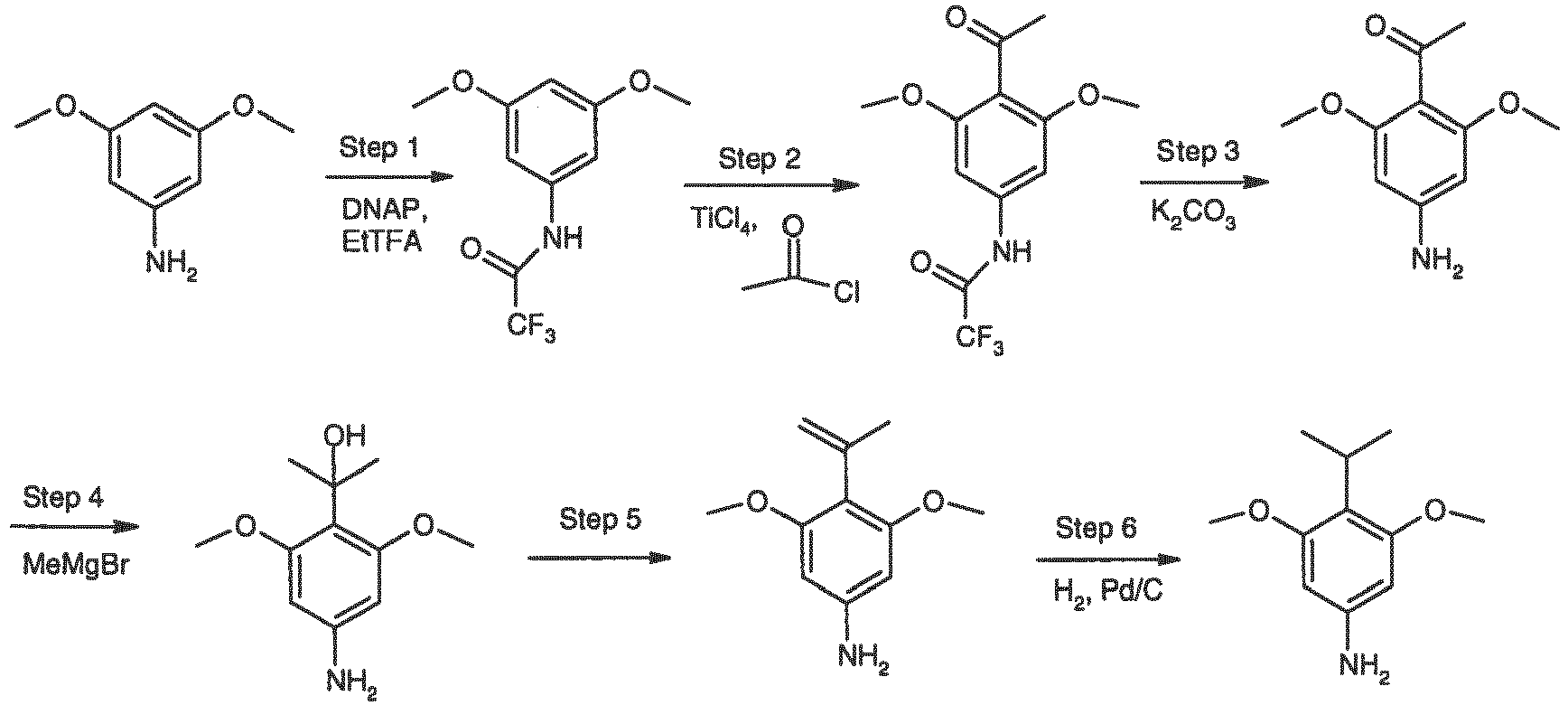

- To 3,5-dimethoxyaniline (20 g, 131 mmol) dissolved in anhydrous THF (90 mL) was added 4-(dimethylamino)pyridine (1.6 g, 13.1 mmol) and ethyl trifluoroacetate (47 mL, 392 mmol). After refluxing 48 hours, the cooled reaction mixture was concentrated and partitioned between ethyl acetate (300 mL) and 2N hydrochloric acid (100 mL). The ethyl acetate layer was washed with water (100 mL), dried using anhydrous sodium sulfate, and concentrated to yield N-(3,5-Dimethoxy-phenyl)-2,2,2-trifluoro-acetamide (31.8 g, 98%) as pale yellow solid.
- To a solution of N-(3,5-Dimethoxy-phenyl)-2,2,2-trifluoro-acetamide (31.8 g, 130 mmol) in anhydrous dichloroethane (450 mL), cooled in an ice bath, was added a solution of tin (IV) chloride (29.9 mL, 260 mmol dissolved in 30 mL anhydrous dichloroethane) dropwise over 10 min. Acetyl chloride (9.1 mL, 130 mmol) was added slowly, maintaining the temperature of the reaction below 5°C. After stirring 3 hours at RT, the reaction was cooled in an ice bath. Water (300 mL) was added, maintaining the temperature of the reaction below 25°C, and the reaction was stirred at RT for 18 hours. The reaction mixture was extracted with DCM, and the organic layer was separated, washed wit water, dried over sodium sulfate, filtered and evaporated under reduced pressure. The residue was purified by silica gel column chromatography eluting with 20% to 30% hexanes/ethyl acetate to yield N-(4-acetyl-3,5-dimethoxy-phenyl)-2,2,2-trifluoro-acetamide (4.8 g, 13%) as a white solid.
- To N-(4-Acetyl-3,5-dimethoxy-phenyl)-2,2,2-trifluoro-acetamide (4.3 g, 14.8 mmol) dissolved in methanol (90 mL) was added anhydrous potassium carbonate (4.67 g, 33.8 mmol). After refluxing for 18 hours, the reaction mixture was cooled and concentrated under reduced pressure. The concentrate was extracted with ethyl acetate and the organic layer was washed with brine, dried using anhydrous sodium sulfate, filtered and concentrated under reduced pressure to yield 1-(4-amino-2,6-dimethoxy-phenyl)-ethanone (2.5 g, 87%) as a pale yellow solid.
- To a solution of methyl magnesium bromide (3M in ether, 16.8 mL, 50.5 mmol) in anhydrous THF (20 mL), cooled in an ice bath, was added 1-(4-amino-2,6-dimethoxy-phenyl)-ethanone (2.19 g, 11.2 mmol- dissolved in 65 mL anhydrous THF), maintaining the reaction temperature below 10°C. After stirring 4 hours at RT, 10% ammonium chloride (20 mL) was added, maintaining the temperature of the reaction below 20°C (with the use of an ice bath) during the addition. The mixture was diluted with water and extracted with ethyl acetate. The ethyl acetate layer was washed with brine, dried using anhydrous sodium sulfate, filtered and concentrated to yield 2-(4-amino-2,6-dimethoxy-phenyl)-propan-2-ol (2.23 g, 94%) as a pale yellow solid.
- A solution of 2-(4-amino-2,6-dimethoxy-phenyl)-propan-2-ol (2.2 g, 10.4 mmol) in chloroform (100 mL) was refluxed overnight. The cooled reaction mixture was concentrated under reduced pressure to yield 4-isopropenyl-3,5-dimethoxy-phenylamine, which was used directly in the following step.
- A solution of 4-isopropenyl-3,5-dimethoxy-phenylamine (taken directly from step 5) in ethanol (200 mL) was hydrogenated overnight at RT and 1 psig of H2 gas using 10% palladium on charcoal catalyst (200 mg). The reaction was filtered through Celite and the pad was washed with additional ethanol. Concentration of the filtrate and purification by silica gel column chromatography eluting with 70/30 hexane/ ethyl acetate yielded 4-isopropyl-3,5-dimethoxy-phenylamine (1.4 g, 69%) as a pale pink solid, MS (M+H) = 196.
- To a suspension of 4-isopropyl-3,5-dimethoxy-phenylamine (1.28 g, 6.56 mmol) in 15% hydrochloric acid (20 mL) at 0°C was added sodium nitrite (0.54 g, 7.87 mmol dissolved in 4 mL water) dropwise. After stirring 20 min, potassium iodide (1.09 g, 6.56 mmol dissolved in 4 mL water) was added slowly at 0°C. After stirring at RT for 18 hours, the reaction mixture was partitioned between ether and 10% aqueous sodium bisulfite solution. The ether layer was washed with water, dried using anhydrous magnesium sulfate, filtered and concentrated under reduced pressure. Purification of the residue by silica gel column chromatography eluting with hexane yielded 5-iodo-2-isopropyl-1,3-dimethoxy-benzene (807 mg, 40%) as a white solid, MS (M+H) = 307.
- To a solution of 5-iodo-2-isopropyl-1,3-dimethoxy-benzene (805 mg, 2.63 mmol) in anhydrous DCM (26 mL) at 0°C was added boron tribromide (2.63 mL, 2.63 mmol) 1M in DCM), maintaining the temperature of the reaction at 0°C during the addition. After stirring at RT for 18 hours, water (10 mL) was slowly added to the reaction. After stirring 30 min, the DCM layer was collected, dried using anhydrous magnesium sulfate, filtered and concentrated under reduced pressure. Purification of the residue by silica gel column chromatography eluting with 90/10 hexane/ ethyl acetate yielded 5-iodo-2-isopropyl-3-methoxy-phenol (612 mg, 80%) as an oil, MS (M+H) = 293.
- Following the procedure of Steps 2-4 of Example 6,5-Iodo-2-isopropyl-3-methoxyphenol was converted to 5-(5-Iodo-2-isopropyl-3-methoxy-phenoxy)-pyrimidine-2,4-diamine, MS (M+H) = 401.
- Pharmaceutical preparations for delivery by various routes are formulated as shown in the following Tables. "Active ingredient" or "Active compound" as used in the Tables means one or more of the Compounds of Formula I.
-
Ingredient % wt./wt. Active ingredient 20.0% Lactose 79.5% Magnesium stearate 0.5% - The ingredients are mixed and dispensed into capsules containing about 100 mg each; one capsule would approximate a total daily dosage.
-
Ingredient % wt./wt. Active ingredient 20.0% Magnesium stearate 0.5% Crosscarmellose sodium 2.0% Lactose 76.5% PVP (polyvinylpyrrolidine) 1.0% - The ingredients are combined and granulated using a solvent such as methanol. The formulation is then dried and formed into tablets (containing about 20 mg of active compound) with an appropriate tablet machine.
-
Ingredient Amount Active compound 1.0 g Fumaric acid 0.5 g Sodium chloride 2.0 g Methyl paraben 0.15 g Propyl paraben 0.05 g Granulated sugar 25.5 g Sorbitol (70% solution) 12.85 g Veegum K (Vanderbilt Co.) 1.0 g Flavoring 0.035 ml Colorings 0.5 mg Distilled water q.s. to 100 ml - The ingredients are mixed to form a suspension for oral administration.
-
Ingredient % wt./wt. Active ingredient 0.25 g Sodium Chloride qs to make isotonic Water for injection 100 ml - The active ingredient is dissolved in a portion of the water for injection. A sufficient quantity of sodium chloride is then added with stirring to make the solution isotonic. The solution is made up to weight with the remainder of the water for injection, filtered through a 0.2 micron membrane filter and packaged under sterile conditions.
-
Ingredient % wt./wt. Active ingredient 1.0% Polyethylene glycol 1000 74.5% Polyethylene glycol 4000 24.5% - The ingredients are melted together and mixed on a steam bath, and poured into molds containing 2.5 g total weight.
-
Ingredients Grams Active compound 0.2-2 Span 60 2 Tween 60 2 Mineral oil 5 Petrolatum 10 Methyl paraben 0.15 Propyl paraben 0.05 BHA (butylated hydroxy anisole) 0.01 Water q.s. 100 - All of the ingredients, except water, are combined and heated to about 60°C with stirring. A sufficient quantity of water at about 60°C is then added with vigorous stirring to emulsify the ingredients, and water then added q.s. about 100 g.
- Several aqueous suspensions containing from about 0.025-0.5 percent active compound are prepared as nasal spray formulations. The formulations optionally contain inactive ingredients such as, for example, microcrystalline cellulose, sodium carboxymethylcellulose, and dextrose. Hydrochloric acid may be added to adjust pH. The nasal spray formulations may be delivered via a nasal spray metered pump typically delivering about 50-100 microliters of formulation per actuation. A typical dosing schedule is 2-4 sprays every 4-12 hours.
- CHO-K1 cells were transfected with cloned rat P2X3 or human P2X2/3 receptor subunits and passaged in flasks. 18-24 hours before the FLIPR experiment, cells were released from their flasks, centrifuged, and resuspended in nutrient medium at 2.5 x 10⁵ cells/ml. The cells were aliquoted into black-walled 96-well plates at a density of 50,000 cells/well and incubated overnight in 5% CO2 at 37°C. On the day of the experiment, cells were washed in FLIPR buffer (calcium- and magnesium-free Hank's balanced salt solution, 10 mM HEPES, 2 mM CaCl2, 2.5 mM probenecid; FB). Each well received 100 µl FB and 100 µl of the fluorescent dye Fluo-3 AM [2 µM final conc.]. After a 1 hour dye loading incubation at 37°C, the cells were washed 4 times with FB, and a final 75 µl/well FB was left in each well.
- Test compounds (dissolved in DMSO at 10 mM and serially diluted with FB) or vehicle were added to each well (25 µl of a 4X solution) and allowed to equilibrate for 20 min at RT. The plates were then placed in the FLIPR and a baseline fluorescence measurement (excitation at 488 nm and emission at 510-570 nm) was obtained for 10 seconds before a 100 µl/well agonist or vehicle addition. The agonist was a 2X solution of α,β-meATP producing a final concentration of 1 µM (P2X3) or 5 µM (P2X2/3). Fluorescence was measured for an additional 2 min at 1 second intervals after agonist addition. A final addition of ionomycin (5 µM, final concentration) was made to each well of the FLIPR test plate to establish cell viability and maximum fluorescence of dye-bound cytosolic calcium. Peak fluorescence in response to the addition of α,β-meATP (in the absence and presence of test compounds) was measured and inhibition curves generated using nonlinear regression. PPADS, a standard P2X antagonist, was used as a positive control. Using the above procedure, compounds of the invention exhibited activity for the P2X3 and P2X2/3 receptor. The compound 4-(2,4-Diamino-pyrimidin-5-yloxy)-2-ethynyl-5-isopropyl-phenol, e.g., exhibited a pIC50 of approximately 8.24 for the P2X3 receptor, and approximately 7.99 for the P2X2/3 receptor, using the above assay.
- BALb/cJ mice are immunized with a standard immunization protocol. Briefly, mice (N=8/group) are immunized i.p. with ovalbumin (OVA; 10 µg) in alum on days 0 and 14. Mice are then challenged with aerosolized OVA (5%) on day 21 and 22. Animals receive vehicle (p.o.) or a compound of the invention (100 mg/kg p.o.) all starting on day 20. Lung function is evaluated on day 23 using the Buxco system to measure PenH in response to an aerosol methacholine challenge. Mice are then euthanized and plasma samples collected at the end of the study.
- Female Sprague-Dawley rats (200-300g) were anesthetized with urethane (1.5 g/kg, sc). The animals were tracheotomized, and a carotid artery and femoral vein were cannulated for blood pressure measurement and drug administration, respectively. A laparotomy was performed and the ureters were ligated and transected proximal to the ligation. The external urethral meatus was ligated with silk suture and the urinary bladder was cannulated via the dome for saline infusion and bladder pressure measurement. Following a 15-30 minute stabilization period the bladder was infused with RT saline at 100 µl/min until continuous volume-induced bladder contractions (VIBCs) were observed. The infusion rate was then lowered to 3-5 µl/min for 30 min before the bladder was drained and allowed to rest for 30 min. All subsequent infusions were performed as indicated except the lower infusion rate was maintained for only 15 min instead of 30 min. Bladder filling and draining cycles were repeated until the threshold volumes (TV; the volume needed to trigger the first micturition bladder contraction) varied by less than 10% for two consecutive baselines and contraction frequency was within 2 contractions for a 10 minute period following the slower infusion rate. Once reproducible TVs and VIBCs were established the bladder was drained and the animal was dosed with drug or vehicle (0.5 ml/kg, i.v.) 3 min prior to the start of the next scheduled infusion.
- Male Sprague Dawley rats (180-220 g) are placed in individual Plexiglas cylinders and allowed to acclimate to the testing environment for 30 min. Vehicle, drug or positive control (morphine 2 mg/kg) is administered subcutaneously at 5 ml/kg. 15 min post dosing, formalin (5% in 50 µl) is injected into plantar surface of the right hind paw using a 26-gauge needle. Rats are immediately put back to the observation chamber. Mirrors placed around the chamber allow unhindered observation of the formalin-injected paw. The duration of nociphensive behavior of each animal is recorded by a blinded observer using an automated behavioral timer. Hindpaw licking and shaking / lifting are recorded separately in 5 min bin, for a total of 60 min. The sum of time spent licking or shaking in seconds from time 0 to 5 min is considered the early phase, whereas the late phase is taken as the sum of seconds spent licking or shaking from 15 to 40 min. A plasma sample is collected.
- Adult male Sprague-Dawley rats (350-425 g; Harlan, Indianapolis, IN) are housed 1-2 per cage in an animal care facility. Rats are deeply anesthetized with pentobarbital sodium (45 mg/kg) administered intraperitoneally. Electrodes are placed and secured into the external oblique musculature for electromyographic (EMG) recording. Electrode leads are tunneled subcutaneously and exteriorized at the nape of the neck for future access. After surgery, rats are housed separately and allowed to recuperate for 4-5 days prior to testing.
- The descending colon and rectum are distended by pressure-controlled inflation of a 7-8 cm-long flexible latex balloon tied around a flexible tube. The balloon is lubricated, inserted into the colon via the anus, and anchored by taping the balloon catheter to the base of the tail. Colorectal distension (CRD) is achieved by opening a solenoid gate to a constant pressure air reservoir. Intracolonic pressure is controlled and continuously monitored by a pressure control device. Response is quantified as the visceromotor response (VMR), a contraction of the abdominal and hindlimb musculature. EMG activity produced by contraction of the external oblique musculature is quantified using Spike2 software (Cambridge Electronic Design). Each distension trial lasts 60 sec, and EMG activity is quantified for 20 sec before distension (baseline), during 20 sec distension, and 20 sec after distention. The increase in total number of recorded counts during distension above baseline is defined as the response. Stable baseline responses to CRD (10, 20, 40 and 80 mmHg, 20 seconds, 4 min apart) are obtained in conscious, unsedated rats before any treatment.
- Compounds are evaluated for effects on responses to colon distension initially in a model of acute visceral nociception and a model of colon hypersensitivity produced by intracolonic treatment with zymosan (1 mL, 25 mg/mL) instilled into the colon with a gavage needle inserted to a depth of about 6 cm. Experimental groups will consist of 8 rats each. Acute visceral nociception: For testing effects of drug on acute visceral nociception, 1 of 3 doses of drug, vehicle or positive control (morphine, 2.5 mg/kg) are administered after baseline responses are established; responses to distension are followed over the next 60-90 min.
- Visceral hypersensitivity: For testing effects of drug or vehicle after intracolonic treatment with zymosan, intracolonic treatment is given after baseline responses are established. Prior to drug testing at 4 hours, responses to distension are assessed to establish the presence of hypersensitivity. In zymosan-treated rats, administration of 1 of 3 doses of drug, vehicle or positive control (morphine, 2.5 mg/kg) are given 4 hours after zymosan treatment and responses to distension followed over the next 60-90 min.
- The effects of compounds of this invention on cold allodynia are determined using the chronic constriction injury (CCI) model of neuropathic pain in rats, where cold allodynia is measured in a cold-water bath with a metal-plate floor and water at a depth of 1.5-2.0 cm and a temperature of 3-4°C (Gogas et al., Analgesia, 1997, 3, 1-8).
- Specifically, CCI, rats are anesthetized; the trifurcation of the sciatic nerve is located and 4 ligatures (4-0, or 5-0 chromic gut) are placed circumferentially around the sciatic nerve proximal to the trifurcation. The rats are then allowed to recover from the surgery. On days 4-7 after surgery, the rats are initially assessed for cold -induced allodynia by individually placing the animals in the cold-water bath and recording the total lifts of the injured paw during a 1-min period of time: The injured paw is lifted out of the water. Paw lifts associated with locomotion or body repositioning are not recorded. Rats that displayed 5 lifts per min or more on day 4-7 following surgery are considered to exhibit cold allodynia and are used in subsequent studies. In the acute studies, vehicle, reference compound or compounds of this invention are administered subcutaneously (s.c.) 30 min before testing. The effects of repeated administration of the compounds of this invention on cold allodynia are determined 14, 20 or 38 h following the last oral dose of the following regimen: oral (p.o.) administration of vehicle, reference or a compound of this invention at ∼12 h intervals (BID) for 7 days.
- The effects of compounds of this invention on bone pain are determined between Day 7 to Day 18 following intramedullary injection of 2472 sarcoma cells into the distal femur of C3H/HeJ mice.
- Specifically, NCTC 2472 tumor cells (American Type Culture Collection, ATCC), previously shown to form lytic lesions in bone after intramedullary injection, are grown and maintained according to ATCC recommendations. Approximately 105 cells are injected directly into the medullary cavity of the distal femur in anesthetized C3H/HeJ mice. Beginning on about Day 7, the mice are assessed for spontaneous nocifensive behaviors (flinching & guarding), palpation-evoked nocifensive behaviors (flinching & guarding), forced ambultory guarding and limb use. The effects of compounds of this invention are determined following a single acute (s.c.) administration on Day 7 - Day 15. In addition, the effects of repeated (BID) administration of compounds of this invention from Day 7 - Day 15 are determined within 1 hour of the first dose on Days 7, 9, 11, 13 and 15.
Claims (7)
- A compound of formula I
 X is -CH2-; -O-; -S(O)n- or -NRc-, wherein n is from 0 to 2 and Rc is hydrogen or alkyl;D is an optional oxygen;R1 is alkyl; alkenyl; cycloalkyl; cycloalkenyl; halo; haloalkyl or hydroxyalkyl;R2, R3, and R4 each independently is hydrogen; alkyl; alkenyl; amino; halo; amido; haloalkyl; alkoxy; hydroxy; haloalkoxy; nitro; amino; hydroxyalkyl; alkoxyalkyl; hydroxyalkoxy; alkynylalkoxy; alkylsulfonyl; arylsulfonyl; cyano; aryl; heteroaryl; heterocyclyl; heterocyclylalkoxy; aryloxy; heteroaryloxy; aralkyloxy; heteroaralkyloxy; optionally substituted phenoxy; -C≡C-Ra; -(CH2)m-(Z)n-(CO)-Rb;-(CH2)m-(Z)n-SO2-(NRc)n-Rb, wherein
m and n each independently is 0 or 1,
Z is O or NRc,
Ra is hydrogen; alkyl; aryl;aralkyl; heteroaryl; heteroaralkyl; hydroxyalkyl,; alkoxyalkyl; alkylsulfonylalkyl; aminoalkyl; cyanoalkyl; alkylsilyl, cycloalkyl, cycloalkylalkyl; heterocyclyl; and heterocyclylalkyl;
Rb is hydrogen, alkyl, hydroxy, alkoxy, amino, hydroxyalkyl or alkoxyalkyl, and each Rc is independently hydrogen or alkyl;or R2 and R3 together with the atoms to which they are attached may form a five or six-membered ring that optionally includes one or two heteroatoms selected from O, S and N;R5 is hydrogen; alkyl; aryl; aralkyl; heteroaryl; heteroaralkyl; hydroxyalkyl; alkoxyalkyl; alkylsulfonylalkyl; aminoalkyl; cyanoalkyl; alkylsilyl, cycloalkyl, cycloalkylalkyl; heterocycl; or heterocyclylalkyl;R6 is hydrogen; alkyl; halo; haloalkyl; amino; or alkoxy; andR7 and R8 each independently is hydrogen; alkyl; alkoxyalkyl; aminoalkyl; aminosulfonyl; cycloalkyl; cycloalkylalkyl; haloalkyl; haloalkoxy; hydroxyalky; alkoxyalkyl; alkylsulfonyl; alkylsulfonylalkyl; aminocarbonyloxyalkyl; hydroxycarbonylalkyl; hydroxyalkyloxycarbonylalkyl; aryl; aralkyl; arylsulfonyl; heteroaryl; heteroarylalkyl; heteroarylsulfonyl; heterocyclyl; or heterocyclylalkyl. - The compound of claim 1, wherein X is -O- or -CH2-.
- The compound of claim 1 wherein said compound is of the formula II


- A pharmaceutical composition comprising a pharmaceutically acceptable excipient; and a compound of Claim 1.
- The use of a compound according to claim 1 for the preparation of a medicament for the treatment of a P2X3 or P2X2/3 receptor antagonist-mediated disease.
- The use according to claim 5, wherein such disease is a urinary tract disease selected from reduced bladder capacity, frequent micturition, urge incontinence, stress incontinence, bladder hyperreactivity, benign prostatic hypertrophy, prostatitis, detrusor hyperreflexia, urinary frequency, nocturia, urinary urgency, overactive bladder, pelvic hypersensitivity, urethritis, prostatitits, pelvic pain syndrome, prostatodynia, cystitis, or idiophatic bladder hypersensitivity, a pain condition, said pain condition selected from inflammatory pain, surgical pain, visceral pain, dental pain, premenstrual pain, central pain, pain due to burns, migraine or cluster headaches, nerve injury, neuritis, neuralgias, poisoning, ischemic injury, interstitial cystitis, cancer pain, viral, parasitic or bacterial infection, post-traumatic injury, or pain associated with irritable bowel syndrome, respiratory disorder selected from chronic obstructive pulmonary disease, asthma, and bronchospasm, or gastrointestinal disorder selected from irritable bowel syndrome, inflammatory bowel disease, biliary colic, renal colic, diarrhea-dominant IBS, and pain associated with gastrointestinal distension.
- A compound according to claim 1 selected from the group consisting of:5-(5-Ethynyl-2-isopropyl-4-methoxy-phenoxy)-pyrimidine-2,4-iamine;5-(2-Isopropyl-4-methoxy-5-phenylethynyl-phenoxy)-pyrimidine-2,4-diamine,5-(2-Isopropyl-4-methoxy-5-prop-1-ynyl-phenoxy)-pyrimidine-2,4-diamine,5-(5-Ethynyl-4-fluoro-2-isopropyl-phenoxy)-pyrimidine-2,4-diamine,5-[2-Isopropyl-4-methoxy-5-(3-methoxy-prop-1-ynyl)-phenoxy]-pyrimidine-2,4-diamine,5-(2-Isopropyl-4-methoxy-5-pyridin-2-ylethynyl-phenoxy)-pyrimidine-2,4-diamine,5-(2-Isopropyl-4-methoxy-5-pyridin-3-ylethynyl-phenoxy)-pyrimidine-2,4-diamine,4-[5-(2,4-Diamino-pyrimidin-5-yloxy)-4-isopropyl-2-methoxy-phenyl]-but-3-yn-1-ol,5-[5-(2,4-Diamino-pyrimidin-5-yloxy)-4-isopropyl-2-methoxy-phenyl]-pent-4-ynenitrile,5-(2-Isopropyl-4-methoxy-5-pent-1-ynyl-phenoxy)-pyrimidine-2,4-diamine,5-(2-Isopropyl-4-methoxy-5-pyridin-4-ylethynyl-phenoxy)-pyrimidine-2,4-diamine,5-(2-Isopropyl-4-methoxy-5-thiophen-3-ylethynyl-phenoxy)-pyrimidine-2,4-diamine,5-[2-Isopropyl-4-methoxy-5-(3-methyl-3H-imidazol-4-ylethynyl)-phenoxy]-pyrimidine-2,4-diamine,5-[5-(2,4-Diamino-pyrimidin-5-yloxy)-4-isopropyl-2-methoxy-phenyl]-pent-4-yn-1-ol,5-(4-Fluoro-2-isopropyl-5-prop-1-ynyl-phenoxy)-pyrimidine-2,4-diamine,5- [2-Isopropyl-4-methoxy-5-(3-methylamino-prop-1-ynyl)-phenoxy]-pyrimidine-2,4-diamine,3-[5-(2,4-Diamino-pyrimidin-5-yloxy)-4-isopropyl-2-methoxy-phenyl]-prop-2-yn-1-ol,5-(2-Isopropyl-4-methoxy-5-trimethylsilanylethynyl-phenoxy)-pyrimidine-2,4-diamine5-(5-Cyclopropylethynyl-2-isopropyl-4-methoxy-phenoxy)-pyrimidine-2,4-diamine,4-(2,4-Diamino-pyrimidin-5-yloxy)-2-ethynyl-5-isopropyl-phenol,5-(5-Ethynyl-2-isopropyl-phenoxy)-pyrimidine-2,4-diamine,5-[5-Ethynyl-4-(3-fluoro-benzyloxy)-2-isopropyl-phenoxy]-pyrimidine-2,4-diamine,5-(5-Ethynyl-2-isopropyl-4-methoxy-benzyl)-pyrimidine-2,4-diamine,5-(2-Ethyl-5-ethynyl-4-methoxy-phenoxy)-pyrimidine-2,4-diamine,5-(2,5-Diethynyl-4-methoxy-phenoxy)-pyrimidine-2,4-diamine,5-(2,5-Diethynyl-phenoxy)-pyrimidine-2,4-diamine,5-(5-Ethynyl-2-iodo-phenoxy)-pyrimidine-2,4-diamine,5-(2-Ethynyl-5-iodo-4-methoxy-phenoxy)-pyrimidine-2,4-diamine,5-(5-Iodo-2-isopropyl-3-methoxy-phenoxy)-pyrimidine-2,4-diamine,2-[4-(2,4-Diamino-pyrimidin-5-yloxy)-2-ethynyl-5-isopropyl-phenoxy]-ethanol,5-(5-Ethynyl-2-isopropyl-3-methoxy-phenoxy)-pyrimidine-2,4-diamine,2-[4-Amino-5-(5-ethynyl-2-isopropyl-4-methoxy-phenoxy)-pyrimidin-2-ylamino]-ethanol,5-(5-Ethynyl-2-isopropyl-4-methoxy-phenoxy)-N2-(2-piperidin-1-yl-ethyl)-pyrimidine-2,4-diamine,N2-(2-Dimethylamino-ethyl)-5-(5-ethynyl-2-isopropyl-4-methoxy-phenoxy)-pyrimidine-2,4-diamine,2-[4-Amino-5-(5-ethynyl-2-isopropyl-4-methoxy-phenoxy)-pyrimidin-2-ylamino]-propan-1-ol,5-(5-Ethynyl-2-isopropyl-4-methoxy-phenoxy)-N2-(2-morpholin-4-yl-ethyl)-pyrimidine-2,4-diamine,1-[4-Amino-5-(5-ethynyl-2-isopropyl-4-methoxy-phenoxy)-pyrimidin-2-ylamino]-propan-2-ol,5-(5-Ethynyl-2-isopropyl-4-methoxy-phenoxy)-N2-(1-methanesulfonyl-piperidin-4-yl)-pyrimidine-2,4-diamine,5-(5-Ethynyl-2-isopropyl-4-methoxy-phenoxy)-N2-(tetrahydro-pyran-4-yl)-pyrimidine-2,4-diamine,2-[4-Amino-5-(5-ethynyl-2-isopropyl-4-methoxy-phenoxy)-pyrimidin-2-ylamino]-propane-1,3-diol,5-(4-Chloro-5-ethynyl-2-isopropyl-phenoxy)-pyrimidine-2,4-diamine, and3-[4-Amino-5-(5-ethynyl-2-isopropyl-4-methoxy-phenoxy)-pyrimidin-2-ylamino]-propan-1-ol.
Applications Claiming Priority (2)
| Application Number | Priority Date | Filing Date | Title |
|---|---|---|---|
| US71339905P | 2005-09-01 | 2005-09-01 | |
| PCT/EP2006/065524 WO2007025899A1 (en) | 2005-09-01 | 2006-08-21 | Diaminopyrimidines as p2x3 and p2x2/3 modulators |
Publications (2)
| Publication Number | Publication Date |
|---|---|
| EP1924564A1 EP1924564A1 (en) | 2008-05-28 |
| EP1924564B1 true EP1924564B1 (en) | 2016-11-09 |
Family
ID=37149621
Family Applications (1)
| Application Number | Title | Priority Date | Filing Date |
|---|---|---|---|
| EP06778312.6A Active EP1924564B1 (en) | 2005-09-01 | 2006-08-21 | Diaminopyrimidines as p2x3 and p2x2/3 modulators |
Country Status (9)
| Country | Link |
|---|---|
| US (1) | US7531547B2 (en) |
| EP (1) | EP1924564B1 (en) |
| JP (1) | JP4850911B2 (en) |
| CN (1) | CN101296907B (en) |
| AR (1) | AR057104A1 (en) |
| CA (1) | CA2619919C (en) |
| ES (1) | ES2612890T3 (en) |
| TW (1) | TW200740773A (en) |
| WO (1) | WO2007025899A1 (en) |
Families Citing this family (36)
| Publication number | Priority date | Publication date | Assignee | Title |
|---|---|---|---|---|
| KR101012926B1 (en) * | 2005-09-01 | 2011-02-09 | 에프. 호프만-라 로슈 아게 | Diaminopyrimidines as P2x3 and P2x2 / 3 Modulators |
| WO2008104474A1 (en) * | 2007-02-28 | 2008-09-04 | F. Hoffmann-La Roche Ag | Diaminopyrimidines |
| CN101679246A (en) | 2007-03-30 | 2010-03-24 | 盐野义制药株式会社 | Novel pyrrolinone derivative and pharmaceutical composition comprising same |
| CN101981003B (en) | 2008-02-29 | 2014-07-02 | 伊沃泰克股份公司 | Amide compounds, compositions and uses thereof |
| TW201016702A (en) * | 2008-09-25 | 2010-05-01 | Shionogi & Co | Novel pyrrolinone derivative and pharmaceutical composition comprising the same |
| CN102395571B (en) | 2009-02-13 | 2015-12-16 | 盐野义制药株式会社 | Pyrrolotriazine derivatives and the pharmaceutical composition containing this pyrrolotriazine derivatives |
| US9212130B2 (en) | 2010-08-10 | 2015-12-15 | Shionogi & Co., Ltd. | Heterocyclic derivative and pharmaceutical composition comprising the same |
| PL2604595T3 (en) | 2010-08-10 | 2016-09-30 | Triazine derivative and pharmaceutical compound that contains same and exhibits analgesic activity | |
| KR101946499B1 (en) | 2011-04-08 | 2019-02-11 | 얀센 사이언시즈 아일랜드 언리미티드 컴퍼니 | Pyrimidine derivatives for the treatment of viral infections |
| UA116083C2 (en) | 2011-11-09 | 2018-02-12 | ЯНССЕН САЙЄНСІЗ АЙРЛЕНД ЮСі | PURINE DERIVATIVES FOR TREATMENT OF VIRAL INFECTIONS |
| US9550763B2 (en) | 2012-02-09 | 2017-01-24 | Shionogi & Co., Ltd. | Heterocyclic ring and carbocyclic derivative |
| PT2872515T (en) | 2012-07-13 | 2016-07-27 | Janssen Sciences Ireland Uc | Macrocyclic purines for the treatment of viral infections |
| EP2712866A1 (en) * | 2012-10-01 | 2014-04-02 | Centre National de la Recherche Scientifique (CNRS) | 1,2,4-triazine derivatives for the treatment of viral infections |
| EA035327B1 (en) | 2012-10-10 | 2020-05-28 | Янссен Сайенсиз Айрлэнд Юси | PYRROLO[3,2-d]PYRIMIDINE DERIVATIVES FOR THE TREATMENT OF VIRAL INFECTIONS AND OTHER DISEASES |
| ES2655843T3 (en) | 2012-11-16 | 2018-02-21 | Janssen Sciences Ireland Uc | Heterocyclic substituted 2-aminoquinazoline derivatives for the treatment of viral infections |
| MY191389A (en) | 2013-02-21 | 2022-06-22 | Janssen Sciences Ireland Uc | 2-aminopyrimidine derivatives for the treatment of viral infections |
| CN105338983B (en) | 2013-03-29 | 2019-10-25 | 爱尔兰詹森科学公司 | Macrocyclic deaza-purinones for the treatment of viral infections |
| JP6377139B2 (en) | 2013-05-24 | 2018-08-22 | ヤンセン・サイエンシズ・アイルランド・ユーシー | Pyridone derivatives for the treatment of viral infections and further diseases |
| TWI637949B (en) | 2013-06-14 | 2018-10-11 | 塩野義製藥股份有限公司 | Aminotriazine derivative and pharmaceutical composition comprising the same |
| JP6763769B2 (en) | 2013-06-27 | 2020-09-30 | ヤンセン・サイエンシズ・アイルランド・アンリミテッド・カンパニー | Piroro [3,2-d] pyrimidine derivatives for the treatment of viral infections and other diseases |
| MX368625B (en) | 2013-07-30 | 2019-10-08 | Janssen Sciences Ireland Uc | THIENO[3,2-d]PYRIMIDINES DERIVATIVES FOR THE TREATMENT OF VIRAL INFECTIONS. |
| JP6993084B2 (en) | 2013-08-12 | 2022-02-03 | ジェネンテック, インコーポレイテッド | 1- (Chloromethyl) -2,3-dihydro-1H-benzo [E] indole dimer antibody-drug conjugate compound, and method of use and treatment |
| CR20160093A (en) | 2013-08-23 | 2016-08-26 | Afferent Pharmaceuticals Inc | DIAMINOPIRIDINE RECEPTOR MODULATORS P2X3 AND P2X2 / 3 FOR THE TREATMENT OF ACUTE, ACUTE OR CHRONIC TOS |
| EP3082876B1 (en) | 2013-12-16 | 2018-01-17 | Genentech, Inc. | 1-(chloromethyl)-2,3-dihydro-1h-benzo[e]indole dimer antibody-drug conjugate compounds, and methods of use and treatment |
| US10195198B2 (en) | 2014-07-03 | 2019-02-05 | Afferent Pharmaceuticals, Inc. | Methods and compositions for treating diseases and conditions |
| WO2016084922A1 (en) * | 2014-11-28 | 2016-06-02 | 塩野義製薬株式会社 | 1,2,4-triazine derivative and pharmaceutical composition thereof |
| PT3355889T (en) | 2015-09-29 | 2023-04-26 | Afferent Pharmaceuticals Inc | Diaminopyrimidine p2x3 and p2x2/3 receptor modulators for use in the treatment of cough |
| WO2017160569A1 (en) | 2016-03-14 | 2017-09-21 | Afferent Pharmaceuticals Inc. | Pyrimidines and variants thereof, and uses therefor |
| CA3018180C (en) | 2016-03-25 | 2024-02-20 | Ronald Charles Hawley | Pyrimidines and variants thereof, and uses therefor |
| SG11201811448RA (en) | 2016-07-01 | 2019-01-30 | Janssen Sciences Ireland Unlimited Co | Dihydropyranopyrimidines for the treatment of viral infections |
| KR102450287B1 (en) | 2016-09-29 | 2022-09-30 | 얀센 사이언시즈 아일랜드 언리미티드 컴퍼니 | Pyrimidine prodrugs for treatment of viral infections and additional diseases |
| RU2650780C1 (en) | 2016-12-06 | 2018-04-17 | Общество с ограниченной ответственностью "Анальгетики будущего" | Peptide modulator of purinergic receptors |
| TW202415645A (en) | 2018-03-01 | 2024-04-16 | 愛爾蘭商健生科學愛爾蘭無限公司 | 2,4-diaminoquinazoline derivatives and medical uses thereof |
| EP4230195A1 (en) | 2019-03-07 | 2023-08-23 | Arbormentis LLC | Compositions and methods of use comprising substances with neural plasticity actions administered at non-psychedelic / psychotomimetic dosages and formulations |
| SG11202111877TA (en) * | 2019-04-30 | 2021-11-29 | Beijing Tide Pharmaceutical Co Ltd | Method for treating cough by using diaminopyrimidine compound |
| AU2020265969B2 (en) | 2019-04-30 | 2025-10-02 | Beijing Tide Pharmaceutical Co., Ltd. | Solid form of diaminopyrimidine compound or hydrate thereof, preparation method therefor, and application thereof |
Family Cites Families (52)
| Publication number | Priority date | Publication date | Assignee | Title |
|---|---|---|---|---|
| US2953567A (en) | 1956-11-23 | 1960-09-20 | Burroughs Wellcome Co | 5-phenylmercaptopyrimidines and method |
| US3850927A (en) | 1969-03-06 | 1974-11-26 | Burroughs Wellcome Co | 5-benzyl pyrimidines intermediates therefore,and method |
| US4052553A (en) | 1969-03-06 | 1977-10-04 | Burroughs Wellcome Co. | 5-benzyl pyrimidines intermediates therefore, and method |
| US3991050A (en) | 1969-03-06 | 1976-11-09 | Burroughs Wellcome Co. | Preparation of β-Amino-α-benzylacrylonitriles |
| US3855265A (en) | 1969-03-06 | 1974-12-17 | Burroughs Wellcome Co | 5-benzyl pyrimidines intermediates therefore, and method |
| US3852276A (en) | 1969-03-06 | 1974-12-03 | Burroughs Wellcome Co | 5-benzyl pyrimidines intermediate therefore, and method |
| US3849470A (en) | 1969-03-06 | 1974-11-19 | Burroughs Wellcome Co | 5-benzyl pyrimidines intermediates therefore,and method |
| CH513181A (en) | 1969-06-12 | 1971-09-30 | Hoffmann La Roche | Process for the preparation of N-oxides of benzylpyrimidines |
| US4143227A (en) | 1973-02-26 | 1979-03-06 | Hoffmann-La Roche Inc. | Process for substituted 5-benzyl-2,4-diamino-pyrimidines |
| US4255574A (en) | 1973-02-26 | 1981-03-10 | Hoffmann-La Roche Inc. | Process for preparing 2,4-diamino-pyrimidines |
| US3931181A (en) | 1973-07-27 | 1976-01-06 | Hoffmann-La Roche Inc. | 2,4-Diamino-5-benzylpyrimidines |
| US4515948A (en) | 1973-09-12 | 1985-05-07 | Hoffmann-La Roche Inc. | 2,4-Diamino-5-(4-amino and 4-dimethylamino-3,5-dimethoxy benzyl)pyrimidines |
| CH591457A5 (en) | 1973-11-08 | 1977-09-15 | Hoffmann La Roche | |
| US3940393A (en) | 1974-06-21 | 1976-02-24 | American Home Products Corporation | Synthesis of 2,6-diaminopyrimidines |
| US4039543A (en) | 1974-12-24 | 1977-08-02 | Hoffmann-La Roche Inc. | Benzylpyrimidines |
| US4033962A (en) | 1975-06-26 | 1977-07-05 | Hoffman-La Roche Inc. | 2,4-Diamino-pyrimidine derivatives and processes |
| GB1582245A (en) | 1976-06-09 | 1981-01-07 | Wellcome Found | Benzyl cyanoacetal derivatives and their conversion to pyrimidine derivatives |
| US4115650A (en) | 1976-11-17 | 1978-09-19 | Hoffmann-La Roche Inc. | Process for preparing 2,4-diamino-5-(substituted benzyl)-pyrimidines |
| US4075209A (en) | 1977-02-07 | 1978-02-21 | Hoffmann-La Roche, Inc. | Process for preparing substituted 2,4-diaminopyrimidines and isoxazole intermediate |
| FR2397407A2 (en) | 1977-07-11 | 1979-02-09 | Dick Pierre | 2,4-DIAMINO PYRIMIDINE DERIVATIVES AND THEIR SOLUTION IN ASSOCIATION WITH SULFAMIDS |
| US4258045A (en) | 1979-11-30 | 1981-03-24 | Merck & Co., Inc. | Inhibitor of dihydrofolate reductase |
| DE3045720A1 (en) | 1980-12-04 | 1982-07-08 | Basf Ag, 6700 Ludwigshafen | N-PYRIMIDINYL-CARBAMINE ACID ESTER, METHOD FOR THE PRODUCTION THEREOF AND MEDICINAL PRODUCTS CONTAINING THE SAME |
| FR2502152A1 (en) | 1981-03-20 | 1982-09-24 | Panmedica Laboratoires | NOVEL SUBSTITUTED DIAMINO-2,4-BENZYL-5-PYRIMIDINE N2-SOLUBLE DERIVATIVES, PROCESS FOR THEIR PREPARATION AND MEDICAMENTS CONTAINING SAME |
| IT1138146B (en) | 1981-08-11 | 1986-09-17 | Proter Spa | PROCESS FOR THE PRODUCTION OF 2,4-DIAMINE- (3,5-DIMETHOXY-4-METOS SIETOXY-BENZYL) -PYRIMIDINE |
| US4590271A (en) | 1982-05-01 | 1986-05-20 | Burroughs Wellcome Co. | 2,4-diamino-5-(substituted)pyrimidines, useful as antimicrobials |
| US4587341A (en) | 1982-05-07 | 1986-05-06 | Burroughs Wellcome Co. | 2,4-diamino-5-(1,2,3,4-tetrahydro-(substituted or unsubstituted)-6-quinolylmethyl)pyrimidines, useful as antimicrobials |
| DE3603577A1 (en) | 1986-02-06 | 1987-08-13 | Joachim K Prof Dr Seydel | NEW SUBSTITUTED 2,4-DIAMINO-5-BENZYLPYRIMIDINE, THEIR PRODUCTION AND USE THEREOF AS A MEDICINE WITH ANTIBACTERIAL EFFECTIVENESS |
| FR2595697B1 (en) | 1986-03-13 | 1988-07-08 | Rousselot Cie | BENZYL-PYRIMIDINE DERIVATIVES, PROCESS FOR THEIR PREPARATION AND COMPOSITIONS CONTAINING THEM |
| HU199683B (en) | 1987-07-22 | 1990-03-28 | Egyt Gyogyszervegyeszeti Gyar | Process for producing pharmaceutical compositions analgesic, antiphlogistic, antipyretic, antianginic and/or antioxidative activity |
| US4996198A (en) | 1988-07-11 | 1991-02-26 | Hoffmann-La Roche Inc. | Anticoccidial composition |
| US5240640A (en) | 1990-06-04 | 1993-08-31 | Coulter Corporation | In situ use of gelatin or an aminodextran in the preparation of uniform ferrite particles |
| US5258373A (en) | 1991-07-17 | 1993-11-02 | Hoffmann-La Roche Inc. | Anticoccidial compositions |
| TW394761B (en) | 1993-06-28 | 2000-06-21 | Hoffmann La Roche | Novel Sulfonylamino Pyrimidines |
| IL111959A (en) | 1993-12-17 | 2000-07-16 | Tanabe Seiyaku Co | N-(polysubstituted pyrimidin-4-yl) benzenesulfonamide derivatives their preparation and pharmaceutical compositions containing them |
| FI972194A7 (en) * | 1994-11-24 | 1997-05-22 | Basilea Pharmaceutica Ag | New benzylpyrimidines |
| US5739333A (en) | 1995-05-16 | 1998-04-14 | Tanabe Seiyaku Co., Ltd. | Sulfonamide derivative and process for preparing the same |
| US6136971A (en) | 1998-07-17 | 2000-10-24 | Roche Colorado Corporation | Preparation of sulfonamides |
| US6583148B1 (en) * | 1999-04-08 | 2003-06-24 | Krenitsky Pharmaceuticals, Inc. | Neurotrophic substituted pyrimidines |
| US6211185B1 (en) | 1999-05-05 | 2001-04-03 | Veterinary Pharmacy Corporation | Concentrate comprising a sulfonamide in solution, a 2,4-diaminopyrimidine in stable suspension within said solution, and a suspending agent |
| ES2295048T3 (en) | 1999-09-03 | 2008-04-16 | Actelion Pharmaceuticals Ltd. | BIS-SULFONAMIDS. |
| DE60025837T2 (en) | 1999-09-24 | 2006-11-02 | Janssen Pharmaceutica N.V. | ANTIVIRAL SOLID DISPERSIONS |
| SE9904652D0 (en) | 1999-12-17 | 1999-12-17 | Astra Pharma Prod | Novel Compounds |
| AU2001263850A1 (en) | 2000-04-20 | 2001-11-07 | Actelion Pharmaceuticals Ltd | Pyrimidine-sulfonamides having endothelin-antagonist activity |
| WO2001081338A1 (en) | 2000-04-25 | 2001-11-01 | Actelion Pharmaceuticals Ltd | Substituted sulfonylaminopyrimidines |
| MY140724A (en) | 2000-07-21 | 2010-01-15 | Actelion Pharmaceuticals Ltd | Novel arylethene-sulfonamides |
| NZ524172A (en) | 2000-09-25 | 2004-09-24 | Actelion Pharmaceuticals Ltd | Arylalkane-sulfonamides useful as endothelin receptor antagonists |
| WO2002053557A1 (en) | 2000-12-18 | 2002-07-11 | Actelion Pharmaceuticals Ltd | Novel sulfamides and their use as endothelin receptor antagonists |
| US6423720B1 (en) | 2001-02-01 | 2002-07-23 | Duquesne University Of The Holy Ghost | Pyrimidine compounds and methods for making and using the same |
| WO2002083650A1 (en) | 2001-04-11 | 2002-10-24 | Actelion Pharmaceuticals Ltd | Novel sulfonylamino-pyrimidines |
| EP1392643B1 (en) | 2001-05-18 | 2005-09-14 | Abbott Laboratories | Trisubstituted-n- (1s)-1,2,3,4-tetrahydro-1-naphthalenyl] benzamides which inhibit p2x3 and p2x2/3 containing receptors |
| WO2003042190A1 (en) | 2001-11-12 | 2003-05-22 | Pfizer Products Inc. | N-alkyl-adamantyl derivatives as p2x7-receptor antagonists |
| ES2391636T3 (en) * | 2004-03-05 | 2012-11-28 | F. Hoffmann-La Roche Ag | Diaminopyrimidines as antagonists of P2X3 and P2X2 / 3 |
-
2006
- 2006-08-21 ES ES06778312.6T patent/ES2612890T3/en active Active
- 2006-08-21 CA CA2619919A patent/CA2619919C/en not_active Expired - Fee Related
- 2006-08-21 JP JP2008528472A patent/JP4850911B2/en not_active Expired - Fee Related
- 2006-08-21 EP EP06778312.6A patent/EP1924564B1/en active Active
- 2006-08-21 CN CN2006800403523A patent/CN101296907B/en not_active Expired - Fee Related
- 2006-08-21 WO PCT/EP2006/065524 patent/WO2007025899A1/en not_active Ceased
- 2006-08-25 US US11/510,216 patent/US7531547B2/en active Active
- 2006-08-29 TW TW095131818A patent/TW200740773A/en unknown
- 2006-08-30 AR ARP060103783A patent/AR057104A1/en not_active Application Discontinuation
Also Published As
| Publication number | Publication date |
|---|---|
| JP2009513565A (en) | 2009-04-02 |
| US7531547B2 (en) | 2009-05-12 |
| AR057104A1 (en) | 2007-11-14 |
| EP1924564A1 (en) | 2008-05-28 |
| WO2007025899A1 (en) | 2007-03-08 |
| JP4850911B2 (en) | 2012-01-11 |
| CA2619919C (en) | 2014-04-01 |
| CN101296907B (en) | 2013-03-27 |
| ES2612890T3 (en) | 2017-05-19 |
| CA2619919A1 (en) | 2007-03-08 |
| CN101296907A (en) | 2008-10-29 |
| US20070049758A1 (en) | 2007-03-01 |
| TW200740773A (en) | 2007-11-01 |
Similar Documents
| Publication | Publication Date | Title |
|---|---|---|
| US7531547B2 (en) | Diaminopyrimidines as P2X3 and P2X2/3 modulators | |
| EP1924565B1 (en) | Diaminopyrimidines as p2x3 and p3x2/3 modulators | |
| EP1924566B1 (en) | Diaminopyrimidines as p2x3 and p2x2/3 modulators | |
| EP2592070B1 (en) | Tetrazole-substituted arylamides | |
| US7589090B2 (en) | Diaminopyrimidines as P2X3 and P2X2/3 modulators | |
| EP2445897B1 (en) | Novel indazole arylamides as p2x3 and/or p2x2/3 antagonists | |
| US20100144758A1 (en) | Azaindole p2x3 and p2x2/3 modulators | |
| US20080207655A1 (en) | Diaminopyrimidines as P2X3 and P2X2/3 modulators | |
| ES2542021T3 (en) | Piperidine- and piperazine-1-carboxylic acid amide derivatives and related compounds as modulators of fatty acid amide hydrolase (faah) for the treatment of anxiety, pain and other conditions | |
| EP2445889B1 (en) | Novel benzoxazolone -substituted arylamides |
Legal Events
| Date | Code | Title | Description |
|---|---|---|---|
| PUAI | Public reference made under article 153(3) epc to a published international application that has entered the european phase |
Free format text: ORIGINAL CODE: 0009012 |
|
| 17P | Request for examination filed |
Effective date: 20080401 |
|
| AK | Designated contracting states |
Kind code of ref document: A1 Designated state(s): AT BE BG CH CY CZ DE DK EE ES FI FR GB GR HU IE IS IT LI LT LU LV MC NL PL PT RO SE SI SK TR |
|
| DAX | Request for extension of the european patent (deleted) | ||
| 17Q | First examination report despatched |
Effective date: 20130826 |
|
| GRAP | Despatch of communication of intention to grant a patent |
Free format text: ORIGINAL CODE: EPIDOSNIGR1 |
|
| INTG | Intention to grant announced |
Effective date: 20160620 |
|
| RIN1 | Information on inventor provided before grant (corrected) |
Inventor name: MOORE, AMY GERALDINE Inventor name: JAHANGIR, ALAM Inventor name: WAGNER, PAUL J. Inventor name: DILLON, MICHAEL PATRICK |
|
| GRAS | Grant fee paid |
Free format text: ORIGINAL CODE: EPIDOSNIGR3 |
|
| GRAA | (expected) grant |
Free format text: ORIGINAL CODE: 0009210 |
|
| AK | Designated contracting states |
Kind code of ref document: B1 Designated state(s): AT BE BG CH CY CZ DE DK EE ES FI FR GB GR HU IE IS IT LI LT LU LV MC NL PL PT RO SE SI SK TR |
|
| REG | Reference to a national code |
Ref country code: GB Ref legal event code: FG4D |
|
| REG | Reference to a national code |
Ref country code: AT Ref legal event code: REF Ref document number: 843780 Country of ref document: AT Kind code of ref document: T Effective date: 20161115 Ref country code: CH Ref legal event code: EP |
|
| REG | Reference to a national code |
Ref country code: IE Ref legal event code: FG4D |
|
| REG | Reference to a national code |
Ref country code: DE Ref legal event code: R096 Ref document number: 602006050856 Country of ref document: DE |
|
| PG25 | Lapsed in a contracting state [announced via postgrant information from national office to epo] |
Ref country code: LV Free format text: LAPSE BECAUSE OF FAILURE TO SUBMIT A TRANSLATION OF THE DESCRIPTION OR TO PAY THE FEE WITHIN THE PRESCRIBED TIME-LIMIT Effective date: 20161109 |
|
| REG | Reference to a national code |
Ref country code: LT Ref legal event code: MG4D |
|
| REG | Reference to a national code |
Ref country code: NL Ref legal event code: MP Effective date: 20161109 |
|
| REG | Reference to a national code |
Ref country code: AT Ref legal event code: MK05 Ref document number: 843780 Country of ref document: AT Kind code of ref document: T Effective date: 20161109 |
|
| PG25 | Lapsed in a contracting state [announced via postgrant information from national office to epo] |
Ref country code: GR Free format text: LAPSE BECAUSE OF FAILURE TO SUBMIT A TRANSLATION OF THE DESCRIPTION OR TO PAY THE FEE WITHIN THE PRESCRIBED TIME-LIMIT Effective date: 20170210 Ref country code: SE Free format text: LAPSE BECAUSE OF FAILURE TO SUBMIT A TRANSLATION OF THE DESCRIPTION OR TO PAY THE FEE WITHIN THE PRESCRIBED TIME-LIMIT Effective date: 20161109 Ref country code: NL Free format text: LAPSE BECAUSE OF FAILURE TO SUBMIT A TRANSLATION OF THE DESCRIPTION OR TO PAY THE FEE WITHIN THE PRESCRIBED TIME-LIMIT Effective date: 20161109 Ref country code: LT Free format text: LAPSE BECAUSE OF FAILURE TO SUBMIT A TRANSLATION OF THE DESCRIPTION OR TO PAY THE FEE WITHIN THE PRESCRIBED TIME-LIMIT Effective date: 20161109 |
|
| REG | Reference to a national code |
Ref country code: ES Ref legal event code: FG2A Ref document number: 2612890 Country of ref document: ES Kind code of ref document: T3 Effective date: 20170519 |
|
| PG25 | Lapsed in a contracting state [announced via postgrant information from national office to epo] |
Ref country code: FI Free format text: LAPSE BECAUSE OF FAILURE TO SUBMIT A TRANSLATION OF THE DESCRIPTION OR TO PAY THE FEE WITHIN THE PRESCRIBED TIME-LIMIT Effective date: 20161109 Ref country code: AT Free format text: LAPSE BECAUSE OF FAILURE TO SUBMIT A TRANSLATION OF THE DESCRIPTION OR TO PAY THE FEE WITHIN THE PRESCRIBED TIME-LIMIT Effective date: 20161109 Ref country code: PL Free format text: LAPSE BECAUSE OF FAILURE TO SUBMIT A TRANSLATION OF THE DESCRIPTION OR TO PAY THE FEE WITHIN THE PRESCRIBED TIME-LIMIT Effective date: 20161109 Ref country code: IS Free format text: LAPSE BECAUSE OF FAILURE TO SUBMIT A TRANSLATION OF THE DESCRIPTION OR TO PAY THE FEE WITHIN THE PRESCRIBED TIME-LIMIT Effective date: 20170309 Ref country code: PT Free format text: LAPSE BECAUSE OF FAILURE TO SUBMIT A TRANSLATION OF THE DESCRIPTION OR TO PAY THE FEE WITHIN THE PRESCRIBED TIME-LIMIT Effective date: 20170309 |
|
| REG | Reference to a national code |
Ref country code: FR Ref legal event code: PLFP Year of fee payment: 12 |
|
| PG25 | Lapsed in a contracting state [announced via postgrant information from national office to epo] |
Ref country code: CZ Free format text: LAPSE BECAUSE OF FAILURE TO SUBMIT A TRANSLATION OF THE DESCRIPTION OR TO PAY THE FEE WITHIN THE PRESCRIBED TIME-LIMIT Effective date: 20161109 Ref country code: EE Free format text: LAPSE BECAUSE OF FAILURE TO SUBMIT A TRANSLATION OF THE DESCRIPTION OR TO PAY THE FEE WITHIN THE PRESCRIBED TIME-LIMIT Effective date: 20161109 Ref country code: SK Free format text: LAPSE BECAUSE OF FAILURE TO SUBMIT A TRANSLATION OF THE DESCRIPTION OR TO PAY THE FEE WITHIN THE PRESCRIBED TIME-LIMIT Effective date: 20161109 Ref country code: RO Free format text: LAPSE BECAUSE OF FAILURE TO SUBMIT A TRANSLATION OF THE DESCRIPTION OR TO PAY THE FEE WITHIN THE PRESCRIBED TIME-LIMIT Effective date: 20161109 Ref country code: DK Free format text: LAPSE BECAUSE OF FAILURE TO SUBMIT A TRANSLATION OF THE DESCRIPTION OR TO PAY THE FEE WITHIN THE PRESCRIBED TIME-LIMIT Effective date: 20161109 |
|
| REG | Reference to a national code |
Ref country code: DE Ref legal event code: R097 Ref document number: 602006050856 Country of ref document: DE |
|
| PG25 | Lapsed in a contracting state [announced via postgrant information from national office to epo] |
Ref country code: BG Free format text: LAPSE BECAUSE OF FAILURE TO SUBMIT A TRANSLATION OF THE DESCRIPTION OR TO PAY THE FEE WITHIN THE PRESCRIBED TIME-LIMIT Effective date: 20170209 Ref country code: BE Free format text: LAPSE BECAUSE OF FAILURE TO SUBMIT A TRANSLATION OF THE DESCRIPTION OR TO PAY THE FEE WITHIN THE PRESCRIBED TIME-LIMIT Effective date: 20161109 |
|
| PLBE | No opposition filed within time limit |
Free format text: ORIGINAL CODE: 0009261 |
|
| STAA | Information on the status of an ep patent application or granted ep patent |
Free format text: STATUS: NO OPPOSITION FILED WITHIN TIME LIMIT |
|
| 26N | No opposition filed |
Effective date: 20170810 |
|
| PGFP | Annual fee paid to national office [announced via postgrant information from national office to epo] |
Ref country code: IE Payment date: 20170428 Year of fee payment: 8 |
|
| PG25 | Lapsed in a contracting state [announced via postgrant information from national office to epo] |
Ref country code: SI Free format text: LAPSE BECAUSE OF FAILURE TO SUBMIT A TRANSLATION OF THE DESCRIPTION OR TO PAY THE FEE WITHIN THE PRESCRIBED TIME-LIMIT Effective date: 20161109 |
|
| PG25 | Lapsed in a contracting state [announced via postgrant information from national office to epo] |
Ref country code: MC Free format text: LAPSE BECAUSE OF FAILURE TO SUBMIT A TRANSLATION OF THE DESCRIPTION OR TO PAY THE FEE WITHIN THE PRESCRIBED TIME-LIMIT Effective date: 20161109 |
|
| REG | Reference to a national code |
Ref country code: IE Ref legal event code: MM4A |
|
| PG25 | Lapsed in a contracting state [announced via postgrant information from national office to epo] |
Ref country code: LU Free format text: LAPSE BECAUSE OF NON-PAYMENT OF DUE FEES Effective date: 20170821 |
|
| REG | Reference to a national code |
Ref country code: FR Ref legal event code: PLFP Year of fee payment: 13 |
|
| PG25 | Lapsed in a contracting state [announced via postgrant information from national office to epo] |
Ref country code: IE Free format text: LAPSE BECAUSE OF NON-PAYMENT OF DUE FEES Effective date: 20170821 |
|
| PG25 | Lapsed in a contracting state [announced via postgrant information from national office to epo] |
Ref country code: IT Free format text: LAPSE BECAUSE OF NON-PAYMENT OF DUE FEES Effective date: 20170821 |
|
| REG | Reference to a national code |
Ref country code: ES Ref legal event code: FD2A Effective date: 20181029 |
|
| PG25 | Lapsed in a contracting state [announced via postgrant information from national office to epo] |
Ref country code: ES Free format text: LAPSE BECAUSE OF NON-PAYMENT OF DUE FEES Effective date: 20170822 |
|
| REG | Reference to a national code |
Ref country code: CH Ref legal event code: PL |
|
| PG25 | Lapsed in a contracting state [announced via postgrant information from national office to epo] |
Ref country code: LI Free format text: LAPSE BECAUSE OF NON-PAYMENT OF DUE FEES Effective date: 20180831 Ref country code: CH Free format text: LAPSE BECAUSE OF NON-PAYMENT OF DUE FEES Effective date: 20180831 |
|
| PG25 | Lapsed in a contracting state [announced via postgrant information from national office to epo] |
Ref country code: HU Free format text: LAPSE BECAUSE OF FAILURE TO SUBMIT A TRANSLATION OF THE DESCRIPTION OR TO PAY THE FEE WITHIN THE PRESCRIBED TIME-LIMIT; INVALID AB INITIO Effective date: 20060821 |
|
| PG25 | Lapsed in a contracting state [announced via postgrant information from national office to epo] |
Ref country code: CY Free format text: LAPSE BECAUSE OF NON-PAYMENT OF DUE FEES Effective date: 20161109 |
|
| PG25 | Lapsed in a contracting state [announced via postgrant information from national office to epo] |
Ref country code: TR Free format text: LAPSE BECAUSE OF NON-PAYMENT OF DUE FEES Effective date: 20170821 |
|
| PGFP | Annual fee paid to national office [announced via postgrant information from national office to epo] |
Ref country code: DE Payment date: 20250724 Year of fee payment: 20 |
|
| PGFP | Annual fee paid to national office [announced via postgrant information from national office to epo] |
Ref country code: GB Payment date: 20250724 Year of fee payment: 20 |
|
| PGFP | Annual fee paid to national office [announced via postgrant information from national office to epo] |
Ref country code: FR Payment date: 20250725 Year of fee payment: 20 |