EP1923387B1 - Acylguanidine derivative or salt thereof - Google Patents
Acylguanidine derivative or salt thereof Download PDFInfo
- Publication number
- EP1923387B1 EP1923387B1 EP06782418A EP06782418A EP1923387B1 EP 1923387 B1 EP1923387 B1 EP 1923387B1 EP 06782418 A EP06782418 A EP 06782418A EP 06782418 A EP06782418 A EP 06782418A EP 1923387 B1 EP1923387 B1 EP 1923387B1
- Authority
- EP
- European Patent Office
- Prior art keywords
- fab
- alkyl
- compound
- group
- alkylene
- Prior art date
- Legal status (The legal status is an assumption and is not a legal conclusion. Google has not performed a legal analysis and makes no representation as to the accuracy of the status listed.)
- Not-in-force
Links
- 150000003839 salts Chemical class 0.000 title claims abstract description 29
- 150000001875 compounds Chemical class 0.000 claims abstract description 146
- 208000019695 Migraine disease Diseases 0.000 claims abstract description 35
- 206010027599 migraine Diseases 0.000 claims abstract description 35
- 230000003405 preventing effect Effects 0.000 claims abstract description 22
- 239000003795 chemical substances by application Substances 0.000 claims description 44
- UHOVQNZJYSORNB-UHFFFAOYSA-N Benzene Chemical compound C1=CC=CC=C1 UHOVQNZJYSORNB-UHFFFAOYSA-N 0.000 claims description 30
- 125000005842 heteroatom Chemical group 0.000 claims description 23
- 125000004093 cyano group Chemical group *C#N 0.000 claims description 22
- 238000004519 manufacturing process Methods 0.000 claims description 22
- -1 -S(O)p-aryl Chemical group 0.000 claims description 21
- 229910052736 halogen Inorganic materials 0.000 claims description 21
- JUJWROOIHBZHMG-UHFFFAOYSA-N Pyridine Chemical compound C1=CC=NC=C1 JUJWROOIHBZHMG-UHFFFAOYSA-N 0.000 claims description 18
- 125000004169 (C1-C6) alkyl group Chemical group 0.000 claims description 17
- 150000002367 halogens Chemical class 0.000 claims description 17
- 125000000753 cycloalkyl group Chemical group 0.000 claims description 16
- YTPLMLYBLZKORZ-UHFFFAOYSA-N Thiophene Chemical compound C=1C=CSC=1 YTPLMLYBLZKORZ-UHFFFAOYSA-N 0.000 claims description 14
- 125000003118 aryl group Chemical group 0.000 claims description 12
- 239000008194 pharmaceutical composition Substances 0.000 claims description 10
- 125000000449 nitro group Chemical group [O-][N+](*)=O 0.000 claims description 9
- UMJSCPRVCHMLSP-UHFFFAOYSA-N pyridine Natural products COC1=CC=CN=C1 UMJSCPRVCHMLSP-UHFFFAOYSA-N 0.000 claims description 9
- 125000001997 phenyl group Chemical group [H]C1=C([H])C([H])=C(*)C([H])=C1[H] 0.000 claims description 8
- 229940044551 receptor antagonist Drugs 0.000 claims description 8
- 239000002464 receptor antagonist Substances 0.000 claims description 8
- 229930192474 thiophene Natural products 0.000 claims description 7
- RNXIRXYZZGOBQG-UHFFFAOYSA-N 2h-indeno[2,1-b]thiophene Chemical compound C1=CC=C2C3=CCSC3=CC2=C1 RNXIRXYZZGOBQG-UHFFFAOYSA-N 0.000 claims description 6
- JWAOIQJBPAHCST-UHFFFAOYSA-N 9h-indeno[2,1-c]pyridine Chemical compound C1=NC=C2CC3=CC=CC=C3C2=C1 JWAOIQJBPAHCST-UHFFFAOYSA-N 0.000 claims description 5
- 238000006467 substitution reaction Methods 0.000 claims description 5
- 125000003003 spiro group Chemical group 0.000 claims description 4
- 125000005275 alkylenearyl group Chemical group 0.000 claims description 3
- 239000003937 drug carrier Substances 0.000 claims description 3
- SVOPWLXVTHPVRN-UHFFFAOYSA-N n-(diaminomethylidene)-9-propan-2-ylcarbazole-2-carboxamide Chemical compound C1=C(C(=O)N=C(N)N)C=C2N(C(C)C)C3=CC=CC=C3C2=C1 SVOPWLXVTHPVRN-UHFFFAOYSA-N 0.000 claims description 3
- 125000000882 C2-C6 alkenyl group Chemical group 0.000 claims description 2
- 125000000392 cycloalkenyl group Chemical group 0.000 claims 2
- 125000003161 (C1-C6) alkylene group Chemical group 0.000 claims 1
- DXHWJHIVNBBECW-UHFFFAOYSA-N n-(diaminomethylidene)spiro[indeno[1,2-b]thiophene-4,2'-oxolane]-6-carboxamide Chemical compound C=1C(C(=O)N=C(N)N)=CC=C(C=2SC=CC=22)C=1C12CCCO1 DXHWJHIVNBBECW-UHFFFAOYSA-N 0.000 claims 1
- 102000005962 receptors Human genes 0.000 abstract description 80
- 108020003175 receptors Proteins 0.000 abstract description 80
- 208000002551 irritable bowel syndrome Diseases 0.000 abstract description 27
- 230000008485 antagonism Effects 0.000 abstract description 13
- 230000009471 action Effects 0.000 abstract description 12
- 239000005557 antagonist Substances 0.000 abstract description 6
- 201000010099 disease Diseases 0.000 abstract description 6
- 208000037265 diseases, disorders, signs and symptoms Diseases 0.000 abstract description 6
- 230000000144 pharmacologic effect Effects 0.000 abstract description 5
- 102000006969 5-HT2B Serotonin Receptor Human genes 0.000 abstract 3
- 108010072584 5-HT2B Serotonin Receptor Proteins 0.000 abstract 3
- 108091005436 5-HT7 receptors Proteins 0.000 abstract 3
- 238000004992 fast atom bombardment mass spectroscopy Methods 0.000 description 167
- VEXZGXHMUGYJMC-UHFFFAOYSA-N Hydrochloric acid Chemical compound Cl VEXZGXHMUGYJMC-UHFFFAOYSA-N 0.000 description 86
- 238000005481 NMR spectroscopy Methods 0.000 description 84
- 238000002330 electrospray ionisation mass spectrometry Methods 0.000 description 70
- IXCSERBJSXMMFS-UHFFFAOYSA-N hydrogen chloride Substances Cl.Cl IXCSERBJSXMMFS-UHFFFAOYSA-N 0.000 description 70
- 229910000041 hydrogen chloride Inorganic materials 0.000 description 68
- 125000000217 alkyl group Chemical group 0.000 description 58
- 238000006243 chemical reaction Methods 0.000 description 57
- LFQSCWFLJHTTHZ-UHFFFAOYSA-N Ethanol Chemical compound CCO LFQSCWFLJHTTHZ-UHFFFAOYSA-N 0.000 description 45
- 238000000034 method Methods 0.000 description 35
- ZMXDDKWLCZADIW-UHFFFAOYSA-N N,N-Dimethylformamide Chemical compound CN(C)C=O ZMXDDKWLCZADIW-UHFFFAOYSA-N 0.000 description 29
- 238000010438 heat treatment Methods 0.000 description 27
- OKKJLVBELUTLKV-UHFFFAOYSA-N Methanol Chemical compound OC OKKJLVBELUTLKV-UHFFFAOYSA-N 0.000 description 24
- QZAYGJVTTNCVMB-UHFFFAOYSA-N serotonin Chemical compound C1=C(O)C=C2C(CCN)=CNC2=C1 QZAYGJVTTNCVMB-UHFFFAOYSA-N 0.000 description 24
- QTBSBXVTEAMEQO-UHFFFAOYSA-N Acetic acid Chemical compound CC(O)=O QTBSBXVTEAMEQO-UHFFFAOYSA-N 0.000 description 21
- 239000007858 starting material Substances 0.000 description 21
- 230000027455 binding Effects 0.000 description 20
- 239000002904 solvent Substances 0.000 description 19
- HEMHJVSKTPXQMS-UHFFFAOYSA-M Sodium hydroxide Chemical compound [OH-].[Na+] HEMHJVSKTPXQMS-UHFFFAOYSA-M 0.000 description 18
- 125000001309 chloro group Chemical group Cl* 0.000 description 18
- 238000010998 test method Methods 0.000 description 17
- WYURNTSHIVDZCO-UHFFFAOYSA-N Tetrahydrofuran Chemical compound C1CCOC1 WYURNTSHIVDZCO-UHFFFAOYSA-N 0.000 description 16
- KWYUFKZDYYNOTN-UHFFFAOYSA-M Potassium hydroxide Chemical compound [OH-].[K+] KWYUFKZDYYNOTN-UHFFFAOYSA-M 0.000 description 15
- YXFVVABEGXRONW-UHFFFAOYSA-N Toluene Chemical compound CC1=CC=CC=C1 YXFVVABEGXRONW-UHFFFAOYSA-N 0.000 description 15
- 230000000694 effects Effects 0.000 description 15
- 125000001449 isopropyl group Chemical group [H]C([H])([H])C([H])(*)C([H])([H])[H] 0.000 description 15
- 125000000956 methoxy group Chemical group [H]C([H])([H])O* 0.000 description 15
- 239000000203 mixture Substances 0.000 description 15
- HEDRZPFGACZZDS-UHFFFAOYSA-N Chloroform Chemical compound ClC(Cl)Cl HEDRZPFGACZZDS-UHFFFAOYSA-N 0.000 description 14
- 230000003042 antagnostic effect Effects 0.000 description 14
- 239000000243 solution Substances 0.000 description 14
- ZZZQXCUPAJFVBN-UHFFFAOYSA-N 4-(4-fluoronaphthalen-1-yl)-6-propan-2-ylpyrimidin-2-amine Chemical compound NC1=NC(C(C)C)=CC(C=2C3=CC=CC=C3C(F)=CC=2)=N1 ZZZQXCUPAJFVBN-UHFFFAOYSA-N 0.000 description 13
- 229910002092 carbon dioxide Inorganic materials 0.000 description 13
- 235000018102 proteins Nutrition 0.000 description 13
- 102000004169 proteins and genes Human genes 0.000 description 13
- 108090000623 proteins and genes Proteins 0.000 description 13
- 125000001424 substituent group Chemical group 0.000 description 13
- 238000012360 testing method Methods 0.000 description 12
- QAOWNCQODCNURD-UHFFFAOYSA-N Sulfuric acid Chemical compound OS(O)(=O)=O QAOWNCQODCNURD-UHFFFAOYSA-N 0.000 description 11
- 125000003178 carboxy group Chemical group [H]OC(*)=O 0.000 description 11
- XLYOFNOQVPJJNP-UHFFFAOYSA-N water Substances O XLYOFNOQVPJJNP-UHFFFAOYSA-N 0.000 description 11
- IAZDPXIOMUYVGZ-UHFFFAOYSA-N Dimethylsulphoxide Chemical compound CS(C)=O IAZDPXIOMUYVGZ-UHFFFAOYSA-N 0.000 description 10
- 239000000872 buffer Substances 0.000 description 10
- 125000001995 cyclobutyl group Chemical group [H]C1([H])C([H])([H])C([H])(*)C1([H])[H] 0.000 description 10
- ZRALSGWEFCBTJO-UHFFFAOYSA-N guanidine group Chemical group NC(=N)N ZRALSGWEFCBTJO-UHFFFAOYSA-N 0.000 description 10
- 125000006239 protecting group Chemical group 0.000 description 10
- QKNYBSVHEMOAJP-UHFFFAOYSA-N 2-amino-2-(hydroxymethyl)propane-1,3-diol;hydron;chloride Chemical compound Cl.OCC(N)(CO)CO QKNYBSVHEMOAJP-UHFFFAOYSA-N 0.000 description 9
- YLQBMQCUIZJEEH-UHFFFAOYSA-N Furan Chemical compound C=1C=COC=1 YLQBMQCUIZJEEH-UHFFFAOYSA-N 0.000 description 9
- 125000002947 alkylene group Chemical group 0.000 description 9
- 239000007864 aqueous solution Substances 0.000 description 9
- 239000007787 solid Substances 0.000 description 9
- 241000700199 Cavia porcellus Species 0.000 description 8
- 239000002253 acid Substances 0.000 description 8
- 239000003814 drug Substances 0.000 description 8
- 210000001951 dura mater Anatomy 0.000 description 8
- 238000005259 measurement Methods 0.000 description 8
- 238000003756 stirring Methods 0.000 description 8
- JOXIMZWYDAKGHI-UHFFFAOYSA-N toluene-4-sulfonic acid Chemical compound CC1=CC=C(S(O)(=O)=O)C=C1 JOXIMZWYDAKGHI-UHFFFAOYSA-N 0.000 description 8
- KEAYESYHFKHZAL-UHFFFAOYSA-N Sodium Chemical compound [Na] KEAYESYHFKHZAL-UHFFFAOYSA-N 0.000 description 7
- 235000011054 acetic acid Nutrition 0.000 description 7
- 125000003277 amino group Chemical group 0.000 description 7
- 230000013872 defecation Effects 0.000 description 7
- 238000001914 filtration Methods 0.000 description 7
- 239000007788 liquid Substances 0.000 description 7
- 125000002496 methyl group Chemical group [H]C([H])([H])* 0.000 description 7
- 238000002360 preparation method Methods 0.000 description 7
- 239000012312 sodium hydride Substances 0.000 description 7
- 229910000104 sodium hydride Inorganic materials 0.000 description 7
- 238000003786 synthesis reaction Methods 0.000 description 7
- WEVYAHXRMPXWCK-UHFFFAOYSA-N Acetonitrile Chemical compound CC#N WEVYAHXRMPXWCK-UHFFFAOYSA-N 0.000 description 6
- XEKOWRVHYACXOJ-UHFFFAOYSA-N Ethyl acetate Chemical compound CCOC(C)=O XEKOWRVHYACXOJ-UHFFFAOYSA-N 0.000 description 6
- MWUXSHHQAYIFBG-UHFFFAOYSA-N Nitric oxide Chemical compound O=[N] MWUXSHHQAYIFBG-UHFFFAOYSA-N 0.000 description 6
- 241000700159 Rattus Species 0.000 description 6
- 238000005804 alkylation reaction Methods 0.000 description 6
- 150000004945 aromatic hydrocarbons Chemical group 0.000 description 6
- 150000001732 carboxylic acid derivatives Chemical class 0.000 description 6
- 125000001559 cyclopropyl group Chemical group [H]C1([H])C([H])([H])C1([H])* 0.000 description 6
- 238000001704 evaporation Methods 0.000 description 6
- 238000000528 statistical test Methods 0.000 description 6
- 108091032151 5-hydroxytryptamine receptor family Proteins 0.000 description 5
- 206010012735 Diarrhoea Diseases 0.000 description 5
- UFHFLCQGNIYNRP-UHFFFAOYSA-N Hydrogen Chemical compound [H][H] UFHFLCQGNIYNRP-UHFFFAOYSA-N 0.000 description 5
- 230000015572 biosynthetic process Effects 0.000 description 5
- 210000004027 cell Anatomy 0.000 description 5
- 239000003638 chemical reducing agent Substances 0.000 description 5
- 125000002147 dimethylamino group Chemical group [H]C([H])([H])N(*)C([H])([H])[H] 0.000 description 5
- 229940079593 drug Drugs 0.000 description 5
- 230000008020 evaporation Effects 0.000 description 5
- 210000003608 fece Anatomy 0.000 description 5
- 125000000524 functional group Chemical group 0.000 description 5
- 125000005843 halogen group Chemical group 0.000 description 5
- 238000006460 hydrolysis reaction Methods 0.000 description 5
- INQOMBQAUSQDDS-UHFFFAOYSA-N iodomethane Chemical compound IC INQOMBQAUSQDDS-UHFFFAOYSA-N 0.000 description 5
- WDNZNDZRMLZWNC-UHFFFAOYSA-N methyl 9h-carbazole-2-carboxylate Chemical compound C1=CC=C2C3=CC=C(C(=O)OC)C=C3NC2=C1 WDNZNDZRMLZWNC-UHFFFAOYSA-N 0.000 description 5
- 239000000843 powder Substances 0.000 description 5
- 230000003449 preventive effect Effects 0.000 description 5
- NDVLTYZPCACLMA-UHFFFAOYSA-N silver oxide Chemical compound [O-2].[Ag+].[Ag+] NDVLTYZPCACLMA-UHFFFAOYSA-N 0.000 description 5
- 239000000126 substance Substances 0.000 description 5
- DZCZZKXCCXNUEN-UHFFFAOYSA-N 4-oxoindeno[1,2-b]thiophene-6-carboxylic acid Chemical compound OC(=O)C1=CC=C2C(SC=C3)=C3C(=O)C2=C1 DZCZZKXCCXNUEN-UHFFFAOYSA-N 0.000 description 4
- UJOBWOGCFQCDNV-UHFFFAOYSA-N 9H-carbazole Chemical compound C1=CC=C2C3=CC=CC=C3NC2=C1 UJOBWOGCFQCDNV-UHFFFAOYSA-N 0.000 description 4
- 206010010774 Constipation Diseases 0.000 description 4
- QOSSAOTZNIDXMA-UHFFFAOYSA-N Dicylcohexylcarbodiimide Chemical compound C1CCCCC1N=C=NC1CCCCC1 QOSSAOTZNIDXMA-UHFFFAOYSA-N 0.000 description 4
- ISWSIDIOOBJBQZ-UHFFFAOYSA-N Phenol Chemical compound OC1=CC=CC=C1 ISWSIDIOOBJBQZ-UHFFFAOYSA-N 0.000 description 4
- UIIMBOGNXHQVGW-UHFFFAOYSA-M Sodium bicarbonate Chemical compound [Na+].OC([O-])=O UIIMBOGNXHQVGW-UHFFFAOYSA-M 0.000 description 4
- 230000029936 alkylation Effects 0.000 description 4
- 239000012298 atmosphere Substances 0.000 description 4
- 238000000668 atmospheric pressure chemical ionisation mass spectrometry Methods 0.000 description 4
- 239000003153 chemical reaction reagent Substances 0.000 description 4
- 238000004587 chromatography analysis Methods 0.000 description 4
- 238000001816 cooling Methods 0.000 description 4
- HGCIXCUEYOPUTN-UHFFFAOYSA-N cyclohexene Chemical compound C1CCC=CC1 HGCIXCUEYOPUTN-UHFFFAOYSA-N 0.000 description 4
- LPIQUOYDBNQMRZ-UHFFFAOYSA-N cyclopentene Chemical compound C1CC=CC1 LPIQUOYDBNQMRZ-UHFFFAOYSA-N 0.000 description 4
- 125000001495 ethyl group Chemical group [H]C([H])([H])C([H])([H])* 0.000 description 4
- 125000001153 fluoro group Chemical group F* 0.000 description 4
- 239000011521 glass Substances 0.000 description 4
- 230000007062 hydrolysis Effects 0.000 description 4
- 125000002887 hydroxy group Chemical group [H]O* 0.000 description 4
- 239000007924 injection Substances 0.000 description 4
- 238000002347 injection Methods 0.000 description 4
- UKVIEHSSVKSQBA-UHFFFAOYSA-N methane;palladium Chemical compound C.[Pd] UKVIEHSSVKSQBA-UHFFFAOYSA-N 0.000 description 4
- 230000002969 morbid Effects 0.000 description 4
- 230000009871 nonspecific binding Effects 0.000 description 4
- 230000003287 optical effect Effects 0.000 description 4
- 229910052760 oxygen Inorganic materials 0.000 description 4
- 239000002504 physiological saline solution Substances 0.000 description 4
- BWHMMNNQKKPAPP-UHFFFAOYSA-L potassium carbonate Chemical compound [K+].[K+].[O-]C([O-])=O BWHMMNNQKKPAPP-UHFFFAOYSA-L 0.000 description 4
- NTTOTNSKUYCDAV-UHFFFAOYSA-N potassium hydride Chemical compound [KH] NTTOTNSKUYCDAV-UHFFFAOYSA-N 0.000 description 4
- 229910000105 potassium hydride Inorganic materials 0.000 description 4
- LPNYRYFBWFDTMA-UHFFFAOYSA-N potassium tert-butoxide Chemical compound [K+].CC(C)(C)[O-] LPNYRYFBWFDTMA-UHFFFAOYSA-N 0.000 description 4
- 238000000746 purification Methods 0.000 description 4
- 238000007363 ring formation reaction Methods 0.000 description 4
- 229910052717 sulfur Inorganic materials 0.000 description 4
- 239000000725 suspension Substances 0.000 description 4
- 125000004178 (C1-C4) alkyl group Chemical group 0.000 description 3
- PFKFTWBEEFSNDU-UHFFFAOYSA-N 1,1'-Carbonyldiimidazole Substances C1=CN=CN1C(=O)N1C=CN=C1 PFKFTWBEEFSNDU-UHFFFAOYSA-N 0.000 description 3
- MEKOFIRRDATTAG-UHFFFAOYSA-N 2,2,5,8-tetramethyl-3,4-dihydrochromen-6-ol Chemical compound C1CC(C)(C)OC2=C1C(C)=C(O)C=C2C MEKOFIRRDATTAG-UHFFFAOYSA-N 0.000 description 3
- PCWDMUSCUJPFII-UHFFFAOYSA-N 6,7,8,9-tetrahydro-5h-carbazole-2-carboxylic acid Chemical compound C1CCCC2=C1C1=CC=C(C(=O)O)C=C1N2 PCWDMUSCUJPFII-UHFFFAOYSA-N 0.000 description 3
- 102000004414 Calcitonin Gene-Related Peptide Human genes 0.000 description 3
- 108090000932 Calcitonin Gene-Related Peptide Proteins 0.000 description 3
- YMWUJEATGCHHMB-UHFFFAOYSA-N Dichloromethane Chemical compound ClCCl YMWUJEATGCHHMB-UHFFFAOYSA-N 0.000 description 3
- RTZKZFJDLAIYFH-UHFFFAOYSA-N Diethyl ether Chemical compound CCOCC RTZKZFJDLAIYFH-UHFFFAOYSA-N 0.000 description 3
- 102000014630 G protein-coupled serotonin receptor activity proteins Human genes 0.000 description 3
- 206010019233 Headaches Diseases 0.000 description 3
- KFZMGEQAYNKOFK-UHFFFAOYSA-N Isopropanol Chemical compound CC(C)O KFZMGEQAYNKOFK-UHFFFAOYSA-N 0.000 description 3
- 239000002841 Lewis acid Substances 0.000 description 3
- OFOBLEOULBTSOW-UHFFFAOYSA-N Malonic acid Chemical compound OC(=O)CC(O)=O OFOBLEOULBTSOW-UHFFFAOYSA-N 0.000 description 3
- SJRJJKPEHAURKC-UHFFFAOYSA-N N-Methylmorpholine Chemical compound CN1CCOCC1 SJRJJKPEHAURKC-UHFFFAOYSA-N 0.000 description 3
- CHJJGSNFBQVOTG-UHFFFAOYSA-N N-methyl-guanidine Natural products CNC(N)=N CHJJGSNFBQVOTG-UHFFFAOYSA-N 0.000 description 3
- CTQNGGLPUBDAKN-UHFFFAOYSA-N O-Xylene Chemical compound CC1=CC=CC=C1C CTQNGGLPUBDAKN-UHFFFAOYSA-N 0.000 description 3
- MUBZPKHOEPUJKR-UHFFFAOYSA-N Oxalic acid Chemical compound OC(=O)C(O)=O MUBZPKHOEPUJKR-UHFFFAOYSA-N 0.000 description 3
- DNIAPMSPPWPWGF-UHFFFAOYSA-N Propylene glycol Chemical compound CC(O)CO DNIAPMSPPWPWGF-UHFFFAOYSA-N 0.000 description 3
- VYPSYNLAJGMNEJ-UHFFFAOYSA-N Silicium dioxide Chemical compound O=[Si]=O VYPSYNLAJGMNEJ-UHFFFAOYSA-N 0.000 description 3
- ZMANZCXQSJIPKH-UHFFFAOYSA-N Triethylamine Chemical compound CCN(CC)CC ZMANZCXQSJIPKH-UHFFFAOYSA-N 0.000 description 3
- 150000008065 acid anhydrides Chemical class 0.000 description 3
- 239000003377 acid catalyst Substances 0.000 description 3
- 239000000654 additive Substances 0.000 description 3
- 125000003342 alkenyl group Chemical group 0.000 description 3
- 125000003282 alkyl amino group Chemical group 0.000 description 3
- 230000009435 amidation Effects 0.000 description 3
- 238000007112 amidation reaction Methods 0.000 description 3
- 230000002421 anti-septic effect Effects 0.000 description 3
- 239000003420 antiserotonin agent Substances 0.000 description 3
- 239000008280 blood Substances 0.000 description 3
- 210000004369 blood Anatomy 0.000 description 3
- 210000004204 blood vessel Anatomy 0.000 description 3
- KRKNYBCHXYNGOX-UHFFFAOYSA-N citric acid Chemical compound OC(=O)CC(O)(C(O)=O)CC(O)=O KRKNYBCHXYNGOX-UHFFFAOYSA-N 0.000 description 3
- 238000005859 coupling reaction Methods 0.000 description 3
- 150000001925 cycloalkenes Chemical group 0.000 description 3
- 125000000113 cyclohexyl group Chemical group [H]C1([H])C([H])([H])C([H])([H])C([H])(*)C([H])([H])C1([H])[H] 0.000 description 3
- 125000001511 cyclopentyl group Chemical group [H]C1([H])C([H])([H])C([H])([H])C([H])(*)C1([H])[H] 0.000 description 3
- 238000010511 deprotection reaction Methods 0.000 description 3
- SWSQBOPZIKWTGO-UHFFFAOYSA-N dimethylaminoamidine Natural products CN(C)C(N)=N SWSQBOPZIKWTGO-UHFFFAOYSA-N 0.000 description 3
- 230000009977 dual effect Effects 0.000 description 3
- 125000004185 ester group Chemical group 0.000 description 3
- 125000002541 furyl group Chemical group 0.000 description 3
- 229960004198 guanidine Drugs 0.000 description 3
- 125000000623 heterocyclic group Chemical group 0.000 description 3
- RAXXELZNTBOGNW-UHFFFAOYSA-N imidazole Natural products C1=CNC=N1 RAXXELZNTBOGNW-UHFFFAOYSA-N 0.000 description 3
- 230000002401 inhibitory effect Effects 0.000 description 3
- 150000007517 lewis acids Chemical class 0.000 description 3
- 238000011068 loading method Methods 0.000 description 3
- 239000012528 membrane Substances 0.000 description 3
- 229910052751 metal Inorganic materials 0.000 description 3
- 239000002184 metal Substances 0.000 description 3
- GRMRGPVHQUMUCX-UHFFFAOYSA-N methyl 5-(bromomethyl)-9-propan-2-ylcarbazole-2-carboxylate Chemical compound C1=CC(CBr)=C2C3=CC=C(C(=O)OC)C=C3N(C(C)C)C2=C1 GRMRGPVHQUMUCX-UHFFFAOYSA-N 0.000 description 3
- CTVHXRVBODUWAJ-UHFFFAOYSA-N methyl 5-(hydroxymethyl)-9-propan-2-ylcarbazole-2-carboxylate Chemical compound C1=CC(CO)=C2C3=CC=C(C(=O)OC)C=C3N(C(C)C)C2=C1 CTVHXRVBODUWAJ-UHFFFAOYSA-N 0.000 description 3
- QXVCXTBUIHODHH-UHFFFAOYSA-N methyl 9-propan-2-ylcarbazole-2-carboxylate Chemical compound C1=CC=C2C3=CC=C(C(=O)OC)C=C3N(C(C)C)C2=C1 QXVCXTBUIHODHH-UHFFFAOYSA-N 0.000 description 3
- 125000002757 morpholinyl group Chemical group 0.000 description 3
- 229910052757 nitrogen Inorganic materials 0.000 description 3
- QJGQUHMNIGDVPM-UHFFFAOYSA-N nitrogen group Chemical group [N] QJGQUHMNIGDVPM-UHFFFAOYSA-N 0.000 description 3
- 125000004193 piperazinyl group Chemical group 0.000 description 3
- 125000003386 piperidinyl group Chemical group 0.000 description 3
- 125000004309 pyranyl group Chemical group O1C(C=CC=C1)* 0.000 description 3
- 125000003373 pyrazinyl group Chemical group 0.000 description 3
- 125000002098 pyridazinyl group Chemical group 0.000 description 3
- 125000004076 pyridyl group Chemical group 0.000 description 3
- 125000000714 pyrimidinyl group Chemical group 0.000 description 3
- 125000000719 pyrrolidinyl group Chemical group 0.000 description 3
- 230000009467 reduction Effects 0.000 description 3
- 238000006722 reduction reaction Methods 0.000 description 3
- 229910001923 silver oxide Inorganic materials 0.000 description 3
- 239000012279 sodium borohydride Substances 0.000 description 3
- 229910000033 sodium borohydride Inorganic materials 0.000 description 3
- 239000008247 solid mixture Substances 0.000 description 3
- 125000001544 thienyl group Chemical group 0.000 description 3
- 125000002023 trifluoromethyl group Chemical group FC(F)(F)* 0.000 description 3
- 239000008096 xylene Substances 0.000 description 3
- VHFVKMTVMIZMIK-UHFFFAOYSA-N 1-(3-chlorophenyl)piperazine Chemical compound ClC1=CC=CC(N2CCNCC2)=C1 VHFVKMTVMIZMIK-UHFFFAOYSA-N 0.000 description 2
- ASOKPJOREAFHNY-UHFFFAOYSA-N 1-Hydroxybenzotriazole Chemical compound C1=CC=C2N(O)N=NC2=C1 ASOKPJOREAFHNY-UHFFFAOYSA-N 0.000 description 2
- AWNXKZVIZARMME-UHFFFAOYSA-N 1-[[5-[2-[(2-chloropyridin-4-yl)amino]pyrimidin-4-yl]-4-(cyclopropylmethyl)pyrimidin-2-yl]amino]-2-methylpropan-2-ol Chemical compound N=1C(NCC(C)(O)C)=NC=C(C=2N=C(NC=3C=C(Cl)N=CC=3)N=CC=2)C=1CC1CC1 AWNXKZVIZARMME-UHFFFAOYSA-N 0.000 description 2
- 125000006017 1-propenyl group Chemical group 0.000 description 2
- YLQLMVVRNCYEJQ-UHFFFAOYSA-N 10-methylphenoxazine-3-carbonitrile Chemical compound N#CC1=CC=C2N(C)C3=CC=CC=C3OC2=C1 YLQLMVVRNCYEJQ-UHFFFAOYSA-N 0.000 description 2
- TZMSYXZUNZXBOL-UHFFFAOYSA-N 10H-phenoxazine Chemical compound C1=CC=C2NC3=CC=CC=C3OC2=C1 TZMSYXZUNZXBOL-UHFFFAOYSA-N 0.000 description 2
- GVULGBMMUORKKO-UHFFFAOYSA-N 10h-phenoxazine-3-carbonitrile Chemical compound C1=CC=C2OC3=CC(C#N)=CC=C3NC2=C1 GVULGBMMUORKKO-UHFFFAOYSA-N 0.000 description 2
- OZAIFHULBGXAKX-UHFFFAOYSA-N 2-(2-cyanopropan-2-yldiazenyl)-2-methylpropanenitrile Chemical compound N#CC(C)(C)N=NC(C)(C)C#N OZAIFHULBGXAKX-UHFFFAOYSA-N 0.000 description 2
- HZAXFHJVJLSVMW-UHFFFAOYSA-N 2-Aminoethan-1-ol Chemical compound NCCO HZAXFHJVJLSVMW-UHFFFAOYSA-N 0.000 description 2
- 125000000094 2-phenylethyl group Chemical group [H]C1=C([H])C([H])=C(C([H])=C1[H])C([H])([H])C([H])([H])* 0.000 description 2
- VSWICNJIUPRZIK-UHFFFAOYSA-N 2-piperideine Chemical compound C1CNC=CC1 VSWICNJIUPRZIK-UHFFFAOYSA-N 0.000 description 2
- 125000003903 2-propenyl group Chemical group [H]C([*])([H])C([H])=C([H])[H] 0.000 description 2
- UHUXLJKQAKBQRP-UHFFFAOYSA-N 3-[2-(1-ethoxycarbonylpiperidin-4-ylidene)hydrazinyl]benzoic acid Chemical compound C1CN(C(=O)OCC)CCC1=NNC1=CC=CC(C(O)=O)=C1 UHUXLJKQAKBQRP-UHFFFAOYSA-N 0.000 description 2
- VBYDSMBICNUTKN-UHFFFAOYSA-N 3-hydrazinylbenzoic acid Chemical compound NNC1=CC=CC(C(O)=O)=C1 VBYDSMBICNUTKN-UHFFFAOYSA-N 0.000 description 2
- QKUVSIOPZXVRMG-UHFFFAOYSA-N 4-hydroxy-4-methylindeno[1,2-b]thiophene-6-carboxylic acid Chemical compound C12=CC=C(C(O)=O)C=C2C(C)(O)C2=C1SC=C2 QKUVSIOPZXVRMG-UHFFFAOYSA-N 0.000 description 2
- UATMTGOIVUZPHR-UHFFFAOYSA-N 4-thiophen-2-ylbenzene-1,3-dicarboxylic acid Chemical compound OC(=O)C1=CC(C(=O)O)=CC=C1C1=CC=CS1 UATMTGOIVUZPHR-UHFFFAOYSA-N 0.000 description 2
- 229940127239 5 Hydroxytryptamine receptor antagonist Drugs 0.000 description 2
- 102000040125 5-hydroxytryptamine receptor family Human genes 0.000 description 2
- JATFYKRYLHPWLZ-UHFFFAOYSA-N 6,7,8,9-tetrahydro-5h-carbazole-4-carboxylic acid Chemical compound C1CCCC2=C1NC1=C2C(C(=O)O)=CC=C1 JATFYKRYLHPWLZ-UHFFFAOYSA-N 0.000 description 2
- QAKBHJQWWRXEJR-UHFFFAOYSA-N 9-propan-2-ylcarbazole-2-carboxylic acid Chemical compound C1=C(C(O)=O)C=C2N(C(C)C)C3=CC=CC=C3C2=C1 QAKBHJQWWRXEJR-UHFFFAOYSA-N 0.000 description 2
- KZMGYPLQYOPHEL-UHFFFAOYSA-N Boron trifluoride etherate Chemical compound FB(F)F.CCOCC KZMGYPLQYOPHEL-UHFFFAOYSA-N 0.000 description 2
- CURLTUGMZLYLDI-UHFFFAOYSA-N Carbon dioxide Chemical compound O=C=O CURLTUGMZLYLDI-UHFFFAOYSA-N 0.000 description 2
- FEWJPZIEWOKRBE-JCYAYHJZSA-N Dextrotartaric acid Chemical compound OC(=O)[C@H](O)[C@@H](O)C(O)=O FEWJPZIEWOKRBE-JCYAYHJZSA-N 0.000 description 2
- XTHFKEDIFFGKHM-UHFFFAOYSA-N Dimethoxyethane Chemical compound COCCOC XTHFKEDIFFGKHM-UHFFFAOYSA-N 0.000 description 2
- IAZDPXIOMUYVGZ-WFGJKAKNSA-N Dimethyl sulfoxide Chemical compound [2H]C([2H])([2H])S(=O)C([2H])([2H])[2H] IAZDPXIOMUYVGZ-WFGJKAKNSA-N 0.000 description 2
- ROSDSFDQCJNGOL-UHFFFAOYSA-N Dimethylamine Chemical compound CNC ROSDSFDQCJNGOL-UHFFFAOYSA-N 0.000 description 2
- QUSNBJAOOMFDIB-UHFFFAOYSA-N Ethylamine Chemical compound CCN QUSNBJAOOMFDIB-UHFFFAOYSA-N 0.000 description 2
- VZCYOOQTPOCHFL-OWOJBTEDSA-N Fumaric acid Chemical compound OC(=O)\C=C\C(O)=O VZCYOOQTPOCHFL-OWOJBTEDSA-N 0.000 description 2
- MHAJPDPJQMAIIY-UHFFFAOYSA-N Hydrogen peroxide Chemical compound OO MHAJPDPJQMAIIY-UHFFFAOYSA-N 0.000 description 2
- DGAQECJNVWCQMB-PUAWFVPOSA-M Ilexoside XXIX Chemical compound C[C@@H]1CC[C@@]2(CC[C@@]3(C(=CC[C@H]4[C@]3(CC[C@@H]5[C@@]4(CC[C@@H](C5(C)C)OS(=O)(=O)[O-])C)C)[C@@H]2[C@]1(C)O)C)C(=O)O[C@H]6[C@@H]([C@H]([C@@H]([C@H](O6)CO)O)O)O.[Na+] DGAQECJNVWCQMB-PUAWFVPOSA-M 0.000 description 2
- GUBGYTABKSRVRQ-QKKXKWKRSA-N Lactose Natural products OC[C@H]1O[C@@H](O[C@H]2[C@H](O)[C@@H](O)C(O)O[C@@H]2CO)[C@H](O)[C@@H](O)[C@H]1O GUBGYTABKSRVRQ-QKKXKWKRSA-N 0.000 description 2
- AFVFQIVMOAPDHO-UHFFFAOYSA-N Methanesulfonic acid Chemical compound CS(O)(=O)=O AFVFQIVMOAPDHO-UHFFFAOYSA-N 0.000 description 2
- BAVYZALUXZFZLV-UHFFFAOYSA-N Methylamine Chemical compound NC BAVYZALUXZFZLV-UHFFFAOYSA-N 0.000 description 2
- JGFZNNIVVJXRND-UHFFFAOYSA-N N,N-Diisopropylethylamine (DIPEA) Chemical compound CCN(C(C)C)C(C)C JGFZNNIVVJXRND-UHFFFAOYSA-N 0.000 description 2
- PCLIMKBDDGJMGD-UHFFFAOYSA-N N-bromosuccinimide Chemical compound BrN1C(=O)CCC1=O PCLIMKBDDGJMGD-UHFFFAOYSA-N 0.000 description 2
- GRYLNZFGIOXLOG-UHFFFAOYSA-N Nitric acid Chemical compound O[N+]([O-])=O GRYLNZFGIOXLOG-UHFFFAOYSA-N 0.000 description 2
- 208000002193 Pain Diseases 0.000 description 2
- NBIIXXVUZAFLBC-UHFFFAOYSA-N Phosphoric acid Chemical compound OP(O)(O)=O NBIIXXVUZAFLBC-UHFFFAOYSA-N 0.000 description 2
- CDBYLPFSWZWCQE-UHFFFAOYSA-L Sodium Carbonate Chemical compound [Na+].[Na+].[O-]C([O-])=O CDBYLPFSWZWCQE-UHFFFAOYSA-L 0.000 description 2
- 229920002472 Starch Polymers 0.000 description 2
- FEWJPZIEWOKRBE-UHFFFAOYSA-N Tartaric acid Natural products [H+].[H+].[O-]C(=O)C(O)C(O)C([O-])=O FEWJPZIEWOKRBE-UHFFFAOYSA-N 0.000 description 2
- 239000004809 Teflon Substances 0.000 description 2
- 229920006362 Teflon® Polymers 0.000 description 2
- DTQVDTLACAAQTR-UHFFFAOYSA-N Trifluoroacetic acid Chemical compound OC(=O)C(F)(F)F DTQVDTLACAAQTR-UHFFFAOYSA-N 0.000 description 2
- 125000002777 acetyl group Chemical group [H]C([H])([H])C(*)=O 0.000 description 2
- 230000010933 acylation Effects 0.000 description 2
- 238000005917 acylation reaction Methods 0.000 description 2
- 230000000996 additive effect Effects 0.000 description 2
- 150000001298 alcohols Chemical class 0.000 description 2
- 125000005907 alkyl ester group Chemical group 0.000 description 2
- 239000002168 alkylating agent Substances 0.000 description 2
- 229940100198 alkylating agent Drugs 0.000 description 2
- 125000003368 amide group Chemical group 0.000 description 2
- 238000004458 analytical method Methods 0.000 description 2
- 238000010171 animal model Methods 0.000 description 2
- 229940064004 antiseptic throat preparations Drugs 0.000 description 2
- 239000003125 aqueous solvent Substances 0.000 description 2
- 125000002393 azetidinyl group Chemical group 0.000 description 2
- FBDSNRGERTZOBB-UHFFFAOYSA-N benzyl 9-(2-methylpropanoyl)carbazole-2-carboxylate Chemical compound C1=C2N(C(=O)C(C)C)C3=CC=CC=C3C2=CC=C1C(=O)OCC1=CC=CC=C1 FBDSNRGERTZOBB-UHFFFAOYSA-N 0.000 description 2
- 125000001797 benzyl group Chemical group [H]C1=C([H])C([H])=C(C([H])=C1[H])C([H])([H])* 0.000 description 2
- 125000001246 bromo group Chemical group Br* 0.000 description 2
- 239000011575 calcium Substances 0.000 description 2
- 239000002775 capsule Substances 0.000 description 2
- 229910052799 carbon Inorganic materials 0.000 description 2
- 125000004432 carbon atom Chemical group C* 0.000 description 2
- 210000004978 chinese hamster ovary cell Anatomy 0.000 description 2
- 238000004440 column chromatography Methods 0.000 description 2
- 230000008602 contraction Effects 0.000 description 2
- 238000002425 crystallisation Methods 0.000 description 2
- 230000008025 crystallization Effects 0.000 description 2
- JHIVVAPYMSGYDF-UHFFFAOYSA-N cyclohexanone Chemical compound O=C1CCCCC1 JHIVVAPYMSGYDF-UHFFFAOYSA-N 0.000 description 2
- UMCCPACHDWNOLC-UHFFFAOYSA-N diethyl 1,3,4,5-tetrahydropyrido[4,3-b]indole-2,7-dicarboxylate Chemical compound N1C2=CC(C(=O)OCC)=CC=C2C2=C1CCN(C(=O)OCC)C2 UMCCPACHDWNOLC-UHFFFAOYSA-N 0.000 description 2
- FJCWYCRRAAPMJG-UHFFFAOYSA-N diethyl 1,3,4,5-tetrahydropyrido[4,3-b]indole-2,9-dicarboxylate Chemical compound N1C2=CC=CC(C(=O)OCC)=C2C2=C1CCN(C(=O)OCC)C2 FJCWYCRRAAPMJG-UHFFFAOYSA-N 0.000 description 2
- NKEILWHXWYJONC-UHFFFAOYSA-N diethyl 4-thiophen-2-ylbenzene-1,3-dicarboxylate Chemical compound CCOC(=O)C1=CC(C(=O)OCC)=CC=C1C1=CC=CS1 NKEILWHXWYJONC-UHFFFAOYSA-N 0.000 description 2
- XBDQKXXYIPTUBI-UHFFFAOYSA-N dimethylselenoniopropionate Natural products CCC(O)=O XBDQKXXYIPTUBI-UHFFFAOYSA-N 0.000 description 2
- MKRTXPORKIRPDG-UHFFFAOYSA-N diphenylphosphoryl azide Chemical compound C=1C=CC=CC=1P(=O)(N=[N+]=[N-])C1=CC=CC=C1 MKRTXPORKIRPDG-UHFFFAOYSA-N 0.000 description 2
- 238000010494 dissociation reaction Methods 0.000 description 2
- 230000005593 dissociations Effects 0.000 description 2
- VYFYYTLLBUKUHU-UHFFFAOYSA-N dopamine Chemical compound NCCC1=CC=C(O)C(O)=C1 VYFYYTLLBUKUHU-UHFFFAOYSA-N 0.000 description 2
- 239000000839 emulsion Substances 0.000 description 2
- 238000005886 esterification reaction Methods 0.000 description 2
- 150000002148 esters Chemical class 0.000 description 2
- 238000006266 etherification reaction Methods 0.000 description 2
- 150000002170 ethers Chemical class 0.000 description 2
- ABYCVTCJYSWQBY-UHFFFAOYSA-N ethyl 4-oxoindeno[1,2-b]thiophene-6-carboxylate Chemical compound CCOC(=O)C1=CC=C2C(SC=C3)=C3C(=O)C2=C1 ABYCVTCJYSWQBY-UHFFFAOYSA-N 0.000 description 2
- 238000000605 extraction Methods 0.000 description 2
- 239000000945 filler Substances 0.000 description 2
- 102000034287 fluorescent proteins Human genes 0.000 description 2
- 108091006047 fluorescent proteins Proteins 0.000 description 2
- 238000001640 fractional crystallisation Methods 0.000 description 2
- 210000001035 gastrointestinal tract Anatomy 0.000 description 2
- 238000007429 general method Methods 0.000 description 2
- 239000008187 granular material Substances 0.000 description 2
- 150000004820 halides Chemical class 0.000 description 2
- 231100000869 headache Toxicity 0.000 description 2
- 150000004677 hydrates Chemical class 0.000 description 2
- 229910052739 hydrogen Inorganic materials 0.000 description 2
- 239000001257 hydrogen Substances 0.000 description 2
- 125000004435 hydrogen atom Chemical group [H]* 0.000 description 2
- NPZTUJOABDZTLV-UHFFFAOYSA-N hydroxybenzotriazole Substances O=C1C=CC=C2NNN=C12 NPZTUJOABDZTLV-UHFFFAOYSA-N 0.000 description 2
- 210000003405 ileum Anatomy 0.000 description 2
- 239000012442 inert solvent Substances 0.000 description 2
- 230000002757 inflammatory effect Effects 0.000 description 2
- 150000007529 inorganic bases Chemical class 0.000 description 2
- 238000007912 intraperitoneal administration Methods 0.000 description 2
- MVFCKEFYUDZOCX-UHFFFAOYSA-N iron(2+);dinitrate Chemical compound [Fe+2].[O-][N+]([O-])=O.[O-][N+]([O-])=O MVFCKEFYUDZOCX-UHFFFAOYSA-N 0.000 description 2
- LHOWRPZTCLUDOI-UHFFFAOYSA-K iron(3+);triperchlorate Chemical compound [Fe+3].[O-]Cl(=O)(=O)=O.[O-]Cl(=O)(=O)=O.[O-]Cl(=O)(=O)=O LHOWRPZTCLUDOI-UHFFFAOYSA-K 0.000 description 2
- 238000002955 isolation Methods 0.000 description 2
- JVTAAEKCZFNVCJ-UHFFFAOYSA-N lactic acid Chemical compound CC(O)C(O)=O JVTAAEKCZFNVCJ-UHFFFAOYSA-N 0.000 description 2
- 239000008101 lactose Substances 0.000 description 2
- 239000003446 ligand Substances 0.000 description 2
- 238000012417 linear regression Methods 0.000 description 2
- 239000000314 lubricant Substances 0.000 description 2
- HQKMJHAJHXVSDF-UHFFFAOYSA-L magnesium stearate Chemical compound [Mg+2].CCCCCCCCCCCCCCCCCC([O-])=O.CCCCCCCCCCCCCCCCCC([O-])=O HQKMJHAJHXVSDF-UHFFFAOYSA-L 0.000 description 2
- NUJOXMJBOLGQSY-UHFFFAOYSA-N manganese dioxide Chemical compound O=[Mn]=O NUJOXMJBOLGQSY-UHFFFAOYSA-N 0.000 description 2
- BDAGIHXWWSANSR-UHFFFAOYSA-N methanoic acid Natural products OC=O BDAGIHXWWSANSR-UHFFFAOYSA-N 0.000 description 2
- QLBQDTHLYXLDOV-UHFFFAOYSA-N methyl 3-nitro-4-phenylbenzoate Chemical compound [O-][N+](=O)C1=CC(C(=O)OC)=CC=C1C1=CC=CC=C1 QLBQDTHLYXLDOV-UHFFFAOYSA-N 0.000 description 2
- GLFHKRHJTCQLJS-UHFFFAOYSA-N methyl 4-hydroxy-4-(3-hydroxypropyl)indeno[1,2-b]thiophene-6-carboxylate Chemical compound OCCCC1(O)C2=CC(C(=O)OC)=CC=C2C2=C1C=CS2 GLFHKRHJTCQLJS-UHFFFAOYSA-N 0.000 description 2
- MHHPMZGFQLFWFA-UHFFFAOYSA-N methyl 5-(acetyloxymethyl)-9-propan-2-ylcarbazole-2-carboxylate Chemical compound C1=CC(COC(C)=O)=C2C3=CC=C(C(=O)OC)C=C3N(C(C)C)C2=C1 MHHPMZGFQLFWFA-UHFFFAOYSA-N 0.000 description 2
- 125000002950 monocyclic group Chemical group 0.000 description 2
- 125000001624 naphthyl group Chemical group 0.000 description 2
- 239000002858 neurotransmitter agent Substances 0.000 description 2
- 229910017604 nitric acid Inorganic materials 0.000 description 2
- 150000007524 organic acids Chemical class 0.000 description 2
- 150000007530 organic bases Chemical class 0.000 description 2
- 125000003566 oxetanyl group Chemical group 0.000 description 2
- 125000000466 oxiranyl group Chemical group 0.000 description 2
- 230000036407 pain Effects 0.000 description 2
- NFHFRUOZVGFOOS-UHFFFAOYSA-N palladium;triphenylphosphane Chemical compound [Pd].C1=CC=CC=C1P(C=1C=CC=CC=1)C1=CC=CC=C1.C1=CC=CC=C1P(C=1C=CC=CC=1)C1=CC=CC=C1.C1=CC=CC=C1P(C=1C=CC=CC=1)C1=CC=CC=C1.C1=CC=CC=C1P(C=1C=CC=CC=1)C1=CC=CC=C1 NFHFRUOZVGFOOS-UHFFFAOYSA-N 0.000 description 2
- 238000007911 parenteral administration Methods 0.000 description 2
- 230000037361 pathway Effects 0.000 description 2
- RGSFGYAAUTVSQA-UHFFFAOYSA-N pentamethylene Natural products C1CCCC1 RGSFGYAAUTVSQA-UHFFFAOYSA-N 0.000 description 2
- HXITXNWTGFUOAU-UHFFFAOYSA-N phenylboronic acid Chemical compound OB(O)C1=CC=CC=C1 HXITXNWTGFUOAU-UHFFFAOYSA-N 0.000 description 2
- 239000006187 pill Substances 0.000 description 2
- FIADGNVRKBPQEU-UHFFFAOYSA-N pizotifen Chemical compound C1CN(C)CCC1=C1C2=CC=CC=C2CCC2=C1C=CS2 FIADGNVRKBPQEU-UHFFFAOYSA-N 0.000 description 2
- 229960004572 pizotifen Drugs 0.000 description 2
- SCVFZCLFOSHCOH-UHFFFAOYSA-M potassium acetate Chemical compound [K+].CC([O-])=O SCVFZCLFOSHCOH-UHFFFAOYSA-M 0.000 description 2
- 229910000027 potassium carbonate Inorganic materials 0.000 description 2
- 239000000651 prodrug Substances 0.000 description 2
- 229940002612 prodrug Drugs 0.000 description 2
- AQHHHDLHHXJYJD-UHFFFAOYSA-N propranolol Chemical compound C1=CC=C2C(OCC(O)CNC(C)C)=CC=CC2=C1 AQHHHDLHHXJYJD-UHFFFAOYSA-N 0.000 description 2
- 239000002287 radioligand Substances 0.000 description 2
- 238000001953 recrystallisation Methods 0.000 description 2
- 230000002829 reductive effect Effects 0.000 description 2
- 230000004044 response Effects 0.000 description 2
- 239000003369 serotonin 5-HT3 receptor antagonist Substances 0.000 description 2
- 238000010898 silica gel chromatography Methods 0.000 description 2
- 229910052708 sodium Inorganic materials 0.000 description 2
- 239000011734 sodium Substances 0.000 description 2
- 229910000030 sodium bicarbonate Inorganic materials 0.000 description 2
- 235000017557 sodium bicarbonate Nutrition 0.000 description 2
- 239000012453 solvate Substances 0.000 description 2
- 230000009870 specific binding Effects 0.000 description 2
- 230000002269 spontaneous effect Effects 0.000 description 2
- 239000003381 stabilizer Substances 0.000 description 2
- 239000008107 starch Substances 0.000 description 2
- 235000019698 starch Nutrition 0.000 description 2
- 230000006103 sulfonylation Effects 0.000 description 2
- 238000005694 sulfonylation reaction Methods 0.000 description 2
- 208000024891 symptom Diseases 0.000 description 2
- 230000002195 synergetic effect Effects 0.000 description 2
- 239000003826 tablet Substances 0.000 description 2
- 239000011975 tartaric acid Substances 0.000 description 2
- 235000002906 tartaric acid Nutrition 0.000 description 2
- VZGDMQKNWNREIO-UHFFFAOYSA-N tetrachloromethane Chemical compound ClC(Cl)(Cl)Cl VZGDMQKNWNREIO-UHFFFAOYSA-N 0.000 description 2
- FYSNRJHAOHDILO-UHFFFAOYSA-N thionyl chloride Chemical compound ClS(Cl)=O FYSNRJHAOHDILO-UHFFFAOYSA-N 0.000 description 2
- VZCYOOQTPOCHFL-UHFFFAOYSA-N trans-butenedioic acid Natural products OC(=O)C=CC(O)=O VZCYOOQTPOCHFL-UHFFFAOYSA-N 0.000 description 2
- BDZBKCUKTQZUTL-UHFFFAOYSA-N triethyl phosphite Chemical compound CCOP(OCC)OCC BDZBKCUKTQZUTL-UHFFFAOYSA-N 0.000 description 2
- QAEDZJGFFMLHHQ-UHFFFAOYSA-N trifluoroacetic anhydride Chemical compound FC(F)(F)C(=O)OC(=O)C(F)(F)F QAEDZJGFFMLHHQ-UHFFFAOYSA-N 0.000 description 2
- 210000003901 trigeminal nerve Anatomy 0.000 description 2
- RIOQSEWOXXDEQQ-UHFFFAOYSA-N triphenylphosphine Chemical compound C1=CC=CC=C1P(C=1C=CC=CC=1)C1=CC=CC=C1 RIOQSEWOXXDEQQ-UHFFFAOYSA-N 0.000 description 2
- LWIHDJKSTIGBAC-UHFFFAOYSA-K tripotassium phosphate Chemical compound [K+].[K+].[K+].[O-]P([O-])([O-])=O LWIHDJKSTIGBAC-UHFFFAOYSA-K 0.000 description 2
- 125000000391 vinyl group Chemical group [H]C([*])=C([H])[H] 0.000 description 2
- 229920002554 vinyl polymer Polymers 0.000 description 2
- QDZOEBFLNHCSSF-PFFBOGFISA-N (2S)-2-[[(2R)-2-[[(2S)-1-[(2S)-6-amino-2-[[(2S)-1-[(2R)-2-amino-5-carbamimidamidopentanoyl]pyrrolidine-2-carbonyl]amino]hexanoyl]pyrrolidine-2-carbonyl]amino]-3-(1H-indol-3-yl)propanoyl]amino]-N-[(2R)-1-[[(2S)-1-[[(2R)-1-[[(2S)-1-[[(2S)-1-amino-4-methyl-1-oxopentan-2-yl]amino]-4-methyl-1-oxopentan-2-yl]amino]-3-(1H-indol-3-yl)-1-oxopropan-2-yl]amino]-1-oxo-3-phenylpropan-2-yl]amino]-3-(1H-indol-3-yl)-1-oxopropan-2-yl]pentanediamide Chemical compound C([C@@H](C(=O)N[C@H](CC=1C2=CC=CC=C2NC=1)C(=O)N[C@@H](CC(C)C)C(=O)N[C@@H](CC(C)C)C(N)=O)NC(=O)[C@@H](CC=1C2=CC=CC=C2NC=1)NC(=O)[C@H](CCC(N)=O)NC(=O)[C@@H](CC=1C2=CC=CC=C2NC=1)NC(=O)[C@H]1N(CCC1)C(=O)[C@H](CCCCN)NC(=O)[C@H]1N(CCC1)C(=O)[C@H](N)CCCNC(N)=N)C1=CC=CC=C1 QDZOEBFLNHCSSF-PFFBOGFISA-N 0.000 description 1
- KPJZHOPZRAFDTN-ZRGWGRIASA-N (6aR,9R)-N-[(2S)-1-hydroxybutan-2-yl]-4,7-dimethyl-6,6a,8,9-tetrahydroindolo[4,3-fg]quinoline-9-carboxamide Chemical compound C1=CC(C=2[C@H](N(C)C[C@@H](C=2)C(=O)N[C@H](CO)CC)C2)=C3C2=CN(C)C3=C1 KPJZHOPZRAFDTN-ZRGWGRIASA-N 0.000 description 1
- 125000006656 (C2-C4) alkenyl group Chemical group 0.000 description 1
- 125000006272 (C3-C7) cycloalkyl group Chemical group 0.000 description 1
- BJEPYKJPYRNKOW-REOHCLBHSA-N (S)-malic acid Chemical compound OC(=O)[C@@H](O)CC(O)=O BJEPYKJPYRNKOW-REOHCLBHSA-N 0.000 description 1
- WSLDOOZREJYCGB-UHFFFAOYSA-N 1,2-Dichloroethane Chemical compound ClCCCl WSLDOOZREJYCGB-UHFFFAOYSA-N 0.000 description 1
- VYMPLPIFKRHAAC-UHFFFAOYSA-N 1,2-ethanedithiol Chemical compound SCCS VYMPLPIFKRHAAC-UHFFFAOYSA-N 0.000 description 1
- RYHBNJHYFVUHQT-UHFFFAOYSA-N 1,4-Dioxane Chemical compound C1COCCO1 RYHBNJHYFVUHQT-UHFFFAOYSA-N 0.000 description 1
- WYCMFCPHWDZHMR-UHFFFAOYSA-N 1-(4,7-dimethyl-6,6a,8,9,10,10a-hexahydroindolo[4,3-fg]quinoline-9-yl)-n,n-dimethylmethanesulfonamide Chemical compound C1=CC(C2CC(CN(C)C2C2)CS(=O)(=O)N(C)C)=C3C2=CN(C)C3=C1 WYCMFCPHWDZHMR-UHFFFAOYSA-N 0.000 description 1
- JQSAYKKFZOSZGJ-UHFFFAOYSA-N 1-[bis(4-fluorophenyl)methyl]-4-[(2,3,4-trimethoxyphenyl)methyl]piperazine Chemical compound COC1=C(OC)C(OC)=CC=C1CN1CCN(C(C=2C=CC(F)=CC=2)C=2C=CC(F)=CC=2)CC1 JQSAYKKFZOSZGJ-UHFFFAOYSA-N 0.000 description 1
- LMDZBCPBFSXMTL-UHFFFAOYSA-N 1-ethyl-3-(3-dimethylaminopropyl)carbodiimide Chemical compound CCN=C=NCCCN(C)C LMDZBCPBFSXMTL-UHFFFAOYSA-N 0.000 description 1
- 125000006039 1-hexenyl group Chemical group 0.000 description 1
- 125000006023 1-pentenyl group Chemical group 0.000 description 1
- HUAFACOCHRHNDE-UHFFFAOYSA-N 10-methylphenoxazine-3-carboxylic acid Chemical compound OC(=O)C1=CC=C2N(C)C3=CC=CC=C3OC2=C1 HUAFACOCHRHNDE-UHFFFAOYSA-N 0.000 description 1
- IYYHNWMLFWPCLM-UHFFFAOYSA-N 10h-phenoxazine-2-carbonitrile Chemical compound C1=CC=C2NC3=CC(C#N)=CC=C3OC2=C1 IYYHNWMLFWPCLM-UHFFFAOYSA-N 0.000 description 1
- GPDPNAWCXCYAPK-UHFFFAOYSA-N 10h-phenoxazine-2-carboxylic acid Chemical compound C1=CC=C2NC3=CC(C(=O)O)=CC=C3OC2=C1 GPDPNAWCXCYAPK-UHFFFAOYSA-N 0.000 description 1
- 238000005160 1H NMR spectroscopy Methods 0.000 description 1
- XYHKNCXZYYTLRG-UHFFFAOYSA-N 1h-imidazole-2-carbaldehyde Chemical compound O=CC1=NC=CN1 XYHKNCXZYYTLRG-UHFFFAOYSA-N 0.000 description 1
- 125000004206 2,2,2-trifluoroethyl group Chemical group [H]C([H])(*)C(F)(F)F 0.000 description 1
- DETRPTDCALRQFZ-UHFFFAOYSA-N 2-(1,3,3-tributylphospholan-2-ylidene)acetonitrile Chemical compound CCCCP1CCC(CCCC)(CCCC)C1=CC#N DETRPTDCALRQFZ-UHFFFAOYSA-N 0.000 description 1
- NGNBDVOYPDDBFK-UHFFFAOYSA-N 2-[2,4-di(pentan-2-yl)phenoxy]acetyl chloride Chemical compound CCCC(C)C1=CC=C(OCC(Cl)=O)C(C(C)CCC)=C1 NGNBDVOYPDDBFK-UHFFFAOYSA-N 0.000 description 1
- 125000004974 2-butenyl group Chemical group C(C=CC)* 0.000 description 1
- YMILPKBSAPYXBN-UHFFFAOYSA-N 2-ethoxycarbonyl-1,3,4,5-tetrahydropyrido[4,3-b]indole-7-carboxylic acid Chemical compound N1C2=CC(C(O)=O)=CC=C2C2=C1CCN(C(=O)OCC)C2 YMILPKBSAPYXBN-UHFFFAOYSA-N 0.000 description 1
- UOCFTOFJQPIHMT-UHFFFAOYSA-N 2-ethoxycarbonyl-1,3,4,5-tetrahydropyrido[4,3-b]indole-9-carboxylic acid Chemical compound N1C2=CC=CC(C(O)=O)=C2C2=C1CCN(C(=O)OCC)C2 UOCFTOFJQPIHMT-UHFFFAOYSA-N 0.000 description 1
- DGMOBVGABMBZSB-UHFFFAOYSA-N 2-methylpropanoyl chloride Chemical compound CC(C)C(Cl)=O DGMOBVGABMBZSB-UHFFFAOYSA-N 0.000 description 1
- GWYFCOCPABKNJV-UHFFFAOYSA-M 3-Methylbutanoic acid Natural products CC(C)CC([O-])=O GWYFCOCPABKNJV-UHFFFAOYSA-M 0.000 description 1
- BMYNFMYTOJXKLE-UHFFFAOYSA-N 3-azaniumyl-2-hydroxypropanoate Chemical compound NCC(O)C(O)=O BMYNFMYTOJXKLE-UHFFFAOYSA-N 0.000 description 1
- 125000004975 3-butenyl group Chemical group C(CC=C)* 0.000 description 1
- OSWFIVFLDKOXQC-UHFFFAOYSA-N 4-(3-methoxyphenyl)aniline Chemical compound COC1=CC=CC(C=2C=CC(N)=CC=2)=C1 OSWFIVFLDKOXQC-UHFFFAOYSA-N 0.000 description 1
- VHYFNPMBLIVWCW-UHFFFAOYSA-N 4-Dimethylaminopyridine Chemical compound CN(C)C1=CC=NC=C1 VHYFNPMBLIVWCW-UHFFFAOYSA-N 0.000 description 1
- NLBYKESVJXLZPJ-UHFFFAOYSA-N 4-pyridin-4-ylphthalic acid Chemical compound C1=C(C(O)=O)C(C(=O)O)=CC=C1C1=CC=NC=C1 NLBYKESVJXLZPJ-UHFFFAOYSA-N 0.000 description 1
- YYROPELSRYBVMQ-UHFFFAOYSA-N 4-toluenesulfonyl chloride Chemical compound CC1=CC=C(S(Cl)(=O)=O)C=C1 YYROPELSRYBVMQ-UHFFFAOYSA-N 0.000 description 1
- 125000002373 5 membered heterocyclic group Chemical group 0.000 description 1
- GLFJLYXXPNEAEP-UHFFFAOYSA-N 6-amino-n-(diaminomethylidene)-9-propan-2-ylcarbazole-2-carboxamide Chemical compound C1=C(C(=O)N=C(N)N)C=C2N(C(C)C)C3=CC=C(N)C=C3C2=C1 GLFJLYXXPNEAEP-UHFFFAOYSA-N 0.000 description 1
- MGRZMQVBCIASMV-UHFFFAOYSA-N 9-(1-benzhydrylazetidin-3-yl)-n-(diaminomethylidene)carbazole-2-carboxamide Chemical compound C=1C(C(=O)N=C(N)N)=CC=C(C2=CC=CC=C22)C=1N2C(C1)CN1C(C=1C=CC=CC=1)C1=CC=CC=C1 MGRZMQVBCIASMV-UHFFFAOYSA-N 0.000 description 1
- LRVWIPPCBKOXOM-UHFFFAOYSA-N 9-(2-methylpropanoyl)carbazole-2-carboxylic acid Chemical compound C1=C(C(O)=O)C=C2N(C(=O)C(C)C)C3=CC=CC=C3C2=C1 LRVWIPPCBKOXOM-UHFFFAOYSA-N 0.000 description 1
- CTMLBYSOHKAGPI-UHFFFAOYSA-N 9-(azetidin-3-yl)-n-(diaminomethylidene)carbazole-2-carboxamide Chemical compound C=1C(C(=O)N=C(N)N)=CC=C(C2=CC=CC=C22)C=1N2C1CNC1 CTMLBYSOHKAGPI-UHFFFAOYSA-N 0.000 description 1
- WHOPQFBTXKRKGP-UHFFFAOYSA-N 9-methylcarbazole-2-carboxylic acid Chemical compound C1=C(C(O)=O)C=C2N(C)C3=CC=CC=C3C2=C1 WHOPQFBTXKRKGP-UHFFFAOYSA-N 0.000 description 1
- NXRLMBSRVNAYTF-UHFFFAOYSA-N 9-oxoindeno[2,1-c]pyridine-7-carboxylic acid Chemical compound C1=NC=C2C(=O)C3=CC(C(=O)O)=CC=C3C2=C1 NXRLMBSRVNAYTF-UHFFFAOYSA-N 0.000 description 1
- 208000004998 Abdominal Pain Diseases 0.000 description 1
- UCTWMZQNUQWSLP-UHFFFAOYSA-N Adrenaline Natural products CNCC(O)C1=CC=C(O)C(O)=C1 UCTWMZQNUQWSLP-UHFFFAOYSA-N 0.000 description 1
- GUBGYTABKSRVRQ-XLOQQCSPSA-N Alpha-Lactose Chemical compound O[C@@H]1[C@@H](O)[C@@H](O)[C@@H](CO)O[C@H]1O[C@@H]1[C@@H](CO)O[C@H](O)[C@H](O)[C@H]1O GUBGYTABKSRVRQ-XLOQQCSPSA-N 0.000 description 1
- 241000894006 Bacteria Species 0.000 description 1
- 108010017384 Blood Proteins Proteins 0.000 description 1
- 102000004506 Blood Proteins Human genes 0.000 description 1
- CPELXLSAUQHCOX-UHFFFAOYSA-M Bromide Chemical compound [Br-] CPELXLSAUQHCOX-UHFFFAOYSA-M 0.000 description 1
- 0 CC(*)(C=C1)C=Cc2c1c(ccc(*)c1)c1[n]2 Chemical compound CC(*)(C=C1)C=Cc2c1c(ccc(*)c1)c1[n]2 0.000 description 1
- WACYTCDCBQXUAW-UHFFFAOYSA-N CC1(C)CN(C)CC1 Chemical compound CC1(C)CN(C)CC1 WACYTCDCBQXUAW-UHFFFAOYSA-N 0.000 description 1
- GFBJFXBUYJMDCL-UHFFFAOYSA-N CC1(c2cc(C(N=C(N)N)=O)ccc2-c2c1cc[s]2)OC Chemical compound CC1(c2cc(C(N=C(N)N)=O)ccc2-c2c1cc[s]2)OC GFBJFXBUYJMDCL-UHFFFAOYSA-N 0.000 description 1
- 101100241173 Caenorhabditis elegans dat-1 gene Proteins 0.000 description 1
- OYPRJOBELJOOCE-UHFFFAOYSA-N Calcium Chemical compound [Ca] OYPRJOBELJOOCE-UHFFFAOYSA-N 0.000 description 1
- UXVMQQNJUSDDNG-UHFFFAOYSA-L Calcium chloride Chemical compound [Cl-].[Cl-].[Ca+2] UXVMQQNJUSDDNG-UHFFFAOYSA-L 0.000 description 1
- 241000700198 Cavia Species 0.000 description 1
- 229910052684 Cerium Inorganic materials 0.000 description 1
- DWGWCWDDNTVOGF-UHFFFAOYSA-N Cl.Cl.Cl.Cl.Cl.Cl Chemical compound Cl.Cl.Cl.Cl.Cl.Cl DWGWCWDDNTVOGF-UHFFFAOYSA-N 0.000 description 1
- 208000006561 Cluster Headache Diseases 0.000 description 1
- 206010009895 Colitis ischaemic Diseases 0.000 description 1
- FBPFZTCFMRRESA-KVTDHHQDSA-N D-Mannitol Chemical compound OC[C@@H](O)[C@@H](O)[C@H](O)[C@H](O)CO FBPFZTCFMRRESA-KVTDHHQDSA-N 0.000 description 1
- VGGSQFUCUMXWEO-UHFFFAOYSA-N Ethene Chemical compound C=C VGGSQFUCUMXWEO-UHFFFAOYSA-N 0.000 description 1
- JOYRKODLDBILNP-UHFFFAOYSA-N Ethyl urethane Chemical compound CCOC(N)=O JOYRKODLDBILNP-UHFFFAOYSA-N 0.000 description 1
- 239000005977 Ethylene Substances 0.000 description 1
- WQZGKKKJIJFFOK-GASJEMHNSA-N Glucose Natural products OC[C@H]1OC(O)[C@H](O)[C@@H](O)[C@@H]1O WQZGKKKJIJFFOK-GASJEMHNSA-N 0.000 description 1
- WHUUTDBJXJRKMK-UHFFFAOYSA-N Glutamic acid Natural products OC(=O)C(N)CCC(O)=O WHUUTDBJXJRKMK-UHFFFAOYSA-N 0.000 description 1
- 239000007818 Grignard reagent Substances 0.000 description 1
- 229920002153 Hydroxypropyl cellulose Polymers 0.000 description 1
- 206010061218 Inflammation Diseases 0.000 description 1
- 238000006898 Intramolecular Friedel-Crafts reaction Methods 0.000 description 1
- AHLPHDHHMVZTML-BYPYZUCNSA-N L-Ornithine Chemical compound NCCC[C@H](N)C(O)=O AHLPHDHHMVZTML-BYPYZUCNSA-N 0.000 description 1
- CKLJMWTZIZZHCS-REOHCLBHSA-N L-aspartic acid Chemical compound OC(=O)[C@@H](N)CC(O)=O CKLJMWTZIZZHCS-REOHCLBHSA-N 0.000 description 1
- WHUUTDBJXJRKMK-VKHMYHEASA-N L-glutamic acid Chemical compound OC(=O)[C@@H](N)CCC(O)=O WHUUTDBJXJRKMK-VKHMYHEASA-N 0.000 description 1
- KDXKERNSBIXSRK-YFKPBYRVSA-N L-lysine Chemical compound NCCCC[C@H](N)C(O)=O KDXKERNSBIXSRK-YFKPBYRVSA-N 0.000 description 1
- WHXSMMKQMYFTQS-UHFFFAOYSA-N Lithium Chemical compound [Li] WHXSMMKQMYFTQS-UHFFFAOYSA-N 0.000 description 1
- HBBGRARXTFLTSG-UHFFFAOYSA-N Lithium ion Chemical compound [Li+] HBBGRARXTFLTSG-UHFFFAOYSA-N 0.000 description 1
- KDXKERNSBIXSRK-UHFFFAOYSA-N Lysine Natural products NCCCCC(N)C(O)=O KDXKERNSBIXSRK-UHFFFAOYSA-N 0.000 description 1
- 239000004472 Lysine Substances 0.000 description 1
- FYYHWMGAXLPEAU-UHFFFAOYSA-N Magnesium Chemical compound [Mg] FYYHWMGAXLPEAU-UHFFFAOYSA-N 0.000 description 1
- JLVVSXFLKOJNIY-UHFFFAOYSA-N Magnesium ion Chemical compound [Mg+2] JLVVSXFLKOJNIY-UHFFFAOYSA-N 0.000 description 1
- CSNNHWWHGAXBCP-UHFFFAOYSA-L Magnesium sulfate Chemical compound [Mg+2].[O-][S+2]([O-])([O-])[O-] CSNNHWWHGAXBCP-UHFFFAOYSA-L 0.000 description 1
- 229930195725 Mannitol Natural products 0.000 description 1
- 241001465754 Metazoa Species 0.000 description 1
- 229920000168 Microcrystalline cellulose Polymers 0.000 description 1
- 101001128134 Mus musculus NACHT, LRR and PYD domains-containing protein 5 Proteins 0.000 description 1
- UQOFGTXDASPNLL-XHNCKOQMSA-N Muscarine Chemical compound C[C@@H]1O[C@H](C[N+](C)(C)C)C[C@H]1O UQOFGTXDASPNLL-XHNCKOQMSA-N 0.000 description 1
- NQTADLQHYWFPDB-UHFFFAOYSA-N N-Hydroxysuccinimide Chemical compound ON1C(=O)CCC1=O NQTADLQHYWFPDB-UHFFFAOYSA-N 0.000 description 1
- 102000003797 Neuropeptides Human genes 0.000 description 1
- 108090000189 Neuropeptides Proteins 0.000 description 1
- 102000008299 Nitric Oxide Synthase Human genes 0.000 description 1
- 108010021487 Nitric Oxide Synthase Proteins 0.000 description 1
- AHLPHDHHMVZTML-UHFFFAOYSA-N Orn-delta-NH2 Natural products NCCCC(N)C(O)=O AHLPHDHHMVZTML-UHFFFAOYSA-N 0.000 description 1
- UTJLXEIPEHZYQJ-UHFFFAOYSA-N Ornithine Natural products OC(=O)C(C)CCCN UTJLXEIPEHZYQJ-UHFFFAOYSA-N 0.000 description 1
- ZCQWOFVYLHDMMC-UHFFFAOYSA-N Oxazole Chemical compound C1=COC=N1 ZCQWOFVYLHDMMC-UHFFFAOYSA-N 0.000 description 1
- 239000002202 Polyethylene glycol Substances 0.000 description 1
- ZLMJMSJWJFRBEC-UHFFFAOYSA-N Potassium Chemical compound [K] ZLMJMSJWJFRBEC-UHFFFAOYSA-N 0.000 description 1
- CZPWVGJYEJSRLH-UHFFFAOYSA-N Pyrimidine Chemical compound C1=CN=CN=C1 CZPWVGJYEJSRLH-UHFFFAOYSA-N 0.000 description 1
- 239000007868 Raney catalyst Substances 0.000 description 1
- 229910000564 Raney nickel Inorganic materials 0.000 description 1
- NPXOKRUENSOPAO-UHFFFAOYSA-N Raney nickel Chemical compound [Al].[Ni] NPXOKRUENSOPAO-UHFFFAOYSA-N 0.000 description 1
- 241000700157 Rattus norvegicus Species 0.000 description 1
- 206010041349 Somnolence Diseases 0.000 description 1
- 102400000096 Substance P Human genes 0.000 description 1
- 101800003906 Substance P Proteins 0.000 description 1
- KDYFGRWQOYBRFD-UHFFFAOYSA-N Succinic acid Natural products OC(=O)CCC(O)=O KDYFGRWQOYBRFD-UHFFFAOYSA-N 0.000 description 1
- FZWLAAWBMGSTSO-UHFFFAOYSA-N Thiazole Chemical compound C1=CSC=N1 FZWLAAWBMGSTSO-UHFFFAOYSA-N 0.000 description 1
- 208000021017 Weight Gain Diseases 0.000 description 1
- 101100020289 Xenopus laevis koza gene Proteins 0.000 description 1
- 230000003187 abdominal effect Effects 0.000 description 1
- 238000010521 absorption reaction Methods 0.000 description 1
- 230000001133 acceleration Effects 0.000 description 1
- 230000002378 acidificating effect Effects 0.000 description 1
- 125000000641 acridinyl group Chemical group C1(=CC=CC2=NC3=CC=CC=C3C=C12)* 0.000 description 1
- 239000004480 active ingredient Substances 0.000 description 1
- 239000013543 active substance Substances 0.000 description 1
- 125000005073 adamantyl group Chemical group C12(CC3CC(CC(C1)C3)C2)* 0.000 description 1
- 239000000443 aerosol Substances 0.000 description 1
- 150000001336 alkenes Chemical class 0.000 description 1
- 125000004450 alkenylene group Chemical group 0.000 description 1
- 125000005741 alkyl alkenyl group Chemical group 0.000 description 1
- 125000002877 alkyl aryl group Chemical group 0.000 description 1
- 150000001350 alkyl halides Chemical class 0.000 description 1
- 230000002152 alkylating effect Effects 0.000 description 1
- 125000000304 alkynyl group Chemical group 0.000 description 1
- FLZQKRKHLSUHOR-UHFFFAOYSA-N alosetron Chemical compound CC1=NC=N[C]1CN1C(=O)C(C=2C(=CC=CC=2)N2C)=C2CC1 FLZQKRKHLSUHOR-UHFFFAOYSA-N 0.000 description 1
- 229960003550 alosetron Drugs 0.000 description 1
- BJEPYKJPYRNKOW-UHFFFAOYSA-N alpha-hydroxysuccinic acid Natural products OC(=O)C(O)CC(O)=O BJEPYKJPYRNKOW-UHFFFAOYSA-N 0.000 description 1
- 229910052782 aluminium Inorganic materials 0.000 description 1
- XAGFODPZIPBFFR-UHFFFAOYSA-N aluminium Chemical compound [Al] XAGFODPZIPBFFR-UHFFFAOYSA-N 0.000 description 1
- 229910000147 aluminium phosphate Inorganic materials 0.000 description 1
- 229940009868 aluminum magnesium silicate Drugs 0.000 description 1
- WMGSQTMJHBYJMQ-UHFFFAOYSA-N aluminum;magnesium;silicate Chemical compound [Mg+2].[Al+3].[O-][Si]([O-])([O-])[O-] WMGSQTMJHBYJMQ-UHFFFAOYSA-N 0.000 description 1
- 150000003863 ammonium salts Chemical class 0.000 description 1
- 125000005427 anthranyl group Chemical group 0.000 description 1
- 235000003704 aspartic acid Nutrition 0.000 description 1
- QVGXLLKOCUKJST-UHFFFAOYSA-N atomic oxygen Chemical compound [O] QVGXLLKOCUKJST-UHFFFAOYSA-N 0.000 description 1
- 239000012752 auxiliary agent Substances 0.000 description 1
- 230000008901 benefit Effects 0.000 description 1
- 125000003785 benzimidazolyl group Chemical group N1=C(NC2=C1C=CC=C2)* 0.000 description 1
- 125000000499 benzofuranyl group Chemical group O1C(=CC2=C1C=CC=C2)* 0.000 description 1
- 125000001164 benzothiazolyl group Chemical group S1C(=NC2=C1C=CC=C2)* 0.000 description 1
- 125000004196 benzothienyl group Chemical group S1C(=CC2=C1C=CC=C2)* 0.000 description 1
- 125000004541 benzoxazolyl group Chemical group O1C(=NC2=C1C=CC=C2)* 0.000 description 1
- HNLIUMXXMZJJFX-UHFFFAOYSA-N benzyl 9h-carbazole-2-carboxylate Chemical compound C=1C=C(C2=CC=CC=C2N2)C2=CC=1C(=O)OCC1=CC=CC=C1 HNLIUMXXMZJJFX-UHFFFAOYSA-N 0.000 description 1
- 239000002876 beta blocker Substances 0.000 description 1
- WQZGKKKJIJFFOK-VFUOTHLCSA-N beta-D-glucose Chemical compound OC[C@H]1O[C@@H](O)[C@H](O)[C@@H](O)[C@@H]1O WQZGKKKJIJFFOK-VFUOTHLCSA-N 0.000 description 1
- 229940030611 beta-adrenergic blocking agent Drugs 0.000 description 1
- OQFSQFPPLPISGP-UHFFFAOYSA-N beta-carboxyaspartic acid Natural products OC(=O)C(N)C(C(O)=O)C(O)=O OQFSQFPPLPISGP-UHFFFAOYSA-N 0.000 description 1
- GWYFCOCPABKNJV-UHFFFAOYSA-N beta-methyl-butyric acid Natural products CC(C)CC(O)=O GWYFCOCPABKNJV-UHFFFAOYSA-N 0.000 description 1
- SIPUZPBQZHNSDW-UHFFFAOYSA-N bis(2-methylpropyl)aluminum Chemical compound CC(C)C[Al]CC(C)C SIPUZPBQZHNSDW-UHFFFAOYSA-N 0.000 description 1
- 238000007664 blowing Methods 0.000 description 1
- 230000037396 body weight Effects 0.000 description 1
- KDYFGRWQOYBRFD-NUQCWPJISA-N butanedioic acid Chemical compound O[14C](=O)CC[14C](O)=O KDYFGRWQOYBRFD-NUQCWPJISA-N 0.000 description 1
- 229910052791 calcium Inorganic materials 0.000 description 1
- 239000001110 calcium chloride Substances 0.000 description 1
- 229910001628 calcium chloride Inorganic materials 0.000 description 1
- STIAPHVBRDNOAJ-UHFFFAOYSA-N carbamimidoylazanium;carbonate Chemical compound NC(N)=N.NC(N)=N.OC(O)=O STIAPHVBRDNOAJ-UHFFFAOYSA-N 0.000 description 1
- 125000000609 carbazolyl group Chemical group C1(=CC=CC=2C3=CC=CC=C3NC12)* 0.000 description 1
- 150000001721 carbon Chemical group 0.000 description 1
- 239000001569 carbon dioxide Substances 0.000 description 1
- 239000011203 carbon fibre reinforced carbon Substances 0.000 description 1
- 150000001728 carbonyl compounds Chemical class 0.000 description 1
- 125000002915 carbonyl group Chemical group [*:2]C([*:1])=O 0.000 description 1
- 239000000969 carrier Substances 0.000 description 1
- 239000003054 catalyst Substances 0.000 description 1
- 150000001768 cations Chemical class 0.000 description 1
- 230000001364 causal effect Effects 0.000 description 1
- 210000000170 cell membrane Anatomy 0.000 description 1
- 230000001413 cellular effect Effects 0.000 description 1
- GWXLDORMOJMVQZ-UHFFFAOYSA-N cerium Chemical compound [Ce] GWXLDORMOJMVQZ-UHFFFAOYSA-N 0.000 description 1
- 239000007795 chemical reaction product Substances 0.000 description 1
- 125000000259 cinnolinyl group Chemical group N1=NC(=CC2=CC=CC=C12)* 0.000 description 1
- 235000015165 citric acid Nutrition 0.000 description 1
- 230000007012 clinical effect Effects 0.000 description 1
- 208000018912 cluster headache syndrome Diseases 0.000 description 1
- 210000001072 colon Anatomy 0.000 description 1
- 238000004891 communication Methods 0.000 description 1
- ZXIJMRYMVAMXQP-UHFFFAOYSA-N cycloheptene Chemical compound C1CCC=CCC1 ZXIJMRYMVAMXQP-UHFFFAOYSA-N 0.000 description 1
- 125000000582 cycloheptyl group Chemical group [H]C1([H])C([H])([H])C([H])([H])C([H])([H])C([H])(*)C([H])([H])C1([H])[H] 0.000 description 1
- 125000000596 cyclohexenyl group Chemical group C1(=CCCCC1)* 0.000 description 1
- URYYVOIYTNXXBN-UPHRSURJSA-N cyclooctene Chemical compound C1CCC\C=C/CC1 URYYVOIYTNXXBN-UPHRSURJSA-N 0.000 description 1
- 239000004913 cyclooctene Substances 0.000 description 1
- 125000000640 cyclooctyl group Chemical group [H]C1([H])C([H])([H])C([H])([H])C([H])([H])C([H])(*)C([H])([H])C([H])([H])C1([H])[H] 0.000 description 1
- 125000002433 cyclopentenyl group Chemical group C1(=CCCC1)* 0.000 description 1
- 238000013461 design Methods 0.000 description 1
- 238000011161 development Methods 0.000 description 1
- SKEUPOHSMLHHSS-UHFFFAOYSA-N diethyl 4-bromobenzene-1,2-dicarboxylate Chemical compound CCOC(=O)C1=CC=C(Br)C=C1C(=O)OCC SKEUPOHSMLHHSS-UHFFFAOYSA-N 0.000 description 1
- AMIIIXXHQPWVFM-UHFFFAOYSA-N diethyl 4-bromobenzene-1,3-dicarboxylate Chemical compound CCOC(=O)C1=CC=C(Br)C(C(=O)OCC)=C1 AMIIIXXHQPWVFM-UHFFFAOYSA-N 0.000 description 1
- 125000001028 difluoromethyl group Chemical group [H]C(F)(F)* 0.000 description 1
- 125000000723 dihydrobenzofuranyl group Chemical group O1C(CC2=C1C=CC=C2)* 0.000 description 1
- 125000004852 dihydrofuranyl group Chemical group O1C(CC=C1)* 0.000 description 1
- 125000006222 dimethylaminomethyl group Chemical group [H]C([H])([H])N(C([H])([H])[H])C([H])([H])* 0.000 description 1
- 239000002270 dispersing agent Substances 0.000 description 1
- 239000012153 distilled water Substances 0.000 description 1
- 208000002173 dizziness Diseases 0.000 description 1
- 229960003638 dopamine Drugs 0.000 description 1
- 229940112141 dry powder inhaler Drugs 0.000 description 1
- 238000001035 drying Methods 0.000 description 1
- 238000002451 electron ionisation mass spectrometry Methods 0.000 description 1
- 125000006575 electron-withdrawing group Chemical group 0.000 description 1
- 239000003995 emulsifying agent Substances 0.000 description 1
- 238000009505 enteric coating Methods 0.000 description 1
- 239000002702 enteric coating Substances 0.000 description 1
- 230000032050 esterification Effects 0.000 description 1
- CCIVGXIOQKPBKL-UHFFFAOYSA-M ethanesulfonate Chemical compound CCS([O-])(=O)=O CCIVGXIOQKPBKL-UHFFFAOYSA-M 0.000 description 1
- BRMNIPUJQIHQIE-UHFFFAOYSA-N ethanol;toluene;hydrate Chemical compound O.CCO.CC1=CC=CC=C1 BRMNIPUJQIHQIE-UHFFFAOYSA-N 0.000 description 1
- HMZIFCOKQKPOJB-UHFFFAOYSA-N ethyl 10h-phenoxazine-2-carboxylate Chemical compound C1=CC=C2NC3=CC(C(=O)OCC)=CC=C3OC2=C1 HMZIFCOKQKPOJB-UHFFFAOYSA-N 0.000 description 1
- LUBGFMZTGFXIIN-UHFFFAOYSA-N ethyl 4-oxopiperidine-1-carboxylate Chemical compound CCOC(=O)N1CCC(=O)CC1 LUBGFMZTGFXIIN-UHFFFAOYSA-N 0.000 description 1
- WYZAEMGNUBKBTE-UHFFFAOYSA-N ethyl 9-ethylcarbazole-2-carboxylate Chemical compound C1=CC=C2C3=CC=C(C(=O)OCC)C=C3N(CC)C2=C1 WYZAEMGNUBKBTE-UHFFFAOYSA-N 0.000 description 1
- UHIQMNXZSZLBTR-UHFFFAOYSA-N ethyl spiro[1,3-dithiolane-2,4'-indeno[1,2-b]thiophene]-6'-carboxylate Chemical compound C=1C(C(=O)OCC)=CC=C(C=2SC=CC=22)C=1C12SCCS1 UHIQMNXZSZLBTR-UHFFFAOYSA-N 0.000 description 1
- 238000011156 evaluation Methods 0.000 description 1
- 230000005284 excitation Effects 0.000 description 1
- SMANXXCATUTDDT-QPJJXVBHSA-N flunarizine Chemical compound C1=CC(F)=CC=C1C(C=1C=CC(F)=CC=1)N1CCN(C\C=C\C=2C=CC=CC=2)CC1 SMANXXCATUTDDT-QPJJXVBHSA-N 0.000 description 1
- 229960000326 flunarizine Drugs 0.000 description 1
- 125000003983 fluorenyl group Chemical group C1(=CC=CC=2C3=CC=CC=C3CC12)* 0.000 description 1
- 108010006205 fluorescein isothiocyanate bovine serum albumin Proteins 0.000 description 1
- 229910052731 fluorine Inorganic materials 0.000 description 1
- 125000004216 fluoromethyl group Chemical group [H]C([H])(F)* 0.000 description 1
- 235000003599 food sweetener Nutrition 0.000 description 1
- 235000019253 formic acid Nutrition 0.000 description 1
- 238000009472 formulation Methods 0.000 description 1
- 238000010575 fractional recrystallization Methods 0.000 description 1
- 239000001530 fumaric acid Substances 0.000 description 1
- 230000006870 function Effects 0.000 description 1
- 239000007789 gas Substances 0.000 description 1
- 230000002496 gastric effect Effects 0.000 description 1
- 239000008103 glucose Substances 0.000 description 1
- 235000001727 glucose Nutrition 0.000 description 1
- 239000004220 glutamic acid Substances 0.000 description 1
- 235000013922 glutamic acid Nutrition 0.000 description 1
- 150000004795 grignard reagents Chemical class 0.000 description 1
- 229960000789 guanidine hydrochloride Drugs 0.000 description 1
- PJJJBBJSCAKJQF-UHFFFAOYSA-N guanidinium chloride Chemical compound [Cl-].NC(N)=[NH2+] PJJJBBJSCAKJQF-UHFFFAOYSA-N 0.000 description 1
- 150000008282 halocarbons Chemical class 0.000 description 1
- 125000001072 heteroaryl group Chemical group 0.000 description 1
- 150000004678 hydrides Chemical class 0.000 description 1
- 150000002430 hydrocarbons Chemical group 0.000 description 1
- 150000005828 hydrofluoroalkanes Chemical class 0.000 description 1
- 150000002431 hydrogen Chemical class 0.000 description 1
- XMBWDFGMSWQBCA-UHFFFAOYSA-N hydrogen iodide Chemical compound I XMBWDFGMSWQBCA-UHFFFAOYSA-N 0.000 description 1
- 238000005984 hydrogenation reaction Methods 0.000 description 1
- 229940071870 hydroiodic acid Drugs 0.000 description 1
- 230000003301 hydrolyzing effect Effects 0.000 description 1
- 125000002768 hydroxyalkyl group Chemical group 0.000 description 1
- 239000001863 hydroxypropyl cellulose Substances 0.000 description 1
- 235000010977 hydroxypropyl cellulose Nutrition 0.000 description 1
- 125000002883 imidazolyl group Chemical group 0.000 description 1
- 238000000338 in vitro Methods 0.000 description 1
- 125000003392 indanyl group Chemical group C1(CCC2=CC=CC=C12)* 0.000 description 1
- 125000001041 indolyl group Chemical group 0.000 description 1
- 230000004054 inflammatory process Effects 0.000 description 1
- 230000005764 inhibitory process Effects 0.000 description 1
- 239000000543 intermediate Substances 0.000 description 1
- 210000000936 intestine Anatomy 0.000 description 1
- 238000007918 intramuscular administration Methods 0.000 description 1
- 238000001990 intravenous administration Methods 0.000 description 1
- 125000002346 iodo group Chemical group I* 0.000 description 1
- HVTICUPFWKNHNG-UHFFFAOYSA-N iodoethane Chemical compound CCI HVTICUPFWKNHNG-UHFFFAOYSA-N 0.000 description 1
- 201000008222 ischemic colitis Diseases 0.000 description 1
- 125000000959 isobutyl group Chemical group [H]C([H])([H])C([H])(C([H])([H])[H])C([H])([H])* 0.000 description 1
- 125000000555 isopropenyl group Chemical group [H]\C([H])=C(\*)C([H])([H])[H] 0.000 description 1
- 125000000842 isoxazolyl group Chemical group 0.000 description 1
- 239000004310 lactic acid Substances 0.000 description 1
- 235000014655 lactic acid Nutrition 0.000 description 1
- 125000005647 linker group Chemical group 0.000 description 1
- 229910052744 lithium Inorganic materials 0.000 description 1
- 239000012280 lithium aluminium hydride Substances 0.000 description 1
- 229910001416 lithium ion Inorganic materials 0.000 description 1
- ANYSGBYRTLOUPO-UHFFFAOYSA-N lithium tetramethylpiperidide Chemical compound [Li]N1C(C)(C)CCCC1(C)C ANYSGBYRTLOUPO-UHFFFAOYSA-N 0.000 description 1
- 229950007692 lomerizine Drugs 0.000 description 1
- 239000011777 magnesium Substances 0.000 description 1
- 229910052749 magnesium Inorganic materials 0.000 description 1
- 229910001425 magnesium ion Inorganic materials 0.000 description 1
- 235000019359 magnesium stearate Nutrition 0.000 description 1
- NXPHGHWWQRMDIA-UHFFFAOYSA-M magnesium;carbanide;bromide Chemical compound [CH3-].[Mg+2].[Br-] NXPHGHWWQRMDIA-UHFFFAOYSA-M 0.000 description 1
- DQEUYIQDSMINEY-UHFFFAOYSA-M magnesium;prop-1-ene;bromide Chemical compound [Mg+2].[Br-].[CH2-]C=C DQEUYIQDSMINEY-UHFFFAOYSA-M 0.000 description 1
- VZCYOOQTPOCHFL-UPHRSURJSA-N maleic acid Chemical compound OC(=O)\C=C/C(O)=O VZCYOOQTPOCHFL-UPHRSURJSA-N 0.000 description 1
- 239000011976 maleic acid Substances 0.000 description 1
- 239000001630 malic acid Substances 0.000 description 1
- 235000011090 malic acid Nutrition 0.000 description 1
- 239000000594 mannitol Substances 0.000 description 1
- 235000010355 mannitol Nutrition 0.000 description 1
- 235000012054 meals Nutrition 0.000 description 1
- 230000007246 mechanism Effects 0.000 description 1
- 230000004060 metabolic process Effects 0.000 description 1
- 150000002739 metals Chemical class 0.000 description 1
- WZHJKEUHNJHDLS-QTGUNEKASA-N metergoline Chemical compound C([C@H]1CN([C@H]2[C@@H](C=3C=CC=C4N(C)C=C(C=34)C2)C1)C)NC(=O)OCC1=CC=CC=C1 WZHJKEUHNJHDLS-QTGUNEKASA-N 0.000 description 1
- 229960004650 metergoline Drugs 0.000 description 1
- 229940098779 methanesulfonic acid Drugs 0.000 description 1
- GBMDVOWEEQVZKZ-UHFFFAOYSA-N methanol;hydrate Chemical compound O.OC GBMDVOWEEQVZKZ-UHFFFAOYSA-N 0.000 description 1
- GRWIABMEEKERFV-UHFFFAOYSA-N methanol;oxolane Chemical compound OC.C1CCOC1 GRWIABMEEKERFV-UHFFFAOYSA-N 0.000 description 1
- RPKQXHNACTWKQY-UHFFFAOYSA-N methyl 3-nitro-4-(trifluoromethylsulfonyloxy)benzoate Chemical compound COC(=O)C1=CC=C(OS(=O)(=O)C(F)(F)F)C([N+]([O-])=O)=C1 RPKQXHNACTWKQY-UHFFFAOYSA-N 0.000 description 1
- OYFNOIJAXYYRDS-UHFFFAOYSA-N methyl 4-hydroxy-4-[3-(4-methylphenyl)sulfonyloxypropyl]indeno[1,2-b]thiophene-6-carboxylate Chemical compound C12=CC(C(=O)OC)=CC=C2C=2SC=CC=2C1(O)CCCOS(=O)(=O)C1=CC=C(C)C=C1 OYFNOIJAXYYRDS-UHFFFAOYSA-N 0.000 description 1
- KJNVZJDBQOZCIR-UHFFFAOYSA-N methyl 4-methoxy-4-methylindeno[1,2-b]thiophene-6-carboxylate Chemical compound COC1(C)C2=CC(C(=O)OC)=CC=C2C2=C1C=CS2 KJNVZJDBQOZCIR-UHFFFAOYSA-N 0.000 description 1
- ANDXQRHROOLIMY-UHFFFAOYSA-N methyl 5-(methoxymethyl)-9-propan-2-ylcarbazole-2-carboxylate Chemical compound CC(C)N1C2=CC(C(=O)OC)=CC=C2C2=C1C=CC=C2COC ANDXQRHROOLIMY-UHFFFAOYSA-N 0.000 description 1
- JLDLVSVVMIMECI-UHFFFAOYSA-N methyl 5-[(dimethylamino)methyl]-9-propan-2-ylcarbazole-2-carboxylate Chemical compound C1=CC(CN(C)C)=C2C3=CC=C(C(=O)OC)C=C3N(C(C)C)C2=C1 JLDLVSVVMIMECI-UHFFFAOYSA-N 0.000 description 1
- ZYKUJJPPBUPXCC-UHFFFAOYSA-N methyl 5-formyl-9-propan-2-ylcarbazole-2-carboxylate Chemical compound C1=CC(C=O)=C2C3=CC=C(C(=O)OC)C=C3N(C(C)C)C2=C1 ZYKUJJPPBUPXCC-UHFFFAOYSA-N 0.000 description 1
- YIJCQUZIFAIPHX-UHFFFAOYSA-N methyl 5-methyl-9-propan-2-ylcarbazole-2-carboxylate Chemical compound C1=CC(C)=C2C3=CC=C(C(=O)OC)C=C3N(C(C)C)C2=C1 YIJCQUZIFAIPHX-UHFFFAOYSA-N 0.000 description 1
- JIKRQIFBJQYZNW-UHFFFAOYSA-N methyl 6,7,8,9-tetrahydro-5h-carbazole-2-carboxylate Chemical compound C1CCCC2=C1C1=CC=C(C(=O)OC)C=C1N2 JIKRQIFBJQYZNW-UHFFFAOYSA-N 0.000 description 1
- LVQSBFDBVJYCMI-UHFFFAOYSA-N methyl 6,7,8,9-tetrahydro-5h-carbazole-4-carboxylate Chemical compound C1CCCC2=C1NC1=C2C(C(=O)OC)=CC=C1 LVQSBFDBVJYCMI-UHFFFAOYSA-N 0.000 description 1
- DLCDGCZTTLZQCC-UHFFFAOYSA-N methyl 6-nitro-9-propan-2-ylcarbazole-2-carboxylate Chemical compound C1=C([N+]([O-])=O)C=C2C3=CC=C(C(=O)OC)C=C3N(C(C)C)C2=C1 DLCDGCZTTLZQCC-UHFFFAOYSA-N 0.000 description 1
- 125000001570 methylene group Chemical group [H]C([H])([*:1])[*:2] 0.000 description 1
- 229960001186 methysergide Drugs 0.000 description 1
- 239000008108 microcrystalline cellulose Substances 0.000 description 1
- 229940016286 microcrystalline cellulose Drugs 0.000 description 1
- 235000019813 microcrystalline cellulose Nutrition 0.000 description 1
- 150000007522 mineralic acids Chemical class 0.000 description 1
- 239000012046 mixed solvent Substances 0.000 description 1
- 210000003205 muscle Anatomy 0.000 description 1
- 210000002464 muscle smooth vascular Anatomy 0.000 description 1
- QAXZWHGWYSJAEI-UHFFFAOYSA-N n,n-dimethylformamide;ethanol Chemical compound CCO.CN(C)C=O QAXZWHGWYSJAEI-UHFFFAOYSA-N 0.000 description 1
- CYRFQRVDYREVTO-UHFFFAOYSA-N n-(diaminomethylidene)-4-hydroxy-4h-indeno[2,1-b]thiophene-6-carboxamide Chemical compound NC(N)=NC(=O)C1=CC=C2C(C=CS3)=C3C(O)C2=C1 CYRFQRVDYREVTO-UHFFFAOYSA-N 0.000 description 1
- HPLOSNYWUUIWHN-UHFFFAOYSA-N n-(diaminomethylidene)-4-oxoindeno[2,1-b]thiophene-6-carboxamide Chemical compound O=C1C2=CC(C(=O)N=C(N)N)=CC=C2C2=C1SC=C2 HPLOSNYWUUIWHN-UHFFFAOYSA-N 0.000 description 1
- MYKZNZDDWDQTSO-UHFFFAOYSA-N n-(diaminomethylidene)-6-nitro-9-propan-2-ylcarbazole-2-carboxamide Chemical compound C1=C(C(=O)N=C(N)N)C=C2N(C(C)C)C3=CC=C([N+]([O-])=O)C=C3C2=C1 MYKZNZDDWDQTSO-UHFFFAOYSA-N 0.000 description 1
- IKCMOFKGYPELHG-UHFFFAOYSA-N n-(diaminomethylidene)-9-(2-hydroxyethyl)carbazole-2-carboxamide Chemical compound C1=CC=C2C3=CC=C(C(=O)N=C(N)N)C=C3N(CCO)C2=C1 IKCMOFKGYPELHG-UHFFFAOYSA-N 0.000 description 1
- IJJQYDXEXQBVMR-UHFFFAOYSA-N n-(diaminomethylidene)-9-(2-phenylmethoxyethyl)carbazole-2-carboxamide Chemical compound C=1C(C(=O)N=C(N)N)=CC=C(C2=CC=CC=C22)C=1N2CCOCC1=CC=CC=C1 IJJQYDXEXQBVMR-UHFFFAOYSA-N 0.000 description 1
- WREBGQISIJCPDI-UHFFFAOYSA-N n-(diaminomethylidene)-9-piperidin-4-ylcarbazole-2-carboxamide;dihydrochloride Chemical compound Cl.Cl.C=1C(C(=O)N=C(N)N)=CC=C(C2=CC=CC=C22)C=1N2C1CCNCC1 WREBGQISIJCPDI-UHFFFAOYSA-N 0.000 description 1
- HBXGOKQTTPPWRD-UHFFFAOYSA-N n-(diaminomethylidene)-9h-carbazole-2-carboxamide Chemical compound C1=CC=C2C3=CC=C(C(=O)N=C(N)N)C=C3NC2=C1 HBXGOKQTTPPWRD-UHFFFAOYSA-N 0.000 description 1
- 239000012457 nonaqueous media Substances 0.000 description 1
- 125000002868 norbornyl group Chemical group C12(CCC(CC1)C2)* 0.000 description 1
- NIHNNTQXNPWCJQ-UHFFFAOYSA-N o-biphenylenemethane Natural products C1=CC=C2CC3=CC=CC=C3C2=C1 NIHNNTQXNPWCJQ-UHFFFAOYSA-N 0.000 description 1
- 239000004006 olive oil Substances 0.000 description 1
- 235000008390 olive oil Nutrition 0.000 description 1
- 235000005985 organic acids Nutrition 0.000 description 1
- 239000003960 organic solvent Substances 0.000 description 1
- 229960003104 ornithine Drugs 0.000 description 1
- 125000001715 oxadiazolyl group Chemical group 0.000 description 1
- 235000006408 oxalic acid Nutrition 0.000 description 1
- 125000002971 oxazolyl group Chemical group 0.000 description 1
- 230000003647 oxidation Effects 0.000 description 1
- 238000007254 oxidation reaction Methods 0.000 description 1
- 239000001301 oxygen Substances 0.000 description 1
- 239000003002 pH adjusting agent Substances 0.000 description 1
- NXJCBFBQEVOTOW-UHFFFAOYSA-L palladium(2+);dihydroxide Chemical compound O[Pd]O NXJCBFBQEVOTOW-UHFFFAOYSA-L 0.000 description 1
- 125000006340 pentafluoro ethyl group Chemical group FC(F)(F)C(F)(F)* 0.000 description 1
- 230000010412 perfusion Effects 0.000 description 1
- 230000008855 peristalsis Effects 0.000 description 1
- 239000000546 pharmaceutical excipient Substances 0.000 description 1
- 239000000825 pharmaceutical preparation Substances 0.000 description 1
- AHWALFGBDFAJAI-UHFFFAOYSA-N phenyl carbonochloridate Chemical compound ClC(=O)OC1=CC=CC=C1 AHWALFGBDFAJAI-UHFFFAOYSA-N 0.000 description 1
- 125000000843 phenylene group Chemical group C1(=C(C=CC=C1)*)* 0.000 description 1
- 239000008363 phosphate buffer Substances 0.000 description 1
- XHXFXVLFKHQFAL-UHFFFAOYSA-N phosphoryl trichloride Chemical compound ClP(Cl)(Cl)=O XHXFXVLFKHQFAL-UHFFFAOYSA-N 0.000 description 1
- 239000010773 plant oil Substances 0.000 description 1
- 229920001223 polyethylene glycol Polymers 0.000 description 1
- 239000000244 polyoxyethylene sorbitan monooleate Substances 0.000 description 1
- 235000010482 polyoxyethylene sorbitan monooleate Nutrition 0.000 description 1
- 229940068968 polysorbate 80 Drugs 0.000 description 1
- 229920000053 polysorbate 80 Polymers 0.000 description 1
- 239000001267 polyvinylpyrrolidone Substances 0.000 description 1
- 229920000036 polyvinylpyrrolidone Polymers 0.000 description 1
- 235000013855 polyvinylpyrrolidone Nutrition 0.000 description 1
- 229910052700 potassium Inorganic materials 0.000 description 1
- 239000011591 potassium Substances 0.000 description 1
- 235000011056 potassium acetate Nutrition 0.000 description 1
- 229910000160 potassium phosphate Inorganic materials 0.000 description 1
- 235000011009 potassium phosphates Nutrition 0.000 description 1
- 102000004196 processed proteins & peptides Human genes 0.000 description 1
- 108090000765 processed proteins & peptides Proteins 0.000 description 1
- 239000000047 product Substances 0.000 description 1
- 235000019260 propionic acid Nutrition 0.000 description 1
- 229960003712 propranolol Drugs 0.000 description 1
- 239000008213 purified water Substances 0.000 description 1
- PBMFSQRYOILNGV-UHFFFAOYSA-N pyridazine Chemical compound C1=CC=NN=C1 PBMFSQRYOILNGV-UHFFFAOYSA-N 0.000 description 1
- QLULGIRFKAWHOJ-UHFFFAOYSA-N pyridin-4-ylboronic acid Chemical compound OB(O)C1=CC=NC=C1 QLULGIRFKAWHOJ-UHFFFAOYSA-N 0.000 description 1
- 125000000168 pyrrolyl group Chemical group 0.000 description 1
- 125000002294 quinazolinyl group Chemical group N1=C(N=CC2=CC=CC=C12)* 0.000 description 1
- IUVKMZGDUIUOCP-BTNSXGMBSA-N quinbolone Chemical compound O([C@H]1CC[C@H]2[C@H]3[C@@H]([C@]4(C=CC(=O)C=C4CC3)C)CC[C@@]21C)C1=CCCC1 IUVKMZGDUIUOCP-BTNSXGMBSA-N 0.000 description 1
- 125000002943 quinolinyl group Chemical group N1=C(C=CC2=CC=CC=C12)* 0.000 description 1
- 125000001567 quinoxalinyl group Chemical group N1=C(C=NC2=CC=CC=C12)* 0.000 description 1
- 239000000018 receptor agonist Substances 0.000 description 1
- 229940044601 receptor agonist Drugs 0.000 description 1
- 238000005932 reductive alkylation reaction Methods 0.000 description 1
- 238000010992 reflux Methods 0.000 description 1
- 238000002694 regional anesthesia Methods 0.000 description 1
- 238000011160 research Methods 0.000 description 1
- 238000012552 review Methods 0.000 description 1
- 125000006413 ring segment Chemical group 0.000 description 1
- JUQLTPCYUFPYKE-UHFFFAOYSA-N ritanserin Chemical compound CC=1N=C2SC=CN2C(=O)C=1CCN(CC1)CCC1=C(C=1C=CC(F)=CC=1)C1=CC=C(F)C=C1 JUQLTPCYUFPYKE-UHFFFAOYSA-N 0.000 description 1
- 229950009626 ritanserin Drugs 0.000 description 1
- 229920006395 saturated elastomer Polymers 0.000 description 1
- 230000002000 scavenging effect Effects 0.000 description 1
- 125000002914 sec-butyl group Chemical group [H]C([H])([H])C([H])([H])C([H])(*)C([H])([H])[H] 0.000 description 1
- 238000000926 separation method Methods 0.000 description 1
- 229940076279 serotonin Drugs 0.000 description 1
- 239000000952 serotonin receptor agonist Substances 0.000 description 1
- HIOWXRMTSANEFB-UHFFFAOYSA-N silver;carbanide Chemical compound [CH3-].[Ag+] HIOWXRMTSANEFB-UHFFFAOYSA-N 0.000 description 1
- 210000003625 skull Anatomy 0.000 description 1
- 210000000813 small intestine Anatomy 0.000 description 1
- 210000002460 smooth muscle Anatomy 0.000 description 1
- 229910000029 sodium carbonate Inorganic materials 0.000 description 1
- HPALAKNZSZLMCH-UHFFFAOYSA-M sodium;chloride;hydrate Chemical class O.[Na+].[Cl-] HPALAKNZSZLMCH-UHFFFAOYSA-M 0.000 description 1
- MVJNGSLTKDODSH-UHFFFAOYSA-N spiro[indeno[1,2-b]thiophene-4,2'-oxolane]-6-carboxylic acid Chemical compound C12=CC(C(=O)O)=CC=C2C=2SC=CC=2C21CCCO2 MVJNGSLTKDODSH-UHFFFAOYSA-N 0.000 description 1
- 239000007921 spray Substances 0.000 description 1
- 239000008223 sterile water Substances 0.000 description 1
- 230000000638 stimulation Effects 0.000 description 1
- 238000009495 sugar coating Methods 0.000 description 1
- 150000003459 sulfonic acid esters Chemical class 0.000 description 1
- 125000004434 sulfur atom Chemical group 0.000 description 1
- 239000006228 supernatant Substances 0.000 description 1
- 239000000829 suppository Substances 0.000 description 1
- 239000004094 surface-active agent Substances 0.000 description 1
- 239000000375 suspending agent Substances 0.000 description 1
- 239000003765 sweetening agent Substances 0.000 description 1
- 238000010189 synthetic method Methods 0.000 description 1
- 239000006188 syrup Substances 0.000 description 1
- 235000020357 syrup Nutrition 0.000 description 1
- IKBKZGMPCYNSLU-RGVLZGJSSA-N tegaserod Chemical compound C1=C(OC)C=C2C(/C=N/NC(=N)NCCCCC)=CNC2=C1 IKBKZGMPCYNSLU-RGVLZGJSSA-N 0.000 description 1
- 229960002876 tegaserod Drugs 0.000 description 1
- LBSFDJCHQJYVBE-UHFFFAOYSA-N tert-butyl 4-[2-(diaminomethylidenecarbamoyl)carbazol-9-yl]piperidine-1-carboxylate Chemical compound C1CN(C(=O)OC(C)(C)C)CCC1N1C2=CC(C(=O)N=C(N)N)=CC=C2C2=CC=CC=C21 LBSFDJCHQJYVBE-UHFFFAOYSA-N 0.000 description 1
- 125000000999 tert-butyl group Chemical group [H]C([H])([H])C(*)(C([H])([H])[H])C([H])([H])[H] 0.000 description 1
- 125000005931 tert-butyloxycarbonyl group Chemical group [H]C([H])([H])C(OC(*)=O)(C([H])([H])[H])C([H])([H])[H] 0.000 description 1
- 125000003718 tetrahydrofuranyl group Chemical group 0.000 description 1
- 125000001712 tetrahydronaphthyl group Chemical group C1(CCCC2=CC=CC=C12)* 0.000 description 1
- 125000001412 tetrahydropyranyl group Chemical group 0.000 description 1
- 125000003831 tetrazolyl group Chemical group 0.000 description 1
- 125000001113 thiadiazolyl group Chemical group 0.000 description 1
- 125000000335 thiazolyl group Chemical group 0.000 description 1
- 239000002562 thickening agent Substances 0.000 description 1
- ARYHTUPFQTUBBG-UHFFFAOYSA-N thiophen-2-ylboronic acid Chemical compound OB(O)C1=CC=CS1 ARYHTUPFQTUBBG-UHFFFAOYSA-N 0.000 description 1
- 230000009466 transformation Effects 0.000 description 1
- 125000001425 triazolyl group Chemical group 0.000 description 1
- 230000002227 vasoactive effect Effects 0.000 description 1
- 230000024883 vasodilation Effects 0.000 description 1
- 210000003462 vein Anatomy 0.000 description 1
- 238000005406 washing Methods 0.000 description 1
- 238000005303 weighing Methods 0.000 description 1
- 230000004584 weight gain Effects 0.000 description 1
- 235000019786 weight gain Nutrition 0.000 description 1
- 229910052727 yttrium Inorganic materials 0.000 description 1
Images


Classifications
-
- C—CHEMISTRY; METALLURGY
- C07—ORGANIC CHEMISTRY
- C07D—HETEROCYCLIC COMPOUNDS
- C07D209/00—Heterocyclic compounds containing five-membered rings, condensed with other rings, with one nitrogen atom as the only ring hetero atom
- C07D209/56—Ring systems containing three or more rings
- C07D209/80—[b, c]- or [b, d]-condensed
- C07D209/82—Carbazoles; Hydrogenated carbazoles
- C07D209/88—Carbazoles; Hydrogenated carbazoles with hetero atoms or with carbon atoms having three bonds to hetero atoms with at the most one bond to halogen, e.g. ester or nitrile radicals, directly attached to carbon atoms of the ring system
-
- A—HUMAN NECESSITIES
- A61—MEDICAL OR VETERINARY SCIENCE; HYGIENE
- A61K—PREPARATIONS FOR MEDICAL, DENTAL OR TOILETRY PURPOSES
- A61K31/00—Medicinal preparations containing organic active ingredients
- A61K31/33—Heterocyclic compounds
- A61K31/38—Heterocyclic compounds having sulfur as a ring hetero atom
- A61K31/381—Heterocyclic compounds having sulfur as a ring hetero atom having five-membered rings
-
- A—HUMAN NECESSITIES
- A61—MEDICAL OR VETERINARY SCIENCE; HYGIENE
- A61P—SPECIFIC THERAPEUTIC ACTIVITY OF CHEMICAL COMPOUNDS OR MEDICINAL PREPARATIONS
- A61P1/00—Drugs for disorders of the alimentary tract or the digestive system
-
- A—HUMAN NECESSITIES
- A61—MEDICAL OR VETERINARY SCIENCE; HYGIENE
- A61P—SPECIFIC THERAPEUTIC ACTIVITY OF CHEMICAL COMPOUNDS OR MEDICINAL PREPARATIONS
- A61P1/00—Drugs for disorders of the alimentary tract or the digestive system
- A61P1/06—Anti-spasmodics, e.g. drugs for colics, esophagic dyskinesia
-
- A—HUMAN NECESSITIES
- A61—MEDICAL OR VETERINARY SCIENCE; HYGIENE
- A61P—SPECIFIC THERAPEUTIC ACTIVITY OF CHEMICAL COMPOUNDS OR MEDICINAL PREPARATIONS
- A61P1/00—Drugs for disorders of the alimentary tract or the digestive system
- A61P1/12—Antidiarrhoeals
-
- A—HUMAN NECESSITIES
- A61—MEDICAL OR VETERINARY SCIENCE; HYGIENE
- A61P—SPECIFIC THERAPEUTIC ACTIVITY OF CHEMICAL COMPOUNDS OR MEDICINAL PREPARATIONS
- A61P25/00—Drugs for disorders of the nervous system
- A61P25/06—Antimigraine agents
-
- A—HUMAN NECESSITIES
- A61—MEDICAL OR VETERINARY SCIENCE; HYGIENE
- A61P—SPECIFIC THERAPEUTIC ACTIVITY OF CHEMICAL COMPOUNDS OR MEDICINAL PREPARATIONS
- A61P43/00—Drugs for specific purposes, not provided for in groups A61P1/00-A61P41/00
-
- C—CHEMISTRY; METALLURGY
- C07—ORGANIC CHEMISTRY
- C07D—HETEROCYCLIC COMPOUNDS
- C07D221/00—Heterocyclic compounds containing six-membered rings having one nitrogen atom as the only ring hetero atom, not provided for by groups C07D211/00 - C07D219/00
- C07D221/02—Heterocyclic compounds containing six-membered rings having one nitrogen atom as the only ring hetero atom, not provided for by groups C07D211/00 - C07D219/00 condensed with carbocyclic rings or ring systems
- C07D221/04—Ortho- or peri-condensed ring systems
- C07D221/06—Ring systems of three rings
- C07D221/16—Ring systems of three rings containing carbocyclic rings other than six-membered
-
- C—CHEMISTRY; METALLURGY
- C07—ORGANIC CHEMISTRY
- C07D—HETEROCYCLIC COMPOUNDS
- C07D265/00—Heterocyclic compounds containing six-membered rings having one nitrogen atom and one oxygen atom as the only ring hetero atoms
- C07D265/28—1,4-Oxazines; Hydrogenated 1,4-oxazines
- C07D265/34—1,4-Oxazines; Hydrogenated 1,4-oxazines condensed with carbocyclic rings
- C07D265/38—[b, e]-condensed with two six-membered rings
-
- C—CHEMISTRY; METALLURGY
- C07—ORGANIC CHEMISTRY
- C07D—HETEROCYCLIC COMPOUNDS
- C07D333/00—Heterocyclic compounds containing five-membered rings having one sulfur atom as the only ring hetero atom
- C07D333/50—Heterocyclic compounds containing five-membered rings having one sulfur atom as the only ring hetero atom condensed with carbocyclic rings or ring systems
- C07D333/78—Heterocyclic compounds containing five-membered rings having one sulfur atom as the only ring hetero atom condensed with carbocyclic rings or ring systems condensed with rings other than six-membered or with ring systems containing such rings
-
- C—CHEMISTRY; METALLURGY
- C07—ORGANIC CHEMISTRY
- C07D—HETEROCYCLIC COMPOUNDS
- C07D401/00—Heterocyclic compounds containing two or more hetero rings, having nitrogen atoms as the only ring hetero atoms, at least one ring being a six-membered ring with only one nitrogen atom
- C07D401/02—Heterocyclic compounds containing two or more hetero rings, having nitrogen atoms as the only ring hetero atoms, at least one ring being a six-membered ring with only one nitrogen atom containing two hetero rings
- C07D401/04—Heterocyclic compounds containing two or more hetero rings, having nitrogen atoms as the only ring hetero atoms, at least one ring being a six-membered ring with only one nitrogen atom containing two hetero rings directly linked by a ring-member-to-ring-member bond
-
- C—CHEMISTRY; METALLURGY
- C07—ORGANIC CHEMISTRY
- C07D—HETEROCYCLIC COMPOUNDS
- C07D403/00—Heterocyclic compounds containing two or more hetero rings, having nitrogen atoms as the only ring hetero atoms, not provided for by group C07D401/00
- C07D403/02—Heterocyclic compounds containing two or more hetero rings, having nitrogen atoms as the only ring hetero atoms, not provided for by group C07D401/00 containing two hetero rings
- C07D403/04—Heterocyclic compounds containing two or more hetero rings, having nitrogen atoms as the only ring hetero atoms, not provided for by group C07D401/00 containing two hetero rings directly linked by a ring-member-to-ring-member bond
-
- C—CHEMISTRY; METALLURGY
- C07—ORGANIC CHEMISTRY
- C07D—HETEROCYCLIC COMPOUNDS
- C07D405/00—Heterocyclic compounds containing both one or more hetero rings having oxygen atoms as the only ring hetero atoms, and one or more rings having nitrogen as the only ring hetero atom
- C07D405/02—Heterocyclic compounds containing both one or more hetero rings having oxygen atoms as the only ring hetero atoms, and one or more rings having nitrogen as the only ring hetero atom containing two hetero rings
- C07D405/04—Heterocyclic compounds containing both one or more hetero rings having oxygen atoms as the only ring hetero atoms, and one or more rings having nitrogen as the only ring hetero atom containing two hetero rings directly linked by a ring-member-to-ring-member bond
-
- C—CHEMISTRY; METALLURGY
- C07—ORGANIC CHEMISTRY
- C07D—HETEROCYCLIC COMPOUNDS
- C07D405/00—Heterocyclic compounds containing both one or more hetero rings having oxygen atoms as the only ring hetero atoms, and one or more rings having nitrogen as the only ring hetero atom
- C07D405/02—Heterocyclic compounds containing both one or more hetero rings having oxygen atoms as the only ring hetero atoms, and one or more rings having nitrogen as the only ring hetero atom containing two hetero rings
- C07D405/06—Heterocyclic compounds containing both one or more hetero rings having oxygen atoms as the only ring hetero atoms, and one or more rings having nitrogen as the only ring hetero atom containing two hetero rings linked by a carbon chain containing only aliphatic carbon atoms
-
- C—CHEMISTRY; METALLURGY
- C07—ORGANIC CHEMISTRY
- C07D—HETEROCYCLIC COMPOUNDS
- C07D413/00—Heterocyclic compounds containing two or more hetero rings, at least one ring having nitrogen and oxygen atoms as the only ring hetero atoms
- C07D413/02—Heterocyclic compounds containing two or more hetero rings, at least one ring having nitrogen and oxygen atoms as the only ring hetero atoms containing two hetero rings
- C07D413/04—Heterocyclic compounds containing two or more hetero rings, at least one ring having nitrogen and oxygen atoms as the only ring hetero atoms containing two hetero rings directly linked by a ring-member-to-ring-member bond
-
- C—CHEMISTRY; METALLURGY
- C07—ORGANIC CHEMISTRY
- C07D—HETEROCYCLIC COMPOUNDS
- C07D413/00—Heterocyclic compounds containing two or more hetero rings, at least one ring having nitrogen and oxygen atoms as the only ring hetero atoms
- C07D413/02—Heterocyclic compounds containing two or more hetero rings, at least one ring having nitrogen and oxygen atoms as the only ring hetero atoms containing two hetero rings
- C07D413/06—Heterocyclic compounds containing two or more hetero rings, at least one ring having nitrogen and oxygen atoms as the only ring hetero atoms containing two hetero rings linked by a carbon chain containing only aliphatic carbon atoms
-
- C—CHEMISTRY; METALLURGY
- C07—ORGANIC CHEMISTRY
- C07D—HETEROCYCLIC COMPOUNDS
- C07D471/00—Heterocyclic compounds containing nitrogen atoms as the only ring hetero atoms in the condensed system, at least one ring being a six-membered ring with one nitrogen atom, not provided for by groups C07D451/00 - C07D463/00
- C07D471/02—Heterocyclic compounds containing nitrogen atoms as the only ring hetero atoms in the condensed system, at least one ring being a six-membered ring with one nitrogen atom, not provided for by groups C07D451/00 - C07D463/00 in which the condensed system contains two hetero rings
- C07D471/04—Ortho-condensed systems
-
- C—CHEMISTRY; METALLURGY
- C07—ORGANIC CHEMISTRY
- C07D—HETEROCYCLIC COMPOUNDS
- C07D491/00—Heterocyclic compounds containing in the condensed ring system both one or more rings having oxygen atoms as the only ring hetero atoms and one or more rings having nitrogen atoms as the only ring hetero atoms, not provided for by groups C07D451/00 - C07D459/00, C07D463/00, C07D477/00 or C07D489/00
- C07D491/02—Heterocyclic compounds containing in the condensed ring system both one or more rings having oxygen atoms as the only ring hetero atoms and one or more rings having nitrogen atoms as the only ring hetero atoms, not provided for by groups C07D451/00 - C07D459/00, C07D463/00, C07D477/00 or C07D489/00 in which the condensed system contains two hetero rings
- C07D491/10—Spiro-condensed systems
-
- C—CHEMISTRY; METALLURGY
- C07—ORGANIC CHEMISTRY
- C07D—HETEROCYCLIC COMPOUNDS
- C07D495/00—Heterocyclic compounds containing in the condensed system at least one hetero ring having sulfur atoms as the only ring hetero atoms
- C07D495/02—Heterocyclic compounds containing in the condensed system at least one hetero ring having sulfur atoms as the only ring hetero atoms in which the condensed system contains two hetero rings
- C07D495/10—Spiro-condensed systems
Definitions
- the present invention relates to a pharmaceutical, particularly an acylguanidine derivative which is useful as an agent for treating irritable bowel syndrome and/or an agent for preventing migraine.
- Serotonin is a monoamine neurotransmitter and exerts various physiological actions via 5-HT receptors.
- the 5-HT receptors are classified into 7 families of from 5-HT 1 to 5-HT 7 . Particularly, three subtypes, 5-HT 2A , 5-HT 2B , and 5-HT 2C , are known for 5-HT 2 receptor (Non-patent Reference 1).
- IBS Irritable bowel syndrome
- Non-patent References 3 and 4 In recent years, pharmacological studies on other 5-HT receptor subtypes have also been in progress (Non-patent Reference 5).
- the 5-HT 2B receptor and 5-HT 7 receptor there are reports pointing out about said receptors and roles in the digestive tracts. For example, there are reports stating that the 5-HT 2B receptor is localized in human ileum longitudinal muscle and a 5-HT 2B receptor antagonistic compound suppresses contraction by 5-HT (Non-patent Reference 6) and that the 5-HT 2B receptor localizing in human colon relates to the 5-HT-induced contraction at the time of electric stimulation and a 5-HT 2B receptor antagonistic compound suppresses it (Non-patent Reference 7).
- migraine is a pulsating headache which is a disease in which a strong pain occurs in one side or both sides of the head and continues for several hours to about 3 days. It is suggested that morbid state of migraine progresses by the following onset mechanism. That is, dura mater blood vessel once contracts by the action of neurotransmitters (e.g., 5-HT and the like) and then dilates again and, at this time, releases vasoactive peptides (e.g., calcitonin gene-related peptide (CGRP) and the like) and serum protein to accelerate inflammation which leads to the onset of headache.
- neurotransmitters e.g., 5-HT and the like
- vasoactive peptides e.g., calcitonin gene-related peptide (CGRP) and the like
- the pharmaceutical targeted at migraine is divided into a preventive agent and a treating agent
- the former aims at reducing attack frequency by preventively administering it continuously before onset of the disease and the latter aims at suppressing the pain by taking it after expression of the attack.
- the preventive agent for migraine Ca antagonists (e.g., lomerizine, flunarizine and the like), 5-HT antagonists (e.g., pizotifen, methysergide and the like); ⁇ -adrenergic blocking agents (e.g., propranolol and the like), and the like are clinically used in certain countries, but many side effects have been reported on them and sufficient clinical effects have not been obtained.
- Non-patent Reference 11 It is known that said compound has affinity for all of the 5-HT receptor subtypes and also has high affinity for various receptors such as ⁇ 1 adrenaline receptor ( ⁇ 1 ), muscarine 1 receptor (M 1 ), dopamine 2 receptor (D 2 ) and the like. In recent years, pharmacological studies on 5-HT receptor subtypes have been conducted.
- Non-patent Reference 12 a 5-HT 2B receptor antagonist suppresses guinea pig m-chlorophenylpiperazine (mCPP)-induced dura mater extravascular protein leakage (Non-patent Reference 12) and that the 5-HT 2B receptor localizing on the vascular smooth muscle induces release of nitrogen monoxide (NO) and the NO accelerates release of neuro-peptides such as CGRP, substance P and the like from the trigeminal nerve (Non-patent References 13 and 14). Also, a result which suggests a migraine preventive action has been obtained by an animal model using a 5-HT 2B receptor selective antagonist (Non-patent Reference 15).
- mCPP m-chlorophenylpiperazine
- Non-patent Reference 16 concerned in the vasodilation by 5-HT in cerebrovascular smooth muscle (Non-patent Reference 17) or concerned in the dura mater extravascular protein leakage acceleration action (Non-patent Reference 18).
- Patent References 1 and 2 applied by the instant applicant and published after the priority date of this application, that a selective 5-HT 2B and 5-HT 7 receptor dual antagonist is effective for preventing migraine. Based on the above, it is expected that a compound which has the antagonistic activity for 5-HT 2B and 5-HT 7 receptors and is selective against other receptors is useful as an agent for preventing migraine with less side effects.
- Patent References 3 and 4 are known.
- Patent Reference 3 describes that the compounds represented by the following formula (B) is effective for the treatment of central diseases.
- a ring group is linked to the guanidine moiety via a linker X.
- R is a cycloalkyl, an aryl, a mono- to tricyclic heteroaryl or the like
- R 1 and R 2 are independently H, an alkyl alkenyl or the like
- X is a bond, an alkene, an alkenylene or the like
- R 3 is a cycloalkyl, an aryl, an alkylaryl or the like. See said publication for details.
- Patent Reference 4 it is reported that the compounds represented by the following formula (C) have an NO synthase inhibitory activity and/or an active oxygen species scavenging activity.
- ⁇ is a bond or a compound which has -NH 2 as -NR 13 R 14 .
- ⁇ is a bond or phenylene group
- B is -CH 2 -NO 2 , an alkyl group, an aryl group or NR 13 R 14 or the like, wherein R 13 and R 14 are independently hydrogen atom, an alkyl group, cyano group or the like
- X is a bond, -O-, -S- or CO- or the like
- Y is a bond, -(CH 2 ) m - or the like
- W is not present, or a bond, S atom or NR 15
- R 1 to R 5 are hydrogen, a halogen or the like. See said publication for details.
- WO 2006/085510 discloses a medicament for IBS which comprises a dual antagonist for 5-HT 2B and 5-HT 7 .
- the dual antagonist is a fluorene derivative represented by the following general formula (I) or a salt thereof: wherein the symbols have the following significances.
- R 1 and R 2 are the same or different from each other and each represents -R 0 , lower alkenyl, lower alkynyl, halogen, -OH, -O-R 0 , -O-CO-R 0 , -NH 2 , NR 6 -R 0 , -CN, -NO 2 , -CHO, -CONH 2 , -CO-NR 6 -R 0 , -CO 2 H, -CO 2 R 0 , -CO-R 0 , -NR 6 -CO-R 0 , -NR 6 -CO 2 -R 0 , -O-CO-NR 6 -R 0 , -SH, -S(O) p -R 0 , -S(O) 2 -NH 2 , -S(O) 2 -NR 6 -R 0 , NR 6 -S(O) 2 -R 0 , -R 00
- the existing agents for treating IBS and agents for preventing migraine are not satisfactory in view of the efficacy, safety and the like, so that it is highly demanded to provide an agent for treating IBS and an agent for preventing migraine, having excellent efficacy and safety.
- the present invention has been accomplished by further finding that these acylguanidine derivatives have excellent IBS treating effects and/or migraine preventing effect in comparison with the conventional compounds which have the antagonistic activity to only one of the 5-HT 2B and 5-HT 7 receptors. That is, the present invention relates to an acylguanidine derivative represented by the following general formula (I) or a pharmaceutically acceptable salt thereof [symbols in the formula represent the following meanings R 1 and R 2 : the same or different from each other, and each represents lower alkyl which may be substituted, lower alkenyl, halogen, -CN, -NO 2 , -OR 0 , -O-halogeno-lower alkyl, -OC(O)R 0 , -NR 0 R 0a , -NR 0 -C(O)R 0a , -NR 0 -S(O) 2 R 0a , -SH, -S(O) p -lower alkyl,
- the present invention also relates to a pharmaceutical composition which comprises the aforementioned acylguanidine derivative or a pharmaceutically acceptable salt thereof and a pharmaceutically acceptable carrier, particularly a pharmaceutical composition which is a 5 -HT 2B and 5-HT 7 receptor antagonist, a migraine preventing agent and/or an IBS treating agent. That is,
- the compound of the present invention showed excellent antagonistic activity to both of the 5-HT 2B and 5-HT 7 receptors.
- the compound of the present invention showed excellent IBS treating effect and/or migraine preventing effect in comparison with the conventional compounds which have the antagonistic activity to only one of the 5-HT 2B and 5-HT 7 receptors, it is useful as an IBS treating agent and/or migraine preventing agent.
- lower means a straight or branched hydrocarbon chain having from 1 to 6 carbon atoms unless otherwise noted.
- the "lower alkyl” means a C 1-6 alkyl.
- methyl, ethyl, normal-propyl, isopropyl, normal-butyl, isobutyl, sec-butyl, tert-butyl, normal-pentyl, normal-hexyl and the like may be exemplified.
- Preferred is a C 1-4 alkyl, and particularly preferred are methyl, ethyl, normal-propyl and isopropyl.
- the "lower alkenyl” means a C 2-6 alkenyl.
- the double bond may be at any optional position, and it may have two or more double bonds.
- vinyl, 1-propenyl, allyl, isopropenyl,1-butenyl, 2-butenyl, 3-butenyl, 1,3-butadienyl, 1-pentenyl, 1-hexenyl and the like may be cited.
- Preferred is a C 2-4 alkenyl, and particularly preferred are vinyl, 1-propenyl, allyl and isopropenyl.
- the "lower alkylene" means a divalent group resulting from the removal of one hydrogen at an optional position of C 1-6 alkyl.
- methylene ethylene, methylmethylene, dimethylmethylene, trimethylene, propylene, butylene, pentylene, hexylene and the like may be exemplified.
- Preferred is a C 1-4 alkylene, and particularly preferred are methylene and ethylene.
- halogen means a halogen atom.
- fluoro, chloro, bromo and iodo may be cited.
- Preferred are fluoro and chloro.
- halogeno-lower alkyl means a group in which 1 or more optional hydrogen atoms of the aforementioned “lower alkyl” are substituted by the aforementioned "halogen” which are the same or different from one another.
- fluoromethyl, difluoromethyl, trifluoromethyl, 2,2,2-trifluoroethyl, pentafluoroethyl, hexafluoropropyl and the like may be exemplified.
- Preferred is a C 1-2 alkyl substituted by 1 to 5 fluoro, and particularly preferred is trifluoromethyl.
- cycloalkyl means a C 3-10 non-aromatic hydrocarbon ring group which may form a bridged ring or spiro ring or may be partially unsaturated.
- cyclopropyl, cyclobutyl, cyclopentyl, cyclohexyl, cycloheptyl, cyclooctyl, adamantyl, norbornyl, cyclopentenyl, cyclohexenyl and the like may be exemplified.
- Preferred is a C 3-7 cycloalkyl, and particularly preferred are cyclobutyl, cyclopentyl and cyclohexyl.
- cycloalkene ring in the ring A means a C 5-8 monocyclic non-aromatic hydrocarbon ring having a double bond at the fused site with the ring containing X and Y, which may further have a double bond.
- cyclopentene, cyclohexene, cycloheptene, cyclooctene and the like may be exemplified.
- Preferred are cyclopentene and cyclohexene.
- aryl means a monocyclic to tricyclic C 6-14 aromatic hydrocarbon ring group.
- phenyl, naphthyl, anthranyl and the like may be cited.
- Preferred are phenyl and naphthyl.
- a C 5-8 a non-aromatic hydrocarbon ring may be ring-fused and may form, for example, indanyl or tetrahydronaphthyl.
- hetero ring group means a saturated, unsaturated or partially unsaturated 3- to 8-membered monocyclic hetero ring group, 8- to 14-membered bicyclic hetero ring group or 11- to 20-membered tricyclic hetero ring group, which contains 1 to 4 hetero atoms selected from O, S and N. It may form oxide or dioxide through the oxidation of the S or N as the ring atom, or may form a bridged ring or spiro ring.
- azetidinyl, oxiranyl, oxetanyl, pyrrolidinyl, piperidinyl, piperazinyl, morpholinyl, pyranyl, pyridyl, pyridazinyl, pyrimidinyl, pyrazinyl, furyl, dihydrofuryl, thienyl, pyrrolyl, oxazolyl, isoxazolyl, oxadiazolyl, thiazolyl, thiadiazolyl, imidazolyl, triazolyl, tetrazolyl, tetrahydrofuranyl, tetrahydropyranyl and the like may be exemplified.
- bicyclic hetero ring group illustratively, indolyl, benzofuranyl, dihydrobenzofuranyl, benzothienyl, benzoxazolyl, benzimidazolyl, benzothiazolyl, quinolinyl, quinazolinyl, quinoxalinyl, cinnolinyl and the like may be exemplified.
- tricyclic hetero ring group illustratively, carbazolyl, acridinyl and the like may be exemplified.
- the "5- to 8-membered monocyclic hetero ring" in the ring A means an unsaturated or partially unsaturated 5- to 8-membered monocyclic hetero ring which contains 1 to 4 hetero atoms selected from O, S and N and has a double bond at the fused site with the ring containing X and Y.
- Preferred is a 5- or 6-membered monocyclic hetero ring, and particularly preferred are thiophene, pyridine and tetrahydropyridine.
- the "lower alkylene which may be interrupted by 1 or 2 groups selected from -O-, -NR 0 - and -S(O) p -" formed by R 3 and R 4 in combination means a group formed by inserting 1 or 2 groups selected from -O-, -NR 0 - and -S(O) p - into the carbon-carbon bond of lower alkylene. When 2 groups are inserted, the respective groups may be the same or different from each other.
- -CH 2 -O-CH 2 CH 2 -, -CH 2 -S-CH 2 CH 2 -, -CH 2 -NH-CH 2 CH 2 -, -CH 2 -N(CH 3 )-CH 2 CH 2 -, -CH 2 CH 2 -O-CH 2 CH 2 -, -CH 2 CH 2 -S-CH 2 CH 2 -, -CH 2 CH 2 -NH-CH 2 CH 2 -, -CH 2 CH 2 -N(CH 3 )-CH 2 CH 2 -, -CH 2 -O-(CH 2 ) 3 -, -CH 2 -S-(CH 2 ) 3 -, -CH 2 -NH-(CH 2 ) 3 -, -CH 2 -N(CH 3 )-(CH 2 ) 3 -, -CH 2 -O-CH 2 -O-CH 2 - and the like may be exemplified.
- the "which may be substituted” means that it is “not substituted” or “substituted with 1 to 5 substituents which may be the same or different from one another.
- the acceptable substituent of the term "which may be substituted” may be any one as long as it is generally used in said technical field as a substituent of respective group.
- the respective substituents may be the same or different from each other.
- Preferred as the substituents of the "lower alkyl which may be substituted" in R 1 , R 2 , R 3 , R 4 and R 5 are halogen, -OR 0 , -O-lower alkylene-aryl, -OC(O)R 0 , -NR 0 R 0a , -NR 0 -C(O)R 0a , -NR 0 -S(O) 2 R 0a , -SH, -S(O) p -lower alkyl, -S(O) 2 -R 0 R 0a , -C(O)R 0 , -CO 2 R 0 or -C(O)NR 0 R 0a .
- Particularly preferred is halogen, -OR 0 or -NR 0 R 0a .
- substituent of the "aryl” and “hetero ring group” which may be respectively substituted in R 1 , R 2 and R 5 is halogen, lower alkyl which may be substituted with halogen or aryl, -OR 0 or -O-halogeno-lower alkyl. Particularly preferred is halogen or lower alkyl.
- R 1 is halogen, lower alkyl, -O-lower alkyl, -NH 2 , lower alkylene-OR 0 or -C(O)H, and more preferred is halogen, lower alkyl, -O-lower alkyl, lower alkylene-OH or -C(O)H.
- R 2 is halogen or lower alkyl.
- m is 0 or 1, more preferably 0.
- Preferred as n is 0.
- R 3 and R 4 are the case wherein they are the same or different from each other and each is lower alkyl or -OR 0 , or the case wherein they mean oxo, lower alkylene-O- or -S-lower alkylene-S- in combination. More preferred as R 3 and R 4 is lower alkyl or -OR 0 , or lower alkylene-O- or -S-lower alkylene-S- as R 3 and R 4 in combination, and further preferred is lower alkylene-O- as R 3 and R 4 in combination.
- R 5 when Y is a single bond, is -H, lower alkyl, lower alkylene-OR 0 , cycloalkyl, lower alkylene-cycloalkyl, a hetero ring group, lower alkylene-(hetero ring group which may be substituted with lower alkyl), -C(O)-lower alkyl, -S(O) 2 -lower alkyl or -C(O)-N(lower alkyl, more preferred is lower alkyl, cycloalkyl, lower alkylene-cycloalkyl, a hetero ring group, lower alkylene-(hetero ring group which may be substituted with lower alkyl), -C(O)-lower alkyl or -S(O) 2 -lower alkyl, and further more preferred is lower alkyl.
- R 5 is -H, lower alkyl,-cycloalkyl, a hetero ring group or lower alkylene-(hetero ring group which may be substituted with lower alkyl), more preferred is lower alkyl, cycloalkyl, a hetero ring group or lower alkylene-(hetero ring group which may be substituted with lower alkyl), and further more preferred is lower alkyl.
- Preferred as ring A when X is -C(R 3 )(R 4 ), is thiophene or pyridine, and more preferred is thiophene.
- ring A is benzene, thiophene or pyridine, and more preferred is benzene.
- Preferred as X is -C(R 3 XR 4 )- or -N(R 5 )-.
- Preferred as Y is a single bond.
- Preferred as the tricyclic system constituted from ring A, a ring containing X and Y and benzene ring is carbazole, phenoxazine, indeno[2,1-b]thiophene or indeno[2,1-c]pyridine, more preferred is indeno[2,1-b]thiophene or indeno[2,1-c]pyridine, and further more preferred is indeno[2,1-b]thiophene.
- the substitution position of the guanidinocarbonyl group is the para position against Y.
- the "binding affinity” means the ability to bind to a part of a receptor, and its evaluation is carried out by comparing the Ki value calculated by an in vitro receptor binding test as described in the test method or the IC 50 value of a receptor binding test carried out under the same condition as occasion demands.
- IC 50 value of the compound is regarded as said concentration or more in some cases.
- binding affinity of the compound of the present invention is “selective" for the 5-HT 2B and 5-HT 7 receptors, it means that binding affinity of said receptors is high in comparison with the binding affinity for "other receptors".
- the “selective” according to the present invention indicates a case in which the Ki value or IC 50 value showing binding affinity for said receptors is 1/10 or less in comparison with the value for the "other receptors", and this value is preferably 1/50 or less, more preferably 1/100 or less, more further preferably 1/500 or less, particularly preferably 1/1000 or less.
- the "other receptors" as used herein are other receptors which are reported regarding the existing nonselective 5-HT receptor antagonists and receptors particularly relating to undesirable actions.
- preferred as the compound of the present invention is a compound whose binding affinity for 5-HT 2B and 5-HT 7 receptors is selective in comparison with ⁇ 1 , M 1 and D 2 receptors, and more preferred is a compound whose binding affinity for 5-HT 2B and 5-HT 7 receptors is selective in comparison with ⁇ 1 , M 1 , D 2 , 5-HT 1A , 5-HT 1B , 5-HT 2A , 5-HT 2C , 5-HT 3 , 5-HT 4 and 5-HT 6 receptors.
- acid addition salts with inorganic acids e.g., hydrochloric acid, hydrobromic acid, hydroiodic acid, sulfuric acid, nitric acid, phosphoric acid and the like
- organic acids e.g., formic acid, acetic acid, propionic acid, oxalic acid, malonic acid, succinic acid, fumaric acid, maleic acid, lactic acid, malic acid, tartaric acid, citric acid, methanesulfonic acid, ethanesulfonic acid, aspartic acid, glutamic acid and the like
- inorganic acids e.g., hydrochloric acid, hydrobromic acid, hydroiodic acid, sulfuric acid, nitric acid, phosphoric acid and the like
- organic acids e.g., formic acid, acetic acid, propionic acid, oxalic acid, malonic acid, succinic acid, fumaric acid, maleic acid, lactic acid, malic acid, tartaric acid,
- the present invention also includes various hydrates, solvates and polymorphic substances of the compound (I) and salts thereof.
- the compound (I) of the present invention and pharmaceutically acceptable salts thereof can be produced by employing various conventionally known synthetic methods by making use of the characteristics based on its basic backbone or kinds of its substituents.
- various conventionally known synthetic methods by making use of the characteristics based on its basic backbone or kinds of its substituents.
- protection of said functional group with an appropriate protecting group or its replacement to a group which can be easily converted into said functional group, at the stages of the starting materials to intermediates is effective in view of the production techniques.
- a functional group it includes amino group, hydroxyl group, carboxyl group and the like, as their protecting groups, the protecting groups described for example in " Protective Groups in Organic Synthesis", edited by T.W. Greene and P.G.M.
- a desired compound can be obtained by carrying out the reaction by introducing said protecting group and then removing the protecting group or converting it into a desired group as occasion demands.
- This production method is a method in which the compound (I) of the present invention is produced by subjecting a carboxylic acid or a reactive derivative thereof (I) and guanidine (2) or a salt thereof to amidation.
- the reaction can be carried out using equivalent amounts of the carboxylic acid or a reactive derivative thereof (1) and guanidine (2), or guanidine in an excess amount.
- a solvent which is inert to the reaction such as aromatic hydrocarbons (e.g., benzene, toluene or xylene or the like), halogenated hydrocarbons (e.g., dichloromethane, 1,2-dichloroethane or chloroform or the like), ethers (e.g., diethyl ether, tetrahydrofuran (THF), dioxane or dimethoxyethane (DME) or the like), N,N-dimethylformamide (DMF), dimethyl sulfoxide (DMSO), ethyl acetate, acetonitrile or water, or a mixed liquid thereof.
- aromatic hydrocarbons e.g., benzene, toluene or xylene or the like
- halogenated hydrocarbons e.g., dichloromethane, 1,2-dichloroethane or chloroform or the like
- ethers e.g.,
- a condensing agent such as N,N'-dicyclohexylcarbodiimide (DCC), 1-[3-(dimethylamino)propyl]-3-ethylcarbodiimide (WSC), 1,1'-carbonyldiimidazole (CDI), 2-(1H-benzotriazol-1-yl)-1,1,3,3-tetramethyluronium hexafluorophosphate (HBTU), diphenyl phosphoryl azide (DPPA), phosphorous oxychloride or the like, and further an additive agent (e.g., N-hydroxysuccinimide (HONSu), 1-hydroxybenzotriazole (HOBt) or the like). It can be carried out using equivalent amount or excess amount of the condensing agent
- an acid halide e.g., acid chloride, acid bromide or the like
- an acid anhydride e.g., a mixed acid anhydride with phenyl chlorocarbonate, p-toluenesulfonic acid, isovaleric acid or the like or symmetric acid anhydride
- an active ester e.g., an ester which can be prepared using phenol that may be substituted with an electron withdrawing group such as a nitro group, a fluorine atom or the like, HOBt, HONSu and the like
- a lower alkyl ester and the like may be exemplified, and each of them can be produced from respective carboxylic acid using a reaction obvious to those skilled in the art.
- a base e.g., organic bases such as triethylamine, diisopropylethylamine, N-methylmorpholine, pyridine, 4-(N,N-dimethylamino)pyridine and the like or inorganic bases such as sodium bicarbonate.
- a base e.g., organic bases such as triethylamine, diisopropylethylamine, N-methylmorpholine, pyridine, 4-(N,N-dimethylamino)pyridine and the like or inorganic bases such as sodium bicarbonate.
- Pyridine can also serve as a solvent.
- a compound (I-b) in which -CR 3 R 4 - is represented by -CH(OH)- can be produced by subjecting a compound (I-a) of the present invention in which said moiety is a carbonyl group to reduction.
- the reaction is carried out by treating the compound (I-a) with an equivalent amount or excess amount of a reducing agent.
- a reducing agent hydride reducing agents such as sodium borohydride or diisobutylaluminum hydride or the like or the reducing agent described in " Comprehensive Organic Transformation", edited by Richard C. Larock, (USA), VCH Publishers, Inc., 1989 , are used.
- the reaction is carried out under cooling to under heating, preferably at from -20°C to room temperature with using as a solvent selected from aromatic hydrocarbons, ethers, DMF, DMSO, alcohols (e.g., methanol, ethanol, and the like), or water, or mixed solvents thereof.
- a solvent selected from aromatic hydrocarbons, ethers, DMF, DMSO, alcohols (e.g., methanol, ethanol, and the like), or water, or mixed solvents thereof.
- the compounds of the present invention having various functional groups such as an amino group, a carboxyl group, an amido group, a hydroxyl group, an alkylamino group and the like can be easily produced by those methods which are obvious to those skilled in the art or modified methods thereof using the compounds of the present invention having a corresponding nitro group, ester group, carboxyl group, amino group and the like as the starting materials. For example, these can be produced by the following reactions.
- a compound having an amino group can be produced by reducing a compound having a nitro group.
- the reaction can be carried out using a hydrogenation reaction which uses palladium-carbon, Raney nickel or the like as the catalyst.
- a compound having a hydroxyalkyl group can be produced by reducing a compound having an ester group.
- the reaction may be carried out using lithium aluminum hydride, sodium borohydride or the like as the reducing agent
- a compound having a carboxyl group can be produced by hydrolyzing a compound having an ester group. For example, this may be carried out in accordance with the deprotection reaction described in the aforementioned "Protective Groups in Organic Synthesis".
- a compound having an amido group may be produced by the amidation of a compound having a carboxyl group or an amino group. This may be carried out in accordance with the aforementioned production method 1.
- a compound having an alkylamino group can be produced by alkylating a compound having an amino group.
- the reaction can be carried out by a general method using various alkylating agents (e.g., an alkyl halide, an alkyl sulfonic acid ester or the like).
- a compound having an alkylamino group can be produced by carrying out reductive alkylation of a compound having an amino group with a carbonyl compound.
- the method described in " Jikken Kagaku Koza (Experimental Chemistry Course) (vol. 20) Yuki Gosei (Organic Synthesis) 2", edited by The Chemical Society of Japan, 4th edition, Maruzen; 1992,p:300 ;or the like can be applied to the reaction.
- the starting compound (1) in the production methods described in the above can be produced for example by the following method, a conventionally known method or a modified method thereof.
- either one of Q and U is -Br, -Cl, -I or -O-SO 2 -CF 3 and the other represents -B(OH) 2 or B(O-lower alkyl) 2
- R 10 represents a protective group such as lower alkyl or benzyl or the like.
- a compound (1a) in which X is NH and Y is a single bond can be produced by the above reaction pathway.
- the coupling reaction can be carried out by the method described in " Synthetic Communications", (England), 1981, vol. 11, p. 513 - 519 , “ Synlett”, (Germany), 2000, vol. 6, p. 829 - 831 , or " Chemistry Letters", 1989, p. 1405 - 1408 .
- the cyclization reaction can be carried out at room temperature to under heating in a solvent such as benzene, toluene or the like or without solvent, using triethyl phosphite, triphenylphosphine or the like.
- L 2 represents -OH or a leaving group such as halogen, -O-methanesulfonyl, -O-p-toluenesulfonyl or the like.
- a compound (1b) in which X is NR 5 and Y is a single bond can be produced from the compound (1a) by the reaction such as alkylation, acylation, sulfonylation or the like.
- the alkylation reaction can be carried out in the presence of a base such as sodium hydride, potassium hydride, potassium tert-butoxide or the like.
- a compound (6) in which L 2 is -OH when used, it can be carried out using the usual method ofMitsunobu reaction, for example, in accordance with the method described in Tetrahedron Letters, (Netherlands), 2002, vol. 43, p. 2187 .
- the reaction can be carried out using an acid halide in which the leaving group of L 2 is halogen, or the like, as the compound (6), in the presence of a base such as potassium hydride, potassium tert-butoxide or the like.
- compounds (1c) and (1d) in which -CR 3 R 4 is represented by -C(O)- can be produced by the above reaction pathway.
- the coupling reaction can be carried out in the same manner as the coupling reaction of the starting material synthesis 1.
- the hydrolysis and esterification can be carried out in accordance with the hydrolysis reaction and esterification reaction described in the aforementioned "Protective Groups in Organic Synthesis".
- the usual method of intramolecular Friedel-Crafts' reaction can be used for the cyclization reaction and, for example, the method described in " Journal of the American Chemical Society", (USA), 1941, vol. 63, p. 1948 may be cited.
- R 11 represents lower alkyl
- R 12 represents lower alkyl or two R 12 together form lower alkylene
- M represents the counter cation such as lithium ion; magnesium ion or the like of an organic metal reagent
- E represents O or S
- R 13 represents lower alkylene.
- compounds (1e) to (1h) in which at least one of R 3 and R 4 has various types of substituent can be easily produced using each reaction of the alkylation, etherification, ketal formation and cyclization or a combination thereof.
- the alkylation can be carried out using an organic metal reagent such as the Grignard reagent, an organic lithium reagent, an organic cerium reagent, or the like.
- the etherification is carried out using an alkylating agent in which L 2 is a leaving group, in the presence of a. base such as sodium hydride, potassium hydride, potassium tert-butoxide, silver oxide or the like.
- a. base such as sodium hydride, potassium hydride, potassium tert-butoxide, silver oxide or the like.
- this is carried out under an acidic condition using a compound wherein L 2 is -OH, which is carried out using an acid catalyst such as hydrochloric acid, sulfuric acid, p-toluenesulfonic acid or the like, a Lewis acid such as iron nitrate or iron perchlorate or the like, in a solvent such as methanol, ethanol, benzene, toluene, xylene or the like, and at room temperature to under heating.
- an acid catalyst such as hydrochloric acid, sulfuric acid, p-toluenesulfonic acid or the like
- a Lewis acid such
- the ketal formation can be carried out using an acid catalyst such as hydrochloric acid, sulfuric acid, p-toluenesulfonic acid or the like and a Lewis acid such as boron trifluoride diethyl ether or the like, at room temperature to under heating.
- the cyclization is carried out using an acid catalyst such as hydrochloric acid, sulfuric acid, p-toluenesulfonic acid or the like, a Lewis acid such as iron nitrate or iron perchlorate or the like, in a solvent such as benzene, toluene, xylene or the like, and at from room temperature to under heating.
- this can be carried out in the presence of a base such as sodium hydride, potassium hydride, potassium tert-butoxide, silver oxide or the like, after converting the hydroxyl group of R 3 into a leaving group such as halogen, sulfonic acid ester or the like.
- a base such as sodium hydride, potassium hydride, potassium tert-butoxide, silver oxide or the like
- Respective products of the above production methods can be introduced into corresponding carboxyl compounds by the deprotection of -CO 2 R 10 group.
- the deprotection reaction described in the aforementioned "Protective Groups in Organic Synthesis” can be used.
- the starting compound (1 i) can be produced also by the hydrolysis of a compound (10) which has a cyano group.
- the compound (10) can be produced by a conventionally known method or by similar methods of the production methods of the starting material syntheses 1 to 4, using a corresponding starting material in which the -CO 2 R 10 group is changed to a cyano group.
- the hydrolysis can be carried out at room temperature to under heating in a solvent which is inert to the reaction, such as acetic acid, water or the like, using an acid such as hydrochloric acid, sulfuric acid or the like.
- the reaction can also be carried out at room temperature to under heating in solvent such as an alcohol (e.g., ethanol or the like), water or the like, using a base such as potassium hydroxide or the like.
- the compound (I) produced in this manner is isolated and purified as such or after making it into a salt by carrying out a salt formation treatment by a general method.
- the isolation and purification are carried out by employing general chemical operations such as extraction, concentration, evaporation, crystallization, filtration, recrystallization, various types of chromatography and the like.
- Various isomers can be isolated by usual methods making use of the difference in a physicochemical property between isomers.
- optical isomers can be respectively separated and purified by a method in which a racemic compound is derived into a diastereomer salt with an optically active organic acid (tartaric acid or the like) and then subjected to fractional recrystallization, or a technique such as a chiral filler-aided column chromatography or the like.
- an optically active compound can also be produced using an appropriate optically active compound as the starting material.
- a diastereomer mixture can also be separated by a fractional crystallization, a chromatography or the like.
- the reaction products obtained by the respective production methods described in the above can be isolated and purified as free compounds, salts thereof or their various solvates (e.g., hydrates and the like).
- the salts can be produced by subjecting to general salt formation treatment.
- the isolation and purification are carried out by employing general chemical operations such as extraction, concentration, evaporation, crystallization, filtration, recrystallization, various types of chromatography and the like.
- Various isomers can be isolated by usual methods making use of the difference in a physicochemical property between isomers.
- optical isomers can be separated by a general optical resolution method such as a fractional crystallization, a chromatography or the like.
- an optically active isomer can also be produced from an appropriate optically active starting compound.
- the pharmaceutical preparation which comprises one or two or more of the compound of the present invention or a salt thereof as the active ingredient can be prepared using carriers, fillers and other additive agents which are generally used in the preparation of medicines.
- the administration may be either embodiment of oral administration by tablets, pills, capsules, granules, powders, solutions and the like, or parenteral administration by injections (e.g., intravenous, intramuscular and the like), suppositories, percutaneous preparations, transnasal preparations, inhalations and the like.
- the dose is optionally decided in response to each case by taking symptom, age, sex and the like of the object to be administered into consideration, but in the case of oral administration, it is generally approximately from 0.001 mg/kg to 100 mg/kg per day per adult, and this is administered once or by dividing into 2 to 4 times. Also, when intravenously administered, it is generally administered once to two or more times a day within the range of from 0.0001 mg/kg to 10 mg/kg per day per adult. Also, in the case of transnasal administration, it is generally administered once to two or more times a day within the range of from 0.0001 mg/kg to 10 mg/kg per day per adult. In addition, in the case of inhalation, it is generally administered once to two or more times a day within the range of from 0.0001 mg/kg to 1 mg/kg per day per adult.
- the solid composition for oral administration by the present invention tablets, powders, granules and the like are used.
- one or more active substances are mixed with at least one inert filler such as lactose, mannitol, glucose, hydroxypropylcellulose, microcrystalline cellulose, starch, polyvinyl pyrrolidone, aluminum magnesium silicate or the like.
- the composition may contain inert additives such as lubricants (e.g., magnesium stearate and the like), disintegrators (e.g., carboxymethylstarch sodium and the like); solubilizing agents, and the like.
- the tablets or pills may be coated with a sugar coating or a gastric or enteric coating.
- liquid composition for oral administration pharmaceutically acceptable emulsions, solutions, suspensions, syrups, elixirs and the like are included, which contain a generally used inert solvent such as purified water or ethanol.
- this composition may contain auxiliary agents (e.g., solubilizing agents, moistening agents, suspending agents and the like), sweeteners, correctives, aromatics and antiseptics.
- auxiliary agents e.g., solubilizing agents, moistening agents, suspending agents and the like
- sweeteners e.g., solubilizing agents, moistening agents, suspending agents and the like
- sweeteners e.g., solubilizing agents, moistening agents, suspending agents and the like
- sweeteners e.g., solubilizing agents, moistening agents, suspending agents and the like
- sweeteners e.g., solubilizing agents, moistening agents, suspending agents and the like
- sweeteners e.g., solub
- non-aqueous solvent examples include propylene glycol, polyethylene glycol, plant oils (e.g., olive oil or the like), alcohols (e.g., ethanol or the like), polysorbate 80 (the name in Pharmacopeia), and the like.
- a composition may further contain tonicity agents, antiseptics, moistening agents, emulsifying agents, dispersing agents, stabilizing agents and solubilizing agents. These are sterilized by, for example, filtration through a bacteria retaining filter, formulation ofbactericides or irradiation. In addition, these can also be used by producing a sterile solid compositions and dissolving or suspending them in sterile water or a sterile solvent for injection prior to use.
- transmucosal preparations transnasal preparations and the like are used in a solid, liquid or semisolid form and can be produced in accordance with conventionally known methods.
- excipients such as lactose, starch or the like, as well as a pH adjusting agent, an antiseptic, a surfactant, a lubricant, a stabilizer, a thickener and the like, may be optionally added.
- An appropriate device for inhalation or blowing can be used for the administration.
- a compound can be administered alone or as a powder of a prescribed mixture, or as a solution or suspension by a combination with a medicinally acceptable carrier.
- the dry powder inhaler or the like may be for single or multiple administration use, and a dry powder or a powder-containing capsule can be used. Alternatively, it may be in a form such as a pressurized aerosol spray or the like, which uses suitable gas such as chlorofluoroalkane, hydrofluoroalkane, carbon dioxide or the like.
- Test method (1) 5-HT 2B receptor binding test
- Tris-HCl tris-hydrochloric acid
- PTA 10-TS Polytron
- a centrifugal treatment 40,000 x g,10 min, 4°C
- 50 mM Tris-HCl (pH 7.4) buffer these were suspended using a glass-Teflon (registered trademark) homogenizer.
- a centrifugal treatment 40,000 x g, 10 min, 4°C
- the compound was dissolved in 100% DMSO and diluted to respective concentrations.
- Nonspecific binding was regarded as the binding quantity in the presence of 1 ⁇ M ritanserin, and a result of subtracting the nonspecific binding quantity from the total binding quantity was regarded as the specific binding quantity.
- Ki IC 50 /(1 + [L]/[Kd]) ([L]: ligand concentration, [Kd]: dissociation constant). The results are shown in the following Table 1.
- a total volume of 500 ⁇ l containing 50 mM Tris-HCl, 4 mM CaCl 2 (pH 7.4) buffer, the human 5-HT 7 receptor expressing CHO cell membrane sample and a radio ligand [ 3 H] 5-HT (3.40 TBq/mmol) was incubated at 25°C for 1 hour.
- the compound was dissolved in 100% DMSO and diluted to respective concentrations.
- Nonspecific binding was regarded as the binding quantity in the presence of 10 ⁇ m metergoline, and a result of subtracting the nonspecific binding quantity from the total binding quantity was regarded as the specific binding quantity.
- Ki IC 50 /(1 + [L]/[Kd]) ([L]: ligand concentration, [Kd]: dissociation constant). The results are shown in the following Table 2.
- affinities of the RS-127445 (2-amino-4-(4-fluoronaphth-1-yl)-6-isopropylpyrimidine); see WO 97/44326 for its production method) and SB-269970 ((R)-3-(2-(2-(4-methylpiperidine-1-yl)ethyl)pyrrolidine-1-sulfbnyl)phenol; see WO 97/48681 for its production method), described in the following test method (4), are conventionally known, and regarding the RS-127445, it has been reported, for example in " British Journal of Pharmacology", (England), 1999, vol. 127, p.
- pKi of said compound for 5-HT 7 receptor is 8.9, and it is 250 times or more 5-HT 7 receptor-selective against 5-HT 1A , 5-HT 1B , 5-HT 2A , 5-HT 2B , 5-HT 2c , 5-HT 4 ,5-HT 6 , ⁇ 1 , D 2 and the like receptors.
- the IBS-treating effect of the compound (I) of the present invention was evaluated using a method in which a confined stress is applied to rats and the evacuation quantity is measured (cf. " The Journal of Pharmacology Experimental Therapeutics", (USA), 1992, vol. 261, p. 297 - 303 ).
- This test is an animal model wherein it is known that the 5-HT 3 receptor antagonist as a diarrhea-predominant IBS-treating agent shows its efficacy.
- An agent to be tested was administered to male Wistar rats (body weight 250 to 320 g, 10 animals for each group) and a confined stress was applied thereto 30 minutes thereafter.
- a confining cage (trade name: KN-468, 265 mm in width x 95 mm in length x 200 mm in height, Natsume Seisakusho, Tokyo) was used in the confined stress loading, and the number of feces during 1 hour after the stress loading was counted.
- the RS-127445 as a 5-HT 2B receptor-selective antagonistic compound did not show the action to suppress defecation even when a dose of 10 mg/kg was orally administered (p.o.).
- the SB-269970 as a 5-HT 7 receptor-selective antagonistic compound also did not show the action to suppress defecation even at a dose of 10 mg/kg (p.o.).
- RS-127445 and SB-269970 were simultaneously administered. That is, as shown in Fig. 1 and Fig. 2 , RS-127445 and SB-269970 did not show the action even at 10 mg/kg (p.o.) when used each independently, but it was revealed that significant suppressing action is shown starting at a dose of 1 mg/kg (p.o.) when both compounds are simultaneously administered.
- Hartley male guinea pigs 250 to 350 g were anesthetized by the intraperitoneal administration (i.p.) of urethane (1.5 g/kg).
- a simple canulation to a latent vein, 50 mg/kg of a fluorescent protein (FITC-BSA) was intravenously administered (i.v.) and, 5 minutes thereafter, physiological saline or 1 ⁇ mol/ml/kg of 5-HT was intravenously administered.
- Perfusion was carried out with physiological saline 15 minutes thereafter and blood was washed out.
- RS-127445 and SB-269970 were administered intravenously, and the compound of Example 1 orally, respectively 30 minutes before the administration of fluorescent protein.
- the dura mater was extracted and incubated in an Eppendorf tube at 37°C for 16 hours in the presence of physiological saline adjusted to pH 11. By carrying out a centrifugal operation, the supernatant was dispensed into a plate. The fluorescence intensity was measured using a fluorescence plate reader (excitation wavelength 485 nm, absorption wavelength 530 nm). By weighing the dura mater weight, the fluorescence intensity per mg dura mater protein was calculated.
- the values of fluorescence intensity measured at the time of the administration and non-administration of each compound are shown in Fig. 4 to Fig. 7 .
- the axis of abscissa shows dose of the compounds
- the control shows fluorescence strength at the time of not adding 5-HT, namely the standard value.
- a 5-HT 2B -selective antagonistic compound RS-127445 showed the leaked protein quantity-reducing action at 3 mg/kg, but did not lower it to the standard value when the dose was increased from 3 mg/kg to 10 mg/kg.
- a 5-HT 7 -selective antagonistic compound SB-269970 also showed the action at from 10 mg/kg, but did not lower the leaked protein quantity to the standard value when the dose was increased from this to 30 mg/kg.
- Fig. 7 it was found that a synergistic effect can be obtained when both of the compounds RS-127445 and SB-269970 are simultaneously administered. That is, as shown in Fig. 5 and Fig. 6 , it was shown that the minimum amount by which the both compounds show the maximum drug efficacy is 3 mg/kg for RS-127445 and 10 mg/kg for SB-269970, and it was revealed that the leaked protein quantity is almost completely suppressed to the standard value when both compounds are simultaneously administered at the same doses. This result shows that, when both functions of the 5-HT 2B receptor and 5-HT 7 receptor are simultaneously inhibited, an excellent effect which cannot be obtained by the inhibition of one of the selective receptors can be obtained.
- the compound of the present invention can completely suppress leaking amount the inflammatory protein. Accordingly, it was confirmed that the compound of the present invention has a possibility of effectively suppressing onset of migraine and has-a superior-effect to prevent migraine in comparison with one of the selective receptor antagonists.
- REx Reference Example number, Ex: Example number, No: compound number, Str: structural formula, Dat: physical data (EI: EI-MS; ESI: ESI-MS; APCI: APCI-MS; FAB: FAB-MS; MR: ⁇ (ppm) of characteristic peaks in DMSO-d 6 by 1 H NMR), Sal: salt (Blank space or no description indicates that it is a free form, and the numeral before the acid component shows molar ratio.
- Methyl 2-nitrobiphenyl-4-carboxylate was obtained by allowing methyl 3-nitro4- ⁇ [(trifluoromethyl)sulfonyl]oxy ⁇ benzoate and phenyl boronic acid, potassium phosphate and tetrakistriphenylphosphine palladium to undergo the reaction in DMF under heating.
- FAB 258 (M + H) + .
- Methyl 9H-carbazole-2-carboxylate was obtained by allowing methyl 2-nitrobiphenyl-4-carboxylate and triethyl phosphite to undergo the reaction under heating.
- Methyl 9-isopropyl-9H-carbazole-2-carboxylate was obtained by allowing methyl 9H-carbazole-2-carboxylate, 2-propanol and (tributylphospholanylidene)acetonitrile to undergo the reaction in toluene under heating.
- 9-Isopropyl-9H-carbazole-2-carboxylic acid was obtained by allowing methyl 9-isopropyl-9H-carbazole-2-carboxylate and a 1 M sodium hydroxide aqueous solution to undergo the reaction in ethanol under heating.
- ESI 252 (M - H) - .
- Methyl 5-bromomethyl-9-isopropyl-9H-carbazole-2-carboxylate was obtained by allowing methyl 9-isopropyl-5-methyl-9H-carbazole-2-carboxylate, N-bromosuccinimide and 2,2'-azobisisobutyronitrile to undergo the reaction in carbon tetrachloride under heating: FAB: 360, 362 (M + H) + .
- Methyl 5-dimethylaminomethyl-9-isopropyl-9H-carbazole-2-carboxylate was obtained by allowing methyl 5-bromomethyl-9-isopropyl-9H-carbazole-2-carboxylate, dimethylamine (2 M, methanol solution) and potassium carbonate to undergo the reaction at room temperature in THF.
- FAB 325 (M + H) + .
- Methyl 5-acetoxymethyl-9-isopropyl-9H-carbazole-2-carboxylate was obtained by allowing methyl 5-bromomethyl-9-isopropyl-9H-carbazole-2-carboxylate and potassium acetate to undergo the reaction at room temperature in DMF. EI: 339 (M) + .
- Methyl 5-hydroxymethyl-9-isopropyl-9H-carbazole-2-carboxylate was obtained by allowing methyl 5-acetoxymethyl-9-isopropyl-9H-carbazole-2-carboxylate and potassium carbonate to undergo the reaction at room temperature in methanol-THF.
- Methyl 9-isopropyl-5-methoxymethyl-9H-carbazole-2-carboxylate was obtained by allowing methyl 5-hydroxymethyl-9-isopropyl-9H-carbazole-2-carboxylate, methyl iodide and- silver oxide to undergo the reaction under heating in acetonitrile.
- Benzyl 9-isobutyryl-9H-carbazole-2-carboxylate was obtained by allowing benzyl 9H-carbazole-2-carboxylate and 2-methylpropionyl chloride to undergo the reaction at room temperature in DMF in the presence of sodium hydride.
- 9-Isobutyryl-9H-carbazole-2-carboxylic acid was obtained by allowing benzyl 9-isobutyryl-9H-carbazole-2-carboxylate, and palladium-carbon to undergo the reaction at room temperature in ethanol-DMF in an atmosphere of hydrogen gas.
- Methyl 9-isopropyl-6-nitro-9H-carbazole-2-carboxylate was obtained by allowing methyl 9-isopropyl-9H-carbazole-2-carboxylate and concentrated nitric acid to undergo the reaction at room temperature in acetic acid.
- FAB 313 (M + H) + .
- Methyl 5-formyl-9-isopropyl-9H-carbazole-2-carboxylate was obtained by allowing methyl 5-hydroxymethyl-9-isopropyl-9H-carbazole-2-carboxylate and manganese dioxide to undergo the reaction at room temperature in chloroform.
- FAB 296 (M + H) + .
- 9-Methyl-9H-carbazole-2-carboxylic acid was obtained by allowing methyl 9H-carbazole-2-carboxylate, methyl iodide and potassium hydroxide to undergo the reaction at room temperature in DMF.
- Ethyl 9-ethyl-9H-carbazole-2-carboxylate was obtained by allowing methyl 9H-carbazole-2-carboxylate, ethyl iodide and potassium hydroxide to undergo the reaction under heating in DMF.
- 10H-Phenoxazine-3-caboxylic acid was obtained by allowing 10H-phenoxazine-3-carbonitrile produced in accordance with " New Journal of Chemistry", (England), 2001, vol. 25, no. 3, p. 385 , and concentrated hydrochloric acid under heating in acetic acid.
- Ethyl 10H-phenoxazine-2-carboxylate was obtained by producing it in accordance with " Journal of Organic Chemistry", 1960, vol. 25, p. 747 .
- Diethyl 4-(2-thienyl)isophthalate was obtained by allowing 4-bromophthalic acid diethyl ester, 2-thienyl boronic acid, sodium carbonate and tetrakistriphenylphosphine palladium to undergo the reaction under heating in toluene-ethanol-water.FAB: 305 (M + H) + .
- 4-(2-Thienyl)isophthalic acid was obtained by treating an ethanol solution of diethyl 4-(2-thienyl)isophthalate with 5 M sodium hydroxide aqueous solution.
- FAB 248(M) + .
- Ethyl 4-oxo-4H-indeno[1,2-b]thiophene-6-carboxylate was obtained by allowing 4-oxo-4H-indeno[1,2-b]thiophene-6-carboxylic acid and concentrated sulfuric acid to undergo the reaction under heating in ethanol.
- Ethyl spiro[1,3-dithiolan-2,4'-indeno[1,2-b]thiophene]-6'-carboxylate was obtained by allowing ethyl 4-oxo-4H-indeno[1,2-b]thiophene-6-carboxylate, 1,2-ethanedithiol and boron trifluoride diethyl ether complex to undergo the reaction under heating in acetic acid.
- FAB 334 (M) + .
- Methyl 4-methoxy-4-methyl-4H-indeno[1,2-b]thiophene-6-carboxylate was obtained by allowing 4-hydroxy-4-methyl-4H-indeno[1,2-b]thiophene-6-carboxylic acid, methyl iodide and sodium hydride to undergo the reaction at room temperature in DMF.
- Methyl 4-allyl-4-hydroxy-4H-indeno[1,2-b]thiophene-6-carboxylate was obtained by allowing 4-allyl-4-hydroxy-4H-indeno[1,2-b]thiophene-6-carboxylic acid [ESI: 273 (M + H) + ] synthesized by carrying out the same operation of Reference Example 32 using 4-oxo-4H-indeno[1,2-b]thiophene-6-carboxylic acid and allylmagnesium bromide to undergo the reaction with methyl iodide and sodium bicarbonate at 50°C in DMF. ESI: 287 (M + H) + .
- Methyl 4-hydroxy-4-(3-hydroxypropyl)-4H-indeno[1,2-b]thiophene-6-carboxylate was obtained by allowing methyl 4-allyl-4-hydroxy-4H-indeno[1,2 b]thiophene-6-carboxylate and BH 3 -TBF complex to undergo the reaction at 0°C in THF and then further carrying out the reaction at 60°C by adding hydrogen peroxide aqueous solution and sodium hydroxide aqueous solution thereto.
- ESI 305 (M + H) + .
- 4,5-Dihydro-3H-spiro[furan-2,4'-indeno[1,2-b]thiophene]-6'-carboxylic acid was obtained by treating, with 1 M sodium hydroxide aqueous solution, methyl 4-hydroxy-4-(3- ⁇ [(4-methylphenyl)sulfonyl]oxy ⁇ propyl)-4H-indeno[1,2-b]thiophene-6-carboxylate which had been obtained by allowing methyl 4-hydroxy-4-(3-hydroxypropyl)-4H-indeno[1,2-b]thiophene-6-carboxylate and 4-methylbenzenesulfonyl chloride to undergo the reaction at 0°C in pyridine.
- Example compounds shown in Tables 11 to 19 which are described later were produced using respectively corresponding starting materials (except that Example 61 used a starting material in which the hydroxyl group was protected with acetyl group) in the same manner as in the methods of Examples 1 to 7 described in the above.
- the compound of the present invention has excellent antagonism to both of 5-HT 2B and 5-HT 7 receptors, it is useful as a pharmaceutical, particularly as an agent for treating IBS and/or an agent for preventing migraine.
Landscapes
- Chemical & Material Sciences (AREA)
- Organic Chemistry (AREA)
- Health & Medical Sciences (AREA)
- General Health & Medical Sciences (AREA)
- Veterinary Medicine (AREA)
- Public Health (AREA)
- Medicinal Chemistry (AREA)
- Animal Behavior & Ethology (AREA)
- Life Sciences & Earth Sciences (AREA)
- Pharmacology & Pharmacy (AREA)
- Bioinformatics & Cheminformatics (AREA)
- Nuclear Medicine, Radiotherapy & Molecular Imaging (AREA)
- Engineering & Computer Science (AREA)
- General Chemical & Material Sciences (AREA)
- Chemical Kinetics & Catalysis (AREA)
- Neurosurgery (AREA)
- Biomedical Technology (AREA)
- Neurology (AREA)
- Pain & Pain Management (AREA)
- Epidemiology (AREA)
- Pharmaceuticals Containing Other Organic And Inorganic Compounds (AREA)
- Plural Heterocyclic Compounds (AREA)
- Nitrogen Condensed Heterocyclic Rings (AREA)
- Heterocyclic Carbon Compounds Containing A Hetero Ring Having Oxygen Or Sulfur (AREA)
- Indole Compounds (AREA)
- Other In-Based Heterocyclic Compounds (AREA)
- Heterocyclic Carbon Compounds Containing A Hetero Ring Having Nitrogen And Oxygen As The Only Ring Hetero Atoms (AREA)
Abstract
Description
- The present invention relates to a pharmaceutical, particularly an acylguanidine derivative which is useful as an agent for treating irritable bowel syndrome and/or an agent for preventing migraine.
- Serotonin (5-HT) is a monoamine neurotransmitter and exerts various physiological actions via 5-HT receptors. The 5-HT receptors are classified into 7 families of from 5-HT1 to 5-HT7. Particularly, three subtypes, 5-HT2A, 5-HT2B, and 5-HT2C, are known for 5-HT2 receptor (Non-patent Reference 1).
- Irritable bowel syndrome (IBS) is a disease in which abdominal pain or abdominal unpleasantness continues for a long period of time. Based on the symptoms, IBS is classified into a diarrhea-predominant-type, a constipation-predominant-type and a diarrhea-constipation alternating-type. In each case, it has been pointed out that there is a causal relation between morbid state and amount of 5-HT in blood. For example, there is a report pointing out that increase of blood 5-HT concentration after meal occurs in patients of diarrhea-predominant IBS and this deeply relates to the morbid state (Non-patent Reference 2).
Currently, a 5-HT receptor antagonist or a 5-HT receptor agonist is already used in Europe and U.S.A. as an agent for treating IBS, though it is at a clinical trial stage in Japan. Alosetron (5-HT3 receptor antagonist) is used in the clinical field as an agent for treating diarrhea-predominant-type, but side effects such as ischemic colitis, constipation and the like have been reported. In addition, tegaserod (5-HT4 receptor agonist) is used in the clinical field in Europe and U.S.A. as an agent for treating constipation-predominant-type, but its side effects have also been reported (Non-patentReferences 3 and 4).
In recent years, pharmacological studies on other 5-HT receptor subtypes have also been in progress (Non-patent Reference 5). Regarding the 5-HT2B receptor and 5-HT7 receptor, there are reports pointing out about said receptors and roles in the digestive tracts. For example, there are reports stating that the 5-HT2B receptor is localized in human ileum longitudinal muscle and a 5-HT2B receptor antagonistic compound suppresses contraction by 5-HT (Non-patent Reference 6) and that the 5-HT2B receptor localizing in human colon relates to the 5-HT-induced contraction at the time of electric stimulation and a 5-HT2B receptor antagonistic compound suppresses it (Non-patent Reference 7).
In addition, there are reports stating that the 5-HT7 receptor is present in guinea pig small intestines (Non-patent Reference 8) and rat intestines (Non-patent Reference 9) and concerned in the peristalsis of guinea pig ileum (Non-patent Reference 10). Based on-the above, it is expected that a compound having antagonism to 5-HT2B and 5-HT7 receptors is useful as an agent for treating IBS. - On the other hand, migraine is a pulsating headache which is a disease in which a strong pain occurs in one side or both sides of the head and continues for several hours to about 3 days. It is suggested that morbid state of migraine progresses by the following onset mechanism. That is, dura mater blood vessel once contracts by the action of neurotransmitters (e.g., 5-HT and the like) and then dilates again and, at this time, releases vasoactive peptides (e.g., calcitonin gene-related peptide (CGRP) and the like) and serum protein to accelerate inflammation which leads to the onset of headache.
The pharmaceutical targeted at migraine is divided into a preventive agent and a treating agent The former aims at reducing attack frequency by preventively administering it continuously before onset of the disease and the latter aims at suppressing the pain by taking it after expression of the attack. As the preventive agent for migraine, Ca antagonists (e.g., lomerizine, flunarizine and the like), 5-HT antagonists (e.g., pizotifen, methysergide and the like); β-adrenergic blocking agents (e.g., propranolol and the like), and the like are clinically used in certain countries, but many side effects have been reported on them and sufficient clinical effects have not been obtained.
Regarding the pizotifen as a 5-HT antagonist among the preventive agents described in the above, its efficacy is high in comparison with other agents, but there is a problem in that fatigued feeling, drowsiness, dizziness, weight gain and the side effects are observed at its effective dose (Non-patent Reference 11). It is known that said compound has affinity for all of the 5-HT receptor subtypes and also has high affinity for various receptors such as α1 adrenaline receptor (α1),muscarine 1 receptor (M1), dopamine 2 receptor (D2) and the like.
In recent years, pharmacological studies on 5-HT receptor subtypes have been conducted. It has been reported that a 5-HT2B receptor antagonist suppresses guinea pig m-chlorophenylpiperazine (mCPP)-induced dura mater extravascular protein leakage (Non-patent Reference 12) and that the 5-HT2B receptor localizing on the vascular smooth muscle induces release of nitrogen monoxide (NO) and the NO accelerates release of neuro-peptides such as CGRP, substance P and the like from the trigeminal nerve (Non-patent References 13 and 14). Also, a result which suggests a migraine preventive action has been obtained by an animal model using a 5-HT2B receptor selective antagonist (Non-patent Reference 15). Also, there are reports stating that 5-HT7 receptor is present in the trigeminal nerve (Non-patent Reference 16), concerned in the vasodilation by 5-HT in cerebrovascular smooth muscle (Non-patent Reference 17) or concerned in the dura mater extravascular protein leakage acceleration action (Non-patent Reference 18). In addition, it has been reported inPatent References 1 and 2, applied by the instant applicant and published after the priority date of this application, that a selective 5-HT2B and 5-HT7 receptor dual antagonist is effective for preventing migraine. Based on the above, it is expected that a compound which has the antagonistic activity for 5-HT2B and 5-HT7 receptors and is selective against other receptors is useful as an agent for preventing migraine with less side effects. - As the compound having antagonistic activity for 5-HT2B and 5-HT7 receptors, the compounds shown in
Patent References 1 and 2 have been reported.
It has been reported inPatent References 1 and 2, applied by the instant applicant and published after the priority date of this application, that a fluorene compound represented by the following formula (A) has antagonistic activity for 5-HT2B and 5-HT7 receptors and is effective for preventing migraine.
- As acylguanidine derivatives having a tricyclic structure,
Patent References 3 and 4 are known.
Patent Reference 3 describes that the compounds represented by the following formula (B) is effective for the treatment of central diseases. However, in these compounds, a ring group is linked to the guanidine moiety via a linker X.
- In Patent Reference 4, it is reported that the compounds represented by the following formula (C) have an NO synthase inhibitory activity and/or an active oxygen species scavenging activity. However, there is no illustrative disclosure in this publication on a compound in which Φ is a bond or a compound which has -NH2 as -NR13R14.

-
- Non-patent Reference 1: Pharmacological Reviews, (USA), 1994, vol. 46, p. 157-203
- Non-patent Reference 2: Gut, (England), 1998, vol. 42, p. 42 - 46
- Non-patent Reference 3: The American Journal of Gastroenterology, (USA), 2000, vol. 95, p. 2698-2709
- Non-patent Reference 4: The American Journal of Gastroenterology, (USA), 2003, vol. 98, p. 750 - 758
- Non-patent Reference 5: Drugs, (New Zealand), 2001, vol. 61, no. 3, p. 317 - 332
- Non-patent Reference 6: Brutish Journal of Pharmacology, (England), 1995, vol. 114, p. 1525 - 1527
- Non-patent Reference 7: Brutish Journal of Pharmacology, (England), 2002, vol. 135, p. 1144-1151
- Non-patent Reference 8: European Journal of Pharmacology, (Holland), 1995, vol. 280, p. 243 - 250
- Non-patent Reference 9: Life Science, (Holland), 2001, vol. 69, p. 2467 - 2475
- Non-patent Reference 10: Brutish Journal of Pharmacology, (England), 2003, vol. 138, p. 1210 - 1214
- Non-patent Reference 11: Journal of Neurology, (Germany), 1991, vol. 238, p. S45 - S52
- Non-patent Reference 12: Cephalalgia, (England); 2003, vol. 23, p. 117-123
- Non-patent Reference 13: The Journal of Biological Chemistry, (USA), 2000, vol. 275, p. 9324 - 9331
- Non-patent Reference 14: Circulation Research, (USA), 1992, vol. 70, p. 1313 - 1319
- Non-patent Reference 15: "Cluster Headache and Related Conditions", edited by D.W. Bonhaus, vol. 9, (England), Oxford University Press, 1999, p. 278 - 286 .
- Non-patent Reference 16: Neuroscience Letters, (Holland), 2001, vol. 302, p. 9 -12
- Non-patent Reference 17: European Journal of Pharmacology, (Holland), 2002, vol. 439, p. 1-11
- Non-patent Reference 18: Regional Anesthesia, (England), 1996, vol. 21, p. 219 - 225
- Patent Reference 1: International Publication No.
2005/79845 - Patent Reference 2: International Publication No.
2005/80322 - Patent Reference 3: International Publication No.
99/20599 - Patent Reference 4: International Publication No.
00/17191 -
WO 2006/085510 (published 17.8.2006 ) discloses a medicament for IBS which comprises a dual antagonist for 5-HT2B and 5-HT7. The dual antagonist is a fluorene derivative represented by the following general formula (I) or a salt thereof:
R0 is the same or different from each other and represents a lower alkyl which may be substituted with 1 or more substituents selected from the group consisting of -OH, -O-C1-4 alkyl, -NH2, -NR6-C1-4 alkyl and halogen;
R6 is the same or different from one another and represents lower alkyl or H;
R00 is the same or different from one another and represents lower alkylene;
p is 0, 1 or 2;
n is 0, 1 or 2;
m is 0 or 1;
R7 and R8 are the same or different from each other and each represents -H, -R0, halogen,
-OH, -O-R0, -NH2, -NR6-R0, -NR6-CO-R0, -O-R00-OH, -O-R00-O-R0, cycloalkyl, nitrogen-containing saturated heterocyclic ring, or R7 and R8 may be taken together to form a group selected from the group consisting of oxo (=O), =N-OH, =N-OR0 and tetrahydropyranylidene, or R7 and R8 may be taken together to form a lower alkylene which may be interrupted by 1 to 2 groups selected from the group consisting of -O-, -S(O)p- NR6- and -CONR6-, and may form a 3- to 8-membered ring together with the C atom to which they are attached.
Z is -NH-;
R3 is -H or R0; and
R4 and R5 are the same or different from each other and each represents -H, -R0, -CO2-R0, -CO-R0, or R4 and R5 may be taken together to form a divalent group, which may form a 5-membered heterocyclic ring together with the N-C-Z- group to which R4 and R5 are attached, wherein Z may further be -0- or S- and the 5-membered ring may be substituted with 1 or 2 substituents selected from lower alkyl, -OH, -O-R0, -NH2, -NR6-R0, and oxo (=O). - As has been described in the above, the existing agents for treating IBS and agents for preventing migraine are not satisfactory in view of the efficacy, safety and the like, so that it is highly demanded to provide an agent for treating IBS and an agent for preventing migraine, having excellent efficacy and safety.
- As has been described in the above, it is be expected that a compound having antagonistic activity to 5-HT2B and 5-HT7 receptors becomes an IBS treating agent and/or a migraine preventing agent having less side effects and excellent efficacy. Accordingly, with the aim of providing a compound useful as an IBS treating agent and/or a migraine preventing agent, the present inventors have conducted intensive studies on a compound having antagonistic activity to 5-HT2B and 5-HT7 receptors. As a result, it was found that novel acylguanidine derivatives represented by the following general formula (I), which are characterized by the possession of a tricyclic structure, show excellent antagonism to both of the 5-HT2B and 5-HT7 receptors. The present invention has been accomplished by further finding that these acylguanidine derivatives have excellent IBS treating effects and/or migraine preventing effect in comparison with the conventional compounds which have the antagonistic activity to only one of the 5-HT2B and 5-HT7 receptors.
That is, the present invention relates to an acylguanidine derivative represented by the following general formula (I) or a pharmaceutically acceptable salt thereof
X: -C(R3)(R4)- or -N(R5)-,
Y: (i) when X is -C(R3)(R4): a single bond,
(ii) when X is -N(R5)-: a single bond or -O-,
R3 and R4: the same or different from each other, and each represents -H, lower alkyl which may be substituted, halogen, -OR0, -NR0R0a, -NR0-C(O)R0a, -SH or -S(O)p-lower alkyl, or R3 and R4 may together form oxo, lower alkylene-O-, -O-lower alkylene-O-, lower alkylene-S-, -S-lower alkylene-S-, or lower alkylene which may be interrupted by 1 or 2 groups selected from -O-, -NR0- and -S(O)p-,
R5: -H, lower alkyl which may be substituted, -C(O)R0, -CO2R0, -C(O)NR0R0a, -S(O)p-lower alkyl, -S(O)p-aryl, cycloalkyl, a hetero ring group, lower alkylene-cycloalkyl, lower alkylene-aryl, lower alkylene-hetero ring group, -C(O)-aryl or -C(O)-hetero ring group,
wherein the aryl and hetero ring group in R5 may be respectively substituted, and wherein the substitution position of the guanidinocarbonyl group is the para position against Y; provided that: - (i) when X is -C(R3)(R4)-: ring A is cycloalkene ring or 5- to 8-membered monocyclic hetero ring,
- (ii) when X is -N(R5)-: ring A is benzene ring, cycloalkene ring or 5- to 8-membered monocylic hetero ring;
- In addition, the present invention also relates to a pharmaceutical composition which comprises the aforementioned acylguanidine derivative or a pharmaceutically acceptable salt thereof and a pharmaceutically acceptable carrier, particularly a pharmaceutical composition which is a 5 -HT2B and 5-HT7 receptor antagonist, a migraine preventing agent and/or an IBS treating agent. That is,
- (1) a pharmaceutical composition which comprises the compound described in the formula (I) or a pharmaceutically acceptable salt thereof and a pharmaceutically acceptable carrier.
- (2) The pharmaceutical composition described in (1), which is a 5-HT2B and 5-HT7 receptor antagonist.
- (3) The pharmaceutical composition described in (1), which is a migraine preventing agent.
- (4) The pharmaceutical composition described in (1), which is an IBS treating agent.
- (5) Use of the compound described in the formula (I) or a pharmaceutically acceptable salt thereof for the manufacture of a 5-HT2B and 5-HT7 receptor antagonist, a migraine preventing agent and/or an IBS treating agent.
- (7) The compound described in the formula (I) or a salt thereof to a patient for use in preventing migraine and/or treating IBS.
- The compound of the present invention showed excellent antagonistic activity to both of the 5-HT2B and 5-HT7 receptors. In addition, since the compound of the present invention showed excellent IBS treating effect and/or migraine preventing effect in comparison with the conventional compounds which have the antagonistic activity to only one of the 5-HT2B and 5-HT7 receptors, it is useful as an IBS treating agent and/or migraine preventing agent.
-
-
Fig. 1 is a graph showing a result of the measurement of the number of feces at the time of PS-127445 administration in the rat confined stress defecation model of the test method (4). Significant difference was not found in the respective 1, 3 and 10 mg/kg administration groups in comparison with the non-administration group (N = 10). -
Fig. 2 is a graph showing a result of the measurement of the number of feces at the time of SB-269970 administration in the rat confined stress defecation model of the test method (4). Significant difference was not found in the respective 1, 3 and 10 mg/kg administration groups in comparison with the non-administration group (N = 10). -
Fig. 3 is a graph showing a result of the measurement of the number of feces at the time of RS-127445 and SB-269970 simultaneous administration in the rat confined stress defecation model of the test method (4). Statistical test was carried out by the Dunnett's method, and * shows a significance level of 5%, and ** that of 1% and *** that of 0.1% (N = 10). -
Fig. 4 is a graph showing a result of the measurement of the number of feces at the time of the administration of Example 84 in the rat confined stress defecation model of the test method (4). Statistical test was carried out by the Dunnett's method, and ** shows 1% and *** shows 0.1% (N = 10). -
Fig. 5 is a graph showing a result of the measurement of the leaked amount of protein at the time of RS-127445 administration in the guinea pig migraine model of the test method (5). Statistical test was carried out by the Dunnett's method, and * shows a significance level of 5%, and ** that of 1%. -
Fig. 6 is a graph showing a result of the measurement of the leaked amount of protein at the time of SB-269970 administration in the guinea pig migraine model of the test method (5). Statistical test was carried out by the Dunnett's method, and ** shows a significance level of 1%. -
Fig. 7 is a graph showing a result of the measurement of the leaked amount of protein at the time of RS-127445 and SB-269970 simultaneous administration in the guinea pig migraine model of the test method (5). Statistical test was carried out by the T test, and * shows a significance level of 5%. -
Fig. 8 is a graph showing a result of the measurement of the leaked amount of protein at the time of the administration of the compound of Example 1 in the guinea pig migraine model of the test method (5). Statistical test was carried out by the T test, and * shows a significance level of 5%. - The following describes the present invention in detail.
In this description, the term "lower" means a straight or branched hydrocarbon chain having from 1 to 6 carbon atoms unless otherwise noted. - The "lower alkyl" means a C1-6 alkyl. Illustratively, methyl, ethyl, normal-propyl, isopropyl, normal-butyl, isobutyl, sec-butyl, tert-butyl, normal-pentyl, normal-hexyl and the like may be exemplified. Preferred is a C1-4 alkyl, and particularly preferred are methyl, ethyl, normal-propyl and isopropyl.
The "lower alkenyl" means a C2-6 alkenyl. The double bond may be at any optional position, and it may have two or more double bonds. Illustratively, for example, vinyl, 1-propenyl, allyl, isopropenyl,1-butenyl, 2-butenyl, 3-butenyl, 1,3-butadienyl, 1-pentenyl, 1-hexenyl and the like may be cited. Preferred is a C2-4 alkenyl, and particularly preferred are vinyl, 1-propenyl, allyl and isopropenyl.
The "lower alkylene" means a divalent group resulting from the removal of one hydrogen at an optional position of C1-6 alkyl. Illustratively, methylene, ethylene, methylmethylene, dimethylmethylene, trimethylene, propylene, butylene, pentylene, hexylene and the like may be exemplified. Preferred is a C1-4 alkylene, and particularly preferred are methylene and ethylene. - The "halogen" means a halogen atom. Illustratively, fluoro, chloro, bromo and iodo may be cited. Preferred are fluoro and chloro.
- The "halogeno-lower alkyl" means a group in which 1 or more optional hydrogen atoms of the aforementioned "lower alkyl" are substituted by the aforementioned "halogen" which are the same or different from one another. Illustratively, fluoromethyl, difluoromethyl, trifluoromethyl, 2,2,2-trifluoroethyl, pentafluoroethyl, hexafluoropropyl and the like may be exemplified. Preferred is a C1-2 alkyl substituted by 1 to 5 fluoro, and particularly preferred is trifluoromethyl.
- The "cycloalkyl" means a C3-10 non-aromatic hydrocarbon ring group which may form a bridged ring or spiro ring or may be partially unsaturated. Illustratively, cyclopropyl, cyclobutyl, cyclopentyl, cyclohexyl, cycloheptyl, cyclooctyl, adamantyl, norbornyl, cyclopentenyl, cyclohexenyl and the like may be exemplified. Preferred is a C3-7 cycloalkyl, and particularly preferred are cyclobutyl, cyclopentyl and cyclohexyl.
The "cycloalkene ring" in the ring A means a C5-8 monocyclic non-aromatic hydrocarbon ring having a double bond at the fused site with the ring containing X and Y, which may further have a double bond. Illustratively, cyclopentene, cyclohexene, cycloheptene, cyclooctene and the like may be exemplified. Preferred are cyclopentene and cyclohexene. - The "aryl" means a monocyclic to tricyclic C6-14 aromatic hydrocarbon ring group. Illustratively, for example, phenyl, naphthyl, anthranyl and the like may be cited. Preferred are phenyl and naphthyl. In addition, a C5-8 a non-aromatic hydrocarbon ring may be ring-fused and may form, for example, indanyl or tetrahydronaphthyl.
- The "hetero ring group" means a saturated, unsaturated or partially unsaturated 3- to 8-membered monocyclic hetero ring group, 8- to 14-membered bicyclic hetero ring group or 11- to 20-membered tricyclic hetero ring group, which contains 1 to 4 hetero atoms selected from O, S and N. It may form oxide or dioxide through the oxidation of the S or N as the ring atom, or may form a bridged ring or spiro ring. As the monocyclic hetero ring group, illustratively, azetidinyl, oxiranyl, oxetanyl, pyrrolidinyl, piperidinyl, piperazinyl, morpholinyl, pyranyl, pyridyl, pyridazinyl, pyrimidinyl, pyrazinyl, furyl, dihydrofuryl, thienyl, pyrrolyl, oxazolyl, isoxazolyl, oxadiazolyl, thiazolyl, thiadiazolyl, imidazolyl, triazolyl, tetrazolyl, tetrahydrofuranyl, tetrahydropyranyl and the like may be exemplified. As the bicyclic hetero ring group, illustratively, indolyl, benzofuranyl, dihydrobenzofuranyl, benzothienyl, benzoxazolyl, benzimidazolyl, benzothiazolyl, quinolinyl, quinazolinyl, quinoxalinyl, cinnolinyl and the like may be exemplified. As the tricyclic hetero ring group, illustratively, carbazolyl, acridinyl and the like may be exemplified. Preferred are azetidinyl, oxiranyl, oxetanyl, pyrrolidinyl, piperidinyl, piperazinyl, morpholinyl, pyranyl, pyridyl, pyridazinyl, pyrimidinyl, pyrazinyl, furyl and thienyl, and particularly preferred are pyrrolidinyl, piperidinyl, piperazinyl, morpholinyl, pyranyl, pyridyl, pyridazinyl, pyrimidinyl, pyrazinyl, furyl and thienyl.
- The "5- to 8-membered monocyclic hetero ring" in the ring A means an unsaturated or partially unsaturated 5- to 8-membered monocyclic hetero ring which contains 1 to 4 hetero atoms selected from O, S and N and has a double bond at the fused site with the ring containing X and Y. Illustratively, pyridine, pyridazine, pyrimidine, imidazole, furan, thiophene, oxazole, thiazole, tetrahydropyridine and the like. Preferred is a 5- or 6-membered monocyclic hetero ring, and particularly preferred are thiophene, pyridine and tetrahydropyridine.
- The "lower alkylene which may be interrupted by 1 or 2 groups selected from -O-, -NR0- and -S(O)p-" formed by R3 and R4 in combination means a group formed by inserting 1 or 2 groups selected from -O-, -NR0- and -S(O)p- into the carbon-carbon bond of lower alkylene. When 2 groups are inserted, the respective groups may be the same or different from each other. Illustratively, -CH2-O-CH2CH2-, -CH2-S-CH2CH2-, -CH2-NH-CH2CH2-, -CH2-N(CH3)-CH2CH2-, -CH2CH2-O-CH2CH2-, -CH2CH2-S-CH2CH2-, -CH2CH2-NH-CH2CH2-, -CH2CH2-N(CH3)-CH2CH2-, -CH2-O-(CH2)3-, -CH2-S-(CH2)3-, -CH2-NH-(CH2)3-, -CH2-N(CH3)-(CH2)3-, -CH2-O-CH2-O-CH2- and the like may be exemplified.
- The "which may be substituted" means that it is "not substituted" or "substituted with 1 to 5 substituents which may be the same or different from one another".
- According to the description, the acceptable substituent of the term "which may be substituted" may be any one as long as it is generally used in said technical field as a substituent of respective group. In addition, when two or more groups are present like the case, for example, of the lower alkyl of -C(O)-N(lower alkyl)2, the respective substituents may be the same or different from each other.
Preferred as the substituents of the "lower alkyl which may be substituted" in R1, R2, R3, R4 and R5 are halogen, -OR0, -O-lower alkylene-aryl, -OC(O)R0, -NR0R0a, -NR0-C(O)R0a, -NR0-S(O)2R0a, -SH, -S(O)p-lower alkyl, -S(O)2-R0R0a, -C(O)R0, -CO2R0 or -C(O)NR0R0a. Particularly preferred is halogen, -OR0 or -NR0R0a. - Preferred as the substituent of the "aryl" and "hetero ring group" which may be respectively substituted in R1, R2 and R5 is halogen, lower alkyl which may be substituted with halogen or aryl, -OR0 or -O-halogeno-lower alkyl. Particularly preferred is halogen or lower alkyl.
- Preferred embodiments of the present invention are shown below.
Preferred as R1 is halogen, lower alkyl, -O-lower alkyl, -NH2, lower alkylene-OR0 or -C(O)H, and more preferred is halogen, lower alkyl, -O-lower alkyl, lower alkylene-OH or -C(O)H.
Preferred as R2 is halogen or lower alkyl.
Preferred as m is 0 or 1, more preferably 0.
Preferred as n is 0.
Preferred as R3 and R4 are the case wherein they are the same or different from each other and each is lower alkyl or -OR0, or the case wherein they mean oxo, lower alkylene-O- or -S-lower alkylene-S- in combination. More preferred as R3 and R4 is lower alkyl or -OR0, or lower alkylene-O- or -S-lower alkylene-S- as R3 and R4 in combination, and further preferred is lower alkylene-O- as R3 and R4 in combination.
Preferred as R5, when Y is a single bond, is -H, lower alkyl, lower alkylene-OR0, cycloalkyl, lower alkylene-cycloalkyl, a hetero ring group, lower alkylene-(hetero ring group which may be substituted with lower alkyl), -C(O)-lower alkyl, -S(O)2-lower alkyl or -C(O)-N(lower alkyl, more preferred is lower alkyl, cycloalkyl, lower alkylene-cycloalkyl, a hetero ring group, lower alkylene-(hetero ring group which may be substituted with lower alkyl), -C(O)-lower alkyl or -S(O)2-lower alkyl, and further more preferred is lower alkyl. When Y is -O-, preferred as R5 is -H, lower alkyl,-cycloalkyl, a hetero ring group or lower alkylene-(hetero ring group which may be substituted with lower alkyl), more preferred is lower alkyl, cycloalkyl, a hetero ring group or lower alkylene-(hetero ring group which may be substituted with lower alkyl), and further more preferred is lower alkyl.
Preferred as ring A, when X is -C(R3)(R4), is thiophene or pyridine, and more preferred is thiophene. When X is -N(R5)-, preferred as ring A is benzene, thiophene or pyridine, and more preferred is benzene.
Preferred as X is -C(R3XR4)- or -N(R5)-.
Preferred as Y is a single bond. Preferred as the tricyclic system constituted from ring A, a ring containing X and Y and benzene ring is carbazole, phenoxazine, indeno[2,1-b]thiophene or indeno[2,1-c]pyridine, more preferred is indeno[2,1-b]thiophene or indeno[2,1-c]pyridine, and further more preferred is indeno[2,1-b]thiophene.
In the aforementioned tricyclic system, the substitution position of the guanidinocarbonyl group is the para position against Y. Illustratively, it is the 2-position in the case of carbazole and phenoxazine, the 6-position in indeno[2,1-b]thiophene and the 7-position in indeno[2,1-c]pyridine.
A compound further consisting of the combination of the preferred groups described in the above is more desirable. - In addition, other preferred embodiments of the compound of the present invention represented by the general formula (I) are shown below.
- (1) The compound described in the general formula (I), wherein X is -C(R3)(R4)-.
- (2) The compound described in (1), wherein ring A is thiophene or pyridine.
- (3) The compound described in (2), wherein the tricyclic system constituted from ring A, a ring containing X and Y and benzene ring is indeno[2,1-b]thiophene or indeno[2,1-c]pyridine.
- (4) The compound described in (3), wherein R3 and R4 are the same or different from each other and each is lower alkyl or -OR0, or oxo, lower alkylene-O- or -S-lower alkylene-S-as R3 and R4 in combination.
- (5) The compound described in the general formula (I), wherein X is -N(R5)-.
- (6) The compound described in (5), wherein Y is a single bond.
- (7) The compound described in (6), wherein ring A is benzene.
- (8) The compound described in (7), wherein R5 is lower alkyl, cycloalkyl, lower alkylene-cycloalkyl, a hetero ring group, lower alkylene-(hetero ring group which may be substituted with lower alkyl), -C(O)-lower alkyl or -S(O)2-lower alkyl.
- (9) The compound described in (5), wherein Y is -O-.
- (10) The compound described in (9), wherein ring A is benzene.
- (11) The compound described in (10), wherein R5 is lower alkyl, cycloalkyl, a hetero ring group or lower alkylene-(hetero ring group which may be substituted with lower alkyl).
- (12) A compound described in the general formula (I) selected from the group consisting of
N-(diaminomethylene)-4,5-dihydro-3H-spiro[furan-2,4'-indeno[1,2-b]thiophene]-6'-carboxamide,
N-(diaminomethylene)-9-isopropyl-9H-carbazole-2-carboxamide,
N-(diaminomethylene)-10-isopropyl-10H-phenoxazine-2-carboxamide,
N-(diaminomethylene)spiro[1,3-dithiolan-2,4'-indeno[1,2-b]thiophene]-6'-carboxamide, and
N-(diaminomethylene)-4-methoxy-4-methyl-4H-indeno[1,2-b]thiophene]-6-carboxamide, or a pharmaceutically acceptable salt thereof. - In addition, according to the description, the "binding affinity" means the ability to bind to a part of a receptor, and its evaluation is carried out by comparing the Ki value calculated by an in vitro receptor binding test as described in the test method or the IC50 value of a receptor binding test carried out under the same condition as occasion demands. In this connection, when the IC50 value cannot be calculated because sufficient inhibitory action is not shown at a certain concentration in the receptor binding test, IC50 value of the compound is regarded as said concentration or more in some cases.
- When binding affinity of the compound of the present invention is "selective" for the 5-HT2B and 5-HT7 receptors, it means that binding affinity of said receptors is high in comparison with the binding affinity for "other receptors". The "selective" according to the present invention indicates a case in which the Ki value or IC50 value showing binding affinity for said receptors is 1/10 or less in comparison with the value for the "other receptors", and this value is preferably 1/50 or less, more preferably 1/100 or less, more further preferably 1/500 or less, particularly preferably 1/1000 or less.
- The "other receptors" as used herein are other receptors which are reported regarding the existing nonselective 5-HT receptor antagonists and receptors particularly relating to undesirable actions. Thus, preferred as the compound of the present invention is a compound whose binding affinity for 5-HT2B and 5-HT7 receptors is selective in comparison with α1, M1 and D2 receptors, and more preferred is a compound whose binding affinity for 5-HT2B and 5-HT7 receptors is selective in comparison with α1, M1, D2, 5-HT1A, 5-HT1B, 5-HT2A, 5-HT2C, 5-HT3, 5-HT4 and 5-HT6 receptors.
- There is a case in which geometrical isomers and tautomers are present in the compound (I) of the present invention. For example, the following tautomers are present.

In addition, there is a case in which isomers based on the asymmetric carbon atom are present in the compound of the present invention. The present invention includes mixtures and isolated counterparts of these optical isomers. - In this connection, all of the compounds which are converted into the compound (I) or a salt thereof by undergoing metabolism in the living body, or so-called prodrugs, are included in the compound (I) of the present invention. Regarding the group which forms this prodrug, the groups described in "Progress in Medicine", Lifescience Medica, 1985, vol. 5, p. 2157 - 2161 and the groups described in "Iyakuhin no Kaihatsu (Development of Medicines)", published in 1990 by Hirokawa Shoten, voL 7 Bunshi Sekkei (Molecular Design) 163-198 may be exemplified.
- As the pharmaceutically acceptable salt of the compound (I) of the present invention, illustratively, acid addition salts with inorganic acids (e.g., hydrochloric acid, hydrobromic acid, hydroiodic acid, sulfuric acid, nitric acid, phosphoric acid and the like), organic acids (e.g., formic acid, acetic acid, propionic acid, oxalic acid, malonic acid, succinic acid, fumaric acid, maleic acid, lactic acid, malic acid, tartaric acid, citric acid, methanesulfonic acid, ethanesulfonic acid, aspartic acid, glutamic acid and the like), and the like may be exemplified. Also, there is a case in which it forms a salt with a base depending on the kind of substituent, and for example, salts with inorganic bases containing metals such as sodium, potassium, magnesium, calcium, aluminum and the like or organic bases (e.g., methylamine, ethylamine, ethanolamine, lysine, ornithine and the like), ammonium salt, and the like may be cited.
In addition, the present invention also includes various hydrates, solvates and polymorphic substances of the compound (I) and salts thereof. - The compound (I) of the present invention and pharmaceutically acceptable salts thereof can be produced by employing various conventionally known synthetic methods by making use of the characteristics based on its basic backbone or kinds of its substituents. In that case, depending on the kinds of functional group, there is a case in which protection of said functional group with an appropriate protecting group or its replacement to a group which can be easily converted into said functional group, at the stages of the starting materials to intermediates, is effective in view of the production techniques. As such a functional group, it includes amino group, hydroxyl group, carboxyl group and the like, as their protecting groups, the protecting groups described for example in "Protective Groups in Organic Synthesis", edited by T.W. Greene and P.G.M. Wuts, (USA), 3rd edition, John Wiley & Sons, 1999 may be cited, and these may be optionally selected and used in response to the reaction conditions. By such a method, a desired compound can be obtained by carrying out the reaction by introducing said protecting group and then removing the protecting group or converting it into a desired group as occasion demands.
- The following describes typical production methods of the compound of the present invention.
-

- This production method is a method in which the compound (I) of the present invention is produced by subjecting a carboxylic acid or a reactive derivative thereof (I) and guanidine (2) or a salt thereof to amidation.
The reaction can be carried out using equivalent amounts of the carboxylic acid or a reactive derivative thereof (1) and guanidine (2), or guanidine in an excess amount. It can be carried out under cooling to under heating, preferably at from -20°C to 60°C, in a solvent which is inert to the reaction, such as aromatic hydrocarbons (e.g., benzene, toluene or xylene or the like), halogenated hydrocarbons (e.g., dichloromethane, 1,2-dichloroethane or chloroform or the like), ethers (e.g., diethyl ether, tetrahydrofuran (THF), dioxane or dimethoxyethane (DME) or the like), N,N-dimethylformamide (DMF), dimethyl sulfoxide (DMSO), ethyl acetate, acetonitrile or water, or a mixed liquid thereof.
When a free carboxylic acid wherein L1 is OH is used as the starting compound (1), it is desirable to carry out the reaction in the presence of a condensing agent. In that case, it is desirable to use a condensing agent such as N,N'-dicyclohexylcarbodiimide (DCC), 1-[3-(dimethylamino)propyl]-3-ethylcarbodiimide (WSC), 1,1'-carbonyldiimidazole (CDI), 2-(1H-benzotriazol-1-yl)-1,1,3,3-tetramethyluronium hexafluorophosphate (HBTU), diphenyl phosphoryl azide (DPPA), phosphorous oxychloride or the like, and further an additive agent (e.g., N-hydroxysuccinimide (HONSu), 1-hydroxybenzotriazole (HOBt) or the like). It can be carried out using equivalent amount or excess amount of the condensing agent based on the carboxylic acid. - As the reactive derivative of carboxylic acid wherein L1 is a leaving group regarding the starting compound (1), an acid halide (e.g., acid chloride, acid bromide or the like), an acid anhydride (e.g., a mixed acid anhydride with phenyl chlorocarbonate, p-toluenesulfonic acid, isovaleric acid or the like or symmetric acid anhydride), an active ester (e.g., an ester which can be prepared using phenol that may be substituted with an electron withdrawing group such as a nitro group, a fluorine atom or the like, HOBt, HONSu and the like), a lower alkyl ester and the like may be exemplified, and each of them can be produced from respective carboxylic acid using a reaction obvious to those skilled in the art. Depending on the kind of the reactive derivatives, it is sometimes advantageous for smooth progress of the reaction to carry out the reaction in the presence of a base (e.g., organic bases such as triethylamine, diisopropylethylamine, N-methylmorpholine, pyridine, 4-(N,N-dimethylamino)pyridine and the like or inorganic bases such as sodium bicarbonate).. Pyridine can also serve as a solvent. In this connection, when a lower alkyl ester is used as the reactive derivative, it is desirable to carry out the reaction under room temperature to under heating under reflux.
-

The reaction is carried out by treating the compound (I-a) with an equivalent amount or excess amount of a reducing agent. As the reducing agent, hydride reducing agents such as sodium borohydride or diisobutylaluminum hydride or the like or the reducing agent described in "Comprehensive Organic Transformation", edited by Richard C. Larock, (USA), VCH Publishers, Inc., 1989, are used. The reaction is carried out under cooling to under heating, preferably at from -20°C to room temperature with using as a solvent selected from aromatic hydrocarbons, ethers, DMF, DMSO, alcohols (e.g., methanol, ethanol, and the like), or water, or mixed solvents thereof. - The compounds of the present invention having various functional groups such as an amino group, a carboxyl group, an amido group, a hydroxyl group, an alkylamino group and the like can be easily produced by those methods which are obvious to those skilled in the art or modified methods thereof using the compounds of the present invention having a corresponding nitro group, ester group, carboxyl group, amino group and the like as the starting materials. For example, these can be produced by the following reactions.
- A compound having an amino group can be produced by reducing a compound having a nitro group. For example, the reaction can be carried out using a hydrogenation reaction which uses palladium-carbon, Raney nickel or the like as the catalyst.
- A compound having a hydroxyalkyl group can be produced by reducing a compound having an ester group. For example, the reaction may be carried out using lithium aluminum hydride, sodium borohydride or the like as the reducing agent
- A compound having a carboxyl group can be produced by hydrolyzing a compound having an ester group. For example, this may be carried out in accordance with the deprotection reaction described in the aforementioned "Protective Groups in Organic Synthesis".
- A compound having an amido group may be produced by the amidation of a compound having a carboxyl group or an amino group. This may be carried out in accordance with the
aforementioned production method 1. - A compound having an alkylamino group can be produced by alkylating a compound having an amino group. As the alkylation reaction, the reaction can be carried out by a general method using various alkylating agents (e.g., an alkyl halide, an alkyl sulfonic acid ester or the like). In addition, a compound having an alkylamino group can be produced by carrying out reductive alkylation of a compound having an amino group with a carbonyl compound. The method described in "Jikken Kagaku Koza (Experimental Chemistry Course) (vol. 20) Yuki Gosei (Organic Synthesis) 2", edited by The Chemical Society of Japan, 4th edition, Maruzen; 1992,p:300;or the like can be applied to the reaction.
- The starting compound (1) in the production methods described in the above can be produced for example by the following method, a conventionally known method or a modified method thereof.

Among the starting compounds represented by the formula (1), a compound (1a) in which X is NH and Y is a single bond can be produced by the above reaction pathway.
In this case, the coupling reaction can be carried out by the method described in "Synthetic Communications", (England), 1981, vol. 11, p. 513 - 519, "Synlett", (Germany), 2000, vol. 6, p. 829 - 831, or "Chemistry Letters", 1989, p. 1405 - 1408. The cyclization reaction can be carried out at room temperature to under heating in a solvent such as benzene, toluene or the like or without solvent, using triethyl phosphite, triphenylphosphine or the like. -
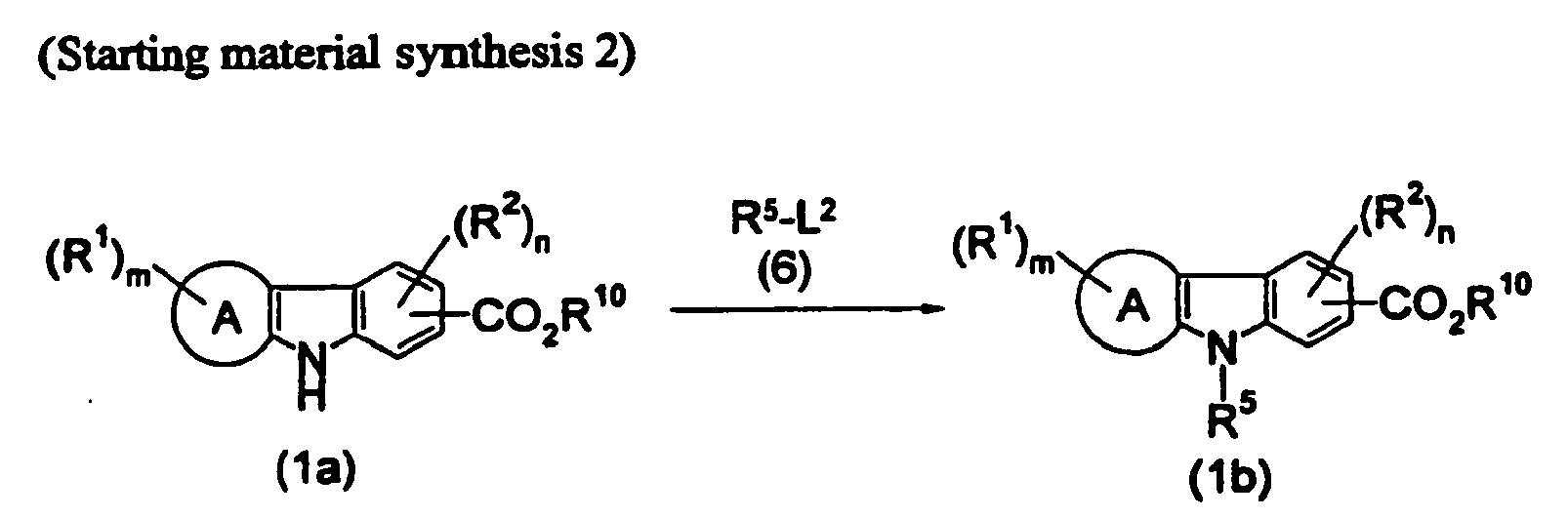
Among the starting compounds (1), a compound (1b) in which X is NR5 and Y is a single bond can be produced from the compound (1a) by the reaction such as alkylation, acylation, sulfonylation or the like.
When a compound (6) in which L2 is a leaving group is used, the alkylation reaction can be carried out in the presence of a base such as sodium hydride, potassium hydride, potassium tert-butoxide or the like. Also, when a compound (6) in which L2 is -OH is used, it can be carried out using the usual method ofMitsunobu reaction, for example, in accordance with the method described in Tetrahedron Letters, (Netherlands), 2002, vol. 43, p. 2187.
Regarding the acylation or sulfonylation, the reaction can be carried out using an acid halide in which the leaving group of L2 is halogen, or the like, as the compound (6), in the presence of a base such as potassium hydride, potassium tert-butoxide or the like. -

material synthesis 1. The hydrolysis and esterification can be carried out in accordance with the hydrolysis reaction and esterification reaction described in the aforementioned "Protective Groups in Organic Synthesis". The usual method of intramolecular Friedel-Crafts' reaction can be used for the cyclization reaction and, for example, the method described in "Journal of the American Chemical Society", (USA), 1941, vol. 63, p. 1948 may be cited. -

Among the starting compounds (1), compounds (1e) to (1h) in which at least one of R3 and R4 has various types of substituent can be easily produced using each reaction of the alkylation, etherification, ketal formation and cyclization or a combination thereof.
The alkylation can be carried out using an organic metal reagent such as the Grignard reagent, an organic lithium reagent, an organic cerium reagent, or the like. The etherification is carried out using an alkylating agent in which L2 is a leaving group, in the presence of a. base such as sodium hydride, potassium hydride, potassium tert-butoxide, silver oxide or the like. There is a case in which this is carried out under an acidic condition using a compound wherein L2 is -OH, which is carried out using an acid catalyst such as hydrochloric acid, sulfuric acid, p-toluenesulfonic acid or the like, a Lewis acid such as iron nitrate or iron perchlorate or the like, in a solvent such as methanol, ethanol, benzene, toluene, xylene or the like, and at room temperature to under heating.
The ketal formation can be carried out using an acid catalyst such as hydrochloric acid, sulfuric acid, p-toluenesulfonic acid or the like and a Lewis acid such as boron trifluoride diethyl ether or the like, at room temperature to under heating.
The cyclization is carried out using an acid catalyst such as hydrochloric acid, sulfuric acid, p-toluenesulfonic acid or the like, a Lewis acid such as iron nitrate or iron perchlorate or the like, in a solvent such as benzene, toluene, xylene or the like, and at from room temperature to under heating. Alternatively, this can be carried out in the presence of a base such as sodium hydride, potassium hydride, potassium tert-butoxide, silver oxide or the like, after converting the hydroxyl group of R3 into a leaving group such as halogen, sulfonic acid ester or the like. - Respective products of the above production methods can be introduced into corresponding carboxyl compounds by the deprotection of -CO2R10 group. For example, the deprotection reaction described in the aforementioned "Protective Groups in Organic Synthesis" can be used.
-

material syntheses 1 to 4, using a corresponding starting material in which the -CO2R10 group is changed to a cyano group. The hydrolysis can be carried out at room temperature to under heating in a solvent which is inert to the reaction, such as acetic acid, water or the like, using an acid such as hydrochloric acid, sulfuric acid or the like. In addition, the reaction can also be carried out at room temperature to under heating in solvent such as an alcohol (e.g., ethanol or the like), water or the like, using a base such as potassium hydroxide or the like. - The compound (I) produced in this manner is isolated and purified as such or after making it into a salt by carrying out a salt formation treatment by a general method. The isolation and purification are carried out by employing general chemical operations such as extraction, concentration, evaporation, crystallization, filtration, recrystallization, various types of chromatography and the like.
Various isomers can be isolated by usual methods making use of the difference in a physicochemical property between isomers. For example, optical isomers can be respectively separated and purified by a method in which a racemic compound is derived into a diastereomer salt with an optically active organic acid (tartaric acid or the like) and then subjected to fractional recrystallization, or a technique such as a chiral filler-aided column chromatography or the like. In addition, an optically active compound can also be produced using an appropriate optically active compound as the starting material. In this connection, a diastereomer mixture can also be separated by a fractional crystallization, a chromatography or the like. - The reaction products obtained by the respective production methods described in the above can be isolated and purified as free compounds, salts thereof or their various solvates (e.g., hydrates and the like). The salts can be produced by subjecting to general salt formation treatment.
The isolation and purification are carried out by employing general chemical operations such as extraction, concentration, evaporation, crystallization, filtration, recrystallization, various types of chromatography and the like.
Various isomers can be isolated by usual methods making use of the difference in a physicochemical property between isomers. For example, optical isomers can be separated by a general optical resolution method such as a fractional crystallization, a chromatography or the like. In addition, an optically active isomer can also be produced from an appropriate optically active starting compound. - The pharmaceutical preparation which comprises one or two or more of the compound of the present invention or a salt thereof as the active ingredient can be prepared using carriers, fillers and other additive agents which are generally used in the preparation of medicines.
The administration may be either embodiment of oral administration by tablets, pills, capsules, granules, powders, solutions and the like, or parenteral administration by injections (e.g., intravenous, intramuscular and the like), suppositories, percutaneous preparations, transnasal preparations, inhalations and the like. The dose is optionally decided in response to each case by taking symptom, age, sex and the like of the object to be administered into consideration, but in the case of oral administration, it is generally approximately from 0.001 mg/kg to 100 mg/kg per day per adult, and this is administered once or by dividing into 2 to 4 times. Also, when intravenously administered, it is generally administered once to two or more times a day within the range of from 0.0001 mg/kg to 10 mg/kg per day per adult. Also, in the case of transnasal administration, it is generally administered once to two or more times a day within the range of from 0.0001 mg/kg to 10 mg/kg per day per adult. In addition, in the case of inhalation, it is generally administered once to two or more times a day within the range of from 0.0001 mg/kg to 1 mg/kg per day per adult. - As the solid composition for oral administration by the present invention, tablets, powders, granules and the like are used. In such a solid composition, one or more active substances are mixed with at least one inert filler such as lactose, mannitol, glucose, hydroxypropylcellulose, microcrystalline cellulose, starch, polyvinyl pyrrolidone, aluminum magnesium silicate or the like. In accordance with the usual way, the composition may contain inert additives such as lubricants (e.g., magnesium stearate and the like), disintegrators (e.g., carboxymethylstarch sodium and the like); solubilizing agents, and the like. As occasion demands, the tablets or pills may be coated with a sugar coating or a gastric or enteric coating.
- As the liquid composition for oral administration, pharmaceutically acceptable emulsions, solutions, suspensions, syrups, elixirs and the like are included, which contain a generally used inert solvent such as purified water or ethanol. In addition to the inert solvent, this composition may contain auxiliary agents (e.g., solubilizing agents, moistening agents, suspending agents and the like), sweeteners, correctives, aromatics and antiseptics.
As the injections for parenteral administration, sterile aqueous or non-aqueous solutions, suspensions and emulsions are included. As the aqueous solvent, for example, distilled water for injection and physiological saline are included. Examples of the non-aqueous solvent include propylene glycol, polyethylene glycol, plant oils (e.g., olive oil or the like), alcohols (e.g., ethanol or the like), polysorbate 80 (the name in Pharmacopeia), and the like. Such a composition may further contain tonicity agents, antiseptics, moistening agents, emulsifying agents, dispersing agents, stabilizing agents and solubilizing agents. These are sterilized by, for example, filtration through a bacteria retaining filter, formulation ofbactericides or irradiation. In addition, these can also be used by producing a sterile solid compositions and dissolving or suspending them in sterile water or a sterile solvent for injection prior to use.
Inhalations, transmucosal preparations transnasal preparations and the like are used in a solid, liquid or semisolid form and can be produced in accordance with conventionally known methods. For example, excipients such as lactose, starch or the like, as well as a pH adjusting agent, an antiseptic, a surfactant, a lubricant, a stabilizer, a thickener and the like, may be optionally added. An appropriate device for inhalation or blowing can be used for the administration. For example, using a conventionally known device such as a measured administration inhalation device or the like or a sprayer, a compound can be administered alone or as a powder of a prescribed mixture, or as a solution or suspension by a combination with a medicinally acceptable carrier. The dry powder inhaler or the like may be for single or multiple administration use, and a dry powder or a powder-containing capsule can be used. Alternatively, it may be in a form such as a pressurized aerosol spray or the like, which uses suitable gas such as chlorofluoroalkane, hydrofluoroalkane, carbon dioxide or the like. - Effects of the compound (I) of the present invention were confirmed by the following pharmacological tests.
- Cultured human 5-HT2B receptor-expressing HEK293-EBNA cells were washed with a phosphate buffer (PBS)(-). The cells were peeled off using a scraper in the presence of PBS(-), and the cells were recovered by a centrifugal treatment (1,000 rpm, 10 min, 4°C). In the presence of 5 mM tris-hydrochloric acid (Tris-HCl) (pH 7.4) buffer, these were homogenized using a homogenizer (registered trademark: Polytron (PTA 10-TS)) and subjected to a centrifugal treatment (40,000 x g,10 min, 4°C), In the presence of 50 mM Tris-HCl (pH 7.4) buffer, these were suspended using a glass-Teflon (registered trademark) homogenizer. By carrying out a centrifugal treatment (40,000 x g, 10 min, 4°C), these were suspended in 50 mM Tris-HCl (pH 7.4) and stored at -80°C.
- A total volume of 500 µl containing 50 mM Tris-HCl; 4 mM-CaCl2-(pH-7.4) buffer, the human 5-HT2B receptor expressing HEK293-EBNA cell membrane sample and a radio ligand [3H] Mesulergine (3.1 TBq/mmol;) was incubated at 25°C for 1 hour. The compound was dissolved in 100% DMSO and diluted to respective concentrations. Nonspecific binding was regarded as the binding quantity in the presence of 1 µM ritanserin, and a result of subtracting the nonspecific binding quantity from the total binding quantity was regarded as the specific binding quantity. By adding 4 ml of 50 mM Tris-HCl buffer (pH 7.4), filtered under a reduced pressure trough a GF/B glass filter, and the filter was washed with the same buffer (4 ml x 3). The glass filter was soaked in 5 ml of a liquid scintillator (trade name: Aquasol-2), and the radioactivity quantity was measured using a liquid scintillation counter. The compound concentration which inhibits 50% of the receptor binding, IC50 value, was calculated by non-linear regression analysis using a statistical analysis software (registered trademark: SAS (ver. 6.11)), and the Ki value which shows affinity for the receptor was calculated using the formula of Cheng & Prussoff; Ki = IC50/(1 + [L]/[Kd]) ([L]: ligand concentration, [Kd]: dissociation constant). The results are shown in the following Table 1.
-
[Table 1] Ex Ki (nM) 1 4.6 66 0.26 81 0.83 83 1.5 84 1.3 - Cultured human 5-HT7 receptor expressing CHO cells were washed PBS(-). The cells were peeled off using a scraper in the presence of PBS(-), and the cells were recovered by a centrifugal treatment (1,000 rpm,10 min, 4°C). In the presence of 5 mM Tris-HCl (pH 7.4) buffer, these were homogenized using a homogenizer (registered trademark: Polygon (PTA 10-TS)) and subjected to a centrifugal treatment (40,000 x g, 10 min, 4°C). In the presence of 50 mM Tris-HCl (pH 7.4) buffer, these were suspended using a glass-Teflon (registered trademark) homogenizer. By carrying out a centrifugal treatment (40,000 x g, 10 min, 4°C), these were suspended in 50 mM Tris-HCl (pH 7.4) and stored at -80°C.
- A total volume of 500 µl containing 50 mM Tris-HCl, 4 mM CaCl2 (pH 7.4) buffer, the human 5-HT7 receptor expressing CHO cell membrane sample and a radio ligand [3H] 5-HT (3.40 TBq/mmol) was incubated at 25°C for 1 hour. The compound was dissolved in 100% DMSO and diluted to respective concentrations. Nonspecific binding was regarded as the binding quantity in the presence of 10 µm metergoline, and a result of subtracting the nonspecific binding quantity from the total binding quantity was regarded as the specific binding quantity. By adding 4 ml of 50 mM Tris-HCl buffer (pH 7.4), filtered under a reduced pressure trough a GF/B glass filter, and the filter was washed with the same buffer (4 ml x 3). The glass filter was soaked in 5 ml of a liquid scintillator (trade name: Aquasol-2), and the radioactivity quantity was measured using a liquid scintillation counter. The compound concentration which inhibits 50% of the receptor binding, IC50 value, was calculated by non-linear regression analysis using SAS (ver. 6.11), and the Ki value which shows affinity for the receptor was calculated using the formula of Cheng & Prussoff; Ki = IC50/(1 + [L]/[Kd]) ([L]: ligand concentration, [Kd]: dissociation constant). The results are shown in the following Table 2.
-
[Table 2] Ex Ki(nM) 1 0.64 66 2.6 81 0.78 83 0.99 84 2.5 - Affinities for 5-HT1A, 5-HT1B, 5-HT2A, 5-HT2c, 5-HT3,5-HT4, 5-HT6, α1, M1 and D2 receptors can be confirmed using conventionally known methods ("Journal of Neurochemistry", (England), 1986, vol. 47, p. 529 - 540; "Molecular Pharmacology", (USA), 1982, vol. 21, p. 301 - 314; "European Journal of Pharmacology", (Holland), 1985, vol. 106, p. 539 - 546; "The Journal of Pharmacology Experimental Therapeutics", (USA), 1992, vol. 263, p. 1127 - 1132; "British Journal of Pharmacology", (England), 1993; vol. 109, p. 618 - 624; "Molecular Pharmacology", (USA), 1993, vol. 43, p. 320 - 327; "Molecular Pharmacology", (USA), 1989, vol. 35, p. 324 - 330; "Cellular and Molecular Neurobiology", (Germany), 1988, vol. 8, p.181 - 191; "European Journal of Pharmacology", (Holland), 1988, vol. 173, p. 177 - 182).
- In this connection, affinities of the RS-127445 (2-amino-4-(4-fluoronaphth-1-yl)-6-isopropylpyrimidine); see
WO 97/44326 WO 97/48681 - The IBS-treating effect of the compound (I) of the present invention was evaluated using a method in which a confined stress is applied to rats and the evacuation quantity is measured (cf. "The Journal of Pharmacology Experimental Therapeutics", (USA), 1992, vol. 261, p. 297 - 303). This test is an animal model wherein it is known that the 5-HT3 receptor antagonist as a diarrhea-predominant IBS-treating agent shows its efficacy.
- An agent to be tested was administered to male Wistar rats (
body weight 250 to 320 g, 10 animals for each group) and a confined stress was applied thereto 30 minutes thereafter. A confining cage (trade name: KN-468, 265 mm in width x 95 mm in length x 200 mm in height, Natsume Seisakusho, Tokyo) was used in the confined stress loading, and the number of feces during 1 hour after the stress loading was counted. - As shown in
Fig. 1 , the RS-127445 as a 5-HT2B receptor-selective antagonistic compound did not show the action to suppress defecation even when a dose of 10 mg/kg was orally administered (p.o.). - In addition, as shown in
Fig. 2 , the SB-269970 as a 5-HT7 receptor-selective antagonistic compound also did not show the action to suppress defecation even at a dose of 10 mg/kg (p.o.). - On the other hand, as shown in
Fig. 3 , it was found that a synergistic effect can be obtained when both of the compounds RS-127445 and SB-269970 are simultaneously administered. That is, as shown inFig. 1 and Fig. 2 , RS-127445 and SB-269970 did not show the action even at 10 mg/kg (p.o.) when used each independently, but it was revealed that significant suppressing action is shown starting at a dose of 1 mg/kg (p.o.) when both compounds are simultaneously administered. - This effect was the same when the compound of the present invention which selectively possesses both of the 5-HT2B receptor antagonism and 5-HT7 receptor antagonism was used. That is, as shown in
Fig. 4 , the compound of Example 84 which is described later showed an excellent suppressing action of 0.72 mg/kg (p.o.) in ED50 (50% effective dose). - It has been suggested that an inflammatory protein leaked from dura mater blood vessel by 5-HT is concerned in the onset of migraine. This test system evaluates the migraine-preventive effect by measuring the amount of this leaked protein in the presence of a compound to be tested and was carried out by partially modifying the method described by Rachel A. Spokes and Vicki C. Middlefell in "European Journal of Pharmacology", (Holland), 1995, vol. 281, p. 75 - 79.
- Hartley male guinea pigs (250 to 350 g) were anesthetized by the intraperitoneal administration (i.p.) of urethane (1.5 g/kg). By applying a simple canulation to a latent vein, 50 mg/kg of a fluorescent protein (FITC-BSA) was intravenously administered (i.v.) and, 5 minutes thereafter, physiological saline or 1 µmol/ml/kg of 5-HT was intravenously administered. Perfusion was carried out with physiological saline 15 minutes thereafter and blood was washed out. RS-127445 and SB-269970 were administered intravenously, and the compound of Example 1 orally, respectively 30 minutes before the administration of fluorescent protein. By detaching the skull, the dura mater was extracted and incubated in an Eppendorf tube at 37°C for 16 hours in the presence of physiological saline adjusted to pH 11. By carrying out a centrifugal operation, the supernatant was dispensed into a plate. The fluorescence intensity was measured using a fluorescence plate reader (excitation wavelength 485 nm, absorption wavelength 530 nm). By weighing the dura mater weight, the fluorescence intensity per mg dura mater protein was calculated.
- The values of fluorescence intensity measured at the time of the administration and non-administration of each compound are shown in
Fig. 4 to Fig. 7 . In each of them, the axis of abscissa shows dose of the compounds, and the axis of ordinate fluorescence strength-per 1 mg dura mater blood vessel. The control shows fluorescence strength at the time of not adding 5-HT, namely the standard value. - As shown in
Fig. 5 , a 5-HT2B-selective antagonistic compound RS-127445 showed the leaked protein quantity-reducing action at 3 mg/kg, but did not lower it to the standard value when the dose was increased from 3 mg/kg to 10 mg/kg. - In addition, as shown in
Fig. 6 , a 5-HT7-selective antagonistic compound SB-269970 also showed the action at from 10 mg/kg, but did not lower the leaked protein quantity to the standard value when the dose was increased from this to 30 mg/kg. - On the other hand, as shown in
Fig. 7 , it was found that a synergistic effect can be obtained when both of the compounds RS-127445 and SB-269970 are simultaneously administered. That is, as shown inFig. 5 and Fig. 6 , it was shown that the minimum amount by which the both compounds show the maximum drug efficacy is 3 mg/kg for RS-127445 and 10 mg/kg for SB-269970, and it was revealed that the leaked protein quantity is almost completely suppressed to the standard value when both compounds are simultaneously administered at the same doses. This result shows that, when both functions of the 5-HT2B receptor and 5-HT7 receptor are simultaneously inhibited, an excellent effect which cannot be obtained by the inhibition of one of the selective receptors can be obtained. - This effect was the same when the compound of the present invention which selectively possesses both of the 5-HT2B receptor antagonism and 5-HT7 receptor antagonism was used. That is, as shown in
Fig. 8 , the compound of Example 1 which is described later almost completely suppressed the leaked protein quantity by 30 mg/kg of oral administration. - It was shown based on the above results that, being possessed of both of the 5-HT2B receptor antagonism and 5-HT7 receptor antagonism, the compound of the present invention can completely suppress leaking amount the inflammatory protein. Accordingly, it was confirmed that the compound of the present invention has a possibility of effectively suppressing onset of migraine and has-a superior-effect to prevent migraine in comparison with one of the selective receptor antagonists.
- The following illustratively describes production methods of the compounds of the present invention with reference to the production examples of the compounds of the present invention, though the present invention is not restricted by these examples. In this connection, since novel compounds are included in the starting compounds of the compounds of the present invention, production methods of these compounds are described as reference examples.
- In this connection, the signs in the Reference Examples and Examples and in the tables which are described later have the following meanings (the same shall apply hereinafter).
- REx: Reference Example number, Ex: Example number, No: compound number, Str: structural formula, Dat: physical data (EI: EI-MS; ESI: ESI-MS; APCI: APCI-MS; FAB: FAB-MS; MR: δ (ppm) of characteristic peaks in DMSO-d6 by 1H NMR), Sal: salt (Blank space or no description indicates that it is a free form, and the numeral before the acid component shows molar ratio. For example, when 2HCl is described, it means that the compound is dihydrochloride.), Me: methyl, Et: ethyl, nPr: normal-propyl, cPr: cyclopropyl, iPr: isopropyl, nBu: normal-butyl, cBu: cyclobutyl, nPen: normal-pentyl, cPen: cyclopentyl, cHex: cyclohexyl, Ph: phenyl, Bn: benzyl, Ac: acetyl, Boc: tert-butoxycarbonyl, null: no substitution. The numeral before substituent indicates the substitution position, for example, 5-F indicates 5-fluoro. RSyn and Syn: production method (The numeral indicates that it was produced using a corresponding starting material similar to the case of a compound having respective number as Reference Example number or Example number.).
- Methyl 2-nitrobiphenyl-4-carboxylate was obtained by allowing methyl 3-nitro4-{[(trifluoromethyl)sulfonyl]oxy}benzoate and phenyl boronic acid, potassium phosphate and tetrakistriphenylphosphine palladium to undergo the reaction in DMF under heating. FAB: 258 (M + H)+.
- Methyl 9H-carbazole-2-carboxylate was obtained by allowing methyl 2-nitrobiphenyl-4-carboxylate and triethyl phosphite to undergo the reaction under heating. FAB: 226 (M + H)+.
- Methyl 9-isopropyl-9H-carbazole-2-carboxylate was obtained by allowing methyl 9H-carbazole-2-carboxylate, 2-propanol and (tributylphospholanylidene)acetonitrile to undergo the reaction in toluene under heating. ESI: 268 (M + H)+.
- 9-Isopropyl-9H-carbazole-2-carboxylic acid was obtained by allowing methyl 9-isopropyl-9H-carbazole-2-carboxylate and a 1 M sodium hydroxide aqueous solution to undergo the reaction in ethanol under heating. ESI: 252 (M - H)-.
- Methyl 5-bromomethyl-9-isopropyl-9H-carbazole-2-carboxylate was obtained by allowing methyl 9-isopropyl-5-methyl-9H-carbazole-2-carboxylate, N-bromosuccinimide and 2,2'-azobisisobutyronitrile to undergo the reaction in carbon tetrachloride under heating: FAB: 360, 362 (M + H)+.
- Methyl 5-dimethylaminomethyl-9-isopropyl-9H-carbazole-2-carboxylate was obtained by allowing methyl 5-bromomethyl-9-isopropyl-9H-carbazole-2-carboxylate, dimethylamine (2 M, methanol solution) and potassium carbonate to undergo the reaction at room temperature in THF. FAB: 325 (M + H)+.
- Methyl 5-acetoxymethyl-9-isopropyl-9H-carbazole-2-carboxylate was obtained by allowing methyl 5-bromomethyl-9-isopropyl-9H-carbazole-2-carboxylate and potassium acetate to undergo the reaction at room temperature in DMF. EI: 339 (M)+.
- Methyl 5-hydroxymethyl-9-isopropyl-9H-carbazole-2-carboxylate was obtained by allowing methyl 5-acetoxymethyl-9-isopropyl-9H-carbazole-2-carboxylate and potassium carbonate to undergo the reaction at room temperature in methanol-THF. FAB: 297 (M)+.
- Methyl 9-isopropyl-5-methoxymethyl-9H-carbazole-2-carboxylate was obtained by allowing methyl 5-hydroxymethyl-9-isopropyl-9H-carbazole-2-carboxylate, methyl iodide and- silver oxide to undergo the reaction under heating in acetonitrile. FAB: 311 (M)+.
- Benzyl 9-isobutyryl-9H-carbazole-2-carboxylate was obtained by allowing benzyl 9H-carbazole-2-carboxylate and 2-methylpropionyl chloride to undergo the reaction at room temperature in DMF in the presence of sodium hydride. ESI: 372 (M +H)+.
- 9-Isobutyryl-9H-carbazole-2-carboxylic acid was obtained by allowing benzyl 9-isobutyryl-9H-carbazole-2-carboxylate, and palladium-carbon to undergo the reaction at room temperature in ethanol-DMF in an atmosphere of hydrogen gas. ESI: 282 (M + H)+.
- Methyl 9-isopropyl-6-nitro-9H-carbazole-2-carboxylate was obtained by allowing methyl 9-isopropyl-9H-carbazole-2-carboxylate and concentrated nitric acid to undergo the reaction at room temperature in acetic acid. FAB: 313 (M + H)+.
- Methyl 5-formyl-9-isopropyl-9H-carbazole-2-carboxylate was obtained by allowing methyl 5-hydroxymethyl-9-isopropyl-9H-carbazole-2-carboxylate and manganese dioxide to undergo the reaction at room temperature in chloroform. FAB: 296 (M + H)+.
- 9-Methyl-9H-carbazole-2-carboxylic acid was obtained by allowing methyl 9H-carbazole-2-carboxylate, methyl iodide and potassium hydroxide to undergo the reaction at room temperature in DMF. FAB: 226 (M + H)+.
- Ethyl 9-ethyl-9H-carbazole-2-carboxylate was obtained by allowing methyl 9H-carbazole-2-carboxylate, ethyl iodide and potassium hydroxide to undergo the reaction under heating in DMF. ESI: 268 (M + H)+.
- A mixture of 2,3,4,9-tetrahydro-1H-carbazole-7-carboxylic acid and 2,3,4,9-tetrahydro-1H-carbazole-5-carboxylic acid was obtained by allowing cyclohexanone and 3-hydrazinobenzoic acid to undergo the reaction under heating in acetic acid. By separating and purifying this mixture by a silica gel column chromatography, 2,3,4,9-tetrahydro-1H-carbazole-5-carhoxylic acid [Reference Example 16a: FAB: 216 (M + H)+] and 2,3,4,9-tetrahydro-1H-carbazole-7-carboxylic acid [Reference Example 16b: FAB: 216 (M + H)+] were obtained.
- By adding thionyl chloride to a methanol solution of a mixture of 2,3,4,9-tetrahydro-1H-carbazole-7-carboxylic acid and 2,3,4,9-tetrahydro-1H-carbazole-5-carboxylic acid at -10°C, followed by the reaction under heating and subsequent separation and purification by a column chromatography,
methyl 2,3,4,9-tetrahydro-1Hcarbazole-7-carboxylate [Reference Example 17a: ESI: 2230 (M + H)+] andmethyl 2,3,4,9-tetrahydro-1H-carbazole-5-carboxylate [Reference Example 17b: ESI: 230 (M + H)+] were obtained. - 3-{2-[1-(Ethoxycarbonyl)piperidin-4-ylidene]hydrazino}benzoic acid was obtained by allowing ethyl 4-oxopiperidine-1-carboxylate and 3-hydrazinobenzoic acid to undergo the reaction under heating in acetic acid ESI: 306 (M + H)+.
- A mixture of
diethyl diethyl - A mixture of 2-(ethoxycarbonyl)-2,3,4,5-tetrahydro-1H-pyrido[4,3-b]indole-7-carboxylic acid and 2-(ethoxycarbonyl)-2,3,4,5-tetrahydro-1H-pyrido[4,3-b]indole-9-carboxylic acid was obtained by allowing a mixture of
diethyl diethyl - 10H-Phenoxazine-3-caboxylic acid was obtained by allowing 10H-phenoxazine-3-carbonitrile produced in accordance with "New Journal of Chemistry", (England), 2001, vol. 25, no. 3, p. 385, and concentrated hydrochloric acid under heating in acetic acid. FAB: 227 (M)+.
- 10-Methyl-10H-phenoxazine-3-carbonitrile was obtained by allowing 10H-phenoxazine-3-carbonitrile produced in accordance with "New Journal of Chemistry", (England), 2001, vol. 25, no. 3, p. 385, methyl iodide and sodium hydride at room temperature in THF. FAB: 223 (M + H)+.
- 10-Methyl-10H-phenoxazine-3-carboxylic acid was obtained by treating 10-methyl-10H-phenoxazine-3-carbonitrile with 8 M potassium hydroxide aqueous solution under heating in ethanol. FAB: 241 (M)+.
- 10H-Phenoxazine-2-carbonitrile was obtained by producing it in accordance with "New Journal of Chemistry", (England), 2001, vol. 25, no. 3, p. 385.
- 10H-Phenoxazine-2-carboxylic acid was obtained by producing it in accordance with "Journal of Organic Chemistry", 1960, vol. 25, p. 747.
- Ethyl 10H-phenoxazine-2-carboxylate was obtained by producing it in accordance with "Journal of Organic Chemistry", 1960, vol. 25, p. 747.
- Diethyl 4-(2-thienyl)isophthalate was obtained by allowing 4-bromophthalic acid diethyl ester, 2-thienyl boronic acid, sodium carbonate and tetrakistriphenylphosphine palladium to undergo the reaction under heating in toluene-ethanol-water.FAB: 305 (M + H)+.
- 4-(2-Thienyl)isophthalic acid was obtained by treating an ethanol solution of diethyl 4-(2-thienyl)isophthalate with 5 M sodium hydroxide aqueous solution. FAB: 248(M)+.
- 4-Oxo-4H-indeno[1,2-b]thiophene-6-carboxylic acid was obtained by allowing 4-(2-thienyl)isophthalic acid and trifluoroacetic anhydride to undergo the reaction under heating in trifluoroacetic acid. FAB: 230 (M)-.
- Ethyl 4-oxo-4H-indeno[1,2-b]thiophene-6-carboxylate was obtained by allowing 4-oxo-4H-indeno[1,2-b]thiophene-6-carboxylic acid and concentrated sulfuric acid to undergo the reaction under heating in ethanol. EI: 258 (M)+.
- Ethyl spiro[1,3-dithiolan-2,4'-indeno[1,2-b]thiophene]-6'-carboxylate was obtained by allowing ethyl 4-oxo-4H-indeno[1,2-b]thiophene-6-carboxylate, 1,2-ethanedithiol and boron trifluoride diethyl ether complex to undergo the reaction under heating in acetic acid. FAB: 334 (M)+.
- 4-Hydroxy-4-methyl-4H-indeno[1,2-b]thiophene-6-carboxylic acid was obtained by allowing 4-oxo-4H-indeno[1,2-b]thiophene-6-carboxylic acid and methylmagnesium bromide to undergo the reaction at 0°C in THF. FAB: 245 (M - H)-
- Methyl 4-methoxy-4-methyl-4H-indeno[1,2-b]thiophene-6-carboxylate was obtained by allowing 4-hydroxy-4-methyl-4H-indeno[1,2-b]thiophene-6-carboxylic acid, methyl iodide and sodium hydride to undergo the reaction at room temperature in DMF. FAB: 275 (M + H)+.
- Methyl 4-allyl-4-hydroxy-4H-indeno[1,2-b]thiophene-6-carboxylate was obtained by allowing 4-allyl-4-hydroxy-4H-indeno[1,2-b]thiophene-6-carboxylic acid [ESI: 273 (M + H)+] synthesized by carrying out the same operation of Reference Example 32 using 4-oxo-4H-indeno[1,2-b]thiophene-6-carboxylic acid and allylmagnesium bromide to undergo the reaction with methyl iodide and sodium bicarbonate at 50°C in DMF. ESI: 287 (M + H)+.
- Methyl 4-hydroxy-4-(3-hydroxypropyl)-4H-indeno[1,2-b]thiophene-6-carboxylate was obtained by allowing methyl 4-allyl-4-hydroxy-4H-indeno[1,2 b]thiophene-6-carboxylate and BH3-TBF complex to undergo the reaction at 0°C in THF and then further carrying out the reaction at 60°C by adding hydrogen peroxide aqueous solution and sodium hydroxide aqueous solution thereto. ESI: 305 (M + H)+.
- 4,5-Dihydro-3H-spiro[furan-2,4'-indeno[1,2-b]thiophene]-6'-carboxylic acid was obtained by treating, with 1 M sodium hydroxide aqueous solution, methyl 4-hydroxy-4-(3-{[(4-methylphenyl)sulfonyl]oxy}propyl)-4H-indeno[1,2-b]thiophene-6-carboxylate which had been obtained by allowing methyl 4-hydroxy-4-(3-hydroxypropyl)-4H-indeno[1,2-b]thiophene-6-carboxylate and 4-methylbenzenesulfonyl chloride to undergo the reaction at 0°C in pyridine. ESI: 273 (M+H)+.
- 9-Oxo-9H-indeno[2,1-c]pyridine-7-carboxylic acid was obtained by allowing 4-pyridin-4-ylphthalic acid [FAB: 244 (M + H)+] which had been synthesized by carrying out the same operations of Reference Examples 27 and 28 using 4-bromoisophthalic acid diethyl ester and 4-pyridine boronic acid to undergo the reaction with
lithium 2,2,6,6-tetramethylpiperidide at 0°C in THF. By carrying out reaction of this compound by the same method of Reference Example 30, ethyl 9-oxo-9H-indeno[2,1-c]pytidine-7-carboxylate was obtained. FAB: 254 (M + H)+. - The reference example compounds shown in Tables 3 to 10 which are described later were produced using respectively corresponding starting materials in the same manner as in the methods of Reference Examples 1 to 37 described in the above.
- A 134 mg portion of CDI was added to 4 ml DMF solution of 140 mg 9-isopropyl-9H-carbazole-2-carboxylic acid, followed by stirring at 50°C for 1 hour. After spontaneous cooling to room temperature, 238 mg of guanidine carbonate was added thereto, followed by stirring overnight at room temperature. After evaporation of the solvent, water was added thereto and the thus precipitated solid was purified by a silica gel column chromatography (Chromatorex (registered trademark), methanol/chloroform) to obtain 157 mg of N-(diaminomethylene)-9-isopropyl-9H-carbazole-2-carboxamide as a pale yellow solid.
- A 192 mg portion of sodium hydride (60%) was added to 6.5 ml DMF solution of 573 mg guanidine hydrochloride and stirred at room temperature for 1 hour. A 6.5 ml DMF solution of 270 mg methyl 9H-carbazole-2-carboxylate was added to this solution, followed by stirring at 70°C for 2.5 hours. After spontaneous cooling to room temperature and subsequent evaporation of the solvent, water was added thereto and the thus precipitated solid was purified by Chromatorex (methanol/chloroform) to obtain 236 mg of N-(diaminomethylene)-9H-carbazole-2-carboxamide as a pale yellow solid.
- A 1.26 ml portion of 1 M hydrochloric acid and 30 mg of 20% palladium hydroxide were added to 9 ml ethanol solution of 300 mg N-(diaminomethylene)-9-[1-(diphenylmethyl)-azetidin-3-yl]-9H-carbazole-2-carboxamide, followed by stirring at room temperature for 4 days under an atmosphere of hydrogen gas. After carrying out celite filtration after adding 1 M sodium hydroxide aqueous solution, the solvent was evaporated; followed by purification by Chromatorex (methanol/chloroform) to obtain 89 mg of 9-azetidin-3-yl-N-(diaminomethylene)-9H-carbazole-2-carboxamide.
- A 1.0 ml portion of 1 M hydrochloric acid and 40 mg of 10% palladium-carbon were added to an ethanol 9 ml-
THF 3 ml solution of 393 mg N-(diaminomethylene)-9-[2-(benzyloxy)ethyl]-9H-carbazole-2-carboxamide, followed by stirring at room temperature for 3 days under an atmosphere of hydrogen gas. After carrying out celite filtration by adding 1 M sodium hydroxide aqueous solution, the organic solvent was evaporated and the water layer was extracted with chloroform, followed by washing with saturated brine and drying with anhydrous magnesium sulfate. By evaporating the solvent, 140 mg of N-(diaminomethylene)-9-(2-hydroxyethyl)-9H-carbazole-2-carboxamide was obtained. - A 20 mg portion of 10% palladium-carbon was added to an
ethanol 5 ml-THF 3 ml solution of 106 mg N-(diaminomethylene)-9-isopropyl-6-nitro-9H-carbazole-2-carboxamide, followed by stirring at room temperature for 4 hours under an atmosphere of hydrogen gas. After carrying out Celite filtration, the solvent was evaporated to obtain 128 mg of 6-amino-N-(diaminomethylene)-9-isopropyl-9H-carbazole-2-carboxamide. - A 0.6 ml portion of 4 M hydrogen chloride/ethyl acetate was added to 4.4 ml ethanol solution of 201 mg tert-butyl 4-(2-{[(diaminomethylene)amino]carbonyl}-9H-carbazol-9-yl)piperidine-1-carboxylate which had been synthesized in the same manner as in Example 1, followed by stirring overnight at room temperature. The thus precipitated solid was colleted by filtration and washed with EtOH to obtain 125 mg of N-(diaminomethylene)-9-piperidin-4-yl-9H-carbazole-2-carboxamide dihydrochloride as pale yellow solid.
- A 156 mg portion of sodium borohydride was added to a 10 ml methanol suspension of 280 mg N-(diaminomethylene)-8-oxo-8H-indeno[2,1-b]thiophene-6-carboxamide, followed by stirring at room temperature for 30 minutes. After evaporation of the solvent, the solid precipitated by adding water was purified by Chromatorex (DMF/chloroform) to obtain 284 mg of N-(diaminomethylene)-8-hydroxy-8H-indeno[2,1-b]thiophene-6-carboxamide as a pale green solid.
- The Example compounds shown in Tables 11 to 19 which are described later were produced using respectively corresponding starting materials (except that Example 61 used a starting material in which the hydroxyl group was protected with acetyl group) in the same manner as in the methods of Examples 1 to 7 described in the above.
- In addition, structures of other compounds of the present invention are shown in Tables 20 to 24. These can be easily synthesized using the aforementioned production methods, the methods described in examples and the methods obvious to those skilled in the art, or modified methods thereof.
-
[Table 3] 
REx RSyn R1 Dat 38 1 2'-F FAB : 275(M)+ 39 1 3'-F FAB : 276(M+H)+ 40 1 4'-F FAB : 276(M+H)+ 41 1 2'-Me FAB : 272(M+H)+ 42 1 3'-Me FAB . 272(M+H)+ 43 1 4'-Me FAB : 272(M+H)+ 44 1 2'-OMe FAB : 288(M+H)+ 45 1 3'-OMe FAB : 288(M+H)+ 46 1 4'-OMe FAB : 288(M+H)+ 47 1 2'-Cl FAB : 292(M+H)+ 48 1 3'-Cl FAB :291(M)+ 49 1 4'-Cl FAB : 292(M+H)+ 50 1 2'-CN ESI : 283 (M+H)+ 51 1 3'-CN FAB : 283(M+H)+ 52 1 4'-CN FAB : 283(M+H)+ -
[Table 4] 
REx RSyn R1 Dat 53 2 5-F FAB . 244(M+)+ 54 2 6-F FAB : 244(M+H)+ 55 2 7-F FAB : 244(M+H)+ 56 2 8-F FAB : 244(M+H)+ 57 2 5Me FAR 240(M+H)+ 58 2 6-Me FAB : 240(M+H)+ 59 2 7-Me FAB : 240(M+H)+ 60 2 8-Me FAB : 240(M+H)+ 61 2 5-OMe FAB : 256(M+H)+ 62 2 6-OMe FAB : 255(M)+ 63 2 7-OMe FAB : 256(M+H)+ 64 2 8-OMe FAB : 256(M+H)+ 65 2 5-Cl FAB : 259(M)+ 66 2 6-Cl FAB : 260(M+H)+ 67 2 7-Cl FAB : 260(M+H)+ 68 2 8-Cl FAB : 260(M+H)+ 69 2 5-CN FAB : 249(M-H)- 70 2 6-CN ESI : 249(M-H)- 71 2 7-CN ESI : 249(M-H)- 72 2 8-CN ESI: 249(M-H)- - [Table 5]
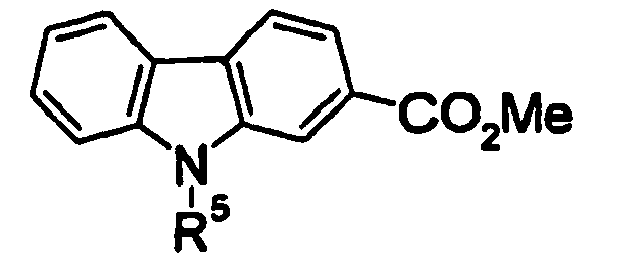
REx RSyn R5 Dat 73 3 nPr ESI : 268(M+H)+ 74 3 nBu ESI 282(M+H)+ 75 3 nPen ESI 296(M+H)+ 76 3 -(CH2)2OMe ESI 284(M+H)+ 77 3 -(CH2)2OBn ESI : 360(M+H)+ 78 3 -(CH2)2NMe2 ESI : 297(M+H)+ 79 3 -(CH2)3OMe FAB : 297(M)+ 80 3 -(CH2)2Ph FAB : 330(M+H)+ 81 3 Bn ESI : 316(M+H)+ 82 3 cBu ESI : 280(M+H)+ 83 3 cPen ESI : 294(M+H)+ 84 3 cHex ESI : 308(M+H)+ 85 3 -CH(C2H5)2, ESI : 296(M+H)+ 86 3 
FAB : 408(M)+ 87 3 
EI : 309(M)+ 88 3 CH2-cPr ESI : 280(M+H)+ 89 3 
APCI : 310(M+H)+ 90 3 
ESI : 306(M+H)+ 91 3 
ESI : 447(M+H)+ 92 3 
ESI : 306(M+H)+ 93 3 
FAB : 323(M)+ 94 10 
FAB : 339(M+H)+ -
[Table 6] 
REx RSyn R5 R Dat 95 3 Et Et ESI : 268(M+H)+ 96 3 
Bn EI: 357(M)+ 97 10 Ac Bn ESI : 344(M+H)+ 98 10 -S(O)2-Me Bn EI : 379(M)+ 99 10 -S(O)2-iPr Bn ESI : 408(M+H)+ 100 10 -C(O)NMe2 Bn FAB : 373(M+H)+ -
[Table 7] 
Prex RSyn R5 Dat 101 4 nPr ESI : 252 (M-H)- 102 4 nBu ESI : 266 (M-H)- 103 4 nPen ESI : 280 (M-H)- 104 4 -(CH2)2OBn ESI : 344 (M-H)- 105 4 -(CH2)3OMe ESI : 282(M-H)- 106 4 Bn ESI : 300(M-H)- 107 4 (CH2)2Ph ESI : 314(M-H)- 108 4 cBu FAB : 266(M+H)+ 109 4 cPen ESI : 278(M-H)- 110 4 cHex ESI : 292(M-H)- 111 4 -CH(C2H5)2 ESI : 280(M-H)- 112 4 
ESI : 294(M-H)- 113 4 
ESI : 393(M-H)- 114 4 -CH2-cPr ESI : 264(M-H)- 115 4 
ESI : 290(M-H)- 116 4 
ESI: : 290(M-H)- 117 4 
ESI : 308(M-H)- 118 4 
FAB : 325(M+H)+ 119 11 
ESI : 266(M-H)- 120 11 Ac ESI : 254(M+H)- 121 11 -S(O)2-Me FAB : 289(M)+ 122 11 -S(O)2-iPr ESI : 316(M-H)- 123 11 -C(O)NMe2 FAB : 283(M+H)+ -
[Table 8] 
Prex RSyn R1 R Dat 124 3 5-F Me FAB : 286(M+H)+ 125 3 6-F Me FAB : 286(M+H)+ 126 3 7-F Me FAB 286(M+H)+ 127 3 8-F Me FAB : 286(M+H)+ 128 3 5-Me Me FAB : 282(M+H)+ 129 3 6-Me Me FAB : 282(M+H)+ 130 3 7-Me Me FAB : 282(M+H)+ 131 3 8-Me Me FAB : 282(M+H)+ 132 3 5-OMe Me FAB : 298(M+H)+ 133 3 6-OMe Me FAB: 297(M)+ 134 3 7-OMe Me FAB : 298(M+H)+ 135 3 8-OMe Me FAB : 298 (M+H)+ 136 3 6-Cl Me FAB : 302(M+H)+ 137 3 5-Cl Me ESI : 302(M+H)+ 138 3 7-Cl Me ESI : 302(M+H)+ 139 3 8-Cl Me FAB : 302(M+H)+ 140 3 5-CN Me FAB : 293(M+H)+ 141 3 6-CN Me FAB : 293(M+H)+ 142 3 7-CN Me FAB : 293(M+H)+ 143 3 8-CN Me FAB : 293(M+H)+ 144 4 5-CN H FAB : 279(M+H)+ 145 4 6-CN H FAB : 277(M-H)- 146 4 7-CN H FAB : 279(M+H)+ 147 4 8-CN H FAB : 279(M+H)+ 148 4 6-NO2 H FAB : 297(M-H)- 149 4 5-C(O)H H FAB : 282(M+H)+ -
[Table 9] REx RSyn Str Dat 150 27 
FAB : 305(M+H)+ 151 28 
FAD : 247(M-H)- 152 29 
FAB : 231(M+H)+ 153 4 
FAB : 305(M-H)- 154 4 
FAB : 259(M-H)- 155 27 
FAB : 300(M+H)+ 156 4 
ESI : 226(M+H)+ -
[Table 10] 
REx RSyn R5 R Dat 157 3 
CO2Et ESI : 340(M+H)+ 158 3 -(CH2)-NMe2 CO2Et ESI : 327(M+H)+ 159 3 
CO2Et ESI : 340(M+H)+ 160 3 Et CO2Et APCI : 283(M)+ 161 3 cBu CO2Et ESI : 310(M+H)+ 162 4 Et CO2H ESI : 254(M-H)- 163 4 cBu CO2H ESI : 280(M-H)- 164 22 Me CN FAB : 222(M)+ 165 23 Me CO2H FAB : 241(M)+ -
[Table 11] 
Ex Syn R5 Sal Dat 1 1 iPr HCl NMR : 1.69(6H, d, J=6.9Hz),5.31(1H. sept, J=6.9Hz), 8.65(1H,s). ; FAB : 295(M+H)+ 2 2 H HCl NMR : 7.24(111, dt, J=73,1.0Hz), 751(1H, dt, J=73, 1.0Hz),833(1H,s). ; FAB : 253(M+H)+ 3 3 
2HCl NMR : 4:52(2H, dd, J=83,83Hz), 4.99 (2H, dd, J=83, 83Hz),8.76(1H,s). ; FAB : 308(M+H)+ 4 4 -(CH2)2OH HCl NMR : 3.84(2H, t ,J=5.4Hz), 4.58(2H, t, J=5.4Hz), 8.67(1H,s). ; FAB : 297(M+H)+ 8 1 Me HCl NMR : 4.01(3H, s), 729(1H, dt, J=7.3, 1.0Hz), 8.71(1H, d,J=1.5 Hz). ; FAB : 267(M+H)+ 9 2 Et HCl NMR : 137(3H, t, J=73Hz), 459(2H,q, J=73Hz), 8.72(1H, d, J=1.5Hz) ; FAB : 281(M+H)+ 10 1 nPr HCl NMR : 0.92(3H, t, J=7.3Hz),1.86(2H, tq, J=73, 73 Hz),8.78(1H,s). : FAB : 295(M+H)+ 11 1 nBu HCl NMR : 0.89(3H, t, J=73H), 1.35(2H, tq, J=7.4, 73 Hz),8.74(1H, d, J=1.5Hz). ; FAB : 309(M+H)+ 12 1 oPen HCl NMR : 0.81(3H, t, J=6.8 Hz),1.82(2H, tt, J=7.4,6.8 Hz),8.70(1H,d,J=1.5Hz). ; FAB : 323(M+H)+ 13 1 -CH(Et)2 HCl NMR : 0.66 (6H, t, J= 6.4 Hz), 4.60-5.00 (1H, m), 8.89 (1H,s). ; ESI: 323 (M+H)+ 14 2 -(CH2)2OMe HCl HCl NMR: 3.18(3H, s), 4.69(2H, t, J=S2Hz),858(1H, s). ; ESI : 311(M+H)+ 15 1 -(CH2)2OBn HCl NMR : 3.90(2H, t, J=4.9Hz),4.45(2H,s),8.84(1H, s). ; FAH : 387(M+H)+ 16 1 -(CH2)3OMe HCl NMR : 207(2H, tt, J=6.9, 63Hz), 3.20(3H, s), 8.65(1H, d, J=09Hz). ; FAB : 325(M+H)+ 17 2 -(CH2)2N(Me)2 2HCl NMR : 2.97(6H, s), 496(2H, brt, J=7.8Hz), 8.83(1H, s). ; FAB : 324(M+H)+ 18 1 cBu HCl NMR : 1.92-200(1H, m), 5.49(1H, quint, J=8.8Hz), 8.57 (1H, d, J=1.6Hz). ; ESI : 307(M+H)+ 19 1 cPen HCl NMR : 1.76-1.88(2H, m), 5.47(1H, quint, J=9.0Hz), 8.58 (1H, s). ; FAB : 321 (M+H)+ 20 1 cHex HCl NMR : 1.64-1.77(4H, m), 1.84-1.93 (4H, m), 8.80 (1H, s). ; FAB : 335 (M+H)+ -
[Table 12] 21 1 
HCl NMR : 1.82 (2H, brd, J=115 Hz), 4.09 (2H, brdd, J= 1.5, 20Hz), 8.65-8.88 (3H, m). ; FAB : 337(M+H)+ 6 6 
2HCl NMR : 201(2H, brd, J=112Hz), 533-5.43(1H, m), 8.99 (1H, s). ; FAB : 336(M+H)+ 22 1 Ac HCl NMR : 3.00(3H, s), 8.40(1H, d, J=8.3Hz), 8.93(1H, d, J =0.9Hz). ; FAB : 295(M+H)+ 23 1 -C(O)-iPr HCl HCl 135(6H, d, J=6.3Hz), 3.88(1H, sept, J=63Hz), 8.94 (1H, s). ; FAB : 323(M+H)+ 24 1 -3(O)2-iPr HCl NMR : 1.20(6H, d, J=6.8Hz), 4.10(1H, sept, J=6.8Hz), 8.69(1H, d, J=1.4Hz). ; FAB : 359(M+H)+ 25 1 -C(O)-NMe2 HCl NMR : 3.09(6H, s), 7.38-7.43(1H, m), 8.37(1H, s). ; FAB : 324(M+H)+ 26 1 
HCl NMR : 3.78(1H, dd, J=5.9, 112Hz), 3.85 (1H, dd, J= 11.2, 39Hz), 8.74(1H, s). ; EI : 308(M)+ 27 2 
NMR : 134 (3H, s), 454(2H, s), 8.27(1H, s). ; FAB : 337(M+H)+ 28 1 CH2-cPr HCl NMR : 0.43-0.47 (2H, m), 4.48 (2H, d, J=73Hz), 8.79 (1H, d, J=15Hz). ; FAB : 307(M+H)+ 29 1 
HCl NMR : 5.80(2H, s), 637(1H, dd, J=3.4, 20Hz), 891 (1H, s). ; FAB : 333 (M+H)+ 30 1 
HCl NMR: 5.62(2H, s), 637(1H, d, J=1.5Hz), 8.90(1H, d, J =1.4Hz). ; FAB : 333(M+H)+ 31 1 -CH2CH2Ph HCl NMR : 3.13 (2H, t, J=73Hz), 4.74(2H, t, J=73Hz), 8.67 (1H, d, J=1.0Hz). ; FAB : 357(M+H)+ 32 1 
HCl NMR : 3.18(2H, dd, J=11.7, 11.7Hz), 3.79(2H, dd, J= 11.7, 2.4Hz), 8.84(1H, d, J=09Hz). ; FAB : 351 (M+H)+ 33 1 Bn HCl NMR : 5.83 (2H, s), 8.40 (1H, d, J=83Hz), 8.77 (1H, s). ; FAB : 343(M+H)+ 34 1 -S(O)2-Me HCl NMR : 329(3H, s), 7.48(1H, t, J=7.8Hz), 8.79(1H, s). ; FAB : 331 (M+H)+ 35 2 
NMR : 4.76 (1H, s), 5.45-5.48(1H, m), 8.73 (1H, s). ; ESI : 474(M+H)+ 36 1 
HCl NMR : 3.53-3.63 (4H, m), 7.42(1H, t, J=7.8Hz), 8.45 (1H, d, J=1.0Hz). ; FAB : 366(M+H)+ -
[Table 13] 
Ex Syn R1 Sal Dat 37 2 5-F HCl NMR : 7.04(1H, dd, J=10.3, 7.8Hz), 7.51(1H, dt, J=7.8, 5.6Hz), 8.35 (1H, s). ; FAB : 271 (M+H)+ 38 2 7-F HCl NMR : 7.09(1H, ddd, J=95, 8.8, 2.5Hz), 735(1H, dd, J=9.8, 25 Hz), 8.32(1H, s). ; FAB : 271(M+H)+ -
[Table 14] 
Ex Syn R1 Sal Dat 5 5 6-NH2 2HCl NMR : 1.69 (6H, d, J=6.8 Hz), 755(1H, d, J=8.8Hz), 8.74 (1H, s). ; FAB : 310(M+H)+ 39 2 5-F HCl NMR : 1.70(6H, d, J=6.8Hz), 7.08(1H, dd, J=10.3, 7.9 Hz), 8.74(1H, s). ; FAB : 313(M+H)+ 40 2 6-F HCl NMR : 1.68(6H, d, J=7.4Hz), 7.40(1H, dt, J=9.3, 2.8Hz), 8.64(1H,s). ; FAB : 313 (M+H)+ 41 2 7-F HCl NMR : 1.68(6H, d, J=6.9Hz), 7.12(1H, dt, J=9.1, 20Hz), 8.64(1H, s). ; FAB : 313(M+H)+ 42 2 8-F HCl NMR : 1.68(6H, d, J=6.9Hz), 7.12(1H, dt, J=9.1, 2.0Hz), 8.64(1H, s). ; FAB : 313(M+H)+ 43 2 5-Me HCl NMR : 1.69 (6H, d, J=7.3Hz), 285(3H, s), 8.64(1H, s). ; FAB : 309(M+H)+ 44 2 6-Me HCl NMR : 1.67(6H, d, J=7.3Hz), 2.49(3H, s), 8.62(1H, s). ; FAB : 309(M+H)+ 45 2 7-Me HCl NMR : 1.69(6H, d, J=6.8Hz), 2.54(3H, s), 855(1H, s). ; FAB : 309(M+H)+ 46 2 8-Me HCl NMR : 1.75(6H, d, J=6.8Hz), 2.82(3H, s), 8.47(1H, s). ; FAB : 309(M+H)+ 47 2 5-OMe HCl NMR : 1.68(6H, d, J=6.8Hz), 4.06(3H, s), 8.61(1H, s). ; FAB : 325(M+H)+ 48 2 6-OMe HCl NMR : 1.66(6H, d, J=6.9Hz), 3.87(3H, s), 8.53(1H, s). ; ESI : 325(M+H)+ 49 2 7-OMe HCl NMR : 1.69(6H, d, J=6.8Hz), 3.92(3H, s), 8.56(1H, s). ; FAB : 325(M+H)+ 6.8Hz), 3.92(3H, s), 8.56(1H, s). ; 50 2 8-OMe HCl NMR : 1.68(6H, d, J=6.8Hz), 401(3H, s), 859(1H, s). ; ESI : 325(M+H)+ 51 1 5-CN HCl NMR : 1.72(6H, d, J=6.8Hz), 7.72(1H, t, J=73Hz), 8.79 (1H,s). ; FAB : 320(M+H)+ . 52 1 6-CN HCl NMR : 1.71(6H, d, J=6.8Hz), 7.89(1H, dd, J=8.8, 15 Hz), 8.90(1H, d, J=1.5Hz). ; FAB : 320(M+H)+ 53 1 7-CN HCl NMR : 1.72(6H, d, J=7.4Hz), 765(1H, dd, J=83, 1.0 Hz), 8.71(1H, s). ; FAB : 320(M+H)+ 54 1 8-CN HCl NMR : 1.83(6H, d, J=73Hz), 7.43(1H, t, J=7.8Hz), 864 (1H, s). ; FAB : 320(M+H)+ -
[Table 15] 55 2 5-Cl HCl NMR : 1.70(6H, d, J=6.9Hz), 734(1H, t, J=7.8Hz), 8.72 (1H, s). ; FAB : 329(M+H)+ 56 2 6-Cl HCl NMR : 1.68(6H, d, J=6.9Hz), 7.54(1H, dd, J=8.7, 1.9 Hz), 8.65(1H, s). ; FAB : 329(M+H)+ 57 2 7-Cl HCl NMR : 1.69(6H, d, J=6.8Hz), 730(1H, dd, J=8.3, 2.0 Hz), 8.65(1H, s). ; FAB : 329(M+H)+ 58 2 8-Cl HCl NMR : 1.76 (6H, d, J=7.3Hz), 7.27(1H, t, J=7.8Hz), 8.54 (1H, s). ; FAB : 329(M+H)+ 59 1 6-NO2 HCl NMR : 1.73(6H, d, J=6.8Hz), 8.02(1H, d, J=9.2Hz), 8.77 (1H, s). ; FAB : 340(M+H)+ 60 2 5-CH2NMe2 2HCl NMR : 1.71(6H, d, J=6.8Hz), 289(6H, s), 8.81(1H, s). ; FAB : 352(M+H)+ 6.8 Hz), 2.89 (6H, s), 8.81 (1H, s). ; 61 2 5-CH2OH HCl NMR : 1.69(6H, d, J=7.3Hz), 5.10(2H, s), 8.66(1H, s). ; FAB : 325(M+H)+ 62 2 5-CH2OMe HCl NMR : 1.70(6H, d, J=6.8Hz), 3.42(3H, s), 8.65(1H, s). ; FAB : 339(M+H)+ 63 1 5-C(O)H HCl NMR : 1.73(6H, d, J=6.8Hz), 8.71(1H, s), 10.44(1H, FAB : 323(M+H)+ -
[Table 16] 
Ex Syn R5 Sal Dat 64 1 H HCl NMR : 6.49(1H, dd, J=7.9, 1.5Hz), 6.58-6.66(2H, m), 7.04 (1H, d, J=24Hz). ; FAB : 269(M+H)+ 65 1 Me HCl NMR : 3.14(3H, s), 6.73-6.80(3H, m), 7.40(1H, d, J=2.0 Hz). ; FAB : 283(M+H)+ 66 1 iPr HCl NMR : 1.48(6H, d, J=7.0Hz), 4.37(1H, sept, J=7.0Hz), 7.47(1H, d, J=2.0Hz). ; ESI : 311(M+H)+ 67 1 Et HCl NMR : 1.15(3H, t, J=6.9Hz), 3.80(2H, q, J=6.9Hz), 7.40(1H, d, J=15Hz). ; FAB : 297(M+H)+ 68 1 cBu HCl NMR : 1.68-1.87(2H, m), 438(1H, t, J=7.3, 7.3Hz), 730(1H,d,J=1.4Hz). ; FAB : 323(M+H)+ 69 2 
HCl NMR : 1.86(2H, dd, J=12.2, 2.5Hz), 2.22(1H, dd, J= 122, 4.4Hz), 7.61(1H, s). ; FAB : 353(M+H)+ 70 2 -(CH2)2-NMe2 2HCl NMR : 294(6H, s), 4.19(2H, t, J=7.8Hz), 7.49(1H, d, J =1.4Hz). ; EI : 339(M)+ 71 2 
NMR : 4.11(2H, d, J=59Hz), 4.56(2H, d, J=59Hz), 7.28(1H, d, J=1.4Hz). ; FAB : 353 (M+H)+ -
[Table 17] 
Ex Syn R5 Sal Dat 72* 1 H HCl NMR : 6.51-6.54(2H,m), 6.64-6.69 (2H, m), 7.29 (1H, d, J=1.9 Hz) : FAB : 269 (M+H)+ 73* 1 Me HCl NMR : 3.12 (3H, s), 6.76 (1H, dt, J=7.3,1.5Hz), 7.37 (1H, d, J=2.0 Hz) ; FAB : 283 (M+H)+ *indicates that the compound is a reference example. -
[Table 18] Ex Syn Str Sal Dat 74 1 
HCl NMR : 1.76-1.89 (4H, m), 2.63-2.68 (2H,m),8.15(1H,d,J=1.5Hz). ; FAB : 257 (M+H)+ 75 1 
HCl NMR : 1.71-1.79 (2H, m), 1.79-1.86 (2H, m), 7.11 (1H, t, J=7.9Hz). ; FAB : 257 (M+H)+ 76* 1 
HCl NMR : 1.20 (3H, t, J=6.9Hz), 2.86 (2H, brt, J=53Hz), 7.18 (1H, t, J=7.8 Hz). ; FAB : 330 (M+H)+ 77 1 
HQ NMR : 122 (3H, t, J=6.9Hz), 2.87 (2H, brt, J=5.6Hz), 8.18(1H, s). ; FAB : 330(M+H)+ *indicates that the compound is a reference example -
[Table 19] Ex Syn Str Sal Dat 78 1 
HCl NMR : 7.54 (1H, d, J=4.4Hz), 8.05(1H, s), 8.28 (1H, d, J=4.4Hz). ; FAB : 272 (MtH)+ 7 7 
HCl NMR : 5.63 (1H, bis), 7.45 (1H, d, J=4.9 Hz), 8.12 (1H, s). ; FAB : 274 (M+H)+ 79 1 
NMR : 7.22 (1H, d, J=4.9Hz), 7.64.(1H, d, J=4.9Hz), 8.10 (1H, s). ; ESI : 272 (M+H)+ 80 7 
HCl NMR : 5.45 (1H, s), 728 (1H, d, J=49 Hz),8.14(1H,s). ; ESI : 274 (M+H)+ 81 1 
HCl NMR : 3.78-3.85 (2H, m), 7.33 (1H, d, J =52Hz), 8.44 (1H, d, J=1.6Hz). ; FAB : 348 (M+H)+ 82 1 
HCl NMR : 1.63 (3H, s), 7.24 (1H, d, J=5.2 Hz), 8.16 (1H, d, J=1.2Hz). ; FAB : 288(M+H)+ 83 1 
HCl NMR 1.66 (3H, s), 2.75 (3H, s), 8.17 (1H, s). ; FAB : 302 (M+H)+ 84 1 
HCl NMR :4.11-4.16 (1H, m), 7.26 (1H, d, J= 4.9Hz), 8.27 (1H, d, J=13Hz). ; FAB : 314 (M+H)+ 85 1 
NMR : 7.92 (1H, d, J=4.4Hz), 8.40 (1H, s), 8.80 (1H, s). ; FAB : 267 (M+H)+ 86 7 
2HCl FAB : 269 (M+H)+ -
[Table 20] 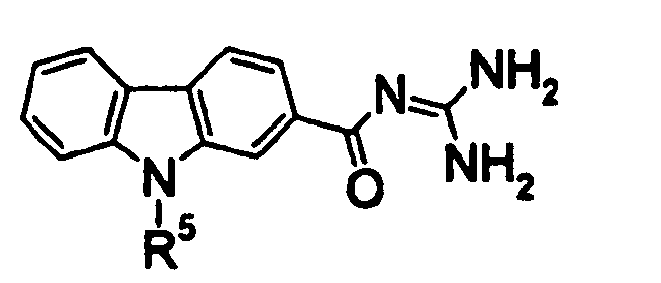
No R5 No R5 1 -C(O)Ph 2 -S(O)2Ph -
[Table 21] 
No R5 R1 No R5 R 13 Ac null 7 iPr 6-F 4 -S(O)2Me null 8 iPr 8-F 5 -C(O)iPr null 9 iPr 7-Me 6 -S(O)2 iPr null 10 iPr 9-Me -
[Table 22] 
No 
No 
No 
No 
11 
12 
13 
14 
-
[Table 23] 
No 
No 
No 
No 
15 
16 
17 
18 
-
[Table 24] No Str No Str 19 
20 
21 
22 
- Since the compound of the present invention has excellent antagonism to both of 5-HT2B and 5-HT7 receptors, it is useful as a pharmaceutical, particularly as an agent for treating IBS and/or an agent for preventing migraine.
Claims (19)
- An acylguanidine derivative represented by the following general formula (I) or a
pharmaceutically acceptable salt thereof R1 and R2: the same or different from each other, and each represents C1-6 alkyl which may be substituted, C2-6 alkenyl, halogen, -CN, -NO2, -OR0, -O-halogeno-C1-6 alkyl, -OC(O)R0, -NR0R0a, -NR0-C(O)R0a, -NR0-S(O)2R0a, -SH, -S(O)p-C1-6 alkyl, -S(O)2-NR0R0a, -C(O)R0, -CO2R0, -C(O)NR0R0a, cycloalkyl, aryl or a hetero ring group, wherein the aryl and a hetero ring group in R1 and R2 may respectively be substituted,R0 and R0a: the same or different from each other, and each represents -H or C1-6 alkyl,m, n and p: the same or different from one another and each is 0, 1 or 2,X: -C(R3)(R4)- or -N(R5)-,Y: (i) when X is -C(R3)(R4)-: a single bond,(ii) when X is -N(R5)-: a single bond or -O-,R3 and R4: the same or different from each other, and each represents -H, C1-6 alkyl which may be substituted, halogen, -OR0, -NR0R0a, -NR0-C(O)R0a, -SH or -S(O)p-C1-6 alkyl,or R3 and R4 may together form oxo, C1-6 alkylene-O-, -O-C1-6 alkylene-O-, C1-6 alkylene-S-, -S-C1-6 alkylene-S-, or C1-6 alkylene which may be interrupted by I or 2 groups selected from -O-, -NR0- and -S(O)p-,R5: -H, C1-6 alkyl which may be substituted, -C(O)R0, -CO2R0, -C(O)NR0R0a, -S(O)p-C1-6 alkyl, -S(O)p-aryl, cycloalkyl, a hetero ring group, C1-6 alkylene-cycloalkyl, C1-6 alkylene-aryl, C1-6 alkylene-hetero ring group,-C(O)-aryl or -C(O)-hetero ring group,wherein the aryl and a hetero ring group in R5 may be respectively substituted, andwherein the substitution position of the guanidinocarbonyl group is the para position against Y,provided that:(i) when X is -C(R3)(R4)-: ring A is a cycloalkene ring or a 5- to 8-membered monocyclic hetero ring,(ii) when X is -N(R5)-: ring A is a benzene ring, a cycloalkene ring or 5- to 8-membered monocyclic hetero ring].
 - The compound described in claim 1, wherein X is -C(R3)(R4)-.
- The compound described in claim 2, wherein ring A is thiophene or pyridine.
- The compound described in claim 3, wherein the tricyclic system constituted from ring A, a ring containing X and Y and benzene ring is indeno[2,1-b]thiophene or indeno[2,1-c]pyridine.
- The compound described in claim 1, wherein R3 and R4 are the same or different from each other and each is C1-6 alkyl or -OR0, or oxo, C1-6 alkylene-O- or -S-C1-6 alkylene-S- as R3 and R4 in combination.
- The compound described in claim 1, wherein X is -N(R5)-.
- The compound described in claim 6, wherein Y is a single bond.
- The compound described in claim 7, wherein ring A is benzene.
- The compound described in claim 8, wherein R5 is C1-6 alkyl, cycloalkyl, C1-6 alkylene-cycloalkyl, a hetero ring group, C1-6 alkylene-(hetero ring group which may be substituted with C1-6 alkyl), -C(O)-C1-6 alkyl or -S(O)2-C1-6 alkyl.
- The compound described in claim 6, wherein Y is -O-.
- The compound described in claim 10, wherein ring A is benzene.
- The compound described in claim 11, wherein R5 is C1-6 alkyl, cycloalkyl, a hetero ring group or C1-6 alkylene-(hetero ring group which may be substituted with C1-6 alkyl).
- The compound described in claim 1 which is selected from the group consisting of
N-(diaminomethylene)-4,5-dihydro-3H-spiro[furan-2,4'-indeno[1,2-b]thiophene]-6'-carboxamide,
N-(diaminomethylene)-9-isopropyl-9H-carbazole-2-carboxamide,
N-(diaminomethylene)-10-isopropyl-1 OH-phenoxazine-2-carboxamide,
N-(diaminomethylene)spiro[1,3-dithiolan-2,4'-indeno[1,2-b]thiophene]-6'-carboxamide, and
N-(diaminomethylene)-4-methoxy-4-methyl-4H-indeno[1,2-b] thiophene]-6-carboxamide,
or a pharmaceutically acceptable salt thereof. - A pharmaceutical composition which comprises the compound described in any one of claims 1 to 13 or a pharmaceutically acceptable salt thereof and a pharmaceutically acceptable carrier.
- The pharmaceutical composition described in claim 14, which is a 5-HT2B and 5-HT7 receptor antagonist.
- The pharmaceutical composition described in claim 14, which is a migraine-preventing agent.
- The pharmaceutical composition described in claim 14, which is an IBS-treating agent.
- Use of the compound described in any one of claims 1 to 13 or a pharmaceutically acceptable salt thereof for the manufacture of a 5-HT2B and 5-HT7 receptor antagonist, a migraine preventing agent and/or an IBS treating agent.
- The compound described in any one of claims 1 to 13 for use in preventing migraine and/or treating IBS.
Applications Claiming Priority (2)
| Application Number | Priority Date | Filing Date | Title |
|---|---|---|---|
| JP2005230095 | 2005-08-08 | ||
| PCT/JP2006/315576 WO2007018168A1 (en) | 2005-08-08 | 2006-08-07 | Acylguanidine derivative or salt thereof |
Publications (3)
| Publication Number | Publication Date |
|---|---|
| EP1923387A1 EP1923387A1 (en) | 2008-05-21 |
| EP1923387A4 EP1923387A4 (en) | 2009-10-28 |
| EP1923387B1 true EP1923387B1 (en) | 2011-10-19 |
Family
ID=37727351
Family Applications (1)
| Application Number | Title | Priority Date | Filing Date |
|---|---|---|---|
| EP06782418A Not-in-force EP1923387B1 (en) | 2005-08-08 | 2006-08-07 | Acylguanidine derivative or salt thereof |
Country Status (8)
| Country | Link |
|---|---|
| US (1) | US8076348B2 (en) |
| EP (1) | EP1923387B1 (en) |
| JP (1) | JP5092746B2 (en) |
| KR (1) | KR20080044273A (en) |
| CN (1) | CN101243046A (en) |
| CA (1) | CA2617473A1 (en) |
| ES (1) | ES2371106T3 (en) |
| WO (1) | WO2007018168A1 (en) |
Families Citing this family (8)
| Publication number | Priority date | Publication date | Assignee | Title |
|---|---|---|---|---|
| TW200638926A (en) * | 2005-02-08 | 2006-11-16 | Astellas Pharma Inc | A therapeutic agent for irritable bowel disease |
| JP5157892B2 (en) * | 2006-02-20 | 2013-03-06 | アステラス製薬株式会社 | Amide derivatives or salts thereof |
| KR20080105092A (en) | 2006-02-20 | 2008-12-03 | 아스텔라스세이야쿠 가부시키가이샤 | Pyrrole derivatives or salts thereof |
| CN101627013A (en) * | 2007-02-07 | 2010-01-13 | 安斯泰来制药有限公司 | Acylguanidine derivative |
| JP5569857B2 (en) * | 2007-08-10 | 2014-08-13 | アステラス製薬株式会社 | Bicyclic acylguanidine derivatives |
| EP2394987A4 (en) * | 2009-02-09 | 2012-09-05 | Astellas Pharma Inc | Acylguanidine derivative |
| JPWO2010090305A1 (en) * | 2009-02-09 | 2012-08-09 | アステラス製薬株式会社 | Substituted acylguanidine derivatives |
| TW201116281A (en) * | 2009-08-06 | 2011-05-16 | Astellas Pharma Inc | N atom containing ring acylguanidine derivatives |
Family Cites Families (31)
| Publication number | Priority date | Publication date | Assignee | Title |
|---|---|---|---|---|
| IT8721978A0 (en) | 1987-09-21 | 1987-09-21 | Angeli Inst Spa | NEW TRICYCLIC AMIDE DERIVATIVES. |
| FR2679555B1 (en) | 1991-07-25 | 1993-11-19 | Fabre Medicament Pierre | NEW DERIVATIVES OF UREAE, THEIR PREPARATION AND THEIR APPLICATION IN THERAPEUTICS. |
| CA2121391A1 (en) | 1993-04-28 | 1994-10-29 | Atsuyuki Kojima | Indoloylguanidine derivatives |
| EP0639573A1 (en) | 1993-08-03 | 1995-02-22 | Hoechst Aktiengesellschaft | Benzocondensed five membered heterocycles, process of their preparation, their use as drug, as diagnostic means and pharmaceuticals containing it |
| US5688807A (en) | 1994-03-11 | 1997-11-18 | Eli Lilly And Company | Method for treating 5HT2B receptor related conditions |
| FI963571L (en) | 1994-03-11 | 1996-11-08 | Lilly Co Eli | Method for treating conditions associated with the 5HT2B receptor |
| US5663178A (en) | 1995-02-06 | 1997-09-02 | Eli Lilly And Company | Tetrahydro-beta carbolines |
| US5861409A (en) | 1995-05-19 | 1999-01-19 | Eli Lilly And Company | Tetrahydro-beta-carbolines |
| GB9511355D0 (en) | 1995-06-06 | 1995-08-02 | Fujisawa Pharmaceutical Co | Urea derivatives |
| NZ331827A (en) | 1996-03-25 | 2000-02-28 | Lilly Co Eli | Tetrahydro-beta-cabroline compounds and their use as 5HT2B receptors |
| ID23053A (en) | 1997-06-04 | 2000-01-20 | Lilly Co Eli | CARBOXAMIDE USED AS A 5-HT <IF> AGONIST |
| JP2001520215A (en) * | 1997-10-21 | 2001-10-30 | ケンブリッジ・ニューロサイエンス・インコーポレイティッド | Pharmaceutically active compounds and uses |
| FR2784678B1 (en) | 1998-09-23 | 2002-11-29 | Sod Conseils Rech Applic | NOVEL N- (IMINOMETHYL) AMINE DERIVATIVES, THEIR PREPARATION, THEIR USE AS MEDICAMENTS AND THE PHARMACEUTICAL COMPOSITIONS CONTAINING THEM |
| WO2000069437A1 (en) | 1999-05-18 | 2000-11-23 | Synaptic Pharmaceutical Corporation | Use of agonists or antagonists of the 5-ht7 receptor to treat disorders of the bladder |
| US6534535B1 (en) | 1999-08-12 | 2003-03-18 | Millennium Pharmaceuticals, Inc. | Inhibitors of factor Xa |
| MY125942A (en) * | 1999-09-07 | 2006-09-29 | Upjohn Co | Aminoalkoxy carbazoles for the treatment of cns diseases |
| AU2001241128A1 (en) | 2000-03-14 | 2001-09-24 | Fujisawa Pharmaceutical Co. Ltd. | Novel amide compounds |
| US20030027128A1 (en) | 2000-11-28 | 2003-02-06 | Borman Richard Anthony | Methods for the treatment of IBS |
| US6444477B1 (en) | 2000-11-28 | 2002-09-03 | Pharmagene Laboratories Limited | Assay method for detecting 5-HT2B antagonists |
| ITRM20010356A1 (en) | 2001-06-21 | 2002-12-23 | Sigma Tau Ind Farmaceuti | "5-HALOGEN TRIPTAMIN DERIVATIVES USEFUL AS LIGANDS OF THE 5-HT6 AND / OR 5-HT7 SEROTONIN RECEPTOR. |
| FR2842524B1 (en) | 2002-07-16 | 2005-04-22 | Aventis Pharma Sa | PHARMACEUTICAL COMPOSITIONS CONTAINING 3-GUANIDINOCARBONYL-1-HETEROARYL-PYRROLE DERIVATIVE, PROCESS FOR PREPARING THE SAME AS MEDICAMENTS |
| JP4399862B2 (en) | 2002-08-09 | 2010-01-20 | 味の素株式会社 | Treatment for bowel disease and visceral pain |
| WO2004107798A1 (en) * | 2003-05-22 | 2004-12-09 | Research Triangle Institute | Optical burst switch network system and method with just-in-time signaling |
| DE602004019118D1 (en) | 2003-09-17 | 2009-03-05 | Janssen Pharmaceutica Nv | CONDENSED HETEROCYCLIC COMPOUNDS AS MODULATORS OF THE SEROTONIN RECEPTOR |
| JP2005162657A (en) | 2003-12-02 | 2005-06-23 | Takeda Chem Ind Ltd | Cannabinoid receptor regulator |
| MXPA06002391A (en) | 2004-02-20 | 2006-06-20 | Astellas Pharma Inc | Fluorene derivative. |
| US20080161419A1 (en) | 2004-02-20 | 2008-07-03 | Shinobu Akuzawa | Prophylactic Antimigraine Agents |
| TW200638926A (en) * | 2005-02-08 | 2006-11-16 | Astellas Pharma Inc | A therapeutic agent for irritable bowel disease |
| JP5157892B2 (en) | 2006-02-20 | 2013-03-06 | アステラス製薬株式会社 | Amide derivatives or salts thereof |
| KR20080105092A (en) | 2006-02-20 | 2008-12-03 | 아스텔라스세이야쿠 가부시키가이샤 | Pyrrole derivatives or salts thereof |
| JP5017552B2 (en) | 2006-08-24 | 2012-09-05 | 社会医療法人大雄会 | Genetic testing method and kit used for genetic testing method |
-
2006
- 2006-08-07 CN CNA2006800295868A patent/CN101243046A/en active Pending
- 2006-08-07 CA CA002617473A patent/CA2617473A1/en not_active Abandoned
- 2006-08-07 KR KR1020087005637A patent/KR20080044273A/en not_active Withdrawn
- 2006-08-07 EP EP06782418A patent/EP1923387B1/en not_active Not-in-force
- 2006-08-07 WO PCT/JP2006/315576 patent/WO2007018168A1/en not_active Ceased
- 2006-08-07 JP JP2007529568A patent/JP5092746B2/en not_active Expired - Fee Related
- 2006-08-07 US US11/997,956 patent/US8076348B2/en not_active Expired - Fee Related
- 2006-08-07 ES ES06782418T patent/ES2371106T3/en active Active
Also Published As
| Publication number | Publication date |
|---|---|
| EP1923387A1 (en) | 2008-05-21 |
| US8076348B2 (en) | 2011-12-13 |
| JP5092746B2 (en) | 2012-12-05 |
| CN101243046A (en) | 2008-08-13 |
| JPWO2007018168A1 (en) | 2009-02-19 |
| US20100168096A1 (en) | 2010-07-01 |
| WO2007018168A1 (en) | 2007-02-15 |
| ES2371106T3 (en) | 2011-12-27 |
| EP1923387A4 (en) | 2009-10-28 |
| CA2617473A1 (en) | 2007-02-15 |
| KR20080044273A (en) | 2008-05-20 |
Similar Documents
| Publication | Publication Date | Title |
|---|---|---|
| AU2020278140B2 (en) | A process for the manufacture of (2S,3S,4S,5R,6S)-3,4,5- trihydroxy-6-(((4aR,10aR)-7-hydroxy-1-propyl-1,2,3,4,4a,5,10,10a-octahydrobenzo[g]quinolin-6-yl)oxy)tetrahydro-2H-pyran-2-carboxylic acid | |
| TWI391387B (en) | Indole derivative having piperidine ring | |
| JP5287257B2 (en) | Acylguanidine derivatives | |
| BRPI0915273B1 (en) | TRICYCLICAL DERIVATIVE OR PHARMACEUTICALLY ACCEPTABLE SALTS AND ITS METHODS OF PREPARATION | |
| JP2004509894A (en) | Substituted azepino [4,5-b] indoline derivatives | |
| KR101132208B1 (en) | Tricyclic ?-opioid modulators | |
| JP2008519794A (en) | Pyrimidine compounds | |
| KR20260053219A (en) | Novel modulators of the 5-hydroxytryptamine receptor 7 and their method of use | |
| US10106522B2 (en) | Benzimidazole derivatives as antihistamine agents | |
| EP1988075B1 (en) | Pyrrole derivative or salt thereof | |
| AU2010340745B2 (en) | Sulfone compounds as 5-HT6 receptor ligands | |
| EP1923387A1 (en) | Acylguanidine derivative or salt thereof | |
| TWI495640B (en) | Benzodiazepine compound | |
| KR0140504B1 (en) | Amphoteric tricyclic compounds as antihistaminic and antiallergic agents | |
| JP4557112B2 (en) | Benzoxazole derivative and pharmaceutical comprising the derivative as an active ingredient | |
| JP2024532558A (en) | Thieno-fused ring compounds and their preparation and use | |
| US20030045526A1 (en) | Antipsychotic aminomethyl derivatives of 1,3,7,8-tetrahydro-6,9-dioxa-1,3-diaza-cyclopenta[a]-naphthalen-2-one | |
| HK1176619B (en) | Sulfone compounds as 5-ht6 receptor ligands |
Legal Events
| Date | Code | Title | Description |
|---|---|---|---|
| PUAI | Public reference made under article 153(3) epc to a published international application that has entered the european phase |
Free format text: ORIGINAL CODE: 0009012 |
|
| 17P | Request for examination filed |
Effective date: 20080207 |
|
| AK | Designated contracting states |
Kind code of ref document: A1 Designated state(s): AT BE BG CH CY CZ DE DK EE ES FI FR GB GR HU IE IS IT LI LT LU LV MC NL PL PT RO SE SI SK TR |
|
| A4 | Supplementary search report drawn up and despatched |
Effective date: 20090930 |
|
| 17Q | First examination report despatched |
Effective date: 20091222 |
|
| GRAP | Despatch of communication of intention to grant a patent |
Free format text: ORIGINAL CODE: EPIDOSNIGR1 |
|
| GRAS | Grant fee paid |
Free format text: ORIGINAL CODE: EPIDOSNIGR3 |
|
| GRAA | (expected) grant |
Free format text: ORIGINAL CODE: 0009210 |
|
| AK | Designated contracting states |
Kind code of ref document: B1 Designated state(s): AT BE BG CH CY CZ DE DK EE ES FI FR GB GR HU IE IS IT LI LT LU LV MC NL PL PT RO SE SI SK TR |
|
| DAX | Request for extension of the european patent (deleted) | ||
| REG | Reference to a national code |
Ref country code: GB Ref legal event code: FG4D |
|
| REG | Reference to a national code |
Ref country code: CH Ref legal event code: EP |
|
| REG | Reference to a national code |
Ref country code: IE Ref legal event code: FG4D |
|
| REG | Reference to a national code |
Ref country code: NL Ref legal event code: T3 |
|
| REG | Reference to a national code |
Ref country code: DE Ref legal event code: R096 Ref document number: 602006025278 Country of ref document: DE Effective date: 20111222 |
|
| REG | Reference to a national code |
Ref country code: ES Ref legal event code: FG2A Ref document number: 2371106 Country of ref document: ES Kind code of ref document: T3 Effective date: 20111227 |
|
| LTIE | Lt: invalidation of european patent or patent extension |
Effective date: 20111019 |
|
| REG | Reference to a national code |
Ref country code: AT Ref legal event code: MK05 Ref document number: 529403 Country of ref document: AT Kind code of ref document: T Effective date: 20111019 |
|
| PG25 | Lapsed in a contracting state [announced via postgrant information from national office to epo] |
Ref country code: IS Free format text: LAPSE BECAUSE OF FAILURE TO SUBMIT A TRANSLATION OF THE DESCRIPTION OR TO PAY THE FEE WITHIN THE PRESCRIBED TIME-LIMIT Effective date: 20120219 Ref country code: LT Free format text: LAPSE BECAUSE OF FAILURE TO SUBMIT A TRANSLATION OF THE DESCRIPTION OR TO PAY THE FEE WITHIN THE PRESCRIBED TIME-LIMIT Effective date: 20111019 Ref country code: BE Free format text: LAPSE BECAUSE OF FAILURE TO SUBMIT A TRANSLATION OF THE DESCRIPTION OR TO PAY THE FEE WITHIN THE PRESCRIBED TIME-LIMIT Effective date: 20111019 |
|
| PG25 | Lapsed in a contracting state [announced via postgrant information from national office to epo] |
Ref country code: GR Free format text: LAPSE BECAUSE OF FAILURE TO SUBMIT A TRANSLATION OF THE DESCRIPTION OR TO PAY THE FEE WITHIN THE PRESCRIBED TIME-LIMIT Effective date: 20120120 Ref country code: PT Free format text: LAPSE BECAUSE OF FAILURE TO SUBMIT A TRANSLATION OF THE DESCRIPTION OR TO PAY THE FEE WITHIN THE PRESCRIBED TIME-LIMIT Effective date: 20120220 Ref country code: SE Free format text: LAPSE BECAUSE OF FAILURE TO SUBMIT A TRANSLATION OF THE DESCRIPTION OR TO PAY THE FEE WITHIN THE PRESCRIBED TIME-LIMIT Effective date: 20111019 Ref country code: SI Free format text: LAPSE BECAUSE OF FAILURE TO SUBMIT A TRANSLATION OF THE DESCRIPTION OR TO PAY THE FEE WITHIN THE PRESCRIBED TIME-LIMIT Effective date: 20111019 Ref country code: LV Free format text: LAPSE BECAUSE OF FAILURE TO SUBMIT A TRANSLATION OF THE DESCRIPTION OR TO PAY THE FEE WITHIN THE PRESCRIBED TIME-LIMIT Effective date: 20111019 |
|
| PG25 | Lapsed in a contracting state [announced via postgrant information from national office to epo] |
Ref country code: CY Free format text: LAPSE BECAUSE OF FAILURE TO SUBMIT A TRANSLATION OF THE DESCRIPTION OR TO PAY THE FEE WITHIN THE PRESCRIBED TIME-LIMIT Effective date: 20111019 |
|
| PG25 | Lapsed in a contracting state [announced via postgrant information from national office to epo] |
Ref country code: CZ Free format text: LAPSE BECAUSE OF FAILURE TO SUBMIT A TRANSLATION OF THE DESCRIPTION OR TO PAY THE FEE WITHIN THE PRESCRIBED TIME-LIMIT Effective date: 20111019 Ref country code: DK Free format text: LAPSE BECAUSE OF FAILURE TO SUBMIT A TRANSLATION OF THE DESCRIPTION OR TO PAY THE FEE WITHIN THE PRESCRIBED TIME-LIMIT Effective date: 20111019 Ref country code: EE Free format text: LAPSE BECAUSE OF FAILURE TO SUBMIT A TRANSLATION OF THE DESCRIPTION OR TO PAY THE FEE WITHIN THE PRESCRIBED TIME-LIMIT Effective date: 20111019 Ref country code: BG Free format text: LAPSE BECAUSE OF FAILURE TO SUBMIT A TRANSLATION OF THE DESCRIPTION OR TO PAY THE FEE WITHIN THE PRESCRIBED TIME-LIMIT Effective date: 20120119 Ref country code: SK Free format text: LAPSE BECAUSE OF FAILURE TO SUBMIT A TRANSLATION OF THE DESCRIPTION OR TO PAY THE FEE WITHIN THE PRESCRIBED TIME-LIMIT Effective date: 20111019 |
|
| PLBE | No opposition filed within time limit |
Free format text: ORIGINAL CODE: 0009261 |
|
| STAA | Information on the status of an ep patent application or granted ep patent |
Free format text: STATUS: NO OPPOSITION FILED WITHIN TIME LIMIT |
|
| PG25 | Lapsed in a contracting state [announced via postgrant information from national office to epo] |
Ref country code: RO Free format text: LAPSE BECAUSE OF FAILURE TO SUBMIT A TRANSLATION OF THE DESCRIPTION OR TO PAY THE FEE WITHIN THE PRESCRIBED TIME-LIMIT Effective date: 20111019 Ref country code: PL Free format text: LAPSE BECAUSE OF FAILURE TO SUBMIT A TRANSLATION OF THE DESCRIPTION OR TO PAY THE FEE WITHIN THE PRESCRIBED TIME-LIMIT Effective date: 20111019 |
|
| 26N | No opposition filed |
Effective date: 20120720 |
|
| PGFP | Annual fee paid to national office [announced via postgrant information from national office to epo] |
Ref country code: GB Payment date: 20120801 Year of fee payment: 7 |
|
| REG | Reference to a national code |
Ref country code: DE Ref legal event code: R097 Ref document number: 602006025278 Country of ref document: DE Effective date: 20120720 |
|
| PGFP | Annual fee paid to national office [announced via postgrant information from national office to epo] |
Ref country code: ES Payment date: 20120827 Year of fee payment: 7 Ref country code: IT Payment date: 20120811 Year of fee payment: 7 Ref country code: FR Payment date: 20120823 Year of fee payment: 7 Ref country code: DE Payment date: 20120731 Year of fee payment: 7 |
|
| PG25 | Lapsed in a contracting state [announced via postgrant information from national office to epo] |
Ref country code: AT Free format text: LAPSE BECAUSE OF FAILURE TO SUBMIT A TRANSLATION OF THE DESCRIPTION OR TO PAY THE FEE WITHIN THE PRESCRIBED TIME-LIMIT Effective date: 20111019 |
|
| PGFP | Annual fee paid to national office [announced via postgrant information from national office to epo] |
Ref country code: NL Payment date: 20120816 Year of fee payment: 7 |
|
| REG | Reference to a national code |
Ref country code: CH Ref legal event code: PL |
|
| PG25 | Lapsed in a contracting state [announced via postgrant information from national office to epo] |
Ref country code: MC Free format text: LAPSE BECAUSE OF NON-PAYMENT OF DUE FEES Effective date: 20120831 |
|
| PG25 | Lapsed in a contracting state [announced via postgrant information from national office to epo] |
Ref country code: LI Free format text: LAPSE BECAUSE OF NON-PAYMENT OF DUE FEES Effective date: 20120831 Ref country code: CH Free format text: LAPSE BECAUSE OF NON-PAYMENT OF DUE FEES Effective date: 20120831 |
|
| REG | Reference to a national code |
Ref country code: IE Ref legal event code: MM4A |
|
| PG25 | Lapsed in a contracting state [announced via postgrant information from national office to epo] |
Ref country code: FI Free format text: LAPSE BECAUSE OF FAILURE TO SUBMIT A TRANSLATION OF THE DESCRIPTION OR TO PAY THE FEE WITHIN THE PRESCRIBED TIME-LIMIT Effective date: 20111019 |
|
| PG25 | Lapsed in a contracting state [announced via postgrant information from national office to epo] |
Ref country code: IE Free format text: LAPSE BECAUSE OF NON-PAYMENT OF DUE FEES Effective date: 20120807 |
|
| REG | Reference to a national code |
Ref country code: NL Ref legal event code: V1 Effective date: 20140301 |
|
| GBPC | Gb: european patent ceased through non-payment of renewal fee |
Effective date: 20130807 |
|
| PG25 | Lapsed in a contracting state [announced via postgrant information from national office to epo] |
Ref country code: NL Free format text: LAPSE BECAUSE OF NON-PAYMENT OF DUE FEES Effective date: 20140301 Ref country code: DE Free format text: LAPSE BECAUSE OF NON-PAYMENT OF DUE FEES Effective date: 20140301 Ref country code: TR Free format text: LAPSE BECAUSE OF FAILURE TO SUBMIT A TRANSLATION OF THE DESCRIPTION OR TO PAY THE FEE WITHIN THE PRESCRIBED TIME-LIMIT Effective date: 20111019 |
|
| REG | Reference to a national code |
Ref country code: FR Ref legal event code: ST Effective date: 20140430 |
|
| PG25 | Lapsed in a contracting state [announced via postgrant information from national office to epo] |
Ref country code: LU Free format text: LAPSE BECAUSE OF NON-PAYMENT OF DUE FEES Effective date: 20120807 Ref country code: IT Free format text: LAPSE BECAUSE OF NON-PAYMENT OF DUE FEES Effective date: 20130807 |
|
| REG | Reference to a national code |
Ref country code: DE Ref legal event code: R119 Ref document number: 602006025278 Country of ref document: DE Effective date: 20140301 |
|
| PG25 | Lapsed in a contracting state [announced via postgrant information from national office to epo] |
Ref country code: GB Free format text: LAPSE BECAUSE OF NON-PAYMENT OF DUE FEES Effective date: 20130807 Ref country code: HU Free format text: LAPSE BECAUSE OF FAILURE TO SUBMIT A TRANSLATION OF THE DESCRIPTION OR TO PAY THE FEE WITHIN THE PRESCRIBED TIME-LIMIT Effective date: 20060807 |
|
| PG25 | Lapsed in a contracting state [announced via postgrant information from national office to epo] |
Ref country code: FR Free format text: LAPSE BECAUSE OF NON-PAYMENT OF DUE FEES Effective date: 20130902 |
|
| PG25 | Lapsed in a contracting state [announced via postgrant information from national office to epo] |
Ref country code: ES Free format text: LAPSE BECAUSE OF NON-PAYMENT OF DUE FEES Effective date: 20130808 |