EP1923380A1 - Process for the conversion of hydrocarbons to alcohols - Google Patents
Process for the conversion of hydrocarbons to alcohols Download PDFInfo
- Publication number
- EP1923380A1 EP1923380A1 EP06255412A EP06255412A EP1923380A1 EP 1923380 A1 EP1923380 A1 EP 1923380A1 EP 06255412 A EP06255412 A EP 06255412A EP 06255412 A EP06255412 A EP 06255412A EP 1923380 A1 EP1923380 A1 EP 1923380A1
- Authority
- EP
- European Patent Office
- Prior art keywords
- stream
- synthesis reactor
- oxygenate synthesis
- methanol
- process according
- Prior art date
- Legal status (The legal status is an assumption and is not a legal conclusion. Google has not performed a legal analysis and makes no representation as to the accuracy of the status listed.)
- Ceased
Links
- 238000000034 method Methods 0.000 title claims abstract description 71
- 230000008569 process Effects 0.000 title claims abstract description 55
- 238000006243 chemical reaction Methods 0.000 title claims abstract description 44
- 229930195733 hydrocarbon Natural products 0.000 title claims abstract description 42
- 150000002430 hydrocarbons Chemical class 0.000 title claims abstract description 42
- 150000001298 alcohols Chemical class 0.000 title claims description 25
- LFQSCWFLJHTTHZ-UHFFFAOYSA-N Ethanol Chemical compound CCO LFQSCWFLJHTTHZ-UHFFFAOYSA-N 0.000 claims abstract description 70
- 239000003054 catalyst Substances 0.000 claims abstract description 59
- OKKJLVBELUTLKV-UHFFFAOYSA-N Methanol Chemical compound OC OKKJLVBELUTLKV-UHFFFAOYSA-N 0.000 claims description 151
- 238000003786 synthesis reaction Methods 0.000 claims description 99
- 230000015572 biosynthetic process Effects 0.000 claims description 95
- CURLTUGMZLYLDI-UHFFFAOYSA-N Carbon dioxide Chemical compound O=C=O CURLTUGMZLYLDI-UHFFFAOYSA-N 0.000 claims description 88
- 239000007789 gas Substances 0.000 claims description 35
- IJGRMHOSHXDMSA-UHFFFAOYSA-N Atomic nitrogen Chemical compound N#N IJGRMHOSHXDMSA-UHFFFAOYSA-N 0.000 claims description 22
- 229910052739 hydrogen Inorganic materials 0.000 claims description 22
- 239000001257 hydrogen Substances 0.000 claims description 22
- 150000001335 aliphatic alkanes Chemical class 0.000 claims description 20
- 239000004215 Carbon black (E152) Substances 0.000 claims description 19
- 150000002148 esters Chemical class 0.000 claims description 19
- XLYOFNOQVPJJNP-UHFFFAOYSA-N water Substances O XLYOFNOQVPJJNP-UHFFFAOYSA-N 0.000 claims description 19
- OKTJSMMVPCPJKN-UHFFFAOYSA-N Carbon Chemical compound [C] OKTJSMMVPCPJKN-UHFFFAOYSA-N 0.000 claims description 18
- 229910052799 carbon Inorganic materials 0.000 claims description 18
- 239000007788 liquid Substances 0.000 claims description 14
- BDERNNFJNOPAEC-UHFFFAOYSA-N propan-1-ol Chemical compound CCCO BDERNNFJNOPAEC-UHFFFAOYSA-N 0.000 claims description 13
- 239000000203 mixture Substances 0.000 claims description 12
- 229910052757 nitrogen Inorganic materials 0.000 claims description 11
- LRHPLDYGYMQRHN-UHFFFAOYSA-N N-Butanol Chemical compound CCCCO LRHPLDYGYMQRHN-UHFFFAOYSA-N 0.000 claims description 10
- 229910002090 carbon oxide Inorganic materials 0.000 claims description 10
- 239000000446 fuel Substances 0.000 claims description 8
- XEKOWRVHYACXOJ-UHFFFAOYSA-N Ethyl acetate Chemical compound CCOC(C)=O XEKOWRVHYACXOJ-UHFFFAOYSA-N 0.000 claims description 6
- QVGXLLKOCUKJST-UHFFFAOYSA-N atomic oxygen Chemical compound [O] QVGXLLKOCUKJST-UHFFFAOYSA-N 0.000 claims description 5
- 125000004432 carbon atom Chemical group C* 0.000 claims description 5
- 239000001301 oxygen Substances 0.000 claims description 5
- 229910052760 oxygen Inorganic materials 0.000 claims description 5
- KFZMGEQAYNKOFK-UHFFFAOYSA-N Isopropanol Chemical compound CC(C)O KFZMGEQAYNKOFK-UHFFFAOYSA-N 0.000 claims description 4
- ZXEKIIBDNHEJCQ-UHFFFAOYSA-N isobutanol Chemical compound CC(C)CO ZXEKIIBDNHEJCQ-UHFFFAOYSA-N 0.000 claims description 4
- 150000002170 ethers Chemical class 0.000 claims description 3
- XBDQKXXYIPTUBI-UHFFFAOYSA-M Propionate Chemical compound CCC([O-])=O XBDQKXXYIPTUBI-UHFFFAOYSA-M 0.000 claims description 2
- KXKVLQRXCPHEJC-UHFFFAOYSA-N acetic acid trimethyl ester Natural products COC(C)=O KXKVLQRXCPHEJC-UHFFFAOYSA-N 0.000 claims description 2
- 125000000217 alkyl group Chemical group 0.000 claims description 2
- 150000007942 carboxylates Chemical class 0.000 claims description 2
- 229960004592 isopropanol Drugs 0.000 claims description 2
- 125000004435 hydrogen atom Chemical class [H]* 0.000 claims 2
- 229910002092 carbon dioxide Inorganic materials 0.000 description 38
- VNWKTOKETHGBQD-UHFFFAOYSA-N methane Chemical compound C VNWKTOKETHGBQD-UHFFFAOYSA-N 0.000 description 30
- 238000004519 manufacturing process Methods 0.000 description 21
- UFHFLCQGNIYNRP-UHFFFAOYSA-N Hydrogen Chemical compound [H][H] UFHFLCQGNIYNRP-UHFFFAOYSA-N 0.000 description 20
- 239000000047 product Substances 0.000 description 18
- 238000000926 separation method Methods 0.000 description 13
- UGFAIRIUMAVXCW-UHFFFAOYSA-N Carbon monoxide Chemical class [O+]#[C-] UGFAIRIUMAVXCW-UHFFFAOYSA-N 0.000 description 8
- 239000001569 carbon dioxide Substances 0.000 description 8
- 229910002091 carbon monoxide Inorganic materials 0.000 description 7
- 239000003345 natural gas Substances 0.000 description 7
- 238000002407 reforming Methods 0.000 description 7
- 238000002360 preparation method Methods 0.000 description 6
- 230000008901 benefit Effects 0.000 description 5
- 230000003197 catalytic effect Effects 0.000 description 5
- XEEYBQQBJWHFJM-UHFFFAOYSA-N iron Substances [Fe] XEEYBQQBJWHFJM-UHFFFAOYSA-N 0.000 description 5
- 229910052751 metal Inorganic materials 0.000 description 5
- 239000002184 metal Substances 0.000 description 5
- PTISTKLWEJDJID-UHFFFAOYSA-N sulfanylidenemolybdenum Chemical class [Mo]=S PTISTKLWEJDJID-UHFFFAOYSA-N 0.000 description 5
- 239000002028 Biomass Substances 0.000 description 4
- 239000003245 coal Substances 0.000 description 4
- 229910017052 cobalt Inorganic materials 0.000 description 4
- 239000010941 cobalt Substances 0.000 description 4
- GUTLYIVDDKVIGB-UHFFFAOYSA-N cobalt atom Chemical compound [Co] GUTLYIVDDKVIGB-UHFFFAOYSA-N 0.000 description 4
- 238000005516 engineering process Methods 0.000 description 4
- 239000012530 fluid Substances 0.000 description 4
- 239000000463 material Substances 0.000 description 4
- BWHMMNNQKKPAPP-UHFFFAOYSA-L potassium carbonate Chemical compound [K+].[K+].[O-]C([O-])=O BWHMMNNQKKPAPP-UHFFFAOYSA-L 0.000 description 4
- 238000011084 recovery Methods 0.000 description 4
- RYGMFSIKBFXOCR-UHFFFAOYSA-N Copper Chemical compound [Cu] RYGMFSIKBFXOCR-UHFFFAOYSA-N 0.000 description 3
- ZOKXTWBITQBERF-UHFFFAOYSA-N Molybdenum Chemical compound [Mo] ZOKXTWBITQBERF-UHFFFAOYSA-N 0.000 description 3
- NINIDFKCEFEMDL-UHFFFAOYSA-N Sulfur Chemical compound [S] NINIDFKCEFEMDL-UHFFFAOYSA-N 0.000 description 3
- 238000002453 autothermal reforming Methods 0.000 description 3
- 229910052802 copper Inorganic materials 0.000 description 3
- 239000010949 copper Substances 0.000 description 3
- 238000010410 dusting Methods 0.000 description 3
- 238000002309 gasification Methods 0.000 description 3
- 229910052742 iron Inorganic materials 0.000 description 3
- 229910052750 molybdenum Inorganic materials 0.000 description 3
- 239000011733 molybdenum Substances 0.000 description 3
- PXHVJJICTQNCMI-UHFFFAOYSA-N nickel Substances [Ni] PXHVJJICTQNCMI-UHFFFAOYSA-N 0.000 description 3
- 230000003647 oxidation Effects 0.000 description 3
- 238000007254 oxidation reaction Methods 0.000 description 3
- 238000010926 purge Methods 0.000 description 3
- 238000000746 purification Methods 0.000 description 3
- 238000004064 recycling Methods 0.000 description 3
- 229910052703 rhodium Inorganic materials 0.000 description 3
- 239000010948 rhodium Substances 0.000 description 3
- MHOVAHRLVXNVSD-UHFFFAOYSA-N rhodium atom Chemical compound [Rh] MHOVAHRLVXNVSD-UHFFFAOYSA-N 0.000 description 3
- 238000000629 steam reforming Methods 0.000 description 3
- 239000002699 waste material Substances 0.000 description 3
- PNEYBMLMFCGWSK-UHFFFAOYSA-N aluminium oxide Inorganic materials [O-2].[O-2].[O-2].[Al+3].[Al+3] PNEYBMLMFCGWSK-UHFFFAOYSA-N 0.000 description 2
- 230000009286 beneficial effect Effects 0.000 description 2
- 239000006227 byproduct Substances 0.000 description 2
- 239000003575 carbonaceous material Substances 0.000 description 2
- 239000003153 chemical reaction reagent Substances 0.000 description 2
- 239000003426 co-catalyst Substances 0.000 description 2
- 238000002485 combustion reaction Methods 0.000 description 2
- 238000001816 cooling Methods 0.000 description 2
- 230000007812 deficiency Effects 0.000 description 2
- 238000004821 distillation Methods 0.000 description 2
- 230000007613 environmental effect Effects 0.000 description 2
- 239000012528 membrane Substances 0.000 description 2
- 238000005272 metallurgy Methods 0.000 description 2
- 150000002739 metals Chemical class 0.000 description 2
- 229910052759 nickel Inorganic materials 0.000 description 2
- 238000012856 packing Methods 0.000 description 2
- 239000003208 petroleum Substances 0.000 description 2
- 239000012071 phase Substances 0.000 description 2
- 239000004033 plastic Substances 0.000 description 2
- 229920003023 plastic Polymers 0.000 description 2
- 239000002574 poison Substances 0.000 description 2
- 231100000614 poison Toxicity 0.000 description 2
- 229910000027 potassium carbonate Inorganic materials 0.000 description 2
- 229910001414 potassium ion Inorganic materials 0.000 description 2
- 238000012545 processing Methods 0.000 description 2
- 150000003839 salts Chemical class 0.000 description 2
- 239000002002 slurry Substances 0.000 description 2
- 239000007858 starting material Substances 0.000 description 2
- 238000003860 storage Methods 0.000 description 2
- 239000000126 substance Substances 0.000 description 2
- 238000005406 washing Methods 0.000 description 2
- ZSLUVFAKFWKJRC-IGMARMGPSA-N 232Th Chemical compound [232Th] ZSLUVFAKFWKJRC-IGMARMGPSA-N 0.000 description 1
- QTBSBXVTEAMEQO-UHFFFAOYSA-M Acetate Chemical compound CC([O-])=O QTBSBXVTEAMEQO-UHFFFAOYSA-M 0.000 description 1
- 229910018404 Al2 O3 Inorganic materials 0.000 description 1
- -1 C1-C3 alkanes) Chemical class 0.000 description 1
- VYZAMTAEIAYCRO-UHFFFAOYSA-N Chromium Chemical compound [Cr] VYZAMTAEIAYCRO-UHFFFAOYSA-N 0.000 description 1
- OTMSDBZUPAUEDD-UHFFFAOYSA-N Ethane Chemical compound CC OTMSDBZUPAUEDD-UHFFFAOYSA-N 0.000 description 1
- ZLMJMSJWJFRBEC-UHFFFAOYSA-N Potassium Chemical compound [K] ZLMJMSJWJFRBEC-UHFFFAOYSA-N 0.000 description 1
- 239000005864 Sulphur Substances 0.000 description 1
- 229910052776 Thorium Inorganic materials 0.000 description 1
- 239000003513 alkali Substances 0.000 description 1
- 229910052783 alkali metal Inorganic materials 0.000 description 1
- 150000001340 alkali metals Chemical class 0.000 description 1
- 150000001412 amines Chemical class 0.000 description 1
- 238000009835 boiling Methods 0.000 description 1
- 238000006555 catalytic reaction Methods 0.000 description 1
- 238000001311 chemical methods and process Methods 0.000 description 1
- 238000012993 chemical processing Methods 0.000 description 1
- 239000007795 chemical reaction product Substances 0.000 description 1
- 229910052804 chromium Inorganic materials 0.000 description 1
- 239000011651 chromium Substances 0.000 description 1
- 239000003034 coal gas Substances 0.000 description 1
- WHDPTDWLEKQKKX-UHFFFAOYSA-N cobalt molybdenum Chemical compound [Co].[Co].[Mo] WHDPTDWLEKQKKX-UHFFFAOYSA-N 0.000 description 1
- INILCLIQNYSABH-UHFFFAOYSA-N cobalt;sulfanylidenemolybdenum Chemical compound [Mo].[Co]=S INILCLIQNYSABH-UHFFFAOYSA-N 0.000 description 1
- 238000010276 construction Methods 0.000 description 1
- PGTIPSRGRGGDQO-UHFFFAOYSA-N copper;oxozinc Chemical compound [Zn].[Cu]=O PGTIPSRGRGGDQO-UHFFFAOYSA-N 0.000 description 1
- 238000005260 corrosion Methods 0.000 description 1
- 230000007797 corrosion Effects 0.000 description 1
- 229910052593 corundum Inorganic materials 0.000 description 1
- 230000001419 dependent effect Effects 0.000 description 1
- 238000013461 design Methods 0.000 description 1
- 238000011161 development Methods 0.000 description 1
- 230000018109 developmental process Effects 0.000 description 1
- 238000009826 distribution Methods 0.000 description 1
- 230000000694 effects Effects 0.000 description 1
- 239000003344 environmental pollutant Substances 0.000 description 1
- 230000002349 favourable effect Effects 0.000 description 1
- 238000000855 fermentation Methods 0.000 description 1
- 230000004151 fermentation Effects 0.000 description 1
- 239000003502 gasoline Substances 0.000 description 1
- 239000005431 greenhouse gas Substances 0.000 description 1
- 230000007062 hydrolysis Effects 0.000 description 1
- 238000006460 hydrolysis reaction Methods 0.000 description 1
- 230000008676 import Effects 0.000 description 1
- 239000012535 impurity Substances 0.000 description 1
- 238000011065 in-situ storage Methods 0.000 description 1
- 239000012442 inert solvent Substances 0.000 description 1
- 230000000155 isotopic effect Effects 0.000 description 1
- 239000007791 liquid phase Substances 0.000 description 1
- 238000011068 loading method Methods 0.000 description 1
- WPBNNNQJVZRUHP-UHFFFAOYSA-L manganese(2+);methyl n-[[2-(methoxycarbonylcarbamothioylamino)phenyl]carbamothioyl]carbamate;n-[2-(sulfidocarbothioylamino)ethyl]carbamodithioate Chemical compound [Mn+2].[S-]C(=S)NCCNC([S-])=S.COC(=O)NC(=S)NC1=CC=CC=C1NC(=S)NC(=O)OC WPBNNNQJVZRUHP-UHFFFAOYSA-L 0.000 description 1
- 230000007246 mechanism Effects 0.000 description 1
- 239000002808 molecular sieve Substances 0.000 description 1
- 239000011368 organic material Substances 0.000 description 1
- 229910052763 palladium Inorganic materials 0.000 description 1
- 231100000719 pollutant Toxicity 0.000 description 1
- 229910052700 potassium Inorganic materials 0.000 description 1
- 239000011591 potassium Substances 0.000 description 1
- SCVFZCLFOSHCOH-UHFFFAOYSA-M potassium acetate Substances [K+].CC([O-])=O SCVFZCLFOSHCOH-UHFFFAOYSA-M 0.000 description 1
- 235000011056 potassium acetate Nutrition 0.000 description 1
- 239000010970 precious metal Substances 0.000 description 1
- 150000003138 primary alcohols Chemical class 0.000 description 1
- 239000000376 reactant Substances 0.000 description 1
- 238000000066 reactive distillation Methods 0.000 description 1
- 230000009257 reactivity Effects 0.000 description 1
- 230000009467 reduction Effects 0.000 description 1
- 238000006057 reforming reaction Methods 0.000 description 1
- 238000005057 refrigeration Methods 0.000 description 1
- 238000012552 review Methods 0.000 description 1
- 229910052702 rhenium Inorganic materials 0.000 description 1
- WUAPFZMCVAUBPE-UHFFFAOYSA-N rhenium atom Chemical compound [Re] WUAPFZMCVAUBPE-UHFFFAOYSA-N 0.000 description 1
- 229910052707 ruthenium Inorganic materials 0.000 description 1
- 229920006395 saturated elastomer Polymers 0.000 description 1
- 230000009919 sequestration Effects 0.000 description 1
- URGAHOPLAPQHLN-UHFFFAOYSA-N sodium aluminosilicate Chemical compound [Na+].[Al+3].[O-][Si]([O-])=O.[O-][Si]([O-])=O URGAHOPLAPQHLN-UHFFFAOYSA-N 0.000 description 1
- 235000000346 sugar Nutrition 0.000 description 1
- 150000008163 sugars Chemical class 0.000 description 1
- WFKWXMTUELFFGS-UHFFFAOYSA-N tungsten Chemical compound [W] WFKWXMTUELFFGS-UHFFFAOYSA-N 0.000 description 1
- 229910052721 tungsten Inorganic materials 0.000 description 1
- 239000010937 tungsten Substances 0.000 description 1
- 229910052720 vanadium Inorganic materials 0.000 description 1
- GPPXJZIENCGNKB-UHFFFAOYSA-N vanadium Chemical compound [V]#[V] GPPXJZIENCGNKB-UHFFFAOYSA-N 0.000 description 1
- 229910001845 yogo sapphire Inorganic materials 0.000 description 1
Images

Classifications
-
- C—CHEMISTRY; METALLURGY
- C07—ORGANIC CHEMISTRY
- C07C—ACYCLIC OR CARBOCYCLIC COMPOUNDS
- C07C29/00—Preparation of compounds having hydroxy or O-metal groups bound to a carbon atom not belonging to a six-membered aromatic ring
- C07C29/15—Preparation of compounds having hydroxy or O-metal groups bound to a carbon atom not belonging to a six-membered aromatic ring by reduction of oxides of carbon exclusively
- C07C29/151—Preparation of compounds having hydroxy or O-metal groups bound to a carbon atom not belonging to a six-membered aromatic ring by reduction of oxides of carbon exclusively with hydrogen or hydrogen-containing gases
- C07C29/1516—Multisteps
- C07C29/1518—Multisteps one step being the formation of initial mixture of carbon oxides and hydrogen for synthesis
Definitions
- the present invention relates to an improved process, that has a significantly reduced level of carbon oxide(s) emissions, for the conversion of hydrocarbons into alcohol(s), wherein the hydrocarbons are first converted into syngas which is then subsequently converted into alcohol(s) in the presence of a catalyst.
- the said alcohols may be produced by the fermentation of, for example, sugars and/or cellulosic materials.
- Steam reforming for the preparation of synthesis gas, may take place in a single-step, wherein all of the energy consuming reforming reactions are accomplished in a single tubular steam reformer.
- the single-step reformer results in a production of surplus hydrogen to that required for the stoichiometry of typical alcohol(s) synthesis.
- steam reforming of methane generally produces a syngas with a 3:1 hydrogen to carbon monoxide ratio
- the synthesis of methanol requires a 2:1 ratio.
- ethanol synthesis catalysts prefer to operate at a 1:1 ratio of hydrogen to carbon monoxide.
- the excess hydrogen in terms of the typical required molar ratio for higher alcohol synthesis
- the recovered hydrogen may then be used as a fuel or as a reagent in another chemical process, however the hydrogen recovery process causes a substantial increase to the overall expenditure of the process.
- the synthesis gas preparation may take place in a two-step reforming process wherein the primary reforming in a tubular steam reformer is combined with an oxygen-fired secondary reforming step which produces a synthesis gas with a deficiency in hydrogen for the stoichiometry required for typical alcohol(s) synthesis.
- an oxygen-fired secondary reforming step which produces a synthesis gas with a deficiency in hydrogen for the stoichiometry required for typical alcohol(s) synthesis.
- auto-thermal reforming - wherein a stand-alone, oxygen-fired reformer produces synthesis gas having a hydrogen deficiency followed by the downstream removal of carbon dioxide to restore the desired ratio of hydrogen to carbon oxide - results in a simplified process scheme with lower capital cost.
- the burner design is an important part of either oxygen-fired step as this stage mixes the hydrocarbon and oxygen and provides heat for the conversion of the hydrocarbons.
- Water is a byproduct of the conversion of CO2 to methanol and the conversion of CO synthesis gas to C2 and C2+ oxygenates.
- an active water gas-shift catalyst such as a methanol catalyst or a cobalt molybdenum catalyst the water equilibrates with the carbon monoxide to give CO2 and hydrogen.
- the present invention relates to an improved process in terms of CO2 emissions and energy efficiency for the conversion of hydrocarbons into alcohols, wherein the hydrocarbons are first converted into syngas, which is subsequently converted into alcohols preferably in the presence of a modified molybdenum sulphide based catalyst, or a modified methanol based catalyst and/or a modified Fischer-Tropsch catalyst and/or a supported rhodium catalyst.
Landscapes
- Chemical & Material Sciences (AREA)
- Organic Chemistry (AREA)
- Organic Low-Molecular-Weight Compounds And Preparation Thereof (AREA)
Abstract
The present invention provides a process, that has a reduced level of CO2 emissions, for the conversion of hydrocarbons into alcohol(s) in the presence of a catalyst.
Description
- The present invention relates to an improved process, that has a significantly reduced level of carbon oxide(s) emissions, for the conversion of hydrocarbons into alcohol(s), wherein the hydrocarbons are first converted into syngas which is then subsequently converted into alcohol(s) in the presence of a catalyst.
- In particular, the present invention relates to an improved process, that has a significantly reduced level of carbon oxide(s) emissions, for the conversion of hydrocarbons into alcohol(s), wherein the hydrocarbons are first converted into syngas, which is then subsequently converted into alcohol(s) in the presence of a modified molybdenum sulphide based catalyst, or a modified methanol based catalyst and/or a modified Fischer-Tropsch catalyst and/or a supported rhodium catalyst.
- In recent years increased use and demand for alcohols such as methanol, ethanol and higher alcohols has led to a greater interest in processes relating to alcohol production. The said alcohols may be produced by the fermentation of, for example, sugars and/or cellulosic materials.
- Alternatively, alcohols may be produced from synthesis gas. Synthesis gas refers to a combination of hydrogen and carbon oxides produced in a synthesis gas plant from a carbon source such as natural gas, petroleum liquids, biomass and carbonaceous materials including coal, recycled plastics, municipal wastes, or any organic material. Thus, alcohol and alcohol derivatives may provide non-petroleum based routes for the production of valuable chemicals and fuels.
- Generally, the production of alcohols, for example methanol, takes place via three process steps: synthesis gas preparation, methanol synthesis, and methanol purification. In the synthesis gas preparation step, an additional stage maybe employed by where the feedstock is treated, e.g. the feedstock is purified to remove sulphur and other potential catalyst poisons prior to being converted into synthesis gas. This treatment can also be conducted after syngas preparation; for example, when coal or biomass is employed.
- Steam reforming, for the preparation of synthesis gas, may take place in a single-step, wherein all of the energy consuming reforming reactions are accomplished in a single tubular steam reformer. However, the single-step reformer results in a production of surplus hydrogen to that required for the stoichiometry of typical alcohol(s) synthesis. For example, steam reforming of methane generally produces a syngas with a 3:1 hydrogen to carbon monoxide ratio, whereas the synthesis of methanol requires a 2:1 ratio. Indeed, ethanol synthesis catalysts prefer to operate at a 1:1 ratio of hydrogen to carbon monoxide.
- Consequently, when using methane as a feedstock, the excess hydrogen (in terms of the typical required molar ratio for higher alcohol synthesis) must be utilised efficiently, and hence an additional separation stage is often employed, the recovered hydrogen may then be used as a fuel or as a reagent in another chemical process, however the hydrogen recovery process causes a substantial increase to the overall expenditure of the process.
- Alternatively, the synthesis gas preparation may take place in a two-step reforming process wherein the primary reforming in a tubular steam reformer is combined with an oxygen-fired secondary reforming step which produces a synthesis gas with a deficiency in hydrogen for the stoichiometry required for typical alcohol(s) synthesis. With this combination it is possible to adjust the synthesis gas composition to obtain the most suitable composition for methanol synthesis. As an alternative, auto-thermal reforming - wherein a stand-alone, oxygen-fired reformer produces synthesis gas having a hydrogen deficiency followed by the downstream removal of carbon dioxide to restore the desired ratio of hydrogen to carbon oxide - results in a simplified process scheme with lower capital cost. The burner design is an important part of either oxygen-fired step as this stage mixes the hydrocarbon and oxygen and provides heat for the conversion of the hydrocarbons.
- The reaction to produce alcohol(s) from syngas is generally exothermic. The formation of C2 and C2+ alcohols is believed to proceed via the formation of methanol for modified methanol catalysts and cobalt molybdenum sulphide catalysts. However, the production of methanol is equilibrium limited and thus requires high pressures in order to achieve viable yields. Hence, pressure can be used to increase the yield, as the reaction which produces methanol exhibits a decrease in volume, as disclosed in
U.S. Pat. No. 3,326,956 . Improved catalysts have now allowed viable rates of methanol formation to be achieved at reduced reaction temperatures, and hence allow commercial operation at lower reaction pressures, e.g. a copper oxide-zinc oxide-alumina catalyst that typically operates at a nominal pressure of 5-10 MPa and temperatures ranging from approximately 150 DEG C. to 450 DEG C. over a variety of catalysts, including CuO/ZnO/Al2 O3, CuO/ZnO/Cr2 03, ZnO/Cr2 03, and supported Fe, Co, Ni, Ru, Os, Pt, and Pd catalysts. A low-pressure, copper-based methanol synthesis catalyst is commercially available from suppliers such as BASF, ICI Ltd. of the United Kingdom, and Haldor-Topsoe. Methanol yields from copper-based catalysts are generally over 99.5% of the converted CO+CO2 present. Water is a byproduct of the conversion of CO2 to methanol and the conversion of CO synthesis gas to C2 and C2+ oxygenates. In the presence of an active water gas-shift catalyst, such as a methanol catalyst or a cobalt molybdenum catalyst the water equilibrates with the carbon monoxide to give CO2 and hydrogen. A paper entitled, "Selection of Technology for Large Methanol Plants," by Helge Holm-Larsen, presented at the 1994 World Methanol Conference, Nov. 30-Dec. 1, 1994, in Geneva, Switzerland, reviews the developments in methanol production and shows how further reduction in costs of methanol production will result in the construction of very large plants with capacities approaching 10,000 metric tonnes per day. - Other processes, for the production of C2 and C2+ alcohol(s), include the processes described hereinafter;
US 4,122,110 relates to a process for manufacturing alcohols, particularly linear saturated primary alcohols, by reacting carbon monoxide with hydrogen at a pressure between 20 and 250 bars and a temperature between 150 DEG and 400 DEG C., in the presence of a catalyst, characterized in that the catalyst contains at least 4 essential elements: (a) copper (b) cobalt (c) at least one element M selected from chromium, iron, vanadium and manganese, and (d) at least one alkali metal. -
US 4,831,060 relates to the production of mixed alcohols from carbon monoxide and hydrogen gases using a catalyst, with optionally a co-catalyst, wherein the catalyst metals are molybdenum, tungsten or rhenium, and the co-catalyst metals are cobalt, nickel or iron. The catalyst is promoted with a Fischer-Tropsch promoter like an alkali or alkaline earth series metal or a smaller amount of thorium and is further treated by sulfiding. The composition of the mixed alcohols fraction can be selected by selecting the extent of intimate contact among the catalytic components. - Journal of Catalysis 114, 90-99 (1988) discloses a mechanism of ethanol formation from synthesis gas over CuO/ZnO/Al2O3. The formation of ethanol from CO and H2 over a CuO/ZnO methanol catalyst is studied in a fixed-bed microreactor by measuring the isotopic distribution of the carbon in the product ethanol when 13C methanol was added to the feed.
- At present, there are two major issues, associated with the conversion of hydrocarbons to alcohol(s), which need to be addressed.
- The first issue is primarily an environmental concern, as when manufacturing and using syngas as part of an integrated process, the high temperatures necessary for syngas formation, are often generated by the burning of carbonaceous fuel, and hence dilute carbon dioxide is produced as a result.
- In addition to this, is the fact that water is produced as a result of the conversion of syngas to C2 and C2+ alcohol(s), which consequently is rapidly converted to carbon dioxide and hydrogen during the oxygenate synthesis reaction stage due to the nature of the typical catalysts used (i.e. active water gas-shift catalysts), and the reaction conditions typically employed in these processes. Hence, during the overall integrated process, significant amounts of carbon dioxide is produced and emitted into the environment.
- Contributing significantly to the above issue, is the factor that the use of a typical higher alcohol catalysts during the alcohol synthesis stage of the process, results in the build up of alkanes (due to loss of selectivity) during the required gas recycling process, which will often necessitate in a purge. Typically purge streams are fuelled or flared which can add significant amounts of CO2 to the overall carbon emissions.
- The level of carbon dioxide present in the atmosphere is a well documented environmental concern of today's world, as carbon dioxide is considered to be the most prominent of all the 'greenhouse gases', and therefore one of the main pollutants in the present atmosphere. For this reason, it is of global interest and concern to reduce carbon dioxide emissions in industrial processes to a minimum as far as possible.
- The second issue associated with the conversion of hydrocarbons to alcohol(s), wherein the hydrocarbons are first converted into syngas, which is then subsequently converted into alcohol(s), is concerned with the overall heat efficiency of the process. Historically, there has been a lot of interest shown in trying to utilise the heat generated during the syngas to alcohol(s) conversion stage efficiently, for example by generating steam from the excess heat and subsequently using the steam to provide the energy to power alternative processes. However, depending on the production site in question, this is not always possible. Therefore, recently more interest has been shown in trying to improve efficiency of the heat generated in a more local manner, i.e. as part of an integrated process.
- It is therefore an object of the present invention to address the above issues, and to provide an improved process in terms of CO2 emissions and energy efficiency for the conversion of hydrocarbons into alcohols, wherein the hydrocarbons are first converted into syngas, which is subsequently converted into alcohols.
- In particular, the present invention relates to an improved process in terms of CO2 emissions and energy efficiency for the conversion of hydrocarbons into alcohols, wherein the hydrocarbons are first converted into syngas, which is subsequently converted into alcohols preferably in the presence of a modified molybdenum sulphide based catalyst, or a modified methanol based catalyst and/or a modified Fischer-Tropsch catalyst and/or a supported rhodium catalyst.
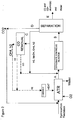
- Figures 1 and 2, represent embodiments of a process scheme according to the present invention. These said embodiments comprise process steps according to the present invention. The letter references in Figures 1 and 2 correspond to those used in the present description and appending claims.
- The present invention thus provides a process for the conversion of a hydrocarbon feedstock into alcohol(s), wherein the hydrocarbons are first converted into syngas, which is subsequently converted into alcohols, characterised by the following consecutive steps:
- 1. converting a hydrocarbon feedstock, together with an oxygen feedstock, in a auto-thermal reactor (ATR), into a stream A, comprising essentially of a mixture of carbon oxide(s) and hydrogen,
- 2. converting at least part of stream A, in the presence of a catalyst in a oxygenate synthesis reactor under a temperature comprised between 150 and 400°C and a pressure of 20 to 200 bar, into an alcohols stream B, comprising essentially methanol, ethanol, propanol, H2, C1-C3 alkanes, CO, CO2 and water,
- 3. separating stream B, into a stream C containing the CO, C1-C3 alkanes, H2 and methanol; a stream D containing the CO2; and recovering a stream E containing the ethanol, propanol(s) and water,
- 4. reintroducing at least part of stream C into the oxygenate synthesis reactor of step 2, and
- 5. reintroducing at least part of stream D into the auto-thermal reactor of step 1.
- The term 'target alcohols', as used herewith and hereinafter, is understood to mean the alcohols produced (stream E) according to the process described by the present invention and preferably consist of either ethanol or propanol(s) or, more preferably, a mixture thereof.
- The hydrocarbon feedstock used for syngas generation is preferably a carbonaceous material, for example biomass, plastic, naphtha, refinery bottoms, crude syngas (from underground coal gasification or biomass gasification), smelter off gas, municipal waste, coal, and/or natural gas, with coal and natural gas being the preferred sources, and natural gas being the most preferable source.
- Natural gas commonly contains a range of hydrocarbons (e.g. C1-C3 alkanes), in which methane predominates. In addition to this, natural gas will usually contain nitrogen, carbon dioxide and sulphur compounds. Preferably the nitrogen content of the feedstock is less than 40 wt %, more preferably less than 10 wt % and most preferably less than 1 wt %.
- Processes for producing mixtures of carbon oxide(s) and hydrogen (commonly known as synthesis gas), in a syngas reactor, are well known. Each method has its advantages and disadvantages, and the choice of using a particular reforming process over another is governed by economic and available feed stream considerations, as well as by the desire to obtain the optimum (H2-CO2):(CO+CO2) molar ratio in the resulting synthesis gas that is suitable for further chemical processing. A discussion of the available synthesis gas production technologies is provided in both "Hydrocarbon Processing" V78, N.4, 87-90, 92-93 (April 1999) and "Petrole et Techniques", N. 415, 86-93 (July-August 1998), and are both hereby incorporated by reference.
- It is also known that the synthesis gas may be obtained by catalytic partial oxidation of hydrocarbons in a microstructured reactor as exemplified in "IMRET 3: Proceedings of the Third International Conference on Microreaction Technology", Editor W Ehrfeld, Springer Verlag, 1999, pages 187-196. Alternatively, the synthesis gas may be obtained by short contact time catalytic partial oxidation of hydrocarbonaceous feedstocks as described in
EP 0303438 . The synthesis gas can also be obtained via a "Compact Reformer" process as described in "Hydrocarbon Engineering", 2000, 5, (5), 67-69; "Hydrocarbon Processing", 79/9, 34 (September 2000); "Today's Refinery", 15/8, 9 (August 2000);WO 99/02254 WO 200023689 - The syngas used in the present invention is preferably obtained via Auto-Thermal Reforming (ATR). Typically, for commercial syngas production the pressure at which the synthesis gas is produced ranges from approximately 1 to 100 bar, preferably 20 to 50 bar and the temperatures at which the synthesis gas exits the reformer ranges from approximately 700 DEG C. to 1300 DEG C. The high temperatures are necessary in order to produce a favourable equilibrium for syngas production, and to avoid metallurgy problems associated with carbon dusting. The synthesis gas used in the present invention preferably contains a molar ratio of (H2-CO2):(CO+CO2) ranging from 0.5 to 1.6, which is dependent on the hydrocarbon feedstock and the method of reforming. When natural gas is used as the hydrocarbon feedstock, the syngas obtained usually has a (H2-CO2):(CO+CO2) ratio of approximately 1.5.
- Catalytic auto-thermal reforming (ATR) of hydrocarbon fuels to generate synthesis gas, uses methane and/or liquid hydrocarbons as a reagent that undergoes a reaction with oxygen in a single reactor. The ATR process can be thought of as the combination of an exothermic combustion of hydrocarbons together with the endothermic reforming of the said combustion products; hence the process is extremely efficient in terms of energy, since the heat produced from the catalytic partial oxidation stage can be transferred directly to the steam reforming reaction in situ. Thus, this reactor possesses a clear advantage over other reactors (e.g. using a single steam methane reformer) in the field, in that it is extremely heat efficient and thereby lowers the overall expenditure associated with the process. Furthermore, the ATR process is capable of using heavy hydrocarbons such as gasoline and diesel.
- The presence of a catalyst in this ATR reaction process commonly requires a de-sulphurised feedstock, as sulphur compounds are known poisons for the typical catalysts employed. The ATR process also allows for a reduced operating temperature by reducing allowable oxygen to carbon ratios,
- According to a preferred embodiment of the present invention, the hydrocarbon feedstock fed into the auto-thermal reformer is preheated to a temperature comprised between 400 and 550 DEG C, and more preferably the preheated temperature is such that it alleviates the formation of metal dusting (i.e. a temperature that is as close to 550 DEG C as possible). The use of a furnace(s) may be employed to generate the energy required to preheat the hydrocarbon feedstock prior to entering the auto-thermal reformer. Alternatively, an interchanger may be employed in addition to the furnace(s), whereby the heat generated from cooling the product from the auto-thermal reformer (stream A), is then used to preheat the hydrocarbon feedstock entering into the auto-thermal reformer, thereby reducing the duty on the furnace and increasing the overall heat efficiency of the process. Whilst use of the interchanger is the preferred method of operation, it should be noted that stream A must be rapidly cooled (e.g. by preferably using a fluid) to prevent metal dusting; hence the maximum temperature of the cold-side fluid (e.g. water) used to cool the exit stream is approximately 500 DEG C. The preferred method of cooling stream A is against a boiling fluid, such as water.
- According to the present invention, the exit stream obtained from the auto-thermal reformer, stream A, comprises essentially a mixture of carbon oxide(s) and hydrogen. It can also comprise water, nitrogen and traces of unconverted hydrocarbon (e.g. C1-C3 alkanes). The stream A is then preferably cooled further to a temperature that is comprised between 5 and 60 DEG C, and more preferably to a temperature that is comprised between 20 and 50 DEG C. Once this temperature has been achieved, then the majority of the water is preferably removed from stream A and the overall water content of the treated stream A, after water removal treatment, is less than 5% wt of stream A, more preferably less than 1% wt of stream A and most preferably treated stream A contains less than 0.5% wt of water.
- Treated stream A is then preferably pre-heated, by use of a furnace(s) and/or any other suitable method known to those skilled in the art, to a temperature that is comprised between the operating temperature of the oxygenate synthesis reactor and (or equal to) 30 DEG C less than the operating temperature of the oxygenate synthesis reactor, more preferably treated stream A is pre-heated to a temperature that is as close to the operating temperature of the oxygenate synthesis reactor as possible.
- In one embodiment of this invention at least part, preferably all of stream A comprising the desired synthesis gas molar ratio (defined as being H2/CO) is fed into the oxygenate synthesis reactor at a controlled rate and the reaction is carried out in a reaction zone under controlled conditions of temperature and pressure and in the presence of a catalyst to convert the feedstock into the target alcohols.
- According to the present invention, the desired synthesis gas molar ratio (defined as being H2/CO) of the total feed introduced into the oxygenate synthesis reactor of step 2, is preferably comprised between 0.5 and 2.0, more preferably comprised between 0.5 and 1.5.
- The oxygenate synthesis reaction (alcohol(s) synthesis), according to step 2 of the present invention, is preferably performed by passing a mixture of hydrogen and carbon monoxide (stream A) over a conversion catalyst as a vapour phase reaction (e.g. using a fixed bed and/or fluidized bed reactor) or as a liquid phase reaction in an essentially involatile and inert solvent, such as a hydrocarbon-(e.g. using a slurry reactor).
- The said oxygenate synthesis reaction (the alcohol synthesis) may be carried out in a oxygenate synthesis reactor, under conditions as indicated in step 2. The term oxygenate synthesis reactor as used in the present invention pertains to any appropriate reactor, e.g. a tubular reactor using a fixed bed of the catalyst. The reactants may be fed upwards or downwards to the catalyst, or a combination of both, to a fixed bed located in a tubular reactor. The reaction may be effected in a dynamic bed of the catalyst. In such a reaction, the bed of catalyst is moving such as in the case of a fluid bed of the catalyst. The oxygenate synthesis reactor may preferably be chosen amongst tubular, multitubular, slurry, moving bed, fluidised bed, radial bed, multibed or reactive distillation reactor. According to an embodiment of the present invention, a fixed bed reactor is used, preferably a radial bed(s) or multibed or a multitubular vapour phase reactor or a combination thereof is used. Most preferably the oxygenate synthesis reactor comprises a series of adiabatic fixed bed reactors operated in either a longitudinal and/or radial flow mode.
- According to a preferred embodiment of the present invention, the alcohol(s) produced in the oxygenate synthesis reactor (i.e. during alcohol synthesis) are primarily methanol, ethanol, propanol(s) (n-propanol with low amounts of iso-propanol), and butanol(s) (n-butanol and iso-butanol); said methanol, ethanol, propanol(s) and butanol(s) preferably represent together at least 50% by carbon content of the products (where the products are defined as being all products excluding CO2 and CO) obtained from the oxygenate synthesis reactor (stream B), more preferably at least 75% by carbon content of the products obtained and most preferably at least 80% by carbon content of the products obtained.
- According to another embodiment of the present invention, esters and ethers are also produced in the oxygenate synthesis reactor, and together with the alcohol(s) on a single pass, preferably represent at least 70% by carbon content of the products (where the products are defined as being all products excluding CO2 and CO) obtained from the oxygenate synthesis reactor (stream B), more preferably at least 80% by carbon content of the products obtained and most preferably at least 85% by carbon content of the products obtained. Stream B also typically contains a level of nitrogen, which arises as an impurity from the aforementioned hydrocarbon feedstock(s), together with a level of hydrocarbons (e.g. C1-C3 alkanes(s)) that arise from incomplete conversion in the reforming stage and as reaction by-products during the oxygenate synthesis reaction.
- According to a preferred embodiment of the present invention the quantity of inert materials, with respect to the oxygenate synthesis reaction (e.g. C1-C3 alkanes and nitrogen), that are present in stream B, during normal operation, is less than 30 mol % of stream B and preferably less than 20 mol % of stream B.
- The C2 and C3 target alcohols comprise together, at least 25% by carbon content of the products (where the products are defined as being all products excluding CO2 and CO), obtained from the oxygenate synthesis reactor (stream B), preferably at least 33% by carbon content of the products obtained and most preferably at least 50% by carbon content of the products obtained.
- In a preferred embodiment of the present invention, the conversion of the carbon oxide(s) per pass through the oxygenate synthesis reactor is set to operate between 5 and 70%, preferably between 10 and 50% and most preferably between 15 and 40%, as the applicants have found this to be the most advantageous conversion rate in terms of sufficient productivity of the target alcohol(s) per pass whilst maintaining reduced overall alkane production. Conversions per pass, higher than those stated above are covered by the present invention; however they do not represent preferred embodiments of the present invention since they lead to the undesirable formation of alkanes as part of the integrated process.
- The temperature in the oxygenate synthesis reaction zone is approximately between 150°C and 400°C, preferably in between 250°C and 350°C and most preferably in between 280°C and 320°C.
- The pressure employed in the oxygenate synthesis reaction zone may be selected from the approximate range of 20 to 200 bar, more preferably a pressure is employed in the approximate range of 80 to 150 bar. Primarily, the hydrogen and carbon monoxide partial pressures present in stream A should be sufficient to enable the production of the target alcohols. For the purpose of this invention, the term GHSV is the gas hourly space velocity which is the rate of gas flow over the catalyst. It is determined by dividing the volume of gas (at 25°C. and 1 atmosphere) which passes over the catalyst in one hour by the volume of the catalyst.
- The optimum gas hourly space velocity (GHSV) of the stream A (litres of stream/hr/litre of catalyst) passing through the reaction zone can vary significantly, depending upon a variety of factors such as, for example, reaction conditions, composition of the stream and age and type of catalyst being used. Preferably, the GHSV can be maintained at any rate in the range of from approximately 1 to 30,000 hr-1, more preferably the GHSV will be maintained at a rate of between approximately 500 hr-1 and 20,000hr-1, and most preferably the GHSV will be maintained at a rate of approximately between 1,000 hr-1 and 10,000hr-1.
- Whilst the aforementioned reaction conditions specified for the oxygenate synthesis reactor, form preferred embodiments for the present invention, reaction conditions outside of this stated range are not excluded, and the effective reaction conditions may comprise any that are sufficient to produce the aforementioned target alcohols. The exact reaction conditions will be governed by the best compromise between achieving high catalyst selectivity, activity, lifetime and ease of operability, whilst maintaining the intrinsic reactivity of the starting materials, the stability of the starting materials in question and the stability of the desired reaction product.
- As previously indicated, the catalyst used in the oxygenate synthesis reactor is preferably a modified molybdenum sulphide based catalyst, or a modified methanol based catalyst and/or a precious metal based catalyst such as a rhodium catalyst, and/or a modified Fischer-Tropsch catalyst.
- Molybdenum sulphide based catalysts are preferred; these can be modified by a promoter. Promoter(s) can be added as salts during the catalyst preparation; the preferred promoter(s) are potassium ions and are derived from a salt of potassium, such as potassium carbonate or acetate. The preferred loadings of potassium ions per molybdenum are comprised between 0.7 and 1.5, most preferably between 1.0 and 1.4.
- The preferred catalyst, according to the present invention, is a molybdenum sulphide based catalysts containing cobalt, the cobalt to molybdenum molar ratio being preferably comprised between 0.5 and 3.0, more preferably between 0.5 and 1.0, most preferably between 0.5 to 0.9.
- According to an embodiment of the present invention, stream B exiting the oxygenate synthesis reactor is subsequently cooled and a separation into a liquid portion and a gaseous portion is conducted. According to a preferred embodiment of the present invention the said separation is conducted using a knockout drum or a dephlegmator at a similar pressure to that used for the oxygenate synthesis reaction.
- Subsequently, a C2 and C2+ alcohol(s) and water stream is recovered from the said separated liquid portion to form a stream E (e.g. by conventional distillation). Simultaneously, the said separated gaseous portion from stream B, is preferably washed with alcohol, allowing recovery of a CO2 rich stream D and the production of the gaseous part of stream C.
- The efficiency of the said alcohol wash can be improved by pre-chilling the alcohol. The said alcohol is preferably taken from the separated liquid portion of stream B. The preferred alcohol used for performing the wash is methanol, which can be obtained via the said conventional distillation of stream B.
- The alcohol washing requires good gas/liquid contact. Common methods used include vessel internals which increase internal surface area of contact between liquid and gas, such as packings, structured packings, baffles, sieve plates.
- Alternatively, said CO2 rich stream D may be recovered by any suitable method(s) known to those skilled in the art, for example, by reacting with amines; by performing a methanol wash (i.e. the RECTISOL process) and/or by using hot potassium carbonate (e.g. the BENFIELD process).
- According to the present invention stream C comprises CO, C1-C3 alkanes, hydrogen and methanol. The said methanol comes from the separation of the liquid portion of stream B (post stream E recovery) and/or liquid methanol recovered from the aforementioned CO2 washing.
- Additionally, as a consequence of the aforementioned separation some methanol may become entrained together with the CO2 to form a part of stream D; this said methanol may then be recovered to subsequently form a part of stream C. The method used to recover the entrained methanol from stream D may be any one or more of the methods known to those skilled in the art (e.g. by using a H2O wash and/or by using molecular sieves and/or by using refrigeration techniques).
- Thus, stream C consists of a gaseous part and a liquid part. The liquid part of stream C contains predominately methanol and may also contain esters and/or ethers. The gaseous part of stream C predominately contains H2, CO, and alkanes (e.g. C1 to C3 alkanes); additionally it may also contain N2.
- According to the present invention, at least part of said stream C is reintroduced into the oxygenate synthesis reactor of step 2, preferably by admixing at least part of stream C to treated stream A, prior to entering the oxygenate synthesis reactor.
- According to a preferred embodiment of the present invention, after the said admixing of the recycle stream C and the treated stream A, at least of part of the CO2 present is removed, by any suitable means or methods known to those skilled in the art; prior to the stream being introduced into the oxygenate synthesis reactor of step 2. Alternatively at least a part of the said admixed stream may be introduced directly into the separation stage defined by step 3, together with stream B.
- The said recycle of stream C, results in an increased ester content in the oxygenate synthesis reactor and the applicants have unexpectedly found that when a certain amount of esters are present in the oxygenate synthesis reactor, there is an overall increase in the yield of the targeted C2 and C2+ alcohol(s). Thus according to a preferred embodiment of the present invention, the preferred quantity of esters (as a molar ratio of the total esters to methanol introduced into the oxygenate synthesis reactor) introduced into the oxygenate synthesis reactor of step 2, is more than 0.1 % but less than 10%, preferably more than 0.25% but less than 15% and most preferably more than 0.5% but less than 1%.
- According to a further embodiment of the present invention, the said quantity of esters that are present in the oxygenate synthesis reactor, may additionally comprise a separate independent feed of ester(s) (in addition to those esters that are produced inside the oxygenate synthesis reactor and form part of the liquid portion of the stream C recycle) as part of the integrated process. Preferably the esters that are introduced into the oxygenate synthesis reactor are those with 3 or less carbon atoms (i.e. 3 or less carbon atoms in either the alkyl component and/or 3 or less carbon atoms in the carboxylate component of the ester), most preferably the esters that are introduced into the oxygenate synthesis reactor are methyl acetate and/or ethyl acetate.
- According to another embodiment of the present invention, the oxygenate synthesis reactor advantageously contains a certain quantity of methanol. However, the preferred quantity of methanol present in the oxygenate synthesis reactor is preferably restricted, as it has been discovered that its presence leads to an increased production of methane and hence, the beneficial effect of methanol addition on productivity reaches a plateau. Therefore, the applicants have found that the preferred quantity of methanol (as a molar ratio of methanol to the total feed entering into the oxygenate synthesis reactor), entering into the oxygenate synthesis reactor is more than 0.25% and less than 10%, preferably more than 0.5% and less than 5% and most preferably more than 0.75% and less than 4%. The methanol may comprise a separate independent feed of methanol, in addition to the said recycled methanol that forms a part of the liquid portion of stream C.
- The applicants have unexpectedly found that by implementing this preferred embodiment of separating and recycling the methanol into the oxygenate synthesis reactor as part of the integrated process of the present invention, it was possible to increase the amount of ethanol and propanol(s) produced in the process. Thus, the present invention also provides an improved process for the conversion of hydrocarbons to alcohol(s), in terms of efficiency and selectivity to the target alcohol(s).
- According to another embodiment of the present invention, at least part of the methanol that is present in stream C and/or stream E is recovered, by any method or means known to those skilled in the art.
- Depending on the feedstock and the selectivity for the conversion of the syngas to alcohol(s), the applicants have discovered an additional embodiment of the present invention, wherein it is advantageous not to recycle the entirety of the gaseous part of stream C, but rather to remove a fraction (purge) of steam C to prevent the build up of inert materials present in the oxygenate synthesis reaction, e.g. methane, ethane and N2.
- According to a preferred embodiment of the present invention, a fraction of the gaseous part of stream C is treated and separated into non-inert components i.e. a CO stream and a H2 stream; and inert components comprising alkanes and optionally nitrogen. Preferably the separated CO is then recycled to the oxygenate synthesis reactor of step 2 together with at least part of the original stream C. Preferably the separated H2 component is recycled back to the furnace used to preheat the auto-thermal reformer of step 1.
- Preferably the separated inert components (with respect to the oxygenate synthesis reaction, e.g. C1-C3 alkanes and nitrogen) are used as a fuel, more preferably the inert components are used as a fuel for the furnace used to preheat the hydrocarbon feedstock entering into the auto-thermal reformer.
- The aforementioned separation of the fraction taken from stream C, into inert and non-inert components, can be done by any appropriate methods known by those skilled in the art. For example, cryogenic separation can be advantageously used to recover CO and H2, from alkanes and nitrogen.
- Alternatively, the applicants have unexpectedly found a preferred embodiment in order to prevent the build up of inert materials inside the oxygenate synthesis reaction. This embodiment consists of adding an independent water feed, to at least a part of stream C, and subjecting the resulting mixture to a water gas-shift reaction step, in order to convert a majority of the CO present into CO2 and H2. This then means that the separation of CO2 and H2 from the inert components is economically advantageous in terms of efficiency, by using a simple, yet effective, separation method known to those skilled in the art, for example, a membrane separation method. Such membrane technologies can be found in 'Purification and Recovery Options for Gasification' D. J. Kubek, E. Polla, F. P. Wilcher, UOP, 1996, and are hereby incorporated by reference. Consequently, the recovered mixture of H2 and CO2 can advantageously be recycled to the auto-thermal reformer of step 1.
- According to the present invention, the said CO2 rich stream D produced in step 3, is preferably compressed and at least part of the stream is recycled back to the auto-thermal reformer of step 1, as a means of adjusting the syngas ratio of stream A to that required for the oxygenate synthesis reaction.
- However, the applicants have discovered that in order to introduce the optimum syngas ratio in the oxygenate synthesis reactor, at least a part of stream D preferably needs to be purged from the recycle loop. Advantageously, the purged CO2 is suitable for chemical use and/or sequestration. Therefore, the CO2 produced during the separation of stream B (step 3) is not released to the atmosphere and may be utilised in an environmentally efficient manner as well as improving the overall economics of the system.
- Another advantage held by conducting the process as described by the present invention, is that due to certain embodiments of the said invention, e.g. use of an auto-thermal reformer and recycling the CO2 (as described above), there are a significantly reduced number of CO2 emissions associated with the overall process. This statement is supported by the fact that the present invention has no requirement for an independent CO2 import to operate in an efficient manner, and typically it also produces a significantly reduced number of dilute CO2 emissions (namely from fuelling the furnace) when compared to using other syngas generators in the field e.g. a steam reformer.
- The process according to the present invention has been found to be highly beneficial towards alcohol(s) selectivity, especially towards ethanol selectivity, whilst simultaneously significantly reducing overall CO2 emissions and improving on the overall heat efficiency associated with conventional processes.
- Beyond these advantages, the present process invention has also been found to encompass the following unexpected advantages, amongst others:
- (i) less waste, and thus higher carbon efficiency.
- (ii) reduced methane production.
- (iii) improved economics, fewer separations, reduced storage tanks.
- (iv) no corrosion and metallurgy constraints due to the potential hydrolysis of the esters during subsequent purification and storage stages.
Claims (10)
- A process for the conversion of a hydrocarbon feedstock into alcohol(s), wherein the hydrocarbons are first converted into syngas, which is subsequently converted into alcohols, characterised by the following consecutive steps:1) converting a hydrocarbon feedstock, together with an oxygen feedstock, in a auto-thermal reactor (ATR), into a stream A, comprising essentially of a mixture of carbon oxide(s) and hydrogen,2) converting at least part of stream A, in the presence of a catalyst in a oxygenate synthesis reactor under a temperature comprised between 150 and 400°C and a pressure of 20 to 200 bar, into an alcohols stream B, comprising essentially methanol, ethanol, propanol, H2, C1-C3 alkanes, CO, CO2 and water,3) separating stream B, into a stream C containing the CO, C1-C3 alkanes, H2 and methanol; a stream D containing the CO2; and recovering a stream E containing the ethanol, propanol(s) and water,4) reintroducing at least part of stream C into the oxygenate synthesis reactor of step 2, and5) reintroducing at least part of stream D into the auto-thermal reactor of step 1.
- A process according to claim 1, wherein the desired synthesis gas molar ratio (defined as being H2/CO) of the total feed introduced into the oxygenate synthesis reactor of step 2, is preferably comprised between 0.5 and 2.0 and is more preferably comprised between 0.5 and 1.5.
- A process according to any of the preceding claims, wherein the alcohol(s) produced in the oxygenate synthesis reactor of step 2, are primarily methanol, ethanol, propanol(s) (n-propanol with low amounts of iso-propanol), and butanol(s) (n-butanol and iso-butanol) and preferably represent together at least 50% by carbon content of the products, where the products are defined as being all products excluding CO2 and CO, obtained from the oxygenate synthesis reactor (stream B), more preferably at least 75% by carbon content of the products obtained and most preferably at least 80% by carbon content of the products obtained.
- A process according to any of the preceding claims, wherein the conversion of the carbon oxide(s) per pass through the oxygenate synthesis reactor is between 5 and 70%, preferably between 10 and 50% and most preferably between 15 and 40%.
- A process according to any of the preceding claims, wherein recycle stream C comprises a liquid part (containing methanol, esters and/or ethers) and a gaseous part (containing hydrogen, CO, nitrogen and C1 to C3 alkanes).
- A process according to claim 5, wherein the preferred quantity of esters (as a molar ratio of the total esters to methanol introduced into the oxygenate synthesis reactor) introduced into the oxygenate synthesis reactor of step 2, are more than 0.1% but less than 10%, preferably more than 0.25% but less than 15% and most preferably more than 0.5% but less than 1%.
- A process according to either of claims 5 or 6, wherein the esters that are recycled into the oxygenate synthesis reactor are those with 3 or less carbon atoms in either the alkyl component and/or 3 or less carbon atoms in the carboxylate component of the ester; most preferably the esters that are introduced into the oxygenate synthesis reactor are methyl acetate and/or ethyl acetate.
- A process according to any of claims 5 to 7, wherein a fraction of the gaseous part of stream C is treated and separated into non-inert component CO and non-inert component H2; and inert components comprising alkanes and optionally nitrogen.
- A process according to claim 8, wherein the separated CO is recycled to the oxygenate synthesis reactor of step 2 together with at least part of the original stream C.
- A process according to either of claims 8 or 9, wherein the separated inert components (C1-C3 alkanes and nitrogen) are used as a fuel; preferably as a fuel for the furnace used to preheat the hydrocarbon feedstock entering into the auto-thermal reformer.
Priority Applications (5)
| Application Number | Priority Date | Filing Date | Title |
|---|---|---|---|
| EP06255412A EP1923380A1 (en) | 2006-10-20 | 2006-10-20 | Process for the conversion of hydrocarbons to alcohols |
| US12/311,941 US8299132B2 (en) | 2006-10-20 | 2007-10-17 | Process for the conversion of hydrocarbons to alcohols |
| PCT/GB2007/003950 WO2008047110A1 (en) | 2006-10-20 | 2007-10-17 | Process for the conversion of hydrocarbons to alcohols |
| CNA2007800476478A CN101568507A (en) | 2006-10-20 | 2007-10-17 | Process for the conversion of hydrocarbons to alcohols |
| EP07824200A EP2074077A1 (en) | 2006-10-20 | 2007-10-17 | Process for the conversion of hydrocarbons to alcohols |
Applications Claiming Priority (1)
| Application Number | Priority Date | Filing Date | Title |
|---|---|---|---|
| EP06255412A EP1923380A1 (en) | 2006-10-20 | 2006-10-20 | Process for the conversion of hydrocarbons to alcohols |
Publications (1)
| Publication Number | Publication Date |
|---|---|
| EP1923380A1 true EP1923380A1 (en) | 2008-05-21 |
Family
ID=37891763
Family Applications (2)
| Application Number | Title | Priority Date | Filing Date |
|---|---|---|---|
| EP06255412A Ceased EP1923380A1 (en) | 2006-10-20 | 2006-10-20 | Process for the conversion of hydrocarbons to alcohols |
| EP07824200A Ceased EP2074077A1 (en) | 2006-10-20 | 2007-10-17 | Process for the conversion of hydrocarbons to alcohols |
Family Applications After (1)
| Application Number | Title | Priority Date | Filing Date |
|---|---|---|---|
| EP07824200A Ceased EP2074077A1 (en) | 2006-10-20 | 2007-10-17 | Process for the conversion of hydrocarbons to alcohols |
Country Status (4)
| Country | Link |
|---|---|
| US (1) | US8299132B2 (en) |
| EP (2) | EP1923380A1 (en) |
| CN (1) | CN101568507A (en) |
| WO (1) | WO2008047110A1 (en) |
Cited By (22)
| Publication number | Priority date | Publication date | Assignee | Title |
|---|---|---|---|---|
| WO2009154788A3 (en) * | 2008-06-20 | 2010-07-22 | Ineos Usa Llc | Methods for sequestring carbon dioxide into alcohols via gasification and fermentation |
| EP2287145A1 (en) | 2009-08-12 | 2011-02-23 | BP p.l.c. | Process for purifying ethylene |
| US8083815B2 (en) * | 2008-12-22 | 2011-12-27 | Shell Oil Company | Process to prepare methanol and/or dimethylether |
| US8142530B2 (en) | 2007-07-09 | 2012-03-27 | Range Fuels, Inc. | Methods and apparatus for producing syngas and alcohols |
| US8153027B2 (en) | 2007-07-09 | 2012-04-10 | Range Fuels, Inc. | Methods for producing syngas |
| WO2013052487A1 (en) | 2011-10-03 | 2013-04-11 | Celanese International Corporation | Processes for producing acrylic acids and acrylates |
| WO2013052421A1 (en) | 2011-10-03 | 2013-04-11 | Celanese International Corporation | Processes for producing acrylic acids and acrylates |
| WO2013052473A1 (en) | 2011-10-03 | 2013-04-11 | Celanese International Corporation | Processes for producing acrylic acids and acrylates with diluted crude acrylate stream |
| WO2013052489A1 (en) | 2011-10-03 | 2013-04-11 | Celanese International Corporation | Processes for producing acrylic acids and acrylates |
| WO2013052488A1 (en) | 2011-10-03 | 2013-04-11 | Celanese International Corporation | Processes for producing acrylic acids and acrylates |
| WO2013052471A1 (en) | 2011-10-03 | 2013-04-11 | Celanese International Corporation | Processes for producing acrylic acids and acrylates |
| WO2013052420A1 (en) | 2011-10-03 | 2013-04-11 | Celanese International Corporation | Processes for producing acrylic acids and acrylates |
| WO2013052461A1 (en) | 2011-10-03 | 2013-04-11 | Celanese International Corporation | Processes for producing acrylic acids and acrylates |
| WO2013052462A1 (en) | 2011-10-03 | 2013-04-11 | Celanese International Corporation | Processes for producing acrylic acids and acrylate with pre- and post-reactor dilution |
| WO2013052472A1 (en) | 2011-10-03 | 2013-04-11 | Celanese International Corporation | Processes for producing acrylic acids and acrylates |
| WO2013052464A1 (en) | 2011-10-03 | 2013-04-11 | Celanese International Corporation | Processes for producing acrylic acids and acrylates |
| WO2013090720A1 (en) | 2011-12-16 | 2013-06-20 | Celanese International Corporation | Production of acetic acid with enhanced catalyst stability |
| US8658824B2 (en) | 2011-10-03 | 2014-02-25 | Celanese International Corporation | Processes for producing acrylic acids and acrylates |
| WO2014070880A1 (en) | 2012-10-31 | 2014-05-08 | Celanese International Corporation | Process for producing an acrylate product comprising a step of catalyst regeneration |
| WO2014197309A1 (en) | 2013-06-05 | 2014-12-11 | Celanese International Corporation | Integrated process for the production of acrylic acids and acrylates |
| US9227895B2 (en) | 2007-07-09 | 2016-01-05 | Albemarle Corporation | Methods and apparatus for producing alcohols from syngas |
| WO2019055273A1 (en) | 2017-09-15 | 2019-03-21 | Celanese International Corporation | Process for producing acrylic acids and acrylates |
Families Citing this family (110)
| Publication number | Priority date | Publication date | Assignee | Title |
|---|---|---|---|---|
| US8309772B2 (en) | 2008-07-31 | 2012-11-13 | Celanese International Corporation | Tunable catalyst gas phase hydrogenation of carboxylic acids |
| US7863489B2 (en) | 2008-07-31 | 2011-01-04 | Celanese International Corporation | Direct and selective production of ethanol from acetic acid utilizing a platinum/tin catalyst |
| US8309773B2 (en) * | 2010-02-02 | 2012-11-13 | Calanese International Corporation | Process for recovering ethanol |
| US8546622B2 (en) | 2008-07-31 | 2013-10-01 | Celanese International Corporation | Process for making ethanol from acetic acid using acidic catalysts |
| US8637714B2 (en) | 2008-07-31 | 2014-01-28 | Celanese International Corporation | Process for producing ethanol over catalysts containing platinum and palladium |
| US7608744B1 (en) | 2008-07-31 | 2009-10-27 | Celanese International Corporation | Ethanol production from acetic acid utilizing a cobalt catalyst |
| US20100197486A1 (en) * | 2008-07-31 | 2010-08-05 | Celanese International Corporation | Catalysts for making ethyl acetate from acetic acid |
| US8501652B2 (en) | 2008-07-31 | 2013-08-06 | Celanese International Corporation | Catalysts for making ethanol from acetic acid |
| US8304586B2 (en) * | 2010-02-02 | 2012-11-06 | Celanese International Corporation | Process for purifying ethanol |
| US8338650B2 (en) | 2008-07-31 | 2012-12-25 | Celanese International Corporation | Palladium catalysts for making ethanol from acetic acid |
| US7820852B2 (en) * | 2008-07-31 | 2010-10-26 | Celanese International Corporation | Direct and selective production of ethyl acetate from acetic acid utilizing a bimetal supported catalyst |
| US8471075B2 (en) | 2008-07-31 | 2013-06-25 | Celanese International Corporation | Processes for making ethanol from acetic acid |
| US8680317B2 (en) * | 2008-07-31 | 2014-03-25 | Celanese International Corporation | Processes for making ethyl acetate from acetic acid |
| US8450535B2 (en) | 2009-07-20 | 2013-05-28 | Celanese International Corporation | Ethanol production from acetic acid utilizing a cobalt catalyst |
| US8710277B2 (en) * | 2009-10-26 | 2014-04-29 | Celanese International Corporation | Process for making diethyl ether from acetic acid |
| US8680321B2 (en) * | 2009-10-26 | 2014-03-25 | Celanese International Corporation | Processes for making ethanol from acetic acid using bimetallic catalysts |
| US8211821B2 (en) | 2010-02-01 | 2012-07-03 | Celanese International Corporation | Processes for making tin-containing catalysts |
| US8680343B2 (en) | 2010-02-02 | 2014-03-25 | Celanese International Corporation | Process for purifying ethanol |
| US8460405B2 (en) * | 2010-02-02 | 2013-06-11 | Celanese International Corporation | Ethanol compositions |
| US8541633B2 (en) * | 2010-02-02 | 2013-09-24 | Celanese International Corporation | Processes for producing anhydrous ethanol compositions |
| US8314272B2 (en) | 2010-02-02 | 2012-11-20 | Celanese International Corporation | Process for recovering ethanol with vapor separation |
| US8858659B2 (en) * | 2010-02-02 | 2014-10-14 | Celanese International Corporation | Processes for producing denatured ethanol |
| KR20120112852A (en) | 2010-02-02 | 2012-10-11 | 셀라니즈 인터내셔날 코포레이션 | Preparation and use of a catalyst for producing ethanol comprising a crystalline support modifier |
| US8932372B2 (en) | 2010-02-02 | 2015-01-13 | Celanese International Corporation | Integrated process for producing alcohols from a mixed acid feed |
| US8747492B2 (en) | 2010-02-02 | 2014-06-10 | Celanese International Corporation | Ethanol/fuel blends for use as motor fuels |
| US8222466B2 (en) * | 2010-02-02 | 2012-07-17 | Celanese International Corporation | Process for producing a water stream from ethanol production |
| US8575403B2 (en) | 2010-05-07 | 2013-11-05 | Celanese International Corporation | Hydrolysis of ethyl acetate in ethanol separation process |
| US8728179B2 (en) | 2010-02-02 | 2014-05-20 | Celanese International Corporation | Ethanol compositions |
| US8344186B2 (en) | 2010-02-02 | 2013-01-01 | Celanese International Corporation | Processes for producing ethanol from acetaldehyde |
| US8668750B2 (en) | 2010-02-02 | 2014-03-11 | Celanese International Corporation | Denatured fuel ethanol compositions for blending with gasoline or diesel fuel for use as motor fuels |
| US8754267B2 (en) | 2010-05-07 | 2014-06-17 | Celanese International Corporation | Process for separating acetaldehyde from ethanol-containing mixtures |
| US8680342B2 (en) | 2010-05-07 | 2014-03-25 | Celanese International Corporation | Process for recovering alcohol produced by hydrogenating an acetic acid feed stream comprising water |
| US8569551B2 (en) | 2010-05-07 | 2013-10-29 | Celanese International Corporation | Alcohol production process integrating acetic acid feed stream comprising water from carbonylation process |
| US8846988B2 (en) | 2010-07-09 | 2014-09-30 | Celanese International Corporation | Liquid esterification for the production of alcohols |
| US8859827B2 (en) | 2011-11-18 | 2014-10-14 | Celanese International Corporation | Esterifying acetic acid to produce ester feed for hydrogenolysis |
| US8710279B2 (en) | 2010-07-09 | 2014-04-29 | Celanese International Corporation | Hydrogenolysis of ethyl acetate in alcohol separation processes |
| US8664454B2 (en) | 2010-07-09 | 2014-03-04 | Celanese International Corporation | Process for production of ethanol using a mixed feed using copper containing catalyst |
| US9272970B2 (en) | 2010-07-09 | 2016-03-01 | Celanese International Corporation | Hydrogenolysis of ethyl acetate in alcohol separation processes |
| WO2012148509A1 (en) | 2011-04-26 | 2012-11-01 | Celanese International Corporation | Process for producing ethanol using a stacked bed reactor |
| US8350098B2 (en) | 2011-04-04 | 2013-01-08 | Celanese International Corporation | Ethanol production from acetic acid utilizing a molybdenum carbide catalyst |
| US8686200B2 (en) | 2011-04-26 | 2014-04-01 | Celanese International Corporation | Process to recover alcohol from an acidic residue stream |
| US9024085B2 (en) | 2011-04-26 | 2015-05-05 | Celanese International Corporation | Process to reduce ethanol recycled to hydrogenation reactor |
| US8927784B2 (en) | 2011-04-26 | 2015-01-06 | Celanese International Corporation | Process to recover alcohol from an ethyl acetate residue stream |
| US8592635B2 (en) | 2011-04-26 | 2013-11-26 | Celanese International Corporation | Integrated ethanol production by extracting halides from acetic acid |
| US8927788B2 (en) | 2011-04-26 | 2015-01-06 | Celanese International Corporation | Process to recover alcohol with reduced water from overhead of acid column |
| US8927787B2 (en) | 2011-04-26 | 2015-01-06 | Celanese International Corporation | Process for controlling a reboiler during alcohol recovery and reduced ester formation |
| US9073816B2 (en) | 2011-04-26 | 2015-07-07 | Celanese International Corporation | Reducing ethyl acetate concentration in recycle streams for ethanol production processes |
| US8884081B2 (en) | 2011-04-26 | 2014-11-11 | Celanese International Corporation | Integrated process for producing acetic acid and alcohol |
| US9024084B2 (en) | 2011-04-26 | 2015-05-05 | Celanese International Corporation | Reduced energy alcohol separation process having controlled pressure |
| US8933278B2 (en) | 2011-04-26 | 2015-01-13 | Celanese International Corporation | Process for producing ethanol and reducing acetic acid concentration |
| US8754268B2 (en) | 2011-04-26 | 2014-06-17 | Celanese International Corporation | Process for removing water from alcohol mixtures |
| US8686199B2 (en) | 2011-04-26 | 2014-04-01 | Celanese International Corporation | Process for reducing the concentration of acetic acid in a crude alcohol product |
| US9024082B2 (en) | 2011-04-26 | 2015-05-05 | Celanese International Corporation | Using a dilute acid stream as an extractive agent |
| TW201302684A (en) | 2011-04-26 | 2013-01-16 | Celanese Int Corp | Process for the production of ethanol from an acetic acid feed and a recycled ethyl acetate feed |
| US8748675B2 (en) | 2011-06-16 | 2014-06-10 | Celanese International Corporation | Extractive distillation of crude alcohol product |
| US9000232B2 (en) | 2011-04-26 | 2015-04-07 | Celanese International Corporation | Extractive distillation of crude alcohol product |
| US8907141B2 (en) | 2011-04-26 | 2014-12-09 | Celanese International Corporation | Process to recover alcohol with secondary reactors for esterification of acid |
| US9000233B2 (en) | 2011-04-26 | 2015-04-07 | Celanese International Corporation | Process to recover alcohol with secondary reactors for hydrolysis of acetal |
| US8704012B2 (en) | 2011-06-16 | 2014-04-22 | Celanese International Corporation | Distillation of crude alcohol product using entrainer |
| US8895786B2 (en) | 2011-08-03 | 2014-11-25 | Celanese International Corporation | Processes for increasing alcohol production |
| US8853466B2 (en) | 2011-08-19 | 2014-10-07 | Celanese International Corporation | Integrated process for producing ethanol from methanol |
| US8853467B2 (en) | 2011-08-19 | 2014-10-07 | Celanese International Corporation | Integrated process for producing ethanol |
| US8829253B2 (en) | 2011-08-19 | 2014-09-09 | Celanese International Corporation | Integrated process for producing ethanol from methanol |
| US8536368B2 (en) | 2011-10-03 | 2013-09-17 | Celanese International Corporation | Processes for the production of acrylic acids and acrylates from a trioxane feed |
| US8658843B2 (en) | 2011-10-06 | 2014-02-25 | Celanese International Corporation | Hydrogenation catalysts prepared from polyoxometalate precursors and process for using same to produce ethanol while minimizing diethyl ether formation |
| US8536382B2 (en) | 2011-10-06 | 2013-09-17 | Celanese International Corporation | Processes for hydrogenating alkanoic acids using catalyst comprising tungsten |
| US8686201B2 (en) | 2011-11-09 | 2014-04-01 | Celanese International Corporation | Integrated acid and alcohol production process having flashing to recover acid production catalyst |
| US8614359B2 (en) | 2011-11-09 | 2013-12-24 | Celanese International Corporation | Integrated acid and alcohol production process |
| US8704013B2 (en) | 2011-11-09 | 2014-04-22 | Celanese International Corporation | Integrated process for producing ethanol |
| US8809598B2 (en) | 2011-11-09 | 2014-08-19 | Celanese International Corporation | Producing ethanol using two different streams from acetic acid carbonylation process |
| US8809599B2 (en) | 2011-11-09 | 2014-08-19 | Celanese International Corporation | Integrated process for producing ethanol and water balance control |
| US8748673B2 (en) | 2011-11-18 | 2014-06-10 | Celanese International Corporation | Process of recovery of ethanol from hydrogenolysis process |
| US8802901B2 (en) | 2011-11-18 | 2014-08-12 | Celanese International Corporation | Continuous ethyl acetate production and hydrogenolysis thereof |
| US9024089B2 (en) | 2011-11-18 | 2015-05-05 | Celanese International Corporation | Esterification process using extractive separation to produce feed for hydrogenolysis |
| US8829249B2 (en) | 2011-11-18 | 2014-09-09 | Celanese International Corporation | Integrated esterification and hydrogenolysis process for producing ethanol |
| US8829251B2 (en) | 2011-11-18 | 2014-09-09 | Celanese International Corporation | Liquid esterification method to produce ester feed for hydrogenolysis |
| US8853468B2 (en) | 2011-11-18 | 2014-10-07 | Celanese International Corporation | Vapor esterification method to produce ester feed for hydrogenolysis |
| WO2013078207A1 (en) | 2011-11-22 | 2013-05-30 | Celanese International Corporation | Esterifying an ethanol and acetic acid mixture to produce an ester feed for hydrogenolysis |
| US8703868B2 (en) | 2011-11-28 | 2014-04-22 | Celanese International Corporation | Integrated process for producing polyvinyl alcohol or a copolymer thereof and ethanol |
| US9029614B2 (en) | 2011-12-14 | 2015-05-12 | Celanese International Corporation | Phasing reactor product from hydrogenating acetic acid into ethyl acetate feed to produce ethanol |
| US8575406B2 (en) | 2011-12-22 | 2013-11-05 | Celanese International Corporation | Catalysts having promoter metals and process for producing ethanol |
| US9000234B2 (en) | 2011-12-22 | 2015-04-07 | Celanese International Corporation | Calcination of modified support to prepare hydrogenation catalysts |
| US9233899B2 (en) | 2011-12-22 | 2016-01-12 | Celanese International Corporation | Hydrogenation catalysts having an amorphous support |
| US8907139B2 (en) | 2011-12-28 | 2014-12-09 | Celanese International Corporation | Process for acetal removal in the purification of a crude ethanol product |
| US8907142B2 (en) | 2011-12-29 | 2014-12-09 | Celanese International Corporation | Process for promoting catalyst activity for ethyl acetate conversion |
| US8455702B1 (en) | 2011-12-29 | 2013-06-04 | Celanese International Corporation | Cobalt and tin catalysts for producing ethanol |
| US9333496B2 (en) | 2012-02-29 | 2016-05-10 | Celanese International Corporation | Cobalt/tin catalyst for producing ethanol |
| US9079172B2 (en) | 2012-03-13 | 2015-07-14 | Celanese International Corporation | Promoters for cobalt-tin catalysts for reducing alkanoic acids |
| CN103282334B (en) | 2011-12-30 | 2015-11-25 | 国际人造丝公司 | For carrying out the pressure-driven distillation of alcohol production and recovery from method of hydrotreating |
| CN104039448B (en) | 2012-01-06 | 2016-11-16 | 国际人造丝公司 | Hydrogenation catalyst with cobalt modified support |
| US9024086B2 (en) | 2012-01-06 | 2015-05-05 | Celanese International Corporation | Hydrogenation catalysts with acidic sites |
| US8802588B2 (en) | 2012-01-23 | 2014-08-12 | Celanese International Corporation | Bismuth catalyst composition and process for manufacturing ethanol mixture |
| US9353034B2 (en) | 2012-02-07 | 2016-05-31 | Celanese International Corporation | Hydrogenation process with reduced residence time for vapor phase reactants |
| US9050585B2 (en) | 2012-02-10 | 2015-06-09 | Celanese International Corporation | Chemisorption of ethyl acetate during hydrogenation of acetic acid to ethanol |
| US9126194B2 (en) | 2012-02-29 | 2015-09-08 | Celanese International Corporation | Catalyst having support containing tin and process for manufacturing ethanol |
| US8921431B2 (en) | 2012-02-29 | 2014-12-30 | Standard Alcohol Company Of America, Inc. | Methods for improving higher alcohol yields from syngas by altering flow regimes within a reactor |
| US8927786B2 (en) | 2012-03-13 | 2015-01-06 | Celanese International Corporation | Ethanol manufacturing process over catalyst having improved radial crush strength |
| US9073042B2 (en) | 2012-03-14 | 2015-07-07 | Celanese International Corporation | Acetic acid hydrogenation over a group VIII metal calcined catalyst having a secondary promoter |
| US8536383B1 (en) | 2012-03-14 | 2013-09-17 | Celanese International Corporation | Rhodium/tin catalysts and processes for producing ethanol |
| US8772553B2 (en) | 2012-10-26 | 2014-07-08 | Celanese International Corporation | Hydrogenation reaction conditions for producing ethanol |
| US8957262B2 (en) | 2012-11-20 | 2015-02-17 | Celanese International Corporation | Olefin hydration for hydrogenation processes |
| US8853469B2 (en) | 2012-11-20 | 2014-10-07 | Celanese International Corporation | Combined column for separating products of different hydrogenation reactors |
| US9000237B2 (en) | 2012-12-20 | 2015-04-07 | Celanese International Corporation | Ethanol refining process using intermediate reboiler |
| US9598342B2 (en) | 2013-03-15 | 2017-03-21 | Celanese International Corporation | Production of acetic acid with enhanced catalyst stability |
| US8926718B2 (en) | 2013-03-15 | 2015-01-06 | Celanese International Corporation | Thermochemically produced ethanol compositions |
| US8975451B2 (en) | 2013-03-15 | 2015-03-10 | Celanese International Corporation | Single phase ester feed for hydrogenolysis |
| US9120743B2 (en) | 2013-06-27 | 2015-09-01 | Celanese International Corporation | Integrated process for the production of acrylic acids and acrylates |
| US20180362418A1 (en) * | 2015-12-14 | 2018-12-20 | Sabic Global Technologies B.V. | Conversion of methane to ethylene comprising integration with the in-situ ethane cracking and direct conversion of co2 byproduct to methanol |
| US11148985B2 (en) * | 2017-01-31 | 2021-10-19 | Sabic Global Technologies, B.V. | Process for oxidative conversion of methane to ethylene |
| AU2023391354B2 (en) * | 2022-12-05 | 2025-12-04 | Bechtel Energy Technologies & Solutions, Inc. | System and methods for producing methanol using carbon dioxide |
Citations (4)
| Publication number | Priority date | Publication date | Assignee | Title |
|---|---|---|---|---|
| US4546111A (en) * | 1983-04-22 | 1985-10-08 | Foster Wheeler Energy Corporation | Process for the production of oxygenated organic compounds such as methanol |
| EP0253540A1 (en) * | 1986-07-15 | 1988-01-20 | Coal Industry (Patents) Limited | Synthesis gas conversion process |
| US6225359B1 (en) * | 1999-12-21 | 2001-05-01 | Chevron U.S.A. Inc. | Process for conversion of natural gas and associated light hydrocarbons to salable products |
| US20050197412A1 (en) * | 2004-03-05 | 2005-09-08 | Van Egmond Cor F. | Processes for making methanol streams and uses for the streams |
Family Cites Families (4)
| Publication number | Priority date | Publication date | Assignee | Title |
|---|---|---|---|---|
| US4218389A (en) | 1977-01-28 | 1980-08-19 | Conoco, Inc. | Process for making methanol |
| US4301312A (en) * | 1980-05-21 | 1981-11-17 | The United States Of America As Represented By The United States Department Of Energy | Method and system for ethanol production |
| NL8102840A (en) | 1981-06-12 | 1983-01-03 | Stamicarbon | METHOD FOR THE PREPARATION OF METHANOL. |
| GB2162172B (en) * | 1984-07-26 | 1988-10-12 | Davy Mckee | Process |
-
2006
- 2006-10-20 EP EP06255412A patent/EP1923380A1/en not_active Ceased
-
2007
- 2007-10-17 EP EP07824200A patent/EP2074077A1/en not_active Ceased
- 2007-10-17 CN CNA2007800476478A patent/CN101568507A/en active Pending
- 2007-10-17 US US12/311,941 patent/US8299132B2/en active Active
- 2007-10-17 WO PCT/GB2007/003950 patent/WO2008047110A1/en not_active Ceased
Patent Citations (4)
| Publication number | Priority date | Publication date | Assignee | Title |
|---|---|---|---|---|
| US4546111A (en) * | 1983-04-22 | 1985-10-08 | Foster Wheeler Energy Corporation | Process for the production of oxygenated organic compounds such as methanol |
| EP0253540A1 (en) * | 1986-07-15 | 1988-01-20 | Coal Industry (Patents) Limited | Synthesis gas conversion process |
| US6225359B1 (en) * | 1999-12-21 | 2001-05-01 | Chevron U.S.A. Inc. | Process for conversion of natural gas and associated light hydrocarbons to salable products |
| US20050197412A1 (en) * | 2004-03-05 | 2005-09-08 | Van Egmond Cor F. | Processes for making methanol streams and uses for the streams |
Cited By (30)
| Publication number | Priority date | Publication date | Assignee | Title |
|---|---|---|---|---|
| US8142530B2 (en) | 2007-07-09 | 2012-03-27 | Range Fuels, Inc. | Methods and apparatus for producing syngas and alcohols |
| US8153027B2 (en) | 2007-07-09 | 2012-04-10 | Range Fuels, Inc. | Methods for producing syngas |
| US9227895B2 (en) | 2007-07-09 | 2016-01-05 | Albemarle Corporation | Methods and apparatus for producing alcohols from syngas |
| CN102105569A (en) * | 2008-06-20 | 2011-06-22 | 伊内奥斯美国公司 | Method for sequestering carbon dioxide into alcohol by gasification and fermentation |
| EP4151705A1 (en) * | 2008-06-20 | 2023-03-22 | Jupeng Bio (HK) Limited | Methods for sequestering carbon dioxide into alcohols via gasification and fermentation |
| WO2009154788A3 (en) * | 2008-06-20 | 2010-07-22 | Ineos Usa Llc | Methods for sequestring carbon dioxide into alcohols via gasification and fermentation |
| AU2009260739B2 (en) * | 2008-06-20 | 2015-09-24 | Jupeng Bio (Hk) Limited | Methods for sequestring carbon dioxide into alcohols via gasification and fermentation |
| US8083815B2 (en) * | 2008-12-22 | 2011-12-27 | Shell Oil Company | Process to prepare methanol and/or dimethylether |
| US8686212B2 (en) | 2009-08-12 | 2014-04-01 | Bp P.L.C. | Process for treatment of ethylene |
| EP2287145A1 (en) | 2009-08-12 | 2011-02-23 | BP p.l.c. | Process for purifying ethylene |
| WO2013052421A1 (en) | 2011-10-03 | 2013-04-11 | Celanese International Corporation | Processes for producing acrylic acids and acrylates |
| US8658823B2 (en) | 2011-10-03 | 2014-02-25 | Celanese International Corporation | Processes for producing acrylic acids and acrylates |
| WO2013052420A1 (en) | 2011-10-03 | 2013-04-11 | Celanese International Corporation | Processes for producing acrylic acids and acrylates |
| WO2013052461A1 (en) | 2011-10-03 | 2013-04-11 | Celanese International Corporation | Processes for producing acrylic acids and acrylates |
| WO2013052462A1 (en) | 2011-10-03 | 2013-04-11 | Celanese International Corporation | Processes for producing acrylic acids and acrylate with pre- and post-reactor dilution |
| WO2013052472A1 (en) | 2011-10-03 | 2013-04-11 | Celanese International Corporation | Processes for producing acrylic acids and acrylates |
| WO2013052464A1 (en) | 2011-10-03 | 2013-04-11 | Celanese International Corporation | Processes for producing acrylic acids and acrylates |
| WO2013052487A1 (en) | 2011-10-03 | 2013-04-11 | Celanese International Corporation | Processes for producing acrylic acids and acrylates |
| US8658824B2 (en) | 2011-10-03 | 2014-02-25 | Celanese International Corporation | Processes for producing acrylic acids and acrylates |
| WO2013052471A1 (en) | 2011-10-03 | 2013-04-11 | Celanese International Corporation | Processes for producing acrylic acids and acrylates |
| US8658822B2 (en) | 2011-10-03 | 2014-02-25 | Celanese International Corporation | Processes for producing acrylic acids and acrylates |
| WO2013052488A1 (en) | 2011-10-03 | 2013-04-11 | Celanese International Corporation | Processes for producing acrylic acids and acrylates |
| WO2013052473A1 (en) | 2011-10-03 | 2013-04-11 | Celanese International Corporation | Processes for producing acrylic acids and acrylates with diluted crude acrylate stream |
| US8729299B2 (en) | 2011-10-03 | 2014-05-20 | Celanese International Corporation | Processes for the production of acrylic acids and acrylates |
| US8864950B2 (en) | 2011-10-03 | 2014-10-21 | Celanese International Corporation | Processes for producing acrylic acids and acrylates |
| WO2013052489A1 (en) | 2011-10-03 | 2013-04-11 | Celanese International Corporation | Processes for producing acrylic acids and acrylates |
| WO2013090720A1 (en) | 2011-12-16 | 2013-06-20 | Celanese International Corporation | Production of acetic acid with enhanced catalyst stability |
| WO2014070880A1 (en) | 2012-10-31 | 2014-05-08 | Celanese International Corporation | Process for producing an acrylate product comprising a step of catalyst regeneration |
| WO2014197309A1 (en) | 2013-06-05 | 2014-12-11 | Celanese International Corporation | Integrated process for the production of acrylic acids and acrylates |
| WO2019055273A1 (en) | 2017-09-15 | 2019-03-21 | Celanese International Corporation | Process for producing acrylic acids and acrylates |
Also Published As
| Publication number | Publication date |
|---|---|
| US8299132B2 (en) | 2012-10-30 |
| US20100016454A1 (en) | 2010-01-21 |
| CN101568507A (en) | 2009-10-28 |
| WO2008047110A1 (en) | 2008-04-24 |
| EP2074077A1 (en) | 2009-07-01 |
Similar Documents
| Publication | Publication Date | Title |
|---|---|---|
| US8299132B2 (en) | Process for the conversion of hydrocarbons to alcohols | |
| US8299133B2 (en) | Process for the conversion of hydrocarbons to oxygenates | |
| US8329960B2 (en) | Process for the conversion of hydrocarbons to oxygenates | |
| EP1904426B1 (en) | Process for the conversion of synthesis gas to oxygenates containing c2+ alcohols | |
| US7834223B2 (en) | Process for the conversion of synthesis gas to oxygenates | |
| AU2009326172B2 (en) | Integrated gas refinery | |
| EP2196447A1 (en) | An improved process for hydrogenating alkyl ester(s) in the presence of carbon monoxide | |
| CA2763481C (en) | Process for the preparation of hydrocarbons from synthesis gas | |
| CN101460438B (en) | Process for the conversion of synthesis gas to oxygenates | |
| WO2010149339A1 (en) | Process for the preparation of hydrocarbons | |
| EP1860088A1 (en) | Process for hydrogen, CO2 and alcohol production | |
| America | for power, fuel and olefins | |
| Salerno et al. | Techno-economic analysis for ethylene and oxygenates products from the oxidative coupling of methane process |
Legal Events
| Date | Code | Title | Description |
|---|---|---|---|
| PUAI | Public reference made under article 153(3) epc to a published international application that has entered the european phase |
Free format text: ORIGINAL CODE: 0009012 |
|
| AK | Designated contracting states |
Kind code of ref document: A1 Designated state(s): AT BE BG CH CY CZ DE DK EE ES FI FR GB GR HU IE IS IT LI LT LU LV MC NL PL PT RO SE SI SK TR |
|
| AX | Request for extension of the european patent |
Extension state: AL BA HR MK RS |
|
| STAA | Information on the status of an ep patent application or granted ep patent |
Free format text: STATUS: THE APPLICATION HAS BEEN REFUSED |
|
| 18R | Application refused |
Effective date: 20080620 |