EP1923289A2 - A forest machine and dampening of vibration - Google Patents
A forest machine and dampening of vibration Download PDFInfo
- Publication number
- EP1923289A2 EP1923289A2 EP07120351A EP07120351A EP1923289A2 EP 1923289 A2 EP1923289 A2 EP 1923289A2 EP 07120351 A EP07120351 A EP 07120351A EP 07120351 A EP07120351 A EP 07120351A EP 1923289 A2 EP1923289 A2 EP 1923289A2
- Authority
- EP
- European Patent Office
- Prior art keywords
- forest machine
- driving speed
- obstacle
- wheel
- control system
- Prior art date
- Legal status (The legal status is an assumption and is not a legal conclusion. Google has not performed a legal analysis and makes no representation as to the accuracy of the status listed.)
- Granted
Links
Images


Classifications
-
- B—PERFORMING OPERATIONS; TRANSPORTING
- B60—VEHICLES IN GENERAL
- B60W—CONJOINT CONTROL OF VEHICLE SUB-UNITS OF DIFFERENT TYPE OR DIFFERENT FUNCTION; CONTROL SYSTEMS SPECIALLY ADAPTED FOR HYBRID VEHICLES; ROAD VEHICLE DRIVE CONTROL SYSTEMS FOR PURPOSES NOT RELATED TO THE CONTROL OF A PARTICULAR SUB-UNIT
- B60W30/00—Purposes of road vehicle drive control systems not related to the control of a particular sub-unit, e.g. of systems using conjoint control of vehicle sub-units
- B60W30/14—Adaptive cruise control
- B60W30/143—Speed control
-
- B—PERFORMING OPERATIONS; TRANSPORTING
- B60—VEHICLES IN GENERAL
- B60G—VEHICLE SUSPENSION ARRANGEMENTS
- B60G17/00—Resilient suspensions having means for adjusting the spring or vibration-damper characteristics, for regulating the distance between a supporting surface and a sprung part of vehicle or for locking suspension during use to meet varying vehicular or surface conditions, e.g. due to speed or load
- B60G17/015—Resilient suspensions having means for adjusting the spring or vibration-damper characteristics, for regulating the distance between a supporting surface and a sprung part of vehicle or for locking suspension during use to meet varying vehicular or surface conditions, e.g. due to speed or load the regulating means comprising electric or electronic elements
-
- B—PERFORMING OPERATIONS; TRANSPORTING
- B60—VEHICLES IN GENERAL
- B60G—VEHICLE SUSPENSION ARRANGEMENTS
- B60G17/00—Resilient suspensions having means for adjusting the spring or vibration-damper characteristics, for regulating the distance between a supporting surface and a sprung part of vehicle or for locking suspension during use to meet varying vehicular or surface conditions, e.g. due to speed or load
- B60G17/015—Resilient suspensions having means for adjusting the spring or vibration-damper characteristics, for regulating the distance between a supporting surface and a sprung part of vehicle or for locking suspension during use to meet varying vehicular or surface conditions, e.g. due to speed or load the regulating means comprising electric or electronic elements
- B60G17/0195—Resilient suspensions having means for adjusting the spring or vibration-damper characteristics, for regulating the distance between a supporting surface and a sprung part of vehicle or for locking suspension during use to meet varying vehicular or surface conditions, e.g. due to speed or load the regulating means comprising electric or electronic elements characterised by the regulation being combined with other vehicle control systems
-
- B—PERFORMING OPERATIONS; TRANSPORTING
- B60—VEHICLES IN GENERAL
- B60W—CONJOINT CONTROL OF VEHICLE SUB-UNITS OF DIFFERENT TYPE OR DIFFERENT FUNCTION; CONTROL SYSTEMS SPECIALLY ADAPTED FOR HYBRID VEHICLES; ROAD VEHICLE DRIVE CONTROL SYSTEMS FOR PURPOSES NOT RELATED TO THE CONTROL OF A PARTICULAR SUB-UNIT
- B60W30/00—Purposes of road vehicle drive control systems not related to the control of a particular sub-unit, e.g. of systems using conjoint control of vehicle sub-units
- B60W30/10—Path keeping
-
- B—PERFORMING OPERATIONS; TRANSPORTING
- B60—VEHICLES IN GENERAL
- B60W—CONJOINT CONTROL OF VEHICLE SUB-UNITS OF DIFFERENT TYPE OR DIFFERENT FUNCTION; CONTROL SYSTEMS SPECIALLY ADAPTED FOR HYBRID VEHICLES; ROAD VEHICLE DRIVE CONTROL SYSTEMS FOR PURPOSES NOT RELATED TO THE CONTROL OF A PARTICULAR SUB-UNIT
- B60W50/00—Details of control systems for road vehicle drive control not related to the control of a particular sub-unit, e.g. process diagnostic or vehicle driver interfaces
- B60W50/0097—Predicting future conditions
-
- A—HUMAN NECESSITIES
- A01—AGRICULTURE; FORESTRY; ANIMAL HUSBANDRY; HUNTING; TRAPPING; FISHING
- A01G—HORTICULTURE; CULTIVATION OF VEGETABLES, FLOWERS, RICE, FRUIT, VINES, HOPS OR SEAWEED; FORESTRY; WATERING
- A01G23/00—Forestry
-
- A—HUMAN NECESSITIES
- A01—AGRICULTURE; FORESTRY; ANIMAL HUSBANDRY; HUNTING; TRAPPING; FISHING
- A01G—HORTICULTURE; CULTIVATION OF VEGETABLES, FLOWERS, RICE, FRUIT, VINES, HOPS OR SEAWEED; FORESTRY; WATERING
- A01G23/00—Forestry
- A01G23/02—Transplanting, uprooting, felling or delimbing trees
- A01G23/08—Felling trees
- A01G23/083—Feller-delimbers
-
- B—PERFORMING OPERATIONS; TRANSPORTING
- B60—VEHICLES IN GENERAL
- B60G—VEHICLE SUSPENSION ARRANGEMENTS
- B60G2300/00—Indexing codes relating to the type of vehicle
- B60G2300/02—Trucks; Load vehicles
- B60G2300/026—Heavy duty trucks
- B60G2300/0262—Multi-axle trucks
-
- B—PERFORMING OPERATIONS; TRANSPORTING
- B60—VEHICLES IN GENERAL
- B60G—VEHICLE SUSPENSION ARRANGEMENTS
- B60G2300/00—Indexing codes relating to the type of vehicle
- B60G2300/07—Off-road vehicles
-
- B—PERFORMING OPERATIONS; TRANSPORTING
- B60—VEHICLES IN GENERAL
- B60G—VEHICLE SUSPENSION ARRANGEMENTS
- B60G2300/00—Indexing codes relating to the type of vehicle
- B60G2300/08—Agricultural vehicles
-
- B—PERFORMING OPERATIONS; TRANSPORTING
- B60—VEHICLES IN GENERAL
- B60G—VEHICLE SUSPENSION ARRANGEMENTS
- B60G2800/00—Indexing codes relating to the type of movement or to the condition of the vehicle and to the end result to be achieved by the control action
- B60G2800/16—Running
- B60G2800/162—Reducing road induced vibrations
-
- B—PERFORMING OPERATIONS; TRANSPORTING
- B60—VEHICLES IN GENERAL
- B60G—VEHICLE SUSPENSION ARRANGEMENTS
- B60G2800/00—Indexing codes relating to the type of movement or to the condition of the vehicle and to the end result to be achieved by the control action
- B60G2800/21—Traction, slip, skid or slide control
- B60G2800/213—Traction, slip, skid or slide control by applying forward/backward torque on each wheel individually
-
- B—PERFORMING OPERATIONS; TRANSPORTING
- B60—VEHICLES IN GENERAL
- B60W—CONJOINT CONTROL OF VEHICLE SUB-UNITS OF DIFFERENT TYPE OR DIFFERENT FUNCTION; CONTROL SYSTEMS SPECIALLY ADAPTED FOR HYBRID VEHICLES; ROAD VEHICLE DRIVE CONTROL SYSTEMS FOR PURPOSES NOT RELATED TO THE CONTROL OF A PARTICULAR SUB-UNIT
- B60W2300/00—Indexing codes relating to the type of vehicle
- B60W2300/18—Four-wheel drive vehicles
- B60W2300/185—Off-road vehicles
-
- B—PERFORMING OPERATIONS; TRANSPORTING
- B60—VEHICLES IN GENERAL
- B60W—CONJOINT CONTROL OF VEHICLE SUB-UNITS OF DIFFERENT TYPE OR DIFFERENT FUNCTION; CONTROL SYSTEMS SPECIALLY ADAPTED FOR HYBRID VEHICLES; ROAD VEHICLE DRIVE CONTROL SYSTEMS FOR PURPOSES NOT RELATED TO THE CONTROL OF A PARTICULAR SUB-UNIT
- B60W2552/00—Input parameters relating to infrastructure
- B60W2552/35—Road bumpiness, e.g. potholes
-
- B—PERFORMING OPERATIONS; TRANSPORTING
- B60—VEHICLES IN GENERAL
- B60W—CONJOINT CONTROL OF VEHICLE SUB-UNITS OF DIFFERENT TYPE OR DIFFERENT FUNCTION; CONTROL SYSTEMS SPECIALLY ADAPTED FOR HYBRID VEHICLES; ROAD VEHICLE DRIVE CONTROL SYSTEMS FOR PURPOSES NOT RELATED TO THE CONTROL OF A PARTICULAR SUB-UNIT
- B60W2720/00—Output or target parameters relating to overall vehicle dynamics
- B60W2720/10—Longitudinal speed
-
- B—PERFORMING OPERATIONS; TRANSPORTING
- B60—VEHICLES IN GENERAL
- B60Y—INDEXING SCHEME RELATING TO ASPECTS CROSS-CUTTING VEHICLE TECHNOLOGY
- B60Y2200/00—Type of vehicle
- B60Y2200/40—Special vehicles
- B60Y2200/41—Construction vehicles, e.g. graders, excavators
Definitions
- the invention relates to a method in damping vibration of a forest machine, a control system for a forest machine, and a forest machine.
- Forest machines are known to include various harvesters, forwarders, and their combinations.
- a harvesting device i.e. a so-called harvester head
- a forwarder equipped with a grapple fastened to a boom
- Publication WO 02/036412 A1 discloses a load-carrying vehicle which is movable by means of wheels and comprises two frames connected to each other by means of a joint.
- the rear frame is equipped with a boom and a load space into which the tree stems are collected.
- the front frame is equipped with a cabin and a power source for the working machine.
- Exposure to vibration is defined on the basis of daily exposure, wherein an 8-hour reference value is examined.
- the daily exposure is assessed by using the greatest RMS (Root-Mean-Square) value or the greatest vibration dose value (VDV), in which different acceleration values are weighted depending on the frequency.
- the values are determined in three orthogonal directions x, y and z (forward, sideward and upward) by using weighting coefficients.
- the RMS value is expressed by means of acceleration, and the unit is m/s 2 .
- the VDV value is expressed in the unit m/s 1.75 , and it is more sensitive to vibration peaks.
- the directive sets for daily 8-hour exposure an action value (daily exposure action value) 1.15 m/s 2 or (VDV) 21 m/s 1.75 and a limit value (daily exposure limit value) 0.5 m/s 2 or (VDV) 9.1 m/s 1.75 .
- the limit value should not be exceeded.
- vibration has been damped by three different methods, which are passive damping, examples of which are springs and shock absorbers in the fastenings of the driver's seat or cabin; semiactive damping, examples of which are adjustable springs and shock absorbers; and active damping, an example of which is the providing of a suitable counterforce for the vibration by using a sensor, a controller, and an actuator.
- Vibration and vibration peaks can be reduced by decreasing the speed of the forest machine, but as a consequence, the work of the forest machine will slow down.
- a forwarder performs transportation of tree stems from a cutting area to a collection point several times during a day, so that using a lower speed will slow down the collection of the tree stems at the collection point.
- a low driving speed is not an attractive alternative, because it will affect directly the productivity of the work.
- the invention is based, among other things, on the observation that especially vibration peaks are a reason for exceeding the limit values set for vibration. Furthermore, it was noticed that particularly low-frequency (about 0.5 to 2 Hz) vibration in the side direction plays a large role in exceeding the limit value. Furthermore, it was found that in calculating the limit value of the directive, direction and frequency bound weighting coefficients are used which emphasize the effect of low-frequency vibration.
- the vibration peaks are caused by the crossing of obstacles, particularly when a tyre of the forest machine falls or descends from the top of an obstacle back to the ground.
- the magnitude of the vibration peaks is proportional to the driving speed of the forest machine when obstacles are being crossed.
- the tyre of the forest machine loses its grip and holding earlier than when driving at a low speed; consequently, the tyre falls from the top of the obstacle onto the ground or down onto the bottom of a recess, resulting in swaying and vibration in the lateral direction.
- the vibration, to which the forest machine and the driver are subjected, is at its worst when a wheel on only one side of the forest machine is crossing the obstacle.
- a system was developed, by means of which it is possible to detect an obstacle or a location where the tyre is susceptible to falling.
- the speed of the forest machine can be decreased at the correct moment on the basis of a signal given by a sensor. Thanks to the system, the deceleration can be achieved precisely at the location where the lower speed is useful, wherein an unnecessary decrease in the speed can be avoided and the work is not slowed down in vain.
- a system was used in which the profile of the ground is monitored already in advance to provide for altering the speed in good time. The profile data can be utilized for controlling all the wheels of the forest machine so that the speed of the forest machine is slowed down any time when any of the successively placed wheels is in turn for crossing an obstacle.
- the speed is selected to be proportional to the size of the obstacle to be crossed, wherein the higher the obstacle, the lower the speed.
- braking to a lower speed and accelerating to a higher speed are controlled by means of settable ramps, wherein the changes in the speed are more comfortable to the driver.
- the forest machine only comprises a system that monitors the profile of the ground and transmits data to the driver. For example, the system warns about obstacles that a wheel is approaching and that the obstacle is so large that it would be desirable to slow down.
- a method according to the invention for damping vibration of a forest machine is presented in claim 1.
- a control system for a forest machine according to the invention is presented in claim 12.
- a forest machine according to the invention is presented in claim 18.
- a forest machine according to the invention is also presented in claim 22.
- the invention provides other advantages as well.
- the driver would follow the obstacles and not sufficiently the other behaviour of the forwarder or the driving route, which would make the transportation times even longer.
- the driver's visual range is obstructed by dead regions caused by the cabin, the chassis and the wheels, wherein the obstacles are not necessarily even visible. Furthermore, even if the obstacle was visible, it would be difficult to determine its height from above, based on a visual perception from the cabin.
- the invention can be applied in various forest machines but particularly in forest machines used for transporting tree stems, because they often perform pick-ups and transfers to the work site during a working day.
- FIG. 1 shows a forwarder of prior art, in which the invention is applied.
- the forwarder comprises a front frame 1 and a rear frame 2 which are interconnected by means of a frame joint 3.
- the front frame 1 comprises a cabin 4 and a power source 5, and the rear frame 2 comprises a boom 6 with a grapple 7 and a load space 8.
- Each frame comprises a two-wheeled rocking shaft, but in the front frame, a possible alternative is to use a normal single-wheel shaft with a large wheel.
- hydrostatic drive transmission is normally applied in forest machines, and this is also applied in the forwarder of Fig. 1.
- the drive transmission converts the mechanical power supplied by a diesel engine 9 to hydraulic power in a pump 10, wherein the power is proportional to the feed pressure and volume flow in the pump 10.
- the pump 10 is adjustable, wherein the volume flow can be changed.
- the hydraulic power is utilized in an engine 11 which, in turn, generates a torque and a rotating speed for an output shaft. The rotation speed of the engine 11 depends on the volume flow and on the setting of the engine 11.
- the engine 11 is coupled to a gear 12 (fast/slow), by means of which the mechanical power is transferred to the wheels 17 of the working machine, for example by means of cardan transmission 13 and differential shafts 14 to two-wheeled rocking shafts or bogies 15 equipped with the wheels 17 of the working machine which are mounted on pivotable hubs 16.
- a balanced planetary transmission is typically provided inside the bogie.
- the driving speed is typically controlled in a stepless manner. To increase the speed, the volume flow produced by the pump 10 is increased.
- control system is used for controlling forest machines.
- the control system controls, among other things, the diesel engine, the hydrostatic drive transmission, and the crane system, to which the harvester head or grapple is coupled, as well as all the auxiliary functions related to these.
- Said control system is used, for example, in the operating environment of a PC computer of prior art.
- the hydrostatic drive transmission is controlled by an electronic control system 18 of the working machine which also controls the diesel engine 9 by means of an electronic control unit (ECU) 19.
- the control bus of the control system typically applies a CAN bus
- the control system 18 typically consists of independent smart modules whose operation is controlled by means of control panels and other equipment (central processing unit, display, keyboard, etc.) placed within the reach of the driver.
- the control system is also connected to a sensor 22 which gives a signal that is proportional to the distance travelled by the wheel 17.
- the operation of the sensor 22 is based, for example, on monitoring the rotation of the hub 16, but with respect to the sensor, it is also possible to apply other principles known as such.
- the sensor 22, which is for example a pulse sensor, is typically placed in the engine 11.
- the rotational speed of the diesel engine 9 and the driving speed are determined by a control value (ref1) given by the driver, typically by using a pedal 20.
- a control value (ref1) given by the driver, typically by using a pedal 20.
- the pedal provides the control system with a signal that is dependent on the position of the pedal 20.
- the control value can also be given in other ways, for example by using a manual control stick.
- the position of the pedal 20 controls the volume flow produced by the pump 10.
- the dependence between the rotational speed or the driving speed and the control value is typically linear.
- the driving speed is also influenced by the use of a so-called reducing gear.
- the reducing gear is a mode of the control system that can be selected by the operator and to which is related either a fixed or settable parameter of the control system, representing the control value.
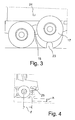
- Figure 3 illustrates the principle, by which the bogie 15 of a forest machine crosses a single obstacle 23, wherein the front wheel 16 ascends on top of the obstacle 23 and further descends, typically by falling, to the other side of the obstacle 23, causing a sway and vibration.
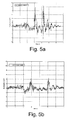
- Figure 5a shows an example illustrating the vibration to which the driver is subjected in the transverse direction (y-direction, lateral acceleration), wherein the horizontal axis represents time in seconds and the vertical axis represents the measured acceleration (m/s 2 ). It is the case of a single obstacle shown in Fig. 3, crossed by the wheels each in turn. The acceleration has been measured with an acceleration sensor 24 placed centrally at the driver's seat in the cabin, as shown in Fig. 3. From Fig. 5a, two vibration peaks are clearly detectable, which are caused by the falling of the front wheel and the rear wheel from the top of the obstacle.
- FIG. 5b shows a situation in which the speed of the forest machine is slowed down when the wheel is on top of the obstacle and is moving forward from the top of the obstacle. It can be seen that the vibraton peaks have become considerably lower. The latter vibration peak occurs later because of the lowered speed. It is a feature of hydrostatic drive transmission that the system is unyielding, wherein the set driving speed is maintained and each traction wheel brakes efficiently the movement of the working machine, wherein it does not tend to move faster than the set driving speed, for example when descending from the top of an obstacle.
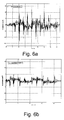
- Figure 6a shows a situation in which there are several obstacles and the wheels are crossing them all the time. From Fig. 6a, several vibration peaks are clearly detectable, which are caused by the falling of the wheels from the top of the obstacles. Even in this case, uncomfortable vibration and exceeding of the limit values are prevented by preventing the occurrence of vibration peaks.
- Figure 6b shows a situation in which the speed of the forest machine is decreased each time when a wheel is on top of an obstacle and is moving forward, away from the top of the obstacle. It can be seen that the vibraton peaks have become considerably lower. The driving speed remains low all the time, because the obstacles follow densely each other.
- the obstacle is detected by using a sensor 25 fixed to the front frame of the forest machine for measuring the distance of the sensor 25 from the ground.
- the sensor 25 can be, for example, an ultrasound sensor whose operation is based on an audio pulse transmitted by the sensor and on an echo received by the sensor.
- the distance of the object to be monitored that is, the distance between the ground or the obstacle and the sensor, is determined on the basis of the length of the time span between the audio pulse and its echo.
- the obstacle to be crossed may be either an obstacle protruding from the gorund and being higher than the ground, so that the wheel must first ascend on top of it, as shown in Fig. 3, or a recess that is lower than the ground and to which the wheel descends, as shown in Fig. 4, for example a pit.
- Typical obstacles include fallen tree stems, tussocks, and tree roots or stumps.
- the control system examines if the shift is sufficiently small (a low obstacle or recess) or flat, and does not lower the speed, or only lowers the speed to a limited extent. For the examining, it is possible to use a limit value that is a settable parameter and is stored in the control system.
- a limit value that is a settable parameter and is stored in the control system.
- the sensor also other alternatives may be feasible that measure the distance of the ground or obstacle from the fastening point of the sensor, for example radars or scanning devices, including laser.
- the system normally comprises two sensors fastened on each side of the front frame, placed on the front side of the wheels. The location may be, for example, a bumper or a running board.
- the movement of the sensor up and down with the forest machine can be compensated for in the measurement, and typically an increase in the measured distance indicates a point at which a wheel falls from the top of an obstacle. The faster and the shorter the range in which the distance increases, the steeper the fall.
- the measurement result of the sensor can also be interpreted in more detail, supplemented or confirmed, for example, with an angle sensor determining the position of the bogie.
- the angle sensor can be used to define if the wheel is on a flat surface or is ascending/descending.
- the location of the obstacle and the position of each wheel in relation to each other can be determined accurately when the distances d between the sensor 25 and each wheel are known.
- the distance travelled by the forest machine is determined by means of the sensor 22, wherein it remains a function of the control system to follow the travelled path and to time a deceleration at the obstacle, when the forest machine has travelled, for example, the distance d.
- the control system may also estimate the position and the path of the wheel on the basis of the data on the speed of the forest machine, obtained e.g. from the control bus. By integrating the speed data or on the basis of the time passed, it is possible to estimate the location of the wheel.
- control system 18 can be supplemented with a separate control module 26 which can, alternatively, also be integrated in the control system 18 as desired.
- the control module 26 modifies (e.g. coefficient X) the control value ref1 given by the driver, if an obstacle is detected.
- the control value ref1 represents the desired driving speed.
- the change in the control value (control value ref2) is dependent on the height of the obstacle (e.g. coefficient X(h)), wherein high obstacles are crossed more slowly.
- the control module 26 is connected to the sensor 25 and, if necessary, also to the sensor 22, if the control algorithm stored in the control module 26 also follows the travelled path and times the change in the control value (control value ref2) at the moment when a wheel is at the obstacle.
- the control module 26 takes care that one or more successive wheels slow down at the obstacle.
- the control system 18 controls, for example by means of the control value, the drive transmission which typically comprises a control module of its own.
- the behaviour of the forest machine is also influenced by the rate at which the driving speed of the forest machine is slowed down to the speed at which the wheel moves away from the top of the obstacle, and the rate at which it is accelerated back to the normal driving speed.
- the normal driving speed for a forwarder is, for example, in the order of 4 km/h
- the decelerated speed at an obstacle, when the wheel moves away from the top of an obstacle is, for example, in the order of 1.5 km/h.
- the control module 26 or the control system 18 comprises a settable ramp 27 for acceleration and a settable ramp 28 for braking.
- the settability is implemented by means of either fixed or variable parameters.
- the system only comprises, as shown in Fig. 7, a sensor 25 and a control module 29 for detecting the profile 30 of the ground.
- the functions of the control module 29 can also be integrated to a desired extent in the control system 18, which presents data about the profile to the driver of the forest machine, for example, by means of a display 31.
- a display for example a graphic curve and/or numerical data are used.
- the functions include, for example, a warning about an obstacle that is larger than a set limit or about a recess that is deeper than a set limit.
- the warning is, for example, a light signal or a flashing icon on the display.
- the functions may also include an acoustic signal that indicates the moment when one of the wheels is on top of an obstacle that requires reducing the driving speed.
- the acoustic signal is timed to be heard at the obstacle, wherein it simultaneously instructs the driver what to do. If necessary, the functions utilize the sensor 22. On the basis of the acoustic signal, the driver may drive more slowly and the driver does not need to monitor the wheels or estimate the obstacles himself/herself.
Landscapes
- Engineering & Computer Science (AREA)
- Mechanical Engineering (AREA)
- Automation & Control Theory (AREA)
- Transportation (AREA)
- Human Computer Interaction (AREA)
- Vehicle Body Suspensions (AREA)
- Vibration Prevention Devices (AREA)
- Operation Control Of Excavators (AREA)
Abstract
Description
- The invention relates to a method in damping vibration of a forest machine, a control system for a forest machine, and a forest machine.
- Forest machines are known to include various harvesters, forwarders, and their combinations. For performing harvesting, a harvesting device, i.e. a so-called harvester head, is fitted at the end of the crane system of the harvester for cutting, felling and delimbing a standing tree stem and sawing it to pieces of desired length. The sawn tree stems are collected with a forwarder equipped with a grapple fastened to a boom, and are transported away in its load space. Publication
WO 02/036412 A1 - Drivers of forest machines are subjected to vibration in their daily work. The Human Vibration Directive 2002/44/EC of the European Parliament and of the Council sets limit values and action values for daily exposure to vibration.
- Exposure to vibration is defined on the basis of daily exposure, wherein an 8-hour reference value is examined. The daily exposure is assessed by using the greatest RMS (Root-Mean-Square) value or the greatest vibration dose value (VDV), in which different acceleration values are weighted depending on the frequency. The values are determined in three orthogonal directions x, y and z (forward, sideward and upward) by using weighting coefficients. The RMS value is expressed by means of acceleration, and the unit is m/s2. The VDV value is expressed in the unit m/s1.75, and it is more sensitive to vibration peaks. The directive sets for daily 8-hour exposure an action value (daily exposure action value) 1.15 m/s2 or (VDV) 21 m/s1.75 and a limit value (daily exposure limit value) 0.5 m/s2 or (VDV) 9.1 m/s1.75. The limit value should not be exceeded.
- Roughness of the terrain and the ground affects the driver of the forest machine by way of vibration. According to prior art, vibration has been damped by three different methods, which are passive damping, examples of which are springs and shock absorbers in the fastenings of the driver's seat or cabin; semiactive damping, examples of which are adjustable springs and shock absorbers; and active damping, an example of which is the providing of a suitable counterforce for the vibration by using a sensor, a controller, and an actuator.
- The damping methods of prior art are deficient in that they do not eliminate the cause of the vibration but tend to dampen the vibration that occurs.
- Vibration and vibration peaks can be reduced by decreasing the speed of the forest machine, but as a consequence, the work of the forest machine will slow down. In particular, a forwarder performs transportation of tree stems from a cutting area to a collection point several times during a day, so that using a lower speed will slow down the collection of the tree stems at the collection point. A low driving speed is not an attractive alternative, because it will affect directly the productivity of the work.
- The invention is based, among other things, on the observation that especially vibration peaks are a reason for exceeding the limit values set for vibration. Furthermore, it was noticed that particularly low-frequency (about 0.5 to 2 Hz) vibration in the side direction plays a large role in exceeding the limit value. Furthermore, it was found that in calculating the limit value of the directive, direction and frequency bound weighting coefficients are used which emphasize the effect of low-frequency vibration.
- On the basis of the analysis, it was found that the vibration peaks are caused by the crossing of obstacles, particularly when a tyre of the forest machine falls or descends from the top of an obstacle back to the ground. On the basis of the analysis, it was also found that the magnitude of the vibration peaks is proportional to the driving speed of the forest machine when obstacles are being crossed. When driving at a high speed, the tyre of the forest machine loses its grip and holding earlier than when driving at a low speed; consequently, the tyre falls from the top of the obstacle onto the ground or down onto the bottom of a recess, resulting in swaying and vibration in the lateral direction. The vibration, to which the forest machine and the driver are subjected, is at its worst when a wheel on only one side of the forest machine is crossing the obstacle.
- In the invention, it was found that vibration peaks are reduced particularly by decreasing the speed of the forest machine before the tyre falls from the top of the obstacle. Furthermore, in the invention, a system was developed that takes care of decreasing the speed automatically, wherein the control system of the forest machine takes care of changing the speed on the basis of, for example, signals given by sensors.
- Furthermore, in the invention, a system was developed, by means of which it is possible to detect an obstacle or a location where the tyre is susceptible to falling. The speed of the forest machine can be decreased at the correct moment on the basis of a signal given by a sensor. Thanks to the system, the deceleration can be achieved precisely at the location where the lower speed is useful, wherein an unnecessary decrease in the speed can be avoided and the work is not slowed down in vain. In the invention, a system was used in which the profile of the ground is monitored already in advance to provide for altering the speed in good time. The profile data can be utilized for controlling all the wheels of the forest machine so that the speed of the forest machine is slowed down any time when any of the successively placed wheels is in turn for crossing an obstacle.
- In one embodiment of the invention, the speed is selected to be proportional to the size of the obstacle to be crossed, wherein the higher the obstacle, the lower the speed.
- In one embodiment of the invention, braking to a lower speed and accelerating to a higher speed are controlled by means of settable ramps, wherein the changes in the speed are more comfortable to the driver.
- In a simple embodiment of the invention, the forest machine only comprises a system that monitors the profile of the ground and transmits data to the driver. For example, the system warns about obstacles that a wheel is approaching and that the obstacle is so large that it would be desirable to slow down.
- A method according to the invention for damping vibration of a forest machine is presented in
claim 1. A control system for a forest machine according to the invention is presented inclaim 12. A forest machine according to the invention is presented inclaim 18. A forest machine according to the invention is also presented inclaim 22. - In addition to reducing vibration, the invention provides other advantages as well. In practice, it would be impossible for the driver to follow the precise mutual position of the wheels and the obstacle so as to decrease the speed at the correct moment. Instead, the driver would decrease the speed unnecessarily, which would slow down the transportation of tree stems, particularly in the case of a forwarder. Furthermore, the driver would follow the obstacles and not sufficiently the other behaviour of the forwarder or the driving route, which would make the transportation times even longer. The driver's visual range is obstructed by dead regions caused by the cabin, the chassis and the wheels, wherein the obstacles are not necessarily even visible. Furthermore, even if the obstacle was visible, it would be difficult to determine its height from above, based on a visual perception from the cabin. It would be difficult for the driver to select the speed, at which the vibration can be prevented in the most efficient way for each obstacle. It is an advantage of the automatic and optimal operation of the control system that the driver may concentrate on other things than on the variation in the driving speed and on the obstacles, and driving is more comfortable and faster.
- The invention can be applied in various forest machines but particularly in forest machines used for transporting tree stems, because they often perform pick-ups and transfers to the work site during a working day.
- In the following, the invention will be described in more detail by means of examples and with reference to the appended drawings, in which
- Fig. 1 shows a forwarder in which the invention is applied,
- Fig. 2 shows the drive transmission of a forest machine and the principle of a control system,
- Fig. 3 shows a wheel of a forest machine and an obstacle,
- Fig. 4 illustrates the operation of a sensor,
- Figs. 5a, 5b, 6a, and 6b represent vibration measurements,
- Fig. 7 illustrates the principle of a simple embodiment of the invention, and
- Fig. 8 shows another embodiment of the invention.
- Figure 1 shows a forwarder of prior art, in which the invention is applied. The forwarder comprises a
front frame 1 and arear frame 2 which are interconnected by means of aframe joint 3. Thefront frame 1 comprises acabin 4 and apower source 5, and therear frame 2 comprises aboom 6 with a grapple 7 and aload space 8. Each frame comprises a two-wheeled rocking shaft, but in the front frame, a possible alternative is to use a normal single-wheel shaft with a large wheel. - As shown in Fig. 2, hydrostatic drive transmission is normally applied in forest machines, and this is also applied in the forwarder of Fig. 1. The drive transmission converts the mechanical power supplied by a
diesel engine 9 to hydraulic power in apump 10, wherein the power is proportional to the feed pressure and volume flow in thepump 10. Thepump 10 is adjustable, wherein the volume flow can be changed. The hydraulic power is utilized in anengine 11 which, in turn, generates a torque and a rotating speed for an output shaft. The rotation speed of theengine 11 depends on the volume flow and on the setting of theengine 11. Theengine 11, in turn, is coupled to a gear 12 (fast/slow), by means of which the mechanical power is transferred to thewheels 17 of the working machine, for example by means ofcardan transmission 13 anddifferential shafts 14 to two-wheeled rocking shafts orbogies 15 equipped with thewheels 17 of the working machine which are mounted onpivotable hubs 16. A balanced planetary transmission is typically provided inside the bogie. The driving speed is typically controlled in a stepless manner. To increase the speed, the volume flow produced by thepump 10 is increased. - It is known that a control system is used for controlling forest machines. In the forest machine, the control system controls, among other things, the diesel engine, the hydrostatic drive transmission, and the crane system, to which the harvester head or grapple is coupled, as well as all the auxiliary functions related to these. Said control system is used, for example, in the operating environment of a PC computer of prior art.
- The hydrostatic drive transmission is controlled by an
electronic control system 18 of the working machine which also controls thediesel engine 9 by means of an electronic control unit (ECU) 19. The control bus of the control system typically applies a CAN bus, and thecontrol system 18 typically consists of independent smart modules whose operation is controlled by means of control panels and other equipment (central processing unit, display, keyboard, etc.) placed within the reach of the driver. The control system is also connected to asensor 22 which gives a signal that is proportional to the distance travelled by thewheel 17. The operation of thesensor 22 is based, for example, on monitoring the rotation of thehub 16, but with respect to the sensor, it is also possible to apply other principles known as such. Thesensor 22, which is for example a pulse sensor, is typically placed in theengine 11. - The rotational speed of the
diesel engine 9 and the driving speed are determined by a control value (ref1) given by the driver, typically by using apedal 20. By means of asensor 21, the pedal provides the control system with a signal that is dependent on the position of thepedal 20. The control value can also be given in other ways, for example by using a manual control stick. The position of the pedal 20 controls the volume flow produced by thepump 10. The dependence between the rotational speed or the driving speed and the control value is typically linear. The driving speed is also influenced by the use of a so-called reducing gear. According to prior art, the reducing gear is a mode of the control system that can be selected by the operator and to which is related either a fixed or settable parameter of the control system, representing the control value. - Figure 3 illustrates the principle, by which the
bogie 15 of a forest machine crosses asingle obstacle 23, wherein thefront wheel 16 ascends on top of theobstacle 23 and further descends, typically by falling, to the other side of theobstacle 23, causing a sway and vibration. - Figure 5a shows an example illustrating the vibration to which the driver is subjected in the transverse direction (y-direction, lateral acceleration), wherein the horizontal axis represents time in seconds and the vertical axis represents the measured acceleration (m/s2). It is the case of a single obstacle shown in Fig. 3, crossed by the wheels each in turn. The acceleration has been measured with an
acceleration sensor 24 placed centrally at the driver's seat in the cabin, as shown in Fig. 3. From Fig. 5a, two vibration peaks are clearly detectable, which are caused by the falling of the front wheel and the rear wheel from the top of the obstacle. - Preventing the occurrence of vibration peaks is an effective way of preventing uncomfortable vibration, to which the driver is subjected, and thereby of preventing that the limit values set for vibration are exceeded. Figure 5b shows a situation in which the speed of the forest machine is slowed down when the wheel is on top of the obstacle and is moving forward from the top of the obstacle. It can be seen that the vibraton peaks have become considerably lower. The latter vibration peak occurs later because of the lowered speed. It is a feature of hydrostatic drive transmission that the system is unyielding, wherein the set driving speed is maintained and each traction wheel brakes efficiently the movement of the working machine, wherein it does not tend to move faster than the set driving speed, for example when descending from the top of an obstacle. In the measurements, it was also found that the ascending of the wheel onto the obstacle did not cause such vibration as the falling of the wheel did. Consequently, in most cases it is sufficient that the limit values set for vibration can be observed by controlling the descending of the wheel from the top of the obstacle.
- Figure 6a shows a situation in which there are several obstacles and the wheels are crossing them all the time. From Fig. 6a, several vibration peaks are clearly detectable, which are caused by the falling of the wheels from the top of the obstacles. Even in this case, uncomfortable vibration and exceeding of the limit values are prevented by preventing the occurrence of vibration peaks. Figure 6b shows a situation in which the speed of the forest machine is decreased each time when a wheel is on top of an obstacle and is moving forward, away from the top of the obstacle. It can be seen that the vibraton peaks have become considerably lower. The driving speed remains low all the time, because the obstacles follow densely each other.
- A requirement for the reduction of the speed is that the obstacle is detected in advance and also that the arrival of the wheel at the obstacle can be estimated with sufficient accuracy. According to Fig. 4, the obstacle is detected by using a
sensor 25 fixed to the front frame of the forest machine for measuring the distance of thesensor 25 from the ground. Thesensor 25 can be, for example, an ultrasound sensor whose operation is based on an audio pulse transmitted by the sensor and on an echo received by the sensor. The distance of the object to be monitored, that is, the distance between the ground or the obstacle and the sensor, is determined on the basis of the length of the time span between the audio pulse and its echo. By means of thesensor 25, information is received about the profile of the ground surface at the location which will be passed by the wheels of the forest machine a moment later. If the distance is abruptly increased, it is possible to determine the height h of the obstacle from the measurement and, depending on the accuracy of the measurement, also the more detailed profile. The faster and the shorter the range in which the distance h increases, the steeper the fall. The obstacle to be crossed may be either an obstacle protruding from the gorund and being higher than the ground, so that the wheel must first ascend on top of it, as shown in Fig. 3, or a recess that is lower than the ground and to which the wheel descends, as shown in Fig. 4, for example a pit. Typical obstacles include fallen tree stems, tussocks, and tree roots or stumps. In an example, the control system examines if the shift is sufficiently small (a low obstacle or recess) or flat, and does not lower the speed, or only lowers the speed to a limited extent. For the examining, it is possible to use a limit value that is a settable parameter and is stored in the control system. For the sensor, also other alternatives may be feasible that measure the distance of the ground or obstacle from the fastening point of the sensor, for example radars or scanning devices, including laser. The system normally comprises two sensors fastened on each side of the front frame, placed on the front side of the wheels. The location may be, for example, a bumper or a running board. - The movement of the sensor up and down with the forest machine can be compensated for in the measurement, and typically an increase in the measured distance indicates a point at which a wheel falls from the top of an obstacle. The faster and the shorter the range in which the distance increases, the steeper the fall. The measurement result of the sensor can also be interpreted in more detail, supplemented or confirmed, for example, with an angle sensor determining the position of the bogie. The angle sensor can be used to define if the wheel is on a flat surface or is ascending/descending.
- The location of the obstacle and the position of each wheel in relation to each other can be determined accurately when the distances d between the
sensor 25 and each wheel are known. The distance travelled by the forest machine is determined by means of thesensor 22, wherein it remains a function of the control system to follow the travelled path and to time a deceleration at the obstacle, when the forest machine has travelled, for example, the distance d. The control system may also estimate the position and the path of the wheel on the basis of the data on the speed of the forest machine, obtained e.g. from the control bus. By integrating the speed data or on the basis of the time passed, it is possible to estimate the location of the wheel. - As shown in Fig. 8, the
control system 18 can be supplemented with aseparate control module 26 which can, alternatively, also be integrated in thecontrol system 18 as desired. In the presented embodiment, thecontrol module 26 modifies (e.g. coefficient X) the control value ref1 given by the driver, if an obstacle is detected. The control value ref1 represents the desired driving speed. In an embodiment, the change in the control value (control value ref2) is dependent on the height of the obstacle (e.g. coefficient X(h)), wherein high obstacles are crossed more slowly. Thecontrol module 26 is connected to thesensor 25 and, if necessary, also to thesensor 22, if the control algorithm stored in thecontrol module 26 also follows the travelled path and times the change in the control value (control value ref2) at the moment when a wheel is at the obstacle. Thecontrol module 26 takes care that one or more successive wheels slow down at the obstacle. Alternatively, said functions of thecontrol module 26 are included in a desired way in thecontrol system 18 which, on the basis of data from thesensor 25, selects either the control value ref1 (normal situation, X = 1) or the control value ref2, when the wheel is at an obstacle. Thecontrol system 18 controls, for example by means of the control value, the drive transmission which typically comprises a control module of its own. - The behaviour of the forest machine is also influenced by the rate at which the driving speed of the forest machine is slowed down to the speed at which the wheel moves away from the top of the obstacle, and the rate at which it is accelerated back to the normal driving speed. The normal driving speed for a forwarder is, for example, in the order of 4 km/h, and the decelerated speed at an obstacle, when the wheel moves away from the top of an obstacle, is, for example, in the order of 1.5 km/h. The
control module 26 or thecontrol system 18 comprises asettable ramp 27 for acceleration and asettable ramp 28 for braking. The settability is implemented by means of either fixed or variable parameters. - In a simple embodiment of the invention, the system only comprises, as shown in Fig. 7, a
sensor 25 and acontrol module 29 for detecting theprofile 30 of the ground. The functions of thecontrol module 29 can also be integrated to a desired extent in thecontrol system 18, which presents data about the profile to the driver of the forest machine, for example, by means of adisplay 31. For the display, for example a graphic curve and/or numerical data are used. The functions include, for example, a warning about an obstacle that is larger than a set limit or about a recess that is deeper than a set limit. The warning is, for example, a light signal or a flashing icon on the display. The functions may also include an acoustic signal that indicates the moment when one of the wheels is on top of an obstacle that requires reducing the driving speed. The acoustic signal is timed to be heard at the obstacle, wherein it simultaneously instructs the driver what to do. If necessary, the functions utilize thesensor 22. On the basis of the acoustic signal, the driver may drive more slowly and the driver does not need to monitor the wheels or estimate the obstacles himself/herself. - In applying the invention, software applications, components and parts of already existing control systems are used which are known as such and which are modified in a way required by the invention. However, the modification work and the application are obvious for a person skilled in the art on the basis of the above description. Furthermore, the invention is not restricted solely to the embodiments presented above.
Claims (23)
- A method in damping vibration in a forest machine, in which method:a desired driving speed is maintained, anda reduced driving speed is automatically maintained when the wheel of the forest machine is descending from the top of an obstacle protruding from the ground or into a recess in the ground.
- The method according to claim 1, in which
the height of said obstacle or the depth of said recess is determined automatically, and
the determination is made before said wheel reaches said obstacle or recess. - The method according to claim 2, in which
the reduced driving speed is proportional to the height of the obstacle or the depth of the recess. - The method according to claim 2 or 3, in which
the reduced driving speed is proportional to the steepness of the obstacle or the steepness of the recess. - The method according to any of the claims 1 to 4, in which
a shift to the reduced driving speed is made under the control of a defined deceleration ramp, and a shift back to the desired driving speed is made under the control of a defined acceleration ramp. - The method according to any of the claims 1 to 5, in which
the two-wheeled rocking bogie of the forest machine is steered across an obstacle and the reduced driving speed is maintained when the front wheel and the rear wheel of the bogie are descending from the top of the obstacle protruding from the ground or into a recess in the ground. - The method according to claim 6, in which
the rear two-wheeled rocking bogie of the forest machine is steered across an obstacle, and
a reduced driving speed is automatically maintained when the front wheel and the rear wheel of the rear bogie are descending from the top of the obstacle protruding from the ground or into a recess in the ground. - The method according to any of the claims 1 to 4, in which
the presence of said obstacle or recess is detected automatically,
the distance between the wheel of the forest machine and said obstacle or recess is determined, and
the implementation of the reduced driving speed is timed for the moment when said wheel starts to descend. - The method according to claim 2 or 8, in which
said obstacle or recess is detected by means of a sensor fastened to the forest machine and detecting the profile of the ground on the path of the wheel. - The method according to any of the claims 1 to 7, in which
the desired driving speed and the reduced driving speed are maintained by the hydrostatic drive transmission of the forest machine that is controlled automatically. - The method according to any of the claims 1 to 9, in which
the desired driving speed is selected automatically in proportion to a control value given by the driver,
said control value is automatically replaced with a new control value corresponding to the reduced driving speed, and
said new control value is entered in the control system which controls the driving speed of the forest machine. - A control system for a forest machine, comprising
a control system arranged to maintain a desired driving speed of the forest machine,
wherein the control system is also arranged to maintain automatically a reduced driving speed at a location where the wheel of the forest machine is descending from the top of an obstacle protruding from the ground or into a recess in the ground. - The control system according to claim 12, also comprising
a first coupling to a first sensor arranged to detect the profile of the ground on the path of a wheel of the forest machine,
a second coupling to a second sensor arranged to determine the path travelled by the wheel of the forest machine. - The control system according to claim 12 or 13, also comprising
a first input which is a control value proportional to the desired driving speed. - The control system according to claim 14, also comprising
a control module arranged to replace said control value automatically with a new control value that corresponds to a reduced driving speed. - The control system according to any of the claims 12 to 15, in which
the reduced driving speed is proportional to the height of the obstacle or the depth of the recess. - The control system according to any of the claims 12 to 16, in which
the control system is also arranged to determine the arrival of the wheel at a location where said obstacle or recess is. - A forest machine comprising
drive transmission, comprising several wheels,
a control system which is arranged to maintain a desired driving speed of the forest machine and to control the drive transmission,
wherein the control system is also arranged to maintain a reduced driving speed automatically at a location where the wheel of the forest machine is descending from the top of an obstacle protruding from the ground or into a recess in the ground. - The forest machine according to claim 18, also comprising
a first sensor coupled to the control system and arranged to monitor the profile of the ground on the travel path of the wheel of the forest machine,
a second sensor coupled to the control system and arranged to determine the path travelled by the wheel of the forest machine, and
an input which is a control value proportional to the desired driving speed. - The forest machine according to claim 18 or 19, in which
said drive transmission is hydrostatic and comprises two or more two-wheeled rocking shafts or bogies. - The forest machine according to any of the claims 18 to 20, which is a forest machine for transporting tree stems.
- A forest machine comprising
a sensor coupled to the forest machine and arranged to monitor the profile of the ground on the travel path of the wheel of the forest machine. - The forest machine according to claim 22, also comprising
a control system coupled to said sensor and arranged to present the driver warnings or data relating to obstacles or recesses included in the profile.
Applications Claiming Priority (1)
| Application Number | Priority Date | Filing Date | Title |
|---|---|---|---|
| FI20065729A FI124700B (en) | 2006-11-15 | 2006-11-15 | Procedure for damping vibration in a forest machine, as well as forest machine and its control system |
Publications (3)
| Publication Number | Publication Date |
|---|---|
| EP1923289A2 true EP1923289A2 (en) | 2008-05-21 |
| EP1923289A3 EP1923289A3 (en) | 2012-01-25 |
| EP1923289B1 EP1923289B1 (en) | 2017-05-10 |
Family
ID=37482548
Family Applications (1)
| Application Number | Title | Priority Date | Filing Date |
|---|---|---|---|
| EP07120351.7A Active EP1923289B1 (en) | 2006-11-15 | 2007-11-09 | A forest machine and dampening of vibration |
Country Status (2)
| Country | Link |
|---|---|
| EP (1) | EP1923289B1 (en) |
| FI (1) | FI124700B (en) |
Cited By (6)
| Publication number | Priority date | Publication date | Assignee | Title |
|---|---|---|---|---|
| GB2516934A (en) * | 2013-08-07 | 2015-02-11 | Jaguar Land Rover Ltd | Vehicle speed control system and method |
| EP2949533A1 (en) * | 2014-05-28 | 2015-12-02 | John Deere Forestry Oy | A method for controlling the primary motor of a load transportation machine, a control system for the primary motor of a load transportation machine, and a load transportation machine |
| CN107757612A (en) * | 2016-08-15 | 2018-03-06 | 法乐第(北京)网络科技有限公司 | A kind of vehicle height road surface driving assistance method and device |
| SE1751567A1 (en) * | 2017-12-18 | 2019-06-19 | Komatsu Forest Ab | Work machine and method for monitoring a control system at a work machine |
| RU2776166C2 (en) * | 2017-12-18 | 2022-07-14 | Комацу Форест Аб | Working machine and method for monitoring control system on working machine |
| CN118765726A (en) * | 2024-07-30 | 2024-10-15 | 江苏裕灌现代农业科技有限公司 | Automatic Agaricus bisporus picking device and self-buffering walking mechanism thereof |
Families Citing this family (2)
| Publication number | Priority date | Publication date | Assignee | Title |
|---|---|---|---|---|
| CN108099897B (en) * | 2017-11-17 | 2019-11-12 | 浙江吉利汽车研究院有限公司 | Cruise control method, device and system |
| US12172647B2 (en) | 2021-03-19 | 2024-12-24 | Caterpillar Inc. | Method and system for engine and machine control |
Citations (1)
| Publication number | Priority date | Publication date | Assignee | Title |
|---|---|---|---|---|
| WO2002036412A1 (en) | 2000-10-30 | 2002-05-10 | Timberjack Oy | Chassis structure for a forest machine |
Family Cites Families (11)
| Publication number | Priority date | Publication date | Assignee | Title |
|---|---|---|---|---|
| GB1495165A (en) * | 1975-04-16 | 1977-12-14 | Mini Agriculture & Fisheries | Rough terrain vehicles |
| US4186815A (en) * | 1977-12-27 | 1980-02-05 | Caterpillar Tractor Co. | Suspension and drive for tandem wheel vehicle |
| SE459571B (en) * | 1987-07-24 | 1989-07-17 | Haldo Karlin | TRACING VEHICLES |
| US5655615A (en) * | 1994-01-06 | 1997-08-12 | Mick; Jeffrey | Wheeled vehicle for distributing agricultural materials in fields having uneven terrain |
| JPH10119739A (en) * | 1996-10-18 | 1998-05-12 | J K C Toratsuku Brake Syst:Kk | Tractor-trailer speed control device |
| US6000703A (en) * | 1997-11-12 | 1999-12-14 | Case Corporation | Active suspension system for a work vehicle having adjustable performance parameters |
| US6036206A (en) * | 1997-11-13 | 2000-03-14 | Case Corporation | Traction control and active suspension |
| JP2005119548A (en) * | 2003-10-17 | 2005-05-12 | Nissan Motor Co Ltd | Electric vehicle suspension system |
| EP1582445A1 (en) * | 2004-03-30 | 2005-10-05 | de Jongh, Eddy | Mining truck |
| JP4737408B2 (en) * | 2004-12-09 | 2011-08-03 | 株式会社エクォス・リサーチ | Wheel support / drive device |
| JP4792801B2 (en) * | 2005-04-21 | 2011-10-12 | 株式会社アドヴィックス | Vehicle speed control device |
-
2006
- 2006-11-15 FI FI20065729A patent/FI124700B/en active IP Right Grant
-
2007
- 2007-11-09 EP EP07120351.7A patent/EP1923289B1/en active Active
Patent Citations (1)
| Publication number | Priority date | Publication date | Assignee | Title |
|---|---|---|---|---|
| WO2002036412A1 (en) | 2000-10-30 | 2002-05-10 | Timberjack Oy | Chassis structure for a forest machine |
Cited By (10)
| Publication number | Priority date | Publication date | Assignee | Title |
|---|---|---|---|---|
| GB2516934A (en) * | 2013-08-07 | 2015-02-11 | Jaguar Land Rover Ltd | Vehicle speed control system and method |
| GB2516934B (en) * | 2013-08-07 | 2017-02-01 | Jaguar Land Rover Ltd | Vehicle speed control system and method |
| US10155516B2 (en) | 2013-08-07 | 2018-12-18 | Jaguar Land Rover Limited | Vehicle speed control system and method |
| EP2949533A1 (en) * | 2014-05-28 | 2015-12-02 | John Deere Forestry Oy | A method for controlling the primary motor of a load transportation machine, a control system for the primary motor of a load transportation machine, and a load transportation machine |
| CN107757612A (en) * | 2016-08-15 | 2018-03-06 | 法乐第(北京)网络科技有限公司 | A kind of vehicle height road surface driving assistance method and device |
| SE1751567A1 (en) * | 2017-12-18 | 2019-06-19 | Komatsu Forest Ab | Work machine and method for monitoring a control system at a work machine |
| WO2019125281A1 (en) * | 2017-12-18 | 2019-06-27 | Komatsu Forest Ab | Work machine and method for monitoring a control system at a work machine |
| RU2776166C2 (en) * | 2017-12-18 | 2022-07-14 | Комацу Форест Аб | Working machine and method for monitoring control system on working machine |
| US11601454B2 (en) | 2017-12-18 | 2023-03-07 | Komatsu Forest Ab | Work machine and method for monitoring a control system at a work machine |
| CN118765726A (en) * | 2024-07-30 | 2024-10-15 | 江苏裕灌现代农业科技有限公司 | Automatic Agaricus bisporus picking device and self-buffering walking mechanism thereof |
Also Published As
| Publication number | Publication date |
|---|---|
| FI124700B (en) | 2014-12-15 |
| EP1923289A3 (en) | 2012-01-25 |
| FI20065729A0 (en) | 2006-11-15 |
| FI20065729L (en) | 2008-05-16 |
| EP1923289B1 (en) | 2017-05-10 |
Similar Documents
| Publication | Publication Date | Title |
|---|---|---|
| EP1923289B1 (en) | A forest machine and dampening of vibration | |
| CN104057954B (en) | Road condition self-adaptation system of crane and crane | |
| US8825292B2 (en) | Suspension control system to facilitate wheel motions during parking | |
| US8065054B2 (en) | Vehicle active suspension system | |
| CN110329297B (en) | Anti-snake-shaped vibration reduction system, vibration reduction control method and vehicle | |
| CA2461084C (en) | Vehicle stability operator feedback system | |
| JP6317257B2 (en) | Vehicle driver advisory system | |
| US9169110B2 (en) | Method for determining the probability of a handling truck's tipping over | |
| US20120323453A1 (en) | Method and apparatus in connection with forestry machine | |
| US8869908B2 (en) | Anti-bounce control system for a machine | |
| CN106982561A (en) | The apparatus and method for adjusting the operation for the drag device that the hydraulic pressure at vehicle can be actuated | |
| US6766236B1 (en) | Skid steer drive control system | |
| JP6258469B2 (en) | Vehicle speed control system | |
| EP2969610B1 (en) | Ride height control system of a vehicle and method | |
| RU2667056C2 (en) | Agricultural vehicle | |
| KR20170122851A (en) | Vehicle speed control system and method employing torque balancing | |
| JP7399680B2 (en) | Work support system | |
| CN106183691A (en) | One takes aim at formula Active suspension and control method thereof in advance | |
| JPH03500520A (en) | Method for preventing overloading of nose wheel equipment of an aircraft being towed by a towing vehicle, and a towing vehicle for carrying out the method | |
| DE102017205513B4 (en) | Method and device for setting an operating strategy for a vehicle | |
| SE1350171A1 (en) | Management of changes in driving resistance parameters | |
| KR20190009018A (en) | Velocity Control Apparatus and the Mehod for Working Safety of Automatic Driving Agricultural Machine | |
| Rawat et al. | Structural optimisation of go kart chassis with basic electronic driver assistance systems | |
| US20080215212A1 (en) | Method For Controlling Driving Functions of a Motor Vehicle | |
| DE102018222206A1 (en) | Control method for a vehicle or a vehicle combination with a stabilization device, stabilization device, vehicle or vehicle combination with a stabilization device |
Legal Events
| Date | Code | Title | Description |
|---|---|---|---|
| PUAI | Public reference made under article 153(3) epc to a published international application that has entered the european phase |
Free format text: ORIGINAL CODE: 0009012 |
|
| AK | Designated contracting states |
Kind code of ref document: A2 Designated state(s): AT BE BG CH CY CZ DE DK EE ES FI FR GB GR HU IE IS IT LI LT LU LV MC MT NL PL PT RO SE SI SK TR |
|
| AX | Request for extension of the european patent |
Extension state: AL BA HR MK RS |
|
| PUAL | Search report despatched |
Free format text: ORIGINAL CODE: 0009013 |
|
| AK | Designated contracting states |
Kind code of ref document: A3 Designated state(s): AT BE BG CH CY CZ DE DK EE ES FI FR GB GR HU IE IS IT LI LT LU LV MC MT NL PL PT RO SE SI SK TR |
|
| AX | Request for extension of the european patent |
Extension state: AL BA HR MK RS |
|
| RIC1 | Information provided on ipc code assigned before grant |
Ipc: B60G 17/0195 20060101ALN20111221BHEP Ipc: A01G 23/00 20060101ALI20111221BHEP Ipc: B60W 30/14 20060101AFI20111221BHEP Ipc: B60W 30/16 20120101ALN20111221BHEP |
|
| 17P | Request for examination filed |
Effective date: 20120612 |
|
| AKX | Designation fees paid |
Designated state(s): AT BE BG CH CY CZ DE DK EE ES FI FR GB GR HU IE IS IT LI LT LU LV MC MT NL PL PT RO SE SI SK TR |
|
| REG | Reference to a national code |
Ref country code: DE Ref legal event code: R079 Ref document number: 602007050916 Country of ref document: DE Free format text: PREVIOUS MAIN CLASS: B60W0030160000 Ipc: B60W0030140000 |
|
| RIC1 | Information provided on ipc code assigned before grant |
Ipc: B60W 30/14 20060101AFI20161026BHEP Ipc: A01G 23/00 20060101ALI20161026BHEP Ipc: B60G 17/0195 20060101ALN20161026BHEP Ipc: B60W 30/16 20120101ALN20161026BHEP |
|
| GRAP | Despatch of communication of intention to grant a patent |
Free format text: ORIGINAL CODE: EPIDOSNIGR1 |
|
| STAA | Information on the status of an ep patent application or granted ep patent |
Free format text: STATUS: GRANT OF PATENT IS INTENDED |
|
| INTG | Intention to grant announced |
Effective date: 20170109 |
|
| GRAS | Grant fee paid |
Free format text: ORIGINAL CODE: EPIDOSNIGR3 |
|
| GRAA | (expected) grant |
Free format text: ORIGINAL CODE: 0009210 |
|
| STAA | Information on the status of an ep patent application or granted ep patent |
Free format text: STATUS: THE PATENT HAS BEEN GRANTED |
|
| GRAJ | Information related to disapproval of communication of intention to grant by the applicant or resumption of examination proceedings by the epo deleted |
Free format text: ORIGINAL CODE: EPIDOSDIGR1 |
|
| AK | Designated contracting states |
Kind code of ref document: B1 Designated state(s): AT BE BG CH CY CZ DE DK EE ES FI FR GB GR HU IE IS IT LI LT LU LV MC MT NL PL PT RO SE SI SK TR |
|
| REG | Reference to a national code |
Ref country code: GB Ref legal event code: FG4D |
|
| REG | Reference to a national code |
Ref country code: AT Ref legal event code: REF Ref document number: 891984 Country of ref document: AT Kind code of ref document: T Effective date: 20170515 Ref country code: CH Ref legal event code: EP |
|
| GRAT | Correction requested after decision to grant or after decision to maintain patent in amended form |
Free format text: ORIGINAL CODE: EPIDOSNCDEC |
|
| REG | Reference to a national code |
Ref country code: IE Ref legal event code: FG4D |
|
| REG | Reference to a national code |
Ref country code: DE Ref legal event code: R096 Ref document number: 602007050916 Country of ref document: DE |
|
| REG | Reference to a national code |
Ref country code: SE Ref legal event code: TRGR |
|
| REG | Reference to a national code |
Ref country code: NL Ref legal event code: MP Effective date: 20170510 |
|
| REG | Reference to a national code |
Ref country code: LT Ref legal event code: MG4D |
|
| REG | Reference to a national code |
Ref country code: AT Ref legal event code: MK05 Ref document number: 891984 Country of ref document: AT Kind code of ref document: T Effective date: 20170510 |
|
| PG25 | Lapsed in a contracting state [announced via postgrant information from national office to epo] |
Ref country code: AT Free format text: LAPSE BECAUSE OF FAILURE TO SUBMIT A TRANSLATION OF THE DESCRIPTION OR TO PAY THE FEE WITHIN THE PRESCRIBED TIME-LIMIT Effective date: 20170510 Ref country code: ES Free format text: LAPSE BECAUSE OF FAILURE TO SUBMIT A TRANSLATION OF THE DESCRIPTION OR TO PAY THE FEE WITHIN THE PRESCRIBED TIME-LIMIT Effective date: 20170510 Ref country code: LT Free format text: LAPSE BECAUSE OF FAILURE TO SUBMIT A TRANSLATION OF THE DESCRIPTION OR TO PAY THE FEE WITHIN THE PRESCRIBED TIME-LIMIT Effective date: 20170510 Ref country code: GR Free format text: LAPSE BECAUSE OF FAILURE TO SUBMIT A TRANSLATION OF THE DESCRIPTION OR TO PAY THE FEE WITHIN THE PRESCRIBED TIME-LIMIT Effective date: 20170811 |
|
| PG25 | Lapsed in a contracting state [announced via postgrant information from national office to epo] |
Ref country code: BG Free format text: LAPSE BECAUSE OF FAILURE TO SUBMIT A TRANSLATION OF THE DESCRIPTION OR TO PAY THE FEE WITHIN THE PRESCRIBED TIME-LIMIT Effective date: 20170810 Ref country code: PL Free format text: LAPSE BECAUSE OF FAILURE TO SUBMIT A TRANSLATION OF THE DESCRIPTION OR TO PAY THE FEE WITHIN THE PRESCRIBED TIME-LIMIT Effective date: 20170510 Ref country code: NL Free format text: LAPSE BECAUSE OF FAILURE TO SUBMIT A TRANSLATION OF THE DESCRIPTION OR TO PAY THE FEE WITHIN THE PRESCRIBED TIME-LIMIT Effective date: 20170510 Ref country code: IS Free format text: LAPSE BECAUSE OF FAILURE TO SUBMIT A TRANSLATION OF THE DESCRIPTION OR TO PAY THE FEE WITHIN THE PRESCRIBED TIME-LIMIT Effective date: 20170910 Ref country code: LV Free format text: LAPSE BECAUSE OF FAILURE TO SUBMIT A TRANSLATION OF THE DESCRIPTION OR TO PAY THE FEE WITHIN THE PRESCRIBED TIME-LIMIT Effective date: 20170510 |
|
| PG25 | Lapsed in a contracting state [announced via postgrant information from national office to epo] |
Ref country code: RO Free format text: LAPSE BECAUSE OF FAILURE TO SUBMIT A TRANSLATION OF THE DESCRIPTION OR TO PAY THE FEE WITHIN THE PRESCRIBED TIME-LIMIT Effective date: 20170510 Ref country code: DK Free format text: LAPSE BECAUSE OF FAILURE TO SUBMIT A TRANSLATION OF THE DESCRIPTION OR TO PAY THE FEE WITHIN THE PRESCRIBED TIME-LIMIT Effective date: 20170510 Ref country code: SK Free format text: LAPSE BECAUSE OF FAILURE TO SUBMIT A TRANSLATION OF THE DESCRIPTION OR TO PAY THE FEE WITHIN THE PRESCRIBED TIME-LIMIT Effective date: 20170510 Ref country code: CZ Free format text: LAPSE BECAUSE OF FAILURE TO SUBMIT A TRANSLATION OF THE DESCRIPTION OR TO PAY THE FEE WITHIN THE PRESCRIBED TIME-LIMIT Effective date: 20170510 Ref country code: EE Free format text: LAPSE BECAUSE OF FAILURE TO SUBMIT A TRANSLATION OF THE DESCRIPTION OR TO PAY THE FEE WITHIN THE PRESCRIBED TIME-LIMIT Effective date: 20170510 |
|
| REG | Reference to a national code |
Ref country code: DE Ref legal event code: R097 Ref document number: 602007050916 Country of ref document: DE |
|
| PG25 | Lapsed in a contracting state [announced via postgrant information from national office to epo] |
Ref country code: IT Free format text: LAPSE BECAUSE OF FAILURE TO SUBMIT A TRANSLATION OF THE DESCRIPTION OR TO PAY THE FEE WITHIN THE PRESCRIBED TIME-LIMIT Effective date: 20170510 |
|
| PLBE | No opposition filed within time limit |
Free format text: ORIGINAL CODE: 0009261 |
|
| STAA | Information on the status of an ep patent application or granted ep patent |
Free format text: STATUS: NO OPPOSITION FILED WITHIN TIME LIMIT |
|
| 26N | No opposition filed |
Effective date: 20180213 |
|
| PG25 | Lapsed in a contracting state [announced via postgrant information from national office to epo] |
Ref country code: SI Free format text: LAPSE BECAUSE OF FAILURE TO SUBMIT A TRANSLATION OF THE DESCRIPTION OR TO PAY THE FEE WITHIN THE PRESCRIBED TIME-LIMIT Effective date: 20170510 |
|
| REG | Reference to a national code |
Ref country code: DE Ref legal event code: R119 Ref document number: 602007050916 Country of ref document: DE |
|
| PG25 | Lapsed in a contracting state [announced via postgrant information from national office to epo] |
Ref country code: MC Free format text: LAPSE BECAUSE OF FAILURE TO SUBMIT A TRANSLATION OF THE DESCRIPTION OR TO PAY THE FEE WITHIN THE PRESCRIBED TIME-LIMIT Effective date: 20170510 |
|
| GBPC | Gb: european patent ceased through non-payment of renewal fee |
Effective date: 20171109 |
|
| PG25 | Lapsed in a contracting state [announced via postgrant information from national office to epo] |
Ref country code: LI Free format text: LAPSE BECAUSE OF NON-PAYMENT OF DUE FEES Effective date: 20171130 Ref country code: CH Free format text: LAPSE BECAUSE OF NON-PAYMENT OF DUE FEES Effective date: 20171130 |
|
| PG25 | Lapsed in a contracting state [announced via postgrant information from national office to epo] |
Ref country code: LU Free format text: LAPSE BECAUSE OF NON-PAYMENT OF DUE FEES Effective date: 20171109 |
|
| REG | Reference to a national code |
Ref country code: FR Ref legal event code: ST Effective date: 20180731 Ref country code: BE Ref legal event code: MM Effective date: 20171130 |
|
| REG | Reference to a national code |
Ref country code: IE Ref legal event code: MM4A |
|
| PG25 | Lapsed in a contracting state [announced via postgrant information from national office to epo] |
Ref country code: MT Free format text: LAPSE BECAUSE OF NON-PAYMENT OF DUE FEES Effective date: 20171109 |
|
| PG25 | Lapsed in a contracting state [announced via postgrant information from national office to epo] |
Ref country code: FR Free format text: LAPSE BECAUSE OF NON-PAYMENT OF DUE FEES Effective date: 20171130 Ref country code: DE Free format text: LAPSE BECAUSE OF NON-PAYMENT OF DUE FEES Effective date: 20180602 Ref country code: IE Free format text: LAPSE BECAUSE OF NON-PAYMENT OF DUE FEES Effective date: 20171109 |
|
| PG25 | Lapsed in a contracting state [announced via postgrant information from national office to epo] |
Ref country code: GB Free format text: LAPSE BECAUSE OF NON-PAYMENT OF DUE FEES Effective date: 20171109 Ref country code: BE Free format text: LAPSE BECAUSE OF NON-PAYMENT OF DUE FEES Effective date: 20171130 |
|
| PG25 | Lapsed in a contracting state [announced via postgrant information from national office to epo] |
Ref country code: HU Free format text: LAPSE BECAUSE OF FAILURE TO SUBMIT A TRANSLATION OF THE DESCRIPTION OR TO PAY THE FEE WITHIN THE PRESCRIBED TIME-LIMIT; INVALID AB INITIO Effective date: 20071109 |
|
| PG25 | Lapsed in a contracting state [announced via postgrant information from national office to epo] |
Ref country code: CY Free format text: LAPSE BECAUSE OF NON-PAYMENT OF DUE FEES Effective date: 20170510 |
|
| PG25 | Lapsed in a contracting state [announced via postgrant information from national office to epo] |
Ref country code: TR Free format text: LAPSE BECAUSE OF FAILURE TO SUBMIT A TRANSLATION OF THE DESCRIPTION OR TO PAY THE FEE WITHIN THE PRESCRIBED TIME-LIMIT Effective date: 20170510 |
|
| PG25 | Lapsed in a contracting state [announced via postgrant information from national office to epo] |
Ref country code: PT Free format text: LAPSE BECAUSE OF FAILURE TO SUBMIT A TRANSLATION OF THE DESCRIPTION OR TO PAY THE FEE WITHIN THE PRESCRIBED TIME-LIMIT Effective date: 20170510 |
|
| PGFP | Annual fee paid to national office [announced via postgrant information from national office to epo] |
Ref country code: FI Payment date: 20231127 Year of fee payment: 17 |
|
| PGFP | Annual fee paid to national office [announced via postgrant information from national office to epo] |
Ref country code: SE Payment date: 20241127 Year of fee payment: 18 |
|
| PG25 | Lapsed in a contracting state [announced via postgrant information from national office to epo] |
Ref country code: FI Free format text: LAPSE BECAUSE OF NON-PAYMENT OF DUE FEES Effective date: 20241109 |