EP1923200A1 - Article - Google Patents
Article Download PDFInfo
- Publication number
- EP1923200A1 EP1923200A1 EP06255921A EP06255921A EP1923200A1 EP 1923200 A1 EP1923200 A1 EP 1923200A1 EP 06255921 A EP06255921 A EP 06255921A EP 06255921 A EP06255921 A EP 06255921A EP 1923200 A1 EP1923200 A1 EP 1923200A1
- Authority
- EP
- European Patent Office
- Prior art keywords
- article
- polypropylene
- propylene
- composition
- copolymer
- Prior art date
- Legal status (The legal status is an assumption and is not a legal conclusion. Google has not performed a legal analysis and makes no representation as to the accuracy of the status listed.)
- Withdrawn
Links
- -1 polypropylene Polymers 0.000 claims abstract description 91
- 229920001155 polypropylene Polymers 0.000 claims abstract description 77
- 239000004743 Polypropylene Substances 0.000 claims abstract description 71
- 239000000203 mixture Substances 0.000 claims abstract description 53
- 239000002667 nucleating agent Substances 0.000 claims abstract description 34
- 229920006378 biaxially oriented polypropylene Polymers 0.000 claims abstract description 3
- 239000011127 biaxially oriented polypropylene Substances 0.000 claims abstract description 3
- 229920000642 polymer Polymers 0.000 claims description 61
- 229920001577 copolymer Polymers 0.000 claims description 32
- 238000000034 method Methods 0.000 claims description 29
- 229920002554 vinyl polymer Polymers 0.000 claims description 20
- 238000012545 processing Methods 0.000 claims description 19
- QQONPFPTGQHPMA-UHFFFAOYSA-N propylene Natural products CC=C QQONPFPTGQHPMA-UHFFFAOYSA-N 0.000 claims description 18
- VGGSQFUCUMXWEO-UHFFFAOYSA-N Ethene Chemical compound C=C VGGSQFUCUMXWEO-UHFFFAOYSA-N 0.000 claims description 13
- 239000005977 Ethylene Substances 0.000 claims description 13
- 238000002347 injection Methods 0.000 claims description 11
- 239000007924 injection Substances 0.000 claims description 11
- 229920001519 homopolymer Polymers 0.000 claims description 9
- 239000004711 α-olefin Substances 0.000 claims description 9
- 229910052799 carbon Inorganic materials 0.000 claims description 7
- 125000004432 carbon atom Chemical group C* 0.000 claims description 7
- 229920001384 propylene homopolymer Polymers 0.000 claims description 7
- 238000010103 injection stretch blow moulding Methods 0.000 claims description 6
- YHQXBTXEYZIYOV-UHFFFAOYSA-N 3-methylbut-1-ene Chemical compound CC(C)C=C YHQXBTXEYZIYOV-UHFFFAOYSA-N 0.000 claims description 5
- 125000003118 aryl group Chemical group 0.000 claims description 5
- LDLDYFCCDKENPD-UHFFFAOYSA-N ethenylcyclohexane Chemical compound C=CC1CCCCC1 LDLDYFCCDKENPD-UHFFFAOYSA-N 0.000 claims description 5
- 238000004519 manufacturing process Methods 0.000 claims description 5
- 229920005606 polypropylene copolymer Polymers 0.000 claims description 5
- WSSSPWUEQFSQQG-UHFFFAOYSA-N 4-methyl-1-pentene Chemical compound CC(C)CC=C WSSSPWUEQFSQQG-UHFFFAOYSA-N 0.000 claims description 4
- 125000004122 cyclic group Chemical group 0.000 claims description 4
- 229920006395 saturated elastomer Polymers 0.000 claims description 3
- FXSUTKNIHXGZFF-UHFFFAOYSA-N 1-ethenyl-2-methylcyclohexane Chemical compound CC1CCCCC1C=C FXSUTKNIHXGZFF-UHFFFAOYSA-N 0.000 claims description 2
- OLGHJTHQWQKJQQ-UHFFFAOYSA-N 3-ethylhex-1-ene Chemical compound CCCC(CC)C=C OLGHJTHQWQKJQQ-UHFFFAOYSA-N 0.000 claims description 2
- LDTAOIUHUHHCMU-UHFFFAOYSA-N 3-methylpent-1-ene Chemical compound CCC(C)C=C LDTAOIUHUHHCMU-UHFFFAOYSA-N 0.000 claims description 2
- 150000001335 aliphatic alkanes Chemical class 0.000 claims description 2
- 150000001924 cycloalkanes Chemical class 0.000 claims description 2
- BEFDCLMNVWHSGT-UHFFFAOYSA-N ethenylcyclopentane Chemical compound C=CC1CCCC1 BEFDCLMNVWHSGT-UHFFFAOYSA-N 0.000 claims description 2
- 239000000155 melt Substances 0.000 claims description 2
- 229920005653 propylene-ethylene copolymer Polymers 0.000 claims 1
- 239000003054 catalyst Substances 0.000 description 13
- 238000010438 heat treatment Methods 0.000 description 13
- 239000007789 gas Substances 0.000 description 10
- VXNZUUAINFGPBY-UHFFFAOYSA-N 1-Butene Chemical compound CCC=C VXNZUUAINFGPBY-UHFFFAOYSA-N 0.000 description 8
- 229920005604 random copolymer Polymers 0.000 description 8
- 239000002002 slurry Substances 0.000 description 8
- 238000002844 melting Methods 0.000 description 7
- 230000008018 melting Effects 0.000 description 7
- 230000003750 conditioning effect Effects 0.000 description 6
- 238000001816 cooling Methods 0.000 description 6
- 238000002156 mixing Methods 0.000 description 6
- 150000001721 carbon Chemical group 0.000 description 5
- 239000000178 monomer Substances 0.000 description 5
- 125000004805 propylene group Chemical group [H]C([H])([H])C([H])([*:1])C([H])([H])[*:2] 0.000 description 5
- 239000000243 solution Substances 0.000 description 5
- UFHFLCQGNIYNRP-UHFFFAOYSA-N Hydrogen Chemical compound [H][H] UFHFLCQGNIYNRP-UHFFFAOYSA-N 0.000 description 4
- CTQNGGLPUBDAKN-UHFFFAOYSA-N O-Xylene Chemical compound CC1=CC=CC=C1C CTQNGGLPUBDAKN-UHFFFAOYSA-N 0.000 description 4
- 239000011954 Ziegler–Natta catalyst Substances 0.000 description 4
- 239000001257 hydrogen Substances 0.000 description 4
- 229910052739 hydrogen Inorganic materials 0.000 description 4
- 239000000047 product Substances 0.000 description 4
- 238000012360 testing method Methods 0.000 description 4
- 239000008096 xylene Substances 0.000 description 4
- FBPFZTCFMRRESA-JGWLITMVSA-N D-glucitol Chemical compound OC[C@H](O)[C@@H](O)[C@H](O)[C@H](O)CO FBPFZTCFMRRESA-JGWLITMVSA-N 0.000 description 3
- 230000002902 bimodal effect Effects 0.000 description 3
- 238000000071 blow moulding Methods 0.000 description 3
- 230000000694 effects Effects 0.000 description 3
- 238000005259 measurement Methods 0.000 description 3
- 230000003287 optical effect Effects 0.000 description 3
- 125000000391 vinyl group Chemical group [H]C([*])=C([H])[H] 0.000 description 3
- YWEWWNPYDDHZDI-JJKKTNRVSA-N (1r)-1-[(4r,4ar,8as)-2,6-bis(3,4-dimethylphenyl)-4,4a,8,8a-tetrahydro-[1,3]dioxino[5,4-d][1,3]dioxin-4-yl]ethane-1,2-diol Chemical compound C1=C(C)C(C)=CC=C1C1O[C@H]2[C@@H]([C@H](O)CO)OC(C=3C=C(C)C(C)=CC=3)O[C@H]2CO1 YWEWWNPYDDHZDI-JJKKTNRVSA-N 0.000 description 2
- RELMFMZEBKVZJC-UHFFFAOYSA-N 1,2,3-trichlorobenzene Chemical compound ClC1=CC=CC(Cl)=C1Cl RELMFMZEBKVZJC-UHFFFAOYSA-N 0.000 description 2
- MYRTYDVEIRVNKP-UHFFFAOYSA-N 1,2-Divinylbenzene Chemical compound C=CC1=CC=CC=C1C=C MYRTYDVEIRVNKP-UHFFFAOYSA-N 0.000 description 2
- LIKMAJRDDDTEIG-UHFFFAOYSA-N 1-hexene Chemical compound CCCCC=C LIKMAJRDDDTEIG-UHFFFAOYSA-N 0.000 description 2
- KWKAKUADMBZCLK-UHFFFAOYSA-N 1-octene Chemical compound CCCCCCC=C KWKAKUADMBZCLK-UHFFFAOYSA-N 0.000 description 2
- CSCPPACGZOOCGX-UHFFFAOYSA-N Acetone Chemical compound CC(C)=O CSCPPACGZOOCGX-UHFFFAOYSA-N 0.000 description 2
- IJGRMHOSHXDMSA-UHFFFAOYSA-N Atomic nitrogen Chemical compound N#N IJGRMHOSHXDMSA-UHFFFAOYSA-N 0.000 description 2
- FBPFZTCFMRRESA-FSIIMWSLSA-N D-Glucitol Natural products OC[C@H](O)[C@H](O)[C@@H](O)[C@H](O)CO FBPFZTCFMRRESA-FSIIMWSLSA-N 0.000 description 2
- URLKBWYHVLBVBO-UHFFFAOYSA-N Para-Xylene Chemical group CC1=CC=C(C)C=C1 URLKBWYHVLBVBO-UHFFFAOYSA-N 0.000 description 2
- ATUOYWHBWRKTHZ-UHFFFAOYSA-N Propane Chemical compound CCC ATUOYWHBWRKTHZ-UHFFFAOYSA-N 0.000 description 2
- WPYMKLBDIGXBTP-UHFFFAOYSA-N benzoic acid Chemical compound OC(=O)C1=CC=CC=C1 WPYMKLBDIGXBTP-UHFFFAOYSA-N 0.000 description 2
- 229920001400 block copolymer Polymers 0.000 description 2
- 239000006229 carbon black Substances 0.000 description 2
- 238000006243 chemical reaction Methods 0.000 description 2
- 230000000052 comparative effect Effects 0.000 description 2
- 150000001875 compounds Chemical class 0.000 description 2
- 238000002425 crystallisation Methods 0.000 description 2
- 239000012467 final product Substances 0.000 description 2
- 230000004907 flux Effects 0.000 description 2
- NNPPMTNAJDCUHE-UHFFFAOYSA-N isobutane Chemical compound CC(C)C NNPPMTNAJDCUHE-UHFFFAOYSA-N 0.000 description 2
- YWAKXRMUMFPDSH-UHFFFAOYSA-N pentene Chemical compound CCCC=C YWAKXRMUMFPDSH-UHFFFAOYSA-N 0.000 description 2
- 239000000600 sorbitol Substances 0.000 description 2
- 239000000126 substance Substances 0.000 description 2
- 125000000383 tetramethylene group Chemical group [H]C([H])([*:1])C([H])([H])C([H])([H])C([H])([H])[*:2] 0.000 description 2
- 239000003643 water by type Substances 0.000 description 2
- FMZUHGYZWYNSOA-VVBFYGJXSA-N (1r)-1-[(4r,4ar,8as)-2,6-diphenyl-4,4a,8,8a-tetrahydro-[1,3]dioxino[5,4-d][1,3]dioxin-4-yl]ethane-1,2-diol Chemical compound C([C@@H]1OC(O[C@@H]([C@@H]1O1)[C@H](O)CO)C=2C=CC=CC=2)OC1C1=CC=CC=C1 FMZUHGYZWYNSOA-VVBFYGJXSA-N 0.000 description 1
- 125000004178 (C1-C4) alkyl group Chemical group 0.000 description 1
- 238000001644 13C nuclear magnetic resonance spectroscopy Methods 0.000 description 1
- 239000005711 Benzoic acid Substances 0.000 description 1
- 239000004604 Blowing Agent Substances 0.000 description 1
- 238000005033 Fourier transform infrared spectroscopy Methods 0.000 description 1
- 241000048360 Gymnadenia borealis Species 0.000 description 1
- 239000004608 Heat Stabiliser Substances 0.000 description 1
- 239000004698 Polyethylene Substances 0.000 description 1
- 239000006096 absorbing agent Substances 0.000 description 1
- 239000000654 additive Substances 0.000 description 1
- 238000013019 agitation Methods 0.000 description 1
- 150000001338 aliphatic hydrocarbons Chemical class 0.000 description 1
- 150000001336 alkenes Chemical class 0.000 description 1
- 238000004458 analytical method Methods 0.000 description 1
- 239000003963 antioxidant agent Substances 0.000 description 1
- 239000002216 antistatic agent Substances 0.000 description 1
- 235000010233 benzoic acid Nutrition 0.000 description 1
- 239000000969 carrier Substances 0.000 description 1
- 239000012986 chain transfer agent Substances 0.000 description 1
- 239000007795 chemical reaction product Substances 0.000 description 1
- 239000003795 chemical substances by application Substances 0.000 description 1
- 239000003086 colorant Substances 0.000 description 1
- 230000006835 compression Effects 0.000 description 1
- 238000007906 compression Methods 0.000 description 1
- 238000007796 conventional method Methods 0.000 description 1
- 230000008025 crystallization Effects 0.000 description 1
- 229940087101 dibenzylidene sorbitol Drugs 0.000 description 1
- 239000003085 diluting agent Substances 0.000 description 1
- 239000003814 drug Substances 0.000 description 1
- 238000002474 experimental method Methods 0.000 description 1
- 238000001125 extrusion Methods 0.000 description 1
- 239000000945 filler Substances 0.000 description 1
- 239000003063 flame retardant Substances 0.000 description 1
- 239000004088 foaming agent Substances 0.000 description 1
- 239000001282 iso-butane Substances 0.000 description 1
- 238000002386 leaching Methods 0.000 description 1
- 239000004611 light stabiliser Substances 0.000 description 1
- 239000007788 liquid Substances 0.000 description 1
- 239000000463 material Substances 0.000 description 1
- 239000012968 metallocene catalyst Substances 0.000 description 1
- 238000000465 moulding Methods 0.000 description 1
- 229910052757 nitrogen Inorganic materials 0.000 description 1
- 125000006574 non-aromatic ring group Chemical group 0.000 description 1
- 230000006911 nucleation Effects 0.000 description 1
- 238000010899 nucleation Methods 0.000 description 1
- JRZJOMJEPLMPRA-UHFFFAOYSA-N olefin Natural products CCCCCCCC=C JRZJOMJEPLMPRA-UHFFFAOYSA-N 0.000 description 1
- 230000000704 physical effect Effects 0.000 description 1
- 239000000049 pigment Substances 0.000 description 1
- 229920003023 plastic Polymers 0.000 description 1
- 239000004033 plastic Substances 0.000 description 1
- 238000006116 polymerization reaction Methods 0.000 description 1
- 239000002244 precipitate Substances 0.000 description 1
- 239000001294 propane Substances 0.000 description 1
- 230000001105 regulatory effect Effects 0.000 description 1
- 229920006126 semicrystalline polymer Polymers 0.000 description 1
- WXMKPNITSTVMEF-UHFFFAOYSA-M sodium benzoate Chemical compound [Na+].[O-]C(=O)C1=CC=CC=C1 WXMKPNITSTVMEF-UHFFFAOYSA-M 0.000 description 1
- 235000010234 sodium benzoate Nutrition 0.000 description 1
- 239000004299 sodium benzoate Substances 0.000 description 1
- 239000002904 solvent Substances 0.000 description 1
- 238000004659 sterilization and disinfection Methods 0.000 description 1
- 238000003756 stirring Methods 0.000 description 1
- 239000000454 talc Substances 0.000 description 1
- 229910052623 talc Inorganic materials 0.000 description 1
- 229920001897 terpolymer Polymers 0.000 description 1
- 230000001225 therapeutic effect Effects 0.000 description 1
- 238000002834 transmittance Methods 0.000 description 1
- 239000002699 waste material Substances 0.000 description 1
Images

Classifications
-
- C—CHEMISTRY; METALLURGY
- C08—ORGANIC MACROMOLECULAR COMPOUNDS; THEIR PREPARATION OR CHEMICAL WORKING-UP; COMPOSITIONS BASED THEREON
- C08L—COMPOSITIONS OF MACROMOLECULAR COMPOUNDS
- C08L23/00—Compositions of homopolymers or copolymers of unsaturated aliphatic hydrocarbons having only one carbon-to-carbon double bond; Compositions of derivatives of such polymers
- C08L23/02—Compositions of homopolymers or copolymers of unsaturated aliphatic hydrocarbons having only one carbon-to-carbon double bond; Compositions of derivatives of such polymers not modified by chemical after-treatment
- C08L23/04—Homopolymers or copolymers of ethene
- C08L23/08—Copolymers of ethene
- C08L23/0807—Copolymers of ethene with unsaturated hydrocarbons only containing four or more carbon atoms
- C08L23/0815—Copolymers of ethene with unsaturated hydrocarbons only containing four or more carbon atoms with aliphatic 1-olefins containing one carbon-to-carbon double bond
-
- B—PERFORMING OPERATIONS; TRANSPORTING
- B29—WORKING OF PLASTICS; WORKING OF SUBSTANCES IN A PLASTIC STATE IN GENERAL
- B29C—SHAPING OR JOINING OF PLASTICS; SHAPING OF MATERIAL IN A PLASTIC STATE, NOT OTHERWISE PROVIDED FOR; AFTER-TREATMENT OF THE SHAPED PRODUCTS, e.g. REPAIRING
- B29C49/00—Blow-moulding, i.e. blowing a preform or parison to a desired shape within a mould; Apparatus therefor
- B29C49/0005—Blow-moulding, i.e. blowing a preform or parison to a desired shape within a mould; Apparatus therefor characterised by the material
- B29C49/0006—Blow-moulding, i.e. blowing a preform or parison to a desired shape within a mould; Apparatus therefor characterised by the material for heating or cooling
-
- B—PERFORMING OPERATIONS; TRANSPORTING
- B29—WORKING OF PLASTICS; WORKING OF SUBSTANCES IN A PLASTIC STATE IN GENERAL
- B29C—SHAPING OR JOINING OF PLASTICS; SHAPING OF MATERIAL IN A PLASTIC STATE, NOT OTHERWISE PROVIDED FOR; AFTER-TREATMENT OF THE SHAPED PRODUCTS, e.g. REPAIRING
- B29C49/00—Blow-moulding, i.e. blowing a preform or parison to a desired shape within a mould; Apparatus therefor
- B29C49/08—Biaxial stretching during blow-moulding
- B29C49/10—Biaxial stretching during blow-moulding using mechanical means for prestretching
- B29C49/12—Stretching rods
-
- C—CHEMISTRY; METALLURGY
- C08—ORGANIC MACROMOLECULAR COMPOUNDS; THEIR PREPARATION OR CHEMICAL WORKING-UP; COMPOSITIONS BASED THEREON
- C08J—WORKING-UP; GENERAL PROCESSES OF COMPOUNDING; AFTER-TREATMENT NOT COVERED BY SUBCLASSES C08B, C08C, C08F, C08G or C08H
- C08J5/00—Manufacture of articles or shaped materials containing macromolecular substances
- C08J5/18—Manufacture of films or sheets
-
- C—CHEMISTRY; METALLURGY
- C08—ORGANIC MACROMOLECULAR COMPOUNDS; THEIR PREPARATION OR CHEMICAL WORKING-UP; COMPOSITIONS BASED THEREON
- C08L—COMPOSITIONS OF MACROMOLECULAR COMPOUNDS
- C08L23/00—Compositions of homopolymers or copolymers of unsaturated aliphatic hydrocarbons having only one carbon-to-carbon double bond; Compositions of derivatives of such polymers
- C08L23/02—Compositions of homopolymers or copolymers of unsaturated aliphatic hydrocarbons having only one carbon-to-carbon double bond; Compositions of derivatives of such polymers not modified by chemical after-treatment
- C08L23/10—Homopolymers or copolymers of propene
-
- B—PERFORMING OPERATIONS; TRANSPORTING
- B29—WORKING OF PLASTICS; WORKING OF SUBSTANCES IN A PLASTIC STATE IN GENERAL
- B29B—PREPARATION OR PRETREATMENT OF THE MATERIAL TO BE SHAPED; MAKING GRANULES OR PREFORMS; RECOVERY OF PLASTICS OR OTHER CONSTITUENTS OF WASTE MATERIAL CONTAINING PLASTICS
- B29B11/00—Making preforms
- B29B11/06—Making preforms by moulding the material
- B29B11/08—Injection moulding
-
- B—PERFORMING OPERATIONS; TRANSPORTING
- B29—WORKING OF PLASTICS; WORKING OF SUBSTANCES IN A PLASTIC STATE IN GENERAL
- B29B—PREPARATION OR PRETREATMENT OF THE MATERIAL TO BE SHAPED; MAKING GRANULES OR PREFORMS; RECOVERY OF PLASTICS OR OTHER CONSTITUENTS OF WASTE MATERIAL CONTAINING PLASTICS
- B29B11/00—Making preforms
- B29B11/14—Making preforms characterised by structure or composition
-
- B—PERFORMING OPERATIONS; TRANSPORTING
- B29—WORKING OF PLASTICS; WORKING OF SUBSTANCES IN A PLASTIC STATE IN GENERAL
- B29C—SHAPING OR JOINING OF PLASTICS; SHAPING OF MATERIAL IN A PLASTIC STATE, NOT OTHERWISE PROVIDED FOR; AFTER-TREATMENT OF THE SHAPED PRODUCTS, e.g. REPAIRING
- B29C35/00—Heating, cooling or curing, e.g. crosslinking or vulcanising; Apparatus therefor
- B29C35/02—Heating or curing, e.g. crosslinking or vulcanizing during moulding, e.g. in a mould
- B29C35/08—Heating or curing, e.g. crosslinking or vulcanizing during moulding, e.g. in a mould by wave energy or particle radiation
- B29C35/0805—Heating or curing, e.g. crosslinking or vulcanizing during moulding, e.g. in a mould by wave energy or particle radiation using electromagnetic radiation
- B29C2035/0822—Heating or curing, e.g. crosslinking or vulcanizing during moulding, e.g. in a mould by wave energy or particle radiation using electromagnetic radiation using IR radiation
-
- B—PERFORMING OPERATIONS; TRANSPORTING
- B29—WORKING OF PLASTICS; WORKING OF SUBSTANCES IN A PLASTIC STATE IN GENERAL
- B29C—SHAPING OR JOINING OF PLASTICS; SHAPING OF MATERIAL IN A PLASTIC STATE, NOT OTHERWISE PROVIDED FOR; AFTER-TREATMENT OF THE SHAPED PRODUCTS, e.g. REPAIRING
- B29C49/00—Blow-moulding, i.e. blowing a preform or parison to a desired shape within a mould; Apparatus therefor
- B29C49/42—Component parts, details or accessories; Auxiliary operations
- B29C49/78—Measuring, controlling or regulating
- B29C49/783—Measuring, controlling or regulating blowing pressure
- B29C2049/7831—Measuring, controlling or regulating blowing pressure characterised by pressure values or ranges
-
- B—PERFORMING OPERATIONS; TRANSPORTING
- B29—WORKING OF PLASTICS; WORKING OF SUBSTANCES IN A PLASTIC STATE IN GENERAL
- B29C—SHAPING OR JOINING OF PLASTICS; SHAPING OF MATERIAL IN A PLASTIC STATE, NOT OTHERWISE PROVIDED FOR; AFTER-TREATMENT OF THE SHAPED PRODUCTS, e.g. REPAIRING
- B29C49/00—Blow-moulding, i.e. blowing a preform or parison to a desired shape within a mould; Apparatus therefor
- B29C49/42—Component parts, details or accessories; Auxiliary operations
- B29C49/78—Measuring, controlling or regulating
- B29C49/786—Temperature
- B29C2049/7861—Temperature of the preform
- B29C2049/7862—Temperature of the preform characterised by temperature values or ranges
-
- B—PERFORMING OPERATIONS; TRANSPORTING
- B29—WORKING OF PLASTICS; WORKING OF SUBSTANCES IN A PLASTIC STATE IN GENERAL
- B29C—SHAPING OR JOINING OF PLASTICS; SHAPING OF MATERIAL IN A PLASTIC STATE, NOT OTHERWISE PROVIDED FOR; AFTER-TREATMENT OF THE SHAPED PRODUCTS, e.g. REPAIRING
- B29C2949/00—Indexing scheme relating to blow-moulding
- B29C2949/07—Preforms or parisons characterised by their configuration
- B29C2949/0715—Preforms or parisons characterised by their configuration the preform having one end closed
-
- B—PERFORMING OPERATIONS; TRANSPORTING
- B29—WORKING OF PLASTICS; WORKING OF SUBSTANCES IN A PLASTIC STATE IN GENERAL
- B29C—SHAPING OR JOINING OF PLASTICS; SHAPING OF MATERIAL IN A PLASTIC STATE, NOT OTHERWISE PROVIDED FOR; AFTER-TREATMENT OF THE SHAPED PRODUCTS, e.g. REPAIRING
- B29C2949/00—Indexing scheme relating to blow-moulding
- B29C2949/07—Preforms or parisons characterised by their configuration
- B29C2949/081—Specified dimensions, e.g. values or ranges
- B29C2949/082—Diameter
- B29C2949/0822—Diameter of the neck
-
- B—PERFORMING OPERATIONS; TRANSPORTING
- B29—WORKING OF PLASTICS; WORKING OF SUBSTANCES IN A PLASTIC STATE IN GENERAL
- B29C—SHAPING OR JOINING OF PLASTICS; SHAPING OF MATERIAL IN A PLASTIC STATE, NOT OTHERWISE PROVIDED FOR; AFTER-TREATMENT OF THE SHAPED PRODUCTS, e.g. REPAIRING
- B29C2949/00—Indexing scheme relating to blow-moulding
- B29C2949/07—Preforms or parisons characterised by their configuration
- B29C2949/081—Specified dimensions, e.g. values or ranges
- B29C2949/0829—Height, length
- B29C2949/0831—Height, length of the neck
-
- B—PERFORMING OPERATIONS; TRANSPORTING
- B29—WORKING OF PLASTICS; WORKING OF SUBSTANCES IN A PLASTIC STATE IN GENERAL
- B29C—SHAPING OR JOINING OF PLASTICS; SHAPING OF MATERIAL IN A PLASTIC STATE, NOT OTHERWISE PROVIDED FOR; AFTER-TREATMENT OF THE SHAPED PRODUCTS, e.g. REPAIRING
- B29C2949/00—Indexing scheme relating to blow-moulding
- B29C2949/07—Preforms or parisons characterised by their configuration
- B29C2949/0861—Other specified values, e.g. values or ranges
- B29C2949/0872—Weight
-
- B—PERFORMING OPERATIONS; TRANSPORTING
- B29—WORKING OF PLASTICS; WORKING OF SUBSTANCES IN A PLASTIC STATE IN GENERAL
- B29C—SHAPING OR JOINING OF PLASTICS; SHAPING OF MATERIAL IN A PLASTIC STATE, NOT OTHERWISE PROVIDED FOR; AFTER-TREATMENT OF THE SHAPED PRODUCTS, e.g. REPAIRING
- B29C2949/00—Indexing scheme relating to blow-moulding
- B29C2949/20—Preforms or parisons whereby a specific part is made of only one component, e.g. only one layer
- B29C2949/22—Preforms or parisons whereby a specific part is made of only one component, e.g. only one layer at neck portion
-
- B—PERFORMING OPERATIONS; TRANSPORTING
- B29—WORKING OF PLASTICS; WORKING OF SUBSTANCES IN A PLASTIC STATE IN GENERAL
- B29C—SHAPING OR JOINING OF PLASTICS; SHAPING OF MATERIAL IN A PLASTIC STATE, NOT OTHERWISE PROVIDED FOR; AFTER-TREATMENT OF THE SHAPED PRODUCTS, e.g. REPAIRING
- B29C2949/00—Indexing scheme relating to blow-moulding
- B29C2949/20—Preforms or parisons whereby a specific part is made of only one component, e.g. only one layer
- B29C2949/24—Preforms or parisons whereby a specific part is made of only one component, e.g. only one layer at flange portion
-
- B—PERFORMING OPERATIONS; TRANSPORTING
- B29—WORKING OF PLASTICS; WORKING OF SUBSTANCES IN A PLASTIC STATE IN GENERAL
- B29C—SHAPING OR JOINING OF PLASTICS; SHAPING OF MATERIAL IN A PLASTIC STATE, NOT OTHERWISE PROVIDED FOR; AFTER-TREATMENT OF THE SHAPED PRODUCTS, e.g. REPAIRING
- B29C2949/00—Indexing scheme relating to blow-moulding
- B29C2949/20—Preforms or parisons whereby a specific part is made of only one component, e.g. only one layer
- B29C2949/26—Preforms or parisons whereby a specific part is made of only one component, e.g. only one layer at body portion
-
- B—PERFORMING OPERATIONS; TRANSPORTING
- B29—WORKING OF PLASTICS; WORKING OF SUBSTANCES IN A PLASTIC STATE IN GENERAL
- B29C—SHAPING OR JOINING OF PLASTICS; SHAPING OF MATERIAL IN A PLASTIC STATE, NOT OTHERWISE PROVIDED FOR; AFTER-TREATMENT OF THE SHAPED PRODUCTS, e.g. REPAIRING
- B29C2949/00—Indexing scheme relating to blow-moulding
- B29C2949/20—Preforms or parisons whereby a specific part is made of only one component, e.g. only one layer
- B29C2949/28—Preforms or parisons whereby a specific part is made of only one component, e.g. only one layer at bottom portion
-
- B—PERFORMING OPERATIONS; TRANSPORTING
- B29—WORKING OF PLASTICS; WORKING OF SUBSTANCES IN A PLASTIC STATE IN GENERAL
- B29C—SHAPING OR JOINING OF PLASTICS; SHAPING OF MATERIAL IN A PLASTIC STATE, NOT OTHERWISE PROVIDED FOR; AFTER-TREATMENT OF THE SHAPED PRODUCTS, e.g. REPAIRING
- B29C2949/00—Indexing scheme relating to blow-moulding
- B29C2949/30—Preforms or parisons made of several components
- B29C2949/3024—Preforms or parisons made of several components characterised by the number of components or by the manufacturing technique
-
- B—PERFORMING OPERATIONS; TRANSPORTING
- B29—WORKING OF PLASTICS; WORKING OF SUBSTANCES IN A PLASTIC STATE IN GENERAL
- B29C—SHAPING OR JOINING OF PLASTICS; SHAPING OF MATERIAL IN A PLASTIC STATE, NOT OTHERWISE PROVIDED FOR; AFTER-TREATMENT OF THE SHAPED PRODUCTS, e.g. REPAIRING
- B29C2949/00—Indexing scheme relating to blow-moulding
- B29C2949/30—Preforms or parisons made of several components
- B29C2949/3032—Preforms or parisons made of several components having components being injected
-
- B—PERFORMING OPERATIONS; TRANSPORTING
- B29—WORKING OF PLASTICS; WORKING OF SUBSTANCES IN A PLASTIC STATE IN GENERAL
- B29C—SHAPING OR JOINING OF PLASTICS; SHAPING OF MATERIAL IN A PLASTIC STATE, NOT OTHERWISE PROVIDED FOR; AFTER-TREATMENT OF THE SHAPED PRODUCTS, e.g. REPAIRING
- B29C49/00—Blow-moulding, i.e. blowing a preform or parison to a desired shape within a mould; Apparatus therefor
- B29C49/02—Combined blow-moulding and manufacture of the preform or the parison
- B29C49/06—Injection blow-moulding
-
- B—PERFORMING OPERATIONS; TRANSPORTING
- B29—WORKING OF PLASTICS; WORKING OF SUBSTANCES IN A PLASTIC STATE IN GENERAL
- B29C—SHAPING OR JOINING OF PLASTICS; SHAPING OF MATERIAL IN A PLASTIC STATE, NOT OTHERWISE PROVIDED FOR; AFTER-TREATMENT OF THE SHAPED PRODUCTS, e.g. REPAIRING
- B29C49/00—Blow-moulding, i.e. blowing a preform or parison to a desired shape within a mould; Apparatus therefor
- B29C49/071—Preforms or parisons characterised by their configuration, e.g. geometry, dimensions or physical properties
-
- B—PERFORMING OPERATIONS; TRANSPORTING
- B29—WORKING OF PLASTICS; WORKING OF SUBSTANCES IN A PLASTIC STATE IN GENERAL
- B29K—INDEXING SCHEME ASSOCIATED WITH SUBCLASSES B29B, B29C OR B29D, RELATING TO MOULDING MATERIALS OR TO MATERIALS FOR MOULDS, REINFORCEMENTS, FILLERS OR PREFORMED PARTS, e.g. INSERTS
- B29K2023/00—Use of polyalkenes or derivatives thereof as moulding material
- B29K2023/10—Polymers of propylene
- B29K2023/12—PP, i.e. polypropylene
-
- B—PERFORMING OPERATIONS; TRANSPORTING
- B29—WORKING OF PLASTICS; WORKING OF SUBSTANCES IN A PLASTIC STATE IN GENERAL
- B29K—INDEXING SCHEME ASSOCIATED WITH SUBCLASSES B29B, B29C OR B29D, RELATING TO MOULDING MATERIALS OR TO MATERIALS FOR MOULDS, REINFORCEMENTS, FILLERS OR PREFORMED PARTS, e.g. INSERTS
- B29K2105/00—Condition, form or state of moulded material or of the material to be shaped
- B29K2105/0005—Condition, form or state of moulded material or of the material to be shaped containing compounding ingredients
- B29K2105/0026—Flame proofing or flame retarding agents
-
- B—PERFORMING OPERATIONS; TRANSPORTING
- B29—WORKING OF PLASTICS; WORKING OF SUBSTANCES IN A PLASTIC STATE IN GENERAL
- B29K—INDEXING SCHEME ASSOCIATED WITH SUBCLASSES B29B, B29C OR B29D, RELATING TO MOULDING MATERIALS OR TO MATERIALS FOR MOULDS, REINFORCEMENTS, FILLERS OR PREFORMED PARTS, e.g. INSERTS
- B29K2105/00—Condition, form or state of moulded material or of the material to be shaped
- B29K2105/0005—Condition, form or state of moulded material or of the material to be shaped containing compounding ingredients
- B29K2105/0032—Pigments, colouring agents or opacifiyng agents
-
- B—PERFORMING OPERATIONS; TRANSPORTING
- B29—WORKING OF PLASTICS; WORKING OF SUBSTANCES IN A PLASTIC STATE IN GENERAL
- B29K—INDEXING SCHEME ASSOCIATED WITH SUBCLASSES B29B, B29C OR B29D, RELATING TO MOULDING MATERIALS OR TO MATERIALS FOR MOULDS, REINFORCEMENTS, FILLERS OR PREFORMED PARTS, e.g. INSERTS
- B29K2105/00—Condition, form or state of moulded material or of the material to be shaped
- B29K2105/0005—Condition, form or state of moulded material or of the material to be shaped containing compounding ingredients
- B29K2105/0044—Stabilisers, e.g. against oxydation, light or heat
-
- B—PERFORMING OPERATIONS; TRANSPORTING
- B29—WORKING OF PLASTICS; WORKING OF SUBSTANCES IN A PLASTIC STATE IN GENERAL
- B29K—INDEXING SCHEME ASSOCIATED WITH SUBCLASSES B29B, B29C OR B29D, RELATING TO MOULDING MATERIALS OR TO MATERIALS FOR MOULDS, REINFORCEMENTS, FILLERS OR PREFORMED PARTS, e.g. INSERTS
- B29K2105/00—Condition, form or state of moulded material or of the material to be shaped
- B29K2105/0005—Condition, form or state of moulded material or of the material to be shaped containing compounding ingredients
- B29K2105/0047—Agents changing thermal characteristics
- B29K2105/005—Heat sensitisers or absorbers
-
- B—PERFORMING OPERATIONS; TRANSPORTING
- B29—WORKING OF PLASTICS; WORKING OF SUBSTANCES IN A PLASTIC STATE IN GENERAL
- B29K—INDEXING SCHEME ASSOCIATED WITH SUBCLASSES B29B, B29C OR B29D, RELATING TO MOULDING MATERIALS OR TO MATERIALS FOR MOULDS, REINFORCEMENTS, FILLERS OR PREFORMED PARTS, e.g. INSERTS
- B29K2105/00—Condition, form or state of moulded material or of the material to be shaped
- B29K2105/06—Condition, form or state of moulded material or of the material to be shaped containing reinforcements, fillers or inserts
- B29K2105/16—Fillers
-
- C—CHEMISTRY; METALLURGY
- C08—ORGANIC MACROMOLECULAR COMPOUNDS; THEIR PREPARATION OR CHEMICAL WORKING-UP; COMPOSITIONS BASED THEREON
- C08J—WORKING-UP; GENERAL PROCESSES OF COMPOUNDING; AFTER-TREATMENT NOT COVERED BY SUBCLASSES C08B, C08C, C08F, C08G or C08H
- C08J2323/00—Characterised by the use of homopolymers or copolymers of unsaturated aliphatic hydrocarbons having only one carbon-to-carbon double bond; Derivatives of such polymers
- C08J2323/02—Characterised by the use of homopolymers or copolymers of unsaturated aliphatic hydrocarbons having only one carbon-to-carbon double bond; Derivatives of such polymers not modified by chemical after treatment
- C08J2323/10—Homopolymers or copolymers of propene
-
- C—CHEMISTRY; METALLURGY
- C08—ORGANIC MACROMOLECULAR COMPOUNDS; THEIR PREPARATION OR CHEMICAL WORKING-UP; COMPOSITIONS BASED THEREON
- C08L—COMPOSITIONS OF MACROMOLECULAR COMPOUNDS
- C08L2205/00—Polymer mixtures characterised by other features
- C08L2205/02—Polymer mixtures characterised by other features containing two or more polymers of the same C08L -group
-
- Y—GENERAL TAGGING OF NEW TECHNOLOGICAL DEVELOPMENTS; GENERAL TAGGING OF CROSS-SECTIONAL TECHNOLOGIES SPANNING OVER SEVERAL SECTIONS OF THE IPC; TECHNICAL SUBJECTS COVERED BY FORMER USPC CROSS-REFERENCE ART COLLECTIONS [XRACs] AND DIGESTS
- Y10—TECHNICAL SUBJECTS COVERED BY FORMER USPC
- Y10T—TECHNICAL SUBJECTS COVERED BY FORMER US CLASSIFICATION
- Y10T428/00—Stock material or miscellaneous articles
- Y10T428/13—Hollow or container type article [e.g., tube, vase, etc.]
- Y10T428/1352—Polymer or resin containing [i.e., natural or synthetic]
Definitions
- the present invention relates to articles comprising a polypropylene composition, to processes for preparing the afore-mentioned articles and to the polypropylene composition per se.
- Articles of particular interest in the present invention are containers (e.g. bottles, cups, vials etc) that are suitable for use in the medical and food industries.
- Propylene polymers have excellent heat resistance and chemical resistance and, in the moulded form, have desirable mechanical properties such as rigidity and impact resistance. Propylene polymers are therefore an attractive option for the production of articles for use in the medical and food industries, which often contact chemicals, undergo sterilisation and are transported and stored prior to use.
- a well known problem associated with articles made from propylene polymers is that they tend to have poor transparency, e.g. haze may be as high as 15-20 % or greater on moulded articles having a wall thickness of 0.5 mm.
- Adding a nucleating agent to polypropylene leads to an increase in the number of nuclei present during crystallisation which results in a decrease in spherulite size.
- spherulite size reaches a critical value, i.e. it becomes smaller than the wavelength of the incident light, transparency is improved.
- EP-A-0251340 discloses injection stretch blow moulded (ISBM) containers for use in therapeutic applications that comprise polypropylene and a nucleating agent such as benzoic acid, sodium benzoate or more preferably dibenzylidenesorbitol or a derivative thereof.
- ISBM injection stretch blow moulded
- EP-A-1674238 teaches that high transparency containers are provided by ISBM compositions comprising polypropylene and inorganic non-sorbitol nucleating agents.
- Another agent that is known to have a nucleating effect on polypropylene is a polymer of vinyl cyclohexane.
- US 4,696,979 discloses a propylene polymer composition comprising crystalline polypropylene and a polymer of a vinyl cycloalkane and teaches that the use of polymers of vinyl cycloalkanes improves both the crystallinity and the transparency of final products.
- EP-A-0151883 show that pressed sheets comprising a crystalline polypropylene and a polymer of a vinyl cycloalkane have a haze of about 20 % (measured according to ASTM D1003) whereas sheets prepared solely from polypropylene have a haze of about 60 %.
- a haze in the order of 20 % is still too high for containers that are to be used in the medical and food industries which, as mentioned above, require high transparencies for safety reasons.
- US 5,286,540 teaches use of a similar polymeric nucleating agent. More specifically US 5,286,540 discloses that 0.0001-10 % by weight of the nucleating agent, 3-methylbutene-1 polymer, should be added to a propylene homopolymer or copolymer to improve the transparency of injection stretch blow moulded articles.
- the examples in US 5,286,540 show, however, that the transparency of containers comprising the polymeric nucleating agent are comparable to those wherein the nucleating agent is absent. In other words, the examples show that the 3-methylbutene-1 polymer has no or little effect on the transparency of the injection stretch blow moulded articles. Moreover the transparency level (measured as parallel light transmittance) of the articles is only around 16-26% .
- the invention provides an article comprising a biaxially oriented polypropylene composition, wherein said composition comprises:
- the invention provides a process for making an article as hereinbefore described comprising injection stretch blow moulding a polypropylene composition, wherein said composition comprises:
- the invention provides use of a polypropylene composition as hereinbefore defined for the manufacture of an article by injection stretch blow moulding.
- the invention provides a biaxially oriented, polypropylene composition comprising:
- the polypropylene present in the composition of the invention is multimodal, preferably bimodal, with respect to comonomer content. It is thought that use of such polypropylene facilitates processing, especially by ISBM processes. More specifically, it is believed that the use of multimodal polypropylene increases the ISBM processing window whilst still providing final articles with excellent optical properties.
- Multimodality may be achieved by use of a propylene copolymer and a propylene homopolymer.
- two propylene copolymers with different comonomer content may be present.
- the different copolymers ensure that the polypropylene is multimodal.
- the nature of the comonomer used in each component will be different and/or the amount of comonomer used in each component will be different, e.g. at least differing by 1 mol%, preferably at least 2 mol%, more preferably at least 3 mol%, still more preferably at least 5 mol%.
- the multimodal (e.g. bimodal) polypropylene comprises a propylene copolymer and a propylene homopolymer or two different propylene copolymers
- Particularly preferred polypropylene for use in the invention comprises:
- the polypropylene preferably comprises 10 to 90 wt % of polymer A, preferably 30 to 70 wt %, more preferably 40 to 60 wt % and most preferably 45 to 55 wt %.
- the composition also preferably comprises 10 to 90 wt % of polymer B, preferably 30 to 70 wt %, more preferably 40 to 60 wt % and most preferably 45 to 55 wt %.
- homopolymer is intended to encompass polymers which consist essentially of repeat units deriving from a single monomer.
- Homopolymers may for example, comprise at least 99 mol %, preferably at least 99.5 mol %, more preferably at least 99.9 mol % of repeat units deriving from a single monomer.
- copolymer is intended to encompass polymers comprising repeat units from two or more monomers. In typical copolymers at least 1 mol %, preferably at least 2 mol %, more preferably at least 3 mol %, e.g. at least 5 mol % of repeat units derive from each of at least two different monomers. Copolymers may comprise ⁇ -olefins having 2 or 4-10 carbon atoms. Examples of suitable monomers include ethylene, but-1-ene, pent-1-ene, hex-1-ene and oct-1-ene. Ethylene is preferred. Another preferred comonomer is but-1-ene. The total amount of any ⁇ -olefin that is copolymerised with propylene may be up to 50 mol%, more preferably up to 20 mol%, e.g. up to 10 mol%.
- Copolymers present in the polypropylene of the invention may be block copolymers and/or random copolymers, but preferably are random copolymers.
- a random copolymer is meant herein that the comonomer is distributed mainly randomly along the polymer chain.
- Any known olefin polymerisation catalyst may be used to make such polymers, e.g. metallocene or Ziegler Natta catalysts.
- Preferred random copolymers are those made using Ziegler Natta catalysts. Such copolymers have been found to increase the transparency of the final moulded (e.g. ISBM) articles.
- Polymer A preferably comprises up to 5 mol % comonomer, more preferably up to 4 mol % comonomer.
- the comonomer is preferably ethylene or but-1-ene, e.g. ethylene.
- polymer A is a homopolymer. Homopolymers tend to have higher melting points than copolymers and thus tend to increase the Tm of the final product. In other embodiments, however, it is preferred that polymer A be a copolymer.
- the MFR 2 of polymer A may be in the range 0.1 to 100 g/10 min, preferably 1 to 60 g/10 min, more preferably 2 to 50 g/10 min, e.g. 5 to 30 g/10 min.
- the isotacticity of polymer A when it is a homopolymer may be as high as 98% although will preferably be at least 85 %, e.g. in the range 90 to 95 %.
- the comonomer content of polymer B may be in the range 0.5 to 10 mol %, preferably 2 to 7 mol %, and most preferably 3 to 6 mol %.
- a preferred comonomer is ethylene.
- Another preferred comonomer is but-1-ene.
- polymer B has a higher comonomer content.
- polymer B may comprise a different comonomer to polymer A.
- the polypropylene present in the compositions of the invention may therefore be a terpolymer.
- Polymer B generally has an MFR 2 of similar value to that of polymer A, e.g. within 5 g/10 min thereof, preferably within 3 g/10 min thereof.
- the total comonomer content of the polypropylene is preferably 1 to 7 mol %, more preferably at least 1.5 mol%, e.g. 2.0 to 6 mol %, and most preferably 3 to 6 mol%.
- the polypropylene of the present invention preferably has a melt flow rate in the range 0.1 to 100 g/10 min, preferably 1 to 60 g/10 min, more preferably 2 to 50 g/10 min, e.g. 5 to 30 g/10 min when measured according to ISO 1133 at 230 °C and a load of 2.16 kg.
- the polypropylene of the present invention is also preferably multimodal, e.g. bimodal, with respect to molecular weight distribution (MWD), i.e. its molecular weight profile does not comprise a single peak but instead comprises the combination of two or more peaks (which may or may not be distinguishable) centred about different average molecular weights as a result of the fact that the polymer comprises two or more separately produced components.
- MWD molecular weight distribution
- the multimodal nature of the claimed composition allows improvements in processing properties.
- the MWD of the polypropylene is in the range 1.5 to 10, more preferably 2 to 7, still more preferably 3 to 5, e.g. about 2 to 4.
- the xylene soluble fraction of the polypropylene can range from 0.1 to 20 %, preferably 1 to 15 wt%. Preferably the xylene soluble fraction of the polypropylene is less than 10 wt%, more preferably less than 7 wt%.
- the melting point of the polymer may range from 150 to 180°C, preferably around 160 to 170°C.
- the polymer is preferably partially crystalline, e.g. having a crystallinity of the order of 20 to 50 %, e.g. 25 to 40%.
- the polypropylene composition of the invention further comprises a polymeric nucleating agent.
- a polymeric nucleating agent Any conventional polymeric nucleating agent may be used, e.g. polymers derived from vinyl cycloalkanes and/or vinyl alkanes.
- the polymeric nucleating agent contains vinyl compound units.
- a polymeric nucleating agent containing vinyl compound units may be a homopolymer of a vinyl compound, a copolymer of different vinyl compounds or a copolymer of a vinyl compound and an ⁇ -olefin.
- the copolymers may be random or block copolymers.
- ⁇ -Olefins which may be copolymerised with the vinyl compound may comprise 2 to 8 carbon atoms (e.g. ethylene, propylene and but-1-ene). Propylene is particularly preferred.
- the amount of any ⁇ -olefin which may be copolymerised with the vinyl compound may be up to 30 mol%, e.g. up to 10 mol%.
- the polymeric nucleating agent is a homopolymer of a vinyl compound.
- Preferred polymeric nucleating agents present in the compositions of the present invention comprise vinyl compound units deriving from a vinyl compound of formula (I): wherein R 1 and R 2 , together with the carbon atom they are attached to, form an optionally substituted, fused ring system or saturated, unsaturated or aromatic ring, wherein said ring system or ring comprises 4 to 20 carbon atoms (e.g. 5 to 12 carbon atoms) or R 1 and R 2 independently represent a linear or branched C 4-30 alkane, a C 4-20 cycloalkane or a C 4-20 aromatic ring.
- R 1 and R 2 together with the carbon atom they are attached to, form an optionally substituted, optionally C 1-2 bridged, 5 or 6 membered saturated, unsaturated or aromatic ring or R 1 and R 2 independently represent a C 1-4 alkyl group.
- R 1 and R 2 together with the carbon atom they are attached to, form a 6 membered ring. Still more preferably R 1 and R 2 , together with the carbon atom they are attached to, form a non-aromatic ring (i.e. a vinyl cycloalkane). In particularly preferred compounds the ring formed by R 1 and R 2 , together with the carbon atom they are attached to, is unsubstituted.
- Vinyl cyclohexane is a particularly preferred vinyl compound.
- the nucleating agent is not a polymer comprising units derived from 3-methylbutene-1.
- the polypropylene present in the compositions of the invention may be prepared by simple blending (e.g. melt blending, preferably extrusion blending), by two or more stage polymerisation or by the use of two or more different polymerisation catalysts in a one stage polymerisation. Blending may, for example, be carried out in a conventional blending apparatus (e.g. an extruder). Propylene homopolymers and copolymers (e.g. random copolymers) that may be used in this invention are commercially available from various suppliers, e.g. Borealis GmbH.
- the polypropylene may be produced in a multi-stage polymerisation using the same catalyst, e.g. a metallocene catalyst or preferably a Ziegler-Natta catalyst.
- a metallocene catalyst e.g. a metallocene catalyst or preferably a Ziegler-Natta catalyst.
- a slurry polymerisation in a loop reactor is followed by a gas phase polymerisation in a gas phase reactor.
- Conventional cocatalysts, supports/carriers, electron donors etc. can be used.
- a loop reactor - gas phase reactor system is described in EP-A-0887379 and WO92/12182 , the contents of which are incorporated herein by reference, and is marketed by Borealis GmbH, Austria as a BORSTAR reactor system.
- the propylene polymer used in the invention is thus preferably formed in a two stage process comprising a first slurry loop polymerisation followed by gas phase polymerisation in the presence of a Ziegler-Natta catalyst.
- a temperature of from 40°C to 110°C, preferably between 60°C and 100°C, in particular between 80°C and 90°C is preferably used in the slurry phase.
- the pressure in the slurry phase is preferably in the range of from 20 to 80 bar, preferably 30 to 60 bar, with the option of adding hydrogen in order to control the molecular weight being available.
- the reaction product of the slurry polymerization which preferably is carried out in a loop reactor, is transferred to a subsequent gas phase reactor, wherein the temperature preferably is within the range of from 50°C to 130°C, more preferably 80°C to 100°C.
- the pressure in the gas phase reactor is preferably in the range of from 5 to 50 bar, more preferably 15 to 35 bar, again with the option of adding hydrogen in order to control the molecular weight available.
- the residence time can vary in the reactor zones identified above.
- the residence time in the slurry reaction for example the loop reactor, may be in the range of from 0.5 to 5 hours, for example 0.5 to 2 hours.
- the residence time in the gas phase reactor may be from 1 to 8 hours.
- the properties of the polypropylene produced with the above-outlined process may be adjusted and controlled with the process conditions as known to the skilled person, for example by one or more of the following process parameters: temperature, hydrogen feed, comonomer feed, propylene feed, catalyst, type and amount of external donor and the split between two or more components of the polymer.
- the first polymer of the polypropylene of the invention is produced in a continuously operating loop reactor where propylene (and comonomer when required) is polymerised in the presence of a polymerisation catalyst (e.g. a Ziegler Natta catalyst) and a chain transfer agent such as hydrogen.
- a polymerisation catalyst e.g. a Ziegler Natta catalyst
- the diluent is typically an inert aliphatic hydrocarbon, preferably isobutane or propane.
- the second polymer can then be formed in a gas phase reactor using the same catalyst.
- Prepolymerisation can be employed as is well known in the art.
- Ziegler-Natta catalysts are preferred. The nature of the preferred Ziegler-Natta catalyst is described in numerous prior publications, e.g. US 5234879 .
- nucleation of the propylene polymers for use in the invention may be carried out by conventional techniques, e.g. by blending. More preferably, however, when the nucleating agent is a polymer containing vinyl compound units, nucleated propylene polymers are made by modifying a polymerisation catalyst with vinyl compounds as hereinbefore described and using the modified catalyst for the polymerisation of propylene, optionally in the presence of comonomers.
- the catalyst systems and reaction conditions suitable for application in this latter method are described in WO99/24501 .
- examples 1 and 2 described therein disclose a specific procedure which may be used to prepare a propylene polymer comprising a polymeric nucleating agent for use in the compositions of the present invention.
- the resulting propylene polymers preferably comprise 0.01 to 1000 ppm wt of polymeric nucleating agent.
- Preferred polypropylene compositions of the invention comprise 0.1 to 100 ppm wt of a polymeric nucleating agent, more preferably 0.5 to 50 ppm wt of polymeric nucleating agent, still more preferably 1 to 10 ppm wt.
- the polymer compositions of the present invention may also contain any conventional additives (e.g. process, heat and light stabilisers, colorants, antistatic agents, antioxidants, carbon black, pigments, flame retardants, foaming agents, blowing agents, IR absorber, e.g. Sb and carbon black etc).
- a filler may also be present (e.g. talc).
- the composition does not contain any non-polymeric nucleating agents.
- the polypropylene composition is particularly suitable for use in the manufacture of articles by ISBM processes. These stretch the polymer at temperatures below the polymer melting point in a stretch blow moulding step and thereby impact biaxial orientation. This improves the physical and optical properties of the article.
- articles made by ISBM of the polypropylene compositions hereinbefore described have surprisingly good transparency (i.e. low haze).
- the polypropylene compositions also have larger processing windows for the stretch blow moulding step compared to unimodal random polypropylene copolymers. As a result, articles with low haze can be prepared by ISBM without highly precise temperature control, and improved throughput may be achieved.
- Two types of ISBM process are generally practised.
- a preform is injection moulded and blown before it is allowed to cool.
- the injection moulded preform is allowed to cool before it is reheated and blown into a container.
- the stretching temperatures used are between 110°C and 160 °C, e.g. 130°C.
- Control of the temperature of the polymer during the biaxial stretching step is critical. If the temperature is too high the stretched polymer will include areas of melted polymer, which reduces the molecular orientation, and will show variation in sample thickness. If the temperature is too low it will not be possible to biaxially stretch the polymer without the polymer failing, e.g. the stretch rod may puncture the preform.
- the processing window for any given polymer is the temperature range over which the polymer can in practice be biaxially stretched.
- the processing window for biaxial stretching is measured by stretch blow moulding of 300 ml polypropylene bottles on a one-cavity SIG Corpoplast LB01HR machine from 17 g pre-forms.
- This machine is equipped with two heater boxes, each having 5 IR lamps (L1-L5), but only one box was used in the determination of processing windows.
- L1 and L2 were 2500 watt lamps and L3, L4 and L5 were 2000 watt.
- the setting ratio of the lamps in the heater box was L1/L2/L3/L4/L5 46/57/85/85/54. All preforms were heated for the same period of time, only total heating was changed. Preforms were heated in two periods, HT1 and HT2.
- CT1 and HT2 are a conditioning time, CT1.
- CT2 and before stretching are a conditioning time, CT2.
- HT1, HT2, CT1 and CT2 were 15 seconds, 4.6 seconds, 13 seconds and 10 seconds respectively.
- surface cooling was provided to prevent surface melting. Cooling was carried out at 80% of the fan capacity. Additionally the preform was rotated on a mandrel throughout heating and conditioning at a speed of 100 rpm.
- CT2 all bottles were blown under the same conditions. The preform was brought into the bottle mould and first stretched at a speed of 1000 mm/s. A pressure of 6 bar for 1.2 seconds was then used to blow up the bottle.
- the total heating energy was changed in steps and the resulting pre-form temperatures recorded to find the upper preform temperature and lower preform temperature at which bottles without visible failures can be blown. This range is defined as the processing window.
- the polymer compositions of the invention exhibit a reasonable processing window (measured as hereinbefore described).
- the processing window is 5 °C or more, still more preferably 7 °C or more.
- the moulded articles that result from ISBM processes have excellent mechanical and optical properties. Haze values of less than 10%, preferably less than 8%, more preferably less than 5 %, e.g. less than 2 % are achievable on ISBM articles having a thickness of 0.5 mm. It is envisaged that the polymer composition of the invention, when biaxially stretched results in a surface of more perfect molecular orientation leading to improved clarity.
- the tensile modulus of moulded articles that result from ISBM processes is preferably more than 800 MPa, more preferably higher than 1000 MPa, still more preferably higher than 1100 MPa.
- the Charpy notched impact strength (as measured according to ISO 179 at 23 °C) of moulded articles that result from ISBM processes is preferably at least 4.0 kJ/m 2 , more preferably at least 6.0 kJ/m 2 .
- Representative examples of articles that may be prepared using the polypropylene compositions hereinbefore described include containers for use in the medical and food industries, e.g. containers for use in the medical industry. These include bottles, bags and boxes for use in both industries as well as syringes, pipettes, vials, ampoules, petri dishes, culture tubes, test tubes and biohazard waste containers for use in the medical industry.
- Figure 1 shows where haze was measured on a blown bottle.
- a waters 150CV plus instrument was used with column 3 x HT&E styragel from Waters (divinylbenzene) and trichlorobenzene (TCB) as solvent at 140 °C.
- the column set was calibrated using universal calibration with narrow MWD PS standards (the Mark Hoiwinks constant K: 9.54x10 -5 and a: 0.725 for PS, and K: 3.92x10 -4 and a: 0.725 for PE).
- the xylene soluble fraction (XS) was determined as follows: 2.0 g of polymer are dissolved in 250 mm p-xylene at 135°C under agitation.
- Xylene soluble fraction 100 ⁇ m 1 ⁇ v 0 / m 0 ⁇ v 1 , wherein m 0 designates the initial polymer amount (grams), m 1 defines the weight of residue (grams), v 0 defines the initial volume (milliliter) and v 1 defines the volume of analyzed sample (milliliter).
- AM % 100 ⁇ m 1 ⁇ v 0 / m 0 ⁇ v 1 wherein m 0 designates the initial polymer amount (grams), m 1 defines the weight of residue (grams), v 0 defines the initial volume (milliliter) and v 1 defines the volume of analyzed sample (milliliter).
- T m Melting temperature
- T c crystallization temperature
- X c degree of crystallinity
- Component (A) Component (B) MFR 2 (g/10 mins) C 2 (% mol) Nucleating Agent 1 C 3 /C 2 random copolymer C 3 /C 2 random copolymer 19 5.7 Polymer of VCH # 2 PP homopolymer C 3 /C 2 copolymer 26 3.5 Polymer of VCH # CE * Random C 2 /C 3 copolymer 20 5.0 Millad 3988 * Comparative Example # Vinyl cyclohexane
- compositions 1 and 2 are Compositions 1 and 2
- Example 8 were prepared according to the process described in WO99/24478 , Example 8 using a multistage polymerisation process comprising a prepolymerisation, a polymerisation in a loop reactor (slurry polymerisation), followed by a final polymerisation in a gas phase reactor.
- slurry polymerisation ethylene was additionally supplied to the loop reactor during slurry polymerisation.
- the polymerisation conditions used are summarised in the Table below.
- the ZN catalyst used is described in US5,234,879 .
- Example 1 Injection Stretch Blow Moulding of polypropylene compositions to form bottles
- PPreX® pre-forms with neck dimension 38/10mm and weight 17 g were injection moulded at standard conditions for PP having a MFR 2 of 20.
- Polypropylene bottles (300 ml) were stretch blow moulded on a one-cavity SIG Corpoplast LB01HR machine from the pre-forms.
- This machine is equipped with two heater boxes, each having 5 IR lamps (L1-L5), but only one box was used in these experiments.
- L1 and L2 were 2500 watt lamps and L3, L4 and L5 were 2000 watt.
- the setting ratio of the lamps in the heater box was L1/L2/L3/L4/L5 46/57/85/85/54. All preforms were heated for the same period of time, only total heating was changed. Preforms were heated in two periods, HT1 and HT2. Between HT1 and HT2 is a conditioning time, CT1.
- CT2 After HT2 and before stretching is a conditioning time, CT2.
- HT1, HT2, CT1 and CT2 were 15 seconds, 4.6 seconds, 13 seconds and 10 seconds respectively.
- surface cooling was provided to prevent surface melting. Cooling was carried out at 80% of the fan capacity. Additionally the preform was rotated on a mandrel throughout heating and conditioning at a speed of 100 rpm.
- CT2 all bottles were blown under the same conditions. The preform was brought into the bottle mould and first stretched at a speed of 1000 mm/s. A pressure of 6 bar for 1.2 seconds was then used to blow up the bottle.
- haze was then analysed at the top of each bottle, as shown in figure 1, according to ASTM D1003.
- the thickness of the top section of the bottles i.e. where haze was measured was also determined using a micrometer (screw form with gauge).
- the article made by ISBM of composition 1 has a lower haze at a thickness of 0.5 mm than the article made by ISBM of the comparative example at a smaller thickness (0.33 mm).
- the polypropylene composition of the invention advantageously has a broader processing window than random propylene copolymer. This facilitates ISBM.
Landscapes
- Chemical & Material Sciences (AREA)
- Manufacturing & Machinery (AREA)
- Engineering & Computer Science (AREA)
- Chemical Kinetics & Catalysis (AREA)
- Health & Medical Sciences (AREA)
- Medicinal Chemistry (AREA)
- Polymers & Plastics (AREA)
- Organic Chemistry (AREA)
- Mechanical Engineering (AREA)
- Materials Engineering (AREA)
- Compositions Of Macromolecular Compounds (AREA)
- Blow-Moulding Or Thermoforming Of Plastics Or The Like (AREA)
- Manufacture Of Macromolecular Shaped Articles (AREA)
Abstract
The present invention provides an article comprising a biaxially oriented polypropylene composition, wherein said composition comprises a multimodal polypropylene and a polymeric nucleating agent. The articles are suitable for use in the medical and food industries.
Description
- The present invention relates to articles comprising a polypropylene composition, to processes for preparing the afore-mentioned articles and to the polypropylene composition per se. Articles of particular interest in the present invention are containers (e.g. bottles, cups, vials etc) that are suitable for use in the medical and food industries.
- Propylene polymers have excellent heat resistance and chemical resistance and, in the moulded form, have desirable mechanical properties such as rigidity and impact resistance. Propylene polymers are therefore an attractive option for the production of articles for use in the medical and food industries, which often contact chemicals, undergo sterilisation and are transported and stored prior to use.
- A well known problem associated with articles made from propylene polymers, however, is that they tend to have poor transparency, e.g. haze may be as high as 15-20 % or greater on moulded articles having a wall thickness of 0.5 mm. This is a particular problem in the use of polypropylene containers in the medical industry where there are often regulatory requirements that containers having a certain transparency level be used. The requirement ensures, for example, that the amount of medicine in a container can be easily viewed and enables any foreign objects present within the container to be readily spotted.
- In semicrystalline polymers, light scattered on the different units of their structure makes products moulded from the polymers opaque. More specifically, in the case of polypropylene, light is scattered on crystallites and spherulites (crystalline phases) and also on the interface between amorphous and crystalline phases having different refractive indices. In polypropylene the size of crystalline units is often large enough to interfere with visible light and this interference results in haze, which is often used to characterise plastic products. Haze is the total flux of light scattered within the angular range 2.5 to 90° and normalised to the total transmitted flux.
- Adding a nucleating agent to polypropylene leads to an increase in the number of nuclei present during crystallisation which results in a decrease in spherulite size. When spherulite size reaches a critical value, i.e. it becomes smaller than the wavelength of the incident light, transparency is improved.
- Various different nucleating agents have been used to improve transparency in this way.
EP-A-0251340 , for example, discloses injection stretch blow moulded (ISBM) containers for use in therapeutic applications that comprise polypropylene and a nucleating agent such as benzoic acid, sodium benzoate or more preferably dibenzylidenesorbitol or a derivative thereof. SimilarlyEP-A-1674238 teaches that high transparency containers are provided by ISBM compositions comprising polypropylene and inorganic non-sorbitol nucleating agents. - However when polypropylene compositions containing nucleating agents such as sorbitol or sorbitol derivatives are heated during the moulding process, odours are often generated and these remain in the final products. Leaching can also occur when these articles are filled with a liquid. These effects are clearly unacceptable in articles (e.g. containers) that are used in the medical and food industries, especially the medical industry.
- Another agent that is known to have a nucleating effect on polypropylene is a polymer of vinyl cyclohexane.
US 4,696,979 , for example, discloses a propylene polymer composition comprising crystalline polypropylene and a polymer of a vinyl cycloalkane and teaches that the use of polymers of vinyl cycloalkanes improves both the crystallinity and the transparency of final products. The examples ofEP-A-0151883 show that pressed sheets comprising a crystalline polypropylene and a polymer of a vinyl cycloalkane have a haze of about 20 % (measured according to ASTM D1003) whereas sheets prepared solely from polypropylene have a haze of about 60 %. However, a haze in the order of 20 % is still too high for containers that are to be used in the medical and food industries which, as mentioned above, require high transparencies for safety reasons. -
US 5,286,540 teaches use of a similar polymeric nucleating agent. More specificallyUS 5,286,540 discloses that 0.0001-10 % by weight of the nucleating agent, 3-methylbutene-1 polymer, should be added to a propylene homopolymer or copolymer to improve the transparency of injection stretch blow moulded articles. The examples inUS 5,286,540 show, however, that the transparency of containers comprising the polymeric nucleating agent are comparable to those wherein the nucleating agent is absent. In other words, the examples show that the 3-methylbutene-1 polymer has no or little effect on the transparency of the injection stretch blow moulded articles. Moreover the transparency level (measured as parallel light transmittance) of the articles is only around 16-26% . - A further problem associated with the polypropylene compositions described in
US 5,286,540 is that ISBM is utilised as the processing technique, but it is well known that polypropylene has a narrow processing window when used in ISBM processes, i.e. polypropylene can only be stretched or blown only over a narrow temperature range. This is industrially unfavourable since close temperature control is both difficult and expensive to implement. - A need therefore exists for alternative polypropylene articles for use in the medical and food industries that have high transparency (i.e. low haze) and are facile to make, e.g. by ISBM. It has now been surprisingly found that articles having these advantages may be prepared by injection stretch blow moulding a polypropylene composition which comprises a multimodal polypropylene and a polymeric nucleating agent.
- Thus viewed from one aspect the invention provides an article comprising a biaxially oriented polypropylene composition, wherein said composition comprises:
- (i) a multimodal polypropylene, and
- (ii) a polymeric nucleating agent.
- Viewed from a further aspect the invention provides a process for making an article as hereinbefore described comprising injection stretch blow moulding a polypropylene composition, wherein said composition comprises:
- (i) a multimodal polypropylene, and
- (ii) a polymeric nucleating agent.
- Viewed from a still further aspect the invention provides use of a polypropylene composition as hereinbefore defined for the manufacture of an article by injection stretch blow moulding.
- Viewed from a yet further aspect the invention provides a biaxially oriented, polypropylene composition comprising:
- (i) a multimodal polypropylene, and
- (ii) a polymeric nucleating agent.
- The polypropylene present in the composition of the invention is multimodal, preferably bimodal, with respect to comonomer content. It is thought that use of such polypropylene facilitates processing, especially by ISBM processes. More specifically, it is believed that the use of multimodal polypropylene increases the ISBM processing window whilst still providing final articles with excellent optical properties.
- Multimodality may be achieved by use of a propylene copolymer and a propylene homopolymer. Alternatively, two propylene copolymers with different comonomer content may be present. In this latter case, the different copolymers ensure that the polypropylene is multimodal. Preferably therefore, where two propylene copolymers are present, the nature of the comonomer used in each component will be different and/or the amount of comonomer used in each component will be different, e.g. at least differing by 1 mol%, preferably at least 2 mol%, more preferably at least 3 mol%, still more preferably at least 5 mol%.
- Whether the multimodal (e.g. bimodal) polypropylene comprises a propylene copolymer and a propylene homopolymer or two different propylene copolymers, it is preferred that at least 5 % wt, more preferably at least 10 % wt, still more preferably at least 20 %wt, e.g. at least 30 %wt of the total weight of polypropylene derives from each polymer.
- Particularly preferred polypropylene for use in the invention comprises:
- (A) at least 5 % wt of a propylene homopolymer or a propylene copolymer (e.g. a copolymer of propylene and comonomer selected from ethylene and/or C4-10 alpha olefin); and
- (B) at least 5 % wt of a propylene copolymer (e.g. a copolymer of propylene and comonomer selected from ethylene and/or C4-10 alpha olefin).
- To maximise the processing window in ISBM as well as the transparency of the final moulded articles, the polypropylene preferably comprises 10 to 90 wt % of polymer A, preferably 30 to 70 wt %, more preferably 40 to 60 wt % and most preferably 45 to 55 wt %. The composition also preferably comprises 10 to 90 wt % of polymer B, preferably 30 to 70 wt %, more preferably 40 to 60 wt % and most preferably 45 to 55 wt %.
- As used herein the term "homopolymer" is intended to encompass polymers which consist essentially of repeat units deriving from a single monomer. Homopolymers, may for example, comprise at least 99 mol %, preferably at least 99.5 mol %, more preferably at least 99.9 mol % of repeat units deriving from a single monomer.
- As used herein the term "copolymer" is intended to encompass polymers comprising repeat units from two or more monomers. In typical copolymers at least 1 mol %, preferably at least 2 mol %, more preferably at least 3 mol %, e.g. at least 5 mol % of repeat units derive from each of at least two different monomers. Copolymers may comprise α-olefins having 2 or 4-10 carbon atoms. Examples of suitable monomers include ethylene, but-1-ene, pent-1-ene, hex-1-ene and oct-1-ene. Ethylene is preferred. Another preferred comonomer is but-1-ene. The total amount of any α-olefin that is copolymerised with propylene may be up to 50 mol%, more preferably up to 20 mol%, e.g. up to 10 mol%.
- Copolymers present in the polypropylene of the invention may be block copolymers and/or random copolymers, but preferably are random copolymers. By a random copolymer is meant herein that the comonomer is distributed mainly randomly along the polymer chain. Any known olefin polymerisation catalyst may be used to make such polymers, e.g. metallocene or Ziegler Natta catalysts. Preferred random copolymers are those made using Ziegler Natta catalysts. Such copolymers have been found to increase the transparency of the final moulded (e.g. ISBM) articles.
- Polymer A preferably comprises up to 5 mol % comonomer, more preferably up to 4 mol % comonomer. Where polymer A is copolymeric, the comonomer is preferably ethylene or but-1-ene, e.g. ethylene. In some embodiments of the invention (e.g. when the moulded article is to be sterilised) it is preferred that polymer A is a homopolymer. Homopolymers tend to have higher melting points than copolymers and thus tend to increase the Tm of the final product. In other embodiments, however, it is preferred that polymer A be a copolymer.
- The MFR2 of polymer A may be in the range 0.1 to 100 g/10 min, preferably 1 to 60 g/10 min, more preferably 2 to 50 g/10 min, e.g. 5 to 30 g/10 min.
- The isotacticity of polymer A when it is a homopolymer may be as high as 98% although will preferably be at least 85 %, e.g. in the range 90 to 95 %.
- The comonomer content of polymer B may be in the range 0.5 to 10 mol %, preferably 2 to 7 mol %, and most preferably 3 to 6 mol %. A preferred comonomer is ethylene. Another preferred comonomer is but-1-ene.
- Where both components A and B are copolymeric, it is preferred if polymer B has a higher comonomer content. Alternatively or additionally, polymer B may comprise a different comonomer to polymer A. The polypropylene present in the compositions of the invention may therefore be a terpolymer.
- It will be appreciated that in certain circumstances it will be impossible to measure the properties of either polymer A or polymer B directly e.g. when a polymer is made second in a multistage process. The person skilled in the art will be able to work out the properties of each polymer from measurements taken on the first formed component and the overall properties of the polymer composition.
- Polymer B generally has an MFR2 of similar value to that of polymer A, e.g. within 5 g/10 min thereof, preferably within 3 g/10 min thereof.
- The total comonomer content of the polypropylene is preferably 1 to 7 mol %, more preferably at least 1.5 mol%, e.g. 2.0 to 6 mol %, and most preferably 3 to 6 mol%.
- The polypropylene of the present invention preferably has a melt flow rate in the range 0.1 to 100 g/10 min, preferably 1 to 60 g/10 min, more preferably 2 to 50 g/10 min, e.g. 5 to 30 g/10 min when measured according to ISO 1133 at 230 °C and a load of 2.16 kg.
- The polypropylene of the present invention is also preferably multimodal, e.g. bimodal, with respect to molecular weight distribution (MWD), i.e. its molecular weight profile does not comprise a single peak but instead comprises the combination of two or more peaks (which may or may not be distinguishable) centred about different average molecular weights as a result of the fact that the polymer comprises two or more separately produced components. It is believed that the multimodal nature of the claimed composition allows improvements in processing properties. Preferably the MWD of the polypropylene is in the range 1.5 to 10, more preferably 2 to 7, still more preferably 3 to 5, e.g. about 2 to 4.
- The xylene soluble fraction of the polypropylene can range from 0.1 to 20 %, preferably 1 to 15 wt%. Preferably the xylene soluble fraction of the polypropylene is less than 10 wt%, more preferably less than 7 wt%. The melting point of the polymer may range from 150 to 180°C, preferably around 160 to 170°C. The polymer is preferably partially crystalline, e.g. having a crystallinity of the order of 20 to 50 %, e.g. 25 to 40%.
- The polypropylene composition of the invention further comprises a polymeric nucleating agent. Any conventional polymeric nucleating agent may be used, e.g. polymers derived from vinyl cycloalkanes and/or vinyl alkanes.
- Preferably the polymeric nucleating agent contains vinyl compound units. A polymeric nucleating agent containing vinyl compound units may be a homopolymer of a vinyl compound, a copolymer of different vinyl compounds or a copolymer of a vinyl compound and an α-olefin. The copolymers may be random or block copolymers. α-Olefins which may be copolymerised with the vinyl compound may comprise 2 to 8 carbon atoms (e.g. ethylene, propylene and but-1-ene). Propylene is particularly preferred. The amount of any α-olefin which may be copolymerised with the vinyl compound may be up to 30 mol%, e.g. up to 10 mol%.
- Preferably the polymeric nucleating agent is a homopolymer of a vinyl compound. Preferred polymeric nucleating agents present in the compositions of the present invention comprise vinyl compound units deriving from a vinyl compound of formula (I):

- Preferably R1 and R2, together with the carbon atom they are attached to, form an optionally substituted, optionally C1-2 bridged, 5 or 6 membered saturated, unsaturated or aromatic ring or R1 and R2 independently represent a C1-4 alkyl group.
- In further preferred compounds of formula (I), R1 and R2, together with the carbon atom they are attached to, form a 6 membered ring. Still more preferably R1 and R2, together with the carbon atom they are attached to, form a non-aromatic ring (i.e. a vinyl cycloalkane). In particularly preferred compounds the ring formed by R1 and R2, together with the carbon atom they are attached to, is unsubstituted.
- Representative examples of vinyl compounds which may be present in the polymeric nucleating agent used in the present invention include vinyl cyclohexane, vinyl cyclopentane, vinyl-2-methyl cyclohexane, 3-methyl-1-pentene, 4-methyl-1-pentene, 3-methyl-1-butene, 3-ethyl-1-hexene or a mixture thereof. Vinyl cyclohexane is a particularly preferred vinyl compound. Preferably the nucleating agent is not a polymer comprising units derived from 3-methylbutene-1.
- The polypropylene present in the compositions of the invention may be prepared by simple blending (e.g. melt blending, preferably extrusion blending), by two or more stage polymerisation or by the use of two or more different polymerisation catalysts in a one stage polymerisation. Blending may, for example, be carried out in a conventional blending apparatus (e.g. an extruder). Propylene homopolymers and copolymers (e.g. random copolymers) that may be used in this invention are commercially available from various suppliers, e.g. Borealis GmbH.
- Alternatively the polypropylene may be produced in a multi-stage polymerisation using the same catalyst, e.g. a metallocene catalyst or preferably a Ziegler-Natta catalyst. In a preferred multi-stage polymerisation a slurry polymerisation in a loop reactor is followed by a gas phase polymerisation in a gas phase reactor. Conventional cocatalysts, supports/carriers, electron donors etc. can be used.
- A loop reactor - gas phase reactor system is described in
EP-A-0887379 andWO92/12182 - With respect to the above-mentioned preferred slurry-gas phase process, the following general information can be provided with respect to the process conditions.
- A temperature of from 40°C to 110°C, preferably between 60°C and 100°C, in particular between 80°C and 90°C is preferably used in the slurry phase. The pressure in the slurry phase is preferably in the range of from 20 to 80 bar, preferably 30 to 60 bar, with the option of adding hydrogen in order to control the molecular weight being available. The reaction product of the slurry polymerization, which preferably is carried out in a loop reactor, is transferred to a subsequent gas phase reactor, wherein the temperature preferably is within the range of from 50°C to 130°C, more preferably 80°C to 100°C. The pressure in the gas phase reactor is preferably in the range of from 5 to 50 bar, more preferably 15 to 35 bar, again with the option of adding hydrogen in order to control the molecular weight available. The residence time can vary in the reactor zones identified above. The residence time in the slurry reaction, for example the loop reactor, may be in the range of from 0.5 to 5 hours, for example 0.5 to 2 hours. The residence time in the gas phase reactor may be from 1 to 8 hours.
- The properties of the polypropylene produced with the above-outlined process may be adjusted and controlled with the process conditions as known to the skilled person, for example by one or more of the following process parameters: temperature, hydrogen feed, comonomer feed, propylene feed, catalyst, type and amount of external donor and the split between two or more components of the polymer.
- Preferably, the first polymer of the polypropylene of the invention is produced in a continuously operating loop reactor where propylene (and comonomer when required) is polymerised in the presence of a polymerisation catalyst (e.g. a Ziegler Natta catalyst) and a chain transfer agent such as hydrogen. The diluent is typically an inert aliphatic hydrocarbon, preferably isobutane or propane.
- The second polymer can then be formed in a gas phase reactor using the same catalyst. Prepolymerisation can be employed as is well known in the art. Ziegler-Natta catalysts are preferred. The nature of the preferred Ziegler-Natta catalyst is described in numerous prior publications, e.g.
US 5234879 . - Nucleation of the propylene polymers for use in the invention may be carried out by conventional techniques, e.g. by blending. More preferably, however, when the nucleating agent is a polymer containing vinyl compound units, nucleated propylene polymers are made by modifying a polymerisation catalyst with vinyl compounds as hereinbefore described and using the modified catalyst for the polymerisation of propylene, optionally in the presence of comonomers. The catalyst systems and reaction conditions suitable for application in this latter method are described in
WO99/24501 - The resulting propylene polymers preferably comprise 0.01 to 1000 ppm wt of polymeric nucleating agent. Preferred polypropylene compositions of the invention comprise 0.1 to 100 ppm wt of a polymeric nucleating agent, more preferably 0.5 to 50 ppm wt of polymeric nucleating agent, still more preferably 1 to 10 ppm wt.
- The polymer compositions of the present invention may also contain any conventional additives (e.g. process, heat and light stabilisers, colorants, antistatic agents, antioxidants, carbon black, pigments, flame retardants, foaming agents, blowing agents, IR absorber, e.g. Sb and carbon black etc). A filler may also be present (e.g. talc). Preferably, however, the composition does not contain any non-polymeric nucleating agents.
- The polypropylene composition is particularly suitable for use in the manufacture of articles by ISBM processes. These stretch the polymer at temperatures below the polymer melting point in a stretch blow moulding step and thereby impact biaxial orientation. This improves the physical and optical properties of the article. In fact, articles made by ISBM of the polypropylene compositions hereinbefore described have surprisingly good transparency (i.e. low haze). Moreover the polypropylene compositions also have larger processing windows for the stretch blow moulding step compared to unimodal random polypropylene copolymers. As a result, articles with low haze can be prepared by ISBM without highly precise temperature control, and improved throughput may be achieved.
- Two types of ISBM process are generally practised. In the single-stage process a preform is injection moulded and blown before it is allowed to cool. In the two-stage process the injection moulded preform is allowed to cool before it is reheated and blown into a container. These processes are well known and the person skilled in the art would be able to choose appropriate process conditions. Ideally however, the stretching temperatures used are between 110°C and 160 °C, e.g. 130°C.
- Control of the temperature of the polymer during the biaxial stretching step is critical. If the temperature is too high the stretched polymer will include areas of melted polymer, which reduces the molecular orientation, and will show variation in sample thickness. If the temperature is too low it will not be possible to biaxially stretch the polymer without the polymer failing, e.g. the stretch rod may puncture the preform. The processing window for any given polymer is the temperature range over which the polymer can in practice be biaxially stretched.
- In the Examples discussed below and for the processing window ranges given below, the processing window for biaxial stretching is measured by stretch blow moulding of 300 ml polypropylene bottles on a one-cavity SIG Corpoplast LB01HR machine from 17 g pre-forms. This machine is equipped with two heater boxes, each having 5 IR lamps (L1-L5), but only one box was used in the determination of processing windows. L1 and L2 were 2500 watt lamps and L3, L4 and L5 were 2000 watt. The setting ratio of the lamps in the heater box was L1/L2/L3/L4/L5 46/57/85/85/54. All preforms were heated for the same period of time, only total heating was changed. Preforms were heated in two periods, HT1 and HT2. Between HT1 and HT2 is a conditioning time, CT1. After HT2 and before stretching is a conditioning time, CT2. HT1, HT2, CT1 and CT2 were 15 seconds, 4.6 seconds, 13 seconds and 10 seconds respectively. During heating of the preforms, surface cooling was provided to prevent surface melting. Cooling was carried out at 80% of the fan capacity. Additionally the preform was rotated on a mandrel throughout heating and conditioning at a speed of 100 rpm. After CT2, all bottles were blown under the same conditions. The preform was brought into the bottle mould and first stretched at a speed of 1000 mm/s. A pressure of 6 bar for 1.2 seconds was then used to blow up the bottle.
- For each sample, the total heating energy was changed in steps and the resulting pre-form temperatures recorded to find the upper preform temperature and lower preform temperature at which bottles without visible failures can be blown. This range is defined as the processing window.
- Visible failures will be readily determined by those skilled in the art. For example, temperatures that are too low for stretching causes the stretch rod to puncture the preform. Temperatures that are too high for stretching cause the polymer to melt and leads to variations in the thickness of the blown articles.
- The polymer compositions of the invention exhibit a reasonable processing window (measured as hereinbefore described). Preferably the processing window is 5 °C or more, still more preferably 7 °C or more.
- Moreover the moulded articles that result from ISBM processes have excellent mechanical and optical properties. Haze values of less than 10%, preferably less than 8%, more preferably less than 5 %, e.g. less than 2 % are achievable on ISBM articles having a thickness of 0.5 mm. It is envisaged that the polymer composition of the invention, when biaxially stretched results in a surface of more perfect molecular orientation leading to improved clarity.
- The tensile modulus of moulded articles that result from ISBM processes is preferably more than 800 MPa, more preferably higher than 1000 MPa, still more preferably higher than 1100 MPa.
- The Charpy notched impact strength (as measured according to ISO 179 at 23 °C) of moulded articles that result from ISBM processes is preferably at least 4.0 kJ/m2, more preferably at least 6.0 kJ/m2.
- Representative examples of articles that may be prepared using the polypropylene compositions hereinbefore described include containers for use in the medical and food industries, e.g. containers for use in the medical industry. These include bottles, bags and boxes for use in both industries as well as syringes, pipettes, vials, ampoules, petri dishes, culture tubes, test tubes and biohazard waste containers for use in the medical industry.
- The invention will now be described with further reference to the following non-limiting examples and figures. Figure 1 shows where haze was measured on a blown bottle.
- Values quoted in the description/examples are measured according to the following tests:
• Melt flow rate (MFR2) was measured according to ISO 1133 at 230°C and a load of 2.16 kg.
• Density is measured according to ISO 1183
• Comonomer content was determined in a known manner based on FTIR measurements calibrated with 13C NMR.
• The weight average molecular weight, Mw and the molecular weight distribution (MWD = Mw/Mn wherein Mn is the number average molecular weight) is measured by a method based on ISO 16014-4:2003. A waters 150CV plus instrument was used with column 3 x HT&E styragel from Waters (divinylbenzene) and trichlorobenzene (TCB) as solvent at 140 °C. The column set was calibrated using universal calibration with narrow MWD PS standards (the Mark Hoiwinks constant K: 9.54x10⁻⁵ and a: 0.725 for PS, and K: 3.92x10⁻⁴ and a: 0.725 for PE).
• The xylene soluble fraction (XS) was determined as follows:
2.0 g of polymer are dissolved in 250 mm p-xylene at 135°C under agitation. After 30± minutes, the solution was allowed to cool for 15 minutes at ambient temperature and then allowed to settle for 30 minutes at 25± 0.5°C. The solution was filtered with filter paper into two 100 mm flask. The solution from the first 100 mm vessel was evaporated in nitrogen flow and the residue dried under vacuum at 90°C until constant weight is reached. Xylene soluble fraction (percent) can then be determined as follows: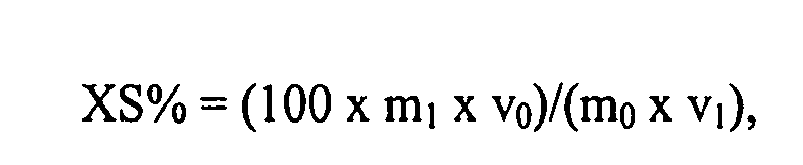
wherein m0 designates the initial polymer amount (grams), m1 defines the weight of residue (grams), v0 defines the initial volume (milliliter) and v1 defines the volume of analyzed sample (milliliter).
The solution from the second 100 ml flask was treated with 200 ml of acetone under vigorous stirring. The precipitate was filtered and dried in a vacuum oven at 90°C. This solution can be employed in order to determine the amorphous part of the polymer (AM) using the following equation:
wherein m0 designates the initial polymer amount (grams), m1 defines the weight of residue (grams), v0 defines the initial volume (milliliter) and v1 defines the volume of analyzed sample (milliliter).
• Melting temperature (Tm), crystallization temperature (Tc) and degree of crystallinity (Xc) were measure according to ISO11357. The samples were cut from compression molded, 0.2 mm films. The measurements were performed at the following conditions:Stage Temperature Program Heating/Cooling Rate °C/min Time min 1st heating 20-225 °C 10 Isothermal 225 °C 5 Cooling 225-20 °C -10 Isothermal 20 1 2nd heating 20-225 °C 10
• Haze was measured on injection moulded plaques according to ASTM D1003 at a thickness of 1 mm unless otherwise indicated and on injection stretch blow moulded bottles according to ASTM D1003 at a thickness of 0.5 mm unless otherwise indicated.
• Charpy notched impact strength was measured according to ISO 179 at 23 °C (room temperature, if not otherwise mentioned) using injection molded test specimen as described in EN ISO 1873-2 (80 x 10 x 4 mm)
• Tensile modulus was measured on specimen according to ISO3167 (Multipurpose test specimen, type A (injected moulded) or B (milled)) according to ISO 527-2:1993. The modulus was measured at a speed of 50mm/min - The following polypropylene compositions were employed in the examples:
Component (A) Component (B) MFR2 (g/10 mins) C2 (% mol) Nucleating Agent 1 C3/C2 random copolymer C3/C2 random copolymer 19 5.7 Polymer of VCH# 2 PP homopolymer C3/C2 copolymer 26 3.5 Polymer of VCH# CE * Random C2/C3 copolymer 20 5.0 Millad 3988 * Comparative Example
# Vinyl cyclohexane - These were prepared according to the process described in
WO99/24478 US5,234,879 . - This is a commercially available random polypropylene ethylene polymer that contains 1700 ppm Millad 3988.
1 2 Comp. Ex Al/D (mol/mol) 10 10 Loop/GPR Split % 53/47 48/52 Loop Temperature (°C) 80 85 MFR2 (g/10 min) 21 26 Ethylene content (wt-%) 2.5 0.0 GPR Temperature (°C) 85 85 Final product Ethylene content (wt-%) 3.8 2.3 3.3 MFR2 (g/10 min) 19 26 20 XS (%) 6.3 5.2 6.5 Tm (°C) 148 162 148 Tc (°C) 119 127 120 - PPreX® pre-forms with neck dimension 38/10mm and weight 17 g were injection moulded at standard conditions for PP having a MFR2 of 20.
- Polypropylene bottles (300 ml) were stretch blow moulded on a one-cavity SIG Corpoplast LB01HR machine from the pre-forms. This machine is equipped with two heater boxes, each having 5 IR lamps (L1-L5), but only one box was used in these experiments. L1 and L2 were 2500 watt lamps and L3, L4 and L5 were 2000 watt. The setting ratio of the lamps in the heater box was L1/L2/L3/L4/L5 46/57/85/85/54. All preforms were heated for the same period of time, only total heating was changed. Preforms were heated in two periods, HT1 and HT2. Between HT1 and HT2 is a conditioning time, CT1. After HT2 and before stretching is a conditioning time, CT2. HT1, HT2, CT1 and CT2 were 15 seconds, 4.6 seconds, 13 seconds and 10 seconds respectively. During heating of the preforms, surface cooling was provided to prevent surface melting. Cooling was carried out at 80% of the fan capacity. Additionally the preform was rotated on a mandrel throughout heating and conditioning at a speed of 100 rpm. After CT2, all bottles were blown under the same conditions. The preform was brought into the bottle mould and first stretched at a speed of 1000 mm/s. A pressure of 6 bar for 1.2 seconds was then used to blow up the bottle.
- For each sample, the total heating energy was changed in steps and the resulting pre-form temperatures recorded to find the upper preform temperature and lower preform temperature at which bottles without visible failures can be blown (the processing window). The results are shown in the table below.
CE 2 1 Upper Heating value (%) 68 78 64 Upper Temperature (°C) 136 155 139 Lower Heating value (%) 62 68 56 Lower Temperature (°C) 133 150 132 Processing window (°C) 3 5 7 - For all samples haze was then analysed at the top of each bottle, as shown in figure 1, according to ASTM D1003. The thickness of the top section of the bottles (i.e. where haze was measured) was also determined using a micrometer (screw form with gauge).
- For comparison purposes, the haze of injection moulded plaques prepared from each of the compositions was also determined.
1 2 CE Tc (°C) 119 127 120 IM Plaques: Haze (%) 29 36 10 Thickness (mm) 1 1 1 Tensile modulus (MPa) 885 1200 1150 Charpy Impact (kJ/m2) 7.6 5.3 6.0 ISBM Bottles: Processing window (°C) 7 5 3 Haze (%) 1.4 4.5 2.7 Thickness (mm) 0.5 0.62 0.33 - The results show that the articles of the present invention have a low haze (i.e. high transparency). The article made by ISBM of composition 1 has a lower haze at a thickness of 0.5 mm than the article made by ISBM of the comparative example at a smaller thickness (0.33 mm).
- Moreover the results show that the polypropylene composition of the invention advantageously has a broader processing window than random propylene copolymer. This facilitates ISBM.
Claims (20)
- An article comprising a biaxially oriented polypropylene composition, wherein said composition comprises:(i) a multimodal polypropylene, and(ii) a polymeric nucleating agent.
- An article as claimed in claim 1, wherein said multimodal polypropylene comprises a propylene copolymer and a propylene homopolymer.
- An article as claimed in claim 1, wherein said multimodal polypropylene comprises two different propylene copolymers.
- An article as claimed in claim 2 or claim 3, wherein at least 5 % wt, more preferably at least 10 % wt of the total weight of polypropylene derives from each polymer.
- An article as claimed in any preceding claim, wherein said multimodal polypropylene comprises:(A) at least 5 % wt of a propylene homopolymer or a propylene copolymer (e.g. a copolymer of propylene and comonomer selected from ethylene and/or C4-10 alpha olefin); and(B) at least 5 % wt of a propylene copolymer (e.g. a copolymer of propylene and comonomer selected from ethylene and/or C4-10 alpha olefin).
- An article as claimed in any one of claims 2 to 5, wherein said copolymer(s) is a random propylene copolymer.
- An article as claimed in any one of claims 2 to 6, wherein said copolymer(s) is a propylene ethylene copolymer.
- An article as claimed in any preceding claim, wherein the ethylene content of the composition is 1 to 7 mol%.
- An article as claimed in any preceding claim, wherein the melt flow rate of the composition is 5 to 30 g/10 min when measured according to ISO 1133 at 230 °C and a load of 2.16 kg.
- An article as claimed in any preceding claim, wherein said polymeric nucleating agent is a homopolymer of a vinyl compound.
- An article as claimed in claim 10, wherein said vinyl compound is of the formula (I)

- An article as claimed in any preceding claim, wherein said vinyl compound is selected from vinyl cyclohexane, vinyl cyclopentane, vinyl-2-methyl cyclohexane, 3-methyl-1-pentene, 4-methyl-1-pentene, 3-methyl-1-butene, 3-ethyl-1-hexene or a mixture thereof.
- An article as claimed in any preceding claim, wherein the amount of polymeric nucleating agent is 0.1 to 100 ppm wt, preferably 0.5 to 50 ppm wt.
- An article as claimed in any preceding claim, wherein said composition does not comprise any non-polymeric nucleating agents.
- An article as claimed in any preceding claim, wherein said article has a haze of less than 10 % as measured on an injection stretch blow moulded bottle having a thickness of 0.5 mm.
- An article as claimed in any preceding claim, wherein said multimodal polypropylene has a processing window of 5 °C or more.
- An article as claimed in any preceding claim which is a container for use in the medical or food industry.
- A process for making an article as claimed in any preceding claim comprising injection stretch blow moulding a polypropylene composition, wherein said composition comprises:(i) a multimodal polypropylene, and(ii) a polymeric nucleating agent.
- Use of a polypropylene composition as defined in any one of claimed 1 to 14 for the manufacture of an article by injection stretch blow moulding.
- A biaxially oriented, polypropylene composition as defined in any of claims 1 to 14.
Priority Applications (6)
| Application Number | Priority Date | Filing Date | Title |
|---|---|---|---|
| EP06255921A EP1923200A1 (en) | 2006-11-20 | 2006-11-20 | Article |
| US12/443,778 US20100003435A1 (en) | 2006-11-20 | 2007-11-16 | Article |
| EP07846627A EP2083987B1 (en) | 2006-11-20 | 2007-11-16 | Article |
| CN2007800402084A CN101541508B (en) | 2006-11-20 | 2007-11-16 | Article |
| PCT/EP2007/009918 WO2008061676A1 (en) | 2006-11-20 | 2007-11-16 | Article |
| ES07846627T ES2395202T3 (en) | 2006-11-20 | 2007-11-16 | Article |
Applications Claiming Priority (1)
| Application Number | Priority Date | Filing Date | Title |
|---|---|---|---|
| EP06255921A EP1923200A1 (en) | 2006-11-20 | 2006-11-20 | Article |
Publications (1)
| Publication Number | Publication Date |
|---|---|
| EP1923200A1 true EP1923200A1 (en) | 2008-05-21 |
Family
ID=37983571
Family Applications (2)
| Application Number | Title | Priority Date | Filing Date |
|---|---|---|---|
| EP06255921A Withdrawn EP1923200A1 (en) | 2006-11-20 | 2006-11-20 | Article |
| EP07846627A Not-in-force EP2083987B1 (en) | 2006-11-20 | 2007-11-16 | Article |
Family Applications After (1)
| Application Number | Title | Priority Date | Filing Date |
|---|---|---|---|
| EP07846627A Not-in-force EP2083987B1 (en) | 2006-11-20 | 2007-11-16 | Article |
Country Status (5)
| Country | Link |
|---|---|
| US (1) | US20100003435A1 (en) |
| EP (2) | EP1923200A1 (en) |
| CN (1) | CN101541508B (en) |
| ES (1) | ES2395202T3 (en) |
| WO (1) | WO2008061676A1 (en) |
Cited By (20)
| Publication number | Priority date | Publication date | Assignee | Title |
|---|---|---|---|---|
| EP2147939A1 (en) * | 2008-07-22 | 2010-01-27 | Borealis AG | Polypropylene composition with improved optics for film and moulding applications |
| WO2011089133A1 (en) * | 2010-01-22 | 2011-07-28 | Borealis Ag | Polypropylene copolymers with specific crystal nucleation |
| EP2719725A1 (en) * | 2012-10-11 | 2014-04-16 | Abu Dhabi Polymers Company Limited (Borouge) | Nucleated polypropylene composition for containers |
| EP2886600A1 (en) * | 2013-12-19 | 2015-06-24 | Abu Dhabi Polymers Co. Ltd (Borouge) LLC. | Multimodal polypropylene with respect to comonomer content |
| US9637602B2 (en) | 2013-12-18 | 2017-05-02 | Borealis Ag | BOPP film with improved stiffness/toughness balance |
| US9670347B2 (en) | 2013-08-14 | 2017-06-06 | Borealis Ag | Propylene composition with improved impact resistance at low temperature |
| US9751962B2 (en) | 2013-11-22 | 2017-09-05 | Borealis Ag | Low emission propylene homopolymer with high melt flow |
| US9777142B2 (en) | 2013-08-21 | 2017-10-03 | Borealis Ag | High flow polyolefin composition with high stiffness and toughness |
| US9802394B2 (en) | 2013-10-11 | 2017-10-31 | Borealis Ag | Machine direction oriented film for labels |
| US9828698B2 (en) | 2013-12-04 | 2017-11-28 | Borealis Ag | Phthalate-free PP homopolymers for meltblown fibers |
| US9890275B2 (en) | 2013-08-21 | 2018-02-13 | Borealis Ag | High flow polyolefin composition with high stiffness and toughness |
| EP2986652B1 (en) | 2013-04-17 | 2018-07-04 | Basell Poliolefine Italia S.r.l. | Nucleated propylene-based polyolefin compositions |
| US10030109B2 (en) | 2014-02-14 | 2018-07-24 | Borealis Ag | Polypropylene composite |
| US10040930B2 (en) | 2013-09-27 | 2018-08-07 | Abu Dhabi Polymers Co. Ltd (Borouge) Llc. | Polymer composition with high XS, high Tm suitable for BOPP processing |
| US10100185B2 (en) | 2014-02-06 | 2018-10-16 | Borealis Ag | Soft copolymers with high impact strength |
| US10100186B2 (en) | 2014-02-06 | 2018-10-16 | Borealis Ag | Soft and transparent impact copolymers |
| US10227427B2 (en) | 2014-01-17 | 2019-03-12 | Borealis Ag | Process for preparing propylene/1-butene copolymers |
| WO2019108693A1 (en) * | 2017-11-30 | 2019-06-06 | Corning Incorporated | Biaxially oriented thermoplastic pipette, and method and apparatus for forming same |
| US10450451B2 (en) | 2014-05-20 | 2019-10-22 | Borealis Ag | Polypropylene composition for automotive interior applications |
| US10519259B2 (en) | 2013-10-24 | 2019-12-31 | Borealis Ag | Low melting PP homopolymer with high content of regioerrors and high molecular weight |
Families Citing this family (7)
| Publication number | Priority date | Publication date | Assignee | Title |
|---|---|---|---|---|
| EP1941998B2 (en) * | 2006-12-21 | 2016-03-16 | Borealis Technology Oy | Film |
| DE602006013673D1 (en) * | 2006-12-21 | 2010-05-27 | Borealis Tech Oy | Film |
| DE602007011259D1 (en) * | 2007-08-10 | 2011-01-27 | Borealis Tech Oy | Article containing a polypropylene composition |
| EP2067799A1 (en) * | 2007-12-05 | 2009-06-10 | Borealis Technology OY | Polymer |
| EP2354183B1 (en) | 2010-01-29 | 2012-08-22 | Borealis AG | Moulding composition |
| PL2354184T3 (en) | 2010-01-29 | 2013-01-31 | Borealis Ag | Polyethylene moulding composition with improved stress crack/stiffness relationship and impact resistance |
| EP3844072A1 (en) * | 2018-08-27 | 2021-07-07 | SABIC Global Technologies B.V. | Multi-cup arrangement for foodstuff packaging |
Citations (5)
| Publication number | Priority date | Publication date | Assignee | Title |
|---|---|---|---|---|
| US5286540A (en) * | 1989-03-29 | 1994-02-15 | Mitsubishi Kasei Corporation | Blow molded container made of polypropylene resin |
| EP0903356A1 (en) * | 1996-05-27 | 1999-03-24 | Mitsui Chemicals, Inc. | Crystalline polypropylene, process for preparing the same, polypropylene composition, and thermoformed article |
| WO1999024478A1 (en) * | 1997-11-07 | 1999-05-20 | Borealis A/S | Process for preparing polypropylene |
| WO2002038383A1 (en) * | 2000-11-09 | 2002-05-16 | Ucb, S.A. | Highly crystalline polypropylene film for packaging purposes |
| EP1674238A1 (en) * | 2004-12-21 | 2006-06-28 | Total Petrochemicals Research Feluy | Bottles prepared from compositions of polypropylene and non-sorbitol nucleating agents |
Family Cites Families (53)
| Publication number | Priority date | Publication date | Assignee | Title |
|---|---|---|---|---|
| JPS5148196B2 (en) * | 1972-03-11 | 1976-12-18 | ||
| SE415006B (en) * | 1978-03-07 | 1980-09-01 | Asea Ab | PUT THE APPLICATION OF ISOLATED POLYMER INSULATION ON A CABLE conductor |
| JPS60133042A (en) * | 1983-12-20 | 1985-07-16 | Nippon Petrochem Co Ltd | Resin composition for electrically insulating use |
| JPS60139731A (en) * | 1983-12-27 | 1985-07-24 | Sumitomo Chem Co Ltd | Crystalline polypropylene composition |
| JPS60139428A (en) * | 1983-12-27 | 1985-07-24 | Sumitomo Chem Co Ltd | Polypropylene oriented film |
| DE3471942D1 (en) * | 1983-12-27 | 1988-07-14 | Sumitomo Chemical Co | Process for producing propylene copolymer |
| US4639386A (en) * | 1984-02-03 | 1987-01-27 | Fuji Photo Film Co., Ltd. | Container for photographic film cartridge |
| US4508872A (en) * | 1984-02-22 | 1985-04-02 | Shell Oil Company | High toughness propylene polymer compositions |
| US4493923A (en) * | 1984-03-27 | 1985-01-15 | Shell Oil Company | High notched impact toughness propylene polymer compositions |
| JPS61111311A (en) * | 1984-07-09 | 1986-05-29 | Mitsubishi Petrochem Co Ltd | Ethylene copolymer and its production |
| US4994539A (en) * | 1984-10-03 | 1991-02-19 | Nippon Petrochemicals Co., Ltd. | Method for improving impulse destructive stength of electrical insulating materials |
| IE56700B1 (en) * | 1984-11-30 | 1991-11-06 | Canadian Ind | Thermoplastic sacks |
| JP2679147B2 (en) * | 1988-09-08 | 1997-11-19 | 住友化学工業株式会社 | Resin composition |
| US5047468A (en) * | 1988-11-16 | 1991-09-10 | Union Carbide Chemicals And Plastics Technology Corporation | Process for the in situ blending of polymers |
| US5126398A (en) * | 1988-11-16 | 1992-06-30 | Union Carbide Chemicals & Plastics Technology Corporation | Process for the in situ blending of polymers |
| US5176953A (en) * | 1990-12-21 | 1993-01-05 | Amoco Corporation | Oriented polymeric microporous films |
| JPH0657057A (en) * | 1992-08-11 | 1994-03-01 | Sumitomo Chem Co Ltd | Polypropylene composition and film thereof |
| DE4229153C2 (en) * | 1992-09-01 | 1996-01-25 | Schoeller Felix Jun Papier | Substrate for photographic recording materials |
| EP0656043B1 (en) * | 1993-06-21 | 1998-10-14 | Shell Oil Company | Plastic closure liners and closures |
| US5554246A (en) * | 1995-01-12 | 1996-09-10 | Anthony Industries, Inc. | Air infiltration barrier laminate and process for preparing same |
| US5752362A (en) * | 1996-03-12 | 1998-05-19 | Tenneco Packaging | Stretch wrap films |
| US6576306B2 (en) * | 1996-09-04 | 2003-06-10 | Exxonmobil Chemical Patents Inc. | Propylene polymers for films |
| FI111166B (en) * | 1997-01-10 | 2003-06-13 | Borealis Polymers Oy | Extrusion coating |
| IL131544A0 (en) * | 1997-02-25 | 2001-01-28 | Exxon Chemical Patents Inc | Heat sealable films containing polyethylene and polypropylene |
| FI980342A0 (en) * | 1997-11-07 | 1998-02-13 | Borealis As | Polymerroer och -roerkopplingar |
| FI974178A0 (en) * | 1997-11-07 | 1997-11-07 | Borealis As | Polypropensammansaettningar |
| DE19805329A1 (en) * | 1998-02-11 | 1999-08-12 | Basf Ag | Injection stretch blow molded olefin polymer containers |
| CN100400613C (en) * | 1998-12-24 | 2008-07-09 | 蒙特尔技术有限公司 | Bottle caps made of polyolefins |
| US6440509B1 (en) * | 1999-07-16 | 2002-08-27 | Fort James Corporation | Compartmented disposable plate with asymmetric rib geometry |
| US6265055B1 (en) * | 1999-10-13 | 2001-07-24 | David Simpson | Multilayer stretch cling film |
| US6583241B1 (en) * | 2000-03-20 | 2003-06-24 | Chevron Phillips Chemical Company Lp | Process for making MVTR resin |
| GB0008690D0 (en) * | 2000-04-07 | 2000-05-31 | Borealis Polymers Oy | Process |
| EP1180534B1 (en) * | 2000-08-18 | 2006-01-11 | Riken Technos Corporation | Thermoplastic resin composition and laminates thereof |
| ATE320455T1 (en) * | 2000-12-06 | 2006-04-15 | Omlidon Technologies Llc | MELT-PROCESSABLE, WEAR-RESISTANT POLYETHYLENE |
| US6943215B2 (en) * | 2001-11-06 | 2005-09-13 | Dow Global Technologies Inc. | Impact resistant polymer blends of crystalline polypropylene and partially crystalline, low molecular weight impact modifiers |
| US7199163B2 (en) * | 2002-06-24 | 2007-04-03 | Basell Poliolefine Italia S.P.A. | Method for removing volatile components from polymer compositions |
| EP1449878A1 (en) * | 2003-02-24 | 2004-08-25 | Borealis Technology Oy | Polypropylene compositions |
| US20050161866A1 (en) * | 2004-01-23 | 2005-07-28 | Rajnish Batlaw | Process of making two-stage injection stretch blow molded polypropylene articles |
| US20050173844A1 (en) * | 2004-01-23 | 2005-08-11 | Bernard Vermeersch | Process of making preform articles and polypropylene molded containers from preform articles using injection stretch blow molding techniques |
| US20050200046A1 (en) * | 2004-03-10 | 2005-09-15 | Breese D. R. | Machine-direction oriented multilayer films |
| DE102004035075A1 (en) * | 2004-07-20 | 2006-02-16 | Basf Ag | Process for preparing aqueous styrene-butadiene polymer dispersions |
| EP1778780B1 (en) * | 2004-08-18 | 2009-01-14 | Basell Poliolefine Italia S.r.l. | Stretch blow-molded containers from ziegler natta propylene polymer compositions |
| ES2399823T3 (en) * | 2004-09-02 | 2013-04-03 | Borealis Technology Oy | A polymer pipe without pressure, a composition for it, and a process for its preparation |
| ES2325405T5 (en) * | 2005-05-20 | 2013-04-23 | Borealis Technology Oy | High melt flow polymer, with improved durability, for tube applications |
| DE602006013673D1 (en) * | 2006-12-21 | 2010-05-27 | Borealis Tech Oy | Film |
| EP1941998B2 (en) * | 2006-12-21 | 2016-03-16 | Borealis Technology Oy | Film |
| CA2588352A1 (en) * | 2007-05-11 | 2008-11-11 | Nova Chemicals Corporation | Method to estimate pent values |
| DE602007011259D1 (en) * | 2007-08-10 | 2011-01-27 | Borealis Tech Oy | Article containing a polypropylene composition |
| EP2067799A1 (en) * | 2007-12-05 | 2009-06-10 | Borealis Technology OY | Polymer |
| BRPI0915738B1 (en) * | 2008-07-10 | 2019-09-24 | Borealis Ag | RETICULABLE POLYMER COMPOSITION, ARTICLE UNDERSTANDING A POLYMER COMPOSITION, PROCESS FOR PRODUCING A RETICULABLE CABLE AND CABLE |
| WO2010003649A1 (en) * | 2008-07-10 | 2010-01-14 | Borealis Ag | Process for preparing a cable |
| ES2527655T5 (en) * | 2008-07-10 | 2022-10-13 | Borealis Ag | Process for producing a polymer and a polymer for wire and cable applications |
| EP2182524A1 (en) * | 2008-10-31 | 2010-05-05 | Borealis AG | Cable and Polymer composition comprising a multimodal ethylene copolymer |
-
2006
- 2006-11-20 EP EP06255921A patent/EP1923200A1/en not_active Withdrawn
-
2007
- 2007-11-16 EP EP07846627A patent/EP2083987B1/en not_active Not-in-force
- 2007-11-16 WO PCT/EP2007/009918 patent/WO2008061676A1/en not_active Ceased
- 2007-11-16 US US12/443,778 patent/US20100003435A1/en not_active Abandoned
- 2007-11-16 ES ES07846627T patent/ES2395202T3/en active Active
- 2007-11-16 CN CN2007800402084A patent/CN101541508B/en active Active
Patent Citations (5)
| Publication number | Priority date | Publication date | Assignee | Title |
|---|---|---|---|---|
| US5286540A (en) * | 1989-03-29 | 1994-02-15 | Mitsubishi Kasei Corporation | Blow molded container made of polypropylene resin |
| EP0903356A1 (en) * | 1996-05-27 | 1999-03-24 | Mitsui Chemicals, Inc. | Crystalline polypropylene, process for preparing the same, polypropylene composition, and thermoformed article |
| WO1999024478A1 (en) * | 1997-11-07 | 1999-05-20 | Borealis A/S | Process for preparing polypropylene |
| WO2002038383A1 (en) * | 2000-11-09 | 2002-05-16 | Ucb, S.A. | Highly crystalline polypropylene film for packaging purposes |
| EP1674238A1 (en) * | 2004-12-21 | 2006-06-28 | Total Petrochemicals Research Feluy | Bottles prepared from compositions of polypropylene and non-sorbitol nucleating agents |
Cited By (36)
| Publication number | Priority date | Publication date | Assignee | Title |
|---|---|---|---|---|
| EP2147939A1 (en) * | 2008-07-22 | 2010-01-27 | Borealis AG | Polypropylene composition with improved optics for film and moulding applications |
| WO2010009827A1 (en) * | 2008-07-22 | 2010-01-28 | Borealis Ag | Polypropylene composition with improved optics for film and moulding applications |
| CN102015785B (en) * | 2008-07-22 | 2013-01-09 | 北欧化工股份公司 | Polypropylene composition with improved optics for film and moulding applications |
| US8476395B2 (en) | 2008-07-22 | 2013-07-02 | Borealis Ag | Polypropylene composition with improved optics for film and moulding applications |
| WO2011089133A1 (en) * | 2010-01-22 | 2011-07-28 | Borealis Ag | Polypropylene copolymers with specific crystal nucleation |
| WO2014056559A1 (en) * | 2012-10-11 | 2014-04-17 | Abu Dhabi Polymers Company Ltd. (Borouge) | Nucleated polypropylene composition for containers |
| AU2013329910B2 (en) * | 2012-10-11 | 2016-05-05 | Abu Dhabi Polymers Co. Ltd (Borouge) L.L.C | Nucleated polypropylene composition for containers |
| EP2719725A1 (en) * | 2012-10-11 | 2014-04-16 | Abu Dhabi Polymers Company Limited (Borouge) | Nucleated polypropylene composition for containers |
| RU2623430C2 (en) * | 2012-10-11 | 2017-06-26 | Абу Даби Полимерс Ко. Лтд (Бороудж) Л.Л.С | Nucleied polypropylene composition for containers |
| EP2986652B1 (en) | 2013-04-17 | 2018-07-04 | Basell Poliolefine Italia S.r.l. | Nucleated propylene-based polyolefin compositions |
| US9670347B2 (en) | 2013-08-14 | 2017-06-06 | Borealis Ag | Propylene composition with improved impact resistance at low temperature |
| US9890275B2 (en) | 2013-08-21 | 2018-02-13 | Borealis Ag | High flow polyolefin composition with high stiffness and toughness |
| US9777142B2 (en) | 2013-08-21 | 2017-10-03 | Borealis Ag | High flow polyolefin composition with high stiffness and toughness |
| US10040930B2 (en) | 2013-09-27 | 2018-08-07 | Abu Dhabi Polymers Co. Ltd (Borouge) Llc. | Polymer composition with high XS, high Tm suitable for BOPP processing |
| US9802394B2 (en) | 2013-10-11 | 2017-10-31 | Borealis Ag | Machine direction oriented film for labels |
| US10519259B2 (en) | 2013-10-24 | 2019-12-31 | Borealis Ag | Low melting PP homopolymer with high content of regioerrors and high molecular weight |
| US9751962B2 (en) | 2013-11-22 | 2017-09-05 | Borealis Ag | Low emission propylene homopolymer with high melt flow |
| US9828698B2 (en) | 2013-12-04 | 2017-11-28 | Borealis Ag | Phthalate-free PP homopolymers for meltblown fibers |
| US9637602B2 (en) | 2013-12-18 | 2017-05-02 | Borealis Ag | BOPP film with improved stiffness/toughness balance |
| EP2886600A1 (en) * | 2013-12-19 | 2015-06-24 | Abu Dhabi Polymers Co. Ltd (Borouge) LLC. | Multimodal polypropylene with respect to comonomer content |
| AU2014368700B2 (en) * | 2013-12-19 | 2017-02-02 | Abu Dhabi Polymers Co. Ltd (Borouge) L.L.C. | Multimodal polypropylene with respect to comonomer content |
| KR101849868B1 (en) | 2013-12-19 | 2018-04-17 | 아부 다비 폴리머스 씨오. 엘티디 (보르쥬) 엘엘씨. | Multimodal polypropylene with respect to comonomer content |
| RU2657872C1 (en) * | 2013-12-19 | 2018-06-18 | Абу Даби Полимерс Ко. Лтд (Боруж) Ллс | Multi-modal polypropylene with regard to the co-monomer content |
| WO2015091660A1 (en) * | 2013-12-19 | 2015-06-25 | Abu Dhabi Polymers Co. Ltd (Borouge) L.L.C. | Multimodal polypropylene with respect to comonomer content |
| US20160312019A1 (en) * | 2013-12-19 | 2016-10-27 | Abu Dhabi Polymers Co. Ltd (Borouge) Llc. | Multimodal polypropylene with respect to comonomer content |
| JP2016540864A (en) * | 2013-12-19 | 2016-12-28 | アブ・ダビ・ポリマーズ・カンパニー・リミテッド・(ブルージュ)・リミテッド・ライアビリティ・カンパニーAbu Dhabi Polymers Co. Ltd (Borouge) L.L.C. | Multimodal polypropylene with respect to comonomer content |
| US10227427B2 (en) | 2014-01-17 | 2019-03-12 | Borealis Ag | Process for preparing propylene/1-butene copolymers |
| US10100185B2 (en) | 2014-02-06 | 2018-10-16 | Borealis Ag | Soft copolymers with high impact strength |
| US10100186B2 (en) | 2014-02-06 | 2018-10-16 | Borealis Ag | Soft and transparent impact copolymers |
| US10030109B2 (en) | 2014-02-14 | 2018-07-24 | Borealis Ag | Polypropylene composite |
| US10450451B2 (en) | 2014-05-20 | 2019-10-22 | Borealis Ag | Polypropylene composition for automotive interior applications |
| WO2019108693A1 (en) * | 2017-11-30 | 2019-06-06 | Corning Incorporated | Biaxially oriented thermoplastic pipette, and method and apparatus for forming same |
| CN111655375A (en) * | 2017-11-30 | 2020-09-11 | 康宁股份有限公司 | Biaxially oriented thermoplastic pipette, method and apparatus for forming the same |
| EP4032613A1 (en) * | 2017-11-30 | 2022-07-27 | Corning Incorporated | Biaxially oriented thermoplastic pipette, and method and apparatus for forming same |
| US11772092B2 (en) | 2017-11-30 | 2023-10-03 | Corning Incorporated | Biaxially oriented thermoplastic pipette, and method and apparatus for forming same |
| US20230390757A1 (en) * | 2017-11-30 | 2023-12-07 | Corning Incorporated | Biaxially oriented thermoplastic pipette, and method and apparatus for forming same |
Also Published As
| Publication number | Publication date |
|---|---|
| CN101541508B (en) | 2012-07-25 |
| EP2083987B1 (en) | 2012-09-05 |
| US20100003435A1 (en) | 2010-01-07 |
| CN101541508A (en) | 2009-09-23 |
| ES2395202T3 (en) | 2013-02-11 |
| WO2008061676A1 (en) | 2008-05-29 |
| EP2083987A1 (en) | 2009-08-05 |
Similar Documents
| Publication | Publication Date | Title |
|---|---|---|
| EP2083987B1 (en) | Article | |
| EP2121830B1 (en) | Polypropylene-based resin composition and molded article thereof | |
| EP1963422B1 (en) | Multimodal polypropylene polymer composition | |
| EP0792914B1 (en) | Polyolefin composition and article molded therefrom | |
| JP5923672B2 (en) | Extrusion blow molding bottle | |
| EP1778780B1 (en) | Stretch blow-molded containers from ziegler natta propylene polymer compositions | |
| EP2516125A1 (en) | Heterophasic polypropylene with improved balance between stiffness and transparency | |
| US20130213982A1 (en) | Injection Stretch Blow Molded Container Comprising A Polyolefin Composition | |
| EP2032333B1 (en) | Verfahren zum Spritzstreckblasformen von Ampullen aus Harzen mit niedrigem Schmelzindex | |
| US20100013129A1 (en) | Stretching/blowing conditions in one-stage injection-stretch-blow-moulding | |
| EP2032334B1 (en) | Low melt flow resins for medical applications in injection-stretch-blow-moulding | |
| JP2001114954A (en) | Propylene resin composition, propylene resin composition for stretch blow molding, stretch blow molding container, and method for producing stretch blow molding container | |
| KR101842787B1 (en) | Polypropylene resin composition for blow molded article integrated with handle and preparing method same | |
| KR101842788B1 (en) | Polypropylene resine material for blow molding with high softness and transparency and preparing method same | |
| WO2008061700A1 (en) | Polymer composition | |
| EP1923424A1 (en) | Polymer composition |
Legal Events
| Date | Code | Title | Description |
|---|---|---|---|
| PUAI | Public reference made under article 153(3) epc to a published international application that has entered the european phase |
Free format text: ORIGINAL CODE: 0009012 |
|
| AK | Designated contracting states |
Kind code of ref document: A1 Designated state(s): AT BE BG CH CY CZ DE DK EE ES FI FR GB GR HU IE IS IT LI LT LU LV MC NL PL PT RO SE SI SK TR |
|
| AX | Request for extension of the european patent |
Extension state: AL BA HR MK RS |
|
| AKX | Designation fees paid | ||
| REG | Reference to a national code |
Ref country code: DE Ref legal event code: 8566 |
|
| STAA | Information on the status of an ep patent application or granted ep patent |
Free format text: STATUS: THE APPLICATION IS DEEMED TO BE WITHDRAWN |
|
| 18D | Application deemed to be withdrawn |
Effective date: 20081122 |