EP1921135A1 - Method for preparation of transglutaminase-containing matter having reduced protease activity - Google Patents
Method for preparation of transglutaminase-containing matter having reduced protease activity Download PDFInfo
- Publication number
- EP1921135A1 EP1921135A1 EP06797340A EP06797340A EP1921135A1 EP 1921135 A1 EP1921135 A1 EP 1921135A1 EP 06797340 A EP06797340 A EP 06797340A EP 06797340 A EP06797340 A EP 06797340A EP 1921135 A1 EP1921135 A1 EP 1921135A1
- Authority
- EP
- European Patent Office
- Prior art keywords
- transglutaminase
- containing product
- activity
- manufacturing
- protease
- Prior art date
- Legal status (The legal status is an assumption and is not a legal conclusion. Google has not performed a legal analysis and makes no representation as to the accuracy of the status listed.)
- Withdrawn
Links
- 108060008539 Transglutaminase Proteins 0.000 title claims abstract description 216
- 102000003601 transglutaminase Human genes 0.000 title claims abstract description 216
- 230000000694 effects Effects 0.000 title claims abstract description 108
- 108091005804 Peptidases Proteins 0.000 title claims abstract description 87
- 239000004365 Protease Substances 0.000 title claims abstract description 87
- 102100037486 Reverse transcriptase/ribonuclease H Human genes 0.000 title claims abstract description 87
- 238000000034 method Methods 0.000 title claims abstract description 67
- 239000000203 mixture Substances 0.000 claims abstract description 69
- 238000009472 formulation Methods 0.000 claims abstract description 47
- 238000004519 manufacturing process Methods 0.000 claims abstract description 43
- 235000013305 food Nutrition 0.000 claims abstract description 18
- 239000012535 impurity Substances 0.000 claims abstract description 9
- 235000018102 proteins Nutrition 0.000 claims description 36
- 102000004169 proteins and genes Human genes 0.000 claims description 36
- 108090000623 proteins and genes Proteins 0.000 claims description 36
- 239000007864 aqueous solution Substances 0.000 claims description 35
- 239000000243 solution Substances 0.000 claims description 35
- 241000251468 Actinopterygii Species 0.000 claims description 29
- 239000000463 material Substances 0.000 claims description 28
- 108010035532 Collagen Proteins 0.000 claims description 14
- 102000008186 Collagen Human genes 0.000 claims description 14
- 229920001436 collagen Polymers 0.000 claims description 14
- 235000013372 meat Nutrition 0.000 claims description 11
- 235000019465 surimi Nutrition 0.000 claims description 10
- 108010011756 Milk Proteins Proteins 0.000 claims description 8
- 102000014171 Milk Proteins Human genes 0.000 claims description 8
- 238000000855 fermentation Methods 0.000 claims description 8
- 230000004151 fermentation Effects 0.000 claims description 8
- 235000021239 milk protein Nutrition 0.000 claims description 8
- 238000002156 mixing Methods 0.000 claims description 8
- 239000000546 pharmaceutical excipient Substances 0.000 claims description 8
- 150000001447 alkali salts Chemical class 0.000 claims description 4
- 159000000007 calcium salts Chemical class 0.000 claims description 4
- 230000008569 process Effects 0.000 claims description 4
- 239000000047 product Substances 0.000 description 98
- 235000019688 fish Nutrition 0.000 description 28
- 239000000523 sample Substances 0.000 description 15
- XLYOFNOQVPJJNP-UHFFFAOYSA-N water Substances O XLYOFNOQVPJJNP-UHFFFAOYSA-N 0.000 description 13
- 239000012488 sample solution Substances 0.000 description 12
- 108091003079 Bovine Serum Albumin Proteins 0.000 description 11
- 229940098773 bovine serum albumin Drugs 0.000 description 11
- 238000012360 testing method Methods 0.000 description 10
- OYPRJOBELJOOCE-UHFFFAOYSA-N Calcium Chemical compound [Ca] OYPRJOBELJOOCE-UHFFFAOYSA-N 0.000 description 9
- 239000011575 calcium Substances 0.000 description 9
- 229960005069 calcium Drugs 0.000 description 9
- 229910052791 calcium Inorganic materials 0.000 description 9
- CDBYLPFSWZWCQE-UHFFFAOYSA-L Sodium Carbonate Chemical compound [Na+].[Na+].[O-]C([O-])=O CDBYLPFSWZWCQE-UHFFFAOYSA-L 0.000 description 8
- 238000002835 absorbance Methods 0.000 description 8
- 239000007858 starting material Substances 0.000 description 8
- 102000004190 Enzymes Human genes 0.000 description 7
- 108090000790 Enzymes Proteins 0.000 description 7
- 108010010803 Gelatin Proteins 0.000 description 7
- 238000006243 chemical reaction Methods 0.000 description 7
- 229940088598 enzyme Drugs 0.000 description 7
- 229920000159 gelatin Polymers 0.000 description 7
- 235000019322 gelatine Nutrition 0.000 description 7
- 235000011852 gelatine desserts Nutrition 0.000 description 7
- NEAQRZUHTPSBBM-UHFFFAOYSA-N 2-hydroxy-3,3-dimethyl-7-nitro-4h-isoquinolin-1-one Chemical compound C1=C([N+]([O-])=O)C=C2C(=O)N(O)C(C)(C)CC2=C1 NEAQRZUHTPSBBM-UHFFFAOYSA-N 0.000 description 6
- 239000002253 acid Substances 0.000 description 6
- 239000012153 distilled water Substances 0.000 description 6
- 239000000843 powder Substances 0.000 description 6
- 239000001488 sodium phosphate Substances 0.000 description 6
- 235000000346 sugar Nutrition 0.000 description 6
- 239000012085 test solution Substances 0.000 description 6
- 229910000406 trisodium phosphate Inorganic materials 0.000 description 6
- 235000019801 trisodium phosphate Nutrition 0.000 description 6
- 108010082495 Dietary Plant Proteins Proteins 0.000 description 5
- 235000015277 pork Nutrition 0.000 description 5
- 235000002639 sodium chloride Nutrition 0.000 description 5
- 239000000126 substance Substances 0.000 description 5
- VTYYLEPIZMXCLO-UHFFFAOYSA-L Calcium carbonate Chemical compound [Ca+2].[O-]C([O-])=O VTYYLEPIZMXCLO-UHFFFAOYSA-L 0.000 description 4
- 108010076119 Caseins Proteins 0.000 description 4
- 229920001353 Dextrin Polymers 0.000 description 4
- 239000004375 Dextrin Substances 0.000 description 4
- VZCYOOQTPOCHFL-OWOJBTEDSA-N Fumaric acid Chemical compound OC(=O)\C=C\C(O)=O VZCYOOQTPOCHFL-OWOJBTEDSA-N 0.000 description 4
- 108010049190 N,N-dimethylcasein Proteins 0.000 description 4
- ISWSIDIOOBJBQZ-UHFFFAOYSA-N Phenol Chemical compound OC1=CC=CC=C1 ISWSIDIOOBJBQZ-UHFFFAOYSA-N 0.000 description 4
- 229920002472 Starch Polymers 0.000 description 4
- 239000003513 alkali Substances 0.000 description 4
- 239000000872 buffer Substances 0.000 description 4
- 239000005018 casein Substances 0.000 description 4
- BECPQYXYKAMYBN-UHFFFAOYSA-N casein, tech. Chemical compound NCCCCC(C(O)=O)N=C(O)C(CC(O)=O)N=C(O)C(CCC(O)=N)N=C(O)C(CC(C)C)N=C(O)C(CCC(O)=O)N=C(O)C(CC(O)=O)N=C(O)C(CCC(O)=O)N=C(O)C(C(C)O)N=C(O)C(CCC(O)=N)N=C(O)C(CCC(O)=N)N=C(O)C(CCC(O)=N)N=C(O)C(CCC(O)=O)N=C(O)C(CCC(O)=O)N=C(O)C(COP(O)(O)=O)N=C(O)C(CCC(O)=N)N=C(O)C(N)CC1=CC=CC=C1 BECPQYXYKAMYBN-UHFFFAOYSA-N 0.000 description 4
- 235000021240 caseins Nutrition 0.000 description 4
- 235000019425 dextrin Nutrition 0.000 description 4
- 238000005259 measurement Methods 0.000 description 4
- 235000013622 meat product Nutrition 0.000 description 4
- 238000005554 pickling Methods 0.000 description 4
- 244000144977 poultry Species 0.000 description 4
- 235000013594 poultry meat Nutrition 0.000 description 4
- 150000003839 salts Chemical class 0.000 description 4
- 229910000029 sodium carbonate Inorganic materials 0.000 description 4
- 235000019698 starch Nutrition 0.000 description 4
- 239000000758 substrate Substances 0.000 description 4
- 150000008163 sugars Chemical class 0.000 description 4
- YNJBWRMUSHSURL-UHFFFAOYSA-N trichloroacetic acid Chemical compound OC(=O)C(Cl)(Cl)Cl YNJBWRMUSHSURL-UHFFFAOYSA-N 0.000 description 4
- RYFMWSXOAZQYPI-UHFFFAOYSA-K trisodium phosphate Chemical compound [Na+].[Na+].[Na+].[O-]P([O-])([O-])=O RYFMWSXOAZQYPI-UHFFFAOYSA-K 0.000 description 4
- RYGMFSIKBFXOCR-UHFFFAOYSA-N Copper Chemical compound [Cu] RYGMFSIKBFXOCR-UHFFFAOYSA-N 0.000 description 3
- HEMHJVSKTPXQMS-UHFFFAOYSA-M Sodium hydroxide Chemical compound [OH-].[Na+] HEMHJVSKTPXQMS-UHFFFAOYSA-M 0.000 description 3
- 239000003153 chemical reaction reagent Substances 0.000 description 3
- 210000000991 chicken egg Anatomy 0.000 description 3
- 229910052802 copper Inorganic materials 0.000 description 3
- 239000010949 copper Substances 0.000 description 3
- 230000003247 decreasing effect Effects 0.000 description 3
- 230000002255 enzymatic effect Effects 0.000 description 3
- 239000000706 filtrate Substances 0.000 description 3
- 239000008273 gelatin Substances 0.000 description 3
- 235000020993 ground meat Nutrition 0.000 description 3
- 239000005457 ice water Substances 0.000 description 3
- 230000001965 increasing effect Effects 0.000 description 3
- 244000144972 livestock Species 0.000 description 3
- 239000011812 mixed powder Substances 0.000 description 3
- 238000012545 processing Methods 0.000 description 3
- 230000009467 reduction Effects 0.000 description 3
- 108010017384 Blood Proteins Proteins 0.000 description 2
- 102000004506 Blood Proteins Human genes 0.000 description 2
- 241000287828 Gallus gallus Species 0.000 description 2
- AVXURJPOCDRRFD-UHFFFAOYSA-N Hydroxylamine Chemical compound ON AVXURJPOCDRRFD-UHFFFAOYSA-N 0.000 description 2
- GUBGYTABKSRVRQ-QKKXKWKRSA-N Lactose Natural products OC[C@H]1O[C@@H](O[C@H]2[C@H](O)[C@@H](O)C(O)O[C@@H]2CO)[C@H](O)[C@@H](O)[C@H]1O GUBGYTABKSRVRQ-QKKXKWKRSA-N 0.000 description 2
- 108010073771 Soybean Proteins Proteins 0.000 description 2
- 235000021307 Triticum Nutrition 0.000 description 2
- 241000209140 Triticum Species 0.000 description 2
- 235000021120 animal protein Nutrition 0.000 description 2
- 229910000019 calcium carbonate Inorganic materials 0.000 description 2
- MKJXYGKVIBWPFZ-UHFFFAOYSA-L calcium lactate Chemical compound [Ca+2].CC(O)C([O-])=O.CC(O)C([O-])=O MKJXYGKVIBWPFZ-UHFFFAOYSA-L 0.000 description 2
- 239000001527 calcium lactate Substances 0.000 description 2
- 229960002401 calcium lactate Drugs 0.000 description 2
- 235000011086 calcium lactate Nutrition 0.000 description 2
- 238000011088 calibration curve Methods 0.000 description 2
- 235000013330 chicken meat Nutrition 0.000 description 2
- 238000005520 cutting process Methods 0.000 description 2
- 239000000796 flavoring agent Substances 0.000 description 2
- 235000019634 flavors Nutrition 0.000 description 2
- 239000001530 fumaric acid Substances 0.000 description 2
- 125000000404 glutamine group Chemical group N[C@@H](CCC(N)=O)C(=O)* 0.000 description 2
- 239000001257 hydrogen Substances 0.000 description 2
- 229910052739 hydrogen Inorganic materials 0.000 description 2
- 150000004698 iron complex Chemical class 0.000 description 2
- 239000008101 lactose Substances 0.000 description 2
- 239000007788 liquid Substances 0.000 description 2
- 230000000813 microbial effect Effects 0.000 description 2
- 235000013336 milk Nutrition 0.000 description 2
- 239000008267 milk Substances 0.000 description 2
- 210000004080 milk Anatomy 0.000 description 2
- 230000000704 physical effect Effects 0.000 description 2
- 210000002381 plasma Anatomy 0.000 description 2
- 239000012460 protein solution Substances 0.000 description 2
- 230000005855 radiation Effects 0.000 description 2
- 229940001941 soy protein Drugs 0.000 description 2
- 238000003756 stirring Methods 0.000 description 2
- 150000005846 sugar alcohols Chemical class 0.000 description 2
- 210000001519 tissue Anatomy 0.000 description 2
- VZCYOOQTPOCHFL-UHFFFAOYSA-N trans-butenedioic acid Natural products OC(=O)C=CC(O)=O VZCYOOQTPOCHFL-UHFFFAOYSA-N 0.000 description 2
- -1 trisodium phosphate anhydride Chemical class 0.000 description 2
- OEPOKWHJYJXUGD-UHFFFAOYSA-N 2-(3-phenylmethoxyphenyl)-1,3-thiazole-4-carbaldehyde Chemical compound O=CC1=CSC(C=2C=C(OCC=3C=CC=CC=3)C=CC=2)=N1 OEPOKWHJYJXUGD-UHFFFAOYSA-N 0.000 description 1
- QKNYBSVHEMOAJP-UHFFFAOYSA-N 2-amino-2-(hydroxymethyl)propane-1,3-diol;hydron;chloride Chemical compound Cl.OCC(N)(CO)CO QKNYBSVHEMOAJP-UHFFFAOYSA-N 0.000 description 1
- 108010001949 Algal Proteins Proteins 0.000 description 1
- 241000972773 Aulopiformes Species 0.000 description 1
- 102100026189 Beta-galactosidase Human genes 0.000 description 1
- 241000283690 Bos taurus Species 0.000 description 1
- 241000283707 Capra Species 0.000 description 1
- BVKZGUZCCUSVTD-UHFFFAOYSA-L Carbonate Chemical compound [O-]C([O-])=O BVKZGUZCCUSVTD-UHFFFAOYSA-L 0.000 description 1
- 241000238366 Cephalopoda Species 0.000 description 1
- 241000252203 Clupea harengus Species 0.000 description 1
- 241000238424 Crustacea Species 0.000 description 1
- 241000238557 Decapoda Species 0.000 description 1
- 102000002322 Egg Proteins Human genes 0.000 description 1
- 108010000912 Egg Proteins Proteins 0.000 description 1
- 102000009123 Fibrin Human genes 0.000 description 1
- 108010073385 Fibrin Proteins 0.000 description 1
- BWGVNKXGVNDBDI-UHFFFAOYSA-N Fibrin monomer Chemical compound CNC(=O)CNC(=O)CN BWGVNKXGVNDBDI-UHFFFAOYSA-N 0.000 description 1
- DGAQECJNVWCQMB-PUAWFVPOSA-M Ilexoside XXIX Chemical compound C[C@@H]1CC[C@@]2(CC[C@@]3(C(=CC[C@H]4[C@]3(CC[C@@H]5[C@@]4(CC[C@@H](C5(C)C)OS(=O)(=O)[O-])C)C)[C@@H]2[C@]1(C)O)C)C(=O)O[C@H]6[C@@H]([C@H]([C@@H]([C@H](O6)CO)O)O)O.[Na+] DGAQECJNVWCQMB-PUAWFVPOSA-M 0.000 description 1
- 108010059881 Lactase Proteins 0.000 description 1
- 241000237852 Mollusca Species 0.000 description 1
- 241000238413 Octopus Species 0.000 description 1
- 108010084695 Pea Proteins Proteins 0.000 description 1
- 241001098054 Pollachius pollachius Species 0.000 description 1
- ZLMJMSJWJFRBEC-UHFFFAOYSA-N Potassium Chemical compound [K] ZLMJMSJWJFRBEC-UHFFFAOYSA-N 0.000 description 1
- FAPWRFPIFSIZLT-UHFFFAOYSA-M Sodium chloride Chemical compound [Na+].[Cl-] FAPWRFPIFSIZLT-UHFFFAOYSA-M 0.000 description 1
- 102000004357 Transferases Human genes 0.000 description 1
- 108090000992 Transferases Proteins 0.000 description 1
- 239000007983 Tris buffer Substances 0.000 description 1
- 229920004890 Triton X-100 Polymers 0.000 description 1
- 239000013504 Triton X-100 Substances 0.000 description 1
- 125000002252 acyl group Chemical group 0.000 description 1
- 239000000654 additive Substances 0.000 description 1
- 102000004139 alpha-Amylases Human genes 0.000 description 1
- 108090000637 alpha-Amylases Proteins 0.000 description 1
- 229940024171 alpha-amylase Drugs 0.000 description 1
- 235000015278 beef Nutrition 0.000 description 1
- 108010005774 beta-Galactosidase Proteins 0.000 description 1
- 239000012267 brine Substances 0.000 description 1
- 239000001506 calcium phosphate Substances 0.000 description 1
- 229910000389 calcium phosphate Inorganic materials 0.000 description 1
- 235000011010 calcium phosphates Nutrition 0.000 description 1
- ZPUCINDJVBIVPJ-LJISPDSOSA-N cocaine Chemical compound O([C@H]1C[C@@H]2CC[C@@H](N2C)[C@H]1C(=O)OC)C(=O)C1=CC=CC=C1 ZPUCINDJVBIVPJ-LJISPDSOSA-N 0.000 description 1
- JZCCFEFSEZPSOG-UHFFFAOYSA-L copper(II) sulfate pentahydrate Chemical compound O.O.O.O.O.[Cu+2].[O-]S([O-])(=O)=O JZCCFEFSEZPSOG-UHFFFAOYSA-L 0.000 description 1
- 230000001419 dependent effect Effects 0.000 description 1
- 238000011161 development Methods 0.000 description 1
- 238000010586 diagram Methods 0.000 description 1
- 230000003467 diminishing effect Effects 0.000 description 1
- 238000009826 distribution Methods 0.000 description 1
- 238000001035 drying Methods 0.000 description 1
- 235000013399 edible fruits Nutrition 0.000 description 1
- 210000003278 egg shell Anatomy 0.000 description 1
- 235000013601 eggs Nutrition 0.000 description 1
- 230000002708 enhancing effect Effects 0.000 description 1
- 238000006911 enzymatic reaction Methods 0.000 description 1
- 238000011156 evaluation Methods 0.000 description 1
- 229950003499 fibrin Drugs 0.000 description 1
- 238000001914 filtration Methods 0.000 description 1
- 235000013332 fish product Nutrition 0.000 description 1
- 230000005251 gamma ray Effects 0.000 description 1
- 235000021552 granulated sugar Nutrition 0.000 description 1
- 235000019514 herring Nutrition 0.000 description 1
- 238000007654 immersion Methods 0.000 description 1
- 230000006872 improvement Effects 0.000 description 1
- 239000003112 inhibitor Substances 0.000 description 1
- 229940116108 lactase Drugs 0.000 description 1
- 230000002045 lasting effect Effects 0.000 description 1
- 239000012669 liquid formulation Substances 0.000 description 1
- 238000009629 microbiological culture Methods 0.000 description 1
- 238000013508 migration Methods 0.000 description 1
- 230000005012 migration Effects 0.000 description 1
- 235000019702 pea protein Nutrition 0.000 description 1
- 239000008363 phosphate buffer Substances 0.000 description 1
- 239000008055 phosphate buffer solution Substances 0.000 description 1
- 239000011591 potassium Substances 0.000 description 1
- 229910052700 potassium Inorganic materials 0.000 description 1
- 229920001592 potato starch Polymers 0.000 description 1
- 238000002731 protein assay Methods 0.000 description 1
- 238000000746 purification Methods 0.000 description 1
- 239000012264 purified product Substances 0.000 description 1
- 230000035484 reaction time Effects 0.000 description 1
- 238000011160 research Methods 0.000 description 1
- 235000019515 salmon Nutrition 0.000 description 1
- 108010081506 salt-tolerant glutaminase Proteins 0.000 description 1
- 238000012216 screening Methods 0.000 description 1
- 230000028327 secretion Effects 0.000 description 1
- 235000015170 shellfish Nutrition 0.000 description 1
- 239000011734 sodium Substances 0.000 description 1
- 229910052708 sodium Inorganic materials 0.000 description 1
- HELHAJAZNSDZJO-OLXYHTOASA-L sodium L-tartrate Chemical compound [Na+].[Na+].[O-]C(=O)[C@H](O)[C@@H](O)C([O-])=O HELHAJAZNSDZJO-OLXYHTOASA-L 0.000 description 1
- 239000011780 sodium chloride Substances 0.000 description 1
- 239000001433 sodium tartrate Substances 0.000 description 1
- 229960002167 sodium tartrate Drugs 0.000 description 1
- 235000011004 sodium tartrates Nutrition 0.000 description 1
- HPALAKNZSZLMCH-UHFFFAOYSA-M sodium;chloride;hydrate Chemical compound O.[Na+].[Cl-] HPALAKNZSZLMCH-UHFFFAOYSA-M 0.000 description 1
- 239000002904 solvent Substances 0.000 description 1
- 239000003381 stabilizer Substances 0.000 description 1
- 238000003860 storage Methods 0.000 description 1
- 239000006228 supernatant Substances 0.000 description 1
- 238000009864 tensile test Methods 0.000 description 1
- 238000006276 transfer reaction Methods 0.000 description 1
- QORWJWZARLRLPR-UHFFFAOYSA-H tricalcium bis(phosphate) Chemical compound [Ca+2].[Ca+2].[Ca+2].[O-]P([O-])([O-])=O.[O-]P([O-])([O-])=O QORWJWZARLRLPR-UHFFFAOYSA-H 0.000 description 1
- LENZDBCJOHFCAS-UHFFFAOYSA-N tris Chemical compound OCC(N)(CO)CO LENZDBCJOHFCAS-UHFFFAOYSA-N 0.000 description 1
- 235000013311 vegetables Nutrition 0.000 description 1
Images


Classifications
-
- A—HUMAN NECESSITIES
- A23—FOODS OR FOODSTUFFS; TREATMENT THEREOF, NOT COVERED BY OTHER CLASSES
- A23J—PROTEIN COMPOSITIONS FOR FOODSTUFFS; WORKING-UP PROTEINS FOR FOODSTUFFS; PHOSPHATIDE COMPOSITIONS FOR FOODSTUFFS
- A23J1/00—Obtaining protein compositions for foodstuffs; Bulk opening of eggs and separation of yolks from whites
-
- A—HUMAN NECESSITIES
- A23—FOODS OR FOODSTUFFS; TREATMENT THEREOF, NOT COVERED BY OTHER CLASSES
- A23B—PRESERVATION OF FOODS, FOODSTUFFS OR NON-ALCOHOLIC BEVERAGES; CHEMICAL RIPENING OF FRUIT OR VEGETABLES
- A23B4/00—Preservation of meat, sausages, fish or fish products
- A23B4/14—Preserving with chemicals not covered by groups A23B4/02 or A23B4/12
- A23B4/18—Preserving with chemicals not covered by groups A23B4/02 or A23B4/12 in the form of liquids or solids
- A23B4/20—Organic compounds; Microorganisms; Enzymes
- A23B4/22—Microorganisms; Enzymes; Antibiotics
-
- A—HUMAN NECESSITIES
- A23—FOODS OR FOODSTUFFS; TREATMENT THEREOF, NOT COVERED BY OTHER CLASSES
- A23J—PROTEIN COMPOSITIONS FOR FOODSTUFFS; WORKING-UP PROTEINS FOR FOODSTUFFS; PHOSPHATIDE COMPOSITIONS FOR FOODSTUFFS
- A23J3/00—Working-up of proteins for foodstuffs
- A23J3/04—Animal proteins
-
- A—HUMAN NECESSITIES
- A23—FOODS OR FOODSTUFFS; TREATMENT THEREOF, NOT COVERED BY OTHER CLASSES
- A23L—FOODS, FOODSTUFFS OR NON-ALCOHOLIC BEVERAGES, NOT OTHERWISE PROVIDED FOR; PREPARATION OR TREATMENT THEREOF
- A23L13/00—Meat products; Meat meal; Preparation or treatment thereof
- A23L13/40—Meat products; Meat meal; Preparation or treatment thereof containing additives
- A23L13/48—Addition of, or treatment with, enzymes
-
- A—HUMAN NECESSITIES
- A23—FOODS OR FOODSTUFFS; TREATMENT THEREOF, NOT COVERED BY OTHER CLASSES
- A23L—FOODS, FOODSTUFFS OR NON-ALCOHOLIC BEVERAGES, NOT OTHERWISE PROVIDED FOR; PREPARATION OR TREATMENT THEREOF
- A23L17/00—Food-from-the-sea products; Fish products; Fish meal; Fish-egg substitutes; Preparation or treatment thereof
- A23L17/65—Addition of, or treatment with, microorganisms or enzymes
-
- A—HUMAN NECESSITIES
- A23—FOODS OR FOODSTUFFS; TREATMENT THEREOF, NOT COVERED BY OTHER CLASSES
- A23L—FOODS, FOODSTUFFS OR NON-ALCOHOLIC BEVERAGES, NOT OTHERWISE PROVIDED FOR; PREPARATION OR TREATMENT THEREOF
- A23L29/00—Foods or foodstuffs containing additives; Preparation or treatment thereof
- A23L29/06—Enzymes
-
- C—CHEMISTRY; METALLURGY
- C12—BIOCHEMISTRY; BEER; SPIRITS; WINE; VINEGAR; MICROBIOLOGY; ENZYMOLOGY; MUTATION OR GENETIC ENGINEERING
- C12N—MICROORGANISMS OR ENZYMES; COMPOSITIONS THEREOF; PROPAGATING, PRESERVING, OR MAINTAINING MICROORGANISMS; MUTATION OR GENETIC ENGINEERING; CULTURE MEDIA
- C12N9/00—Enzymes; Proenzymes; Compositions thereof; Processes for preparing, activating, inhibiting, separating or purifying enzymes
- C12N9/10—Transferases (2.)
- C12N9/1025—Acyltransferases (2.3)
- C12N9/104—Aminoacyltransferases (2.3.2)
- C12N9/1044—Protein-glutamine gamma-glutamyltransferase (2.3.2.13), i.e. transglutaminase or factor XIII
-
- C—CHEMISTRY; METALLURGY
- C12—BIOCHEMISTRY; BEER; SPIRITS; WINE; VINEGAR; MICROBIOLOGY; ENZYMOLOGY; MUTATION OR GENETIC ENGINEERING
- C12Y—ENZYMES
- C12Y203/00—Acyltransferases (2.3)
- C12Y203/02—Aminoacyltransferases (2.3.2)
- C12Y203/02013—Protein-glutamine gamma-glutamyltransferase (2.3.2.13), i.e. transglutaminase or factor XIII
-
- A—HUMAN NECESSITIES
- A23—FOODS OR FOODSTUFFS; TREATMENT THEREOF, NOT COVERED BY OTHER CLASSES
- A23V—INDEXING SCHEME RELATING TO FOODS, FOODSTUFFS OR NON-ALCOHOLIC BEVERAGES AND LACTIC OR PROPIONIC ACID BACTERIA USED IN FOODSTUFFS OR FOOD PREPARATION
- A23V2002/00—Food compositions, function of food ingredients or processes for food or foodstuffs
Definitions
- the present invention relates to a transglutaminase-containing product with reduced protease activity and to a method for manufacturing the same. More particularly, the present invention relates to a method of reducing the activity of protease present as an impurity in transglutaminase-containing products. The present invention further relates to a transglutaminase formulation comprised of a transglutaminase-containing product with reduced protease activity and an additional component, and to a method for manufacturing food employing a transglutaminase formulation.
- Transglutaminase is an enzymatic substance known to modify the physical properties of protein-containing materials. It is added directly to protein-containing materials to modify their physical properties, or is mixed with protein-containing materials, particularly gelatins and milk protein solutions, and employed in various substances as a binding composition.
- transglutaminase formulations manufactured using available transglutaminase-containing products, particularly transglutaminase-containing products derived from microbes vary greatly in quality from lot to lot in the same manner as other enzymatic formulations.
- transglutaminase activity of the transglutaminase-containing product.
- variation in quality remains even when transglutaminase activity is controlled, constituting a major operational problem.
- protease functions to degrade proteins. Since protease functions in an opposite manner from transglutaminase on proteins, the presence of protease as an impurity in products containing transglutaminase is considered undesirable in transglutaminase-containing products and transglutaminase formulations in which such products are blended as starting materials.
- transglutaminase formulations require the use of such countermeasures as selecting transglutaminase-containing products of low protease activity by testing and increasing the blending ratio of transglutaminase-containing product relative to the protease activity that is present.
- These countermeasures entail increased labor and starting material costs, greatly driving up the cost of manufacturing transglutaminase formulations.
- methods of controlling the activity of protease in a transglutaminase-containing product include processing that selectively deactivates the protease in the transglutaminase-containing product or selectively eliminates the protease from the transglutaminase-containing product.
- processing that selectively deactivates the protease in the transglutaminase-containing product or selectively eliminates the protease from the transglutaminase-containing product.
- causing protease to cease functioning by a chemical treatment, such as with inhibitors is the basic means of addressing this problem.
- Treatment for 16 hours at 37°C at pH 9.8, known to eliminate the enzyme activity of impurities such as protease and ⁇ -amylase is a method of selectively deactivating protease without affecting a specific enzyme in the form of salt-tolerant glutaminase.
- transglutaminase which is known to be extremely stable with regard to alkalinity, it was previously not known whether the same alkali treatment of transglutaminase would selectively deactivate just the protease contained without compromising transglutaminase activity.
- One object of the present invention is to provide a treatment method capable of reducing the protease present in a transglutaminase-containing product without reducing transglutaminase activity.
- a further object of the present invention is to provide a method for manufacturing a transglutaminase-containing product in which protease activity has been reduced by the above treatment method.
- a still further object of the present invention is to provide a transglutaminase-containing product in which protease activity has been reduced by the above treatment method.
- a still further object of the present invention is to provide a transglutaminase formulation in which is blended a transglutaminase-containing product the protease activity of which has been reduced by the above treatment method.
- a still further object of the present invention is to provide a method for manufacturing a food employing a transglutaminase formulation in which is blended a transglutaminase-containing product the protease activity of which has been reduced by the above treatment method.
- TG shall be employed as an abbreviation of transglutaminase in the present invention.
- the present invention covers the following specific inventions.
- the protease activity of the transglutaminase-containing product obtained by applying the treatment method of the present invention is reduced to an extremely low level.
- there is no need for countermeasures such as screening transglutaminase-containing products with a trial production test or increasing the blending ratio to ensure the quality of the formulation.
- High-quality transglutaminase-containing products and transglutaminase formulations can be inexpensively manufactured.
- protease is known to be present as an impurity in transglutaminase-containing products, it is difficult to selectively deactivate just the protease contained without compromising the activity of the transglutaminase.
- the present inventors conducted extensive research into methods of reducing the activity of protease present as an impurity in transglutaminase-containing products, resulting in the development of the above-described treatment method.
- Transglutaminase-containing products with low protease activity manufactured by this treatment method can be used to inexpensively manufacture high-quality transglutaminase formulations.
- protease refers to enzyme-degrading proteins that are present either due to migration from starting materials in the course of manufacturing a transglutaminase-containing product or through secretion by microbes.
- transglutaminase refers to a type of transferase that catalyzes an acyl transfer reaction.
- the transglutaminase employed in the present invention may be derived from tissue or from microbes. However, microbial transglutaminase is desirable because of its low cost.
- the transglutaminase employed in the present invention may be calcium-dependent or calcium-independent. Calcium-independent transglutaminase is desirable from the perspective of having an effect that is independent of the calcium concentration of the material to which it is added.
- transglutaminase-containing product means a liquid, or powder obtained by drying such a liquid, that is obtained from organic tissue or a microbial culture solution containing transglutaminase and then subjected to filtration and purification steps as needed. Excipients and stabilizing agents may be admixed to render the transglutaminase activity uniform or stabilize enzymatic activity.
- transglutaminase formulation refers to a mixture of a transglutaminase-containing product and one or more additional components selected based on the objective.
- additional component means a protein-containing-material, salt, sugar, excipient, or the like.
- the "protein-containing material" to which the transglutaminase-containing product or transglutaminase formulation is added is a material containing a protein comprising glutamine residues serving as substrate for transglutaminase, and may be edible or inedible.
- edible protein-containing materials are materials derived from vegetable proteins, animal proteins, microbial proteins, and algal proteins.
- vegetable proteins are soy protein, wheat protein, and pea protein.
- animal proteins are livestock meat, poultry, fish, chicken eggs, milk, isolated purified products thereof, fish roe, blood plasma protein, gelatin, and collagen.
- Calcium lactate, calcium carbonate, calcinated calcium, trisodium phosphate, sodium carbonate, and the like are readily employed salts.
- sugars suitable for use include sugars, starches, dextrin, and sugar alcohols. The above sugars can be employed as excipients. Dextrin, starches, lactose, and the like, which have little effect on flavor, are particularly desirable.
- the transglutaminase-containing product is desirably treated under conditions of a pH range of greater than pH 9.0 but less than pH 13.0, with pH 9.5 or above and pH 12.5 or below being preferred and pH 10.5 or above and pH 12.5 or below being of even greater preference. This range may also be pH 9.5 to 13.
- the temperature and processing times are not specifically limited so long as the transglutaminase is not deactivated.
- a temperature of 0°C or above and less than 50°C, preferably 10°C or above and 40°C or below, and a treatment period of 10 minutes or more and 60 hours or less, preferably 10 minutes or more and 18 hours or less are employed.
- a temperature of 0 to 50°C, preferably 15 to 40°C, is also acceptable.
- the transglutaminase-containing product is desirably treated so that the ratio of protease activity/transglutaminase activity is 0.00024 or less, preferably 0.00017 or less.
- the minimum practical binding strength has been determined by experience to be 50 g, with 100 g being preferred; the above activity ratios correspond to these binding strength, respectively.
- the above treatment can be conducted as a step of separating the transglutaminase from a fermentation solution in a process of manufacturing a transglutaminase-containing product by fermentation.
- the same effect can be achieved by treating a solution obtained by dissolving in solvent a transglutaminase-containing product that has been pulverized. Further, the same effect can be achieved by treating a solution obtained by mixing a transglutaminase-containing product and an additional component (protein-containing material, salt, sugar, excipient, or the like) selected based on the objective.
- transglutaminase formulation for binding application means a mixed powder of transglutaminase-containing product and protein-containing product, or a set provided in the form of the two in separate packages.
- the mixed powder may be used as is, or water may be added to obtain an aqueous solution which is then either sprinkled or spread on the object being binded, or mixed with the object being binded for use.
- the two powders may be mixed immediately prior to use and employed in the same manner as a mixed powder, or a transglutaminase-containing product and protein-containing material may be dissolved in water and the solution coated on or mixed with the objects being binded.
- the form of the formulation is not limited to that of a powder and liquid formulations may be employed.
- the protein-containing material blended into a formulation for binding application may be selected from among the above-described protein-containing materials.
- Milk protein comprised primarily of casein, highly water-soluble gelatins, and blood plasma protein comprised primarily of fibrin all make good additional components.
- gelatins fish gelatin is particularly desirable.
- Transglutaminase formulation for binding applications containing additional components in the form of gelatins afford extremely good binding strength. However, they tend to be relatively easily affected by protease. Thus, the application of the present invention affords a marked improvement in quality.
- transglutaminase formulation for Surimi product refers to a formulation characterized by comprising a transglutaminase-containing product and at least one additional component selected from among the group consisting of protein-containing materials, calcium salts, alkali salts, and excipients.
- the calcium salt may be any salt containing calcium, such as calcium lactate, calcium carbonate, hydrogen calcium phosphate, calcinated calcium, eggshell calcium, and seashell calcium.
- Any alkali salt that raises the pH of ground fish may be employed, readily employed examples of which are trisodium phosphate, sodium carbonate, hydrogen sodium carbonate, and calcified carbonate.
- protein-containing materials that are blended into transglutaminase formulation for Surimi product are sodium casein, potassium casein, soy protein, and wheat protein. Excipients in the form of sugars, starches, dextrin, sugar-alcohols, and the like may be employed. Dextrin, starches, lactose, and the like, which have little effect on flavor, are particularly desirable.
- the transglutaminase-containing product and transglutaminase formulation of the present invention may be employed in restructured food products and Surimi products. They may be added to ground fish, the ground meat of livestock and poultry, gelatin, vegetable protein, fish roe, chicken egg products, and the like.
- the transglutaminase-containing product can also be prepared as an aqueous solution, the aqueous solution mixed with a homogeneous protein to obtain a pickling solution, and the pickling solution added to a stand-alone meat product for use in manufacturing stand-alone meat products.
- the term "restructured food product” means a food that is obtained by bonding food starting materials.
- food starting material means not only meats such as beef, pork, horse meat, mutton, goat meat, poultry, and chicken, but also various fish; shellfish; shrimp, crab, and other crustaceans, squid, octopus, and other mollusks; and caviar, salmon roe, cod roe, herring roe, and other fish roes. Vegetables, fruits, and the like are also included among food starting materials. Starting materials other than those given may also be employed, and two or more starting materials may be combined for use.
- unit of protease activity is defined as follows: one unit (1U) is the amount of enzyme required to impart an increase in the colored substance in a nonprotein Lowry test solution by an amount equivalent to 1 mg of bovine serum albumin (BSA) in one minute. Since protease activity varies with measurement conditions, only values measured under identical measurement conditions can be directly compared.
- the activity unit of transglutaminase in the present invention is measured and defined as follows: TG is reacted in a reaction system with a substrate in the form of benzylcarbonyl-L-glutamylglycine and hydroxylamine in pH 6.0 tris buffer solution at 37°C; the hydroxamic acid produced is used to form an iron complex in the presence of trichloroacetic acid; absorbance is measured at 525 nm; the quantity of hydroxamic acid is obtained from a calibration curve; and the quantity of enzyme required to generate 1 ⁇ mole of hydroxamic acid per minute is defined as one unit (1U) (see Japanese Patent Application Publication No. S64-27471 ).
- sample transglutaminase product name: Activa TG, made by Ajinomoto Corp.
- Activa TG product name: Activa TG
- Tris-HCl buffer was added to the sample solutions prepared under the above-described conditions to dilute them to 0.2 percent sample transglutaminase (product name: Activa TG, made by Ajinomoto Corp.). Subsequently, transglutaminase-containing product was reacted in a reaction system with a substrate in the form of benzylcarbonyl-L-glutamylglycine and hydroxylamine at 37°C. The hydroxamic acid produced was converted to iron complex in the presence of trichloroacetic acid. Next, the absorbance of the reaction system was measured at 525 nm and the quantity of hydroxamic acid was obtained from a calibration curve. The quantity of enzyme required to generate 1 ⁇ mole of hydroxamic acid per minute was adopted as the activity unit, that is, one unit (1U).
- a 2 percent KC1, 1 percent Triton X-100, and 50 mM phosphate buffer solution (pH 6.0) was added to sample solutions prepared as set forth above to dilute them to 0.5 percent sample transglutaminase (product name: Activa TG, made by Ajinomoto Corp.).
- the mixture was stirred with a stirrer for 60 minutes and centrifuged (3,000 rpm, 10 minutes, 20°C). The supernatant was passed through a 0.45 ⁇ m syringe filter (prepared at time of use).
- dimethylcasein (Sigma C9801, Casein, N,N-dimethylated from bovine milk) was precisely weighed out, 100 mL of 50 mM phosphate buffer (pH 6.0) was added, and the mixture was dissolved by stirring for 30 minutes or more at ordinary temperature (prepared at time of use).
- Alkali copper test solution 2 Percent Na 2 CO 3 in 0.1 M NaOH, 2 percent sodium tartrate solution, and 1 percent copper sulfate pentahydrate were admixed in a 50:1:1 ratio (prepared at time of use).
- Dimethylcasein solution was cooled in advance in a thermostatic vessel set to 5°C ⁇ 0.5°C (the temperature was confirmed by a standard temperature gage).
- a 0.4 mL quantity of sample solution was weighed out and charged to a test tube.
- the test tube was placed for about 10 minutes or more in a thermostatic vessel, after which 2 mL of dimethylcasein solution was added.
- the mixture was immediately stirred by shaking and left standing for 24 hours at precisely 5°C ⁇ 0.5°C.
- 2 mL of 5 percent trichloroacetic acid was added and the mixture was immediately stirred. The mixture was restored to room temperature.
- the mixture was charged to a thermostatic vessel set to 37°C ⁇ 0.5°C, left standing for 30 to 45 minutes, centrifuged (3,000 rpm, 10 minutes, 20°C), and passed through a 0.45 ⁇ m syringe filter. The filtrate was recovered.
- Blank A 2 mL quantity of dimethylcasein solution was charged to a test tube and left standing for 24 hours at 5°C ⁇ 0.5°C. A 2 mL quantity of 5 percent trichloroacetic acid was added. The mixture was immediately stirred and restored to room temperature. A 0.4 mL quantity of each of the sample solutions was added and the mixtures were immediately stirred. The mixtures were placed in a thermostatic vessel set to 37°C ⁇ 0.5°C, left standing for 30 to 45 minutes, centrifuged (3,000 rpm, 10 minutes, 20°C), and passed through 0.45 ⁇ m syringe filters. The filtrates was recovered.
- BSA bovine serum albumin
- the mixture was placed in a thermostatic vessel set to 37°C ⁇ 0.5°C, left standing for 30 minutes, and then cooled to room temperature.
- the absorbance (S1) of this solution was measured at a wavelength of 700 nm employing water as control. Separately, distilled water was employed instead of BSA solution, the same operations were conducted, and the absorbance (SO) was measured.
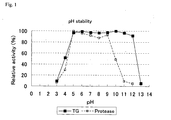
- a scatter diagram was prepared with the Microsoft software application Excel, an approximation curve was prepared as a second degree polynomial approximation, and a mathematical equation was obtained. Values obtained by subtracting S0 from absorbances A1 and A2 were substituted into the equation to calculate the protein concentrations (PA1, PA2).
- transglutaminase activity and protease activity of the sample solutions treated under various conditions have been collected in Fig. 1 as relative values for an activity value of 100 percent when pH treatment was not conducted.
- sample transglutaminase product name: Activa TG, made by Ajinomoto Corp.
- Activa TG product name: Activa TG
- Transglutaminase activity was measured in accordance with the method described in Embodiment 1.
- Protease activity was measured in accordance with the method described in Embodiment 1.
- sample transglutaminase product name: Activa TG, made by Ajinomoto Corp.
- Activa TG product name: Activa TG
- Transglutaminase activity was measured in accordance with the method described in Embodiment 1.
- Protease activity was measured in accordance with the method described in Embodiment 1.
- a 300 g quantity of small pieces of pork round meat (about 2 cm square) was admixed to the aqueous solution of transglutaminase fish collagen that had been prepared and 0.3 g of trisodium phosphate anhydride was added. The mixture was mixed and then stuffed into a casing tube with a folded width of 75 mm.
- the mixtures of pork round meat and aqueous solutions of transglutaminase, fish collagen stuffed into casing tubes as set forth above were left standing at 5°C for 2 hours to allow the transglutaminase reaction to progress. Subsequently, the products were placed in a freezer at -40°C and stored frozen until evaluation. The frozen mixtures of pork round meat and aqueous solutions of transglutaminase fish collagen were sliced into pieces 9 mm thick and 2.5 mm in width and thawed. The binding strength was then measured by a tensile test with a texture analyzer made by Stable Micro Systems Corp.
- the minimum practical binding strength has been determined by experience to be 50 g/cm 2 . Based on the results, the binding strength, when an aqueous solution of transglutaminase fish collagen that had not been treated at pH 11 was employed, was less than 50 g/cm 2 ( Fig. 4 ). However, the binding strength, when the same sample transglutaminase was treated with a pH 11 aqueous solution for 30 minutes and 2 hours, was found to be 50 g/cm 2 or more. The protease activity in the sample transglutaminase in which practical strength was achieved was thought to have been decreased without lowering transglutaminase activity by treatment with pH 11 aqueous solution.
- Test transglutaminase with a ratio of protease activity/transglutaminase activity of greater than 0.00024 (high protease TG) and sample transglutaminase with a ratio of 0.00024 or less (low protease TG) (product name: Activa TG, made by Ajinomoto Corp.) were added in quantities of 0.336 g each to 40 mL of 1 percent brine and dissolved. A 5 mL quantity of 1 percent trisodium phosphate aqueous solution was added to the transglutaminase aqueous solution. The mixture was adjusted to pH 11 and maintained for 30 minutes at 25°C.
- boiled fish paste was prepared by the following procedure.
- a 1,000 g quantity of flaked frozen ground fish (Alaska pollack, FA grade) was cut until the temperature reached -2 to 0°C with a Stephan cutter.
- a 30 g quantity of table salt was added, 350 g of ice water was added, and cutting was conducted until the temperature reached 7 to 8°C with the Stephan cutter.
- 20 g of granulated sugar 40 g of potato starch, 350 g of ice water, and 2 g of Surimi product formulation and cutting was conducted until the temperature reached 7 to 8°C.
- the material thus obtained was stuffed into a cylindrical vinylidene chloride casing 30 mm in diameter, heated for 30 minutes in 40°C steam and then for 20 minutes in 85°C steam, and cooled by immersion in ice water.
- a breaking test was conducted with a texture analyzer. Cylindrical pieces of boiled fish paste were cut to heights of 30 mm, a spherical plunger 5 mm in diameter was pressed at a rate of 1 mm/s into the center of the cross-section of the boiled fish paste, and the stress (breaking stress) at the moment of breaking was measured. Correlation coefficients for the boiled fish paste breaking stress and the protease activity under various conditions of the original sample transglutaminase powder were obtained using the Microsoft application Excel.
- the method of the present invention permits the manufacturing of higher quality transglutaminase formulations by permitting a selective reduction in protease activity without reducing transglutaminase activity. It inexpensively supplies high-quality transglutaminase-containing products that are useful as additives for enhancing the quality of various materials containing proteins which have glutamine residues serving as substrates for transglutaminase, particularly components of formulations for binding application and formulations for Surimi products. Thus, these transglutaminase-containing products expand use of the above protein-containing materials into fields beyond the area of food.
Landscapes
- Life Sciences & Earth Sciences (AREA)
- Chemical & Material Sciences (AREA)
- Engineering & Computer Science (AREA)
- Health & Medical Sciences (AREA)
- Food Science & Technology (AREA)
- Zoology (AREA)
- Polymers & Plastics (AREA)
- Microbiology (AREA)
- Biochemistry (AREA)
- Organic Chemistry (AREA)
- Nutrition Science (AREA)
- Wood Science & Technology (AREA)
- Bioinformatics & Cheminformatics (AREA)
- Genetics & Genomics (AREA)
- General Health & Medical Sciences (AREA)
- General Engineering & Computer Science (AREA)
- General Chemical & Material Sciences (AREA)
- Biomedical Technology (AREA)
- Biotechnology (AREA)
- Molecular Biology (AREA)
- Medicinal Chemistry (AREA)
- Chemical Kinetics & Catalysis (AREA)
- Marine Sciences & Fisheries (AREA)
- Enzymes And Modification Thereof (AREA)
- General Preparation And Processing Of Foods (AREA)
- Fish Paste Products (AREA)
Abstract
The invention provides a treatment method capable of reducing the protease present as an impurity in transglutaminase-containing products without reducing the activity of transglutaminase; a method for manufacturing transglutaminase-containing products with reduced protease activity by a treatment comprising maintaining a transglutaminase-containing product in which protease is present for 10 minutes or more but not more than 60 hours at greater than pH 9.0 but less than pH 13.0 at a temperature of 0°C or greater but less than 50°C; a transglutaminase-containing product obtained by this treatment method; a transglutaminase formulation in which this transglutaminase-containing product is blended, and a method for manufacturing a food by adding this transglutaminase formulation.
Description
- The present invention relates to a transglutaminase-containing product with reduced protease activity and to a method for manufacturing the same. More particularly, the present invention relates to a method of reducing the activity of protease present as an impurity in transglutaminase-containing products. The present invention further relates to a transglutaminase formulation comprised of a transglutaminase-containing product with reduced protease activity and an additional component, and to a method for manufacturing food employing a transglutaminase formulation.
- Transglutaminase is an enzymatic substance known to modify the physical properties of protein-containing materials. It is added directly to protein-containing materials to modify their physical properties, or is mixed with protein-containing materials, particularly gelatins and milk protein solutions, and employed in various substances as a binding composition. However, transglutaminase formulations manufactured using available transglutaminase-containing products, particularly transglutaminase-containing products derived from microbes, vary greatly in quality from lot to lot in the same manner as other enzymatic formulations.
- The principal reason for the variation between lots in the effectiveness of transglutaminase formulations in protein-containing materials is thought to be variation in the transglutaminase activity of the transglutaminase-containing product. However, variation in quality remains even when transglutaminase activity is controlled, constituting a major operational problem.
- In contrast to transglutaminase, which functions to crosslink and polymerize protein molecules, protease functions to degrade proteins. Since protease functions in an opposite manner from transglutaminase on proteins, the presence of protease as an impurity in products containing transglutaminase is considered undesirable in transglutaminase-containing products and transglutaminase formulations in which such products are blended as starting materials. However, there is currently no known method of selectively and efficiently deactivating or eliminating just protease activity without diminishing transglutaminase activity.
- Thus, maintaining the quality of transglutaminase formulations requires the use of such countermeasures as selecting transglutaminase-containing products of low protease activity by testing and increasing the blending ratio of transglutaminase-containing product relative to the protease activity that is present. These countermeasures entail increased labor and starting material costs, greatly driving up the cost of manufacturing transglutaminase formulations.
- Thus, there is a need for a technique that selectively deactivates just the protease present in transglutaminase-containing products without compromising transglutaminase activity.
- Generally, methods of controlling the activity of protease in a transglutaminase-containing product include processing that selectively deactivates the protease in the transglutaminase-containing product or selectively eliminates the protease from the transglutaminase-containing product. In particular, causing protease to cease functioning by a chemical treatment, such as with inhibitors, is the basic means of addressing this problem.
- Treatment for 16 hours at 37°C at pH 9.8, known to eliminate the enzyme activity of impurities such as protease and α-amylase (Patent document 1), is a method of selectively deactivating protease without affecting a specific enzyme in the form of salt-tolerant glutaminase.
- However, in contrast to this enzyme, which is known to be extremely stable with regard to alkalinity, it was previously not known whether the same alkali treatment of transglutaminase would selectively deactivate just the protease contained without compromising transglutaminase activity.
- Further, the method of deactivating protease contained in lactase by γ-ray irradiation is known to reduce protease activity (Patent document 2). However, it is still unclear whether or not this radiation treatment can be applied as a means of selectively deactivating protease in transglutaminase-containing products. It is also unclear to what degree the reduction in protease activity achieved with this treatment is related to the effect of transglutaminase on the protein-containing material. Further, the use of radiation treatment is of little commercial value.
-
Patent document 1
Japanese Patent Application Publication No. H11-42086 -
Patent document 2
Japanese Patent Application Publication No. S51-76459 - One object of the present invention is to provide a treatment method capable of reducing the protease present in a transglutaminase-containing product without reducing transglutaminase activity.
- A further object of the present invention is to provide a method for manufacturing a transglutaminase-containing product in which protease activity has been reduced by the above treatment method.
- A still further object of the present invention is to provide a transglutaminase-containing product in which protease activity has been reduced by the above treatment method.
- A still further object of the present invention is to provide a transglutaminase formulation in which is blended a transglutaminase-containing product the protease activity of which has been reduced by the above treatment method.
- A still further object of the present invention is to provide a method for manufacturing a food employing a transglutaminase formulation in which is blended a transglutaminase-containing product the protease activity of which has been reduced by the above treatment method.
- Unless specifically stated otherwise, "TG" shall be employed as an abbreviation of transglutaminase in the present invention.
- The present invention covers the following specific inventions.
- (1) A method for manufacturing a transglutaminase-containing product with reduced protease activity by a treatment comprising maintaining a transglutaminase-containing product in which protease is present as an impurity for 10 minutes or more but not more than 60 hours at greater than pH 9.0 but less than pH 13.0 at a temperature of 0°C or greater but less than 50°C.
- (2) The method for manufacturing a transglutaminase-containing product according to (1) wherein said treatment is continued until the protease activity/transglutaminase activity in the transglutaminase-containing product reaches 0.00024 or below.
- (3) The method for manufacturing a transglutaminase-containing product according to (1) or (2) wherein said treatment is conducted in a step of separating the transglutaminase-containing product from a fermentation solution in a process of manufacturing a transglutaminase-containing product by fermentation.
- (4) A transglutaminase-containing product with reduced protease activity manufactured by the method for manufacturing according to any one of (1) to (3).
- (5) A transglutaminase formulation comprising the transglutaminase-containing product according to (4) and an additional component.
- (6) A transglutaminase formulation for binding application comprising the transglutaminase-containing product according to (4) and a protein-containing material.
- (7) A transglutaminase formulation for binding application comprising the transglutaminase-containing product according to (4), collagen, and/or milk protein.
- (8) A transglutaminase formulation for Surimi product comprising the transglutaminase-containing product according to (4) and at least one additional component selected from the group consisting of protein-containing materials, calcium salts, alkali salts, and excipients.
- (9) A method for manufacturing a restructured food product employing the transglutaminase-containing product according to any one of (4) to (7).
- (10) A method for manufacturing a restructured food product comprising: preparing an aqueous solution of the transglutaminase-containing product according to (4), mixing this aqueous solution with collagen, and/or milk protein to obtain a solution, and adding this solution to a protein-containing material.
- (11) A method for manufacturing a Surimi product comprising adding the transglutaminase formulation according to any one of (4), (5), or (8) to ground fish meat.
- (12) A method for manufacturing a transglutaminase-containing product with reduced protease activity by a treatment that comprises maintaining a transglutaminase-containing product in which protease is present as an impurity for 10 minutes to 60 hours at pH 9.5 to 13.0 at a temperature of 5 to 50°C.
- (13) The method for manufacturing a transglutaminase-containing product according to (12) wherein said treatment is continued until the protease activity/transglutaminase activity in the transglutaminase-containing product reaches 0.00024 or below.
- (14) The method for manufacturing a transglutaminase-containing product according to (12) or (13) wherein said treatment is conducted in a step of separating the transglutaminase-containing product from a fermentation solution in a process of manufacturing a transglutaminase-containing product by fermentation.
- (15) A transglutaminase-containing product with reduced protease activity manufactured by the method for manufacturing according to any one of (12) to (14).
- (16) A transglutaminase formulation comprising the transglutaminase-containing product according to (15).
- (17) A transglutaminase formulation for binding application comprising the transglutaminase-containing product according to (15), collagen, and/or milk protein.
- (18) A method for manufacturing a ground fish product comprising adding the transglutaminase formulation according to (16) or (17) to ground fish meat.
- (19) A method for manufacturing a ground meat product comprising adding the transglutaminase formulation according to (16) or (17) to the ground meat of livestock and/or poultry.
- (20) A method for manufacturing a vegetable protein-containing food comprising adding the transglutaminase formulation according to (16) or (17) to vegetable protein.
- (21) A method for manufacturing a fish roe product comprising adding the transglutaminase formulation according to (16) or (17) to fish roe protein.
- (22) A method for manufacturing a chicken egg-based food comprising adding the transglutaminase formulation according to (16) or (17) to a chicken egg product.
- (23) A method for manufacturing a restructured food product comprising adding the transglutaminase formulation according to (16) or (17) to a protein-containing material.
- (24) A method for manufacturing a restructured food product comprising: preparing an aqueous solution of the transglutaminase-containing product according to (15), mixing this aqueous solution, collagen, and/or milk protein to obtain a solution, and adding this solution to a protein-containing material.
- (25) A method for manufacturing a stand-alone meat product comprising: preparing an aqueous solution of the transglutaminase-containing product according to (15), mixing this aqueous solution with a heterogeneous protein to prepare a pickling solution, and adding this pickling solution to a stand-alone meat product.
- The protease activity of the transglutaminase-containing product obtained by applying the treatment method of the present invention is reduced to an extremely low level. Thus, there is no need for countermeasures such as screening transglutaminase-containing products with a trial production test or increasing the blending ratio to ensure the quality of the formulation. High-quality transglutaminase-containing products and transglutaminase formulations can be inexpensively manufactured.
-
-
Fig. 1 is a graph showing the relative activity of transglutaminase and protease in sample solutions when the treatment pH of the sample solution was varied. -
Fig. 2 is a series of graphs showing the relative activity of transglutaminase and protease in a sample solution when the treatment time was varied at a prescribed treatment pH. -
Fig. 3 is a graph showing the relative activity of transglutaminase and protease in a sample solution when the processing temperature was varied at a prescribed treatment pH. -
Fig. 4 is a graph comparing binding strength when a transglutaminase-containing product with high protease activity was treated at a prescribed treatment pH and when such treatment was not conducted. -
Fig. 5 is a graph comparing Surimi product properties when a transglutaminase-containing product with high protease activity was treated at a prescribed treatment pH ofpH 11 and when such treatment was not conducted. - Implementation modes of the present invention are described below.
- Although protease is known to be present as an impurity in transglutaminase-containing products, it is difficult to selectively deactivate just the protease contained without compromising the activity of the transglutaminase.
- The present inventors conducted extensive research into methods of reducing the activity of protease present as an impurity in transglutaminase-containing products, resulting in the development of the above-described treatment method. Transglutaminase-containing products with low protease activity manufactured by this treatment method can be used to inexpensively manufacture high-quality transglutaminase formulations.
- In the present invention, the term "protease" refers to enzyme-degrading proteins that are present either due to migration from starting materials in the course of manufacturing a transglutaminase-containing product or through secretion by microbes.
- In the present invention, the term "transglutaminase" refers to a type of transferase that catalyzes an acyl transfer reaction.
- The transglutaminase employed in the present invention may be derived from tissue or from microbes. However, microbial transglutaminase is desirable because of its low cost. The transglutaminase employed in the present invention may be calcium-dependent or calcium-independent. Calcium-independent transglutaminase is desirable from the perspective of having an effect that is independent of the calcium concentration of the material to which it is added.
- In the present invention, the term "transglutaminase-containing product" means a liquid, or powder obtained by drying such a liquid, that is obtained from organic tissue or a microbial culture solution containing transglutaminase and then subjected to filtration and purification steps as needed. Excipients and stabilizing agents may be admixed to render the transglutaminase activity uniform or stabilize enzymatic activity.
- In the present invention, the term "transglutaminase formulation" refers to a mixture of a transglutaminase-containing product and one or more additional components selected based on the objective. Here, the term "additional component" means a protein-containing-material, salt, sugar, excipient, or the like.
- In the present invention, the "protein-containing material" to which the transglutaminase-containing product or transglutaminase formulation is added is a material containing a protein comprising glutamine residues serving as substrate for transglutaminase, and may be edible or inedible. Examples of edible protein-containing materials are materials derived from vegetable proteins, animal proteins, microbial proteins, and algal proteins. Examples of vegetable proteins are soy protein, wheat protein, and pea protein. Examples of animal proteins are livestock meat, poultry, fish, chicken eggs, milk, isolated purified products thereof, fish roe, blood plasma protein, gelatin, and collagen.
- Calcium lactate, calcium carbonate, calcinated calcium, trisodium phosphate, sodium carbonate, and the like are readily employed salts. Examples of sugars suitable for use include sugars, starches, dextrin, and sugar alcohols. The above sugars can be employed as excipients. Dextrin, starches, lactose, and the like, which have little effect on flavor, are particularly desirable.
- In the present invention, the transglutaminase-containing product is desirably treated under conditions of a pH range of greater than pH 9.0 but less than pH 13.0, with pH 9.5 or above and pH 12.5 or below being preferred and pH 10.5 or above and pH 12.5 or below being of even greater preference. This range may also be pH 9.5 to 13. During treatment, the temperature and processing times are not specifically limited so long as the transglutaminase is not deactivated. Generally, a temperature of 0°C or above and less than 50°C, preferably 10°C or above and 40°C or below, and a treatment period of 10 minutes or more and 60 hours or less, preferably 10 minutes or more and 18 hours or less, are employed. A temperature of 0 to 50°C, preferably 15 to 40°C, is also acceptable.
- In the present invention, the transglutaminase-containing product is desirably treated so that the ratio of protease activity/transglutaminase activity is 0.00024 or less, preferably 0.00017 or less. The minimum practical binding strength has been determined by experience to be 50 g, with 100 g being preferred; the above activity ratios correspond to these binding strength, respectively.
- The above treatment can be conducted as a step of separating the transglutaminase from a fermentation solution in a process of manufacturing a transglutaminase-containing product by fermentation. The same effect can be achieved by treating a solution obtained by dissolving in solvent a transglutaminase-containing product that has been pulverized. Further, the same effect can be achieved by treating a solution obtained by mixing a transglutaminase-containing product and an additional component (protein-containing material, salt, sugar, excipient, or the like) selected based on the objective.
- In the present invention, the term "transglutaminase formulation for binding application" means a mixed powder of transglutaminase-containing product and protein-containing product, or a set provided in the form of the two in separate packages. The mixed powder may be used as is, or water may be added to obtain an aqueous solution which is then either sprinkled or spread on the object being binded, or mixed with the object being binded for use. When provided as a set, the two powders may be mixed immediately prior to use and employed in the same manner as a mixed powder, or a transglutaminase-containing product and protein-containing material may be dissolved in water and the solution coated on or mixed with the objects being binded. To the extent that storage stability adequate for product handling and distribution is achieved, the form of the formulation is not limited to that of a powder and liquid formulations may be employed.
- The protein-containing material blended into a formulation for binding application may be selected from among the above-described protein-containing materials. Milk protein comprised primarily of casein, highly water-soluble gelatins, and blood plasma protein comprised primarily of fibrin all make good additional components. Among gelatins, fish gelatin is particularly desirable. Transglutaminase formulation for binding applications containing additional components in the form of gelatins afford extremely good binding strength. However, they tend to be relatively easily affected by protease. Thus, the application of the present invention affords a marked improvement in quality.
- In the present invention, the term "transglutaminase formulation for Surimi product "refers to a formulation characterized by comprising a transglutaminase-containing product and at least one additional component selected from among the group consisting of protein-containing materials, calcium salts, alkali salts, and excipients.
- The calcium salt may be any salt containing calcium, such as calcium lactate, calcium carbonate, hydrogen calcium phosphate, calcinated calcium, eggshell calcium, and seashell calcium. Any alkali salt that raises the pH of ground fish may be employed, readily employed examples of which are trisodium phosphate, sodium carbonate, hydrogen sodium carbonate, and calcified carbonate. Examples of protein-containing materials that are blended into transglutaminase formulation for Surimi product are sodium casein, potassium casein, soy protein, and wheat protein. Excipients in the form of sugars, starches, dextrin, sugar-alcohols, and the like may be employed. Dextrin, starches, lactose, and the like, which have little effect on flavor, are particularly desirable.
- The transglutaminase-containing product and transglutaminase formulation of the present invention may be employed in restructured food products and Surimi products. They may be added to ground fish, the ground meat of livestock and poultry, gelatin, vegetable protein, fish roe, chicken egg products, and the like. The transglutaminase-containing product can also be prepared as an aqueous solution, the aqueous solution mixed with a homogeneous protein to obtain a pickling solution, and the pickling solution added to a stand-alone meat product for use in manufacturing stand-alone meat products.
- In the present invention, the term "restructured food product" means a food that is obtained by bonding food starting materials. Here, the term "food starting material" means not only meats such as beef, pork, horse meat, mutton, goat meat, poultry, and chicken, but also various fish; shellfish; shrimp, crab, and other crustaceans, squid, octopus, and other mollusks; and caviar, salmon roe, cod roe, herring roe, and other fish roes. Vegetables, fruits, and the like are also included among food starting materials. Starting materials other than those given may also be employed, and two or more starting materials may be combined for use.
- In the present invention, the term "unit of protease activity" is defined as follows: one unit (1U) is the amount of enzyme required to impart an increase in the colored substance in a nonprotein Lowry test solution by an amount equivalent to 1 mg of bovine serum albumin (BSA) in one minute. Since protease activity varies with measurement conditions, only values measured under identical measurement conditions can be directly compared.
- The activity unit of transglutaminase in the present invention is measured and defined as follows: TG is reacted in a reaction system with a substrate in the form of benzylcarbonyl-L-glutamylglycine and hydroxylamine in pH 6.0 tris buffer solution at 37°C; the hydroxamic acid produced is used to form an iron complex in the presence of trichloroacetic acid; absorbance is measured at 525 nm; the quantity of hydroxamic acid is obtained from a calibration curve; and the quantity of enzyme required to generate 1 µmole of hydroxamic acid per minute is defined as one unit (1U) (see
Japanese Patent Application Publication No. S64-27471 - The present invention is described in detail below through embodiments. However, the present invention is in no way limited by the embodiments.
- A 1 g quantity of sample transglutaminase (product name: Activa TG, made by Ajinomoto Corp.) was dissolved in 20 g of distilled water and 0.4 g quantities of this aqueous solution were admixed to 1.6 g of 0.1 M GTA buffer that had been adjusted to
pH - pH 6.0 Tris-HCl buffer was added to the sample solutions prepared under the above-described conditions to dilute them to 0.2 percent sample transglutaminase (product name: Activa TG, made by Ajinomoto Corp.). Subsequently, transglutaminase-containing product was reacted in a reaction system with a substrate in the form of benzylcarbonyl-L-glutamylglycine and hydroxylamine at 37°C. The hydroxamic acid produced was converted to iron complex in the presence of trichloroacetic acid. Next, the absorbance of the reaction system was measured at 525 nm and the quantity of hydroxamic acid was obtained from a calibration curve. The quantity of enzyme required to generate 1 µmole of hydroxamic acid per minute was adopted as the activity unit, that is, one unit (1U).
- A 2 percent KC1, 1 percent Triton X-100, and 50 mM phosphate buffer solution (pH 6.0) was added to sample solutions prepared as set forth above to dilute them to 0.5 percent sample transglutaminase (product name: Activa TG, made by Ajinomoto Corp.). The mixture was stirred with a stirrer for 60 minutes and centrifuged (3,000 rpm, 10 minutes, 20°C). The supernatant was passed through a 0.45 µm syringe filter (prepared at time of use).
- A 2.5 g quantity of dimethylcasein (Sigma C9801, Casein, N,N-dimethylated from bovine milk) was precisely weighed out, 100 mL of 50 mM phosphate buffer (pH 6.0) was added, and the mixture was dissolved by stirring for 30 minutes or more at ordinary temperature (prepared at time of use).
- Alkali copper test solution: 2 Percent Na2CO3 in 0.1 M NaOH, 2 percent sodium tartrate solution, and 1 percent copper sulfate pentahydrate were admixed in a 50:1:1 ratio (prepared at time of use).
- Two-fold diluted phenol test solution (phenol reagent made by Wako Junyaku) and distilled water were admixed in a 1:1 ratio by volume (prepared at time of use).
- Sample: Dimethylcasein solution was cooled in advance in a thermostatic vessel set to 5°C ± 0.5°C (the temperature was confirmed by a standard temperature gage). A 0.4 mL quantity of sample solution was weighed out and charged to a test tube. The test tube was placed for about 10 minutes or more in a thermostatic vessel, after which 2 mL of dimethylcasein solution was added. The mixture was immediately stirred by shaking and left standing for 24 hours at precisely 5°C ± 0.5°C. When the reaction had ended, 2 mL of 5 percent trichloroacetic acid was added and the mixture was immediately stirred. The mixture was restored to room temperature. The mixture was charged to a thermostatic vessel set to 37°C ± 0.5°C, left standing for 30 to 45 minutes, centrifuged (3,000 rpm, 10 minutes, 20°C), and passed through a 0.45 µm syringe filter. The filtrate was recovered.
- Blank: A 2 mL quantity of dimethylcasein solution was charged to a test tube and left standing for 24 hours at 5°C ± 0.5°
C. A 2 mL quantity of 5 percent trichloroacetic acid was added. The mixture was immediately stirred and restored to room temperature. A 0.4 mL quantity of each of the sample solutions was added and the mixtures were immediately stirred. The mixtures were placed in a thermostatic vessel set to 37°C ± 0.5°C, left standing for 30 to 45 minutes, centrifuged (3,000 rpm, 10 minutes, 20°C), and passed through 0.45 µm syringe filters. The filtrates was recovered. - A 0.4 mL quantity of filtrate was weighed out and charged to a test tube and 2 mL of alkali copper test solution was added. The mixture was stirred with shaking and left standing for 10 minutes at room temperature. Next, 0.2 mL of phenol reagent (made by Wako Junyaku) that had been diluted two-fold with water was added and the mixture was immediately stirred. Next, the mixture was placed in a thermostatic vessel set to 37°C ± 0.5°C, left standing for 30 minutes, and cooled to room temperature. The absorbance (the absorbance of the sample was denoted as A1 and that of the blank as A2) at a wavelength of 700 nm was measured for the sample and water as control.
- Commercial standard purified bovine serum albumin (BSA) solution (Bio-Rad Protein Assay Standard II, known concentration) was repeatedly diluted two-fold (1-> 2) with distilled water to prepare two-fold, four-fold, and eight-fold diluted solutions (for example, when the concentration of the BSA solution was 1.2 mg/mL, the concentrations of the diluted solutions were 0.6, 0.3, 0.15 mg/mL). A 0.4 mL quantity of diluted BSA solution was weighed out and charged to a test tube, 2 mL of alkali copper test solution was added, the components were mixed by stirring, and the mixture was left standing for 10 minutes at room temperature. Next, 0.2 mL of phenol reagent diluted two-fold with water was added and the mixture was immediately stirred. The mixture was placed in a thermostatic vessel set to 37°C ± 0.5°C, left standing for 30 minutes, and then cooled to room temperature. The absorbance (S1) of this solution was measured at a wavelength of 700 nm employing water as control. Separately, distilled water was employed instead of BSA solution, the same operations were conducted, and the absorbance (SO) was measured. Employing the concentrations of various standard protein solutions and absorbance differences obtained by subtracting S0 from S1, a scatter diagram was prepared with the Microsoft software application Excel, an approximation curve was prepared as a second degree polynomial approximation, and a mathematical equation was obtained. Values obtained by subtracting S0 from absorbances A1 and A2 were substituted into the equation to calculate the protein concentrations (PA1, PA2).
- The quantity of enzyme that imparted an increase in the colored substance in nonprotein Lowry test solution by an amount equivalent to 1 mg of bovine serum albumin (BSA) in one minute was defined as one unit (1U) and calculated based on the following equation.

- PA1
- Protein concentration of the enzyme reaction solution (mg BSA/mL)
- PA2
- Protein concentration of blank (mg BSA/mL)
- 4.4 ÷ 0.4
- Coefficient of conversion to total solution quantity at end of reaction
- T
- Reaction time (minutes)
- V
- Dissolved volume of powder sample (mL)
- W
- Quantity of powder sample employed (g)
- The transglutaminase activity and protease activity of the sample solutions treated under various conditions have been collected in
Fig. 1 as relative values for an activity value of 100 percent when pH treatment was not conducted. - At
pH 3 to 9, the relative activity value of transglutaminase and the relative activity value of protease (the activity relative to the activity of transglutaminase prior to pH treatment, defined as 100 percent) were nearly equivalent. That is, it was clear that treatment within this pH range could not reduce protease activity without reducing transglutaminase activity (Fig. 1 ). However, when treatment was conducted at greater thanpH 9, the relative activity of protease clearly decreased more than the relative activity of transglutaminase. AtpH 13 and above, the activity of transglutaminase was also seen to drop sharply. Thus, treatment of the transglutaminase solution at greater than pH 9.0 but less than pH 13.0 reduced protease activity without reducing transglutaminase activity, permitting the manufacturing of higher-quality transglutaminase. - A 1 g quantity of sample transglutaminase (product name: Activa TG, made by Ajinomoto Corp.) was dissolved in 20 g of distilled water and 0.4 g quantities of this aqueous solution were admixed to 1.6 g of 0.1 M GTA buffer that had been adjusted to
pH - Transglutaminase activity was measured in accordance with the method described in
Embodiment 1. - Protease activity was measured in accordance with the method described in
Embodiment 1. - In the same manner as for the results of
Embodiment 1, in contrast to no difference being found between the relative activity of transglutaminase and the relative activity of protease when treated for six hours atpH 9, the relative activity of protease was determined to be lower than the relative activity of transglutaminase when treated at greater than pH 9 (Fig. 2 ). Further, for treatment lasting 30 minutes or more atpH 11 and above, 80 percent of the relative activity of transglutaminase was maintained, while the relative activity of protease was found to drop to 20 percent or less. For treatment for 30 minutes or more atpH 12 and above, 80 percent of the relative activity of transglutaminase was maintained, while the relative activity of protease was found to drop to 10 percent or less. - A 1 g quantity of sample transglutaminase (product name: Activa TG, made by Ajinomoto Corp.) was dissolved in 20 g of distilled water and 0.4 g quantities of this aqueous solution were admixed to 1.6 g of 0.1 M GTA buffer that had been adjusted to
pH 11. Individual aqueous solutions were maintained for 30 minutes at temperatures of 10, 20, 30, 40, and 50°C to obtain sample solutions. - Transglutaminase activity was measured in accordance with the method described in
Embodiment 1. - Protease activity was measured in accordance with the method described in
Embodiment 1. - A reduction in the activity of protease was found to occur when the transglutaminase aqueous solutions were maintained in various temperature zones (
Fig. 3 ). However, since the drop in activity of transglutaminase was also marked when maintained at 50°C, it was determined that protease activity could be decreased while keeping transglutaminase activity intact when the solution was maintained at less than 50°C. - An 18.0 g quantity of sample transglutaminase (product name: Activa TG, made by Ajinomoto Corp.) with a ratio of protease activity/transglutaminase activity of greater than 0.00024 and 1.2 g of fish collagen (made by Kenny & Ross Ltd.) were dissolved in 12 g of water to obtain an aqueous solution of transglutaminase fish collagen.
- A 300 g quantity of small pieces of pork round meat (about 2 cm square) was admixed to the aqueous solution of transglutaminase fish collagen that had been prepared and 0.3 g of trisodium phosphate anhydride was added. The mixture was mixed and then stuffed into a casing tube with a folded width of 75 mm.
- In another test area, 0.3 g of trisodium phosphate anhydride was added to a transglutaminase fish collagen solution prepared in the manner set forth above. These
pH 11 aqueous solutions were maintained at 25°C for 30 minutes and 2 hours, respectively. A 300 g quantity of small pieces (about 2 cm square) of pork round meat was then added to each of the aqueous solutions, and the mixtures were mixed and stuffed into casing tubes with a folded width of 75 mm. - The mixtures of pork round meat and aqueous solutions of transglutaminase, fish collagen stuffed into casing tubes as set forth above were left standing at 5°C for 2 hours to allow the transglutaminase reaction to progress. Subsequently, the products were placed in a freezer at -40°C and stored frozen until evaluation. The frozen mixtures of pork round meat and aqueous solutions of transglutaminase fish collagen were sliced into
pieces 9 mm thick and 2.5 mm in width and thawed. The binding strength was then measured by a tensile test with a texture analyzer made by Stable Micro Systems Corp. - The minimum practical binding strength has been determined by experience to be 50 g/cm2. Based on the results, the binding strength, when an aqueous solution of transglutaminase fish collagen that had not been treated at
pH 11 was employed, was less than 50 g/cm2 (Fig. 4 ). However, the binding strength, when the same sample transglutaminase was treated with apH 11 aqueous solution for 30 minutes and 2 hours, was found to be 50 g/cm2 or more. The protease activity in the sample transglutaminase in which practical strength was achieved was thought to have been decreased without lowering transglutaminase activity by treatment withpH 11 aqueous solution. - Test transglutaminase with a ratio of protease activity/transglutaminase activity of greater than 0.00024 (high protease TG) and sample transglutaminase with a ratio of 0.00024 or less (low protease TG) (product name: Activa TG, made by Ajinomoto Corp.) were added in quantities of 0.336 g each to 40 mL of 1 percent brine and dissolved. A 5 mL quantity of 1 percent trisodium phosphate aqueous solution was added to the transglutaminase aqueous solution. The mixture was adjusted to
pH 11 and maintained for 30 minutes at 25°C. Subsequently, 5 mL of 0.4 percent fumaric acid aqueous solution was added and neutralized topH 7 to obtain a pH 11-treated transglutaminase-containing product. Further, an aqueous solution obtained by mixing inadvance 5 mL of 1 percent trisodium phosphate aqueous solution and 5 mL of 0.4 percent fumaric acid aqueous solution was admixed with the transglutaminase aqueous solution for use as a control. Employing the transglutaminase-containing products treated as set forth above, boiled fish paste was prepared by the following procedure. - A 1,000 g quantity of flaked frozen ground fish (Alaska pollack, FA grade) was cut until the temperature reached -2 to 0°C with a Stephan cutter. A 30 g quantity of table salt was added, 350 g of ice water was added, and cutting was conducted until the temperature reached 7 to 8°C with the Stephan cutter. To this were added 20 g of granulated sugar, 40 g of potato starch, 350 g of ice water, and 2 g of Surimi product formulation and cutting was conducted until the temperature reached 7 to 8°C. The material thus obtained was stuffed into a cylindrical vinylidene chloride casing 30 mm in diameter, heated for 30 minutes in 40°C steam and then for 20 minutes in 85°C steam, and cooled by immersion in ice water.
- A breaking test was conducted with a texture analyzer. Cylindrical pieces of boiled fish paste were cut to heights of 30 mm, a
spherical plunger 5 mm in diameter was pressed at a rate of 1 mm/s into the center of the cross-section of the boiled fish paste, and the stress (breaking stress) at the moment of breaking was measured. Correlation coefficients for the boiled fish paste breaking stress and the protease activity under various conditions of the original sample transglutaminase powder were obtained using the Microsoft application Excel. - Based on experience, a difference in taste is experienced when the difference in the breaking strength of boiled fish paste is 5 percent or greater. The results are given in
Fig. 5 . Based onFig. 5 , the breaking stress of the high protease TG boiled fish paste when the breaking stress of low protease TG boiled fish paste was adopted as 100 percent (511.0 g) was 90.8 percent (464.2 g) and a difference in taste was found. - When the high protease TG was maintained for 30 minutes at
pH 11, the breaking stress of the boiled fish paste became 99.6 percent (509.1 g), a strength at which no difference in taste was found. It was thought that by maintaining the high protease activity transglutaminase-containing product in apH 11 aqueous solution, the protease activity was reduced without reducing the transglutaminase activity, yielding results equivalent to those obtained for low protease activity transglutaminase-containing products. - As set forth in detail above, the method of the present invention permits the manufacturing of higher quality transglutaminase formulations by permitting a selective reduction in protease activity without reducing transglutaminase activity. It inexpensively supplies high-quality transglutaminase-containing products that are useful as additives for enhancing the quality of various materials containing proteins which have glutamine residues serving as substrates for transglutaminase, particularly components of formulations for binding application and formulations for Surimi products. Thus, these transglutaminase-containing products expand use of the above protein-containing materials into fields beyond the area of food.
- The present application is based on a Patent Application
No. 2005-248771
Claims (11)
- A method for manufacturing a transglutaminase-containing product with reduced protease activity by a treatment comprising maintaining a transglutaminase-containing product in which protease is present as an impurity for 10 minutes or more but not more than 60 hours at greater than pH 9.0 but less than pH 13.0 at a temperature of 0°C or greater but less than 50°C.
- The method for manufacturing a transglutaminase-containing product according to claim 1 wherein said treatment is continued until the protease activity/transglutaminase activity in the transglutaminase-containing product reaches 0.00024 or below.
- The method for manufacturing a transglutaminase-containing product according to claim 1 or 2 wherein said treatment is conducted in a step of separating the transglutaminase-containing product from a fermentation solution in a process of manufacturing a transglutaminase-containing product by fermentation.
- A transglutaminase-containing product with reduced protease activity manufactured by the method for manufacturing according to any one of claims 1 to 3.
- A transglutaminase formulation comprising the transglutaminase-containing product according to claim 4 and an additional component.
- A transglutaminase formulation for binding application comprising the transglutaminase-containing product according to claim 4 and a protein-containing material.
- A transglutaminase formulation for binding application comprising the transglutaminase-containing product according to claim 4, collagen, and/or milk protein.
- A transglutaminase formulation for Surimi product comprising the transglutaminase-containing product according to claim 4 and at least one additional component selected from the group consisting of protein-containing materials, calcium salts, alkali salts, and excipients.
- A method for manufacturing a restructured food product employing the transglutaminase-containing product according to any one of claim 4 to 7.
- A method for manufacturing a restructured food product comprising: preparing an aqueous solution of the transglutaminase-containing product according to claim 4, mixing this aqueous solution with collagen, and/or milk protein to obtain a solution, and adding this solution to a protein-containing material.
- A method for manufacturing a Surimi product comprising adding the transglutaminase formulation according to any one of claim 4, 5, or 8 to ground fish meat.
Applications Claiming Priority (2)
| Application Number | Priority Date | Filing Date | Title |
|---|---|---|---|
| JP2005248771 | 2005-08-30 | ||
| PCT/JP2006/317415 WO2007026922A1 (en) | 2005-08-30 | 2006-08-29 | Method for preparation of transglutaminase-containing matter having reduced protease activity |
Publications (2)
| Publication Number | Publication Date |
|---|---|
| EP1921135A1 true EP1921135A1 (en) | 2008-05-14 |
| EP1921135A4 EP1921135A4 (en) | 2009-09-23 |
Family
ID=37809003
Family Applications (1)
| Application Number | Title | Priority Date | Filing Date |
|---|---|---|---|
| EP06797340A Withdrawn EP1921135A4 (en) | 2005-08-30 | 2006-08-29 | Method for preparation of transglutaminase-containing matter having reduced protease activity |
Country Status (4)
| Country | Link |
|---|---|
| EP (1) | EP1921135A4 (en) |
| JP (1) | JP4905351B2 (en) |
| CN (1) | CN101248176B (en) |
| WO (1) | WO2007026922A1 (en) |
Cited By (2)
| Publication number | Priority date | Publication date | Assignee | Title |
|---|---|---|---|---|
| IT202200024804A1 (en) * | 2022-12-12 | 2024-06-12 | Lorenzini Sabina | PRODUCTION METHOD FOR SMALL SIZE SHRIMP |
| EP4357451A4 (en) * | 2021-06-14 | 2025-04-30 | Amano Enzyme Inc. | ENZYMATIC AGENT CONTAINING TRANSGLUTAMINASE AND ITS USE |
Families Citing this family (2)
| Publication number | Priority date | Publication date | Assignee | Title |
|---|---|---|---|---|
| JP5643917B2 (en) * | 2012-09-28 | 2014-12-17 | マルハニチロ株式会社 | Method for producing softened food |
| JP6510133B1 (en) * | 2018-10-10 | 2019-05-08 | 株式会社タイショーテクノス | Process for producing processed fish eggs, method for producing processed mackerel articles, and food texture improver for fish eggs |
Family Cites Families (7)
| Publication number | Priority date | Publication date | Assignee | Title |
|---|---|---|---|---|
| JP2852364B2 (en) * | 1994-06-13 | 1999-02-03 | アサマ化成株式会社 | Method for producing marine or livestock kneaded products and quality improver |
| JPH08176A (en) * | 1994-06-22 | 1996-01-09 | Human:Kk | Cake for advertisement and its preparation |
| JPH09299065A (en) * | 1996-05-10 | 1997-11-25 | Ajinomoto Co Inc | Production of fish-paste product of fish meat and animal meat |
| JP2000004841A (en) * | 1998-06-29 | 2000-01-11 | Ajinomoto Co Inc | Enzyme preparation for fish paste |
| JP2005229807A (en) * | 2001-03-30 | 2005-09-02 | Ajinomoto Co Inc | Method for producing transglutaminase |
| CA2518049C (en) * | 2003-03-07 | 2013-05-07 | Ajinomoto Co., Inc. | Method of producing microbial transglutaminase |
| CN1237909C (en) * | 2003-09-08 | 2006-01-25 | 王卫 | Novel charqui and its preparation method |
-
2006
- 2006-08-29 CN CN2006800312115A patent/CN101248176B/en not_active Expired - Fee Related
- 2006-08-29 WO PCT/JP2006/317415 patent/WO2007026922A1/en not_active Ceased
- 2006-08-29 EP EP06797340A patent/EP1921135A4/en not_active Withdrawn
- 2006-08-29 JP JP2007533372A patent/JP4905351B2/en active Active
Non-Patent Citations (3)
| Title |
|---|
| JIANG S-T ET AL: "Combination effects of microbial transglutaminase, reducing agent, and protease inhibitor on the quality of hairtail surimi" JOURNAL OF FOOD SCIENCE, WILEY-BLACKWELL PUBLISHING, INC, US, vol. 65, no. 2, 1 March 2000 (2000-03-01), pages 241-245, XP002489807 ISSN: 0022-1147 * |
| NI SHAOWEI ET AL: "The combined effect of transglutaminase and protease inhibitors on the thermal gelation of actomyosin sol from carp and salmon muscles" FISHERIES SCIENCE (TOKYO), vol. 65, no. 4, August 1999 (1999-08), pages 606-612, XP009121382 ISSN: 0919-9268 * |
| See also references of WO2007026922A1 * |
Cited By (2)
| Publication number | Priority date | Publication date | Assignee | Title |
|---|---|---|---|---|
| EP4357451A4 (en) * | 2021-06-14 | 2025-04-30 | Amano Enzyme Inc. | ENZYMATIC AGENT CONTAINING TRANSGLUTAMINASE AND ITS USE |
| IT202200024804A1 (en) * | 2022-12-12 | 2024-06-12 | Lorenzini Sabina | PRODUCTION METHOD FOR SMALL SIZE SHRIMP |
Also Published As
| Publication number | Publication date |
|---|---|
| EP1921135A4 (en) | 2009-09-23 |
| JP4905351B2 (en) | 2012-03-28 |
| JPWO2007026922A1 (en) | 2009-03-12 |
| CN101248176B (en) | 2011-05-11 |
| CN101248176A (en) | 2008-08-20 |
| WO2007026922A1 (en) | 2007-03-08 |
Similar Documents
| Publication | Publication Date | Title |
|---|---|---|
| JP4380538B2 (en) | Enzyme preparation and food production method using the same | |
| EP0291980A1 (en) | Salt substitute and foodstuffs containing same | |
| EP2179662B1 (en) | Method for production of processed livestock meat food or processed sea food, and enzyme preparation for improvement of processed livestock meat food or processed sea food | |
| US9332780B2 (en) | Gelated crab meat and food products derived from gelated crab meat | |
| RU1829910C (en) | Antidenaturated agent for food pasty product | |
| JP3353503B2 (en) | Food adhesive | |
| JP5354635B2 (en) | Lactic acid fermented product of fish meat or fish-derived protein, production method thereof, and food and health food containing the fermented lactic acid product | |
| US20070202213A1 (en) | Method for producing transglutaminase composition | |
| US7128939B2 (en) | Pretreatment agent for a fish food | |
| JP4905351B2 (en) | Method for producing transglutaminase-containing product with reduced protease activity | |
| US7691597B2 (en) | Method for measuring protease activity of transglutaminase and transglutaminase composition | |
| JPH06125694A (en) | Freeze-aging of frozen shrimp and processed shrimp food prepared by using the aging method | |
| WO2018066591A1 (en) | Method for producing glued meat | |
| EP1921155A1 (en) | Method for determination of protease activity in transglutaminase-containing matter and adhesive transglutaminase preparation | |
| CA1219769A (en) | Oil and/or fat composition and treating method of meat with enzyme | |
| CA2494079A1 (en) | Adhesive for livestock meat and sea food and process for producing bonding shaped food with the adhesive | |
| EP4470387A1 (en) | Property modifier for heat-coagulated gel of egg white protein | |
| JP2020043772A (en) | Production method of heat-coagulated egg white | |
| JP3469379B2 (en) | Production method of animal meat and fish meat-containing food | |
| Okutan et al. | Effect of gelatin based edible coatings on quality of surimi from pearl mullet (Alburnus tarichi, Güldenstädt, 1814) during cold storage | |
| JPH0465668B2 (en) | ||
| SU1741714A1 (en) | Sublimated meat restoration method | |
| JP2009034072A (en) | Meat-modifying agent | |
| JPH06292554A (en) | How to bond food | |
| JP2025170661A (en) | Preparation for pickling liquid, pickling liquid, and method for producing processed food |
Legal Events
| Date | Code | Title | Description |
|---|---|---|---|
| PUAI | Public reference made under article 153(3) epc to a published international application that has entered the european phase |
Free format text: ORIGINAL CODE: 0009012 |
|
| 17P | Request for examination filed |
Effective date: 20080222 |
|
| AK | Designated contracting states |
Kind code of ref document: A1 Designated state(s): DE DK GB NL |
|
| RBV | Designated contracting states (corrected) |
Designated state(s): DE DK GB NL |
|
| RBV | Designated contracting states (corrected) |
Designated state(s): DE DK GB NL |
|
| A4 | Supplementary search report drawn up and despatched |
Effective date: 20090824 |
|
| 17Q | First examination report despatched |
Effective date: 20100225 |
|
| STAA | Information on the status of an ep patent application or granted ep patent |
Free format text: STATUS: THE APPLICATION IS DEEMED TO BE WITHDRAWN |
|
| 18D | Application deemed to be withdrawn |
Effective date: 20111116 |