EP1920824A1 - Ionic liquids and uses thereof - Google Patents
Ionic liquids and uses thereof Download PDFInfo
- Publication number
- EP1920824A1 EP1920824A1 EP06255339A EP06255339A EP1920824A1 EP 1920824 A1 EP1920824 A1 EP 1920824A1 EP 06255339 A EP06255339 A EP 06255339A EP 06255339 A EP06255339 A EP 06255339A EP 1920824 A1 EP1920824 A1 EP 1920824A1
- Authority
- EP
- European Patent Office
- Prior art keywords
- group
- alkyl
- groups
- salt
- alkyl group
- Prior art date
- Legal status (The legal status is an assumption and is not a legal conclusion. Google has not performed a legal analysis and makes no representation as to the accuracy of the status listed.)
- Ceased
Links
- 0 ***1(*)CCCCC1 Chemical compound ***1(*)CCCCC1 0.000 description 2
Classifications
-
- C—CHEMISTRY; METALLURGY
- C07—ORGANIC CHEMISTRY
- C07F—ACYCLIC, CARBOCYCLIC OR HETEROCYCLIC COMPOUNDS CONTAINING ELEMENTS OTHER THAN CARBON, HYDROGEN, HALOGEN, OXYGEN, NITROGEN, SULFUR, SELENIUM OR TELLURIUM
- C07F9/00—Compounds containing elements of Groups 5 or 15 of the Periodic Table
- C07F9/02—Phosphorus compounds
- C07F9/06—Phosphorus compounds without P—C bonds
- C07F9/08—Esters of oxyacids of phosphorus
- C07F9/09—Esters of phosphoric acids
- C07F9/091—Esters of phosphoric acids with hydroxyalkyl compounds with further substituents on alkyl
-
- C—CHEMISTRY; METALLURGY
- C07—ORGANIC CHEMISTRY
- C07F—ACYCLIC, CARBOCYCLIC OR HETEROCYCLIC COMPOUNDS CONTAINING ELEMENTS OTHER THAN CARBON, HYDROGEN, HALOGEN, OXYGEN, NITROGEN, SULFUR, SELENIUM OR TELLURIUM
- C07F9/00—Compounds containing elements of Groups 5 or 15 of the Periodic Table
- C07F9/02—Phosphorus compounds
- C07F9/06—Phosphorus compounds without P—C bonds
- C07F9/08—Esters of oxyacids of phosphorus
- C07F9/141—Esters of phosphorous acids
-
- C—CHEMISTRY; METALLURGY
- C07—ORGANIC CHEMISTRY
- C07F—ACYCLIC, CARBOCYCLIC OR HETEROCYCLIC COMPOUNDS CONTAINING ELEMENTS OTHER THAN CARBON, HYDROGEN, HALOGEN, OXYGEN, NITROGEN, SULFUR, SELENIUM OR TELLURIUM
- C07F9/00—Compounds containing elements of Groups 5 or 15 of the Periodic Table
- C07F9/02—Phosphorus compounds
- C07F9/28—Phosphorus compounds with one or more P—C bonds
- C07F9/38—Phosphonic acids [RP(=O)(OH)2]; Thiophosphonic acids ; [RP(=X1)(X2H)2(X1, X2 are each independently O, S or Se)]
- C07F9/3804—Phosphonic acids [RP(=O)(OH)2]; Thiophosphonic acids ; [RP(=X1)(X2H)2(X1, X2 are each independently O, S or Se)] not used, see subgroups
- C07F9/3808—Acyclic saturated acids which can have further substituents on alkyl
-
- C—CHEMISTRY; METALLURGY
- C07—ORGANIC CHEMISTRY
- C07F—ACYCLIC, CARBOCYCLIC OR HETEROCYCLIC COMPOUNDS CONTAINING ELEMENTS OTHER THAN CARBON, HYDROGEN, HALOGEN, OXYGEN, NITROGEN, SULFUR, SELENIUM OR TELLURIUM
- C07F9/00—Compounds containing elements of Groups 5 or 15 of the Periodic Table
- C07F9/02—Phosphorus compounds
- C07F9/28—Phosphorus compounds with one or more P—C bonds
- C07F9/38—Phosphonic acids [RP(=O)(OH)2]; Thiophosphonic acids ; [RP(=X1)(X2H)2(X1, X2 are each independently O, S or Se)]
- C07F9/40—Esters thereof
- C07F9/4003—Esters thereof the acid moiety containing a substituent or a structure which is considered as characteristic
- C07F9/4006—Esters of acyclic acids which can have further substituents on alkyl
-
- C—CHEMISTRY; METALLURGY
- C07—ORGANIC CHEMISTRY
- C07F—ACYCLIC, CARBOCYCLIC OR HETEROCYCLIC COMPOUNDS CONTAINING ELEMENTS OTHER THAN CARBON, HYDROGEN, HALOGEN, OXYGEN, NITROGEN, SULFUR, SELENIUM OR TELLURIUM
- C07F9/00—Compounds containing elements of Groups 5 or 15 of the Periodic Table
- C07F9/02—Phosphorus compounds
- C07F9/28—Phosphorus compounds with one or more P—C bonds
- C07F9/46—Phosphinous acids [R2POH], [R2P(= O)H]: Thiophosphinous acids including[R2PSH]; [R2P(=S)H]; Aminophosphines [R2PNH2]; Derivatives thereof
-
- C—CHEMISTRY; METALLURGY
- C07—ORGANIC CHEMISTRY
- C07F—ACYCLIC, CARBOCYCLIC OR HETEROCYCLIC COMPOUNDS CONTAINING ELEMENTS OTHER THAN CARBON, HYDROGEN, HALOGEN, OXYGEN, NITROGEN, SULFUR, SELENIUM OR TELLURIUM
- C07F9/00—Compounds containing elements of Groups 5 or 15 of the Periodic Table
- C07F9/02—Phosphorus compounds
- C07F9/28—Phosphorus compounds with one or more P—C bonds
- C07F9/54—Quaternary phosphonium compounds
-
- C—CHEMISTRY; METALLURGY
- C09—DYES; PAINTS; POLISHES; NATURAL RESINS; ADHESIVES; COMPOSITIONS NOT OTHERWISE PROVIDED FOR; APPLICATIONS OF MATERIALS NOT OTHERWISE PROVIDED FOR
- C09K—MATERIALS FOR MISCELLANEOUS APPLICATIONS, NOT PROVIDED FOR ELSEWHERE
- C09K3/00—Materials not provided for elsewhere
- C09K3/32—Materials not provided for elsewhere for absorbing liquids to remove pollution, e.g. oil, gasoline, fat
-
- C—CHEMISTRY; METALLURGY
- C09—DYES; PAINTS; POLISHES; NATURAL RESINS; ADHESIVES; COMPOSITIONS NOT OTHERWISE PROVIDED FOR; APPLICATIONS OF MATERIALS NOT OTHERWISE PROVIDED FOR
- C09K—MATERIALS FOR MISCELLANEOUS APPLICATIONS, NOT PROVIDED FOR ELSEWHERE
- C09K8/00—Compositions for drilling of boreholes or wells; Compositions for treating boreholes or wells, e.g. for completion or for remedial operations
- C09K8/02—Well-drilling compositions
- C09K8/03—Specific additives for general use in well-drilling compositions
- C09K8/035—Organic additives
-
- C—CHEMISTRY; METALLURGY
- C09—DYES; PAINTS; POLISHES; NATURAL RESINS; ADHESIVES; COMPOSITIONS NOT OTHERWISE PROVIDED FOR; APPLICATIONS OF MATERIALS NOT OTHERWISE PROVIDED FOR
- C09K—MATERIALS FOR MISCELLANEOUS APPLICATIONS, NOT PROVIDED FOR ELSEWHERE
- C09K8/00—Compositions for drilling of boreholes or wells; Compositions for treating boreholes or wells, e.g. for completion or for remedial operations
- C09K8/02—Well-drilling compositions
- C09K8/32—Non-aqueous well-drilling compositions, e.g. oil-based
- C09K8/36—Water-in-oil emulsions
-
- C—CHEMISTRY; METALLURGY
- C09—DYES; PAINTS; POLISHES; NATURAL RESINS; ADHESIVES; COMPOSITIONS NOT OTHERWISE PROVIDED FOR; APPLICATIONS OF MATERIALS NOT OTHERWISE PROVIDED FOR
- C09K—MATERIALS FOR MISCELLANEOUS APPLICATIONS, NOT PROVIDED FOR ELSEWHERE
- C09K8/00—Compositions for drilling of boreholes or wells; Compositions for treating boreholes or wells, e.g. for completion or for remedial operations
- C09K8/58—Compositions for enhanced recovery methods for obtaining hydrocarbons, i.e. for improving the mobility of the oil, e.g. displacing fluids
- C09K8/584—Compositions for enhanced recovery methods for obtaining hydrocarbons, i.e. for improving the mobility of the oil, e.g. displacing fluids characterised by the use of specific surfactants
-
- C—CHEMISTRY; METALLURGY
- C09—DYES; PAINTS; POLISHES; NATURAL RESINS; ADHESIVES; COMPOSITIONS NOT OTHERWISE PROVIDED FOR; APPLICATIONS OF MATERIALS NOT OTHERWISE PROVIDED FOR
- C09K—MATERIALS FOR MISCELLANEOUS APPLICATIONS, NOT PROVIDED FOR ELSEWHERE
- C09K2208/00—Aspects relating to compositions of drilling or well treatment fluids
- C09K2208/22—Hydrates inhibition by using well treatment fluids containing inhibitors of hydrate formers
-
- C—CHEMISTRY; METALLURGY
- C10—PETROLEUM, GAS OR COKE INDUSTRIES; TECHNICAL GASES CONTAINING CARBON MONOXIDE; FUELS; LUBRICANTS; PEAT
- C10N—INDEXING SCHEME ASSOCIATED WITH SUBCLASS C10M RELATING TO LUBRICATING COMPOSITIONS
- C10N2020/00—Specified physical or chemical properties or characteristics, i.e. function, of component of lubricating compositions
- C10N2020/01—Physico-chemical properties
- C10N2020/077—Ionic Liquids
Definitions
- This invention relates to ionic liquids and certain uses thereof. Particularly, it relates to the use of ionic liquids as surfactants (emulsifiers), and to the use of ionic liquid surfactants (emulsifiers) for forming stable emulsions and microemulsions.
- Room-temperature ionic liquids have been shown to be of great value in a wide variety of solvent applications owing to the ability to tailor their physical properties to the particular solvent application. This is achieved by varying the molecular structure of the components of the ionic liquid. Accordingly, ionic liquids have become known as "Designer Solvents" and have been subject to a great deal of interest in the chemical, pharmaceutical, petrochemical and chemical engineering industries.
- An ionic liquid is an ionic material, i.e. a salt comprised of an anion and a cation, that is in a liquid state at a temperature of below 150°C, particularly, at a temperature of below 100°C. Owing to ionic liquids being comprised entirely of discrete ions, they show vastly reduced vapour pressures when compared with traditional organic solvents thereby minimising the risk of atmospheric contamination. As ionic liquids are essentially nonvolatile, they have a further advantage when compared with traditional organic solvents in that they have no odour thereby reducing health concerns. Yet a further advantage of ionic liquids when compared with traditional organic solvents is that they can be composed of ions of low toxicity.
- ionic liquids as solvents allows them to be tailored to have the desired solubility for the intended solute.
- ionic liquids have found utility as solvents for a wide variety of materials including heavy oils, coal residues, inorganic crystalline materials and silicon compounds.
- Ionic liquid solvents can also be tailored to have the desired miscibility with an intended cosolvent.
- a wide variety of ionic liquids solvents are available which show the whole range of miscibility with water or organic cosolvents.
- Ionic liquids are also available that form stable emulsions with water or organic solvents where the ionic liquid forms either the continuous or discontinuous phase of the emulsion.
- Our copending application PCT/GB2006/001359 relates to the synthesis of certain selected surface active ionic liquids that are capable of reducing the interfacial surface tension between two or more phases selected from the group consisting of solid, liquid, gaseous, ionic and supercritical phases.
- the enhanced miscibility of the phases and/or the lowering of surface tension forces resulting from the employment of the ionic liquid surfactants of the present invention can be used to aid the formation of emulsions, microemulsions or foams.
- the present invention provides additional surface active ionic liquids.
- the present invention provides a salt that is in a liquid state at a temperature below 150°C and in which the anion has one of the general formulae R a .P(O).O 2 2- R a .P(O).(OR b ).O - R a .R b .PO - (R a O)(R b O).PO - (R a O).PO.O 2 2- in which one of R a and R b represents a straight-chain or branched alkyl, alkenyl or alkynyl group having at least 8 carbon atoms, preferably from 8 to 30 carbon atoms, more preferably 12 to 24 carbon atoms, most preferably 16 to 20 carbon atoms, which may be unsubstituted or substituted by one or more substituents selected from halogen atoms, preferably chlorine and/or fluorine atoms, hydroxyl groups, and phenyl groups, and which may be optionally interrupted by one or more oxygen atoms; and
- each of R a and R b represents a hydrocarbyl or a halogenated hydrocarbyl group, for example a fluorinated hydrocarbyl group.
- Particularly preferred alkyl groups R a and/or R b include dodecyl, hexadecyl, octadecyl, and 2,4,4-trimethylpentyl.
- R a and/or R b is interrupted by one or more oxygen atoms
- R a and/or R b may have the formula -(CH 2 CH 2 O) x R (where R is H or methyl and x is an integer of from 4 to 15, preferably 5 to 10.
- one of R a and R b represents a group having up to 7 carbon atoms, it preferably represents a C 1-4 alkyl group, for example a methyl or ethyl group.
- the nature of the cation present in the salt according to the invention is not crucial, provided that, together with the anion, it forms a salt which is in a liquid state at a temperature below 150°C, preferably below 100°C.
- the cation may for example be a quaternary ammonium or phosphonium ion, or a cation derived from an aromatic or non-aromatic heterocyclic ring structure, for example, a heterocyclic ring structure selected from imidazolium, imidazolinium, pyridinium, pyrazolium, thiazolium, isothiazolinium, azathiozolium, oxothiazolium, oxazinium, oxazolium, oxaborolium, dithiozolium, trizdium, selenozolium, oxaphopholium, pyrollium, borolium, furanium, thiophenium, phospholium, pentazolium, ind
- the cation may itself contribute to the surfactant properties of the salt, in which case it may advantageously be selected from the group consisting of:
- the cation may also comprise an aromatic or non-aromatic heterocyclic ring structure having at least one hydrophobic tail group, preferably a hydrocarbyl tail group as a substituent on the heterocyclic ring. It is envisaged that the heterocyclic ring may have from 1 to 3 hydrocarbyl substituents.
- the heterocyclic ring structure of the cation is selected from those listed above, and preferably, the heterocyclic ring structure has at least one N heteroatom, and optionally an O heteroatom.
- Preferred heterocyclic cations include:
- Surfactants may be classified using the hydrophilic-lipophilic balance (HLB) system that employs a scale of 0 to 20 based on the affinity of the surfactants for oil or water. Surfactants with low HLB values are more lipophilic while surfactants with higher HLB values are more hydrophilic.
- HLB values of the ionic liquid surfactants may be determined empirically by comparison with conventional surfactants of predetermined HLB value.
- ionic liquid surfactants will have the following properties or functions based on their HLB values:
- surfactants with HLB values of 3 to 8 are more oil soluble and will form water in oil emulsions while surfactants having an HLB value of greater than 9, preferably, 9 to 18, are more water soluble and will form oil in water emulsions.
- An emulsion of the invention may be a microemulsion.
- An advantage of the microemulsion of the present invention is that it has a low interfacial tension of less than 1 mN m -1 .
- the microemulsion may be an oil in water microemulsion where the oil is dispersed in a continuous aqueous phase or a water in oil microemulsion where the water is dispersed in a continuous oil phase.
- the microemulsion in a water in oil microemulsion.
- the water in oil microemulsion of the present invention may be used for deploying water soluble or water dispersible oil field or gas field production chemicals as described in International Patent Application No. WO 0100747 or in enhanced oil recovery.
- Microemulsions in general are known, see, for example "Microemulsions", Editor I D Robb, Plenum Press, New York, 1982 which is herein incorporated by reference. Microemulsions differ from conventional emulsions in that they form spontaneously upon mixing of the oil phase, aqueous phase and the surfactant. They also differ from ordinary emulsions in having droplets of very small size or in having microdomains having at least one dimension of length, breadth or thickness of very small size. Thus, microemulsions appear clear to the naked eye or even the optical microscope, compared to the larger droplets (greater than 100 nm diameter) of conventional cloudy emulsions.
- the aqueous phase of the water in oil microemulsion is distributed in a continuous oil phase in the form of droplets having a diameter in the range 1 to 100 nm or in the form of microdomains having at least one dimension of length, breadth or thickness in the range 1 to 100 nm.
- the aqueous phase of the water in oil microemulsion is distributed in the oil phase in the form of droplets
- the droplets preferably have an average diameter in the range of 10 to 500 nm, more preferably 50 to 250 nm.
- the droplet size distribution is generally such that at least 90% of the diameters are within 20% or especially 10% of the average diameter.
- the microemulsions are transparent to the eye and are apparently isotropic.
- the microdomains preferably have at least one dimension of length, breadth or thickness in the range 10 to 500 nm, more preferably 50 to 250 nm.
- the oil phase is essentially any liquid which is immiscible with the aqueous phase.
- the oil phase may be selected from the group consisting of liquid alkanes (preferably C 5 -C 20 alkanes, more preferably C 8 to C 15 alkanes, most preferably C 9 -C 12 alkanes, for example, n-hexane, n-nonane, n-decane, and n-undecane), alkenes, liquid alkyl halides (for example, carbon tetrachloride or dichloromethane) and liquid aromatic hydrocarbons (for example, benzene, toluene and xylene).
- liquid alkanes preferably C 5 -C 20 alkanes, more preferably C 8 to C 15 alkanes, most preferably C 9 -C 12 alkanes, for example, n-hexane, n-nonane, n-decane, and n-undecan
- the oil phase may also be a paraffin oil, a natural oil (for example, a vegetable or animal oil), diesel, kerosene, gas oil, crude oil, lubricant base oil, liquid carbon dioxide, liquid chlorofluorocarbons such as CCl 2 F 2 , CHCl 2 F and CH 3 CClF 2 (known as freons), tetrahydrofuran, dimethyl formamide and dimethyl sulfoxide.
- a paraffin oil for example, a vegetable or animal oil
- diesel kerosene
- gas oil crude oil
- lubricant base oil liquid carbon dioxide
- liquid chlorofluorocarbons such as CCl 2 F 2 , CHCl 2 F and CH 3 CClF 2 (known as freons)
- CCl 2 F 2 , CHCl 2 F and CH 3 CClF 2 known as freons
- the aqueous phase may additionally comprise a water miscible solvent such as methanol, ethanol, n-propanol, iso-propanol, n-butanol, iso-butanol, tert-butanol, butyl monoglycol ether, butyl diglycol ether, butyl triglycol ether, ethylene glycol mono butyl ether and ethylene glycol.
- a water miscible solvent such as methanol, ethanol, n-propanol, iso-propanol, n-butanol, iso-butanol, tert-butanol, butyl monoglycol ether, butyl diglycol ether, butyl triglycol ether, ethylene glycol mono butyl ether and ethylene glycol.
- the amount of water miscible solvent which may be present in the aqueous phase is in the range 0.5 to 50 % by weight, preferably 5 to 30 % by weight based on the total weight of water and water miscible solvent.
- an advantage of the ionic liquid surfactant of the present invention is that the microemulsion is stable even in the absence of a water miscible solvent.
- a salt such as sodium chloride or magnesium sulfate is added to the aqueous phase of a conventional microemulsion in order to enhance the stability of the microemulsion.
- the aqueous phase of a conventional microemulsion is generally saturated with the salt.
- a further advantage of the microemulsion of the present invention is that there is no requirement to add a salt to stabilise the emulsion.
- a salt may be included in the aqueous phase of the emulsion.
- the volume fraction of the aqueous phase in the microemulsion is generally in the range from 1-50%, preferably 10 to 40%, more preferably 23 to 30%.
- the ionic liquid surfactant is suitably present in the microemulsion in an amount ranging from 0.1 to 5 mole %, preferably 0.25 to 2 mole %, for example 0.5 to 1 mole %.
- the aqueous phase of the microemulsion may comprise fresh, tap, river, sea, produced or formation water.
- the aqueous phase may have a total salinity of 0-250 g/l, for example 5-50 g/l.
- the aqueous phase may have a pH of 0.5-9.
- the aqueous phase comprises a sea-water solution of a highly acidic production chemical such as, for example, a scale inhibitor
- the aqueous phase usually has a highly acidic pH of 0.1-1.
- the aqueous phase is neutralised prior to being mixed with the organic phase and surfactant to form the microemulsion.
- ionic liquid surfactants may be employed to prepare the microemulsion, for example, 2 or 3 ionic liquid surfactants.
- microemulsion is thermally stable. It is possible to devise microemulsions which are stable over a wide temperature range e.g. from ambient to 300°C or from 90 to about 150°C. However, it is not essential that the microemulsion is stable across the whole of the range of from ambient to 150°C. For example, the microemulsion may be stable between ambient and 70°C or between 40 and 80°C.
- the microemulsion of the present invention forms spontaneously on gentle mixing of the aqueous phase, the oil phase and the ionic liquid surfactant in any order; conveniently, the aqueous phase is mixed last into a mixture of the oil phase and the ionic liquid surfactant. If the material made is initially cloudy, then a microemulsion has not been produced, and minor adjustments to the relative proportions of the ingredients or a change in the nature of the ionic liquid surfactant or the temperature may be needed.
- the ionic liquid surfactants may be used to form conventional emulsions, in which, for example, the internal phase of the emulsion is distributed in a continuous external phase in the form of droplets having a diameter in the range 0.01 to about 100 microns.
- Conventional emulsions differ from microemulsions in that it is necessary to input energy to form the emulsion.
- a microemulsion and a conventional emulsion may coexist.
- the conventional emulsion may be an oil in water emulsion where an internal oil phase in dispersed in the form of droplets in a continuous external aqueous phase or a water in oil emulsion where an internal aqueous phase is dispersed in the form of droplets in a continuous external oil phase.
- the type of conventional emulsion is dependent upon the nature of the ionic liquid surfactant (emulsifier).
- a water in oil emulsion may be formed by dissolving minor amounts of the oil soluble ionic liquid surfactant in the oil that is to form the continuous oil phase of the emulsion.
- the concentration of oil-soluble ionic liquid surfactant in the resulting solution may be in the range of from 0.1 to 5 mole %, preferably 0.25 to 2 mole %, most preferably 0.5 to 1 mole %.
- the emulsion is preferably formed by pouring the aqueous phase into the solution of the oil-soluble ionic liquid surfactant in the oil phase while intensive blending is applied (thereby imparting energy to form the emulsion).
- the blending operation for the emulsion should be designed to minimise the size of the internal phase water droplets since this may increase the stability of the emulsion.
- the mixture should be vigorously stirred or sheared for about 5 to 20 minutes, the rate of shear being highly dependent on the size and type of mixing device employed. Stirring rate and times should be designed to form small aqueous droplets, preferably having average diameters of from about 0.3 to about 100 microns and preferably from about 1 to about 10 microns.
- the internal phase of the emulsion should amount to from 10 to 70 percent, more preferably from 30 to 60 percent of the total volume of the emulsion.
- Density control of the water in oil emulsion may be used to enhance its stability. This may be accomplished by addition of weighting agents to the internal aqueous phase of the emulsion. For example, minor amounts of soluble salts such as sodium or potassium chloride may be added to the internal aqueous phase. Suitably, the aqueous phase may comprise from 0.5 to 20 percent by weight of soluble salts.
- an oil in water emulsion may be formed by dissolving minor amounts of the water soluble ionic liquid surfactant in the aqueous phase.
- the concentration of water-soluble ionic liquid surfactant in the resulting solution may be in the range of from 0.1 to 5 mole%, preferably 0.25 to 2 mole%.
- the emulsion is preferably formed by pouring the oil phase into the solution of the water-soluble ionic liquid surfactant in the aqueous phase while intensive blending is applied, as described above for the preparation of a water in oil emulsion.
- the blending operation for the emulsion should be designed to minimize the size of the internal phase oil droplets since this may increase the stability of the emulsion.
- Stirring rate and times should be designed to form small oil droplets having average diameters of from about 0.3 to about 100 microns and preferably from about 1 to about 10 microns.
- the internal oil of the emulsion should amount to from 1 to 80 percent, more preferably from 5 to 50 percent of the total volume of the emulsion.
- the water in oil emulsion may be used to deploy a water-soluble or water-dispersible production chemical, as described above for a water in oil microemulsion.
- the conventional emulsion may also act as the base fluid of a wellbore fluid, for example, a drilling fluid or completion fluid.
- An advantage of the conventional emulsion is that the use of the ionic liquid surfactant renders the emulsion more stable under high temperature and/or high pressure conditions than emulsions formed using conventional emulsifiers.
- the emulsions are also more tolerant of metal ions and are less likely to form scums.
- ionic liquid surfactants of the present invention have many other applications including their use:
- the invention therefore further provides the use of a salt according to the invention in the above applications.
- the invention provides a composition in the form of a foam, which comprises, as a foaming agent, a salt according to the invention.
- a composition may for example be a composition suitable for use in a gas and/or gas condensate reservoir.
Landscapes
- Chemical & Material Sciences (AREA)
- Organic Chemistry (AREA)
- Life Sciences & Earth Sciences (AREA)
- Health & Medical Sciences (AREA)
- Biochemistry (AREA)
- Molecular Biology (AREA)
- General Health & Medical Sciences (AREA)
- Engineering & Computer Science (AREA)
- Materials Engineering (AREA)
- Oil, Petroleum & Natural Gas (AREA)
- General Life Sciences & Earth Sciences (AREA)
- Environmental & Geological Engineering (AREA)
- Public Health (AREA)
- Emulsifying, Dispersing, Foam-Producing Or Wetting Agents (AREA)
Abstract
The invention provides a salt that is in a liquid state at a temperature below 150°C and in which the anion has one of the general formulae
Ra.P(O).O2 2-
Ra.P(O).(ORb).O-
Ra.Rb.PO-
(RaO)(RbO).PO-
(RaO).PO.O2 2-
in which one of Ra and Rb represents an alkyl, alkenyl or alkynyl group having at least 8 carbon atoms, which may be unsubstituted or substituted by one or more substituents selected from halogen atoms, hydroxyl groups, and phenyl groups, and which may be optionally interrupted by one or more oxygen atoms; and the other of Ra and Rb (if present) has one of these meanings or represents a C1-7 alkyl, alkenyl or alkynyl group, which may be unsubstituted or substituted by one or more substituents selected from halogen atoms, hydroxyl groups, C1-4 alkoxy groups, and phenyl groups. Such salts are useful as surfactants, and may be used to prepare emulsions and foams.
Ra.P(O).O2 2-
Ra.P(O).(ORb).O-
Ra.Rb.PO-
(RaO)(RbO).PO-
(RaO).PO.O2 2-
in which one of Ra and Rb represents an alkyl, alkenyl or alkynyl group having at least 8 carbon atoms, which may be unsubstituted or substituted by one or more substituents selected from halogen atoms, hydroxyl groups, and phenyl groups, and which may be optionally interrupted by one or more oxygen atoms; and the other of Ra and Rb (if present) has one of these meanings or represents a C1-7 alkyl, alkenyl or alkynyl group, which may be unsubstituted or substituted by one or more substituents selected from halogen atoms, hydroxyl groups, C1-4 alkoxy groups, and phenyl groups. Such salts are useful as surfactants, and may be used to prepare emulsions and foams.
Description
- This invention relates to ionic liquids and certain uses thereof. Particularly, it relates to the use of ionic liquids as surfactants (emulsifiers), and to the use of ionic liquid surfactants (emulsifiers) for forming stable emulsions and microemulsions.
- Room-temperature ionic liquids have been shown to be of great value in a wide variety of solvent applications owing to the ability to tailor their physical properties to the particular solvent application. This is achieved by varying the molecular structure of the components of the ionic liquid. Accordingly, ionic liquids have become known as "Designer Solvents" and have been subject to a great deal of interest in the chemical, pharmaceutical, petrochemical and chemical engineering industries.
- An ionic liquid is an ionic material, i.e. a salt comprised of an anion and a cation, that is in a liquid state at a temperature of below 150°C, particularly, at a temperature of below 100°C. Owing to ionic liquids being comprised entirely of discrete ions, they show vastly reduced vapour pressures when compared with traditional organic solvents thereby minimising the risk of atmospheric contamination. As ionic liquids are essentially nonvolatile, they have a further advantage when compared with traditional organic solvents in that they have no odour thereby reducing health concerns. Yet a further advantage of ionic liquids when compared with traditional organic solvents is that they can be composed of ions of low toxicity.
- The flexibility of ionic liquids as solvents allows them to be tailored to have the desired solubility for the intended solute. Thus, ionic liquids have found utility as solvents for a wide variety of materials including heavy oils, coal residues, inorganic crystalline materials and silicon compounds. Ionic liquid solvents can also be tailored to have the desired miscibility with an intended cosolvent. Thus, a wide variety of ionic liquids solvents are available which show the whole range of miscibility with water or organic cosolvents. Ionic liquids are also available that form stable emulsions with water or organic solvents where the ionic liquid forms either the continuous or discontinuous phase of the emulsion.
- Our copending application
PCT/GB2006/001359 - Accordingly, the present invention provides a salt that is in a liquid state at a temperature below 150°C and in which the anion has one of the general formulae
Ra.P(O).O2 2-
Ra.P(O).(ORb).O-
Ra.Rb.PO-
(RaO)(RbO).PO-
(RaO).PO.O2 2-
in which one of Ra and Rb represents a straight-chain or branched alkyl, alkenyl or alkynyl group having at least 8 carbon atoms, preferably from 8 to 30 carbon atoms, more preferably 12 to 24 carbon atoms, most preferably 16 to 20 carbon atoms, which may be unsubstituted or substituted by one or more substituents selected from halogen atoms, preferably chlorine and/or fluorine atoms, hydroxyl groups, and phenyl groups, and which may be optionally interrupted by one or more oxygen atoms; and the other of Ra and Rb (if present) has one of these meanings or represents a C1-7 alkyl, alkenyl or alkynyl group, which may be unsubstituted or substituted by one or more substituents selected from halogen atoms, preferably chlorine and/or fluorine atoms, C1-4 alkoxy groups, preferably methoxy and/or ethoxy groups, hydroxyl groups, and phenyl groups. - Preferably, each of Ra and Rb represents a hydrocarbyl or a halogenated hydrocarbyl group, for example a fluorinated hydrocarbyl group. Particularly preferred alkyl groups Ra and/or Rb include dodecyl, hexadecyl, octadecyl, and 2,4,4-trimethylpentyl. Where Ra and/or Rb is interrupted by one or more oxygen atoms, Ra and/or Rb may have the formula -(CH2CH2O)xR (where R is H or methyl and x is an integer of from 4 to 15, preferably 5 to 10. Where one of Ra and Rb represents a group having up to 7 carbon atoms, it preferably represents a C1-4 alkyl group, for example a methyl or ethyl group.
- The nature of the cation present in the salt according to the invention is not crucial, provided that, together with the anion, it forms a salt which is in a liquid state at a temperature below 150°C, preferably below 100°C. Thus, the cation may for example be a quaternary ammonium or phosphonium ion, or a cation derived from an aromatic or non-aromatic heterocyclic ring structure, for example, a heterocyclic ring structure selected from imidazolium, imidazolinium, pyridinium, pyrazolium, thiazolium, isothiazolinium, azathiozolium, oxothiazolium, oxazinium, oxazolium, oxaborolium, dithiozolium, trizdium, selenozolium, oxaphopholium, pyrollium, borolium, furanium, thiophenium, phospholium, pentazolium, indolium, indolinium, oxazolium, isooxazolium, isotriazolium, tetrazolium, benzofuranium, diborzofuranium, benzothiophenium, dibenzothiophenium, thiadiazolium, pyrimidinium, pyrazinium, pyridazinium, piperazinium, piperidinium, morpholenium, pyranium, annolinium, phthalzinium, quinazolinium, quinaxalinium, quinolinium, isoquinolinium, thazinium, oxazinium, and azaannulenium. Preferably, the heterocyclic ring structure has at least one N heteroatom, and optionally an O heteroatom. Especially preferred heterocycles are pyridine and imidazole.
- The cation may itself contribute to the surfactant properties of the salt, in which case it may advantageously be selected from the group consisting of:
- (a) quaternary ammonium or phosphonium ions of general formula:
[R1R2R3R4M]+
wherein M is N or P;
R1 and R2 are independently selected from methyl and ethyl groups;
R3 is a C8 to C30 alkyl group, preferably a C12 to C28 alkyl group, for example, a C14 to C24 alkyl group and
R4 is selected from the group consisting of methyl, ethyl and a C8 to C30 alkyl group, (preferably a C12 to C28 alkyl group, for example, a C14 to C24 alkyl group). Particularly, preferred quaternary ammonium or phosphonium cations of this class include hexadecyltrimethylphosphonium, hexadecyltriethylphosphonium, octadecyltrimethylphosphonium, octadecyltriethylphosphonium, dihexadecyldimethylphosphonium, dioctadecyldimethylphosphonium hexadecyltrimethylammonium, hexadecyltriethylammonium, octadecyltrimethylammonium, octadecyltriethylammonium, dihexadecyldimethylammonium, and dioctadecyldimethylammonium. - (b) quaternary ammonium or phosphonium ions of general formula:
[R1R2R3R4M]+
wherein M is N or P;
R1 and R2 are independently selected from methyl and ethyl groups;
R3 is -(CH2)nC6H4R' wherein n is an integer of from 0 to 5, preferably, 0 to 3; and R' is selected from the group consisting of H, Cl, Br, I, NO2, C1 to C30 alkyl groups (preferably C1 to C20 alkyl groups), -SO2R" -SOR" and -C(O)R" (wherein R" is a C1 to C30 alkyl group, preferably a C1 to C20 alkyl group) with the proviso that the R3 group has at least 8 carbon atoms; and
R4 is a C8 to C30 alkyl group (preferably a C12 to C28 alkyl group, for example, a C14 to C24 alkyl group) or is an R3 group. - (c) triethanolamine ester quaternary ammonium or phosphonium ions of general formula:
[(R2CO2CH2CH2)2M(R1)CH2CH2OH]+
wherein M is N or P;
R1 is methyl or ethyl; and
R2 is a C5 to C30 alkyl group, preferably a C10 to C28 alkyl group, more preferably a C14 to C24 alkyl group; - (d) quaternised polyoxyethylenated (POE) long-chain amines:
[R1R2N((CH2CH2O)xH)2]+
wherein R1 and R2 are independently selected from methyl and ethyl; and
x is an integer of from 4 to 15, preferably, 5 to 10; - (e) quaternary ammonium ions of general formula:
[R1R2R3NOR4]+
wherein R1 and R2 are independently selected from methyl and ethyl;
R3 is a C8 to C30 alkyl group, preferably a C12 to C28 alkyl group, most preferably, a C14 to C24 alkyl group; and
R4 is H or a C1 to C4 alkyl, preferably, H, methyl or ethyl.
Quaternary ammonium ions of this type may be prepared by protonating or alkylating the corresponding amine oxide, R1R2R3N+O-. - (f) quaternary ammonium ions of general formula:
[(CH3)3N(CH2CH2O)xR1]+
wherein x is an integer of from 1 to 5, preferably 2 to 3 and R1 is a C1 to C30 alkyl group with the proviso that the -(CH2CH2O)xR1 substituent has at least 8 carbon atoms. Quaternary ammonium salts of this class are derived from choline,
[(CH3)3N(CH2CH2OH)]+.
- (g) quaternary ammonium ions of general formula:
[R1R2NCH2CH2NR3R4R5]+
- The cation may also comprise an aromatic or non-aromatic heterocyclic ring structure having at least one hydrophobic tail group, preferably a hydrocarbyl tail group as a substituent on the heterocyclic ring. It is envisaged that the heterocyclic ring may have from 1 to 3 hydrocarbyl substituents. Suitably, the heterocyclic ring structure of the cation is selected from those listed above, and preferably, the heterocyclic ring structure has at least one N heteroatom, and optionally an O heteroatom.
- Preferred heterocyclic cations include:
- (a) non-aromatic heterocycles such as:

R1 is C8 to C30 alkyl group; and
R2 is selected from methyl, ethyl or a C8 to C30 alkyl group. Where R1 and R2 are both C8 to C30 alkyl groups, it is preferred that R1 and R2 are of different length, for example, R1 may be a C8 to C12 alkyl group and R2 a C16 to C30 alkyl group. - (b) Imidazolium ions of the general formula:

R2 is selected from H, methyl and ethyl, preferably H;
R3 is selected from methyl, ethyl and C8 to C30 alkyl groups, preferably, methyl or ethyl; and
R4 and R5 are H or a halide (for example, Cl or Br). - (c) pyridinium ions of the general formula:

R2 and R3 are independently selected from H and dimethylamino, or are R1 groups. Particularly preferred pyridinium ions of this class include dodecylpyridinium, 1,4-didodecylpyridinium, hexadecylpyridinium, 1,4-dihexadecylpyridinium, octadecylpyrinidium, 1,4-octadecylpyridinium, 4-(dimethylamino)dodecylpyridinium, 2-(dimethylamino)dodecylpyridinium, 4-(dimethylamino)hexadecylpyridinium and 2-(dimethylamino)hexadecylpyridinium. Where the pyridinium ion has a dimethylamino substituent in the 2- or 4- position, the pyridinium ion may be prepared from 4-dimethylaminopyridine or 2-dimethylaminopyridine respectively. - (d) an oxazole of general formulae:
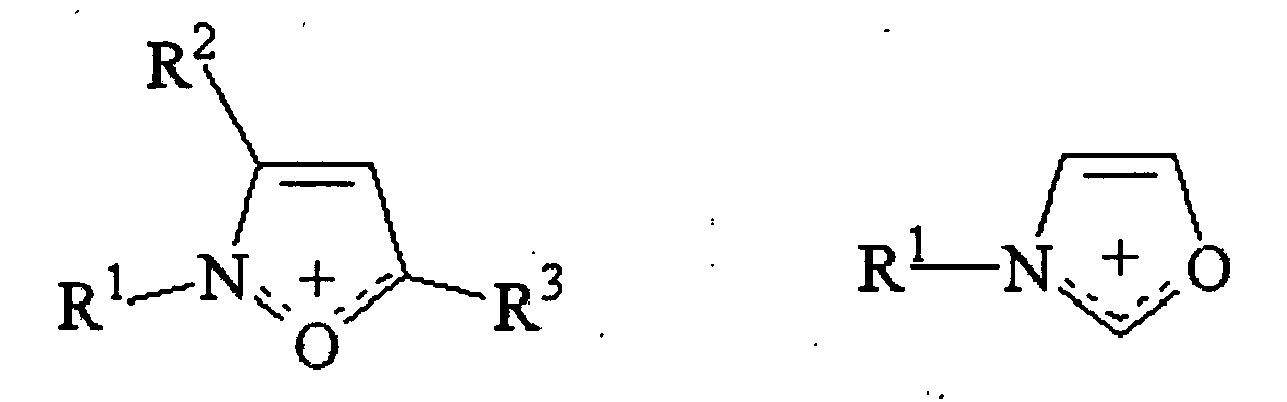
and R2 and R3 are independently selected from H, methyl or ethyl. - (e) derivatives of 1,5-diazabicyclonon-5-ene (DBN) and 1,9-diazabicycloundec-7-ene (DBU) of general formulae:

- Surfactants may be classified using the hydrophilic-lipophilic balance (HLB) system that employs a scale of 0 to 20 based on the affinity of the surfactants for oil or water. Surfactants with low HLB values are more lipophilic while surfactants with higher HLB values are more hydrophilic. The HLB values of the ionic liquid surfactants may be determined empirically by comparison with conventional surfactants of predetermined HLB value.
- In general, ionic liquid surfactants will have the following properties or functions based on their HLB values:
- 1-3 antifoaming properties
- 3-8 water in oil emulsification
- 7-9 wetting properties
- 9-18 oil in water emulsification
- 15-20 solubilising properties.
- In particular, surfactants with HLB values of 3 to 8 are more oil soluble and will form water in oil emulsions while surfactants having an HLB value of greater than 9, preferably, 9 to 18, are more water soluble and will form oil in water emulsions.
- An emulsion of the invention may be a microemulsion. An advantage of the microemulsion of the present invention is that it has a low interfacial tension of less than 1 mN m-1.
- As discussed above, depending upon the HLB value of the ionic liquid surfactant, the microemulsion may be an oil in water microemulsion where the oil is dispersed in a continuous aqueous phase or a water in oil microemulsion where the water is dispersed in a continuous oil phase. Preferably, the microemulsion in a water in oil microemulsion. The water in oil microemulsion of the present invention may be used for deploying water soluble or water dispersible oil field or gas field production chemicals as described in
International Patent Application No. WO 0100747 - Microemulsions in general are known, see, for example "Microemulsions", Editor I D Robb, Plenum Press, New York, 1982 which is herein incorporated by reference. Microemulsions differ from conventional emulsions in that they form spontaneously upon mixing of the oil phase, aqueous phase and the surfactant. They also differ from ordinary emulsions in having droplets of very small size or in having microdomains having at least one dimension of length, breadth or thickness of very small size. Thus, microemulsions appear clear to the naked eye or even the optical microscope, compared to the larger droplets (greater than 100 nm diameter) of conventional cloudy emulsions.
- Suitably, the aqueous phase of the water in oil microemulsion is distributed in a continuous oil phase in the form of droplets having a diameter in the range 1 to 100 nm or in the form of microdomains having at least one dimension of length, breadth or thickness in the range 1 to 100 nm.
- Where the aqueous phase of the water in oil microemulsion is distributed in the oil phase in the form of droplets, the droplets preferably have an average diameter in the range of 10 to 500 nm, more preferably 50 to 250 nm. The droplet size distribution is generally such that at least 90% of the diameters are within 20% or especially 10% of the average diameter. The microemulsions are transparent to the eye and are apparently isotropic.
- Where the aqueous phase of the water in oil microemulsion is distributed in the oil phase in the form of microdomains, the microdomains preferably have at least one dimension of length, breadth or thickness in the range 10 to 500 nm, more preferably 50 to 250 nm.
- The oil phase is essentially any liquid which is immiscible with the aqueous phase. For example the oil phase may be selected from the group consisting of liquid alkanes (preferably C5-C20 alkanes, more preferably C8 to C15 alkanes, most preferably C9-C12 alkanes, for example, n-hexane, n-nonane, n-decane, and n-undecane), alkenes, liquid alkyl halides (for example, carbon tetrachloride or dichloromethane) and liquid aromatic hydrocarbons (for example, benzene, toluene and xylene). The oil phase may also be a paraffin oil, a natural oil (for example, a vegetable or animal oil), diesel, kerosene, gas oil, crude oil, lubricant base oil, liquid carbon dioxide, liquid chlorofluorocarbons such as CCl2F2, CHCl2F and CH3CClF2 (known as freons), tetrahydrofuran, dimethyl formamide and dimethyl sulfoxide.
- The aqueous phase may additionally comprise a water miscible solvent such as methanol, ethanol, n-propanol, iso-propanol, n-butanol, iso-butanol, tert-butanol, butyl monoglycol ether, butyl diglycol ether, butyl triglycol ether, ethylene glycol mono butyl ether and ethylene glycol. Without wishing to be bound by any theory, it is believed that the presence of a water miscible solvent in the aqueous phase stabilises the microemulsion so that less ionic liquid surfactant is required to form a stable microemulsion. The amount of water miscible solvent which may be present in the aqueous phase is in the range 0.5 to 50 % by weight, preferably 5 to 30 % by weight based on the total weight of water and water miscible solvent. However, an advantage of the ionic liquid surfactant of the present invention is that the microemulsion is stable even in the absence of a water miscible solvent.
- Generally, a salt such as sodium chloride or magnesium sulfate is added to the aqueous phase of a conventional microemulsion in order to enhance the stability of the microemulsion. Thus, the aqueous phase of a conventional microemulsion is generally saturated with the salt. However, a further advantage of the microemulsion of the present invention is that there is no requirement to add a salt to stabilise the emulsion. However, if deemed desirable, a salt may be included in the aqueous phase of the emulsion.
- The volume fraction of the aqueous phase in the microemulsion is generally in the range from 1-50%, preferably 10 to 40%, more preferably 23 to 30%.
- The ionic liquid surfactant is suitably present in the microemulsion in an amount ranging from 0.1 to 5 mole %, preferably 0.25 to 2 mole %, for example 0.5 to 1 mole %.
- Where the water in oil microemulsion of the present invention is used to deploy a water-soluble or water-dispersible production chemical, the aqueous phase of the microemulsion may comprise fresh, tap, river, sea, produced or formation water. The aqueous phase may have a total salinity of 0-250 g/l, for example 5-50 g/l. The aqueous phase may have a pH of 0.5-9. Where the aqueous phase comprises a sea-water solution of a highly acidic production chemical such as, for example, a scale inhibitor, the aqueous phase usually has a highly acidic pH of 0.1-1. In such cases it may be necessary to neutralise the acidity of the aqueous phase by using ammonium hydroxide or an alkali metal hydroxide, especially sodium hydroxide, potassium hydroxide or lithium hydroxide, in order to bring the pH of the formulation to within a preferred range of from 2-6. Preferably, the aqueous phase is neutralised prior to being mixed with the organic phase and surfactant to form the microemulsion.
- Mixtures of ionic liquid surfactants may be employed to prepare the microemulsion, for example, 2 or 3 ionic liquid surfactants.
- It is important that the microemulsion is thermally stable. It is possible to devise microemulsions which are stable over a wide temperature range e.g. from ambient to 300°C or from 90 to about 150°C. However, it is not essential that the microemulsion is stable across the whole of the range of from ambient to 150°C. For example, the microemulsion may be stable between ambient and 70°C or between 40 and 80°C.
- The microemulsion of the present invention forms spontaneously on gentle mixing of the aqueous phase, the oil phase and the ionic liquid surfactant in any order; conveniently, the aqueous phase is mixed last into a mixture of the oil phase and the ionic liquid surfactant. If the material made is initially cloudy, then a microemulsion has not been produced, and minor adjustments to the relative proportions of the ingredients or a change in the nature of the ionic liquid surfactant or the temperature may be needed.
- It is also envisaged that the ionic liquid surfactants may be used to form conventional emulsions, in which, for example, the internal phase of the emulsion is distributed in a continuous external phase in the form of droplets having a diameter in the range 0.01 to about 100 microns.
- Conventional emulsions differ from microemulsions in that it is necessary to input energy to form the emulsion. In principle, a microemulsion and a conventional emulsion may coexist.
- The conventional emulsion may be an oil in water emulsion where an internal oil phase in dispersed in the form of droplets in a continuous external aqueous phase or a water in oil emulsion where an internal aqueous phase is dispersed in the form of droplets in a continuous external oil phase. As discussed above, the type of conventional emulsion is dependent upon the nature of the ionic liquid surfactant (emulsifier).
- Where the ionic liquid surfactant has an HLB value of 3 to 8 and the surfactant is oil soluble, a water in oil emulsion may be formed by dissolving minor amounts of the oil soluble ionic liquid surfactant in the oil that is to form the continuous oil phase of the emulsion. The concentration of oil-soluble ionic liquid surfactant in the resulting solution may be in the range of from 0.1 to 5 mole %, preferably 0.25 to 2 mole %, most preferably 0.5 to 1 mole %. The emulsion is preferably formed by pouring the aqueous phase into the solution of the oil-soluble ionic liquid surfactant in the oil phase while intensive blending is applied (thereby imparting energy to form the emulsion). The blending operation for the emulsion should be designed to minimise the size of the internal phase water droplets since this may increase the stability of the emulsion. The mixture should be vigorously stirred or sheared for about 5 to 20 minutes, the rate of shear being highly dependent on the size and type of mixing device employed. Stirring rate and times should be designed to form small aqueous droplets, preferably having average diameters of from about 0.3 to about 100 microns and preferably from about 1 to about 10 microns.
- Preferably, the internal phase of the emulsion should amount to from 10 to 70 percent, more preferably from 30 to 60 percent of the total volume of the emulsion.
- Density control of the water in oil emulsion may be used to enhance its stability. This may be accomplished by addition of weighting agents to the internal aqueous phase of the emulsion. For example, minor amounts of soluble salts such as sodium or potassium chloride may be added to the internal aqueous phase. Suitably, the aqueous phase may comprise from 0.5 to 20 percent by weight of soluble salts.
- Where the ionic liquid surfactant has an HLB value of greater than 9, preferably 9 to 18, and is water soluble, an oil in water emulsion may be formed by dissolving minor amounts of the water soluble ionic liquid surfactant in the aqueous phase. The concentration of water-soluble ionic liquid surfactant in the resulting solution may be in the range of from 0.1 to 5 mole%, preferably 0.25 to 2 mole%. The emulsion is preferably formed by pouring the oil phase into the solution of the water-soluble ionic liquid surfactant in the aqueous phase while intensive blending is applied, as described above for the preparation of a water in oil emulsion. The blending operation for the emulsion should be designed to minimize the size of the internal phase oil droplets since this may increase the stability of the emulsion. Stirring rate and times should be designed to form small oil droplets having average diameters of from about 0.3 to about 100 microns and preferably from about 1 to about 10 microns.
- Preferably, the internal oil of the emulsion should amount to from 1 to 80 percent, more preferably from 5 to 50 percent of the total volume of the emulsion.
- Suitably, the water in oil emulsion may be used to deploy a water-soluble or water-dispersible production chemical, as described above for a water in oil microemulsion. The conventional emulsion may also act as the base fluid of a wellbore fluid, for example, a drilling fluid or completion fluid. An advantage of the conventional emulsion is that the use of the ionic liquid surfactant renders the emulsion more stable under high temperature and/or high pressure conditions than emulsions formed using conventional emulsifiers. The emulsions are also more tolerant of metal ions and are less likely to form scums.
- The ionic liquid surfactants of the present invention have many other applications including their use:
- 1) to prepare foam compositions, for example, for mobility control in gas and/or gas condensate reservoirs where the foam is used to block a high permeability zone and to divert a gas into a low permeability zone.
- 2) as cleaning agents or degreasers (where the ionic liquid surfactant acts as an emulsifier or a wetting agent).
- 3) in personal hygiene products (where the ionic liquid surfactant acts as an emulsifier or a wetting agent).
- 4) as hydrophobic solvents, particularly, terpene free hydrophobic solvents
- 5) as a component of drilling fluids, for example, the ionic liquid surfactant may act as a heat transfer agent (to transfer heat from the drill bit), as a lubricant for the drill bit, as a weighting agent or as a fluid loss control agent.
- 6) as additives during oil production, for example, the surfactant may act as a gas hydrate inhibitor, corrosion inhibitor or drag reducer.
- 7) as additives during water flooding operations (enhanced oil recovery from oil wells)
- 8) as lubricants or lubricant additives
- 9) as hydraulic fluids or hydraulic fluid additives
- 10) for dispersion of oil spillages
- 11) as liquid media for chemical reactions (for example, micellar catalysis).
- 12) as phase transfer agents.
- 13) designer microemulsion compositions.
- 14) mechanical fluids such as milling or cutting fluids.
- 15) drug delivery agents.
- The invention therefore further provides the use of a salt according to the invention in the above applications. In one such embodiment, the invention provides a composition in the form of a foam, which comprises, as a foaming agent, a salt according to the invention. Such a composition may for example be a composition suitable for use in a gas and/or gas condensate reservoir.
R5 is a hydrocarbyl group selected from (i) C8 to C30 alkyl groups or (ii) -(CH2)nC6H4R' wherein n is an integer of from 0 to 5, R1 is selected from the group consisting of H, Cl, Br, I, NO2, C1 to C30 alkyl groups (preferably C1 to C20 alkyl groups), -SO2R", -SOR" and - C(O)R" (wherein R" is a C1 to C30 alkyl group, preferably a C1 to C20 alkyl group) with the proviso that R5 has at least 8 carbon atoms.
Quaternary ammonium ions of this class may, for example, be prepared from tetramethylethylenediamine or tetraethylethylenediamine by reaction with R5X where X is a good leaving group, for example, a halide.
Claims (20)
- A salt that is in a liquid state at a temperature below 150°C and in which the anion has one of the general formulae
Ra.P(O).O2 2-
Ra.P(O).(ORb).O-
Ra.Rb.PO-
(RaO)(RbO).PO-
(RaO).PO.O2 2-
in which one of Ra and Rb represents an alkyl, alkenyl or alkynyl group having at least 8 carbon atoms, which may be unsubstituted or substituted by one or more substituents selected from halogen atoms, hydroxyl groups, and phenyl groups, and which may be optionally interrupted by one or more oxygen atoms; and the other of Ra and Rb (if present) has one of these meanings or represents a C1-7 alkyl, alkenyl or alkynyl group, which may be unsubstituted or substituted by one or more substituents selected from halogen atoms, hydroxyl groups, C1-4 alkoxy groups, and phenyl groups. - A salt as claimed in claim 1, in which one of Ra and Rb represents an alkyl, alkenyl or alkynyl group having from 8 to 30 carbon atoms, which may be unsubstituted or substituted by one or more substituents selected from halogen atoms, hydroxyl groups, and phenyl groups, and which may be optionally interrupted by one or more oxygen atoms; and the other of Ra and Rb has one of these meanings or represents a C1-7 alkyl, alkenyl or alkynyl group, which may be unsubstituted or substituted by one or more substituents selected from halogen atoms, hydroxyl groups, C1-4 alkoxy groups, and phenyl groups.
- A salt as claimed in claim 2, in which one of Ra and Rb represents an alkyl, alkenyl or alkynyl group having from 12 to 24 carbon atoms, which may be unsubstituted or substituted by one or more substituents selected from halogen atoms, hydroxyl groups, and phenyl groups, and which may be optionally interrupted by one or more oxygen atoms; and the other of Ra and Rb has one of these meanings or represents a C1-7 alkyl, alkenyl or alkynyl group, which may be unsubstituted or substituted by one or more substituents selected from halogen atoms, hydroxyl groups, C1-4 alkoxy groups, and phenyl groups.
- A salt as claimed in any one of the preceding claims, in which each of Ra and Rb represents a hydrocarbyl or a halogenated hydrocarbyl group.
- A salt as claimed in any one of the preceding claims, in which at least one of Ra and Rb represents a dodecyl, hexadecyl, octadecyl, or 2,4,4-trimethylpentyl group.
- A salt as claimed in any one of claims 1 to 4, in which at least one of R8 and/or Rb has the formula -(CH2CH2O)xR where R is H or methyl and x is an integer of from 4 to 15.
- A salt as claimed in any one of the preceding claims, in which one of Ra and Rb represents a C1-4 alkyl group.
- A salt as claimed in any one of the preceding claims, in which the salt is in a liquid state at a temperature below 100°C.
- A salt as claimed in any one of the preceding claims in which the cation in the salt is a quaternary ammonium or phosphonium ion, or a cation derived from a heterocyclic ring structure.
- A salt as claimed in claim 9, in which the cation in the salt is a quaternary ammonium or phosphonium ion, or a cation derived from derived from a heterocyclic ring structure selected from imidazolium, imidazolinium, pyridinium, pyrazolium, thiazolium, isothiazolinium, azathiozolium, oxothiazolium, oxazinium, oxazolium, oxaborolium, dithiozolium, trizdium, selenozolium, oxaphopholium, pyrollium, borolium, furanium, thiophenium, phospholium, pentazolium, indolium, indolinium, oxazolium, isooxazolium, isotriazolium, tetrazolium, benzofuranium, diborzofuranium, benzothiophenium, dibenzothiophenium, thiadiazolium, pyrimidinium, pyrazinium, pyridazinium, piperazinium, piperidinium, morpholenium, pyranium, annolinium, phthalzinium, quinazolinium, quinaxalinium, quinolinium, isoquinolinium, thazinium, oxazinium, and azaannulenium.
- A salt as claimed in claim 9, in which the cation is selected from the group consisting of:(a) cations of general formula:
[R1R2R3R4M]+
wherein M is N or P;
R1 and R2 are independently selected from methyl and ethyl groups;
R3 is a C8 to C30 alkyl group; and
R4 is selected from the group consisting of methyl, ethyl and a C8 to C30 alkyl group; (b) cations of general formula:
[R1R2R3R4M]+
wherein M is N or P;
R1 and R2 are independently selected from methyl and ethyl groups;
R3 is -(CH2)nC6H4R' wherein n is an integer of from 0 to 5; and R' is selected from the group consisting of H, Cl, Br, I, NO2, C1 to C30 alkyl groups, -SO2R", -SOR" and -C(O)R" (wherein R" is a C1 to C30 alkyl group) with the proviso that the R3 group has at least 8 carbon atoms; and
R4 is a C8 to C30 alkyl group or is an R3 group;(c) cations of general formula:
[(R2CO2CH2CH2)2M(R1)CH2CH2OH]+
wherein M is N or P;
R1 is methyl or ethyl; and
R2 is a C5 to C30 alkyl group;(d) cations of general formula:
[R1R2N((CH2CH2O)xH)2]+
wherein R1 and R2 are independently selected from methyl and ethyl; and
x is an integer of from 4 to 15;(e) cations of general formula:
[R1R2R3NOR4]+
wherein R1 and R2 are independently selected from methyl and ethyl;
R3 is a C8 to C30 alkyl group; and
R4 is H or a C1 to C4 alkyl group;(f) cations of general formula:
[(CH3)3N(CH2CH2O)xR1]+
wherein x is an integer of from 1 to 5, and R1 is a C1 to C30 alkyl group with the proviso that the -(CH2CH2O)xR1 substituent has at least 8 carbon atoms; and(g) cations of general formula:wherein R1, R2, R3 and R4 are independently selected from methyl and ethyl; and
[R1R2NCH2CH2NR3R4R5]+
R5 is a hydrocarbyl group selected from (i) C8 to C30 alkyl groups or (ii) -(CH2)nC6H4R' wherein n is an integer of from 0 to 5, R' is selected from the group consisting of H, Cl, Br, I, NO2, C1 to C30 alkyl groups, -SO2R", -SOR" and -C(O)R" (wherein R" is a C1 to C30 alkyl group) with the proviso that R5 has at least 8 carbon atoms. - A salt as claimed in claim 9, in which the cation is selected from:(a) cations of the general formula:

R1 is a C8 to C30 alkyl group; and
R2 is selected from methyl, ethyl or a C8 to C30 alkyl group;(b) cations of the general formula:
R2 is selected from H, methyl and ethyl;
R3 is selected from methyl, ethyl and C8 to C30 alkyl groups; and
R4 and R5 are H or a halide;(c) cations of the general formula:
R2 and R3 are independently selected from H and dimethylamino, or are R1 groups; and(e) cations of general formulae:wherein R is selected from (i) C8 to C30 alkyl groups and (ii) -(CH2)nC6H4R' wherein n is an integer from 0 to 5, R' is selected from the group consisting of H, Cl, Br, I, NO2, C1 to C30 alkyl groups, -SO2R", -SOR" and -C(O)R" (wherein R" is a C1 to C30 alkyl group) with the proviso that -(CH2)nC6H4R' contains at least 8 carbon atoms.
- An emulsion which comprises (i) an oil phase, (ii) an aqueous phase and (iii) as a surfactant, a salt as claimed in any one of the preceding claims.
- An emulsion as claimed in claim 13, in the form of a microemulsion having an interfacial tension of less than 1 mN m-1.
- An emulsion as claimed in either claim 13 or claim 14, in the form of a water in oil microemulsion in which the aqueous phase is distributed in a continuous oil phase in the form of droplets having a diameter in the range 1 to 100 nm or in the form of microdomains having at least one dimension of length, breadth or thickness in the range 1 to 100 nm.
- An emulsion as claimed in either claim 13 or claim 14, in which the internal phase of the emulsion is distributed in a continuous external phase in the form of droplets having a diameter in the range 0.01 to 100 microns.
- An emulsion as claimed in any one of claims 13 to 16, in which the oil phase is selected from the group consisting of liquid alkanes, alkenes, liquid alkyl halides, liquid aromatic hydrocarbons, paraffin oils, vegetable or animal oils, diesel, kerosene, gas oil, crude oil, lubricant base oil, liquid carbon dioxide, liquid chlorofluorocarbons, tetrahydrofuran, dimethyl formamide and dimethyl sulfoxide.
- An emulsion as claimed in any one of claims 13 to 17, in which the aqueous phase additionally comprises a water miscible solvent.
- A composition in the form of a foam, which comprises, as a foaming agent, a salt as claimed in any one of claims 1 to 12.
- A composition as claimed in claim 19, suitable for use in a gas and/or gas condensate reservoir.
Priority Applications (1)
| Application Number | Priority Date | Filing Date | Title |
|---|---|---|---|
| EP06255339A EP1920824A1 (en) | 2006-10-17 | 2006-10-17 | Ionic liquids and uses thereof |
Applications Claiming Priority (1)
| Application Number | Priority Date | Filing Date | Title |
|---|---|---|---|
| EP06255339A EP1920824A1 (en) | 2006-10-17 | 2006-10-17 | Ionic liquids and uses thereof |
Publications (1)
| Publication Number | Publication Date |
|---|---|
| EP1920824A1 true EP1920824A1 (en) | 2008-05-14 |
Family
ID=37888317
Family Applications (1)
| Application Number | Title | Priority Date | Filing Date |
|---|---|---|---|
| EP06255339A Ceased EP1920824A1 (en) | 2006-10-17 | 2006-10-17 | Ionic liquids and uses thereof |
Country Status (1)
| Country | Link |
|---|---|
| EP (1) | EP1920824A1 (en) |
Cited By (9)
| Publication number | Priority date | Publication date | Assignee | Title |
|---|---|---|---|---|
| WO2010106115A1 (en) * | 2009-03-18 | 2010-09-23 | Montanuniversität Leoben | Method of treating a borehole and drilling fluid |
| CN102190683A (en) * | 2010-03-10 | 2011-09-21 | 中国人民解放军63975部队 | Phosphorous anion ionic liquid and preparation method thereof |
| US20110319633A1 (en) * | 2009-12-21 | 2011-12-29 | E.I. Du Pont De Nemours And Company | Foamed ionic compounds |
| US8481474B1 (en) | 2012-05-15 | 2013-07-09 | Ecolab Usa Inc. | Quaternized alkyl imidazoline ionic liquids used for enhanced food soil removal |
| US8716207B2 (en) | 2012-06-05 | 2014-05-06 | Ecolab Usa Inc. | Solidification mechanism incorporating ionic liquids |
| CN104011166A (en) * | 2011-12-21 | 2014-08-27 | 国际壳牌研究有限公司 | Method and composition for inhibiting foam in a hydrocarbon mixture |
| WO2016161208A1 (en) * | 2015-03-31 | 2016-10-06 | Uop Llc | Hydrocarbon processes using halometallate ionic liquid micro-emulsions |
| US10596561B2 (en) | 2015-03-31 | 2020-03-24 | Uop Llc | Halometallate ionic liquid micro-emulsions |
| US12241020B2 (en) | 2022-04-26 | 2025-03-04 | Saudi Arabian Oil Company | Method and applications of nonstoichiometric ionic emulsions |
Citations (3)
| Publication number | Priority date | Publication date | Assignee | Title |
|---|---|---|---|---|
| WO2001000747A1 (en) * | 1999-06-29 | 2001-01-04 | Bp Exploration Operating Company Limited | Water-in-oil microemulsions useful for oil field or gas field applications and methods for using the same |
| WO2004016631A1 (en) * | 2002-08-16 | 2004-02-26 | Cytec Canada Inc. | Phosphonium and imidazolium salts and methods of their preparation |
| WO2006111712A2 (en) * | 2005-04-20 | 2006-10-26 | The Queen's University Of Belfast | Ionic liquids and uses thereof |
-
2006
- 2006-10-17 EP EP06255339A patent/EP1920824A1/en not_active Ceased
Patent Citations (3)
| Publication number | Priority date | Publication date | Assignee | Title |
|---|---|---|---|---|
| WO2001000747A1 (en) * | 1999-06-29 | 2001-01-04 | Bp Exploration Operating Company Limited | Water-in-oil microemulsions useful for oil field or gas field applications and methods for using the same |
| WO2004016631A1 (en) * | 2002-08-16 | 2004-02-26 | Cytec Canada Inc. | Phosphonium and imidazolium salts and methods of their preparation |
| WO2006111712A2 (en) * | 2005-04-20 | 2006-10-26 | The Queen's University Of Belfast | Ionic liquids and uses thereof |
Non-Patent Citations (1)
| Title |
|---|
| ZHAO ET AL: "Vapor pressure measurement for binary and ternary systems containing a phosphoric ionic liquid", FLUID PHASE EQUILIBRIA, ELSEVIER, vol. 247, no. 1-2, 15 September 2006 (2006-09-15), pages 190 - 198, XP005615241, ISSN: 0378-3812 * |
Cited By (15)
| Publication number | Priority date | Publication date | Assignee | Title |
|---|---|---|---|---|
| WO2010106115A1 (en) * | 2009-03-18 | 2010-09-23 | Montanuniversität Leoben | Method of treating a borehole and drilling fluid |
| CN102428156A (en) * | 2009-03-18 | 2012-04-25 | 莱奥本矿业大学 | Method of treating borehole and drilling fluid |
| US8946442B2 (en) | 2009-12-21 | 2015-02-03 | E I Du Pont De Nemours And Company | Foamed ionic compounds |
| US20110319633A1 (en) * | 2009-12-21 | 2011-12-29 | E.I. Du Pont De Nemours And Company | Foamed ionic compounds |
| CN102190683B (en) * | 2010-03-10 | 2015-11-25 | 中国人民解放军63975部队 | A kind of phosphorous anion ionic liquid and preparation method thereof |
| CN102190683A (en) * | 2010-03-10 | 2011-09-21 | 中国人民解放军63975部队 | Phosphorous anion ionic liquid and preparation method thereof |
| CN104011166A (en) * | 2011-12-21 | 2014-08-27 | 国际壳牌研究有限公司 | Method and composition for inhibiting foam in a hydrocarbon mixture |
| US20140345190A1 (en) * | 2011-12-21 | 2014-11-27 | Shell Oil Company | Method and composition for inhibiting foam in a hydrocarbon mixture |
| US9453173B2 (en) * | 2011-12-21 | 2016-09-27 | Shell Oil Company | Method and composition for inhibiting foam in a hydrocarbon mixture |
| US8481474B1 (en) | 2012-05-15 | 2013-07-09 | Ecolab Usa Inc. | Quaternized alkyl imidazoline ionic liquids used for enhanced food soil removal |
| US8716207B2 (en) | 2012-06-05 | 2014-05-06 | Ecolab Usa Inc. | Solidification mechanism incorporating ionic liquids |
| WO2016161208A1 (en) * | 2015-03-31 | 2016-10-06 | Uop Llc | Hydrocarbon processes using halometallate ionic liquid micro-emulsions |
| US10596561B2 (en) | 2015-03-31 | 2020-03-24 | Uop Llc | Halometallate ionic liquid micro-emulsions |
| US10814317B2 (en) | 2015-03-31 | 2020-10-27 | Uop Llc | Hydrocarbon processes using halometallate ionic liquid micro-emulsions |
| US12241020B2 (en) | 2022-04-26 | 2025-03-04 | Saudi Arabian Oil Company | Method and applications of nonstoichiometric ionic emulsions |
Similar Documents
| Publication | Publication Date | Title |
|---|---|---|
| WO2006111712A2 (en) | Ionic liquids and uses thereof | |
| Bera et al. | Ionic liquids as alternatives of surfactants in enhanced oil recovery—A state-of-the-art review | |
| US8207096B2 (en) | Compressible packer fluids and methods of making and using same | |
| Sharma et al. | Comparative effectiveness of production performance of Pickering emulsion stabilized by nanoparticle–surfactant–polymerover surfactant–polymer (SP) flooding for enhanced oil recoveryfor Brownfield reservoir | |
| Kanicky et al. | Surface chemistry in the petroleum industry | |
| NO322216B1 (en) | Use of surfactant compositions for borehole operations | |
| US9051504B2 (en) | Emulsified polymer drilling fluid and methods of preparation | |
| CN101925719A (en) | Breaker fluid and method of using same | |
| Yousufi et al. | A review on use of emulsified acids for matrix acidizing in carbonate reservoirs | |
| NO176403B (en) | Oil-based wellbore fluids and gelling agents for these | |
| Carrillo et al. | Capillary flooding of wood with microemulsions from Winsor I systems | |
| US20140329725A1 (en) | Dual Retarded Acid System for Well Stimulation | |
| WO2010030275A1 (en) | Nitrogen-free invert emulsion wellbore fluid | |
| NO812057L (en) | PROCEDURE FOR EXTENDING EMULSIONS AND AGENTS | |
| Lee et al. | Rheological investigation of methane hydrate formation with biodegradable emulsifiers as anti-agglomerants | |
| TW381142B (en) | Improved and multi-component mixture used in substratum excavation | |
| Nguele et al. | Microemulsion and phase behavior properties of (Dimeric ammonium surfactant salt–heavy crude oil–connate water) system | |
| WO2012113861A1 (en) | Compositions comprising alkylalkoxysulfonates for the production of high temperature stable foams | |
| CA2707257C (en) | Emulsifier blend | |
| US8950481B2 (en) | Methods of cleaning wellbores and analyzing wellbore fluids | |
| EP2791270A1 (en) | Light co-solvent compositions | |
| Hashimah Alias et al. | Nanoemulsion applications in enhanced oil recovery and wellbore cleaning: an overview | |
| NO20220459A1 (en) | Star polymers and methods of use for downhole fluids | |
| US11827836B2 (en) | Demulsified composition | |
| GB2546367A (en) | Anti-accretion additives for wellbore fluids and methods of use thereof |
Legal Events
| Date | Code | Title | Description |
|---|---|---|---|
| PUAI | Public reference made under article 153(3) epc to a published international application that has entered the european phase |
Free format text: ORIGINAL CODE: 0009012 |
|
| AK | Designated contracting states |
Kind code of ref document: A1 Designated state(s): AT BE BG CH CY CZ DE DK EE ES FI FR GB GR HU IE IS IT LI LT LU LV MC NL PL PT RO SE SI SK TR |
|
| AX | Request for extension of the european patent |
Extension state: AL BA HR MK RS |
|
| STAA | Information on the status of an ep patent application or granted ep patent |
Free format text: STATUS: THE APPLICATION HAS BEEN REFUSED |
|
| 18R | Application refused |
Effective date: 20080218 |