EP1919137A1 - Method for estimating jitter buffer management performance - Google Patents
Method for estimating jitter buffer management performance Download PDFInfo
- Publication number
- EP1919137A1 EP1919137A1 EP06425744A EP06425744A EP1919137A1 EP 1919137 A1 EP1919137 A1 EP 1919137A1 EP 06425744 A EP06425744 A EP 06425744A EP 06425744 A EP06425744 A EP 06425744A EP 1919137 A1 EP1919137 A1 EP 1919137A1
- Authority
- EP
- European Patent Office
- Prior art keywords
- packet
- packets
- data stream
- jitter buffer
- grid
- Prior art date
- Legal status (The legal status is an assumption and is not a legal conclusion. Google has not performed a legal analysis and makes no representation as to the accuracy of the status listed.)
- Withdrawn
Links
- 238000000034 method Methods 0.000 title claims abstract description 28
- 238000012360 testing method Methods 0.000 claims abstract description 3
- 230000001934 delay Effects 0.000 claims description 6
- 230000003139 buffering effect Effects 0.000 claims description 5
- 239000011159 matrix material Substances 0.000 claims description 2
- 238000005259 measurement Methods 0.000 abstract description 7
- 238000003780 insertion Methods 0.000 abstract description 5
- 230000037431 insertion Effects 0.000 abstract description 5
- 238000012545 processing Methods 0.000 abstract description 3
- 235000000332 black box Nutrition 0.000 description 6
- 238000004891 communication Methods 0.000 description 3
- 238000011156 evaluation Methods 0.000 description 3
- 239000011800 void material Substances 0.000 description 3
- 238000013459 approach Methods 0.000 description 2
- 238000004364 calculation method Methods 0.000 description 2
- 230000000694 effects Effects 0.000 description 2
- 230000000750 progressive effect Effects 0.000 description 2
- 238000012163 sequencing technique Methods 0.000 description 2
- 230000003068 static effect Effects 0.000 description 2
- 230000003044 adaptive effect Effects 0.000 description 1
- 230000005540 biological transmission Effects 0.000 description 1
- 230000006837 decompression Effects 0.000 description 1
- 230000003111 delayed effect Effects 0.000 description 1
- 238000001514 detection method Methods 0.000 description 1
- 238000010586 diagram Methods 0.000 description 1
- 238000005516 engineering process Methods 0.000 description 1
- 238000012986 modification Methods 0.000 description 1
- 230000004048 modification Effects 0.000 description 1
- 238000011084 recovery Methods 0.000 description 1
- 239000013598 vector Substances 0.000 description 1
Images



Classifications
-
- H—ELECTRICITY
- H04—ELECTRIC COMMUNICATION TECHNIQUE
- H04L—TRANSMISSION OF DIGITAL INFORMATION, e.g. TELEGRAPHIC COMMUNICATION
- H04L47/00—Traffic control in data switching networks
- H04L47/10—Flow control; Congestion control
- H04L47/28—Flow control; Congestion control in relation to timing considerations
- H04L47/283—Flow control; Congestion control in relation to timing considerations in response to processing delays, e.g. caused by jitter or round trip time [RTT]
-
- H—ELECTRICITY
- H04—ELECTRIC COMMUNICATION TECHNIQUE
- H04L—TRANSMISSION OF DIGITAL INFORMATION, e.g. TELEGRAPHIC COMMUNICATION
- H04L49/00—Packet switching elements
- H04L49/90—Buffering arrangements
- H04L49/9023—Buffering arrangements for implementing a jitter-buffer
Definitions
- the present invention relates to the field of telecommunications networks, and more precisely to a method for estimating jitter buffer management performance, as set forth in the preamble of claim 1.
- VoIP Voice over IP
- QoS quality of service
- the delays occurring on a packet-switched network are mostly of two nature, one fixed due to the speed of the stream on that network, and the other variable (jitter) due to the chosen path and mostly to the amount of the already present traffic in that network. Since latter can change a lot from a communication to another or even during a communication e.g. due to some overload of the network at some special hours of the day, it is of interest to measure the characteristics of the used Jitter Buffer Manager (average delay and number of de-sequences) in order to achieve the optimal performance.
- JBM Jitter Buffer Management
- the Black-Box model can be applied to every JBM implementation, without having to define a specific reference JBM model.
- the Black-Box model allows performance assessment without the direct knowledge of the JBM implementation.
- a metric called: "Jitter buffer end-to-end delay average increment" is proposed in the cited document to evaluate the performances of some known JBM algorithms as: “Maximum buffer depth value” and "Time scaling".
- the end to end delay average increment is the delay that the jitter buffer introduces until the k-th measurement interval. It is possible to compute both Buffer De-sequencing and End-to-end delay increment metric having:
- Thresholds are referable to three performance parameters of a Black-Box JBM tested for every given delay channel model described in 3GPP S4-AHM013 . Specifically, the thresholds TBD are for: Maximum end-to-end delay increment; Maximum number of packet de-sequences during silence intervals; and Maximum number of packet de-sequences during voice intervals. Silence is detected by means of known Voice Activity Detection (VAD) techniques.
- VAD Voice Activity Detection
- the invention achieves said object by providing a method for testing the performance of known buffering algorithms in terms of average delay and number of de-sequences evaluated at the output when an input data stream affected by time jitter and de-sequences are submitted at the input, as disclosed in claim 1.
- the method of the invention is based on the concept, ascertained by the inventors, that given a reference data stream and having the corresponding output it is possible to compute the performance measurement of a JBM implementation using a template (grid) matching technique which provides a measure of the distortion between a reference input and the measured output.
- the performance estimation method creates a grid that stores unique identifiers of the sender along with the time the packets are sent and stores unique identifiers of the received packets along with the time the packets are received. Records of sent packets are associated with records of received packets so that the time a packet was sent can be compared to the time the same packet was received. Minimum weights are associated to the corresponding associations for all the possible combinations on the grid.
- a processing can associate additional information relevant to the packet content (speech or silence) in order to estimate Jitter Buffer jitter-induced operation in different way when silence is present.
- a performance measurement is provided by the minimum cost path found analyzing all the paths crossing the nodes of the grid.
- Such a technique identifies the minimum distance between the input data stream and the output data stream and the resulting information can be used for determination of the performance in terms of average delay and number of packet loss or packet insertions induced by the Jitter Buffer Management.
- the present invention provides several advantages, for example, it permits a network operator to measure the performance of Jitter Buffer Management with no knowledge of the specific JBM implementation. Additionally it allows a robust measurement for Jitter Buffer Management supporting:
- a sender and a receiver are located at opposite ends of a network.
- the network may be any network, wired or wireless or a combination of technologies.
- a Packet Loss Concealment unit providing procedure for recovery packet losses are included.
- Fig.2 illustrates the data stream flow between the sender and the Jitter Buffer Management.
- the packets sent by the sender may experience a variable delay (jitter) crossing the transport channel.
- the purpose of the Jitter Buffer Management is to hold incoming packets for a specified period of time before forwarding them to the next functional unit in a regular time interval.
- Fig.3 illustrates the location inside the network where the method for performance estimation can be applied.
- the method provides in input to the Jitter Buffer Manager a simulate data streams affected by variable delay (jitter) and stores the dejittered output data stream from the JBM.
- jitter variable delay
- Fig.4 shows a general functional diagram and description of the algorithm used for building the performance metric and evaluate the performance of the tested JBM. More in particular, performance evaluation reference data include: Reference frame sequence and Reference channel model. These references are inputted to a preliminary Step 0 and to a VAD functional block which is deputed to find when there is silence and when there is speech in the Reference frame sequence.
- Jitter definition While in a packet voice environment, the sender is expected to reliably transmit voice packets at a regular interval (for example, send one frame every 20 ms). As packets are transmitted from source to destination, they may experience different delays. As a result, packets arrive at the destination with varying delays. This phenomenon is called 'jitter'.
- the purpose of the jitter buffer is to hold incoming packets for a specified period of time before forwarding them to the decompression process.
- the jitter buffer is designed to smooth packet flow.
- the packet delay jitter buffer at the receiver's end attempts to neutralize the effects of variation in delay from one packet to the next in the incoming packet voice streams (RTP streams).
- An artificial delay is added, if necessary, to each packet's arrival time in order to write asynchronously the incoming packets at the head of the buffer.
- the speech frames are extracted from the tail of the same buffer at a steady rate for proper playback.
- This delay jitter buffer is elastic, and its occupancy level is allowed to grow (up to the maximum size of the jitter buffer) and to shrink in order to accommodate the delay variations.
- JBM Jitter Buffer Management
- the maximum buffer depth value and the time scaling algorithm are quantities with a direct relation to the packet stream processing in terms of packet insertion or discarding.
- each node is computed at the cross-point between rows and column of a matrix.
- the sender data stream (packets) is represented on the ordinate (index j), while the JBM output data stream is represented on the abscissa (index i).
- the first and the last nodes are indicated by arrows.
- Fig.6 outlines four nodes of the used grid as example to be extended to all nodes for calculating in Step 3 the delay vectors needed for tracing the optimal path along the grid.
- Computation at Step 3 includes the following substeps:
- Step 4 account for finding in Step 4 the data streams alignment optimal path.
- Fig.7A refers to optimal path search in progress while the optimal path search complete is shown in fig.7B .
- Step 4 includes the following substeps:
- Fig.8 represents de-sequences identification of Step 5. With reference to fig.8 in Step 5:
- Fig.9 represents delay gained throughout the optimal path of Step 6.
- the amount of delay gained at a certain instant in the JBM output data stream is equal to the horizontal distance that the corresponding node in the path has from the 45° line, divided by the stream data rate and added to the JBM initial waiting time.
- the delay gained at instant 3 is 2/rate + JBM initial waiting time.
- the average delay is the algebraic summation of delays gained at all instants (packet times).
- the 45° line path represent an ideal path wherein all packets of the sender data stream at the input of the JBL buffer are present at the output without any de-sequence and delay other than the physiological latency. The distance from the 45° line of the ideal path is given in number of packets.
Landscapes
- Engineering & Computer Science (AREA)
- Computer Networks & Wireless Communication (AREA)
- Signal Processing (AREA)
- Data Exchanges In Wide-Area Networks (AREA)
Abstract
Description
- The present invention relates to the field of telecommunications networks, and more precisely to a method for estimating jitter buffer management performance, as set forth in the preamble of
claim 1. - As telecommunications networks grow the measurement of network performance metrics becomes of increasing importance. By measuring such metrics, network algorithm for de-jittering and delay minimization can be tuned in order to provide optimal performance. Voice over IP (VoIP) is a typical application using such network and requesting a high level of quality of service (QoS). A real time communications between a sender and a receiver will then be possible only if such requirement of QoS will be fulfilled. Therefore, it is crucial to control and minimize all delays occurring on such a network. This is obtain among other by storing at the receiver some amount of received data in a buffer before restituting it (dejittering) by means of a Jitter Buffer Manager. In such a way it is possible to rebuild the data stream with the same sequence of packets as when the data stream left the sender.
- The delays occurring on a packet-switched network are mostly of two nature, one fixed due to the speed of the stream on that network, and the other variable (jitter) due to the chosen path and mostly to the amount of the already present traffic in that network. Since latter can change a lot from a communication to another or even during a communication e.g. due to some overload of the network at some special hours of the day, it is of interest to measure the characteristics of the used Jitter Buffer Manager (average delay and number of de-sequences) in order to achieve the optimal performance.
- The performance requirements for Jitter Buffer Management (JBM) consists of criteria for delay and jitter-induced concealment operations (packet removal from the data stream or packet insertions in the data stream). A performance estimation method evaluates the buffering time in order to limit the end-to-end delay as possible and evaluates the number of jitter-induced concealment operations in order to avoid distortions in the data stream.
- The following document: 3GPP TSG-SA4 MTSI ad
hoc # 2, presented by the same Applicant during the meeting of 2-4 October 2006, San Diego, CA USA, addresses the problem resumed in its title: "Jitter Buffer Minimum Performance Requirements" by disclosing a Black-Box model approach. Using a black box approach, it is possible to describe the overall JBM impact on a packet stream having: - Buffer De-sequencing: any difference between the packet arrival sequence and the output packet sequence.
- End-to-end delay increment: increment to the end-to-end delay introduced by JBM.
- The Black-Box model can be applied to every JBM implementation, without having to define a specific reference JBM model. The Black-Box model allows performance assessment without the direct knowledge of the JBM implementation. A metric called: "Jitter buffer end-to-end delay average increment" is proposed in the cited document to evaluate the performances of some known JBM algorithms as: "Maximum buffer depth value" and "Time scaling". The end to end delay average increment is the delay that the jitter buffer introduces until the k-th measurement interval. It is possible to compute both Buffer De-sequencing and End-to-end delay increment metric having:
- The initial waiting time: time interval between the moment when the first packet enters the jitter buffer and the moment when the first packet of the output is dequeued.
- Regular packet a packet with the expected sequence number.
- Inserted packet: a void, repeated or out-of-sequence (lower sequence number than expected) packet inserted by JBM.
- Advance packet: an output packet with a higher sequence number than expected (that is the result of one, or more, discarded packets). The number of discarded packet, L, is computed subtracting the advance packet sequence number from the expected one.
- Despite a demanding algorithm for calculating the metric is needed, at the end of calculation the Minimum Performance Requirements of the jitter Buffer are still not calculable because the values of specific comparison thresholds are yet to-be-defined (TBD). This fact reflects the provisional nature of the contribution document. Thresholds are referable to three performance parameters of a Black-Box JBM tested for every given delay channel model described in 3GPP S4-AHM013. Specifically, the thresholds TBD are for: Maximum end-to-end delay increment; Maximum number of packet de-sequences during silence intervals; and Maximum number of packet de-sequences during voice intervals. Silence is detected by means of known Voice Activity Detection (VAD) techniques.
- It is an object of the present invention to provide an alternative method to evaluate the JBM performance according to the Black-Box paradigm based on a simpler metric than the one described for the end-to-end delay average increment which division of the output stream into K measurement intervals (of N packets) is needed, so as the calculation of the incremental delay variation at step k.
- The invention achieves said object by providing a method for testing the performance of known buffering algorithms in terms of average delay and number of de-sequences evaluated at the output when an input data stream affected by time jitter and de-sequences are submitted at the input, as disclosed in
claim 1. - Accordingly, the method of the invention is based on the concept, ascertained by the inventors, that given a reference data stream and having the corresponding output it is possible to compute the performance measurement of a JBM implementation using a template (grid) matching technique which provides a measure of the distortion between a reference input and the measured output.
- Additional features of the present invention which are believed to be novel are set forth with particularity in the appended claims.
- According to the invention, the performance estimation method creates a grid that stores unique identifiers of the sender along with the time the packets are sent and stores unique identifiers of the received packets along with the time the packets are received. Records of sent packets are associated with records of received packets so that the time a packet was sent can be compared to the time the same packet was received. Minimum weights are associated to the corresponding associations for all the possible combinations on the grid. A processing can associate additional information relevant to the packet content (speech or silence) in order to estimate Jitter Buffer jitter-induced operation in different way when silence is present.
- Once the send and receive times are associated in accordance with the teachings of the present invention, a performance measurement is provided by the minimum cost path found analyzing all the paths crossing the nodes of the grid. Such a technique identifies the minimum distance between the input data stream and the output data stream and the resulting information can be used for determination of the performance in terms of average delay and number of packet loss or packet insertions induced by the Jitter Buffer Management.
- The present invention provides several advantages, for example, it permits a network operator to measure the performance of Jitter Buffer Management with no knowledge of the specific JBM implementation. Additionally it allows a robust measurement for Jitter Buffer Management supporting:
- source-controlled operation as well as non-source-controlled operation
- reordering of packets received in out-of-order sequence
- discarding of duplicated packets
- clock drift between sender and receiver endpoints.
- The features of the present invention which are considered to be novel are set forth with particularity in the appended claims. The invention and its advantages may be understood with reference to the following detailed description of an embodiment thereof taken in conjunction with the accompanying drawings given for purely non-limiting explanatory purposes and wherein:
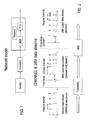
- fig.1 shows a network model useful for implementing the method of the invention;
- fig.2 shows how the time intervals between packets of a data stream change at the various points along the network model of fig.1;
- fig.3 shows diagrammatically the Black-Box concept used by the method of the invention to evaluate the performance of the JBM block of the preceding figures;
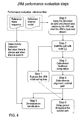
- fig.4 is a flow-chart of the JBM performance evaluation method of the invention;
- fig.5 shows a grid used as evaluation tool by the method of the invention;
- figures 6 to 9 show the various steps of the method by using the grid.
- With reference to fig.1, a sender and a receiver are located at opposite ends of a network. The network may be any network, wired or wireless or a combination of technologies. Inside the receiver a Jitter Buffer Management unit, a Packet Loss Concealment unit providing procedure for recovery packet losses are included.
- Fig.2, illustrates the data stream flow between the sender and the Jitter Buffer Management. The packets sent by the sender may experience a variable delay (jitter) crossing the transport channel. The purpose of the Jitter Buffer Management is to hold incoming packets for a specified period of time before forwarding them to the next functional unit in a regular time interval.
- Fig.3, illustrates the location inside the network where the method for performance estimation can be applied. The method provides in input to the Jitter Buffer Manager a simulate data streams affected by variable delay (jitter) and stores the dejittered output data stream from the JBM.
- Fig.4, shows a general functional diagram and description of the algorithm used for building the performance metric and evaluate the performance of the tested JBM. More in particular, performance evaluation reference data include: Reference frame sequence and Reference channel model. These references are inputted to a
preliminary Step 0 and to a VAD functional block which is deputed to find when there is silence and when there is speech in the Reference frame sequence. - Before illustrating the method of the invention, some introductory notions on the jitter and jitter buffering algorithms are useful to a better understanding.
- Jitter definition - While in a packet voice environment, the sender is expected to reliably transmit voice packets at a regular interval (for example, send one frame every 20 ms). As packets are transmitted from source to destination, they may experience different delays. As a result, packets arrive at the destination with varying delays. This phenomenon is called 'jitter'.
- Jitter Buffer - Dealing with real time applications, such as encoded voice packet transmission, the need of having a regular packet flow at the receiver decoder, with regularly spaced inter-arrival times, is of primary importance. The purpose of the jitter buffer is to hold incoming packets for a specified period of time before forwarding them to the decompression process. Thus, the jitter buffer is designed to smooth packet flow. The packet delay jitter buffer at the receiver's end attempts to neutralize the effects of variation in delay from one packet to the next in the incoming packet voice streams (RTP streams). An artificial delay is added, if necessary, to each packet's arrival time in order to write asynchronously the incoming packets at the head of the buffer. The speech frames are extracted from the tail of the same buffer at a steady rate for proper playback. This delay jitter buffer is elastic, and its occupancy level is allowed to grow (up to the maximum size of the jitter buffer) and to shrink in order to accommodate the delay variations.
- Basically, every possible Jitter Buffer Management (JBM) implementation can be distinguished on the basis of:
- The maximum buffer depth value (Qmax) that is set in order to limit the buffer occupancy level. If the fill level reaches this value and there is an incoming packet, it is discarded and its coded speech payload is considered lost (jitter buffer overflow loss).
- The time scaling algorithm that the JBM adopts in order to control the flow of the jitter buffer occupancy level (Q(t)). In a static jitter buffer the time scaling is not applied and the Q(t) value is allowed to freely grow and shrink to accommodate jittered traffic. A JBM that applies time scaling (adaptive jitter buffer) performs packets discarding in order to reduce the Q(t) value and packets insertion (e.g. repeats packets or uses void packets) in order to increase Q(t). The specific time scaling algorithm used by the jitter buffer implementation decides when and how to perform these operations. Whether the jitter buffer is static or dynamic, when a 20ms clock timeout occurs and there is no available queued packet, there is an buffer underflow (a void packet is processed), otherwise, when a packet is received too late to be processed, it is considered a late packet loss.
- The initial waiting time. This is the time interval from when the first packet is received to the moment when the JBM starts de-queuing.
- The maximum buffer depth value and the time scaling algorithm are quantities with a direct relation to the packet stream processing in terms of packet insertion or discarding. After which the method of the exemplary embodiment includes the following steps (that will be detailed with reference to the remaining figures):
- Step 0 - Apply the simulated delayed and jittered data stream to the JBM and read the JBM output data stream.
- Step 1 - Evaluate the JBM initial waiting time as the delay from the moment the first element of the data stream enters the JBM to the moment it comes out.
- Step 2 - Build the grid with nodes (i.j), where: i is frame progressive number in JBM output sequence; j is the frame progressive number in reference sequence.
- Step 3 - Find the likelihood between the JBM output data stream and the reference stream.
- Step 4 - Find the optimal path through the grid nodes that represents the optimal alignment between the two data streams.
- Step 5 - Compute the amount of de-sequences in the optimal path (different weights for silence and speech).
- Step 6 - Evaluate the amount of delay gained through the output sequence with respect to the reference one.
- With reference to fig.5 we see a performance metric alignment grid where each node is computed at the cross-point between rows and column of a matrix. The sender data stream (packets) is represented on the ordinate (index j), while the JBM output data stream is represented on the abscissa (index i). The first and the last nodes are indicated by arrows.
- Fig.6 outlines four nodes of the used grid as example to be extended to all nodes for calculating in
Step 3 the delay vectors needed for tracing the optimal path along the grid. Computation atStep 3 includes the following substeps: - Assign a weight to each node depending whether it connects the same frame in the two streams or different frames. For example:
weight 0 in the first case (concordance) or 1 in the second case (discordance). In the present case based on searching of the optimum path using a minimum metric criterion, the weight to assign in case of concordance of the frames at the cross-point is lower than in case of discordance; an opposite assignment should be true in case of optimizing with maximum metric criterion. - Mark the nodes on the axes as visited and associate a cost (c) equal to the
node weight - Find a node (i,j) with the three predecessors (i-1,j), (i,j-1) and (i-1,j-1) marked as visited. Associate an optimal predecessor to node (i,j), that is the predecessor with the minimum cost. Associate to node (i,j) a cost (c) that is the sum of the cost of the optimal predecessor (opt_pre) plus the weight of node (i,j). For the example in the figure:


- Repeat the previous step until node (i,j) becomes the node corresponding to the last frames of the two streams. The cost associated to this node represents the likelihood of the JBM output data stream with respect to the reference one. For the example in the figure: c(4,5) = data streams likelihood.
- Figures 7A and 7B, account for finding in
Step 4 the data streams alignment optimal path. Fig.7A refers to optimal path search in progress while the optimal path search complete is shown in fig.7B.With reference to these figures,Step 4 includes the following substeps: - Mark the node corresponding to the last frames of the two streams as a node of the optimal path.
- If node (i,j) is marked as a node of the optimal path, mark its optimal predecessor as a node of the path.
- Repeat the previous step until node (i,j) becomes the node (0,0), that is the node corresponding to the first frames of the two sequences.
- Fig.8 represents de-sequences identification of
Step 5. With reference to fig.8 in Step 5: - A de-sequence occurs when a node of the optimal path corresponds to different frames in the two data streams.
- The amount of de-sequences over a certain number of output frames, possibly computed using different weights for silence or speech, is the first JBM performance score.
- Fig.9 represents delay gained throughout the optimal path of
Step 6. With reference to fig.9, inStep 6 the amount of delay gained at a certain instant in the JBM output data stream is equal to the horizontal distance that the corresponding node in the path has from the 45° line, divided by the stream data rate and added to the JBM initial waiting time. For example in the figure the delay gained atinstant 3 is 2/rate + JBM initial waiting time. The average delay is the algebraic summation of delays gained at all instants (packet times). The 45° line path represent an ideal path wherein all packets of the sender data stream at the input of the JBL buffer are present at the output without any de-sequence and delay other than the physiological latency. The distance from the 45° line of the ideal path is given in number of packets. - Although the invention has been described with particular reference to a preferred embodiment, it will be evident to those skilled in the art, that the present invention is not limited thereto, but further variations and modifications may be applied without departing from the scope of the claims.
Claims (5)
- Method for testing the performance of known buffering algorithms (JBM) in terms of average delay and number of de-sequences evaluated at the output when a packet data stream affected by time jitter and de-sequences is submitted at the input of a buffer subjected to one of said buffering algorithms (JBM), characterized in that includes the steps of:- forming a grid of nodes each one located at the cross-point between a row and a column of a matrix, wherein the elements of each column correspond to packets sent to the buffer input and the elements of each row correspond to output packets received from the buffer;- determining a cost for each node based on correspondence between packet sent and packet received;- calculating a minimum cost path crossing the grid;- estimating an average delay from the minimum cost path;- estimating a number of de-sequences from the minimum cost path.
- The method of claim 1, characterized in that a de-sequence is detected when a node of the minimum cost path corresponds to different packets in the input and output data streams.
- The method of claim 1 or 2, characterized in that said de-sequences are computed using different weights for silence or speech.
- The method of any claim from 1 to 3, characterized in that the amount of delay gained at a certain instant in the output data stream is equal to the horizontal distance in the grid that the corresponding node in the minimum cost path has from an ideal path resulting when all packets at the input of the buffer are present at the output without any de-sequence and delay other than the physiological latency.
- The method of claim 4, characterized in that said average delay is equal to the algebraic summation of delays gained at all packet times.
Priority Applications (1)
| Application Number | Priority Date | Filing Date | Title |
|---|---|---|---|
| EP06425744A EP1919137A1 (en) | 2006-10-30 | 2006-10-30 | Method for estimating jitter buffer management performance |
Applications Claiming Priority (1)
| Application Number | Priority Date | Filing Date | Title |
|---|---|---|---|
| EP06425744A EP1919137A1 (en) | 2006-10-30 | 2006-10-30 | Method for estimating jitter buffer management performance |
Publications (1)
| Publication Number | Publication Date |
|---|---|
| EP1919137A1 true EP1919137A1 (en) | 2008-05-07 |
Family
ID=37904020
Family Applications (1)
| Application Number | Title | Priority Date | Filing Date |
|---|---|---|---|
| EP06425744A Withdrawn EP1919137A1 (en) | 2006-10-30 | 2006-10-30 | Method for estimating jitter buffer management performance |
Country Status (1)
| Country | Link |
|---|---|
| EP (1) | EP1919137A1 (en) |
Cited By (5)
| Publication number | Priority date | Publication date | Assignee | Title |
|---|---|---|---|---|
| WO2010042578A1 (en) * | 2008-10-08 | 2010-04-15 | Citrix Systems, Inc. | Systems and methods for real-time endpoint application flow control with network structure component |
| US8089992B2 (en) | 2009-09-30 | 2012-01-03 | At&T Intellectual Property I, L.P. | Systems and methods to measure the performance of a de-jitter buffer |
| EP2749069A4 (en) * | 2011-10-07 | 2015-06-10 | Ericsson Telefon Ab L M | PROCEDURE FOR PACKET TRANSFER WITH JITTER BUFFER EMULATION AND CORRESPONDING NETWORK NODES |
| CN104570931B (en) * | 2014-11-18 | 2017-08-08 | 中国科学院光电技术研究所 | Method for generating machining track |
| US10560393B2 (en) | 2012-12-20 | 2020-02-11 | Dolby Laboratories Licensing Corporation | Controlling a jitter buffer |
Citations (1)
| Publication number | Priority date | Publication date | Assignee | Title |
|---|---|---|---|---|
| EP1655911A2 (en) * | 2004-11-04 | 2006-05-10 | Zultys Technologies | Audio receiver having adaptive buffer delay |
-
2006
- 2006-10-30 EP EP06425744A patent/EP1919137A1/en not_active Withdrawn
Patent Citations (1)
| Publication number | Priority date | Publication date | Assignee | Title |
|---|---|---|---|---|
| EP1655911A2 (en) * | 2004-11-04 | 2006-05-10 | Zultys Technologies | Audio receiver having adaptive buffer delay |
Cited By (8)
| Publication number | Priority date | Publication date | Assignee | Title |
|---|---|---|---|---|
| WO2010042578A1 (en) * | 2008-10-08 | 2010-04-15 | Citrix Systems, Inc. | Systems and methods for real-time endpoint application flow control with network structure component |
| US8589579B2 (en) | 2008-10-08 | 2013-11-19 | Citrix Systems, Inc. | Systems and methods for real-time endpoint application flow control with network structure component |
| US8089992B2 (en) | 2009-09-30 | 2012-01-03 | At&T Intellectual Property I, L.P. | Systems and methods to measure the performance of a de-jitter buffer |
| US8755411B2 (en) | 2009-09-30 | 2014-06-17 | At&T Intellectual Property I, L.P. | Systems and methods to measure the performance of a de-jitter buffer |
| EP2749069A4 (en) * | 2011-10-07 | 2015-06-10 | Ericsson Telefon Ab L M | PROCEDURE FOR PACKET TRANSFER WITH JITTER BUFFER EMULATION AND CORRESPONDING NETWORK NODES |
| US10560393B2 (en) | 2012-12-20 | 2020-02-11 | Dolby Laboratories Licensing Corporation | Controlling a jitter buffer |
| US12063162B2 (en) | 2012-12-20 | 2024-08-13 | Dolby Laboratories Licensing Corporation | Controlling a jitter buffer |
| CN104570931B (en) * | 2014-11-18 | 2017-08-08 | 中国科学院光电技术研究所 | Method for generating machining track |
Similar Documents
| Publication | Publication Date | Title |
|---|---|---|
| EP1382219B1 (en) | Method and device for robust real-time estimation of bottleneck bandwidth | |
| US10623297B2 (en) | Methods, systems, and computer readable media for testing scheduling fidelity in a time sensitive network | |
| Haßlinger et al. | The Gilbert-Elliott model for packet loss in real time services on the Internet | |
| US6928473B1 (en) | Measuring network jitter on application packet flows | |
| CN100442730C (en) | Measuring Method of Network Link Bandwidth Based on Hop-by-Hop Timestamp Label | |
| US9036624B2 (en) | Method of scheduling transmission in a communication network, corresponding communication node and computer program product | |
| KR100860157B1 (en) | System for identifying and locating network problems | |
| EP2074761B1 (en) | Playout based delay scheduler | |
| US9237108B2 (en) | Jitter buffer emulation for RTP streams in passive network monitoring systems | |
| JP4738148B2 (en) | Method and apparatus for estimating available bandwidth on a packet network | |
| US7957303B2 (en) | Communication quality evaluation method, derivation device, communication quality evaluation system and computer program | |
| US20160127215A1 (en) | Packet Loss and Bandwidth Coordination | |
| RU2695093C2 (en) | Method for performing communication bandwidth testing from first network station to second network station in communication network, corresponding devices for executing steps of method and corresponding computer programs | |
| CN106713166B (en) | Method and device for determining size of congestion window | |
| KR20160127511A (en) | Apparatus and method for controlling downlink throughput in communication system | |
| Piratla et al. | Metrics for packet reordering—a comparative analysis | |
| US7636321B1 (en) | Method and system for measuring round-trip time of packets in a communications network | |
| JP5022935B2 (en) | Quality measuring system, receiving device, quality measuring method and program | |
| US7436778B1 (en) | Related-packet identification | |
| Cavendish et al. | CapStart: An adaptive TCP slow start for high speed networks | |
| EP2291955B1 (en) | Packet latency estimation | |
| JP2009105662A (en) | Multi-hop communication system, multi-hop communication method, terminal device and repeating device | |
| Dán et al. | On the effects of the packet size distribution on the packet loss process | |
| Dán et al. | Packet size distribution: an aside? | |
| JPWO2016103674A1 (en) | Stream receiving apparatus, communication system, stream transmission timing estimation method, and stream transmission timing estimation program |
Legal Events
| Date | Code | Title | Description |
|---|---|---|---|
| PUAI | Public reference made under article 153(3) epc to a published international application that has entered the european phase |
Free format text: ORIGINAL CODE: 0009012 |
|
| AK | Designated contracting states |
Kind code of ref document: A1 Designated state(s): AT BE BG CH CY CZ DE DK EE ES FI FR GB GR HU IE IS IT LI LT LU LV MC NL PL PT RO SE SI SK TR |
|
| AX | Request for extension of the european patent |
Extension state: AL BA HR MK RS |
|
| 17P | Request for examination filed |
Effective date: 20081107 |
|
| AKX | Designation fees paid |
Designated state(s): AT BE BG CH CY CZ DE DK EE ES FI FR GB GR HU IE IS IT LI LT LU LV MC NL PL PT RO SE SI SK TR |
|
| GRAP | Despatch of communication of intention to grant a patent |
Free format text: ORIGINAL CODE: EPIDOSNIGR1 |
|
| STAA | Information on the status of an ep patent application or granted ep patent |
Free format text: STATUS: THE APPLICATION IS DEEMED TO BE WITHDRAWN |
|
| 18D | Application deemed to be withdrawn |
Effective date: 20090721 |