EP1918896A1 - Improved vehicle driving assistance system for keeping/changing lanes and associated operating method - Google Patents
Improved vehicle driving assistance system for keeping/changing lanes and associated operating method Download PDFInfo
- Publication number
- EP1918896A1 EP1918896A1 EP06425747A EP06425747A EP1918896A1 EP 1918896 A1 EP1918896 A1 EP 1918896A1 EP 06425747 A EP06425747 A EP 06425747A EP 06425747 A EP06425747 A EP 06425747A EP 1918896 A1 EP1918896 A1 EP 1918896A1
- Authority
- EP
- European Patent Office
- Prior art keywords
- vehicle
- signalling
- manoeuvre
- signals
- driving
- Prior art date
- Legal status (The legal status is an assumption and is not a legal conclusion. Google has not performed a legal analysis and makes no representation as to the accuracy of the status listed.)
- Granted
Links
Images


Classifications
-
- B—PERFORMING OPERATIONS; TRANSPORTING
- B60—VEHICLES IN GENERAL
- B60Q—ARRANGEMENT OF SIGNALLING OR LIGHTING DEVICES, THE MOUNTING OR SUPPORTING THEREOF OR CIRCUITS THEREFOR, FOR VEHICLES IN GENERAL
- B60Q9/00—Arrangement or adaptation of signal devices not provided for in one of main groups B60Q1/00 - B60Q7/00, e.g. haptic signalling
- B60Q9/008—Arrangement or adaptation of signal devices not provided for in one of main groups B60Q1/00 - B60Q7/00, e.g. haptic signalling for anti-collision purposes
-
- B—PERFORMING OPERATIONS; TRANSPORTING
- B60—VEHICLES IN GENERAL
- B60K—ARRANGEMENT OR MOUNTING OF PROPULSION UNITS OR OF TRANSMISSIONS IN VEHICLES; ARRANGEMENT OR MOUNTING OF PLURAL DIVERSE PRIME-MOVERS IN VEHICLES; AUXILIARY DRIVES FOR VEHICLES; INSTRUMENTATION OR DASHBOARDS FOR VEHICLES; ARRANGEMENTS IN CONNECTION WITH COOLING, AIR INTAKE, GAS EXHAUST OR FUEL SUPPLY OF PROPULSION UNITS IN VEHICLES
- B60K35/00—Instruments specially adapted for vehicles; Arrangement of instruments in or on vehicles
- B60K35/20—Output arrangements, i.e. from vehicle to user, associated with vehicle functions or specially adapted therefor
- B60K35/28—Output arrangements, i.e. from vehicle to user, associated with vehicle functions or specially adapted therefor characterised by the type of the output information, e.g. video entertainment or vehicle dynamics information; characterised by the purpose of the output information, e.g. for attracting the attention of the driver
-
- B—PERFORMING OPERATIONS; TRANSPORTING
- B60—VEHICLES IN GENERAL
- B60K—ARRANGEMENT OR MOUNTING OF PROPULSION UNITS OR OF TRANSMISSIONS IN VEHICLES; ARRANGEMENT OR MOUNTING OF PLURAL DIVERSE PRIME-MOVERS IN VEHICLES; AUXILIARY DRIVES FOR VEHICLES; INSTRUMENTATION OR DASHBOARDS FOR VEHICLES; ARRANGEMENTS IN CONNECTION WITH COOLING, AIR INTAKE, GAS EXHAUST OR FUEL SUPPLY OF PROPULSION UNITS IN VEHICLES
- B60K35/00—Instruments specially adapted for vehicles; Arrangement of instruments in or on vehicles
- B60K35/10—Input arrangements, i.e. from user to vehicle, associated with vehicle functions or specially adapted therefor
-
- B—PERFORMING OPERATIONS; TRANSPORTING
- B60—VEHICLES IN GENERAL
- B60K—ARRANGEMENT OR MOUNTING OF PROPULSION UNITS OR OF TRANSMISSIONS IN VEHICLES; ARRANGEMENT OR MOUNTING OF PLURAL DIVERSE PRIME-MOVERS IN VEHICLES; AUXILIARY DRIVES FOR VEHICLES; INSTRUMENTATION OR DASHBOARDS FOR VEHICLES; ARRANGEMENTS IN CONNECTION WITH COOLING, AIR INTAKE, GAS EXHAUST OR FUEL SUPPLY OF PROPULSION UNITS IN VEHICLES
- B60K35/00—Instruments specially adapted for vehicles; Arrangement of instruments in or on vehicles
- B60K35/20—Output arrangements, i.e. from vehicle to user, associated with vehicle functions or specially adapted therefor
- B60K35/21—Output arrangements, i.e. from vehicle to user, associated with vehicle functions or specially adapted therefor using visual output, e.g. blinking lights or matrix displays
- B60K35/22—Display screens
-
- B—PERFORMING OPERATIONS; TRANSPORTING
- B60—VEHICLES IN GENERAL
- B60K—ARRANGEMENT OR MOUNTING OF PROPULSION UNITS OR OF TRANSMISSIONS IN VEHICLES; ARRANGEMENT OR MOUNTING OF PLURAL DIVERSE PRIME-MOVERS IN VEHICLES; AUXILIARY DRIVES FOR VEHICLES; INSTRUMENTATION OR DASHBOARDS FOR VEHICLES; ARRANGEMENTS IN CONNECTION WITH COOLING, AIR INTAKE, GAS EXHAUST OR FUEL SUPPLY OF PROPULSION UNITS IN VEHICLES
- B60K35/00—Instruments specially adapted for vehicles; Arrangement of instruments in or on vehicles
- B60K35/20—Output arrangements, i.e. from vehicle to user, associated with vehicle functions or specially adapted therefor
- B60K35/25—Output arrangements, i.e. from vehicle to user, associated with vehicle functions or specially adapted therefor using haptic output
-
- B—PERFORMING OPERATIONS; TRANSPORTING
- B60—VEHICLES IN GENERAL
- B60K—ARRANGEMENT OR MOUNTING OF PROPULSION UNITS OR OF TRANSMISSIONS IN VEHICLES; ARRANGEMENT OR MOUNTING OF PLURAL DIVERSE PRIME-MOVERS IN VEHICLES; AUXILIARY DRIVES FOR VEHICLES; INSTRUMENTATION OR DASHBOARDS FOR VEHICLES; ARRANGEMENTS IN CONNECTION WITH COOLING, AIR INTAKE, GAS EXHAUST OR FUEL SUPPLY OF PROPULSION UNITS IN VEHICLES
- B60K35/00—Instruments specially adapted for vehicles; Arrangement of instruments in or on vehicles
- B60K35/20—Output arrangements, i.e. from vehicle to user, associated with vehicle functions or specially adapted therefor
- B60K35/26—Output arrangements, i.e. from vehicle to user, associated with vehicle functions or specially adapted therefor using acoustic output
-
- B—PERFORMING OPERATIONS; TRANSPORTING
- B60—VEHICLES IN GENERAL
- B60K—ARRANGEMENT OR MOUNTING OF PROPULSION UNITS OR OF TRANSMISSIONS IN VEHICLES; ARRANGEMENT OR MOUNTING OF PLURAL DIVERSE PRIME-MOVERS IN VEHICLES; AUXILIARY DRIVES FOR VEHICLES; INSTRUMENTATION OR DASHBOARDS FOR VEHICLES; ARRANGEMENTS IN CONNECTION WITH COOLING, AIR INTAKE, GAS EXHAUST OR FUEL SUPPLY OF PROPULSION UNITS IN VEHICLES
- B60K35/00—Instruments specially adapted for vehicles; Arrangement of instruments in or on vehicles
- B60K35/60—Instruments characterised by their location or relative disposition in or on vehicles
-
- B—PERFORMING OPERATIONS; TRANSPORTING
- B60—VEHICLES IN GENERAL
- B60K—ARRANGEMENT OR MOUNTING OF PROPULSION UNITS OR OF TRANSMISSIONS IN VEHICLES; ARRANGEMENT OR MOUNTING OF PLURAL DIVERSE PRIME-MOVERS IN VEHICLES; AUXILIARY DRIVES FOR VEHICLES; INSTRUMENTATION OR DASHBOARDS FOR VEHICLES; ARRANGEMENTS IN CONNECTION WITH COOLING, AIR INTAKE, GAS EXHAUST OR FUEL SUPPLY OF PROPULSION UNITS IN VEHICLES
- B60K37/00—Dashboards
- B60K37/20—Dashboard panels
-
- B—PERFORMING OPERATIONS; TRANSPORTING
- B60—VEHICLES IN GENERAL
- B60K—ARRANGEMENT OR MOUNTING OF PROPULSION UNITS OR OF TRANSMISSIONS IN VEHICLES; ARRANGEMENT OR MOUNTING OF PLURAL DIVERSE PRIME-MOVERS IN VEHICLES; AUXILIARY DRIVES FOR VEHICLES; INSTRUMENTATION OR DASHBOARDS FOR VEHICLES; ARRANGEMENTS IN CONNECTION WITH COOLING, AIR INTAKE, GAS EXHAUST OR FUEL SUPPLY OF PROPULSION UNITS IN VEHICLES
- B60K2360/00—Indexing scheme associated with groups B60K35/00 or B60K37/00 relating to details of instruments or dashboards
- B60K2360/20—Optical features of instruments
- B60K2360/33—Illumination features
- B60K2360/339—Translucent dashboard skins
Definitions
- the present invention relates to vehicle driving assistance systems and more specifically to a driving assistance system and method for the "lateral" movements performed by the vehicle, in particular for helping stay in or change travel lanes, in accordance with the preamble of Claim 1 and Claim 18, respectively.
- driving assistance systems which are able to assist the driver whilst performing manoeuvres and in every critical driving situation which may occur on the roads, preventing any risk situations, are being developed.
- the preventive safety functions managed by these systems include lateral control of the vehicle, which envisages controlling the vehicle so as to avoid any movement out of the travel lane or, in the case where the driver wishes to "deviate” from the abovementioned travel lane, assisting said operation by checking for the presence of any vehicles approaching from behind in the lane to be moved into.
- These systems are arranged to inform the driver about the need to adapt his/her travel trajectory using different information systems, such as visual instructions, acoustic signals and tactile or "haptic" signals.
- a system aimed at keeping the vehicle in the travel lane (known as "Lane Departure Warning") it is envisaged to signal crossing of the travel lane demarcation lines which has occurred or is about to happen if said crossing manoeuvre is not intentional or if the lane change has not been indicated in advance by operation of the appropriate directional indicator, by acoustic means or by providing the driver with a tactile sensation (haptic feedback) in the form of vibration of the steering wheel or a torque applied to the steering wheel which produces a sensation of resistance to crossing the lane demarcation lines and "suggests" the appropriate steering action to be performed in order to bring back or keep the vehicle within the said lane.
- haptic feedback haptic feedback
- sensors are envisaged for monitoring the side and rear area of the vehicle ("Blind Spot Monitoring") in order to detect other vehicles approaching in the lane to be occupied and reduce the risks of collisions.
- Signalling in this case is typically performed by visual interfaces, such as LEDs which are positioned on the rear-view mirrors, and/or acoustic signals, but equally possible are haptic feedbacks on the steering wheel, such as vibration signals or the generation of a resistive torque which opposes a dangerous manoeuvre, in a manner similar to that which occurs in a Lane Departure Warning system.
- a Blind Spot Monitoring system does not necessarily indicate the presence of vehicles in the blind zone if the vehicle on which it is installed, in the event of no directional indicator being activated, does not deviate laterally (a situation controlled by the Lane Departure Warning system)).
- the object of the present invention is to provide a driving assistance system and method with an incorporated lateral support function, which also allows a high performance to be achieved in terms of driving efficiency and safety, while maintaining an interface for communication with the driver which can be easily understood, logical and natural.
- this object is achieved by means of a driving assistance system having the characteristic features indicated in Claim 1 and an associated method having the characteristic features indicated in Claim 18.
- the present invention is based on the principle of incorporating in a single lateral support system for assistance with driving a system for helping keep the travel lane and a system for helping change the travel lane, switching in succession between the different functions depending on recognition of the travel condition and activation of the directional indicator devices.
- the system is arranged to assess the current driving condition on the basis of signals indicating the position of the vehicle with respect to the configuration of the road travelled along and subsequently on the basis of signals indicating the presence of vehicles close by.
- the signals indicating the position of the vehicle with respect to the configuration of the road travelled along are signals relating to the area in front of the vehicle
- the signals indicating the presence of vehicles close by are signals relating to at least an area behind or along the side of the vehicle.
- the system is arranged to assess the driving conditions on the basis of the rear/side area signals immediately after conducting a first evaluation on the basis of the front area signals, if a deviation of the vehicle with respect to the demarcation lines of the road lane which it is travelling along is not recognized.
- the system is arranged to check activation of the directional indicator devices. If this is the case, the system interprets the manoeuvre out of the lane travelled along as being voluntary and gets ready to assist the manoeuvre on the basis of rear/side area signals, alerting the driver as to an incorrect driving manoeuvre if it recognizes hazardous driving conditions. In the negative, the system interprets the manoeuvre as being involuntary and gets ready to alert the driver in any case as to an anomalous driving condition.
- Signalling of the current driving condition, and in particular of an incorrect driving manoeuvre is performed by means of visual, acoustic or tactile ("haptic") signalling devices and preferably by means of a combination of these devices.
- haptic acoustic or tactile
- the signalling devices comprise at least one LED and/or a display screen for displaying pictograms or for showing short messages, an acoustic warning device and actuating means for producing a vibration on the steering wheel or actuating means adapted to apply a resistive torque to the vehicle steering system.
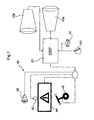
- Figure 1 shows a block diagram of a driving assistance system for helping keep or change the travel lane, according to the invention.
- 10a and 10b are denoted two devices for detecting the environment surrounding the vehicle, i.e. a device for detecting an area in front of the vehicle and a device for detecting an area along the side and behind the vehicle, which are illustrated here in the form of recording devices such as telecameras and the like, but may obviously be realized using other technologies in accordance with the commonly available know-how of the sector, for example as remote radio detection devices, such as radars and the like.
- the detection devices 10a, 10b are linked to a processing and control unit 20, preferably in the form of a digital signal processor, which is supplied, respectively, with front area signals indicating the position of the vehicle with respect to the configuration of the road to be travelled along, and rear/side area signals relating to the presence of vehicles close by.
- a processing and control unit 20 preferably in the form of a digital signal processor, which is supplied, respectively, with front area signals indicating the position of the vehicle with respect to the configuration of the road to be travelled along, and rear/side area signals relating to the presence of vehicles close by.
- the device 10a for detecting an area in front of the vehicle is adapted to provide signals indicating the position of the vehicle with respect to demarcation lines of a lane travelled along by the vehicle, or more generally with respect to the layout and division of the road
- the device 10b for detecting a side and rear area of the vehicle is adapted to provide signals indicating the presence, position and/or speed of other vehicles approaching from behind or coming up alongside the vehicle, for example when overtaking.
- the processing unit 20 is adapted to acquire from the signals supplied by the devices 10a, 10b information relating to the driving scenario of the vehicle and assess the driving conditions on the basis of this information so as to operate on-board signalling devices arranged to inform the driver as to the current driving condition.
- sensor means indicating an activated condition of the directional indicator devices of the vehicle.
- Numeral 40 denotes as a whole the devices for signalling the driving conditions to the driver, i.e. visual signalling devices such as a light-emitting diode (LED) or similar light-emitting source 42 and a display screen 44 for displaying pictograms or showing short messages; an acoustic signalling device 46; and tactile signalling devices 48, such as actuating means for producing a vibration on the steering wheel or electrically operated steering actuating means, the operating principle of which will be described more fully below.
- visual signalling devices such as a light-emitting diode (LED) or similar light-emitting source 42 and a display screen 44 for displaying pictograms or showing short messages
- an acoustic signalling device 46 such as actuating means for producing a vibration on the steering wheel or electrically operated steering actuating means, the operating principle of which will be described more fully below.
- These signalling devices are adapted to assume a first state indicating an incorrect driving manoeuvre, for signalling to the driver an anomalous driving condition for which a manoeuvre or actuation of a vehicle driving system is required, a second state providing a danger warning, for signalling to the driver an alert condition, and a third state indicating a correct or safe driving condition.
- 50 denotes a switching device for activating/deactivating the system.
- the device 10a for detecting an area in front of the vehicle (not shown) is arranged on a front surface of the vehicle, for example in the vicinity of the windscreen or - in a more forwards position - on the bonnet or on the front bumper, while the device 10b for detecting an area along the side or behind the vehicle is mounted preferably on an upright supporting at least one side rear-view mirror M or in any case on a surface directed towards the rear of the vehicle.
- the LED or similar light-emitting source 42 forms an indicator lamp arranged in the vicinity of at least one rear-view mirror of the vehicle, for example the side rear-view mirror M on the driver's side, within the frame supporting the reflecting part or on the upright supporting the body of the rear-view mirror. It is designed to emit light consisting of at least two different colours and for this purpose is composed of an RGB diode.
- the different colours considered to be most suitable for this purpose are red and green, able to indicate a danger condition or danger-free condition respectively, in a manner similar to that of traffic light signals, which are the same in all countries and can be immediately and intuitively understood by the driver.
- the display screen 44 is preferably arranged within the on-board instrument panel C. It is arranged to display a pictogram or similar stylized symbol representing danger, for signalling to the driver an anomalous driving condition, otherwise remaining deactivated or displaying travel parameters and other information.
- the acoustic warning device 46 is arranged on the vehicle dashboard, possibly integrated into the on-board sound distribution system. It is designed to emit a warning tone so as to signal to the driver an anomalous driving condition, otherwise remaining deactivated.
- the tactile signalling devices 48 are provided in the form of actuating devices for producing a vibration on the steering wheel W, incorporated within the structure of the steering wheel itself or within the support for the steering wheel on the steering shaft. More preferably, they are provided as steering actuators associated with an electrically operated steering system so as to control the steering system automatically. In both cases, they help provide a feedback response of the "haptic" type which constitutes the most intuitive driver/vehicle interface device for the steering system, for signalling an anomalous driving condition to the driver, otherwise remaining deactivated.
- the processing and control unit 20 of the system is arranged in the body of the rear-view mirror M or, inside the vehicle, underneath the dashboard, and can be integrated with other on-board electronic control units, for example so as to form a subsystem which is designed to monitor the environment around the vehicle, making use also of signals supplied by other sensors (viewing sensors, proximity sensors, etc.) and able to adopt individual specific measures or a combined strategy on the basis of data fusion techniques.
- the processing and control unit 20 is arranged to assess the current driving condition on the basis of the front area and rear/side area signals.
- a control strategy of the Lane Departure Warning (LDW) type is performed, namely the system assumes the mode whereby it alerts the driver as to an anomalous driving condition, namely one which is potentially dangerous, when it recognizes a deviation of the vehicle from the demarcation lines of the road lane along which it is travelling and no activation of the directional indicators is detected, so that the system interprets any manoeuvre out of the lane travelled along as involuntary.
- LDW Lane Departure Warning
- a control strategy of the Lane Change Support (LCS) type is performed, namely the system assumes the mode whereby it assists the driver during a lane changing manoeuvre, for example in order to perform overtaking, and alerts him/her as to an anomalous driving condition, namely one which is potentially dangerous.
- LCS Lane Change Support
- the systems prepares itself for monitoring the side and rear area of the vehicle so as to provide the driver with a complete and up-to-date picture of the environment around the vehicle. It monitors, in particular, the side area which corresponds to the so-called "blind spot", which the driver cannot monitor via the rear-view mirrors, and the rear area which the driver might not be able to see clearly in poor visibility conditions.
- the system during operation as a Lane Change Support system also assesses the possibility of performing a lane changing manoeuvre depending on the approach speed of the other vehicles concerned, so that it warns the driver that he/she is about to perform a dangerous manoeuvre in relation to the existing traffic conditions, even when the vehicles are visible in the rear-view mirrors, helping the driver to assess the real distance and approach speed of other vehicles, which are often difficult to determine by means of the rear-view mirrors.
- a device for detecting an area in front of the vehicle so as to control not only the lane demarcation lines, but also the side lane in front for further safety during overtaking, in order to avoid frontal impacts with vehicles approaching, but not noticed, for example because of reduced visibility conditions.
- control and processing unit is arranged to assess a driving condition on the basis of the combination of the front area signals and rear/side area signals, namely assess overall a driving condition on the basis of the rear/side area signals after carrying out a first evaluation on the basis of the front area signals, so as to provide constantly information to the driver on the environment surrounding the vehicle, in order to avoid incorrect or dangerous manoeuvres.
- the pictures recorded by the front detection device 10a are supplied to the processing unit 20 which interprets them using algorithms which are known in travel lane tracking systems (step 100).
- the processing unit checks whether this crossing manoeuvre is intentional (step 110) on the basis of the signals supplied by the sensors 30 indicating an activated condition of the directional indicator devices of the vehicle.
- the processing unit activates the tactile signalling devices 48, signalling to the driver the danger condition by means of vibration of the steering wheel or causing application of a resistive torque to the steering wheel (step 120) so as to provide the steering wheel with a feedback of the "haptic" type, which produces a sensation of resistance to crossing of the lane demarcation lines and "suggests" the appropriate steering action to be undertaken so as to bring back or keep the vehicle within the said lane.
- step 130 the processing unit acquires and interprets the pictures taken by the side/rear detection device 10b using known algorithms (step 130), in order to check whether other vehicles are approaching from behind or are coming up alongside the vehicle occupying the lane which the driver intends occupying.
- the unit 20 activates the on-board signalling devices in a first activated state, so as to warn the driver about the dangerous nature of the manoeuvre. Specifically, it causes the LED 42 to emit a red light (132), activates the acoustic warning device (134) and causes display of a warning signal on the display (136) in an alternate, simultaneous or sequential manner.
- the unit 20 causes generation of a vibration on the steering wheel or acts on the steering system by applying an opposing torque (as in step 120) so as to provide a feedback of the "haptic" type on the steering wheel, intended to ensure intuitive correction of the travel path.
- the unit 20 does not activate the on-board signalling devices, in particular the LED 42 remains in its rest state, which is distinguished for example by the emission of a green light, and it prepares itself for interpreting the new pictures taken by the front detection device 10a (step 100) as described above.
- the unit 20 recognizes that the vehicle remains within its delimited travel lane, therefore recognizing correct driving conditions, it also examines the side/rear area of the vehicle, acquiring and interpreting the pictures taken by the side/rear detection device 10b (step 150), in order to check in any case whether other vehicles are approaching from behind or situated alongside the vehicle, occupying the lane adjacent to the lane travelled along, so as to inform the driver of the environment surrounding the vehicle as a whole.
- the unit 20 activates the on-board signalling devices in a second activated state, namely causes the LEDs 42 to emit a red light (152) and causes the display of a warning signal on the display (154), so as to warn the driver as to the dangerous nature of any overtaking manoeuvre performed. If the side/rear area is considered to be free, the unit 20 causes the LED 42 to remain in its rest state (156) distinguished for example by the emission of a green light, and prepares itself for interpreting the new pictures taken by the front detection device 10a (step 100) as described above.
- the processing unit in the case where an anomalous driving condition persists, it is even possible for the processing unit to operate autonomously the steering system of the vehicle, in fact taking the place of the driver in order to perform the appropriate vehicle managing operations, after a predetermined time interval allowing for a voluntary reaction on the part of the driver has lapsed.
Landscapes
- Engineering & Computer Science (AREA)
- Mechanical Engineering (AREA)
- Chemical & Material Sciences (AREA)
- Combustion & Propulsion (AREA)
- Transportation (AREA)
- Human Computer Interaction (AREA)
- Traffic Control Systems (AREA)
Abstract
- assessing the current driving condition on the basis of the vehicle position signals; and subsequently
- operating on-board signalling devices (40) so as to assume a first activated state indicating an incorrect driving manoeuvre, when a manoeuvre involving a change in the travel lane is in progress and the directional indicator devices have not been activated; or alternatively
- assessing the current driving condition on the basis of the vehicle presence signals, and subsequently
if a manoeuvre involving a change in the travel lane is in progress, operating the on-board signalling means (40) so as to assume a first activated state indicating an incorrect driving manoeuvre, when the directional indicator devices are activated and other vehicles are approaching; or
if the travel lane is maintained, operating the on-board signalling devices (40) so as to assume a second activated state providing a danger warning, when other vehicles are approaching.
Description
- The present invention relates to vehicle driving assistance systems and more specifically to a driving assistance system and method for the "lateral" movements performed by the vehicle, in particular for helping stay in or change travel lanes, in accordance with the preamble of Claim 1 and Claim 18, respectively.
- During recent years, the progress achieved in the sector of passive safety and the equipping of vehicles with active safety systems have helped achieve a notable improvement in road safety.
- In order to reduce further the danger situations and achieve a greater driving comfort, driving assistance systems which are able to assist the driver whilst performing manoeuvres and in every critical driving situation which may occur on the roads, preventing any risk situations, are being developed.
- The preventive safety functions managed by these systems include lateral control of the vehicle, which envisages controlling the vehicle so as to avoid any movement out of the travel lane or, in the case where the driver wishes to "deviate" from the abovementioned travel lane, assisting said operation by checking for the presence of any vehicles approaching from behind in the lane to be moved into.
- These systems are arranged to inform the driver about the need to adapt his/her travel trajectory using different information systems, such as visual instructions, acoustic signals and tactile or "haptic" signals.
- For example, in connection with a system aimed at keeping the vehicle in the travel lane (known as "Lane Departure Warning") it is envisaged to signal crossing of the travel lane demarcation lines which has occurred or is about to happen if said crossing manoeuvre is not intentional or if the lane change has not been indicated in advance by operation of the appropriate directional indicator, by acoustic means or by providing the driver with a tactile sensation (haptic feedback) in the form of vibration of the steering wheel or a torque applied to the steering wheel which produces a sensation of resistance to crossing the lane demarcation lines and "suggests" the appropriate steering action to be performed in order to bring back or keep the vehicle within the said lane.
- In connection with a system for providing help during the travel lane changing manoeuvre, for example assistance during overtaking, sensors are envisaged for monitoring the side and rear area of the vehicle ("Blind Spot Monitoring") in order to detect other vehicles approaching in the lane to be occupied and reduce the risks of collisions. Signalling in this case is typically performed by visual interfaces, such as LEDs which are positioned on the rear-view mirrors, and/or acoustic signals, but equally possible are haptic feedbacks on the steering wheel, such as vibration signals or the generation of a resistive torque which opposes a dangerous manoeuvre, in a manner similar to that which occurs in a Lane Departure Warning system.
- Both systems have been developed over the years, independently of each other, resulting in fact in the production of separate systems which duplicate structures and which do not complement each other advantageously (for example, a Blind Spot Monitoring system does not necessarily indicate the presence of vehicles in the blind zone if the vehicle on which it is installed, in the event of no directional indicator being activated, does not deviate laterally (a situation controlled by the Lane Departure Warning system)).
- The object of the present invention is to provide a driving assistance system and method with an incorporated lateral support function, which also allows a high performance to be achieved in terms of driving efficiency and safety, while maintaining an interface for communication with the driver which can be easily understood, logical and natural.
- According to the present invention this object is achieved by means of a driving assistance system having the characteristic features indicated in Claim 1 and an associated method having the characteristic features indicated in Claim 18.
- Particular embodiments of the invention form the subject of the dependent claims.
- In brief, the present invention is based on the principle of incorporating in a single lateral support system for assistance with driving a system for helping keep the travel lane and a system for helping change the travel lane, switching in succession between the different functions depending on recognition of the travel condition and activation of the directional indicator devices.
- In particular, the system is arranged to assess the current driving condition on the basis of signals indicating the position of the vehicle with respect to the configuration of the road travelled along and subsequently on the basis of signals indicating the presence of vehicles close by.
- Specifically, the signals indicating the position of the vehicle with respect to the configuration of the road travelled along are signals relating to the area in front of the vehicle, and the signals indicating the presence of vehicles close by are signals relating to at least an area behind or along the side of the vehicle.
- The system is arranged to assess the driving conditions on the basis of the rear/side area signals immediately after conducting a first evaluation on the basis of the front area signals, if a deviation of the vehicle with respect to the demarcation lines of the road lane which it is travelling along is not recognized.
- In the event of a deviation of the vehicle being recognized, the system is arranged to check activation of the directional indicator devices. If this is the case, the system interprets the manoeuvre out of the lane travelled along as being voluntary and gets ready to assist the manoeuvre on the basis of rear/side area signals, alerting the driver as to an incorrect driving manoeuvre if it recognizes hazardous driving conditions. In the negative, the system interprets the manoeuvre as being involuntary and gets ready to alert the driver in any case as to an anomalous driving condition.
- Signalling of the current driving condition, and in particular of an incorrect driving manoeuvre, is performed by means of visual, acoustic or tactile ("haptic") signalling devices and preferably by means of a combination of these devices.
- In the currently preferred embodiment, the signalling devices comprise at least one LED and/or a display screen for displaying pictograms or for showing short messages, an acoustic warning device and actuating means for producing a vibration on the steering wheel or actuating means adapted to apply a resistive torque to the vehicle steering system.
- Further characteristic features and advantages of the invention will be described more fully in the following detailed description, provided by way of a non-limiting example, with reference to the accompanying drawings in which:
- Figure 1 is a block diagram of a driving assistance system according to the invention;
- Figure 2 is a simplified schematic illustration of an on-board arrangement of the main components of the driving assistance system according to Figure 1; and
- Figure 3 is a flow diagram representing operation of the driving assistance system according to the invention.
- Figure 1 shows a block diagram of a driving assistance system for helping keep or change the travel lane, according to the invention.
- With 10a and 10b are denoted two devices for detecting the environment surrounding the vehicle, i.e. a device for detecting an area in front of the vehicle and a device for detecting an area along the side and behind the vehicle, which are illustrated here in the form of recording devices such as telecameras and the like, but may obviously be realized using other technologies in accordance with the commonly available know-how of the sector, for example as remote radio detection devices, such as radars and the like.
- The
detection devices control unit 20, preferably in the form of a digital signal processor, which is supplied, respectively, with front area signals indicating the position of the vehicle with respect to the configuration of the road to be travelled along, and rear/side area signals relating to the presence of vehicles close by. - In particular, the
device 10a for detecting an area in front of the vehicle is adapted to provide signals indicating the position of the vehicle with respect to demarcation lines of a lane travelled along by the vehicle, or more generally with respect to the layout and division of the road, and thedevice 10b for detecting a side and rear area of the vehicle is adapted to provide signals indicating the presence, position and/or speed of other vehicles approaching from behind or coming up alongside the vehicle, for example when overtaking. - The
processing unit 20 is adapted to acquire from the signals supplied by thedevices - With 30 are denoted sensor means indicating an activated condition of the directional indicator devices of the vehicle.
- Numeral 40 denotes as a whole the devices for signalling the driving conditions to the driver, i.e. visual signalling devices such as a light-emitting diode (LED) or similar light-
emitting source 42 and adisplay screen 44 for displaying pictograms or showing short messages; anacoustic signalling device 46; andtactile signalling devices 48, such as actuating means for producing a vibration on the steering wheel or electrically operated steering actuating means, the operating principle of which will be described more fully below. - These signalling devices are adapted to assume a first state indicating an incorrect driving manoeuvre, for signalling to the driver an anomalous driving condition for which a manoeuvre or actuation of a vehicle driving system is required, a second state providing a danger warning, for signalling to the driver an alert condition, and a third state indicating a correct or safe driving condition.
- Finally, 50 denotes a switching device for activating/deactivating the system.
- With reference to Figure 2, a preferable on-board arrangement of the devices mentioned is suggested.
- The
device 10a for detecting an area in front of the vehicle (not shown) is arranged on a front surface of the vehicle, for example in the vicinity of the windscreen or - in a more forwards position - on the bonnet or on the front bumper, while thedevice 10b for detecting an area along the side or behind the vehicle is mounted preferably on an upright supporting at least one side rear-view mirror M or in any case on a surface directed towards the rear of the vehicle. - Among the signalling devices, the LED or similar light-emitting
source 42 forms an indicator lamp arranged in the vicinity of at least one rear-view mirror of the vehicle, for example the side rear-view mirror M on the driver's side, within the frame supporting the reflecting part or on the upright supporting the body of the rear-view mirror. It is designed to emit light consisting of at least two different colours and for this purpose is composed of an RGB diode. Preferably, the different colours considered to be most suitable for this purpose are red and green, able to indicate a danger condition or danger-free condition respectively, in a manner similar to that of traffic light signals, which are the same in all countries and can be immediately and intuitively understood by the driver. - The
display screen 44 is preferably arranged within the on-board instrument panel C. It is arranged to display a pictogram or similar stylized symbol representing danger, for signalling to the driver an anomalous driving condition, otherwise remaining deactivated or displaying travel parameters and other information. - The
acoustic warning device 46 is arranged on the vehicle dashboard, possibly integrated into the on-board sound distribution system. It is designed to emit a warning tone so as to signal to the driver an anomalous driving condition, otherwise remaining deactivated. - The
tactile signalling devices 48 are provided in the form of actuating devices for producing a vibration on the steering wheel W, incorporated within the structure of the steering wheel itself or within the support for the steering wheel on the steering shaft. More preferably, they are provided as steering actuators associated with an electrically operated steering system so as to control the steering system automatically. In both cases, they help provide a feedback response of the "haptic" type which constitutes the most intuitive driver/vehicle interface device for the steering system, for signalling an anomalous driving condition to the driver, otherwise remaining deactivated. - The processing and
control unit 20 of the system is arranged in the body of the rear-view mirror M or, inside the vehicle, underneath the dashboard, and can be integrated with other on-board electronic control units, for example so as to form a subsystem which is designed to monitor the environment around the vehicle, making use also of signals supplied by other sensors (viewing sensors, proximity sensors, etc.) and able to adopt individual specific measures or a combined strategy on the basis of data fusion techniques. - Essentially, the processing and
control unit 20 is arranged to assess the current driving condition on the basis of the front area and rear/side area signals. - Firstly, a control strategy of the Lane Departure Warning (LDW) type is performed, namely the system assumes the mode whereby it alerts the driver as to an anomalous driving condition, namely one which is potentially dangerous, when it recognizes a deviation of the vehicle from the demarcation lines of the road lane along which it is travelling and no activation of the directional indicators is detected, so that the system interprets any manoeuvre out of the lane travelled along as involuntary.
- Secondly, a control strategy of the Lane Change Support (LCS) type is performed, namely the system assumes the mode whereby it assists the driver during a lane changing manoeuvre, for example in order to perform overtaking, and alerts him/her as to an anomalous driving condition, namely one which is potentially dangerous. This occurs in the case where no deviation of the vehicle from the demarcation lines of the lane travelled along is noted, in order to assist the driver with the decision to perform an overtaking manoeuvre, or in the case of deviation of the vehicle indicated by means of the directional indicators, and hence a voluntary manoeuvre, in order to assist the driver with preparation of the overtaking manoeuvre. The systems prepares itself for monitoring the side and rear area of the vehicle so as to provide the driver with a complete and up-to-date picture of the environment around the vehicle. It monitors, in particular, the side area which corresponds to the so-called "blind spot", which the driver cannot monitor via the rear-view mirrors, and the rear area which the driver might not be able to see clearly in poor visibility conditions.
- Moreover, it must be emphasized that, in the case of detection devices adapted to provide signals indicating the speed of the vehicles approaching from behind, the system during operation as a Lane Change Support system also assesses the possibility of performing a lane changing manoeuvre depending on the approach speed of the other vehicles concerned, so that it warns the driver that he/she is about to perform a dangerous manoeuvre in relation to the existing traffic conditions, even when the vehicles are visible in the rear-view mirrors, helping the driver to assess the real distance and approach speed of other vehicles, which are often difficult to determine by means of the rear-view mirrors.
- In an improved embodiment, it is possible to envisage the use of a device for detecting an area in front of the vehicle so as to control not only the lane demarcation lines, but also the side lane in front for further safety during overtaking, in order to avoid frontal impacts with vehicles approaching, but not noticed, for example because of reduced visibility conditions.
- In summary, the control and processing unit is arranged to assess a driving condition on the basis of the combination of the front area signals and rear/side area signals, namely assess overall a driving condition on the basis of the rear/side area signals after carrying out a first evaluation on the basis of the front area signals, so as to provide constantly information to the driver on the environment surrounding the vehicle, in order to avoid incorrect or dangerous manoeuvres.
- With reference to Figure 3, the operation of the driving assistance system according to Figure 1 is described below.
- The pictures recorded by the
front detection device 10a are supplied to theprocessing unit 20 which interprets them using algorithms which are known in travel lane tracking systems (step 100). - When crossing of the lane demarcation lines occurs, or is expected to occur, the processing unit checks whether this crossing manoeuvre is intentional (step 110) on the basis of the signals supplied by the
sensors 30 indicating an activated condition of the directional indicator devices of the vehicle. - If crossing of the travel lane demarcation lines is not indicated in advance by operation of the associated directional indicator, this is interpreted as an anomalous driving condition, and the processing unit activates the
tactile signalling devices 48, signalling to the driver the danger condition by means of vibration of the steering wheel or causing application of a resistive torque to the steering wheel (step 120) so as to provide the steering wheel with a feedback of the "haptic" type, which produces a sensation of resistance to crossing of the lane demarcation lines and "suggests" the appropriate steering action to be undertaken so as to bring back or keep the vehicle within the said lane. - If crossing of the lane demarcation lines is preceded by operation of the associated directional indicator, this is interpreted as being a voluntary manoeuvre on the part of the driver, and the processing unit acquires and interprets the pictures taken by the side/
rear detection device 10b using known algorithms (step 130), in order to check whether other vehicles are approaching from behind or are coming up alongside the vehicle occupying the lane which the driver intends occupying. - If this is so, namely if the side/rear area is not considered to be free, the
unit 20 activates the on-board signalling devices in a first activated state, so as to warn the driver about the dangerous nature of the manoeuvre. Specifically, it causes theLED 42 to emit a red light (132), activates the acoustic warning device (134) and causes display of a warning signal on the display (136) in an alternate, simultaneous or sequential manner. Separately, theunit 20 causes generation of a vibration on the steering wheel or acts on the steering system by applying an opposing torque (as in step 120) so as to provide a feedback of the "haptic" type on the steering wheel, intended to ensure intuitive correction of the travel path. - If the negative, namely if the side/rear area is considered to be free, the
unit 20 does not activate the on-board signalling devices, in particular theLED 42 remains in its rest state, which is distinguished for example by the emission of a green light, and it prepares itself for interpreting the new pictures taken by thefront detection device 10a (step 100) as described above. - In the case where, following interpretation of the signals supplied by the
front detection device 10a to thestep 100, theunit 20 recognizes that the vehicle remains within its delimited travel lane, therefore recognizing correct driving conditions, it also examines the side/rear area of the vehicle, acquiring and interpreting the pictures taken by the side/rear detection device 10b (step 150), in order to check in any case whether other vehicles are approaching from behind or situated alongside the vehicle, occupying the lane adjacent to the lane travelled along, so as to inform the driver of the environment surrounding the vehicle as a whole. - If the side/rear area is not considered to be free, the
unit 20 activates the on-board signalling devices in a second activated state, namely causes theLEDs 42 to emit a red light (152) and causes the display of a warning signal on the display (154), so as to warn the driver as to the dangerous nature of any overtaking manoeuvre performed. If the side/rear area is considered to be free, theunit 20 causes theLED 42 to remain in its rest state (156) distinguished for example by the emission of a green light, and prepares itself for interpreting the new pictures taken by thefront detection device 10a (step 100) as described above. - In an improved embodiment, in the case where an anomalous driving condition persists, it is even possible for the processing unit to operate autonomously the steering system of the vehicle, in fact taking the place of the driver in order to perform the appropriate vehicle managing operations, after a predetermined time interval allowing for a voluntary reaction on the part of the driver has lapsed.
- Obviously, without modifying the principle of the invention, the embodiments and constructional details may be greatly varied with respect to that described and illustrated purely by way of a non-limiting example, without thereby departing from the scope of protection of the present invention defined by the accompanying claims.
Claims (30)
- Vehicle driving assistance system for helping keep or change the travel lane, the vehicle being equipped with directional indicator devices which can be selectively operated by the driver in order to signal a change in the direction of travel of the vehicle and with signalling means (40) adapted to inform the driver as to the current driving condition, characterized in that it comprises in combination:- means (10a, 10b) for detecting the environment surrounding the vehicle, including:- first detection means (10a) adapted to provide signals indicating the position of the vehicle with respect to the configuration of the road travelled along; and- second detection means (10b) adapted to provide signals indicating the presence of vehicles close by;- sensor means (30) indicating an activated condition of the directional indicator devices; and- electronic processing and control means (20) connected to said sensor means (30) and to said detection means (10a, 10b) for acquiring information relating to the driving scenario of the vehicle, and adapted to operate said signalling means (40) depending on said scenario information,
wherein said processing and control means (20) are arranged for:- assessing the current driving condition on the basis of said vehicle position signals; and subsequently- operating said signalling means (40) so as to assume a first activated state indicating an incorrect driving manoeuvre, for signalling to the driver an anomalous driving condition so that a manoeuvre or actuation of a vehicle driving system is required, when said vehicle position signals indicate a manoeuvre involving a change in the travel lane and said sensor means (30) sense that said directional indicator devices have not been activated;or else alternatively- assessing the current driving condition on the basis of said vehicle presence signals. - System according to Claim 1, in which said processing and control means (20) are arranged for:- assessing the current driving condition on the basis of the vehicle presence signals; and subsequentlyif the vehicle position signals indicate a manoeuvre involving a change in the travel lane:- operating said signalling means (40) so as to assume a first activated state indicating an incorrect driving manoeuvre, for signalling to the driver an anomalous driving condition so that a manoeuvre or actuation of a vehicle driving system is required, when said sensor means (30) detect that said directional indicator devices are activated and said vehicle presence signals indicate the presence of approaching vehicles;or, if the vehicle position signals indicate a condition where the same travel lane is maintained:- operating said signalling means (40) so as to assume a second activated state providing a danger warning, for signalling to the driver an alert condition, when said vehicle presence signals indicate the presence of approaching vehicles.
- System according to Claim 1 or 2, in which said means (10a, 10b) for detecting the environment surrounding the vehicle include:- first means (10a) for detecting an area in front of the vehicle, adapted to provide front area signals indicating the position of the vehicle with respect to the configuration of the road travelled along; and- second means (10b) for detecting at least one area along the side and behind the vehicle, adapted to provide rear/side area signals indicating the presence of vehicles close by.
- System according to any one of the preceding claims, in which said first detection means (10a) are adapted to provide signals indicating the position of the vehicle with respect to demarcation lines of a travel lane.
- System according to any one of the preceding claims, in which said signals relating to the presence of vehicles close by comprise signals indicating the relative position of these vehicles.
- System according to Claim 5, in which said signals relating to the presence of vehicles close by comprise signals indicating the relative speed of these vehicles.
- System according to any one of the preceding claims, in which the processing and control means (20) are arranged for assessing the driving condition on the basis of the vehicle presence signals after performing a first evaluation on the basis of the vehicle position signals.
- System according to any one of the preceding claims, in which said signalling means (40) are adapted to assume/maintain a rest state indicating a correct or safety driving condition, respectively:when the vehicle position signals indicate a manoeuvre involving a change of travel lane for which said directional indicator devices are activated, and said vehicle presence signals indicate the absence of approaching vehicles; andwhen the vehicle position signals indicate a condition where the same travel lane is maintained, and said vehicle presence signals indicate the absence of approaching vehicles.
- System according to any one of the preceding claims, in which said signalling means comprise visual signalling devices (42, 44) which can be operated so as to assume a first activated state indicating an incorrect driving manoeuvre and/or a second activated state providing a danger warning.
- System according to Claim 9, in which said visual signalling devices comprise at least one light-emitting diode (42) adapted to assume a first red colour emitting state and a second green colour emitting state.
- System according to Claim 10, in which said signalling device is arranged in the vicinity of at least one rear-view mirror (M) of the vehicle.
- System according to Claim 9, in which said visual signalling devices comprise at least one display screen (44) for displaying pictograms or for showing short messages.
- System according to Claim 12, in which said signalling device (44) is arranged within the on-board instrument panel (C).
- System according to any one of the preceding claims, in which said signalling means comprise an acoustic warning device (46) which can be operated in a first activated state indicating an incorrect driving manoeuvre.
- System according to any one of the preceding claims, in which said signalling means comprise tactile signalling devices (48).
- System according to Claim 15, in which said tactile signalling devices (48) comprise actuating means for producing a vibration on the steering wheel, which can be operated in a condition where there is an incorrect driving manoeuvre.
- System according to Claim 15, in which said tactile signalling devices (48) comprise steering actuating means which can be electrically operated, the processing means being adapted to cause said actuating means to impart a resistive torque of predetermined value to the vehicle steering system during an incorrect driving manoeuvre.
- Vehicle driving assistance method for helping keep or change the travel lane, the vehicle being equipped with directional indicator devices which can be selectively operated by the driver in order to signal a change in the direction of travel of the vehicle, and with signalling means (40) adapted to inform the driver about the current driving condition, characterized in that it comprises the operations of:- acquiring information relating to the environment surrounding the vehicle, including:- providing signals indicating the position of the vehicle with respect to the configuration of the road travelled along; and- providing signals indicating the presence of vehicles close by;- detecting the state of the directional indicator devices;- assessing the current driving condition on the basis of said vehicle position signals; and subsequently- operating said signalling means (40) so as to assume a first activated state indicating an incorrect driving manoeuvre, for signalling to the driver an anomalous driving condition so that a manoeuvre or actuation of a vehicle driving system is required, when a manoeuvre involving a change in the travel lane is detected and said directional indicator devices are not activated;or else alternatively- assessing the current driving condition on the basis of said vehicle presence signals.
- Method according to Claim 18, in which, after the operation of assessing the current driving condition on the basis of the vehicle presence signals, the following operations are performed:if a manoeuvre involving a change in the travel lane is detected:- operating said signalling means (40) so as to assume a first activated state indicating an incorrect driving manoeuvre, for signalling to the driver an anomalous driving condition so that a manoeuvre or actuation of a vehicle driving system is required, when said directional indicator devices are activated and the presence of approaching vehicles is detected;or, if a condition where the travel lane is maintained is detected:- operating said signalling means (40) so as to assume a second activated state providing a danger warning, for signalling to the driver an alert condition, when the presence of approaching vehicles is detected.
- Method according to Claim 18 or 19, in which the acquisition of information relating to the environment surrounding the vehicle includes:- detecting an area in front of the vehicle and providing front area signals indicating the position of the vehicle with respect to the configuration of the road travelled along; and- detecting at least one area along the side of and behind the vehicle and providing rear/side area signals indicating the presence of vehicles close by.
- Method according to any one of Claims 18 to 20, in which the operation of providing signals indicating the position of the vehicle with respect to the configuration of the road travelled along includes providing signals indicating the position of the vehicle with respect to demarcation lines of a travel lane.
- Method according to any one of Claims 18 to 21, in which the operation of providing signals indicating the presence of vehicles close by includes providing signals indicating the relative position of these vehicles.
- Method according to Claim 22, in which the operation of providing signals indicating the presence of vehicles close by includes providing signals indicating the relative speed of these vehicles.
- Method according to any one of Claims 18 to 23, comprising the further operation of assessing the driving condition on the basis of the vehicle presence signals after performing a first assessment on the basis of the vehicle position signals.
- Method according to any one of Claims 18 to 24, comprising moreover the operation of causing said signalling means to assume/maintain a rest state indicating a correct or safety driving condition, respectively:when a manoeuvre involving a change of travel lane is detected for which said directional indicator devices are activated, and the absence of approaching vehicles is detected; andwhen a condition where the same travel lane is maintained is detected, and the absence of approaching vehicles is detected.
- Method according to any one of Claims 18 to 25, in which operating said signalling means (40) includes driving at least one light-emitting diode (42) in a first activated state indicating an incorrect driving manoeuvre and/or in a second activated state providing a danger warning.
- Method according to any one of Claims 18 to 26, in which operating said signalling means (40) includes driving a display screen (44) so as to display pictograms or show short messages.
- Method according to any one of Claims 18 to 27, in which operating said signalling means (40) includes activating an acoustic warning device (46) in a first activated state indicating an incorrect driving manoeuvre.
- Method according to any one of Claims 18 to 28, in which operating said signalling means (40) includes producing a vibration on the steering wheel during a condition where there is an incorrect driving manoeuvre.
- Method according to any one of Claims 18 to 29, in which operating said signalling means (40) includes applying a resistive torque of predetermined value to a vehicle steering system during a condition where there is an incorrect driving manoeuvre.
Priority Applications (1)
| Application Number | Priority Date | Filing Date | Title |
|---|---|---|---|
| EP06425747.0A EP1918896B1 (en) | 2006-10-30 | 2006-10-30 | Improved vehicle driving assistance system for keeping/changing lanes and associated operating method |
Applications Claiming Priority (1)
| Application Number | Priority Date | Filing Date | Title |
|---|---|---|---|
| EP06425747.0A EP1918896B1 (en) | 2006-10-30 | 2006-10-30 | Improved vehicle driving assistance system for keeping/changing lanes and associated operating method |
Publications (2)
| Publication Number | Publication Date |
|---|---|
| EP1918896A1 true EP1918896A1 (en) | 2008-05-07 |
| EP1918896B1 EP1918896B1 (en) | 2018-10-17 |
Family
ID=37836905
Family Applications (1)
| Application Number | Title | Priority Date | Filing Date |
|---|---|---|---|
| EP06425747.0A Active EP1918896B1 (en) | 2006-10-30 | 2006-10-30 | Improved vehicle driving assistance system for keeping/changing lanes and associated operating method |
Country Status (1)
| Country | Link |
|---|---|
| EP (1) | EP1918896B1 (en) |
Cited By (5)
| Publication number | Priority date | Publication date | Assignee | Title |
|---|---|---|---|---|
| US9919740B2 (en) | 2016-02-05 | 2018-03-20 | Ford Global Technologies, Llc | Situational deactivation of lane keep assist system |
| CN111137286A (en) * | 2018-10-16 | 2020-05-12 | 安波福技术有限公司 | Vehicle lane departure system and method |
| CN116142186A (en) * | 2023-01-09 | 2023-05-23 | 中南民族大学 | Vehicle safety driving warning method, device, medium and equipment in adverse environment |
| EP4197838A1 (en) | 2021-12-20 | 2023-06-21 | Toyota Jidosha Kabushiki Kaisha | Method and system for assisting a driver of a road vehicle |
| CN118298694A (en) * | 2024-04-03 | 2024-07-05 | 浙江大学 | A blind driving system based on multimodal feedback in the metaverse scenario |
Citations (5)
| Publication number | Priority date | Publication date | Assignee | Title |
|---|---|---|---|---|
| WO2001045067A1 (en) * | 1999-12-15 | 2001-06-21 | Sjoenell Goeran | Blind spot detector |
| US20030025597A1 (en) * | 2001-07-31 | 2003-02-06 | Kenneth Schofield | Automotive lane change aid |
| US20040148057A1 (en) * | 2000-05-08 | 2004-07-29 | Breed David S. | Vehicular exterior identification and monitoring system-agricultural product distribution |
| EP1615048A1 (en) | 2004-07-07 | 2006-01-11 | Delphi Technologies, Inc. | Adaptive lighting display for vehicle collision warning |
| US20060206243A1 (en) * | 2002-05-03 | 2006-09-14 | Donnelly Corporation, A Corporation Of The State Michigan | Object detection system for vehicle |
-
2006
- 2006-10-30 EP EP06425747.0A patent/EP1918896B1/en active Active
Patent Citations (5)
| Publication number | Priority date | Publication date | Assignee | Title |
|---|---|---|---|---|
| WO2001045067A1 (en) * | 1999-12-15 | 2001-06-21 | Sjoenell Goeran | Blind spot detector |
| US20040148057A1 (en) * | 2000-05-08 | 2004-07-29 | Breed David S. | Vehicular exterior identification and monitoring system-agricultural product distribution |
| US20030025597A1 (en) * | 2001-07-31 | 2003-02-06 | Kenneth Schofield | Automotive lane change aid |
| US20060206243A1 (en) * | 2002-05-03 | 2006-09-14 | Donnelly Corporation, A Corporation Of The State Michigan | Object detection system for vehicle |
| EP1615048A1 (en) | 2004-07-07 | 2006-01-11 | Delphi Technologies, Inc. | Adaptive lighting display for vehicle collision warning |
Cited By (5)
| Publication number | Priority date | Publication date | Assignee | Title |
|---|---|---|---|---|
| US9919740B2 (en) | 2016-02-05 | 2018-03-20 | Ford Global Technologies, Llc | Situational deactivation of lane keep assist system |
| CN111137286A (en) * | 2018-10-16 | 2020-05-12 | 安波福技术有限公司 | Vehicle lane departure system and method |
| EP4197838A1 (en) | 2021-12-20 | 2023-06-21 | Toyota Jidosha Kabushiki Kaisha | Method and system for assisting a driver of a road vehicle |
| CN116142186A (en) * | 2023-01-09 | 2023-05-23 | 中南民族大学 | Vehicle safety driving warning method, device, medium and equipment in adverse environment |
| CN118298694A (en) * | 2024-04-03 | 2024-07-05 | 浙江大学 | A blind driving system based on multimodal feedback in the metaverse scenario |
Also Published As
| Publication number | Publication date |
|---|---|
| EP1918896B1 (en) | 2018-10-17 |
Similar Documents
| Publication | Publication Date | Title |
|---|---|---|
| US10787177B2 (en) | Exterior rearview device with illumination functions and autonomous vehicles using same | |
| EP2166525B1 (en) | Vehicle surrounding recognition support system | |
| JP5806733B2 (en) | Lane change support information visualization system | |
| US7679495B2 (en) | Displaying unit and method for displaying a steering-wheel angle, to be modified, of a motor vehicle | |
| US6914521B2 (en) | Visual display for vehicle | |
| JP5817843B2 (en) | Vehicle information transmission device | |
| US20100201508A1 (en) | Cross traffic alert system for a vehicle, and related alert display method | |
| US9221384B2 (en) | Method for controlling a display device of a motor vehicle | |
| EP3575175B1 (en) | Method and system for assisting drivers to drive with precaution | |
| US7227454B2 (en) | Display device for an assistance or support system for transport means | |
| CN106536316A (en) | Method for operating a motor vehicle in different driving modes, and motor vehicle | |
| US9262920B2 (en) | Methods and devices for outputting information in a motor vehicle | |
| US20180009373A1 (en) | System for detecting surrounding conditions of moving body | |
| JP3227175U (en) | Vehicle display device | |
| CN206954090U (en) | Driving intention instruction device | |
| JP2007196854A (en) | Driving support device and driving support method | |
| KR20260021712A (en) | Computing device, assistance system and method for a vehicle assistance system for executing automated lane change maneuvers considering a driver's lane change intention | |
| JPH11120498A (en) | Vehicle obstacle warning device | |
| US20070018801A1 (en) | Digital voice/visual warning, alert, and status system for vehicles utilizing laser sensors | |
| EP1918896B1 (en) | Improved vehicle driving assistance system for keeping/changing lanes and associated operating method | |
| CN108944651A (en) | Driving intention instruction device and method | |
| EP4188766A1 (en) | Alert detection system | |
| JP7765727B2 (en) | Vehicle Control System | |
| JP7765728B2 (en) | Vehicle Control System | |
| JP2007001437A (en) | Vehicle rear side obstacle warning system |
Legal Events
| Date | Code | Title | Description |
|---|---|---|---|
| PUAI | Public reference made under article 153(3) epc to a published international application that has entered the european phase |
Free format text: ORIGINAL CODE: 0009012 |
|
| AK | Designated contracting states |
Kind code of ref document: A1 Designated state(s): AT BE BG CH CY CZ DE DK EE ES FI FR GB GR HU IE IS IT LI LT LU LV MC NL PL PT RO SE SI SK TR |
|
| AX | Request for extension of the european patent |
Extension state: AL BA HR MK RS |
|
| 17P | Request for examination filed |
Effective date: 20081106 |
|
| 17Q | First examination report despatched |
Effective date: 20081204 |
|
| AKX | Designation fees paid |
Designated state(s): AT BE BG CH CY CZ DE DK EE ES FI FR GB GR HU IE IS IT LI LT LU LV MC NL PL PT RO SE SI SK TR |
|
| 17Q | First examination report despatched |
Effective date: 20110121 |
|
| GRAP | Despatch of communication of intention to grant a patent |
Free format text: ORIGINAL CODE: EPIDOSNIGR1 |
|
| INTG | Intention to grant announced |
Effective date: 20180419 |
|
| GRAS | Grant fee paid |
Free format text: ORIGINAL CODE: EPIDOSNIGR3 |
|
| RAP1 | Party data changed (applicant data changed or rights of an application transferred) |
Owner name: MAGNETI MARELLI S.P.A. |
|
| GRAA | (expected) grant |
Free format text: ORIGINAL CODE: 0009210 |
|
| AK | Designated contracting states |
Kind code of ref document: B1 Designated state(s): AT BE BG CH CY CZ DE DK EE ES FI FR GB GR HU IE IS IT LI LT LU LV MC NL PL PT RO SE SI SK TR |
|
| REG | Reference to a national code |
Ref country code: GB Ref legal event code: FG4D |
|
| REG | Reference to a national code |
Ref country code: CH Ref legal event code: EP |
|
| REG | Reference to a national code |
Ref country code: IE Ref legal event code: FG4D |
|
| REG | Reference to a national code |
Ref country code: DE Ref legal event code: R096 Ref document number: 602006056593 Country of ref document: DE Ref country code: AT Ref legal event code: REF Ref document number: 1054899 Country of ref document: AT Kind code of ref document: T Effective date: 20181115 |
|
| REG | Reference to a national code |
Ref country code: NL Ref legal event code: MP Effective date: 20181017 |
|
| REG | Reference to a national code |
Ref country code: LT Ref legal event code: MG4D |
|
| REG | Reference to a national code |
Ref country code: AT Ref legal event code: MK05 Ref document number: 1054899 Country of ref document: AT Kind code of ref document: T Effective date: 20181017 |
|
| PG25 | Lapsed in a contracting state [announced via postgrant information from national office to epo] |
Ref country code: NL Free format text: LAPSE BECAUSE OF FAILURE TO SUBMIT A TRANSLATION OF THE DESCRIPTION OR TO PAY THE FEE WITHIN THE PRESCRIBED TIME-LIMIT Effective date: 20181017 |
|
| PG25 | Lapsed in a contracting state [announced via postgrant information from national office to epo] |
Ref country code: LT Free format text: LAPSE BECAUSE OF FAILURE TO SUBMIT A TRANSLATION OF THE DESCRIPTION OR TO PAY THE FEE WITHIN THE PRESCRIBED TIME-LIMIT Effective date: 20181017 Ref country code: PL Free format text: LAPSE BECAUSE OF FAILURE TO SUBMIT A TRANSLATION OF THE DESCRIPTION OR TO PAY THE FEE WITHIN THE PRESCRIBED TIME-LIMIT Effective date: 20181017 Ref country code: BG Free format text: LAPSE BECAUSE OF FAILURE TO SUBMIT A TRANSLATION OF THE DESCRIPTION OR TO PAY THE FEE WITHIN THE PRESCRIBED TIME-LIMIT Effective date: 20190117 Ref country code: AT Free format text: LAPSE BECAUSE OF FAILURE TO SUBMIT A TRANSLATION OF THE DESCRIPTION OR TO PAY THE FEE WITHIN THE PRESCRIBED TIME-LIMIT Effective date: 20181017 Ref country code: IS Free format text: LAPSE BECAUSE OF FAILURE TO SUBMIT A TRANSLATION OF THE DESCRIPTION OR TO PAY THE FEE WITHIN THE PRESCRIBED TIME-LIMIT Effective date: 20190217 Ref country code: ES Free format text: LAPSE BECAUSE OF FAILURE TO SUBMIT A TRANSLATION OF THE DESCRIPTION OR TO PAY THE FEE WITHIN THE PRESCRIBED TIME-LIMIT Effective date: 20181017 Ref country code: LV Free format text: LAPSE BECAUSE OF FAILURE TO SUBMIT A TRANSLATION OF THE DESCRIPTION OR TO PAY THE FEE WITHIN THE PRESCRIBED TIME-LIMIT Effective date: 20181017 Ref country code: FI Free format text: LAPSE BECAUSE OF FAILURE TO SUBMIT A TRANSLATION OF THE DESCRIPTION OR TO PAY THE FEE WITHIN THE PRESCRIBED TIME-LIMIT Effective date: 20181017 |
|
| PG25 | Lapsed in a contracting state [announced via postgrant information from national office to epo] |
Ref country code: SE Free format text: LAPSE BECAUSE OF FAILURE TO SUBMIT A TRANSLATION OF THE DESCRIPTION OR TO PAY THE FEE WITHIN THE PRESCRIBED TIME-LIMIT Effective date: 20181017 Ref country code: PT Free format text: LAPSE BECAUSE OF FAILURE TO SUBMIT A TRANSLATION OF THE DESCRIPTION OR TO PAY THE FEE WITHIN THE PRESCRIBED TIME-LIMIT Effective date: 20190217 Ref country code: GR Free format text: LAPSE BECAUSE OF FAILURE TO SUBMIT A TRANSLATION OF THE DESCRIPTION OR TO PAY THE FEE WITHIN THE PRESCRIBED TIME-LIMIT Effective date: 20190118 |
|
| REG | Reference to a national code |
Ref country code: CH Ref legal event code: PL |
|
| REG | Reference to a national code |
Ref country code: BE Ref legal event code: MM Effective date: 20181031 |
|
| PG25 | Lapsed in a contracting state [announced via postgrant information from national office to epo] |
Ref country code: LU Free format text: LAPSE BECAUSE OF NON-PAYMENT OF DUE FEES Effective date: 20181030 |
|
| REG | Reference to a national code |
Ref country code: DE Ref legal event code: R097 Ref document number: 602006056593 Country of ref document: DE |
|
| REG | Reference to a national code |
Ref country code: IE Ref legal event code: MM4A |
|
| PG25 | Lapsed in a contracting state [announced via postgrant information from national office to epo] |
Ref country code: DK Free format text: LAPSE BECAUSE OF FAILURE TO SUBMIT A TRANSLATION OF THE DESCRIPTION OR TO PAY THE FEE WITHIN THE PRESCRIBED TIME-LIMIT Effective date: 20181017 Ref country code: CZ Free format text: LAPSE BECAUSE OF FAILURE TO SUBMIT A TRANSLATION OF THE DESCRIPTION OR TO PAY THE FEE WITHIN THE PRESCRIBED TIME-LIMIT Effective date: 20181017 |
|
| PLBE | No opposition filed within time limit |
Free format text: ORIGINAL CODE: 0009261 |
|
| STAA | Information on the status of an ep patent application or granted ep patent |
Free format text: STATUS: NO OPPOSITION FILED WITHIN TIME LIMIT |
|
| PG25 | Lapsed in a contracting state [announced via postgrant information from national office to epo] |
Ref country code: MC Free format text: LAPSE BECAUSE OF FAILURE TO SUBMIT A TRANSLATION OF THE DESCRIPTION OR TO PAY THE FEE WITHIN THE PRESCRIBED TIME-LIMIT Effective date: 20181017 Ref country code: RO Free format text: LAPSE BECAUSE OF FAILURE TO SUBMIT A TRANSLATION OF THE DESCRIPTION OR TO PAY THE FEE WITHIN THE PRESCRIBED TIME-LIMIT Effective date: 20181017 Ref country code: LI Free format text: LAPSE BECAUSE OF NON-PAYMENT OF DUE FEES Effective date: 20181031 Ref country code: CH Free format text: LAPSE BECAUSE OF NON-PAYMENT OF DUE FEES Effective date: 20181031 Ref country code: EE Free format text: LAPSE BECAUSE OF FAILURE TO SUBMIT A TRANSLATION OF THE DESCRIPTION OR TO PAY THE FEE WITHIN THE PRESCRIBED TIME-LIMIT Effective date: 20181017 Ref country code: BE Free format text: LAPSE BECAUSE OF NON-PAYMENT OF DUE FEES Effective date: 20181031 Ref country code: SK Free format text: LAPSE BECAUSE OF FAILURE TO SUBMIT A TRANSLATION OF THE DESCRIPTION OR TO PAY THE FEE WITHIN THE PRESCRIBED TIME-LIMIT Effective date: 20181017 |
|
| 26N | No opposition filed |
Effective date: 20190718 |
|
| GBPC | Gb: european patent ceased through non-payment of renewal fee |
Effective date: 20190117 |
|
| PG25 | Lapsed in a contracting state [announced via postgrant information from national office to epo] |
Ref country code: IE Free format text: LAPSE BECAUSE OF NON-PAYMENT OF DUE FEES Effective date: 20181030 Ref country code: SI Free format text: LAPSE BECAUSE OF FAILURE TO SUBMIT A TRANSLATION OF THE DESCRIPTION OR TO PAY THE FEE WITHIN THE PRESCRIBED TIME-LIMIT Effective date: 20181017 |
|
| PG25 | Lapsed in a contracting state [announced via postgrant information from national office to epo] |
Ref country code: GB Free format text: LAPSE BECAUSE OF NON-PAYMENT OF DUE FEES Effective date: 20190117 |
|
| PG25 | Lapsed in a contracting state [announced via postgrant information from national office to epo] |
Ref country code: TR Free format text: LAPSE BECAUSE OF FAILURE TO SUBMIT A TRANSLATION OF THE DESCRIPTION OR TO PAY THE FEE WITHIN THE PRESCRIBED TIME-LIMIT Effective date: 20181017 |
|
| PG25 | Lapsed in a contracting state [announced via postgrant information from national office to epo] |
Ref country code: CY Free format text: LAPSE BECAUSE OF FAILURE TO SUBMIT A TRANSLATION OF THE DESCRIPTION OR TO PAY THE FEE WITHIN THE PRESCRIBED TIME-LIMIT Effective date: 20181017 Ref country code: HU Free format text: LAPSE BECAUSE OF FAILURE TO SUBMIT A TRANSLATION OF THE DESCRIPTION OR TO PAY THE FEE WITHIN THE PRESCRIBED TIME-LIMIT; INVALID AB INITIO Effective date: 20061030 |
|
| PGFP | Annual fee paid to national office [announced via postgrant information from national office to epo] |
Ref country code: IT Payment date: 20250923 Year of fee payment: 20 |
|
| PGFP | Annual fee paid to national office [announced via postgrant information from national office to epo] |
Ref country code: FR Payment date: 20250923 Year of fee payment: 20 |
|
| PGFP | Annual fee paid to national office [announced via postgrant information from national office to epo] |
Ref country code: DE Payment date: 20250923 Year of fee payment: 20 |