EP1918316A1 - Photo-curable resin composition - Google Patents
Photo-curable resin composition Download PDFInfo
- Publication number
- EP1918316A1 EP1918316A1 EP20070119667 EP07119667A EP1918316A1 EP 1918316 A1 EP1918316 A1 EP 1918316A1 EP 20070119667 EP20070119667 EP 20070119667 EP 07119667 A EP07119667 A EP 07119667A EP 1918316 A1 EP1918316 A1 EP 1918316A1
- Authority
- EP
- European Patent Office
- Prior art keywords
- composition
- post
- cure
- group
- composition according
- Prior art date
- Legal status (The legal status is an assumption and is not a legal conclusion. Google has not performed a legal analysis and makes no representation as to the accuracy of the status listed.)
- Granted
Links
Classifications
-
- C—CHEMISTRY; METALLURGY
- C08—ORGANIC MACROMOLECULAR COMPOUNDS; THEIR PREPARATION OR CHEMICAL WORKING-UP; COMPOSITIONS BASED THEREON
- C08L—COMPOSITIONS OF MACROMOLECULAR COMPOUNDS
- C08L63/00—Compositions of epoxy resins; Compositions of derivatives of epoxy resins
-
- B—PERFORMING OPERATIONS; TRANSPORTING
- B29—WORKING OF PLASTICS; WORKING OF SUBSTANCES IN A PLASTIC STATE IN GENERAL
- B29C—SHAPING OR JOINING OF PLASTICS; SHAPING OF MATERIAL IN A PLASTIC STATE, NOT OTHERWISE PROVIDED FOR; AFTER-TREATMENT OF THE SHAPED PRODUCTS, e.g. REPAIRING
- B29C64/00—Additive manufacturing, i.e. manufacturing of three-dimensional [3D] objects by additive deposition, additive agglomeration or additive layering, e.g. by 3D printing, stereolithography or selective laser sintering
- B29C64/10—Processes of additive manufacturing
- B29C64/106—Processes of additive manufacturing using only liquids or viscous materials, e.g. depositing a continuous bead of viscous material
- B29C64/124—Processes of additive manufacturing using only liquids or viscous materials, e.g. depositing a continuous bead of viscous material using layers of liquid which are selectively solidified
- B29C64/129—Processes of additive manufacturing using only liquids or viscous materials, e.g. depositing a continuous bead of viscous material using layers of liquid which are selectively solidified characterised by the energy source therefor, e.g. by global irradiation combined with a mask
- B29C64/135—Processes of additive manufacturing using only liquids or viscous materials, e.g. depositing a continuous bead of viscous material using layers of liquid which are selectively solidified characterised by the energy source therefor, e.g. by global irradiation combined with a mask the energy source being concentrated, e.g. scanning lasers or focused light sources
-
- B—PERFORMING OPERATIONS; TRANSPORTING
- B33—ADDITIVE MANUFACTURING TECHNOLOGY
- B33Y—ADDITIVE MANUFACTURING, i.e. MANUFACTURING OF THREE-DIMENSIONAL [3D] OBJECTS BY ADDITIVE DEPOSITION, ADDITIVE AGGLOMERATION OR ADDITIVE LAYERING, e.g. BY 3D PRINTING, STEREOLITHOGRAPHY OR SELECTIVE LASER SINTERING
- B33Y70/00—Materials specially adapted for additive manufacturing
-
- C—CHEMISTRY; METALLURGY
- C08—ORGANIC MACROMOLECULAR COMPOUNDS; THEIR PREPARATION OR CHEMICAL WORKING-UP; COMPOSITIONS BASED THEREON
- C08G—MACROMOLECULAR COMPOUNDS OBTAINED OTHERWISE THAN BY REACTIONS ONLY INVOLVING UNSATURATED CARBON-TO-CARBON BONDS
- C08G59/00—Polycondensates containing more than one epoxy group per molecule; Macromolecules obtained by polymerising compounds containing more than one epoxy group per molecule using curing agents or catalysts which react with the epoxy groups
- C08G59/18—Macromolecules obtained by polymerising compounds containing more than one epoxy group per molecule using curing agents or catalysts which react with the epoxy groups ; e.g. general methods of curing
- C08G59/20—Macromolecules obtained by polymerising compounds containing more than one epoxy group per molecule using curing agents or catalysts which react with the epoxy groups ; e.g. general methods of curing characterised by the epoxy compounds used
- C08G59/22—Di-epoxy compounds
-
- C—CHEMISTRY; METALLURGY
- C08—ORGANIC MACROMOLECULAR COMPOUNDS; THEIR PREPARATION OR CHEMICAL WORKING-UP; COMPOSITIONS BASED THEREON
- C08G—MACROMOLECULAR COMPOUNDS OBTAINED OTHERWISE THAN BY REACTIONS ONLY INVOLVING UNSATURATED CARBON-TO-CARBON BONDS
- C08G59/00—Polycondensates containing more than one epoxy group per molecule; Macromolecules obtained by polymerising compounds containing more than one epoxy group per molecule using curing agents or catalysts which react with the epoxy groups
- C08G59/18—Macromolecules obtained by polymerising compounds containing more than one epoxy group per molecule using curing agents or catalysts which react with the epoxy groups ; e.g. general methods of curing
- C08G59/20—Macromolecules obtained by polymerising compounds containing more than one epoxy group per molecule using curing agents or catalysts which react with the epoxy groups ; e.g. general methods of curing characterised by the epoxy compounds used
- C08G59/22—Di-epoxy compounds
- C08G59/24—Di-epoxy compounds carbocyclic
-
- C—CHEMISTRY; METALLURGY
- C08—ORGANIC MACROMOLECULAR COMPOUNDS; THEIR PREPARATION OR CHEMICAL WORKING-UP; COMPOSITIONS BASED THEREON
- C08G—MACROMOLECULAR COMPOUNDS OBTAINED OTHERWISE THAN BY REACTIONS ONLY INVOLVING UNSATURATED CARBON-TO-CARBON BONDS
- C08G65/00—Macromolecular compounds obtained by reactions forming an ether link in the main chain of the macromolecule
- C08G65/02—Macromolecular compounds obtained by reactions forming an ether link in the main chain of the macromolecule from cyclic ethers by opening of the heterocyclic ring
- C08G65/04—Macromolecular compounds obtained by reactions forming an ether link in the main chain of the macromolecule from cyclic ethers by opening of the heterocyclic ring from cyclic ethers only
- C08G65/06—Cyclic ethers having no atoms other than carbon and hydrogen outside the ring
- C08G65/16—Cyclic ethers having four or more ring atoms
- C08G65/18—Oxetanes
-
- C—CHEMISTRY; METALLURGY
- C08—ORGANIC MACROMOLECULAR COMPOUNDS; THEIR PREPARATION OR CHEMICAL WORKING-UP; COMPOSITIONS BASED THEREON
- C08L—COMPOSITIONS OF MACROMOLECULAR COMPOUNDS
- C08L71/00—Compositions of polyethers obtained by reactions forming an ether link in the main chain; Compositions of derivatives of such polymers
- C08L71/02—Polyalkylene oxides
-
- G—PHYSICS
- G03—PHOTOGRAPHY; CINEMATOGRAPHY; ANALOGOUS TECHNIQUES USING WAVES OTHER THAN OPTICAL WAVES; ELECTROGRAPHY; HOLOGRAPHY
- G03F—PHOTOMECHANICAL PRODUCTION OF TEXTURED OR PATTERNED SURFACES, e.g. FOR PRINTING, FOR PROCESSING OF SEMICONDUCTOR DEVICES; MATERIALS THEREFOR; ORIGINALS THEREFOR; APPARATUS SPECIALLY ADAPTED THEREFOR
- G03F7/00—Photomechanical, e.g. photolithographic, production of textured or patterned surfaces, e.g. printing surfaces; Materials therefor, e.g. comprising photoresists; Apparatus specially adapted therefor
- G03F7/0037—Production of three-dimensional images
-
- G—PHYSICS
- G03—PHOTOGRAPHY; CINEMATOGRAPHY; ANALOGOUS TECHNIQUES USING WAVES OTHER THAN OPTICAL WAVES; ELECTROGRAPHY; HOLOGRAPHY
- G03F—PHOTOMECHANICAL PRODUCTION OF TEXTURED OR PATTERNED SURFACES, e.g. FOR PRINTING, FOR PROCESSING OF SEMICONDUCTOR DEVICES; MATERIALS THEREFOR; ORIGINALS THEREFOR; APPARATUS SPECIALLY ADAPTED THEREFOR
- G03F7/00—Photomechanical, e.g. photolithographic, production of textured or patterned surfaces, e.g. printing surfaces; Materials therefor, e.g. comprising photoresists; Apparatus specially adapted therefor
- G03F7/004—Photosensitive materials
- G03F7/038—Macromolecular compounds which are rendered insoluble or differentially wettable
-
- G—PHYSICS
- G03—PHOTOGRAPHY; CINEMATOGRAPHY; ANALOGOUS TECHNIQUES USING WAVES OTHER THAN OPTICAL WAVES; ELECTROGRAPHY; HOLOGRAPHY
- G03F—PHOTOMECHANICAL PRODUCTION OF TEXTURED OR PATTERNED SURFACES, e.g. FOR PRINTING, FOR PROCESSING OF SEMICONDUCTOR DEVICES; MATERIALS THEREFOR; ORIGINALS THEREFOR; APPARATUS SPECIALLY ADAPTED THEREFOR
- G03F7/00—Photomechanical, e.g. photolithographic, production of textured or patterned surfaces, e.g. printing surfaces; Materials therefor, e.g. comprising photoresists; Apparatus specially adapted therefor
- G03F7/004—Photosensitive materials
- G03F7/075—Silicon-containing compounds
- G03F7/0755—Non-macromolecular compounds containing Si-O, Si-C or Si-N bonds
-
- B—PERFORMING OPERATIONS; TRANSPORTING
- B33—ADDITIVE MANUFACTURING TECHNOLOGY
- B33Y—ADDITIVE MANUFACTURING, i.e. MANUFACTURING OF THREE-DIMENSIONAL [3D] OBJECTS BY ADDITIVE DEPOSITION, ADDITIVE AGGLOMERATION OR ADDITIVE LAYERING, e.g. BY 3D PRINTING, STEREOLITHOGRAPHY OR SELECTIVE LASER SINTERING
- B33Y70/00—Materials specially adapted for additive manufacturing
- B33Y70/10—Composites of different types of material, e.g. mixtures of ceramics and polymers or mixtures of metals and biomaterials
-
- G—PHYSICS
- G03—PHOTOGRAPHY; CINEMATOGRAPHY; ANALOGOUS TECHNIQUES USING WAVES OTHER THAN OPTICAL WAVES; ELECTROGRAPHY; HOLOGRAPHY
- G03F—PHOTOMECHANICAL PRODUCTION OF TEXTURED OR PATTERNED SURFACES, e.g. FOR PRINTING, FOR PROCESSING OF SEMICONDUCTOR DEVICES; MATERIALS THEREFOR; ORIGINALS THEREFOR; APPARATUS SPECIALLY ADAPTED THEREFOR
- G03F7/00—Photomechanical, e.g. photolithographic, production of textured or patterned surfaces, e.g. printing surfaces; Materials therefor, e.g. comprising photoresists; Apparatus specially adapted therefor
- G03F7/004—Photosensitive materials
- G03F7/027—Non-macromolecular photopolymerisable compounds having carbon-to-carbon double bonds, e.g. ethylenic compounds
-
- Y—GENERAL TAGGING OF NEW TECHNOLOGICAL DEVELOPMENTS; GENERAL TAGGING OF CROSS-SECTIONAL TECHNOLOGIES SPANNING OVER SEVERAL SECTIONS OF THE IPC; TECHNICAL SUBJECTS COVERED BY FORMER USPC CROSS-REFERENCE ART COLLECTIONS [XRACs] AND DIGESTS
- Y10—TECHNICAL SUBJECTS COVERED BY FORMER USPC
- Y10T—TECHNICAL SUBJECTS COVERED BY FORMER US CLASSIFICATION
- Y10T428/00—Stock material or miscellaneous articles
- Y10T428/24—Structurally defined web or sheet [e.g., overall dimension, etc.]
- Y10T428/24479—Structurally defined web or sheet [e.g., overall dimension, etc.] including variation in thickness
- Y10T428/24612—Composite web or sheet
Definitions
- ionic dye-counter ion compounds examples include anionic dye-iodonium ion complexes, anionic dye-pyryllium ion complexes and, especially, cationic dye-borate anion compounds of the following formula (23) wherein D + is a cationic dye and R 12 , R 13 , R 14 , and R 15 are each independently of the others alkyl, aryl, alkaryl, allyl, aralkyl, alkenyl, alkynyl, an alicyclic or saturated or unsaturated heterocyclic group.
- R 12 , R 13 , R 14 , and R 15 are each independently of the others alkyl, aryl, alkaryl, allyl, aralkyl, alkenyl, alkynyl, an alicyclic or saturated or unsaturated heterocyclic group.
- Preferred definitions for the radicals R 12 to R 15 can be found, for example, in published European patent application EP 223587 , which is herein incorporated
- the present composition comprises, relative to the total weight of the composition, from about 0.1 wt% to about 15 wt% of one or more free radical photoinitiators. In one embodiment, the present composition comprises, relative to the total weight of the composition, from about 1 wt% to about 10 wt% of one or more free radical photoinitiators, relative to the total weight of the composition. In another embodiment, the present composition comprises, relative to the total weight of the composition, from about 2 wt% to about 6 wt% of one or more free radical photoinitiators.
- Preferred initiators include diaryl iodonium salts, triaryl sulfonium salts, or the like.
- Typical photo-polymerization initiators are represented by the following formulae (24) and (25): wherein
- the D p ( ⁇ m) is the slope of the least squares fit line.
- the E10 is the energy necessary to produce a layer that was approximately 10 mils (254 ⁇ m) thick. In general, the lower the E10 number, the faster the photo speed of the composition. Similarly, the energy necessary to produce a layer of 12 mils (305 ⁇ m) or 13 mils (330 ⁇ m) was thus obtained.
- the tensile strength of the cured composition of the invention measured at 40 hours or more after UV post-cure in a post-curing apparatus and thermal post-cure, is from about 50 MPa to about 80 MPa. In another embodiment, the tensile strength of the cured composition of the invention, measured at 40 hours or more after UV post-cure in a post-curing apparatus and thermal post-cure, is from about 60 MPa to about 70 MPa.
Landscapes
- Chemical & Material Sciences (AREA)
- Physics & Mathematics (AREA)
- Chemical Kinetics & Catalysis (AREA)
- Health & Medical Sciences (AREA)
- Organic Chemistry (AREA)
- Polymers & Plastics (AREA)
- Medicinal Chemistry (AREA)
- General Physics & Mathematics (AREA)
- Engineering & Computer Science (AREA)
- Materials Engineering (AREA)
- Spectroscopy & Molecular Physics (AREA)
- Manufacturing & Machinery (AREA)
- Optics & Photonics (AREA)
- Mechanical Engineering (AREA)
- Polyethers (AREA)
- Epoxy Resins (AREA)
Abstract
Description
- The present invention relates to selected stereolithographic resins containing cationically curable and radically curable compounds.
- The production of three-dimensional articles of complex shape by means of stereolithography has been known for a number of years. In this technique the desired shaped article is built up from a radiation-curable composition with the aid of a recurring, alternating sequence of two steps (a) and (b). In step (a), a layer of the radiation-curable composition, one boundary of which is the surface of the composition, is cured with the aid of appropriate imaging radiation, preferably imaging radiation from a computer-controlled scanning laser beam, within a surface region which corresponds to the desired cross-sectional area of the shaped article to be formed, and in step (b) the cured layer is covered with a new layer of the radiation-curable composition, and the sequence of steps (a) and (b) is repeated until a so-called green model of the desired shape is finished. This green model is, in general, not yet fully cured and may therefore be subjected to post-curing, though such post curing is not required.
- Via an equivalent process, photopolymer can be jetted by ink jet or multiple ink jet processes in an imagewise fashion. While jetting the photopolymer or after the photopolymer is applied, actinic exposure can be provided to initiate polymerization. Multiple materials (for example non-reactive waxes, weakly reacting photopolymers, photopolymers of various physical properties, photopolymers with various colors or color formers, etc.) can be jetted or applied to provide supports or alternate cured properties.
- The mechanical strength of the green model (modulus of elasticity, fracture strength), also referred to as green strength, constitutes an important property of the green model and is determined essentially by the nature of the stereolithographic resin composition employed in combination with the type of stereolithography apparatus used and degree of exposure provided during part fabrication. Other important properties of a stereolithographic resin composition include a high sensitivity for the radiation employed in the course of curing and a minimum amount of curl or shrinkage deformation, permitting high shape definition of the green model. In addition, for example, it should be relatively easy to coat a new layer of the stereolithographic resin composition during the process. And of course, not only the green model but also the final cured article should have optimum mechanical properties.
- The developments in this area of technology move towards compositions having better mechanical properties in order to better simulate properties of commodity materials like polypropylene and engineering type polymers. Also there exists a requirement for faster cure and process speeds, so as to decrease the time to build a part. This has resulted in new stereolithography machines having solid state lasers that have a high energy output, very fast laser-scanning and fast recoating processes. The new machines supply UV light with a power around 800 mW and above, compared to 200-300 mW for the older conventional machines. Also the scanning time is reduced by 3 to 4 times. These high powers, high scanning speeds, and short recoating times result in higher temperatures, due to polymerization exotherm of the resins and parts during fabrication. Typical temperatures have risen to values between 50°C and 90°C, which leads to part distortion and excessive color development.
- In order to achieve the desired balance of properties, different types of resin systems have been proposed. For example, radical-curable resin systems have been proposed. These systems generally consist of one or more (meth)acrylate compounds (or other free-radically polymerizable organic compounds) along with a free-radical photoinitiator for radical generation.
- Another type of resin composition suitable for this purpose is a dual cure type system that comprises (i) epoxy resins or other types of cationically polymerizable compounds; (ii) cationic polymerization initiator; (iii) acrylate resins or other types of free-radically polymerizable compounds; and (iv) a free radical polymerization initiator.
- Separately, oxetane compounds have been suggested as components for stereolithographic resins and other radiation-curable resins. They have been suggested as either a cationically polymerizing organic substance or as a reactive modifier component for such resins.
- Several references teach the use of oxetane compounds in radiation curable resin compositions, including the following:
-
U.S. Pat. Nos. 5,434,196 and5,525,645 (Ohkawa et al. ) are directed to resin composition for optical molding which comprises (A) an actinic radiation-curable and cationically polymerizable organic substance and (B) an actinic radiation-sensitive initiator for cationic polymerization. -
U.S. Pat. No. 5,674,922 (Igarashi et al. ) teaches active energy beam-curable compositions which comprise (A) at least one oxetane compound (B) at least one epoxide compound and (C) at least one cationic initiator. -
U.S. Pat. No. 5,981,616 (Yamamura et al. ) teaches photo curable compositions that contain (A) an oxetane compound (B) one or more selected epoxy compounds and (C) a cationic photo-initiator. -
U.S. Pat. No. 6,127,085 (Yamamura et al. ) teaches a photo-curable composition comprising (A) a specific epoxy compound having a cyclohexane oxide; (B) a cationic photo-initiator; (C) a specific ethylenically unsaturated monomer; (D) a radical photo-initiator; and (E) a polyol. -
U.S. Pat. No. 6,136,497 (Melisaris et al. ) teaches a method for producing three-dimensional shaped articles with a radiation-curable composition containing (A) 20-90% by weight of cationically polymerizing compounds; (B) 0.05-12% by weight of cationic initiator; and (C) 0.5-60% by weight of at least selected cationic reactive modifiers. -
U.S. Pat. No. 6,368,769 (Ohkawa et al. ) teaches a stereolithographic resin composition that may include mixtures of the following: (A) cationically polymerizable organic substance that could be a mixture of an epoxy compound and an oxetane compound (3-ethyl-3-hydroxy methyloxetane is mentioned as an oxetane compound); (B) selected cationic photo-initiator; (C) radically polymerizable organic substance such as a polyacrylate; (D) radical photo-initiators; and (E) optional organic compounds having two or more hydroxyl groups per molecule (e.g., polyethers). -
U.S. Pat. No. 6,379,866 (Lawton et al. ) teaches a photosensitive composition comprising (A) 30-70% by weight of a cycloaliphatic diepoxide; (B) 5-35% by weight of an acrylic material selected from aromatic acrylic material or combinations thereof; (C) 10-39% by weight of an aliphatic polycarbonate diol or polytetrahydrofuran polyether polyol; (D) at least one cationic photoinitiator; and (E) at least one free-radical photoinitiator. -
U.S. Pat. No. 6,413,696 (Pang et al. ) teaches liquid, radiation-curable compositions that contain (A) 55-90% by weight of at least one solid or liquid actinic radiation-curable and cationically polymerizable organic substance (these may include oxetane compounds, see column 6, lines 42 to 54); (B) 0.05 to 10% by weight of an actinic radiation-sensitive initiator for cationic polymerization; (C) 5% to 25% by weight of an actinic radiation-curable and radical-polymerizable organic substance; (D) 0.02 to 10% by weight of an actinic radiation-sensitive initiator for radical polymerization; and (E) 0.5 to about 40 percent by weight of at lest one solid or liquid cationically reactive modifier-flexibilizer, wherein the reactive modifier-flexibilizer is a reactive epoxy modifier, reactive vinylether modifier, reactive oxetane modifier, or mixtures thereof, and wherein the reactive modifier-flexibilizer contains at least one chain extension segment with a molecular weight of at least about 100 and not more than 2,000, wherein component (A) comprises at least one glycidylether of a polyhydric aliphatic, alicyclic or aromatic alcohol having at least three epoxy groups with epoxy equivalent weight between 90 and 800 g/equivalent and at least one solid or liquid alicyclic epoxide with epoxy equivalent weight between 80 and 330 having at least two epoxy groups with a monomer purity of at least about 80% by weight, or mixtures thereof. -
European Patent No. 0848294 B (DSM N.V.; Japan Synthetic Rubber Col, LTD. and Japan Fiber Coatings, Ltd.) teaches a process for photo-fabricating a three-dimensional object by selectively curing a photo-curable composition comprising an (A) oxetane compound, (B) an epoxy compound and (C) a cationic photo-initiator wherein the oxetane compound (A) is either a compound comprising two or more oxetane rings or a specifically defined oxetane compound. - Japanese Published Patent Application (Kokai)
No. 1-0158385 -
US 2004/0137368 (Steinmann ) teaches a liquid radiation curable composition that comprises cationically plymerizable substances, radically polymerizable substances, a hydroxyl functional component and at least one hydroxyl-functional oxetane compound. - There exists a need for a liquid stereolithographic composition that possesses very high reactivity, high photo speed with high green strength after cure, low viscosity, low humid sensitivity, and produces cured articles with high temperature resistance along with other mechanical and chemical properties desired in stereolithographic resins.
- The present invention relates to a radiation curable composition comprising:
- a. from about 50 wt% to about 70 wt% of a cycloaliphatic diepoxide;
- b. from about 5 wt% to about 15 wt% of a polyol;
- c. from about 5 wt% to about 15 wt% of an oxetane;
- d. from about 10 wt% to about 20 wt% of an aromatic diacrylate;
- e. a radical photoinitiator; and
- f. a cationic photoinitiator.
- The present invention also relates to a radiation curable composition comprising:
- a. from about 50 wt% to about 60 wt% of a cycloaliphatic diepoxide;
- b. from about 10 wt% to about 15 wt% of a polytetramethylene glycol;
- c. from about 7 wt% to about 10 wt% of a monofunctional oxetane having a hydroxyl group;
- d. from about 10 wt% to about 20 wt% of an aromatic diacrylate;
- e. from about 2 wt% to about 6 wt% of a radical photoinitiator;
- f. from about 0.5 wt% to about 6 wt% of a cationic photoinitiator; and
- g. from about 0.003 wt% to about 0.5 wt% of a photosensitizer.
- The present invention further relates to a process for making a three-dimensional article comprising the steps of:
- (1) coating a thin layer of the composition of the instant claimed invention onto a surface;
- (2) exposing said thin layer imagewise to actinic radiation to form an imaged cross-section, wherein the radiation is of sufficient intensity and time to cause substantial curing of the thin layer in the exposed areas;
- (3) coating a thin layer of the composition onto the previously exposed imaged cross-section;
- (4) exposing said thin layer from step (3) imagewise to actinic radiation to form an additional imaged cross-section, wherein the radiation is of sufficient intensity and time to cause substantial curing of the thin layer in the exposed areas and to cause adhesion to the previously exposed imaged cross-section;
- (5) repeating steps (3) and (4) a sufficient number of times in order to build up the three-dimensional article.
- The present invention also relates to three-dimensional articles made from the resin composition of the present invention, or made by the process of the present invention.
- The present invention also relates to the use of the instant claimed composition for making a three dimensional article.
- The instant claimed invention is a radiation-curable composition comprising:
- a. from about 50 wt% to about 70 wt% of a cycloaliphatic diepoxide;
- b, from about 5 wt% to about 15 wt% of a polyol;
- c. from about 5 wt% to about 15 wt% of an oxetane;
- d. from about 10 wt% to about 20 wt% of an aromatic diacrylate;
- e. a radical photoinitiator; and
- f. a cationic photoinitiator.
- The resin composition of the present invention comprises at least one cycloaliphatic diepoxide. An epoxide is a compound that possesses at least one 1,2-epoxide group in the molecule. By "epoxide" is meant the three-membered ring having a structure represented by

- A cycloaliphatic diepoxide is a compound containing an aliphatic moiety having at least one cyclic structure and two 1,2-epoxide groups.
- The epoxide-containing materials, also referred to as epoxy materials, are cationically curable, by which is meant that polymerization and/or crosslinking of the epoxy group may be initiated by cations.
- Examples of compounds in which the epoxide groups are part of an cycloaliphatic ring system include bis(2,3-epoxycyclopentyl)ether; 2,3-epoxycyclopentyl glycidyl ether, 1,2-bis(2,3-epoxycyclopentyloxy)ethane; bis(4-hydroxycyclohexyl)methane diglycidyl ether, 2,2-bis(4-hydroxycyclohexyl)propane diglycidyl ether; 3,4-epoxycyclohexylmethyl-3',4'-epoxycyclohexanecarboxylate; 3,4-epoxy-6-methyl-cyclohexylmethyl 3,4-epoxy-6-methylcyclohexanecarboxylate; di(3,4-epoxycyclohexylmethyl)hexanedioate; di(3,4-epoxy-6-methylcyclohexylmethyl)hexanedioate; ethylenebis(3,4-epoxycyclohexane-carboxylate, ethanediol di(3,4-epoxycyclohexylmethyl)ether; vinylcyclohexene dioxide; dicyclopentadiene diepoxide or 2-(3,4-epoxycyclohexyl-5,5-spiro-3,4-epoxy)cyclohexane-1,3-dioxane, and combinations thereof.
- Preferred epoxy materials a) contain cycloaliphatic diepoxides. Especially preferred cycloaliphatic diepoxides are 3,4-epoxycyclohexylmethyl-3,4-epoxycyclohexanecarboxylate, 3,4-epoxy-6-methylcyclohexylmethyl-3,4-epoxy-6-methylcyclohexanecarboxylate, di(3,4-epoxycyclohexylmethyl)hexanedioate, di(3,4-epoxy-6-methylcyclohexylmethyl)hexanedioate, ethylenebis(3,4-epoxycyclohexanecarboxylate), ethanedioldi(3,4-epoxycyclohexylmethyl) ether, 2-(3,4-epoxycyclohexyl-5,5-spiro-3,4-epoxy)cyclohexane-1,3-dioxane, and combinations thereof.
- The preferred cycloaliphatic diepoxide is 3,4-epoxycyclohexylmethyl-3',4'-epoxy-cyclohexanecarboxylate which is available as Cyracure UVR 6105 or 6110.
- The amount of the cycloaliphatic diepoxide is from about 50 wt% to about 70 wt% , relative to the total weight of the composition. Preferably the amount is from about 50 wt% to about 60 wt%, relative to the total weight of the composition.
- The composition of the invention may contain other epoxy-group-containing compounds. Examples of suitable epoxy materials include polyglycidyl and poly(methylglycidyl) esters of aromatic polycarboxylic acids, or poly(oxiranyl) ethers of polyethers; polyglycidyl or poly(methylglycidyl) ethers obtainable by the reaction of a compound having at least one free alcoholic hydroxy group and/or phenolic hydroxy group and a suitably substituted epichlorohydrin. The alcohols can be acyclic alcohols, such as, for example, C2-C30 alkanols, alkoxylated alcohols, polyols such as for example 1,4-butanediol, trimethylol propane, neopentylglycol, dibromo neopentyl glycol, ethylene glycol, diethylene glycol, and higher poly(oxyethylene) glycols; cycloaliphatic, such as, for example, 1,3- or 1,4-dihydroxycyclohexane, cyclohexane dimethanol, bis(4-hydroxycyclohexyl)methane, 2,2-bis(4-hydroxycyclohexyl)propane, or 1,1-bis(hydroxymethyl)cyclohex-3-ene; or contain aromatic nuclei, such as N,N-bis(2-hydroxyethyl)aniline or p,p'-bis(2-hydroxyethylamino)diphenylmethane; Other suitable epoxy compounds include those which may be derived from mono nuclear phenols, such as, for example, resorcinol or hydroquinone, or they may be based on polynuclear phenols, such as, for example, bis(4-hydroxyphenyl)methane (bisphenol F), bis(4-hydroxyphenyl)S (Bisphenol S), 2,2-bis(4-hydroxyphenyl)propane (bisphenol A), alkoxylated bisphenol A, F or S, triol extended bisphenols A, F or S, and brominated bisphenols A, F or S; glycidyl ethers of phenols and phenols with pendant groups and chains; or on condensation products, obtainable under acidic conditions, of phenols or cresols with formaldehyde, such as phenol novolacs and cresol novolacs, as well as dicyclopentadiene backbone phenol glycidyl ethers and tris(hydroxyphenyl) methane-based epoxies.
- The composition comprises as component b) a polyol. A polyol is an organic molecule having at least 2 hydroxy groups. The polyol may be monomeric or polymeric.
- Representative examples of useful monomeric polyhydroxy organic materials include alkylene and arylalkylene glycols and polyols, such as 1,2,4-butanetriol, 1,2,6-hexanetriol, 1,2,3-heptanetriol, 2,6-dimethyl-1,2;6-hexanetriol, (2R,3R)-(-)-2-benzyloxy-1,3,4-butanetriol, 1,2,3-hexanetriol, 1,2,3-butanetriol, 3-methyl-1,3,5-pentanetriol, 1,2,3-cyclohexanetriol, 1,3,5-cyclohexanetriol, 3,7,11,15-tetramethyl-1,2,3-hexadecanetriol, 2-hydroxymethyltetrahydropyran-3,4,5-triol, 2,2,4,4-tetramethyl-1,3-cyclobutanediol, 1,3-cyclopentanediol, trans-1,2-cyclooctanediol, 1,16-hexadecanediol, 3,6-dithia-1,8-actanediol, 2-butyne-1,4-diol, 1,3-propanediol, 1,4-butanediol, 1,5-pentanediol, 1,6-hexanediol, 1,7-heptanediol, 1,8-octanediol, 1,9-nonanediol, 1-phenyl-1,2-ethanediol, 1,2-cyclohexanediol,1,5-decalindiol, 2,5-dimethyl-3-hexyne-2,5-diol, 2,7-dimethyl-3,5-octadiyne-2-7-diol, 2,3-butanediol, 1,4-cyclohexanedimethanol, and combinations thereof.
- It is preferred that the polyol is an aliphatic polyol.
- Representative examples of useful oligomeric and polymeric hydroxyl-containing materials include polyoxyethylene and polyoxypropylene glycols and triols of number average molecular weight from about 200 to about 10,000; polytetramethylene glycols of varying number average molecular weights; poly(oxyethylene-oxybutylene) random or block copolymers; copolymers containing pendant hydroxy groups formed by hydrolysis or partial hydrolysis of vinyl acetate copolymers, polyvinylacetal resins containing pendant hydroxyl groups; hydroxy-terminated polyesters and hydroxy-terminated polylactones; hydroxy-functionalized polyalkadienes, such as polybutadiene; aliphatic polycarbonate polyols, such as an aliphatic polycarbonate diol; and hydroxy-terminated polyethers, and combinations thereof.
- Preferred hydroxyl-containing monomers include 1,4-cyclohexanedimethanol and aliphatic and cycloaliphatic monohydroxy alkanols. Preferred hydroxyl-containing oligomers and polymers include hydroxyl and hydroxyl/epoxy functionalized polybutadiene, polycaprolactone diols and triols, ethylene/butylene polyols, and monohydroxyl functional monomers. Preferred examples of polyether polyols are polypropylene glycols of various number average molecular weights and glycerol propoxylate-B-ethoxylate triol.
- Especially preferred are polyols selected from polyoxyethylene, polyoxypropylene or polytetramethylene glycol of number average molecular weight from about 600 to about 2000.
- The composition preferably comprises, relative to the total weight of the composition, from about 5 wt% to about 15 wt%, more preferably from about 10 wt% to about 15 wt% of a polyol.
- The composition of the present invention comprises as component c) an oxetane.
- The resin compositions of the present invention may be advantageously employed in high powered stereolithography machines having solid state lasers. The presence of oxetanes improves the flexibility of the objects made from the composition. Furthermore it has been surprisingly found that the presence of oxetanes gives a higher accuracy of object formation, less curling and deformation during the build of the part. It has also been unexpectedly found that the green strength of the parts increases significantly when oxetanes are present in the composition in ranges from about 5 wt% to about 15 wt%, preferably from about 7 wt% to about 10 wt%, relative to the total weight of the composition.
- An oxetane compound comprises at least one oxetane ring shown by the following formula (1).

- The oxetane compound can be polymerized or crosslinked by irradiation with light in the presence of a cationic photoinitiator. The oxetane, or oxetane compound, may comprise one or more oxetane rings.
- Examples of oxetanes having one oxetane ring in the molecule, are shown by the following formula (2):

- Examples of oxetane compounds having two oxetane rings in the molecule are compounds shown by the following formula (3):


- In this patent application, there is no formula (8). The next three formulas are (9), (10) and (11).
- Specific examples of the compounds having two oxetane rings in the molecule are compounds shown by the following formulas (9), and (10).


- In the formula (10), R1 is the same as defined for the above formula (2).
- Examples of the compounds having three or more oxetane rings in the molecule are compounds represented by formula (11):

- In this patent application, there is no formula (12), (13), (14), (15), (16) or (17). The next formulas are (18), (19) and (20), (21) and (22).
- Specific examples of compounds having three or more oxetane rings in the molecule are compounds shown by the following formula (18):
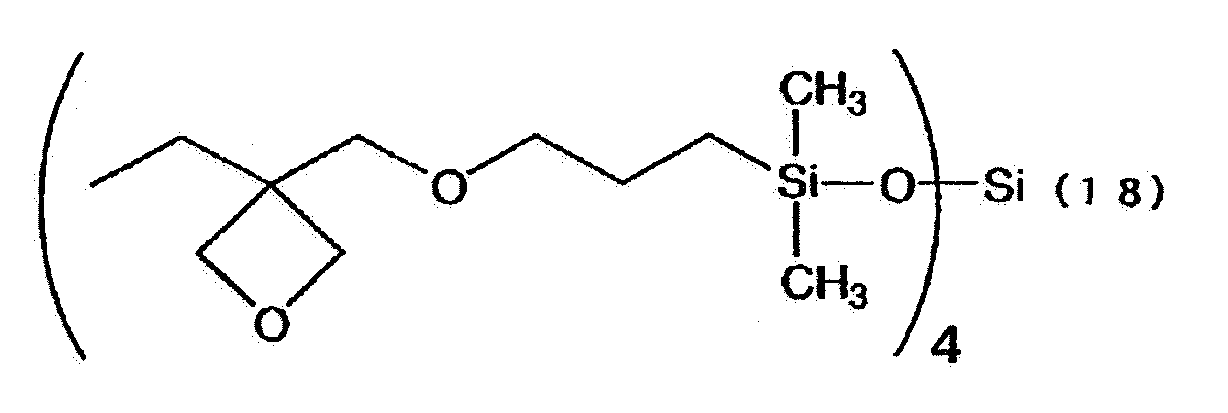
- Compounds shown by the following formula (19) may comprise 1-10 oxetane rings:

- Furthermore, other than the above-mentioned compounds, compounds having a polystyrene-reduced number average molecular weight measured by gel permeation chromatography of from about 1,000 to about 5,000 can be given as examples of the oxetane compound c). Examples of such compounds are compounds shown by the following formulas (20), (21), and (22):
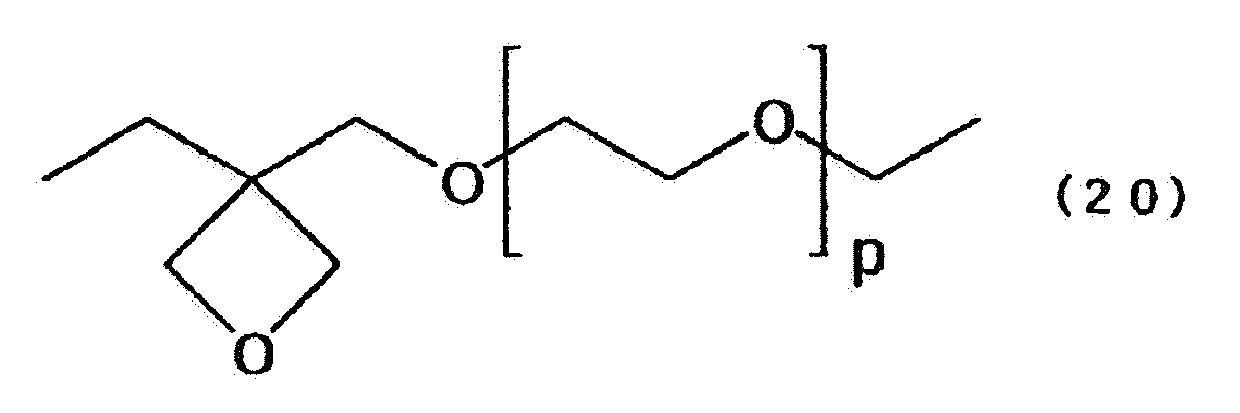


- Specific examples of the above-described oxetane compounds are given below:
- Compounds containing one oxetane ring in the molecule are:
- 3-ethyl-3-hydroxymethyloxetane, 3-(meth)allyloxymethyl-3-ethyloxetane, (3-ethyl-3-oxetanylmethoxy)methylbenzene, (3-ethyl-3-oxetanylmethoxy)benzene, 4-fluoro-[1-(3-ethyl-3-oxetanylmethoxy)methyl]benzene, 4-methoxy-[1-(3-ethyl-3-oxetanylmethoxy)methyl]benzene, [1-(3-ethyl-3-oxetanylmethoxy)ethyl] phenyl ether, isobutoxymethyl (3-ethyl-3-oxetanylmethyl) ether, isobornyloxyethyl (3-ethyl-3-oxetanylmethyl) ether, isobornyl (3-ethyl-3-oxetanylmethyl) ether, 2-ethylhexyl (3-ethyl-3-oxetanyl methyl) ether, ethyldiethylene glycol (3-ethyl-3-oxetanylmethyl) ether, dicyclopentadiene (3-ethyl-3-oxetanylmethyl) ether, dicyclopentenyloxyethyl (3-ethyl-3-oxetanyl methyl) ether, dicyclopentenyl (3-ethyl-3-oxetanylmethyl) ether, tetrahydrofurfuryl (3-ethyl-3-oxetanylmethyl) ether, tetrabromophenyl (3-ethyl-3-oxetanylmethyl) ether, 2-tetrabromophenoxyethyl (3-ethyl-3-oxetanylmethyl) ether, tribromophenyl (3-ethyl-3-oxetanylmethyl) ether, 2-tribromophenoxyethyl (3-ethyl-3-oxetanylmethyl) ether, 2-hydroxyethyl (3-ethyl-3-oxetanyl methyl) ether, 2-hydroxypropyl (3-ethyl-3-oxetanylmethyl) ether, butoxyethyl (3-ethyl-3-oxetanylmethyl) ether, pentachlorophenyl (3-ethyl-3-oxetanylmethyl) ether, pentabromophenyl (3-ethyl-3-oxetanylmethyl) ether, bornyl (3-ethyl-3-oxetanylmethyl) ether.
- Compounds containing two or more oxetane rings in the molecule:
- 3,7-bis(3-oxetanyl)-5-oxa-nonane, 3,3'-(1,3-(2-methylenyl)propanediylbis(oxymethylene))bis-(3-ethyloxetane), 1,4-bis[(3-ethyl-3-oxetanylmethoxy)methyl]benzene, 1,2-bis[(3-ethyl-3-oxetanylmethoxy)methyl]ethane, 1,3-bis[(3-ethyl-3-oxetanylmethoxy)methy]propane, ethylene glycol bis(3-ethyl-3-oxetanylmethyl) ether, dicyclopentenyl bis(3-ethyl-3-oxetanylmethyl) ether, triethylene glycol bis(3-ethyl-3-oxetanylmethyl) ether, tetraethylene glycol bis(3-ethyl-3-oxetanylmethyl) ether, tricyclodecanediyldimethylene (3-ethyl-3-oxetanylmethyl) ether, trimethylolpropane tris(3-ethyl-3-oxetanylmethyl) ether, 1,4-bis(3-ethyl-3-oxetanylmethoxy)butane, 1,6-bis(3-ethyl-3-oxetanylmethoxy)hexane, pentaerythritol tris(3-ethyl-3-oxetanylmethyl) ether, pentaerythritol tetrakis(3-ethyl-3-oxetanylmethyl) ether, polyethylene glycol bis(3-ethyl-3-oxetanylmethyl) ether, dipentaerythritol hexakis(3-ethyl-3-oxetanylmethyl) ether, dipentaerythritol pentakis(3-ethyl-3-oxetanylmethyl) ether, dipentaerythritol tetrakis(3-ethyl-3-oxetanylmethyl) ether, caprolactone-modified dipentaerythritol hexakis(3-ethyl-3-oxetanylmethyl) ether, caprolactone-modified dipentaerythritol pentakis(3-ethyl-3-oxetanylmethyl) ether, ditrimethylolpropane tetrakis(3-ethyl-3-oxetanylmethyl) ether, EO-modified bisphenol A bis(3-ethyl-3-oxetanylmethyl) ether, PO-modified bisphenol A bis(3-ethyl-3-oxetanylmethyl) ether, EO-modified hydrogenated bisphenol A bis(3-ethyl-3-oxetanylmethyl) ether, PO-modified hydrogenated bisphenol A bis(3-ethyl-3-oxetanylmethyl) ether, EO-modified bisphenol F (3-ethyl-3-oxetanylmethyl) ether. These compounds can be used either individually or in combination of two or more.
- Preferred oxetanes are selected from the group consisting of components defined by formula 2, wherein R1 is a C1-C4 alkyl group, Z = Oxygen and R2 = H, a C1-C8 alkyl group or a phenylgroup; 3-ethyl-3-hydroxymethyloxetane, (3-ethyl-3-oxetanylmethoxy)methylbenzene, (3-ethyl-3-oxetanylmethoxy)benzene, 2-ethylhexyl (3-ethyl-3-oxetanyl methyl) ether, 1,4-bis[(3-ethyl-3-oxetanylmethoxy)methyl]benzene, 1,2-bis[(3-ethyl-3-oxetanylmethoxy)methyl]ethane, 1,3-bis[(3-ethyl-3-oxetanylmethoxy)methyl]propane, ethylene glycol bis(3-ethyl-3-oxetanylmethyl) ether and bis(3-ethyl-3-oxetanylmethyl) ether.
- In one embodiment of the present invention, the preferred oxetane is a monofunctional oxetane having an OH group.
- The oxetane compounds can be used either individually or in combinations of two or more.
- The composition of the present invention further comprises as component d) an aromatic diacrylate.
- Examples of suitable aromatic diacrylates are bisphenol A di(meth)acrylate, bisphenol F di(meth)acrylate, bisphenol S di(meth)acrylate, EO-modified bisphenol A di(meth)acrylate, PO-modified bisphenol A di(meth)acrylate, EO-modified bisphenol F di(meth)acrylate, PO-modified bisphenol F di(meth)acrylate, EO-modified bisphenol S di(meth)acrylate, PO-modified bisphenol S di(meth)acrylate.
- In one embodiment, the composition comprises from about 5 wt% to about 25 wt% of the aromatic diacrylate, relative to the total weight of the composition. In another embodiment, the composition comprises from about 10 wt% to about 20 wt% of the aromatic diacrylate, relative to the total weight of the composition.
- The composition of the present invention contains one or more free radical photoinitiators e).
- Examples of photoinitiators include benzoins, such as benzoin, benzoin ethers, such as benzoin methyl ether, benzoin ethyl ether, and benzoin isopropyl ether, benzoin phenyl ether, and benzoin acetate, acetophenones, such as acetophenone, 2,2-dimethoxyacetophenone, 4-(phenylthio)acetophenone, and 1,1-dichloroacetophenone, benzil, benzil ketals, such as benzil dimethyl ketal, and benzil diethyl ketal, anthraquinones, such as 2-methylanthraquinone, 2-ethylanthraquinone, 2-tertbutylanthraquinone, 1-chloroanthraquinone, and 2-amylanthraquinone, also triphenylphosphine, benzoylphosphine oxides, such as, for example, 2,4,6-trimethylbenzoyldiphenylphosphine oxide (Lucirin TPO), benzophenones, such as benzophenone, dimethoxybenzophenone, diphenoxybenzophenone, and 4,4'-bis(N,N'-dimethylamino)benzophenone, thioxanthones and xanthones, acridine derivatives, phenazene derivatives, quinoxaline derivatives or 1-phenyl-1,2-propanedione-2-O-benzoyloxime, 1-aminophenyl ketones or 1-hydroxyphenyl ketones, such as 1-hydroxycyclohexyl phenyl ketone, phenyl (1-hydroxyisopropyl)ketone and 4-isopropylphenyl(1-hydroxyisopropyl)ketone, or triazine compounds, for example, 4"'-methyl thiophenyl-1-di(trichloromethyl)-3,5-S-triazine, S-triazine-2-(stilbene)-4,6-bistrichloromethyl, and paramethoxy styryl triazine, all of which are known compounds.
- Suitable free-radical photoinitiators, which are normally used in combination with a He/Cd laser, operating at for example 325 nm, an Argon-ion laser, operating at for example 351 nm, or 351 and 364 nm, or 333, 351, and 364 nm, or a frequency tripled YAG solid state laser, having an output of 351 or 355 nm, as the radiation source, are acetophenones, such as 2,2-dialkoxybenzophenones and 1-hydroxyphenyl ketones, for example 1-hydroxycyclohexyl phenyl ketone, 2-hydroxy-1-{4-(2-hydroxyethoxy)phenyl}-2-methyl-1-propanone, benzophenone, or 2-hydroxyisopropyl phenyl ketone (also called 2-hydroxy-2,2-dimethylacetophenone), but especially 1-hydroxycyclohexyl phenyl ketone. Another class of free-radical photoinitiators comprises the benzil ketals, such as, for example, benzil dimethyl ketal. Especially an alpha-hydroxyphenyl ketone, benzil dimethyl ketal, or 2,4,6-trimethylbenzoyldiphenylphosphine oxide may be used as photoinitiator.
- Another class of suitable free radical photoinitiators comprises the ionic dye-counter ion compounds, which are capable of absorbing actinic rays and producing free radicals, which can initiate the polymerization of the acrylates. The compositions according to the invention that comprise ionic dye-counter ion compounds can thus be cured in a more variable manner using visible light in an adjustable wavelength range of 400 to 700 nanometers. Ionic dye-counter ion compounds and their mode of action are known, for example from published European patent application
EP 223587 U.S. Patents 4,751,102 ,4,772,530 and4,772,541 , which are hereby incorporated by reference in their entirety. - Examples of suitable ionic dye-counter ion compounds are anionic dye-iodonium ion complexes, anionic dye-pyryllium ion complexes and, especially, cationic dye-borate anion compounds of the following formula (23)

EP 223587 - Preferred free radical photoinitiators include 1-hydroxycyclohexyl phenyl ketone, 2-hydroxy-2-methyl-1-phenylpropan-1-one, 2,2-dimethoxyacetophenone, benzophenone and 2,4,6-trimethylbenzoyldiphenylphosphine oxide. These photoinitiators alone or in combination with each other tend to be comparatively less yellowing.
- The present composition comprises, relative to the total weight of the composition, from about 0.1 wt% to about 15 wt% of one or more free radical photoinitiators. In one embodiment, the present composition comprises, relative to the total weight of the composition, from about 1 wt% to about 10 wt% of one or more free radical photoinitiators, relative to the total weight of the composition. In another embodiment, the present composition comprises, relative to the total weight of the composition, from about 2 wt% to about 6 wt% of one or more free radical photoinitiators.
- In the compositions according to the invention, any suitable type of photoinitiator that, upon exposure to actinic radiation, forms cations that initiate the reactions of the cationically polymerizable compounds, such as epoxy material(s), can be used as component f).
- There are a large number of known and technically proven cationic photoinitiators that are suitable. They include, for example, onium salts with anions of weak nucleophilicity. Examples are halonium salts, iodosyl salts or sulfonium salts, such as are described in published European patent application
EP 153904 WO 98/28663 EP 35969 44274 54509 164314 U.S. Patents 3,708,296 and5,002,856 . All eight of these disclosures are hereby incorporated in their entirety by reference. Other cationic photoinitiators are metallocene salts, such as described, for example, in published European applicationsEP 94914 94915 - A survey of other current onium salt initiators and/or metallocene salts can be found in "UV Curing, Science and Technology", (Editor S. P. Pappas, Technology Marketing Corp., 642 Westover Road, Stamford, Conn., U.S.A.) or "Chemistry & Technology of UV & EB Formulation for Coatings, Inks & Paints", Vol. 3 (edited by P. K. T. Oldring).
- Preferred initiators include diaryl iodonium salts, triaryl sulfonium salts, or the like. Typical photo-polymerization initiators are represented by the following formulae (24) and (25):


- Q3 represents a hydrogen atom, an alkyl group having 1 to 18 carbon atoms, or an alkoxyl group having 1 to 18 carbon atoms;
- M represents a metal atom, preferably antimony;
- Z represents a halogen atom, preferably fluorine; and
- t is the valent number of the metal, for example 6 in the case of antimony.
- Preferred cationic photoinitiators include sulfonium salts (e.g., triarylsulfonium hexafluoroantimonate salts), iodonium photoinitiators, e.g. iodonium tetrakis (pentafluorophenyl) borate, because they tend to be less yellowing, especially when used in combination with photosensitizers such as, for instance, n-ethyl carbazole.
- In order to increase the light efficiency, or to sensitize the cationic photoinitiator to specific wavelengths, such as for example specific laser wavelengths or a specific series of laser wavelengths, it is also possible, depending on the type of initiator, to use sensitizers. Examples are polycyclic aromatic hydrocarbons or aromatic keto compounds. Specific examples of preferred sensitizers are mentioned in published European patent application
EP 153904 U.S. Patent 5,667,937 , which is hereby incorporated in its entirety by reference. It will be recognized that an additional factor in the choice of sensitizer is the nature and primary wavelength of the source of actinic radiation. - The present composition comprises, relative to the total weight of the composition, from about 0.1 wt% to about 15 wt% of one or more cationic photoinitiators. In one embodiment, the present composition comprises, relative to the total weight of the composition, from about 0.2 wt% to about 10 wt% of one or more cationic photoinitators, relative to the total weight of the composition. In another embodiment, the present composition comprises, relative to the total weight of the composition, from about 0.5 wt% to about 6 wt% of one or more cationic photoinitators, relative to the total weight of the composition.
- The composition of the present invention also comprises one or more additives. These additives can be stabilizers such as light stabilizers and thermal stabilizers, antioxidants, dyes, pigments, fluorescent whitening agents, UV absorbers, photosensitizers, antifoaming agents, air release agents, wetting agents, flow control agents, surfactants, and/or leveling agents. Some of the additives are described below as examples.
- Stabilizers useful in resin compositions for stereolithography are known to people of ordinary skill in the art. Suitable stabilizers for the composition of the present invention include those for improving storage and in-use viscosity stability, color stability, thermal stability or ageing stability of the liquid resin or fabricated three-dimensional articles. Such materials include cyclic amides, hindered amines, hindered phenols, phosphites, sulfides, and salts of metals of Group IA and weak inorganic acids. Examples of stabilizers include polyvinylpyrolidone, benzyl-N,N-dialkylamine, Longnox-10, rubidium carbonate.
- Dyes and pigments useful in resins compositions for stereolithography are known to people of ordinary skill in the art. Suitable dyes or pigments in the effective amount for the desired color effect for the composition of the present invention include titanium dioxide white dispersion, carbon black dispersion, various organic or inorganic pigments, dyes, latent dyes like Copikem dyes.
- Antifoaming agents useful in resin compositions for stereolithography are known to people of ordinary skill in the art. Suitable commercially available antifoaming agents for the composition of the present invention include BYK-A-501, BYK A 320, BYK A 506, Foam Blast 20F, SAG-47, PolyFox PF 656.
- Leveling agents useful in resin compositions for stereolithography are known to people of ordinary skill in the art. Suitable leveling agents for the composition of the present invention include polyoxyalkylene siloxanes and silicones such as SILWET L-7600, polyoxyethylene trimethylnonyl ether such as Tergitol TMN 6.
- Each additive is present in the composition with an amount from about 0.001 wt% to about 5 wt%, relative to the total weight of the composition. In one embodiment, each additive is present in the composition with an amount from about 0.002 wt% to about 2 wt%, relative to the total weight of the composition. In another embodiment, each additive is present in the composition with an amount from about 0.003 wt% to about 0.5 wt%, relative to the total weight of the composition.
- The total wt% of the additives used in the composition of the present invention is from about 0.005 wt% to about 10 wt%, relative to the total weight of the composition. In another embodiment, the total wt% of these additives is from about 0.01 wt% to about 5 wt%, relative to the total weight of the composition.
- Fillers can be added to the compositions to improve properties such as modulus, strength, heat resistance. The fillers can be metallic-, organic-, inorganic-, or organic-inorganic hybrid fillers (e.g. silica particles, glass beads, or talc). The size of the fillers may vary and can be, for instance, in the nanometer range or in the micrometer range.
- In one embodiment, the present composition comprises, relative to the total weight of the composition, less than 20 wt% of fillers, e.g. less than 10 wt%, less than 5 wt%, or about 0 wt%. In another embodiment, the present compositions comprise, relative to the total weight of the composition, up to 70 wt% of filler, e.g. 20-70 wt%, 30-60 wt%, or 40-50 wt%.
- Another embodiment of the present invention is a radiation-curable composition comprising:
- a. from about 50 wt% to about 60 wt% of a cycloaliphatic diepoxide;
- b. from about 10 wt% to about 15 wt% of a polytetramethylene glycol;
- c. from about 7 wt% to about 10 wt% of a monofunctional oxetane having a hydroxyl group;
- d. from about 10 wt% to about 20 wt% of an aromatic diacrylate;
- e. from about 2 wt% to about 6 wt% of a radical photoinitiator;
- f. from about 0.5 wt% to about 6 wt% of a cationic photoinitiator; and
- g. from about 0.003 wt% to about 0.5 wt% of a photosensitizer.
- The individual elements of the embodiments of this invention described above are the same as those individual elements of the invention which have been previously described. As such, a description of such individual elements will not be repeated here.
- The present invention is further illustrated with a number of examples, which should not be regarded as limiting the scope of the present invention.
- Radiation curable liquid compositions were prepared by weighing all the ingredients into a container under mechanical stirring either at room temperature or up to 50 °C until homogeneous resin mixtures were obtained. Each liquid mixture was then filtered off into a vat of stereolithography apparatus using a medium paint filter before fabrication of parts.
- Compositions were prepared by mixing the components listed in Table 2 (Examples) and Table 3 (Comparative Examples, which are not Examples of the invention) for epoxy and acrylate dual cure or hybrid resins, with amounts of the components being listed in parts by weight. The thus prepared compositions were subsequently analyzed in accordance with the Test Methods described below. The test results are also listed in Tables 2-3.
- The photo properties Ec (mJ/cm2), Dp (µm), and E10 (mJ/cm2) represent the photo response (in this case thickness of layer formed) of a particular formulation to exposure by a single wavelength or range of wavelengths. In the instant Examples and Comparative Examples, at least 20 grams of composition were poured into a 100 mm diameter petri-dish and allowed to equilibrate to approximately 30°C and 30% RH. The samples were then scanned in a line-by-line fashion using a focused laser beam of approximately 80-140 mW. The laser, a frequency tripled YAG laser, had an output wavelength of 354.7 nm and was pulsed at 80 KHz. The exposures were made in a square pattern approximately 20 mm by 20 mm. Six individual exposures were made at near constant laser power but at various scan speeds. The parallel scan lines making up each exposure were drawn approximately 50 µm apart. Based upon knowledge of the diameter of the focused beam at the liquid surface, the scan speed, the laser power, and the scan spacing, the summation of exposure mJ/cm2 was calculated. Each square was allowed to float on the surface of the petri-dish for approximately 15 minutes. Then the squares were blotted and a thickness measurement was taken using Mitutoyo NTO25-8"C spring loaded Absolute Digimatic calipers. When the natural log of the exposures is plotted against the measured thickness, a least squares fit line can be drawn. The Dp (µm) is the slope of the least squares fit line. The Ec (mJ/cm2) is the X-axis crossing point (Y=0) of the line. The E10 is the energy necessary to produce a layer that was approximately 10 mils (254 µm) thick. In general, the lower the E10 number, the faster the photo speed of the composition. Similarly, the energy necessary to produce a layer of 12 mils (305 µm) or 13 mils (330 µm) was thus obtained.
- Tensile data was obtained by testing tensile bars ("dogbones") made by first consecutively imaging 150 µm thick layers of the composition to be tested in a rapid prototyping machine. Each cross-sectional layer of the tensile bar was given an exposure, as specified in Tables 2 and 3, which was sufficient to polymerize the composition at a 250 µm to 325 µm depth, providing approximately 100 µm to 175 µm of overcure or engagement cure to assure adhesion to the previously coated and exposed layer. The layers were exposed with a laser emitting in the ultraviolet (UV) region at 354.7 nm. The resulting tensile bars/dogbones were approximately 150 mm long and had a cross-section in the narrowed portion of approximately 10 mm x 4 mm. After preparation of the tensile bar in the rapid prototyping machine, the tensile bar was removed from the machine, washed with tri(propyleneglycol) methyl ether ("TPM") and isopropanol, dried in the air and placed in a post-curing apparatus ("PCA" sold by 3-D Systems, 10 bulb unit using Phillips TLK/05 40W bulbs) for UV post-cure. In the PCA, the tensile bar was post-cured by subjecting it to 60 minutes of UV radiation at room temperature. Optionally, the tensile bar was further subjected to 80 °C thermal post-cure for two hours with ramps of 1°C/min from room temperature after the 60 minute UV post-cure in the PCA.
- The tensile tests to determine tensile strength, Young's modulus, and elongation at break were run one week after preparation of the UV-post-cured tensile bar (unless otherwise specified in Tables 2 and 3). In the event the tensile bar is both UV and thermally post-cured, these tests were run 40 hours or more after the thermal post-cure. The tensile tests were conducted in accordance with ASTM D638, which is hereby incorporated in its entirety by reference, except that no provision was made for controlling the room temperature and humidity and the bars were not equilibrated for 2 days. The reported data is the average of three measurements.
- In one embodiment, the tensile strength of the cured composition of the invention, measured 1 week after UV post-cure in a post-curing apparatus, is from about 40 MPa to about 75 MPa. In another embodiment, the tensile strength of the cured composition of the invention, measured 1 week after UV post-cure in a post-curing apparatus, is from about 50 MPa to about 70 MPa.
- In one embodiment, the Young modulus of the cured composition of the invention, measured 1 week after UV post-cure in a post-curing apparatus, is from about 1500 MPa to about 4000 MPa. In another embodiment, the Young modulus of the composition of the invention, measured 1 week after UV post-cure in a post-curing apparatus, is from about 2000 MPa to about 3500 MPa.
- In one embodiment, the tensile strength of the cured composition of the invention, measured at 40 hours or more after UV post-cure in a post-curing apparatus and thermal post-cure, is from about 50 MPa to about 80 MPa. In another embodiment, the tensile strength of the cured composition of the invention, measured at 40 hours or more after UV post-cure in a post-curing apparatus and thermal post-cure, is from about 60 MPa to about 70 MPa.
- In one embodiment, the Young modulus of the cured composition of the invention, measured at 40 hours or more after UV post-cure in a post-curing apparatus and thermal post-cure, is from about 1500 MPa to about 4000 MPa. In another embodiment, the Young modulus of the composition of the invention, measured at 40 hours or more after UV post-cure in a post-curing apparatus and thermal post-cure, is from about 2000 MPa to about 3500 MPa.
- A UV post-cured and thermally post-cured specimen was prepared in the same manner as described above for the preparation of a tensile bar. Part of the specimen was placed in a TA Instruments TMA 2940 at room temperature. The specimen was then heated with a ramp of 3°C/min from room temperature or below up to 250°C under a nitrogen purge of 60 mL/min. A graph of dimension change over temperature was generated and analyzed by using TA Instrument Universal Analysis V2.6D software, which calculated the glass transition temperature (Tg) from a sudden change in the slope of the thermal expansion curve.
- The composition of the present invention, when cured, has a glass transition temperature of about 60°C to about 120°C. In another embodiment, the composition of the present invention, when cured, has a glass transition temperature of about 70°C to about 110°C.
- Fully cured specimens for determining the HDT were prepared in the same manner as for the above tensile bars, except that the dimensions of the specimens for the HDT measurements were 5 inch (127 mm) in length and 0.5 x 0.5 inch (12.7mm x 12.7mm) in cross-section. The HDT (under a pressure of 0.455 MPa or 66 psi) of the specimens was then determined according to ASTM D648-04 Method B, which is hereby incorporated in its entirety by reference, using an ATLAS HDV2 Automated instrument.
- The composition of the present invention has a heat deflection temperature of about 50°C to about 90°C; and preferably from about 55°C to about 85°C after UV post-cure. After UV post-cure in a post-curing apparatus and thermal post-cure, the composition has a heat deflection temperature of about 70°C to about 120°C; and preferably, from about 75°C to about 115°C.
- Fully cured specimens for determining the flexural properties were prepared and conditioned in the same manner as for the above tensile bars, except that the dimensions of the specimens for determining the flexural properties were 10 mm x 6 mm x 125 mm (0.394" x 0.236" x 4.92"). The three point bending test was conducted in accordance with ASTM D790-03, which is hereby incorporated in its entirety by reference, except that no provision was made for controlling the room temperature and humidity and the bars were not equilibrated for 2 days. The reported data is the average of three measurements.
- In one embodiment, the flexural strength of the cured composition of the invention, measured 1 week after UV post-cure in a post-curing apparatus, is from about 60 MPa to about 110 MPa. In another embodiment, the flexural strength of the cured composition of the invention, measured 1 week after UV post-cure in a post-curing apparatus, is from about 70 MPa to about 105 MPa.
- In one embodiment, the flexural modulus of the cured composition of the invention, measured 1 week after UV post-cure in a post-curing apparatus, is from about 1500 MPa to about 3500 MPa. In another embodiment, the flexural modulus of the cured composition of the invention, measured 1 week after UV post-cure in a post-curing apparatus, is from about 2000 MPa to about 3000 MPa.
- In one embodiment, the flexural strength of the cured composition of the invention, measured at 40 hours or more after UV post-cure in a post-curing apparatus and thermal post-cure, is from about 65 MPa to about 120 MPa. In another embodiment, the flexural strength of the cured composition of the invention, measured at 40 hours or more after UV post-cure in a post-curing apparatus and thermal post-cure, is from about 75 MPa to about 110 MPa.
- In one embodiment, the flexural modulus of the cured composition of the invention, measured at 40 hours or more after UV post-cure in a post-curing apparatus and thermal post-cure, is from about 1500 MPa to about 3500 MPa. In another embodiment, the flexural modulus of the cured composition of the invention, measured at 40 hours or more after UV post-cure in a post-curing apparatus and thermal post-cure, is from about 2000 MPa to about 3004 MPa.
- Fully cured specimens for determining notched Izod impact strength were prepared in the same manner as for the above tensile bars, except that the specimen size was 12.7 mm x 6.35 mm x 63.5 mm (0.50" x 0.25" x 2.5"). Specimens were left at ambient conditions for at least one day after UV or UV plus thermal post-cure as described above for the preparation of the tensile bars before notching. Specimens were notched according to ASTM D-256A using a CS-93M Sample Notcher from CSI. The notched samples were placed in an environment controlled at 50% RH and 20 - 23°C for two days. Specimens were removed from the controlled environment immediately prior to testing. Izod Impact values were measured with a Zwick model 5110 impact tester fitted with a 2.75 J pendulum. The reported data is the average of five measurements.
- In one embodiment, the cured composition of the present invention has a notched Izod impact strength from about 0.1 J/cm to about 0.5 J/cm. In another embodiment, the cured composition of the present invention has a notched Izod impact strength from about 0.15 J/cm to about 0.45 J/cm.
Table 1. Commercial name, supplier and description Commercial Name (Supplier) Description Ebecryl 3700 (UCB Chemicals) bisphenol A diglycidyl ether diacrylate SR-399 (Sartomer) monohydroxy dipentaerythritol pentaacrylate SR 368 (Sartomer) tris(2-hydroxy ethyl) isocyanurate triacrylate DPHA (Sartomer) dipentaerythritol hexaacrylate Chivacure-1176 (Chitec) mixture of triarysulfonium hexafluoroantimonate salts IRGACURE 184 (Ciba Geigy) 1-hydroxycyclohexyl phenyl ketone PVP (Aldrich) stabilizer (polyvinylpyrolidone, Mw ca. 10,000) Longnox 10 (Longchem C&S International) tetrakis(methylene-3(3',5'-de-t-butyl-4'-hydroxyphenyl)proprionate)methane SILWET L-7600 (OSI Specialities) polyalkyleneoxide modified polydimethylsiloxane BYK-A-501 (BYK-Chemie) silicone-free solution of foam destroying polymers White dispersion (Chroma Injecta Color Systems) titanium dioxide white pigment dispersion Albidur EP 2240 (Hanse Chemie) silicone rubber-modified bisphenol A epoxy resin Albidur EP 5340 (Hanse Chemie) silicone rubber-modified cycloaliphatic epoxy resin Albidur PU 5640 (Hanse Chemie) silicone rubber-modified glycerol poly(oxypropylene)triol resin Terathane-1000 (Invista) poly(tetramethylene oxide) glycol Terathane 250 (Invista) poly(tetramethylene oxide) glycol CHDM (Eastman Chemical) 1,4-cyclohexanedimethanol Cyracure UVR-6105 (Dow Chemical) 3,4-epoxy cyclohexyl methyl-3,4-epoxy cyclohexyl carboxylate (aliphatic epoxy) Heloxy 48 (Resolution Performance Products) Trimethylolpropane triglycidyl ether Heloxy 107 (Resolution Performance Products) cyclohexanedimethanol diglycidyl ether EPON 825 (Resolution Performance Products) bisphenol A diglycidyl ether (aromatic epoxy) OXT-101 (Toagosei) 3-ethyl-3-hydroxymethyl-oxetane (oxetane) Nanopox 22/0765 (Hanse Chemie) 50% silica nanoparticles in 3-ethyl-3-hydroxymethyl-oxetane Table 2 Examples 1 2 3 4 Ingredient % by wt % by wt % by wt % by wt Ebecryl 3700 18.019 14.237 15.360 15.334 Chivacure-1176 4.498 4.000 4.000 4.000 Irgacure-184 2.000 2.500 2.800 2.500 PVP 0.003 0.005 0.005 0.005 Albidur EP 2240 1.893 Albidur 5340 3.000 3.000 Terathane-1000 9.463 13.991 11.000 10.972 BYK A501 0.013 0.020 0.020 0.020 Cyracure UVR-6105 56.987 55.000 57.585 54.911 Silwet L7600 0.126 0.200 0.200 0.200 White dispersion 0.100 OXT-101 6.998 7.047 8.930 9.058 Total 100.000 100.000 100.000 100.00 Photo Speed Ec (mJ/cm2) 6.34 9.04 5.99 11.47 Dp (µm) 142 145 131 161 E10 (MJ/cm2) 37.9 52.2 41.7 55.4 Exposure energy used for each 152-µm layer (mJ/cm2) 65 (E13) 52 (E10) 42 (E10) 55 (E10) Tensile properties 1 week after UV post-cure in PCA Young's Modulus (MPa) 2931 2662 2724 2690 Tensile Strength (MPa) 62.1 56.6 59.3 57.9 Tensile Elongation (%) 4.0 8.9 5.5 7.1 Tensile properties 40 hours or more after UV post-cure in PCA and thermal post-cure at 80°C/2hrs Young's Modulus (MPa) 2662 2648 2772 2552 Tensile Strength (MPa) 67.6 64.1 65.5 62.8 Tensile Elongation (%) 5.2 7.0 6.1 6.6 Flexural properties 1 week after UV post-cure in PCA Flexural Modulus (MPa) 2697 2434 2579 2545 Flexural Strength (MPa) 93.8 84.8 86.9 85.5 Flexural properties 40 hours or more after UV post-cure in PCA and thermal post-cure at 80°C/2hrs Flexural Modulus (MPa) 2614 2386 2538 2455 Flexural Strength (MPa) 98.6 89.0 90.3 87.6 Tg (°C) 40 hours or more after UV post-cure in PCA and thermal post-cure at 80°C/2hrs 112 HDT at 0.455 MPa (°C) 1 week after UV post-cure in PCA 72 40 hours or more after UV post-cure in PCA and thermal post-cure at 80°C/2hrs 94 Izod Impact Strength (J/cm) 1 week after UV post-cure in PCA 0.25 0.33 0.15 0.17 40 hours or more after UV post-cure in PCA and thermal post-cure at 80°C/2hrs 0.23 0.29 0.16 0.18 Table 3 Comparative Examples CE1 CE2 CE3 CE4 CE5 CE6 Ingredient %by wt %by wt % by wt %by wt %by wt %by wt SR399 2.993 9.500 SR 368 9.978 DPHA 11.839 9.346 Ebecryl 3700 0.000 0.000 17.969 0.000 15.275 0.000 Chivacure-1176 4.989 2.832 4.941 5.300 4.000 4.700 Irgacure-184 1.996 1.914 1.997 2.950 2.500 3.000 PVP 0.005 0.005 0.005 0.005 0.005 0.005 Albidur EP 2240 2.993 2.995 Albidur PU 5640 24.653 Albidur EP 5340 3.000 Terathane-1000 5.987 0.000 14.974 0.000 20.000 15.133 Terathane 250 12.722 CHDM 5.987 BYK A501 0.020 0.020 0.020 0.020 0.020 0.020 Heloxy 48 7.982 Cyracure UVR6105 48.890 52.018 56.900 47.862 55.000 58.712 Nanopox 22/0765 19.106 OXT-101 0.000 0.000 0.000 0.000 0.000 8.884 Heloxy 107 7.982 Silwet L7600 0.200 0.200 0.200 0.197 0.200 0.200 Epon 825 8.858 Total 100.000 100.000 100.000 100.000 100.000 100.000 Photo Speed Ec (mJ/cm2) 4.69 6.98 6.29 7.16 8.87 5.98 D p (µm) 116 125 121 151 149 144 E 10 (mJ/cm2) 41.9 53.5 50.9 38.3 49.0 35.1 Exposure energy used for each 152-µm layer (mJ/cm2) 81 (E13) 53 (E10) 95 (E13) 38 (E10) 69 (E12) 50 (E12) Tensile properties 1 week after UV post-cure in PCA One day Young's Modulus (MPa) 2924 2290 2607 2848 2041 2517 Tensile Strength (MPa) 65.3 43.4 54.5 53.1 42.8 52.4 Tensile Elongation (%) 6.1 3.6 7.6 8.0 21.7 10.2 Tensile properties a 40 hours or more after UV post-cure in PCA and thermal post-cure at 80°C/2hrs Young's Modulus (MPa) 2621 2421 1786 2290 Tensile Strength (MPa) 64.9 52.6 40.7 51.7 Tensile Elongation (%) 5.3 6.2 13.8 7.7 Flexural properties 1 week after UV post-cure in PCA One day Flexural Modulus (MPa) 2386 2407 2159 1731 2290 Flexural Strength (MPa) 69.7 83.4 71.0 60.0 75.2 Flexural properties 40 hours or more after UV post-cure and thermal post-cure at 80°C/2hrs Flexural Modulus (MPa) 2497 2114 1566 2152 Flexural Strength (MPa) 83.4 75.9 54.5 74.5 Tg (°C) 40 hours or more after UV post-cure in PCA and thermal post- cure at 80°C/2hrs 84 97 HDT at 0.455 MPa (°C) 1 week after UV post-cure in PCA 83 40 hours or more after UV post-cure in PCA and thermal post-cure at 80°C/2hrs 89 Izod Impact Strength (J/cm) 1 week after UV post-cure in PCA 0.24 0.40 0.18 40 hours or more after UV post-cure in PCA and thermal post-cure at 80°C/2hrs 0.19 0.28 0.14 - While the invention has been described in detail and with reference to specific embodiments thereof, it will be apparent to one of ordinary skill in the art that various changes and modifications can be made therein without departing from the spirit and scope of the claimed invention.
Claims (19)
- A radiation curable composition comprising:a. from about 50 wt% to about 70 wt% of a cycloaliphatic diepoxide;b. from about 5 wt% to about 15 wt% of a polyol;c. from about 5 wt% to about 15 wt% of an oxetane;d. from about 10 wt% to about 20 wt% of an aromatic diacrylate;e. a radical photoinitiator; andf. a cationic photoinitiator.
- The radiation curable composition according to claim 1, wherein the composition comprisesa. from about 50 wt% to about 60 wt% of a cycloaliphatic diepoxide;b. from about 10 wt% to about 15 wt% of a polyol;c. from about 7 wt% to about 10 wt% of an oxetane; andd. from about 10 wt% to about 20 wt% of an aromatic diacrylate.
- The radiation curable composition according to claim 1, wherein the cycloaliphatic diepoxide is chosen from the group consisting of 3,4-epoxycyclohexylmethyl-3,4-epoxycyclohexanecarboxylate, 3,4-epoxy-6-methylcyclohexylmethyl-3,4-epoxy-6-methylcyclohexanecarboxylate, di(3,4-epoxycyclohexylmethyl)hexanedioate, di(3,4-epoxy-6-methylcyclohexylmethyl)hexanedioate, ethylene bis(3,4-epoxycyclohexanecarboxylate), ethanediol di(3,4-epoxycyclohexylmethyl) ether, 2-(3,4-epoxycyclohexyl-5,5-spiro-3,4-epoxy)cyclohexane-1,3-dioxane, and combinations thereof.
- The radiation curable composition according to claim 1, wherein the polyol is an aliphatic diol.
- The radiation curable composition according to claim 1, wherein the polyol is selected from polyoxyethylene, polyoxypropylene or polytetramethylene glycol of number average molecular weight from about 600 to about 2000.
- The radiation curable composition according to claim 1, wherein the oxetane is a monofunctional oxetane having an OH group.
- The radiation curable composition according to claim 1, wherein the aromatic diacrylate is a bisphenol A-based diacrylate, a bisphenol S-based diacrylate or a bisphenol F-based diacrylate.
- The radiation curable composition according to claim 1, wherein the composition further comprises one or more additives.
- A radiation curable composition comprising:a. from about 50 wt% to about 60 wt% of a cycloaliphatic diepoxide;b. from about 10 wt% to about 15 wt% of a polytetramethylene glycol;c. from about 7 wt% to about 10 wt% of a monofunctional oxetane having a hydroxyl group;d. from about 10 wt% to about 20 wt% of an aromatic diacrylate;e. from about 2 wt% to about 6 wt% of a radical photoinitiator;f. from about 0.5 wt% to about 6 wt% of a cationic photoinitiator; andg. from about 0.003 wt% to about 0.5 wt% of a photosensitizer.
- The composition according to claim 1, wherein the tensile strength of the cured composition of the invention, measured 1 week after UV post-cure in a post-curing apparatus, is from about 40 MPa to about 75 MPa.
- The composition according to claim 1, wherein the tensile strength of the cured composition of the invention, measured at 40 hours or more after UV post-cure in a post-curing apparatus and thermal post-cure, is from about 50 MPa to about 80 MPa.
- The composition according to claim 1, wherein the Young modulus of the cured composition of the invention, measured 1 week after UV post-cure in a post-curing apparatus, is from about 1500 MPa to about 4000 MPa.
- The composition according to claim 1, wherein the Young modulus of the cured composition of the invention, measured at 40 hours or more after UV post-cure in a post-curing apparatus and thermal post-cure, is from about 1500MPa to about 4000MPa.
- The composition according to claim 1, wherein said composition, when cured, has a glass transition temperature of about 60°C to about 120°C.
- The composition according to claim 1, wherein said composition has a notched Izod impact strength of about 0.1 J/cm to about 0.5 J/cm.
- A process for making a three-dimensional article comprising the steps of:(1) coating a thin layer of the composition according to claim 1 onto a surface;(2) exposing said thin layer imagewise to actinic radiation to form an imaged cross-section, wherein the radiation is of sufficient intensity and time to cause substantial curing of the thin layer in the exposed areas;(3) coating a thin layer of the composition onto the previously exposed imaged cross-section;(4) exposing said thin layer from step (3) imagewise to actinic radiation to form an additional imaged cross-section, wherein the radiation is of sufficient intensity and time to cause substantial curing of the thin layer in the exposed areas and to cause adhesion to the previously exposed imaged cross-section;(5) repeating steps (3) and (4) a sufficient number of times in order to build up the three-dimensional article.
- A method for making a three-dimensional article comprising subjecting a radiation curable composition of claim 1 to radiation so as to cure the composition and form the three-dimensional article.
- A three-dimensional article formed from the composition of claim 1.
- A three-dimensional article made by the process of claim 16.
Applications Claiming Priority (1)
| Application Number | Priority Date | Filing Date | Title |
|---|---|---|---|
| US11/589,746 US20080103226A1 (en) | 2006-10-31 | 2006-10-31 | Photo-curable resin composition |
Publications (2)
| Publication Number | Publication Date |
|---|---|
| EP1918316A1 true EP1918316A1 (en) | 2008-05-07 |
| EP1918316B1 EP1918316B1 (en) | 2015-09-16 |
Family
ID=38921791
Family Applications (1)
| Application Number | Title | Priority Date | Filing Date |
|---|---|---|---|
| EP07119667.9A Active EP1918316B1 (en) | 2006-10-31 | 2007-10-30 | Photo-curable resin composition |
Country Status (3)
| Country | Link |
|---|---|
| US (2) | US20080103226A1 (en) |
| EP (1) | EP1918316B1 (en) |
| CN (1) | CN101178539A (en) |
Cited By (26)
| Publication number | Priority date | Publication date | Assignee | Title |
|---|---|---|---|---|
| EP2842980A1 (en) * | 2013-08-09 | 2015-03-04 | DSM IP Assets B.V. | Low-viscosity liquid radiation curable dental aligner mold resin compositions for additive manufacturing |
| WO2017044381A1 (en) * | 2015-09-09 | 2017-03-16 | Carbon3D, Inc. | Epoxy dual cure resins for additive manufacturing |
| US9676963B2 (en) | 2014-06-23 | 2017-06-13 | Carbon, Inc. | Methods of producing three-dimensional objects from materials having multiple mechanisms of hardening |
| JP2017179161A (en) * | 2016-03-30 | 2017-10-05 | 株式会社Adeka | Curable composition, method for producing cured product, and cured product thereof |
| EP3196679A4 (en) * | 2014-08-08 | 2018-03-28 | Daicel Corporation | Specially-shaped epoxy resin molded article, and optical device provided with same |
| EP3315292A1 (en) * | 2016-10-28 | 2018-05-02 | DSM IP Assets B.V. | Thermosetting compositions and forming three-dimensional objects therefrom |
| WO2018078159A1 (en) * | 2016-10-28 | 2018-05-03 | Dsm Ip Assets B.V. | Thermosetting compositions and forming three-dimensional objects therefrom |
| US10316213B1 (en) | 2017-05-01 | 2019-06-11 | Formlabs, Inc. | Dual-cure resins and related methods |
| US10343331B2 (en) | 2015-12-22 | 2019-07-09 | Carbon, Inc. | Wash liquids for use in additive manufacturing with dual cure resins |
| US10350823B2 (en) | 2015-12-22 | 2019-07-16 | Carbon, Inc. | Dual precursor resin systems for additive manufacturing with dual cure resins |
| US10391711B2 (en) | 2015-03-05 | 2019-08-27 | Carbon, Inc. | Fabrication of three dimensional objects with multiple operating modes |
| US10471655B2 (en) | 2015-09-04 | 2019-11-12 | Carbon, Inc. | Cyanate ester dual resins for additive manufacturing |
| US10501572B2 (en) | 2015-12-22 | 2019-12-10 | Carbon, Inc. | Cyclic ester dual cure resins for additive manufacturing |
| US10500786B2 (en) | 2016-06-22 | 2019-12-10 | Carbon, Inc. | Dual cure resins containing microwave absorbing materials and methods of using the same |
| US10538031B2 (en) | 2015-12-22 | 2020-01-21 | Carbon, Inc. | Dual cure additive manufacturing of rigid intermediates that generate semi-rigid, flexible, or elastic final products |
| US10639844B2 (en) | 2015-12-22 | 2020-05-05 | Carbon, Inc. | Fabrication of compound products from multiple intermediates by additive manufacturing with dual cure resins |
| US10647054B2 (en) | 2015-12-22 | 2020-05-12 | Carbon, Inc. | Accelerants for additive manufacturing with dual cure resins |
| US10647873B2 (en) | 2015-10-30 | 2020-05-12 | Carbon, Inc. | Dual cure article of manufacture with portions of differing solubility |
| US10787583B2 (en) | 2015-12-22 | 2020-09-29 | Carbon, Inc. | Method of forming a three-dimensional object comprised of a silicone polymer or co-polymer |
| US10792855B2 (en) | 2015-02-05 | 2020-10-06 | Carbon, Inc. | Method of additive manufacturing by intermittent exposure |
| US11135790B2 (en) | 2016-11-21 | 2021-10-05 | Carbon, Inc. | Method of making three-dimensional object by delivering reactive component for subsequent cure |
| EP4050060A1 (en) * | 2021-02-26 | 2022-08-31 | Henkel AG & Co. KGaA | A photocurable adhesive or sealant composition |
| US11458673B2 (en) | 2017-06-21 | 2022-10-04 | Carbon, Inc. | Resin dispenser for additive manufacturing |
| US11504903B2 (en) | 2018-08-28 | 2022-11-22 | Carbon, Inc. | 1K alcohol dual cure resins for additive manufacturing |
| US11535686B2 (en) | 2017-03-09 | 2022-12-27 | Carbon, Inc. | Tough, high temperature polymers produced by stereolithography |
| US11891485B2 (en) | 2015-11-05 | 2024-02-06 | Carbon, Inc. | Silicone dual cure resins for additive manufacturing |
Families Citing this family (23)
| Publication number | Priority date | Publication date | Assignee | Title |
|---|---|---|---|---|
| CN101592859B (en) * | 2009-06-24 | 2011-12-28 | 广州机械科学研究院 | Stereolithography rapid prototyping photosensitive resin, preparation method and application thereof |
| CN102385250A (en) * | 2011-06-29 | 2012-03-21 | 南昌大学 | Ultraviolet laser solidification rapid-prototyping photosensitive resin and manufacture method thereof |
| US10005236B2 (en) | 2012-03-01 | 2018-06-26 | Stratasys Ltd. | Cationic polymerizable compositions and methods of use thereof |
| CN102981362A (en) * | 2012-11-14 | 2013-03-20 | 南昌大学 | Method using 4 and 5-cyclohexene oxide-1 and 2-dioctyl phthalate glycidyl ester as prepolymer to prepare three-dimensional lithography fast forming photosensitive resin and application |
| WO2016142947A2 (en) * | 2015-03-11 | 2016-09-15 | Stratasys Ltd. | Support material formulation and additive manufacturing processes employing same |
| US10144185B2 (en) * | 2015-04-01 | 2018-12-04 | The Boeing Company | Method and apparatus for high-temperature post-curing of UV-cured photopolymers |
| JP2018517034A (en) * | 2015-06-08 | 2018-06-28 | ディーエスエム アイピー アセッツ ビー.ブイ. | Liquid hybrid UV / vis line curable resin composition for additive molding |
| US9708440B2 (en) * | 2015-06-18 | 2017-07-18 | Novoset, Llc | High temperature three dimensional printing compositions |
| ES2733838T3 (en) | 2015-09-25 | 2019-12-03 | Ivoclar Vivadent Ag | Ceramic and ceramic hob for stereolithography |
| CN107619399B (en) | 2016-07-13 | 2021-04-27 | 常州强力先端电子材料有限公司 | Polyfunctional oxetane compound and preparation method thereof |
| CN107621752B (en) | 2016-07-13 | 2019-11-12 | 常州强力先端电子材料有限公司 | One specific admixture type photosensitive resin and preparation method thereof |
| JP7068270B2 (en) * | 2017-03-06 | 2022-05-16 | マクセル株式会社 | Manufacturing method of model material ink set, support material composition, ink set, three-dimensional model and three-dimensional model |
| TWI692502B (en) | 2017-12-29 | 2020-05-01 | 法商阿科瑪法國公司 | Curable compositions |
| CN109212900B (en) * | 2018-09-11 | 2020-04-03 | 深圳市华星光电技术有限公司 | Photoresist composition and color filter |
| CN110964372A (en) * | 2018-09-30 | 2020-04-07 | 常州格林感光新材料有限公司 | Pigment dispersions and their use in radiation-curable compositions |
| CN110964382A (en) * | 2018-09-30 | 2020-04-07 | 常州格林感光新材料有限公司 | Pigment dispersion and application thereof in environment-friendly photosensitive composition |
| CN112574650B (en) * | 2019-09-29 | 2022-06-17 | 常州格林感光新材料有限公司 | Cationically curable compositions for metal substrates, coatings, metal articles and applications |
| US12172373B2 (en) | 2019-11-26 | 2024-12-24 | Lubbe Steven | Devices, systems, and methods for 3D printing |
| CN114096612A (en) * | 2020-01-27 | 2022-02-25 | 日立能源瑞士股份公司 | Photoradiation curable epoxy resin for electrical parts |
| US12545755B2 (en) * | 2020-02-18 | 2026-02-10 | Rowan University | Network toughening of additively manufactured, high glass transition temperature materials via sequentially cured, interpenetrating polymers |
| WO2021245650A1 (en) * | 2020-06-01 | 2021-12-09 | Polymer Gvulot Ltd | A photopolymer epoxy composition and a photoinitiator for curing same |
| JP7762668B2 (en) * | 2020-06-10 | 2025-10-30 | インクビット, エルエルシー | Materials for photoinitiated cationic ring-opening polymerization and their uses |
| CN111808456A (en) * | 2020-07-23 | 2020-10-23 | 无锡海特圣大光电材料科技有限公司 | UV cationic system gloss oil for metal printing and preparation method thereof |
Citations (5)
| Publication number | Priority date | Publication date | Assignee | Title |
|---|---|---|---|---|
| WO2003072625A1 (en) * | 2002-02-28 | 2003-09-04 | Luvantix Co., Ltd. | Photocurable resin composition for optical waveguide and optical waveguide made of the same |
| EP1371695A1 (en) * | 2002-06-10 | 2003-12-17 | Vantico AG | Jetable compositions |
| WO2005054330A1 (en) * | 2003-12-02 | 2005-06-16 | Dsm Ip Assets B.V. | Flame retardant radiation curable compositions |
| WO2006098676A1 (en) * | 2005-03-18 | 2006-09-21 | Perstorp Specialty Chemicals Ab | Ultraviolet curing resin composition |
| EP1770132A1 (en) * | 2005-09-30 | 2007-04-04 | FUJIFILM Corporation | Inkjet ink composition |
Family Cites Families (33)
| Publication number | Priority date | Publication date | Assignee | Title |
|---|---|---|---|---|
| US3708296A (en) * | 1968-08-20 | 1973-01-02 | American Can Co | Photopolymerization of epoxy monomers |
| US4339567A (en) | 1980-03-07 | 1982-07-13 | Ciba-Geigy Corporation | Photopolymerization by means of sulphoxonium salts |
| US4383025A (en) | 1980-07-10 | 1983-05-10 | Ciba-Geigy Corporation | Photopolymerization by means of sulfoxonium salts |
| US4398014A (en) | 1980-11-04 | 1983-08-09 | Ciba-Geigy Corporation | Sulfoxonium salts and their use as polymerization catalysts |
| EP0094914B1 (en) | 1982-05-19 | 1986-09-24 | Ciba-Geigy Ag | Photopolymerisation with organometal salts |
| EP0094915B1 (en) | 1982-05-19 | 1987-01-21 | Ciba-Geigy Ag | Curable compositions containing metallocen complexes, activated primers obtained therefrom and their use |
| EP0153904B1 (en) | 1984-02-10 | 1988-09-14 | Ciba-Geigy Ag | Process for the preparation of a protection layer or a relief pattern |
| GB8414525D0 (en) | 1984-06-07 | 1984-07-11 | Ciba Geigy Ag | Sulphoxonium salts |
| EP0223587B1 (en) | 1985-11-20 | 1991-02-13 | The Mead Corporation | Photosensitive materials containing ionic dye compounds as initiators |
| US4772541A (en) * | 1985-11-20 | 1988-09-20 | The Mead Corporation | Photohardenable compositions containing a dye borate complex and photosensitive materials employing the same |
| US4772530A (en) * | 1986-05-06 | 1988-09-20 | The Mead Corporation | Photosensitive materials containing ionic dye compounds as initiators |
| US4751102A (en) * | 1987-07-27 | 1988-06-14 | The Mead Corporation | Radiation-curable ink and coating compositions containing ionic dye compounds as initiators |
| US5434196A (en) * | 1988-02-19 | 1995-07-18 | Asahi Denka Kogyo K.K. | Resin composition for optical molding |
| US5002856A (en) * | 1989-08-02 | 1991-03-26 | E. I. Du Pont De Nemours And Company | Thermally stable carbazole diazonium salts as sources of photo-initiated strong acid |
| TW269017B (en) * | 1992-12-21 | 1996-01-21 | Ciba Geigy Ag | |
| WO1996041237A1 (en) * | 1995-06-07 | 1996-12-19 | E.I. Du Pont De Nemours And Company | Sensitizers and photoacid precursors |
| JP3161583B2 (en) * | 1995-07-21 | 2001-04-25 | 東亞合成株式会社 | Active energy ray-curable composition |
| JP3786480B2 (en) * | 1996-10-14 | 2006-06-14 | Jsr株式会社 | Photocurable resin composition |
| JP3765896B2 (en) | 1996-12-13 | 2006-04-12 | Jsr株式会社 | Photocurable resin composition for optical three-dimensional modeling |
| FR2757530A1 (en) | 1996-12-24 | 1998-06-26 | Rhodia Chimie Sa | USE FOR STEREOPHOTOLITHOGRAPHY - A CATIONIC PHOTORETICULABLE LIQUID COMPOSITION COMPRISING A PHOTOAMORER OF THE ONIUM SALTS OR ORGANOMETALLIC COMPLEX TYPE |
| JP4204113B2 (en) * | 1997-12-04 | 2009-01-07 | 株式会社Adeka | Novel aromatic sulfonium compound, photoacid generator comprising the same, photopolymerizable composition containing the same, resin composition for optical modeling, and optical three-dimensional modeling method |
| US6136497A (en) * | 1998-03-30 | 2000-10-24 | Vantico, Inc. | Liquid, radiation-curable composition, especially for producing flexible cured articles by stereolithography |
| US6100007A (en) * | 1998-04-06 | 2000-08-08 | Ciba Specialty Chemicals Corp. | Liquid radiation-curable composition especially for producing cured articles by stereolithography having high heat deflection temperatures |
| US6379866B2 (en) * | 2000-03-31 | 2002-04-30 | Dsm Desotech Inc | Solid imaging compositions for preparing polypropylene-like articles |
| GB9921779D0 (en) * | 1999-09-16 | 1999-11-17 | Ciba Sc Holding Ag | UV-Curable compositions |
| AU3023301A (en) * | 2000-02-08 | 2001-08-20 | Vantico Ag | Liquid, radiation-curable composition, especially for stereolithography |
| US20030149124A1 (en) * | 2001-11-27 | 2003-08-07 | Thommes Glen A. | Radiation curable resin composition for making colored three dimensional objects |
| US20030198824A1 (en) * | 2002-04-19 | 2003-10-23 | Fong John W. | Photocurable compositions containing reactive polysiloxane particles |
| JP2005529200A (en) * | 2002-05-03 | 2005-09-29 | ディーエスエム アイピー アセッツ ビー.ブイ. | Radiation curable resin composition and rapid prototyping method using the same |
| US20040137368A1 (en) * | 2003-01-13 | 2004-07-15 | 3D Systems, Inc. | Stereolithographic resins containing selected oxetane compounds |
| US20040170923A1 (en) * | 2003-02-27 | 2004-09-02 | 3D Systems, Inc. | Colored stereolithographic resins |
| US7232850B2 (en) * | 2003-10-03 | 2007-06-19 | Huntsman Advanced Materials Americas Inc. | Photocurable compositions for articles having stable tensile properties |
| WO2005092598A1 (en) * | 2004-03-22 | 2005-10-06 | Huntsman Advanced Materials (Switzerland) Gmbh | Photocurable compositions |
-
2006
- 2006-10-31 US US11/589,746 patent/US20080103226A1/en not_active Abandoned
-
2007
- 2007-10-30 EP EP07119667.9A patent/EP1918316B1/en active Active
- 2007-10-31 CN CNA2007101664156A patent/CN101178539A/en active Pending
-
2013
- 2013-11-13 US US14/078,975 patent/US9090020B2/en active Active
Patent Citations (5)
| Publication number | Priority date | Publication date | Assignee | Title |
|---|---|---|---|---|
| WO2003072625A1 (en) * | 2002-02-28 | 2003-09-04 | Luvantix Co., Ltd. | Photocurable resin composition for optical waveguide and optical waveguide made of the same |
| EP1371695A1 (en) * | 2002-06-10 | 2003-12-17 | Vantico AG | Jetable compositions |
| WO2005054330A1 (en) * | 2003-12-02 | 2005-06-16 | Dsm Ip Assets B.V. | Flame retardant radiation curable compositions |
| WO2006098676A1 (en) * | 2005-03-18 | 2006-09-21 | Perstorp Specialty Chemicals Ab | Ultraviolet curing resin composition |
| EP1770132A1 (en) * | 2005-09-30 | 2007-04-04 | FUJIFILM Corporation | Inkjet ink composition |
Cited By (63)
| Publication number | Priority date | Publication date | Assignee | Title |
|---|---|---|---|---|
| EP2842980A1 (en) * | 2013-08-09 | 2015-03-04 | DSM IP Assets B.V. | Low-viscosity liquid radiation curable dental aligner mold resin compositions for additive manufacturing |
| US9982164B2 (en) | 2014-06-23 | 2018-05-29 | Carbon, Inc. | Polyurea resins having multiple mechanisms of hardening for use in producing three-dimensional objects |
| US10647879B2 (en) | 2014-06-23 | 2020-05-12 | Carbon, Inc. | Methods for producing a dental mold, dental implant or dental aligner from materials having multiple mechanisms of hardening |
| US12179435B2 (en) | 2014-06-23 | 2024-12-31 | Carbon, Inc. | Methods of producing three-dimensional objects with apparatus having feed channels |
| US10899868B2 (en) | 2014-06-23 | 2021-01-26 | Carbon, Inc. | Methods for producing footwear with materials having multiple mechanisms of hardening |
| US12172382B2 (en) | 2014-06-23 | 2024-12-24 | Carbon, Inc. | Methods for producing three-dimensional objects |
| EP3158400B1 (en) | 2014-06-23 | 2022-06-01 | Carbon, Inc. | Methods of producing three-dimensional objects from materials having multiple mechanisms of hardening |
| US10968307B2 (en) | 2014-06-23 | 2021-04-06 | Carbon, Inc. | Methods of producing three-dimensional objects from materials having multiple mechanisms of hardening |
| US10155882B2 (en) | 2014-06-23 | 2018-12-18 | Carbon, Inc. | Methods of producing EPOXY three-dimensional objects from materials having multiple mechanisms of hardening |
| US10240066B2 (en) | 2014-06-23 | 2019-03-26 | Carbon, Inc. | Methods of producing polyurea three-dimensional objects from materials having multiple mechanisms of hardening |
| US11850803B2 (en) | 2014-06-23 | 2023-12-26 | Carbon, Inc. | Methods for producing three-dimensional objects with apparatus having feed channels |
| US11440266B2 (en) | 2014-06-23 | 2022-09-13 | Carbon, Inc. | Methods of producing epoxy three-dimensional objects from materials having multiple mechanisms of hardening |
| US11707893B2 (en) | 2014-06-23 | 2023-07-25 | Carbon, Inc. | Methods for producing three-dimensional objects with apparatus having feed channels |
| US10647880B2 (en) | 2014-06-23 | 2020-05-12 | Carbon, Inc. | Methods of producing polyurethane three-dimensional objects from materials having multiple mechanisms of hardening |
| US11299579B2 (en) | 2014-06-23 | 2022-04-12 | Carbon, Inc. | Water cure methods for producing three-dimensional objects from materials having multiple mechanisms of hardening |
| US9676963B2 (en) | 2014-06-23 | 2017-06-13 | Carbon, Inc. | Methods of producing three-dimensional objects from materials having multiple mechanisms of hardening |
| US11312084B2 (en) | 2014-06-23 | 2022-04-26 | Carbon, Inc. | Methods for producing helmet inserts with materials having multiple mechanisms of hardening |
| EP3196679A4 (en) * | 2014-08-08 | 2018-03-28 | Daicel Corporation | Specially-shaped epoxy resin molded article, and optical device provided with same |
| US10974445B2 (en) | 2015-02-05 | 2021-04-13 | Carbon, Inc. | Method of additive manufacturing by intermittent exposure |
| US10792855B2 (en) | 2015-02-05 | 2020-10-06 | Carbon, Inc. | Method of additive manufacturing by intermittent exposure |
| US10391711B2 (en) | 2015-03-05 | 2019-08-27 | Carbon, Inc. | Fabrication of three dimensional objects with multiple operating modes |
| US10828826B2 (en) | 2015-03-05 | 2020-11-10 | Carbon, Inc. | Fabrication of three dimensional objects with multiple operating modes |
| US11090859B2 (en) | 2015-09-04 | 2021-08-17 | Carbon, Inc. | Cyanate ester epoxy dual cure resins for additive manufacturing |
| US11040483B2 (en) | 2015-09-04 | 2021-06-22 | Carbon, Inc. | Cyanate ester dual cure resins for additive manufacturing |
| US10471655B2 (en) | 2015-09-04 | 2019-11-12 | Carbon, Inc. | Cyanate ester dual resins for additive manufacturing |
| US11814472B2 (en) | 2015-09-09 | 2023-11-14 | Carbon, Inc. | Epoxy dual cure resins for additive manufacturing |
| US20210198419A1 (en) * | 2015-09-09 | 2021-07-01 | Carbon, Inc. | Epoxy dual cure resins for additive manufacturing |
| WO2017044381A1 (en) * | 2015-09-09 | 2017-03-16 | Carbon3D, Inc. | Epoxy dual cure resins for additive manufacturing |
| US10975193B2 (en) | 2015-09-09 | 2021-04-13 | Carbon, Inc. | Epoxy dual cure resins for additive manufacturing |
| US10647873B2 (en) | 2015-10-30 | 2020-05-12 | Carbon, Inc. | Dual cure article of manufacture with portions of differing solubility |
| US11891485B2 (en) | 2015-11-05 | 2024-02-06 | Carbon, Inc. | Silicone dual cure resins for additive manufacturing |
| US10471656B2 (en) | 2015-12-22 | 2019-11-12 | Carbon, Inc. | Wash liquids for use in additive manufacturing with dual cure resins |
| US10343331B2 (en) | 2015-12-22 | 2019-07-09 | Carbon, Inc. | Wash liquids for use in additive manufacturing with dual cure resins |
| US11905423B2 (en) | 2015-12-22 | 2024-02-20 | Carbon, Inc. | Blocked silicone dual cure resins for additive manufacturing |
| US11034084B2 (en) | 2015-12-22 | 2021-06-15 | Carbon, Inc. | Dual cure additive manufacturing of rigid intermediates that generate semi-rigid, flexible, or elastic final products |
| US10787583B2 (en) | 2015-12-22 | 2020-09-29 | Carbon, Inc. | Method of forming a three-dimensional object comprised of a silicone polymer or co-polymer |
| US10774177B2 (en) | 2015-12-22 | 2020-09-15 | Carbon, Inc. | Cyclic ester dual cure resins for additive manufacturing |
| US10647054B2 (en) | 2015-12-22 | 2020-05-12 | Carbon, Inc. | Accelerants for additive manufacturing with dual cure resins |
| US11833744B2 (en) | 2015-12-22 | 2023-12-05 | Carbon, Inc. | Dual precursor resin systems for additive manufacturing with dual cure resins |
| US10639844B2 (en) | 2015-12-22 | 2020-05-05 | Carbon, Inc. | Fabrication of compound products from multiple intermediates by additive manufacturing with dual cure resins |
| US10538031B2 (en) | 2015-12-22 | 2020-01-21 | Carbon, Inc. | Dual cure additive manufacturing of rigid intermediates that generate semi-rigid, flexible, or elastic final products |
| US10792858B2 (en) | 2015-12-22 | 2020-10-06 | Carbon, Inc. | Wash liquids for use in additive manufacturing with dual cure resin |
| US10350823B2 (en) | 2015-12-22 | 2019-07-16 | Carbon, Inc. | Dual precursor resin systems for additive manufacturing with dual cure resins |
| US11440244B2 (en) | 2015-12-22 | 2022-09-13 | Carbon, Inc. | Dual precursor resin systems for additive manufacturing with dual cure resins |
| US10501572B2 (en) | 2015-12-22 | 2019-12-10 | Carbon, Inc. | Cyclic ester dual cure resins for additive manufacturing |
| JP2017179161A (en) * | 2016-03-30 | 2017-10-05 | 株式会社Adeka | Curable composition, method for producing cured product, and cured product thereof |
| US10500786B2 (en) | 2016-06-22 | 2019-12-10 | Carbon, Inc. | Dual cure resins containing microwave absorbing materials and methods of using the same |
| WO2018078159A1 (en) * | 2016-10-28 | 2018-05-03 | Dsm Ip Assets B.V. | Thermosetting compositions and forming three-dimensional objects therefrom |
| US12378425B2 (en) | 2016-10-28 | 2025-08-05 | Stratasys, Inc. | Thermosetting compositions and forming three-dimensional objects therefrom |
| US11485865B2 (en) | 2016-10-28 | 2022-11-01 | Covestro (Netherlands) B.V. | Thermosetting compositions and forming three-dimensional objects therefrom |
| US11492505B2 (en) | 2016-10-28 | 2022-11-08 | Covestro (Netherlands) B.V. | Thermosetting compositions and forming three-dimensional objects therefrom |
| EP3315292A1 (en) * | 2016-10-28 | 2018-05-02 | DSM IP Assets B.V. | Thermosetting compositions and forming three-dimensional objects therefrom |
| US11999861B2 (en) | 2016-10-28 | 2024-06-04 | Stratasys, Inc. | Thermosetting compositions and forming three-dimensionalobjects therefrom |
| US11926748B2 (en) | 2016-10-28 | 2024-03-12 | Stratasys, Inc. | Thermosetting compositions and forming three-dimensional objects therefrom |
| US11135790B2 (en) | 2016-11-21 | 2021-10-05 | Carbon, Inc. | Method of making three-dimensional object by delivering reactive component for subsequent cure |
| US11535686B2 (en) | 2017-03-09 | 2022-12-27 | Carbon, Inc. | Tough, high temperature polymers produced by stereolithography |
| US10793745B2 (en) | 2017-05-01 | 2020-10-06 | Formlabs, Inc. | Dual-cure resins and related methods |
| US10316213B1 (en) | 2017-05-01 | 2019-06-11 | Formlabs, Inc. | Dual-cure resins and related methods |
| US11724445B2 (en) | 2017-06-21 | 2023-08-15 | Carbon, Inc. | Resin dispenser for additive manufacturing |
| US11458673B2 (en) | 2017-06-21 | 2022-10-04 | Carbon, Inc. | Resin dispenser for additive manufacturing |
| US11504903B2 (en) | 2018-08-28 | 2022-11-22 | Carbon, Inc. | 1K alcohol dual cure resins for additive manufacturing |
| WO2022179826A1 (en) * | 2021-02-26 | 2022-09-01 | Henkel Ag & Co. Kgaa | A photocurable adhesive or sealant composition |
| EP4050060A1 (en) * | 2021-02-26 | 2022-08-31 | Henkel AG & Co. KGaA | A photocurable adhesive or sealant composition |
Also Published As
| Publication number | Publication date |
|---|---|
| US20080103226A1 (en) | 2008-05-01 |
| US9090020B2 (en) | 2015-07-28 |
| EP1918316B1 (en) | 2015-09-16 |
| CN101178539A (en) | 2008-05-14 |
| US20140093699A1 (en) | 2014-04-03 |
Similar Documents
| Publication | Publication Date | Title |
|---|---|---|
| EP1918316B1 (en) | Photo-curable resin composition | |
| EP2466378B1 (en) | Radiation curable resin composition and rapid prototyping process using the same | |
| EP2406318B1 (en) | Radiation curable resin composition and rapid three-dimensional imaging process using the same | |
| EP2842980B1 (en) | Low-viscosity liquid radiation curable dental aligner mold resin compositions for additive manufacturing | |
| EP2160649B1 (en) | Clear and colorless three-dimensional articles made via stereolithography and method of making said articles | |
| KR101048603B1 (en) | Curable composition and rapid molding method using the same | |
| US20070149667A1 (en) | Curable compositions and rapid prototyping process using the same | |
| HK1120869A (en) | Photo-curable resin composition | |
| US20040054025A1 (en) | Compositions comprising a benzophenone photoinitiator | |
| WO2004001507A1 (en) | Compositions comprising a benzophenone photoinitiator | |
| HK1084679B (en) | Curable compositions and rapid prototyping process using the same | |
| HK1143864A (en) | Radiation curable resin composition and rapid prototyping process using the same | |
| HK1080554B (en) | Radiation curable resin composition and rapid prototyping process using the same |
Legal Events
| Date | Code | Title | Description |
|---|---|---|---|
| PUAI | Public reference made under article 153(3) epc to a published international application that has entered the european phase |
Free format text: ORIGINAL CODE: 0009012 |
|
| AK | Designated contracting states |
Kind code of ref document: A1 Designated state(s): AT BE BG CH CY CZ DE DK EE ES FI FR GB GR HU IE IS IT LI LT LU LV MC MT NL PL PT RO SE SI SK TR |
|
| AX | Request for extension of the european patent |
Extension state: AL BA HR MK RS |
|
| 17P | Request for examination filed |
Effective date: 20081105 |
|
| 17Q | First examination report despatched |
Effective date: 20081204 |
|
| AKX | Designation fees paid |
Designated state(s): AT BE BG CH CY CZ DE DK EE ES FI FR GB GR HU IE IS IT LI LT LU LV MC MT NL PL PT RO SE SI SK TR |
|
| GRAP | Despatch of communication of intention to grant a patent |
Free format text: ORIGINAL CODE: EPIDOSNIGR1 |
|
| INTG | Intention to grant announced |
Effective date: 20150427 |
|
| GRAS | Grant fee paid |
Free format text: ORIGINAL CODE: EPIDOSNIGR3 |
|
| GRAA | (expected) grant |
Free format text: ORIGINAL CODE: 0009210 |
|
| AK | Designated contracting states |
Kind code of ref document: B1 Designated state(s): AT BE BG CH CY CZ DE DK EE ES FI FR GB GR HU IE IS IT LI LT LU LV MC MT NL PL PT RO SE SI SK TR |
|
| REG | Reference to a national code |
Ref country code: GB Ref legal event code: FG4D |
|
| REG | Reference to a national code |
Ref country code: CH Ref legal event code: EP |
|
| REG | Reference to a national code |
Ref country code: IE Ref legal event code: FG4D |
|
| REG | Reference to a national code |
Ref country code: AT Ref legal event code: REF Ref document number: 749773 Country of ref document: AT Kind code of ref document: T Effective date: 20151015 |
|
| REG | Reference to a national code |
Ref country code: DE Ref legal event code: R096 Ref document number: 602007043120 Country of ref document: DE |
|
| REG | Reference to a national code |
Ref country code: NL Ref legal event code: MP Effective date: 20150916 |
|
| REG | Reference to a national code |
Ref country code: FR Ref legal event code: PLFP Year of fee payment: 9 |
|
| PG25 | Lapsed in a contracting state [announced via postgrant information from national office to epo] |
Ref country code: LV Free format text: LAPSE BECAUSE OF FAILURE TO SUBMIT A TRANSLATION OF THE DESCRIPTION OR TO PAY THE FEE WITHIN THE PRESCRIBED TIME-LIMIT Effective date: 20150916 Ref country code: FI Free format text: LAPSE BECAUSE OF FAILURE TO SUBMIT A TRANSLATION OF THE DESCRIPTION OR TO PAY THE FEE WITHIN THE PRESCRIBED TIME-LIMIT Effective date: 20150916 Ref country code: GR Free format text: LAPSE BECAUSE OF FAILURE TO SUBMIT A TRANSLATION OF THE DESCRIPTION OR TO PAY THE FEE WITHIN THE PRESCRIBED TIME-LIMIT Effective date: 20151217 Ref country code: LT Free format text: LAPSE BECAUSE OF FAILURE TO SUBMIT A TRANSLATION OF THE DESCRIPTION OR TO PAY THE FEE WITHIN THE PRESCRIBED TIME-LIMIT Effective date: 20150916 |
|
| REG | Reference to a national code |
Ref country code: LT Ref legal event code: MG4D |
|
| REG | Reference to a national code |
Ref country code: AT Ref legal event code: MK05 Ref document number: 749773 Country of ref document: AT Kind code of ref document: T Effective date: 20150916 |
|
| PG25 | Lapsed in a contracting state [announced via postgrant information from national office to epo] |
Ref country code: SE Free format text: LAPSE BECAUSE OF FAILURE TO SUBMIT A TRANSLATION OF THE DESCRIPTION OR TO PAY THE FEE WITHIN THE PRESCRIBED TIME-LIMIT Effective date: 20150916 |
|
| PG25 | Lapsed in a contracting state [announced via postgrant information from national office to epo] |
Ref country code: NL Free format text: LAPSE BECAUSE OF FAILURE TO SUBMIT A TRANSLATION OF THE DESCRIPTION OR TO PAY THE FEE WITHIN THE PRESCRIBED TIME-LIMIT Effective date: 20150916 |
|
| PG25 | Lapsed in a contracting state [announced via postgrant information from national office to epo] |
Ref country code: IS Free format text: LAPSE BECAUSE OF FAILURE TO SUBMIT A TRANSLATION OF THE DESCRIPTION OR TO PAY THE FEE WITHIN THE PRESCRIBED TIME-LIMIT Effective date: 20160116 Ref country code: ES Free format text: LAPSE BECAUSE OF FAILURE TO SUBMIT A TRANSLATION OF THE DESCRIPTION OR TO PAY THE FEE WITHIN THE PRESCRIBED TIME-LIMIT Effective date: 20150916 Ref country code: EE Free format text: LAPSE BECAUSE OF FAILURE TO SUBMIT A TRANSLATION OF THE DESCRIPTION OR TO PAY THE FEE WITHIN THE PRESCRIBED TIME-LIMIT Effective date: 20150916 Ref country code: CZ Free format text: LAPSE BECAUSE OF FAILURE TO SUBMIT A TRANSLATION OF THE DESCRIPTION OR TO PAY THE FEE WITHIN THE PRESCRIBED TIME-LIMIT Effective date: 20150916 Ref country code: SK Free format text: LAPSE BECAUSE OF FAILURE TO SUBMIT A TRANSLATION OF THE DESCRIPTION OR TO PAY THE FEE WITHIN THE PRESCRIBED TIME-LIMIT Effective date: 20150916 |
|
| PG25 | Lapsed in a contracting state [announced via postgrant information from national office to epo] |
Ref country code: PT Free format text: LAPSE BECAUSE OF FAILURE TO SUBMIT A TRANSLATION OF THE DESCRIPTION OR TO PAY THE FEE WITHIN THE PRESCRIBED TIME-LIMIT Effective date: 20160118 Ref country code: AT Free format text: LAPSE BECAUSE OF FAILURE TO SUBMIT A TRANSLATION OF THE DESCRIPTION OR TO PAY THE FEE WITHIN THE PRESCRIBED TIME-LIMIT Effective date: 20150916 Ref country code: PL Free format text: LAPSE BECAUSE OF FAILURE TO SUBMIT A TRANSLATION OF THE DESCRIPTION OR TO PAY THE FEE WITHIN THE PRESCRIBED TIME-LIMIT Effective date: 20150916 Ref country code: RO Free format text: LAPSE BECAUSE OF FAILURE TO SUBMIT A TRANSLATION OF THE DESCRIPTION OR TO PAY THE FEE WITHIN THE PRESCRIBED TIME-LIMIT Effective date: 20150916 |
|
| REG | Reference to a national code |
Ref country code: DE Ref legal event code: R097 Ref document number: 602007043120 Country of ref document: DE |
|
| PG25 | Lapsed in a contracting state [announced via postgrant information from national office to epo] |
Ref country code: MC Free format text: LAPSE BECAUSE OF FAILURE TO SUBMIT A TRANSLATION OF THE DESCRIPTION OR TO PAY THE FEE WITHIN THE PRESCRIBED TIME-LIMIT Effective date: 20150916 |
|
| PLBE | No opposition filed within time limit |
Free format text: ORIGINAL CODE: 0009261 |
|
| STAA | Information on the status of an ep patent application or granted ep patent |
Free format text: STATUS: NO OPPOSITION FILED WITHIN TIME LIMIT |
|
| REG | Reference to a national code |
Ref country code: IE Ref legal event code: MM4A |
|
| 26N | No opposition filed |
Effective date: 20160617 |
|
| PG25 | Lapsed in a contracting state [announced via postgrant information from national office to epo] |
Ref country code: DK Free format text: LAPSE BECAUSE OF FAILURE TO SUBMIT A TRANSLATION OF THE DESCRIPTION OR TO PAY THE FEE WITHIN THE PRESCRIBED TIME-LIMIT Effective date: 20150916 |
|
| REG | Reference to a national code |
Ref country code: FR Ref legal event code: PLFP Year of fee payment: 10 |
|
| PG25 | Lapsed in a contracting state [announced via postgrant information from national office to epo] |
Ref country code: IE Free format text: LAPSE BECAUSE OF NON-PAYMENT OF DUE FEES Effective date: 20151030 |
|
| PG25 | Lapsed in a contracting state [announced via postgrant information from national office to epo] |
Ref country code: SI Free format text: LAPSE BECAUSE OF FAILURE TO SUBMIT A TRANSLATION OF THE DESCRIPTION OR TO PAY THE FEE WITHIN THE PRESCRIBED TIME-LIMIT Effective date: 20150916 |
|
| PG25 | Lapsed in a contracting state [announced via postgrant information from national office to epo] |
Ref country code: HU Free format text: LAPSE BECAUSE OF FAILURE TO SUBMIT A TRANSLATION OF THE DESCRIPTION OR TO PAY THE FEE WITHIN THE PRESCRIBED TIME-LIMIT; INVALID AB INITIO Effective date: 20071030 Ref country code: BG Free format text: LAPSE BECAUSE OF FAILURE TO SUBMIT A TRANSLATION OF THE DESCRIPTION OR TO PAY THE FEE WITHIN THE PRESCRIBED TIME-LIMIT Effective date: 20150916 |
|
| PG25 | Lapsed in a contracting state [announced via postgrant information from national office to epo] |
Ref country code: CY Free format text: LAPSE BECAUSE OF FAILURE TO SUBMIT A TRANSLATION OF THE DESCRIPTION OR TO PAY THE FEE WITHIN THE PRESCRIBED TIME-LIMIT Effective date: 20150916 |
|
| PG25 | Lapsed in a contracting state [announced via postgrant information from national office to epo] |
Ref country code: MT Free format text: LAPSE BECAUSE OF FAILURE TO SUBMIT A TRANSLATION OF THE DESCRIPTION OR TO PAY THE FEE WITHIN THE PRESCRIBED TIME-LIMIT Effective date: 20150916 Ref country code: TR Free format text: LAPSE BECAUSE OF FAILURE TO SUBMIT A TRANSLATION OF THE DESCRIPTION OR TO PAY THE FEE WITHIN THE PRESCRIBED TIME-LIMIT Effective date: 20150916 |
|
| REG | Reference to a national code |
Ref country code: FR Ref legal event code: PLFP Year of fee payment: 11 |
|
| PG25 | Lapsed in a contracting state [announced via postgrant information from national office to epo] |
Ref country code: LU Free format text: LAPSE BECAUSE OF NON-PAYMENT OF DUE FEES Effective date: 20151030 |
|
| REG | Reference to a national code |
Ref country code: FR Ref legal event code: PLFP Year of fee payment: 12 |
|
| REG | Reference to a national code |
Ref country code: DE Ref legal event code: R081 Ref document number: 602007043120 Country of ref document: DE Owner name: COVESTRO (NETHERLANDS) B.V., NL Free format text: FORMER OWNER: DSM IP ASSETS B.V., HEERLEN, NL |
|
| REG | Reference to a national code |
Ref country code: GB Ref legal event code: 732E Free format text: REGISTERED BETWEEN 20210826 AND 20210901 |
|
| REG | Reference to a national code |
Ref country code: BE Ref legal event code: PD Owner name: COVESTRO (NETHERLANDS) B.V.; NL Free format text: DETAILS ASSIGNMENT: CHANGE OF OWNER(S), ASSIGNMENT; FORMER OWNER NAME: DSM IP ASSETS B.V. Effective date: 20210921 |
|
| REG | Reference to a national code |
Ref country code: GB Ref legal event code: 732E Free format text: REGISTERED BETWEEN 20231102 AND 20231108 |
|
| REG | Reference to a national code |
Ref country code: BE Ref legal event code: PD Owner name: COVESTRO (NETHERLANDS) B.V.; NL Free format text: DETAILS ASSIGNMENT: CHANGE OF OWNER(S), ASSIGNMENT; FORMER OWNER NAME: DSM IP ASSETS B.V. Effective date: 20240213 |
|
| PGFP | Annual fee paid to national office [announced via postgrant information from national office to epo] |
Ref country code: IT Payment date: 20250923 Year of fee payment: 19 |
|
| PGFP | Annual fee paid to national office [announced via postgrant information from national office to epo] |
Ref country code: BE Payment date: 20250923 Year of fee payment: 19 Ref country code: GB Payment date: 20250923 Year of fee payment: 19 |
|
| PGFP | Annual fee paid to national office [announced via postgrant information from national office to epo] |
Ref country code: FR Payment date: 20250924 Year of fee payment: 19 |
|
| REG | Reference to a national code |
Ref country code: CH Ref legal event code: U11 Free format text: ST27 STATUS EVENT CODE: U-0-0-U10-U11 (AS PROVIDED BY THE NATIONAL OFFICE) Effective date: 20251101 |
|
| PGFP | Annual fee paid to national office [announced via postgrant information from national office to epo] |
Ref country code: DE Payment date: 20250923 Year of fee payment: 19 |
|
| PGFP | Annual fee paid to national office [announced via postgrant information from national office to epo] |
Ref country code: CH Payment date: 20251101 Year of fee payment: 19 |
|
| REG | Reference to a national code |
Ref country code: BE Ref legal event code: PD Owner name: STRATASYS, INC.; US Free format text: DETAILS ASSIGNMENT: CHANGE OF OWNER(S), ASSIGNMENT; FORMER OWNER NAME: COVESTRO (NETHERLANDS) B.V. Effective date: 20260129 |