EP1918013A1 - Performance stability in shallow bed in pressure swing adsoption systems - Google Patents
Performance stability in shallow bed in pressure swing adsoption systems Download PDFInfo
- Publication number
- EP1918013A1 EP1918013A1 EP07117340A EP07117340A EP1918013A1 EP 1918013 A1 EP1918013 A1 EP 1918013A1 EP 07117340 A EP07117340 A EP 07117340A EP 07117340 A EP07117340 A EP 07117340A EP 1918013 A1 EP1918013 A1 EP 1918013A1
- Authority
- EP
- European Patent Office
- Prior art keywords
- layer
- oxygen
- adsorbent
- adsorbent material
- water
- Prior art date
- Legal status (The legal status is an assumption and is not a legal conclusion. Google has not performed a legal analysis and makes no representation as to the accuracy of the status listed.)
- Withdrawn
Links
- 239000003463 adsorbent Substances 0.000 claims abstract description 147
- QVGXLLKOCUKJST-UHFFFAOYSA-N atomic oxygen Chemical compound [O] QVGXLLKOCUKJST-UHFFFAOYSA-N 0.000 claims abstract description 86
- 239000001301 oxygen Substances 0.000 claims abstract description 86
- 229910052760 oxygen Inorganic materials 0.000 claims abstract description 86
- IJGRMHOSHXDMSA-UHFFFAOYSA-N Atomic nitrogen Chemical compound N#N IJGRMHOSHXDMSA-UHFFFAOYSA-N 0.000 claims abstract description 83
- 239000007789 gas Substances 0.000 claims abstract description 77
- 238000000034 method Methods 0.000 claims abstract description 71
- XLYOFNOQVPJJNP-UHFFFAOYSA-N water Substances O XLYOFNOQVPJJNP-UHFFFAOYSA-N 0.000 claims abstract description 68
- 229910001868 water Inorganic materials 0.000 claims abstract description 67
- 230000008569 process Effects 0.000 claims abstract description 66
- 238000001179 sorption measurement Methods 0.000 claims abstract description 46
- 229910052757 nitrogen Inorganic materials 0.000 claims abstract description 42
- 238000012546 transfer Methods 0.000 claims abstract description 33
- 238000011068 loading method Methods 0.000 claims abstract description 7
- 238000004519 manufacturing process Methods 0.000 claims abstract description 7
- 239000000463 material Substances 0.000 claims description 58
- 239000010457 zeolite Substances 0.000 claims description 25
- 229910021536 Zeolite Inorganic materials 0.000 claims description 22
- HNPSIPDUKPIQMN-UHFFFAOYSA-N dioxosilane;oxo(oxoalumanyloxy)alumane Chemical compound O=[Si]=O.O=[Al]O[Al]=O HNPSIPDUKPIQMN-UHFFFAOYSA-N 0.000 claims description 22
- 239000002245 particle Substances 0.000 claims description 20
- XKRFYHLGVUSROY-UHFFFAOYSA-N Argon Chemical compound [Ar] XKRFYHLGVUSROY-UHFFFAOYSA-N 0.000 claims description 16
- 239000000203 mixture Substances 0.000 claims description 12
- VYPSYNLAJGMNEJ-UHFFFAOYSA-N Silicium dioxide Chemical compound O=[Si]=O VYPSYNLAJGMNEJ-UHFFFAOYSA-N 0.000 claims description 10
- PNEYBMLMFCGWSK-UHFFFAOYSA-N aluminium oxide Inorganic materials [O-2].[O-2].[O-2].[Al+3].[Al+3] PNEYBMLMFCGWSK-UHFFFAOYSA-N 0.000 claims description 9
- 229910052786 argon Inorganic materials 0.000 claims description 8
- WHXSMMKQMYFTQS-UHFFFAOYSA-N Lithium Chemical compound [Li] WHXSMMKQMYFTQS-UHFFFAOYSA-N 0.000 claims description 6
- 229910052744 lithium Inorganic materials 0.000 claims description 6
- 239000000377 silicon dioxide Substances 0.000 claims description 5
- JYIBXUUINYLWLR-UHFFFAOYSA-N aluminum;calcium;potassium;silicon;sodium;trihydrate Chemical compound O.O.O.[Na].[Al].[Si].[K].[Ca] JYIBXUUINYLWLR-UHFFFAOYSA-N 0.000 claims description 4
- UNYSKUBLZGJSLV-UHFFFAOYSA-L calcium;1,3,5,2,4,6$l^{2}-trioxadisilaluminane 2,4-dioxide;dihydroxide;hexahydrate Chemical compound O.O.O.O.O.O.[OH-].[OH-].[Ca+2].O=[Si]1O[Al]O[Si](=O)O1.O=[Si]1O[Al]O[Si](=O)O1 UNYSKUBLZGJSLV-UHFFFAOYSA-L 0.000 claims description 4
- 150000001768 cations Chemical group 0.000 claims description 4
- 229910052676 chabazite Inorganic materials 0.000 claims description 4
- 229910001603 clinoptilolite Inorganic materials 0.000 claims description 4
- 229910052680 mordenite Inorganic materials 0.000 claims description 4
- 239000000356 contaminant Substances 0.000 description 15
- CURLTUGMZLYLDI-UHFFFAOYSA-N Carbon dioxide Chemical compound O=C=O CURLTUGMZLYLDI-UHFFFAOYSA-N 0.000 description 12
- 239000012535 impurity Substances 0.000 description 12
- 239000003570 air Substances 0.000 description 10
- 238000011084 recovery Methods 0.000 description 10
- 230000000694 effects Effects 0.000 description 9
- 238000002474 experimental method Methods 0.000 description 9
- 229910002092 carbon dioxide Inorganic materials 0.000 description 8
- 230000008929 regeneration Effects 0.000 description 7
- 238000011069 regeneration method Methods 0.000 description 7
- 230000009849 deactivation Effects 0.000 description 6
- 238000000926 separation method Methods 0.000 description 6
- 230000007423 decrease Effects 0.000 description 5
- 239000012080 ambient air Substances 0.000 description 4
- 239000001569 carbon dioxide Substances 0.000 description 4
- 238000013461 design Methods 0.000 description 4
- 238000005516 engineering process Methods 0.000 description 4
- 230000000750 progressive effect Effects 0.000 description 4
- 125000004122 cyclic group Chemical group 0.000 description 3
- MWUXSHHQAYIFBG-UHFFFAOYSA-N nitrogen oxide Inorganic materials O=[N] MWUXSHHQAYIFBG-UHFFFAOYSA-N 0.000 description 3
- 238000011027 product recovery Methods 0.000 description 3
- 238000010926 purge Methods 0.000 description 3
- 238000004088 simulation Methods 0.000 description 3
- 238000002411 thermogravimetry Methods 0.000 description 3
- 230000004913 activation Effects 0.000 description 2
- 230000008901 benefit Effects 0.000 description 2
- 230000008859 change Effects 0.000 description 2
- 238000005094 computer simulation Methods 0.000 description 2
- 238000011109 contamination Methods 0.000 description 2
- 230000002349 favourable effect Effects 0.000 description 2
- 230000006872 improvement Effects 0.000 description 2
- 238000005259 measurement Methods 0.000 description 2
- 238000002640 oxygen therapy Methods 0.000 description 2
- 238000012360 testing method Methods 0.000 description 2
- WSWCOQWTEOXDQX-MQQKCMAXSA-M (E,E)-sorbate Chemical compound C\C=C\C=C\C([O-])=O WSWCOQWTEOXDQX-MQQKCMAXSA-M 0.000 description 1
- 230000000274 adsorptive effect Effects 0.000 description 1
- 230000002411 adverse Effects 0.000 description 1
- 150000001412 amines Chemical class 0.000 description 1
- 239000011324 bead Substances 0.000 description 1
- 230000009286 beneficial effect Effects 0.000 description 1
- 230000015556 catabolic process Effects 0.000 description 1
- 238000010276 construction Methods 0.000 description 1
- 230000001276 controlling effect Effects 0.000 description 1
- 230000003247 decreasing effect Effects 0.000 description 1
- 238000006731 degradation reaction Methods 0.000 description 1
- 238000003795 desorption Methods 0.000 description 1
- 238000001514 detection method Methods 0.000 description 1
- 238000011161 development Methods 0.000 description 1
- 230000018109 developmental process Effects 0.000 description 1
- 238000010586 diagram Methods 0.000 description 1
- 239000006185 dispersion Substances 0.000 description 1
- 239000000428 dust Substances 0.000 description 1
- 230000007613 environmental effect Effects 0.000 description 1
- 229930195733 hydrocarbon Natural products 0.000 description 1
- 150000002430 hydrocarbons Chemical class 0.000 description 1
- 239000003562 lightweight material Substances 0.000 description 1
- 230000007257 malfunction Effects 0.000 description 1
- 230000007246 mechanism Effects 0.000 description 1
- 229940110728 nitrogen / oxygen Drugs 0.000 description 1
- QJGQUHMNIGDVPM-UHFFFAOYSA-N nitrogen group Chemical group [N] QJGQUHMNIGDVPM-UHFFFAOYSA-N 0.000 description 1
- 230000005298 paramagnetic effect Effects 0.000 description 1
- 239000008188 pellet Substances 0.000 description 1
- 238000011020 pilot scale process Methods 0.000 description 1
- 238000011112 process operation Methods 0.000 description 1
- 230000009467 reduction Effects 0.000 description 1
- 230000001105 regulatory effect Effects 0.000 description 1
- 230000003584 silencer Effects 0.000 description 1
- 229940075554 sorbate Drugs 0.000 description 1
- XTQHKBHJIVJGKJ-UHFFFAOYSA-N sulfur monoxide Chemical class S=O XTQHKBHJIVJGKJ-UHFFFAOYSA-N 0.000 description 1
- 229910052815 sulfur oxide Inorganic materials 0.000 description 1
- 230000002277 temperature effect Effects 0.000 description 1
- 238000010998 test method Methods 0.000 description 1
- 238000010200 validation analysis Methods 0.000 description 1
Images


Classifications
-
- B—PERFORMING OPERATIONS; TRANSPORTING
- B01—PHYSICAL OR CHEMICAL PROCESSES OR APPARATUS IN GENERAL
- B01D—SEPARATION
- B01D53/00—Separation of gases or vapours; Recovering vapours of volatile solvents from gases; Chemical or biological purification of waste gases, e.g. engine exhaust gases, smoke, fumes, flue gases, aerosols
- B01D53/02—Separation of gases or vapours; Recovering vapours of volatile solvents from gases; Chemical or biological purification of waste gases, e.g. engine exhaust gases, smoke, fumes, flue gases, aerosols by adsorption, e.g. preparative gas chromatography
-
- C—CHEMISTRY; METALLURGY
- C01—INORGANIC CHEMISTRY
- C01B—NON-METALLIC ELEMENTS; COMPOUNDS THEREOF; METALLOIDS OR COMPOUNDS THEREOF NOT COVERED BY SUBCLASS C01C
- C01B13/00—Oxygen; Ozone; Oxides or hydroxides in general
- C01B13/02—Preparation of oxygen
-
- B—PERFORMING OPERATIONS; TRANSPORTING
- B01—PHYSICAL OR CHEMICAL PROCESSES OR APPARATUS IN GENERAL
- B01D—SEPARATION
- B01D53/00—Separation of gases or vapours; Recovering vapours of volatile solvents from gases; Chemical or biological purification of waste gases, e.g. engine exhaust gases, smoke, fumes, flue gases, aerosols
- B01D53/02—Separation of gases or vapours; Recovering vapours of volatile solvents from gases; Chemical or biological purification of waste gases, e.g. engine exhaust gases, smoke, fumes, flue gases, aerosols by adsorption, e.g. preparative gas chromatography
- B01D53/04—Separation of gases or vapours; Recovering vapours of volatile solvents from gases; Chemical or biological purification of waste gases, e.g. engine exhaust gases, smoke, fumes, flue gases, aerosols by adsorption, e.g. preparative gas chromatography with stationary adsorbents
- B01D53/047—Pressure swing adsorption
-
- C—CHEMISTRY; METALLURGY
- C01—INORGANIC CHEMISTRY
- C01B—NON-METALLIC ELEMENTS; COMPOUNDS THEREOF; METALLOIDS OR COMPOUNDS THEREOF NOT COVERED BY SUBCLASS C01C
- C01B13/00—Oxygen; Ozone; Oxides or hydroxides in general
- C01B13/02—Preparation of oxygen
- C01B13/0229—Purification or separation processes
- C01B13/0248—Physical processing only
- C01B13/0259—Physical processing only by adsorption on solids
-
- B—PERFORMING OPERATIONS; TRANSPORTING
- B01—PHYSICAL OR CHEMICAL PROCESSES OR APPARATUS IN GENERAL
- B01D—SEPARATION
- B01D2253/00—Adsorbents used in seperation treatment of gases and vapours
- B01D2253/10—Inorganic adsorbents
- B01D2253/104—Alumina
-
- B—PERFORMING OPERATIONS; TRANSPORTING
- B01—PHYSICAL OR CHEMICAL PROCESSES OR APPARATUS IN GENERAL
- B01D—SEPARATION
- B01D2253/00—Adsorbents used in seperation treatment of gases and vapours
- B01D2253/10—Inorganic adsorbents
- B01D2253/106—Silica or silicates
- B01D2253/108—Zeolites
-
- B—PERFORMING OPERATIONS; TRANSPORTING
- B01—PHYSICAL OR CHEMICAL PROCESSES OR APPARATUS IN GENERAL
- B01D—SEPARATION
- B01D2253/00—Adsorbents used in seperation treatment of gases and vapours
- B01D2253/30—Physical properties of adsorbents
- B01D2253/302—Dimensions
- B01D2253/304—Linear dimensions, e.g. particle shape, diameter
-
- B—PERFORMING OPERATIONS; TRANSPORTING
- B01—PHYSICAL OR CHEMICAL PROCESSES OR APPARATUS IN GENERAL
- B01D—SEPARATION
- B01D2256/00—Main component in the product gas stream after treatment
- B01D2256/12—Oxygen
-
- B—PERFORMING OPERATIONS; TRANSPORTING
- B01—PHYSICAL OR CHEMICAL PROCESSES OR APPARATUS IN GENERAL
- B01D—SEPARATION
- B01D2257/00—Components to be removed
- B01D2257/10—Single element gases other than halogens
- B01D2257/102—Nitrogen
-
- B—PERFORMING OPERATIONS; TRANSPORTING
- B01—PHYSICAL OR CHEMICAL PROCESSES OR APPARATUS IN GENERAL
- B01D—SEPARATION
- B01D2257/00—Components to be removed
- B01D2257/10—Single element gases other than halogens
- B01D2257/11—Noble gases
-
- B—PERFORMING OPERATIONS; TRANSPORTING
- B01—PHYSICAL OR CHEMICAL PROCESSES OR APPARATUS IN GENERAL
- B01D—SEPARATION
- B01D2257/00—Components to be removed
- B01D2257/80—Water
-
- B—PERFORMING OPERATIONS; TRANSPORTING
- B01—PHYSICAL OR CHEMICAL PROCESSES OR APPARATUS IN GENERAL
- B01D—SEPARATION
- B01D2259/00—Type of treatment
- B01D2259/40—Further details for adsorption processes and devices
- B01D2259/414—Further details for adsorption processes and devices using different types of adsorbents
- B01D2259/4141—Further details for adsorption processes and devices using different types of adsorbents within a single bed
- B01D2259/4145—Further details for adsorption processes and devices using different types of adsorbents within a single bed arranged in series
- B01D2259/4146—Contiguous multilayered adsorbents
-
- C—CHEMISTRY; METALLURGY
- C01—INORGANIC CHEMISTRY
- C01B—NON-METALLIC ELEMENTS; COMPOUNDS THEREOF; METALLOIDS OR COMPOUNDS THEREOF NOT COVERED BY SUBCLASS C01C
- C01B2210/00—Purification or separation of specific gases
- C01B2210/0043—Impurity removed
- C01B2210/0046—Nitrogen
-
- C—CHEMISTRY; METALLURGY
- C01—INORGANIC CHEMISTRY
- C01B—NON-METALLIC ELEMENTS; COMPOUNDS THEREOF; METALLOIDS OR COMPOUNDS THEREOF NOT COVERED BY SUBCLASS C01C
- C01B2210/00—Purification or separation of specific gases
- C01B2210/0043—Impurity removed
- C01B2210/0051—Carbon dioxide
-
- C—CHEMISTRY; METALLURGY
- C01—INORGANIC CHEMISTRY
- C01B—NON-METALLIC ELEMENTS; COMPOUNDS THEREOF; METALLOIDS OR COMPOUNDS THEREOF NOT COVERED BY SUBCLASS C01C
- C01B2210/00—Purification or separation of specific gases
- C01B2210/0043—Impurity removed
- C01B2210/0062—Water
-
- C—CHEMISTRY; METALLURGY
- C01—INORGANIC CHEMISTRY
- C01B—NON-METALLIC ELEMENTS; COMPOUNDS THEREOF; METALLOIDS OR COMPOUNDS THEREOF NOT COVERED BY SUBCLASS C01C
- C01B2210/00—Purification or separation of specific gases
- C01B2210/0043—Impurity removed
- C01B2210/0078—Noble gases
- C01B2210/0082—Argon
Definitions
- PSA pressure swing adsorption
- the impact of feed gas impurities on the adsorbent is a generic problem in many PSA systems, and the impact is especially serious in the small adsorbent beds required in small rapid-cycle PSA systems.
- the water and carbon dioxide impurities in air can cause a significant decline in the performance of small PSA air separation systems by progressive deactivation of the adsorbent due to adsorbed impurities that are incompletely removed during regeneration steps of the PSA cycle. Because of this progressive deactivation, oxygen recovery will decline over time and adsorbent replacement may be required on a regular basis.
- the adsorbent beds may have to be oversized to account for progressive adsorbent deactivation. Both of these situations are undesirable because they increase the cost and weight of the oxygen concentrator system.
- the adsorbent material in the first layer may comprise activated alumina; the activated alumina may have an average particle diameter between about 0.3 mm and about 0.7 mm.
- the adsorbent material in the second layer may be selective for the adsorption of argon from a mixture comprising argon and oxygen.
- the concentration of oxygen in the product gas withdrawn from the product end of the adsorber vessel may be at least 85 volume %.
- the pressurized feed gas may be air.
- the depth of the first layer may be between about 10°/a and about 40% of the total depth of the first and second layers, and the depth of the first layer may be between about 0.7 and about 13 cm.
- the adsorber vessel may be cylindrical and the ratio of the total depth of the first and second layers to the inside diameter of the adsorber vessel may be between about 1.8 and about 6.0.
- the pressure swing adsorption process may be operated in a repeating cycle comprising at least a feed step wherein the pressurized feed gas is introduced into the feed end of the adsorber vessel and the product gas enriched in oxygen is withdrawn from the product end of the adsorber vessel, a depressurization step in which gas is withdrawn from the feed end of the adsorber vessel to regenerate the adsorbent material in the first and second layers, and a repressurization step in which the adsorber vessel is pressurized by introducing one or more repressurization gases into the adsorber vessel, and wherein the duration of the feed step is between about 0.75 and about 45 seconds.
- the total duration of the cycle may be between about 6 and about 100 seconds.
- the flow rate of the product gas enriched in oxygen may be between about 0.1 and about 3.0 standard liters per minute.
- the ratio of the weight in grams of the adsorbent material in the first layer to the flow rate of the product gas in standard liters per minute at 93% oxygen purity in the product gas may be less than about 50 g/slpm.
- the amount of oxygen recovered in the product gas at 93% oxygen purity in the product gas may be greater than about 35% of the amount of oxygen in the pressurized feed gas.
- the adsorbent material in the second layer may comprise one or more adsorbents selected from the group consisting of X-type zeolite, A-type zeolite, Y-type zeolite, chabazite, mordenite, and clinoptilolite.
- This adsorbent material may be a lithium-exchanged low silica X-type zeolite in which at least about 85% of the active site cations are lithium.
- the adsorbent material in the first layer may comprise activated alumina; the activated alumina may have an average particle diameter between about 0.3 mm and about 0.7 mm.
- the adsorbent material in the second layer may be selective for the adsorption of argon from a mixture comprising argon and oxygen.
- the concentration of oxygen in the product gas withdrawn from the product end of the adsorber vessel may be at least 93 volume %.
- the pressurized feed gas may be air.
- the depth of the first layer may be between about 10% and about 40% of the total depth of the first and second layers; the depth of the first layer may be between about 0.7 and about 13 cm.
- the adsorber vessel may be cylindrical and the ratio of the total depth of the first and second layers to the inside diameter of the adsorber vessel is between about 1.8 and about 6.0.
- the pressure swing adsorption process may be operated in a repeating cycle comprising at least a feed step wherein the pressurized feed gas is introduced into the feed end of the adsorber vessel and the product gas enriched in oxygen is withdrawn from the product end of the adsorber vessel, a depressurization step in which gas is withdrawn from the feed end of the adsorber vessel to regenerate the adsorbent material in the first and second layers, and a repressurization step in which the adsorber vessel is pressurized by introducing one or more repressurization gases into the adsorber vessel, and wherein the duration of the feed step is between about 0.75 and about 45 seconds.
- the total duration of the cycle may be between about 6 and about 100 seconds.
- the flow rate of the product gas enriched in oxygen may be between about 0.1 and about 3,0 standard liters per minute.
- the amount of oxygen recovered in the product gas at 93% oxygen purity in the product may be greater than about 35% of the amount of oxygen in the pressurized feed gas,
- the adsorbent material in the second layer may comprise one or more adsorbents selected from the group consisting of X-type zeolite, A-type zeolite, Y-type zeolite, chabazite, mordenite, and clinoptilolite.
- This adsorbent material may be a lithium -exchanged low silica X-type zeolite in which at least about 85% of the active site cations are lithium,
- Fig. 1 is a plot of dry nitrogen capacity vs. adsorbed phase wt % (water and CO 2 ) on Li X zeolite.
- Fig. 2 is a plot of oxygen product purity vs. time for the operation of a single-bed PSA system using a bed of Oxysiv-MDX adsorbent with and without pretreatment for water removal.
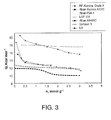
- Fig. 3 is a plot of the heats of adsorption of water vs. water loading for various adsorbents.
- Fig. 4 is an illustration of a process test unit used to measure properties of adsorbent materials.
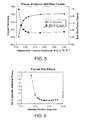
- Fig. 5 is a plot of oxygen recovery and bed size factor vs. heat transfer coefficient for a four-bed PVSA process with pretreatment for water removal.
- Fig. 6 is a plot of the effects of pretreatment adsorbent particle size on normalized adiabatic power.
- the zeolite adsorbents commonly used as the nitrogen-selective adsorbents in oxygen PSA systems are sensitive to contaminants present in ambient air, specifically water and carbon dioxide, with water being the most serious and controlling contaminant.
- the nitrogen-selective zeolite adsorbents have a high affinity for these impurities, and rapid deactivation can occur when the impurities are not adequately removed during the regeneration steps of the PSA process. Numerous techniques have been used in the art to remove these impurities from the feed gas.
- adsorbents in single or multiple bed systems, it is common to layer adsorbents in a vessel wherein a pretreatment layer of impurity-selective adsorbent is used at the feed inlet followed by one or more layers of nitrogen-selective adsorbent.
- the purpose of the impurity-selective pretreatment adsorbent is to reduce or remove water and/or carbon dioxide to protect the downstream adsorbent from progressive deactivation.
- the impact of impurities on the performance of the nitrogen-selective adsorbent is much greater in the small PSA systems used for portable oxygen concentrators than in larger industrial PSA systems. If the impurities are not removed properly in small PSA systems, the impurities can progress through the nitrogen adsorbent beds and cause a slow decline in the performance of the PSA system over a long period of time. Although the contaminants may be removed by the pretreatment layer during the PSA feed step, inadequate regeneration of this layer during the purge step can occur and lead to the slow deactivation of the nitrogen adsorbent. Solutions to this problem are provided by the embodiments of the invention described below.
- PSA pressure swing adsorption
- VSA vacuum swing adsorption
- indefinite articles “a” and “an” as used herein mean one or more when applied to any feature in embodiments of the present invention described in the specification and claims. The use of “a” and “an” does not limit the meaning to a single feature unless such a limit is specifically stated.
- the definite article “the” preceding singular or plural nouns or noun phrases denotes a particular specified feature or particular specified features and may have a singular or plural connotation depending upon the context in which it is used.
- the adjective “any” means one, some, or all indiscriminately of whatever quantity.
- the term “and/or” placed between a first entity and a second entity means one of (1) the first entity, (2) the second entity, and (3) the first entity and the second entity.
- Modern portable oxygen concentrators utilize PSA systems and are battery-powered to allow ambulatory patients to move about independently for reasonable periods of time without requiring connection to a power source.
- Light weight is critical for the successful development and use of these oxygen concentrators, and important design factors to achieve this include advanced adsorbent materials, small scale compressor technology, improved battery chemistry, lightweight materials of construction, new valve technology, scaled-down electronic components, and improved conserver devices.
- the proper choice of PSA cycles and adsorbents can significantly improve oxygen recovery, thereby reducing the weight of the adsorbent and the batteries required to operate the system.
- an adsorbent bed may comprise a pretreatment zone in which feed contaminants of varying concentrations are removed and a main adsorbent zone which the main separation takes place.
- the contaminants typically include water, CO 2 , amines, sulfur oxides, nitrogen oxides, and trace hydrocarbons.
- the main separation is effected by adsorbing nitrogen on a nitrogen-selective adsorbent.
- Fig. 1 is a plot of dry nitrogen adsorption capacity vs. adsorbed phase wt % (water and CO 2 ) on LiX zeolite. It is seen that significant degradation of the nitrogen-selective equilibrium adsorbent capacity occurs at low levels of adsorbed water and CO 2 .
- Water vapor is the critical feed contaminant in PSA systems for recovering oxygen from ambient air.
- Nitrogen-selective adsorbents such as X-type zeolites and low silica zeolites containing lithium strongly adsorb water and require high activation energy to remove adsorbed water in regeneration.
- Water contamination on zeolites used in PSA air separation causes significant reduction in the nitrogen capacity as seen in Fig. 1.
- a wide range of water concentrations may be present in the feed air to a portable oxygen concentrator as the concentrator operates in a wide range of environmental conditions of temperature, altitude, and humidity levels. Therefore, any portable concentrator system must be designed for a wide range of feed gas contaminant levels.
- the superficial contact time may be defined for all adsorbent in the bed including a pretreatment layer, or alternatively may be defined for the pretreatment layer only. A minimum superficial contact time is required to select an adsorbent for contaminant removal
- Fig. 2 is a plot of oxygen product purity vs. time over a period of 80,000 cycles. The decline in product purity over time due to lack of a pretreatment layer occurs almost immediately and continues nearly monotonically over the period of the experiment.
- Process conditions for a typical portable oxygen concentrator design may include cycle differential pressures between about 0.4 atma and about 1.7 atma in PVSA and about 1 atma and about 6 atma in PSA processes.
- a feed flow rate in the range of about 2 slpm to about 40 slpm is required for the production of 0.25 to 5.0 slpm of 93% purity oxygen.
- the operating temperature of the oxygen concentrator typically is -70°F, but can range from 0°F to 100°F depending on the location of the concentrator.
- Altitude can range from sea level to 6000 ft above sea level. Standard conditions are defined as 21.1 °C and 1 atm.
- a pretreatment adsorbent For effective contaminant handling in the adsorber beds, a pretreatment adsorbent with favorable equilibrium properties and mass transfer properties is required.
- Various adsorbents are available to perform the task of reducing or removing the feed contaminants.
- Fig. 3 is a plot of the heats of adsorption of water vs. water loading for typical pretreatment adsorbents,
- the adsorption kinetics of the pretreatment adsorbent and the nitrogen-selective zeolite can be quantified by a mass transfer coefficient, k i , where k is the rate constant for sorbate i using an appropriate mass transfer model.
- This parameter can be determined by fitting experimental breakthrough or cycle data. Fitting cycle data accounts for a complete combination of all mechanisms of mass transfer resistance which are present in the actual process, and a more accurate model of the process kinetics is determined from mass transfer parameters obtained from cyclic data.
- An experimental single-bed PSA apparatus was constructed for evaluating the mass transfer parameter for water adsorption on a given adsorbent.
- the apparatus was capable of experimental process operation in which the bed pressures and feed flow rates can be varied.
- k the apparatus was operated at selected pressures and feed velocities to match those of an actual or planned full-scale process
- Fig. 4 is a schematic flow diagram of the single-bed experimental system.
- the test system comprised adsorber vessel 110 containing adsorbent, empty product tank 111, and air compressor 101 which provided air feed flow and also provided vacuum during evacuation.
- the air feed flow rate was adjusted by throttling a bleedoff flow through valve 102 and was measured by flow meter 103.
- Silencer/filter 104 was placed at the feed inlet/vacuum outlet.
- a block of pneumatic valves (105-108, 112) was operated in sequence by programmable logic controller 119.
- the duration of process steps in the PSA cycle was regulated by the programmable logic controller.
- Pressures were measured by pressure sensor 109 at the product end of the adsorber bed and by pressure sensor 115 at the inlet end of the product tank.
- Check valve 113 controlled the timing of the gas flow to product tank 111.
- the product flow was adjusted by needle valve 118, the oxygen purity was measured by para-magnetic oxygen analyzer 116, and flow rate was measured by flow meter 117. Feed gas temperature and humidity were measured at the feed inlet to the system. The system was located in an environmentally controlled laboratory.
- a standard test procedure was used to evaluate the mass transfer characteristics of an adsorbent.
- the bed pressure was cycled from about 0.3 atm to about 1.2 atm, the oxygen product purity was maintained at 93%, and the feed and evacuation gas superficial velocities were about 0.39 ft sec -1 . It was necessary to change the cycle times slightly and to change the product flow rates to achieve these targets.
- the feed gas humidity, pressure, temperature, and flow rates were determined by direct measurement.
- the product flow rate and concentration were measured at cyclic steady state.
- a computer simulator model was developed to determine the mass transfer coefficient, k, for the tested adsorbent.
- SIMPAC This computer model, is a process simulator which solves energy, mass, and momentum balances for a cycle having one or more adsorbent beds and a multicomponent feed gas.
- the process simulator can utilize a range of mass transfer and equilibrium models.
- the use and validation of SIMPAC is described in U.S. Patent 5,258,06 , which is incorporated herein by reference.
- q is the average amount adsorbed in the pellet
- q* is the equilibrium amount adsorbed per unit volume of adsorbent
- k is the mass transfer coefficient.
- thermogravimetric analysis TGA
- TGA-IR thermogravimetric analysis with infrared detection
- Alcan AA-300 and AA-400 and UOP aluminas were screened to various particle sizes and tested using the procedure described above. Bed heights were between 2.4 and 3.2 inch, and inside bed diameters were 0.88 inch. The pretreatment bed height was 1 cm and feed linear velocities were about 0.4 ft sec -1 . As described above, mass transfer parameters determined for these materials are shown in Table 1.
- Table 1 Approximate k values for water on pretreatment aluminas Adsorbent k water, sec -1 Alcan AA300, Activated, 14x20 mesh 30 Alcan AA400G, Activated, 20x28 mesh 125 Alcan AA400G, Activated, 28x48 mesh 190 Alcan AA400G, Activated, 32x35 mesh 200 UOP, Activated, 12x32 mesh 105
- Table 2 illustrates the impact of the pretreatment kinetics on the overall recovery and bed size factor (BSF), Adsorbents used in the main portion of the adsorbent bed are UOP Oxysiv MDX, UOP Oxysiv-7 and pilot scale LiLSX materials.
- BSF bed size factor
- Adsorbents used in the main portion of the adsorbent bed are UOP Oxysiv MDX, UOP Oxysiv-7 and pilot scale LiLSX materials.
- This comparison of performance in systems having the same main bed adsorbent shows distinguishable differences where a pretreatment material having high k values are used. For example, we can compare case 1 with case 7 where the same Oxysiv-MDX is used and the bed split is 30/70.
- the amount of water removed in the pretreatment layer strongly influences the effectiveness of the nitrogen removal since part of the main bed adsorbent becomes irreversibly contaminated. Minimizing this main bed contamination is important in maintaining the desired performance, As stated earlier, both capacity and adsorption kinetics are important in the removal of water from the feed gas.
- the pretreatment adsorbent must have a fairly low activation energy (heat of adsorption) and high adsorption kinetics. Since the heat of adsorption for water on any adsorbent is not negligible, the thermal profile within the adsorbent bed becomes a contributing factor in the effectiveness of the contaminant removal and regeneration. In systems where water has a low heat of desorption relative to the nitrogen selective adsorbent in the main adsorbent bed, it is beneficial to run the system at near-isothermal conditions.
- a system at near-isothermal conditions is defined as a system where there is a high degree of heat transfer from the adsorption process to the ambient surroundings.
- a temperature effect described as a "cold zone" is observed near the interface of layered beds where the temperature profile of the beds dips very low relative to the feed inlet temperature. With improved heat transfer, this temperature dip can be minimized.
- the degree of heat transfer from the adsorbent bed to the column wall is described by a single heat transfer parameter, h w , where it is shown that higher values of h w yield narrower bed temperature profiles.
- a large drop in bed temperature causes a higher energy requirement for regeneration of the zone where the "dip" occurs.
- increased vacuum energy is costly in the form of increased compressor capacity and hence higher power and weight.
- a solution to this problem is to use a layered adsorbent bed wherein the energy required to regenerate the pretreatment adsorbent is minimized and wherein the heats of adsorption and regeneration are easily transferred from or to the adsorbent bed.
- the effects of this improvement are shown in Fig. 5 and Table 4 which illustrate the performance of the previously described 4-bed system where the overall product recovery and bed size factor are shown to have a dependence on the h w .
- Pressure drop effects are important in selecting and optimizing a pretreatment adsorbent. Since smaller particles will have better mass transfer properties and higher k values, they are preferred in rapid cycle systems. As adsorbent particles are decreased in size, however, there are significant issues with pressure drop and handling which make particles below a certain size unfeasible in packed beds.
- Fig. 6 shows the product recovery effects of using small bead particles with increased pressure drop and a sharp increase in power where smaller particle sizes are used.
- An operating issue not captured in the operating data of Fig. 6 is the generation of fines from rubbing particles, which occurs because the energy required to move and vibrate the small particles is lower than that for larger particles, therefore increasing the likelihood of attrition of smaller particles, Such fines and dust can cause clogging and malfunction of downstream system components, particularly valves.
- Another issue is increased mass transfer resistance due to adsorbed film effects on smaller particles.
- a single bed experiment was run using a 4-step process analogous the process described above.
- the adsorbent column was loaded with LiLSX having an average particle diameter of 0.8 mm and an Alcoa AL H152 pretreatment adsorbent with an average particle diameter of 2.0 mm.
- the cycle time was varied from 85-105 seconds with feed time varied between 25 and 45 seconds.
- the feed linear velocity ranged from 0.2 to 0.4 ft/sec.
- the adsorbent column length was 17 inches and 30% of the total length was the pretreatment layer. Oxygen product purity was 90% and remained steady for about 300 hours before the experiment was completed.
- the column heat transfer coefficient (HTC) was about 0,15 BTU lb -1 hr -1 °F -1 .
Landscapes
- Chemical & Material Sciences (AREA)
- Organic Chemistry (AREA)
- Analytical Chemistry (AREA)
- Engineering & Computer Science (AREA)
- General Chemical & Material Sciences (AREA)
- Oil, Petroleum & Natural Gas (AREA)
- Chemical Kinetics & Catalysis (AREA)
- Inorganic Chemistry (AREA)
- Separation Of Gases By Adsorption (AREA)
- Oxygen, Ozone, And Oxides In General (AREA)
- Solid-Sorbent Or Filter-Aiding Compositions (AREA)
Abstract
Description
- Recent advances in process and adsorbent technology have enabled traditional large-scale pressure swing adsorption (PSA) systems to be scaled down to much smaller systems that operate in rapid cycles of very short duration. These small, rapid-cycle PSA systems may be utilized, for example, in portable medical oxygen concentrators that recover oxygen from ambient air. As the market for these concentrators grows, there is an incentive to develop increasingly smaller, lighter, and more portable units for the benefit of patients on oxygen therapy.
- The impact of feed gas impurities on the adsorbent is a generic problem in many PSA systems, and the impact is especially serious in the small adsorbent beds required in small rapid-cycle PSA systems. For example, the water and carbon dioxide impurities in air can cause a significant decline in the performance of small PSA air separation systems by progressive deactivation of the adsorbent due to adsorbed impurities that are incompletely removed during regeneration steps of the PSA cycle. Because of this progressive deactivation, oxygen recovery will decline over time and adsorbent replacement may be required on a regular basis. Alternatively, the adsorbent beds may have to be oversized to account for progressive adsorbent deactivation. Both of these situations are undesirable because they increase the cost and weight of the oxygen concentrator system.
- There is a need in the art for improved methods to remove impurities, particularly water, in the design and operation of small, portable, rapid-cycle PSA oxygen concentrators. This need is addressed by the embodiments of the invention described below and defined by the claims that follow.
- A first embodiment of the invention includes a pressure swing adsorption process for the production of oxygen comprising
- (a) providing at least one adsorber vessel having a feed end and a product end, wherein the vessel comprises a first layer of adsorbent material adjacent the feed end and a second layer of adsorbent material disposed between the first layer and the product end, wherein the adsorbent in the first layer is selective for the adsorption of water from a mixture comprising water, oxygen, and nitrogen and the adsorbent in the second layer is selective for the adsorption of nitrogen from a mixture comprising oxygen and nitrogen, and wherein the heat of adsorption of water on the adsorbent material in the first layer is equal to or less than about 14 kcal/mole at loadings equal to or greater than about 0.05 mmol adsorbed water per gram of adsorbent;
- (b) introducing a pressurized feed gas comprising at least oxygen, nitrogen, and water into the feed end of the adsorber vessel, passing the gas successively through the first and second layers, adsorbing at least a portion of the water in the adsorbent material in the first layer, and adsorbing at least a portion of the nitrogen in the adsorbent material in the second layer, wherein the mass transfer coefficient of water in the first layer of adsorbent material is in the range of about 125 to about 400 sec-1 and the superficial contact time of the pressurized feed gas in the first layer is between about 0.08 and about 0.50 sec; and
- (c) withdrawing a product gas enriched in oxygen from the product end of the adsorber vessel.
- The adsorbent material in the first layer may comprise activated alumina; the activated alumina may have an average particle diameter between about 0.3 mm and about 0.7 mm. The adsorbent material in the second layer may be selective for the adsorption of argon from a mixture comprising argon and oxygen. The concentration of oxygen in the product gas withdrawn from the product end of the adsorber vessel may be at least 85 volume %. The pressurized feed gas may be air.
- The depth of the first layer may be between about 10°/a and about 40% of the total depth of the first and second layers, and the depth of the first layer may be between about 0.7 and about 13 cm. The adsorber vessel may be cylindrical and the ratio of the total depth of the first and second layers to the inside diameter of the adsorber vessel may be between about 1.8 and about 6.0.
- The pressure swing adsorption process may be operated in a repeating cycle comprising at least a feed step wherein the pressurized feed gas is introduced into the feed end of the adsorber vessel and the product gas enriched in oxygen is withdrawn from the product end of the adsorber vessel, a depressurization step in which gas is withdrawn from the feed end of the adsorber vessel to regenerate the adsorbent material in the first and second layers, and a repressurization step in which the adsorber vessel is pressurized by introducing one or more repressurization gases into the adsorber vessel, and wherein the duration of the feed step is between about 0.75 and about 45 seconds. The total duration of the cycle may be between about 6 and about 100 seconds. The flow rate of the product gas enriched in oxygen may be between about 0.1 and about 3.0 standard liters per minute.
- The ratio of the weight in grams of the adsorbent material in the first layer to the flow rate of the product gas in standard liters per minute at 93% oxygen purity in the product gas may be less than about 50 g/slpm. The amount of oxygen recovered in the product gas at 93% oxygen purity in the product gas may be greater than about 35% of the amount of oxygen in the pressurized feed gas.
- The adsorbent material in the second layer may comprise one or more adsorbents selected from the group consisting of X-type zeolite, A-type zeolite, Y-type zeolite, chabazite, mordenite, and clinoptilolite. This adsorbent material may be a lithium-exchanged low silica X-type zeolite in which at least about 85% of the active site cations are lithium.
- Another embodiment of the invention relates to a pressure swing adsorption process for the production of oxygen comprising
- (a) providing at least one adsorber vessel having a feed end and a product end, wherein the vessel comprises a first layer of adsorbent material adjacent the feed end and a second layer of adsorbent material disposed between the first layer and the product end, wherein the adsorbent in the first layer is selective for the adsorption of water from a mixture comprising water, oxygen, and nitrogen and the adsorbent in the second layer is selective for the adsorption of nitrogen from a mixture comprising oxygen and nitrogen, wherein the heat of adsorption of water on the adsorbent material in the first layer is equal to or less than about 14 kcal/mole at loadings equal to or greater than about 0,05 mmol adsorbed water per gram of adsorbent;
- (b) introducing a pressurized feed gas comprising at least oxygen, nitrogen, and water into the feed end of the adsorber vessel, passing the gas successively through the first and second layers, adsorbing at least a portion of the water in the adsorbent material in the first layer, and adsorbing at least a portion of the nitrogen in the adsorbent material in the second layer, wherein the mass transfer coefficient of water in the first layer of adsorbent material is in the range of about 125 to about 400 sec-1; and
- (c) withdrawing a product gas enriched in oxygen from the product end of the adsorber vessel, wherein the ratio of the weight in grams of the adsorbent material in the first layer to the flow rate of the product gas in standard liters per minute at 93% oxygen purity in the product gas is less than about 50 g/slpm.
- The adsorbent material in the first layer may comprise activated alumina; the activated alumina may have an average particle diameter between about 0.3 mm and about 0.7 mm. The adsorbent material in the second layer may be selective for the adsorption of argon from a mixture comprising argon and oxygen. The concentration of oxygen in the product gas withdrawn from the product end of the adsorber vessel may be at least 93 volume %. The pressurized feed gas may be air.
- The depth of the first layer may be between about 10% and about 40% of the total depth of the first and second layers; the depth of the first layer may be between about 0.7 and about 13 cm. The adsorber vessel may be cylindrical and the ratio of the total depth of the first and second layers to the inside diameter of the adsorber vessel is between about 1.8 and about 6.0.
- The pressure swing adsorption process may be operated in a repeating cycle comprising at least a feed step wherein the pressurized feed gas is introduced into the feed end of the adsorber vessel and the product gas enriched in oxygen is withdrawn from the product end of the adsorber vessel, a depressurization step in which gas is withdrawn from the feed end of the adsorber vessel to regenerate the adsorbent material in the first and second layers, and a repressurization step in which the adsorber vessel is pressurized by introducing one or more repressurization gases into the adsorber vessel, and wherein the duration of the feed step is between about 0.75 and about 45 seconds.
- The total duration of the cycle may be between about 6 and about 100 seconds. The flow rate of the product gas enriched in oxygen may be between about 0.1 and about 3,0 standard liters per minute. The amount of oxygen recovered in the product gas at 93% oxygen purity in the product may be greater than about 35% of the amount of oxygen in the pressurized feed gas, The adsorbent material in the second layer may comprise one or more adsorbents selected from the group consisting of X-type zeolite, A-type zeolite, Y-type zeolite, chabazite, mordenite, and clinoptilolite. This adsorbent material may be a lithium -exchanged low silica X-type zeolite in which at least about 85% of the active site cations are lithium,
- Fig. 1 is a plot of dry nitrogen capacity vs. adsorbed phase wt % (water and CO2) on Li X zeolite.
- Fig. 2 is a plot of oxygen product purity vs. time for the operation of a single-bed PSA system using a bed of Oxysiv-MDX adsorbent with and without pretreatment for water removal.
- Fig. 3 is a plot of the heats of adsorption of water vs. water loading for various adsorbents.
- Fig. 4 is an illustration of a process test unit used to measure properties of adsorbent materials.
- Fig. 5 is a plot of oxygen recovery and bed size factor vs. heat transfer coefficient for a four-bed PVSA process with pretreatment for water removal.
- Fig. 6 is a plot of the effects of pretreatment adsorbent particle size on normalized adiabatic power.
- Recent advances in process and adsorbent technology allow the designs of traditional large-scale pressure swing adsorption (PSA) processes to be scaled down to much smaller systems. These smaller systems are especially useful in transportable devices such as, for example, medical oxygen concentrators for recovering oxygen from air. As the medical oxygen concentrator market develops, there is a growing need for smaller, lighter, and more transportable devices for the benefit of patients requiring oxygen therapy.
- The zeolite adsorbents commonly used as the nitrogen-selective adsorbents in oxygen PSA systems are sensitive to contaminants present in ambient air, specifically water and carbon dioxide, with water being the most serious and controlling contaminant. The nitrogen-selective zeolite adsorbents have a high affinity for these impurities, and rapid deactivation can occur when the impurities are not adequately removed during the regeneration steps of the PSA process. Numerous techniques have been used in the art to remove these impurities from the feed gas. In single or multiple bed systems, it is common to layer adsorbents in a vessel wherein a pretreatment layer of impurity-selective adsorbent is used at the feed inlet followed by one or more layers of nitrogen-selective adsorbent. The purpose of the impurity-selective pretreatment adsorbent is to reduce or remove water and/or carbon dioxide to protect the downstream adsorbent from progressive deactivation.
- The impact of impurities on the performance of the nitrogen-selective adsorbent is much greater in the small PSA systems used for portable oxygen concentrators than in larger industrial PSA systems. If the impurities are not removed properly in small PSA systems, the impurities can progress through the nitrogen adsorbent beds and cause a slow decline in the performance of the PSA system over a long period of time. Although the contaminants may be removed by the pretreatment layer during the PSA feed step, inadequate regeneration of this layer during the purge step can occur and lead to the slow deactivation of the nitrogen adsorbent. Solutions to this problem are provided by the embodiments of the invention described below.
- The generic term "pressure swing adsorption" (PSA) as used herein applies to all adsorptive separation systems operating between a maximum and a minimum pressure. The maximum pressure typically is superatmospheric, and the minimum pressure may be super-atmospheric or sub-atmospheric. When the minimum pressure is sub-atmospheric and the maximum pressure is superatmospheric, the system typically is described as a pressure vacuum swing adsorption (PVSA) system. When the maximum pressure is at or below atmospheric pressure and the minimum pressure is below atmospheric pressure, the system is typically described as a vacuum swing adsorption (VSA) system,
- The indefinite articles "a" and "an" as used herein mean one or more when applied to any feature in embodiments of the present invention described in the specification and claims. The use of "a" and "an" does not limit the meaning to a single feature unless such a limit is specifically stated. The definite article "the" preceding singular or plural nouns or noun phrases denotes a particular specified feature or particular specified features and may have a singular or plural connotation depending upon the context in which it is used. The adjective "any" means one, some, or all indiscriminately of whatever quantity. The term "and/or" placed between a first entity and a second entity means one of (1) the first entity, (2) the second entity, and (3) the first entity and the second entity.
- Modern portable oxygen concentrators utilize PSA systems and are battery-powered to allow ambulatory patients to move about independently for reasonable periods of time without requiring connection to a power source. Light weight is critical for the successful development and use of these oxygen concentrators, and important design factors to achieve this include advanced adsorbent materials, small scale compressor technology, improved battery chemistry, lightweight materials of construction, new valve technology, scaled-down electronic components, and improved conserver devices. In addition, the proper choice of PSA cycles and adsorbents can significantly improve oxygen recovery, thereby reducing the weight of the adsorbent and the batteries required to operate the system.
- For any PSA process, recovery improvements can be realized by utilizing a rapid cycles with adsorbent materials having favorable adsorption capacity and kinetic properties. In rapid cycle processes, adsorption kinetics is an important factor in reducing the size of adsorbent beds. As described above, an adsorbent bed may comprise a pretreatment zone in which feed contaminants of varying concentrations are removed and a main adsorbent zone which the main separation takes place. In PSA oxygen concentrators, the contaminants typically include water, CO2, amines, sulfur oxides, nitrogen oxides, and trace hydrocarbons. The main separation is effected by adsorbing nitrogen on a nitrogen-selective adsorbent.
- Because nitrogen-selective adsorbents have a high adsorption affinity for these contaminants, the adsorbed contaminants are difficult to remove once they are adsorbed. This adversely impacts the efficiency of the nitrogen/oxygen separation in an oxygen PSA system in which contaminants are removed by a pretreatment adsorbent that is regenerated by purging. The embodiments of the present invention are directed towards reducing the quantity of adsorbent in the pretreatment layer while maintaining the performance of the nitrogen-selective adsorbent under varied ambient operating conditions. The importance of proper feed gas pretreatment is illustrated in Fig. 1, which is a plot of dry nitrogen adsorption capacity vs. adsorbed phase wt % (water and CO2) on LiX zeolite. It is seen that significant degradation of the nitrogen-selective equilibrium adsorbent capacity occurs at low levels of adsorbed water and CO2.
- Water vapor is the critical feed contaminant in PSA systems for recovering oxygen from ambient air. Nitrogen-selective adsorbents such as X-type zeolites and low silica zeolites containing lithium strongly adsorb water and require high activation energy to remove adsorbed water in regeneration. Water contamination on zeolites used in PSA air separation causes significant reduction in the nitrogen capacity as seen in Fig. 1. A wide range of water concentrations may be present in the feed air to a portable oxygen concentrator as the concentrator operates in a wide range of environmental conditions of temperature, altitude, and humidity levels. Therefore, any portable concentrator system must be designed for a wide range of feed gas contaminant levels.
- A key parameter used to describe the operation of a PSA system is the superficial contact time of the gas in the adsorbent bed. This parameter is defined as

where L is the bed length and v o is the superficial velocity of the feed gas through the bed based on the empty bed volume. The superficial contact time may be defined for all adsorbent in the bed including a pretreatment layer, or alternatively may be defined for the pretreatment layer only. A minimum superficial contact time is required to select an adsorbent for contaminant removal - Under typical ambient conditions (for example, 10-20% relative humidity in the ambient air feed), operating a zeolite bed without a pretreatment adsorbent in an oxygen PSA system will result in a noticeable decline in system performance in a short period of time. This was illustrated in an experiment carried out with a single-bed oxygen PVSA system using a full bed of a nitrogen-selective LiX adsorbent without a pretreatment layer. A single bed of UOP Oxysiv-MDX adsorbent was cycled in a four-step process (feed repressurization, feed/make product, evacuation, purge). The bed ID was 0.88 inch, the bed height was 2.47 inch, the total cycle time was 19 seconds, and the product rate was 43-48 sccm with a bed feed superficial velocity of about 0.38 ft sec-1. The results of this experiment are given in Fig. 2, which is a plot of oxygen product purity vs. time over a period of 80,000 cycles. The decline in product purity over time due to lack of a pretreatment layer occurs almost immediately and continues nearly monotonically over the period of the experiment.
- Process conditions for a typical portable oxygen concentrator design may include cycle differential pressures between about 0.4 atma and about 1.7 atma in PVSA and about 1 atma and about 6 atma in PSA processes. To achieve an oxygen recovery of 65% (i.e., the percentage of oxygen in the feed gas recovered as product), a feed flow rate in the range of about 2 slpm to about 40 slpm is required for the production of 0.25 to 5.0 slpm of 93% purity oxygen. The operating temperature of the oxygen concentrator typically is -70°F, but can range from 0°F to 100°F depending on the location of the concentrator. Altitude can range from sea level to 6000 ft above sea level. Standard conditions are defined as 21.1 °C and 1 atm.
- For effective contaminant handling in the adsorber beds, a pretreatment adsorbent with favorable equilibrium properties and mass transfer properties is required. Various adsorbents are available to perform the task of reducing or removing the feed contaminants. Fig. 3 is a plot of the heats of adsorption of water vs. water loading for typical pretreatment adsorbents,
- The adsorption kinetics of the pretreatment adsorbent and the nitrogen-selective zeolite can be quantified by a mass transfer coefficient, ki, where k is the rate constant for sorbate i using an appropriate mass transfer model. This parameter can be determined by fitting experimental breakthrough or cycle data. Fitting cycle data accounts for a complete combination of all mechanisms of mass transfer resistance which are present in the actual process, and a more accurate model of the process kinetics is determined from mass transfer parameters obtained from cyclic data.
- An experimental single-bed PSA apparatus was constructed for evaluating the mass transfer parameter for water adsorption on a given adsorbent. The apparatus was capable of experimental process operation in which the bed pressures and feed flow rates can be varied. To determine a representative mass transfer coefficient, k, the apparatus was operated at selected pressures and feed velocities to match those of an actual or planned full-scale process
- Fig. 4 is a schematic flow diagram of the single-bed experimental system. The test system comprised
adsorber vessel 110 containing adsorbent,empty product tank 111, and air compressor 101 which provided air feed flow and also provided vacuum during evacuation. The air feed flow rate was adjusted by throttling a bleedoff flow through valve 102 and was measured byflow meter 103. Silencer/filter 104 was placed at the feed inlet/vacuum outlet. A block of pneumatic valves (105-108, 112) was operated in sequence byprogrammable logic controller 119. The duration of process steps in the PSA cycle was regulated by the programmable logic controller. Pressures were measured by pressure sensor 109 at the product end of the adsorber bed and by pressure sensor 115 at the inlet end of the product tank.Check valve 113 controlled the timing of the gas flow toproduct tank 111. The product flow was adjusted byneedle valve 118, the oxygen purity was measured bypara-magnetic oxygen analyzer 116, and flow rate was measured byflow meter 117. Feed gas temperature and humidity were measured at the feed inlet to the system. The system was located in an environmentally controlled laboratory. - A standard test procedure was used to evaluate the mass transfer characteristics of an adsorbent. The bed pressure was cycled from about 0.3 atm to about 1.2 atm, the oxygen product purity was maintained at 93%, and the feed and evacuation gas superficial velocities were about 0.39 ft sec-1. It was necessary to change the cycle times slightly and to change the product flow rates to achieve these targets. The feed gas humidity, pressure, temperature, and flow rates were determined by direct measurement. The product flow rate and concentration were measured at cyclic steady state. Using all of the collected process data, a computer simulator model was developed to determine the mass transfer coefficient, k, for the tested adsorbent. This computer model, SIMPAC, is a process simulator which solves energy, mass, and momentum balances for a cycle having one or more adsorbent beds and a multicomponent feed gas. The process simulator can utilize a range of mass transfer and equilibrium models. The use and validation of SIMPAC is described in
U.S. Patent 5,258,06 , which is incorporated herein by reference. In the selected mass transfer model, k is the rate constant from the well-known linear driving force model with partial pressure driving force:
q is the average amount adsorbed in the pellet, q* is the equilibrium amount adsorbed per unit volume of adsorbent, and k is the mass transfer coefficient. - Single component isotherms were used to describe the equilibrium properties, axial dispersion was determined to be negligible, and a natural convection heat-transfer model was used in the non-isothermal energy balance. In determining the mass transfer behavior of water adsorption on the identified materials, a bed having two adsorbent layers was used. The first layer adsorbs only water and carbon dioxide, while the second layer has affinity for all of the components in the feed gas. The second layer is a well-characterized material for which all of the pure component isotherms and the mass transfer coefficients are known. In addition to the cyclic experiments, the materials were removed from the adsorbent columns in well-maintained sections after the experiments were complete and were analyzed for water content by thermogravimetric analysis (TGA) or preferably thermogravimetric analysis with infrared detection (TGA-IR) of the desorbing gas. A profile of the adsorbed water was obtained from this direct measurement and was matched to the computer simulation results. The k parameter was therefore determined.
- Alcan AA-300 and AA-400 and UOP aluminas were screened to various particle sizes and tested using the procedure described above. Bed heights were between 2.4 and 3.2 inch, and inside bed diameters were 0.88 inch. The pretreatment bed height was 1 cm and feed linear velocities were about 0.4 ft sec-1. As described above, mass transfer parameters determined for these materials are shown in Table 1.
Table 1 Approximate k values for water on pretreatment aluminas Adsorbent k water, sec-1 Alcan AA300, Activated, 14x20 mesh 30 Alcan AA400G, Activated, 20x28 mesh 125 Alcan AA400G, Activated, 28x48 mesh 190 Alcan AA400G, Activated, 32x35 mesh 200 UOP, Activated, 12x32 mesh 105 - The single bed experiments were extended to determine the overall effect of the pretreatment kinetic parameter on key properties of the process. Table 2 illustrates the impact of the pretreatment kinetics on the overall recovery and bed size factor (BSF), Adsorbents used in the main portion of the adsorbent bed are UOP Oxysiv MDX, UOP Oxysiv-7 and pilot scale LiLSX materials. This comparison of performance in systems having the same main bed adsorbent shows distinguishable differences where a pretreatment material having high k values are used. For example, we can compare
case 1 withcase 7 where the same Oxysiv-MDX is used and the bed split is 30/70. By using a pretreatment material having a larger k value (200 sec-1 versus 30 sec-1), the recovery improves from 29% to 45% and the bed size factor incase 7 is 73% of that incase 1.Table 2 Effect of pretreatment adsorbent on overall performance of a single-bed VPSA process Case Main Bed Sieve Pretreat:Main Bed Ratio Total Bed h, in kwater ,sec-1 O2 Recovery, % Norm BSF, Ib/ TPDc 1 Oxysiv-MDX 30/70 3.1 30 29% 1.00 2 Pilot LiLSX 10/90 2.6 30 15% 1.54 3 Oxysiv-7 30/70 3.2 125 22% 1.36 4 Pilot ULSX 10/90 2.6 125 26% 1.29 5 Oxysiv-MDX 30/70 3.2 125 41% 0.97 6 Oxysiv-MDX 25/75 3.2 190 56% 0.74 7 Oxysiv-MDX 30/70 3.2 200 45% 0.73 8 Oxysiv-MOX 25/75 3.2 105 50% 0.67 - The mass transfer properties of the pretreatment adsorbent were also used to predict the performance of a four-bed process previously described in patent application
EP1598103A2 where cycle times were 6.0-8.0 seconds and individual step times were 0.75 to 1.0 seconds. This four bed process was run both in simulation and experimentally to illustrate the previously unrecognized relationship between the contaminant kinetics in the pretreatment layer and the overall product recovery and bed size factor in a portable system. Table 3 summarizes these experimental results.Table 3 Effect of pretreatment adsorbent on overall performance of 4-bed VPSA process 4-Bed Experiment Main Bed Sieve Pre:Main Bed Ratio kwater sec-1 Production at 93% 02, slpm Recovery, % BSF, lb/TPDc BB326 Oxysiv-MDX 30/70 125 3.1 66% 156 PB334 Oxysiv-MDX 25/75 190 3.2 65% 147 - In the fast cycle process, the amount of water removed in the pretreatment layer strongly influences the effectiveness of the nitrogen removal since part of the main bed adsorbent becomes irreversibly contaminated. Minimizing this main bed contamination is important in maintaining the desired performance, As stated earlier, both capacity and adsorption kinetics are important in the removal of water from the feed gas. The pretreatment adsorbent must have a fairly low activation energy (heat of adsorption) and high adsorption kinetics. Since the heat of adsorption for water on any adsorbent is not negligible, the thermal profile within the adsorbent bed becomes a contributing factor in the effectiveness of the contaminant removal and regeneration. In systems where water has a low heat of desorption relative to the nitrogen selective adsorbent in the main adsorbent bed, it is beneficial to run the system at near-isothermal conditions.
- While no process can be run as purely isothermal, a system at near-isothermal conditions is defined as a system where there is a high degree of heat transfer from the adsorption process to the ambient surroundings. As shown in prior art, for various reasons a temperature effect described as a "cold zone" is observed near the interface of layered beds where the temperature profile of the beds dips very low relative to the feed inlet temperature. With improved heat transfer, this temperature dip can be minimized. For example, the degree of heat transfer from the adsorbent bed to the column wall is described by a single heat transfer parameter, hw, where it is shown that higher values of hw yield narrower bed temperature profiles. A large drop in bed temperature causes a higher energy requirement for regeneration of the zone where the "dip" occurs. In small portable adsorption systems, increased vacuum energy is costly in the form of increased compressor capacity and hence higher power and weight.
- A solution to this problem is to use a layered adsorbent bed wherein the energy required to regenerate the pretreatment adsorbent is minimized and wherein the heats of adsorption and regeneration are easily transferred from or to the adsorbent bed. The effects of this improvement are shown in Fig. 5 and Table 4 which illustrate the performance of the previously described 4-bed system where the overall product recovery and bed size factor are shown to have a dependence on the h w.
- Pressure drop effects are important in selecting and optimizing a pretreatment adsorbent. Since smaller particles will have better mass transfer properties and higher k values, they are preferred in rapid cycle systems. As adsorbent particles are decreased in size, however, there are significant issues with pressure drop and handling which make particles below a certain size unfeasible in packed beds.
- Simulations were made using the 4-bed process described in Example 1. Ambient conditions of 1 atm, 73°F, and 25% relative humidity were assumed. Beds of Alcan AA400G alumina pretreatment layer with highly exchanged LiLSX main bed layer were used in a 25/75 ratio (pretreatment layer/main layer). The total cycle time was 8 seconds and a heat transfer coefficient of 0.87 BTU lb-1hr-1 °F-1 was used. The simulations were made for various values of the pretreatment adsorbent particle size and water mass transfer coefficient, kw. The value of kw was varied according to the relation

where the effective diffusivity, Deff, was assumed to be constant for all particle sizes. Specific adiabatic power was determined for each case for comparison. - The results are presented in Fig. 6, which shows the product recovery effects of using small bead particles with increased pressure drop and a sharp increase in power where smaller particle sizes are used. An operating issue not captured in the operating data of Fig. 6 is the generation of fines from rubbing particles, which occurs because the energy required to move and vibrate the small particles is lower than that for larger particles, therefore increasing the likelihood of attrition of smaller particles, Such fines and dust can cause clogging and malfunction of downstream system components, particularly valves. Another issue is increased mass transfer resistance due to adsorbed film effects on smaller particles.
Table 4 Effects of Heat Transfer on 4-Bed process (constant k) Case Pretreat:Main Bed Ratio HTC, BTU lb-1 hr-1 F-1 O2 Recovery, % Norm BSF, lb/ TPDc 9 25:75 0.05 55% 1.00 10 25:75 0.10 63% 0.89 11 25:75 0.15 66% 0.86 12 25:75 0.20 68% 0.84 13 25:75 0.25 69% 0.84 14 25:75 0.50 70% 0.83 15 25:75 1.00 70% 0.84 - A single bed experiment was run using a 4-step process analogous the process described above. The adsorbent column was loaded with LiLSX having an average particle diameter of 0.8 mm and an Alcoa AL H152 pretreatment adsorbent with an average particle diameter of 2.0 mm. The cycle time was varied from 85-105 seconds with feed time varied between 25 and 45 seconds. The feed linear velocity ranged from 0.2 to 0.4 ft/sec. The adsorbent column length was 17 inches and 30% of the total length was the pretreatment layer. Oxygen product purity was 90% and remained steady for about 300 hours before the experiment was completed. The column heat transfer coefficient (HTC) was about 0,15 BTU lb-1 hr-1 °F-1.
Claims (31)
- A pressure swing adsorption process for the production of oxygen comprising(a) providing at least one adsorber vessel having a feed end and a product end, wherein the vessel comprises a first layer of adsorbent material adjacent the feed end and a second layer of adsorbent material disposed between the first layer and the product end, wherein the adsorbent in the first layer is selective for the adsorption of water from a mixture comprising water, oxygen, and nitrogen and the adsorbent in the second layer is selective for the adsorption of nitrogen from a mixture comprising oxygen and nitrogen, and wherein the heat of adsorption of water on the adsorbent material in the first layer is equal to or less than about 14 kcal/mole at loadings equal to or greater than about 0,05 mmol adsorbed water per gram of adsorbent;(b) introducing a pressurized feed gas comprising at least oxygen, nitrogen, and water into the feed end of the adsorber vessel, passing the gas successively through the first and second layers, adsorbing at least a portion of the water in the adsorbent material in the first layer, and adsorbing at least a portion of the nitrogen in the adsorbent material in the second layer, wherein the mass transfer coefficient of water in the first layer of adsorbent material is in the range of about 125 to about 400 sec-1 and the superficial contact time of the pressurized feed gas in the first layer is between about 0.08 and about 0.50 sec; and(c) withdrawing a product gas enriched in oxygen from the product end of the adsorber vessel.
- The process of Claim 1 wherein the adsorbent material in the first layer comprises activated alumina.
- The process of Claim 2 wherein the activated alumina has an average particle diameter between about 0.3 mm and about 0.7 mm.
- The process of Claim 1 wherein the adsorbent material in the second layer is selective for the adsorption of argon from a mixture comprising argon and oxygen.
- The process of Claim 1 wherein the concentration of oxygen in the product gas withdrawn from the product end of the adsorber vessel is at least 85 volume %.
- The process of Claim 1 wherein the depth of the first layer is between about 10% and about 40% of the total depth of the first and second layers.
- The process of Claim 6 wherein the depth of the first layer is between about 0.7 and about 13cm.
- The process of Claim 6 wherein the adsorber vessel is cylindrical and the ratio of the total depth of the first and second layers to the inside diameter of the adsorber vessel is between about 1.8 and about 6.0.
- The process of Claim 1 wherein the pressure swing adsorption process is operated in a repeating cycle comprising at least a feed step wherein the pressurized feed gas is introduced into the feed end of the adsorber vessel and the product gas enriched in oxygen is withdrawn from the product end of the adsorber vessel, a depressurization step in which gas is withdrawn from the feed end of the adsorber vessel to regenerate the adsorbent material in the first and second layers, and a repressurization step in which the adsorber vessel is pressurized by introducing one or more repressurization gases into the adsorber vessel, and wherein the duration of the feed step is between about 0.75 and about 45 seconds.
- The process of Claim 9 wherein the total duration of the cycle is between about 6 and about 100 seconds.
- The process of Claim 1 wherein the flow rate of the product gas enriched in oxygen is between about 0.1 and about 3.0 standard liters per minute.
- The method of Claim 11 wherein the ratio of the weight in grams of the adsorbent material in the first layer to the flow rate of the product gas in standard liters per minute at 93% oxygen purity in the product gas is less than about 50 g/slpm.
- The process of Claim 1 wherein the amount of oxygen recovered in the product gas at 93% oxygen purity in the product gas is greater than about 35% of the amount of oxygen in the pressurized feed gas.
- The process of Claim 1 wherein the adsorbent material in the second layer comprises one or more adsorbents selected from the group consisting of X-type zeolite, A-type zeolite, Y-type zeolite, chabazite, mordenite, and clinoptilolite.
- The process of Claim 14 wherein the adsorbent material is a lithium-exchanged low silica X-type zeolite in which at least about 85% of the active site cations are lithium.
- The process of Claim 1 wherein the pressurized feed gas is air.
- A pressure swing adsorption process for the production of oxygen comprising(a) providing at least one adsorber vessel having a feed end and a product end, wherein the vessel comprises a first layer of adsorbent material adjacent the feed end and a second layer of adsorbent material disposed between the first layer and the product end, wherein the adsorbent in the first layer is selective for the adsorption of water from a mixture comprising water, oxygen, and nitrogen and the adsorbent in the second layer is selective for the adsorption of nitrogen from a mixture comprising oxygen and nitrogen, wherein the heat of adsorption of water on the adsorbent material in the first layer is equal to or less than about 14 kcal/mole at loadings equal to or greater than about 0.05 mmol adsorbed water per gram of adsorbent;(b) introducing a pressurized feed gas comprising at least oxygen, nitrogen, and water into the feed end of the adsorber vessel, passing the gas successively through the first and second layers, adsorbing at least a portion of the water in the adsorbent material in the first layer, and adsorbing at least a portion of the nitrogen in the adsorbent material in the second layer, wherein the mass transfer coefficient of water in the first layer of adsorbent material is in the range of about 125 to about 400 sec-1; and(c) withdrawing a product gas enriched in oxygen from the product end of the adsorber vessel, wherein the ratio of the weight in grams of the adsorbent material in the first layer to the flow rate of the product gas in standard liters per minute at 93% oxygen purity in the product gas is less than about 50 g/slpm.
- The process of Claim 17 wherein the adsorbent material in the first layer comprises activated alumina.
- The process of Claim 18 wherein the activated alumina has an average particle diameter between about 0.3 mm and about 0.7 mm.
- The process of Claim 17 wherein the adsorbent material in the second layer is selective for the adsorption of argon from a mixture comprising argon and oxygen.
- The process of Claim 17 wherein the concentration of oxygen in the product gas withdrawn from the product end of the adsorber vessel is at least 93 volume %.
- The process of Claim '17 wherein the depth of the first layer is between about 10% and about 40% of the total depth of the first and second layers.
- The process of Claim 22 wherein the depth of the first layer is between about 0.7 and about 13 cm.
- The process of Claim 22 wherein the adsorber vessel is cylindrical and the ratio of the total depth of the first and second layers to the inside diameter of the adsorber vessel is between about 1.8 and about 6.0.
- The process of Claim 17 wherein the pressure swing adsorption process is operated in a repeating cycle comprising at least a feed step wherein the pressurized feed gas is introduced into the feed end of the adsorber vessel and the product gas enriched in oxygen is withdrawn from the product end of the adsorber vessel, a depressurization step in which gas is withdrawn from the feed end of the adsorber vessel to regenerate the adsorbent material in the first and second layers, and a repressurization step in which the adsorber vessel is pressurized by introducing one or more repressurization gases into the adsorber vessel, and wherein the duration of the feed step is between about 0.75 and about 45 seconds.
- The process of Claim 25 wherein the total duration of the cycle is between about 6 and about 100 seconds.
- The process of Claim 17 wherein the flow rate of the product gas enriched in oxygen is between about 0.1 and about 3.0 standard liters per minute.
- The process of Claim 17 wherein the amount of oxygen recovered in the product gas at 93% oxygen purity in the product is greater than about 35% of the amount of oxygen in the pressurized feed gas.
- The process of Claim 17 wherein the adsorbent material in the second layer comprises one or more adsorbents selected from the group consisting of X-type zeolite, A-type zeolite, Y-type zeolite, chabazite, mordenite, and clinoptilolite.
- The process of Claim 29 wherein the adsorbent material is a lithium-exchanged low silica X-type zeolite in which at least about 85% of the active site cations are lithium.
- The process of Claim 17 wherein the pressurized feed gas is air.
Applications Claiming Priority (1)
| Application Number | Priority Date | Filing Date | Title |
|---|---|---|---|
| US11/542,948 US7717981B2 (en) | 2006-10-04 | 2006-10-04 | Performance stability in shallow beds in pressure swing adsorption systems |
Publications (1)
| Publication Number | Publication Date |
|---|---|
| EP1918013A1 true EP1918013A1 (en) | 2008-05-07 |
Family
ID=38947036
Family Applications (1)
| Application Number | Title | Priority Date | Filing Date |
|---|---|---|---|
| EP07117340A Withdrawn EP1918013A1 (en) | 2006-10-04 | 2007-09-27 | Performance stability in shallow bed in pressure swing adsoption systems |
Country Status (7)
| Country | Link |
|---|---|
| US (1) | US7717981B2 (en) |
| EP (1) | EP1918013A1 (en) |
| JP (1) | JP2008100222A (en) |
| KR (1) | KR100926487B1 (en) |
| CN (1) | CN101219326A (en) |
| CA (1) | CA2604410C (en) |
| TW (1) | TW200817080A (en) |
Cited By (2)
| Publication number | Priority date | Publication date | Assignee | Title |
|---|---|---|---|---|
| EP2189417A3 (en) * | 2008-11-21 | 2010-07-14 | Air Products and Chemicals, Inc. | Performance stability in shallow beds in pressure swing adsorption systems |
| WO2021165054A1 (en) * | 2020-02-23 | 2021-08-26 | Koninklijke Philips N.V. | Portable oxygen concentrator |
Families Citing this family (44)
| Publication number | Priority date | Publication date | Assignee | Title |
|---|---|---|---|---|
| US7954490B2 (en) | 2005-02-09 | 2011-06-07 | Vbox, Incorporated | Method of providing ambulatory oxygen |
| US7857894B2 (en) * | 2006-10-10 | 2010-12-28 | Inogen, Inc. | Adsorbent bed pressure balancing for a gas concentrator |
| US7780768B2 (en) * | 2006-11-28 | 2010-08-24 | Inogen, Inc. | Gas concentrator with improved water rejection capability |
| CA2842928A1 (en) | 2011-03-01 | 2012-11-29 | Exxonmobil Upstream Research Company | Apparatus and systems having a rotary valve assembly and swing adsorption processes related thereto |
| CN103429339B (en) | 2011-03-01 | 2015-06-10 | 埃克森美孚上游研究公司 | Apparatus and system with closed adsorbent contactor and swing adsorption process associated therewith |
| JP6235567B2 (en) | 2012-05-16 | 2017-11-22 | コーニンクレッカ フィリップス エヌ ヴェKoninklijke Philips N.V. | Oxygen separator and method for producing oxygen |
| WO2016014232A1 (en) | 2014-07-25 | 2016-01-28 | Exxonmobil Upstream Research Company | Apparatus and system having a valve assembly and swing adsorption processes related thereto |
| AU2015347232B2 (en) | 2014-11-11 | 2018-02-01 | Exxonmobil Upstream Research Company | High capacity structures and monoliths via paste imprinting |
| AU2015361102B2 (en) | 2014-12-10 | 2018-09-13 | Exxonmobil Research And Engineering Company | Adsorbent-incorporated polymer fibers in packed bed and fabric contactors, and methods and devices using same |
| AU2015370106B2 (en) | 2014-12-23 | 2019-01-03 | Exxonmobil Upstream Research Company | Structured adsorbent beds, methods of producing the same and uses thereof |
| US10315002B2 (en) | 2015-03-24 | 2019-06-11 | Ventec Life Systems, Inc. | Ventilator with integrated oxygen production |
| US11247015B2 (en) | 2015-03-24 | 2022-02-15 | Ventec Life Systems, Inc. | Ventilator with integrated oxygen production |
| CA2979869C (en) | 2015-05-15 | 2019-12-03 | Exxonmobil Upstream Research Company | Apparatus and system for swing adsorption processes related thereto comprising mid-bed purge systems |
| WO2016186726A1 (en) | 2015-05-15 | 2016-11-24 | Exxonmobil Upstream Research Company | Apparatus and system for swing adsorption processes related thereto |
| US10124286B2 (en) | 2015-09-02 | 2018-11-13 | Exxonmobil Upstream Research Company | Apparatus and system for swing adsorption processes related thereto |
| CA2996139C (en) | 2015-09-02 | 2021-06-15 | Exxonmobil Upstream Research Company | Process and system for swing adsorption using an overhead stream of a demethanizer as purge gas |
| JP6615373B2 (en) | 2015-10-27 | 2019-12-04 | エクソンモービル アップストリーム リサーチ カンパニー | Apparatus and system for swing adsorption process with active controlled feed poppet valve and passively controlled product valve |
| CA3002648A1 (en) | 2015-10-27 | 2017-05-04 | Exxonmobil Upstream Research Company | Apparatus and system for swing adsorption processes related thereto having a plurality of valves |
| EA201891041A1 (en) | 2015-10-27 | 2018-09-28 | Эксонмобил Апстрим Рисерч Компани | DEVICE AND SYSTEM FOR PROCESSES OF SHORT-CYCLE ADSORPTION HAVING A VARIETY VARIETY |
| US10744449B2 (en) | 2015-11-16 | 2020-08-18 | Exxonmobil Upstream Research Company | Adsorbent materials and methods of adsorbing carbon dioxide |
| JP2019508245A (en) | 2016-03-18 | 2019-03-28 | エクソンモービル アップストリーム リサーチ カンパニー | Apparatus and system for swing adsorption process |
| WO2017209860A1 (en) | 2016-05-31 | 2017-12-07 | Exxonmobil Upstream Research Company | Apparatus and system for swing adsorption processes |
| EP3463620A1 (en) | 2016-05-31 | 2019-04-10 | ExxonMobil Upstream Research Company | Apparatus and system for swing adsorption processes |
| US10773049B2 (en) | 2016-06-21 | 2020-09-15 | Ventec Life Systems, Inc. | Cough-assist systems with humidifier bypass |
| US10434458B2 (en) | 2016-08-31 | 2019-10-08 | Exxonmobil Upstream Research Company | Apparatus and system for swing adsorption processes related thereto |
| US10603626B2 (en) | 2016-09-01 | 2020-03-31 | Exxonmobil Upstream Research Company | Swing adsorption processes using zeolite structures |
| US10328382B2 (en) | 2016-09-29 | 2019-06-25 | Exxonmobil Upstream Research Company | Apparatus and system for testing swing adsorption processes |
| JP7021226B2 (en) | 2016-12-21 | 2022-02-16 | エクソンモービル アップストリーム リサーチ カンパニー | Self-supporting structure with foamed geometry and active material |
| JP7021227B2 (en) | 2016-12-21 | 2022-02-16 | エクソンモービル アップストリーム リサーチ カンパニー | Self-supporting structure with active material |
| US11331620B2 (en) | 2018-01-24 | 2022-05-17 | Exxonmobil Upstream Research Company | Apparatus and system for swing adsorption processes |
| US11413567B2 (en) | 2018-02-28 | 2022-08-16 | Exxonmobil Upstream Research Company | Apparatus and system for swing adsorption processes |
| WO2019202390A1 (en) * | 2018-04-20 | 2019-10-24 | Roam Technologies Pty Ltd | Systems and methods for providing concentrated oxygen to a user |
| EP4470589A3 (en) | 2018-05-13 | 2025-02-19 | Ventec Life Systems, Inc. | Portable medical ventilator system using portable oxygen |
| US11318410B2 (en) | 2018-12-21 | 2022-05-03 | Exxonmobil Upstream Research Company | Flow modulation systems, apparatus, and methods for cyclical swing adsorption |
| US11376545B2 (en) | 2019-04-30 | 2022-07-05 | Exxonmobil Upstream Research Company | Rapid cycle adsorbent bed |
| WO2021021027A1 (en) * | 2019-07-31 | 2021-02-04 | ResMed Asia Pte Ltd | Efficient vacuum pressure swing adsorption systems and methods |
| WO2021071755A1 (en) | 2019-10-07 | 2021-04-15 | Exxonmobil Upstream Research Company | Adsorption processes and systems utilizing step lift control of hydraulically actuated poppet valves |
| WO2021076594A1 (en) | 2019-10-16 | 2021-04-22 | Exxonmobil Upstream Research Company | Dehydration processes utilizing cationic zeolite rho |
| JP2023548463A (en) | 2020-11-06 | 2023-11-17 | ベンテック ライフ システムズ, インコーポレイテッド | Respiratory therapy data management systems, devices, and methods |
| JP2024503250A (en) | 2020-12-21 | 2024-01-25 | ベンテック ライフ システムズ, インコーポレイテッド | Ventilator system with integrated oxygen delivery and associated devices and methods |
| CN119056403B (en) * | 2023-05-30 | 2025-10-10 | 中国石油化工股份有限公司 | Air separation adsorbent and preparation method thereof |
| CN119056402B (en) * | 2023-05-30 | 2026-01-02 | 中国石油化工股份有限公司 | A nitrogen and oxygen separation adsorbent and its preparation method |
| CN116626246B (en) * | 2023-07-24 | 2023-10-20 | 四川空分设备(集团)有限责任公司 | Low-temperature adsorption testing device and testing method thereof |
| WO2025072168A1 (en) | 2023-09-28 | 2025-04-03 | Air Products And Chemicals, Inc. | Pressure vessel nozzle and associated method |
Citations (5)
| Publication number | Priority date | Publication date | Assignee | Title |
|---|---|---|---|---|
| US4711645A (en) * | 1986-02-10 | 1987-12-08 | Air Products And Chemicals, Inc. | Removal of water and carbon dioxide from atmospheric air |
| EP0391718A2 (en) * | 1989-04-06 | 1990-10-10 | Pall Corporation | Heaterless adsorption system for combined purification and fractionation of air |
| US6238460B1 (en) * | 1997-09-26 | 2001-05-29 | The Boc Group, Inc. | Air purification process |
| US20020014159A1 (en) * | 2000-06-27 | 2002-02-07 | Nippon Sanso Corporation | Adsorbent, adsorption column and apparatus for pressure swing adsorption separation |
| US20040261618A1 (en) * | 2000-12-11 | 2004-12-30 | Questair Technologies Inc. | PSA with adsorbents sensitive to contaminants |
Family Cites Families (16)
| Publication number | Priority date | Publication date | Assignee | Title |
|---|---|---|---|---|
| US4222750A (en) * | 1976-08-16 | 1980-09-16 | Champion Spark Plug Company | Oxygen enrichment system for medical use |
| US4406675A (en) | 1981-12-10 | 1983-09-27 | Union Carbide Corporation | RPSA Process |
| US4477264A (en) | 1983-03-30 | 1984-10-16 | Air Products And Chemicals, Inc. | Pressure swing adsorption process for a medical oxygen generator for home use |
| JPS62235201A (en) | 1986-04-05 | 1987-10-15 | Masayoshi Maeda | Method and device for concentrating oxygen in high yield-high concentration |
| JPH0352615A (en) | 1989-07-20 | 1991-03-06 | Yutaka Noguchi | Gas separation |
| US4964888A (en) | 1989-12-27 | 1990-10-23 | Uop | Multiple zone adsorption process |
| ZA911499B (en) | 1990-03-30 | 1991-12-24 | Boc Group Inc | Purifying fluids by adsorption |
| US5071449A (en) | 1990-11-19 | 1991-12-10 | Air Products And Chemicals, Inc. | Gas separation by rapid pressure swing adsorption |
| US5258060A (en) | 1992-09-23 | 1993-11-02 | Air Products And Chemicals, Inc. | Adsorptive separation using diluted adsorptive phase |
| FR2722111B1 (en) | 1994-07-06 | 1996-08-14 | Rhone Poulenc Chimie | PROCESS FOR DRYING A GASEOUS OR LIQUID MIXTURE USING AN ALUMINUM ADSORBER AND A MOLECULAR SIEVE |
| JPH10152305A (en) | 1996-11-21 | 1998-06-09 | Nippon Sanso Kk | Oxygen gas production apparatus and oxygen gas production method |
| JP4001992B2 (en) | 1998-01-16 | 2007-10-31 | 大陽日酸株式会社 | Oxygen concentration method and apparatus |
| US6691702B2 (en) | 2000-08-03 | 2004-02-17 | Sequal Technologies, Inc. | Portable oxygen concentration system and method of using the same |
| US6824590B2 (en) | 2000-11-07 | 2004-11-30 | Air Products And Chemicals, Inc. | Use of lithium-containing fau in air separation processes including water and/or carbon dioxide removal |
| US6551384B1 (en) | 2001-07-05 | 2003-04-22 | Praxair Technology, Inc. | Medical oxygen concentrator |
| US7279029B2 (en) | 2004-05-21 | 2007-10-09 | Air Products And Chemicals, Inc. | Weight-optimized portable oxygen concentrator |
-
2006
- 2006-10-04 US US11/542,948 patent/US7717981B2/en active Active
-
2007
- 2007-09-27 EP EP07117340A patent/EP1918013A1/en not_active Withdrawn
- 2007-09-27 CA CA2604410A patent/CA2604410C/en active Active
- 2007-10-02 KR KR1020070099530A patent/KR100926487B1/en not_active Expired - Fee Related
- 2007-10-03 TW TW096137061A patent/TW200817080A/en unknown
- 2007-10-03 JP JP2007259963A patent/JP2008100222A/en active Pending
- 2007-10-08 CN CNA2007101622505A patent/CN101219326A/en active Pending
Patent Citations (5)
| Publication number | Priority date | Publication date | Assignee | Title |
|---|---|---|---|---|
| US4711645A (en) * | 1986-02-10 | 1987-12-08 | Air Products And Chemicals, Inc. | Removal of water and carbon dioxide from atmospheric air |
| EP0391718A2 (en) * | 1989-04-06 | 1990-10-10 | Pall Corporation | Heaterless adsorption system for combined purification and fractionation of air |
| US6238460B1 (en) * | 1997-09-26 | 2001-05-29 | The Boc Group, Inc. | Air purification process |
| US20020014159A1 (en) * | 2000-06-27 | 2002-02-07 | Nippon Sanso Corporation | Adsorbent, adsorption column and apparatus for pressure swing adsorption separation |
| US20040261618A1 (en) * | 2000-12-11 | 2004-12-30 | Questair Technologies Inc. | PSA with adsorbents sensitive to contaminants |
Cited By (2)
| Publication number | Priority date | Publication date | Assignee | Title |
|---|---|---|---|---|
| EP2189417A3 (en) * | 2008-11-21 | 2010-07-14 | Air Products and Chemicals, Inc. | Performance stability in shallow beds in pressure swing adsorption systems |
| WO2021165054A1 (en) * | 2020-02-23 | 2021-08-26 | Koninklijke Philips N.V. | Portable oxygen concentrator |
Also Published As
| Publication number | Publication date |
|---|---|
| US20080083332A1 (en) | 2008-04-10 |
| TW200817080A (en) | 2008-04-16 |
| KR100926487B1 (en) | 2009-11-12 |
| CA2604410A1 (en) | 2008-04-04 |
| CN101219326A (en) | 2008-07-16 |
| US7717981B2 (en) | 2010-05-18 |
| KR20080031646A (en) | 2008-04-10 |
| CA2604410C (en) | 2011-02-08 |
| JP2008100222A (en) | 2008-05-01 |
Similar Documents
| Publication | Publication Date | Title |
|---|---|---|
| US7717981B2 (en) | Performance stability in shallow beds in pressure swing adsorption systems | |
| EP2189417A2 (en) | Performance stability in shallow beds in pressure swing adsorption systems | |
| US6605136B1 (en) | Pressure swing adsorption process operation and optimization | |
| US8016918B2 (en) | Performance stability in rapid cycle pressure swing adsorption systems | |
| Wawrzyńczak et al. | The pilot dual-reflux vacuum pressure swing adsorption unit for CO2 capture from flue gas | |
| US7651549B2 (en) | Pressure swing adsorption process with improved recovery of high-purity product | |
| Shen et al. | Capture of CO2 from flue gas by vacuum pressure swing adsorption using activated carbon beads | |
| EP2681705A2 (en) | Temperature swing adsorption process for the separation of target species from a gas mixture | |
| US20020014159A1 (en) | Adsorbent, adsorption column and apparatus for pressure swing adsorption separation | |
| US9649589B2 (en) | Oxygen concentrator system and method | |
| Ling et al. | Strategies for CO2 capture from different CO2 emission sources by vacuum swing adsorption technology | |
| Shah et al. | Recent developments in pressure swing adsorption for biomethane production | |
| Javadi et al. | Pilot-scale experiments for nitrogen separation from air by pressure swing adsorption | |
| Chai | Experimental simulation of rapid pressure swing adsorption for medical oxygen concentrator and numerical simulation of the critical desorption-by-purge step | |
| Mofarahi et al. | Numerical simulation of a pressure swing adsorption for air separation |
Legal Events
| Date | Code | Title | Description |
|---|---|---|---|
| PUAI | Public reference made under article 153(3) epc to a published international application that has entered the european phase |
Free format text: ORIGINAL CODE: 0009012 |
|
| AK | Designated contracting states |
Kind code of ref document: A1 Designated state(s): AT BE BG CH CY CZ DE DK EE ES FI FR GB GR HU IE IS IT LI LT LU LV MC MT NL PL PT RO SE SI SK TR |
|
| AX | Request for extension of the european patent |
Extension state: AL BA HR MK RS |
|
| 17P | Request for examination filed |
Effective date: 20080610 |
|
| 17Q | First examination report despatched |
Effective date: 20080708 |
|
| AKX | Designation fees paid |
Designated state(s): AT BE BG CH CY CZ DE DK EE ES FI FR GB GR HU IE IS IT LI LT LU LV MC MT NL PL PT RO SE SI SK TR |
|
| STAA | Information on the status of an ep patent application or granted ep patent |
Free format text: STATUS: THE APPLICATION IS DEEMED TO BE WITHDRAWN |
|
| 18D | Application deemed to be withdrawn |
Effective date: 20090120 |