EP1916602A1 - Recovery based on ordered restart of processes - Google Patents
Recovery based on ordered restart of processes Download PDFInfo
- Publication number
- EP1916602A1 EP1916602A1 EP06022422A EP06022422A EP1916602A1 EP 1916602 A1 EP1916602 A1 EP 1916602A1 EP 06022422 A EP06022422 A EP 06022422A EP 06022422 A EP06022422 A EP 06022422A EP 1916602 A1 EP1916602 A1 EP 1916602A1
- Authority
- EP
- European Patent Office
- Prior art keywords
- group
- processes
- demarcation
- recovery
- restart
- Prior art date
- Legal status (The legal status is an assumption and is not a legal conclusion. Google has not performed a legal analysis and makes no representation as to the accuracy of the status listed.)
- Withdrawn
Links
Images

Classifications
-
- G—PHYSICS
- G06—COMPUTING OR CALCULATING; COUNTING
- G06F—ELECTRIC DIGITAL DATA PROCESSING
- G06F11/00—Error detection; Error correction; Monitoring
- G06F11/07—Responding to the occurrence of a fault, e.g. fault tolerance
- G06F11/14—Error detection or correction of the data by redundancy in operations
- G06F11/1402—Saving, restoring, recovering or retrying
- G06F11/1415—Saving, restoring, recovering or retrying at system level
- G06F11/1438—Restarting or rejuvenating
Definitions
- the invention concerns methods and devices for recovering a telecommunication network system.
- a dedicated start-up group serves as flexible "demarcation line" between processes that take part in “soft recovery” operations and processes that don't.
- a "soft recovery” operation When a "soft recovery” operation is triggered, all participating processes are terminated in the reverse order of their start-up sequence (till the "demarcation line” is met) and restarted acc. to their startup-up dependencies.
- two modes are available: either processes are terminated by a "hard kill” or by a “graceful shutdown” that grants processes a certain period of time for clean-up tasks before the actual termination.
- the termination mode may be selected by configuration means acc. to performance and/or safety requirements.
- process message queues may be kept or discarded - according to configured restart mode.
- blade in the following can mean any component, e.g. any pluggable computer unit with a complete software module (including everything from OS to application processes) of a telecommunication system.
- start- up group defines a group of processes which are all restarted before and/or after the processes of other start-up groups. E.g. all processes of start-up group n-1 in Fig.2 are started before the processes of start- up group n in Fig.2 are started, but processes of start- up group n-1 are started after processes of start- up group ... in Fig.2 are started.
- Fig. 1 shows a full blade recovery as described above. Before a full blade recovery the shown "blade" is completely terminated. After this termination, the OS, drivers, protocol stacks etc processes are restarted, then the middleware components, DB etc processes are restarted, Then the application processes of start- up group lare restarted. After the application processes of start- up group 1 are restarted, the application processes of start- up group 2 are restarted, etc; the application processes of start- up group n are restarted last. Therefore the number of affected components and duration is relatively high. (The name "demarcation group" in Fig. 1 has no meaning, it only is a demarcation in Fig. 2, whereas in Fig.1 it is just any start- up group.)
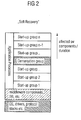
- Fig. 2 shows an inventive recovery ("soft recovery”).
- a termination and restart of the OS, drivers, protocol stacks, middleware components, DB etc processes, can be generally avoided in a "soft recovery” according to the invention.
- Processes are terminated, group by group, starting with the processes in the start-up group n (on top in Figure 2), followed by the processes in the start-up group n-1.
- the processes in the group named "demarcation group" in Figure 2 are terminated last.
- the demarcation line (i.e. the start- up group "demarcation group") can be chosen flexibly, e.g. based on experience or details of the analyzed error situation triggering the recovery.
- the arrow in Fig. 2 does not indicate the order of termination of the start-up groups, it only indicates the order of restart of the start-up groups.
Landscapes
- Engineering & Computer Science (AREA)
- Theoretical Computer Science (AREA)
- Quality & Reliability (AREA)
- Physics & Mathematics (AREA)
- General Engineering & Computer Science (AREA)
- General Physics & Mathematics (AREA)
- Retry When Errors Occur (AREA)
Abstract
The invention concerns a method (Fig. 2, "soft recovery") for a recovery within a telecommunication network system by restarting a plurality of application processes within a component or module ("blade") of the telecommunication network system, wherein, wherein when recovery is triggered, all the start-up groups (Fig. 2, start-up group n , start-up group n-1, start-up group ... above demarcation group, demarcation group) are terminated in the reverse order of their later restart,
and then starting with processes of a predefined start-up group (Fig. 2, demarcation group),
application processes assigned to a start-up group (Fig. 2, start-up group n with start-up number n) are respectively restarted after application processes of all start- up groups (Fig. 2, demarcation group, start-up group...above demarcation group, start-up group n-1) with a lower assigned start-up-number (n-1, ...) are restarted.
and then starting with processes of a predefined start-up group (Fig. 2, demarcation group),
application processes assigned to a start-up group (Fig. 2, start-up group n with start-up number n) are respectively restarted after application processes of all start- up groups (Fig. 2, demarcation group, start-up group...above demarcation group, start-up group n-1) with a lower assigned start-up-number (n-1, ...) are restarted.
Description
- The invention concerns methods and devices for recovering a telecommunication network system.
- The following technical problem is the background for the invention:
- Modern telecommunication platforms as used in mobile networks have a high demand for uninterrupted availability and serviceability. Preventing service loss is a crucial requirement for system maintenance components. Among the features to ensure utmost availability is e.g. flexible and intelligent handling of redundant resources and an efficient independent error recovery concept.
- Due to high availability requirements, systems are expected to recover automatically from error situations. The term "recovery" indicates a set of actions designed to keep the system in service or restore it to service.
- Error recovery concepts need to consider two diametrical requirements:
- a) maximize probability to solve the underlying error situation
- b) minimize impact on system serviceability, i.e. minimize service loss.
- Therefore, a recovery escalation concept was introduced with recovery operations on process, blade and system level.
- On the one hand, single process restart is a very fast recovery action but it depends on the application architecture if it is likely to be successful. It works fine for applications that have a well-separated, independent process scheme. In fact, however, applications tend to feature processes that are closely interacting with each other or dependent on each other. Restart of a single process might even not be possible without heavy impact on related processes.
Performing a full blade recovery would overcome these process dependencies but is considered far too time- consuming for a low-level recovery as it encompasses a full restart of all SW components such as operating system and middleware SW. Furthermore, the restart of a whole blade might seriously impact overall system operability for quite a while. - There are recovery actions on process and blade level. All processes are treated alike, inter-process dependencies are not taken into consideration. It is left to the application provider to deal with single process restarts in an appropriate manner.
- To combine the advantages of single process recovery (fast) and full blade recovery (effective), the so-called "soft recovery" mechanism was introduced, i.e. a restart of a flexible number of application processes without restart of basic SW components (e.g. operating system). Application processes are organized in hierarchical start- up groups. Processes within one start-up group are started simultaneously while processes of a higher start-up group only commence starting as soon as the processes of the lower start-up group communicate start-up completion.
- A dedicated start-up group serves as flexible "demarcation line" between processes that take part in "soft recovery" operations and processes that don't.
When a "soft recovery" operation is triggered, all participating processes are terminated in the reverse order of their start-up sequence (till the "demarcation line" is met) and restarted acc. to their startup-up dependencies.
For termination, two modes are available: either processes are terminated by a "hard kill" or by a "graceful shutdown" that grants processes a certain period of time for clean-up tasks before the actual termination. The termination mode may be selected by configuration means acc. to performance and/or safety requirements.
During process restarts, process message queues may be kept or discarded - according to configured restart mode. - It is an object of the invention to improve the performance of telecommunication systems recovery operations. The object is respectively achieved by the invention defined in the claims.
-
- o Process dependencies are fully taken into account
- o Stable SW components such as operating system, middleware SW and other off-the-shelf SW are not restarted, i.e. time consumption of a soft recovery operation is considerably smaller than that of a full blade restart
- o Number of participating/restarting processes can be limited by flexible "demarcation line"
- o Lowest recovery operation (single process recovery or soft recovery) may be selected by configuration (depending on application needs)
- o Two methods for application process termination: hard "kill" (fast) or "graceful" termination (safe)
- A possible implementation of the invention is explained in the following description of the enclosed drawings. In the drawings
- Fig 1 shows an example of a full blade (complete) restart within a telecommunication system in case of e.g. an error situation.
- Fig 2 shows an example of a "soft recovery" within a telecommunication system according to the invention.
- The term "blade" in the following can mean any component, e.g. any pluggable computer unit with a complete software module (including everything from OS to application processes) of a telecommunication system.
The term ""start- up group" defines a group of processes which are all restarted before and/or after the processes of other start-up groups. E.g. all processes of start-up group n-1 in Fig.2 are started before the processes of start- up group n in Fig.2 are started, but processes of start- up group n-1 are started after processes of start- up group ... in Fig.2 are started. - Fig. 1 shows a full blade recovery as described above.
Before a full blade recovery the shown "blade" is completely terminated.
After this termination, the OS, drivers, protocol stacks etc processes are restarted, then the middleware components, DB etc processes are restarted,
Then the application processes of start- up group lare restarted.
After the application processes of start-up group 1 are restarted,
the application processes of start-up group 2 are restarted, etc;
the application processes of start- up group n are restarted last.
Therefore the number of affected components and duration is relatively high.
(The name "demarcation group" in Fig. 1 has no meaning, it only is a demarcation in Fig. 2, whereas in Fig.1 it is just any start- up group.) - Fig. 2 shows an inventive recovery ("soft recovery").
A termination and restart of the OS, drivers, protocol stacks, middleware components, DB etc processes, can be generally avoided in a "soft recovery" according to the invention.
Processes are terminated, group by group, starting with the processes in the start-up group n (on top in Figure 2), followed by the processes in the start-up group n-1. The processes in the group named "demarcation group" in Figure 2 are terminated last. - Then the processes are restarted, starting with the processes in the start up demarcation group. After the processes in the start up demarcation group, the processes in "start- up group..." (the upper one of the processes named "start- up group..." in the figures above the demarcation group is meant with this expression) are restarted. After the processes in "start- up group...", the processes in "start- up group n-1" are restarted. After the processes in "start- up group n-1", the processes in "start- up group n" are restarted.
The demarcation line (i.e. the start- up group "demarcation group") can be chosen flexibly, e.g. based on experience or details of the analyzed error situation triggering the recovery.
The arrow in Fig. 2 does not indicate the order of termination of the start-up groups,
it only indicates the order of restart of the start-up groups. - Thus the number of affected components and duration is lower than in a full blade recovery.
Claims (6)
- Method (Fig. 2, "soft recovery") for a recovery within a telecommunication network system by restarting a plurality of application processes within a component or module ("blade") of the telecommunication network system,
wherein,
wherein when a recovery is triggered,
start-up groups (Fig. 2, start-up group n , start-up group n-1, start-up group ... above demarcation group, demarcation group) are terminated, in the reverse order of their later restart, until a predefined demarcation group is terminated,
and then for a restart,
starting with processes of a predefined start-up group (Fig. 2, demarcation group),
application processes assigned to a start-up group (Fig. 2, start-up group n with start-up number n) are respectively restarted after application processes of all start- up groups (Fig. 2, demarcation group, start- up group...above demarcation group, start-up group n-1), terminated before, and with a lower assigned start-up-number (n-1, ...), are restarted. - Method according to claim 1,
wherein when recovery is triggered,
all the start-up groups are terminated in the reverse order of their later restart, before restart of the start-up groups. - Method according to claim 2,
wherein for termination, two modes are available,
wherein according to one mode processes are terminated by a "hard kill",
wherein according to the other mode the termination grants processes a certain period of time for clean-up tasks before the actual termination. - Method according to claim 2,
wherein the termination mode may be selected by configuration means according to performance and/or safety requirements. - Method according to any of the preceding claims,
wherein during process restarts, process message queues may be kept or discarded according to the configured restart mode. - Telecommunication network system
providing a recovery (Fig. 2, "soft recovery") within the telecommunication network system by restarting a plurality of application processes within a component or module ("blade") of the telecommunication network system,
with a module- for terminating all the start-up groups (Fig. 2, start-up group n , start-up group n-1, start-up group ... above demarcation group, demarcation group) in the reverse order of their later restart, before restart of the start-up groups,- and for restarting,starting with processes of a predefined start-up group
(Fig. 2, demarcation
group),
application processes assigned to a start-up group (Fig. 2, start-up group n with a start-up number "n"), respectively after restart of application processes of all start- up groups (Fig. 2, demarcation group, start- up group...above demarcation group, start-up group n-1) with a lower assigned start-up-number (n-1, ...).
Priority Applications (1)
| Application Number | Priority Date | Filing Date | Title |
|---|---|---|---|
| EP06022422A EP1916602A1 (en) | 2006-10-26 | 2006-10-26 | Recovery based on ordered restart of processes |
Applications Claiming Priority (1)
| Application Number | Priority Date | Filing Date | Title |
|---|---|---|---|
| EP06022422A EP1916602A1 (en) | 2006-10-26 | 2006-10-26 | Recovery based on ordered restart of processes |
Publications (1)
| Publication Number | Publication Date |
|---|---|
| EP1916602A1 true EP1916602A1 (en) | 2008-04-30 |
Family
ID=38191241
Family Applications (1)
| Application Number | Title | Priority Date | Filing Date |
|---|---|---|---|
| EP06022422A Withdrawn EP1916602A1 (en) | 2006-10-26 | 2006-10-26 | Recovery based on ordered restart of processes |
Country Status (1)
| Country | Link |
|---|---|
| EP (1) | EP1916602A1 (en) |
Citations (3)
| Publication number | Priority date | Publication date | Assignee | Title |
|---|---|---|---|---|
| DE19607515A1 (en) * | 1995-05-31 | 1996-12-12 | Mitsubishi Electric Corp | Computer operation management system for computer operating system performing simultaneous program runs |
| US5781770A (en) * | 1994-06-01 | 1998-07-14 | Northern Telecom Limited | Method and controller for controlling shutdown of a processing unit |
| US6732359B1 (en) * | 1999-12-21 | 2004-05-04 | Bellsouth Intellectual Property Corporation | Application process monitor |
-
2006
- 2006-10-26 EP EP06022422A patent/EP1916602A1/en not_active Withdrawn
Patent Citations (3)
| Publication number | Priority date | Publication date | Assignee | Title |
|---|---|---|---|---|
| US5781770A (en) * | 1994-06-01 | 1998-07-14 | Northern Telecom Limited | Method and controller for controlling shutdown of a processing unit |
| DE19607515A1 (en) * | 1995-05-31 | 1996-12-12 | Mitsubishi Electric Corp | Computer operation management system for computer operating system performing simultaneous program runs |
| US6732359B1 (en) * | 1999-12-21 | 2004-05-04 | Bellsouth Intellectual Property Corporation | Application process monitor |
Similar Documents
| Publication | Publication Date | Title |
|---|---|---|
| CN111782360A (en) | Distributed task scheduling method and device | |
| US7987467B2 (en) | Scale across in a grid computing environment | |
| US7975188B2 (en) | Restoration device for BIOS stall failures and method and computer program product for the same | |
| EP0953911A2 (en) | Method and apparatus for providing scaleable levels of application availability | |
| US20170047069A1 (en) | Voice processing method and device | |
| US20100211822A1 (en) | Disaster recovery based on journaling events prioritization in information technology environments | |
| WO2012156851A1 (en) | Managing a message subscription in a publish/subscribe messaging system | |
| CN110825495A (en) | Container cloud platform recovery method, device, equipment and readable storage medium | |
| JP4491482B2 (en) | Failure recovery method, computer, cluster system, management computer, and failure recovery program | |
| US10379931B2 (en) | Computer system | |
| WO2006103814A1 (en) | Application management device and storage medium containing its software | |
| CN106161086B (en) | The control method and device that master control borad is restarted | |
| CN102780578A (en) | Updating system and updating method for operating system for network equipment | |
| CN114090104A (en) | Applet starting control method and device | |
| CN113138812A (en) | Spacecraft task scheduling method and device | |
| CN111858177B (en) | Inter-process communication abnormality repairing method and device, electronic equipment and storage medium | |
| JP7000797B2 (en) | Startup management device, startup management system, startup management method, and startup management program | |
| CN110287159B (en) | File processing method and device | |
| CN113568719B (en) | Service fault processing method and device, electronic equipment and storage medium | |
| CN105786597A (en) | Method and device for realizing task switching in uCOS-III operation system | |
| US20060282831A1 (en) | Method and hardware node for customized upgrade control | |
| CN104978208B (en) | Hot restart method and device thereof | |
| CN115550280B (en) | Multi-level message queue implementation method, system, electronic device and readable storage medium | |
| US20060277548A1 (en) | Task management system | |
| CN109859755B (en) | Voice recognition method, storage medium and terminal |
Legal Events
| Date | Code | Title | Description |
|---|---|---|---|
| PUAI | Public reference made under article 153(3) epc to a published international application that has entered the european phase |
Free format text: ORIGINAL CODE: 0009012 |
|
| AK | Designated contracting states |
Kind code of ref document: A1 Designated state(s): AT BE BG CH CY CZ DE DK EE ES FI FR GB GR HU IE IS IT LI LT LU LV MC NL PL PT RO SE SI SK TR |
|
| AX | Request for extension of the european patent |
Extension state: AL BA HR MK RS |
|
| AKX | Designation fees paid | ||
| STAA | Information on the status of an ep patent application or granted ep patent |
Free format text: STATUS: THE APPLICATION IS DEEMED TO BE WITHDRAWN |
|
| 18D | Application deemed to be withdrawn |
Effective date: 20081031 |
|
| REG | Reference to a national code |
Ref country code: DE Ref legal event code: 8566 |