EP1915994A1 - Cyclic amine derivative containing ppar regulator - Google Patents
Cyclic amine derivative containing ppar regulator Download PDFInfo
- Publication number
- EP1915994A1 EP1915994A1 EP06767218A EP06767218A EP1915994A1 EP 1915994 A1 EP1915994 A1 EP 1915994A1 EP 06767218 A EP06767218 A EP 06767218A EP 06767218 A EP06767218 A EP 06767218A EP 1915994 A1 EP1915994 A1 EP 1915994A1
- Authority
- EP
- European Patent Office
- Prior art keywords
- group
- methyl
- amino
- pharmaceutical composition
- butan
- Prior art date
- Legal status (The legal status is an assumption and is not a legal conclusion. Google has not performed a legal analysis and makes no representation as to the accuracy of the status listed.)
- Granted
Links
- 0 C*(C)C(c1ccc(C)cc1)=O Chemical compound C*(C)C(c1ccc(C)cc1)=O 0.000 description 2
- FWUDQGVTFWMGHN-YCJQUICGSA-N CC1C(C2=CC=C(C/C=C/Oc3ccc(CC[C@](C)(CO)N)cc3)CC2)=C=C=C=C1 Chemical compound CC1C(C2=CC=C(C/C=C/Oc3ccc(CC[C@](C)(CO)N)cc3)CC2)=C=C=C=C1 FWUDQGVTFWMGHN-YCJQUICGSA-N 0.000 description 1
- ITJCKQTXCLGXHE-GOSISDBHSA-N CCCCCCCOc1ccc(CC[C@](C)(CO)N)cc1 Chemical compound CCCCCCCOc1ccc(CC[C@](C)(CO)N)cc1 ITJCKQTXCLGXHE-GOSISDBHSA-N 0.000 description 1
- VBSNIRRXMNZMON-RUZDIDTESA-N C[C@@](CCCc(c(Cl)c1)ccc1Sc1cc(OCc2ccccc2)ccc1)(CO)N Chemical compound C[C@@](CCCc(c(Cl)c1)ccc1Sc1cc(OCc2ccccc2)ccc1)(CO)N VBSNIRRXMNZMON-RUZDIDTESA-N 0.000 description 1
- TTWYWDKXOGKVDD-HXUWFJFHSA-N C[C@@](CCc(cc1)ccc1OCCCC1CCCCC1)(CO)N Chemical compound C[C@@](CCc(cc1)ccc1OCCCC1CCCCC1)(CO)N TTWYWDKXOGKVDD-HXUWFJFHSA-N 0.000 description 1
- UEDSNYLNCXQVJM-HSZRJFAPSA-N C[C@@](CCc1ccc(C(CCCCc2c(C)c(C)ccc2)=O)[n]1C)(CO)N Chemical compound C[C@@](CCc1ccc(C(CCCCc2c(C)c(C)ccc2)=O)[n]1C)(CO)N UEDSNYLNCXQVJM-HSZRJFAPSA-N 0.000 description 1
- JBGYCVQVJCOPNF-HSZRJFAPSA-N C[C@@](CCc1ccc(C(CCCCc2c(C)cc(C)cc2)=O)[n]1C)(CO)N Chemical compound C[C@@](CCc1ccc(C(CCCCc2c(C)cc(C)cc2)=O)[n]1C)(CO)N JBGYCVQVJCOPNF-HSZRJFAPSA-N 0.000 description 1
- BCSLVHPGRDJVGY-OAQYLSRUSA-N C[C@@](CCc1ccc(C(CCCc(cc2)ccc2C#N)=O)[n]1C)(CO)N Chemical compound C[C@@](CCc1ccc(C(CCCc(cc2)ccc2C#N)=O)[n]1C)(CO)N BCSLVHPGRDJVGY-OAQYLSRUSA-N 0.000 description 1
- ULDYUOGJAGFQHI-OAQYLSRUSA-N C[C@@](CCc1ccc(C(CCCc2cc(C)ccc2)=O)[n]1C)(CO)N Chemical compound C[C@@](CCc1ccc(C(CCCc2cc(C)ccc2)=O)[n]1C)(CO)N ULDYUOGJAGFQHI-OAQYLSRUSA-N 0.000 description 1
- IEOCQHIHYGEVLN-JOCHJYFZSA-N C[C@@](CCc1ccc(C(CCCc2cccc(C)c2C)=O)[n]1C)(CO)N Chemical compound C[C@@](CCc1ccc(C(CCCc2cccc(C)c2C)=O)[n]1C)(CO)N IEOCQHIHYGEVLN-JOCHJYFZSA-N 0.000 description 1
- YXFVVABEGXRONW-UHFFFAOYSA-N Cc1ccccc1 Chemical compound Cc1ccccc1 YXFVVABEGXRONW-UHFFFAOYSA-N 0.000 description 1
Classifications
-
- A—HUMAN NECESSITIES
- A61—MEDICAL OR VETERINARY SCIENCE; HYGIENE
- A61K—PREPARATIONS FOR MEDICAL, DENTAL OR TOILETRY PURPOSES
- A61K31/00—Medicinal preparations containing organic active ingredients
-
- A—HUMAN NECESSITIES
- A61—MEDICAL OR VETERINARY SCIENCE; HYGIENE
- A61K—PREPARATIONS FOR MEDICAL, DENTAL OR TOILETRY PURPOSES
- A61K31/00—Medicinal preparations containing organic active ingredients
- A61K31/13—Amines
- A61K31/135—Amines having aromatic rings, e.g. ketamine, nortriptyline
- A61K31/137—Arylalkylamines, e.g. amphetamine, epinephrine, salbutamol, ephedrine or methadone
-
- A—HUMAN NECESSITIES
- A61—MEDICAL OR VETERINARY SCIENCE; HYGIENE
- A61K—PREPARATIONS FOR MEDICAL, DENTAL OR TOILETRY PURPOSES
- A61K31/00—Medicinal preparations containing organic active ingredients
- A61K31/33—Heterocyclic compounds
- A61K31/395—Heterocyclic compounds having nitrogen as a ring hetero atom, e.g. guanethidine or rifamycins
- A61K31/40—Heterocyclic compounds having nitrogen as a ring hetero atom, e.g. guanethidine or rifamycins having five-membered rings with one nitrogen as the only ring hetero atom, e.g. sulpiride, succinimide, tolmetin, buflomedil
-
- A—HUMAN NECESSITIES
- A61—MEDICAL OR VETERINARY SCIENCE; HYGIENE
- A61K—PREPARATIONS FOR MEDICAL, DENTAL OR TOILETRY PURPOSES
- A61K31/00—Medicinal preparations containing organic active ingredients
- A61K31/33—Heterocyclic compounds
- A61K31/395—Heterocyclic compounds having nitrogen as a ring hetero atom, e.g. guanethidine or rifamycins
- A61K31/41—Heterocyclic compounds having nitrogen as a ring hetero atom, e.g. guanethidine or rifamycins having five-membered rings with two or more ring hetero atoms, at least one of which being nitrogen, e.g. tetrazole
- A61K31/42—Oxazoles
- A61K31/421—1,3-Oxazoles, e.g. pemoline, trimethadione
-
- A—HUMAN NECESSITIES
- A61—MEDICAL OR VETERINARY SCIENCE; HYGIENE
- A61K—PREPARATIONS FOR MEDICAL, DENTAL OR TOILETRY PURPOSES
- A61K31/00—Medicinal preparations containing organic active ingredients
- A61K31/33—Heterocyclic compounds
- A61K31/395—Heterocyclic compounds having nitrogen as a ring hetero atom, e.g. guanethidine or rifamycins
- A61K31/41—Heterocyclic compounds having nitrogen as a ring hetero atom, e.g. guanethidine or rifamycins having five-membered rings with two or more ring hetero atoms, at least one of which being nitrogen, e.g. tetrazole
- A61K31/425—Thiazoles
- A61K31/426—1,3-Thiazoles
-
- A—HUMAN NECESSITIES
- A61—MEDICAL OR VETERINARY SCIENCE; HYGIENE
- A61K—PREPARATIONS FOR MEDICAL, DENTAL OR TOILETRY PURPOSES
- A61K31/00—Medicinal preparations containing organic active ingredients
- A61K31/33—Heterocyclic compounds
- A61K31/395—Heterocyclic compounds having nitrogen as a ring hetero atom, e.g. guanethidine or rifamycins
- A61K31/41—Heterocyclic compounds having nitrogen as a ring hetero atom, e.g. guanethidine or rifamycins having five-membered rings with two or more ring hetero atoms, at least one of which being nitrogen, e.g. tetrazole
- A61K31/425—Thiazoles
- A61K31/427—Thiazoles not condensed and containing further heterocyclic rings
-
- A—HUMAN NECESSITIES
- A61—MEDICAL OR VETERINARY SCIENCE; HYGIENE
- A61K—PREPARATIONS FOR MEDICAL, DENTAL OR TOILETRY PURPOSES
- A61K31/00—Medicinal preparations containing organic active ingredients
- A61K31/33—Heterocyclic compounds
- A61K31/395—Heterocyclic compounds having nitrogen as a ring hetero atom, e.g. guanethidine or rifamycins
- A61K31/435—Heterocyclic compounds having nitrogen as a ring hetero atom, e.g. guanethidine or rifamycins having six-membered rings with one nitrogen as the only ring hetero atom
- A61K31/44—Non condensed pyridines; Hydrogenated derivatives thereof
- A61K31/4427—Non condensed pyridines; Hydrogenated derivatives thereof containing further heterocyclic ring systems
- A61K31/4439—Non condensed pyridines; Hydrogenated derivatives thereof containing further heterocyclic ring systems containing a five-membered ring with nitrogen as a ring hetero atom, e.g. omeprazole
-
- A—HUMAN NECESSITIES
- A61—MEDICAL OR VETERINARY SCIENCE; HYGIENE
- A61K—PREPARATIONS FOR MEDICAL, DENTAL OR TOILETRY PURPOSES
- A61K31/00—Medicinal preparations containing organic active ingredients
- A61K31/33—Heterocyclic compounds
- A61K31/395—Heterocyclic compounds having nitrogen as a ring hetero atom, e.g. guanethidine or rifamycins
- A61K31/495—Heterocyclic compounds having nitrogen as a ring hetero atom, e.g. guanethidine or rifamycins having six-membered rings with two or more nitrogen atoms as the only ring heteroatoms, e.g. piperazine or tetrazines
- A61K31/505—Pyrimidines; Hydrogenated pyrimidines, e.g. trimethoprim
- A61K31/517—Pyrimidines; Hydrogenated pyrimidines, e.g. trimethoprim ortho- or peri-condensed with carbocyclic ring systems, e.g. quinazoline, perimidine
-
- A—HUMAN NECESSITIES
- A61—MEDICAL OR VETERINARY SCIENCE; HYGIENE
- A61K—PREPARATIONS FOR MEDICAL, DENTAL OR TOILETRY PURPOSES
- A61K45/00—Medicinal preparations containing active ingredients not provided for in groups A61K31/00 - A61K41/00
- A61K45/06—Mixtures of active ingredients without chemical characterisation, e.g. antiphlogistics and cardiaca
-
- A—HUMAN NECESSITIES
- A61—MEDICAL OR VETERINARY SCIENCE; HYGIENE
- A61P—SPECIFIC THERAPEUTIC ACTIVITY OF CHEMICAL COMPOUNDS OR MEDICINAL PREPARATIONS
- A61P1/00—Drugs for disorders of the alimentary tract or the digestive system
- A61P1/04—Drugs for disorders of the alimentary tract or the digestive system for ulcers, gastritis or reflux esophagitis, e.g. antacids, inhibitors of acid secretion, mucosal protectants
-
- A—HUMAN NECESSITIES
- A61—MEDICAL OR VETERINARY SCIENCE; HYGIENE
- A61P—SPECIFIC THERAPEUTIC ACTIVITY OF CHEMICAL COMPOUNDS OR MEDICINAL PREPARATIONS
- A61P17/00—Drugs for dermatological disorders
- A61P17/06—Antipsoriatics
-
- A—HUMAN NECESSITIES
- A61—MEDICAL OR VETERINARY SCIENCE; HYGIENE
- A61P—SPECIFIC THERAPEUTIC ACTIVITY OF CHEMICAL COMPOUNDS OR MEDICINAL PREPARATIONS
- A61P19/00—Drugs for skeletal disorders
- A61P19/02—Drugs for skeletal disorders for joint disorders, e.g. arthritis, arthrosis
-
- A—HUMAN NECESSITIES
- A61—MEDICAL OR VETERINARY SCIENCE; HYGIENE
- A61P—SPECIFIC THERAPEUTIC ACTIVITY OF CHEMICAL COMPOUNDS OR MEDICINAL PREPARATIONS
- A61P25/00—Drugs for disorders of the nervous system
-
- A—HUMAN NECESSITIES
- A61—MEDICAL OR VETERINARY SCIENCE; HYGIENE
- A61P—SPECIFIC THERAPEUTIC ACTIVITY OF CHEMICAL COMPOUNDS OR MEDICINAL PREPARATIONS
- A61P29/00—Non-central analgesic, antipyretic or antiinflammatory agents, e.g. antirheumatic agents; Non-steroidal antiinflammatory drugs [NSAID]
-
- A—HUMAN NECESSITIES
- A61—MEDICAL OR VETERINARY SCIENCE; HYGIENE
- A61P—SPECIFIC THERAPEUTIC ACTIVITY OF CHEMICAL COMPOUNDS OR MEDICINAL PREPARATIONS
- A61P37/00—Drugs for immunological or allergic disorders
-
- A—HUMAN NECESSITIES
- A61—MEDICAL OR VETERINARY SCIENCE; HYGIENE
- A61P—SPECIFIC THERAPEUTIC ACTIVITY OF CHEMICAL COMPOUNDS OR MEDICINAL PREPARATIONS
- A61P37/00—Drugs for immunological or allergic disorders
- A61P37/02—Immunomodulators
-
- A—HUMAN NECESSITIES
- A61—MEDICAL OR VETERINARY SCIENCE; HYGIENE
- A61P—SPECIFIC THERAPEUTIC ACTIVITY OF CHEMICAL COMPOUNDS OR MEDICINAL PREPARATIONS
- A61P37/00—Drugs for immunological or allergic disorders
- A61P37/02—Immunomodulators
- A61P37/06—Immunosuppressants, e.g. drugs for graft rejection
-
- A—HUMAN NECESSITIES
- A61—MEDICAL OR VETERINARY SCIENCE; HYGIENE
- A61P—SPECIFIC THERAPEUTIC ACTIVITY OF CHEMICAL COMPOUNDS OR MEDICINAL PREPARATIONS
- A61P41/00—Drugs used in surgical methods, e.g. surgery adjuvants for preventing adhesion or for vitreum substitution
-
- C—CHEMISTRY; METALLURGY
- C07—ORGANIC CHEMISTRY
- C07D—HETEROCYCLIC COMPOUNDS
- C07D207/00—Heterocyclic compounds containing five-membered rings not condensed with other rings, with one nitrogen atom as the only ring hetero atom
- C07D207/02—Heterocyclic compounds containing five-membered rings not condensed with other rings, with one nitrogen atom as the only ring hetero atom with only hydrogen or carbon atoms directly attached to the ring nitrogen atom
- C07D207/30—Heterocyclic compounds containing five-membered rings not condensed with other rings, with one nitrogen atom as the only ring hetero atom with only hydrogen or carbon atoms directly attached to the ring nitrogen atom having two double bonds between ring members or between ring members and non-ring members
- C07D207/32—Heterocyclic compounds containing five-membered rings not condensed with other rings, with one nitrogen atom as the only ring hetero atom with only hydrogen or carbon atoms directly attached to the ring nitrogen atom having two double bonds between ring members or between ring members and non-ring members with only hydrogen atoms, hydrocarbon or substituted hydrocarbon radicals, directly attached to ring carbon atoms
- C07D207/325—Heterocyclic compounds containing five-membered rings not condensed with other rings, with one nitrogen atom as the only ring hetero atom with only hydrogen or carbon atoms directly attached to the ring nitrogen atom having two double bonds between ring members or between ring members and non-ring members with only hydrogen atoms, hydrocarbon or substituted hydrocarbon radicals, directly attached to ring carbon atoms with substituted hydrocarbon radicals directly attached to the ring nitrogen atom
-
- C—CHEMISTRY; METALLURGY
- C07—ORGANIC CHEMISTRY
- C07D—HETEROCYCLIC COMPOUNDS
- C07D207/00—Heterocyclic compounds containing five-membered rings not condensed with other rings, with one nitrogen atom as the only ring hetero atom
- C07D207/02—Heterocyclic compounds containing five-membered rings not condensed with other rings, with one nitrogen atom as the only ring hetero atom with only hydrogen or carbon atoms directly attached to the ring nitrogen atom
- C07D207/30—Heterocyclic compounds containing five-membered rings not condensed with other rings, with one nitrogen atom as the only ring hetero atom with only hydrogen or carbon atoms directly attached to the ring nitrogen atom having two double bonds between ring members or between ring members and non-ring members
- C07D207/32—Heterocyclic compounds containing five-membered rings not condensed with other rings, with one nitrogen atom as the only ring hetero atom with only hydrogen or carbon atoms directly attached to the ring nitrogen atom having two double bonds between ring members or between ring members and non-ring members with only hydrogen atoms, hydrocarbon or substituted hydrocarbon radicals, directly attached to ring carbon atoms
- C07D207/33—Heterocyclic compounds containing five-membered rings not condensed with other rings, with one nitrogen atom as the only ring hetero atom with only hydrogen or carbon atoms directly attached to the ring nitrogen atom having two double bonds between ring members or between ring members and non-ring members with only hydrogen atoms, hydrocarbon or substituted hydrocarbon radicals, directly attached to ring carbon atoms with substituted hydrocarbon radicals, directly attached to ring carbon atoms
- C07D207/335—Radicals substituted by nitrogen atoms not forming part of a nitro radical
Definitions
- the present invention relates to a pharmaceutical composition
- a pharmaceutical composition comprising a PPAR (peroxisome proliferator-activated receptor) regulator and an amino alcohol derivative having immunosuppressive action or a pharmacologically acceptable salt thereof as active ingredients, which is excellent as a medicament for prophylaxis or treatment of diseases relating to immune action such as rejection in organ transplants or skin grafts, rheumatoid arthritis, psoriasis, inflammatory enteritis, multiple sclerosis and other autoimmune diseases.
- PPAR peroxisome proliferator-activated receptor
- Immunosuppressive agents such as cyclosporin A (CsA) and tacrolimus (TRL) are extremely important for prevention of rejection in organ transplants and skin grafts, and also for treatment of various autoimmune diseases.
- CsA cyclosporin A
- TRL tacrolimus
- Convention immunosuppressive agents are known to show toxicity against the kidney and the liver, and thus treatment methods such as by applying steroids in combination have been conducted in order to reduce such side effects. Despite this, alleviation of side effects and a sufficient immunosuppressive effect have not yet necessarily been achieved.
- the present Applicant discloses compounds of the general formula (e) (refer to Patent Document 6) : [wherein R v 1 and R v 2 are a hydrogen atom, an amino-protecting group or the like; R v 3 is a hydrogen atom, a hydroxyl-protecting group and the like; R v 4 is a lower alkyl group; n is an integer from 1 to 6; X v is an ethylene group or the like; Y v is a C 1 -C 10 alkylene group or the like; and R v 5 is an aryl group, substituted aryl group and the like; R v 6 and R v 7 are hydrogen atoms or the like; here, in the case where R v 5 is a hydrogen atom, Y v represents a group other than a single bond and a linear C 1 -C 10 alkylene group] and compounds of the following general formula (f) (refer to Patent Document 7): [wherein R T 1 and R T 2
- Patent Document 8 a report that a PPAR regulator is effective for treatment of autoimmune diseases is known (refer to Patent Document 8).
- An object of the present invention is to provide a pharmaceutical composition which is excellent as a medicament for prophylaxis or treatment of diseases relating to immune action such as rejection in organ transplants or skin grafts, rheumatoid arthritis, psoriasis, inflammatory enteritis, multiple sclerosis and other autoimmune diseases.
- the pharmaceutical composition according to the present invention possesses low toxicity and excellent immunosuppressive action, exerts enhanced pharmacological effects of both a PPAR regulator and an amino alcohol derivative that are included in the pharmaceutical composition, lowers side effects, and is useful for autoimmune diseases such as systemic lupus erythematosus, rheumatoid arthritis, polymyositis, dermatomyositis, scleroderma, Behcet's disease, Crohn's disease, ulcerative colitis, autoimmune hepatitis, aplastic anemia, exanthema thrombocytopenic purpura, autoimmune hemolytic anemia, multiple sclerosis, autoimmune bullous disease, psoriasis vulgaris, vascular inflammation group, Wegener's granuloma, uveitis, exanthema pneumonitis, Goodpasture's syndrome, sarco
- autoimmune diseases such as systemic lupus erythematosus, rheumato
- the present invention provides
- the pharmaceutical composition according to the present invention is useful as a pharmaceutical composition which is excellent as a medicament for prophylaxis or treatment of diseases relating to immune action such as rejection in organ transplants or skin grafts, rheumatoid arthritis, psoriasis, inflammatory enteritis, multiple sclerosis and other autoimmune diseases.
- PPAR regulator which is one of active ingredients of the pharmaceutical composition according to the present invention, includes an antagonist, agonist or the like of a PPAR subtype (for example, ⁇ and/or ⁇ ), such as ( ⁇ )-5-5- ⁇ 4-[(3,4-dihydro-3-methyl-4-oxoquinazolin-2-yl)methoxy]benzyl ⁇ thiazoline-2,4-dione (balaglitazone, pamphlet of International Publication WO 97/41097 ), a compound of the formula (II) 5-[4-(6-methoxy-1-methyl-1-H-benzimidazol-2-yl methoxy)benzyl]thiazoline-2,4-dione hydrochloride (pamphlet of International Publication WO 00/71540 ), N-[(4-methoxyphenoxy)carbonyl]-N- ⁇ 4-[2-(5-methyl-2-phenyloxazol-4-yl)ethoxy]benzyl ⁇ amin
- the PPAR regulator is preferably balaglitazone, muraglitazar, naveglitazar, netoglitazone, pioglitazone, rosiglitazone, imiglitazar, tesaglitazar or a compound of the formula (II), more preferably muraglitazar, naveglitazar, tesaglitazar, pioglitazone, rosiglitazone or compound of the formula (II), and further more preferably pioglitazone, rosiglitazone or a compound of the formula (II).
- the amino alcohol derivatives of the aforementioned formula (I), which is one of the active ingredients of the pharmaceutical composition according to the present invention, can be prepared in accordance with methods described in the aforementioned Patent Document 1 through Patent Document 7 (pamphlet of International Publication WO 94/08943 , pamphlet of International Publication WO 96/06068 , pamphlet of International Publication WO 98/45249 , pamphlet of International Publication WO 03/029184 , pamphlet of International Publication WO 03/029205 , pamphlet of International Publication WO 02/06228 , pamphlet of International Publication WO 03/059880 ) or the like.
- R 1 and R 2 are preferably hydrogen atoms.
- R 3 is preferably a C1-C6 alkyl group or a hydroxymethyl group, and more preferably a methyl group or a hydroxymethyl group.
- R 4 is preferably a hydrogen atom, a halogen atom or a C1-C6 alkyl group, more preferably a hydrogen atom, a chlorine atom or a methyl group, and further more preferably a hydrogen atom or a chlorine atom.
- R 5 is, for example, a phenyl group substituted with 1 to 3 substituents selected from the group consisting of a hydrogen atom, a halogen atom, a cyano group, a C1-C6 alkyl group, a C1-C6 alkoxy group, a C3-C6 cycloalkyl group, a halogeno C1-C6 alkyl group, a phenyl group and a benzyloxy group, a halogen atom or a hydrogen atom, preferably a phenyl group substituted with 1 to 3 substituents selected from the group consisting of a hydrogen atom, a fluorine atom, a chlorine atom, a cyano group, a methyl group, a methoxy group, a cyclopropyl group, a trifluoromethyl group, a phenyl group and a benzyloxy group, a fluorine atom or a hydrogen atom, more
- Y is preferably a single bond, an oxygen atom, a sulfur atom or a carbonyl group, and more preferably a single bond, an oxygen atom or a carbonyl group.
- Z is preferably a single bond or a C1-C8 alkylene group, and more preferably a trimethylene, a tetramethylene or an octamethylene group.
- n is preferably 2 or 3, and more preferably 2.
- the compounds as the amino alcohol derivatives of the formula (I), which is one of the active ingredients of the pharmaceutical composition according to the present invention, are preferably 2-amino-2-methyl-4- ⁇ 1-methyl-5-[5-phenylpentanoyl]pyrrol-2-yl ⁇ butan-1-ol, 2-amino-2-methyl-4- ⁇ 1-methyl-5-[5-(2-methylphenyl)pentanoyl]pyrrol-2-yl ⁇ butan-1-ol, 2-amino-2-methyl-4- ⁇ 1-methyl-5-[5-(3-methylphenyl)pentanoyl]pyrrol-2-yl ⁇ butan-1-ol, 2-amino-2-methyl-4- ⁇ 1-methyl-5-[5-(4-methylphenyl)pentanoyl]pyrrol-2-yl ⁇ butan-1-ol, 2-amino-2-methyl-4- ⁇ 1-methyl-5-[5-(2,3-dimethylphenyl)pentanoyl]pyrrol
- Structural formulas for compounds as the amino alcohol derivatives of the formula (I), which is one of the active ingredients of the pharmaceutical composition according to the present invention are given below.
- Table 1 Compound No. Structural formula
- Structural formula 1 Compound No. Structural formula 1 7 2 8 3 9 4 10 5 11 6 12 13 19 14 20 15 21 16 22 17 23 18 24 31 25 32 26 33 27 34 28 35 29 36 30 37 42 38 43 39 44 40 45 41
- the "C1-C6 alkyl group" in the definition of the aforementioned R 1 , R 2 , R 3 , R 4 and R 5 is, for example, a methyl group, an ethyl group, a propyl group, an isopropyl group, a butyl group, a 2-methylpropyl group, a 3-methylpropyl group, a 2,2,2-trimethylmethyl group, a pentyl group or a hexyl group.
- halogen atom in the definition of the aforementioned R 4 and R 5 is, for example, a fluorine atom, a chlorine atom, a bromine atom or an iodine atom.
- the "C1-C6 alkoxy group" in the definition of the aforementioned R 4 and R 5 is, for example, a methoxy group, an ethoxy group, a propoxy group, an isopropoxy group, a butoxy group, a 2-methylpropoxy group, a 3-methylpropoxy group, a 2,2,2-trimethylmethoxy group, a pentyloxy group or a hexyloxy group.
- C3-C6 cycloalkyl group in the definition of the aforementioned R 5 is, for example, a cyclopropyl group, a cyclobutyl group, a cyclopentyl group or a cyclohexyl group, and is preferably a cyclopropyl group or a cyclohexyl group.
- halogeno C1-C6 alkyl group in the definition of the aforementioned R 5 is a group in which the aforementioned C1-C6 alkyl group is substituted with a halogen atom, for example, a fluoromethyl group, a difluoromethyl group, a trifluoromethyl group, a fluoroethyl group, a difluoroethyl group, a trifluoroethyl group, a fluoropropyl group, a difluoropropyl group, a trifluoropropyl group, a fluorobutyl group, a difluorobutyl group, a trifluorobutyl group, a fluoropentyl group, a difluoropentyl group, a trifluoropentyl group, a fluorohexyl group, a difluorohexyl group, a trifluorohexyl group, a pent
- the "C1-C8 alkylene group" in the definition of the aforementioned Z is, for example, a methylene group, an ethylene group, a propylene group, a tetramethylene group, a pentamethylene group, a hexamethylene group, a heptamethylene group or an octamethylene group.
- the "C1-C8 alkylene group substituted with 2 to 8 fluorine atoms" in the definition of the aforementioned Z may be, for example, a difluoromethylene group, a 1,1-difluoroethylene group, a 1,1,2,2-tetrafluoroethylene group, a 1,1-difluoropropylene group, a 1,1,2,2-tetrafluoropropylene group, a 1,1-difluorotetramethylene group, a 1,1,2,2-tetrafluorotetramethylene group, a 1,1-difluoropentamethylene group or a 1,1,2,2-tetrafluoropentamethylene group, and is preferably a 1,1-difluoropropylene group, a 1,1,2,2-tetrafluoropropylene group, a 1,1-difluorotetramethylene group, a 1,1,2,2-tetrafluorotetramethylene group, a 1,1-difluoropentamethylene group
- the aforementioned "pharmacologically acceptable salts thereof” are salts obtained by reaction with an acid, since the amino alcohol derivatives of the general formula (I) possess an amino group as a basic group, and include, for example, inorganic acid salts such as hydrohalogenic acid salts, e.g. a hydrofluoric acid salt, a hydrochloric acid salt, a hydrobromic acid salt or a hydroiodic acid salt, a nitric acid salt, a perchloric acid salt, a sulfuric acid salt, a phosphoric acid salt or the like; organic acid salts such as lower alkane sulfonic acid salts, e.g.
- hydrohalogenic acid salts e.g. a hydrofluoric acid salt, a hydrochloric acid salt, a hydrobromic acid salt or a hydroiodic acid salt, a nitric acid salt, a perchloric acid salt, a sulfuric acid salt, a phosphoric acid salt or the like
- a methanesulfonic acid salt a trifluoromethanesulfonic acid salt or an ethanesulfonic acid salt
- aryl sulfonic acid salts e.g. a benzenesulfonic acid salt or a p-toluenesulfonic acid salt, an acetic acid salt, a malic acid salt, a fumaric acid salt, a succinic acid salt, a citric acid salt, an ascorbic acid salt, a tartaric acid salt, an oxalic acid salt or a maleic acid salt
- amino acid salts e.g.
- a glycine salt a lysine salt, an arginine salt, an ornithine salt, a glutamic acid salt and an asparatic acid salt, and preferably a hydrochloric acid salt, an acetic acid salt, a fumaric acid salt, a succinic acid salt or a maleic acid salt.
- the amino alcohol derivatives of the general formula (I) which is one of the active ingredients of the pharmaceutical composition according to the present invention.
- the amino alcohol derivatives of the general formula (I) compounds which have an asymmetric carbon atom are represented as a single formula, that is, as the R-configuration.
- the amino alcohol derivatives of the general formula (I) mainly contain, as optical isomers, the one in the R-configuration but also in part contain the one in the S-configuration.
- amino alcohol derivatives of the general formula (I) and pharmacologically acceptable salts thereof When exposed to the atmosphere or are recrystallized, they may absorb moisture, resulting in cases such as addition of adsorbed water and generation of hydrates. Such hydrates are also embraced in the pharmacologically acceptable salts of the amino alcohol derivatives of the general formula (I) of the present invention.
- the pharmaceutical composition according to the present invention exerts enhanced pharmacological effects of both the PPAR regulator and the amino alcohol derivatives that are contained in the composition, shows excellent immunosuppressive action, as well as lowering side effects and having low toxicity, thereby being useful as a prophylactic drug or a therapeutic drug (especially a therapeutic drug) for autoimmune diseases such as systemic lupus erythematosus, rheumatoid arthritis, polymyositis, dermatomyositis, scleroderma, Behcet's disease, Crohn's disease, ulcerative colitis, autoimmune hepatitis, aplastic anemia, exanthema thrombocytopenic purpura, autoimmune hemolytic anemia, multiple sclerosis, autoimmune bullous disease, psoriasis vulgaris, vascular inflammation group, Wegener's granuloma, uveitis, exanthema pneumonitis, Goodpasture's syndrome, sarcoidosis, allergic
- the pharmaceutical composition according to the present invention can be mixed with a pharmacologically acceptable excipient, diluent or the like, and can be administered as an oral drug by a tablet, a capsule, granules, powders or syrup, or as a parenteral drug by injection or suppository.
- excipients for example, organic excipients such as sugar derivatives, e.g. lactose, sucrose, glucose, mannitol or sorbitol; starch derivatives, e.g. corn starch, potato starch, ⁇ -starch or dextrin; cellulose derivatives, e.g. crystalline cellulose; gum arabic; dextrane; or pullulan, and inorganic excipients such as silicate derivatives, e.g. light silicic anhydride, synthetic aluminum silicate, calcium silicate, meta magnesium aluminate; phosphates, e.g. calcium hydrogenphosphate; carbonates, e.g.
- excipients for example, organic excipients such as sugar derivatives, e.g. lactose, sucrose, glucose, mannitol or sorbitol; starch derivatives, e.g. corn starch, potato starch, ⁇ -starch or dextrin; cellulose derivatives, e
- lubricants for example, stearic acid, stearic acid metal salts such as calcium stearate or magnesium stearate; talc; colloid silica; waxes such as bee gum or spermaceti, boric acid; adipic acid; sulfates such as sodium sulfate; glycol; fumaric acid; sodium benzoate; DL leucine; sodium salt of fatty acid; lauryl sulfates such as sodium lauryl sulfate or magnesium lauryl sulfate; silicic acids such as silicic anhydride or silicate hydrate; and the aforementioned starch derivatives can be mentioned), binders (for example, hydroxypropyl cellulose, hydroxypropyl methyl cellulose, polyvinylpyrrolidone, macrogol and compounds similar to the aforementioned excipients can be mentioned), disintegrants (for example, stearic acid, stearic acid metal salts such as calcium stearate or
- 1 or 2 or more PPAR regulators selected from the aforementioned specific group and 1 or 2 or more selected from the group consisting of the aforementioned amino alcohol derivatives of the formula (I) and pharmacologically acceptable salts thereof can be administered either simultaneously or separately at a time interval; however, from the clinical perspective, it is convenient to administer them simultaneously, and thus it is preferable that the PPAR regulator and the amino alcohol derivative of the formula (I) or pharmacologically acceptable salt thereof be administered as a formulation.
- each of the monotherapies can be administered simultaneously or at a time interval.
- to "administer separately at a time interval" is not specifically limited so long as it is in an administration form which is capable of being administered at different times.
- 1 or 2 or more selected from the group consisting of the amino alcohol derivatives of the aforementioned general formula (I) and pharmacologically acceptable salts thereof may be administered first, and then after a predetermined time, 1 or 2 or more PPAR regulators selected from the specific group may be administered; or alternatively, the PPAR regulators may be administered first, and then after a predetermined time, the aforementioned amino alcohol derivatives of the general formula (I) or pharmacologically acceptable salts thereof may be administered.
- treatment means to cure or improve a disease or symptoms, or to alleviate symptoms
- prophylaxis means to prevent an expression of a disease or symptoms
- formulation refers to a single composition in which a plurality of ingredients are mixed.
- kit refers to the case in which a plurality of individual compositions are used as one set.
- the maximum administration interval of the aforementioned two types of drugs which can achieve the excellent effect provided by the PPAR regulator and at least one compound selected from the group consisting of the aforementioned amino alcohol derivatives of the general formula (I) and pharmacologically acceptable salts thereof, can be confirmed by clinical or animal experiments.
- the administration amount and administration ratio of the active ingredients of the pharmaceutical composition according to the present invention may vary depending on various conditions such as the activity of each of the drugs, symptoms, age and weight of the patient, and the like.
- the single dosage of the PPAR regulator as an active ingredient varies depending on symptoms, age and the like,
- the single dosage of the aforementioned amino alcohol derivatives of the general formula (I) and pharmacologically acceptable salts thereof as an active ingredient varies depending on symptoms, age and the like, it is for example, 0.0001 mg/kg to 1.0 mg/kg, preferably 0.001 mg/kg to 0.1 mg/kg for an adult human, irrespective of the route of administration such as oral administration or intravenous administration.
- the number of administrations is generally 1 to 3 times a day, or the number of administration may be decreased depending on circumstances, such as once a week.
- the number of administrations is preferably once a day to once a week, and more preferably once a day to once every three days.
- the administration amount ratio of the 1 or 2 or more PPAR regulators selected from the aforementioned specific group and the 1 or 2 or more compounds selected from the group consisting of the aforementioned amino alcohol derivatives of the general formula (I) and pharmacologically acceptable salts thereof may also vary to a large extent; for example, the administration amount ratio of the aforementioned PPAR regulator and the compound selected from the group consisting of the 1 or 2 or more selected from the group consisting of the amino alcohol derivatives of the general formula (I) and pharmacologically acceptable salts thereof may be in the range of 1:2 to 500:1 by weight.
- a rat adjuvant arthritis model developing arthritis that is similar to human rheumatoid arthritis was used, and effect of the pharmaceutical composition according to the present invention with respect to the arthritis was evaluated by using footpad volume increase suppression rate as an indicator. Eight-week old female Lewis rats were used in the experiment.
- the mean popliteal lymph node weight is subtracted from the popliteal lymph node weight, with respect to each individual for each of the administration groups ("popliteal lymph weight by HvGR"), and the suppression ratio is calculated from "popliteal lymph weight by HvGR" of each individual of the compound administration group with respect to the mean "popliteal lymph weight by HvGR" of the control group.
- LEW rats male, 5 weeks old, Charles River Laboratories Japan, Inc.
- 5 rats per group are used.
- (1) Administration of Test Compound The test compound is suspended in a 1% tragacanth solution (solvent). The test compound suspension is orally administered forcedly at the rate of 5 ml per 1 kg of the rat's weight. Here, solvent is administered to the normal group, in place of the test compound suspension.
- (2) Measurement of Peripheral Blood Lymphocytes After 3 hours from administration of the solvent or the test compound suspension, blood is collected from the inferior vena cava under etherization, and is transferred to a tube containing EDTA. The absolute lymphocytic count of the collected blood is measured by a hematology examination device.
- the peripheral blood lymphocyte decreasing action is calculated as the relative value (%), taking the lymphocytic count of the normal group as 100%.
Landscapes
- Health & Medical Sciences (AREA)
- Chemical & Material Sciences (AREA)
- Veterinary Medicine (AREA)
- Pharmacology & Pharmacy (AREA)
- Public Health (AREA)
- General Health & Medical Sciences (AREA)
- Animal Behavior & Ethology (AREA)
- Medicinal Chemistry (AREA)
- Life Sciences & Earth Sciences (AREA)
- Epidemiology (AREA)
- Organic Chemistry (AREA)
- Chemical Kinetics & Catalysis (AREA)
- Nuclear Medicine, Radiotherapy & Molecular Imaging (AREA)
- General Chemical & Material Sciences (AREA)
- Bioinformatics & Cheminformatics (AREA)
- Engineering & Computer Science (AREA)
- Immunology (AREA)
- Emergency Medicine (AREA)
- Rheumatology (AREA)
- Orthopedic Medicine & Surgery (AREA)
- Neurosurgery (AREA)
- Pain & Pain Management (AREA)
- Surgery (AREA)
- Dermatology (AREA)
- Biomedical Technology (AREA)
- Neurology (AREA)
- Physical Education & Sports Medicine (AREA)
- Transplantation (AREA)
- Pharmaceuticals Containing Other Organic And Inorganic Compounds (AREA)
- Acyclic And Carbocyclic Compounds In Medicinal Compositions (AREA)
- Plural Heterocyclic Compounds (AREA)
- Pyrrole Compounds (AREA)
Abstract
1 or 2 or more selected from PPAR regulators and
1 or 2 or more selected from the group consisting of amino alcohol derivatives of the general formula (I):

R1 and R2 are the same or different, and each represents a hydrogen atom or the like; R3 represents a C1-C6 alkyl group or a hydroxymethyl group; R4 represents a hydrogen atom, a C1-C6 alkyl group or the like; R5 represents a phenyl group substituted with 1 to 3 substituents selected from the group consisting of a hydrogen atom, a halogen atom, a cyano group, a C1-C6 alkyl group or the like; X represents a vinylene group (CH=CH group), an oxygen atom or the like; Y represents a single bond, an oxygen atom or the like; Z represents a single bond, a C1-C8 alkylene group or the like; n represents an integer of 2 or 3]; and
pharmacologically acceptable salt thereof.
Description
- The present invention relates to a pharmaceutical composition comprising a PPAR (peroxisome proliferator-activated receptor) regulator and an amino alcohol derivative having immunosuppressive action or a pharmacologically acceptable salt thereof as active ingredients, which is excellent as a medicament for prophylaxis or treatment of diseases relating to immune action such as rejection in organ transplants or skin grafts, rheumatoid arthritis, psoriasis, inflammatory enteritis, multiple sclerosis and other autoimmune diseases.
- Conventionally, in the treatment of rheumatoid arthritis and other autoimmune diseases, anti-inflammatory drugs such as steroids have been used against inflammatory responses, which occur due to immune response disorders. However, problems exist in that they are palliative and in that they may have serious side effects. In addition, it has been reported that immune system disorders are also involved in the onset of diabetes and nephritis (for example, refer to Non-patent Document 1 and Non-patent Document 2); however, no medicament which can improve such disorders has been developed to date.
- Immunosuppressive agents such as cyclosporin A (CsA) and tacrolimus (TRL) are extremely important for prevention of rejection in organ transplants and skin grafts, and also for treatment of various autoimmune diseases. However, conventional immunosuppressive agents are known to show toxicity against the kidney and the liver, and thus treatment methods such as by applying steroids in combination have been conducted in order to reduce such side effects. Despite this, alleviation of side effects and a sufficient immunosuppressive effect have not yet necessarily been achieved.
- Recently, research and development on the following amino alcohol derivatives and the like as novel immunosuppressive agents have been reported; however, they are not yet actually used in clinical applications.
- That is, they are
- (1) compounds of the general formula (a) (refer to Patent Document 1) :

- (2) compounds of the general formula (b) (refer to Patent Document 2):

- (3) compounds of the general formula (c) (refer to Patent Document 3):

- (4) compounds of the general formula (d) (refer to Patent Document 4 and Patent Document 5):

- On the other hand, the present Applicant discloses compounds of the general formula (e) (refer to Patent Document 6) :

compounds of the following general formula (f) (refer to Patent Document 7):
- In addition, a report that a PPAR regulator is effective for treatment of autoimmune diseases is known (refer to Patent Document 8).
- However, there has not been known a pharmaceutical composition which uses a combination of an aforementioned amino alcohol derivative and a PPAR regulator.
- [Non-patent Document 1] Kidney International, vol. 51, 94(1997)
- [Non-patent Document 2] Journal of Immunology, vol. 157, 4691(1996)
- [Patent Document 1] pamphlet of
International Publication WO 94/08943 - [Patent Document 2] pamphlet of
International Publication WO 96/06068 - [Patent Document 3] pamphlet of
International Publication WO 98/45249 - [Patent Document 4] pamphlet of International Publication
WO 03/029184 - [Patent Document 5] pamphlet of International Publication
WO 03/029205 - [Patent Document 6] pamphlet of
International Publication WO 02/06228 - [Patent Document 7] pamphlet of International Publication
WO 03/059880 - [Patent Document 8] pamphlet of
International Publication WO 97/45141 - An object of the present invention is to provide a pharmaceutical composition which is excellent as a medicament for prophylaxis or treatment of diseases relating to immune action such as rejection in organ transplants or skin grafts, rheumatoid arthritis, psoriasis, inflammatory enteritis, multiple sclerosis and other autoimmune diseases.
- As a result of conducting extensive research with respect to pharmaceutical compositions that have immunosuppressive action, the present inventors found that the pharmaceutical composition according to the present invention possesses low toxicity and excellent immunosuppressive action, exerts enhanced pharmacological effects of both a PPAR regulator and an amino alcohol derivative that are included in the pharmaceutical composition, lowers side effects, and is useful for autoimmune diseases such as systemic lupus erythematosus, rheumatoid arthritis, polymyositis, dermatomyositis, scleroderma, Behcet's disease, Crohn's disease, ulcerative colitis, autoimmune hepatitis, aplastic anemia, exanthema thrombocytopenic purpura, autoimmune hemolytic anemia, multiple sclerosis, autoimmune bullous disease, psoriasis vulgaris, vascular inflammation group, Wegener's granuloma, uveitis, exanthema pneumonitis, Goodpasture's syndrome, sarcoidosis, allergic granulomatous angiitis, bronchial asthma, myocarditis, cardiomyopathy, aortitis syndrome, post-myocardial infarction syndrome, primary pulmonary hypertension, minimal change nephropathy, membranous nephropathy, membranous proliferative nephropathy, focal glomerulosclerosis, crescentic, myasthenia gravis, inflammatory neuropathy, atopic dermatitis, chronic actinic dermatitis, acute polyarthritis, Sydenham's chorea, systemic sclerosis, adultonset diabetes, insulin-dependent diabetes, juvenile diabetes, atherosclerosis, glomerulonephritis, tubulointerstitial nephritis, primary biliary cirrhosis, primary sclerosing cholangitis, fulminant hepatic failure, viral hepatitis, GVHD, rejection in various organ transplants, contact dermatitis and sepsis, or other diseases related to immunology (especially autoimmune diseases), thereby leading to completion of the present invention.
- The present invention provides
- (1) a pharmaceutical composition comprising:
1 or 2 or more selected from PPAR regulators and
1 or 2 or more selected from the group consisting of amino alcohol derivatives of the general formula (I):
R1 and R2 are the same or different, and each represents a hydrogen atom or a C1-C6 alkyl group;
R3 represents a C1-C6 alkyl group or a hydroxymethyl group;
R4 represents a hydrogen atom, a C1-C6 alkyl group, a C1-C6 alkoxy group or a halogen atom;
R5 represents a phenyl group substituted with 1 to 3 substituents selected from the group consisting of a hydrogen atom, a halogen atom, a cyano group, a C1-C6 alkyl group, a C1-C6 alkoxy group, a C3-C6 cycloalkyl group, a halogeno C1-C6 alkyl group, a phenyl group and a benzyloxy group, a halogen atom or a hydrogen atom;
X represents a vinylene group (CH=CH group), an oxygen atom, a sulfur atom or a nitrogen atom substituted by one methyl group;
Y represents a single bond, an oxygen atom, a sulfur atom or a carbonyl group;
Z represents a single bond, a C1-C8 alkylene group or a C1-C8 alkylene group substituted with 2 to 8 fluorine atoms;
n represents an integer of 2 or 3]; and
pharmacologically acceptable salts thereof.
The above-described pharmaceutical composition is preferably - (2) the pharmaceutical composition according to (1), wherein the PPAR regulator is balaglitazone, muraglitazar, naveglitazar, netoglitazone, pioglitazone, rosiglitazone, imiglitazar, tesaglitazar or a compound of the formula (II):

- (3) the pharmaceutical composition according to (1), wherein the PPAR regulator is muraglitazar, naveglitazar or tesaglitazar;
- (4) the pharmaceutical composition according to (1), wherein the PPAR regulator is pioglitazone, rosiglitazone or a compound of the formula (II);
- (5) the pharmaceutical composition according to (1), wherein the PPAR regulator is a compound of the formula (II);
- (6) the pharmaceutical composition according to any one of (1) to (5), wherein R1 and R2 are hydrogen atoms;
- (7) the pharmaceutical composition according to any one of (1) to (6), wherein R3 is a methyl group or a hydroxymethyl group;
- (8) the pharmaceutical composition according to any one of (1) to (6), wherein R3 is a hydroxymethyl group;
- (9) the pharmaceutical composition according to any one of (1) to (6), wherein R3 is a methyl group;
- (10) the pharmaceutical composition according to any one of (1) to (9), wherein R4 is a hydrogen atom or a chlorine atom;
- (11) the pharmaceutical composition according to any one of (1) to (9), wherein R4 is a hydrogen atom;
- (12) the pharmaceutical composition according to any one of (1) to (11), wherein R5 is a phenyl group substituted with 1 to 3 substituents selected from the group consisting of a hydrogen atom, a methyl group, a methoxy group, a trifluoromethyl group, a phenyl group and a benzyloxy group, a fluorine atom or a hydrogen atom;
- (13) the pharmaceutical composition according to any one of (1) to (11), wherein R5 is a phenyl group, a 4-methylphenyl group, a 4-methoxyphenyl group, a 3-methoxy-4-methylphenyl group, a 3-trifluoromethylphenyl group, 3-benzyloxyphenyl group, a fluorine atom or a hydrogen atom;
- (14) the pharmaceutical composition according to any one of (1) to (13), wherein X is a vinylene group (CH=CH group);
- (15) the pharmaceutical composition according to any one of (1) to (13), wherein X is a methylamino group;
- (16) the pharmaceutical composition according to any one of (1) to (15), wherein Y is a single bond or a carbonyl group;
- (17) the pharmaceutical composition according to any one of (1) to (15), wherein Y is a carbonyl group;
- (18) the pharmaceutical composition according to any one of (1) to (17), wherein Z is a single bond or a C1-C8 alkylene group;
- (19) the pharmaceutical composition according to any one of (1) to (17), wherein z is a single bond, trimethylene, tetramethylene or octamethylene;
- (20) the pharmaceutical composition according to any one of (1) to (19), wherein n is 2;
- (21) the pharmaceutical composition according to any one of (1) to (5), wherein the amino alcohol derivative of the general formula (I) is:
- 2-amino-2-methyl-4-{1-methyl-5-[5-phenylpentanoyl]pyrrol-2-yl}butan-1-ol,
- 2-amino-2-methyl-4-{1-methyl-5-[5-(2-methylphenyl)pentanoyl]pyrrol-2-yl}butan-1-ol,
- 2-amino-2-methyl-4-{1-methyl-5-[5-(3-methylphenyl)pentanoyl]pyrrol-2-yl}butan-1-ol,
- 2-amino-2-methyl-4-{1-methyl-5-[5-(4-methylphenyl)pentanoyl]pyrrol-2-yl}butan-1-ol,
- 2-amino-2-methyl-4-{1-methyl-5-[5-(2,3-dimethylphenyl)pentanoyl]pyrrol-2-yl}butan-1-ol,
- 2-amino-2-methyl-4-{1-methyl-5-[5-(2,4-dimethylphenyl)pentanoyl]pyrrol-2-yl}butan-1-ol,
- 2-amino-2-methyl-4-{1-methyl-5-[5-(2,5-dimethylphenyl)pentanoyl]pyrrol-2-yl}butan-1-ol,
- 2-amino-2-methyl-4-{1-methyl-5-[5-(3,4-dimethylphenyl)pentanoyl]pyrrol-2-yl}butan-1-ol,
- 2-amino-2-methyl-4-{1-methyl-5-[5-(3,5-dimethylphenyl)pentanoyl]pyrrol-2-yl}butan-1-ol,
- 2-amino-2-methyl-4-{1-methyl-5-[5-(3-methyl-4-methoxyphenyl)pentanoyl]pyrrol-2-yl}butan-1-ol,
- 2-amino-2-methyl-4-{1-methyl-5-[5-(3-methoxy-4-methylphenyl)pentanoyl]pyrrol-2-yl}butan-1-ol,
- 2-amino-2-methyl-4-{1-methyl-5-[5-(4-cyanophenyl)pentanoyl]pyrrol-2-yl}butan-1-ol,
- 2-amino-2-methyl-4-{1-methyl-5-[4-(2-methylphenyl)butanoyl]pyrrol-2-yl}butan-1-ol,
- 2-amino-2-methyl-4-{1-methyl-5-[4-(3-methylphenyl)butanoyl]pyrrol-2-yl}butan-1-ol,
- 2-amino-2-methyl-4-{1-methyl-5-[4-(4-methylphenyl)butanoyl]pyrrol-2-yl}butan-1-ol,
- 2-amino-2-methyl-4-{1-methyl-5-[4-(2,3-dimethylphenyl)butanoyl]pyrrol-2-yl}butan-1-ol,
- 2-amino-2-methyl-4-{1-methyl-5-[4-(2,4-dimethylphenyl)butanoyl]pyrrol-2-yl}butan-1-ol,
- 2-amino-2-methyl-4-{1-methyl-5-[4-(2,5-dimethylphenyl)butanoyl]pyrrol-2-yl}butan-1-ol,
- 2-amino-2-methyl-4-{1-methyl-5-[4-(3,4-dimethylphenyl)butanoyl]pyrrol-2-yl}butan-1-ol,
- 2-amino-2-methyl-4-{1-methyl-5-[4-(3,5-dimethylphenyl)butanoyl]pyrrol-2-yl}butan-1-ol,
- 2-amino-2-methyl-4-{1-methyl-5-[4-(3-methyl-4-methoxyphenyl)butanoyl]pyrrol-2-yl}butan-1-ol,
- 2-amino-2-methyl-4-{1-methyl-5-[4-(3-methoxy-4-methylphenyl)butanoyl]pyrrol-2-yl}butan-1-ol or
- 2-amino-2-methyl-4-{1-methyl-5-[4-(4-cyanophenyl)butanoyl]pyrrol-2-yl}butan-1-ol;
- (22) the pharmaceutical composition according to any one of (1) to (5), wherein the amino alcohol derivative of the general formula (I) is:
- 2-amino-2-methyl-4-{1-methyl-5-[5-phenylpentanoyl]pyrrol-2-yl}butan-1-ol,
- 2-amino-2-methyl-4-{1-methyl-5-[5-(4-methylphenyl)pentanoyl]pyrrol-2-yl}butan-1-ol,
- 2-amino-2-methyl-4-{1-methyl-5-[5-(3,4-dimethylphenyl)pentanoyl]pyrrol-2-yl}butan-1-ol,
- 2-amino-2-methyl-4-{1-methyl-5-[5-(3-methyl-4-methoxyphenyl)pentanoyl]pyrrol-2-yl}butan-1-ol,
- 2-amino-2-methyl-4-{1-methyl-5-[5-(3-methoxy-4-methylphenyl)pentanoyl]pyrrol-2-yl}butan-1-ol,
- 2-amino-2-methyl-4-{1-methyl-5-[5-(4-cyanophenyl)pentanoyl]pyrrol-2-yl}butan-1-ol,
- 2-amino-2-methyl-4-{1-methyl-5-[4-(4-methylphenyl)butanoyl]pyrrol-2-yl}butan-1-ol,
- 2-amino-2-methyl-4-{1-methyl-5-[4-(3,4-dimethylphenyl)butanoyl]pyrrol-2-yl}butan-1-ol,
- 2-amino-2-methyl-4-{1-methyl-5-[4-(3-methyl-4-methoxyphenyl)butanoyl]pyrrol-2-yl}butan-1-ol,
- 2-amino-2-methyl-4-{1-methyl-5-[4-(3-methoxy-4-methylphenyl)butanoyl]pyrrol-2-yl}butan-1-ol, or
- 2-amino-2-methyl-4-{1-methyl-5-[4-(4-cyanophenyl)butanoyl]pyrrol-2-yl}butan-1-ol;
- (23) the pharmaceutical composition according to any one of (1) to (5), wherein the amino alcohol derivative of the general formula (I) is:
- 2-amino-2-[2-(4-octylphenyl)ethyl]propan-1,3-diol,
- 2-amino-2-[2-(4-heptyloxyphenyl)ethyl]propan-1,3-diol,
- 2-amino-2-{2-[4-(5-phenylpentanoyl)phenyl]ethyl}propan-1,3-diol,
- 2-amino-2-{2-[4-(5-cyclohexylpentanoyl)phenyl]ethyl}propan-1,3-diol,
- 2-amino-2-{2-[4-(7-phenylheptanoyl)phenyl]ethyl}propan-1,3-diol,
- 2-amino-2-[2-(4-[2-(4-methoxyphenyl)ethoxy]phenyl)ethyl]propan-1,3-diol,
- 2-amino-2-[2-(4-[2-(4-ethoxyphenyl)ethoxy]phenyl)ethyl]propan-1,3-diol,
- 2-amino-2-[2-(4-[2-(3-fluoro-4-methoxyphenyl)ethoxy]phenyl)ethyl]propan-1,3-diol,
- 2-amino-2-methyl-4-[4-(4,4,5,5,5-pentafluoropentyloxy)phenyl]butan-1-ol,
- 2-amino-2-methyl-4-[4-(3-biphenyl-4-ylpropoxy)phenyl]butan-1-ol,
- 2-amino-2-methyl-4-[4-(3-biphenyl-4-ylpropionyl)phenyl]butan-1-ol,
- 2-amino-2-methyl-4-[3-methoxy-4-(4-phenylbutoxy)phenyl]butan-1-ol,
- 2-amino-2-methyl-4-[4-(5-phenylpentyloxy)phenyl]butan-1-ol,
- 2-amino-2-methyl-4-[4-(5-phenylpentanoyl)phenyl]butan-1-ol,
- 2-amino-2-methyl-4-(4-hexyloxyphenyl)butan-1-ol,
- 2-amino-2-methyl-4-[4-(3-phenylpropoxy)phenyl]butan-1-ol,
- 2-amino-2-methyl-4-[4-(3-cyclohexylpropoxy)phenyl]butan-1-ol,
- 2-amino-2-methyl-4-[4-(5-cyclohexylpentanoyl)phenyl]butan-1-ol,
- 2-amino-2-methyl-4-[4-heptyloxyphenyl]butan-1-ol,
- 2-amino-2-[4-(3-benzyloxyphenoxy)-2-chlorophenyl]propyl-1,3-propanediol,
- 2-amino-2-[4-(3-benzyloxyphenylthio)-2-chlorophenyl]propyl-1,3-propanediol,
- 2-amino-2-methyl-5-[4-(3-benzyloxyphenoxy)-2-chlorophenyl]pentan-1-ol, or
- 2-amino-2-methyl-5-[4-(3-benzyloxyphenylthio)-2-chlorophenyl]pentan-1-ol; and
- (24) the pharmaceutical composition according to any one of (1) to (5), wherein the amino alcohol derivative of the general formula (I) is 2-amino-2-[2-(4-octylphenyl)ethyl]propan-1,3-diol.
In addition, the present invention provides - (25) the pharmaceutical composition according to any one of (1) to (24) for use in suppression of rejection in organ transplants or skin grafts;
- (26) the pharmaceutical composition according to any one of (1) to (24) for use in prophylaxis or treatment of an autoimmune disease;
- (27) the pharmaceutical composition according to (26), wherein the autoimmune disease is rheumatoid arthritis, psoriasis, inflammatory enteritis or multiple sclerosis;
- (28) the pharmaceutical composition according to any one of (1) to (27), which is an adjuvant containing the PPAR regulator(s) and the amino alcohol derivative(s) of the general formula (I) in the same pharmaceutical composition; and
- (29) the pharmaceutical composition according to any one of (1) to (27), which is a kit comprising a pharmaceutical composition containing the PPAR regulator(s) and the amino alcohol derivative(s) of the general formula (I).
Further, the present invention provides - (30) a method for preparation of the pharmaceutical composition according to (28).
- (31) a method for suppression of rejection in organ transplants or skin grafts comprising administering an effective amount of the pharmaceutical composition according to any one of (1) to (29) to a mammal;
- (32) a method for prophylaxis or treatment of an autoimmune disease comprising administering an effective amount of the pharmaceutical composition according to any one of (1) to (29) to a mammal; and
- (33) the method for the prevention or the treatment according to (32), wherein the autoimmune disease is rheumatoid arthritis, psoriasis, inflammatory enteritis or multiple sclerosis.
- The pharmaceutical composition according to the present invention is useful as a pharmaceutical composition which is excellent as a medicament for prophylaxis or treatment of diseases relating to immune action such as rejection in organ transplants or skin grafts, rheumatoid arthritis, psoriasis, inflammatory enteritis, multiple sclerosis and other autoimmune diseases.
- "PPAR regulator", which is one of active ingredients of the pharmaceutical composition according to the present invention, includes an antagonist, agonist or the like of a PPAR subtype (for example, α and/or γ), such as (±)-5-5-{4-[(3,4-dihydro-3-methyl-4-oxoquinazolin-2-yl)methoxy]benzyl}thiazoline-2,4-dione (balaglitazone, pamphlet of
International Publication WO 97/41097 International Publication WO 00/71540 WO 01/021602 WO 02/100813 No. 1853588 WO 95/21608 No. 3074532 International Publication WO 99/62871 - The PPAR regulator is preferably balaglitazone, muraglitazar, naveglitazar, netoglitazone, pioglitazone, rosiglitazone, imiglitazar, tesaglitazar or a compound of the formula (II), more preferably muraglitazar, naveglitazar, tesaglitazar, pioglitazone, rosiglitazone or compound of the formula (II), and further more preferably pioglitazone, rosiglitazone or a compound of the formula (II).
- Plane structural formulas for representative examples of the PPAR regulator are given below.

- The amino alcohol derivatives of the aforementioned formula (I), which is one of the active ingredients of the pharmaceutical composition according to the present invention, can be prepared in accordance with methods described in the aforementioned Patent Document 1 through Patent Document 7 (pamphlet of
International Publication WO 94/08943 International Publication WO 96/06068 International Publication WO 98/45249 WO 03/029184 WO 03/029205 International Publication WO 02/06228 WO 03/059880 - Preferred substituents of the amino alcohol derivatives of the aforementioned formula (I), which is one of the active ingredients of the pharmaceutical composition according to the present invention, are given below.

- R1 and R2 are preferably hydrogen atoms.
- R3 is preferably a C1-C6 alkyl group or a hydroxymethyl group, and more preferably a methyl group or a hydroxymethyl group.
- R4 is preferably a hydrogen atom, a halogen atom or a C1-C6 alkyl group, more preferably a hydrogen atom, a chlorine atom or a methyl group, and further more preferably a hydrogen atom or a chlorine atom.
- R5 is, for example, a phenyl group substituted with 1 to 3 substituents selected from the group consisting of a hydrogen atom, a halogen atom, a cyano group, a C1-C6 alkyl group, a C1-C6 alkoxy group, a C3-C6 cycloalkyl group, a halogeno C1-C6 alkyl group, a phenyl group and a benzyloxy group, a halogen atom or a hydrogen atom, preferably a phenyl group substituted with 1 to 3 substituents selected from the group consisting of a hydrogen atom, a fluorine atom, a chlorine atom, a cyano group, a methyl group, a methoxy group, a cyclopropyl group, a trifluoromethyl group, a phenyl group and a benzyloxy group, a fluorine atom or a hydrogen atom, more preferably a phenyl group substituted with 1 to 3 substituents selected from the group consisting of a hydrogen atom, a methyl group, a methoxy group, a trifluoromethyl group, a phenyl group and a benzyloxy group, a fluorine atom or a hydrogen atom, and further more preferably a phenyl group, a 4-methylphenyl group, a 4-methoxyphenyl group, a 3-methoxy-4-methylphenyl group, 3-trifluoromethylphenyl group, 3-benzyloxyphenyl group, a fluorine atom or a hydrogen atom.
- X is preferably a vinylene group (CH=CH group), an oxygen atom, a sulfur atom or a methylamino group, and more preferably a vinylene group (CH=CH group) or a methylamino group.
- Y is preferably a single bond, an oxygen atom, a sulfur atom or a carbonyl group, and more preferably a single bond, an oxygen atom or a carbonyl group.
- Z is preferably a single bond or a C1-C8 alkylene group, and more preferably a trimethylene, a tetramethylene or an octamethylene group.
- n is preferably 2 or 3, and more preferably 2.
- The compounds as the amino alcohol derivatives of the formula (I), which is one of the active ingredients of the pharmaceutical composition according to the present invention, are preferably
2-amino-2-methyl-4-{1-methyl-5-[5-phenylpentanoyl]pyrrol-2-yl}butan-1-ol,
2-amino-2-methyl-4-{1-methyl-5-[5-(2-methylphenyl)pentanoyl]pyrrol-2-yl}butan-1-ol,
2-amino-2-methyl-4-{1-methyl-5-[5-(3-methylphenyl)pentanoyl]pyrrol-2-yl}butan-1-ol,
2-amino-2-methyl-4-{1-methyl-5-[5-(4-methylphenyl)pentanoyl]pyrrol-2-yl}butan-1-ol,
2-amino-2-methyl-4-{1-methyl-5-[5-(2,3-dimethylphenyl)pentanoyl]pyrrol-2-yl}butan-1-ol,
2-amino-2-methyl-4-{1-methyl-5-[5-(2,4-dimethylphenyl)pentanoyl]pyrrol-2-yl}butan-1-ol,
2-amino-2-methyl-4-{1-methyl-5-[5-(2,5-dimethylphenyl)pentanoyl]pyrrol-2-yl}butan-1-ol,
2-amino-2-methyl-4-{1-methyl-5-[5-(3,4-dimethylphenyl)pentanoyl]pyrrol-2-yl}butan-1-ol,
2-amino-2-methyl-4-{1-methyl-5-[5-(3,5-dimethylphenyl)pentanoyl]pyrrol-2-yl}butan-1-ol,
2-amino-2-methyl-4-{1-methyl-5-[5-(3-methyl-4-methoxyphenyl)pentanoyl]pyrrol-2-yl}butan-1-ol,
2-amino-2-methyl-4-{1-methyl-5-[5-(3-methoxy-4-methylphenyl)pentanoyl]pyrrol-2-yl}butan-1-ol,
2-amino-2-methyl-4-{1-methyl-5-[5-(4-cyanophenyl)pentanoyl]pyrrol-2-yl}butan-1-ol,
2-amino-2-methyl-4-{1-methyl-5-[4-(2-methylphenyl)butanoyl]pyrrol-2-yl}butan-1-ol,
2-amino-2-methyl-4-{1-methyl-5-[4-(3-methylphenyl)butanoyl]pyrrol-2-yl}butan-1-ol,
2-amino-2-methyl-4-{1-methyl-5-[4-(4-methylphenyl)butanoyl]pyrrol-2-yl}butan-1-ol,
2-amino-2-methyl-4-{1-methyl-5-[4-(2,3-dimethylphenyl)butanoyl]pyrrol-2-yl}butan-1-ol,
2-amino-2-methyl-4-{1-methyl-5-[4-(2,4-dimethylphenyl)butanoyl]pyrrol-2-yl}butan-1-ol,
2-amino-2-methyl-4-{1-methyl-5-[4-(2,5-dimethylphenyl)butanoyl]pyrrol-2-yl}butan-1-ol,
2-amino-2-methyl-4-{1-methyl-5-[4-(3,4-dimethylphenyl)butanoyl]pyrrol-2-yl}butan-1-ol,
2-amino-2-methyl-4-{1-methyl-5-[4-(3,5-dimethylphenyl)butanoyl]pyrrol-2-yl}butan-1-ol,
2-amino-2-methyl-4-{1-methyl-5-[4-(3-methyl-4-methoxyphenyl)butanoyl]pyrrol-2-yl}butan-1-ol,
2-amino-2-methyl-4-{1-methyl-5-[4-(3-methoxy-4-methylphenyl)butanoyl]pyrrol-2-yl}butan-1-ol and
2-amino-2-methyl-4-{1-methyl-5-[4-(4-cyanophenyl)butanoyl]pyrrol-2-yl}butan-1-ol and,
2-amino-2-[2-(4-octylphenyl)ethyl]propan-1,3-diol,
2-amino-2-[2-(4-heptyloxyphenyl)ethyl]propan-1,3-diol,
2-amino-2-{2-[4-(5-phenylpentanoyl)phenyl]ethyl}-propan-1,3-diol,
2-amino-2-{2-[4-(5-cyclohexylpentanoyl)phenyl]ethyl}-propan-1,3-diol,
2-amino-2-{2-[4-(7-phenylheptanoyl)phenyl]ethyl}propan-1,3-diol,
2-amino-2-[2-(4-[2-(4-methoxyphenyl)ethoxy]phenyl)ethyl]propan-1,3-diol,
2-amino-2-[2-(4-[2-(4-ethoxyphenyl)ethoxy]phenyl)ethyl]propan-1,3-diol,
2-amino-2-[2-(4-[2-(3-fluoro-4-methoxyphenyl)ethoxy]phenyl)ethyl]propan-1,3-diol,
2-amino-2-methyl-4-[4-(4,4,5,5,5-pentafluoropentyloxy)phenyl]butan-1-ol,
2-amino-2-methyl-4-[4-(3-biphenyl-4-ylpropoxy)phenyl]butan-1-ol,
2-amino-2-methyl-4-[4-(3-biphenyl-4-ylbutanoyl)phenyl]butan-1-ol,
2-amino-2-methyl-4-[3-methoxy-4-(4-phenylbutoxy)phenyl]butan-1-ol,
2-amino-2-methyl-4-[4-(5-phenylpentyloxy)phenyl]butan-1-ol,
2-amino-2-methyl-4-[4-(5-phenylpentanoyl)phenyl]butan-1-ol,
2-amino-2-methyl-4-(4-hexyloxyphenyl)butan-1-ol,
2-amino-2-methyl-4-[4-(3-phenylpropoxy)phenyl]butan-1-ol,
2-amino-2-methyl-4-[4-(3-cyclohexylpropoxy)phenyl]butan-1-ol,
2-amino-2-methyl-4-[4-(5-cyclohexylpentanoyl)phenyl]butan-1-ol,
2-amino-2-methyl-4-[4-heptyloxyphenyl]butan-1-ol,
2-amino-2-[4-(3-benzyloxyphenoxy)-2-chlorophenyl]propyl-1,3-propanediol,
2-amino-2-methyl-5-[4-(3-benzyloxyphenoxy)-2-chlorophenyl]pentan-1-ol or
2-amino-2-methyl-5-[4-(3-benzyloxyphenylthio)-2-chlorophenyl]pentan-1-ol,
more preferably
2-amino-2-methyl-4-{1-methyl-5-[5-phenylpentanoyl]pyrrol-2-yl}butan-1-ol,
2-amino-2-methyl-4-{1-methyl-5-[5-(4-methylphenyl)pentanoyl]pyrrol-2-yl}butan-1-ol,
2-amino-2-methyl-4-{1-methyl-5-[5-(3,4-dimethylphenyl)pentanoyl]pyrrol-2-yl}butan-1-ol,
2-amino-2-methyl-4-{1-methyl-5-[5-(3-methyl-4-methoxyphenyl)pentanoyl]pyrrol-2-yl}butan-1-ol,
2-amino-2-methyl-4-{1-methyl-5-[5-(3-methoxy-4-methylphenyl)pentanoyl]pyrrol-2-yl}butan-1-ol,
2-amino-2-methyl-4-{1-methyl-5-[5-(4-cyanophenyl)pentanoyl]pyrrol-2-yl}butan-1-ol,
2-amino-2-methyl-4-{1-methyl-5-[4-(4-methylphenyl)butanoyl]pyrrol-2-yl}butan-1-ol,
2-amino-2-methyl-4-{1-methyl-5-[4-(3,4-dimethylphenyl)butanoyl]pyrrol-2-yl}butan-1-ol,
2-amino-2-methyl-4-{1-methyl-5-[4-(3-methyl-4-methoxyphenyl)butanoyl]pyrrol-2-yl}butan-1-ol,
2-amino-2-methyl-4-{1-methyl-5-[4-(3-methoxy-4-methylphenyl)butanoyl]pyrrol-2-yl}butan-1-ol and
2-amino-2-methyl-4-{1-methyl-5-[4-(4-cyanophenyl)butanoyl]pyrrol-2-yl}butan-1-ol or
2-amino-2-[2-(4-octylphenyl)ethyl]propane-1,3-diol, and further more preferably
2-amino-2-methyl-4-{1-methyl-5-[5-phenylpentanoyl]pyrrol-2-yl}butan-1-ol,
2-amino-2-methyl-4-{1-methyl-5-[4-(4-methylphenyl)butanoyl]pyrrol-2-yl}butan-1-ol,
2-amino-2-methyl-4-{1-methyl-5-[4-(3,4-dimethylphenyl)butanoyl]pyrrol-2-yl}butan-1-ol,
2-amino-2-methyl-4-{1-methyl-5-[4-(3-methyl-4-methoxyphenyl)butanoyl]pyrrol-2-yl}butan-1-ol,
2-amino-2-methyl-4-{1-methyl-5-[4-(3-methoxy-4-methylphenyl)butanoyl]pyrrol-2-yl}butan-1-ol and
2-amino-2-methyl-4-{1-methyl-5-[4-(4-cyanophenyl)butanoyl]pyrrol-2-yl}butan-1-ol or
2-amino-2-[2-(4-octylphenyl)ethyl]propan-1,3-diol. - Structural formulas for compounds as the amino alcohol derivatives of the formula (I), which is one of the active ingredients of the pharmaceutical composition according to the present invention, are given below.
(Table 1) Compound No. Structural formula Compound No. Structural formula 1 
7 
2 
8 
3 
9 
4 
10 
5 
11 
6 
12 
13 
19 
14 
20 
15 
21 
16 
22 
17 
23 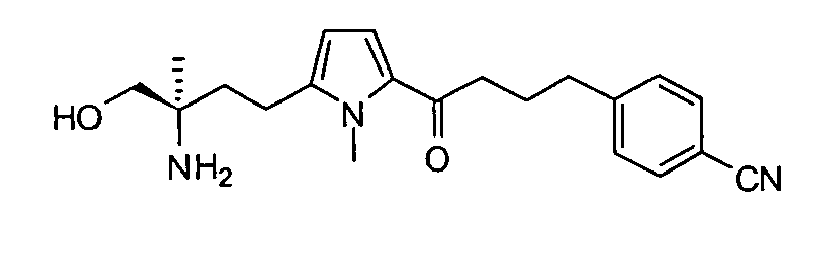
18 
24 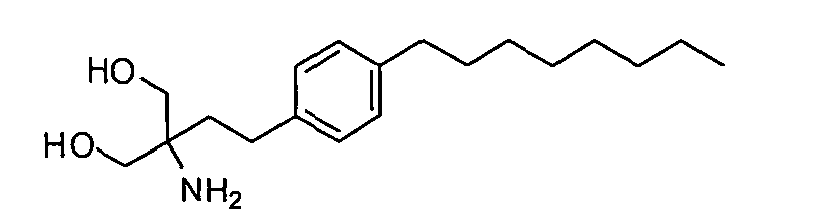
31 
25 
32 
26 
33 
27 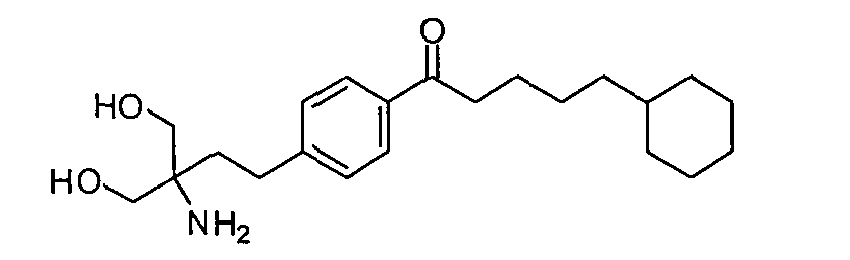
34 
28 
35 
29 
36 
30 
37 
42 
38 
43 
39 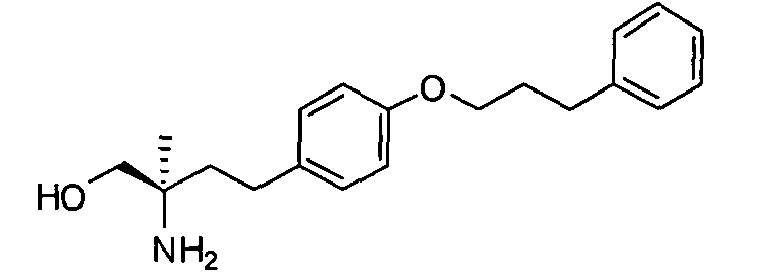
44 
40 
45 
41 
- The "C1-C6 alkyl group" in the definition of the aforementioned R1, R2, R3, R4 and R5 is, for example, a methyl group, an ethyl group, a propyl group, an isopropyl group, a butyl group, a 2-methylpropyl group, a 3-methylpropyl group, a 2,2,2-trimethylmethyl group, a pentyl group or a hexyl group.
- The "halogen atom" in the definition of the aforementioned R4 and R5 is, for example, a fluorine atom, a chlorine atom, a bromine atom or an iodine atom.
- The "C1-C6 alkoxy group" in the definition of the aforementioned R4 and R5 is, for example, a methoxy group, an ethoxy group, a propoxy group, an isopropoxy group, a butoxy group, a 2-methylpropoxy group, a 3-methylpropoxy group, a 2,2,2-trimethylmethoxy group, a pentyloxy group or a hexyloxy group.
- The "C3-C6 cycloalkyl group" in the definition of the aforementioned R5 is, for example, a cyclopropyl group, a cyclobutyl group, a cyclopentyl group or a cyclohexyl group, and is preferably a cyclopropyl group or a cyclohexyl group.
- The "halogeno C1-C6 alkyl group" in the definition of the aforementioned R5 is a group in which the aforementioned C1-C6 alkyl group is substituted with a halogen atom, for example, a fluoromethyl group, a difluoromethyl group, a trifluoromethyl group, a fluoroethyl group, a difluoroethyl group, a trifluoroethyl group, a fluoropropyl group, a difluoropropyl group, a trifluoropropyl group, a fluorobutyl group, a difluorobutyl group, a trifluorobutyl group, a fluoropentyl group, a difluoropentyl group, a trifluoropentyl group, a fluorohexyl group, a difluorohexyl group, a trifluorohexyl group, a pentafluoroethyl group, a hexafluoropropyl group, a nonafluorobutyl group, a chloromethyl group, a dichloromethyl group, a trichloromethyl group, a chloroethyl group, a dichloroethyl group, a trichloroethyl group, a chloropropyl group, a dichloropropyl group, a trichloropropyl group, a chlorobutyl group, a dichlorobutyl group, a trichlorobutyl group, a chloropentyl group, a dichloropentyl group, a trichloropentyl group, a chlorohexyl group, a dichlorohexyl group, a trichlorohexyl group, a pentachloroethyl group, a hexachloropropyl group or a nonachlorobutyl group.
- The "C1-C8 alkylene group" in the definition of the aforementioned Z is, for example, a methylene group, an ethylene group, a propylene group, a tetramethylene group, a pentamethylene group, a hexamethylene group, a heptamethylene group or an octamethylene group.
- The "C1-C8 alkylene group substituted with 2 to 8 fluorine atoms" in the definition of the aforementioned Z may be, for example, a difluoromethylene group, a 1,1-difluoroethylene group, a 1,1,2,2-tetrafluoroethylene group, a 1,1-difluoropropylene group, a 1,1,2,2-tetrafluoropropylene group, a 1,1-difluorotetramethylene group, a 1,1,2,2-tetrafluorotetramethylene group, a 1,1-difluoropentamethylene group or a 1,1,2,2-tetrafluoropentamethylene group, and is preferably a 1,1-difluoropropylene group, a 1,1,2,2-tetrafluoropropylene group, a 1,1-difluorotetramethylene group, a 1,1,2,2-tetrafluorotetramethylene group, a 1,1-difluoropentamethylene group or a 1,1,2,2-tetrafluoropentamethylene group.
- The aforementioned "pharmacologically acceptable salts thereof" are salts obtained by reaction with an acid, since the amino alcohol derivatives of the general formula (I) possess an amino group as a basic group, and include, for example, inorganic acid salts such as hydrohalogenic acid salts, e.g. a hydrofluoric acid salt, a hydrochloric acid salt, a hydrobromic acid salt or a hydroiodic acid salt, a nitric acid salt, a perchloric acid salt, a sulfuric acid salt, a phosphoric acid salt or the like; organic acid salts such as lower alkane sulfonic acid salts, e.g. a methanesulfonic acid salt, a trifluoromethanesulfonic acid salt or an ethanesulfonic acid salt, aryl sulfonic acid salts, e.g. a benzenesulfonic acid salt or a p-toluenesulfonic acid salt, an acetic acid salt, a malic acid salt, a fumaric acid salt, a succinic acid salt, a citric acid salt, an ascorbic acid salt, a tartaric acid salt, an oxalic acid salt or a maleic acid salt; or amino acid salts, e.g. a glycine salt, a lysine salt, an arginine salt, an ornithine salt, a glutamic acid salt and an asparatic acid salt, and preferably a hydrochloric acid salt, an acetic acid salt, a fumaric acid salt, a succinic acid salt or a maleic acid salt.
- There exists an optical isomer, in cases where there is an asymmetric carbon atom within the molecule of the amino alcohol derivatives of the general formula (I), which is one of the active ingredients of the pharmaceutical composition according to the present invention. Among the amino alcohol derivatives of the general formula (I), compounds which have an asymmetric carbon atom are represented as a single formula, that is, as the R-configuration. However, depending on the preparation process, there may be cases where a compound with the S-configuration becomes contaminated as a by-product. Therefore, in such cases, the amino alcohol derivatives of the general formula (I) mainly contain, as optical isomers, the one in the R-configuration but also in part contain the one in the S-configuration.
- When the amino alcohol derivatives of the general formula (I) and pharmacologically acceptable salts thereof are exposed to the atmosphere or are recrystallized, they may absorb moisture, resulting in cases such as addition of adsorbed water and generation of hydrates. Such hydrates are also embraced in the pharmacologically acceptable salts of the amino alcohol derivatives of the general formula (I) of the present invention.
- The pharmaceutical composition according to the present invention exerts enhanced pharmacological effects of both the PPAR regulator and the amino alcohol derivatives that are contained in the composition, shows excellent immunosuppressive action, as well as lowering side effects and having low toxicity, thereby being useful as a prophylactic drug or a therapeutic drug (especially a therapeutic drug) for autoimmune diseases such as systemic lupus erythematosus, rheumatoid arthritis, polymyositis, dermatomyositis, scleroderma, Behcet's disease, Crohn's disease, ulcerative colitis, autoimmune hepatitis, aplastic anemia, exanthema thrombocytopenic purpura, autoimmune hemolytic anemia, multiple sclerosis, autoimmune bullous disease, psoriasis vulgaris, vascular inflammation group, Wegener's granuloma, uveitis, exanthema pneumonitis, Goodpasture's syndrome, sarcoidosis, allergic granulomatous angiitis, bronchial asthma, myocarditis, cardiomyopathy, aortitis syndrome, post-myocardial infarction syndrome, primary pulmonary hypertension, minimal change nephropathy, membranous nephropathy, membranous proliferative nephropathy, focal glomerulosclerosis, crescentic, myasthenia gravis, inflammatory neuropathy, atopic dermatitis, chronic actinic dermatitis, acute polyarthritis, Sydenham's chorea, systemic sclerosis, adult-onset diabetes, insulin-dependent diabetes, juvenile diabetes, atherosclerosis, glomerulonephritis, tubulointerstitial nephritis, primary biliary cirrhosis, primary sclerosing cholangitis, fulminant hepatic failure, viral hepatitis, GVHD, rejection in various kinds of organ transplants, contact dermatitis and sepsis, or other diseases related to immunology (especially autoimmune diseases).
- In the case where the pharmaceutical composition according to the present invention is used as a prophylactic drug or a therapeutic drug for the aforementioned diseases, the pharmaceutical composition according to the present invention can be mixed with a pharmacologically acceptable excipient, diluent or the like, and can be administered as an oral drug by a tablet, a capsule, granules, powders or syrup, or as a parenteral drug by injection or suppository.
- These pharmaceutical preparations are prepared in accordance with known processes by using additives, including excipients (for example, organic excipients such as sugar derivatives, e.g. lactose, sucrose, glucose, mannitol or sorbitol; starch derivatives, e.g. corn starch, potato starch, α-starch or dextrin; cellulose derivatives, e.g. crystalline cellulose; gum arabic; dextrane; or pullulan, and inorganic excipients such as silicate derivatives, e.g. light silicic anhydride, synthetic aluminum silicate, calcium silicate, meta magnesium aluminate; phosphates, e.g. calcium hydrogenphosphate; carbonates, e.g. calcium carbonate; salts of sulfuric acid such as calcium sulfate, can be mentioned), lubricants (for example, stearic acid, stearic acid metal salts such as calcium stearate or magnesium stearate; talc; colloid silica; waxes such as bee gum or spermaceti, boric acid; adipic acid; sulfates such as sodium sulfate; glycol; fumaric acid; sodium benzoate; DL leucine; sodium salt of fatty acid; lauryl sulfates such as sodium lauryl sulfate or magnesium lauryl sulfate; silicic acids such as silicic anhydride or silicate hydrate; and the aforementioned starch derivatives can be mentioned), binders (for example, hydroxypropyl cellulose, hydroxypropyl methyl cellulose, polyvinylpyrrolidone, macrogol and compounds similar to the aforementioned excipients can be mentioned), disintegrants (for example, cellulose derivatives such as low-substituted hydroxypropyl cellulose, carboxymethyl cellulose, calcium carboxymethyl cellulose or internally crosslinked sodium carboxymethyl cellulose; or chemically modified starches or celluloses such as carboxymethyl starch, sodium carboxymethyl starch or crosslinked polyvinylpyrrolidone can be mentioned), stabilizers (for example, paraoxybenzoic acid esters such as methyl paraben or propyl paraben; alcohols such as chlorobutanol, benzyl alcohol or phenyl ethyl alcohol, benzalkonium chloride; phenols such as phenol or cresol; thimerosal; dehydroacetic acid; and sorbic acid can be mentioned) and corrigents (for example, commonly used sweeteners, acidifiers or fragrances can be mentioned) or diluents.
- With respect to the pharmaceutical composition according to the present invention, 1 or 2 or more PPAR regulators selected from the aforementioned specific group and 1 or 2 or more selected from the group consisting of the aforementioned amino alcohol derivatives of the formula (I) and pharmacologically acceptable salts thereof can be administered either simultaneously or separately at a time interval; however, from the clinical perspective, it is convenient to administer them simultaneously, and thus it is preferable that the PPAR regulator and the amino alcohol derivative of the formula (I) or pharmacologically acceptable salt thereof be administered as a formulation.
- Concerning the pharmaceutical technology, in cases where it is not preferable for both of the compounds to be physically mixed together, each of the monotherapies can be administered simultaneously or at a time interval.
- In the present invention, to "administer separately at a time interval" is not specifically limited so long as it is in an administration form which is capable of being administered at different times. For example, 1 or 2 or more selected from the group consisting of the amino alcohol derivatives of the aforementioned general formula (I) and pharmacologically acceptable salts thereof may be administered first, and then after a predetermined time, 1 or 2 or more PPAR regulators selected from the specific group may be administered; or alternatively, the PPAR regulators may be administered first, and then after a predetermined time, the aforementioned amino alcohol derivatives of the general formula (I) or pharmacologically acceptable salts thereof may be administered.
- In the present invention, "treatment" means to cure or improve a disease or symptoms, or to alleviate symptoms, and "prophylaxis" means to prevent an expression of a disease or symptoms.
- In the present invention, "formulation" refers to a single composition in which a plurality of ingredients are mixed.
- In the present invention, "kit" refers to the case in which a plurality of individual compositions are used as one set.
- In the present invention, the maximum administration interval of the aforementioned two types of drugs, which can achieve the excellent effect provided by the PPAR regulator and at least one compound selected from the group consisting of the aforementioned amino alcohol derivatives of the general formula (I) and pharmacologically acceptable salts thereof, can be confirmed by clinical or animal experiments.
- The administration amount and administration ratio of the active ingredients of the pharmaceutical composition according to the present invention, which are the 1 or 2 or more PPAR regulators selected from the aforementioned specific group and 1 or 2 or more compounds selected from the group consisting of the aforementioned amino alcohol derivatives of the general formula (I) and pharmacologically acceptable salts thereof, may vary depending on various conditions such as the activity of each of the drugs, symptoms, age and weight of the patient, and the like.
- Although the single dosage of the PPAR regulator as an active ingredient varies depending on symptoms, age and the like,
- in the case of oral administration, it is 0.001 mg/kg to 1.7 mg/kg, preferably 0.002 mg/kg to 0.83 mg/kg for an adult human, and
in the case of intravenous administration, it is 0.0005 mg/kg to 0.8 mg/kg, preferably 0.001 mg/kg to 0.4 mg/kg for an adult human. - Although the single dosage of the aforementioned amino alcohol derivatives of the general formula (I) and pharmacologically acceptable salts thereof as an active ingredient varies depending on symptoms, age and the like, it is for example, 0.0001 mg/kg to 1.0 mg/kg, preferably 0.001 mg/kg to 0.1 mg/kg for an adult human, irrespective of the route of administration such as oral administration or intravenous administration.
- With respect to oral administration, the number of administrations is generally 1 to 3 times a day, or the number of administration may be decreased depending on circumstances, such as once a week. The number of administrations is preferably once a day to once a week, and more preferably once a day to once every three days.
- In addition, the administration amount ratio of the 1 or 2 or more PPAR regulators selected from the aforementioned specific group and the 1 or 2 or more compounds selected from the group consisting of the aforementioned amino alcohol derivatives of the general formula (I) and pharmacologically acceptable salts thereof may also vary to a large extent; for example, the administration amount ratio of the aforementioned PPAR regulator and the compound selected from the group consisting of the 1 or 2 or more selected from the group consisting of the amino alcohol derivatives of the general formula (I) and pharmacologically acceptable salts thereof may be in the range of 1:2 to 500:1 by weight.
- Test examples and preparation examples will be given hereinafter, and the present invention will be described in more detail; however, the scope of the present invention should not be limited thereto.
- A rat adjuvant arthritis model developing arthritis that is similar to human rheumatoid arthritis was used, and effect of the pharmaceutical composition according to the present invention with respect to the arthritis was evaluated by using footpad volume increase suppression rate as an indicator. Eight-week old female Lewis rats were used in the experiment.
- (1) Preparation of Adjuvant
Heat killed Mycobacterium butyricum was ground in an agate mortar, then suspended in dry heat sterilized liquid paraffin so as to have a concentration of 2 mg/ml, and treated with sonication to prepare an adjuvant. - (2) Preparation of Test Compound
The test compound was suspended or dissolved in a 0.5% tragacanth solution. As the test compound, the compound of Compound No. 1 described in Table 1 was used as the amino alcohol derivative, and the compound of the formula (II) was used as the PPAR regulator. - (3) Induction of Adjuvant Arthritis
0.05 ml of the adjuvant prepared in (1) was injected subcutaneously into the footpad of right hind leg of rats, with respect to a control group and a test compound administration group. Here, 5 rats were used for each group. In addition, a normal control group was provided as a group without injection of the adjuvant. - (4) Administration of Test Compound
The test compound prepared in (2) was orally administrated once a day in the amount of 5 ml/kg, after 18 days from the day of adjuvant injection. The control group was administered with only the 0.5% tragacanth solution in a similar manner. - (5) Calculation of Footpad Volume Increase Suppression Ratio of Test Compound
- After the start of administration, on day 11 and day 18, the volume of the right hind leg was measured by a leg volume measuring device, and the mean value of the swelling volume was calculated for each group.
- Results of the experiment are given in Table 2. The footpad volume increase suppression ratio (%) was calculated by the following equation, and evaluated.

(Table 2) Test Compound (administration amount mg/kg) Footpad volume increase suppression ratio (%) After 11 days After 18 days Compound No. 1 (0.1) 43.0 44.8 Formula (II) (10.0) 24.7 30.1 Compound No. 1 (0.1) + Formula (II) (10.0) 53.2 49.4 
- The results of the experiment showed that when compared with the case where the Compound No. 1 or the compound of the formula (II) are each administered separately, the footpad volume increase suppression ratio is higher when both of the compounds are used in combination, and that the pharmaceutical composition according to the present invention, which contains the amino alcohol derivative and the PPAR regulator, has excellent anti-arthritis action.
- Two families of rat [Lewis (male, 6 weeks old, Charles River Laboratories Japan, Inc.) and WKAH/Hkm (male, 7 weeks old, Japan SLC, Inc.)] are used. Five rats (hosts) are used for each group.
- (1) Induction of HvGR
Spleen cells are isolated from the spleens of the WKAH/Hkm rats and the Lewis rats, and are suspended in RPMI1640 medium (Life Technologies, Inc.) so as to have a concentration of 1 x 10⁸ cells/ml. 0.1 ml of spleen cell suspension (1 x 10⁷ cells as the number of spleen cells) of WKAH/Hkm rats or Lewis rats are injected subcutaneously into the footpad of both hind legs of Lewis rats. - (2) Administration of Test Compound
The test compounds are used as a suspension in a 0.5% tragacanth solution. The suspension of the test compound (5 ml per 1 kg of rat's weight) is orally administered to the test compound administration group (Lewis rat that is injected with spleen cells of WKAH/Hkm rat and is administered with the test compound), once a day, for four days successively from the day the spleen cells are injected. Here, the syngeneic group (Lewis rat that is injected with spleen cells of Lewis rat) and the control group (Lewis rat that is injected with the spleen cells of WKAH/Hkm rat and is not administered with the test compound) are orally administered with 0.5% tragacanth solution in place of the test compound. - (3) Measurement of Suppression Activity with Respect to HvGR
- The mean popliteal lymph node weight is subtracted from the popliteal lymph node weight, with respect to each individual for each of the administration groups ("popliteal lymph weight by HvGR"), and the suppression ratio is calculated from "popliteal lymph weight by HvGR" of each individual of the compound administration group with respect to the mean "popliteal lymph weight by HvGR" of the control group.
- LEW rats (male, 5 weeks old, Charles River Laboratories Japan, Inc.) are used. 5 rats per group are used.
(1) Administration of Test Compound
The test compound is suspended in a 1% tragacanth solution (solvent). The test compound suspension is orally administered forcedly at the rate of 5 ml per 1 kg of the rat's weight.
Here, solvent is administered to the normal group, in place of the test compound suspension.
(2) Measurement of Peripheral Blood Lymphocytes
After 3 hours from administration of the solvent or the test compound suspension, blood is collected from the inferior vena cava under etherization, and is transferred to a tube containing EDTA. The absolute lymphocytic count of the collected blood is measured by a hematology examination device. The peripheral blood lymphocyte decreasing action is calculated as the relative value (%), taking the lymphocytic count of the normal group as 100%.(Preparation Example) Ingredients contained in 1 tablet (150 mg) PPAR regulator 50 mg Immunosuppressive agent 10 mg Lactose 113 mg Corn starch 25 mg Magnesium stearate 2 mg 200 mg - The aforementioned powders are mixed, and tablets of 200 mg per tablet are prepared in accordance with the "tablets" section in General Rules for Preparation of Japanese Pharmacopoeia, by tableting with a tableting machine.
Claims (32)
- A pharmaceutical composition comprising
1 or 2 or more selected from PPAR regulators and
1 or 2 or more selected from the group consisting of amino alcohol derivatives of the general formula (I):
R1 and R2 are the same or different, and each represents a hydrogen atom or a C1-C6 alkyl group;
R3 represents a C1-C6 alkyl group or a hydroxymethyl group;
R4 represents a hydrogen atom, a C1-C6 alkyl group, a C1-C6 alkoxy group or a halogen atom;
R5 represents a phenyl group substituted with 1 to 3 substituents selected from the group consisting of a hydrogen atom, a halogen atom, a cyano group, a C1-C6 alkyl group, a C1-C6 alkoxy group, a C3-C6 cycloalkyl group, a halogeno C1-C6 alkyl group, a phenyl group and a benzyloxy group, a halogen atom or a hydrogen atom;
X represents a vinylene group (CH=CH group), an oxygen atom, a sulfur atom or a methylamino group;
Y represents a single bond, an oxygen atom, a sulfur atom or a carbonyl group;
Z represents a single bond, a C1-C8 alkylene group or a C1-C8 alkylene group substituted with 2 to 8 fluorine atoms;
n represents an integer of 2 or 3]; and pharmacologically acceptable salts thereof. - The pharmaceutical composition according to claim 1, wherein the PPAR regulator is balaglitazone, muraglitazar, naveglitazar, netoglitazone, pioglitazone, rosiglitazone, imiglitazar, tesaglitazar or a compound of the formula (II):

- The pharmaceutical composition according to claim 1, wherein the PPAR regulator is muraglitazar, naveglitazar or tesaglitazar.
- The pharmaceutical composition according to claim 1, wherein the PPAR regulator is pioglitazone, rosiglitazone or the compound of the formula (II).
- The pharmaceutical composition according to claim 1, wherein the PPAR regulator is the compound of the formula (II).
- The pharmaceutical composition according to any one of claims 1 to 5, wherein R1 and R2 are hydrogen atoms.
- The pharmaceutical composition according to any one of claims 1 to 6, wherein R3 is a methyl group or a hydroxymethyl group.
- The pharmaceutical composition according to any one of claims 1 to 6, wherein R3 is a hydroxymethyl group.
- The pharmaceutical composition according to any one of claims 1 to 6, wherein R3 is a methyl group.
- The pharmaceutical composition according to any one of claims 1 to 9, wherein R4 is a hydrogen atom or a chlorine atom.
- The pharmaceutical composition according to any one of claims 1 to 9, wherein R4 is a hydrogen atom.
- The pharmaceutical composition according to any one of claims 1 to 11, wherein R5 is a phenyl group substituted with 1 to 3 substituents selected from the group consisting of a hydrogen atom, a methyl group, a methoxy group, a trifluoromethyl group, a phenyl group and a benzyloxy group, a fluorine atom or a hydrogen atom.
- The pharmaceutical composition according to any one of claims 1 to 11, wherein R5 is a phenyl group, a 4-methylphenyl group, a 4-methoxyphenyl group, a 3-methoxy-4-methylphenyl group, a 3-trifluoromethylphenyl group, a 3-benzyloxyphenyl group, a fluorine atom or a hydrogen atom.
- The pharmaceutical composition according to any one of claims 1 to 13, wherein X is a vinylene group (CH=CH group).
- The pharmaceutical composition according to any one of claims 1 to 13, wherein X is a methylamino group.
- The pharmaceutical composition according to any one of claims 1 to 15, wherein Y is a single bond or a carbonyl group.
- The pharmaceutical composition according to any one of claims 1 to 15, wherein Y is a carbonyl group.
- The pharmaceutical composition according to any one of claims 1 to 17, wherein Z is a single bond or a C1-C8 alkylene group.
- The pharmaceutical composition according to any one of claims 1 to 17, wherein Z is a single bond, trimethylene, tetramethylene or octamethylene.
- The pharmaceutical composition according to any one of claims 1 to 19, wherein n is 2.
- The pharmaceutical composition according to any one of claims 1 to 5, wherein the amino alcohol derivative of the general formula (I) is:2-amino-2-methyl-4-{1-methyl-5-[5-phenylpentanoyl]pyrrol-2-yl}butan-1-ol,2-amino-2-methyl-4-{1-methyl-5-[5-(4-methylphenyl)pentanoyl]pyrrol-2-yl}butan-1-ol,2-amino-2-methyl-4-{1-methyl-5-[5-(3,4-dimethylphenyl)pentanoyl]pyrrol-2-yl}butan-1-ol,2-amino-2-methyl-4-{1-methyl-5-[5-(3-methyl-4-methoxyphenyl)pentanoyl]pyrrol-2-yl}butan-1-ol,2-amino-2-methyl-4-{1-methyl-5-[5-(3-methoxy-4-methylphenyl)pentanoyl]pyrrol-2-yl}butan-1-ol,2-amino-2-methyl-4-{1-methyl-5-[5-(4-cyanophenyl)pentanoyl]pyrrol-2-yl}butan-1-ol,2-amino-2-methyl-4-{1-methyl-5-[4-(4-methylphenyl)butanoyl]pyrrol-2-yl}butan-1-ol,2-amino-2-methyl-4-{1-methyl-5-[4-(3,4-dimethylphenyl)butanoyl] pyrrol-2-yl}butan-1-ol,2-amino-2-methyl-4-{1-methyl-5-[4-(3-methyl-4-methoxyphenyl)butanoyl]pyrrol-2-yl}butan-1-ol,2-amino-2-methyl-4-{1-methyl-5-[4-(3-methoxy-4-methylphenyl)butanoyl]pyrrol-2-yl}butan-1-ol, or2-amino-2-methyl-4-{1-methyl-5-[4-(4-cyanophenyl)butanoyl]pyrrol-2-yl}butan-1-ol.
- The pharmaceutical composition according to any one of claims 1 to 5, wherein the amino alcohol derivative of the general formula (I) is:2-amino-2-[2-(4-octylphenyl)ethyl]propan-1,3-diol,2-amino-2-[2-(4-heptyloxyphenyl)ethyl]propan-1,3-diol,2-amino-2-{2-[4-(5-phenylpentanoyl)phenyl]ethyl}propan-1,3-diol,2-amino-2-{2-[4-(5-cyclohexylpentanoyl)phenyl]ethyl}propan-1,3-diol,2-amino-2-{2-[4-(7-phenylheptanoyl)phenyl]ethyl}propan-1,3-diol,2-amino-2-[2-(4-[2-(4-methoxyphenyl)ethoxy]phenyl)ethyl]propan-1,3-diol,2-amino-2-[2-(4-[2-(4-ethoxyphenyl)ethoxy]phenyl)ethyl]propan-1,3-diol,2-amino-2-[2-(4-[2-(3-fluoro-4-methoxyphenyl)ethoxy]phenyl)ethyl]propan-1,3-diol,2-amino-2-methyl-4-[4-(4,4,5,5,5-pentafluoropentyloxy)phenyl]butan-1-ol,2-amino-2-methyl-4-[4-(3-biphenyl-4-ylpropoxy)phenyl]butan-1-ol,2-amino-2-methyl-4-[4-(3-biphenyl-4-ylropionyl)phenyl]butan-1-ol,2-amino-2-methyl-4-[3-methoxy-4-(4-phenylbutoxy)phenyl]butan-1-ol,2-amino-2-methyl-4-[4-(5-phenylpentyloxy)phenyl]butan-1-ol,2-amino-2-methyl-4-[4-(5-phenylpentanoyl)phenyl]butan-1-ol,2-amino-2-methyl-4-(4-hexyloxyphenyl)butan-1-ol,2-amino-2-methyl-4-[4-(3-phenylpropoxy)phenyl]butan-1-ol,2-amino-2-methyl-4-[4-(3-cyclohexylpropoxy)phenyl]butan-1-ol,2-amino-2-methyl-4-[4-(5-cyclohexylpentanoyl)phenyl]butan-1-ol,2-amino-2-methyl-4-[4-heptyloxyphenyl]butan-1-ol,2-amino-2-[4-(3-benzyloxyphenoxy)-2-chlorophenyl]propyl-1,3-propanediol,2-amino-2-[4-(3-benzyloxyphenylthio)-2-chlorophenyl]propyl-1,3-propanediol,2-amino-2-methyl-5-[4-(3-benzyloxyphenoxy)-2-chlorophenyl]pentan-1-ol, or2-amino-2-methyl-5-[4-(3-benzyloxyphenylthio)-2-chlorophenyl]pentan-1-ol.
- The pharmaceutical composition according to any one of claims 1 to 5, wherein the amino alcohol derivative of the general formula (I) is 2-amino-2-[2-(4-octylphenyl)ethyl]-propan-1,3-diol.
- The pharmaceutical composition according to any one of claims 1 to 23 for use in suppression of rejection in organ transplants or skin grafts.
- The pharmaceutical composition according to any one of claims 1 to 23 for use in prophylaxis or treatment of autoimmune disease.
- The pharmaceutical composition according to claim 25, wherein the autoimmune disease is rheumatoid arthritis, psoriasis, inflammatory enteritis or multiple sclerosis.
- The pharmaceutical composition according to any one of claims 1 to 26, which is an adjuvant containing the PPAR regulator(s) and the amino alcohol derivative(s) of the general formula (I) in the same pharmaceutical composition.
- The pharmaceutical composition according to any one of claims 1 to 26, which is a kit comprising a pharmaceutical composition including the PPAR regulator(s) and the amino alcohol derivative(s) of the general formula (I).
- A method for preparing the pharmaceutical composition according to claim 27.
- A method for suppression of rejection in organ transplants or skin grafts, which comprises administering an effective amount of the pharmaceutical composition according to any one of claims 1 to 28 to a mammal.
- A method for prophylaxis or treatment of an autoimmune disease, which comprises administering an effective amount of the pharmaceutical composition according to any one of claims 1 to 28 to a mammal.
- The method for the prophylaxis or the treatment according to claim 31, wherein the autoimmune disease is rheumatoid arthritis, psoriasis, inflammatory enteritis or multiple sclerosis.
Applications Claiming Priority (2)
| Application Number | Priority Date | Filing Date | Title |
|---|---|---|---|
| JP2005185287 | 2005-06-24 | ||
| PCT/JP2006/312568 WO2006137509A1 (en) | 2005-06-24 | 2006-06-23 | Cyclic amine derivative containing ppar regulator |
Publications (3)
| Publication Number | Publication Date |
|---|---|
| EP1915994A1 true EP1915994A1 (en) | 2008-04-30 |
| EP1915994A4 EP1915994A4 (en) | 2011-06-15 |
| EP1915994B1 EP1915994B1 (en) | 2012-08-01 |
Family
ID=37570526
Family Applications (1)
| Application Number | Title | Priority Date | Filing Date |
|---|---|---|---|
| EP06767218A Expired - Lifetime EP1915994B1 (en) | 2005-06-24 | 2006-06-23 | Cyclic amine derivatives in combination with ppar regulators |
Country Status (10)
| Country | Link |
|---|---|
| US (1) | US20080153882A1 (en) |
| EP (1) | EP1915994B1 (en) |
| JP (1) | JPWO2006137509A1 (en) |
| KR (1) | KR20080017050A (en) |
| CN (1) | CN101242829B (en) |
| BR (1) | BRPI0612266A2 (en) |
| CA (1) | CA2613253A1 (en) |
| ES (1) | ES2390810T3 (en) |
| TW (1) | TWI418350B (en) |
| WO (1) | WO2006137509A1 (en) |
Cited By (2)
| Publication number | Priority date | Publication date | Assignee | Title |
|---|---|---|---|---|
| EP1782804A4 (en) * | 2004-07-29 | 2010-12-15 | Sankyo Co | MEDICINAL COMPOSITION USEFUL AS IMMUNOSUPPRESSOR |
| EP2149549A4 (en) * | 2007-05-25 | 2012-01-04 | Daiichi Sankyo Co Ltd | PHARMACEUTICAL COMPOSITION FOR THE PREVENTION OR TREATMENT OF HEPATITIS |
Families Citing this family (23)
| Publication number | Priority date | Publication date | Assignee | Title |
|---|---|---|---|---|
| MXPA04006709A (en) * | 2002-01-11 | 2004-10-04 | Sankyo Co | Amino alcohol derivative or phosphonic acid derivative and medicinal composition containing these. |
| CN101905023B (en) * | 2004-07-16 | 2012-07-11 | 杏林制药株式会社 | Method of effectively using medicine and method concerning prevention of side effect |
| PL1806338T3 (en) | 2004-10-12 | 2016-07-29 | Kyorin Seiyaku Kk | Process for producing 2-amino-2-[2-[4-(3-benzyloxyphenylthio)-2-chlorophenyl[ethyl]-1,3-propanediol hydrochloride and hydrates thereof. and intermediates the production thereof |
| SI1932522T1 (en) * | 2005-10-07 | 2012-08-31 | Kyorin Seiyaku Kk | Therapeutic agent for liver disease containing 2-amino-1,3-propanediol derivative as active ingredient |
| TWI389683B (en) * | 2006-02-06 | 2013-03-21 | Kyorin Seiyaku Kk | A therapeutic agent for an inflammatory bowel disease or an inflammatory bowel disease treatment using a 2-amino-1,3-propanediol derivative as an active ingredient |
| RU2430925C2 (en) * | 2006-08-08 | 2011-10-10 | Киорин Фармасьютикал Ко., Лтд. | Aminophosphate derivative and s1p receptor modulator containing said derivative as active ingredient |
| CA2659599C (en) * | 2006-08-08 | 2014-06-17 | Kyorin Pharmaceutical Co., Ltd. | Amino alcohol derivative and immunosuppressive agent having same as an active ingredient |
| WO2008099781A1 (en) * | 2007-02-13 | 2008-08-21 | Kyorin Pharmaceutical Co., Ltd. | Therapeutic or prophylactic agent for demyelinating disease comprising amino alcohol derivative as active ingredient |
| JP5452237B2 (en) * | 2008-02-07 | 2014-03-26 | 杏林製薬株式会社 | Therapeutic or prophylactic agent for inflammatory bowel disease comprising an amino alcohol derivative as an active ingredient |
| CN104311472B9 (en) | 2008-07-23 | 2020-03-17 | 艾尼纳制药公司 | Substituted 1,2,3, 4-tetrahydrocyclopenta [ b ] indol-3-yl acetic acid derivatives |
| PL2342205T4 (en) | 2008-08-27 | 2016-12-30 | Substituted tricyclic acid derivatives as s1p1 receptor agonists useful in the treatment of autoimmune and inflammatory disorders | |
| CN104788325A (en) * | 2008-11-11 | 2015-07-22 | 诺华股份有限公司 | Crystalline form of fingolimod |
| WO2010087244A1 (en) * | 2009-01-30 | 2010-08-05 | 第一三共株式会社 | Cyclic amino alcohol compound |
| EP2528894A1 (en) | 2010-01-27 | 2012-12-05 | Arena Pharmaceuticals, Inc. | Processes for the preparation of (r)-2-(7-(4-cyclopentyl-3-(trifluoromethyl)benzyloxy)-1,2,3,4-tetrahydrocyclopenta[b]indol-3-yl)acetic acid and salts thereof |
| CN105503882B (en) | 2010-03-03 | 2019-07-05 | 艾尼纳制药公司 | The method for preparing S1P1 receptor modulators and its crystal form |
| CA3002540C (en) | 2015-01-06 | 2023-11-07 | Arena Pharmaceuticals, Inc. | Use of (r)-2-(7-(4-cyclopentyl-3-(trifluoromethyl)benzyloxy)-1,2,3,4-tetrahydrocyclopenta[b]indol-3-yl)acetic acid for treating conditions related to the s1p1 receptor |
| JP6838744B2 (en) | 2015-06-22 | 2021-03-03 | アリーナ ファーマシューティカルズ, インコーポレイテッド | (R) -2- (7- (4-cyclopentyl-3- (trifluoromethyl) benzyloxy) -1,2,3,4-tetrahydrocyclopenta [b] indole-for use in S1P1 receptor-related disorders Crystalline L-arginine salt of 3-yl) acetic acid (Compound 1) |
| KR20190113955A (en) | 2017-02-16 | 2019-10-08 | 아레나 파마슈티칼스, 인크. | Compounds and Methods for the Treatment of Inflammatory Bowel Disease With Extra-Intestinal Symptoms |
| CN110520124A (en) | 2017-02-16 | 2019-11-29 | 艾尼纳制药公司 | For treating the Compounds and methods for of primary biliary cholangitis |
| US10512622B2 (en) * | 2017-07-14 | 2019-12-24 | Cymabay Therapeutics, Inc. | Treatment of intrahepatic cholestatic diseases |
| JP7397011B2 (en) | 2018-06-06 | 2023-12-12 | アリーナ ファーマシューティカルズ, インコーポレイテッド | Methods of treating conditions associated with S1P1 receptors |
| EP3847158B1 (en) | 2018-09-06 | 2026-06-24 | Arena Pharmaceuticals, Inc. | Compounds useful in the treatment of autoimmune and inflammatory disorders |
| CN112955135B (en) * | 2018-10-31 | 2024-02-09 | 富士胶片株式会社 | Composition, sprayer and wiping cloth |
Family Cites Families (15)
| Publication number | Priority date | Publication date | Assignee | Title |
|---|---|---|---|---|
| KR0155015B1 (en) * | 1992-10-21 | 1998-12-01 | 고우야 마사시 | 2-amino-1,3-propanediol compound and immunosuppressant |
| DE69524962T4 (en) * | 1994-08-22 | 2003-08-28 | Mitsubishi Pharma Corp., Osaka | BENZENE DERIVATIVES AND THEIR MEDICAL USE |
| CZ293016B6 (en) * | 1995-06-01 | 2004-01-14 | Sankyo Company Limited | Benzimidazole derivatives and pharmaceutical compositions in which the derivatives are comprised |
| NZ333065A (en) * | 1996-05-31 | 2000-05-26 | Sankyo Co | Treatment or prevention of autoimmune diseases using an insulin resistance improving thiazolidinedione derivative |
| ES2240868T3 (en) * | 1997-04-04 | 2005-10-16 | Mitsubishi Pharma Corporation | COMPOSITE OF 2-AMINOPROPANE -1,3-DIOL, ITS PHARMACEUTICAL USE AND INTERMEDIATES IN ITS SYNTHESIS |
| JPH1180026A (en) * | 1997-09-02 | 1999-03-23 | Yoshitomi Pharmaceut Ind Ltd | Novel immunosuppressants, methods of use and methods of identification thereof |
| US6900335B2 (en) * | 2000-07-19 | 2005-05-31 | Ube Industries, Ltd. | Process for producing 5-fluorooxindole and for producing intermediates therefor |
| JP2005512532A (en) * | 2001-08-03 | 2005-05-12 | ディヴァーサ コーポレイション | P450 enzymes, nucleic acids encoding them and their production and use |
| JP4152884B2 (en) * | 2001-09-27 | 2008-09-17 | 杏林製薬株式会社 | Diaryl ether derivatives and their addition salts and immunosuppressants |
| KR100913269B1 (en) * | 2001-09-27 | 2009-08-21 | 교린 세이야꾸 가부시키 가이샤 | Diaryl sulfide derivatives, salts thereof and immunosuppressive agents using the same |
| MXPA04006709A (en) * | 2002-01-11 | 2004-10-04 | Sankyo Co | Amino alcohol derivative or phosphonic acid derivative and medicinal composition containing these. |
| CN100516024C (en) * | 2002-09-13 | 2009-07-22 | 诺瓦提斯公司 | Amino-propanol derivatives |
| WO2005105146A1 (en) * | 2004-05-03 | 2005-11-10 | Novartis Ag | Combinations comprising a s1p receptor agonist and a jak3 kinase inhibitor |
| CN101905023B (en) * | 2004-07-16 | 2012-07-11 | 杏林制药株式会社 | Method of effectively using medicine and method concerning prevention of side effect |
| TW200611687A (en) * | 2004-07-29 | 2006-04-16 | Sankyo Co | Pharmaceutical compositions used for immunosuppressant |
-
2006
- 2006-06-22 TW TW095122393A patent/TWI418350B/en not_active IP Right Cessation
- 2006-06-23 JP JP2007522373A patent/JPWO2006137509A1/en active Pending
- 2006-06-23 CN CN2006800305018A patent/CN101242829B/en not_active Expired - Fee Related
- 2006-06-23 BR BRPI0612266-3A patent/BRPI0612266A2/en not_active IP Right Cessation
- 2006-06-23 CA CA002613253A patent/CA2613253A1/en not_active Abandoned
- 2006-06-23 ES ES06767218T patent/ES2390810T3/en not_active Expired - Lifetime
- 2006-06-23 KR KR1020077030008A patent/KR20080017050A/en not_active Ceased
- 2006-06-23 WO PCT/JP2006/312568 patent/WO2006137509A1/en not_active Ceased
- 2006-06-23 US US11/922,429 patent/US20080153882A1/en not_active Abandoned
- 2006-06-23 EP EP06767218A patent/EP1915994B1/en not_active Expired - Lifetime
Cited By (2)
| Publication number | Priority date | Publication date | Assignee | Title |
|---|---|---|---|---|
| EP1782804A4 (en) * | 2004-07-29 | 2010-12-15 | Sankyo Co | MEDICINAL COMPOSITION USEFUL AS IMMUNOSUPPRESSOR |
| EP2149549A4 (en) * | 2007-05-25 | 2012-01-04 | Daiichi Sankyo Co Ltd | PHARMACEUTICAL COMPOSITION FOR THE PREVENTION OR TREATMENT OF HEPATITIS |
Also Published As
| Publication number | Publication date |
|---|---|
| KR20080017050A (en) | 2008-02-25 |
| WO2006137509A1 (en) | 2006-12-28 |
| TWI418350B (en) | 2013-12-11 |
| JPWO2006137509A1 (en) | 2009-01-22 |
| TW200724136A (en) | 2007-07-01 |
| BRPI0612266A2 (en) | 2012-04-24 |
| CA2613253A1 (en) | 2006-12-28 |
| CN101242829A (en) | 2008-08-13 |
| US20080153882A1 (en) | 2008-06-26 |
| ES2390810T3 (en) | 2012-11-16 |
| EP1915994B1 (en) | 2012-08-01 |
| CN101242829B (en) | 2011-05-18 |
| EP1915994A4 (en) | 2011-06-15 |
Similar Documents
| Publication | Publication Date | Title |
|---|---|---|
| US20080153882A1 (en) | Pharmaceutical Composition Comprising Ppar Regulator | |
| CN100567275C (en) | 5-(Phenyl-(Z)-ylidene)-thiazolidin-4-one derivatives as immunosuppressants | |
| PT2010501E (en) | Imidazole-based compounds, compositions comprising them and methods of their use | |
| CN101027048A (en) | Medicinal composition as immunosuppressant | |
| KR20220081631A (en) | Novel use of pyrolo-pyridine derivatives for preventing or treating inflammatory diseases | |
| USRE43833E1 (en) | Thiazolidin-4-one derivatives | |
| EP0292660B1 (en) | Alkylidenedithiobis (substituted) phenols for inhibiting interleukin-1 release and for alleviating interleukin-1 mediated conditions | |
| JPWO2002072097A1 (en) | Agent for treating and / or preventing ischemic heart disease derived from diabetes | |
| EP0531228B1 (en) | Thiourea derivatives, antimicrobial agent and antiulcer agent containing the same | |
| CN1162152C (en) | diabetes treatment agent | |
| HK1111885A (en) | Cyclic amine derivative containing ppar regulator | |
| EP3507278B1 (en) | Substituted tricyclic heterocyclic compounds | |
| RU2646475C2 (en) | Treatment of type i and ii diabetes | |
| PT98911B (en) | METHOD FOR PREPARING 3- (1H-INDAZOL-3-YL) -4-PYRIDINAMINS, ITS INTERMEDIARIES AND PHARMACEUTICAL COMPOSITIONS THAT CONTAIN THEM | |
| US11014940B1 (en) | Thiazolidinone and oxazolidinone compounds and formulations | |
| KR20040028916A (en) | Medicament inhibiting sodium/calcium exchange system | |
| JP5559696B2 (en) | Treatment for diabetic nephropathy | |
| US7846974B2 (en) | Method of lowering blood glucose and method of treating diabetes and obesity | |
| JP4919374B2 (en) | Pharmaceutical composition as an immunosuppressant | |
| JP2006347935A (en) | Pharmaceutical for preventing/treating disease related to inflammatory cytokine production | |
| WO2018016596A1 (en) | Prophylactic or therapeutic agent for pulmonary hypertension which comprises pparα agonist | |
| US20110152275A1 (en) | Agent for maintenance of induced remission | |
| WO2022098748A1 (en) | Uses for hsd17b13 inhibitors | |
| JPWO1992010176A1 (en) | Liver disease treatment | |
| JPWO1994027607A1 (en) | antiviral agents |
Legal Events
| Date | Code | Title | Description |
|---|---|---|---|
| PUAI | Public reference made under article 153(3) epc to a published international application that has entered the european phase |
Free format text: ORIGINAL CODE: 0009012 |
|
| 17P | Request for examination filed |
Effective date: 20071214 |
|
| AK | Designated contracting states |
Kind code of ref document: A1 Designated state(s): AT BE BG CH CY CZ DE DK EE ES FI FR GB GR HU IE IS IT LI LT LU LV MC NL PL PT RO SE SI SK TR |
|
| REG | Reference to a national code |
Ref country code: HK Ref legal event code: DE Ref document number: 1111885 Country of ref document: HK |
|
| DAX | Request for extension of the european patent (deleted) | ||
| A4 | Supplementary search report drawn up and despatched |
Effective date: 20110516 |
|
| RTI1 | Title (correction) |
Free format text: CYCLIC AMINE DERIVATIVES IN COMBINATION WITH PPAR REGULATORS |
|
| GRAP | Despatch of communication of intention to grant a patent |
Free format text: ORIGINAL CODE: EPIDOSNIGR1 |
|
| GRAS | Grant fee paid |
Free format text: ORIGINAL CODE: EPIDOSNIGR3 |
|
| GRAA | (expected) grant |
Free format text: ORIGINAL CODE: 0009210 |
|
| RAP1 | Party data changed (applicant data changed or rights of an application transferred) |
Owner name: DAIICHI SANKYO COMPANY, LIMITED |
|
| AK | Designated contracting states |
Kind code of ref document: B1 Designated state(s): AT BE BG CH CY CZ DE DK EE ES FI FR GB GR HU IE IS IT LI LT LU LV MC NL PL PT RO SE SI SK TR |
|
| REG | Reference to a national code |
Ref country code: GB Ref legal event code: FG4D |
|
| REG | Reference to a national code |
Ref country code: CH Ref legal event code: EP Ref country code: AT Ref legal event code: REF Ref document number: 568263 Country of ref document: AT Kind code of ref document: T Effective date: 20120815 |
|
| REG | Reference to a national code |
Ref country code: IE Ref legal event code: FG4D |
|
| REG | Reference to a national code |
Ref country code: DE Ref legal event code: R096 Ref document number: 602006031116 Country of ref document: DE Effective date: 20120927 |
|
| REG | Reference to a national code |
Ref country code: ES Ref legal event code: FG2A Ref document number: 2390810 Country of ref document: ES Kind code of ref document: T3 Effective date: 20121116 |
|
| REG | Reference to a national code |
Ref country code: NL Ref legal event code: VDEP Effective date: 20120801 |
|
| REG | Reference to a national code |
Ref country code: AT Ref legal event code: MK05 Ref document number: 568263 Country of ref document: AT Kind code of ref document: T Effective date: 20120801 |
|
| REG | Reference to a national code |
Ref country code: LT Ref legal event code: MG4D Effective date: 20120801 |
|
| PG25 | Lapsed in a contracting state [announced via postgrant information from national office to epo] |
Ref country code: CY Free format text: LAPSE BECAUSE OF FAILURE TO SUBMIT A TRANSLATION OF THE DESCRIPTION OR TO PAY THE FEE WITHIN THE PRESCRIBED TIME-LIMIT Effective date: 20120801 Ref country code: FI Free format text: LAPSE BECAUSE OF FAILURE TO SUBMIT A TRANSLATION OF THE DESCRIPTION OR TO PAY THE FEE WITHIN THE PRESCRIBED TIME-LIMIT Effective date: 20120801 Ref country code: IS Free format text: LAPSE BECAUSE OF FAILURE TO SUBMIT A TRANSLATION OF THE DESCRIPTION OR TO PAY THE FEE WITHIN THE PRESCRIBED TIME-LIMIT Effective date: 20121201 Ref country code: AT Free format text: LAPSE BECAUSE OF FAILURE TO SUBMIT A TRANSLATION OF THE DESCRIPTION OR TO PAY THE FEE WITHIN THE PRESCRIBED TIME-LIMIT Effective date: 20120801 Ref country code: LT Free format text: LAPSE BECAUSE OF FAILURE TO SUBMIT A TRANSLATION OF THE DESCRIPTION OR TO PAY THE FEE WITHIN THE PRESCRIBED TIME-LIMIT Effective date: 20120801 |
|
| PG25 | Lapsed in a contracting state [announced via postgrant information from national office to epo] |
Ref country code: SE Free format text: LAPSE BECAUSE OF FAILURE TO SUBMIT A TRANSLATION OF THE DESCRIPTION OR TO PAY THE FEE WITHIN THE PRESCRIBED TIME-LIMIT Effective date: 20120801 Ref country code: PL Free format text: LAPSE BECAUSE OF FAILURE TO SUBMIT A TRANSLATION OF THE DESCRIPTION OR TO PAY THE FEE WITHIN THE PRESCRIBED TIME-LIMIT Effective date: 20120801 Ref country code: LV Free format text: LAPSE BECAUSE OF FAILURE TO SUBMIT A TRANSLATION OF THE DESCRIPTION OR TO PAY THE FEE WITHIN THE PRESCRIBED TIME-LIMIT Effective date: 20120801 Ref country code: SI Free format text: LAPSE BECAUSE OF FAILURE TO SUBMIT A TRANSLATION OF THE DESCRIPTION OR TO PAY THE FEE WITHIN THE PRESCRIBED TIME-LIMIT Effective date: 20120801 Ref country code: BE Free format text: LAPSE BECAUSE OF FAILURE TO SUBMIT A TRANSLATION OF THE DESCRIPTION OR TO PAY THE FEE WITHIN THE PRESCRIBED TIME-LIMIT Effective date: 20120801 Ref country code: PT Free format text: LAPSE BECAUSE OF FAILURE TO SUBMIT A TRANSLATION OF THE DESCRIPTION OR TO PAY THE FEE WITHIN THE PRESCRIBED TIME-LIMIT Effective date: 20121203 Ref country code: GR Free format text: LAPSE BECAUSE OF FAILURE TO SUBMIT A TRANSLATION OF THE DESCRIPTION OR TO PAY THE FEE WITHIN THE PRESCRIBED TIME-LIMIT Effective date: 20121102 |
|
| PG25 | Lapsed in a contracting state [announced via postgrant information from national office to epo] |
Ref country code: NL Free format text: LAPSE BECAUSE OF FAILURE TO SUBMIT A TRANSLATION OF THE DESCRIPTION OR TO PAY THE FEE WITHIN THE PRESCRIBED TIME-LIMIT Effective date: 20120801 |
|
| PG25 | Lapsed in a contracting state [announced via postgrant information from national office to epo] |
Ref country code: EE Free format text: LAPSE BECAUSE OF FAILURE TO SUBMIT A TRANSLATION OF THE DESCRIPTION OR TO PAY THE FEE WITHIN THE PRESCRIBED TIME-LIMIT Effective date: 20120801 Ref country code: RO Free format text: LAPSE BECAUSE OF FAILURE TO SUBMIT A TRANSLATION OF THE DESCRIPTION OR TO PAY THE FEE WITHIN THE PRESCRIBED TIME-LIMIT Effective date: 20120801 Ref country code: CZ Free format text: LAPSE BECAUSE OF FAILURE TO SUBMIT A TRANSLATION OF THE DESCRIPTION OR TO PAY THE FEE WITHIN THE PRESCRIBED TIME-LIMIT Effective date: 20120801 Ref country code: DK Free format text: LAPSE BECAUSE OF FAILURE TO SUBMIT A TRANSLATION OF THE DESCRIPTION OR TO PAY THE FEE WITHIN THE PRESCRIBED TIME-LIMIT Effective date: 20120801 |
|
| PG25 | Lapsed in a contracting state [announced via postgrant information from national office to epo] |
Ref country code: SK Free format text: LAPSE BECAUSE OF FAILURE TO SUBMIT A TRANSLATION OF THE DESCRIPTION OR TO PAY THE FEE WITHIN THE PRESCRIBED TIME-LIMIT Effective date: 20120801 |
|
| PLBE | No opposition filed within time limit |
Free format text: ORIGINAL CODE: 0009261 |
|
| STAA | Information on the status of an ep patent application or granted ep patent |
Free format text: STATUS: NO OPPOSITION FILED WITHIN TIME LIMIT |
|
| 26N | No opposition filed |
Effective date: 20130503 |
|
| PG25 | Lapsed in a contracting state [announced via postgrant information from national office to epo] |
Ref country code: BG Free format text: LAPSE BECAUSE OF FAILURE TO SUBMIT A TRANSLATION OF THE DESCRIPTION OR TO PAY THE FEE WITHIN THE PRESCRIBED TIME-LIMIT Effective date: 20121101 |
|
| REG | Reference to a national code |
Ref country code: DE Ref legal event code: R097 Ref document number: 602006031116 Country of ref document: DE Effective date: 20130503 |
|
| PG25 | Lapsed in a contracting state [announced via postgrant information from national office to epo] |
Ref country code: MC Free format text: LAPSE BECAUSE OF FAILURE TO SUBMIT A TRANSLATION OF THE DESCRIPTION OR TO PAY THE FEE WITHIN THE PRESCRIBED TIME-LIMIT Effective date: 20120801 |
|
| REG | Reference to a national code |
Ref country code: CH Ref legal event code: PL |
|
| REG | Reference to a national code |
Ref country code: IE Ref legal event code: MM4A |
|
| PG25 | Lapsed in a contracting state [announced via postgrant information from national office to epo] |
Ref country code: CH Free format text: LAPSE BECAUSE OF NON-PAYMENT OF DUE FEES Effective date: 20130630 Ref country code: IE Free format text: LAPSE BECAUSE OF NON-PAYMENT OF DUE FEES Effective date: 20130623 Ref country code: LI Free format text: LAPSE BECAUSE OF NON-PAYMENT OF DUE FEES Effective date: 20130630 |
|
| REG | Reference to a national code |
Ref country code: FR Ref legal event code: PLFP Year of fee payment: 10 |
|
| PG25 | Lapsed in a contracting state [announced via postgrant information from national office to epo] |
Ref country code: TR Free format text: LAPSE BECAUSE OF FAILURE TO SUBMIT A TRANSLATION OF THE DESCRIPTION OR TO PAY THE FEE WITHIN THE PRESCRIBED TIME-LIMIT Effective date: 20120801 |
|
| PG25 | Lapsed in a contracting state [announced via postgrant information from national office to epo] |
Ref country code: HU Free format text: LAPSE BECAUSE OF FAILURE TO SUBMIT A TRANSLATION OF THE DESCRIPTION OR TO PAY THE FEE WITHIN THE PRESCRIBED TIME-LIMIT; INVALID AB INITIO Effective date: 20060623 Ref country code: LU Free format text: LAPSE BECAUSE OF NON-PAYMENT OF DUE FEES Effective date: 20130623 |
|
| PGFP | Annual fee paid to national office [announced via postgrant information from national office to epo] |
Ref country code: GB Payment date: 20150617 Year of fee payment: 10 Ref country code: ES Payment date: 20150512 Year of fee payment: 10 Ref country code: DE Payment date: 20150616 Year of fee payment: 10 |
|
| PGFP | Annual fee paid to national office [announced via postgrant information from national office to epo] |
Ref country code: FR Payment date: 20150608 Year of fee payment: 10 |
|
| PGFP | Annual fee paid to national office [announced via postgrant information from national office to epo] |
Ref country code: IT Payment date: 20150625 Year of fee payment: 10 |
|
| REG | Reference to a national code |
Ref country code: DE Ref legal event code: R119 Ref document number: 602006031116 Country of ref document: DE |
|
| GBPC | Gb: european patent ceased through non-payment of renewal fee |
Effective date: 20160623 |
|
| REG | Reference to a national code |
Ref country code: FR Ref legal event code: ST Effective date: 20170228 |
|
| PG25 | Lapsed in a contracting state [announced via postgrant information from national office to epo] |
Ref country code: FR Free format text: LAPSE BECAUSE OF NON-PAYMENT OF DUE FEES Effective date: 20160630 Ref country code: DE Free format text: LAPSE BECAUSE OF NON-PAYMENT OF DUE FEES Effective date: 20170103 |
|
| PG25 | Lapsed in a contracting state [announced via postgrant information from national office to epo] |
Ref country code: GB Free format text: LAPSE BECAUSE OF NON-PAYMENT OF DUE FEES Effective date: 20160623 |
|
| PG25 | Lapsed in a contracting state [announced via postgrant information from national office to epo] |
Ref country code: IT Free format text: LAPSE BECAUSE OF NON-PAYMENT OF DUE FEES Effective date: 20160623 |
|
| PG25 | Lapsed in a contracting state [announced via postgrant information from national office to epo] |
Ref country code: ES Free format text: LAPSE BECAUSE OF NON-PAYMENT OF DUE FEES Effective date: 20160624 |
|
| REG | Reference to a national code |
Ref country code: ES Ref legal event code: FD2A Effective date: 20181204 |