EP1915347B1 - New 1 , 2 -diaryl pyrazoles useful as analgetic and anti-inflammatory agents - Google Patents
New 1 , 2 -diaryl pyrazoles useful as analgetic and anti-inflammatory agents Download PDFInfo
- Publication number
- EP1915347B1 EP1915347B1 EP06765404A EP06765404A EP1915347B1 EP 1915347 B1 EP1915347 B1 EP 1915347B1 EP 06765404 A EP06765404 A EP 06765404A EP 06765404 A EP06765404 A EP 06765404A EP 1915347 B1 EP1915347 B1 EP 1915347B1
- Authority
- EP
- European Patent Office
- Prior art keywords
- formula
- compound
- group
- compounds
- pharmaceutically acceptable
- Prior art date
- Legal status (The legal status is an assumption and is not a legal conclusion. Google has not performed a legal analysis and makes no representation as to the accuracy of the status listed.)
- Active
Links
Classifications
-
- C—CHEMISTRY; METALLURGY
- C07—ORGANIC CHEMISTRY
- C07D—HETEROCYCLIC COMPOUNDS
- C07D231/00—Heterocyclic compounds containing 1,2-diazole or hydrogenated 1,2-diazole rings
- C07D231/02—Heterocyclic compounds containing 1,2-diazole or hydrogenated 1,2-diazole rings not condensed with other rings
- C07D231/10—Heterocyclic compounds containing 1,2-diazole or hydrogenated 1,2-diazole rings not condensed with other rings having two or three double bonds between ring members or between ring members and non-ring members
- C07D231/12—Heterocyclic compounds containing 1,2-diazole or hydrogenated 1,2-diazole rings not condensed with other rings having two or three double bonds between ring members or between ring members and non-ring members with only hydrogen atoms, hydrocarbon or substituted hydrocarbon radicals, directly attached to ring carbon atoms
-
- A—HUMAN NECESSITIES
- A61—MEDICAL OR VETERINARY SCIENCE; HYGIENE
- A61P—SPECIFIC THERAPEUTIC ACTIVITY OF CHEMICAL COMPOUNDS OR MEDICINAL PREPARATIONS
- A61P29/00—Non-central analgesic, antipyretic or antiinflammatory agents, e.g. antirheumatic agents; Non-steroidal antiinflammatory drugs [NSAID]
Definitions
- the invention relates to new compounds of formula (I) and/or stereoisomers and/or diastereomers and/or salts and/or hydrates and/or solvates thereof, which are useful in treating pain originated from acute and chronic inflammation as well as surgical action and dysmenorrhea. Furthermore the invention relates to the synthesis of compounds of formula (I) and the pharmaceutical compositions containing them.
- Celecoxib is described in the European patent EP 731795 . Certain problems arose during the use of it. On the one hand celecoxib is not effective in all cases of patients therefore the research for more effective analogous drugs have started. On the other hand it is desirable to reduce the gastrointestinal side-effects. It is known from the literature that the research was focused on increasing the selective inhibition of COX-2 enzyme in order to decrease the gastrointestinal side-effects. This raises the question of cardiovascular side-effects, as according to the previous observations increasing the selectivity of COX-2 inhibition resulted in increasing cardiovascular side-effects.
- celecoxib derivatives are more effective analgetic and anti-inflammatory agents than celecoxib, furthermore they do not have in vitro COX-1 and COX-2 inhibitory activity and their gastrointestinal side-effect profile is essentially more favorable, as well as they have cardioprotective activity.
- the present invention relates to new compounds of formula (I), wherein the meaning of R 1 is hydrogen atom, C 1 -C 5 acyl group, benzoyl group or R 2 -COOR 3 group, Y is hydrogen atom or alkali ion, R 2 is C 1 -C 4 straight or branched alkylidene group and R 3 is hydrogen atom, C 1 -C 4 alkyl group or alkali ion, and/or stereoisomers and/or diastereomers and/or pharmaceutically acceptable salts and/or hydrates and/or solvates thereof.
- the invention also relates to the process of their synthesis as well as the pharmaceutical composition containing the same and the use for treatment of pain, inflammation and disorders associated with inflammation.
- the present invention relates to new compounds of formula (I), wherein the meaning of R 1 is hydrogen atom, C 1 -C 5 acyl group, benzoyl group or R 2 -COOR 3 group, Y is hydrogen atom or alkali ion, R 2 is C 1 -C 4 straight or branched alkylidene group and R 3 is hydrogen atom, C 1 -C 4 alkyl group or alkali ion, and/or stereoisomers and/or diastereomers and/or pharmaceutically acceptable salts and/or hydrates and/or solvates thereof.
- the alkali ion is preferably sodium.
- the invention also relates to solvates and hydrates of compounds of formula (I).
- the invention also relates to the process of the synthesis of compounds of formula (I) and the chemical and pharmaceutical manufacture of pharmaceutical compositions containing the same, as well as the use of a compound of formula (I) for manufacturing a pharmaceutical composition.
- the new intermediate of formula (III) is transformed into 4-(5-p-methylphenyl-3-trifluoromethyl-pyrazol-1-yl)-benzenesulfonyl chloride of formula (II) with phosphorous pentachloride in an inert solvent, preferably in dry dichloromethane.
- the obtained compound of formula (II) is reacted with hydroxylamine in an inert solvent, preferably in a mixture of water and dioxane, to furnish compound of formula (I), wherein the meaning of R 1 is hydrogen atom.
- the reagent is formed in situ in the reaction mixture from hydroxylamine hydrochloride and sodium acetate.
- Those compounds of formula (I), wherein the meaning of R 3 is hydrogen atom, can be transformed into alkali salts with alkali hydroxide solution, preferably with two equivalent of sodium hydroxide.
- the formed disodium salt can contain hydrate as solvate, preferably monohydrate.
- the invention also relates to pharmaceutical compositions containing compounds of formula (I) as an active ingredient.
- Compounds of formula (I) can be used in treating of inflammation and disorders associated with inflammation, for example as an analgesic agent in treatment of pain and headache.
- Compounds of formula (I) and/or stereoisomers and/or diastereomers can be used as such and/or pharmaceutically acceptable salts and/or hydrates and/or solvates thereof as medicament, usually as a standard composition.
- the present invention also relates to pharmaceutical compositions containing a new compound of formula (I) and/or stereoisomers and/or diastereomers and/or pharmaceutically acceptable salts and/or hydrates and/or solvates thereof as well as one or more pharmaceutically acceptable adjuvant and auxiliary material.
- Compounds of formula (I) and/or geometric isomers and/or stereoisomers and/or diastereomers and/or pharmaceutically acceptable salts and/or hydrates and/or solvates thereof may be administered by any convenient method, for example by oral, parenteral buccal, sublingual, nasal, rectal or transdermal administration and the pharmaceutical compositions adapted accordingly.
- Pharmaceutical compositions containing compounds of formula (I) and/or geometric isomers and/or stereoisomers and/or diastereomers and/or pharmaceutically acceptable salts and/or hydrates and/or solvates thereof when given orally can be formulated as liquids or solids, for example syrups, suspensions or emulsions, tablets, capsules and chewable tablets..
- Liquid formulations of compounds of formula (I) and/or geometric isomers and/or stereoisomers and/or diastereomers and/or pharmaceutically acceptable salts and/or hydrates and/or solvates thereof generally consist of a suspension or solution of a compound of formula (I) in an appropriate liquid carrier(s), for example an aqueous solvent, such as water, ethanol or glycerine or a non-aqueous solvent, such as polyethylene glycol or an oil.
- the pharmaceutical composition can also contain a suspending agent, preservative, flavoring and coloring agents.
- a composition in the solid form of tablet can be prepared using any suitable pharmaceutical carrier(s), which are commonly used in practice; such as magnesium stearate, starch, lactose, saccharose, cellulose etc.
- a composition in the solid form of capsule can be prepared using routine encapsulation procedures.
- pellets containing the active ingredient can be prepared using standard carriers and then filled into a hard gelatine capsule; alternatively, a dispersion or suspension can be prepared using any suitable pharmaceutical carrier(s), for example aqueous gums, celluloses, silicates or oils and the dispersion or suspension then filled into a soft gelatine capsule.
- Typical parenteral compositions consist of a solution or suspension of the compound of formula (I) and/or geometric isomers and/or stereoisomers and/or diastereomers and/or pharmaceutically acceptable salts and/or hydrates and/or solvates thereof in a sterile aqueous carrier or parenterally acceptable oil, for example polyethylene glycol, polyvinyl pyrrolidone, lecithin, arachis oil or sesame oil.
- the solution can be lyophilized and then reconstituted with a suitable solvent just prior to administration.
- the compounds of our invention did not have COX-2 enzyme inhibition activity at 10 ⁇ M concentration - according to spectrophotometric TMPD measurements ( K. Gierse, S.D. Hauser, D.P. Creely, C.M. Koboldt, S.H. Rangwala, P.C. Isakson and K. Seibert, 1995: Expression and selective inhibition of the constitutive and inducible forms of human cyclo-oxygenase. Biochem. J. 305: 479-48 )
- Oedema was induced by subcutaneous injection of 50 ⁇ l of 1 % carrageenan (CARR) suspension in the subplantar region of the right hind paw of male Wistar rats (140-150 g).
- the injected carrageenan induced paw inflammation.
- the oedema i.e. the difference between the pre-and post-treatment volume (in ml) of the injected hind-paw was measured using a water displacement plethysmometer (Ugo Basile, type: 7150).
- the treated paw was immersed up to the tibio-tarsal articulation into the chamber and the volume of displaced liquid was determined as the degree of the inflammation.
- Degree of inflammation ( ml ) volume after the CARR treatment ( ml ) ⁇ volume before the CARR treatment ml
- the degree of the anti-inflammatory effect of the treated group (which obtained test agent) was compared to that of the control group (which obtained only vehicle).
- the test compound and the vehicle were given orally by blunt-ended needle cannula one hour before the CARR treatment.
- the nociceptive thresholds of the inflamed hind paw after painful mechanical stimuli were measured with analgesimeter (Ugo Basile, type: 37215, Italy).
- the apparatus is suitable for the measuring of the extent and the latency of the pain reaction threshold of the sensitized paw after painful stimuli.
- the analgesics elevate the low pain reaction threshold of inflamed paw and the degree of its antinociceptive effect is expressed in reversal %.
- the withdrawal threshold was determined as the first sign (squeaking and/or struggling) of pain response.
- the pressure threshold was shown in grams.
- the average value of the hind paw withdrawal obtained with untreated right paw was regarded as the basal hind paw withdrawal (average 80-110 grams.)
- the mechanical threshold was determined at various times to establish the magnitude and duration of the hyperalgesia.
- the maximum reduction in threshold was measured 2 - 3 h after injection (the pain threshold of the inflamed paw is 20-30 g, which was decreased by 65-80 % in comparing to the basic value).
- Acute hyperalgesia model the animals were treated with the test compounds and celecoxib (10 and 30 mg/kg p.o.) one hour after CARR treatment (100 ⁇ l 2 % suspension). Pain threshold was measured at 2 and 4 hours after the treatment.
- Chronic hyperalgesia model extended inflammation and decreased pain threshold were induced with higher dose of CARR. Pain threshold of inflamed paw was measured 24 hours after CARR treatment (150 ⁇ l, 2 % suspension) then test compound and Celecoxib (30 mg/kg p.o.) were given to the animals. Pain threshold of treated paw was measured from 30 minutes till 3 hours after treatment.
- Celecoxib in 30 mg/kg p.o. dose showed partial analgesic effect (24 % and 54 % reversal).
- the test compound in 30 mg/kg p.o. dose showed almost complete reversal % (90 %), so the test compound showed significantly better anti-inflammatory/analgesic effect as compared to the reference compound.
- the lesion was longer than 5 mm, it was scored 4 point as many times as the total length of the lesion divisible by four and the rest of the length was evaluated according to the above scale.
- the degree of injury of mucosa was characterized by ulcer index. Ulcer index (severity of lesion x number of lesion) was calculated for every animal and the degree of injury of mucosa in the groups of tested animals was characterized by the mean of ulcer index of different groups of animals.
- test compound was given p.o. on the fifth day after the operation for seven days.
- the animals were euthanized with ether after 24 hours of the last dose and the abdomen was macroscopically examined (exravasation, accretion), the stomach was excised and the diameters of ulcers were measured.
- Table 5 Acetic acid induced chronic gastric ulcer in rats Compound Dose mg/kg p.o.
- Myocardial infarction was produced in male, SPRD CFY rats of 300-360 g by surgical occlusion of left anterior descending coronary artery. Briefly, the animals were anesthetized with pentobarbital (60 mg/kg i.p.) and the chest was opened, the left coronary artery was ligated for 6 minutes followed by reperfusion. Test compounds were administered i.p. in 30 and 60 mg/kg dose 30 minutes before occlusion of the coronary artery. The control group was treated with vehicle (5 % TWEEN 80 in isotonic NaCl, 2 mg/kg).
- the obtained reaction mixture was poured into water (100 ml), extracted with ethyl acetate (2 x 50 ml), the organic layers were washed with water (3 x 50 ml) and brine (1 x 50 ml), dried over MgSO 4 filtered and concentrated in vacuo.
- the obtained oil was crystallized from 75 % aqueous ethanol (75 ml) to yield 2.94 g (75 %) of the title compound as white crystals.
- Mp 203 °C.
- (+/-)-2-[4-(5-p-methylphenyl-3-trifluoromethyl-pyrazol-1-yl)-benzenesulfonylaminooxy]-propionic acid 35 g, 74.50 mmol
- ethanol 400 ml
- sodium hydroxide solution 38.46 ml, 0.15 mol
- the product started to precipitate after 5 minutes.
- the suspension was cooled to 0-5 °C and stirred for 2 h, the product was filtered off, washed with ethanol (50 ml) and dried at 60 °C to yield 38.39 g (96.7 %) of the title compound.
- (+/-)-2-[4-(5-p-methylphenyl-3-trifluoromethyl-pyrazol-1-yl)-benzenesulfonyl-aminooxy]-propionic acid 10 g, 21 mmol
- 97 % ethanol 50 ml
- (-)-ephedrine 1.76 g, 10 mmol
- the mixture was stirred at room temperature for 1 day, the precipitated crystals were filtered off and washed with 97 % ethanol to yield 3.38 g (25 %) product, calculated on the basis of the starting racemic mixture.
- the so obtained crystals were recrystallized twice from 97 % ethanol to yield 2.02 g (60 %) white crystalline material.
Landscapes
- Chemical & Material Sciences (AREA)
- Organic Chemistry (AREA)
- Health & Medical Sciences (AREA)
- Chemical Kinetics & Catalysis (AREA)
- Life Sciences & Earth Sciences (AREA)
- General Chemical & Material Sciences (AREA)
- Medicinal Chemistry (AREA)
- Nuclear Medicine, Radiotherapy & Molecular Imaging (AREA)
- Pain & Pain Management (AREA)
- Pharmacology & Pharmacy (AREA)
- Rheumatology (AREA)
- Animal Behavior & Ethology (AREA)
- General Health & Medical Sciences (AREA)
- Public Health (AREA)
- Veterinary Medicine (AREA)
- Pharmaceuticals Containing Other Organic And Inorganic Compounds (AREA)
- Plural Heterocyclic Compounds (AREA)
Abstract
Description
- The invention relates to new compounds of formula (I) and/or stereoisomers and/or diastereomers and/or salts and/or hydrates and/or solvates thereof, which are useful in treating pain originated from acute and chronic inflammation as well as surgical action and dysmenorrhea. Furthermore the invention relates to the synthesis of compounds of formula (I) and the pharmaceutical compositions containing them.
- It is known, that selective cyclooxygenase-2 (COX-2) enzyme inhibitors have significantly more advantageous gastrointestinal side-effect profile than the traditional non-steroid anti-inflammatory agents, however, concerning the cardiovascular side-effect profile long-term use of both the traditional non-steroid anti-inflammatory agents both the coxibs can cause cardiovascular side-effects (L.A.Garcia Rodriguez, Annals of the Rheumatic Diseases 2005, 64 (Suppl. III) page 40). Celecoxib is the most advantageous in this respect, as its cardiovascular side-effects are less pronounced.
- Celecoxib is described in the European patent
EP 731795 - Our aim was to synthesize analogous compounds, which are more effective than celecoxib and have less undesirable side-effects, on the other hand their COX-1/COX-2 selectivity remains unchanged.
- Surprisingly it was found, that some of celecoxib derivatives are more effective analgetic and anti-inflammatory agents than celecoxib, furthermore they do not have in vitro COX-1 and COX-2 inhibitory activity and their gastrointestinal side-effect profile is essentially more favorable, as well as they have cardioprotective activity.
- The present invention relates to new compounds of formula (I),

and/or stereoisomers and/or diastereomers and/or pharmaceutically acceptable salts and/or hydrates and/or solvates thereof. The invention also relates to the process of their synthesis as well as the pharmaceutical composition containing the same and the use for treatment of pain, inflammation and disorders associated with inflammation. - The present invention relates to new compounds of formula (I),
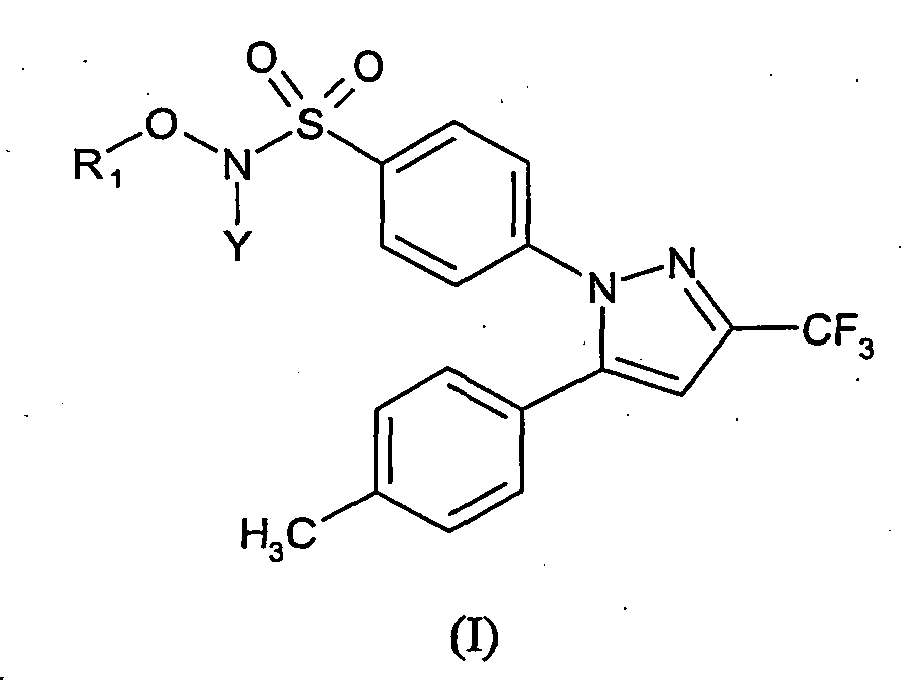
and/or stereoisomers and/or diastereomers and/or pharmaceutically acceptable salts and/or hydrates and/or solvates thereof. - In the meaning of Y and R2 the alkali ion is preferably sodium.
- The invention also relates to solvates and hydrates of compounds of formula (I).
- In those cases when compounds of formula (I) have chiral centre both stereoisomers and the racemic mixture of them are subject of the invention.
- The invention also relates to the process of the synthesis of compounds of formula (I) and the chemical and pharmaceutical manufacture of pharmaceutical compositions containing the same, as well as the use of a compound of formula (I) for manufacturing a pharmaceutical composition.
- Claisen reaction of the commercially available p-methyl-acetophenone and trifluoroacetic acid ethyl ester gave 4,4,4-trifluoro-1-(4-methylphenyl)-butane-1,3-dione in good yield. The latter was further reacted with the commercially available p-hydrazino-benzenesulfonic acid in an inert solvent in the presence of hydrochloric acid to give the new 4-(5-p-methyl-phenyl)-3-trifluoromethyl-pyrazol-1-yl)-benzenesulfonic acid of formula (III) (yield over 80%),


- The obtained compound of formula (II) is reacted with hydroxylamine in an inert solvent, preferably in a mixture of water and dioxane, to furnish compound of formula (I), wherein the meaning of R1 is hydrogen atom. The reagent is formed in situ in the reaction mixture from hydroxylamine hydrochloride and sodium acetate. If compound of formula (II) is reacted with an aminooxy-alkane acid in an inert solvent, preferably in dioxane, those products of formula (I) are formed in high yield, wherein the meaning of R1 is R2-COOR3 group, wherein the meaning of R2 is C1-C4 straight or branched alkilydene group and R3 is hydrogen atom or C1-C4 alkyl group or alkali atom. If desired the obtained compounds of formula (I) can be purified by recrystallization from an inert solvent, preferably from toluene.
- Those compounds of formula (I), wherein the meaning of R3 is hydrogen atom, can be transformed into alkali salts with alkali hydroxide solution, preferably with two equivalent of sodium hydroxide. The formed disodium salt can contain hydrate as solvate, preferably monohydrate.
- If compound of formula (II) is reacted with O-acylated hydroxylamine in an inert solvent, preferably in dioxane, those compounds of formula (I) are formed in high yield, wherein the meaning of R1 is C1-C5 acyl group or benzoyl group.
- The invention also relates to pharmaceutical compositions containing compounds of formula (I) as an active ingredient.
- Compounds of formula (I) can be used in treating of inflammation and disorders associated with inflammation, for example as an analgesic agent in treatment of pain and headache.
- Compounds of formula (I) and/or stereoisomers and/or diastereomers can be used as such and/or pharmaceutically acceptable salts and/or hydrates and/or solvates thereof as medicament, usually as a standard composition. The present invention also relates to pharmaceutical compositions containing a new compound of formula (I) and/or stereoisomers and/or diastereomers and/or pharmaceutically acceptable salts and/or hydrates and/or solvates thereof as well as one or more pharmaceutically acceptable adjuvant and auxiliary material.
- Compounds of formula (I) and/or geometric isomers and/or stereoisomers and/or diastereomers and/or pharmaceutically acceptable salts and/or hydrates and/or solvates thereof may be administered by any convenient method, for example by oral, parenteral buccal, sublingual, nasal, rectal or transdermal administration and the pharmaceutical compositions adapted accordingly. Pharmaceutical compositions containing compounds of formula (I) and/or geometric isomers and/or stereoisomers and/or diastereomers and/or pharmaceutically acceptable salts and/or hydrates and/or solvates thereof when given orally can be formulated as liquids or solids, for example syrups, suspensions or emulsions, tablets, capsules and chewable tablets..
- Liquid formulations of compounds of formula (I) and/or geometric isomers and/or stereoisomers and/or diastereomers and/or pharmaceutically acceptable salts and/or hydrates and/or solvates thereof generally consist of a suspension or solution of a compound of formula (I) in an appropriate liquid carrier(s), for example an aqueous solvent, such as water, ethanol or glycerine or a non-aqueous solvent, such as polyethylene glycol or an oil. The pharmaceutical composition can also contain a suspending agent, preservative, flavoring and coloring agents.
- A composition in the solid form of tablet can be prepared using any suitable pharmaceutical carrier(s), which are commonly used in practice; such as magnesium stearate, starch, lactose, saccharose, cellulose etc.
- A composition in the solid form of capsule can be prepared using routine encapsulation procedures. For example, pellets containing the active ingredient can be prepared using standard carriers and then filled into a hard gelatine capsule; alternatively, a dispersion or suspension can be prepared using any suitable pharmaceutical carrier(s), for example aqueous gums, celluloses, silicates or oils and the dispersion or suspension then filled into a soft gelatine capsule.
- Typical parenteral compositions consist of a solution or suspension of the compound of formula (I) and/or geometric isomers and/or stereoisomers and/or diastereomers and/or pharmaceutically acceptable salts and/or hydrates and/or solvates thereof in a sterile aqueous carrier or parenterally acceptable oil, for example polyethylene glycol, polyvinyl pyrrolidone, lecithin, arachis oil or sesame oil. Alternatively, the solution can be lyophilized and then reconstituted with a suitable solvent just prior to administration.
- The compounds of our invention did not have COX-2 enzyme inhibition activity at 10 µM concentration - according to spectrophotometric TMPD measurements (K. Gierse, S.D. Hauser, D.P. Creely, C.M. Koboldt, S.H. Rangwala, P.C. Isakson and K. Seibert, 1995: Expression and selective inhibition of the constitutive and inducible forms of human cyclo-oxygenase. Biochem. J. 305: 479-48)
- Oedema was induced by subcutaneous injection of 50 µl of 1 % carrageenan (CARR) suspension in the subplantar region of the right hind paw of male Wistar rats (140-150 g). The injected carrageenan induced paw inflammation. The oedema, i.e. the difference between the pre-and post-treatment volume (in ml) of the injected hind-paw was measured using a water displacement plethysmometer (Ugo Basile, type: 7150). The treated paw was immersed up to the tibio-tarsal articulation into the chamber and the volume of displaced liquid was determined as the degree of the inflammation.

- The degree of the anti-inflammatory effect of the treated group (which obtained test agent) was compared to that of the control group (which obtained only vehicle). The test compound and the vehicle were given orally by blunt-ended needle cannula one hour before the CARR treatment. The volume of the treated paw was measured at 3 and 5 hours after the CARR treatment and the change in the degree of inflammation in % was calculated according to the following formula:

- Celecoxib and the compounds of the invention were measured in 1-10-30 mg/kg p.o. dose (n = 12 animal/group). Anti-inflammatory activity of the compounds was determined in % at 4 and 6 hours after p.o. treatment and ED30 was calculated.
- inhibition of the oedema by Celecoxib: was effective at 4 hours after treatment with an ED30 of 23 mg/kg. The anti-inflammatory activity of the Celecoxib at 6 hours after the treatment was less than 30 % as compared to the control group. Compound of Example 5: was potent at 4 and 6 hours after treatment with an ED30 of 5.7 mg/kg and ED30 of 8.4 mg/kg respectively. The obtained results show that compound of Example 5 as compared to Celecoxib significantly inhibited paw oedema at both investigated time points.
Table 1 Test compound Anti-inflammatory activity after treatment Inhibiton of carrageenan induced edema % ED30 mg/kg 3 mg/kg 10 mg/kg 30 mg/kg Celecoxib p.o. 4 hours 16 ± 3 24 ± 4 32 ± 5 23.0 6 hours 12 ± 4 18 ± 2 26 ± 4 >30 Compound of Example 5 p.o. 4 hours 21 ± 3 40 ± 4 49 ± 5 5.7 6 hours 20 ± 3 34 ± 5 40 ± 4 8.4 - Oedema (inflammation) was induced by subcutaneous injection of carrageenan (CARR) suspension in the subplantar region of the right hind paw of male Wistar rats, weighted 140-190 g (n = 8-12 animal/group). The nociceptive thresholds of the inflamed hind paw after painful mechanical stimuli were measured with analgesimeter (Ugo Basile, type: 37215, Italy). The apparatus is suitable for the measuring of the extent and the latency of the pain reaction threshold of the sensitized paw after painful stimuli. The analgesics elevate the low pain reaction threshold of inflamed paw and the degree of its antinociceptive effect is expressed in reversal %.
- An increasing pressure was applied to the paw and the withdrawal threshold was determined as the first sign (squeaking and/or struggling) of pain response. The pressure threshold was shown in grams. The average value of the hind paw withdrawal obtained with untreated right paw was regarded as the basal hind paw withdrawal (average 80-110 grams.) After determining the baseline threshold the animals received carrageenan injection that produced an intense inflammation associated with hyperalgesia. The mechanical threshold was determined at various times to establish the magnitude and duration of the hyperalgesia. The maximum reduction in threshold was measured 2 - 3 h after injection (the pain threshold of the inflamed paw is 20-30 g, which was decreased by 65-80 % in comparing to the basic value).
- Acute hyperalgesia model: the animals were treated with the test compounds and celecoxib (10 and 30 mg/kg p.o.) one hour after CARR treatment (100 µl 2 % suspension). Pain threshold was measured at 2 and 4 hours after the treatment. Chronic hyperalgesia model: extended inflammation and decreased pain threshold were induced with higher dose of CARR. Pain threshold of inflamed paw was measured 24 hours after CARR treatment (150 µl, 2 % suspension) then test compound and Celecoxib (30 mg/kg p.o.) were given to the animals. Pain threshold of treated paw was measured from 30 minutes till 3 hours after treatment.
- Control groups in both models after CARR treatment were treated with vehicle p.o. at the same intervals as the test compounds. In both models the analgesic effect of the compounds was expressed in the reversal (%) of the decrease of the pain threshold.

T-1h = mean of the pain threshold of paw before CARR treatment in acute model (g)
T0h = mean of the pain threshold before treatment 1 hour after CARR treatment in acute model (g)
Txh = pain threshold after CARR treatment in the measuring times (1h, 2h, 3h) in acute model (g) - In both models (acute and chronic treatment) Celecoxib in 30 mg/kg p.o. dose showed partial analgesic effect (24 % and 54 % reversal). In the acute model the test compound in 30 mg/kg p.o. dose showed almost complete reversal % (90 %), so the test compound showed significantly better anti-inflammatory/analgesic effect as compared to the reference compound.
- In the chronic model test drug showed 54 % reversal, comparable with Celecoxib analgesic effect.
Table 2 - acute model Acute model Dose
(mg/kg p.o.)Analgesic effect (reversal %)
after p.o. treatment1 hour 2 hour 3 hour Celecoxib p.o. 10 0 0 0 30 24 3 0 Compound of Example 5 10 24 30 15 30 89 59 35 Table 3 - chronic model Acute model Dose
(mg/kg p.o.)Analgesic effect (reversal %)
after p.o. treatment30 min 1 hour 2 hour 3 hour 4 hour Celecoxib p.o. 10 24 17 0 30 54 34 34 26 20 Compound of Example 5 10 23 22 28 14 11 30 42 54 34 19 19 - Male Wistar rats weighing 140-160 g were treated p.o. with a 1:0.02 mixture of dry ethanol and concentrated HCl (0.5 ml) in order to induce gastric lesions. One hour later the animals were euthanized with ether and the stomach excised along its greater curvature, the mucosa was examined for the presence of lesions.
-
- 1: petechiae or erosion with length of 1 mm
- 2: erosion with length between 2 and 3 mm
- 3: erosion with length between 3 and 4 mm
- 4: erosion with length between 4 and 5 mm
- If the lesion was longer than 5 mm, it was scored 4 point as many times as the total length of the lesion divisible by four and the rest of the length was evaluated according to the above scale. The degree of injury of mucosa was characterized by ulcer index. Ulcer index (severity of lesion x number of lesion) was calculated for every animal and the degree of injury of mucosa in the groups of tested animals was characterized by the mean of ulcer index of different groups of animals.
- Test compounds were given p.o. 40 minutes before the ethanol + HCl treatment
Table 4 Alcohol induced mucosa injury in rats (n =10) Compound Dose mg/kg p.o. Ulcer index Methylcellulose - 60.8 ± 4.1 Celecoxib 30 49.4 ± 4.5 Compound of Example 5 30 35.0 ± 4.4* Methylcellulose - 66.2 ± 1.7 Compound of Example 5 15 43.0 ± 4.4 60 15.8 ± 2.8* Methylcellulose - 97.8 ± 2.8 Celecoxib 15 80.6 ± 2.3 60 44.4 ± 6.4* *p<0.05 - It can be seen from the above data that both celecoxib and the compound of the invention inhibited the alcohol induced mucosa injury, but the compound of the invention was significantly (p<0.05) more effective than celecoxib.
- In our experiments the method of Okabe et al was used. Male Wistar rats of 150-170 g were narcotized with ether and 20 % acetic acid (0.05 ml) was subserosally injected in the glandular part of the stomach.
- The test compound was given p.o. on the fifth day after the operation for seven days. The animals were euthanized with ether after 24 hours of the last dose and the abdomen was macroscopically examined (exravasation, accretion), the stomach was excised and the diameters of ulcers were measured.
Table 5 Acetic acid induced chronic gastric ulcer in rats Compound Dose mg/kg p.o. Change of bodyweight (g) + (increase) - (decrease) Area of ulcer
(mm2)Methylcellulose - +58 ± 3 3.0 ± 0,8 Indometacin 2.0 +2 ± 0.6 39.0 ± 5** Celecoxib 30 +32 ± 4 8.2 ± 2.0* Example 5 30 +43 ± 5 2.4 ± 0.7 * p<0.05; ** p<0.01 - Recovery of acetic acid induced ulcer - which is analogous to the human ulcer - was inhibited significantly by celecoxib, while compound of Example 5 did not influence it.
- Effect of compound of Example 5 and celecoxib was determined in experimental myocardial ischemia-reperfusion induced injury.
- Myocardial infarction was produced in male, SPRD CFY rats of 300-360 g by surgical occlusion of left anterior descending coronary artery. Briefly, the animals were anesthetized with pentobarbital (60 mg/kg i.p.) and the chest was opened, the left coronary artery was ligated for 6 minutes followed by reperfusion. Test compounds were administered i.p. in 30 and 60 mg/kg dose 30 minutes before occlusion of the coronary artery. The control group was treated with vehicle (5 % TWEEN 80 in isotonic NaCl, 2 mg/kg).
- During the myocardial ischemia-reperfusion the applied pre-treatments did not influence the heart rate and the mean blood pressure of the animals.
- The frequency of arrhythmia during the 6 minutes coronary artery ligation did not alter in the different groups. In those animals which were pre-treated with compound of Example 5 (30 mg/kg) the occurrence of the serious, not mortal ventricular fibrillation, developed during reperfusion, was decreased (60 % vs. 90 % in the control group).
- Anti-hypertensive activity of celecoxib and compound of Example 6 (in a dose of 30 mg/kg p.o.) was compared in New Zealand white rabbits of 2.5-3.0 kg. Molsidomine was used as reference compound in 2 mg/kg dose. Compound of Example 6 showed similar anti-hypertensive activity as molsidomine (p<0.05), while celecoxib did not have such effect.
- Summarising the biological results it can be seen, that according to in vivo experiments pharmacological efficacy of compounds of our invention both in extent and duration exceeds that of the reference compound celecoxib.
- In CARR induced oedema test anti-inflammatory activity of compounds of Examples 5 and 6 was significantly (p<0.05) higher, than that of celecoxib. In the inflammation induced chronic hyperalgesia model compound of Example 5 showed significant analgesic effect (p<0.01) and its duration of action was several hours longer than that of the reference compound.
- In comparing the gastrointestinal and cardiovascular effects compounds of Examples 5 and 6 of our invention showed significantly more favourable side-effect profile than the reference compound celecoxib.
- The invention is illustrated by the following not limiting examples.
- Sodium metal (5.76 g, 0.25 mol) was dissolved in methanol (80 ml), then trifluoroacetic acid (22 ml, 0.168 mol) was added at room temperature, followed by dropwise addition of methyl-acetophenone (21.04 g, 0:165 mol). The obtained mixture was stirred at 80 °C for 10 h, the reaction mixture was concentrated in vacuo and the residue was dissolved in water (50 ml). The solution was acidified by addition of 1N hydrochloric acid (120 ml), extracted with ethyl acetate (2 x 80 ml), dried over MgSO4, filtered and concentrated in vacuo to yield 34.60 g (95 %) of the title compound. The obtained crystalline product was used in the next step without further purification.
- To a stirred suspension of p-hydrazino-benzenesulfonic acid (42 g, 0.223 mol) in ethanol (450 ml) 6N hydrochloric acid (74 ml, 0.446 mol) was added at room temperature, followed by addition of 4,4,4-trifluoro-1-(4-methyl-phenyl)-butane-1,3-dione (51.45 g, 0.223 mol). The obtained suspension was refluxed for 8 h, then concentrated in vacuo. The residue was dissolved in water (300 ml) and extracted with ethyl acetate (2 x 200 ml). The combined organic layers were washed with water (1 x 100 ml) and brine (1 x 100 ml), dried over MgSO4, decolorized, filtered and concentrated in vacuo. The obtained crystalline product was recrystallized from diisopropyl ether (300 ml) to yield 70.12 g (82 %) of the title compound.
- To a stirred suspension of 4-(5-p-methylphenyl-3-trifluoromethyl-pyrazol-1-yl)-benzenesulfonic acid (43 g, 0.112 mol) in dichloromethane (250 ml) phosphorous pentachloride (34.20 g, 0.168 mol) was added portion-wise at room temperature, followed by addition of N,N-dimethylformamide (10 ml). The so obtained suspension was refluxed for 8 h, then concentrated in vacuo. The residue was partitioned between ethyl acetate (150 ml) and water (150 ml) and separated. The aqueous phase was extracted with ethyl acetate (1 x 50 ml), the combined organic layers were dried over MgSO4, filtered and concentrated. The obtained oil was crystallized from cyclohexane (120 ml) to yield 33.40 g (74 %) of the title compound as white crystals. Mp: 97-98 °C.
-

- To a stirred suspension of hydroxylamine hydrochloride (2.74 g, 40 mmol) in dioxane (25 ml) sodium acetate (3.25 g, 40 mmol) in water (15 ml) was added dropwise at room temperature, followed by dropwise addition of 4-(5-p-methylphenyl-3-trifluoromethyl-pyrazol-1-yl)-benzenesulfonyl chloride (4.11 g, 10 mmol) in dioxane (40 ml). The obtained reaction mixture was poured into water (100 ml), extracted with ethyl acetate (2 x 50 ml), the organic layers were washed with water (3 x 50 ml) and brine (1 x 50 ml), dried over MgSO4 filtered and concentrated in vacuo. The obtained oil was crystallized from 75 % aqueous ethanol (75 ml) to yield 2.94 g (75 %) of the title compound as white crystals. Mp: 203 °C.
-

- To a stirred suspension of 2-aminooxy-propionic acid hydrochloride (32.60 g, 0.23 mol) in dioxane (100 ml) sodium acetate (18.86 g, 0.23 mmol) in water (100 ml) was added dropwise at room temperature, followed by dropwise addition of 4-(5-p-methylphenyl-3-trifluoromethyl-pyrazol-1-yl)-benzenesulfonyl chloride (38 g, 94.80 mmol) in dioxane (100 ml). The obtained reaction mixture was stirred for 5 h, then concentrated in vacuo.. The residue was dissolved in water (200 ml), extracted with ethyl acetate (2 x 100 ml), the combined organic layers were washed with water (4 x 50 ml) and brine (1 x 50 ml), dried over MgSO4, filtered and concentrated in vacuo. The obtained oil was crystallized from toluene (250 ml) to yield 37.94 g (85 %) of the title compound as white crystals. The so obtained product was dissolved in toluene (480 ml) and stirred at 0-5 °C for 1 h, the precipitated product was filtered off, washed with cold toluene and dried at room temperature to yield 36.43 g (96 %) of the title compound. Mp: 187-189 °C, HPLC: 99.9 %.
-

- To a stirred solution of (+/-)-2-[4-(5-p-methylphenyl-3-trifluoromethyl-pyrazol-1-yl)-benzenesulfonylaminooxy]-propionic acid (35 g, 74.50 mmol) in ethanol (400 ml) 3.9 N sodium hydroxide solution (38.46 ml, 0.15 mol) was added at room temperature. The product started to precipitate after 5 minutes. The suspension was cooled to 0-5 °C and stirred for 2 h, the product was filtered off, washed with ethanol (50 ml) and dried at 60 °C to yield 38.39 g (96.7 %) of the title compound.
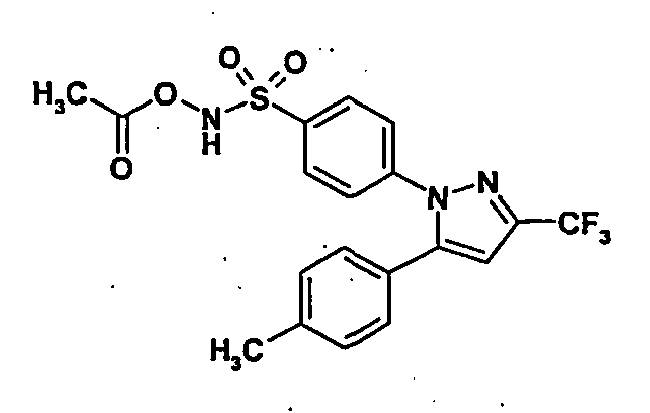
- Compounds of Examples of 7-16 were synthesized according to the methods described in Examples 5 and 6.
-

- Yield: 88 %. Mp: 224-225 °C.
-

- Yield: 82 %. Mp: 143-144 °C.
-

- Yield: 92 %. Mp: 176-178 °C.
-

- Yield: 82 %. Mp: 137-138 °C.
-
- Yield: 44 %. Mp: 138-140 °C.
-

- Yield: 40 %. Mp: 152-155 °C.
-

- Yield: 72 %. Mp: 134-136 °C.
-

- Yield: 90 %.
-

- Yield: 87 %.
-

- Yield: 53 %.
- To a stirred solution of (+/-)-2-[4-(5-p-methylphenyl-3-trifluoromethyl-pyrazol-1-yl)-benzenesulfonyl-aminooxy]-propionic acid (10 g, 21 mmol) in 97 % ethanol (50 ml) (-)-ephedrine (1.76 g, 10 mmol) was added. The mixture was stirred at room temperature for 1 day, the precipitated crystals were filtered off and washed with 97 % ethanol to yield 3.38 g (25 %) product, calculated on the basis of the starting racemic mixture. The so obtained crystals were recrystallized twice from 97 % ethanol to yield 2.02 g (60 %) white crystalline material.
- The diastereomer salt was suspended in ethyl acetate (30 ml) and 1 N hydrochloric acid (15 ml) was added. The organic layer was separated, dried over MgSO4, filtered and concentrated in vacuo. The obtained oil was crystallized from petroleum ether to yield 0.9 g (60 %) of the title compound.
Mp: 158-160 °C.
[α]D = - 505.3° (c = 1, methanol) - The title compound was obtained according to the method described in Example 17 using (+)-ephedrine as resolving agent and isopropanol as solvent.
Yield: 0.62 g.
Mp: 161-163 °C.
[α]D = + 457.6° (c = 1, methanol)
Claims (6)
- New compounds of formula (I),

and/or stereoisomers and/or diastereomers and/or pharmaceutically acceptable salts and/or hydrates and/or solvates thereof. - (R,S)-2-[4-(5-p-methylphenyl-3-trifluoromethyl-pyrazol-1-yl)-benzenesulfonylaminooxy]-propionic acid.
- Disodium (R,S)-2-[4-(5-p-methylphenyl-3-trifluoromethyl-pyrazol-1-yl)-benzenesulfonylaminooxy]-propionic acid monohydrate.
- Process for the synthesis of compounds of claims 1-3 and/or geometric isomers and/or stereoisomers and/or diastereomers and/or pharmaceutically acceptable salts and/or hydrates and/or solvates thereof, characterized by reacting 4,4,4-trifluoro-1-(4-methylphenyl)-butane-1,3-dione with p-hydrazino-benzenesulfonic acid in an inert solvent in the presence of hydrochloric acid, then reacting the obtained compound of formula (III) with phosphorus pentachloride in an inert solvent to give compound of formula (II), which is reacteda) with hydroxylamine, orb) with a compound of formula NH2-O-R2-COOR3, wherein the meaning of R2 and R3 is the same as mentioned before, orc) with a compound of formula NH2-OCOR1, wherein the meaning of R1 is the same as mentioned beforeto yield compounds of formula (I).
- Pharmaceutical composition containing a compound of claims 1-3 and/or stereoisomers and/or diastereomers and/or pharmaceutically acceptable salts and/or hydrates and/or solvates thereof as well as one or more pharmaceutically acceptable adjuvant and/or auxiliary material.
- Use of a compound of claims 1-3 and/or stereoisomers and/or diastereomers and/or pharmaceutically acceptable salts and/or hydrates and/or solvates thereof for manufacturing a pharmaceutical composition for the treatment of inflammation and disorders associated with inflammation.
Applications Claiming Priority (2)
| Application Number | Priority Date | Filing Date | Title |
|---|---|---|---|
| HU0500730A HUP0500730A2 (en) | 2005-07-29 | 2005-07-29 | 1,2-diaryl-heterocyclic compounds, their preparation, pharmaceutical compositions comprising thereof and their use |
| PCT/HU2006/000063 WO2007012906A1 (en) | 2005-07-29 | 2006-07-27 | New 1 , 2 -diaryl pyrazoles useful as analgetic and anti-inflammatory agents |
Publications (2)
| Publication Number | Publication Date |
|---|---|
| EP1915347A1 EP1915347A1 (en) | 2008-04-30 |
| EP1915347B1 true EP1915347B1 (en) | 2009-01-28 |
Family
ID=89986187
Family Applications (1)
| Application Number | Title | Priority Date | Filing Date |
|---|---|---|---|
| EP06765404A Active EP1915347B1 (en) | 2005-07-29 | 2006-07-27 | New 1 , 2 -diaryl pyrazoles useful as analgetic and anti-inflammatory agents |
Country Status (7)
| Country | Link |
|---|---|
| US (1) | US7723370B2 (en) |
| EP (1) | EP1915347B1 (en) |
| AT (1) | ATE421955T1 (en) |
| DE (1) | DE602006005057D1 (en) |
| EA (1) | EA013232B1 (en) |
| HU (1) | HUP0500730A2 (en) |
| WO (1) | WO2007012906A1 (en) |
Families Citing this family (1)
| Publication number | Priority date | Publication date | Assignee | Title |
|---|---|---|---|---|
| GB0716968D0 (en) | 2007-08-31 | 2007-10-10 | Vivacta Ltd | Sensor |
Family Cites Families (3)
| Publication number | Priority date | Publication date | Assignee | Title |
|---|---|---|---|---|
| RO118291B1 (en) * | 1993-11-30 | 2003-04-30 | Searle & Co | PIRAZOL DERIVATIVES 1,3,4,5 - TETRASUBSTITUITIS AND PHARMACEUTICAL COMPOSITION CONTAINING CONTAINERS |
| WO1997038986A1 (en) * | 1996-04-12 | 1997-10-23 | G.D. Searle & Co. | Substituted benzenesulfonamide derivatives as prodrugs of cox-2 inhibitors |
| ES2215474B1 (en) * | 2002-12-24 | 2005-12-16 | J. URIACH & CIA S.A. | NEW DERIVATIVES OF PHOSPHORAMIDE. |
-
2005
- 2005-07-29 HU HU0500730A patent/HUP0500730A2/en unknown
-
2006
- 2006-07-27 WO PCT/HU2006/000063 patent/WO2007012906A1/en not_active Ceased
- 2006-07-27 EA EA200800474A patent/EA013232B1/en not_active IP Right Cessation
- 2006-07-27 DE DE602006005057T patent/DE602006005057D1/en active Active
- 2006-07-27 US US11/989,439 patent/US7723370B2/en not_active Expired - Fee Related
- 2006-07-27 AT AT06765404T patent/ATE421955T1/en not_active IP Right Cessation
- 2006-07-27 EP EP06765404A patent/EP1915347B1/en active Active
Also Published As
| Publication number | Publication date |
|---|---|
| US20090036510A1 (en) | 2009-02-05 |
| WO2007012906A1 (en) | 2007-02-01 |
| EP1915347A1 (en) | 2008-04-30 |
| EA200800474A1 (en) | 2008-06-30 |
| ATE421955T1 (en) | 2009-02-15 |
| US7723370B2 (en) | 2010-05-25 |
| HUP0500730A2 (en) | 2007-02-28 |
| HU0500730D0 (en) | 2005-10-28 |
| EA013232B1 (en) | 2010-04-30 |
| DE602006005057D1 (en) | 2009-03-19 |
Similar Documents
| Publication | Publication Date | Title |
|---|---|---|
| EP0936217B1 (en) | 1-phenylpyrazole compounds and medicinal application thereof | |
| KR101118807B1 (en) | ?-substituted hydroxyaryl derivatives | |
| WO2004089918A1 (en) | Heteroaromatic pentacyclic compound and medicinal use thereof | |
| JP5128959B2 (en) | New histidine derivatives | |
| US5110831A (en) | Vinylogous hydroxamic acids and derivatives thereof as 5-lipoxygenase inhibitors | |
| HU208123B (en) | Process for producing n-imidazolyl and n-imidazolylmethyl derivatives of substituted bicyclic compounds and pharmaceutical compositions comprising same | |
| CN101282926A (en) | S1p3 receptor antagonist | |
| HU184851B (en) | Process for producing 4,5-diaryl-alpha-bracket-polyfluoro-alkyl-bracket closed-ih-pyrrol-2-methan-amines and antiphlogistic pharmaceutical kompositions containing them | |
| US7723370B2 (en) | 1, 2-diaryl pyrazoles useful as analgetic and antiinflammatory agents | |
| US6083987A (en) | Phenylenediamine derivative, radical scavenger, brain-infarction depressant, and brain-edema depressant | |
| JP2004051600A (en) | Hematopoietic prostaglandin D2 synthase inhibitor | |
| JP5314597B2 (en) | Derivatives of substituted tartaric acid and uses for preparing β-secretase inhibitors | |
| US4980349A (en) | Sulphonamides derived from diarylmethanes, the processes for preparing them and pharmaceutical compositions containing them | |
| JP5301441B2 (en) | New histidine derivatives | |
| WO2019088057A1 (en) | Anilide derivative and medicinal use thereof | |
| US6403629B2 (en) | Heterocyclic compounds for therapeutic use | |
| CA2173305A1 (en) | Pyrazolidine derivative, radical scavenger, brain-infarction depressant, and brain-edema depressant | |
| WO2019044940A1 (en) | Cyclic amine derivative and use thereof for medical purposes | |
| JP2009046476A (en) | New histidine derivatives | |
| US4105768A (en) | Hypotensive substituted 1,2,4-triazoles | |
| JP5597400B2 (en) | Medicament containing histidine derivative | |
| JP2894617B2 (en) | 2-phenylindole derivatives | |
| JPH07100687B2 (en) | Novel N-hydroxyurea compounds and compositions | |
| JP2988723B2 (en) | 2-phenylindole derivatives | |
| JPH0566939B2 (en) |
Legal Events
| Date | Code | Title | Description |
|---|---|---|---|
| PUAI | Public reference made under article 153(3) epc to a published international application that has entered the european phase |
Free format text: ORIGINAL CODE: 0009012 |
|
| 17P | Request for examination filed |
Effective date: 20080118 |
|
| AK | Designated contracting states |
Kind code of ref document: A1 Designated state(s): AT BE BG CH CY CZ DE DK EE ES FI FR GB GR HU IE IS IT LI LT LU LV MC NL PL PT RO SE SI SK TR |
|
| GRAP | Despatch of communication of intention to grant a patent |
Free format text: ORIGINAL CODE: EPIDOSNIGR1 |
|
| RAP1 | Party data changed (applicant data changed or rights of an application transferred) |
Owner name: RICHTER GEDEON NYRT. |
|
| GRAS | Grant fee paid |
Free format text: ORIGINAL CODE: EPIDOSNIGR3 |
|
| GRAA | (expected) grant |
Free format text: ORIGINAL CODE: 0009210 |
|
| DAX | Request for extension of the european patent (deleted) | ||
| AK | Designated contracting states |
Kind code of ref document: B1 Designated state(s): AT BE BG CH CY CZ DE DK EE ES FI FR GB GR HU IE IS IT LI LT LU LV MC NL PL PT RO SE SI SK TR |
|
| REG | Reference to a national code |
Ref country code: GB Ref legal event code: FG4D |
|
| REG | Reference to a national code |
Ref country code: CH Ref legal event code: EP |
|
| REG | Reference to a national code |
Ref country code: IE Ref legal event code: FG4D |
|
| REF | Corresponds to: |
Ref document number: 602006005057 Country of ref document: DE Date of ref document: 20090319 Kind code of ref document: P |
|
| NLV1 | Nl: lapsed or annulled due to failure to fulfill the requirements of art. 29p and 29m of the patents act | ||
| PG25 | Lapsed in a contracting state [announced via postgrant information from national office to epo] |
Ref country code: SI Free format text: LAPSE BECAUSE OF FAILURE TO SUBMIT A TRANSLATION OF THE DESCRIPTION OR TO PAY THE FEE WITHIN THE PRESCRIBED TIME-LIMIT Effective date: 20090128 Ref country code: NL Free format text: LAPSE BECAUSE OF FAILURE TO SUBMIT A TRANSLATION OF THE DESCRIPTION OR TO PAY THE FEE WITHIN THE PRESCRIBED TIME-LIMIT Effective date: 20090128 Ref country code: FI Free format text: LAPSE BECAUSE OF FAILURE TO SUBMIT A TRANSLATION OF THE DESCRIPTION OR TO PAY THE FEE WITHIN THE PRESCRIBED TIME-LIMIT Effective date: 20090128 Ref country code: ES Free format text: LAPSE BECAUSE OF FAILURE TO SUBMIT A TRANSLATION OF THE DESCRIPTION OR TO PAY THE FEE WITHIN THE PRESCRIBED TIME-LIMIT Effective date: 20090509 Ref country code: LT Free format text: LAPSE BECAUSE OF FAILURE TO SUBMIT A TRANSLATION OF THE DESCRIPTION OR TO PAY THE FEE WITHIN THE PRESCRIBED TIME-LIMIT Effective date: 20090128 |
|
| PG25 | Lapsed in a contracting state [announced via postgrant information from national office to epo] |
Ref country code: PL Free format text: LAPSE BECAUSE OF FAILURE TO SUBMIT A TRANSLATION OF THE DESCRIPTION OR TO PAY THE FEE WITHIN THE PRESCRIBED TIME-LIMIT Effective date: 20090128 Ref country code: SE Free format text: LAPSE BECAUSE OF FAILURE TO SUBMIT A TRANSLATION OF THE DESCRIPTION OR TO PAY THE FEE WITHIN THE PRESCRIBED TIME-LIMIT Effective date: 20090428 Ref country code: LV Free format text: LAPSE BECAUSE OF FAILURE TO SUBMIT A TRANSLATION OF THE DESCRIPTION OR TO PAY THE FEE WITHIN THE PRESCRIBED TIME-LIMIT Effective date: 20090128 Ref country code: IS Free format text: LAPSE BECAUSE OF FAILURE TO SUBMIT A TRANSLATION OF THE DESCRIPTION OR TO PAY THE FEE WITHIN THE PRESCRIBED TIME-LIMIT Effective date: 20090528 Ref country code: PT Free format text: LAPSE BECAUSE OF FAILURE TO SUBMIT A TRANSLATION OF THE DESCRIPTION OR TO PAY THE FEE WITHIN THE PRESCRIBED TIME-LIMIT Effective date: 20090629 Ref country code: AT Free format text: LAPSE BECAUSE OF FAILURE TO SUBMIT A TRANSLATION OF THE DESCRIPTION OR TO PAY THE FEE WITHIN THE PRESCRIBED TIME-LIMIT Effective date: 20090128 |
|
| PG25 | Lapsed in a contracting state [announced via postgrant information from national office to epo] |
Ref country code: BE Free format text: LAPSE BECAUSE OF FAILURE TO SUBMIT A TRANSLATION OF THE DESCRIPTION OR TO PAY THE FEE WITHIN THE PRESCRIBED TIME-LIMIT Effective date: 20090128 |
|
| REG | Reference to a national code |
Ref country code: HU Ref legal event code: AG4A Ref document number: E005754 Country of ref document: HU |
|
| PG25 | Lapsed in a contracting state [announced via postgrant information from national office to epo] |
Ref country code: CZ Free format text: LAPSE BECAUSE OF FAILURE TO SUBMIT A TRANSLATION OF THE DESCRIPTION OR TO PAY THE FEE WITHIN THE PRESCRIBED TIME-LIMIT Effective date: 20090128 Ref country code: EE Free format text: LAPSE BECAUSE OF FAILURE TO SUBMIT A TRANSLATION OF THE DESCRIPTION OR TO PAY THE FEE WITHIN THE PRESCRIBED TIME-LIMIT Effective date: 20090128 Ref country code: DK Free format text: LAPSE BECAUSE OF FAILURE TO SUBMIT A TRANSLATION OF THE DESCRIPTION OR TO PAY THE FEE WITHIN THE PRESCRIBED TIME-LIMIT Effective date: 20090128 |
|
| PG25 | Lapsed in a contracting state [announced via postgrant information from national office to epo] |
Ref country code: SK Free format text: LAPSE BECAUSE OF FAILURE TO SUBMIT A TRANSLATION OF THE DESCRIPTION OR TO PAY THE FEE WITHIN THE PRESCRIBED TIME-LIMIT Effective date: 20090128 Ref country code: RO Free format text: LAPSE BECAUSE OF FAILURE TO SUBMIT A TRANSLATION OF THE DESCRIPTION OR TO PAY THE FEE WITHIN THE PRESCRIBED TIME-LIMIT Effective date: 20090128 |
|
| PLBE | No opposition filed within time limit |
Free format text: ORIGINAL CODE: 0009261 |
|
| STAA | Information on the status of an ep patent application or granted ep patent |
Free format text: STATUS: NO OPPOSITION FILED WITHIN TIME LIMIT |
|
| 26N | No opposition filed |
Effective date: 20091029 |
|
| PG25 | Lapsed in a contracting state [announced via postgrant information from national office to epo] |
Ref country code: BG Free format text: LAPSE BECAUSE OF FAILURE TO SUBMIT A TRANSLATION OF THE DESCRIPTION OR TO PAY THE FEE WITHIN THE PRESCRIBED TIME-LIMIT Effective date: 20090428 |
|
| PG25 | Lapsed in a contracting state [announced via postgrant information from national office to epo] |
Ref country code: MC Free format text: LAPSE BECAUSE OF NON-PAYMENT OF DUE FEES Effective date: 20090731 |
|
| REG | Reference to a national code |
Ref country code: IE Ref legal event code: MM4A |
|
| PG25 | Lapsed in a contracting state [announced via postgrant information from national office to epo] |
Ref country code: IE Free format text: LAPSE BECAUSE OF NON-PAYMENT OF DUE FEES Effective date: 20090727 |
|
| PG25 | Lapsed in a contracting state [announced via postgrant information from national office to epo] |
Ref country code: GR Free format text: LAPSE BECAUSE OF FAILURE TO SUBMIT A TRANSLATION OF THE DESCRIPTION OR TO PAY THE FEE WITHIN THE PRESCRIBED TIME-LIMIT Effective date: 20090429 |
|
| REG | Reference to a national code |
Ref country code: CH Ref legal event code: PL |
|
| PG25 | Lapsed in a contracting state [announced via postgrant information from national office to epo] |
Ref country code: IT Free format text: LAPSE BECAUSE OF FAILURE TO SUBMIT A TRANSLATION OF THE DESCRIPTION OR TO PAY THE FEE WITHIN THE PRESCRIBED TIME-LIMIT Effective date: 20090128 |
|
| PG25 | Lapsed in a contracting state [announced via postgrant information from national office to epo] |
Ref country code: LU Free format text: LAPSE BECAUSE OF NON-PAYMENT OF DUE FEES Effective date: 20090727 Ref country code: LI Free format text: LAPSE BECAUSE OF NON-PAYMENT OF DUE FEES Effective date: 20100731 Ref country code: CH Free format text: LAPSE BECAUSE OF NON-PAYMENT OF DUE FEES Effective date: 20100731 |
|
| PG25 | Lapsed in a contracting state [announced via postgrant information from national office to epo] |
Ref country code: TR Free format text: LAPSE BECAUSE OF FAILURE TO SUBMIT A TRANSLATION OF THE DESCRIPTION OR TO PAY THE FEE WITHIN THE PRESCRIBED TIME-LIMIT Effective date: 20090128 |
|
| PG25 | Lapsed in a contracting state [announced via postgrant information from national office to epo] |
Ref country code: CY Free format text: LAPSE BECAUSE OF FAILURE TO SUBMIT A TRANSLATION OF THE DESCRIPTION OR TO PAY THE FEE WITHIN THE PRESCRIBED TIME-LIMIT Effective date: 20090128 |
|
| REG | Reference to a national code |
Ref country code: FR Ref legal event code: PLFP Year of fee payment: 11 |
|
| REG | Reference to a national code |
Ref country code: FR Ref legal event code: PLFP Year of fee payment: 12 |
|
| REG | Reference to a national code |
Ref country code: FR Ref legal event code: PLFP Year of fee payment: 13 |
|
| PGFP | Annual fee paid to national office [announced via postgrant information from national office to epo] |
Ref country code: DE Payment date: 20180723 Year of fee payment: 13 Ref country code: FR Payment date: 20180725 Year of fee payment: 13 |
|
| PGFP | Annual fee paid to national office [announced via postgrant information from national office to epo] |
Ref country code: IT Payment date: 20180713 Year of fee payment: 13 |
|
| REG | Reference to a national code |
Ref country code: DE Ref legal event code: R119 Ref document number: 602006005057 Country of ref document: DE |
|
| GBPC | Gb: european patent ceased through non-payment of renewal fee |
Effective date: 20190727 |
|
| PG25 | Lapsed in a contracting state [announced via postgrant information from national office to epo] |
Ref country code: GB Free format text: LAPSE BECAUSE OF NON-PAYMENT OF DUE FEES Effective date: 20190727 Ref country code: DE Free format text: LAPSE BECAUSE OF NON-PAYMENT OF DUE FEES Effective date: 20200201 |
|
| PG25 | Lapsed in a contracting state [announced via postgrant information from national office to epo] |
Ref country code: FR Free format text: LAPSE BECAUSE OF NON-PAYMENT OF DUE FEES Effective date: 20190731 |
|
| P01 | Opt-out of the competence of the unified patent court (upc) registered |
Effective date: 20230608 |
|
| PGFP | Annual fee paid to national office [announced via postgrant information from national office to epo] |
Ref country code: HU Payment date: 20250627 Year of fee payment: 20 |