EP1915014A2 - Method and apparatus for handover decision by using context information in a mobile communications network - Google Patents
Method and apparatus for handover decision by using context information in a mobile communications network Download PDFInfo
- Publication number
- EP1915014A2 EP1915014A2 EP07020430A EP07020430A EP1915014A2 EP 1915014 A2 EP1915014 A2 EP 1915014A2 EP 07020430 A EP07020430 A EP 07020430A EP 07020430 A EP07020430 A EP 07020430A EP 1915014 A2 EP1915014 A2 EP 1915014A2
- Authority
- EP
- European Patent Office
- Prior art keywords
- context information
- network
- terminal
- denotes
- application program
- Prior art date
- Legal status (The legal status is an assumption and is not a legal conclusion. Google has not performed a legal analysis and makes no representation as to the accuracy of the status listed.)
- Withdrawn
Links
Images



Classifications
-
- H—ELECTRICITY
- H04—ELECTRIC COMMUNICATION TECHNIQUE
- H04W—WIRELESS COMMUNICATION NETWORKS
- H04W36/00—Hand-off or reselection arrangements
- H04W36/24—Reselection being triggered by specific parameters
-
- H—ELECTRICITY
- H04—ELECTRIC COMMUNICATION TECHNIQUE
- H04W—WIRELESS COMMUNICATION NETWORKS
- H04W36/00—Hand-off or reselection arrangements
- H04W36/04—Reselecting a cell layer in multi-layered cells
-
- H—ELECTRICITY
- H04—ELECTRIC COMMUNICATION TECHNIQUE
- H04W—WIRELESS COMMUNICATION NETWORKS
- H04W8/00—Network data management
- H04W8/18—Processing of user or subscriber data, e.g. subscribed services, user preferences or user profiles; Transfer of user or subscriber data
Definitions
- the present invention relates to a handover technology in a network; and, more particularly, to a method and apparatus for deciding a handover by using context information in a 4G mobile communications network to provide an optimum handover management.
- the present invention provides a method and a apparatus for a handover decision based on context information in a next-generation mobile communications network so that various services suitable for a user's preferences can be provided by deciding a handover based on not only a signal strength but also various other information collected from a terminal and networks, thereby achieving an efficient mobility management in a 4G network in which heterogeneous networks coexist.
- the present invention also provide a method and an apparatus for a handover decision by using context information in a next-generation mobile communications network so that a handover can be decided based on the context information available in a terminal in the next-generation mobile communications network.
- a method for deciding a handover of a mobile terminal based on context information in a network environment including:
- an apparatus for deciding a handover of a mobile terminal based on context information in a network environment including:
- the present invention decides a handover based on various context information available in a terminal for efficient mobility management in a 4G (4 th Generation) network, which is a next-generation mobile communications network adopting various access network technologies.
- the terminal used in this network is a multimode terminal accessible to a plurality of networks.
- a handover matrix is organized on the basis of context information.
- the context information is used to execute a handover, and includes the type and properties of the terminal, an amount of resources (of processor, memory, battery, etc.), use cases of the terminal, user's preferences for application programs, an available bandwidth of a network, and a network cost. Further, a single service provided in the terminal may be composed of several application programs. In view of the above, a handover policy may be determined with regard to not only each session of application program but also the whole services.
- Fig. 1 is a schematic view for describing a handover on the basis of an application service available in a terminal in accordance with an embodiment of the present invention.
- reference numeral 100 denotes a process flow in which a user 110 receives a specific service from a base station 102 in the form of a session
- reference numeral 150 denotes a video conference process presented as an example.
- the base station 102 executes an application program 106 via a network 104 so that a subscriber terminal can use a mobile communications service, and delivers a service 108 to the terminal for the user 110 to use the service 108.
- the video conference process 150 is an example of the process flow 100.
- Base stations 152, 154, 156 and 158 supply various application programs such as audio 172, video 174 and data 176 via networks such as a wireless LAN (WLAN) 162, code division multiple access (CDMA) 164, WiBro 166 and Bluetooth 168 to which the base stations 152, 154, 156 and 158 respectively belong, so that a subscriber terminal can use a mobile communications service.
- WLAN wireless LAN
- CDMA code division multiple access
- WiBro WiBro
- Bluetooth Bluetooth
- a single service used by the user may involve various application programs.
- the application programs access different networks and establish sessions corresponding thereto.
- a process of allowing the application programs to select a specific network is referred to as a vertical handover, and a process of allowing the application programs to select a base station while moving from cell to cell in a specified network is referred to as a horizontal handover.
- the present invention is directed to the vertical handover for deciding a network for each application program.
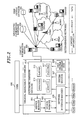
- it is decided which network is presently the best for each application program in view of various criteria by considering overall context information. For example, in case of an audio program, when the user wants to receive the best quality service regardless of its cost, the policy is determined such that, e.g., CDMA is to be selected as being presently the best for the audio program.
- Fig. 2 is a view for illustrating a configuration in which context information is collected by a terminal in accordance with the embodiment of the present invention.
- a terminal management system 220 in a mobile terminal includes an automatic handover manager (AHM) 210; a network interface manager 205; a system monitor 207; a user profile storage unit 209; a session manager 203; and a service manager 201.
- the AHM 210 is provided with a monitor 211; an analyzer 213; a planner 215; and an executer 217.
- the context information to be used for the handover is provided from the terminal, the user and the network.
- the terminal management system 220 manages the system monitor 207 that collects the context information (remaining battery capacity, available memory capacity, type and properties of the terminal, and the like) from the terminal, the user profile storage unit 209 that stores information of user's profile and preferences, and the network interface manager 205 that manages various network interfaces. Further, the terminal management system 220 evaluates and surveys data from various networks; and lets the session manager 203 receive network context data (bandwidth, reception intensity and the like) from the network interface manager 205.
- Operation and Support Systems (OSSs) 231, 233, 235 and 237 that can manage heterogeneous networks are installed in respective network interfaces.
- the network is also provided with a context information server 230 that collects necessary context information from the OSSs 231, 233, 235 and 237.
- the context information server 230 further receives information from a geographic information database 239 that stores a current location of the terminal, and a user profile database 241 that stores user's setting information and user's profile including his/her preferences.
- the monitor 211 in the AHM 210 collects the context information sent from the network interface manager 205, the system monitor 207 and the user profile storage unit 209 and the information sent from the context information server 230, and sends the collected information to the analyzer 213. That is, the monitor 211 can collect information received directly by the terminal itself or sent from the context information server 230. Alternatively, the monitor 211 may be configured to collect the collected context information or only pre-selected context information among the collected information.
- the analyzer 213 creates a matrix for evaluating various context information sent from the terminal, the user and the network. To be more specific, the analyzer 213 expresses the context information, currently available networks and application programs used for the service in the form of matrix, thereby evaluating selection priorities of the network interfaces for respective transmission paths for the respective application programs. Then, the planner 215 computes a handover decision value for selecting a network for each transmission path for each application program by applying a proper cost function to the matrix to thereby determine the best policy. Thereafter, the executer 217 sends the policy determined by the planner 215 to the relevant module, i.e., the service manager 201 in the terminal management system 220.
- the relevant module i.e., the service manager 201 in the terminal management system 220.
- the service manager 201 which serves to provide services for the user, manages mappings of services and application programs, and establishes sessions for the application programs as per the policy sent from the AHM 210.
- the session manager 203 maintains the sessions established by the service manager 201, selects a network interface to be used, and notifies it to the network interface manager 205. Then, the network interface manager 205 connects the selected network interface by carrying out the handover.
- Table 1 shows a list of context information collected by the context information server 230 and used for the handover.
- Table 1 Mobile terminal Network Static User's settings and profile User's profile and history Application setting Network location, capabilities and services Willingness to pay Charging models
- Type and properties of the terminal Support policy for terminal Static in cell Reachable base station Available networks Potential next base station Available networks
- Dynamic Type of application Location information and location prediction Application requirements
- Network status such as signal strength Terminal Status (battery, interface status) Network traffic load
- the context information shown above can be obtained from the terminal and the network.
- Each context information includes static information and dynamic information.
- the handover has been carried out according to the signal strength of the terminal based on the signal-to-noise ratio (SNR).
- SNR signal-to-noise ratio
- the handover is carried out according to more detailed selections based on more various situations.
- Formula 1 which is used by the analyzer 213 in the AHM 210, shows the matrix used for determining an optimum policy according to the context information.
- Formula 1 it is assumed that there are m number of application programs, n number of network interfaces and k number of available context information.
- S ij denotes an expectation of an i-th application program when using a j-th network interface
- C ij denotes a weight (equivalent to user's preference) of j-th context information with respect to the i-th application program
- R ij denotes an influence (available bandwidth, signal strength, etc.) of i-th context information in a j-th network.
- Fig. 3 is a view for illustrating an information exchange procedure between the terminal and the context information server in accordance with the embodiment of the present invention.
- a mobile terminal 300 requests in step S1 that context information available in a network be filled into, for example, a C and R matrix.
- a context information server 310 collects the context information from the OSSs 231 to 237 in the networks, the geographic information database 239 and the user profile database 241 (step S2); fills the collected network context information into the C and R matrix (step S3); and, sends information of the C and R matrix to the mobile terminal 300 (step S4).
- C and R values in the matrix are defined, they can be normally reused. However, if the number m of the application programs used for the service of the mobile terminal 300, the number n of the available networks, or the number k of the context information for use in the handover decision are changed, C and R values must be recreated.
- the context information server 310 After the context information server 310 sends the requested information of the C and R matrix to the mobile terminal 300, the context information server 310 sends only changed context information (e.g., dynamic information such as signal strength and battery capacity) to the mobile terminal 300 in step S5. Upon receipt of such information, the mobile terminal 300 replaces the C and R values received in step S4 with those received in step S6. Then, in step S7, the mobile terminal 300 evaluates the matrix by applying a cost function thereto. Finally, in step S8, the mobile terminal 300 obtains the best policy by the following Formula 2.
- context information e.g., dynamic information such as signal strength and battery capacity
- Formula 2 is executed by the planner 215 in the AHM 210 shown in Fig. 2, and shows a process of determining a proper policy from the resultant value of Formula 1.
- S 11 S 12 ⁇ S 1 ⁇ n S 12 S 22 ⁇ S 2 ⁇ n ⁇ ⁇ ⁇ ⁇ S m ⁇ 1 S 2 ⁇ m ⁇ S mn ⁇ ⁇ policies
- S 1 ⁇ j S 2 ⁇ h ⁇ S ml A 1 : N j A 2 : N h ⁇ A m : N l ⁇ Q k
- S ij denotes an expectation of an i-th application program in a j-th network
- a i denotes an i-th application program (e.g., audio, video, or data)
- N j denotes a j-th network interface (e.g., WLAN, CDMA, or WiBro)
- Q k denotes a k-th service (e.g., a video conference service). That is, Q k of the k-th service represents the policy that indicates the best network for each application program of the k-th service.
- the handover is carried out as per thus determined policy so that the user of the mobile terminal 300 can receive a service suitable for his/her preferences in quality, cost, etc.
- the mobile terminal 300 receives the context information from the context information server 310.
- the matrix is computed from the context information transferred from the network interface manager 205, the system collector 207 and the user profile storage unit 209, the terminal may perform this procedure by itself without the context information server 300.
- Fig. 4 is a view for illustrating a handover procedure in accordance with the embodiment of the present invention.
- CDMA and Wired are available in Situation 1; only CDMA is available in Situation 2; CDMA and Bluetooth are available in Situation 3; CDMA, WiBro, WLAN and Bluetooth are available in Situation 4; CDMA and WLAN are available in Situation 5; only CDMA is available in Situation 6; and CDMA and WLAN are available in Situation 7.
- the networks are not selected merely by the signal strength, but the selection is made by the above-described method that considers the cost policy as well as the signal intensity.
- Table 2 given below shows schemes for selecting networks for each application program in Situation 1 to 7.
- the first row designates each situation; the second row shows all available networks in each situation at a specified location of a terminal; and the third to fifth rows represent respective application programs to be used for a service.
- Situation 1 2 3 4 5 6 7 Available networks CDMA Wired CDMA CDMA Bluetooth CDMA WiBro WLAN Bluetooth CDMA WLAN CDMA CDMA WLAN Audio Wired CDMA Bluetooth WiBro CDMA CDMA WLAN Video Wired X Bluetooth WiBro WLAN X WLAN Data Wired CDMA Bluetooth WiBro WLAN CDMA WLAN
- networks selected for an audio service are same in almost all situations as those selected for a data program, except in Situation 5 where CDMA is used for the audio service and WLAN is used for the data program. Further, in Situation 5, WLAN is used for a video service as in the data program. In Situations 2 and 6, CDMA is the only available network, which implies a resultant value indicating that the handover cannot be carried out.
- the following Formula 3 shows a process of obtaining a resultant value, particularly by applying the user's preferences to Situation 5.
- C Audio ⁇ Video ⁇ Data ⁇ Quality ⁇ Cost
- the cost function f of quality and cost in Formula 3 is computed by summation, and the largest value is selected from among resultant values of the cost function.
- the cost function may be applied to different situations in different ways.
- each value that ranges from 0 to 1 means preference, i.e., how important each item is evaluated to be.
- the first row of the C matrix is (0.9, 0.1), which means that, in case of the audio program, the preference in quality is 0.9 and the preference in cost is 0.1. This implies that the user of the video conference service places more emphasis on the quality of the audio than the cost.
- the selection may be made depending on other criteria. If, for example, the cost is more important, CDMA will be selected. In contrast, if the priority is assigned to WLAN in case of a tie in preference, WLAN will be selected.
- the handover can be decided based on various context information available in the terminal for efficient mobility management in the 4G network, which is the next-generation mobile communications network adopting various access network technologies.
- a handover can be decided based on various context information available in a terminal, thereby enabling an efficient mobility management in a 4G network.
- an end-user using a terminal can receive services suitable for his/her preferences in quality and cost, thereby making it possible to create a user-oriented service policy.
- the user of the terminal can receive the services in a more favorable manner by the user-oriented services.
- terminal settings that have become more complicated due to the development of services and networks, can be made to reflect more various kinds of information, so that the user can use the services in a more flexible manner.
- the present invention can also contribute to supporting the broadband convergence network (BcN) that bas been developed due to the progress of various access network technologies.
- BcN broadband convergence network
Landscapes
- Engineering & Computer Science (AREA)
- Computer Networks & Wireless Communication (AREA)
- Signal Processing (AREA)
- Mobile Radio Communication Systems (AREA)
- Data Exchanges In Wide-Area Networks (AREA)
Abstract
Description
- The present invention relates to a handover technology in a network; and, more particularly, to a method and apparatus for deciding a handover by using context information in a 4G mobile communications network to provide an optimum handover management.
- Recently, a variety of researches have been made for a terminal for providing a continuous service during handover. To this end, a media-independent handover has been suggested in IEEE 802.21, so that a standardization activity is being done to perform handover initialization, handover preparation and handover execution independently of media. Especially, there are increasing demands for detecting and selecting a currently available network before a handover is performed. To meet the demands, a lot of researches have been made to develop a handover management scheme in which a handover is decided based on more flexible criteria rather than merely based on signal strength.
- In a policy-oriented research, there has been proposed a method of creating an appropriate handover plan through the use of a cost function. Also, a method of modeling a handover using a hypertext transport protocol (HTTP) traffic has been suggested. Moreover, there has been presented a method of deciding a vertical handover depending on a service cost, security, a required power amount, a user's preference, a service quality and a speed. However, such methods do not show in a sufficient detail how such values should be evaluated and applied. Further, researches have been made on a model of performing an intelligent handover directed to a best network interface at a best time. However, most of the researches provide no more than abstract directions, but do not show specified parameters and computing methods.
- In view of the foregoing, the present invention provides a method and a apparatus for a handover decision based on context information in a next-generation mobile communications network so that various services suitable for a user's preferences can be provided by deciding a handover based on not only a signal strength but also various other information collected from a terminal and networks, thereby achieving an efficient mobility management in a 4G network in which heterogeneous networks coexist.
- Further, the present invention also provide a method and an apparatus for a handover decision by using context information in a next-generation mobile communications network so that a handover can be decided based on the context information available in a terminal in the next-generation mobile communications network.
- In accordance with one aspect of the present invention, there is provided a method for deciding a handover of a mobile terminal based on context information in a network environment, including:
- receiving context information from the terminal and networks;
- evaluating selection priorities of network interfaces for each transmission path for each application program based on the context information; and
- obtaining a handover decision value for selecting a best network interface from among the networks by applying a cost function to the evaluated selection priority.
- In accordance with another aspect of the present invention, there is provided an apparatus for deciding a handover of a mobile terminal based on context information in a network environment, including:
- a monitor that collects context information from the terminal and networks;
- an analyzer that evaluates selection priorities of the networks for each transmission path for each application program based on the context information; and
- a planner that obtains a network handover decision value for each transmission path of each application program based on the selection priorities.
- The objects and features of the present invention will become apparent from the following description of embodiments, given in conjunction with the accompanying drawings, in which:
- Fig. 1 is a schematic view for describing a handover on the basis of an application service available in a terminal in accordance with an embodiment of the present invention;
- Fig. 2 is a view for illustrating a configuration in which context information is collected by a terminal in accordance with the embodiment of the present invention;
- Fig. 3 is a view for illustrating an information exchange procedure between the terminal and a context information server in accordance with the embodiment of the present invention; and
- Fig. 4 is a view for illustrating a handover procedure in accordance with the embodiment of the present invention.
- Hereinafter, principles of the present invention will be described in detail with reference to the accompanying drawings, which form a part hereof. In the following description, well-known functions or configurations will not be set forth in detail if it may obscure the invention in unnecessary detail. Further, the following terms are defined in view of functions in the present invention, and may be changed depending on the user's intentions or the usage. Therefore, the terms should be construed by the whole contents of the description.
- The present invention decides a handover based on various context information available in a terminal for efficient mobility management in a 4G (4th Generation) network, which is a next-generation mobile communications network adopting various access network technologies. The terminal used in this network is a multimode terminal accessible to a plurality of networks. In this case, a handover matrix is organized on the basis of context information.
- The context information is used to execute a handover, and includes the type and properties of the terminal, an amount of resources (of processor, memory, battery, etc.), use cases of the terminal, user's preferences for application programs, an available bandwidth of a network, and a network cost. Further, a single service provided in the terminal may be composed of several application programs. In view of the above, a handover policy may be determined with regard to not only each session of application program but also the whole services.
- Fig. 1 is a schematic view for describing a handover on the basis of an application service available in a terminal in accordance with an embodiment of the present invention.
- In Fig. 1,
reference numeral 100 denotes a process flow in which auser 110 receives a specific service from abase station 102 in the form of a session, andreference numeral 150 denotes a video conference process presented as an example. - In the
process flow 100, thebase station 102 executes anapplication program 106 via anetwork 104 so that a subscriber terminal can use a mobile communications service, and delivers aservice 108 to the terminal for theuser 110 to use theservice 108. Thevideo conference process 150 is an example of theprocess flow 100.Base stations audio 172,video 174 anddata 176 via networks such as a wireless LAN (WLAN) 162, code division multiple access (CDMA) 164, WiBro 166 and Bluetooth 168 to which thebase stations video conference service 178 is provided as theservice 108 for auser 180 to use. - As described above, a single service used by the user may involve various application programs. In a case where heterogeneous networks coexist, the application programs access different networks and establish sessions corresponding thereto. A process of allowing the application programs to select a specific network is referred to as a vertical handover, and a process of allowing the application programs to select a base station while moving from cell to cell in a specified network is referred to as a horizontal handover.
- The present invention is directed to the vertical handover for deciding a network for each application program. In this case, it is decided which network is presently the best for each application program in view of various criteria by considering overall context information. For example, in case of an audio program, when the user wants to receive the best quality service regardless of its cost, the policy is determined such that, e.g., CDMA is to be selected as being presently the best for the audio program.
- Fig. 2 is a view for illustrating a configuration in which context information is collected by a terminal in accordance with the embodiment of the present invention.
- As illustrated therein, a
terminal management system 220 in a mobile terminal includes an automatic handover manager (AHM) 210; anetwork interface manager 205; asystem monitor 207; a userprofile storage unit 209; asession manager 203; and aservice manager 201. The AHM 210 is provided with amonitor 211; ananalyzer 213; aplanner 215; and anexecuter 217. - The context information to be used for the handover is provided from the terminal, the user and the network. Specifically, the
terminal management system 220 manages thesystem monitor 207 that collects the context information (remaining battery capacity, available memory capacity, type and properties of the terminal, and the like) from the terminal, the userprofile storage unit 209 that stores information of user's profile and preferences, and thenetwork interface manager 205 that manages various network interfaces. Further, theterminal management system 220 evaluates and surveys data from various networks; and lets thesession manager 203 receive network context data (bandwidth, reception intensity and the like) from thenetwork interface manager 205. - Operation and Support Systems (OSSs) 231, 233, 235 and 237 that can manage heterogeneous networks are installed in respective network interfaces. The network is also provided with a
context information server 230 that collects necessary context information from theOSSs context information server 230 further receives information from ageographic information database 239 that stores a current location of the terminal, and auser profile database 241 that stores user's setting information and user's profile including his/her preferences. - The
monitor 211 in the AHM 210 collects the context information sent from thenetwork interface manager 205, thesystem monitor 207 and the userprofile storage unit 209 and the information sent from thecontext information server 230, and sends the collected information to theanalyzer 213. That is, themonitor 211 can collect information received directly by the terminal itself or sent from thecontext information server 230. Alternatively, themonitor 211 may be configured to collect the collected context information or only pre-selected context information among the collected information. - The
analyzer 213 creates a matrix for evaluating various context information sent from the terminal, the user and the network. To be more specific, theanalyzer 213 expresses the context information, currently available networks and application programs used for the service in the form of matrix, thereby evaluating selection priorities of the network interfaces for respective transmission paths for the respective application programs. Then, theplanner 215 computes a handover decision value for selecting a network for each transmission path for each application program by applying a proper cost function to the matrix to thereby determine the best policy. Thereafter, theexecuter 217 sends the policy determined by theplanner 215 to the relevant module, i.e., theservice manager 201 in theterminal management system 220. - The
service manager 201, which serves to provide services for the user, manages mappings of services and application programs, and establishes sessions for the application programs as per the policy sent from the AHM 210. - The
session manager 203 maintains the sessions established by theservice manager 201, selects a network interface to be used, and notifies it to thenetwork interface manager 205. Then, thenetwork interface manager 205 connects the selected network interface by carrying out the handover. - Table 1 given below shows a list of context information collected by the
context information server 230 and used for the handover.(Table 1) Mobile terminal Network Static User's settings and profile User's profile and history Application setting Network location, capabilities and services Willingness to pay Charging models Type and properties of the terminal Support policy for terminal Static in cell Reachable base station Available networks Potential next base station Available networks Dynamic Type of application Location information and location prediction Application requirements Network status such as signal strength Terminal Status (battery, interface status) Network traffic load - The context information shown above can be obtained from the terminal and the network. Each context information includes static information and dynamic information. In conventional cases, the handover has been carried out according to the signal strength of the terminal based on the signal-to-noise ratio (SNR). However, in accordance with the present embodiment of the invention, by applying various parameters in addition to the signal intensity, the handover is carried out according to more detailed selections based on more various situations.
- The following
Formula 1, which is used by theanalyzer 213 in theAHM 210, shows the matrix used for determining an optimum policy according to the context information. InFormula 1, it is assumed that there are m number of application programs, n number of network interfaces and k number of available context information.
- In the above, Sij denotes an expectation of an i-th application program when using a j-th network interface; Cij denotes a weight (equivalent to user's preference) of j-th context information with respect to the i-th application program; and Rij denotes an influence (available bandwidth, signal strength, etc.) of i-th context information in a j-th network.
- Fig. 3 is a view for illustrating an information exchange procedure between the terminal and the context information server in accordance with the embodiment of the present invention.
- As shown therein, a mobile terminal 300 requests in step S1 that context information available in a network be filled into, for example, a C and R matrix. Then, a
context information server 310 collects the context information from theOSSs 231 to 237 in the networks, thegeographic information database 239 and the user profile database 241 (step S2); fills the collected network context information into the C and R matrix (step S3); and, sends information of the C and R matrix to the mobile terminal 300 (step S4). Once C and R values in the matrix are defined, they can be normally reused. However, if the number m of the application programs used for the service of themobile terminal 300, the number n of the available networks, or the number k of the context information for use in the handover decision are changed, C and R values must be recreated. - After the
context information server 310 sends the requested information of the C and R matrix to themobile terminal 300, thecontext information server 310 sends only changed context information (e.g., dynamic information such as signal strength and battery capacity) to themobile terminal 300 in step S5. Upon receipt of such information, themobile terminal 300 replaces the C and R values received in step S4 with those received in step S6. Then, in step S7, themobile terminal 300 evaluates the matrix by applying a cost function thereto. Finally, in step S8, themobile terminal 300 obtains the best policy by the followingFormula 2. -
Formula 2 is executed by theplanner 215 in theAHM 210 shown in Fig. 2, and shows a process of determining a proper policy from the resultant value ofFormula 1.
- In the above, Sij denotes an expectation of an i-th application program in a j-th network; Ai denotes an i-th application program (e.g., audio, video, or data); Nj denotes a j-th network interface (e.g., WLAN, CDMA, or WiBro); and Qk denotes a k-th service (e.g., a video conference service). That is, Qk of the k-th service represents the policy that indicates the best network for each application program of the k-th service. As a result of context processing, we can achieve Q matrix for all of services.
- Then, the handover is carried out as per thus determined policy so that the user of the
mobile terminal 300 can receive a service suitable for his/her preferences in quality, cost, etc. - In the above, it has been described that the
mobile terminal 300 receives the context information from thecontext information server 310. However, as shown in Fig. 2, if the matrix is computed from the context information transferred from thenetwork interface manager 205, thesystem collector 207 and the userprofile storage unit 209, the terminal may perform this procedure by itself without thecontext information server 300. - Fig. 4 is a view for illustrating a handover procedure in accordance with the embodiment of the present invention.
- In Fig. 4, different kinds of networks are assumed to be available for one user, and a network and an application program are to be selected in each situation. Specifically, CDMA and Wired are available in
Situation 1; only CDMA is available inSituation 2; CDMA and Bluetooth are available inSituation 3; CDMA, WiBro, WLAN and Bluetooth are available inSituation 4; CDMA and WLAN are available inSituation 5; only CDMA is available inSituation 6; and CDMA and WLAN are available inSituation 7. - In the above, the networks are not selected merely by the signal strength, but the selection is made by the above-described method that considers the cost policy as well as the signal intensity.
- Table 2 given below shows schemes for selecting networks for each application program in
Situation 1 to 7. Herein, the first row designates each situation; the second row shows all available networks in each situation at a specified location of a terminal; and the third to fifth rows represent respective application programs to be used for a service.(Table 2) Situation 1 2 3 4 5 6 7 Available networks CDMA Wired CDMA CDMA Bluetooth CDMA WiBro WLAN Bluetooth CDMA WLAN CDMA CDMA WLAN Audio Wired CDMA Bluetooth WiBro CDMA CDMA WLAN Video Wired X Bluetooth WiBro WLAN X WLAN Data Wired CDMA Bluetooth WiBro WLAN CDMA WLAN - As shown above, networks selected for an audio service are same in almost all situations as those selected for a data program, except in
Situation 5 where CDMA is used for the audio service and WLAN is used for the data program. Further, inSituation 5, WLAN is used for a video service as in the data program. InSituations - The following
Formula 3 shows a process of obtaining a resultant value, particularly by applying the user's preferences toSituation 5.
- The cost function f of quality and cost in
Formula 3 is computed by summation, and the largest value is selected from among resultant values of the cost function. The cost function may be applied to different situations in different ways. Herein, each value that ranges from 0 to 1 means preference, i.e., how important each item is evaluated to be. For example, the first row of the C matrix is (0.9, 0.1), which means that, in case of the audio program, the preference in quality is 0.9 and the preference in cost is 0.1. This implies that the user of the video conference service places more emphasis on the quality of the audio than the cost. - Further, if the sum of the cost function has the same value in WLAN and CDMA, the selection may be made depending on other criteria. If, for example, the cost is more important, CDMA will be selected. In contrast, if the priority is assigned to WLAN in case of a tie in preference, WLAN will be selected.
- As described above, in accordance with the present embodiment of the invention, the handover can be decided based on various context information available in the terminal for efficient mobility management in the 4G network, which is the next-generation mobile communications network adopting various access network technologies.
- Although the present invention has been described with respect to the specific embodiment, it is obvious that various changes and modifications may be made within the scope of the present invention. Therefore, the application programs such as video, audio and data, the network interfaces such as WiBro and Bluetooth, and the services such as the video conference service set forth in the above description of the invention are merely examples, and other application programs, network interfaces and services may be introduced instead thereof.
- With regard to the embodiment of the present invention operated as described above, the effects obtained by the features of the invention will be briefly explained below.
- In accordance with the present invention, a handover can be decided based on various context information available in a terminal, thereby enabling an efficient mobility management in a 4G network. As a result, an end-user using a terminal can receive services suitable for his/her preferences in quality and cost, thereby making it possible to create a user-oriented service policy. In this manner, the user of the terminal can receive the services in a more favorable manner by the user-oriented services. Further, terminal settings, that have become more complicated due to the development of services and networks, can be made to reflect more various kinds of information, so that the user can use the services in a more flexible manner. Moreover, the present invention can also contribute to supporting the broadband convergence network (BcN) that bas been developed due to the progress of various access network technologies.
- While the present invention has been described with respect to the embodiments, it will be apparent to those skilled in the art that various changes and modifications may be made without departing from the scope of the invention as defined in the following claims.
Claims (15)
- A method for deciding a handover of a mobile terminal based on context information in a network environment, comprising:collecting context information from the terminal and networks;evaluating selection priorities of network interfaces for each transmission path for each application program based on the context information; andobtaining a handover decision value for selecting a best network interface from among the networks by applying a cost function to the evaluated selection priority.
- The method of claim 1, further comprising:requesting a context information server to provide the context information available in the networks;receiving periodically dynamic context information that has been changed from the context information server; andupdating the received dynamic context information.
- The method of claim 1, wherein the selection priorities are evaluated by using the following formula:

wherein Sij denotes an expectation value of an i-th application program when using a j-th network interface; Cij denotes a user's preference of j-th context information with respect to the i-th application program; and Rij denotes an influence of i-th context information in a j-th network. - The method of claim 1, wherein the handover decision value is obtained by using the following formula:

wherein Sij denotes an expectation value of an i-th application program in a j-th network; Ai denotes an i-th application program; Nj denotes a j-th network interface; and Qk denotes the handover decision value of a k-th service. - The method of claim 1, wherein the context information contains a type and properties of the terminal, an amount of resources, use cases of the terminal, user's preferences for application programs, an available bandwidth of a network, and a network cost.
- An apparatus for deciding a handover of a mobile terminal based on context information in a network environment, comprising:a monitor that collects context information from the terminal and networks;an analyzer that evaluates selection priorities of the networks for each transmission path for each application program based on the context information; anda planner that obtains a handover decision value for each transmission path of each application program based on the selection priorities.
- The apparatus of claim 6, further comprising:an executor that transfers the handover decision value to a service manager in the terminal.
- The apparatus of claim 6, wherein the analyzer evaluates the selection priorities by using the following formula:

wherein Sij denotes an expectation value of an i-th application program when using a j-th network interface; Cij denotes a user's preference of j-th context information with respect to the i-th application program; and Rij denotes an influence of i-th context information in a j-th network. - The apparatus of claim 6, wherein the planner obtains the handover decision value by using the following formula:

wherein Sij denotes an expectation value of an i-th application program in a j-th network; Ai denotes an i-th application program; Nj denotes a j-th network interface; and Qk denotes the handover decision value of a k-th service. - The apparatus of claim 6, wherein the context information is sent from OSS systems, a geographic information database and a user profile database.
- The apparatus of claim 6, further comprising:a service manager that manages mappings of services and application programs, and establishes sessions for the application programs according to the handover decision value.
- The apparatus of claim 11, further comprising:a session manager that maintains the sessions established by the service manager, and selects the best network interface.
- The apparatus of claim 12, further comprising:a network interface manager that connects the best network interface by carrying out the handover.
- The apparatus of claim 13, further comprising:a system collector that collects information including a remaining battery capacity, an available memory capacity, a type of the terminal and properties of the terminal from the terminal; anda user profile storage unit that stores information of user's profile and preferences.
- The apparatus of claim 6, wherein the context contains a type and properties of the terminal, an amount of resources, use cases of the terminal, user's preferences for application programs, an available bandwidth of a network, and a network cost.
Applications Claiming Priority (1)
| Application Number | Priority Date | Filing Date | Title |
|---|---|---|---|
| KR20060101249A KR100809260B1 (en) | 2006-10-18 | 2006-10-18 | Method and apparatus for handover decision using context information in next generation mobile communication network |
Publications (2)
| Publication Number | Publication Date |
|---|---|
| EP1915014A2 true EP1915014A2 (en) | 2008-04-23 |
| EP1915014A3 EP1915014A3 (en) | 2012-07-18 |
Family
ID=38994183
Family Applications (1)
| Application Number | Title | Priority Date | Filing Date |
|---|---|---|---|
| EP20070020430 Withdrawn EP1915014A3 (en) | 2006-10-18 | 2007-10-18 | Method and apparatus for handover decision by using context information in a mobile communications network |
Country Status (4)
| Country | Link |
|---|---|
| US (1) | US7933248B2 (en) |
| EP (1) | EP1915014A3 (en) |
| JP (1) | JP4571663B2 (en) |
| KR (1) | KR100809260B1 (en) |
Cited By (6)
| Publication number | Priority date | Publication date | Assignee | Title |
|---|---|---|---|---|
| WO2010057534A1 (en) * | 2008-11-24 | 2010-05-27 | Nokia Siemens Networks Gmbh & Co. Kg | Evaluation device and method for evaluating access selection in a wireless communication system |
| WO2014109695A1 (en) * | 2013-01-08 | 2014-07-17 | Telefonaktiebolaget L M Ericsson (Publ) | Vertical hand over scenarios considering application mobility |
| CN104283976A (en) * | 2013-07-10 | 2015-01-14 | 中兴通讯股份有限公司 | Switching method of network interfaces and access equipment |
| GB2485080B (en) * | 2009-08-21 | 2016-01-20 | Avaya Inc | Switching communications between different networks based on device capabilities |
| WO2016011370A1 (en) * | 2014-07-18 | 2016-01-21 | Qualcomm Incorporated | Ims based wwan-wlan mobility |
| US11080796B2 (en) * | 2014-02-18 | 2021-08-03 | Verizon Media Inc. | Automated summary and action generation for identified events |
Families Citing this family (34)
| Publication number | Priority date | Publication date | Assignee | Title |
|---|---|---|---|---|
| KR101055109B1 (en) | 2007-07-25 | 2011-08-08 | 엘지전자 주식회사 | How to Move Sessions and How to Support Session Continuity |
| CN101442417B (en) * | 2007-11-21 | 2011-11-16 | 华为技术有限公司 | Method, apparatus and system for implementing pre-payment in network |
| KR100940921B1 (en) | 2008-02-05 | 2010-02-08 | 연세대학교 산학협력단 | A heterogeneous network interworking system and method thereof, and a recording medium having recorded thereon a program for implementing the method |
| EP2298025B1 (en) * | 2008-07-07 | 2016-03-09 | MediaTek, Inc | Methods for scanning neighbor base stations and communication apparatuses utilizing the same |
| KR101065064B1 (en) * | 2008-09-11 | 2011-09-19 | 한국전자통신연구원 | Radio resource management device for heterogeneous manganese handover method and heterogeneous manganese handover |
| KR100998398B1 (en) * | 2008-10-17 | 2010-12-03 | 숭실대학교산학협력단 | Individual Session Handoff Method Considering Quality of Service in Multi-hop Wireless Access Networks |
| KR101126796B1 (en) * | 2008-11-24 | 2012-03-29 | 한국전자통신연구원 | Handover decision apparatus and method in the overlay mobile network environment |
| GB0822849D0 (en) * | 2008-12-16 | 2009-01-21 | Vodafone Plc | Control of service handover |
| NO329739B1 (en) * | 2008-12-23 | 2010-12-13 | Tandberg Telecom As | Method, device and computer program for processing images in a conference between a plurality of video conferencing terminals |
| KR101515591B1 (en) | 2009-01-22 | 2015-04-28 | 주식회사 케이티 | Handover system and handover processing method of multi-service session |
| US20100222053A1 (en) * | 2009-02-27 | 2010-09-02 | Girisrinivasarao Athulurutirumala | Arrangement and methods for establishing a telecommunication connection based on a heuristic model |
| US8856665B2 (en) * | 2009-04-23 | 2014-10-07 | Avaya Inc. | Setting user-preference information on the conference bridge |
| KR101044452B1 (en) | 2009-07-22 | 2011-06-27 | 경희대학교 산학협력단 | Video Transmitter and Wireless Network Selection Method to Ensure Optimal Quality of Experience |
| RU2527755C2 (en) * | 2009-09-14 | 2014-09-10 | Эппл Инк. | Method of determining mobile station capabilities (versions), mobile station and base station |
| US8650326B2 (en) * | 2009-11-11 | 2014-02-11 | Microsoft Corporation | Smart client routing |
| EP2339513A1 (en) * | 2009-12-08 | 2011-06-29 | Postech Academy-Industry- Foundation | Apparatus and method for creating and managing personalized services in communication system |
| US20110182272A1 (en) | 2010-01-25 | 2011-07-28 | Qualcomm Incorporated | Application-layer handoff of an access terminal from a first system of an access network to a second system of the access network during a communication session within a wireless communications system |
| US8660086B2 (en) * | 2010-05-04 | 2014-02-25 | Nokia Corporation | Method and apparatus for admission control and forced handover in a multi-layer network configuration |
| KR101753368B1 (en) * | 2010-07-23 | 2017-07-03 | 삼성전자주식회사 | Apparatus and method for selecting adaptively RF interface based on WPAN |
| KR101148550B1 (en) * | 2010-10-19 | 2012-05-23 | 포항공과대학교 산학협력단 | Method for decisioning personalized handover of mobile terminal and mobile terminal performing the same |
| WO2012138090A2 (en) * | 2011-04-08 | 2012-10-11 | 엘지전자 주식회사 | Method for performing handover in wireless communication system and apparatus for same |
| CN103947258B (en) * | 2011-09-29 | 2018-10-09 | 三星电子株式会社 | Mobile communication system and information processing method for improving user experience in mobile communication system |
| WO2013069116A1 (en) * | 2011-11-09 | 2013-05-16 | 富士通株式会社 | Communication method and communication apparatus |
| JP6106971B2 (en) | 2012-07-06 | 2017-04-05 | 富士通株式会社 | Mobile station and communication control method |
| US9497745B2 (en) | 2013-02-11 | 2016-11-15 | Telefonaktiebolaget L M Ericsson (Publ) | Virtual macro cells |
| US9974107B2 (en) | 2013-09-04 | 2018-05-15 | Lg Electronics Inc. | Radio node communicating with terminal in communication environment supporting plurality of radio networks, and radio communication method |
| US9564986B2 (en) | 2013-11-06 | 2017-02-07 | At&T Intellectual Property I, L.P. | Latency reduction and range extension system for radio networks |
| US9826039B2 (en) | 2014-02-04 | 2017-11-21 | Honeywell International Inc. | Configurable communication systems and methods for communication |
| JP6867371B2 (en) * | 2016-04-01 | 2021-04-28 | 株式会社Nttドコモ | Slice management system and slice management method |
| KR101675552B1 (en) * | 2016-04-12 | 2016-11-14 | 한국과학기술정보연구원 | Data Pricing Apparatus and Method based on Data Volume and Quality of Service in Communication Systems |
| KR20190049873A (en) * | 2016-09-20 | 2019-05-09 | 콘비다 와이어리스, 엘엘씨 | Service layer support for multiple interface nodes |
| KR20180077673A (en) * | 2016-12-29 | 2018-07-09 | 현대자동차주식회사 | In-vehicle wireless data transceiving system and method for controlling thereof |
| KR20200031900A (en) * | 2018-09-17 | 2020-03-25 | 삼성전자주식회사 | Apparatus and method for controlling protocol data unit session |
| KR102763865B1 (en) * | 2020-01-03 | 2025-02-07 | 애플 인크. | Method and device for application-aware interaction |
Family Cites Families (16)
| Publication number | Priority date | Publication date | Assignee | Title |
|---|---|---|---|---|
| US5732351A (en) * | 1995-08-31 | 1998-03-24 | Motorola, Inc. | Communication system and method for single channel hand-offs |
| US5974318A (en) | 1997-07-09 | 1999-10-26 | Northern Telecom Limited | Method and system for increasing capacity and improving performance of a cellular network |
| US6504828B1 (en) | 1999-03-11 | 2003-01-07 | Telefonaktiebolaget Lm Ericsson (Publ) | Adaptive handoff algorithms for mobiles operating in CDMA systems |
| CN1643970A (en) * | 2002-03-29 | 2005-07-20 | 皇家飞利浦电子股份有限公司 | Allocation of Channelization Codes Based on Cost Function |
| US7161914B2 (en) * | 2002-04-11 | 2007-01-09 | Ntt Docomo, Inc. | Context aware application level triggering mechanism for pre-authentication, service adaptation, pre-caching and handover in a heterogeneous network environment |
| AU2002320857A1 (en) * | 2002-06-13 | 2003-12-31 | Docomo Communications Laboratories Europe Gmbh | Proactive deployment of decision mechanisms for optimal handover |
| JP2004304399A (en) * | 2003-03-31 | 2004-10-28 | Nec Corp | Communication terminal, base station, server, network system, and handover method |
| US6954643B2 (en) * | 2003-06-25 | 2005-10-11 | Arraycomm Llc | Criteria for base station selection, including handover, in a wireless communication system |
| EP1661425B1 (en) * | 2003-09-05 | 2007-11-14 | NTT DoCoMo, Inc. | Mobility management in mobile networks based on context information |
| EP1531645A1 (en) * | 2003-11-12 | 2005-05-18 | Matsushita Electric Industrial Co., Ltd. | Context transfer in a communication network comprising plural heterogeneous access networks |
| KR20050072966A (en) * | 2004-01-08 | 2005-07-13 | 아이피원(주) | Handoff method based on wireless radio measurement between different multiple networks |
| JP2006020270A (en) | 2004-06-04 | 2006-01-19 | Ntt Docomo Inc | Handover control device, radio resource management device, network resource management device, mobile communication system, and handover control method |
| KR100580078B1 (en) * | 2004-10-06 | 2006-05-16 | 주식회사 팬택앤큐리텔 | Soft handoff processing system, mobile communication terminal and soft handoff method |
| KR20060100031A (en) * | 2005-03-16 | 2006-09-20 | 삼성전자주식회사 | Apparatus and method for selecting network interface in mobile terminal supporting multiple wireless access methods |
| EP1927255A4 (en) * | 2005-09-23 | 2012-06-20 | Research In Motion Ltd | METHODS AND APPARATUSES RELATING TO PSTN CONFERENCE GATEWAYS FACILITATING TRANSFERS OVER MOBILE COMMUNICATION DEVICE NETWORKS |
| US20070160007A1 (en) * | 2006-01-11 | 2007-07-12 | Li-Chun Wang | Method and device for cost-function based handoff determination using wavelet prediction in vertical networks |
-
2006
- 2006-10-18 KR KR20060101249A patent/KR100809260B1/en not_active Expired - Fee Related
-
2007
- 2007-10-15 US US11/907,547 patent/US7933248B2/en not_active Expired - Fee Related
- 2007-10-18 JP JP2007271645A patent/JP4571663B2/en not_active Expired - Fee Related
- 2007-10-18 EP EP20070020430 patent/EP1915014A3/en not_active Withdrawn
Cited By (8)
| Publication number | Priority date | Publication date | Assignee | Title |
|---|---|---|---|---|
| WO2010057534A1 (en) * | 2008-11-24 | 2010-05-27 | Nokia Siemens Networks Gmbh & Co. Kg | Evaluation device and method for evaluating access selection in a wireless communication system |
| GB2485080B (en) * | 2009-08-21 | 2016-01-20 | Avaya Inc | Switching communications between different networks based on device capabilities |
| WO2014109695A1 (en) * | 2013-01-08 | 2014-07-17 | Telefonaktiebolaget L M Ericsson (Publ) | Vertical hand over scenarios considering application mobility |
| CN104283976A (en) * | 2013-07-10 | 2015-01-14 | 中兴通讯股份有限公司 | Switching method of network interfaces and access equipment |
| EP3021558A4 (en) * | 2013-07-10 | 2016-07-13 | Zte Corp | SWITCHING METHOD FOR NETWORK INTERFACES, ACCESS DEVICE, AND COMPUTER STORAGE MEDIUM |
| CN104283976B (en) * | 2013-07-10 | 2019-12-24 | 中兴通讯股份有限公司 | Network interface switching method and access device |
| US11080796B2 (en) * | 2014-02-18 | 2021-08-03 | Verizon Media Inc. | Automated summary and action generation for identified events |
| WO2016011370A1 (en) * | 2014-07-18 | 2016-01-21 | Qualcomm Incorporated | Ims based wwan-wlan mobility |
Also Published As
| Publication number | Publication date |
|---|---|
| JP2008104190A (en) | 2008-05-01 |
| US20080095120A1 (en) | 2008-04-24 |
| US7933248B2 (en) | 2011-04-26 |
| JP4571663B2 (en) | 2010-10-27 |
| EP1915014A3 (en) | 2012-07-18 |
| KR100809260B1 (en) | 2008-03-03 |
Similar Documents
| Publication | Publication Date | Title |
|---|---|---|
| US7933248B2 (en) | Method and apparatus for handover decision by using context information in a mobile communications network | |
| Lin et al. | ARC: an integrated admission and rate control framework for competitive wireless CDMA data networks using noncooperative games | |
| EP1685731B1 (en) | Quality of service monitoring architecture, related method, network and computer program product | |
| Asheralieva et al. | Combining contract theory and Lyapunov optimization for content sharing with edge caching and device-to-device communications | |
| EP3580955B1 (en) | System and method of network policy optimization | |
| US7392035B2 (en) | Consolidated billing in a wireless network | |
| EP3058772B1 (en) | Dynamic frequency and power resource allocation with granular policy management | |
| CN101120605B (en) | System for monitoring quality of service in a communication network | |
| EP2790424B1 (en) | Mobility management method, system and equipment for group terminals | |
| Das et al. | An econometric model for resource management in competitive wireless data networks | |
| WO2012064521A2 (en) | Tiers in wireless communication systems | |
| CN107302784A (en) | Smart connection manager | |
| US20240107367A1 (en) | Intelligent connectivity and data usage management for mobile devices in a converged network | |
| CN109547221A (en) | Big data analysis service providing method and device, computer readable storage medium | |
| Araniti et al. | Adaptively controlling the QoS of multimedia wireless applications through" user profiling" techniques | |
| Metre et al. | A comparative study of network slicing techniques for effective utilization of channel for 5g and beyond 5g networks | |
| Lin et al. | ARC: An integrated admission and rate control framework for CDMA data networks based on non-cooperative games | |
| Badia et al. | Pricing VoWLAN services through a micro-economic framework | |
| US20230046731A1 (en) | Deviced based network steering | |
| Lindemann et al. | A unified approach for improving QoS and provider revenue in 3G mobile networks | |
| EP1540979A1 (en) | A method for providing telecommunications services, related system and information technology product | |
| EP1661425B1 (en) | Mobility management in mobile networks based on context information | |
| Yang | Handover in DVB-H: investigation and analysis | |
| Ramya et al. | Building Sustainable Communication: A Game‐Theoretic Approach in 5G and 6G Cellular Networks | |
| Papazoglou et al. | Improved integral channel allocation algorithms in cellular communication systems enabling multimedia QoS services |
Legal Events
| Date | Code | Title | Description |
|---|---|---|---|
| PUAI | Public reference made under article 153(3) epc to a published international application that has entered the european phase |
Free format text: ORIGINAL CODE: 0009012 |
|
| AK | Designated contracting states |
Kind code of ref document: A2 Designated state(s): AT BE BG CH CY CZ DE DK EE ES FI FR GB GR HU IE IS IT LI LT LU LV MC MT NL PL PT RO SE SI SK TR |
|
| AX | Request for extension of the european patent |
Extension state: AL BA HR MK RS |
|
| PUAL | Search report despatched |
Free format text: ORIGINAL CODE: 0009013 |
|
| AK | Designated contracting states |
Kind code of ref document: A3 Designated state(s): AT BE BG CH CY CZ DE DK EE ES FI FR GB GR HU IE IS IT LI LT LU LV MC MT NL PL PT RO SE SI SK TR |
|
| AX | Request for extension of the european patent |
Extension state: AL BA HR MK RS |
|
| RIC1 | Information provided on ipc code assigned before grant |
Ipc: H04W 4/00 20090101AFI20120618BHEP |
|
| AKY | No designation fees paid | ||
| REG | Reference to a national code |
Ref country code: DE Ref legal event code: R108 |
|
| REG | Reference to a national code |
Ref country code: DE Ref legal event code: R108 Effective date: 20130327 |
|
| STAA | Information on the status of an ep patent application or granted ep patent |
Free format text: STATUS: THE APPLICATION IS DEEMED TO BE WITHDRAWN |
|
| 18D | Application deemed to be withdrawn |
Effective date: 20130119 |