EP1909223A1 - Technology event detection, analysis, and reporting system - Google Patents
Technology event detection, analysis, and reporting system Download PDFInfo
- Publication number
- EP1909223A1 EP1909223A1 EP20070253957 EP07253957A EP1909223A1 EP 1909223 A1 EP1909223 A1 EP 1909223A1 EP 20070253957 EP20070253957 EP 20070253957 EP 07253957 A EP07253957 A EP 07253957A EP 1909223 A1 EP1909223 A1 EP 1909223A1
- Authority
- EP
- European Patent Office
- Prior art keywords
- event
- technology
- analysis system
- events
- hypothesis
- Prior art date
- Legal status (The legal status is an assumption and is not a legal conclusion. Google has not performed a legal analysis and makes no representation as to the accuracy of the status listed.)
- Withdrawn
Links
Images













Classifications
-
- G—PHYSICS
- G06—COMPUTING OR CALCULATING; COUNTING
- G06Q—INFORMATION AND COMMUNICATION TECHNOLOGY [ICT] SPECIALLY ADAPTED FOR ADMINISTRATIVE, COMMERCIAL, FINANCIAL, MANAGERIAL OR SUPERVISORY PURPOSES; SYSTEMS OR METHODS SPECIALLY ADAPTED FOR ADMINISTRATIVE, COMMERCIAL, FINANCIAL, MANAGERIAL OR SUPERVISORY PURPOSES, NOT OTHERWISE PROVIDED FOR
- G06Q30/00—Commerce
- G06Q30/02—Marketing; Price estimation or determination; Fundraising
- G06Q30/0201—Market modelling; Market analysis; Collecting market data
- G06Q30/0202—Market predictions or forecasting for commercial activities
-
- G—PHYSICS
- G06—COMPUTING OR CALCULATING; COUNTING
- G06Q—INFORMATION AND COMMUNICATION TECHNOLOGY [ICT] SPECIALLY ADAPTED FOR ADMINISTRATIVE, COMMERCIAL, FINANCIAL, MANAGERIAL OR SUPERVISORY PURPOSES; SYSTEMS OR METHODS SPECIALLY ADAPTED FOR ADMINISTRATIVE, COMMERCIAL, FINANCIAL, MANAGERIAL OR SUPERVISORY PURPOSES, NOT OTHERWISE PROVIDED FOR
- G06Q10/00—Administration; Management
- G06Q10/04—Forecasting or optimisation specially adapted for administrative or management purposes, e.g. linear programming or "cutting stock problem"
-
- G—PHYSICS
- G06—COMPUTING OR CALCULATING; COUNTING
- G06Q—INFORMATION AND COMMUNICATION TECHNOLOGY [ICT] SPECIALLY ADAPTED FOR ADMINISTRATIVE, COMMERCIAL, FINANCIAL, MANAGERIAL OR SUPERVISORY PURPOSES; SYSTEMS OR METHODS SPECIALLY ADAPTED FOR ADMINISTRATIVE, COMMERCIAL, FINANCIAL, MANAGERIAL OR SUPERVISORY PURPOSES, NOT OTHERWISE PROVIDED FOR
- G06Q30/00—Commerce
- G06Q30/02—Marketing; Price estimation or determination; Fundraising
- G06Q30/0201—Market modelling; Market analysis; Collecting market data
Definitions
- This disclosure relates to processing systems that intelligently process information received from a wide range of sources.
- this disclosure relates to a technology analysis system that automatically detects technology events represented in articles of information and that determines how a technology hypothesis stands up against ongoing technological developments.
- Modem communication technology has delivered unprecedented growth in information, sources of information, and electronic access to information. However, it is difficult, if not impossible, for an individual to obtain, search, and interpret the information for events of interest and their potential meaning or impact. For example, newspapers from almost every country in the world are available online. Yet, from a practical standpoint, the immense amount of time required to retrieve and read each newspaper dictates that a much smaller subset of newspapers are actually reviewed for pertinent information.
- a business despite the general availability of vast information resources, a business often obtains an incomplete view of their operating environment, fails to understand or identify patterns in information, and does not or cannot properly interpret the patterns as they relate to the dynamics of that business.
- the past, present, and/or predicted future resource availability, as well as changes in the availability are known with only partial accuracy and without a clearly defined impact on the business.
- Formulating business strategy based on incomplete information subjects the business to undue risk and may limit profits, growth, and other desirable goals.
- a technology analysis system provides a technology radar that assists with determining how technology hypotheses stands up against ongoing developments in technology.
- the technology analysis system automatically monitors information available from both publicly and privately distributed networks of information for details that are relevant to the technology hypothesis.
- the technology analysis system also visualizes the technology hypothesis and its underlying precursor predictions using a web portal, dynamic document, or other visualization technique.
- the technology hypothesis system includes a memory that stores a technology hypothesis structure and an event detection engine.
- the memory also holds a technology analysis program.
- a processor executes the technology analysis program.
- the technology hypothesis structure establishes precursor prediction nodes that underlie a technology hypothesis.
- the precursor prediction nodes may be organized into intermediate hypotheses and the technology hypothesis structure may establish a multiple branch hypothesis tree.
- the precursor prediction nodes may support a satisfaction status, as examples: 'Satisfied' status, 'Unsatisfied' status, and a 'Rejected' status.
- the technology analysis program initiates execution of the event detection engine to detect a technology event represented in an article of information.
- the technology analysis program also matches the technology even to one or more of the precursor prediction nodes.
- the technology analysis program may update the satisfaction status associated with the precursor prediction nodes.
- a hypothesis status display may be derived from the updated technology hypothesis structure and displayed for the system operator or subscriber. For example, the technology analysis system may update a web page, dynamic document, or other mechanism for displaying information.
- the technology radar system may include any of the features of an event analysis system in order to detect events (e.g., technology events), determine event implications, model technology environments, and perform any other of the processing noted below in the description of the event analysis system in the technology radar system.
- the event analysis system equipped with a customized model of a particular business' concerns, analyzes information received from many different sources, and stored in an information database.
- the event analysis system detects relevant events, filters the events, infers new events from the detected events, and reports the events.
- Flexible models established in the event analysis system tailor the operation of the event analysis system to specific entities (including organizations, individuals, or other entities) and to relationships between entities.
- An information source model identifies and characterizes the information sources from which the event analysis system may obtain information.
- An entity relationship model provides a representation of a particular entity (e.g., a business) as well as relationships of that entity to other entities.
- An event type model allows the event analysis system to define event types which are relevant to any particular entity.
- an event implication model defines implication rules. The event analysis system applies the implication rules to detected events. As a result, the event analysis system may determine new inferred events which may impact the entity for which event analysis is occurring. The entity for which event analysis is occurring is referred to as the event focus.
- An event processing control program in the event analysis system coordinates the analysis performed by the event analysis system.
- the control program periodically scans information sources to retrieve and store, in an information database, new information potentially describing relevant events.
- the event processing control program implements a filtering step during which the control program recognizes and retains information relevant to entities defined in the environment model. Other information may be discarded, when it is not relevant to the entities established in the environment model.
- the control program initiates execution of an event detection engine to the newly retrieved information.
- the event detection engine produces an event record which follows a standardized format.
- the format may include information about the event's event type, attributes, referenced organizations, the importance or priority of the event, the source text that describes the event, an address for the source text, or other information.
- the format may also include information specific to the data type that the event is based on. As an example, if the event is based on unstructured text, then the event detection engine may generate a tokenized or parsed version of the unstructured text.
- the control program initiates execution of an implication engine to the event record.
- the implication engine produces two results.
- the first result is a description of an implied event which may be added to the event record.
- the implication engine prepares the description when the event record includes characteristics which signal the implied event.
- the second result is a separate event description for the implied event represented by a new event record.
- the event analysis system stores all of the event records in the event database, including the originally detected events, as well as the event records describing inferred events.
- the control program also signals any processes which are consuming events.
- the processes may then retrieve the event records which represent the newly added events and inferred events from the event database.
- the processes may then report the events by updating a user interface or other information presentation.
- control program may accept modifications to the data extracted by the automated event detection and implication processes.
- the modifications may come from any process that consumes the events, from a system operator, or from another source.
- the event analysis system updates the event database to reflect the modifications, and re-applies the implication engine to the modified event.
- the event analysis system 100 may leam from the modifications, and, for example, suggest similar modifications in the future, thereby leading to enhanced future performance of the system.
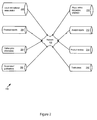
- Figure 1 illustrates an event analysis system for gathering information, identifying events, and interpreting the events.
- Figure 2 shows information sources which the event analysis system 100 may systematically monitor to obtain information.
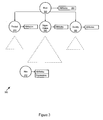
- Figure 3 shows an event model including event records defined in a hierarchical tree.
- Figure 4 illustrates an entity node and an entity relationship which may be defined in an environment model.
- Figure 5 illustrates an implication item including a trigger constraint and a resulting implication.
- Figure 6 shows the acts which the event analysis system may take to detect and infer events.
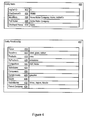
- Figure 7 shows an event object defined according to a common event structure.
- Figure 8 shows an example of the acts which an event detection engine may take to detect an event in an article.
- Figure 9 shows an example of the acts which an event implication engine may take to infer new events from detected events.
- Figure 10 illustrates an example of the acts which an event display preparation engine may take to create output files.
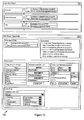
- Figure 11 shows a competitor display rendered on a user interface.
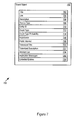
- Figure 12 shows an event detail window.
- Figure 13 shows a graphical user interface front end to an environment model design tool.
- Figure 14 shows a graphical user interface front end to an event model design tool.
- Figure 15 shows two different windows of a graphical user interface front end to an implication model design tool.
- Figure 16 shows a technology analysis system.
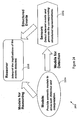
- Figure 17 illustrates a technology hypothesis model including precursor prediction nodes and intermediate hypotheses.
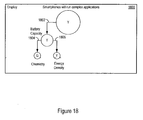
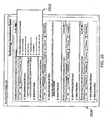
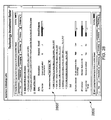
- Figure 18 shows a hypothesis status display.
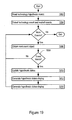
- Figure 19 shows the acts that the technology analysis program may take to evaluate a technology hypothesis.
- Figure 20 shows a portal user interface that presents events detected by the event and technology analysis systems.
- Figure 21 shows a portal user interface that presents events detected by the event and technology analysis systems.
- Figure 22 shows a portal user interface that presents events detected by the event and technology analysis systems.
- Figure 23 shows a business-aware web client.
- Figure 24 shows an interaction diagram for event implications.
- Figure 25 shows an executive summary interface resulting from application of a technology roadmap model.
- Figure 26 shows an activities summary interface resulting from application of a technology roadmap model.
- Figure 27 shows a state of gates interface in a technology roadmap model.
- Figure 28 shows an evidence supporting gates interface in a technology roadmap model.
- Figure 29 shows an overview of the event analysis platform.
- Figure 30 shows an overview of the event analysis platform.
- a processor may be implemented as a microprocessor, microcontroller, application specific integrated circuit (ASIC), discrete logic, or a combination of other types of circuits acting as explained above.
- ASIC application specific integrated circuit
- Databases, tables, and other data structures may be separately stored and managed, incorporated into a single memory or database, or generally logically and physically organized in many different ways.
- the programs discussed below may be parts of a single program, separate programs, or distributed across several memories and processors.
- event detection steps include the collection of raw data (e.g., from news articles), converting the data into event objects, and filtering (and discarding) events that are not relevant.
- event detection steps also include classifying the events which were not discarded, extracting information from the data which characterizes the events, and building an event template. Extracting information about the events includes obtaining event attribute values, while building the event template includes adding the attribute values into attribute fields in event objects.
- An event implication engine applies an event implication model to infer new events from existing detected events.
- the new events may be fed back into the implication engine, resulting in additional inferred events.
- the feedback process may continue iterating to generate additional new events, all of which are maintained in the event database, and any of which may also be fed back into the implication engine.
- FIG. 1 shows an event analysis system 100.
- the event analysis system 100 monitors information available from information sources connected to both publicly and privately distributed networks.
- the event analysis system 100 retrieves the information, such as news articles, blog entries, web site content, and electronic documents (e.g., word processor or spreadsheet documents) from the information sources for analysis.
- electronic documents e.g., word processor or spreadsheet documents
- the event analysis system 100 may process information in any other format from any other source.
- RSS Really Simple Syndication
- the event analysis system 100 analyzes the article for events.
- the event details are extracted from the article and represented in a standardized way for further processing.
- the system 100 discards articles which are not relevant with respect to the environment model 130, and classifies events described in the remaining articles according to the event model.
- the event analysis system 100 determines relevant events, and alerts other systems, individuals, or other entities of the new event and its relevance.
- the event analysis system 100 includes a processor 102, a memory 104, and a display 106.
- a network interface 108, an information database 110, and an event database 112 are present.
- the information database 110 stores articles received over the network 114 from the information sources 116.
- the event database 112 stores event objects constructed using information obtained from the articles, and modified and extended by further processing in the event analysis system 100.
- the event objects may share a common event structure which is independent of the information sources 116 from which the articles are received.
- the common format of the event structure facilitates subsequent processing of the event objects by a wide range of analysis tools, described below.
- the event analysis system 100 may communicate the detected events, implications of the events (e.g., in the form of a newly created event flowing from an implication of a previously detected event), or both, for further processing by external entities.
- Figure 1 shows an example in which an automated alert system 118 consumes originally detected events and inferred events produced by the event analysis system 100.
- the automated alert system 118 may include comparison logic which watches for specific types of events and produces an alert.
- the alert system 118 may send the alert to an individual or other system (e.g., a PDA, a personal computer, or pager) to perform a notification that the event has occurred or that the event has the potential implication determined by the event analysis system 100.
- the enterprise data integration system 120 may include a database management system or other information processing system which integrates event data into other data maintained for an enterprise.
- An event portal 122 provides a remote external interface into the event analysis system 100.
- the event portal 122 may implement a portal user interface 124 which supports login and communication with the event analysis system 100.
- the event portal 122 may provide a representation (including text and/or or graphical elements) of the events (including inferred events arising from implications of existing events).
- the representation may assist, for example, a decision support role of the operator of the event portal 122.
- the memory 104 stores one or more information source models 126, event models 128, environment models 130, and event implication models 132, which are explained in more detail below.
- the memory 104 also stores analysis engines 134.
- the analysis engines 134 may include an event detection engine 136, an event implication engine 138, and buzz and/or sentiment monitoring engines 140.
- the processor 102 generates a user interface 142 on the display 106.
- the user interface 142 may locally provide graphical representations of events and their implications (e.g., in the form of inferred events) organized by company, competitor, or in another manner to an operator using the event analysis system 100.
- the event analysis system 100 may include a rendering engine 144.
- the rendering engine 144 may be implemented with programs which generate text and/or graphical representations (as examples, dashboards, charts, or text reports) of the events and their inferred events in the user interface 142.
- the rendering engine 144 may include a program such as Crystal Reports (TM) available from Business Objects of San Jose California, or any other drawing, report generation, or graphical output program.
- the rendering engine 144 may parse output files generated by the event display preparation engine 146.
- An event processing control program 148 coordinates the processing of the event analysis system 100, as described in more detail below.
- the network interface 108 connects the event analysis system 100 to the networks 114.
- the networks 114 may be internal or external networks, including, as examples, company intranets, local area networks, and the Internet.
- the networks 114 connect, in turn, to the information sources 116.
- the system 100 connects to the information sources 116 specified by the information source model 126 in the memory 104. Accordingly, the processor 102 reads the information source model 102, determines which information sources 116 to contact, then retrieves articles from the information sources 116 through the networks 114.
- the system 100 also includes graphical modeling tools 150.
- the graphical modeling tools 150 display user interfaces through which an operator may establish and modify the models 126 - 132 without the burden of writing code.
- the modeling tools 150 include an event modeling tool, an implication modeling tool, and an environment modeling tool which support the definition and modification of the event model 128, the event implication model 132, and the environment model 130, respectively.
- An information source modeling tool may also be provided to provide a graphical user interface for modifying the information source model 126.
- the modeling tools 150 are described in more detail below.
- the information sources 116 may include government publication information sources 202, online price information sources 204, financial report information sources 206, and local and national news information sources 208.
- the information sources may also include one or more blog, online discussion, or USENET information sources 210, analyst report information sources 212, product review information sources 214, and trade press information sources 216.
- the information sources 202 - 216 are exemplary only, and the event analysis system 100 may connect to any other information source.
- the information sources 202 - 216 may be driven by web sites, free or subscription electronic databases (e.g., the Lexis/Nexis (TM) databases), news groups, electronic news feeds, journal article databases, manual data entry services, or other sources.
- the event analysis system 100 may access the information sources 202 - 216 using a Hypertext Transport Protocol (HTTP) interface, File Transfer Protocol (FTP) interface, web service calls, message subscription service, or using any other retrieval mechanism.
- HTTP Hypertext Transport Protocol
- FTP File Transfer Protocol
- the networks 114 may adhere to a wide variety of network topologies and technologies.
- the networks 132 may include Ethernet and Fiber Distributed Data Interconnect (FDDI) networks.
- the network interface 108 is assigned one or more network addresses.
- the network address may be a packet switched network identifier such as a Transmission Control Protocol / Internet Protocol (TCP/IP) address (optionally including port numbers), or any other communication protocol address.
- TCP/IP Transmission Control Protocol / Internet Protocol
- the networks 114 may represent a transport mechanism or interconnection of multiple transport mechanisms for data exchange between the event analysis system 100 and the information sources 202 - 216, the automated alert system 118, the enterprise data integration system 120, and the event portals 122.
- the information source model 126 may establish, define, or otherwise identify information sources.
- the information source model 126 may use include (e.g., "news.abcbnewspaper.com"), identifiers (e.g., an IP address and port number), or other identifiers to specify information sources which the event analysis system 100 will monitor.
- the processor 102 may then systematically monitor and gather articles from one or more of the information sources 116 to build the information compilation in the information database 110.
- the processor 102 may supplement the information compilation at any time, such as on a periodic schedule (e.g., twice per day), when instructed by an operator, or when receiving a message that a new article is available.
- a periodic schedule e.g., twice per day
- the information source model 126 includes configuration information.
- the configuration information may specify how to access a given information source 116, as well as information characterizing the information source 116.
- the characterizing information may include weighting values for individual information sources which record the reputation, reliability, or quality of the information source (e.g., a weighting value between 1 and 5).
- the event analysis system 100 may use the configuration information in subsequent processing stages. For example, the event analysis system 100 may determine measures of event accuracy or probability based on the weighting values.
- Table 1 shows an example of a source model instance.
- the example shown in Table 1 is an extensible Markup Language (XML) instance, with tags which specify the name, location, connection method, update frequency (e.g., once per day), and weighting value for the information source.
- the information source models 126 may represent a collection of such instances.
- the name tag provides a descriptive string to describe the source.
- the url tag indicates where to access the requested information.
- the connectionMethod tag defines how to access the source.
- the event analysis system 100 uses an RSS feed.
- the connection Method tag may specify other access mechanisms, including ftp, http, or other mechanisms.
- the update Frequency tag determines how often the event analysis system 100 accesses a particular information source 116.
- the value '1.0' specifies one access per day.
- the reputation tag assigns a weighting value to each source, on a scale of 1-5 (5 being most reputable).
- the event analysis system may use this information to resolve conflicting stories between different information sources and to build a measure of event accuracy or likelihood. Additional extensions include configuration parameters which specify login name and password, timeout constraints, and data transfer size limits or time limits.
- the event models 128 define the type of events that can occur and the attributes which belong to instances of each event type. For example, “Hire” is an event type with attributes of "New employer”, “Previous employer”, “New position”, and “Manager name”. Thus, when the event analysis system 100 detects a "Hire” event in an article obtained from an information source 116, the event analysis system 100 will scan through the article text to determine who the previous employer was, what the new position is, and what the manager's name is.
- Figure 3 shows that the event model 128 may include event nodes defined as a hierarchical tree 300, starting with a root node 302 and root attributes 304.
- the root node has three child nodes: an organization-centered node 306, a society-centered node 308, and a product-centered node 310.
- the organization-centered node 306 is the parent node for child nodes that represent events that directly affect an organization, or are generated by the organization.
- a new ad campaign, a labor dispute, and a stock price change are examples of organization-centered events.
- the tree 300 separates event types into organization-centered, society-centered, and product-centered events, but any other organization may be implemented.
- the society-centered noted 308 categorizes changes that are external to the company, such as environmental changes or demographic changes.
- the product-centered node 310 categorizes events which are relevant to a particular product that is created by a company or organization.
- a product recall, a manufacturing difficulty that affects a product, and a rebate on a product are examples of product-centered events.
- the categories are not rigid. Instead, different system implementations may classify the same event into different categories and may define the fewer, more, or different categories and event nodes.
- Each child node inherits the attributes from the root node, and each child node may optionally include additional attributes individually associated with that child node.
- Each child node 306 - 310 may have children nodes as well, which inherit the attributes from parent, grandparent, and further prior nodes.
- the tree 300 ends in leaf nodes (e.g., the leaf node 312), a node with no child nodes.
- the leaf nodes are associated with expressions which help the system 100 determine that article text includes an event of the event type represented in a leaf node.
- the tree 300 provides a structure in which similar events may be grouped together (e.g., for ease of comprehension).
- the tree 300 also increases efficiencies by avoiding duplication of information that is shared by children of the same parent. By allowing children to inherit attributes of their parents, the attributes may be specified only once (in the parent) instead of more than once (in all of the children).
- the event analysis system 100 classifies an event, the event analysis system 100 creates an event object and builds the event object according to one of the event types represented by a leaf node.
- an event may be classified as a "Hire" event, including the inherited attributes from prior nodes such as the organization-centered node 306 and the root node 302.
- the event model 128 defines the form and content of the event objects for many different types of events.
- Table 2 shows an example of the implementation of a root event type in the event model 128 corresponding to the root node 302.
- the EventType (event type) tag includes a label attribute which specifies the name of the event type (e.g., Root), and the color used to display the node (e.g., in a model building tool on the user interface 142).
- the toolData tag specifies information which may be used by a model building tool.
- the toolData tag includes a color sharing tag that tells the model building tool that any children of the root event type should be displayed in the same color as the root node by default.
- the categoryDetectionlnfo (category definition) tags specify text strings which the event analysis system 100 uses to detect events which match the event type. In this example, events are not assigned to the root event type, and no text strings are defined. However, the event model 128 will specify text strings for leaf event nodes.
- the eventlnstanceAttributes (event instance attribute) tags specify the attributes for which the event analysis system 100 will search for values in the article, for any event that belongs to the event type, or any of the event type's children.
- the attributes 'date', 'time', 'tense', and 'confidence' are defined. Because the root node includes 'date', 'time', 'tense', and 'confidence' attributes, the event analysis system 100 will search the article to determine the date this event occurred or will occur, what time the event occurred or will occur, whether the event occurred in the past or will occur in the future, and how confident the event analysis system 100 is are about the analysis of the event, regardless of the specific type of event.
- the attributes may vary widely in form, number, and type between implementations. In particular, two different implementations of the system may define the same event or events, yet use similar or very different attributes to characterize the events.
- the "name” field contains the name of the event instance attribute.
- the "dataType” field contains a description of the data types that serve as a value for the attribute. This field may specify, as examples, that a "person's name”, “geographical location”, “quantity”, “currency”, “company name”, “job title”, or other data type may provide the value. Knowing what data type provides the value assists the event analysis system 100 with identifying the value in the text itself.
- the "preRegex” field specifies a regular expression that identifies text that event analysis system 100 may search for prior to (e.g., immediately prior to) the text that serves as the value for the event instance attribute. For example, the phrase "will be leaving" found before a company's name may point to the company name as value for the "Previous employer” event instance attribute for the "Hire” event type.
- the "postRegex” field is similar to the "preRegex” field, but the event analysis system 100 uses the postRegex field to specify a regular expression which identifies strings expected to come immediately after the value for the event instance attribute.
- the "display” field contains information about whether the event instance attribute will be shown on either a “summary” display of the event, a “detailed” display of the event, both, or neither.
- the user interface 142 may display either or both of a broad-view or summary window, as well as pop-up windows giving more details about an individual event (i.e., a detailed display).
- Table 3 shows a definition for the organization centered event type, a child of the root node.
- the event type provides an acronym for the event type (e.g., "OAA"), a scope specifier, and focus specifier, and a parent specifier which links the event type to a parent event type (i.e., the root event type).
- OAA acronym for the event type
- scope specifier e.g., "OAA”
- focus specifier e.g., "AAA”
- parent specifier which links the event type to a parent event type (i.e., the root event type).
- the scope and focus specifiers provide fields for future implementations which further increase the flexibility and capabilities of the system.
- Table 4 shows an example of a 'hire' event type. Other events may share the same or similar tags and structure.
- Table 4 shows that the 'Hire' event type is a child of the 'Management' event type, and that 'Hire' events are displayed as DeepSkyBlue boxes in the user interface 142 (and in other interfaces, such as a model building tool).
- the newsStoryDetectionlnfo tags establish the regular expressions, under the newsStoryDetectionPatterns tag, which the event analysis system 100 uses to identify events which are 'Hire' events.
- Each regular expression (bounded by the 'pattern' tag) may specify the regular expression and a weight.
- the event analysis system 100 uses the patterns and weights to determine whether a particular event belongs to a particular event type. Thus, the event analysis system 100 may distinguish between events when regular expressions from different event types are located in the same article. When regular expressions from multiple different event types are found in a single article, the system 100 adds the weights for the expressions. The highest resulting weight is the event type to which the system 100 classifies the event. Note that weights can be positive or negative. Negative weights may be applied when a regular expression matches text which points away from the event type. For example, matching the phrase "service appointment” or "of the year” would be clear indicators that the article does not describe a 'hire' event. Accordingly, large negative weights are assigned to those regular expressions.
- the 'hire' event type specifies that the value of the "Previous Employer” event instance attribute should be a company name.
- the "preRegex" (i.e., prior regular expression) field defines a regular expression that the event analysis system 100 uses to identify phrases that are expected or likely to come before (e.g., immediately before) the value for the Previous Employer attribute. In this example, when the event analysis system 100 finds the text "is leaving" followed by a company name, the event analysis system 100 determines that the company name should be the value for the Previous Employer attribute.
- postRegex i.e., post regular expression fields define a regular expression that is likely to occur after the value for the Previous Employer attribute.
- the event analysis system 100 may establish the text "has fired” as text expected to come immediately after a company name to suggest that that company name is the appropriate value for the Previous Employer attribute.
- the event model may also specify variables instead of text strings that the event analysis system 100 uses to match an event.
- the variables may be flagged by a leading character (e.g., '$'), followed by a variable, for example, '$ ⁇ changephrase ⁇ '.
- the event analysis system 100 may expand a variable using rules defined according to a specific grammar.
- Table 5 shows an example of a grammar.
- the grammar shown in Table 5 specifies how to expand variables into regular expressions for pattern matching.
- the grammar shown in Table 5 specifies that "$ ⁇ changephrase ⁇ " should be expanded into “$ ⁇ increasephrase ⁇
- the grammar specifies that "$ ⁇ increasephrase ⁇ is expanded into "(will
- the event analysis system 100 thereby implements macros which allow shorter forms to be used in the event model, allow re-use of common phrases, and that significantly increases the flexibility of the event model.
- the event analysis system 100 may store the grammar in the memory 104, in a file on disk, or in any other location for reference when parsing the event model.
- Tables 6 and 7 show examples of the product centered node 306 and the society centered node 308.
- Table 8 shows an example of the events established in the tree 300 and which may be defined in the event model 128.
- Root is the root event
- Organization-centered, Product-centered, and Society-centered are children of the Root event.
- the Financial, Image, Labor Relations, Legal, Management, Marketing, and Partnering events are children of the organization-centered event.
- the Analyst Report, Earnings guidance, Earnings report, Market report, and Stock price change are examples of leaf nodes under the Financial node. Any other attributes or regular expressions may be defined for the events or used to locate the events.
- Event types are very flexible and may be organized, defined, or established into multiple event types in many different ways. For example, one implementation of the system 100 may include a Product Price Change event, while another implementation may define separate Product Price Increase and Product Price Decrease events.
- Table 9 shows examples of the attributes (in single quotes) and regular expressions (in double quotes) defined for specific events.
- Table 9 Event Attributes and Regular Expressions Financial 'value' and 'valence' Analyst Report or a Market Report 'analyst' and 'issues raised' earnings guidance or an earnings report 'timespan' Stock price change 'percent change', and 'split' "stock price $ ⁇ changephrase ⁇ " "shares $ ⁇ changephrase ⁇ " Image 'issue' ad campaign 'focus' and 'channel' scandal 'person' labor relations 'labor organization' labor demands 'demands' and 'issues' public demonstration 'location', 'message', and 'size' strike 'management positions' and 'labor positions' workforce size change 'number effected', 'location', and 'reason' criminal 'charges', 'prosecution stage', and 'defendant' lawsuit 'suit type', 'dollar value', 'issue
- the environment model 130 defines entities and the relationships between entities.
- Table 10 shows an example of an XML definition of entities.
- the XML definition shown in Table 9 specifies the list of entities in the environment model 130 and their attributes.
- the ⁇ orgDef> contains the definition of an Organization entity
- the ⁇ typeDef> contains the definition of an ProductType entity
- the ⁇ brandDef> contains the definition of an Brand entity
- the ⁇ segmentDef> contains the definition of an ConsumerSegment entity
- the ⁇ modelDef> contains the definition of a ProductModel entity
- the ⁇ personDef> contains the definition of an Person entity.
- the system 100 may specify different default relationships for each entity type. For instance, a Consumer Segment entity would generally not have a 'competitor' relationship with any other entity, but a Product Type or Organizational entity may.
- entity types provides more flexibility when displaying events in the user interface 142, which may then display, as examples, events that involve people, or products, or organizations.
- entity i.e., Organization, Product Types, Brand, Consumer Segments, Product Models, and Person
- the environment model 130 may specify an identifier (ID), a FullName, a DisplayName, and a list of Identifiers.
- the Identifiers are the strings that event analysis system 100 searches for to recognize the entity when parsing through an article.
- the identifiers may include "ACME” and "Acme Motors", both specify the same entity.
- the DisplayName field stores the value for the name which is displayed on the user interface 142, while FullName gives the proper full name of the entity.
- the ID (e.g., a stock symbol or a short form of the entity name) is the name by which the event analysis system 100 refers to the entity.
- the environment model 130 may also specify a OneSourcelD attribute. This attribute may provide a numerical identifier for the organization which the event analysis system 100 may use to look up information in OneSource online business information (www.onesource.com).
- the event analysis system 100 may also define, for ProductType entities, an EconomicCategory attribute. This attribute may influence how the event analysis system 100 processes events involving different kinds of products and materials.
- Figure 4 illustrates an entity node 400 for Acme Motor Company
- the ID 402 is "A” (the stock ticker for Acme).
- the OneSourceID 404 of 99999 allows the event analysis system 100 to connect to OneSource to find more information about Acme.
- the entity node 400 defines the identifiers 406 as "Acme Motor Company,” “Acme,” or “AcMoCo.”
- the full name field 408 gives the full name "Acme Motor Company” and the displayed name field 410 specifies "Acme”.
- the event analysis system 100 may store (e.g., in an entity specific file, database entry, or other storage), a relationship entry for the entity.
- the ID field 402 may be used as an index or file identifier to locate the relationship entry in a database or in a file system.
- the environment model 130 also defines relationships between entities.
- Table 11 shows an example of an entity relationship file for XYZ Motor, which is a competitor of Acme.
- the busNet and CMNet nodes are reserved for future expansion, and Figure 4 (in conjunction with Table 11) shows the configuration of an entity relationship 412.
- the focus node 414 verifies that the content of the relationship entity file is for XYZ Motor Company (and not some other entity).
- the remainder of the relationship entity file is subdivided by relationship type. Examples are shown in Table 11; any other relationships may be defined and established in the relationship entity file.
- Figure 4 shows that the entity relationship 412 may define relationships of other entities, places, or things to Acme using a Suppliers field 416 (e.g., "steel"), Products field 418 (e.g., “cars”), ByProducts field 420 (e.g., "emissions"), Competitors field 422 (e.g., "ABC motor”), Substitutes field 424, Consumers field 426, Complements field 428 (e.g., "gasoline”), Issues field 430, Subsidiaries field 432 (e.g., “Volvo”, “Jaguar”, and “Mazda”), and Parent company field 434.
- Suppliers field 416 e.g., "steel”
- Products field 418 e.g., "cars”
- ByProducts field 420 e.g., "emissions”
- Competitors field 422 e.g., "ABC motor”
- each relationship section is populated with the IDs of the entities that fulfill that relationship.
- Table 11 establishes that Acme has three defined subsidiaries, Volvo, Jaguar, and Mazda. In other words, Acme is related to Volvo, Jaguar, and Mazda by the relationship of parent to subsidiary.
- the entity relationship establishes Acme as a competitor to XYZ using the Competitors field.
- the event analysis system 100 may employ the lDs as a database key, search term, or filename to navigate through the model 130 and to locate additional information about the entities. For example, knowing that XYZ Motor is a competitor of Acme Motor, the event analysis system may then open a file keyed off of the ID (e.g., "XYZ.xml”) to determine XYZ's suppliers.
- the event analysis system 100 uses the event implication model 132 to determine when certain types of events with particular attributes signal the possibility of other events occurring in the future. As one example, if a CEO of a competitor is recruited to head another competitor, it is reasonable to infer that there is an increased chance of the two competitors merging, sharing technology, or otherwise working together.
- the event implication model 132 establishes rules for making the inferences.
- the event analysis system 100 adds messages to events.
- the messages explain that an inference can be made from the event, and/or describe the inference.
- the event analysis system 100 creates new detected events which the event analysis system 100 may display along with events directly determined from an original article.
- the event analysis system 100 may inject the inferred events back into the implication processing flow so that the inferred event may generate additional detected events.
- the event implication engine 138 matches trigger events to possible implications defined in the implication models 132.
- An example of an implication model 132 is shown below in Table 12.
- the event implication model 132 defines individual implication items, shown in Figure 5, each tagged with a 'ThreatAndOpportunityltem' tag.
- the implication items 500 establish one or more trigger constraints 502 for the triggering event to meet, and a resulting implication 504 which holds when the constraints were met.
- the trigger constraints 502 may be established as an event constraint 506 and one or more attribute constraints 508 for that event.
- the event constraint 506 searches for a match on the event type.
- the implication items 500 may distinguish between multiple different types of attribute constraints 508.
- One example is an 'Optional' attribute constraint.
- the optional attribute constraint signifies that the value of the attribute is not pivotal and may even be unknown or undefined.
- Optional attributes may be included so that the implications may refer to the attribute by name.
- a second example is 'NonEmpty'.
- the nonempty attribute constraint signifies that the event extraction process has returned a value for the attribute.
- the specific value is not pivotal.
- a third example is 'Match'.
- the match attribute constraint signifies that the extracted value for the attribute matches a listed value. There may be multiple listed values which can match the extracted value.
- a fourth example is 'Retationship'.
- the relationship attribute constraint signifies that the extracted value for the attribute conforms to a relationship defined in the environment model 130.
- the extracted value serves as a target for the relationship, and the origin of the relationship is listed in the constraint.
- the origin of the relationship may refer to another attribute of the event.
- the origin may include special parameters, such as "focus” and "fill” parameters.
- special parameters such as "focus” and "fill” parameters.
- $FOCUS The $FOCUS parameter specifies that the origin will be the focus entity of the application.
- the system 100 may define both parties in the relationship.
- the system 100 may then check detected hire events, and when the company involved in the hiring event is a competitor to the FOCUS, the system 100 may make a match.
- the FOCUS may be defined as Acme Motors, Inc. A particular hire event at XYZ Motors may not mention Acme, but the FOCUS entity lets the system 100 make the connection, since XYZ is a competitor of Acme.
- a second example is $FILL_ ⁇ entity>_IS_ ⁇ relationship>. This parameter specifies that the event analysis system 100 will fill in the entity from the environment model 130. Generally, the system 100 will generate one inferred event for a triggering threat event. With the FILL functionality, however, the system 100 may generate multiple inferred events from a single triggering threat event. For example, assume an event involving company SupplierX which may have implications for several other companies (namely, for each company which has a supplier relationship with SupplierX). The system 100 may use the FILL functionality to look at the relationship model and pick out each entity that has the supplier relationship with SupplierX. Then the system 100 may generate inferred event for each of those companies.
- the resulting implication 504 is the second part of each implication item 500.
- the resulting implication 504 specifies an action to take when the attribute constraints are met.
- Each resulting implication 504 may specify an implication message 510 and an implication event 512.
- the implication message 510 may be implemented as a string (e.g., a human readable text string) that the event analysis system 100 stores in the event object for the inferred event and outputs through the user interface when there is an event match.
- the string may embed variables, which may specify the named attributes from the attribute constraints 508 in the trigger constraint portion 502.
- the "focus" and “fill” parameters may provide variables for the implication message 510.
- the inferred event 512 specifies an output event which may enter the event stream, according to the format described above for events.
- the inferred event objects may be saved in the event database 112, and subject to further implication as well.
- the implication item 500 specifies the event type for the output event and the attributes far the event Any attribute may be left empty, may be set to a specific value, or may be filled using the attribute variable described above.
- Figure 6 presents an example of the acts 600 which the event processing control program 148 may take to coordinate the processing of the event analysis system 100.
- the event processing control program 148 scans the information sources 116 and retrieves new articles (Act 602).
- the event processing control program 148 filters (e.g., removes) articles which are not relevant to the entities defined in the environment model 130 (Act 604).
- the analysis system 100 eliminates a significant percentage (e.g., 99% or more) of retrieved information prior to applying the event detection engine on the new articles.
- the event processing control program 148 initiates execution of the event detection engine 136 on the retained articles.
- the event detection engine 136 processes each article according to the source and type of data (e.g., text) in the article.
- the event detection engine 136 produces an event record according to the event model 128 for the events defined in the article, including event type, event attributes, event importance or priority, the source article which describes the event, an address for the article, and referenced organizations, and any other extracted event information (Act 605). Prior to performing event implication, additional filtering may be performed to retain those events which reference entities defined in the environment model 130. In addition, the event detection engine 136 may output information specific to the type of data in which the event was detected. As one example, when the article is a text article, the output of the conversion engine may include a tokenized or parsed version of the text article.
- the event processing control program 148 also initiates execution of the event implication engine 138 on the event records (Act 606).
- the implication engine 138 produces a description of an implied event which is added to the original event record.
- the implication engine 138 also generates a new event record for an inferred event.
- the event processing control program 148 may signal other entities that newly detected events and inferred events exist (Act 608).
- the entities may be processes which consume and display events on a graphical user interface, for example.
- the event analysis system 100 may employ a message publication / subscription engine, web services, direct messaging or signaling, email, file transfer, or other communication techniques to notify other entities.
- the event analysis system 100 may thereby create a stream of events (e.g., a stream of event object data) in a form for consumption by client applications.
- the stream may include each event detected, or may include subsets of detected events, as specified or requested by the client application.
- the event processing control program 148 may query for and accept manual corrections to any of the automated event detection processing (Act 610).
- the event analysis system 100 may accept a correction to a time, date, or place where an event occurred from the user interface 142.
- the event analysis system 100 may then update the event database 112 with the corrected event, and re-apply the implication engine 138 to the corrected event.
- we can have manual corrections to the attributes of an event (date, time, place, etc., like you mention) but also to the event type itself. For example, something that is actually a Hire event may be incorrectly machine classified as a Joint Venture event. Accordingly, manual corrections may also apply to the event type itself, and an operator may, for example, change a Joint Venture event to a Hire event, or may make any other change to an event classification.
- Figure 7 shows an event object 700 which the event analysis system 100 may create, save in the event database 112, and update as a new article is processed.
- the event object 700 may include a title field 702, which stores a title associated with the article; a link field 704, which stores a link (e.g., a url link) which specifies where the article may be found; and a description field 706, which stores a description of the event.
- the event object 700 may include a source type field 708, which identifies the type of source from which the article was obtained; an entity identifier field 710 which stores an identifier of an entity involved in the event; and an event type field 712, which stores an identifier of the type of event represented in the article.
- Different, fewer, or additional fields may be provided in any particular implementation. As examples, the additional fields may specify full article text, numerical data, or other data.
- the event object 700 also includes an event type probability field 714, which identifies how certain the event analysis system 100 is that the event occurred; an importance field 716, which specifies how important the event is; and a public interest field 718, which specifies the level of public interest in the event.
- the event object 700 further includes a tokenized title 720, which stores the title of the article broken down into tokens; a tokenized description 722, which stores the description of the article broken down into tokens; and attribute fields such as an attribute list 724, which holds the attribute values for the event represented by the event object.
- the event object 700 may also include an implication message list 726, which stores messages returned by the implication process; and an extracted entities list 728, which stores identifiers of entities involved in the event.
- the fields shown in Figure 7 are examples only.
- the event object 700 may include additional, fewer, or different fields.
- Figure 8 shows an example of the acts 800 which the event detection engine 136 may take.
- the event detection engine 136 analyzes each article and responsively prepares a new event object 700.
- An example of the processing is given below, assuming an article received from an RSS information source 116 illustrated in Table 13.
- the event detection engine 136 parses the article and extracts the title, link, description, and source type information by locating the corresponding xml tags in the article (Act 802). The event detection engine 136 then completes the title field 702, link field 704, description field 706, and source type field 708. Table 14 shows the newly created event object.
- the event detection engine 136 then filters the events generated by the initial analysis phase (Act 804).
- the event detection engine 136 retains those event objects which include an entity defined in the environment model 130 (e.g., Acme motor company) and that does not include any exclusion phrases (e.g., "Acme modeling agency") which may also be defined in the event model 130.
- the event detection engine 136 may perform regular expression pattern matching to search the event object (e.g., the description field 706) for entities defined in the environment model 130. Accordingly, the event detection engine 136 applies a filter to the articles received from the information sources 116. Specifically, the event detection engine 136 retains those articles and corresponding event objects which are relevant to the entities defined in the environment model 130.
- the pattern matching process identifies entities in the event object which are defined in the environment model 130.
- entityID e.g., "Acme”
- the system 100 may assign the entityID for an event to the first entity found in that event. For example, an event created by the text "Acme and XYZ Motors to merge" may have only Acme as its entityID.
- the system 100 may implement each event's entity field as a list including each entity discovered in the article (e.g., a list with two members: Acme and XYZ).
- the event detection engine 136 removes duplicate event objects (Act 806). Because an article may appear multiple times across multiple dates from multiple RSS feeds, the same article may create multiple duplicate event objects.
- the event detection engine 136 may eliminate duplicates by computing a hash value based on the fields of the event object (e.g., the title and description fields).
- the hash function may be the SHA-1 hash function, or another function which converts a string into a fixed-length (hexadecimal) number.
- the event detection engine 136 determines that an event object is a duplicate when hash values collide. In one implementation, each duplicate event object is removed, leaving one event object which captures the event.
- the event detection engine 136 continues by classifying an event represented in the event object (Act 808).
- the event detection engine 136 may apply a classification algorithm to the description field 706.
- the classification algorithm may determine, given the description, whether the description belongs to a specified class (e.g., a particular event defined in the event model 128).
- the classification algorithm may implement, for example, the naive Bayes algorithm for document classification.
- the classification algorithm may be implemented with the opensource Rainbow classification engine, or any other classification engine.
- the classification algorithm may provide not only the classification of the event, but also the reliability or probability of a correct classification.
- the classification algorithm may provide information for the event type field 712 and the event type probability field 714.
- the event detection engine 136 also applies an attribute extraction program to extract attributes for the event (e.g., obtained from the description field 706) (Act 810).
- the extracted attributes build the attribute list 724.
- the event detection engine 136 tokenizes the title (Act 812) and tokenizes the description (Act 814) as part of the attribute extraction process.
- a tokenizing engine breaks the title and event description into a tokenized description, including words, numbers, punctuation, and/or other tokens, and adds the tokens to the tokenized title 720 and tokenized description 722.
- a natural language processing engine may perform the tokenizing operation.
- the natural language processing engine may be the opensource Natural Language Tool Kit (NLTK).
- NLTK Natural Language Tool Kit
- a tagging engine may assign a part-of-speech tag to each token in the tokenized representations (At 816) to provide a tagged tokenized description.
- the NLTK may implement the tagging engine.
- the event detection engine 136 also performs named entity recognition (Act 818).
- a named entity recognition engine accepts as input an event object (e.g., including a tokenized tagged description) and performs named entity recognition on the text included in the event object.
- the named entity recognition engine may identify personal names, company names, or geographical locations within the text.
- the named entity recognition engine adds information tags to the event object which describe which named entities exist and where they are located to the event object.
- the named entity recognition engine may be the ClearForest engine available from ClearForest Corp. of Waltham, MA.
- a parsing engine which takes as input an event object, identifies the grammatical structure of the text (Act 818). For example, the parsing engine may identify noun phrases, verb phrases, or other grammatical structure within a sentence. The parsing engine adds grammatical structure tags to identify the detected structures and identifies which words make up the structures. The tags are added to the event object 700.
- the parsing engine may be implemented with a statistical natural language parser, such as the Collins parser.
- the event detection engine 136 performs template matching (Act 820).
- the event detection engine 136 may process an event object and determine a matching event type in the event model 128.
- the matching event type defines the attributes for the event.
- the template matching may then add each attribute and a detected value for the attribute to the event object (Act 822).
- the system 100 performs template filling as described next. Assume that the system 100 has already identified all instances of all data types within the event text, where the data types may be a pre-defined "class" of words or terms. For instance, "person” is a data type, and "John Doe” is an instance of the "person” data type. Other examples of data types include date, company name, and job title.
- markers are phrases that are defined in the business event model 128, and indicate possible positions of event attribute values.
- the system 100 then examines the event model 128 to determine what attributes the system 100 should search for, for each event, based on each event's event type. For instance, if the event has been classified as belonging to the "Hire" event type, then the system 100 may search for five attributes: person, new employer, previous employer, new job title, and the date that the hire becomes effective.
- the event model 128 specifies what data type each of these attributes will have.
- the person attribute will be filled with a value that belongs to the person data type
- the new employer and previous employer attributes will be filled with values that belong to the company name data type.
- the system 100 determines whether it has identified any instances of the data type associated with that attribute. For instance, if the system 100 is searching to find the value for the "New Employer" attribute, the system 100 determines if it has identified any instances of the "company" data type. If the system 100 has identified 0 instances of that data type, the system assigns the value 'unknown'.
- the system 100 checks whether that instance has already been determined to be the value of a different attribute. If so, the system 100 assigns the value 'unknown'. If the instance has not been used for another attribute, the system 100 may assume that that instance is the value for our current attribute, and the system 100 may assign the value to the current attribute. If the system 100 has identified more than one instance of the right kind of data type, then the system 100 determines whether there are any preMarkers that fall immediately before an instance of the data type, or if there are any postMarkers that fall immediately after an instance of the data type. For example, the phrase "will be joining" may be a preMarker for the "New Employer" attribute.
- the system 100 may assume that that instance is the value for the "New Employer” attribute.
- "will join” is a postMarker for the "Person” attribute
- the system 100 may assume that that instance of the "Person” data type is the value for the "Person” attribute.
- the term "Person” is used both as a data type and as an attribute name. If the system 100 does not find any cases of an instance of the right data type either preceded by a preMarker or followed by a postMarker, then the system 100 may assign the value of 'unknown'.
- Table 15 shows an event object, continuing the example above, processed through the template matching phase.
- the event analysis system 100 determines and assigns importance and/or public interest levels (e.g., from 1 to 5) to the detected event (Act 824).
- the buzz and sentiment engines 140 may provide estimates of the importance and public interest levels.
- the buzz and sentiment engines 140 may be provided by the Sentiment Monitoring System or Online Analysis System available from Accenture Technology Labs of Chicago II.
- the event analysis system 100 may communicate with an external system which performs the analysis of importance or public interest and returns the importance or public interest level, given event objects which the event analysis system 100 sends to the external system.
- the event analysis system 100 may thereby receive the importance and public interest levels from the external system and accordingly populate the event object in the event database 112.
- the buzz and sentiment engines 140 may consider factors such as organization size, event likelihood, number of articles reporting the same event, length of article, amount of money or personnel at issue, or other factors.
- Figure 9 shows an example of the acts which the event implication engine 138 may take to interpret events, starting with an input of a list of event objects.
- the implication engine 138 reads the implication model 138 (Act 902).
- the implication engine 138 thereby obtains a list of the implication items, trigger constraints, and resulting implications stored in the implication model 138.
- the event implication engine 138 obtains the next event object from the list of event objects (Act 904) and searches for a match. To that end, the event implication engine 138 searches for a match between the event type defined in the event type field 712 of the event object and the event type specified in the event constraints 506 of the trigger constraints 502.
- the event implication engine 138 also searches for a match to the attribute constraints 508 in the attribute list 724 (Act 908). When the event type and attributes match, the event implication engine 138 activates the resulting implications 504. For example, the event implication engine 138 may generate an implication message (Act 910) and then insert the implication message into the event object which triggered the implication (Act 912). In addition, the implication engine 138 generates one or more inferred events flowing from the matched trigger constraint 502 (Act 914). The inferred events give rise to new event objects which are inserted into the event database 112. Thus, a single originally detected event may result in many inferred events, as each new inferred event is processed by the implication engine, established as a new event object, stored in the event database 112, and processed by the implication engine.
- the event implication engine 138 creates a temporary variable list, and creates an attribute variable for each attribute named in the constraints.
- the event implication engine 138 creates the focus and fill variables as they are encountered.
- the focus and fill variables are bound with the actual attribute values from the triggering event (or from the entity-relationship model for the fill variables).
- the event implication engine 138 may use the variables in the implications analysis, having bound the variable values in the constraints analysis.
- Table 16 shows detailed pseudo-code for the event implication engine 138.
- the event analysis system 100 also facilitates the display of events, including inferred events. To that end, the event analysis system 100 may produce output files which drive the display of events on the user interface 142, or which the event portal 122 may use to display event and event information on the portal user interface 124.
- Figure 10 shows an example of the acts which the event display preparation engine 146 may take to create the output files.
- the event display preparation engine 146 obtains the list of event objects, including each event detected by the event detection engine 136 and the inferred events determined by the event implication engine 138 (Act 1002).
- the event display preparation engine 146 writes the contents of the event objects in the list to specific XML display files. In other implementations, however, the event display preparation engine 146 writes the contents of the event objects into database tables and fields organized, for example, by entity relationship type for further processing by the rendering engine 144 or event portal 122.
- the event display preparation engine 146 adds the contents of the event objects to specific XML display files created for each relationship type established in the environment model 130.
- XML display files created for Competitors, Suppliers, Products, Consumers, Subsidiaries, or any other defined relationship.
- the event analysis system 100 particular display file chosen to hold the event data depends on the relationship between the event entity and the focus.
- the focus entity is the entity on behalf of which the event analysis system 100 detects and infers events.
- the focus may be XYZ motors, a competitor of Acme motors.
- the event analysis system 100 may then detect, infer, and display events as they affect XYZ motors.
- the focus may be set before event detection and implication occurs. In other implementations, the focus may be selected through the user interface 142, and the processing system 100 will initiate the corresponding changes to the reports generated on the display 106 or communicated through the event portal 122.
- the display preparation engine 146 determines the focus (Act 1004), obtains the next event object in the event object list (Act 1006), and determines the entity specified in the event object (Act 1008). Knowing the focus and the event entity, the display preparation engine 146 may determine the relationship between the focus and the event entity (Act 1010). To that end, the display preparation engine 146 may search the environment model 130 for an entity relationship between the focus and the event entity. In the example above, Table 11 defined the environment for XYZ Motor Company. In particular, the environment established a Competitors relationship between XYZ and Acme. More generally, the display preparation engine 146 determines the relationship between the focus and the event entity by searching the environment model 130 (Act 1010).
- the display preparation engine 146 identifies the specific XML display file in which to write the event data.
- the XML display file is the Competitors display file.
- the display preparation engine 146 writes the event data from the event object into the display file (Act 1012). Specifically, the display preparation engine 146 may save the event type, source type, link, description, entity identifier and name, entity attribute names and values, implications and any other event data in the display file.
- Table 17 shows an example of the contents of the display file, continuing the example above regarding the layoffs at Acme Motor Company.
- the event analysis system 100 renders the events on the user interface 142.
- Figure 11 shows an example of a competitor display 1100 rendered on the user interface 142.
- the event analysis system 100 may display one or more events associated with a particular entity, events of a particular type, events within a specific date range, events obeying a particular relationship, or any other set of events.
- the event analysis system 100 may read a configuration file of operator preferences to determine how many events to display, what date ranges to display, or to determine any other display parameter (including, as examples, color, font size, and data position on the display).
- the system 100 may also accept input from the operator to select and modify one or more of these parameters.
- the user interface 142 includes a display selector 1102, through which an operator may select the information which will be shown on the user interface 142. As shown in Figure 11, the display selector is set to Competitors.
- the event analysis system 100 responds to the display selector 1102 by responsively updating the display to show the requested information, such as events involving all Competitors, Products, Suppliers (or specific individual Competitors, Products, or Suppliers), or any other relationship defined in the environment model 130.
- the competitor display 1100 includes the Acme competitor event window 1104 and the ZZZ Motor Company competitor event window 1106. Additional competitor event windows may be displayed, one for each competitor defined in the environment model 130 with regard to the current focus.
- the Acme competitor event window 1104 includes three event panes 1108, 1110, and 1112.
- the ZZZ competitor event window 1106 includes four event panes 1114,1116, 1118, and 1120.
- Each event pane 1114 - 1120 displays the data for an event involving a particular competitor entity as detected by the event analysis system.
- each event pane may display an importance indicator.
- the importance indicator 1122 shows that the layoffs at Acme motor company have been assigned a level 5 importance.
- Navigation buttons 1124 (in this case arrow buttons) allow the operator to move between multiple pages of event panes.
- the user interface 142 may also provide drill down links. For example, any of the event panes 1108 -1120 may operate as a drill down link when clicked. In response, the user interface 142 may display an event detail window.
- Figure 12 shows an example of an event detail window 1200 for the Acme layoff event.
- the event detail window 1200 includes an overview pane 1202, a buzz analysis pane 1204, and a potential implications pane 1206.
- the event detail window 1200 also includes a sources pane 1208 and a source text pane 1210.
- the event detail window 1200 may vary widely in content, however, and is not limited to the form shown in Figure 12.
- the overview pane 1202 specifies the event type, event importance, and event attributes for the event.
- the operator may change any of the entries in the overview pane 1202 using the Edit / Confirm / Cancel interface buttons 1212.
- the user interface 142 may provide text entry fields, drop down selection menus, selection buttons, or any other user interface element which accepts modified event data. Any modifications may feed back into the analysis engines 134, and initiate a revised analysis (e.g., a revised implication analysis) based on the modified information.
- the buzz analysis pane 1204 displays the public interest level with regard to the event.
- the buzz and sentiment engine 140 may gauge the public interest level.
- the event analysis system 100 may obtain the buzz and sentiment level from external measurement systems.
- the sources pane 1208 displays the article title and the article source.
- the article title is "Acme slashing production and jobs.”
- the information source 116 from which the article was retrieved is identified as ABC Newspaper.
- the source pane 1208 may include a drop down menu from which the operator may select from multiple sources reporting the same event.
- the source text window 1210 displays the text of the article received from the information source 116, while the source link button 1212 provides a mechanism by which the event reporting system 100 may open and display the original article from the original information source (e.g., by opening a web page addressed to the link at which the article is found).
- the event analysis system 100 may interact with or provide graphical tools 150 for building any of the models described above.
- a graphical tool to build the environment model 130 may provide a focus selector, an entity relationship selector (e.g., to choose between Competitor, Consumers, and Products relationships), and a selection pane of entity types (e.g., organizations, brands, or product types) to add to the selected entity relationship.
- entity types e.g., organizations, brands, or product types
- the environment model tool may also provide a pane with interface elements which display and/or accept input to set the attributes of the entities, such as displayed name, full name, ID, identifiers, OneSourceID, and other attributes.
- Figure 13 shows one example of a graphical user interface front end 1300 to an environment model tool.
- the front end 1300 shows a focus selector 1302, an entity type pane 1304, and an entity type selection pane 1306.
- the attributes pane 1308 displays and accepts input to set specific attributes of the entities.
- an event model tool may provide a tree node editing pane in which the operator may add or delete leaf and non-leaf event nodes.
- the event model tool may also provide a pane which displays and accepts input which defines or modifies event type properties, including colors, parent and/or child nodes, event attributes, regular expressions, weights, and any other characteristic of an event.
- Figure 14 shows an example of a graphical user interface front end 1400 to an event model tool.
- the front end 1400 includes a node editing pane 1402 for adding, modifying, and deleting nodes in the event model 128.
- the front end 1400 also includes an event properties pane 1404 which displays the properties assigned to an event type.
- an event type editing pane 1406 displays and accepts operator input to set, change, or delete regular expressions and weights assigned to the regular expressions.
- An implication model tool provides a graphical mechanism for an operator to define and modify elements of the event implication model 132.
- the implication model tool may provide a window in which new threat and opportunity items (i.e., trigger events) are established.
- the implication model tool accepts operator input for selecting, defining, or modifying a trigger constraint (e.g., a New position trigger type), one or more attribute constraints (e.g., a Match or Non-Empty constraint), and attribute constraint properties, including the values which will satisfy the constraint.
- a trigger constraint e.g., a New position trigger type
- attribute constraints e.g., a Match or Non-Empty constraint
- attribute constraint properties including the values which will satisfy the constraint.
- the implication model tool may accept operator input to select a corresponding resulting implication, as well as define the implication messages and events.
- the implication model tool also provides a selection interface for assigning trigger events to specific events defined in the event model 1
- Figure 15 shows an example of the graphical user interface front end 1500, including an implication model window 1502 and a threat / opportunity editing window 1504.
- the implication model window 1502 displays events and implication rules defined for the events.
- the editing window 1504 displays the implication rules, and allows the operator to add, change, or delete trigger constraints 502 and resulting implications 504.
- a graphical user interface may be provided for accepting, modifying, and deleting information which establishes the information source model 126.
- the system 100 may provide input interface elements for accepting an information source name, url (or other locator or specifier), a connection method (e.g., RSS, FTP, HTTP), an update frequency, a reputation level, or any other information which the operator desires to add to characterize the information source.
- Each of the modeling tools 150 separates the user from the underlying XML code in the models 126-132.
- the modeling tools 150 convert from the graphical elements to corresponding entries in XML statements which compose the models 126-132. For example, when an operator ads the "XYZ Motor" element to the competitors list for Acme motors, the modeling tool may insert a new organization ID tag into the Competitors list for Acme in the environment model 130. Accordingly, the operator is not burdened with writing XML to define, modify, and change the models.
- the event analysis system 100 solves several challenging technical problems surrounding event detection and implication.
- the fundamental problem is to automatically detect and relate to users information about external events.
- One associated problem was to determine how to design models which facilitate event detection and implication.
- the environment model 130 stores descriptions of entities that make up the competitive ecosystem for a particular industry, as well as relationships between those entities.
- the system 100 attaches key phrases to the entities in the model.
- the system 100 may thereby detect when an article mentions an entity which is relevant to the operator.
- the relationships stored in the model help the system infer how certain events may affect particular entities, based on the location of the entities in the business ecosystem.
- the environment model 130 helps the user interface 142 display events in an organized manner.
- the event model 128 was built to store descriptions of the event types which the system 100 will detect and process. Each description includes key phrases through which the system 100 detects instances of that event type (in other words, classify input data as belonging to a specific event type). In addition, the event model 128 instructs the system 100 about which key pieces of information (attributes) to extract from instances of that event type. The event model 128 also provides a structure for the inference rules applied by the implication engine, and includes information on how to display each event in the user interface 142.
- the event implication model 132 stores interpretive rules which the system 100 applies to determine what future events may occur based on existing events. Each rule in the model may specify which event type and attribute values should match in order for the implication engine to generate an implied event from an existing detected event.
- the information source model 126 stores descriptions of online data sources. The information source model 126 specifies how the system collects information from the data sources and how to resolve conflicting data pulled from the data sources.
- the modeling tools described above allow the operator to view and maintain the models in a way that does not presuppose any understanding of XML or XML-editing tools.
- the modeling tools provide a custom display for each of the models, and provide a rich graphical user interface through which the operators may view, add, delete, or edit entries in each of the models.
- the modeling tool converts the graphical elements to well-formed XML that conforms to the appropriate schemas for the models. Accordingly, the modeling tools generate XML which the system 100 may parse without requiring manual coding.
- Another technical challenge was providing a client-specific event processing application driven by the models.
- the technical challenge was addressed by breaking the event processing into several distinct steps.
- the system 100 consults the information source model 126 to determine from which online sources to obtain articles.
- the articles are augmented with information about the source itself, such as source reliability or source importance, and then converted into a standard format to be consumed by the application's processing engines.
- the system 100 applies the environment model 130 to filter out content which is not of interest, according to the particular industry focus for the particular system implementation.
- the system 100 uses the event model 128 to drive the classification of the data.
- the result is a classification into an event type.
- the event model 128 includes a list of possible event types and representative text phrases to aid in the classification process.
- the event model 128 also drives extraction of attribute information for each event.
- the event model 128 includes a list of particular attributes to extract for each event type and representative text patterns to aid in the extraction process.
- the system 100 may then apply the event implication model 132 to drive the inference of new potential events from existing events.
- each inference rule contained in the model is applied to each input event to find matches. A match results in an implied event.
- the event display preparation engine 146 then creates output XML files which drive the user interface 142 to report the events.
- the event analysis system 100 may include additional features.
- One feature is multi-step implications.
- the event analysis system 100 may perform inferences of arbitrary depth.
- the event analysis system 100 may employ, for example, a first-order frame-based logic system that supports multiple step inferences as the underlying reasoning engine.
- the Knowledge Machine (KM) open source logic system may implement the underlying reasoning engine for the event analysis system 100.
- the event analysis system 100 may also implement reasoning control logic that interacts with KM.
- the reasoning control logic evaluates the implications to prevent non-sensical conclusions from being made.
- the reasoning control logic may incorporate a weighting system that specifies weights associated with each event.
- the reasoning control logic may propagate the weights to direct conclusions which in turn are propagated to additional conclusions based on the direct conclusions, and so forth.
- the reasoning control logic may adjust the weights according to a pre-defined weighting strategy. If the weights fall under an implication weight threshold, then the reasoning control logic may inform KM to stop pursuing the line of inference.
- a second feature is link discovery.
- the event analysis system 100 may automatically investigate the bigger picture.
- the event analysis system 100 connects together the events that it detects though using link discovery logic.
- the following events might be connected by a merger that is taking place (but not yet reported): 1) there are a lot of activities within the HR departments of companies X and Y, and 2) there are high-level talks between these same companies.
- the link discovery logic may operate by matching the above events with a library of models encoding activities of interest (e.g., mergers, takeovers, or other activities) and selecting the model with the best match.
- the link discovery logic may employ a flexible semantic matcher, as one example.
- a third feature is enhanced matching logic that assists with building rich event descriptions by finding better fitting event models.
- the event analysis system 100 detects events from various sources (e.g. news articles, internet, and the intranet) and builds a rich description of these events that includes the participants, causes, environment, location, and other event characteristics. For example, given the headline "Computer company 'X' rocked by scandal caused by unethical behavior", the event analysis system 100 may detect that there is a scandal event, include in its description of this event that company 'X' is the company affected by the scandal, and that the scandal is the result of unethical behavior.
- sources e.g. news articles, internet, and the intranet
- the enhanced matching logic may then build on the underlying description.
- the enhanced matching logic may implement a multiple step process.
- the first step may include generating a set of candidate descriptions from the article of information based on linguistic information in the article, such as part of speech, the subject, the direct object, and so on.
- the part of speech information may be provided by NLTK or another analyzer.
- the subject, object, and other language constructs may be provided by existing parsing logic including the Collins Parser or the Chamiaks Parser.
- the enhanced matching logic may then match each candidate description against existing event models to select the candidate with the best match to serve as the final description of the event.
- the enhanced matching logic may use a flexible semantic matcher for the matching.
- the enhanced matching logic may instead determine, based on the linguistic analysis of the article, that the article more closely fits with a model defined to capture unethical behavior in large corporations.
- the technology analysis system may implement a sensor description language (SDL) to establish a set of sensors that track technology.
- the technology analysis system may assign a sensor relevance score to each sensor.
- the sensor relevance score may depend, for example, on the particular technology being tracked and the state of that technology. For example, it may not make sense to track the price of a technology that is still under development, and the sensor relevance score for developing technology may reflect a lower relevance.
- the sensor description language may facilitate the integration and management of these sensors.
- Each sensor may provide a description of the type of information it provides, the signals it monitors, and its confidence in the quality of the information collected.
- the technology analysis system analyzes the descriptions to decide which sensors to use (or focus on) based on its models.
- the technology analysis system may also include a technology flow model.
- the technology flow model describes the maturation stages a technology undergoes.
- the stages are: 'Development', 'Introduction', 'Growth', 'Competition', 'Maturity', and 'Decline'.
- Each stage of the technology flow model may define the scope within which a technology should be tracked.
- the 'Introduction' stage for example, may specify that the technology analysis system should detect or otherwise focus on signals including media buzz and start up companies, as examples.
- the 'Competition' stage may specify that the technology analysis system should detect or otherwise focus on marketing buzz by vendors of the technology and hiring activities.
- the technology analysis system may give more weight to detected event in information that meets the specifications (e.g., marketing press releases) for the particular maturation stage of the technology under analysis in the technology hypothesis.
- the technology analysis system may incorporate technology hypothesis model.
- the technology hypothesis model may specify how a technology may progress and what impacts (both social and business) it may have.
- Each technology hypothesis model may also include relevant events and indicators that the technology analysis system should track to confirm (or disprove) the stated hypothesis.
- the technology hypothesis model may include relevant events and indicators, as examples, advances in battery technology and decrease in battery price respectively.
- the technology analysis system may detect new scientific advances such as fuel cell technology and track battery prices on popular ecommerce websites. The information detected in the articles may then be analyzed against the technology hypothesis model to determining whether underlying precursor predictions are met, disproved, or underdetermined.
- Figure 16 shows a technology analysis system 1600 ("system 1600").
- system 1600 monitors information available from information sources 116 connected to both publicly and privately distributed networks.
- the system 1600 retrieves the information, such as news articles, blog entries, web site content, and electronic documents (e.g., word processor or spreadsheet documents) from the information sources for analysis.
- information sources 116 connected to both publicly and privately distributed networks.
- the system 1600 retrieves the information, such as news articles, blog entries, web site content, and electronic documents (e.g., word processor or spreadsheet documents) from the information sources for analysis.
- electronic documents e.g., word processor or spreadsheet documents
- the system 1600 analyzes the article for technology events.
- the technology event details may be extracted from the article and represented in a standardized way for further processing.
- the system 1600 may discard articles that are not relevant with respect to a technology hypothesis, intermediate hypotheses, or precursor prediction nodes.
- the system 1600 determines relevant technology events, determines the applicability of the technology events to the technology hypothesis, and alerts other systems, individuals, or other entities of the impact of the technology events on the technology hypothesis.
- the technology analysis system 1600 includes a processor 102, a memory 104, and a display 106.
- a network interface 108, an information database 110, and an event database 112 are present.
- the information database 110 stores articles received over the network 114 from the information sources 116.
- the event database 112 stores event objects constructed using information obtained from the articles, and modified and extended by further processing in the event analysis system 100.
- the event objects may share a common event structure which is independent of the information sources 116 from which the articles are received.
- the common format of the event structure facilitates subsequent processing of the event objects by a wide range of analysis tools, described below.
- the system 1600 may communicate the detected technology events, implications of the technology events (e.g., in the form of a newly created technology event flowing from an implication of a previously detected event), or both, for further processing by external entities.
- Figure 16 shows an example in which an automated alert system 118 consumes originally technology detected events and inferred events produced by the system 1600.
- the automated alert system 118 may include comparison logic which watches for specific types of events and produces an alert.
- the alert system 118 may send the alert to an individual or other system (e.g., a PDA, a personal computer, or pager) to perform a notification that the event has occurred or that the event has the potential implication determined by the system 1600.
- the enterprise data integration system 120 may include a database management system or other information processing system which integrates event data into other data maintained for an enterprise.
- a technology portal 1602 provides a remote external interface into the technology analysis system 1600.
- the technology portal 1602 may implement a portal user interface 124 which supports login, communication, and remote event display using the system 1600 (or the event analysis system 100).
- the technology portal 1602 may provide a representation (including text and/or or graphical elements) of the events (including inferred events arising from implications of existing events).
- the representation may assist, for example, a technology review or decision support role of the operator of the technology portal 1602.
- the technology analysis system 1600 may publish event descriptions in a standardized format.
- the technology analysis system 1600 may publish Java Specification Request (JSR) 168 standard descriptions that any portal server or portlet meeting the JSR-168 standard may consume, process, and display.
- JSR Java Specification Request
- the analysis systems 100 and 1600 thereby provide a systematic way of displaying structured event descriptions.
- the memory 104 stores one or more technology hypothesis models 1604, technology event models 1606, technology implication models 1608, and technology flow models 1618.
- the memory 104 also stores analysis engines 1610.
- the analysis engines 1610 may include a technology event detection engine 1612 and an event implication engine 1614, as examples.
- the models 1606, 1608, and 1618 and engines 1612 and 1614 may be implemented as noted above, though tailored for technology events. For example, the search strings and regular expressions may be customized to search for technology related events in the articles.
- the technology flow model 1618 establishes one or more flow stages (e.g., the flow stage 1620) and flow stage weights (e.g., the flow stage weight 1622). As noted above, the flow stages divide technology maturity into segments, during each of which a different weight may apply to events detected from articles received by the system 1600.
- the processor 102 may also generate a user interface 142 on the local display 106.
- the user interface 142 may locally provide graphical representations of technology events and their implications organized by technology hypothesis, precursor predictions, or in another manner to an operator using the technology analysis system 1600.
- the technology analysis system 1600 may include a rendering engine 144.
- the rendering engine 144 may be implemented with programs which generate text and/or graphical representations (as examples, dashboards, charts, or text reports) of the events and their inferred events in the user interface 142.
- the rendering engine 144 may include a program such as Crystal Reports (TM) available from Business Objects of San Jose California, or any other drawing, report generation, or graphical output program.
- the rendering engine 144 may parse output files generated by the event display preparation engine 146.
- the rendering engine 144 consumes event descriptions meeting a standardized format, such as JSR-186, and prepared by the event display preparation engine 146 or other logic.
- a technology analysis program 1616 coordinates the processing of the system 1600, as described in more detail below.
- the network interface 108 connects the system 1600 to the networks 114.
- the networks 114 may be internal or external networks, including, as examples, company intranets, local area networks, and the Internet.
- the networks 114 connect, in turn, to the information sources 116.
- the system 1600 connects to the information sources 116 specified by the information source model 126 in the memory 104. Accordingly, the processor 102 reads the information source model 102, determines which information sources 116 to contact, then retrieves articles from the information sources 116 through the networks 114.
- Figure 17 shows an example of a technology hypothesis model 1700, implemented, for example, in XML.
- the model 1700 includes a root level hypothesis 1702 that the technology analysis system 1600 will ultimately track.
- the root level hypothesis 1702 is that smartphones will run complex applications (e.g., word processors and spreadsheets, in addition to basic voice messaging applications).
- the model 1700 establishes precursor prediction nodes that underlie the root level hypothesis 1702. More specifically, the model 1700 establishes individual precursor prediction nodes grouped into intermediate hypothesis that underlie the root level hypothesis 1702. In the example shown in Figure 17, the root level hypothesis 1702 requires that two intermediate hypotheses are met: the intermediate hypothesis 1703 (i.e., the battery energy capacity will reach 1000 mAH) and the intermediate hypothesis 1704 (i.e., that cell processor capability will increase 400%).
- the intermediate hypothesis 1703 i.e., the battery energy capacity will reach 1000 mAH
- the intermediate hypothesis 1704 i.e., that cell processor capability will increase 400%).
- the intermediate hypothesis 1703 includes two precursor prediction nodes (e.g., nodes that have no further underlying predictions): the precursor prediction node 1706 (i.e., that lithium ion chemistry will improve 40% over existing levels), and the precursor prediction node 1708 (i.e., that energy density will increase 25% over current levels).
- the intermediate hypothesis 1704 includes two precursor prediction nodes: the precursor prediction node 1710 (i.e., that cell processor speeds will reach 1 GHz), and the precursor prediction node 1712 (i.e., that cell processors will evolve to include at least two independent cores).
- the model 1700 may establish any logical relation between the intermediate hypotheses and the precursor prediction nodes to be met in order to satisfy any intermediate hypothesis or root level hypothesis.
- the model 1700 may specify that the intermediate hypothesis 1703 may be met when the precursor prediction node 1706 AND the precursor prediction node 1708 are met.
- the model 1700 may specify that the intermediate hypothesis 1704 may be met when either the precursor prediction node 1710 OR the precursor prediction node 1712 are met.
- the technology analysis system may mark any precursor prediction node, intermediate hypothesis, or root level hypothesis as satisfied, indeterminate, disproven, rejected, or any other status when the technology analysis system detects events that satisfy, disprove, reject, or otherwise meet or refute the precursor prediction nodes, intermediate hypotheses, or root level hypothesis.
- the technology analysis system 1600 permits automated tracking of the technology hypothesis as the precursor predictions do or do not come true, thereby turning an otherwise static vision into a living asset. For instance, an operator who wanted to the use the hypothesis as guidance for determining where to invest may view the hypothesis status display to see how well the technologies envisioned to be important really are maturing.
- the root hypothesis includes of a set of inter-related hypotheses (some of which may be implicit when the root hypothesis is presented) about how various technologies will progress, what social and business impacts they will have, and other characteristics.
- the technology analysis system 1600 tracks events and indicators relevant to those hypotheses, and alerts operators to technology events in the business environment and how they relate to the technology hypotheses.
- the technology event detection engine 1612 may be an extension of the event detection 136 that is tailored to search for the technology related events, for example by using search strings, tests, logical relationships, and other processing features specific to the model 1700.
- the technology analysis system 1600 thereby provides indicators, or web-based sensors, integrated around a model of technology emergence and maturation representing a technology hypothesis.
- Figure 18 shows an example of a dynamic hypothesis status display 1800 derived from the technology hypothesis model 1700.
- the system 1600 generates the status display 1800.
- the status display 1800 shows the status of the root level hypothesis 1702 as a stoplight indicator (e.g., red, green, or yellow to indicate disproven, established, or indeterminate).
- the status display 1800 includes drill down links for the operator to activate to investigate the reasons underlying the root level hypothesis status: the drill down links, 1802, 1804, and 1806.
- the status display 1800 may be implemented in many other manners, including as a dynamic document, such as a PowerPoint or Word document with content or embedded links to status that the technology hypothesis system 1600 dynamically updates.
- the technology analysis system 1600 may report the status to subscribers or other third parties as noted above in connection with the automated alert system 118 and data integration system 120.
- Figure 19 shows the acts that the technology analysis system 1600 and technology analysis program 1616 may take to analyze a technology hypothesis.
- the system 1600 reads the technology hypothesis model 1700 (Act 1092). As the system 1600 gathers articles from the information sources, the system 1600 detects technology events and implied events (Act 1904).
- the system 1600 obtains the next technology event (e.g., stored as an event object) (Act 1906).
- the system 1600 compares the data in the event object to the matching data (e.g., text strings such as "battery capacity" or other matching data or specified attribute data for the technology event) associated with precursor prediction nodes, intermediate hypotheses, and root hypothesis.
- the system 1600 may thereby detect technology event matches (e.g., that mobile battery capacity has increase 10% since last year) (Act 1908).
- the system 1600 may update the status of the precursor prediction nodes, intermediate hypotheses, and root hypothesis accordingly (Act 1910). At any time, the system 1600 may generate or update a hypothesis status display 1800 (Act 1912). In addition, the system 1600 may notify system subscribers, operators, or other interested parties regarding the hypothesis status, detected technology events, and any other technology status data (Act 1914).
- Figures 20, 21, and 22 show portal user interfaces that present events detected by the event and technology analysis systems 100 and 1600. Such interfaces may be implemented through a JSR 186 interpreter for rendering the displays. However, the displays may also be implemented using other rendering logic that interprets other rendering standards.
- the user interface 2000 shown in Figure 20 includes a menu bar 2002 for selecting specific event displays by highlights, event types, geography, or any other filter characteristic.
- a search interface 2004 provides a mechanism for searching the events, implications, technology hypothesis, and/or any other data maintained in the systems 100 or 1600.
- the user interface 2000 provides a highlight window 2006 that displays an event summary, including the number of new events, the number of new events exceeding a predefined importance threshold, the number of events that meet a predefined alerting criteria, the most common type of events, and the most active competitors and suppliers.
- the user interface 2000 also includes a most recent event display 2008, showing a configurable number of the most recent events that the systems 100 and 1600 detected.
- the user interface 2000 further includes a matching event display 2010 that displays a configurable number of the most recent events that match a specified after criteria. Relevance rankings (e.g., the relevance ranking 2012) are also displayed.
- the user interface 2100 includes a navigation panel 2102 that may provide convenient selection through a drop down menu, text entry box, or other input, of the type of events displayed with respect to a focus entity, such as another business or technology type selected through a drop down menu, text entry box, or other input.
- the user interface 2100 then provides one or more responsive event displays.
- the event displays 2104 and 2106 are specific to particular competitors.
- Figure 22 shows additional examples of user interfaces 2200 and 2250.
- the user interface 2200 shows a product introduction event display 2202 including the event signals 2204 and event implications 2206.
- the user interface 2250 shows a implication detail display 2252, including the underlying inferences 2254 (e.g., implications) behind the implication.
- the user interfaces 2000, 2100, 2200, and 2252 may be extended or modified to portray any other type of information received, determined, or generated by the analysis systems 100 and 1600 including the technology hypothesis displays.
- the technology analysis system may take the form of business-aware web clients.
- the web-clients may provide business relevant conclusions, and may employ a semantic model of the business dynamic that the users operate in to automatically process both structured and unstructured content, such as network (e.g., Internet or World Wide Web) content.
- network e.g., Internet or World Wide Web
- the technology analysis system allows the operator to tell the system what a particular company does, its investment goals, and other areas of interests.
- the technology analysis system responds with relevant events and their potential implications to the company.
- the technology analysis system may, on its own, discover meaningful patterns to form reliable predictions.
- Figure 23 shows a business-aware web client 2300.
- the web client 2300 receives unstructured information from external networks (e.g., the Internet).
- the web client 2300 uses web sensors 2302 and detection models 2304 to produce structured events.
- a reasoner 2306 e.g., an event implication engine
- the reasoner may operate on structured events received as such, e.g., from sources of structured events.
- the web sensors 2302 may encode and employ semantic models 2310 for sensors that detect relevant signals from information sources, such as the Web.
- the semantic models may encode the type of event being detected, from what source, and the confidence in the information reported by the sensor.
- a semantic model for Mergers-and-Acquisition sensor may be implemented as:
- the semantic models 2310 of the sensors provide an abstraction of the actual algorithms used to detect events of interest. As a result, the semantic models 2310 provide a decoupling of the actual implementation of the sensor from the rest of the system. These models also enable the reasoner 2306 to determine on its own which sensors to invoke to detect an event of interest by examining relevant information from the models of the sensors (e.g. event-type-detected).
- the technology analysis system may apply the reasoner 2306 in several different ways. For example, the system may use the reasoner 2306 to introspect on what events the reasoner needs to look for to satisfy a particular model such as the technology roadmap model, or other models noted above. As another example, the system may use the reasoner 2306 to determine which sensors to invoke based on the semantic models 2310 of the sensors.
- Figure 24 shows an interaction diagram 2400 for event implications.
- the reasoner 2306 interprets the implications of the detected events, using reasoning models 2304, 2306 and structured events.
- the reasoning models 2304, 2306 provide semantic models to drive both detection and interpretation.
- the sensors 2302 detect relevant events and generate the corresponding structured representations.
- the business event advisor extends the business awareness vision outward.
- the system may monitor the external environment that a specific company operates in and spot and interpret potential threats and opportunities as early as possible.
- the system may also produce a stream of structured descriptions of business-related events that may populate decision support portals, trigger alerts, and integrate with enterprise business intelligence systems.
- the event models capture the business events that are relevant to an organization and its business. For example, 'Recall' events may be more relevant to product companies than 'Service' events.
- the entity models capture the operators within a specific business ecosystem, including the competitors, suppliers, customers, and their relationships to each other.
- the business threat and opportunity models capture how relevant business events affect each other both positively (i.e., opportunities) and negatively (i.e., threats).
- the technology analysis system provides an automatic, continuous, and systematic way of tracking technologies to justify investment decisions.
- the operator informs the system about, as examples, the organization, its investment activities, and technologies of interest.
- the system tracks technologies to produce an assessment of a technology's maturity, a stream of evidence supporting the assessment, and other characteristics.
- FIG. 25 shows an executive summary 2500 resulting from application of a technology roadmap model.
- the executive summary 2500 may provide activity level indicators 2502 for specific technology windows 2504 (e.g., a window for Mobile Wi-Max).
- the executive summary 2500 also provides a gate activity summary display 2506 and a gate summary display 2508, optionally including drop down or other user interface functionality.
- the executive summary 2504 also includes maturity selection tabs 2510, by which the operator can select a display focus on any particular maturity stage (e.g., Potential, or Growing), and the related gate activities and state of gates discovered, analyzed, and/or stored in a database.
- Figure 26 shows an activities summary interface 2600 resulting from application of a technology roadmap model.
- the activities summary interface 2600 may include a summary display 2602 that shows a concise report of the technology activities detected over a pre-determine time span (e.g., 1 week, 1 month, 6 months, or 1 year).
- Figure 27 shows the state of gates interface 2700 in a technology roadmap model.
- the state 2700 may include a progress display 2702 for one or more gates, including the gate name, the gate description, the number of events required, the number of events found, and a graphical indicator 2704 of progress, including a marker that shows the requirement level for any particular gate.
- Figure 28 shows an evidence interface 2800 supporting gates in a technology roadmap model.
- the evidence interface 2800 includes an evidence display 2802 that conveys the evidence (e.g., detected events) that support the gate conditions. Any of the information noted above may be displayed with hyper-links to the source of the information (e.g., a source news article).
- Figures 25 - 28 illustrate how a technology roadmap model may assist with determining when a technology (in this instance Wi-Max) evolves from an Emerging to a Growing market stage.
- the technology roadmap model may capture several different maturity stages, such as: 'Pre-Market': The technology has business relevance but is in the research stages and cannot be purchased; 'Potential Market': The technology can be purchased; 'Emerging Market': There is a commercial sale/deployment of the technology; 'Growing Market': There are several sales/ deployments of the technology; 'Mature Market': The market has solidified with only a few major operators left; and 'Declining Market': The technology is on its way out.
- the technology roadmap model may establish one or more advancement gates (e.g., conditions to be met for advancement), for one or more entities, as shown in the Table below: Table - advancement gates
- Vendor Start up company has popped up. Sales/deployments by vendors of the technology. Customer: Deployments by handset manufacturers. Deployment of services around the technology by software vendors.
- Media Media hits on the technology.
- Standards/Forum Formation of standards bodies and forums. Participation in standards bodies/forums by major operators. Standards activities (e.g. ratification, adoption, etc).
- Announcements Announcements by major operators - i.e. expansion plans, tests, and trials.
- Public Interest Public interest in the technology. Publication: Publications in academic venues (e.g. IEEE). White paper publications on the technology. Analyst: Analyst sentiments toward the technology. University: Adoption of technology by colleges/universities.
- advancement gates (these may be logically ANDed ORed, or otherwise connected together) to determine when a technology is at the 'Pre-Market' stage is shown below:
- advancement gates (these may be logically ANDed ORed, or otherwise connected together) to determine when a technology is at the 'Potential Market' stage is shown below:
- advancement gates (these may be logically ANDed ORed, or otherwise connected together) to determine when a technology is at the 'Emerging Market' stage is shown below:
- advancement gates (these may be logically ANDed ORed, or otherwise connected together) to determine when a technology is at the 'Growing Market' stage is shown below:
- advancement gates (these may be logically ANDed ORed, or otherwise connected together) to determine when a technology is at the 'Mature Market' stage is shown below:
- advancement gates (these may be logically ANDed ORed, or otherwise connected together) to determine when a technology is at the 'Declining Market' stage is shown below:
- the system uses a variety of different sensors to detect relevant events on the Web, e.g., sales, lawsuits, mergers, sentiment, buzz, and other events.
- the reasoner interprets the implications of the events detected.
- the system also uses models of the business dynamics to help guide the detection of business relevant events and drive their interpretation.
- Figure 29 shows an overview 2900 of the event analysis platform.
- the platform captures relevant information (2902), detects business-related events (2904), interprets potential implications (2906), and organizes and displays results for business-users (2908).
- One or more business dynamics models 2910 assist with the tasks noted.
- Figure 30 shows an overview of the event analysis platform 3000.
- the platform 3000 includes models 3002, the reasoner 3004, and the sensors 3006. As shown in Figure 30, the platform 3000 detects events and their details (e.g., a contract award event detected using a contract sensor), and interprets the implications.
- events and their details e.g., a contract award event detected using a contract sensor
- the system may include the analytic capability to support reasoning with rules in order to infer future events before they are reported (e.g., reports of orders for chipsets imply a handset deployment within 6 months).
- the analytic capability may also support reasoning about constraints (e.g., at least one commercial sale; more than 10 deployments).
- the analytic capability may also support temporal reasoning in order to track events of interest over time, with reasoning about changes in the world and how these changes affect existing information.
- the system may include the modeling capability to capture implication rules to infer future events and to draw business relevant conclusions before they are reported.
- the models may include an upper ontology that supports reusability and leverages the fact that many generic concepts (e.g. Buy, Person, Company, etc) appear across multiple applications.
- the models may further capture domain/application specific concepts, as each domain/application has concepts specific to it; the models may encode these concepts quickly by extending generic concepts from the upper ontology.
- the models may also provide linguistic support, as knowledge of how various models surface in language helps guide event detection from unstructured text - e.g. a Buy event surfaces as the verb "buy", "purchase”, “get”, or other verbs.
- the system may include the sensor capability that supports natural language understanding (e.g., identify the event type and its participants). Natural language understanding helps process many relevant information sources on the Web that are still unstructured and are likely to remain that way for some time (e.g., RSS feeds, blogs, and other sources).
- the system may include a semantic model for each sensor that helps the reasoner to determine the appropriate sensor to invoke and that provides a loose coupling between the implementation of the sensor and the rest of the system. Each sensor may detect and report on a specific type of event, in order to reduce complexity and improve accuracy.
- the system may include an upper ontology that encodes underlying concepts that appear across multiple applications.
- the system may also include a domain specific encoding extension to the upper ontology encoding that captures an application specific concept that refines the underlying concepts.
- the underlying concepts may be a 'Transfer' of property concept, and the application specific concept comprises a 'Buy' or 'Exchange' concept.
- the upper ontology facilitates reusability and authoring of application and domain specific concepts.
- the upper ontology may capture concepts of generic events and entities that are not tied to any specific applications or domains. These concepts will serve as the basic building blocks that can either be extended to create new domain specific concepts or be composed with other existing concepts to form new ones.
- one concept in the upper ontology may be a Transfer event which encodes information about the participants in the events - e.g. there is a donor, an object (the thing being transferred), and a recipient - and the expected types for each of these participant - e.g. the expected type for the donor participant is an Entity concept.
- the system may include new domain specific concepts specific to an analysis system application, such as a Product-Ordering event concept.
- the system proceeds by:
- Transfer event concept is a more general concept (i.e. a super concept) of the new Product-Ordering event concept. This will facilitate information from the Transfer event concept to be inherited by the Product-Ordering event concept.
- the type of the object participant inherited from the Transfer event concept may be specialized to be a Product concept.
- the analysis systems may also support other business radar functions, including monitoring sales opportunities; performance of products, and- other functions.
- the sensors may incorporate natural language technologies or other technologies that detect events of interest on the Web.
Landscapes
- Business, Economics & Management (AREA)
- Engineering & Computer Science (AREA)
- Strategic Management (AREA)
- Development Economics (AREA)
- Accounting & Taxation (AREA)
- Finance (AREA)
- Entrepreneurship & Innovation (AREA)
- Economics (AREA)
- Marketing (AREA)
- Game Theory and Decision Science (AREA)
- Physics & Mathematics (AREA)
- General Business, Economics & Management (AREA)
- General Physics & Mathematics (AREA)
- Theoretical Computer Science (AREA)
- Data Mining & Analysis (AREA)
- Human Resources & Organizations (AREA)
- Operations Research (AREA)
- Quality & Reliability (AREA)
- Tourism & Hospitality (AREA)
- Information Retrieval, Db Structures And Fs Structures Therefor (AREA)
- Management, Administration, Business Operations System, And Electronic Commerce (AREA)
Abstract
Description
- This application claims the benefit of priority to
U.S. Provisional application serial number 60/850,081, filed 6-October-2006 U.S. Provisional application serial number 60/923,957, filed 16-April-2007 - A portion of the disclosure of this patent document contains material which is subject to copyright protection. The copyright owner has no objection to the facsimile reproduction by anyone of the patent document or the patent disclosure, as it appears in the Patent and Trademark Office patent file or records, but otherwise reserves all copyright rights whatsoever. The following notice applies to any software and data as described below and in the drawings hereto: Copyright © 2005-2007, Accenture LLP, All Rights Reserved.
- This disclosure relates to processing systems that intelligently process information received from a wide range of sources. In particular, this disclosure relates to a technology analysis system that automatically detects technology events represented in articles of information and that determines how a technology hypothesis stands up against ongoing technological developments.
- Modem communication technology has delivered unprecedented growth in information, sources of information, and electronic access to information. However, it is difficult, if not impossible, for an individual to obtain, search, and interpret the information for events of interest and their potential meaning or impact. For example, newspapers from almost every country in the world are available online. Yet, from a practical standpoint, the immense amount of time required to retrieve and read each newspaper dictates that a much smaller subset of newspapers are actually reviewed for pertinent information.
- Accordingly, despite the general availability of vast information resources, a business often obtains an incomplete view of their operating environment, fails to understand or identify patterns in information, and does not or cannot properly interpret the patterns as they relate to the dynamics of that business. As examples, the past, present, and/or predicted future resource availability, as well as changes in the availability are known with only partial accuracy and without a clearly defined impact on the business. Formulating business strategy based on incomplete information subjects the business to undue risk and may limit profits, growth, and other desirable goals.
- There is a need for addressing the problems noted above and others previously experienced.
- A technology analysis system provides a technology radar that assists with determining how technology hypotheses stands up against ongoing developments in technology. The technology analysis system automatically monitors information available from both publicly and privately distributed networks of information for details that are relevant to the technology hypothesis. The technology analysis system also visualizes the technology hypothesis and its underlying precursor predictions using a web portal, dynamic document, or other visualization technique.
- In one implementation, the technology hypothesis system includes a memory that stores a technology hypothesis structure and an event detection engine. The memory also holds a technology analysis program. A processor executes the technology analysis program.
- The technology hypothesis structure establishes precursor prediction nodes that underlie a technology hypothesis. The precursor prediction nodes may be organized into intermediate hypotheses and the technology hypothesis structure may establish a multiple branch hypothesis tree. The precursor prediction nodes may support a satisfaction status, as examples: 'Satisfied' status, 'Unsatisfied' status, and a 'Rejected' status.
- The technology analysis program initiates execution of the event detection engine to detect a technology event represented in an article of information. The technology analysis program also matches the technology even to one or more of the precursor prediction nodes. When the technology analysis program finds a match, the technology analysis program may update the satisfaction status associated with the precursor prediction nodes. A hypothesis status display may be derived from the updated technology hypothesis structure and displayed for the system operator or subscriber. For example, the technology analysis system may update a web page, dynamic document, or other mechanism for displaying information.
- The technology radar system may include any of the features of an event analysis system in order to detect events (e.g., technology events), determine event implications, model technology environments, and perform any other of the processing noted below in the description of the event analysis system in the technology radar system. The event analysis system, equipped with a customized model of a particular business' concerns, analyzes information received from many different sources, and stored in an information database. The event analysis system detects relevant events, filters the events, infers new events from the detected events, and reports the events. Flexible models established in the event analysis system tailor the operation of the event analysis system to specific entities (including organizations, individuals, or other entities) and to relationships between entities.
- An information source model identifies and characterizes the information sources from which the event analysis system may obtain information. An entity relationship model provides a representation of a particular entity (e.g., a business) as well as relationships of that entity to other entities. An event type model allows the event analysis system to define event types which are relevant to any particular entity. In addition, an event implication model defines implication rules. The event analysis system applies the implication rules to detected events. As a result, the event analysis system may determine new inferred events which may impact the entity for which event analysis is occurring. The entity for which event analysis is occurring is referred to as the event focus.
- An event processing control program in the event analysis system coordinates the analysis performed by the event analysis system. The control program periodically scans information sources to retrieve and store, in an information database, new information potentially describing relevant events. The event processing control program implements a filtering step during which the control program recognizes and retains information relevant to entities defined in the environment model. Other information may be discarded, when it is not relevant to the entities established in the environment model. The control program initiates execution of an event detection engine to the newly retrieved information.
- The event detection engine produces an event record which follows a standardized format. The format may include information about the event's event type, attributes, referenced organizations, the importance or priority of the event, the source text that describes the event, an address for the source text, or other information. The format may also include information specific to the data type that the event is based on. As an example, if the event is based on unstructured text, then the event detection engine may generate a tokenized or parsed version of the unstructured text.
- The control program initiates execution of an implication engine to the event record. The implication engine produces two results. The first result is a description of an implied event which may be added to the event record. The implication engine prepares the description when the event record includes characteristics which signal the implied event. The second result is a separate event description for the implied event represented by a new event record.
- The event analysis system stores all of the event records in the event database, including the originally detected events, as well as the event records describing inferred events. The control program also signals any processes which are consuming events. The processes may then retrieve the event records which represent the newly added events and inferred events from the event database. The processes may then report the events by updating a user interface or other information presentation.
- Additionally, the control program may accept modifications to the data extracted by the automated event detection and implication processes. The modifications may come from any process that consumes the events, from a system operator, or from another source. In response, the event analysis system updates the event database to reflect the modifications, and re-applies the implication engine to the modified event. The
event analysis system 100 may leam from the modifications, and, for example, suggest similar modifications in the future, thereby leading to enhanced future performance of the system. - Other systems, methods, features and advantages of the invention will be, or will become, apparent to one with skill in the art upon examination of the following figures and detailed description. It is intended that all such additional systems, methods, features and advantages be included within this description, be within the scope of the invention, and be protected by the following claims.
- Figure 1 illustrates an event analysis system for gathering information, identifying events, and interpreting the events.
- Figure 2 shows information sources which the
event analysis system 100 may systematically monitor to obtain information. - Figure 3 shows an event model including event records defined in a hierarchical tree.
- Figure 4 illustrates an entity node and an entity relationship which may be defined in an environment model.
- Figure 5 illustrates an implication item including a trigger constraint and a resulting implication.
- Figure 6 shows the acts which the event analysis system may take to detect and infer events.
- Figure 7 shows an event object defined according to a common event structure.
- Figure 8 shows an example of the acts which an event detection engine may take to detect an event in an article.
- Figure 9 shows an example of the acts which an event implication engine may take to infer new events from detected events.
- Figure 10 illustrates an example of the acts which an event display preparation engine may take to create output files.
- Figure 11 shows a competitor display rendered on a user interface.
- Figure 12 shows an event detail window.
- Figure 13 shows a graphical user interface front end to an environment model design tool.
- Figure 14 shows a graphical user interface front end to an event model design tool.
- Figure 15 shows two different windows of a graphical user interface front end to an implication model design tool.
- Figure 16 shows a technology analysis system.
- Figure 17 illustrates a technology hypothesis model including precursor prediction nodes and intermediate hypotheses.
- Figure 18 shows a hypothesis status display.
- Figure 19 shows the acts that the technology analysis program may take to evaluate a technology hypothesis.
- Figure 20 shows a portal user interface that presents events detected by the event and technology analysis systems.
- Figure 21 shows a portal user interface that presents events detected by the event and technology analysis systems.
- Figure 22 shows a portal user interface that presents events detected by the event and technology analysis systems.
- Figure 23 shows a business-aware web client.
- Figure 24 shows an interaction diagram for event implications.
- Figure 25 shows an executive summary interface resulting from application of a technology roadmap model.
- Figure 26 shows an activities summary interface resulting from application of a technology roadmap model.
- Figure 27 shows a state of gates interface in a technology roadmap model.
- Figure 28 shows an evidence supporting gates interface in a technology roadmap model.
- Figure 29 shows an overview of the event analysis platform.
- Figure 30 shows an overview of the event analysis platform.
- The discussion below, regardless of the particular implementation being described, is exemplary in nature, rather than limiting. For example, although selected aspects, features, or components of the implementations are depicted as stored in program, data, or multipurpose system memories, all or part of systems and methods consistent with the technology or event analysis systems may be stored on or read from other machine-readable media, for example, secondary storage devices such as hard disks, floppy disks, and CD-ROMs; electromagnetic signals; or other forms of machine readable media either currently known or later developed.
- Furthermore, although this specification describes specific components of an event analysis system, methods, systems, and articles of manufacture consistent with the event analysis system may include additional or different components. For example, a processor may be implemented as a microprocessor, microcontroller, application specific integrated circuit (ASIC), discrete logic, or a combination of other types of circuits acting as explained above. Databases, tables, and other data structures may be separately stored and managed, incorporated into a single memory or database, or generally logically and physically organized in many different ways. The programs discussed below may be parts of a single program, separate programs, or distributed across several memories and processors.
- In the discussion below, event detection steps include the collection of raw data (e.g., from news articles), converting the data into event objects, and filtering (and discarding) events that are not relevant. In addition, event detection steps also include classifying the events which were not discarded, extracting information from the data which characterizes the events, and building an event template. Extracting information about the events includes obtaining event attribute values, while building the event template includes adding the attribute values into attribute fields in event objects.
- An event implication engine applies an event implication model to infer new events from existing detected events. The new events may be fed back into the implication engine, resulting in additional inferred events. The feedback process may continue iterating to generate additional new events, all of which are maintained in the event database, and any of which may also be fed back into the implication engine.
- Figure 1 shows an
event analysis system 100. As an overview, theevent analysis system 100 monitors information available from information sources connected to both publicly and privately distributed networks. Theevent analysis system 100 retrieves the information, such as news articles, blog entries, web site content, and electronic documents (e.g., word processor or spreadsheet documents) from the information sources for analysis. Although the example of a news article from a Really Simple Syndication (RSS) feed is used below, it is noted that theevent analysis system 100 may process information in any other format from any other source. - Once retrieved, the
event analysis system 100 analyzes the article for events. The event details are extracted from the article and represented in a standardized way for further processing. Thesystem 100 discards articles which are not relevant with respect to theenvironment model 130, and classifies events described in the remaining articles according to the event model. In particular, theevent analysis system 100 determines relevant events, and alerts other systems, individuals, or other entities of the new event and its relevance. - The
event analysis system 100 includes aprocessor 102, amemory 104, and adisplay 106. In addition, anetwork interface 108, aninformation database 110, and anevent database 112 are present. Theinformation database 110 stores articles received over thenetwork 114 from the information sources 116. Theevent database 112 stores event objects constructed using information obtained from the articles, and modified and extended by further processing in theevent analysis system 100. The event objects may share a common event structure which is independent of theinformation sources 116 from which the articles are received. The common format of the event structure facilitates subsequent processing of the event objects by a wide range of analysis tools, described below. - The
event analysis system 100 may communicate the detected events, implications of the events (e.g., in the form of a newly created event flowing from an implication of a previously detected event), or both, for further processing by external entities. Figure 1 shows an example in which anautomated alert system 118 consumes originally detected events and inferred events produced by theevent analysis system 100. Theautomated alert system 118 may include comparison logic which watches for specific types of events and produces an alert. Thealert system 118 may send the alert to an individual or other system (e.g., a PDA, a personal computer, or pager) to perform a notification that the event has occurred or that the event has the potential implication determined by theevent analysis system 100. As an additional example, the enterprisedata integration system 120 may include a database management system or other information processing system which integrates event data into other data maintained for an enterprise. - An
event portal 122 provides a remote external interface into theevent analysis system 100. Theevent portal 122 may implement aportal user interface 124 which supports login and communication with theevent analysis system 100. Theevent portal 122 may provide a representation (including text and/or or graphical elements) of the events (including inferred events arising from implications of existing events). The representation may assist, for example, a decision support role of the operator of theevent portal 122. - The
memory 104 stores one or moreinformation source models 126,event models 128,environment models 130, andevent implication models 132, which are explained in more detail below. Thememory 104 also storesanalysis engines 134. Theanalysis engines 134 may include anevent detection engine 136, anevent implication engine 138, and buzz and/orsentiment monitoring engines 140. - The
processor 102 generates auser interface 142 on thedisplay 106. Theuser interface 142 may locally provide graphical representations of events and their implications (e.g., in the form of inferred events) organized by company, competitor, or in another manner to an operator using theevent analysis system 100. To that end, theevent analysis system 100 may include arendering engine 144. Therendering engine 144 may be implemented with programs which generate text and/or graphical representations (as examples, dashboards, charts, or text reports) of the events and their inferred events in theuser interface 142. Therendering engine 144 may include a program such as Crystal Reports (TM) available from Business Objects of San Jose California, or any other drawing, report generation, or graphical output program. Therendering engine 144 may parse output files generated by the eventdisplay preparation engine 146. An eventprocessing control program 148 coordinates the processing of theevent analysis system 100, as described in more detail below. - The
network interface 108 connects theevent analysis system 100 to thenetworks 114. Thenetworks 114 may be internal or external networks, including, as examples, company intranets, local area networks, and the Internet. Thenetworks 114 connect, in turn, to the information sources 116. Thesystem 100 connects to theinformation sources 116 specified by theinformation source model 126 in thememory 104. Accordingly, theprocessor 102 reads theinformation source model 102, determines whichinformation sources 116 to contact, then retrieves articles from theinformation sources 116 through thenetworks 114. - The
system 100 also includes graphical modeling tools 150. The graphical modeling tools 150 display user interfaces through which an operator may establish and modify the models 126 - 132 without the burden of writing code. In one implementation, the modeling tools 150 include an event modeling tool, an implication modeling tool, and an environment modeling tool which support the definition and modification of theevent model 128, theevent implication model 132, and theenvironment model 130, respectively. An information source modeling tool may also be provided to provide a graphical user interface for modifying theinformation source model 126. The modeling tools 150 are described in more detail below. - Figure 2 shows several examples of the information sources 116. The information sources 116 may include government
publication information sources 202, onlineprice information sources 204, financialreport information sources 206, and local and national news information sources 208. The information sources may also include one or more blog, online discussion, orUSENET information sources 210, analystreport information sources 212, productreview information sources 214, and trade press information sources 216. - The information sources 202 - 216 are exemplary only, and the
event analysis system 100 may connect to any other information source. The information sources 202 - 216 may be driven by web sites, free or subscription electronic databases (e.g., the Lexis/Nexis (TM) databases), news groups, electronic news feeds, journal article databases, manual data entry services, or other sources. Theevent analysis system 100 may access the information sources 202 - 216 using a Hypertext Transport Protocol (HTTP) interface, File Transfer Protocol (FTP) interface, web service calls, message subscription service, or using any other retrieval mechanism. - The
networks 114 may adhere to a wide variety of network topologies and technologies. For example, thenetworks 132 may include Ethernet and Fiber Distributed Data Interconnect (FDDI) networks. Thenetwork interface 108 is assigned one or more network addresses. The network address may be a packet switched network identifier such as a Transmission Control Protocol / Internet Protocol (TCP/IP) address (optionally including port numbers), or any other communication protocol address. Thus, thenetworks 114 may represent a transport mechanism or interconnection of multiple transport mechanisms for data exchange between theevent analysis system 100 and the information sources 202 - 216, theautomated alert system 118, the enterprisedata integration system 120, and theevent portals 122. - The
information source model 126 may establish, define, or otherwise identify information sources. Theinformation source model 126 may use include (e.g., "news.abcbnewspaper.com"), identifiers (e.g., an IP address and port number), or other identifiers to specify information sources which theevent analysis system 100 will monitor. Theprocessor 102 may then systematically monitor and gather articles from one or more of theinformation sources 116 to build the information compilation in theinformation database 110. Theprocessor 102 may supplement the information compilation at any time, such as on a periodic schedule (e.g., twice per day), when instructed by an operator, or when receiving a message that a new article is available. - In other implementations, the
information source model 126 includes configuration information. The configuration information may specify how to access a giveninformation source 116, as well as information characterizing theinformation source 116. The characterizing information may include weighting values for individual information sources which record the reputation, reliability, or quality of the information source (e.g., a weighting value between 1 and 5). Theevent analysis system 100 may use the configuration information in subsequent processing stages. For example, theevent analysis system 100 may determine measures of event accuracy or probability based on the weighting values. - Table 1 shows an example of a source model instance. The example shown in Table 1 is an extensible Markup Language (XML) instance, with tags which specify the name, location, connection method, update frequency (e.g., once per day), and weighting value for the information source. The
information source models 126 may represent a collection of such instances.

- The name tag provides a descriptive string to describe the source. The url tag indicates where to access the requested information. The connectionMethod tag defines how to access the source. In this example, the
event analysis system 100 uses an RSS feed. For other sources, the connection Method tag may specify other access mechanisms, including ftp, http, or other mechanisms. - The update Frequency tag determines how often the
event analysis system 100 accesses aparticular information source 116. In this example, the value '1.0' specifies one access per day. The reputation tag assigns a weighting value to each source, on a scale of 1-5 (5 being most reputable). The event analysis system may use this information to resolve conflicting stories between different information sources and to build a measure of event accuracy or likelihood. Additional extensions include configuration parameters which specify login name and password, timeout constraints, and data transfer size limits or time limits. - The
event models 128 define the type of events that can occur and the attributes which belong to instances of each event type. For example, "Hire" is an event type with attributes of "New employer", "Previous employer", "New position", and "Manager name". Thus, when theevent analysis system 100 detects a "Hire" event in an article obtained from aninformation source 116, theevent analysis system 100 will scan through the article text to determine who the previous employer was, what the new position is, and what the manager's name is. - Figure 3 shows that the
event model 128 may include event nodes defined as ahierarchical tree 300, starting with aroot node 302 and root attributes 304. In one implementation, the root node has three child nodes: an organization-centerednode 306, a society-centerednode 308, and a product-centerednode 310. The organization-centerednode 306 is the parent node for child nodes that represent events that directly affect an organization, or are generated by the organization. A new ad campaign, a labor dispute, and a stock price change are examples of organization-centered events. Thetree 300 separates event types into organization-centered, society-centered, and product-centered events, but any other organization may be implemented. The society-centered noted 308 categorizes changes that are external to the company, such as environmental changes or demographic changes. The product-centerednode 310 categorizes events which are relevant to a particular product that is created by a company or organization. A product recall, a manufacturing difficulty that affects a product, and a rebate on a product are examples of product-centered events. The categories are not rigid. Instead, different system implementations may
- Each child node inherits the attributes from the root node, and each child node may optionally include additional attributes individually associated with that child node. Each child node 306 - 310 may have children nodes as well, which inherit the attributes from parent, grandparent, and further prior nodes. The
tree 300 ends in leaf nodes (e.g., the leaf node 312), a node with no child nodes. The leaf nodes are associated with expressions which help thesystem 100 determine that article text includes an event of the event type represented in a leaf node. Thetree 300 provides a structure in which similar events may be grouped together (e.g., for ease of comprehension). Thetree 300 also increases efficiencies by avoiding duplication of information that is shared by children of the same parent. By allowing children to inherit attributes of their parents, the attributes may be specified only once (in the parent) instead of more than once (in all of the children). - When the
event analysis system 100 classifies an event, theevent analysis system 100 creates an event object and builds the event object according to one of the event types represented by a leaf node. As an example, an event may be classified as a "Hire" event, including the inherited attributes from prior nodes such as the organization-centerednode 306 and theroot node 302. Thus, theevent model 128 defines the form and content of the event objects for many different types of events. - Table 2 shows an example of the implementation of a root event type in the
event model 128 corresponding to theroot node 302.

- In Table 2, the EventType (event type) tag includes a label attribute which specifies the name of the event type (e.g., Root), and the color used to display the node (e.g., in a model building tool on the user interface 142). The toolData tag specifies information which may be used by a model building tool. In this example, the toolData tag includes a color sharing tag that tells the model building tool that any children of the root event type should be displayed in the same color as the root node by default.
- The categoryDetectionlnfo (category definition) tags specify text strings which the
event analysis system 100 uses to detect events which match the event type. In this example, events are not assigned to the root event type, and no text strings are defined. However, theevent model 128 will specify text strings for leaf event nodes. - The eventlnstanceAttributes (event instance attribute) tags specify the attributes for which the
event analysis system 100 will search for values in the article, for any event that belongs to the event type, or any of the event type's children. In this example, the attributes 'date', 'time', 'tense', and 'confidence' are defined. Because the root node includes 'date', 'time', 'tense', and 'confidence' attributes, theevent analysis system 100 will search the article to determine the date this event occurred or will occur, what time the event occurred or will occur, whether the event occurred in the past or will occur in the future, and how confident theevent analysis system 100 is are about the analysis of the event, regardless of the specific type of event. The attributes may vary widely in form, number, and type between implementations. In particular, two different implementations of the system may define the same event or events, yet use similar or very different attributes to characterize the events. - Within the event instance attribute, the "name" field contains the name of the event instance attribute. The "dataType" field contains a description of the data types that serve as a value for the attribute. This field may specify, as examples, that a "person's name", "geographical location", "quantity", "currency", "company name", "job title", or other data type may provide the value. Knowing what data type provides the value assists the
event analysis system 100 with identifying the value in the text itself. - The "preRegex" field specifies a regular expression that identifies text that
event analysis system 100 may search for prior to (e.g., immediately prior to) the text that serves as the value for the event instance attribute. For example, the phrase "will be leaving" found before a company's name may point to the company name as value for the "Previous employer" event instance attribute for the "Hire" event type. The "postRegex" field is similar to the "preRegex" field, but theevent analysis system 100 uses the postRegex field to specify a regular expression which identifies strings expected to come immediately after the value for the event instance attribute. - The "display" field contains information about whether the event instance attribute will be shown on either a "summary" display of the event, a "detailed" display of the event, both, or neither. For example, the
user interface 142 may display either or both of a broad-view or summary window, as well as pop-up windows giving more details about an individual event (i.e., a detailed display). - Table 3 shows a definition for the organization centered event type, a child of the root node.

- The event type provides an acronym for the event type (e.g., "OAA"), a scope specifier, and focus specifier, and a parent specifier which links the event type to a parent event type (i.e., the root event type). The scope and focus specifiers provide fields for future implementations which further increase the flexibility and capabilities of the system.
- Table 4 shows an example of a 'hire' event type. Other events may share the same or similar tags and structure.


- Table 4 shows that the 'Hire' event type is a child of the 'Management' event type, and that 'Hire' events are displayed as DeepSkyBlue boxes in the user interface 142 (and in other interfaces, such as a model building tool). The newsStoryDetectionlnfo tags establish the regular expressions, under the newsStoryDetectionPatterns tag, which the
event analysis system 100 uses to identify events which are 'Hire' events. Each regular expression (bounded by the 'pattern' tag) may specify the regular expression and a weight. - The
event analysis system 100 uses the patterns and weights to determine whether a particular event belongs to a particular event type. Thus, theevent analysis system 100 may distinguish between events when regular expressions from different event types are located in the same article. When regular expressions from multiple different event types are found in a single article, thesystem 100 adds the weights for the expressions. The highest resulting weight is the event type to which thesystem 100 classifies the event. Note that weights can be positive or negative. Negative weights may be applied when a regular expression matches text which points away from the event type. For example, matching the phrase "service appointment" or "of the year" would be clear indicators that the article does not describe a 'hire' event. Accordingly, large negative weights are assigned to those regular expressions. - Note that the 'hire' event type specifies that the value of the "Previous Employer" event instance attribute should be a company name. The "preRegex" (i.e., prior regular expression) field defines a regular expression that the
event analysis system 100 uses to identify phrases that are expected or likely to come before (e.g., immediately before) the value for the Previous Employer attribute. In this example, when theevent analysis system 100 finds the text "is leaving" followed by a company name, theevent analysis system 100 determines that the company name should be the value for the Previous Employer attribute. - The "postRegex" (i.e., post regular expression) fields define a regular expression that is likely to occur after the value for the Previous Employer attribute. For example, the
event analysis system 100 may establish the text "has fired" as text expected to come immediately after a company name to suggest that that company name is the appropriate value for the Previous Employer attribute. - The event model may also specify variables instead of text strings that the
event analysis system 100 uses to match an event. The variables may be flagged by a leading character (e.g., '$'), followed by a variable, for example, '${changephrase}'. Theevent analysis system 100 may expand a variable using rules defined according to a specific grammar. - Table 5 shows an example of a grammar.
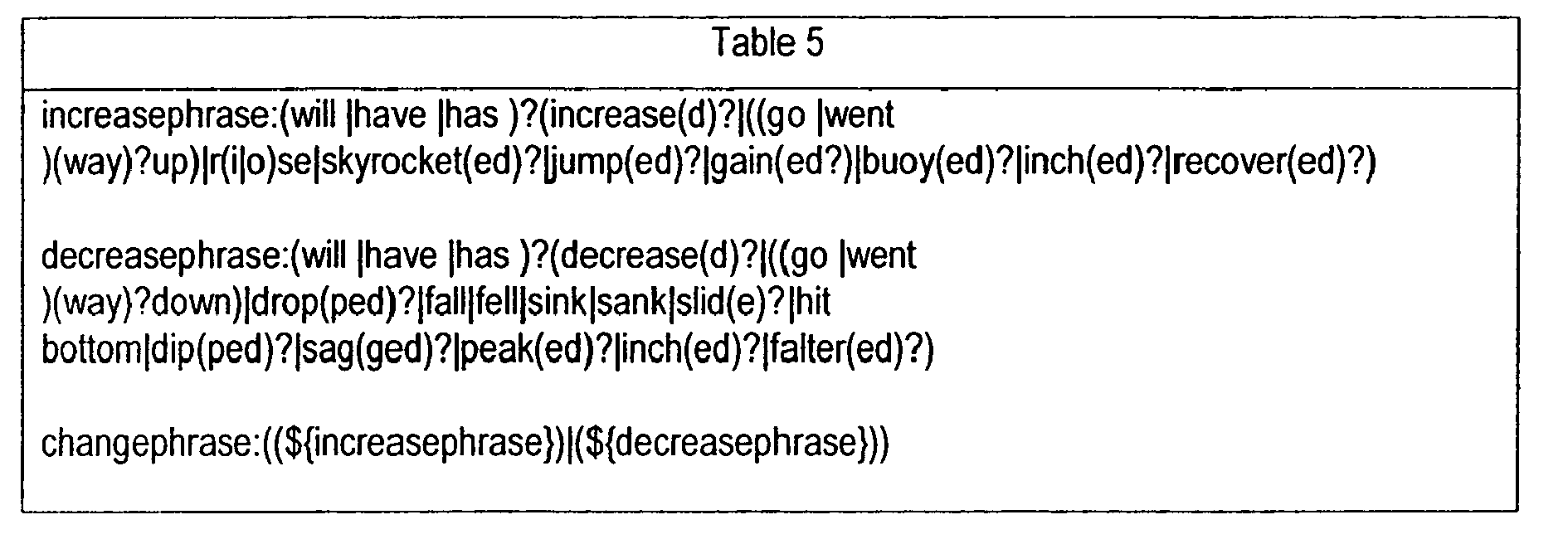
- The grammar shown in Table 5 specifies how to expand variables into regular expressions for pattern matching. In particular, the grammar shown in Table 5 specifies that "${changephrase}" should be expanded into "${increasephrase}|${decreasephrase}". In turn, the grammar specifies that "${increasephrase} is expanded into "(will |have |has )?(increase(d)?|((go|went)(way)?up)|r(i|o)selskyrocket(ed)?|jump(ed)?|gain(ed?)|buoy(ed)?|inch(ed)?|recove r(ed)?). Similarly, the grammar specifies that "${decreasephrase}" is expanded into "(will |have |has )?(decrease(d)?|((go|went)(way)?down)|drop(ped)?|fall|fell|sink|sank|slid(e)?|hit bottom|dip(ped)?|sag(ged)?|peak(ed)?|inch(ed)?|falter(ed)?)".
- The
event analysis system 100 thereby implements macros which allow shorter forms to be used in the event model, allow re-use of common phrases, and that significantly increases the flexibility of the event model. Theevent analysis system 100 may store the grammar in thememory 104, in a file on disk, or in any other location for reference when parsing the event model. - Tables 6 and 7 show examples of the product centered
node 306 and the society centerednode 308.


- Table 8 shows an example of the events established in the
tree 300 and which may be defined in theevent model 128. In the example, Root is the root event, Organization-centered, Product-centered, and Society-centered are children of the Root event. As examples, the Financial, Image, Labor Relations, Legal, Management, Marketing, and Partnering events are children of the organization-centered event. The Analyst Report, Earnings guidance, Earnings report, Market report, and Stock price change are examples of leaf nodes under the Financial node. Any other attributes or regular expressions may be defined for the events or used to locate the events. Event types are very flexible and may be organized, defined, or established into multiple event types in many different ways. For example, one implementation of thesystem 100 may include a Product Price Change event, while another implementation may define separate Product Price Increase and Product Price Decrease events.


- Table 9 shows examples of the attributes (in single quotes) and regular expressions (in double quotes) defined for specific events.
Table 9 Event Attributes and Regular Expressions Financial 'value' and 'valence' Analyst Report or a Market Report 'analyst' and 'issues raised' earnings guidance or an earnings report 'timespan' Stock price change 'percent change', and 'split' "stock price ${changephrase}" "shares ${changephrase}" Image 'issue' ad campaign 'focus' and 'channel' scandal 'person' labor relations 'labor organization' labor demands 'demands' and 'issues' public demonstration 'location', 'message', and 'size' strike 'management positions' and 'labor positions' workforce size change 'number effected', 'location', and 'reason' criminal 'charges', 'prosecution stage', and 'defendant' lawsuit 'suit type', 'dollar value', 'issues', 'prosecution stage', 'plaintiff' and 'defendant' management 'manager name' departure 'reason' "quit(s)?" "resign(s|ed|ing)" "fired" "retir(e|es|ing|ement)" "leaving" "leave(s)?(?!( a))" position change 'old position' and 'new position' marketing 'scope' ad campaign 'topic' and 'channel' charitable donation 'charity' event sponsorship 'event type' "event(?=(.*sponsorship))" "spooser(?=(.*event))" press release 'topic' public presentation 'presenter' and 'location' partnering 'organizations' agreement 'duration' and 'promises' co-branding 'product' joint venture 'type', 'purpose' and 'size' "hooks up with" "joint venture" "joint company" "partner" "teaming" "teams(s) ? (up )?with" "join(s) forces" "combines(s)? forces" "alliance" merger 'acquirer' and 'price' feature 'feature' price 'old price' and 'new price' product discontinuation 'reason' "discontinu(e|es|ed|ing)" "exit(s|ed|ing)? the market" product introduction 'features', 'competitors', and 'price' production location change 'old location' and 'new location' product promotion 'type', 'duration', 'target', and 'objective' ad campaign 'focus' and 'channels' rebate 'amount' "rebate(s)?" "mail-in" award 'award' and 'award source' "award(?!(-| )?winning)" "award(s)?" "winner(s)?" "win(s)?(?=.*(prize|award|honor|best))" "rates(?=.*(top|best|highest))" "name(s|d)(?=.*of the year)" "name(s|d)(?=.*best)" "best(?=.*(of 20\d\d))" "best(?=.*(of the year))" "honor(ed|s)?" "most respected" "prize(s)?" "world(-l )record" "excellence in" design flaw or manufacturing flaw 'plants' recall 'problem type', 'number', and 'cost of remedy' "recall" recall(ing|s)" review . "(magazine|product.) review(s)?" "comparo" "comparison" "round(-)?up" cultural trend 'demographic', and 'strength' attitude change 'target' and 'change direction' demographic change "demographic change" "demographic trend" "change in demographic(s)?" "changing demographic(s)?" environmental 'scope', 'regulatory agency', 'new restriction', 'old restriction', and 'estimated cost' "kyoto treaty" "global warming" "environmental" "epa" "e.p.a." "greenhouse" "greenpeace" "fuel economy" "energy consumption" "emission(s)?" "eco-" technology trend 'technology' obsolescence 'reason' and 'replacement technology' technology development 'technology replaced' - The
environment model 130 defines entities and the relationships between entities. Table 10 shows an example of an XML definition of entities.


- The XML definition shown in Table 9 specifies the list of entities in the
environment model 130 and their attributes. The <orgDef> contains the definition of an Organization entity, the <typeDef> contains the definition of an ProductType entity, the <brandDef> contains the definition of an Brand entity, the <segmentDef> contains the definition of an ConsumerSegment entity, the <modelDef> contains the definition of a ProductModel entity, and the <personDef> contains the definition of an Person entity. By dividing entities into these entity types, thesystem 100 may specify different default relationships for each entity type. For instance, a Consumer Segment entity would generally not have a 'competitor' relationship with any other entity, but a Product Type or Organizational entity may. Furthermore, the distinction between entity types provides more flexibility when displaying events in theuser interface 142, which may then display, as examples, events that involve people, or products, or organizations. For each of different kind of entity (i.e., Organization, Product Types, Brand, Consumer Segments, Product Models, and Person), theenvironment model 130 may specify an identifier (ID), a FullName, a DisplayName, and a list of Identifiers. - The Identifiers are the strings that
event analysis system 100 searches for to recognize the entity when parsing through an article. For example, for Acme Motors, the identifiers may include "ACME" and "Acme Motors", both specify the same entity. The DisplayName field stores the value for the name which is displayed on theuser interface 142, while FullName gives the proper full name of the entity. The ID (e.g., a stock symbol or a short form of the entity name) is the name by which theevent analysis system 100 refers to the entity. - For Organization entities, the
environment model 130 may also specify a OneSourcelD attribute. This attribute may provide a numerical identifier for the organization which theevent analysis system 100 may use to look up information in OneSource online business information (www.onesource.com). Theevent analysis system 100 may also define, for ProductType entities, an EconomicCategory attribute. This attribute may influence how theevent analysis system 100 processes events involving different kinds of products and materials. - Figure 4 illustrates an
entity node 400 for Acme Motor Company, theID 402 is "A" (the stock ticker for Acme). TheOneSourceID 404 of 99999 allows theevent analysis system 100 to connect to OneSource to find more information about Acme. Theentity node 400 defines theidentifiers 406 as "Acme Motor Company," "Acme," or "AcMoCo." Thefull name field 408 gives the full name "Acme Motor Company" and the displayedname field 410 specifies "Acme". For each entity, theevent analysis system 100 may store (e.g., in an entity specific file, database entry, or other storage), a relationship entry for the entity. TheID field 402 may be used as an index or file identifier to locate the relationship entry in a database or in a file system. - The
environment model 130 also defines relationships between entities. Table 11 shows an example of an entity relationship file for XYZ Motor, which is a competitor of Acme.

- The busNet and CMNet nodes are reserved for future expansion, and Figure 4 (in conjunction with Table 11) shows the configuration of an
entity relationship 412. Thefocus node 414 verifies that the content of the relationship entity file is for XYZ Motor Company (and not some other entity). The remainder of the relationship entity file is subdivided by relationship type. Examples are shown in Table 11; any other relationships may be defined and established in the relationship entity file. Figure 4 shows that theentity relationship 412 may define relationships of other entities, places, or things to Acme using a Suppliers field 416 (e.g., "steel"), Products field 418 (e.g., "cars"), ByProducts field 420 (e.g., "emissions"), Competitors field 422 (e.g., "ABC motor"), Substitutesfield 424,Consumers field 426, Complements field 428 (e.g., "gasoline"), Issuesfield 430, Subsidiaries field 432 (e.g., "Volvo", "Jaguar", and "Mazda"), andParent company field 434. - In the examples shown in Table 11, each relationship section is populated with the IDs of the entities that fulfill that relationship. For example, Table 11 establishes that Acme has three defined subsidiaries, Volvo, Jaguar, and Mazda. In other words, Acme is related to Volvo, Jaguar, and Mazda by the relationship of parent to subsidiary. As another example, the entity relationship establishes Acme as a competitor to XYZ using the Competitors field. The
event analysis system 100 may employ the lDs as a database key, search term, or filename to navigate through themodel 130 and to locate additional information about the entities. For example, knowing that XYZ Motor is a competitor of Acme Motor, the event analysis system may then open a file keyed off of the ID (e.g., "XYZ.xml") to determine XYZ's suppliers. - The
event analysis system 100 uses theevent implication model 132 to determine when certain types of events with particular attributes signal the possibility of other events occurring in the future. As one example, if a CEO of a competitor is recruited to head another competitor, it is reasonable to infer that there is an increased chance of the two competitors merging, sharing technology, or otherwise working together. Theevent implication model 132 establishes rules for making the inferences. - As an overview, the
event analysis system 100 adds messages to events. The messages explain that an inference can be made from the event, and/or describe the inference. In addition, theevent analysis system 100 creates new detected events which theevent analysis system 100 may display along with events directly determined from an original article. Furthermore, theevent analysis system 100 may inject the inferred events back into the implication processing flow so that the inferred event may generate additional detected events. - The
event implication engine 138 matches trigger events to possible implications defined in theimplication models 132. An example of animplication model 132 is shown below in Table 12.


- The
event implication model 132 defines individual implication items, shown in Figure 5, each tagged with a 'ThreatAndOpportunityltem' tag. Theimplication items 500 establish one ormore trigger constraints 502 for the triggering event to meet, and a resultingimplication 504 which holds when the constraints were met. Thetrigger constraints 502 may be established as anevent constraint 506 and one ormore attribute constraints 508 for that event. Theevent constraint 506 searches for a match on the event type. - The
implication items 500 may distinguish between multiple different types ofattribute constraints 508. One example is an 'Optional' attribute constraint. The optional attribute constraint signifies that the value of the attribute is not pivotal and may even be unknown or undefined. Optional attributes may be included so that the implications may refer to the attribute by name. - A second example is 'NonEmpty'. The nonempty attribute constraint signifies that the event extraction process has returned a value for the attribute. The specific value is not pivotal.
- A third example is 'Match'. The match attribute constraint signifies that the extracted value for the attribute matches a listed value. There may be multiple listed values which can match the extracted value.
- A fourth example is 'Retationship'. The relationship attribute constraint signifies that the extracted value for the attribute conforms to a relationship defined in the
environment model 130. The extracted value serves as a target for the relationship, and the origin of the relationship is listed in the constraint. The origin of the relationship may refer to another attribute of the event. - The origin may include special parameters, such as "focus" and "fill" parameters. One example is: $FOCUS. The $FOCUS parameter specifies that the origin will be the focus entity of the application. For a particular relationship attribute constraint, the
system 100 may define both parties in the relationship. For some event types, there may not be an attribute to define both parties. For example, in the event type definition of the Hire event, there may not be both of the companies defined as attributes. Instead, there may only be the company that is involved in the hiring. Nevertheless, thesystem 100 may then "lookup" the competitor relationship by specifying that the hiring company is the FOCUS. Thesystem 100 may then check detected hire events, and when the company involved in the hiring event is a competitor to the FOCUS, thesystem 100 may make a match. For example, the FOCUS may be defined as Acme Motors, Inc. A particular hire event at XYZ Motors may not mention Acme, but the FOCUS entity lets thesystem 100 make the connection, since XYZ is a competitor of Acme. A second example is $FILL_<entity>_IS_<relationship>. This parameter specifies that theevent analysis system 100 will fill in the entity from theenvironment model 130. Generally, thesystem 100 will generate one inferred event for a triggering threat event. With the FILL functionality, however, thesystem 100 may generate multiple inferred events from a single triggering threat event. For example, assume an event involving company SupplierX which may have implications for several other companies (namely, for each company which has a supplier relationship with SupplierX). Thesystem 100 may use the FILL functionality to look at the relationship model and pick out each entity that has the supplier relationship with SupplierX. Then thesystem 100 may generate inferred event for each of those companies. - The resulting
implication 504 is the second part of eachimplication item 500. The resultingimplication 504 specifies an action to take when the attribute constraints are met. Each resultingimplication 504 may specify animplication message 510 and animplication event 512. - The
implication message 510 may be implemented as a string (e.g., a human readable text string) that theevent analysis system 100 stores in the event object for the inferred event and outputs through the user interface when there is an event match. The string may embed variables, which may specify the named attributes from theattribute constraints 508 in thetrigger constraint portion 502. In addition, the "focus" and "fill" parameters may provide variables for theimplication message 510. - The
inferred event 512 specifies an output event which may enter the event stream, according to the format described above for events. Thus, the inferred event objects may be saved in theevent database 112, and subject to further implication as well. Theimplication item 500 specifies the event type for the output event and the attributes far the event Any attribute may be left empty, may be set to a specific value, or may be filled using the attribute variable described above. - Figure 6 presents an example of the
acts 600 which the eventprocessing control program 148 may take to coordinate the processing of theevent analysis system 100. The eventprocessing control program 148 scans theinformation sources 116 and retrieves new articles (Act 602). The eventprocessing control program 148 filters (e.g., removes) articles which are not relevant to the entities defined in the environment model 130 (Act 604). As a result, theanalysis system 100 eliminates a significant percentage (e.g., 99% or more) of retrieved information prior to applying the event detection engine on the new articles. The eventprocessing control program 148 initiates execution of theevent detection engine 136 on the retained articles. Theevent detection engine 136 processes each article according to the source and type of data (e.g., text) in the article. Theevent detection engine 136 produces an event record according to theevent model 128 for the events defined in the article, including event type, event attributes, event importance or priority, the source article which describes the event, an address for the article, and referenced organizations, and any other extracted event information (Act 605). Prior to performing event implication, additional filtering may be performed to retain those events which reference entities defined in theenvironment model 130. In addition, theevent detection engine 136 may output information specific to the type of data in which the event was detected. As one example, when the article is a text article, the output of the conversion engine may include a tokenized or parsed version of the text article. - The event
processing control program 148 also initiates execution of theevent implication engine 138 on the event records (Act 606). Theimplication engine 138 produces a description of an implied event which is added to the original event record. Theimplication engine 138 also generates a new event record for an inferred event. - The event
processing control program 148 may signal other entities that newly detected events and inferred events exist (Act 608). The entities may be processes which consume and display events on a graphical user interface, for example. Theevent analysis system 100 may employ a message publication / subscription engine, web services, direct messaging or signaling, email, file transfer, or other communication techniques to notify other entities. Theevent analysis system 100 may thereby create a stream of events (e.g., a stream of event object data) in a form for consumption by client applications. The stream may include each event detected, or may include subsets of detected events, as specified or requested by the client application. - In addition, the event
processing control program 148 may query for and accept manual corrections to any of the automated event detection processing (Act 610). For example, theevent analysis system 100 may accept a correction to a time, date, or place where an event occurred from theuser interface 142. Theevent analysis system 100 may then update theevent database 112 with the corrected event, and re-apply theimplication engine 138 to the corrected event. (Note that we can have manual corrections to the attributes of an event (date, time, place, etc., like you mention), but also to the event type itself. For example, something that is actually a Hire event may be incorrectly machine classified as a Joint Venture event. Accordingly, manual corrections may also apply to the event type itself, and an operator may, for example, change a Joint Venture event to a Hire event, or may make any other change to an event classification. - Figure 7 shows an
event object 700 which theevent analysis system 100 may create, save in theevent database 112, and update as a new article is processed. Theevent object 700 may include atitle field 702, which stores a title associated with the article; alink field 704, which stores a link (e.g., a url link) which specifies where the article may be found; and adescription field 706, which stores a description of the event. In addition, theevent object 700 may include asource type field 708, which identifies the type of source from which the article was obtained; anentity identifier field 710 which stores an identifier of an entity involved in the event; and anevent type field 712, which stores an identifier of the type of event represented in the article. Different, fewer, or additional fields may be provided in any particular implementation. As examples, the additional fields may specify full article text, numerical data, or other data. - The
event object 700 also includes an eventtype probability field 714, which identifies how certain theevent analysis system 100 is that the event occurred; animportance field 716, which specifies how important the event is; and apublic interest field 718, which specifies the level of public interest in the event. Theevent object 700 further includes atokenized title 720, which stores the title of the article broken down into tokens; atokenized description 722, which stores the description of the article broken down into tokens; and attribute fields such as anattribute list 724, which holds the attribute values for the event represented by the event object. Theevent object 700 may also include animplication message list 726, which stores messages returned by the implication process; and an extracted entities list 728, which stores identifiers of entities involved in the event. - The fields shown in Figure 7 are examples only. The
event object 700 may include additional, fewer, or different fields. - Figure 8 shows an example of the
acts 800 which theevent detection engine 136 may take. Theevent detection engine 136 analyzes each article and responsively prepares anew event object 700. An example of the processing is given below, assuming an article received from anRSS information source 116 illustrated in Table 13.
- The
event detection engine 136 parses the article and extracts the title, link, description, and source type information by locating the corresponding xml tags in the article (Act 802). Theevent detection engine 136 then completes thetitle field 702,link field 704,description field 706, andsource type field 708. Table 14 shows the newly created event object.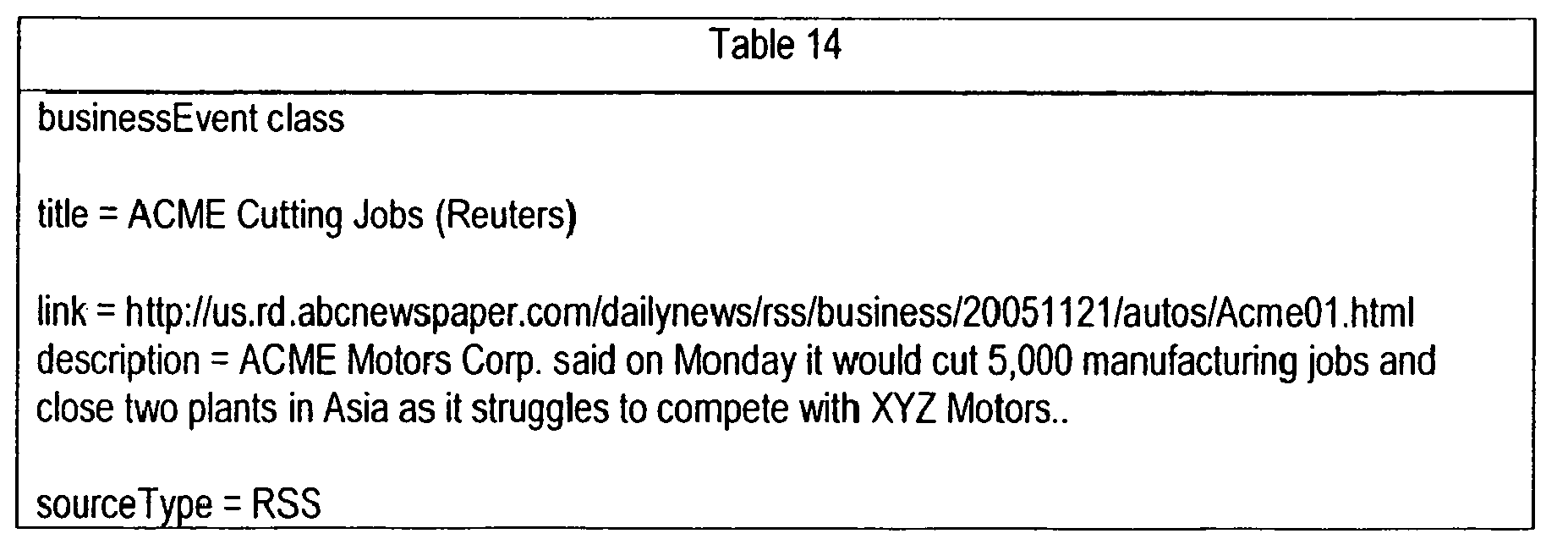
- The
event detection engine 136 then filters the events generated by the initial analysis phase (Act 804). In particular, theevent detection engine 136 retains those event objects which include an entity defined in the environment model 130 (e.g., Acme motor company) and that does not include any exclusion phrases (e.g., "Acme modeling agency") which may also be defined in theevent model 130. Theevent detection engine 136 may perform regular expression pattern matching to search the event object (e.g., the description field 706) for entities defined in theenvironment model 130. Accordingly, theevent detection engine 136 applies a filter to the articles received from the information sources 116. Specifically, theevent detection engine 136 retains those articles and corresponding event objects which are relevant to the entities defined in theenvironment model 130. - During the filtering process, the pattern matching process identifies entities in the event object which are defined in the
environment model 130. As a result, theevent detection engine 136 may set theentity identifier field 710 to an entity identifier (e.g., "Acme") located in the description field 706 (i.e., entityID="Acme"). Thesystem 100 may assign the entityID for an event to the first entity found in that event. For example, an event created by the text "Acme and XYZ Motors to merge" may have only Acme as its entityID. In an alternate embodiment, thesystem 100 may implement each event's entity field as a list including each entity discovered in the article (e.g., a list with two members: Acme and XYZ). - Next, the
event detection engine 136 removes duplicate event objects (Act 806). Because an article may appear multiple times across multiple dates from multiple RSS feeds, the same article may create multiple duplicate event objects. Theevent detection engine 136 may eliminate duplicates by computing a hash value based on the fields of the event object (e.g., the title and description fields). The hash function may be the SHA-1 hash function, or another function which converts a string into a fixed-length (hexadecimal) number. Theevent detection engine 136 determines that an event object is a duplicate when hash values collide. In one implementation, each duplicate event object is removed, leaving one event object which captures the event. - The
event detection engine 136 continues by classifying an event represented in the event object (Act 808). In one implementation, theevent detection engine 136 may apply a classification algorithm to thedescription field 706. The classification algorithm may determine, given the description, whether the description belongs to a specified class (e.g., a particular event defined in the event model 128). The classification algorithm may implement, for example, the naive Bayes algorithm for document classification. The classification algorithm may be implemented with the opensource Rainbow classification engine, or any other classification engine. - The classification algorithm may provide not only the classification of the event, but also the reliability or probability of a correct classification. Thus, the classification algorithm may provide information for the
event type field 712 and the eventtype probability field 714. As examples: eventType='workforce size change' and eventTypeProbabilty=0.99. - The
event detection engine 136 also applies an attribute extraction program to extract attributes for the event (e.g., obtained from the description field 706) (Act 810). The extracted attributes build theattribute list 724. In one implementation, theevent detection engine 136 tokenizes the title (Act 812) and tokenizes the description (Act 814) as part of the attribute extraction process. - To that end, a tokenizing engine breaks the title and event description into a tokenized description, including words, numbers, punctuation, and/or other tokens, and adds the tokens to the
tokenized title 720 andtokenized description 722. A natural language processing engine may perform the tokenizing operation. As an example, the natural language processing engine may be the opensource Natural Language Tool Kit (NLTK). In addition, a tagging engine may assign a part-of-speech tag to each token in the tokenized representations (At 816) to provide a tagged tokenized description. The NLTK may implement the tagging engine. - The
event detection engine 136 also performs named entity recognition (Act 818). In that regard, a named entity recognition engine accepts as input an event object (e.g., including a tokenized tagged description) and performs named entity recognition on the text included in the event object. As examples, the named entity recognition engine may identify personal names, company names, or geographical locations within the text. The named entity recognition engine adds information tags to the event object which describe which named entities exist and where they are located to the event object. In one implementation, the named entity recognition engine may be the ClearForest engine available from ClearForest Corp. of Waltham, MA. - A parsing engine, which takes as input an event object, identifies the grammatical structure of the text (Act 818). For example, the parsing engine may identify noun phrases, verb phrases, or other grammatical structure within a sentence. The parsing engine adds grammatical structure tags to identify the detected structures and identifies which words make up the structures. The tags are added to the
event object 700. The parsing engine may be implemented with a statistical natural language parser, such as the Collins parser. - Next, the
event detection engine 136 performs template matching (Act 820). Theevent detection engine 136 may process an event object and determine a matching event type in theevent model 128. The matching event type defines the attributes for the event. The template matching may then add each attribute and a detected value for the attribute to the event object (Act 822). In one implementation, thesystem 100 performs template filling as described next. Assume that thesystem 100 has already identified all instances of all data types within the event text, where the data types may be a pre-defined "class" of words or terms. For instance, "person" is a data type, and "John Doe" is an instance of the "person" data type. Other examples of data types include date, company name, and job title. - Assume also that preMarkers and postMarkers for all event types have been identified. These markers are phrases that are defined in the
business event model 128, and indicate possible positions of event attribute values. - The
system 100 then examines theevent model 128 to determine what attributes thesystem 100 should search for, for each event, based on each event's event type. For instance, if the event has been classified as belonging to the "Hire" event type, then thesystem 100 may search for five attributes: person, new employer, previous employer, new job title, and the date that the hire becomes effective. - The
event model 128 specifies what data type each of these attributes will have. As examples, the person attribute will be filled with a value that belongs to the person data type, and the new employer and previous employer attributes will be filled with values that belong to the company name data type. - For each attribute, the
system 100 determines whether it has identified any instances of the data type associated with that attribute. For instance, if thesystem 100 is searching to find the value for the "New Employer" attribute, thesystem 100 determines if it has identified any instances of the "company" data type. If thesystem 100 has identified 0 instances of that data type, the system assigns the value 'unknown'. - If the
system 100 has identified one instance of that data type, thesystem 100 checks whether that instance has already been determined to be the value of a different attribute. If so, thesystem 100 assigns the value 'unknown'. If the instance has not been used for another attribute, thesystem 100 may assume that that instance is the value for our current attribute, and thesystem 100 may assign the value to the current attribute. If thesystem 100 has identified more than one instance of the right kind of data type, then thesystem 100 determines whether there are any preMarkers that fall immediately before an instance of the data type, or if there are any postMarkers that fall immediately after an instance of the data type. For example, the phrase "will be joining" may be a preMarker for the "New Employer" attribute. Thus, if an instance of the "company name" data type comes immediately after the phrase "will be joining" in the event text, thesystem 100 may assume that that instance is the value for the "New Employer" attribute. Similarly, if "will join" is a postMarker for the "Person" attribute, and if thesystem 100 sees an instance of the "Person" data type followed by the phrase "will join", thesystem 100 may assume that that instance of the "Person" data type is the value for the "Person" attribute. Thus, the term "Person" is used both as a data type and as an attribute name. If thesystem 100 does not find any cases of an instance of the right data type either preceded by a preMarker or followed by a postMarker, then thesystem 100 may assign the value of 'unknown'. - Table 15 shows an event object, continuing the example above, processed through the template matching phase.

- Optionally, the
event analysis system 100 determines and assigns importance and/or public interest levels (e.g., from 1 to 5) to the detected event (Act 824). The buzz andsentiment engines 140 may provide estimates of the importance and public interest levels. The buzz andsentiment engines 140 may be provided by the Sentiment Monitoring System or Online Analysis System available from Accenture Technology Labs of Chicago II. Alternatively, theevent analysis system 100 may communicate with an external system which performs the analysis of importance or public interest and returns the importance or public interest level, given event objects which theevent analysis system 100 sends to the external system. Theevent analysis system 100 may thereby receive the importance and public interest levels from the external system and accordingly populate the event object in theevent database 112. In determining the importance level and public interest level, the buzz andsentiment engines 140 may consider factors such as organization size, event likelihood, number of articles reporting the same event, length of article, amount of money or personnel at issue, or other factors. - Figure 9 shows an example of the acts which the
event implication engine 138 may take to interpret events, starting with an input of a list of event objects. Theimplication engine 138 reads the implication model 138 (Act 902). Theimplication engine 138 thereby obtains a list of the implication items, trigger constraints, and resulting implications stored in theimplication model 138. - The
event implication engine 138 obtains the next event object from the list of event objects (Act 904) and searches for a match. To that end, theevent implication engine 138 searches for a match between the event type defined in theevent type field 712 of the event object and the event type specified in theevent constraints 506 of thetrigger constraints 502. - If the event type matches, then the
event implication engine 138 also searches for a match to theattribute constraints 508 in the attribute list 724 (Act 908). When the event type and attributes match, theevent implication engine 138 activates the resultingimplications 504. For example, theevent implication engine 138 may generate an implication message (Act 910) and then insert the implication message into the event object which triggered the implication (Act 912). In addition, theimplication engine 138 generates one or more inferred events flowing from the matched trigger constraint 502 (Act 914). The inferred events give rise to new event objects which are inserted into theevent database 112. Thus, a single originally detected event may result in many inferred events, as each new inferred event is processed by the implication engine, established as a new event object, stored in theevent database 112, and processed by the implication engine. - In the process of matching attributes, the
event implication engine 138 creates a temporary variable list, and creates an attribute variable for each attribute named in the constraints. In addition, theevent implication engine 138 creates the focus and fill variables as they are encountered. The focus and fill variables are bound with the actual attribute values from the triggering event (or from the entity-relationship model for the fill variables). Thus, theevent implication engine 138 may use the variables in the implications analysis, having bound the variable values in the constraints analysis. - Table 16 shows detailed pseudo-code for the
event implication engine 138.


- The
event analysis system 100 also facilitates the display of events, including inferred events. To that end, theevent analysis system 100 may produce output files which drive the display of events on theuser interface 142, or which theevent portal 122 may use to display event and event information on theportal user interface 124. - Figure 10 shows an example of the acts which the event
display preparation engine 146 may take to create the output files. The eventdisplay preparation engine 146 obtains the list of event objects, including each event detected by theevent detection engine 136 and the inferred events determined by the event implication engine 138 (Act 1002). The eventdisplay preparation engine 146 writes the contents of the event objects in the list to specific XML display files. In other implementations, however, the eventdisplay preparation engine 146 writes the contents of the event objects into database tables and fields organized, for example, by entity relationship type for further processing by therendering engine 144 orevent portal 122. - In one implementation, the event
display preparation engine 146 adds the contents of the event objects to specific XML display files created for each relationship type established in theenvironment model 130. As examples, there may be an XML display file for Competitors, Suppliers, Products, Consumers, Subsidiaries, or any other defined relationship. Theevent analysis system 100 particular display file chosen to hold the event data depends on the relationship between the event entity and the focus. - The focus entity is the entity on behalf of which the
event analysis system 100 detects and infers events. For example, the focus may be XYZ motors, a competitor of Acme motors. Theevent analysis system 100 may then detect, infer, and display events as they affect XYZ motors. The focus may be set before event detection and implication occurs. In other implementations, the focus may be selected through theuser interface 142, and theprocessing system 100 will initiate the corresponding changes to the reports generated on thedisplay 106 or communicated through theevent portal 122. - Accordingly, the
display preparation engine 146 determines the focus (Act 1004), obtains the next event object in the event object list (Act 1006), and determines the entity specified in the event object (Act 1008). Knowing the focus and the event entity, thedisplay preparation engine 146 may determine the relationship between the focus and the event entity (Act 1010). To that end, thedisplay preparation engine 146 may search theenvironment model 130 for an entity relationship between the focus and the event entity. In the example above, Table 11 defined the environment for XYZ Motor Company. In particular, the environment established a Competitors relationship between XYZ and Acme. More generally, thedisplay preparation engine 146 determines the relationship between the focus and the event entity by searching the environment model 130 (Act 1010). - As a result, the
display preparation engine 146 identifies the specific XML display file in which to write the event data. In the example above, the XML display file is the Competitors display file. Thedisplay preparation engine 146 writes the event data from the event object into the display file (Act 1012). Specifically, thedisplay preparation engine 146 may save the event type, source type, link, description, entity identifier and name, entity attribute names and values, implications and any other event data in the display file. - Table 17 shows an example of the contents of the display file, continuing the example above regarding the layoffs at Acme Motor Company.


- Given the display files or database entries, the
event analysis system 100 renders the events on theuser interface 142. Figure 11 shows an example of acompetitor display 1100 rendered on theuser interface 142. Theevent analysis system 100 may display one or more events associated with a particular entity, events of a particular type, events within a specific date range, events obeying a particular relationship, or any other set of events. Theevent analysis system 100 may read a configuration file of operator preferences to determine how many events to display, what date ranges to display, or to determine any other display parameter (including, as examples, color, font size, and data position on the display). Thesystem 100 may also accept input from the operator to select and modify one or more of these parameters. - The
user interface 142 includes adisplay selector 1102, through which an operator may select the information which will be shown on theuser interface 142. As shown in Figure 11, the display selector is set to Competitors. Theevent analysis system 100 responds to thedisplay selector 1102 by responsively updating the display to show the requested information, such as events involving all Competitors, Products, Suppliers (or specific individual Competitors, Products, or Suppliers), or any other relationship defined in theenvironment model 130. - In particular the
competitor display 1100 includes the Acmecompetitor event window 1104 and the ZZZ Motor Companycompetitor event window 1106. Additional competitor event windows may be displayed, one for each competitor defined in theenvironment model 130 with regard to the current focus. The Acmecompetitor event window 1104 includes threeevent panes competitor event window 1106 includes fourevent panes - Each event pane 1114 - 1120 displays the data for an event involving a particular competitor entity as detected by the event analysis system. In addition, each event pane may display an importance indicator. As an example, the
importance indicator 1122 shows that the layoffs at Acme motor company have been assigned alevel 5 importance. Navigation buttons 1124 (in this case arrow buttons) allow the operator to move between multiple pages of event panes. - The
user interface 142 may also provide drill down links. For example, any of the event panes 1108 -1120 may operate as a drill down link when clicked. In response, theuser interface 142 may display an event detail window. - Figure 12 shows an example of an
event detail window 1200 for the Acme layoff event. Theevent detail window 1200 includes anoverview pane 1202, abuzz analysis pane 1204, and apotential implications pane 1206. Theevent detail window 1200 also includes asources pane 1208 and asource text pane 1210. Theevent detail window 1200 may vary widely in content, however, and is not limited to the form shown in Figure 12. - The
overview pane 1202 specifies the event type, event importance, and event attributes for the event. The operator may change any of the entries in theoverview pane 1202 using the Edit / Confirm / Cancelinterface buttons 1212. When editing the entries, theuser interface 142 may provide text entry fields, drop down selection menus, selection buttons, or any other user interface element which accepts modified event data. Any modifications may feed back into theanalysis engines 134, and initiate a revised analysis (e.g., a revised implication analysis) based on the modified information. - The
buzz analysis pane 1204 displays the public interest level with regard to the event. As noted above, the buzz andsentiment engine 140 may gauge the public interest level. Alternatively, theevent analysis system 100 may obtain the buzz and sentiment level from external measurement systems. - The
sources pane 1208 displays the article title and the article source. In the example shown in Figure 12, the article title is "Acme slashing production and jobs." Theinformation source 116 from which the article was retrieved is identified as ABC Newspaper. Thesource pane 1208 may include a drop down menu from which the operator may select from multiple sources reporting the same event. Thesource text window 1210 displays the text of the article received from theinformation source 116, while thesource link button 1212 provides a mechanism by which theevent reporting system 100 may open and display the original article from the original information source (e.g., by opening a web page addressed to the link at which the article is found). - The
event analysis system 100 may interact with or provide graphical tools 150 for building any of the models described above. For example, a graphical tool to build theenvironment model 130 may provide a focus selector, an entity relationship selector (e.g., to choose between Competitor, Consumers, and Products relationships), and a selection pane of entity types (e.g., organizations, brands, or product types) to add to the selected entity relationship. The environment model tool may also provide a pane with interface elements which display and/or accept input to set the attributes of the entities, such as displayed name, full name, ID, identifiers, OneSourceID, and other attributes. - Figure 13 shows one example of a graphical user interface
front end 1300 to an environment model tool. Thefront end 1300 shows afocus selector 1302, anentity type pane 1304, and an entitytype selection pane 1306. Theattributes pane 1308 displays and accepts input to set specific attributes of the entities. - Similarly, an event model tool may provide a tree node editing pane in which the operator may add or delete leaf and non-leaf event nodes. The event model tool may also provide a pane which displays and accepts input which defines or modifies event type properties, including colors, parent and/or child nodes, event attributes, regular expressions, weights, and any other characteristic of an event.
- Figure 14 shows an example of a graphical user interface
front end 1400 to an event model tool. Thefront end 1400 includes anode editing pane 1402 for adding, modifying, and deleting nodes in theevent model 128. Thefront end 1400 also includes anevent properties pane 1404 which displays the properties assigned to an event type. In addition, an eventtype editing pane 1406 displays and accepts operator input to set, change, or delete regular expressions and weights assigned to the regular expressions. - An implication model tool provides a graphical mechanism for an operator to define and modify elements of the
event implication model 132. To that end, the implication model tool may provide a window in which new threat and opportunity items (i.e., trigger events) are established. To that end, the implication model tool accepts operator input for selecting, defining, or modifying a trigger constraint (e.g., a New position trigger type), one or more attribute constraints (e.g., a Match or Non-Empty constraint), and attribute constraint properties, including the values which will satisfy the constraint. Furthermore, the implication model tool may accept operator input to select a corresponding resulting implication, as well as define the implication messages and events. In addition, the implication model tool also provides a selection interface for assigning trigger events to specific events defined in theevent model 128. - Figure 15 shows an example of the graphical user interface
front end 1500, including animplication model window 1502 and a threat /opportunity editing window 1504. Theimplication model window 1502 displays events and implication rules defined for the events. Theediting window 1504 displays the implication rules, and allows the operator to add, change, or deletetrigger constraints 502 and resultingimplications 504. - Similarly, a graphical user interface may be provided for accepting, modifying, and deleting information which establishes the
information source model 126. To that end, thesystem 100 may provide input interface elements for accepting an information source name, url (or other locator or specifier), a connection method (e.g., RSS, FTP, HTTP), an update frequency, a reputation level, or any other information which the operator desires to add to characterize the information source. - Each of the modeling tools 150 separates the user from the underlying XML code in the models 126-132. The modeling tools 150 convert from the graphical elements to corresponding entries in XML statements which compose the models 126-132. For example, when an operator ads the "XYZ Motor" element to the competitors list for Acme motors, the modeling tool may insert a new organization ID tag into the Competitors list for Acme in the
environment model 130. Accordingly, the operator is not burdened with writing XML to define, modify, and change the models. - The
event analysis system 100 solves several challenging technical problems surrounding event detection and implication. The fundamental problem is to automatically detect and relate to users information about external events. One associated problem was to determine how to design models which facilitate event detection and implication. Thus, for example, theenvironment model 130 stores descriptions of entities that make up the competitive ecosystem for a particular industry, as well as relationships between those entities. In order to filter out events that do not reference any entities in the model, thesystem 100 attaches key phrases to the entities in the model. Thesystem 100 may thereby detect when an article mentions an entity which is relevant to the operator. The relationships stored in the model help the system infer how certain events may affect particular entities, based on the location of the entities in the business ecosystem. Furthermore, theenvironment model 130 helps theuser interface 142 display events in an organized manner. - Additionally, the
event model 128 was built to store descriptions of the event types which thesystem 100 will detect and process. Each description includes key phrases through which thesystem 100 detects instances of that event type (in other words, classify input data as belonging to a specific event type). In addition, theevent model 128 instructs thesystem 100 about which key pieces of information (attributes) to extract from instances of that event type. Theevent model 128 also provides a structure for the inference rules applied by the implication engine, and includes information on how to display each event in theuser interface 142. - In addition, the
event implication model 132 stores interpretive rules which thesystem 100 applies to determine what future events may occur based on existing events. Each rule in the model may specify which event type and attribute values should match in order for the implication engine to generate an implied event from an existing detected event. Finally, theinformation source model 126 stores descriptions of online data sources. Theinformation source model 126 specifies how the system collects information from the data sources and how to resolve conflicting data pulled from the data sources. - Another problem was viewing and maintaining the models. The modeling tools described above allow the operator to view and maintain the models in a way that does not presuppose any understanding of XML or XML-editing tools. To that end, the modeling tools provide a custom display for each of the models, and provide a rich graphical user interface through which the operators may view, add, delete, or edit entries in each of the models. The modeling tool converts the graphical elements to well-formed XML that conforms to the appropriate schemas for the models. Accordingly, the modeling tools generate XML which the
system 100 may parse without requiring manual coding. - Another technical challenge was providing a client-specific event processing application driven by the models. The technical challenge was addressed by breaking the event processing into several distinct steps. First, the
system 100 consults theinformation source model 126 to determine from which online sources to obtain articles. The articles are augmented with information about the source itself, such as source reliability or source importance, and then converted into a standard format to be consumed by the application's processing engines. Next, thesystem 100 applies theenvironment model 130 to filter out content which is not of interest, according to the particular industry focus for the particular system implementation. - After the input data stream has been filtered, the
system 100 uses theevent model 128 to drive the classification of the data. The result is a classification into an event type. Theevent model 128 includes a list of possible event types and representative text phrases to aid in the classification process. Theevent model 128 also drives extraction of attribute information for each event. To that end, theevent model 128 includes a list of particular attributes to extract for each event type and representative text patterns to aid in the extraction process. Thesystem 100 may then apply theevent implication model 132 to drive the inference of new potential events from existing events. In the implication engine, each inference rule contained in the model is applied to each input event to find matches. A match results in an implied event. As described above, the eventdisplay preparation engine 146 then creates output XML files which drive theuser interface 142 to report the events. - The
event analysis system 100 may include additional features. One feature is multi-step implications. In addition to single step inferences as described above, theevent analysis system 100 may perform inferences of arbitrary depth. To that end, theevent analysis system 100 may employ, for example, a first-order frame-based logic system that supports multiple step inferences as the underlying reasoning engine. The Knowledge Machine (KM) open source logic system, for example, may implement the underlying reasoning engine for theevent analysis system 100. - The
event analysis system 100 may also implement reasoning control logic that interacts with KM. The reasoning control logic evaluates the implications to prevent non-sensical conclusions from being made. The reasoning control logic may incorporate a weighting system that specifies weights associated with each event. The reasoning control logic may propagate the weights to direct conclusions which in turn are propagated to additional conclusions based on the direct conclusions, and so forth. At each step in this process, the reasoning control logic may adjust the weights according to a pre-defined weighting strategy. If the weights fall under an implication weight threshold, then the reasoning control logic may inform KM to stop pursuing the line of inference. - A second feature is link discovery. In addition to detecting potential threats and opportunities, the
event analysis system 100 may automatically investigate the bigger picture. In one implementation, theevent analysis system 100 connects together the events that it detects though using link discovery logic. For example, the following events might be connected by a merger that is taking place (but not yet reported): 1) there are a lot of activities within the HR departments of companies X and Y, and 2) there are high-level talks between these same companies. The link discovery logic may operate by matching the above events with a library of models encoding activities of interest (e.g., mergers, takeovers, or other activities) and selecting the model with the best match. The link discovery logic may employ a flexible semantic matcher, as one example. - A third feature is enhanced matching logic that assists with building rich event descriptions by finding better fitting event models. The
event analysis system 100 detects events from various sources (e.g. news articles, internet, and the intranet) and builds a rich description of these events that includes the participants, causes, environment, location, and other event characteristics. For example, given the headline "Computer company 'X' rocked by scandal caused by unethical behavior", theevent analysis system 100 may detect that there is a scandal event, include in its description of this event that company 'X' is the company affected by the scandal, and that the scandal is the result of unethical behavior. - The enhanced matching logic may then build on the underlying description. For example, the enhanced matching logic may implement a multiple step process. The first step may include generating a set of candidate descriptions from the article of information based on linguistic information in the article, such as part of speech, the subject, the direct object, and so on. The part of speech information may be provided by NLTK or another analyzer. The subject, object, and other language constructs may be provided by existing parsing logic including the Collins Parser or the Chamiaks Parser. The enhanced matching logic may then match each candidate description against existing event models to select the candidate with the best match to serve as the final description of the event. The enhanced matching logic may use a flexible semantic matcher for the matching. Thus, continuing the example above, the enhanced matching logic may instead determine, based on the linguistic analysis of the article, that the article more closely fits with a model defined to capture unethical behavior in large corporations.
- The features noted above may also be incorporated into the technology analysis system described below that tracks developments in technology with respect to a technology hypothesis. The technology analysis system may implement a sensor description language (SDL) to establish a set of sensors that track technology. The technology analysis system may assign a sensor relevance score to each sensor. The sensor relevance score may depend, for example, on the particular technology being tracked and the state of that technology. For example, it may not make sense to track the price of a technology that is still under development, and the sensor relevance score for developing technology may reflect a lower relevance. The sensor description language may facilitate the integration and management of these sensors. Each sensor may provide a description of the type of information it provides, the signals it monitors, and its confidence in the quality of the information collected. The technology analysis system analyzes the descriptions to decide which sensors to use (or focus on) based on its models.
- The technology analysis system may also include a technology flow model. The technology flow model describes the maturation stages a technology undergoes. In one implementation, the stages are: 'Development', 'Introduction', 'Growth', 'Competition', 'Maturity', and 'Decline'. Each stage of the technology flow model may define the scope within which a technology should be tracked. The 'Introduction' stage, for example, may specify that the technology analysis system should detect or otherwise focus on signals including media buzz and start up companies, as examples. The 'Competition' stage, on the other hand, may specify that the technology analysis system should detect or otherwise focus on marketing buzz by vendors of the technology and hiring activities. The technology analysis system may give more weight to detected event in information that meets the specifications (e.g., marketing press releases) for the particular maturation stage of the technology under analysis in the technology hypothesis.
- Furthermore, the technology analysis system may incorporate technology hypothesis model. The technology hypothesis model may specify how a technology may progress and what impacts (both social and business) it may have. Each technology hypothesis model may also include relevant events and indicators that the technology analysis system should track to confirm (or disprove) the stated hypothesis.
- An example hypothesis might state that smartphones will begin to support complex applications. The technology hypothesis model may include relevant events and indicators, as examples, advances in battery technology and decrease in battery price respectively. Guided by this model, the technology analysis system may detect new scientific advances such as fuel cell technology and track battery prices on popular ecommerce websites. The information detected in the articles may then be analyzed against the technology hypothesis model to determining whether underlying precursor predictions are met, disproved, or underdetermined.
- Figure 16 shows a technology analysis system 1600 ("
system 1600"). Thesystem 1600 monitors information available frominformation sources 116 connected to both publicly and privately distributed networks. Thesystem 1600 retrieves the information, such as news articles, blog entries, web site content, and electronic documents (e.g., word processor or spreadsheet documents) from the information sources for analysis. - Once retrieved, the
system 1600 analyzes the article for technology events. The technology event details may be extracted from the article and represented in a standardized way for further processing. Thesystem 1600 may discard articles that are not relevant with respect to a technology hypothesis, intermediate hypotheses, or precursor prediction nodes. In particular, thesystem 1600 determines relevant technology events, determines the applicability of the technology events to the technology hypothesis, and alerts other systems, individuals, or other entities of the impact of the technology events on the technology hypothesis. - The
technology analysis system 1600 includes aprocessor 102, amemory 104, and adisplay 106. In addition, anetwork interface 108, aninformation database 110, and anevent database 112 are present. Theinformation database 110 stores articles received over thenetwork 114 from the information sources 116. Theevent database 112 stores event objects constructed using information obtained from the articles, and modified and extended by further processing in theevent analysis system 100. The event objects may share a common event structure which is independent of theinformation sources 116 from which the articles are received. The common format of the event structure facilitates subsequent processing of the event objects by a wide range of analysis tools, described below. - The
system 1600 may communicate the detected technology events, implications of the technology events (e.g., in the form of a newly created technology event flowing from an implication of a previously detected event), or both, for further processing by external entities. Figure 16 shows an example in which anautomated alert system 118 consumes originally technology detected events and inferred events produced by thesystem 1600. Theautomated alert system 118 may include comparison logic which watches for specific types of events and produces an alert. Thealert system 118 may send the alert to an individual or other system (e.g., a PDA, a personal computer, or pager) to perform a notification that the event has occurred or that the event has the potential implication determined by thesystem 1600. As an additional example, the enterprisedata integration system 120 may include a database management system or other information processing system which integrates event data into other data maintained for an enterprise. - A
technology portal 1602 provides a remote external interface into thetechnology analysis system 1600. Thetechnology portal 1602 may implement aportal user interface 124 which supports login, communication, and remote event display using the system 1600 (or the event analysis system 100). Thetechnology portal 1602 may provide a representation (including text and/or or graphical elements) of the events (including inferred events arising from implications of existing events). The representation may assist, for example, a technology review or decision support role of the operator of thetechnology portal 1602. - The
technology analysis system 1600 may publish event descriptions in a standardized format. For example, thetechnology analysis system 1600 may publish Java Specification Request (JSR) 168 standard descriptions that any portal server or portlet meeting the JSR-168 standard may consume, process, and display. Theanalysis systems - The
memory 104 stores one or moretechnology hypothesis models 1604,technology event models 1606,technology implication models 1608, andtechnology flow models 1618. Thememory 104 also storesanalysis engines 1610. Theanalysis engines 1610 may include a technologyevent detection engine 1612 and anevent implication engine 1614, as examples. Themodels engines technology flow model 1618 establishes one or more flow stages (e.g., the flow stage 1620) and flow stage weights (e.g., the flow stage weight 1622). As noted above, the flow stages divide technology maturity into segments, during each of which a different weight may apply to events detected from articles received by thesystem 1600. - In addition to supporting remote delivery of event descriptions, hypothesis status displays, and other information to the
technology portal 1602, theprocessor 102 may also generate auser interface 142 on thelocal display 106. Theuser interface 142 may locally provide graphical representations of technology events and their implications organized by technology hypothesis, precursor predictions, or in another manner to an operator using thetechnology analysis system 1600. To that end, the technology analysis system 1600may include arendering engine 144. Therendering engine 144 may be implemented with programs which generate text and/or graphical representations (as examples, dashboards, charts, or text reports) of the events and their inferred events in theuser interface 142. Therendering engine 144 may include a program such as Crystal Reports (TM) available from Business Objects of San Jose California, or any other drawing, report generation, or graphical output program. Therendering engine 144 may parse output files generated by the eventdisplay preparation engine 146. In one implementation, therendering engine 144 consumes event descriptions meeting a standardized format, such as JSR-186, and prepared by the eventdisplay preparation engine 146 or other logic. - A
technology analysis program 1616 coordinates the processing of thesystem 1600, as described in more detail below. Thenetwork interface 108 connects thesystem 1600 to thenetworks 114. Thenetworks 114 may be internal or external networks, including, as examples, company intranets, local area networks, and the Internet. Thenetworks 114 connect, in turn, to the information sources 116. Thesystem 1600 connects to theinformation sources 116 specified by theinformation source model 126 in thememory 104. Accordingly, theprocessor 102 reads theinformation source model 102, determines whichinformation sources 116 to contact, then retrieves articles from theinformation sources 116 through thenetworks 114. - Figure 17 shows an example of a
technology hypothesis model 1700, implemented, for example, in XML. Themodel 1700 includes aroot level hypothesis 1702 that thetechnology analysis system 1600 will ultimately track. In this example, theroot level hypothesis 1702 is that smartphones will run complex applications (e.g., word processors and spreadsheets, in addition to basic voice messaging applications). - The
model 1700 establishes precursor prediction nodes that underlie theroot level hypothesis 1702. More specifically, themodel 1700 establishes individual precursor prediction nodes grouped into intermediate hypothesis that underlie theroot level hypothesis 1702. In the example shown in Figure 17, theroot level hypothesis 1702 requires that two intermediate hypotheses are met: the intermediate hypothesis 1703 (i.e., the battery energy capacity will reach 1000 mAH) and the intermediate hypothesis 1704 (i.e., that cell processor capability will increase 400%). - The
intermediate hypothesis 1703 includes two precursor prediction nodes (e.g., nodes that have no further underlying predictions): the precursor prediction node 1706 (i.e., that lithium ion chemistry will improve 40% over existing levels), and the precursor prediction node 1708 (i.e., that energy density will increase 25% over current levels). Similarly, theintermediate hypothesis 1704 includes two precursor prediction nodes: the precursor prediction node 1710 (i.e., that cell processor speeds will reach 1 GHz), and the precursor prediction node 1712 (i.e., that cell processors will evolve to include at least two independent cores). - The
model 1700 may establish any logical relation between the intermediate hypotheses and the precursor prediction nodes to be met in order to satisfy any intermediate hypothesis or root level hypothesis. For example, themodel 1700 may specify that theintermediate hypothesis 1703 may be met when theprecursor prediction node 1706 AND theprecursor prediction node 1708 are met. As another example, themodel 1700 may specify that theintermediate hypothesis 1704 may be met when either theprecursor prediction node 1710 OR theprecursor prediction node 1712 are met. The technology analysis system may mark any precursor prediction node, intermediate hypothesis, or root level hypothesis as satisfied, indeterminate, disproven, rejected, or any other status when the technology analysis system detects events that satisfy, disprove, reject, or otherwise meet or refute the precursor prediction nodes, intermediate hypotheses, or root level hypothesis. - The
technology analysis system 1600 permits automated tracking of the technology hypothesis as the precursor predictions do or do not come true, thereby turning an otherwise static vision into a living asset. For instance, an operator who wanted to the use the hypothesis as guidance for determining where to invest may view the hypothesis status display to see how well the technologies envisioned to be important really are maturing. Thus, the root hypothesis includes of a set of inter-related hypotheses (some of which may be implicit when the root hypothesis is presented) about how various technologies will progress, what social and business impacts they will have, and other characteristics. Thetechnology analysis system 1600 tracks events and indicators relevant to those hypotheses, and alerts operators to technology events in the business environment and how they relate to the technology hypotheses. - The technology
event detection engine 1612 may be an extension of theevent detection 136 that is tailored to search for the technology related events, for example by using search strings, tests, logical relationships, and other processing features specific to themodel 1700. Thetechnology analysis system 1600 thereby provides indicators, or web-based sensors, integrated around a model of technology emergence and maturation representing a technology hypothesis. - Figure 18 shows an example of a dynamic
hypothesis status display 1800 derived from thetechnology hypothesis model 1700. Thesystem 1600 generates thestatus display 1800. In the example shown in Figure 18, thestatus display 1800 shows the status of theroot level hypothesis 1702 as a stoplight indicator (e.g., red, green, or yellow to indicate disproven, established, or indeterminate). Thestatus display 1800 includes drill down links for the operator to activate to investigate the reasons underlying the root level hypothesis status: the drill down links, 1802, 1804, and 1806. Thestatus display 1800 may be implemented in many other manners, including as a dynamic document, such as a PowerPoint or Word document with content or embedded links to status that thetechnology hypothesis system 1600 dynamically updates. Furthermore, thetechnology analysis system 1600 may report the status to subscribers or other third parties as noted above in connection with theautomated alert system 118 anddata integration system 120. - Figure 19 shows the acts that the
technology analysis system 1600 andtechnology analysis program 1616 may take to analyze a technology hypothesis. Thesystem 1600 reads the technology hypothesis model 1700 (Act 1092). As thesystem 1600 gathers articles from the information sources, thesystem 1600 detects technology events and implied events (Act 1904). - When there are events or implied events to process, the
system 1600 obtains the next technology event (e.g., stored as an event object) (Act 1906). Thesystem 1600 then compares the data in the event object to the matching data (e.g., text strings such as "battery capacity" or other matching data or specified attribute data for the technology event) associated with precursor prediction nodes, intermediate hypotheses, and root hypothesis. Thesystem 1600 may thereby detect technology event matches (e.g., that mobile battery capacity has increase 10% since last year) (Act 1908). - If the
system 1600 finds a matching event, thesystem 1600 may update the status of the precursor prediction nodes, intermediate hypotheses, and root hypothesis accordingly (Act 1910). At any time, thesystem 1600 may generate or update a hypothesis status display 1800 (Act 1912). In addition, thesystem 1600 may notify system subscribers, operators, or other interested parties regarding the hypothesis status, detected technology events, and any other technology status data (Act 1914). - Figures 20, 21, and 22 show portal user interfaces that present events detected by the event and
technology analysis systems - The
user interface 2000 shown in Figure 20 includes amenu bar 2002 for selecting specific event displays by highlights, event types, geography, or any other filter characteristic. Asearch interface 2004 provides a mechanism for searching the events, implications, technology hypothesis, and/or any other data maintained in thesystems user interface 2000 provides ahighlight window 2006 that displays an event summary, including the number of new events, the number of new events exceeding a predefined importance threshold, the number of events that meet a predefined alerting criteria, the most common type of events, and the most active competitors and suppliers. - The
user interface 2000 also includes a mostrecent event display 2008, showing a configurable number of the most recent events that thesystems user interface 2000 further includes amatching event display 2010 that displays a configurable number of the most recent events that match a specified after criteria. Relevance rankings (e.g., the relevance ranking 2012) are also displayed. - The
user interface 2100 includes anavigation panel 2102 that may provide convenient selection through a drop down menu, text entry box, or other input, of the type of events displayed with respect to a focus entity, such as another business or technology type selected through a drop down menu, text entry box, or other input. Theuser interface 2100 then provides one or more responsive event displays. In the example shown in Figure 21, the event displays 2104 and 2106 are specific to particular competitors. - Figure 22 shows additional examples of
user interfaces user interface 2200 shows a productintroduction event display 2202 including the event signals 2204 andevent implications 2206. Theuser interface 2250 shows aimplication detail display 2252, including the underlying inferences 2254 (e.g., implications) behind the implication. - The
user interfaces analysis systems - The technology analysis system may take the form of business-aware web clients. The web-clients may provide business relevant conclusions, and may employ a semantic model of the business dynamic that the users operate in to automatically process both structured and unstructured content, such as network (e.g., Internet or World Wide Web) content.
- The technology analysis system allows the operator to tell the system what a particular company does, its investment goals, and other areas of interests. The technology analysis system responds with relevant events and their potential implications to the company. In some implementations, the technology analysis system, may, on its own, discover meaningful patterns to form reliable predictions.
- Figure 23 shows a business-
aware web client 2300. Theweb client 2300 receives unstructured information from external networks (e.g., the Internet). Theweb client 2300 usesweb sensors 2302 anddetection models 2304 to produce structured events. A reasoner 2306 (e.g., an event implication engine) employsreasoning models 2308 to determine events of interest or event implications for the operator. As shown in Figure 23, the reasoner may operate on structured events received as such, e.g., from sources of structured events. - The
web sensors 2302 may encode and employsemantic models 2310 for sensors that detect relevant signals from information sources, such as the Web. The semantic models may encode the type of event being detected, from what source, and the confidence in the information reported by the sensor. For example, a semantic model for Mergers-and-Acquisition sensor may be implemented as: - Sensor:
- Mergers-and-Acquisition
event-type-detected: Mergers-and-Acquisition-Event
source: CNN
confidence: High - The
semantic models 2310 of the sensors provide an abstraction of the actual algorithms used to detect events of interest. As a result, thesemantic models 2310 provide a decoupling of the actual implementation of the sensor from the rest of the system. These models also enable thereasoner 2306 to determine on its own which sensors to invoke to detect an event of interest by examining relevant information from the models of the sensors (e.g. event-type-detected). - The technology analysis system may apply the
reasoner 2306 in several different ways. For example, the system may use thereasoner 2306 to introspect on what events the reasoner needs to look for to satisfy a particular model such as the technology roadmap model, or other models noted above. As another example, the system may use thereasoner 2306 to determine which sensors to invoke based on thesemantic models 2310 of the sensors. - Figure 24 shows an interaction diagram 2400 for event implications. The
reasoner 2306 interprets the implications of the detected events, usingreasoning models reasoning models sensors 2302 detect relevant events and generate the corresponding structured representations. - In summary, the business event advisor extends the business awareness vision outward. Thus, the system may monitor the external environment that a specific company operates in and spot and interpret potential threats and opportunities as early as possible. The system may also produce a stream of structured descriptions of business-related events that may populate decision support portals, trigger alerts, and integrate with enterprise business intelligence systems. The event models capture the business events that are relevant to an organization and its business. For example, 'Recall' events may be more relevant to product companies than 'Service' events. The entity models capture the operators within a specific business ecosystem, including the competitors, suppliers, customers, and their relationships to each other. The business threat and opportunity models capture how relevant business events affect each other both positively (i.e., opportunities) and negatively (i.e., threats).
- The technology analysis system provides an automatic, continuous, and systematic way of tracking technologies to justify investment decisions. The operator informs the system about, as examples, the organization, its investment activities, and technologies of interest. The system tracks technologies to produce an assessment of a technology's maturity, a stream of evidence supporting the assessment, and other characteristics.
- With reference to Figures 17 and 19, a technology roadmap model captures the stages that a technology advances through as it matures and the gates to be met in order for a technology to advance into a particular stage. Figure 25 shows an
executive summary 2500 resulting from application of a technology roadmap model. Theexecutive summary 2500 may provideactivity level indicators 2502 for specific technology windows 2504 (e.g., a window for Mobile Wi-Max). Theexecutive summary 2500 also provides a gateactivity summary display 2506 and agate summary display 2508, optionally including drop down or other user interface functionality. Theexecutive summary 2504 also includesmaturity selection tabs 2510, by which the operator can select a display focus on any particular maturity stage (e.g., Potential, or Growing), and the related gate activities and state of gates discovered, analyzed, and/or stored in a database. - Figure 26 shows an
activities summary interface 2600 resulting from application of a technology roadmap model. Theactivities summary interface 2600 may include asummary display 2602 that shows a concise report of the technology activities detected over a pre-determine time span (e.g., 1 week, 1 month, 6 months, or 1 year). Figure 27 shows the state of gates interface 2700 in a technology roadmap model. Thestate 2700 may include aprogress display 2702 for one or more gates, including the gate name, the gate description, the number of events required, the number of events found, and agraphical indicator 2704 of progress, including a marker that shows the requirement level for any particular gate. Figure 28 shows anevidence interface 2800 supporting gates in a technology roadmap model. Theevidence interface 2800 includes anevidence display 2802 that conveys the evidence (e.g., detected events) that support the gate conditions. Any of the information noted above may be displayed with hyper-links to the source of the information (e.g., a source news article). Figures 25 - 28 illustrate how a technology roadmap model may assist with determining when a technology (in this instance Wi-Max) evolves from an Emerging to a Growing market stage. - The technology roadmap model may capture several different maturity stages, such as: 'Pre-Market': The technology has business relevance but is in the research stages and cannot be purchased; 'Potential Market': The technology can be purchased; 'Emerging Market': There is a commercial sale/deployment of the technology; 'Growing Market': There are several sales/ deployments of the technology; 'Mature Market': The market has solidified with only a few major operators left; and 'Declining Market': The technology is on its way out.
- As one example, the technology roadmap model may establish one or more advancement gates (e.g., conditions to be met for advancement), for one or more entities, as shown in the Table below:
Table - advancement gates Vendor: Start up company has popped up. Sales/deployments by vendors of the technology. Customer: Deployments by handset manufacturers. Deployment of services around the technology by software vendors. Media: Media hits on the technology. Standards/Forum: Formation of standards bodies and forums. Participation in standards bodies/forums by major operators. Standards activities (e.g. ratification, adoption, etc). Announcements: Announcements by major operators - i.e. expansion plans, tests, and trials. Public Interest: Public interest in the technology. Publication: Publications in academic venues (e.g. IEEE). White paper publications on the technology. Analyst: Analyst sentiments toward the technology. University: Adoption of technology by colleges/universities. - One example of advancement gates (these may be logically ANDed ORed, or otherwise connected together) to determine when a technology is at the 'Pre-Market' stage is shown below:
- Vendor:
- At least one startup company has popped up.
- Announcement:
- At least one major industry research lab has announced plans to work on technology.
- Publication:
- At least one publication on the technology in an academic venue (e.g. IEEE).
- One example of advancement gates (these may be logically ANDed ORed, or otherwise connected together) to determine when a technology is at the 'Potential Market' stage is shown below:
- Vendor:
- At least one company is selling the technology.
- Standards/Forum:
- At least one standards body/forum has been formed.
- Announcements:
- 5 major announcements.
- Media:
- 10 media hits in industry specific media.
- Publications:
- Over a dozen academic or whitepaper publications.
- One example of advancement gates (these may be logically ANDed ORed, or otherwise connected together) to determine when a technology is at the 'Emerging Market' stage is shown below:
- Vendor:
- 1 commercial sale/deployment by a vendor of the technology.
- University:*
- A university has adopted the technology.
- Standards/Forum:
- At least one major operator has joined a standards body/forum.
- Announcements:
- 10 major announcements.
- Media:
- 50 media hits (any medium).
- Analyst:
- Majority of analyst sentiments towards technology is positive.
- Public Interest:
- Some public interest in the technology.
- One example of advancement gates (these may be logically ANDed ORed, or otherwise connected together) to determine when a technology is at the 'Growing Market' stage is shown below:
- Vendor:
- 10 commercial sales/deployments by vendors of the technology.
- Customer:
- 6 deployments by handset manufacturers.
- Public Interest:
- High public interest in the technology.
- Standards/Forum:
- Standards are ratified.
- One example of advancement gates (these may be logically ANDed ORed, or otherwise connected together) to determine when a technology is at the 'Mature Market' stage is shown below:
- Vendor:
- Less than ½ dozen vendors left in the market.
- Customer:
- Increased number of services being deployed around the technology.
- Standards/Forum:
- Standards adopted by remaining vendors.
- Analyst:
- Less than ½ dozen analysts are talking about the technology.
- One example of advancement gates (these may be logically ANDed ORed, or otherwise connected together) to determine when a technology is at the 'Declining Market' stage is shown below:
- Customer:
- 2 (or fewer) deployments per year by handset manufacturers.
- Announcement:
- A major operator has announced plans to leave the market.
- Analyst:
- Majority of analyst sentiments towards technology is negative.
- Public Interest:
- Low to NO public interest in the technology.
- Summarizing the approach, the system uses a variety of different sensors to detect relevant events on the Web, e.g., sales, lawsuits, mergers, sentiment, buzz, and other events. The reasoner interprets the implications of the events detected. The system also uses models of the business dynamics to help guide the detection of business relevant events and drive their interpretation.
- Figure 29 shows an
overview 2900 of the event analysis platform. The platform captures relevant information (2902), detects business-related events (2904), interprets potential implications (2906), and organizes and displays results for business-users (2908). One or morebusiness dynamics models 2910 assist with the tasks noted. - Figure 30 shows an overview of the
event analysis platform 3000. Theplatform 3000 includesmodels 3002, thereasoner 3004, and thesensors 3006. As shown in Figure 30, theplatform 3000 detects events and their details (e.g., a contract award event detected using a contract sensor), and interprets the implications. - The system may include the analytic capability to support reasoning with rules in order to infer future events before they are reported (e.g., reports of orders for chipsets imply a handset deployment within 6 months). The analytic capability may also support reasoning about constraints (e.g., at least one commercial sale; more than 10 deployments). The analytic capability may also support temporal reasoning in order to track events of interest over time, with reasoning about changes in the world and how these changes affect existing information.
- The system may include the modeling capability to capture implication rules to infer future events and to draw business relevant conclusions before they are reported. The models may include an upper ontology that supports reusability and leverages the fact that many generic concepts (e.g. Buy, Person, Company, etc) appear across multiple applications. The models may further capture domain/application specific concepts, as each domain/application has concepts specific to it; the models may encode these concepts quickly by extending generic concepts from the upper ontology. The models may also provide linguistic support, as knowledge of how various models surface in language helps guide event detection from unstructured text - e.g. a Buy event surfaces as the verb "buy", "purchase", "get", or other verbs.
- The system may include the sensor capability that supports natural language understanding (e.g., identify the event type and its participants). Natural language understanding helps process many relevant information sources on the Web that are still unstructured and are likely to remain that way for some time (e.g., RSS feeds, blogs, and other sources). The system may include a semantic model for each sensor that helps the reasoner to determine the appropriate sensor to invoke and that provides a loose coupling between the implementation of the sensor and the rest of the system. Each sensor may detect and report on a specific type of event, in order to reduce complexity and improve accuracy.
- As noted above, the system may include an upper ontology that encodes underlying concepts that appear across multiple applications. The system may also include a domain specific encoding extension to the upper ontology encoding that captures an application specific concept that refines the underlying concepts. For example, the underlying concepts may be a 'Transfer' of property concept, and the application specific concept comprises a 'Buy' or 'Exchange' concept.
- The upper ontology facilitates reusability and authoring of application and domain specific concepts. The upper ontology may capture concepts of generic events and entities that are not tied to any specific applications or domains. These concepts will serve as the basic building blocks that can either be extended to create new domain specific concepts or be composed with other existing concepts to form new ones.
- For example, one concept in the upper ontology may be a Transfer event which encodes information about the participants in the events - e.g. there is a donor, an object (the thing being transferred), and a recipient - and the expected types for each of these participant - e.g. the expected type for the donor participant is an Entity concept. A corresponding model:
Event: Transfer donor: Entity object: Entity recipient: Entity - Using the Transfer event concept, the system may include new domain specific concepts specific to an analysis system application, such as a Product-Ordering event concept. In one implementation, the system proceeds by:
- 1) Encoding that the Transfer event concept is a more general concept (i.e. a super concept) of the new Product-Ordering event concept. This will facilitate information from the Transfer event concept to be inherited by the Product-Ordering event concept.
- 2) Specialize the expected types of the participants inherited from the super concept. For example, the type of the object participant inherited from the Transfer event concept may be specialized to be a Product concept.
-
- Event:
- Product-Ordering
-
- donor:
- Company
-
- object:
- Product
-
- recipient:
- Entilty
- 3) Encode additional participants specific to the Product-Ordering event concept.
- Technologies that may provide support for the reasoner include:
- Java Expert System Shell (JESS)
- A rule engine and scripting environment
- Provides its own declarative XML rule language called JessML.
- Small, lightweight, and can directly manipulate and reason about Java objects.
- Pellet
- Open source OWL-DL reasoner implemented in Java.
- Supports the full expressivity of OWL-DL.
- Provides the following reasoning capabilities: support for rules, consistency checking, classification, datatype reasoning, and more.
- The Knowledge Machine
- Open source frame-based reasoner grounded in FOPL implemented in Lisp.
- Provides the following reasoning capabilities: support for rules, constraint language, situation calculus, qualitative simulation, and more.
- Others
- Jena, FOWL, Euler, and more
- Technologies that may provide support for the models include:
- Cyc
- A large commonsense knowledge base - thousands of micro-theories and hundreds of thousands of assertions.
- Possesses knowledge ranging from generic concepts (e.g. Space, Time, etc.) to domain specific ones (e.g. Politics & Warfare, Law, etc.)
- Knowledge is formalized using the CycL representation language.
- Component Library
- A library of about 500 generic events and entities that serve as the basic building from which complex models can be assembled
- Each event and entity is linguistically motivated and cross-referenced with the appropriate WordNet synset.
- Knowledge is encoded using the Knowledge Machine representation language.
- WordNet
- A semantic lexicon where English words are grouped into synsets (over 100,000 synsets).
- Provides a short gloss for each synset along with semantic relations between them such as hypernym, hyponym, meronym, etc.
- Can be used to support automatic text analysis.
- Others
- e.g. VerbNet, PropNet, FrameNet, and more.
- Technologies that may provide authoring tools for the models include:
- Protégé
- A free, open source platform that supports the creation, visualization, and manipulation of ontologies.
- Supports two main ways of modeling ontologies - i.e. the Protégé-Frames editor or the Protégé-OWL editor.
- Shaken
- A system developed by SRI and others to enable SMEs to directly enter knowledge, unaided by Al technologists.
- SMEs author models of interest by assembling existing components that act as building blocks.
- CoGITaNT
- A conceptual graph modeling tool developed at LIRMM CNRS.
- Supports modeling with rules, nested typed graphs, and projections.
- Others
- OntoEdit, Ontolingua, GCE, and more.
- Technologies that may support the sensors include:
- Language Computer Corporation
- Offers a variety of NL technologies such as question answering (PowerAnswer), information extraction (Cicero), and text summarization.
- PowerAnswer system placed first at several previous TREC competitions.
- Clear Forest
- Offers NL technologies to perform tagging and categorization of text.
- Rainbow
- Statistical text classifier from CMU.
- Natural Language Toolkit
- Provides a suite of NL software modules - e.g. stemmers, parsers, similarity measures, etc.
- Available under an open source license.
- Control Language Systems
- Systems that produce structured representations of text by focusing on a subset of English.
- Examples include: CPL, RavenFlow, etc.
- BuzzMetrics
- Provides tools to monitor and mine for various metrics on the Web such as buzz, sentiment, new phrases/topics, and other metrics.
- BuzzLogic
- Provides tools to determine the most influential participants in conversations of interest.
- Accelovation
- Provides tools to find relevant information on the Web that "match" a problem statement.
- Google Trends
- Can be used to monitor the amount of public interest in a topic.
- Online Analysis
- Tool developed at ATL to monitor the amount of buzz surrounding a topic of interest.
- Online Sentiment Monitor
- Tool developed at ATL to monitor the public's sentiment towards a topic of interest.
- The analysis systems may also support other business radar functions, including monitoring sales opportunities; performance of products, and- other functions. Furthermore, the sensors may incorporate natural language technologies or other technologies that detect events of interest on the Web.
- It is therefore intended that the foregoing detailed description be regarded as illustrative rather than limiting, and that it be understood that it is the following claims, including all equivalents, that are intended to define the spirit and scope of this invention.
Claims (25)
- A technology analysis system comprising:a memory comprising:a technology hypothesis model comprising precursor nodes that underlie a technology hypothesis;an event detection engine;a technology analysis program operable to:initiate execution of the event with at least one of the precursor prediction nodes;update a satisfaction status of the precursor prediction nodes; andgenerate a hypothesis status display derived from the technology structure; anda processor coupled to the memory that is operable to execute the technology analysis program.
- The technology analysis system of claim 1, where the technology analysis program is further operable to generate an event object from the technology event, and where the memory further comprises an event model that defines event attributes in the event object.
- The technology analysis system of claim 2, where the event detection engine is further operable to:apply a classification algorithm to the event object to determine an event type represented in the event object.
- The technology analysis system of claim 3, where the event detection engine is further operable to:extract attributes specific to the event type from article text in the event object; andstore the attributes into attribute fields of the event object.
- The technology analysis system of claim 1, where the memory further comprises:an alerting program operable to initiate transmission of a technology alert to a subscriber.
- The technology analysis system of claim 5, where the alerting program is further operable to determine when a message transmission threshold has been exceeded depending on the satisfaction status of the precursor prediction nodes.
- The technology analysis system of claim 1, where the technology hypothesis model further comprises intermediate hypotheses.
- The technology analysis system of claim 1, where the technology hypothesis model further comprises a multiple branch hypothesis tree.
- The technology analysis system of claim 1, where the satisfaction status supports a 'Satisfied' status, 'Unsatisfied' status, and a 'Rejected' status.
- The technology analysis system of claim 1, where the hypothesis status display comprises a dynamic document display.
- The technology analysis system of claim 1, further comprising:a technology roadmap that defines technology development stages for the hypothesis status display.
- The technology analysis system of claim 11, where the technology development stages comprise:a "Pre-Market" stage;a "Potential Market" stage;an "Emerging Market" stage;a "Growing Market";a "Mature Market" stage; anda "Declining Market stage.
- The technology analysis system of claim 1, where the technology hypothesis model further comprises:an upper ontology encoding underlying concepts that appear across multiple applications.
- The technology analysis system of claim 12, further comprising:a domain specific encoding extension to the upper ontology encoding that defines an application specific concept that refines the underlying concepts.
- A method for technology analysis comprising:establishing a technology hypothesis model comprising precursor nodes that underlie a technology hypothesis;initiating execution of an event detection engine;initiating execution of a technology analysis program operable to:initiate execution of the event with at least one of the precursor prediction nodes;update a satisfaction status of the precursor prediction nodes; andgenerate a hypothesis status display derived from the technology structure.
- The method of claim 15, further comprising:generating an event object from the technology event; andestablishing in a memory an event model that defines event attributes in the event object.
- The method of claim 16, further comprising:applying a classification algorithm to the event object to determine an event type represented in the event - object.
- The method of claim 17, further comprising:extracting attributes specific to the event type from article text in the event object; andstoring the attributes into attribute fields of the event object.
- The method of claim 1, further comprising:initiating transmission of a technology alert to a subscriber when a message transmission threshold has been exceeded depending on the satisfaction status of the precursor prediction nodes.
- A product comprising:a machine readable medium; andlogic stored on the medium for execution by a processor in a technology analysis system, the logic operable to:establish a technology hypothesis model comprising precursor nodes that underlie a technology hypothesis; initiate execution of an event detection engine;initiate execution of a technology analysis program operable to:initiate execution of the event with at least one of the precursor prediction nodes;update a satisfaction status of the precursor prediction nodes; andgenerate a hypothesis status display derived from the technology structure.
- The product of claim 20, where the technology analysis program is further operable to:generate an event object from the technology event; andestablish in a memory an event model that defines event attributes in the event object.
- The product of claim 20, where the event detection engine is further operable to:apply a classification algorithm to the event object to determine an event type represented in the event object.
- The product of claim 22, where the event detection engine is further operable to:extract attributes specific to the event type from article text in the event object; andstore the attributes into attribute fields of the event object.
- The product of claim 1, where the technology hypothesis model further comprises:an upper ontology encoding underlying concepts that appear across multiple applications.
- The product of claim 24, further comprising:a domain specific encoding extension to the upper ontology encoding that defines an application specific concept that refines the underlying concepts.
Applications Claiming Priority (3)
| Application Number | Priority Date | Filing Date | Title |
|---|---|---|---|
| US85008106P | 2006-10-06 | 2006-10-06 | |
| US92395707P | 2007-04-16 | 2007-04-16 | |
| US11/900,995 US8731994B2 (en) | 2006-10-06 | 2007-09-14 | Technology event detection, analysis, and reporting system |
Publications (1)
| Publication Number | Publication Date |
|---|---|
| EP1909223A1 true EP1909223A1 (en) | 2008-04-09 |
Family
ID=39275690
Family Applications (1)
| Application Number | Title | Priority Date | Filing Date |
|---|---|---|---|
| EP20070253957 Withdrawn EP1909223A1 (en) | 2006-10-06 | 2007-10-05 | Technology event detection, analysis, and reporting system |
Country Status (3)
| Country | Link |
|---|---|
| US (2) | US8731994B2 (en) |
| EP (1) | EP1909223A1 (en) |
| CA (1) | CA2604690C (en) |
Cited By (1)
| Publication number | Priority date | Publication date | Assignee | Title |
|---|---|---|---|---|
| US9269273B1 (en) | 2012-07-30 | 2016-02-23 | Weongozi Inc. | Systems, methods and computer program products for building a database associating n-grams with cognitive motivation orientations |
Families Citing this family (86)
| Publication number | Priority date | Publication date | Assignee | Title |
|---|---|---|---|---|
| US8468153B2 (en) * | 2009-01-21 | 2013-06-18 | Recorded Future, Inc. | Information service for facts extracted from differing sources on a wide area network |
| US8768945B2 (en) * | 2009-05-21 | 2014-07-01 | Vijay Sathya | System and method of enabling identification of a right event sound corresponding to an impact related event |
| TW201118589A (en) * | 2009-06-09 | 2011-06-01 | Ebh Entpr Inc | Methods, apparatus and software for analyzing the content of micro-blog messages |
| US20110071867A1 (en) * | 2009-09-23 | 2011-03-24 | International Business Machines Corporation | Transformation of data centers to manage pollution |
| US8356025B2 (en) * | 2009-12-09 | 2013-01-15 | International Business Machines Corporation | Systems and methods for detecting sentiment-based topics |
| NO20100464A1 (en) * | 2010-03-29 | 2011-09-30 | Companybook | Method and arrangement for business matching and detection of changes for a business using mathematical models |
| US8346879B2 (en) * | 2010-06-04 | 2013-01-01 | Xerox Corporation | Detecting conflicts in email messages |
| US20110320381A1 (en) * | 2010-06-24 | 2011-12-29 | International Business Machines Corporation | Business driven combination of service oriented architecture implementations |
| US9507880B2 (en) * | 2010-06-30 | 2016-11-29 | Oracle International Corporation | Regular expression optimizer |
| US8543653B2 (en) * | 2010-11-11 | 2013-09-24 | Sap Ag | Systems and methods for business network management discovery and consolidation |
| US20130006712A1 (en) * | 2011-07-01 | 2013-01-03 | Nabil Behlouli | Method and system for revenue management system based on market pricing |
| US8793154B2 (en) | 2011-08-18 | 2014-07-29 | Alterian, Inc. | Customer relevance scores and methods of use |
| US9123055B2 (en) | 2011-08-18 | 2015-09-01 | Sdl Enterprise Technologies Inc. | Generating and displaying customer commitment framework data |
| US20130074076A1 (en) * | 2011-09-19 | 2013-03-21 | Any.Do Inc. | Automatic task management and resolution systems and methods |
| US20130132161A1 (en) * | 2011-11-19 | 2013-05-23 | Tata Consultancy Services Limited | Determining Maturity Status of An Organization In A Technology Area |
| US9477749B2 (en) * | 2012-03-02 | 2016-10-25 | Clarabridge, Inc. | Apparatus for identifying root cause using unstructured data |
| US9659042B2 (en) * | 2012-06-12 | 2017-05-23 | Accenture Global Services Limited | Data lineage tracking |
| WO2014028648A2 (en) * | 2012-08-15 | 2014-02-20 | Thomson Reuters Global Resources (Trgr) | System and method for forming predictions using event-based sentiment analysis |
| US9141942B2 (en) | 2012-09-05 | 2015-09-22 | International Business Machines Corporation | Event scheduler based on real-time analytics and business rules |
| US20140172668A1 (en) * | 2012-12-17 | 2014-06-19 | Salesforce.Com, Inc. | System, method and computer program product for performing an action in response to an event |
| US9591052B2 (en) * | 2013-02-05 | 2017-03-07 | Apple Inc. | System and method for providing a content distribution network with data quality monitoring and management |
| US10339542B2 (en) * | 2013-02-22 | 2019-07-02 | Avatier Corporation | Store intelligence—in-store analytics |
| USD744001S1 (en) * | 2013-03-06 | 2015-11-24 | Google Inc. | Display screen or portion thereof with transitional icon |
| US10290058B2 (en) | 2013-03-15 | 2019-05-14 | Thomson Reuters (Grc) Llc | System and method for determining and utilizing successful observed performance |
| US10574548B2 (en) * | 2013-07-31 | 2020-02-25 | Splunk Inc. | Key indicators view |
| US10296616B2 (en) | 2014-07-31 | 2019-05-21 | Splunk Inc. | Generation of a search query to approximate replication of a cluster of events |
| US20160092045A1 (en) | 2014-09-30 | 2016-03-31 | Splunk, Inc. | Event View Selector |
| US11231840B1 (en) | 2014-10-05 | 2022-01-25 | Splunk Inc. | Statistics chart row mode drill down |
| US12346542B1 (en) | 2014-10-05 | 2025-07-01 | Splunk Inc. | Presenting events based on selected search option |
| US10139997B2 (en) | 2014-10-05 | 2018-11-27 | Splunk Inc. | Statistics time chart interface cell mode drill down |
| US10025829B2 (en) * | 2014-12-19 | 2018-07-17 | Conduent Business Services, Llc | Computer-implemented system and method for analyzing organizational performance from episodic data |
| US9916346B2 (en) | 2015-01-30 | 2018-03-13 | Splunk Inc. | Interactive command entry list |
| US10915583B2 (en) | 2015-01-30 | 2021-02-09 | Splunk Inc. | Suggested field extraction |
| US10061824B2 (en) | 2015-01-30 | 2018-08-28 | Splunk Inc. | Cell-based table manipulation of event data |
| US11442924B2 (en) | 2015-01-30 | 2022-09-13 | Splunk Inc. | Selective filtered summary graph |
| US10726037B2 (en) | 2015-01-30 | 2020-07-28 | Splunk Inc. | Automatic field extraction from filed values |
| US9922084B2 (en) | 2015-01-30 | 2018-03-20 | Splunk Inc. | Events sets in a visually distinct display format |
| US10013454B2 (en) | 2015-01-30 | 2018-07-03 | Splunk Inc. | Text-based table manipulation of event data |
| US9977803B2 (en) | 2015-01-30 | 2018-05-22 | Splunk Inc. | Column-based table manipulation of event data |
| US9922082B2 (en) | 2015-01-30 | 2018-03-20 | Splunk Inc. | Enforcing dependency between pipelines |
| US11544248B2 (en) | 2015-01-30 | 2023-01-03 | Splunk Inc. | Selective query loading across query interfaces |
| US11615073B2 (en) | 2015-01-30 | 2023-03-28 | Splunk Inc. | Supplementing events displayed in a table format |
| US9842160B2 (en) | 2015-01-30 | 2017-12-12 | Splunk, Inc. | Defining fields from particular occurences of field labels in events |
| WO2016166416A1 (en) * | 2015-04-13 | 2016-10-20 | Forthcast Oy | Method and system for temporal predictions |
| US10847175B2 (en) | 2015-07-24 | 2020-11-24 | Nuance Communications, Inc. | System and method for natural language driven search and discovery in large data sources |
| CN105426509A (en) * | 2015-11-30 | 2016-03-23 | 用友网络科技股份有限公司 | Abnormal quality event fast response system applied to enterprise |
| EP3500942A4 (en) * | 2016-08-19 | 2020-04-08 | Accenture Global Solutions Limited | Identifying attributes associated with an entity using natural language processing |
| US11030409B2 (en) | 2016-08-19 | 2021-06-08 | Accenture Global Solutions Limited | Identifying attributes associated with an entity using natural language processing |
| US10437840B1 (en) | 2016-08-19 | 2019-10-08 | Palantir Technologies Inc. | Focused probabilistic entity resolution from multiple data sources |
| US11093557B2 (en) * | 2016-08-29 | 2021-08-17 | Zoominfo Apollo Llc | Keyword and business tag extraction |
| US10331693B1 (en) * | 2016-09-12 | 2019-06-25 | Amazon Technologies, Inc. | Filters and event schema for categorizing and processing streaming event data |
| US10235336B1 (en) * | 2016-09-14 | 2019-03-19 | Compellon Incorporated | Prescriptive analytics platform and polarity analysis engine |
| US10592912B1 (en) * | 2016-12-06 | 2020-03-17 | Xignite, Inc. | Methods and systems for taking an electronic communication action in response to detecting a market condition |
| US10791134B2 (en) | 2016-12-21 | 2020-09-29 | Threat Stack, Inc. | System and method for cloud-based operating system event and data access monitoring |
| US10043511B2 (en) * | 2017-01-06 | 2018-08-07 | International Business Machines Corporation | Domain terminology expansion by relevancy |
| US10032448B1 (en) | 2017-01-06 | 2018-07-24 | International Business Machines Corporation | Domain terminology expansion by sensitivity |
| US10496467B1 (en) | 2017-01-18 | 2019-12-03 | Amazon Technologies, Inc. | Monitoring software computations of arbitrary length and duration |
| US10666671B2 (en) * | 2017-04-26 | 2020-05-26 | Cisco Technology, Inc. | Data security inspection mechanism for serial networks |
| US10783287B2 (en) | 2017-06-14 | 2020-09-22 | International Business Machines Corporation | Employing natural language processing to facilitate geospatial analysis |
| US11372862B2 (en) | 2017-10-16 | 2022-06-28 | Nuance Communications, Inc. | System and method for intelligent knowledge access |
| US10769186B2 (en) * | 2017-10-16 | 2020-09-08 | Nuance Communications, Inc. | System and method for contextual reasoning |
| US10740211B2 (en) * | 2017-11-28 | 2020-08-11 | Vmware, Inc. | Methods and systems to tag tokens in log messages |
| CN111356996B (en) | 2018-06-02 | 2023-07-21 | 西部数据技术公司 | System and computer-implemented method for version verification |
| US11222296B2 (en) | 2018-09-28 | 2022-01-11 | International Business Machines Corporation | Cognitive user interface for technical issue detection by process behavior analysis for information technology service workloads |
| US11526750B2 (en) | 2018-10-29 | 2022-12-13 | Zoominfo Apollo Llc | Automated industry classification with deep learning |
| CN110069810B (en) * | 2019-03-11 | 2023-04-07 | 北京百度网讯科技有限公司 | Battery failure prediction method, device, equipment and readable storage medium |
| US11232111B2 (en) | 2019-04-14 | 2022-01-25 | Zoominfo Apollo Llc | Automated company matching |
| US11115440B2 (en) | 2019-05-08 | 2021-09-07 | Bank Of America Corporation | Dynamic threat intelligence detection and control system |
| US11531824B2 (en) | 2019-05-17 | 2022-12-20 | Raytheon Bbn Technologies Corp. | Cross-lingual information retrieval and information extraction |
| US11295020B2 (en) | 2019-08-05 | 2022-04-05 | Bank Of America Corporation | System for integrated natural language processing and event analysis for threat detection in computing systems |
| US11068758B1 (en) | 2019-08-14 | 2021-07-20 | Compellon Incorporated | Polarity semantics engine analytics platform |
| CN110503263A (en) * | 2019-08-23 | 2019-11-26 | 苏州肯博思智能科技有限公司 | By Simulation Calculation to the optimization method of spare parts demand prediction and management strategy |
| US11240122B2 (en) | 2019-11-25 | 2022-02-01 | Cisco Technology, Inc. | Event-triggered machine learning for rare event forecasting in a software defined wide area Network (SD-WAN) |
| US11658882B1 (en) * | 2020-01-21 | 2023-05-23 | Vmware, Inc. | Algorithm-based automatic presentation of a hierarchical graphical representation of a computer network structure |
| US11526825B2 (en) * | 2020-07-27 | 2022-12-13 | Cygnvs Inc. | Cloud-based multi-tenancy computing systems and methods for providing response control and analytics |
| US11755822B2 (en) | 2020-08-04 | 2023-09-12 | International Business Machines Corporation | Promised natural language processing annotations |
| US11520972B2 (en) * | 2020-08-04 | 2022-12-06 | International Business Machines Corporation | Future potential natural language processing annotations |
| CN112766301B (en) * | 2020-12-11 | 2024-04-12 | 南京富岛信息工程有限公司 | Oil extraction machine indicator diagram similarity judging method |
| CN112966003A (en) * | 2021-03-02 | 2021-06-15 | 广州汇通国信科技有限公司 | Data quality problem troubleshooting method based on neural network algorithm |
| US12041062B2 (en) | 2021-09-15 | 2024-07-16 | Cygnvs Inc. | Systems for securely tracking incident data and automatically generating data incident reports using collaboration rooms with dynamic tenancy |
| US11477208B1 (en) | 2021-09-15 | 2022-10-18 | Cygnvs Inc. | Systems and methods for providing collaboration rooms with dynamic tenancy and role-based security |
| CA3230409A1 (en) * | 2021-10-18 | 2023-02-28 | Clearbrief, Inc. | System, method, and computer program product for identifying events and representing a plurality of events in an interactive graphical user interface |
| CN114065769B (en) * | 2022-01-14 | 2022-04-08 | 四川大学 | Method, device, equipment and medium for training emotion reason pair extraction model |
| CN114581687B (en) * | 2022-01-26 | 2025-06-24 | 南京富岛油气智控科技有限公司 | A method for identifying oil pumping conditions based on content retrieval and fusion reasoning of indicator diagram |
| CN114581685B (en) * | 2022-01-26 | 2025-06-24 | 南京富岛油气智控科技有限公司 | A fusion reasoning and identification method for oil pumping conditions based on fusion similarity of indicator diagrams |
| CN117456416B (en) * | 2023-11-03 | 2024-06-07 | 北京饼干科技有限公司 | Method and system for intelligently generating material labels |
Citations (1)
| Publication number | Priority date | Publication date | Assignee | Title |
|---|---|---|---|---|
| JPH06250911A (en) * | 1993-02-26 | 1994-09-09 | Kobe Steel Ltd | Data analysis device |
Family Cites Families (7)
| Publication number | Priority date | Publication date | Assignee | Title |
|---|---|---|---|---|
| US7870012B2 (en) * | 2001-05-15 | 2011-01-11 | Agile Software Corporation | Method for managing a workflow process that assists users in procurement, sourcing, and decision-support for strategic sourcing |
| US7010494B2 (en) * | 2003-03-27 | 2006-03-07 | University Of Washington | Performing predictive pricing based on historical data |
| US20050071217A1 (en) * | 2003-09-30 | 2005-03-31 | General Electric Company | Method, system and computer product for analyzing business risk using event information extracted from natural language sources |
| US20070018953A1 (en) * | 2004-03-03 | 2007-01-25 | The Boeing Company | System, method, and computer program product for anticipatory hypothesis-driven text retrieval and argumentation tools for strategic decision support |
| US8161053B1 (en) * | 2004-03-31 | 2012-04-17 | Google Inc. | Methods and systems for eliminating duplicate events |
| US20070112635A1 (en) * | 2005-11-14 | 2007-05-17 | Sanjin Loncaric | System and method for monitoring, aggregation and presentation of product prices collected from multiple electronic marketplaces |
| US20070150293A1 (en) * | 2005-12-22 | 2007-06-28 | Aldo Dagnino | Method and system for cmmi diagnosis and analysis |
-
2007
- 2007-09-14 US US11/900,995 patent/US8731994B2/en active Active
- 2007-09-27 CA CA2604690A patent/CA2604690C/en active Active
- 2007-10-05 EP EP20070253957 patent/EP1909223A1/en not_active Withdrawn
-
2014
- 2014-04-21 US US14/257,559 patent/US10096034B2/en active Active
Patent Citations (1)
| Publication number | Priority date | Publication date | Assignee | Title |
|---|---|---|---|---|
| JPH06250911A (en) * | 1993-02-26 | 1994-09-09 | Kobe Steel Ltd | Data analysis device |
Cited By (3)
| Publication number | Priority date | Publication date | Assignee | Title |
|---|---|---|---|---|
| US9269273B1 (en) | 2012-07-30 | 2016-02-23 | Weongozi Inc. | Systems, methods and computer program products for building a database associating n-grams with cognitive motivation orientations |
| US9268765B1 (en) | 2012-07-30 | 2016-02-23 | Weongozi Inc. | Systems, methods and computer program products for neurolinguistic text analysis |
| US10133734B2 (en) | 2012-07-30 | 2018-11-20 | Weongozi Inc. | Systems, methods and computer program products for building a database associating N-grams with cognitive motivation orientations |
Also Published As
| Publication number | Publication date |
|---|---|
| US20080086363A1 (en) | 2008-04-10 |
| CA2604690C (en) | 2016-04-26 |
| US8731994B2 (en) | 2014-05-20 |
| US20140229235A1 (en) | 2014-08-14 |
| CA2604690A1 (en) | 2008-04-06 |
| US10096034B2 (en) | 2018-10-09 |
Similar Documents
| Publication | Publication Date | Title |
|---|---|---|
| US10096034B2 (en) | Technology event detection, analysis, and reporting system | |
| US8538911B2 (en) | Model-driven event detection, implication, and reporting system | |
| Rahman et al. | A systematic review towards big data analytics in social media | |
| US20230316186A1 (en) | Multi-service business platform system having entity resolution systems and methods | |
| JP5879260B2 (en) | Method and apparatus for analyzing content of microblog message | |
| US12554728B2 (en) | Information service for facts extracted from differing sources on a wide area network | |
| US8135711B2 (en) | Method and apparatus for sociological data analysis | |
| US7454430B1 (en) | System and method for facts extraction and domain knowledge repository creation from unstructured and semi-structured documents | |
| US8266148B2 (en) | Method and system for business intelligence analytics on unstructured data | |
| US8301628B2 (en) | Predictive analytic method and apparatus | |
| Kenett et al. | Operational Risk Management: a practical approach to intelligent data analysis | |
| EP3706064A1 (en) | Generation of corporate green score using social media sourced data and sentiment analysis | |
| US20120296845A1 (en) | Methods and systems for generating composite index using social media sourced data and sentiment analysis | |
| US20060271526A1 (en) | Method and apparatus for sociological data analysis | |
| US20120221485A1 (en) | Methods and systems for risk mining and for generating entity risk profiles | |
| US20140195449A1 (en) | System and method for automatic building of business contacts temporal social network using corporate emails and internet | |
| JP2013543610A (en) | System and method for reputation management of consumer sent media | |
| CA2617060A1 (en) | An improved method and apparatus for sociological data analysis | |
| Elleuch et al. | Discovering activities from emails based on pattern discovery approach | |
| Wang et al. | Transmission of information about consumer product quality and safety: a social media perspective | |
| CN120562398A (en) | An AI intelligent SMS content generation optimization method and system based on user portrait | |
| Varma | Use of ontologies for organizational knowledge management and knowledge management systems | |
| Yang et al. | GroupMemBench: Benchmarking LLM Agent Memory in Multi-Party Conversations | |
| CN121503465A (en) | Account profile information generation methods, devices, computer equipment, readable storage media, and program products | |
| Berkan et al. | Fuzzy logic and hybrid approaches to web intelligence gathering and information management |
Legal Events
| Date | Code | Title | Description |
|---|---|---|---|
| PUAI | Public reference made under article 153(3) epc to a published international application that has entered the european phase |
Free format text: ORIGINAL CODE: 0009012 |
|
| 17P | Request for examination filed |
Effective date: 20071011 |
|
| AK | Designated contracting states |
Kind code of ref document: A1 Designated state(s): AT BE BG CH CY CZ DE DK EE ES FI FR GB GR HU IE IS IT LI LT LU LV MC MT NL PL PT RO SE SI SK TR |
|
| AX | Request for extension of the european patent |
Extension state: AL BA HR MK RS |
|
| AKX | Designation fees paid |
Designated state(s): AT BE BG CH CY CZ DE DK EE ES FI FR GB GR HU IE IS IT LI LT LU LV MC MT NL PL PT RO SE SI SK TR |
|
| RAP1 | Party data changed (applicant data changed or rights of an application transferred) |
Owner name: ACCENTURE GLOBAL SERVICES LIMITED |
|
| 17Q | First examination report despatched |
Effective date: 20130716 |
|
| STAA | Information on the status of an ep patent application or granted ep patent |
Free format text: STATUS: THE APPLICATION IS DEEMED TO BE WITHDRAWN |
|
| 18D | Application deemed to be withdrawn |
Effective date: 20131127 |