EP1906783B1 - Shoe sole - Google Patents
Shoe sole Download PDFInfo
- Publication number
- EP1906783B1 EP1906783B1 EP06765024A EP06765024A EP1906783B1 EP 1906783 B1 EP1906783 B1 EP 1906783B1 EP 06765024 A EP06765024 A EP 06765024A EP 06765024 A EP06765024 A EP 06765024A EP 1906783 B1 EP1906783 B1 EP 1906783B1
- Authority
- EP
- European Patent Office
- Prior art keywords
- sole
- elongate elements
- elongate
- anterior
- foot
- Prior art date
- Legal status (The legal status is an assumption and is not a legal conclusion. Google has not performed a legal analysis and makes no representation as to the accuracy of the status listed.)
- Expired - Lifetime
Links
Images


Classifications
-
- A—HUMAN NECESSITIES
- A43—FOOTWEAR
- A43B—CHARACTERISTIC FEATURES OF FOOTWEAR; PARTS OF FOOTWEAR
- A43B13/00—Soles; Sole-and-heel integral units
- A43B13/14—Soles; Sole-and-heel integral units characterised by the constructive form
- A43B13/18—Resilient soles
-
- A—HUMAN NECESSITIES
- A43—FOOTWEAR
- A43B—CHARACTERISTIC FEATURES OF FOOTWEAR; PARTS OF FOOTWEAR
- A43B13/00—Soles; Sole-and-heel integral units
- A43B13/02—Soles; Sole-and-heel integral units characterised by the material
- A43B13/10—Metal
-
- A—HUMAN NECESSITIES
- A43—FOOTWEAR
- A43B—CHARACTERISTIC FEATURES OF FOOTWEAR; PARTS OF FOOTWEAR
- A43B13/00—Soles; Sole-and-heel integral units
- A43B13/02—Soles; Sole-and-heel integral units characterised by the material
- A43B13/12—Soles with several layers of different materials
-
- A—HUMAN NECESSITIES
- A43—FOOTWEAR
- A43B—CHARACTERISTIC FEATURES OF FOOTWEAR; PARTS OF FOOTWEAR
- A43B13/00—Soles; Sole-and-heel integral units
- A43B13/14—Soles; Sole-and-heel integral units characterised by the constructive form
- A43B13/18—Resilient soles
- A43B13/181—Resiliency achieved by the structure of the sole
- A43B13/183—Leaf springs
-
- A—HUMAN NECESSITIES
- A43—FOOTWEAR
- A43B—CHARACTERISTIC FEATURES OF FOOTWEAR; PARTS OF FOOTWEAR
- A43B3/00—Footwear characterised by the shape or the use
- A43B3/0036—Footwear characterised by the shape or the use characterised by a special shape or design
Definitions
- the present invention relates to the fabrication and construction of shoe soles as well as athletic shoes incorporating such soles.
- the invention relates to a shoe sole adapted for improved performance due to its ability to provide improved leverage during the toe-off stage of gait.
- the plantar fascia is a band of fibrous connective tissue that runs along the bottom of the foot.
- the human plantar fascia originates at the anterior-medial aspect of the calcaneal tubercle and diverges medially and laterally as it courses anteriorly towards the forefoot.
- the fascia then divides into five bands in the region of the metatarsal bases and continues anteriorly towards the five toes. As the bands near the metatarsal heads, they divide into two further bands. One band passes superficially to the skin.
- the deeper band bifurcates, with the two branches passing around and superior to the flexor tendons.
- the bifurcating branches then merge with the flexor sheet of the toe and deep transverse ligaments.
- the primary function of the plantar fascia is to provide support and stability to the arch of the foot during weight bearing. Walking and running are the two most common forms of human gait and there are typically three stages; the contact stage, the midstance stage and the propulsive stage. Heel lift commences the propulsive phase, and it is at this point, as the heel is elevated from the ground, that the body weight is transferred from the posterior aspect of the foot to the anterior aspect of the foot. As the weight is transferred, a tension stress is applied to the plantar fascia so that the tissue is pulled tight along the bottom of the foot. Due to the limited elasticity of the plantar fascia, the plantar fascia stretches in a bowstring-like fashion to its elastic limit, becoming taut. This "windlass" effect raises the arch of the foot and turns the midfoot into a rigid lever, helping to propel the body forward.
- Plantar fasciitis is a common orthopaedic problem and is prevalent in athletic adults.
- WO 03/075698 discloses an article of footwear having a stabilizing element incorporated into a sole structure.
- the stabilizing element is located primarily in the midfoot region of the footwear but extends into both the forefoot and heel regions.
- the stabilizing element includes five stabilizing members that extend from a connecting member. The function of the stabilizing members is to provide support along the longitudinal length of the foot so as to limit non-axial, vertical flexion in the midfoot and heel regions; permit the forefoot to axially flex in relation to the heel; and permit forefoot flexion.
- DE 29712705 discloses a multi-part sole with at least two pre-shaped and essential rigid parts which are arranged behind one another along the sole of the foot and are movable connected to one another, with at least one separation line in the area of the ball of the foot, whereby the force of the weight of the user is transferred essentially via the ball of the foot onto the sole, wherein the sole exhibits a separation line running transferring to the mid-axis of the foot only after the ball area, which runs through a point at which the ball area of the user's foot ends on the outer side of the foot and by which the curvature of the foot is delimited.
- the present invention identifies the benefit of providing a sole for a shoe which works in synergy with the natural motion of the foot and assists natural gait.
- a sole comprising at least three elongate elements oriented longitudinally within the horizontal plane of the sole and adapted to increase in rigidity in response to an increase in longitudinal tension of the sole, each of the at least three elongate elements is provided with two anchor points which affix each elongate element to the sole, said elongate elements extend between and attach to respective anchor points and are movable independently of surrounding structures of the sole, characterized in that each of the three elongate elements is formed of an inelastic material and attached at a respective anchor point at the centre of a heel (posterior) portion of the sole and a respective anchor point at the base of the toes (anterior) forward of the metatarsal head portion of the sole.
- the elongate element is adapted to become substantially rigid when placed under tension, the at least one elongate element being oriented longitudinally within the horizontal plane of the sole.
- the elongate element is adapted to tauten in response to an increase in the longitudinal tension on the sole.
- the elongate element is adapted to provide resistance to longitudinal extension of the sole wherein the resistance is maximised substantially towards the anterior of the sole.
- Providing at least one elongate element in this manner will allow the sole to provide support to the medial arch of the foot by resisting the elongation of the sole due to the increase in longitudinal tension on the sole when body weight is applied thereto.
- the elongate element will function as an additional propulsive element by increasing the rigidity of the midsection of the sole as the vertical force imparted on the sole is increased by the transfer of weight from the posterior to the anterior of the sole during the step sequence.
- the rigidity produced by the resistance of the sole is proportional to the load transmitted through the foot to the ground.
- the resistance of the elongate element is dependent on the pressure applied to the sole, the resistance on the sole of the shoe will vary during the step sequence. This allows for the combination of flexibility and rigidity that is required to provide the foot with propulsive leverage at the toe-off stage whilst allowing a degree of flexibility during the contact and midstance stages of gait.
- tauten is used throughout this specification to indicate that the elongate element can stretch slightly when placed under tension until it reaches an inelastic limit at which it becomes inextensible.
- the elongate element can be formed of an inelastic material which becomes tight when placed under tension.
- sole can be taken to be either an integral sole, outsole or midsole or combination of the two, or a footbed or orthotic section which can be inserted into a shoe.
- shoe is intended to cover a variety of footwear including, but not limited to, athletic shoes, walking boots and football boots.
- anterior is taken to mean towards the rear (heel) of the sole or foot.
- anterior is taken to mean towards the front (toe) of the sole or foot.
- the sole comprises five elongate elements.
- the sole comprises three elongate elements.
- the elongate elements are conjoined at one end.
- the elongate elements are conjoined at the posterior end.
- the elongate elements extend from the centre of the heel (posterior) portion of the sole towards the base of the toe (anterior) portion of the sole.
- the sole comprises an upper sole, a mid-sole and an outer sole.
- the sole comprises a mid-sole and an outer sole.
- the elongate element is provided at the midsole.
- the elongate element is provided at the outer sole.
- the elongate element is provided at the upper sole.
- the elongate elements can move independently of the surrounding structures of the sole.
- the elongate elements are provided with two anchor points which affix the elongate element to the sole.
- the elongate elements are provided with anchor points at the posterior and anterior ends.
- the elongate element is provided with additional anchor points.
- the elongate element is formed of an inelastic material.
- the elongate element is formed of a material which is capable of withstanding a load of at least 115% of the body mass of the wearer.
- a shoe comprising an upper and a sole according to the previously described first aspect of the invention.
- the drawing shows a sole generally depicted at 1 .
- the sole 1 represents a mid-sole which is sandwiched between an upper and an outer sole.
- the sole 1 comprises five elongate elements 2a-e which are provided longitudinally along the horizontal plane of the sole.
- the elongate elements 2a-e comprise thin bands of inelastic material which are fixed to the sole 1 at a point 3 corresponding to the anterior-medial aspect of the calcaneal tubercle, and extend anteriorly in a substantially parallel fashion along the sole of the shoe towards the front of the foot.
- the elongate elements 2a-e are fixed to the sole 1 by moulding at the anchor points .3 and 5a-e so that they have a degree of freedom of movement with respect to the surrounding structures of the sole between these anchor points.
- the elongate elements 2a-e are also encased between the upper and outer soles.
- the elongate elements are affixed to the sole by moulding, it will be understood that the elongate elements can be affixed to the sole by any suitable means such as chemical bonding, gluing or stitching.
- the elongate elements can be provided integral with the sole.
- the elongate elements may also be provided at the outsole.
- the elongate elements may be provided within channels in the sole.
- the elongate elements 2a-e of the sole 1 function in a similar fashion to the plantar fascia and work in synergy with the natural motion of the foot.
- the sole flexes and lengthens, pulling the elongate elements 2a-e taut.
- the elongate elements 2a-e resist further lengthening of the sole and increase the rigidity of the midsection of the shoe.
- This windlass effect provides a stiffness to the sole proportional to the load transmitted through the foot to the ground and gives effective propulsive assistance through the provision of an additional mechanical lever within the sole; duplicating and strengthening the natural work of the plantar fascia.
- the drawing shows a sole generally depicted at 11.
- the sole 11 represents a mid-sole which is sandwiched between an upper and an outer sole.
- the sole 11 comprises three elongate elements 12a-c which are provided longitudinally along the horizontal plane of the sole.
- the elongate elements 12a-c comprise thin bands of material with a low elastic limit which are fixed to the sole 11 at a point 13 corresponding to the anterior-medial aspect of the calcaneal tubercle, and extend anteriorly in a substantially parallel fashion along the sole of the shoe towards the front of the foot.
- the elongate elements 12a-c are bridged at a point 14, at the central position of the sole.
- This bridge 14 maintains the elongate elements in a semi-taut position and provides support to the elongate elements. Anterior to this bridge point 14, the elongate elements 12a-c begin to diverge with the three elements extending anteriorly to their final anchor points 15a-c at the base of the toes. The elongate elements are attached to the sole at the anchor points 13 and 15a-c by glue.
- FIG. 3 the drawing shows a mid-sole generally depicted at 21 , similar to the sole as described for the previous Figure.
- the mid-sole 2 1 is flanked on either side by an upper sole 26 and an outer sole 27.
- One of the elongate elements 22c is visible in this Figure and extends between two anchoring positions at the middle of the heel 2 3 and the base of the toes 25.
- a bridge point 24 in the middle of the sole maintains the elongate elements in a semi-taut position. This allows the elongate elements to fully tauten in response to minor longitudinal expansion of the sole.
- an upper sole, a midsole and an outer sole are all present in the above depictions of the invention, it will be understood that the three sole sections are not all required for the invention to be performed, once a sole section is present. Furthermore, in an alternative embodiment the elongate element or elements may be provided in an upper or an outer sole section.
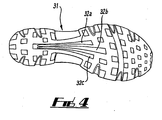
- FIG. 4 An example not falling under the scope of the invention is shown in Figure 4 .
- the drawing depicts a sole, generally depicted at 31 .
- the sole in this embodiment is an outsole.
- the sole comprises three elongate elements in the form of longitudinal bands indicated at 32a,b,c.
- the longitudinal bands 32a,b,c extend anteriorly from the centre of the heel of the foot where they are conjoined towards the ball of the foot.
- the longitudinal bands 32a,b,c are formed from the same material as the outsole 31, but are thicker than the material of the sole so that the protrude gently therefrom.
- the increased thickness of the longitudinal bands 32a,b,c results in increased resistance to the longitudinal expansion of the sole.
- the longitudinal bands are of asymmetrical width, becoming wider as they extend in an anterior direction.
- the resistance on the sole is thereby manipulated so that the resistance is increased as the weight is shifted towards the anterior of the foot with increased resistance being provided towards the anterior of the sole where the bands are at their widest.
- This allows the longitudinal bands to provide improved leverage to the foot during the toe-off stage of gait.
- the central band 32b is longer than the remaining bands, however, it will be understood that the relative lengths of the bands can be adjusted within the scope of the invention.
- the width of the longitudinal bands may be uniform along the length of the bands or may be asymmetrical with the bands widening towards the posterior, or along the centre of the bands.
Landscapes
- Chemical & Material Sciences (AREA)
- Engineering & Computer Science (AREA)
- Materials Engineering (AREA)
- Footwear And Its Accessory, Manufacturing Method And Apparatuses (AREA)
Description
- The present invention relates to the fabrication and construction of shoe soles as well as athletic shoes incorporating such soles. In particular, the invention relates to a shoe sole adapted for improved performance due to its ability to provide improved leverage during the toe-off stage of gait.
- Athletic shoes have been developed to minimise the negative effect of taking the foot out of its natural environment. However, thus far these shoes have not been designed to assist the foot and to improve gait above the foot's natural performance.
- The plantar fascia is a band of fibrous connective tissue that runs along the bottom of the foot. The human plantar fascia originates at the anterior-medial aspect of the calcaneal tubercle and diverges medially and laterally as it courses anteriorly towards the forefoot. The fascia then divides into five bands in the region of the metatarsal bases and continues anteriorly towards the five toes. As the bands near the metatarsal heads, they divide into two further bands. One band passes superficially to the skin. The deeper band bifurcates, with the two branches passing around and superior to the flexor tendons. The bifurcating branches then merge with the flexor sheet of the toe and deep transverse ligaments.
- The primary function of the plantar fascia is to provide support and stability to the arch of the foot during weight bearing. Walking and running are the two most common forms of human gait and there are typically three stages; the contact stage, the midstance stage and the propulsive stage. Heel lift commences the propulsive phase, and it is at this point, as the heel is elevated from the ground, that the body weight is transferred from the posterior aspect of the foot to the anterior aspect of the foot. As the weight is transferred, a tension stress is applied to the plantar fascia so that the tissue is pulled tight along the bottom of the foot. Due to the limited elasticity of the plantar fascia, the plantar fascia stretches in a bowstring-like fashion to its elastic limit, becoming taut. This "windlass" effect raises the arch of the foot and turns the midfoot into a rigid lever, helping to propel the body forward.
- Repeated stress on the tissue due to inefficient foot function can lead to inflammation of the plantar fascia. Plantar fasciitis is a common orthopaedic problem and is prevalent in athletic adults.
-
WO 03/075698 -
DE 29712705 discloses a multi-part sole with at least two pre-shaped and essential rigid parts which are arranged behind one another along the sole of the foot and are movable connected to one another, with at least one separation line in the area of the ball of the foot, whereby the force of the weight of the user is transferred essentially via the ball of the foot onto the sole, wherein the sole exhibits a separation line running transferring to the mid-axis of the foot only after the ball area, which runs through a point at which the ball area of the user's foot ends on the outer side of the foot and by which the curvature of the foot is delimited. - The present invention identifies the benefit of providing a sole for a shoe which works in synergy with the natural motion of the foot and assists natural gait.
- The aims and objects of the invention will become apparent from reading the following description.
- According to a first aspect of the present invention there is provided a sole comprising at least three elongate elements oriented longitudinally within the horizontal plane of the sole and adapted to increase in rigidity in response to an increase in longitudinal tension of the sole, each of the at least three elongate elements is provided with two anchor points which affix each elongate element to the sole, said elongate elements extend between and attach to respective anchor points and are movable independently of surrounding structures of the sole, characterized in that each of the three elongate elements is formed of an inelastic material and attached at a respective anchor point at the centre of a heel (posterior) portion of the sole and a respective anchor point at the base of the toes (anterior) forward of the metatarsal head portion of the sole.
- Preferably the elongate element is adapted to become substantially rigid when placed under tension, the at least one elongate element being oriented longitudinally within the horizontal plane of the sole.
- Preferably, the elongate element is adapted to tauten in response to an increase in the longitudinal tension on the sole.
- Optionally, the elongate element is adapted to provide resistance to longitudinal extension of the sole wherein the resistance is maximised substantially towards the anterior of the sole.
- Providing at least one elongate element in this manner will allow the sole to provide support to the medial arch of the foot by resisting the elongation of the sole due to the increase in longitudinal tension on the sole when body weight is applied thereto.
- Advantageously, the elongate element will function as an additional propulsive element by increasing the rigidity of the midsection of the sole as the vertical force imparted on the sole is increased by the transfer of weight from the posterior to the anterior of the sole during the step sequence. The rigidity produced by the resistance of the sole is proportional to the load transmitted through the foot to the ground.
- Furthermore, and advantageously, as the resistance of the elongate element is dependent on the pressure applied to the sole, the resistance on the sole of the shoe will vary during the step sequence. This allows for the combination of flexibility and rigidity that is required to provide the foot with propulsive leverage at the toe-off stage whilst allowing a degree of flexibility during the contact and midstance stages of gait.
- The term "tauten" is used throughout this specification to indicate that the elongate element can stretch slightly when placed under tension until it reaches an inelastic limit at which it becomes inextensible. Alternatively, the elongate element can be formed of an inelastic material which becomes tight when placed under tension.
- The term "sole" can be taken to be either an integral sole, outsole or midsole or combination of the two, or a footbed or orthotic section which can be inserted into a shoe.
- The term "shoe" is intended to cover a variety of footwear including, but not limited to, athletic shoes, walking boots and football boots.
- The term "posterior" is taken to mean towards the rear (heel) of the sole or foot.
- The term "anterior" is taken to mean towards the front (toe) of the sole or foot.
- More preferably, the sole comprises five elongate elements.
- Optionally, the sole comprises three elongate elements.
- Optionally, the elongate elements are conjoined at one end.
- Optionally, the elongate elements are conjoined at the posterior end.
- The elongate elements extend from the centre of the heel (posterior) portion of the sole towards the base of the toe (anterior) portion of the sole.
- Preferably, the sole comprises an upper sole, a mid-sole and an outer sole.
- Optionally, the sole comprises a mid-sole and an outer sole.
- Preferably the elongate element is provided at the midsole.
- Optionally the elongate element is provided at the outer sole.
- Alternatively, the elongate element is provided at the upper sole.
- The elongate elements can move independently of the surrounding structures of the sole.
- The elongate elements are provided with two anchor points which affix the elongate element to the sole.
- The elongate elements are provided with anchor points at the posterior and anterior ends.
- Optionally, the elongate element is provided with additional anchor points.
- The elongate element is formed of an inelastic material.
- Preferably the elongate element is formed of a material which is capable of withstanding a load of at least 115% of the body mass of the wearer.
- The aforesaid optional and preferred features of the sole of the present invention may be incorporated in a shoe provided according to second aspect of the invention.
- Thus according to a second aspect of the present invention there is provided a shoe, the shoe comprising an upper and a sole according to the previously described first aspect of the invention.
- Preferred embodiments of the invention will now be described by way of illustration with reference to the accompanying drawings in which:
-
Figure 1 shows a plan view of a sole according to the preferred embodiment of the invention; and -
Figure 2 shows a plan view of a sole according to an alternative embodiment of the invention; and -
Figure 3 shows an exploded cross-section view from the lateral side of a sole according to the preferred embodiment of the invention; and -
Figure 4 shows a plan view of a sole according to an illustrative example not falling under the scope of the invention. - Referring firstly to
Figure 1 , the drawing shows a sole generally depicted at 1. In the preferred and depicted embodiment the sole 1 represents a mid-sole which is sandwiched between an upper and an outer sole. The sole 1 comprises fiveelongate elements 2a-e which are provided longitudinally along the horizontal plane of the sole. Theelongate elements 2a-e comprise thin bands of inelastic material which are fixed to the sole 1 at a point 3 corresponding to the anterior-medial aspect of the calcaneal tubercle, and extend anteriorly in a substantially parallel fashion along the sole of the shoe towards the front of the foot. As the elongate elements extend anteriorly past the central position of the sole they begin to diverge towards their final anchor points 5a-e at the base of the toes. Theelongate elements 2a-e are fixed to the sole 1 by moulding at the anchor points .3 and 5a-e so that they have a degree of freedom of movement with respect to the surrounding structures of the sole between these anchor points. As the mid-sole is sandwiched between an upper and an outer sole, theelongate elements 2a-e are also encased between the upper and outer soles. - While in the above-described embodiment the elongate elements are affixed to the sole by moulding, it will be understood that the elongate elements can be affixed to the sole by any suitable means such as chemical bonding, gluing or stitching. Optionally the elongate elements can be provided integral with the sole. Furthermore, while in the depicted embodiment the elongate elements are encased in the sole, the elongate elements may also be provided at the outsole. Optionally the elongate elements may be provided within channels in the sole.
- In use, the
elongate elements 2a-e of the sole 1 function in a similar fashion to the plantar fascia and work in synergy with the natural motion of the foot. As stress is applied to the sole of the shoe due to vertical forces from the body weight and ground reaction forces, the sole flexes and lengthens, pulling theelongate elements 2a-e taut. As theelongate elements 2a-e are pulled taut, they resist further lengthening of the sole and increase the rigidity of the midsection of the shoe. This windlass effect provides a stiffness to the sole proportional to the load transmitted through the foot to the ground and gives effective propulsive assistance through the provision of an additional mechanical lever within the sole; duplicating and strengthening the natural work of the plantar fascia. - Although the preferred and depicted embodiment utilises five elongate elements, it can be envisaged that so long as at least three elongate elements are present, an alternative number of elongate elements can be used.
- Referring now to
Figure 2 , the drawing shows a sole generally depicted at 11. In this alternative and depicted embodiment the sole 11 represents a mid-sole which is sandwiched between an upper and an outer sole. The sole 11 comprises threeelongate elements 12a-c which are provided longitudinally along the horizontal plane of the sole. Theelongate elements 12a-c comprise thin bands of material with a low elastic limit which are fixed to the sole 11 at apoint 13 corresponding to the anterior-medial aspect of the calcaneal tubercle, and extend anteriorly in a substantially parallel fashion along the sole of the shoe towards the front of the foot. Theelongate elements 12a-c are bridged at apoint 14, at the central position of the sole. Thisbridge 14 maintains the elongate elements in a semi-taut position and provides support to the elongate elements. Anterior to thisbridge point 14, theelongate elements 12a-c begin to diverge with the three elements extending anteriorly to their final anchor points 15a-c at the base of the toes. The elongate elements are attached to the sole at the anchor points 13 and 15a-c by glue. - Referring now to
Figure 3 , the drawing shows a mid-sole generally depicted at 21, similar to the sole as described for the previous Figure. The mid-sole 21 is flanked on either side by an upper sole 26 and an outer sole 27. One of the elongate elements 22c is visible in this Figure and extends between two anchoring positions at the middle of theheel 23 and the base of thetoes 25. Abridge point 24 in the middle of the sole maintains the elongate elements in a semi-taut position. This allows the elongate elements to fully tauten in response to minor longitudinal expansion of the sole. - While an upper sole, a midsole and an outer sole are all present in the above depictions of the invention, it will be understood that the three sole sections are not all required for the invention to be performed, once a sole section is present. Furthermore, in an alternative embodiment the elongate element or elements may be provided in an upper or an outer sole section.
- An example not falling under the scope of the invention is shown in
Figure 4 . The drawing depicts a sole, generally depicted at 31. The sole in this embodiment is an outsole. The sole comprises three elongate elements in the form of longitudinal bands indicated at 32a,b,c. Thelongitudinal bands 32a,b,c extend anteriorly from the centre of the heel of the foot where they are conjoined towards the ball of the foot. Thelongitudinal bands 32a,b,c are formed from the same material as theoutsole 31, but are thicker than the material of the sole so that the protrude gently therefrom. The increased thickness of thelongitudinal bands 32a,b,c results in increased resistance to the longitudinal expansion of the sole. The longitudinal bands are of asymmetrical width, becoming wider as they extend in an anterior direction. The resistance on the sole is thereby manipulated so that the resistance is increased as the weight is shifted towards the anterior of the foot with increased resistance being provided towards the anterior of the sole where the bands are at their widest. This allows the longitudinal bands to provide improved leverage to the foot during the toe-off stage of gait. In the depicted embodiment, thecentral band 32b is longer than the remaining bands, however, it will be understood that the relative lengths of the bands can be adjusted within the scope of the invention. Furthermore, the width of the longitudinal bands may be uniform along the length of the bands or may be asymmetrical with the bands widening towards the posterior, or along the centre of the bands. - It will be evident that various modifications and improvements could be made to the above-described sole within the scope of the invention. For example, the above description is written in the context of an athletic shoe. However, the invention applies equally to any shoes or boots.
- Further modifications may be made without departing from the scope of the invention herein intended.
Claims (21)
- A sole (1) comprising at least three elongate elements (2a-e) oriented longitudinally within the horizontal plane of the sole and adapted to increase in rigidity in response to an increase in longitudinal tension of the sole, each of the at least three elongate elements is provided with two anchor points (3, 5a-e; 13, 15a-c; 23, 25) which affix each elongate element to the sole, said elongate elements extend between and attach to respective anchor points and are movable independently of surrounding structures of the sole, characterized in that each of the three elongate elements is formed of an inelastic material and attached at a respective anchor point at the centre of a heel (posterior) portion of the sole and a respective anchor point at the base of the toes (anterior) forward of the metatarsal head portion of the sole.
- A sole as claimed in Claim 1, wherein the elongate elements are adapted to provide resistance to longitudinal extension.
- A sole as claimed in Claim 2, wherein the resistance is maximised substantially towards the anterior of the sole.
- A sole as claimed in any one of the preceding Claims, wherein the sole comprises five elongate elements (2a-e).
- A sole as claimed in any one of Claims 1 to 3, wherein the sole comprises three elongate elements (15a-c).
- A sole as claimed in any of the preceding Claims, wherein the elongate elements are conjoined at one end.
- A sole as claimed in Claim 6, wherein the elongate elements are conjoined at the posterior end.
- A sole as claimed in any one of Claims 1 to 7, wherein the elongate element extends from the centre of the heel (posterior) portion of the sole towards the anterior midsection of the sole.
- A sole as claimed in any one of the previous Claims, wherein the sole comprises an upper sole, a mid-sole and an outer sole.
- A sole as claimed in any one of Claims 1 to 8, wherein the sole comprises a mid-sole and an outer sole.
- A sole as claimed in either one of Claims 9 or 10, wherein the elongate elements are provided at the midsole.
- A sole as claimed in either one of Claims 9 or 10, wherein the elongate elements are provided at the outer sole.
- A sole as claimed in Claim 9, wherein the elongate elements are provided at the upper sole.
- A sole as claimed in any one of the preceding Claims, wherein the elongate element is provided with anchor points at the posterior and anterior ends.
- A sole as claimed in Claim 14, wherein the elongate elements are provided with additional anchor points (14, 24).
- A sole as claimed in any one of Claims 1 to 13, wherein the elongate elements are an integral part of the sole.
- A sole as claimed in any one of Claims 1 to 16, wherein the elongate elements are formed of a material with a low elastic limit.
- A sole as claimed in any one of Claims 1 to 16, wherein the elongate elements are formed of an elastic material which is near its elastic limit.
- A sole as claimed in Claim 17 or Claim 18, wherein the elongate elements are formed of rubber.
- A sole as claimed in any one of the previous Claims, wherein the elongate elements are formed of a material which is capable of withstanding a load of at least 115% of the body mass of the wearer.
- A shoe comprising an upper and a sole wherein the sole is as claimed in any one of Claims 1 to 20.
Applications Claiming Priority (2)
| Application Number | Priority Date | Filing Date | Title |
|---|---|---|---|
| GBGB0514846.5A GB0514846D0 (en) | 2005-07-20 | 2005-07-20 | Shoe sole |
| PCT/GB2006/002691 WO2007010253A1 (en) | 2005-07-20 | 2006-07-19 | Shoe sole |
Publications (2)
| Publication Number | Publication Date |
|---|---|
| EP1906783A1 EP1906783A1 (en) | 2008-04-09 |
| EP1906783B1 true EP1906783B1 (en) | 2012-09-12 |
Family
ID=34897487
Family Applications (1)
| Application Number | Title | Priority Date | Filing Date |
|---|---|---|---|
| EP06765024A Expired - Lifetime EP1906783B1 (en) | 2005-07-20 | 2006-07-19 | Shoe sole |
Country Status (10)
| Country | Link |
|---|---|
| US (1) | US8567097B2 (en) |
| EP (1) | EP1906783B1 (en) |
| JP (1) | JP5047171B2 (en) |
| KR (1) | KR101307565B1 (en) |
| CN (1) | CN101247744B (en) |
| DK (1) | DK1906783T3 (en) |
| ES (1) | ES2394800T3 (en) |
| GB (1) | GB0514846D0 (en) |
| PT (1) | PT1906783E (en) |
| WO (1) | WO2007010253A1 (en) |
Cited By (3)
| Publication number | Priority date | Publication date | Assignee | Title |
|---|---|---|---|---|
| DE102020202237A1 (en) | 2020-02-21 | 2021-08-26 | Adidas Ag | Sole comprising individually deflectable reinforcing elements, and shoe with such a sole |
| US20220395055A1 (en) * | 2019-11-18 | 2022-12-15 | Inoveight Limited | A shoes sole |
| US12575640B2 (en) | 2021-05-31 | 2026-03-17 | Adidas Ag | Sole comprising a reinforcing structure, shoe with such a sole, and method for the manufacture of such items |
Families Citing this family (25)
| Publication number | Priority date | Publication date | Assignee | Title |
|---|---|---|---|---|
| US7650707B2 (en) * | 2006-02-24 | 2010-01-26 | Nike, Inc. | Flexible and/or laterally stable foot-support structures and products containing such support structures |
| US7707748B2 (en) * | 2006-02-24 | 2010-05-04 | Nike, Inc. | Flexible foot-support structures and products containing such support structures |
| US20100237599A1 (en) * | 2009-03-21 | 2010-09-23 | Bianchi Steven B | Magnetic attachment for board sports |
| KR100923736B1 (en) * | 2009-05-13 | 2009-10-27 | 홍순구 | Functional shoes |
| WO2011054979A1 (en) * | 2009-11-05 | 2011-05-12 | Desarrollo Integral Del Molde, S. L. | Flexible footwear |
| DE102010028889A1 (en) * | 2010-05-11 | 2012-04-19 | Kom*Sport Kompetenzzentrum Sport Gbr Vertreten Durch Oliver Elsenbach | Shoe insert and shoe |
| US9149087B2 (en) * | 2011-08-05 | 2015-10-06 | Newton Running Company, Inc. | Shoe soles for shock absorption and energy return |
| US10470518B1 (en) * | 2012-01-11 | 2019-11-12 | Alliance Deign and Development Group, Inc. | Systems and methods for adjusting variable geometry, height, weight distribution in footwear devices and equipment |
| US9609911B1 (en) * | 2012-01-11 | 2017-04-04 | Alliance Design And Development Group, Inc. | Systems and methods for adjusting variable geometry, height, weight distribution dynamics in footwear devices and equipment |
| US9044064B2 (en) | 2012-06-08 | 2015-06-02 | Nike, Inc. | Article of footwear having a sole structure with heel-arch stability |
| US9241535B2 (en) * | 2013-03-14 | 2016-01-26 | Nike, Inc. | Sole structures and articles incorporating same |
| US9532623B2 (en) | 2014-02-07 | 2017-01-03 | Nike, Inc. | Sole structure for an article of footwear with extended plate |
| US20150366290A1 (en) * | 2014-06-24 | 2015-12-24 | Nike, Inc. | Stability Structure |
| US10827798B2 (en) | 2014-07-24 | 2020-11-10 | Shlomo Piontkowski | Footwear with dynamic arch system |
| US9857788B2 (en) | 2014-07-24 | 2018-01-02 | Shlomo Piontkowski | Adjustable height sole |
| US9848673B2 (en) | 2015-01-16 | 2017-12-26 | Nike, Inc. | Vacuum formed knit sole system for an article of footwear incorporating a knitted component |
| US10568383B2 (en) | 2015-01-16 | 2020-02-25 | Nike, Inc. | Sole system for an article of footwear incorporating a knitted component with a one-piece knit outsole and a tensile element |
| WO2016191282A1 (en) * | 2015-05-22 | 2016-12-01 | Nike, Inc. | Ground-engaging structures for articles of footwear |
| US10743613B2 (en) | 2016-11-21 | 2020-08-18 | Nike, Inc. | Sole structure with piston and adaptive cushioning system |
| US10448702B2 (en) | 2016-11-21 | 2019-10-22 | Nike, Inc. | Sole structure with progressively adaptive stiffness |
| US10986896B2 (en) | 2018-01-22 | 2021-04-27 | Adidas Ag | Article of footwear with ribbed outsole and notched midsole |
| US11583029B2 (en) | 2018-01-22 | 2023-02-21 | Adidas Ag | Article of footwear with ribbed outsole and notched midsole |
| GB2583705B (en) * | 2019-04-23 | 2024-03-06 | Healus Ltd | Resilient footwear with trampoline and pole vault effects |
| CN109966037B (en) * | 2019-04-25 | 2024-06-21 | 吉林大学 | A kind of auxiliary treatment shoe for resisting scar contracture of foot |
| CN112220160A (en) * | 2020-09-21 | 2021-01-15 | 李宁(中国)体育用品有限公司 | Sole and shoe with bionic function of foot fascia |
Family Cites Families (10)
| Publication number | Priority date | Publication date | Assignee | Title |
|---|---|---|---|---|
| US881974A (en) * | 1906-09-29 | 1908-03-17 | Egidius Van Der Heyden | Instep-supporter. |
| US1219890A (en) * | 1916-07-26 | 1917-03-20 | Charles R Cooper | Insole. |
| US1240249A (en) * | 1916-12-01 | 1917-09-18 | J E Peckham Co Inc | Shank-stiffener. |
| US1470618A (en) * | 1922-08-07 | 1923-10-16 | Edward C Smith | Arch support |
| US1811912A (en) * | 1929-03-14 | 1931-06-30 | United Shoe Machinery Corp | Shoe and shank stiffener therefor |
| US2129424A (en) * | 1936-05-28 | 1938-09-06 | Steven J Jay | Arch support |
| US2386667A (en) * | 1943-10-20 | 1945-10-09 | William H Doherty | Shoe sole |
| DE29712705U1 (en) * | 1997-07-18 | 1997-11-06 | Kahmann, Gabriela, 75177 Pforzheim | Multi-part sole |
| US6968637B1 (en) * | 2002-03-06 | 2005-11-29 | Nike, Inc. | Sole-mounted footwear stability system |
| US20050268489A1 (en) * | 2004-06-04 | 2005-12-08 | Austin Tyrone L | Resilient shoe lift |
-
2005
- 2005-07-20 GB GBGB0514846.5A patent/GB0514846D0/en not_active Ceased
-
2006
- 2006-07-19 US US11/995,883 patent/US8567097B2/en active Active
- 2006-07-19 PT PT67650242T patent/PT1906783E/en unknown
- 2006-07-19 DK DK06765024.2T patent/DK1906783T3/en active
- 2006-07-19 WO PCT/GB2006/002691 patent/WO2007010253A1/en not_active Ceased
- 2006-07-19 CN CN200680026380XA patent/CN101247744B/en not_active Expired - Lifetime
- 2006-07-19 EP EP06765024A patent/EP1906783B1/en not_active Expired - Lifetime
- 2006-07-19 ES ES06765024T patent/ES2394800T3/en not_active Expired - Lifetime
- 2006-07-19 JP JP2008522056A patent/JP5047171B2/en not_active Expired - Lifetime
- 2006-07-19 KR KR1020087004027A patent/KR101307565B1/en not_active Expired - Lifetime
Non-Patent Citations (1)
| Title |
|---|
| ELASTOGRAN GMBH: "Technical Information: Thermoplastic Polyurethane Elastomers (TPU)", February 2005 (2005-02-01), Retrieved from the Internet <URL:http://www.polyurethanes.basf.de/pu/solutions/elastollan/de/function/conversions:/publish/content/group/Arbeitsgebiete_und_Produkte/Thermoplastische_Spezialelastomere/elastollan_material_uk.pdf> * |
Cited By (10)
| Publication number | Priority date | Publication date | Assignee | Title |
|---|---|---|---|---|
| US20220395055A1 (en) * | 2019-11-18 | 2022-12-15 | Inoveight Limited | A shoes sole |
| US12471666B2 (en) * | 2019-11-18 | 2025-11-18 | Inoveight Limited | Shoe sole |
| DE102020202237A1 (en) | 2020-02-21 | 2021-08-26 | Adidas Ag | Sole comprising individually deflectable reinforcing elements, and shoe with such a sole |
| DE102020202237B4 (en) | 2020-02-21 | 2023-05-17 | Adidas Ag | Sole comprising individually deflectable reinforcement elements, and shoe with such a sole |
| EP4241605A2 (en) | 2020-02-21 | 2023-09-13 | adidas AG | Sole comprising individually deflectable reinforcing members and shoe with such a sole |
| US11779077B2 (en) | 2020-02-21 | 2023-10-10 | Adidas Ag | Sole comprising individually deflectable reinforcing members, shoe with such a sole, and method for the manufacture of such items |
| US12178279B2 (en) | 2020-02-21 | 2024-12-31 | Adidas Ag | Sole comprising individually deflectable reinforcing members, and shoe with such a sole |
| US12245657B2 (en) | 2020-02-21 | 2025-03-11 | Adidas Ag | Sole comprising individually deflectable reinforcing members, shoe with such a sole, and method for the manufacture of such items |
| EP4674306A2 (en) | 2020-02-21 | 2026-01-07 | adidas AG | Sole comprising individually deflectable reinforcing members, shoe with such a sole, and method for the manufacture of such items |
| US12575640B2 (en) | 2021-05-31 | 2026-03-17 | Adidas Ag | Sole comprising a reinforcing structure, shoe with such a sole, and method for the manufacture of such items |
Also Published As
| Publication number | Publication date |
|---|---|
| GB0514846D0 (en) | 2005-08-24 |
| PT1906783E (en) | 2013-01-07 |
| US20090056166A1 (en) | 2009-03-05 |
| ES2394800T3 (en) | 2013-02-05 |
| CN101247744B (en) | 2011-07-20 |
| KR20080042089A (en) | 2008-05-14 |
| KR101307565B1 (en) | 2013-09-12 |
| WO2007010253A1 (en) | 2007-01-25 |
| US8567097B2 (en) | 2013-10-29 |
| DK1906783T3 (en) | 2012-12-10 |
| JP5047171B2 (en) | 2012-10-10 |
| JP2009501593A (en) | 2009-01-22 |
| CN101247744A (en) | 2008-08-20 |
| EP1906783A1 (en) | 2008-04-09 |
Similar Documents
| Publication | Publication Date | Title |
|---|---|---|
| US8567097B2 (en) | Shoe sole | |
| EP1824351B1 (en) | Footwear with bridged decoupling | |
| EP2816925B1 (en) | Shoe with instep elastic insertion and insole with depressions | |
| EP3349608B1 (en) | Item of footwear | |
| CN104379014B (en) | It is configured to allow the footwear sole construction of relative heel/forward foot in a step campaign | |
| DK2259693T3 (en) | Walking device | |
| US20180199666A1 (en) | Shoe having shoe sole with divided forefoot portion | |
| US20120192455A1 (en) | Outer sole for shoes and shoes comprising such outer soles | |
| US20100126040A1 (en) | Mechanical cushioning system for footwear | |
| WO2007038487A3 (en) | Footwear having independently articuable toe portions | |
| JPS6235761B2 (en) | ||
| US20140059887A1 (en) | Footwear support structures | |
| AU2019395740B2 (en) | Shoe sole for a sports shoe and shoe, in particular sports shoe for the sport of running | |
| WO2012156267A1 (en) | An orthotic insole | |
| CN106510920A (en) | Hallux valgus correcting shoes | |
| JPH09182601A (en) | Athletic shoes | |
| KR20110022161A (en) | Shoe insole | |
| WO2018153391A1 (en) | Footwear | |
| AU2012257817A1 (en) | An orthotic insole |
Legal Events
| Date | Code | Title | Description |
|---|---|---|---|
| PUAI | Public reference made under article 153(3) epc to a published international application that has entered the european phase |
Free format text: ORIGINAL CODE: 0009012 |
|
| 17P | Request for examination filed |
Effective date: 20080215 |
|
| AK | Designated contracting states |
Kind code of ref document: A1 Designated state(s): AT BE BG CH CY CZ DE DK EE ES FI FR GB GR HU IE IS IT LI LT LU LV MC NL PL PT RO SE SI SK TR |
|
| 17Q | First examination report despatched |
Effective date: 20080429 |
|
| GRAP | Despatch of communication of intention to grant a patent |
Free format text: ORIGINAL CODE: EPIDOSNIGR1 |
|
| DAX | Request for extension of the european patent (deleted) | ||
| GRAS | Grant fee paid |
Free format text: ORIGINAL CODE: EPIDOSNIGR3 |
|
| RAP1 | Party data changed (applicant data changed or rights of an application transferred) |
Owner name: INOVEIGHT LIMITED |
|
| GRAA | (expected) grant |
Free format text: ORIGINAL CODE: 0009210 |
|
| AK | Designated contracting states |
Kind code of ref document: B1 Designated state(s): AT BE BG CH CY CZ DE DK EE ES FI FR GB GR HU IE IS IT LI LT LU LV MC NL PL PT RO SE SI SK TR |
|
| REG | Reference to a national code |
Ref country code: GB Ref legal event code: FG4D |
|
| REG | Reference to a national code |
Ref country code: CH Ref legal event code: EP |
|
| REG | Reference to a national code |
Ref country code: AT Ref legal event code: REF Ref document number: 574631 Country of ref document: AT Kind code of ref document: T Effective date: 20120915 |
|
| REG | Reference to a national code |
Ref country code: IE Ref legal event code: FG4D |
|
| REG | Reference to a national code |
Ref country code: DE Ref legal event code: R096 Ref document number: 602006031961 Country of ref document: DE Effective date: 20121031 Ref country code: CH Ref legal event code: NV Representative=s name: MURGITROYD & COMPANY |
|
| REG | Reference to a national code |
Ref country code: SE Ref legal event code: TRGR |
|
| REG | Reference to a national code |
Ref country code: NL Ref legal event code: T3 |
|
| REG | Reference to a national code |
Ref country code: DK Ref legal event code: T3 |
|
| REG | Reference to a national code |
Ref country code: PT Ref legal event code: SC4A Free format text: AVAILABILITY OF NATIONAL TRANSLATION Effective date: 20121212 |
|
| PG25 | Lapsed in a contracting state [announced via postgrant information from national office to epo] |
Ref country code: LT Free format text: LAPSE BECAUSE OF FAILURE TO SUBMIT A TRANSLATION OF THE DESCRIPTION OR TO PAY THE FEE WITHIN THE PRESCRIBED TIME-LIMIT Effective date: 20120912 Ref country code: CY Free format text: LAPSE BECAUSE OF FAILURE TO SUBMIT A TRANSLATION OF THE DESCRIPTION OR TO PAY THE FEE WITHIN THE PRESCRIBED TIME-LIMIT Effective date: 20120912 |
|
| REG | Reference to a national code |
Ref country code: ES Ref legal event code: FG2A Ref document number: 2394800 Country of ref document: ES Kind code of ref document: T3 Effective date: 20130205 |
|
| REG | Reference to a national code |
Ref country code: LT Ref legal event code: MG4D Effective date: 20120912 |
|
| PG25 | Lapsed in a contracting state [announced via postgrant information from national office to epo] |
Ref country code: LV Free format text: LAPSE BECAUSE OF FAILURE TO SUBMIT A TRANSLATION OF THE DESCRIPTION OR TO PAY THE FEE WITHIN THE PRESCRIBED TIME-LIMIT Effective date: 20120912 Ref country code: GR Free format text: LAPSE BECAUSE OF FAILURE TO SUBMIT A TRANSLATION OF THE DESCRIPTION OR TO PAY THE FEE WITHIN THE PRESCRIBED TIME-LIMIT Effective date: 20121213 Ref country code: SI Free format text: LAPSE BECAUSE OF FAILURE TO SUBMIT A TRANSLATION OF THE DESCRIPTION OR TO PAY THE FEE WITHIN THE PRESCRIBED TIME-LIMIT Effective date: 20120912 |
|
| PG25 | Lapsed in a contracting state [announced via postgrant information from national office to epo] |
Ref country code: IS Free format text: LAPSE BECAUSE OF FAILURE TO SUBMIT A TRANSLATION OF THE DESCRIPTION OR TO PAY THE FEE WITHIN THE PRESCRIBED TIME-LIMIT Effective date: 20130112 Ref country code: RO Free format text: LAPSE BECAUSE OF FAILURE TO SUBMIT A TRANSLATION OF THE DESCRIPTION OR TO PAY THE FEE WITHIN THE PRESCRIBED TIME-LIMIT Effective date: 20120912 Ref country code: BE Free format text: LAPSE BECAUSE OF FAILURE TO SUBMIT A TRANSLATION OF THE DESCRIPTION OR TO PAY THE FEE WITHIN THE PRESCRIBED TIME-LIMIT Effective date: 20120912 Ref country code: EE Free format text: LAPSE BECAUSE OF FAILURE TO SUBMIT A TRANSLATION OF THE DESCRIPTION OR TO PAY THE FEE WITHIN THE PRESCRIBED TIME-LIMIT Effective date: 20120912 |
|
| PG25 | Lapsed in a contracting state [announced via postgrant information from national office to epo] |
Ref country code: PL Free format text: LAPSE BECAUSE OF FAILURE TO SUBMIT A TRANSLATION OF THE DESCRIPTION OR TO PAY THE FEE WITHIN THE PRESCRIBED TIME-LIMIT Effective date: 20120912 Ref country code: SK Free format text: LAPSE BECAUSE OF FAILURE TO SUBMIT A TRANSLATION OF THE DESCRIPTION OR TO PAY THE FEE WITHIN THE PRESCRIBED TIME-LIMIT Effective date: 20120912 |
|
| PLBE | No opposition filed within time limit |
Free format text: ORIGINAL CODE: 0009261 |
|
| STAA | Information on the status of an ep patent application or granted ep patent |
Free format text: STATUS: NO OPPOSITION FILED WITHIN TIME LIMIT |
|
| PG25 | Lapsed in a contracting state [announced via postgrant information from national office to epo] |
Ref country code: BG Free format text: LAPSE BECAUSE OF FAILURE TO SUBMIT A TRANSLATION OF THE DESCRIPTION OR TO PAY THE FEE WITHIN THE PRESCRIBED TIME-LIMIT Effective date: 20121212 |
|
| 26N | No opposition filed |
Effective date: 20130613 |
|
| REG | Reference to a national code |
Ref country code: DE Ref legal event code: R097 Ref document number: 602006031961 Country of ref document: DE Effective date: 20130613 |
|
| PG25 | Lapsed in a contracting state [announced via postgrant information from national office to epo] |
Ref country code: MC Free format text: LAPSE BECAUSE OF FAILURE TO SUBMIT A TRANSLATION OF THE DESCRIPTION OR TO PAY THE FEE WITHIN THE PRESCRIBED TIME-LIMIT Effective date: 20120912 |
|
| PG25 | Lapsed in a contracting state [announced via postgrant information from national office to epo] |
Ref country code: HU Free format text: LAPSE BECAUSE OF FAILURE TO SUBMIT A TRANSLATION OF THE DESCRIPTION OR TO PAY THE FEE WITHIN THE PRESCRIBED TIME-LIMIT; INVALID AB INITIO Effective date: 20060719 |
|
| REG | Reference to a national code |
Ref country code: FR Ref legal event code: PLFP Year of fee payment: 11 |
|
| REG | Reference to a national code |
Ref country code: FR Ref legal event code: PLFP Year of fee payment: 12 |
|
| REG | Reference to a national code |
Ref country code: FR Ref legal event code: PLFP Year of fee payment: 13 |
|
| PGFP | Annual fee paid to national office [announced via postgrant information from national office to epo] |
Ref country code: LU Payment date: 20180731 Year of fee payment: 13 |
|
| PGFP | Annual fee paid to national office [announced via postgrant information from national office to epo] |
Ref country code: PL Payment date: 20180822 Year of fee payment: 13 |
|
| PGFP | Annual fee paid to national office [announced via postgrant information from national office to epo] |
Ref country code: PT Payment date: 20180719 Year of fee payment: 13 |
|
| REG | Reference to a national code |
Ref country code: CH Ref legal event code: NV Representative=s name: TR-IP CONSULTING LLC, CH |
|
| REG | Reference to a national code |
Ref country code: DE Ref legal event code: R082 Ref document number: 602006031961 Country of ref document: DE Representative=s name: HGF EUROPE LLP, DE Ref country code: DE Ref legal event code: R082 Ref document number: 602006031961 Country of ref document: DE Representative=s name: HGF EUROPE LP, DE |
|
| REG | Reference to a national code |
Ref country code: CH Ref legal event code: PCAR Free format text: NEW ADDRESS: ROUTE DU COUTSET 18, 1485 NUVILLY (CH) |
|
| PG25 | Lapsed in a contracting state [announced via postgrant information from national office to epo] |
Ref country code: PT Free format text: LAPSE BECAUSE OF NON-PAYMENT OF DUE FEES Effective date: 20200120 |
|
| PG25 | Lapsed in a contracting state [announced via postgrant information from national office to epo] |
Ref country code: LU Free format text: LAPSE BECAUSE OF NON-PAYMENT OF DUE FEES Effective date: 20190719 |
|
| PGFP | Annual fee paid to national office [announced via postgrant information from national office to epo] |
Ref country code: NL Payment date: 20230717 Year of fee payment: 18 |
|
| PGFP | Annual fee paid to national office [announced via postgrant information from national office to epo] |
Ref country code: IT Payment date: 20230717 Year of fee payment: 18 Ref country code: IE Payment date: 20230718 Year of fee payment: 18 Ref country code: FI Payment date: 20230720 Year of fee payment: 18 Ref country code: ES Payment date: 20230801 Year of fee payment: 18 Ref country code: CZ Payment date: 20230717 Year of fee payment: 18 Ref country code: CH Payment date: 20230809 Year of fee payment: 18 Ref country code: AT Payment date: 20230731 Year of fee payment: 18 |
|
| PGFP | Annual fee paid to national office [announced via postgrant information from national office to epo] |
Ref country code: SE Payment date: 20230717 Year of fee payment: 18 Ref country code: FR Payment date: 20230717 Year of fee payment: 18 Ref country code: DK Payment date: 20230717 Year of fee payment: 18 Ref country code: DE Payment date: 20230725 Year of fee payment: 18 |
|
| PG25 | Lapsed in a contracting state [announced via postgrant information from national office to epo] |
Ref country code: TR Free format text: LAPSE BECAUSE OF NON-PAYMENT OF DUE FEES Effective date: 20190719 |
|
| REG | Reference to a national code |
Ref country code: DE Ref legal event code: R119 Ref document number: 602006031961 Country of ref document: DE |
|
| REG | Reference to a national code |
Ref country code: DK Ref legal event code: EBP Effective date: 20240731 |
|
| REG | Reference to a national code |
Ref country code: CH Ref legal event code: PL |
|
| REG | Reference to a national code |
Ref country code: SE Ref legal event code: EUG |
|
| REG | Reference to a national code |
Ref country code: NL Ref legal event code: MM Effective date: 20240801 |
|
| REG | Reference to a national code |
Ref country code: AT Ref legal event code: MM01 Ref document number: 574631 Country of ref document: AT Kind code of ref document: T Effective date: 20240719 |
|
| PG25 | Lapsed in a contracting state [announced via postgrant information from national office to epo] |
Ref country code: DE Free format text: LAPSE BECAUSE OF NON-PAYMENT OF DUE FEES Effective date: 20250201 |
|
| PG25 | Lapsed in a contracting state [announced via postgrant information from national office to epo] |
Ref country code: FI Free format text: LAPSE BECAUSE OF NON-PAYMENT OF DUE FEES Effective date: 20240719 Ref country code: NL Free format text: LAPSE BECAUSE OF NON-PAYMENT OF DUE FEES Effective date: 20240801 |
|
| PG25 | Lapsed in a contracting state [announced via postgrant information from national office to epo] |
Ref country code: AT Free format text: LAPSE BECAUSE OF NON-PAYMENT OF DUE FEES Effective date: 20240719 Ref country code: CH Free format text: LAPSE BECAUSE OF NON-PAYMENT OF DUE FEES Effective date: 20240731 |
|
| PG25 | Lapsed in a contracting state [announced via postgrant information from national office to epo] |
Ref country code: FR Free format text: LAPSE BECAUSE OF NON-PAYMENT OF DUE FEES Effective date: 20240731 Ref country code: CZ Free format text: LAPSE BECAUSE OF NON-PAYMENT OF DUE FEES Effective date: 20240719 |
|
| PG25 | Lapsed in a contracting state [announced via postgrant information from national office to epo] |
Ref country code: DK Free format text: LAPSE BECAUSE OF NON-PAYMENT OF DUE FEES Effective date: 20240731 |
|
| PG25 | Lapsed in a contracting state [announced via postgrant information from national office to epo] |
Ref country code: IT Free format text: LAPSE BECAUSE OF NON-PAYMENT OF DUE FEES Effective date: 20240719 |
|
| PG25 | Lapsed in a contracting state [announced via postgrant information from national office to epo] |
Ref country code: IE Free format text: LAPSE BECAUSE OF NON-PAYMENT OF DUE FEES Effective date: 20240719 |
|
| REG | Reference to a national code |
Ref country code: ES Ref legal event code: FD2A Effective date: 20250829 |
|
| PG25 | Lapsed in a contracting state [announced via postgrant information from national office to epo] |
Ref country code: ES Free format text: LAPSE BECAUSE OF NON-PAYMENT OF DUE FEES Effective date: 20240720 |
|
| PG25 | Lapsed in a contracting state [announced via postgrant information from national office to epo] |
Ref country code: SE Free format text: LAPSE BECAUSE OF NON-PAYMENT OF DUE FEES Effective date: 20240720 |
|
| PGFP | Annual fee paid to national office [announced via postgrant information from national office to epo] |
Ref country code: GB Payment date: 20250702 Year of fee payment: 20 |
|
| REG | Reference to a national code |
Ref country code: GB Ref legal event code: PE20 Expiry date: 20260718 |