EP1906609A1 - Device for switching frames of packets of data with optimization of transcoding resource - Google Patents
Device for switching frames of packets of data with optimization of transcoding resource Download PDFInfo
- Publication number
- EP1906609A1 EP1906609A1 EP07116565A EP07116565A EP1906609A1 EP 1906609 A1 EP1906609 A1 EP 1906609A1 EP 07116565 A EP07116565 A EP 07116565A EP 07116565 A EP07116565 A EP 07116565A EP 1906609 A1 EP1906609 A1 EP 1906609A1
- Authority
- EP
- European Patent Office
- Prior art keywords
- module
- transcoding
- switching
- access
- switching module
- Prior art date
- Legal status (The legal status is an assumption and is not a legal conclusion. Google has not performed a legal analysis and makes no representation as to the accuracy of the status listed.)
- Withdrawn
Links
- 238000005457 optimization Methods 0.000 title 1
- 238000006243 chemical reaction Methods 0.000 claims abstract description 12
- 238000004891 communication Methods 0.000 claims description 5
- 238000001514 detection method Methods 0.000 claims description 3
- 238000005516 engineering process Methods 0.000 description 4
- 230000000694 effects Effects 0.000 description 3
- 230000006978 adaptation Effects 0.000 description 1
- 230000002457 bidirectional effect Effects 0.000 description 1
- 230000015556 catabolic process Effects 0.000 description 1
- 230000006835 compression Effects 0.000 description 1
- 238000007906 compression Methods 0.000 description 1
- 230000006837 decompression Effects 0.000 description 1
- 238000006731 degradation reaction Methods 0.000 description 1
- 230000000593 degrading effect Effects 0.000 description 1
- 239000000284 extract Substances 0.000 description 1
- 238000009432 framing Methods 0.000 description 1
- 238000000034 method Methods 0.000 description 1
- 230000008520 organization Effects 0.000 description 1
- 230000009897 systematic effect Effects 0.000 description 1
Images

Classifications
-
- H—ELECTRICITY
- H04—ELECTRIC COMMUNICATION TECHNIQUE
- H04L—TRANSMISSION OF DIGITAL INFORMATION, e.g. TELEGRAPHIC COMMUNICATION
- H04L12/00—Data switching networks
- H04L12/66—Arrangements for connecting between networks having differing types of switching systems, e.g. gateways
-
- H—ELECTRICITY
- H04—ELECTRIC COMMUNICATION TECHNIQUE
- H04W—WIRELESS COMMUNICATION NETWORKS
- H04W88/00—Devices specially adapted for wireless communication networks, e.g. terminals, base stations or access point devices
- H04W88/18—Service support devices; Network management devices
- H04W88/181—Transcoding devices; Rate adaptation devices
Definitions
- the invention relates to the field of packet transport networks, and more precisely to the switching equipments used to switch packets of data between packet transport networks of different types.
- switching equipment means any network equipment responsible for switching packets of different types, for example voice media gateways (MGW), between networks of different types, in particular ATM or IP type communication networks or access networks of type 2G, UMA, 3G, etc.
- MGW voice media gateways
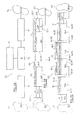
- Figures 1A and 1 B show one example of a prior art voice media gateway equipped with a switching device DC and coupled to networks N1 and N2 of different types, namely a 3G network N1, on the one hand, and a UMA network N2, on the other hand.
- the switching device DC includes an access module MA1, on the (3G) network N1 side, and an access module MA2, on the (UMA) network N2 side, connected to each other by a switching module MC.
- the device described with reference to figures 1A and 1 B does not conform to the transcoder free operation (TrFO) protocol defined by the 3GPP standardization organization, which imposes the transparent passage of the lu transport layer between the two access modules.
- TrFO transcoder free operation
- the access module MA1 includes a framing module MT1 receiving from the network N1 frames including ATM protocol cells AAL2 addressed to the network N2, for example, and vice-versa.
- the access module MA1 further includes a lu transport layer, for example, and a transcoding module TC1 formed by the AMR and G.711 pair.
- a link LC connects the access module MA1 to the access module MA2 for transporting voice coded in accordance with an internal transport protocol via the transport layer TI1 for the access module MA1 and the transport layer TI2 for the access module MA2.
- the access module MA2 includes a transcoding module TC2 associating the coding/decoding (codec) pair G.711 and AMR, an RFC3267 layer associated with the transcoding module TC2, and a transport module MP of type RTP, UDP and IP.
- a transcoding module TC2 associating the coding/decoding (codec) pair G.711 and AMR, an RFC3267 layer associated with the transcoding module TC2, and a transport module MP of type RTP, UDP and IP.
- This kind of prior art switching device DC systematically includes two complete transcoding modules TC1 and TC2, one for each end, here the AMR/G.711 combination.
- transcoding modules have the drawback of degrading voice in that each compression/decompression stage causes a loss of information. Moreover, such transcoding modules consume processing resource, which generates a cost for each end.
- transcoding modules are not always indispensable and necessary at each end, in particular in certain calling contexts such as 3G to UMA or IMS to 3G, as well as during other phases such as the lu initialization phase. In effect, in this kind of call, it is not necessary to proceed to a transcoding operation, only the frame adaptation operation having to be effected.
- an object of the invention is to improve upon this situation.
- It relates to a device dedicated to switching frames of packets of data of different types coming from at least two transport networks using different transport protocol layers, comprising a switching module, at least two access modules each connected to one of the networks and to the switching module, and at least one transcoding module connected to the switching module and adapted, on reception of a frame, coming from an access module, via said switching module, and intended for another access module, to convert payload data in a first code to a second code, and then to transmit said frame to said switching module in order for it to transmit it to said other access module.
- the switching module is adapted, if there is code conversion to be effected, to cause each frame to be converted to pass in transit through said transcoding module while said switching module is adapted, if there is no coding conversion to be effected, to route a frame directly without causing it to pass in transit through said transcoding module.
- the transcoding module according to the invention therefore makes its contribution only when transcoding is required. This results in limited degradation of voice compared to the systematic double transcoding of the prior art switching device, together with optimized use of the transcoding resources compared to the
- the device according to the invention can have other features and in particular, separately or in combination:
- the invention also consists in a network equipment for at least two transport networks using different transport protocol layers, comprising a switching device of the above type.
- This equipment takes the form of a voice media gateway (MGW), for example.
- MGW voice media gateway
- the invention is particularly suitable, although not exclusively so, for situations in which a switching equipment is connected to at least two transport networks of 3G and UMA types.
- An object of the invention is to transport frames of packets of data in a frame switching equipment connected to at least two transport networks of different types.
- the switching equipment P (here of MGW type) is connected, by way of illustrative example, on the one hand, to a 3G network (N1) and, on the other hand, to a UMA network (N2).
- N1 3G network
- N2 UMA network
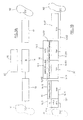
- the switching device DC includes a first access module 10, connected to the network N1, a second access module 12, connected to the network N2, a switching module 14 connected to the first and second access modules 10, 12, and a transcoding module 16 connected to the switching module 14.
- the access module 10 includes an interface on the network N1 side and an internal interface.
- the interface on the network N1 side is formed of an ATM layer (10-1), an AAL2 layer (10-2) and a lu layer (10-3).
- the access module receives from the ATM network N1 frames including AAL2 over ATM cells.
- the internal interface includes a TDM interconnection layer (14-11) supporting an internal tandem free operation (TFO) layer (14-2).
- TDM 64 kbps channel
- TFO G.711
- the access module 12 includes an interface on the network N2 side and an internal interface.
- the interface on the network N2 side includes an RFC3267/RTP transport layer (12-3), a UDP transport layer (12-2) and an IP transport layer (12-1).
- the interface on the network N2 side receives the frames coming from UMA (N2) and addressed to the ATM network N1 and vice-versa.
- the internal interface of the access module 12 is identical to the internal interface of the access module 10 and includes the TDM interconnection layer (14-21) supporting the internal TFO layer (14-22).
- the internal interfaces of the access modules are connected directly to each other via a link 14-0 to route a frame directly from one network to the other without it passing in transit through any transcoding module.
- TDM interconnection (14-0) is a direct path between the access modules 10 and 12.
- each network side interface of the access modules 10 and 12 includes a respective transport layer linked to transcoding. This refers to the lu transport layer (10-3) for the access module 10 and the RFC3267 transport layer (12-3) for the access module 12.
- the transcoding module 16 is inserted between the access modules 10 and 12 to convert the voice samples.
- the transcoding module 16 is responsible for converting the data that is contained in the frames and that is coded in a first code (for example by CODEC A of type AMR for 3G(16-1)), respectively a second code (by CODEC B of type AMR for UMA (16-2)), into data coded in the second code (by CODEC B), respectively the first code (by CODEC A).
- a first code for example by CODEC A of type AMR for 3G(16-1)
- CODEC B of type AMR for UMA (16-2)
- the transcoding module 16 is preferably a single module shared by the access modules 10 and 12. Alternatively, it can be divided into a number of portions each associated with one access module.
- the transcoding module 16 further includes an input interface associated with the transcoding layer 16-1 and an output interface associated with the transcoding layer 16-2.
- the input interface of the transcoding module 16 includes the TDM layer (14-111) and the internal TFO layer (14-112).
- the output interface of the transcoding module 16 includes the TDM layer (14-211) and the internal TFO layer (14-212).
- a TDM interconnection (14-01) between the TDM layer (14-11) of the output interface of the access module 10 and the TDM layer (14-111) of the input interface of the transcoding module 16 and, on the other hand, a TDM interconnection (14-02) between the TDM layer (14-21) of the output interface of the access module 12 and the TDM layer (14-211) of the output interface of the transcoding module 16.
- TDM interconnections (14-01 and 14-02) are paths between the access modules 10 and 12 and the transcoding module 16.
- the switching module includes detection means able, upon setting up the call, to detect the absence/presence of the need to effect code conversion.
- Figures 3A and 3B show a switching equipment P in a 3G (N1) and 2G (N2) context in which the transcoding function is always required.
- FIGS. 1 to 2C show the essential components of the switching module P described with reference to figures 2A to 2C, namely two access modules 10 and 12, a switching module 14 and a transcoding module 16.
- Figure 3B includes the access module 10 described with reference to figure 2C and the interface of the 2G side transcoding module 16.
- the output interface of the transcoding module includes a G.711 type transcoding layer (16-2), a standard TFO layer (14-212) and a TDM layer (14-211).
- the access module 12 includes only a TDM layer (14-21).
- This figure shows the TDM interconnection (14-01) between the TDM layer (14-11) of the internal interface of the access module 10 and the TDM layer (14-111) of the input interface of the transcoding module 16 and the TDM interconnection (14-02) between the TDM layer (14-21) of the internal interface of the access module 12 and the TDM layer (14-211) of the output interface of the transcoding module 16.
- TDM interconnections (14-01 and 14-02) are paths between the access modules 10 and 12 and the transcoding module 16.
- the transcoding function extracts the compressed voice samples coming from the TFO frames and directs them to the decoder before sending the G.711 samples to the 2G network and vice-versa.
- the capacity of the transcoding function is enhanced by choosing the best technology for each process.
- the processor technology can be used for the access modules while the programmable component (FPGA) technology can be chosen for the transcoding module.
- FPGA programmable component
- the switching device of the invention and in particular the access modules 10 and 12 and the transcoding module 16, can be produced in the form of electronic components, software (or electronic data processing) modules, or a combination of components and software.
- the invention enables the use of transcoding modules 16 independent of the transport interfaces and therefore of the transport protocols used by the transport networks.
- the overall performance of a voice gateway is enhanced in terms of voice quality, internal latency, the number of users supported. Moreover, the cost per user is lower.
Landscapes
- Engineering & Computer Science (AREA)
- Computer Networks & Wireless Communication (AREA)
- Signal Processing (AREA)
- Data Exchanges In Wide-Area Networks (AREA)
Abstract
Description
- The invention relates to the field of packet transport networks, and more precisely to the switching equipments used to switch packets of data between packet transport networks of different types.
- Here "switching equipment" means any network equipment responsible for switching packets of different types, for example voice media gateways (MGW), between networks of different types, in particular ATM or IP type communication networks or access networks of
type 2G, UMA, 3G, etc. - Figures 1A and 1 B show one example of a prior art voice media gateway equipped with a switching device DC and coupled to networks N1 and N2 of different types, namely a 3G network N1, on the one hand, and a UMA network N2, on the other hand. The switching device DC includes an access module MA1, on the (3G) network N1 side, and an access module MA2, on the (UMA) network N2 side, connected to each other by a switching module MC.
- It is to be noted that the device described with reference to figures 1A and 1 B does not conform to the transcoder free operation (TrFO) protocol defined by the 3GPP standardization organization, which imposes the transparent passage of the lu transport layer between the two access modules.
- In practice (figure 1B), the access module MA1 includes a framing module MT1 receiving from the network N1 frames including ATM protocol cells AAL2 addressed to the network N2, for example, and vice-versa. The access module MA1 further includes a lu transport layer, for example, and a transcoding module TC1 formed by the AMR and G.711 pair.
- A link LC connects the access module MA1 to the access module MA2 for transporting voice coded in accordance with an internal transport protocol via the transport layer TI1 for the access module MA1 and the transport layer TI2 for the access module MA2.
- For its part, the access module MA2 includes a transcoding module TC2 associating the coding/decoding (codec) pair G.711 and AMR, an RFC3267 layer associated with the transcoding module TC2, and a transport module MP of type RTP, UDP and IP.
- This kind of prior art switching device DC systematically includes two complete transcoding modules TC1 and TC2, one for each end, here the AMR/G.711 combination.
- Such transcoding modules have the drawback of degrading voice in that each compression/decompression stage causes a loss of information. Moreover, such transcoding modules consume processing resource, which generates a cost for each end.
- The Applicant has observed that such transcoding modules are not always indispensable and necessary at each end, in particular in certain calling contexts such as 3G to UMA or IMS to 3G, as well as during other phases such as the lu initialization phase. In effect, in this kind of call, it is not necessary to proceed to a transcoding operation, only the frame adaptation operation having to be effected.
- Thus an object of the invention is to improve upon this situation.
- It relates to a device dedicated to switching frames of packets of data of different types coming from at least two transport networks using different transport protocol layers, comprising a switching module, at least two access modules each connected to one of the networks and to the switching module, and at least one transcoding module connected to the switching module and adapted, on reception of a frame, coming from an access module, via said switching module, and intended for another access module, to convert payload data in a first code to a second code, and then to transmit said frame to said switching module in order for it to transmit it to said other access module.
- According to a general definition of the invention the switching module is adapted, if there is code conversion to be effected, to cause each frame to be converted to pass in transit through said transcoding module while said switching module is adapted, if there is no coding conversion to be effected, to route a frame directly without causing it to pass in transit through said transcoding module.
- The transcoding module according to the invention therefore makes its contribution only when transcoding is required. This results in limited degradation of voice compared to the systematic double transcoding of the prior art switching device, together with optimized use of the transcoding resources compared to the
- The device according to the invention can have other features and in particular, separately or in combination:
- said switching module includes detection means adapted, when the call is set up, to detect the absence/presence of the need to effect code conversion to be effected;
- the transcoding module is connected to each access module via an interconnection using a chosen communication protocol, the interconnection is of 64 kbps TDM type, and the communication protocol on the interconnection is of internal TFO (Tandem Free Operation) type, for example.
- The invention also consists in a network equipment for at least two transport networks using different transport protocol layers, comprising a switching device of the above type.
- This equipment takes the form of a voice media gateway (MGW), for example.
- The invention is particularly suitable, although not exclusively so, for situations in which a switching equipment is connected to at least two transport networks of 3G and UMA types.
- Other features and advantages of the invention will become apparent on reading the following detailed description and examining the appended drawings, in which:
- figures 1A and 1B, already described, illustrate very diagrammatically and functionally one example of a voice media gateway equipped with a prior art switching device and coupled to 3G and UMA networks,
- figure 2A illustrates very diagrammatically and functionally one example of a voice media gateway equipped with a switching device according to the invention and coupled to 3G and UMA networks,
- figure 2B is a detailed view of the switching device from figure 2A when transcoding does not need to be effected,
- figure 2C is a detailed view of the switching device from figure 2A when transcoding needs to be effected, and
- figures 3A and 3B illustrate very diagrammatically and functionally one example of a voice media gateway equipped with a switching device according to the invention and coupled to ATM and IP networks.
- The appended drawings can constitute part of the description of the invention as well as contributing to the definition of the invention, if necessary.
- An object of the invention is to transport frames of packets of data in a frame switching equipment connected to at least two transport networks of different types.
- In the examples illustrated in figures 2A to 2C, the switching equipment P (here of MGW type) is connected, by way of illustrative example, on the one hand, to a 3G network (N1) and, on the other hand, to a UMA network (N2). This is a functional description of the various modules, making no assumptions as to their physical implementation. Similarly, the terms "input" and "output" are interchangeable here to the extent that the exchanges of data between the various modules are bidirectional.
- Referring to figure 2A, the switching device DC includes a
first access module 10, connected to the network N1, asecond access module 12, connected to the network N2, aswitching module 14 connected to the first andsecond access modules transcoding module 16 connected to theswitching module 14. - Referring to figure 2B, the
access module 10 includes an interface on the network N1 side and an internal interface. - The interface on the network N1 side is formed of an ATM layer (10-1), an AAL2 layer (10-2) and a lu layer (10-3). The access module receives from the ATM network N1 frames including AAL2 over ATM cells.
- The internal interface includes a TDM interconnection layer (14-11) supporting an internal tandem free operation (TFO) layer (14-2). The compressed voice samples from the
access module 10 are transported over TDM (64 kbps channel) in accordance with the internal tandem free operation without G.711 (TFO) protocol, i.e. a frame structure for transporting variable bit rate compressed data over a 64 kbps interconnection link. - Similarly, the
access module 12 includes an interface on the network N2 side and an internal interface. - The interface on the network N2 side includes an RFC3267/RTP transport layer (12-3), a UDP transport layer (12-2) and an IP transport layer (12-1). The interface on the network N2 side receives the frames coming from UMA (N2) and addressed to the ATM network N1 and vice-versa.
- The internal interface of the
access module 12 is identical to the internal interface of theaccess module 10 and includes the TDM interconnection layer (14-21) supporting the internal TFO layer (14-22). - If there is no code conversion to be effected (figure 2B), the internal interfaces of the access modules are connected directly to each other via a link 14-0 to route a frame directly from one network to the other without it passing in transit through any transcoding module.
- Here the TDM interconnection (14-0) is a direct path between the
access modules - Note that each network side interface of the
access modules access module 10 and the RFC3267 transport layer (12-3) for theaccess module 12. - When there is code conversion to be effected (figure 2C), for example in the case where certain elements of the coding/decoding of the networks are not compatible, the
transcoding module 16 is inserted between theaccess modules - In practice, the
transcoding module 16 is responsible for converting the data that is contained in the frames and that is coded in a first code (for example by CODEC A of type AMR for 3G(16-1)), respectively a second code (by CODEC B of type AMR for UMA (16-2)), into data coded in the second code (by CODEC B), respectively the first code (by CODEC A). - The
transcoding module 16 is preferably a single module shared by theaccess modules - The
transcoding module 16 further includes an input interface associated with the transcoding layer 16-1 and an output interface associated with the transcoding layer 16-2. - The input interface of the
transcoding module 16 includes the TDM layer (14-111) and the internal TFO layer (14-112). - The output interface of the
transcoding module 16 includes the TDM layer (14-211) and the internal TFO layer (14-212). - When there is code conversion to be effected (figure 2C), there is provided, on the one hand, a TDM interconnection (14-01) between the TDM layer (14-11) of the output interface of the
access module 10 and the TDM layer (14-111) of the input interface of thetranscoding module 16 and, on the other hand, a TDM interconnection (14-02) between the TDM layer (14-21) of the output interface of theaccess module 12 and the TDM layer (14-211) of the output interface of thetranscoding module 16. - Here the TDM interconnections (14-01 and 14-02) are paths between the
access modules transcoding module 16. - In practice, the switching module includes detection means able, upon setting up the call, to detect the absence/presence of the need to effect code conversion.
- Figures 3A and 3B show a switching equipment P in a 3G (N1) and 2G (N2) context in which the transcoding function is always required.
- These figures show the essential components of the switching module P described with reference to figures 2A to 2C, namely two
access modules switching module 14 and atranscoding module 16. - Figure 3B includes the
access module 10 described with reference to figure 2C and the interface of the 2Gside transcoding module 16. - The output interface of the transcoding module includes a G.711 type transcoding layer (16-2), a standard TFO layer (14-212) and a TDM layer (14-211).
- The
access module 12 includes only a TDM layer (14-21). - This figure shows the TDM interconnection (14-01) between the TDM layer (14-11) of the internal interface of the
access module 10 and the TDM layer (14-111) of the input interface of thetranscoding module 16 and the TDM interconnection (14-02) between the TDM layer (14-21) of the internal interface of theaccess module 12 and the TDM layer (14-211) of the output interface of thetranscoding module 16. - Here the TDM interconnections (14-01 and 14-02) are paths between the
access modules transcoding module 16. - The transcoding function extracts the compressed voice samples coming from the TFO frames and directs them to the decoder before sending the G.711 samples to the 2G network and vice-versa.
- Thanks to the invention, the capacity of the transcoding function is enhanced by choosing the best technology for each process. For example, the processor technology can be used for the access modules while the programmable component (FPGA) technology can be chosen for the transcoding module. Obviously, other technologies can be used.
- Generally speaking, the switching device of the invention, and in particular the
access modules transcoding module 16, can be produced in the form of electronic components, software (or electronic data processing) modules, or a combination of components and software. - Moreover, the invention enables the use of
transcoding modules 16 independent of the transport interfaces and therefore of the transport protocols used by the transport networks. - Thanks to the invention, the overall performance of a voice gateway is enhanced in terms of voice quality, internal latency, the number of users supported. Moreover, the cost per user is lower.
- The invention is not limited to the switching device and network equipment embodiments described hereinabove are by way of example only and encompass all variants that the person skilled in the art might envisage within the scope of the following claims.
Claims (7)
- Device (DC) for switching frames of packets of data of different types coming from at least two transport networks (N1, N2) using different transport protocol layers, comprising a switching module (14), at least two access modules (10, 12) each connected to one of said networks and to said switching module, and at least one transcoding module (16) connected to said switching module (14) and adapted, on reception of a frame, coming from an access module (10), via said switching module (14), and intended for another access module (12), to convert payload data in a first code to a second code, and then to transmit said frame to said switching module (14) in order for it to transmit it to said other access module (12), characterized in that said switching module (14) is adapted, if there is code conversion to be effected, to cause each frame to be converted to pass in transit through said transcoding module (16) while said switching module (14) is adapted, if there is no coding conversion to be effected, to route a frame directly without causing it to pass in transit through said transcoding module (16).
- Device according to claim 1, wherein said switching module includes detection means adapted, when setting up the call, to detect the absence/presence of coding conversion to be effected.
- Device according to claim 1 or claim 2, wherein the transcoding module (16) is connected to each access module (10, 12) via an interconnection (14-0, 14-01, 14-02) using a chosen communication protocol.
- Device according to claim 3, wherein the interconnection is of 64 kbps TDM type.
- Device according to claim 3 or claim 4, wherein the communication protocol on the interconnection is of internal TFO type.
- Network equipment (P) for at least two transport networks (N1, N2) using different transport protocol layers, characterized in that it comprises a switching device (DC) according to any one of the preceding claims.
- Equipment according to claim 6, characterized in that it belongs to a voice media gateway.
Applications Claiming Priority (1)
| Application Number | Priority Date | Filing Date | Title |
|---|---|---|---|
| FR0608466A FR2906431B1 (en) | 2006-09-27 | 2006-09-27 | DEVICE FOR SWITCHING DATA PACKET FRAMES WITH TRANSCODING RESOURCE OPTIMIZATION |
Publications (1)
| Publication Number | Publication Date |
|---|---|
| EP1906609A1 true EP1906609A1 (en) | 2008-04-02 |
Family
ID=38038551
Family Applications (1)
| Application Number | Title | Priority Date | Filing Date |
|---|---|---|---|
| EP07116565A Withdrawn EP1906609A1 (en) | 2006-09-27 | 2007-09-17 | Device for switching frames of packets of data with optimization of transcoding resource |
Country Status (2)
| Country | Link |
|---|---|
| EP (1) | EP1906609A1 (en) |
| FR (1) | FR2906431B1 (en) |
Citations (4)
| Publication number | Priority date | Publication date | Assignee | Title |
|---|---|---|---|---|
| WO2001005109A1 (en) * | 1999-07-12 | 2001-01-18 | Telefonaktiebolaget Lm Ericsson | Method and system for exchanging information between multimedia network nodes |
| WO2001091489A1 (en) * | 2000-05-22 | 2001-11-29 | Telefonaktiebolaget Lm Ericsson (Publ) | Method for a connection through a core network |
| EP1198146A1 (en) * | 2000-10-13 | 2002-04-17 | TELEFONAKTIEBOLAGET LM ERICSSON (publ) | Method and node for the control of a connection in a communication network |
| EP1565014A1 (en) * | 2004-02-12 | 2005-08-17 | Alcatel | Packet transport of compressed voice in the core communication network of a mobile network |
-
2006
- 2006-09-27 FR FR0608466A patent/FR2906431B1/en not_active Expired - Fee Related
-
2007
- 2007-09-17 EP EP07116565A patent/EP1906609A1/en not_active Withdrawn
Patent Citations (4)
| Publication number | Priority date | Publication date | Assignee | Title |
|---|---|---|---|---|
| WO2001005109A1 (en) * | 1999-07-12 | 2001-01-18 | Telefonaktiebolaget Lm Ericsson | Method and system for exchanging information between multimedia network nodes |
| WO2001091489A1 (en) * | 2000-05-22 | 2001-11-29 | Telefonaktiebolaget Lm Ericsson (Publ) | Method for a connection through a core network |
| EP1198146A1 (en) * | 2000-10-13 | 2002-04-17 | TELEFONAKTIEBOLAGET LM ERICSSON (publ) | Method and node for the control of a connection in a communication network |
| EP1565014A1 (en) * | 2004-02-12 | 2005-08-17 | Alcatel | Packet transport of compressed voice in the core communication network of a mobile network |
Also Published As
| Publication number | Publication date |
|---|---|
| FR2906431A1 (en) | 2008-03-28 |
| FR2906431B1 (en) | 2008-11-14 |
Similar Documents
| Publication | Publication Date | Title |
|---|---|---|
| EP1782644B1 (en) | Interoperability for wireless user devices with different speech processing formats | |
| US7227922B2 (en) | Method and device for the transmission of data in a packet-oriented data network | |
| EP1933511A1 (en) | Protocol conversion system in media communications between packet exchanging network and line exchanging network | |
| JP5299438B2 (en) | Gateway apparatus and method and system | |
| WO2010093037A1 (en) | Gateway device, system and method | |
| EP2271174B1 (en) | Gateway device, communication method, and program | |
| WO2010104154A1 (en) | Gateway device and method, and communication system | |
| CN101242458B (en) | Media gateway and control method thereof | |
| US7257114B1 (en) | Method for transmitting calls over packet network | |
| JP5316546B2 (en) | Gateway apparatus, method and program | |
| KR100917546B1 (en) | Method and apparatus for voice transcoding in a voip environment | |
| EP1906609A1 (en) | Device for switching frames of packets of data with optimization of transcoding resource | |
| US20060095590A1 (en) | Exchange of encoded data packets | |
| EP3018880B1 (en) | Apparatus and method for converting control information | |
| US7715365B2 (en) | Vocoder and communication method using the same | |
| US7764673B1 (en) | System and method for implementing a variable size codebook for compression in a communications environment | |
| US20050180456A1 (en) | Method of transporting compressed speech in packet mode in the core network of public land mobile network infrastructures | |
| CN1653515A (en) | Transcoding of speech in a packet network environment | |
| US7564381B1 (en) | System and method for code-based compression in a communications environment | |
| Du et al. | Architecture design of video transmission between UMTS and WSN | |
| WO2011162349A1 (en) | Gateway device, mobile circuit-switched network, voice data relay method, and program |
Legal Events
| Date | Code | Title | Description |
|---|---|---|---|
| PUAI | Public reference made under article 153(3) epc to a published international application that has entered the european phase |
Free format text: ORIGINAL CODE: 0009012 |
|
| AK | Designated contracting states |
Kind code of ref document: A1 Designated state(s): AT BE BG CH CY CZ DE DK EE ES FI FR GB GR HU IE IS IT LI LT LU LV MC MT NL PL PT RO SE SI SK TR |
|
| AX | Request for extension of the european patent |
Extension state: AL BA HR MK YU |
|
| 17P | Request for examination filed |
Effective date: 20081002 |
|
| 17Q | First examination report despatched |
Effective date: 20081030 |
|
| AKX | Designation fees paid |
Designated state(s): AT BE BG CH CY CZ DE DK EE ES FI FR GB GR HU IE IS IT LI LT LU LV MC MT NL PL PT RO SE SI SK TR |
|
| RAP1 | Party data changed (applicant data changed or rights of an application transferred) |
Owner name: ALCATEL LUCENT |
|
| STAA | Information on the status of an ep patent application or granted ep patent |
Free format text: STATUS: THE APPLICATION IS DEEMED TO BE WITHDRAWN |
|
| 18D | Application deemed to be withdrawn |
Effective date: 20111123 |