EP1905838A1 - Enzymatic regioselective 6-acylation of sucrose - Google Patents
Enzymatic regioselective 6-acylation of sucrose Download PDFInfo
- Publication number
- EP1905838A1 EP1905838A1 EP06020561A EP06020561A EP1905838A1 EP 1905838 A1 EP1905838 A1 EP 1905838A1 EP 06020561 A EP06020561 A EP 06020561A EP 06020561 A EP06020561 A EP 06020561A EP 1905838 A1 EP1905838 A1 EP 1905838A1
- Authority
- EP
- European Patent Office
- Prior art keywords
- lipase
- sucrose
- process according
- group
- reaction
- Prior art date
- Legal status (The legal status is an assumption and is not a legal conclusion. Google has not performed a legal analysis and makes no representation as to the accuracy of the status listed.)
- Withdrawn
Links
- 229930006000 Sucrose Natural products 0.000 title claims abstract description 65
- 239000005720 sucrose Substances 0.000 title claims abstract description 65
- CZMRCDWAGMRECN-UGDNZRGBSA-N Sucrose Chemical compound O[C@H]1[C@H](O)[C@@H](CO)O[C@@]1(CO)O[C@@H]1[C@H](O)[C@@H](O)[C@H](O)[C@@H](CO)O1 CZMRCDWAGMRECN-UGDNZRGBSA-N 0.000 title claims abstract description 64
- 238000005917 acylation reaction Methods 0.000 title claims abstract description 26
- 230000002255 enzymatic effect Effects 0.000 title claims abstract description 9
- 108090001060 Lipase Proteins 0.000 claims abstract description 104
- 102000004882 Lipase Human genes 0.000 claims abstract description 104
- 239000004367 Lipase Substances 0.000 claims abstract description 97
- 235000019421 lipase Nutrition 0.000 claims abstract description 97
- -1 acyl ester Chemical class 0.000 claims abstract description 43
- 238000000034 method Methods 0.000 claims abstract description 34
- 230000010933 acylation Effects 0.000 claims abstract description 23
- 241001135516 Burkholderia gladioli Species 0.000 claims abstract description 21
- 244000005700 microbiome Species 0.000 claims abstract description 19
- 230000000269 nucleophilic effect Effects 0.000 claims abstract description 17
- 125000000217 alkyl group Chemical group 0.000 claims abstract description 16
- 125000005842 heteroatom Chemical group 0.000 claims abstract description 16
- 125000004432 carbon atom Chemical group C* 0.000 claims abstract description 13
- 238000002360 preparation method Methods 0.000 claims abstract description 13
- 230000000694 effects Effects 0.000 claims abstract description 12
- 125000003118 aryl group Chemical group 0.000 claims abstract description 9
- 239000003960 organic solvent Substances 0.000 claims abstract description 6
- 229910052736 halogen Inorganic materials 0.000 claims abstract description 4
- 150000002367 halogens Chemical class 0.000 claims abstract description 4
- 229910052739 hydrogen Inorganic materials 0.000 claims abstract description 3
- 239000001257 hydrogen Substances 0.000 claims abstract description 3
- 125000004435 hydrogen atom Chemical class [H]* 0.000 claims abstract description 3
- 238000006243 chemical reaction Methods 0.000 claims description 56
- 102000004190 Enzymes Human genes 0.000 claims description 38
- 108090000790 Enzymes Proteins 0.000 claims description 38
- HETCEOQFVDFGSY-UHFFFAOYSA-N Isopropenyl acetate Chemical compound CC(=C)OC(C)=O HETCEOQFVDFGSY-UHFFFAOYSA-N 0.000 claims description 22
- JUJWROOIHBZHMG-UHFFFAOYSA-N Pyridine Chemical group C1=CC=NC=C1 JUJWROOIHBZHMG-UHFFFAOYSA-N 0.000 claims description 22
- 239000000203 mixture Substances 0.000 claims description 14
- UMJSCPRVCHMLSP-UHFFFAOYSA-N pyridine Natural products COC1=CC=CN=C1 UMJSCPRVCHMLSP-UHFFFAOYSA-N 0.000 claims description 11
- 235000019408 sucralose Nutrition 0.000 claims description 9
- 239000004376 Sucralose Substances 0.000 claims description 8
- BAQAVOSOZGMPRM-QBMZZYIRSA-N sucralose Chemical compound O[C@@H]1[C@@H](O)[C@@H](Cl)[C@@H](CO)O[C@@H]1O[C@@]1(CCl)[C@@H](O)[C@H](O)[C@@H](CCl)O1 BAQAVOSOZGMPRM-QBMZZYIRSA-N 0.000 claims description 8
- 238000005660 chlorination reaction Methods 0.000 claims description 7
- 238000002955 isolation Methods 0.000 claims description 4
- 150000001298 alcohols Chemical class 0.000 claims description 3
- 150000001408 amides Chemical class 0.000 claims description 3
- 150000001412 amines Chemical class 0.000 claims description 3
- 238000007257 deesterification reaction Methods 0.000 claims description 3
- MEGHWIAOTJPCHQ-UHFFFAOYSA-N ethenyl butanoate Chemical compound CCCC(=O)OC=C MEGHWIAOTJPCHQ-UHFFFAOYSA-N 0.000 claims description 3
- 230000007062 hydrolysis Effects 0.000 claims description 3
- 238000006460 hydrolysis reaction Methods 0.000 claims description 3
- 150000003462 sulfoxides Chemical class 0.000 claims description 3
- QQVDYSUDFZZPSU-UHFFFAOYSA-M chloromethylidene(dimethyl)azanium;chloride Chemical compound [Cl-].C[N+](C)=CCl QQVDYSUDFZZPSU-UHFFFAOYSA-M 0.000 claims description 2
- UIWXSTHGICQLQT-UHFFFAOYSA-N ethenyl propanoate Chemical compound CCC(=O)OC=C UIWXSTHGICQLQT-UHFFFAOYSA-N 0.000 claims description 2
- 241000894007 species Species 0.000 abstract description 2
- 239000002904 solvent Substances 0.000 description 19
- 230000035484 reaction time Effects 0.000 description 12
- 125000002252 acyl group Chemical group 0.000 description 10
- IMNFDUFMRHMDMM-UHFFFAOYSA-N N-Heptane Chemical compound CCCCCCC IMNFDUFMRHMDMM-UHFFFAOYSA-N 0.000 description 9
- YXFVVABEGXRONW-UHFFFAOYSA-N Toluene Chemical compound CC1=CC=CC=C1 YXFVVABEGXRONW-UHFFFAOYSA-N 0.000 description 9
- 239000000047 product Substances 0.000 description 9
- 239000000758 substrate Substances 0.000 description 9
- 101000968491 Pseudomonas sp. (strain 109) Triacylglycerol lipase Proteins 0.000 description 8
- 239000003054 catalyst Substances 0.000 description 8
- 239000011541 reaction mixture Substances 0.000 description 8
- 241000223258 Thermomyces lanuginosus Species 0.000 description 7
- 230000000052 comparative effect Effects 0.000 description 7
- 238000004108 freeze drying Methods 0.000 description 7
- 230000002209 hydrophobic effect Effects 0.000 description 7
- XLYOFNOQVPJJNP-UHFFFAOYSA-N water Chemical compound O XLYOFNOQVPJJNP-UHFFFAOYSA-N 0.000 description 7
- WEVYAHXRMPXWCK-UHFFFAOYSA-N Acetonitrile Chemical compound CC#N WEVYAHXRMPXWCK-UHFFFAOYSA-N 0.000 description 6
- LFQSCWFLJHTTHZ-UHFFFAOYSA-N Ethanol Chemical compound CCO LFQSCWFLJHTTHZ-UHFFFAOYSA-N 0.000 description 6
- OKKJLVBELUTLKV-UHFFFAOYSA-N Methanol Chemical compound OC OKKJLVBELUTLKV-UHFFFAOYSA-N 0.000 description 6
- 241000235403 Rhizomucor miehei Species 0.000 description 6
- 239000003480 eluent Substances 0.000 description 6
- DKGAVHZHDRPRBM-UHFFFAOYSA-N Tert-Butanol Chemical compound CC(C)(C)O DKGAVHZHDRPRBM-UHFFFAOYSA-N 0.000 description 5
- 125000000555 isopropenyl group Chemical group [H]\C([H])=C(\*)C([H])([H])[H] 0.000 description 5
- 239000000843 powder Substances 0.000 description 5
- 238000004809 thin layer chromatography Methods 0.000 description 5
- 241000589513 Burkholderia cepacia Species 0.000 description 4
- VYPSYNLAJGMNEJ-UHFFFAOYSA-N Silicium dioxide Chemical compound O=[Si]=O VYPSYNLAJGMNEJ-UHFFFAOYSA-N 0.000 description 4
- 241000235015 Yarrowia lipolytica Species 0.000 description 4
- IAOZJIPTCAWIRG-QWRGUYRKSA-N aspartame Chemical compound OC(=O)C[C@H](N)C(=O)N[C@H](C(=O)OC)CC1=CC=CC=C1 IAOZJIPTCAWIRG-QWRGUYRKSA-N 0.000 description 4
- 239000006227 byproduct Substances 0.000 description 4
- 235000014113 dietary fatty acids Nutrition 0.000 description 4
- 229930195729 fatty acid Natural products 0.000 description 4
- 239000000194 fatty acid Substances 0.000 description 4
- 150000004665 fatty acids Chemical class 0.000 description 4
- 239000000741 silica gel Substances 0.000 description 4
- 229910002027 silica gel Inorganic materials 0.000 description 4
- 239000000243 solution Substances 0.000 description 4
- 229920001567 vinyl ester resin Polymers 0.000 description 4
- 125000000391 vinyl group Chemical group [H]C([*])=C([H])[H] 0.000 description 4
- 108010011485 Aspartame Proteins 0.000 description 3
- KFZMGEQAYNKOFK-UHFFFAOYSA-N Isopropanol Chemical compound CC(C)O KFZMGEQAYNKOFK-UHFFFAOYSA-N 0.000 description 3
- ZMXDDKWLCZADIW-UHFFFAOYSA-N N,N-Dimethylformamide Chemical compound CN(C)C=O ZMXDDKWLCZADIW-UHFFFAOYSA-N 0.000 description 3
- SJRJJKPEHAURKC-UHFFFAOYSA-N N-Methylmorpholine Chemical compound CN1CCOCC1 SJRJJKPEHAURKC-UHFFFAOYSA-N 0.000 description 3
- ZMANZCXQSJIPKH-UHFFFAOYSA-N Triethylamine Chemical compound CCN(CC)CC ZMANZCXQSJIPKH-UHFFFAOYSA-N 0.000 description 3
- 239000000605 aspartame Substances 0.000 description 3
- 235000010357 aspartame Nutrition 0.000 description 3
- 229960003438 aspartame Drugs 0.000 description 3
- 239000011942 biocatalyst Substances 0.000 description 3
- 150000005690 diesters Chemical class 0.000 description 3
- 150000002016 disaccharides Chemical class 0.000 description 3
- 239000012153 distilled water Substances 0.000 description 3
- 239000003921 oil Substances 0.000 description 3
- 235000019198 oils Nutrition 0.000 description 3
- 239000007787 solid Substances 0.000 description 3
- 238000001644 13C nuclear magnetic resonance spectroscopy Methods 0.000 description 2
- 238000005160 1H NMR spectroscopy Methods 0.000 description 2
- HEDRZPFGACZZDS-UHFFFAOYSA-N Chloroform Chemical compound ClC(Cl)Cl HEDRZPFGACZZDS-UHFFFAOYSA-N 0.000 description 2
- IAZDPXIOMUYVGZ-UHFFFAOYSA-N Dimethylsulphoxide Chemical compound CS(C)=O IAZDPXIOMUYVGZ-UHFFFAOYSA-N 0.000 description 2
- 101710152525 Esterase P Proteins 0.000 description 2
- 108090000371 Esterases Proteins 0.000 description 2
- XEKOWRVHYACXOJ-UHFFFAOYSA-N Ethyl acetate Chemical compound CCOC(C)=O XEKOWRVHYACXOJ-UHFFFAOYSA-N 0.000 description 2
- 108010093096 Immobilized Enzymes Proteins 0.000 description 2
- 241001661345 Moesziomyces antarcticus Species 0.000 description 2
- SECXISVLQFMRJM-UHFFFAOYSA-N N-Methylpyrrolidone Chemical compound CN1CCCC1=O SECXISVLQFMRJM-UHFFFAOYSA-N 0.000 description 2
- 239000004372 Polyvinyl alcohol Substances 0.000 description 2
- 101000966369 Rhizopus oryzae Lipase Proteins 0.000 description 2
- XTXRWKRVRITETP-UHFFFAOYSA-N Vinyl acetate Chemical compound CC(=O)OC=C XTXRWKRVRITETP-UHFFFAOYSA-N 0.000 description 2
- 150000004982 aromatic amines Chemical class 0.000 description 2
- 108010051210 beta-Fructofuranosidase Proteins 0.000 description 2
- 230000003197 catalytic effect Effects 0.000 description 2
- 150000001875 compounds Chemical class 0.000 description 2
- 230000001419 dependent effect Effects 0.000 description 2
- 238000001514 detection method Methods 0.000 description 2
- OBNCKNCVKJNDBV-UHFFFAOYSA-N ethyl butyrate Chemical compound CCCC(=O)OCC OBNCKNCVKJNDBV-UHFFFAOYSA-N 0.000 description 2
- MMXKVMNBHPAILY-UHFFFAOYSA-N ethyl laurate Chemical compound CCCCCCCCCCCC(=O)OCC MMXKVMNBHPAILY-UHFFFAOYSA-N 0.000 description 2
- 239000000706 filtrate Substances 0.000 description 2
- 125000002887 hydroxy group Chemical group [H]O* 0.000 description 2
- 238000002347 injection Methods 0.000 description 2
- 239000007924 injection Substances 0.000 description 2
- 239000013067 intermediate product Substances 0.000 description 2
- 239000001573 invertase Substances 0.000 description 2
- 235000011073 invertase Nutrition 0.000 description 2
- 239000007788 liquid Substances 0.000 description 2
- 239000004006 olive oil Substances 0.000 description 2
- 235000008390 olive oil Nutrition 0.000 description 2
- 210000000496 pancreas Anatomy 0.000 description 2
- 239000008363 phosphate buffer Substances 0.000 description 2
- 229920002451 polyvinyl alcohol Polymers 0.000 description 2
- 230000008092 positive effect Effects 0.000 description 2
- 239000000376 reactant Substances 0.000 description 2
- 238000005070 sampling Methods 0.000 description 2
- FYSNRJHAOHDILO-UHFFFAOYSA-N thionyl chloride Chemical compound ClS(Cl)=O FYSNRJHAOHDILO-UHFFFAOYSA-N 0.000 description 2
- BTANRVKWQNVYAZ-UHFFFAOYSA-N 2-butanol Substances CCC(C)O BTANRVKWQNVYAZ-UHFFFAOYSA-N 0.000 description 1
- MSXVEPNJUHWQHW-UHFFFAOYSA-N 2-methylbutan-2-ol Chemical compound CCC(C)(C)O MSXVEPNJUHWQHW-UHFFFAOYSA-N 0.000 description 1
- XVMSFILGAMDHEY-UHFFFAOYSA-N 6-(4-aminophenyl)sulfonylpyridin-3-amine Chemical compound C1=CC(N)=CC=C1S(=O)(=O)C1=CC=C(N)C=N1 XVMSFILGAMDHEY-UHFFFAOYSA-N 0.000 description 1
- IJGRMHOSHXDMSA-UHFFFAOYSA-N Atomic nitrogen Chemical compound N#N IJGRMHOSHXDMSA-UHFFFAOYSA-N 0.000 description 1
- 241000283690 Bos taurus Species 0.000 description 1
- 229930091371 Fructose Natural products 0.000 description 1
- 239000005715 Fructose Substances 0.000 description 1
- RFSUNEUAIZKAJO-ARQDHWQXSA-N Fructose Chemical compound OC[C@H]1O[C@](O)(CO)[C@@H](O)[C@@H]1O RFSUNEUAIZKAJO-ARQDHWQXSA-N 0.000 description 1
- WQZGKKKJIJFFOK-GASJEMHNSA-N Glucose Natural products OC[C@H]1OC(O)[C@H](O)[C@@H](O)[C@@H]1O WQZGKKKJIJFFOK-GASJEMHNSA-N 0.000 description 1
- 101001064316 Homo sapiens Lipase member H Proteins 0.000 description 1
- 102100030658 Lipase member H Human genes 0.000 description 1
- 108010048733 Lipozyme Proteins 0.000 description 1
- 241000498617 Mucor javanicus Species 0.000 description 1
- 240000005384 Rhizopus oryzae Species 0.000 description 1
- 235000013752 Rhizopus oryzae Nutrition 0.000 description 1
- QAOWNCQODCNURD-UHFFFAOYSA-N Sulfuric acid Chemical compound OS(O)(=O)=O QAOWNCQODCNURD-UHFFFAOYSA-N 0.000 description 1
- PQLVXDKIJBQVDF-UHFFFAOYSA-N acetic acid;hydrate Chemical compound O.CC(O)=O PQLVXDKIJBQVDF-UHFFFAOYSA-N 0.000 description 1
- 230000001476 alcoholic effect Effects 0.000 description 1
- 150000001338 aliphatic hydrocarbons Chemical class 0.000 description 1
- 125000003545 alkoxy group Chemical group 0.000 description 1
- 150000004945 aromatic hydrocarbons Chemical class 0.000 description 1
- 125000003435 aroyl group Chemical group 0.000 description 1
- 238000003556 assay Methods 0.000 description 1
- WQZGKKKJIJFFOK-VFUOTHLCSA-N beta-D-glucose Chemical compound OC[C@H]1O[C@@H](O)[C@H](O)[C@@H](O)[C@@H]1O WQZGKKKJIJFFOK-VFUOTHLCSA-N 0.000 description 1
- 230000015572 biosynthetic process Effects 0.000 description 1
- 238000001460 carbon-13 nuclear magnetic resonance spectrum Methods 0.000 description 1
- 238000012512 characterization method Methods 0.000 description 1
- 239000003153 chemical reaction reagent Substances 0.000 description 1
- 239000003795 chemical substances by application Substances 0.000 description 1
- 238000010549 co-Evaporation Methods 0.000 description 1
- 238000004440 column chromatography Methods 0.000 description 1
- 238000010790 dilution Methods 0.000 description 1
- 239000012895 dilution Substances 0.000 description 1
- 229910001873 dinitrogen Inorganic materials 0.000 description 1
- KPUWHANPEXNPJT-UHFFFAOYSA-N disiloxane Chemical class [SiH3]O[SiH3] KPUWHANPEXNPJT-UHFFFAOYSA-N 0.000 description 1
- 239000000839 emulsion Substances 0.000 description 1
- 150000002148 esters Chemical class 0.000 description 1
- 150000002170 ethers Chemical class 0.000 description 1
- 235000019439 ethyl acetate Nutrition 0.000 description 1
- 238000002474 experimental method Methods 0.000 description 1
- 235000013305 food Nutrition 0.000 description 1
- 238000009472 formulation Methods 0.000 description 1
- 235000021588 free fatty acids Nutrition 0.000 description 1
- 239000011521 glass Substances 0.000 description 1
- 239000008103 glucose Substances 0.000 description 1
- 150000002303 glucose derivatives Chemical class 0.000 description 1
- 125000005843 halogen group Chemical group 0.000 description 1
- 238000010438 heat treatment Methods 0.000 description 1
- 229960004592 isopropanol Drugs 0.000 description 1
- 235000019626 lipase activity Nutrition 0.000 description 1
- FCCDDURTIIUXBY-UHFFFAOYSA-N lipoamide Chemical compound NC(=O)CCCCC1CCSS1 FCCDDURTIIUXBY-UHFFFAOYSA-N 0.000 description 1
- 230000002366 lipolytic effect Effects 0.000 description 1
- 238000004519 manufacturing process Methods 0.000 description 1
- 230000035772 mutation Effects 0.000 description 1
- 125000000449 nitro group Chemical group [O-][N+](*)=O 0.000 description 1
- 235000013615 non-nutritive sweetener Nutrition 0.000 description 1
- 230000002018 overexpression Effects 0.000 description 1
- 229910052760 oxygen Inorganic materials 0.000 description 1
- 229910052698 phosphorus Inorganic materials 0.000 description 1
- 239000002798 polar solvent Substances 0.000 description 1
- 125000000075 primary alcohol group Chemical group 0.000 description 1
- 108090000623 proteins and genes Proteins 0.000 description 1
- 238000000425 proton nuclear magnetic resonance spectrum Methods 0.000 description 1
- 239000012429 reaction media Substances 0.000 description 1
- 230000036632 reaction speed Effects 0.000 description 1
- 239000008159 sesame oil Substances 0.000 description 1
- 235000011803 sesame oil Nutrition 0.000 description 1
- 238000007086 side reaction Methods 0.000 description 1
- 125000003808 silyl group Chemical group [H][Si]([H])([H])[*] 0.000 description 1
- 239000007858 starting material Substances 0.000 description 1
- 238000003756 stirring Methods 0.000 description 1
- 239000012089 stop solution Substances 0.000 description 1
- 125000001424 substituent group Chemical group 0.000 description 1
- BAQAVOSOZGMPRM-UHFFFAOYSA-N sucralose Chemical compound OC1C(O)C(Cl)C(CO)OC1OC1(CCl)C(O)C(O)C(CCl)O1 BAQAVOSOZGMPRM-UHFFFAOYSA-N 0.000 description 1
- 125000000185 sucrose group Chemical group 0.000 description 1
- HXJUTPCZVOIRIF-UHFFFAOYSA-N sulfolane Chemical compound O=S1(=O)CCCC1 HXJUTPCZVOIRIF-UHFFFAOYSA-N 0.000 description 1
- 229910052717 sulfur Inorganic materials 0.000 description 1
- YBBRCQOCSYXUOC-UHFFFAOYSA-N sulfuryl dichloride Chemical compound ClS(Cl)(=O)=O YBBRCQOCSYXUOC-UHFFFAOYSA-N 0.000 description 1
- 239000001117 sulphuric acid Substances 0.000 description 1
- 235000011149 sulphuric acid Nutrition 0.000 description 1
- 238000003786 synthesis reaction Methods 0.000 description 1
- 150000003512 tertiary amines Chemical class 0.000 description 1
- PRZSXZWFJHEZBJ-UHFFFAOYSA-N thymol blue Chemical compound C1=C(O)C(C(C)C)=CC(C2(C3=CC=CC=C3S(=O)(=O)O2)C=2C(=CC(O)=C(C(C)C)C=2)C)=C1C PRZSXZWFJHEZBJ-UHFFFAOYSA-N 0.000 description 1
- 150000005691 triesters Chemical class 0.000 description 1
- 229940086542 triethylamine Drugs 0.000 description 1
- FIQMHBFVRAXMOP-UHFFFAOYSA-N triphenylphosphane oxide Chemical compound C=1C=CC=CC=1P(C=1C=CC=CC=1)(=O)C1=CC=CC=C1 FIQMHBFVRAXMOP-UHFFFAOYSA-N 0.000 description 1
- 229920002554 vinyl polymer Polymers 0.000 description 1
- 239000003039 volatile agent Substances 0.000 description 1
- 238000005406 washing Methods 0.000 description 1
Classifications
-
- C—CHEMISTRY; METALLURGY
- C12—BIOCHEMISTRY; BEER; SPIRITS; WINE; VINEGAR; MICROBIOLOGY; ENZYMOLOGY; MUTATION OR GENETIC ENGINEERING
- C12P—FERMENTATION OR ENZYME-USING PROCESSES TO SYNTHESISE A DESIRED CHEMICAL COMPOUND OR COMPOSITION OR TO SEPARATE OPTICAL ISOMERS FROM A RACEMIC MIXTURE
- C12P19/00—Preparation of compounds containing saccharide radicals
- C12P19/12—Disaccharides
Definitions
- 6- O -acylsucrose has a considerable interest as an intermediate product in the synthesis of the synthetic intense sweetener sucralose (4,1',6'-trichloro-4,1',6'-trideoxygalactosucrose, Figure 2).
- Sucralose is approximately 2.5 times sweeter than aspartame ( ⁇ -L-aspartyl-L-phenylalanine methyl ester) and has the advantage that it is suitable for a number of products for which aspartame is less suitable, e.g. food products that need to undergo heat treatment, have an unfavourable pH for aspartame and/or need to have a very long shelf life.
- enzymatically catalysed acylations of sucrose in organic media usually result in low conversions to the desired product 6- O -acylsucrose, as is shown in, for example, M. Woudenberg-Van Oosterom et al., "Regioselective acylation of disaccharides in tert-butyl alcohol catalyzed by Candida antarctica lipase” Biotechnol. Bioeng. 49 (1996), 328-333 .
- enzymatic acylation is described of several disaccharides with ethyl butanoate or ethyl dodecanoate as the donor acyl ester, the acylation being catalyzed by Candida antarctica lipase.
- acylation being catalyzed by Candida antarctica lipase.
- monoesters resulting from acylation of the primary alcohol groups were obtained as the primary products, while at higher conversion diesters were formed, the ratio of diester to monoester being dependent on the structure of the disaccharide.
- a process for the enzymatic preparation of 6- O -acetylsucrose is also known from US Patent 5,128,248 , wherein sucrose is acetylated with isopropenylacetate in pyridine in the presence of lipase P (Amano).
- a drawback of the process disclosed in US Patent 5,128,248 is the low conversion to the desired product 6-O-acetylsucrose, in spite of the large excess of acyl donor and large amounts of enzyme, as has been confirmed in Comparative Example B of the present application. Additionally, a significant amount of 4',6-di-O-acetylsucrose is formed as a by-product.
- the object of the present invention is therefore to provide a commercially attractive process in which sucrose or a derivative thereof is acylated to 6- O -acylsucrose or a derivative thereof in a much higher conversion than known from the state of the art, the acylation reaction being catalysed by an enzyme.
- this object is achieved according to the invention by performing the process in the presence of a lipase enzyme selected from the group of
- lipases naturally produced by a micro-organism from a Burkholderia gladioli species whether or not they are obtained from a Burkholderia gladioli species micro-organism (or are obtained by heterologous over-expression in another suitable microorganism) can be used in the context of the present invention, but also such lipases can be used as are obtained by mutation of genes coding for such lipases to obtain mutant lipases having selective acylation activity to form 6- O -acylsucrose in acylation of sucrose.
- any other lipases having similar activity with respect to the selective acylation of the 6-position of sucrose can be used in the process according to the invention.
- a lipase produced by a micro-organism from a Burkholderia gladioli species is used, more preferably a lipase chosen from the group consisting of Lipase PL, Lipase QL, and Lipase QLM; most preferably, the lipase is Lipase QL or Lipase QLM.
- lipases can be used as such, as part of a whole cell (which may be a Burkholderia gladioli cell, or a cell of any other micro-organism in which the lipases from Burkholderia gladioli may be over-expressed), or immobilized on a solid carrier.
- the lipase used in the process according to the invention is generally present in a quantity corresponding to 1.000-1.000.000 U per gram of sucrose or a derivative thereof.
- a quantity corresponding to between 10.000 and 100.000 U per gram of sucrose is used, more preferably between 25.000 and 75.000 U per gram of sucrose.
- the unit 1 U corresponds to the amount of enzyme which liberates 1 ⁇ mol of fatty acid per min at 37 °C in the assay method of Kokusho et al. (Agric. Biol. Chem. 46 (1982), 1159-1164 ) using olive oil emulsified with polyvinyl alcohol as a substrate (see: Naka Y., Yukagaku 36 (1987), 821-825 ).
- the skilled person can easily establish the actual quantity in weight of the lipase to be used most suitably in the process of the invention. It will be clear that such quantity will depend on the activity of the lipase used (in U/gram lipase), which is determined by parameters like the purity and formulation (e.g. free or immobilized enzyme) of the lipase as used. Depending on the quantity of catalyst not only the reaction rate, but also the selectivity achieved, may vary. The skilled person will take these factors into account, when determining the optimum quantity in weight of the lipase to be used most suitably. One also may influence the reaction rate and its selectivity by providing suitable mutants of the lipases to be used in the context of the present invention.
- the lipase used is a lyophilised lipase, optionally in the presence of a lyoprotectant, i.e. of a component that protects the lipase during lyophilization.
- a lyoprotectant i.e. of a component that protects the lipase during lyophilization.
- the lyoprotectant a wide range of compounds can be used.
- the substrate sucrose itself, or derivatives thereof, as exemplified below, may be applied as lyoprotectant.
- the substrate used in the process of the invention is either sucrose itself, or a derivative thereof, for example derivatives bearing one or more O -functional groups such as acyl or aroyl groups (such derivatives being esters); or alkyl or aryl groups (which types of derivatives are ethers); or silyl groups (i.e. these are silyl ethers); or derivatives wherein one or more of the hydroxyl groups other than the 6-hydroxy group are replaced by a halogen atom); in any case, however, in any of the derivatives at least the 6-position carries a free hydroxyl group.
- O -functional groups such as acyl or aroyl groups (such derivatives being esters); or alkyl or aryl groups (which types of derivatives are ethers); or silyl groups (i.e. these are silyl ethers); or derivatives wherein one or more of the hydroxyl groups other than the 6-hydroxy group are replaced by a halogen atom); in any case, however, in any
- the method according to the invention can be used for the production of 6- O -acylsucrose, which is an intermediate in for example the preparation of sucralose from sucrose.
- the starting concentration of substrate (i.e. of sucrose or a derivative thereof) in the reaction mixture is generally chosen between 0.1 and 60 wt.%, in particular between 1 and 40 wt.%, more in particular between 2 and 10 wt.%.
- the most suitable concentration of substrate, preferably of sucrose depends on e.g. the solubility of sucrose (or the derivative thereof) in the reaction medium.
- sucrose or the derivative thereof is not limited to the maximum solubility of sucrose or the derivative thereof in the solvent at the temperature applied; the sucrose or the derivative thereof may not dissolve completely at the beginning of the reaction, but will dissolve completely in the course of the reaction when the dissolved sucrose or derivative thereof is transformed into the product 6-O-acylsucrose, because this compound generally has a higher solubility than the substrate.
- a donor acyl ester of formula R 1 R 2 C CR 3 -O-C(O)R, in which R 1 , R 2 , R 3 , and R have the meaning as defined above, or a donor acyl ester of formula R 4 -O-C(O)R in which R 4 has the meaning as defined above is used in the process according to the invention.
- Examples of heteroatoms in the optionally substituted (hetero)alkyl group and optionally substituted (hetero)aryl group with for example 1-50 C atoms which may be present in R, R 1 , R 2 and R 3 are N, O, P and S.
- substituents on the (hetero) alkyl group or (hetero) aryl group are a nitro group, a halogen, an alkyl group with 1-6 C atoms, and an alkoxy group with 1-6 C atoms.
- R CH 3
- an isopropenyl ester is preferred rather than a vinyl ester
- the isopropenyl group usually having a positive effect on the selectivity of the acylation reaction, as isopropenyl esters are usually hardly reactive in the presence of sucrose or a derivative thereof in the absence of an enzyme.
- vinyl esters are preferred, thereby usually leading to higher reaction rates.
- donor acyl esters of formula R 4 -O-C(O)R are 2,2,2-trichloroethylesters and 2,2,2-trifluoroethylesters.
- the molar ratio between the donor acyl ester and sucrose or a derivative thereof is not particularly critical and will generally be chosen between 0.5:1 and 100:1, preferably between 0.8:1 and 50:1, more preferably between 1:1 and 25:1, in particular between 2:1 and 10:1.
- the molar ratio between the donor acyl ester and sucrose or a derivative thereof is in particular between 2:1 and 6:1.
- the donor acyl ester may also be used as a solvent. In that case the ratio between the donor acyl ester and sucrose or a derivative thereof may be higher than 100:1.
- the process according to the invention is carried out in the presence of at least one non-nucleophilic organic solvent which has sufficient polarity to dissolve at least part of each reactant, i.e. sucrose or a derivative thereof and the donor acyl ester, under the applied reaction conditions, for example 3 wt.% at 30 °C.
- Non-nucleophilic-solvents is defined here to describe solvents that do not compete with the substrate by reacting with the donor acyl esters.
- the solvent used is selected from the group of non-nucleophilic amines, non-nucleophilic amides, non-nucleophilic sterically hindered alcohols, and non-nucleophilic sulfoxides.
- non-nucleophilic amines are tertiary amines, such as N -methyl morpholine or triethyl amine, or aromatic amines such as pyridine. In particular aromatic amines are preferred, for example pyridine.
- non-nucleophilic amides are N , N -dimethyl formamide and 1-methyl-2-pyrrolidone (NMP).
- NMP 1-methyl-2-pyrrolidone
- sterically hindered alcohols which owe their non-nucleophilicity to their bulky nature, are t-butanol and t-amylalcohol (2-mathyl-2-butanol).
- non-nucleophilic sulfoxides are, for instance, dimethyl sulfoxide and sulfolane.
- the process according to the invention may also be carried out in a mixture of solvents, for example a mixture of two or more of the non-nucleophilic solvents mentioned above.
- one or more hydrophobic solvents i.e. co-solvents
- suitable hydrophobic solvents include for example optionally substituted aliphatic or aromatic hydrocarbons with for example 5-12 carbon atoms.
- hydrophobic solvents may result in a higher conversion to 6- O -acylsucrose or a derivative thereof and may improve the solubility of some donor acyl esters.
- the use of hydrophobic solvents is generally known and usually essential to improve the stability and activity of the enzyme to an acceptably high level, as described in for example J.O. Rich et al., Biotechnology and Bioengineering, 45 (1995) p. 426-434 . It is therefore even more surprising that in the process according to the invention the presence of such hydrophobic solvents is not necessary. In fact the process according to.the invention results in superior selectivities and yields even when performed in non-nucleophilic, polar solvents such as pyridine or mixtures thereof.
- the reaction is preferably carried out at a reaction temperature between 0 and 100 °C, the most suitable reaction temperature depending on the type of enzyme and the donor acyl ester used. At temperatures below 0 °C the reaction will be relatively slow, while at temperatures higher than 100 °C the enzyme stability is affected significantly, resulting in a lower regioselectivity and enzyme efficiency. More preferably the reaction is performed at a reaction temperature between 20 and 80 °C, most preferably at a reaction temperature between 30 and 70 °C.
- reaction time for achieving the desired high conversion level can vary within broad ranges and is dependent on for example the types, amounts and concentrations of the enzyme, sucrose or a derivative thereof and the donor acyl ester, the solvent(s) and the temperature.
- a skilled person can easily determine the most suitable reaction time for a particular combination of enzyme, sucrose or derivative thereof, donor acyl ester, solvent(s) and reaction conditions.
- a reaction time of at least 1 h is aimed at, more preferably a reaction time of at least 6 h, and even more preferably of at least 12 h is aimed at.
- reaction times of more than one or two days, for instance, between 3 and 7 days may still be suitable. In general reaction times will be shorter if the enzyme activity (in U/gram enzyme) is higher and/or if more enzyme is applied.
- the reaction mixture may be kept in motion, for example, using a shaker or by stirring. If a shaker is used, the shaking speed is preferably between 10 and 1000 rpm, more preferably between 100 and 600 rpm, most preferably between 200 and 400 rpm. Shaking speeds higher than 1000 ppm may negatively affect the stability of the enzyme.
- the mixture can be passed over a column in which the solid and or immobilized enzyme catalyst is packed as a fixed bed.
- the 6-O-acylsucroses obtained by the method according to the invention can be used as an intermediate product in a wide range of further reactions.
- the 6-O-acylsucroses can be further subjected to a chlorination reaction.
- Suitable methods for performing the chlorination reaction are disclosed in for example GB-B-2,079,749 (Vilsmeier reagents, sulphuryl chloride) and GB-A-2,195,632 (thionyl chloride/triphenylphosphine oxide).
- 6-O-acylsucroses can be used for the preparation of sucralose by subjecting 6- O -acylsucrose to subsequently a chlorination reaction using a Vilsmeier reagent, a peracylation reaction, for example in pyridine and a deesterification (hydrolysis) reaction, followed by isolation of sucralose, as described in for example WO-A-9960006 .
- Sucralose may also be prepared using a method in which the peracylation reaction is omitted, as described in for example US-A- 4,980,463 .
- Fatgen sesame oil emulsion
- the lipases from Surkholderia gladioli were assayed by the method of Kokusho et al. (Agric. Biol. Chem. 46 (1982), 1159-1164 ) using olive oil emulsified with polyvinyl alcohol as a substrate ( Naks Y., Yukagaku 36 (1987), 821-825 ), 1 U corresponds to the amount of enzyme, which liberates 1 ⁇ mol fatty acid per min at 37 °C.
- Example I-III Preparation of 6- O -acetylsucrose using isopropenyl acetate as the donor acyl ester and lipases produced by a micro-organism from a Burkholderia gladioli species
- 6- O -acetylsucrose was prepared using different lipases produced by a micro-organism from a Burkholderia gladioli species and isopropenyl acetate as the donor acyl ester.
- the lipases were lyophilized as described in Examples V-VI before use to remove water if present in the commercial samples.
- Example Enzyme catalyst Results Reaction time (h) Conversion to 6-O-acetylsucrose (mol%) I Lipase PL 4 1 (lyophilized) 76 10 290 20 II Lipase QL 4 11 (lyophilized) 76 50 290 59 III Lipase QLM 20 29 (lyophilized) 48 48 92 59
- Table 2 shows that three lipases produced by a micro-organism from a Burkholderia gladioli species, in particular lipase QL and lipase QLM, are surprisingly active in the conversion of sucrose to 6- O -acetylsucrose.
- Lipase P (Amano) as the enzyme, applying the same reaction conditions as in Examples I-III.
- Lipase P (Amano) is produced by a micro-organism from a Pseudomonas cepacia species. The results are given in Table 3.
- Table 3 Preparation of 6- O -acetylsucrose using isopropenyl acetate as the donor acyl ester and Lipase P as the biocatalyst Enzyme catalyst Results Reaction time (h) Conversion to 6-O-acetylsucrose (mol%) Lipase P 2 0 (lyophilized) 24 1 50 2 72 2 96 3
- Example IV (IV.1 - IV.3) and Comparative Examples B.1 - B.23.
- 6-O-acetylsucrose was prepared using lipases produced by a micro-organism from a Burkholderia gladioli species (Examples IV.1-IV.3), respectively lipases from a different origin (Comparative Examples B.1-8.23) and isopropenyl acetate as the donor acyl ester.
- sucrose 0.5 g, 1.46 mmol
- lipase 0.5 g
- the reaction vessel was closed and the reaction mixture was maintained at 37 °C and shaken at 300 rpm for 70 hours.
- Conversion to 6-O-acetylsucrose and by-products, e.g. sucrose mono-, di- and triesters, fructose, glucose, glucose esters was determined qualitatively via Thin Layer Chromatography (TLC), using silica gel, and quantitatively by High Performance Liquid Chromatochraphy (HPLC) on a Nucleosil ® -NH 2 HPLC column, with detection of the components on a refractometer.
- Eluent acetonitrile / water (85/15 v/v).
- Table 2 shows that lipases produced by a micro-organism from a Burkholderia gladioli species, are much more active and selective in the conversion of sucrose to 6-O-acetylsucrose than lipases from other origin.
- lyophilization was carried out by storing the lipase (as a powder) together with sucrose in a freezer at -80 °C for 30 min. Subsequently the lipase was dried in a freeze dryer overnight.
- Example VII-IX Acylation of sucrose with different donor acyl esters in the presence of Lipase QLM.
- Example X Example XI Donor acyl ester : sucrose 3:1 Donor acyl ester : sucrose 6:1 Reaction time (h) Conversion to 6- O -acetylsucrose (mol%) Reaction time (h) Conversion to 6-O-acetylsucrose (mol%) 24 14 20 29 48 21 48 48 174 37 92 59
- Table 7 shows that when isopropenyl acetate and Lipase QLM are used, an increase of the donor acyl ester : sucrose ratio from 3:1 to 6:1 results in a 2-fold increase of reaction speed.
- a filtrate sample of the crude reaction mixture was analyzed by HPLC and was found to contain 6-O-acetylsucrose as the main product and minor amounts of byproducts such as 1'-O-acetylsucrose, 6'-O-acetylsucrose and sucrose-di- and tri-acetates.
- the enzyme was separated from the mixture using a G-3 glass funnel and washed with toluene.
- the filtrate and the toluene washing were evaporated separately (rotary evaporator, 40°C) to remove the solvents.
- the resulting oils were cooled to -80 °C and freeze dried using an oil pump.
- 6- O -acetylsucrose (0.17 g, 0.4 mmol) was obtained in high purity (no by-products could be observed in the 1 H NMR and 13 C NMR spectra).
- the product was characterized by 1 H and 13 C NMR spectroscopy recorded at 300 and 75 MHz, respectively.
Landscapes
- Organic Chemistry (AREA)
- Chemical & Material Sciences (AREA)
- Engineering & Computer Science (AREA)
- Zoology (AREA)
- Life Sciences & Earth Sciences (AREA)
- Wood Science & Technology (AREA)
- Chemical Kinetics & Catalysis (AREA)
- Microbiology (AREA)
- General Chemical & Material Sciences (AREA)
- Biotechnology (AREA)
- Health & Medical Sciences (AREA)
- Biochemistry (AREA)
- Bioinformatics & Cheminformatics (AREA)
- General Engineering & Computer Science (AREA)
- General Health & Medical Sciences (AREA)
- Genetics & Genomics (AREA)
- Preparation Of Compounds By Using Micro-Organisms (AREA)
- Enzymes And Modification Thereof (AREA)
Abstract
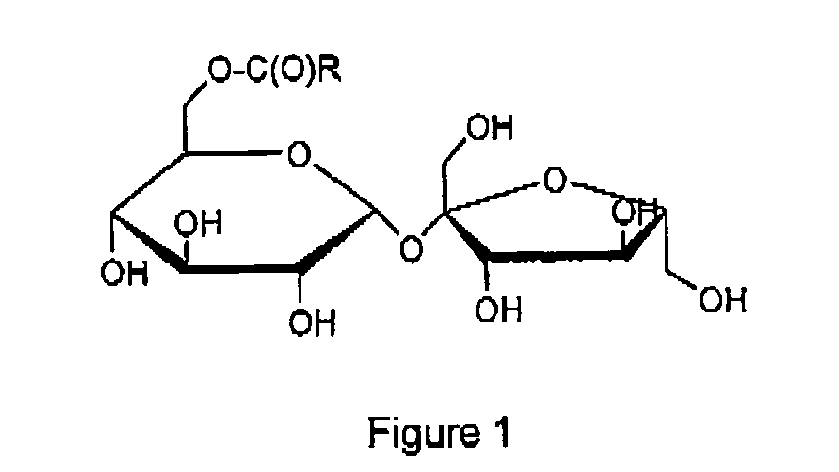
The invention relates to a process for the enzymatic preparation of 6-O-acylsucrose (Figure 1) or a derivative thereof
in the presence of at least one non-nucleophilic organic solvent, by selective monoacylation of sucrose on the 6-position with a donor acyl ester of formula R1R2C=CR3-O-C(O)R, in which R1, R2, and R3 each independently represent hydrogen, an optionally substituted (hetero)alkyl group or an optionally substituted (hatero)aryl group with for example 1-50 C atoms, or of formula R4-O-C(O)R, in which R4 is a halogenated alkyl group of 2-50 carbon atoms in which at least the 2-position of the alkyl group is substituted with one, two or three halogens, and with R representing an optionally substituted (hetero)alkyl or (hetero)aryl group having from 1 to 50 carbon atoms, wherein the acylation is carried out in the presence of a lipase enzyme selected from the group of
(i) lipases obtainable from a micro-organism from a Surkholderia gladioli species; or
(ii) any such Burkholderia gladioli lipase enzyme produced and over-expressed in another suitable micro-organism; or
(iii) mutants of the lipases from (i) and/or (ii) having selective acylation activity to form 6-O-acylsucrose in acylation of sucrose.
(i) lipases obtainable from a micro-organism from a Surkholderia gladioli species; or
(ii) any such Burkholderia gladioli lipase enzyme produced and over-expressed in another suitable micro-organism; or
(iii) mutants of the lipases from (i) and/or (ii) having selective acylation activity to form 6-O-acylsucrose in acylation of sucrose.
Description
- The invention relates to a process for the enzymatic preparation of 6-O-acylsucrose (Figure 1 with R representing an optionally substituted (hetero)alkyl or (hetero)aryl group having from 1 to 50 carbon atoms) or a derivative thereof

- 6-O-acylsucrose has a considerable interest as an intermediate product in the synthesis of the synthetic intense sweetener sucralose (4,1',6'-trichloro-4,1',6'-trideoxygalactosucrose, Figure 2).

- Sucralose is approximately 2.5 times sweeter than aspartame (α-L-aspartyl-L-phenylalanine methyl ester) and has the advantage that it is suitable for a number of products for which aspartame is less suitable, e.g. food products that need to undergo heat treatment, have an unfavourable pH for aspartame and/or need to have a very long shelf life.
- In general, enzymatically catalysed acylations of sucrose in organic media usually result in low conversions to the desired product 6-O-acylsucrose, as is shown in, for example, M. Woudenberg-Van Oosterom et al., "Regioselective acylation of disaccharides in tert-butyl alcohol catalyzed by Candida antarctica lipase" Biotechnol. Bioeng. 49 (1996), 328-333. Herein enzymatic acylation is described of several disaccharides with ethyl butanoate or ethyl dodecanoate as the donor acyl ester, the acylation being catalyzed by Candida antarctica lipase. At relatively low conversion several monoesters resulting from acylation of the primary alcohol groups were obtained as the primary products, while at higher conversion diesters were formed, the ratio of diester to monoester being dependent on the structure of the disaccharide.
- A process for the enzymatic preparation of 6-O-acetylsucrose is also known from
US Patent 5,128,248 , wherein sucrose is acetylated with isopropenylacetate in pyridine in the presence of lipase P (Amano). - A drawback of the process disclosed in
US Patent 5,128,248 is the low conversion to the desired product 6-O-acetylsucrose, in spite of the large excess of acyl donor and large amounts of enzyme, as has been confirmed in Comparative Example B of the present application. Additionally, a significant amount of 4',6-di-O-acetylsucrose is formed as a by-product. - The object of the present invention is therefore to provide a commercially attractive process in which sucrose or a derivative thereof is acylated to 6-O-acylsucrose or a derivative thereof in a much higher conversion than known from the state of the art, the acylation reaction being catalysed by an enzyme.
- Surprisingly, this object is achieved according to the invention by performing the process in the presence of a lipase enzyme selected from the group of
- (i) lipases obtainable from a micro-organism from a Burkholderia gladioli species, or
- (ii) any such Burkholderia gladioli lipase enzyme produced and overexpressed in another suitable micro-organism, or
- (iii) mutants of the lipases from (i) and/or (ii) having selective acylation activity to form 6-O-acylsucrose in acylation of sucrose.
- Accordingly, not only lipases naturally produced by a micro-organism from a Burkholderia gladioli species, whether or not they are obtained from a Burkholderia gladioli species micro-organism (or are obtained by heterologous over-expression in another suitable microorganism) can be used in the context of the present invention, but also such lipases can be used as are obtained by mutation of genes coding for such lipases to obtain mutant lipases having selective acylation activity to form 6-O-acylsucrose in acylation of sucrose. Of course, also any other lipases having similar activity with respect to the selective acylation of the 6-position of sucrose can be used in the process according to the invention.
- Preferably a lipase produced by a micro-organism from a Burkholderia gladioli species is used, more preferably a lipase chosen from the group consisting of Lipase PL, Lipase QL, and Lipase QLM; most preferably, the lipase is Lipase QL or Lipase QLM. In the process according to the invention lipases can be used as such, as part of a whole cell (which may be a Burkholderia gladioli cell, or a cell of any other micro-organism in which the lipases from Burkholderia gladioli may be over-expressed), or immobilized on a solid carrier.
- The lipase used in the process according to the invention is generally present in a quantity corresponding to 1.000-1.000.000 U per gram of sucrose or a derivative thereof. Preferably a quantity corresponding to between 10.000 and 100.000 U per gram of sucrose is used, more preferably between 25.000 and 75.000 U per gram of sucrose.
- As used herein, the unit 1 U corresponds to the amount of enzyme which liberates 1 µmol of fatty acid per min at 37 °C in the assay method of Kokusho et al. (Agric. Biol. Chem. 46 (1982), 1159-1164) using olive oil emulsified with polyvinyl alcohol as a substrate (see: Naka Y., Yukagaku 36 (1987), 821-825).
- The skilled person can easily establish the actual quantity in weight of the lipase to be used most suitably in the process of the invention. It will be clear that such quantity will depend on the activity of the lipase used (in U/gram lipase), which is determined by parameters like the purity and formulation (e.g. free or immobilized enzyme) of the lipase as used. Depending on the quantity of catalyst not only the reaction rate, but also the selectivity achieved, may vary. The skilled person will take these factors into account, when determining the optimum quantity in weight of the lipase to be used most suitably. One also may influence the reaction rate and its selectivity by providing suitable mutants of the lipases to be used in the context of the present invention.
- Excellent results also may be achieved, if the lipase used is a lyophilised lipase, optionally in the presence of a lyoprotectant, i.e. of a component that protects the lipase during lyophilization. As the lyoprotectant a wide range of compounds can be used. Conveniently, the substrate sucrose itself, or derivatives thereof, as exemplified below, may be applied as lyoprotectant.
- The substrate used in the process of the invention is either sucrose itself, or a derivative thereof, for example derivatives bearing one or more O-functional groups such as acyl or aroyl groups (such derivatives being esters); or alkyl or aryl groups (which types of derivatives are ethers); or silyl groups (i.e. these are silyl ethers); or derivatives wherein one or more of the hydroxyl groups other than the 6-hydroxy group are replaced by a halogen atom); in any case, however, in any of the derivatives at least the 6-position carries a free hydroxyl group.
- In particular the method according to the invention can be used for the production of 6-O-acylsucrose, which is an intermediate in for example the preparation of sucralose from sucrose.
- The starting concentration of substrate (i.e. of sucrose or a derivative thereof) in the reaction mixture is generally chosen between 0.1 and 60 wt.%, in particular between 1 and 40 wt.%, more in particular between 2 and 10 wt.%. The most suitable concentration of substrate, preferably of sucrose, depends on e.g. the solubility of sucrose (or the derivative thereof) in the reaction medium. It should be noted, however, that the concentration of sucrose or the derivative thereof is not limited to the maximum solubility of sucrose or the derivative thereof in the solvent at the temperature applied; the sucrose or the derivative thereof may not dissolve completely at the beginning of the reaction, but will dissolve completely in the course of the reaction when the dissolved sucrose or derivative thereof is transformed into the product 6-O-acylsucrose, because this compound generally has a higher solubility than the substrate.
- A donor acyl ester of formula R1R2C=CR3-O-C(O)R, in which R1, R2, R3, and R have the meaning as defined above, or a donor acyl ester of formula R4-O-C(O)R in which R4 has the meaning as defined above is used in the process according to the invention. Examples of heteroatoms in the optionally substituted (hetero)alkyl group and optionally substituted (hetero)aryl group with for example 1-50 C atoms which may be present in R, R1, R2 and R3 are N, O, P and S. Examples of substituents on the (hetero) alkyl group or (hetero) aryl group are a nitro group, a halogen, an alkyl group with 1-6 C atoms, and an alkoxy group with 1-6 C atoms.
- Examples of donor acyl esters of formula R1R2C=CR3-O-C(O)R are isopropenyl and vinyl esters, for example vinyl acetate, vinyl proprionate, vinyl butyrate, and isopropenyl acetate. In particular when R = CH3, an isopropenyl ester is preferred rather than a vinyl ester, the isopropenyl group usually having a positive effect on the selectivity of the acylation reaction, as isopropenyl esters are usually hardly reactive in the presence of sucrose or a derivative thereof in the absence of an enzyme. In other cases, when the bulky isopropenyl group of isopropenyl esters is not required to suppress undesired side-reactions in the absence of an enzyme, vinyl esters are preferred, thereby usually leading to higher reaction rates.
- Examples of donor acyl esters of formula R4-O-C(O)R are are 2,2,2-trichloroethylesters and 2,2,2-trifluoroethylesters.
- The enzymatic acylation of sucrose to 6-O-acylsucrose by using hydrophobic vinyl esters of fatty acids as the acylating agent is commonly known to result in reasonable conversions, for example from M. Ferrer et al., Biotechnol. Bioeng., 65 (1999), 10, and W. Tzuzuki et al., Biotechol. Bioeng., 64 (1999), 267. On the other hand, it is also commonly known that the use of short chain, relatively hydrophilic donor acyl esters usually results is much lower conversions to the desired product. See for example J.O. Rich et al., Biotechnology and Bioengineering, 45 (1995), 426-434. It is therefore even more surprising that high conversions to 6-O-acylsucrose or derivatives thereof are obtained even when the reaction is performed using a short chain donor acyl ester, for example vinyl acetate and isopropenyl acetate.
- The molar ratio between the donor acyl ester and sucrose or a derivative thereof is not particularly critical and will generally be chosen between 0.5:1 and 100:1, preferably between 0.8:1 and 50:1, more preferably between 1:1 and 25:1, in particular between 2:1 and 10:1. For economic reasons the molar ratio between the donor acyl ester and sucrose or a derivative thereof is in particular between 2:1 and 6:1. The donor acyl ester may also be used as a solvent. In that case the ratio between the donor acyl ester and sucrose or a derivative thereof may be higher than 100:1.
- The process according to the invention is carried out in the presence of at least one non-nucleophilic organic solvent which has sufficient polarity to dissolve at least part of each reactant, i.e. sucrose or a derivative thereof and the donor acyl ester, under the applied reaction conditions, for example 3 wt.% at 30 °C. Non-nucleophilic-solvents is defined here to describe solvents that do not compete with the substrate by reacting with the donor acyl esters. Preferably the solvent used is selected from the group of non-nucleophilic amines, non-nucleophilic amides, non-nucleophilic sterically hindered alcohols, and non-nucleophilic sulfoxides. Examples of non-nucleophilic amines are tertiary amines, such as N-methyl morpholine or triethyl amine, or aromatic amines such as pyridine. In particular aromatic amines are preferred, for example pyridine. Examples of non-nucleophilic amides are N,N-dimethyl formamide and 1-methyl-2-pyrrolidone (NMP). Examples of sterically hindered alcohols, which owe their non-nucleophilicity to their bulky nature, are t-butanol and t-amylalcohol (2-mathyl-2-butanol). Examples of non-nucleophilic sulfoxides are, for instance, dimethyl sulfoxide and sulfolane.
- The process according to the invention may also be carried out in a mixture of solvents, for example a mixture of two or more of the non-nucleophilic solvents mentioned above. In addition to the non-nucleophilic solvents, however, also one or more hydrophobic solvents (i.e. co-solvents) may be present, thereby forming a mixture of one or more of the non-nucleophilic solvents mentioned above and one or more hydrophobic co-solvents. Examples of suitable hydrophobic solvents include for example optionally substituted aliphatic or aromatic hydrocarbons with for example 5-12 carbon atoms. The presence of one or more of such hydrophobic solvents may result in a higher conversion to 6-O-acylsucrose or a derivative thereof and may improve the solubility of some donor acyl esters. In fact, the use of hydrophobic solvents is generally known and usually essential to improve the stability and activity of the enzyme to an acceptably high level, as described in for example J.O. Rich et al., Biotechnology and Bioengineering, 45 (1995) p. 426-434. It is therefore even more surprising that in the process according to the invention the presence of such hydrophobic solvents is not necessary. In fact the process according to.the invention results in superior selectivities and yields even when performed in non-nucleophilic, polar solvents such as pyridine or mixtures thereof.
- The reaction is preferably carried out at a reaction temperature between 0 and 100 °C, the most suitable reaction temperature depending on the type of enzyme and the donor acyl ester used. At temperatures below 0 °C the reaction will be relatively slow, while at temperatures higher than 100 °C the enzyme stability is affected significantly, resulting in a lower regioselectivity and enzyme efficiency. More preferably the reaction is performed at a reaction temperature between 20 and 80 °C, most preferably at a reaction temperature between 30 and 70 °C.
- The reaction time for achieving the desired high conversion level can vary within broad ranges and is dependent on for example the types, amounts and concentrations of the enzyme, sucrose or a derivative thereof and the donor acyl ester, the solvent(s) and the temperature. A skilled person can easily determine the most suitable reaction time for a particular combination of enzyme, sucrose or derivative thereof, donor acyl ester, solvent(s) and reaction conditions. Usually a reaction time of at least 1 h is aimed at, more preferably a reaction time of at least 6 h, and even more preferably of at least 12 h is aimed at. However, reaction times of more than one or two days, for instance, between 3 and 7 days, may still be suitable. In general reaction times will be shorter if the enzyme activity (in U/gram enzyme) is higher and/or if more enzyme is applied.
- The reaction mixture may be kept in motion, for example, using a shaker or by stirring. If a shaker is used, the shaking speed is preferably between 10 and 1000 rpm, more preferably between 100 and 600 rpm, most preferably between 200 and 400 rpm. Shaking speeds higher than 1000 ppm may negatively affect the stability of the enzyme. Alternatively, the mixture can be passed over a column in which the solid and or immobilized enzyme catalyst is packed as a fixed bed.
- If desired, the 6-O-acylsucroses obtained by the method according to the invention can be used as an intermediate product in a wide range of further reactions.
- For example, the 6-O-acylsucroses can be further subjected to a chlorination reaction. Suitable methods for performing the chlorination reaction are disclosed in for example
GB-B-2,079,749 GB-A-2,195,632 - In particular 6-O-acylsucroses can be used for the preparation of sucralose by subjecting 6-O-acylsucrose to subsequently a chlorination reaction using a Vilsmeier reagent, a peracylation reaction, for example in pyridine and a deesterification (hydrolysis) reaction, followed by isolation of sucralose, as described in for example
WO-A-9960006 US-A- 4,980,463 . - The invention will now be explained in more detail with reference to the following examples, without however being limited thereto in any way.
- Information about the lipases used is listed in Table 1.
Table 1. Information about the lipases used. Species Lipase Supplier Activity Pseudomonas cepacia Lipase P Amano ≥ 30.000 U/g powder Burkholderia gladioli Lipase PL Meito Sangyo 100.000U/g powder Lipase QL Meito Sangyo 30.000U/g powder Lipase QLM Meito Sangyo 60.000U/g powder - Lipase P was assayed by the method disclosed in the product sheet provided by Amano; 1 mL of substrate solution (5% bovine albumine dissolved in 20 mL 0.1 M phosphate buffer pH=7 mixed with 3 mL of Fatgen (sesame oil emulsion)) mixed with 0.5 mL 0.1 M phosphate buffer pH=7 is incubated at 37 °C for 5 min in a closed test tube. 0.5 mL of diluted enzyme solution is added and the mixture is incubated at 37°C for 20 min. Subsequently 5 mL of stop solution (10 volumes of n-heptane, 40 volumes of isopropylalcohol and 1 volume of 2 N aq. sulphuric acid) is added and shaken, free fatty acids are extracted with 3 mL of n-heptane and 2 mL of distilled water. 3 mL of n-heptane layer is taken up and after adding 1 drop of Thymol Blue (1% in ethanol) as indicator, the solution is titrated with 0.01 N alcoholic KOH solution (0.8 g KOH in 10 mL distilled water diluted to 1 liter with 95% ethanol) in nitrogen gas currents (t mL). Controls are determined in the same way with distilled water (B mL). 1 unit (U) is defined as the lipase activity to free 1 µmole of fatty acid per 1 minute. Lipolytic activity (U/g)= 1.000 x 0.01 x 2 x 1/20 x 1.327 x (t - B) x D in which D = multiple of dilution.
- The lipases from Surkholderia gladioli were assayed by the method of Kokusho et al. (Agric. Biol. Chem. 46 (1982), 1159-1164) using olive oil emulsified with polyvinyl alcohol as a substrate (Naks Y., Yukagaku 36 (1987), 821-825), 1 U corresponds to the amount of enzyme, which liberates 1 µmol fatty acid per min at 37 °C.
- 6-O-acetylsucrose was prepared using different lipases produced by a micro-organism from a Burkholderia gladioli species and isopropenyl acetate as the donor acyl ester. The lipases were lyophilized as described in Examples V-VI before use to remove water if present in the commercial samples. For Lipase PL and Lipase QL, to a mixture of sucrose (0.25 g, 0.73 mmol) and lipase (0.25 g) in pyridine (10 mL) isopropenylacetate (0.46 g, 4.6 mmol) was added (donor acyl ester : sucrose = 6 : 1 mol/mol). In the case of Lipase QLM higher concentrations (2x) of the reactants were applied: 0.50 g of sucrose, 0.50 g of lipase and 0.87 g of isopropenylacetate. The reaction vessel was closed and the reaction mixture was maintained at 37 °C and shaken at 300 rpm. Conversion to 6-O-acetylsucrose was followed in time by determining the concentration of 6-O-acetylsucrose via Thin Layer Chromatography (TLC), using silica gel, and quantitatively by High Performance Liquid Chromatochraphy (HPLC) on a Nucleosil®-NH2 HPLC column, with detection of the components on a refractometer. Eluent: acetonitrile / water (85/15 v/v). Before sampling, the shaking of the reaction vessel was stopped for 30 min, to allow the enzyme to deposit on the bottom of the reaction vessel so that clear samples could be taken. Samples of 50 µL were taken from the reaction mixture and diluted with 450 µL eluent before injection. Results are presented in Table 2.
Table 2. Preparation of 6-O-acetylsucrose using isopropenyl acetate as the donor acyl ester and a lipase produced by a micro-organism from a Burkholderia gladioli species. Example Enzyme catalyst Results Reaction time (h) Conversion to 6-O-acetylsucrose (mol%) I Lipase PL 4 1 (lyophilized) 76 10 290 20 II Lipase QL 4 11 (lyophilized) 76 50 290 59 III Lipase QLM 20 29 (lyophilized) 48 48 92 59 - Table 2 shows that three lipases produced by a micro-organism from a Burkholderia gladioli species, in particular lipase QL and lipase QLM, are surprisingly active in the conversion of sucrose to 6-O-acetylsucrose.
- A reaction was performed using Lipase P (Amano) as the enzyme, applying the same reaction conditions as in Examples I-III. Lipase P (Amano) is produced by a micro-organism from a Pseudomonas cepacia species. The results are given in Table 3.
Table 3. Preparation of 6-O-acetylsucrose using isopropenyl acetate as the donor acyl ester and Lipase P as the biocatalyst Enzyme catalyst Results Reaction time (h) Conversion to 6-O-acetylsucrose (mol%) Lipase P 2 0 (lyophilized) 24 1 50 2 72 2 96 3 - 6-O-acetylsucrose was prepared using lipases produced by a micro-organism from a Burkholderia gladioli species (Examples IV.1-IV.3), respectively lipases from a different origin (Comparative Examples B.1-8.23) and isopropenyl acetate as the donor acyl ester. For each of these Examples and Comparative Examples, to a mixture of sucrose (0.5 g, 1.46 mmol) and lipase (0.5 g) in pyridine (10 mL) was added isopropenylacetate (0.45 g, 4.5 mmol) (donor acyl ester : sucrose = 3 1 mol/mol). The reaction vessel was closed and the reaction mixture was maintained at 37 °C and shaken at 300 rpm for 70 hours. Conversion to 6-O-acetylsucrose and by-products, e.g. sucrose mono-, di- and triesters, fructose, glucose, glucose esters was determined qualitatively via Thin Layer Chromatography (TLC), using silica gel, and quantitatively by High Performance Liquid Chromatochraphy (HPLC) on a Nucleosil®-NH2 HPLC column, with detection of the components on a refractometer. Eluent: acetonitrile / water (85/15 v/v). After shaking for 70 hours, and before sampling, the shaking of the reaction vessel was stopped for 30 min, to allow the enzyme to deposit on the bottom of the reaction vessel so that clear samples could be taken. Samples of 50 µL were taken from the reaction mixture and diluted with 450 µL eluent before injection. Results are presented in Table 4.
Table 4. Preparation of 6-O-acetylsucrose using isopropenyl acetate as the donor acyl ester and various lipases obtained from different origin. Example, respectively Comparative Example Origin of lipase Biocatalyst Supplier Result (conversion to 6-O-acetylsucrose in %) other remarks IV.1 Burkholderia gladioli Lipase PL Meito Sangyo 12 IV.2 Burkholderia gladioli Lipase QL Meito Sangyo 18 IV.3 Burkholderia gladioli Lipase QLM Meito Sangyo 37 B.1 Candida lipolytica Lip F6 Enzymatix None B.2 Candida lipolytica Lipase L10 Amano None B.3 Candida lipolytica Lipase C. lipolytica Biocatalysts None B.4 Humicola lanuginosa Lipase CE Amano10 Amano < 5, not 6-selective B.5 Humicola lanuginosa Lipozyme TL IM Novo None B.6 Humicola lanuginosa Chirazyme L-8 Roche <5 B.7 Humicola lanuginosa Lip F13 Enzymatix <5 B.8 Humicola lanuginosa Lipase H. lanuginosa Biocatalysts Not 6-selective; invertase activity B.9 Humicola lanuginosa SP 523 Novo None B.10 Mucor javanicus Lipase M Amano10 Amano None B.11 Mucor miehei Lipase RM IM (= IM20) Novo None B.12 Mucor miehei SP 225 Novo None B.14 Mucor miehei Lip F7 Enzymatix None B.15 Mucor miehei Lipase Mucor miehei Biocatalysts <5 B.16 Mucor miehei SP 254 Novo None B.17 Pseudomonas cepacia Lipase AK Amano Amano Not 6-selective and invertase activity B.18 Pseudomonas cepacia Lipase PS D Amano I Amano 3 and 1% of 1'-O-acetylsucrose B.19 Porcine pancreas Lipase PPL Fluka None B.20 Porcine pancreas Lipase PPL USBC None B.21 Rhizopus oryzae Lip F3 Enzymatix None B.22 Rhizopus oryzae Lipase D Amano20 Amano < 5 B.23 Rhizopus oryzae Lipase N Amano cone. Amano None - Table 2 shows that lipases produced by a micro-organism from a Burkholderia gladioli species, are much more active and selective in the conversion of sucrose to 6-O-acetylsucrose than lipases from other origin.
- The influence of lyophilization of the lipase on its catalytic activity was determined for Lipase QLM using isopropenyl acetate as the donor acyl ester. Herein lyophilization was carried out by storing the lipase (as a powder) together with sucrose in a freezer at -80 °C for 30 min. Subsequently the lipase was dried in a freeze dryer overnight. Pyridine (10 mL) and isopropenylacetate (0.46 g, 4.6 mmol) were added (donor acyl ester: sucrose = 3 : 1 mol/mol) to the lyophilized mixture of sucrose (0.50 g, 1.46 mmol) and lipase (0.50 g). Further reaction conditions were the same as those in Example I. The results for Lipase QLM as received and after lyophilization are given in Table 5.
Table 5. Influence of lyophilization of the enzyme on the acylation of sucrose to 6-O-acetylsucrose. Example Enzyme catalyst Results Reaction time (h) Conversion to 6-O-acetylsucrose (%) V Lipase QLM 24 14 as received 48 21 174 37 VI Lipase QLM 24 25 lyophilized 48 34 174 48 - The results in Table 5 show that lyophilization of Lipase QLM in the presence of sucrose as the lyoprotectant has a positive effect on its catalytic activity in the acylation of sucrose to 6-O-acylsucrose.
- Different donor acyl esters were tested for the acylation of sucrose in the presence of Lipase QLM as the enzyme catalyst. Lipase QLM was used as received. To a mixture of sucrose (0.50 g, 1.46 mmol) and lipase (0.50 g) in pyridine (10 mL) donor acyl ester (8.7 mmol) was added (donor acyl ester: sucrose = 6 : 1 mol/mol). Further reaction conditions were the same as those in Examples I-III. The results are listed in Table 6.
Table 6. Acylation of sucrose to 6-O-acylsucrose with different donor acyl esters in the presence of Lipase QLM. Example Donor acyl ester Result Reaction time (h) Conversion to 6-O-acetylsucrose (%) VII Isopropenyl acetate 20 29 48 48 VIII Vinyl propionate 20 46 48 58 IX Vinyl butyrate 20 48 48 65 - To investigate the influence of the molar ratio between the donor acyl ester and sucrose on the yield, experiments were performed using lipase QLM as received, isopropenyl acetate as the donor acyl ester and donor acyl ester: sucrose molar ratios of 3:1 and 6:1, respectively, at a temperature of 37°C, using concentrations of 146 mM (sucrose) and 50g/L (enzyme). The results are given in Table 7.
Table 7. Influence of the molar ratio donor acyl ester: sucrose on the yield. Example X Example XI Donor acyl ester : sucrose 3:1 Donor acyl ester : sucrose 6:1 Reaction time (h) Conversion to 6-O-acetylsucrose (mol%) Reaction time (h) Conversion to 6-O-acetylsucrose (mol%) 24 14 20 29 48 21 48 48 174 37 92 59 - Table 7 shows that when isopropenyl acetate and Lipase QLM are used, an increase of the donor acyl ester : sucrose ratio from 3:1 to 6:1 results in a 2-fold increase of reaction speed.
- The influence of the reaction temperature on the enzymatic acylation is illustrated by performing tests with Lipase QLM as the enzyme catalyst and isopropenyl acetate as the donor acyl ester (donor acyl ester: sucrose = 3 : 1) at 37 and 60 °C, respectively, using concentrations of 146 mM (sucrose) and 50g/L (enzyme). No significant difference was observed between the reaction rates at 37 and 60 °C.
- To a mixture of sucrose (1.0 g, 0.003 mol) and enzyme catalyst (1 g, lipase QL, Meito Sangyo, lot no. N3104) in pyridine (40 mL) was added isopropenyl acetate (2 mL, 0.02 mol, 6 molar equivalents). The reaction vessel was closed and the reaction mixture was maintained at 37 °C and shaken at 300 rpm for 18 days. A filtrate sample of the crude reaction mixture was analyzed by HPLC and was found to contain 6-O-acetylsucrose as the main product and minor amounts of byproducts such as 1'-O-acetylsucrose, 6'-O-acetylsucrose and sucrose-di- and tri-acetates. The enzyme was separated from the mixture using a G-3 glass funnel and washed with toluene. The filtrate and the toluene washing were evaporated separately (rotary evaporator, 40°C) to remove the solvents. The resulting oils were cooled to -80 °C and freeze dried using an oil pump. Both fractions were analyzed using TLC on silica gel (eluent: EtOAc/MeOH / H2O=75/25/5 v/v/v) and were found to contain mainly sucrose-monoacetate (Rt = 0.3). Pyridine was removed from the combined oil fractions by co-evaporation with toluene (2 x 30 mL) in vacuo at 40 °C. The remaining volatiles were evaporated with a vacuum pump. The brown solid residue was further purified using column chromatography on silica gel (eluent: CHCl3 / methanol / acetic acid water=60/30/3/5 v/v/v/v), Tetrahedron, vol. 51, no 13, p 3881, 1995).
- 6-O-acetylsucrose (0.17 g, 0.4 mmol) was obtained in high purity (no by-products could be observed in the 1H NMR and 13C NMR spectra). The product was characterized by 1H and 13C NMR spectroscopy recorded at 300 and 75 MHz, respectively. 1H NMR (D2O) (δ in ppm): 2.05 (s, 3H), 3.36 (t, J = 9.6 Hz, 1H), 3.48 (dd, J = 9.9, 3.8 Hz, 1H), 3.57 (s, 1 H), 3.67 (t, J = 9.6 Hz, 1H), 3.70 - 3.74 (m, 2H), 3.76 - 3.84 (m, 1H), 3.94 (t, J = 8.4 Hz, 1 H), 3.97 - 4.01 (m, 1H), 4.13 (d, J = 8.7 Hz, 1H), 4.19 (dd, J = 12.3, 5.1 Hz, 1H), 4.30 (dd, J = 12.3, 2.3 Hz, 1H), 5.32 (d, J = 3.8 Hz, 1H). 13C NMR (D2O) 20.58 (q), 61.72 (t), 62.99 (t), 63.94 (t), 69.92 (d), 70.60 (d), 71.28 (d), 72.69 (d), 74.52 (d), 76.66 (d), 81.77 (d), 92.32 (d), 104.06 (d), 174.45 (d).
Claims (11)
- Process for the enzymatic preparation of 6-O-acylsucrose (Figure 1 with R representing an optionally substituted (hetero)alkyl or (hetero)aryl group having from 1 to 50 carbon atoms) or a derivative thereof
 (i) lipases obtainable from a micro-organism from a Burkholderia gladioli species; or(ii) any such Burkholderia gladioli lipase enzyme produced and over-expressed in another suitable micro-organism; or(iii) mutants of the lipases from (i) and/or (ii) having selective acylation activity to form 6-O-acylsucrose in acylation of sucrose.
 - Process according to claim 1, characterized in that the lipase is chosen from the group consisting of Lipase PL, Lipase QL and Lipase QLM.
- Process according to claim 1 or claim 2, characterized in that the donor acyl ester is chosen from the group consisting of isopropenyl acetate, vinyl propionate and vinyl butyrate.
- Process according to any one of claims 1-3, characterized in that the ratio between the donor acyl ester and sucrose or a derivative thereof is in the range between 2:1 and 10:1.
- Process according to any one of claims 1-4, characterized in that at least one non-nucleophilic organic solvent is chosen from the group consisting of amines, amides, sterically hindered alcohols, and sulfoxides, or mixtures thereof.
- Process according to claim 5, characterized in that at least one non-nucleophilic organic solvent is pyridine.
- Process according to any one of claims 1-6, characterized in that the process is performed at a temperature between 30 and 70 °C.
- Process according to any one of claims 1-7, characterized in that the 6-O-acylsucrose obtained is further subjected to a chlorination reaction.
- Process according to claim 8, characterized in that the chlorination is carried out using a Vilsmeier reagent.
- Process according to claim 8 or claim 9, characterized in that the chlorination reaction is followed by a deesterification (hydrolysis) reaction, followed by isolation of sucralose.
- Process according to claim 8 or claim 9, characterized in that the chlorination reaction is followed by a peracylation and a deesterification (hydrolysis) reaction, followed by isolation of sucralose.
Priority Applications (1)
| Application Number | Priority Date | Filing Date | Title |
|---|---|---|---|
| EP06020561A EP1905838A1 (en) | 2006-09-29 | 2006-09-29 | Enzymatic regioselective 6-acylation of sucrose |
Applications Claiming Priority (1)
| Application Number | Priority Date | Filing Date | Title |
|---|---|---|---|
| EP06020561A EP1905838A1 (en) | 2006-09-29 | 2006-09-29 | Enzymatic regioselective 6-acylation of sucrose |
Publications (1)
| Publication Number | Publication Date |
|---|---|
| EP1905838A1 true EP1905838A1 (en) | 2008-04-02 |
Family
ID=37876858
Family Applications (1)
| Application Number | Title | Priority Date | Filing Date |
|---|---|---|---|
| EP06020561A Withdrawn EP1905838A1 (en) | 2006-09-29 | 2006-09-29 | Enzymatic regioselective 6-acylation of sucrose |
Country Status (1)
| Country | Link |
|---|---|
| EP (1) | EP1905838A1 (en) |
Cited By (2)
| Publication number | Priority date | Publication date | Assignee | Title |
|---|---|---|---|---|
| CN102181494A (en) * | 2011-03-21 | 2011-09-14 | 盐城捷康三氯蔗糖制造有限公司 | Synthesis of sucrose-6-fatty acid ester through selective catalysis of immobilized aspergillus oryzae lipase |
| US10100074B2 (en) | 2013-06-19 | 2018-10-16 | The Regents Of The University Of California | Regioselective silyl exchange of per-silylated oligosaccharides |
Citations (3)
| Publication number | Priority date | Publication date | Assignee | Title |
|---|---|---|---|---|
| US5128248A (en) * | 1988-09-27 | 1992-07-07 | Tate & Lyle Public Limited Company | Selective acrylation of sugars |
| WO1999060006A1 (en) * | 1998-05-15 | 1999-11-25 | Zhbankov Rostislav G | Method of preparation 4,1´,6´-trichloro-4,1´,6´-trideoxygalactosucrose |
| US6605452B1 (en) * | 1997-09-24 | 2003-08-12 | Enzymotec, Ltd. | Fatty acid polyol ester-coated lipase complex immobilized on insoluble matrix |
-
2006
- 2006-09-29 EP EP06020561A patent/EP1905838A1/en not_active Withdrawn
Patent Citations (3)
| Publication number | Priority date | Publication date | Assignee | Title |
|---|---|---|---|---|
| US5128248A (en) * | 1988-09-27 | 1992-07-07 | Tate & Lyle Public Limited Company | Selective acrylation of sugars |
| US6605452B1 (en) * | 1997-09-24 | 2003-08-12 | Enzymotec, Ltd. | Fatty acid polyol ester-coated lipase complex immobilized on insoluble matrix |
| WO1999060006A1 (en) * | 1998-05-15 | 1999-11-25 | Zhbankov Rostislav G | Method of preparation 4,1´,6´-trichloro-4,1´,6´-trideoxygalactosucrose |
Non-Patent Citations (1)
| Title |
|---|
| WOUDENBERG-VAN OOSEREROM M ET AL: "REGIOSELECTIVE ACYLATION OF DISACCHARIDES IN TERT-BUTYL ALCOHOL CATALYZED BY CANDIDA ANTARCTICA LIPASE", BIOTECHNOLOGY AND BIOENGINEERING, WILEY & SONS, HOBOKEN, NJ, US, vol. 49, no. 3, 1996, pages 328 - 333, XP002046397, ISSN: 0006-3592 * |
Cited By (3)
| Publication number | Priority date | Publication date | Assignee | Title |
|---|---|---|---|---|
| CN102181494A (en) * | 2011-03-21 | 2011-09-14 | 盐城捷康三氯蔗糖制造有限公司 | Synthesis of sucrose-6-fatty acid ester through selective catalysis of immobilized aspergillus oryzae lipase |
| US10100074B2 (en) | 2013-06-19 | 2018-10-16 | The Regents Of The University Of California | Regioselective silyl exchange of per-silylated oligosaccharides |
| US10759823B2 (en) | 2013-06-19 | 2020-09-01 | The Regents Of The University Of California | Regioselective silyl exchange of per-silylated oligosaccharides |
Similar Documents
| Publication | Publication Date | Title |
|---|---|---|
| Ferrer et al. | Lipase‐catalyzed regioselective acylation of sucrose in two‐solvent mixtures | |
| Woudenberg‐van Oosterom et al. | Regioselective acylation of disaccharides in tert‐butyl alcohol catalyzed by Candida antarctica lipase | |
| Faber et al. | Enzyme-catalyzed irreversible acyl transfer | |
| EP2014771B1 (en) | Continuous enzymatic hydrolysis process | |
| US4959459A (en) | Surface active compounds and a process for their preparation | |
| US5380659A (en) | Process for highly regioselective esterification and ester cleavage on unsaturated sugar compounds with the aid of lipases and esterases | |
| EP0197484B1 (en) | Method for producing optically active glycol derivatives | |
| EP1905838A1 (en) | Enzymatic regioselective 6-acylation of sucrose | |
| Millqvist‐Fureby et al. | Regioselective synthesis of ethoxylated glycoside esters using β‐glucosidase in supersaturated solutions and lipases in organic solvents | |
| EP0868525B1 (en) | Process for preparing intermediates for the synthesis of antifungal agents | |
| Plou et al. | Acylation of sucrose with vinyl esters using immobilized hydrolases: demonstration that chemical catalysis may interfere with enzymatic catalysis | |
| JP3370670B2 (en) | Process for the enzymatic production of α-glucosides and α-glucoside esters and the use of the products thus obtained | |
| US10378036B2 (en) | Method for the regioselective deacetylation of mannosylerythritol lipids | |
| EP0894868B1 (en) | Process for producing nucleoside derivatives | |
| EP0512848B1 (en) | Enzymatic resolution of alpha-tertiary carboxylic acid esters | |
| US5445951A (en) | Regioselective enzymatic deacylation of sucrose esters in anhydrous organic media | |
| JP4042454B2 (en) | Process for producing optically active 3-methylglutaric acid monoester | |
| Ritthitham et al. | Selectivity and stability of alkaline protease AL-89 in hydrophilic solvents | |
| Simerská et al. | Regioselective enzymatic acylation of N-acetylhexosamines | |
| Xu et al. | Two-step sequential synthesis of pyrimidine derivatives containing a sugar branch via combining of enzymatic Michael addition/acylation | |
| Göbbert et al. | Microbial transesterification of sugar-corynomycolates | |
| Wu et al. | Highly anomer-and regio-selective transesterification catalyzed by alkaline protease from Bacillus subtilis in organic media | |
| Jeon et al. | Enzymatic synthesis of amino acid-sugar alcohol conjugates in organic media | |
| JP2003319793A (en) | Phospholipid base exchange method | |
| Junot et al. | Regioselective acylation of 1, 6-anhydro-β-D-manno and galactopyranose catalysed by lipases |
Legal Events
| Date | Code | Title | Description |
|---|---|---|---|
| PUAI | Public reference made under article 153(3) epc to a published international application that has entered the european phase |
Free format text: ORIGINAL CODE: 0009012 |
|
| AK | Designated contracting states |
Kind code of ref document: A1 Designated state(s): AT BE BG CH CY CZ DE DK EE ES FI FR GB GR HU IE IS IT LI LT LU LV MC NL PL PT RO SE SI SK TR |
|
| AX | Request for extension of the european patent |
Extension state: AL BA HR MK YU |
|
| AKX | Designation fees paid | ||
| REG | Reference to a national code |
Ref country code: DE Ref legal event code: 8566 |
|
| STAA | Information on the status of an ep patent application or granted ep patent |
Free format text: STATUS: THE APPLICATION IS DEEMED TO BE WITHDRAWN |
|
| 18D | Application deemed to be withdrawn |
Effective date: 20081003 |