EP1903739A1 - S-CSCF re-assignment by receiving non-REGISTER request for unregistered IMS users - Google Patents
S-CSCF re-assignment by receiving non-REGISTER request for unregistered IMS users Download PDFInfo
- Publication number
- EP1903739A1 EP1903739A1 EP06019892A EP06019892A EP1903739A1 EP 1903739 A1 EP1903739 A1 EP 1903739A1 EP 06019892 A EP06019892 A EP 06019892A EP 06019892 A EP06019892 A EP 06019892A EP 1903739 A1 EP1903739 A1 EP 1903739A1
- Authority
- EP
- European Patent Office
- Prior art keywords
- cscf
- user
- hss
- request
- services
- Prior art date
- Legal status (The legal status is an assumption and is not a legal conclusion. Google has not performed a legal analysis and makes no representation as to the accuracy of the status listed.)
- Withdrawn
Links
- 238000000034 method Methods 0.000 claims abstract description 12
- 238000010187 selection method Methods 0.000 claims description 2
- WRXPXUSZYDNAQP-LEJQEAHTSA-N [(2r,3s,4r,5r)-5-(6-aminopurin-9-yl)-3,4-dihydroxyoxolan-2-yl]methyl n-[(2s)-2-amino-3-(1h-imidazol-5-yl)propanoyl]sulfamate Chemical compound C([C@H](N)C(=O)NS(=O)(=O)OC[C@@H]1[C@H]([C@@H](O)[C@@H](O1)N1C2=NC=NC(N)=C2N=C1)O)C1=CNC=N1 WRXPXUSZYDNAQP-LEJQEAHTSA-N 0.000 claims 7
- 230000007246 mechanism Effects 0.000 description 3
- MWRWFPQBGSZWNV-UHFFFAOYSA-N Dinitrosopentamethylenetetramine Chemical compound C1N2CN(N=O)CN1CN(N=O)C2 MWRWFPQBGSZWNV-UHFFFAOYSA-N 0.000 description 2
- 238000010561 standard procedure Methods 0.000 description 1
Images


Classifications
-
- H—ELECTRICITY
- H04—ELECTRIC COMMUNICATION TECHNIQUE
- H04L—TRANSMISSION OF DIGITAL INFORMATION, e.g. TELEGRAPHIC COMMUNICATION
- H04L65/00—Network arrangements, protocols or services for supporting real-time applications in data packet communication
- H04L65/80—Responding to QoS
-
- H—ELECTRICITY
- H04—ELECTRIC COMMUNICATION TECHNIQUE
- H04L—TRANSMISSION OF DIGITAL INFORMATION, e.g. TELEGRAPHIC COMMUNICATION
- H04L69/00—Network arrangements, protocols or services independent of the application payload and not provided for in the other groups of this subclass
- H04L69/40—Network arrangements, protocols or services independent of the application payload and not provided for in the other groups of this subclass for recovering from a failure of a protocol instance or entity, e.g. service redundancy protocols, protocol state redundancy or protocol service redirection
-
- H—ELECTRICITY
- H04—ELECTRIC COMMUNICATION TECHNIQUE
- H04L—TRANSMISSION OF DIGITAL INFORMATION, e.g. TELEGRAPHIC COMMUNICATION
- H04L65/00—Network arrangements, protocols or services for supporting real-time applications in data packet communication
- H04L65/10—Architectures or entities
- H04L65/1016—IP multimedia subsystem [IMS]
Definitions
- the so called Serving Session Control Function S-CSCF is the central point to users that are hosted by this S-CSCF. According to 3GPP TS 23.228 the S-CSCF provides these services to registered and unregistered users when it is assigned to these users. This assignment is stored in the Home Subscriber Server HSS.
- the assignment of the S-CSCF 100 will happen when the first SIP message for an unregistered user arrives at an S-CSCF 100.
- This S-CSCF 100 will then treat the user as an unregistered user and try to download the user profile from the HSS 103 via a Cx-SAR request 101. If no S-CSCF 100 is assigned to this user at this moment, the HSS 103 will then assign an S-CSCF 100 to this user and provide the user profile to the S-CSCF via a Cx-SAA response 102.
- an S-CSCF 200 re-assignment is not possible for the unregistered user, according to the current procedures as per 3GPP TS 23.228. If an S-CSCF was already assigned to an unregistered user, the HSS 203 will reject the Cx-SAR request 201 coming from another S-CSCF. So when the currently assigned S-CSCF is not available for an unregistered user, temporarily or permanently, no service can be provided for this unregistered user and a rejection response 202 is returned.
- an I-CSCF can only select an S-CSCF for an IMS user when it receives a terminating request and when no S-CSCF is assigned to the user. This is shown in Figure 3, wherein the HSS 300 return the Server Capabilities of the user to the I-CSCF 306. The I-CSCF will then select an S-CSCF 307 for the user according to the capabilities, from a list of S-CSCFs stored at the I-CSCF.
- an S-CSCF 306 has already been assigned to the user and the HSS 300 return an S-CSCF address to the I-CSCF 307 via a Cx-LIA response (303) 303, no S-CSCF re-selection is allowed for an I-CSCF 307.
- the I-CSCF 306 receives an SIP Request 301, which in run sends an Cx-LIR (UerID) message 302 to the HSS 300 and the HSS 300 sends an Cx-LIA (ServerCapS-CSCF Addr.) message 303 back, containing the S-CSCF address.
- the I-CSCF 306 then sends the message to thean S-CSCF message to itself indicated in the Cx-LIA response.
- the I-CSCF cannot re-select another S-CSCF for the user. It has to reject the request. So no service can be provided in this case.
- the only way to solve the problem is to remove the S-CSCF assignment to the unregistered user via administrative means. After that the I-CSCF can select a new S-CSCF for the user and the selected S-CSCF can download the user profile from the HSS (see Figure 1). This will usually be done for all users assigned with this S-CSCF. Since the removal of the S-CSCF assignment will cause Cx-RTR request to the S-CSCF, the removal of the S-CSCF assignment for all users hosted by the S-CSCF will introduce additional load burst at the HSS, which could lead to an overload situation at the HSS. Furthermore the administrative removal of the S-CSCF assignment will usually involve service staff of operators and cause additional OPEX.
- the present invention is provided by a method for re-assigning Serving Call Session Control Function, S-CSCF (307), services to an un-registered user, hereafter the user, who is of a Home Subscriber Server, HSS (300), in a Third Generation Partnership Program, 3GPP, telecommunications network.
- S-CSCF Serving Call Session Control Function
- HSS Home Subscriber Server
- 3GPP Third Generation Partnership Program
- the I-CSCF (306) is caused to not reject a non-REGISTER request, but to reassign reselect a S-CSCF for the user.
- the HSS (300) re-assigns the S-CSCF (307) contained in a Cx-SAR request (504) to the user and providing a user profile of the unregistered user to a new S-CSCF (307).
- the HSS When the HSS receives a Cx-SAR request for an unregistered IMS user and the S-CSCF address in the Cx-SAR request is different than the S-CSCF address stored as assigned for that user at the HSS, the HSS shall firstly check the availability of the S-CSCF, whose address is stored at the HSS. If the S-CSCF is not available at the moment, the HSS shall re-assign the S-CSCF contained in the Cx-SAR request to the user and provide the user profile of the unregistered user to the new S-CSCF (see Figure 1). If the old assigned S-CSCF is available, the Cx-SAR request shall be rejected by the HSS (see Figure 2). This is different to the current IMS standard procedures as per 3GPP TS 23.228 where the HSS shall reject such a Cx-SAR request. So this is an extension to the Cx-SAR/SAA operation.
- How the availability of the S-CSCF is checked by the HSS is an implementation issue. There are at least two possibilities: a) using the Diameter peer state table, where the connection states of S-CSCFs are stored. An S-CSCF is unavailable if its state is "Closed” or "Closing”; b) or the HSS sends a Cx-PPR request containing the current user profile or charging function address to the S-CSCF, and if no response is received, the S-CSCF is then unavailable.
- the proposal described under point i) is enough to solve the problem when the SIP request is sent directly to the new S-CSCF, e.g. by an Application Server (AS). But if the request is firstly sent to an I-CSCF, the enhancement described under point ii) is needed so that a new S-CSCF can be selected by the I-CSCF.
- AS Application Server
- an I-CSCF When an I-CSCF receives a terminating non-REGISTER request and finds that the assigned S-CSCF is not available, it shall not reject the request, as according to the current procedures described in 3GPP TS 23.228.
- the I-CSCF 400 shall conduct the S-CSCF re-selection procedure described in Figure 4.
- the I-CSCF 400 receives an SIP Request 401, which in run sends an Cx-LIR (UerID) message 302 to the HSS 406 and the HSS 400 sends an Cx-LIA (ServerCap.) message 403 back.
- the I-CSCF 400 sends an SIP request 405 to the S-CSCF 407
- the I-CSCF 400 sends an S-CSCF message to itself.
- the I-CSCF shall firstly query the HSS again via a Cx-LIA(User ID, CapFlag) request (4302), with the explicit request for the Server Capabilities of the user. After the I-CSCF receives the Server Capabilities of the user from the HSS via Cx-LIA response (4303), the I-CSCF shall re-select another S-CSCF from its list of S-CSCFs according to the capabilities and forward the request to the newly selected S-CSCF. This is an extension to the Cx-LIR/LIA operation.
- an unregistered user can receive service from the new S-CSCF, when the previously assigned S-CSCF for this user is not available.
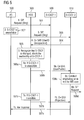
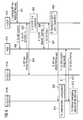
- an originating ( Figure 5) or a terminating request ( Figure 6) for an unregistered user can be delivered even when the previously assigned S-CSCF is not available.
- the AS 500 sends an SIP Request(Orig) message 501 to the S-CSCF-1 509.
- 502 indicates that the S-CSCF is unavailable and the AS sends an SIP Request(Orig) to the S-CSCF-2 510, which in turn sends an Cx-SAR(UserID, Unregistered) message 504 to the HSS 508.
- 505 indicates that the S-CSCF is changed and that the availability of the S-CSCF-1 should be checked. If, in decision step 506a, the S-CSCF-1 is unavailable, the HSS 508 sends an Cx-SAAA(UserProfile) message 506b to the S-CSCF-2 510.
- 506c indicates that and originating services for the IMS user is to be conducted.
- an SIP request 506d is sent.
- the 507a decision step determines that the S-CSCF-1 is available and, in response, the Cx-SAA(Rejection) message 507b is sent to the S-CSCF-2 510, which in turn sends an 4xx response 507c to the AS 500.
- an incoming SIP Request 601 is received by the I-CSCF 616 and the I-CSCF 616 sends an Cx-LIR (UserID) message 602 to the HSS 615.
- a Cx-LIA (S-CSCF-1 Addr) message 603 is sent to the I-CSCF 616 and an SIP Request 604 is sent to the S-CSCF-1 614a.
- 605 indicates that the S-CSCF-1 614a is unavailable and the I-CSCF 616 sends an Cx-LIR (UserID, CapFlag) 606 to the HSS 615, which in turn sends a Cx-LIA (Cap.) message 607 to the I-CSCF 616.
- 608 indicates that the S-CSCF-2 614b is reselected according to its capabilities and the I-CSCF 616 sends an SIP Request 609 to the S-CSCF-2 614b.
- 610 indicates the user ID is an unknown user and is treated by S-CSCF-2 614b as unregistered and the S-CSCF 2 614b sends an Cx-SAR (UserID, Unregistered) message 611 to the HSS 615, which in turn returns an Cx-SAA (Profile, RegInfo) message 612 to the S-CSCF-2 614b.
- 613 indicates that services are terminated for the IMS user.
Landscapes
- Engineering & Computer Science (AREA)
- Computer Networks & Wireless Communication (AREA)
- Signal Processing (AREA)
- Computer Security & Cryptography (AREA)
- Multimedia (AREA)
- Mobile Radio Communication Systems (AREA)
- Telephonic Communication Services (AREA)
Abstract
Description
- Within the IM CN subsystem IMS as defined by 3GPP the so called Serving Session Control Function S-CSCF is the central point to users that are hosted by this S-CSCF. According to 3GPP TS 23.228 the S-CSCF provides these services to registered and unregistered users when it is assigned to these users. This assignment is stored in the Home Subscriber Server HSS.
- Though mechanisms at the network element layer like cluster solution could be used to improve the reliability of the S-CSCF, it is inevitable to have a failover mechanism at the network layer to ensure the availability of the network service. Therefore S-CSCF re-assignment shall be possible.
- For unregistered users, the assignment of the S-CSCF 100 will happen when the first SIP message for an unregistered user arrives at an S-
CSCF 100. This S-CSCF 100 will then treat the user as an unregistered user and try to download the user profile from the HSS 103 via a Cx-SAR request 101. If no S-CSCF 100 is assigned to this user at this moment, the HSS 103 will then assign an S-CSCF 100 to this user and provide the user profile to the S-CSCF via a Cx-SAA response 102. - In Figure 2, an S-CSCF 200 re-assignment is not possible for the unregistered user, according to the current procedures as per 3GPP TS 23.228. If an S-CSCF was already assigned to an unregistered user, the
HSS 203 will reject the Cx-SAR request 201 coming from another S-CSCF. So when the currently assigned S-CSCF is not available for an unregistered user, temporarily or permanently, no service can be provided for this unregistered user and arejection response 202 is returned. - It is worthwhile to note that according to 3GPP TS 23.228 services like a voice mail box can also be provided to unregistered users.
- According to 3GPP TS 23.228 it is possible to re-assign an S-CSCF to the IMS user when this user tries to register with the IMS via a SIP REGISTER request sent to the S-CSCF. In this case the registration status of the user is changed and therefore this is not a solution for an unregistered user. In addition there are IMS users who do not register with the IMS at all, e.g. the so called Public Service Identity (PSI), which represents a service identity.
- Another problem in the current IMS standard is that an I-CSCF can only select an S-CSCF for an IMS user when it receives a terminating request and when no S-CSCF is assigned to the user. This is shown in Figure 3, wherein the HSS 300 return the Server Capabilities of the user to the I-
CSCF 306. The I-CSCF will then select an S-CSCF 307 for the user according to the capabilities, from a list of S-CSCFs stored at the I-CSCF. - As shown in Figure 3, if an S-
CSCF 306 has already been assigned to the user and theHSS 300 return an S-CSCF address to the I-CSCF 307 via a Cx-LIA response (303) 303, no S-CSCF re-selection is allowed for an I-CSCF 307. In operation, the I-CSCF 306 receives anSIP Request 301, which in run sends an Cx-LIR (UerID)message 302 to the HSS 300 and the HSS 300 sends an Cx-LIA (ServerCapS-CSCF Addr.)message 303 back, containing the S-CSCF address. The I-CSCF 306 then sends the message to thean S-CSCF message to itself indicated in the Cx-LIA response. - So when the currently assigned S-CSCF for the user is not available, the I-CSCF cannot re-select another S-CSCF for the user. It has to reject the request. So no service can be provided in this case.
- The only way to solve the problem is to remove the S-CSCF assignment to the unregistered user via administrative means. After that the I-CSCF can select a new S-CSCF for the user and the selected S-CSCF can download the user profile from the HSS (see Figure 1). This will usually be done for all users assigned with this S-CSCF. Since the removal of the S-CSCF assignment will cause Cx-RTR request to the S-CSCF, the removal of the S-CSCF assignment for all users hosted by the S-CSCF will introduce additional load burst at the HSS, which could lead to an overload situation at the HSS. Furthermore the administrative removal of the S-CSCF assignment will usually involve service staff of operators and cause additional OPEX.
- The idea of this proposal is i) to allow S-CSCF re-assignment by Cx-SAR request for unregistered IMS users in case the previously selected S-CSCF is unavailable; ii) to enhance the Cx-LIA request (302) to allow the I-CSCF explicitly require the server capabilities of an user for S-CSCF re-selection.
- The present invention is provided by a method for re-assigning Serving Call Session Control Function, S-CSCF (307), services to an un-registered user, hereafter the user, who is of a Home Subscriber Server, HSS (300), in a Third Generation Partnership Program, 3GPP, telecommunications network. Previously an S-CSCF (307) services to the user including a registration procedure is assigned, but access by the user to the S-CSCF (307) services is erroneously lost. The S-CSCF (307) server previously selected is re-selected if that S-CSCF (307) is presently available. In case that the S-CSCF (307) is not available, the I-CSCF (306) is caused to not reject a non-REGISTER request, but to reassign reselect a S-CSCF for the user. The HSS (300) re-assigns the S-CSCF (307) contained in a Cx-SAR request (504) to the user and providing a user profile of the unregistered user to a new S-CSCF (307).
- The specification shall make reference to the following abbreviations.
- CSCF
- Call Session Control Function
- S-CSCF
- Serving CSCF
- P-CSCF
- Proxy CSCF
- I-CSCF
- Interrogating CSCF
- HSS
- Home Subscriber Server
- IMS
- IP Multimedia Subsystem
- 3GPP
- 3rd Generation Partnership Project
- LIR
- Location Information Request
- LIA
- Location Information Answer
- SAR
- Server Assignment Request
- SAA
- Server Assignment Answer
- RTR
- Registration Termination Request
- RTA
- Registration Termination Answer
- PPR
- Push Profile Request
- PPA
- Push Profile Answer
- PSI
- Public Service Identity
- AS
- Application Server
- The following advantages are provided by the proposal:
- • an automatic mechanism of S-CSCF failover can be provided to unregistered IMS users. No involvement of service staff of operators is required. Therefore no additional OPEX will be generated.
- • The failover procedure only takes place when a request for an unregistered IMS user arrives. This can avoid a possible overload situation at the HSS caused by the administrative removal of the S-CSCF, where a flood of requests will be sent from the HSS to the previously assigned S-CSCF to remove the assignment.
- • the existing Cx-SAR/SAA and Cx-LIR/LIA operations are re-used with extensions. This will only cause limited impact on the existing specification/implementations.
- • The proposal is easily to be verified by checking the Cx-SAR/SAA and Cx-LIR/LIA message.
-
- Fig. 1 illustrates the prior art,
- Fig. 2 illustrates the problem of the un-registered user,
- Fig. 3 illustrates the problem in more detail,
- Fig. 4 illustrates the solution of the present invention,
- Figs. 5 and 6 illustrate case examples of the invention in operation.
- When the HSS receives a Cx-SAR request for an unregistered IMS user and the S-CSCF address in the Cx-SAR request is different than the S-CSCF address stored as assigned for that user at the HSS, the HSS shall firstly check the availability of the S-CSCF, whose address is stored at the HSS. If the S-CSCF is not available at the moment, the HSS shall re-assign the S-CSCF contained in the Cx-SAR request to the user and provide the user profile of the unregistered user to the new S-CSCF (see Figure 1). If the old assigned S-CSCF is available, the Cx-SAR request shall be rejected by the HSS (see Figure 2). This is different to the current IMS standard procedures as per 3GPP TS 23.228 where the HSS shall reject such a Cx-SAR request. So this is an extension to the Cx-SAR/SAA operation.
- How the availability of the S-CSCF is checked by the HSS is an implementation issue. There are at least two possibilities: a) using the Diameter peer state table, where the connection states of S-CSCFs are stored. An S-CSCF is unavailable if its state is "Closed" or "Closing"; b) or the HSS sends a Cx-PPR request containing the current user profile or charging function address to the S-CSCF, and if no response is received, the S-CSCF is then unavailable.
- The proposal described under point i) is enough to solve the problem when the SIP request is sent directly to the new S-CSCF, e.g. by an Application Server (AS). But if the request is firstly sent to an I-CSCF, the enhancement described under point ii) is needed so that a new S-CSCF can be selected by the I-CSCF.
- When an I-CSCF receives a terminating non-REGISTER request and finds that the assigned S-CSCF is not available, it shall not reject the request, as according to the current procedures described in 3GPP TS 23.228. The I-
CSCF 400 shall conduct the S-CSCF re-selection procedure described in Figure 4. In operation, the I-CSCF 400 receives anSIP Request 401, which in run sends an Cx-LIR (UerID)message 302 to theHSS 406 and theHSS 400 sends an Cx-LIA (ServerCap.)message 403 back. In response, the I-CSCF 400 sends anSIP request 405 to the S-CSCF 407 The I-CSCF 400 sends an S-CSCF message to itself. - Tthe I-CSCF shall firstly query the HSS again via a Cx-LIA(User ID, CapFlag) request (4302), with the explicit request for the Server Capabilities of the user. After the I-CSCF receives the Server Capabilities of the user from the HSS via Cx-LIA response (4303), the I-CSCF shall re-select another S-CSCF from its list of S-CSCFs according to the capabilities and forward the request to the newly selected S-CSCF. This is an extension to the Cx-LIR/LIA operation.
- With the proposal described (S-CSCF re-assignment) or (S-CSCF re-selection), an unregistered user can receive service from the new S-CSCF, when the previously assigned S-CSCF for this user is not available. In the following it is showed how an originating (Figure 5) or a terminating request (Figure 6) for an unregistered user can be delivered even when the previously assigned S-CSCF is not available.
- In Figure 5, the
AS 500 sends an SIP Request(Orig)message 501 to the S-CSCF-1 509. 502 indicates that the S-CSCF is unavailable and the AS sends an SIP Request(Orig) to the S-CSCF-2 510, which in turn sends an Cx-SAR(UserID, Unregistered)message 504 to theHSS 508. 505 indicates that the S-CSCF is changed and that the availability of the S-CSCF-1 should be checked. If, indecision step 506a, the S-CSCF-1 is unavailable, theHSS 508 sends an Cx-SAAA(UserProfile)message 506b to the S-CSCF-2 510. 506c indicates that and originating services for the IMS user is to be conducted. In response, anSIP request 506d is sent. The 507a decision step determines that the S-CSCF-1 is available and, in response, the Cx-SAA(Rejection)message 507b is sent to the S-CSCF-2 510, which in turn sends an4xx response 507c to theAS 500. - In Figure 6, an
incoming SIP Request 601 is received by the I-CSCF 616 and the I-CSCF 616 sends an Cx-LIR (UserID)message 602 to theHSS 615. In return, a Cx-LIA (S-CSCF-1 Addr)message 603 is sent to the I-CSCF 616 and anSIP Request 604 is sent to the S-CSCF-1 614a. 605 indicates that the S-CSCF-1 614a is unavailable and the I-CSCF 616 sends an Cx-LIR (UserID, CapFlag) 606 to theHSS 615, which in turn sends a Cx-LIA (Cap.)message 607 to the I-CSCF 616. 608 indicates that the S-CSCF-2 614b is reselected according to its capabilities and the I-CSCF 616 sends anSIP Request 609 to the S-CSCF-2 614b. 610 indicates the user ID is an unknown user and is treated by S-CSCF-2 614b as unregistered and the S-CSCF 2 614b sends an Cx-SAR (UserID, Unregistered)message 611 to theHSS 615, which in turn returns an Cx-SAA (Profile, RegInfo)message 612 to the S-CSCF-2 614b. 613 indicates that services are terminated for the IMS user.
Claims (5)
- A method for re-assigning Serving Call Session Control Function, S-CSCF (307), services to an un-registered user, hereafter the user, who is of a Home Subscriber Server, HSS (300), in a Third Generation Partnership Program, 3GPP, telecommunications network, comprising:previously assigning S-CSCF (307) services to the user including a registration procedure,wherein access by the user to the S-CSCF (307) services is erroneously lost,
characterized in that,
re-assigning the user to the S-CSCF (307) server previously selected if that S-CSCF (307) is presently available;
in case that the S-CSCF (307) is not available, causing an I-CSCF (306) to not reject a request to reassign re-select another S-CSCF for the user, and
re-assigning by the HSS (300) the S-CSCF (307) contained in a Cx-SAR request (504) to the user and providing a user profile of the unregistered user to a new S-CSCF (307). - The method according to claim 1, wherein when the HSS (300) receives a Cx-SAR request (504) for the unregistered user and the S-CSCF (307) address in the Cx-SAR request (504) is different than an S-CSCF (307) address stored as assigned for that user at the HSS (300), the HSS (300) shall firstly check the availability of the S-CSCF (307), whose address is stored at the HSS (300).
- The method according to claim 1, the availability of the S-CSCF (307) is checked by the HSS (300) by using a diameter peer state table, where the connection states of S-CSCF (307)s are stored.
- The method according to claim 1, the availability of the S-CSCF (307) is checked by the HSS (300) by sending a Cx-PPR request containing the current user profile or charging function address to the S-CSCF (307), and if no response is received, the S-CSCF (307) is determined as unavailable.
- The method according to claim 1, wherein the I-CSCF (306) conducts S-CSCF (307) re-selection procedure by
querying the HSS (300) again via a Cx-LIA request (302), with the explicit request for Server Capabilities of the user,
after the I-CSCF (306) receives the Server Capabilities of the user from the HSS (300) via Cx-LIA response (303), the I-CSCF (306) shall re-select another S-CSCF (307) from its list of S-CSCF (307)s according to the capabilities and forwards the request to the newly selected S-CSCF (307).
Priority Applications (2)
| Application Number | Priority Date | Filing Date | Title |
|---|---|---|---|
| EP06019892A EP1903739A1 (en) | 2006-09-22 | 2006-09-22 | S-CSCF re-assignment by receiving non-REGISTER request for unregistered IMS users |
| PCT/EP2007/059819 WO2008034817A1 (en) | 2006-09-22 | 2007-09-18 | S-cscf re-assignment by receiving non-register request for unregistered ims users |
Applications Claiming Priority (1)
| Application Number | Priority Date | Filing Date | Title |
|---|---|---|---|
| EP06019892A EP1903739A1 (en) | 2006-09-22 | 2006-09-22 | S-CSCF re-assignment by receiving non-REGISTER request for unregistered IMS users |
Publications (1)
| Publication Number | Publication Date |
|---|---|
| EP1903739A1 true EP1903739A1 (en) | 2008-03-26 |
Family
ID=37821517
Family Applications (1)
| Application Number | Title | Priority Date | Filing Date |
|---|---|---|---|
| EP06019892A Withdrawn EP1903739A1 (en) | 2006-09-22 | 2006-09-22 | S-CSCF re-assignment by receiving non-REGISTER request for unregistered IMS users |
Country Status (2)
| Country | Link |
|---|---|
| EP (1) | EP1903739A1 (en) |
| WO (1) | WO2008034817A1 (en) |
Cited By (4)
| Publication number | Priority date | Publication date | Assignee | Title |
|---|---|---|---|---|
| WO2009124439A1 (en) * | 2008-04-11 | 2009-10-15 | 中兴通讯股份有限公司 | A serving call session control function failure recovery processing method |
| CN102045364A (en) * | 2010-12-31 | 2011-05-04 | 华为技术有限公司 | User registration method, device and communication system in internet protocol multimedia subsystem (IMS) network |
| CN101754358B (en) * | 2008-12-05 | 2012-07-11 | 中国移动通信集团公司 | Processing method, system and device for canceling unregistered service session controller |
| EP2569998A4 (en) * | 2010-05-14 | 2013-12-11 | Ericsson Telefon Ab L M | Enabling set up of a connection from a non-registered ue in ims |
Families Citing this family (2)
| Publication number | Priority date | Publication date | Assignee | Title |
|---|---|---|---|---|
| CN101478737B (en) * | 2008-12-30 | 2010-10-27 | 华为技术有限公司 | Method, device and system for service migration |
| GB2542592B (en) | 2015-09-24 | 2021-10-06 | Metaswitch Networks Ltd | Managing interaction constraints |
Citations (1)
| Publication number | Priority date | Publication date | Assignee | Title |
|---|---|---|---|---|
| WO2007025480A1 (en) * | 2005-08-31 | 2007-03-08 | Huawei Technologies Co., Ltd. | Method of session processing in an ims and interrogating-call state control function |
-
2006
- 2006-09-22 EP EP06019892A patent/EP1903739A1/en not_active Withdrawn
-
2007
- 2007-09-18 WO PCT/EP2007/059819 patent/WO2008034817A1/en not_active Ceased
Patent Citations (1)
| Publication number | Priority date | Publication date | Assignee | Title |
|---|---|---|---|---|
| WO2007025480A1 (en) * | 2005-08-31 | 2007-03-08 | Huawei Technologies Co., Ltd. | Method of session processing in an ims and interrogating-call state control function |
Non-Patent Citations (3)
| Title |
|---|
| "Digital cellular telecommunications system (Phase 2+); Universal Mobile Telecommunications System (UMTS); Internet Protocol (IP) multimedia call control protocol based on Session Initiation Protocol (SIP) and Session Description Protocol (SDP); Stage 3 (3GPP TS 24.229 version 7.2.0 Release 7)", ETSI TS 124 229 V7.2.0, December 2005 (2005-12-01), XP014032501 * |
| "Digital cellular telecommunications system (Phase 2+); Universal Mobile Telecommunications System (UMTS); IP Multimedia Subsystem (IMS); Stage 2 (3GPP TS 23.228 version 7.2.0 Release 7)", ETSI TS 123 228 V7.2.0, December 2005 (2005-12-01), XP014032467 * |
| "Reassignment for S-CSCF during the terminated call procedure", 3GPP TSG SA WG2 ARCHITECTURE- S2#50, 16 January 2006 (2006-01-16) - 20 January 2006 (2006-01-20), Budapest, Hungary, XP002424790 * |
Cited By (4)
| Publication number | Priority date | Publication date | Assignee | Title |
|---|---|---|---|---|
| WO2009124439A1 (en) * | 2008-04-11 | 2009-10-15 | 中兴通讯股份有限公司 | A serving call session control function failure recovery processing method |
| CN101754358B (en) * | 2008-12-05 | 2012-07-11 | 中国移动通信集团公司 | Processing method, system and device for canceling unregistered service session controller |
| EP2569998A4 (en) * | 2010-05-14 | 2013-12-11 | Ericsson Telefon Ab L M | Enabling set up of a connection from a non-registered ue in ims |
| CN102045364A (en) * | 2010-12-31 | 2011-05-04 | 华为技术有限公司 | User registration method, device and communication system in internet protocol multimedia subsystem (IMS) network |
Also Published As
| Publication number | Publication date |
|---|---|
| WO2008034817A1 (en) | 2008-03-27 |
Similar Documents
| Publication | Publication Date | Title |
|---|---|---|
| EP3054644B1 (en) | Voice session termination for messaging clients in IMS | |
| US9706019B2 (en) | Method, system, and network element for service processing after data of network element is invalid or network element fails | |
| CA2680069C (en) | System and method for indicating circuit switched access at ims registration | |
| EP2359577B1 (en) | Correlating communication sessions | |
| EP2174461B1 (en) | Method and apparatus for use in a communications network | |
| US7586903B2 (en) | System and method for VoIP call transfer using instant message service in an IP multimedia subsystem | |
| US8782208B2 (en) | Method and apparatus for use in a communications network | |
| US20100220703A1 (en) | Method and system for controlling call admission in ims | |
| US7899036B2 (en) | Assignment of a serving entity in a communication system | |
| CA2700881C (en) | Providing services in case of call diversion in a communication system | |
| US20120177194A1 (en) | Method for connecting call | |
| WO2008034817A1 (en) | S-cscf re-assignment by receiving non-register request for unregistered ims users | |
| KR100703426B1 (en) | Method and apparatus for enabling subscriber originating originating and incoming call in IP based multimedia subsystem | |
| CN101577893A (en) | Method for recovering failed service call session control function | |
| CN101018240B (en) | Method for checking validity of universal routable user agent uniform resource identifier | |
| CN100452738C (en) | Session Handling Method in IMS | |
| EP2382749A1 (en) | Allocation of a serving entity in a communication network | |
| KR20110040151A (en) | How to register PCSC in IMS network and system using same |
Legal Events
| Date | Code | Title | Description |
|---|---|---|---|
| PUAI | Public reference made under article 153(3) epc to a published international application that has entered the european phase |
Free format text: ORIGINAL CODE: 0009012 |
|
| AK | Designated contracting states |
Kind code of ref document: A1 Designated state(s): AT BE BG CH CY CZ DE DK EE ES FI FR GB GR HU IE IS IT LI LT LU LV MC NL PL PT RO SE SI SK TR |
|
| AX | Request for extension of the european patent |
Extension state: AL BA HR MK YU |
|
| 17P | Request for examination filed |
Effective date: 20080926 |
|
| 17Q | First examination report despatched |
Effective date: 20081027 |
|
| AKX | Designation fees paid |
Designated state(s): AT BE BG CH CY CZ DE DK EE ES FI FR GB GR HU IE IS IT LI LT LU LV MC NL PL PT RO SE SI SK TR |
|
| STAA | Information on the status of an ep patent application or granted ep patent |
Free format text: STATUS: THE APPLICATION IS DEEMED TO BE WITHDRAWN |
|
| 18D | Application deemed to be withdrawn |
Effective date: 20090307 |