EP1903206A2 - Injector for rocket engine - Google Patents
Injector for rocket engine Download PDFInfo
- Publication number
- EP1903206A2 EP1903206A2 EP07253596A EP07253596A EP1903206A2 EP 1903206 A2 EP1903206 A2 EP 1903206A2 EP 07253596 A EP07253596 A EP 07253596A EP 07253596 A EP07253596 A EP 07253596A EP 1903206 A2 EP1903206 A2 EP 1903206A2
- Authority
- EP
- European Patent Office
- Prior art keywords
- injector
- fuel
- assembly
- faceplate
- combustion chamber
- Prior art date
- Legal status (The legal status is an assumption and is not a legal conclusion. Google has not performed a legal analysis and makes no representation as to the accuracy of the status listed.)
- Withdrawn
Links
Images


Classifications
-
- F—MECHANICAL ENGINEERING; LIGHTING; HEATING; WEAPONS; BLASTING
- F02—COMBUSTION ENGINES; HOT-GAS OR COMBUSTION-PRODUCT ENGINE PLANTS
- F02K—JET-PROPULSION PLANTS
- F02K9/00—Rocket-engine plants, i.e. plants carrying both fuel and oxidant therefor; Control thereof
- F02K9/42—Rocket-engine plants, i.e. plants carrying both fuel and oxidant therefor; Control thereof using liquid or gaseous propellants
- F02K9/44—Feeding propellants
- F02K9/52—Injectors
Definitions
- the present invention relates to fluidic injection systems for use with rocket engines, and more particularly to an injector assembly for injecting a three-part propellant mixture for use with a rocket engine.
- Rocket engines can utilize different types of propellants. Liquid propellants are desirable because they generally have a higher specific impulse than solid propellants. Among liquid propellants, hydrogen-oxygen propellants represent a benchmark for providing a desirable specific impulse. However, there are operational drawbacks to the use of such propellant mixtures, primarily because liquid hydrogen is a difficult fuel to deal with in terms of storage, delivery, etc. Kerosene is seen as a suitable alternative to hydrogen as a rocket fuel for use with an oxygen oxidizer.
- Kerosene-oxygen rocket engines present problems in two distinct areas for rocket engine operation: combustion efficiency and combustion stability.
- Combustion efficiency generally refers to the completeness of the burning of propellants during engine operation.
- a problem faced with kerosene-oxygen rocket engines is that some kerosene typically exits an exhaust nozzle of the rocket engine without being burned, which lowers combustion efficiency in producing engine thrust. It is desired to achieve a relatively high level of combustion efficiency. It is also generally desired to maintain a stable combustion process, and to increase the stability of kerosene-oxygen rocket engine combustion processes.
- Combustion stability can be particularly problematic with kerosene rocket propellants, and undesired effects like oscillations in pressure can be produced.
- a rocket engine system in one arrangement disclosed herein, includes a combustion chamber defining a centerline axis, an oxidizer supply, a first fuel delivery circuit connected to a fuel supply, a second fuel delivery circuit connected to the fuel supply, a faceplate having a plurality of openings therethrough, and an injector assembly positioned at the combustion chamber.
- the injector assembly includes a first injector element connected to the first fuel delivery circuit and extending into one of the openings in the faceplate, and a second injector element connected to the second fuel delivery circuit and extending into another of the openings in the faceplate.
- Annular oxidizer outlets are formed at the openings in the faceplate and connected to the oxidizer supply to deliver oxidizer to the combustion chamber.
- the present invention generally relates to an injector assembly for use with a rocket engine system.
- the injector assembly is used with propellant mixtures of kerosene-type fuels and a gaseous oxygen (or GO2) oxidizer.
- the kerosene-type fuel is provided in two distinct parts, with one part being the kerosene-type fuel in a liquid state and another part being the kerosene-type fuel in a supercritical and/or endothermically converted state.
- the injector assembly delivers a three part propellant mixture, including the two fuel parts and a third oxidizer part, along separate and distinct injection circuits (or paths) to a main combustion chamber where the propellants are mixed and burned to generate thrust.
- Use of the injector assembly in a rocket engine helps promote combustion stability and combustion efficiency when utilizing a kerosene-type fuel that has been converted, as least partially to a gas or gas-like state. Because inadequate heat is typically available in a given engine to convert all fuel to a supercritical and/or endothermically converted state, the use of two separate fuel injection circuits allows fuel in one injection circuit to undergo conversion to a gas or gas-like form while the fuel in the other circuit can remain in a liquid form.
- FIG. 1 is a block diagram of a rocket engine system having a three-part injector assembly 10.
- the system includes an oxidizer supply 12, an oxidizer dome (or manifold) 14, fuel supplies "A" and “B” (designated by reference numbers 16A and 16B, respectively), a fuel conversion system 18, and fuel manifolds "A” and “B” (designated by reference numbers 20A and 20B, respectively).
- the system further includes a combustion chamber 22, an ignition means 24, and can optionally include a preburner 26.
- the oxidizer supply 12 delivers an oxidizer from a storage location (not shown).
- the oxidizer can optionally be routed to the oxidizer-rich preburner 26, which can be a conventional preburner that generates a gaseous oxygen (or GO2) product for use as the oxidizer for the main combustion process.
- the oxidizer supply can provide gaseous oxygen directly. From the oxidizer supply 12 or the preburner 26, oxidizer is routed to the oxidizer dome 14, which distributes oxidizer to the injector assembly 10.
- the fuel supply "A" 16A delivers fuel from a storage location (not shown) to the fuel manifold “A" 20A, which in turn distributes fuel to the injector assembly 10.
- Fuel from fuel supply “A” 16A is delivered to the combustion chamber 22 along a fuel circuit "A", and utilizes a kerosene-type hydrocarbon fuel in liquid form.
- the fuel supply “A” 16A can include a fuel cooling circuit, which can add heat to the fuel while the fuel remains substantially in a liquid form. It should be understood that this kerosene-type fuel can be nearly any type of conventional kerosene rocket fuel or kerosene-like hydrocarbon fuel as desired for particular applications.
- the fuel supply "B” 16B delivers fuel from a storage location (not shown), which can be the same fuel storage location from which the fuel supply "A" 16A obtains fuel or a different location, to the fuel conversion system 18.
- the fuel conversion system 18 then delivers "converted” fuel to the fuel manifold "B" 20B, which distributes fuel to the injector assembly 10. Fuel travels between the fuel supply "B” 16B to the combustion chamber 22 along a fuel circuit "B", which is separate and distinct from the fuel circuit "A" described above.
- the fuel supply “B” 16B delivers a kerosene-type hydrocarbon fuel in liquid form to the fuel conversion system 18.
- the fuel conversion system 18 then converts or "cracks" the kerosene-type fuel through an endothermic process to produce a converted fuel that is in a supercritical and/or endothermically converted state.
- the fuel conversion system 18 can convert fuel through a known endothermic conversion process.
- the fuel can be routed through a cooling circuit, which can include passages in the walls of the combustion chamber 22. Heat from the combustion chamber 22 is added to the fuel as it passes through the cooling circuit of the fuel conversion system 18.
- a thin layer of an endothermic decomposition catalyst e.g., similar to that described in U.S. Pat Nos.
- 5,232,672 and 5,207,053 can be located along fuel lines of the fuel conversion system 18 in order to promote conversion of the fuel.
- "Converted" fuel is in a supercritical and/or endothermically converted state.
- Kerosene-type fuels reach a supercritical state at conditions above approximately 2,413 kPa (350 psi) in pressure and approximately 427° C (800° F) in temperature, where physical properties of the fuel change such that the liquid meniscus disappears and the fuel behaves much like a gas.
- temperatures above approximately 538°C (1,000° F) kerosene-type fuels undergo chemical changes into simpler, lighter molecular weight hydrocarbons.
- the particular characteristics of the conversion process can vary. For instance, the fuel conversion system 18 will convert some of the fuel to a supercritical state and the rest will be endothermically converted. The particular percentage of fuel converted to the supercritical state versus an endothermically converted state can vary for different applications. However, in all cases, substantially all of the converted fuel generally behaves like a gas.
- the ignition means 24 can be a chemical ignition system (e.g., a known hypergolic ignition system), an electrical ignition system (e.g., a known spark ignition system), or other suitable system for initiating combustion in the combustion chamber 22.
- a chemical ignition system e.g., a known hypergolic ignition system
- an electrical ignition system e.g., a known spark ignition system
- FIG. 2 is a front view of an injector assembly 110.
- FIG. 3 is a schematic cross-sectional view of a rocket engine 100 having the injector assembly 110, taken along line 3-3 of FIG. 2.
- the rocket engine 100 includes an oxidizer dome 114, two sets of fuel manifolds 120A and 120B, and a combustion chamber 122.
- the engine 100 can be used in conjunction with a rocket engine system similar to that described above with respect to FIG. 1.
- the combustion chamber 122 is a conventional converging-diverging combustion chamber with walls having cooling circuit passageways therein.
- the combustion chamber 122 is aligned along an engine centerline axis CL.
- the injector assembly 110 is positioned at a forward end of the combustion chamber 122.
- the injector assembly 110 includes an injector faceplate 130 and first and second sets of injector elements 132A and 132B, respectively.
- the injector faceplate 130 is a generally disc-shaped structure that includes generally circular openings 134 into which distal ends of each of the two sets of injector elements 132A and 132B are positioned coaxially (with respect to each opening 134), and can be made of a porous web of metallic material (e.g., Rigimesh® media available from Pall Corp., Ann Arbor, MI).
- the openings 134 can be machined into the material of the faceplate 130.
- FIG. 3 includes an enlarged representation of a portion of injector assembly 110, showing one of the injector elements 132A extending through one of the openings 134 in the faceplate 130 with arrows schematically representing propellant flow paths into the combustion chamber 122.
- the oxidizer dome 114 routes oxidizer from a supply (not shown, but see FIG. 1) to the combustion chamber 122.
- Oxidizer can move past the fuel manifolds 120A and 120B and then through annular gaps formed between each of the injector elements 132A and 132B and each opening 134 in the faceplate 130.
- the size of the annular gaps is determined based upon a predetermined amount of oxidizer flow desired at the propellant feed system temperature and pressure.
- the material of the faceplate 130 is porous, and the oxidizer can pass into and through those pores to help cool the faceplate 130.
- the fuel manifolds 120A and 120B are axially offset.
- the fuel manifold 120B is positioned axially forward of the fuel manifold 120A, which facilitates mechanically integrating the two manifolds into the injector assembly 110, although in alternative embodiments other arrangements are possible.
- Each fuel manifold 120A and 120B includes a radially outer ring portion 136A and 136B, respectively, and a set of radially inwardly extending arms 138A and 138B, respectively.
- the arms 138A and 138B are cantilevered from the ring portions 136A and 136B, respectively, which are secured relative to the combustion chamber 122.
- the injector elements 132A extend aft from the arms 138A of the fuel manifold 120A, and the injector elements 132B extend aft from the arms 138B of the fuel manifold 120B. It should be noted that in the illustrated embodiment the injector elements 132B have a slightly longer axial length than the injector elements 132A, which is a result of the fuel manifold 120B from which the injector elements 132B extend being positioned more axially forward from the injector faceplate 130 than the fuel manifold 120A from which the injector elements 132A extend. Fuel can pass from the ring portions 136A and 136B to the arms 138A and 138B, respectively, and then to the injector elements 132A and 132B, respectively.
- the arms 138A of the fuel manifold 120A and the arms 138B of the fuel manifold 120B are arranged such that the injector elements 132A and 132B are dispersed across the injector faceplate 130 such that propellants are distributed relatively evenly into the combustion chamber 122. Moreover, the arms 138A and their respective injector elements 132A are interspersed azimuthally across the faceplate 130 with the arms 138B and their respective injector elements 132B.
- Interspersing the arms 138A and 138B includes alternating or staggering the positioning of the arms 138A and 138B about the centerline CL, which Can include arranging the injector assembly 110 such that the arms 138B of the fuel manifold 120B alternate with the arms 138A of the fuel manifold 120A about the circumference of the injector assembly 110. Interspersing the injector elements 132A and 132B facilitates more even distribution of fuels from the fuel manifold 120A and the fuel manifold 120B in the combustion chamber 122. Furthermore, the alternating or staggering of the arms 138A and 138B of the fuel manifolds 120A and 120B, respectively, helps discourage fuels from burning in the combustion chamber 122 all in substantially the same plane (defined perpendicular to the centerline CL).
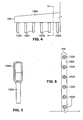
- FIG. 4 is a side view of a portion of the injector assembly 110, showing one arm 138A of the fuel manifold 120A and a number of the injector elements 132A extending therefrom.
- FIG. 5 is a cross-sectional view of a portion of the injector assembly 110, taken along line 5-5 of FIG. 4, and
- FIG. 6 is a rear or aft view of the portion of the injector assembly 110 shown in FIG. 4. As shown in FIGS.
- the arm 138A is configured to taper to a smaller cross-sectional area at an inner diameter end 140 than near the ring portion 136A, which facilitates maintaining fuel flow to all of the injector elements 132A supplied with fuel by the fuel manifold 120A.
- the arm 138A has a generally rectangular tube shape.
- Each injector element 132A and 132B is of a tubular configuration similar to known coaxial injector element configurations.
- the injector elements 132A and 132B can be either swirl-type elements of shear-type elements (without swirl).
- the injector elements 132A and 132B deliver fuel to the combustion chamber 122 that mixes with oxidizer supplied through the annular gaps formed between each injector element 132A and 132B and the respective openings 134 in the faceplate 130.
- Other arms 138A and 138B of the injector assembly 110 are generally similar to the arm 138A shown in FIGS. 4-6. However, as shown in FIG. 3, the lengths of the injector elements 132A and 132B can be different, and as shown in FIG. 2, the lengths of the arms 138A and 138B can vary. As a result of the varying lengths of the arms 138A and 138, different numbers of injector elements 132A and 132B, respectively, extend from them. In the illustrated embodiment, between three and six injector elements 132A and 132B extend from each arm 138A and 138B, respectively. It should be noted that the total number of injector elements 132A and 132B in the injector assembly 110 can vary as desired for a particular application.
- the overall ratio of the number of injector elements 132A as compared to the number of injector elements 132B will be determined by the desired mass fraction of the fuels (or fuel supplies) delivered to the combustion chamber 122 via each fuel manifold 120A and 120B.
- the engine 100 generally operates as follows.
- An oxidizer typically gaseous oxygen, is delivered to the oxidizer dome 114.
- a liquid hydrocarbon fuel typically a kerosene-type fuel, constitutes a first fuel part that is delivered along a first fuel supply circuit (or path) through the fuel manifold 120A (see FIG. 1).
- the same kind of liquid hydrocarbon fuel e.g., a kerosene-type fuel
- the converted fuel represents a second fuel part (see FIG. 1).
- the converted fuel is delivered along a second fuel supply circuit (or path) through the fuel manifold 120B.
- Injector elements 132A and 132B deliver the two fuel parts from two fuel deliver circuits corresponding to the two the fuel manifolds 120A and 120B, respectively, to the combustion chamber 122.
- Oxidizer flows from the oxidizer dome 114 to the combustion chamber 122 past the fuel manifolds 120A and 120B and through the annular gaps formed between each injector element 132A and 132B and the respective openings 134 in the faceplate 130.
- the oxidizer from the oxidizer dome 114 bathes the components of the injector assembly 110 forward (i.e., upstream) of the faceplate 130, which helps provide heat to keep the fuel in the second fuel supply circuit in a supercritical and/or endothermically converted state prior to combustion.
- the three propellants, including the oxidizer and the two fuel parts, are mixed and burned in the combustion chamber 122 to generate thrust.
- the injector assembly of the present invention permits the use of a split or two-part fuel delivery circuit, which in a practical sense enables an injection of a gas-like hydrocarbon fuel to a combustion chamber for combustion.
- the fuels carried by the respective fuel manifolds 120A and 120B can remain in their respective thermodynamic states, and in particular, the supercritical/endothermic fuel cannot mix with conventional fuel and thereby lose its unique characteristics.
Landscapes
- Engineering & Computer Science (AREA)
- Chemical & Material Sciences (AREA)
- Combustion & Propulsion (AREA)
- Mechanical Engineering (AREA)
- General Engineering & Computer Science (AREA)
- Fuel-Injection Apparatus (AREA)
- Nozzles (AREA)
Abstract
Description
- The present invention relates to fluidic injection systems for use with rocket engines, and more particularly to an injector assembly for injecting a three-part propellant mixture for use with a rocket engine.
Rocket engines can utilize different types of propellants. Liquid propellants are desirable because they generally have a higher specific impulse than solid propellants. Among liquid propellants, hydrogen-oxygen propellants represent a benchmark for providing a desirable specific impulse. However, there are operational drawbacks to the use of such propellant mixtures, primarily because liquid hydrogen is a difficult fuel to deal with in terms of storage, delivery, etc. Kerosene is seen as a suitable alternative to hydrogen as a rocket fuel for use with an oxygen oxidizer. - Kerosene-oxygen rocket engines present problems in two distinct areas for rocket engine operation: combustion efficiency and combustion stability. Combustion efficiency generally refers to the completeness of the burning of propellants during engine operation. A problem faced with kerosene-oxygen rocket engines is that some kerosene typically exits an exhaust nozzle of the rocket engine without being burned, which lowers combustion efficiency in producing engine thrust. It is desired to achieve a relatively high level of combustion efficiency. It is also generally desired to maintain a stable combustion process, and to increase the stability of kerosene-oxygen rocket engine combustion processes. Combustion stability can be particularly problematic with kerosene rocket propellants, and undesired effects like oscillations in pressure can be produced.
- In one arrangement disclosed herein, a rocket engine system includes a combustion chamber defining a centerline axis, an oxidizer supply, a first fuel delivery circuit connected to a fuel supply, a second fuel delivery circuit connected to the fuel supply, a faceplate having a plurality of openings therethrough, and an injector assembly positioned at the combustion chamber. The injector assembly includes a first injector element connected to the first fuel delivery circuit and extending into one of the openings in the faceplate, and a second injector element connected to the second fuel delivery circuit and extending into another of the openings in the faceplate. Annular oxidizer outlets are formed at the openings in the faceplate and connected to the oxidizer supply to deliver oxidizer to the combustion chamber.
-
- FIG. 1 is a block diagram of a rocket engine system having a three-part injector assembly.
- FIG. 2 is a front view of the injector assembly of FIG. 1.
- FIG. 3 is a schematic cross-sectional view of a rocket engine having a three-part injector assembly, taken along line 3-3 of FIG. 2.
- FIG. 4 is a side view of a portion of the injector assembly of FIGS. 2 and 3.
- FIG. 5 is a cross-sectional view of the portion of the injector assembly, taken along line 5-5 of FIG. 4.
- FIG. 6 is a rear view of the portion of the injector assembly shown in FIGS. 4 and 5.
- The present invention generally relates to an injector assembly for use with a rocket engine system. The injector assembly is used with propellant mixtures of kerosene-type fuels and a gaseous oxygen (or GO2) oxidizer. As explained in greater detail below, the kerosene-type fuel is provided in two distinct parts, with one part being the kerosene-type fuel in a liquid state and another part being the kerosene-type fuel in a supercritical and/or endothermically converted state. The injector assembly delivers a three part propellant mixture, including the two fuel parts and a third oxidizer part, along separate and distinct injection circuits (or paths) to a main combustion chamber where the propellants are mixed and burned to generate thrust. Use of the injector assembly in a rocket engine helps promote combustion stability and combustion efficiency when utilizing a kerosene-type fuel that has been converted, as least partially to a gas or gas-like state. Because inadequate heat is typically available in a given engine to convert all fuel to a supercritical and/or endothermically converted state, the use of two separate fuel injection circuits allows fuel in one injection circuit to undergo conversion to a gas or gas-like form while the fuel in the other circuit can remain in a liquid form.
- FIG. 1 is a block diagram of a rocket engine system having a three-
part injector assembly 10. The system includes anoxidizer supply 12, an oxidizer dome (or manifold) 14, fuel supplies "A" and "B" (designated byreference numbers fuel conversion system 18, and fuel manifolds "A" and "B" (designated byreference numbers combustion chamber 22, an ignition means 24, and can optionally include apreburner 26. - The
oxidizer supply 12 delivers an oxidizer from a storage location (not shown). The oxidizer can optionally be routed to the oxidizer-rich preburner 26, which can be a conventional preburner that generates a gaseous oxygen (or GO2) product for use as the oxidizer for the main combustion process. Alternatively, the oxidizer supply can provide gaseous oxygen directly. From theoxidizer supply 12 or thepreburner 26, oxidizer is routed to theoxidizer dome 14, which distributes oxidizer to theinjector assembly 10. - The fuel supply "A" 16A delivers fuel from a storage location (not shown) to the fuel manifold "A" 20A, which in turn distributes fuel to the
injector assembly 10. Fuel from fuel supply "A" 16A is delivered to thecombustion chamber 22 along a fuel circuit "A", and utilizes a kerosene-type hydrocarbon fuel in liquid form. The fuel supply "A" 16A can include a fuel cooling circuit, which can add heat to the fuel while the fuel remains substantially in a liquid form. It should be understood that this kerosene-type fuel can be nearly any type of conventional kerosene rocket fuel or kerosene-like hydrocarbon fuel as desired for particular applications. - The fuel supply "B" 16B delivers fuel from a storage location (not shown), which can be the same fuel storage location from which the fuel supply "A" 16A obtains fuel or a different location, to the
fuel conversion system 18. Thefuel conversion system 18 then delivers "converted" fuel to the fuel manifold "B" 20B, which distributes fuel to theinjector assembly 10. Fuel travels between the fuel supply "B" 16B to thecombustion chamber 22 along a fuel circuit "B", which is separate and distinct from the fuel circuit "A" described above. - The fuel supply "B" 16B delivers a kerosene-type hydrocarbon fuel in liquid form to the
fuel conversion system 18. Thefuel conversion system 18 then converts or "cracks" the kerosene-type fuel through an endothermic process to produce a converted fuel that is in a supercritical and/or endothermically converted state. Thefuel conversion system 18 can convert fuel through a known endothermic conversion process. For example, the fuel can be routed through a cooling circuit, which can include passages in the walls of thecombustion chamber 22. Heat from thecombustion chamber 22 is added to the fuel as it passes through the cooling circuit of thefuel conversion system 18. A thin layer of an endothermic decomposition catalyst (e.g., similar to that described inU.S. Pat Nos. 5,232,672 and5,207,053 ) can be located along fuel lines of thefuel conversion system 18 in order to promote conversion of the fuel. "Converted" fuel is in a supercritical and/or endothermically converted state. Kerosene-type fuels reach a supercritical state at conditions above approximately 2,413 kPa (350 psi) in pressure and approximately 427° C (800° F) in temperature, where physical properties of the fuel change such that the liquid meniscus disappears and the fuel behaves much like a gas. At temperatures above approximately 538°C (1,000° F), kerosene-type fuels undergo chemical changes into simpler, lighter molecular weight hydrocarbons. Depending upon the specific conditions of a particular application, such as the amount of heat available from thecombustion chamber 22 to convert the fuel, the particular characteristics of the conversion process can vary. For instance, thefuel conversion system 18 will convert some of the fuel to a supercritical state and the rest will be endothermically converted. The particular percentage of fuel converted to the supercritical state versus an endothermically converted state can vary for different applications. However, in all cases, substantially all of the converted fuel generally behaves like a gas. - It should be noted that the operation of the
fuel conversion system 18 of the overall engine system is described with respect to endothermic conversion during steady-state engine operation after the startup transient is complete. The provision of heat for fuel conversion during the startup transient may require special design considerations, such as auxiliary heat sources. - Oxidizer, the converted fuel and the unconverted fuel are delivered by the
injector assembly 10 to the combustion chamber where those propellants mix and are ignited by the ignition means 24. The ignition means 24 can be a chemical ignition system (e.g., a known hypergolic ignition system), an electrical ignition system (e.g., a known spark ignition system), or other suitable system for initiating combustion in thecombustion chamber 22. - FIG. 2 is a front view of an
injector assembly 110. FIG. 3 is a schematic cross-sectional view of arocket engine 100 having theinjector assembly 110, taken along line 3-3 of FIG. 2. Therocket engine 100 includes anoxidizer dome 114, two sets offuel manifolds combustion chamber 122. Theengine 100 can be used in conjunction with a rocket engine system similar to that described above with respect to FIG. 1. - As shown in FIG. 3, the
combustion chamber 122 is a conventional converging-diverging combustion chamber with walls having cooling circuit passageways therein. Thecombustion chamber 122 is aligned along an engine centerline axis CL. Theinjector assembly 110 is positioned at a forward end of thecombustion chamber 122. Theinjector assembly 110 includes aninjector faceplate 130 and first and second sets ofinjector elements injector faceplate 130 is a generally disc-shaped structure that includes generallycircular openings 134 into which distal ends of each of the two sets ofinjector elements openings 134 can be machined into the material of thefaceplate 130. FIG. 3 includes an enlarged representation of a portion ofinjector assembly 110, showing one of theinjector elements 132A extending through one of theopenings 134 in thefaceplate 130 with arrows schematically representing propellant flow paths into thecombustion chamber 122. - The
oxidizer dome 114 routes oxidizer from a supply (not shown, but see FIG. 1) to thecombustion chamber 122. Oxidizer can move past thefuel manifolds injector elements opening 134 in thefaceplate 130. The size of the annular gaps is determined based upon a predetermined amount of oxidizer flow desired at the propellant feed system temperature and pressure. In the illustrated embodiment, the material of thefaceplate 130 is porous, and the oxidizer can pass into and through those pores to help cool thefaceplate 130. - The
fuel manifolds fuel manifold 120B is positioned axially forward of thefuel manifold 120A, which facilitates mechanically integrating the two manifolds into theinjector assembly 110, although in alternative embodiments other arrangements are possible. Eachfuel manifold outer ring portion arms arms ring portions combustion chamber 122. Theinjector elements 132A extend aft from thearms 138A of thefuel manifold 120A, and theinjector elements 132B extend aft from thearms 138B of thefuel manifold 120B. It should be noted that in the illustrated embodiment theinjector elements 132B have a slightly longer axial length than theinjector elements 132A, which is a result of thefuel manifold 120B from which theinjector elements 132B extend being positioned more axially forward from theinjector faceplate 130 than thefuel manifold 120A from which theinjector elements 132A extend. Fuel can pass from thering portions arms injector elements - As shown in FIG. 2, the
arms 138A of thefuel manifold 120A and thearms 138B of thefuel manifold 120B are arranged such that theinjector elements injector faceplate 130 such that propellants are distributed relatively evenly into thecombustion chamber 122. Moreover, thearms 138A and theirrespective injector elements 132A are interspersed azimuthally across thefaceplate 130 with thearms 138B and theirrespective injector elements 132B. Interspersing thearms arms injector assembly 110 such that thearms 138B of thefuel manifold 120B alternate with thearms 138A of thefuel manifold 120A about the circumference of theinjector assembly 110. Interspersing theinjector elements fuel manifold 120A and thefuel manifold 120B in thecombustion chamber 122. Furthermore, the alternating or staggering of thearms fuel manifolds combustion chamber 122 all in substantially the same plane (defined perpendicular to the centerline CL). - Additional details of the
injector assembly 110 components are shown in FIGS. 4-6. FIG. 4 is a side view of a portion of theinjector assembly 110, showing onearm 138A of thefuel manifold 120A and a number of theinjector elements 132A extending therefrom. FIG. 5 is a cross-sectional view of a portion of theinjector assembly 110, taken along line 5-5 of FIG. 4, and FIG. 6 is a rear or aft view of the portion of theinjector assembly 110 shown in FIG. 4. As shown in FIGS. 2 and 4, thearm 138A is configured to taper to a smaller cross-sectional area at aninner diameter end 140 than near thering portion 136A, which facilitates maintaining fuel flow to all of theinjector elements 132A supplied with fuel by thefuel manifold 120A. As shown in FIG. 5, thearm 138A has a generally rectangular tube shape. - Each
injector element injector elements injector elements combustion chamber 122 that mixes with oxidizer supplied through the annular gaps formed between eachinjector element respective openings 134 in thefaceplate 130. -
Other arms injector assembly 110 are generally similar to thearm 138A shown in FIGS. 4-6. However, as shown in FIG. 3, the lengths of theinjector elements arms arms 138A and 138, different numbers ofinjector elements injector elements arm injector elements injector assembly 110 can vary as desired for a particular application. For example, large rocket engines will typically have more injector elements than smaller engines. Furthermore, the overall ratio of the number ofinjector elements 132A as compared to the number ofinjector elements 132B will be determined by the desired mass fraction of the fuels (or fuel supplies) delivered to thecombustion chamber 122 via eachfuel manifold - In operation, the
engine 100 generally operates as follows. An oxidizer, typically gaseous oxygen, is delivered to theoxidizer dome 114. A liquid hydrocarbon fuel, typically a kerosene-type fuel, constitutes a first fuel part that is delivered along a first fuel supply circuit (or path) through thefuel manifold 120A (see FIG. 1). The same kind of liquid hydrocarbon fuel (e.g., a kerosene-type fuel) is converted to a supercritical and/or endothermically converted state and the converted fuel represents a second fuel part (see FIG. 1). The converted fuel is delivered along a second fuel supply circuit (or path) through thefuel manifold 120B.Injector elements fuel manifolds combustion chamber 122. Oxidizer flows from theoxidizer dome 114 to thecombustion chamber 122 past thefuel manifolds injector element respective openings 134 in thefaceplate 130. The oxidizer from theoxidizer dome 114 bathes the components of theinjector assembly 110 forward (i.e., upstream) of thefaceplate 130, which helps provide heat to keep the fuel in the second fuel supply circuit in a supercritical and/or endothermically converted state prior to combustion. The three propellants, including the oxidizer and the two fuel parts, are mixed and burned in thecombustion chamber 122 to generate thrust. - The use of a fuel in a supercritical and/or endothermically converted state helps to promote combustion efficiency and combustion stability. The injector assembly of the present invention permits the use of a split or two-part fuel delivery circuit, which in a practical sense enables an injection of a gas-like hydrocarbon fuel to a combustion chamber for combustion. By keeping the fuels carried by the
respective fuel manifolds - Although the present invention has been described with reference to preferred embodiments, workers skilled in the art will recognize that changes may be made in form and detail without departing from the scope of the invention. For instance, the various components of a rocket engine system with an injector assembly according to the present invention can have different shapes, configurations and arrangements other than the particular embodiments shown and describes herein. The embodiments disclosed are provided merely by way of example, and not by way of limitation.
Claims (20)
- An injector assembly (110) for a rocket engine, the injector assembly (110) comprising:a faceplate (130) positioned adjacent to a combustion chamber (122) that defines an engine centerline(CL);a first set of holes (134) defined in the faceplate (130);a first set of injector elements (132A), wherein the first set of injector elements (132A) is arranged to correspond with the first set of holes (134) defined in the faceplate (130) such that each injector element (132A) is positioned to extend into one of the first set of holes (134), and wherein an annular fluid outlet is formed between each injector element (132A) and each hole (134) in the faceplate (130) for delivering a first fluid to the combustion chamber (122);a first injector manifold (120A), wherein each injector (132A) of the first set of injector elements is connected in fluid communication with the first injector manifold (120A) for delivering a second fluid to the combustion chamber (122); a second set of holes (134) defined in the faceplate (130);a second set of injector elements (132B), wherein the second set of injector elements (132B) is arranged to correspond with the second set of holes (134) defined in the faceplate (130) such that each injector element (132B) is positioned to extend into one of the second set of holes (134), and wherein an annular fluid outlet is formed between each injector element (132B) and each hole (134) in the faceplate (130) for delivering the first fluid to the combustion chamber (122); anda second injector manifold (120B), wherein each injector (132B) of the second set of injector elements is connected in fluid communication with the second injector manifold (120B) for delivering a third fluid to the combustion chamber (122).
- The assembly of claim 1, wherein the first and second injector manifolds (120A, 120B) each comprise a radially disposed manifold arm (138A, 138B).
- The assembly of claim 2, wherein the manifold arm (138A) of the first injector manifold (120A) is axiaiiy offset from the manifold arm (138B) of the second injector assembly (120B).
- The assembly of any preceding claim, wherein the first fluid is an oxidizer.
- The assembly of claim 4, wherein the oxidizer comprises gaseous oxygen.
- The assembly of any preceding claim, wherein the second fluid is a fuel in a liquid state.
- The assembly of claim 6, wherein the third fluid comprises the fuel in a supercritical state.
- The assembly of claim 6, wherein the third fluid comprises the fuel in an endothermically converted state.
- The assembly of claim 6, 7 or 8, wherein the fuel comprises kerosene.
- The assembly of any preceding claim, wherein each injector element (132A) of the first set has a length L1 and each injector element (132B) of the second set has a length L2, and wherein L1 is not equal to L2.
- The assembly of any preceding claim, wherein the first set of injector elements (132A) is interspersed azimuthally with the second set of injector elements (132B).
- The assembly of any preceding claim, wherein the faceplate (130) comprises a porous web of material.
- A rocket engine system (100) comprising:a combustion chamber (1 22) defining a centerline axis (CL);an oxidizer supply (12);a first fuel delivery circuit connected to a fuel supply (16);a second fuel delivery circuit connected to the fuel supply (16);an injector assembly (110) positioned at the combustion chamber (122), the injector assembly (110) comprising:a faceplate 130) having a plurality of openings (134) therethrough;a first injector element (132A) connected to the first fuel delivery circuit and extending into one of the openings (134) in the faceplate (130); anda second injector element (132B) connected to the second fuel delivery circuit and extending into another of the openings (134) in the faceplate(130); and
annular oxidizer outlets formed at the openings (134) in the faceplate (130) and connected to the oxidizer supply (12) to deliver oxidizer to the combustion chamber (122). - The system of claim 13 and further comprising:a first injector supply manifold (120A) connected between the first fuel delivery circuit and the first injector element (132A);a third injector assembly connected to the first injector supply manifold (132A); a second injector supply manifold (120B) connected between the second fuel delivery circuit and the second injector element (132B); anda fourth injector assembly connected to the second injector supply manifold (120B).
- The system of claim 13 or 14 and further comprising:an oxygen-rich preburner (26), wherein the oxidizer from the oxidizer supply (12) passes through the preburner (26) to generate a gaseous oxygen oxidizer product for combustion in the combustion chamber (122).
- The system of claim 13, 14 or 15, wherein the faceplate (130) comprises a web of porous metallic material.
- The system of any of claims 13 to 16, wherein the first injector element (132A) and the second injector element (132B) are arranged such that fuels delivered to the combustion chamber (122) do not burn in substantially the same plane.
- The system of any of claims 13 to 17 and further comprising:a fuel conversion subsystem (18) integrated with the first fuel delivery circuit for changing the physical state of fuel such that converted fuel behaves like a gas.
- The system of claim 18, wherein the first fuel delivery circuit delivers a hydrocarbon fuel in a liquid form to the combustion chamber (122), and wherein the second fuel delivery circuit delivers the hydrocarbon fuel at least partially in a supercritical state to the combustion chamber (122).
- The system of claim 13, wherein the oxidizer is gaseous oxygen.
Applications Claiming Priority (1)
| Application Number | Priority Date | Filing Date | Title |
|---|---|---|---|
| US11/516,417 US7685807B2 (en) | 2006-09-06 | 2006-09-06 | Three component injector for kerosene-oxygen rocket engine |
Publications (2)
| Publication Number | Publication Date |
|---|---|
| EP1903206A2 true EP1903206A2 (en) | 2008-03-26 |
| EP1903206A3 EP1903206A3 (en) | 2013-11-13 |
Family
ID=38667298
Family Applications (1)
| Application Number | Title | Priority Date | Filing Date |
|---|---|---|---|
| EP07253596.6A Withdrawn EP1903206A3 (en) | 2006-09-06 | 2007-09-10 | Injector for rocket engine |
Country Status (4)
| Country | Link |
|---|---|
| US (1) | US7685807B2 (en) |
| EP (1) | EP1903206A3 (en) |
| JP (1) | JP2008064097A (en) |
| RU (1) | RU2007133324A (en) |
Cited By (3)
| Publication number | Priority date | Publication date | Assignee | Title |
|---|---|---|---|---|
| WO2012112688A1 (en) * | 2011-02-15 | 2012-08-23 | Pratt & Whitney Rocketdyne, Inc. | Rocket engine with augmented expander cycle |
| EP2484979A3 (en) * | 2011-02-03 | 2017-11-29 | General Electric Company | Apparatus for mixing fuel in a gas turbine |
| CN112110060A (en) * | 2020-07-31 | 2020-12-22 | 北京航天试验技术研究所 | Low-temperature filling platform and automatic filling method thereof |
Families Citing this family (8)
| Publication number | Priority date | Publication date | Assignee | Title |
|---|---|---|---|---|
| US7827781B2 (en) * | 2005-12-05 | 2010-11-09 | Bendel Timothy B | Liquid propellant rocket engine with pintle injector and acoustic dampening |
| KR20100119805A (en) * | 2008-02-18 | 2010-11-10 | 어플라이드 머티어리얼스, 인코포레이티드 | Apparatus and methods for supplying fuel employed by abatement systems to effectively abate effluents |
| US9151246B2 (en) * | 2011-02-04 | 2015-10-06 | Aerojet Rocketdyne Of De, Inc. | Thrust chamber and rocket engine system |
| CN102400815B (en) * | 2011-03-18 | 2013-09-18 | 北京航空航天大学 | Layer-board type injection device for oxygen/ methane low-thrust engine |
| US9200596B2 (en) | 2011-12-13 | 2015-12-01 | Aerojet Rocketdyne, Inc. | Catalytically enhanced gas generator system for rocket applications |
| US8695540B2 (en) | 2012-06-18 | 2014-04-15 | Aerojet Rocketdyne Of De, Inc. | Fuel-cracking diesel engine system |
| US11021666B2 (en) | 2015-12-21 | 2021-06-01 | Shell Oil Company | Methods of providing higher quality liquid kerosene based-propulsion fuels |
| DE102017127831A1 (en) * | 2017-11-24 | 2019-05-29 | Arianegroup Gmbh | INJECTION HEAD FOR A TRANSMISSION, ENGINE AND ROCKET |
Family Cites Families (17)
| Publication number | Priority date | Publication date | Assignee | Title |
|---|---|---|---|---|
| US3662960A (en) | 1966-11-21 | 1972-05-16 | United Aircraft Corp | Injector head |
| US3541788A (en) * | 1968-05-03 | 1970-11-24 | Bolkow Gmbh | Nozzle construction and liquid fuel rocket fuel system |
| US4100733A (en) | 1976-10-04 | 1978-07-18 | United Technologies Corporation | Premix combustor |
| US5054287A (en) * | 1989-11-30 | 1991-10-08 | The United States Of America As Represented By The Administrator Of The National Aeronautics And Space Administration | Extended temperature range rocket injector |
| US5232672A (en) | 1991-05-15 | 1993-08-03 | United Technologies Corporation | Endothermic fuel system |
| US5207053A (en) | 1991-05-15 | 1993-05-04 | United Technologies Corporation | Method and system for staged rich/lean combustion |
| US5165224A (en) | 1991-05-15 | 1992-11-24 | United Technologies Corporation | Method and system for lean premixed/prevaporized combustion |
| US5151171A (en) | 1991-05-15 | 1992-09-29 | United Technologies Corporation | Method of cooling with an endothermic fuel |
| US5176814A (en) | 1991-05-15 | 1993-01-05 | United Technologies Corporation | Method of cooling with an endothermic fuel |
| US5392595A (en) | 1993-08-06 | 1995-02-28 | United Technologies Corporation | Endothermic fuel energy management system |
| US5414992A (en) | 1993-08-06 | 1995-05-16 | United Technologies Corporation | Aircraft cooling method |
| US5857323A (en) * | 1995-08-22 | 1999-01-12 | Aerotherm Corporation, A Subsidiary Of Dyncorp | Rocket engine burner with porous metal injector for throttling over a large thrust range |
| US6185927B1 (en) * | 1997-12-22 | 2001-02-13 | Trw Inc. | Liquid tripropellant rocket engine coaxial injector |
| DE19958310C2 (en) * | 1999-12-03 | 2002-01-17 | Daimler Chrysler Ag | Rocket engine for liquid fuels with a closed engine circuit |
| DE10015369C2 (en) * | 2000-03-28 | 2003-07-03 | Astrium Gmbh | Tri-coaxial injection element |
| US7124574B2 (en) * | 2002-12-04 | 2006-10-24 | United Technologies Corporation | Method and apparatus for a substantially coaxial injector element |
| US7389636B2 (en) * | 2005-07-06 | 2008-06-24 | United Technologies Corporation | Booster rocket engine using gaseous hydrocarbon in catalytically enhanced gas generator cycle |
-
2006
- 2006-09-06 US US11/516,417 patent/US7685807B2/en active Active
-
2007
- 2007-09-05 JP JP2007229612A patent/JP2008064097A/en active Pending
- 2007-09-05 RU RU2007133324/06A patent/RU2007133324A/en not_active Application Discontinuation
- 2007-09-10 EP EP07253596.6A patent/EP1903206A3/en not_active Withdrawn
Cited By (4)
| Publication number | Priority date | Publication date | Assignee | Title |
|---|---|---|---|---|
| EP2484979A3 (en) * | 2011-02-03 | 2017-11-29 | General Electric Company | Apparatus for mixing fuel in a gas turbine |
| WO2012112688A1 (en) * | 2011-02-15 | 2012-08-23 | Pratt & Whitney Rocketdyne, Inc. | Rocket engine with augmented expander cycle |
| CN112110060A (en) * | 2020-07-31 | 2020-12-22 | 北京航天试验技术研究所 | Low-temperature filling platform and automatic filling method thereof |
| CN112110060B (en) * | 2020-07-31 | 2022-05-27 | 北京航天试验技术研究所 | Low-temperature filling platform and automatic filling method thereof |
Also Published As
| Publication number | Publication date |
|---|---|
| US20080053063A1 (en) | 2008-03-06 |
| JP2008064097A (en) | 2008-03-21 |
| US7685807B2 (en) | 2010-03-30 |
| EP1903206A3 (en) | 2013-11-13 |
| RU2007133324A (en) | 2009-03-10 |
Similar Documents
| Publication | Publication Date | Title |
|---|---|---|
| EP1903206A2 (en) | Injector for rocket engine | |
| US6244041B1 (en) | Liquid-propellant rocket engine chamber and its casing | |
| JP3100950B2 (en) | Three-propellant injector for rocket engines | |
| US10634352B2 (en) | Gas turbine engine afterburner | |
| US7036302B2 (en) | Controlled pressure fuel nozzle system | |
| CN108885005B (en) | Integrated combustor nozzle for segmented annular combustion system | |
| US9366432B2 (en) | Multistaged lean prevaporizing premixing fuel injector | |
| RU2328615C1 (en) | Liquid-propellant rocket engine chamber mixing head | |
| RU2435063C2 (en) | Injection and ignition system for rocket engine (versions) and low-thrust rocket engine | |
| US20210148307A1 (en) | Rocket engine with integrated oxidizer catalyst in manifold and injector assembly | |
| US5438834A (en) | Close combustion gas generator | |
| US7124574B2 (en) | Method and apparatus for a substantially coaxial injector element | |
| WO1997008442A1 (en) | Rocket engine burner with porous metal injector | |
| WO1997008442A9 (en) | Rocket engine burner with porous metal injector | |
| US10920714B2 (en) | Stable hybrid rocket technology | |
| US2753687A (en) | Injection head for jet propulsion system | |
| EP1715173A1 (en) | Pintle injector | |
| RU2517940C2 (en) | Jet engine composed by set of jet engines | |
| US20080302335A1 (en) | Injector assembly having multiple manifolds for propellant delivery | |
| EP4411241A1 (en) | Fuel system with pilot and main injectors for hydrogen-driven gas turbine engine | |
| CN118997952A (en) | Ignition device and method for gas generator of afterburning engine | |
| CN116951471B (en) | Gas turbine engine, mixer assembly, combustion chamber, and method for atomizing fuel therefor | |
| RU2847608C1 (en) | Liquid-propellant engine combustion chamber nozzle head | |
| RU2449158C1 (en) | Chamber of liquid-propellant engine | |
| US20250314382A1 (en) | Dual fuel combustor for a turbine engine |
Legal Events
| Date | Code | Title | Description |
|---|---|---|---|
| PUAI | Public reference made under article 153(3) epc to a published international application that has entered the european phase |
Free format text: ORIGINAL CODE: 0009012 |
|
| AK | Designated contracting states |
Kind code of ref document: A2 Designated state(s): AT BE BG CH CY CZ DE DK EE ES FI FR GB GR HU IE IS IT LI LT LU LV MC MT NL PL PT RO SE SI SK TR |
|
| AX | Request for extension of the european patent |
Extension state: AL BA HR MK YU |
|
| PUAL | Search report despatched |
Free format text: ORIGINAL CODE: 0009013 |
|
| AK | Designated contracting states |
Kind code of ref document: A3 Designated state(s): AT BE BG CH CY CZ DE DK EE ES FI FR GB GR HU IE IS IT LI LT LU LV MC MT NL PL PT RO SE SI SK TR |
|
| AX | Request for extension of the european patent |
Extension state: AL BA HR MK RS |
|
| RIC1 | Information provided on ipc code assigned before grant |
Ipc: F02K 9/52 20060101AFI20131007BHEP |
|
| STAA | Information on the status of an ep patent application or granted ep patent |
Free format text: STATUS: THE APPLICATION HAS BEEN WITHDRAWN |
|
| 17P | Request for examination filed |
Effective date: 20140512 |
|
| RBV | Designated contracting states (corrected) |
Designated state(s): AT BE BG CH CY CZ DE DK EE ES FI FR GB GR HU IE IS IT LI LT LU LV MC MT NL PL PT RO SE SI SK TR |
|
| RBV | Designated contracting states (corrected) |
Designated state(s): AT BE BG CH CY CZ DE DK EE ES FI FR GB GR HU IE IS IT LI LT LU LV MC MT NL PL PT RO SE SI SK TR |
|
| 18W | Application withdrawn |
Effective date: 20140522 |