EP1902737A1 - Ophthalmic lens, cell or organ culture substrate, container for biological material and transparent gel produced by polymerization of cyclic siloxane compound and process for production thereof - Google Patents
Ophthalmic lens, cell or organ culture substrate, container for biological material and transparent gel produced by polymerization of cyclic siloxane compound and process for production thereof Download PDFInfo
- Publication number
- EP1902737A1 EP1902737A1 EP06757015A EP06757015A EP1902737A1 EP 1902737 A1 EP1902737 A1 EP 1902737A1 EP 06757015 A EP06757015 A EP 06757015A EP 06757015 A EP06757015 A EP 06757015A EP 1902737 A1 EP1902737 A1 EP 1902737A1
- Authority
- EP
- European Patent Office
- Prior art keywords
- group
- siloxane compound
- cyclic siloxane
- formula
- polymerizing
- Prior art date
- Legal status (The legal status is an assumption and is not a legal conclusion. Google has not performed a legal analysis and makes no representation as to the accuracy of the status listed.)
- Withdrawn
Links
- -1 cyclic siloxane compound Chemical class 0.000 title claims abstract description 40
- 239000000758 substrate Substances 0.000 title claims abstract description 22
- 210000000056 organ Anatomy 0.000 title claims abstract description 16
- 238000004519 manufacturing process Methods 0.000 title claims description 5
- 238000006116 polymerization reaction Methods 0.000 title description 18
- 238000000034 method Methods 0.000 title description 6
- 239000012620 biological material Substances 0.000 title 1
- 125000004169 (C1-C6) alkyl group Chemical group 0.000 claims abstract description 23
- 125000004435 hydrogen atom Chemical group [H]* 0.000 claims abstract description 22
- 239000000463 material Substances 0.000 claims abstract description 20
- 125000000962 organic group Chemical group 0.000 claims abstract description 19
- 230000000379 polymerizing effect Effects 0.000 claims abstract description 18
- 229910052731 fluorine Inorganic materials 0.000 claims abstract description 15
- 125000001153 fluoro group Chemical group F* 0.000 claims abstract description 15
- 125000001997 phenyl group Chemical group [H]C1=C([H])C([H])=C(*)C([H])=C1[H] 0.000 claims abstract description 14
- 125000001183 hydrocarbyl group Chemical group 0.000 claims abstract 6
- 239000000178 monomer Substances 0.000 claims description 29
- 125000004432 carbon atom Chemical group C* 0.000 claims description 15
- 239000004642 Polyimide Substances 0.000 claims description 10
- 229920001721 polyimide Polymers 0.000 claims description 10
- 229920002050 silicone resin Polymers 0.000 claims description 10
- 229910052799 carbon Inorganic materials 0.000 claims description 8
- 125000004427 diamine group Chemical group 0.000 claims description 6
- 239000000203 mixture Substances 0.000 claims description 6
- 125000001931 aliphatic group Chemical group 0.000 claims description 4
- 239000003960 organic solvent Substances 0.000 claims description 3
- 229920001187 thermosetting polymer Polymers 0.000 claims description 3
- 230000002794 monomerizing effect Effects 0.000 claims 1
- 238000004381 surface treatment Methods 0.000 abstract description 5
- DBCAQXHNJOFNGC-UHFFFAOYSA-N 4-bromo-1,1,1-trifluorobutane Chemical compound FC(F)(F)CCCBr DBCAQXHNJOFNGC-UHFFFAOYSA-N 0.000 description 12
- STVZJERGLQHEKB-UHFFFAOYSA-N ethylene glycol dimethacrylate Substances CC(=C)C(=O)OCCOC(=O)C(C)=C STVZJERGLQHEKB-UHFFFAOYSA-N 0.000 description 12
- 150000002430 hydrocarbons Chemical group 0.000 description 12
- WHNWPMSKXPGLAX-UHFFFAOYSA-N N-Vinyl-2-pyrrolidone Chemical compound C=CN1CCCC1=O WHNWPMSKXPGLAX-UHFFFAOYSA-N 0.000 description 11
- 239000003431 cross linking reagent Substances 0.000 description 11
- GNWBLLYJQXKPIP-ZOGIJGBBSA-N (1s,3as,3bs,5ar,9ar,9bs,11as)-n,n-diethyl-6,9a,11a-trimethyl-7-oxo-2,3,3a,3b,4,5,5a,8,9,9b,10,11-dodecahydro-1h-indeno[5,4-f]quinoline-1-carboxamide Chemical compound CN([C@@H]1CC2)C(=O)CC[C@]1(C)[C@@H]1[C@@H]2[C@@H]2CC[C@H](C(=O)N(CC)CC)[C@@]2(C)CC1 GNWBLLYJQXKPIP-ZOGIJGBBSA-N 0.000 description 8
- 239000000499 gel Substances 0.000 description 8
- XLYOFNOQVPJJNP-UHFFFAOYSA-N water Substances O XLYOFNOQVPJJNP-UHFFFAOYSA-N 0.000 description 8
- 125000002496 methyl group Chemical group [H]C([H])([H])* 0.000 description 7
- 229920001296 polysiloxane Polymers 0.000 description 7
- BESKSSIEODQWBP-UHFFFAOYSA-N 3-tris(trimethylsilyloxy)silylpropyl 2-methylprop-2-enoate Chemical compound CC(=C)C(=O)OCCC[Si](O[Si](C)(C)C)(O[Si](C)(C)C)O[Si](C)(C)C BESKSSIEODQWBP-UHFFFAOYSA-N 0.000 description 6
- 150000002632 lipids Chemical class 0.000 description 6
- 230000000704 physical effect Effects 0.000 description 6
- 125000000217 alkyl group Chemical group 0.000 description 4
- 229920001477 hydrophilic polymer Polymers 0.000 description 4
- 238000007654 immersion Methods 0.000 description 4
- 229920000642 polymer Polymers 0.000 description 4
- 239000003505 polymerization initiator Substances 0.000 description 4
- CSCPPACGZOOCGX-UHFFFAOYSA-N Acetone Chemical compound CC(C)=O CSCPPACGZOOCGX-UHFFFAOYSA-N 0.000 description 3
- KFZMGEQAYNKOFK-UHFFFAOYSA-N Isopropanol Chemical compound CC(C)O KFZMGEQAYNKOFK-UHFFFAOYSA-N 0.000 description 3
- 239000004743 Polypropylene Substances 0.000 description 3
- QVGXLLKOCUKJST-UHFFFAOYSA-N atomic oxygen Chemical compound [O] QVGXLLKOCUKJST-UHFFFAOYSA-N 0.000 description 3
- MTHSVFCYNBDYFN-UHFFFAOYSA-N diethylene glycol Chemical compound OCCOCCO MTHSVFCYNBDYFN-UHFFFAOYSA-N 0.000 description 3
- 125000001570 methylene group Chemical group [H]C([H])([*:1])[*:2] 0.000 description 3
- VLKZOEOYAKHREP-UHFFFAOYSA-N n-Hexane Chemical compound CCCCCC VLKZOEOYAKHREP-UHFFFAOYSA-N 0.000 description 3
- 239000001301 oxygen Substances 0.000 description 3
- 229910052760 oxygen Inorganic materials 0.000 description 3
- 229920001155 polypropylene Polymers 0.000 description 3
- FBCQUCJYYPMKRO-UHFFFAOYSA-N prop-2-enyl 2-methylprop-2-enoate Chemical compound CC(=C)C(=O)OCC=C FBCQUCJYYPMKRO-UHFFFAOYSA-N 0.000 description 3
- 125000001424 substituent group Chemical group 0.000 description 3
- XMLYCEVDHLAQEL-UHFFFAOYSA-N 2-hydroxy-2-methyl-1-phenylpropan-1-one Chemical compound CC(C)(O)C(=O)C1=CC=CC=C1 XMLYCEVDHLAQEL-UHFFFAOYSA-N 0.000 description 2
- WOBHKFSMXKNTIM-UHFFFAOYSA-N Hydroxyethyl methacrylate Chemical compound CC(=C)C(=O)OCCO WOBHKFSMXKNTIM-UHFFFAOYSA-N 0.000 description 2
- FAPWRFPIFSIZLT-UHFFFAOYSA-M Sodium chloride Chemical group [Na+].[Cl-] FAPWRFPIFSIZLT-UHFFFAOYSA-M 0.000 description 2
- WYURNTSHIVDZCO-UHFFFAOYSA-N Tetrahydrofuran Chemical compound C1CCOC1 WYURNTSHIVDZCO-UHFFFAOYSA-N 0.000 description 2
- 125000002947 alkylene group Chemical group 0.000 description 2
- 230000000052 comparative effect Effects 0.000 description 2
- 125000004122 cyclic group Chemical group 0.000 description 2
- KPUWHANPEXNPJT-UHFFFAOYSA-N disiloxane Chemical class [SiH3]O[SiH3] KPUWHANPEXNPJT-UHFFFAOYSA-N 0.000 description 2
- 239000012153 distilled water Substances 0.000 description 2
- 125000004051 hexyl group Chemical group [H]C([H])([H])C([H])([H])C([H])([H])C([H])([H])C([H])([H])C([H])([H])* 0.000 description 2
- 229940088644 n,n-dimethylacrylamide Drugs 0.000 description 2
- YLGYACDQVQQZSW-UHFFFAOYSA-N n,n-dimethylprop-2-enamide Chemical compound CN(C)C(=O)C=C YLGYACDQVQQZSW-UHFFFAOYSA-N 0.000 description 2
- QJGQUHMNIGDVPM-UHFFFAOYSA-N nitrogen group Chemical group [N] QJGQUHMNIGDVPM-UHFFFAOYSA-N 0.000 description 2
- 239000011780 sodium chloride Substances 0.000 description 2
- 239000002904 solvent Substances 0.000 description 2
- AFXKUUDFKHVAGI-UHFFFAOYSA-N 1-methyl-3-methylidenepyrrolidin-2-one Chemical compound CN1CCC(=C)C1=O AFXKUUDFKHVAGI-UHFFFAOYSA-N 0.000 description 1
- QRIMLDXJAPZHJE-UHFFFAOYSA-N 2,3-dihydroxypropyl 2-methylprop-2-enoate Chemical compound CC(=C)C(=O)OCC(O)CO QRIMLDXJAPZHJE-UHFFFAOYSA-N 0.000 description 1
- AHNYHYYIECFEQY-UHFFFAOYSA-N 2-phenylethenylsilicon Chemical compound [Si]C=CC1=CC=CC=C1 AHNYHYYIECFEQY-UHFFFAOYSA-N 0.000 description 1
- GTFLHKOYKHMMHZ-UHFFFAOYSA-N 3-(2,4,4,6,6,8,8-heptamethyl-1,3,5,7,2,4,6,8-tetraoxatetrasilocan-2-yl)propyl 2-methylprop-2-enoate Chemical compound CC(=C)C(=O)OCCC[Si]1(C)O[Si](C)(C)O[Si](C)(C)O[Si](C)(C)O1 GTFLHKOYKHMMHZ-UHFFFAOYSA-N 0.000 description 1
- HBRFPAGMMOQNIM-UHFFFAOYSA-N 3-[2,4,6,8-tetramethyl-4,6,8-tris(3,3,3-trifluoropropyl)-1,3,5,7,2,4,6,8-tetraoxatetrasilocan-2-yl]propyl 2-methylprop-2-enoate Chemical compound CC(=C)C(=O)OCCC[Si]1(C)O[Si](C)(CCC(F)(F)F)O[Si](C)(CCC(F)(F)F)O[Si](C)(CCC(F)(F)F)O1 HBRFPAGMMOQNIM-UHFFFAOYSA-N 0.000 description 1
- ATVJXMYDOSMEPO-UHFFFAOYSA-N 3-prop-2-enoxyprop-1-ene Chemical compound C=CCOCC=C ATVJXMYDOSMEPO-UHFFFAOYSA-N 0.000 description 1
- LFQSCWFLJHTTHZ-UHFFFAOYSA-N Ethanol Chemical compound CCO LFQSCWFLJHTTHZ-UHFFFAOYSA-N 0.000 description 1
- VQTUBCCKSQIDNK-UHFFFAOYSA-N Isobutene Chemical group CC(C)=C VQTUBCCKSQIDNK-UHFFFAOYSA-N 0.000 description 1
- 102000016943 Muramidase Human genes 0.000 description 1
- 108010014251 Muramidase Proteins 0.000 description 1
- 108010062010 N-Acetylmuramoyl-L-alanine Amidase Proteins 0.000 description 1
- 210000000988 bone and bone Anatomy 0.000 description 1
- 125000000484 butyl group Chemical group [H]C([*])([H])C([H])([H])C([H])([H])C([H])([H])[H] 0.000 description 1
- 150000001875 compounds Chemical class 0.000 description 1
- 230000000694 effects Effects 0.000 description 1
- 238000010828 elution Methods 0.000 description 1
- 238000005516 engineering process Methods 0.000 description 1
- 125000001495 ethyl group Chemical group [H]C([H])([H])C([H])([H])* 0.000 description 1
- 125000000816 ethylene group Chemical group [H]C([H])([*:1])C([H])([H])[*:2] 0.000 description 1
- 238000011156 evaluation Methods 0.000 description 1
- 239000012530 fluid Substances 0.000 description 1
- 238000010528 free radical solution polymerization reaction Methods 0.000 description 1
- 125000004836 hexamethylene group Chemical group [H]C([H])([*:2])C([H])([H])C([H])([H])C([H])([H])C([H])([H])C([H])([H])[*:1] 0.000 description 1
- 239000000017 hydrogel Substances 0.000 description 1
- 239000004615 ingredient Substances 0.000 description 1
- 125000000959 isobutyl group Chemical group [H]C([H])([H])C([H])(C([H])([H])[H])C([H])([H])* 0.000 description 1
- 125000001972 isopentyl group Chemical group [H]C([H])([H])C([H])(C([H])([H])[H])C([H])([H])C([H])([H])* 0.000 description 1
- 125000001449 isopropyl group Chemical group [H]C([H])([H])C([H])(*)C([H])([H])[H] 0.000 description 1
- 229960000274 lysozyme Drugs 0.000 description 1
- 235000010335 lysozyme Nutrition 0.000 description 1
- 239000004325 lysozyme Substances 0.000 description 1
- 238000005259 measurement Methods 0.000 description 1
- 239000011259 mixed solution Substances 0.000 description 1
- 238000010899 nucleation Methods 0.000 description 1
- 125000004817 pentamethylene group Chemical group [H]C([H])([*:2])C([H])([H])C([H])([H])C([H])([H])C([H])([H])[*:1] 0.000 description 1
- 125000001147 pentyl group Chemical group C(CCCC)* 0.000 description 1
- 230000035699 permeability Effects 0.000 description 1
- 125000001436 propyl group Chemical group [H]C([*])([H])C([H])([H])C([H])([H])[H] 0.000 description 1
- 125000004805 propylene group Chemical group [H]C([H])([H])C([H])([*:1])C([H])([H])[*:2] 0.000 description 1
- 230000003014 reinforcing effect Effects 0.000 description 1
- 229920005989 resin Polymers 0.000 description 1
- 239000011347 resin Substances 0.000 description 1
- 230000001953 sensory effect Effects 0.000 description 1
- 239000000243 solution Substances 0.000 description 1
- 230000001954 sterilising effect Effects 0.000 description 1
- 239000000126 substance Substances 0.000 description 1
- 238000009864 tensile test Methods 0.000 description 1
- 125000000999 tert-butyl group Chemical group [H]C([H])([H])C(*)(C([H])([H])[H])C([H])([H])[H] 0.000 description 1
- 125000000383 tetramethylene group Chemical group [H]C([H])([*:1])C([H])([H])C([H])([H])C([H])([H])[*:2] 0.000 description 1
- YNDXUCZADRHECN-JNQJZLCISA-N triamcinolone acetonide Chemical compound C1CC2=CC(=O)C=C[C@]2(C)[C@]2(F)[C@@H]1[C@@H]1C[C@H]3OC(C)(C)O[C@@]3(C(=O)CO)[C@@]1(C)C[C@@H]2O YNDXUCZADRHECN-JNQJZLCISA-N 0.000 description 1
Classifications
-
- A—HUMAN NECESSITIES
- A61—MEDICAL OR VETERINARY SCIENCE; HYGIENE
- A61L—METHODS OR APPARATUS FOR STERILISING MATERIALS OR OBJECTS IN GENERAL; DISINFECTION, STERILISATION OR DEODORISATION OF AIR; CHEMICAL ASPECTS OF BANDAGES, DRESSINGS, ABSORBENT PADS OR SURGICAL ARTICLES; MATERIALS FOR BANDAGES, DRESSINGS, ABSORBENT PADS OR SURGICAL ARTICLES
- A61L27/00—Materials for grafts or prostheses or for coating grafts or prostheses
- A61L27/14—Macromolecular materials
- A61L27/18—Macromolecular materials obtained otherwise than by reactions only involving carbon-to-carbon unsaturated bonds
-
- C—CHEMISTRY; METALLURGY
- C08—ORGANIC MACROMOLECULAR COMPOUNDS; THEIR PREPARATION OR CHEMICAL WORKING-UP; COMPOSITIONS BASED THEREON
- C08F—MACROMOLECULAR COMPOUNDS OBTAINED BY REACTIONS ONLY INVOLVING CARBON-TO-CARBON UNSATURATED BONDS
- C08F222/00—Copolymers of compounds having one or more unsaturated aliphatic radicals, each having only one carbon-to-carbon double bond, and at least one being terminated by a carboxyl radical and containing at least one other carboxyl radical in the molecule; Salts, anhydrides, esters, amides, imides, or nitriles thereof
- C08F222/10—Esters
- C08F222/1006—Esters of polyhydric alcohols or polyhydric phenols
- C08F222/102—Esters of polyhydric alcohols or polyhydric phenols of dialcohols, e.g. ethylene glycol di(meth)acrylate or 1,4-butanediol dimethacrylate
-
- C—CHEMISTRY; METALLURGY
- C08—ORGANIC MACROMOLECULAR COMPOUNDS; THEIR PREPARATION OR CHEMICAL WORKING-UP; COMPOSITIONS BASED THEREON
- C08F—MACROMOLECULAR COMPOUNDS OBTAINED BY REACTIONS ONLY INVOLVING CARBON-TO-CARBON UNSATURATED BONDS
- C08F226/00—Copolymers of compounds having one or more unsaturated aliphatic radicals, each having only one carbon-to-carbon double bond, and at least one being terminated by a single or double bond to nitrogen or by a heterocyclic ring containing nitrogen
- C08F226/06—Copolymers of compounds having one or more unsaturated aliphatic radicals, each having only one carbon-to-carbon double bond, and at least one being terminated by a single or double bond to nitrogen or by a heterocyclic ring containing nitrogen by a heterocyclic ring containing nitrogen
- C08F226/10—N-Vinyl-pyrrolidone
-
- C—CHEMISTRY; METALLURGY
- C08—ORGANIC MACROMOLECULAR COMPOUNDS; THEIR PREPARATION OR CHEMICAL WORKING-UP; COMPOSITIONS BASED THEREON
- C08F—MACROMOLECULAR COMPOUNDS OBTAINED BY REACTIONS ONLY INVOLVING CARBON-TO-CARBON UNSATURATED BONDS
- C08F230/00—Copolymers of compounds having one or more unsaturated aliphatic radicals, each having only one carbon-to-carbon double bond, and containing phosphorus, selenium, tellurium or a metal
- C08F230/04—Copolymers of compounds having one or more unsaturated aliphatic radicals, each having only one carbon-to-carbon double bond, and containing phosphorus, selenium, tellurium or a metal containing a metal
- C08F230/08—Copolymers of compounds having one or more unsaturated aliphatic radicals, each having only one carbon-to-carbon double bond, and containing phosphorus, selenium, tellurium or a metal containing a metal containing silicon
-
- C—CHEMISTRY; METALLURGY
- C12—BIOCHEMISTRY; BEER; SPIRITS; WINE; VINEGAR; MICROBIOLOGY; ENZYMOLOGY; MUTATION OR GENETIC ENGINEERING
- C12P—FERMENTATION OR ENZYME-USING PROCESSES TO SYNTHESISE A DESIRED CHEMICAL COMPOUND OR COMPOSITION OR TO SEPARATE OPTICAL ISOMERS FROM A RACEMIC MIXTURE
- C12P9/00—Preparation of organic compounds containing a metal or atom other than H, N, C, O, S or halogen
-
- A—HUMAN NECESSITIES
- A61—MEDICAL OR VETERINARY SCIENCE; HYGIENE
- A61L—METHODS OR APPARATUS FOR STERILISING MATERIALS OR OBJECTS IN GENERAL; DISINFECTION, STERILISATION OR DEODORISATION OF AIR; CHEMICAL ASPECTS OF BANDAGES, DRESSINGS, ABSORBENT PADS OR SURGICAL ARTICLES; MATERIALS FOR BANDAGES, DRESSINGS, ABSORBENT PADS OR SURGICAL ARTICLES
- A61L2430/00—Materials or treatment for tissue regeneration
- A61L2430/16—Materials or treatment for tissue regeneration for reconstruction of eye parts, e.g. intraocular lens, cornea
-
- C—CHEMISTRY; METALLURGY
- C08—ORGANIC MACROMOLECULAR COMPOUNDS; THEIR PREPARATION OR CHEMICAL WORKING-UP; COMPOSITIONS BASED THEREON
- C08F—MACROMOLECULAR COMPOUNDS OBTAINED BY REACTIONS ONLY INVOLVING CARBON-TO-CARBON UNSATURATED BONDS
- C08F220/00—Copolymers of compounds having one or more unsaturated aliphatic radicals, each having only one carbon-to-carbon double bond, and only one being terminated by only one carboxyl radical or a salt, anhydride ester, amide, imide or nitrile thereof
- C08F220/02—Monocarboxylic acids having less than ten carbon atoms; Derivatives thereof
- C08F220/52—Amides or imides
- C08F220/54—Amides, e.g. N,N-dimethylacrylamide or N-isopropylacrylamide
- C08F220/56—Acrylamide; Methacrylamide
-
- Y—GENERAL TAGGING OF NEW TECHNOLOGICAL DEVELOPMENTS; GENERAL TAGGING OF CROSS-SECTIONAL TECHNOLOGIES SPANNING OVER SEVERAL SECTIONS OF THE IPC; TECHNICAL SUBJECTS COVERED BY FORMER USPC CROSS-REFERENCE ART COLLECTIONS [XRACs] AND DIGESTS
- Y10—TECHNICAL SUBJECTS COVERED BY FORMER USPC
- Y10T—TECHNICAL SUBJECTS COVERED BY FORMER US CLASSIFICATION
- Y10T428/00—Stock material or miscellaneous articles
- Y10T428/13—Hollow or container type article [e.g., tube, vase, etc.]
- Y10T428/1352—Polymer or resin containing [i.e., natural or synthetic]
Definitions
- the present invention relates to an ophthalmic lens, a culture substrate material for cells or organs, a container for a living thing and a transparent gel, which are obtained by polymerizing a cyclic siloxane compound.
- a conventional polymer obtained from siloxane monomer has been highly tacky and sticky and thus difficult to handle. Further, the resulting polymer has been necessary for a surface treatment, and this surface treatment has been accompanied with such a problem that the processes are complicated and the effect is lowered after using for a long period.
- a contact lens comprising a cyclic or straight chained siloxane, which is wettable, rigid, gas-permeable and substantially non-expansible is disclosed.
- the cyclic siloxane compound contains no cross-linkable unsaturated group, it is difficult to produce a transparent gel, and even when it can be produced, its transparency and mechanical strength are not practically applicable.
- a cyclic siloxane compound is disclosed, but this is for using to a silicone type releasing paper for giving hardening property and no consideration is made at all to application to a substrate material for an ophthalmic lens and other living body-related substances and to a container for living things.
- the present invention provides an ophthalmic lens which is required for no surface treatment and excellent in tackiness, a culture substrate material for cells or organs, a container for living things and a transparent gel.
- the present invention relates to an ophthalmic lens obtained by polymerizing a cyclic siloxane compound shown by the following formula (A).
- A a cyclic siloxane compound shown by the following formula (A).
- Ra or Rb is a hydrogen atom or a monovalent hydrocarbon group which may be substituted by a fluorine atom, and they are same or different with each other
- Rc is a C 1 to C6 alkyl group or a phenyl group
- X is an organic group containing an unsaturated aliphatic bond
- n is an integer of 1 to 10
- the cyclic siloxane compound is preferably polymerized together with a hydrophilic monomer.
- the present invention relates to a culture substrate material for cells or organs, which contains the cyclic siloxane compound shown by the following formula (A).
- Ra or Rb is a hydrogen atom or a monovalent hydrocarbon group which may be substituted by a fluorine atom, and they are same or different with each other
- Rc is a C 1 to C6 alkyl group or a phenyl group
- X is an organic group containing an unsaturated aliphatic bond
- n is an integer of 1 to 10
- the present invention also relates to a container for living things, which is obtained by polymerizing the cyclic siloxane compound shown by the following formula (A).
- Ra or Rb is a hydrogen atom or a monovalent hydrocarbon group which may be substituted by a fluorine atom, and they are same or different with each other
- Rc is a C 1 to C6 alkyl group or a phenyl group
- X is an organic group containing an unsaturated aliphatic bond
- n is an integer of 1 to 10
- the present invention still further relates to a transparent gel obtained by polymerizing the cyclic siloxane compound shown by the following formula (A), a hydrophilic monomer and a thermosetting polyimide silicone resin soluble in organic solvents which contains a structural units shown by the following formula (B-1) and one shown by the following formula (B-2).
- Ra or Rb is a hydrogen atom or a monovalent hydrocarbon group which may be substituted by a fluorine atom, and they are same or different with each other
- Rc is a C 1 to C6 alkyl group or a phenyl group
- X is an organic group containing an unsaturated aliphatic bond
- n is an integer of 1 to 10
- X is a tetravalent organic group having 4 or more carbon atoms, providing that plural of -CO- groups are not bound to one carbon atom in X
- Y is a diamine residue shown by the general formula (1) or (2) (wherein each of R 1 to R 6 is, same or different, a hydrogen atom or a C1 to C6 alkyl group). (wherein R 7 and R 8 are, same or different, a hydrogen atom or a C 1 to C6 alkyl group)].
- X is a tetravalent organic group having 4 or more carbon atoms, providing that plural of -CO- groups are not bound to one carbon atom in X, and Z is a diamine residue shown by the general formula (3) (wherein R 9 to R 12 are, same or different, a substituted or unsubstituted monovalent hydrocarbon group of C1 to C8, and a is an integer of 1 to 100)].
- the present invention relates to a method for producing a transparent gel, comprising dissolving a polyimide silicone resin containing structural units shown by the formula (B-1) and (B-2) into a mixture of a cyclic siloxane compound shown by the formula (A) and a hydrophilic monomer, followed by polymerization.
- the ophthalmic lens, a culture substrate material for cells and organs and a container for living things of the present invention is obtained by polymerizing a cyclic siloxane compound shown by the following formula (A).
- A a cyclic siloxane compound shown by the following formula (A).
- Ra or Rb is a hydrogen atom or a monovalent hydrocarbon group which may be substituted by a fluorine atom, and they are same or different with each other
- Rc is a C 1 to C6 alkyl group or a phenyl group
- X is an organic group containing an unsaturated aliphatic bond
- n is an integer of 1 to 10
- Ra or Rb is a hydrogen atom or a monovalent hydrocarbon group which may be substituted by a fluorine atom, and they are same or different with each other.
- Ra and Rb are a C1 1 to C6 alkyl group and still preferably Ra is a C 1 to C6 alkyl group substituted by a fluorine atom and Rb is a C1 to C6 alkyl group.
- the C1 to C6 alkyl group in Ra and Rb is exemplified by a methyl group, an ethyl group, a propyl group, an isopropyl group, a butyl group, an isobutyl group, a tert-butyl group, a pentyl group, an isopentyl group, a hexyl group, etc.
- a methyl group an ethyl group, a propyl group, an isopropyl group, a butyl group, an isobutyl group, a tert-butyl group, a pentyl group, an isopentyl group, a hexyl group, etc.
- Ra is -CH 3 or -CH 2 CH 2 CF 3 and Rb is -CH 3 is still preferable.
- Ra or Rb is a monovalent hydrocarbon group such as an alkyl group of 7 or more carbon atoms
- the obtained lens tends to be stuck with a lipid or tends to become lowered flexible.
- Ra is an alkyl group substituted by a fluorine atom
- Ra has preferably 3 to 6 carbon atoms, and when the carbon atom is less than 3, the compound containing an alkyl group substituted by a fluorine atom tends to be difficult to produce.
- the X in the above formula (A) contains an unsaturated aliphatic group which is exemplified by the following (wherein Rx 1 , Rx 2 and Rx 3 are a hydrogen atom, a C 1 to C6 alkyl group or a phenyl group, which may be same or different, Q is a divalent organic group, and Z is a trivalent organic group).
- the Q in the above formula (A) is preferably (i) a C1 to C8 straight chained or branched alkylene group or (ii) a C1 to C8 straight chained or branched alkylene group whose methylene unit is substituted by one or more members selected from the group consisting of -O-, -CO-, -COO-, -OCO-, -OCOO-, -C 6 H 4 -, -OC 6 H 4 - and -S-, including specifically a methylene group, an ethylene group, a propylene group, a butylene group, a pentylene group, a hexylene group, an isobutylene group, an isopentylene group, an ethylhexylene group, etc.
- the Z in the formula (A) is preferably (iii) a C1to C20 trivalent hydrocarbon group forming a cyclic structure through an unsaturated aliphatic bond as the structural unit to which Rx 1 and Rx 2 are bound or (iv) a C2 to C20 trivalent hydrocarbon group whose methylene unit is substituted by one or more members selected from the group consisting of -O-, -CO-, -COO-, -OCO-, -OCOO-, -C 6 H 4 -, -OC 6 H 4 - and -S-.
- the X in the formula A the following is preferable from viewpoints of low cost in an industrial scale and availability in a large amount
- Rx 1 , Rx 2 and Rx 3 are a hydrogen atom or a methyl group, which may be same or different
- Rx 1 , Rx 2 and Rx 3 are a hydrogen atom or a methyl group, which may be same or different
- Q is a substituent shown by the formula (5) and m is an integer of 3. or wherein Rx 1 and Rx 2 are a hydrogen atom or a methyl group, which may be same or different
- Z is
- the Rc in the formula (A) is a C1 to C6 alkyl group or a phenyl group, including specifically the alkyl group mentioned in the C1 to C6 alkyl group and the phenyl group in the above Ra and Rb, among which a methyl group is preferable.
- the ophthalmic lens and the culture substrate material for cells and organs of the present invention are preferably obtained by polymerizing the cyclic siloxane compound of the formula (A) together with a hydrophilic monomer.
- the hydrophilic monomer is exemplified by an alcohol and a nitrogen-containing monomer, including specifically 2-hydroxyethyl methacrylate (2-HEMA), glycerol methacrylate (GMA), N-vinyl-2-pyrrolidone (NVP), N,N-dimethyl acrylamide (DMAA), 1-methyl-3-methylene-2-pyrolidinone (NMMP), etc. Those may be used singly or in combination of two or more thereof.
- a nitrogen-containing monomer is preferable from a viewpoint of suppressing turbidity of the resulting ophthalmic lens.
- DMAA is preferable for increasing transparency, and NVP is preferable from viewpoints of improvement of tackiness and a lipid-sticking property.
- the hydrophilic polymer is particularly preferably used in production of a silicone hydrogel contact lens.
- a weight ratio of the cyclic siloxane compound shown by the formula (A) to the hydrophilic monomer is preferably 20 : 80 to 80 : 20.
- the ratio of the cyclic siloxane compound shown by the formula (A) is less than 20 % by weight, the shape-holdability of the resulting ophthalmic lens is inferior and becomes flat, and thus wearing tends to be difficult.
- the ratio of the cyclic siloxane compound shown by the formula (A) is over 80 % by weight, flexibility and repulsion of the produced lens tends to be lowered.
- the cyclic siloxane compound shown by the formula (A) can be incorporated with a cross-linking agent.
- the cross-linking agent is for giving a reinforcing effect, and exemplified by ethylene glycol dimethacrylate (EDMA), allyl methacrylate (AMA), diethylene glycol allyl ether (TRIAM), etc. Those may be used singly or in combination of two or more thereof. Among them, EDMA or a mixture of EDMA and AMA is preferably used as the cross-linking agent from a viewpoint of keeping suitable flexibility in the ophthalmic lens.
- a content of the cross-linking agent is preferably 0.01 to 5 % by weight relative to the cyclic siloxane compound shown by the formula (A).
- the content of the cross-linking agent is less than 0.01 % by weight, strength of the resulting ophthalmic lens becomes lower, and when over 5 % by weight, flexibility of the ophthalmic lens obtained tends to be lowered because of increased cross-linked structure ratio.
- the ophthalmic lens, and the culture substrate material for cells and organs of the present invention are preferably produced by polymerizing the cyclic siloxane compound shown by the formula (A) together with a hydrophilic polymer and a cross-linking agent.
- a content of the cross-linking agent is preferably 0.01 to 3 % by weight relative to the cyclic siloxane compound shown by the formula (A).
- shape-holdability of the resulting ophthalmic lens and the culture substrate material tends to be inferior and become flat. Further, mounting of the ophthalmic lens tends to be difficult.
- the content of the cross-linking agent is over 3 % by weight, though the shape-holdability becomes good, the lens becomes rigid (hard) and thus resulting ophthalmic lens and the culture substrate material tend to be fragile. Further, wearing of the ophthalmic lens tends to be difficult.
- the method for polymerizing the cyclic siloxane compound shown by the formula (A) is not specifically restricted, and the polymerization can be conducted be a generally used polymerization method such as photo-polymerization and heat polymerization.
- the ophthalmic lens of the present invention preferably has a Young's Modulus of 0.1 to 5 MPa, still preferably 0.2 to 1.1 MPa.
- Young's Modulus is less than 0.1 MPa, strength of the resulting ophthalmic lens tends to be lowered, and when it is over 5 MPa, on the other hand, the lens tends to be rigid and its wearing feeling tends to be inferior.
- the ophthalmic lens of the present invention preferably shows an oxygen-permeation coefficient (Dk) of 40 ⁇ 10- 11 (cm 2 /sec) ⁇ (mLO 2 /(mL ⁇ mmHg)) or more.
- Dk oxygen-permeation coefficient
- a water content of the ophthalmic lens of the present invention is preferably not more than 90 %, still preferably 20 to 80 %. When it is over 90 %, strength of the resulting ophthalmic lens tends to be lowered.
- the ophthalmic lens obtained in the present invention includes a contact lens, an intraocular lens, a corneal inlay, etc.
- the culture substrate material for cells and organs includes a substrate material used in production of a culture skin, a substrate material used as a skeleton of an artificial bone, etc. and the material is for seeding cells on or in the said substrate material.
- the container for living things means a general culture container used in cultivation of cells.
- the present invention relates to a transparent gel obtained by polymerizing the cyclic siloxane compound shown by the formula (A) and a thermosetting polyimide silicone resin soluble in an organic solvent which contains structural units shown by the following formula (B-1) and (B-2).
- Ra or Rb is a hydrogen atom or a monovalent hydrocarbon group which may be substituted by a fluorine atom, and they are same or different with each other
- Rc is a C1 to C6 alkyl group or a phenyl group
- X is an organic group containing an unsaturated aliphatic bond
- n is an integer of 1 to 10).
- X is a tetravalent organic group having 4 or more carbon atoms, providing that plural of -CO- groups are not bound to one carbon atom in X
- Y is a diamine residue shown by the general formula (1) or (2) (wherein R 1 to R 6 are a hydrogen atom or a C1 to C6 alkyl group, which may be same or different) (wherein R 7 and R 8 are a hydrogen atom or a C1 to C6 alkyl group, which may be same or different)]
- R 1 to R 6 are a hydrogen atom or a C1 to C6 alkyl group, which may be same or different
- R 7 and R 8 are a hydrogen atom or a C1 to C6 alkyl group, which may be same or different
- X is a tetravalent organic group having 4 or more carbon atoms, providing that plural of -CO- groups are not bound to one carbon atom in X
- Z is a diamine residue shown by the general formula (3) (wherein R
- the cyclic siloxane compound shown by the formula (A) can be used within preferable fields of embodiments such as an ophthalmic lens, a culture substrate material for cells and organs and a container for living things.
- the hydrophilic monomer is exemplified by a monomer used in an ophthalmic lens, a culture substrate for cells and organs, etc.
- the transparent polyimide silicone resin is not specifically restricted so far as it contains the above structure (the transparent polyimide silicone resin disclosed in Japanese Patent Publication No. 2004-149777A ), and one having the structure of the formula (6) is preferably used from viewpoints of transparency, flexibility and surface properties.
- X is Y is Z is
- the hydrophilic monomer and the polyimide silicone resin may be added other ingredients including a silicone-containing monomer such as tris (trimethyl siloxy)silyl propyl methacrylate and tris (trimethyl siloxy)silyl styrene, a silicone-containing macromonomer such as polysiloxane macromonomer disclosed in International Patent Publication No. WO 01/071415 , and the like.
- a silicone-containing monomer such as tris (trimethyl siloxy)silyl propyl methacrylate and tris (trimethyl siloxy)silyl styrene
- a silicone-containing macromonomer such as polysiloxane macromonomer disclosed in International Patent Publication No. WO 01/071415 , and the like.
- the transparent gel of the present invention is preferably obtained by dissolving a polyimide silicone resin shown by the formula (B-1) or (B-2) into a mixture of the cyclic siloxane compound shown by the formula (A) and the hydrophilic monomer, followed by polymerizing.
- a mixed ratio of the cyclic siloxane compound shown by the formula (A) to the hydrophilic monomer is preferably 90 : 10 to 10 : 90 by weight. When it is less than 10 % by weight, a mechanical strength of the resulting polymer tends to be lowered, and when it is over 90 % by weight, the resultant tends to be rigid and lowered flexible.
- a content of the polyimide silicone resin is preferably not more than 50 parts by weight relative to the above mixture. When it is over 50 parts by weight, the resultant tends to be rigid.
- the polymerization reaction is conducted by a conventional manner such as heat polymerization, photo polymerization and mold polymerization (e.g. resin mold).
- the polymerization is conducted appropriately with the addition of a conventional polymerization initiator such as a heat polymerization initiator and a photo polymerization initiator.
- a solution polymerization under addition of a solvent may also be conducted.
- the solvent is not specifically restricted, and use can be made of THF, isopropyl alcohol, acetone, hexane, etc.
- a polymerization temperature can be set forth according to the polymerization method, and in a case of heat polymerization, it is in a range of 60 to 120°C, preferably 80 to 100°C. In a case of polymerization at lower than 60°C, no polymerization proceeds and non-polymerized monomer amount increases, and when over 120°C, polymerization does not proceed, and an amount of non-polymerized monomer is increased, and also a mold tends to be deformed because of poor heat resistance, when a mold made of polypropylene (PP) is used.
- PP polypropylene
- the resulting transparent gel shows transparency and suitable flexibility, and thus it can be applied to an ophthalmic lens, a culture substrate for cells and organs, and a container for living things without surface treatment.
- Wettability, stickiness and tackiness of the plate surface of the resultant were evaluated by sensory test based upon feeling (wettability, stickiness, tackiness) after rubbing by fingers. TABLE 1 ⁇ ⁇ ⁇ ⁇ Wettability very good good slightly inferior inferior Stickiness completely none observed slightly observed Tackiness completely none observed slightly observed
- a refraction index at 20°C (Na-D line) of the resulting lenses was measured by an Abbe refractometer (1-T, Atago Co., Ltd.).
- Dk of the resulting lenses were measured after an electrode method by an oxygen permeation measurement machine (Rikagaku Seiki Kogyo K.K.).
- the plates were immersed in a saline for 16 hours to hydrate, and the surfaces were rightly wiped and the weights were measured (W1: g). Then the plates were placed in a drier at 105°C for 16 hours, and then cooled to a room temperature in a desiccator, and weights of the dried plates were measured (W2: g).
- the water contents were calculated by the following equation: W ⁇ 1 - W ⁇ 2 / W ⁇ 1 ⁇ 100 %
- Relaxation rate % initial load g - stress after predetermined time g / initial load g ⁇ 100 TABLE 2 (Dimension of components: % by weight) Ex. Com. Ex.
- the amount was large when a conventional silicone-containing monomer was used, while the amount was considerably reduced when the cyclic siloxane compound of the present invention shown by the formula (A) was used.
- Example 3 wherein a hydrophilic monomer was co-used.
- an ophthalmic lens a culture substrate material for cells and organs and a container for living things wherein tackiness and stickiness are reduced, lipid adhesion ability is excellent and surface wettability is also excellent can be provided.
Landscapes
- Chemical & Material Sciences (AREA)
- Health & Medical Sciences (AREA)
- Organic Chemistry (AREA)
- Chemical Kinetics & Catalysis (AREA)
- Medicinal Chemistry (AREA)
- Polymers & Plastics (AREA)
- Life Sciences & Earth Sciences (AREA)
- General Health & Medical Sciences (AREA)
- Engineering & Computer Science (AREA)
- Zoology (AREA)
- Wood Science & Technology (AREA)
- Dermatology (AREA)
- Transplantation (AREA)
- General Engineering & Computer Science (AREA)
- General Chemical & Material Sciences (AREA)
- Genetics & Genomics (AREA)
- Biotechnology (AREA)
- Biochemistry (AREA)
- Microbiology (AREA)
- Oral & Maxillofacial Surgery (AREA)
- Bioinformatics & Cheminformatics (AREA)
- Epidemiology (AREA)
- Animal Behavior & Ethology (AREA)
- Public Health (AREA)
- Veterinary Medicine (AREA)
- Apparatus Associated With Microorganisms And Enzymes (AREA)
- Materials For Medical Uses (AREA)
- Graft Or Block Polymers (AREA)
- Addition Polymer Or Copolymer, Post-Treatments, Or Chemical Modifications (AREA)
- Polymerisation Methods In General (AREA)
Abstract
The present invention is to provide an ophthalmic lens, a culture substrate material for cells or organs, a container for living things and a transparent gel wherein wettability and tackiness are excellent and no surface treatment is required. The ophthalmic lens, the culture substrate material for cells and organs and the transparent gel is obtained by polymerizing a cyclic siloxane compound shown by the following formula (A)
(wherein Ra or Rb is a hydrogen atom or a monovalent hydrocarbon group which may be substituted by a fluorine atom, and they are same or different with each other, Rc is a C1 to C6 alkyl group or a phenyl group, X is an organic group containing an unsaturated aliphatic bond, and n is an integer of 1 to 10).
Description
- The present invention relates to an ophthalmic lens, a culture substrate material for cells or organs, a container for a living thing and a transparent gel, which are obtained by polymerizing a cyclic siloxane compound.
- A conventional polymer obtained from siloxane monomer has been highly tacky and sticky and thus difficult to handle. Further, the resulting polymer has been necessary for a surface treatment, and this surface treatment has been accompanied with such a problem that the processes are complicated and the effect is lowered after using for a long period.
- For instance, in
Japanese Patent Publication No. 1-256537A - Further, in
Japanese Patent Publication No. 7-149902A - The present invention provides an ophthalmic lens which is required for no surface treatment and excellent in tackiness, a culture substrate material for cells or organs, a container for living things and a transparent gel.
- Namely, the present invention relates to an ophthalmic lens obtained by polymerizing a cyclic siloxane compound shown by the following formula (A).
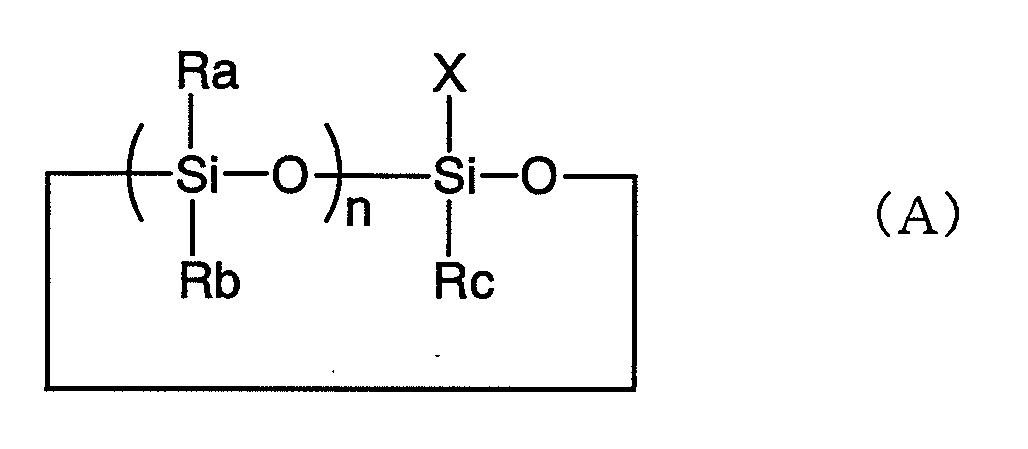
- The cyclic siloxane compound is preferably polymerized together with a hydrophilic monomer.
- Further, the present invention relates to a culture substrate material for cells or organs, which contains the cyclic siloxane compound shown by the following formula (A).

- It is preferable to polymerize a hydrophilic monomer together with the cyclic siloxane compound.
- The present invention also relates to a container for living things, which is obtained by polymerizing the cyclic siloxane compound shown by the following formula (A).

- The present invention still further relates to a transparent gel obtained by polymerizing the cyclic siloxane compound shown by the following formula (A), a hydrophilic monomer and a thermosetting polyimide silicone resin soluble in organic solvents which contains a structural units shown by the following formula (B-1) and one shown by the following formula (B-2).


- Further, the present invention relates to a method for producing a transparent gel, comprising dissolving a polyimide silicone resin containing structural units shown by the formula (B-1) and (B-2) into a mixture of a cyclic siloxane compound shown by the formula (A) and a hydrophilic monomer, followed by polymerization.
- The ophthalmic lens, a culture substrate material for cells and organs and a container for living things of the present invention is obtained by polymerizing a cyclic siloxane compound shown by the following formula (A).

- Ra or Rb is a hydrogen atom or a monovalent hydrocarbon group which may be substituted by a fluorine atom, and they are same or different with each other. Preferably, Ra and Rb are a C1 1 to C6 alkyl group and still preferably Ra is a C 1 to C6 alkyl group substituted by a fluorine atom and Rb is a C1 to C6 alkyl group. The C1 to C6 alkyl group in Ra and Rb is exemplified by a methyl group, an ethyl group, a propyl group, an isopropyl group, a butyl group, an isobutyl group, a tert-butyl group, a pentyl group, an isopentyl group, a hexyl group, etc. Among the above, one wherein Ra is -CH3 or -CH2CH2CF3 and Rb is -CH3 is still preferable. In a case where Ra or Rb is a monovalent hydrocarbon group such as an alkyl group of 7 or more carbon atoms, the obtained lens tends to be stuck with a lipid or tends to become lowered flexible. In a case where Ra is an alkyl group substituted by a fluorine atom, Ra has preferably 3 to 6 carbon atoms, and when the carbon atom is less than 3, the compound containing an alkyl group substituted by a fluorine atom tends to be difficult to produce.
- The X in the above formula (A) contains an unsaturated aliphatic group which is exemplified by the following

- The Q in the above formula (A) is preferably (i) a C1 to C8 straight chained or branched alkylene group or (ii) a C1 to C8 straight chained or branched alkylene group whose methylene unit is substituted by one or more members selected from the group consisting of -O-, -CO-, -COO-, -OCO-, -OCOO-, -C6H4-, -OC6H4- and -S-, including specifically a methylene group, an ethylene group, a propylene group, a butylene group, a pentylene group, a hexylene group, an isobutylene group, an isopentylene group, an ethylhexylene group, etc.
- The Z in the formula (A) is preferably (iii) a C1to C20 trivalent hydrocarbon group forming a cyclic structure through an unsaturated aliphatic bond as the structural unit to which Rx1 and Rx2 are bound or (iv) a C2 to C20 trivalent hydrocarbon group whose methylene unit is substituted by one or more members selected from the group consisting of -O-, -CO-, -COO-, -OCO-, -OCOO-, -C6H4-, -OC6H4- and -S-.
- Among the above, as the X in the formula A, the following is preferable from viewpoints of low cost in an industrial scale and availability in a large amount


- Specific examples of the above substituents are as the followings, but the substituent X in the present invention is not limited thereto.
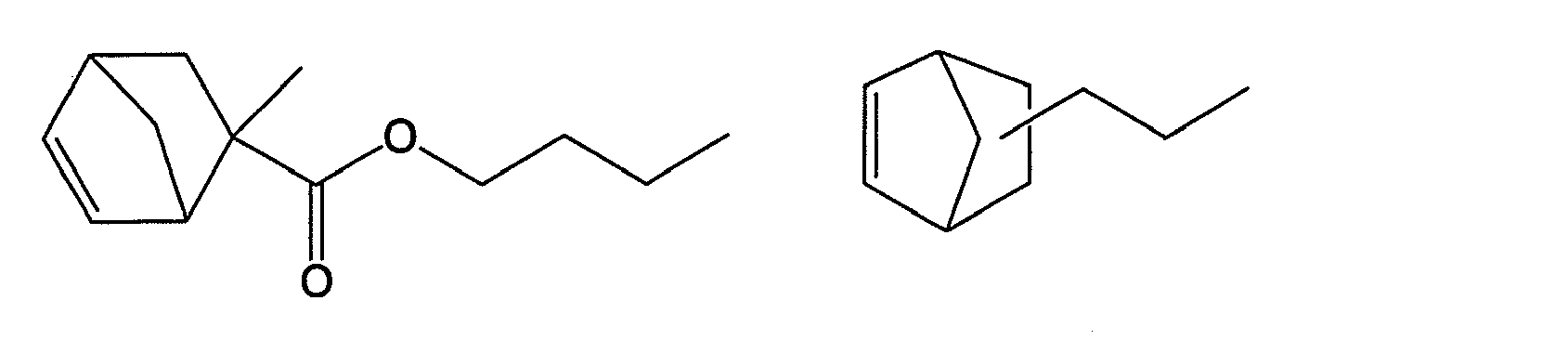


- The Rc in the formula (A) is a C1 to C6 alkyl group or a phenyl group, including specifically the alkyl group mentioned in the C1 to C6 alkyl group and the phenyl group in the above Ra and Rb, among which a methyl group is preferable.
- The n in the formula (A) of the present invention is an integer of 1 to 10, and n=3 is preferable from viewpoints of low cost in an industrial scale and availability in a large amount.
- The ophthalmic lens and the culture substrate material for cells and organs of the present invention are preferably obtained by polymerizing the cyclic siloxane compound of the formula (A) together with a hydrophilic monomer. The hydrophilic monomer is exemplified by an alcohol and a nitrogen-containing monomer, including specifically 2-hydroxyethyl methacrylate (2-HEMA), glycerol methacrylate (GMA), N-vinyl-2-pyrrolidone (NVP), N,N-dimethyl acrylamide (DMAA), 1-methyl-3-methylene-2-pyrolidinone (NMMP), etc. Those may be used singly or in combination of two or more thereof. Particularly a nitrogen-containing monomer is preferable from a viewpoint of suppressing turbidity of the resulting ophthalmic lens. DMAA is preferable for increasing transparency, and NVP is preferable from viewpoints of improvement of tackiness and a lipid-sticking property. The hydrophilic polymer is particularly preferably used in production of a silicone hydrogel contact lens.
- In a case where the hydrophilic polymer is contained, a weight ratio of the cyclic siloxane compound shown by the formula (A) to the hydrophilic monomer is preferably 20 : 80 to 80 : 20. When the ratio of the cyclic siloxane compound shown by the formula (A) is less than 20 % by weight, the shape-holdability of the resulting ophthalmic lens is inferior and becomes flat, and thus wearing tends to be difficult. When the ratio of the cyclic siloxane compound shown by the formula (A) is over 80 % by weight, flexibility and repulsion of the produced lens tends to be lowered.
- The cyclic siloxane compound shown by the formula (A) can be incorporated with a cross-linking agent.
- The cross-linking agent is for giving a reinforcing effect, and exemplified by ethylene glycol dimethacrylate (EDMA), allyl methacrylate (AMA), diethylene glycol allyl ether (TRIAM), etc. Those may be used singly or in combination of two or more thereof. Among them, EDMA or a mixture of EDMA and AMA is preferably used as the cross-linking agent from a viewpoint of keeping suitable flexibility in the ophthalmic lens.
- A content of the cross-linking agent is preferably 0.01 to 5 % by weight relative to the cyclic siloxane compound shown by the formula (A). When the content of the cross-linking agent is less than 0.01 % by weight, strength of the resulting ophthalmic lens becomes lower, and when over 5 % by weight, flexibility of the ophthalmic lens obtained tends to be lowered because of increased cross-linked structure ratio.
- The ophthalmic lens, and the culture substrate material for cells and organs of the present invention are preferably produced by polymerizing the cyclic siloxane compound shown by the formula (A) together with a hydrophilic polymer and a cross-linking agent. In a case of co-using the hydrophilic polymer and the cross-linking agent, a content of the cross-linking agent is preferably 0.01 to 3 % by weight relative to the cyclic siloxane compound shown by the formula (A). When the content of the cross-linking agent is less than 0.01 % by weight, shape-holdability of the resulting ophthalmic lens and the culture substrate material tends to be inferior and become flat. Further, mounting of the ophthalmic lens tends to be difficult. When the content of the cross-linking agent is over 3 % by weight, though the shape-holdability becomes good, the lens becomes rigid (hard) and thus resulting ophthalmic lens and the culture substrate material tend to be fragile. Further, wearing of the ophthalmic lens tends to be difficult.
- The method for polymerizing the cyclic siloxane compound shown by the formula (A) is not specifically restricted, and the polymerization can be conducted be a generally used polymerization method such as photo-polymerization and heat polymerization.
- The ophthalmic lens of the present invention preferably has a Young's Modulus of 0.1 to 5 MPa, still preferably 0.2 to 1.1 MPa. When the Young's Modulus is less than 0.1 MPa, strength of the resulting ophthalmic lens tends to be lowered, and when it is over 5 MPa, on the other hand, the lens tends to be rigid and its wearing feeling tends to be inferior.
- Further, the ophthalmic lens of the present invention preferably shows an oxygen-permeation coefficient (Dk) of 40 × 10-11 (cm2/sec) · (mLO2/(mL × mmHg)) or more. When it is less than 40 × 10-11 (cm2/sec) · (mLO2/(mL × mmHg)), the resultant tends to unsuitable to an ophthalmic lens.
- A water content of the ophthalmic lens of the present invention is preferably not more than 90 %, still preferably 20 to 80 %. When it is over 90 %, strength of the resulting ophthalmic lens tends to be lowered.
- The ophthalmic lens obtained in the present invention includes a contact lens, an intraocular lens, a corneal inlay, etc. The culture substrate material for cells and organs includes a substrate material used in production of a culture skin, a substrate material used as a skeleton of an artificial bone, etc. and the material is for seeding cells on or in the said substrate material. The container for living things means a general culture container used in cultivation of cells.
- Still further, the present invention relates to a transparent gel obtained by polymerizing the cyclic siloxane compound shown by the formula (A) and a thermosetting polyimide silicone resin soluble in an organic solvent which contains structural units shown by the following formula (B-1) and (B-2).


- The cyclic siloxane compound shown by the formula (A) can be used within preferable fields of embodiments such as an ophthalmic lens, a culture substrate material for cells and organs and a container for living things.
- The hydrophilic monomer is exemplified by a monomer used in an ophthalmic lens, a culture substrate for cells and organs, etc.
- The transparent polyimide silicone resin is not specifically restricted so far as it contains the above structure (the transparent polyimide silicone resin disclosed in
Japanese Patent Publication No. 2004-149777A 


- To a mixture of the cyclic siloxane compound shown by the formula (A), the hydrophilic monomer and the polyimide silicone resin may be added other ingredients including a silicone-containing monomer such as tris (trimethyl siloxy)silyl propyl methacrylate and tris (trimethyl siloxy)silyl styrene, a silicone-containing macromonomer such as polysiloxane macromonomer disclosed in International Patent Publication No.
WO 01/071415 - The transparent gel of the present invention is preferably obtained by dissolving a polyimide silicone resin shown by the formula (B-1) or (B-2) into a mixture of the cyclic siloxane compound shown by the formula (A) and the hydrophilic monomer, followed by polymerizing.
- A mixed ratio of the cyclic siloxane compound shown by the formula (A) to the hydrophilic monomer is preferably 90 : 10 to 10 : 90 by weight. When it is less than 10 % by weight, a mechanical strength of the resulting polymer tends to be lowered, and when it is over 90 % by weight, the resultant tends to be rigid and lowered flexible.
- A content of the polyimide silicone resin is preferably not more than 50 parts by weight relative to the above mixture. When it is over 50 parts by weight, the resultant tends to be rigid.
- The polymerization reaction is conducted by a conventional manner such as heat polymerization, photo polymerization and mold polymerization (e.g. resin mold). The polymerization is conducted appropriately with the addition of a conventional polymerization initiator such as a heat polymerization initiator and a photo polymerization initiator. A solution polymerization under addition of a solvent may also be conducted. The solvent is not specifically restricted, and use can be made of THF, isopropyl alcohol, acetone, hexane, etc.
- A polymerization temperature can be set forth according to the polymerization method, and in a case of heat polymerization, it is in a range of 60 to 120°C, preferably 80 to 100°C. In a case of polymerization at lower than 60°C, no polymerization proceeds and non-polymerized monomer amount increases, and when over 120°C, polymerization does not proceed, and an amount of non-polymerized monomer is increased, and also a mold tends to be deformed because of poor heat resistance, when a mold made of polypropylene (PP) is used.
- The resulting transparent gel shows transparency and suitable flexibility, and thus it can be applied to an ophthalmic lens, a culture substrate for cells and organs, and a container for living things without surface treatment.
- Mixed solutions were prepared according to Tables 2 to 7, and filled in a plate mold made of polypropylene, and UV polymerization was conducted for 30 minutes using a UV-ray curing machine (EYE GRAPHICS CO., LTD.) to give polymer samples. The samples were subjected to elution treatment with distilled water, and distilled water was replaced with saline, followed by sterilizing with an autoclave.
- Wettability, stickiness and tackiness of the plate surface of the resultant were evaluated by sensory test based upon feeling (wettability, stickiness, tackiness) after rubbing by fingers.
TABLE 1 ⊚ ○ Δ × Wettability very good good slightly inferior inferior Stickiness completely none observed slightly observed Tackiness completely none observed slightly observed - After the resulting plates were immersed in an artificial lacrimal fluid (0.7 % aqueous lysozyme solution) for 16 hours or 40 hours, an amount of lipid adhered to the plates was analyzed using GC/MSD (5973N MSD system, Agilent Technologies).
- A refraction index at 20°C (Na-D line) of the resulting lenses was measured by an Abbe refractometer (1-T, Atago Co., Ltd.).
- Dk of the resulting lenses were measured after an electrode method by an oxygen permeation measurement machine (Rikagaku Seiki Kogyo K.K.).
- The plates were immersed in a saline for 16 hours to hydrate, and the surfaces were rightly wiped and the weights were measured (W1: g). Then the plates were placed in a drier at 105°C for 16 hours, and then cooled to a room temperature in a desiccator, and weights of the dried plates were measured (W2: g). The water contents were calculated by the following equation:

- Tensile test was conducted using a multi-role tester (Model 4301, Instron Japan Co., Ltd.), and an average value of each 5 plates was calculated to give Young's Modulus. Young's Modulus shows extension, and a large value means short extension and a small value means long extension.
- Using a punch through tester, around 20 g load was given to the plates, and the stress after 30 and 60 seconds was measured, and the relaxation rate was calculated according the following equation compared with the initial load. An average value of each 3 plates was referred to the relaxation rate. The stress is an index of repulsion and as its value becomes large, the article becomes difficult to reform to the original form, and a small value means easy reform.

TABLE 2 (Dimension of components: % by weight) Ex. Com. Ex. 1 2 3 4 5 6 1 2 Formula (A) S-502FCT 50 50 50 S-502CT 50 50 50 SK-5001 50 50 Hydrophilic monomer NVP 50 50 50 DMAA 50 50 50 Cross-linking agent EDMA 1 1 0.5 0.5 0.5 0.5 0.5 0.5 Photo polymerization initiator D1173 0.5 0.5 0.5 0.5 0.5 0.5 0.5 0.5 Physical properties Wettability ○ ○ ⊚ ○ ○ ○ × × Stickiness ○ ○ ⊚ ⊚ ⊚ ⊚ × × Lipid-adhesion property (immersion for 16 hours) 1.26 1.30 0.13 0.77 - 1.11 - 4.61 (µg/cm2) Lipid-adhesion property (immersion for 40 hours) - - 0.25 0.74 - 3.56 - 2.41 (µg/cm2) Refractive index 1.42 1.45 1.40 1.40 - 1.41 - 1.42 Dk 58 55 46 44 - 59 - 77 Thickness of sample (mm) 0.286 0.285 0.293 0.304 - 0.297 - 0.299 Water content (%) 0 0 45 52 47 53 51 1 50 -: not measured
Dk: × 10-11 (cm2/sec) · (mLO2/(mL × mmHg)) - · S-502CT (3-methacryloxypropyl) heptamethyl cyclotetrasiloxane

- · S-502FCT (3-methacryloxypropyl)tris (3,3,3-trifluoropropyl)tetramethyl cyclotetrasiloxane

- · SK-5001: tris(trimethyl siloxy)silyl propyl methacrylate (MW: 422.82, Shin-Etsu Chemical Co., Ltd.)
- · NVP: N-vinyl-2-pyrrolidone
- · DMAA: N,N-dimethylacrylamide
- · NMMP: 1-methyl-3-methylene-2-pyrrolidinone
- · EDMA: ethylene glycol dimethacrylate
- · D1173: 2-hydroxy-2-methyl-1-phenyl-propan-1-on (Darocure (registered trade mark) 1173)
- As result from Comparative Examples 1 and 2 of Table 2, when a conventional silicone-containing monomer was used, surface wettability was inferior and tackiness was observed even using with a hydrophilic monomer. On the other hand, when the cyclo siloxane compound of the present invention shown by the formula (A) was used, surface wettability was good and plates having no tackiness were obtained even without using a hydrophilic monomer. Further, it was result from Examples 3 to 6, tackiness was improved by co-using a hydrophilic monomer.
- Also regarding the lipid adhesion amount, as result from Comparative Example 2, the amount was large when a conventional silicone-containing monomer was used, while the amount was considerably reduced when the cyclic siloxane compound of the present invention shown by the formula (A) was used.
- Among the Examples, one wherein surface wettability was good, no tackiness was observed and lipid was difficult to adhere was Example 3 wherein a hydrophilic monomer was co-used.
- From the evaluation of the refractive index, the oxygen-permeation index, the water content, the Young's Modulus and the stress relaxation rate, they were understood to be within a range sufficiently capable of applying to a contact lens.
- According to the present invention, an ophthalmic lens, a culture substrate material for cells and organs and a container for living things wherein tackiness and stickiness are reduced, lipid adhesion ability is excellent and surface wettability is also excellent can be provided.
| (Dimension of components: % by weight) | ||||
| Ex. | ||||
| 7 | 8 | 9 | 10 | |
| S-502FCT | 50 | 50 | 50 | 50 |
| S-502CT | ||||
| SK-5001 | ||||
| NVP | 45 | 40 | 35 | 25 |
| DMAA | 5 | 10 | 15 | 25 |
| EDMA | 0.5 | 0.5 | 0.5 | 0.5 |
| D1173 | 0.5 | 0.5 | 0.5 | 0.5 |
| Physical properties | ||||
| Wettability | ⊚ | ⊚ | ⊚ | ○ |
| Stickiness | ⊚ | ⊚ | ⊚ | ⊚ |
| Lipid-adhesion property | ||||
| (immersion for 16 hours) | 0.53 | 0.86 | 0.80 | 0.73 |
| (µg/cm2) | ||||
| Lipid-adhesion property | ||||
| (immersion for 40 hours) | - | - | - | - |
| (µg/cm2) | ||||
| Refractive index | - | - | - | - |
| Dk | - | - | - | - |
| Thickness of sample (mm) | - | - | - | - |
| Water content (%) | - | - | - | - |
| -: not measured Dk: × 10-11 (cm2/sec) · (mLO2/mL × mmHg)) |
| (Dimension of components: % by weight) | |||||||||
| Ex. | |||||||||
| 11 | 12 | 13 | 14 | 15 | 16 | 17 | 18 | 19 | |
| S-502FCT | 10 | 20 | 30 | 40 | 50 | 60 | 70 | 80 | 90 |
| NVP | 90 | 80 | 70 | 60 | 50 | 40 | 30 | 20 | 10 |
| EDMA | 0.5 | 0.5 | 0.5 | 0.5 | 0.5 | 0.5 | 0.5 | 0.5 | 0.5 |
| D1173 | 0.5 | 0.5 | 0.5 | 0.5 | 0.5 | 0.5 | 0.5 | 0.5 | 0.5 |
| Physical properties | |||||||||
| Wettability | ⊚ | ⊚ | ⊚ | ⊚ | ⊚ | ⊚ | ⊚ | ⊚ | ⊚ |
| Stickiness | ⊚ | ⊚ | ⊚ | ⊚ | ⊚ | ⊚ | ⊚ | ⊚ | ⊚ |
| Tackiness | ⊚ | ⊚ | ⊚ | ⊚ | ⊚ | ⊚ | ⊚ | ⊚ | ⊚ |
| (Dimension of components: % by weight) | |||||||||||
| Ex. | |||||||||||
| 20 | 21 | 22 | 23 | 24 | 25 | 26 | 27 | 28 | 29 | 30 | |
| S-502FCT | 50 | 50 | 50 | 50 | 50 | 50 | 50 | 50 | 50 | 50 | 50 |
| NVP | 50 | 45 | 40 | 35 | 30 | 25 | 20 | 15 | 10 | 5 | 0 |
| DMAA | 0 | 5 | 10 | 15 | 20 | 25 | 30 | 35 | 40 | 45 | 50 |
| EDMA | 0.5 | 0.5 | 0.5 | 0.5 | 0.5 | 0.5 | 0.5 | 0.5 | 0.5 | 0.5 | 0.5 |
| D1173 | 0.5 | 0.5 | 0.5 | 0.5 | 0.5 | 0.5 | 0.5 | 0.5 | 0.5 | 0.5 | 0.5 |
| Physical properties | |||||||||||
| Wettability | ⊚ | ⊚ | ⊚ | ○ | ○ | ○ | ○ | Δ | Δ | Δ | Δ |
| Stickiness | ⊚ | ⊚ | ⊚ | ⊚ | ⊚ | ⊚ | ⊚ | ⊚ | ⊚ | ⊚ | ⊚ |
| Tackiness | ⊚ | ⊚ | ⊚ | ⊚ | ⊚ | ⊚ | ⊚ | ⊚ | ⊚ | ⊚ | ⊚ |
| Young's Modulus (MPa) | 4.961 | 1.047 | 0.427 | 0.320 | 0.394 | 0.346 | 0.305 | 0.268 | 0.197 | 0.136 | 0.192 |
| Stress relaxation rate after 30 seconds (%) | 38.5 | 28.6 | 22.5 | 20.7 | 19.6 | 22.5 | 23.2 | 23.1 | 23.9 | 25.7 | 23.7 |
| Stress relaxation rate after 60 seconds (%) | 41.9 | 31.6 | 26.3 | 24.5 | 23.3 | 25.9 | 27.3 | 27.6 | 28.1 | 30.1 | 28.1 |
| (Dimension of components: % by weight) | |||||||
| Ex. | |||||||
| 31 | 32 | 33 | 34 | 35 | 36 | 37 | |
| S-502FCT | 50 | 50 | 50 | 50 | 50 | 50 | 50 |
| NMMP | 0 | 0 | 0 | 0 | 30 | 20 | 10 |
| NVP | 30 | 20 | 10 | 0 | 0 | 0 | 0 |
| DMAA | 20 | 30 | 40 | 50 | 20 | 30 | 40 |
| EDMA | 1 | 1 | 1 | 1 | 1 | 1 | 1 |
| D1173 | 0.5 | 0.5 | 0.5 | 0.5 | 0.5 | 0.5 | 0.5 |
| Physical properties | |||||||
| Wettability | ○ | ○ | Δ | Δ | Δ | Δ | Δ |
| Stickiness | ⊚ | ⊚ | ⊚ | ⊚ | ⊚ | ⊚ | ⊚ |
| Tackiness | ⊚ | ⊚ | ⊚ | ⊚ | ⊚ | ⊚ | ⊚ |
| Young's Modulus (MPa) | 0.516 | 0.415 | 0.446 | 0.418 | 0.463 | 0.559 | 0.380 |
| Stress relaxation rate after 30 seconds (%) | 22.3 | 20.9 | 20.8 | 22.2 | 24.1 | 23.5 | 25.1 |
| Stress relaxation rate after 60 seconds (%) | 24.4 | 23.3 | 24.6 | 26.2 | 29.0 | 26.4 | 007 |
| (Dimension of components: % by weight) | ||||||||||
| Ex. | ||||||||||
| 38 | 39 | 40 | 41 | 42 | 43 | 44 | 45 | 46 | 47 | |
| S-502FCT | 50 | 50 | 50 | 50 | 50 | 50 | 50 | 50 | 50 | 50 |
| NVP | 40 | 30 | 20 | 10 | 40 | 30 | 20 | 10 | 0 | 0 |
| DMAA | 10 | 20 | 30 | 40 | 10 | 20 | 30 | 40 | 50 | 50 |
| EDMA | 0.25 | 0.25 | 0.25 | 0.25 | 0.75 | 0.75 | 0.75 | 0.75 | 0.75 | 1 |
| D1173 | 0.5 | 0.5 | 0.5 | 0.5 | 0.5 | 0.5 | 0.5 | 0.5 | 0.5 | 0.5 |
| Physical properties | ||||||||||
| Wettability | ⊚ | ⊚ | ○ | Δ | ⊚ | ○ | Δ | Δ | Δ | Δ |
| Stickiness | ⊚ | ⊚ | ⊚ | ⊚ | ⊚ | ⊚ | ⊚ | ⊚ | ⊚ | ⊚ |
| Tackiness | ⊚ | ⊚ | ⊚ | ⊚ | ⊚ | ⊚ | ⊚ | ⊚ | ⊚ | ⊚ |
| Young's Modulus (MPa) | 0.289 | 0.280 | 0.331 | 0.278 | 0.444 | 0.385 | 0.334 | 0.371 | 0.334 | 0.441 |
| Stress relaxation rate after 30 seconds (%) | 25.4 | 21.3 | 22.0 | 23.0 | 20.1 | 20.2 | 22.8 | 23.6 | 23.0 | 23.3 |
| Stress relaxation rate after 60 seconds (%) | 30.2 | 25.1 | 25.5 | 27.1 | 23.8 | 23.2 | 26.6 | 27.2 | 27.0 | 26.5 |
Claims (7)
- An ophthalmic lens, which is obtained by polymerizing a cyclic siloxane compound shown by the following formula (A)

- The ophthalmic lens of Claim 1, which is one obtained by polymerizing a hydrophilic monomer together with a cyclic siloxane compound.
- A culture substrate material for cells or organs, which is obtained by polymerizing a cyclic siloxane compound shown by the formula (A)

- The culture substrate material for cells or organs of Claim 3, which is obtained by polymerizing a hydrophilic monomer together with a cyclic siloxane compound.
- A container for living things, which is obtained by polymerizing a cyclic siloxane compound shown by the formula (A)

- A transparent gel, which is obtained by polymerizing a cyclic siloxane compound shown by the following formula (A), a hydrophilic monomer and a thermosetting polyimide silicone resin soluble in an organic solvent, which contains structural units shown by the following formula (B-1) and (B-2)


- A method for producing the transparent gel of Claim 6 comprising dissolving a polyimide silicone resin containing structural units shown by the formula (B-1) and (B-2) in a mixture of a cyclic siloxane compound shown by the formula (A) and a hydrophilic monomer and polymerizing the same.
Applications Claiming Priority (2)
| Application Number | Priority Date | Filing Date | Title |
|---|---|---|---|
| JP2005200920A JP4828171B2 (en) | 2005-07-08 | 2005-07-08 | Ophthalmic lens obtained by polymerizing cyclic siloxane compound, cell or organ culture substrate, biological container, transparent gel and method for producing the same |
| PCT/JP2006/311275 WO2007007489A1 (en) | 2005-07-08 | 2006-06-06 | Ophthalmic lens, cell or organ culture substrate, container for biological material and transparent gel produced by polymerization of cyclic siloxane compound and process for production thereof |
Publications (1)
| Publication Number | Publication Date |
|---|---|
| EP1902737A1 true EP1902737A1 (en) | 2008-03-26 |
Family
ID=37636888
Family Applications (1)
| Application Number | Title | Priority Date | Filing Date |
|---|---|---|---|
| EP06757015A Withdrawn EP1902737A1 (en) | 2005-07-08 | 2006-06-06 | Ophthalmic lens, cell or organ culture substrate, container for biological material and transparent gel produced by polymerization of cyclic siloxane compound and process for production thereof |
Country Status (4)
| Country | Link |
|---|---|
| US (1) | US20100119744A1 (en) |
| EP (1) | EP1902737A1 (en) |
| JP (1) | JP4828171B2 (en) |
| WO (1) | WO2007007489A1 (en) |
Cited By (11)
| Publication number | Priority date | Publication date | Assignee | Title |
|---|---|---|---|---|
| US9486311B2 (en) | 2013-02-14 | 2016-11-08 | Shifamed Holdings, Llc | Hydrophilic AIOL with bonding |
| US10195018B2 (en) | 2013-03-21 | 2019-02-05 | Shifamed Holdings, Llc | Accommodating intraocular lens |
| US10350056B2 (en) | 2016-12-23 | 2019-07-16 | Shifamed Holdings, Llc | Multi-piece accommodating intraocular lenses and methods for making and using same |
| US10548718B2 (en) | 2013-03-21 | 2020-02-04 | Shifamed Holdings, Llc | Accommodating intraocular lens |
| US10736734B2 (en) | 2014-08-26 | 2020-08-11 | Shifamed Holdings, Llc | Accommodating intraocular lens |
| US10987214B2 (en) | 2017-05-30 | 2021-04-27 | Shifamed Holdings, Llc | Surface treatments for accommodating intraocular lenses and associated methods and devices |
| US11141263B2 (en) | 2015-11-18 | 2021-10-12 | Shifamed Holdings, Llc | Multi-piece accommodating intraocular lens |
| US11266496B2 (en) | 2017-06-07 | 2022-03-08 | Shifamed Holdings, Llc | Adjustable optical power intraocular lenses |
| US12167960B2 (en) | 2016-12-23 | 2024-12-17 | Shifamed Holdings, Llc | Multi-piece accommodating intraocular lenses and methods for making and using same |
| US12376957B2 (en) | 2015-11-18 | 2025-08-05 | Shifamed Holdings, Llc | Multi-piece accommodating intraocular lens |
| US12521232B2 (en) | 2019-07-11 | 2026-01-13 | Shifamed Holdings, Llc | Accommodating intraocular lenses and associated methods |
Families Citing this family (9)
| Publication number | Priority date | Publication date | Assignee | Title |
|---|---|---|---|---|
| JP4496434B2 (en) * | 2005-11-24 | 2010-07-07 | 信越化学工業株式会社 | Polyfunctional (meth) acrylate compound, photocurable resin composition and article |
| JP5155244B2 (en) * | 2009-04-21 | 2013-03-06 | 株式会社Adeka | Cell culture substrate |
| JP5805420B2 (en) * | 2011-03-31 | 2015-11-04 | 旭化成ケミカルズ株式会社 | Thermosetting resin composition using organopolysiloxane, encapsulant for optical semiconductor, die bond material for semiconductor, optical semiconductor package, optical semiconductor |
| JP5729865B2 (en) * | 2011-03-31 | 2015-06-03 | 旭化成ケミカルズ株式会社 | Photocurable resin composition containing organopolysiloxane and use thereof |
| WO2015092859A1 (en) * | 2013-12-16 | 2015-06-25 | 株式会社メニコン | Ocular lens |
| WO2015092858A1 (en) | 2013-12-16 | 2015-06-25 | 株式会社メニコン | Polysiloxane-based macromonomer for use in ocular lens and ocular lens using same |
| JP6401307B2 (en) * | 2014-06-10 | 2018-10-10 | コリア アドバンスト インスティテュート オブ サイエンスアンド テクノロジーKorea Advanced Institute Of Science And Technology | Cell culture substrate, production method and use thereof |
| JP6763139B2 (en) | 2015-12-25 | 2020-09-30 | 信越化学工業株式会社 | Solvent-free silicone-modified polyimide resin composition |
| RU2753172C2 (en) * | 2016-12-22 | 2021-08-12 | Иллюмина, Инк. | Device for pressing out relief |
Family Cites Families (9)
| Publication number | Priority date | Publication date | Assignee | Title |
|---|---|---|---|---|
| JPS6157612A (en) * | 1984-08-23 | 1986-03-24 | Nippon Contact Lens:Kk | Contact lens material |
| JPS60165617A (en) * | 1984-02-09 | 1985-08-28 | Tokyo Contact Lens Kenkyusho:Kk | Contact lens material |
| JPS6254220A (en) * | 1985-09-03 | 1987-03-09 | Nippon Contact Lens:Kk | Contact lens material |
| JP3043390B2 (en) * | 1990-10-19 | 2000-05-22 | ノバルティス アクチエンゲゼルシャフト | Method for producing oxygen-permeable polymer material |
| JP2856378B2 (en) * | 1993-11-30 | 1999-02-10 | 信越化学工業株式会社 | Acryloxypropyl group-containing cyclotetrasiloxane, method for producing polymer composition thereof, and polymer composition |
| JP3406112B2 (en) * | 1995-03-10 | 2003-05-12 | 旭化成アイミー株式会社 | Manufacturing method of ophthalmic lens material |
| JPH11302409A (en) * | 1998-04-23 | 1999-11-02 | Toray Ind Inc | Gas permeable sheet |
| JP4204435B2 (en) * | 2002-10-10 | 2009-01-07 | 信越化学工業株式会社 | Transparent polyimide silicone resin containing thermosetting groups |
| US7189868B2 (en) * | 2005-05-19 | 2007-03-13 | Shin-Etsu Chemical Co., Ltd. | Cyclic siloxane compounds and making method |
-
2005
- 2005-07-08 JP JP2005200920A patent/JP4828171B2/en not_active Expired - Lifetime
-
2006
- 2006-06-06 EP EP06757015A patent/EP1902737A1/en not_active Withdrawn
- 2006-06-06 US US11/995,028 patent/US20100119744A1/en not_active Abandoned
- 2006-06-06 WO PCT/JP2006/311275 patent/WO2007007489A1/en not_active Ceased
Non-Patent Citations (1)
| Title |
|---|
| See references of WO2007007489A1 * |
Cited By (19)
| Publication number | Priority date | Publication date | Assignee | Title |
|---|---|---|---|---|
| US11540916B2 (en) | 2013-02-14 | 2023-01-03 | Shifamed Holdings, Llc | Accommodating intraocular lens |
| US9486311B2 (en) | 2013-02-14 | 2016-11-08 | Shifamed Holdings, Llc | Hydrophilic AIOL with bonding |
| US10350057B2 (en) | 2013-02-14 | 2019-07-16 | Shifamed Holdings, Llc | Hydrophilic AIOL with bonding |
| US10709549B2 (en) | 2013-02-14 | 2020-07-14 | Shifamed Holdings, Llc | Hydrophilic AIOL with bonding |
| US10195018B2 (en) | 2013-03-21 | 2019-02-05 | Shifamed Holdings, Llc | Accommodating intraocular lens |
| US10548718B2 (en) | 2013-03-21 | 2020-02-04 | Shifamed Holdings, Llc | Accommodating intraocular lens |
| US11583390B2 (en) | 2014-08-26 | 2023-02-21 | Shifamed Holdings, Llc | Accommodating intraocular lens |
| US10736734B2 (en) | 2014-08-26 | 2020-08-11 | Shifamed Holdings, Llc | Accommodating intraocular lens |
| US12251303B2 (en) | 2014-08-26 | 2025-03-18 | Shifamed Holdings, Llc | Accommodating intraocular lens |
| US11141263B2 (en) | 2015-11-18 | 2021-10-12 | Shifamed Holdings, Llc | Multi-piece accommodating intraocular lens |
| US12376957B2 (en) | 2015-11-18 | 2025-08-05 | Shifamed Holdings, Llc | Multi-piece accommodating intraocular lens |
| US12376958B2 (en) | 2015-11-18 | 2025-08-05 | Shifamed Holdings, Llc | Multi-piece accommodating intraocular lens |
| US11065109B2 (en) | 2016-12-23 | 2021-07-20 | Shifamed Holdings, Llc | Multi-piece accommodating intraocular lenses and methods for making and using same |
| US10350056B2 (en) | 2016-12-23 | 2019-07-16 | Shifamed Holdings, Llc | Multi-piece accommodating intraocular lenses and methods for making and using same |
| US12167960B2 (en) | 2016-12-23 | 2024-12-17 | Shifamed Holdings, Llc | Multi-piece accommodating intraocular lenses and methods for making and using same |
| US10987214B2 (en) | 2017-05-30 | 2021-04-27 | Shifamed Holdings, Llc | Surface treatments for accommodating intraocular lenses and associated methods and devices |
| US11266496B2 (en) | 2017-06-07 | 2022-03-08 | Shifamed Holdings, Llc | Adjustable optical power intraocular lenses |
| US12465483B2 (en) | 2017-06-07 | 2025-11-11 | Shifamed Holdings, Llc | Adjustable optical power intraocular lenses |
| US12521232B2 (en) | 2019-07-11 | 2026-01-13 | Shifamed Holdings, Llc | Accommodating intraocular lenses and associated methods |
Also Published As
| Publication number | Publication date |
|---|---|
| WO2007007489A1 (en) | 2007-01-18 |
| US20100119744A1 (en) | 2010-05-13 |
| JP2007014637A (en) | 2007-01-25 |
| JP4828171B2 (en) | 2011-11-30 |
Similar Documents
| Publication | Publication Date | Title |
|---|---|---|
| KR102512731B1 (en) | silicone hydrogel contact lenses | |
| US20100119744A1 (en) | Ophthalmic lens, culture substrate material for cell or organ, container for living thing and transparent gel obtained by polymerization of cyclic siloxane and their production method | |
| EP2077292B1 (en) | Polysiloxane-based prepolymer and hydrogel | |
| JP4732464B2 (en) | Polymerizable surfactants and their use as device forming comonomers | |
| CN104602886B (en) | There are the preparation method of the copolymer products formed containing organosilicon of hydrophilic surface and the silicone hydrogels contact lenses with hydrophilic surface | |
| KR101713370B1 (en) | Wettable silicone hydrogel contact lenses | |
| EP1968986B1 (en) | Process for making cationic hydrophilic siloxanyl monomers | |
| EP2760917B1 (en) | Silicone hydrogels having improved curing speed and other properties | |
| CN111902459B (en) | Polysiloxane monomer containing phosphorylcholine group | |
| EP2738221A1 (en) | Silicone hydrogel composition and silicone hydrogel contact lenses made from the composition | |
| EP3526277A1 (en) | Polymerizable polydimethylsiloxane-polyoxyalkylene block copolymers | |
| JPH07502547A (en) | Wettable silicone hydrogel compositions and methods | |
| AU2013210010A1 (en) | Silicone polymers comprising sulfonic acid groups | |
| US20090227804A1 (en) | Polysiloxanes and polysiloxane prepolymers with vinyl or epoxy functionality | |
| KR20080102365A (en) | Silicone-containing polymers formed from non-reactive silicone-containing prepolymers | |
| KR20250067820A (en) | Monomer composition for contact lenses, polymer for contact lenses, and contact lenses | |
| US10160854B1 (en) | Hydrogel materials | |
| US8030423B2 (en) | Multi-armed macromonomers | |
| EP2215501A1 (en) | Biomedical devices | |
| US11905351B2 (en) | Silicone hydrogel materials | |
| HK1200475B (en) | Silicone hydrogels having improved curing speed and other properties | |
| HK1199895B (en) | Silicone hydrogels having improved curing speed and other properties | |
| HK1120279A1 (en) | Silicon-containing monomers end-capped with polymerizable cationic hydrophilic groups |
Legal Events
| Date | Code | Title | Description |
|---|---|---|---|
| PUAI | Public reference made under article 153(3) epc to a published international application that has entered the european phase |
Free format text: ORIGINAL CODE: 0009012 |
|
| 17P | Request for examination filed |
Effective date: 20071119 |
|
| AK | Designated contracting states |
Kind code of ref document: A1 Designated state(s): AT BE BG CH CY CZ DE DK EE ES FI FR GB GR HU IE IS IT LI LT LU LV MC NL PL PT RO SE SI SK TR |
|
| DAX | Request for extension of the european patent (deleted) | ||
| STAA | Information on the status of an ep patent application or granted ep patent |
Free format text: STATUS: THE APPLICATION HAS BEEN WITHDRAWN |
|
| 18W | Application withdrawn |
Effective date: 20100303 |