EP1902675A1 - Abdominal impedance based body composition meter - Google Patents
Abdominal impedance based body composition meter Download PDFInfo
- Publication number
- EP1902675A1 EP1902675A1 EP07017152A EP07017152A EP1902675A1 EP 1902675 A1 EP1902675 A1 EP 1902675A1 EP 07017152 A EP07017152 A EP 07017152A EP 07017152 A EP07017152 A EP 07017152A EP 1902675 A1 EP1902675 A1 EP 1902675A1
- Authority
- EP
- European Patent Office
- Prior art keywords
- electrodes
- pressing force
- current
- measuring means
- passing
- Prior art date
- Legal status (The legal status is an assumption and is not a legal conclusion. Google has not performed a legal analysis and makes no representation as to the accuracy of the status listed.)
- Granted
Links
Images



Classifications
-
- A—HUMAN NECESSITIES
- A61—MEDICAL OR VETERINARY SCIENCE; HYGIENE
- A61B—DIAGNOSIS; SURGERY; IDENTIFICATION
- A61B5/00—Measuring for diagnostic purposes; Identification of persons
- A61B5/05—Detecting, measuring or recording for diagnosis by means of electric currents or magnetic fields; Measuring using microwaves or radio waves
- A61B5/053—Measuring electrical impedance or conductance of a portion of the body
- A61B5/0537—Measuring body composition by impedance, e.g. tissue hydration or fat content
Definitions
- This invention relates to an abdominal impedance based body composition meter which measures an impedance in the abdomen (abdominal impedance) and estimates a body composition indicator.
- a body fat measuring device disclosed in Patent Literature 1 and a body composition meter disclosed in Patent Literature 2 comprise support means having a plurality of electrodes disposed on a surface thereof and measure an abdominal impedance and estimate a body composition indicator by pressing the electrode-disposed surface of the support means against the abdomen, passing a current between current-passing electrodes out of the above electrodes and detecting a voltage generated in the abdomen upon passage of the current between measuring electrodes out of the above electrodes.
- the present invention has been conceived to solve the above problem of the prior art, and an object of the present is to provide an abdominal impedance based body composition meter capable of estimating a body composition indicator with high accuracy.
- An abdominal impedance based body composition meter of the present invention comprises:
- the electrodes comprise a pair of current-passing electrodes and a pair of measuring electrodes
- the pressing force measuring means comprises load detection sections which detect loads produced when the electrodes are pressed against the abdomen and determines a pressing force applied to the current-passing electrodes and a pressing force applied to the measuring electrodes based on the loads detected by the load detection sections
- the abdominal impedance measuring means determines an abdominal impedance based on a potential difference which is detected between the measuring electrodes when a low-frequency current is passed between the current-passing electrodes and determines an abdominal impedance based on a potential difference which is detected between the measuring electrodes when a high-frequency current is passed between the current-passing electrodes
- the body composition estimating means computes and estimates an abdominal total fat area as the body composition indicator by substituting the abdominal impedance determined by the abdominal impedance measuring means by passing the low-frequency current into Z low , the abdominal impedance determined by the abdominal impedance measuring means by passing the high-frequency current into Z high , the pressing force applied
- the electrodes comprise a pair of current-passing electrodes and a pair of measuring electrodes
- the pressing force measuring means comprises load detection sections which detect loads produced when the electrodes are pressed against the abdomen and determines a pressing force applied to the current-passing electrodes and a pressing force applied to the measuring electrodes based on the loads detected by the load detection sections
- the abdominal impedance measuring means determines an abdominal impedance based on a potential difference which is detected between the measuring electrodes when a low-frequency current is passed between the current-passing electrodes and determines an abdominal impedance based on a potential difference which is detected between the measuring electrodes when a high-frequency current is passed between the current-passing electrodes
- the body composition estimating means computes and estimates a subcutaneous fat area as the body composition indicator by substituting the abdominal impedance determined by the abdominal impedance measuring means by passing the low-frequency current into Z low , the abdominal impedance determined by the abdominal impedance measuring means by passing the high-frequency current into Z high , the pressing force
- the electrodes comprise a pair of current-passing electrodes and a pair of measuring electrodes
- the pressing force measuring means comprises load detection sections which detect loads produced when the electrodes are pressed against the abdomen and determines a pressing force applied to the current-passing electrodes and a pressing force applied to the measuring electrodes based on the loads detected by the load detection sections
- the abdominal impedance measuring means determines an abdominal impedance based on a potential difference which is detected between the measuring electrodes when a low-frequency current is passed between the current-passing electrodes and determines an abdominal impedance based on a potential difference which is detected between the measuring electrodes when a high-frequency current is passed between the current-passing electrodes
- the body composition estimating means computes and estimates a visceral fat area as the body composition indicator by substituting the abdominal impedance determined by the abdominal impedance measuring means by passing the low-frequency current into Z low , the abdominal impedance determined by the abdominal impedance measuring means by passing the high-frequency current into Z high , the pressing
- the electrodes comprise a pair of current-passing electrodes and a pair of measuring electrodes
- the pressing force measuring means comprises load detection sections which detect loads produced when the electrodes are pressed against the abdomen and determines a pressing force applied to the current-passing electrodes and a pressing force applied to the measuring electrodes based on the loads detected by the load detection sections
- the abdominal impedance measuring means determines an abdominal impedance based on a potential difference which is detected between the measuring electrodes when a high-frequency current is passed between the current-passing electrodes
- the body composition estimating means computes and estimates a truncal fat percentage as the body composition indicator by substituting the abdominal impedance determined by the abdominal impedance measuring means by passing the high-frequency current into Z high , the pressing force applied to the current-passing electrodes which has been determined by the pressing force measuring means into SI avg , the pressing force applied to the measuring electrodes which has been determined by the pressing force measuring means into SV avg and constants which provide a correlation with a
- the electrodes comprise a pair of current-passing electrodes and a pair of measuring electrodes
- the pressing force measuring means comprises load detection sections which detect loads produced when the electrodes are pressed against the abdomen and determines a pressing force applied to the current-passing electrodes and a pressing force applied to the measuring electrodes based on the loads detected by the load detection sections
- the abdominal impedance measuring means determines an abdominal impedance based on a potential difference which is detected between the measuring electrodes when a high-frequency current is passed between the current-passing electrodes
- the body composition estimating means computes and estimates a total body fat percentage as the body composition indicator by substituting the abdominal impedance determined by the abdominal impedance measuring means by passing the high-frequency current into Z high , the pressing force applied to the current-passing electrodes which has been determined by the pressing force measuring means into SI avg , the pressing force applied to the measuring electrodes which has been determined by the pressing force measuring means into SV avg and constants which provide a correlation with a total body
- the abdominal impedance based body composition meter of the present invention measures pressing forces by the pressing force measuring means and estimates body composition indicators based on the measured pressing forces and abdominal impedances measured by the abdominal impedance measuring means by the body composition estimating means. Therefore, even if abdominal impedances measured by the abdominal impedance measuring means vary due to a difference in the degree of impression of the electrodes into the abdomen which is caused by a variation in force pressing the support, body composition indicators can be obtained with high accuracy.
- the abdominal impedance based body composition meter of the present invention calculates an abdominal total fat area, subcutaneous fat area, visceral fat area, truncal fat percentage and total body fat percentage as body composition indicators by use of the arithmetic expressions which take the pressing forces SI avg and SV avg into consideration and provide correlations with body composition indicators determined by a standard technique, the body composition indicators can be obtained securely with high accuracy.
- An abdominal impedance based body composition meter comprises abdominal impedance measuring means, pressing force measuring means and body composition estimating means.
- the abdominal impedance measuring means comprises a plurality of electrodes and a support which keeps these electrodes pressed against the abdomen and measures an abdominal impedance when these electrodes are in contact with the abdomen.
- the pressing force measuring means measures a pressing force when the electrodes are pressed against the abdomen by the support.
- the body composition estimating means estimates a body composition indicator, based on the abdominal impedances measured by the abdominal impedance measuring means and the pressing forces measured by the pressing force measuring means.
- abdominal impedance based body composition meter According to the thus constituted abdominal impedance based body composition meter, a force pressing the support is obtained in the pressing force measuring means, and a body composition indicator based on this pressing force is estimated in the body composition estimating means. Hence, even if abdominal impedances measured by the abdominal impedance measuring means vary due to a difference in the degree of impression of the electrodes into the abdomen which is caused by a variation in force pressing the support, body composition indicators can be estimated with high accuracy.
- an abdominal impedance based body composition meter according to the present invention will be described by using primarily an external view shown in Fig. 1, a diagram shown in Fig. 2 illustrating the body composition meter during measurement, and a block diagram shown in Fig. 3.
- the abdominal impedance based body composition meter according to the present invention is roughly constituted by a support 1, electrodes 2a, 2b, 2c and 2d, load sensing sections 3a, 3b, 3c and 3d, and an operation section 4.
- the support 1 comprises a bar-shaped hollow body having a support surface 1c which is curved to fit the circumference of the abdomen.
- the bar-shaped hollow body also has grips 1a and 1b for keeping the support surface 1c pressed against an abdomen 100.
- the bar-shaped hollow body comprises a flexible material which is deformed such that the electrodes 2a, 2b, 2c and 2d can make closer contact with the surface of the abdomen 100 along the circumference of the abdomen when the support 1 is pressed against the abdomen.
- the electrodes 2a and 2b are a pair of current-passing electrodes for passing a low-frequency current or high-frequency current through the abdomen 100.
- the electrodes 2c and 2d are a pair of measuring electrodes for detecting a potential difference which occurs in the abdomen 100 when a low-frequency current or high-frequency current is passed through the abdomen 100 from the current-passing electrodes 2a and 2b.
- the current-passing electrodes 2a and 2b are disposed on the load detection sections 3a and 3b which are disposed on the support surface 1c.
- the measuring electrodes 2c and 2d are disposed between the current-passing electrodes 2a and 2b and on the load detection sections 3c and 3d which are disposed on the support surface 1c. These electrodes are aligned in the abdominal circumferential direction.
- the load detection sections 3a, 3b, 3c and 3d comprise a load sensor, an amplifier and an A/D converter.
- the load detection section 3a is disposed between the support 1 and the electrode 2a and detects a load signal when the electrode 2a is in contact with the abdomen 100.
- the load detection section 3b is disposed between the support 1 and the electrode 2b and detects a load signal when the electrode 2b is in contact with the abdomen 100.
- the load detection section 3c is disposed between the support 1 and the electrode 2c and detects a load signal when the electrode 2c is in contact with the abdomen 100.
- the load detection section 3d is disposed between the support 1 and the electrode 2d and detects a load signal when the electrode 2d is in contact with the abdomen 100.
- the operation section 4 has an input section 5 and a display section 6 on an external surface of the case and has a power supply section 7, a current generating section 8, a voltage detection section 9, a time keeping section 10, a storage section 11, a computing section 12 and a control section 13 in the case.
- the operation section 4 is disposed on the support 1.
- the power supply section 7 supplies electric power to each section in the electrical system of the present device.
- the time keeping section 10 keeps time.
- the input section 5 comprises a power switch 5a for starting supply of power from the power supply section 7 and a measurement switch 5b for starting measurements of an abdominal impedance and pressing force.
- the current generating section 8 generates a current A low of low frequency (4 to 12.5 kHz (preferably 5 kHz)) to be passed through the abdomen 100 and a current A high of high frequency (128 to 512 kHz (preferably 256 kHz)) to be passed through the abdomen 100, under the control of the control section 13.
- the voltage detection section 9 detects a voltage V low which is generated between the measuring electrodes 2c and 2d when the low-frequency current A low is passed between the current-passing electrodes 2a and 2b and a voltage V high which is generated between the measuring electrodes 2c and 2d when the high-frequency current A high is passed between the current-passing electrodes 2a and 2b.
- the storage section 11 stores the following various arithmetic expressions (expressions (1) to (5)) for calculating body composition indicators (abdominal total fat area, subcutaneous fat area, visceral fat area, truncal fat percentage and total body fat percentage) based on an abdominal impedance Z low based on the voltage V low generated between the measuring electrodes 2c and 2d, an abdominal impedance Z high based on the voltage V high generated between the measuring electrodes 2c and 2d, a pressing force SI avg applied to the current-passing electrodes 2a and 2b and a pressing force SV avg applied to the measuring electrodes 2c and 2d, input information, result information, programs and various other information.
- a, b, c and d are constants which provide a correlation with an abdominal total fat area determined by DXA (Dual X-ray Absorptiometry) which is a standard technique.
- e, f, g and h are constants which provide a correlation with a subcutaneous fat area determined by DXA (Dual X-ray Absorptiometry) which is a standard technique.
- i, j, k and m are constants which provide a correlation with a visceral fat area determined by DXA (Dual X-ray Absorptiometry) which is a standard technique.
- n, p, q and r are constants which provide a correlation with a truncal fat percentage determined by DXA (Dual X-ray Absorptiometry) which is a standard technique.
- s, n, p, q and r are constants which provide a correlation with a total body fat percentage determined by DXA (Dual X-ray Absorptiometry) which is a standard technique.
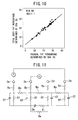
- the abdominal total fat area, subcutaneous fat area, visceral fat area and truncal fat percentage determined by the above arithmetic expressions (expressions (1) to (4)) have high correlations with an abdominal total fat area, subcutaneous fat area, visceral fat area and truncal fat percentage determined by DXA (standard technique) which is generally considered to enjoy high estimation accuracy, as shown in Figs. 6 to 9 (refer to R, SEE), and the truncal fat percentage determined by DXA (standard technique) which is generally considered to enjoy high estimation accuracy has a high correlation with a total body fat percentage determined by DXA, as shown in Fig. 10 (refer to R, SEE).
- the total body fat percentage determined by the above arithmetic expression (expression (5)) based on the truncal fat percentage has a high correlation with a total body fat percentage determined by DXA.
- the display section 6 displays information about the results of computations of the body composition indicators (abdominal total fat area, subcutaneous fat area, visceral fat area, truncal fat percentage and total body fat percentage) by the computing section 12 as well as other input, measurement and result information.
- the control section 13 controls supply of power from the power supply section 7 to each section in the electrical system of the present device based on an ON signal from the power switch 5a, (ii) controls generation of the low-frequency current A low and high-frequency current A high from the current generating section 8 based on an ON signal from the measurement switch 5b, (iii) controls computations of the abdominal impedances Z low and Z high by the computing section 12 based on the voltages V low and V high generated between the measuring electrodes 2c and 2d from the voltage detection section 9, (iv) controls computations of the pressing forces SI1, SI2, SV1, SV2, SI avg and SV avg by the computing section 12 based on the detected signals from the load detection sections 3a, 3b, 3c and 3d, (v) controls computations of the body composition indicators (abdominal total fat area, subcutaneous fat area, visceral fat area, truncal fat percentage and total body fat percentage) by the computing section 12, based on the abdominal impedances Z low
- the superficial structure of the front section of the abdomen of a body can be represented by an electrical equivalent circuit model in which Rs represents a skin surface, Rf and Cf represent a subcutaneous fat layer, and Cm, Ri and Re represent a cell membrane, intracellular fluid and extracellular fluid in an abdominal muscle layer, respectively.
- the state of measurement of abdominal impedance can be represented by an electrical equivalent circuit model having contact impedances Rc between the skin surface and electrodes (current-passing electrodes 2a, 2b, measuring electrodes 2c, 2d).
- a current passes from the current-passing electrodes 2a and 2b with the electrodes 2a, 2b, 2c and 2d in contact with the front section of the abdomen, the current passes through the abdominal muscle layer on the abdomen side and the abdominal muscle layer on the back side as pathways (c1, c2), as shown in an abdomen cross-section diagram in Fig. 12 illustrating current pathways (in Fig. 12, S represents subcutaneous fat, V represents splanchnic organs and visceral fat, M represents muscles, B represents the backbone).
- the skin surface Rs, subcutaneous fat layers Rf and Cf and abdominal muscle layer (cell membrane Cm, intracellular fluid Ri, extracellular fluid Re) also vary.
- body composition indicators (abdominal total fat area, subcutaneous fat area, visceral fat area, truncal fat percentage, total body fat percentage) can be estimated by combining the abdominal impedances Z low and Z high and pressing forces SI avg and SV avg as appropriate as in the arithmetic expressions (expressions (1) to (5)).
- the power supply section 7, support 1, current-passing electrodes 2a and 2b, measuring electrodes 2c and 2d, current generating section 8, voltage detection section 9, computing section 12 and control section 13 constitute abdominal impedance measuring means. Further, the power supply section 7, load detection sections 3a, 3b, 3c and 3d, computing section 12 and control section 13 constitute pressing force measuring means. Further, the power supply section 7, storage section 11, computing section 12 and control section 13 constitute body composition estimating means.
- control section 13 determines whether the measurement switch 5b has been pressed (STEP S2). If the measurement switch 5b has not been pressed (NO in STEP S2), the control section 13 repeats the process of this measurement standby state until the measurement switch 5b is pressed.
- the present device when the measurement switch 5b is pressed with the support surface 1c having the electrodes 2a, 2b, 2c and 2d disposed thereon of the support 1 pressed against the front section of the abdomen as shown in Fig. 2 (YES in STEP S2), the present device operates as follows.
- the current generating section 8 under the control of the control section 13, (i) the current generating section 8 generates a current A low of low frequency (4 to 12.5 kHz (preferably 5 kHz)) between the current-passing electrodes 2a and 2b, the voltage detection section 9 detects a voltage V low which is generated between the measuring electrodes 2c and 2d upon generation of the current A low , and the computing section 12 computes an abdominal impedance Z low based on the generated low-frequency current A low and the detected voltage V low , (ii) the current generating section 8 generates a current A high of high frequency (128 to 512 kHz (preferably 256 kHz)) between the current-passing electrodes 2a and 2b, the voltage detection section 9 detects a voltage V high which is generated between the measuring electrodes 2c and 2d upon generation of the current A high , and the computing section 12 computes an abdominal impedance Z high based on the generated high-frequency current A high and the detected voltage V high , (iii) load signals
- the computing section 12 computes an abdominal total fat area by substituting the abdominal impedances Z low and Z high and pressing forces SI avg and SV avg which are temporarily stored in the storage section 11 into the arithmetic expression (1) which is stored in the storage section 11, and the storage section 11 temporarily stores the computed abdominal total fat area (STEP S4).
- the computing section 12 computes a subcutaneous fat area by substituting the abdominal impedances Z low and Z high and pressing forces SI avg and SV avg which are temporarily stored in the storage section 11 into the arithmetic expression (2) which is stored in the storage section 11, and the storage section 11 temporarily stores the computed subcutaneous fat area (STEP S5).
- the computing section 12 computes a visceral fat area by substituting the abdominal impedances Z low and Z high and pressing forces SI avg and SV avg which are temporarily stored in the storage section 11 into the arithmetic expression (3) which is stored in the storage section 11, and the storage section 11 temporarily stores the computed visceral fat area (STEP S6).
- the computing section 12 computes a truncal fat percentage by substituting the abdominal impedance Z high and pressing forces SI avg and SV avg which are temporarily stored in the storage section 11 into the arithmetic expression (4) which is stored in the storage section 11, and the storage section 11 temporarily stores the computed truncal fat percentage (STEP S7).
- the computing section 12 computes a total body fat percentage by substituting the abdominal impedance Z high and pressing forces SI avg and SV avg which are temporarily stored in the storage section 11 into the arithmetic expression (5) which is stored in the storage section 11, and the storage section 11 temporarily stores the computed total body fat percentage (STEP S8).
- the computing section 12 compares the subcutaneous fat area with visceral fat area which are temporarily stored in the storage section 11 (STEP S9).
- the display section 6 displays the measurement results with a message "Visceral Fat Type ! as shown in Fig. 5C, while when it is not visceral fat area - subcutaneous fat area ⁇ 0, the display section 6 displays the measurement results with a message "Subcutaneous Fat Type ! as shown in Fig. 5D.
- the display section 6 displays the measurement results and the message for a given period of time and then displays a screen inquiring about remeasurements as shown in Fig. 5E (STEP S10).
- the control section 13 determines whether the measurement switch 5b has been pressed (STEP S11).
- the present device returns to the initial screen (STEP S1), thereby making it possible to carry out a series of the above measurement steps.
- the measurement switch 5b has not been pressed for a given period of time kept by the time keeping section 10 (NO in STEP S11)
- the power is turned off automatically, thereby ending a series of operations.
- body composition indicators (abdominal total fat area, subcutaneous fat area, visceral fat area, truncal fat percentage, total body fat percentage) can be estimated with high accuracy, because the body composition indicators are calculated by use of the arithmetic expressions (expressions (1) to (5) ) which take the pressing forces SI avg and SV avg into consideration and have high correlations with body composition indicators determined by DXA.
- arithmetic expressions (expressions (1) to (5)) having high correlations with body composition indicators determined by DXA are used in the above example, arithmetic expressions having high correlations with body composition indicators determined by a technique which is generally considered to enjoy high estimation accuracy such as CT (Computed Tomography) may be used. Comparable estimation accuracy can be obtained for body composition indicators.
Landscapes
- Health & Medical Sciences (AREA)
- Life Sciences & Earth Sciences (AREA)
- Biomedical Technology (AREA)
- Molecular Biology (AREA)
- Radiology & Medical Imaging (AREA)
- Biophysics (AREA)
- Pathology (AREA)
- Engineering & Computer Science (AREA)
- Nuclear Medicine, Radiotherapy & Molecular Imaging (AREA)
- Heart & Thoracic Surgery (AREA)
- Medical Informatics (AREA)
- Physics & Mathematics (AREA)
- Surgery (AREA)
- Animal Behavior & Ethology (AREA)
- General Health & Medical Sciences (AREA)
- Public Health (AREA)
- Veterinary Medicine (AREA)
- Measurement And Recording Of Electrical Phenomena And Electrical Characteristics Of The Living Body (AREA)
- Investigating Or Analyzing Materials By The Use Of Electric Means (AREA)
Abstract
Description
- This invention relates to an abdominal impedance based body composition meter which measures an impedance in the abdomen (abdominal impedance) and estimates a body composition indicator.
- In the technology of estimating indicators (such as amount, thickness, area and percentage) associated with body compositions (such as fat, muscles, bones and other tissues constituting a body), since introduction of a body fat meter which measures an impedance occurring between both feet, between both hands or between a hand and a foot and estimates the body fat percentage of the whole body which is a body composition indicator in the market, research and development on estimation of indicators for further health management have been made, resulting in development and introduction of a body fat meter which measures an impedance in the abdomen and estimates a subcutaneous fat amount or visceral fat amount in the abdomen which is a body composition indicator.
- A body fat measuring device disclosed in Patent Literature 1 and a body composition meter disclosed in
Patent Literature 2 comprise support means having a plurality of electrodes disposed on a surface thereof and measure an abdominal impedance and estimate a body composition indicator by pressing the electrode-disposed surface of the support means against the abdomen, passing a current between current-passing electrodes out of the above electrodes and detecting a voltage generated in the abdomen upon passage of the current between measuring electrodes out of the above electrodes. - Patent Literature 1
Japanese Patent Application Laid-Open No. 288023/2005 -
Patent Literature 2
Japanese Patent Application Laid-Open No. 61677/2006 - However, in the case of the devices disclosed in
Patent Literatures 1 and 2, when the support means is pressed against the abdomen, the state of deformation of the abdomen varies according to the pressing force. That is, when the force pressing the support means against the abdomen is large, the electrodes are pressed into the abdomen deeply, while when the force pressing the support means against the abdomen is small, the electrodes are pressed into the abdomen shallowly. When the state of deformation of the abdomen varies, the state of current-passing part also varies. That is, the electrical impedance of the current-passing part varies. Therefore, there is a problem that an abdominal impedance measured varies according to the strength of the force pressing the support means against the abdomen. - The present invention has been conceived to solve the above problem of the prior art, and an object of the present is to provide an abdominal impedance based body composition meter capable of estimating a body composition indicator with high accuracy.
- An abdominal impedance based body composition meter of the present invention comprises:
- abdominal impedance measuring means,
- pressing force measuring means, and
- body composition estimating means,
- Further, the electrodes comprise a pair of current-passing electrodes and a pair of measuring electrodes,
the pressing force measuring means comprises load detection sections which detect loads produced when the electrodes are pressed against the abdomen and determines a pressing force applied to the current-passing electrodes and a pressing force applied to the measuring electrodes based on the loads detected by the load detection sections,
the abdominal impedance measuring means determines an abdominal impedance based on a potential difference which is detected between the measuring electrodes when a low-frequency current is passed between the current-passing electrodes and determines an abdominal impedance based on a potential difference which is detected between the measuring electrodes when a high-frequency current is passed between the current-passing electrodes, and
the body composition estimating means computes and estimates an abdominal total fat area as the body composition indicator by substituting the abdominal impedance determined by the abdominal impedance measuring means by passing the low-frequency current into Zlow, the abdominal impedance determined by the abdominal impedance measuring means by passing the high-frequency current into Zhigh, the pressing force applied to the current-passing electrodes which has been determined by the pressing force measuring means into SIavg, the pressing force applied to the measuring electrodes which has been determined by the pressing force measuring means into SVavg and constants which provide a correlation with an abdominal total fat area determined by a standard technique into a, b, c and d in an arithmetic expression represented by abdominal total fat area = a x Zlow + b x Zhigh + c x Slavg + d x SVavg. - Further, the electrodes comprise a pair of current-passing electrodes and a pair of measuring electrodes,
the pressing force measuring means comprises load detection sections which detect loads produced when the electrodes are pressed against the abdomen and determines a pressing force applied to the current-passing electrodes and a pressing force applied to the measuring electrodes based on the loads detected by the load detection sections,
the abdominal impedance measuring means determines an abdominal impedance based on a potential difference which is detected between the measuring electrodes when a low-frequency current is passed between the current-passing electrodes and determines an abdominal impedance based on a potential difference which is detected between the measuring electrodes when a high-frequency current is passed between the current-passing electrodes, and
the body composition estimating means computes and estimates a subcutaneous fat area as the body composition indicator by substituting the abdominal impedance determined by the abdominal impedance measuring means by passing the low-frequency current into Zlow, the abdominal impedance determined by the abdominal impedance measuring means by passing the high-frequency current into Zhigh, the pressing force applied to the current-passing electrodes which has been determined by the pressing force measuring means into SIavg. the pressing force applied to the measuring electrodes which has been determined by the pressing force measuring means into SVavg and constants which provide a correlation with a subcutaneous fat area determined by a standard technique into e, f, g and h in an arithmetic expression represented by subcutaneous fat area = e x Zlow - f x Zhigh + g x SIavg + h x SVavg. - Further, the electrodes comprise a pair of current-passing electrodes and a pair of measuring electrodes,
the pressing force measuring means comprises load detection sections which detect loads produced when the electrodes are pressed against the abdomen and determines a pressing force applied to the current-passing electrodes and a pressing force applied to the measuring electrodes based on the loads detected by the load detection sections,
the abdominal impedance measuring means determines an abdominal impedance based on a potential difference which is detected between the measuring electrodes when a low-frequency current is passed between the current-passing electrodes and determines an abdominal impedance based on a potential difference which is detected between the measuring electrodes when a high-frequency current is passed between the current-passing electrodes, and
the body composition estimating means computes and estimates a visceral fat area as the body composition indicator by substituting the abdominal impedance determined by the abdominal impedance measuring means by passing the low-frequency current into Zlow, the abdominal impedance determined by the abdominal impedance measuring means by passing the high-frequency current into Zhigh, the pressing force applied to the current-passing electrodes which has been determined by the pressing force measuring means into SIavg, the pressing force applied to the measuring electrodes which has been determined by the pressing force measuring means into SVavg and constants which provide a correlation with a visceral fat area determined by a standard technique into i, j , k and m in an arithmetic expression represented by visceral fat area = -i x Zlow + j x Zhigh + k x SIavg + m x SVavg. - Further, the electrodes comprise a pair of current-passing electrodes and a pair of measuring electrodes,
the pressing force measuring means comprises load detection sections which detect loads produced when the electrodes are pressed against the abdomen and determines a pressing force applied to the current-passing electrodes and a pressing force applied to the measuring electrodes based on the loads detected by the load detection sections,
the abdominal impedance measuring means determines an abdominal impedance based on a potential difference which is detected between the measuring electrodes when a high-frequency current is passed between the current-passing electrodes, and
the body composition estimating means computes and estimates a truncal fat percentage as the body composition indicator by substituting the abdominal impedance determined by the abdominal impedance measuring means by passing the high-frequency current into Zhigh, the pressing force applied to the current-passing electrodes which has been determined by the pressing force measuring means into SIavg, the pressing force applied to the measuring electrodes which has been determined by the pressing force measuring means into SVavg and constants which provide a correlation with a truncal fat percentage determined by a standard technique into n, p, q and r in an arithmetic expression represented by truncal fat percentage = n - p x 1 ÷ Zhigh + q x SIavg + r x SVavg. - Further, the electrodes comprise a pair of current-passing electrodes and a pair of measuring electrodes,
the pressing force measuring means comprises load detection sections which detect loads produced when the electrodes are pressed against the abdomen and determines a pressing force applied to the current-passing electrodes and a pressing force applied to the measuring electrodes based on the loads detected by the load detection sections,
the abdominal impedance measuring means determines an abdominal impedance based on a potential difference which is detected between the measuring electrodes when a high-frequency current is passed between the current-passing electrodes, and
the body composition estimating means computes and estimates a total body fat percentage as the body composition indicator by substituting the abdominal impedance determined by the abdominal impedance measuring means by passing the high-frequency current into Zhigh, the pressing force applied to the current-passing electrodes which has been determined by the pressing force measuring means into SIavg, the pressing force applied to the measuring electrodes which has been determined by the pressing force measuring means into SVavg and constants which provide a correlation with a total body fat percentage determined by a standard technique into n, p, q, r, s and t in an arithmetic expression represented by total body fat percentage = s x (n - p x 1 ÷ Zhigh + q x SIavg + r x SVavg) + t. - The abdominal impedance based body composition meter of the present invention measures pressing forces by the pressing force measuring means and estimates body composition indicators based on the measured pressing forces and abdominal impedances measured by the abdominal impedance measuring means by the body composition estimating means. Therefore, even if abdominal impedances measured by the abdominal impedance measuring means vary due to a difference in the degree of impression of the electrodes into the abdomen which is caused by a variation in force pressing the support, body composition indicators can be obtained with high accuracy.
- Further, in particular, since the abdominal impedance based body composition meter of the present invention calculates an abdominal total fat area, subcutaneous fat area, visceral fat area, truncal fat percentage and total body fat percentage as body composition indicators by use of the arithmetic expressions which take the pressing forces SIavg and SVavg into consideration and provide correlations with body composition indicators determined by a standard technique, the body composition indicators can be obtained securely with high accuracy.
-
- Fig. 1 shows external views of an abdominal impedance based body composition meter according to the present invention wherein 1A is a front view and 1B is a plan view.
- Fig. 2 is a diagram illustrating a state of making a measurement by use of the abdominal impedance based body composition meter according to the present invention.
- Fig. 3 is a block diagram illustrating the electrical configuration of the abdominal impedance based body composition meter according to the present invention.
- Fig. 4 is a flowchart illustrating the operational procedures of the abdominal impedance based body composition meter according to the present invention.
- Fig. 5 shows screen images displayed between the start and the end of measurement.
- Fig. 6 is a graph illustrating the correlation between an abdominal total fat area determined by DXA and an abdominal total fat area determined by an arithmetic expression.
- Fig. 7 is a graph illustrating the correlation between a subcutaneous fat area determined by DXA and a subcutaneous fat area determined by an arithmetic expression.
- Fig. 8 is a graph illustrating the correlation between a visceral fat area determined by DXA and a visceral fat area determined by an arithmetic expression.
- Fig. 9 is a graph illustrating the correlation between a truncal fat percentage determined by DXA and a truncal fat percentage determined by an arithmetic expression.
- Fig. 10 is a graph illustrating the correlation between a total body fat percentage determined by DXA and a truncal fat percentage determined by DXA.
- Fig. 11 is a diagram illustrating an electrical equivalent circuit model of the abdomen of a body.
- Fig. 12 is a diagram illustrating current pathways in the abdomen of a body.
- An abdominal impedance based body composition meter according to the present invention comprises abdominal impedance measuring means, pressing force measuring means and body composition estimating means.
- The abdominal impedance measuring means comprises a plurality of electrodes and a support which keeps these electrodes pressed against the abdomen and measures an abdominal impedance when these electrodes are in contact with the abdomen.
- The pressing force measuring means measures a pressing force when the electrodes are pressed against the abdomen by the support.
- The body composition estimating means estimates a body composition indicator, based on the abdominal impedances measured by the abdominal impedance measuring means and the pressing forces measured by the pressing force measuring means.
- According to the thus constituted abdominal impedance based body composition meter, a force pressing the support is obtained in the pressing force measuring means, and a body composition indicator based on this pressing force is estimated in the body composition estimating means. Hence, even if abdominal impedances measured by the abdominal impedance measuring means vary due to a difference in the degree of impression of the electrodes into the abdomen which is caused by a variation in force pressing the support, body composition indicators can be estimated with high accuracy.
- Hereinafter, an embodiment based on the above form will be described specifically.
- First, the specific configuration of an abdominal impedance based body composition meter according to the present invention will be described by using primarily an external view shown in Fig. 1, a diagram shown in Fig. 2 illustrating the body composition meter during measurement, and a block diagram shown in Fig. 3.
- The abdominal impedance based body composition meter according to the present invention is roughly constituted by a support 1,
electrodes load sensing sections operation section 4. - The support 1 comprises a bar-shaped hollow body having a
support surface 1c which is curved to fit the circumference of the abdomen. The bar-shaped hollow body also hasgrips support surface 1c pressed against an abdomen 100. The bar-shaped hollow body comprises a flexible material which is deformed such that theelectrodes abdomen 100 along the circumference of the abdomen when the support 1 is pressed against the abdomen. - The
electrodes electrodes electrodes electrodes load detection sections support surface 1c. The measuringelectrodes electrodes load detection sections support surface 1c. These electrodes are aligned in the abdominal circumferential direction. - The
load detection sections load detection section 3a is disposed between the support 1 and theelectrode 2a and detects a load signal when theelectrode 2a is in contact with the abdomen 100. Theload detection section 3b is disposed between the support 1 and theelectrode 2b and detects a load signal when theelectrode 2b is in contact with the abdomen 100. Theload detection section 3c is disposed between the support 1 and theelectrode 2c and detects a load signal when theelectrode 2c is in contact with the abdomen 100. Theload detection section 3d is disposed between the support 1 and theelectrode 2d and detects a load signal when theelectrode 2d is in contact with the abdomen 100. - The
operation section 4 has aninput section 5 and adisplay section 6 on an external surface of the case and has a power supply section 7, acurrent generating section 8, avoltage detection section 9, atime keeping section 10, astorage section 11, acomputing section 12 and acontrol section 13 in the case. Theoperation section 4 is disposed on the support 1. - The power supply section 7 supplies electric power to each section in the electrical system of the present device. The
time keeping section 10 keeps time. Theinput section 5 comprises apower switch 5a for starting supply of power from the power supply section 7 and ameasurement switch 5b for starting measurements of an abdominal impedance and pressing force. - The
current generating section 8 generates a current Alow of low frequency (4 to 12.5 kHz (preferably 5 kHz)) to be passed through the abdomen 100 and a current Ahigh of high frequency (128 to 512 kHz (preferably 256 kHz)) to be passed through the abdomen 100, under the control of thecontrol section 13. Thevoltage detection section 9 detects a voltage Vlow which is generated between the measuringelectrodes electrodes electrodes electrodes - Further, the
storage section 11 stores the following various arithmetic expressions (expressions (1) to (5)) for calculating body composition indicators (abdominal total fat area, subcutaneous fat area, visceral fat area, truncal fat percentage and total body fat percentage) based on an abdominal impedance Zlow based on the voltage Vlow generated between the measuringelectrodes electrodes electrodes electrodes 




- In the expression (1), a, b, c and d are constants which provide a correlation with an abdominal total fat area determined by DXA (Dual X-ray Absorptiometry) which is a standard technique. In the expression (2), e, f, g and h are constants which provide a correlation with a subcutaneous fat area determined by DXA (Dual X-ray Absorptiometry) which is a standard technique. In the expression (3), i, j, k and m are constants which provide a correlation with a visceral fat area determined by DXA (Dual X-ray Absorptiometry) which is a standard technique. In the expression (4), n, p, q and r are constants which provide a correlation with a truncal fat percentage determined by DXA (Dual X-ray Absorptiometry) which is a standard technique. In the expression (5), s, n, p, q and r are constants which provide a correlation with a total body fat percentage determined by DXA (Dual X-ray Absorptiometry) which is a standard technique.
- The abdominal total fat area, subcutaneous fat area, visceral fat area and truncal fat percentage determined by the above arithmetic expressions (expressions (1) to (4)) have high correlations with an abdominal total fat area, subcutaneous fat area, visceral fat area and truncal fat percentage determined by DXA (standard technique) which is generally considered to enjoy high estimation accuracy, as shown in Figs. 6 to 9 (refer to R, SEE), and the truncal fat percentage determined by DXA (standard technique) which is generally considered to enjoy high estimation accuracy has a high correlation with a total body fat percentage determined by DXA, as shown in Fig. 10 (refer to R, SEE). Thus, the total body fat percentage determined by the above arithmetic expression (expression (5)) based on the truncal fat percentage has a high correlation with a total body fat percentage determined by DXA.
- The computing section 12 (i) computes the abdominal impedance Zlow based on the low-frequency current Alow generated from the current generating section 8 and the voltage Vlow detected by the voltage detection section 9 upon passage of the current Alow, (ii) computes the abdominal impedance Zhigh based on the high-frequency current Ahigh generated from the current generating section 8 and the voltage Vhigh detected by the voltage detection section 9 upon passage of the current Ahigh, (iii) computes pressing forces SI1, SI2, SV1 and SV2 when the electrodes 2a, 2b, 2c and 2d are in contact with the abdomen 100 based on the load signals detected by the load detection sections 3a, 3b, 3c and 3d and computes the pressing force SIavg (= (SI1 + SI2) ÷ 2) when the current-passing electrodes 2a and 2b are in contact with the abdomen 100 and the pressing force SVavg (= (SV1 + SV2) ÷ 2) when the measuring electrodes 2c and 2d are in contact with the abdomen 100, (iv) computes body composition indicators (abdominal total fat area, subcutaneous fat area, visceral fat area, truncal fat percentage and total body fat percentage) by substituting the computed abdominal impedances Zlow and Zhigh and pressing forces SIavg and SVavg into the arithmetic expressions (expressions (1) to (5)) stored in the storage section 11, and (v) computes various other data.
- The
display section 6 displays information about the results of computations of the body composition indicators (abdominal total fat area, subcutaneous fat area, visceral fat area, truncal fat percentage and total body fat percentage) by thecomputing section 12 as well as other input, measurement and result information. - The control section 13 (i) controls supply of power from the power supply section 7 to each section in the electrical system of the present device based on an ON signal from the power switch 5a, (ii) controls generation of the low-frequency current Alow and high-frequency current Ahigh from the current generating section 8 based on an ON signal from the measurement switch 5b, (iii) controls computations of the abdominal impedances Zlow and Zhigh by the computing section 12 based on the voltages Vlow and Vhigh generated between the measuring electrodes 2c and 2d from the voltage detection section 9, (iv) controls computations of the pressing forces SI1, SI2, SV1, SV2, SIavg and SVavg by the computing section 12 based on the detected signals from the load detection sections 3a, 3b, 3c and 3d, (v) controls computations of the body composition indicators (abdominal total fat area, subcutaneous fat area, visceral fat area, truncal fat percentage and total body fat percentage) by the computing section 12, based on the abdominal impedances Zlow and Zhigh computed by the computing section 12, the pressing forces SIavg and SVavg computed by the computing section 12 and the arithmetic expressions (expressions (1) to (5)) stored in the storage section 11, (vi) controls displaying of various input, measurement and result information by the display section 6 at input, measurement and result stages, and (vii) controls various other information.
- Next, the principle of why the body composition indicators can be estimated by measuring the abdominal impedances and pressing forces will be described.
- As shown in a diagram illustrating an electrical equivalent circuit model of the abdomen of a body in Fig. 11, the superficial structure of the front section of the abdomen of a body can be represented by an electrical equivalent circuit model in which Rs represents a skin surface, Rf and Cf represent a subcutaneous fat layer, and Cm, Ri and Re represent a cell membrane, intracellular fluid and extracellular fluid in an abdominal muscle layer, respectively. Further, the state of measurement of abdominal impedance can be represented by an electrical equivalent circuit model having contact impedances Rc between the skin surface and electrodes (current-passing
electrodes electrodes - Further, when a current is passed from the current-passing
electrodes electrodes electrodes - Accordingly, body composition indicators (abdominal total fat area, subcutaneous fat area, visceral fat area, truncal fat percentage, total body fat percentage) can be estimated by combining the abdominal impedances Zlow and Zhigh and pressing forces SIavg and SVavg as appropriate as in the arithmetic expressions (expressions (1) to (5)).
- In the above description, the power supply section 7, support 1, current-passing
electrodes electrodes current generating section 8,voltage detection section 9, computingsection 12 andcontrol section 13 constitute abdominal impedance measuring means. Further, the power supply section 7,load detection sections section 12 andcontrol section 13 constitute pressing force measuring means. Further, the power supply section 7,storage section 11, computingsection 12 andcontrol section 13 constitute body composition estimating means. - Next, the operation of an abdominal impedance based body composition meter according to the present invention will be described by using primarily a flowchart shown in Fig. 4.
- First, when the
power switch 5a is pressed, power is supplied from the power supply section 7 to each section in the electrical system, and such an initial screen as shown in Fig. 5A is displayed in the display section 6 (STEP S1). - Then, the
control section 13 determines whether themeasurement switch 5b has been pressed (STEP S2). If themeasurement switch 5b has not been pressed (NO in STEP S2), thecontrol section 13 repeats the process of this measurement standby state until themeasurement switch 5b is pressed. - Meanwhile, when the
measurement switch 5b is pressed with thesupport surface 1c having theelectrodes display section 6 displays such a message as shown in Fig. 5B. - Then, under the control of the
control section 13, thecomputing section 12 computes an abdominal total fat area by substituting the abdominal impedances Zlow and Zhigh and pressing forces SIavg and SVavg which are temporarily stored in thestorage section 11 into the arithmetic expression (1) which is stored in thestorage section 11, and thestorage section 11 temporarily stores the computed abdominal total fat area (STEP S4). - Then, under the control of the
control section 13, thecomputing section 12 computes a subcutaneous fat area by substituting the abdominal impedances Zlow and Zhigh and pressing forces SIavg and SVavg which are temporarily stored in thestorage section 11 into the arithmetic expression (2) which is stored in thestorage section 11, and thestorage section 11 temporarily stores the computed subcutaneous fat area (STEP S5). - Then, under the control of the
control section 13, thecomputing section 12 computes a visceral fat area by substituting the abdominal impedances Zlow and Zhigh and pressing forces SIavg and SVavg which are temporarily stored in thestorage section 11 into the arithmetic expression (3) which is stored in thestorage section 11, and thestorage section 11 temporarily stores the computed visceral fat area (STEP S6). - Then, under the control of the
control section 13, thecomputing section 12 computes a truncal fat percentage by substituting the abdominal impedance Zhigh and pressing forces SIavg and SVavg which are temporarily stored in thestorage section 11 into the arithmetic expression (4) which is stored in thestorage section 11, and thestorage section 11 temporarily stores the computed truncal fat percentage (STEP S7). - Then, under the control of the
control section 13, thecomputing section 12 computes a total body fat percentage by substituting the abdominal impedance Zhigh and pressing forces SIavg and SVavg which are temporarily stored in thestorage section 11 into the arithmetic expression (5) which is stored in thestorage section 11, and thestorage section 11 temporarily stores the computed total body fat percentage (STEP S8). - Then, under the control of the
control section 13, thecomputing section 12 compares the subcutaneous fat area with visceral fat area which are temporarily stored in the storage section 11 (STEP S9). When the result of the comparison is visceral fat area - subcutaneous fat area ≥ 0, thedisplay section 6 displays the measurement results with a message "Visceral Fat Type !" as shown in Fig. 5C, while when it is not visceral fat area - subcutaneous fat area ≥ 0, thedisplay section 6 displays the measurement results with a message "Subcutaneous Fat Type !" as shown in Fig. 5D. In either case, thedisplay section 6 displays the measurement results and the message for a given period of time and then displays a screen inquiring about remeasurements as shown in Fig. 5E (STEP S10). - Then, the
control section 13 determines whether themeasurement switch 5b has been pressed (STEP S11). When themeasurement switch 5b has been pressed (YES in STEP S11), the present device returns to the initial screen (STEP S1), thereby making it possible to carry out a series of the above measurement steps. Meanwhile, when themeasurement switch 5b has not been pressed for a given period of time kept by the time keeping section 10 (NO in STEP S11), the power is turned off automatically, thereby ending a series of operations. - According to the thus constituted abdominal impedance based body composition meter of the above example, even if the degree of force pressing the support 1 against the abdomen varies and the degree of deformation of the abdomen by the
electrodes - Although the arithmetic expressions (expressions (1) to (5)) having high correlations with body composition indicators determined by DXA are used in the above example, arithmetic expressions having high correlations with body composition indicators determined by a technique which is generally considered to enjoy high estimation accuracy such as CT (Computed Tomography) may be used. Comparable estimation accuracy can be obtained for body composition indicators.
the abdominal impedance measuring means comprises a plurality of electrodes and a support which keeps the electrodes pressed against the abdomen and measures an abdominal impedance when the electrodes are in contact with the abdomen,
the pressing force measuring means measures a pressing force when the electrodes are pressed against the abdomen by the support, and
the body composition estimating means estimates a body composition indicator based on the abdominal impedance measured by the
abdominal impedance measuring means and the pressing force measured by the pressing force measuring means.
Claims (6)
- An abdominal impedance based body composition meter comprising:abdominal impedance measuring means,pressing force measuring means, andbody composition estimating means,whereinthe abdominal impedance measuring means comprises a plurality of electrodes and a support which keeps the electrodes pressed against the abdomen and measures an abdominal impedance when the electrodes are in contact with the abdomen,the pressing force measuring means measures a pressing force when the electrodes are pressed against the abdomen by the support, andthe body composition estimating means estimates a body composition indicator based on the abdominal impedance measured by the abdominal impedance measuring means and the pressing force measured by the pressing force measuring means.
- The body composition meter of claim 1, wherein the electrodes comprise a pair of current-passing electrodes and a pair of measuring electrodes,
the pressing force measuring means comprises load detection sections which detect loads produced when the electrodes are pressed against the abdomen and determines a pressing force applied to the current-passing electrodes and a pressing force applied to the measuring electrodes based on the loads detected by the load detection sections,
the abdominal impedance measuring means determines an abdominal impedance based on a potential difference which is detected between the measuring electrodes when a low-frequency current is passed between the current-passing electrodes and determines an abdominal impedance based on a potential difference which is detected between the measuring electrodes when a high-frequency current is passed between the current-passing electrodes, and
the body composition estimating means computes and estimates an abdominal total fat area as the body composition indicator by substituting the abdominal impedance determined by the abdominal impedance measuring means by passing the low-frequency current into Zlow, the abdominal impedance determined by the abdominal impedance measuring means by passing the high-frequency current into Zhigh, the pressing force applied to the current-passing electrodes which has been determined by the pressing force measuring means into SIavg, the pressing force applied to the measuring electrodes which has been determined by the pressing force measuring means into SVavg and constants which provide a correlation with an abdominal total fat area determined by a standard technique into a, b, c and d in an arithmetic expression represented by abdominal total fat area = a x Zlow + b x Zhigh + C x SIavg + d x SVavg. - The body composition meter of claim 1, wherein the electrodes comprise a pair of current-passing electrodes and a pair of measuring electrodes,
the pressing force measuring means comprises load detection sections which detect loads produced when the electrodes are pressed against the abdomen and determines a pressing force applied to the current-passing electrodes and a pressing force applied to the measuring electrodes based on the loads detected by the load detection sections,
the abdominal impedance measuring means determines an abdominal impedance based on a potential difference which is detected between the measuring electrodes when a low-frequency current is passed between the current-passing electrodes and determines an abdominal impedance based on a potential difference which is detected between the measuring electrodes when a high-frequency current is passed between the current-passing electrodes, and
the body composition estimating means computes and estimates a subcutaneous fat area as the body composition indicator by substituting the abdominal impedance determined by the abdominal impedance measuring means by passing the low-frequency current into Zlow, the abdominal impedance determined by the abdominal impedance measuring means by passing the high-frequency current into Zhigh, the pressing force applied to the current-passing electrodes which has been determined by the pressing force measuring means into SIavg, the pressing force applied to the measuring electrodes which has been determined by the pressing force measuring means into SVavg and constants which provide a correlation with a subcutaneous fat area determined by a standard technique into e, f, g and h in an arithmetic expression represented by subcutaneous fat area = e x Zlow - f x Zhigh + g x SIavg + h x SVavg. - The body composition meter of claim 1, wherein the electrodes comprise a pair of current-passing electrodes and a pair of measuring electrodes,
the pressing force measuring means comprises load detection sections which detect loads produced when the electrodes are pressed against the abdomen and determines a pressing force applied to the current-passing electrodes and a pressing force applied to the measuring electrodes based on the loads detected by the load detection sections,
the abdominal impedance measuring means determines an abdominal impedance based on a potential difference which is detected between the measuring electrodes when a low-frequency current is passed between the current-passing electrodes and determines an abdominal impedance based on a potential difference which is detected between the measuring electrodes when a high-frequency current is passed between the current-passing electrodes, and
the body composition estimating means computes and estimates a visceral fat area as the body composition indicator by substituting the abdominal impedance determined by the abdominal impedance measuring means by passing the low-frequency current into Zlow, the abdominal impedance determined by the abdominal impedance measuring means by passing the high-frequency current into Zhigh, the pressing force applied to the current-passing electrodes which has been determined by the pressing force measuring means into SIavg, the pressing force applied to the measuring electrodes which has been determined by the pressing force measuring means into SVavg and constants which provide a correlation with a visceral fat area determined by a standard technique into i, j, k and m in an arithmetic expression represented by visceral fat area = -i x Zlow + j x Zhigh + k x SIavg + m x SVavg. - The body composition meter of claim 1, wherein the electrodes comprise a pair of current-passing electrodes and a pair of measuring electrodes,
the pressing force measuring means comprises load detection sections which detect loads produced when the electrodes are pressed against the abdomen and determines a pressing force applied to the current-passing electrodes and a pressing force applied to the measuring electrodes based on the loads detected by the load detection sections,
the abdominal impedance measuring means determines an abdominal impedance based on a potential difference which is detected between the measuring electrodes when a high-frequency current is passed between the current-passing electrodes, and
the body composition estimating means computes and estimates a truncal fat percentage as the body composition indicator by substituting the abdominal impedance determined by the abdominal impedance measuring means by passing the high-frequency current into Zhigh, the pressing force applied to the current-passing electrodes which has been determined by the pressing force measuring means into SIavg, the pressing force applied to the measuring electrodes which has been determined by the pressing force measuring means into SVavg and constants which provide a correlation with a truncal fat percentage determined by a standard technique into n, p, q and r in an arithmetic expression represented by truncal fat percentage = n - p x 1 ÷ Zhigh + q x SIavg + r x SVavg. - The body composition meter of claim 1, wherein the electrodes comprise a pair of current-passing electrodes and a pair of measuring electrodes,
the pressing force measuring means comprises load detection sections which detect loads produced when the electrodes are pressed against the abdomen and determines a pressing force applied to the current-passing electrodes and a pressing force applied to the measuring electrodes based on the loads detected by the load detection sections,
the abdominal impedance measuring means determines an abdominal impedance based on a potential difference which is detected between the measuring electrodes when a high-frequency current is passed between the current-passing electrodes, and
the body composition estimating means computes and estimates a total body fat percentage as the body composition indicator by substituting the abdominal impedance determined by the abdominal impedance measuring means by passing the high-frequency current into Zhigh, the pressing force applied to the current-passing electrodes which has been determined by the pressing force measuring means into SIavg, the pressing force applied to the measuring electrodes which has been determined by the pressing force measuring means into SVavg and constants which provide a correlation with a total body fat percentage determined by a standard technique into n, p, q, r, s and t in an arithmetic expression represented by total body fat percentage = s x (n - p x 1 ÷ Zhigh + q x SIavg + r x SVavg) + t.
Applications Claiming Priority (1)
| Application Number | Priority Date | Filing Date | Title |
|---|---|---|---|
| JP2006253242A JP4229960B2 (en) | 2006-09-19 | 2006-09-19 | Abdominal impedance type body composition meter |
Publications (2)
| Publication Number | Publication Date |
|---|---|
| EP1902675A1 true EP1902675A1 (en) | 2008-03-26 |
| EP1902675B1 EP1902675B1 (en) | 2010-05-12 |
Family
ID=38729023
Family Applications (1)
| Application Number | Title | Priority Date | Filing Date |
|---|---|---|---|
| EP07017152A Not-in-force EP1902675B1 (en) | 2006-09-19 | 2007-08-31 | Abdominal impedance based body composition meter |
Country Status (5)
| Country | Link |
|---|---|
| US (1) | US7440797B2 (en) |
| EP (1) | EP1902675B1 (en) |
| JP (1) | JP4229960B2 (en) |
| CN (1) | CN101147677A (en) |
| DE (1) | DE602007006387D1 (en) |
Cited By (2)
| Publication number | Priority date | Publication date | Assignee | Title |
|---|---|---|---|---|
| WO2017202487A1 (en) * | 2016-05-24 | 2017-11-30 | Robin Fox | Device assembly for detecting physical performance values of a test subject, and method for determining physical performance values of a test subject |
| WO2018001902A1 (en) * | 2016-06-27 | 2018-01-04 | Koninklijke Philips N.V. | A system and method for determining a fat to lean mass ratio of body tissue |
Families Citing this family (8)
| Publication number | Priority date | Publication date | Assignee | Title |
|---|---|---|---|---|
| JP4893515B2 (en) * | 2007-07-19 | 2012-03-07 | オムロンヘルスケア株式会社 | Body impedance measurement unit for body impedance measurement and body fat measurement device |
| USD584978S1 (en) * | 2007-10-18 | 2009-01-20 | Tanita Corporation | Impedance meter |
| JP5287079B2 (en) * | 2008-09-22 | 2013-09-11 | オムロンヘルスケア株式会社 | Visceral fat measuring device |
| TWD136867S1 (en) * | 2009-03-02 | 2010-09-11 | 歐姆龍健康醫療事業股份有限公司 | Waist belt with electrodes for visceral fat measuring device |
| JP6183827B2 (en) * | 2013-03-14 | 2017-08-23 | 株式会社タニタ | Motor function evaluation apparatus and motor function evaluation method |
| US8983571B2 (en) | 2013-06-12 | 2015-03-17 | General Electric Company | Method for measuring liver fat mass using dual-energy X-ray absorptiometry |
| CN112294286B (en) * | 2020-11-19 | 2023-04-25 | 西安电子科技大学 | A device for measuring human abdominal impedance |
| AU2023371464A1 (en) * | 2022-11-02 | 2025-06-05 | GI Matters Pty Ltd | Method and system for assessing intra-abdominal health |
Citations (6)
| Publication number | Priority date | Publication date | Assignee | Title |
|---|---|---|---|---|
| US6354996B1 (en) | 1998-04-15 | 2002-03-12 | Braun Gmbh | Body composition analyzer with trend display |
| US20030097081A1 (en) | 2000-10-24 | 2003-05-22 | Yasutoshi Masuda | Health care administration device |
| EP1464277A2 (en) | 1999-06-11 | 2004-10-06 | Tanita Corporation | Apparatus for measuring distribution of body fat |
| JP2005288023A (en) | 2004-04-05 | 2005-10-20 | Tanita Corp | Body fat measuring device |
| JP2006061677A (en) | 2004-07-27 | 2006-03-09 | Tanita Corp | Body composition meter |
| EP1844707A1 (en) | 2005-01-26 | 2007-10-17 | Matsushita Electric Works, Ltd | Body fat measuring device |
Family Cites Families (2)
| Publication number | Priority date | Publication date | Assignee | Title |
|---|---|---|---|---|
| JP2004135698A (en) | 2002-10-15 | 2004-05-13 | Omron Healthcare Co Ltd | Health care guide advice apparatus |
| JP2005124914A (en) * | 2003-10-24 | 2005-05-19 | Omron Healthcare Co Ltd | Impedance measurement device and health management guideline advice device |
-
2006
- 2006-09-19 JP JP2006253242A patent/JP4229960B2/en not_active Expired - Fee Related
-
2007
- 2007-08-01 US US11/882,345 patent/US7440797B2/en not_active Expired - Fee Related
- 2007-08-31 CN CNA2007101476852A patent/CN101147677A/en active Pending
- 2007-08-31 EP EP07017152A patent/EP1902675B1/en not_active Not-in-force
- 2007-08-31 DE DE602007006387T patent/DE602007006387D1/en active Active
Patent Citations (6)
| Publication number | Priority date | Publication date | Assignee | Title |
|---|---|---|---|---|
| US6354996B1 (en) | 1998-04-15 | 2002-03-12 | Braun Gmbh | Body composition analyzer with trend display |
| EP1464277A2 (en) | 1999-06-11 | 2004-10-06 | Tanita Corporation | Apparatus for measuring distribution of body fat |
| US20030097081A1 (en) | 2000-10-24 | 2003-05-22 | Yasutoshi Masuda | Health care administration device |
| JP2005288023A (en) | 2004-04-05 | 2005-10-20 | Tanita Corp | Body fat measuring device |
| JP2006061677A (en) | 2004-07-27 | 2006-03-09 | Tanita Corp | Body composition meter |
| EP1844707A1 (en) | 2005-01-26 | 2007-10-17 | Matsushita Electric Works, Ltd | Body fat measuring device |
Cited By (2)
| Publication number | Priority date | Publication date | Assignee | Title |
|---|---|---|---|---|
| WO2017202487A1 (en) * | 2016-05-24 | 2017-11-30 | Robin Fox | Device assembly for detecting physical performance values of a test subject, and method for determining physical performance values of a test subject |
| WO2018001902A1 (en) * | 2016-06-27 | 2018-01-04 | Koninklijke Philips N.V. | A system and method for determining a fat to lean mass ratio of body tissue |
Also Published As
| Publication number | Publication date |
|---|---|
| DE602007006387D1 (en) | 2010-06-24 |
| JP2008073110A (en) | 2008-04-03 |
| CN101147677A (en) | 2008-03-26 |
| JP4229960B2 (en) | 2009-02-25 |
| EP1902675B1 (en) | 2010-05-12 |
| US20080071186A1 (en) | 2008-03-20 |
| US7440797B2 (en) | 2008-10-21 |
Similar Documents
| Publication | Publication Date | Title |
|---|---|---|
| US7440797B2 (en) | Abdominal impedance based body composition meter | |
| EP1621131B1 (en) | Body composition meter | |
| CN1315427C (en) | Measurement method and apparatus for bioelectric impedance and health management guideline advising apparatus comprising measurement apparatus | |
| US6321112B1 (en) | Device to provide data as a guide to health management | |
| EP1989999B1 (en) | Apparatus for measuring body fat | |
| JP4706782B2 (en) | Body fat measuring device | |
| JP4024774B2 (en) | Body fat measuring device | |
| EP1932475B1 (en) | Human subject index estimation apparatus and method | |
| JP4101821B2 (en) | Abdominal impedance type body composition meter | |
| CN102118996B (en) | Unit for measuring longitudinal and lateral widths of body and visceral fat measuring instrument | |
| US7110809B2 (en) | Muscle fatigue measuring equipment | |
| JP2002369806A (en) | Body fat measurement device | |
| JP2002045346A (en) | Body water content determination device by multi-frequency bioimpedance measurement | |
| JP5641527B2 (en) | Muscle mass evaluation method and muscle mass evaluation apparatus | |
| JP2015093133A (en) | Biometric device | |
| KR20020064356A (en) | Health Care Administration Device | |
| EP1479339B1 (en) | Method and apparatus for estimation of muscle mass | |
| JP4739140B2 (en) | Abdominal impedance type body composition meter | |
| JP5426518B2 (en) | Body fat measuring device | |
| JP4647639B2 (en) | Body fat measuring device | |
| JP2004065282A (en) | Body moisture measurement device |
Legal Events
| Date | Code | Title | Description |
|---|---|---|---|
| PUAI | Public reference made under article 153(3) epc to a published international application that has entered the european phase |
Free format text: ORIGINAL CODE: 0009012 |
|
| 17P | Request for examination filed |
Effective date: 20070913 |
|
| AK | Designated contracting states |
Kind code of ref document: A1 Designated state(s): AT BE BG CH CY CZ DE DK EE ES FI FR GB GR HU IE IS IT LI LT LU LV MC MT NL PL PT RO SE SI SK TR |
|
| AX | Request for extension of the european patent |
Extension state: AL BA HR MK YU |
|
| AKX | Designation fees paid |
Designated state(s): DE FR GB |
|
| 17Q | First examination report despatched |
Effective date: 20090128 |
|
| GRAP | Despatch of communication of intention to grant a patent |
Free format text: ORIGINAL CODE: EPIDOSNIGR1 |
|
| GRAS | Grant fee paid |
Free format text: ORIGINAL CODE: EPIDOSNIGR3 |
|
| GRAA | (expected) grant |
Free format text: ORIGINAL CODE: 0009210 |
|
| AK | Designated contracting states |
Kind code of ref document: B1 Designated state(s): DE FR GB |
|
| REG | Reference to a national code |
Ref country code: GB Ref legal event code: FG4D |
|
| REF | Corresponds to: |
Ref document number: 602007006387 Country of ref document: DE Date of ref document: 20100624 Kind code of ref document: P |
|
| PLBE | No opposition filed within time limit |
Free format text: ORIGINAL CODE: 0009261 |
|
| STAA | Information on the status of an ep patent application or granted ep patent |
Free format text: STATUS: NO OPPOSITION FILED WITHIN TIME LIMIT |
|
| 26N | No opposition filed |
Effective date: 20110215 |
|
| REG | Reference to a national code |
Ref country code: DE Ref legal event code: R097 Ref document number: 602007006387 Country of ref document: DE Effective date: 20110214 |
|
| PGFP | Annual fee paid to national office [announced via postgrant information from national office to epo] |
Ref country code: DE Payment date: 20140827 Year of fee payment: 8 |
|
| PGFP | Annual fee paid to national office [announced via postgrant information from national office to epo] |
Ref country code: FR Payment date: 20140808 Year of fee payment: 8 Ref country code: GB Payment date: 20140827 Year of fee payment: 8 |
|
| REG | Reference to a national code |
Ref country code: DE Ref legal event code: R119 Ref document number: 602007006387 Country of ref document: DE |
|
| GBPC | Gb: european patent ceased through non-payment of renewal fee |
Effective date: 20150831 |
|
| REG | Reference to a national code |
Ref country code: FR Ref legal event code: ST Effective date: 20160429 |
|
| PG25 | Lapsed in a contracting state [announced via postgrant information from national office to epo] |
Ref country code: DE Free format text: LAPSE BECAUSE OF NON-PAYMENT OF DUE FEES Effective date: 20160301 Ref country code: GB Free format text: LAPSE BECAUSE OF NON-PAYMENT OF DUE FEES Effective date: 20150831 |
|
| PG25 | Lapsed in a contracting state [announced via postgrant information from national office to epo] |
Ref country code: FR Free format text: LAPSE BECAUSE OF NON-PAYMENT OF DUE FEES Effective date: 20150831 |