EP1901044A2 - Capacitive sensor apparatus for passenger presence detection - Google Patents
Capacitive sensor apparatus for passenger presence detection Download PDFInfo
- Publication number
- EP1901044A2 EP1901044A2 EP07075781A EP07075781A EP1901044A2 EP 1901044 A2 EP1901044 A2 EP 1901044A2 EP 07075781 A EP07075781 A EP 07075781A EP 07075781 A EP07075781 A EP 07075781A EP 1901044 A2 EP1901044 A2 EP 1901044A2
- Authority
- EP
- European Patent Office
- Prior art keywords
- force translation
- control circuit
- sensor apparatus
- plates
- conductor
- Prior art date
- Legal status (The legal status is an assumption and is not a legal conclusion. Google has not performed a legal analysis and makes no representation as to the accuracy of the status listed.)
- Granted
Links
- 238000001514 detection method Methods 0.000 title description 4
- 239000004020 conductor Substances 0.000 claims abstract description 53
- 230000008878 coupling Effects 0.000 claims description 4
- 238000010168 coupling process Methods 0.000 claims description 4
- 238000005859 coupling reaction Methods 0.000 claims description 4
- 239000003990 capacitor Substances 0.000 description 10
- 239000000463 material Substances 0.000 description 8
- 238000004382 potting Methods 0.000 description 6
- 238000000926 separation method Methods 0.000 description 6
- 239000012530 fluid Substances 0.000 description 4
- 238000010586 diagram Methods 0.000 description 3
- 238000007599 discharging Methods 0.000 description 3
- 238000005516 engineering process Methods 0.000 description 3
- 239000006260 foam Substances 0.000 description 3
- 230000008859 change Effects 0.000 description 2
- 230000000694 effects Effects 0.000 description 2
- 238000009434 installation Methods 0.000 description 2
- 239000002184 metal Substances 0.000 description 2
- 230000036316 preload Effects 0.000 description 2
- 230000003068 static effect Effects 0.000 description 2
- 239000000853 adhesive Substances 0.000 description 1
- 230000001070 adhesive effect Effects 0.000 description 1
- 238000005452 bending Methods 0.000 description 1
- 230000008901 benefit Effects 0.000 description 1
- 230000005684 electric field Effects 0.000 description 1
- 238000000034 method Methods 0.000 description 1
- 238000012986 modification Methods 0.000 description 1
- 230000004048 modification Effects 0.000 description 1
- 239000002991 molded plastic Substances 0.000 description 1
- 239000004033 plastic Substances 0.000 description 1
- 229920001296 polysiloxane Polymers 0.000 description 1
- 239000007787 solid Substances 0.000 description 1
- 239000000126 substance Substances 0.000 description 1
- 230000007704 transition Effects 0.000 description 1
Images




Classifications
-
- G—PHYSICS
- G01—MEASURING; TESTING
- G01G—WEIGHING
- G01G19/00—Weighing apparatus or methods adapted for special purposes not provided for in the preceding groups
- G01G19/40—Weighing apparatus or methods adapted for special purposes not provided for in the preceding groups with provisions for indicating, recording, or computing price or other quantities dependent on the weight
- G01G19/413—Weighing apparatus or methods adapted for special purposes not provided for in the preceding groups with provisions for indicating, recording, or computing price or other quantities dependent on the weight using electromechanical or electronic computing means
- G01G19/414—Weighing apparatus or methods adapted for special purposes not provided for in the preceding groups with provisions for indicating, recording, or computing price or other quantities dependent on the weight using electromechanical or electronic computing means using electronic computing means only
- G01G19/4142—Weighing apparatus or methods adapted for special purposes not provided for in the preceding groups with provisions for indicating, recording, or computing price or other quantities dependent on the weight using electromechanical or electronic computing means using electronic computing means only for controlling activation of safety devices, e.g. airbag systems
-
- B—PERFORMING OPERATIONS; TRANSPORTING
- B60—VEHICLES IN GENERAL
- B60N—SEATS SPECIALLY ADAPTED FOR VEHICLES; VEHICLE PASSENGER ACCOMMODATION NOT OTHERWISE PROVIDED FOR
- B60N2/00—Seats specially adapted for vehicles; Arrangement or mounting of seats in vehicles
- B60N2/002—Seats provided with an occupancy detection means mounted therein or thereon
- B60N2/0021—Seats provided with an occupancy detection means mounted therein or thereon characterised by the type of sensor or measurement
-
- B—PERFORMING OPERATIONS; TRANSPORTING
- B60—VEHICLES IN GENERAL
- B60N—SEATS SPECIALLY ADAPTED FOR VEHICLES; VEHICLE PASSENGER ACCOMMODATION NOT OTHERWISE PROVIDED FOR
- B60N2/00—Seats specially adapted for vehicles; Arrangement or mounting of seats in vehicles
- B60N2/002—Seats provided with an occupancy detection means mounted therein or thereon
- B60N2/0021—Seats provided with an occupancy detection means mounted therein or thereon characterised by the type of sensor or measurement
- B60N2/0024—Seats provided with an occupancy detection means mounted therein or thereon characterised by the type of sensor or measurement for identifying, categorising or investigation of the occupant or object on the seat
-
- B—PERFORMING OPERATIONS; TRANSPORTING
- B60—VEHICLES IN GENERAL
- B60N—SEATS SPECIALLY ADAPTED FOR VEHICLES; VEHICLE PASSENGER ACCOMMODATION NOT OTHERWISE PROVIDED FOR
- B60N2/00—Seats specially adapted for vehicles; Arrangement or mounting of seats in vehicles
- B60N2/002—Seats provided with an occupancy detection means mounted therein or thereon
- B60N2/0021—Seats provided with an occupancy detection means mounted therein or thereon characterised by the type of sensor or measurement
- B60N2/003—Seats provided with an occupancy detection means mounted therein or thereon characterised by the type of sensor or measurement characterised by the sensor mounting location in or on the seat
- B60N2/0031—Seats provided with an occupancy detection means mounted therein or thereon characterised by the type of sensor or measurement characterised by the sensor mounting location in or on the seat mounted on the frame
-
- G—PHYSICS
- G01—MEASURING; TESTING
- G01G—WEIGHING
- G01G7/00—Weighing apparatus wherein the balancing is effected by magnetic, electromagnetic, or electrostatic action, or by means not provided for in the preceding groups
- G01G7/06—Weighing apparatus wherein the balancing is effected by magnetic, electromagnetic, or electrostatic action, or by means not provided for in the preceding groups by electrostatic action
-
- B—PERFORMING OPERATIONS; TRANSPORTING
- B60—VEHICLES IN GENERAL
- B60N—SEATS SPECIALLY ADAPTED FOR VEHICLES; VEHICLE PASSENGER ACCOMMODATION NOT OTHERWISE PROVIDED FOR
- B60N2210/00—Sensor types, e.g. for passenger detection systems or for controlling seats
- B60N2210/10—Field detection presence sensors
- B60N2210/12—Capacitive; Electric field
Definitions
- the present invention is directed to a capacitive sensor disposed in a vehicle seat for detecting the presence of a passenger on the seat.
- Occupant presence detection is frequently used in connection with air bags and other pyrotechnically deployed restraints as a means of determining if the restraints should be deployed in the event of sufficiently severe crash.
- One commonly employed way of detecting occupant presence involves installing a fluid-filled bladder in or under the bottom foam cushion of the vehicle seat and measuring the fluid pressure in the bladder with a pressure sensor. Exemplary systems of this type are disclosed, for example, in the U.S. Patent Nos. 5,987,370 and 6,246,936 to Murphy et al. , and the U.S. Patent Nos. 6,101,436 and 6,490,936 to Fortune et al. , all of which are assigned to Delphi Technologies, Inc., and incorporated herein by reference.
- the cost of the pressure sensor can be avoided by providing conductor plates on or near the upper and lower surfaces of a fluid-filled bladder, and detecting changes in capacitance between the plates when the thickness of the bladder changes due to the presence of occupant weight. See, for example, the U.S. Patent No. 6,927,678 to Fultz et al. , assigned to Delphi Technologies, Inc. and incorporated herein by reference.
- the upper and lower plates of a capacitive sensor are separated by a layer of foam or other compressible material instead of a fluid-filled bladder.
- a layer of foam or other compressible material instead of a fluid-filled bladder.
- the present invention is directed to an improved capacitive sensor apparatus disposed between the bottom cushion and frame of a seat.
- the sensor apparatus includes first and second mutually parallel rigid force translation plates biased apart by a set of springs, first and second conductor plates centrally affixed to inboard faces of the first and second force translation plates, and a control circuit responsive to the gap capacitance between the first and second conductor plates.
- the force translation plates are joined in a manner to maintain the conductor plates parallel to each other while permitting movement of either force translation plate relative to the other in a direction perpendicular to the force translation plates.
- the capacitive sensor apparatus of the present invention is disclosed herein in the context of an apparatus for sensing the weight applied to a vehicle seat by a passenger.
- the sensed weight is used for passenger presence detection, and for classifying a detected passenger as a child, an adult, or some other classification.
- a capacitive sensor comprises upper and lower conductor plates 28 and 30 separated by a dielectric substance (primarily air in the illustrated embodiment), and packaged such that weight applied to the seating surface of the seat reduces the separation distance of the conductor plates, thereby increasing the electrical capacitance between the upper and lower plates.
- the capacitive sensor apparatus is preferably disposed between the frame and bottom cushion of the seat as depicted herein, possibly with a felt pad disposed between the sensor apparatus and the seat frame, but it should be understood that the sensor apparatus may be installed in a different location such as in the bottom cushion, in or behind a back cushion, and so on. Also, it should be understood that the disclosed sensor apparatus may be used in other applications, both vehicular and non-vehicular.
- the reference numeral 10 generally designates a seat bottom and a sensor apparatus according to this invention.
- the sensor apparatus 12 is disposed between the seat frame 16 and a foam seat cushion 18, and is coupled to an electronic control unit (ECU) 14 by an electrical cable 20.
- ECU electronice control unit
- the ECU 14 is an airbag control unit.
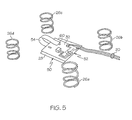
- the sensor apparatus 12 includes first and second rigid force translation plates 22, 24; a set of springs 26a, 26b, 26c, 26d; a first conductor plate 28 affixed to an inboard face of first force translation plate 22; a second conductor plate 30 affixed to an inboard face of second force translation plate 24; and a control circuit 32.
- the force translation plates are formed of molded plastic, and ribs formed on their inboard faces add rigidity to resist bending due to externally applied forces.
- the force translation plates 22 and 24 may be constructed of a non-insulative rigid material such as die-cast metal or stamped sheet metal, provided the conductor plates 28 and 30 are insulated from the respective force translation plates 22 and 24.
- the sensor apparatus 12 is mounted in seat 10 such that the first force translation plate 22 is facing upward (that is, toward the seat cushion 18), and the second force translation plate 24 is facing downward (that is, toward the seat frame 16).
- the conductor plate 28 is regarded as the upper conductor plate
- the conductor plate 30 is regarded as the lower conductor plate.
- the force translation plates 22 and 24 are joined in a manner to maintain the conductor plates 28 and 30 parallel to each other while permitting movement of either force translation plate 22, 24 relative to the other in a direction perpendicular to the force translation plates 22, 24.
- the conductor plates 28 and 30 are similar in size, and are affixed to the force translation plates 22 and 24 such that they substantially overlap each other.
- the conductor plates 28, 30 occupy a small portion of the force translation plates 22, 24; in the illustrated embodiment, the conductor plates 28, 30 have a surface area of approximately 1.69 in 2 , while the force translation plates have a surface area of approximately 16 in 2 .
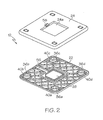
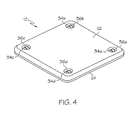
- the inboard face of force translation plate 24 has a set of four inwardly extending snap posts 34a, 34b, 34c, 34d, and the force translation plate 22 has a set of corresponding openings 36a, 36b, 36c, 36d for receiving the snap posts 34a, 34b, 34c, 34d.
- the snap posts 34a, 34b, 34c, 34d of force translation plate 24 are each surrounded by a circular wall 38a, 38b, 38c, 38d.
- a boss 40a, 40b, 40c, 40d surrounding each opening 36a, 36b, 36c, 36d of force translation plate 22 nests in the space between a respective snap post 34a-34d and circular wall 38a-38d.
- the springs 26a-26d are disposed about the bosses 40a-40d between the force translation plates 22 and 24 to bias the plates 22 and 24 apart in a direction perpendicular to the plates 22, 24. As shown in FIG. 7, interference between a given snap post 34a and an annular wall 42 of a respective boss 40a defines a maximum separation distance of the force translation plates 22 and 24.
- the parameters of springs 26a-26d are selected to achieve a desired force vs. deflection characteristic by setting both the spring pre-load (i.e., the spring bias force at the maximum separation distance of force translation plates 22 and 24) and the spring rate (i.e., the force vs. deflection relationship for passenger force in excess of the pre-load bias force.
- the conductor plate 28 occupies one face of a single-sided printed circuit board 50 that is affixed to the inboard face of force translation plate 22 by an adhesive, for example.
- the conductor plate 30 occupies one face of a double-sided circuit board 52, and the control circuit 32 is disposed on the opposite face of circuit board 52.
- the force translation plate 24 is provided with a central opening 24a and an inwardly extending shoulder or ledge 24b within the opening 24a.
- the margin of circuit board 52 is supported on the ledge 24b, with the conductor plate 30 facing the conductor plate 28. This leaves the control circuit 32 exposed.
- FIG. 8-9 the force translation plate 24 is provided with a central opening 24a and an inwardly extending shoulder or ledge 24b within the opening 24a.
- the margin of circuit board 52 is supported on the ledge 24b, with the conductor plate 30 facing the conductor plate 28. This leaves the control circuit 32 exposed.
- FIG. 8-9 the force translation plate 24 is provided with a central opening 24a and an inward
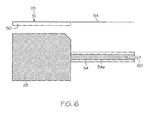
- the single-sided printed circuit board 50 is provided with a flexible circuit pig-tail or runner 54 carrying a conductor trace 54a that is electrically tied to the conductor plate 28.
- the flexible runner 54 is disposed in part in a channel 56 formed on the inboard face of plate 22, and extends through a slot aperture 58 formed in the force translation plate 24 adjacent the opening 24a.
- the conductor trace 54a terminates in a solderable tab 60, which is soldered to a terminal of control circuit 32 to electrically couple the conductor plate 28 to the control circuit 32.
- the runner 54 is implemented as a flexible strip circuit in the illustrated embodiment, it should be understood that it could alternately be implemented with a different kind of flexible conductor such as a simple wire or a conductive spring.
- the sensor apparatus 12 is assembled as follows. First, the circuit board 50 is affixed to the inboard face of force translation plate 22, and the flexible runner 54 is threaded through the slot aperture 58 of force translation plate 24. The springs 26a-26d are positioned about the bosses 40a-40d of force translation plate 22, and the force translation plates 22 and 24 are snapped together, with the snap posts 34a-34d of plate 24 passing into the openings 36a-36d of plate 22.
- the circuit board 52 is then placed on (or affixed to) the ledge 24b of force translation plate 24 with the control circuit 32 facing outward, and the tab 60 at the end of flexible runner 54 is soldered to a terminal of control circuit 32. Potting material (not shown) is then dispensed onto the exposed face of control circuit 32 within the sidewalls of opening 24a. When cured, the potting material seals the control circuit 32 and retains the circuit board 52 in place on ledge 24b.
- the cable 20 between ECU 14 and control circuit 32 can be directly connected to control circuit terminals, with the potting material in opening 24a of force translation plate 24 fixing the cable 20 with respect to the control circuit 32.
- the cable 20 will usually have a connector at each end to facilitate installation in a seat 10.
- the sensor apparatus 12 will usually be provided with a connector as well. This may be accomplished most easily by mounting a connector (including electrical terminals supported in a plastic housing) such as designated by the reference numeral 62 in FIGS. 8-9 directly on the exposed face of circuit board 52 such that it is surrounded by the potting material dispensed into opening 24a of force translation plate 24.
- the connector housing will protrude from the potting material so that it is accessible for attachment to the cable connector. If the potting material is sufficiently thick, it will serve when cured to fix the connector with respect to the rest of the sensor apparatus 12, and isolate the circuit board 52 from forces applied to the connector housing.
- Another approach, depicted in FIGS. 8-9, is to integrate the connector 62 into the outboard face of force translation plate 24, and to internally couple the connector terminals 62a to the control circuit 32. Referring to FIG. 9, this may be achieved with a set of compliant pins 64 and a set of insert molded conductors 66.
- the compliant pins 64 extend out of an extension 68 of ledge 24b such that they pass through plated through-holes formed in the margin of circuit board 52 when circuit board 52 is installed on the ledge 24a.
- the plated through-holes are electrically coupled to control circuit terminals, and the insert-molded conductors 66 electrically tie the compliant pins 64 to the connector terminals 62a.
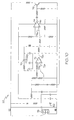
- FIG. 10 is a schematic diagram of the control circuit 32.
- the control circuit 32 is designed to measure the gap capacitance between the conductor plates 28 and 30. This capacitance will vary depending on the separation distance of plates 28 and 30. When the seat 10 is unoccupied, the separation distance is approximately 0.210 inch, and the gap capacitance has a relatively low value such as 5pF. When the seated weight of a passenger is sufficient to fully compress the sensor apparatus 12, the separation distance will be approximately 0.050 inch, and the gap capacitance will have a relatively high value such as 25pF.
- the gap capacitance is represented by the capacitor 70.
- the capacitance of capacitor 70 is evaluated by a constant current source formed by operational amplifier 72, configured as a voltage-to-current converter.
- a high control voltage applied to the non-inverting input 72a of amplifier 72 will exceed the voltage applied to the inverting input 72b of amplifier 72; in this case the output 72c of amplifier 72 is driven to a high state, and a charging current flows through capacitor 70 as indicated by arrow C.
- a low control voltage at the non-inverting input 72a drives the output 72c of amplifier 72 to a low state, and a discharging current flows through capacitor 70 as indicated by arrow D.
- the output 72c of amplifier 72 is applied to the non-inverting input 74a of comparator 74 so that its output 74b transitions from high to low with the charging and discharging of capacitor 70.
- the comparator 74 also has hysteresis to allow output voltage operation of amplifier 72 from 2 to 4 volts.
- the square-wave output voltage of comparator 74 regulates the control voltage applied to the non-inverting input 72a of amplifier 72.
- the output 74b of comparator 74 is also capacitively coupled to the base of transistor 76 to provide a corresponding output at pin 2 of the harness connector 78, which also serves as a power supply for the circuit via zener diode 80. In other words, the transistor 76 modulates the power supply bus at the charge/discharge frequency of capacitor 70.
- the output 72c of amplifier 72 is a triangular waveform due to the charging and discharging of capacitor 70. Since the charge and discharge rates vary with the capacitance of capacitor 70, the frequency of the waveform provides a measure of the capacitance - that is, the gap capacitance between conductor plates 28 and 30.
- the power supply bus is modulated at the same frequency, and ECU 14 determines the frequency by measuring the supply bus modulation over a full cycle. This has the benefit of compensating for slowly changing external static fields since the effect of such a field is balanced out over a full cycle of the triangular waveform.
- the present invention provides a practical and cost-effective sensor apparatus for passenger presence detection. While the apparatus has been described in reference to the illustrated embodiment, it should be understood that various modifications in addition to those mentioned above will occur to persons skilled in the art.
- the conductor plates 28 and 30 may be patterned instead of solid, and so forth.
- the space between conductor plates 28 and 30 can be at least partially filled with a crushable or displaceable medium such as silicone gel in order to minimize changes in the sensor capacitance due to humidity variations in the vicinity of the sensor apparatus 12; alternately, the control circuit 32 could include a humidity sensor in order to electrically compensate for any variability due to humidity.
- capacitance is simply a way of characterizing the change in electric field coupling between the first and second conductor plates 28 and 30, and any technique for measuring the change in such coupling is essentially equivalent for purposes of this invention. Accordingly, it is intended that the invention not be limited to the disclosed embodiment, but that it have the full scope permitted by the language of the following claims.
Landscapes
- Engineering & Computer Science (AREA)
- Physics & Mathematics (AREA)
- Aviation & Aerospace Engineering (AREA)
- Transportation (AREA)
- Mechanical Engineering (AREA)
- Mathematical Physics (AREA)
- Theoretical Computer Science (AREA)
- General Physics & Mathematics (AREA)
- Electromagnetism (AREA)
- Seats For Vehicles (AREA)
- Geophysics And Detection Of Objects (AREA)
Abstract
Description
- The present invention is directed to a capacitive sensor disposed in a vehicle seat for detecting the presence of a passenger on the seat.
- Occupant presence detection is frequently used in connection with air bags and other pyrotechnically deployed restraints as a means of determining if the restraints should be deployed in the event of sufficiently severe crash. One commonly employed way of detecting occupant presence involves installing a fluid-filled bladder in or under the bottom foam cushion of the vehicle seat and measuring the fluid pressure in the bladder with a pressure sensor. Exemplary systems of this type are disclosed, for example, in the
U.S. Patent Nos. 5,987,370 and6,246,936 to Murphy et al. , and theU.S. Patent Nos. 6,101,436 and6,490,936 to Fortune et al. , all of which are assigned to Delphi Technologies, Inc., and incorporated herein by reference. - In a somewhat different approach, the cost of the pressure sensor can be avoided by providing conductor plates on or near the upper and lower surfaces of a fluid-filled bladder, and detecting changes in capacitance between the plates when the thickness of the bladder changes due to the presence of occupant weight. See, for example, the
U.S. Patent No. 6,927,678 to Fultz et al. , assigned to Delphi Technologies, Inc. and incorporated herein by reference. - In yet another approach, the upper and lower plates of a capacitive sensor are separated by a layer of foam or other compressible material instead of a fluid-filled bladder. See, for example, the
U.S. Patent No. 6,999,301 to Sanftleban et al. and theU.S. Patent Application Publication No. 2006/0196702 to Hansen et al. , both of which are assigned to Delphi Technologies, Inc., and incorporated herein by reference. - The present invention is directed to an improved capacitive sensor apparatus disposed between the bottom cushion and frame of a seat. The sensor apparatus includes first and second mutually parallel rigid force translation plates biased apart by a set of springs, first and second conductor plates centrally affixed to inboard faces of the first and second force translation plates, and a control circuit responsive to the gap capacitance between the first and second conductor plates. The force translation plates are joined in a manner to maintain the conductor plates parallel to each other while permitting movement of either force translation plate relative to the other in a direction perpendicular to the force translation plates.
-
- FIG. 1 diagrammatically depicts a vehicle seat equipped with a capacitive sensor apparatus according to this invention;
- FIG. 2 depicts first and second force translation plates of the sensor apparatus of FIG. 1 according to a first embodiment, including an inboard face of the first force translation plate and a first conductor plate;
- FIG. 3 depicts the first and second force translation plates of the sensor apparatus of FIG. 1 according to the first embodiment, including an inboard face of the second force translation plate and a second conductor plate;
- FIG. 4 depicts first and second force translation plates of the sensor apparatus of FIG. 1 according to first embodiment, as assembled;
- FIG. 5 depicts a control circuit and a set of springs for the sensor apparatus of FIG. 1;
- FIG. 6 depicts the second conductor plate and a contiguous flexible runner;
- FIG. 7 is a partial cross-sectional view of assembled first and second force translation plates of the sensor apparatus of FIG. 1, according to a second embodiment;
- FIG. 8 is an isometric view of an outboard face of the second force translation plate, according to the second embodiment;
- FIG. 9 is a partial cross-sectional view of assembled first and second force translation plates of the sensor apparatus of FIG. 1, according to the second embodiment; and
- FIG. 10 is a schematic diagram of the control circuit of FIG. 5.
- The capacitive sensor apparatus of the present invention is disclosed herein in the context of an apparatus for sensing the weight applied to a vehicle seat by a passenger. The sensed weight is used for passenger presence detection, and for classifying a detected passenger as a child, an adult, or some other classification. In general, a capacitive sensor comprises upper and
lower conductor plates - Referring to FIG. 1, the
reference numeral 10 generally designates a seat bottom and a sensor apparatus according to this invention. Thesensor apparatus 12 is disposed between theseat frame 16 and afoam seat cushion 18, and is coupled to an electronic control unit (ECU) 14 by anelectrical cable 20. In a typical installation, theECU 14 is an airbag control unit. - Referring to FIGS. 2-9, the
sensor apparatus 12 includes first and second rigidforce translation plates springs first conductor plate 28 affixed to an inboard face of firstforce translation plate 22; asecond conductor plate 30 affixed to an inboard face of secondforce translation plate 24; and acontrol circuit 32. In the illustrated embodiment, the force translation plates are formed of molded plastic, and ribs formed on their inboard faces add rigidity to resist bending due to externally applied forces. Alternately, theforce translation plates conductor plates force translation plates sensor apparatus 12 is mounted inseat 10 such that the firstforce translation plate 22 is facing upward (that is, toward the seat cushion 18), and the secondforce translation plate 24 is facing downward (that is, toward the seat frame 16). In this orientation, theconductor plate 28 is regarded as the upper conductor plate, and theconductor plate 30 is regarded as the lower conductor plate. - The
force translation plates conductor plates force translation plate force translation plates conductor plates force translation plates conductor plates force translation plates conductor plates - The inboard face of
force translation plate 24 has a set of four inwardly extendingsnap posts force translation plate 22 has a set ofcorresponding openings snap posts snap posts force translation plate 24 are each surrounded by acircular wall boss force translation plate 22 nests in the space between arespective snap post 34a-34d andcircular wall 38a-38d. Thesprings 26a-26d are disposed about thebosses 40a-40d between theforce translation plates plates plates snap post 34a and anannular wall 42 of arespective boss 40a defines a maximum separation distance of theforce translation plates springs 26a-26d are selected to achieve a desired force vs. deflection characteristic by setting both the spring pre-load (i.e., the spring bias force at the maximum separation distance offorce translation plates 22 and 24) and the spring rate (i.e., the force vs. deflection relationship for passenger force in excess of the pre-load bias force. - The
conductor plate 28 occupies one face of a single-sided printedcircuit board 50 that is affixed to the inboard face offorce translation plate 22 by an adhesive, for example. Theconductor plate 30 occupies one face of a double-sided circuit board 52, and thecontrol circuit 32 is disposed on the opposite face ofcircuit board 52. As best seen in FIGS. 8-9, theforce translation plate 24 is provided with acentral opening 24a and an inwardly extending shoulder orledge 24b within the opening 24a. The margin ofcircuit board 52 is supported on theledge 24b, with theconductor plate 30 facing theconductor plate 28. This leaves thecontrol circuit 32 exposed. As best seen in FIG. 6, the single-sided printedcircuit board 50 is provided with a flexible circuit pig-tail orrunner 54 carrying aconductor trace 54a that is electrically tied to theconductor plate 28. When thecircuit board 50 is installed in theforce translation plate 22, theflexible runner 54 is disposed in part in achannel 56 formed on the inboard face ofplate 22, and extends through aslot aperture 58 formed in theforce translation plate 24 adjacent the opening 24a. Theconductor trace 54a terminates in asolderable tab 60, which is soldered to a terminal ofcontrol circuit 32 to electrically couple theconductor plate 28 to thecontrol circuit 32. Though therunner 54 is implemented as a flexible strip circuit in the illustrated embodiment, it should be understood that it could alternately be implemented with a different kind of flexible conductor such as a simple wire or a conductive spring. - The
sensor apparatus 12 is assembled as follows. First, thecircuit board 50 is affixed to the inboard face offorce translation plate 22, and theflexible runner 54 is threaded through theslot aperture 58 offorce translation plate 24. Thesprings 26a-26d are positioned about thebosses 40a-40d offorce translation plate 22, and theforce translation plates snap posts 34a-34d ofplate 24 passing into theopenings 36a-36d ofplate 22. Thecircuit board 52 is then placed on (or affixed to) the ledge 24b offorce translation plate 24 with thecontrol circuit 32 facing outward, and thetab 60 at the end offlexible runner 54 is soldered to a terminal ofcontrol circuit 32. Potting material (not shown) is then dispensed onto the exposed face ofcontrol circuit 32 within the sidewalls of opening 24a. When cured, the potting material seals thecontrol circuit 32 and retains thecircuit board 52 in place on ledge 24b. - Theoretically, the
cable 20 betweenECU 14 andcontrol circuit 32 can be directly connected to control circuit terminals, with the potting material in opening 24a offorce translation plate 24 fixing thecable 20 with respect to thecontrol circuit 32. As a practical matter, however, thecable 20 will usually have a connector at each end to facilitate installation in aseat 10. Accordingly, thesensor apparatus 12 will usually be provided with a connector as well. This may be accomplished most easily by mounting a connector (including electrical terminals supported in a plastic housing) such as designated by thereference numeral 62 in FIGS. 8-9 directly on the exposed face ofcircuit board 52 such that it is surrounded by the potting material dispensed intoopening 24a offorce translation plate 24. The connector housing will protrude from the potting material so that it is accessible for attachment to the cable connector. If the potting material is sufficiently thick, it will serve when cured to fix the connector with respect to the rest of thesensor apparatus 12, and isolate thecircuit board 52 from forces applied to the connector housing. Another approach, depicted in FIGS. 8-9, is to integrate theconnector 62 into the outboard face offorce translation plate 24, and to internally couple theconnector terminals 62a to thecontrol circuit 32. Referring to FIG. 9, this may be achieved with a set ofcompliant pins 64 and a set of insert moldedconductors 66. The compliant pins 64 extend out of anextension 68 ofledge 24b such that they pass through plated through-holes formed in the margin ofcircuit board 52 whencircuit board 52 is installed on theledge 24a. The plated through-holes are electrically coupled to control circuit terminals, and the insert-moldedconductors 66 electrically tie thecompliant pins 64 to theconnector terminals 62a. - FIG. 10 is a schematic diagram of the
control circuit 32. Thecontrol circuit 32 is designed to measure the gap capacitance between theconductor plates plates seat 10 is unoccupied, the separation distance is approximately 0.210 inch, and the gap capacitance has a relatively low value such as 5pF. When the seated weight of a passenger is sufficient to fully compress thesensor apparatus 12, the separation distance will be approximately 0.050 inch, and the gap capacitance will have a relatively high value such as 25pF. - In the schematic diagram of FIG. 10, the gap capacitance is represented by the
capacitor 70. The capacitance ofcapacitor 70 is evaluated by a constant current source formed byoperational amplifier 72, configured as a voltage-to-current converter. A high control voltage applied to thenon-inverting input 72a ofamplifier 72 will exceed the voltage applied to the invertinginput 72b ofamplifier 72; in this case theoutput 72c ofamplifier 72 is driven to a high state, and a charging current flows throughcapacitor 70 as indicated by arrow C. Conversely, a low control voltage at thenon-inverting input 72a drives theoutput 72c ofamplifier 72 to a low state, and a discharging current flows throughcapacitor 70 as indicated by arrow D. - The
output 72c ofamplifier 72 is applied to the non-inverting input 74a ofcomparator 74 so that its output 74b transitions from high to low with the charging and discharging ofcapacitor 70. Thecomparator 74 also has hysteresis to allow output voltage operation ofamplifier 72 from 2 to 4 volts. The square-wave output voltage ofcomparator 74 regulates the control voltage applied to thenon-inverting input 72a ofamplifier 72. The output 74b ofcomparator 74 is also capacitively coupled to the base oftransistor 76 to provide a corresponding output at pin 2 of theharness connector 78, which also serves as a power supply for the circuit viazener diode 80. In other words, thetransistor 76 modulates the power supply bus at the charge/discharge frequency ofcapacitor 70. - The
output 72c ofamplifier 72 is a triangular waveform due to the charging and discharging ofcapacitor 70. Since the charge and discharge rates vary with the capacitance ofcapacitor 70, the frequency of the waveform provides a measure of the capacitance - that is, the gap capacitance betweenconductor plates ECU 14 determines the frequency by measuring the supply bus modulation over a full cycle. This has the benefit of compensating for slowly changing external static fields since the effect of such a field is balanced out over a full cycle of the triangular waveform. Rapidly changing external static fields such as EMI or localized RF currents are handled by the faraday shielding effect of having the right side of capacitor 70 (that is, conductor plate 28) as the separate plate and the left (high impedance) side of capacitor 70 (that is, conductor plate 30) as the second layer of thecontrol circuit 32. - In summary, the present invention provides a practical and cost-effective sensor apparatus for passenger presence detection. While the apparatus has been described in reference to the illustrated embodiment, it should be understood that various modifications in addition to those mentioned above will occur to persons skilled in the art. For example, the
conductor plates conductor plates sensor apparatus 12; alternately, thecontrol circuit 32 could include a humidity sensor in order to electrically compensate for any variability due to humidity. Moreover, it should be recognized that the term capacitance as used herein is simply a way of characterizing the change in electric field coupling between the first andsecond conductor plates
Claims (8)
- Sensor apparatus (12) for detecting the presence of a passenger on a seat (10), comprising:first and second rigid planar force translation plates (22, 24) disposed in said seat (10);joining means (34, 40) for joining said force translation plates (22, 24) in a manner that maintains them substantially parallel to each other while permitting movement of either force translation plate relative to the other in a direction perpendicular to said force translation plates (22, 24);a set of springs (26) disposed between said first and second force translation plates (22, 24) for exerting a bias force that biases said first and second force translation plates (22, 24) apart in said perpendicular direction;first and second conductor plates (28, 30) centrally affixed to inboard faces of said first and second force translation plates (22, 24), respectively; anda control circuit (32) responsive to a gap capacitance between said first and second conductor plates (28, 30) for detecting the presence of said passenger when a weight of said passenger overcomes the bias force of said springs (26).
- The sensor apparatus of claim 1, where:said first conductor plate (28) is formed on first circuit board (50) affixed to the inboard face of said first force translation plate (22); andsaid second conductor plate (30) and said control circuit (32) are mounted on opposite sides of a second circuit board (52) affixed to the inboard face of said second force translation plate (24).
- The sensor apparatus of claim 2, where said control circuit (32) is electrically coupled to said second conductor plate (30) through said second circuit board (52), and the apparatus (12) additionally comprises a conductive element (54) electrically coupling said first conductor plate (28) to said control circuit (32).
- The sensor apparatus of claim 3, further where:said control circuit (32) is mounted on an outboard face of said second circuit board (52);said conductive element is a flexible conductor (54); andsaid flexible conductor (54) passes through a slot aperture (58) in said second force translation plate (24) adjacent said second circuit board (52) to reach said control circuit (32).
- The sensor apparatus of claim 1, where:said second force translation plate (24) has a central opening (24a) with an interior ledge (24b) recessed in said opening (24a); andsaid control circuit (32) is mounted on an outboard face of a circuit board (52) disposed within said central opening (24a) and supported on said interior ledge (24b).
- The sensor apparatus of claim 5, where:said second force translation plate (24) has a slot aperture (58) adjacent said central opening (24a); andsaid first conductor plate (28) is electrically coupled to said control circuit (32) by a flexible conductor (54) that passes through said slot aperture (58).
- The sensor apparatus of claim 5, where:said second force translation plate (24) includes an electrical connector (62) for coupling said control circuit (32) to a remote electronic module (14), and insert molded conductors (62a, 64, 66) coupled between said control circuit (32) and said electrical connector (62).
- The sensor apparatus of claim 7, where said insert molded conductors include a set of compliant pins (64) that protrude from said interior ledge (24b) and pass through a margin of said circuit board (52).
Applications Claiming Priority (2)
| Application Number | Priority Date | Filing Date | Title |
|---|---|---|---|
| US84462106P | 2006-09-14 | 2006-09-14 | |
| US11/706,016 US7434481B2 (en) | 2006-09-14 | 2007-02-14 | Capacitive sensor apparatus for passenger presence detection |
Publications (3)
| Publication Number | Publication Date |
|---|---|
| EP1901044A2 true EP1901044A2 (en) | 2008-03-19 |
| EP1901044A3 EP1901044A3 (en) | 2011-04-20 |
| EP1901044B1 EP1901044B1 (en) | 2019-01-16 |
Family
ID=38739972
Family Applications (1)
| Application Number | Title | Priority Date | Filing Date |
|---|---|---|---|
| EP07075781.0A Active EP1901044B1 (en) | 2006-09-14 | 2007-09-10 | Capacitive sensor apparatus for passenger presence detection |
Country Status (2)
| Country | Link |
|---|---|
| US (1) | US7434481B2 (en) |
| EP (1) | EP1901044B1 (en) |
Families Citing this family (8)
| Publication number | Priority date | Publication date | Assignee | Title |
|---|---|---|---|---|
| US7644628B2 (en) * | 2005-12-16 | 2010-01-12 | Loadstar Sensors, Inc. | Resistive force sensing device and method with an advanced communication interface |
| US20110133755A1 (en) * | 2009-12-08 | 2011-06-09 | Delphi Technologies, Inc. | System and Method of Occupant Detection with a Resonant Frequency |
| US8178797B2 (en) * | 2009-12-30 | 2012-05-15 | Mettler-Toledo, LLC | Hermetically sealed scale platform |
| US8371877B2 (en) * | 2010-05-05 | 2013-02-12 | Sabritec, Inc. | Electrical connector with printed circuit board subassembly |
| US20130192904A1 (en) * | 2012-01-26 | 2013-08-01 | Delphi Technologies, Inc. | Occupant detection sensor assembly with integrated fasteners |
| DE102013004031A1 (en) * | 2013-03-08 | 2014-09-11 | Würth Elektronik Ics Gmbh & Co. Kg | Sensor device and storage device with a sensor device |
| US10017078B2 (en) * | 2013-05-30 | 2018-07-10 | Yefim G Kriger | Relocatable/replaceable pad for accurate vehicle occupant weight measurement |
| US20190100122A1 (en) * | 2017-10-04 | 2019-04-04 | Ford Global Technologies, Llc | Waterproof skinned bench seat |
Citations (5)
| Publication number | Priority date | Publication date | Assignee | Title |
|---|---|---|---|---|
| US5987370A (en) | 1997-09-03 | 1999-11-16 | Delco Electronics Corp. | Vehicle occupant weight estimation apparatus having fluid-filled seat bladder |
| US6246936B1 (en) | 1999-10-05 | 2001-06-12 | Delphi Technologies, Inc. | Vehicle occupant characterization method based on sensed occupant weight |
| US6927678B2 (en) | 2003-08-18 | 2005-08-09 | Delphi Technologies, Inc. | Fluid filled seat bladder with capacitive sensors for occupant classification and weight estimation |
| US6999301B1 (en) | 2005-02-08 | 2006-02-14 | Delphi Technologies, Inc. | Capacitive load cell apparatus having an annealed synthetic woven spring dielectric |
| US20060196702A1 (en) | 2005-03-02 | 2006-09-07 | Delphi Technologies, Inc. | Capacitive load cell with multi-layer dielectric for extended range |
Family Cites Families (5)
| Publication number | Priority date | Publication date | Assignee | Title |
|---|---|---|---|---|
| US5353641A (en) * | 1992-08-07 | 1994-10-11 | Ford Motor Company | Digital capacitive accelerometer |
| US5641202A (en) * | 1996-01-16 | 1997-06-24 | Lear Seating Corporation | Release latch for utility seat |
| US5900592A (en) * | 1997-08-29 | 1999-05-04 | Lockheed Martin Energy Research Corp. | Load sensing system |
| US5975958A (en) * | 1997-10-14 | 1999-11-02 | The Whitaker Corporation | Capactive coupling adapter for an electrical connector |
| US7159471B2 (en) * | 2005-03-02 | 2007-01-09 | Delphi Technologies, Inc. | Capacitive load cell apparatus having silicone-impregnated foam dielectric pads |
-
2007
- 2007-02-14 US US11/706,016 patent/US7434481B2/en active Active
- 2007-09-10 EP EP07075781.0A patent/EP1901044B1/en active Active
Patent Citations (7)
| Publication number | Priority date | Publication date | Assignee | Title |
|---|---|---|---|---|
| US5987370A (en) | 1997-09-03 | 1999-11-16 | Delco Electronics Corp. | Vehicle occupant weight estimation apparatus having fluid-filled seat bladder |
| US6101436A (en) | 1997-09-03 | 2000-08-08 | Delco Electronics Corp. | Vehicle occupant weight estimation apparatus having fluid-filled multi-cell seat bladder |
| US6490936B1 (en) | 1997-09-03 | 2002-12-10 | Delphi Technologies, Inc. | Bladder and support structure for occupant weight estimation |
| US6246936B1 (en) | 1999-10-05 | 2001-06-12 | Delphi Technologies, Inc. | Vehicle occupant characterization method based on sensed occupant weight |
| US6927678B2 (en) | 2003-08-18 | 2005-08-09 | Delphi Technologies, Inc. | Fluid filled seat bladder with capacitive sensors for occupant classification and weight estimation |
| US6999301B1 (en) | 2005-02-08 | 2006-02-14 | Delphi Technologies, Inc. | Capacitive load cell apparatus having an annealed synthetic woven spring dielectric |
| US20060196702A1 (en) | 2005-03-02 | 2006-09-07 | Delphi Technologies, Inc. | Capacitive load cell with multi-layer dielectric for extended range |
Also Published As
| Publication number | Publication date |
|---|---|
| EP1901044B1 (en) | 2019-01-16 |
| US20080066563A1 (en) | 2008-03-20 |
| EP1901044A3 (en) | 2011-04-20 |
| US7434481B2 (en) | 2008-10-14 |
Similar Documents
| Publication | Publication Date | Title |
|---|---|---|
| EP1901044B1 (en) | Capacitive sensor apparatus for passenger presence detection | |
| US7679378B2 (en) | Dual function capacitive sensor for seat occupant detection | |
| US6559555B1 (en) | Passenger detection system and detection method | |
| US7598881B2 (en) | Sensor and circuit configuration for occupant detection | |
| JP5748362B2 (en) | Occupant detection and classification system | |
| CN100473568C (en) | Generator support for a driver air bag module to be mounted in the steering wheel of a motor vehicle | |
| EP1961625A2 (en) | Switch-based seat sensor for occupant presence detection | |
| CN103765538A (en) | Pressure-responsive b-surface seat occupancy sensor unit | |
| CN101970263A (en) | Safety arrangement and method for the production of such a safety arrangement | |
| US20110187346A1 (en) | Current detecting device | |
| US9771042B2 (en) | Occupant classification system | |
| GB2307750A (en) | Control device having a pressure sensor | |
| US6907795B2 (en) | Seat position sensor | |
| EP2014519A2 (en) | Flexible vehicle occupant sensor and method of use. | |
| US5684336A (en) | Crash sensor assembly including both an inertia sensor and an accelerometer and method | |
| WO2017129433A1 (en) | Capacitive occupant classification sensor with load-dependent antenna area | |
| US20090014228A1 (en) | Collision detector | |
| US12431853B2 (en) | Noise filter | |
| EP2727245A1 (en) | Touch sensor mechanical interface | |
| US5679897A (en) | Piezoelectric type acceleration sensor with metallic case and resin package | |
| CN115672424A (en) | Micro-fluidic device | |
| CN110361034A (en) | Capacitive sensor unit | |
| EP1002690A1 (en) | Sitting detection apparatus for an automobile seat | |
| CN101022979A (en) | Seat sensor system | |
| US7443075B2 (en) | Entrapment detecting system |
Legal Events
| Date | Code | Title | Description |
|---|---|---|---|
| PUAI | Public reference made under article 153(3) epc to a published international application that has entered the european phase |
Free format text: ORIGINAL CODE: 0009012 |
|
| AK | Designated contracting states |
Kind code of ref document: A2 Designated state(s): AT BE BG CH CY CZ DE DK EE ES FI FR GB GR HU IE IS IT LI LT LU LV MC MT NL PL PT RO SE SI SK TR |
|
| AX | Request for extension of the european patent |
Extension state: AL BA HR MK YU |
|
| PUAL | Search report despatched |
Free format text: ORIGINAL CODE: 0009013 |
|
| AK | Designated contracting states |
Kind code of ref document: A3 Designated state(s): AT BE BG CH CY CZ DE DK EE ES FI FR GB GR HU IE IS IT LI LT LU LV MC MT NL PL PT RO SE SI SK TR |
|
| AX | Request for extension of the european patent |
Extension state: AL BA HR MK RS |
|
| 17P | Request for examination filed |
Effective date: 20111020 |
|
| AKX | Designation fees paid |
Designated state(s): AT BE BG CH CY CZ DE DK EE ES FI FR GB GR HU IE IS IT LI LT LU LV MC MT NL PL PT RO SE SI SK TR |
|
| 17Q | First examination report despatched |
Effective date: 20160909 |
|
| STAA | Information on the status of an ep patent application or granted ep patent |
Free format text: STATUS: EXAMINATION IS IN PROGRESS |
|
| GRAP | Despatch of communication of intention to grant a patent |
Free format text: ORIGINAL CODE: EPIDOSNIGR1 |
|
| STAA | Information on the status of an ep patent application or granted ep patent |
Free format text: STATUS: GRANT OF PATENT IS INTENDED |
|
| INTG | Intention to grant announced |
Effective date: 20180801 |
|
| GRAS | Grant fee paid |
Free format text: ORIGINAL CODE: EPIDOSNIGR3 |
|
| GRAA | (expected) grant |
Free format text: ORIGINAL CODE: 0009210 |
|
| STAA | Information on the status of an ep patent application or granted ep patent |
Free format text: STATUS: THE PATENT HAS BEEN GRANTED |
|
| RAP1 | Party data changed (applicant data changed or rights of an application transferred) |
Owner name: APTIV TECHNOLOGIES LIMITED |
|
| AK | Designated contracting states |
Kind code of ref document: B1 Designated state(s): AT BE BG CH CY CZ DE DK EE ES FI FR GB GR HU IE IS IT LI LT LU LV MC MT NL PL PT RO SE SI SK TR |
|
| REG | Reference to a national code |
Ref country code: GB Ref legal event code: FG4D |
|
| REG | Reference to a national code |
Ref country code: CH Ref legal event code: EP |
|
| REG | Reference to a national code |
Ref country code: IE Ref legal event code: FG4D |
|
| REG | Reference to a national code |
Ref country code: DE Ref legal event code: R096 Ref document number: 602007057424 Country of ref document: DE |
|
| REG | Reference to a national code |
Ref country code: AT Ref legal event code: REF Ref document number: 1090037 Country of ref document: AT Kind code of ref document: T Effective date: 20190215 |
|
| REG | Reference to a national code |
Ref country code: NL Ref legal event code: MP Effective date: 20190116 |
|
| REG | Reference to a national code |
Ref country code: LT Ref legal event code: MG4D |
|
| PG25 | Lapsed in a contracting state [announced via postgrant information from national office to epo] |
Ref country code: NL Free format text: LAPSE BECAUSE OF FAILURE TO SUBMIT A TRANSLATION OF THE DESCRIPTION OR TO PAY THE FEE WITHIN THE PRESCRIBED TIME-LIMIT Effective date: 20190116 |
|
| REG | Reference to a national code |
Ref country code: AT Ref legal event code: MK05 Ref document number: 1090037 Country of ref document: AT Kind code of ref document: T Effective date: 20190116 |
|
| PG25 | Lapsed in a contracting state [announced via postgrant information from national office to epo] |
Ref country code: ES Free format text: LAPSE BECAUSE OF FAILURE TO SUBMIT A TRANSLATION OF THE DESCRIPTION OR TO PAY THE FEE WITHIN THE PRESCRIBED TIME-LIMIT Effective date: 20190116 Ref country code: LT Free format text: LAPSE BECAUSE OF FAILURE TO SUBMIT A TRANSLATION OF THE DESCRIPTION OR TO PAY THE FEE WITHIN THE PRESCRIBED TIME-LIMIT Effective date: 20190116 Ref country code: PL Free format text: LAPSE BECAUSE OF FAILURE TO SUBMIT A TRANSLATION OF THE DESCRIPTION OR TO PAY THE FEE WITHIN THE PRESCRIBED TIME-LIMIT Effective date: 20190116 Ref country code: SE Free format text: LAPSE BECAUSE OF FAILURE TO SUBMIT A TRANSLATION OF THE DESCRIPTION OR TO PAY THE FEE WITHIN THE PRESCRIBED TIME-LIMIT Effective date: 20190116 Ref country code: FI Free format text: LAPSE BECAUSE OF FAILURE TO SUBMIT A TRANSLATION OF THE DESCRIPTION OR TO PAY THE FEE WITHIN THE PRESCRIBED TIME-LIMIT Effective date: 20190116 Ref country code: PT Free format text: LAPSE BECAUSE OF FAILURE TO SUBMIT A TRANSLATION OF THE DESCRIPTION OR TO PAY THE FEE WITHIN THE PRESCRIBED TIME-LIMIT Effective date: 20190516 |
|
| PG25 | Lapsed in a contracting state [announced via postgrant information from national office to epo] |
Ref country code: BG Free format text: LAPSE BECAUSE OF FAILURE TO SUBMIT A TRANSLATION OF THE DESCRIPTION OR TO PAY THE FEE WITHIN THE PRESCRIBED TIME-LIMIT Effective date: 20190416 Ref country code: GR Free format text: LAPSE BECAUSE OF FAILURE TO SUBMIT A TRANSLATION OF THE DESCRIPTION OR TO PAY THE FEE WITHIN THE PRESCRIBED TIME-LIMIT Effective date: 20190417 Ref country code: LV Free format text: LAPSE BECAUSE OF FAILURE TO SUBMIT A TRANSLATION OF THE DESCRIPTION OR TO PAY THE FEE WITHIN THE PRESCRIBED TIME-LIMIT Effective date: 20190116 Ref country code: IS Free format text: LAPSE BECAUSE OF FAILURE TO SUBMIT A TRANSLATION OF THE DESCRIPTION OR TO PAY THE FEE WITHIN THE PRESCRIBED TIME-LIMIT Effective date: 20190516 |
|
| REG | Reference to a national code |
Ref country code: DE Ref legal event code: R097 Ref document number: 602007057424 Country of ref document: DE |
|
| PG25 | Lapsed in a contracting state [announced via postgrant information from national office to epo] |
Ref country code: SK Free format text: LAPSE BECAUSE OF FAILURE TO SUBMIT A TRANSLATION OF THE DESCRIPTION OR TO PAY THE FEE WITHIN THE PRESCRIBED TIME-LIMIT Effective date: 20190116 Ref country code: RO Free format text: LAPSE BECAUSE OF FAILURE TO SUBMIT A TRANSLATION OF THE DESCRIPTION OR TO PAY THE FEE WITHIN THE PRESCRIBED TIME-LIMIT Effective date: 20190116 Ref country code: CZ Free format text: LAPSE BECAUSE OF FAILURE TO SUBMIT A TRANSLATION OF THE DESCRIPTION OR TO PAY THE FEE WITHIN THE PRESCRIBED TIME-LIMIT Effective date: 20190116 Ref country code: DK Free format text: LAPSE BECAUSE OF FAILURE TO SUBMIT A TRANSLATION OF THE DESCRIPTION OR TO PAY THE FEE WITHIN THE PRESCRIBED TIME-LIMIT Effective date: 20190116 Ref country code: IT Free format text: LAPSE BECAUSE OF FAILURE TO SUBMIT A TRANSLATION OF THE DESCRIPTION OR TO PAY THE FEE WITHIN THE PRESCRIBED TIME-LIMIT Effective date: 20190116 Ref country code: AT Free format text: LAPSE BECAUSE OF FAILURE TO SUBMIT A TRANSLATION OF THE DESCRIPTION OR TO PAY THE FEE WITHIN THE PRESCRIBED TIME-LIMIT Effective date: 20190116 Ref country code: EE Free format text: LAPSE BECAUSE OF FAILURE TO SUBMIT A TRANSLATION OF THE DESCRIPTION OR TO PAY THE FEE WITHIN THE PRESCRIBED TIME-LIMIT Effective date: 20190116 |
|
| PLBE | No opposition filed within time limit |
Free format text: ORIGINAL CODE: 0009261 |
|
| STAA | Information on the status of an ep patent application or granted ep patent |
Free format text: STATUS: NO OPPOSITION FILED WITHIN TIME LIMIT |
|
| 26N | No opposition filed |
Effective date: 20191017 |
|
| PG25 | Lapsed in a contracting state [announced via postgrant information from national office to epo] |
Ref country code: SI Free format text: LAPSE BECAUSE OF FAILURE TO SUBMIT A TRANSLATION OF THE DESCRIPTION OR TO PAY THE FEE WITHIN THE PRESCRIBED TIME-LIMIT Effective date: 20190116 |
|
| PG25 | Lapsed in a contracting state [announced via postgrant information from national office to epo] |
Ref country code: TR Free format text: LAPSE BECAUSE OF FAILURE TO SUBMIT A TRANSLATION OF THE DESCRIPTION OR TO PAY THE FEE WITHIN THE PRESCRIBED TIME-LIMIT Effective date: 20190116 |
|
| PG25 | Lapsed in a contracting state [announced via postgrant information from national office to epo] |
Ref country code: MC Free format text: LAPSE BECAUSE OF FAILURE TO SUBMIT A TRANSLATION OF THE DESCRIPTION OR TO PAY THE FEE WITHIN THE PRESCRIBED TIME-LIMIT Effective date: 20190116 |
|
| REG | Reference to a national code |
Ref country code: CH Ref legal event code: PL |
|
| PG25 | Lapsed in a contracting state [announced via postgrant information from national office to epo] |
Ref country code: LU Free format text: LAPSE BECAUSE OF NON-PAYMENT OF DUE FEES Effective date: 20190910 Ref country code: IE Free format text: LAPSE BECAUSE OF NON-PAYMENT OF DUE FEES Effective date: 20190910 Ref country code: LI Free format text: LAPSE BECAUSE OF NON-PAYMENT OF DUE FEES Effective date: 20190930 Ref country code: CH Free format text: LAPSE BECAUSE OF NON-PAYMENT OF DUE FEES Effective date: 20190930 |
|
| REG | Reference to a national code |
Ref country code: BE Ref legal event code: MM Effective date: 20190930 |
|
| PG25 | Lapsed in a contracting state [announced via postgrant information from national office to epo] |
Ref country code: BE Free format text: LAPSE BECAUSE OF NON-PAYMENT OF DUE FEES Effective date: 20190930 |
|
| PG25 | Lapsed in a contracting state [announced via postgrant information from national office to epo] |
Ref country code: CY Free format text: LAPSE BECAUSE OF FAILURE TO SUBMIT A TRANSLATION OF THE DESCRIPTION OR TO PAY THE FEE WITHIN THE PRESCRIBED TIME-LIMIT Effective date: 20190116 |
|
| PG25 | Lapsed in a contracting state [announced via postgrant information from national office to epo] |
Ref country code: HU Free format text: LAPSE BECAUSE OF FAILURE TO SUBMIT A TRANSLATION OF THE DESCRIPTION OR TO PAY THE FEE WITHIN THE PRESCRIBED TIME-LIMIT; INVALID AB INITIO Effective date: 20070910 Ref country code: MT Free format text: LAPSE BECAUSE OF FAILURE TO SUBMIT A TRANSLATION OF THE DESCRIPTION OR TO PAY THE FEE WITHIN THE PRESCRIBED TIME-LIMIT Effective date: 20190116 |
|
| P01 | Opt-out of the competence of the unified patent court (upc) registered |
Effective date: 20230424 |
|
| PGFP | Annual fee paid to national office [announced via postgrant information from national office to epo] |
Ref country code: DE Payment date: 20240827 Year of fee payment: 18 |
|
| PGFP | Annual fee paid to national office [announced via postgrant information from national office to epo] |
Ref country code: GB Payment date: 20240821 Year of fee payment: 18 |
|
| PGFP | Annual fee paid to national office [announced via postgrant information from national office to epo] |
Ref country code: FR Payment date: 20240828 Year of fee payment: 18 |
|
| REG | Reference to a national code |
Ref country code: DE Ref legal event code: R081 Ref document number: 602007057424 Country of ref document: DE Owner name: APTIV TECHNOLOGIES AG, CH Free format text: FORMER OWNER: APTIV TECHNOLOGIES LIMITED, ST. MICHAEL, BB |