EP1900894A1 - Modular closure latch mechanism - Google Patents
Modular closure latch mechanism Download PDFInfo
- Publication number
- EP1900894A1 EP1900894A1 EP06778449A EP06778449A EP1900894A1 EP 1900894 A1 EP1900894 A1 EP 1900894A1 EP 06778449 A EP06778449 A EP 06778449A EP 06778449 A EP06778449 A EP 06778449A EP 1900894 A1 EP1900894 A1 EP 1900894A1
- Authority
- EP
- European Patent Office
- Prior art keywords
- latch
- casing
- carriage
- door
- rotation shaft
- Prior art date
- Legal status (The legal status is an assumption and is not a legal conclusion. Google has not performed a legal analysis and makes no representation as to the accuracy of the status listed.)
- Withdrawn
Links
Images




Classifications
-
- E—FIXED CONSTRUCTIONS
- E05—LOCKS; KEYS; WINDOW OR DOOR FITTINGS; SAFES
- E05B—LOCKS; ACCESSORIES THEREFOR; HANDCUFFS
- E05B65/00—Locks or fastenings for special use
- E05B65/10—Locks or fastenings for special use for panic or emergency doors
- E05B65/1046—Panic bars
- E05B65/1053—Panic bars sliding towards and away form the door
-
- E—FIXED CONSTRUCTIONS
- E05—LOCKS; KEYS; WINDOW OR DOOR FITTINGS; SAFES
- E05B—LOCKS; ACCESSORIES THEREFOR; HANDCUFFS
- E05B65/00—Locks or fastenings for special use
- E05B65/10—Locks or fastenings for special use for panic or emergency doors
-
- E—FIXED CONSTRUCTIONS
- E05—LOCKS; KEYS; WINDOW OR DOOR FITTINGS; SAFES
- E05B—LOCKS; ACCESSORIES THEREFOR; HANDCUFFS
- E05B15/00—Other details of locks; Parts for engagement by bolts of fastening devices
- E05B15/10—Bolts of locks or night latches
- E05B15/102—Bolts having movable elements
-
- E—FIXED CONSTRUCTIONS
- E05—LOCKS; KEYS; WINDOW OR DOOR FITTINGS; SAFES
- E05C—BOLTS OR FASTENING DEVICES FOR WINGS, SPECIALLY FOR DOORS OR WINDOWS
- E05C9/00—Arrangements of simultaneously actuated bolts or other securing devices at well-separated positions on the same wing
- E05C9/04—Arrangements of simultaneously actuated bolts or other securing devices at well-separated positions on the same wing with two sliding bars moved in opposite directions when fastening or unfastening
- E05C9/046—Arrangements of simultaneously actuated bolts or other securing devices at well-separated positions on the same wing with two sliding bars moved in opposite directions when fastening or unfastening with two interconnected mechanisms each driving one rod
-
- E—FIXED CONSTRUCTIONS
- E05—LOCKS; KEYS; WINDOW OR DOOR FITTINGS; SAFES
- E05C—BOLTS OR FASTENING DEVICES FOR WINGS, SPECIALLY FOR DOORS OR WINDOWS
- E05C9/00—Arrangements of simultaneously actuated bolts or other securing devices at well-separated positions on the same wing
- E05C9/04—Arrangements of simultaneously actuated bolts or other securing devices at well-separated positions on the same wing with two sliding bars moved in opposite directions when fastening or unfastening
- E05C9/047—Arrangements of simultaneously actuated bolts or other securing devices at well-separated positions on the same wing with two sliding bars moved in opposite directions when fastening or unfastening comprising key-operated locks, e.g. a lock cylinder to drive auxiliary deadbolts or latch bolts
-
- E—FIXED CONSTRUCTIONS
- E05—LOCKS; KEYS; WINDOW OR DOOR FITTINGS; SAFES
- E05C—BOLTS OR FASTENING DEVICES FOR WINGS, SPECIALLY FOR DOORS OR WINDOWS
- E05C9/00—Arrangements of simultaneously actuated bolts or other securing devices at well-separated positions on the same wing
- E05C9/04—Arrangements of simultaneously actuated bolts or other securing devices at well-separated positions on the same wing with two sliding bars moved in opposite directions when fastening or unfastening
- E05C9/048—Arrangements of simultaneously actuated bolts or other securing devices at well-separated positions on the same wing with two sliding bars moved in opposite directions when fastening or unfastening externally mounted on the wing, i.e. surface mounted
-
- E—FIXED CONSTRUCTIONS
- E05—LOCKS; KEYS; WINDOW OR DOOR FITTINGS; SAFES
- E05B—LOCKS; ACCESSORIES THEREFOR; HANDCUFFS
- E05B17/00—Accessories in connection with locks
- E05B17/20—Means independent of the locking mechanism for preventing unauthorised opening, e.g. for securing the bolt in the fastening position
- E05B17/2003—Preventing opening by insertion of a tool, e.g. flexible, between door and jamb to withdraw the bolt
-
- E—FIXED CONSTRUCTIONS
- E05—LOCKS; KEYS; WINDOW OR DOOR FITTINGS; SAFES
- E05B—LOCKS; ACCESSORIES THEREFOR; HANDCUFFS
- E05B63/00—Locks or fastenings with special structural characteristics
- E05B63/04—Locks or fastenings with special structural characteristics for alternative use on the right-hand or left-hand side of wings
- E05B63/042—Locks or fastenings with special structural characteristics for alternative use on the right-hand or left-hand side of wings constructed symmetrically
-
- E—FIXED CONSTRUCTIONS
- E05—LOCKS; KEYS; WINDOW OR DOOR FITTINGS; SAFES
- E05B—LOCKS; ACCESSORIES THEREFOR; HANDCUFFS
- E05B65/00—Locks or fastenings for special use
- E05B65/10—Locks or fastenings for special use for panic or emergency doors
- E05B65/1006—Locks or fastenings for special use for panic or emergency doors of the vertical rod type
-
- Y—GENERAL TAGGING OF NEW TECHNOLOGICAL DEVELOPMENTS; GENERAL TAGGING OF CROSS-SECTIONAL TECHNOLOGIES SPANNING OVER SEVERAL SECTIONS OF THE IPC; TECHNICAL SUBJECTS COVERED BY FORMER USPC CROSS-REFERENCE ART COLLECTIONS [XRACs] AND DIGESTS
- Y10—TECHNICAL SUBJECTS COVERED BY FORMER USPC
- Y10T—TECHNICAL SUBJECTS COVERED BY FORMER US CLASSIFICATION
- Y10T292/00—Closure fasteners
- Y10T292/08—Bolts
- Y10T292/0894—Spring arm
- Y10T292/0895—Operating means
Definitions
- the present invention relates to a closing latch modular mechanism which is designed to be used in particular in connection with the anti-panic function of a lock, either a domestic lock or, more especially, a lock installed in an emergency exit door of premises frequented by large numbers of people (dance halls, large shopping areas, shopping malls, office buildings, hospitals, etc.).
- the anti-panic function of a lock enables the door to be opened from the inside in all circumstances without having to use a key, and simply by actuating a handle or pushing or depressing a bar.
- This modular mechanism can be used in independently operable locks regardless of their actuating system, i.e. manual, automatic, mechanical or electromechanical; all that is necessary is that this system produces an action capable of activating the mechanism of the invention so as to effect the retraction of the latch.
- Anti-panic opening systems are obligatory in order to facilitate the rapid evacuation of people from areas where large numbers of people congregate, as well as in the domestic sector.
- the actuation of the mechanism must be smooth and require little force.
- the mechanism must be robust in order to resist attempts to force or break the lock, which can compromise the ease and facility of actuation needed to ensure the safety of people.
- the mechanism has to function reliably and be designed and constructed as simply as possible.
- one of these standards specifies that, in the rest state (that is to say, when no pressure is exerted on the door panel equipped with an anti-panic lock), this anti-panic lock can be opened by applying a maximum force of 80 N; the standard also specifies that the same lock can be opened by a force of 220 N when a force of 1000 N is exerted on the door, which is equivalent to the force exerted by four people who would be squashed against the door on account of the almost inevitable stampede caused by panic in emergency escape situations, for example when attempting to escape from a fire inside a locked building.
- this standard is to prevent the numerous fatalities which occur in such stampedes not on account of the direct action of the fire or of the accompanying danger, but by the fact that the bodies of people who are in front are increasingly crushed by people from behind, due to the fact that before the door is opened it is subjected to a pressure which already prevents it being opened subsequently and which is caused by people who, in trying to escape, are crushed against the door before they have been able to actuate the anti-panic bar that would open the door and thereby allow a mass exodus of the fleeing people.
- the difficulty is to satisfy these standards, which are aimed at improving the safety of people while at the same time ensuring an adequate security of property.
- the reason why the anti-panic mechanism is not activated when the door is subjected to a foreseeable pressure in cases of human stampede is due to the fact that, in the various designs of devices currently employed for this purpose, the operation to retract the latch is effected by friction between a surface of the latch and a surface of its lock, so that if an excessive pressure is exerted on such surfaces before the said retraction is initiated, then the mechanism is inactivated, which blocks the operation.
- a normal type of mechanism consists of a catch of conventional shape that has a bevelled front surface that rests against the lock when the door is in contact with the frame, as well as a longitudinal opposite surface that remains in contact with an internal wall of the lock, thereby preventing the door from being opened while the catch is not retracted, and in this type of mechanism the said retraction is effected by a linear frictional movement on the lock, whereby as soon as a pressure that is not too large is exerted on the locked door, although the opening of the anti-panic device is then actuated, the force of the latter will still not be able to retract the said latch.
- the rotation shaft can be displaced along a longitudinal path by connecting it to displaceable connecting rod-type means that are subjected to a force that is exerted by means of an electromagnet or a permanent magnet; in order to achieve the operative rotation of the latch the longitudinal path is combined with another, curved path which is traversed by a second shaft of the latch which is at the end of the curved convex surface which is opposite the most projecting part of the emergent position of the latch.
- both shafts of the latch can be displaced along both curved parts.
- the object of the present invention is a closing latch modular mechanism which comprises a mechanism casing, a latch head or latch per se, which has a conventional configuration with a bevelled surface and a longitudinal surface parallel to the plane of the door, a support for the latch, a rotation shaft of the latch, an anti-rotation device of the latch, a rotatory lever carrying the said anti-rotation device, a carriage that is displaceable longitudinally parallel to the plane of the door, and means for actuating the carriage, wherein the said latch is installed in the said support by means of the said rotation shaft, has a receptacle of semicircular cross-section elongated tangentially at its ends, which is parallel to the rotation shaft and is situated in its rear surface at a distance from the plane of the door which is suitably larger than that of the rotation shaft, and, in opposition to the said rotation shaft, this latch has a projection that in front abuts against a wall of the said support, the said rotation shaft being situated adjacent to the front
- the crosspiece thereof presses on the concavity of the rotatory lever and causes the latter to rotate in its rotational joint, thereby compressing the second torsion spring and displacing the anti-rotation device from its rear receptacle in the latch; then, when the door is pressed in the opening direction the simple action of the keeper on the latch causes this to rotate about its axis, releasing it into the cavity of the casing of the mechanism, which takes place with the compression of the first torsion spring, which in turn restores the starting position as soon as the door becomes separated from its frame.
- This proposed mechanism is sensitive, robust and reliable; it contains a small number of parts connected to one another in a simple manner, without the need for complex kinematic linkages involving a large number of movements between their component parts; to effect opening the latch is released simply by rotation about only one shaft, without involvement of the type of friction that is found in those solutions in which the latch is retracted longitudinally, sliding on the internal wall of the keeper, where blockages occur that prevent the door opening when subjected to the pressure of people who have fallen against the door on being squashed by others attempting to flee from imminent danger; this type of release satisfies the most stringent standard mentioned hereinbefore as regards the safety of people, while providing a high degree of security for property thanks to a high basic robustness, in which its design allows the anti-rotation device to be as solid and bulky as necessary, and in addition there is a wide margin for varying the dimensions of the remote rotatory lever to the advantage of the anti-rotation device with respect to the articulation of this lever and the concavity of
- the proposed mechanism is compatible with any type of lock and actuating technology provided that this is arranged so as to effect the traction of the carriage in the sense of displacing the anti-rotation device from its receptacle in the latch.
- an envisaged modification of the invention consists in that the said actuating means for the carriage comprise a puller (traction means) that is coupled to the carriage by means of a third track so that its working path and its longitudinal position are in conjunction with the travel length and the front and rear operating positions of the said carriage.
- the envisaged mechanism has a reversible design and construction for right-hand and left-hand doors, symmetrical with respect to the longitudinal mid plane of the latch, comprising a handle, a rotating plate, second and third rockers, first and second slide rims, and first and second locks actuated by a key, wherein the rotating plate is rotatably coupled to the handle, is longitudinally convex towards the floor of the casing, has two diametrically opposite leaves that are perpendicular to the said convexity, and is capable of adopting two disengaged and engaged handle operating positions that are respectively closer to or further from the floor of the casing, the said second and third rockers have their rotation shaft fixed to the casing, both have pivots rot
- the eccentric of the appropriate one of these locks is actuated, following which the corresponding rim is introduced underneath the rotating plate (by pushing the wedged edge of the first against the convexity of the latter), thereby separating it from the floor of the casing so that, on rotation, one of its leaves presses on the pivot of one of the rims (the corresponding one), effecting the retraction of the carriage and, thereby, causing the anti-rotation device to leave the receptacle of the latch; this operation allows access from the outside by authorised personnel.
- the second and third rockers have a pin that slidably engages in a groove of both first and second straightedge plates, which are slidably guided in the direction perpendicular to the travel of the latch and which are capable of acting respectively on top and bottom complementary locking points situated in the same vertical frame of the central locking means and/or in the doorsill and doorhead frames.
- a preferred embodiment of the object of the invention is illustrated in the accompanying drawings, and relates to a modular mechanism which (see Fig. 1 ) comprises a mechanism casing (1), a latch head or latch (2) per se, which has a conventional shape with a bevelled surface (8) and a longitudinal surface (9) parallel to the plane of the door (47), a support (3) of the latch (2), a rotation shaft (4) of the latch (2), an anti-rotation device (5) of the latch (2), a rotatory lever (6) carrying the said anti-rotation device (5), a carriage (7) that is displaceable longitudinally parallel to the plane of the door (47), and means for actuating the carriage (7), wherein the said latch (2) is installed in the said support (3) by means of the said rotation shaft (4), has a receptacle (11) of semicircular cross-section elongated tangentially at its ends, which is parallel to the rotation shaft (4) and is situated on its rear surface (10) at
- the receptacle (11) for the anti-rotation device (5) is related to the longitudinal mid plane of the latch (2); similarly, in accordance with a preferred embodiment, the said rotatory linkage (12) of the rotatory lever (6) is at a greater distance from the door (47) than is the side of the latch (2) opposite the longitudinal surface (9) thereof.
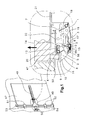
- FIG. 1 shows diagrammatically a door (47) with a generic locking system in which, apart from the central lock (48), there is a handle (30), an anti-panic push bar (49) and complementary top (51) and bottom (52) locking devices arranged both in the plane itself of the central lock (48) as well as in the doorsill and doorhead frames.
- the mechanism may be employed universally, namely for locking systems with a single conventional central lock (48), with an internal anti-panic handle (30), for cases where there are also top (51) and bottom (52) locking devices, for cases where the actuation is by means of a push-type (or lever-type) anti-panic bar (49), or for cases where the actuation is by electromechanical means, the only requirement being that the actuating means exert the necessary traction on the carriage (7) and that engagement means are provided for the handle (30) and also means known per se are provided so that the top (51) and bottom (52) locking devices are actuated via transmission of the actuation of the central lock (48).
- Figs. 2 to 4 illustrate the mode of operation starting from the rest position shown in Fig. 1 .
- the crosspiece (16) causes the rotatory lever (6) to tilt, thereby displacing the anti-rotation device (5) from the rear receptacle (11) of the latch (2), this being arranged so as to rotate on its shaft (4) ( Fig.
- Figs. 11 to 19 illustrate the application of the mechanism of the invention to the case where a handle (30) is incorporated, comprising an engagement mechanism actuated by means of a cylindrical combination key, as well as an anti-panic push bar (49) and top (51) and bottom (52) locking devices actuated by means of first (44) and second (45) straightedge plates.
- the said actuating means of the carriage (7) comprise a puller (21) which is coupled to the carriage (7) by means of a third track (22), such that its working path and its longitudinal position coincide with the travel length and the front and rear operating positions of the said carriage (7); furthermore, the mechanism according to the invention has a reversible design and construction for left-hand and right-hand doors (47), symmetrical with respect to the longitudinal mid plane of the latch (2), comprising a handle (30), a rotating plate (31), second (32) and third (33) rockers, first (34) and second (35) slide rims, and first (36) and second (37) locks actuated by a key, wherein the rotating plate (31) is rotatably coupled to the handle (30), has a longitudinal convexity (38) towards the floor of the casing (1), has two diametrically opposite leaves (39) that are perpendicular to the said convexity (38) and are capable of adopting two, namely a disengaged and engaged, operating positions of the handle (30), which are
- Fig. 13 the handle (30) is disengaged or in its position closest to the floor of the casing (1), the rockers (32, 33) are in the non-tilting or rest position, the rims (34, 35) are in their position remote from the rotational plate (31), and the straightedge plates (44, 45) are in their extended or most remote position from this plate (31).
- the position of the rims (34, 35) is produced by the action of the eccentric of the corresponding lock (36, 37) in the notch (43), by means of which, when this eccentric is actuated (the upper one in Figs.
- the first rim (34) drops and presses with its edge (42) against the convexity of the plate (31), which reaches its most distant position from the floor of the casing (1) and one of its leaves (39), on rotation of the handle (30), presses against the pivot (40) of the corresponding rocker (32, 33) and ( Figs.
- Another object of the present invention consists in that a first rocker (24), which is rotatably installed on its own rotation shaft (4) of the latch (2), is present in a cavity (23) of the latch (2) open along its longitudinal surface (9), and that in relation to the projecting position of rest of the latch (2), this first rocker (24) has first (25) and second (26) arms that are located respectively outside and inside the casing (1) of the mechanism, and between this first arm (25) and the bottom of the cavity (23) is interposed a second helical spring (27) that has respective compressed and relaxed states in which the first arm (25) remains inside or outside the said cavity (23), and, corresponding to these positions of the first arm (25), a front part (28) of the second arm (26) oriented transversely to the door (47) remains longitudinally opposite, and adjacent or offset with respect to a projection (29) of the casing (1) of the mechanism.
- the device is intended to prevent the catch (2) being able to be released from outside by the conventional method of inserting a credit card or the like between the small gap that always remains between the locked door (47) and its lock frame. If this manoeuvre is attempted ( Figs. 7 and 9 ) the catch (2) cannot move back since the first rocker (24) is tilted against the second helical spring (27) and the front part (28) of the second arm (26) remains bearing against the projection (29) belonging to the casing (1) which is fixed to the door (47).
- the elastic recovery of the second helical spring (27) ( Figs. 8 and 10 ) lifts the first rocker (24) to its rest position, corresponding to that shown in Fig. 4 , in which the latch (2) is available for the manoeuvre of locking the door (47) to its frame.
Landscapes
- Engineering & Computer Science (AREA)
- Mechanical Engineering (AREA)
- Business, Economics & Management (AREA)
- Emergency Management (AREA)
- Lock And Its Accessories (AREA)
- Wing Frames And Configurations (AREA)
Abstract
Description
- The present invention relates to a closing latch modular mechanism which is designed to be used in particular in connection with the anti-panic function of a lock, either a domestic lock or, more especially, a lock installed in an emergency exit door of premises frequented by large numbers of people (dance halls, large shopping areas, shopping malls, office buildings, hospitals, etc.). The anti-panic function of a lock enables the door to be opened from the inside in all circumstances without having to use a key, and simply by actuating a handle or pushing or depressing a bar.
- This modular mechanism can be used in independently operable locks regardless of their actuating system, i.e. manual, automatic, mechanical or electromechanical; all that is necessary is that this system produces an action capable of activating the mechanism of the invention so as to effect the retraction of the latch.
- Anti-panic opening systems are obligatory in order to facilitate the rapid evacuation of people from areas where large numbers of people congregate, as well as in the domestic sector.
- When designing anti-panic systems two mutually contradictory ideas have to be reconciled, namely the safety of people and the security of property.
- As regards the safety of people the actuation of the mechanism must be smooth and require little force. As regards the security of property the mechanism must be robust in order to resist attempts to force or break the lock, which can compromise the ease and facility of actuation needed to ensure the safety of people. Moreover, it is obvious that the mechanism has to function reliably and be designed and constructed as simply as possible.
- At the present time the trend in this field is to specify standards that are increasingly stringent as regards the safety of people, with the result that existing mechanisms cannot satisfy these standards and, furthermore, on account of their complexity or particular design and construction, are difficult to adapt to increasingly stringent standards or can meet these standards only at the cost of a loss of security of property. Purely by way of illustration, one of these standards specifies that, in the rest state (that is to say, when no pressure is exerted on the door panel equipped with an anti-panic lock), this anti-panic lock can be opened by applying a maximum force of 80 N; the standard also specifies that the same lock can be opened by a force of 220 N when a force of 1000 N is exerted on the door, which is equivalent to the force exerted by four people who would be squashed against the door on account of the almost inevitable stampede caused by panic in emergency escape situations, for example when attempting to escape from a fire inside a locked building. The purpose of this standard is to prevent the numerous fatalities which occur in such stampedes not on account of the direct action of the fire or of the accompanying danger, but by the fact that the bodies of people who are in front are increasingly crushed by people from behind, due to the fact that before the door is opened it is subjected to a pressure which already prevents it being opened subsequently and which is caused by people who, in trying to escape, are crushed against the door before they have been able to actuate the anti-panic bar that would open the door and thereby allow a mass exodus of the fleeing people. However, as has already been said hereinbefore, the difficulty is to satisfy these standards, which are aimed at improving the safety of people while at the same time ensuring an adequate security of property.
- The reason why the anti-panic mechanism is not activated when the door is subjected to a foreseeable pressure in cases of human stampede is due to the fact that, in the various designs of devices currently employed for this purpose, the operation to retract the latch is effected by friction between a surface of the latch and a surface of its lock, so that if an excessive pressure is exerted on such surfaces before the said retraction is initiated, then the mechanism is inactivated, which blocks the operation.
- In this connection, a normal type of mechanism consists of a catch of conventional shape that has a bevelled front surface that rests against the lock when the door is in contact with the frame, as well as a longitudinal opposite surface that remains in contact with an internal wall of the lock, thereby preventing the door from being opened while the catch is not retracted, and in this type of mechanism the said retraction is effected by a linear frictional movement on the lock, whereby as soon as a pressure that is not too large is exerted on the locked door, although the opening of the anti-panic device is then actuated, the force of the latter will still not be able to retract the said latch.
- Other types of mechanisms employ a latch which, since it involves a rotational movement to open or lock the door, means that the keeper has a curved convex or curved concave surface, and in these mechanisms the release of the latch is effected by combining a rotational displacement with a linear displacement; in these types of mechanisms the rotation of the latch takes place with respect to a shaft which is attached to the front of the latch and in the most remote part of the keeper in relation to the rotational movement to open the door, starting from its locked position on the frame. In some cases the rotation shaft can be displaced along a longitudinal path by connecting it to displaceable connecting rod-type means that are subjected to a force that is exerted by means of an electromagnet or a permanent magnet; in order to achieve the operative rotation of the latch the longitudinal path is combined with another, curved path which is traversed by a second shaft of the latch which is at the end of the curved convex surface which is opposite the most projecting part of the emergent position of the latch. In other cases both shafts of the latch can be displaced along both curved parts. In these types of mechanisms the problems of blocking by inactivation preventing the retraction of the latch under an excessive pressure applied to the door occur in a similar way; moreover, the interlocking forces that can be exerted by electromagnetic means are not sufficiently reliable so as to ensure that the correct positioning has been achieved for defining the locking state of the mechanism. Apart from this, these known mechanisms comprise kinematic linkages that involve a large number of interconnected movable elements, as a result of which it is difficult to manufacture them with a sufficient degree of robustness that satisfies the aforementioned standards, and moreover they are inclined to malfunction and are also subject to wear and tear.
- In view of this state of affairs, the object of the present invention is a closing latch modular mechanism which comprises a mechanism casing, a latch head or latch per se, which has a conventional configuration with a bevelled surface and a longitudinal surface parallel to the plane of the door, a support for the latch, a rotation shaft of the latch, an anti-rotation device of the latch, a rotatory lever carrying the said anti-rotation device, a carriage that is displaceable longitudinally parallel to the plane of the door, and means for actuating the carriage, wherein the said latch is installed in the said support by means of the said rotation shaft, has a receptacle of semicircular cross-section elongated tangentially at its ends, which is parallel to the rotation shaft and is situated in its rear surface at a distance from the plane of the door which is suitably larger than that of the rotation shaft, and, in opposition to the said rotation shaft, this latch has a projection that in front abuts against a wall of the said support, the said rotation shaft being situated adjacent to the front part of this casing and closer to the plane of the door than is the longitudinal surface of the latch, the said support and rotation shaft being longitudinally displaceable at the same time with respect to the casing of the mechanism by means of both first and second tracks, the said anti-rotation device being of circular cross-section adapted as required to that of the said receptacle and being installed via a said rotatory lever which at its end furthest from the door has a rotational linkage with respect to the said support and at its other end, on the front side, this rotatory lever forms a concavity which, in the emergent position of the latch, is opposite a crosspiece of a said carriage that comprises means that operate in conjunction with the said actuating means for the carriage; the modular mechanism also comprises a first helical spring and first, second and third torsion springs, such that the first helical spring is installed between the support and the casing of the mechanism so that it has a state of maximum relative relaxation in conjunction with the most forward positions of the said latch and support, the said first torsion spring being installed on the rotation shaft between the latch and its support so that it has states of maximum relaxation and tension coinciding with respective positions of extension or rest, and release or rotation, of the latch, the said second torsion spring being installed between the support and the anti-rotation device so that it has states of maximum relaxation and tension coinciding with respective positions of the anti-rotation device inside and outside the receptacle of the latch, and the said third torsion spring being installed between the carriage and the casing of the mechanism so that it has states of maximum relaxation and tension coinciding with respective front and rear positions of this carriage.
- In order to explain the mode of operation of the mechanism we shall start from the rest position, in which the latch is inside its keeper, the catch support and the carriage are in the front position, the anti-rotation device is inside the rear receptacle of the latch, and the first helical spring and the first, second and third torsion springs are all in the relaxed state. On moving the carriage to the rear by any anti-panic actuating means known per se (mechanical or electromechanical), the crosspiece thereof presses on the concavity of the rotatory lever and causes the latter to rotate in its rotational joint, thereby compressing the second torsion spring and displacing the anti-rotation device from its rear receptacle in the latch; then, when the door is pressed in the opening direction the simple action of the keeper on the latch causes this to rotate about its axis, releasing it into the cavity of the casing of the mechanism, which takes place with the compression of the first torsion spring, which in turn restores the starting position as soon as the door becomes separated from its frame. When the door is returned to its position flush with the frame, since the abutment of the bevelled surface of the latch on the frame is unable thereby to rotate the latch (since the top of the projection of the latch is against the wall of the support), it causes the longitudinal retraction of the latch per se, from its support and from the carriage, thereby tensioning the first helical spring and the third torsion spring; on reaching the cavity of the keeper the latch returns and leaves its rest position as a result of the elastic recovery of the said first helical spring and third torsion spring.
- This proposed mechanism is sensitive, robust and reliable; it contains a small number of parts connected to one another in a simple manner, without the need for complex kinematic linkages involving a large number of movements between their component parts; to effect opening the latch is released simply by rotation about only one shaft, without involvement of the type of friction that is found in those solutions in which the latch is retracted longitudinally, sliding on the internal wall of the keeper, where blockages occur that prevent the door opening when subjected to the pressure of people who have fallen against the door on being squashed by others attempting to flee from imminent danger; this type of release satisfies the most stringent standard mentioned hereinbefore as regards the safety of people, while providing a high degree of security for property thanks to a high basic robustness, in which its design allows the anti-rotation device to be as solid and bulky as necessary, and in addition there is a wide margin for varying the dimensions of the remote rotatory lever to the advantage of the anti-rotation device with respect to the articulation of this lever and the concavity of the latter, on which the crosspiece of the carriage acts; the couplings between the parts are mechanical, and are more reliable than those encountered in magnetic elements, which can be actuated unintentionally when the parts that are to be coupled are not yet in their proper positions, besides which their actuation depends on there being no breakdown in the power supply.
- On the other hand, the proposed mechanism is compatible with any type of lock and actuating technology provided that this is arranged so as to effect the traction of the carriage in the sense of displacing the anti-rotation device from its receptacle in the latch. In this connection an envisaged modification of the invention consists in that the said actuating means for the carriage comprise a puller (traction means) that is coupled to the carriage by means of a third track so that its working path and its longitudinal position are in conjunction with the travel length and the front and rear operating positions of the said carriage.
- This implementation by means of a puller is suitable for application in an emergency door locking device operated by means of an anti-panic bar which, when pushed, causes the displacement of the puller, which then pulls the carriage so as to release the anti-rotation device of the latch. In accordance with a preferred implementation in this connection, the envisaged mechanism has a reversible design and construction for right-hand and left-hand doors, symmetrical with respect to the longitudinal mid plane of the latch, comprising a handle, a rotating plate, second and third rockers, first and second slide rims, and first and second locks actuated by a key, wherein the rotating plate is rotatably coupled to the handle, is longitudinally convex towards the floor of the casing, has two diametrically opposite leaves that are perpendicular to the said convexity, and is capable of adopting two disengaged and engaged handle operating positions that are respectively closer to or further from the floor of the casing, the said second and third rockers have their rotation shaft fixed to the casing, both have pivots rotatably linked with respect to the said carriage and which rotatably engage with the leaves of the rotating plate when this is situated in its position remote from the floor of the casing or engaged handle, and which are capable of rotating between two positions that are congruent with those of the said anti-rotation device inside and outside the rear receptacle of the latch, the said first and second rims are supported on the floor of the casing, have an edge of wedge-shaped cross-section at an appropriate distance from the said convexity, and have a notch that operates in conjunction with the eccentric of the said first and second locks, thereby generating an operative travel of these rims between active and inactive positions that are congruent with the disengaged and engaged handle positions. Starting from a position in which the mechanism is arranged so as to function as described hereinbefore, the handle is in the disengaged state and its actuation does not have the effect of acting on the latch; in other words, in this situation both rims are in their inactive position determined by the action of the eccentric of the first and second locks on the notch of these rims. In order to engage the handle, the eccentric of the appropriate one of these locks is actuated, following which the corresponding rim is introduced underneath the rotating plate (by pushing the wedged edge of the first against the convexity of the latter), thereby separating it from the floor of the casing so that, on rotation, one of its leaves presses on the pivot of one of the rims (the corresponding one), effecting the retraction of the carriage and, thereby, causing the anti-rotation device to leave the receptacle of the latch; this operation allows access from the outside by authorised personnel.
- In the case where other locking points exist that are controlled from the main lock, as opposed to the pivots, the second and third rockers have a pin that slidably engages in a groove of both first and second straightedge plates, which are slidably guided in the direction perpendicular to the travel of the latch and which are capable of acting respectively on top and bottom complementary locking points situated in the same vertical frame of the central locking means and/or in the doorsill and doorhead frames.
- In order to obtain a better understanding of the nature of the invention, an example of an industrial realisation of the invention is described hereinafter purely by way of illustration and in a non-limiting manner, with the aid of the accompanying drawings, in which:
-
Fig.1 is a diagrammatic perspective view of a door (47) provided with a main or central attached lock (48) that incorporates the mechanism of the invention, and also comprises an anti-panic push bar (49) and top (51) and bottom (52) complementary locking points, the whole arrangement being suitable for general application as will be explained hereinafter. This Figure incorporates an enlarged portion which shows an orthogonal projection corresponding to the section indicated in the circled detail in the perspective view, but in the case where there is no handle (30). -
Figs. 2 to 4 illustrate the operative sequence involved in opening the door (47), starting from the position shown inFig. 1 . -
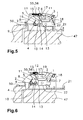
Figs. 5 and 6 illustrate the operative sequence involved in locking the door (47), starting from the position shown inFig. 4 . -
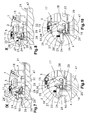
Figs. 7 and 8 illustrate the actuation of the first rocker (24) when the door (47) is in the frame and separated from the latter. -
Figs. 9 and 10 are respective enlarged view of the details IX and X encircled inFigs. 7 and 8 . -
Fig. 11 is equivalent to the enlarged detail ofFig. 1 , but for the case where a handle (30) exists. -
Fig. 12 is an upper horizontal projection corresponding to the mechanism ofFig. 11 and for the particular case in which this is applied to an anti-panic push bar (49). -
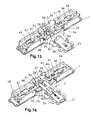
Fig. 13 is a perspective view of the lock ofFig. 12 . In order to assist the understanding, the latch (2) and the carriage (7) have been omitted. The position of the mechanism is that of the extended latch (2) and disengaged handle (30). -
Fig. 14 is similar toFig. 13 , and incorporates the carriage (7) and corresponds to the engaged and rotatably actuated handle (30). -
Fig. 15 is an upper horizontal projection of the mechanism according toFig. 13 . -
Fig. 16 is similar toFig. 15 , now showing the handle (30) engaged but not rotatably actuated. -
Fig. 17 is an upper horizontal projection of the mechanism according toFig. 14 . -
Fig. 18 is an enlarged view of the section XVIII-XVIII shown inFig. 15 . -
Fig. 19 is similar toFig. 18 , consisting of an enlargement of the section XIX-XIX shown inFig. 16 . - With reference to the drawings and aforementioned reference numerals, a preferred embodiment of the object of the invention is illustrated in the accompanying drawings, and relates to a modular mechanism which (see
Fig. 1 ) comprises a mechanism casing (1), a latch head or latch (2) per se, which has a conventional shape with a bevelled surface (8) and a longitudinal surface (9) parallel to the plane of the door (47), a support (3) of the latch (2), a rotation shaft (4) of the latch (2), an anti-rotation device (5) of the latch (2), a rotatory lever (6) carrying the said anti-rotation device (5), a carriage (7) that is displaceable longitudinally parallel to the plane of the door (47), and means for actuating the carriage (7), wherein the said latch (2) is installed in the said support (3) by means of the said rotation shaft (4), has a receptacle (11) of semicircular cross-section elongated tangentially at its ends, which is parallel to the rotation shaft (4) and is situated on its rear surface (10) at a distance from the plane of the door (47) which is suitably larger than that of the rotation shaft (4), and, in opposition to the said rotation shaft (4), this latch (2) has a projection (53) that in front abuts against a wall (54) of the said support (3), the said rotation shaft (4) being situated adjacent to the front part of this casing (1) and closer to the plane of the door (47) than is the longitudinal surface (9) of the latch (2), the said support (3) and rotation shaft (4) being longitudinally displaceable at the same time with respect to the casing (1) of the mechanism by means of both first (19) and second (20) tracks, the said anti-rotation device (5) being of circular cross-section adapted as required to that of the said receptacle (11) and being installed by means of the said rotatory lever (6) which at its end furthest from the door (47) has a rotational linkage (12) with respect to the said support (3) and at its other end, on the front side, this rotatory lever (6) forms a concavity (13) which, in the emergent position of the latch (2), remains against a crosspiece (14) of the said carriage (7) which comprises means that operate in conjunction with the said actuating means of the carriage (7); the modular mechanism also comprises a first helical spring (15) and first (16), second (17) and third (18) torsion springs, such that the first helical spring (15) is installed between the support (3) and the casing (1) of the mechanism so that it has a state of maximum relative relaxation in conjunction with the most forward positions of the said latch (2) and support (3), the said first torsion spring (16) being installed on the rotation shaft (4) between the latch (2) and its support (3) so that it has states of maximum relaxation and tension coinciding with respective positions of extension or rest, and release or rotation, of the latch (2), the said second torsion spring (17) being installed between the support (3) and the anti-rotation device (5) so that it has states of maximum relaxation and tension coinciding with respective positions of the anti-rotation device (5) inside and outside the receptacle (11) of the latch (2), and the said third torsion spring (18) is installed between the carriage (7) and the casing (1) of the mechanism so that it has states of maximum relaxation and tension coinciding with respective front and rear positions of this carriage (7). According to a preferred embodiment, the receptacle (11) for the anti-rotation device (5) is related to the longitudinal mid plane of the latch (2); similarly, in accordance with a preferred embodiment, the said rotatory linkage (12) of the rotatory lever (6) is at a greater distance from the door (47) than is the side of the latch (2) opposite the longitudinal surface (9) thereof. - The perspective view of
Fig. 1 shows diagrammatically a door (47) with a generic locking system in which, apart from the central lock (48), there is a handle (30), an anti-panic push bar (49) and complementary top (51) and bottom (52) locking devices arranged both in the plane itself of the central lock (48) as well as in the doorsill and doorhead frames. In accordance with what has been described hereinbefore in connection with the envisaged mechanism, as well as in accordance with the following description, it is clear that the mechanism may be employed universally, namely for locking systems with a single conventional central lock (48), with an internal anti-panic handle (30), for cases where there are also top (51) and bottom (52) locking devices, for cases where the actuation is by means of a push-type (or lever-type) anti-panic bar (49), or for cases where the actuation is by electromechanical means, the only requirement being that the actuating means exert the necessary traction on the carriage (7) and that engagement means are provided for the handle (30) and also means known per se are provided so that the top (51) and bottom (52) locking devices are actuated via transmission of the actuation of the central lock (48). -
Figs. 2 to 4 illustrate the mode of operation starting from the rest position shown inFig. 1 . Insofar as the traction is exerted on the carriage (7) (Fig. 2 ), the crosspiece (16) causes the rotatory lever (6) to tilt, thereby displacing the anti-rotation device (5) from the rear receptacle (11) of the latch (2), this being arranged so as to rotate on its shaft (4) (Fig. 3 ) and thereby slip into the casing (1) under the intrinsic pressure that is exerted by the keeper (50) when the door (47) is caused to open, separating the door from its frame; in this operation the first (16) and second (17) torsion springs are compressed, which after the door has been opened recover their initial state and bring the mechanism (Fig. 3 ) into the rest position shown inFig. 1 . Starting from this rest position the operation of locking the door (47) is illustrated by means ofFigs. 5 and 6 ; to start with the bevelled surface (8) of the latch (2) rests against the frame and, since this latch (2) is not able to rotate towards the left-hand side of the drawing since the top of its projection (55) rests against the wall (56) of the support (3), the support (3) and the carriage (7) are jointly retracted under the corresponding tension of the first helical spring (15) and of the third torsion spring (18) (Fig. 5 ), which (Fig. 6 ) recover elastically, forcing the release of the latch (2) on reaching its keeper (50). -
Figs. 11 to 19 illustrate the application of the mechanism of the invention to the case where a handle (30) is incorporated, comprising an engagement mechanism actuated by means of a cylindrical combination key, as well as an anti-panic push bar (49) and top (51) and bottom (52) locking devices actuated by means of first (44) and second (45) straightedge plates. - To this end the said actuating means of the carriage (7) comprise a puller (21) which is coupled to the carriage (7) by means of a third track (22), such that its working path and its longitudinal position coincide with the travel length and the front and rear operating positions of the said carriage (7); furthermore, the mechanism according to the invention has a reversible design and construction for left-hand and right-hand doors (47), symmetrical with respect to the longitudinal mid plane of the latch (2), comprising a handle (30), a rotating plate (31), second (32) and third (33) rockers, first (34) and second (35) slide rims, and first (36) and second (37) locks actuated by a key, wherein the rotating plate (31) is rotatably coupled to the handle (30), has a longitudinal convexity (38) towards the floor of the casing (1), has two diametrically opposite leaves (39) that are perpendicular to the said convexity (38) and are capable of adopting two, namely a disengaged and engaged, operating positions of the handle (30), which are respectively closer to or more remote from the floor of the casing (1); the second (32) and third (33) rockers have their rotation shaft fixed to the casing (1), both have pivots (40) rotatably linked with respect to the said carriage (7) which engage rotatably with the leaves (39) of the rotating plate (31) when the latter is situated in its remote position relative to the floor of the casing (1) or engaged handle (30), and which are capable of rotating between two positions congruent with those of the said anti-rotation device (5) inside and outside the rear receptacle (11) of the catch (2); the first (34) and second (35) rims rest on the floor of the housing (1), have an edge (42) of wedge-shaped cross-section spaced an appropriate distance from the said convexity (38), and have a notch (43) that operates in conjunction with the eccentric of the said first (36) and second (37) locks, thereby producing an operational travel of these rims (34, 35) between inactive and active positions that are congruent with respectively the disengaged and engaged positions of the handle (30); moreover, an implementation is envisaged according to which, in contrast to the pivots (40), the second (32) and third (33) rockers have a pin (41) that slidably engages in a groove (46) of both first (44) and second (45) straightedge plates, which are slidably guided in the direction perpendicular to the travel of the latch (2) and which are capable of actuating respective top (51) and bottom (52) complementary locking points situated in the same vertical frame of the central lock and/or in the doorsill and doorhead frames. In
Fig. 13 the handle (30) is disengaged or in its position closest to the floor of the casing (1), the rockers (32, 33) are in the non-tilting or rest position, the rims (34, 35) are in their position remote from the rotational plate (31), and the straightedge plates (44, 45) are in their extended or most remote position from this plate (31). The position of the rims (34, 35) is produced by the action of the eccentric of the corresponding lock (36, 37) in the notch (43), by means of which, when this eccentric is actuated (the upper one inFigs. 16 and19 ), the first rim (34) drops and presses with its edge (42) against the convexity of the plate (31), which reaches its most distant position from the floor of the casing (1) and one of its leaves (39), on rotation of the handle (30), presses against the pivot (40) of the corresponding rocker (32, 33) and (Figs. 14 and17 ) effect the retraction of the carriage (7), which initiates the tilting of the other rocker (32, 33), as a result of which the anti-rotation device (5) is displaced from the receptacle (11), thereby allowing the catch (2) to be released, at the same time as the pins (41) of these rockers (32, 33) engage in the groove (46) of the straightedge plates (44, 45), thereby raising these to the withdrawn position closest to the plate (31). - Another object of the present invention consists in that a first rocker (24), which is rotatably installed on its own rotation shaft (4) of the latch (2), is present in a cavity (23) of the latch (2) open along its longitudinal surface (9), and that in relation to the projecting position of rest of the latch (2), this first rocker (24) has first (25) and second (26) arms that are located respectively outside and inside the casing (1) of the mechanism, and between this first arm (25) and the bottom of the cavity (23) is interposed a second helical spring (27) that has respective compressed and relaxed states in which the first arm (25) remains inside or outside the said cavity (23), and, corresponding to these positions of the first arm (25), a front part (28) of the second arm (26) oriented transversely to the door (47) remains longitudinally opposite, and adjacent or offset with respect to a projection (29) of the casing (1) of the mechanism. This device and its function are illustrated in
Figs. 7 to 10 . The device is intended to prevent the catch (2) being able to be released from outside by the conventional method of inserting a credit card or the like between the small gap that always remains between the locked door (47) and its lock frame. If this manoeuvre is attempted (Figs. 7 and 9 ) the catch (2) cannot move back since the first rocker (24) is tilted against the second helical spring (27) and the front part (28) of the second arm (26) remains bearing against the projection (29) belonging to the casing (1) which is fixed to the door (47). When the door (47) moves from its frame, the elastic recovery of the second helical spring (27) (Figs. 8 and 10 ) lifts the first rocker (24) to its rest position, corresponding to that shown inFig. 4 , in which the latch (2) is available for the manoeuvre of locking the door (47) to its frame.
Claims (7)
- Closing latch modular mechanism, characterised in that it comprises a mechanism casing (1), a latch head or latch (2) per se, which has a conventional configuration with a bevelled surface (8) and a longitudinal surface (9) parallel to the plane of the door (47), a support (3) of the latch (2), a rotation shaft (4) of the latch (2), an anti-rotation device (5) of the latch (2), a rotatory lever (6) carrying the said anti-rotation device (5), a carriage (7) that is displaceable longitudinally parallel to the plane of the door (47), and means for actuating the carriage (7), wherein the said latch (2) is installed in the said support (3) by means of the said rotation shaft (4), comprises a receptacle (11) of semicircular cross-section elongated tangentially at its ends, which is parallel to the rotation shaft (4) and is situated in its rear surface (10) at a distance from the plane of the door (47) which is suitably larger than that of the rotation shaft (4), and, in contrast to the said rotation shaft (4), this latch (2) has a projection (55) that in front abuts against a wall (56) of the said support (3), the said rotation shaft (4) being situated adjacent to the front part of this casing (1) and closer to the plane of the door (47) than is the longitudinal surface (9) of the latch (2), the said support (3) and rotation shaft (4) being longitudinally displaceable at the same time with respect to the casing (1) of the mechanism by means of both first (19) and second (20) tracks, the said anti-rotation device (5) being of circular cross-section adapted as required to that of the said receptacle (11) and being installed by means of a said rotatory lever (6) which at its end furthest from the door (47) has a rotational linkage (12) with respect to the said support (3) and at its other end, on the front side, this rotatory lever (6) forms a concavity (13) which, in the emergent position of the latch (2), is against a crosspiece (14) of a said carriage (7) that comprises means that operate in conjunction with the said means actuating the carriage (7); the modular mechanism also comprises a first helical spring (15) and first (16), second (17) and third (18) torsion springs, such that the first helical spring (15) is installed between the support (3) and the casing (1) of the mechanism so that it has a state of maximum relative relaxation in conjunction with the most forward positions of the said latch (2) and support (3), the said first torsion spring (16) being installed on the rotation shaft (4) between the latch (2) and its support (3) so that it has states of maximum relaxation and tension coinciding with respective positions of extension or rest, and release or rotation, of the latch (2), the said second torsion spring (17) being installed between the support (3) and the anti-rotation device (5) so that it has states of maximum relaxation and tension coinciding with the respective positions of the anti-rotation device (5) inside and outside the receptacle (11) of the latch (2), and the said third torsion spring (18) is installed between the carriage (7) and the casing (1) of the mechanism so that it has states of maximum relaxation and tension coinciding with respective front and rear positions of this carriage (7).
- Closing latch modular mechanism according to claim 1, characterised in that the receptacle (11) for the anti-rotation device (5) is in the longitudinal mid plane of the latch (2).
- Closing latch modular mechanism according to the preceding claims, characterised in that the said rotational linkage (12) of the rotatory lever (6) is at a greater distance from the door (47) than is the side of the latch (2) opposite the longitudinal surface (9) thereof.
- Closing latch modular mechanism according to the preceding claims, characterised in that the said means actuating the carriage (7) consist of a puller (21) that is coupled to the carriage (7) by means of a third track (22) so that its working path and its longitudinal position are in conjunction with the travel length and the front and rear operating positions of the said carriage (7).
- Closing latch modular mechanism according to the preceding claims, characterised in that a first rocker (24) that is rotatably installed on its own rotation shaft (4) of the latch (2) is present in a cavity (23) of the catch (2) open along its longitudinal surface (9) and that, in relation to the projecting rest position of the catch (2), this first rocker (24) has first (25) and second (26) arms that are situated respectively outside and inside the casing (1) of the mechanism, and between this first arm (25) and the floor of the cavity (23) is interposed a second helical spring (27) that has respectively compressed and relaxed states in which the first arm (25) remains inside or outside the said cavity (23), and, corresponding to these positions of the first arm (25), a front part (28) of the second arm (26) oriented transversely to the door (47) is longitudinally facing and adjacent or offset with respect to a projection (29) of the casing (1) of the mechanism.
- Closing latch modular mechanism according to the preceding claims, characterised in that it has a reversible design and construction for left-hand and right-hand doors (47), symmetrical with respect to the longitudinal mid plane of the latch (2), and comprises a handle (30), a rotational plate (31), second (32) and third (33) rockers, first (34) and second (35) slide rims, and first (36) and second (37) locks actuated by a key, wherein the rotational plate (31) is rotatably coupled to the handle (30), has a longitudinal convexity (38) towards the floor of the casing (1), has two diametrically opposite leaves (39) that are perpendicular to the said convexity (38), and is capable of adopting two disengaged and engaged operating positions of the handle (30) that are respectively closer to or further away from the floor of the casing (1), the said second (32) and third (33) rockers have their rotation shaft fixed to the casing (1), both have pivots (40) rotatably linked with respect to the said carriage (7) that engage rotatably with the leaves (39) of the rotational plate (31) when this is situated in its position remote from the floor of the casing (1) or engaged plate (30), and that are capable of rotating between two positions congruent with those of the said anti-rotation device (5) inside and outside the rear receptacle (11) of the catch (2), the said first (34) and second (35) rims are joined to the floor of the casing (1), have an edge (42) of wedge-shaped cross-section situated at an appropriate distance opposite the said convexity (38), and have a notch (43) that operates in conjunction with the eccentric of the said first (36) and second (37) locks, thereby forming an operating path of these rims (34, 35) between inactive and active positions that are congruent with the disengaged and engaged positions of the handle (30).
- Closing latch modular mechanism according to claim 6, characterised in that, in contrast to the pivots (40), the second (32) and third (33) rockers comprise a pin (41) that engages slidably in a groove (46) of both first (44) and second (45) straightedge plates that are slidably guided in the direction perpendicular to the path of the catch (2) and that are capable of actuating respective top (51) and bottom (52) complementary locking points situated in the same vertical plane of the central locking device and/or in the doorsill and doorhead frames.
Applications Claiming Priority (2)
| Application Number | Priority Date | Filing Date | Title |
|---|---|---|---|
| ES200501577A ES2276598B1 (en) | 2005-06-28 | 2005-06-28 | MODULAR MECHANISM OF CLOSING PICAPORTE. |
| PCT/ES2006/000328 WO2007000480A1 (en) | 2005-06-28 | 2006-06-05 | Modular closure latch mechanism |
Publications (2)
| Publication Number | Publication Date |
|---|---|
| EP1900894A1 true EP1900894A1 (en) | 2008-03-19 |
| EP1900894A4 EP1900894A4 (en) | 2014-06-25 |
Family
ID=37595053
Family Applications (1)
| Application Number | Title | Priority Date | Filing Date |
|---|---|---|---|
| EP20060778449 Withdrawn EP1900894A4 (en) | 2005-06-28 | 2006-06-05 | Modular closure latch mechanism |
Country Status (8)
| Country | Link |
|---|---|
| US (1) | US20080169655A1 (en) |
| EP (1) | EP1900894A4 (en) |
| KR (1) | KR20080020593A (en) |
| CN (1) | CN101151434B (en) |
| ES (1) | ES2276598B1 (en) |
| MX (1) | MX2007015514A (en) |
| RU (1) | RU2362860C1 (en) |
| WO (1) | WO2007000480A1 (en) |
Cited By (2)
| Publication number | Priority date | Publication date | Assignee | Title |
|---|---|---|---|---|
| FR2993912A1 (en) * | 2012-07-27 | 2014-01-31 | Thirard Ets | Device for locking and unlocking door for emergency evacuation in building, has bolts actuated by key and handle such that bolts moved from locking position to unlocking position when handle is moved from rest position to actuated position |
| EP3564467A1 (en) | 2018-05-04 | 2019-11-06 | Groupe Valente | Closing system by mechanical locking |
Families Citing this family (11)
| Publication number | Priority date | Publication date | Assignee | Title |
|---|---|---|---|---|
| SE531998C2 (en) * | 2008-02-01 | 2009-09-22 | Assa Ab | Lock with plunger |
| WO2014063043A1 (en) * | 2012-10-19 | 2014-04-24 | Yale Security Inc. | Apparatus and method for electromechanically retracting a door latch |
| US12680343B2 (en) | 2018-12-11 | 2026-07-14 | SimpliSafe, Inc. | Door lock with clutch |
| US10770836B2 (en) * | 2018-12-17 | 2020-09-08 | Te Connectivity Corporation | Plug connector including a profiled latch |
| US10657795B1 (en) | 2019-02-01 | 2020-05-19 | SimpliSafe, Inc. | Alarm system with first responder code for building access |
| US11761246B2 (en) * | 2019-06-05 | 2023-09-19 | Sargent Manufacturing Company | Surface vertical rod exit device |
| US11933092B2 (en) | 2019-08-13 | 2024-03-19 | SimpliSafe, Inc. | Mounting assembly for door lock |
| CN112431483B (en) * | 2019-08-26 | 2022-02-22 | 堡笙工业有限公司 | Anti-theft door lock set |
| DE202021104902U1 (en) | 2021-09-10 | 2022-12-19 | Baugruppentechnik Pollmeier Gmbh | Door lock and latch for a door lock |
| FR3134405B1 (en) * | 2022-04-12 | 2024-04-12 | La Croisee D S | Device for locking/unlocking an opening, and locking/unlocking assembly comprising it |
| US12595687B2 (en) * | 2024-09-05 | 2026-04-07 | Toby Jack Sims | Panic bar latch system and method |
Family Cites Families (33)
| Publication number | Priority date | Publication date | Assignee | Title |
|---|---|---|---|---|
| US1646990A (en) * | 1925-06-01 | 1927-10-25 | Bolles William Bertram | Antipanic actuator for door fasteners |
| US4427223A (en) * | 1981-08-03 | 1984-01-24 | Von Duprin, Inc. | Latching device |
| US4545606A (en) * | 1983-01-31 | 1985-10-08 | Vodra Richard J | Door latch assembly |
| US4601499A (en) * | 1984-07-03 | 1986-07-22 | Von Duprin, Inc. | Operating mechanism for a closure latching assembly |
| US4741563A (en) * | 1986-04-07 | 1988-05-03 | Von Duprin, Inc. | Center case assembly, and a universal, center case sub-assembly |
| US4796931A (en) * | 1987-08-07 | 1989-01-10 | Yale Security Inc. | Exit device having adjustable backset |
| US4961330A (en) * | 1989-09-12 | 1990-10-09 | Sargent & Greenleaf, Inc. | High security panic exit system |
| US5340171A (en) * | 1992-01-22 | 1994-08-23 | Republic Industries, Inc. | Door latch control apparatus with independent actuators |
| US5412961A (en) * | 1993-06-01 | 1995-05-09 | Von Duprin, Inc. | Exit delaying mechanism for panic exit door |
| US6779819B2 (en) * | 1993-11-01 | 2004-08-24 | Yale Security Inc. | Exit device having press bar-operated elongated securing member |
| EP0651120A3 (en) * | 1993-11-01 | 1996-10-02 | Yale Security Inc | Panic lock with deadbolt as a blocking device. |
| US5490697A (en) * | 1994-04-12 | 1996-02-13 | International Security Products, Inc. | Access control assembly |
| SE505779C2 (en) * | 1994-04-14 | 1997-10-06 | Assa Ab | Locking mechanism |
| US5947534A (en) * | 1995-06-19 | 1999-09-07 | Zarzycki, Jr.; Vincent W. | Panic exit device suitable for use with standard doors |
| ES2155291B1 (en) * | 1996-04-01 | 2001-12-01 | Talleres Escoriaza Sa | ANTIPANIC BAR WITH REVERSIBILITY FOR EMERGENCY DOORS. |
| US6009732A (en) * | 1998-04-07 | 2000-01-04 | Detex Corporation | Panic exit device |
| US6048000A (en) * | 1998-04-28 | 2000-04-11 | Geringer; Arthur | Delayed egress panic device with internal deadlocking bolt mechanism |
| US6032985A (en) * | 1998-05-22 | 2000-03-07 | Harrow Products, Inc. | Latch assembly |
| ES2168171B1 (en) * | 1999-05-13 | 2003-05-01 | Talleres Escoriaza Sa | IMPROVED DEVICE FOR AN ANTIPANIC CLOSURE |
| ES2217910B1 (en) * | 2001-12-07 | 2005-06-01 | Talleres De Escoriaza, S.A. | DEVICE FOR AN ANTIPANIC LOCK. |
| ITTO20020283A1 (en) * | 2002-03-29 | 2003-09-29 | Savio Spa | ,, ADJUSTMENT DEVICE FOR PANIC OPENING SYSTEMS FOR DOORS ,,. |
| ITTO20020281A1 (en) * | 2002-03-29 | 2003-09-29 | Savio Spa | ,, PANIC OPENING SYSTEM FOR DOORS ,,. |
| ES2211277B1 (en) * | 2002-04-10 | 2005-10-01 | La Industrial Cerrajera, S.A. | SECURITY LOCK WITH DOUBLE CONTROL OF THE PICAPORTE AND ANTIPANIC FUNCTION. |
| TW547533U (en) * | 2002-12-27 | 2003-08-11 | Ching-Tian Lin | Improvement of fireproof door lock structure |
| TW547534U (en) * | 2002-12-27 | 2003-08-11 | Ching-Tian Lin | Press type door lock device used in fireproof doors |
| TW572117U (en) * | 2003-03-17 | 2004-01-11 | Ching-Tian Lin | Fireproof door lock structure |
| TW568161U (en) * | 2003-05-14 | 2003-12-21 | Ching-Tian Lin | Structure of fireproof doors |
| TW568160U (en) * | 2003-05-14 | 2003-12-21 | Ching-Tian Lin | Structure of fireproof doors |
| FR2863000B1 (en) * | 2003-11-28 | 2007-06-29 | Vachette Sa | AUTOMATIC LOADING DOOR LOCK |
| US7832777B2 (en) * | 2006-04-05 | 2010-11-16 | Von Duprin, Inc. | Door lock assembly |
| US7641244B2 (en) * | 2007-10-24 | 2010-01-05 | Thase Enterprise Co., Ltd. | Fire door lock |
| US7748757B2 (en) * | 2008-09-17 | 2010-07-06 | I-Tek Metal Mfg. Co. Ltd. | Connecting device for concealed-type top or bottom latch for panic exit door lock |
| US7634927B1 (en) * | 2009-02-04 | 2009-12-22 | I-Tek Metal Mfg. Co., Ltd. | Panic exit door lock allowing locking on both sides |
-
2005
- 2005-06-28 ES ES200501577A patent/ES2276598B1/en not_active Expired - Fee Related
-
2006
- 2006-06-05 WO PCT/ES2006/000328 patent/WO2007000480A1/en not_active Ceased
- 2006-06-05 MX MX2007015514A patent/MX2007015514A/en active IP Right Grant
- 2006-06-05 EP EP20060778449 patent/EP1900894A4/en not_active Withdrawn
- 2006-06-05 US US11/914,229 patent/US20080169655A1/en not_active Abandoned
- 2006-06-05 CN CN200680010632XA patent/CN101151434B/en not_active Expired - Lifetime
- 2006-06-05 RU RU2007137068A patent/RU2362860C1/en not_active IP Right Cessation
- 2006-06-05 KR KR1020077020290A patent/KR20080020593A/en not_active Withdrawn
Cited By (3)
| Publication number | Priority date | Publication date | Assignee | Title |
|---|---|---|---|---|
| FR2993912A1 (en) * | 2012-07-27 | 2014-01-31 | Thirard Ets | Device for locking and unlocking door for emergency evacuation in building, has bolts actuated by key and handle such that bolts moved from locking position to unlocking position when handle is moved from rest position to actuated position |
| EP3564467A1 (en) | 2018-05-04 | 2019-11-06 | Groupe Valente | Closing system by mechanical locking |
| FR3080881A1 (en) * | 2018-05-04 | 2019-11-08 | Groupe Valente | LOCKING SYSTEM WITH MECHANICAL LOCKING |
Also Published As
| Publication number | Publication date |
|---|---|
| CN101151434B (en) | 2012-02-22 |
| KR20080020593A (en) | 2008-03-05 |
| MX2007015514A (en) | 2008-03-06 |
| US20080169655A1 (en) | 2008-07-17 |
| ES2276598B1 (en) | 2008-02-16 |
| RU2362860C1 (en) | 2009-07-27 |
| CN101151434A (en) | 2008-03-26 |
| EP1900894A4 (en) | 2014-06-25 |
| ES2276598A1 (en) | 2007-06-16 |
| WO2007000480A1 (en) | 2007-01-04 |
Similar Documents
| Publication | Publication Date | Title |
|---|---|---|
| US20080169655A1 (en) | Modular Closure Latch Mechanism | |
| US5953942A (en) | Catch mechanism for locks | |
| JP4538001B2 (en) | Guide structure of latch bolt locking in door lock | |
| JP2554702B2 (en) | Door lock | |
| CN102918220B (en) | Multiple opening door lock mechanism | |
| EP0651120A2 (en) | Exit device having a deadbolt as its securing member | |
| CN111051631A (en) | Latch device | |
| US20060123859A1 (en) | Mortise lock with automatic projection of dead bolt | |
| CN108291414A (en) | Doors or other closable panels with latch-actuated linkages | |
| CN111386378A (en) | Hinge closing piece | |
| EP1234935A2 (en) | Linearly actuated locking device for transit vehicle door system | |
| US20240392607A1 (en) | Push Pad Exit Device for Emergency Door Egress and Vertical Latch Bolt Assembly | |
| EP3853431B1 (en) | Panel lock assembly | |
| CN1068401C (en) | Door handle assembly with energency-unlocking function | |
| JPH11148258A (en) | Self-locking dial combination lock and locking system | |
| CN103827419B (en) | Close and open system | |
| KR101043620B1 (en) | Electronic lock device for door with forced release means | |
| EP3911821B1 (en) | Panel closure apparatus | |
| US7954862B2 (en) | Electromagnetic lock provided with a sliding bolt for a swinging-type door | |
| CN101815835A (en) | Antipanic lock | |
| EP3702558B1 (en) | Counter lock for an inactive leaf of a double leaf door | |
| JPH0850836A (en) | Key operated safety switch | |
| CN108661450A (en) | A kind of band escaping function security lock | |
| EP1866508A1 (en) | Recessed handle |
Legal Events
| Date | Code | Title | Description |
|---|---|---|---|
| PUAI | Public reference made under article 153(3) epc to a published international application that has entered the european phase |
Free format text: ORIGINAL CODE: 0009012 |
|
| 17P | Request for examination filed |
Effective date: 20080128 |
|
| AK | Designated contracting states |
Kind code of ref document: A1 Designated state(s): AT BE BG CH CY CZ DE DK EE ES FI FR GB GR HU IE IS IT LI LT LU LV MC NL PL PT RO SE SI SK TR |
|
| DAX | Request for extension of the european patent (deleted) | ||
| DAX | Request for extension of the european patent (deleted) | ||
| A4 | Supplementary search report drawn up and despatched |
Effective date: 20140522 |
|
| RIC1 | Information provided on ipc code assigned before grant |
Ipc: E05B 65/10 20060101AFI20140516BHEP |
|
| GRAP | Despatch of communication of intention to grant a patent |
Free format text: ORIGINAL CODE: EPIDOSNIGR1 |
|
| INTG | Intention to grant announced |
Effective date: 20150223 |
|
| GRAS | Grant fee paid |
Free format text: ORIGINAL CODE: EPIDOSNIGR3 |
|
| STAA | Information on the status of an ep patent application or granted ep patent |
Free format text: STATUS: THE APPLICATION IS DEEMED TO BE WITHDRAWN |
|
| 18D | Application deemed to be withdrawn |
Effective date: 20150707 |