EP1900821A1 - Process for production of l-amino acid - Google Patents
Process for production of l-amino acid Download PDFInfo
- Publication number
- EP1900821A1 EP1900821A1 EP06756916A EP06756916A EP1900821A1 EP 1900821 A1 EP1900821 A1 EP 1900821A1 EP 06756916 A EP06756916 A EP 06756916A EP 06756916 A EP06756916 A EP 06756916A EP 1900821 A1 EP1900821 A1 EP 1900821A1
- Authority
- EP
- European Patent Office
- Prior art keywords
- amino acid
- derived
- dehydrogenase
- acid
- converting
- Prior art date
- Legal status (The legal status is an assumption and is not a legal conclusion. Google has not performed a legal analysis and makes no representation as to the accuracy of the status listed.)
- Withdrawn
Links
- 238000000034 method Methods 0.000 title claims abstract description 256
- 230000008569 process Effects 0.000 title claims abstract description 153
- 238000004519 manufacturing process Methods 0.000 title description 25
- 150000001413 amino acids Chemical class 0.000 claims abstract description 290
- 102000004190 Enzymes Human genes 0.000 claims abstract description 274
- 108090000790 Enzymes Proteins 0.000 claims abstract description 274
- 150000004715 keto acids Chemical group 0.000 claims abstract description 177
- 238000006243 chemical reaction Methods 0.000 claims abstract description 171
- 239000002773 nucleotide Substances 0.000 claims abstract description 158
- 125000003729 nucleotide group Chemical group 0.000 claims abstract description 158
- 239000013598 vector Substances 0.000 claims abstract description 139
- UQDJGEHQDNVPGU-UHFFFAOYSA-N serine phosphoethanolamine Chemical compound [NH3+]CCOP([O-])(=O)OCC([NH3+])C([O-])=O UQDJGEHQDNVPGU-UHFFFAOYSA-N 0.000 claims abstract description 137
- 108091028043 Nucleic acid sequence Proteins 0.000 claims abstract description 84
- 239000013604 expression vector Substances 0.000 claims abstract description 81
- 239000000203 mixture Substances 0.000 claims abstract description 52
- 235000001014 amino acid Nutrition 0.000 claims description 277
- 239000011541 reaction mixture Substances 0.000 claims description 223
- SNDPXSYFESPGGJ-UHFFFAOYSA-N L-norVal-OH Natural products CCCC(N)C(O)=O SNDPXSYFESPGGJ-UHFFFAOYSA-N 0.000 claims description 133
- MHAJPDPJQMAIIY-UHFFFAOYSA-N Hydrogen peroxide Chemical compound OO MHAJPDPJQMAIIY-UHFFFAOYSA-N 0.000 claims description 116
- SNDPXSYFESPGGJ-BYPYZUCNSA-N L-2-aminopentanoic acid Chemical compound CCC[C@H](N)C(O)=O SNDPXSYFESPGGJ-BYPYZUCNSA-N 0.000 claims description 101
- 108010003989 D-amino-acid oxidase Proteins 0.000 claims description 99
- 241000588724 Escherichia coli Species 0.000 claims description 96
- 238000007254 oxidation reaction Methods 0.000 claims description 95
- 102000004674 D-amino-acid oxidase Human genes 0.000 claims description 80
- 230000003647 oxidation Effects 0.000 claims description 80
- 108090000698 Formate Dehydrogenases Proteins 0.000 claims description 69
- 150000008575 L-amino acids Chemical class 0.000 claims description 65
- BDAGIHXWWSANSR-UHFFFAOYSA-N methanoic acid Natural products OC=O BDAGIHXWWSANSR-UHFFFAOYSA-N 0.000 claims description 64
- 230000009467 reduction Effects 0.000 claims description 64
- 108010053835 Catalase Proteins 0.000 claims description 57
- QVGXLLKOCUKJST-UHFFFAOYSA-N atomic oxygen Chemical compound [O] QVGXLLKOCUKJST-UHFFFAOYSA-N 0.000 claims description 57
- 239000001301 oxygen Substances 0.000 claims description 57
- 229910052760 oxygen Inorganic materials 0.000 claims description 57
- 238000005273 aeration Methods 0.000 claims description 56
- 244000005700 microbiome Species 0.000 claims description 54
- 102000016938 Catalase Human genes 0.000 claims description 51
- 108030000198 L-amino-acid dehydrogenases Proteins 0.000 claims description 50
- 108010031025 Alanine Dehydrogenase Proteins 0.000 claims description 43
- 239000007789 gas Substances 0.000 claims description 42
- 230000001925 catabolic effect Effects 0.000 claims description 39
- OSWFIVFLDKOXQC-UHFFFAOYSA-N 4-(3-methoxyphenyl)aniline Chemical compound COC1=CC=CC(C=2C=CC(N)=CC=2)=C1 OSWFIVFLDKOXQC-UHFFFAOYSA-N 0.000 claims description 32
- 235000019253 formic acid Nutrition 0.000 claims description 32
- 241000222124 [Candida] boidinii Species 0.000 claims description 28
- 108010028658 Leucine Dehydrogenase Proteins 0.000 claims description 27
- 241000187644 Mycobacterium vaccae Species 0.000 claims description 25
- 241000203773 Thermoactinomyces intermedius Species 0.000 claims description 25
- 241000193385 Geobacillus stearothermophilus Species 0.000 claims description 23
- 241000193386 Lysinibacillus sphaericus Species 0.000 claims description 20
- 108010078226 phenylalanine oxidase Proteins 0.000 claims description 20
- 108090000340 Transaminases Proteins 0.000 claims description 15
- QGZKDVFQNNGYKY-UHFFFAOYSA-O Ammonium Chemical compound [NH4+] QGZKDVFQNNGYKY-UHFFFAOYSA-O 0.000 claims description 14
- 241001480015 Trigonopsis variabilis Species 0.000 claims description 13
- 230000001590 oxidative effect Effects 0.000 claims description 13
- BDAGIHXWWSANSR-UHFFFAOYSA-M Formate Chemical compound [O-]C=O BDAGIHXWWSANSR-UHFFFAOYSA-M 0.000 claims description 11
- 150000003839 salts Chemical class 0.000 claims description 11
- 241001468249 Geobacillus thermocatenulatus Species 0.000 claims description 8
- 102000003929 Transaminases Human genes 0.000 claims description 8
- 241000193830 Bacillus <bacterium> Species 0.000 claims description 7
- 241000235347 Schizosaccharomyces pombe Species 0.000 claims description 5
- 241000863430 Shewanella Species 0.000 claims description 3
- 239000000463 material Substances 0.000 claims description 2
- 239000007858 starting material Substances 0.000 abstract description 37
- 229940088598 enzyme Drugs 0.000 description 236
- 229940024606 amino acid Drugs 0.000 description 223
- 239000013612 plasmid Substances 0.000 description 215
- 238000002360 preparation method Methods 0.000 description 186
- 108020004414 DNA Proteins 0.000 description 84
- 108090000623 proteins and genes Proteins 0.000 description 68
- 230000000694 effects Effects 0.000 description 61
- 230000003287 optical effect Effects 0.000 description 59
- 238000006722 reduction reaction Methods 0.000 description 59
- 239000012634 fragment Substances 0.000 description 54
- 238000003752 polymerase chain reaction Methods 0.000 description 52
- 210000004027 cell Anatomy 0.000 description 50
- 108091008146 restriction endonucleases Proteins 0.000 description 46
- 230000002255 enzymatic effect Effects 0.000 description 43
- QGZKDVFQNNGYKY-UHFFFAOYSA-N Ammonia Chemical compound N QGZKDVFQNNGYKY-UHFFFAOYSA-N 0.000 description 35
- 238000000746 purification Methods 0.000 description 35
- 239000011543 agarose gel Substances 0.000 description 32
- 230000000692 anti-sense effect Effects 0.000 description 32
- 239000000284 extract Substances 0.000 description 27
- 230000010718 Oxidation Activity Effects 0.000 description 26
- COLNVLDHVKWLRT-QMMMGPOBSA-N L-phenylalanine Chemical compound OC(=O)[C@@H](N)CC1=CC=CC=C1 COLNVLDHVKWLRT-QMMMGPOBSA-N 0.000 description 25
- 239000000758 substrate Substances 0.000 description 25
- KDVFRMMRZOCFLS-UHFFFAOYSA-N 2-oxopentanoic acid Chemical compound CCCC(=O)C(O)=O KDVFRMMRZOCFLS-UHFFFAOYSA-N 0.000 description 24
- 230000014509 gene expression Effects 0.000 description 24
- 108010088278 Branched-chain-amino-acid transaminase Proteins 0.000 description 22
- 239000000872 buffer Substances 0.000 description 22
- 238000010276 construction Methods 0.000 description 22
- QNAYBMKLOCPYGJ-UHFFFAOYSA-N D-alpha-Ala Natural products CC([NH3+])C([O-])=O QNAYBMKLOCPYGJ-UHFFFAOYSA-N 0.000 description 21
- VZTDIZULWFCMLS-UHFFFAOYSA-N ammonium formate Chemical compound [NH4+].[O-]C=O VZTDIZULWFCMLS-UHFFFAOYSA-N 0.000 description 21
- 239000013611 chromosomal DNA Substances 0.000 description 19
- 102000012410 DNA Ligases Human genes 0.000 description 18
- 108010061982 DNA Ligases Proteins 0.000 description 18
- OKKJLVBELUTLKV-UHFFFAOYSA-N Methanol Chemical compound OC OKKJLVBELUTLKV-UHFFFAOYSA-N 0.000 description 18
- YTRQFSDWAXHJCC-UHFFFAOYSA-N chloroform;phenol Chemical compound ClC(Cl)Cl.OC1=CC=CC=C1 YTRQFSDWAXHJCC-UHFFFAOYSA-N 0.000 description 18
- 239000004280 Sodium formate Substances 0.000 description 17
- 230000009471 action Effects 0.000 description 17
- 229910021529 ammonia Inorganic materials 0.000 description 17
- 239000005515 coenzyme Substances 0.000 description 17
- 238000006911 enzymatic reaction Methods 0.000 description 17
- 239000000047 product Substances 0.000 description 17
- HLBBKKJFGFRGMU-UHFFFAOYSA-M sodium formate Chemical compound [Na+].[O-]C=O HLBBKKJFGFRGMU-UHFFFAOYSA-M 0.000 description 17
- 235000019254 sodium formate Nutrition 0.000 description 17
- BPHPUYQFMNQIOC-NXRLNHOXSA-N isopropyl beta-D-thiogalactopyranoside Chemical compound CC(C)S[C@@H]1O[C@H](CO)[C@H](O)[C@H](O)[C@H]1O BPHPUYQFMNQIOC-NXRLNHOXSA-N 0.000 description 16
- QNAYBMKLOCPYGJ-UWTATZPHSA-N D-alanine Chemical compound C[C@@H](N)C(O)=O QNAYBMKLOCPYGJ-UWTATZPHSA-N 0.000 description 15
- 101000702488 Rattus norvegicus High affinity cationic amino acid transporter 1 Proteins 0.000 description 15
- QAOWNCQODCNURD-UHFFFAOYSA-N Sulfuric acid Chemical compound OS(O)(=O)=O QAOWNCQODCNURD-UHFFFAOYSA-N 0.000 description 15
- 150000008574 D-amino acids Chemical class 0.000 description 14
- 238000001962 electrophoresis Methods 0.000 description 14
- 239000013600 plasmid vector Substances 0.000 description 14
- 235000002639 sodium chloride Nutrition 0.000 description 14
- 101710088194 Dehydrogenase Proteins 0.000 description 13
- 241001131785 Escherichia coli HB101 Species 0.000 description 13
- BAWFJGJZGIEFAR-NNYOXOHSSA-N NAD zwitterion Chemical compound NC(=O)C1=CC=C[N+]([C@H]2[C@@H]([C@H](O)[C@@H](COP([O-])(=O)OP(O)(=O)OC[C@@H]3[C@H]([C@@H](O)[C@@H](O3)N3C4=NC=NC(N)=C4N=C3)O)O2)O)=C1 BAWFJGJZGIEFAR-NNYOXOHSSA-N 0.000 description 13
- 240000004808 Saccharomyces cerevisiae Species 0.000 description 13
- 235000014680 Saccharomyces cerevisiae Nutrition 0.000 description 13
- FFBHFFJDDLITSX-UHFFFAOYSA-N benzyl N-[2-hydroxy-4-(3-oxomorpholin-4-yl)phenyl]carbamate Chemical compound OC1=C(NC(=O)OCC2=CC=CC=C2)C=CC(=C1)N1CCOCC1=O FFBHFFJDDLITSX-UHFFFAOYSA-N 0.000 description 13
- 239000000499 gel Substances 0.000 description 13
- 229950006238 nadide Drugs 0.000 description 13
- 239000008057 potassium phosphate buffer Substances 0.000 description 13
- 238000006268 reductive amination reaction Methods 0.000 description 13
- 239000007787 solid Substances 0.000 description 13
- 238000003756 stirring Methods 0.000 description 13
- CSCPPACGZOOCGX-UHFFFAOYSA-N Acetone Chemical compound CC(C)=O CSCPPACGZOOCGX-UHFFFAOYSA-N 0.000 description 12
- 229930027945 nicotinamide-adenine dinucleotide Natural products 0.000 description 12
- 229960005190 phenylalanine Drugs 0.000 description 12
- 238000000354 decomposition reaction Methods 0.000 description 11
- 230000001172 regenerating effect Effects 0.000 description 11
- 244000063299 Bacillus subtilis Species 0.000 description 10
- 235000014469 Bacillus subtilis Nutrition 0.000 description 10
- 125000002924 primary amino group Chemical group [H]N([H])* 0.000 description 10
- WEVYAHXRMPXWCK-UHFFFAOYSA-N Acetonitrile Chemical compound CC#N WEVYAHXRMPXWCK-UHFFFAOYSA-N 0.000 description 9
- LFQSCWFLJHTTHZ-UHFFFAOYSA-N Ethanol Chemical compound CCO LFQSCWFLJHTTHZ-UHFFFAOYSA-N 0.000 description 9
- HEMHJVSKTPXQMS-UHFFFAOYSA-M Sodium hydroxide Chemical compound [OH-].[Na+] HEMHJVSKTPXQMS-UHFFFAOYSA-M 0.000 description 9
- 150000004716 alpha keto acids Chemical class 0.000 description 9
- 229960000723 ampicillin Drugs 0.000 description 9
- AVKUERGKIZMTKX-NJBDSQKTSA-N ampicillin Chemical compound C1([C@@H](N)C(=O)N[C@H]2[C@H]3SC([C@@H](N3C2=O)C(O)=O)(C)C)=CC=CC=C1 AVKUERGKIZMTKX-NJBDSQKTSA-N 0.000 description 9
- 238000010367 cloning Methods 0.000 description 9
- 238000005580 one pot reaction Methods 0.000 description 9
- ROHFNLRQFUQHCH-YFKPBYRVSA-N L-leucine Chemical compound CC(C)C[C@H](N)C(O)=O ROHFNLRQFUQHCH-YFKPBYRVSA-N 0.000 description 8
- FAPWRFPIFSIZLT-UHFFFAOYSA-M Sodium chloride Chemical compound [Na+].[Cl-] FAPWRFPIFSIZLT-UHFFFAOYSA-M 0.000 description 8
- 239000000654 additive Substances 0.000 description 8
- 230000015572 biosynthetic process Effects 0.000 description 8
- 230000001965 increasing effect Effects 0.000 description 8
- 238000005259 measurement Methods 0.000 description 8
- 239000000126 substance Substances 0.000 description 8
- 238000006467 substitution reaction Methods 0.000 description 8
- CCBICDLNWJRFPO-UHFFFAOYSA-N 2,6-dichloroindophenol Chemical compound C1=CC(O)=CC=C1N=C1C=C(Cl)C(=O)C(Cl)=C1 CCBICDLNWJRFPO-UHFFFAOYSA-N 0.000 description 7
- NLXLAEXVIDQMFP-UHFFFAOYSA-N Ammonia chloride Chemical compound [NH4+].[Cl-] NLXLAEXVIDQMFP-UHFFFAOYSA-N 0.000 description 7
- 102000016901 Glutamate dehydrogenase Human genes 0.000 description 7
- 108700023156 Glutamate dehydrogenases Proteins 0.000 description 7
- CKLJMWTZIZZHCS-REOHCLBHSA-N L-aspartic acid Chemical compound OC(=O)[C@@H](N)CC(O)=O CKLJMWTZIZZHCS-REOHCLBHSA-N 0.000 description 7
- 241000124008 Mammalia Species 0.000 description 7
- 108700026244 Open Reading Frames Proteins 0.000 description 7
- 229910052799 carbon Inorganic materials 0.000 description 7
- 238000001914 filtration Methods 0.000 description 7
- BOPGDPNILDQYTO-NNYOXOHSSA-N nicotinamide-adenine dinucleotide Chemical compound C1=CCC(C(=O)N)=CN1[C@H]1[C@H](O)[C@H](O)[C@@H](COP(O)(=O)OP(O)(=O)OC[C@@H]2[C@H]([C@@H](O)[C@@H](O2)N2C3=NC=NC(N)=C3N=C2)O)O1 BOPGDPNILDQYTO-NNYOXOHSSA-N 0.000 description 7
- 238000000926 separation method Methods 0.000 description 7
- 239000000243 solution Substances 0.000 description 7
- 239000006228 supernatant Substances 0.000 description 7
- 102000014898 transaminase activity proteins Human genes 0.000 description 7
- 108010021809 Alcohol dehydrogenase Proteins 0.000 description 6
- 102000007698 Alcohol dehydrogenase Human genes 0.000 description 6
- 229910014273 BSB1 Inorganic materials 0.000 description 6
- PEDCQBHIVMGVHV-UHFFFAOYSA-N Glycerine Chemical compound OCC(O)CO PEDCQBHIVMGVHV-UHFFFAOYSA-N 0.000 description 6
- VEXZGXHMUGYJMC-UHFFFAOYSA-N Hydrochloric acid Chemical compound Cl VEXZGXHMUGYJMC-UHFFFAOYSA-N 0.000 description 6
- KFZMGEQAYNKOFK-UHFFFAOYSA-N Isopropanol Chemical compound CC(C)O KFZMGEQAYNKOFK-UHFFFAOYSA-N 0.000 description 6
- QNAYBMKLOCPYGJ-REOHCLBHSA-N L-alanine Chemical compound C[C@H](N)C(O)=O QNAYBMKLOCPYGJ-REOHCLBHSA-N 0.000 description 6
- 102000004316 Oxidoreductases Human genes 0.000 description 6
- 108090000854 Oxidoreductases Proteins 0.000 description 6
- 229960003767 alanine Drugs 0.000 description 6
- 239000002518 antifoaming agent Substances 0.000 description 6
- 229960005261 aspartic acid Drugs 0.000 description 6
- 150000001875 compounds Chemical class 0.000 description 6
- 229920001184 polypeptide Polymers 0.000 description 6
- 102000004196 processed proteins & peptides Human genes 0.000 description 6
- 108090000765 processed proteins & peptides Proteins 0.000 description 6
- 230000010076 replication Effects 0.000 description 6
- 102100034289 Deoxynucleoside triphosphate triphosphohydrolase SAMHD1 Human genes 0.000 description 5
- 241000588722 Escherichia Species 0.000 description 5
- 108010036684 Glycine Dehydrogenase Proteins 0.000 description 5
- 101000641031 Homo sapiens Deoxynucleoside triphosphate triphosphohydrolase SAMHD1 Proteins 0.000 description 5
- WHUUTDBJXJRKMK-VKHMYHEASA-N L-glutamic acid Chemical compound OC(=O)[C@@H](N)CCC(O)=O WHUUTDBJXJRKMK-VKHMYHEASA-N 0.000 description 5
- XJLXINKUBYWONI-NNYOXOHSSA-N NADP zwitterion Chemical compound NC(=O)C1=CC=C[N+]([C@H]2[C@@H]([C@H](O)[C@@H](COP([O-])(=O)OP(O)(=O)OC[C@@H]3[C@H]([C@@H](OP(O)(O)=O)[C@@H](O3)N3C4=NC=NC(N)=C4N=C3)O)O2)O)=C1 XJLXINKUBYWONI-NNYOXOHSSA-N 0.000 description 5
- 102000003992 Peroxidases Human genes 0.000 description 5
- 108030006586 Phenylalanine dehydrogenases Proteins 0.000 description 5
- 241000700159 Rattus Species 0.000 description 5
- 241000490596 Shewanella sp. Species 0.000 description 5
- 210000000349 chromosome Anatomy 0.000 description 5
- 230000007423 decrease Effects 0.000 description 5
- 238000004128 high performance liquid chromatography Methods 0.000 description 5
- 150000002430 hydrocarbons Chemical group 0.000 description 5
- 239000007788 liquid Substances 0.000 description 5
- 239000003960 organic solvent Substances 0.000 description 5
- 108040007629 peroxidase activity proteins Proteins 0.000 description 5
- 230000002829 reductive effect Effects 0.000 description 5
- QKNYBSVHEMOAJP-UHFFFAOYSA-N 2-amino-2-(hydroxymethyl)propane-1,3-diol;hydron;chloride Chemical compound Cl.OCC(N)(CO)CO QKNYBSVHEMOAJP-UHFFFAOYSA-N 0.000 description 4
- RLFWWDJHLFCNIJ-UHFFFAOYSA-N 4-aminoantipyrine Chemical compound CN1C(C)=C(N)C(=O)N1C1=CC=CC=C1 RLFWWDJHLFCNIJ-UHFFFAOYSA-N 0.000 description 4
- 241000222120 Candida <Saccharomycetales> Species 0.000 description 4
- 108020005199 Dehydrogenases Proteins 0.000 description 4
- 241000196324 Embryophyta Species 0.000 description 4
- 235000019454 L-leucine Nutrition 0.000 description 4
- 239000004395 L-leucine Substances 0.000 description 4
- 108030006556 Lysine dehydrogenases Proteins 0.000 description 4
- 241001465754 Metazoa Species 0.000 description 4
- BAWFJGJZGIEFAR-NNYOXOHSSA-O NAD(+) Chemical compound NC(=O)C1=CC=C[N+]([C@H]2[C@@H]([C@H](O)[C@@H](COP(O)(=O)OP(O)(=O)OC[C@@H]3[C@H]([C@@H](O)[C@@H](O3)N3C4=NC=NC(N)=C4N=C3)O)O2)O)=C1 BAWFJGJZGIEFAR-NNYOXOHSSA-O 0.000 description 4
- ISWSIDIOOBJBQZ-UHFFFAOYSA-N Phenol Chemical compound OC1=CC=CC=C1 ISWSIDIOOBJBQZ-UHFFFAOYSA-N 0.000 description 4
- 241000589516 Pseudomonas Species 0.000 description 4
- 239000013543 active substance Substances 0.000 description 4
- 230000000996 additive effect Effects 0.000 description 4
- 125000003277 amino group Chemical group 0.000 description 4
- 230000008901 benefit Effects 0.000 description 4
- 230000033228 biological regulation Effects 0.000 description 4
- 238000006555 catalytic reaction Methods 0.000 description 4
- 238000005119 centrifugation Methods 0.000 description 4
- 239000007810 chemical reaction solvent Substances 0.000 description 4
- 238000012217 deletion Methods 0.000 description 4
- 230000037430 deletion Effects 0.000 description 4
- PXEDJBXQKAGXNJ-QTNFYWBSSA-L disodium L-glutamate Chemical compound [Na+].[Na+].[O-]C(=O)[C@@H](N)CCC([O-])=O PXEDJBXQKAGXNJ-QTNFYWBSSA-L 0.000 description 4
- 238000010353 genetic engineering Methods 0.000 description 4
- 229960002989 glutamic acid Drugs 0.000 description 4
- 238000003780 insertion Methods 0.000 description 4
- 230000037431 insertion Effects 0.000 description 4
- 229960003136 leucine Drugs 0.000 description 4
- 108020004707 nucleic acids Proteins 0.000 description 4
- 150000007523 nucleic acids Chemical class 0.000 description 4
- 102000039446 nucleic acids Human genes 0.000 description 4
- 102000004169 proteins and genes Human genes 0.000 description 4
- 239000011780 sodium chloride Substances 0.000 description 4
- 239000000725 suspension Substances 0.000 description 4
- XLYOFNOQVPJJNP-UHFFFAOYSA-N water Substances O XLYOFNOQVPJJNP-UHFFFAOYSA-N 0.000 description 4
- DGVVWUTYPXICAM-UHFFFAOYSA-N β‐Mercaptoethanol Chemical compound OCCS DGVVWUTYPXICAM-UHFFFAOYSA-N 0.000 description 4
- 102100036475 Alanine aminotransferase 1 Human genes 0.000 description 3
- 108010082126 Alanine transaminase Proteins 0.000 description 3
- 108010025188 Alcohol oxidase Proteins 0.000 description 3
- 241000186146 Brevibacterium Species 0.000 description 3
- 241000222128 Candida maltosa Species 0.000 description 3
- 241000186216 Corynebacterium Species 0.000 description 3
- 241000186226 Corynebacterium glutamicum Species 0.000 description 3
- 108030002082 Cysteine transaminases Proteins 0.000 description 3
- SNDPXSYFESPGGJ-SCSAIBSYSA-N D-2-aminopentanoic acid Chemical compound CCC[C@@H](N)C(O)=O SNDPXSYFESPGGJ-SCSAIBSYSA-N 0.000 description 3
- CKLJMWTZIZZHCS-UHFFFAOYSA-N D-OH-Asp Natural products OC(=O)C(N)CC(O)=O CKLJMWTZIZZHCS-UHFFFAOYSA-N 0.000 description 3
- 108010050375 Glucose 1-Dehydrogenase Proteins 0.000 description 3
- 108010035289 Glucose Dehydrogenases Proteins 0.000 description 3
- WHUUTDBJXJRKMK-UHFFFAOYSA-N Glutamic acid Natural products OC(=O)C(N)CCC(O)=O WHUUTDBJXJRKMK-UHFFFAOYSA-N 0.000 description 3
- 102100033495 Glycine dehydrogenase (decarboxylating), mitochondrial Human genes 0.000 description 3
- 108010011689 Glycine transaminase Proteins 0.000 description 3
- 108030001067 Histidine transaminases Proteins 0.000 description 3
- 241000282412 Homo Species 0.000 description 3
- 241000235649 Kluyveromyces Species 0.000 description 3
- CKLJMWTZIZZHCS-UWTATZPHSA-N L-Aspartic acid Natural products OC(=O)[C@H](N)CC(O)=O CKLJMWTZIZZHCS-UWTATZPHSA-N 0.000 description 3
- 108010022203 Leucine transaminase Proteins 0.000 description 3
- 241000699670 Mus sp. Species 0.000 description 3
- 101100509674 Mycolicibacterium smegmatis (strain ATCC 700084 / mc(2)155) katG3 gene Proteins 0.000 description 3
- 241000320412 Ogataea angusta Species 0.000 description 3
- 102000011755 Phosphoglycerate Kinase Human genes 0.000 description 3
- 241000235648 Pichia Species 0.000 description 3
- KWYUFKZDYYNOTN-UHFFFAOYSA-M Potassium hydroxide Chemical compound [OH-].[K+] KWYUFKZDYYNOTN-UHFFFAOYSA-M 0.000 description 3
- 241000235346 Schizosaccharomyces Species 0.000 description 3
- 241000194017 Streptococcus Species 0.000 description 3
- 241000187747 Streptomyces Species 0.000 description 3
- 101001099217 Thermotoga maritima (strain ATCC 43589 / DSM 3109 / JCM 10099 / NBRC 100826 / MSB8) Triosephosphate isomerase Proteins 0.000 description 3
- ZMANZCXQSJIPKH-UHFFFAOYSA-N Triethylamine Chemical compound CCN(CC)CC ZMANZCXQSJIPKH-UHFFFAOYSA-N 0.000 description 3
- 108010015382 Tryptophan transaminase Proteins 0.000 description 3
- 108010042606 Tyrosine transaminase Proteins 0.000 description 3
- 101710100604 Valine dehydrogenase Proteins 0.000 description 3
- 239000002253 acid Substances 0.000 description 3
- 230000002378 acidificating effect Effects 0.000 description 3
- 230000002411 adverse Effects 0.000 description 3
- 235000019270 ammonium chloride Nutrition 0.000 description 3
- 235000003704 aspartic acid Nutrition 0.000 description 3
- 230000037429 base substitution Effects 0.000 description 3
- OQFSQFPPLPISGP-UHFFFAOYSA-N beta-carboxyaspartic acid Natural products OC(=O)C(N)C(C(O)=O)C(O)=O OQFSQFPPLPISGP-UHFFFAOYSA-N 0.000 description 3
- 239000003054 catalyst Substances 0.000 description 3
- 238000002425 crystallisation Methods 0.000 description 3
- 230000008025 crystallization Effects 0.000 description 3
- 238000001514 detection method Methods 0.000 description 3
- 238000010790 dilution Methods 0.000 description 3
- 239000012895 dilution Substances 0.000 description 3
- 239000003480 eluent Substances 0.000 description 3
- 239000000706 filtrate Substances 0.000 description 3
- 235000013922 glutamic acid Nutrition 0.000 description 3
- 239000004220 glutamic acid Substances 0.000 description 3
- 102000006602 glyceraldehyde-3-phosphate dehydrogenase Human genes 0.000 description 3
- 108020004445 glyceraldehyde-3-phosphate dehydrogenase Proteins 0.000 description 3
- 150000002466 imines Chemical class 0.000 description 3
- 230000001939 inductive effect Effects 0.000 description 3
- 238000011835 investigation Methods 0.000 description 3
- 101150013110 katG gene Proteins 0.000 description 3
- 230000014759 maintenance of location Effects 0.000 description 3
- 239000012528 membrane Substances 0.000 description 3
- 238000002156 mixing Methods 0.000 description 3
- 230000004048 modification Effects 0.000 description 3
- 238000012986 modification Methods 0.000 description 3
- 229920001983 poloxamer Polymers 0.000 description 3
- 235000018102 proteins Nutrition 0.000 description 3
- 159000000000 sodium salts Chemical class 0.000 description 3
- 230000007928 solubilization Effects 0.000 description 3
- 238000005063 solubilization Methods 0.000 description 3
- 238000013519 translation Methods 0.000 description 3
- YBJHBAHKTGYVGT-ZKWXMUAHSA-N (+)-Biotin Chemical compound N1C(=O)N[C@@H]2[C@H](CCCCC(=O)O)SC[C@@H]21 YBJHBAHKTGYVGT-ZKWXMUAHSA-N 0.000 description 2
- 238000005160 1H NMR spectroscopy Methods 0.000 description 2
- 108030000991 Aromatic-amino-acid transaminases Proteins 0.000 description 2
- 241000228212 Aspergillus Species 0.000 description 2
- IJGRMHOSHXDMSA-UHFFFAOYSA-N Atomic nitrogen Chemical compound N#N IJGRMHOSHXDMSA-UHFFFAOYSA-N 0.000 description 2
- 241000193755 Bacillus cereus Species 0.000 description 2
- 101000950981 Bacillus subtilis (strain 168) Catabolic NAD-specific glutamate dehydrogenase RocG Proteins 0.000 description 2
- 102100026189 Beta-galactosidase Human genes 0.000 description 2
- 241000255789 Bombyx mori Species 0.000 description 2
- 241000283690 Bos taurus Species 0.000 description 2
- 240000002791 Brassica napus Species 0.000 description 2
- 235000004977 Brassica sinapistrum Nutrition 0.000 description 2
- CURLTUGMZLYLDI-UHFFFAOYSA-N Carbon dioxide Chemical compound O=C=O CURLTUGMZLYLDI-UHFFFAOYSA-N 0.000 description 2
- 235000005956 Cosmos caudatus Nutrition 0.000 description 2
- 241000235646 Cyberlindnera jadinii Species 0.000 description 2
- 102000016928 DNA-directed DNA polymerase Human genes 0.000 description 2
- 108010014303 DNA-directed DNA polymerase Proteins 0.000 description 2
- MYMOFIZGZYHOMD-UHFFFAOYSA-N Dioxygen Chemical compound O=O MYMOFIZGZYHOMD-UHFFFAOYSA-N 0.000 description 2
- 108700033776 EC 1.4.1.3 Proteins 0.000 description 2
- 108700033775 EC 1.4.1.4 Proteins 0.000 description 2
- 108700033772 EC 1.4.1.8 Proteins 0.000 description 2
- 241000672609 Escherichia coli BL21 Species 0.000 description 2
- 102100022314 Glutamate dehydrogenase 2, mitochondrial Human genes 0.000 description 2
- 241001524175 Glutamicibacter protophormiae Species 0.000 description 2
- 241000238631 Hexapoda Species 0.000 description 2
- 241000186660 Lactobacillus Species 0.000 description 2
- 102000013460 Malate Dehydrogenase Human genes 0.000 description 2
- 108010026217 Malate Dehydrogenase Proteins 0.000 description 2
- 102000045595 Phosphoprotein Phosphatases Human genes 0.000 description 2
- 108700019535 Phosphoprotein Phosphatases Proteins 0.000 description 2
- 102000012288 Phosphopyruvate Hydratase Human genes 0.000 description 2
- 108010022181 Phosphopyruvate Hydratase Proteins 0.000 description 2
- OFOBLEOULBTSOW-UHFFFAOYSA-N Propanedioic acid Natural products OC(=O)CC(O)=O OFOBLEOULBTSOW-UHFFFAOYSA-N 0.000 description 2
- 241000588769 Proteus <enterobacteria> Species 0.000 description 2
- 241000589776 Pseudomonas putida Species 0.000 description 2
- 241000316848 Rhodococcus <scale insect> Species 0.000 description 2
- 241000223252 Rhodotorula Species 0.000 description 2
- 241000235070 Saccharomyces Species 0.000 description 2
- MTCFGRXMJLQNBG-UHFFFAOYSA-N Serine Natural products OCC(N)C(O)=O MTCFGRXMJLQNBG-UHFFFAOYSA-N 0.000 description 2
- 108030000194 Serine 2-dehydrogenases Proteins 0.000 description 2
- 244000061456 Solanum tuberosum Species 0.000 description 2
- 235000002595 Solanum tuberosum Nutrition 0.000 description 2
- 241000282887 Suidae Species 0.000 description 2
- 241000204667 Thermoplasma Species 0.000 description 2
- DTQVDTLACAAQTR-UHFFFAOYSA-N Trifluoroacetic acid Chemical compound OC(=O)C(F)(F)F DTQVDTLACAAQTR-UHFFFAOYSA-N 0.000 description 2
- 241001480014 Trigonopsis Species 0.000 description 2
- 108030006554 Tryptophan dehydrogenases Proteins 0.000 description 2
- 240000008042 Zea mays Species 0.000 description 2
- 235000005824 Zea mays ssp. parviglumis Nutrition 0.000 description 2
- 235000002017 Zea mays subsp mays Nutrition 0.000 description 2
- 241000235017 Zygosaccharomyces Species 0.000 description 2
- 241000235033 Zygosaccharomyces rouxii Species 0.000 description 2
- TUENNOFVPLQEJC-UHFFFAOYSA-L [OH-].[Cl-].[K+].[K+].NCC(O)=O Chemical compound [OH-].[Cl-].[K+].[K+].NCC(O)=O TUENNOFVPLQEJC-UHFFFAOYSA-L 0.000 description 2
- 150000001299 aldehydes Chemical class 0.000 description 2
- QWCKQJZIFLGMSD-UHFFFAOYSA-N alpha-aminobutyric acid Chemical compound CCC(N)C(O)=O QWCKQJZIFLGMSD-UHFFFAOYSA-N 0.000 description 2
- 238000004458 analytical method Methods 0.000 description 2
- 108010005774 beta-Galactosidase Proteins 0.000 description 2
- 238000004587 chromatography analysis Methods 0.000 description 2
- 235000005822 corn Nutrition 0.000 description 2
- 230000003247 decreasing effect Effects 0.000 description 2
- 238000004821 distillation Methods 0.000 description 2
- 238000000605 extraction Methods 0.000 description 2
- 238000010438 heat treatment Methods 0.000 description 2
- 230000006801 homologous recombination Effects 0.000 description 2
- 238000002744 homologous recombination Methods 0.000 description 2
- 230000002401 inhibitory effect Effects 0.000 description 2
- 230000010354 integration Effects 0.000 description 2
- 229940039696 lactobacillus Drugs 0.000 description 2
- 210000004185 liver Anatomy 0.000 description 2
- VZCYOOQTPOCHFL-UPHRSURJSA-N maleic acid Chemical compound OC(=O)\C=C/C(O)=O VZCYOOQTPOCHFL-UPHRSURJSA-N 0.000 description 2
- 239000011976 maleic acid Substances 0.000 description 2
- 229910052751 metal Inorganic materials 0.000 description 2
- 239000002184 metal Substances 0.000 description 2
- 239000003002 pH adjusting agent Substances 0.000 description 2
- 230000020477 pH reduction Effects 0.000 description 2
- VLTRZXGMWDSKGL-UHFFFAOYSA-N perchloric acid Chemical compound OCl(=O)(=O)=O VLTRZXGMWDSKGL-UHFFFAOYSA-N 0.000 description 2
- NGVDGCNFYWLIFO-UHFFFAOYSA-N pyridoxal 5'-phosphate Chemical compound CC1=NC=C(COP(O)(O)=O)C(C=O)=C1O NGVDGCNFYWLIFO-UHFFFAOYSA-N 0.000 description 2
- 235000007682 pyridoxal 5'-phosphate Nutrition 0.000 description 2
- 239000011589 pyridoxal 5'-phosphate Substances 0.000 description 2
- 230000006340 racemization Effects 0.000 description 2
- IXFAZKRLPPMQEO-UHFFFAOYSA-M sodium;4-methyl-2-oxopentanoate Chemical compound [Na+].CC(C)CC(=O)C([O-])=O IXFAZKRLPPMQEO-UHFFFAOYSA-M 0.000 description 2
- 125000001424 substituent group Chemical group 0.000 description 2
- 230000001502 supplementing effect Effects 0.000 description 2
- 238000003786 synthesis reaction Methods 0.000 description 2
- VZCYOOQTPOCHFL-UHFFFAOYSA-N trans-butenedioic acid Natural products OC(=O)C=CC(O)=O VZCYOOQTPOCHFL-UHFFFAOYSA-N 0.000 description 2
- 238000005891 transamination reaction Methods 0.000 description 2
- 238000011144 upstream manufacturing Methods 0.000 description 2
- 235000013311 vegetables Nutrition 0.000 description 2
- SDZGVFSSLGTJAJ-ZETCQYMHSA-N (2s)-2-azaniumyl-3-(2-nitrophenyl)propanoate Chemical compound OC(=O)[C@@H](N)CC1=CC=CC=C1[N+]([O-])=O SDZGVFSSLGTJAJ-ZETCQYMHSA-N 0.000 description 1
- YTHDRUZHNYKZGF-QMMMGPOBSA-N (2s)-2-azaniumyl-3-(3-nitrophenyl)propanoate Chemical compound OC(=O)[C@@H](N)CC1=CC=CC([N+]([O-])=O)=C1 YTHDRUZHNYKZGF-QMMMGPOBSA-N 0.000 description 1
- WOWNQYXIQWQJRJ-UHFFFAOYSA-N (3,4,5-triacetyloxy-6-isothiocyanatooxan-2-yl)methyl acetate Chemical compound CC(=O)OCC1OC(N=C=S)C(OC(C)=O)C(OC(C)=O)C1OC(C)=O WOWNQYXIQWQJRJ-UHFFFAOYSA-N 0.000 description 1
- BJEPYKJPYRNKOW-REOHCLBHSA-N (S)-malic acid Chemical compound OC(=O)[C@@H](O)CC(O)=O BJEPYKJPYRNKOW-REOHCLBHSA-N 0.000 description 1
- CVSUAFOWIXUYQA-UHFFFAOYSA-M 2,6-Dichlorophenolindophenol sodium salt Chemical compound [Na+].C1=CC([O-])=CC=C1N=C1C=C(Cl)C(=O)C(Cl)=C1 CVSUAFOWIXUYQA-UHFFFAOYSA-M 0.000 description 1
- BKQQPCDQZZTLSE-UHFFFAOYSA-N 2-amino-3-naphthalen-1-ylpropanoic acid;hydrochloride Chemical compound Cl.C1=CC=C2C(CC(N)C(O)=O)=CC=CC2=C1 BKQQPCDQZZTLSE-UHFFFAOYSA-N 0.000 description 1
- FWMNVWWHGCHHJJ-SKKKGAJSSA-N 4-amino-1-[(2r)-6-amino-2-[[(2r)-2-[[(2r)-2-[[(2r)-2-amino-3-phenylpropanoyl]amino]-3-phenylpropanoyl]amino]-4-methylpentanoyl]amino]hexanoyl]piperidine-4-carboxylic acid Chemical compound C([C@H](C(=O)N[C@H](CC(C)C)C(=O)N[C@H](CCCCN)C(=O)N1CCC(N)(CC1)C(O)=O)NC(=O)[C@H](N)CC=1C=CC=CC=1)C1=CC=CC=C1 FWMNVWWHGCHHJJ-SKKKGAJSSA-N 0.000 description 1
- GTVVZTAFGPQSPC-UHFFFAOYSA-N 4-nitrophenylalanine Chemical compound OC(=O)C(N)CC1=CC=C([N+]([O-])=O)C=C1 GTVVZTAFGPQSPC-UHFFFAOYSA-N 0.000 description 1
- HBAQYPYDRFILMT-UHFFFAOYSA-N 8-[3-(1-cyclopropylpyrazol-4-yl)-1H-pyrazolo[4,3-d]pyrimidin-5-yl]-3-methyl-3,8-diazabicyclo[3.2.1]octan-2-one Chemical class C1(CC1)N1N=CC(=C1)C1=NNC2=C1N=C(N=C2)N1C2C(N(CC1CC2)C)=O HBAQYPYDRFILMT-UHFFFAOYSA-N 0.000 description 1
- 241000589155 Agrobacterium tumefaciens Species 0.000 description 1
- 108700023418 Amidases Proteins 0.000 description 1
- USFZMSVCRYTOJT-UHFFFAOYSA-N Ammonium acetate Chemical compound N.CC(O)=O USFZMSVCRYTOJT-UHFFFAOYSA-N 0.000 description 1
- 239000005695 Ammonium acetate Substances 0.000 description 1
- VHUUQVKOLVNVRT-UHFFFAOYSA-N Ammonium hydroxide Chemical compound [NH4+].[OH-] VHUUQVKOLVNVRT-UHFFFAOYSA-N 0.000 description 1
- 108010065511 Amylases Proteins 0.000 description 1
- 241000186063 Arthrobacter Species 0.000 description 1
- 102100036608 Aspartate aminotransferase, cytoplasmic Human genes 0.000 description 1
- 241000228245 Aspergillus niger Species 0.000 description 1
- 240000006439 Aspergillus oryzae Species 0.000 description 1
- 235000002247 Aspergillus oryzae Nutrition 0.000 description 1
- 108090000145 Bacillolysin Proteins 0.000 description 1
- 241000193408 Bacillus badius Species 0.000 description 1
- 241000194107 Bacillus megaterium Species 0.000 description 1
- 241000894006 Bacteria Species 0.000 description 1
- 108010023063 Bacto-peptone Proteins 0.000 description 1
- 108091005658 Basic proteases Proteins 0.000 description 1
- 102100026413 Branched-chain-amino-acid aminotransferase, mitochondrial Human genes 0.000 description 1
- 241000186312 Brevibacterium sp. Species 0.000 description 1
- 241000589513 Burkholderia cepacia Species 0.000 description 1
- 102100025570 Cancer/testis antigen 1 Human genes 0.000 description 1
- 241000222122 Candida albicans Species 0.000 description 1
- 241000222178 Candida tropicalis Species 0.000 description 1
- 108010059892 Cellulase Proteins 0.000 description 1
- 241001619326 Cephalosporium Species 0.000 description 1
- 108091026890 Coding region Proteins 0.000 description 1
- 241000589518 Comamonas testosteroni Species 0.000 description 1
- XDTMQSROBMDMFD-UHFFFAOYSA-N Cyclohexane Chemical group C1CCCCC1 XDTMQSROBMDMFD-UHFFFAOYSA-N 0.000 description 1
- 241001148513 Cytophaga sp. Species 0.000 description 1
- 108010070357 D-Aspartate Oxidase Proteins 0.000 description 1
- 108010004365 D-glutamate oxidase Proteins 0.000 description 1
- 108030000902 D-glutamate(D-aspartate) oxidases Proteins 0.000 description 1
- 102000004594 DNA Polymerase I Human genes 0.000 description 1
- 108010017826 DNA Polymerase I Proteins 0.000 description 1
- KCXVZYZYPLLWCC-UHFFFAOYSA-N EDTA Chemical compound OC(=O)CN(CC(O)=O)CCN(CC(O)=O)CC(O)=O KCXVZYZYPLLWCC-UHFFFAOYSA-N 0.000 description 1
- 241001198387 Escherichia coli BL21(DE3) Species 0.000 description 1
- 101710089384 Extracellular protease Proteins 0.000 description 1
- 241000589565 Flavobacterium Species 0.000 description 1
- 241000589564 Flavobacterium sp. Species 0.000 description 1
- 241000233866 Fungi Species 0.000 description 1
- 241000427940 Fusarium solani Species 0.000 description 1
- 241000626621 Geobacillus Species 0.000 description 1
- 101000892220 Geobacillus thermodenitrificans (strain NG80-2) Long-chain-alcohol dehydrogenase 1 Proteins 0.000 description 1
- WQZGKKKJIJFFOK-GASJEMHNSA-N Glucose Natural products OC[C@H]1OC(O)[C@H](O)[C@@H](O)[C@@H]1O WQZGKKKJIJFFOK-GASJEMHNSA-N 0.000 description 1
- 108010004237 Glycine oxidase Proteins 0.000 description 1
- 241000206596 Halomonas Species 0.000 description 1
- 102100031004 Histidine-tRNA ligase, cytoplasmic Human genes 0.000 description 1
- 102100029015 Histidine-tRNA ligase, mitochondrial Human genes 0.000 description 1
- 101000856237 Homo sapiens Cancer/testis antigen 1 Proteins 0.000 description 1
- 101000838688 Homo sapiens D-aminoacyl-tRNA deacylase 1 Proteins 0.000 description 1
- 101000843187 Homo sapiens Histidine-tRNA ligase, cytoplasmic Proteins 0.000 description 1
- 101000696493 Homo sapiens Histidine-tRNA ligase, mitochondrial Proteins 0.000 description 1
- 101000695548 Homo sapiens Probable proline-tRNA ligase, mitochondrial Proteins 0.000 description 1
- 241001138401 Kluyveromyces lactis Species 0.000 description 1
- 241000235058 Komagataella pastoris Species 0.000 description 1
- FFEARJCKVFRZRR-UHFFFAOYSA-N L-Methionine Natural products CSCCC(N)C(O)=O FFEARJCKVFRZRR-UHFFFAOYSA-N 0.000 description 1
- JTTHKOPSMAVJFE-VIFPVBQESA-N L-homophenylalanine Chemical compound OC(=O)[C@@H](N)CCC1=CC=CC=C1 JTTHKOPSMAVJFE-VIFPVBQESA-N 0.000 description 1
- 101710192191 L-hydantoinase Proteins 0.000 description 1
- FFEARJCKVFRZRR-BYPYZUCNSA-N L-methionine Chemical compound CSCC[C@H](N)C(O)=O FFEARJCKVFRZRR-BYPYZUCNSA-N 0.000 description 1
- 229930195722 L-methionine Natural products 0.000 description 1
- LRQKBLKVPFOOQJ-YFKPBYRVSA-N L-norleucine Chemical compound CCCC[C@H]([NH3+])C([O-])=O LRQKBLKVPFOOQJ-YFKPBYRVSA-N 0.000 description 1
- QIVBCDIJIAJPQS-VIFPVBQESA-N L-tryptophane Chemical compound C1=CC=C2C(C[C@H](N)C(O)=O)=CNC2=C1 QIVBCDIJIAJPQS-VIFPVBQESA-N 0.000 description 1
- GUBGYTABKSRVRQ-QKKXKWKRSA-N Lactose Natural products OC[C@H]1O[C@@H](O[C@H]2[C@H](O)[C@@H](O)C(O)O[C@@H]2CO)[C@H](O)[C@@H](O)[C@H]1O GUBGYTABKSRVRQ-QKKXKWKRSA-N 0.000 description 1
- 102000003960 Ligases Human genes 0.000 description 1
- 108090000364 Ligases Proteins 0.000 description 1
- 108090001060 Lipase Proteins 0.000 description 1
- 241000186359 Mycobacterium Species 0.000 description 1
- 101710150975 N-acyl-L-amino acid amidohydrolase Proteins 0.000 description 1
- 108010011945 N-carbamoyl-L-amino-acid hydrolase Proteins 0.000 description 1
- 241000221960 Neurospora Species 0.000 description 1
- 108091005507 Neutral proteases Proteins 0.000 description 1
- 102000035092 Neutral proteases Human genes 0.000 description 1
- 241000187681 Nocardia sp. Species 0.000 description 1
- 241000283973 Oryctolagus cuniculus Species 0.000 description 1
- 240000007594 Oryza sativa Species 0.000 description 1
- 235000007164 Oryza sativa Nutrition 0.000 description 1
- 101150012394 PHO5 gene Proteins 0.000 description 1
- 241000589597 Paracoccus denitrificans Species 0.000 description 1
- 239000001888 Peptone Substances 0.000 description 1
- 108010080698 Peptones Proteins 0.000 description 1
- 102000004160 Phosphoric Monoester Hydrolases Human genes 0.000 description 1
- 108090000608 Phosphoric Monoester Hydrolases Proteins 0.000 description 1
- RVGRUAULSDPKGF-UHFFFAOYSA-N Poloxamer Chemical compound C1CO1.CC1CO1 RVGRUAULSDPKGF-UHFFFAOYSA-N 0.000 description 1
- 102100028531 Probable proline-tRNA ligase, mitochondrial Human genes 0.000 description 1
- 241000589517 Pseudomonas aeruginosa Species 0.000 description 1
- 241000187693 Rhodococcus rhodochrous Species 0.000 description 1
- 241000187562 Rhodococcus sp. Species 0.000 description 1
- 241000221523 Rhodotorula toruloides Species 0.000 description 1
- 108020001027 Ribosomal DNA Proteins 0.000 description 1
- 241000607142 Salmonella Species 0.000 description 1
- 241000293869 Salmonella enterica subsp. enterica serovar Typhimurium Species 0.000 description 1
- 241000607720 Serratia Species 0.000 description 1
- 241000186652 Sporosarcina ureae Species 0.000 description 1
- 241000187392 Streptomyces griseus Species 0.000 description 1
- 241000187398 Streptomyces lividans Species 0.000 description 1
- 241000187122 Streptomyces virginiae Species 0.000 description 1
- 241000205091 Sulfolobus solfataricus Species 0.000 description 1
- 241000203775 Thermoactinomyces Species 0.000 description 1
- 241000223259 Trichoderma Species 0.000 description 1
- 241000499912 Trichoderma reesei Species 0.000 description 1
- 241000223230 Trichosporon Species 0.000 description 1
- QIVBCDIJIAJPQS-UHFFFAOYSA-N Tryptophan Natural products C1=CC=C2C(CC(N)C(O)=O)=CNC2=C1 QIVBCDIJIAJPQS-UHFFFAOYSA-N 0.000 description 1
- 102100021869 Tyrosine aminotransferase Human genes 0.000 description 1
- 241000235013 Yarrowia Species 0.000 description 1
- 230000001133 acceleration Effects 0.000 description 1
- 239000003463 adsorbent Substances 0.000 description 1
- 239000003905 agrochemical Substances 0.000 description 1
- 150000001298 alcohols Chemical class 0.000 description 1
- 125000002723 alicyclic group Chemical group 0.000 description 1
- 125000003545 alkoxy group Chemical group 0.000 description 1
- 125000000217 alkyl group Chemical group 0.000 description 1
- 102000004139 alpha-Amylases Human genes 0.000 description 1
- 108090000637 alpha-Amylases Proteins 0.000 description 1
- 229940024171 alpha-amylase Drugs 0.000 description 1
- BJEPYKJPYRNKOW-UHFFFAOYSA-N alpha-hydroxysuccinic acid Natural products OC(=O)C(O)CC(O)=O BJEPYKJPYRNKOW-UHFFFAOYSA-N 0.000 description 1
- 102000005922 amidase Human genes 0.000 description 1
- 235000019257 ammonium acetate Nutrition 0.000 description 1
- 229940043376 ammonium acetate Drugs 0.000 description 1
- 235000011114 ammonium hydroxide Nutrition 0.000 description 1
- 150000003863 ammonium salts Chemical class 0.000 description 1
- 230000003321 amplification Effects 0.000 description 1
- 238000000137 annealing Methods 0.000 description 1
- 108010024239 aromatic amino acid aminotransferase Proteins 0.000 description 1
- 125000002029 aromatic hydrocarbon group Chemical group 0.000 description 1
- 229960002685 biotin Drugs 0.000 description 1
- 235000020958 biotin Nutrition 0.000 description 1
- 239000011616 biotin Substances 0.000 description 1
- 230000003139 buffering effect Effects 0.000 description 1
- 125000004369 butenyl group Chemical group C(=CCC)* 0.000 description 1
- 125000000484 butyl group Chemical group [H]C([*])([H])C([H])([H])C([H])([H])C([H])([H])[H] 0.000 description 1
- 229940095731 candida albicans Drugs 0.000 description 1
- 229940041514 candida albicans extract Drugs 0.000 description 1
- 125000003917 carbamoyl group Chemical group [H]N([H])C(*)=O 0.000 description 1
- 150000001720 carbohydrates Chemical class 0.000 description 1
- 235000014633 carbohydrates Nutrition 0.000 description 1
- 239000001569 carbon dioxide Substances 0.000 description 1
- 229910002092 carbon dioxide Inorganic materials 0.000 description 1
- 230000002789 catalaselike Effects 0.000 description 1
- 238000009903 catalytic hydrogenation reaction Methods 0.000 description 1
- 238000001311 chemical methods and process Methods 0.000 description 1
- 239000007795 chemical reaction product Substances 0.000 description 1
- 239000003638 chemical reducing agent Substances 0.000 description 1
- WIIZWVCIJKGZOK-RKDXNWHRSA-N chloramphenicol Chemical compound ClC(Cl)C(=O)N[C@H](CO)[C@H](O)C1=CC=C([N+]([O-])=O)C=C1 WIIZWVCIJKGZOK-RKDXNWHRSA-N 0.000 description 1
- 229960005091 chloramphenicol Drugs 0.000 description 1
- 239000012141 concentrate Substances 0.000 description 1
- 238000001816 cooling Methods 0.000 description 1
- 125000001511 cyclopentyl group Chemical group [H]C1([H])C([H])([H])C([H])([H])C([H])(*)C1([H])[H] 0.000 description 1
- 230000009089 cytolysis Effects 0.000 description 1
- 238000006114 decarboxylation reaction Methods 0.000 description 1
- 230000018044 dehydration Effects 0.000 description 1
- 238000006297 dehydration reaction Methods 0.000 description 1
- 238000004925 denaturation Methods 0.000 description 1
- 230000036425 denaturation Effects 0.000 description 1
- 230000003544 deproteinization Effects 0.000 description 1
- 230000029087 digestion Effects 0.000 description 1
- 229910001882 dioxygen Inorganic materials 0.000 description 1
- ZPWVASYFFYYZEW-UHFFFAOYSA-L dipotassium hydrogen phosphate Chemical compound [K+].[K+].OP([O-])([O-])=O ZPWVASYFFYYZEW-UHFFFAOYSA-L 0.000 description 1
- 150000002148 esters Chemical class 0.000 description 1
- 125000001495 ethyl group Chemical group [H]C([H])([H])C([H])([H])* 0.000 description 1
- 238000011156 evaluation Methods 0.000 description 1
- 238000002474 experimental method Methods 0.000 description 1
- 239000013613 expression plasmid Substances 0.000 description 1
- 239000000796 flavoring agent Substances 0.000 description 1
- 235000019634 flavors Nutrition 0.000 description 1
- 238000005189 flocculation Methods 0.000 description 1
- 230000016615 flocculation Effects 0.000 description 1
- 238000005187 foaming Methods 0.000 description 1
- 229930182830 galactose Natural products 0.000 description 1
- 239000008103 glucose Substances 0.000 description 1
- 230000034659 glycolysis Effects 0.000 description 1
- 230000012010 growth Effects 0.000 description 1
- 125000005843 halogen group Chemical group 0.000 description 1
- DMEGYFMYUHOHGS-UHFFFAOYSA-N heptamethylene Natural products C1CCCCCC1 DMEGYFMYUHOHGS-UHFFFAOYSA-N 0.000 description 1
- WJRBRSLFGCUECM-UHFFFAOYSA-N hydantoin Chemical compound O=C1CNC(=O)N1 WJRBRSLFGCUECM-UHFFFAOYSA-N 0.000 description 1
- 229940091173 hydantoin Drugs 0.000 description 1
- 150000004678 hydrides Chemical class 0.000 description 1
- 229930195733 hydrocarbon Natural products 0.000 description 1
- 239000011261 inert gas Substances 0.000 description 1
- 229910052500 inorganic mineral Inorganic materials 0.000 description 1
- 125000000959 isobutyl group Chemical group [H]C([H])([H])C([H])(C([H])([H])[H])C([H])([H])* 0.000 description 1
- 239000008101 lactose Substances 0.000 description 1
- 150000002632 lipids Chemical class 0.000 description 1
- WRUGWIBCXHJTDG-UHFFFAOYSA-L magnesium sulfate heptahydrate Chemical compound O.O.O.O.O.O.O.[Mg+2].[O-]S([O-])(=O)=O WRUGWIBCXHJTDG-UHFFFAOYSA-L 0.000 description 1
- 229940061634 magnesium sulfate heptahydrate Drugs 0.000 description 1
- 239000001630 malic acid Substances 0.000 description 1
- 235000011090 malic acid Nutrition 0.000 description 1
- 235000013372 meat Nutrition 0.000 description 1
- 229940126601 medicinal product Drugs 0.000 description 1
- MYWUZJCMWCOHBA-VIFPVBQESA-N methamphetamine Chemical compound CN[C@@H](C)CC1=CC=CC=C1 MYWUZJCMWCOHBA-VIFPVBQESA-N 0.000 description 1
- 229960004452 methionine Drugs 0.000 description 1
- 125000002496 methyl group Chemical group [H]C([H])([H])* 0.000 description 1
- 230000000813 microbial effect Effects 0.000 description 1
- 235000010755 mineral Nutrition 0.000 description 1
- 239000011707 mineral Substances 0.000 description 1
- 238000010369 molecular cloning Methods 0.000 description 1
- 229910000402 monopotassium phosphate Inorganic materials 0.000 description 1
- 235000019796 monopotassium phosphate Nutrition 0.000 description 1
- 230000035772 mutation Effects 0.000 description 1
- 230000031942 natural killer cell mediated cytotoxicity Effects 0.000 description 1
- 230000007935 neutral effect Effects 0.000 description 1
- 125000000449 nitro group Chemical group [O-][N+](*)=O 0.000 description 1
- 229910052757 nitrogen Inorganic materials 0.000 description 1
- 231100000989 no adverse effect Toxicity 0.000 description 1
- 238000003199 nucleic acid amplification method Methods 0.000 description 1
- 150000007524 organic acids Chemical class 0.000 description 1
- 230000036961 partial effect Effects 0.000 description 1
- 230000037361 pathway Effects 0.000 description 1
- RGSFGYAAUTVSQA-UHFFFAOYSA-N pentamethylene Natural products C1CCCC1 RGSFGYAAUTVSQA-UHFFFAOYSA-N 0.000 description 1
- 235000019319 peptone Nutrition 0.000 description 1
- 230000035699 permeability Effects 0.000 description 1
- 101150079312 pgk1 gene Proteins 0.000 description 1
- 125000001997 phenyl group Chemical group [H]C1=C([H])C([H])=C(*)C([H])=C1[H] 0.000 description 1
- PJNZPQUBCPKICU-UHFFFAOYSA-N phosphoric acid;potassium Chemical compound [K].OP(O)(O)=O PJNZPQUBCPKICU-UHFFFAOYSA-N 0.000 description 1
- 239000002244 precipitate Substances 0.000 description 1
- 238000001556 precipitation Methods 0.000 description 1
- 125000004368 propenyl group Chemical group C(=CC)* 0.000 description 1
- 125000001436 propyl group Chemical group [H]C([*])([H])C([H])([H])C([H])([H])[H] 0.000 description 1
- 230000035484 reaction time Effects 0.000 description 1
- 238000004064 recycling Methods 0.000 description 1
- 239000011347 resin Substances 0.000 description 1
- 229920005989 resin Polymers 0.000 description 1
- 108020004418 ribosomal RNA Proteins 0.000 description 1
- 238000007142 ring opening reaction Methods 0.000 description 1
- 238000012163 sequencing technique Methods 0.000 description 1
- 229910052710 silicon Inorganic materials 0.000 description 1
- 239000010703 silicon Substances 0.000 description 1
- PPAYYZDRYXSSMC-UHFFFAOYSA-M sodium;2-oxopentanoate Chemical compound [Na+].CCCC(=O)C([O-])=O PPAYYZDRYXSSMC-UHFFFAOYSA-M 0.000 description 1
- 230000003381 solubilizing effect Effects 0.000 description 1
- 238000001179 sorption measurement Methods 0.000 description 1
- 239000013589 supplement Substances 0.000 description 1
- 230000009469 supplementation Effects 0.000 description 1
- 239000004094 surface-active agent Substances 0.000 description 1
- 230000002194 synthesizing effect Effects 0.000 description 1
- 238000012360 testing method Methods 0.000 description 1
- 125000003944 tolyl group Chemical group 0.000 description 1
- 238000013518 transcription Methods 0.000 description 1
- 230000035897 transcription Effects 0.000 description 1
- 101150019416 trpA gene Proteins 0.000 description 1
- 238000000108 ultra-filtration Methods 0.000 description 1
- 238000002604 ultrasonography Methods 0.000 description 1
- 239000011782 vitamin Substances 0.000 description 1
- 235000013343 vitamin Nutrition 0.000 description 1
- 229940088594 vitamin Drugs 0.000 description 1
- 229930003231 vitamin Natural products 0.000 description 1
- 239000002699 waste material Substances 0.000 description 1
- 210000005253 yeast cell Anatomy 0.000 description 1
- 239000012138 yeast extract Substances 0.000 description 1
Images





Classifications
-
- C—CHEMISTRY; METALLURGY
- C12—BIOCHEMISTRY; BEER; SPIRITS; WINE; VINEGAR; MICROBIOLOGY; ENZYMOLOGY; MUTATION OR GENETIC ENGINEERING
- C12N—MICROORGANISMS OR ENZYMES; COMPOSITIONS THEREOF; PROPAGATING, PRESERVING, OR MAINTAINING MICROORGANISMS; MUTATION OR GENETIC ENGINEERING; CULTURE MEDIA
- C12N9/00—Enzymes; Proenzymes; Compositions thereof; Processes for preparing, activating, inhibiting, separating or purifying enzymes
- C12N9/10—Transferases (2.)
- C12N9/1096—Transferases (2.) transferring nitrogenous groups (2.6)
-
- C—CHEMISTRY; METALLURGY
- C12—BIOCHEMISTRY; BEER; SPIRITS; WINE; VINEGAR; MICROBIOLOGY; ENZYMOLOGY; MUTATION OR GENETIC ENGINEERING
- C12N—MICROORGANISMS OR ENZYMES; COMPOSITIONS THEREOF; PROPAGATING, PRESERVING, OR MAINTAINING MICROORGANISMS; MUTATION OR GENETIC ENGINEERING; CULTURE MEDIA
- C12N9/00—Enzymes; Proenzymes; Compositions thereof; Processes for preparing, activating, inhibiting, separating or purifying enzymes
- C12N9/0004—Oxidoreductases (1.)
- C12N9/0012—Oxidoreductases (1.) acting on nitrogen containing compounds as donors (1.4, 1.5, 1.6, 1.7)
- C12N9/0014—Oxidoreductases (1.) acting on nitrogen containing compounds as donors (1.4, 1.5, 1.6, 1.7) acting on the CH-NH2 group of donors (1.4)
-
- C—CHEMISTRY; METALLURGY
- C12—BIOCHEMISTRY; BEER; SPIRITS; WINE; VINEGAR; MICROBIOLOGY; ENZYMOLOGY; MUTATION OR GENETIC ENGINEERING
- C12N—MICROORGANISMS OR ENZYMES; COMPOSITIONS THEREOF; PROPAGATING, PRESERVING, OR MAINTAINING MICROORGANISMS; MUTATION OR GENETIC ENGINEERING; CULTURE MEDIA
- C12N9/00—Enzymes; Proenzymes; Compositions thereof; Processes for preparing, activating, inhibiting, separating or purifying enzymes
- C12N9/0004—Oxidoreductases (1.)
- C12N9/0012—Oxidoreductases (1.) acting on nitrogen containing compounds as donors (1.4, 1.5, 1.6, 1.7)
- C12N9/0014—Oxidoreductases (1.) acting on nitrogen containing compounds as donors (1.4, 1.5, 1.6, 1.7) acting on the CH-NH2 group of donors (1.4)
- C12N9/0016—Oxidoreductases (1.) acting on nitrogen containing compounds as donors (1.4, 1.5, 1.6, 1.7) acting on the CH-NH2 group of donors (1.4) with NAD or NADP as acceptor (1.4.1)
-
- C—CHEMISTRY; METALLURGY
- C12—BIOCHEMISTRY; BEER; SPIRITS; WINE; VINEGAR; MICROBIOLOGY; ENZYMOLOGY; MUTATION OR GENETIC ENGINEERING
- C12N—MICROORGANISMS OR ENZYMES; COMPOSITIONS THEREOF; PROPAGATING, PRESERVING, OR MAINTAINING MICROORGANISMS; MUTATION OR GENETIC ENGINEERING; CULTURE MEDIA
- C12N9/00—Enzymes; Proenzymes; Compositions thereof; Processes for preparing, activating, inhibiting, separating or purifying enzymes
- C12N9/0004—Oxidoreductases (1.)
- C12N9/0012—Oxidoreductases (1.) acting on nitrogen containing compounds as donors (1.4, 1.5, 1.6, 1.7)
- C12N9/0014—Oxidoreductases (1.) acting on nitrogen containing compounds as donors (1.4, 1.5, 1.6, 1.7) acting on the CH-NH2 group of donors (1.4)
- C12N9/0022—Oxidoreductases (1.) acting on nitrogen containing compounds as donors (1.4, 1.5, 1.6, 1.7) acting on the CH-NH2 group of donors (1.4) with oxygen as acceptor (1.4.3)
- C12N9/0024—D-Amino acid oxidase (1.4.3.3)
-
- C—CHEMISTRY; METALLURGY
- C12—BIOCHEMISTRY; BEER; SPIRITS; WINE; VINEGAR; MICROBIOLOGY; ENZYMOLOGY; MUTATION OR GENETIC ENGINEERING
- C12P—FERMENTATION OR ENZYME-USING PROCESSES TO SYNTHESISE A DESIRED CHEMICAL COMPOUND OR COMPOSITION OR TO SEPARATE OPTICAL ISOMERS FROM A RACEMIC MIXTURE
- C12P13/00—Preparation of nitrogen-containing organic compounds
- C12P13/04—Alpha- or beta- amino acids
-
- C—CHEMISTRY; METALLURGY
- C12—BIOCHEMISTRY; BEER; SPIRITS; WINE; VINEGAR; MICROBIOLOGY; ENZYMOLOGY; MUTATION OR GENETIC ENGINEERING
- C12P—FERMENTATION OR ENZYME-USING PROCESSES TO SYNTHESISE A DESIRED CHEMICAL COMPOUND OR COMPOSITION OR TO SEPARATE OPTICAL ISOMERS FROM A RACEMIC MIXTURE
- C12P41/00—Processes using enzymes or microorganisms to separate optical isomers from a racemic mixture
- C12P41/001—Processes using enzymes or microorganisms to separate optical isomers from a racemic mixture by metabolizing one of the enantiomers
-
- C—CHEMISTRY; METALLURGY
- C12—BIOCHEMISTRY; BEER; SPIRITS; WINE; VINEGAR; MICROBIOLOGY; ENZYMOLOGY; MUTATION OR GENETIC ENGINEERING
- C12P—FERMENTATION OR ENZYME-USING PROCESSES TO SYNTHESISE A DESIRED CHEMICAL COMPOUND OR COMPOSITION OR TO SEPARATE OPTICAL ISOMERS FROM A RACEMIC MIXTURE
- C12P41/00—Processes using enzymes or microorganisms to separate optical isomers from a racemic mixture
- C12P41/002—Processes using enzymes or microorganisms to separate optical isomers from a racemic mixture by oxidation/reduction reactions
Definitions
- the present invention relates to a process for producing the L-form of an amino acid (L-amino acid) from an enantiomeric mixture of the amino acid as a starting material and using a transformant that expresses an enzyme capable of converting the D-form of an amino acid into a keto acid and an enzyme capable of converting a keto acid into the L-form of an amino acid.
- the process (5) for example, uses keto acids as starting materials, but they are generally expensive and unsuitable as industrial starting materials. Productions of L-amino acids may be carried out at lower cost using racemic amino acids as starting materials than that using keto acids in some structures of the amino acids.
- a process of subjecting a racemate as a starting material simply to optical resolution has a theoretical yield of a target L-amino acid of not more than 50%. To improve the yield, an extra racemization is required. However, if optical resolution alone is conducted, an unnecessary D-amino acid turns into a waste, and it is difficult to bring the theoretical yield close to 100%.
- the process (6) is economically disadvantageous, because there is need of preparing purified enzymes by expressing large amounts of at least two enzymes used in the steps using, for example, microorganisms, and recovering and purifying the expressed enzymes, or by purchasing commercially available enzymes.
- this process includes a complicated procedure of preparing a reaction mixture, because at least two enzymes should be added thereto.
- the process (7) is disadvantageous in that a harmful metal catalyst is used in the reduction reaction, the reaction should be conducted under pressurized conditions, and the product accumulates in a low concentration.
- PCT International Publication Number WO 2005-090590 discloses a recombinant microorganism having increased concentrations or activities of a D-amino acid oxidase, an L-amino acid dehydrogenase, a cosubstrate-NADH regenerating enzyme and, optionally, a catalase; and a process for producing L-amino acids using the recombinant microorganism.
- Examples there is described an example of the production of L-methionine or L-leucine by a process of using a transformant which includes introduced two recombinant vectors expressing one or two enzymes selected from a D-amino acid oxidase derived from Arthrobacter protophormiae or Trigonopsis variabilis, a leucine dehydrogenase derived from Bacillus cereus, and a cosubstrate-NADH regenerating enzyme. It is difficult, however, to use this process in commercial production, because the substrate concentration is very low as low as about 25 mM.
- This document lacks an example of the combination use of a catalase and fails to teach an effect of the combination use of a catalase concretely.
- Non-patent Document 1 Method Enzymol., 3, 554, (1957 )
- Non-patent Document 2 Agric. Biol. Chem., 51, 729 (1087 )
- Non-patent Document 3 Biotechnol. Bioeng., 14, 1288 (1994 )
- Non-patent Document 4 Biomolecular Engineering, 17, 167 (2001 )
- Non-patent Document 5 Chem. Comm., 246 (2002 )
- Patent Document 1 JP-A No. H10-23896
- Patent Document 2 PCT International Publication Number WO 2005-090590
- An object of the present invention is to provide a transformant that has a capability of carrying out a reaction for converting the D-form of an amino acid into a keto acid and a reaction for converting a keto acid into the L-form of an amino acid in one pot (in a single system) while the converted L-form of the amino acid being accumulated in a high concentration; and to provide a process for producing the L-form of an amino acid which is capable of efficiently producing the L-form of an amino acid from an inexpensive starting material using the transformant.
- Another object of the present invention is to provide a transformant that has, in addition to the above capabilities, a capability of converting a starting material into the L-from of an amino acid at a higher efficiency by using an enzymatic activity that supplements main reactions; and to provide a process for producing the L-form of an amino acid using this transformant.
- Yet another object of the present invention is to provide a process for producing the L-form of an amino acid which can produce the L-form of an amino acid in a high yield and has excellent productivity even when a substrate is used in a high concentration; and to provide a transformant for use in the process.
- the present inventors After intensive investigations to achieve the objects, the present inventors have found that the two reactions can be conducted in one pot (in a single system) and the target L-form of the amino acid can be accumulated in a high concentration using an inexpensive starting material, by using a transformant that coexpresses an enzyme capable of converting the D-form of an amino acid into a keto acid, and an enzyme capable of converting a keto acid into the L-form of an amino acid.
- the present invention has been made based on these findings.
- a process for producing the L-form of an amino acid enzymatically from an enantiomeric mixture of the amino acid includes the step of contacting a transformant or a treated product thereof with an enantiomeric mixture of the amino acid.
- the transformant includes a single host and one or more recombinant vectors introduced into the single host, in which the one or more recombinant vectors include one or more expression vectors and nucleotide sequences, and the nucleotide sequences include a nucleotide sequence encoding an enzyme capable of converting the D-form of an amino acid into a keto acid and a nucleotide sequence encoding an enzyme capable of converting a keto acid into the L-form of an amino acid.
- the nucleotide sequences are integrated into the one expression vector or the different expression vectors, respectively. This process is hereinafter also referred to as "L-amino acid production process 1 according to the present invention" or "process 1".
- the transformant may be a transformant which includes a single host and one or more recombinant vectors introduced into the single host, in which the one or more recombinant vectors include one or more expression vectors and nucleotide sequences, and the nucleotide sequences include a nucleotide sequence encoding an enzyme capable of converting the D-form of an amino acid into a keto acid, a nucleotide sequence encoding an enzyme capable of converting a keto acid into the L-form of an amino acid, and a nucleotide sequence encoding a coenzyme-regenerating enzyme.
- the nucleotide sequences are integrated into the one expression vector or the different expression vectors, respectively.
- the transformant may also be a transformant which includes a single host and one or more recombinant vectors introduced into the single host, in which the one or more recombinant vectors include one or more expression vectors and nucleotide sequences, and the nucleotide sequences include a nucleotide sequence encoding an enzyme capable of converting the D-form of an amino acid into a keto acid, a nucleotide sequence encoding an enzyme capable of converting a keto acid into the L-form of an amino acid, and a nucleotide sequence encoding a hydrogen peroxide catabolic enzyme.
- the nucleotide sequences are integrated into the one expression vector or the different expression vectors, respectively.
- the enzyme capable of converting the D-form of an amino acid into a keto acid for use in the present invention may be a D-amino acid oxidase and/or a D-amino acid dehydrogenase.
- the D-amino acid oxidase includes, for example, at least one D-amino acid oxidase derived from a microorganism selected from the group consisting of Candida boidinii, Trigonopsis variabilis, and Schizosaccharomyces pombe.
- the D-amino acid dehydrogenase may be a D-amino acid dehydrogenase derived from Escherichia coli.
- the enzyme capable of converting a keto acid into the L-form of an amino acid may be an L-amino acid dehydrogenase and/or an L-amino acid transaminase.
- the L-amino acid dehydrogenase includes, for example, a phenylalanine dehydrogenase derived from Thermoactinomyces intermedius, an alanine dehydrogenase derived from Geobacillus stearothermophilus, an alanine dehydrogenase derived from Bacillus thermocatenulatus, an alanine dehydrogenase derived from Bacillus sphaericus, an alanine dehydrogenase derived from Shewanella species, a leucine dehydrogenase derived from Geobacillus stearothermophilus, and a leucine dehydrogenase derived from Bacillus sphaericus.
- the coenzyme-regenerating enzyme for use in the present invention may be a formate dehydrogenase.
- the formate dehydrogenase includes a formate dehydrogenase derived from Mycobacterium vaccae.
- the hydrogen peroxide catabolic enzyme may be a catalase.
- the catalase may be a catalase derived from Escherichia coli.
- the process 1 according to the present invention may be a process in which the enzyme capable of converting the D-form of an amino acid into a keto acid is a D-amino acid oxidase, the enzyme capable of converting a keto acid into the L-form of an amino acid is an L-amino acid dehydrogenase, the coenzyme-regenerating enzyme is a formate dehydrogenase, and the hydrogen peroxide catabolic enzyme is a catalase.
- the process may be a process in which the D-amino acid oxidase is one derived from Candida boidinii, the L-amino acid dehydrogenase is a phenylalanine dehydrogenase derived from Thermoactinomyces intermedius, the formate dehydrogenase is one derived from Mycobacterium vaccae, and the catalase is one derived from Escherichia coli.
- a preferred example of the L-form of the amino acid in the present invention includes L-norvaline.
- a transformant which includes a single host and one or more recombinant vectors introduced into the single host.
- the one or more recombinant vectors herein include one or more expression vectors and nucleotide sequences, and the nucleotide sequences include a nucleotide sequence encoding an enzyme capable of converting the D-form of an amino acid into a keto acid, a nucleotide sequence encoding an enzyme capable of converting a keto acid into the L-form of an amino acid, a nucleotide sequence encoding a coenzyme-regenerating enzyme, and a nucleotide sequence encoding a hydrogen peroxide catabolic enzyme.
- the nucleotide sequences are integrated into the one expression vector or the different expression vectors, respectively.
- the transformant according to the present invention is, for example, a transformant in which the enzyme capable of converting the D-form of an amino acid into a keto acid is a D-amino acid oxidase, the enzyme capable of converting a keto acid into the L-form of an amino acid is an L-amino acid dehydrogenase, the coenzyme-regenerating enzyme is a formate dehydrogenase, and the hydrogen peroxide catabolic enzyme is a catalase.
- the transformant is, for example, a transformant in which the D-amino acid oxidase is one derived from Candida boidinii, the L-amino acid dehydrogenase is a phenylalanine dehydrogenase derived from Thermoactinomyces intermedius, the formate dehydrogenase is one derived from Mycobacterium vaccae, and the catalase is one derived from Escherichia coli.
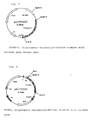
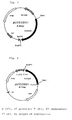
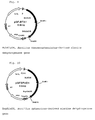
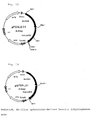
- a recombinant vector which includes a single expression vector and nucleotide sequences integrated into the single expression vector, in which the nucleotide sequences include a nucleotide sequence encoding an enzyme capable of converting the D-form of an amino acid into a keto acid, a nucleotide sequence encoding an enzyme capable of converting a keto acid into the L-form of an amino acid, a nucleotide sequence encoding a coenzyme-regenerating enzyme, and a nucleotide sequence encoding a hydrogen peroxide catabolic enzyme.
- the recombinant vector according to the present invention is, for example, a recombinant vector in which the enzyme capable of converting the D-form of an amino acid into a keto acid is a D-amino acid oxidase, the enzyme capable of converting a keto acid into the L-form of an amino acid is an L-amino acid dehydrogenase, the coenzyme-regenerating enzyme is a formate dehydrogenase, and the hydrogen peroxide catabolic enzyme is a catalase.
- the enzyme capable of converting the D-form of an amino acid into a keto acid is a D-amino acid oxidase
- the enzyme capable of converting a keto acid into the L-form of an amino acid is an L-amino acid dehydrogenase
- the coenzyme-regenerating enzyme is a formate dehydrogenase
- the hydrogen peroxide catabolic enzyme is a catalase.
- the recombinant vector is a recombinant vector in which the D-amino acid oxidase is one derived from Candida boidinii, the L-amino acid dehydrogenase is a phenylalanine dehydrogenase derived from Thermoactinomyces intermedius, the formate dehydrogenase is one derived from Mycobacterium vaccae, and the catalase is one derived from Escherichia coli.
- a process for producing the L-form of an amino acid enzymatically from an enantiomeric mixture of the amino acid includes two or more different reaction steps including an oxidation step and a reduction step.
- the oxidation step mainly includes oxidizing the D-form of an amino acid using a transformant or a treated product thereof, in which the transformant coexpresses at least an enzyme capable of oxidizing the D-form of an amino acid to a keto acid and a hydrogen peroxide catabolic enzyme.
- the reduction step mainly includes synthetically producing the L-form of an amino acid from a keto acid using a transformant or a treated product thereof, in which the transformant expresses an enzyme capable of producing the L-form of an amino acid from a keto acid and optionally coexpresses a coenzyme-regenerating enzyme according to necessity.
- This process is hereinafter also referred to as "L-amino acid production process 2 according to the present invention” or "process 2".
- the transformant according to the present invention may be used.
- the process 2 according to the present invention may be a process in which the oxidation step and the reduction step are carried out under different reaction conditions.
- the oxidation step may be carried out under aeration of an oxygen-containing gas
- the reduction step may be carried out without aeration of an oxygen-containing gas or under aeration of an oxygen-containing gas at an aeration rate lower than that in the oxidation step.
- the process 2 includes, for example, a process in which an aeration rate of the oxygen-containing gas in the oxidation step is 1 percent by volume per minute or more relative to a reaction mixture, and an aeration rate of the oxygen-containing gas in the reduction step is less than 10 percent by volume per minute relative to a reaction mixture.
- the process may be a process in which an aeration rate of the oxygen-containing gas in the oxidation step is 2 percent by volume per minute or more relative to a reaction mixture, and an aeration rate of the oxygen-containing gas in the reduction step is less than 2 percent by volume per minute relative to a reaction mixture.
- the process may be a process in which an aeration rate of the oxygen-containing gas in the oxidation step is 5 percent by volume per minute or more relative to a reaction mixture, and an aeration rate of the oxygen-containing gas in the reduction step is less than 5 percent by volume per minute relative to a reaction mixture.
- the process 2 according to the present invention may also be a process in which an aeration rate of the oxygen-containing gas in the oxidation step is 1 percent by volume per minute or more relative to a reaction mixture, and substantially no aeration of the oxygen-containing gas is conducted in the reduction step.
- the process 2 according to the present invention may be a process in which the reaction mixture in the oxidation step is controlled to have a pH of 7.0 to 9.5, and the reaction mixture in the reduction step is controlled to have a pH falling within a range of 6.0 to 8.5 and being lower than the pH of the reaction mixture in the oxidation step.
- the process 2 may be a process in which the reaction mixture in the oxidation step is controlled to have a pH of 7.5 to 9.0, and the reaction mixture in the reduction step is controlled to have a pH falling within a range of 6.5 to 8.0.
- the transformant according to the present invention or a treated product thereof may be supplemented to the reaction mixture before or after a switch from the oxidation step to the reduction step.
- the pH control in a reaction for converting the D-form of an amino acid into a keto acid may be carried out using formic acid or a salt thereof.
- process 1 and process 2 may use a reaction mixture containing 0.2 equivalent or more of formate ion and/or ammonium ion relative to the material enantiomeric mixture of the amino acid.
- the "enzyme” in the present description may also be a mutant which has been varied in a genetic engineering manner by deletion, substitution, and/or addition of a part of amino acids constituting the enzyme, as long as it has a target enzymatic activity.
- the term "process according to the present invention” is used as generically meaning the process 1 and process 2 according to the present invention.
- a reaction for converting the D-form of an amino acid into a keto acid and a reaction for converting a keto acid into the L-form of an amino acid can be conducted in one pot (in a single system) using a single transformant that expresses specific enzymes and using their enzymatic activities.
- the target L-amino acid can efficiently accumulate in a high concentration, and the L-amino acid can be produced in a theoretical yield of 100% through a smaller number of steps using an inexpensive enantiomeric mixture of the amino acid as a starting material.
- the process includes an oxidation step of oxidizing the D-form of an amino acid to a keto acid
- reactions can be conducted under mild conditions to thereby prevent the keto acid from decomposition, because a hydrogen peroxide catabolic enzyme is expressed in a single host.
- the target L-amino acid can therefore be obtained with satisfactory productivity.
- the L-amino acid production process 1 is a process for producing the L-form of an amino acid enzymatically from an enantiomeric mixture of the amino acid, which includes the step of contacting a transformant or a treated product thereof with an enantiomeric mixture of the amino acid, in which the transformant includes a single host and one or more recombinant vectors introduced into the single host, the one or more recombinant vectors include one or more expression vectors and nucleotide sequences, and the nucleotide sequences include a nucleotide sequence encoding an enzyme capable of converting the D-form of an amino acid into a keto acid and a nucleotide sequence encoding an enzyme capable of converting a keto acid into the L-form of an amino acid.
- the nucleotide sequences are integrated into the one expression vector or the different expression vectors, respectively.
- the target L-amino acid can be produced in a theoretical yield of 100%. This is because the process carries out a reaction for converting the D-form of an amino acid into a keto acid and a reaction for converting a keto acid into the L-form of an amino acid (hereinafter the two reactions together are also referred to as "main reaction(s)”) in one pot (in a single system) by the actions of enzymes expressed in a single transformant, in which an enantiomeric mixture of the amino acid is used as a starting material.
- the L-amino acid production process 1 includes a cultivation step and a reaction step, in which the cultivation step includes inducing the expression of the transformant having the above structure to yield a culture containing target converting enzymes, and the reaction step includes converting a D-form of an amino acid contained in an enantiomeric mixture of the amino acid into the L-form of the amino acid by enzymatic reactions using the culture.
- the cultivation step is a step of inducing the expression of a transformant to yield a culture containing target converting enzymes, in which the transformant is composed of a single host and one or more recombinant vectors introduced thereinto, the one or more recombinant vectors are composed of one or more expression vectors and nucleotide sequences, and the nucleotide sequences include a nucleotide sequence encoding an enzyme capable of converting the D-form of an amino acid into a keto acid and a nucleotide sequence encoding an enzyme capable of converting a keto acid into the L-form of an amino acid.
- the nucleotide sequences are integrated into the one expression vector or the different expression vectors, respectively.
- the enzyme capable of converting the D-form of an amino acid into a keto acid for use in the present invention is not specifically limited, as long as it is an enzyme capable of acting on the D-form of an amino acid to form a corresponding keto acid.
- Examples thereof include D-amino acid oxidases and D-amino acid dehydrogenases.
- Such D-amino acid oxidase can be, for example, a D-amino acid oxidase, or a polypeptide which has an amino acid sequence corresponding to the amino acid sequence of the enzyme, except with a part of amino acids constituting the enzyme being deleted, substituted, and/or added, and is capable of expressing the D-amino acid oxidase.
- Such D-amino acid oxidases are classified as, for example, EC 1.4.3.1, EC 1.4.3.3, EC 1.4.3.7, EC 1.4.3.15, and EC 1.4.3.19 and each have an enzymatic activity of oxidatively deaminating a D-amino acid with oxygen as an electron acceptor in the presence of water to a corresponding keto acid and hydrogen peroxide.
- D-amino acid oxidases that oxidize an amino acid with oxygen as an electron acceptor to an imine but do not yield hydrogen peroxide. These enzymes are also included D-amino acid oxidases for use in the present invention.
- the D-amino acid oxidases may be derived from organisms of every kind.
- Examples of usable D-amino acid oxidases include enzymes derived from microorganisms belonging typically to the genus Candida, the genus Trigonopsis, the genus Schizosaccharomyces, the genus Arthrobacter, the genus Corynebacterium, the genus Pseudomonas, and the genus Rhodotorula; and enzymes derived from the livers of mammals such as humans, mice, pigs, and rabbits ( Biochemistry, 26, 3612 (1987 )).
- enzymes derived from microorganisms include one derived from Arthrobacter protophormiae ( EP 1375649 ), one derived from Candida boidinii ( Yeast, 16, 1217 (2000 )), one derived from Corynebacterium glutamicum ( J. Biotechnol. 104, 5 (2003 )), one derived from Pseudomonas putida ( Environ. Microbiol. 4, 799 (2002 )), one derived from Rhodotorula gracilis ( J. Bacteriol., 58, 115 (1997 )), one derived from Trigonopsis variabilis (Japanese Examined Patent Application Publication ( JP-B) No. H07-108225 ), one derived from Fusarium solani ( J. Biochem., 108, 1063 (1990 )), and one derived from Schizosaccharomyces pombe.
- Arthrobacter protophormiae EP 1375649
- preferred examples include D-amino acid oxidases derived from microorganisms belonging to the genus Candida, such as the Candida boidinii strain DSM 70026; and D-amino acid oxidases derived from microorganisms belonging to the genus Trigonopsis, such as Trigonopsis variabilis strain CBS 4095.
- the D-amino acid dehydrogenase for use herein can be, for example, a D-amino acid dehydrogenase, or a polypeptide which has an amino acid sequence corresponding to the amino acid sequence of the enzyme, except with a part of amino acids constituting the enzyme being deleted, substituted, and/or added, and is capable of expressing the D-amino acid dehydrogenase.
- Such D-amino acid dehydrogenases are classified as, for example, EC 1.4.99.1 and each have an enzymatic activity capable of oxidatively deaminating a D-amino acid typically with 2,6-dichloroindophenol (DCIP) as an electron acceptor to yield a corresponding keto acid.
- DCIP 2,6-dichloroindophenol
- the D-amino acid dehydrogenases may be derived from organisms of every kind. Examples thereof include enzymes derived from microorganisms belonging typically to the genus Escherichia, the genus Pseudomonas, the genus Salmonella, and the genus Flavobacterium.
- enzymes derived from microorganisms include one derived from Escherichia coli ( J. Bacteriol., 176, 1500 (1994 )), one derived from Pseudomonas aeruginosa ( Curr. Microbiol. 41, 290 (2000 )), one derived from Salmonella typhimurium ( Nature, 413, 852 (2001 )), and one derived from Flavobacterium sp. ( J. Gen. Microbiol. 133, 745-754 (1987) ).
- D-amino acid dehydrogenases derived from microorganisms belonging to the genus Escherichia, such as Escherichia coli strain K-12, are preferably used.
- the activity of an enzyme capable of converting the D-form of an amino acid into a keto acid for use in the present invention can be determined according to the following procedure. Specifically, the enzymatic activity of a D-amino acid oxidase is determined by a process of reacting a reaction mixture at 30°C, in which the reaction mixture contains 100 mM potassium phosphate buffer (pH 8.0), 10 mM of the D-amino acid, 0.5 mM 4-aminoantipyrine, 2 mM phenol, and 5 U/mL peroxidase, and the amount of the enzyme that catalyzes the production of 0.5 ⁇ mol of quinonimine per one minute is defined as one unit (1 U).
- the enzymatic activity of a D-amino acid dehydrogenase is determined by a process of reacting a reaction mixture at 30°C, in which the reaction mixture contains 100 mM Tris-HCl buffer (pH 8.0), 10 mM D-amino acid, and 0.1 mM 2,6-dichloroindophenol (DCIP) sodium salt, and the amount of the enzyme that catalyzes decrease of 1 ⁇ mol of DCIP per one minute is defined as 1 U.
- the enzyme capable of converting a keto acid into the L-form of an amino acid for use in the present invention is not specifically limited as long as it is an enzyme capable of acting on a keto acid to yield a corresponding L-amino acid.
- Examples thereof include L-amino acid dehydrogenase, and polypeptides having L-amino acid transaminase activities.
- the L-amino acid dehydrogenases each have an enzymatic activity capable of reductively aminating an ⁇ -keto acid in the presence of, for example, NAD(P)H and ammonia to yield a corresponding L-amino acid.
- L-amino acid dehydrogenases examples include alanine dehydrogenases (EC 1.4.1.1), glutamate dehydrogenases (EC 1.4.1.2, EC 1.4.1.3, EC 1.4.1.4), L-amino acid dehydrogenases (EC 1.4.1.5), serine dehydrogenases (EC 1.4.1.7), valine dehydrogenases (EC 1.4.1.8), leucine dehydrogenases (EC 1.4.1.9), glycine dehydrogenases (EC 1.4.1.10), lysine dehydrogenases (EC 1.4.1.15), tryptophan dehydrogenases (EC 1.4.1.19), and phenylalanine dehydrogenases (EC 1.4.1.20).
- alanine dehydrogenases EC 1.4.1.1
- glutamate dehydrogenases EC 1.4.1.2, EC 1.4.1.3, EC 1.4.1.4
- L-amino acid dehydrogenases EC 1.4.1.5
- the L-amino acid dehydrogenases may be derived from organisms of every kind.
- Examples of usable L-amino acid dehydrogenases include enzymes derived from microorganisms; and enzymes derived from mammals such as humans, mice, pigs, and cattle.
- alanine dehydrogenases examples include alanine dehydrogenases derived from organisms, such as one derived from Geobacillus stearothermophilus ( Biochemistry, 29, 1009 (1990 )), one derived from Bacillus thermocatenulatus ( Biochimie, 71, 559 (1989 )), one derived from Shewanella sp. ( Appl. Environ. Microbiol., 65, 4014 (1999 )), and one derived from Bacillus sphaericus, such as Bacillus sphaericus IFO 3525 ( Biochemistry, 29, 1009 (1990 ); Accession No. M33298).
- organisms such as one derived from Geobacillus stearothermophilus ( Biochemistry, 29, 1009 (1990 )), one derived from Bacillus thermocatenulatus ( Biochimie, 71, 559 (1989 )), one derived from Shewanella sp. ( Appl. Environ. Microbiol., 65, 40
- the glutamate dehydrogenases include glutamate dehydrogenases derived from organisms, such as one derived from the bovine liver ( J. Biochem. Mol. Biol., 36, 545 (2003 ), one derived from Bacillus subtilis ( J. Bacteriol., 180, 6298 (1998 )), one derived from Sulfolobus solfataricus ( Biochemistry, 203, 81 (1992 )), and one derived from Saccharomyces cerevisiae ( Biochemistry, 217, 469 (1993 )).
- the L-amino acid dehydrogenases (EC 1.4.1.5) include L-amino acid dehydrogenases derived from organisms such as obligate anaerobes.
- Examples of the serine dehydrogenases include enzymes derived from microorganisms, such as one derived from Agrobacterium tumefaciens (Accession No. AB032242).
- valine dehydrogenases examples include valine dehydrogenases derived from organisms, such as one derived from Cytophaga sp. (Accession No. AF339150).
- leucine dehydrogenases examples include leucine dehydrogenases derived from organisms, such as one derived from Geobacillus stearothermophilus ( Biochemistry, 27, 9056 (1988 )) and one derived from Bacillus sphaericus.
- glycine dehydrogenases examples include glycine dehydrogenases derived from organisms, such as one derived from Escherichia coli ( Eur. J. Biochem. 216, 539 (1993 )).
- lysine dehydrogenases examples include enzymes derived from organisms, such as one derived from Geobacillus stearothermophilus ( Appl. Environ. Microbiol. 70, 937 (2004 )).
- phenylalanine dehydrogenases examples include phenylalanine dehydrogenases derived from organisms, such as one derived from Thermoactinomyces intermedius ( J. Biochem., 109, 371 (1991 )), one derived from Brevibacterium sp. ( JP-A No. S63-157986 ), one derived from Sporosarcina urea ( JP-A No. S61-239887 ), one derived from Bacillus sphaericus ( JP-A No. S63-157986 ), one derived from Bacillus badius ( JP-A No. S63-157986 ), one derived from Rhodococcus sp.
- organisms such as one derived from Thermoactinomyces intermedius ( J. Biochem., 109, 371 (1991 )), one derived from Brevibacterium sp. ( JP-A No. S63-157986 ), one derived from Sporosarcina ure
- JP-A No. S61-146183 one derived from Nocardia sp. ( Arch. Microbiol., 153, 12 (1989 )), and one derived from Halomona pacifica ( JP-A No. 2002-65270 ).
- L-amino acid dehydrogenases derived from microorganisms belonging to, for example, the genus Geobacillus, the genus Bacillus, the genus Shewanella, and the genus Thermoactinomyces.
- L-amino acid dehydrogenases examples include a phenylalanine dehydrogenase derived from Thermoactinomyces intermedius, an alanine dehydrogenase derived from Geobacillus stearothermophilus, an alanine dehydrogenase derived from Bacillus thermocatenulatus, an alanine dehydrogenase derived from Bacillus sphaericus, an alanine dehydrogenase derived from Shewanella sp., a leucine dehydrogenase derived from Geobacillus stearothermophilus, and a leucine dehydrogenase derived from Bacillus sphaericus.
- L-Amino acid transaminases each have an enzymatic activity of transferring amino group from an amino donor, such as L-glutamic acid or L-aspartic acid, to an ⁇ -keto acid to yield a corresponding L-amino acid.
- L-amino acid transaminases include alanine transaminases (EC 2.6.1.2), cysteine transaminases (EC 2.6.1.3), glycine transaminases (EC 2.6.1.4), tyrosine transaminases (EC 2.6.1.5), leucine transaminases (EC 2.6.1.6), tryptophan transaminases (EC 2.6.1.27), histidine transaminases (EC 2.6.1.38), branched-chain-amino-acid transaminases (EC 2.6.1.42), and aromatic-L-amino-acid transaminases (EC 2.6.1.57).
- alanine transaminases EC 2.6.1.2
- cysteine transaminases EC 2.6.1.3
- glycine transaminases EC 2.6.1.4
- tyrosine transaminases EC 2.6.1.5
- leucine transaminases EC 2.6.1.6
- L-amino acid transaminases may be derived from organisms of every kind.
- Examples usable L-amino acid transaminases include enzymes derived from microorganisms; and enzymes derived from mammals such as humans, rats, and mice.
- L-amino acid transaminases include an alanine transaminase derived from Oryza sativa ( Plant Mol. Biol. 39, 149 (1999 )); a cysteine transaminase derived from a mammal such as a rat ( Physiol. Chem. Phys., 10, 483 (1978 )); a glycine transaminase derived from a mammal such as a human or a rat ( J. Biol. Chem., 242, 3614 (1967 )); a tyrosine transaminase derived from a mammal such as a rat ( Anal.
- branched-chain-amino-acid transaminases examples include branched-chain-amino-acid transaminases derived from organisms, such as one derived from Escherichia coli ( J. Biochem., 97, 993 (1985 )) and one derived from Bacillus subtilis ( J. Bacteriol., 179, 496 (1997 )).
- aromatic-amino-acid transaminases include aromatic-amino-acid transaminases derived from organisms, such as one derived from Escherichia coli ( Biochem. Biophys. Res. Commun., 133, 134 (1985 )) and one derived from Paracoccus denitrificans ( JP-A No. H01-153084 ).
- branched-chain-amino-acid transaminases of which particularly preferred are amino acid transaminases derived from microorganisms, such as a branched-chain-amino-acid transaminase derived from a microorganism belonging to the genus Escherichia such as Escherichia coli strain K-12; and a branched-chain-amino-acid transaminase derived from a microorganism belonging to the genus Bacillus, such as Bacillus subtilis.
- amino acid transaminases derived from microorganisms such as a branched-chain-amino-acid transaminase derived from a microorganism belonging to the genus Escherichia such as Escherichia coli strain K-12; and a branched-chain-amino-acid transaminase derived from a microorganism belonging to the genus Bacillus, such
- the activity of an enzyme capable of converting a keto acid into the L-form of an amino acid for use in the present invention can be determined, for example, according to the following processes.
- the activity of an L-amino acid dehydrogenase can be determined by a process of reacting a reaction mixture at 30°C, in which the reaction mixture contains 200 mM glycine-potassium chloride-potassium hydroxide buffer (pH 10.5), 10 mM of an L-amino acid, and 2.5 mM NAD+, and the amount of the enzyme that yields 1 ⁇ mol of reduced-form nicotinamide adenine dinucleotide (NADH) per one minute is defined as one unit (1 U).
- the activity of an L-amino acid transaminase can be determined by a process of reacting a reaction mixture at 30°C, in which the reaction mixture contains 100 mM Tris-HC1 buffer (pH 8.0), 50 mM ammonium chloride, 10 mM sodium ⁇ -ketoisocaproate, 40 mM of an L-amino acid (amino donor), 0.05 mM pyridoxal-5'-phosphate, 0.2 mM reduced-form nicotinamide adenine dinucleotide phosphate (NADPH), and 5 U/mL glutamate dehydrogenase derived from Proteus species (TOYOBO CO., LTD.), and the amount of the enzyme that catalyzes decrease of 1 ⁇ mol of NADPH per one minute is defied as one unit (1 U).
- Tris-HC1 buffer pH 8.0
- 50 mM ammonium chloride 10 mM sodium ⁇ -ketoisocapro
- a nucleotide sequence encoding another enzyme may be integrated into an expression vector, in which the expression vector may be the same as or different from the expression vector(s) containing target converting enzymes integrated thereinto, within ranges not adversely affecting the enzymatic activities.
- the other enzymes include enzymes capable of decomposing a substance inhibiting a main reaction from proceeding, such as a hydrogen peroxide catabolic enzyme; and enzymes capable of regenerating a substrate to be consumed in a main reaction, such as a coenzyme-regenerating enzyme.
- the hydrogen peroxide catabolic enzyme acts to efficiently proceed main reactions by its activity of decomposing and removing hydrogen peroxide, which hydrogen peroxide is by-produced in a reaction using a D-amino acid oxidase and inhibits main reactions from proceeding.
- the hydrogen peroxide catabolic enzyme can be, for example, a catalase or a polypeptide (catalase-like enzyme) which has an amino acid sequence corresponding to the amino acid sequence of the catalase, except with a part of amino acids constituting the catalase being deleted, substituted, and/or added, and is capable of expressing a hydrogen peroxide catabolic (decomposing) activity.
- Examples of usable catalases include known catalases derived typically from microorganisms, such as a catalase derived from Escherichia coli .
- Specific preferred examples of the catalase derived from Escherichia coli include katE ( J. Biol. Chem., 254, 11664-11668 (1979 )) and katG ( J. Biol. Chem., 254, 4245-4252 (1979) ).
- the activity of decomposing hydrogen peroxide can be determined, for example, by a process of reacting a reaction mixture at 30°C, in which the reaction mixture contains 50 mM potassium phosphate buffer (pH 7.0) and 0.035% hydrogen peroxide, and the amount of the enzyme that catalyzes decomposition of 1 ⁇ mol of hydrogen peroxide per one minute is defined as one unit (1 U).
- the coenzyme-regenerating enzyme can proceed a main reaction by its activity of regenerating coenzyme NAD(P)H, which NAD(P)H is consumed with the proceeding of a reaction using a L-amino acid dehydrogenase.
- a transformant which is capable of regenerating coenzyme NAD(P)H for use in the present invention can be, for example, a transformant composed of a host having an activity of regenerating coenzyme NAD(P)H, and one or more recombinant vectors introduced thereinto, in which the one or more recombinant vectors have nucleotide sequences corresponding to target converting enzymes integrated thereinto; and/or a transformant composed of a single host and one or more recombinant vectors introduced thereinto, in which the one or more recombinant vectors are composed of one or more expression vectors and nucleotide sequences, and the nucleotide sequences include a nucleotide sequence encoding an enzyme capable of converting the D-form of an amino acid into a keto acid, a nucleotide sequence encoding an L-amino acid dehydrogenase, and a nucleotide sequence encoding a coenzyme-
- the host having an activity of regenerating NAD(P)H can be a microorganism within a broad range, in which the coenzyme is regenerated typically by the action of a glycolytic pathway or a methylotrophic single-carbon (C1) utilization pathway of the microorganism.
- the coenzyme-regenerating enzyme can be, for example, a coenzyme-regenerating enzyme or a polypeptide which has an amino acid sequence corresponding to the amino acid sequence of the coenzyme-regenerating enzyme, except with a part of amino acids constituting the enzyme being deleted, substituted, and/or added, and is capable of expressing an enzymatic activity of regenerating a coenzyme.
- coenzyme-regenerating enzymes examples include formate dehydrogenases, glucose dehydrogenases, alcohol dehydrogenases, amino acid dehydrogenases, and organic acid dehydrogenases such as malate dehydrogenases.
- the coenzyme-regenerating enzymes may be derived from organisms of every kind. Among them, preferred are a formate dehydrogenase derived from a microorganism belonging to the genus Mycobacterium; and glucose dehydrogenases derived from microorganisms belonging to the genus Bacillus and the genus Thermoplasma.
- usable coenzyme-regenerating enzymes include a formate dehydrogenase derived typically from Mycobacterium vaccae as a NADH regenerating enzyme; and glucose dehydrogenases such as one derived from Bacillus subtilis, one derived from Thermoplasma acidphilum, one derived from Bacillus megaterium, and one derived from Bacillus cereus, as NAD(P)H regenerating enzymes.
- the activity of a coenzyme-regenerating enzyme can be determined, for example, in the following manner.
- the activity of a formate dehydrogenase for example, can be determined by a process of reacting a reaction mixture at 30°C, in which the reaction mixture contains 100 mM potassium phosphate buffer (pH 7.0), 100 mM sodium formate, and 2.5 mM NAD+, and the amount of the enzyme that catalyzes the production of 1 ⁇ mol of NADH per one minute is defined as one unit (1 U).
- the nucleotide sequence encoding an enzyme for use in the present invention can be any nucleotide sequence that encodes a polypeptide expressing a target enzymatic activity.
- Such nucleotide sequences include known nucleotide sequences, part or all of which are in public in DNA Data Bank of Japan (DDBJ); and nucleotide sequences which are determined as corresponding to amino acid sequences identified from purified enzymes. These nucleotide sequences can be prepared using known processes such as processes using polymerase chain reactions (PCR) and other amplification procedures; and chemical synthesis processes.
- PCR polymerase chain reactions
- the expression vectors for use herein can be plasmid vectors and phage vectors. Such expression vectors can be selected as appropriate according to the type of a host, and the types and number of genes to be integrated. Each of these expression vectors can be used alone or in combination. Specific examples of expression vectors corresponding to a host will be mentioned later.
- One or more recombinant vectors are used as recombinant vectors in the present invention, in which the one or more recombinant vectors are composed of one or more expression vectors and nucleotide sequences, and the nucleotide sequences include a nucleotide sequence encoding an enzyme capable of converting the D-form of an amino acid into a keto acid, and a nucleotide sequence encoding an enzyme capable of converting a keto acid into the L-form of an amino acid.
- the nucleotide sequences are integrated into the one expression vector or the different expression vectors, respectively.
- a recombinant vector composed of a single expression vector and nucleotide sequences integrated thereinto, in which the nucleotide sequences include a nucleotide sequence encoding an enzyme capable of converting the D-form of an amino acid into a keto acid, and a nucleotide sequence encoding an enzyme capable of converting a keto acid into the L-form of an amino acid.
- a nucleotide sequence corresponding to another enzyme may further be integrated into an expression vector which is the same as or different from the expression vector(s) containing the above-mentioned nucleotide sequences integrated thereinto.
- recombinant vectors for use in the present invention include: a two-gene-expressing recombinant vector, which is composed of a single expression vector and nucleotide sequences integrated thereinto, in which the nucleotide sequences include a nucleotide sequence corresponding to an enzyme capable of converting the D-form of an amino acid into a keto acid and a nucleotide sequence corresponding to an enzyme capable of converting a keto acid into the L-form of an amino acid; a multiple-gene-expressing recombinant vector, which is composed of a single expression vector and nucleotide sequences integrated thereinto, in which the nucleotide sequences include a nucleotide sequence corresponding to an enzyme capable of converting the D-form of an amino acid into a keto acid, a nucleotide sequence corresponding to an enzyme capable of converting a keto acid into the L-form of an amino acid, and a nucleotide sequence corresponding to another arbitrary enzyme;
- a single recombinant vector expressing multiple genes is preferably used, for yielding a transformant without problems such as incompatibility and for better workability and handleability.
- recombinant vectors of this type include a recombinant vector composed of a single expression vector and nucleotide sequences integrated thereinto, in which the nucleotide sequences include a nucleotide sequence encoding an enzyme capable of converting the D-form of an amino acid into a keto acid and a nucleotide sequence encoding an enzyme capable of converting a keto acid into the L-form of an amino acid; and a multiple-gene-expressing recombinant vector composed of a single expression vector and nucleotide sequences integrated thereinto, in which the nucleotide sequences include a nucleotide sequence corresponding to an enzyme capable of converting the D-form of an amino acid into a keto acid, a nucleotide sequence corresponding to an enzyme capable of converting
- the enzyme capable of converting the D-form of an amino acid into a keto acid is a D-amino acid oxidase
- preferred is a recombinant vector using a hydrogen peroxide catabolic enzyme, of which a catalase is preferred, as the "other arbitrary enzyme", or a combination of this recombinant vector and one or more other recombinant vectors.
- This configuration is for suppressing the decomposition of the keto acid by the action of by-produced hydrogen peroxide and reducing oxygen required for an oxidation reaction of the D-amino acid to thereby proceed main reactions smoothly.
- recombinant vectors and combinations thereof include: a four-gene-expressing recombinant vector which is composed of a single expression vector and nucleotide sequences integrated thereinto, in which the nucleotide sequences include a nucleotide sequence corresponding to an enzyme capable of converting the D-form of an amino acid into a keto acid, a nucleotide sequence corresponding to an L-amino acid dehydrogenase, a nucleotide sequence corresponding to a hydrogen peroxide catabolic enzyme, and a nucleotide sequence corresponding to a coenzyme-regenerating enzyme; a three-gene-expressing recombinant vector which is composed of a single expression vector and nucleotide sequences integrated thereinto, in which the nucleotide sequences include a nucleotide sequence corresponding to an enzyme capable of converting the D-form of an amino acid into a keto acid, a nucleotide sequence corresponding to an L
- the enzyme capable of converting a keto acid into the L-form of an amino acid is an L-amino acid dehydrogenase
- preferred is a recombinant vector using a coenzyme-regenerating enzyme as the "other arbitrary enzyme", or a combination of the recombinant vector and one or more other vectors. This configuration proceeds main reactions smoothly.
- recombinant vectors and combinations thereof include: a three-gene-expressing recombinant vector which is composed of a single expression vector and nucleotide sequences integrated thereinto, in which the nucleotide sequences include a nucleotide sequence corresponding to an enzyme capable of converting the D-form of an amino acid into a keto acid, a nucleotide sequence corresponding to an L-amino acid dehydrogenase, and a nucleotide sequence corresponding to a coenzyme-regenerating enzyme; a combination of a multiple-gene-expressing recombinant vector and a one-gene-expressing recombinant vector, in which the multiple-gene-expressing recombinant vector is composed of a single expression vector and nucleotide sequences integrated thereinto, the nucleotide sequences are at least two or more nucleotide sequences selected from a nucleotide sequence corresponding to an enzyme capable of converting the D-
- an enzymatic activity thereof may be expressed as a result of direct transcription and translation from the recombinant vector, or the enzymatic activity may be expressed after the introduced nucleotide sequence is integrated into a chromosome of the host.
- the construction of such a recombinant vector is carried out by a process of integrating a nucleotide sequence corresponding to a target converting enzyme into an expression vector in an expressible manner.
- the process of integrating a nucleotide sequence corresponding to a target converting enzyme into an expression vector in an expressible manner used herein is generally a process of integrating a region involved in regulation of expression (expression regulation unit), such as a promoter or a terminator, into the vicinity of a target nucleotide sequence.
- expression regulation unit such as a promoter or a terminator
- the process can be, for example, a process of connecting expression regulation units, such as promoters and/or terminators, to respective genes; or a process of expressing them as an operon containing two or more cistrons, such as lactose operon.
- Examples of preferred structures of such recombinant vectors include a structure in which a promoter is arranged in a 5' upstream region of a target nucleotide sequence, and more preferably a structure in which a terminator is arranged in a 3' downstream region of the target nucleotide sequence, in addition to the promoter.
- Usable vectors, promoters, and terminators according to the type of an organism used as the host are described in detail, for example, in " Biseibutsugaku Kisokoza 8 Idensikougaku (in Japanese; Basic Miclobiology (8), Genetic Engineering), Kyoritsu Shuppan Co., Ltd. ", of which yeasts are described in detail in Adv. Biochem. Eng.
- Yeast 8, 423-488 (1992) there have been developed systems of expressing a heteroprotein in a large amount in a host, in which the host is an insect such as silkworm ( Nature 315, 592-594 (1985) ), or another animal, or rapeseed, corn, potato, or another vegetable. These systems are preferably used herein.
- the construction of a recombinant vector according to the type of a host can be carried out according to a technique commonly used in the fields of molecular biology, biological engineering, and genetic engineering, as described, for example, by Sambrook et al. in Molecular Cloning, Cold Spring Harbor Laboratories.
- plasmid pSFTPC01 which is composed of a three-gene expressing vector pSE420U, which is a modification of a pSE420D ( JP 2000-189170A ), and, sequentially inserted thereinto, a gene encoding a D-amino acid oxidase derived from Candida boidinii, a formate dehydrogenase derived from Mycobacterium vaccae, and a gene encoding a phenylalanine dehydrogenase derived from Thermoactinomyces intermedius; and plasmids pSFGACO1, pSFTPCO2, and pSFTPCO3 having, inserted thereinto in any order, a gene encoding a D-amino acid oxidase derived from Candida boidinii, a formate dehydrogenase derived from Mycobacterium vaccae, and a gene encoding a D-amino acid oxidase
- the recombinant vectors further include a recombinant vector pSCCBDO1 which coexpresses a gene encoding a D-amino acid oxidase derived from Candida boidinii and a gene encoding catalase derived from Escherichia coli; a recombinant vector pSF-TIP2 which coexpresses a gene encoding a formate dehydrogenase derived from Mycobacterium vaccae and a gene encoding a gene encoding phenylalanine dehydrogenase derived from Thermoactinomyces intermedius; and pSFCPCO1 which coexpresses four genes including a gene encoding a D-amino acid oxidase derived from Candida boidinii, a gene encoding a catalase derived from Escherichia coli, a gene encoding a phenylalanine dehydrogenas
- a host into which recombinant vectors are introduced is not specifically limited, as long as it is an organism into which one or more recombinant vectors containing nucleotide sequences corresponding to the target enzymes can be introduced and which can express the target enzymes.
- the host can be selected from among organisms of wide variety, such as microorganisms, vegetables (plants), and animals.
- Microorganisms in which expression vector systems usable as a host have been developed can be used as microorganisms usable as a host.
- Examples thereof include bacteria such as those belonging to the genus Escherichia, the genus Bacillus, the genus Pseudomonas, the genus Serratia, the genus Brevibacterium, the genus Corynebacterium, the genus Streptococcus, and the genus Lactobacillus; mycobacteria in which host vector systems have been developed, such as those belonging to the genus Rhodococcus and the genus Streptomyces; yeasts in which host vector systems have been developed, such as those belonging to the genus Saccharomyces, the genus Kluyveromyces, the genus Schizosaccharomyces, the genus Zygosaccharomyces, the genus Yarrowia, the genus Trichosporon, the genus Rh
- examples of the combinations include combinations each composed of: a pBR series or pUC series plasmid vector; a promoter derived from lac ( ⁇ -galactosidase), trp (tryptophan operon), tac, trc (chimera of lac and trp), or PL or PR of lambda phase; and a terminator derived from trpA, a phage, or rrnB ribosomal RNA.
- a vector pSE420D JP-A No.
- a multicloning site of a commercially available pSE420 (Invitrogen) is partially modified; a vector pSE420U capable of coexpressing three genes; and a vector pSE420Q capable of coexpressing four genes.
- plasmid vectors such as pUB110 series plasmids and pC194 series plasmids can be used. Such plasmid vectors can be integrated into a chromosome.
- Usable promoters and terminators include those derived from apr (alkaline protease), npr (neutral protease), and/or amy ( ⁇ -amylase).
- host-vector systems typically for Pseudomonas putida and Pseudomonas cepacia, respectively, as a host.
- Available vectors include a broad-host vector pKT240 based on a plasmid TOL which participates in the decomposition of toluene compounds.
- Such a broad-host vector contains genes which are necessary for autologous replication and are derived typically from RSF1010.
- Available promoters and terminators include the lipase gene ( JP-A No. H05-284973 ).
- plasmid vectors such as pAJ43 ( Gene 39, 281 (1985 )) can be used. Promoters and terminators used in Escherichia coli can be used without any modification for Brevibacterium.
- plasmid vectors such as pCS11 ( JP-A No. S57-183799 ) and pCB101 ( Mol. Gen. Genet. 196, 175 (1984 )) can be used.
- plasmid vectors include pHV1301 ( FEMS Microbiol. Lett. 26, 239 (1985 ) and pGK1 ( Appl. Environ. Microbiol. 50, 94 (1985 )).
- pAM ⁇ 1 J. Bacteriol. 137, 614 (1979 )
- the promoters exemplified in the genus Bacillus can also be used herein.
- Rhodococcus rhodochrous J. Gen. Microbiol. 138, 1003 (1992 )
- plasmids can be constructed according to the process described by Hopwood et al. in Genetic Manipulation of Streptomyces: A Laboratory Manual Cold Spring Harbor Laboratories (1985 ).
- pIJ486 Mol. Gen. Genet. 203, 468-478 (1986)
- pKC1064 Gene 103, 97-99 (1991)
- pUWL-KS Gene 165,149-150 (1995)
- Streptomyces virginiae Actinomycetol. 11, 46-53 (1997) ).
- Integration vectors are very useful, because they are integrated into chromosome via homologous recombination with multicopy-ribosomal genes, allow to introduce a gene of interest in multicopy and the gene incorporated is stably maintained in the microorganism.
- Usable promoters and terminators include those derived from genes encoding, for example, ADH (alcohol dehydrogenase), GAPDH (glyceraldehyde-3-phosphate dehydrogenase), PHO (acidic phosphatase), GAL ( ⁇ -galactosidase), PGK (phosphoglycerate kinase), and ENO (enolase).
- ADH alcohol dehydrogenase
- GAPDH glycoside dehydrogenase
- PHO acidic phosphatase
- GAL ⁇ -galactosidase
- PGK phosphoglycerate kinase
- ENO enolase
- usable plasmids include 2 ⁇ m-series plasmids derived from Saccharomyces cerevisiae; pKD1 series plasmids derived from Saccharomyces cerevisiae ( J. Bacteriol.
- plasmids derived from pGKl1 involved in the killer activity plasmids derived from autonomous replication gene KARS in a microorganism belonging to the genus Kluyveromyces; and vector plasmids that can be integrated into chromosome through homologous recombination typically with ribosomal DNA (e.g., EP 537456 ).
- Promoters and terminators derived typically from ADH and PGK can be used.
- plasmid vectors containing ARS autonomous replication sequence
- Schizosaccharomyces pombe and auxotrophy-complementing selectable markers derived from Saccharomyces cerevisiae ( Mol. Cell. Biol. 6, 80 (1986 )
- Usable promoters include ADH promoters derived from Schizosaccharomyces pombe ( EMBO J. 6, 729 (1987 )).
- pAUR224 is commercially available from Takara Shuzo Co., Ltd., so that it is easily used.
- plasmid vectors derived typically from pSB3 derived from Zygosaccharomyces rouxii ( Nucleic Acids Res. 13, 4267 (1985 )).
- Usable promoters include PHO5 promoter derived from Saccharomyces cerevisiae and GAP-Zr (glyceraldehyde-3-phosphate dehydrogenase) promoter derived from Zygosaccharomyces rouxii ( Agri. Biol. Chem. 54, 2521 (1990 )).
- Pichia angusta When the host is a microorganism belonging to the genus Pichia, host-vector systems have been developed for Pichia angusta (formerly Hansenula polymorpha).
- Usable vectors include those derived from autonomous replication genes (HARS1, HARS2) derived from Pichia angusta. However, these are relatively unstable, and multicopy integration of these genes into chromosome is effective ( Yeast 7, 431-443 (1991) ).
- Promoters for AOX (alcohol oxidase) and FDH (formate dehydrogenase) genes induced typically with methanol can be used.
- Host-vector systems using the autonomous replication sequences (PARS1, PARS2) derived from Pichia have been developed typically for Pichia pastoris ( Mol. Cell. Biol. 5, 3376 (1985 )), and highly efficient promoters, such as AOX promoter inducible with methanol and high-cell-density culture, are usable ( Nucleic Acids Res
- ARS autonomous replication sequence
- microorganisms such as Aspergillus niger and Aspergillus oryzae have been most intensively investigated among fungi, and plasmid vectors and chromosome-integration vectors are usable, as well as promoters derived from extracellular protease gene and amylase gene are available ( Trends in Biotechnology 7, 283-287 (1989) ).
- Trichoderma When the host is a microorganism belonging to the genus Trichoderma, host-vector systems using Trichoderma reesei have been developed, and promoters such as one derived from the extracellular cellulase gene are usable ( Biotechnology 7, 596-603 (1989) ).
- insects such as silkworm ( Nature 315, 592-594 (1985) ) or plants such as rapeseed, corn, and potato, and these systems are advantageously used for expression of large amounts of heteroproteins.
- a process for introducing a recombinant vector into a host can be a known or common procedure and process as selected according to the type of the host.
- a transformant composed of a single host and one or more recombinant vectors capable of expressing target enzymes can be formed.
- Transformants according to the present invention are constructed by introducing one or more of the above-exemplified recombinant vectors into a single host.
- Representative examples of the transformants according to the present invention include: a transformant which contains a single recombinant vector composed of a single expression vector and two nucleotide sequences integrated thereinto, in which the two nucleotide sequences are a nucleotide sequence encoding an enzyme capable of converting the D-form of an amino acid into a keto acid and a nucleotide sequence encoding an enzyme capable of converting a keto acid into the L-form of an amino acid; a single transformant which contains a single host and multiple recombinant vectors introduced thereinto, in which the multiple recombinant vectors are composed of the two nucleotide sequences integrated into different expression vectors; and a single transformant which is composed of a single host and one or more recombinant vectors and the other two or more recombinant vector
- Preferred transformants include transformants in which, in the above-mentioned structure, the enzyme capable of converting the D-form of an amino acid into a keto acid is a D-amino acid oxidase, the enzyme capable of converting a keto acid into the L-form of an amino acid is an L-amino acid dehydrogenase, the coenzyme-regenerating enzyme is a formate dehydrogenase, and the hydrogen peroxide catabolic enzyme is a catalase, of which more preferred are transformants in which the D-amino acid oxidase is one derived from Candida boidinii, the L-amino acid dehydrogenase is a phenylalanine dehydrogenase derived from Thermoactinomyces intermedius, the formate dehydrogenase is one derived from Mycobacterium vaccae, and the catalase is one derived from Escherichia coli.
- preferred transformants for use in the present invention include a transformant which is capable of coexpressing at least an enzyme capable of oxidizing the D-form of an amino acid to a keto acid, a hydrogen peroxide catabolic enzyme, and an enzyme capable of converting a keto acid into the L-form of an amino acid.
- the keto acid is inhibited from decomposition due to hydrogen peroxide and can be formed in a higher yield, which hydrogen peroxide has been by-produced in an oxidation reaction of the D-amino acid.
- the preferred transformant may be capable of further coexpressing a coenzyme-regenerating enzyme according to necessity. In this case, a reductive amination reaction of the keto acid can be efficiently proceeded by the action of the coenzyme-regenerating enzyme to yield a corresponding L-amino acid in a high yield.
- an enzyme capable of converting the D-form of an amino acid into a keto acid and an enzyme capable of converting a keto acid into the L-form of an amino acid can be coexpressed by cultivating a transformant having the above-mentioned structure alone. Consequently, the number of production steps can be reduced, because a reaction for converting the D-form of an amino acid into a keto acid and a reaction for converting the keto acid into an L-amino acid (main reactions) can be carried out in one pot (in a single system). In addition, the main reactions can efficiently proceed by the actions of enzymes accumulated in high concentrations, because a forced expression system using vectors is employed according to the present invention. Accordingly, the L-form of an amino acid can be produced in a theoretical yield of 100% using an inexpensive enantiomeric mixture of the amino acid as a starting material.
- Media for use in cultivation of the transformant include liquid media and solid media each containing at least useful components necessary for the growth of a host, such as proteins, lipids, carbohydrates, vitamins, and minerals.
- liquid media are preferably used, because the resulting culture can be used without modification in enzymatic reactions.
- Such media may further contain additives of every kind.
- the cultivation step yields a culture containing an enzyme capable of converting the D-form of an amino acid into a keto acid, and enzyme capable of converting a keto acid into the L-form of an amino acid, and, where necessary, one or more other enzymes accumulated in high concentrations.
- the reaction step enzymatic reactions for converting the D-form of an amino acid contained in an enantiomeric mixture of the amino acid into the L-form of the amino acid proceed using a culture or a treated product thereof obtained in the cultivation step.
- the reaction step is a step in which an enzymatic reaction of converting the D-form of an amino acid into a keto acid, and another enzymatic reaction of converting the formed keto acid into the L-form of the amino acid proceed in a single system using an enantiomeric mixture of the amino acid as a starting material, to thereby yield the L-form of the amino acid accumulated in a high concentration.
- a reaction mixture in the reaction step at least contains a culture obtained in the cultivation step or a treated product thereof, and an enantiomeric mixture of the amino acid as a starting material.
- the culture obtained in the cultivation step is composed of at least a transformant in which expressions are induced, and a medium.
- the culture can be used in the reaction step without any treatment, but it is preferred to remove the medium from the culture to thereby yield a transformant as a treated product of the culture, because a reaction mixture suitable for enzymatic reactions can be easily prepared using the resulting transformant.
- the treated product of the culture can be a treated product of the culture which has been subjected to a suitable treatment such as crushing, concentration, dilution, filtration, centrifugal separation, extraction, and/or immobilization within ranges where target enzymatic activities induced and expressed in the culture can be maintained.
- the treated product of the culture used can be, for example, a microorganism having an increased membrane permeability by the action of a surfactant or an organic solvent, an immobilized microorganism, or a cell-free extract which is prepared by crushing cells typically using a homogenizer or by the application of ultrasound.
- the "enantiomeric mixture of (the) amino acid" used as a starting material is a mixture of a pair of the D-form and L-form of an amino acid.
- Such mixtures include mixtures having the ratio of the D-form of an amino acid to the L-form of the amino acid of, for example, 10:90 to 90:10, preferably 25:75 to 75:25, and more preferably 50:50 (racemate).
- Examples of amino acids constituting such enantiomeric mixtures include a compound represented by following Formula (1) : wherein R represents a hydrocarbon group which may have one or more substituents.
- R represents a hydrocarbon group which may have one or more substituents.
- the hydrocarbon group in R include straight- or branched-chain hydrocarbon groups such as methyl, ethyl, propyl, propenyl, butyl, isobutyl, and butenyl; alicyclic hydrocarbon groups such as cyclopentane and cyclohexane; and aromatic hydrocarbon groups such as phenyl.
- substituents which the hydrocarbon group may have include halogen atoms, amino groups, nitro group, alkyl groups, and alkoxy groups.
- amino acids for use in the present invention include norvaline, norleucine, homophenylalanine, o-nitrophenylalanine, m-nitrophenylalanine, p-nitrophenylalanine, 2-aminobutyric acid, and ⁇ -naphthylalanine.
- norvaline norleucine
- homophenylalanine o-nitrophenylalanine
- m-nitrophenylalanine m-nitrophenylalanine
- p-nitrophenylalanine 2-aminobutyric acid
- ⁇ -naphthylalanine 2-aminobutyric acid
- an enantiomeric mixture of norvaline is preferably used.
- the amount of an enantiomeric mixture of the amino acid can be selected according typically to the types and amounts of enzymes to be expressed by the transformant.
- the amount is, for example, about 0.1 to about 50 percent by weight, preferably about 1 to about 30 percent by weight, and more preferably about 2 to about 20 percent by weight based on the total reaction mixture.
- the reaction mixture may further contain one or more other components in addition to a culture or a treated product thereof, and an enantiomeric mixture of the amino acid.
- other components include reaction solvents, substrates and coenzymes corresponding to the enzymatic activities, and antifoaming agents.
- the reaction solvents include water; suitable organic solvents such as hydrocarbons, esters, and alcohols; and acidity or alkalinity adjusters such as pH adjusters and buffers. Each of these reaction solvents can be used alone or in combination.
- the substrates and coenzymes corresponding to enzymatic activities can be suitably selected according to enzymes which the transformant expresses.
- a coenzyme to be contained in the reaction mixture can be, for example, NAD(P)H for a transformant that expresses an amino acid dehydrogenase, and NAD(P)+ for a transformant that expresses a coenzyme-regenerating enzyme such as a formate dehydrogenase or a glucose dehydrogenase.
- NAD(P)H for a transformant that expresses an amino acid dehydrogenase
- NAD(P)+ for a transformant that expresses a coenzyme-regenerating enzyme such as a formate dehydrogenase or a glucose dehydrogenase.
- the coenzymes can be added to the reaction mixture in a concentration of, for example, about 0.001 to about 100 mM, preferably about 0.01 to about 10 mM, and more preferably about 0.1 to about 1 mM, to the total amount of the reaction mixture.
- the system should further contain a substrate corresponding to the activity of the coenzyme-regenerating enzyme.
- a coenzyme-regenerating enzyme and a substrate thereof include a combination of formate dehydrogenase with formic acid or a salt thereof; a combination of glucose dehydrogenase with glucose; a combination of an alcohol dehydrogenase with ethanol or 2-propanol; a combination of malate dehydrogenase with malic acid or a salt thereof; a combination of glycerol dehydrogenase with glycerol.
- the substrate can be added in an amount of, for example, about 0.1 to about 20 equivalents, and preferably about 1 to about 5 equivalents, to the D-form of an amino acid contained in an enantiomeric mixture of the amino acid used as a starting material.
- an amino donor is added.
- the amino donor can be, for example, any of amino acids such as glutamic acid and aspartic acid, and salts thereof.
- the amino donor can be added in an amount of, for example, about 0.1 to 100 equivalents, and preferably about 1 to about 20 equivalents, to the D-form of an amino acid contained in the enantiomeric mixture used as a starting material.
- the system preferably further contain an amino donor such as ammonium ion.
- the ammonium ion may be contained in any form in the reaction mixture.
- the ammonium ion may be contained as an ammonium buffer, or may be contained as ammonium formate.
- ammonium formate can also act to donate formic acid as a substrate for a formate dehydrogenase which is a coenzyme-regenerating enzyme.
- formic acid and ammonia may be added separately to the reaction mixture.
- the amount of ammonium ion is, for example, about 0.1 to about 20 equivalents, preferably about 0.2 to about 10 equivalents, and more preferably about 0.5 to about 4 equivalents, to the amount of the D-form of an amino acid in the system at the beginning of a reaction.
- the antifoaming agents are effective for improving the properties of the reaction mixture, and examples thereof include ADEKA PLURONIC L-61, ADEKA PLURONIC L-71, ADEKA PLURONIC 25R-1, ADEKA PLURONIC 25R-2, ADEKANOL LG-294, COLORIN, and silicon.
- the amount of an antifoaming agent is, for example, about 0.001 to about 0.5 percent by weight, preferably about 0.005 to about 0.1 percent by weight, and more preferably about 0.01 to about 0.05 percent by weight, to the total amount of the reaction mixture.
- any of buffers and compounds having buffering capabilities can be added for maintaining the pH of the reaction mixture.
- an ammonia buffer and/or ammonium formate is preferably used when an L-amino acid dehydrogenase is used as an enzyme capable of converting a keto acid into the L-form of an amino acid.
- These substances can be added in a concentration of, for example, about 10 mM to about 3 M, and preferably about 50 mM to about 1.5 M, to the total amount of the medium.
- Enzymatic reactions are carried out in the presence of oxygen when the transformant expresses enzymes of some types.
- the transformant is a transformant that expresses a D-amino acid oxidase
- a reaction can be carried out while aerating, for example, pure oxygen, air whose oxygen partial pressure is increased, or the air as intact to the reaction mixture.
- the aeration rate is, for example, about 0.01 to about 10 volume per volume per minute (vvm), and preferably about 0.05 to about 2 vvm.
- the aeration procedure can be any procedure such as a procedure of contacting, for example, oxygen with the reaction mixture typically by stirring or shaking, and a procedure of pressurization. These conditions may be controlled depending on the dissolved oxygen level.
- Reactions in the reaction step are carried out by mixing a culture or a treated product thereof and other components with an enantiomeric mixture of the amino acid as a starting material.
- the starting material for example, may be added typically to a reaction solvent simultaneously, sequentially, continuously, or intermittently.
- the reactions are carried out statically or with stirring.
- Reaction conditions are appropriately selected within ranges not adversely affecting the proceeding of enzymatic reactions.
- the pH of the reaction mixture at the beginning of reaction is selected within ranges where the target enzymatic activities can be maintained, and is generally about pH 5 to about pH 11, preferably about pH 6 to about pH 10, and more preferably about pH 7 to about pH 9.
- the pH during the reaction and after the completion of the reaction may be controlled within a suitable range or may be varied along with the proceeding of the reaction without control.
- Reaction temperatures can be selected within ranges where target enzymatic activities can be maintained, and are, for example, about 5°C to about 70°C, preferably about 10°C to about 55°C, and more preferably about 20°C to about 40°C.
- reaction step for example, a reaction mixture is stirred under aeration conditions, in which the reaction mixture contains a transformant recovered from a culture obtained in the cultivation step, an enantiomeric mixture of the amino acid, substrates corresponding to the enzymes, and suitable additives.
- enzymes expressed in the cultivation step are allowed to act upon the enantiomeric mixture of the amino acid, and thereby an enzymatic reaction of converting the D-form of an amino acid into a keto acid and another enzymatic reaction of converting the keto acid into the L-form of the amino acid proceed in one pot (in a single system).
- the L-form of the amino acid is formed.
- a reaction termination point in the present invention is such that the concentration of the L-amino acid accumulated in the culture system is, for example, 90% e.e. (enantiomer excess) or more, preferably 95% e.e. or more, and more preferably 99% e.e. or more.
- the reactions yield a reaction mixture containing the L-amino acid accumulated in a high concentration.
- the L-amino acid can be recovered, for example, by solubilizing the L-amino acid accumulated in a concentration equal to or higher than its solubility in the reaction mixture, carrying out a treatment such as cell removal and/or protein removal (deproteinization), and purifying the treated mixture according to necessity.
- the solubilization treatment of an L-amino acid can be carried out in the following manner.
- the solubilization treatment can be conducted, for example, by a procedure such as acidification, basification, or dilution of the culture system.
- the acidification is carried out by adding an acid such as hydrochloric acid or sulfuric acid to the system.
- the basification is carried out by adding a base such as sodium hydroxide or potassium hydroxide to the system.
- the treated mixture after the solubilization treatment may be acidic, basic, or neutral.
- the separation procedure can be a known procedure such as filtration or centrifugal separation.
- a solution of the L-amino acid, from which inorganic salts have been removed, can be obtained by adding an additive to the treated mixture after cell removal and/or protein removal to thereby precipitate unnecessary inorganic salts, and carrying out a separation procedure such as filtration.
- the additive used herein is not particularly limited, as long as the solubility of such unnecessary inorganic salts can be lowered while the solubility of the L-amino acid can be maintained.
- water-soluble organic solvents such as methanol, ethanol, 2-propanol, acetone, and acetonitrile are preferably used. These additives may be removed from the system by a procedure such as distillation, or the system containing such an additive as intact may be subjected to subsequent purification.
- the purification is carried out by a known purification procedure such as concentration, isoelectric precipitation, crystallization through cooling or addition of an additive capable of lowering the solubility of the target, treatment with an ionic exchange resin, membrane separation, extraction with an organic solvent, chromatography such as ionic exchange chromatography, adsorption with an adsorbent, dehydration or flocculation with a flocculant or a dehydrator, or distillation, or any combination of these procedures.
- the purification procedure can be appropriately selected according to the type of the amino acid.
- An example of a preferred process for separating and purifying the L-amino acid from the reaction mixture is a process in which a reaction mixture containing the L-form of an amino acid is concentrated, the pH thereof is adjusted to the vicinity of an isoelectric point, a water-soluble organic solvent as exemplified above is added to carry out crystallization, and precipitated, purified L-form of the amino acid is separated and recovered.
- L-norvaline as an amino acid
- sulfuric acid is added to a reaction mixture containing L-norvaline to acidify the reaction mixture to thereby solubilize L-norvaline accumulated in the reaction mixture, from which cells are removed by centrifugal separation.
- the resulting solution containing L-norvaline is combined with methanol to precipitate unnecessary inorganic salts, and these are removed by filtration.
- the filtrate is recovered, neutralized with a base such as ammonia or sodium hydroxide, combined with acetone for crystallization, and thereby yields purified norvaline.
- an enzymatic reaction of converting the D-form of an amino acid into a keto acid, and another enzymatic reaction of converting the formed keto acid into the L-form of the amino acid proceed in one pot (in a single system).
- the enzymatic reaction of forming a keto acid from the D-form of an amino acid and the enzymatic reaction of forming the L-form of the amino acid from the keto acid can be carried out as a cultivation step using a single transformant, and the target L-amino acid can be obtained as accumulated in a high concentration. Accordingly, the target L-amino acid can be produced in a theoretical yield of 100% even when an inexpensive mixture of D-form and L-form of the amino acid, such as a racemate, is used as a starting material.
- the L-amino acid production process 2 is a process for producing the L-form of an amino acid enzymatically from an enantiomeric mixture of the amino acid.
- the process includes two different reaction steps including an oxidation step and a reduction step.
- the oxidation step mainly includes oxidizing the D-form of an amino acid using a transformant or a treated product thereof, in which the transformant coexpresses at least an enzyme capable of oxidizing the D-form of an amino acid to a keto acid and a hydrogen peroxide catabolic enzyme.
- the reduction step mainly includes synthetically producing the L-form of an amino acid from a keto acid using a transformant or a treated product thereof, in which the transformant expresses an enzyme capable of producing the L-form of an amino acid from a keto acid and optionally coexpresses a coenzyme-regenerating enzyme according to necessity.
- oxidation step means a step which mainly contains an oxidation reaction of oxidizing the D-form of an amino acid to a keto acid.
- one or more other reactions may proceed in addition to the oxidation reaction.
- examples of other reactions in the oxidation step include a reaction for accelerating the oxidation reaction (e.g., a reaction by the catalysis of a hydrogen peroxide catabolic enzyme), and a reduction reaction as mentioned below.
- reduction step means a step which mainly contains a reduction reaction of synthetically producing the L-form of an amino acid by a reductive amination of a keto acid.
- one or more other reactions may proceed in addition to the reduction reaction.
- examples of other reactions in the reduction step include a reaction for accelerating the reduction reaction (e.g., a reaction by the action of a coenzyme-regenerating enzyme), and the above-mentioned oxidation reaction.
- transformant which expresses an enzyme capable of producing the L-form of an amino acid from a keto acid and optionally coexpresses a coenzyme-regenerating enzyme
- in the reduction step means and includes a transformant which expresses an enzyme capable of producing the L-form of an amino acid from a keto acid; and a transformant which coexpresses an enzyme capable of producing the L-form of an amino acid from a keto acid and a coenzyme-regenerating enzyme.
- the L-amino acid production process 2 has only to include at least two different reaction steps composed of the oxidation step and the reduction step and may further include any other step such as a purification step.
- an oxidation reaction using an enzyme capable of oxidizing the D-form of an amino acid to a keto acid tends to have a decreased yield of a reaction product (keto acid) [the ratio of the L-form of the amino acid to the starting material enantiomeric mixture of the amino acid (DL-amino acids)] when the substrate concentration in the reaction mixture is high.
- keto acid the ratio of the L-form of the amino acid to the starting material enantiomeric mixture of the amino acid (DL-amino acids)
- the yield is at most about 70%. Accordingly, such oxidation reactions are unsuitable for commercial production.
- the yield is lowered probably because a keto acid formed by the action of the D-amino acid oxidase is decomposed through a series of reactions, in which the keto acid comes in contact with hydrogen peroxide by-produced in this reaction, undergoes decarboxylation to yield an aldehyde, and the aldehyde further undergoes enzymatic oxidation or air oxidation to yield an organic acid; and as a result, main reactions are inhibited from proceeding.
- the present inventors have found that the yield of an L-amino acid can be markedly increased by using a transformant which coexpresses a D-amino acid oxidase and a hydrogen peroxide catabolic enzyme, in particular, by a catalase. They have also found that, in contrast to this, substantially no effect is obtained when a catalase is added to a reaction mixture containing a transformant which expresses a D-amino acid oxidase alone.
- Oxidation reactions of D-amino acids by the action of D-amino acid oxidases often require conditions of high aeration rate and high stirring rate, because oxygen aeration generally limits the reaction rates. These conditions lead to increased load on facilities in industrial-scale fermenters, induce microbial lysis and foaming of the reaction mixture, and thereby tend to show decreased yields.
- the present inventors have also found that the combination use of a hydrogen peroxide catabolic enzyme such as a catalase exhibits a secondary advantage of solving the above problems. This will be illustrated in detail below.
- Reaction Formula (1) When a D-amino acid oxidase alone is used in an oxidation step of oxidizing the D-form of an amino acid to yield a keto acid, for example, a reaction represented by following Reaction Formula (1) proceeds. With reference to Reaction Formula (1), one molecule of oxygen is necessary for oxidizing one molecule of the D-form of the amino acid, and one molecule of hydrogen peroxide is by-produced simultaneously. In contrast, when a D-amino acid oxidase and a hydrogen peroxide catabolic enzyme are used in combination, a reaction represented by following Reaction Formula (2) proceeds.
- one molecule of hydrogen peroxide is decomposed by the action of the hydrogen peroxide catabolic enzyme to yield a half molecule of oxygen, and this is supplied to the reaction system.
- the amount of oxygen to be introduced from outside of the reaction system can be reduced in half as a whole. This yields advantageous effects in that aeration and stirring in the oxidation step can be carried out under milder conditions and that the reaction time can be shortened.
- the peroxidase activity of a hydrogen peroxide catabolic enzyme such as a catalase may accelerate the decomposition of a keto acid as an intermediate.
- a catalase was actually used in combination, the yield of an L-amino acid could be markedly effectively improved.
- the process 2 according to the present invention is very advantageous for production in high yields, because the combination use of a catalase much effectively inhibits the decomposition of a keto acid whereas hydrogen peroxide is decomposed with substantially no adverse effect caused by peroxidase activity (acceleration of the decomposition of the keto acid).
- the process 2 according to the present invention has the above-mentioned configuration and can thereby produce a keto acid in a high yield under mild reaction conditions. Enzymes, recombinant vectors, transformants, culture conditions, and other factors can be as with the process 1.
- the process 2 according to the present invention can employ reaction conditions stated in the process 1.
- an oxidation step and a reduction step are preferably carried out under different reaction conditions.
- the oxidation step is mainly composed of an oxidation reaction of a D-amino acid which requires oxygen
- the reduction step is mainly composed of a reductive amination reaction of a keto acid which does not require oxygen. Accordingly, a reaction of forming an L-amino acid can be accelerated and the L-amino acid can be produced in a higher yield by setting conditions suitable for the respective steps.
- the present inventors have found that a reduction reaction of a keto acid in the reduction step is inhibited from proceeding if it is carried out under high aeration conditions which are set for accelerating an oxidation reaction of the D-form of an amino acid in the oxidation step. This is because a substrate and a coenzyme necessary for the reduction reaction are oxidized under such conditions. They have also found that main causes of this are the following (1) and (2).
- a reduced-form coenzyme such as NADH
- a substrate for a coenzyme-regenerating enzyme e.g., formic acid as a substrate for a formate dehydrogenase
- a reaction of regenerating an oxidized-form, such as NAD, of the coenzyme to form a reduced-form thereof, such as NADH by the action of the coenzyme-regenerating enzyme present in the reaction system.
- the reductive amination reaction of a keto acid in the reduction step is rather preferably carried out in the absence of oxygen.
- the reduction step and the oxidation step are carried out in one pot (in a single system).
- reaction conditions to be set differently between the oxidation step and the reduction step include oxygen aeration conditions, stirring conditions, pH, and the addition of catalysts (including enzymes) and the transformant.
- the process 2 according to the present invention is, for example, a process in which the oxidation step is carried out under aeration of an oxygen-containing gas, and the reduction step is carried out without aeration of an oxygen-containing gas or under aeration of an oxygen-containing gas at an aeration rate lower than that in the oxidation step.
- the efficiency of producing the L-form of an amino acid from a keto acid can further be improved, because the above-mentioned problems can be avoided.
- the problems are that a reduced-form coenzyme is oxidized and wasted in the reduction step and that a reductive amination reaction is inhibited from proceeding because the oxidized coenzyme is reduced again by the action of a coenzyme-regenerating enzyme, and thereby a substrate for the enzyme is wasted.
- the oxygen-containing gas can be any gas that contains at least oxygen. Examples thereof include oxygen gas, and mixtures of oxygen and one or more other gases, such as the air.
- the other gases include inert gases such as carbon dioxide and nitrogen.
- the air for example, is preferably used as the oxygen-containing gas.
- the content of oxygen in the oxygen-containing gas is, for example, about 0.1 percent by volume or more (0.1 to 100 percent by volume), preferably about 1 percent by volume or more, and more preferably about 5 percent by volume or more.
- aeration conditions of an oxygen-containing gas are such that an aeration rate of the oxygen-containing gas in the oxidation step is 1 percent by volume per minute or more relative to the reaction mixture, and an aeration rate of the oxygen-containing gas in the reduction step is less than 10 percent by volume per minute relative to the reaction mixture; preferably such that an aeration rate of the oxygen-containing gas in the oxidation step is 2 percent by volume per minute or more relative to the reaction mixture and an aeration rate of the oxygen-containing gas in the reduction step is less than 2 percent by volume per minute relative to the reaction mixture; more preferably such that an aeration rate of the oxygen-containing gas in the oxidation step is 5 percent by volume per minute or more relative to the reaction mixture and an aeration rate of the oxygen-containing gas in the reduction step is less than 5 percent by volume per minute relative to the reaction mixture; and especially preferably such that an aeration rate of the oxygen-containing gas in the oxidation step is 1 percent by volume per minute or more relative to the reaction mixture
- Preferred embodiments of the process 2 according to the present invention further include, in addition to the above-mentioned processes, a process in which a reaction mixture in the reduction step is controlled to have a pH different from that of a reaction mixture in the oxidation step.
- the reaction mixture in the reduction step is controlled to have a pH lower than that of a reaction mixture in the oxidation step.
- Specific pH conditions include such that the reaction mixture in the oxidation step is controlled to have a pH of 7.0 to 9.5, and the reaction mixture in the reduction step is controlled to have a pH falling within a range of 6.0 to 8.5 and being lower than the pH of the reaction mixture in the oxidation step; and such that the reaction mixture in the oxidation step is controlled to have a pH of 7.5 to 9.0, and the reaction mixture in the reduction step is controlled to have a pH falling within a range of 6.5 to 8.0 and being lower than the pH of the reaction mixture in the oxidation step.
- the pH controls in the oxidation step and the reduction step are not particularly limited, within ranges not adversely affecting the proceeding of main reactions, and a known acid or base can be used in a suitable amount according to the type of the acid or base.
- formic acid or a salt thereof e.g., ammonium formate
- formic acid or a salt thereof is preferably used for pH control in the reaction of converting the D-form of an amino acid into a keto acid, because formic acid which has been wasted in the oxidation step can be efficiently supplemented.
- the process according to the present invention is preferably a process using a reaction mixture containing 0.2 equivalent or more of formate ion and/or ammonium ion relative to the starting material enantiomeric mixture of the amino acid.
- formate ion a compound capable of forming formate ion in the reaction system can be used.
- examples of such compounds usable herein include formic acid; and salts of formic acid such as ammonium formate and sodium formate.
- the ammonium ion a compound capable of forming ammonium ion in the reaction system can be used. Examples of such compounds usable herein include ammonia; and ammonium salts such as ammonium chloride, ammonium formate, and ammonium acetate.
- a keto acid can be obtained in a good yield, because the formate ion acts as a pH adjuster in the reaction of forming the keto acid from the D-form of an amino acid.
- the process includes a reaction of converting a keto acid into the L-form of an amino acid using a formate dehydrogenase as a coenzyme-regenerating enzyme, the L-form of the amino acid can be obtained in a high yield, because the formate ion acts as a source for supplying a substrate for the formate dehydrogenase, the formate dehydrogenase thereby efficiently regenerates the coenzyme, and the reductive amination reaction of the keto acid is accelerated. Accordingly, the amount of a residual keto acid in the reaction mixture after the completion of the reaction can further be reduced.
- the above-mentioned process exhibits higher advantages when it includes a reaction using a D-amino acid oxidase.
- the L-form of an amino acid can be further efficiently produced, because the ammonia ion acts as a pH adjuster and the ammonium ion acts as a source for supplying amino group to accelerate a reductive amination reaction of a keto acid in a reaction of converting the keto acid into the L-form of the amino acid.
- the process is further more effective when an L-amino acid dehydrogenase is used.
- the present inventors have found that the formation of a keto acid is accelerated by adding 0.2 equivalent or more of ammonium formate to the starting material enantiomeric mixture of an amino acid (D,L-amino acids).
- ammonium formate in itself is considered not to affect a reaction of converting a D-amino acid into the keto acid (in particular, an oxidation reaction).
- the advantages of processes according to the present invention can further be increased by using a reaction mixture containing both 0.2 equivalent or more of formate ion and 0.2 equivalent or more of ammonium ion relative to the starting material enantiomeric mixture of the amino acid.
- the efficiency of a reaction of converting a keto acid into the L-form of an amino acid using a formate enzyme dehydrogenase can be markedly improved.
- the formate ion and the ammonium ion both act as pH adjusters, and in addition, the former acts as a substrate for the formate enzyme dehydrogenase to efficiently regenerate a coenzyme, and the latter acts as a source for supplying amino group.
- the transformant according to the present invention or a treated product thereof is supplemented to a reaction mixture before or after a switch from the oxidation step to the reduction step, for improving the reaction yield.
- the target L-amino acid can be obtained in a high yield, because enzymes consumed in the oxidation step are supplemented, and a reductive amination reaction smoothly proceeds in the reduction step, and thereby the keto acid as an intermediate is prevented from remaining after the completion of the reaction.
- a D-amino acid oxidase and a hydrogen peroxide catabolic enzyme are coexpressed; and an enzymatic reaction of converting the D-form of an amino acid into a keto acid using the D-amino acid oxidase and an enzymatic reaction of converting the keto acid into an L-amino acid proceed in one pot (in a single system).
- the oxidation step of the D-amino acid can be conducted under mild conditions, the formed keto acid can accumulate in a high concentration whereas the decomposition of the keto acid is prevented; and the target L-amino acid can be efficiently obtained in a high yield in the subsequent reduction step.
- the reaction of converting the keto acid into the L-amino acid can be accelerated by conducing the reduction step under conditions different from those in the oxidation step. Accordingly, the intermediate keto acid is unlikely to remain in the reaction mixture after the completion of the reaction, and the L-amino acid can be obtained in a further higher yield.
- the L-amino acid can therefore be produced in a theoretical yield of 100% even when an inexpensive mixture of D,L-amino acids, such as a racemate, is used as a starting material.
- the present invention will be illustrated in further detail with reference to several examples below. It should be noted, however, that these examples are never construed to limit the scope of the present invention.
- the "LB medium” used herein was a medium having a composition of 1% Bactotriptone, 0.5% Bactoyeast extract, and 1% sodium chloride (pH 7.2).
- the "LB medium containing ampicillin” was a medium containing the LB medium of the above composition and further containing ampicillin in a concentration of 50 ⁇ g/mL.
- the term “Nva” represents the "concentration of a substrate for norvaline (percent by weight)”
- the term “Nva residual rate [%]” represents a value represented by the formula: "(molarity of norvaline in the reaction mixture)/(molarity of norvaline upon the preparation of the reaction mixture) x 100”
- the term “Nva formation rate [%]” represents a value represented by the formula: "(molarity of norvaline in the reaction mixture)/(molarity of 2-oxopentanoic acid upon the preparation of the reaction mixture) x 100".
- Escherichia coli strain HB101 was transformed with a plasmid prepared in any one of Preparation Examples and Examples, the transformant was cultivated in a liquid LB medium containing ampicillin (50 ⁇ g/ml) at 30°C overnight, and 0.1 mM isopropyl- ⁇ -D-thiogalactopyranoside (IPTG) was added to induce gene expression, followed by cultivation at 30°C for further four hours.
- IPTG isopropyl- ⁇ -D-thiogalactopyranoside
- Cells were collected, suspended in a 50 mM potassium phosphate buffer (pH 8.0) containing 0.02% 2-mercaptoethanol, crushed in the Closed System Ultrasonic Cell Disrupter UCD-200TM (COSMO BIO Co., Ltd.), subjected to centrifugal separation, and thereby yielded a series of supernatants (cell-free extracts). Enzymatic activities were measured according to the following methods using the cell-free extracts, respectively.
- D-Alanine oxidation activities were measured by holding reaction mixtures at 30°C to proceed reactions, in which the reaction mixtures contained the cell-free extracts, 100 mM potassium phosphate buffer (pH 8.0), 10 mM D-alanine, 0.5 mM 4-aminoantipyrine, 2 mM phenol, and 5 U/mL peroxidase.
- One unit (1 U) herein was defined as the amount of the enzyme that catalyzes the formation of 0.5 ⁇ mol of quinonimine per one minute.
- D-Alanine oxidation activities were measured by holding reaction mixtures at 30°C to proceed reactions, in which the reaction mixtures contained the cell-free extracts, 100 mM Tris-HCl buffer (pH 8.0), 10 mM D-alanine, and 0.1 mM 2,6-dichloroindophenol sodium salt (DCIP).
- One unit (1 U) herein was defined as the amount of the enzyme that catalyses decrease of 1 ⁇ mol of DCIP per one minute.
- L-Amino acid dehydrogenase activities were measured by holding reaction mixtures at 30°C to proceed reactions, in which the reaction mixtures contained the cell-free extracts, 200 mM glycine-potassium chloride-potassium hydroxide buffer (pH 10.5), 10 mM L-amino acid, and 2.5 mM NAD+.
- One unit (1 U) herein was defined as the amount of the enzyme that catalyses the formation of 1 ⁇ mol of NADH per one minute.
- L-amino acid there were used L-alanine for L-alanine dehydrogenase activities, L-leucine for L-leucine dehydrogenase activities, and L-phenylalanine for L-phenylalanine dehydrogenase activities, respectively.
- Formic acid oxidation activities were measured by holding reaction mixtures at 30°C to proceed reactions, in which the reaction mixtures contained the cell-free extracts, 100 mM potassium phosphate buffer (pH 7.0), 100 mM sodium formate, and 2.5 mM NAD+.
- One unit (1 U) herein was defined as the amount of the enzyme that catalyses the formation of 1 ⁇ mol of NADH per one minute.
- L-Amino acid transaminase activities were measured by holding reaction mixtures at 30°C to proceed reactions, in which the reaction mixtures contained the cell-free extracts, 100 mM Tris-HCl buffer (pH 8.0), 50 mM ammonium chloride, 10 mM sodium ⁇ -ketoisocaproate, 40 mM sodium L-glutamate, 0.05 mM pyridoxal-5'-phosphate, 0.2 mM NADPH, and 5 U/mL glutamate dehydrogenase derived from Proteus species (Toyobo).
- One unit (1 U) herein was defined as the amount of the enzyme that catalyses decrease of 1 ⁇ mol of NADPH per one minute.
- Catalase activities were measured by holding reaction mixtures at 30°C to proceed reactions, in which the reaction mixtures contained the cell-free extracts, 50 mM potassium phosphate buffer (pH 7.0), and 0.035% hydrogen peroxide.
- One unit (1 U) herein was defined as the amount of the enzyme that catalyzes decomposition of 1 ⁇ mol of hydrogen peroxide per one minute.
- a vector pSE420-N whose Nde I restriction enzyme site had been collapsed, was constructed by sequentially subjecting pSE420D ( JP-A No. 2000-189170 ) to digestion with Nde I, blunting with the Klenow fragment, and self-ligation. Positions 260-263 CTAG of pSE420-N was replaced with AGCT through site-specific mutation to construct pSE420S having a Sac I site at this site. The pSE420S was digested simultaneously with Cla I and Nco I, annealed with synthetic DNAs (SEQ ID NO: 1 and SEQ ID NO: 2) at this site, and ligated to construct a plasmid pSE420U ( Fig. 1 ).
- Cells were prepared by cultivating Candida boidinii strain DSM 70026 in a YEPD medium (2% Bactopeptone, 1% Bactoyeast extract, and 2% galactose, pH 6.0), from which chromosomal DNA was separated and purified according to the process as described in Meth. Cell Biol., 29, 39 (1975 ).
- a sense primer CbDAO-A1 (SEQ ID NO: 3) and an antisense primer CbDAO-T1 (SEQ ID NO: 4) were synthesized for cloning based on the nucleotide sequence (Accession No. AB042032) of a D-amino acid oxidase gene derived from Candida boidinii strain TK 62 as described in Yeast, 16, 1217 (2000 ).
- a reaction mixture (50 ⁇ l) was subjected to a polymerase chain reaction (PCR) using the GeneAmp PCR System 2400 (The Perkin-Elmer Corporation), in which the PCR was composed of 30 cycles of denaturation at 95°C for 30 seconds, annealing at 52°C for 30 seconds, and elongation at 72°C for 70 seconds, and the reaction mixture contained 50 ng of the chromosomal DNA purified from Candida boidinii strain DSM 70026 (Candida boidinii strain TK 62), 3.75 U PfuUltra DNA polymerase, buffer for PfuUltra DNA polymerase, 0.2 mM dNTP, and 20 pmol each of the sense primer CbDAO-A1 and the antisense primer CbDAO-T1.
- PCR polymerase chain reaction
- a part of the resulting PCR reaction mixture was analyzed by electrophoresis on an agarose gel to detect a specific band of about 1.1 kbp. This band was cut out, purified with the GFX PCR DNA and Gel Band Purification Kit (Pharmacia), and thus a DNA fragment was recovered.
- the obtained DNA fragment was digested simultaneously with restriction enzymes Nde I and Afl II, treated with phenol-chloroform, and electrophoresed on an agarose gel.
- a target band was cut out and purified with the Sephaglas Band Prep Kit (Pharmacia) to recover a target DNA fragment.
- a plasmid pSE420U was digested simultaneously with restriction enzymes Nde I and Afl II, to which the target DNA fragment was ligated using T4 DNA ligase (TAKARA BIO INC.). Escherichia coli strain JM109 was transformed with the obtained plasmid.
- the transformant was cultivated on an ampicillin-containing LB medium plate, a colony-direct PCR was conducted using the sense primer CbDAO-A1 and the antisense primer CbDAO-T1, and the sizes of the inserted fragments were determined.
- a colony which was considered to have an inserted DNA fragment of 1.1 kb was cultivated in an ampicillin-containing LB medium, subjected to purification with the FlexiPrep Kit (Pharmacia), and thereby yielded a plasmid pSUCBDO1 ( Fig. 2 ).
- the nucleotide sequence of the inserted DNA in the purified plasmid pSUCBDO1 was analyzed by primer walking using the BigDye Terminator Cycle Sequencing FS Ready Reaction Kit (The Perkin-Elmer Corporation) and the ABI PRISMTM 310 (The Perkin-Elmer Corporation).
- the nucleotide sequence of the D-amino acid oxidase derived from Candida boidinii strain DSM 70026 which had been inserted into the plasmid was compared with the nucleotide sequence (Accession No. AB042032) of the D-amino acid oxidase gene derived from Candida boidinii TK 62 described in Yeast, 16, 1217 (2000 ).
- a D-alanine oxidation activity was determined according to the above-mentioned enzymatic activity measuring method.
- the measured specific activity was 4.68 U/mg-protein.
- Trigonopsis variabilis strain CBS 4095 from which chromosomal DNA was separated and subjected to purification by the procedure of Preparation Example 1.
- a D-amino acid oxidase gene derived from Trigonopsis variabilis CBS 4095 (Accession No. Z50019) as described in PCT Japanese Translation Patent Publication No. 2001-506868 contains an intron in ORF. Accordingly, cloning of the second exon region was initially conducted.
- a sense primer TvDAO-e2A1 (SEQ ID NO: 5) and an antisense primer TvDAO-T2 (SEQ ID NO: 6) were synthesized for cloning from coding regions at the 5'- and 3'-ends of an intron region upstream from the second exon of the gene.
- a PCR was conducted under the same conditions as in Preparation Example 1, using the chromosomal DNA purified from Trigonopsis variabilis strain CBS 4095 as a template, and the primers TvDAO-e2A1 and TvDAO-T2 as primers.
- a part of the resulting PCR reaction mixture was analyzed by electrophoresis on an agarose gel to detect a specific band of about 1.1 kbp. This band was cut out, purified with the GFX PCR DNA and Gel Band Purification Kit (Pharmacia), and thereby a DNA fragment containing the second exon was recovered.
- the obtained DNA fragment was digested with restriction enzyme Hind III, electrophoresed on an agarose gel, from which a target band was cut out and purified with the Sephaglas Band Prep Kit (Pharmacia).
- a plasmid vector pUC119 was digested simultaneously with restriction enzymes Hind III and Hinc II, to which the DNA fragment containing the second exon was ligated using T4 DNA ligase (TAKARA BIO INC.) to form a plasmid, and Escherichia coli strain JM109 was transformed with the plasmid.
- the transformant was cultivated in an ampicillin-containing LB medium, subjected to purification with the FlexiPrep Kit (Pharmacia), and thereby yielded a plasmid pUCTVDOT ( Fig. 3 ).
- the nucleotide sequence of the inserted DNA in the purified plasmid pUCTVDOT was analyzed by primer walking under the same conditions as in Preparation Example 1.
- the identified nucleotide sequence was compared with the nucleotide sequence of the Trigonopsis variabilis CBS 4095-derived D-amino acid oxidase gene as described in PCT Japanese Translation Patent Publication No. 2001-506868 (Accession No.
- the first exon region of the D-amino acid oxidase gene contained in chromosomal DNA of Trigonopsis variabilis strain CBS 4095 was synthesized as TvDAO-e5 (SEQ ID NO: 7) and TvDAO-e3 (SEQ ID NO: 8).
- a reaction mixture (50 ⁇ L) containing 1.25 ⁇ mol each of TvDAO-e3 and TvDAO-e5, and 0.1 mM EDTA in 10 mM Tris-HCl buffer (pH 8.0) was denatured at 94°C for one minute, annealed at 61°C for one minute, digested with restriction enzyme Nco I, treated with phenol-chloroform, electrophoresed on an agarose gel, from which a target band was cut out and purified with the Sephaglas Band Prep Kit (Pharmacia), and thereby yielded a DNA fragment containing the second exon.
- the plasmid pUCTVDOT was digested simultaneously with restriction enzymes NgoM IV and Hind III, electrophoresed on an agarose gel, from which a target band was cut out, purified with the Sephaglas Band Prep Kit (Pharmacia), and thereby yielded a DNA fragment containing the first exon.
- the plasmid pSE420U described in Preparation Example 1 was digested simultaneously with restriction enzymes Nco I and Hind III, to which the DNA fragments containing the first exon and the second exon, respectively, were ligated using T4 DNA ligase (TAKARA BIO INC.).
- T4 DNA ligase T4 DNA ligase
- a D-alanine oxidation activity by the plasmid pSUTVDO1 was determined according to the above-mentioned enzymatic activity measuring method.
- the measured specific activity was 5.26 U/mg-protein.
- Cells were prepared by cultivating Escherichia coli strain JM109 in an LB medium, from which chromosomal DNA was separated and purified according to the method as described in Nucleic Acids Res., 8, 4321 (1980 ).
- a sense primer EcDadA-A1 SEQ ID NO: 9
- an antisense primer EcDadA-T1 SEQ ID NO: 10.
- a PCR was conducted under the same conditions as in Preparation Example 1, using the chromosomal DNA purified from Escherichia coli strain K-12 as a template, and the primers EcDadA-A1 and EcDadA-T1 as primers.
- a part of the resulting PCR reaction mixture was analyzed by electrophoresis on an agarose gel to detect a highly specific band of about 1.3 kbp. This band was cut out, purified with the GFX PCR DNA and Gel Band Purification Kit (Pharmacia), and a target DNA fragment was thereby recovered.
- a plasmid vector pUC118 was digested with restriction enzyme Hinc II, to which the target DNA fragment was ligated using T4 DNA ligase (TAKARA BIO INC.).
- Escherichia coli strain JM109 was transformed with the obtained plasmid, subjected to purification by the procedure of Preparation Example 1, and thereby yielded a plasmid pUCECDD1 ( Fig. 5 ).
- the nucleotide sequence of the inserted DNA in the purified plasmid pUCECDD1 was analyzed by primer walking under the same conditions as in Preparation Example 1.
- the identified nucleotide sequence was found to completely agree with the nucleotide sequence of the D-amino acid dehydrogenase gene derived from Escherichia coli strain K-12 (Accession No. L02948) as described in J. Bacteriol., 176, 1500 (1994 ). This verified that the plasmid pUCECDD1 contains the D-amino acid dehydrogenase gene derived from Escherichia coli strain K-12.
- the obtained pUCECDD1 was digested simultaneously with restriction enzymes Nco I and EcoR I, electrophoresed on an agarose gel, from which a target band was cut out and purified with the Sephaglas Band Prep Kit (Pharmacia), and thereby yielded a target DNA fragment.
- a plasmid vector pET-21d was digested simultaneously with restriction enzymes Nco I and EcoR I, to which the target DNA fragment was ligated using T4 DNA ligase (TAKARA BIO INC.), and Escherichia coli strain BL21 (DB3)pLysS was transformed with the obtained plasmid.
- a plasmid pETECDD1 was obtained ( Fig. 6 ).
- This plasmid contained, as integrated therein, the D-amino acid dehydrogenase gene derived from Escherichia coli strain K-12.
- the Escherichia coli strain BL21(DB3)pLysS transformed with the purified plasmid pETECDD1 was cultivated in an LB medium containing ampicillin and chloramphenicol (25 ⁇ g/mL) at 28°C overnight and then combined with 0.1 mM IPTG to induce gene expression, followed by cultivation at 30°C for further four hours.
- Cells were collected, suspended in a 50 mM potassium phosphate buffer (pH 8.0) containing 0.02% 2-mercaptoethanol, crushed with the Closed System Ultrasonic Cell Disrupter UCD-200TM (COSMO BIO Co., Ltd.), separated by centrifugation, and a supernatant (cell-free extract) was recovered.
- a D-alanine oxidation activity by the cell-free extract was measured according to the above-mentioned enzymatic activity measuring method. The measured specific activity was 49.2 mU/mg-protein.
- the plasmid pSE420U (Preparation Example 1) was digested with these restriction enzymes Nco I and Xba I and ligated to the above-obtained DNA fragment using T4 ligase (TAKARA BIO INC.), and thereby yielded a plasmid.
- Escherichia coli strain JM109 was transformed with the obtained plasmid, cultivated in an ampicillin-containing LB medium, from which a transformant was selected. By purifying from the selected transformant, a plasmid pSU-MF26 was obtained ( Fig. 7 ).
- This plasmid contains the formate dehydrogenase mutant gene derived from Mycobacterium vaccae.
- a sense primer BstAlaDH-A1 (SEQ ID NO: 11) and an antisense primer BstAlaDH-T1 (SEQ ID NO: 12) were synthesized for cloning based on the nucleotide sequence (Accession No. M33299) of an L-alanine dehydrogenase gene derived from Geobacillus stearothermophilus strain IFO 12550 as described in Biochemistry, 29, 1009 (1990 ).
- a PCR was conducted by the procedure of Preparation Example 1, using a plasmid pICD301 as a template, and the sense primer BstAlaDH-A1 and the antisense primer BstAlaDH-T1 as primers, in which the plasmid pICD301 was a plasmid expressing a leucine dehydrogenase derived from Geobacillus stearothermophilus strain IFO 12250 described in Biochemistry, 29, 1009 (1990 ). A part of the resulting PCR reaction mixture was analyzed by electrophoresis on an agarose gel to detect a specific band of about 1.1 kbp.
- This band was cut out, purified with the GFX PCR DNA and Gel Band Purification Kit (Pharmacia), digested simultaneously with restriction enzymes EcoR I and Hind III, treated with phenol-chloroform, electrophoresed on an agarose gel, from which a target band was cut out and purified with the Sephaglas Band Prep Kit (Pharmacia), and thereby yielded a target DNA fragment.
- the plasmid pSU-MF26 obtained in Preparation Example 4 was digested simultaneously with restriction enzymes EcoR I and Hind III, to which the target DNA fragment was ligated using T4 DNA ligase (TAKARA BIO INC.).
- Escherichia coli strain JM109 was transformed with the obtained plasmid, subjected to purification by the procedure of Preparation Example 1, and thereby yielded a plasmid pSF-GSA2 ( Fig. 8 ).
- the nucleotide sequence of the inserted DNA in the purified plasmid pSF-GSA2 was analyzed by primer walking under the same conditions as in Preparation Example 1.
- the identified nucleotide sequence was compared with the nucleotide sequence of Geobacillus stearothermophilus strain IFO 12550 as described in Biochemistry, 29, 1009 (1990 ) to find that there occurred substitutions of 20 bases, deletions of 3 bases, and insertions of 3 bases. Along with this, there occurred substitutions of 16 amino acids, deletion of 1 amino acid, and insertion of 1 amino acid.
- the obtained nucleotide sequence is shown as SEQ ID NO: 13. This verified that the plasmid pSF-GSA2 contains the L-alanine dehydrogenase gene derived from Geobacillus stearothermophilus strain IFO 12550 and the formate dehydrogenase mutant gene derived from Mycobacterium vaccae.
- an L-alanine oxidation activity and a formic acid oxidation activity were measured according to the above-mentioned enzymatic activity measuring methods.
- the measured specific activities were 2.40 U/mg-protein and 0.74 U/mg-protein, respectively.
- a sense primer BthAlaDH-A1 (SEQ ID NO: 14) and an antisense primer BthAlaDH-T1 (SEQ ID NO: 15) were synthesized for cloning based on the nucleotide sequence of the alanine dehydrogenase gene derived from Bacillus thermocatenulatus strain DSM 730 as described in Biochimie, 71, 559 (1989 ).
- a PCR was conducted by the procedure of Preparation Example 1, using the plasmid pKUAD103 as a template, and the sense primer BthAlaDH-A1 and the antisense primer BthAlaDH-T1 as primers. A part of the resulting PCR reaction mixture was analyzed by electrophoresis on an agarose gel to detect a highly specific band of about 1.2 kbp.
- This band was cut out, purified with the GFX PCR DNA and Gel Band Purification Kit (Pharmacia), digested simultaneously with restriction enzymes EcoR I and Hind III, treated with phenol-chloroform, electrophoresed on an agarose gel, from which a target band was cut out and purified with the Sephaglas Band Prep Kit (Pharmacia), and thereby yielded a target DNA fragment.
- the plasmid pSE-MF26 obtained in Preparation Example 4 was digested simultaneously with restriction enzymes EcoR I and Hind III, to which the target DNA fragment was ligated using T4 DNA ligase (TAKARA BIO INC.).
- Escherichia coli strain JM109 was transformed with the obtained plasmid, subjected to purification by the procedure of Preparation Example 1, and thereby yielded a plasmid pSF-BTA1 ( Fig. 9 ).
- the nucleotide sequence of the inserted DNA in the purified plasmid pSF-BTA1 was analyzed by primer walking.
- the identified nucleotide sequence was found to completely agree with the nucleotide sequence of the L-alanine dehydrogenase gene derived from Bacillus thermocatenulatus strain DSM 730 as described in Biochimie, 71, 559 (1989 ). This verified that the plasmid pSF-BTA1 contains the L-alanine dehydrogenase gene derived from Bacillus thermocatenulatus strain DSM 730 and the formate dehydrogenase mutant gene derived from Mycobacterium vaccae.
- a cell-free extract was prepared using the plasmid pSF-BTA1, and the L-alanine oxidation activity and the formic acid oxidation activity thereof were measured according to the enzymatic activity measuring methods, except for carrying out cultivation at 25°C overnight.
- the measured specific activities were 3.38 U/mg-protein and 1.24 U/mg-protein, respectively.
- Plasmid pSFBPAD1 Containing Two Genes (L-Alanine Dehydrogenase and Formate Dehydrogenase)
- Cells were prepared by cultivating Bacillus sphaericus strain IFO 3525 in an LB medium, from which chromosomal DNA was separated and purified using the Genome tip 100 (Qiagen).
- a sense primer BspAlaDH-A1 SEQ ID NO: 16
- an antisense primer BspAlaDH-T1 SEQ ID NO: 17
- SEQ ID NO: 17 was synthesized based on the nucleotide sequence (Accession No. M33298) of an alanine dehydrogenase gene derived from Bacillus sphaericus strain IFO 3525 as described in Biochemistry, 29, 1009 (1990 ).
- a PCR was conducted under the same conditions as in Preparation Example 1, using the chromosomal DNA purified from Bacillus sphaericus strain IFO 3525 as a template, and the primers BspAlaDH-A1 and BspAlaDH-T1 as primers. A part of the resulting PCR reaction mixture was analyzed by electrophoresis on an agarose gel to detect a specific band of about 1.1 kbp.
- This band was cut out, purified with the GFX PCR DNA and Gel Band Purification Kit (Pharmacia), digested simultaneously with restriction enzymes EcoR I and Hind III, treated with phenol-chloroform, electrophoresed on an agarose gel, from which a target band was cut out, purified with the Sephaglas Band Prep Kit (Pharmacia), and thereby yielded a target DNA fragment.
- the plasmid pSU-MF26 obtained in Preparation Example 4 was digested simultaneously with restriction enzymes EcoR I and Hind III, to which the target DNA fragment was ligated using T4 DNA ligase (TAKARA BIO INC.).
- Escherichia coli strain JM109 was transformed with the obtained plasmid, subjected to purification by the procedure of Preparation Example 1, and thereby yielded a plasmid pSFBPAD1 ( Fig. 10 ).
- the nucleotide sequence of the inserted DNA in the purified plasmid pSFBPAD1 was analyzed by primer walking under the same conditions as in Preparation Example 1. The identified nucleotide sequence was compared with the nucleotide sequence (Accession No.
- the plasmid pSFBPAD1 contains the L-alanine dehydrogenase gene derived from Bacillus sphaericus strain IFO 3525 and the formate dehydrogenase mutant gene derived from Mycobacterium vaccae.
- a cell-free extract was prepared using the plasmid pSFBPAD1, and the L-alanine oxidation activity and the formic acid oxidation activity thereof were measured according to the enzymatic activity measuring methods, except for carrying out cultivation at 25°C overnight.
- the measured specific activities were 8.44 U/mg-protein and 0.83 U/mg-protein, respectively.
- a sense primer SheAlaDH-A2 (SEQ ID NO: 19) and an antisense primer SheAlaDH-T2 (SEQ ID NO: 20) were synthesized based on the nucleotide sequence (Accession No. AF070715) of a plasmid pSheAlaDH2 having an L-alanine dehydrogenase gene derived from Shewanella sp. strain Ac10 as described in Appl. Environ. Mictobiol., 65, 4014 (1999 ).
- the nucleotide sequence of the inserted DNA in the purified plasmid pSF-SAD1 was analyzed by primer walking. The identified nucleotide sequence was found to completely agree with the nucleotide sequence described in Appl. Environ. Mictobiol., 65, 4014 (1999 ). This verified that the plasmid pSF-SAD1 contains the L-alanine dehydrogenase gene derived from Shewanella sp. strain Ac10 and the formate dehydrogenase mutant gene derived from Mycobacterium vaccae.
- a cell-free extract was prepared using the plasmid pSF-SAD1, and the L-alanine oxidation activity and the formic acid oxidation activity thereof were measured according to the enzymatic activity measuring methods, except for carrying out cultivation at 25°C overnight.
- the measured specific activities were 3.50 U/mg-protein and 1.02 U/mg-protein, respectively.
- Plasmid pFGSLED1 Containing Two Genes (L-Leucine Dehydrogenase and Formate Dehydrogenase) Cells were prepared by cultivating Geobacillus stearothermophilus strain IFO 12550 in an LB medium, from which chromosomal DNA was separated and purified using the Genome tip 100 (Qiagen).
- a sense primer GSTLEUDH-A2 (SEQ ID NO: 21) and an antisense primer GSTLEUDH-T2 (SEQ ID NO: 22) were synthesized based on the nucleotide sequence (Accession No. M22977) of an L-leucine dehydrogenase gene derived from Geobacillus stearothermophilus strain IFO 12550 as described in Biochemistry, 27, 9056 (1988 ).
- a sense primer GstLeuDH-SalI (SEQ ID NO: 24) and an antisense primer GstLeuDH-TAA1 (SEQ ID NO: 25) were synthesized for cloning based on the nucleotide sequences of an intermediate region and the 3'-end of the L-leucine dehydrogenase gene derived from Geobacillus stearothermophilus strain IFO 12550.
- a cell-free extract was prepared using the plasmid pFGSLED1, and the L-leucine oxidation activity and the formic acid oxidation activity thereof were measured according to the enzymatic activity measuring methods, except for carrying out cultivation at 24°C overnight.
- the measured specific activities were 4.03 U/mg-protein and 0.63 U/mg-protein, respectively.
- Plasmid pSFBPLD1 Containing Two Genes (L-Leucine Dehydrogenase and Formate Dehydrogenase)
- a sense primer BspLeuDH-A1 (SEQ ID NO: 26) and an antisense primer BspLeuDH-T1 (SEQ ID NO: 27) were synthesized based on the nucleotide sequence (Accession No. AB103119) of the L-leucine dehydrogenase gene derived from Bacillus sphaericus described in DDBJ/EMBL/GenBank database.
- a cell-free extract was prepared using the plasmid pSFBPLD1, and the L-leucine oxidation activity and the formic acid oxidation activity thereof were measured according to the enzymatic activity measuring methods, except for carrying out cultivation at 24°C overnight.
- the measured specific activities were 5.76 U/mg-protein and 0.54 U/mg-protein, respectively.
- Thermoactinomyces intermedius strain IFO 14230 in an M-64 medium at 55°C, from which chromosomal DNA was purified according to the method described in Methods Enzymol., 152, 116 (1987 ).
- the M-64-medium contains 1% peptone, 0.25% yeast extract, 0.2% meat extract, 0.2% glycerol, 0.2% sodium chloride, 0.2% dipotassium hydrogen phosphate, 0.2% potassium dihydrogen phosphate, 0.01% magnesium sulfate heptahydrate, and a trace amount of biotin (2 ⁇ L of a 20 mg/100 mL solution per 1 liter of the medium) (pH 7.2).
- a sense primer TIP-ATG1 (SEQ ID NO: 28) and an antisense primer TIP-TAA1 (SEQ ID NO: 29) were synthesized based on the nucleotide sequence (Accession No. D00631) of the phenylalanine dehydrogenase gene derived from Thermoactinomyces intermedius strain IFO 14230 as described in J. Biochem., 109, 371 (1991 ).
- the nucleotide sequence of the inserted DNA in the purified plasmid pSU-TIP2 was analyzed by primer walking under the same conditions as in Preparation Example 1.
- the identified nucleotide sequence was compared with the nucleotide sequence (Accession No. D00631) of the L-phenylalanine dehydrogenase gene derived from Thermoactinomyces intermedius strain IFO 14230 as described in J. Biochem., 109, 371 (1991 ), to find that there occurred base substitutions including two amino acid substitutions of 431AG ⁇ GC (Lys144 ⁇ Ser) and 846T ⁇ G (Cys282 ⁇ Trp), in which the origin of ORF was defined as position 1.
- the plasmid pSE-MF26 prepared in Preparation Example 4 was digested simultaneously with restriction enzymes Nco I and EcoR I, treated with phenol-chloroform, electrophoresed on an agarose gel, from which a target band was cut out, purified with the Sephaglas Band Prep Kit (Pharmacia), and thereby yielded a target DNA fragment.
- the plasmid pSU-TIP2 was digested simultaneously with restriction enzymes Nco I and EcoR I, to which the target DNA fragment was ligated using T4 DNA ligase (TAKARA BIO INC.).
- Escherichia coli strain JM109 was transformed with the obtained plasmid, subjected to purification by the procedure of Preparation Example 1, and thereby yielded a plasmid pSF-TIP2 ( Fig. 16 ).
- This plasmid contains the L-phenylalanine dehydrogenase derived from Thermoactinomyces intermedius strain IFO 14230 and the formate dehydrogenase gene derived from Mycobacterium vaccae.
- a cell-free extract was prepared using the plasmid pSF-TIP2, and the L-phenylalanine oxidation activity and the formic acid oxidation activity thereof were measured according to the enzymatic activity measuring methods, except for carrying out cultivation at 24°C overnight.
- the measured specific activities were 9.56 U/mg-protein and 0.76 U/mg-protein, respectively.
- a sense primer EcBCA-A1 (SEQ ID NO: 30) and an antisense primer EcBCA-T1 (SEQ ID NO: 31) were synthesized based on the nucleotide sequence (Accession No. X02413) of a branched-chain-amino-acid transaminase gene derived from Escherichia coli strain K-12 as described in J. Biochem., 97, 993 (1985 ).
- a cell-free extract was prepared using the plasmid pSE-ECB1, and the transamination activity thereof was measured according to the above-mentioned enzymatic activity measuring method, except for carrying out cultivation at 24°C overnight.
- the measured specific activity was 1.44 U/mg-protein.
- Cells were prepared by cultivating Bacillus subtilis DB 104 strain in an LB medium, from which chromosomal DNA was separated and purified according to the method described in Nucleic Acids Res., 8, 4321 (1980 ).
- a primer BsBCA-A1 (SEQ ID NO: 32) and an antisense primer BsBCA-T1 (SEQ ID NO: 33) were synthesized based on the nucleotide sequence (Z49992) of a branched-chain-amino-acid transaminase derived from Bacillus subtilis as described in J. Bacteriol., 179, 496 (1997 ).
- a cell-free extract was prepared using the plasmid pSE-BSB1 according to the above-mentioned enzymatic activity measuring method, except for carrying out cultivation at 24°C overnight, and the transamination activity thereof was measured according to the above-mentioned enzymatic activity measuring method.
- the measured specific activity was 0.30 U/mg-protein.
- Escherichia coli strain HB101 was transformed with the plasmid pSUCBDO1 prepared in Preparation Example 1, and the transformant was cultivated in a 2x YT medium (2% Bactotriptone, 1% Bactoyeast extract, 1% sodium chloride, pH 7.2) at 33°C overnight.
- the medium was combined with 0.1 mM IPTG to induce the expression of the D-amino acid oxidase gene, cells were collected therefrom, and thereby yielded Escherichia coli expressing a D-amino acid oxidase.
- DL-Norvaline (enantiomeric mixture of norvaline) was placed in three reactors to final concentrations of the substrate of 1 percent by weight (85 mM), 4 percent by weight (341 mM), and 10 percent by weight (850 mM), respectively.
- 400 mM potassium phosphate buffer (pH 8.0) and the cells prepared from 10 g of the culture were added, to yield reaction mixtures each in a total weight of 10 g, followed by reactions with shaking at 30°C overnight.
- Samples (each 0.1 g) were collected from the reaction mixtures, and the optical purities and amounts of norvaline contained in the reaction mixtures were analyzed under the after-mentioned norvaline analytical conditions 1. The results are shown in Table 1.
- Escherichia coli expressing a D-amino acid oxidase was prepared by the procedure of Preparation Example 14, except for using, as a plasmid, pSUTVDO1 prepared in Preparation Example 2 instead of pSUCBDO1 prepared in Preparation Example 1.
- pSUTVDO1 prepared in Preparation Example 2
- pSUCBDO1 prepared in Preparation Example 1.
- Using obtained Escherichia coli reactions were conducted, and the optical purities and amounts of norvaline contained in the reaction mixtures were analyzed by the procedure of Preparation Example 14. The results are shown in Table 1.
- Escherichia coli strain BL21(DE3)pLysS was transformed with the plasmid pETECDD1 prepared in Preparation Example 3, and the transformant was cultivated in a 2x YT medium (2% Bactotriptone, 1% Bactoyeast extract, and 1% sodium chloride, pH 7.2) at 33°C overnight.
- the medium was combined with 0.1 mM IPTG to induce the expression of D-amino acid dehydrogenase gene, cells were collected therefrom, and thereby yielded Escherichia coli expressing a D-amino acid dehydrogenase.
- DL-Norvaline (enantiomeric mixture of norvaline) was placed in two reactors to final concentrations of the substrate of 1 percent by weight (85 mM) and 4 percent by weight (341 mM), respectively.
- 400 mM potassium phosphate buffer (pH 8.0) and cells prepared from 10 g of the culture were added, to yield reaction mixtures each in a total weight of 10 g, followed by reactions with shaking at 30°C overnight.
- Samples (each 0.1 g) were collected from the reaction mixtures, and the optical purities and amounts of norvaline contained in the reaction mixtures were analyzed under the norvaline analytical conditions 1. The results are shown in Table 1.
- Escherichia coli strain HB101 was transformed with the plasmid pSF-GSA2 prepared in Preparation Example 5, and the transformant was cultivated in the 2x YT medium (as with Preparation Example 14) at 33°C overnight.
- the medium was combined with 0.1 mM IPTG to induce the expression of the L-alanine dehydrogenase gene, cells were collected therefrom, and thereby yielded Escherichia coli coexpressing an L-alanine dehydrogenase and a formate dehydrogenase.
- Escherichia coli coexpressing an L-alanine dehydrogenase and a formate dehydrogenase was prepared by the procedure of Preparation Example 17, except for using, as a plasmid, pSF-BTA1 prepared in Preparation Example 6 instead of pSF-GSA2 prepared in Preparation Example 5.
- pSF-BTA1 prepared in Preparation Example 6
- pSF-GSA2 prepared in Preparation Example 5
- Escherichia coli coexpressing an L-alanine dehydrogenase and a formate dehydrogenase was prepared by the procedure of Preparation Example 17, except for using, as a plasmid, pSFBPAD1 prepared in Preparation Example 7 instead of pSF-GSA2 prepared in Preparation Example 5.
- pSFBPAD1 prepared in Preparation Example 7
- pSF-GSA2 prepared in Preparation Example 5
- Escherichia coli coexpressing an L-alanine dehydrogenase and a formate dehydrogenase was prepared by the procedure of Preparation Example 17, except for using, as a plasmid, pSF-SAD1 prepared in Preparation Example 8 instead of pSF-GSA2 prepared in Preparation Example 5.
- pSF-SAD1 prepared in Preparation Example 8
- pSF-GSA2 prepared in Preparation Example 5
- Escherichia coli coexpressing an L-leucine dehydrogenase and a formate dehydrogenase was prepared by the procedure of Preparation Example 17, except for using, as a plasmid, pFGSLED1 prepared in Preparation Example 9 instead of pSF-GSA2 prepared in Preparation Example 5.
- pFGSLED1 prepared in Preparation Example 9
- pSF-GSA2 prepared in Preparation Example 5
- Escherichia coli coexpressing an L-leucine dehydrogenase and a formate dehydrogenase was prepared by the procedure of Preparation Example 17, except for using, as a plasmid, pSFBPLD1 prepared in Preparation Example 10 instead of pSF-GSA2 prepared in Preparation Example 5.
- pSFBPLD1 prepared in Preparation Example 10
- pSF-GSA2 prepared in Preparation Example 5
- Escherichia coli coexpressing an L-amino acid dehydrogenase and a formate dehydrogenase was prepared by the procedure of Preparation Example 17, except for using, as a plasmid, pSF-TIP2 prepared in Preparation Example 11 instead of pSF-GSA2 prepared in Preparation Example 5.
- pSF-TIP2 prepared in Preparation Example 11
- pSF-GSA2 prepared in Preparation Example 5
- Escherichia coli expressing a branched-chain-amino-acid transaminase was prepared by the procedure of Preparation Example 17, except for using, as a plasmid, pSE-ECB1 prepared in Preparation Example 12 instead of pSF-GSA2 prepared in Preparation Example 5.
- pSE-ECB1 prepared in Preparation Example 12 instead of pSF-GSA2 prepared in Preparation Example 5.
- sodium salt of 2-oxopentanoic acid sodium 2-oxopentanoic acid
- 290 mM sodium L-glutamate as an amino donor to final concentrations of 290 mM and 580 mM, respectively.
- Escherichia coli expressing a branched-chain-amino-acid transaminase prepared in Preparation Example 24 was used in the following reactions. Specifically, reactions were conducted by the procedure of Preparation Example 24, except for using, as an amino donor, L-aspartic acid instead of sodium L-glutamate, and the optical purities and amounts of norvaline contained in the reaction mixtures were determined. The results are shown in Table 3.
- Escherichia coli expressing a branched-chain-amino-acid transaminase was prepared by the procedure of Preparation Example 17, except for using, as a plasmid, pSE-BSB1 prepared in Preparation Example 13 instead of pSF-GSA2 prepared in Preparation Example 5.
- pSE-BSB1 prepared in Preparation Example 13 instead of pSF-GSA2 prepared in Preparation Example 5.
- optical purities and amounts of norvaline contained in the reaction mixtures were determined by the procedure of Preparation Example 24. The results are shown in Table 3.
- Escherichia coli expressing a branched-chain-amino-acid transaminase prepared in Preparation Example 26 was used in the following reactions. Specifically, reactions were conducted by the procedure of Preparation Example 26, except for using, as an amino donor, L-aspartic acid instead of sodium L-glutamate, and the optical purities and amounts of norvaline contained in the reaction mixtures were determined. The results are shown in Table 3.
- Escherichia coli strain HB101 was transformed with the plasmid pSUCBDO1 prepared in Preparation Example 1, and the transformant was cultivated in 50 ml of the 2x YT medium (as with Preparation Example 14) at 33°C overnight.
- the medium was combined with 0.1 mM IPTG to induce gene expression, cells were collected therefrom, and thereby yielded Escherichia coli expressing a D-amino acid oxidase.
- Escherichia coli strain HB101 was transformed with the plasmid pSF-TIP2 prepared in Preparation Example 11, and the transformant was cultivated in 50 ml of the 2x YT medium (as with Preparation Example 14) at 33°C overnight.
- the medium was combined with 0.1 mM IPTG to induce gene expression, cells were collected therefrom, and thereby yielded Escherichia coli coexpressing an L-phenylalanine dehydrogenase and a formate dehydrogenase.
- the cells prepared from 5 g each of the two cultures were added to a reaction mixture containing 4 percent by weight DL-norvaline, 0.20 M sodium formate, and 0.75 M ammonia buffer (pH 8.0) to a total weight of 10 g, followed by a reaction at 30°C with shaking under aeration conditions.
- Samples (each 0.1 g) were collected from the reaction mixture after 20 hours and 45 hours from the beginning of the reaction, and the optical purities and amounts of norvaline contained in the reaction mixtures were analyzed under the norvaline analytical conditions 1. The results are shown in Table 4.
- a reaction was conducted by the procedure of Preparation Example 28, except for using, as a reaction mixture, one containing 10 percent by weight DL-norvaline, and 0.51 M sodium formate in 0.75 M ammonia buffer (pH 8.0). Samples (each 0.1 g) were collected from the reaction mixture after 20 hours and 45 hours from the beginning of the reaction, and the optical purities and amounts of norvaline contained in the reaction mixture samples were analyzed under the norvaline analytical conditions 1. The results are shown in Table 4.
- Escherichia coli strain HB101 was transformed with the plasmid pSUCBDO1 prepared in Preparation Example 1, and the transformant was cultivated in 50 ml of the 2x YT medium (as with Preparation Example 14) at 33°C overnight.
- the medium was combined with 0.1 mM IPTG to induce gene expression, cells were collected therefrom, and thereby yielded Escherichia coli expressing a D-amino acid oxidase.
- Escherichia coli strain HB101 was transformed with the plasmid pSF-GSA2 prepared in Preparation Example 5, and the transformant was cultivated in 50 ml of the 2x YT medium (as with Preparation Example 14) at 33°C overnight.
- the medium was combined with 0.1 mM IPTG to induce gene expression, cells were collected therefrom, and thereby yielded Escherichia coli coexpressing an L-alanine dehydrogenase and a formate dehydrogenase.
- the cells prepared from 5 g each of the two cultures were added to a reaction mixture containing 4 percent by weight DL-norvaline, 0.20 M sodium formate, and 0.75 M ammonia buffer (pH 8.0) to a total weight of 10 g, followed by a reaction at 30°C with shaking under aeration conditions.
- Samples (each 0.1 g) were collected from the reaction mixture after 20 hours and 45 hours from the beginning of the reaction, and the optical purities and amounts of norvaline contained in the reaction mixture samples were analyzed under the norvaline analytical conditions 1. The results are shown in Table 4.
- a reaction was conducted by the procedure of Preparation Example 30, except for using, as a reaction mixture, one containing 10 percent by weight DL-norvaline and 0.51 M sodium formate in 0.75 M ammonia buffer (pH 8.0). Samples (each 0.1 g) were collected from the reaction mixture after 20 hours and 45 hours from the beginning of the reaction, and the optical purities and amounts of norvaline contained in the reaction mixture samples were analyzed under the norvaline analytical conditions 1. The results are shown in Table 4.
- the plasmid pSE420U prepared in Preparation Example 1 was digested simultaneously with SpeI, and synthetic DNAs (SEQ ID NO: 35 and SEQ ID NO: 36) were annealed and ligated to this site, to thereby construct a plasmid pSE420Q.
- a sense primer EckatE-A1 (SEQ ID NO: 37) and an antisense primer EckatE-T1 (SEQ ID NO: 38) were synthesized for cloning based on the nucleotide sequence (Accession No. NC_000913 REGION: 1811891..1814152) of the catalase gene katE derived from Escherichia coli strain K-12.
- a sense primer EckatG-A1 (SEQ ID NO: 40) and an antisense primer EckatG-T1 (SEQ ID NO: 41) were synthesized for cloning based on the nucleotide sequence (Accession NC_000913 REGION: 4131858..4134038) of the catalase gene katG derived from Escherichia coli strain K-12.
- a sense primer TIP-ATG4 (SEQ ID NO: 43) and an antisense primer TIP-TAA4 (SEQ ID NO: 44) were synthesized based on the nucleotide sequence (Accession No. D00631) of a phenylalanine dehydrogenase gene derived from Thermoactinomyces intermedius strain IFO 14230 as described in J. Biochem., 109, 371 (1991 ).
- An antisense primer CbDAO-T2 (SEQ ID NO: 34) corresponding to the D-amino acid oxidase gene derived from Candida boidinii strain DSM 70026 was synthesized.
- a cell-free extract was prepared and the respective enzymatic activities were determined according to the enzymatic activity measuring methods except for carrying out cultivation at 26°C overnight, to find that the sample had, in terms of specific activities, a D-alanine oxidation activity of 2.93 U/mg-protein, an L-phenylalanine oxidation activity of 7.03 U/mg-protein, and a formic acid oxidation activity of 0.71 U/mg-protein, respectively.
- the DNA fragment containing the D-amino acid oxidase gene derived from Candida boidinii prepared in the PCR in Preparation Example 1, and the plasmid pSF-GSA2 prepared in Preparation Example 5 were respectively digested simultaneously with restriction enzymes Nde I and Pac I, treated with phosphatase, subsequently treated with phenol-chloroform, ligated to each other using T4 DNA ligase (TAKARA BIO INC.), and Escherichia coli strain JM109 was transformed therewith.
- T4 DNA ligase T4 DNA ligase
- the transformant having the target DNA fragment inserted thereinto was cultivated in a liquid LB medium containing ampicillin, subjected to purification with the FlexiPrep Kit (Pharmacia), and thereby yielded a plasmid pSFGACO1 ( Fig. 20 ) containing and expressing three genes of the D-amino acid oxidase derived from Candida boidinii, the alanine dehydrogenase derived from Geobacillus stearothermophilus, and the formate dehydrogenase derived from Mycobacterium vaccae.
- the nucleotide sequences of the inserted DNAs in the purified plasmid pSFGACO1 were identified by primer walking.
- a cell-free extract was prepared and the respective enzymatic activities were determined according to the enzymatic activity measuring methods, except for carrying out cultivation at 26°C overnight, to find that the sample had, in terms of specific activities, a D-alanine oxidation activity of 2.42 U/mg-protein, an L-alanine oxidation activity of 2.63 U/mg-protein, and a formic acid oxidation activity of 0.79 U/mg-protein, respectively.
- Escherichia coli strain HB101 was transformed with the three-gene-containing plasmid pSFTPCO1 constructed in Example 1, and the transformant was cultivated in 50 ml of the 2x YT medium (as with Preparation Example 14) at 33°C overnight.
- the medium was combined with 0.1 mM IPTG to induce gene expression, cells were collected therefrom, and thereby yielded Escherichia coli expressing three genes.
- Cells prepared from 10 g of the culture were added to a reaction mixture containing 4 percent by weight DL-norvaline and 0.20 M sodium formate in 0.17 M ammonia buffer (pH 8.0) to a total weight of 10 g, followed by a reaction at 30°C with shaking under aeration conditions.
- a reaction was conducted by the procedure of Example 3, except for using, as a reaction mixture, one containing 10 percent by weight DL-norvaline and 0.51 M sodium formate in 0.43M ammonia buffer (pH 8.0). Samples (each 0.1 g) were collected from the reaction mixture after 20 hours and 45 hours from the beginning of the reaction, and the optical purities and amounts of norvaline contained in the reaction mixture samples were analyzed under the norvaline analytical conditions 1. The results are shown in Table 5.
- a reaction was conducted by the procedure of Example 3, except for using, as a reaction mixture, one containing 12 percent by weight DL-norvaline and 0.61 M sodium formate in 0.51 M ammonia buffer (pH 8.0). Samples (each 0.1 g) were collected from the reaction mixture after 20 hours and 45 hours from the beginning of the reaction, and the optical purities and amounts of norvaline contained in the reaction mixture samples were analyzed under the norvaline analytical conditions 1. The results are shown in Table 5.
- a reaction was conducted by the procedure of Example 3, except for using, as a three-gene-containing plasmid, the three-gene-containing plasmid pSFGACO1 constructed in Example 2 instead of pSFTPCO1.
- Samples (each 0.1 g) were collected from the reaction mixture after 20 hours and 45 hours from the beginning of the reaction, and the optical purities and amounts of norvaline contained in the reaction mixture samples were analyzed under the norvaline analytical conditions 1. The results are shown in Table 5.
- a reaction was conducted by the procedure of Example 6, except for using, as a reaction mixture, one containing 10 percent by weight DL-norvaline and 0.51 M sodium formate in 0.21 M ammonia buffer (pH 8.0). Samples (each 0.1 g) were collected from the reaction mixture after 20 hours and 45 hours from the beginning of the reaction, and the optical purities and amounts of norvaline contained in the reaction mixture samples were analyzed under the norvaline analytical conditions 1. The results are shown in Table 5.
- a reaction was conducted by the procedure of Example 6, except for using, as a reaction mixture, one containing 12 percent by weight DL-norvaline and 0.61 M sodium formate in 0.26 M ammonia buffer (pH 8.0). Samples (each 0.1 g) were collected from the reaction mixture after 20 hours and 45 hours from the beginning of the reaction, and the optical purities and amounts of norvaline contained in the reaction mixture samples were analyzed under the norvaline analytical conditions 1. The results are shown in Table 5.
- Escherichia coli strain HB101 was transformed with the three-gene-expressing plasmid pSFTPC01 constructed in Example 1, and the transformant was cultivated in 400 ml of the 2x YT medium (as with Preparation Example 14) at 33°C overnight. The medium was combined with 0.1 mM IPTG to induce gene expression, cells were collected therefrom, and thereby yielded Escherichia coli expressing three genes.
- the obtained Escherichia coli was added to a reaction mixture containing 12 percent by weight (1.02 M) DL-norvaline and 2.8% (0.61 M) sodium formate in 1.1% (0.62 M) ammonia buffer (pH 8.0) up to 400 g, and reacted with stirring under aeration conditions at 30°C for 24 hours.
- a sample (0.1 g) was collected from the reaction mixture, and the optical purity and amount of norvaline contained in the reaction mixture sample were analyzed under the norvaline analytical conditions 1, to find that the reaction mixture has a L-norvaline concentration of 9.1 percent by weight (0.779 M) and an optical purity of 100% while no D-norvaline was detected.
- a part of the reaction mixture obtained in Example 9 was purified in the following manner. To 30.5 g of the reaction mixture obtained in Example 9 was added 1.7 g of concentrated sulfuric acid to adjust to pH 2.5, followed by heating and stirring at 30°C for 17 hours. The resulting acidic suspension was separated by centrifugation to remove cells, and the supernatant was deproteinized by adding 50 ml of methanol to precipitate a solid and removing the precipitated solid by filtration. The filtrate was combined with an aqueous ammonia solution to adjust to pH 6, and further combined with 60 ml of acetone to precipitate solids. The precipitated solids were collected by filtration, dried, and thereby yielded 2.42 g of a white solid containing purified norvaline. The solid was subjected to 1H-NMR analysis using maleic acid as an internal standard and found to have a chemical purity of 95% and an optical purity determined under the after-mentioned norvaline analytical conditions 2 of 100% (L-form).
- a part of the reaction mixture obtained in Example 9 was purified in the following manner. To 9.1 g of the reaction mixture obtained in Example 9 was added 4.5 ml of water, followed by heating and stirring at 60°C for 2.5 hours. The resulting suspension was separated by centrifugation to remove cells, and deproteinized by centrifugation using an ultrafiltration membrane of a cut-off molecular weight of 10000 (CentriCon YM10, Millipore Corporation) at 2000x g at 30°C. Next, the filtrate was concentrated under reduced pressure until solids were precipitated. The concentrate was combined with 0.1 g of formic acid to adjust to pH 6.2 and further combined with 14.8 mL of acetone to precipitate solids.
- the solids were collected by filtration, dried, and thereby yielded 0.433 g of a white solid containing purified norvaline.
- the solid was subjected to 1H-NMR analysis using maleic acid as an internal standard and found to have a chemical purity of 95% and an optical purity determined under the norvaline analytical conditions 2 of 100% (L-form).
- Plasmid pSFCPC01 Containing Four Genes (D-Amino Acid Oxidase, Formate Dehydrogenase, Phenylalanine Dehydrogenase, and Catalase)
- the three-gene-expressing plasmid pSFTP01 prepared in Example 1 was digested simultaneously with restriction enzymes NdeI and XbaI and thereby yielded a DNA fragment containing D-alanine oxidase and formate dehydrogenase genes.
- the two-gene-expressing plasmid pSQTIP4 prepared in Preparation Example 35 was digested simultaneously with these restriction enzymes, to which the DNA fragment containing the D-alanine oxidase and formate dehydrogenase genes was ligated, and thereby yielded a plasmid pSFCPC01.
- the plasmid pSFCPC01 coexpresses four genes including the D-alanine oxidase derived from Candida boidini, formate dehydrogenase derived from Mycobacterium vaccae, L-phenylalanine dehydrogenase derived from Thermoactinomyces intermedius strain IFO 14230, and catalase gene katE derived from Escherichia coli strain K-12.
- a cell-free extract was prepared and the activities of the corresponding enzymes were measured according to the methods as described in "Measurement of Enzymatic Activity" to find that this has a D-alanine oxidase activity of 2.40 U/mg-protein, a formate dehydrogenase activity of 0.63 U/mg-protein, an L-phenylalanine dehydrogenase activity of 5.30 U/mg-protein, and a catalase activity of 399 U/mg-protein. These verified that all the enzymes are expressed with sufficient activities.
- Escherichia coli strain HB101 was transformed with the three-gene-containing plasmid pSFTPCO1 constructed in Example 12, and the transformant was cultivated in the 2x YT medium (as with Preparation Example 14) at 33°C overnight.
- the medium was combined with 0.1 mM IPTG to induce gene expression, cells were collected therefrom, and thereby yielded Escherichia coli expressing three genes.
- Cells prepared from 5 g of the culture were added to a reaction mixture (pH 8.0) containing 8 percent by weight DL-norvaline and 0.6 equivalent of ammonium formate relative to norvaline, to a total weight of 10 g, followed by a reaction with shaking under aeration conditions at 30°C for 44 hours.
- the reaction mixture after the completion of the reaction was analyzed by high-performance liquid chromatography to detect no ⁇ -ketovaleric acid.
- Example 13 A reaction was conducted, and the optical purity and amount of norvaline were determined by the procedure of Example 13, except for using the four-gene-containing plasmid pSFCPCO1 prepared in Example 12 instead of the three-gene-containing plasmid pSFTPCO1.
- L-norvaline was obtained with an optical purity of 100% e.e. in a yield of 76.6%.
- the concentration of ⁇ -ketovaleric acid remained after the completion of the reaction was measured by the procedure of Example 13, to detect 21.3 percent by mole of ⁇ -ketovaleric acid relative to the starting material DL-norvaline.
- Escherichia coli strain HB101 was transformed with the four-gene-containing plasmid pSFCPC01 prepared in Example 12, and the transformant was cultivated in the 2x YT medium (as with Preparation Example 14) at 33°C overnight.
- the medium was combined with 0.1 mM IPTG to induce gene expression, cells were collected therefrom, and thereby yielded Escherichia coli expressing four genes.
- the cells prepared from 132 g of the culture were combined with 8 percent by weight of DL-norvaline, 0.6 equivalent of ammonium formate relative to norvaline, and 0.02% ADEKANOL (antifoaming agent; Asahi Denka Kogyo K.K.), and the mixture was adjusted to pH 8.0 with sulfuric acid, and thereby yielded a reaction mixture.
- ADEKANOL antifoaming agent
- a sample (0.1 g) was collected from the reaction mixture after the completion of the oxidation step, and the optical purity and amount of norvaline contained in the reaction mixture were determined under the norvaline analytical conditions 1, to find that L-norvaline was obtained with an optical purity of 98.3% e.e. in a yield of 64.4%.
- the aeration of the oxygen-containing gas was stopped, 0.37 equivalent of ammonium formate was added relative to the starting material DL-norvaline (cells prepared from 132 g of the culture), and a reaction was conducted under conditions of a stirring rate of 300 rpm and a pH of the reaction mixture of 8.0 at 30°C for 62 hours.
- the reaction mixture after the completion of the reaction was analyzed by high-performance liquid chromatography to find that ⁇ -ketovaleric acid remained slightly (about 4 percent by weight on the basis of the starting material DL-norvaline).
- Escherichia coli strain HB101 was transformed with the four-gene-containing plasmid pSFCPC01 prepared in Example 12, and the transformant was cultivated in the 2x YT medium (as with Preparation Example 14) at 33°C overnight.
- the medium was combined with 0.1 mM IPTG to induce gene expression, cells were collected therefrom, and thereby yielded Escherichia coli expressing four genes.
- reaction mixtures were prepared by mixing cells prepared from 132 g of the culture, 8 percent by weight of DL-norvaline, 0.02% ADEKANOL (antifoaming agent; produced by Asahi Denka Kogyo K.K.), and ammonium formate in amounts of 0 (not added), 0.2 equivalent, 0.4 equivalent, and 0.6 equivalent relative to the starting material DL-norvaline, and adjusting to pH 8.0 with formic acid.
- ADEKANOL anti-aming agent
- ammonium formate in amounts of 0 (not added), 0.2 equivalent, 0.4 equivalent, and 0.6 equivalent relative to the starting material DL-norvaline, and adjusting to pH 8.0 with formic acid.
- 1-liter mini jars were placed 400 ml of the reaction mixtures, respectively, and reactions were conducted as an oxidation reaction under conditions of an air aeration rate of 0.5 vvm and a stirring rate of 500 rpm at 30°C.
- the time periods for completing the oxidation step under the respective conditions were 28 hours or more, 28 hours, 24 hours, and 28 hours, respectively.
- Samples (each 0.1 g) were collected from the reaction mixtures after the completion of the reactions, and the optical purities of norvaline contained in the reaction mixtures were analyzed under the norvaline analytical conditions 1. The results are shown in Table 6. These results showed that, when ammonium formate is not added at the beginning of reaction in the oxidation step, the optical purity is at most 49.3% e.e. even the reaction is conducted for more than 28 hours, and the reaction proceeds very slowly, as compared with the optical purity of 99% e.e.
- ammonium formate is added in amounts of 0.2 equivalent or more relative to the starting material DL-norvaline.
- the optical purities of L-norvaline are sufficiently high with no difference among them at amounts of ammonium formate of 0.2 equivalent or more.
- Oxidation steps were carried out by the procedure of Referential Example 1, except for using formic acid for pH control instead of ammonium formate, and for adjusting pH of the reaction mixture to 7.0, 7.5, 8.0, and 8.5, respectively.
- Samples (each 0.1 g) were colleted from the reaction mixtures after the completion of the oxidation step, and the optical purities of norvaline contained in the reaction mixtures were determined under after-mentioned norvaline analytical conditions 1. The results are shown in Table 7.
- EXAMPLE 18 (Proposal of your company: EXAMPLE 13 as added; former REFERENTIAL EXAMPLE 3)
- Escherichia coli strain HB101 was transformed with the four-gene-containing plasmid pSFCPC01 prepared in Example 12, and the transformant was cultivated in the 2x YT medium (as with Preparation Example 14) at 33°C overnight.
- the medium was combined with 0.1 mM IPTG to induce gene expression, cells were collected therefrom, and thereby yielded Escherichia coli expressing four genes.
- a reaction mixture was prepared by mixing the cells prepared from 132 g of the culture with 8 percent by weight DL-norvaline, 0.6 equivalent of ammonium formate relative to norvaline, and 0.02% ADEKANOL (antifoaming agent; Asahi Denka Kogyo K.K.), and adjusting to pH 8.0 with sulfuric acid.
- ADEKANOL antifoaming agent; Asahi Denka Kogyo K.K.
- a sample (0.1 g) was collected from the reaction mixture after the completion of the oxidation step, and the optical purity and amount of norvaline contained in the reaction mixture were determined under the norvaline analytical conditions 1, to find that L-norvaline was obtained with an optical purity of 98.3% e.e. in a yield of 64.4%.
- the aeration of the oxygen-containing gas was stopped, pH of the reaction mixture was adjusted to 6.5, 7.0, 7.5, 8.0, 8.5, and 9.0, respectively, with formic acid, and reactions were conducted as a reduction step under conditions of a stirring rate of 300 rpm and a temperature of 30°C for 62 hours.
- a sample reaction mixture (0.1 g) containing norvaline was suspended with 0.1 M hydrochloric acid, the suspension was centrifuged to yield a supernatant, and the supernatant was diluted with a 50% aqueous acetonitrile solution containing 0.4% triethylamine. The dilution (100 ⁇ L) was combined with 0.2% 2,3,4,6-tetra-O-acetyl- ⁇ -D-glucopyranosyl isothiocyanate (GITC) (100 ⁇ L), followed by a reaction at 40°C for 90 minutes. The resulting reaction mixture was analyzed by high-performance liquid chromatography under following conditions.
- GITC 2,3,4,6-tetra-O-acetyl- ⁇ -D-glucopyranosyl isothiocyanate
- a solid (5 mg) containing norvaline was dissolved in 1 mL of water and analyzed under the following conditions.
- a sample reaction mixture (0.1 g) upon the preparation of reaction mixture was suspended with 0.1 M hydrochloric acid, the suspension was centrifuged to yield a supernatant, and the supernatant was analyzed under the following conditions.
- strain Ac10 2 100 79 4 100 82 10 100 62 21 Leucine dehydrogenase derived from Geobacillus stearothermophilus strain IFO 12550 2 100 90 4 100 89 10 100 32 22 Leucine dehydrogenase derived from Bacillus sphaericus strain IFO 3525 2 100 92 4 100 92 10 100 39 23 Phenylalanine dehydrogenase derived from Thermoactinomyces intermedius 2 100 100 4 100 88 10 100 73
- Processes for producing the L-form of an amino acid according to the present invention are useful typically as processes for efficiently producing the L-form of an amino acid in a single system using enzymatic reactions. According to these processes, L-amino acids can be obtained in high optical yields from inexpensive enantiomeric mixtures of amino acids. Among them, a process, in which a hydrogen peroxide catabolic enzyme is further expressed in a single host, can be carried out under mild reaction conditions to avoid decomposition of an intermediate keto acid and can thereby improve the productivity of the L-form of the amino acid.
Landscapes
- Chemical & Material Sciences (AREA)
- Life Sciences & Earth Sciences (AREA)
- Organic Chemistry (AREA)
- Health & Medical Sciences (AREA)
- Wood Science & Technology (AREA)
- Zoology (AREA)
- Engineering & Computer Science (AREA)
- Genetics & Genomics (AREA)
- Bioinformatics & Cheminformatics (AREA)
- General Health & Medical Sciences (AREA)
- Microbiology (AREA)
- Biotechnology (AREA)
- General Engineering & Computer Science (AREA)
- Biochemistry (AREA)
- Molecular Biology (AREA)
- Medicinal Chemistry (AREA)
- Biomedical Technology (AREA)
- General Chemical & Material Sciences (AREA)
- Chemical Kinetics & Catalysis (AREA)
- Analytical Chemistry (AREA)
- Proteomics, Peptides & Aminoacids (AREA)
- Preparation Of Compounds By Using Micro-Organisms (AREA)
- Micro-Organisms Or Cultivation Processes Thereof (AREA)
- Enzymes And Modification Thereof (AREA)
Abstract
Description
- The present invention relates to a process for producing the L-form of an amino acid (L-amino acid) from an enantiomeric mixture of the amino acid as a starting material and using a transformant that expresses an enzyme capable of converting the D-form of an amino acid into a keto acid and an enzyme capable of converting a keto acid into the L-form of an amino acid.
- Importance of the synthesis of optically active substances has recently increased in the fields typically of medicinal products, agricultural chemicals, foodstuffs, animal feeds, and flavors. This is because some pairs of enantiomers have different bioactivities between them. How to obtain pure optically active substances has therefore been an industrially important issue. Among such optically active substances, L-amino acids typified by naturally-occurring L-amino acids have been positively used as easily-available chiral synthons for the synthetically preparation of their derivatives. In addition, those having nonnatural structures have also been used. Obtaining pure optically active substances takes on increasing importance.
- There have been known the following processes for synthetically preparing nonnatural L-amino acids:
- (1) a process of producing the L-form of an amino acid from an acylated racemate of the amino acid as a starting material by the action of an L-aminoacylase (Method Enzymol., 3, 554, (1957));
- (2) a process of producing the L-form of an amino acid by subjecting hydantoin to ring-opening by the catalysis of L-hydantoinase and eliminating carbamoyl group by the catalysis typically of an L-carbamoylase (Agric. Biol. Chem., 51, 729 (1087));
- (3) a process of producing the L-form of an amino acid from an amidated racemate as a starting material by the catalysis of an amidase (Method Enzymol., 3, 554, (1957));
- (4) a process of selectively decomposing the D-form of an amino acid (D-amino acid) in a racemate as a starting material to leave the L-form of the amino acid (Biotechnol. Bioeng., 14, 1288 (1994)); and
- (5) a process of synthetically preparing the L-form of an amino acid by reductive amination of a keto acid (Japanese Unexamined Patent Application Publication (
JP-A) No. H10-23896 - All these processes, however, are not satisfactory for industrial use. The process (5), for example, uses keto acids as starting materials, but they are generally expensive and unsuitable as industrial starting materials. Productions of L-amino acids may be carried out at lower cost using racemic amino acids as starting materials than that using keto acids in some structures of the amino acids. On the other hand, a process of subjecting a racemate as a starting material simply to optical resolution has a theoretical yield of a target L-amino acid of not more than 50%. To improve the yield, an extra racemization is required. However, if optical resolution alone is conducted, an unnecessary D-amino acid turns into a waste, and it is difficult to bring the theoretical yield close to 100%.
- As a process of recycling an unnecessary D-form to improve the yield, there have been proposed processes which include the step of stereoinverting the D-form of an amino acid and processes which include a combination of the steps of enzymatically converting the unnecessary D-form into a keto acid, and aminating and thereby converting a keto acid into the L-form of an amino acid. For example, the following processes have been reported as processes for converting all of a racemate as a starting material into the L-form of an amino acid:
- (6) a process of enzymatically synthesizing the L-form of an amino acid by converting the D-form of the amino acid in a racemate of the amino acid as a starting material into a keto acid by the actions of a catalase, and yeast cells or a D-amino acid oxidase, and converting the keto acid into the corresponding L-form of the amino acid by the actions of an L-amino acid dehydrogenase and a glucose dehydrogenase (Biomolecular Engineering, 17, 167 (2001)); and
- (7) a process of preparing the L-from of an amino acid using both an enzymatic technique and a chemical technique by repeating the steps of oxidizing the D-form of an amino acid contained in a racemate of the amino acid as a starting material into an imine as an intermediate by the action of a D-amino acid oxidase, and reducing the imine by using a hydride reducing agent or by catalytic hydrogenation with a metal catalyst to thereby regenerate a racemate of the amino acid (racemization) (Chem. Comm., 246 (2002)).
- However, the process (6) is economically disadvantageous, because there is need of preparing purified enzymes by expressing large amounts of at least two enzymes used in the steps using, for example, microorganisms, and recovering and purifying the expressed enzymes, or by purchasing commercially available enzymes. In addition, this process includes a complicated procedure of preparing a reaction mixture, because at least two enzymes should be added thereto. The process (7) is disadvantageous in that a harmful metal catalyst is used in the reduction reaction, the reaction should be conducted under pressurized conditions, and the product accumulates in a low concentration.
- PCT International Publication Number
WO 2005-090590 discloses a recombinant microorganism having increased concentrations or activities of a D-amino acid oxidase, an L-amino acid dehydrogenase, a cosubstrate-NADH regenerating enzyme and, optionally, a catalase; and a process for producing L-amino acids using the recombinant microorganism. In Examples, there is described an example of the production of L-methionine or L-leucine by a process of using a transformant which includes introduced two recombinant vectors expressing one or two enzymes selected from a D-amino acid oxidase derived from Arthrobacter protophormiae or Trigonopsis variabilis, a leucine dehydrogenase derived from Bacillus cereus, and a cosubstrate-NADH regenerating enzyme. It is difficult, however, to use this process in commercial production, because the substrate concentration is very low as low as about 25 mM. This document lacks an example of the combination use of a catalase and fails to teach an effect of the combination use of a catalase concretely. - [Non-patent Document 1] Method Enzymol., 3, 554, (1957)
[Non-patent Document 2] Agric. Biol. Chem., 51, 729 (1087)
[Non-patent Document 3] Biotechnol. Bioeng., 14, 1288 (1994)
[Non-patent Document 4] Biomolecular Engineering, 17, 167 (2001)
[Non-patent Document 5] Chem. Comm., 246 (2002)
[Patent Document 1]JP-A No. H10-23896
[Patent Document 2] PCT International Publication NumberWO 2005-090590 - An object of the present invention is to provide a transformant that has a capability of carrying out a reaction for converting the D-form of an amino acid into a keto acid and a reaction for converting a keto acid into the L-form of an amino acid in one pot (in a single system) while the converted L-form of the amino acid being accumulated in a high concentration; and to provide a process for producing the L-form of an amino acid which is capable of efficiently producing the L-form of an amino acid from an inexpensive starting material using the transformant.
Another object of the present invention is to provide a transformant that has, in addition to the above capabilities, a capability of converting a starting material into the L-from of an amino acid at a higher efficiency by using an enzymatic activity that supplements main reactions; and to provide a process for producing the L-form of an amino acid using this transformant.
Yet another object of the present invention is to provide a process for producing the L-form of an amino acid which can produce the L-form of an amino acid in a high yield and has excellent productivity even when a substrate is used in a high concentration; and to provide a transformant for use in the process. - After intensive investigations to achieve the objects, the present inventors have found that the two reactions can be conducted in one pot (in a single system) and the target L-form of the amino acid can be accumulated in a high concentration using an inexpensive starting material, by using a transformant that coexpresses an enzyme capable of converting the D-form of an amino acid into a keto acid, and an enzyme capable of converting a keto acid into the L-form of an amino acid. The present invention has been made based on these findings.
- Specifically, there is provided a process for producing the L-form of an amino acid enzymatically from an enantiomeric mixture of the amino acid. The process includes the step of contacting a transformant or a treated product thereof with an enantiomeric mixture of the amino acid. The transformant includes a single host and one or more recombinant vectors introduced into the single host, in which the one or more recombinant vectors include one or more expression vectors and nucleotide sequences, and the nucleotide sequences include a nucleotide sequence encoding an enzyme capable of converting the D-form of an amino acid into a keto acid and a nucleotide sequence encoding an enzyme capable of converting a keto acid into the L-form of an amino acid. The nucleotide sequences are integrated into the one expression vector or the different expression vectors, respectively. This process is hereinafter also referred to as "L-amino
acid production process 1 according to the present invention" or "process 1". - In the
process 1 according to the present invention, the transformant may be a transformant which includes a single host and one or more recombinant vectors introduced into the single host, in which the one or more recombinant vectors include one or more expression vectors and nucleotide sequences, and the nucleotide sequences include a nucleotide sequence encoding an enzyme capable of converting the D-form of an amino acid into a keto acid, a nucleotide sequence encoding an enzyme capable of converting a keto acid into the L-form of an amino acid, and a nucleotide sequence encoding a coenzyme-regenerating enzyme. The nucleotide sequences are integrated into the one expression vector or the different expression vectors, respectively. The transformant may also be a transformant which includes a single host and one or more recombinant vectors introduced into the single host, in which the one or more recombinant vectors include one or more expression vectors and nucleotide sequences, and the nucleotide sequences include a nucleotide sequence encoding an enzyme capable of converting the D-form of an amino acid into a keto acid, a nucleotide sequence encoding an enzyme capable of converting a keto acid into the L-form of an amino acid, and a nucleotide sequence encoding a hydrogen peroxide catabolic enzyme. The nucleotide sequences are integrated into the one expression vector or the different expression vectors, respectively. - The enzyme capable of converting the D-form of an amino acid into a keto acid for use in the present invention may be a D-amino acid oxidase and/or a D-amino acid dehydrogenase. The D-amino acid oxidase includes, for example, at least one D-amino acid oxidase derived from a microorganism selected from the group consisting of Candida boidinii, Trigonopsis variabilis, and Schizosaccharomyces pombe. The D-amino acid dehydrogenase may be a D-amino acid dehydrogenase derived from Escherichia coli. The enzyme capable of converting a keto acid into the L-form of an amino acid may be an L-amino acid dehydrogenase and/or an L-amino acid transaminase. The L-amino acid dehydrogenase includes, for example, a phenylalanine dehydrogenase derived from Thermoactinomyces intermedius, an alanine dehydrogenase derived from Geobacillus stearothermophilus, an alanine dehydrogenase derived from Bacillus thermocatenulatus, an alanine dehydrogenase derived from Bacillus sphaericus, an alanine dehydrogenase derived from Shewanella species, a leucine dehydrogenase derived from Geobacillus stearothermophilus, and a leucine dehydrogenase derived from Bacillus sphaericus.
- The coenzyme-regenerating enzyme for use in the present invention may be a formate dehydrogenase. The formate dehydrogenase includes a formate dehydrogenase derived from Mycobacterium vaccae. The hydrogen peroxide catabolic enzyme may be a catalase. The catalase may be a catalase derived from Escherichia coli.
- In a preferred embodiment, the
process 1 according to the present invention may be a process in which the enzyme capable of converting the D-form of an amino acid into a keto acid is a D-amino acid oxidase, the enzyme capable of converting a keto acid into the L-form of an amino acid is an L-amino acid dehydrogenase, the coenzyme-regenerating enzyme is a formate dehydrogenase, and the hydrogen peroxide catabolic enzyme is a catalase. In a more preferred embodiment, the process may be a process in which the D-amino acid oxidase is one derived from Candida boidinii, the L-amino acid dehydrogenase is a phenylalanine dehydrogenase derived from Thermoactinomyces intermedius, the formate dehydrogenase is one derived from Mycobacterium vaccae, and the catalase is one derived from Escherichia coli. - A preferred example of the L-form of the amino acid in the present invention includes L-norvaline.
- According to the present invention, there is further provided a transformant which includes a single host and one or more recombinant vectors introduced into the single host. The one or more recombinant vectors herein include one or more expression vectors and nucleotide sequences, and the nucleotide sequences include a nucleotide sequence encoding an enzyme capable of converting the D-form of an amino acid into a keto acid, a nucleotide sequence encoding an enzyme capable of converting a keto acid into the L-form of an amino acid, a nucleotide sequence encoding a coenzyme-regenerating enzyme, and a nucleotide sequence encoding a hydrogen peroxide catabolic enzyme. The nucleotide sequences are integrated into the one expression vector or the different expression vectors, respectively.
- In a preferred embodiment, the transformant according to the present invention is, for example, a transformant in which the enzyme capable of converting the D-form of an amino acid into a keto acid is a D-amino acid oxidase, the enzyme capable of converting a keto acid into the L-form of an amino acid is an L-amino acid dehydrogenase, the coenzyme-regenerating enzyme is a formate dehydrogenase, and the hydrogen peroxide catabolic enzyme is a catalase. In a more preferred embodiment, the transformant is, for example, a transformant in which the D-amino acid oxidase is one derived from Candida boidinii, the L-amino acid dehydrogenase is a phenylalanine dehydrogenase derived from Thermoactinomyces intermedius, the formate dehydrogenase is one derived from Mycobacterium vaccae, and the catalase is one derived from Escherichia coli.
- According to the present invention, there is also provided a recombinant vector which includes a single expression vector and nucleotide sequences integrated into the single expression vector, in which the nucleotide sequences include a nucleotide sequence encoding an enzyme capable of converting the D-form of an amino acid into a keto acid, a nucleotide sequence encoding an enzyme capable of converting a keto acid into the L-form of an amino acid, a nucleotide sequence encoding a coenzyme-regenerating enzyme, and a nucleotide sequence encoding a hydrogen peroxide catabolic enzyme.
- In a preferred embodiment, the recombinant vector according to the present invention is, for example, a recombinant vector in which the enzyme capable of converting the D-form of an amino acid into a keto acid is a D-amino acid oxidase, the enzyme capable of converting a keto acid into the L-form of an amino acid is an L-amino acid dehydrogenase, the coenzyme-regenerating enzyme is a formate dehydrogenase, and the hydrogen peroxide catabolic enzyme is a catalase. In a more preferred embodiment, the recombinant vector is a recombinant vector in which the D-amino acid oxidase is one derived from Candida boidinii, the L-amino acid dehydrogenase is a phenylalanine dehydrogenase derived from Thermoactinomyces intermedius, the formate dehydrogenase is one derived from Mycobacterium vaccae, and the catalase is one derived from Escherichia coli.
- There is further provided, according to the present invention, a process for producing the L-form of an amino acid enzymatically from an enantiomeric mixture of the amino acid. The process includes two or more different reaction steps including an oxidation step and a reduction step. The oxidation step mainly includes oxidizing the D-form of an amino acid using a transformant or a treated product thereof, in which the transformant coexpresses at least an enzyme capable of oxidizing the D-form of an amino acid to a keto acid and a hydrogen peroxide catabolic enzyme. The reduction step mainly includes synthetically producing the L-form of an amino acid from a keto acid using a transformant or a treated product thereof, in which the transformant expresses an enzyme capable of producing the L-form of an amino acid from a keto acid and optionally coexpresses a coenzyme-regenerating enzyme according to necessity. This process is hereinafter also referred to as "L-amino acid production process 2 according to the present invention" or "process 2". In the process 2 according to the present invention, the transformant according to the present invention may be used.
- The process 2 according to the present invention may be a process in which the oxidation step and the reduction step are carried out under different reaction conditions. In the process 2 according to the present invention, for example, the oxidation step may be carried out under aeration of an oxygen-containing gas, and the reduction step may be carried out without aeration of an oxygen-containing gas or under aeration of an oxygen-containing gas at an aeration rate lower than that in the oxidation step.
- The process 2 according to the present invention includes, for example, a process in which an aeration rate of the oxygen-containing gas in the oxidation step is 1 percent by volume per minute or more relative to a reaction mixture, and an aeration rate of the oxygen-containing gas in the reduction step is less than 10 percent by volume per minute relative to a reaction mixture. In a preferred embodiment, the process may be a process in which an aeration rate of the oxygen-containing gas in the oxidation step is 2 percent by volume per minute or more relative to a reaction mixture, and an aeration rate of the oxygen-containing gas in the reduction step is less than 2 percent by volume per minute relative to a reaction mixture. In a more preferred embodiment, the process may be a process in which an aeration rate of the oxygen-containing gas in the oxidation step is 5 percent by volume per minute or more relative to a reaction mixture, and an aeration rate of the oxygen-containing gas in the reduction step is less than 5 percent by volume per minute relative to a reaction mixture. The process 2 according to the present invention may also be a process in which an aeration rate of the oxygen-containing gas in the oxidation step is 1 percent by volume per minute or more relative to a reaction mixture, and substantially no aeration of the oxygen-containing gas is conducted in the reduction step.
- The process 2 according to the present invention may be a process in which the reaction mixture in the oxidation step is controlled to have a pH of 7.0 to 9.5, and the reaction mixture in the reduction step is controlled to have a pH falling within a range of 6.0 to 8.5 and being lower than the pH of the reaction mixture in the oxidation step. In a more preferred embodiment, the process 2 may be a process in which the reaction mixture in the oxidation step is controlled to have a pH of 7.5 to 9.0, and the reaction mixture in the reduction step is controlled to have a pH falling within a range of 6.5 to 8.0.
- In a preferred embodiment of the process 2 according to the present invention, the transformant according to the present invention or a treated product thereof may be supplemented to the reaction mixture before or after a switch from the oxidation step to the reduction step.
- In the
process 1 and process 2 according to the present invention, the pH control in a reaction for converting the D-form of an amino acid into a keto acid may be carried out using formic acid or a salt thereof. - In the
process 1 and process 2 according to the present invention may use a reaction mixture containing 0.2 equivalent or more of formate ion and/or ammonium ion relative to the material enantiomeric mixture of the amino acid. - The "enzyme" in the present description may also be a mutant which has been varied in a genetic engineering manner by deletion, substitution, and/or addition of a part of amino acids constituting the enzyme, as long as it has a target enzymatic activity. The term "process according to the present invention" is used as generically meaning the
process 1 and process 2 according to the present invention. Advantages - According to the present invention, a reaction for converting the D-form of an amino acid into a keto acid and a reaction for converting a keto acid into the L-form of an amino acid can be conducted in one pot (in a single system) using a single transformant that expresses specific enzymes and using their enzymatic activities. Thus, the target L-amino acid can efficiently accumulate in a high concentration, and the L-amino acid can be produced in a theoretical yield of 100% through a smaller number of steps using an inexpensive enantiomeric mixture of the amino acid as a starting material.
In particular, when the process includes an oxidation step of oxidizing the D-form of an amino acid to a keto acid, reactions can be conducted under mild conditions to thereby prevent the keto acid from decomposition, because a hydrogen peroxide catabolic enzyme is expressed in a single host. The target L-amino acid can therefore be obtained with satisfactory productivity. -
- [
Fig. 1] Fig. 1 is a restriction map of a plasmid pSE420U used in Preparation Example 1. - [
Fig. 2] Fig. 2 is a restriction map of a plasmid pSUCBDO1 used in Preparation Example 1. - [
Fig. 3] Fig. 3 is a restriction map of a plasmid pUCTVDOT used in Preparation Example 2. - [
Fig. 4] Fig. 4 is a restriction map of a plasmid pSUTVDO1 used in Preparation Example 2. - [
Fig. 5] Fig. 5 is a restriction map of a plasmid pUCECDD1 used in Preparation Example 3. - [
Fig. 6] Fig. 6 is a restriction map of a plasmid pETECDD1 used in Preparation Example 3. - [
Fig. 7] Fig. 7 is a restriction map of a plasmid pSU-MF26 used in Preparation Example 4. - [
Fig. 8] Fig. 8 is a restriction map of a plasmid pSF-GSA2 used in Preparation Example 5. - [
Fig. 9] Fig. 9 is a restriction map of a plasmid pSF-BTA1 used in Preparation Example 6. - [
Fig. 10] Fig. 10 is a restriction map of a plasmid pSFBPAD1 used in Preparation Example 7. - [
Fig. 11] Fig. 11 is a restriction map of a plasmid pSF-SAD1 used in Preparation Example 8. - [
Fig. 12] Fig. 12 is a restriction map of a plasmid pEGSLED2 used in Preparation Example 9. - [
Fig. 13] Fig. 13 is a restriction map of a plasmid pFGSLED1 used in Preparation Example 9. - [
Fig. 14] Fig. 14 is a restriction map of a plasmid pSFBPLD1 used in Preparation Example 10. - [
Fig. 15] Fig. 15 is a restriction map of a plasmid pSU-TIP2 used in Preparation Example 11. - [
Fig. 16] Fig. 16 is a restriction map of a plasmid pSF-TIP2 used in Preparation Example 11. - [
Fig. 17] Fig. 17 is a restriction map of a plasmid pSE-ECB1 used in Preparation Example 12. - [
Fig. 18] Fig. 18 is a restriction map of a plasmid pSE-BSB1 used in Preparation Example 13. - [
Fig. 19] Fig. 19 is a restriction map of a plasmid pSFTPCO1 constructed in Example 1. - [
Fig. 20] Fig. 20 is a restriction map of a plasmid pSFGACO1 constructed in Example 2. - The L-amino
acid production process 1 according to the present invention is a process for producing the L-form of an amino acid enzymatically from an enantiomeric mixture of the amino acid, which includes the step of contacting a transformant or a treated product thereof with an enantiomeric mixture of the amino acid, in which the transformant includes a single host and one or more recombinant vectors introduced into the single host, the one or more recombinant vectors include one or more expression vectors and nucleotide sequences, and the nucleotide sequences include a nucleotide sequence encoding an enzyme capable of converting the D-form of an amino acid into a keto acid and a nucleotide sequence encoding an enzyme capable of converting a keto acid into the L-form of an amino acid. The nucleotide sequences are integrated into the one expression vector or the different expression vectors, respectively. Specifically, according to this process, the target L-amino acid can be produced in a theoretical yield of 100%. This is because the process carries out a reaction for converting the D-form of an amino acid into a keto acid and a reaction for converting a keto acid into the L-form of an amino acid (hereinafter the two reactions together are also referred to as "main reaction(s)") in one pot (in a single system) by the actions of enzymes expressed in a single transformant, in which an enantiomeric mixture of the amino acid is used as a starting material. - The L-amino
acid production process 1 according to the present invention includes a cultivation step and a reaction step, in which the cultivation step includes inducing the expression of the transformant having the above structure to yield a culture containing target converting enzymes, and the reaction step includes converting a D-form of an amino acid contained in an enantiomeric mixture of the amino acid into the L-form of the amino acid by enzymatic reactions using the culture. - The cultivation step is a step of inducing the expression of a transformant to yield a culture containing target converting enzymes, in which the transformant is composed of a single host and one or more recombinant vectors introduced thereinto, the one or more recombinant vectors are composed of one or more expression vectors and nucleotide sequences, and the nucleotide sequences include a nucleotide sequence encoding an enzyme capable of converting the D-form of an amino acid into a keto acid and a nucleotide sequence encoding an enzyme capable of converting a keto acid into the L-form of an amino acid. The nucleotide sequences are integrated into the one expression vector or the different expression vectors, respectively.
- The enzyme capable of converting the D-form of an amino acid into a keto acid for use in the present invention is not specifically limited, as long as it is an enzyme capable of acting on the D-form of an amino acid to form a corresponding keto acid. Examples thereof include D-amino acid oxidases and D-amino acid dehydrogenases.
- Such D-amino acid oxidase can be, for example, a D-amino acid oxidase, or a polypeptide which has an amino acid sequence corresponding to the amino acid sequence of the enzyme, except with a part of amino acids constituting the enzyme being deleted, substituted, and/or added, and is capable of expressing the D-amino acid oxidase.
- Such D-amino acid oxidases are classified as, for example, EC 1.4.3.1, EC 1.4.3.3, EC 1.4.3.7, EC 1.4.3.15, and EC 1.4.3.19 and each have an enzymatic activity of oxidatively deaminating a D-amino acid with oxygen as an electron acceptor in the presence of water to a corresponding keto acid and hydrogen peroxide. There have also been found D-amino acid oxidases that oxidize an amino acid with oxygen as an electron acceptor to an imine but do not yield hydrogen peroxide. These enzymes are also included D-amino acid oxidases for use in the present invention.
- The D-amino acid oxidases may be derived from organisms of every kind. Examples of usable D-amino acid oxidases include enzymes derived from microorganisms belonging typically to the genus Candida, the genus Trigonopsis, the genus Schizosaccharomyces, the genus Arthrobacter, the genus Corynebacterium, the genus Pseudomonas, and the genus Rhodotorula; and enzymes derived from the livers of mammals such as humans, mice, pigs, and rabbits (Biochemistry, 26, 3612 (1987)).
- Specific examples of the enzymes derived from microorganisms include one derived from Arthrobacter protophormiae (
EP 1375649 ), one derived from Candida boidinii (Yeast, 16, 1217 (2000)), one derived from Corynebacterium glutamicum (J. Biotechnol. 104, 5 (2003)), one derived from Pseudomonas putida (Environ. Microbiol. 4, 799 (2002)), one derived from Rhodotorula gracilis (J. Bacteriol., 58, 115 (1997)), one derived from Trigonopsis variabilis (Japanese Examined Patent Application Publication (JP-B) No. H07-108225 - Among them, preferred examples include D-amino acid oxidases derived from microorganisms belonging to the genus Candida, such as the Candida boidinii strain DSM 70026; and D-amino acid oxidases derived from microorganisms belonging to the genus Trigonopsis, such as Trigonopsis variabilis strain CBS 4095.
- The D-amino acid dehydrogenase for use herein can be, for example, a D-amino acid dehydrogenase, or a polypeptide which has an amino acid sequence corresponding to the amino acid sequence of the enzyme, except with a part of amino acids constituting the enzyme being deleted, substituted, and/or added, and is capable of expressing the D-amino acid dehydrogenase.
- Such D-amino acid dehydrogenases are classified as, for example, EC 1.4.99.1 and each have an enzymatic activity capable of oxidatively deaminating a D-amino acid typically with 2,6-dichloroindophenol (DCIP) as an electron acceptor to yield a corresponding keto acid.
- The D-amino acid dehydrogenases may be derived from organisms of every kind. Examples thereof include enzymes derived from microorganisms belonging typically to the genus Escherichia, the genus Pseudomonas, the genus Salmonella, and the genus Flavobacterium.
- Specific examples of the enzymes derived from microorganisms include one derived from Escherichia coli (J. Bacteriol., 176, 1500 (1994)), one derived from Pseudomonas aeruginosa (Curr. Microbiol. 41, 290 (2000)), one derived from Salmonella typhimurium (Nature, 413, 852 (2001)), and one derived from Flavobacterium sp. (J. Gen. Microbiol. 133, 745-754 (1987)).
- Among them, D-amino acid dehydrogenases derived from microorganisms belonging to the genus Escherichia, such as Escherichia coli strain K-12, are preferably used.
- The activity of an enzyme capable of converting the D-form of an amino acid into a keto acid for use in the present invention can be determined according to the following procedure. Specifically, the enzymatic activity of a D-amino acid oxidase is determined by a process of reacting a reaction mixture at 30°C, in which the reaction mixture contains 100 mM potassium phosphate buffer (pH 8.0), 10 mM of the D-amino acid, 0.5 mM 4-aminoantipyrine, 2 mM phenol, and 5 U/mL peroxidase, and the amount of the enzyme that catalyzes the production of 0.5 µmol of quinonimine per one minute is defined as one unit (1 U). The enzymatic activity of a D-amino acid dehydrogenase is determined by a process of reacting a reaction mixture at 30°C, in which the reaction mixture contains 100 mM Tris-HCl buffer (pH 8.0), 10 mM D-amino acid, and 0.1 mM 2,6-dichloroindophenol (DCIP) sodium salt, and the amount of the enzyme that catalyzes decrease of 1 µmol of DCIP per one minute is defined as 1 U.
- The enzyme capable of converting a keto acid into the L-form of an amino acid for use in the present invention is not specifically limited as long as it is an enzyme capable of acting on a keto acid to yield a corresponding L-amino acid. Examples thereof include L-amino acid dehydrogenase, and polypeptides having L-amino acid transaminase activities.
- The L-amino acid dehydrogenases each have an enzymatic activity capable of reductively aminating an α-keto acid in the presence of, for example, NAD(P)H and ammonia to yield a corresponding L-amino acid. Examples of such L-amino acid dehydrogenases include alanine dehydrogenases (EC 1.4.1.1), glutamate dehydrogenases (EC 1.4.1.2, EC 1.4.1.3, EC 1.4.1.4), L-amino acid dehydrogenases (EC 1.4.1.5), serine dehydrogenases (EC 1.4.1.7), valine dehydrogenases (EC 1.4.1.8), leucine dehydrogenases (EC 1.4.1.9), glycine dehydrogenases (EC 1.4.1.10), lysine dehydrogenases (EC 1.4.1.15), tryptophan dehydrogenases (EC 1.4.1.19), and phenylalanine dehydrogenases (EC 1.4.1.20).
- The L-amino acid dehydrogenases may be derived from organisms of every kind. Examples of usable L-amino acid dehydrogenases include enzymes derived from microorganisms; and enzymes derived from mammals such as humans, mice, pigs, and cattle.
- Examples of the alanine dehydrogenases (EC 1.4.1.1) include alanine dehydrogenases derived from organisms, such as one derived from Geobacillus stearothermophilus (Biochemistry, 29, 1009 (1990)), one derived from Bacillus thermocatenulatus (Biochimie, 71, 559 (1989)), one derived from Shewanella sp. (Appl. Environ. Microbiol., 65, 4014 (1999)), and one derived from Bacillus sphaericus, such as Bacillus sphaericus IFO 3525 (Biochemistry, 29, 1009 (1990); Accession No. M33298).
- The glutamate dehydrogenases (EC 1.4.1.2, EC 1.4.1.3, EC 1.4.1.4) include glutamate dehydrogenases derived from organisms, such as one derived from the bovine liver (J. Biochem. Mol. Biol., 36, 545 (2003), one derived from Bacillus subtilis (J. Bacteriol., 180, 6298 (1998)), one derived from Sulfolobus solfataricus (Biochemistry, 203, 81 (1992)), and one derived from Saccharomyces cerevisiae (Biochemistry, 217, 469 (1993)).
- The L-amino acid dehydrogenases (EC 1.4.1.5) include L-amino acid dehydrogenases derived from organisms such as obligate anaerobes.
- Examples of the serine dehydrogenases (EC 1.4.1.7) include enzymes derived from microorganisms, such as one derived from Agrobacterium tumefaciens (Accession No. AB032242).
- Examples of the valine dehydrogenases (EC 1.4.1.8) include valine dehydrogenases derived from organisms, such as one derived from Cytophaga sp. (Accession No. AF339150).
- Examples of the leucine dehydrogenases (EC 1.4.1.9) include leucine dehydrogenases derived from organisms, such as one derived from Geobacillus stearothermophilus (Biochemistry, 27, 9056 (1988)) and one derived from Bacillus sphaericus.
- Examples of the glycine dehydrogenases (EC 1.4.1.10) include glycine dehydrogenases derived from organisms, such as one derived from Escherichia coli (Eur. J. Biochem. 216, 539 (1993)).
- Examples of the lysine dehydrogenases (EC 1.4.1.15) include enzymes derived from organisms, such as one derived from Geobacillus stearothermophilus (Appl. Environ. Microbiol. 70, 937 (2004)).
- Examples of the phenylalanine dehydrogenases (EC 1.4.1.20) include phenylalanine dehydrogenases derived from organisms, such as one derived from Thermoactinomyces intermedius (J. Biochem., 109, 371 (1991)), one derived from Brevibacterium sp. (
JP-A No. S63-157986 JP-A No. S61-239887 JP-A No. S63-157986 JP-A No. S63-157986 JP-A No. S61-146183 JP-A No. 2002-65270 - Among them, preferred are L-amino acid dehydrogenases derived from microorganisms belonging to, for example, the genus Geobacillus, the genus Bacillus, the genus Shewanella, and the genus Thermoactinomyces. Examples of preferred L-amino acid dehydrogenases include a phenylalanine dehydrogenase derived from Thermoactinomyces intermedius, an alanine dehydrogenase derived from Geobacillus stearothermophilus, an alanine dehydrogenase derived from Bacillus thermocatenulatus, an alanine dehydrogenase derived from Bacillus sphaericus, an alanine dehydrogenase derived from Shewanella sp., a leucine dehydrogenase derived from Geobacillus stearothermophilus, and a leucine dehydrogenase derived from Bacillus sphaericus.
- L-Amino acid transaminases each have an enzymatic activity of transferring amino group from an amino donor, such as L-glutamic acid or L-aspartic acid, to an α-keto acid to yield a corresponding L-amino acid. Such L-amino acid transaminases include alanine transaminases (EC 2.6.1.2), cysteine transaminases (EC 2.6.1.3), glycine transaminases (EC 2.6.1.4), tyrosine transaminases (EC 2.6.1.5), leucine transaminases (EC 2.6.1.6), tryptophan transaminases (EC 2.6.1.27), histidine transaminases (EC 2.6.1.38), branched-chain-amino-acid transaminases (EC 2.6.1.42), and aromatic-L-amino-acid transaminases (EC 2.6.1.57).
- Such L-amino acid transaminases may be derived from organisms of every kind. Examples usable L-amino acid transaminases include enzymes derived from microorganisms; and enzymes derived from mammals such as humans, rats, and mice.
- Representative examples of L-amino acid transaminases include an alanine transaminase derived from Oryza sativa (Plant Mol. Biol. 39, 149 (1999)); a cysteine transaminase derived from a mammal such as a rat (Physiol. Chem. Phys., 10, 483 (1978)); a glycine transaminase derived from a mammal such as a human or a rat (J. Biol. Chem., 242, 3614 (1967)); a tyrosine transaminase derived from a mammal such as a rat (Anal. Biochem., 95, 188 (1979)); a leucine transaminase derived from a mammal such as a rat (Biochim. Biophys. Acta, 445, 622 (1976)); a tryptophan transaminase derived from Streptomyces griseus (J. Biol. Chem., 250, 7819 (1975)); and a histidine transaminase derived from Pseudomonas testosteroni (Biochem. J., 147, 327 (1975)).
- Examples of the branched-chain-amino-acid transaminases include branched-chain-amino-acid transaminases derived from organisms, such as one derived from Escherichia coli (J. Biochem., 97, 993 (1985)) and one derived from Bacillus subtilis (J. Bacteriol., 179, 496 (1997)). Examples of the aromatic-amino-acid transaminases include aromatic-amino-acid transaminases derived from organisms, such as one derived from Escherichia coli (Biochem. Biophys. Res. Commun., 133, 134 (1985)) and one derived from Paracoccus denitrificans (
JP-A No. H01-153084 - Among them, preferred are branched-chain-amino-acid transaminases, of which particularly preferred are amino acid transaminases derived from microorganisms, such as a branched-chain-amino-acid transaminase derived from a microorganism belonging to the genus Escherichia such as Escherichia coli strain K-12; and a branched-chain-amino-acid transaminase derived from a microorganism belonging to the genus Bacillus, such as Bacillus subtilis.
- The activity of an enzyme capable of converting a keto acid into the L-form of an amino acid for use in the present invention can be determined, for example, according to the following processes. Specifically, the activity of an L-amino acid dehydrogenase can be determined by a process of reacting a reaction mixture at 30°C, in which the reaction mixture contains 200 mM glycine-potassium chloride-potassium hydroxide buffer (pH 10.5), 10 mM of an L-amino acid, and 2.5 mM NAD+, and the amount of the enzyme that yields 1 µmol of reduced-form nicotinamide adenine dinucleotide (NADH) per one minute is defined as one unit (1 U). The activity of an L-amino acid transaminase can be determined by a process of reacting a reaction mixture at 30°C, in which the reaction mixture contains 100 mM Tris-HC1 buffer (pH 8.0), 50 mM ammonium chloride, 10 mM sodium α-ketoisocaproate, 40 mM of an L-amino acid (amino donor), 0.05 mM pyridoxal-5'-phosphate, 0.2 mM reduced-form nicotinamide adenine dinucleotide phosphate (NADPH), and 5 U/mL glutamate dehydrogenase derived from Proteus species (TOYOBO CO., LTD.), and the amount of the enzyme that catalyzes decrease of 1 µmol of NADPH per one minute is defied as one unit (1 U).
- In the present invention, a nucleotide sequence encoding another enzyme may be integrated into an expression vector, in which the expression vector may be the same as or different from the expression vector(s) containing target converting enzymes integrated thereinto, within ranges not adversely affecting the enzymatic activities. Examples of usable enzymes as the other enzymes include enzymes capable of decomposing a substance inhibiting a main reaction from proceeding, such as a hydrogen peroxide catabolic enzyme; and enzymes capable of regenerating a substrate to be consumed in a main reaction, such as a coenzyme-regenerating enzyme.
- The hydrogen peroxide catabolic enzyme acts to efficiently proceed main reactions by its activity of decomposing and removing hydrogen peroxide, which hydrogen peroxide is by-produced in a reaction using a D-amino acid oxidase and inhibits main reactions from proceeding. The hydrogen peroxide catabolic enzyme can be, for example, a catalase or a polypeptide (catalase-like enzyme) which has an amino acid sequence corresponding to the amino acid sequence of the catalase, except with a part of amino acids constituting the catalase being deleted, substituted, and/or added, and is capable of expressing a hydrogen peroxide catabolic (decomposing) activity. Examples of usable catalases include known catalases derived typically from microorganisms, such as a catalase derived from Escherichia coli. Specific preferred examples of the catalase derived from Escherichia coli include katE (J. Biol. Chem., 254, 11664-11668 (1979)) and katG (J. Biol. Chem., 254, 4245-4252 (1979)).
- The activity of decomposing hydrogen peroxide (catalase activity) can be determined, for example, by a process of reacting a reaction mixture at 30°C, in which the reaction mixture contains 50 mM potassium phosphate buffer (pH 7.0) and 0.035% hydrogen peroxide, and the amount of the enzyme that catalyzes decomposition of 1 µmol of hydrogen peroxide per one minute is defined as one unit (1 U).
- The coenzyme-regenerating enzyme can proceed a main reaction by its activity of regenerating coenzyme NAD(P)H, which NAD(P)H is consumed with the proceeding of a reaction using a L-amino acid dehydrogenase. A transformant which is capable of regenerating coenzyme NAD(P)H for use in the present invention can be, for example, a transformant composed of a host having an activity of regenerating coenzyme NAD(P)H, and one or more recombinant vectors introduced thereinto, in which the one or more recombinant vectors have nucleotide sequences corresponding to target converting enzymes integrated thereinto; and/or a transformant composed of a single host and one or more recombinant vectors introduced thereinto, in which the one or more recombinant vectors are composed of one or more expression vectors and nucleotide sequences, and the nucleotide sequences include a nucleotide sequence encoding an enzyme capable of converting the D-form of an amino acid into a keto acid, a nucleotide sequence encoding an L-amino acid dehydrogenase, and a nucleotide sequence encoding a coenzyme-regenerating enzyme. The nucleotide sequences are integrated into the one expression vector or the different expression vectors, respectively.
- The host having an activity of regenerating NAD(P)H can be a microorganism within a broad range, in which the coenzyme is regenerated typically by the action of a glycolytic pathway or a methylotrophic single-carbon (C1) utilization pathway of the microorganism.
- The coenzyme-regenerating enzyme can be, for example, a coenzyme-regenerating enzyme or a polypeptide which has an amino acid sequence corresponding to the amino acid sequence of the coenzyme-regenerating enzyme, except with a part of amino acids constituting the enzyme being deleted, substituted, and/or added, and is capable of expressing an enzymatic activity of regenerating a coenzyme.
- Examples of such coenzyme-regenerating enzymes include formate dehydrogenases, glucose dehydrogenases, alcohol dehydrogenases, amino acid dehydrogenases, and organic acid dehydrogenases such as malate dehydrogenases. The coenzyme-regenerating enzymes may be derived from organisms of every kind. Among them, preferred are a formate dehydrogenase derived from a microorganism belonging to the genus Mycobacterium; and glucose dehydrogenases derived from microorganisms belonging to the genus Bacillus and the genus Thermoplasma. Specific examples of usable coenzyme-regenerating enzymes include a formate dehydrogenase derived typically from Mycobacterium vaccae as a NADH regenerating enzyme; and glucose dehydrogenases such as one derived from Bacillus subtilis, one derived from Thermoplasma acidphilum, one derived from Bacillus megaterium, and one derived from Bacillus cereus, as NAD(P)H regenerating enzymes.
- The activity of a coenzyme-regenerating enzyme can be determined, for example, in the following manner. The activity of a formate dehydrogenase, for example, can be determined by a process of reacting a reaction mixture at 30°C, in which the reaction mixture contains 100 mM potassium phosphate buffer (pH 7.0), 100 mM sodium formate, and 2.5 mM NAD+, and the amount of the enzyme that catalyzes the production of 1 µmol of NADH per one minute is defined as one unit (1 U).
- The nucleotide sequence encoding an enzyme for use in the present invention can be any nucleotide sequence that encodes a polypeptide expressing a target enzymatic activity. Such nucleotide sequences include known nucleotide sequences, part or all of which are in public in DNA Data Bank of Japan (DDBJ); and nucleotide sequences which are determined as corresponding to amino acid sequences identified from purified enzymes. These nucleotide sequences can be prepared using known processes such as processes using polymerase chain reactions (PCR) and other amplification procedures; and chemical synthesis processes.
- The expression vectors for use herein can be plasmid vectors and phage vectors. Such expression vectors can be selected as appropriate according to the type of a host, and the types and number of genes to be integrated. Each of these expression vectors can be used alone or in combination. Specific examples of expression vectors corresponding to a host will be mentioned later.
- One or more recombinant vectors are used as recombinant vectors in the present invention, in which the one or more recombinant vectors are composed of one or more expression vectors and nucleotide sequences, and the nucleotide sequences include a nucleotide sequence encoding an enzyme capable of converting the D-form of an amino acid into a keto acid, and a nucleotide sequence encoding an enzyme capable of converting a keto acid into the L-form of an amino acid. The nucleotide sequences are integrated into the one expression vector or the different expression vectors, respectively. Among such recombinant vectors, preferred is a recombinant vector composed of a single expression vector and nucleotide sequences integrated thereinto, in which the nucleotide sequences include a nucleotide sequence encoding an enzyme capable of converting the D-form of an amino acid into a keto acid, and a nucleotide sequence encoding an enzyme capable of converting a keto acid into the L-form of an amino acid. In such recombinant vectors, a nucleotide sequence corresponding to another enzyme may further be integrated into an expression vector which is the same as or different from the expression vector(s) containing the above-mentioned nucleotide sequences integrated thereinto.
- Representative examples of recombinant vectors for use in the present invention include: a two-gene-expressing recombinant vector, which is composed of a single expression vector and nucleotide sequences integrated thereinto, in which the nucleotide sequences include a nucleotide sequence corresponding to an enzyme capable of converting the D-form of an amino acid into a keto acid and a nucleotide sequence corresponding to an enzyme capable of converting a keto acid into the L-form of an amino acid; a multiple-gene-expressing recombinant vector, which is composed of a single expression vector and nucleotide sequences integrated thereinto, in which the nucleotide sequences include a nucleotide sequence corresponding to an enzyme capable of converting the D-form of an amino acid into a keto acid, a nucleotide sequence corresponding to an enzyme capable of converting a keto acid into the L-form of an amino acid, and a nucleotide sequence corresponding to another arbitrary enzyme; a combination of a first one-gene-expressing recombinant vector and a second one-gene-expressing recombinant vector, in which the first one-gene-expressing recombinant vector is composed of an expression vector and a nucleotide sequence corresponding to an enzyme capable of converting the D-form of an amino acid into a keto acid integrated thereinto, and the second one-gene-expressing recombinant vector is composed of another expression vector than that in the first vector and a nucleotide sequence corresponding to an enzyme capable of converting a keto acid into the L-form of an amino acid integrated thereinto; a combination of a multiple-gene-expressing recombinant vector and a one-gene-expressing recombinant vector, in which the multiple-gene-expressing recombinant vector is composed of a single expression vector and at least two or more nucleotide sequences integrated thereinto, the at least two or more nucleotide sequences are selected from a nucleotide sequence corresponding to an enzyme capable of converting the D-form of an amino acid into a keto acid, a nucleotide sequence corresponding to an enzyme capable of converting a keto acid into the L-form of an amino acid, and a nucleotide sequence corresponding to another arbitrary enzyme, and the one-gene-expressing recombinant vector is composed of another expression vector than the former and one nucleotide sequence integrated thereinto; and a combination of a first one-gene-expressing recombinant vector, a second one-gene-expressing recombinant vector, and a third recombinant vector, in which the first one-gene-expressing recombinant vector is composed of an expression vector and a nucleotide sequence corresponding to an enzyme capable of converting the D-form of an amino acid into a keto acid integrated thereinto, the second one-gene-expressing recombinant vector is composed of another expression vector than the former and a nucleotide sequence corresponding to an enzyme capable of converting a keto acid into the L-form of an amino acid integrated thereinto, and the third recombinant vector is composed of yet another expression vector than the former two and a nucleotide sequence corresponding to another arbitrary enzyme integrated thereinto.
- Among them, a single recombinant vector expressing multiple genes is preferably used, for yielding a transformant without problems such as incompatibility and for better workability and handleability. Examples of recombinant vectors of this type include a recombinant vector composed of a single expression vector and nucleotide sequences integrated thereinto, in which the nucleotide sequences include a nucleotide sequence encoding an enzyme capable of converting the D-form of an amino acid into a keto acid and a nucleotide sequence encoding an enzyme capable of converting a keto acid into the L-form of an amino acid; and a multiple-gene-expressing recombinant vector composed of a single expression vector and nucleotide sequences integrated thereinto, in which the nucleotide sequences include a nucleotide sequence corresponding to an enzyme capable of converting the D-form of an amino acid into a keto acid, a nucleotide sequence corresponding to an enzyme capable of converting a keto acid into the L-form of an amino acid, and a nucleotide sequence corresponding to another arbitrary enzyme.
- When the enzyme capable of converting the D-form of an amino acid into a keto acid is a D-amino acid oxidase, preferred is a recombinant vector using a hydrogen peroxide catabolic enzyme, of which a catalase is preferred, as the "other arbitrary enzyme", or a combination of this recombinant vector and one or more other recombinant vectors. This configuration is for suppressing the decomposition of the keto acid by the action of by-produced hydrogen peroxide and reducing oxygen required for an oxidation reaction of the D-amino acid to thereby proceed main reactions smoothly. Specific examples of such recombinant vectors and combinations thereof include: a four-gene-expressing recombinant vector which is composed of a single expression vector and nucleotide sequences integrated thereinto, in which the nucleotide sequences include a nucleotide sequence corresponding to an enzyme capable of converting the D-form of an amino acid into a keto acid, a nucleotide sequence corresponding to an L-amino acid dehydrogenase, a nucleotide sequence corresponding to a hydrogen peroxide catabolic enzyme, and a nucleotide sequence corresponding to a coenzyme-regenerating enzyme; a three-gene-expressing recombinant vector which is composed of a single expression vector and nucleotide sequences integrated thereinto, in which the nucleotide sequences include a nucleotide sequence corresponding to an enzyme capable of converting the D-form of an amino acid into a keto acid, a nucleotide sequence corresponding to an L-amino acid dehydrogenase, and a nucleotide sequence corresponding to a hydrogen peroxide catabolic enzyme; and a combination of a first two-gene-expressing recombinant vector and a second two-gene-expressing recombinant vector, in which the first two-gene-expressing recombinant vector is composed of a single expression vector and nucleotide sequences integrated thereinto, the nucleotide sequences include a nucleotide sequence corresponding to an enzyme capable of converting the D-form of an amino acid into a keto acid and a nucleotide sequence corresponding to a hydrogen peroxide catabolic enzyme, and in which the second two-gene-expressing recombinant vector is composed of another expression vector than the first vector and nucleotide sequences integrated thereinto, and the nucleotide sequences include a nucleotide sequence corresponding to an L-amino acid dehydrogenase and a nucleotide sequence corresponding to a coenzyme-regenerating enzyme.
- When the enzyme capable of converting a keto acid into the L-form of an amino acid is an L-amino acid dehydrogenase, preferred is a recombinant vector using a coenzyme-regenerating enzyme as the "other arbitrary enzyme", or a combination of the recombinant vector and one or more other vectors. This configuration proceeds main reactions smoothly. Specific examples of such recombinant vectors and combinations thereof include: a three-gene-expressing recombinant vector which is composed of a single expression vector and nucleotide sequences integrated thereinto, in which the nucleotide sequences include a nucleotide sequence corresponding to an enzyme capable of converting the D-form of an amino acid into a keto acid, a nucleotide sequence corresponding to an L-amino acid dehydrogenase, and a nucleotide sequence corresponding to a coenzyme-regenerating enzyme; a combination of a multiple-gene-expressing recombinant vector and a one-gene-expressing recombinant vector, in which the multiple-gene-expressing recombinant vector is composed of a single expression vector and nucleotide sequences integrated thereinto, the nucleotide sequences are at least two or more nucleotide sequences selected from a nucleotide sequence corresponding to an enzyme capable of converting the D-form of an amino acid into a keto acid, a nucleotide sequence corresponding to an L-amino acid dehydrogenase, and a nucleotide sequence corresponding to a coenzyme-regenerating enzyme, and the one-gene-expressing recombinant vector is composed of another single expression vector than above and one of these nucleotide sequences integrated thereinto; a combination of a first one-gene-expressing recombinant vector, a second one-gene-expressing recombinant vector, and a third recombinant vector, in which the first one-gene-expressing recombinant vector is composed of an expression vector and, integrated thereinto, a nucleotide sequence corresponding to an enzyme capable of converting the D-form of an amino acid into a keto acid, the second one-gene-expressing recombinant vector is composed of another expression vector and, integrated thereinto, a nucleotide sequence corresponding to an L-amino acid dehydrogenase, and the third recombinant vector is composed of yet another expression vector and, integrated thereinto, a nucleotide sequence corresponding to a coenzyme-regenerating enzyme.
- In such a nucleotide sequence introduced into a host through a recombinant vector, an enzymatic activity thereof may be expressed as a result of direct transcription and translation from the recombinant vector, or the enzymatic activity may be expressed after the introduced nucleotide sequence is integrated into a chromosome of the host. The construction of such a recombinant vector is carried out by a process of integrating a nucleotide sequence corresponding to a target converting enzyme into an expression vector in an expressible manner. The process of integrating a nucleotide sequence corresponding to a target converting enzyme into an expression vector in an expressible manner used herein is generally a process of integrating a region involved in regulation of expression (expression regulation unit), such as a promoter or a terminator, into the vicinity of a target nucleotide sequence. The process can be selected as appropriate according to the type of an organism used as the host. For example, when nucleotide sequences encoding two or more genes respectively are introduced into a single expression vector in an optional order, the process can be, for example, a process of connecting expression regulation units, such as promoters and/or terminators, to respective genes; or a process of expressing them as an operon containing two or more cistrons, such as lactose operon.
- Examples of preferred structures of such recombinant vectors include a structure in which a promoter is arranged in a 5' upstream region of a target nucleotide sequence, and more preferably a structure in which a terminator is arranged in a 3' downstream region of the target nucleotide sequence, in addition to the promoter. Usable vectors, promoters, and terminators according to the type of an organism used as the host are described in detail, for example, in "Biseibutsugaku Kisokoza 8 Idensikougaku (in Japanese; Basic Miclobiology (8), Genetic Engineering), Kyoritsu Shuppan Co., Ltd.", of which yeasts are described in detail in Adv. Biochem. Eng. 43, 75-102 (1990), Yeast 8, 423-488 (1992). In addition, there have been developed systems of expressing a heteroprotein in a large amount in a host, in which the host is an insect such as silkworm (Nature 315, 592-594 (1985)), or another animal, or rapeseed, corn, potato, or another vegetable. These systems are preferably used herein. The construction of a recombinant vector according to the type of a host can be carried out according to a technique commonly used in the fields of molecular biology, biological engineering, and genetic engineering, as described, for example, by Sambrook et al. in Molecular Cloning, Cold Spring Harbor Laboratories.
- Specific examples of structures of such recombinant vectors include a plasmid pSFTPC01 which is composed of a three-gene expressing vector pSE420U, which is a modification of a pSE420D (
JP 2000-189170A - A host into which recombinant vectors are introduced is not specifically limited, as long as it is an organism into which one or more recombinant vectors containing nucleotide sequences corresponding to the target enzymes can be introduced and which can express the target enzymes. The host can be selected from among organisms of wide variety, such as microorganisms, vegetables (plants), and animals.
- Microorganisms in which expression vector systems usable as a host have been developed can be used as microorganisms usable as a host. Examples thereof include bacteria such as those belonging to the genus Escherichia, the genus Bacillus, the genus Pseudomonas, the genus Serratia, the genus Brevibacterium, the genus Corynebacterium, the genus Streptococcus, and the genus Lactobacillus; mycobacteria in which host vector systems have been developed, such as those belonging to the genus Rhodococcus and the genus Streptomyces; yeasts in which host vector systems have been developed, such as those belonging to the genus Saccharomyces, the genus Kluyveromyces, the genus Schizosaccharomyces, the genus Zygosaccharomyces, the genus Yarrowia, the genus Trichosporon, the genus Rhodosporidium, the genus Pichia, and the genus Candida; microorganisms belonging to the genus Neurospora; and microorganisms belonging to the genus Aspergillus and the genus Cephalosporium.
- Specific examples of combinations of expression vectors with expression regulation units (promoters and terminators) used according to the type of a host in the present invention will be illustrated below.
- When the host is a microorganism belonging to the genus Escherichia, say, Escherichia coli, examples of the combinations include combinations each composed of: a pBR series or pUC series plasmid vector; a promoter derived from lac (β-galactosidase), trp (tryptophan operon), tac, trc (chimera of lac and trp), or PL or PR of lambda phase; and a terminator derived from trpA, a phage, or rrnB ribosomal RNA. Among them, preferably usable are a vector pSE420D (
JP-A No. 2000-189170 - When the host is a microorganism belonging to the genus Bacillus, plasmid vectors such as pUB110 series plasmids and pC194 series plasmids can be used. Such plasmid vectors can be integrated into a chromosome. Usable promoters and terminators include those derived from apr (alkaline protease), npr (neutral protease), and/or amy (α-amylase).
- When the host is a microorganism belonging to the genus Pseudomonas, there have been developed host-vector systems typically for Pseudomonas putida and Pseudomonas cepacia, respectively, as a host. Available vectors include a broad-host vector pKT240 based on a plasmid TOL which participates in the decomposition of toluene compounds. Such a broad-host vector contains genes which are necessary for autologous replication and are derived typically from RSF1010. Available promoters and terminators include the lipase gene (
JP-A No. H05-284973 - When the host is a microorganism belonging to the genus Brevibacterium, say, Brevibacterium lactofermentum, plasmid vectors such as pAJ43 (Gene 39, 281 (1985)) can be used. Promoters and terminators used in Escherichia coli can be used without any modification for Brevibacterium.
- When the host is a microorganism belonging to the genus Corynebacterium, say, Corynebacterium glutamicum, plasmid vectors such as pCS11 (
JP-A No. S57-183799 - When the host is a microorganism belonging to the genus Streptococcus, available plasmid vectors include pHV1301 (FEMS Microbiol. Lett. 26, 239 (1985) and pGK1 (Appl. Environ. Microbiol. 50, 94 (1985)).
- When the host is a microorganism belonging to the genus Lactobacillus, pAMβ1 (J. Bacteriol. 137, 614 (1979)) which has been developed for a microorganism belonging to the genus Streptococcus can be used. The promoters exemplified in the genus Bacillus can also be used herein.
- When the host is a microorganism belonging to the genus Rhodococcus, plasmid vectors isolated from Rhodococcus rhodochrous (J. Gen. Microbiol. 138, 1003 (1992)) are available.
- When the host is a microorganism belonging to the genus Streptomyces, plasmids can be constructed according to the process described by Hopwood et al. in Genetic Manipulation of Streptomyces: A Laboratory Manual Cold Spring Harbor Laboratories (1985). In particular, when the host is Streptomyces lividans, pIJ486 (Mol. Gen. Genet. 203, 468-478 (1986)), pKC1064 (Gene 103, 97-99 (1991)), and pUWL-KS (Gene 165,149-150 (1995)) are usable. These plasmids can also be used for Streptomyces virginiae (Actinomycetol. 11, 46-53 (1997)).
- When the host is a microorganism belonging to the genus Saccharomyces, say, Saccharomyces cerevisiae, YRp series, YEp series, YCp series, and YIp series plasmids are usable. Integration vectors (e.g.,
EP 537456 - When the host is a microorganism belonging to the genus Kluyveromyces, say, Kluyveromyces lactis, usable plasmids include 2 µm-series plasmids derived from Saccharomyces cerevisiae; pKD1 series plasmids derived from Saccharomyces cerevisiae (J. Bacteriol. 145, 382-390 (1981)); plasmids derived from pGKl1 involved in the killer activity; plasmids derived from autonomous replication gene KARS in a microorganism belonging to the genus Kluyveromyces; and vector plasmids that can be integrated into chromosome through homologous recombination typically with ribosomal DNA (e.g.,
EP 537456 - When the host is a microorganism belonging to the genus Schizosaccharomyces, usable are plasmid vectors containing ARS (autonomous replication sequence) derived from Schizosaccharomyces pombe and auxotrophy-complementing selectable markers derived from Saccharomyces cerevisiae (Mol. Cell. Biol. 6, 80 (1986)). Usable promoters include ADH promoters derived from Schizosaccharomyces pombe ( EMBO J. 6, 729 (1987)). Among them, pAUR224 is commercially available from Takara Shuzo Co., Ltd., so that it is easily used.
- When the host is a microorganism belonging to the genus Zygosaccharomyces, usable are plasmid vectors derived typically from pSB3 derived from Zygosaccharomyces rouxii (Nucleic Acids Res. 13, 4267 (1985)). Usable promoters include PHO5 promoter derived from Saccharomyces cerevisiae and GAP-Zr (glyceraldehyde-3-phosphate dehydrogenase) promoter derived from Zygosaccharomyces rouxii (Agri. Biol. Chem. 54, 2521 (1990)).
- When the host is a microorganism belonging to the genus Pichia, host-vector systems have been developed for Pichia angusta (formerly Hansenula polymorpha). Usable vectors include those derived from autonomous replication genes (HARS1, HARS2) derived from Pichia angusta. However, these are relatively unstable, and multicopy integration of these genes into chromosome is effective (Yeast 7, 431-443 (1991)). Promoters for AOX (alcohol oxidase) and FDH (formate dehydrogenase) genes induced typically with methanol can be used. Host-vector systems using the autonomous replication sequences (PARS1, PARS2) derived from Pichia have been developed typically for Pichia pastoris (Mol. Cell. Biol. 5, 3376 (1985)), and highly efficient promoters, such as AOX promoter inducible with methanol and high-cell-density culture, are usable (Nucleic Acids Res. 15, 3859 (1987)).
- When the host is a microorganism belonging to the genus Candida, host-vector systems have been developed typically for Candida maltosa, Candida albicans, Candida tropicalis, and Candida utilis. An autonomous replication sequence (ARS) originating from Candida maltosa has been cloned (Agri. Biol. Chem., 51:1587, 1987), and a vector using the sequence has been developed for Candida maltosa. Further, a chromosome-integration vector with a highly efficient promoter unit has been developed for Candida utilis (
JP-A No. H08-173170 - When the host is a microorganism belonging to the genus Aspergillus, microorganisms such as Aspergillus niger and Aspergillus oryzae have been most intensively investigated among fungi, and plasmid vectors and chromosome-integration vectors are usable, as well as promoters derived from extracellular protease gene and amylase gene are available (Trends in Biotechnology 7, 283-287 (1989)).
- When the host is a microorganism belonging to the genus Trichoderma, host-vector systems using Trichoderma reesei have been developed, and promoters such as one derived from the extracellular cellulase gene are usable (Biotechnology 7, 596-603 (1989)).
- In addition to the microorganisms, other organisms such as plants and animals can be used as a host. Usable vectors and promoters, for example, have been developed corresponding to a host. For example, there have been developed systems using insects such as silkworm (Nature 315, 592-594 (1985)) or plants such as rapeseed, corn, and potato, and these systems are advantageously used for expression of large amounts of heteroproteins.
- A process for introducing a recombinant vector into a host can be a known or common procedure and process as selected according to the type of the host.
- According to the above process, a transformant composed of a single host and one or more recombinant vectors capable of expressing target enzymes can be formed.
- Transformants according to the present invention are constructed by introducing one or more of the above-exemplified recombinant vectors into a single host. Representative examples of the transformants according to the present invention include: a transformant which contains a single recombinant vector composed of a single expression vector and two nucleotide sequences integrated thereinto, in which the two nucleotide sequences are a nucleotide sequence encoding an enzyme capable of converting the D-form of an amino acid into a keto acid and a nucleotide sequence encoding an enzyme capable of converting a keto acid into the L-form of an amino acid; a single transformant which contains a single host and multiple recombinant vectors introduced thereinto, in which the multiple recombinant vectors are composed of the two nucleotide sequences integrated into different expression vectors; and a single transformant which is composed of a single host and one or more recombinant vectors and the other two or more recombinant vectors introduced thereinto, in which the one or more recombinant vectors are composed of a single expression vector and nucleotide sequences integrated thereinto, the nucleotide sequences are a nucleotide sequence encoding an enzyme capable of converting the D-form of an amino acid into a keto acid and a nucleotide sequence encoding an enzyme capable of converting a keto acid into the L-form of an amino acid, in combination with a nucleotide sequence encoding a coenzyme-regenerating enzyme and/or a nucleotide sequence encoding a hydrogen peroxide catabolic enzyme, and the other two or more recombinant vectors are composed of two or more different expression vectors and the three or four nucleotide sequences integrated thereinto. Among them, a transformant composed of a single recombinant vector introduced into a single host is preferred, for avoiding problems, such as incompatibility, occurring between two or more vectors.
- Preferred transformants include transformants in which, in the above-mentioned structure, the enzyme capable of converting the D-form of an amino acid into a keto acid is a D-amino acid oxidase, the enzyme capable of converting a keto acid into the L-form of an amino acid is an L-amino acid dehydrogenase, the coenzyme-regenerating enzyme is a formate dehydrogenase, and the hydrogen peroxide catabolic enzyme is a catalase, of which more preferred are transformants in which the D-amino acid oxidase is one derived from Candida boidinii, the L-amino acid dehydrogenase is a phenylalanine dehydrogenase derived from Thermoactinomyces intermedius, the formate dehydrogenase is one derived from Mycobacterium vaccae, and the catalase is one derived from Escherichia coli.
- Specific examples of preferred transformants for use in the present invention include a transformant which is capable of coexpressing at least an enzyme capable of oxidizing the D-form of an amino acid to a keto acid, a hydrogen peroxide catabolic enzyme, and an enzyme capable of converting a keto acid into the L-form of an amino acid. By using this transformant, the keto acid is inhibited from decomposition due to hydrogen peroxide and can be formed in a higher yield, which hydrogen peroxide has been by-produced in an oxidation reaction of the D-amino acid. According to another embodiment, the preferred transformant may be capable of further coexpressing a coenzyme-regenerating enzyme according to necessity. In this case, a reductive amination reaction of the keto acid can be efficiently proceeded by the action of the coenzyme-regenerating enzyme to yield a corresponding L-amino acid in a high yield.
- According to the present invention, an enzyme capable of converting the D-form of an amino acid into a keto acid and an enzyme capable of converting a keto acid into the L-form of an amino acid can be coexpressed by cultivating a transformant having the above-mentioned structure alone. Consequently, the number of production steps can be reduced, because a reaction for converting the D-form of an amino acid into a keto acid and a reaction for converting the keto acid into an L-amino acid (main reactions) can be carried out in one pot (in a single system). In addition, the main reactions can efficiently proceed by the actions of enzymes accumulated in high concentrations, because a forced expression system using vectors is employed according to the present invention. Accordingly, the L-form of an amino acid can be produced in a theoretical yield of 100% using an inexpensive enantiomeric mixture of the amino acid as a starting material.
- Media for use in cultivation of the transformant include liquid media and solid media each containing at least useful components necessary for the growth of a host, such as proteins, lipids, carbohydrates, vitamins, and minerals. Among them, liquid media are preferably used, because the resulting culture can be used without modification in enzymatic reactions. Such media may further contain additives of every kind.
- The cultivation step yields a culture containing an enzyme capable of converting the D-form of an amino acid into a keto acid, and enzyme capable of converting a keto acid into the L-form of an amino acid, and, where necessary, one or more other enzymes accumulated in high concentrations.
- In the reaction step, enzymatic reactions for converting the D-form of an amino acid contained in an enantiomeric mixture of the amino acid into the L-form of the amino acid proceed using a culture or a treated product thereof obtained in the cultivation step. Specifically, the reaction step is a step in which an enzymatic reaction of converting the D-form of an amino acid into a keto acid, and another enzymatic reaction of converting the formed keto acid into the L-form of the amino acid proceed in a single system using an enantiomeric mixture of the amino acid as a starting material, to thereby yield the L-form of the amino acid accumulated in a high concentration.
- A reaction mixture in the reaction step at least contains a culture obtained in the cultivation step or a treated product thereof, and an enantiomeric mixture of the amino acid as a starting material.
- The culture obtained in the cultivation step is composed of at least a transformant in which expressions are induced, and a medium. The culture can be used in the reaction step without any treatment, but it is preferred to remove the medium from the culture to thereby yield a transformant as a treated product of the culture, because a reaction mixture suitable for enzymatic reactions can be easily prepared using the resulting transformant. The treated product of the culture can be a treated product of the culture which has been subjected to a suitable treatment such as crushing, concentration, dilution, filtration, centrifugal separation, extraction, and/or immobilization within ranges where target enzymatic activities induced and expressed in the culture can be maintained. More specifically, the treated product of the culture used can be, for example, a microorganism having an increased membrane permeability by the action of a surfactant or an organic solvent, an immobilized microorganism, or a cell-free extract which is prepared by crushing cells typically using a homogenizer or by the application of ultrasound.
- The "enantiomeric mixture of (the) amino acid" used as a starting material is a mixture of a pair of the D-form and L-form of an amino acid. Such mixtures include mixtures having the ratio of the D-form of an amino acid to the L-form of the amino acid of, for example, 10:90 to 90:10, preferably 25:75 to 75:25, and more preferably 50:50 (racemate).
- Examples of amino acids constituting such enantiomeric mixtures include a compound represented by following Formula (1) :


Examples of the hydrocarbon group in R include straight- or branched-chain hydrocarbon groups such as methyl, ethyl, propyl, propenyl, butyl, isobutyl, and butenyl; alicyclic hydrocarbon groups such as cyclopentane and cyclohexane; and aromatic hydrocarbon groups such as phenyl. Examples of substituents which the hydrocarbon group may have include halogen atoms, amino groups, nitro group, alkyl groups, and alkoxy groups. - Representative examples of amino acids for use in the present invention include norvaline, norleucine, homophenylalanine, o-nitrophenylalanine, m-nitrophenylalanine, p-nitrophenylalanine, 2-aminobutyric acid, and β-naphthylalanine. Among them, an enantiomeric mixture of norvaline is preferably used.
- The amount of an enantiomeric mixture of the amino acid can be selected according typically to the types and amounts of enzymes to be expressed by the transformant. The amount is, for example, about 0.1 to about 50 percent by weight, preferably about 1 to about 30 percent by weight, and more preferably about 2 to about 20 percent by weight based on the total reaction mixture.
- The reaction mixture may further contain one or more other components in addition to a culture or a treated product thereof, and an enantiomeric mixture of the amino acid. Examples of other components include reaction solvents, substrates and coenzymes corresponding to the enzymatic activities, and antifoaming agents. Examples of the reaction solvents include water; suitable organic solvents such as hydrocarbons, esters, and alcohols; and acidity or alkalinity adjusters such as pH adjusters and buffers. Each of these reaction solvents can be used alone or in combination. The substrates and coenzymes corresponding to enzymatic activities can be suitably selected according to enzymes which the transformant expresses.
- A coenzyme to be contained in the reaction mixture can be, for example, NAD(P)H for a transformant that expresses an amino acid dehydrogenase, and NAD(P)+ for a transformant that expresses a coenzyme-regenerating enzyme such as a formate dehydrogenase or a glucose dehydrogenase. These coenzymes, when added the reaction mixture, act to compensate or stabilize respective enzymes to thereby accelerate proceeding of main reactions. The coenzymes (NAD(P)H, NAD(P)+) can be added to the reaction mixture in a concentration of, for example, about 0.001 to about 100 mM, preferably about 0.01 to about 10 mM, and more preferably about 0.1 to about 1 mM, to the total amount of the reaction mixture.
- When the transformant expresses an amino acid dehydrogenase and a coenzyme-regenerating enzyme, the system should further contain a substrate corresponding to the activity of the coenzyme-regenerating enzyme. Specific examples of combinations of a coenzyme-regenerating enzyme and a substrate thereof include a combination of formate dehydrogenase with formic acid or a salt thereof; a combination of glucose dehydrogenase with glucose; a combination of an alcohol dehydrogenase with ethanol or 2-propanol; a combination of malate dehydrogenase with malic acid or a salt thereof; a combination of glycerol dehydrogenase with glycerol. These can be added to the reaction system. The substrate can be added in an amount of, for example, about 0.1 to about 20 equivalents, and preferably about 1 to about 5 equivalents, to the D-form of an amino acid contained in an enantiomeric mixture of the amino acid used as a starting material.
- When the transformant expresses an L-amino acid transaminase, an amino donor is added. The amino donor can be, for example, any of amino acids such as glutamic acid and aspartic acid, and salts thereof. The amino donor can be added in an amount of, for example, about 0.1 to 100 equivalents, and preferably about 1 to about 20 equivalents, to the D-form of an amino acid contained in the enantiomeric mixture used as a starting material.
- When the transformant expresses an L-amino acid dehydrogenase, the system preferably further contain an amino donor such as ammonium ion. The ammonium ion may be contained in any form in the reaction mixture. For example, the ammonium ion may be contained as an ammonium buffer, or may be contained as ammonium formate. In the latter case, ammonium formate can also act to donate formic acid as a substrate for a formate dehydrogenase which is a coenzyme-regenerating enzyme. Alternatively, formic acid and ammonia may be added separately to the reaction mixture. The amount of ammonium ion is, for example, about 0.1 to about 20 equivalents, preferably about 0.2 to about 10 equivalents, and more preferably about 0.5 to about 4 equivalents, to the amount of the D-form of an amino acid in the system at the beginning of a reaction.
- The antifoaming agents are effective for improving the properties of the reaction mixture, and examples thereof include ADEKA PLURONIC L-61, ADEKA PLURONIC L-71, ADEKA PLURONIC 25R-1, ADEKA PLURONIC 25R-2, ADEKANOL LG-294, COLORIN, and silicon. The amount of an antifoaming agent is, for example, about 0.001 to about 0.5 percent by weight, preferably about 0.005 to about 0.1 percent by weight, and more preferably about 0.01 to about 0.05 percent by weight, to the total amount of the reaction mixture.
- In addition, any of buffers and compounds having buffering capabilities can be added for maintaining the pH of the reaction mixture. In particular, an ammonia buffer and/or ammonium formate is preferably used when an L-amino acid dehydrogenase is used as an enzyme capable of converting a keto acid into the L-form of an amino acid. These substances can be added in a concentration of, for example, about 10 mM to about 3 M, and preferably about 50 mM to about 1.5 M, to the total amount of the medium.
- Enzymatic reactions are carried out in the presence of oxygen when the transformant expresses enzymes of some types. When the transformant is a transformant that expresses a D-amino acid oxidase, a reaction can be carried out while aerating, for example, pure oxygen, air whose oxygen partial pressure is increased, or the air as intact to the reaction mixture. In this case, the aeration rate is, for example, about 0.01 to about 10 volume per volume per minute (vvm), and preferably about 0.05 to about 2 vvm. The aeration procedure can be any procedure such as a procedure of contacting, for example, oxygen with the reaction mixture typically by stirring or shaking, and a procedure of pressurization. These conditions may be controlled depending on the dissolved oxygen level.
- Reactions in the reaction step are carried out by mixing a culture or a treated product thereof and other components with an enantiomeric mixture of the amino acid as a starting material. The starting material, for example, may be added typically to a reaction solvent simultaneously, sequentially, continuously, or intermittently. The reactions are carried out statically or with stirring.
- Reaction conditions are appropriately selected within ranges not adversely affecting the proceeding of enzymatic reactions. The pH of the reaction mixture at the beginning of reaction is selected within ranges where the target enzymatic activities can be maintained, and is generally about pH 5 to about pH 11, preferably about pH 6 to about pH 10, and more preferably about pH 7 to about pH 9. The pH during the reaction and after the completion of the reaction may be controlled within a suitable range or may be varied along with the proceeding of the reaction without control. Reaction temperatures can be selected within ranges where target enzymatic activities can be maintained, and are, for example, about 5°C to about 70°C, preferably about 10°C to about 55°C, and more preferably about 20°C to about 40°C.
- In a preferred embodiment of the reaction step, for example, a reaction mixture is stirred under aeration conditions, in which the reaction mixture contains a transformant recovered from a culture obtained in the cultivation step, an enantiomeric mixture of the amino acid, substrates corresponding to the enzymes, and suitable additives.
- According to the reaction step, enzymes expressed in the cultivation step are allowed to act upon the enantiomeric mixture of the amino acid, and thereby an enzymatic reaction of converting the D-form of an amino acid into a keto acid and another enzymatic reaction of converting the keto acid into the L-form of the amino acid proceed in one pot (in a single system). Thus, the L-form of the amino acid is formed.
- The termination of reactions can be verified at the time when D-amino acid in the reaction mixture decreases in concentration and the corresponding L-amino acid accumulates in a high concentration. Specifically, a reaction termination point in the present invention is such that the concentration of the L-amino acid accumulated in the culture system is, for example, 90% e.e. (enantiomer excess) or more, preferably 95% e.e. or more, and more preferably 99% e.e. or more. The term "% e.e." as used herein refers to the value expressed by the following equation:

- The reactions yield a reaction mixture containing the L-amino acid accumulated in a high concentration. The L-amino acid can be recovered, for example, by solubilizing the L-amino acid accumulated in a concentration equal to or higher than its solubility in the reaction mixture, carrying out a treatment such as cell removal and/or protein removal (deproteinization), and purifying the treated mixture according to necessity.
- The solubilization treatment of an L-amino acid can be carried out in the following manner. For example, when the target L-amino acid accumulates in a concentration equal to or higher than its solubility in a culture after liquid cultivation, the solubilization treatment can be conducted, for example, by a procedure such as acidification, basification, or dilution of the culture system. The acidification is carried out by adding an acid such as hydrochloric acid or sulfuric acid to the system. The basification is carried out by adding a base such as sodium hydroxide or potassium hydroxide to the system. The treated mixture after the solubilization treatment may be acidic, basic, or neutral. The separation procedure can be a known procedure such as filtration or centrifugal separation.
- A solution of the L-amino acid, from which inorganic salts have been removed, can be obtained by adding an additive to the treated mixture after cell removal and/or protein removal to thereby precipitate unnecessary inorganic salts, and carrying out a separation procedure such as filtration. The additive used herein is not particularly limited, as long as the solubility of such unnecessary inorganic salts can be lowered while the solubility of the L-amino acid can be maintained. Among such additives, water-soluble organic solvents such as methanol, ethanol, 2-propanol, acetone, and acetonitrile are preferably used. These additives may be removed from the system by a procedure such as distillation, or the system containing such an additive as intact may be subjected to subsequent purification.
- The purification is carried out by a known purification procedure such as concentration, isoelectric precipitation, crystallization through cooling or addition of an additive capable of lowering the solubility of the target, treatment with an ionic exchange resin, membrane separation, extraction with an organic solvent, chromatography such as ionic exchange chromatography, adsorption with an adsorbent, dehydration or flocculation with a flocculant or a dehydrator, or distillation, or any combination of these procedures. The purification procedure can be appropriately selected according to the type of the amino acid.
- An example of a preferred process for separating and purifying the L-amino acid from the reaction mixture is a process in which a reaction mixture containing the L-form of an amino acid is concentrated, the pH thereof is adjusted to the vicinity of an isoelectric point, a water-soluble organic solvent as exemplified above is added to carry out crystallization, and precipitated, purified L-form of the amino acid is separated and recovered.
- To separate and purify L-norvaline as an amino acid, for example, the following process can be used. Specifically, sulfuric acid is added to a reaction mixture containing L-norvaline to acidify the reaction mixture to thereby solubilize L-norvaline accumulated in the reaction mixture, from which cells are removed by centrifugal separation. The resulting solution containing L-norvaline is combined with methanol to precipitate unnecessary inorganic salts, and these are removed by filtration. The filtrate is recovered, neutralized with a base such as ammonia or sodium hydroxide, combined with acetone for crystallization, and thereby yields purified norvaline.
- By the
process 1 according to the present invention, an enzymatic reaction of converting the D-form of an amino acid into a keto acid, and another enzymatic reaction of converting the formed keto acid into the L-form of the amino acid proceed in one pot (in a single system). Thus, the enzymatic reaction of forming a keto acid from the D-form of an amino acid and the enzymatic reaction of forming the L-form of the amino acid from the keto acid can be carried out as a cultivation step using a single transformant, and the target L-amino acid can be obtained as accumulated in a high concentration. Accordingly, the target L-amino acid can be produced in a theoretical yield of 100% even when an inexpensive mixture of D-form and L-form of the amino acid, such as a racemate, is used as a starting material. - The L-amino acid production process 2 according to the present invention is a process for producing the L-form of an amino acid enzymatically from an enantiomeric mixture of the amino acid. The process includes two different reaction steps including an oxidation step and a reduction step. The oxidation step mainly includes oxidizing the D-form of an amino acid using a transformant or a treated product thereof, in which the transformant coexpresses at least an enzyme capable of oxidizing the D-form of an amino acid to a keto acid and a hydrogen peroxide catabolic enzyme. The reduction step mainly includes synthetically producing the L-form of an amino acid from a keto acid using a transformant or a treated product thereof, in which the transformant expresses an enzyme capable of producing the L-form of an amino acid from a keto acid and optionally coexpresses a coenzyme-regenerating enzyme according to necessity.
- The term "oxidation step" means a step which mainly contains an oxidation reaction of oxidizing the D-form of an amino acid to a keto acid. In this step, one or more other reactions may proceed in addition to the oxidation reaction. Examples of other reactions in the oxidation step include a reaction for accelerating the oxidation reaction (e.g., a reaction by the catalysis of a hydrogen peroxide catabolic enzyme), and a reduction reaction as mentioned below.
- The term "reduction step" means a step which mainly contains a reduction reaction of synthetically producing the L-form of an amino acid by a reductive amination of a keto acid. In the reduction step, one or more other reactions may proceed in addition to the reduction reaction. Examples of other reactions in the reduction step include a reaction for accelerating the reduction reaction (e.g., a reaction by the action of a coenzyme-regenerating enzyme), and the above-mentioned oxidation reaction. The term "transformant (which) expresses an enzyme capable of producing the L-form of an amino acid from a keto acid and optionally coexpresses a coenzyme-regenerating enzyme" in the reduction step means and includes a transformant which expresses an enzyme capable of producing the L-form of an amino acid from a keto acid; and a transformant which coexpresses an enzyme capable of producing the L-form of an amino acid from a keto acid and a coenzyme-regenerating enzyme.
- The L-amino acid production process 2 according to the present invention has only to include at least two different reaction steps composed of the oxidation step and the reduction step and may further include any other step such as a purification step.
- After investigations, the present inventors have found that an oxidation reaction using an enzyme capable of oxidizing the D-form of an amino acid to a keto acid tends to have a decreased yield of a reaction product (keto acid) [the ratio of the L-form of the amino acid to the starting material enantiomeric mixture of the amino acid (DL-amino acids)] when the substrate concentration in the reaction mixture is high. For example, when the oxidation reaction is carried out under reaction conditions at a substrate concentration of more than 5 percent by weight, the yield is at most about 70%. Accordingly, such oxidation reactions are unsuitable for commercial production. The yield is lowered probably because a keto acid formed by the action of the D-amino acid oxidase is decomposed through a series of reactions, in which the keto acid comes in contact with hydrogen peroxide by-produced in this reaction, undergoes decarboxylation to yield an aldehyde, and the aldehyde further undergoes enzymatic oxidation or air oxidation to yield an organic acid; and as a result, main reactions are inhibited from proceeding.
- To solve this problem, the present inventors have found that the yield of an L-amino acid can be markedly increased by using a transformant which coexpresses a D-amino acid oxidase and a hydrogen peroxide catabolic enzyme, in particular, by a catalase. They have also found that, in contrast to this, substantially no effect is obtained when a catalase is added to a reaction mixture containing a transformant which expresses a D-amino acid oxidase alone. This indicates not that an α-keto acid leaked extracellularly is gradually decomposed by hydrogen peroxide also leaked extracellularly but that an α-keto acid formed within cells is immediately decomposed within the cells by the action of a hydrogen peroxide which is concurrently by-produced. Specifically, for highly effectively inhibiting the α-keto acid from decomposing, it is especially important to express a D-amino acid oxidase and a hydrogen peroxide catabolic enzyme, in particular, by a catalase in a single cell (in a single host) rather than to add a hydrogen peroxide catabolic enzyme to a reaction mixture.
- Oxidation reactions of D-amino acids by the action of D-amino acid oxidases often require conditions of high aeration rate and high stirring rate, because oxygen aeration generally limits the reaction rates. These conditions lead to increased load on facilities in industrial-scale fermenters, induce microbial lysis and foaming of the reaction mixture, and thereby tend to show decreased yields. The present inventors have also found that the combination use of a hydrogen peroxide catabolic enzyme such as a catalase exhibits a secondary advantage of solving the above problems. This will be illustrated in detail below.
- When a D-amino acid oxidase alone is used in an oxidation step of oxidizing the D-form of an amino acid to yield a keto acid, for example, a reaction represented by following Reaction Formula (1) proceeds. With reference to Reaction Formula (1), one molecule of oxygen is necessary for oxidizing one molecule of the D-form of the amino acid, and one molecule of hydrogen peroxide is by-produced simultaneously. In contrast, when a D-amino acid oxidase and a hydrogen peroxide catabolic enzyme are used in combination, a reaction represented by following Reaction Formula (2) proceeds. With reference to Reaction Formula (2), one molecule of hydrogen peroxide is decomposed by the action of the hydrogen peroxide catabolic enzyme to yield a half molecule of oxygen, and this is supplied to the reaction system. Thus, the amount of oxygen to be introduced from outside of the reaction system can be reduced in half as a whole. This yields advantageous effects in that aeration and stirring in the oxidation step can be carried out under milder conditions and that the reaction time can be shortened.
- (1) D-Amino acid + O2 + H2O → Keto acid + Hydrogen peroxide + Ammonia (2) D-Amino acid + 1/2O2 → Keto acid + Ammonia
- It was also expected that the peroxidase activity of a hydrogen peroxide catabolic enzyme such as a catalase, if added, may accelerate the decomposition of a keto acid as an intermediate. However, when a catalase was actually used in combination, the yield of an L-amino acid could be markedly effectively improved. As has been described, the process 2 according to the present invention is very advantageous for production in high yields, because the combination use of a catalase much effectively inhibits the decomposition of a keto acid whereas hydrogen peroxide is decomposed with substantially no adverse effect caused by peroxidase activity (acceleration of the decomposition of the keto acid).
- The process 2 according to the present invention has the above-mentioned configuration and can thereby produce a keto acid in a high yield under mild reaction conditions. Enzymes, recombinant vectors, transformants, culture conditions, and other factors can be as with the
process 1. The process 2 according to the present invention can employ reaction conditions stated in theprocess 1. - In the process 2 according to the present invention, an oxidation step and a reduction step are preferably carried out under different reaction conditions. The oxidation step is mainly composed of an oxidation reaction of a D-amino acid which requires oxygen, and the reduction step is mainly composed of a reductive amination reaction of a keto acid which does not require oxygen. Accordingly, a reaction of forming an L-amino acid can be accelerated and the L-amino acid can be produced in a higher yield by setting conditions suitable for the respective steps.
- After further investigations, the present inventors have found that a reduction reaction of a keto acid in the reduction step is inhibited from proceeding if it is carried out under high aeration conditions which are set for accelerating an oxidation reaction of the D-form of an amino acid in the oxidation step. This is because a substrate and a coenzyme necessary for the reduction reaction are oxidized under such conditions. They have also found that main causes of this are the following (1) and (2). Specifically, (1) a reduced-form coenzyme, such as NADH, should be primarily effectively used in a reductive amination reaction but is likely to be oxidized and wasted if high aeration conditions are employed in the reduction step, and, in addition, (2) a substrate for a coenzyme-regenerating enzyme (e.g., formic acid as a substrate for a formate dehydrogenase) is wasted, because there proceeds a reaction of regenerating an oxidized-form, such as NAD, of the coenzyme to form a reduced-form thereof, such as NADH, by the action of the coenzyme-regenerating enzyme present in the reaction system. This means that the reductive amination reaction of a keto acid in the reduction step is rather preferably carried out in the absence of oxygen. According to the present invention, the reduction step and the oxidation step are carried out in one pot (in a single system). By conducting these steps under different reaction conditions, the reductive amination reaction of an α-keto acid is accelerated, and the yield of a final target L-amino acid can be further effectively improved. Such reaction conditions to be set differently between the oxidation step and the reduction step include oxygen aeration conditions, stirring conditions, pH, and the addition of catalysts (including enzymes) and the transformant.
- In a preferred embodiment, the process 2 according to the present invention is, for example, a process in which the oxidation step is carried out under aeration of an oxygen-containing gas, and the reduction step is carried out without aeration of an oxygen-containing gas or under aeration of an oxygen-containing gas at an aeration rate lower than that in the oxidation step. According to this process, the efficiency of producing the L-form of an amino acid from a keto acid can further be improved, because the above-mentioned problems can be avoided. Specifically, the problems are that a reduced-form coenzyme is oxidized and wasted in the reduction step and that a reductive amination reaction is inhibited from proceeding because the oxidized coenzyme is reduced again by the action of a coenzyme-regenerating enzyme, and thereby a substrate for the enzyme is wasted.
- The oxygen-containing gas can be any gas that contains at least oxygen. Examples thereof include oxygen gas, and mixtures of oxygen and one or more other gases, such as the air. The other gases include inert gases such as carbon dioxide and nitrogen. The air, for example, is preferably used as the oxygen-containing gas. The content of oxygen in the oxygen-containing gas is, for example, about 0.1 percent by volume or more (0.1 to 100 percent by volume), preferably about 1 percent by volume or more, and more preferably about 5 percent by volume or more.
- Specific examples of aeration conditions of an oxygen-containing gas are such that an aeration rate of the oxygen-containing gas in the oxidation step is 1 percent by volume per minute or more relative to the reaction mixture, and an aeration rate of the oxygen-containing gas in the reduction step is less than 10 percent by volume per minute relative to the reaction mixture; preferably such that an aeration rate of the oxygen-containing gas in the oxidation step is 2 percent by volume per minute or more relative to the reaction mixture and an aeration rate of the oxygen-containing gas in the reduction step is less than 2 percent by volume per minute relative to the reaction mixture; more preferably such that an aeration rate of the oxygen-containing gas in the oxidation step is 5 percent by volume per minute or more relative to the reaction mixture and an aeration rate of the oxygen-containing gas in the reduction step is less than 5 percent by volume per minute relative to the reaction mixture; and especially preferably such that an aeration rate of the oxygen-containing gas in the oxidation step is 1 percent by volume per minute or more relative to the reaction mixture, and substantially no aeration of an oxygen-containing gas is conducted in the reduction step. When the steps are carried out under these conditions, the yield of the target L-amino acid can be further effectively improved.
- Preferred embodiments of the process 2 according to the present invention further include, in addition to the above-mentioned processes, a process in which a reaction mixture in the reduction step is controlled to have a pH different from that of a reaction mixture in the oxidation step. For example, the reaction mixture in the reduction step is controlled to have a pH lower than that of a reaction mixture in the oxidation step. Specific pH conditions include such that the reaction mixture in the oxidation step is controlled to have a pH of 7.0 to 9.5, and the reaction mixture in the reduction step is controlled to have a pH falling within a range of 6.0 to 8.5 and being lower than the pH of the reaction mixture in the oxidation step; and such that the reaction mixture in the oxidation step is controlled to have a pH of 7.5 to 9.0, and the reaction mixture in the reduction step is controlled to have a pH falling within a range of 6.5 to 8.0 and being lower than the pH of the reaction mixture in the oxidation step.
- The pH controls in the oxidation step and the reduction step are not particularly limited, within ranges not adversely affecting the proceeding of main reactions, and a known acid or base can be used in a suitable amount according to the type of the acid or base. In the
process 1 and process 2 according to the present invention, formic acid or a salt thereof (e.g., ammonium formate) is preferably used for pH control in the reaction of converting the D-form of an amino acid into a keto acid, because formic acid which has been wasted in the oxidation step can be efficiently supplemented. - The process according to the present invention is preferably a process using a reaction mixture containing 0.2 equivalent or more of formate ion and/or ammonium ion relative to the starting material enantiomeric mixture of the amino acid. As the formate ion, a compound capable of forming formate ion in the reaction system can be used. Examples of such compounds usable herein include formic acid; and salts of formic acid such as ammonium formate and sodium formate. As the ammonium ion, a compound capable of forming ammonium ion in the reaction system can be used. Examples of such compounds usable herein include ammonia; and ammonium salts such as ammonium chloride, ammonium formate, and ammonium acetate.
- According to the above-mentioned process, a keto acid can be obtained in a good yield, because the formate ion acts as a pH adjuster in the reaction of forming the keto acid from the D-form of an amino acid. In particular, when the process includes a reaction of converting a keto acid into the L-form of an amino acid using a formate dehydrogenase as a coenzyme-regenerating enzyme, the L-form of the amino acid can be obtained in a high yield, because the formate ion acts as a source for supplying a substrate for the formate dehydrogenase, the formate dehydrogenase thereby efficiently regenerates the coenzyme, and the reductive amination reaction of the keto acid is accelerated. Accordingly, the amount of a residual keto acid in the reaction mixture after the completion of the reaction can further be reduced. The above-mentioned process exhibits higher advantages when it includes a reaction using a D-amino acid oxidase.
- According to the above process, the L-form of an amino acid can be further efficiently produced, because the ammonia ion acts as a pH adjuster and the ammonium ion acts as a source for supplying amino group to accelerate a reductive amination reaction of a keto acid in a reaction of converting the keto acid into the L-form of the amino acid. In addition, the process is further more effective when an L-amino acid dehydrogenase is used.
- The present inventors have found that the formation of a keto acid is accelerated by adding 0.2 equivalent or more of ammonium formate to the starting material enantiomeric mixture of an amino acid (D,L-amino acids). Such ammonium formate in itself is considered not to affect a reaction of converting a D-amino acid into the keto acid (in particular, an oxidation reaction). Specifically, the advantages of processes according to the present invention can further be increased by using a reaction mixture containing both 0.2 equivalent or more of formate ion and 0.2 equivalent or more of ammonium ion relative to the starting material enantiomeric mixture of the amino acid. In particular, the efficiency of a reaction of converting a keto acid into the L-form of an amino acid using a formate enzyme dehydrogenase, if employed in the processes, can be markedly improved. This is because the formate ion and the ammonium ion both act as pH adjusters, and in addition, the former acts as a substrate for the formate enzyme dehydrogenase to efficiently regenerate a coenzyme, and the latter acts as a source for supplying amino group.
- In a preferred embodiment of the process 2 according to the present invention, the transformant according to the present invention or a treated product thereof is supplemented to a reaction mixture before or after a switch from the oxidation step to the reduction step, for improving the reaction yield. According to this process, the target L-amino acid can be obtained in a high yield, because enzymes consumed in the oxidation step are supplemented, and a reductive amination reaction smoothly proceeds in the reduction step, and thereby the keto acid as an intermediate is prevented from remaining after the completion of the reaction.
- In the process 2 according to the present invention, a D-amino acid oxidase and a hydrogen peroxide catabolic enzyme are coexpressed; and an enzymatic reaction of converting the D-form of an amino acid into a keto acid using the D-amino acid oxidase and an enzymatic reaction of converting the keto acid into an L-amino acid proceed in one pot (in a single system). Thus, the oxidation step of the D-amino acid can be conducted under mild conditions, the formed keto acid can accumulate in a high concentration whereas the decomposition of the keto acid is prevented; and the target L-amino acid can be efficiently obtained in a high yield in the subsequent reduction step. In particular, the reaction of converting the keto acid into the L-amino acid can be accelerated by conducing the reduction step under conditions different from those in the oxidation step. Accordingly, the intermediate keto acid is unlikely to remain in the reaction mixture after the completion of the reaction, and the L-amino acid can be obtained in a further higher yield. The L-amino acid can therefore be produced in a theoretical yield of 100% even when an inexpensive mixture of D,L-amino acids, such as a racemate, is used as a starting material.
- The present invention will be illustrated in further detail with reference to several examples below. It should be noted, however, that these examples are never construed to limit the scope of the present invention. The "LB medium" used herein was a medium having a composition of 1% Bactotriptone, 0.5% Bactoyeast extract, and 1% sodium chloride (pH 7.2). The "LB medium containing ampicillin" was a medium containing the LB medium of the above composition and further containing ampicillin in a concentration of 50 µg/mL. In Tables 1 to 5, the term "Nva" represents the "concentration of a substrate for norvaline (percent by weight)", the term "Nva residual rate [%]" represents a value represented by the formula: "(molarity of norvaline in the reaction mixture)/(molarity of norvaline upon the preparation of the reaction mixture) x 100"; and the term "Nva formation rate [%]" represents a value represented by the formula: "(molarity of norvaline in the reaction mixture)/(molarity of 2-oxopentanoic acid upon the preparation of the reaction mixture) x 100".
- Escherichia coli strain HB101 was transformed with a plasmid prepared in any one of Preparation Examples and Examples, the transformant was cultivated in a liquid LB medium containing ampicillin (50 µg/ml) at 30°C overnight, and 0.1 mM isopropyl-β-D-thiogalactopyranoside (IPTG) was added to induce gene expression, followed by cultivation at 30°C for further four hours. Cells were collected, suspended in a 50 mM potassium phosphate buffer (pH 8.0) containing 0.02% 2-mercaptoethanol, crushed in the Closed System Ultrasonic Cell Disrupter UCD-200TM (COSMO BIO Co., Ltd.), subjected to centrifugal separation, and thereby yielded a series of supernatants (cell-free extracts).
Enzymatic activities were measured according to the following methods using the cell-free extracts, respectively. - D-Alanine oxidation activities were measured by holding reaction mixtures at 30°C to proceed reactions, in which the reaction mixtures contained the cell-free extracts, 100 mM potassium phosphate buffer (pH 8.0), 10 mM D-alanine, 0.5 mM 4-aminoantipyrine, 2 mM phenol, and 5 U/mL peroxidase. One unit (1 U) herein was defined as the amount of the enzyme that catalyzes the formation of 0.5 µmol of quinonimine per one minute.
- D-Alanine oxidation activities were measured by holding reaction mixtures at 30°C to proceed reactions, in which the reaction mixtures contained the cell-free extracts, 100 mM Tris-HCl buffer (pH 8.0), 10 mM D-alanine, and 0.1 mM 2,6-dichloroindophenol sodium salt (DCIP). One unit (1 U) herein was defined as the amount of the enzyme that catalyses decrease of 1 µmol of DCIP per one minute.
- L-Amino acid dehydrogenase activities were measured by holding reaction mixtures at 30°C to proceed reactions, in which the reaction mixtures contained the cell-free extracts, 200 mM glycine-potassium chloride-potassium hydroxide buffer (pH 10.5), 10 mM L-amino acid, and 2.5 mM NAD+. One unit (1 U) herein was defined as the amount of the enzyme that catalyses the formation of 1 µmol of NADH per one minute. As the L-amino acid, there were used L-alanine for L-alanine dehydrogenase activities, L-leucine for L-leucine dehydrogenase activities, and L-phenylalanine for L-phenylalanine dehydrogenase activities, respectively.
- Formic acid oxidation activities were measured by holding reaction mixtures at 30°C to proceed reactions, in which the reaction mixtures contained the cell-free extracts, 100 mM potassium phosphate buffer (pH 7.0), 100 mM sodium formate, and 2.5 mM NAD+. One unit (1 U) herein was defined as the amount of the enzyme that catalyses the formation of 1 µmol of NADH per one minute.
- L-Amino acid transaminase activities were measured by holding reaction mixtures at 30°C to proceed reactions, in which the reaction mixtures contained the cell-free extracts, 100 mM Tris-HCl buffer (pH 8.0), 50 mM ammonium chloride, 10 mM sodium α-ketoisocaproate, 40 mM sodium L-glutamate, 0.05 mM pyridoxal-5'-phosphate, 0.2 mM NADPH, and 5 U/mL glutamate dehydrogenase derived from Proteus species (Toyobo). One unit (1 U) herein was defined as the amount of the enzyme that catalyses decrease of 1 µmol of NADPH per one minute.
- Catalase activities were measured by holding reaction mixtures at 30°C to proceed reactions, in which the reaction mixtures contained the cell-free extracts, 50 mM potassium phosphate buffer (pH 7.0), and 0.035% hydrogen peroxide. One unit (1 U) herein was defined as the amount of the enzyme that catalyzes decomposition of 1 µmol of hydrogen peroxide per one minute.
- A vector pSE420-N, whose Nde I restriction enzyme site had been collapsed, was constructed by sequentially subjecting pSE420D (
JP-A No. 2000-189170 Fig. 1 ).

- Cells were prepared by cultivating Candida boidinii strain DSM 70026 in a YEPD medium (2% Bactopeptone, 1% Bactoyeast extract, and 2% galactose, pH 6.0), from which chromosomal DNA was separated and purified according to the process as described in Meth. Cell Biol., 29, 39 (1975).
- A sense primer CbDAO-A1 (SEQ ID NO: 3) and an antisense primer CbDAO-T1 (SEQ ID NO: 4) were synthesized for cloning based on the nucleotide sequence (Accession No. AB042032) of a D-amino acid oxidase gene derived from Candida boidinii strain TK 62 as described in Yeast, 16, 1217 (2000).
- SEQ ID NO: 3: CACCATATGGGTGATCAAATTGTTGTTCTTGGTTC
- SEQ ID NO: 4: CGACTTAAGTCTAGATTAAAGTTTAGCTTTAACTTTTTGGTTATCAACTAAAAG
- A reaction mixture (50 µl) was subjected to a polymerase chain reaction (PCR) using the GeneAmp PCR System 2400 (The Perkin-Elmer Corporation), in which the PCR was composed of 30 cycles of denaturation at 95°C for 30 seconds, annealing at 52°C for 30 seconds, and elongation at 72°C for 70 seconds, and the reaction mixture contained 50 ng of the chromosomal DNA purified from Candida boidinii strain DSM 70026 (Candida boidinii strain TK 62), 3.75 U PfuUltra DNA polymerase, buffer for PfuUltra DNA polymerase, 0.2 mM dNTP, and 20 pmol each of the sense primer CbDAO-A1 and the antisense primer CbDAO-T1. A part of the resulting PCR reaction mixture was analyzed by electrophoresis on an agarose gel to detect a specific band of about 1.1 kbp. This band was cut out, purified with the GFX PCR DNA and Gel Band Purification Kit (Pharmacia), and thus a DNA fragment was recovered.
- The obtained DNA fragment was digested simultaneously with restriction enzymes Nde I and Afl II, treated with phenol-chloroform, and electrophoresed on an agarose gel. A target band was cut out and purified with the Sephaglas Band Prep Kit (Pharmacia) to recover a target DNA fragment. A plasmid pSE420U was digested simultaneously with restriction enzymes Nde I and Afl II, to which the target DNA fragment was ligated using T4 DNA ligase (TAKARA BIO INC.). Escherichia coli strain JM109 was transformed with the obtained plasmid. The transformant was cultivated on an ampicillin-containing LB medium plate, a colony-direct PCR was conducted using the sense primer CbDAO-A1 and the antisense primer CbDAO-T1, and the sizes of the inserted fragments were determined. A colony which was considered to have an inserted DNA fragment of 1.1 kb was cultivated in an ampicillin-containing LB medium, subjected to purification with the FlexiPrep Kit (Pharmacia), and thereby yielded a plasmid pSUCBDO1 (
Fig. 2 ). - The nucleotide sequence of the inserted DNA in the purified plasmid pSUCBDO1 was analyzed by primer walking using the BigDye Terminator Cycle Sequencing FS Ready Reaction Kit (The Perkin-Elmer Corporation) and the ABI PRISMTM 310 (The Perkin-Elmer Corporation). The nucleotide sequence of the D-amino acid oxidase derived from Candida boidinii strain DSM 70026 which had been inserted into the plasmid was compared with the nucleotide sequence (Accession No. AB042032) of the D-amino acid oxidase gene derived from Candida boidinii TK 62 described in Yeast, 16, 1217 (2000). As a result, there occurred six base substitutions including three amino-acid substitutions, i.e., 77G→T (Cys27→Phe), 83C→A (Ala28→Asp), 198A→C, 243C→A (His81→Gln), 501A→G, and 525A→G in which the origin of an open reading frame (ORF) was defined as
position 1. This verified that the plasmid pSUCBDO1 contains the D-amino acid oxidase gene derived from Candida boidinii strain DSM 70026. - Using the plasmid pSUCBDO1, a D-alanine oxidation activity was determined according to the above-mentioned enzymatic activity measuring method. The measured specific activity was 4.68 U/mg-protein.
- Cells were prepared by cultivating Trigonopsis variabilis strain CBS 4095, from which chromosomal DNA was separated and subjected to purification by the procedure of Preparation Example 1.
A D-amino acid oxidase gene derived from Trigonopsis variabilis CBS 4095 (Accession No. Z50019) as described inPCT Japanese Translation Patent Publication No. 2001-506868 - SEQ ID NO: 5: GACGCCGGCGTTGCAGGTTTAACTAC
- SEQ ID NO: 6: CTCAAGCTTCTAGATTAAAGATTTGGACGAGTAAGAGCTC
- A PCR was conducted under the same conditions as in Preparation Example 1, using the chromosomal DNA purified from Trigonopsis variabilis strain CBS 4095 as a template, and the primers TvDAO-e2A1 and TvDAO-T2 as primers. A part of the resulting PCR reaction mixture was analyzed by electrophoresis on an agarose gel to detect a specific band of about 1.1 kbp. This band was cut out, purified with the GFX PCR DNA and Gel Band Purification Kit (Pharmacia), and thereby a DNA fragment containing the second exon was recovered.
The obtained DNA fragment was digested with restriction enzyme Hind III, electrophoresed on an agarose gel, from which a target band was cut out and purified with the Sephaglas Band Prep Kit (Pharmacia). A plasmid vector pUC119 was digested simultaneously with restriction enzymes Hind III and Hinc II, to which the DNA fragment containing the second exon was ligated using T4 DNA ligase (TAKARA BIO INC.) to form a plasmid, and Escherichia coli strain JM109 was transformed with the plasmid.
The transformant was cultivated in an ampicillin-containing LB medium, subjected to purification with the FlexiPrep Kit (Pharmacia), and thereby yielded a plasmid pUCTVDOT (Fig. 3 ).
The nucleotide sequence of the inserted DNA in the purified plasmid pUCTVDOT was analyzed by primer walking under the same conditions as in Preparation Example 1. The identified nucleotide sequence was compared with the nucleotide sequence of the Trigonopsis variabilis CBS 4095-derived D-amino acid oxidase gene as described inPCT Japanese Translation Patent Publication No. 2001-506868 position 1. This verified that the plasmid pUCTVDOT contains the second exon region of the D-amino acid oxidase gene derived from Trigonopsis variabilis strain CBS 4095. - The first exon region of the D-amino acid oxidase gene contained in chromosomal DNA of Trigonopsis variabilis strain CBS 4095 was synthesized as TvDAO-e5 (SEQ ID NO: 7) and TvDAO-e3 (SEQ ID NO: 8).
- SEQ ID NO: 7: CAGCCATGGCTAAAATCGTTGTTATTGGTG
- SEQ ID NO: 8: CCGGCACCAATAACAACGATTTTAGCCATGGCTG
- A reaction mixture (50 µL) containing 1.25 µmol each of TvDAO-e3 and TvDAO-e5, and 0.1 mM EDTA in 10 mM Tris-HCl buffer (pH 8.0) was denatured at 94°C for one minute, annealed at 61°C for one minute, digested with restriction enzyme Nco I, treated with phenol-chloroform, electrophoresed on an agarose gel, from which a target band was cut out and purified with the Sephaglas Band Prep Kit (Pharmacia), and thereby yielded a DNA fragment containing the second exon. The plasmid pUCTVDOT was digested simultaneously with restriction enzymes NgoM IV and Hind III, electrophoresed on an agarose gel, from which a target band was cut out, purified with the Sephaglas Band Prep Kit (Pharmacia), and thereby yielded a DNA fragment containing the first exon.
The plasmid pSE420U described in Preparation Example 1 was digested simultaneously with restriction enzymes Nco I and Hind III, to which the DNA fragments containing the first exon and the second exon, respectively, were ligated using T4 DNA ligase (TAKARA BIO INC.). Thus, a plasmid pSUTVD01 containing, as integrated therein, the D-amino acid oxidase gene derived from Trigonopsis variabilis strain CBS 4095 was constructed (Fig. 4 ). - A D-alanine oxidation activity by the plasmid pSUTVDO1 was determined according to the above-mentioned enzymatic activity measuring method. The measured specific activity was 5.26 U/mg-protein.
- Cells were prepared by cultivating Escherichia coli strain JM109 in an LB medium, from which chromosomal DNA was separated and purified according to the method as described in Nucleic Acids Res., 8, 4321 (1980).
A sense primer EcDadA-A1 (SEQ ID NO: 9) and an antisense primer EcDadA-T1 (SEQ ID NO: 10) were synthesized for cloning based on the D-amino acid dehydrogenase gene derived from Escherichia coli strain K-12 (Accession No. L02948) as described in J. Bacteriol., 176, 1500 (1994). - SEQ ID NO: 9: TGGCCATGGCTCGTGTTGTAATTCTGGGAAGTGGTGTG
- SEQ ID NO: 10: CAGTCTAGATTAAGAATGTGCACCATGTAAATGGCCC
- A PCR was conducted under the same conditions as in Preparation Example 1, using the chromosomal DNA purified from Escherichia coli strain K-12 as a template, and the primers EcDadA-A1 and EcDadA-T1 as primers. A part of the resulting PCR reaction mixture was analyzed by electrophoresis on an agarose gel to detect a highly specific band of about 1.3 kbp. This band was cut out, purified with the GFX PCR DNA and Gel Band Purification Kit (Pharmacia), and a target DNA fragment was thereby recovered.
A plasmid vector pUC118 was digested with restriction enzyme Hinc II, to which the target DNA fragment was ligated using T4 DNA ligase (TAKARA BIO INC.). Escherichia coli strain JM109 was transformed with the obtained plasmid, subjected to purification by the procedure of Preparation Example 1, and thereby yielded a plasmid pUCECDD1 (Fig. 5 ).
The nucleotide sequence of the inserted DNA in the purified plasmid pUCECDD1 was analyzed by primer walking under the same conditions as in Preparation Example 1. The identified nucleotide sequence was found to completely agree with the nucleotide sequence of the D-amino acid dehydrogenase gene derived from Escherichia coli strain K-12 (Accession No. L02948) as described in J. Bacteriol., 176, 1500 (1994). This verified that the plasmid pUCECDD1 contains the D-amino acid dehydrogenase gene derived from Escherichia coli strain K-12. - The obtained pUCECDD1 was digested simultaneously with restriction enzymes Nco I and EcoR I, electrophoresed on an agarose gel, from which a target band was cut out and purified with the Sephaglas Band Prep Kit (Pharmacia), and thereby yielded a target DNA fragment.
A plasmid vector pET-21d was digested simultaneously with restriction enzymes Nco I and EcoR I, to which the target DNA fragment was ligated using T4 DNA ligase (TAKARA BIO INC.), and Escherichia coli strain BL21 (DB3)pLysS was transformed with the obtained plasmid. By purifying from the transformant by the procedure of Preparation Example 1, a plasmid pETECDD1 was obtained (Fig. 6 ). This plasmid contained, as integrated therein, the D-amino acid dehydrogenase gene derived from Escherichia coli strain K-12. - The Escherichia coli strain BL21(DB3)pLysS transformed with the purified plasmid pETECDD1 was cultivated in an LB medium containing ampicillin and chloramphenicol (25µg/mL) at 28°C overnight and then combined with 0.1 mM IPTG to induce gene expression, followed by cultivation at 30°C for further four hours. Cells were collected, suspended in a 50 mM potassium phosphate buffer (pH 8.0) containing 0.02% 2-mercaptoethanol, crushed with the Closed System Ultrasonic Cell Disrupter UCD-200TM (COSMO BIO Co., Ltd.), separated by centrifugation, and a supernatant (cell-free extract) was recovered. A D-alanine oxidation activity by the cell-free extract was measured according to the above-mentioned enzymatic activity measuring method. The measured specific activity was 49.2 mU/mg-protein.
- An expression plasmid pSE-MF26 containing a mutant gene of the formate dehydrogenase gene derived from Mycobacterium vaccae (
JP-A No. 2003-199595 Fig. 7 ). This plasmid contains the formate dehydrogenase mutant gene derived from Mycobacterium vaccae. - A sense primer BstAlaDH-A1 (SEQ ID NO: 11) and an antisense primer BstAlaDH-T1 (SEQ ID NO: 12) were synthesized for cloning based on the nucleotide sequence (Accession No. M33299) of an L-alanine dehydrogenase gene derived from Geobacillus stearothermophilus strain IFO 12550 as described in Biochemistry, 29, 1009 (1990).
- SEQ ID NO: 11: GAGGAATTCTGTCATGAAAATTGGTATTCCAAAAGAAATCAAAAACAATG
- SEQ ID NO: 12: CTGAAGCTTCTAGATTATCCATGTAACAACGAATGAACATCTG
- A PCR was conducted by the procedure of Preparation Example 1, using a plasmid pICD301 as a template, and the sense primer BstAlaDH-A1 and the antisense primer BstAlaDH-T1 as primers, in which the plasmid pICD301 was a plasmid expressing a leucine dehydrogenase derived from Geobacillus stearothermophilus strain IFO 12250 described in Biochemistry, 29, 1009 (1990). A part of the resulting PCR reaction mixture was analyzed by electrophoresis on an agarose gel to detect a specific band of about 1.1 kbp. This band was cut out, purified with the GFX PCR DNA and Gel Band Purification Kit (Pharmacia), digested simultaneously with restriction enzymes EcoR I and Hind III, treated with phenol-chloroform, electrophoresed on an agarose gel, from which a target band was cut out and purified with the Sephaglas Band Prep Kit (Pharmacia), and thereby yielded a target DNA fragment.
- The plasmid pSU-MF26 obtained in Preparation Example 4 was digested simultaneously with restriction enzymes EcoR I and Hind III, to which the target DNA fragment was ligated using T4 DNA ligase (TAKARA BIO INC.). Escherichia coli strain JM109 was transformed with the obtained plasmid, subjected to purification by the procedure of Preparation Example 1, and thereby yielded a plasmid pSF-GSA2 (
Fig. 8 ).
The nucleotide sequence of the inserted DNA in the purified plasmid pSF-GSA2 was analyzed by primer walking under the same conditions as in Preparation Example 1. The identified nucleotide sequence was compared with the nucleotide sequence of Geobacillus stearothermophilus strain IFO 12550 as described in Biochemistry, 29, 1009 (1990) to find that there occurred substitutions of 20 bases, deletions of 3 bases, and insertions of 3 bases. Along with this, there occurred substitutions of 16 amino acids, deletion of 1 amino acid, and insertion of 1 amino acid. The obtained nucleotide sequence is shown as SEQ ID NO: 13. This verified that the plasmid pSF-GSA2 contains the L-alanine dehydrogenase gene derived from Geobacillus stearothermophilus strain IFO 12550 and the formate dehydrogenase mutant gene derived from Mycobacterium vaccae. - Using the plasmid pSF-GSA2, an L-alanine oxidation activity and a formic acid oxidation activity were measured according to the above-mentioned enzymatic activity measuring methods. The measured specific activities were 2.40 U/mg-protein and 0.74 U/mg-protein, respectively.
- A sense primer BthAlaDH-A1 (SEQ ID NO: 14) and an antisense primer BthAlaDH-T1 (SEQ ID NO: 15) were synthesized for cloning based on the nucleotide sequence of the alanine dehydrogenase gene derived from Bacillus thermocatenulatus strain DSM 730 as described in Biochimie, 71, 559 (1989).
- SEQ ID NO: 14: GAGGAATTCTATTCATGATTATTGGTGTGCCAAAGGAA
- SEQ ID NO: 15: CAGAAGCTTCTAGATTAATTAGCAGCCAACGTTTTCC
- A PCR was conducted by the procedure of Preparation Example 1, using the plasmid pKUAD103 as a template, and the sense primer BthAlaDH-A1 and the antisense primer BthAlaDH-T1 as primers. A part of the resulting PCR reaction mixture was analyzed by electrophoresis on an agarose gel to detect a highly specific band of about 1.2 kbp. This band was cut out, purified with the GFX PCR DNA and Gel Band Purification Kit (Pharmacia), digested simultaneously with restriction enzymes EcoR I and Hind III, treated with phenol-chloroform, electrophoresed on an agarose gel, from which a target band was cut out and purified with the Sephaglas Band Prep Kit (Pharmacia), and thereby yielded a target DNA fragment.
- The plasmid pSE-MF26 obtained in Preparation Example 4 was digested simultaneously with restriction enzymes EcoR I and Hind III, to which the target DNA fragment was ligated using T4 DNA ligase (TAKARA BIO INC.). Escherichia coli strain JM109 was transformed with the obtained plasmid, subjected to purification by the procedure of Preparation Example 1, and thereby yielded a plasmid pSF-BTA1 (
Fig. 9 ).
The nucleotide sequence of the inserted DNA in the purified plasmid pSF-BTA1 was analyzed by primer walking. The identified nucleotide sequence was found to completely agree with the nucleotide sequence of the L-alanine dehydrogenase gene derived from Bacillus thermocatenulatus strain DSM 730 as described in Biochimie, 71, 559 (1989). This verified that the plasmid pSF-BTA1 contains the L-alanine dehydrogenase gene derived from Bacillus thermocatenulatus strain DSM 730 and the formate dehydrogenase mutant gene derived from Mycobacterium vaccae. - A cell-free extract was prepared using the plasmid pSF-BTA1, and the L-alanine oxidation activity and the formic acid oxidation activity thereof were measured according to the enzymatic activity measuring methods, except for carrying out cultivation at 25°C overnight. The measured specific activities were 3.38 U/mg-protein and 1.24 U/mg-protein, respectively.
- Cells were prepared by cultivating Bacillus sphaericus strain IFO 3525 in an LB medium, from which chromosomal DNA was separated and purified using the Genome tip 100 (Qiagen).
A sense primer BspAlaDH-A1 (SEQ ID NO: 16) and an antisense primer BspAlaDH-T1 (SEQ ID NO: 17) were synthesized based on the nucleotide sequence (Accession No. M33298) of an alanine dehydrogenase gene derived from Bacillus sphaericus strain IFO 3525 as described in Biochemistry, 29, 1009 (1990). - SEQ ID NO: 16: GTGGAATTCTATCATGAAAATTGGTATTCCAAAGGAAATTAAAAACAACG
- SEQ ID NO: 17: CTGAAGCTTCTAGATTATTGGATTAATTCATCCACATTCACATATGG
- A PCR was conducted under the same conditions as in Preparation Example 1, using the chromosomal DNA purified from Bacillus sphaericus strain IFO 3525 as a template, and the primers BspAlaDH-A1 and BspAlaDH-T1 as primers. A part of the resulting PCR reaction mixture was analyzed by electrophoresis on an agarose gel to detect a specific band of about 1.1 kbp. This band was cut out, purified with the GFX PCR DNA and Gel Band Purification Kit (Pharmacia), digested simultaneously with restriction enzymes EcoR I and Hind III, treated with phenol-chloroform, electrophoresed on an agarose gel, from which a target band was cut out, purified with the Sephaglas Band Prep Kit (Pharmacia), and thereby yielded a target DNA fragment.
The plasmid pSU-MF26 obtained in Preparation Example 4 was digested simultaneously with restriction enzymes EcoR I and Hind III, to which the target DNA fragment was ligated using T4 DNA ligase (TAKARA BIO INC.). Escherichia coli strain JM109 was transformed with the obtained plasmid, subjected to purification by the procedure of Preparation Example 1, and thereby yielded a plasmid pSFBPAD1 (Fig. 10 ).
The nucleotide sequence of the inserted DNA in the purified plasmid pSFBPAD1 was analyzed by primer walking under the same conditions as in Preparation Example 1. The identified nucleotide sequence was compared with the nucleotide sequence (Accession No. M33298) of Bacillus sphaericus strain IFO 3525 as described in Biochemistry, 29, 1009 (1990) to find that there occurred substitutions of 6 bases of 99GT→TG, 119G→C, 150G→T, 537G→C, and 888T→C; deletions of 6 bases of 96G, 103G, 104C, 169G, 297C, and 505C; and insertions of 3 bases of 186CA→CAA, 302CT→CGT, and 499CA→CAA, in which the origin of ORF was defined asposition 1. The nucleotide sequence is shown as SEQ ID NO: 18. This verified that the plasmid pSFBPAD1 contains the L-alanine dehydrogenase gene derived from Bacillus sphaericus strain IFO 3525 and the formate dehydrogenase mutant gene derived from Mycobacterium vaccae. - A cell-free extract was prepared using the plasmid pSFBPAD1, and the L-alanine oxidation activity and the formic acid oxidation activity thereof were measured according to the enzymatic activity measuring methods, except for carrying out cultivation at 25°C overnight. The measured specific activities were 8.44 U/mg-protein and 0.83 U/mg-protein, respectively.
- A sense primer SheAlaDH-A2 (SEQ ID NO: 19) and an antisense primer SheAlaDH-T2 (SEQ ID NO: 20) were synthesized based on the nucleotide sequence (Accession No. AF070715) of a plasmid pSheAlaDH2 having an L-alanine dehydrogenase gene derived from Shewanella sp. strain Ac10 as described in Appl. Environ. Mictobiol., 65, 4014 (1999).
- SEQ ID NO: 19: AGAGAATTCTATCATGATTATTGGTGTTCCAACAGAAATC
- SEQ ID NO: 20: GACAAGCTTCTAGATTAAGCAAGTAGGCTTTTTGGTTCAG
- The nucleotide sequence of the inserted DNA in the purified plasmid pSF-SAD1 was analyzed by primer walking. The identified nucleotide sequence was found to completely agree with the nucleotide sequence described in Appl. Environ. Mictobiol., 65, 4014 (1999). This verified that the plasmid pSF-SAD1 contains the L-alanine dehydrogenase gene derived from Shewanella sp. strain Ac10 and the formate dehydrogenase mutant gene derived from Mycobacterium vaccae.
- A cell-free extract was prepared using the plasmid pSF-SAD1, and the L-alanine oxidation activity and the formic acid oxidation activity thereof were measured according to the enzymatic activity measuring methods, except for carrying out cultivation at 25°C overnight. The measured specific activities were 3.50 U/mg-protein and 1.02 U/mg-protein, respectively.
- Construction of Plasmid pFGSLED1 Containing Two Genes (L-Leucine Dehydrogenase and Formate Dehydrogenase) Cells were prepared by cultivating Geobacillus stearothermophilus strain IFO 12550 in an LB medium, from which chromosomal DNA was separated and purified using the Genome tip 100 (Qiagen).
A sense primer GSTLEUDH-A2 (SEQ ID NO: 21) and an antisense primer GSTLEUDH-T2 (SEQ ID NO: 22) were synthesized based on the nucleotide sequence (Accession No. M22977) of an L-leucine dehydrogenase gene derived from Geobacillus stearothermophilus strain IFO 12550 as described in Biochemistry, 27, 9056 (1988). - SEQ ID NO: 21: GTCTCTAGAGGAATTCTACCATGGAATTGTTCAAATATATGGAAACTTACGATTATGAGC
- SEQ ID NO: 22: CTGAAGCTTCTAGATTATATTGCCGAAGCACCTGCC
- A sense primer GstLeuDH-SalI (SEQ ID NO: 24) and an antisense primer GstLeuDH-TAA1 (SEQ ID NO: 25) were synthesized for cloning based on the nucleotide sequences of an intermediate region and the 3'-end of the L-leucine dehydrogenase gene derived from Geobacillus stearothermophilus strain IFO 12550.
- SEQ ID NO: 24: GCGGTCGACCCGAACGAC
- SEQ ID NO: 25: CTGAAGCTTCTAGATTAACGTGCACGACGGCGGCTTAA
- A cell-free extract was prepared using the plasmid pFGSLED1, and the L-leucine oxidation activity and the formic acid oxidation activity thereof were measured according to the enzymatic activity measuring methods, except for carrying out cultivation at 24°C overnight. The measured specific activities were 4.03 U/mg-protein and 0.63 U/mg-protein, respectively.
- A sense primer BspLeuDH-A1 (SEQ ID NO: 26) and an antisense primer BspLeuDH-T1 (SEQ ID NO: 27) were synthesized based on the nucleotide sequence (Accession No. AB103119) of the L-leucine dehydrogenase gene derived from Bacillus sphaericus described in DDBJ/EMBL/GenBank database.
- SEQ ID NO: 26: GTGGAATTCTACCATGGAAATCTTCAAGTATATGGAAAAGTATG
- SEQ ID NO: 27: CTCCTTAAGTCTAGATTAACGACCGTTCAAAATGTTTTTTTCATTTTTTAAGAACTG
- A cell-free extract was prepared using the plasmid pSFBPLD1, and the L-leucine oxidation activity and the formic acid oxidation activity thereof were measured according to the enzymatic activity measuring methods, except for carrying out cultivation at 24°C overnight. The measured specific activities were 5.76 U/mg-protein and 0.54 U/mg-protein, respectively.
- Cells were prepared by cultivating Thermoactinomyces intermedius strain IFO 14230 in an M-64 medium at 55°C, from which chromosomal DNA was purified according to the method described in Methods Enzymol., 152, 116 (1987). The M-64-medium contains 1% peptone, 0.25% yeast extract, 0.2% meat extract, 0.2% glycerol, 0.2% sodium chloride, 0.2% dipotassium hydrogen phosphate, 0.2% potassium dihydrogen phosphate, 0.01% magnesium sulfate heptahydrate, and a trace amount of biotin (2 µL of a 20 mg/100 mL solution per 1 liter of the medium) (pH 7.2).
- A sense primer TIP-ATG1 (SEQ ID NO: 28) and an antisense primer TIP-TAA1 (SEQ ID NO: 29) were synthesized based on the nucleotide sequence (Accession No. D00631) of the phenylalanine dehydrogenase gene derived from Thermoactinomyces intermedius strain IFO 14230 as described in J. Biochem., 109, 371 (1991).
- SEQ ID NO: 28: CAGGAATTCTATAATGCGTGATGTATTTGAAATGATGGAC
- SEQ ID NO: 29: CTGAAGCTTCTAGATTAACGACGTGCACTATTACGGGGATCCTCCAA
- The nucleotide sequence of the inserted DNA in the purified plasmid pSU-TIP2 was analyzed by primer walking under the same conditions as in Preparation Example 1. The identified nucleotide sequence was compared with the nucleotide sequence (Accession No. D00631) of the L-phenylalanine dehydrogenase gene derived from Thermoactinomyces intermedius strain IFO 14230 as described in J. Biochem., 109, 371 (1991), to find that there occurred base substitutions including two amino acid substitutions of 431AG→GC (Lys144→Ser) and 846T→G (Cys282→Trp), in which the origin of ORF was defined as
position 1. This verified that the plasmid pSU-TIP2 contains the L-phenylalanine dehydrogenase gene derived from Thermoactinomyces intermedius strain IFO 14230. - The plasmid pSE-MF26 prepared in Preparation Example 4 was digested simultaneously with restriction enzymes Nco I and EcoR I, treated with phenol-chloroform, electrophoresed on an agarose gel, from which a target band was cut out, purified with the Sephaglas Band Prep Kit (Pharmacia), and thereby yielded a target DNA fragment. The plasmid pSU-TIP2 was digested simultaneously with restriction enzymes Nco I and EcoR I, to which the target DNA fragment was ligated using T4 DNA ligase (TAKARA BIO INC.). Escherichia coli strain JM109 was transformed with the obtained plasmid, subjected to purification by the procedure of Preparation Example 1, and thereby yielded a plasmid pSF-TIP2 (
Fig. 16 ). This plasmid contains the L-phenylalanine dehydrogenase derived from Thermoactinomyces intermedius strain IFO 14230 and the formate dehydrogenase gene derived from Mycobacterium vaccae. - A cell-free extract was prepared using the plasmid pSF-TIP2, and the L-phenylalanine oxidation activity and the formic acid oxidation activity thereof were measured according to the enzymatic activity measuring methods, except for carrying out cultivation at 24°C overnight. The measured specific activities were 9.56 U/mg-protein and 0.76 U/mg-protein, respectively.
- A sense primer EcBCA-A1 (SEQ ID NO: 30) and an antisense primer EcBCA-T1 (SEQ ID NO: 31) were synthesized based on the nucleotide sequence (Accession No. X02413) of a branched-chain-amino-acid transaminase gene derived from Escherichia coli strain K-12 as described in J. Biochem., 97, 993 (1985).
- SEQ ID NO: 30: CTGTCATGACTACTAAGAAAGCTGATTACATTTGGTTCAATGG
- SEQ ID NO: 31: GTCTCTAGATTATTGATTAACTTGATCTAACCAGCCCCA
- A cell-free extract was prepared using the plasmid pSE-ECB1, and the transamination activity thereof was measured according to the above-mentioned enzymatic activity measuring method, except for carrying out cultivation at 24°C overnight. The measured specific activity was 1.44 U/mg-protein.
- Cells were prepared by cultivating Bacillus subtilis DB 104 strain in an LB medium, from which chromosomal DNA was separated and purified according to the method described in Nucleic Acids Res., 8, 4321 (1980).
A primer BsBCA-A1 (SEQ ID NO: 32) and an antisense primer BsBCA-T1 (SEQ ID NO: 33) were synthesized based on the nucleotide sequence (Z49992) of a branched-chain-amino-acid transaminase derived from Bacillus subtilis as described in J. Bacteriol., 179, 496 (1997). - SEQ ID NO: 32: TGATCATGACTAAACAAACAATTCGCGTTGA
- SEQ ID NO: 33: GCTTCTAGATTATTTACTTTCAGTCAGCGCTGCGA
- A cell-free extract was prepared using the plasmid pSE-BSB1 according to the above-mentioned enzymatic activity measuring method, except for carrying out cultivation at 24°C overnight, and the transamination activity thereof was measured according to the above-mentioned enzymatic activity measuring method. The measured specific activity was 0.30 U/mg-protein.
- Escherichia coli strain HB101 was transformed with the plasmid pSUCBDO1 prepared in Preparation Example 1, and the transformant was cultivated in a 2x YT medium (2% Bactotriptone, 1% Bactoyeast extract, 1% sodium chloride, pH 7.2) at 33°C overnight. The medium was combined with 0.1 mM IPTG to induce the expression of the D-amino acid oxidase gene, cells were collected therefrom, and thereby yielded Escherichia coli expressing a D-amino acid oxidase.
DL-Norvaline (enantiomeric mixture of norvaline) was placed in three reactors to final concentrations of the substrate of 1 percent by weight (85 mM), 4 percent by weight (341 mM), and 10 percent by weight (850 mM), respectively. To the substrate in the three reactors, 400 mM potassium phosphate buffer (pH 8.0) and the cells prepared from 10 g of the culture were added, to yield reaction mixtures each in a total weight of 10 g, followed by reactions with shaking at 30°C overnight. Samples (each 0.1 g) were collected from the reaction mixtures, and the optical purities and amounts of norvaline contained in the reaction mixtures were analyzed under the after-mentioned norvalineanalytical conditions 1. The results are shown in Table 1. - Escherichia coli expressing a D-amino acid oxidase was prepared by the procedure of Preparation Example 14, except for using, as a plasmid, pSUTVDO1 prepared in Preparation Example 2 instead of pSUCBDO1 prepared in Preparation Example 1. Using obtained Escherichia coli, reactions were conducted, and the optical purities and amounts of norvaline contained in the reaction mixtures were analyzed by the procedure of Preparation Example 14. The results are shown in Table 1.
- Escherichia coli strain BL21(DE3)pLysS was transformed with the plasmid pETECDD1 prepared in Preparation Example 3, and the transformant was cultivated in a 2x YT medium (2% Bactotriptone, 1% Bactoyeast extract, and 1% sodium chloride, pH 7.2) at 33°C overnight. The medium was combined with 0.1 mM IPTG to induce the expression of D-amino acid dehydrogenase gene, cells were collected therefrom, and thereby yielded Escherichia coli expressing a D-amino acid dehydrogenase.
DL-Norvaline (enantiomeric mixture of norvaline) was placed in two reactors to final concentrations of the substrate of 1 percent by weight (85 mM) and 4 percent by weight (341 mM), respectively. To the substrate in the two reactors, 400 mM potassium phosphate buffer (pH 8.0) and cells prepared from 10 g of the culture were added, to yield reaction mixtures each in a total weight of 10 g, followed by reactions with shaking at 30°C overnight. Samples (each 0.1 g) were collected from the reaction mixtures, and the optical purities and amounts of norvaline contained in the reaction mixtures were analyzed under the norvalineanalytical conditions 1. The results are shown in Table 1. - Escherichia coli strain HB101 was transformed with the plasmid pSF-GSA2 prepared in Preparation Example 5, and the transformant was cultivated in the 2x YT medium (as with Preparation Example 14) at 33°C overnight. The medium was combined with 0.1 mM IPTG to induce the expression of the L-alanine dehydrogenase gene, cells were collected therefrom, and thereby yielded Escherichia coli coexpressing an L-alanine dehydrogenase and a formate dehydrogenase.
In three reactors were placed sodium salt of 2-oxopentanoic acid to final concentrations of 2 percent by weight (145 mM), 4 percent by weight (290 mM), and 10 percent by weight (724 mM), respectively, and sodium formate to final concentrations of 174 mM, 348 mM, and 869 mM, respectively. To these substances in the three reactors, were added 400 mM potassium phosphate buffer (pH 8.0) and the cells prepared from 10 g of the culture respectively, to yield reaction mixtures each in a total weight of 10 g, followed by reactions with shaking at 30°C overnight. Samples (each 0.1 g) were collected from the reaction mixtures, and the optical purities and amounts of norvaline contained in the reaction mixtures were analyzed under the norvalineanalytical conditions 1. The results are shown in Table 2. - Escherichia coli coexpressing an L-alanine dehydrogenase and a formate dehydrogenase was prepared by the procedure of Preparation Example 17, except for using, as a plasmid, pSF-BTA1 prepared in Preparation Example 6 instead of pSF-GSA2 prepared in Preparation Example 5. Using obtained Escherichia coli, reactions were conducted, and the optical purities and amounts of norvaline contained in the reaction mixtures were determined by the procedure of Preparation Example 17. The results are shown in Table 2.
- Escherichia coli coexpressing an L-alanine dehydrogenase and a formate dehydrogenase was prepared by the procedure of Preparation Example 17, except for using, as a plasmid, pSFBPAD1 prepared in Preparation Example 7 instead of pSF-GSA2 prepared in Preparation Example 5. Using obtained Escherichia coli, reactions were conducted, and the optical purities and amounts of norvaline contained in the reaction mixtures were determined by the procedure of Preparation Example 17. The results are shown in Table 2.
- Escherichia coli coexpressing an L-alanine dehydrogenase and a formate dehydrogenase was prepared by the procedure of Preparation Example 17, except for using, as a plasmid, pSF-SAD1 prepared in Preparation Example 8 instead of pSF-GSA2 prepared in Preparation Example 5. Using obtained Escherichia coli, reactions were conducted, and the optical purities and amounts of norvaline contained in the reaction mixtures were determined by the procedure of Preparation Example 17. The results are shown in Table 2.
- Escherichia coli coexpressing an L-leucine dehydrogenase and a formate dehydrogenase was prepared by the procedure of Preparation Example 17, except for using, as a plasmid, pFGSLED1 prepared in Preparation Example 9 instead of pSF-GSA2 prepared in Preparation Example 5. Using obtained Escherichia coli, reactions were conducted, and the optical purities and amounts of norvaline contained in the reaction mixtures were determined by the procedure of Preparation Example 17. The results are shown in Table 2.
- Escherichia coli coexpressing an L-leucine dehydrogenase and a formate dehydrogenase was prepared by the procedure of Preparation Example 17, except for using, as a plasmid, pSFBPLD1 prepared in Preparation Example 10 instead of pSF-GSA2 prepared in Preparation Example 5. Using obtained Escherichia coli, reactions were conducted, and the optical purities and amounts of norvaline contained in the reaction mixtures were determined by the procedure of Preparation Example 17. The results are shown in Table 2.
- Escherichia coli coexpressing an L-amino acid dehydrogenase and a formate dehydrogenase was prepared by the procedure of Preparation Example 17, except for using, as a plasmid, pSF-TIP2 prepared in Preparation Example 11 instead of pSF-GSA2 prepared in Preparation Example 5. Using obtained Escherichia coli, reactions were conducted, and the optical purities and amounts of norvaline contained in the reaction mixtures were determined by the procedure of Preparation Example 17. The results are shown in Table 2.
- Escherichia coli expressing a branched-chain-amino-acid transaminase was prepared by the procedure of Preparation Example 17, except for using, as a plasmid, pSE-ECB1 prepared in Preparation Example 12 instead of pSF-GSA2 prepared in Preparation Example 5.
In two reactors were placed sodium salt of 2-oxopentanoic acid (sodium 2-oxopentanoate) to final concentrations of 2 percent by weight (145 mM) and 4 percent by weight (290 mM), respectively, and sodium L-glutamate as an amino donor to final concentrations of 290 mM and 580 mM, respectively. To these substances in the two reactors, was added 400 mM potassium phosphate buffer (pH 8.0), the pH was adjusted to 8.0 with 5 M aqueous sodium hydroxide solution, and cells prepared from 10 g of the culture were added, to yield reaction mixtures each in a total weight of 10 g, followed by reactions with shaking at 30°C overnight. Samples (each 0.1 g) were collected from the reaction mixtures, and the optical purities and amounts of norvaline contained in the reaction mixtures were analyzed under the norvalineanalytical conditions 1. The results are shown in Table 3. - Escherichia coli expressing a branched-chain-amino-acid transaminase prepared in Preparation Example 24 was used in the following reactions. Specifically, reactions were conducted by the procedure of Preparation Example 24, except for using, as an amino donor, L-aspartic acid instead of sodium L-glutamate, and the optical purities and amounts of norvaline contained in the reaction mixtures were determined. The results are shown in Table 3.
- Escherichia coli expressing a branched-chain-amino-acid transaminase was prepared by the procedure of Preparation Example 17, except for using, as a plasmid, pSE-BSB1 prepared in Preparation Example 13 instead of pSF-GSA2 prepared in Preparation Example 5. Using obtained Escherichia coli, reactions were conducted, and optical purities and amounts of norvaline contained in the reaction mixtures were determined by the procedure of Preparation Example 24. The results are shown in Table 3.
- Escherichia coli expressing a branched-chain-amino-acid transaminase prepared in Preparation Example 26 was used in the following reactions. Specifically, reactions were conducted by the procedure of Preparation Example 26, except for using, as an amino donor, L-aspartic acid instead of sodium L-glutamate, and the optical purities and amounts of norvaline contained in the reaction mixtures were determined. The results are shown in Table 3.
- Escherichia coli strain HB101 was transformed with the plasmid pSUCBDO1 prepared in Preparation Example 1, and the transformant was cultivated in 50 ml of the 2x YT medium (as with Preparation Example 14) at 33°C overnight. The medium was combined with 0.1 mM IPTG to induce gene expression, cells were collected therefrom, and thereby yielded Escherichia coli expressing a D-amino acid oxidase.
Separately, Escherichia coli strain HB101 was transformed with the plasmid pSF-TIP2 prepared in Preparation Example 11, and the transformant was cultivated in 50 ml of the 2x YT medium (as with Preparation Example 14) at 33°C overnight. The medium was combined with 0.1 mM IPTG to induce gene expression, cells were collected therefrom, and thereby yielded Escherichia coli coexpressing an L-phenylalanine dehydrogenase and a formate dehydrogenase.
The cells prepared from 5 g each of the two cultures were added to a reaction mixture containing 4 percent by weight DL-norvaline, 0.20 M sodium formate, and 0.75 M ammonia buffer (pH 8.0) to a total weight of 10 g, followed by a reaction at 30°C with shaking under aeration conditions. Samples (each 0.1 g) were collected from the reaction mixture after 20 hours and 45 hours from the beginning of the reaction, and the optical purities and amounts of norvaline contained in the reaction mixtures were analyzed under the norvalineanalytical conditions 1. The results are shown in Table 4. - A reaction was conducted by the procedure of Preparation Example 28, except for using, as a reaction mixture, one containing 10 percent by weight DL-norvaline, and 0.51 M sodium formate in 0.75 M ammonia buffer (pH 8.0). Samples (each 0.1 g) were collected from the reaction mixture after 20 hours and 45 hours from the beginning of the reaction, and the optical purities and amounts of norvaline contained in the reaction mixture samples were analyzed under the norvaline
analytical conditions 1. The results are shown in Table 4. - Escherichia coli strain HB101 was transformed with the plasmid pSUCBDO1 prepared in Preparation Example 1, and the transformant was cultivated in 50 ml of the 2x YT medium (as with Preparation Example 14) at 33°C overnight. The medium was combined with 0.1 mM IPTG to induce gene expression, cells were collected therefrom, and thereby yielded Escherichia coli expressing a D-amino acid oxidase.
Separately, Escherichia coli strain HB101 was transformed with the plasmid pSF-GSA2 prepared in Preparation Example 5, and the transformant was cultivated in 50 ml of the 2x YT medium (as with Preparation Example 14) at 33°C overnight. The medium was combined with 0.1 mM IPTG to induce gene expression, cells were collected therefrom, and thereby yielded Escherichia coli coexpressing an L-alanine dehydrogenase and a formate dehydrogenase.
The cells prepared from 5 g each of the two cultures were added to a reaction mixture containing 4 percent by weight DL-norvaline, 0.20 M sodium formate, and 0.75 M ammonia buffer (pH 8.0) to a total weight of 10 g, followed by a reaction at 30°C with shaking under aeration conditions. Samples (each 0.1 g) were collected from the reaction mixture after 20 hours and 45 hours from the beginning of the reaction, and the optical purities and amounts of norvaline contained in the reaction mixture samples were analyzed under the norvalineanalytical conditions 1. The results are shown in Table 4. - A reaction was conducted by the procedure of Preparation Example 30, except for using, as a reaction mixture, one containing 10 percent by weight DL-norvaline and 0.51 M sodium formate in 0.75 M ammonia buffer (pH 8.0). Samples (each 0.1 g) were collected from the reaction mixture after 20 hours and 45 hours from the beginning of the reaction, and the optical purities and amounts of norvaline contained in the reaction mixture samples were analyzed under the norvaline
analytical conditions 1. The results are shown in Table 4. - The plasmid pSE420U prepared in Preparation Example 1 was digested simultaneously with SpeI, and synthetic DNAs (SEQ ID NO: 35 and SEQ ID NO: 36) were annealed and ligated to this site, to thereby construct a plasmid pSE420Q.
- SEQ ID NO: 35: CTAGTAGAGGTACCTATATATGCATGTGCACGC
- SEQ ID NO: 36: TTAAGCGTGCACATGCATATATAGGTACCTCTA
- A sense primer EckatE-A1 (SEQ ID NO: 37) and an antisense primer EckatE-T1 (SEQ ID NO: 38) were synthesized for cloning based on the nucleotide sequence (Accession No. NC_000913 REGION: 1811891..1814152) of the catalase gene katE derived from Escherichia coli strain K-12.
- SEQ ID NO: 37: gacggtacctatacATGTCTCAACATAACGAAAAGAACCCACA
- SEQ ID NO: 38: tcgaagcttaagaTTATGCAGGAATTTTGTCAATCTTAGGAATGC
- A sense primer EckatG-A1 (SEQ ID NO: 40) and an antisense primer EckatG-T1 (SEQ ID NO: 41) were synthesized for cloning based on the nucleotide sequence (Accession NC_000913 REGION: 4131858..4134038) of the catalase gene katG derived from Escherichia coli strain K-12.
- SEQ ID NO: 40: gacggtaccatatcATGAGTACTTCAGACGATATCCATAACAC
- SEQ ID NO: 41: gacaagcttaagaTTAAAGCAGATCAAAACGGTCGAGG
- A sense primer TIP-ATG4 (SEQ ID NO: 43) and an antisense primer TIP-TAA4 (SEQ ID NO: 44) were synthesized based on the nucleotide sequence (Accession No. D00631) of a phenylalanine dehydrogenase gene derived from Thermoactinomyces intermedius strain IFO 14230 as described in J. Biochem., 109, 371 (1991).
- SEQ ID NO: 43: CAGGAATTCTATAATGCGTGATGTATTTGAAATGATGGAC
- SEQ ID NO: 44: gtcaggtacctcTTAACGACGTGCACTATTACGG
- An antisense primer CbDAO-T2 (SEQ ID NO: 34) corresponding to the D-amino acid oxidase gene derived from Candida boidinii strain DSM 70026 was synthesized.
- SEQ ID NO: 34: GTCTTAATTAAAGTTTAGCTTTAACTTTTTGGTTATCAACTAA
- Using the plasmid pSFTPCO1, a cell-free extract was prepared and the respective enzymatic activities were determined according to the enzymatic activity measuring methods except for carrying out cultivation at 26°C overnight, to find that the sample had, in terms of specific activities, a D-alanine oxidation activity of 2.93 U/mg-protein, an L-phenylalanine oxidation activity of 7.03 U/mg-protein, and a formic acid oxidation activity of 0.71 U/mg-protein, respectively.
- The DNA fragment containing the D-amino acid oxidase gene derived from Candida boidinii prepared in the PCR in Preparation Example 1, and the plasmid pSF-GSA2 prepared in Preparation Example 5 were respectively digested simultaneously with restriction enzymes Nde I and Pac I, treated with phosphatase, subsequently treated with phenol-chloroform, ligated to each other using T4 DNA ligase (TAKARA BIO INC.), and Escherichia coli strain JM109 was transformed therewith. The transformant having the target DNA fragment inserted thereinto was cultivated in a liquid LB medium containing ampicillin, subjected to purification with the FlexiPrep Kit (Pharmacia), and thereby yielded a plasmid pSFGACO1 (
Fig. 20 ) containing and expressing three genes of the D-amino acid oxidase derived from Candida boidinii, the alanine dehydrogenase derived from Geobacillus stearothermophilus, and the formate dehydrogenase derived from Mycobacterium vaccae. The nucleotide sequences of the inserted DNAs in the purified plasmid pSFGACO1 were identified by primer walking. - Using the plasmid pSFGACO1, a cell-free extract was prepared and the respective enzymatic activities were determined according to the enzymatic activity measuring methods, except for carrying out cultivation at 26°C overnight, to find that the sample had, in terms of specific activities, a D-alanine oxidation activity of 2.42 U/mg-protein, an L-alanine oxidation activity of 2.63 U/mg-protein, and a formic acid oxidation activity of 0.79 U/mg-protein, respectively.
- Escherichia coli strain HB101 was transformed with the three-gene-containing plasmid pSFTPCO1 constructed in Example 1, and the transformant was cultivated in 50 ml of the 2x YT medium (as with Preparation Example 14) at 33°C overnight. The medium was combined with 0.1 mM IPTG to induce gene expression, cells were collected therefrom, and thereby yielded Escherichia coli expressing three genes.
Cells prepared from 10 g of the culture were added to a reaction mixture containing 4 percent by weight DL-norvaline and 0.20 M sodium formate in 0.17 M ammonia buffer (pH 8.0) to a total weight of 10 g, followed by a reaction at 30°C with shaking under aeration conditions. Samples (each 0.1 g) were collected from the reaction mixture after 20 hours and 45 hours from the beginning of the reaction, and the optical purities and amounts of norvaline contained in the reaction mixture samples were analyzed under the norvalineanalytical conditions 1. The results are shown in Table 5. - A reaction was conducted by the procedure of Example 3, except for using, as a reaction mixture, one containing 10 percent by weight DL-norvaline and 0.51 M sodium formate in 0.43M ammonia buffer (pH 8.0). Samples (each 0.1 g) were collected from the reaction mixture after 20 hours and 45 hours from the beginning of the reaction, and the optical purities and amounts of norvaline contained in the reaction mixture samples were analyzed under the norvaline
analytical conditions 1. The results are shown in Table 5. - A reaction was conducted by the procedure of Example 3, except for using, as a reaction mixture, one containing 12 percent by weight DL-norvaline and 0.61 M sodium formate in 0.51 M ammonia buffer (pH 8.0). Samples (each 0.1 g) were collected from the reaction mixture after 20 hours and 45 hours from the beginning of the reaction, and the optical purities and amounts of norvaline contained in the reaction mixture samples were analyzed under the norvaline
analytical conditions 1. The results are shown in Table 5. - A reaction was conducted by the procedure of Example 3, except for using, as a three-gene-containing plasmid, the three-gene-containing plasmid pSFGACO1 constructed in Example 2 instead of pSFTPCO1. Samples (each 0.1 g) were collected from the reaction mixture after 20 hours and 45 hours from the beginning of the reaction, and the optical purities and amounts of norvaline contained in the reaction mixture samples were analyzed under the norvaline
analytical conditions 1. The results are shown in Table 5. - A reaction was conducted by the procedure of Example 6, except for using, as a reaction mixture, one containing 10 percent by weight DL-norvaline and 0.51 M sodium formate in 0.21 M ammonia buffer (pH 8.0). Samples (each 0.1 g) were collected from the reaction mixture after 20 hours and 45 hours from the beginning of the reaction, and the optical purities and amounts of norvaline contained in the reaction mixture samples were analyzed under the norvaline
analytical conditions 1. The results are shown in Table 5. - A reaction was conducted by the procedure of Example 6, except for using, as a reaction mixture, one containing 12 percent by weight DL-norvaline and 0.61 M sodium formate in 0.26 M ammonia buffer (pH 8.0). Samples (each 0.1 g) were collected from the reaction mixture after 20 hours and 45 hours from the beginning of the reaction, and the optical purities and amounts of norvaline contained in the reaction mixture samples were analyzed under the norvaline
analytical conditions 1. The results are shown in Table 5. - Escherichia coli strain HB101 was transformed with the three-gene-expressing plasmid pSFTPC01 constructed in Example 1, and the transformant was cultivated in 400 ml of the 2x YT medium (as with Preparation Example 14) at 33°C overnight. The medium was combined with 0.1 mM IPTG to induce gene expression, cells were collected therefrom, and thereby yielded Escherichia coli expressing three genes.
The obtained Escherichia coli was added to a reaction mixture containing 12 percent by weight (1.02 M) DL-norvaline and 2.8% (0.61 M) sodium formate in 1.1% (0.62 M) ammonia buffer (pH 8.0) up to 400 g, and reacted with stirring under aeration conditions at 30°C for 24 hours. A sample (0.1 g) was collected from the reaction mixture, and the optical purity and amount of norvaline contained in the reaction mixture sample were analyzed under the norvalineanalytical conditions 1, to find that the reaction mixture has a L-norvaline concentration of 9.1 percent by weight (0.779 M) and an optical purity of 100% while no D-norvaline was detected. - A part of the reaction mixture obtained in Example 9 was purified in the following manner.
To 30.5 g of the reaction mixture obtained in Example 9 was added 1.7 g of concentrated sulfuric acid to adjust to pH 2.5, followed by heating and stirring at 30°C for 17 hours. The resulting acidic suspension was separated by centrifugation to remove cells, and the supernatant was deproteinized by adding 50 ml of methanol to precipitate a solid and removing the precipitated solid by filtration. The filtrate was combined with an aqueous ammonia solution to adjust to pH 6, and further combined with 60 ml of acetone to precipitate solids. The precipitated solids were collected by filtration, dried, and thereby yielded 2.42 g of a white solid containing purified norvaline. The solid was subjected to 1H-NMR analysis using maleic acid as an internal standard and found to have a chemical purity of 95% and an optical purity determined under the after-mentioned norvaline analytical conditions 2 of 100% (L-form). - A part of the reaction mixture obtained in Example 9 was purified in the following manner.
To 9.1 g of the reaction mixture obtained in Example 9 was added 4.5 ml of water, followed by heating and stirring at 60°C for 2.5 hours. The resulting suspension was separated by centrifugation to remove cells, and deproteinized by centrifugation using an ultrafiltration membrane of a cut-off molecular weight of 10000 (CentriCon YM10, Millipore Corporation) at 2000x g at 30°C. Next, the filtrate was concentrated under reduced pressure until solids were precipitated. The concentrate was combined with 0.1 g of formic acid to adjust to pH 6.2 and further combined with 14.8 mL of acetone to precipitate solids. The solids were collected by filtration, dried, and thereby yielded 0.433 g of a white solid containing purified norvaline. The solid was subjected to 1H-NMR analysis using maleic acid as an internal standard and found to have a chemical purity of 95% and an optical purity determined under the norvaline analytical conditions 2 of 100% (L-form). - The three-gene-expressing plasmid pSFTP01 prepared in Example 1 was digested simultaneously with restriction enzymes NdeI and XbaI and thereby yielded a DNA fragment containing D-alanine oxidase and formate dehydrogenase genes. Separately, the two-gene-expressing plasmid pSQTIP4 prepared in Preparation Example 35 was digested simultaneously with these restriction enzymes, to which the DNA fragment containing the D-alanine oxidase and formate dehydrogenase genes was ligated, and thereby yielded a plasmid pSFCPC01. The plasmid pSFCPC01 coexpresses four genes including the D-alanine oxidase derived from Candida boidini, formate dehydrogenase derived from Mycobacterium vaccae, L-phenylalanine dehydrogenase derived from Thermoactinomyces intermedius strain IFO 14230, and catalase gene katE derived from Escherichia coli strain K-12.
Using the four-gene-expressing plasmid pSFCPCO1, a cell-free extract was prepared and the activities of the corresponding enzymes were measured according to the methods as described in "Measurement of Enzymatic Activity" to find that this has a D-alanine oxidase activity of 2.40 U/mg-protein, a formate dehydrogenase activity of 0.63 U/mg-protein, an L-phenylalanine dehydrogenase activity of 5.30 U/mg-protein, and a catalase activity of 399 U/mg-protein. These verified that all the enzymes are expressed with sufficient activities. - Escherichia coli strain HB101 was transformed with the three-gene-containing plasmid pSFTPCO1 constructed in Example 12, and the transformant was cultivated in the 2x YT medium (as with Preparation Example 14) at 33°C overnight. The medium was combined with 0.1 mM IPTG to induce gene expression, cells were collected therefrom, and thereby yielded Escherichia coli expressing three genes.
Cells prepared from 5 g of the culture were added to a reaction mixture (pH 8.0) containing 8 percent by weight DL-norvaline and 0.6 equivalent of ammonium formate relative to norvaline, to a total weight of 10 g, followed by a reaction with shaking under aeration conditions at 30°C for 44 hours. A sample (0.1g) was collected from the reaction mixture, and the optical purity and amount of norvaline contained in the reaction mixture was determined under the norvalineanalytical conditions 1 to find that L-norvaline was obtained with an optical purity of 100% e.e. in a yield of 65.9%.
The reaction mixture after the completion of the reaction was analyzed by high-performance liquid chromatography to detect no α-ketovaleric acid. - A reaction was conducted, and the optical purity and amount of norvaline were determined by the procedure of Example 13, except for using the four-gene-containing plasmid pSFCPCO1 prepared in Example 12 instead of the three-gene-containing plasmid pSFTPCO1. As a result, L-norvaline was obtained with an optical purity of 100% e.e. in a yield of 76.6%.
The concentration of α-ketovaleric acid remained after the completion of the reaction was measured by the procedure of Example 13, to detect 21.3 percent by mole of α-ketovaleric acid relative to the starting material DL-norvaline. This result shows that a reductive amination reaction of the keto acid for forming the L-amino acid from the keto acid did not fully proceed and the α-keto acid remained in the reduction step subsequent to the oxidation step of forming the keto acid from the D-amino acid. - Escherichia coli strain HB101 was transformed with the four-gene-containing plasmid pSFCPC01 prepared in Example 12, and the transformant was cultivated in the 2x YT medium (as with Preparation Example 14) at 33°C overnight. The medium was combined with 0.1 mM IPTG to induce gene expression, cells were collected therefrom, and thereby yielded Escherichia coli expressing four genes.
The cells prepared from 132 g of the culture were combined with 8 percent by weight of DL-norvaline, 0.6 equivalent of ammonium formate relative to norvaline, and 0.02% ADEKANOL (antifoaming agent; Asahi Denka Kogyo K.K.), and the mixture was adjusted to pH 8.0 with sulfuric acid, and thereby yielded a reaction mixture. In a 1-liter mini jar was placed 400 ml of the reaction mixture, and, as an oxidation step, a reaction was conducted under conditions of an air aeration rate of 0.5 vvm and a stirring rate of 500 rpm at 30°C for 43 hours. A sample (0.1 g) was collected from the reaction mixture after the completion of the oxidation step, and the optical purity and amount of norvaline contained in the reaction mixture were determined under the norvalineanalytical conditions 1, to find that L-norvaline was obtained with an optical purity of 98.3% e.e. in a yield of 64.4%.
Next, as a reduction step, the aeration of the oxygen-containing gas was stopped, 0.37 equivalent of ammonium formate was added relative to the starting material DL-norvaline (cells prepared from 132 g of the culture), and a reaction was conducted under conditions of a stirring rate of 300 rpm and a pH of the reaction mixture of 8.0 at 30°C for 62 hours. A sample (0.1 g) was collected from the reaction mixture after the completion of the reaction, and the optical purity and amount of norvaline contained in the reaction mixture were determined under after-mentioned norvalineanalytical conditions 1, to find that L-norvaline was obtained with an optical purity of 100% e.e. in a yield of 86.6%.
The reaction mixture after the completion of the reaction was analyzed by high-performance liquid chromatography to find that α-ketovaleric acid remained slightly (about 4 percent by weight on the basis of the starting material DL-norvaline). - An oxidation step and a reduction step were carried out by the procedure of Example 15, except for using formic acid instead of sulfuric acid for the pH control of the reaction mixture in the oxidation step. As a result, L-norvaline was obtained with an optical purity of 100% e.e. in a yield of 92.8%.
The reaction mixture after the completion of the reaction was analyzed by high-performance liquid chromatography to detect no α-ketovaleric acid. - Process of Controlling pH with Formic Acid in Oxidation Step Without Supplementation of Ammonium Formate in Reduction Step
- An oxidation step and a reduction step were carried out by the procedure of Example 15, except for using formic acid instead of sulfuric acid for controlling the pH of the reaction mixture in the oxidation step, and for supplementing no ammonium formate in the reduction step. As a result, L-norvaline was obtained with an optical purity of 100% e.e. in a yield of 93.3%.
The concentration of α-ketovaleric acid remained after the completion of the reaction was determined by the procedure of Example 13, to detect no α-ketovaleric acid.
These results demonstrate as follows. When sulfuric acid is used for pH control in the oxidation step, α-keto acid remains after the completion of the reaction, and a reductive amination reaction does not sufficiently proceed in the reduction step (Example 15). In contrast, when formic acid is used for pH control in the oxidation step, the reduction step fully proceeds, and there remains no α-keto acid after the completion of the reaction (Examples 16 and 17). In this case, the yield does not vary regardless of whether ammonium formate is supplemented in the reduction step (Example 16) or not (Example 17). This demonstrates that, when formic acid is wasted in the oxidation step, formic acid can be efficiently supplemented by using formic acid for pH control. - Escherichia coli strain HB101 was transformed with the four-gene-containing plasmid pSFCPC01 prepared in Example 12, and the transformant was cultivated in the 2x YT medium (as with Preparation Example 14) at 33°C overnight. The medium was combined with 0.1 mM IPTG to induce gene expression, cells were collected therefrom, and thereby yielded Escherichia coli expressing four genes.
A series of reaction mixtures was prepared by mixing cells prepared from 132 g of the culture, 8 percent by weight of DL-norvaline, 0.02% ADEKANOL (antifoaming agent; produced by Asahi Denka Kogyo K.K.), and ammonium formate in amounts of 0 (not added), 0.2 equivalent, 0.4 equivalent, and 0.6 equivalent relative to the starting material DL-norvaline, and adjusting to pH 8.0 with formic acid. In 1-liter mini jars were placed 400 ml of the reaction mixtures, respectively, and reactions were conducted as an oxidation reaction under conditions of an air aeration rate of 0.5 vvm and a stirring rate of 500 rpm at 30°C. The time periods for completing the oxidation step under the respective conditions were 28 hours or more, 28 hours, 24 hours, and 28 hours, respectively. Samples (each 0.1 g) were collected from the reaction mixtures after the completion of the reactions, and the optical purities of norvaline contained in the reaction mixtures were analyzed under the norvalineanalytical conditions 1. The results are shown in Table 6. These results showed that, when ammonium formate is not added at the beginning of reaction in the oxidation step, the optical purity is at most 49.3% e.e. even the reaction is conducted for more than 28 hours, and the reaction proceeds very slowly, as compared with the optical purity of 99% e.e. or more where ammonium formate is added in amounts of 0.2 equivalent or more relative to the starting material DL-norvaline. The optical purities of L-norvaline are sufficiently high with no difference among them at amounts of ammonium formate of 0.2 equivalent or more. - Oxidation steps were carried out by the procedure of Referential Example 1, except for using formic acid for pH control instead of ammonium formate, and for adjusting pH of the reaction mixture to 7.0, 7.5, 8.0, and 8.5, respectively. Samples (each 0.1 g) were colleted from the reaction mixtures after the completion of the oxidation step, and the optical purities of norvaline contained in the reaction mixtures were determined under after-mentioned norvaline
analytical conditions 1. The results are shown in Table 7. - Escherichia coli strain HB101 was transformed with the four-gene-containing plasmid pSFCPC01 prepared in Example 12, and the transformant was cultivated in the 2x YT medium (as with Preparation Example 14) at 33°C overnight. The medium was combined with 0.1 mM IPTG to induce gene expression, cells were collected therefrom, and thereby yielded Escherichia coli expressing four genes.
A reaction mixture was prepared by mixing the cells prepared from 132 g of the culture with 8 percent by weight DL-norvaline, 0.6 equivalent of ammonium formate relative to norvaline, and 0.02% ADEKANOL (antifoaming agent; Asahi Denka Kogyo K.K.), and adjusting to pH 8.0 with sulfuric acid. In a 1-liter mini jar was placed 400 ml of the reaction mixture, and a reaction was conducted as an oxidation step under conditions of an air aeration rate of 0.5 vvm and a stirring rate of 500 rpm at 30°C for 43 hours. A sample (0.1 g) was collected from the reaction mixture after the completion of the oxidation step, and the optical purity and amount of norvaline contained in the reaction mixture were determined under the norvalineanalytical conditions 1, to find that L-norvaline was obtained with an optical purity of 98.3% e.e. in a yield of 64.4%.
Next, the aeration of the oxygen-containing gas was stopped, pH of the reaction mixture was adjusted to 6.5, 7.0, 7.5, 8.0, 8.5, and 9.0, respectively, with formic acid, and reactions were conducted as a reduction step under conditions of a stirring rate of 300 rpm and a temperature of 30°C for 62 hours. Samples (each 0.1 g) were collected from the reaction mixtures after the completion of the reactions, and the optical purities and amounts of norvaline contained in the reaction mixtures were determined under the norvalineanalytical conditions 1, to find that L-norvaline was obtained with an optical purity of 100% e.e. in a yield of 86.6%.
The reaction mixtures after the completion of the reactions were analyzed by high-performance liquid chromatography to find that α-ketovaleric acid remained slightly (about 4 percent by weight on the basis of the starting material DL-norvaline). - A sample reaction mixture (0.1 g) containing norvaline was suspended with 0.1 M hydrochloric acid, the suspension was centrifuged to yield a supernatant, and the supernatant was diluted with a 50% aqueous acetonitrile solution containing 0.4% triethylamine. The dilution (100 µL) was combined with 0.2% 2,3,4,6-tetra-O-acetyl-β-D-glucopyranosyl isothiocyanate (GITC) (100 µL), followed by a reaction at 40°C for 90 minutes. The resulting reaction mixture was analyzed by high-performance liquid chromatography under following conditions.
- Column: Inertsil ODS-3 (4.6 mm in diameter x 250 mm) (GL Sciences Inc.)
- Temperature: 25°C
- Detection: UV 250 nm
- Eluent: (10 mM potassium phosphate buffer (pH 2.5))/(methanol) = 45/55
- Flow rate: 1 mL/min.
- A solid (5 mg) containing norvaline was dissolved in 1 mL of water and analyzed under the following conditions.
- Column: CROWNPAK CR(+) (4 mm in diameter x 150 mm) (Daicel Chemical Industries, Ltd.)
- Temperature: 40°C
- Detection: UV 210 nm
- Eluent: aqueous perchloric acid solution (pH 2.0)
- Flow rate: 0.8 mL/minute
- A sample reaction mixture (0.1 g) upon the preparation of reaction mixture was suspended with 0.1 M hydrochloric acid, the suspension was centrifuged to yield a supernatant, and the supernatant was analyzed under the following conditions.
- Column: Wakosil-II 5C18 HG (4.6 mm in diameter x 250 mm) (Wako Pure Chemical Industries, Ltd.)
- Temperature: 40°C
- Detection: UV 230 nm
- Eluent: (0.1 percent by volume aqueous trifluoroacetic acid solution)/(acetonitrile) = 95/5
- Flow rate: 1 mL/minute
- [Table 1]
Table 1 Preparation Example D-Amino acid oxidase or dehydrogenase Nva [% by weight] Optical purity [% e.e. (L)] Nva residual rate [%] 14 D-amino acid oxidase derived from Candida boidinii strain DSM 70026 1 100 57 4 100 60 10 39 82 15 D-amino acid oxidase derived from Trigonopsis variabilis strain CBS 4095 1 100 59 4 100 49 10 24 91 16 D-amino acid dehydrogenase derived from Escherichia coli strain K-12 1 100 54 4 57 68 - [Table 2]
[Table 2] Preparation Example L-Amino acid dehydrogenase Substrate [% by weight] Optical purity [% e.e. (L)] Nva formation rate [%] 17 Alanine dehydrogenase derived from Geobacillus stearothermophilus strain IFO 12550 2 100 79 4 100 81 10 100 74 18 Alanine dehydrogenase derived from Bacillus thermocatenulatus strain DSM 730 2 100 68 4 100 73 10 100 76 19 Alanine dehydrogenase derived from Bacillus sphaericus strain IFO 3525 2 100 76 4 100 76 10 100 77 20 Alanine dehydrogenase derived from Shewanella sp. strain Ac10 2 100 79 4 100 82 10 100 62 21 Leucine dehydrogenase derived from Geobacillus stearothermophilus strain IFO 12550 2 100 90 4 100 89 10 100 32 22 Leucine dehydrogenase derived from Bacillus sphaericus strain IFO 3525 2 100 92 4 100 92 10 100 39 23 Phenylalanine dehydrogenase derived from Thermoactinomyces intermedius 2 100 100 4 100 88 10 100 73 - [Table 3]
Table 3 Preparation Example Branched-chain-amino-acid transaminase Amino donor Substrate [% by weight] Optical purity [% e.e. (L)] Nva formation rate [%] 23 Branched-chain-amino-acid transaminase derived from Escherichia coli strain K-12 Glutamic acid 2 100 88 4 100 90 24 Aspartic acid 2 100 44 4 100 35 25 branched-chain-amino-acid transaminase derived from Bacillus subtilis Glutamic acid 2 100 70 4 100 70 26 Aspartic acid 2 100 41 4 100 36 - [Table 4]
Table 4 Production Example Reaction system 20 hr later 45 hr later Plasmid Nva [% by weight] Sodium formate [M] Optical purity [%} Nva residual rate [%] Optical purity [%} Nva residual rate [%] 28 pSUCBDO1/ pSF-TIP2 4 0.20 100 73 - - 29 10 0.51 48 79 100 77 30 pSUCBDO1/ pSF-GSA2 4 0.20 100 44 - - 31 10 0.51 61 64 100 82 - [Table 5]
Table 5 Example Reaction system 20 hr later 45 hr later Plasmid Nva [% by weight] Sodium formate [M] Optical purity [%} Nva residual rate [%] Optical purity [%} Nva residual rate [%] 2 pSFTPCO1 4 0.20 100 58 - - 3 10 0.51 61 79 100 72 4 12 0.61 53 72 100 69 5 pSFGACO1 4 0.20 100 51 - - 6 10 0.51 61 74 100 74 7 12 0.61 42 93 100 68 - [Table 6]
Table 6 Sodium formate [equivalent] Time for oxidization step Optical purity [%] 0 more than 28 hr 49.3 0.2 28 hr more than 99 0.4 24 hr more than 99 0.6 28 hr more than 99 - [Table 7]
Table 7 pH [-] Optical purity [%] 7.0 16.5 7.5 55.8 8.0 99.5 8.5 92.3 - Processes for producing the L-form of an amino acid according to the present invention are useful typically as processes for efficiently producing the L-form of an amino acid in a single system using enzymatic reactions. According to these processes, L-amino acids can be obtained in high optical yields from inexpensive enantiomeric mixtures of amino acids. Among them, a process, in which a hydrogen peroxide catabolic enzyme is further expressed in a single host, can be carried out under mild reaction conditions to avoid decomposition of an intermediate keto acid and can thereby improve the productivity of the L-form of the amino acid.


The plasmid pSE-MF26 prepared in Preparation Example 4 was digested simultaneously with restriction enzymes EcoR I and Hind III, to which the target DNA fragment was ligated using T4 DNA ligase (TAKARA BIO INC.). Escherichia coli strain JM109 was transformed with the obtained plasmid, subjected to purification by the procedure of Preparation Example 1, and thereby yielded a plasmid pSF-SAD1 (
A plasmid pSE420D (
The nucleotide sequence of the inserted DNA in the purified plasmid was analyzed by primer walking under the same conditions as in Preparation Example 1. The identified nucleotide sequence was compared with the registered sequence (M22977) as described in Biochemistry, 27, 9056 (1988), to find that there occurred an insertion of a noncoding sequence of 186 bp at the 3'-end of the registered sequence. The nucleotide sequence is shown as SEQ ID NO: 23. This verified that the plasmid pEGSLED2 contains the L-leucine dehydrogenase gene derived from Geobacillus stearothermophilus strain IFO 12550.
The plasmid pSU-MF26 obtained in Preparation Example 4 was digested simultaneously with restriction enzymes Xba I and Hind III, to which the two DNA fragments were ligated using T4 DNA ligase (TAKARA BIO INC.). Escherichia coli strain JM109 was transformed with the obtained plasmid, subjected to purification by the procedure of Preparation Example 1, and thereby yielded a plasmid pFGSLED1 (
The nucleotide sequence of the inserted DNA in the purified plasmid pFGSLED1 was analyzed by primer walking under the same conditions as in Preparation Example 1, to verify that the plasmid pFGSLED1 contains the L-leucine dehydrogenase gene derived from Geobacillus stearothermophilus IFO 12550 and composed of the nucleotide sequence of SEQ ID NO: 23 and the formate dehydrogenase mutant gene derived from Mycobacterium vaccae.
The plasmid pSU-MF26 obtained in Preparation Example 4 was digested simultaneously with the restrictions enzymes, to which the target DNA fragment was ligated using T4 DNA ligase (TAKARA BIO INC.). Escherichia coli strain JM109 was transformed with the obtained plasmid, subjected to purification by the procedure of Preparation Example 1, and thereby yielded a plasmid pSFBPLD1 (
The nucleotide sequence of the inserted DNA in the purified plasmid was analyzed by primer walking under the same conditions as in Preparation Example 1. The identified nucleotide sequence was found to completely agree with the nucleotide sequence (Accession No. AB103119) of the L-leucine dehydrogenase gene derived from Bacillus sphaericus as described in DDBJ/EMBL/GenBank database. This verified that the plasmid pSFBPLD1 contains the L-leucine dehydrogenase gene derived from Bacillus sphaericus strain IFO 3525.
The plasmid pSE420U prepared in Preparation Example 1 was digested simultaneously with restriction enzymes EcoR I and Hind III, to which the target DNA fragment was ligated using T4 DNA ligase (TAKARA BIO INC.). Escherichia coli strain JM109 was transformed with the obtained plasmid, subjected to purification by the procedure of Preparation Example 1, and thereby yielded a plasmid pSU-TIP2 (
A plasmid pSE420D (
The nucleotide sequence of the inserted DNA in the purified plasmid pSFBPAD1 was analyzed by primer walking under the same conditions as in Preparation Example 1. The identified nucleotide sequence was found to completely agree with the nucleotide sequence (Accession No. X02413) of the branched-chain-amino-acid transaminase gene derived from Escherichia coli strain K-12 as described in J. Biochem., 97, 993 (1985). This verified that the plasmid pSE-ECB1 contains the branched-chain-amino-acid transaminase gene derived from Escherichia coli strain K-12.
A plasmid pSE420D (
The nucleotide sequence of the inserted DNA in the purified plasmid was analyzed by primer walking under the same conditions as in Preparation Example 1. The identified nucleotide sequence was compared with the nucleotide sequence (Z49992) of the branched-chain-amino-acid transaminase derived from Bacillus subtilis as described in J. Bacteriol., 179, 496 (1997), to find that the former nucleotide sequence contains two base substitutions including one amino acid substitution of 177A→G and 178A→G (Thr60→Ala), in which the origin of ORF was defined as
The catalase activity by the plasmid pSQECKE1 was determined according to the above-mentioned enzymatic activity measuring method. The measured specific activity was 260 U/m g-protein.
The Escherichia coli-derived catalase EckatE contained in the plasmid pSQECKE1 has been reported to have a higher catalase activity and a higher stability, and a lower peroxidase activity than the Escherichia coli-derived catalase EckatG contained in the plasmid pSQECKG1 prepared in Preparation Example 34. These properties are more suitable for the objects of the present invention, and the plasmid pSQECKE1 expressing EckatE was used in the following experiments.
The catalase activity by the plasmid pSQECKG1 was determined according to the above-mentioned enzymatic activity measuring method. The measured specific activity was 108 U/mg-protein.
The plasmid pSF-TIP2 prepared in Preparation Example 11 was digested simultaneously with restriction enzymes Nde I and Pac I, treated with phosphatase, and subsequently treated with phenol-chloroform, to which the target DNA fragment was ligated using T4 DNA ligase (TAKARA BIO INC.). Escherichia coli strain JM109 was transformed with the obtained plasmid, subjected to purification by the procedure of Preparation Example 1, and thereby yielded a plasmid pSFTPCO1 (
The nucleotide sequence of the inserted DNA in the purified plasmid was analyzed by primer walking under the same conditions as in Preparation Example 1 to verify that the plasmid contains the D-alanine oxidase derived from Candida boidinii, the L-phenylalanine dehydrogenase derived from Thermoactinomyces intermedius, and the formate dehydrogenase derived from Mycobacterium vaccae.
Claims (35)
- A process for producing an L-form of an amino acid enzymatically from an enantiomeric mixture of the amino acid, the process comprising
the step of contacting a transformant or a treated product thereof with the enantiomeric mixture of the amino acid, the transformant comprising a single host and one or more recombinant vectors introduced into the single host,
wherein the one or more recombinant vectors comprise one or more expression vectors and nucleotide sequences, the nucleotide sequences comprising :a nucleotide sequence encoding an enzyme capable of converting a D-form of the amino acid into a keto acid; anda nucleotide sequence encoding an enzyme capable of converting the keto acid into the L-form of the amino acid, and the nucleotide sequences being integrated into the one expression vector or the different expression vectors, respectively. - A process for producing an L-form of an amino acid, according
to claim 1, wherein
the transformant comprises the single host and the one or more recombinant vectors introduced into the single host,
wherein the one or more recombinant vectors comprise one or more expression vectors and nucleotide sequences, the nucleotide sequences comprising :the nucleotide sequence encoding the enzyme capable of converting the D-form of the amino acid into the keto acid;the nucleotide sequence encoding the enzyme capable of converting the keto acid into the L-form of the amino acid; anda nucleotide sequence encoding a coenzyme-regenerating enzyme, and the nucleotide sequences being integrated into the one expression vector or the different expression vectors, respectively. - A process for producing an L-form of an amino acid, according
to one of claims 1 and 2, wherein
the transformant comprises the single host and the one or more recombinant vectors introduced into the single host,
wherein the one or more recombinant vectors comprise one or more expression vectors and nucleotide sequences, the nucleotide sequences comprising :the nucleotide sequence encoding the enzyme capable of converting the D-form of the amino acid into the keto acid;the nucleotide sequence encoding the enzyme capable of converting the keto acid into the L-form of an amino acid; anda nucleotide sequence encoding a hydrogen peroxide catabolic enzyme,and the nucleotide sequences being integrated into the one expression vector or the different expression vectors, respectively. - A process for producing an L-form of an amino acid, according to any one of claims 1 to 3, wherein
the enzyme capable of converting the D-form of the amino acid into the keto acid is a D-amino acid oxidase and/or a D-amino acid dehydrogenase. - A process for producing an L-form of an amino acid, according to claim 4, wherein
the D-amino acid oxidase is derived from at least one microorganism selected from the group consisting of Candida boidinii, Trigonopsis variabilis, and Schizosaccharomyces pombe. - A process for producing an L-form of an amino acid, according to claim 4, wherein
the D-amino acid dehydrogenase is derived from Escherichia coli. - A process for producing an L-form of an amino acid, according to any one of claims 1 to 3, wherein
the enzyme capable of converting the keto acid into the L-form of the amino acid is an L-amino acid dehydrogenase and/or an L-amino acid transaminase. - A process for producing an L-form of an amino acid, according to claim 7, wherein
the L-amino acid dehydrogenase is derived from at least one microorganism selected from the group consisting of a phenylalanine dehydrogenase derived from Thermoactinomyces intermedius, an alanine dehydrogenase derived from Geobacillus stearothermophilus, an alanine dehydrogenase derived from Bacillus thermocatenulatus, an alanine dehydrogenase derived from Bacillus sphearicus, an alanine dehydrogenase derived from Shewanella species, a leucine dehydrogenase derived from Geobacillus stearothermophilus, and a leucine dehydrogenase derived from Bacillus sphaericus. - A process for producing an L-form of an amino acid, according to claim 2, wherein
the coenzyme-regenerating enzyme is a formate dehydrogenase. - A process for producing an L-form of an amino acid, according to claim 9, wherein
the formate dehydrogenase is derived from Mycobacterium vaccae. - A process for producing an L-form of an amino acid, according to claim 3, wherein
the hydrogen peroxide catabolic enzyme is a catalase. - A process for producing an L-form of an amino acid, according to claim 11, wherein
the catalase is derived from Escherichia coli. - A process for producing an L-form of an amino acid, according to one of claims 2 and 3, wherein:the enzyme capable of converting the D-form of the amino acid into the keto acid is a D-amino acid oxidase;the enzyme capable of converting the keto acid into the L-form of the amino acid is an L-amino acid dehydrogenase;the coenzyme-regenerating enzyme is a formate dehydrogenase; andthe hydrogen peroxide catabolic enzyme is a catalase.
- A process for producing an L-form of an amino acid, according to claim 13, wherein:the D-amino acid oxidase is derived from Candida boidinii;the L-amino acid dehydrogenase is a phenylalanine dehydrogenase derived from Thermoactinomyces intermedius;the formate dehydrogenase is derived from Mycobacterium vaccae; andthe catalase is derived from Escherichia coli.
- A process for producing an L-form of an amino acid, according to any one of claims 1 to 14, wherein
the L-form of the amino acid is L-norvaline. - A transformant comprising a single host and one or more
recombinant vectors introduced into the single host,
wherein the one or more recombinant vectors comprises one or more expression vectors and nucleotide sequences, and
wherein the nucleotide sequences comprise:a nucleotide sequence encoding an enzyme capable of converting the D-form of an amino acid into a keto acid;a nucleotide sequence encoding an enzyme capable of converting a keto acid into the L-form of an amino acid;a nucleotide sequence encoding a coenzyme-regenerating enzyme; anda nucleotide sequence encoding a hydrogen peroxide catabolic enzyme,and the nucleotide sequences are integrated into the one expression vector or the different expression vectors, respectively. - A transformant according to claim 16, wherein:the enzyme capable of converting the D-form of the amino acid into the keto acid is a D-amino acid oxidase;the enzyme capable of converting the keto acid into the L-form of the amino acid is an L-amino acid dehydrogenase;the coenzyme-regenerating enzyme is a formate dehydrogenase; andthe hydrogen peroxide catabolic enzyme is a catalase.
- A transformant according to claim 17, wherein:the D-amino acid oxidase is derived from Candida boidinii;the L-amino acid dehydrogenase is a phenylalanine dehydrogenase derived from Thermoactinomyces intermedius;the formate dehydrogenase is derived from Mycobacterium vaccae; andthe catalase is derived from Escherichia coli.
- A recombinant vector comprising a single expression vector and nucleotide sequences integrated into the single expression vector,
wherein the nucleotide sequences comprise:a nucleotide sequence encoding an enzyme capable of converting the D-form of an amino acid into a keto acid;a nucleotide sequence encoding an enzyme capable of converting a keto acid into the L-form of an amino acid;a nucleotide sequence encoding a coenzyme-regenerating enzyme; anda nucleotide sequence encoding a hydrogen peroxide catabolic enzyme. - A recombinant vector according to claim 19, wherein:the enzyme capable of converting the D-form of the amino acid into the keto acid is a D-amino acid oxidase;the enzyme capable of converting the keto acid into the L-form of the amino acid is an L-amino acid dehydrogenase;the coenzyme-regenerating enzyme is a formate dehydrogenase; andthe hydrogen peroxide catabolic enzyme is a catalase.
- A recombinant vector according to claim 20, wherein:the D-amino acid oxidase is derived from Candida boidinii;the L-amino acid dehydrogenase is a phenylalanine dehydrogenase derived from Thermoactinomyces intermedius;the formate dehydrogenase is derived from Mycobacterium vaccae; andthe catalase is derived from Escherichia coli.
- A process for producing an L-form of an amino acid enzymatically from an enantiomeric mixture of the amino acid, the process comprising
two or more different reaction steps including an oxidation step and a reduction step,
wherein the oxidation step mainly comprises oxidizing a D-form of the amino acid using a transformant or a treated product thereof, the transformant coexpressing at least an enzyme capable of oxidizing the D-form of the amino acid to a keto acid and a hydrogen peroxide catabolic enzyme, and
wherein the reduction step mainly comprises synthetically producing the L-form of the amino acid from the keto acid using another transformant or a treated product thereof, the transformant expressing an enzyme capable of producing the L-form of the amino acid from the keto acid and optionally coexpressing a coenzyme-regenerating enzyme according to necessity. - A process for producing an L-form of an amino acid, according to claim 22, wherein
the transformant of any one of claims 16 to 18 is used. - A process for producing an L-form of an amino acid, according to one of claims 22 and 23, wherein
the oxidation step and the reduction step are carried out under different reaction conditions. - A process for producing an L-form of an amino acid, according to claim 24, wherein:the oxidation step is carried out under a condition with aeration of an oxygen-containing gas; andthe reduction step is carried out under a condition without aeration of an oxygen-containing gas or under a condition with aeration of an oxygen-containing gas at an aeration rate lower than that in the oxidation step.
- A process for producing an L-form of an amino acid, according to claim 25, wherein:in the oxidation step, an aeration rate of the oxygen-containing gas is 1 percent by volume per minute or more relative to a reaction mixture; andin the reduction step, an aeration rate of the oxygen-containing gas is less than 10 percent by volume per minute relative to the reaction mixture.
- A process for producing an L-form of an amino acid, according to claim 25, wherein:in the oxidation step, an aeration rate of the oxygen-containing gas is 2 percent by volume per minute or more relative to a reaction mixture; andin the reduction step, an aeration rate of the oxygen-containing gas is less than 2 percent by volume per minute relative to the reaction mixture.
- A process for producing an L-form of an amino acid, according to claim 25, wherein:in the oxidation step, an aeration rate of the oxygen-containing gas is 5 percent by volume per minute or more relative to a reaction mixture; andin the reduction step, an aeration rate of the oxygen-containing gas is less than 5 percent by volume per minute relative to the reaction mixture.
- A process for producing an L-form of an amino acid, according to claim 25, wherein:in the oxidation step, an aeration rate of the oxygen-containing gas is 1 percent by volume per minute or more relative to a reaction mixture; andin the reduction step, substantially no aeration of the oxygen-containing gas is conducted.
- A process for producing an L-form of an amino acid, according to claim 24, wherein
in the oxidation step, a reaction mixture in the reduction step is controlled to have a pH lower than that of the reaction mixture. - A process for producing an L-form of an amino acid, according to claim 30, wherein:in the oxidation step, the reaction mixture is controlled to have a pH of 7.0 to 9.5; andin the reduction step, the reaction mixture is controlled to have a pH falling within a range of 6.0 to 8.5 and being lower than the pH of the reaction mixture in the oxidation step.
- A process for producing an L-form of an amino acid, according to claim 30, wherein:in the oxidation step, the reaction mixture is controlled to have a pH of 7.5 to 9.0; andin the reduction step, the reaction mixture is controlled to have a pH falling within a range of 6.5 to 8.0 and being lower than the pH of the reaction mixture in the oxidation step.
- A process for producing an L-form of an amino acid, according to any one of claims 9, 10, 13 to 15, and 22 to 32, wherein
the pH control in a reaction for converting the D-form of the amino acid into the keto acid is carried out using formic acid or a salt thereof. - A process for producing an L-form of an amino acid, according to claim 24, wherein
the transformant of any one of claims 16 to 18 or a treated product thereof is supplemented to a reaction mixture before or after a switch from the oxidation step to the reduction step. - A process for producing an L-form of an amino acid, according
to any one of claims 1 to 15 and 22 to 34, further comprising
the step of using a reaction mixture containing 0.2 equivalent or more of formate ion and/or ammonium ion relative to the material enantiomeric mixture of the amino acid.
Applications Claiming Priority (2)
| Application Number | Priority Date | Filing Date | Title |
|---|---|---|---|
| JP2005169919 | 2005-06-09 | ||
| PCT/JP2006/311081 WO2006132145A1 (en) | 2005-06-09 | 2006-06-02 | Process for production of l-amino acid |
Publications (2)
| Publication Number | Publication Date |
|---|---|
| EP1900821A1 true EP1900821A1 (en) | 2008-03-19 |
| EP1900821A4 EP1900821A4 (en) | 2011-12-21 |
Family
ID=37498345
Family Applications (1)
| Application Number | Title | Priority Date | Filing Date |
|---|---|---|---|
| EP06756916A Withdrawn EP1900821A4 (en) | 2005-06-09 | 2006-06-02 | PROCESS FOR THE PRODUCTION OF L-FORM AMINO ACID |
Country Status (5)
| Country | Link |
|---|---|
| US (1) | US20090209012A1 (en) |
| EP (1) | EP1900821A4 (en) |
| JP (1) | JPWO2006132145A1 (en) |
| CN (1) | CN101194020A (en) |
| WO (1) | WO2006132145A1 (en) |
Cited By (3)
| Publication number | Priority date | Publication date | Assignee | Title |
|---|---|---|---|---|
| WO2015165746A1 (en) * | 2014-04-30 | 2015-11-05 | Evonik Degussa Gmbh | Method for producing l-amino acids using an alkaliphilic bacteria |
| US9267116B2 (en) | 2008-12-09 | 2016-02-23 | Kaneka Corporation | Amino acid dehydrogenase, and process for producing L-amino acid, 2-oxo acid or D-amino acid |
| RU2829762C1 (en) * | 2023-12-28 | 2024-11-05 | Федеральное государственное бюджетное образовательное учреждение высшего образования "Московский государственный университет имени М.В. Ломоносова" (МГУ) | RECOMBINANT PLASMID pHpFDH_HisA, PROVIDING SYNTHESIS IN ESCHERICHIA coli CELLS OF FORMATE DEHYDROGENASE OF METHYLOTROPHIC YEAST HANSENULA POLYMORPHA (HpFDH_HisA) AND RECOMBINANT STRAIN ESCHERICHIA coli BL21(DE3)/pHpFDH_HisA VKPM B-14559 - HpFDH_HisA PRODUCER |
Families Citing this family (13)
| Publication number | Priority date | Publication date | Assignee | Title |
|---|---|---|---|---|
| CN102174632A (en) * | 2009-05-19 | 2011-09-07 | 重庆邮电大学 | Bio-catalytic deracemization preparation method of non-natural L-amino acid |
| JP5787360B2 (en) | 2009-10-30 | 2015-09-30 | 株式会社ダイセル | Genetically modified microorganisms provided with 1,3-butanediol production function and use thereof |
| JP2014036576A (en) | 2010-12-10 | 2014-02-27 | Ajinomoto Co Inc | Method for producing l-amino acids |
| WO2014092496A1 (en) * | 2012-12-13 | 2014-06-19 | 연세대학교 산학협력단 | Method for preparing optically active amine compound using deracemization |
| CN104557911B (en) * | 2013-10-17 | 2016-08-31 | 苏州同力生物医药有限公司 | A kind of preparation method of levo-praziquantel |
| CN104152498A (en) * | 2014-07-31 | 2014-11-19 | 洛阳华荣生物技术有限公司 | Method for producing alpha-ketoglutaric acid by virtue of enzymic method |
| CN109971802B (en) * | 2017-12-28 | 2023-04-07 | 苏州同力生物医药有限公司 | Method for preparing (S) -1,2,3, 4-tetrahydroisoquinoline-1-formic acid and derivatives thereof by enzymatic resolution |
| CN110317849B (en) * | 2018-03-30 | 2020-12-08 | 浙江大学 | A method for preparing (S)-1,2,3,4-tetrahydroisoquinoline-1-carboxylic acid and derivatives thereof |
| CN111254181B (en) * | 2018-11-30 | 2023-06-06 | 苏州同力生物医药有限公司 | A method for preparing (S)-1,2,3,4-tetrahydroisoquinoline-3-carboxylic acid by chemical enzymatic method |
| CN113969269B (en) | 2021-04-29 | 2024-05-03 | 永农生物科学有限公司 | D-amino acid oxidase mutant and application thereof in preparation of L-glufosinate |
| CN114196642B (en) * | 2021-11-10 | 2023-12-05 | 浙江大学杭州国际科创中心 | Glutamate dehydrogenase variants and their use in the preparation of L-amino acids |
| CN113956154A (en) * | 2021-11-15 | 2022-01-21 | 长沙贝塔医药科技有限公司 | D-lactic acid-14C and preparation method and application |
| CN118222528B (en) * | 2024-04-25 | 2025-09-16 | 昆明理工大学 | Glutamate dehydrogenase gene RkGDH and application thereof |
Family Cites Families (3)
| Publication number | Priority date | Publication date | Assignee | Title |
|---|---|---|---|---|
| US5316943A (en) * | 1988-06-14 | 1994-05-31 | Kidman Gene E | Racemic conversion of using a transaminase |
| JPH1023896A (en) * | 1996-05-07 | 1998-01-27 | Unitika Ltd | Recombinant plasmid, Escherichia coli transformed therewith, culture thereof, and method for producing amino acids or derivatives thereof using the same |
| DE102004008445A1 (en) * | 2004-02-19 | 2005-09-08 | Degussa Ag | New recombinant microorganisms comprising increased concentration of D-amino acid oxidase, L-amino acid dehydrogenase, co-substrate NADH enzyme and catalase than the parental microorganism, useful to prepare L-amino acids from D-amino acids |
-
2006
- 2006-06-02 WO PCT/JP2006/311081 patent/WO2006132145A1/en not_active Ceased
- 2006-06-02 EP EP06756916A patent/EP1900821A4/en not_active Withdrawn
- 2006-06-02 CN CNA2006800202153A patent/CN101194020A/en active Pending
- 2006-06-02 US US11/921,747 patent/US20090209012A1/en not_active Abandoned
- 2006-06-02 JP JP2007520078A patent/JPWO2006132145A1/en not_active Withdrawn
Non-Patent Citations (3)
| Title |
|---|
| GALKIN A ET AL: "Synthesis of optically active amino acids from alpha-keto acids with Escherichia coli cells expressing heterologous genes", APPLIED AND ENVIRONMENTAL MICROBIOLOGY, AMERICAN SOCIETY FOR MICROBIOLOGY, US, vol. 12, no. 63, 1 December 1997 (1997-12-01), pages 4651-4656, XP002079513, ISSN: 0099-2240 * |
| NAKAJIMA N ET AL: "ENZYMATIC CONVERSION OF RACEMIC METHIONINE TO THE L-ENANTIOMER", JOURNAL OF THE CHEMICAL SOCIETY, CHEMICAL COMMUNICATIONS, CHEMICAL SOCIETY. LETCHWORTH, GB, no. 13, 1 January 1990 (1990-01-01), page 947/948, XP009046042, ISSN: 0022-4936, DOI: 10.1039/C39900000947 * |
| See also references of WO2006132145A1 * |
Cited By (4)
| Publication number | Priority date | Publication date | Assignee | Title |
|---|---|---|---|---|
| US9267116B2 (en) | 2008-12-09 | 2016-02-23 | Kaneka Corporation | Amino acid dehydrogenase, and process for producing L-amino acid, 2-oxo acid or D-amino acid |
| WO2015165746A1 (en) * | 2014-04-30 | 2015-11-05 | Evonik Degussa Gmbh | Method for producing l-amino acids using an alkaliphilic bacteria |
| RU2702416C2 (en) * | 2014-04-30 | 2019-10-08 | Эвоник Дегусса Гмбх | Method of producing l-amino acids by alkaliphilic bacteria |
| RU2829762C1 (en) * | 2023-12-28 | 2024-11-05 | Федеральное государственное бюджетное образовательное учреждение высшего образования "Московский государственный университет имени М.В. Ломоносова" (МГУ) | RECOMBINANT PLASMID pHpFDH_HisA, PROVIDING SYNTHESIS IN ESCHERICHIA coli CELLS OF FORMATE DEHYDROGENASE OF METHYLOTROPHIC YEAST HANSENULA POLYMORPHA (HpFDH_HisA) AND RECOMBINANT STRAIN ESCHERICHIA coli BL21(DE3)/pHpFDH_HisA VKPM B-14559 - HpFDH_HisA PRODUCER |
Also Published As
| Publication number | Publication date |
|---|---|
| US20090209012A1 (en) | 2009-08-20 |
| EP1900821A4 (en) | 2011-12-21 |
| JPWO2006132145A1 (en) | 2009-01-08 |
| WO2006132145A1 (en) | 2006-12-14 |
| CN101194020A (en) | 2008-06-04 |
Similar Documents
| Publication | Publication Date | Title |
|---|---|---|
| EP1900821A1 (en) | Process for production of l-amino acid | |
| EP2330210A1 (en) | Process for production of optically active amine derivative | |
| EP2374882A1 (en) | Novel amino acid dehydrogenase, and process for producing l-amino acid, 2-oxo acid or d-amino acid | |
| JP5291934B2 (en) | A method for producing D-amino acid oxidase and L-amino acid, 2-oxoacid, or cyclic imine. | |
| US7452704B2 (en) | Dehydrogenase and a gene encoding the same | |
| EP1188826B1 (en) | 5-substituted hydantoin racemase, DNA coding for the same, and process for producing optically active amino acids | |
| JP4590981B2 (en) | Method for producing optically active cyclic amino acid | |
| US6887697B2 (en) | D-aminoacylase and gene encoding the same | |
| US20050214912A1 (en) | Method for producing an optically active amino acid | |
| JP4231709B2 (en) | Novel dehydrogenase and gene encoding the same | |
| JP5005293B2 (en) | A method for producing D-amino acid oxidase and L-amino acid, 2-oxoacid, or cyclic imine. | |
| JP2011177029A (en) | Method for producing optically-active amine derivative | |
| US20250243520A1 (en) | Production method for l-cyclic amino acids | |
| JP7735863B2 (en) | Benzaldehyde manufacturing method | |
| US20050112729A1 (en) | Recombinant DNA having hydantoinase gene and carbamylase gene and process for producing amino acid | |
| WO2011001889A1 (en) | METHOD FOR RACEMIZING OPTICALLY ACTIVE α-AMINO ACIDS | |
| JP2007254439A (en) | Method for producing optically active amino acid | |
| JP2011024572A (en) | Method for producing optically active amino acid | |
| JP2006246815A (en) | Method for producing L-phenylserine dehydrogenase |
Legal Events
| Date | Code | Title | Description |
|---|---|---|---|
| PUAI | Public reference made under article 153(3) epc to a published international application that has entered the european phase |
Free format text: ORIGINAL CODE: 0009012 |
|
| 17P | Request for examination filed |
Effective date: 20080108 |
|
| AK | Designated contracting states |
Kind code of ref document: A1 Designated state(s): DE |
|
| RIN1 | Information on inventor provided before grant (corrected) |
Inventor name: KIMOTO, NORIHIRO Inventor name: YAMAMOTO, HIROAKI Inventor name: HAYASHI, MOTOKO |
|
| RBV | Designated contracting states (corrected) |
Designated state(s): DE |
|
| RIN1 | Information on inventor provided before grant (corrected) |
Inventor name: KIMOTO, NORIHIRO Inventor name: HAYASHI, MOTOKOC/O ARAI PLANT DAICEL CHEMICAL INDU Inventor name: YAMAMOTO, HIROAKI |
|
| DAX | Request for extension of the european patent (deleted) | ||
| A4 | Supplementary search report drawn up and despatched |
Effective date: 20111117 |
|
| RIC1 | Information provided on ipc code assigned before grant |
Ipc: C12N 5/10 20060101ALI20111111BHEP Ipc: C12N 15/09 20060101ALI20111111BHEP Ipc: C12R 1/72 20060101ALI20111111BHEP Ipc: C12R 1/07 20060101ALI20111111BHEP Ipc: C12N 1/21 20060101ALI20111111BHEP Ipc: C12R 1/19 20060101ALI20111111BHEP Ipc: C12R 1/01 20060101ALI20111111BHEP Ipc: C12N 1/19 20060101ALI20111111BHEP Ipc: C12N 1/15 20060101ALI20111111BHEP Ipc: C12R 1/645 20060101ALI20111111BHEP Ipc: C12P 13/04 20060101AFI20111111BHEP |
|
| STAA | Information on the status of an ep patent application or granted ep patent |
Free format text: STATUS: THE APPLICATION IS DEEMED TO BE WITHDRAWN |
|
| 18D | Application deemed to be withdrawn |
Effective date: 20120619 |