EP1900722A1 - Fluorinated alkoxy-imino catalyst components - Google Patents
Fluorinated alkoxy-imino catalyst components Download PDFInfo
- Publication number
- EP1900722A1 EP1900722A1 EP06120743A EP06120743A EP1900722A1 EP 1900722 A1 EP1900722 A1 EP 1900722A1 EP 06120743 A EP06120743 A EP 06120743A EP 06120743 A EP06120743 A EP 06120743A EP 1900722 A1 EP1900722 A1 EP 1900722A1
- Authority
- EP
- European Patent Office
- Prior art keywords
- ligand
- group
- alkyl
- fluorinated alcohol
- metallic complex
- Prior art date
- Legal status (The legal status is an assumption and is not a legal conclusion. Google has not performed a legal analysis and makes no representation as to the accuracy of the status listed.)
- Withdrawn
Links
- 239000003054 catalyst Substances 0.000 title claims abstract description 18
- 125000000676 alkoxyimino group Chemical group 0.000 title abstract description 5
- VGGSQFUCUMXWEO-UHFFFAOYSA-N Ethene Chemical compound C=C VGGSQFUCUMXWEO-UHFFFAOYSA-N 0.000 claims abstract description 4
- 239000005977 Ethylene Substances 0.000 claims abstract description 4
- 239000004711 α-olefin Substances 0.000 claims abstract description 4
- 239000003446 ligand Substances 0.000 claims description 24
- 125000002496 methyl group Chemical group [H]C([H])([H])* 0.000 claims description 15
- 230000003213 activating effect Effects 0.000 claims description 13
- 229910052751 metal Inorganic materials 0.000 claims description 11
- 239000002184 metal Substances 0.000 claims description 11
- 125000000217 alkyl group Chemical group 0.000 claims description 9
- 239000003795 chemical substances by application Substances 0.000 claims description 8
- 238000000034 method Methods 0.000 claims description 8
- 125000001797 benzyl group Chemical group [H]C1=C([H])C([H])=C(C([H])=C1[H])C([H])([H])* 0.000 claims description 7
- 125000003118 aryl group Chemical group 0.000 claims description 6
- 229910052739 hydrogen Inorganic materials 0.000 claims description 6
- 125000001449 isopropyl group Chemical group [H]C([H])([H])C([H])(*)C([H])([H])[H] 0.000 claims description 6
- 125000004432 carbon atom Chemical group C* 0.000 claims description 4
- 125000000753 cycloalkyl group Chemical group 0.000 claims description 4
- 125000001997 phenyl group Chemical group [H]C1=C([H])C([H])=C(*)C([H])=C1[H] 0.000 claims description 4
- 229920000642 polymer Polymers 0.000 claims description 4
- 239000002243 precursor Substances 0.000 claims description 4
- 150000003839 salts Chemical class 0.000 claims description 4
- 239000000460 chlorine Substances 0.000 claims description 3
- 239000000178 monomer Substances 0.000 claims description 3
- 125000003903 2-propenyl group Chemical group [H]C([*])([H])C([H])=C([H])[H] 0.000 claims description 2
- 238000006243 chemical reaction Methods 0.000 claims description 2
- 229910052801 chlorine Inorganic materials 0.000 claims description 2
- 125000001309 chloro group Chemical group Cl* 0.000 claims description 2
- 230000000536 complexating effect Effects 0.000 claims description 2
- 229910052736 halogen Inorganic materials 0.000 claims description 2
- 150000002367 halogens Chemical class 0.000 claims description 2
- 125000001072 heteroaryl group Chemical group 0.000 claims description 2
- 239000001257 hydrogen Substances 0.000 claims description 2
- 125000004435 hydrogen atom Chemical group [H]* 0.000 claims description 2
- 238000006263 metalation reaction Methods 0.000 claims description 2
- 230000000737 periodic effect Effects 0.000 claims description 2
- HEDRZPFGACZZDS-MICDWDOJSA-N Trichloro(2H)methane Chemical compound [2H]C(Cl)(Cl)Cl HEDRZPFGACZZDS-MICDWDOJSA-N 0.000 description 18
- YXFVVABEGXRONW-UHFFFAOYSA-N Toluene Chemical compound CC1=CC=CC=C1 YXFVVABEGXRONW-UHFFFAOYSA-N 0.000 description 15
- 230000015572 biosynthetic process Effects 0.000 description 10
- 238000005160 1H NMR spectroscopy Methods 0.000 description 9
- YMWUJEATGCHHMB-UHFFFAOYSA-N Dichloromethane Chemical compound ClCCl YMWUJEATGCHHMB-UHFFFAOYSA-N 0.000 description 9
- 238000005481 NMR spectroscopy Methods 0.000 description 9
- 238000003786 synthesis reaction Methods 0.000 description 9
- 238000004293 19F NMR spectroscopy Methods 0.000 description 8
- 239000013078 crystal Substances 0.000 description 8
- 239000011541 reaction mixture Substances 0.000 description 6
- VLKZOEOYAKHREP-UHFFFAOYSA-N n-Hexane Chemical class CCCCCC VLKZOEOYAKHREP-UHFFFAOYSA-N 0.000 description 5
- CSCPPACGZOOCGX-UHFFFAOYSA-N Acetone Chemical compound CC(C)=O CSCPPACGZOOCGX-UHFFFAOYSA-N 0.000 description 4
- VYPSYNLAJGMNEJ-UHFFFAOYSA-N Silicium dioxide Chemical group O=[Si]=O VYPSYNLAJGMNEJ-UHFFFAOYSA-N 0.000 description 4
- WYURNTSHIVDZCO-UHFFFAOYSA-N Tetrahydrofuran Chemical compound C1CCOC1 WYURNTSHIVDZCO-UHFFFAOYSA-N 0.000 description 4
- 150000004703 alkoxides Chemical class 0.000 description 4
- YMWUJEATGCHHMB-DICFDUPASA-N dichloromethane-d2 Chemical compound [2H]C([2H])(Cl)Cl YMWUJEATGCHHMB-DICFDUPASA-N 0.000 description 4
- 125000002524 organometallic group Chemical group 0.000 description 4
- 239000007787 solid Substances 0.000 description 4
- JOXIMZWYDAKGHI-UHFFFAOYSA-N toluene-4-sulfonic acid Chemical compound CC1=CC=C(S(O)(=O)=O)C=C1 JOXIMZWYDAKGHI-UHFFFAOYSA-N 0.000 description 4
- 150000001336 alkenes Chemical class 0.000 description 3
- UHOVQNZJYSORNB-MZWXYZOWSA-N benzene-d6 Chemical compound [2H]C1=C([2H])C([2H])=C([2H])C([2H])=C1[2H] UHOVQNZJYSORNB-MZWXYZOWSA-N 0.000 description 3
- 230000003197 catalytic effect Effects 0.000 description 3
- 239000000203 mixture Substances 0.000 description 3
- VAIZVCMDJPBJCM-UHFFFAOYSA-N 1,1,1,3,3,3-hexafluoropropan-2-one;trihydrate Chemical compound O.O.O.FC(F)(F)C(=O)C(F)(F)F.FC(F)(F)C(=O)C(F)(F)F VAIZVCMDJPBJCM-UHFFFAOYSA-N 0.000 description 2
- GEJNCQLQUSNXIN-UHFFFAOYSA-N 1,1,1-trifluoro-3-(2,3,4,5,6-pentafluorophenyl)imino-2-(trifluoromethyl)butan-2-ol Chemical compound FC(F)(F)C(O)(C(F)(F)F)C(C)=NC1=C(F)C(F)=C(F)C(F)=C1F GEJNCQLQUSNXIN-UHFFFAOYSA-N 0.000 description 2
- KWKAKUADMBZCLK-UHFFFAOYSA-N 1-octene Chemical compound CCCCCCC=C KWKAKUADMBZCLK-UHFFFAOYSA-N 0.000 description 2
- KWOLFJPFCHCOCG-UHFFFAOYSA-N Acetophenone Chemical compound CC(=O)C1=CC=CC=C1 KWOLFJPFCHCOCG-UHFFFAOYSA-N 0.000 description 2
- PAYRUJLWNCNPSJ-UHFFFAOYSA-N Aniline Chemical compound NC1=CC=CC=C1 PAYRUJLWNCNPSJ-UHFFFAOYSA-N 0.000 description 2
- ZOXJGFHDIHLPTG-UHFFFAOYSA-N Boron Chemical compound [B] ZOXJGFHDIHLPTG-UHFFFAOYSA-N 0.000 description 2
- RTZKZFJDLAIYFH-UHFFFAOYSA-N Diethyl ether Chemical compound CCOCC RTZKZFJDLAIYFH-UHFFFAOYSA-N 0.000 description 2
- MZRVEZGGRBJDDB-UHFFFAOYSA-N N-Butyllithium Chemical compound [Li]CCCC MZRVEZGGRBJDDB-UHFFFAOYSA-N 0.000 description 2
- PPBRXRYQALVLMV-UHFFFAOYSA-N Styrene Chemical compound C=CC1=CC=CC=C1 PPBRXRYQALVLMV-UHFFFAOYSA-N 0.000 description 2
- -1 amino- Chemical class 0.000 description 2
- 229910052796 boron Inorganic materials 0.000 description 2
- 239000007788 liquid Substances 0.000 description 2
- CPOFMOWDMVWCLF-UHFFFAOYSA-N methyl(oxo)alumane Chemical compound C[Al]=O CPOFMOWDMVWCLF-UHFFFAOYSA-N 0.000 description 2
- 238000000655 nuclear magnetic resonance spectrum Methods 0.000 description 2
- 239000000377 silicon dioxide Substances 0.000 description 2
- 239000002904 solvent Substances 0.000 description 2
- 229910001220 stainless steel Inorganic materials 0.000 description 2
- 239000010935 stainless steel Substances 0.000 description 2
- 125000001424 substituent group Chemical group 0.000 description 2
- YLQBMQCUIZJEEH-UHFFFAOYSA-N tetrahydrofuran Natural products C=1C=COC=1 YLQBMQCUIZJEEH-UHFFFAOYSA-N 0.000 description 2
- 238000002328 two-dimensional heteronuclear correlation spectroscopy Methods 0.000 description 2
- 239000003039 volatile agent Substances 0.000 description 2
- XLYOFNOQVPJJNP-UHFFFAOYSA-N water Substances O XLYOFNOQVPJJNP-UHFFFAOYSA-N 0.000 description 2
- 125000004209 (C1-C8) alkyl group Chemical group 0.000 description 1
- 238000001644 13C nuclear magnetic resonance spectroscopy Methods 0.000 description 1
- 238000004009 13C{1H}-NMR spectroscopy Methods 0.000 description 1
- NOXLGCOSAFGMDV-UHFFFAOYSA-N 2,3,4,5,6-pentafluoroaniline Chemical compound NC1=C(F)C(F)=C(F)C(F)=C1F NOXLGCOSAFGMDV-UHFFFAOYSA-N 0.000 description 1
- WKBALTUBRZPIPZ-UHFFFAOYSA-N 2,6-di(propan-2-yl)aniline Chemical compound CC(C)C1=CC=CC(C(C)C)=C1N WKBALTUBRZPIPZ-UHFFFAOYSA-N 0.000 description 1
- WYVMCXZBHYHJSP-UHFFFAOYSA-N 3,3,3-trifluoro-2-hydroxy-1-phenyl-2-(trifluoromethyl)propan-1-one Chemical compound FC(F)(F)C(C(F)(F)F)(O)C(=O)C1=CC=CC=C1 WYVMCXZBHYHJSP-UHFFFAOYSA-N 0.000 description 1
- NLUFRMQHWBDLKE-UHFFFAOYSA-N 3-[2,6-di(propan-2-yl)phenyl]imino-1,1,1-trifluoro-2-(trifluoromethyl)butan-2-ol Chemical compound CC(C)C1=CC=CC(C(C)C)=C1N=C(C)C(O)(C(F)(F)F)C(F)(F)F NLUFRMQHWBDLKE-UHFFFAOYSA-N 0.000 description 1
- UDKCCEARGYBTCP-UHFFFAOYSA-N 4,4,4-trifluoro-3-hydroxy-3-(trifluoromethyl)butan-2-one Chemical compound CC(=O)C(O)(C(F)(F)F)C(F)(F)F UDKCCEARGYBTCP-UHFFFAOYSA-N 0.000 description 1
- JKKJSNWKUPYINA-UFWORHAWSA-N C/C(/CC(C(F)(F)F)(C(F)(F)F)O)=N\c1ccccc1 Chemical compound C/C(/CC(C(F)(F)F)(C(F)(F)F)O)=N\c1ccccc1 JKKJSNWKUPYINA-UFWORHAWSA-N 0.000 description 1
- 239000004215 Carbon black (E152) Substances 0.000 description 1
- 229910007926 ZrCl Inorganic materials 0.000 description 1
- 229910007932 ZrCl4 Inorganic materials 0.000 description 1
- POQKGIPYRUOMMU-UHFFFAOYSA-N [O-]B[O-].C1=CC=CC=C1[C+](C=1C=CC=CC=1)C1=CC=CC=C1.C1=CC=CC=C1[C+](C=1C=CC=CC=1)C1=CC=CC=C1 Chemical compound [O-]B[O-].C1=CC=CC=C1[C+](C=1C=CC=CC=1)C1=CC=CC=C1.C1=CC=CC=C1[C+](C=1C=CC=CC=1)C1=CC=CC=C1 POQKGIPYRUOMMU-UHFFFAOYSA-N 0.000 description 1
- 230000002776 aggregation Effects 0.000 description 1
- 238000004220 aggregation Methods 0.000 description 1
- 150000001298 alcohols Chemical class 0.000 description 1
- PNEYBMLMFCGWSK-UHFFFAOYSA-N aluminium oxide Inorganic materials [O-2].[O-2].[O-2].[Al+3].[Al+3] PNEYBMLMFCGWSK-UHFFFAOYSA-N 0.000 description 1
- CTNFGBKAHAEKFE-UHFFFAOYSA-N bis(2-methylpropyl)alumanyloxy-bis(2-methylpropyl)alumane Chemical compound CC(C)C[Al](CC(C)C)O[Al](CC(C)C)CC(C)C CTNFGBKAHAEKFE-UHFFFAOYSA-N 0.000 description 1
- 238000006555 catalytic reaction Methods 0.000 description 1
- 238000010668 complexation reaction Methods 0.000 description 1
- 238000001816 cooling Methods 0.000 description 1
- 125000004122 cyclic group Chemical group 0.000 description 1
- 238000011161 development Methods 0.000 description 1
- 230000018109 developmental process Effects 0.000 description 1
- HQWPLXHWEZZGKY-UHFFFAOYSA-N diethylzinc Chemical compound CC[Zn]CC HQWPLXHWEZZGKY-UHFFFAOYSA-N 0.000 description 1
- 230000000694 effects Effects 0.000 description 1
- 238000003919 heteronuclear multiple bond coherence Methods 0.000 description 1
- 238000003929 heteronuclear multiple quantum coherence Methods 0.000 description 1
- 229930195733 hydrocarbon Natural products 0.000 description 1
- 150000002430 hydrocarbons Chemical class 0.000 description 1
- 238000011835 investigation Methods 0.000 description 1
- 150000002739 metals Chemical class 0.000 description 1
- TVMXDCGIABBOFY-UHFFFAOYSA-N n-Octanol Natural products CCCCCCCC TVMXDCGIABBOFY-UHFFFAOYSA-N 0.000 description 1
- 230000007935 neutral effect Effects 0.000 description 1
- 229910052760 oxygen Inorganic materials 0.000 description 1
- 239000001301 oxygen Substances 0.000 description 1
- ISWSIDIOOBJBQZ-UHFFFAOYSA-M phenolate Chemical compound [O-]C1=CC=CC=C1 ISWSIDIOOBJBQZ-UHFFFAOYSA-M 0.000 description 1
- 229940031826 phenolate Drugs 0.000 description 1
- 238000002360 preparation method Methods 0.000 description 1
- 238000010992 reflux Methods 0.000 description 1
- 230000000717 retained effect Effects 0.000 description 1
- 238000002390 rotary evaporation Methods 0.000 description 1
- 238000001228 spectrum Methods 0.000 description 1
- 229910052723 transition metal Inorganic materials 0.000 description 1
- 150000003624 transition metals Chemical class 0.000 description 1
- VOITXYVAKOUIBA-UHFFFAOYSA-N triethylaluminium Chemical compound CC[Al](CC)CC VOITXYVAKOUIBA-UHFFFAOYSA-N 0.000 description 1
- MCULRUJILOGHCJ-UHFFFAOYSA-N triisobutylaluminium Chemical compound CC(C)C[Al](CC(C)C)CC(C)C MCULRUJILOGHCJ-UHFFFAOYSA-N 0.000 description 1
- LFXVBWRMVZPLFK-UHFFFAOYSA-N trioctylalumane Chemical compound CCCCCCCC[Al](CCCCCCCC)CCCCCCCC LFXVBWRMVZPLFK-UHFFFAOYSA-N 0.000 description 1
- DUNKXUFBGCUVQW-UHFFFAOYSA-J zirconium tetrachloride Chemical compound Cl[Zr](Cl)(Cl)Cl DUNKXUFBGCUVQW-UHFFFAOYSA-J 0.000 description 1
Images


Classifications
-
- B—PERFORMING OPERATIONS; TRANSPORTING
- B01—PHYSICAL OR CHEMICAL PROCESSES OR APPARATUS IN GENERAL
- B01J—CHEMICAL OR PHYSICAL PROCESSES, e.g. CATALYSIS OR COLLOID CHEMISTRY; THEIR RELEVANT APPARATUS
- B01J31/00—Catalysts comprising hydrides, coordination complexes or organic compounds
- B01J31/02—Catalysts comprising hydrides, coordination complexes or organic compounds containing organic compounds or metal hydrides
- B01J31/12—Catalysts comprising hydrides, coordination complexes or organic compounds containing organic compounds or metal hydrides containing organo-metallic compounds or metal hydrides
- B01J31/14—Catalysts comprising hydrides, coordination complexes or organic compounds containing organic compounds or metal hydrides containing organo-metallic compounds or metal hydrides of aluminium or boron
- B01J31/143—Catalysts comprising hydrides, coordination complexes or organic compounds containing organic compounds or metal hydrides containing organo-metallic compounds or metal hydrides of aluminium or boron of aluminium
-
- B—PERFORMING OPERATIONS; TRANSPORTING
- B01—PHYSICAL OR CHEMICAL PROCESSES OR APPARATUS IN GENERAL
- B01J—CHEMICAL OR PHYSICAL PROCESSES, e.g. CATALYSIS OR COLLOID CHEMISTRY; THEIR RELEVANT APPARATUS
- B01J31/00—Catalysts comprising hydrides, coordination complexes or organic compounds
- B01J31/16—Catalysts comprising hydrides, coordination complexes or organic compounds containing coordination complexes
- B01J31/22—Organic complexes
- B01J31/2204—Organic complexes the ligands containing oxygen or sulfur as complexing atoms
- B01J31/2208—Oxygen, e.g. acetylacetonates
- B01J31/2226—Anionic ligands, i.e. the overall ligand carries at least one formal negative charge
- B01J31/2243—At least one oxygen and one nitrogen atom present as complexing atoms in an at least bidentate or bridging ligand
-
- C—CHEMISTRY; METALLURGY
- C07—ORGANIC CHEMISTRY
- C07C—ACYCLIC OR CARBOCYCLIC COMPOUNDS
- C07C251/00—Compounds containing nitrogen atoms doubly-bound to a carbon skeleton
- C07C251/02—Compounds containing nitrogen atoms doubly-bound to a carbon skeleton containing imino groups
- C07C251/04—Compounds containing nitrogen atoms doubly-bound to a carbon skeleton containing imino groups having carbon atoms of imino groups bound to hydrogen atoms or to acyclic carbon atoms
- C07C251/06—Compounds containing nitrogen atoms doubly-bound to a carbon skeleton containing imino groups having carbon atoms of imino groups bound to hydrogen atoms or to acyclic carbon atoms to carbon atoms of a saturated carbon skeleton
- C07C251/08—Compounds containing nitrogen atoms doubly-bound to a carbon skeleton containing imino groups having carbon atoms of imino groups bound to hydrogen atoms or to acyclic carbon atoms to carbon atoms of a saturated carbon skeleton being acyclic
-
- C—CHEMISTRY; METALLURGY
- C07—ORGANIC CHEMISTRY
- C07F—ACYCLIC, CARBOCYCLIC OR HETEROCYCLIC COMPOUNDS CONTAINING ELEMENTS OTHER THAN CARBON, HYDROGEN, HALOGEN, OXYGEN, NITROGEN, SULFUR, SELENIUM OR TELLURIUM
- C07F7/00—Compounds containing elements of Groups 4 or 14 of the Periodic Table
-
- C—CHEMISTRY; METALLURGY
- C07—ORGANIC CHEMISTRY
- C07F—ACYCLIC, CARBOCYCLIC OR HETEROCYCLIC COMPOUNDS CONTAINING ELEMENTS OTHER THAN CARBON, HYDROGEN, HALOGEN, OXYGEN, NITROGEN, SULFUR, SELENIUM OR TELLURIUM
- C07F7/00—Compounds containing elements of Groups 4 or 14 of the Periodic Table
- C07F7/003—Compounds containing elements of Groups 4 or 14 of the Periodic Table without C-Metal linkages
-
- C—CHEMISTRY; METALLURGY
- C08—ORGANIC MACROMOLECULAR COMPOUNDS; THEIR PREPARATION OR CHEMICAL WORKING-UP; COMPOSITIONS BASED THEREON
- C08F—MACROMOLECULAR COMPOUNDS OBTAINED BY REACTIONS ONLY INVOLVING CARBON-TO-CARBON UNSATURATED BONDS
- C08F10/00—Homopolymers and copolymers of unsaturated aliphatic hydrocarbons having only one carbon-to-carbon double bond
-
- B—PERFORMING OPERATIONS; TRANSPORTING
- B01—PHYSICAL OR CHEMICAL PROCESSES OR APPARATUS IN GENERAL
- B01J—CHEMICAL OR PHYSICAL PROCESSES, e.g. CATALYSIS OR COLLOID CHEMISTRY; THEIR RELEVANT APPARATUS
- B01J2231/00—Catalytic reactions performed with catalysts classified in B01J31/00
- B01J2231/10—Polymerisation reactions involving at least dual use catalysts, e.g. for both oligomerisation and polymerisation
- B01J2231/12—Olefin polymerisation or copolymerisation
- B01J2231/122—Cationic (co)polymerisation, e.g. single-site or Ziegler-Natta type
-
- B—PERFORMING OPERATIONS; TRANSPORTING
- B01—PHYSICAL OR CHEMICAL PROCESSES OR APPARATUS IN GENERAL
- B01J—CHEMICAL OR PHYSICAL PROCESSES, e.g. CATALYSIS OR COLLOID CHEMISTRY; THEIR RELEVANT APPARATUS
- B01J2531/00—Additional information regarding catalytic systems classified in B01J31/00
- B01J2531/40—Complexes comprising metals of Group IV (IVA or IVB) as the central metal
- B01J2531/46—Titanium
-
- B—PERFORMING OPERATIONS; TRANSPORTING
- B01—PHYSICAL OR CHEMICAL PROCESSES OR APPARATUS IN GENERAL
- B01J—CHEMICAL OR PHYSICAL PROCESSES, e.g. CATALYSIS OR COLLOID CHEMISTRY; THEIR RELEVANT APPARATUS
- B01J2531/00—Additional information regarding catalytic systems classified in B01J31/00
- B01J2531/40—Complexes comprising metals of Group IV (IVA or IVB) as the central metal
- B01J2531/48—Zirconium
-
- B—PERFORMING OPERATIONS; TRANSPORTING
- B01—PHYSICAL OR CHEMICAL PROCESSES OR APPARATUS IN GENERAL
- B01J—CHEMICAL OR PHYSICAL PROCESSES, e.g. CATALYSIS OR COLLOID CHEMISTRY; THEIR RELEVANT APPARATUS
- B01J2531/00—Additional information regarding catalytic systems classified in B01J31/00
- B01J2531/40—Complexes comprising metals of Group IV (IVA or IVB) as the central metal
- B01J2531/49—Hafnium
-
- B—PERFORMING OPERATIONS; TRANSPORTING
- B01—PHYSICAL OR CHEMICAL PROCESSES OR APPARATUS IN GENERAL
- B01J—CHEMICAL OR PHYSICAL PROCESSES, e.g. CATALYSIS OR COLLOID CHEMISTRY; THEIR RELEVANT APPARATUS
- B01J2540/00—Compositional aspects of coordination complexes or ligands in catalyst systems
- B01J2540/20—Non-coordinating groups comprising halogens
- B01J2540/22—Non-coordinating groups comprising halogens comprising fluorine, e.g. trifluoroacetate
Definitions
- the present invention discloses catalyst components based on fluorinated alkoxy-imino ligands, their method of preparation and their use in the polymerisation of olefins.
- group 4 metal [MX 2 (OZ) 2 ] and [MX 2 (OZZO)] type complexes that incorporate simple (amino-)alkoxide ligands have been much less studied. This is mainly due to aggregation problems traditionally encountered with these relatively more basic ligands (as compared to aryloxides).
- a valuable approach to overcome this issue consists in introducing electron-withdrawing CF 3 groups ⁇ to the alkoxides; this generates increased intra- and inter-molecular repulsions and a much less basic alkoxide O-atom, and in turn a much reduced bridging ability.
- Lavanant et al. L. Lavanant, T.-Y. Chou, Y. Chi, C. W. Lehmann, L. Toupet, J.-F. Carpentier, Organometallics 2004, 23, 5450-5458
- Amgoune et al. A. Amgoune, L. Lavanant, C. M. Thomas, Y. Chi, R. Welter, S. Dagorne, J.-F. Carpentier, Organometallics, 2005, 24, 6279-6282
- Kirillov et al. E. Kirillov, L. Lavanant, C. M. Thomas, T. Roisnel, Y. Chi, J.-F. Carpentier, Chem. Eur. J. 2006, in press ).
- the present invention reaches, at least partially, any one of those aims.
- the present invention discloses a new class of fluorinated alcohol-imine pro-ligand of formula wherein
- R 1 is phenyl, unsubstituted or substituted.
- the substituents can be selected from H, F, CF 3 or isopropyl. If the substituents are H, F or CF 3 they are located preferably at positions 2 and/or 3 and/or 4 and/or 5 and/or 6. If they are isopropyl, they preferably occupy positions 2 and 6.
- R 2 can be for instance a methyl group or a phenyl group, substituted or unsubstituted.
- R 3 and R 4 are the same and are CF 3 , C n F 2n+1 , more preferably CF 3 .
- the invention also discloses a metallic complex obtained by metallation of the fluorinated alcohol-imine pro-ligand with a metal salt or a precursor of formula MX 4 wherein M is a metal group 4 of the Periodic Table, wherein each X is the same or different and is halogen, or alkyl or benzyl group.
- X is chlorine, methyl or benzyl.
- the solvent for synthesis may be selected from dichloromethane (DCM), tetrahydrofuran (THF) or a hydrocarbon and the complexation reaction is carried out at reflux.
- DCM dichloromethane
- THF tetrahydrofuran
- hydrocarbon a hydrocarbon
- metallic complexes can be formed, depending on the relative amounts of alkoxy-imino ligand and metal unit.
- the preferred ratio is of two fluorinated alkoxy-imino ligands per metal unit.
- the present invention further discloses an active catalyst system comprising the metallic complex and an activating agent having an ionising action.
- aluminoxane can be aluminoxane and comprise oligomeric linear and/or cyclic alkyl aluminoxanes represented by formula for oligomeric, linear aluminoxanes and by formula for oligomeric, cyclic aluminoxane, wherein n is 1-40, preferably 10-20, m is 3-40, preferably 3-20 and R* is a C 1 -C 8 alkyl group and preferably methyl.
- the amount of activating is selected to give an Al/M ratio of from 100 to 3000, preferably of about 1000.
- suitable boron-containing activating agents may be used. They comprise a triphenylcarbenium boronate such as tetrakis-pentafluorophenyl-borato-triphenylcarbenium as described in EP-A-0427696 , or those of the general formula [L'-H] + [B Ar 1 Ar 2 X 3 X 4 ]- as described in EP-A-0277004 (page 6, line 30 to page 7, line 7).
- the amount of boron -containing activating agent is selected to give B/M ratio of from 0.5 to 5, preferably of about 1.
- the metallic complex may be deposited on a conventional support impregnated with an activating agent.
- the conventional support is silica impregnated with methylaluminoxane (MAO).
- it can be an activating support such as fluorinated alumina silica.
- the present invention further discloses a method for preparing an active catalyst system that comprises the steps of:
- the catalyst component is deposited on a support impregnated with an activating agent or on a fluorinated activating support.
- the cocatalyst may be selected from triethylaluminium, triisobutylaluminum, tris-n-octylaluminium, tetraisobutyldialuminoxane or diethyl zinc.
- the active catalyst system is used in the oligomerisation and in the homo- or copolymerisation of ethylene and alpha-olefins.
- the present invention discloses a method for the oligomerisation or the homo- or copolymerisation of ethylene and alpha-olefins that comprises the steps of:
- the pressure in the reactor can vary from 0.5 to 50 bars, preferably from 5 to 25 bars.
- the polymerisation temperature can range from 10 to 100°C, preferably from 50 to 85°C.
- the monomer and optional comonomer are selected from ethylene, propylene,1-hexene, 1-octene or styrene.
- the present invention also discloses the polymers obtained with the new catalyst systems.
- Figure 1 represents the crystal structure of pro-ligand 3 .
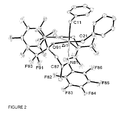
- Figure 2 represents the crystal structure of complex 6 .
- Figure 3 represents the crystal structure of complex 7 .
- a stainless steel autoclave was charged with 13.5 g (70.0 mmol) of hexafluoroacetone sesquihydrate and 7.8 mL (66.7 mmol) of acetophenone.
- the autoclave was sealed and heated at a temperature of 160 °C for 120 h.
- the reaction mixture was subjected to rotary evaporation to remove water.
- the residue was vacuum transferred to a condenser to yield a viscous colourless liquid which rapidly crystallised at ambient temperature to give 15.5 g of 2 as an off-white crystalline solid with a yield of 86%.
- a Teflon-valved NMR tube was charged with 68.3 mg (175.5 ⁇ mol) of 3 40.0 mg (87.8 ⁇ mol) of and Zr(CH 2 Ph) 4 and about 0.5 mL of dry toluene- d 8 under vacuum.
- the tube was kept for a period of time of 3 to 4 h at a temperature of -30 °C and afterwards NMR spectroscopy was recorded.
- the formation of complex 6 proceeded with a yield of about 80% according to 1 H NMR. Green-yellow crystals of 6 suitable for X-ray were obtained by cooling the solution at a temperature of -30 °C for a period of time of 20 h.
- the crystal structure of complex 6 is represented in Figure 2 and the crystal structure of complex 7 is represented in Figure 3.
Landscapes
- Chemical & Material Sciences (AREA)
- Organic Chemistry (AREA)
- Chemical Kinetics & Catalysis (AREA)
- Engineering & Computer Science (AREA)
- Materials Engineering (AREA)
- Health & Medical Sciences (AREA)
- Inorganic Chemistry (AREA)
- Medicinal Chemistry (AREA)
- Polymers & Plastics (AREA)
- Catalysts (AREA)
- Organic Low-Molecular-Weight Compounds And Preparation Thereof (AREA)
- Transition And Organic Metals Composition Catalysts For Addition Polymerization (AREA)
- Low-Molecular Organic Synthesis Reactions Using Catalysts (AREA)
Abstract
This invention relates to fluorinated alkoxy-imino metallic complexes and their use in catalyst systems for the polymerisation or oligomerisation of ethylene and alpha-olefins.
Description
- The present invention discloses catalyst components based on fluorinated alkoxy-imino ligands, their method of preparation and their use in the polymerisation of olefins.
- Investigations to replace ubiquitous cyclopentadienyl-type ligands in modern coordination chemistry of early transition metals have become very popular in recent years. Hard, electronegative π-donor ligands such as aryloxides/alkoxides are attractive because they offer strong metal-oxygen bonds that are expected to stabilize complexes of these electropositive metals. Also, the great variety of these ligands conveniently obtained from alcohols allows considerable stereo-electronic variations. Accordingly, group 4 metal complexes of the type [MX2(OZ)2] and [MX2(OZZO)], where OZ- and OZZO2- are monoanionic and chelating dianionic ligands respectively, have retained considerable attention. Most successful developments in terms of synthetic organometallic chemistry and catalysis have appeared using aryloxide (phenolate) ligands, with significant contributions of the groups of Fujita such as for example Matsui et al. (S. Matsui, M. Mitani, J. Saito, Y. Tohi, H. Makio, N. Matsukawa, Y. Takagi, K. Tsuru, M. Nitabaru, T. Nakano, H. Tanaka, N. Kashiwa, T. Fujita, in J. Am. Chem. Soc. 2001, 123, 6847-6856) or Kojoh et al. (S. Kojoh, T. Matsugi, J. Saito, M. Mitani, T. Fujita, N. Kashiwa, Chem. Lett. 2001, 822-823) or Saito et al. (J. Saito, M. Mitani, S. Matsui, J. Y. Mohri, S. Kojoh, N. Kashiwa, T. Fujita, Angew. Chem., Int. Ed. 2001, 40, 2918-2920; Angew. Chem. 2001, 113, 3002-3004) or Mitani et al. (M. Mitani, J. Mohri, Y. Yoshida, J. Saito, S. Ishii, K. Tsuru, S. Matsui, R. Furuyama, T. Nakano, H. Tanaka, S.-I. Kojoh, T. Matsugi, N. Kashiwa, T. Fujita, J. Am. Chem. Soc. 2002, 124, 3327-3336) or Saito et al. (J. Saito, M. Mitani, J. Mohri, S. Ishii, Y. Yoshida, T. Matsugi, S. Kojoh, N. Kashiwa, T. Fujita, T. Chem. Lett. 2001, 576-577) or Mitani et al. (M. Mitani, R. Furuyama, J.-I. Mohri, J. Saito, S. Ishii, H. Terao, N. Kashiwa, T. Fujita, J. Am. Chem. Soc. 2002, 124, 7888-7889) or of the group of Coates such as for example Tian and Coates (J. Tian, G. W. Coates, Angew. Chem., Int. Ed. 2000, 39, 3626-3629; Angew. Chem. 2000, 112, 3772-3775 or Tian et al. (J. Tian, P. D. Hustad, G. W. Coates, J. Am. Chem. Soc. 2001, 123, 5134-5135) or Mason and Coates (A. F. Mason, G. W. Coates, J. Am. Chem. Soc. 2004, 126, 16326-16327).
- Comparatively, group 4 metal [MX2(OZ)2] and [MX2(OZZO)] type complexes that incorporate simple (amino-)alkoxide ligands have been much less studied. This is mainly due to aggregation problems traditionally encountered with these relatively more basic ligands (as compared to aryloxides). A valuable approach to overcome this issue consists in introducing electron-withdrawing CF3 groups α to the alkoxides; this generates increased intra- and inter-molecular repulsions and a much less basic alkoxide O-atom, and in turn a much reduced bridging ability. On this principle, Jordan et al. have developed "fluorous" group 4 complexes with two pyridine-alkoxide ligands such as for example in Tsukahara et al (T. Tsukahara, D. C. Swenson, R. F. Jordan, Organometallics 1997, 16, 3303-3313). Tetradentate diamino-dialkoxide {ONnNO}2- ligands with a ethylene- (n = 2), propylene- (n = 3) or chiral 1,2-cyclohexyldiamine backbone flanked by two fluorinated tertiary alkoxides were recently prepared as well as neutral groups 3, 4 and 13 metal complexes derived thereof. They are described for example in Lavanant et al. (L. Lavanant, T.-Y. Chou, Y. Chi, C. W. Lehmann, L. Toupet, J.-F. Carpentier, Organometallics 2004, 23, 5450-5458) or in Amgoune et al. (A. Amgoune, L. Lavanant, C. M. Thomas, Y. Chi, R. Welter, S. Dagorne, J.-F. Carpentier, Organometallics, 2005, 24, 6279-6282) or in Kirillov et al. (E. Kirillov, L. Lavanant, C. M. Thomas, T. Roisnel, Y. Chi, J.-F. Carpentier, Chem. Eur. J. 2006, in press).
- There is a demand for new catalyst systems having good activity and able to produce polymers and oligomers tailored to specific needs.
- It is an aim of the present invention to prepare new catalyst components that can be used in the polymerisation or oligomerisation of olefins.
- It is also an aim of the present invention to provide very active catalyst components.
- It is another aim of the present invention to provide a method for polymerising or copolymerising or oligomerising olefins.
- The present invention reaches, at least partially, any one of those aims.
- Accordingly, the present invention discloses a new class of fluorinated alcohol-imine pro-ligand of formula

- R1 is alkyl, cycloalkyl, allyl, benzyl, or an aromatic or heteroaromatic group having at most 20 carbon atoms;
- R2 is hydrogen, alkyl, cycloalkyl, or aryl group having at most 20 carbon atoms and
- R1and R2 can be joined to form a ring;
- R3 and R4 are each independently selected from CF3, CnF2n+1 wherein n is an integer between 1 and 10, or from aryl or alkyl, substituted or unsubstituted.
- Preferably, R1 is phenyl, unsubstituted or substituted. The substituents, if present, can be selected from H, F, CF3 or isopropyl. If the substituents are H, F or CF3 they are located preferably at positions 2 and/or 3 and/or 4 and/or 5 and/or 6. If they are isopropyl, they preferably occupy positions 2 and 6.
- R2 can be for instance a methyl group or a phenyl group, substituted or unsubstituted.
- Preferably R3 and R4 are the same and are CF3, CnF2n+1, more preferably CF3.
- The invention also discloses a metallic complex obtained by metallation of the fluorinated alcohol-imine pro-ligand with a metal salt or a precursor of formula MX4
wherein M is a metal group 4 of the Periodic Table,
wherein each X is the same or different and is halogen, or alkyl or benzyl group. Preferably, X is chlorine, methyl or benzyl. - The solvent for synthesis may be selected from dichloromethane (DCM), tetrahydrofuran (THF) or a hydrocarbon and the complexation reaction is carried out at reflux.
- Typically, several types of metallic complexes can be formed, depending on the relative amounts of alkoxy-imino ligand and metal unit. The preferred ratio is of two fluorinated alkoxy-imino ligands per metal unit.
- The present invention further discloses an active catalyst system comprising the metallic complex and an activating agent having an ionising action.
- It can be aluminoxane and comprise oligomeric linear and/or cyclic alkyl aluminoxanes represented by formula


wherein n is 1-40, preferably 10-20, m is 3-40, preferably 3-20 and R* is a C1-C8 alkyl group and preferably methyl. - The amount of activating is selected to give an Al/M ratio of from 100 to 3000, preferably of about 1000.
- When X is alkyl or benzyl group, suitable boron-containing activating agents may be used. They comprise a triphenylcarbenium boronate such as tetrakis-pentafluorophenyl-borato-triphenylcarbenium as described in
EP-A-0427696 , or those of the general formula [L'-H] + [B Ar1 Ar2 X3 X4]- as described inEP-A-0277004 (page 6, line 30 to page 7, line 7). The amount of boron -containing activating agent is selected to give B/M ratio of from 0.5 to 5, preferably of about 1. - In another embodiment, according to the present invention, the metallic complex may be deposited on a conventional support impregnated with an activating agent. Preferably, the conventional support is silica impregnated with methylaluminoxane (MAO).
- Alternatively, it can be an activating support such as fluorinated alumina silica.
- The present invention further discloses a method for preparing an active catalyst system that comprises the steps of:
- a) providing a fluorinated alcohol-imine pro-ligand;
- b) complexing the pro-ligand of step a) with a metallic salt or precursor MX4 in a solvent;
- c) retrieving a catalyst component;
- d) activating the catalyst component with an activating agent having an ionising action;
- e) optionally adding a cocatalyst;
- f) retrieving an active oligomerisation or polymerisation catalyst system.
- Alternatively, in step d), the catalyst component is deposited on a support impregnated with an activating agent or on a fluorinated activating support.
- The cocatalyst may be selected from triethylaluminium, triisobutylaluminum, tris-n-octylaluminium, tetraisobutyldialuminoxane or diethyl zinc.
- The active catalyst system is used in the oligomerisation and in the homo- or copolymerisation of ethylene and alpha-olefins.
- The present invention discloses a method for the oligomerisation or the homo- or copolymerisation of ethylene and alpha-olefins that comprises the steps of:
- a) injecting the active catalyst system into the reactor;
- b) injecting the monomer and optional comonomer;
- c) maintaining under polymerisation conditions;
- d) retrieving the oligomers and/or polymer.
- The pressure in the reactor can vary from 0.5 to 50 bars, preferably from 5 to 25 bars.
- The polymerisation temperature can range from 10 to 100°C, preferably from 50 to 85°C.
- Preferably the monomer and optional comonomer are selected from ethylene, propylene,1-hexene, 1-octene or styrene.
- The present invention also discloses the polymers obtained with the new catalyst systems.
- Figure 1 represents the crystal structure of pro-ligand 3.
- Figure 2 represents the crystal structure of complex 6.
- Figure 3 represents the crystal structure of complex 7.
- The synthesis was carried out following the method described by Lay et al. (E. Lay, Y.-H. Song, Y.-C. Chiu, Y.-M. Lin, Y. Chi, A. J. Carty, S.-M. Peng, G.-H. Lee, in Inorg. Chem. 2005, vol. 44, 7226).

- A stainless steel autoclave was charged with 12.5 g (75.0 mmol) of hexafluoroacetone sesquihydrate and 45 mL of acetone. The autoclave was sealed and heated at a temperature of 140 °C for from 85 to 100 h. Excess acetone and water formed were removed under reduced pressure and the residue was vacuum transferred to yield 5.71 g of (1) as a viscous colourless liquid with a yield of 34%. The NMR spectrum was as follows: 1H NMR (200 MHz, CDCl3, 298K): δ (ppm) 2.34 (s, 3H, CH3), 2.96 (s, 2H, CH2), 6.81 (s, 1 H, OH). 19F NMR (188 MHz, CDCl3, 298K): δ (ppm) -78.7.
-

- A stainless steel autoclave was charged with 13.5 g (70.0 mmol) of hexafluoroacetone sesquihydrate and 7.8 mL (66.7 mmol) of acetophenone. The autoclave was sealed and heated at a temperature of 160 °C for 120 h. The reaction mixture was subjected to rotary evaporation to remove water. Then, the residue was vacuum transferred to a condenser to yield a viscous colourless liquid which rapidly crystallised at ambient temperature to give 15.5 g of 2 as an off-white crystalline solid with a yield of 86%.
The NMR spectrum was as follows: 1H NMR (200 MHz, CDCl3, 298K): δ (ppm) 3.50 (s, 2H, CH2), 7.23 (s, 1H, OH), 7.58 (t, 3 J = 7.5 Hz, 2H, m-H), 7.74 (t, 3 J = 7.5 Hz, 1H, p-H), 7.99 (d, 3 J = 7.5 Hz, 1 H, o-H). 19F NMR (188 MHz, CDCl3, 298K): δ (ppm) -78.4. Anal. Calcd. for C10H6F6O2: C, 44.13; H, 2.22. Found: C, 45.01; H, 2.48. -

- In a 50 mL flask, a mixture of 0.81 g (3.61 mmol) of 1 and 0.66 g (3.60 mmol) of pentafluoroaniline in 40 mL of toluene, in the presence of a catalytic amount of paratoluene sulfonic acid (PTSA) was refluxed for 12 h using a Dean-Stark receiver. The reaction mixture was evaporated in vacuum and the residue was distilled in a Kugelrohr apparatus to give 0.65 g of a colourless oily product which rapidly crystallised at room temperature with a yield of 46%.
NMR results were as follows: 1H NMR (200 MHz, CDCl3, 298K): δ (ppm) 2.13 (s, 3H, CH3), 3.09 (s, 2H, CH2), 7.60 (s, 1H, OH). 19F NMR (188 MHz, CDCl3, 298K): δ (ppm) -162.0 (m, 2F, m-F), -160.0 (t, 3 J = 22.0 Hz, 1F, p-F), -151.0 (d, 3 J = 22.0 Hz, 2F, oF), -78.4 (s, 6F, CF3). Anal. Calcd. for C12H6F11NO: C, 37.04; H, 1.55. Found: C, 37.41; H, 2.04. - The crystal structure of ligand 3 is represented in Figure 1
-

- In a 50 mL flask, a mixture of 4.5 g (20.08 mmol) of 1 and 3.8 mL (20.15 mmol) of 2,6-diisopropylaniline in 40 mL of toluene, in the presence of a catalytic amount of PTSA, was refluxed for 15 h using a Dean-Stark receiver. The reaction mixture was evaporated in vacuum and the residue was distilled in a Kugelrohr apparatus to give 0.74 g of 4 as a pale-yellow oily product with a yield of 10%.
The NMR results were as follows: 1H NMR (200 MHz, CDCl3,298K): δ (ppm) 1.15 (d, 6H, iPr), 1.19 (d, 6H, iPr), 1.86 (s, 3H, CH3), 2.69 (m, 2H, iPr), 2.97 (s, 2H, CH2), 7.18 (m, 3H, arom.), 9.68 (s, 1H, OH). 19F NMR (188 MHz, CDCl3, 298K): δ (ppm) -79.1. Anal. Calcd. for C18H23F6NO: C, 56.39; H, 6.05. Found: C, 56.43; H, 5.84. -

- In a 50 mL flask, a mixture of 2.10 g (9.37 mmol) of 1 and 1.0 mL (10.97 mmol) of aniline in 40 mL of toluene, in the presence of a catalytic amount of PTSA, was refluxed for 12 h using a Dean-Stark receiver. The reaction mixture was evaporated in vacuum and the residue was distilled in a Kugelrohr apparatus to give 1.35 g of 5 as a colorless oily product which rapidly crystallised at room temperature with a yield of 48%.
The NMR results were as follows:
1H NMR (200 MHz, CDCl3, 298K): δ (ppm) 2.00 (s, 3H, CH3), 2.94 (s, 2H, CH2), 6.79 (d, 3 J = 7.3 Hz, 2H, o-H), 7.23 (t, 3 J = 7.3 Hz, 1H, p-H), 7.39 (t, 3 J = 7.3 Hz, 3H, m-H), 9.04 (s, 1H, OH). 19F NMR (188 MHz, CDCl3, 298K): δ (ppm) -78.3. Anal. Calcd. for C12H11F6NO: C, 48.17; H, 3.71. Found: C, 48.10; H, 3.56. -

- A Teflon-valved NMR tube was charged with 68.3 mg (175.5 µmol) of 3 40.0 mg (87.8 µmol) of and Zr(CH2Ph)4 and about 0.5 mL of dry toluene-d 8 under vacuum. The tube was kept for a period of time of 3 to 4 h at a temperature of -30 °C and afterwards NMR spectroscopy was recorded. The formation of complex 6 proceeded with a yield of about 80% according to 1H NMR. Green-yellow crystals of 6 suitable for X-ray were obtained by cooling the solution at a temperature of -30 °C for a period of time of 20 h.
The NMR results for 6 were as follows:
1H NMR (500 MHz, toluene-d 8, 298K): δ (ppm) 1.23 (s, 6H, CH3), 2.42 (s, 4H, ZrCH 2Ph), 2.78 (s, 4H, OC(CF3)2CH 2), 6.9-7.2 (m, 10H, Ph). 19F NMR (188 MHz, toluene-d 8, 298K): δ (ppm) -167.0 (m, 4F, m-F), -163.0 (t, 2F, p-F), -167.0 (br s, 4F, oF), -82.0 (s, 12F, CF3).
Due to the instability of 6 at room temperature in toluene solution, 13C NMR and HETCOR spectra were not recorded. - The toluene solution of complex 6 was kept in the glovebox at room temperature for one day, after which time period 36.3 mg (28.9 µmol) of pale-yellow crystals of (7) grew and were recovered with a yield of 33%.
The NMR results for 7 were as follows:
1H NMR (500 MHz, benzene-d 6, 298K): δ (ppm) 1.14 (s, 3H, CH3), 1.16 (s, 6H, CH3), 3.28 (s, 4H, OC(CF3)2CH 2), 4.93 (s, 1H, N(CH3)CH=C(CF3)2). 13C{1H} NMR (125 MHz, benzene-d 6, 298 K): δ (ppm) 22.3 (CH=C(CH3)N), 26.0 (CH2C(CH3)=N), 39.8 (CH2C(CH3)=N), 81.3 (CF3)2 CCH=C(CH3)N, 99.3 (CH=C(CH3)N), 150.0 (CH=C(CH3)N), 193.3 (CH2 C(CH3)=N), the remaining resonances were not observed by HMQC and HMBC methods.
19F NMR (188 MHz, benzene-d 6, 298K): δ (ppm) -164.9 (m, 2F), -161.6 (m, 4F), - 155.9 (m, 2F), -149.7-147.3 (br m, 7F), -82.6 (s, 6F, CF3), -82.2 (s, 12F, CF3). Anal. Calcd. for C36H14F33N3O3Zr: C, 34.46; H, 1.12. Found: C, 35.10; H, 1.50. - The crystal structure of complex 6 is represented in Figure 2 and the crystal structure of complex 7 is represented in Figure 3.
-

- To a solution of 0.70 g (1.79 mmol) of 3 in 30 mL of Et2O kept at a temperature of -78 °C were added dropwise 0.72 mL of a 2.5M solution in hexanes (1.79 mmol) of n-butyllithium. The reaction mixture was stirred for a period of time of 3 h at a temperature of -78 °C and then allowed to warm up to room temperature over 1 h. Volatiles were removed under vacuum and 0.21 g (0.90 mmol) of solid ZrCl4 were added in the glovebox. 30 mL of fresh Et2O were vacuum transferred to the reaction mixture and the latter was stirred for a period of time of 12 h at room temperature. Volatiles were removed in vacuum, and 30 mL of dichloromethane were vacuum transferred onto the residue. The resulting solution was filtered off, the pale-pink solution was concentrated to about 5-7 mL and 5 mL of hexane were added. After a period of time of 10 h at a temperature of -30 °C, a pink microcrystalline solid precipitated out. It was separated and dried under vacuum to give 0.10 g of 8 as a white solid with a yield of 12 %.
NMR results for 8 were as follows:
1H NMR (200 MHz, CD2Cl2, 298K): δ (ppm) 2.12 (s, 6H, CH3), 3.12 (s, 4H, CH2).
19F NMR (188 MHz, CD2Cl2, 298K): δ (ppm) -163.2 (m, 4F, m-F), -160.7 (t, 3 J = 25.6 Hz, 2F, p-F), -151.4 (d, 3 J = 25.6 Hz, 4F, o-F), -78.4 (s, 12F, CF3).
Due to the poor solubility of 8, 13C and HETCOR NMR were not recorded.
Anal. Calcd. for C24H10Cl2F22N2O2Zr: C, 30.72; H, 1.07. Found: C, 30.50; H, 1.01.
Claims (11)
- A fluorinated alcohol-imine pro-ligand of general formula
 R1 is alkyl, cycloalkyl, allyl, benzyl, or an aromatic or heteroaromatic group having at most 20 carbon atomsR2 is hydrogen, alkyl, cycloalkyl, or aryl group having at most 20 carbon atoms,R3 and R4 are each independently selected from CF3, CnF2n+1 wherein n is an integer between 1 and 10, or aryl or alkyl group substituted or unsubstituted.
 - The fluorinated alcohol-imine pro-ligand of claim 1 wherein R3 and R4 are the same and are CF3, CnF2n+1, preferably CF3.
- The fluorinated alcohol-imine pro-ligand of claim 1 or claim 2 wherein R1 is phenyl group, unsubstituted or substituted.
- The fluorinated alcohol-imine pro-ligand of claim 3 wherein the phenyl group is substituted with H, F, CF3 at positions 2, 3, 4, 5, and 6, or with isopropyl at positions 2 and 6.
- A metallic complex resulting from the metallation reaction of the fluorinated alcohol-imine pro-ligand of any one of claims 1 to 4 with a metal salt or precursor of formula MX4 wherein M is a metal group 4 of the Periodic Table, and wherein each X is the same or different and is halogen, or an alkyl or benzyl group.
- The metallic complex of claim 5 wherein X is chlorine, methyl or benzyl.
- The metallic complex of claim 5 or claim 6 wherein M is Zr or Ti.
- A method for preparing the metallic complex of any one of claims 5 to 7 by the steps of:a) providing the ligand of any one of claims 1 to 4;b) complexing it with metal salt or precursor of formula MX4 wherein M and X are as defined in any one of claims 5 to 7.
- An active catalyst system comprising the metallic complex of any one of claims 5 to 7, an activating agent having an ionising action and optionally a cocatalyst.
- The active catalyst of claim 9 wherein the activating agent is aluminoxane or an activating support.
- A method for oligomerising or homo- or co-polymerising ethylene or alpha-olefins that comprises the steps of:a. injecting the active catalyst system of claim 9 or claim 10 into the reactor;b. injecting the monomer and optional comonomer(s) simultaneously with or after step a);c. maintaining under polymerisation conditions;d. retrieving an oligomer or a polymer.
Priority Applications (9)
| Application Number | Priority Date | Filing Date | Title |
|---|---|---|---|
| EP06120743A EP1900722A1 (en) | 2006-09-15 | 2006-09-15 | Fluorinated alkoxy-imino catalyst components |
| PCT/EP2007/059723 WO2008031890A1 (en) | 2006-09-15 | 2007-09-14 | Fluorinated alkoxy-imino catalyst components. |
| EP07820227A EP2064218B8 (en) | 2006-09-15 | 2007-09-14 | Fluorinated alkoxy-imino catalyst components |
| US12/440,871 US8026192B2 (en) | 2006-09-15 | 2007-09-14 | Fluorinated alkoxy-imino catalyst components |
| DE602007014069T DE602007014069D1 (en) | 2006-09-15 | 2007-09-14 | Fluorinated alkoxy-imino catalyst components |
| AT07820227T ATE506369T1 (en) | 2006-09-15 | 2007-09-14 | FLUORINATED ALKOXY-IMINO CATALYST COMPONENTS |
| ES07820227T ES2361887T3 (en) | 2006-09-15 | 2007-09-14 | CATALYZING COMPONENTS OF FLUORATED ALCOXI-IMINO. |
| US13/214,747 US20110312489A1 (en) | 2006-09-15 | 2011-08-22 | Fluorinated Alkoxy-Imino Catalyst Components |
| US13/561,634 US20120289670A1 (en) | 2006-09-15 | 2012-07-30 | Fluorinated Alkoxy-Imino Catalyst Components |
Applications Claiming Priority (1)
| Application Number | Priority Date | Filing Date | Title |
|---|---|---|---|
| EP06120743A EP1900722A1 (en) | 2006-09-15 | 2006-09-15 | Fluorinated alkoxy-imino catalyst components |
Publications (1)
| Publication Number | Publication Date |
|---|---|
| EP1900722A1 true EP1900722A1 (en) | 2008-03-19 |
Family
ID=37734287
Family Applications (2)
| Application Number | Title | Priority Date | Filing Date |
|---|---|---|---|
| EP06120743A Withdrawn EP1900722A1 (en) | 2006-09-15 | 2006-09-15 | Fluorinated alkoxy-imino catalyst components |
| EP07820227A Not-in-force EP2064218B8 (en) | 2006-09-15 | 2007-09-14 | Fluorinated alkoxy-imino catalyst components |
Family Applications After (1)
| Application Number | Title | Priority Date | Filing Date |
|---|---|---|---|
| EP07820227A Not-in-force EP2064218B8 (en) | 2006-09-15 | 2007-09-14 | Fluorinated alkoxy-imino catalyst components |
Country Status (6)
| Country | Link |
|---|---|
| US (3) | US8026192B2 (en) |
| EP (2) | EP1900722A1 (en) |
| AT (1) | ATE506369T1 (en) |
| DE (1) | DE602007014069D1 (en) |
| ES (1) | ES2361887T3 (en) |
| WO (1) | WO2008031890A1 (en) |
Cited By (1)
| Publication number | Priority date | Publication date | Assignee | Title |
|---|---|---|---|---|
| US20120289670A1 (en) * | 2006-09-15 | 2012-11-15 | Total Petrochemicals Research Feluy | Fluorinated Alkoxy-Imino Catalyst Components |
Citations (2)
| Publication number | Priority date | Publication date | Assignee | Title |
|---|---|---|---|---|
| DE10107045A1 (en) * | 2001-02-13 | 2002-08-14 | Basf Ag | Process for the polymerization of olefins |
| WO2003040150A1 (en) * | 2001-11-09 | 2003-05-15 | Yun Chi | Volatile noble metal organometallic complexes |
Family Cites Families (1)
| Publication number | Priority date | Publication date | Assignee | Title |
|---|---|---|---|---|
| EP1900722A1 (en) * | 2006-09-15 | 2008-03-19 | Total Petrochemicals Research Feluy | Fluorinated alkoxy-imino catalyst components |
-
2006
- 2006-09-15 EP EP06120743A patent/EP1900722A1/en not_active Withdrawn
-
2007
- 2007-09-14 EP EP07820227A patent/EP2064218B8/en not_active Not-in-force
- 2007-09-14 US US12/440,871 patent/US8026192B2/en not_active Expired - Fee Related
- 2007-09-14 AT AT07820227T patent/ATE506369T1/en active
- 2007-09-14 DE DE602007014069T patent/DE602007014069D1/en active Active
- 2007-09-14 ES ES07820227T patent/ES2361887T3/en active Active
- 2007-09-14 WO PCT/EP2007/059723 patent/WO2008031890A1/en not_active Ceased
-
2011
- 2011-08-22 US US13/214,747 patent/US20110312489A1/en not_active Abandoned
-
2012
- 2012-07-30 US US13/561,634 patent/US20120289670A1/en not_active Abandoned
Patent Citations (2)
| Publication number | Priority date | Publication date | Assignee | Title |
|---|---|---|---|---|
| DE10107045A1 (en) * | 2001-02-13 | 2002-08-14 | Basf Ag | Process for the polymerization of olefins |
| WO2003040150A1 (en) * | 2001-11-09 | 2003-05-15 | Yun Chi | Volatile noble metal organometallic complexes |
Non-Patent Citations (5)
| Title |
|---|
| BARTEN J A ET AL: "Novel beta-hydroxy-beta-bis(trifluoromethyl) imines", JOURNAL OF FLUORINE CHEMISTRY, ELSEVIER, AMSTERDAM, NL, vol. 125, no. 6, June 2004 (2004-06-01), pages 1039 - 1049, XP004586029, ISSN: 0022-1139 * |
| CHI, YUN ET AL: "Synthesis and Characterization of Fluorinated Aminoalkoxide and Iminoalkoxide Gallium Complexes: Application in Chemical Vapor Deposition of Ga2O3 Thin Films", ORGANOMETALLICS , 23(1), 95-103 CODEN: ORGND7; ISSN: 0276-7333, 2004, XP002421097 * |
| LAY, EDDY ET AL: "New CVD Precursors Capable of Depositing Copper Metal under Mixed O2/Ar Atmosphere", INORGANIC CHEMISTRY , 44(20), 7226-7233 CODEN: INOCAJ; ISSN: 0020-1669, 2005, XP002421095 * |
| LIU, YAN-HSIU ET AL: "Synthesis and characterization of fluorinated .beta.-ketoiminate and imino-alcoholate Pd complexes: precursors for palladium chemical vapor deposition", JOURNAL OF MATERIALS CHEMISTRY , 13(1), 135-142 CODEN: JMACEP; ISSN: 0959-9428, 2003, XP002421096 * |
| LOEB, STEPHEN J. ET AL: "Coordination modes of polydentate ligands. 2. Template synthesis of four-, five-, and six-coordinate fluorinated Schiff-base complexes of nickel(2+): structure of an octahedral nickel(2+) complex containing two tridentate ligands", INORGANIC CHEMISTRY , 23(11), 1509-12 CODEN: INOCAJ; ISSN: 0020-1669, 1984, XP009079422 * |
Cited By (1)
| Publication number | Priority date | Publication date | Assignee | Title |
|---|---|---|---|---|
| US20120289670A1 (en) * | 2006-09-15 | 2012-11-15 | Total Petrochemicals Research Feluy | Fluorinated Alkoxy-Imino Catalyst Components |
Also Published As
| Publication number | Publication date |
|---|---|
| US8026192B2 (en) | 2011-09-27 |
| EP2064218A1 (en) | 2009-06-03 |
| EP2064218B8 (en) | 2011-09-14 |
| US20110312489A1 (en) | 2011-12-22 |
| ES2361887T3 (en) | 2011-06-24 |
| WO2008031890A1 (en) | 2008-03-20 |
| DE602007014069D1 (en) | 2011-06-01 |
| ATE506369T1 (en) | 2011-05-15 |
| EP2064218B1 (en) | 2011-04-20 |
| US20100029472A1 (en) | 2010-02-04 |
| US20120289670A1 (en) | 2012-11-15 |
Similar Documents
| Publication | Publication Date | Title |
|---|---|---|
| Tsukahara et al. | Neutral and Cationic Zirconium Benzyl Complexes Containing Bidentate Pyridine− Alkoxide Ligands. Synthesis and Olefin Polymerization Chemistry of (pyCR2O) 2Zr (CH2Ph) 2 and (pyCR2O) 2Zr (CH2Ph)+ Complexes | |
| Yoshida et al. | New titanium complexes having two pyrrolide− Imine chelate ligands: syntheses, structures, and ethylene polymerization behavior | |
| Rios Yepes et al. | Mono-and dinuclear asymmetric aluminum guanidinates for the catalytic CO2 fixation into cyclic carbonates | |
| RU2317306C2 (en) | Monometallocene catalyst comprising schiff's reagent bis-ligand for polymerization of olefins, method for its preparing and its using | |
| JP2015525268A (en) | Amidinate and guanidinate complexes, their use as chain transfer polymerization catalysts, and long chain alcohols obtained by the process | |
| US7148174B2 (en) | Non-metallocene catalyst system | |
| US8519070B2 (en) | Post-metallocene complexes based on bis(naphthoxy)pyridine and bis(naphthoxy)thiophene ligands for the polymerisation of ethylene and alpha-olefins | |
| KR102087994B1 (en) | Method for preparing ethylene tetramerization catalyst system, ethylene tetramerization catalyst system, manufacturing method for ethylene tetramer and bisphosphine ligand compound | |
| Nelkenbaum et al. | Synthesis, molecular structure and catalytic activity of chiral benzamidinate nickel complexes | |
| Annunziata et al. | Bis [(amidomethyl) pyridine] zirconium (IV) complexes: synthesis, characterization, and activity as olefin polymerization catalysts | |
| Xu et al. | Highly active ethylene polymerization and regioselective 1-hexene oligomerization using zirconium and titanium catalysts with tridentate [ONO] ligands | |
| JP7805963B2 (en) | Homogeneous single-site catalysts and their use in the preparation of linear polyethylene | |
| EP1994040A1 (en) | Polymerisation of ethylene and alpha-olefins with phosphino-iminophenol complexes | |
| EP2064218B8 (en) | Fluorinated alkoxy-imino catalyst components | |
| EP1900757A1 (en) | Fluorinated dialkoxy-diimino catalyst components | |
| Dietz et al. | Binaphtholate and binaphtholate chloride complexes of tungsten (VI) | |
| KR20150058048A (en) | Ligand compound, catalyst system for olefin oligomerization, and method for olefin oligomerization using the same | |
| EP2268651A1 (en) | Sterically emcumbered bidentate and tridentate naphthoxy-imine metallic complexes | |
| US7645716B2 (en) | Oxygen-bridged bimetallic complex, the production thereof and its utilization for polymerization catalysis | |
| CN116726998A (en) | Catalyst containing biphosphine ligand for ethylene selective tetramerization and preparation method and application thereof | |
| CN100491386C (en) | Multinuclear metallocene complex and application thereof | |
| KR101178996B1 (en) | Catalysts for preparing 1-hexene and method for preparing 1-hexene using the same | |
| KR100265413B1 (en) | Polymerization catalyst and preparing method therof | |
| US20090203948A1 (en) | Single site catalyst component with metal containing chelate backbone | |
| WO1997042163A1 (en) | Substituted pentadiene compound |
Legal Events
| Date | Code | Title | Description |
|---|---|---|---|
| PUAI | Public reference made under article 153(3) epc to a published international application that has entered the european phase |
Free format text: ORIGINAL CODE: 0009012 |
|
| AK | Designated contracting states |
Kind code of ref document: A1 Designated state(s): AT BE BG CH CY CZ DE DK EE ES FI FR GB GR HU IE IS IT LI LT LU LV MC NL PL PT RO SE SI SK TR |
|
| AX | Request for extension of the european patent |
Extension state: AL BA HR MK YU |
|
| AKX | Designation fees paid | ||
| REG | Reference to a national code |
Ref country code: DE Ref legal event code: 8566 |
|
| STAA | Information on the status of an ep patent application or granted ep patent |
Free format text: STATUS: THE APPLICATION IS DEEMED TO BE WITHDRAWN |
|
| 18D | Application deemed to be withdrawn |
Effective date: 20080920 |