EP1899022B1 - Method of detoxication of yperite by using haloalkane dehalogenases - Google Patents
Method of detoxication of yperite by using haloalkane dehalogenases Download PDFInfo
- Publication number
- EP1899022B1 EP1899022B1 EP06753161.6A EP06753161A EP1899022B1 EP 1899022 B1 EP1899022 B1 EP 1899022B1 EP 06753161 A EP06753161 A EP 06753161A EP 1899022 B1 EP1899022 B1 EP 1899022B1
- Authority
- EP
- European Patent Office
- Prior art keywords
- haloalkane dehalogenase
- enzyme
- haloalkane
- sequence
- dehalogenase
- Prior art date
- Legal status (The legal status is an assumption and is not a legal conclusion. Google has not performed a legal analysis and makes no representation as to the accuracy of the status listed.)
- Not-in-force
Links
- 108010004901 Haloalkane dehalogenase Proteins 0.000 title claims description 68
- QKSKPIVNLNLAAV-UHFFFAOYSA-N bis(2-chloroethyl) sulfide Chemical compound ClCCSCCCl QKSKPIVNLNLAAV-UHFFFAOYSA-N 0.000 title claims description 31
- 238000000034 method Methods 0.000 title claims description 19
- 108090000790 Enzymes Proteins 0.000 claims description 49
- 102000004190 Enzymes Human genes 0.000 claims description 49
- 239000000203 mixture Substances 0.000 claims description 21
- XLYOFNOQVPJJNP-UHFFFAOYSA-N water Substances O XLYOFNOQVPJJNP-UHFFFAOYSA-N 0.000 claims description 15
- 239000003960 organic solvent Substances 0.000 claims description 14
- 108090000623 proteins and genes Proteins 0.000 claims description 9
- 239000007864 aqueous solution Substances 0.000 claims description 8
- 230000000694 effects Effects 0.000 claims description 8
- ARSRBNBHOADGJU-UHFFFAOYSA-N 7,12-dimethyltetraphene Chemical compound C1=CC2=CC=CC=C2C2=C1C(C)=C(C=CC=C1)C1=C2C ARSRBNBHOADGJU-UHFFFAOYSA-N 0.000 claims description 7
- 102000004169 proteins and genes Human genes 0.000 claims description 7
- 241000186366 Mycobacterium bovis Species 0.000 claims description 6
- 241000736110 Sphingomonas paucimobilis Species 0.000 claims description 6
- 229920001184 polypeptide Polymers 0.000 claims description 6
- 102000004196 processed proteins & peptides Human genes 0.000 claims description 6
- 108090000765 processed proteins & peptides Proteins 0.000 claims description 6
- 239000011159 matrix material Substances 0.000 claims description 4
- 229920000642 polymer Polymers 0.000 claims description 4
- 239000000243 solution Substances 0.000 claims description 4
- 239000004094 surface-active agent Substances 0.000 claims description 4
- 239000007788 liquid Substances 0.000 claims description 3
- 239000012528 membrane Substances 0.000 claims description 3
- 239000007787 solid Substances 0.000 claims description 3
- 150000005846 sugar alcohols Polymers 0.000 claims description 3
- 230000002051 biphasic effect Effects 0.000 claims description 2
- 238000004132 cross linking Methods 0.000 claims description 2
- 238000002360 preparation method Methods 0.000 claims description 2
- 229940124272 protein stabilizer Drugs 0.000 claims description 2
- 125000003275 alpha amino acid group Chemical group 0.000 claims 2
- 241000316848 Rhodococcus <scale insect> Species 0.000 claims 1
- 239000007853 buffer solution Substances 0.000 claims 1
- 238000001179 sorption measurement Methods 0.000 claims 1
- RAXXELZNTBOGNW-UHFFFAOYSA-N imidazole Natural products C1=CNC=N1 RAXXELZNTBOGNW-UHFFFAOYSA-N 0.000 description 21
- 238000005202 decontamination Methods 0.000 description 16
- 230000003588 decontaminative effect Effects 0.000 description 16
- PEDCQBHIVMGVHV-UHFFFAOYSA-N Glycerine Chemical compound OCC(O)CO PEDCQBHIVMGVHV-UHFFFAOYSA-N 0.000 description 12
- 239000000872 buffer Substances 0.000 description 12
- DHMQDGOQFOQNFH-UHFFFAOYSA-N Glycine Chemical compound NCC(O)=O DHMQDGOQFOQNFH-UHFFFAOYSA-N 0.000 description 10
- HEMHJVSKTPXQMS-UHFFFAOYSA-M Sodium hydroxide Chemical compound [OH-].[Na+] HEMHJVSKTPXQMS-UHFFFAOYSA-M 0.000 description 9
- 238000006243 chemical reaction Methods 0.000 description 9
- 238000001784 detoxification Methods 0.000 description 9
- 239000008057 potassium phosphate buffer Substances 0.000 description 9
- 230000003301 hydrolyzing effect Effects 0.000 description 8
- 241000187693 Rhodococcus rhodochrous Species 0.000 description 7
- 230000003197 catalytic effect Effects 0.000 description 7
- -1 halogen ion Chemical class 0.000 description 7
- 239000000126 substance Substances 0.000 description 7
- OKKJLVBELUTLKV-UHFFFAOYSA-N Methanol Chemical compound OC OKKJLVBELUTLKV-UHFFFAOYSA-N 0.000 description 6
- FAPWRFPIFSIZLT-UHFFFAOYSA-M Sodium chloride Chemical compound [Na+].[Cl-] FAPWRFPIFSIZLT-UHFFFAOYSA-M 0.000 description 6
- 238000005695 dehalogenation reaction Methods 0.000 description 6
- 238000002703 mutagenesis Methods 0.000 description 6
- 231100000350 mutagenesis Toxicity 0.000 description 6
- 235000018102 proteins Nutrition 0.000 description 6
- DGVVWUTYPXICAM-UHFFFAOYSA-N β‐Mercaptoethanol Chemical compound OCCS DGVVWUTYPXICAM-UHFFFAOYSA-N 0.000 description 6
- 239000004471 Glycine Substances 0.000 description 5
- 239000012071 phase Substances 0.000 description 5
- OKTJSMMVPCPJKN-UHFFFAOYSA-N Carbon Chemical compound [C] OKTJSMMVPCPJKN-UHFFFAOYSA-N 0.000 description 4
- FKNQFGJONOIPTF-UHFFFAOYSA-N Sodium cation Chemical compound [Na+] FKNQFGJONOIPTF-UHFFFAOYSA-N 0.000 description 4
- 229910052799 carbon Inorganic materials 0.000 description 4
- 229910052736 halogen Inorganic materials 0.000 description 4
- 230000006698 induction Effects 0.000 description 4
- 231100000252 nontoxic Toxicity 0.000 description 4
- 230000003000 nontoxic effect Effects 0.000 description 4
- 239000000047 product Substances 0.000 description 4
- 229910001415 sodium ion Inorganic materials 0.000 description 4
- YODZTKMDCQEPHD-UHFFFAOYSA-N thiodiglycol Chemical compound OCCSCCO YODZTKMDCQEPHD-UHFFFAOYSA-N 0.000 description 4
- 231100000331 toxic Toxicity 0.000 description 4
- 230000002588 toxic effect Effects 0.000 description 4
- CSCPPACGZOOCGX-UHFFFAOYSA-N Acetone Chemical compound CC(C)=O CSCPPACGZOOCGX-UHFFFAOYSA-N 0.000 description 3
- WEVYAHXRMPXWCK-UHFFFAOYSA-N Acetonitrile Chemical compound CC#N WEVYAHXRMPXWCK-UHFFFAOYSA-N 0.000 description 3
- PNEYBMLMFCGWSK-UHFFFAOYSA-N Alumina Chemical compound [O-2].[O-2].[O-2].[Al+3].[Al+3] PNEYBMLMFCGWSK-UHFFFAOYSA-N 0.000 description 3
- RTZKZFJDLAIYFH-UHFFFAOYSA-N Diethyl ether Chemical compound CCOCC RTZKZFJDLAIYFH-UHFFFAOYSA-N 0.000 description 3
- XEKOWRVHYACXOJ-UHFFFAOYSA-N Ethyl acetate Chemical compound CCOC(C)=O XEKOWRVHYACXOJ-UHFFFAOYSA-N 0.000 description 3
- 241000282326 Felis catus Species 0.000 description 3
- ZMXDDKWLCZADIW-UHFFFAOYSA-N N,N-Dimethylformamide Chemical compound CN(C)C=O ZMXDDKWLCZADIW-UHFFFAOYSA-N 0.000 description 3
- YXFVVABEGXRONW-UHFFFAOYSA-N Toluene Chemical compound CC1=CC=CC=C1 YXFVVABEGXRONW-UHFFFAOYSA-N 0.000 description 3
- 150000001450 anions Chemical class 0.000 description 3
- 230000015572 biosynthetic process Effects 0.000 description 3
- 239000012876 carrier material Substances 0.000 description 3
- 239000000287 crude extract Substances 0.000 description 3
- BNIILDVGGAEEIG-UHFFFAOYSA-L disodium hydrogen phosphate Chemical compound [Na+].[Na+].OP([O-])([O-])=O BNIILDVGGAEEIG-UHFFFAOYSA-L 0.000 description 3
- 229910000397 disodium phosphate Inorganic materials 0.000 description 3
- 150000002500 ions Chemical class 0.000 description 3
- 230000007935 neutral effect Effects 0.000 description 3
- 239000008363 phosphate buffer Substances 0.000 description 3
- 239000011780 sodium chloride Substances 0.000 description 3
- 239000006228 supernatant Substances 0.000 description 3
- DNIAPMSPPWPWGF-GSVOUGTGSA-N (R)-(-)-Propylene glycol Chemical compound C[C@@H](O)CO DNIAPMSPPWPWGF-GSVOUGTGSA-N 0.000 description 2
- KBPLFHHGFOOTCA-UHFFFAOYSA-N 1-Octanol Chemical compound CCCCCCCCO KBPLFHHGFOOTCA-UHFFFAOYSA-N 0.000 description 2
- AFABGHUZZDYHJO-UHFFFAOYSA-N 2-Methylpentane Chemical compound CCCC(C)C AFABGHUZZDYHJO-UHFFFAOYSA-N 0.000 description 2
- GXDHCNNESPLIKD-UHFFFAOYSA-N 2-methylhexane Natural products CCCCC(C)C GXDHCNNESPLIKD-UHFFFAOYSA-N 0.000 description 2
- FRDAATYAJDYRNW-UHFFFAOYSA-N 3-methyl-3-pentanol Chemical compound CCC(C)(O)CC FRDAATYAJDYRNW-UHFFFAOYSA-N 0.000 description 2
- 241000894006 Bacteria Species 0.000 description 2
- 229920002307 Dextran Polymers 0.000 description 2
- IAZDPXIOMUYVGZ-UHFFFAOYSA-N Dimethylsulphoxide Chemical compound CS(C)=O IAZDPXIOMUYVGZ-UHFFFAOYSA-N 0.000 description 2
- 241000588724 Escherichia coli Species 0.000 description 2
- WHUUTDBJXJRKMK-UHFFFAOYSA-N Glutamic acid Natural products OC(=O)C(N)CCC(O)=O WHUUTDBJXJRKMK-UHFFFAOYSA-N 0.000 description 2
- 241000235058 Komagataella pastoris Species 0.000 description 2
- 241001506991 Komagataella phaffii GS115 Species 0.000 description 2
- 241001465754 Metazoa Species 0.000 description 2
- BZLVMXJERCGZMT-UHFFFAOYSA-N Methyl tert-butyl ether Chemical compound COC(C)(C)C BZLVMXJERCGZMT-UHFFFAOYSA-N 0.000 description 2
- 239000002202 Polyethylene glycol Substances 0.000 description 2
- JUJWROOIHBZHMG-UHFFFAOYSA-N Pyridine Chemical compound C1=CC=NC=C1 JUJWROOIHBZHMG-UHFFFAOYSA-N 0.000 description 2
- 240000004808 Saccharomyces cerevisiae Species 0.000 description 2
- 229920002684 Sepharose Polymers 0.000 description 2
- VYPSYNLAJGMNEJ-UHFFFAOYSA-N Silicium dioxide Chemical compound O=[Si]=O VYPSYNLAJGMNEJ-UHFFFAOYSA-N 0.000 description 2
- DKGAVHZHDRPRBM-UHFFFAOYSA-N Tert-Butanol Chemical compound CC(C)(C)O DKGAVHZHDRPRBM-UHFFFAOYSA-N 0.000 description 2
- WYURNTSHIVDZCO-UHFFFAOYSA-N Tetrahydrofuran Chemical compound C1CCOC1 WYURNTSHIVDZCO-UHFFFAOYSA-N 0.000 description 2
- 150000007824 aliphatic compounds Chemical class 0.000 description 2
- 125000000539 amino acid group Chemical group 0.000 description 2
- 150000001413 amino acids Chemical group 0.000 description 2
- BFNBIHQBYMNNAN-UHFFFAOYSA-N ammonium sulfate Chemical compound N.N.OS(O)(=O)=O BFNBIHQBYMNNAN-UHFFFAOYSA-N 0.000 description 2
- 229910052921 ammonium sulfate Inorganic materials 0.000 description 2
- 235000011130 ammonium sulphate Nutrition 0.000 description 2
- 239000008346 aqueous phase Substances 0.000 description 2
- 239000001913 cellulose Substances 0.000 description 2
- 229920002678 cellulose Polymers 0.000 description 2
- 239000003795 chemical substances by application Substances 0.000 description 2
- 150000002367 halogens Chemical class 0.000 description 2
- ZSIAUFGUXNUGDI-UHFFFAOYSA-N hexan-1-ol Chemical compound CCCCCCO ZSIAUFGUXNUGDI-UHFFFAOYSA-N 0.000 description 2
- MLFHJEHSLIIPHL-UHFFFAOYSA-N isoamyl acetate Chemical compound CC(C)CCOC(C)=O MLFHJEHSLIIPHL-UHFFFAOYSA-N 0.000 description 2
- 239000000463 material Substances 0.000 description 2
- UAEPNZWRGJTJPN-UHFFFAOYSA-N methylcyclohexane Chemical compound CC1CCCCC1 UAEPNZWRGJTJPN-UHFFFAOYSA-N 0.000 description 2
- VLKZOEOYAKHREP-UHFFFAOYSA-N n-Hexane Chemical compound CCCCCC VLKZOEOYAKHREP-UHFFFAOYSA-N 0.000 description 2
- TVMXDCGIABBOFY-UHFFFAOYSA-N octane Chemical compound CCCCCCCC TVMXDCGIABBOFY-UHFFFAOYSA-N 0.000 description 2
- 230000003287 optical effect Effects 0.000 description 2
- PGMYKACGEOXYJE-UHFFFAOYSA-N pentyl acetate Chemical compound CCCCCOC(C)=O PGMYKACGEOXYJE-UHFFFAOYSA-N 0.000 description 2
- 239000013612 plasmid Substances 0.000 description 2
- 229920001223 polyethylene glycol Polymers 0.000 description 2
- YKYONYBAUNKHLG-UHFFFAOYSA-N propyl acetate Chemical compound CCCOC(C)=O YKYONYBAUNKHLG-UHFFFAOYSA-N 0.000 description 2
- 239000000376 reactant Substances 0.000 description 2
- 239000011347 resin Substances 0.000 description 2
- 229920005989 resin Polymers 0.000 description 2
- JHJLBTNAGRQEKS-UHFFFAOYSA-M sodium bromide Chemical compound [Na+].[Br-] JHJLBTNAGRQEKS-UHFFFAOYSA-M 0.000 description 2
- 239000002689 soil Substances 0.000 description 2
- 239000000758 substrate Substances 0.000 description 2
- 238000003786 synthesis reaction Methods 0.000 description 2
- 229950006389 thiodiglycol Drugs 0.000 description 2
- YBJHBAHKTGYVGT-ZKWXMUAHSA-N (+)-Biotin Chemical compound N1C(=O)N[C@@H]2[C@H](CCCCC(=O)O)SC[C@@H]21 YBJHBAHKTGYVGT-ZKWXMUAHSA-N 0.000 description 1
- ALUXMJUSANOXBU-KOKHDOHPSA-N (2S)-2-aminobutanedioic acid (2S)-2-amino-3-(1H-imidazol-5-yl)propanoic acid Chemical compound N[C@@H](CC(=O)O)C(=O)O.N[C@@H](CC1=CNC=N1)C(=O)O.N[C@@H](CC(=O)O)C(=O)O ALUXMJUSANOXBU-KOKHDOHPSA-N 0.000 description 1
- RYHBNJHYFVUHQT-UHFFFAOYSA-N 1,4-Dioxane Chemical compound C1COCCO1 RYHBNJHYFVUHQT-UHFFFAOYSA-N 0.000 description 1
- DURPTKYDGMDSBL-UHFFFAOYSA-N 1-butoxybutane Chemical compound CCCCOCCCC DURPTKYDGMDSBL-UHFFFAOYSA-N 0.000 description 1
- GBNVXYXIRHSYEG-UHFFFAOYSA-N 1-chloro-2-ethylsulfanylethane Chemical compound CCSCCCl GBNVXYXIRHSYEG-UHFFFAOYSA-N 0.000 description 1
- BQPYFTUMNBOSNC-UHFFFAOYSA-N 2-(9-ethoxynonyl)phenol Chemical compound CCOCCCCCCCCCC1=CC=CC=C1O BQPYFTUMNBOSNC-UHFFFAOYSA-N 0.000 description 1
- FHVDTGUDJYJELY-UHFFFAOYSA-N 6-{[2-carboxy-4,5-dihydroxy-6-(phosphanyloxy)oxan-3-yl]oxy}-4,5-dihydroxy-3-phosphanyloxane-2-carboxylic acid Chemical compound O1C(C(O)=O)C(P)C(O)C(O)C1OC1C(C(O)=O)OC(OP)C(O)C1O FHVDTGUDJYJELY-UHFFFAOYSA-N 0.000 description 1
- 229920001817 Agar Polymers 0.000 description 1
- 229920000936 Agarose Polymers 0.000 description 1
- 102000006996 Aryldialkylphosphatase Human genes 0.000 description 1
- 108010008184 Aryldialkylphosphatase Proteins 0.000 description 1
- OGTCOKZFOJIZFG-CIUDSAMLSA-N Asp-His-Asp Chemical compound [H]N[C@@H](CC(O)=O)C(=O)N[C@@H](CC1=CNC=N1)C(=O)N[C@@H](CC(O)=O)C(O)=O OGTCOKZFOJIZFG-CIUDSAMLSA-N 0.000 description 1
- ZNSMNVMLTJELDZ-UHFFFAOYSA-N Bis(2-chloroethyl)ether Chemical compound ClCCOCCCl ZNSMNVMLTJELDZ-UHFFFAOYSA-N 0.000 description 1
- 108091003079 Bovine Serum Albumin Proteins 0.000 description 1
- DKPFZGUDAPQIHT-UHFFFAOYSA-N Butyl acetate Natural products CCCCOC(C)=O DKPFZGUDAPQIHT-UHFFFAOYSA-N 0.000 description 1
- UXVMQQNJUSDDNG-UHFFFAOYSA-L Calcium chloride Chemical compound [Cl-].[Cl-].[Ca+2] UXVMQQNJUSDDNG-UHFFFAOYSA-L 0.000 description 1
- 229920002101 Chitin Polymers 0.000 description 1
- XDTMQSROBMDMFD-UHFFFAOYSA-N Cyclohexane Chemical compound C1CCCCC1 XDTMQSROBMDMFD-UHFFFAOYSA-N 0.000 description 1
- 235000000638 D-biotin Nutrition 0.000 description 1
- 239000011665 D-biotin Substances 0.000 description 1
- 239000004593 Epoxy Substances 0.000 description 1
- 241000672609 Escherichia coli BL21 Species 0.000 description 1
- LFQSCWFLJHTTHZ-UHFFFAOYSA-N Ethanol Chemical compound CCO LFQSCWFLJHTTHZ-UHFFFAOYSA-N 0.000 description 1
- 239000007836 KH2PO4 Substances 0.000 description 1
- 239000006137 Luria-Bertani broth Substances 0.000 description 1
- 101100277670 Mycobacterium bovis (strain ATCC BAA-935 / AF2122/97) dhaA gene Proteins 0.000 description 1
- 238000005481 NMR spectroscopy Methods 0.000 description 1
- 239000007832 Na2SO4 Substances 0.000 description 1
- 239000001888 Peptone Substances 0.000 description 1
- 108010080698 Peptones Proteins 0.000 description 1
- 239000004372 Polyvinyl alcohol Substances 0.000 description 1
- 229920005654 Sephadex Polymers 0.000 description 1
- 239000012507 Sephadex™ Substances 0.000 description 1
- PMZURENOXWZQFD-UHFFFAOYSA-L Sodium Sulfate Chemical compound [Na+].[Na+].[O-]S([O-])(=O)=O PMZURENOXWZQFD-UHFFFAOYSA-L 0.000 description 1
- VMHLLURERBWHNL-UHFFFAOYSA-M Sodium acetate Chemical compound [Na+].CC([O-])=O VMHLLURERBWHNL-UHFFFAOYSA-M 0.000 description 1
- 229920002472 Starch Polymers 0.000 description 1
- 238000010521 absorption reaction Methods 0.000 description 1
- 239000008351 acetate buffer Substances 0.000 description 1
- 239000002253 acid Substances 0.000 description 1
- 239000003570 air Substances 0.000 description 1
- 150000001298 alcohols Chemical class 0.000 description 1
- 229940072056 alginate Drugs 0.000 description 1
- 229920000615 alginic acid Polymers 0.000 description 1
- 235000010443 alginic acid Nutrition 0.000 description 1
- 150000001338 aliphatic hydrocarbons Chemical class 0.000 description 1
- 125000000217 alkyl group Chemical group 0.000 description 1
- 150000001350 alkyl halides Chemical class 0.000 description 1
- 238000004458 analytical method Methods 0.000 description 1
- 239000012062 aqueous buffer Substances 0.000 description 1
- 239000003125 aqueous solvent Substances 0.000 description 1
- 239000007900 aqueous suspension Substances 0.000 description 1
- 238000003556 assay Methods 0.000 description 1
- 125000004429 atom Chemical group 0.000 description 1
- ITQTTZVARXURQS-UHFFFAOYSA-N beta-methylpyridine Natural products CC1=CC=CN=C1 ITQTTZVARXURQS-UHFFFAOYSA-N 0.000 description 1
- 238000006065 biodegradation reaction Methods 0.000 description 1
- 229940098773 bovine serum albumin Drugs 0.000 description 1
- 239000001110 calcium chloride Substances 0.000 description 1
- 229910001628 calcium chloride Inorganic materials 0.000 description 1
- 229940041514 candida albicans extract Drugs 0.000 description 1
- 150000001721 carbon Chemical group 0.000 description 1
- 238000012219 cassette mutagenesis Methods 0.000 description 1
- 239000003054 catalyst Substances 0.000 description 1
- 238000005119 centrifugation Methods 0.000 description 1
- 238000012512 characterization method Methods 0.000 description 1
- 238000000978 circular dichroism spectroscopy Methods 0.000 description 1
- 239000007979 citrate buffer Substances 0.000 description 1
- 238000003776 cleavage reaction Methods 0.000 description 1
- 239000004035 construction material Substances 0.000 description 1
- 230000007797 corrosion Effects 0.000 description 1
- 238000005260 corrosion Methods 0.000 description 1
- MGNCLNQXLYJVJD-UHFFFAOYSA-N cyanuric chloride Chemical compound ClC1=NC(Cl)=NC(Cl)=N1 MGNCLNQXLYJVJD-UHFFFAOYSA-N 0.000 description 1
- HPXRVTGHNJAIIH-UHFFFAOYSA-N cyclohexanol Chemical compound OC1CCCCC1 HPXRVTGHNJAIIH-UHFFFAOYSA-N 0.000 description 1
- 230000007123 defense Effects 0.000 description 1
- 101150068461 dhaA gene Proteins 0.000 description 1
- 238000002050 diffraction method Methods 0.000 description 1
- ZPWVASYFFYYZEW-UHFFFAOYSA-L dipotassium hydrogen phosphate Chemical compound [K+].[K+].OP([O-])([O-])=O ZPWVASYFFYYZEW-UHFFFAOYSA-L 0.000 description 1
- 229910000396 dipotassium phosphate Inorganic materials 0.000 description 1
- 239000006185 dispersion Substances 0.000 description 1
- 238000009510 drug design Methods 0.000 description 1
- 239000000839 emulsion Substances 0.000 description 1
- 238000005516 engineering process Methods 0.000 description 1
- 230000002708 enhancing effect Effects 0.000 description 1
- VEUUMBGHMNQHGO-UHFFFAOYSA-N ethyl chloroacetate Chemical compound CCOC(=O)CCl VEUUMBGHMNQHGO-UHFFFAOYSA-N 0.000 description 1
- 239000013604 expression vector Substances 0.000 description 1
- 239000006260 foam Substances 0.000 description 1
- 239000000499 gel Substances 0.000 description 1
- 235000013922 glutamic acid Nutrition 0.000 description 1
- 239000004220 glutamic acid Substances 0.000 description 1
- 150000004676 glycans Chemical class 0.000 description 1
- 239000001963 growth medium Substances 0.000 description 1
- 125000005843 halogen group Chemical group 0.000 description 1
- 150000003944 halohydrins Chemical class 0.000 description 1
- FUZZWVXGSFPDMH-UHFFFAOYSA-M hexanoate Chemical compound CCCCCC([O-])=O FUZZWVXGSFPDMH-UHFFFAOYSA-M 0.000 description 1
- 230000007062 hydrolysis Effects 0.000 description 1
- 238000006460 hydrolysis reaction Methods 0.000 description 1
- 230000002209 hydrophobic effect Effects 0.000 description 1
- XLYOFNOQVPJJNP-UHFFFAOYSA-M hydroxide Chemical compound [OH-] XLYOFNOQVPJJNP-UHFFFAOYSA-M 0.000 description 1
- 229910010272 inorganic material Inorganic materials 0.000 description 1
- 239000011147 inorganic material Substances 0.000 description 1
- GJRQTCIYDGXPES-UHFFFAOYSA-N iso-butyl acetate Natural products CC(C)COC(C)=O GJRQTCIYDGXPES-UHFFFAOYSA-N 0.000 description 1
- 229940117955 isoamyl acetate Drugs 0.000 description 1
- FGKJLKRYENPLQH-UHFFFAOYSA-M isocaproate Chemical compound CC(C)CCC([O-])=O FGKJLKRYENPLQH-UHFFFAOYSA-M 0.000 description 1
- JMMWKPVZQRWMSS-UHFFFAOYSA-N isopropanol acetate Natural products CC(C)OC(C)=O JMMWKPVZQRWMSS-UHFFFAOYSA-N 0.000 description 1
- 229940011051 isopropyl acetate Drugs 0.000 description 1
- BPHPUYQFMNQIOC-NXRLNHOXSA-N isopropyl beta-D-thiogalactopyranoside Chemical compound CC(C)S[C@@H]1O[C@H](CO)[C@H](O)[C@H](O)[C@H]1O BPHPUYQFMNQIOC-NXRLNHOXSA-N 0.000 description 1
- GWYFCOCPABKNJV-UHFFFAOYSA-M isovalerate Chemical compound CC(C)CC([O-])=O GWYFCOCPABKNJV-UHFFFAOYSA-M 0.000 description 1
- OQAGVSWESNCJJT-UHFFFAOYSA-N isovaleric acid methyl ester Natural products COC(=O)CC(C)C OQAGVSWESNCJJT-UHFFFAOYSA-N 0.000 description 1
- 101150116778 linB gene Proteins 0.000 description 1
- 230000005923 long-lasting effect Effects 0.000 description 1
- 230000007774 longterm Effects 0.000 description 1
- 125000003588 lysine group Chemical group [H]N([H])C([H])([H])C([H])([H])C([H])([H])C([H])([H])C([H])(N([H])[H])C(*)=O 0.000 description 1
- 238000012423 maintenance Methods 0.000 description 1
- 239000002609 medium Substances 0.000 description 1
- GYNNXHKOJHMOHS-UHFFFAOYSA-N methyl-cycloheptane Natural products CC1CCCCCC1 GYNNXHKOJHMOHS-UHFFFAOYSA-N 0.000 description 1
- 239000004530 micro-emulsion Substances 0.000 description 1
- 238000003032 molecular docking Methods 0.000 description 1
- 238000000329 molecular dynamics simulation Methods 0.000 description 1
- 238000000324 molecular mechanic Methods 0.000 description 1
- 239000000178 monomer Substances 0.000 description 1
- 229910000402 monopotassium phosphate Inorganic materials 0.000 description 1
- 238000000491 multivariate analysis Methods 0.000 description 1
- 239000003471 mutagenic agent Substances 0.000 description 1
- 230000001537 neural effect Effects 0.000 description 1
- 229920000847 nonoxynol Polymers 0.000 description 1
- SNQQPOLDUKLAAF-UHFFFAOYSA-N nonylphenol Chemical class CCCCCCCCCC1=CC=CC=C1O SNQQPOLDUKLAAF-UHFFFAOYSA-N 0.000 description 1
- 102000039446 nucleic acids Human genes 0.000 description 1
- 108020004707 nucleic acids Proteins 0.000 description 1
- 150000007523 nucleic acids Chemical class 0.000 description 1
- 239000012038 nucleophile Substances 0.000 description 1
- 230000000269 nucleophilic effect Effects 0.000 description 1
- 238000010534 nucleophilic substitution reaction Methods 0.000 description 1
- 239000011368 organic material Substances 0.000 description 1
- 239000012074 organic phase Substances 0.000 description 1
- 239000008188 pellet Substances 0.000 description 1
- 235000019319 peptone Nutrition 0.000 description 1
- 108010053512 phosphorylphosphatase Proteins 0.000 description 1
- 238000013081 phylogenetic analysis Methods 0.000 description 1
- 229920002401 polyacrylamide Polymers 0.000 description 1
- 238000006116 polymerization reaction Methods 0.000 description 1
- 229920001282 polysaccharide Polymers 0.000 description 1
- 239000005017 polysaccharide Substances 0.000 description 1
- 229920002451 polyvinyl alcohol Polymers 0.000 description 1
- 239000005373 porous glass Substances 0.000 description 1
- GNSKLFRGEWLPPA-UHFFFAOYSA-M potassium dihydrogen phosphate Chemical group [K+].OP(O)([O-])=O GNSKLFRGEWLPPA-UHFFFAOYSA-M 0.000 description 1
- 230000005610 quantum mechanics Effects 0.000 description 1
- 239000011535 reaction buffer Substances 0.000 description 1
- 239000012429 reaction media Substances 0.000 description 1
- 238000011160 research Methods 0.000 description 1
- 238000012552 review Methods 0.000 description 1
- 150000003839 salts Chemical class 0.000 description 1
- 230000007017 scission Effects 0.000 description 1
- 239000013049 sediment Substances 0.000 description 1
- 239000000741 silica gel Substances 0.000 description 1
- 229910002027 silica gel Inorganic materials 0.000 description 1
- 238000002741 site-directed mutagenesis Methods 0.000 description 1
- FQENQNTWSFEDLI-UHFFFAOYSA-J sodium diphosphate Chemical compound [Na+].[Na+].[Na+].[Na+].[O-]P([O-])(=O)OP([O-])([O-])=O FQENQNTWSFEDLI-UHFFFAOYSA-J 0.000 description 1
- 229910052938 sodium sulfate Inorganic materials 0.000 description 1
- 239000002904 solvent Substances 0.000 description 1
- 238000000527 sonication Methods 0.000 description 1
- 235000019698 starch Nutrition 0.000 description 1
- 239000008107 starch Substances 0.000 description 1
- 238000003756 stirring Methods 0.000 description 1
- 238000012916 structural analysis Methods 0.000 description 1
- 239000000057 synthetic resin Substances 0.000 description 1
- 229920003002 synthetic resin Polymers 0.000 description 1
- YLQBMQCUIZJEEH-UHFFFAOYSA-N tetrahydrofuran Natural products C=1C=COC=1 YLQBMQCUIZJEEH-UHFFFAOYSA-N 0.000 description 1
- 231100000419 toxicity Toxicity 0.000 description 1
- 230000001988 toxicity Effects 0.000 description 1
- 238000012546 transfer Methods 0.000 description 1
- 239000013598 vector Substances 0.000 description 1
- 239000012138 yeast extract Substances 0.000 description 1
Classifications
-
- A—HUMAN NECESSITIES
- A62—LIFE-SAVING; FIRE-FIGHTING
- A62D—CHEMICAL MEANS FOR EXTINGUISHING FIRES OR FOR COMBATING OR PROTECTING AGAINST HARMFUL CHEMICAL AGENTS; CHEMICAL MATERIALS FOR USE IN BREATHING APPARATUS
- A62D3/00—Processes for making harmful chemical substances harmless or less harmful, by effecting a chemical change in the substances
- A62D3/02—Processes for making harmful chemical substances harmless or less harmful, by effecting a chemical change in the substances by biological methods, i.e. processes using enzymes or microorganisms
-
- A—HUMAN NECESSITIES
- A61—MEDICAL OR VETERINARY SCIENCE; HYGIENE
- A61P—SPECIFIC THERAPEUTIC ACTIVITY OF CHEMICAL COMPOUNDS OR MEDICINAL PREPARATIONS
- A61P39/00—General protective or antinoxious agents
- A61P39/02—Antidotes
-
- A—HUMAN NECESSITIES
- A62—LIFE-SAVING; FIRE-FIGHTING
- A62D—CHEMICAL MEANS FOR EXTINGUISHING FIRES OR FOR COMBATING OR PROTECTING AGAINST HARMFUL CHEMICAL AGENTS; CHEMICAL MATERIALS FOR USE IN BREATHING APPARATUS
- A62D2101/00—Harmful chemical substances made harmless, or less harmful, by effecting chemical change
- A62D2101/02—Chemical warfare substances, e.g. cholinesterase inhibitors
-
- C—CHEMISTRY; METALLURGY
- C02—TREATMENT OF WATER, WASTE WATER, SEWAGE, OR SLUDGE
- C02F—TREATMENT OF WATER, WASTE WATER, SEWAGE, OR SLUDGE
- C02F11/00—Treatment of sludge; Devices therefor
- C02F11/004—Sludge detoxification
-
- C—CHEMISTRY; METALLURGY
- C02—TREATMENT OF WATER, WASTE WATER, SEWAGE, OR SLUDGE
- C02F—TREATMENT OF WATER, WASTE WATER, SEWAGE, OR SLUDGE
- C02F11/00—Treatment of sludge; Devices therefor
- C02F11/02—Biological treatment
-
- C—CHEMISTRY; METALLURGY
- C02—TREATMENT OF WATER, WASTE WATER, SEWAGE, OR SLUDGE
- C02F—TREATMENT OF WATER, WASTE WATER, SEWAGE, OR SLUDGE
- C02F2101/00—Nature of the contaminant
- C02F2101/30—Organic compounds
- C02F2101/36—Organic compounds containing halogen
-
- C—CHEMISTRY; METALLURGY
- C02—TREATMENT OF WATER, WASTE WATER, SEWAGE, OR SLUDGE
- C02F—TREATMENT OF WATER, WASTE WATER, SEWAGE, OR SLUDGE
- C02F2209/00—Controlling or monitoring parameters in water treatment
- C02F2209/06—Controlling or monitoring parameters in water treatment pH
-
- C—CHEMISTRY; METALLURGY
- C02—TREATMENT OF WATER, WASTE WATER, SEWAGE, OR SLUDGE
- C02F—TREATMENT OF WATER, WASTE WATER, SEWAGE, OR SLUDGE
- C02F3/00—Biological treatment of water, waste water, or sewage
- C02F3/34—Biological treatment of water, waste water, or sewage characterised by the microorganisms used
Definitions
- This invention relates to method for detoxification of yperite 2,2'-dichlorodiethylsulfide - by using haloalkane dehalogenases (Enzyme Commission number EC 3.8.1.5) as a primary, chemically active component of decontamination compositions.
- Decontamination compositions are designated for detoxification of yperite (2,2-dichlorodiethylsulfide) on the surface of military hardware, transportation, industrial and agricultural hardware, technical devices and constructional objects (hereafter instrumentation), human or animal skin and elements of environment (water, soil, sediments and air), that are contaminated by this highly toxic blistering substance.
- decontamination compositions are being used in the armed forces, civil defense troops, fire services and rescue forces, that exhibit high unit consumption and undesirable aggressiveness on material, because their chemically active components are stechiometric agents, that are gradually consumed during their reaction with yperite.
- Their application on instrumentation leads to depreciation of decontaminated material or surfaces by corrosion and if these compositions get into soil or water, it endangers environment.
- organophosphate hydrolases organophosphate hydrolases
- OPA anhydrases DFPases
- IGTS8 bacteria species Rhodococcus rhodochrous IGTS8
- Rhodococcus rhodochrous IGTS8 (ATCC 53968) is based on splitting the S-C bond in the molecule.
- Haloalkane dehalogenases are enzymes that are able to remove halogen from halogenated aliphatic compound by a hydrolytic replacement, forming the corresponding alcohols [ Janssen, D. B. Pries, F., and Van der Ploeg, J. R. (1994) Annual Review of Microbiology 48, 163-191 ]. Hydrolytic dehalogenation proceeds by formal nucleophilic substitution of the halogen atom by hydroxyl ion. Structurally, haloalkane dehalogenases belong to the ⁇ / ⁇ -hydrolase fold superfamily [ Ollis, D. L., Cheah, E., Cygler, M., Dijkstra, B., Frolow, F., Franken, S.
- Haloalkane dehalogenases contain a nucleophile elbow [ Damborsky, J. (1998) Pure and Applied Chemistry 70, 1375-1383 ] that belongs to the most conserved structural features of the ⁇ / ⁇ -hydrolase fold.
- Another highly conserved region in haloalkane dehalogenases is the central ⁇ -sheet that is flanked on both sides by ⁇ -helixes that form hydrophobic core of the main domain.
- the main domain carries the catalytic triad: aspartic acid - histidine - aspartic acid/glutamic acid (Asp-His-Asp/Glu).
- the second domain is solely consisting of ⁇ -helixes and is placed like a cap on top of the main domain.
- the interface between the main and the cap domain forms the active site of the enzyme.
- the sequence and structure of the cap domain varies significantly in different haloalkane dehalogenases. It is supposed, that character and structure of the cap domain essentially determine the substrate specificity [ Pries, F., Van den Wijngaard, A. J., Bos, R., Pentenga, M., and Janssen, D.
- compositions containing stechiometric agents are to the great extent overcome by preparations in accordance with the present invention comprising a catalyst of hydrolytic detoxification of yperite (2,2'-dichlorodiethylsulfide), which is enzyme or mixture of enzymes haloalkane dehalogenases.
- the basic and active component of the compositions is at least one wild type or modified enzyme of the haloalkane dehalogenase family (EC 3.8.1.5).
- the present invention provides a method of detoxication of yperite by the use of haloalkane dehalogenases which comprises hydrolytic dehalogenation of yperite, wherein yperite is treated with the detoxification composition containing one or more wild type or modified haloalkane dehalogenases and is thereby converted to the non-toxic product thiodiglycol.
- Haloalkane dehalogenase is expressed in the natural producer or in a heterologous host organism, e.g. in bacteria Escherichia coli, or in yeast Pichia pastoris,
- the enzyme used can be comprised in non-living or living cells, in the form of crude extract or purified protein.
- an enzyme for the dehalogenase composition at least one haloalkane dehalogenase selected from the family of enzymes EC 3.8.1.5 is used, e.g. haloalkane dehalogenase DhaA from Rhodococcus rhodochrous NCIMB 13064, DmbA from Mycobacterium bovis 5033/66 or LinB from Sphingomonas paucimobilis UT26.
- a wild type haloalkane dehalogenase or modified polypeptide with haloalkane dehalogenase activity having an amino acid sequence that corresponds at least in 80 %, more preferably at least in 90 %, to the sequence No. 2, 4 or 6 (amino acid sequences of LinB, DhaA and DmbA, respectively) or the mixture of the wild type haloalkane dehalogenase and the modified polypeptide is used.
- Haloalkane dehalogenases constitute an important group of enzymes that are able to cleave the halogen-carbon bond in halogenated aliphatic compounds. They exhibit a broad substrate specificity including haloalkanes, halocycloalkanes, haloalkenes, haloethers and haloalcohols.
- the mechanism of dehalogenation is based on the nucleophilic attack to the carbon atom to which the halogen is bound and proceeds to cleavage of halogen ion and formation of alkyl-enzyme intermediate. The intermediate is subsequently hydrolyzed, yielding the corresponding alcohol, halogen ion and proton.
- the enzyme haloalkane dehalogenase transforms yperite into non-toxic bis(2-hydroxyethyl)sulfide by hydrolytic dehalogenation.
- haloalkane dehalogenase in the decontamination compositions can be in crude extract or purified, immobilized on a carrier material, free in aqueous solution, in a monophasic organic or aqueous solution or in organic/aqueous biphasic systems.
- Enzymes can be immobilized by absorption on the inorganic or organic carrier material (such as: Celite, activated charcoal, aluminium oxide, cellulose, synthetic resins or Sephadex which is based on synthetically derived polysaccharide (dextran) or covalent attachment onto the surface of organic material (such as: cellulose, dextran, starch, chitin, agarose) or inorganic material (such as: porous glass), or synthetic polymeric carrier material (such as: VA-Epoxy Biosynt, Eupergit):
- the enzyme may be immobilized also by cross-linking (linkage to each other) or entrapping enzyme into a solid matrix or a compartment confined by a membrane.
- the enzyme haloalkane dehalogenase may be dissolved, crystalline, lyophilized or precipitated.
- the liquid medium is an organic solvent, a mono-phasic aqueous solution of organic solvent or bi-phasic system consisting of organic solvent and water.
- the enzyme can be confined to a restricted area, where it remains catalytically active - entrapped into a solid matrix or into compartments restricted by a membrane.
- Enzymes may be entrapped into a biological matrix, e.g., agar gel, alginate gel, ⁇ -carragenan.
- the enzyme can be entrapped also to inorganic stable matrices, e.g., silica gel.
- a tight network that is able to carry isolated enzyme can be obtained by polymerization of synthetic monomers, e.g., polyacrylamide, in the presence of the enzyme.
- synthetic monomers e.g., polyacrylamide
- the properties of the enzyme such as catalytic rate, stability and binding affinity may be significantly altered.
- the hydrolytic detoxification of yperite catalysed by the enzyme can be performed in the temperature range of 10 - 70 °C with reaction optimum of about 40 °C.
- Additional components are aqueous buffer systems (e.g., phosphate buffer, tris-sulfate buffer, glycine buffer, acetate buffer or citrate buffer) which stabilize the neutral pH being close to optimum interval of 7.0 - 8.5.
- the pH activity profile is broader and allows pH interval from 4 to 12 while maintaining a reasonable activity.
- Other additional components are surfactants or organic solvents that facilitate dissolving of yperite in aqueous solvents.
- Addition of water-miscible organic solvents e.g., methanol, tert-butanol, acetone, dioxane, acetonitrile, dimethyl formamide, dimethyl sulfoxide, tetrahydrofuran, 3-methyl-3-pentanol and pyridine, can be used at concentration up to 70 % of the total volume depending on the enzyme stability.
- water-miscible organic solvents e.g., methanol, tert-butanol, acetone, dioxane, acetonitrile, dimethyl formamide, dimethyl sulfoxide, tetrahydrofuran, 3-methyl-3-pentanol and pyridine
- Decontamination compositions based on haloalkane dehalogenases can consist of two macroscopic phases, namely the aqueous phase containing the dissolved enzyme and a second phase consisting of organic solvents, partially water soluble or insoluble in water, e.g., ethyl acetate, diethyl ether, methyl tert-butyl ether, cyclohexanol, n-propylacetate, ethyl chloroacetate, bis(2-chloroethyl)ether, isopropyl acetate, butyl acetate, isobutyl acetate, hexanol, isoamyl acetate, n-amyl acetate, toluene, octanol, isoheptane, n-butyl ether, cyclohexane, 2-methylpentane, n-hexane, methylcyclohexane and n-
- Organic phase enhances solubility of yperite in the decontamination composition which penetrates into water phase.
- the reaction takes place in aqueous phase, where the enzyme is in natural environment and is not in direct contact with organic solvent, where the most of dissolved yperite is located.
- the transfer of reactant and product between the two phases, reactant to the enzyme, product from the enzyme can be increased by enlarging the surface between the two phases (producing a fine dispersion) or by stirring.
- the bulk water can be replaced by addition of water immiscible organic solvent.
- the enzyme is then suspended in a monophasic organic solvent. The optimum catalytic activity of the enzyme in organic solvent can be obtained by adjustment and maintenance of the water content.
- This can be conventionally obtained by a pair of salt/hydrate, e.g., CaCl 2 • H 2 O/2 H 2 O, Nal anh./2 H 2 O, Na 2 HPO 4 anh./2 H 2 O, NaOAc anh./3 H 2 O, NaBr anh./2 H 2 O, Na 4 P 2 O 7 anh./7 H 2 O, Na 2 HPO 4 • 2 H 2 O/7 H 2 O, Na 2 SO 4 anh./10 H 2 O, Na 2 HPO 4 • 7 H 2 O/12 H 2 O, that are added to the solvent and function as a water content buffer.
- the enzyme solubility in lipophilic organic solvents can be modified by covalent attachment of the amphiphatic polymer polyethylene glycol to the surface of enzyme.
- Linkage of the polymer chain onto the enzyme surface is achieved by reaction of ⁇ -amino groups of lysine residues with "linker", e.g., cyanuric chloride.
- Linker e.g., cyanuric chloride.
- Protein stabilizers such as polyalcohols, e.g., sugar alcohols or glycerol, inactivated proteins, e.g., bovine serum albumin, or polymers, which show a certain structural resemblance with water, e.g., polyethylene glycol, polyvinyl alcohol, can be added to the reaction medium to enhance the enzyme stability.
- Haloalkane dehalogenases used according to this invention can be further produced by means of rational design based on structural analysis, e.g., protein crystallography, nuclear magnetic resonance and circular dichroism spectroscopy, and biochemical characterization, e.g., steady-state kinetics, transient-state kinetics, stability and thermo stability assays, spectroscopic analyses and the like, followed by computer modelling, e.g., sequence comparisons, phylogenetic analysis, homology modelling, molecular docking, molecular mechanics, molecular dynamics, quantum mechanics and multivariate statistics, and DNA mutagenesis, e.g., cassette mutagenesis, site-directed mutagenesis, chemical mutagenesis, error-prone PCR, site saturation mutagenesis, ensemble mutagenesis, recursive ensemble mutagenesis, scanning saturation mutagenesis, mutator strains, etc.
- structural analysis e.g., protein crystallography, nuclear magnetic resonance and circular dichroism spectroscopy
- the procedure includes altering at least one amino acid residue of the haloalkane dehalogenase with another amino acid residue or recombining two or more members of the haloalkane dehalogenases to obtain a modified enzyme with improved efficacy.
- Modified nucleic acids can be introduced into a cell, in which they can be expressed to provide an altered haloalkane dehalogenase.
- the enzyme is prepared by homologous expression in native producer or by heterologous expression in a host organism, e.g., bacterium Escherichia coli or yeast Pichia pastoris.
- a host organism e.g., bacterium Escherichia coli or yeast Pichia pastoris.
- the enzyme present in living or non-living cells is used in the form of crude extract or purified protein.
- haloalkane dehalogenase LinB from Sphingomonas paucimobilis UT26 (Sequence 1 and 2) the corresponding gene was cloned in the pPICZ ⁇ A expression vector. Cloned plasmids were then transferred into Pichia pastoris GS115. Pichia pastoris GS115 was then cultured at 28 °C in growth medium (1 weight % of yeast extract, 2 weight % of peptone, 4 ⁇ 10 -5 weight % of Biotine and 1 weight % of casamino acid in 100 mM potassium phosphate buffer, pH 6.5).
- the induction of the enzyme synthesis was initiated by addition of 0.7 volume % of methanol when the culture reached an optical density of 2 at 600 nm. After induction the culture was incubated at 28 °C for 10 h and then harvested. Ammonium sulfate was added to supernatant to a final concentration of 75 % of saturation. Solution was stirred 30 min until the added ammonium sulfate was dissolved. The supernatant was centrifugated 15 min at 11 000 g. Pellet was than re-suspended in 20 mM potassium phosphate buffer, pH 7.5 with content of 0.5 M sodium chloride and 10 mM imidazole.
- the haloalkane dehalogenase was then purified on a Ni-NTA Sepharose column HR 16/10 (Qiagen, Germany).
- Hydrolytic dehalogenation catalyzed by haloalkane dehalogenase converts the toxic yperite into non-toxic bis(2-hydroxyethyl)sulfide.
- the hydrolytic dehalogenation of yperite was catalyzed by haloalkane dehalogenase at 37 °C in 50 mM phosphate buffer (pH 7.5; adjusted by addition of 1M NaOH solution). The yperite was added into reaction buffer to its final concentration of 94.3 mg.l -1 of yperite in buffer.
- Sequence 1 and 2 Sequence of the gene linB and haloalkane dehalogenase LinB isolated from bacterium Sphingomonas paucimobilis UT26.
- haloalkane dehalogenase DhaA from Rhodococcus rhodochrous NCIMB 13064 (Sequence 3 and 4)
- the corresponding gene was cloned in the pAQN vector containing tac promotor (P tac ) under the control of lacl q .
- Escherichia coli BL21 containing pAQN plasmid was cultured in 250 ml Luria broth at 37 °C.
- the induction of enzyme synthesis was initiated by addition of isopropyl- ⁇ -D-thiogalactopyranoside to a final concentration of 0.5 mM when the culture reached an optical density of 0.6 at 600 nm.
- haloalkane dehalogenase was purified on a Ni-NTA Sepharose column HR 16/10 (Qiagen, Germany). His-tagged haloalkane dehalogenase was bound onto the resin placed in the equilibrating buffer, which contained 20 mM potassium phosphate buffer pH 7.5, 0.5 M sodium chloride and 10 mM imidazole.
- Unbound and weakly bound proteins were washed off by buffer containing 60 mM imidazole.
- the His-tagged haloalkane dehalogenase was then eluted by buffer containing 160 mM imidazole.
- the active fractions were dialysed overnight against 50 mM potassium phosphate buffer, pH 7.5.
- the enzyme was stored at 4 °C in 50 mM potassium phosphate buffer, pH 7.5, containing 10 % glycerol and 1mM 2-mercaptoethanol enhancing long-term enzyme stability.
- Enzyme haloalkane dehalogenase DhaA or its variant is the part of decontamination composition that contains aforementioned enzyme at concentration 1 ⁇ 10 -6 to 1 ⁇ 10 -4 mol.l -1 , further 1 to 5 vol % of aliphatic hydrocarbon of general formula C n H 2n+2 or cyclic aliphatic hydrocarbon of general formula C n H 2n , where n is 6 to 12, further 5 to 20 vol % of aliphatic alcohol of general formula C n H 2n+1 OH, where n is 2 to 4, further 3 to 15 weight % of anion active tenside of general formula C n H 2n+1 OSO 3 Me, where n is 10 to 16 and Me stands for counter ion (Na + , K + or monoethanol amonium), 1 to 10 weight % alkylbenzenesulfonate of general formula R (3) -(Ar)SO 3 - .Me + , where R (3) stands for alkyl with 11 to 13 atom
- Enzyme haloalkane dehalogenase DmbA or its variant is the part of decontamination composition that contains aforementioned enzyme at concentrations 1 ⁇ 10 -6 to 1 ⁇ 10 -4 mol.l -1 , further 1 to 20 vol % of aliphatic alcohol of general formula C n H 2n+1 OH, where n is 2 to 4, further 3 to 15 weight % of anion active surfactant of general formula C n H 2n+1 OSO 3 Me, where n is 10 to 16 and Me stands for counter ion (Na + , K + or monoethanol amonium), 1 to 10 weight % of ethoxy nonylphenol of general formula C 9 H 19 -Ar-O-(C 2 H 4 O) n H, where n is 9 to 10, further components of glycine
- Sequence 5 and 6 Sequence of the gene dmbA and haloalkane dehalogenase DmbA isolated from bacterium Mycobacterium bovis 5033/66.
- Enzyme haloalkane dehalogenase LinB or its variant is the part of decontamination composition that contains the enzyme at concentrations 1 ⁇ 10 -6 to 1 ⁇ 10 -4 mol.l -1 , further 1 to 15 weight % of anion active surfactant of general formula C n H 2n+1 OSO 3 Me, where n is 10 to 16 and Me stands for counter ion (Na + , K + or monoethanol amonium), 1 to 10 weight % of ethoxylated nonylphenol of general formula C 9 H 19 -Ar-O-(C 2 H 4 O) n H, where n is 9 to 10, further components of phosphate buffer to adjust pH of aqueous solution in the range from 7 to 8.5; that is KH 2 PO 4 a K 2 HPO 4 in the required ratio and in a total concentration 50 mmol.l -1 , etc. The rest to make 100% is water.
- This invention is utilizable in industry to eliminate yperite from the surfaces of military hardware, transportation, industrial and agricultural hardware, technical devices and constructional objects, of the human or animal skin and elements of environment, that are contaminated by this highly toxic blistering substance.
- This technology is utilizable in armed forces and also in civil services, generally there, where the use of detoxication compositions to decontaminate blistering substances is necessary.
Landscapes
- Health & Medical Sciences (AREA)
- Chemical & Material Sciences (AREA)
- General Health & Medical Sciences (AREA)
- Life Sciences & Earth Sciences (AREA)
- General Chemical & Material Sciences (AREA)
- Chemical Kinetics & Catalysis (AREA)
- Toxicology (AREA)
- Business, Economics & Management (AREA)
- Molecular Biology (AREA)
- Microbiology (AREA)
- Biomedical Technology (AREA)
- Biochemistry (AREA)
- Engineering & Computer Science (AREA)
- Emergency Management (AREA)
- Organic Chemistry (AREA)
- Nuclear Medicine, Radiotherapy & Molecular Imaging (AREA)
- Medicinal Chemistry (AREA)
- Pharmacology & Pharmacy (AREA)
- Animal Behavior & Ethology (AREA)
- Public Health (AREA)
- Veterinary Medicine (AREA)
- Enzymes And Modification Thereof (AREA)
- Micro-Organisms Or Cultivation Processes Thereof (AREA)
- Medicines That Contain Protein Lipid Enzymes And Other Medicines (AREA)
Description
- This invention relates to method for detoxification of yperite 2,2'-dichlorodiethylsulfide - by using haloalkane dehalogenases (Enzyme Commission number EC 3.8.1.5) as a primary, chemically active component of decontamination compositions. Decontamination compositions are designated for detoxification of yperite (2,2-dichlorodiethylsulfide) on the surface of military hardware, transportation, industrial and agricultural hardware, technical devices and constructional objects (hereafter instrumentation), human or animal skin and elements of environment (water, soil, sediments and air), that are contaminated by this highly toxic blistering substance.
- At the present time, decontamination compositions are being used in the armed forces, civil defense troops, fire services and rescue forces, that exhibit high unit consumption and undesirable aggressiveness on material, because their chemically active components are stechiometric agents, that are gradually consumed during their reaction with yperite. Their application on instrumentation leads to depreciation of decontaminated material or surfaces by corrosion and if these compositions get into soil or water, it endangers environment.
- There have been described enzymes in the literature that exhibit activity against highly toxic organophosphorous (neural) substances, called organophosphate hydrolases, OPA anhydrases or DFPases. As the only example of biological detoxification of blistering yperite (2,2'-dichlorodiethylsulfide), the use of bacteria species Rhodococcus rhodochrous IGTS8 (ATCC 53968) was mentioned in the art so far, which has the ability to utilize a chemical analog of yperite 2-chloroethyl-ethylsulfide as the only source of carbon for its growth [Kilbane, J. J., and Jackowski, K. (1996) J. Chem. Tech. Biotechnol. 65, 370-374]. Detoxification activity of bacteria species Rhodococcus rhodochrous IGTS8 (ATCC 53968) is based on splitting the S-C bond in the molecule. The application of the enzyme splitting C-S bond in a non-toxic product of hydrolysis, thiodiglycol, has been published [Harvey, S., DeFrank, J. J., Valdes, J. J., Kamely, D, and Chakrabarty, A. M., (1990) Proceedings: Biotechnology-Biodegradation Workshop Symposium by US Army Research Office, 47-58; Kilbane, J. J., (1990) Resources Conserv. and Recycl. 3, 69-79].
- Haloalkane dehalogenases are enzymes that are able to remove halogen from halogenated aliphatic compound by a hydrolytic replacement, forming the corresponding alcohols [Janssen, D. B. Pries, F., and Van der Ploeg, J. R. (1994) Annual Review of Microbiology 48, 163-191]. Hydrolytic dehalogenation proceeds by formal nucleophilic substitution of the halogen atom by hydroxyl ion. Structurally, haloalkane dehalogenases belong to the α/β-hydrolase fold superfamily [Ollis, D. L., Cheah, E., Cygler, M., Dijkstra, B., Frolow, F., Franken, S. M., Harel, M., Remington, S. J., Silman, I., Schrag, J., Sussman, J. L., Verschueren, K. H. G., and Goldman, A. (1992) Protein Engineering 5, 197-211]. Haloalkane dehalogenases contain a nucleophile elbow [Damborsky, J. (1998) Pure and Applied Chemistry 70, 1375-1383] that belongs to the most conserved structural features of the α/β-hydrolase fold. Another highly conserved region in haloalkane dehalogenases is the central β-sheet that is flanked on both sides by α-helixes that form hydrophobic core of the main domain. The main domain carries the catalytic triad: aspartic acid - histidine - aspartic acid/glutamic acid (Asp-His-Asp/Glu). The second domain is solely consisting of α-helixes and is placed like a cap on top of the main domain. The interface between the main and the cap domain forms the active site of the enzyme. Whereas there is significant similarity between main domains, the sequence and structure of the cap domain varies significantly in different haloalkane dehalogenases. It is supposed, that character and structure of the cap domain essentially determine the substrate specificity [Pries, F., Van den Wijngaard, A. J., Bos, R., Pentenga, M., and Janssen, D. B. (1994) Journal of Biological Chemistry 269, 17490-17494; Kmunicek, J., Luengo, S., Gago, F., Ortiz, A. R., Wade, R. C., and Damborsky, J. (2001) Biochemistry 40, 8905-8917].
- The disadvantages of the above mentioned existing decontamination compositions containing stechiometric agents, are to the great extent overcome by preparations in accordance with the present invention comprising a catalyst of hydrolytic detoxification of yperite (2,2'-dichlorodiethylsulfide), which is enzyme or mixture of enzymes haloalkane dehalogenases. The basic and active component of the compositions is at least one wild type or modified enzyme of the haloalkane dehalogenase family (EC 3.8.1.5). The present invention provides a method of detoxication of yperite by the use of haloalkane dehalogenases which comprises hydrolytic dehalogenation of yperite, wherein yperite is treated with the detoxification composition containing one or more wild type or modified haloalkane dehalogenases and is thereby converted to the non-toxic product thiodiglycol.
- Haloalkane dehalogenase is expressed in the natural producer or in a heterologous host organism, e.g. in bacteria Escherichia coli, or in yeast Pichia pastoris, The enzyme used can be comprised in non-living or living cells, in the form of crude extract or purified protein. As an enzyme for the dehalogenase composition at least one haloalkane dehalogenase selected from the family of enzymes EC 3.8.1.5 is used, e.g. haloalkane dehalogenase DhaA from Rhodococcus rhodochrous NCIMB 13064, DmbA from Mycobacterium bovis 5033/66 or LinB from Sphingomonas paucimobilis UT26. Preferably, a wild type haloalkane dehalogenase or modified polypeptide with haloalkane dehalogenase activity having an amino acid sequence that corresponds at least in 80 %, more preferably at least in 90 %, to the sequence No. 2, 4 or 6 (amino acid sequences of LinB, DhaA and DmbA, respectively) or the mixture of the wild type haloalkane dehalogenase and the modified polypeptide is used.
- Haloalkane dehalogenases constitute an important group of enzymes that are able to cleave the halogen-carbon bond in halogenated aliphatic compounds. They exhibit a broad substrate specificity including haloalkanes, halocycloalkanes, haloalkenes, haloethers and haloalcohols. The mechanism of dehalogenation is based on the nucleophilic attack to the carbon atom to which the halogen is bound and proceeds to cleavage of halogen ion and formation of alkyl-enzyme intermediate. The intermediate is subsequently hydrolyzed, yielding the corresponding alcohol, halogen ion and proton. The enzyme haloalkane dehalogenase transforms yperite into non-toxic bis(2-hydroxyethyl)sulfide by hydrolytic dehalogenation.
- In the decontamination compositions haloalkane dehalogenase can be in crude extract or purified, immobilized on a carrier material, free in aqueous solution, in a monophasic organic or aqueous solution or in organic/aqueous biphasic systems. Enzymes can be immobilized by absorption on the inorganic or organic carrier material (such as: Celite, activated charcoal, aluminium oxide, cellulose, synthetic resins or Sephadex which is based on synthetically derived polysaccharide (dextran) or covalent attachment onto the surface of organic material (such as: cellulose, dextran, starch, chitin, agarose) or inorganic material (such as: porous glass), or synthetic polymeric carrier material (such as: VA-Epoxy Biosynt, Eupergit): The enzyme may be immobilized also by cross-linking (linkage to each other) or entrapping enzyme into a solid matrix or a compartment confined by a membrane.
- The enzyme haloalkane dehalogenase may be dissolved, crystalline, lyophilized or precipitated. The liquid medium is an organic solvent, a mono-phasic aqueous solution of organic solvent or bi-phasic system consisting of organic solvent and water. The enzyme can be confined to a restricted area, where it remains catalytically active - entrapped into a solid matrix or into compartments restricted by a membrane. Enzymes may be entrapped into a biological matrix, e.g., agar gel, alginate gel, κ-carragenan. The enzyme can be entrapped also to inorganic stable matrices, e.g., silica gel. A tight network that is able to carry isolated enzyme can be obtained by polymerization of synthetic monomers, e.g., polyacrylamide, in the presence of the enzyme. Depending on the immobilization technique, the properties of the enzyme such as catalytic rate, stability and binding affinity may be significantly altered. The hydrolytic detoxification of yperite catalysed by the enzyme can be performed in the temperature range of 10 - 70 °C with reaction optimum of about 40 °C.
- Additional components are aqueous buffer systems (e.g., phosphate buffer, tris-sulfate buffer, glycine buffer, acetate buffer or citrate buffer) which stabilize the neutral pH being close to optimum interval of 7.0 - 8.5. The pH activity profile is broader and allows pH interval from 4 to 12 while maintaining a reasonable activity. Other additional components are surfactants or organic solvents that facilitate dissolving of yperite in aqueous solvents. Addition of water-miscible organic solvents, e.g., methanol, tert-butanol, acetone, dioxane, acetonitrile, dimethyl formamide, dimethyl sulfoxide, tetrahydrofuran, 3-methyl-3-pentanol and pyridine, can be used at concentration up to 70 % of the total volume depending on the enzyme stability.
- Decontamination compositions based on haloalkane dehalogenases can consist of two macroscopic phases, namely the aqueous phase containing the dissolved enzyme and a second phase consisting of organic solvents, partially water soluble or insoluble in water, e.g., ethyl acetate, diethyl ether, methyl tert-butyl ether, cyclohexanol, n-propylacetate, ethyl chloroacetate, bis(2-chloroethyl)ether, isopropyl acetate, butyl acetate, isobutyl acetate, hexanol, isoamyl acetate, n-amyl acetate, toluene, octanol, isoheptane, n-butyl ether, cyclohexane, 2-methylpentane, n-hexane, methylcyclohexane and n-octane. Organic phase enhances solubility of yperite in the decontamination composition which penetrates into water phase. The reaction takes place in aqueous phase, where the enzyme is in natural environment and is not in direct contact with organic solvent, where the most of dissolved yperite is located. The transfer of reactant and product between the two phases, reactant to the enzyme, product from the enzyme, can be increased by enlarging the surface between the two phases (producing a fine dispersion) or by stirring. The bulk water can be replaced by addition of water immiscible organic solvent. The enzyme is then suspended in a monophasic organic solvent. The optimum catalytic activity of the enzyme in organic solvent can be obtained by adjustment and maintenance of the water content. This can be conventionally obtained by a pair of salt/hydrate, e.g., CaCl2 • H2O/2 H2O, Nal anh./2 H2O, Na2HPO4 anh./2 H2O, NaOAc anh./3 H2O, NaBr anh./2 H2O, Na4P2O7 anh./7 H2O, Na2HPO4 • 2 H2O/7 H2O, Na2SO4 anh./10 H2O, Na2HPO4 • 7 H2O/12 H2O, that are added to the solvent and function as a water content buffer. The enzyme solubility in lipophilic organic solvents can be modified by covalent attachment of the amphiphatic polymer polyethylene glycol to the surface of enzyme. Linkage of the polymer chain onto the enzyme surface is achieved by reaction of ε-amino groups of lysine residues with "linker", e.g., cyanuric chloride. Protein stabilizers such as polyalcohols, e.g., sugar alcohols or glycerol, inactivated proteins, e.g., bovine serum albumin, or polymers, which show a certain structural resemblance with water, e.g., polyethylene glycol, polyvinyl alcohol, can be added to the reaction medium to enhance the enzyme stability.
- Haloalkane dehalogenases used according to this invention can be further produced by means of rational design based on structural analysis, e.g., protein crystallography, nuclear magnetic resonance and circular dichroism spectroscopy, and biochemical characterization, e.g., steady-state kinetics, transient-state kinetics, stability and thermo stability assays, spectroscopic analyses and the like, followed by computer modelling, e.g., sequence comparisons, phylogenetic analysis, homology modelling, molecular docking, molecular mechanics, molecular dynamics, quantum mechanics and multivariate statistics, and DNA mutagenesis, e.g., cassette mutagenesis, site-directed mutagenesis, chemical mutagenesis, error-prone PCR, site saturation mutagenesis, ensemble mutagenesis, recursive ensemble mutagenesis, scanning saturation mutagenesis, mutator strains, etc. The procedure includes altering at least one amino acid residue of the haloalkane dehalogenase with another amino acid residue or recombining two or more members of the haloalkane dehalogenases to obtain a modified enzyme with improved efficacy. Modified nucleic acids can be introduced into a cell, in which they can be expressed to provide an altered haloalkane dehalogenase.
- Advantages of decontamination compositions with haloalkane dehalogenases are that
- a) It possesses desired detoxification activity towards the yperite, which is homogeneously dissolved in aqueous solutions with pH in the range from 4 to 12 (with the neutral optimum of pH 7.0 to 8.5) at the temperature range +10 to +70°C with reaction optimum at about +40 °C.
- b) A low initial concentration (1×10⁻⁶ mol.l-1) is sufficient to attain desired reaction rate that means a satisfactory level of detoxification in about 15 to 30 minutes, whereas the upper limit of the enzyme concentration is 1×100 mol.l-1.
- c) It exhibits catalytic activity, i.e. it remains unexhausted during reaction, which brings cost reduction in logistic area.
- d) It doesn't exhibit chemical aggressiveness against common construction materials and components of technique that resist the affect of neutral aqueous, corrosively non-aggressive decontamination compositions (aqueous suspensions, foams, emulsions or micro-emulsions).
- e) It doesn't exhibit any toxicity and is degradable in environment
- The enzyme is prepared by homologous expression in native producer or by heterologous expression in a host organism, e.g., bacterium Escherichia coli or yeast Pichia pastoris. According to the invention, the enzyme present in living or non-living cells is used in the form of crude extract or purified protein.
- To overproduce wild type of enzyme haloalkane dehalogenase LinB from Sphingomonas paucimobilis UT26 (Sequence 1 and 2) the corresponding gene was cloned in the pPICZαA expression vector. Cloned plasmids were then transferred into Pichia pastoris GS115. Pichia pastoris GS115 was then cultured at 28 °C in growth medium (1 weight % of yeast extract, 2 weight % of peptone, 4×10⁻⁵ weight % of Biotine and 1 weight % of casamino acid in 100 mM potassium phosphate buffer, pH 6.5). The induction of the enzyme synthesis was initiated by addition of 0.7 volume % of methanol when the culture reached an optical density of 2 at 600 nm. After induction the culture was incubated at 28 °C for 10 h and then harvested. Ammonium sulfate was added to supernatant to a final concentration of 75 % of saturation. Solution was stirred 30 min until the added ammonium sulfate was dissolved. The supernatant was centrifugated 15 min at 11 000 g. Pellet was than re-suspended in 20 mM potassium phosphate buffer, pH 7.5 with content of 0.5 M sodium chloride and 10 mM imidazole. The haloalkane dehalogenase was then purified on a Ni-NTA Sepharose column HR 16/10 (Qiagen, Germany). The His-tagged haloalkane dehalogenase was bound to the resin placed in the equilibrating buffer, which contained 20 mM potassium phosphate buffer pH 7.5; 0.5 M sodium chloride and 10 mM imidazole. Unbound and weakly bound proteins were washed off by buffer containing 60 mM imidazole. Then the His-tagged enzyme LinB was eluted by buffer containing 160 mM imidazole. The active fractions were dialyzed overnight against 50 mM potassium phosphate buffer, pH = 7.5. The enzyme was stored at 4 °C in 50 mM potassium phosphate buffer, pH 7.5, containing 10 % glycerol and 1 mM 2-mercaptoethanol to enhance long-lasting enzyme stability.
- Hydrolytic dehalogenation catalyzed by haloalkane dehalogenase (wild type or modified) converts the toxic yperite into non-toxic bis(2-hydroxyethyl)sulfide. The hydrolytic dehalogenation of yperite was catalyzed by haloalkane dehalogenase at 37 °C in 50 mM phosphate buffer (pH 7.5; adjusted by addition of 1M NaOH solution). The yperite was added into reaction buffer to its final concentration of 94.3 mg.l-1 of yperite in buffer. Reaction was initiated by addition of solution of enzyme LinB (50 mM potassium phosphate buffer pH 7.5; 1×10⁻⁵ to 1×10⁻⁴ mol.l-1 of haloalkane dehalogenase LinB, 10 vol % of glycerol and 1 mmol.l-1 2-mercaptoethanol). Operation of haloalkane dehalogenase leads to rapid and complete decontamination of the yperite. The kinetics of reaction is shown in Figure 1. Catalytic activity/power of haloalkane dehalogenase LinB at decontamination of yperite is k cat lK m = 6.9 s-1.mM-1.

- Sequence 1 and 2. Sequence of the gene linB and haloalkane dehalogenase LinB isolated from bacterium Sphingomonas paucimobilis UT26.
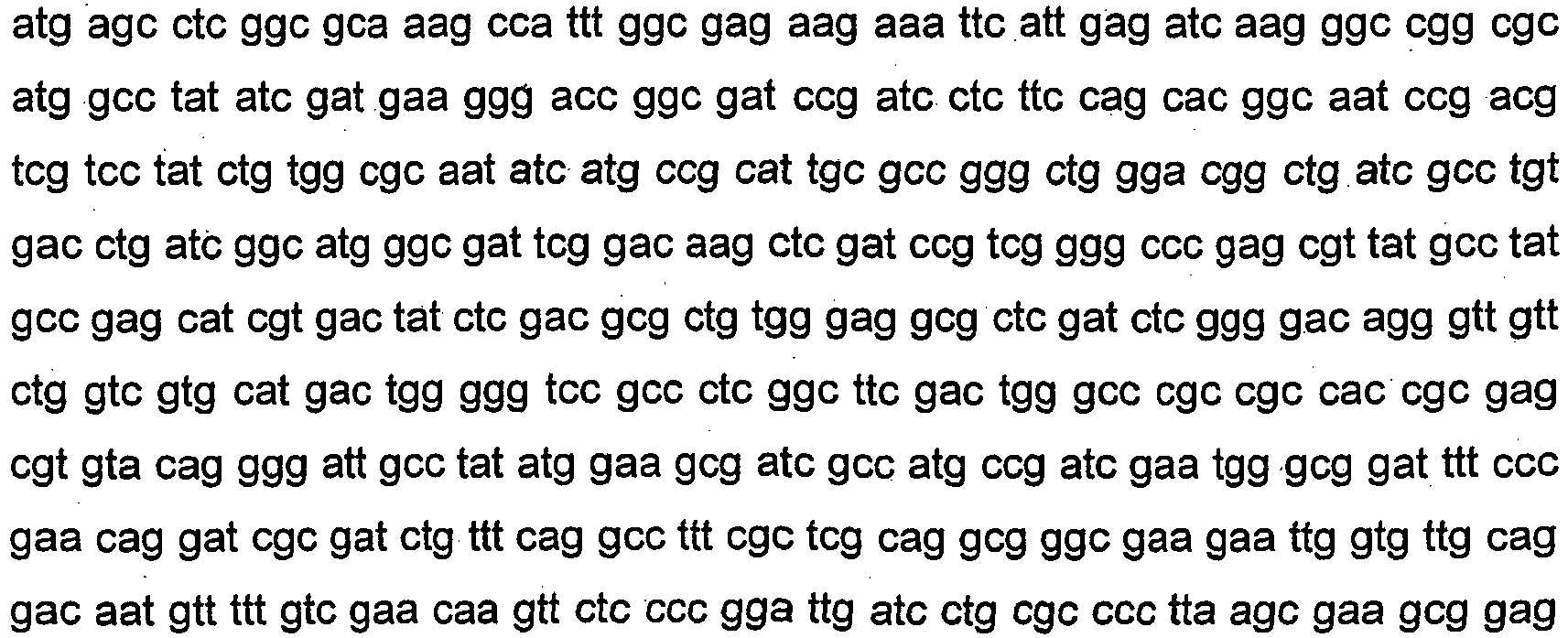


- To overproduce enzyme haloalkane dehalogenase DhaA from Rhodococcus rhodochrous NCIMB 13064 (Sequence 3 and 4), the corresponding gene was cloned in the pAQN vector containing tac promotor (Ptac) under the control of lacl q . Escherichia coli BL21 containing pAQN plasmid was cultured in 250 ml Luria broth at 37 °C. The induction of enzyme synthesis was initiated by addition of isopropyl-β-D-thiogalactopyranoside to a final concentration of 0.5 mM when the culture reached an optical density of 0.6 at 600 nm. After induction, the culture was incubated at 30°C for 4 h and then harvested. The cells were disrupted by sonication using a Soniprep 150 (Sanyo, UK). The supernatant was used after centrifugation at 100 000 g for 1 h. The haloalkane dehalogenase was purified on a Ni-NTA Sepharose column HR 16/10 (Qiagen, Germany). His-tagged haloalkane dehalogenase was bound onto the resin placed in the equilibrating buffer, which contained 20 mM potassium phosphate buffer pH 7.5, 0.5 M sodium chloride and 10 mM imidazole. Unbound and weakly bound proteins were washed off by buffer containing 60 mM imidazole. The His-tagged haloalkane dehalogenase was then eluted by buffer containing 160 mM imidazole. The active fractions were dialysed overnight against 50 mM potassium phosphate buffer, pH 7.5. The enzyme was stored at 4 °C in 50 mM potassium phosphate buffer, pH 7.5, containing 10 % glycerol and 1mM 2-mercaptoethanol enhancing long-term enzyme stability.
- Enzyme haloalkane dehalogenase DhaA or its variant is the part of decontamination composition that contains aforementioned enzyme at concentration 1×10⁻⁶ to 1×10⁻⁴ mol.l-1, further 1 to 5 vol % of aliphatic hydrocarbon of general formula CnH2n+2 or cyclic aliphatic hydrocarbon of general formula CnH2n, where n is 6 to 12, further 5 to 20 vol % of aliphatic alcohol of general formula CnH2n+1OH, where n is 2 to 4, further 3 to 15 weight % of anion active tenside of general formula CnH2n+1OSO3Me, where n is 10 to 16 and Me stands for counter ion (Na+, K+ or monoethanol amonium), 1 to 10 weight % alkylbenzenesulfonate of general formula R(3)-(Ar)SO3 -.Me+, where R(3) stands for alkyl with 11 to 13 atoms of carbon, and Me+ indicates sodium ion, further components of glycine buffer to adjust pH of aqueous solution in the range from 7 to 9, or else glycine of total concentration 0.1 mol.l-1, etc. Required pH 8.2 is reached by addition of 1 M NaOH. The rest to make 100% is water. The catalytic power of haloalkane dehalogenase DhaA at decontamination of yperite is k cat/K m= 5.7 s-1.mM-1.
- Sequence 3 and 4. Sequence of the gene dhaA and haloalkane dehalogenase DhaA isolated from bacterium Rhodococcus rhodochrous NCIMB 13064.


- To overproduce enzyme haloalkane dehalogenase DmbA from Mycobacterium bovis 5033/66 (Sequence 5 and 6), the same procedure as in example 1 is followed. Enzyme haloalkane dehalogenase DmbA or its variant is the part of decontamination composition that contains aforementioned enzyme at concentrations 1×10⁻⁶ to 1×10⁻⁴ mol.l-1, further 1 to 20 vol % of aliphatic alcohol of general formula CnH2n+1OH, where n is 2 to 4, further 3 to 15 weight % of anion active surfactant of general formula CnH2n+1OSO3Me, where n is 10 to 16 and Me stands for counter ion (Na+, K+ or monoethanol amonium), 1 to 10 weight % of ethoxy nonylphenol of general formula C9H19-Ar-O-(C2H4O)nH, where n is 9 to 10, further components of glycine buffer to adjust pH of aqueous solution in the range from 7 to 9, or else glycine of total concentration 0.1 mol.l-1, etc. Required pH is reached by addition of 1M NaOH. The rest to make 100% is water. The catalytic power of haloalkane dehalogenase DmbA at decontamination of yperite is k cat/Km= 6.0 s-1.mM-1.
- Sequence 5 and 6. Sequence of the gene dmbA and haloalkane dehalogenase DmbA isolated from bacterium Mycobacterium bovis 5033/66.


- Enzyme haloalkane dehalogenase LinB or its variant is the part of decontamination composition that contains the enzyme at concentrations 1×10⁻⁶ to 1×10⁻⁴ mol.l-1, further 1 to 15 weight % of anion active surfactant of general formula CnH2n+1OSO3Me, where n is 10 to 16 and Me stands for counter ion (Na+, K+ or monoethanol amonium), 1 to 10 weight % of ethoxylated nonylphenol of general formula C9H19-Ar-O-(C2H4O)nH, where n is 9 to 10, further components of phosphate buffer to adjust pH of aqueous solution in the range from 7 to 8.5; that is KH2PO4 a K2HPO4 in the required ratio and in a total concentration 50 mmol.l-1, etc. The rest to make 100% is water.
- This invention is utilizable in industry to eliminate yperite from the surfaces of military hardware, transportation, industrial and agricultural hardware, technical devices and constructional objects, of the human or animal skin and elements of environment, that are contaminated by this highly toxic blistering substance. This technology is utilizable in armed forces and also in civil services, generally there, where the use of detoxication compositions to decontaminate blistering substances is necessary.
-
- <110> Masarykova univerzita
- <120> Method of detoxication of yperite by using haloalkane dehalogenases
- <130> D0096N/PCT
- <150>
CZ 2005-352
<151> 2005-06-03 - <160> 6
- <170> PatentIn version 3.3
- <210> 1
<211> 891
<212> DNA
<213> Sphingomonas paucimobilis - <400> 1

- <210> 2
<211> 296
<212> PRT
<213> Sphingomonas paucimobilis - <400> 2


- <210> 3
<211> 882
<212> DNA
<213> Rhodococcus rhodochrous - <400> 3

- <210> 4
<211> 293
<212> PRT
<213> Rhodococcus rhodochrous - <400> 4


- <210> 5
<211> 903
<212> DNA
<213> Mycobacterium bovis - <400> 5

- <210> 6
<211> 300
<212> PRT
<213> Mycobacterium bovis - <400> 6



Claims (11)
- Method of detoxication of yperite by the use of haloalkane dehalogenases characterized in that said yperite is treated with at least one haloalkane dehalogenase selected from the group of enzymes EC 3.8.1.5, at the concentration of enzyme 1×10⁻⁶ to 1×100 mol.l-1, at temperature from +10 °C to +70 °C and pH from 4 to 12 in liquid medium.
- Method according to claim 1, characterized in that the haloalkane dehalogenase is at least one enzyme selected from the group comprising dehalogenases LinB from Sphingomonas paucimobilis UT26 (Sequence 1 and 2), DhaA from Rhodococcus rodochrous NCIMB 13064 (Sequence 3 and 4), DmbA from Mycobacterium bovis 5033/66 (Sequence 5 and 6).
- Method according to claim 1 or 2, characterized in that the haloalkane dehalogenase is wild type haloalkane dehalogenase or modified polypeptide with haloalkane dehalogenase activity having an amino acid sequence that corresponds at least in 80% to the sequence No. 2, 4 or 6 or the mixture of the wild type haloalkane dehalogenase and the modified polypeptide.
- Method according to claim 1 or 2, characterized in that the haloalkane dehalogenase is wild type haloalkane dehalogenase or modified polypeptide with haloalkane dehalogenase activity having an amino acid sequence that corresponds at least in 90% to the sequence No. 2, 4 or 6 or the mixture of the wild type haloalkane dehalogenase and the modified polypeptide.
- Method according to claims 1 to 4, characterized in that the liquid medium is an organic solvent, a mono-phasic aqueous solution of organic solvent or biphasic system consisting of organic solvent and water.
- Method according to claim 5, characterized in that the haloalkane dehalogenase solution includes a buffer system.
- Method according to claims 1 to 6, characterized in that the preparation of haloalkane dehalogenase is carried out in the presence of at least one protein stabilizer, selected from the group consisting of polyalcohols, inactive proteins, polymers.
- Method according to claims 1 to 7, characterized in that the enzyme haloalkane dehalogenase is used as soluble form or as crystalline form or as lyophilized form or as precipitated form.
- Method according to claims 1 to 8, characterized in that the enzyme haloalkane dehalogenase is immobilized by adsorption, by ionic binding or by covalent attachment onto the surface of organic or inorganic carrier.
- Method according to claims 1 to 8, characterized in that the enzyme haloalkane dehalogenase is immobilized by cross-linking or entrapping enzyme into a solid matrix or a compartment confined by a membrane.
- Method according to claim 1 to 10, characterized in that the detoxication is carried out in the presence of surfactants.
Applications Claiming Priority (2)
| Application Number | Priority Date | Filing Date | Title |
|---|---|---|---|
| CZ20050352A CZ298287B6 (en) | 2005-06-03 | 2005-06-03 | Detoxication method of sulfide yperite by treating thereof with haloalkane dehalogenases |
| PCT/CZ2006/000036 WO2006128390A1 (en) | 2005-06-03 | 2006-06-01 | Method of detoxication of yperite by using haloalkane dehalogenases |
Publications (3)
| Publication Number | Publication Date |
|---|---|
| EP1899022A1 EP1899022A1 (en) | 2008-03-19 |
| EP1899022B1 true EP1899022B1 (en) | 2013-10-09 |
| EP1899022B8 EP1899022B8 (en) | 2013-12-18 |
Family
ID=37038083
Family Applications (1)
| Application Number | Title | Priority Date | Filing Date |
|---|---|---|---|
| EP06753161.6A Not-in-force EP1899022B8 (en) | 2005-06-03 | 2006-06-01 | Method of detoxication of yperite by using haloalkane dehalogenases |
Country Status (10)
| Country | Link |
|---|---|
| US (1) | US7888103B2 (en) |
| EP (1) | EP1899022B8 (en) |
| JP (1) | JP4793947B2 (en) |
| AU (1) | AU2006254625B2 (en) |
| CA (1) | CA2610024C (en) |
| CZ (1) | CZ298287B6 (en) |
| EA (1) | EA011311B1 (en) |
| IL (1) | IL186596A (en) |
| NZ (1) | NZ564218A (en) |
| WO (1) | WO2006128390A1 (en) |
Families Citing this family (3)
| Publication number | Priority date | Publication date | Assignee | Title |
|---|---|---|---|---|
| RU2497564C2 (en) * | 2011-11-07 | 2013-11-10 | Федеральное бюджетное учреждение "33 Центральный научно-исследовательский испытательный институт Министерства обороны Российской Федерации" | Method of destructing mustard agents |
| EP3173487B1 (en) | 2015-11-26 | 2019-02-20 | Masarykova univerzita | Device for detection of halogenated hydrocarbons |
| CN109706139A (en) * | 2019-03-01 | 2019-05-03 | 中国人民解放军92609部队 | Dehalogenase genes LinB, dehalogenase, dehalogenase genes engineering bacteria and its construction method and methods for using them |
Family Cites Families (2)
| Publication number | Priority date | Publication date | Assignee | Title |
|---|---|---|---|---|
| IL150925A0 (en) * | 2000-02-01 | 2003-02-12 | Little Inc A | Chemical and/or biological decontamination system |
| CN1764489A (en) * | 2003-01-22 | 2006-04-26 | 维克凯斯工业有限公司 | A method for neutralization of toxin agents, pesticides and their hydrolysates, and a reagent for it |
-
2005
- 2005-06-03 CZ CZ20050352A patent/CZ298287B6/en not_active IP Right Cessation
-
2006
- 2006-06-01 US US11/916,144 patent/US7888103B2/en not_active Expired - Fee Related
- 2006-06-01 EA EA200702273A patent/EA011311B1/en not_active IP Right Cessation
- 2006-06-01 NZ NZ564218A patent/NZ564218A/en not_active IP Right Cessation
- 2006-06-01 AU AU2006254625A patent/AU2006254625B2/en not_active Ceased
- 2006-06-01 WO PCT/CZ2006/000036 patent/WO2006128390A1/en not_active Ceased
- 2006-06-01 CA CA2610024A patent/CA2610024C/en not_active Expired - Fee Related
- 2006-06-01 JP JP2008513906A patent/JP4793947B2/en not_active Expired - Fee Related
- 2006-06-01 EP EP06753161.6A patent/EP1899022B8/en not_active Not-in-force
-
2007
- 2007-10-11 IL IL186596A patent/IL186596A/en not_active IP Right Cessation
Also Published As
| Publication number | Publication date |
|---|---|
| IL186596A (en) | 2012-01-31 |
| EP1899022B8 (en) | 2013-12-18 |
| EA011311B1 (en) | 2009-02-27 |
| CA2610024C (en) | 2012-06-26 |
| IL186596A0 (en) | 2008-01-20 |
| WO2006128390A1 (en) | 2006-12-07 |
| JP4793947B2 (en) | 2011-10-12 |
| EA200702273A1 (en) | 2008-04-28 |
| CA2610024A1 (en) | 2006-12-07 |
| AU2006254625B2 (en) | 2009-10-22 |
| AU2006254625A1 (en) | 2006-12-07 |
| US7888103B2 (en) | 2011-02-15 |
| NZ564218A (en) | 2010-05-28 |
| CZ298287B6 (en) | 2007-08-15 |
| EP1899022A1 (en) | 2008-03-19 |
| CZ2005352A3 (en) | 2007-02-14 |
| US20080248557A1 (en) | 2008-10-09 |
| JP2008545483A (en) | 2008-12-18 |
Similar Documents
| Publication | Publication Date | Title |
|---|---|---|
| Pal et al. | Microbial extracellular polymeric substances: central elements in heavy metal bioremediation | |
| Ozdemir et al. | Utilization of an exopolysaccharide produced by Chryseomonas luteola TEM05 in alginate beads for adsorption of cadmium and cobalt ions | |
| Kim et al. | Single enzyme nanoparticles in nanoporous silica: a hierarchical approach to enzyme stabilization and immobilization | |
| Kauffmann et al. | Entrapment of atrazine chlorohydrolase in sol–gel glass matrix | |
| Yadav et al. | Immobilized carbonic anhydrase for the biomimetic carbonation reaction | |
| JP2018196382A (en) | Biodegradable immobilized enzyme and method for producing the same | |
| Kaewchai et al. | Biosorption of heavy metal by thermotolerant polymer-producing bacterial cells and the bioflocculant | |
| Wang et al. | Genetical surface display of silicatein on Yarrowia lipolytica confers living and renewable biosilica–yeast hybrid materials | |
| WO2019179303A1 (en) | Preparation method and application of oil sludge petroleum degradation composite enzyme | |
| Lan et al. | Genetically modified microorganism Spingomonas paucimobilis UT26 for simultaneously degradation of methyl-parathion and γ-hexachlorocyclohexane | |
| US9045746B2 (en) | Nanostructured carbon based biocatalyst for remediation of environmental pollutants | |
| IL186596A (en) | Method of detoxication of yperite by using haloalkane dehalogenases | |
| Hao et al. | Characterization of 17β-estradiol-degrading enzyme from Microbacterium sp. MZT7 and its function on E2 biodegradation in wastewater | |
| Varmazyar | Removal of mercuric chloride by a mercury resistant Pseudomonas putida strain | |
| Frischmuth et al. | Microbial transformation of mercury (II): I. Isolation of microbes and characterization of their transformation capabilities | |
| Baldi et al. | Biological removal of inorganic Hg (II) as gaseous elemental Hg (0) by continuous culture of a Hg-resistant Pseudomonas putida strain FB-1 | |
| Wu et al. | Bacillus circulans WZ-12—a newly discovered aerobic dichloromethane-degrading methylotrophic bacterium | |
| WO1993020223A1 (en) | Purification process by decomposition of haloalkanoic acid with dehalogenase | |
| Potočár et al. | Alkaline flocculation of Microcystis aeruginosa induced by calcium and magnesium precipitates | |
| Ntozonke | Assessment of bioflocculant production by two marine bacteria isolated from the bottom sediment of marine Algoa Bay | |
| RU2663798C2 (en) | Method of purification of wastewater from the oil refining and petrochemical manufacturing productions from benzene | |
| Saduzzaman et al. | Evaluation of Cr (VI) Reducing Capability of Bacillus licheniformis DAS1 Using a Multifactor Experimental Approach | |
| Medvedeva et al. | Soil bacterium Pseudomonas sp.: destroyer of mustard gas hydrolysis products | |
| Khozhanepessova et al. | ADSORPTION IMMOBILIZATION OF MICROORGANISM CELLS ON MINERAL CARRIERS | |
| Choi et al. | Removal of neurotoxic ethyl parathion pesticide by two-stage chemical/enzymatic treatment system using Fenton’s reagent and organophosphorous hydrolase |
Legal Events
| Date | Code | Title | Description |
|---|---|---|---|
| PUAI | Public reference made under article 153(3) epc to a published international application that has entered the european phase |
Free format text: ORIGINAL CODE: 0009012 |
|
| 17P | Request for examination filed |
Effective date: 20071105 |
|
| AK | Designated contracting states |
Kind code of ref document: A1 Designated state(s): AT BE BG CH CY CZ DE DK EE ES FI FR GB GR HU IE IS IT LI LT LU LV MC NL PL PT RO SE SI SK TR |
|
| DAX | Request for extension of the european patent (deleted) | ||
| 17Q | First examination report despatched |
Effective date: 20080922 |
|
| REG | Reference to a national code |
Ref country code: DE Ref legal event code: R079 Ref document number: 602006038782 Country of ref document: DE Free format text: PREVIOUS MAIN CLASS: A62D0003000000 Ipc: A62D0003020000 |
|
| RIC1 | Information provided on ipc code assigned before grant |
Ipc: C02F 11/00 20060101ALI20130408BHEP Ipc: A62D 3/02 20070101AFI20130408BHEP Ipc: C02F 3/34 20060101ALI20130408BHEP Ipc: A62D 101/02 20070101ALI20130408BHEP Ipc: C02F 11/02 20060101ALI20130408BHEP Ipc: C02F 101/36 20060101ALI20130408BHEP |
|
| GRAP | Despatch of communication of intention to grant a patent |
Free format text: ORIGINAL CODE: EPIDOSNIGR1 |
|
| INTG | Intention to grant announced |
Effective date: 20130604 |
|
| GRAS | Grant fee paid |
Free format text: ORIGINAL CODE: EPIDOSNIGR3 |
|
| GRAA | (expected) grant |
Free format text: ORIGINAL CODE: 0009210 |
|
| RIN1 | Information on inventor provided before grant (corrected) |
Inventor name: PROKOP, ZBYNEK Inventor name: OPLUSTIL, FRANTISEK Inventor name: JESENSKA, ANDREA Inventor name: NAGATA, YUJI Inventor name: DAMBORSKY, JIRI |
|
| AK | Designated contracting states |
Kind code of ref document: B1 Designated state(s): AT BE BG CH CY CZ DE DK EE ES FI FR GB GR HU IE IS IT LI LT LU LV MC NL PL PT RO SE SI SK TR |
|
| REG | Reference to a national code |
Ref country code: GB Ref legal event code: FG4D |
|
| REG | Reference to a national code |
Ref country code: CH Ref legal event code: EP Ref country code: AT Ref legal event code: REF Ref document number: 635305 Country of ref document: AT Kind code of ref document: T Effective date: 20131015 |
|
| REG | Reference to a national code |
Ref country code: IE Ref legal event code: FG4D |
|
| REG | Reference to a national code |
Ref country code: DE Ref legal event code: R096 Ref document number: 602006038782 Country of ref document: DE Effective date: 20131212 |
|
| REG | Reference to a national code |
Ref country code: AT Ref legal event code: MK05 Ref document number: 635305 Country of ref document: AT Kind code of ref document: T Effective date: 20131009 |
|
| REG | Reference to a national code |
Ref country code: NL Ref legal event code: VDEP Effective date: 20131009 |
|
| PG25 | Lapsed in a contracting state [announced via postgrant information from national office to epo] |
Ref country code: SI Free format text: LAPSE BECAUSE OF FAILURE TO SUBMIT A TRANSLATION OF THE DESCRIPTION OR TO PAY THE FEE WITHIN THE PRESCRIBED TIME-LIMIT Effective date: 20131009 |
|
| REG | Reference to a national code |
Ref country code: LT Ref legal event code: MG4D |
|
| PG25 | Lapsed in a contracting state [announced via postgrant information from national office to epo] |
Ref country code: SE Free format text: LAPSE BECAUSE OF FAILURE TO SUBMIT A TRANSLATION OF THE DESCRIPTION OR TO PAY THE FEE WITHIN THE PRESCRIBED TIME-LIMIT Effective date: 20131009 Ref country code: IS Free format text: LAPSE BECAUSE OF FAILURE TO SUBMIT A TRANSLATION OF THE DESCRIPTION OR TO PAY THE FEE WITHIN THE PRESCRIBED TIME-LIMIT Effective date: 20140209 Ref country code: NL Free format text: LAPSE BECAUSE OF FAILURE TO SUBMIT A TRANSLATION OF THE DESCRIPTION OR TO PAY THE FEE WITHIN THE PRESCRIBED TIME-LIMIT Effective date: 20131009 Ref country code: BE Free format text: LAPSE BECAUSE OF FAILURE TO SUBMIT A TRANSLATION OF THE DESCRIPTION OR TO PAY THE FEE WITHIN THE PRESCRIBED TIME-LIMIT Effective date: 20131009 Ref country code: LT Free format text: LAPSE BECAUSE OF FAILURE TO SUBMIT A TRANSLATION OF THE DESCRIPTION OR TO PAY THE FEE WITHIN THE PRESCRIBED TIME-LIMIT Effective date: 20131009 Ref country code: FI Free format text: LAPSE BECAUSE OF FAILURE TO SUBMIT A TRANSLATION OF THE DESCRIPTION OR TO PAY THE FEE WITHIN THE PRESCRIBED TIME-LIMIT Effective date: 20131009 |
|
| PG25 | Lapsed in a contracting state [announced via postgrant information from national office to epo] |
Ref country code: PL Free format text: LAPSE BECAUSE OF FAILURE TO SUBMIT A TRANSLATION OF THE DESCRIPTION OR TO PAY THE FEE WITHIN THE PRESCRIBED TIME-LIMIT Effective date: 20131009 Ref country code: ES Free format text: LAPSE BECAUSE OF FAILURE TO SUBMIT A TRANSLATION OF THE DESCRIPTION OR TO PAY THE FEE WITHIN THE PRESCRIBED TIME-LIMIT Effective date: 20131009 Ref country code: CY Free format text: LAPSE BECAUSE OF FAILURE TO SUBMIT A TRANSLATION OF THE DESCRIPTION OR TO PAY THE FEE WITHIN THE PRESCRIBED TIME-LIMIT Effective date: 20131009 Ref country code: AT Free format text: LAPSE BECAUSE OF FAILURE TO SUBMIT A TRANSLATION OF THE DESCRIPTION OR TO PAY THE FEE WITHIN THE PRESCRIBED TIME-LIMIT Effective date: 20131009 Ref country code: LV Free format text: LAPSE BECAUSE OF FAILURE TO SUBMIT A TRANSLATION OF THE DESCRIPTION OR TO PAY THE FEE WITHIN THE PRESCRIBED TIME-LIMIT Effective date: 20131009 |
|
| PG25 | Lapsed in a contracting state [announced via postgrant information from national office to epo] |
Ref country code: PT Free format text: LAPSE BECAUSE OF FAILURE TO SUBMIT A TRANSLATION OF THE DESCRIPTION OR TO PAY THE FEE WITHIN THE PRESCRIBED TIME-LIMIT Effective date: 20140210 |
|
| REG | Reference to a national code |
Ref country code: DE Ref legal event code: R097 Ref document number: 602006038782 Country of ref document: DE |
|
| PG25 | Lapsed in a contracting state [announced via postgrant information from national office to epo] |
Ref country code: EE Free format text: LAPSE BECAUSE OF FAILURE TO SUBMIT A TRANSLATION OF THE DESCRIPTION OR TO PAY THE FEE WITHIN THE PRESCRIBED TIME-LIMIT Effective date: 20131009 |
|
| PLBE | No opposition filed within time limit |
Free format text: ORIGINAL CODE: 0009261 |
|
| STAA | Information on the status of an ep patent application or granted ep patent |
Free format text: STATUS: NO OPPOSITION FILED WITHIN TIME LIMIT |
|
| PG25 | Lapsed in a contracting state [announced via postgrant information from national office to epo] |
Ref country code: IT Free format text: LAPSE BECAUSE OF FAILURE TO SUBMIT A TRANSLATION OF THE DESCRIPTION OR TO PAY THE FEE WITHIN THE PRESCRIBED TIME-LIMIT Effective date: 20131009 Ref country code: CZ Free format text: LAPSE BECAUSE OF FAILURE TO SUBMIT A TRANSLATION OF THE DESCRIPTION OR TO PAY THE FEE WITHIN THE PRESCRIBED TIME-LIMIT Effective date: 20131009 Ref country code: SK Free format text: LAPSE BECAUSE OF FAILURE TO SUBMIT A TRANSLATION OF THE DESCRIPTION OR TO PAY THE FEE WITHIN THE PRESCRIBED TIME-LIMIT Effective date: 20131009 Ref country code: RO Free format text: LAPSE BECAUSE OF FAILURE TO SUBMIT A TRANSLATION OF THE DESCRIPTION OR TO PAY THE FEE WITHIN THE PRESCRIBED TIME-LIMIT Effective date: 20131009 |
|
| 26N | No opposition filed |
Effective date: 20140710 |
|
| PG25 | Lapsed in a contracting state [announced via postgrant information from national office to epo] |
Ref country code: DK Free format text: LAPSE BECAUSE OF FAILURE TO SUBMIT A TRANSLATION OF THE DESCRIPTION OR TO PAY THE FEE WITHIN THE PRESCRIBED TIME-LIMIT Effective date: 20131009 |
|
| REG | Reference to a national code |
Ref country code: DE Ref legal event code: R097 Ref document number: 602006038782 Country of ref document: DE Effective date: 20140710 |
|
| PG25 | Lapsed in a contracting state [announced via postgrant information from national office to epo] |
Ref country code: LU Free format text: LAPSE BECAUSE OF FAILURE TO SUBMIT A TRANSLATION OF THE DESCRIPTION OR TO PAY THE FEE WITHIN THE PRESCRIBED TIME-LIMIT Effective date: 20140601 Ref country code: MC Free format text: LAPSE BECAUSE OF FAILURE TO SUBMIT A TRANSLATION OF THE DESCRIPTION OR TO PAY THE FEE WITHIN THE PRESCRIBED TIME-LIMIT Effective date: 20131009 |
|
| REG | Reference to a national code |
Ref country code: CH Ref legal event code: PL |
|
| REG | Reference to a national code |
Ref country code: IE Ref legal event code: MM4A |
|
| PG25 | Lapsed in a contracting state [announced via postgrant information from national office to epo] |
Ref country code: LI Free format text: LAPSE BECAUSE OF NON-PAYMENT OF DUE FEES Effective date: 20140630 Ref country code: IE Free format text: LAPSE BECAUSE OF NON-PAYMENT OF DUE FEES Effective date: 20140601 Ref country code: CH Free format text: LAPSE BECAUSE OF NON-PAYMENT OF DUE FEES Effective date: 20140630 |
|
| REG | Reference to a national code |
Ref country code: FR Ref legal event code: PLFP Year of fee payment: 10 |
|
| PGFP | Annual fee paid to national office [announced via postgrant information from national office to epo] |
Ref country code: DE Payment date: 20150624 Year of fee payment: 10 |
|
| PGFP | Annual fee paid to national office [announced via postgrant information from national office to epo] |
Ref country code: FR Payment date: 20150630 Year of fee payment: 10 |
|
| PG25 | Lapsed in a contracting state [announced via postgrant information from national office to epo] |
Ref country code: BG Free format text: LAPSE BECAUSE OF FAILURE TO SUBMIT A TRANSLATION OF THE DESCRIPTION OR TO PAY THE FEE WITHIN THE PRESCRIBED TIME-LIMIT Effective date: 20131009 |
|
| PG25 | Lapsed in a contracting state [announced via postgrant information from national office to epo] |
Ref country code: GR Free format text: LAPSE BECAUSE OF FAILURE TO SUBMIT A TRANSLATION OF THE DESCRIPTION OR TO PAY THE FEE WITHIN THE PRESCRIBED TIME-LIMIT Effective date: 20140110 |
|
| PG25 | Lapsed in a contracting state [announced via postgrant information from national office to epo] |
Ref country code: TR Free format text: LAPSE BECAUSE OF FAILURE TO SUBMIT A TRANSLATION OF THE DESCRIPTION OR TO PAY THE FEE WITHIN THE PRESCRIBED TIME-LIMIT Effective date: 20131009 Ref country code: HU Free format text: LAPSE BECAUSE OF FAILURE TO SUBMIT A TRANSLATION OF THE DESCRIPTION OR TO PAY THE FEE WITHIN THE PRESCRIBED TIME-LIMIT; INVALID AB INITIO Effective date: 20060601 |
|
| REG | Reference to a national code |
Ref country code: DE Ref legal event code: R119 Ref document number: 602006038782 Country of ref document: DE |
|
| REG | Reference to a national code |
Ref country code: FR Ref legal event code: ST Effective date: 20170228 |
|
| PG25 | Lapsed in a contracting state [announced via postgrant information from national office to epo] |
Ref country code: FR Free format text: LAPSE BECAUSE OF NON-PAYMENT OF DUE FEES Effective date: 20160630 Ref country code: DE Free format text: LAPSE BECAUSE OF NON-PAYMENT OF DUE FEES Effective date: 20170103 |
|
| PGFP | Annual fee paid to national office [announced via postgrant information from national office to epo] |
Ref country code: GB Payment date: 20170615 Year of fee payment: 12 |
|
| GBPC | Gb: european patent ceased through non-payment of renewal fee |
Effective date: 20180601 |
|
| PG25 | Lapsed in a contracting state [announced via postgrant information from national office to epo] |
Ref country code: GB Free format text: LAPSE BECAUSE OF NON-PAYMENT OF DUE FEES Effective date: 20180601 |