EP1897908A1 - Antifoulant dispersant composition and method of use - Google Patents
Antifoulant dispersant composition and method of use Download PDFInfo
- Publication number
- EP1897908A1 EP1897908A1 EP07253055A EP07253055A EP1897908A1 EP 1897908 A1 EP1897908 A1 EP 1897908A1 EP 07253055 A EP07253055 A EP 07253055A EP 07253055 A EP07253055 A EP 07253055A EP 1897908 A1 EP1897908 A1 EP 1897908A1
- Authority
- EP
- European Patent Office
- Prior art keywords
- dispersant
- antifouling dispersant
- antifouling
- compressor
- fatty acid
- Prior art date
- Legal status (The legal status is an assumption and is not a legal conclusion. Google has not performed a legal analysis and makes no representation as to the accuracy of the status listed.)
- Granted
Links
- 239000002270 dispersing agent Substances 0.000 title claims abstract description 83
- 238000000034 method Methods 0.000 title claims abstract description 39
- 239000000203 mixture Substances 0.000 title claims description 15
- 239000002519 antifouling agent Substances 0.000 title claims description 6
- 229910052757 nitrogen Inorganic materials 0.000 claims abstract description 21
- VGGSQFUCUMXWEO-UHFFFAOYSA-N Ethene Chemical compound C=C VGGSQFUCUMXWEO-UHFFFAOYSA-N 0.000 claims abstract description 20
- 239000005977 Ethylene Substances 0.000 claims abstract description 20
- ODHYIQOBTIWVRZ-UHFFFAOYSA-N n-propan-2-ylhydroxylamine Chemical compound CC(C)NO ODHYIQOBTIWVRZ-UHFFFAOYSA-N 0.000 claims abstract description 19
- 235000014113 dietary fatty acids Nutrition 0.000 claims abstract description 16
- 229930195729 fatty acid Natural products 0.000 claims abstract description 16
- 239000000194 fatty acid Substances 0.000 claims abstract description 16
- 150000004665 fatty acids Chemical class 0.000 claims abstract description 16
- 238000004519 manufacturing process Methods 0.000 claims abstract description 5
- 230000003373 anti-fouling effect Effects 0.000 claims description 29
- 239000002904 solvent Substances 0.000 claims description 13
- KAKZBPTYRLMSJV-UHFFFAOYSA-N Butadiene Chemical compound C=CC=C KAKZBPTYRLMSJV-UHFFFAOYSA-N 0.000 claims description 12
- XLYOFNOQVPJJNP-UHFFFAOYSA-N water Substances O XLYOFNOQVPJJNP-UHFFFAOYSA-N 0.000 claims description 10
- NLHHRLWOUZZQLW-UHFFFAOYSA-N Acrylonitrile Chemical compound C=CC#N NLHHRLWOUZZQLW-UHFFFAOYSA-N 0.000 claims description 8
- PPBRXRYQALVLMV-UHFFFAOYSA-N Styrene Chemical compound C=CC1=CC=CC=C1 PPBRXRYQALVLMV-UHFFFAOYSA-N 0.000 claims description 8
- 238000009472 formulation Methods 0.000 claims description 7
- 125000004432 carbon atom Chemical group C* 0.000 claims description 6
- 150000001875 compounds Chemical class 0.000 claims description 6
- MTHSVFCYNBDYFN-UHFFFAOYSA-N diethylene glycol Chemical compound OCCOCCO MTHSVFCYNBDYFN-UHFFFAOYSA-N 0.000 claims description 6
- 239000007788 liquid Substances 0.000 claims description 6
- 239000000443 aerosol Substances 0.000 claims description 5
- 125000000217 alkyl group Chemical group 0.000 claims description 5
- 238000012824 chemical production Methods 0.000 claims description 5
- 238000011084 recovery Methods 0.000 claims description 5
- ARXJGSRGQADJSQ-UHFFFAOYSA-N 1-methoxypropan-2-ol Chemical compound COCC(C)O ARXJGSRGQADJSQ-UHFFFAOYSA-N 0.000 claims description 4
- POAOYUHQDCAZBD-UHFFFAOYSA-N 2-butoxyethanol Chemical compound CCCCOCCO POAOYUHQDCAZBD-UHFFFAOYSA-N 0.000 claims description 4
- 125000003342 alkenyl group Chemical group 0.000 claims description 4
- 239000000178 monomer Substances 0.000 claims description 3
- 238000010791 quenching Methods 0.000 claims description 3
- 238000011144 upstream manufacturing Methods 0.000 claims description 3
- QWOZZTWBWQMEPD-UHFFFAOYSA-N 1-(2-ethoxypropoxy)propan-2-ol Chemical compound CCOC(C)COCC(C)O QWOZZTWBWQMEPD-UHFFFAOYSA-N 0.000 claims description 2
- JOLQKTGDSGKSKJ-UHFFFAOYSA-N 1-ethoxypropan-2-ol Chemical compound CCOCC(C)O JOLQKTGDSGKSKJ-UHFFFAOYSA-N 0.000 claims description 2
- SBASXUCJHJRPEV-UHFFFAOYSA-N 2-(2-methoxyethoxy)ethanol Chemical compound COCCOCCO SBASXUCJHJRPEV-UHFFFAOYSA-N 0.000 claims description 2
- NCHBYORVPVDWBJ-UHFFFAOYSA-N 2-(3-methylbutoxy)ethanol Chemical compound CC(C)CCOCCO NCHBYORVPVDWBJ-UHFFFAOYSA-N 0.000 claims description 2
- INFFATMFXZFLAO-UHFFFAOYSA-N 2-(methoxymethoxy)ethanol Chemical compound COCOCCO INFFATMFXZFLAO-UHFFFAOYSA-N 0.000 claims description 2
- UPGSWASWQBLSKZ-UHFFFAOYSA-N 2-hexoxyethanol Chemical compound CCCCCCOCCO UPGSWASWQBLSKZ-UHFFFAOYSA-N 0.000 claims description 2
- QCDWFXQBSFUVSP-UHFFFAOYSA-N 2-phenoxyethanol Chemical compound OCCOC1=CC=CC=C1 QCDWFXQBSFUVSP-UHFFFAOYSA-N 0.000 claims description 2
- QCAHUFWKIQLBNB-UHFFFAOYSA-N 3-(3-methoxypropoxy)propan-1-ol Chemical compound COCCCOCCCO QCAHUFWKIQLBNB-UHFFFAOYSA-N 0.000 claims description 2
- 239000002202 Polyethylene glycol Substances 0.000 claims description 2
- 239000002253 acid Substances 0.000 claims description 2
- 238000000151 deposition Methods 0.000 claims description 2
- 229940028356 diethylene glycol monobutyl ether Drugs 0.000 claims description 2
- XXJWXESWEXIICW-UHFFFAOYSA-N diethylene glycol monoethyl ether Chemical compound CCOCCOCCO XXJWXESWEXIICW-UHFFFAOYSA-N 0.000 claims description 2
- 229940075557 diethylene glycol monoethyl ether Drugs 0.000 claims description 2
- 238000010790 dilution Methods 0.000 claims description 2
- 239000012895 dilution Substances 0.000 claims description 2
- SZXQTJUDPRGNJN-UHFFFAOYSA-N dipropylene glycol Chemical compound OCCCOCCCO SZXQTJUDPRGNJN-UHFFFAOYSA-N 0.000 claims description 2
- JCGNDDUYTRNOFT-UHFFFAOYSA-N oxolane-2,4-dione Chemical compound O=C1COC(=O)C1 JCGNDDUYTRNOFT-UHFFFAOYSA-N 0.000 claims description 2
- 229960005323 phenoxyethanol Drugs 0.000 claims description 2
- WVDDGKGOMKODPV-ZQBYOMGUSA-N phenyl(114C)methanol Chemical compound O[14CH2]C1=CC=CC=C1 WVDDGKGOMKODPV-ZQBYOMGUSA-N 0.000 claims description 2
- 229920001223 polyethylene glycol Polymers 0.000 claims description 2
- 229920001451 polypropylene glycol Polymers 0.000 claims description 2
- 238000000746 purification Methods 0.000 claims description 2
- 239000000126 substance Substances 0.000 claims description 2
- ZIBGPFATKBEMQZ-UHFFFAOYSA-N triethylene glycol Chemical compound OCCOCCOCCO ZIBGPFATKBEMQZ-UHFFFAOYSA-N 0.000 claims description 2
- JLGLQAWTXXGVEM-UHFFFAOYSA-N triethylene glycol monomethyl ether Chemical compound COCCOCCOCCO JLGLQAWTXXGVEM-UHFFFAOYSA-N 0.000 claims description 2
- 239000002351 wastewater Substances 0.000 claims description 2
- 230000002265 prevention Effects 0.000 abstract 1
- 229930195733 hydrocarbon Natural products 0.000 description 12
- 150000002430 hydrocarbons Chemical class 0.000 description 12
- 230000000052 comparative effect Effects 0.000 description 8
- 229920000642 polymer Polymers 0.000 description 8
- 101100170601 Drosophila melanogaster Tet gene Proteins 0.000 description 7
- VHILMKFSCRWWIJ-UHFFFAOYSA-N dimethyl acetylenedicarboxylate Chemical compound COC(=O)C#CC(=O)OC VHILMKFSCRWWIJ-UHFFFAOYSA-N 0.000 description 7
- IJGRMHOSHXDMSA-UHFFFAOYSA-N Atomic nitrogen Chemical compound N#N IJGRMHOSHXDMSA-UHFFFAOYSA-N 0.000 description 6
- 239000004215 Carbon black (E152) Substances 0.000 description 6
- 239000000356 contaminant Substances 0.000 description 4
- 239000007789 gas Substances 0.000 description 4
- 238000010926 purge Methods 0.000 description 4
- 239000000654 additive Substances 0.000 description 3
- 239000000839 emulsion Substances 0.000 description 3
- 239000000243 solution Substances 0.000 description 3
- OAYXUHPQHDHDDZ-UHFFFAOYSA-N 2-(2-butoxyethoxy)ethanol Chemical compound CCCCOCCOCCO OAYXUHPQHDHDDZ-UHFFFAOYSA-N 0.000 description 2
- 229920001174 Diethylhydroxylamine Polymers 0.000 description 2
- 229920002367 Polyisobutene Polymers 0.000 description 2
- ATUOYWHBWRKTHZ-UHFFFAOYSA-N Propane Chemical compound CCC ATUOYWHBWRKTHZ-UHFFFAOYSA-N 0.000 description 2
- 230000015572 biosynthetic process Effects 0.000 description 2
- 125000000484 butyl group Chemical group [H]C([*])([H])C([H])([H])C([H])([H])C([H])([H])[H] 0.000 description 2
- FVCOIAYSJZGECG-UHFFFAOYSA-N diethylhydroxylamine Chemical compound CCN(O)CC FVCOIAYSJZGECG-UHFFFAOYSA-N 0.000 description 2
- 238000005187 foaming Methods 0.000 description 2
- 239000007791 liquid phase Substances 0.000 description 2
- VNWKTOKETHGBQD-UHFFFAOYSA-N methane Chemical compound C VNWKTOKETHGBQD-UHFFFAOYSA-N 0.000 description 2
- 229920000620 organic polymer Polymers 0.000 description 2
- 238000006116 polymerization reaction Methods 0.000 description 2
- 239000002002 slurry Substances 0.000 description 2
- 239000000725 suspension Substances 0.000 description 2
- OTMSDBZUPAUEDD-UHFFFAOYSA-N Ethane Chemical compound CC OTMSDBZUPAUEDD-UHFFFAOYSA-N 0.000 description 1
- 230000002378 acidificating effect Effects 0.000 description 1
- 239000011149 active material Substances 0.000 description 1
- 230000032683 aging Effects 0.000 description 1
- 239000012736 aqueous medium Substances 0.000 description 1
- 238000010923 batch production Methods 0.000 description 1
- 239000001273 butane Substances 0.000 description 1
- 239000011248 coating agent Substances 0.000 description 1
- 238000000576 coating method Methods 0.000 description 1
- 238000010924 continuous production Methods 0.000 description 1
- QKIUAMUSENSFQQ-UHFFFAOYSA-N dimethylazanide Chemical compound C[N-]C QKIUAMUSENSFQQ-UHFFFAOYSA-N 0.000 description 1
- 230000003628 erosive effect Effects 0.000 description 1
- NBVXSUQYWXRMNV-UHFFFAOYSA-N fluoromethane Chemical compound FC NBVXSUQYWXRMNV-UHFFFAOYSA-N 0.000 description 1
- 230000002401 inhibitory effect Effects 0.000 description 1
- 229910052816 inorganic phosphate Inorganic materials 0.000 description 1
- 229910052909 inorganic silicate Inorganic materials 0.000 description 1
- 238000002955 isolation Methods 0.000 description 1
- 239000000463 material Substances 0.000 description 1
- 239000002184 metal Substances 0.000 description 1
- IJDNQMDRQITEOD-UHFFFAOYSA-N n-butane Chemical compound CCCC IJDNQMDRQITEOD-UHFFFAOYSA-N 0.000 description 1
- OFBQJSOFQDEBGM-UHFFFAOYSA-N n-pentane Natural products CCCCC OFBQJSOFQDEBGM-UHFFFAOYSA-N 0.000 description 1
- 239000003345 natural gas Substances 0.000 description 1
- 239000003921 oil Substances 0.000 description 1
- 239000003208 petroleum Substances 0.000 description 1
- NBIIXXVUZAFLBC-UHFFFAOYSA-K phosphate Chemical compound [O-]P([O-])([O-])=O NBIIXXVUZAFLBC-UHFFFAOYSA-K 0.000 description 1
- 239000001294 propane Substances 0.000 description 1
- 229920006395 saturated elastomer Polymers 0.000 description 1
- 238000010008 shearing Methods 0.000 description 1
- -1 silicate ions Chemical class 0.000 description 1
- 238000004230 steam cracking Methods 0.000 description 1
- 238000010998 test method Methods 0.000 description 1
Classifications
-
- C—CHEMISTRY; METALLURGY
- C10—PETROLEUM, GAS OR COKE INDUSTRIES; TECHNICAL GASES CONTAINING CARBON MONOXIDE; FUELS; LUBRICANTS; PEAT
- C10B—DESTRUCTIVE DISTILLATION OF CARBONACEOUS MATERIALS FOR PRODUCTION OF GAS, COKE, TAR, OR SIMILAR MATERIALS
- C10B43/00—Preventing or removing incrustations
- C10B43/14—Preventing incrustations
-
- C—CHEMISTRY; METALLURGY
- C08—ORGANIC MACROMOLECULAR COMPOUNDS; THEIR PREPARATION OR CHEMICAL WORKING-UP; COMPOSITIONS BASED THEREON
- C08K—Use of inorganic or non-macromolecular organic substances as compounding ingredients
- C08K5/00—Use of organic ingredients
- C08K5/16—Nitrogen-containing compounds
- C08K5/20—Carboxylic acid amides
-
- C—CHEMISTRY; METALLURGY
- C08—ORGANIC MACROMOLECULAR COMPOUNDS; THEIR PREPARATION OR CHEMICAL WORKING-UP; COMPOSITIONS BASED THEREON
- C08K—Use of inorganic or non-macromolecular organic substances as compounding ingredients
- C08K5/00—Use of organic ingredients
- C08K5/16—Nitrogen-containing compounds
- C08K5/32—Compounds containing nitrogen bound to oxygen
-
- C—CHEMISTRY; METALLURGY
- C10—PETROLEUM, GAS OR COKE INDUSTRIES; TECHNICAL GASES CONTAINING CARBON MONOXIDE; FUELS; LUBRICANTS; PEAT
- C10G—CRACKING HYDROCARBON OILS; PRODUCTION OF LIQUID HYDROCARBON MIXTURES, e.g. BY DESTRUCTIVE HYDROGENATION, OLIGOMERISATION, POLYMERISATION; RECOVERY OF HYDROCARBON OILS FROM OIL-SHALE, OIL-SAND, OR GASES; REFINING MIXTURES MAINLY CONSISTING OF HYDROCARBONS; REFORMING OF NAPHTHA; MINERAL WAXES
- C10G75/00—Inhibiting corrosion or fouling in apparatus for treatment or conversion of hydrocarbon oils, in general
- C10G75/04—Inhibiting corrosion or fouling in apparatus for treatment or conversion of hydrocarbon oils, in general by addition of antifouling agents
-
- Y—GENERAL TAGGING OF NEW TECHNOLOGICAL DEVELOPMENTS; GENERAL TAGGING OF CROSS-SECTIONAL TECHNOLOGIES SPANNING OVER SEVERAL SECTIONS OF THE IPC; TECHNICAL SUBJECTS COVERED BY FORMER USPC CROSS-REFERENCE ART COLLECTIONS [XRACs] AND DIGESTS
- Y02—TECHNOLOGIES OR APPLICATIONS FOR MITIGATION OR ADAPTATION AGAINST CLIMATE CHANGE
- Y02P—CLIMATE CHANGE MITIGATION TECHNOLOGIES IN THE PRODUCTION OR PROCESSING OF GOODS
- Y02P30/00—Technologies relating to oil refining and petrochemical industry
- Y02P30/40—Ethylene production
Definitions
- the present invention relates to an antifoulant dispersant.
- the present invention particularly relates to antifoulant dispersants for use with compressors.
- the steps of the method are applying to the surface a first slurry containing an acidic aqueous medium containing a galvanically active material and phosphate ions, thereby forming a galvanically sacrificial first layer, curing the first layer, applying to the cured first layer an aqueous non-conductive second slurry containing inorganic phosphate or silicate ions, thereby forming a non-conductive second layer, curing the second layer, applying to the cured second layer a liquid sealer composition containing a thermally stable organic polymer and fluorocarbon, thereby forming a top layer, and curing the top layer.
- Hydrocarbons used as ethylene feedstocks range from natural gas liquids including ethane, propane and butane, to petroleum liquids including gas oils and naphtha.
- ethylene feedstocks range from natural gas liquids including ethane, propane and butane, to petroleum liquids including gas oils and naphtha.
- polymers are generally considered contaminants and are undesirable in the product ethylene.
- One point of isolation of such contaminants is the compressors. Due to pressure changes, the contaminants can be isolated as liquids and sent to knockout pots wherein the contaminants are held until sent for recycle or disposal.
- the present invention is an antifouling dispersant prepared from a formulation comprising isopropylhydroxyl amine, and an N, N-dialkyl fatty acid amide.
- the present invention is a process for preventing fouling of a compressor used to compress gasses comprising depositing an antifouling dispersant onto one or more blades of a compressor to be protected from fouling, the antifouling dispersant being prepared from a formulation comprising isopropylhydroxyl amine and an N, N-dialkyl fatty acid amide.
- the present invention is a process for preventing fouling of a compressor used to compress gasses comprising using an antifouling dispersant wash in a compressor to be protected from fouling, the antifouling dispersant being prepared from a formulation comprising isopropylhydroxyl amine and an N, N-dialkyl fatty acid amide.
- Another embodiment of the invention is a process for preventing fouling of chemical production equipment comprising using an antifouling dispersant wash in at least one device to be protected from fouling, the antifouling dispersant being prepared from a formulation comprising isopropylhydroxyl amine and an N, N-dialkyl fatty acid amide.
- the present invention is a process for preventing fouling of compressor blades used to compress gasses.
- the dispersants can be applied to compressor blades in any way known to those of ordinary skill in the art of applying such materials to be useful for preventing fouling.
- the additives are sprayed onto the compressor blades in the form of an aerosol.
- the additives are injected into the gas stream being compressed, upstream of the compressor, as an aerosol that is then carried to the compressor blades by the gas being compressed.
- the additives are employed as part of a wash solution applied directly or indirectly to the compressor parts.
- the invention is an antifoulant dispersant including isopropylhydroxyl amine (IPHA) and an N, N-dialkylamide of a fatty acid.
- IPHA isopropylhydroxyl amine
- N, N-dialkylamide of a fatty acid This combination of components is hereinafter referred to sometimes as dispersant or antifouling dispersant.
- the antifouling dispersant has the functionality of dispersing polymerized hydrocarbons and inhibiting the auto-polymerization of hydrocarbons thereby reducing polymers forming.
- the IPHA component of the antifouling dispersants functions to inhibit auto-polymerizations.
- the N, N-dialkylamide component acts to disperse hydrocarbons and polymers and has a general formula: wherein:
- R is an alkenyl group having one or more unsaturated bonds and having from 12 to 20 carbon atoms.
- the N, N-dialkylamide may be a single compound but in some embodiments is a mixture of compounds.
- the N, N-dialkylamide used to prepare the dispersant of the invention is DMAD which is available from Buckman Laboratories of Canada, Ltd., Vaudreuil, Quebec, Canada.
- the DMAD products are believed to consist primarily of a mixture of two N, N-dialkylamides having the formulae: and along with a minor amount of similar saturated compounds.
- the two components of the dispersants of the present invention may be brought together in ratios of IPHA to N, N-dialkyl fatty acid amides in weight ratios ranging from 10:1 1 to 1:10. In some embodiments this ratio may be from 1:1 to 1:10. In other embodiments, this ratio may be from 1:1 to 1:2. All points intermediate in these ranges is also within the scope of the present invention.
- the dispersant may be used or applied neat, in one embodiment of the invention, the dispersant is prepared using a solvent.
- the solvents which are useful with the present invention include any solvent in which: a) the IPHA and N, N-dialkylamide of a fatty acid are soluble or can be stably suspended and b) the resulting solution or suspension is miscible with water at a concentration of at least 100 weight ppm of solution or suspension in water.
- Exemplary solvents include, but are not limited to benzyl alcohol, 2-phenoxyethanol, 2-(methoxymethoxy)ethanol, 2-butoxyethanol, 2-(isopentyloxy)ethanol, 2-(hexyloxy)ethanol, diethylene glycol, diethylene glycol monomethyl ether, diethylene glycol monoethyl ether, diethylene glycol monobutyl ether, triethylene glycol, triethylene glycol monomethyl ether, liquid polyethylene glycol, 1-methoxy-2-propanol, 1-ethoxy-2- propanol, dipropylene glycol, dipropylene glycol monomethyl ether, dipropylene glycol monoethyl ether, and a low molecular weight polypropylene glycol.
- Butyl CELLOSOLVE TM which consists primarily of 2-butoxyethanol
- Butyl CARBITOL TM which consists primarily of ethylene glycol monobutyl ether
- a solvent When a solvent is present, it may be present in a weight ratio of solvent to dispersant of from about 4:1 to about 1:1.
- the components of the dispersants may be brought together in any way that is known to be useful to those of ordinary skill in preparing chemical compositions for industrial use.
- the components may be admixed sequentially or all at once.
- the dispersants of the invention may be prepared using a batch process or they may be prepared using a continuous process.
- the dispersants of the present invention have a useful synergy, the mixed components performing better together than the individual components singularly.
- dispersants of the present invention are effective at preventing compressor fouling, there is a second property of these dispersants that is also desirable.
- the dispersants of the invention have the desirable property of not creating emulsions with resultant foaming in, for example, knockout pots. Knockout pots are used most applications where a compressor is employed and is often a point where dispersants may accumulate. While the dispersant of the invention may not act to break existing emulsions, they do not of themselves cause emulsions, unlike many other dispersants used for preventing compressor fouling.
- dispersants of the present invention are useful in compressors used for an ethylene process production process, they are also useful in other similar applications and with other equipment.
- the dispersants of the invention may be used with any process where process equipment will come into contact with ethylene cracked gassed.
- Another application of the invention is ethylene and acrylonitrile quench water systems.
- the dispersants of the application may be used with ethylene dilution steam generators and acrylonitrile purification systems.
- Many polymer processes have monomer recovery systems which are subject to fouling and are good target applications for the dispersants of the invention.
- Process water strippers and waste water strippers used with petrochemical processes such as styrene, butadiene, acrylonitrile, and ethylene processes are potential applications for the dispersants of the invention.
- ethylene acid gas scrubbers and butadiene solvent recovery systems are also end use applications of the dispersants of the present invention.
- the dispersants can be desirably used in any process which has process equipment subject to fouling with polymers.
- the dispersants are especially desirable in applications where foaming would problematic.
- processes that consume or produce at least one of styrene, butadiene, acrylonitrile, and ethylene are potential applications of the dispersants.
- process equipment means compressors, fans, impellers, pumps, vacuum pumps, valves, heat exchangers; sensors, and the like, that are associated with the process and which may be subject to fouling.
- This term also includes supersets of these components where more than one of the components is part of a "system” such as, for example, a stripper where hydrocarbons are removed from an aqueous process stream, or a knockout pot.
- a dispersant of the present invention is prepared by admixing 7.5 parts IPHA, 10 parts DMAD (a fatty acid dimethylamide available from Buckman Laboratories of Canada), 40 parts Butyl CARBITOL, and 42.5 parts water.
- the dispersant is tested according to ASTM-873 also known as the induced gums test.
- ASTM-873 also known as the induced gums test.
- This test method determines the tendency of a hydrocarbon to form gums under accelerated aging conditions.
- 100 ml of a hydrocarbon is placed into a bomb and air is introduced to attain a pressure of about 100 psi (689 kPa).
- the bomb is then kept at 100°C for four hours.
- bomb is cooled rapidly and the pressure is released slowly.
- the liquid phase of the sample is evaporated 160°C under a nitrogen purge for 30 minutes then at about 220°C under a steam purge for 30 minutes.
- the value of potential gum is determined using weight differentials.
- the dispersant is tested at a concentration of 100 ppm.
- a control is prepared and tested wherein no dispersant is included in the hydrocarbon.
- Example 1 is repeated substantially identically except that the dispersant is prepared by admixing 6 parts IPHA, 20 parts DMAD, 40 parts Butyl CARBITOL, and 34 parts water. Table 1 Sample ID Gums Produced (mg/100ml) Percent Reduction Control* 355.6 -- Example 1 (Dispersant I) 328.4 7.6 Example 2 (Dispersant II) 327.4 7.9 * Not an example of the invention.
- Example 3 is repeated substantially identically except that the dispersant is tested at 25 ppm.
- Example 3 is repeated substantially identically except that diethylhydroxyl amine (DEHA) is used (Dispersant III) instead of IPHA.
- DEHA diethylhydroxyl amine
- Example 3 is repeated substantially identically except that Dispersant III is used at a concentration of 25ppm.
- Example 3 is repeated substantially identically except that the dispersant is IPHA alone and it is used at a concentration of 1.875 ppm.
- Example 3 is repeated substantially identically except that the dispersant is DMAD alone and it is used at a concentration of 2.5 ppm.
Landscapes
- Chemical & Material Sciences (AREA)
- Organic Chemistry (AREA)
- Chemical Kinetics & Catalysis (AREA)
- Oil, Petroleum & Natural Gas (AREA)
- Engineering & Computer Science (AREA)
- Polymers & Plastics (AREA)
- Health & Medical Sciences (AREA)
- Medicinal Chemistry (AREA)
- Materials Engineering (AREA)
- General Chemical & Material Sciences (AREA)
- Emulsifying, Dispersing, Foam-Producing Or Wetting Agents (AREA)
- Organic Low-Molecular-Weight Compounds And Preparation Thereof (AREA)
- Agricultural Chemicals And Associated Chemicals (AREA)
Abstract
Description
- This application claims priority to the U.S. Provisional Patent Application having serial number
60/835,298 - The present invention relates to an antifoulant dispersant. The present invention particularly relates to antifoulant dispersants for use with compressors.
- Fouling of compressors is a well-known problem in processes using them. The fouling of compressors can cause damage to the compressors as well as plant down time, both potentially very expensive problems. There has been considerable effort spent by industry to prevent such fouling. For example,
U.S. Patent No. 6,159,547 to McMordie, et al., discloses a method for coating turbomachinery having a metal surface to prevent fouling. The steps of the method are applying to the surface a first slurry containing an acidic aqueous medium containing a galvanically active material and phosphate ions, thereby forming a galvanically sacrificial first layer, curing the first layer, applying to the cured first layer an aqueous non-conductive second slurry containing inorganic phosphate or silicate ions, thereby forming a non-conductive second layer, curing the second layer, applying to the cured second layer a liquid sealer composition containing a thermally stable organic polymer and fluorocarbon, thereby forming a top layer, and curing the top layer. - In some processes, the operating conditions under which the compressors are laboring can foul or even erode compressor blades, no matter how well coated the compressor blades may be. For example,
U.S. Patent No. 5,849,983 to Khatib discloses addition of polyisobutylene to a predominantly gaseous stream for preventing the shearing of hydrocarbon droplets in the stream to aerosol sizes. One advantage of this invention is that when the polyisobutylene is sprayed upstream of compressor stations, it functions to prevent fouling and erosion of the compressor blades. - While a polymer can function to prevent fouling, as is disclosed in
U.S. Patent No. 5,849,983 to Khatib, in some processes, it is the formation of polymers that can cause fouling. For example, in an ethylene process, it is the formation of organic polymers that can cause compressor fouling. - Steam cracking of hydrocarbons accounts for virtually all of the ethylene produced worldwide. Hydrocarbons used as ethylene feedstocks range from natural gas liquids including ethane, propane and butane, to petroleum liquids including gas oils and naphtha. In the process of producing ethylene, as the ethylene is produced and purified, small amounts of polymers can form. These polymers are generally considered contaminants and are undesirable in the product ethylene. One point of isolation of such contaminants is the compressors. Due to pressure changes, the contaminants can be isolated as liquids and sent to knockout pots wherein the contaminants are held until sent for recycle or disposal.
- In one aspect, the present invention is an antifouling dispersant prepared from a formulation comprising isopropylhydroxyl amine, and an N, N-dialkyl fatty acid amide.
- In another aspect, the present invention is a process for preventing fouling of a compressor used to compress gasses comprising depositing an antifouling dispersant onto one or more blades of a compressor to be protected from fouling, the antifouling dispersant being prepared from a formulation comprising isopropylhydroxyl amine and an N, N-dialkyl fatty acid amide.
- In still another embodiment, the present invention is a process for preventing fouling of a compressor used to compress gasses comprising using an antifouling dispersant wash in a compressor to be protected from fouling, the antifouling dispersant being prepared from a formulation comprising isopropylhydroxyl amine and an N, N-dialkyl fatty acid amide.
- Another embodiment of the invention is a process for preventing fouling of chemical production equipment comprising using an antifouling dispersant wash in at least one device to be protected from fouling, the antifouling dispersant being prepared from a formulation comprising isopropylhydroxyl amine and an N, N-dialkyl fatty acid amide.
- In one aspect, the present invention is a process for preventing fouling of compressor blades used to compress gasses. In the practice of the process of the present invention the dispersants can be applied to compressor blades in any way known to those of ordinary skill in the art of applying such materials to be useful for preventing fouling. In one embodiment, the additives are sprayed onto the compressor blades in the form of an aerosol. In another embodiment, the additives are injected into the gas stream being compressed, upstream of the compressor, as an aerosol that is then carried to the compressor blades by the gas being compressed. In still another embodiment, the additives are employed as part of a wash solution applied directly or indirectly to the compressor parts.
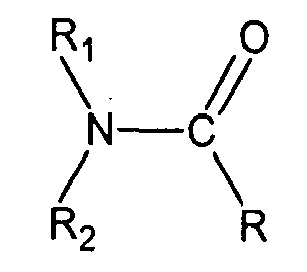
- In another aspect, the invention is an antifoulant dispersant including isopropylhydroxyl amine (IPHA) and an N, N-dialkylamide of a fatty acid. This combination of components is hereinafter referred to sometimes as dispersant or antifouling dispersant. The antifouling dispersant has the functionality of dispersing polymerized hydrocarbons and inhibiting the auto-polymerization of hydrocarbons thereby reducing polymers forming. The IPHA component of the antifouling dispersants functions to inhibit auto-polymerizations. The N, N-dialkylamide component acts to disperse hydrocarbons and polymers and has a general formula:wherein:

- R1 and R2 are the same or different and are alkyl groups having from one to four carbon atoms; and
- R is an alkyl or alkenyl group having from 9 to 30 carbon atoms.
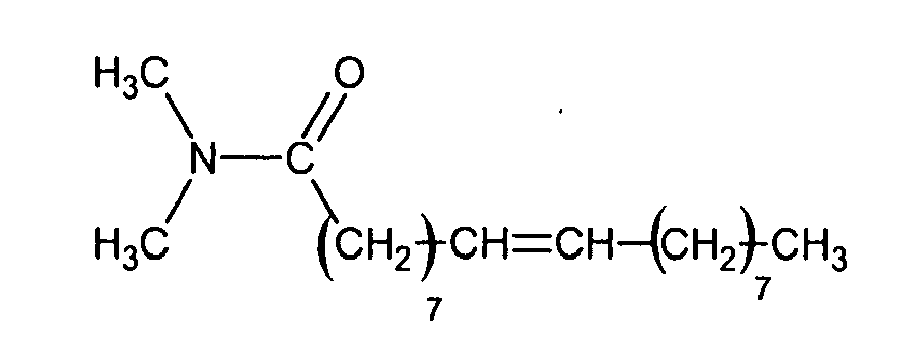
- Typically, R is an alkenyl group having one or more unsaturated bonds and having from 12 to 20 carbon atoms. The N, N-dialkylamide may be a single compound but in some embodiments is a mixture of compounds. For example, in one embodiment the N, N-dialkylamide used to prepare the dispersant of the invention is DMAD which is available from Buckman Laboratories of Canada, Ltd., Vaudreuil, Quebec, Canada. The DMAD products are believed to consist primarily of a mixture of two N, N-dialkylamides having the formulae:

- The two components of the dispersants of the present invention may be brought together in ratios of IPHA to N, N-dialkyl fatty acid amides in weight ratios ranging from 10:1 1 to 1:10. In some embodiments this ratio may be from 1:1 to 1:10. In other embodiments, this ratio may be from 1:1 to 1:2. All points intermediate in these ranges is also within the scope of the present invention.
- While the dispersants may be used or applied neat, in one embodiment of the invention, the dispersant is prepared using a solvent. The solvents which are useful with the present invention include any solvent in which: a) the IPHA and N, N-dialkylamide of a fatty acid are soluble or can be stably suspended and b) the resulting solution or suspension is miscible with water at a concentration of at least 100 weight ppm of solution or suspension in water. Exemplary solvents include, but are not limited to benzyl alcohol, 2-phenoxyethanol, 2-(methoxymethoxy)ethanol, 2-butoxyethanol, 2-(isopentyloxy)ethanol, 2-(hexyloxy)ethanol, diethylene glycol, diethylene glycol monomethyl ether, diethylene glycol monoethyl ether, diethylene glycol monobutyl ether, triethylene glycol, triethylene glycol monomethyl ether, liquid polyethylene glycol, 1-methoxy-2-propanol, 1-ethoxy-2- propanol, dipropylene glycol, dipropylene glycol monomethyl ether, dipropylene glycol monoethyl ether, and a low molecular weight polypropylene glycol. Commercial solvents such as Butyl CELLOSOLVE™, which consists primarily of 2-butoxyethanol, and Butyl CARBITOL™, which consists primarily of ethylene glycol monobutyl ether may be used and are available from DOW.
- When a solvent is present, it may be present in a weight ratio of solvent to dispersant of from about 4:1 to about 1:1.
- The components of the dispersants may be brought together in any way that is known to be useful to those of ordinary skill in preparing chemical compositions for industrial use. For example, the components may be admixed sequentially or all at once. The dispersants of the invention may be prepared using a batch process or they may be prepared using a continuous process.
- The dispersants of the present invention have a useful synergy, the mixed components performing better together than the individual components singularly.
- While the dispersants of the present invention are effective at preventing compressor fouling, there is a second property of these dispersants that is also desirable. The dispersants of the invention have the desirable property of not creating emulsions with resultant foaming in, for example, knockout pots. Knockout pots are used most applications where a compressor is employed and is often a point where dispersants may accumulate. While the dispersant of the invention may not act to break existing emulsions, they do not of themselves cause emulsions, unlike many other dispersants used for preventing compressor fouling.
- While the dispersants of the present invention are useful in compressors used for an ethylene process production process, they are also useful in other similar applications and with other equipment. For example, the dispersants of the invention may be used with any process where process equipment will come into contact with ethylene cracked gassed. Another application of the invention is ethylene and acrylonitrile quench water systems. The dispersants of the application may be used with ethylene dilution steam generators and acrylonitrile purification systems. Many polymer processes have monomer recovery systems which are subject to fouling and are good target applications for the dispersants of the invention. Process water strippers and waste water strippers used with petrochemical processes such as styrene, butadiene, acrylonitrile, and ethylene processes are potential applications for the dispersants of the invention. Finally, ethylene acid gas scrubbers and butadiene solvent recovery systems are also end use applications of the dispersants of the present invention. The dispersants can be desirably used in any process which has process equipment subject to fouling with polymers. The dispersants are especially desirable in applications where foaming would problematic. In addition to processes that consume or produce at least one of styrene, butadiene, acrylonitrile, and ethylene are potential applications of the dispersants.
- For the purposes of the present application, the term process equipment means compressors, fans, impellers, pumps, vacuum pumps, valves, heat exchangers; sensors, and the like, that are associated with the process and which may be subject to fouling. This term also includes supersets of these components where more than one of the components is part of a "system" such as, for example, a stripper where hydrocarbons are removed from an aqueous process stream, or a knockout pot.
- The following examples are provided to illustrate the present invention. The examples are not intended to limit the scope of the present invention and they should not be so interpreted. Amounts are in weight parts or weight percentages unless otherwise indicated.
- A dispersant of the present invention is prepared by admixing 7.5 parts IPHA, 10 parts DMAD (a fatty acid dimethylamide available from Buckman Laboratories of Canada), 40 parts Butyl CARBITOL, and 42.5 parts water.
- The dispersant is tested according to ASTM-873 also known as the induced gums test. This test method determines the tendency of a hydrocarbon to form gums under accelerated aging conditions. In this method 100 ml of a hydrocarbon is placed into a bomb and air is introduced to attain a pressure of about 100 psi (689 kPa). The bomb is then kept at 100°C for four hours. After the completion of the test, bomb is cooled rapidly and the pressure is released slowly. The liquid phase of the sample is evaporated 160°C under a nitrogen purge for 30 minutes then at about 220°C under a steam purge for 30 minutes. The value of potential gum is determined using weight differentials. The dispersant is tested at a concentration of 100 ppm. A control is prepared and tested wherein no dispersant is included in the hydrocarbon.
- The results are shown below in Table 1
- Example 1 is repeated substantially identically except that the dispersant is prepared by admixing 6 parts IPHA, 20 parts DMAD, 40 parts Butyl CARBITOL, and 34 parts water.
Table 1 Sample ID Gums Produced (mg/100ml) Percent Reduction Control* 355.6 -- Example 1 (Dispersant I) 328.4 7.6 Example 2 (Dispersant II) 327.4 7.9 * Not an example of the invention. - The dispersant prepared in Example 1 (Dispersant I) is tested according to the following procedure.
- 100 ml of a hydrocarbon is placed into a bomb and nitrogen is introduced to attain a pressure of about 100 psi (689 kPa). The bomb is then kept at 100°C for four hours. After the completion of the test, bomb is cooled rapidly and the pressure is released slowly. The liquid phase of the sample is evaporated 160°C under a nitrogen purge for 30 minutes then at about 220°C under a steam purge for 30 minutes. The value of potential gum is determined using weight differentials. The dispersant is tested at a concentration of 12 ppm. A control is prepared and tested wherein no dispersant is included in the hydrocarbon.
- The results are shown below in Table 2.
- Example 3 is repeated substantially identically except that the dispersant is tested at 25 ppm.
- The results are shown below in Table 2.
- Example 3 is repeated substantially identically except that diethylhydroxyl amine (DEHA) is used (Dispersant III) instead of IPHA.
- The results are shown below in Table 2.
- Example 3 is repeated substantially identically except that Dispersant III is used at a concentration of 25ppm.
- The results are shown below in Table 2.
- Example 3 is repeated substantially identically except that the dispersant is IPHA alone and it is used at a concentration of 1.875 ppm.
- The results are shown below in Table 2.
- Example 3 is repeated substantially identically except that the dispersant is DMAD alone and it is used at a concentration of 2.5 ppm.
- The results are shown below in Table 2.
Table 2 Sample ID Concentration (ppm) Percent Reduction of Gums Example 3 (Dispersant I) 12 53 Example 4 (Dispersant I) 25 38 Comparative Example A* (Dispersant III) 12 -8^ Comparative Example B* (Dispersant III) 25 -36^ Comparative Example C* IPHA alone 1.875# -70^ Comparative Example D* DMAD alone 2.5## -35^ * Not an example of the invention.
^A negative reduction indicates that the gum concentration increased over the blank.
#Represents the level of IPHA found in Example 4.
##Represents the level of DMAD found in Example 4.
Claims (19)


Applications Claiming Priority (1)
| Application Number | Priority Date | Filing Date | Title |
|---|---|---|---|
| US83529806P | 2006-08-03 | 2006-08-03 |
Publications (2)
| Publication Number | Publication Date |
|---|---|
| EP1897908A1 true EP1897908A1 (en) | 2008-03-12 |
| EP1897908B1 EP1897908B1 (en) | 2009-01-07 |
Family
ID=38656579
Family Applications (1)
| Application Number | Title | Priority Date | Filing Date |
|---|---|---|---|
| EP07253055A Active EP1897908B1 (en) | 2006-08-03 | 2007-08-02 | Antifoulant dispersant composition and method of use |
Country Status (5)
| Country | Link |
|---|---|
| EP (1) | EP1897908B1 (en) |
| AT (1) | ATE420135T1 (en) |
| CA (1) | CA2596012C (en) |
| DE (1) | DE602007000464D1 (en) |
| ES (1) | ES2317628T3 (en) |
Cited By (4)
| Publication number | Priority date | Publication date | Assignee | Title |
|---|---|---|---|---|
| WO2012009157A3 (en) * | 2010-07-13 | 2012-04-26 | Baker Hughes Incorporated | Method for inhibiting fouling in vapor transport system |
| WO2018037328A1 (en) * | 2016-08-24 | 2018-03-01 | Sabic Global Technologies B.V. | N,n-dimethylacetamide as wash-oil for dilution steam systems |
| WO2018044644A1 (en) * | 2016-08-31 | 2018-03-08 | Ecolab USA, Inc. | Method to inhibit polymerization in a process water |
| WO2018156914A1 (en) * | 2017-02-27 | 2018-08-30 | Ecolab USA, Inc. | Anti-foulant formulation for compressors |
Families Citing this family (1)
| Publication number | Priority date | Publication date | Assignee | Title |
|---|---|---|---|---|
| CN110713864B (en) | 2018-07-13 | 2023-09-26 | Bl 科技公司 | Antifouling dispersant compositions and methods of use |
Citations (3)
| Publication number | Priority date | Publication date | Assignee | Title |
|---|---|---|---|---|
| US4410419A (en) * | 1982-07-14 | 1983-10-18 | Chevron Research Company | Heat exchanger antifoulant |
| US6299836B1 (en) * | 1995-10-10 | 2001-10-09 | Coastal Chemical Co., L.L.C. (A Louisiana Limited Liability Company) | Gas treating solution corrosion inhibitor |
| US20030049161A1 (en) * | 2001-08-06 | 2003-03-13 | Blaschke Marilyn Wood | Preventing deposition of fouling agents onto equipment |
-
2007
- 2007-08-02 EP EP07253055A patent/EP1897908B1/en active Active
- 2007-08-02 AT AT07253055T patent/ATE420135T1/en not_active IP Right Cessation
- 2007-08-02 ES ES07253055T patent/ES2317628T3/en active Active
- 2007-08-02 DE DE602007000464T patent/DE602007000464D1/en active Active
- 2007-08-02 CA CA2596012A patent/CA2596012C/en not_active Expired - Fee Related
Patent Citations (3)
| Publication number | Priority date | Publication date | Assignee | Title |
|---|---|---|---|---|
| US4410419A (en) * | 1982-07-14 | 1983-10-18 | Chevron Research Company | Heat exchanger antifoulant |
| US6299836B1 (en) * | 1995-10-10 | 2001-10-09 | Coastal Chemical Co., L.L.C. (A Louisiana Limited Liability Company) | Gas treating solution corrosion inhibitor |
| US20030049161A1 (en) * | 2001-08-06 | 2003-03-13 | Blaschke Marilyn Wood | Preventing deposition of fouling agents onto equipment |
Cited By (14)
| Publication number | Priority date | Publication date | Assignee | Title |
|---|---|---|---|---|
| WO2012009157A3 (en) * | 2010-07-13 | 2012-04-26 | Baker Hughes Incorporated | Method for inhibiting fouling in vapor transport system |
| CN109804050A (en) * | 2016-08-24 | 2019-05-24 | 沙特基础工业全球技术公司 | N,N-Dimethylacetamide as wash oil for dilution steam systems |
| WO2018037328A1 (en) * | 2016-08-24 | 2018-03-01 | Sabic Global Technologies B.V. | N,n-dimethylacetamide as wash-oil for dilution steam systems |
| CN109804050B (en) * | 2016-08-24 | 2021-05-04 | 沙特基础工业全球技术公司 | N, N-dimethyl acetamide as washing oil of dilution steam system |
| US10577549B2 (en) | 2016-08-24 | 2020-03-03 | Sabic Global Technologies B.V. | N,N-dimethylacetamide as wash-oil for dilution steam systems |
| JP2019532132A (en) * | 2016-08-31 | 2019-11-07 | エコラブ ユーエスエイ インク | Method for inhibiting polymerization in process water |
| CN109563419A (en) * | 2016-08-31 | 2019-04-02 | 埃科莱布美国股份有限公司 | Methods of inhibiting polymerization in process water |
| WO2018044644A1 (en) * | 2016-08-31 | 2018-03-08 | Ecolab USA, Inc. | Method to inhibit polymerization in a process water |
| US11174439B2 (en) * | 2016-08-31 | 2021-11-16 | Ecolab Usa Inc. | Method to inhibit polymerization in a process water |
| CN109563419B (en) * | 2016-08-31 | 2022-10-25 | 埃科莱布美国股份有限公司 | Method for inhibiting polymerization in process water |
| WO2018156914A1 (en) * | 2017-02-27 | 2018-08-30 | Ecolab USA, Inc. | Anti-foulant formulation for compressors |
| US10745345B2 (en) | 2017-02-27 | 2020-08-18 | Ecolab Usa Inc. | Anti-foulant formulation for compressors |
| US11186540B2 (en) | 2017-02-27 | 2021-11-30 | Ecolab Usa Inc. | Anti-foulant formulation for compressors |
| JP2025028353A (en) * | 2017-02-27 | 2025-02-28 | エコラブ ユーエスエイ インク | Antifouling formulation for compressors |
Also Published As
| Publication number | Publication date |
|---|---|
| ATE420135T1 (en) | 2009-01-15 |
| ES2317628T3 (en) | 2009-04-16 |
| CA2596012C (en) | 2011-07-05 |
| EP1897908B1 (en) | 2009-01-07 |
| CA2596012A1 (en) | 2008-02-03 |
| DE602007000464D1 (en) | 2009-02-26 |
Similar Documents
| Publication | Publication Date | Title |
|---|---|---|
| CN110337488B (en) | Antifouling agent formulation for compressor | |
| KR102763249B1 (en) | Composition for inhibiting monomer polymerization comprising nitroxide inhibitor, quinone methide retarder and amine stabilizer | |
| EP1897908B1 (en) | Antifoulant dispersant composition and method of use | |
| WO2017006199A1 (en) | Hydrogen sulfide scavenging additive compositions, and medium comprising the same | |
| US20080028979A1 (en) | Antifoulant Dispersant Composition and Method of Use | |
| EP3507349B1 (en) | Method to inhibit polymerization in a process water, a treated process water and its use | |
| CA2503534C (en) | Antifoulant dispersant | |
| EP4549535A2 (en) | Method to disperse byproducts formed in dilution steam systems | |
| CN1247816C (en) | Multifunctional corrosion inhibitor and preparation method thereof | |
| CN113563927A (en) | Efficient and environment-friendly scale inhibitor for gasoline stripping tower of ethylene device and preparation method of scale inhibitor | |
| WO2025231070A1 (en) | Composition with fatty acid derivatives and use in industrial processes |
Legal Events
| Date | Code | Title | Description |
|---|---|---|---|
| PUAI | Public reference made under article 153(3) epc to a published international application that has entered the european phase |
Free format text: ORIGINAL CODE: 0009012 |
|
| AK | Designated contracting states |
Kind code of ref document: A1 Designated state(s): AT BE BG CH CY CZ DE DK EE ES FI FR GB GR HU IE IS IT LI LT LU LV MC MT NL PL PT RO SE SI SK TR |
|
| AX | Request for extension of the european patent |
Extension state: AL BA HR MK YU |
|
| 17P | Request for examination filed |
Effective date: 20080312 |
|
| GRAP | Despatch of communication of intention to grant a patent |
Free format text: ORIGINAL CODE: EPIDOSNIGR1 |
|
| GRAS | Grant fee paid |
Free format text: ORIGINAL CODE: EPIDOSNIGR3 |
|
| AKX | Designation fees paid |
Designated state(s): AT BE BG CH CY CZ DE DK EE ES FI FR GB GR HU IE IS IT LI LT LU LV MC MT NL PL PT RO SE SI SK TR |
|
| GRAA | (expected) grant |
Free format text: ORIGINAL CODE: 0009210 |
|
| RAP1 | Party data changed (applicant data changed or rights of an application transferred) |
Owner name: BAKER HUGHES INCORPORATED |
|
| AK | Designated contracting states |
Kind code of ref document: B1 Designated state(s): AT BE BG CH CY CZ DE DK EE ES FI FR GB GR HU IE IS IT LI LT LU LV MC MT NL PL PT RO SE SI SK TR |
|
| REG | Reference to a national code |
Ref country code: GB Ref legal event code: FG4D |
|
| REG | Reference to a national code |
Ref country code: CH Ref legal event code: EP |
|
| REG | Reference to a national code |
Ref country code: IE Ref legal event code: FG4D |
|
| REF | Corresponds to: |
Ref document number: 602007000464 Country of ref document: DE Date of ref document: 20090226 Kind code of ref document: P |
|
| REG | Reference to a national code |
Ref country code: ES Ref legal event code: FG2A Ref document number: 2317628 Country of ref document: ES Kind code of ref document: T3 |
|
| PG25 | Lapsed in a contracting state [announced via postgrant information from national office to epo] |
Ref country code: SI Free format text: LAPSE BECAUSE OF FAILURE TO SUBMIT A TRANSLATION OF THE DESCRIPTION OR TO PAY THE FEE WITHIN THE PRESCRIBED TIME-LIMIT Effective date: 20090107 |
|
| PG25 | Lapsed in a contracting state [announced via postgrant information from national office to epo] |
Ref country code: LT Free format text: LAPSE BECAUSE OF FAILURE TO SUBMIT A TRANSLATION OF THE DESCRIPTION OR TO PAY THE FEE WITHIN THE PRESCRIBED TIME-LIMIT Effective date: 20090107 Ref country code: FI Free format text: LAPSE BECAUSE OF FAILURE TO SUBMIT A TRANSLATION OF THE DESCRIPTION OR TO PAY THE FEE WITHIN THE PRESCRIBED TIME-LIMIT Effective date: 20090107 |
|
| PG25 | Lapsed in a contracting state [announced via postgrant information from national office to epo] |
Ref country code: LV Free format text: LAPSE BECAUSE OF FAILURE TO SUBMIT A TRANSLATION OF THE DESCRIPTION OR TO PAY THE FEE WITHIN THE PRESCRIBED TIME-LIMIT Effective date: 20090107 Ref country code: SE Free format text: LAPSE BECAUSE OF FAILURE TO SUBMIT A TRANSLATION OF THE DESCRIPTION OR TO PAY THE FEE WITHIN THE PRESCRIBED TIME-LIMIT Effective date: 20090407 Ref country code: AT Free format text: LAPSE BECAUSE OF FAILURE TO SUBMIT A TRANSLATION OF THE DESCRIPTION OR TO PAY THE FEE WITHIN THE PRESCRIBED TIME-LIMIT Effective date: 20090107 Ref country code: PT Free format text: LAPSE BECAUSE OF FAILURE TO SUBMIT A TRANSLATION OF THE DESCRIPTION OR TO PAY THE FEE WITHIN THE PRESCRIBED TIME-LIMIT Effective date: 20090608 Ref country code: PL Free format text: LAPSE BECAUSE OF FAILURE TO SUBMIT A TRANSLATION OF THE DESCRIPTION OR TO PAY THE FEE WITHIN THE PRESCRIBED TIME-LIMIT Effective date: 20090107 Ref country code: IS Free format text: LAPSE BECAUSE OF FAILURE TO SUBMIT A TRANSLATION OF THE DESCRIPTION OR TO PAY THE FEE WITHIN THE PRESCRIBED TIME-LIMIT Effective date: 20090507 |
|
| PG25 | Lapsed in a contracting state [announced via postgrant information from national office to epo] |
Ref country code: CZ Free format text: LAPSE BECAUSE OF FAILURE TO SUBMIT A TRANSLATION OF THE DESCRIPTION OR TO PAY THE FEE WITHIN THE PRESCRIBED TIME-LIMIT Effective date: 20090107 Ref country code: DK Free format text: LAPSE BECAUSE OF FAILURE TO SUBMIT A TRANSLATION OF THE DESCRIPTION OR TO PAY THE FEE WITHIN THE PRESCRIBED TIME-LIMIT Effective date: 20090107 Ref country code: EE Free format text: LAPSE BECAUSE OF FAILURE TO SUBMIT A TRANSLATION OF THE DESCRIPTION OR TO PAY THE FEE WITHIN THE PRESCRIBED TIME-LIMIT Effective date: 20090107 |
|
| PLBE | No opposition filed within time limit |
Free format text: ORIGINAL CODE: 0009261 |
|
| STAA | Information on the status of an ep patent application or granted ep patent |
Free format text: STATUS: NO OPPOSITION FILED WITHIN TIME LIMIT |
|
| PG25 | Lapsed in a contracting state [announced via postgrant information from national office to epo] |
Ref country code: RO Free format text: LAPSE BECAUSE OF FAILURE TO SUBMIT A TRANSLATION OF THE DESCRIPTION OR TO PAY THE FEE WITHIN THE PRESCRIBED TIME-LIMIT Effective date: 20090107 Ref country code: SK Free format text: LAPSE BECAUSE OF FAILURE TO SUBMIT A TRANSLATION OF THE DESCRIPTION OR TO PAY THE FEE WITHIN THE PRESCRIBED TIME-LIMIT Effective date: 20090107 |
|
| 26N | No opposition filed |
Effective date: 20091008 |
|
| PG25 | Lapsed in a contracting state [announced via postgrant information from national office to epo] |
Ref country code: BG Free format text: LAPSE BECAUSE OF FAILURE TO SUBMIT A TRANSLATION OF THE DESCRIPTION OR TO PAY THE FEE WITHIN THE PRESCRIBED TIME-LIMIT Effective date: 20090407 |
|
| PG25 | Lapsed in a contracting state [announced via postgrant information from national office to epo] |
Ref country code: MC Free format text: LAPSE BECAUSE OF NON-PAYMENT OF DUE FEES Effective date: 20090831 |
|
| REG | Reference to a national code |
Ref country code: IE Ref legal event code: MM4A |
|
| PG25 | Lapsed in a contracting state [announced via postgrant information from national office to epo] |
Ref country code: IE Free format text: LAPSE BECAUSE OF NON-PAYMENT OF DUE FEES Effective date: 20090802 |
|
| PG25 | Lapsed in a contracting state [announced via postgrant information from national office to epo] |
Ref country code: GR Free format text: LAPSE BECAUSE OF FAILURE TO SUBMIT A TRANSLATION OF THE DESCRIPTION OR TO PAY THE FEE WITHIN THE PRESCRIBED TIME-LIMIT Effective date: 20090408 |
|
| PG25 | Lapsed in a contracting state [announced via postgrant information from national office to epo] |
Ref country code: HU Free format text: LAPSE BECAUSE OF FAILURE TO SUBMIT A TRANSLATION OF THE DESCRIPTION OR TO PAY THE FEE WITHIN THE PRESCRIBED TIME-LIMIT Effective date: 20090708 |
|
| PG25 | Lapsed in a contracting state [announced via postgrant information from national office to epo] |
Ref country code: TR Free format text: LAPSE BECAUSE OF FAILURE TO SUBMIT A TRANSLATION OF THE DESCRIPTION OR TO PAY THE FEE WITHIN THE PRESCRIBED TIME-LIMIT Effective date: 20090107 |
|
| PG25 | Lapsed in a contracting state [announced via postgrant information from national office to epo] |
Ref country code: CY Free format text: LAPSE BECAUSE OF FAILURE TO SUBMIT A TRANSLATION OF THE DESCRIPTION OR TO PAY THE FEE WITHIN THE PRESCRIBED TIME-LIMIT Effective date: 20090107 |
|
| PGFP | Annual fee paid to national office [announced via postgrant information from national office to epo] |
Ref country code: LU Payment date: 20110901 Year of fee payment: 5 |
|
| PGFP | Annual fee paid to national office [announced via postgrant information from national office to epo] |
Ref country code: GB Payment date: 20110825 Year of fee payment: 5 Ref country code: FR Payment date: 20110830 Year of fee payment: 5 Ref country code: DE Payment date: 20110830 Year of fee payment: 5 Ref country code: ES Payment date: 20110826 Year of fee payment: 5 |
|
| PGFP | Annual fee paid to national office [announced via postgrant information from national office to epo] |
Ref country code: NL Payment date: 20110901 Year of fee payment: 5 Ref country code: BE Payment date: 20110825 Year of fee payment: 5 Ref country code: IT Payment date: 20110823 Year of fee payment: 5 |
|
| REG | Reference to a national code |
Ref country code: CH Ref legal event code: PL |
|
| PG25 | Lapsed in a contracting state [announced via postgrant information from national office to epo] |
Ref country code: LI Free format text: LAPSE BECAUSE OF NON-PAYMENT OF DUE FEES Effective date: 20110831 Ref country code: CH Free format text: LAPSE BECAUSE OF NON-PAYMENT OF DUE FEES Effective date: 20110831 |
|
| BERE | Be: lapsed |
Owner name: BAKER HUGHES INC. Effective date: 20120831 |
|
| REG | Reference to a national code |
Ref country code: NL Ref legal event code: V1 Effective date: 20130301 |
|
| GBPC | Gb: european patent ceased through non-payment of renewal fee |
Effective date: 20120802 |
|
| PG25 | Lapsed in a contracting state [announced via postgrant information from national office to epo] |
Ref country code: NL Free format text: LAPSE BECAUSE OF NON-PAYMENT OF DUE FEES Effective date: 20130301 |
|
| REG | Reference to a national code |
Ref country code: FR Ref legal event code: ST Effective date: 20130430 |
|
| PG25 | Lapsed in a contracting state [announced via postgrant information from national office to epo] |
Ref country code: BE Free format text: LAPSE BECAUSE OF NON-PAYMENT OF DUE FEES Effective date: 20120831 Ref country code: IT Free format text: LAPSE BECAUSE OF NON-PAYMENT OF DUE FEES Effective date: 20120802 |
|
| PG25 | Lapsed in a contracting state [announced via postgrant information from national office to epo] |
Ref country code: GB Free format text: LAPSE BECAUSE OF NON-PAYMENT OF DUE FEES Effective date: 20120802 Ref country code: DE Free format text: LAPSE BECAUSE OF NON-PAYMENT OF DUE FEES Effective date: 20130301 |
|
| PG25 | Lapsed in a contracting state [announced via postgrant information from national office to epo] |
Ref country code: FR Free format text: LAPSE BECAUSE OF NON-PAYMENT OF DUE FEES Effective date: 20120831 |
|
| REG | Reference to a national code |
Ref country code: DE Ref legal event code: R119 Ref document number: 602007000464 Country of ref document: DE Effective date: 20130301 |
|
| REG | Reference to a national code |
Ref country code: ES Ref legal event code: FD2A Effective date: 20131018 |
|
| PG25 | Lapsed in a contracting state [announced via postgrant information from national office to epo] |
Ref country code: ES Free format text: LAPSE BECAUSE OF NON-PAYMENT OF DUE FEES Effective date: 20120803 |
|
| PG25 | Lapsed in a contracting state [announced via postgrant information from national office to epo] |
Ref country code: LU Free format text: LAPSE BECAUSE OF NON-PAYMENT OF DUE FEES Effective date: 20120802 |