EP1895730A1 - Soft decision generation in a lattice reduction MIMO system. - Google Patents
Soft decision generation in a lattice reduction MIMO system. Download PDFInfo
- Publication number
- EP1895730A1 EP1895730A1 EP07251679A EP07251679A EP1895730A1 EP 1895730 A1 EP1895730 A1 EP 1895730A1 EP 07251679 A EP07251679 A EP 07251679A EP 07251679 A EP07251679 A EP 07251679A EP 1895730 A1 EP1895730 A1 EP 1895730A1
- Authority
- EP
- European Patent Office
- Prior art keywords
- determining
- transmitted
- accordance
- candidate vectors
- list
- Prior art date
- Legal status (The legal status is an assumption and is not a legal conclusion. Google has not performed a legal analysis and makes no representation as to the accuracy of the status listed.)
- Withdrawn
Links
- 230000009467 reduction Effects 0.000 title claims abstract description 14
- 239000013598 vector Substances 0.000 claims abstract description 72
- 238000004891 communication Methods 0.000 claims abstract description 40
- 238000000034 method Methods 0.000 claims description 50
- 230000004044 response Effects 0.000 claims description 8
- 238000004590 computer program Methods 0.000 claims 1
- 238000001514 detection method Methods 0.000 description 10
- 239000011159 matrix material Substances 0.000 description 9
- 238000013459 approach Methods 0.000 description 6
- 230000005540 biological transmission Effects 0.000 description 6
- 230000006870 function Effects 0.000 description 5
- 230000003936 working memory Effects 0.000 description 5
- 230000008901 benefit Effects 0.000 description 4
- 230000008569 process Effects 0.000 description 3
- 238000007476 Maximum Likelihood Methods 0.000 description 2
- 230000000694 effects Effects 0.000 description 2
- 230000003287 optical effect Effects 0.000 description 2
- 101100228469 Caenorhabditis elegans exp-1 gene Proteins 0.000 description 1
- 230000009471 action Effects 0.000 description 1
- 230000003044 adaptive effect Effects 0.000 description 1
- 238000010276 construction Methods 0.000 description 1
- 230000003247 decreasing effect Effects 0.000 description 1
- 230000002708 enhancing effect Effects 0.000 description 1
- 230000015654 memory Effects 0.000 description 1
- 238000012545 processing Methods 0.000 description 1
- 238000011946 reduction process Methods 0.000 description 1
- 238000010845 search algorithm Methods 0.000 description 1
- 230000009466 transformation Effects 0.000 description 1
- 238000013519 translation Methods 0.000 description 1
- 230000000007 visual effect Effects 0.000 description 1
Images


Classifications
-
- H—ELECTRICITY
- H04—ELECTRIC COMMUNICATION TECHNIQUE
- H04L—TRANSMISSION OF DIGITAL INFORMATION, e.g. TELEGRAPHIC COMMUNICATION
- H04L25/00—Baseband systems
- H04L25/02—Details ; arrangements for supplying electrical power along data transmission lines
- H04L25/06—DC level restoring means; Bias distortion correction ; Decision circuits providing symbol by symbol detection
- H04L25/067—DC level restoring means; Bias distortion correction ; Decision circuits providing symbol by symbol detection providing soft decisions, i.e. decisions together with an estimate of reliability
-
- H—ELECTRICITY
- H04—ELECTRIC COMMUNICATION TECHNIQUE
- H04L—TRANSMISSION OF DIGITAL INFORMATION, e.g. TELEGRAPHIC COMMUNICATION
- H04L1/00—Arrangements for detecting or preventing errors in the information received
- H04L1/02—Arrangements for detecting or preventing errors in the information received by diversity reception
- H04L1/06—Arrangements for detecting or preventing errors in the information received by diversity reception using space diversity
- H04L1/0618—Space-time coding
- H04L1/0631—Receiver arrangements
-
- H—ELECTRICITY
- H04—ELECTRIC COMMUNICATION TECHNIQUE
- H04L—TRANSMISSION OF DIGITAL INFORMATION, e.g. TELEGRAPHIC COMMUNICATION
- H04L25/00—Baseband systems
- H04L25/02—Details ; arrangements for supplying electrical power along data transmission lines
- H04L25/03—Shaping networks in transmitter or receiver, e.g. adaptive shaping networks
- H04L25/03006—Arrangements for removing intersymbol interference
- H04L25/03178—Arrangements involving sequence estimation techniques
- H04L25/03203—Trellis search techniques
- H04L25/03242—Methods involving sphere decoding
-
- H—ELECTRICITY
- H03—ELECTRONIC CIRCUITRY
- H03M—CODING; DECODING; CODE CONVERSION IN GENERAL
- H03M13/00—Coding, decoding or code conversion, for error detection or error correction; Coding theory basic assumptions; Coding bounds; Error probability evaluation methods; Channel models; Simulation or testing of codes
- H03M13/37—Decoding methods or techniques, not specific to the particular type of coding provided for in groups H03M13/03 - H03M13/35
- H03M13/45—Soft decoding, i.e. using symbol reliability information
-
- H—ELECTRICITY
- H04—ELECTRIC COMMUNICATION TECHNIQUE
- H04L—TRANSMISSION OF DIGITAL INFORMATION, e.g. TELEGRAPHIC COMMUNICATION
- H04L25/00—Baseband systems
- H04L25/02—Details ; arrangements for supplying electrical power along data transmission lines
- H04L25/03—Shaping networks in transmitter or receiver, e.g. adaptive shaping networks
- H04L25/03006—Arrangements for removing intersymbol interference
- H04L25/03178—Arrangements involving sequence estimation techniques
- H04L25/03203—Trellis search techniques
-
- H—ELECTRICITY
- H04—ELECTRIC COMMUNICATION TECHNIQUE
- H04L—TRANSMISSION OF DIGITAL INFORMATION, e.g. TELEGRAPHIC COMMUNICATION
- H04L25/00—Baseband systems
- H04L25/02—Details ; arrangements for supplying electrical power along data transmission lines
- H04L25/03—Shaping networks in transmitter or receiver, e.g. adaptive shaping networks
- H04L25/03006—Arrangements for removing intersymbol interference
- H04L25/03178—Arrangements involving sequence estimation techniques
- H04L25/03312—Arrangements specific to the provision of output signals
- H04L25/03318—Provision of soft decisions
Definitions
- the present invention is in the field of wireless communication, and particularly, but not exclusively, the field of multiple input multiple output (MIMO) communications systems.
- MIMO multiple input multiple output
- y Hx + v in which, for a MIMO communication system, y is an n -by-1 vector representing the received signal, H is an n-by-m channel matrix modelling the transmission characteristics of the communications channel, x is an m -by-1 vector representing transmit symbols, v is an n -by-1 noise vector and wherein m and n denote the number of transmit and receive antennas respectively.
- Lattice-Reduction-Aided Detectors for MIMO Communication Systems (H. Yao and G.W. Womell, Proc. IEEE Globecom, Nov 2002, pp. 424-428 ) describes Lattice-reduction (LR) techniques for enhancing the performance of multiple-input multiple-output (MIMO) digital communication systems.
- LR Lattice-reduction
- Berenguer et al. Lattice-Reduction-Aided Receivers for MIMO-OFDM in Spatial Multiplexing Systems
- Berenguer et al. describes the use of Orthogonal Frequency Division Multiplexing (OFDM) to significantly reduce receiver complexity in wireless systems with Multipath propagation, and notes its proposed use in wireless broadband multi-antenna (MIMO) systems.
- OFDM Orthogonal Frequency Division Multiplexing
- Berenguer et al. describes the equivalent method in the complex field, though for the purpose of clarity the Real representation of the method is used herein.
- LLLL Lenstra-Lenstra-Lovasz
- the matrix T contains only integer entries and its determinant is +/-1.
- H ⁇ r Since H ⁇ r is close to orthogonal, z ⁇ r should suffer much less noise enhancement than if the receiver directly equalised the channel H r .
- MMSE techniques or more complex successive interference cancellation based methods, such as in the published prior art identified above, could be considered for use.
- a receiver in accordance with the above operates in the knowledge that the transmitted symbols contained in x are obtained from an M-QAM constellation.
- Q ⁇ is the quantisation function that rounds each element of its argument to the nearest integer, and where 1 is a 2*m-by-1 vector of ones.
- the scalar values ⁇ and ⁇ are obtained from the definition of the M-QAM constellation in use, and ⁇ is equal to the minimum distance between two constellation points while ⁇ corresponds to the minimum between the constellation points and the I/R axes (i.e. minimum offset from the origin in the I and R directions).
- a 16-QAM constellation is used, having real and imaginary components of ⁇ +/-1, +/-3 ⁇ .
- Such reduced lattice detectors usually output hard decisions.
- the only mention in the literature of a technique that could be employed for obtaining soft-output is " From Lattice-Reduction-Aided Detection Towards Maximum-Likelihood Detection in MIMO Systems", (C. Windpassinger, L. Lampe and R. Fischer, in Proc. Int. Conf. on Wireless and Optical Communications, Banff, Canada, July 2003 , hereinafter referred to as "Windpassinger et al.”).
- the method that Windpassinger et al. proposes is complex, and the performance of this technique was not validated in the publication. Therefore it is an aim of aspects of the present invention to provide a MIMO detector capable of determining a soft output using a simple and proven approach.
- a method of generating a list of candidate solutions by assuming that all elements of the hard decision vector, ⁇ r , are equally reliable was described in the applicant's earlier UK patent application no. 0518036.9 . That application describes an approach which involves generating a list by applying pre-determined perturbation to the quantised estimate provided by the reduced lattice detector.
- the noise present in the elements of the un-quantised solution, z ⁇ r is different. Consequently, the reliability of the elements of ⁇ r can vary significantly.
- An aspect of the present invention provides a method of generating candidate solutions which recognises and takes into account the variation in reliability of different elements of the hard decision. This method generates a list of more likely candidate solutions and thus produces better quality soft information.
- Figure 1 demonstrates the benefit that can be obtained by computing better quality soft information.
- an aspect of the present invention provides a method of obtaining log-likelihood ratios (LLRs) for bits at the output of a lattice reduction aided MIMO receiver.
- LLRs log-likelihood ratios
- a method for determining soft estimates of transmitted bit values from a received signal in a lattice-reduction-aided receiver based wireless communications system comprising obtaining an estimate of channel response in a communication channel defined in the system, applying lattice reduction to said channel response and equalisation of said received signal in accordance with channel expressed in a reduced basis, and determining probabilities of transmitted bits having particular values by means of generating a list of candidate vectors in the reduced basis based on nearest candidate vectors, determining a corresponding transmitted symbol vector for each candidate vector and, on the basis of the received signal, determining the probability of each transmitted bit value having been transmitted.
- the step of generating a list of candidate vectors includes the step of selecting a list of potential candidate vectors by any one of:
- said nearest candidate vectors are nearest in the weighted squared Euclidean sense.
- the step of determining transmitted bit probabilities includes determining the probability of each candidate symbol vector having been transmitted and then determining the probabilities of all possible symbols having been transmitted from each of said transmitter antennas.
- the method is suitable for use in a MIMO wireless communications system. Further, it can be used with any other system wherein a received signal is the result of transmission from a plurality of antennas, which may or may not be collocated. Further, the method is applicable to CDMA systems, such as multi-user detection (MUD).
- a receiver for determining soft estimates of transmitted bit values from a received signal in a lattice-reduction-aided receiver based wireless communications system comprising means for obtaining an estimate of the channel response, means for applying lattice reduction to said channel response, means for equalisation of the received signal in accordance with the reduced basis channel, and soft information determining means for determining probabilities of transmitted bits having particular values, said soft information determining means comprising means for generating a list of candidate vectors in the reduced basis based on nearest candidate vectors, means for determining a transmitted symbol vector for each candidate vector and, means for determining the probability of said transmitted bit value having been transmitted, on the basis of the received signal.
- Another aim of the present invention is to provide a method for obtaining log-likelihood ratios (LLRs) for bits at the output of a lattice-reduction-aided MIMO receiver.
- LLRs log-likelihood ratios
- the probabilities determined in either the method above or by the detector above can be converted into LLRs.
- FIG. 3 illustrates such a system, comprising a MIMO data communications system 10 of generally known construction. New components, in accordance with a specific embodiment of the invention, will be evident from the following description.
- the communications system 10 comprises a transmitter device 12 and a receiver device 14. It will be appreciated that in many circumstances, a wireless communications device will be provided with the facilities of a transmitter and a receiver in combination but, for this example, the devices have been illustrated as one way communications devices for reasons of simplicity.
- the transmitter device 12 comprises a data source 16, which provides data (comprising information bits or symbols) to a channel encoder 18.
- the channel encoder 18 is followed by a channel interleaver 20 and, in the illustrated example, a space-time encoder 22.
- the space-time encoder 22 encodes an incoming symbol or symbols as a plurality of code symbols for simultaneous transmission from a transmitter antenna array 24 comprising a plurality of transmit antennas 25. In this illustrated example, three transmit antennas 25 are provided, though practical implementations may include more, or less antennas depending on the application.
- the encoded transmitted signals propagate through a MIMO channel 28 defined between the transmit antenna array 24 and a corresponding receive antenna array 26 of the receiver device 14.
- the receive antenna array 26 comprises a plurality of receive antennas 27 which provide a plurality of inputs to a lattice-reduction-aided decoder 30 of the receiver device 14.
- the receive antenna array 26 comprises three receive antennas 27.
- the lattice-reduction-aided decoder 30 has the task of removing the effect of the MIMO channel 28.
- the output of the lattice-reduction-aided decoder 30 comprises a plurality of signal streams, one for each transmit antenna 25, each carrying so-called soft or likelihood data on the probability of a transmitted bit having a particular value.
- This data is provided to a channel de-interleaver 32 which reverses the effect of the channel interleaver 20, and the de-interleaved bits output by this channel de-interleaver 32 are then presented to a channel decoder 34, in this example a Viterbi decoder, which decodes the convolutional code.
- the output of channel decoder 34 is provided to a data sink 36, for further processing of the data in any desired manner.
- FIG. 4 illustrates schematically hardware operably configured (by means of software or application specific hardware components) as the receiver device 14.
- the receiver device 14 comprises a processor 110 operable to execute machine code instructions stored in a working memory 112 and/or retrievable from a mass storage device 116.
- user operable input devices 118 are capable of communication with the processor 110.
- the user operable input devices 118 comprise, in this example, a keyboard and a mouse though it will be appreciated that any other input devices could also or alternatively be provided, such as another type of pointing device, a writing tablet, speech recognition means, or any other means by which a user input action can be interpreted and converted into data signals.
- Audio/video output hardware devices 120 are further connected to the general purpose bus 114, for the output of information to a user.
- Audio/video output hardware devices 120 can include a visual display unit, a speaker or any other device capable of presenting information to a user.
- Communications hardware devices 122 connected to the general purpose bus 114, are connected to the antenna 26.
- the working memory 112 stores user applications 130 which, when executed by the processor 110, cause the establishment of a user interface to enable communication of data to and from a user.
- the applications in this embodiment establish general purpose or specific computer implemented utilities that might habitually be used by a user.
- Communications facilities 132 in accordance with the specific embodiment are also stored in the working memory 112, for establishing a communications protocol to enable data generated in the execution of one of the applications 130 to be processed and then passed to the communications hardware devices 122 for transmission and communication with another communications device.
- the software defining the applications 130 and the communications facilities 132 may be partly stored in the working memory 112 and the mass storage device 116, for convenience.
- a memory manager could optionally be provided to enable this to be managed effectively, to take account of the possible different speeds of access to data stored in the working memory 112 and the mass storage device 116.
- the processor 110 On execution by the processor 110 of processor executable instructions corresponding with the communications facilities 132, the processor 110 is operable to establish communication with another device in accordance with a recognised communications protocol.
- z r denotes the true value, as defined in the introduction and discussion of the prior art above
- n denotes the noise present in the estimate.
- the elements of n are zero-mean Gaussian random variables.
- E [] denotes statistical expectation.
- the covariance matrix, M can be estimated using channel state information and the noise variance at the input of the reduced lattice detector. It will be understood that practical wireless systems are designed such that both of these parameters can be measured with sufficient accuracy using the channel estimation process.
- a list of most likely candidate vectors for z ⁇ r herein denoted by c r 1 ⁇ c r 2 ⁇ c r K , is required.
- the list of c r 1 ⁇ c r 2 ⁇ c r K is generated.
- the quality of soft-outputs can be improved by expanding the list size, K, until all candidate vectors have been included. However, in practice, only a small fraction of the total number of candidate vectors is required to produce sufficiently good soft-outputs.
- step 220 The conditional probability of the observation z ⁇ r given that c is equal to z r is performed in step 220, and is given as: P z ⁇ r
- the lattice reduction process results in a modified system matrix, H ⁇ r , such that the columns of H ⁇ r are nearly mutually-orthogonal.
- H ⁇ r modified system matrix
- the off-diagonal elements of the covariance matrix M are close to zero i.e. the elements of n are nearly mutually-independent.
- the set of K nearest candidate vectors to z ⁇ r can be computed very efficiently using techniques known as k shortest path algorithms as described in D. Eppstein, "Finding the k shortest paths", in Proc. 35 Ih IEEE Symp. Foundations of Computer Science, Santa Fe, NM, 1994, pp 154-165 . All nearest neighbour search algorithms operate iteratively i.e. in each iteration, the next closest neighbour is found from a list of potential candidates. In addition to this, the list of potential candidates is expanded in each iteration.
- a candidate vector c r i is said to be valid if all elements of its corresponding symbol vector, x ⁇ r i , are valid constellation symbols.
- some candidate vectors may map to symbol vectors whose elements may lie outside the signal constellation used for transmission.
- the valid candidate symbols vectors are used to calculate soft-outputs.
- the quality of the soft-outputs depends on the number of valid candidate vectors in the list c r 1 ⁇ c r 2 ⁇ c r K .
- step 260 the probability of symbol x' having been transmitted from antenna k, where x' ⁇ X and X defines the set of symbols in the chosen constellation.
- P k ⁇ x ⁇ ⁇ i
- P may not be specified for all values of k and x' .
- P is set to a default (small) value.
- This default can be a fixed value or it could varied according to a method such as that described in " Adaptive Selection of Surviving Symbol Replica Candidates Based on Maximum Reliability in QRM-MLD for OFCDM MIMO Multiplexing" (K. Higuchi, H. Kawai, N. Maeda and M. Sawahashi, in Proc. IEEE Globecom, Dallas, Dec. 2004 ), or by any other appropriate method.
- step 270 a log-likelihood ratio for each transmitted bit.
- L b k , i log ⁇ x ⁇ ⁇ X 1 P k ⁇ x ⁇ ⁇ x " ⁇ X 0 P k , x "
- the invention has been described by way of a software implementation.
- This software implementation can be introduced as a stand alone software product, such as borne on a storage medium, e.g. an optical disk, or by means of a signal. Further, the implementation could be by means of an upgrade or plug-in to existing software.
Landscapes
- Engineering & Computer Science (AREA)
- Computer Networks & Wireless Communication (AREA)
- Signal Processing (AREA)
- Power Engineering (AREA)
- Radio Transmission System (AREA)
- Error Detection And Correction (AREA)
Abstract

Description
- The present invention is in the field of wireless communication, and particularly, but not exclusively, the field of multiple input multiple output (MIMO) communications systems.
- Conventional communication systems can be represented mathematically as:

in which, for a MIMO communication system, y is an n-by-1 vector representing the received signal, H is an n-by-m channel matrix modelling the transmission characteristics of the communications channel, x is an m-by-1 vector representing transmit symbols, v is an n-by-1 noise vector and wherein m and n denote the number of transmit and receive antennas respectively. - It will be understood by the skilled reader that the same representation can be used for multi-user detection in CDMA systems.
- Recent publications have demonstrated how the use of a technique called Lattice Reduction can improve the performance of MIMO detection methods.
- For example, "Lattice-Reduction-Aided Detectors for MIMO Communication Systems", (H. Yao and G.W. Womell, Proc. IEEE Globecom, Nov 2002, pp. 424-428) describes Lattice-reduction (LR) techniques for enhancing the performance of multiple-input multiple-output (MIMO) digital communication systems.
- In addition, "Low-Complexity Near-Maximum-Likelihood Detection and Precoding for MIMO Systems using Lattice Reduction", (C. Windpassinger and R. Fischer, in Proc. IEEE Information Theory Workshop, Paris, March, 2003, pp. 346-348) studies the lattice-reduction-aided detection scheme proposed by Yao and Womell. It extends this with the use of the well-known LLL algorithm, which enables the application to MIMO systems with arbitrary numbers of dimensions.
- "Lattice-Reduction-Aided Receivers for MIMO-OFDM in Spatial Multiplexing Systems", (I. Berenguer, J. Adeane, I. Wassell and X. Wang, in Proc. Int. Symp. on Personal Indoor and Mobile Radio Communications, Sept. 2004, pp. 1517-1521, hereinafter referred to as "Berenguer et al.") describes the use of Orthogonal Frequency Division Multiplexing (OFDM) to significantly reduce receiver complexity in wireless systems with Multipath propagation, and notes its proposed use in wireless broadband multi-antenna (MIMO) systems.
- Finally, "MMSE-Based Lattice-Reduction for Near-ML Detection of MIMO Systems", (D. Wubben, R. Bohnke, V. Kuhn and K. Kammeyer, in Proc. ITG Workshop on Smart Antennas, 2004, hereinafter referred to as "Wubben et al.") adopts the lattice-reduction aided schemes described above to the MMSE criterion.
- The techniques used in the publications described above use the concept that mathematically, the columns of the channel matrix, H, can be viewed as describing the basis of a lattice. An equivalent description of this lattice (a so-called 'reduced basis') can therefore be calculated so that the basis vectors are close to orthogonal. If the receiver then uses this reduced basis to equalise the channel, noise enhancement can be kept to a minimum and detection performance will improve (such as, as illustrated in Figure 5 in Wubben et al.). This process comprises the steps described as follows:
- y r , x r and H r are defined to be the real-valued representations of y, x, and H respectively, such that:

where Re() and Im() denote the real and imaginary components of their arguments. - It will be noted that Berenguer et al. describes the equivalent method in the complex field, though for the purpose of clarity the Real representation of the method is used herein.
- A number of lattice reduction algorithms exist in the art. One suitable lattice reduction algorithm is the Lenstra-Lenstra-Lovasz (LLL) algorithm referred to above, which is disclosed in Wubben et al., and also in "Factoring Polynomials with Rational Coefficients", (A. Lenstra, H. Lenstra and L. Lovasz, Math Ann., Vol. 261, pp. 515-534, 1982, hereinafter referred to as "Lenstra et al."), and in "An Algorithmic Theory of Numbers, Graphs and Convexity", (L. Lovasz, Philadelpia, SIAM, 1980, hereinafter referred to as "Lovasz").
- Any one of these can be used to calculate a transformation matrix, T, such that a reduced basis, H̃ r , is given by

- The matrix T contains only integer entries and its determinant is +/-1.
- After lattice reduction, the system is re-expressed as:


- Since H̃ r is close to orthogonal, z̃ r should suffer much less noise enhancement than if the receiver directly equalised the channel H r .
- Of course, other equalisation techniques could be used. For example, MMSE techniques, or more complex successive interference cancellation based methods, such as in the published prior art identified above, could be considered for use.
- A receiver in accordance with the above operates in the knowledge that the transmitted symbols contained in x are obtained from an M-QAM constellation. With this constraint, z̃ r can then be quantised in accordance with the method indicated in Wubben et al.:

where Q{} is the quantisation function that rounds each element of its argument to the nearest integer, and where 1 is a 2*m-by-1 vector of ones. - It will be understood from the above that, the quantisation function apart, the remaining operations are a result of M-QAM constellations being scaled and translated versions of the integer lattice. The integer quantisation therefore requires the same simple scaling and translation operations.
- As shown in Figure 2, the scalar values α and β are obtained from the definition of the M-QAM constellation in use, and α is equal to the minimum distance between two constellation points while β corresponds to the minimum between the constellation points and the I/R axes (i.e. minimum offset from the origin in the I and R directions). In the present example, a 16-QAM constellation is used, having real and imaginary components of {+/-1, +/-3}.
- Finally, the estimate x̂ r of x r is obtained by this method as

- Occasionally, if errors are present in the estimate of ẑ r , then it is possible that some of the symbol estimates in x̂ r may not be valid symbols. In such cases, these symbols are mapped to the nearest valid symbol. For example, for the present example employing 16-QAM, the values +/-1, +/-3 may define the valid entries in x̂ r . Therefore if a component of x̂ r were, for example, equal to +5, then this would be mapped to a value of +3.
- Such reduced lattice detectors (e.g. for MIMO systems) usually output hard decisions. The only mention in the literature of a technique that could be employed for obtaining soft-output is "From Lattice-Reduction-Aided Detection Towards Maximum-Likelihood Detection in MIMO Systems", (C. Windpassinger, L. Lampe and R. Fischer, in Proc. Int. Conf. on Wireless and Optical Communications, Banff, Canada, July 2003, hereinafter referred to as "Windpassinger et al."). The method that Windpassinger et al. proposes is complex, and the performance of this technique was not validated in the publication. Therefore it is an aim of aspects of the present invention to provide a MIMO detector capable of determining a soft output using a simple and proven approach.
- A method of generating a list of candidate solutions by assuming that all elements of the hard decision vector, ẑr , are equally reliable was described in the applicant's earlier
UK patent application no. 0518036.9 - In general terms, an aspect of the present invention provides a method of obtaining log-likelihood ratios (LLRs) for bits at the output of a lattice reduction aided MIMO receiver.
- In a first aspect of the present invention, there is provided a method for determining soft estimates of transmitted bit values from a received signal in a lattice-reduction-aided receiver based wireless communications system, the method comprising obtaining an estimate of channel response in a communication channel defined in the system, applying lattice reduction to said channel response and equalisation of said received signal in accordance with channel expressed in a reduced basis, and determining probabilities of transmitted bits having particular values by means of generating a list of candidate vectors in the reduced basis based on nearest candidate vectors, determining a corresponding transmitted symbol vector for each candidate vector and, on the basis of the received signal, determining the probability of each transmitted bit value having been transmitted.
- Preferably, the step of generating a list of candidate vectors includes the step of selecting a list of potential candidate vectors by any one of:
- (i) Setting the size of said list to a known fixed value, and;
- (ii) Setting the size of said list to a predetermined number of valid candidate vectors, and varying the size until sufficient number of candidates are found.
- In a preferred embodiment of the above aspect, there is provided the steps of determining a conditional probability of an estimated initial vector based on the condition of said potential candidate vectors being equal to true values of said initial vectors, and then determining said nearest candidate vectors based on said determined conditional probability.
- Preferably, said nearest candidate vectors are nearest in the weighted squared Euclidean sense.
- In another embodiment of the above aspect, there is provided the step of determining transmitted bit probabilities includes determining the probability of each candidate symbol vector having been transmitted and then determining the probabilities of all possible symbols having been transmitted from each of said transmitter antennas.
- The method is suitable for use in a MIMO wireless communications system. Further, it can be used with any other system wherein a received signal is the result of transmission from a plurality of antennas, which may or may not be collocated. Further, the method is applicable to CDMA systems, such as multi-user detection (MUD).
- Another aspect of the present invention provides a receiver for determining soft estimates of transmitted bit values from a received signal in a lattice-reduction-aided receiver based wireless communications system, comprising means for obtaining an estimate of the channel response, means for applying lattice reduction to said channel response, means for equalisation of the received signal in accordance with the reduced basis channel, and soft information determining means for determining probabilities of transmitted bits having particular values, said soft information determining means comprising means for generating a list of candidate vectors in the reduced basis based on nearest candidate vectors, means for determining a transmitted symbol vector for each candidate vector and, means for determining the probability of said transmitted bit value having been transmitted, on the basis of the received signal.
- Another aim of the present invention is to provide a method for obtaining log-likelihood ratios (LLRs) for bits at the output of a lattice-reduction-aided MIMO receiver.
- To this end, the probabilities determined in either the method above or by the detector above can be converted into LLRs.
- Embodiments of the present invention will now be described with reference to the accompanying drawings, wherein:
- Figure 1 illustrates a graph of performance obtained in accordance with an embodiment of the present invention and that obtained in accordance with an embodiment of the method disclosed in
GB0518036.9 - Figure 2 illustrates a graph of a lattice used in the wireless communications system of a specific embodiment of the invention, and used in the described examples of the prior art;
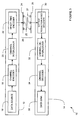
- Figure 3 illustrates schematically a MIMO system including a transmitter and a receiver;
- Figure 4 illustrates in further detail the receiver of figure 3; and
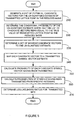
- Figure 5 illustrates a detecting method operable by means of the detector illustrated in figure 4.
- The present invention will now be described with reference to an implementation thereof for the equalization of a wireless communication system. Figure 3 illustrates such a system, comprising a MIMO
data communications system 10 of generally known construction. New components, in accordance with a specific embodiment of the invention, will be evident from the following description. - The
communications system 10 comprises atransmitter device 12 and areceiver device 14. It will be appreciated that in many circumstances, a wireless communications device will be provided with the facilities of a transmitter and a receiver in combination but, for this example, the devices have been illustrated as one way communications devices for reasons of simplicity. - The
transmitter device 12 comprises adata source 16, which provides data (comprising information bits or symbols) to achannel encoder 18. Thechannel encoder 18 is followed by achannel interleaver 20 and, in the illustrated example, a space-time encoder 22. The space-time encoder 22 encodes an incoming symbol or symbols as a plurality of code symbols for simultaneous transmission from atransmitter antenna array 24 comprising a plurality of transmitantennas 25. In this illustrated example, three transmitantennas 25 are provided, though practical implementations may include more, or less antennas depending on the application. - The encoded transmitted signals propagate through a
MIMO channel 28 defined between the transmitantenna array 24 and a corresponding receiveantenna array 26 of thereceiver device 14. The receiveantenna array 26 comprises a plurality of receiveantennas 27 which provide a plurality of inputs to a lattice-reduction-aideddecoder 30 of thereceiver device 14. In this specific embodiment, the receiveantenna array 26 comprises three receiveantennas 27. - The lattice-reduction-aided
decoder 30 has the task of removing the effect of theMIMO channel 28. The output of the lattice-reduction-aideddecoder 30 comprises a plurality of signal streams, one for each transmitantenna 25, each carrying so-called soft or likelihood data on the probability of a transmitted bit having a particular value. This data is provided to achannel de-interleaver 32 which reverses the effect of thechannel interleaver 20, and the de-interleaved bits output by thischannel de-interleaver 32 are then presented to achannel decoder 34, in this example a Viterbi decoder, which decodes the convolutional code. The output ofchannel decoder 34 is provided to adata sink 36, for further processing of the data in any desired manner. - The specific function of the lattice-reduction-aided
decoder 30 will be described in due course. - Figure 4 illustrates schematically hardware operably configured (by means of software or application specific hardware components) as the
receiver device 14. Thereceiver device 14 comprises aprocessor 110 operable to execute machine code instructions stored in a workingmemory 112 and/or retrievable from amass storage device 116. By means of ageneral purpose bus 114, useroperable input devices 118 are capable of communication with theprocessor 110. The useroperable input devices 118 comprise, in this example, a keyboard and a mouse though it will be appreciated that any other input devices could also or alternatively be provided, such as another type of pointing device, a writing tablet, speech recognition means, or any other means by which a user input action can be interpreted and converted into data signals. - Audio/video
output hardware devices 120 are further connected to thegeneral purpose bus 114, for the output of information to a user. Audio/videooutput hardware devices 120 can include a visual display unit, a speaker or any other device capable of presenting information to a user. -
Communications hardware devices 122, connected to thegeneral purpose bus 114, are connected to theantenna 26. In the illustrated embodiment in Figure 4, the workingmemory 112stores user applications 130 which, when executed by theprocessor 110, cause the establishment of a user interface to enable communication of data to and from a user. The applications in this embodiment establish general purpose or specific computer implemented utilities that might habitually be used by a user. -
Communications facilities 132 in accordance with the specific embodiment are also stored in the workingmemory 112, for establishing a communications protocol to enable data generated in the execution of one of theapplications 130 to be processed and then passed to thecommunications hardware devices 122 for transmission and communication with another communications device. It will be understood that the software defining theapplications 130 and thecommunications facilities 132 may be partly stored in the workingmemory 112 and themass storage device 116, for convenience. A memory manager could optionally be provided to enable this to be managed effectively, to take account of the possible different speeds of access to data stored in the workingmemory 112 and themass storage device 116. - On execution by the
processor 110 of processor executable instructions corresponding with thecommunications facilities 132, theprocessor 110 is operable to establish communication with another device in accordance with a recognised communications protocol. - The function of the lattice-reduction aided
decoder 30 will now be described in further detail in accordance with figure 5. This method as illustrated commences once the un-quantised estimate of the transmitted lattice point in the reduced basis, i.e. ẑ r , has been determined as outlined in the introduction and discussion of the prior art above. The manner in which this estimate is obtained is immaterial: any appropriate lattice reduction algorithm may have been used, and any of a number of equalisation methods may have been applied. - The estimate z̃ r is expressed as


where E[] denotes statistical expectation. The covariance matrix, M, can be estimated using channel state information and the noise variance at the input of the reduced lattice detector. It will be understood that practical wireless systems are designed such that both of these parameters can be measured with sufficient accuracy using the channel estimation process. - In order to generate soft-outputs, a list of most likely candidate vectors for z̃ r , herein denoted by

step 210 the list of
- The conditional probability of the observation z̃ r given that c is equal to z r is performed in
step 220, and is given as:
- In accordance with Lenstra et al., the lattice reduction process results in a modified system matrix, H̃ r , such that the columns of H̃ r are nearly mutually-orthogonal. In this case, it can be shown that the off-diagonal elements of the covariance matrix M are close to zero i.e. the elements of n are nearly mutually-independent. Under this assumption, (z̃ r -c)*M -1(z̃ r -c) is equal to the weighted squared Euclidean distance, D(z̃ r ,c), given by

- z̃ r [i] denotes the i-th element of the vector z̃ r
- c[i] denotes the i-th element of the vector c and
-

- Therefore, in the case when M is diagonal, P(z r = c|z̃ r ) is a monotonically decreasing function of the weighted squared Euclidian distance D(z̃ r , c). Hence the set of K most likely candidate vectors,

step 230. - The set of K nearest candidate vectors to z̃ r can be computed very efficiently using techniques known as k shortest path algorithms as described in D. Eppstein, "Finding the k shortest paths", in Proc. 35 Ih IEEE Symp. Foundations of Computer Science, Santa Fe, NM, 1994, pp 154-165. All nearest neighbour search algorithms operate iteratively i.e. in each iteration, the next closest neighbour is found from a list of potential candidates. In addition to this, the list of potential candidates is expanded in each iteration.
- In
step 240, each candidate vector,


- The valid candidate symbols vectors are used to calculate soft-outputs. Thus the quality of the soft-outputs depends on the number of valid candidate vectors in the
list 
- (1) Set the list size K to a value that is known to contain a sufficient number of valid candidate vectors which provides the required detector performance. As the list size is fixed the complexity of the algorithm is also fixed using this approach.
- (2) Vary the list size K such that the list contains a pre-determined number of valid candidate vectors. With this approach, every time a candidate vector is found a check is performed to determine if it is valid and the candidate vector search is only terminated once sufficient number of valid candidates are found. Although the complexity will vary with this approach, the average complexity will be significantly lower than the above method.
- For each valid candidate symbol vector

step 250, its probability of being transmitted, as:
- These probabilities are then used to calculate, in
step 260, the probability of symbol x' having been transmitted from antenna k, where x' ∈ X and X defines the set of symbols in the chosen constellation.
- Depending on the list of candidates, according to the above definition P may not be specified for all values of k and x'. In these cases P is set to a default (small) value. This default can be a fixed value or it could varied according to a method such as that described in "Adaptive Selection of Surviving Symbol Replica Candidates Based on Maximum Reliability in QRM-MLD for OFCDM MIMO Multiplexing" (K. Higuchi, H. Kawai, N. Maeda and M. Sawahashi, in Proc. IEEE Globecom, Dallas, Dec. 2004), or by any other appropriate method.
- Now that the receiver has information on the probability of different symbols having been transmitted, these are processed in the conventional way in
step 270 to obtain a log-likelihood ratio for each transmitted bit. In the present example, this is done as follows:
where L(bk,i ) is the log-likelihood ratio of bit bk,i, k indicates the transmit antenna, i=1,...,M where M is the number of bits per symbol, and where X(1) and X(0) are the sets of symbols for which bk,i = 1 and bk,i = 0 respectively. - It will be appreciated that the foregoing disclosure of specific embodiments of the invention can be applied to any communications product employing MIMO transmission techniques, to take advantage of the benefits of the invention. Further, the invention is applicable to any circumstance in which the detection of symbols which may be based on multiple input is required. This could arise in systems where a plurality of antennas are provided in separate locations. Further, CDMA MUD may be a suitable basis for use of the method of the present invention.
- The invention has been described by way of a software implementation. This software implementation can be introduced as a stand alone software product, such as borne on a storage medium, e.g. an optical disk, or by means of a signal. Further, the implementation could be by means of an upgrade or plug-in to existing software.
- Whereas the invention can be so provided, it could also be by way exclusively by hardware, such as on an ASIC.
- The reader will appreciate that the foregoing is but one example of implementation of the present invention, and that further aspects, features, variations and advantages may arise from using the invention in different embodiments. The scope of protection is intended to be provided by the claims appended hereto, which are to be interpreted in the light of the description with reference to the drawings and not to be limited thereby.
Claims (16)
- A method for determining soft estimates of transmitted bit values from a received signal in a lattice-reduction-aided receiver based wireless communications system, the method comprising obtaining an estimate of the channel response, applying lattice reduction to said channel response and equalisation of said received signal in accordance with the reduced basis channel, and determining probabilities of transmitted bits having particular values by means of generating a list of candidate vectors in the reduced basis based on nearest candidate vectors, determining a corresponding transmitted symbol vector for each candidate vector and, on the basis of the received signal determining the probability of each transmitted bit value having been transmitted.
- A method in accordance with claim 1 wherein the step of generating a list of candidate vectors includes the step of selecting a list of potential candidate vectors by any one of:(i) Setting the size of said list to a known fixed value, and;(iii) Setting the size of said list to a predetermined number of valid candidate vectors, and varying the size until sufficient number of candidates are found.
- A method in accordance with any preceding claim and further including the steps of determining a conditional probability of an estimated initial vectors based on the condition of said potential candidate vectors being equal to true values of said initial vectors, and then determining said nearest candidate vectors based on said determined conditional probability.
- A method in accordance with claim 3 wherein said nearest candidate vectors are in the weighted square Euclidean sense.
- A method in accordance with any preceding claim wherein the step of determining transmitted bit probabilities includes determining the probability of each candidate symbol vector having been transmitted and then determining the probabilities of all possible symbols having been transmitted from each of said transmitter antennas.
- A method in accordance with claim 5 and further comprising the step of determining Log Likelihood Ratios (LLRs) from the determined probabilities.
- A method in accordance with any preceding claim and wherein the lattice reduction is in accordance with the LLL algorithm.
- A method in accordance with any preceding claim used in a MIMO communications system.
- Apparatus for determining soft estimates of transmitted bit values from a received signal in a lattice-reduction-aided receiver based wireless communications system, comprising means for obtaining an estimate of the channel response, means for applying lattice reduction to said channel response, means for equalisation of the received signal in accordance with the reduced basis channel, and soft information determining means for determining probabilities of transmitted bits having particular values, said soft information determining means comprising means for generating a list of candidate vectors in the reduced basis based on nearest candidate vectors, means for determining a transmitted symbol vector for each candidate vector and, means for determining the probability of said transmitted bit value having been transmitted, on the basis of the received signal.
- Apparatus in accordance with claim 9 wherein said means for generating said list of candidate vectors is operable to select a list of potential candidate vectors.
- Apparatus in accordance with claim 9 or claim 10 including means for determining a conditional probability of an estimated initial vectors based on the condition of said potential candidate vectors being equal to true values of said initial vectors, and then to determine said nearest candidate vectors based on said determined conditional probability.
- Apparatus in accordance with any one of claims 9 to 11 wherein said soft information determining means is operable to determine the probability of said symbol vector having been transmitted and then to determine the probabilities of all possible symbols having been transmitted from each of said transmitter antennas.
- A MIMO wireless communications apparatus including a detector comprising apparatus in accordance with any one of claims 9 to 12.
- A computer program product comprising computer executable instructions which, when executed on general purpose computer controlled communications apparatus, cause the apparatus to become configured to perform the method of any of claims 1 to 8.
- A storage medium storing computer executable instructions which, when executed on general purpose computer controlled communications apparatus, cause the apparatus to become configured to perform the method of any of claims 1 to 8.
- A signal carrying computer receivable information, the information defining computer executable instructions which, when executed on general purpose computer controlled communications apparatus, cause the apparatus to become configured to perform the method of any of claims 1 to 8.
Applications Claiming Priority (1)
| Application Number | Priority Date | Filing Date | Title |
|---|---|---|---|
| GB0617287A GB2441376B (en) | 2006-09-01 | 2006-09-01 | Wireless communication apparatus |
Publications (1)
| Publication Number | Publication Date |
|---|---|
| EP1895730A1 true EP1895730A1 (en) | 2008-03-05 |
Family
ID=37137219
Family Applications (1)
| Application Number | Title | Priority Date | Filing Date |
|---|---|---|---|
| EP07251679A Withdrawn EP1895730A1 (en) | 2006-09-01 | 2007-04-23 | Soft decision generation in a lattice reduction MIMO system. |
Country Status (6)
| Country | Link |
|---|---|
| US (1) | US20080075183A1 (en) |
| EP (1) | EP1895730A1 (en) |
| JP (1) | JP4922395B2 (en) |
| CN (1) | CN101366251B (en) |
| GB (1) | GB2441376B (en) |
| WO (1) | WO2008029819A2 (en) |
Families Citing this family (12)
| Publication number | Priority date | Publication date | Assignee | Title |
|---|---|---|---|---|
| KR101402305B1 (en) * | 2008-01-21 | 2014-06-30 | 삼성전자주식회사 | METHOD FOR DETECTING TRANSMISSION SYMBOL USING GRID SHRINKAGE MATRIX IN MULTIPLE INPUT / OUTPUT SYSTEM |
| GB2458883B (en) | 2008-03-20 | 2010-09-29 | Toshiba Res Europ Ltd | Wireless communication apparatus |
| CN101621354B (en) * | 2008-07-06 | 2013-07-31 | 财团法人工业技术研究院 | Signal detection method and receiving device using the method |
| TWI381668B (en) * | 2008-07-07 | 2013-01-01 | Ind Tech Res Inst | Signal detecting method and receiver using the same |
| IL204565A0 (en) | 2010-03-17 | 2010-11-30 | Nds Ltd | Data expansion using an approximate method |
| CN101917368B (en) * | 2010-07-30 | 2013-01-09 | 北京邮电大学 | Soft Output Method for MIMO Detection Based on Lattice Reduction |
| US8948612B2 (en) * | 2010-12-03 | 2015-02-03 | Tyco Electronics Subsea Communications Llc | System and method for generating soft decision reliability information from hard decisions in an optical signal receiver |
| CN102142947B (en) * | 2011-03-23 | 2013-09-11 | 北京邮电大学 | Lattice reduction based retransmission merging method for MIMO (Multiple Input Multiple Output) system |
| TW201322006A (en) * | 2011-11-18 | 2013-06-01 | Ind Tech Res Inst | Data processing method and device using the same |
| CN104270329B (en) * | 2014-09-18 | 2017-06-23 | 北京邮电大学 | The space-time optimization method and system of a kind of multiple-input and multiple-output MIMO demodulation |
| CN104580039B (en) * | 2015-01-26 | 2017-12-15 | 上海交通大学 | The receiver detection method of the radio MIMO system of lattice reduction algorithm auxiliary |
| US11309992B2 (en) * | 2018-07-17 | 2022-04-19 | Qualcomm Incorporated | Using lattice reduction for reduced decoder complexity |
Citations (4)
| Publication number | Priority date | Publication date | Assignee | Title |
|---|---|---|---|---|
| US20030076890A1 (en) * | 2001-07-26 | 2003-04-24 | Lucent Technologies, Inc. | Method and apparatus for detection and decoding of signals received from a linear propagation channel |
| US6724843B1 (en) * | 1999-10-08 | 2004-04-20 | Lucent Technologies Inc. | Method and apparatus for fast decoding in a multiple-antenna wireless communication system |
| EP1521414A1 (en) * | 2003-10-03 | 2005-04-06 | Kabushiki Kaisha Toshiba | Method and apparatus for sphere decoding |
| GB2429884A (en) * | 2005-09-05 | 2007-03-07 | Toshiba Res Europ Ltd | Lattice Reduction in MIMO receiver decoding |
Family Cites Families (5)
| Publication number | Priority date | Publication date | Assignee | Title |
|---|---|---|---|---|
| US5968198A (en) * | 1996-08-16 | 1999-10-19 | Ericsson, Inc. | Decoder utilizing soft information output to minimize error rates |
| US7349496B2 (en) * | 2003-06-27 | 2008-03-25 | Nortel Networks Limited | Fast space-time decoding using soft demapping with table look-up |
| GB0323208D0 (en) * | 2003-10-03 | 2003-11-05 | Toshiba Res Europ Ltd | Signal decoding methods and apparatus |
| WO2006043013A1 (en) * | 2004-10-22 | 2006-04-27 | Nortel Networks Limited | Fast space-time decoding using soft demapping with table look-up |
| US7583763B2 (en) * | 2005-02-07 | 2009-09-01 | Mimopro Ltd. | Multi input multi output wireless communication reception method and apparatus |
-
2006
- 2006-09-01 GB GB0617287A patent/GB2441376B/en not_active Expired - Fee Related
-
2007
- 2007-04-23 EP EP07251679A patent/EP1895730A1/en not_active Withdrawn
- 2007-08-29 WO PCT/JP2007/067249 patent/WO2008029819A2/en not_active Ceased
- 2007-08-29 CN CN2007800007916A patent/CN101366251B/en not_active Expired - Fee Related
- 2007-08-29 JP JP2009508032A patent/JP4922395B2/en not_active Expired - Fee Related
- 2007-08-31 US US11/848,265 patent/US20080075183A1/en not_active Abandoned
Patent Citations (4)
| Publication number | Priority date | Publication date | Assignee | Title |
|---|---|---|---|---|
| US6724843B1 (en) * | 1999-10-08 | 2004-04-20 | Lucent Technologies Inc. | Method and apparatus for fast decoding in a multiple-antenna wireless communication system |
| US20030076890A1 (en) * | 2001-07-26 | 2003-04-24 | Lucent Technologies, Inc. | Method and apparatus for detection and decoding of signals received from a linear propagation channel |
| EP1521414A1 (en) * | 2003-10-03 | 2005-04-06 | Kabushiki Kaisha Toshiba | Method and apparatus for sphere decoding |
| GB2429884A (en) * | 2005-09-05 | 2007-03-07 | Toshiba Res Europ Ltd | Lattice Reduction in MIMO receiver decoding |
Non-Patent Citations (3)
| Title |
|---|
| DONG-JIN LEE ET AL: "Near-Maximum Likelihood Detection of MIMO Systems Using Error Detection Scheme Based Lattice Reduction", 2006 ASIA-PACIFIC CONFERENCE ON COMMUNICATIONS, 31 August 2006 (2006-08-31) - 1 September 2006 (2006-09-01), IEEE, Piscataway, NJ, USA, pages 1 - 5, XP031002044, ISBN: 1-4244-0573-4 * |
| WINPASSINGER ET AL: "From lattice-reduction-aided detection towards maximum-likelihood detection in MIMO systems", INTERNET CITATION, July 2003 (2003-07-01), XP002433912, Retrieved from the Internet <URL:http://www.lnt.de/LIT/papers/WOC03.pdf> [retrieved on 20070516] * |
| YI HONG ET AL: "A New approach for Iterative Decoding on Coded MIMO Channels via Sphere Decoding", SPREAD SPECTRUM TECHNIQUES AND APPLICATIONS, 30 August 2004 (2004-08-30) - 2 September 2004 (2004-09-02), IEEE, PISCATAWAY, NJ, USA, pages 520 - 524, XP010755088, ISBN: 0-7803-8408-3 * |
Also Published As
| Publication number | Publication date |
|---|---|
| WO2008029819A2 (en) | 2008-03-13 |
| CN101366251A (en) | 2009-02-11 |
| GB2441376B (en) | 2009-08-05 |
| US20080075183A1 (en) | 2008-03-27 |
| GB0617287D0 (en) | 2006-10-11 |
| JP2010502038A (en) | 2010-01-21 |
| GB2441376A (en) | 2008-03-05 |
| CN101366251B (en) | 2012-07-18 |
| JP4922395B2 (en) | 2012-04-25 |
| WO2008029819A3 (en) | 2008-05-02 |
Similar Documents
| Publication | Publication Date | Title |
|---|---|---|
| US20080075183A1 (en) | Wireless communication apparatus | |
| US20070121753A1 (en) | Wireless communications apparatus | |
| EP1912371A2 (en) | Wireless communications apparatus | |
| US7583763B2 (en) | Multi input multi output wireless communication reception method and apparatus | |
| US20060023636A1 (en) | Detector and method for estimating data probability in a multi-channel receiver | |
| US20080013444A1 (en) | Wireless communications apparatus | |
| KR100804796B1 (en) | Ku decoder and its decoding method | |
| EP2062387A2 (en) | Apparatus, method and computer program product providing soft decision generation with lattice reduction aided mimo detection | |
| Silvola et al. | Suboptimal soft-output MAP detector with lattice reduction | |
| EP1912396A2 (en) | Wireless communications apparatus | |
| Awater et al. | Reduced complexity space division multiplexing receivers | |
| US20070076669A1 (en) | Multi-channel communication method and apparatus using plural Markov Chain Monte Carlo Simulations | |
| US20110182336A1 (en) | Method for determining a signal vector and detection circuit | |
| US20080181321A1 (en) | Systems and methods for low-complexity mimo detection using leaf-node prediction via look-up tables | |
| Tang et al. | Time-multiplexed training for time-selective channels | |
| EP3251312A1 (en) | Method for decoding block of data received over communication channel and receiver | |
| US20110200148A1 (en) | Systems and methods for low-complexity mimo detection with analytical leaf-node prediction | |
| GB2446659A (en) | Controlling LLL Lattice reduction runtimes in wireless MIMO receivers | |
| Roger et al. | Lattice-reduction-aided K-best MIMO detector based on the channel matrix condition number | |
| WO2006068414A2 (en) | Sphere decoder and decoding method thereof | |
| JP2009505530A (en) | Integrated space-time optimal filter (JSTOF) using Cholesky decomposition and eigenvalue decomposition |
Legal Events
| Date | Code | Title | Description |
|---|---|---|---|
| PUAI | Public reference made under article 153(3) epc to a published international application that has entered the european phase |
Free format text: ORIGINAL CODE: 0009012 |
|
| 17P | Request for examination filed |
Effective date: 20070427 |
|
| AK | Designated contracting states |
Kind code of ref document: A1 Designated state(s): AT BE BG CH CY CZ DE DK EE ES FI FR GB GR HU IE IS IT LI LT LU LV MC MT NL PL PT RO SE SI SK TR |
|
| AX | Request for extension of the european patent |
Extension state: AL BA HR MK YU |
|
| 17Q | First examination report despatched |
Effective date: 20080929 |
|
| AKX | Designation fees paid |
Designated state(s): DE FR |
|
| STAA | Information on the status of an ep patent application or granted ep patent |
Free format text: STATUS: THE APPLICATION IS DEEMED TO BE WITHDRAWN |
|
| 18D | Application deemed to be withdrawn |
Effective date: 20090210 |