EP1895666A1 - Utilizing variable-length input blocks in an inter-sequence permutation turbo code system - Google Patents
Utilizing variable-length input blocks in an inter-sequence permutation turbo code system Download PDFInfo
- Publication number
- EP1895666A1 EP1895666A1 EP07115243A EP07115243A EP1895666A1 EP 1895666 A1 EP1895666 A1 EP 1895666A1 EP 07115243 A EP07115243 A EP 07115243A EP 07115243 A EP07115243 A EP 07115243A EP 1895666 A1 EP1895666 A1 EP 1895666A1
- Authority
- EP
- European Patent Office
- Prior art keywords
- inter
- sequence
- encoder
- code
- bit
- Prior art date
- Legal status (The legal status is an assumption and is not a legal conclusion. Google has not performed a legal analysis and makes no representation as to the accuracy of the status listed.)
- Ceased
Links
Images




Classifications
-
- H—ELECTRICITY
- H03—ELECTRONIC CIRCUITRY
- H03M—CODING; DECODING; CODE CONVERSION IN GENERAL
- H03M13/00—Coding, decoding or code conversion, for error detection or error correction; Coding theory basic assumptions; Coding bounds; Error probability evaluation methods; Channel models; Simulation or testing of codes
- H03M13/27—Coding, decoding or code conversion, for error detection or error correction; Coding theory basic assumptions; Coding bounds; Error probability evaluation methods; Channel models; Simulation or testing of codes using interleaving techniques
-
- H—ELECTRICITY
- H03—ELECTRONIC CIRCUITRY
- H03M—CODING; DECODING; CODE CONVERSION IN GENERAL
- H03M13/00—Coding, decoding or code conversion, for error detection or error correction; Coding theory basic assumptions; Coding bounds; Error probability evaluation methods; Channel models; Simulation or testing of codes
- H03M13/27—Coding, decoding or code conversion, for error detection or error correction; Coding theory basic assumptions; Coding bounds; Error probability evaluation methods; Channel models; Simulation or testing of codes using interleaving techniques
- H03M13/2771—Internal interleaver for turbo codes
-
- H—ELECTRICITY
- H03—ELECTRONIC CIRCUITRY
- H03M—CODING; DECODING; CODE CONVERSION IN GENERAL
- H03M13/00—Coding, decoding or code conversion, for error detection or error correction; Coding theory basic assumptions; Coding bounds; Error probability evaluation methods; Channel models; Simulation or testing of codes
- H03M13/29—Coding, decoding or code conversion, for error detection or error correction; Coding theory basic assumptions; Coding bounds; Error probability evaluation methods; Channel models; Simulation or testing of codes combining two or more codes or code structures, e.g. product codes, generalised product codes, concatenated codes, inner and outer codes
- H03M13/2903—Methods and arrangements specifically for encoding, e.g. parallel encoding of a plurality of constituent codes
-
- H—ELECTRICITY
- H03—ELECTRONIC CIRCUITRY
- H03M—CODING; DECODING; CODE CONVERSION IN GENERAL
- H03M13/00—Coding, decoding or code conversion, for error detection or error correction; Coding theory basic assumptions; Coding bounds; Error probability evaluation methods; Channel models; Simulation or testing of codes
- H03M13/29—Coding, decoding or code conversion, for error detection or error correction; Coding theory basic assumptions; Coding bounds; Error probability evaluation methods; Channel models; Simulation or testing of codes combining two or more codes or code structures, e.g. product codes, generalised product codes, concatenated codes, inner and outer codes
- H03M13/2957—Turbo codes and decoding
-
- H—ELECTRICITY
- H03—ELECTRONIC CIRCUITRY
- H03M—CODING; DECODING; CODE CONVERSION IN GENERAL
- H03M13/00—Coding, decoding or code conversion, for error detection or error correction; Coding theory basic assumptions; Coding bounds; Error probability evaluation methods; Channel models; Simulation or testing of codes
- H03M13/29—Coding, decoding or code conversion, for error detection or error correction; Coding theory basic assumptions; Coding bounds; Error probability evaluation methods; Channel models; Simulation or testing of codes combining two or more codes or code structures, e.g. product codes, generalised product codes, concatenated codes, inner and outer codes
- H03M13/2957—Turbo codes and decoding
- H03M13/2978—Particular arrangement of the component decoders
- H03M13/2987—Particular arrangement of the component decoders using more component decoders than component codes, e.g. pipelined turbo iterations
-
- H—ELECTRICITY
- H03—ELECTRONIC CIRCUITRY
- H03M—CODING; DECODING; CODE CONVERSION IN GENERAL
- H03M13/00—Coding, decoding or code conversion, for error detection or error correction; Coding theory basic assumptions; Coding bounds; Error probability evaluation methods; Channel models; Simulation or testing of codes
- H03M13/65—Purpose and implementation aspects
- H03M13/6561—Parallelized implementations
Definitions
- the present application relates to a method of utilizing variable-length inputs in an inter-sequence permutation turbo code system.
- the present invention is thus a solution to this problem and a teaching in utilizing an inputted sequence with variable-length in the inter-sequence permutation (ISP) turbo code system.
- the method can be further applied for the turbo code applying the almost regular permutation (ARP) interleaver, which is another kind of the inter-sequence permutation interleaver.
- ARP almost regular permutation
- the present invention relates to an inter-sequence permutation (ISP) encoder.
- the ISP encoder comprising a receiving means for receiving an information bit sequence input; a first outputting means through which a first code bit sequence output is outputted; a second outputting means through which a second code bit sequence output is outputted; a bit-adding means coupled to the receiving means, the bit-adding (symbol-adding) means processing the received information bit sequence input prior to any subsequent processing in the ISP encoder; a first convolutional code encoder coupled between the bit-adding means and the first outputting means; a second convolutional code encoder; and an inter-sequence permutation interleaver.
- the inter-sequence permutation interleaver is coupled between the bit-adding means and the second convolutional code encoder.
- the second convolutional code encoder is coupled between the inter-sequence permutation interleaver and the second outputting means.
- the ISP encoder comprises a third outputting means through which a third code bit sequence output is outputted, wherein the third outputting means is coupled to the bit-adding means or directly coupled to the receiving means.
- the ISP encoder comprises a fourth outputting means through which a fourth code bit sequence output is outputted, wherein the fourth outputting means is coupled to the inter-sequence permutation interleaver.
- the present invention also relates to an inter-sequence permutation encoder.
- the ISP encoder comprises a receiving means for receiving an information bit sequence input; a first outputting means for outputting a first code bit sequence output; a second outputting means for outputting a second code bit sequence output; a bit-adding means coupled to the receiving means, wherein the bit-adding means processes the received information bit sequence input prior to any subsequent processing of the received information bit sequence input in the inter-sequence permutation encoder; a first convolutional code encoder coupled between the receiving means and the first outputting means; and a second convolutional code encoder coupled to the second outputting means; and an inter-sequence permutation interleaver coupled between the bit-adding means and the second convolutional code encoder.
- the ISP encoder comprises a third outputting means coupled to the receiving means to output a third code bit sequence output.
- the ISP encoder comprises a fourth outputting means coupled to the inter-sequence permutation interleaver to output a fourth code bit sequence output.
- first sequence 101 comprises 13 bits and all the sequence permuters process 4 bits.
- a sequence is not a valid sequence input to the ISP turbo code encoder.
- second sequence 102 which can be divided by 4 without leaving any remainder.
- adding other kinds of symbol is also possible, e.g. "1”.
- we add three "0" at the end exchanging prior information bits with at least one "0” is also possible.
- bit and “symbol” can be interchanged in the present specification.
- An individual who fully understands the bit-adding operation could realize that adding bits makes the extended length of bit sequence valid for inputting to the inter-sequence permutation interleaver.
- the sequence 102 can be permuted and encoded by the encoder performing inter-sequence permutation and convolutional code encoding (both have been discussed in US Application No. 11/176,829 ), the second sequence 102 becomes a third sequence 103 and a fourth sequence 104.
- the third sequence 103 underlined digits in a sequence represent "added" bits.
- the fourth sequence 104 underlined digits in a sequence represent "punctured" bits.
- the added bits or the punctured bits are taken away, the resulting sequences are a fifth sequence 103' and a sixth sequence 104' respectively.
- Adding the added bits before encoding and removing the added bits after encoding is called “shortening.” Removing the punctured bits is called “puncturing.”
- the shortening makes that the ISP turbo code system can encode a variable-length information bit sequence encodable when the length of information bit sequence is smaller than the designed length processed by the ISP turbo coding system.
- the puncturing makes that the length of code bit length matches the desired code bit length and the resultant code rate matches the desired code rate.
- receiving means and outputting means indicate physical portions for receiving and outputting sequences, respectively. They can be devices, circuit blocks, terminals, contacts, or simply wire junctions.
- FIG. 2 is a first embodiment of the present invention, which evolves from FIG. 2 of US Application No. 11/176,829 by choosing outputs 106, 107 and 108 in FIG. 2 of US Application No. 11/176,829 .
- outputs 106, 107, 108, or 107, 108, 109) are required.
- a bit-adding means 203 adds bits to an information bit sequence input received from a receiving means 202.
- every code bit sequence output at the first outputting means 207, second outputting means 208, and third outputting means 209 is subjected to a deleting operation in order to eliminate the "added” or "punctured” bits.
- at least an additional puncturing operation can be further performed on the code bit sequence output in order to increase the bandwidth efficiency.
- every code bit sequence output at the first outputting means 207, second outputting means 208, and fourth outputting means 301 is subjected to a deleting operation in order to eliminate the "added" bits.
- at least an additional puncturing operation can be further performed on the code bit sequence output in order to increase the bandwidth efficiency.
- the third outputting means is directly coupled to the receiving means 202, thus eliminating the need to perform the deleting operation at the third outputting means 209. Similarly, every code bit output at the first outputting means 207 and second outputting means 208 is still subjected to a deleting operation in order to eliminate the "punctured" bits. As mentioned before, at least an additional puncturing operation can be further performed on the code bit sequence output in order to increase the bandwidth efficiency.
- Encoders shown in FIG. 5 and FIG. 6 are similar to those in FIG. 4 and FIG. 3, respectively.
- a difference lies in that the first convolutional code encoder 205 directly receives sequences from the receiving means 202, since not all methods of convolutional code encoding requires "shortening" or "puncturing” beforehand. As mentioned before, at least an additional puncturing operation can be further performed on the code bit sequence output in order to increase the bandwidth efficiency.
- the first and second convolutional code encoders can adopt as least one of the following methods: tail-biting convolutional encoding, tail-padding convolutional code encoding.
- the convolutional code encoders can be replaced by other encoding methods such as Reed-Muller code, BCH code... etc. Multiple sequences after and before inter-sequence permutation interleaver can be separately encoded.
- the almost regular permutation is also a kind of inter-sequence permutation interleaver and the "shortening" or “puncturing” can be applied for the turbo code applying the almost regular permutation as interleaver to encode a bit sequence with variable length.
Landscapes
- Physics & Mathematics (AREA)
- Probability & Statistics with Applications (AREA)
- Engineering & Computer Science (AREA)
- Theoretical Computer Science (AREA)
- Error Detection And Correction (AREA)
Abstract
Description
- The present application relates to a method of utilizing variable-length inputs in an inter-sequence permutation turbo code system.
- The present application is a continuation-in-part application of
US Application Serial No. 11/176,829 , which is entitled "AN INTER-SEQUENCE PERMUTATION TURBO CODE SYSTEM AND OPERATION METHODS THEREOF," andUS Application No. 11/414,433 - In
US Application No. 11/176,829 US Application No. 11/414,433 US application No. 11/176,829 - The present invention relates to an inter-sequence permutation (ISP) encoder. The ISP encoder comprising a receiving means for receiving an information bit sequence input; a first outputting means through which a first code bit sequence output is outputted; a second outputting means through which a second code bit sequence output is outputted; a bit-adding means coupled to the receiving means, the bit-adding (symbol-adding) means processing the received information bit sequence input prior to any subsequent processing in the ISP encoder; a first convolutional code encoder coupled between the bit-adding means and the first outputting means; a second convolutional code encoder; and an inter-sequence permutation interleaver. The inter-sequence permutation interleaver is coupled between the bit-adding means and the second convolutional code encoder. The second convolutional code encoder is coupled between the inter-sequence permutation interleaver and the second outputting means.
- Further, the ISP encoder comprises a third outputting means through which a third code bit sequence output is outputted, wherein the third outputting means is coupled to the bit-adding means or directly coupled to the receiving means.
- Alternatively, the ISP encoder comprises a fourth outputting means through which a fourth code bit sequence output is outputted, wherein the fourth outputting means is coupled to the inter-sequence permutation interleaver.
- The present invention also relates to an inter-sequence permutation encoder. The ISP encoder comprises a receiving means for receiving an information bit sequence input; a first outputting means for outputting a first code bit sequence output; a second outputting means for outputting a second code bit sequence output; a bit-adding means coupled to the receiving means, wherein the bit-adding means processes the received information bit sequence input prior to any subsequent processing of the received information bit sequence input in the inter-sequence permutation encoder; a first convolutional code encoder coupled between the receiving means and the first outputting means; and a second convolutional code encoder coupled to the second outputting means; and an inter-sequence permutation interleaver coupled between the bit-adding means and the second convolutional code encoder. Further, the ISP encoder comprises a third outputting means coupled to the receiving means to output a third code bit sequence output.
- Alternatively, the ISP encoder comprises a fourth outputting means coupled to the inter-sequence permutation interleaver to output a fourth code bit sequence output.
- The present invention is described below by way of examples with reference to the accompanying drawings which will make it easier for readers to understand the purpose, technical contents, characteristics and achievement of the present invention, wherein
- FIG. 1 shows an example illustrating "shortening" and "puncturing" utilized in the ISP turbo code encoder;
- FIG. 2 shows a first embodiment of the ISP encoder of the present invention;
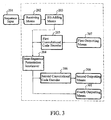
- FIG. 3 shows a second embodiment of the ISP encoder of the present invention;
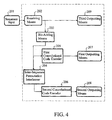
- FIG. 4 shows a third embodiment of the ISP encoder of the present invention;
- FIG. 5 shows a fourth embodiment of the ISP encoder of the present invention; and
- FIG. 6 shows a fifth embodiment of the ISP encoder of the present invention.
- The detailed description of a preferred embodiment is intended to illustrate the present invention, and is not intended to limit forms to embody the present invention.
- Techniques that the invention adopts are conventional "shortening" and "puncturing." Please first refer to FIG. 1. We assume that an inputted,
first sequence 101 comprises 13 bits and all the sequence permuters process 4 bits. According toUS Application No. 11/176,829 US Application No. 11/414,433 sequence 101, it becomes asecond sequence 102, which can be divided by 4 without leaving any remainder. Although we add "0" in this case, adding other kinds of symbol is also possible, e.g. "1". Although we add three "0" at the end, exchanging prior information bits with at least one "0" is also possible. Please also note that meanings of "bit" and "symbol" can be interchanged in the present specification. An individual who fully understands the bit-adding operation could realize that adding bits makes the extended length of bit sequence valid for inputting to the inter-sequence permutation interleaver. - The
sequence 102 can be permuted and encoded by the encoder performing inter-sequence permutation and convolutional code encoding (both have been discussed inUS Application No. 11/176,829 second sequence 102 becomes athird sequence 103 and afourth sequence 104. In thethird sequence 103 underlined digits in a sequence represent "added" bits. In thefourth sequence 104 underlined digits in a sequence represent "punctured" bits. After the process of inter-sequence permutation and/or convolutional code encoding, the added bits or the punctured bits are taken away, the resulting sequences are a fifth sequence 103' and a sixth sequence 104' respectively. - Adding the added bits before encoding and removing the added bits after encoding is called "shortening." Removing the punctured bits is called "puncturing." The shortening makes that the ISP turbo code system can encode a variable-length information bit sequence encodable when the length of information bit sequence is smaller than the designed length processed by the ISP turbo coding system. The puncturing makes that the length of code bit length matches the desired code bit length and the resultant code rate matches the desired code rate. One would easily note that essentially operations for removing the added bits and removing the punctured bits are very similar; therefore, we will uniformly call them "deleting" in the specification of the present application. However readers should keep in mind that in practice one would use different terms to refer to the deleting operation.
- After the added bits are taken away, in order to increase bandwidth efficiency, the outputted "code bit sequences" can be further punctured, individually or jointly. This technique of "further puncturing" has been widely known, and we will just skip detailed description here.
- The techniques described in previous 2 paragraphs and FIG. 1 can be embodied in
US Application No. 11/176,829 US Application No. 11/414,433 - FIG. 2 is a first embodiment of the present invention, which evolves from FIG. 2 of
US Application No. 11/176,829 US Application No. 11/176,829 US Application No. 11/176,829 - In FIG. 2, a bit-adding means 203 adds bits to an information bit sequence input received from a
receiving means 202. After processed by the ISP encoder, every code bit sequence output at the first outputting means 207, second outputting means 208, and third outputting means 209 is subjected to a deleting operation in order to eliminate the "added" or "punctured" bits. As mentioned before, at least an additional puncturing operation can be further performed on the code bit sequence output in order to increase the bandwidth efficiency. - In FIG. 3, similarly every code bit sequence output at the first outputting means 207, second outputting means 208, and fourth outputting means 301 is subjected to a deleting operation in order to eliminate the "added" bits. As mentioned before, at least an additional puncturing operation can be further performed on the code bit sequence output in order to increase the bandwidth efficiency.
- In FIG. 4, the third outputting means is directly coupled to the
receiving means 202, thus eliminating the need to perform the deleting operation at the third outputting means 209. Similarly, every code bit output at the first outputting means 207 and second outputting means 208 is still subjected to a deleting operation in order to eliminate the "punctured" bits. As mentioned before, at least an additional puncturing operation can be further performed on the code bit sequence output in order to increase the bandwidth efficiency. - Encoders shown in FIG. 5 and FIG. 6 are similar to those in FIG. 4 and FIG. 3, respectively. A difference lies in that the first
convolutional code encoder 205 directly receives sequences from the receiving means 202, since not all methods of convolutional code encoding requires "shortening" or "puncturing" beforehand. As mentioned before, at least an additional puncturing operation can be further performed on the code bit sequence output in order to increase the bandwidth efficiency. - In FIG. 2, FIG. 3, FIG. 4, FIG. 5, and FIG. 6, the first and second convolutional code encoders can adopt as least one of the following methods: tail-biting convolutional encoding, tail-padding convolutional code encoding. The convolutional code encoders can be replaced by other encoding methods such as Reed-Muller code, BCH code... etc. Multiple sequences after and before inter-sequence permutation interleaver can be separately encoded.
- Naturally, an individual who fully understand the present invention could realize that in fact, only sequences passing through the inter-sequence permutation interleaver requires "shortening" or "puncturing" operations. Therefore, the deleting operations do not require to be only performed at the outputting means. They can be performed right following the inter-sequence permutation interleaver, or prior to a convolutional code encoder if sequences passing through that convolutional code encoder do not require "shortening" or "puncturing."
- The almost regular permutation is also a kind of inter-sequence permutation interleaver and the "shortening" or "puncturing" can be applied for the turbo code applying the almost regular permutation as interleaver to encode a bit sequence with variable length.
Claims (27)
- An inter-sequence permutation encoder, at least comprising:a receiving means for receiving an information bit sequence input;a first outputting means for outputting a first code bit sequence output;a second outputting means for outputting a second code bit sequence output;a bit-adding means coupled to the receiving means, wherein the bit-adding means processing the received information bit sequence input prior to any subsequent processing of the received information bit sequence input in the inter-sequence permutation encoder;a first convolutional code encoder coupled between the bit-adding means and the first outputting means; anda second convolutional code encoder coupled to the second outputting means; andan inter-sequence permutation interleaver coupled between the bit-adding means and the second convolutional code encoder.
- The inter-sequence permutation encoder as claimed in Claim 1, further comprising a third outputting means coupled to the bit-adding means to output a third code bit sequence output.
- The inter-sequence permutation encoder as claimed in Claim 1, further comprising a third outputting means coupled to the receiving means to output a third code bit sequence output.
- The inter-sequence permutation encoder as claimed in Claim 1, further comprising a fourth outputting means coupled to the inter-sequence pennutation interleaver to output a fourth code bit sequence output.
- The inter-sequence permutation encoder as claimed in Claim 1, wherein the first and second convolutional code encoders perform as least one of the following methods: tail-biting convolutional encoding, tail-padding convolutional code encoding.
- The inter-sequence permutation encoder as claimed in Claim 1, wherein methods adopted by the convolutional code encoders are replaced by at least one of the following methods: Reed-Muller code and BCH code.
- The inter-sequence permutation encoder as claimed in Claim 1, wherein sequences processed after and before the inter-sequence permutation interleaver are separately encoded.
- The inter-sequence permutation encoder as claimed in Claim 1, wherein the first and second outputting means perform deleting operations in order to eliminate bits added by the bit-adding means.
- The inter-sequence permutation encoder as claimed in Claim 2, wherein the third outputting means performs a deleting operation in order to eliminate bits added by the bit-adding means.
- The inter-sequence permutation encoder as claimed in Claim 4, wherein the fourth outputting means performs a deleting operation in order to eliminate bits added by the bit-adding means.
- The inter-sequence permutation encoder as claimed in Claim 1, wherein the first and second code bit sequence outputs undergo at least an additional puncturing operation.
- The inter-sequence permutation encoder as claimed in Claim 2 or 3, wherein the third code bit sequence output undergoes at least an additional deleting operation.
- The inter-sequence permutation encoder as claimed in Claim 4, wherein the fourth code bit sequence output undergoes at least an additional deleting operation.
- The inter-sequence permutation encoder as claimed in Claim 6, wherein the first or second code bit sequence output undergoes at least an additional puncturing operation.
- The inter-sequence permutation encoder as claimed in Claim 9, wherein the third code bit sequence output undergoes at least an additional puncturing operation.
- The inter-sequence permutation encoder as claimed in Claim 10, wherein the fourth code bit sequence output undergoes at least an additional puncturing operation.
- An inter-sequence permutation encoder, at least comprising:a receiving means for receiving an information bit sequence input;a first outputting means for outputting a first code bit sequence output;a second outputting means for outputting a second code bit sequence output;a bit-adding means coupled to the receiving means, wherein the bit-adding means processes the received information bit sequence input prior to any subsequent processing of the received information bit sequence input in the inter-sequence permutation encoder;a first convolutional code encoder coupled between the receiving means and the first outputting means;a second convolutional code encoder coupled to the second outputting means; andan inter-sequence permutation interleaver coupled between the bit-adding means and the second convolutional code encoder.
- The inter-sequence permutation encoder as claimed in Claim 17, further comprising a third outputting means coupled to the receiving means to output a third code bit sequence output.
- The inter-sequence permutation encoder as claimed in Claim 17, further comprising a fourth outputting means coupled to the inter-sequence permutation interleaver to output a fourth code bit sequence output.
- The inter-sequence permutation encoder as claimed in Claim 17, wherein the first and second convolutional code encoders perform as least one of the following methods: tail-biting convolutional encoding, tail-padding convolutional code encoding.
- The inter-sequence permutation encoder as claimed in Claim 17, wherein methods adoped by the convolutional code encoders are replaced by at least one of the following methods: Reed-Muller code and BCH code.
- The inter-sequence permutation encoder as claimed in Claim 17, wherein sequences processed after and before the inter-sequence permutation interleaver are separately encoded.
- The inter-sequence permutation encoder as claimed in Claim 17, wherein the second outputting means performs a deleting operation in order to eliminate bits added by the bit-adding means.
- The inter-sequence permutation encoder as claimed in Claim 19, wherein the fourth outputting means performs a deleting operation in order to eliminate bits added by the bit-adding means.
- The inter-sequence permutation encoder as claimed in Claim 23, wherein the first or second code bit sequence output undergoes at least an additional puncturing operation.
- The inter-sequence permutation encoder as claimed in Claim 18, wherein the third code bit sequence output undergoes at least an additional puncturing operation.
- The inter-sequence permutation encoder as claimed in Claim 24, wherein the fourth code bit sequence output undergoes at least an additional puncturing operation.
Priority Applications (1)
| Application Number | Priority Date | Filing Date | Title |
|---|---|---|---|
| EP14164405.4A EP2763322A1 (en) | 2006-08-31 | 2007-08-29 | Utilizing variable-length input blocks in an inter-sequence permutation turbo code system |
Applications Claiming Priority (1)
| Application Number | Priority Date | Filing Date | Title |
|---|---|---|---|
| US11/513,158 US7797615B2 (en) | 2005-07-07 | 2006-08-31 | Utilizing variable-length inputs in an inter-sequence permutation turbo code system |
Related Child Applications (1)
| Application Number | Title | Priority Date | Filing Date |
|---|---|---|---|
| EP14164405.4A Division EP2763322A1 (en) | 2006-08-31 | 2007-08-29 | Utilizing variable-length input blocks in an inter-sequence permutation turbo code system |
Publications (1)
| Publication Number | Publication Date |
|---|---|
| EP1895666A1 true EP1895666A1 (en) | 2008-03-05 |
Family
ID=38692065
Family Applications (2)
| Application Number | Title | Priority Date | Filing Date |
|---|---|---|---|
| EP07115243A Ceased EP1895666A1 (en) | 2006-08-31 | 2007-08-29 | Utilizing variable-length input blocks in an inter-sequence permutation turbo code system |
| EP14164405.4A Withdrawn EP2763322A1 (en) | 2006-08-31 | 2007-08-29 | Utilizing variable-length input blocks in an inter-sequence permutation turbo code system |
Family Applications After (1)
| Application Number | Title | Priority Date | Filing Date |
|---|---|---|---|
| EP14164405.4A Withdrawn EP2763322A1 (en) | 2006-08-31 | 2007-08-29 | Utilizing variable-length input blocks in an inter-sequence permutation turbo code system |
Country Status (4)
| Country | Link |
|---|---|
| US (1) | US7797615B2 (en) |
| EP (2) | EP1895666A1 (en) |
| CN (2) | CN101136640A (en) |
| TW (1) | TWI357726B (en) |
Cited By (4)
| Publication number | Priority date | Publication date | Assignee | Title |
|---|---|---|---|---|
| WO2012047235A1 (en) * | 2010-10-08 | 2012-04-12 | Research In Motion Limited | Message rearrangement for improved code performance |
| US8769365B2 (en) | 2010-10-08 | 2014-07-01 | Blackberry Limited | Message rearrangement for improved wireless code performance |
| US9043667B2 (en) | 2011-11-04 | 2015-05-26 | Blackberry Limited | Method and system for up-link HARQ-ACK and CSI transmission |
| US10178651B2 (en) | 2012-05-11 | 2019-01-08 | Blackberry Limited | Method and system for uplink HARQ and CSI multiplexing for carrier aggregation |
Families Citing this family (2)
| Publication number | Priority date | Publication date | Assignee | Title |
|---|---|---|---|---|
| US8074155B2 (en) * | 2006-09-28 | 2011-12-06 | Broadcom Corporation | Tail-biting turbo coding to accommodate any information and/or interleaver block size |
| US7873897B2 (en) * | 2007-09-17 | 2011-01-18 | Industrial Technology Research Institute | Devices and methods for bit-level coding and decoding of turbo codes |
Citations (7)
| Publication number | Priority date | Publication date | Assignee | Title |
|---|---|---|---|---|
| US6437714B1 (en) | 1998-04-18 | 2002-08-20 | Samsung Electronics, Co., Ltd. | Channel encoding device and method for communication system |
| US20020124224A1 (en) * | 2000-12-29 | 2002-09-05 | Blankenship Thomas Keith | Method and system for matching information rates in turbo coded channels |
| US20030014715A1 (en) * | 2000-02-22 | 2003-01-16 | Andreas Lobinger | Method for adapting the data blocks to be supplied to a turbo coder and corresponding communications apparatus |
| US20030227885A1 (en) * | 2002-06-07 | 2003-12-11 | Sandbridge Technologies Inc. | Method of first interleavering of a two interleaver transmitter |
| US6766489B1 (en) | 1998-11-09 | 2004-07-20 | Canon Kabushiki Kaisha | Device and method of adapting turbocoders and the associated decoders to sequences of variable length |
| WO2006075417A1 (en) | 2005-01-14 | 2006-07-20 | Fujitsu Limited | Encoding method, decoding method, and device thereof |
| EP1839999A2 (en) | 2006-03-30 | 2007-10-03 | Aisin Aw Co., Ltd. | Driving support method and driving support device |
Family Cites Families (53)
| Publication number | Priority date | Publication date | Assignee | Title |
|---|---|---|---|---|
| US4400768A (en) | 1980-06-04 | 1983-08-23 | Burroughs Corporation | Parallel access computer memory system employing a power-of-two memory modules |
| JPS5753806A (en) | 1980-09-16 | 1982-03-31 | Toshiba Corp | Processor of digital signal |
| US4754394A (en) | 1984-10-24 | 1988-06-28 | International Business Machines Corporation | Multiprocessing system having dynamically allocated local/global storage and including interleaving transformation circuit for transforming real addresses to corresponding absolute address of the storage |
| JPH063589B2 (en) | 1987-10-29 | 1994-01-12 | インターナシヨナル・ビジネス・マシーンズ・コーポレーシヨン | Address replacement device |
| US5224100A (en) | 1991-05-09 | 1993-06-29 | David Sarnoff Research Center, Inc. | Routing technique for a hierarchical interprocessor-communication network between massively-parallel processors |
| US5392299A (en) | 1992-01-15 | 1995-02-21 | E-Systems, Inc. | Triple orthogonally interleaed error correction system |
| US5530707A (en) | 1994-03-09 | 1996-06-25 | At&T Corp. | Area-efficient decoders for rate-k/n convolutional codes and other high rate trellis codes |
| US5519734A (en) | 1994-08-15 | 1996-05-21 | Lsi Logic Corporation | Synchronization arrangement for decoder-de-interleaver |
| DE59610391D1 (en) | 1995-06-12 | 2003-06-05 | Siemens Ag | Method and coding device for the secure transmission of data by means of multi-component coding |
| US5815515A (en) | 1996-03-28 | 1998-09-29 | Lsi Logic Corporation | Edge metric calculation method and apparatus using permutations |
| US6023783A (en) | 1996-05-15 | 2000-02-08 | California Institute Of Technology | Hybrid concatenated codes and iterative decoding |
| US5734962A (en) | 1996-07-17 | 1998-03-31 | General Electric Company | Satellite communications system utilizing parallel concatenated coding |
| US5812601A (en) | 1996-11-15 | 1998-09-22 | Telefonaktiebolaget Lm Ericsson | Coding for higher-level modulation |
| US6373831B1 (en) | 1997-03-26 | 2002-04-16 | Nortel Networks Ltd. | Systems and methods of channel coding and inverse-multiplexing for multi-carrier CDMA systems |
| US6014761A (en) | 1997-10-06 | 2000-01-11 | Motorola, Inc. | Convolutional interleaving/de-interleaving method using pointer incrementing across predetermined distances and apparatus for data transmission |
| US6631491B1 (en) | 1997-11-10 | 2003-10-07 | Ntt Mobile Communications Network, Inc. | Interleaving method, interleaving apparatus, and recording medium in which interleave pattern generating program is recorded |
| US6477680B2 (en) | 1998-06-26 | 2002-11-05 | Agere Systems Inc. | Area-efficient convolutional decoder |
| FR2782425B1 (en) | 1998-07-31 | 2000-10-13 | France Telecom | ERROR CORRECTING CODING METHOD AND DEVICE AND CORRESPONDING DECODING METHOD AND DEVICE |
| JP2000068863A (en) | 1998-08-19 | 2000-03-03 | Fujitsu Ltd | Encoding device and method |
| JP2000151427A (en) | 1998-09-08 | 2000-05-30 | Sony Corp | Encoding apparatus and method, decoding apparatus and method, providing medium, and method for generating data replacement position information |
| US6044116A (en) | 1998-10-29 | 2000-03-28 | The Aerospace Corporation | Error-floor mitigated and repetitive turbo coding communication system |
| US6292918B1 (en) | 1998-11-05 | 2001-09-18 | Qualcomm Incorporated | Efficient iterative decoding |
| FR2785741B1 (en) | 1998-11-09 | 2001-01-26 | Canon Kk | CODING AND INTERLACING DEVICE AND METHOD FOR SERIES OR HYBRID TURBOCODES |
| DE69943198D1 (en) | 1998-12-30 | 2011-03-31 | Canon Kk | Coding apparatus and method, decoding apparatus and method and associated systems |
| US6678843B2 (en) | 1999-02-18 | 2004-01-13 | Interuniversitair Microelektronics Centrum (Imec) | Method and apparatus for interleaving, deinterleaving and combined interleaving-deinterleaving |
| CA2298919C (en) * | 1999-02-19 | 2006-04-18 | Ntt Mobile Communications Network Inc. | Interleaving and turbo encoding using prime number permutations |
| WO2000064058A1 (en) | 1999-04-16 | 2000-10-26 | Fujitsu Limited | Encoder and decoder |
| US6414988B1 (en) | 1999-05-12 | 2002-07-02 | Qualcomm Incorporated | Amplitude and phase estimation method in a wireless communication system |
| US6618371B1 (en) | 1999-06-08 | 2003-09-09 | Cisco Technology, Inc. | Butterfly network with switches set for two node disjoint paths and method for forming the paths |
| CA2550761C (en) * | 1999-07-08 | 2009-05-26 | Nortel Networks Limited | Puncturing of convolutional codes |
| US6697990B2 (en) | 1999-12-15 | 2004-02-24 | Hughes Electronics Corporation | Interleaver design for parsed parallel concatenated codes |
| CA2366592A1 (en) | 2000-02-10 | 2001-08-16 | Roger Hammons | A system and method employing a modular decoder for decoding turbo and turbo-like codes in a communications network |
| US6922472B2 (en) | 2000-05-05 | 2005-07-26 | Teleputers, Llc | Method and system for performing permutations using permutation instructions based on butterfly networks |
| CA2348941C (en) | 2000-05-26 | 2008-03-18 | Stewart N. Crozier | Method and system for high-spread high-distance interleaving for turbo-codes |
| EP2293452B1 (en) * | 2000-07-05 | 2012-06-06 | LG ELectronics INC. | Method of puncturing a turbo coded data block |
| JP2002076933A (en) | 2000-08-31 | 2002-03-15 | Sony Corp | Soft output decoding device and soft output decoding method, and decoding device and decoding method |
| KR100393608B1 (en) | 2000-09-29 | 2003-08-09 | 삼성전자주식회사 | An internal interleaver of the turbo decoder in an umts system and method for interleaving thereof |
| US6845482B2 (en) | 2001-02-28 | 2005-01-18 | Qualcomm Incorporated | Interleaver for turbo decoder |
| US20030002474A1 (en) | 2001-03-21 | 2003-01-02 | Thomas Alexander | Multi-stream merge network for data width conversion and multiplexing |
| US7313192B2 (en) * | 2001-05-31 | 2007-12-25 | Nxp B.V. | Method and apparatus for a complementary encoder/decoder |
| US6603412B2 (en) | 2001-06-08 | 2003-08-05 | Texas Instruments Incorporated | Interleaved coder and method |
| US7085969B2 (en) | 2001-08-27 | 2006-08-01 | Industrial Technology Research Institute | Encoding and decoding apparatus and method |
| JP3669433B2 (en) | 2001-12-25 | 2005-07-06 | ソニー株式会社 | Interleaving apparatus and interleaving method, encoding apparatus and encoding method, decoding apparatus and decoding method |
| CN1324811C (en) | 2002-02-06 | 2007-07-04 | 三星电子株式会社 | Interleaver and Interleaving Method in Communication System |
| US7058874B2 (en) | 2002-05-24 | 2006-06-06 | Lucent Technologies Inc. | Interleaver address generator and method of generating an interleaver address |
| US6961888B2 (en) | 2002-08-20 | 2005-11-01 | Flarion Technologies, Inc. | Methods and apparatus for encoding LDPC codes |
| US6903665B2 (en) | 2002-10-30 | 2005-06-07 | Spacebridge Semiconductor Corporation | Method and apparatus for error control coding in communication systems using an outer interleaver |
| US6957375B2 (en) | 2003-02-26 | 2005-10-18 | Flarion Technologies, Inc. | Method and apparatus for performing low-density parity-check (LDPC) code operations using a multi-level permutation |
| CN1305264C (en) * | 2003-04-14 | 2007-03-14 | 中兴通讯股份有限公司 | Device and method for radio local network baseband processing and coding modulation |
| US20050216700A1 (en) | 2004-03-26 | 2005-09-29 | Hooman Honary | Reconfigurable parallelism architecture |
| US7856579B2 (en) | 2006-04-28 | 2010-12-21 | Industrial Technology Research Institute | Network for permutation or de-permutation utilized by channel coding algorithm |
| US20070011557A1 (en) | 2005-07-07 | 2007-01-11 | Highdimension Ltd. | Inter-sequence permutation turbo code system and operation methods thereof |
| US7873897B2 (en) | 2007-09-17 | 2011-01-18 | Industrial Technology Research Institute | Devices and methods for bit-level coding and decoding of turbo codes |
-
2006
- 2006-08-31 US US11/513,158 patent/US7797615B2/en active Active
-
2007
- 2007-08-29 EP EP07115243A patent/EP1895666A1/en not_active Ceased
- 2007-08-29 EP EP14164405.4A patent/EP2763322A1/en not_active Withdrawn
- 2007-08-31 CN CNA2007101457086A patent/CN101136640A/en active Pending
- 2007-08-31 CN CN201410505545.8A patent/CN104320146A/en active Pending
- 2007-08-31 TW TW096132641A patent/TWI357726B/en not_active IP Right Cessation
Patent Citations (8)
| Publication number | Priority date | Publication date | Assignee | Title |
|---|---|---|---|---|
| US6437714B1 (en) | 1998-04-18 | 2002-08-20 | Samsung Electronics, Co., Ltd. | Channel encoding device and method for communication system |
| US6766489B1 (en) | 1998-11-09 | 2004-07-20 | Canon Kabushiki Kaisha | Device and method of adapting turbocoders and the associated decoders to sequences of variable length |
| US20030014715A1 (en) * | 2000-02-22 | 2003-01-16 | Andreas Lobinger | Method for adapting the data blocks to be supplied to a turbo coder and corresponding communications apparatus |
| US20020124224A1 (en) * | 2000-12-29 | 2002-09-05 | Blankenship Thomas Keith | Method and system for matching information rates in turbo coded channels |
| US20030227885A1 (en) * | 2002-06-07 | 2003-12-11 | Sandbridge Technologies Inc. | Method of first interleavering of a two interleaver transmitter |
| WO2006075417A1 (en) | 2005-01-14 | 2006-07-20 | Fujitsu Limited | Encoding method, decoding method, and device thereof |
| EP1837999A1 (en) * | 2005-01-14 | 2007-09-26 | Fujitsu Ltd. | Encoding method, decoding method, and device thereof |
| EP1839999A2 (en) | 2006-03-30 | 2007-10-03 | Aisin Aw Co., Ltd. | Driving support method and driving support device |
Non-Patent Citations (8)
| Title |
|---|
| "Eliminating Memory Contentions in LTE Channel Coding", INTERNET CITATION, 28 August 2006 (2006-08-28), Retrieved from the Internet <URL:http://www.3gpp.org/ftp/tsg_ran/WG1_RL1/TSGR1_46/Docs> |
| BERROU C ET AL.: "Designing good permutations for turbo codes: towards a single model", PROC. 2004 IEEE INTERNATIONAL CONFERENCE ON COMMUNICATIONS ICC 2004, 20 June 2004 (2004-06-20), pages 341 - 345, XP010710014, DOI: doi:10.1109/ICC.2004.1312507 |
| BERROU C ET AL: "Designing good permutations for turbo codes: towards a single model", 2004 IEEE INTERNATIONAL CONFERENCE ON COMMUNICATIONS ; ICC 2004 ; 20 - 24 JUNE 2004, PARIS, IEEE OPERATIONS CENTER, PISCATAWAY, NJ, USA, vol. 1, 20 June 2004 (2004-06-20), pages 341 - 345, XP010710014, ISBN: 978-0-7803-8533-7, DOI: 10.1109/ICC.2004.1312507 * |
| BLANKENSHIP T KEITH ET AL.: "High-throughput turbo decoding techniques for 4G", PROCEEDINGS INTERNATIONAL CONFERENCE ON THIRD GENERATION WIRELESS AND BEYOND, 28 May 2002 (2002-05-28), pages 137 - 142, XP009097982 |
| BLANKENSHIP T KEITH ET AL: "High-throughput turbo decoding techniques for 4G", PROCEEDINGS. INTERNATIONAL CONFERENCE ON THIRD GENERATIONWIRELESS AND BEYOND, 28 May 2002 (2002-05-28), pages 137 - 142, XP009097982 * |
| MOTOROLA ET AL.: "EUTRA FEC Enhancement", INTERNET CITATION, 27 March 2006 (2006-03-27), Retrieved from the Internet <URL:http://www.3gpp.org/ftp/tsg_ran/WG1_RL1/TSGR1_44bis/Docs> |
| MOTOROLA ET AL: "EUTRA FEC Enhancement", INTERNET CITATION, 27 March 2006 (2006-03-27), XP002475873, Retrieved from the Internet <URL:http://www.3gpp.org/ftp/tsg_ran/WG1_RL1/TSGR1_44bis/Docs/> [retrieved on 20080409] * |
| MOTOROLA: "Eliminating Memory Contentions in LTE Channel Coding", INTERNET CITATION, 28 August 2006 (2006-08-28), XP002475296, Retrieved from the Internet <URL:http://www.3gpp.org/ftp/tsg_ran/WG1_RL1/TSGR1_46/Docs/> [retrieved on 20080407] * |
Cited By (6)
| Publication number | Priority date | Publication date | Assignee | Title |
|---|---|---|---|---|
| WO2012047235A1 (en) * | 2010-10-08 | 2012-04-12 | Research In Motion Limited | Message rearrangement for improved code performance |
| US8769365B2 (en) | 2010-10-08 | 2014-07-01 | Blackberry Limited | Message rearrangement for improved wireless code performance |
| US8972814B2 (en) | 2010-10-08 | 2015-03-03 | Blackberry Limited | Message rearrangement for improved wireless code performance |
| USRE48767E1 (en) * | 2010-10-08 | 2021-10-05 | Blackberry Limited | Message rearrangement for improved wireless code performance |
| US9043667B2 (en) | 2011-11-04 | 2015-05-26 | Blackberry Limited | Method and system for up-link HARQ-ACK and CSI transmission |
| US10178651B2 (en) | 2012-05-11 | 2019-01-08 | Blackberry Limited | Method and system for uplink HARQ and CSI multiplexing for carrier aggregation |
Also Published As
| Publication number | Publication date |
|---|---|
| TW200814545A (en) | 2008-03-16 |
| EP2763322A1 (en) | 2014-08-06 |
| CN104320146A (en) | 2015-01-28 |
| TWI357726B (en) | 2012-02-01 |
| CN101136640A (en) | 2008-03-05 |
| US20070022353A1 (en) | 2007-01-25 |
| US7797615B2 (en) | 2010-09-14 |
Similar Documents
| Publication | Publication Date | Title |
|---|---|---|
| EP2019503B1 (en) | A data communication system and rate matching method | |
| US7318189B2 (en) | Parallel convolutional encoder | |
| CN103414478A (en) | Computationally efficient convolutional coding with rate-matching | |
| EP2763322A1 (en) | Utilizing variable-length input blocks in an inter-sequence permutation turbo code system | |
| US7872598B2 (en) | Accelerated decompression | |
| CN100508404C (en) | Segmentation Mechanism in Chunk Encoder | |
| KR960043552A (en) | Error Correction Coded Decoding Method and Circuit Using the Method | |
| WO2009009577A4 (en) | Fifo radix coder for electrical computers and digital data processing systems | |
| CN1161918C (en) | Data transmission method and signal encoding apparatus | |
| JP2006528848A (en) | Method, encoder and communication device for individually encoding parallel concatenated data | |
| EP2309651A1 (en) | Optimised code block segmentation for turbo encoding | |
| EP3476052B1 (en) | Coding and decoding of polar codes extended to lengths which are not powers of two | |
| US8532415B2 (en) | Data compression method | |
| US6385752B1 (en) | Method and apparatus for puncturing a convolutionally encoded bit stream | |
| CN109327276B (en) | Secure encoding method, decoding method and device | |
| CN109245853A (en) | It is a kind of that synchronized communication method is exempted from based on polarization code | |
| CN1443406A (en) | Method and device for diversity transmission of encoded information | |
| EP1350326B1 (en) | Decoding of reed-muller codes | |
| JP4420925B2 (en) | Method and encoder for encoding an information bit sequence | |
| TW202320493A (en) | Transition encoder and method for transition encoding with flexible word-size | |
| KR100997870B1 (en) | Data encoding and decoding methods, data transmission methods, transmitters and receivers | |
| Tse et al. | Polar coding for parallel Gaussian channels | |
| US7949062B2 (en) | Encoding system using a non-binary turbo code and an encoding method thereof | |
| CN108880569A (en) | A kind of rate-compatible coding method based on feedback packet Markov supercomposed coding | |
| KR100396827B1 (en) | Parallel convolutional encoder in data transmission system |
Legal Events
| Date | Code | Title | Description |
|---|---|---|---|
| PUAI | Public reference made under article 153(3) epc to a published international application that has entered the european phase |
Free format text: ORIGINAL CODE: 0009012 |
|
| AK | Designated contracting states |
Kind code of ref document: A1 Designated state(s): AT BE BG CH CY CZ DE DK EE ES FI FR GB GR HU IE IS IT LI LT LU LV MC MT NL PL PT RO SE SI SK TR |
|
| AX | Request for extension of the european patent |
Extension state: AL BA HR MK YU |
|
| AKX | Designation fees paid | ||
| 17P | Request for examination filed |
Effective date: 20080730 |
|
| RBV | Designated contracting states (corrected) |
Designated state(s): DE FI FR GB SE |
|
| 17Q | First examination report despatched |
Effective date: 20081110 |
|
| RAP1 | Party data changed (applicant data changed or rights of an application transferred) |
Owner name: INDUSTRIAL TECHNOLOGY RESEARCH INSTITUTE |
|
| RAP1 | Party data changed (applicant data changed or rights of an application transferred) |
Owner name: ACER INCORPORATED |
|
| STAA | Information on the status of an ep patent application or granted ep patent |
Free format text: STATUS: THE APPLICATION HAS BEEN REFUSED |
|
| 18R | Application refused |
Effective date: 20140428 |