EP1894915A1 - Phenyloxyaniline derivatives - Google Patents
Phenyloxyaniline derivatives Download PDFInfo
- Publication number
- EP1894915A1 EP1894915A1 EP06018455A EP06018455A EP1894915A1 EP 1894915 A1 EP1894915 A1 EP 1894915A1 EP 06018455 A EP06018455 A EP 06018455A EP 06018455 A EP06018455 A EP 06018455A EP 1894915 A1 EP1894915 A1 EP 1894915A1
- Authority
- EP
- European Patent Office
- Prior art keywords
- phenyl
- compound
- group
- formula
- compound according
- Prior art date
- Legal status (The legal status is an assumption and is not a legal conclusion. Google has not performed a legal analysis and makes no representation as to the accuracy of the status listed.)
- Withdrawn
Links
- GYNAVKULVOETAD-UHFFFAOYSA-N n-phenoxyaniline Chemical class C=1C=CC=CC=1NOC1=CC=CC=C1 GYNAVKULVOETAD-UHFFFAOYSA-N 0.000 title abstract 2
- 238000000034 method Methods 0.000 claims abstract description 20
- 238000004519 manufacturing process Methods 0.000 claims abstract description 5
- 150000001875 compounds Chemical class 0.000 claims description 112
- 229910052739 hydrogen Inorganic materials 0.000 claims description 53
- -1 (para-methyl)-phenyl Chemical group 0.000 claims description 35
- 239000002253 acid Substances 0.000 claims description 28
- 125000001997 phenyl group Chemical group [H]C1=C([H])C([H])=C(*)C([H])=C1[H] 0.000 claims description 27
- 238000006243 chemical reaction Methods 0.000 claims description 23
- 150000001450 anions Chemical class 0.000 claims description 22
- 239000001257 hydrogen Substances 0.000 claims description 19
- 125000002496 methyl group Chemical group [H]C([H])([H])* 0.000 claims description 17
- 125000000999 tert-butyl group Chemical group [H]C([H])([H])C(*)(C([H])([H])[H])C([H])([H])[H] 0.000 claims description 16
- 229940126214 compound 3 Drugs 0.000 claims description 15
- PAYRUJLWNCNPSJ-UHFFFAOYSA-N Aniline Chemical compound NC1=CC=CC=C1 PAYRUJLWNCNPSJ-UHFFFAOYSA-N 0.000 claims description 14
- UFHFLCQGNIYNRP-UHFFFAOYSA-N Hydrogen Chemical compound [H][H] UFHFLCQGNIYNRP-UHFFFAOYSA-N 0.000 claims description 13
- 229910052500 inorganic mineral Inorganic materials 0.000 claims description 12
- 239000011707 mineral Substances 0.000 claims description 12
- 239000000203 mixture Substances 0.000 claims description 12
- 125000000217 alkyl group Chemical group 0.000 claims description 11
- 125000001246 bromo group Chemical group Br* 0.000 claims description 10
- 125000000956 methoxy group Chemical group [H]C([H])([H])O* 0.000 claims description 10
- ISWSIDIOOBJBQZ-UHFFFAOYSA-N Phenol Chemical compound OC1=CC=CC=C1 ISWSIDIOOBJBQZ-UHFFFAOYSA-N 0.000 claims description 9
- 238000006640 acetylation reaction Methods 0.000 claims description 8
- 238000005804 alkylation reaction Methods 0.000 claims description 8
- 125000001797 benzyl group Chemical group [H]C1=C([H])C([H])=C(C([H])=C1[H])C([H])([H])* 0.000 claims description 8
- 125000000449 nitro group Chemical group [O-][N+](*)=O 0.000 claims description 8
- 125000006501 nitrophenyl group Chemical group 0.000 claims description 8
- 125000001412 tetrahydropyranyl group Chemical group 0.000 claims description 8
- 125000005424 tosyloxy group Chemical group S(=O)(=O)(C1=CC=C(C)C=C1)O* 0.000 claims description 8
- 125000003903 2-propenyl group Chemical group [H]C([*])([H])C([H])=C([H])[H] 0.000 claims description 6
- 230000029936 alkylation Effects 0.000 claims description 6
- 125000001309 chloro group Chemical group Cl* 0.000 claims description 6
- ZUOUZKKEUPVFJK-UHFFFAOYSA-N diphenyl Chemical group C1=CC=CC=C1C1=CC=CC=C1 ZUOUZKKEUPVFJK-UHFFFAOYSA-N 0.000 claims description 6
- 125000005059 halophenyl group Chemical group 0.000 claims description 6
- 150000002431 hydrogen Chemical class 0.000 claims description 6
- 239000012039 electrophile Substances 0.000 claims description 5
- 125000001495 ethyl group Chemical group [H]C([H])([H])C([H])([H])* 0.000 claims description 5
- YJTKZCDBKVTVBY-UHFFFAOYSA-N 1,3-Diphenylbenzene Chemical group C1=CC=CC=C1C1=CC=CC(C=2C=CC=CC=2)=C1 YJTKZCDBKVTVBY-UHFFFAOYSA-N 0.000 claims description 4
- 125000004172 4-methoxyphenyl group Chemical group [H]C1=C([H])C(OC([H])([H])[H])=C([H])C([H])=C1* 0.000 claims description 4
- 125000005037 alkyl phenyl group Chemical group 0.000 claims description 4
- 210000003169 central nervous system Anatomy 0.000 claims description 4
- 238000002059 diagnostic imaging Methods 0.000 claims description 4
- 125000005805 dimethoxy phenyl group Chemical group 0.000 claims description 4
- 125000001072 heteroaryl group Chemical group 0.000 claims description 4
- 239000012216 imaging agent Substances 0.000 claims description 4
- 125000001449 isopropyl group Chemical group [H]C([H])([H])C([H])(*)C([H])([H])[H] 0.000 claims description 4
- HRDXJKGNWSUIBT-UHFFFAOYSA-N methoxybenzene Chemical group [CH2]OC1=CC=CC=C1 HRDXJKGNWSUIBT-UHFFFAOYSA-N 0.000 claims description 4
- 125000004184 methoxymethyl group Chemical group [H]C([H])([H])OC([H])([H])* 0.000 claims description 4
- 125000005246 nonafluorobutyl group Chemical group FC(F)(F)C(F)(F)C(F)(F)C(F)(F)* 0.000 claims description 4
- 125000004469 siloxy group Chemical group [SiH3]O* 0.000 claims description 4
- 125000002023 trifluoromethyl group Chemical group FC(F)(F)* 0.000 claims description 4
- 125000001624 naphthyl group Chemical group 0.000 claims description 3
- LMBFAGIMSUYTBN-MPZNNTNKSA-N teixobactin Chemical compound C([C@H](C(=O)N[C@@H]([C@@H](C)CC)C(=O)N[C@@H](CO)C(=O)N[C@H](CCC(N)=O)C(=O)N[C@H]([C@@H](C)CC)C(=O)N[C@@H]([C@@H](C)CC)C(=O)N[C@@H](CO)C(=O)N[C@H]1C(N[C@@H](C)C(=O)N[C@@H](C[C@@H]2NC(=N)NC2)C(=O)N[C@H](C(=O)O[C@H]1C)[C@@H](C)CC)=O)NC)C1=CC=CC=C1 LMBFAGIMSUYTBN-MPZNNTNKSA-N 0.000 claims description 3
- 125000003545 alkoxy group Chemical group 0.000 claims description 2
- 125000005036 alkoxyphenyl group Chemical group 0.000 claims description 2
- 125000003710 aryl alkyl group Chemical group 0.000 claims description 2
- 235000010290 biphenyl Nutrition 0.000 claims description 2
- 239000004305 biphenyl Substances 0.000 claims description 2
- 125000004093 cyano group Chemical group *C#N 0.000 claims description 2
- 125000004802 cyanophenyl group Chemical group 0.000 claims description 2
- 125000006371 dihalo methyl group Chemical group 0.000 claims description 2
- 239000003085 diluting agent Substances 0.000 claims description 2
- 201000010099 disease Diseases 0.000 claims description 2
- 208000037265 diseases, disorders, signs and symptoms Diseases 0.000 claims description 2
- 239000003937 drug carrier Substances 0.000 claims description 2
- 125000005843 halogen group Chemical group 0.000 claims description 2
- 125000004970 halomethyl group Chemical group 0.000 claims description 2
- 125000002887 hydroxy group Chemical group [H]O* 0.000 claims description 2
- 238000003384 imaging method Methods 0.000 claims description 2
- 125000002346 iodo group Chemical group I* 0.000 claims description 2
- 125000003854 p-chlorophenyl group Chemical group [H]C1=C([H])C(*)=C([H])C([H])=C1Cl 0.000 claims description 2
- 125000000636 p-nitrophenyl group Chemical group [H]C1=C([H])C(=C([H])C([H])=C1*)[N+]([O-])=O 0.000 claims description 2
- 125000002924 primary amino group Chemical group [H]N([H])* 0.000 claims description 2
- 125000004953 trihalomethyl group Chemical group 0.000 claims description 2
- 125000000391 vinyl group Chemical group [H]C([*])=C([H])[H] 0.000 claims description 2
- 229920002554 vinyl polymer Polymers 0.000 claims description 2
- 125000002485 formyl group Chemical class [H]C(*)=O 0.000 claims 1
- XEKOWRVHYACXOJ-UHFFFAOYSA-N Ethyl acetate Chemical compound CCOC(C)=O XEKOWRVHYACXOJ-UHFFFAOYSA-N 0.000 description 108
- YMWUJEATGCHHMB-UHFFFAOYSA-N Dichloromethane Chemical compound ClCCl YMWUJEATGCHHMB-UHFFFAOYSA-N 0.000 description 66
- XLYOFNOQVPJJNP-UHFFFAOYSA-N water Substances O XLYOFNOQVPJJNP-UHFFFAOYSA-N 0.000 description 47
- CSNNHWWHGAXBCP-UHFFFAOYSA-L Magnesium sulfate Chemical compound [Mg+2].[O-][S+2]([O-])([O-])[O-] CSNNHWWHGAXBCP-UHFFFAOYSA-L 0.000 description 42
- ZMXDDKWLCZADIW-UHFFFAOYSA-N N,N-Dimethylformamide Chemical compound CN(C)C=O ZMXDDKWLCZADIW-UHFFFAOYSA-N 0.000 description 40
- 239000012074 organic phase Substances 0.000 description 40
- 229940093499 ethyl acetate Drugs 0.000 description 36
- 235000019439 ethyl acetate Nutrition 0.000 description 36
- VYPSYNLAJGMNEJ-UHFFFAOYSA-N Silicium dioxide Chemical compound O=[Si]=O VYPSYNLAJGMNEJ-UHFFFAOYSA-N 0.000 description 32
- 239000000243 solution Substances 0.000 description 31
- 239000012043 crude product Substances 0.000 description 30
- VLKZOEOYAKHREP-UHFFFAOYSA-N n-Hexane Chemical compound CCCCCC VLKZOEOYAKHREP-UHFFFAOYSA-N 0.000 description 30
- 239000011541 reaction mixture Substances 0.000 description 30
- 229910052757 nitrogen Inorganic materials 0.000 description 25
- 229910052731 fluorine Inorganic materials 0.000 description 24
- 238000003786 synthesis reaction Methods 0.000 description 24
- 230000015572 biosynthetic process Effects 0.000 description 23
- 239000000047 product Substances 0.000 description 23
- 239000012267 brine Substances 0.000 description 21
- 229910052943 magnesium sulfate Inorganic materials 0.000 description 21
- 235000019341 magnesium sulphate Nutrition 0.000 description 21
- NZVKWLWAFUSDQE-FNNGWQQSSA-N n-[[2-(2-fluoranylethoxy)-5-methoxyphenyl]methyl]-n-(5-fluoro-2-phenoxyphenyl)acetamide Chemical compound COC1=CC=C(OCC[18F])C(CN(C(C)=O)C=2C(=CC=C(F)C=2)OC=2C=CC=CC=2)=C1 NZVKWLWAFUSDQE-FNNGWQQSSA-N 0.000 description 21
- HPALAKNZSZLMCH-UHFFFAOYSA-M sodium;chloride;hydrate Chemical compound O.[Na+].[Cl-] HPALAKNZSZLMCH-UHFFFAOYSA-M 0.000 description 21
- 239000002904 solvent Substances 0.000 description 20
- 238000004458 analytical method Methods 0.000 description 17
- WFDIJRYMOXRFFG-UHFFFAOYSA-N Acetic anhydride Chemical compound CC(=O)OC(C)=O WFDIJRYMOXRFFG-UHFFFAOYSA-N 0.000 description 16
- FJDQFPXHSGXQBY-UHFFFAOYSA-L Cs2CO3 Substances [Cs+].[Cs+].[O-]C([O-])=O FJDQFPXHSGXQBY-UHFFFAOYSA-L 0.000 description 15
- OKKJLVBELUTLKV-UHFFFAOYSA-N Methanol Chemical compound OC OKKJLVBELUTLKV-UHFFFAOYSA-N 0.000 description 15
- 238000004440 column chromatography Methods 0.000 description 15
- 239000000377 silicon dioxide Substances 0.000 description 15
- NXXJKNZCEXCLHX-UHFFFAOYSA-N 2-[2-[(n-acetyl-5-fluoro-2-phenoxyanilino)methyl]-4-methoxyphenoxy]ethyl 4-methylbenzenesulfonate Chemical compound C=1C(F)=CC=C(OC=2C=CC=CC=2)C=1N(C(C)=O)CC1=CC(OC)=CC=C1OCCOS(=O)(=O)C1=CC=C(C)C=C1 NXXJKNZCEXCLHX-UHFFFAOYSA-N 0.000 description 14
- BWHMMNNQKKPAPP-UHFFFAOYSA-L potassium carbonate Chemical compound [K+].[K+].[O-]C([O-])=O BWHMMNNQKKPAPP-UHFFFAOYSA-L 0.000 description 14
- 239000011734 sodium Substances 0.000 description 13
- 229910052708 sodium Inorganic materials 0.000 description 13
- HGYAADNAINLWPB-UHFFFAOYSA-N 2-[2-[(n-acetyl-5-fluoro-2-phenoxyanilino)methyl]-4-methoxyphenoxy]ethyl methanesulfonate Chemical compound COC1=CC=C(OCCOS(C)(=O)=O)C(CN(C(C)=O)C=2C(=CC=C(F)C=2)OC=2C=CC=CC=2)=C1 HGYAADNAINLWPB-UHFFFAOYSA-N 0.000 description 12
- WEVYAHXRMPXWCK-UHFFFAOYSA-N Acetonitrile Chemical compound CC#N WEVYAHXRMPXWCK-UHFFFAOYSA-N 0.000 description 12
- KDLHZDBZIXYQEI-UHFFFAOYSA-N Palladium Chemical compound [Pd] KDLHZDBZIXYQEI-UHFFFAOYSA-N 0.000 description 12
- BQGMMFZDQBVDCE-UHFFFAOYSA-N n-(5-fluoro-2-phenoxyphenyl)-n-[(2-hydroxy-5-methoxyphenyl)methyl]acetamide Chemical compound COC1=CC=C(O)C(CN(C(C)=O)C=2C(=CC=C(F)C=2)OC=2C=CC=CC=2)=C1 BQGMMFZDQBVDCE-UHFFFAOYSA-N 0.000 description 12
- 150000001299 aldehydes Chemical class 0.000 description 11
- JUJWROOIHBZHMG-UHFFFAOYSA-N Pyridine Chemical compound C1=CC=NC=C1 JUJWROOIHBZHMG-UHFFFAOYSA-N 0.000 description 10
- 235000010755 mineral Nutrition 0.000 description 10
- DGAQECJNVWCQMB-PUAWFVPOSA-M Ilexoside XXIX Chemical compound C[C@@H]1CC[C@@]2(CC[C@@]3(C(=CC[C@H]4[C@]3(CC[C@@H]5[C@@]4(CC[C@@H](C5(C)C)OS(=O)(=O)[O-])C)C)[C@@H]2[C@]1(C)O)C)C(=O)O[C@H]6[C@@H]([C@H]([C@@H]([C@H](O6)CO)O)O)O.[Na+] DGAQECJNVWCQMB-PUAWFVPOSA-M 0.000 description 9
- 239000008346 aqueous phase Substances 0.000 description 9
- 229910000024 caesium carbonate Inorganic materials 0.000 description 9
- FZHSPPYCNDYIKD-UHFFFAOYSA-N 5-methoxysalicylaldehyde Chemical compound COC1=CC=C(O)C(C=O)=C1 FZHSPPYCNDYIKD-UHFFFAOYSA-N 0.000 description 8
- UORVGPXVDQYIDP-UHFFFAOYSA-N borane Chemical compound B UORVGPXVDQYIDP-UHFFFAOYSA-N 0.000 description 8
- 238000000746 purification Methods 0.000 description 8
- LFQSCWFLJHTTHZ-UHFFFAOYSA-N Ethanol Chemical compound CCO LFQSCWFLJHTTHZ-UHFFFAOYSA-N 0.000 description 7
- 150000007513 acids Chemical class 0.000 description 7
- 150000002828 nitro derivatives Chemical class 0.000 description 7
- 229910000027 potassium carbonate Inorganic materials 0.000 description 7
- 239000007858 starting material Substances 0.000 description 7
- CSCPPACGZOOCGX-UHFFFAOYSA-N Acetone Chemical compound CC(C)=O CSCPPACGZOOCGX-UHFFFAOYSA-N 0.000 description 6
- IJGRMHOSHXDMSA-UHFFFAOYSA-N Atomic nitrogen Chemical compound N#N IJGRMHOSHXDMSA-UHFFFAOYSA-N 0.000 description 6
- CPELXLSAUQHCOX-UHFFFAOYSA-M Bromide Chemical compound [Br-] CPELXLSAUQHCOX-UHFFFAOYSA-M 0.000 description 6
- KFZMGEQAYNKOFK-UHFFFAOYSA-N Isopropanol Chemical compound CC(C)O KFZMGEQAYNKOFK-UHFFFAOYSA-N 0.000 description 6
- JGFZNNIVVJXRND-UHFFFAOYSA-N N,N-Diisopropylethylamine (DIPEA) Chemical compound CCN(C(C)C)C(C)C JGFZNNIVVJXRND-UHFFFAOYSA-N 0.000 description 6
- CDBYLPFSWZWCQE-UHFFFAOYSA-L Sodium Carbonate Chemical compound [Na+].[Na+].[O-]C([O-])=O CDBYLPFSWZWCQE-UHFFFAOYSA-L 0.000 description 6
- WYURNTSHIVDZCO-UHFFFAOYSA-N Tetrahydrofuran Chemical compound C1CCOC1 WYURNTSHIVDZCO-UHFFFAOYSA-N 0.000 description 6
- 239000006227 byproduct Substances 0.000 description 6
- MHDVGSVTJDSBDK-UHFFFAOYSA-N dibenzyl ether Chemical compound C=1C=CC=CC=1COCC1=CC=CC=C1 MHDVGSVTJDSBDK-UHFFFAOYSA-N 0.000 description 6
- 238000004128 high performance liquid chromatography Methods 0.000 description 6
- 230000002285 radioactive effect Effects 0.000 description 6
- FVAUCKIRQBBSSJ-UHFFFAOYSA-M sodium iodide Chemical compound [Na+].[I-] FVAUCKIRQBBSSJ-UHFFFAOYSA-M 0.000 description 6
- SCYULBFZEHDVBN-UHFFFAOYSA-N 1,1-Dichloroethane Chemical compound CC(Cl)Cl SCYULBFZEHDVBN-UHFFFAOYSA-N 0.000 description 5
- PHWPLSJAAQJLSC-UHFFFAOYSA-N 2-[2-[(5-fluoro-2-phenoxyanilino)methyl]-4-methoxyphenoxy]ethyl 4-methylbenzenesulfonate Chemical compound C=1C(F)=CC=C(OC=2C=CC=CC=2)C=1NCC1=CC(OC)=CC=C1OCCOS(=O)(=O)C1=CC=C(C)C=C1 PHWPLSJAAQJLSC-UHFFFAOYSA-N 0.000 description 5
- RMYDPTVQMJEGLG-UHFFFAOYSA-N 5-fluoro-2-phenoxyaniline Chemical compound NC1=CC(F)=CC=C1OC1=CC=CC=C1 RMYDPTVQMJEGLG-UHFFFAOYSA-N 0.000 description 5
- RTHHKJVQKBLYGV-UHFFFAOYSA-N 5-fluoro-n-[[5-methoxy-2-[2-(oxan-2-yloxy)ethoxy]phenyl]methyl]-2-phenoxyaniline Chemical compound C=1C(F)=CC=C(OC=2C=CC=CC=2)C=1NCC1=CC(OC)=CC=C1OCCOC1CCCCO1 RTHHKJVQKBLYGV-UHFFFAOYSA-N 0.000 description 5
- WDYVUKGVKRZQNM-UHFFFAOYSA-N 6-phosphonohexylphosphonic acid Chemical compound OP(O)(=O)CCCCCCP(O)(O)=O WDYVUKGVKRZQNM-UHFFFAOYSA-N 0.000 description 5
- 238000010438 heat treatment Methods 0.000 description 5
- RXNSMLBOQWRBIR-UHFFFAOYSA-N n-(5-fluoro-2-phenoxyphenyl)-n-[[2-(2-hydroxyethoxy)-5-methoxyphenyl]methyl]acetamide Chemical compound COC1=CC=C(OCCO)C(CN(C(C)=O)C=2C(=CC=C(F)C=2)OC=2C=CC=CC=2)=C1 RXNSMLBOQWRBIR-UHFFFAOYSA-N 0.000 description 5
- UMJSCPRVCHMLSP-UHFFFAOYSA-N pyridine Natural products COC1=CC=CN=C1 UMJSCPRVCHMLSP-UHFFFAOYSA-N 0.000 description 5
- 230000002829 reductive effect Effects 0.000 description 5
- KIFZAMRXKJGYEV-UHFFFAOYSA-N 2-(2-formyl-4-methoxyphenoxy)ethyl 4-methylbenzenesulfonate Chemical compound O=CC1=CC(OC)=CC=C1OCCOS(=O)(=O)C1=CC=C(C)C=C1 KIFZAMRXKJGYEV-UHFFFAOYSA-N 0.000 description 4
- XEMLVTUBYAMDOH-UHFFFAOYSA-N 2-(2-formyl-4-methoxyphenoxy)ethyl methanesulfonate Chemical compound COC1=CC=C(OCCOS(C)(=O)=O)C(C=O)=C1 XEMLVTUBYAMDOH-UHFFFAOYSA-N 0.000 description 4
- QSQFARNGNIZGAW-UHFFFAOYSA-N 2-methylsulfonyloxyethyl methanesulfonate Chemical compound CS(=O)(=O)OCCOS(C)(=O)=O QSQFARNGNIZGAW-UHFFFAOYSA-N 0.000 description 4
- WRWLWQYESYITHB-UHFFFAOYSA-N 5-methoxy-2-[2-(oxan-2-yloxy)ethoxy]benzaldehyde Chemical compound O=CC1=CC(OC)=CC=C1OCCOC1OCCCC1 WRWLWQYESYITHB-UHFFFAOYSA-N 0.000 description 4
- RTZKZFJDLAIYFH-UHFFFAOYSA-N Diethyl ether Chemical compound CCOCC RTZKZFJDLAIYFH-UHFFFAOYSA-N 0.000 description 4
- RAVIZVQZGXBOQO-UHFFFAOYSA-N PK-11195 Chemical compound N=1C(C(=O)N(C)C(C)CC)=CC2=CC=CC=C2C=1C1=CC=CC=C1Cl RAVIZVQZGXBOQO-UHFFFAOYSA-N 0.000 description 4
- UIIMBOGNXHQVGW-UHFFFAOYSA-M Sodium bicarbonate Chemical compound [Na+].OC([O-])=O UIIMBOGNXHQVGW-UHFFFAOYSA-M 0.000 description 4
- 229910000085 borane Inorganic materials 0.000 description 4
- 239000000706 filtrate Substances 0.000 description 4
- 125000001153 fluoro group Chemical group F* 0.000 description 4
- ZZUFCTLCJUWOSV-UHFFFAOYSA-N furosemide Chemical compound C1=C(Cl)C(S(=O)(=O)N)=CC(C(O)=O)=C1NCC1=CC=CO1 ZZUFCTLCJUWOSV-UHFFFAOYSA-N 0.000 description 4
- 238000002347 injection Methods 0.000 description 4
- 239000007924 injection Substances 0.000 description 4
- ADLOGRNUILDEDD-UHFFFAOYSA-N n-(5-fluoro-2-phenoxyphenyl)-n-[[5-methoxy-2-[2-(oxan-2-yloxy)ethoxy]phenyl]methyl]acetamide Chemical compound C=1C(F)=CC=C(OC=2C=CC=CC=2)C=1N(C(C)=O)CC1=CC(OC)=CC=C1OCCOC1CCCCO1 ADLOGRNUILDEDD-UHFFFAOYSA-N 0.000 description 4
- DCRZYADKQRHHSF-KTXUZGJCSA-N n-[(2,5-dimethoxyphenyl)methyl]-n-(5-fluoro-2-phenoxyphenyl)acetamide Chemical compound COC1=CC=C(O[11CH3])C(CN(C(C)=O)C=2C(=CC=C(F)C=2)OC=2C=CC=CC=2)=C1 DCRZYADKQRHHSF-KTXUZGJCSA-N 0.000 description 4
- 230000000269 nucleophilic effect Effects 0.000 description 4
- UNILWMWFPHPYOR-KXEYIPSPSA-M 1-[6-[2-[3-[3-[3-[2-[2-[3-[[2-[2-[[(2r)-1-[[2-[[(2r)-1-[3-[2-[2-[3-[[2-(2-amino-2-oxoethoxy)acetyl]amino]propoxy]ethoxy]ethoxy]propylamino]-3-hydroxy-1-oxopropan-2-yl]amino]-2-oxoethyl]amino]-3-[(2r)-2,3-di(hexadecanoyloxy)propyl]sulfanyl-1-oxopropan-2-yl Chemical compound O=C1C(SCCC(=O)NCCCOCCOCCOCCCNC(=O)COCC(=O)N[C@@H](CSC[C@@H](COC(=O)CCCCCCCCCCCCCCC)OC(=O)CCCCCCCCCCCCCCC)C(=O)NCC(=O)N[C@H](CO)C(=O)NCCCOCCOCCOCCCNC(=O)COCC(N)=O)CC(=O)N1CCNC(=O)CCCCCN\1C2=CC=C(S([O-])(=O)=O)C=C2CC/1=C/C=C/C=C/C1=[N+](CC)C2=CC=C(S([O-])(=O)=O)C=C2C1 UNILWMWFPHPYOR-KXEYIPSPSA-M 0.000 description 3
- NNQKFNAHSWRUTF-UHFFFAOYSA-N 5-methoxy-2-(2-phenylmethoxyethoxy)benzaldehyde Chemical compound O=CC1=CC(OC)=CC=C1OCCOCC1=CC=CC=C1 NNQKFNAHSWRUTF-UHFFFAOYSA-N 0.000 description 3
- QTBSBXVTEAMEQO-UHFFFAOYSA-N Acetic acid Chemical compound CC(O)=O QTBSBXVTEAMEQO-UHFFFAOYSA-N 0.000 description 3
- WMFOQBRAJBCJND-UHFFFAOYSA-M Lithium hydroxide Chemical compound [Li+].[OH-] WMFOQBRAJBCJND-UHFFFAOYSA-M 0.000 description 3
- 239000012359 Methanesulfonyl chloride Substances 0.000 description 3
- 238000007126 N-alkylation reaction Methods 0.000 description 3
- KWYUFKZDYYNOTN-UHFFFAOYSA-M Potassium hydroxide Chemical compound [OH-].[K+] KWYUFKZDYYNOTN-UHFFFAOYSA-M 0.000 description 3
- HEMHJVSKTPXQMS-UHFFFAOYSA-M Sodium hydroxide Chemical compound [OH-].[Na+] HEMHJVSKTPXQMS-UHFFFAOYSA-M 0.000 description 3
- 210000004556 brain Anatomy 0.000 description 3
- TVFDJXOCXUVLDH-UHFFFAOYSA-N caesium atom Chemical compound [Cs] TVFDJXOCXUVLDH-UHFFFAOYSA-N 0.000 description 3
- 230000003197 catalytic effect Effects 0.000 description 3
- 239000003638 chemical reducing agent Substances 0.000 description 3
- 229960004592 isopropanol Drugs 0.000 description 3
- 238000002372 labelling Methods 0.000 description 3
- QARBMVPHQWIHKH-UHFFFAOYSA-N methanesulfonyl chloride Chemical compound CS(Cl)(=O)=O QARBMVPHQWIHKH-UHFFFAOYSA-N 0.000 description 3
- 210000000274 microglia Anatomy 0.000 description 3
- KRKOKBZKRFJGCG-UHFFFAOYSA-N n-(5-fluoro-2-phenoxyphenyl)-n-[[5-methoxy-2-(2-phenylmethoxyethoxy)phenyl]methyl]acetamide Chemical compound C=1C(F)=CC=C(OC=2C=CC=CC=2)C=1N(C(C)=O)CC1=CC(OC)=CC=C1OCCOCC1=CC=CC=C1 KRKOKBZKRFJGCG-UHFFFAOYSA-N 0.000 description 3
- FBOWQDWFHGSCJT-UHFFFAOYSA-N n-[[2-(2-bromoethoxy)-5-methoxyphenyl]methyl]-n-(5-fluoro-2-phenoxyphenyl)acetamide Chemical compound COC1=CC=C(OCCBr)C(CN(C(C)=O)C=2C(=CC=C(F)C=2)OC=2C=CC=CC=2)=C1 FBOWQDWFHGSCJT-UHFFFAOYSA-N 0.000 description 3
- 229910000029 sodium carbonate Inorganic materials 0.000 description 3
- HJUGFYREWKUQJT-UHFFFAOYSA-N tetrabromomethane Chemical compound BrC(Br)(Br)Br HJUGFYREWKUQJT-UHFFFAOYSA-N 0.000 description 3
- YLQBMQCUIZJEEH-UHFFFAOYSA-N tetrahydrofuran Natural products C=1C=COC=1 YLQBMQCUIZJEEH-UHFFFAOYSA-N 0.000 description 3
- RIOQSEWOXXDEQQ-UHFFFAOYSA-N triphenylphosphine Chemical compound C1=CC=CC=C1P(C=1C=CC=CC=1)C1=CC=CC=C1 RIOQSEWOXXDEQQ-UHFFFAOYSA-N 0.000 description 3
- HUHXLHLWASNVDB-UHFFFAOYSA-N 2-(oxan-2-yloxy)oxane Chemical compound O1CCCCC1OC1OCCCC1 HUHXLHLWASNVDB-UHFFFAOYSA-N 0.000 description 2
- LDLCZOVUSADOIV-UHFFFAOYSA-N 2-bromoethanol Chemical compound OCCBr LDLCZOVUSADOIV-UHFFFAOYSA-N 0.000 description 2
- SZIFAVKTNFCBPC-UHFFFAOYSA-N 2-chloroethanol Chemical compound OCCCl SZIFAVKTNFCBPC-UHFFFAOYSA-N 0.000 description 2
- AUFVJZSDSXXFOI-UHFFFAOYSA-N 2.2.2-cryptand Chemical compound C1COCCOCCN2CCOCCOCCN1CCOCCOCC2 AUFVJZSDSXXFOI-UHFFFAOYSA-N 0.000 description 2
- HVBSAKJJOYLTQU-UHFFFAOYSA-N 4-aminobenzenesulfonic acid Chemical compound NC1=CC=C(S(O)(=O)=O)C=C1 HVBSAKJJOYLTQU-UHFFFAOYSA-N 0.000 description 2
- ZFDSQQMBTWGBJO-UHFFFAOYSA-N 4-fluoro-2-nitro-1-phenoxybenzene Chemical compound [O-][N+](=O)C1=CC(F)=CC=C1OC1=CC=CC=C1 ZFDSQQMBTWGBJO-UHFFFAOYSA-N 0.000 description 2
- 0 CC(N(Cc(cc(cc1)OC)c1OCCO*)c(cc(cc1)F)c1Oc1ccccc1)=O Chemical compound CC(N(Cc(cc(cc1)OC)c1OCCO*)c(cc(cc1)F)c1Oc1ccccc1)=O 0.000 description 2
- IAZDPXIOMUYVGZ-UHFFFAOYSA-N Dimethylsulphoxide Chemical compound CS(C)=O IAZDPXIOMUYVGZ-UHFFFAOYSA-N 0.000 description 2
- YCKRFDGAMUMZLT-UHFFFAOYSA-N Fluorine atom Chemical compound [F] YCKRFDGAMUMZLT-UHFFFAOYSA-N 0.000 description 2
- VEXZGXHMUGYJMC-UHFFFAOYSA-N Hydrochloric acid Chemical compound Cl VEXZGXHMUGYJMC-UHFFFAOYSA-N 0.000 description 2
- 230000021736 acetylation Effects 0.000 description 2
- 125000002490 anilino group Chemical group [H]N(*)C1=C([H])C([H])=C([H])C([H])=C1[H] 0.000 description 2
- 125000003118 aryl group Chemical group 0.000 description 2
- 239000012298 atmosphere Substances 0.000 description 2
- 125000004432 carbon atom Chemical group C* 0.000 description 2
- 239000003054 catalyst Substances 0.000 description 2
- 239000003153 chemical reaction reagent Substances 0.000 description 2
- 238000010511 deprotection reaction Methods 0.000 description 2
- RJGHQTVXGKYATR-UHFFFAOYSA-L dibutyl(dichloro)stannane Chemical compound CCCC[Sn](Cl)(Cl)CCCC RJGHQTVXGKYATR-UHFFFAOYSA-L 0.000 description 2
- 239000011737 fluorine Substances 0.000 description 2
- 238000003328 mesylation reaction Methods 0.000 description 2
- MUMZUERVLWJKNR-UHFFFAOYSA-N oxoplatinum Chemical compound [Pt]=O MUMZUERVLWJKNR-UHFFFAOYSA-N 0.000 description 2
- PARWUHTVGZSQPD-UHFFFAOYSA-N phenylsilane Chemical compound [SiH3]C1=CC=CC=C1 PARWUHTVGZSQPD-UHFFFAOYSA-N 0.000 description 2
- 229910003446 platinum oxide Inorganic materials 0.000 description 2
- 239000002243 precursor Substances 0.000 description 2
- 238000002953 preparative HPLC Methods 0.000 description 2
- 125000006239 protecting group Chemical group 0.000 description 2
- 230000035484 reaction time Effects 0.000 description 2
- 238000006268 reductive amination reaction Methods 0.000 description 2
- 229920006395 saturated elastomer Polymers 0.000 description 2
- 235000009518 sodium iodide Nutrition 0.000 description 2
- 125000005207 tetraalkylammonium group Chemical group 0.000 description 2
- 125000002088 tosyl group Chemical group [H]C1=C([H])C(=C([H])C([H])=C1C([H])([H])[H])S(*)(=O)=O 0.000 description 2
- ONBQEOIKXPHGMB-VBSBHUPXSA-N 1-[2-[(2s,3r,4s,5r)-3,4-dihydroxy-5-(hydroxymethyl)oxolan-2-yl]oxy-4,6-dihydroxyphenyl]-3-(4-hydroxyphenyl)propan-1-one Chemical compound O[C@@H]1[C@H](O)[C@@H](CO)O[C@H]1OC1=CC(O)=CC(O)=C1C(=O)CCC1=CC=C(O)C=C1 ONBQEOIKXPHGMB-VBSBHUPXSA-N 0.000 description 1
- GCUOLJOTJRUDIZ-UHFFFAOYSA-N 2-(2-bromoethoxy)oxane Chemical compound BrCCOC1CCCCO1 GCUOLJOTJRUDIZ-UHFFFAOYSA-N 0.000 description 1
- UQSODMLYMPOPDP-UHFFFAOYSA-N 2-(2-methylphenyl)sulfonyloxyethyl 2-methylbenzenesulfonate Chemical compound CC1=CC=CC=C1S(=O)(=O)OCCOS(=O)(=O)C1=CC=CC=C1C UQSODMLYMPOPDP-UHFFFAOYSA-N 0.000 description 1
- LZIPBJBQQPZLOR-UHFFFAOYSA-N 2-(4-methylphenyl)sulfonyloxyethyl 4-methylbenzenesulfonate Chemical compound C1=CC(C)=CC=C1S(=O)(=O)OCCOS(=O)(=O)C1=CC=C(C)C=C1 LZIPBJBQQPZLOR-UHFFFAOYSA-N 0.000 description 1
- KCONKOTZXAFSAY-UHFFFAOYSA-N 2-(hydroxymethyl)-4-methoxyphenol Chemical compound COC1=CC=C(O)C(CO)=C1 KCONKOTZXAFSAY-UHFFFAOYSA-N 0.000 description 1
- LBLYYCQCTBFVLH-UHFFFAOYSA-N 2-Methylbenzenesulfonic acid Chemical compound CC1=CC=CC=C1S(O)(=O)=O LBLYYCQCTBFVLH-UHFFFAOYSA-N 0.000 description 1
- XYIMKICOIATTHH-UHFFFAOYSA-N 2-[(n-acetyl-5-fluoro-2-phenoxyanilino)-(3-methoxyphenyl)methoxy]ethyl 4-methylbenzenesulfonate Chemical compound COC1=CC=CC(C(OCCOS(=O)(=O)C=2C=CC(C)=CC=2)N(C(C)=O)C=2C(=CC=C(F)C=2)OC=2C=CC=CC=2)=C1 XYIMKICOIATTHH-UHFFFAOYSA-N 0.000 description 1
- LRNKAMRFYAYMAI-UHFFFAOYSA-N 2-[2-(hydroxymethyl)-4-methoxyphenoxy]ethanol Chemical compound COC1=CC=C(OCCO)C(CO)=C1 LRNKAMRFYAYMAI-UHFFFAOYSA-N 0.000 description 1
- QFUWWVDWOVROSN-UHFFFAOYSA-N 2-[4-methoxy-2-(methylsulfonyloxymethyl)phenoxy]ethyl methanesulfonate Chemical compound COC1=CC=C(OCCOS(C)(=O)=O)C(COS(C)(=O)=O)=C1 QFUWWVDWOVROSN-UHFFFAOYSA-N 0.000 description 1
- FWOHDAGPWDEWIB-UHFFFAOYSA-N 2-bromoethoxymethylbenzene Chemical compound BrCCOCC1=CC=CC=C1 FWOHDAGPWDEWIB-UHFFFAOYSA-N 0.000 description 1
- BMYNFMYTOJXKLE-UHFFFAOYSA-N 3-azaniumyl-2-hydroxypropanoate Chemical compound NCC(O)C(O)=O BMYNFMYTOJXKLE-UHFFFAOYSA-N 0.000 description 1
- 125000002471 4H-quinolizinyl group Chemical group C=1(C=CCN2C=CC=CC12)* 0.000 description 1
- HBAQYPYDRFILMT-UHFFFAOYSA-N 8-[3-(1-cyclopropylpyrazol-4-yl)-1H-pyrazolo[4,3-d]pyrimidin-5-yl]-3-methyl-3,8-diazabicyclo[3.2.1]octan-2-one Chemical class C1(CC1)N1N=CC(=C1)C1=NNC2=C1N=C(N=C2)N1C2C(N(CC1CC2)C)=O HBAQYPYDRFILMT-UHFFFAOYSA-N 0.000 description 1
- 208000024827 Alzheimer disease Diseases 0.000 description 1
- OJRUSAPKCPIVBY-KQYNXXCUSA-N C1=NC2=C(N=C(N=C2N1[C@H]3[C@@H]([C@@H]([C@H](O3)COP(=O)(CP(=O)(O)O)O)O)O)I)N Chemical compound C1=NC2=C(N=C(N=C2N1[C@H]3[C@@H]([C@@H]([C@H](O3)COP(=O)(CP(=O)(O)O)O)O)O)I)N OJRUSAPKCPIVBY-KQYNXXCUSA-N 0.000 description 1
- JFLHLOUBDXCHHE-UHFFFAOYSA-N CC(C)(C)OCCOc(cc1)c(CN(C(C)=O)c(cc(cc2)F)c2Oc2ccccc2)cc1OC Chemical compound CC(C)(C)OCCOc(cc1)c(CN(C(C)=O)c(cc(cc2)F)c2Oc2ccccc2)cc1OC JFLHLOUBDXCHHE-UHFFFAOYSA-N 0.000 description 1
- OLTAHVDUKQAESC-UHFFFAOYSA-N CC(N(Cc(cc(cc1)OC)c1OCCOC)c(cc(cc1)F)c1Oc1ccccc1)=O Chemical compound CC(N(Cc(cc(cc1)OC)c1OCCOC)c(cc(cc1)F)c1Oc1ccccc1)=O OLTAHVDUKQAESC-UHFFFAOYSA-N 0.000 description 1
- NZFOPUPUHVEFBI-UHFFFAOYSA-N CC(N(Cc(cc(cc1)OC)c1OCCOCC=C)c(cc(cc1)F)c1Oc1ccccc1)=O Chemical compound CC(N(Cc(cc(cc1)OC)c1OCCOCC=C)c(cc(cc1)F)c1Oc1ccccc1)=O NZFOPUPUHVEFBI-UHFFFAOYSA-N 0.000 description 1
- RAVIZVQZGXBOQO-CQSZACIVSA-N CC[C@@H](C)N(C)C(c1nc(-c(cccc2)c2Cl)c(cccc2)c2c1)=O Chemical compound CC[C@@H](C)N(C)C(c1nc(-c(cccc2)c2Cl)c(cccc2)c2c1)=O RAVIZVQZGXBOQO-CQSZACIVSA-N 0.000 description 1
- OKTJSMMVPCPJKN-UHFFFAOYSA-N Carbon Chemical compound [C] OKTJSMMVPCPJKN-UHFFFAOYSA-N 0.000 description 1
- YXFVVABEGXRONW-UHFFFAOYSA-N Cc1ccccc1 Chemical compound Cc1ccccc1 YXFVVABEGXRONW-UHFFFAOYSA-N 0.000 description 1
- 206010012289 Dementia Diseases 0.000 description 1
- 102000004300 GABA-A Receptors Human genes 0.000 description 1
- 108090000839 GABA-A Receptors Proteins 0.000 description 1
- 206010061218 Inflammation Diseases 0.000 description 1
- AFVFQIVMOAPDHO-UHFFFAOYSA-N Methanesulfonic acid Chemical compound CS(O)(=O)=O AFVFQIVMOAPDHO-UHFFFAOYSA-N 0.000 description 1
- 208000036110 Neuroinflammatory disease Diseases 0.000 description 1
- GRYLNZFGIOXLOG-UHFFFAOYSA-N Nitric acid Chemical compound O[N+]([O-])=O GRYLNZFGIOXLOG-UHFFFAOYSA-N 0.000 description 1
- NBIIXXVUZAFLBC-UHFFFAOYSA-N Phosphoric acid Chemical compound OP(O)(O)=O NBIIXXVUZAFLBC-UHFFFAOYSA-N 0.000 description 1
- NINIDFKCEFEMDL-UHFFFAOYSA-N Sulfur Chemical group [S] NINIDFKCEFEMDL-UHFFFAOYSA-N 0.000 description 1
- QAOWNCQODCNURD-UHFFFAOYSA-N Sulfuric acid Chemical compound OS(O)(=O)=O QAOWNCQODCNURD-UHFFFAOYSA-N 0.000 description 1
- ZMANZCXQSJIPKH-UHFFFAOYSA-N Triethylamine Chemical compound CCN(CC)CC ZMANZCXQSJIPKH-UHFFFAOYSA-N 0.000 description 1
- 238000009825 accumulation Methods 0.000 description 1
- 229960000583 acetic acid Drugs 0.000 description 1
- 235000011054 acetic acid Nutrition 0.000 description 1
- 239000012345 acetylating agent Substances 0.000 description 1
- 230000002378 acidificating effect Effects 0.000 description 1
- 125000000641 acridinyl group Chemical group C1(=CC=CC2=NC3=CC=CC=C3C=C12)* 0.000 description 1
- 210000001642 activated microglia Anatomy 0.000 description 1
- 125000001931 aliphatic group Chemical group 0.000 description 1
- 239000001099 ammonium carbonate Substances 0.000 description 1
- 235000012501 ammonium carbonate Nutrition 0.000 description 1
- 206010002026 amyotrophic lateral sclerosis Diseases 0.000 description 1
- QVGXLLKOCUKJST-UHFFFAOYSA-N atomic oxygen Chemical compound [O] QVGXLLKOCUKJST-UHFFFAOYSA-N 0.000 description 1
- WPYMKLBDIGXBTP-UHFFFAOYSA-N benzoic acid group Chemical group C(C1=CC=CC=C1)(=O)O WPYMKLBDIGXBTP-UHFFFAOYSA-N 0.000 description 1
- 125000004541 benzoxazolyl group Chemical group O1C(=NC2=C1C=CC=C2)* 0.000 description 1
- AGEZXYOZHKGVCM-UHFFFAOYSA-N benzyl bromide Chemical compound BrCC1=CC=CC=C1 AGEZXYOZHKGVCM-UHFFFAOYSA-N 0.000 description 1
- 125000001743 benzylic group Chemical group 0.000 description 1
- 150000001649 bromium compounds Chemical class 0.000 description 1
- 125000000609 carbazolyl group Chemical group C1(=CC=CC=2C3=CC=CC=C3NC12)* 0.000 description 1
- 125000004623 carbolinyl group Chemical group 0.000 description 1
- 229910052799 carbon Inorganic materials 0.000 description 1
- BVKZGUZCCUSVTD-UHFFFAOYSA-N carbonic acid Chemical compound OC(O)=O BVKZGUZCCUSVTD-UHFFFAOYSA-N 0.000 description 1
- 238000009903 catalytic hydrogenation reaction Methods 0.000 description 1
- 210000004027 cell Anatomy 0.000 description 1
- 125000004230 chromenyl group Chemical group O1C(C=CC2=CC=CC=C12)* 0.000 description 1
- 125000000259 cinnolinyl group Chemical group N1=NC(=CC2=CC=CC=C12)* 0.000 description 1
- 229940125773 compound 10 Drugs 0.000 description 1
- 229940125758 compound 15 Drugs 0.000 description 1
- 229940126142 compound 16 Drugs 0.000 description 1
- 229940125782 compound 2 Drugs 0.000 description 1
- 239000006184 cosolvent Substances 0.000 description 1
- 150000003983 crown ethers Chemical class 0.000 description 1
- WZHCOOQXZCIUNC-UHFFFAOYSA-N cyclandelate Chemical compound C1C(C)(C)CC(C)CC1OC(=O)C(O)C1=CC=CC=C1 WZHCOOQXZCIUNC-UHFFFAOYSA-N 0.000 description 1
- 125000004122 cyclic group Chemical group 0.000 description 1
- 210000004443 dendritic cell Anatomy 0.000 description 1
- 239000012973 diazabicyclooctane Substances 0.000 description 1
- 229960001760 dimethyl sulfoxide Drugs 0.000 description 1
- CYMQRGKQAOPOAQ-UHFFFAOYSA-N diphosphanium;carbonate Chemical compound [PH4+].[PH4+].[O-]C([O-])=O CYMQRGKQAOPOAQ-UHFFFAOYSA-N 0.000 description 1
- 150000002170 ethers Chemical class 0.000 description 1
- OAYLNYINCPYISS-UHFFFAOYSA-N ethyl acetate;hexane Chemical compound CCCCCC.CCOC(C)=O OAYLNYINCPYISS-UHFFFAOYSA-N 0.000 description 1
- 238000003682 fluorination reaction Methods 0.000 description 1
- 125000003838 furazanyl group Chemical group 0.000 description 1
- 125000002541 furyl group Chemical group 0.000 description 1
- 229940093915 gynecological organic acid Drugs 0.000 description 1
- 125000000623 heterocyclic group Chemical group 0.000 description 1
- 238000007210 heterogeneous catalysis Methods 0.000 description 1
- XMBWDFGMSWQBCA-UHFFFAOYSA-N hydrogen iodide Chemical compound I XMBWDFGMSWQBCA-UHFFFAOYSA-N 0.000 description 1
- 125000002883 imidazolyl group Chemical group 0.000 description 1
- 210000002865 immune cell Anatomy 0.000 description 1
- 239000012535 impurity Substances 0.000 description 1
- 238000011503 in vivo imaging Methods 0.000 description 1
- 125000003453 indazolyl group Chemical group N1N=C(C2=C1C=CC=C2)* 0.000 description 1
- 125000003406 indolizinyl group Chemical group C=1(C=CN2C=CC=CC12)* 0.000 description 1
- 125000001041 indolyl group Chemical group 0.000 description 1
- 230000004054 inflammatory process Effects 0.000 description 1
- 239000000543 intermediate Substances 0.000 description 1
- 125000001977 isobenzofuranyl group Chemical group C=1(OC=C2C=CC=CC12)* 0.000 description 1
- 125000000904 isoindolyl group Chemical group C=1(NC=C2C=CC=CC12)* 0.000 description 1
- 125000005956 isoquinolyl group Chemical group 0.000 description 1
- 125000001786 isothiazolyl group Chemical group 0.000 description 1
- 125000000842 isoxazolyl group Chemical group 0.000 description 1
- ZLVXBBHTMQJRSX-VMGNSXQWSA-N jdtic Chemical compound C1([C@]2(C)CCN(C[C@@H]2C)C[C@H](C(C)C)NC(=O)[C@@H]2NCC3=CC(O)=CC=C3C2)=CC=CC(O)=C1 ZLVXBBHTMQJRSX-VMGNSXQWSA-N 0.000 description 1
- 239000003446 ligand Substances 0.000 description 1
- 210000002540 macrophage Anatomy 0.000 description 1
- 125000005905 mesyloxy group Chemical group 0.000 description 1
- 125000002950 monocyclic group Chemical group 0.000 description 1
- 201000006417 multiple sclerosis Diseases 0.000 description 1
- BAPROVDXKNPHAM-UHFFFAOYSA-N n-(2-aminoethyl)-3-(3,5-ditert-butyl-4-hydroxyphenyl)propanamide Chemical compound CC(C)(C)C1=CC(CCC(=O)NCCN)=CC(C(C)(C)C)=C1O BAPROVDXKNPHAM-UHFFFAOYSA-N 0.000 description 1
- NZVKWLWAFUSDQE-UHFFFAOYSA-N n-[[2-(2-fluoroethoxy)-5-methoxyphenyl]methyl]-n-(5-fluoro-2-phenoxyphenyl)acetamide Chemical compound COC1=CC=C(OCCF)C(CN(C(C)=O)C=2C(=CC=C(F)C=2)OC=2C=CC=CC=2)=C1 NZVKWLWAFUSDQE-UHFFFAOYSA-N 0.000 description 1
- RAVIZVQZGXBOQO-KTXUZGJCSA-N n-butan-2-yl-1-(2-chlorophenyl)-n-methylisoquinoline-3-carboxamide Chemical compound N=1C(C(=O)N([11CH3])C(C)CC)=CC2=CC=CC=C2C=1C1=CC=CC=C1Cl RAVIZVQZGXBOQO-KTXUZGJCSA-N 0.000 description 1
- 125000003136 n-heptyl group Chemical group [H]C([H])([H])C([H])([H])C([H])([H])C([H])([H])C([H])([H])C([H])([H])C([H])([H])* 0.000 description 1
- 125000000740 n-pentyl group Chemical group [H]C([H])([H])C([H])([H])C([H])([H])C([H])([H])C([H])([H])* 0.000 description 1
- 125000004123 n-propyl group Chemical group [H]C([H])([H])C([H])([H])C([H])([H])* 0.000 description 1
- 125000004593 naphthyridinyl group Chemical group N1=C(C=CC2=CC=CN=C12)* 0.000 description 1
- 210000000653 nervous system Anatomy 0.000 description 1
- 208000015122 neurodegenerative disease Diseases 0.000 description 1
- 210000004498 neuroglial cell Anatomy 0.000 description 1
- 230000003959 neuroinflammation Effects 0.000 description 1
- 238000007339 nucleophilic aromatic substitution reaction Methods 0.000 description 1
- 238000005580 one pot reaction Methods 0.000 description 1
- 238000010915 one-step procedure Methods 0.000 description 1
- 210000000056 organ Anatomy 0.000 description 1
- 150000007524 organic acids Chemical class 0.000 description 1
- 235000005985 organic acids Nutrition 0.000 description 1
- 229910052760 oxygen Inorganic materials 0.000 description 1
- 239000001301 oxygen Substances 0.000 description 1
- VLTRZXGMWDSKGL-UHFFFAOYSA-N perchloric acid Chemical compound OCl(=O)(=O)=O VLTRZXGMWDSKGL-UHFFFAOYSA-N 0.000 description 1
- 125000005327 perimidinyl group Chemical group N1C(=NC2=CC=CC3=CC=CC1=C23)* 0.000 description 1
- 230000002093 peripheral effect Effects 0.000 description 1
- 210000001539 phagocyte Anatomy 0.000 description 1
- 125000004934 phenanthridinyl group Chemical group C1(=CC=CC2=NC=C3C=CC=CC3=C12)* 0.000 description 1
- 125000004625 phenanthrolinyl group Chemical group N1=C(C=CC2=CC=C3C=CC=NC3=C12)* 0.000 description 1
- 125000001791 phenazinyl group Chemical group C1(=CC=CC2=NC3=CC=CC=C3N=C12)* 0.000 description 1
- 125000001484 phenothiazinyl group Chemical group C1(=CC=CC=2SC3=CC=CC=C3NC12)* 0.000 description 1
- 125000005954 phenoxathiinyl group Chemical group 0.000 description 1
- 125000001644 phenoxazinyl group Chemical group C1(=CC=CC=2OC3=CC=CC=C3NC12)* 0.000 description 1
- WLJVXDMOQOGPHL-UHFFFAOYSA-N phenylacetic acid Chemical compound OC(=O)CC1=CC=CC=C1 WLJVXDMOQOGPHL-UHFFFAOYSA-N 0.000 description 1
- 125000004592 phthalazinyl group Chemical group C1(=NN=CC2=CC=CC=C12)* 0.000 description 1
- 125000001042 pteridinyl group Chemical group N1=C(N=CC2=NC=CN=C12)* 0.000 description 1
- 125000000561 purinyl group Chemical group N1=C(N=C2N=CNC2=C1)* 0.000 description 1
- 125000004309 pyranyl group Chemical group O1C(C=CC=C1)* 0.000 description 1
- 125000003373 pyrazinyl group Chemical group 0.000 description 1
- 125000003226 pyrazolyl group Chemical group 0.000 description 1
- 125000002098 pyridazinyl group Chemical group 0.000 description 1
- 125000004076 pyridyl group Chemical group 0.000 description 1
- 125000000714 pyrimidinyl group Chemical group 0.000 description 1
- 125000000168 pyrrolyl group Chemical group 0.000 description 1
- 238000004445 quantitative analysis Methods 0.000 description 1
- 125000002294 quinazolinyl group Chemical group N1=C(N=CC2=CC=CC=C12)* 0.000 description 1
- 125000005493 quinolyl group Chemical group 0.000 description 1
- 150000003254 radicals Chemical class 0.000 description 1
- 125000006413 ring segment Chemical group 0.000 description 1
- 229910000030 sodium bicarbonate Inorganic materials 0.000 description 1
- 235000017557 sodium bicarbonate Nutrition 0.000 description 1
- WBHQBSYUUJJSRZ-UHFFFAOYSA-M sodium bisulfate Chemical compound [Na+].OS([O-])(=O)=O WBHQBSYUUJJSRZ-UHFFFAOYSA-M 0.000 description 1
- 229910000342 sodium bisulfate Inorganic materials 0.000 description 1
- 229950000244 sulfanilic acid Drugs 0.000 description 1
- 239000001117 sulphuric acid Substances 0.000 description 1
- 235000011149 sulphuric acid Nutrition 0.000 description 1
- 125000001712 tetrahydronaphthyl group Chemical group C1(CCCC2=CC=CC=C12)* 0.000 description 1
- 125000004627 thianthrenyl group Chemical group C1(=CC=CC=2SC3=CC=CC=C3SC12)* 0.000 description 1
- 125000001544 thienyl group Chemical group 0.000 description 1
- JOXIMZWYDAKGHI-UHFFFAOYSA-N toluene-4-sulfonic acid Chemical compound CC1=CC=C(S(O)(=O)=O)C=C1 JOXIMZWYDAKGHI-UHFFFAOYSA-N 0.000 description 1
- IMNIMPAHZVJRPE-UHFFFAOYSA-N triethylenediamine Chemical compound C1CN2CCN1CC2 IMNIMPAHZVJRPE-UHFFFAOYSA-N 0.000 description 1
- 238000012800 visualization Methods 0.000 description 1
- 125000001834 xanthenyl group Chemical group C1=CC=CC=2OC3=CC=CC=C3C(C12)* 0.000 description 1
Classifications
-
- C—CHEMISTRY; METALLURGY
- C07—ORGANIC CHEMISTRY
- C07C—ACYCLIC OR CARBOCYCLIC COMPOUNDS
- C07C309/00—Sulfonic acids; Halides, esters, or anhydrides thereof
- C07C309/63—Esters of sulfonic acids
- C07C309/64—Esters of sulfonic acids having sulfur atoms of esterified sulfo groups bound to acyclic carbon atoms
- C07C309/69—Esters of sulfonic acids having sulfur atoms of esterified sulfo groups bound to acyclic carbon atoms of a carbon skeleton substituted by nitrogen atoms, not being part of nitro or nitroso groups
-
- C—CHEMISTRY; METALLURGY
- C07—ORGANIC CHEMISTRY
- C07D—HETEROCYCLIC COMPOUNDS
- C07D309/00—Heterocyclic compounds containing six-membered rings having one oxygen atom as the only ring hetero atom, not condensed with other rings
- C07D309/02—Heterocyclic compounds containing six-membered rings having one oxygen atom as the only ring hetero atom, not condensed with other rings having no double bonds between ring members or between ring members and non-ring members
- C07D309/08—Heterocyclic compounds containing six-membered rings having one oxygen atom as the only ring hetero atom, not condensed with other rings having no double bonds between ring members or between ring members and non-ring members with hetero atoms or with carbon atoms having three bonds to hetero atoms with at the most one bond to halogen, e.g. ester or nitrile radicals, directly attached to ring carbon atoms
- C07D309/10—Oxygen atoms
- C07D309/12—Oxygen atoms only hydrogen atoms and one oxygen atom directly attached to ring carbon atoms, e.g. tetrahydropyranyl ethers
-
- A—HUMAN NECESSITIES
- A61—MEDICAL OR VETERINARY SCIENCE; HYGIENE
- A61K—PREPARATIONS FOR MEDICAL, DENTAL OR TOILETRY PURPOSES
- A61K49/00—Preparations for testing in vivo
- A61K49/04—X-ray contrast preparations
-
- A—HUMAN NECESSITIES
- A61—MEDICAL OR VETERINARY SCIENCE; HYGIENE
- A61K—PREPARATIONS FOR MEDICAL, DENTAL OR TOILETRY PURPOSES
- A61K51/00—Preparations containing radioactive substances for use in therapy or testing in vivo
- A61K51/02—Preparations containing radioactive substances for use in therapy or testing in vivo characterised by the carrier, i.e. characterised by the agent or material covalently linked or complexing the radioactive nucleus
- A61K51/04—Organic compounds
-
- C—CHEMISTRY; METALLURGY
- C07—ORGANIC CHEMISTRY
- C07C—ACYCLIC OR CARBOCYCLIC COMPOUNDS
- C07C233/00—Carboxylic acid amides
- C07C233/88—Carboxylic acid amides having nitrogen atoms of carboxamide groups bound to an acyclic carbon atom and to a carbon atom of a six-membered aromatic ring wherein at least one ortho-hydrogen atom has been replaced
-
- C—CHEMISTRY; METALLURGY
- C07—ORGANIC CHEMISTRY
- C07C—ACYCLIC OR CARBOCYCLIC COMPOUNDS
- C07C309/00—Sulfonic acids; Halides, esters, or anhydrides thereof
- C07C309/63—Esters of sulfonic acids
- C07C309/64—Esters of sulfonic acids having sulfur atoms of esterified sulfo groups bound to acyclic carbon atoms
- C07C309/65—Esters of sulfonic acids having sulfur atoms of esterified sulfo groups bound to acyclic carbon atoms of a saturated carbon skeleton
- C07C309/66—Methanesulfonates
-
- C—CHEMISTRY; METALLURGY
- C07—ORGANIC CHEMISTRY
- C07F—ACYCLIC, CARBOCYCLIC OR HETEROCYCLIC COMPOUNDS CONTAINING ELEMENTS OTHER THAN CARBON, HYDROGEN, HALOGEN, OXYGEN, NITROGEN, SULFUR, SELENIUM OR TELLURIUM
- C07F7/00—Compounds containing elements of Groups 4 or 14 of the Periodic Table
- C07F7/02—Silicon compounds
- C07F7/08—Compounds having one or more C—Si linkages
- C07F7/18—Compounds having one or more C—Si linkages as well as one or more C—O—Si linkages
-
- C—CHEMISTRY; METALLURGY
- C07—ORGANIC CHEMISTRY
- C07F—ACYCLIC, CARBOCYCLIC OR HETEROCYCLIC COMPOUNDS CONTAINING ELEMENTS OTHER THAN CARBON, HYDROGEN, HALOGEN, OXYGEN, NITROGEN, SULFUR, SELENIUM OR TELLURIUM
- C07F7/00—Compounds containing elements of Groups 4 or 14 of the Periodic Table
- C07F7/02—Silicon compounds
- C07F7/08—Compounds having one or more C—Si linkages
- C07F7/18—Compounds having one or more C—Si linkages as well as one or more C—O—Si linkages
- C07F7/1804—Compounds having Si-O-C linkages
-
- C—CHEMISTRY; METALLURGY
- C07—ORGANIC CHEMISTRY
- C07C—ACYCLIC OR CARBOCYCLIC COMPOUNDS
- C07C2601/00—Systems containing only non-condensed rings
- C07C2601/12—Systems containing only non-condensed rings with a six-membered ring
- C07C2601/14—The ring being saturated
Definitions
- PBR Peripheral benzodiazepine receptor
- CNS central nervous system
- Microglia are related to other phagocytic cells including macrophages and dendritic cells. Microglia are thought to be highly mobile cells that play numerous important roles in protecting the nervous system. They are also thought to play a role in neurodegenerative disorders such as Alzheimer's disease, dementia, multiple sclerosis and Amyotrophic lateral sclerosis. Microglia are responsible for producing an inflammatory reaction to insults ( J. Neuroinflammation, 2004, Jul 30; 1(1):14 .). The C-11 isotope labeled version of PK11195 ( 1 ) has been widely used for the in vivo imaging of neuroinflamation and PBRs, but its signal in the brain was not high enough for stable quantitative analysis.
- Compound 3 can be synthesized by the alkylation reaction of the phenol DAA1123 ( 4 ) with [ 18 F]-1-bromo-2-fluoro-ethane ( 5 ) as shown in scheme 1.
- the drawback of the reaction is that the reagent ( 18 F]-1-bromo-2-fluoro-ethane ( 5 ) has to be synthesized from trifluoro-methanesulfonklare-2-bromo-ethyl ester ( 6 ) prior phenol alkylation ( 4 ⁇ 3 ).
- Compound 4 is prepared from benzyl ether 8 by catalytic hydrogenation (see scheme 4).
- Benzyl ether 8 is prepared in a one-pot reaction from nitro compound 9 and aldehyde 10 (see scheme 5).
- Nitro compound 9 is synthesized from difluoride ( 11 ) and phenol by nucleophilic aromatic substitution reaction. Whereas compound 10 is prepared from phenol 12 and benzyl bromide (see scheme 6 ).
- the present invention provides novel compounds of Formula I.
- the present invention provides novel compounds of Formula II.
- the invention further provides a novel process of preparing N -(5-Fluoro-2-phenoxyphenyl)- N -(5-methoxy-2-(2-tosyloxy-ethoxy)-benzyl)acetamide ( 7 ) and compounds represented by Formula I or II.
- the invention further provides a novel process of preparing N-(5-Fluoro-2-phenoxyphenyl)- N -(2-(2-[ 18 F]fluoroethoxy)-5-methoxybenzyl)acetamide ( 3 ).
- the present invention is directed to compounds of formula I : wherein R is
- R is
- R is
- a preferred series of compounds of Formula I include mesyloxy and bromo derivatives having the following structures:
- G is
- R 1 is independently from each other
- R 2 is independently from each other
- R 2 is independently from each other
- a preferred series of compounds of Formula II include derivatives having the following structures:
- lower un-branched or branched alkyl shall have the following meaning: a substituted or unsubstituted, straight or branched chain monovalent or divalent radical consisting substantially of carbon and hydrogen, containing no unsaturation and having from one to eight carbon atoms, e.g. but not limited to methyl, ethyl, n-propyl, n-pentyl, 1,1-dimethylethyl (t-butyl), n-heptyl, and the like.
- aryl as employed herein by itself or as part of another group refers to monocyclic or bicyclic aromatic groups containing from 6 to 12 carbons in the ring portion, preferably 6-10 carbons in the ring portion, such as phenyl, naphthyl or tetrahydronaphthyl.
- heteroaryl refers to groups having 5 to 14 ring atoms; 6, 10 or 14 ⁇ (pi) electrons shared in a cyclic array; and containing carbon atoms and 1, 2, 3 or 4 oxygen, nitrogen or sulfur heteroatoms (where examples of heteroaryl groups are: thienyl, benzo[b]thienyl, naphtho[2,3-b]thienyl, thianthrenyl, furyl, pyranyl, isobenzofuranyl, benzoxazolyl, chromenyl, xanthenyl, phenoxathiinyl, 2H-pyrrolyl, pyrrolyl, imidazolyl, pyrazolyl, pyridyl, pyrazinyl, pyrimidinyl, pyridazinyl, indolizinyl, isoindolyl, 3H-indolyl, indolyl, indazolyl, pur
- a chiral center or another form of an isomeric center is present in a compound according to Formula I or II of the present invention, all forms of such isomer, including enantiomers and diastereoisomers, are intended to be covered herein.
- Compounds containing a chiral center may be used as racemic mixture or as an enantiomerically enriched mixture or the racemic mixture may be separated using well-known techniques and an individual enantiomer maybe used alone. In cases in which compounds have unsaturated carbon-carbon bonds double bonds, both the cis-isomer and trans-isomers are within the scope of this invention.
- compounds may exist in tautomeric forms, such as keto-enol tautomers, each tautomeric form is contemplated as being included within this invention whether existing in equilibrium or predominantly in one form.
- the present invention is directed to a process for preparing N-(5-Fluoro-2-phenoxyphenyl)-N-(5-methoxy-2-tosyloxyethoxybenzyl)acetamide (7) or a compound represented by Formula I or II characterized by
- R 3 is
- a forth aspect of the invention is directed to a process of preparing compound 3 which is characterized by the nucleophilic 18 F radiofluorination of compound 7 or a compound of formula I in only one radiochemical step.
- the forth aspect of the present invention provides additional starting materials and/or new parameters which allow the 18 F fluorination towards N -(5-Fluoro-2-phenoxyphenyl)- N -(2-(2-[ 18 F]fluoroethoxy)-5-methoxybenzyl)acetamide (3) without generating a disadvantageous amount of by-products which are costly or difficult to separate.
- the present invention comprises an approach for the nucleophilic 18 F radiofluorination towards N -(5-Fluoro-2-phenoxyphenyl)- N -(2-(2-[ 18 F]fluoroethoxy)-5-methoxybenzyl)acetamide ( 3 ) which is characterized by use of starting materials represented by
- reaction with 18 F anions is conducted over a period in the range of from 1 to 60 minutes, preferably 5 to 50 minutes, more preferably 10 to 40 minutes.
- compositions comprising a compound according to Formula I, preferably as defined in any of claims 1-6, and a pharmaceutically acceptable carrier or diluent.
- kits comprising a sealed vial containing a compound according to Formula I, preferably as defined in any of claims 1-6, wherein, more preferably, said sealed vial contains a predetermined quantity of said compound.
- the objects of the present invention are furthermore solved by a use of a compound according to formula I, as defined in any of claims 1-6, for the manufacturing of a diagnostic imaging agent, wherein, preferably, said diagnostic imaging agent is for imaging diseases of the central nervous system.
- acid refers to mineral acids, including but not limited to acids such as hydrochloric, hydrobromic, hydroiodic, perchloric, phosphoric, carbonic, nitric or sulphuric acid or to appropriate organic acids which includes but not limited to acids such as aliphatic, cycloaliphatic, aromatic, araliphatic, heterocyclic, carboxylic and sulphonic acids, examples of which are formic, acetic, trifluoracetic, propionic, succinic, glycolic, gluconic, lactic, malic, fumaric, pyruvic, benzoic, anthranilic, mesylic, fumaric, salicylic, phenylacetic, mandelic, embonic, methansulfonic, ethanesulfonic, benzenesulfonic, phantothenic, toluenesulfonic and sulfanilic acid.
- acids such as hydrochloric, hydrobromic, hydroiodic, perch
- the term "at least one mineral acid having a concentration in the range of form 0.5 N-6N" is used, this is meant to refer to a scenario, wherein the at least one mineral acid has a concentration in the indicated range.
- this term should also be understood as encompassing a scenario wherein more than one mineral acid is used, e.g. a mixture of several mineral acids, and the total acid concentration, i.e. the sum of all individual mineral acid concentrations is in the indicated range of from 0.5 N-6N.
- aqueous H 18 F to which a base, for example in the form of potassium carbonate or tetra alkyl ammonium carbonate is added.
- the aqueous H 18 F may be obtained from a synchrotron.
- a radiofluorination causes as little by-products as possible in order to avoid a difficult purification of the desired product.
- a compound of formula I e.g. compound 13
- the reaction causes less non-radioactive by-products (see fig. 1b) compared to a reaction in which compound 7 is converted to 3 at any temperature (compare fig. 2b with 3b and 4b as example).
- Compound 7 as starting material shows surprisingly also an improved profile of by-products regarding radiofluorination by treatment with 18 F anion if the temperature is above 120°C (compare Fig 2b with 4b).
- radiofluorinations of compounds of formula I can be conducted at all temperatures (see e.g. fig. 5a and 5b).
- the radiofluorination reaction can be carried out, for example in a typical reaction vessel (e.g. Wheaton vial) which is known to someone skilled in the art, or in a microreactor.
- the reaction can be heated by typical methods, e.g. oil bath, heating block or microwave.
- acid can be added to the crude product or to the reaction mixture after the radiofluorinations of compound 7 or of compounds of formula I towards compound 3 has been carried out.
- the treatment with acid can lead surprisingly to an improved profile of by-products.
- the radiofluorination reactions are carried out in dimethylformamide with potassium carbonate as base and "kryptofix" as crown-ether. But also other solvents can be used which are well known to experts. These possible conditions include, but are not limited to: dimethylsulfoxid and acetonitril as solvent and tetraalkyl ammonium and tertraalkyl phosphonium carbonate as base. Water and/or alcohol can be involved in such a reaction as co-solvent.
- the radiofluorination reactions are conducted for one to 60 minutes. Preferred reaction times are five to 50 minutes. Further preferred reaction times are 10 to 40 min.
- Scheme 8 depicts an example of a synthetic route for forming a compound of formula I via a compound of formula II:
- Compound 4 J. Med. Chem.; 47; 9; (2004); 2228 - 2235
- other bases including but not limited to caesium or sodium carbonate, sodium hydroxid, potassium hydroxid, lithium hydroxid, tetra-alkyl hydroxid, sodium hydrid and other solvents, including but not limited to acetone, tetrahydrofuran, eventually mixed with water, are possible.
- Compound 15 is deprotected by heterogeneous catalysis and hydrogen. Suited reaction conditions are e.g. palladium on carbon and isopropanol. Other possible reagents and solvents for this kind of reaction of deprotection are known to experts and listed in T. Greene, "Protective Groups in Organic Synthesis", Wiley & Sons, 1999 .
- the resulting alcohol 13 is then converted to compound 16 by use of e.g. mesylchloride, triethylamin and dichloromethane.
- Other possible solvents and bases including but not limited to, are dichloroethane, ethers, ethyl acetate, diisopropyl ethyl amine, DABCO ect.
- Scheme 9 depicts another example of a synthetic route for forming a compound of Formula I.
- Phenol 4 can be alkylated by use of 1,2-bis-methanesulfonyloxy-ethane ( J. Med. Chem.; 47; 17; (2004); 4300 - 4315 ), potassium carbonate and sodium iodide in dimethylformamide to obtain mesylate 13 .
- bases including but not limited to caesium or sodium carbonate, sodium hydroxid, potassium hydroxid, lithium hydroxid, tetraalkyl hydroxid, sodium hydrid and other solvents, including but not limited to acetone, tetrahydrofuran, eventually mixed with water, are possible.
- Scheme 10 depicts another example of a synthetic route for reductively N-alkylation forming a compound of Formula I via a compound of formula III:
- Nitro-compound 9 is reduced to the corresponding aniline 18 .
- a possible reducing agent for this reaction is hydrogen with palladium on carbon.
- Aniline 18 is converted in a reductive amination reaction with tris-acetoxy sodium borohydrid in dichloromethane and aldehyde 21 and subsequent acetylation with aceticacid anhydride to obtain the acetylated secondary aniline 22.
- Other useful reducing agents are well-known to experts: e.g. sodium cyano borohydrid in methanol or hydrogen and heterogenous catalysts (e.g. palladium on carbon ( Bioorg. Med. Chem.
- Scheme 11 depicts another synthetic route for forming a compound of Formula I via the reductive N-alkylation of a compound of formula III and an aldehyde of formula V.
- Aniline 18 (comp. formula V) can be converted in a reductive amination reaction with tris-acetoxy sodium borohydrid and acetic acid in dichloromethane and aldehyde 23 and subsequent acetylation, e.g. with acetic acid anhydride, to obtain the acetylated secondary aniline 13 .
- Other useful reducing agents are well-known to experts: e.g. sodium cyano borohydrid in methanol or hydrogen and heterogenous catalysts (e.g. palladium on carbon ( Bioorg. Med. Chem. Lett.; 15; 22; (2005); 4989 - 4993 ) or platinum oxide), dibutyl tin chloride and phenyl silane ( Org.
- Aldehyde 23 is prepared in an alkylation reaction with commercially available phenol 19 and 1,2-bis-methanesulfonyloxy-ethane ( J. Med. Chem.; 47; 17; (2004); 4300 - 4315 ) by use of potassium carbonate and in dimethylformamide.
- bases including but not limited to caesium or sodium carbonate, sodium hydroxid, potassium hydroxid, lithium hydroxid, tetraalkyl hydroxid, sodium hydrid and other solvents, including but not limited to acetone, tetrahydrofuran, eventually mixed with water, are possible.
- Scheme 12 depicts a very similar synthetic route for forming compound 7 via the reductive N-alkylation of a compound of formula III and an aldehyde of formula V.
- Scheme 13 depicts another synthetic route for forming a compound of formula I from a compound of formula II whereas bromide 25 is suited as precursor (starting material) for the nucleophilic 18 F-radiofluorination reaction towards compound 3 .
- Alcohol 16 is converted to the corresponding bromide 25 by methods which are well known to experts. For example alcohol 16 is treated with triphenylphosphin and tetrabromomethane in dichloromethane to obtain bromide 25 .
- Scheme 14 depicts an example for a synthetic route for forming a compound of formula I or II by use of a compound of formula V and an electrophile of formula VI and subsequent N- acetylation.
- Aniline 18 is alkylated by bis-mesylate 24.
- the alkylation is highly selective due to the more activated benzylic leaving group.
- Subsequent N-acetylation with acetic acid anhydride or by other acetylating agents which are well-known to experts resulted in compound 13 .
- Bis-mesylate 24 is the product of the mesylation reaction of bis-alcohol 26 by typical methods which are well-known to experts.
- Bis-alcohol ( 26 ) can be prepared from phenol 25 (Rarechem) with 2-chloro-ethanol or another 2-substituted ethanol derivative with a leaving group in 2-postion (e.g. 2-bromo-ethanol; comp. Farmaco Ed. Sci.; 14; (1959); 159, 170 and Tetrahedron; 59; 29; 2003; 5457 - 5468 ).
- the crude reaction mixture is analyzed using an analytical HPLC: ACE3-C18 50mm*4,6mm; solvent: 5%acetonitril - 95%acetonitril in water in 7 min., flow: 2ml/min.
- the F-18 labeled product 1g is confirmed by co-injection with the non-radioactive F-19 fluoro standard on the analytical HPLC.
- the crude product 160 MBq was purified by preparative HPLC column: ACE5-C18-HL 250mm*10mm; solvent 62% acetonitril-38% water, isocratic 20 min., flow: 3ml/min.
- the desired product 1g was obtained (45 MBq) as reconfirmed by co-injection with the non-radioactive F-19 fluoro standard on the analytical HPLC.
- the crude reaction mixture is analyzed using an analytical HPLC: ACE3-C18 50mm*4,6mm; solvent: 5%acetonitril- 95%acetonitril in water in 7 min., flow: 2ml/min.
- the F-18 labeled product 1g is confirmed by co-injection with the non-radioactive F-19 fluoro standard on the analytical HPLC.
- the crude product (221 MBq) was purified by preparative HPLC column: ACES-C18-HL 250mm*10mm; solvent 62% acetonitril-38% water, isocratic 20 min., flow: 3ml/min.
- the desired product 1g was obtained (55 MBq) as reconfirmed by co-injection with the non-radioactive F-19 fluoro standard on the analytical HPLC.
Landscapes
- Chemical & Material Sciences (AREA)
- Organic Chemistry (AREA)
- Health & Medical Sciences (AREA)
- Life Sciences & Earth Sciences (AREA)
- Epidemiology (AREA)
- Veterinary Medicine (AREA)
- Public Health (AREA)
- General Health & Medical Sciences (AREA)
- Animal Behavior & Ethology (AREA)
- Physics & Mathematics (AREA)
- Pharmacology & Pharmacy (AREA)
- Optics & Photonics (AREA)
- Medicinal Chemistry (AREA)
- Proteomics, Peptides & Aminoacids (AREA)
- Organic Low-Molecular-Weight Compounds And Preparation Thereof (AREA)
- Acyclic And Carbocyclic Compounds In Medicinal Compositions (AREA)
- Medicines Containing Antibodies Or Antigens For Use As Internal Diagnostic Agents (AREA)
- Pharmaceuticals Containing Other Organic And Inorganic Compounds (AREA)
Abstract
Description
- Peripheral benzodiazepine receptor (PBR) is expressed in most organs and its expression is reported to be increased in activated microglia in the brain which are the smallest type of glial cells acting as the immune cells of the central nervous system (CNS). Microglia are related to other phagocytic cells including macrophages and dendritic cells. Microglia are thought to be highly mobile cells that play numerous important roles in protecting the nervous system. They are also thought to play a role in neurodegenerative disorders such as Alzheimer's disease, dementia, multiple sclerosis and Amyotrophic lateral sclerosis. Microglia are responsible for producing an inflammatory reaction to insults (J. Neuroinflammation, 2004, Jul 30; 1(1):14.). The C-11 isotope labeled version of PK11195 (1) has been widely used for the in vivo imaging of neuroinflamation and PBRs, but its signal in the brain was not high enough for stable quantitative analysis.

- Furthermore, it has been shown that the development of superior positron-emitting ligands, like [11C]DAA1106 (2) (e.g. Eur J Pharmacol. 1999 Apr 29;371(2-3):197-204 and Life Sci. 1999;64(16):1455-64) and [18F]fluoroethyl-DAA1106 (3) (e.g. J. Nucl. Med., (2006), 47, 43-50), for visualization of PBRs is possible: The compounds 2 and 3 have a higher binding affinity to PBR and a higher accumulation in the brain than [11C]PK11195 (1).

- The non-radioactive version of compound 2 is claimed by the patent family related to
WO99/006353 US 6,870,069 . - Compound 3 can be synthesized by the alkylation reaction of the phenol DAA1123 (4) with [18F]-1-bromo-2-fluoro-ethane (5) as shown in scheme 1. The drawback of the reaction is that the reagent (18F]-1-bromo-2-fluoro-ethane (5) has to be synthesized from trifluoro-methanesulfonsäure-2-bromo-ethyl ester (6) prior phenol alkylation (4 → 3). Due to the fact that the 18F isotope has a half-life of only 111 min it is a challenge to produce [18F]-1-bromo-2-fluoro-ethane (5) just in time and to carry out the subsequent alkylation in good yield. The overall radiochemical yield for this two-step sequence shown in scheme 1 is normally lower than 10 % yield.

- Attempts have been made to synthesize compound 3 directly by starting from tosylate 7 (J. Med. Chem., (2004), 2228) by 18F labeling in a one-step procedure. The reaction was carried out between 80°C and 120°C. However, the radiochemical yields were not reproducible (2%-60%). In addition purification of [18F]-(3) from reaction mixture was often difficult since many of the impurities resulting from the target and reaction greatly reduced the efficiency (J. Med. Chem., (2004), 2228).
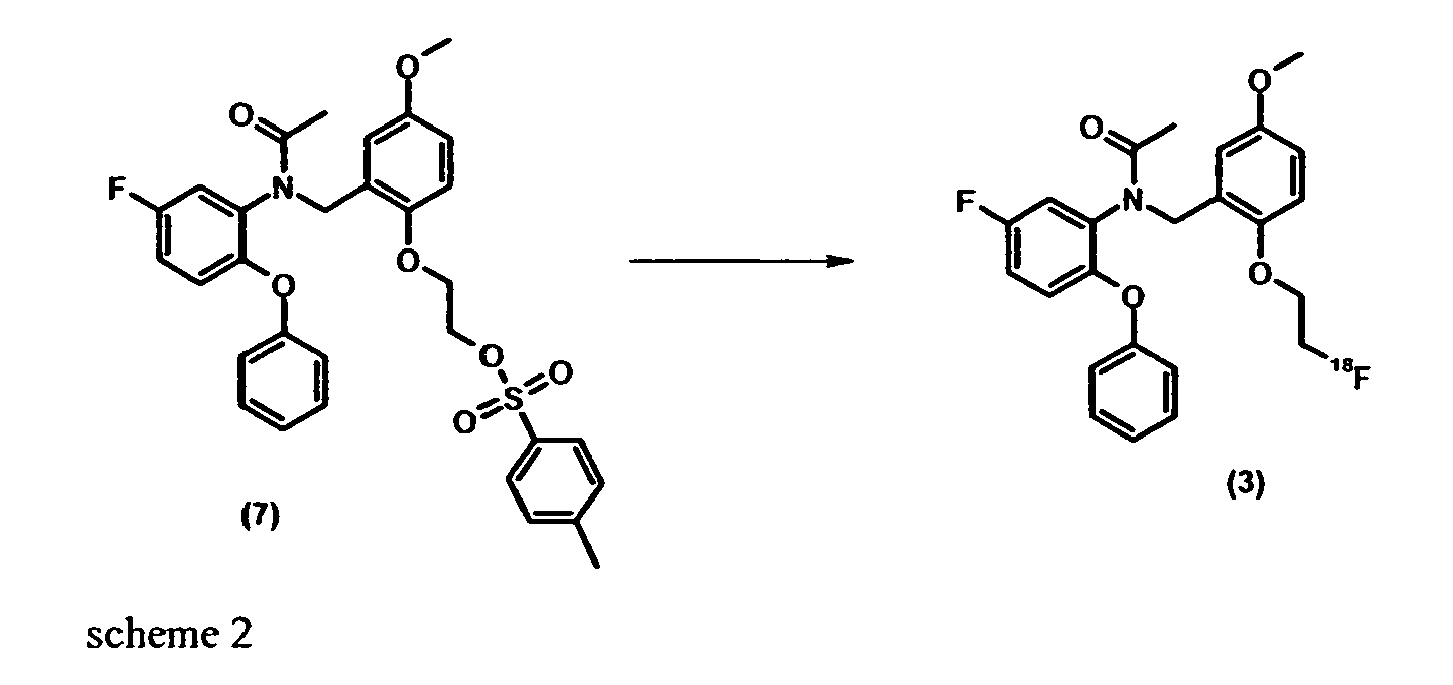
- It is known from literature (Biorg. Med. Chem., (2004), 12, 423) that compound 7 can be prepared from 4 by alkylation of 1,2-bis-tosyloxy-ethane which is commercially available (see scheme 3).

- Compound 4 is prepared from benzyl ether 8 by catalytic hydrogenation (see scheme 4).

- Benzyl ether 8 is prepared in a one-pot reaction from nitro compound 9 and aldehyde 10 (see scheme 5).

- Nitro compound 9 is synthesized from difluoride (11) and phenol by nucleophilic aromatic substitution reaction. Whereas compound 10 is prepared from phenol 12 and benzyl bromide (see scheme 6).

- It would be useful to have a practical and sufficient technique for the synthesis of 18F-(3) in only one rather than in two radiochemical steps. The profile of by-products needs to be simple enough so that the desired product 18F-(3) can be purified easily.
In addition it would be useful to have convenient synthetic routes to compounds and intermediates which allow the one-step labeling towards 18F-(3). - The present invention provides novel compounds of Formula I.
- The present invention provides novel compounds of Formula II.
- The invention further provides a novel process of preparing N-(5-Fluoro-2-phenoxyphenyl)-N-(5-methoxy-2-(2-tosyloxy-ethoxy)-benzyl)acetamide (7) and compounds represented by Formula I or II.
- The invention further provides a novel process of preparing N-(5-Fluoro-2-phenoxyphenyl)-N-(2-(2-[18F]fluoroethoxy)-5-methoxybenzyl)acetamide (3).
- In a first aspect the present invention is directed to compounds of formula I :

R is - a) -OS(O)2-L
- b) chloro,
- c) bromo or
- d) iodo .
- In preferred embodiments of compounds of Formula I,
R is - a) -OS(O)2-L
- b) bromo or
- c) chloro .
- In further preferred embodiments of compounds of Formula I,
R is - a) -OS(O)2-L or
- b) bromo.
- L is
- a) branched or unbranched alkyl
- b) perhalo alkyl
- c) aralkyl
- d) alkyl-phenyl
- e) (di- alkyl)-phenyl
- f) (tri- alkyl)-phenyl
- g) (alkoxy-phenyl)
- h) (nitro-phenyl)
- i) (halo-phenyl)
- j) naphtyl or
- k) heteroaryl
- In preferred embodiments of compounds of Formula I,
L is - a) methyl
- b) trifluormethyl
- b) nonafluorobutyl
- c) (nitro-phenyl)
- d) (halo-phenyl)
- e) C1-C6 alkylphenyl or
- f) (2,4,6-C1-C6 trialkyl)phenyl
whereas L is not (para-methyl)-phenyl. - In further preferred embodiments of compounds of Formula I,
L is - a) methyl
- b) trifluormethyl or
- c) nonafluorobutyl
- A preferred series of compounds of Formula I include mesyloxy and bromo derivatives having the following structures:


- In a second aspect the present invention is directed to compounds of formula II which are possible starting materials of compounds of formula I:

A is - a) hydrogen
- b) SiR1 3
- c) CH2-G
- d) C(O)-Q
- e) C(O)O-E
- f) -(R2-phenyl)
- g) -((R2)2-phenyl)
- h) tetrahydropyranyl
- i) (1-alkoxy)-alkyl
- j) (1-alkoxy)-cycloalkyl
- k) allyl or
- l) tert-butyl.
- In preferred embodiments of compounds of Formula II
A is - a) hydrogen
- b) SiR1 3
- c) CH2-G
- d) tetrahydropyranyl
- e) allyl or
- f) tert-butyl.
- In further preferred embodiments of compounds of Formula II,
A is - a) hydrogen
- b) SiR1 3
- c) CH2-G
- d) tetrahydropyranyl or
- e) tert-butyl.
- a) phenyl
- b) alkoxy
- c) dimethoxyphenyl
- d) nitrophenyl
- e) halophenyl
- f) di-halophenyl
- g) cyanophenyl
- h) p-biphenyl
- i) acylaminophenyl
- j) triphenyl
- k) (methoxyphenyl)phenyl
- l) di(methoxyphenyl)phenyl
- m) α-naphtyldiphenyl or
- n) hydrogen
- In preferred embodiments of compounds of Formula II,
G is - a) phenyl
- b) methoxy
- c) p-methoxyphenyl
- d) p-nitrophenyl
- e) p-chlorophenyl or
- f) triphenyl .
- In further preferred embodiments of compounds of Formula II
G is - a) phenyl
- b) methoxy or
- c) p-methoxyphenyl.
Q is - a) hydrogen
- b) C1-C5 branched or unbranched alkyl
- c) halomethyl
- d) dihalomethyl
- e) trihalomethyl
- f) phenyl
- g) biphenyl
- h) triphenylmethoxymethyl or
- i) phenoxymethyl .
- In preferred embodiments of compounds of Formula II
Q is - a) hydrogen
- b) methyl
- c) phenyl or
- d) phenoxymethyl.
- In further preferred embodiments of compounds of Formula II,
Q is - a) is methyl
- b) phenyl.
- a) lower branched or unbranched alkyl
- b) methoxymethyl
- c) vinyl
- d) allyl
- e) benzyl
- f) methoxyphenyl
- g) dimethoxyphenyl or
- h) nitrophenyl
- In preferred embodiments of compounds of Formula II,
E is - a) methyl
- b) tert-butyl
- c) methoxymethyl or
- d) phenyl
- In further preferred embodiments of compounds of Formula II, E is
- a) methyl
- c) tert-butyl
- b) phenyl
- a) lower branched or unbranched alkyl
- b) phenyl or
- c) benzyl and
- a) methyl
- b) ethyl
- c) isopropyl
- d) tert-butyl
- e) phenyl or
- f) benzyl
- In further preferred embodiments of compounds of Formula II, R1 is independently from each other
- a) methyl
- b) ethyl
- c) isopropyl
- d) tert-butyl or
- e) phenyl
- a) methoxy
- b) nitro
- c) halo or
- d) cyano
- In preferred embodiments of compounds of Formula II,
R2 is independently from each other - a) methoxy
- b) nitro
- c) chloro
- In further preferred embodiments of compounds of Formula II,
R2 is independently from each other - a) methoxy
- b) nitro
- A preferred series of compounds of Formula II include derivatives having the following structures:
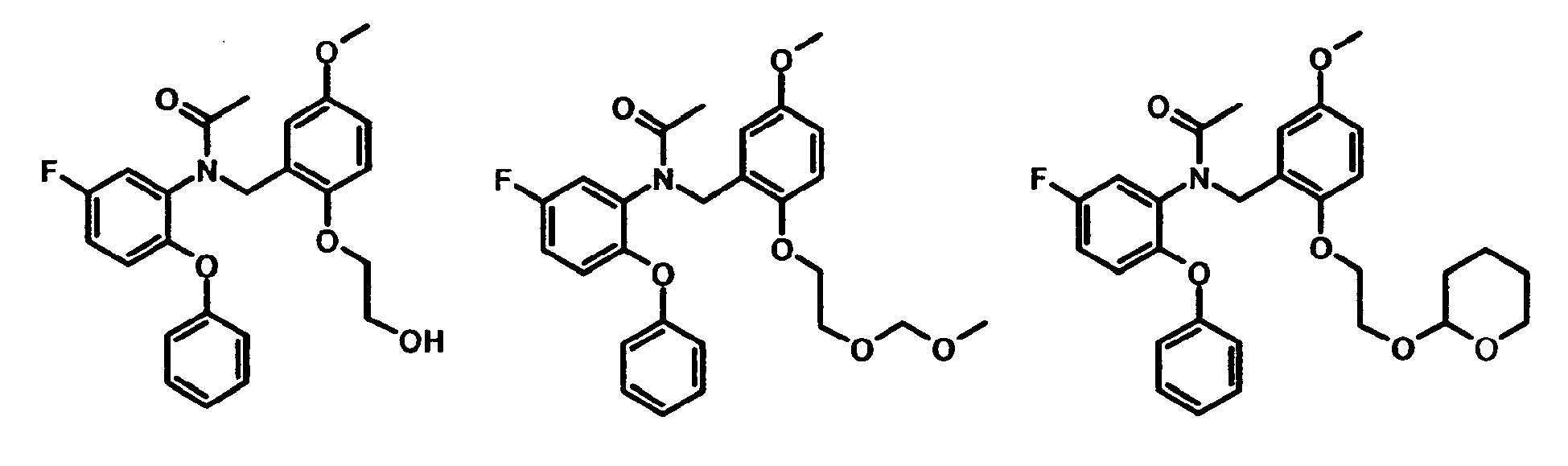


- As used in the specification and appended claims unless specified to the contrary, the term "lower un-branched or branched alkyl" shall have the following meaning: a substituted or unsubstituted, straight or branched chain monovalent or divalent radical consisting substantially of carbon and hydrogen, containing no unsaturation and having from one to eight carbon atoms, e.g. but not limited to methyl, ethyl, n-propyl, n-pentyl, 1,1-dimethylethyl (t-butyl), n-heptyl, and the like.
- The term "aryl" as employed herein by itself or as part of another group refers to monocyclic or bicyclic aromatic groups containing from 6 to 12 carbons in the ring portion, preferably 6-10 carbons in the ring portion, such as phenyl, naphthyl or tetrahydronaphthyl.
The term "heteroaryl" as employed herein refers to groups having 5 to 14 ring atoms; 6, 10 or 14 Π (pi) electrons shared in a cyclic array; and containing carbon atoms and 1, 2, 3 or 4 oxygen, nitrogen or sulfur heteroatoms (where examples of heteroaryl groups are: thienyl, benzo[b]thienyl, naphtho[2,3-b]thienyl, thianthrenyl, furyl, pyranyl, isobenzofuranyl, benzoxazolyl, chromenyl, xanthenyl, phenoxathiinyl, 2H-pyrrolyl, pyrrolyl, imidazolyl, pyrazolyl, pyridyl, pyrazinyl, pyrimidinyl, pyridazinyl, indolizinyl, isoindolyl, 3H-indolyl, indolyl, indazolyl, purinyl, 4H-quinolizinyl, isoquinolyl, quinolyl, phthalazinyl, naphthyridinyl, quinazolinyl, cinnolinyl, pteridinyl, 4aH-carbazolyl, carbazolyl, carbolinyl, phenanthridinyl, acridinyl, perimidinyl, phenanthrolinyl, phenazinyl, isothiazolyl, phenothiazinyl, isoxazolyl, furazanyl and phenoxazinyl groups).
If a chiral center or another form of an isomeric center is present in a compound according to Formula I or II of the present invention, all forms of such isomer, including enantiomers and diastereoisomers, are intended to be covered herein. Compounds containing a chiral center may be used as racemic mixture or as an enantiomerically enriched mixture or the racemic mixture may be separated using well-known techniques and an individual enantiomer maybe used alone. In cases in which compounds have unsaturated carbon-carbon bonds double bonds, both the cis-isomer and trans-isomers are within the scope of this invention. In cases wherein compounds may exist in tautomeric forms, such as keto-enol tautomers, each tautomeric form is contemplated as being included within this invention whether existing in equilibrium or predominantly in one form. - In a third aspect the present invention is directed to a process for preparing N-(5-Fluoro-2-phenoxyphenyl)-N-(5-methoxy-2-tosyloxyethoxybenzyl)acetamide (7) or a compound represented by Formula I or II characterized by
- a) reductively N-alkylating a compound of formula III:


- b) N-alkylating an aniline of formula V:


- c) alkylation of phenol 4 with an


- X is a) nitro or
- b) amino and
- Z is
- a) R
- b) tosyloxy or
- c) O-A and
- In preferred embodiments of compounds of formula VII,
Z is - a) methanesulphonyloxy
- b) trifluoromethansulphonyloxy
- c) nonafluorobutanesulfonyloxy
- d) tosyloxy
- e) bromo
- f) O-A
- In further preferred embodiments of compounds of formula VII, Z is
- a) methanesulphonyloxy
- b) trifluoromethansulphonyloxy
- c) nonafluorobutanesulfonyloxy
- d) tosyloxy
- e) bromo
- f) hydroxyl
- g) (tert-butyl dimethyl) silyloxy
- h) (triisopropyl) silyloxy
- i) phenyl
- j) tetrahydropyranyl or
- k) tert-butyl.
- a) R or
- b) tosyloxy
whereas R is above-defined. - In preferred embodiments of compounds of formula VI,
R3 is - a) R
whereas R is above-defined.
The above mentioned processes of forming compound 7 or a compound of formula I and II avoid the laborious protecting group strategy as it is shown in scheme 4 and 6 and as it was reported e.g. in Biorg. Med. Chem., (2004), 12, 423. In this mentioned publication the phenol protecting "benzyl" has to be installed and deprotected within a relatively short sequence. The third aspect of the present invention provides a more convergent approach to synthesize a suited precursor for the later radiofluorination reaction. - A forth aspect of the invention is directed to a process of preparing compound 3 which is characterized by the nucleophilic 18F radiofluorination of compound 7 or a compound of formula I in only one radiochemical step. In contrast to the published one-step 18F labelling procedure (J. Med. Chem., (2004), 2228) the forth aspect of the present invention provides additional starting materials and/or new parameters which allow the 18F fluorination towards N-(5-Fluoro-2-phenoxyphenyl)-N-(2-(2-[18F]fluoroethoxy)-5-methoxybenzyl)acetamide (3) without generating a disadvantageous amount of by-products which are costly or difficult to separate. The present invention comprises an approach for the nucleophilic 18F radiofluorination towards N-(5-Fluoro-2-phenoxyphenyl)-N-(2-(2-[18F]fluoroethoxy)-5-methoxybenzyl)acetamide (3) which is characterized by use of starting materials represented by
- a) compound 7 and 18F anions which are reacted at temperatures in the range of from 121°C-160°C and, optionally, subsequent use of acid,
or - b) compounds of formula I and 18F anions which are reacted
at temperatures in the range of from 50°C to 160°C. - In preferred embodiments of 18F radiofluorinations towards N-(5-Fluoro-2-phenoxyphenyl)-N-(2-(2-[18F]fluoroethoxy)-5-methoxybenzyl)acetamide (3) the reaction is characterized by use of starting materials represented by
- a) compound 7 and 18F anions which are reacted at temperatures in the range of from 121°C to 150°C and, optionally, subsequent use of mineral acids with concentrations between 0.5 N - 6 N, or
- b) compounds of formula I and 18F anions which are reacted at temperatures in the range of from 75°C to 150°C.
- In further preferred embodiments of 18F radiofluorinations towards N-(5-Fluoro-2-phenoxyphenyl)-N-(2-(2-[18F]fluoroethoxy)-5-methoxybenzyl)acetamide (3) the reaction is characterized by use of starting materials represented by
- a) compound 7 and 18F anions which are reacted at temperatures in the range of from 121°C to 140°C, and, optionally, subsequent use of mineral acids with concentrations between 2 N - 6 N,or
- b) compounds of formula I and 18F anions which are reacted at temperatures in the range of from 85°C to 140°C.
- The objects of the present invention are also solved by a process of preparing compound 3
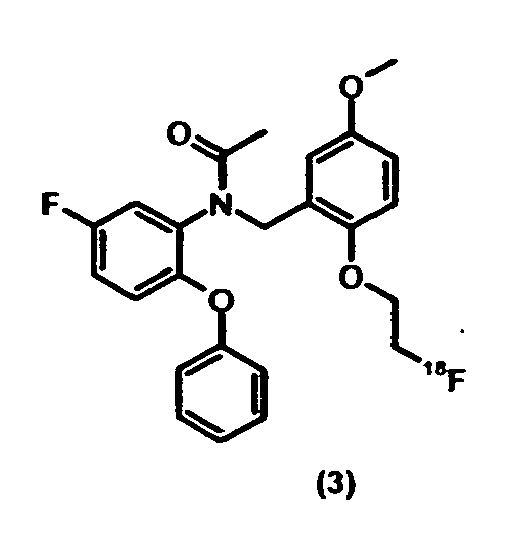
- a) reacting compound 7

at temperatures in the range of from 121°C to 160°C, and, optionally, upon obtainment of compound 3, addition of acid,
or - b) reacting a compound of formula I, as defined in any of claims 1-6 with 18F anions at temperatures in the range of from 50°C to 160°C.
- a) compound 7 is reacted with 18F anions at temperatures in the range of from 121°C to 150°C, and, optionally, upon obtainment of compound 3, at least one mineral acid having a concentration in the range of from 0.5N-6N is added,
or - b) a compound of formula I is reacted with 18F anions at temperatures in the range of from 75°C to 150°C.
- Preferably,
- a) compound 7 is reacted with 18F anions, at temperatures in the range of from 121°C to 140°C and, optionally, upon obtainment of compound 3, at least one mineral acid having a concentration in the range of from 2N-6N is added,
or - b) a compound of formula I is reacted with 18F anions
at temperatures in the range of from 85°C to 140°C. - In one embodiment in each of the reactions a) and b), the reaction with 18F anions is conducted over a period in the range of from 1 to 60 minutes, preferably 5 to 50 minutes, more preferably 10 to 40 minutes.
- The objects of the present invention are also solved by a composition comprising a compound according to Formula I, preferably as defined in any of claims 1-6, and a pharmaceutically acceptable carrier or diluent.
- The objects of the present invention are furthermore solved by a kit comprising a sealed vial containing a compound according to Formula I, preferably as defined in any of claims 1-6, wherein, more preferably, said sealed vial contains a predetermined quantity of said compound.
- The objects of the present invention are furthermore solved by a compound according to formula I, as defined in any of claims 1-6, for use as a pharmaceutical.
- The objects of the present invention are furthermore solved by a use of a compound according to formula I, as defined in any of claims 1-6, for the manufacturing of a diagnostic imaging agent, wherein, preferably, said diagnostic imaging agent is for imaging diseases of the
central nervous system. - The term "acid" as employed herein refers to mineral acids, including but not limited to acids such as hydrochloric, hydrobromic, hydroiodic, perchloric, phosphoric, carbonic, nitric or sulphuric acid or to appropriate organic acids which includes but not limited to acids such as aliphatic, cycloaliphatic, aromatic, araliphatic, heterocyclic, carboxylic and sulphonic acids, examples of which are formic, acetic, trifluoracetic, propionic, succinic, glycolic, gluconic, lactic, malic, fumaric, pyruvic, benzoic, anthranilic, mesylic, fumaric, salicylic, phenylacetic, mandelic, embonic, methansulfonic, ethanesulfonic, benzenesulfonic, phantothenic, toluenesulfonic and sulfanilic acid.
If, in the context of the process of preparing compound 3, the term "at least one mineral acid having a concentration in the range of form 0.5 N-6N" is used, this is meant to refer to a scenario, wherein the at least one mineral acid has a concentration in the indicated range. However, this term should also be understood as encompassing a scenario wherein more than one mineral acid is used, e.g. a mixture of several mineral acids, and the total acid concentration, i.e. the sum of all individual mineral acid concentrations is in the indicated range of from 0.5 N-6N. - The provision of 18F anions is known to someone skilled in the art and in one embodiment is achieved by providing aqueous H18F to which a base, for example in the form of potassium carbonate or tetra alkyl ammonium carbonate is added. The aqueous H18F may be obtained from a synchrotron.
- It is important that a radiofluorination causes as little by-products as possible in order to avoid a difficult purification of the desired product.
As depicted in scheme 7 a compound of formula I, e.g. compound 13, can be radio-fluorinated to obtain the desired product 3 (see fig 1a). The reaction causes less non-radioactive by-products (see fig. 1b) compared to a reaction in which compound 7 is converted to 3 at any temperature (compare fig. 2b with 3b and 4b as example). Compound 7 as starting material shows surprisingly also an improved profile of by-products regarding radiofluorination by treatment with 18F anion if the temperature is above 120°C (compare Fig 2b with 4b). If one compares the nucleophilic radiofluorination reaction of a compound of formula I with compound 7 it is obvious that radiofluorinations of compounds of formula I can be conducted at all temperatures (see e.g. fig. 5a and 5b). The radiofluorination reaction can be carried out, for example in a typical reaction vessel (e.g. Wheaton vial) which is known to someone skilled in the art, or in a microreactor. The reaction can be heated by typical methods, e.g. oil bath, heating block or microwave. Furthermore it can be useful to add acid to the crude product or to the reaction mixture after the radiofluorinations of compound 7 or of compounds of formula I towards compound 3 has been carried out. The treatment with acid can lead surprisingly to an improved profile of by-products. - The radiofluorination reactions are carried out in dimethylformamide with potassium carbonate as base and "kryptofix" as crown-ether. But also other solvents can be used which are well known to experts. These possible conditions include, but are not limited to: dimethylsulfoxid and acetonitril as solvent and tetraalkyl ammonium and tertraalkyl phosphonium carbonate as base. Water and/or alcohol can be involved in such a reaction as co-solvent. The radiofluorination reactions are conducted for one to 60 minutes. Preferred reaction times are five to 50 minutes. Further preferred reaction times are 10 to 40 min.


- Scheme 8 depicts an example of a synthetic route for forming a compound of formula I via a compound of formula II:

- Compound 4 (J. Med. Chem.; 47; 9; (2004); 2228 - 2235) can be alkylated by use of e.g. benzyl protected bromoethanol (Bioorg. Med. Chem. Lett.; 15; 22; (2005); 4989 - 4993), potassium carbonate and sodium iodide in dimethylformamide to obtain ether 15. But also other bases, including but not limited to caesium or sodium carbonate, sodium hydroxid, potassium hydroxid, lithium hydroxid, tetra-alkyl hydroxid, sodium hydrid and other solvents, including but not limited to acetone, tetrahydrofuran, eventually mixed with water, are possible. Compound 15 is deprotected by heterogeneous catalysis and hydrogen. Suited reaction conditions are e.g. palladium on carbon and isopropanol. Other possible reagents and solvents for this kind of reaction of deprotection are known to experts and listed in T. Greene, "Protective Groups in Organic Synthesis", Wiley & Sons, 1999. The resulting alcohol 13 is then converted to compound 16 by use of e.g. mesylchloride, triethylamin and dichloromethane. Other possible solvents and bases including but not limited to, are dichloroethane, ethers, ethyl acetate, diisopropyl ethyl amine, DABCO ect.
- Scheme 9 depicts another example of a synthetic route for forming a compound of Formula I.
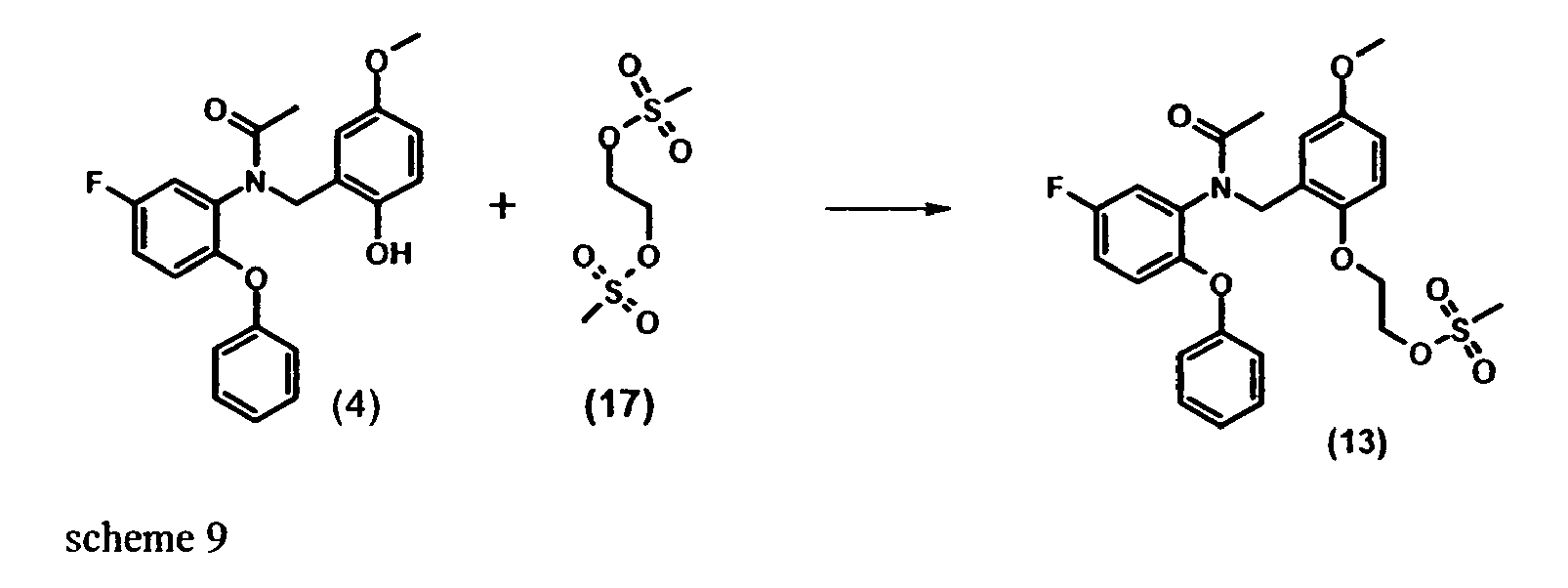
- Phenol 4 can be alkylated by use of 1,2-bis-methanesulfonyloxy-ethane (J. Med. Chem.; 47; 17; (2004); 4300 - 4315), potassium carbonate and sodium iodide in dimethylformamide to obtain mesylate 13. But also other bases, including but not limited to caesium or sodium carbonate, sodium hydroxid, potassium hydroxid, lithium hydroxid, tetraalkyl hydroxid, sodium hydrid and other solvents, including but not limited to acetone, tetrahydrofuran, eventually mixed with water, are possible.
- Scheme 10 depicts another example of a synthetic route for reductively N-alkylation forming a compound of Formula I via a compound of formula III:

- Nitro-compound 9 is reduced to the corresponding aniline 18. A possible reducing agent for this reaction is hydrogen with palladium on carbon. Aniline 18 is converted in a reductive amination reaction with tris-acetoxy sodium borohydrid in dichloromethane and aldehyde 21 and subsequent acetylation with aceticacid anhydride to obtain the acetylated secondary aniline 22. Other useful reducing agents are well-known to experts: e.g. sodium cyano borohydrid in methanol or hydrogen and heterogenous catalysts (e.g. palladium on carbon (Bioorg. Med. Chem. Lett.; 15; 22; 2005; 4989 - 4993) or platinum oxide), dibutyl tin chloride and phenyl silane (Org. Lett.; 25; 2005; 5653 - 5656). Deprotection of the tetrahydropyranyl ether 22 under acidic conditions with tosyl acid in methanol resulted in alcohol 16. The subsequent mesylation towards compound 13 has already been described in scheme 8.
- Scheme 11 depicts another synthetic route for forming a compound of Formula I via the reductive N-alkylation of a compound of formula III and an aldehyde of formula V.

- Aniline 18 (comp. formula V) can be converted in a reductive amination reaction with tris-acetoxy sodium borohydrid and acetic acid in dichloromethane and aldehyde 23 and subsequent acetylation, e.g. with acetic acid anhydride, to obtain the acetylated secondary aniline 13. Other useful reducing agents are well-known to experts: e.g. sodium cyano borohydrid in methanol or hydrogen and heterogenous catalysts (e.g. palladium on carbon (Bioorg. Med. Chem. Lett.; 15; 22; (2005); 4989 - 4993) or platinum oxide), dibutyl tin chloride and phenyl silane (Org. Lett.; 25; (2005); 5653 - 5656). Aldehyde 23 is prepared in an alkylation reaction with commercially available phenol 19 and 1,2-bis-methanesulfonyloxy-ethane (J. Med. Chem.; 47; 17; (2004); 4300 - 4315) by use of potassium carbonate and in dimethylformamide. But also other bases, including but not limited to caesium or sodium carbonate, sodium hydroxid, potassium hydroxid, lithium hydroxid, tetraalkyl hydroxid, sodium hydrid and other solvents, including but not limited to acetone, tetrahydrofuran, eventually mixed with water, are possible.
- Scheme 12 depicts a very similar synthetic route for forming compound 7 via the reductive N-alkylation of a compound of formula III and an aldehyde of formula V.

- Scheme 13 depicts another synthetic route for forming a compound of formula I from a compound of formula II whereas bromide 25 is suited as precursor (starting material) for the nucleophilic 18F-radiofluorination reaction towards compound 3.

- Alcohol 16 is converted to the corresponding bromide 25 by methods which are well known to experts. For example alcohol 16 is treated with triphenylphosphin and tetrabromomethane in dichloromethane to obtain bromide 25.
- Scheme 14 depicts an example for a synthetic route for forming a compound of formula I or II by use of a compound of formula V and an electrophile of formula VI and subsequent N-acetylation.

- Aniline 18 is alkylated by bis-mesylate 24. The alkylation is highly selective due to the more activated benzylic leaving group. Subsequent N-acetylation with acetic acid anhydride or by other acetylating agents which are well-known to experts resulted in compound 13. Bis-mesylate 24 is the product of the mesylation reaction of bis-alcohol 26 by typical methods which are well-known to experts. Bis-alcohol (26) can be prepared from phenol 25 (Rarechem) with 2-chloro-ethanol or another 2-substituted ethanol derivative with a leaving group in 2-postion (e.g. 2-bromo-ethanol; comp. Farmaco Ed. Sci.; 14; (1959); 159, 170 and Tetrahedron; 59; 29; 2003; 5457 - 5468).
- To a vigorously stirred solution of 15,2 g (100 mmol) 2-hydroxy-5-methoxy-benzaldehyde and 42.4 g (130 mmol) caesium carbonate in 350 ml DMF at 0°C was added 26.1 g (125 mmol) 2-(2-Bromo-ethoxy)-tetrahydro-pyran (J. Org. Chem.; 50; 22; (1985); 4238-4245) in 50 ml DMF dropwisely. The reaction mixture was stirred vigorously at 70°C for 6h. The solvent was evaporated. 200 ml water and 200 ml ethyl acetate were added. The organic phase was separated. The aqueous phase was extracted three times with 100 ml ethyl acetate each. The combined organic phases were washed with 50 ml water and 50 ml brine. The organic phase was dried with magnesium sulphate and evaporated. The crude product was purified by silica column chromatography (ethylacetate : hexane 1:3). The desired product 1a was obtained in 81% yield (22.7g, 81 mmol) as yellow oil.
MS-ESI: 281 (M+ + 1 , 100). Elementary analysis: C 64.27% H 5.34% Determined: C 64.25% H 5.35% - The atmosphere over a stirred solution of 11,6 g (50 mmol) 4-fluoro-2-nitro-1-phenoxy-benzene and catalytic amount of palladium on carbon in 150 ml iso-propanol at 20°C was saturated with hydrogen. The reaction mixture was stirred vigorously at 25°C for 8h. The reaction mixture was filtered over celite. The filtrate was evaporated. 200 ml water and 200 ml dichloromethane were added. The organic phase was separated. The aqueous phase was extracted three times with 100 ml dichloromethane each. The combined organic phases were washed with 50 ml water and 50 ml brine. The organic phase was dried with magnesium sulfate and evaporated. The crude product 1b was used without purification. The desired crude product 1b was obtained in 94% yield (9.54 g, 47 mmol) as yellow oil.
MS-ESI: 204 (M+ + 1 , 100). Elementary analysis: C 70.93% H 4.96% F 9.35% N 6.89% Determined: C 71.00% H 4.92% F 9.33% N 6.87% - To stirred solution of 9.1 g (45 mmol) 1b, 12.6 g (45 mmol) 1a and one drop of glacial acid in 60 ml dichloroethane (pH = 5) were added 14.8 g (70 mmol) sodium tris-acetoxy hydro borane. The reaction mixture was stirred over night and diluted with 5 ml water. The pH value was adjusted with aqueous sodium hydroxyd solution to pH = 8-9. The mixture was extracted three times with dichloromethane. The combined organic phases were washed with water and brine and were dried with magnesium sulfate. The desired crude product 1c was obtained in 66% yield (13.9 g, 29.7 mmol) as yellow oil. The crude product 1c was used without further purification.
MS-ESI: 468 (M+ + 1 , 89). - To a solution of 5.0 g (10.7 mmol) crude 1c in 50 ml ml pyridine was added 4.37 g (42.8 mmol) acetic acid anhydride. The reaction mixture was stirred over night and poured into ice-cold ethyl acetate. The organic phase was washed with water and brine and were dried with magnesium sulfate. The crude product was purified by silica column chromatography (ethyl acetate : hexane gradient 1:8 → 1:4). The desired product 1d was obtained in 84% yield (4.5 g, 8.9 mmol).
MS-ESI: 510 (M+ + 1 , 100). Elementary analysis: C 68.36% H 6.33% F 3.73% N 2.75% Determined: C 68.34% H 6.34% F 3.71% N 2.74% - To a solution of 1.53 g (3.0 mmol) 1d in 15 ml methanol was added a catalytic amount of tosyl acid. The reaction mixture was stirred for 4h at 25°C. The reaction mixture was poured in ice-cold ethyl acetate. The solution was washed twice with ice-cold diluted aqueous sodium hydrogen carbonate solution and brine and dried with magnesium sulfate. The crude product was purified by silica column chromatography (ethyl acetate : hexane gradient 1:4 → 1:2). The desired product 1e was obtained in 71% yield (0.91 g, 2.13 mmol) as yellow oil.
MS-ESI: 426 (M+ + 1 , 100). Elementary analysis: C 67.75% H 5.69% F 4.47% N 3.29% Determined: C 67.72% H 5.71% F 4.46% N 3.28% - To a solution of 300 mg (0.71 mmol) 1e and 139 mg (1,06 mmol) diisopropyl ethyl amine in 5 ml dichloromethane was added 97 mg (0.85 mmol) mesyl chloride in 0.5 ml dichloromethane drop wisely at -10°C. The stirred reaction mixture was warmed over a period of 4h to room temperature and diluted with dichloromethane. The organic phase was washed with saturated sodium hydrogen carbonate solution, water and brine. The organic phase was dried with magnesium sulfate. The crude product was purified by silica column chromatography (ethyl acetate : hexane gradient 1:6 → 1:2). The desired product 1f was obtained in 88% yield (346 mg, 0.62 mmol) as yellow oil.
MS-ESI: 559 (M++ 1 , 60). Elementary analysis: C 59.63% H 5.20% F 3.77% N 2.78% Determined: C 59.62% H 5.20% F 3.78% N 2.77% - To a Wheaton vial (5ml) charged with 2.5 mg Kryptofix 222 in 0.75 ml acetonitrile and 0.5 mg potassium carbonate and the fluorine containing water (2.2 GBq, 250µl) was added. The solvent was removed by heating at 120°C for 10 mins under a stream of nitrogen. Anhydrous MeCN (1ml) is added and evaporated as before. This step is repeated again. A solution of 1g (2mg) in 0.705 ml anhydrous DMF is added. After heating at 130°C for 30 min. The crude reaction mixture is analyzed using an analytical HPLC: ACE3-C18 50mm*4,6mm; solvent: 5%acetonitril - 95%acetonitril in water in 7 min., flow: 2ml/min. The F-18 labeled product 1g is confirmed by co-injection with the non-radioactive F-19 fluoro standard on the analytical HPLC. The crude product (160 MBq) was purified by preparative HPLC column: ACE5-C18-HL 250mm*10mm; solvent 62% acetonitril-38% water, isocratic 20 min., flow: 3ml/min. The desired product 1g was obtained (45 MBq) as reconfirmed by co-injection with the non-radioactive F-19 fluoro standard on the analytical HPLC.
- To a vigorously stirred solution of 15,2 g (100 mmol) 2-hydroxy-5-methoxy-benzaldehyde and 42.4 g (130 mmol) caesium carbonate in 350 ml DMF at 0°C was added 26.9 g (125 mmol) (2-Bromo-ethoxymethyl)-benzene (Adrich) in 50 ml DMF dropwisely. The reaction mixture was stirred vigorously at 70°C for 6h. The solvent was evaporated. 200 ml water and 200 ml ethyl acetate were added. The organic phase was separated. The aqueous phase was extracted three times with 100 ml ethyl acetate each. The combined organic phases were washed with 50 ml water and 50 ml brine. The organic phase was dried with magnesium sulphate and evaporated. The crude product was purified by silica column chromatography (gradient ethylacetate : hexane 1:3 → 1:2). The desired product 2a was obtained in 86% yield (24.6 g, 86 mmol) as yellow oil.
MS-ESI: 287 (M+ + I , 100). Elementary analysis: C 71.31 % H 6.34% Determined: C 71.29% H 6.35% - To stirred solution of 4.6 g (23 mmol) 1b, 6.3 g (23 mmol) 2a and one drop of glacial acid in 35 ml dichloroethane (pH = 5) were added 7.4 g (35 mmol) sodium tris-acetoxy hydro borane. The reaction mixture was stirred over night and diluted with 3 ml water. The pH value was adjusted with aqueous sodium hydroxyd solution to pH = 8-9. The mixture was extracted three times with dichloromethane. The combined organic phases were washed with water and brine and were dried with magnesium sulfate. The desired crude product 2b was obtained in 78% yield (8.5 g, 17.9 mmol) as yellow oil. The crude product 2b was used without further purification.
MS-ESI: 475 (M+ + 1 , 81). - To a solution of 5.08 g (10.7 mmol) crude 2b in 50 ml ml pyridine was added 4.37 g (42.8 mmol) acetic acid anhydride. The reaction mixture was stirred over night and poured into ice-cold ethyl acetate. The organic phase was washed with water, diluted aqueous sodium hydrogen sulfate, water and brine and were dried with magnesium sulfate. The crude product was purified by silica column chromatography (ethyl acetate : hexane gradient 1:8 → 1:4). The desired product 2c was obtained in 79% yield (4.36 g, 8.45 mmol).
MS-ESI: 517 (M+ + 1, 100). Elementary analysis: C 72.22% H 5.86% F 3.68% N 2.72% Determined: C 72.20% H 5.87% F 3.67% N 2.71% - The atmosphere over a stirred solution of 2.58 g (5 mmol) 4-fluoro-2-nitro-1-phenoxy-benzene and catalytic amount of palladium on carbon in 35 ml iso-propanol at 20°C was saturated with hydrogen. The reaction mixture was stirred vigorously at 25°C for 7h. The reaction mixture was filtered over celite. The solvent of the filtrate was evaporated. 10 ml water and 10 ml dichloromethane were added. The organic phase was separated. The aqueous phase was extracted three times with 10 ml dichloromethane each. The combined organic phases were washed with 10 ml water and 10 ml brine. The organic phase was dried with magnesium sulfate and evaporated. The crude product 2d was used without purification. The desired crude product 2d was obtained in 89% yield (1.7 g, 4.45 mmol) as yellow oil.
MS-ESI: 382 (M+ + 1 , 100). Elementary analysis: C 69.28% H 5.29% F 4.98% N 3.67% Determined: C 69.25% H 5.30% F 4.97% N 3.66% - To a vigorously stirred solution of 38.1 g (100 mmol) N-(5-fluoro-2-phenoxy-phenyl)-N-(2-hydroxy-5-methoxy-benzyl)-acetamide (Biorg. Med. Chem., (2004), 12, 423) and 42.4 g (130 mmol) caesium carbonate in 350 ml DMF at 0°C was added 27,3 g (125 mmol) 1,2-bis-methanesulfonyloxy-ethane ((J. Med. Chem.; 47; 17; (2004); 4300 - 4315)) in 50 ml DMF dropwisely. The reaction mixture was stirred vigorously at 70°C for 6,5 h. The solvent was evaporated. 200 ml water and 200 ml ethyl acetate were added. The organic phase was separated. The aqueous phase was extracted three times with 100 ml ethyl acetate each. The combined organic phases were washed with 50 ml water and 50 ml brine. The organic phase was dried with magnesium sulfate and evaporated. The crude product was purified by silica column chromatography (gradient ethylacetate : hexane 1:6 → 1:2). The desired product 3a was obtained in 85% yield (42.8 g, 85 mmol) as yellow oil.
MS-ESI: 505 (M+ + 1 , 78). Elementary analysis: C 59.63% H 5.20% F 3.77% N 2.78% Determined: C 59.62% H 5.21% F 3.76% N 2.78% - To a vigorously stirred solution of 15,2 g (100 mmol) 2-hydroxy-5-methoxy-benzaldehyde and 42.4 g (130 mmol) caesium carbonate in 350 ml DMF at 0°C was added 27,3 g (125 mmol) 1,2-bis-methanesulfonyloxy-ethane ((J. Med. Chem.; 47; 17; (2004); 4300 - 4315) in 50 ml DMF dropwisely. The reaction mixture was stirred vigorously at 70°C for 5h. The solvent was evaporated. 200 ml water and 200 ml ethyl acetate were added. The organic phase was separated. The aqueous phase was extracted three times with 100 ml ethyl acetate each. The combined organic phases were washed with 50 ml water and 50 ml brine. The organic phase was dried with magnesium sulfate and evaporated. The crude product was purified by silica column chromatography (gradient ethylacetate : hexane 1:6, ethyl acetate → 1:2). The desired product 4a was obtained in 78% yield (21.4 g, 78 mmol) as yellow oil.
MS-ESI: 275 (M+ + 1 , 100). Elementary analysis: C 48.17% H 5.14% Determined: C 48.19% H 5.15% - To stirred solution of 9.1 g (45 mmol) 1b, 12.3 g (45 mmol) 4a and one drop of glacial acid in 60 ml dichloroethane (pH = 5) were added 14.8 g (70 mmol) sodium tris-acetoxy hydro borane. The reaction mixture was stirred over night and diluted with 5 ml water. The pH value was adjusted with aqueous sodium hydroxyd solution to pH = 8-9. The mixture was extracted three times with dichloromethane. The combined organic phases were washed with water and brine and were dried with magnesium sulfate. The desired crude product 4b was obtained in 62% yield (12.9 g, 27.9 mmol) as yellow oil. The crude product 4b was used without further purification.
MS-ESI: 463 (M+ + 1 , 65). - To a solution of 4.94 g (10.7 mmol) crude 4b in 50 ml ml pyridine was added 4.37 g (42.8 mmol) acetic acid anhydride. The reaction mixture was stirred over night and poured into ice-cold ethyl acetate. The organic phase was washed with water and brine and were dried with magnesium sulfate. The crude product was purified by silica column chromatography (ethyl acetate : hexane gradient 1:8 → 1:4). The desired product 4c was obtained in 80% yield (4.3 g, 8.56 mmol).
MS-ESI: 504 (M+ + 1 , 78). Elementary analysis: C 59.63% H 5.20% F 3.77% N 2.78% Determined: C 59.61% H 5.19% F 3.79% N 2.77% - To a vigorously stirred solution of 15,2 g (100 mmol) 2-hydroxy-5-methoxy-benzaldehyde and 42.4 g (130 mmol) caesium carbonate in 350 ml DMF at 0°C was added 46.3 g (125 mmol) ethylene glycol bis-toluene sulfonate (Aldrich) in 50 ml DMF dropwisely. The reaction mixture was stirred vigorously at 70°C for 5h. The solvent was evaporated. 200 ml water and 200 ml ethyl acetate were added. The organic phase was separated. The aqueous phase was extracted three times with 100 ml ethyl acetate each. The combined organic phases were washed with 50 ml water and 50 ml brine. The organic phase was dried with magnesium sulfate and evaporated. The crude product was purified by silica column chromatography (gradient ethylacetate : hexane 1:6, ethyl acetate → 1:2). The desired product 5a was obtained in 75% yield (26.3 g, 75 mmol) as yellow oil.
MS-ESI: 351 (M+ + 1 , 100). Elementary analysis: C 58.27% H 5.18% Determined: C 58.27% H 5.17% - To stirred solution of 9.1 g (45 mmol) 1b, 15.8 g (45 mmol) 5a and one drop of glacial acid in 60 ml dichloroethane (pH = 5) were added 14.8 g (70 mmol) sodium tris-acetoxy hydro borane. The reaction mixture was stirred over night and diluted with 5 ml water. The pH value was adjusted with aqueous sodium hydroxyd solution to pH = 8-9. The mixture was extracted three times with dichloromethane. The combined organic phases were washed with water and brine and were dried with magnesium sulfate. The desired crude product 5b was obtained in 71% yield (17.2 g, 32.0 mmol) as yellow oil. The crude product 5b was used without further purification.
MS-ESI: 539 (M+ + 1 , 64). - To a solution of 5.75 g (10.7 mmol) crude 5b in 50 ml pyridine was added 4.37 g (42.8 mmol) acetic acid anhydride. The reaction mixture was stirred over night and poured into ice-cold ethyl acetate. The organic phase was washed with water and brine and were dried with magnesium sulfate. The crude product was purified by silica column chromatography (ethyl acetate : hexane gradient 1:8 → 1:4). The desired product 5c was obtained in 74.5% yield (4.62 g, 7.97 mmol).
MS-ESI: 581 (M+ + 1 , 100). Elementary analysis: C 64.24% H 5.22% F 3.28% N 2.42% Determined: C 64.22% H 5.23% F 3.26% N 2.41% - To a stirred solution of 1.69 g (5.1 mmol) CBr4 and 2,89 g (11 mmol) PPh3 in dry dichloromethane (35 mL) 2,04 g (4.8 mmol) (1e) was added at 0°C. The reaction mixture was allowed to warm to room temperature and stirred overnight, then diluted with ether and filtered through sintered funnel. The filtrate was concentrated and the residue was purified by silica column chromatography (gradient hexane-ethyl acetate 6:1 → 2:1). The desired product 6a was obtained in 64% yield (1.37 g, 3.07 mmol).
MS-ESI: 446 (MBr79+ + 1 , 100). Elementary analysis: C 59.21% H 4.74% F 4.26% N 3.14% Determined: C 59.20% H 4.74% F 4.25% N 3.13% - To a stirred solution of 7.7g (50 mmol) 2-hydroxymethyl-4-methoxy-phenol (Rarechem) and 4.0 g (100 mmol) sodium hydroxyd in 300 ml ethanol and 150 ml water 5.6 g (70 mmol) 2-chloro ethanol were added at 0°C. The reaction mixture was stirred vigorously over night at 70°C. The reaction mixture was cooled to 0°C and neutralized by use of 3N HCl to pH =7. The volume of the mixture was reduced to a fifth of the volume. Dichloromethane was added to the residue. The mixture was filtered and the filtrate was diluted with 150 ml water and 150 ml dichloromethane. The organic phase was separated. The aqueous phase was extracted three times with 200 ml dichloromethane. The combined organic phases were washed with 50 ml water and 50 ml brine. The organic phase was dried with magnesium sulfate and evaporated. The crude product was purified by silica column chromatography (gradient hexane : ethyl acetate 1:1 → hexane : ethyl acetate : methanol 1:10:0.1). The desired product 7a was obtained in 65% yield (6.44 g; 32.5 mmol).
MS-ESI: 199 (M+ + 1 , 100). Elementary analysis: C 60.59% H 7.12% Determined: C 64.22% H 5.23% - To a solution of 6.41 g (32.3 mmol) 7a and 13.9 g (106 mmol) diisopropyl ethyl amine in 25 ml dichloromethane was added 9.7 g (85 mmol) mesyl chloride in 5 ml dichloromethane drop wisely at -10°C. The stirred reaction mixture was warmed over a period of 4h to room temperature and diluted with dichloromethane. The organic phase was washed with saturated sodium hydrogen carbonate solution, water and brine. The organic phase was dried with magnesium sulfate. The crude product was purified by silica column chromatography (ethyl acetate : hexane gradient 1:4 → 1:1). The desired product 7b was obtained in 72% yield (8.25 g, 23.3 mmol) as yellow oil.
MS-ESI: 355 (M+ + 1 , 100). Elementary analysis: C 40.67% H 5.12% Determined: C 40.70% H 5.13% - To a solution of 1.01 g (5 mmol) 1b and and 4.24 g (13.0 mmol) caesium carbonate in 50 ml DMF at 0°C was added 531 mg (1.5 mmol) 7b in 2 ml DMF dropwisely. The reaction mixture was stirred vigorously at 70°C for 5h. The solvent was evaporated. 50 ml water and 50 ml ethyl acetate were added. The organic phase was separated. The aqueous phase was extracted three times with 50 ml ethyl acetate each. The combined organic phases were washed with 10 ml water and 10 ml brine. The organic phase was dried with magnesium sulfate and evaporated. The crude product diluted in 5 ml pyridine. 2.17 g (21.0 mmol) acetic acid anhydride were added. The reaction mixture was stirred over night and poured into ice-cold ethyl acetate. The organic phase was washed with water and brine and were dried with magnesium sulfate. The crude product was purified by silica column chromatography (ethyl acetate : hexane gradient 1:8 → 1:4). The desired product 7c was obtained in 72% yield (543 mg, 1.08 mmol) as yellow oil.
MS-ESI: 504 (M++ 1 , 89). Elementary analysis: C 59.63% H 5.20% F 3.77% N 2.78% Determined: C 59.61% H 5.21% F 3.77% N 2.78% - To a Wheaton vial (5ml) charged with 2.5 mg Kryptofix 222 in 0.75 ml acetonitrile and 0.5 mg potassium carbonate and the fluorine containing water (2.5 GBq, 250µl) was added. The solvent was removed by heating at 120°C for 10 mins under a stream of nitrogen. Anhydrous MeCN (1ml) is added and evaporated as before. This step is repeated again. A solution of 7 (2mg) in 0.705 ml anhydrous DMF is added. After heating at 130°C for 30 min. The crude reaction mixture is analyzed using an analytical HPLC: ACE3-C18 50mm*4,6mm; solvent: 5%acetonitril- 95%acetonitril in water in 7 min., flow: 2ml/min. The F-18 labeled product 1g is confirmed by co-injection with the non-radioactive F-19 fluoro standard on the analytical HPLC. The crude product (221 MBq) was purified by preparative HPLC column: ACES-C18-HL 250mm*10mm; solvent 62% acetonitril-38% water, isocratic 20 min., flow: 3ml/min. The desired product 1g was obtained (55 MBq) as reconfirmed by co-injection with the non-radioactive F-19 fluoro standard on the analytical HPLC.
R1 is independently from each other
Claims (33)
- A compound of formula I :

R, at each occurrence, is independently selected from the group comprisinga) -OS(O)2-Lb) chloro,c) bromo ord) iodo,and wherein L is selected from the group comprisinga) branched and unbranched alkylb) perhalo alkylc) aralkyld) alkyl-phenyle) (di- alkyl)-phenylf) (tri- alkyl)-phenylg) (alkoxy-phenyl)h) (nitro-phenyl)i) (halo-phenyl)j) naphtyl, andk) heteroarylwith the proviso that L is not (para-methyl)-phenyl. - The compound according to claim 1, wherein R isa) -OS(O)2-Lb) bromo orc) chloro .
- The compound according to any of claims 1-2, wherein
R isa) -OS(O)2-L orb) bromo. - The compound according to any of the foregoing claims, wherein L isa) methylb) trifluormethylb) nonafluorobutylc) (nitro-phenyl)d) (halo-phenyl)e) C1-C6 alkylphenyl orf) (2,4,6-C1-C6 trialkyl)phenyl,with the proviso that L is not (para-methyl)-phenyl.
- The compound according to claim 4, wherein
L isa) methylb) trifluormethyl orc) nonafluorobutyl - The compound according to any of the foregoing claims, represented by one of the following structures:


- A compound of formula II:

A is selected from the group comprising:a) hydrogenb) SiR1 3c) CH2-Gd) C(O)-Qe) C(O)O-Ef) -(R2-phenyl)g) -((R2)2-phenyl)h) tetrahydropyranyli) (1-alkoxy)-alkylj) (1-alkoxy)-cycloalkylk) allyl andl) tert-butyl,wherein G is selected from the group comprisinga) phenylb) alkoxyc) dimethoxyphenyld) nitrophenyle) halophenylf) di-halophenylg) cyanophenylh) p-biphenyli) acylaminophenylj) triphenylk) (methoxyphenyl)phenyll) di(methoxyphenyl)phenylm) α-naphtyldiphenyl, andn) hydrogenand Q is selected from the group comprisinga) hydrogenb) C1-C5 branched and unbranched alkylc) halomethyld) dihalomethyle) trihalomethylf) phenylg) biphenylh) triphenylmethoxymethyl andi) phenoxymethyl,and E is selected from the group comprisinga) lower branched and unbranched alkylb) methoxymethylc) vinyld) allyle) benzylf) methoxyphenylg) dimethoxyphenyl andh) nitrophenyl,and wherein R1 is selected from the group comprising:a) lower branched and unbranched alkyl,b) phenyl, andc) benzyl,and wherein R2 is selected from the group comprising:a) methoxy,b) nitro,c) halo, andd) cyano. - The compound according to claim 7, wherein A is selected from the group comprisinga) hydrogenb) SiR1 3c) CH2-Gd) tetrahydropyranyle) allyl andf) tert-butyl.
- The compound according to claim 8, wherein
A is selected from the group comprisinga) hydrogenb) SiR1 3c) CH2-Gd) tetrahydropyranyl, ande) tert-butyl. - The compound according to any of claims 7-9, wherein
G is selected from the group comprisinga) phenylb) methoxyc) p-methoxyphenyld) p-nitrophenyle) p-chlorophenyl, andf) triphenyl . - The compound according to claim 9, wherein
G is selected from the group comprisinga) phenyl,b) methoxy, andc) p-methoxyphenyl. - The compound according to any of claims 7-11, wherein
Q is selected from the group comprisinga) hydrogenb) methylc) phenyl, andd) phenoxymethyl. - The compound according to claim 12, wherein
Q is selected from the group comprisinga) methyl, andb) phenyl. - The compound according to any of claims 7-13, wherein
E is selected from the group comprisinga) methylb) tert-butylc) methoxymethyl, andd) phenyl - The compound according to claim 14, wherein
E is selected from the group comprisinga) methylc) tert-butyl, andb) phenyl - The compound according to any of claims 7-15, wherein R1 is selected from the group comprisinga) methylb) ethylc) isopropyld) tert-butyle) phenyl, andf) benzyl.
- The compound according to claim 16, wherein R1 is selected from the group comprisinga) methylb) ethylc) isopropyld) tert-butyl, ande) phenyl.
- The compound according to any of claims 7-17, wherein R2 is selected from the group comprisinga) methoxyb) nitro, andc) chloro.
- The compound according to claim 18, wherein
R2 is selected from the group comprisinga) methoxy, andb) nitro. - The compound according to any of claims 7-19, represented by a structure selected from the group comprising


- A process for preparing a compound according to any of claims 1-6 or 7-20, or a compound of formula I wherein L is (para-methyl)-phenyl, comprising the steps:a) reductively N-alkylating a compound of formula III:

 b) N-alkylating an aniline of formula V:
 c) alkylation of phenol 4 with an

X is a) nitro orb) amino, andZ is, independently, selected from the group comprisinga) Rb) tosyloxy , andc) O-A, andwherein R and A are as defined in any of claims 1-3 and 7-9, and wherein R3 is independently selected from the group comprisinga) R, andb) tosyloxy,wherein R is as defined in any of claims 1-3. - The process according to claim 21, wherein Z is selected from the group comprisinga) methanesulphonyloxyb) trifluoromethansulphonyloxyc) nonafluorobutanesulfonyloxyd) tosyloxye) bromo, andf) O-Awherein A is as defined in any of claims 7-9 .
- The process according to claim 22, wherein Z is selected from the group comprisinga) methanesulphonyloxyb) trifluoromethansulphonyloxyc) nonafluorobutanesulfonyloxyd) tosyloxye) bromof) hydroxylg) (tert-butyl dimethyl) silyloxyh) (triisopropyl) silyloxyi) phenylj) tetrahydropyranyl, andk) tert-butyl.
- The process according to any of claims 21-23, wherein
R3 isa) Rwherein R is as defined in any of claims 1-3 . - A process of preparing compound 3
 a) reacting compound 7
at temperatures in the range of from 121°C to 160°C, and, optionally, upon obtainment of compound 3, addition of acid,
orb) reacting a compound of formula I, as defined in any of claims 1-6 with 18F anions at temperatures in the range of from 50°C to 160°C. - The process according to claim 25, whereina) compound 7 is reacted with 18F anions at temperatures in the range of from 121°C to 150°C, and, optionally, upon obtainment of compound 3, at least one mineral acid having a concentration in the range of from 0.5N-6N is added,
orb) a compound of formula I is reacted with 18F anions at temperatures in the range of from 75°C to 150°C. - The process according to any of claims 25-26, whereina) compound 7 is reacted with 18F anions, at temperatures in the range of from 121°C to 140°C, and, optionally upon obtainment of compound 3, at least one mineral acid having a concentration in the range of from 2N-6N is added,
orb) a compound of formula I is reacted with 18F anions
at temperatures in the range of from 85°C to 140°C. - The process according to any of claims 25-27, characterized in that in each of the reactions a) and b), the reaction with 18F anions is conducted over a period in the range of from 1 to 60 minutes, preferably 5 to 50 minutes, more preferably 10 to 40 minutes.
- A composition comprising a compound according to Formula I, preferably as defined in any of claims 1-6, and a pharmaceutically acceptable carrier or diluent.
- A kit comprising a sealed vial containing a compound according to Formula I, preferably as defined in any of claims 1-6, wherein, more preferably, said sealed vial contains a predetermined quantity of said compound.
- A compound according to formula I, as defined in any of claims 1-6, for use as a pharmaceutical.
- Use of a compound according to formula I, as defined in any of claims 1-6, for the manufacture of a diagnostic imaging agent.
- Use according to claim 32, wherein said diagnostic imaging agent is for imaging diseases of the central nervous system.
Priority Applications (23)
| Application Number | Priority Date | Filing Date | Title |
|---|---|---|---|
| EP06018455A EP1894915A1 (en) | 2006-09-04 | 2006-09-04 | Phenyloxyaniline derivatives |
| CA002662217A CA2662217A1 (en) | 2006-09-04 | 2007-07-06 | Phenyloxyaniline derivatives |
| EP07765168A EP2064176A1 (en) | 2006-09-04 | 2007-07-06 | Phenyloxyaniline derivatives |
| BRPI0716474-2A BRPI0716474A2 (en) | 2006-09-04 | 2007-07-06 | phenoxy aniline derivatives |
| NZ575224A NZ575224A (en) | 2006-09-04 | 2007-07-06 | Phenyloxyaniline derivatives |
| AU2007294247A AU2007294247A1 (en) | 2006-09-04 | 2007-07-06 | Phenyloxyaniline derivatives |
| CNA2007800408767A CN101535241A (en) | 2006-09-04 | 2007-07-06 | Phenyloxyaniline derivatives |
| MX2009002361A MX2009002361A (en) | 2006-09-04 | 2007-07-06 | Phenyloxyaniline derivatives. |
| JP2009525936A JP2010502578A (en) | 2006-09-04 | 2007-07-06 | Phenyloxyaniline derivatives |
| KR1020097006920A KR20090061030A (en) | 2006-09-04 | 2007-07-06 | Phenyloxyaniline Derivatives |
| PCT/EP2007/006148 WO2008028533A1 (en) | 2006-09-04 | 2007-07-06 | Phenyloxyaniline derivatives |
| RU2009112160/04A RU2009112160A (en) | 2006-09-04 | 2007-07-06 | Phenyloxyaniline derivatives |
| TW096125885A TW200812625A (en) | 2006-09-04 | 2007-07-16 | F-18 DAA derivatives |
| CL200702563A CL2007002563A1 (en) | 2006-09-04 | 2007-09-04 | COMPOUNDS DERIVED FROM FENOXI-PHENYL-ACETAMIDE; PREPARATION PROCESS; PHARMACEUTICAL COMPOSITION; PHARMACEUTICAL KIT; AND USE AS AN AGENT FOR IMAGE DIAGNOSIS. |
| US11/896,607 US7803960B2 (en) | 2006-09-04 | 2007-09-04 | Phenyloxyaniline derivatives |
| ARP070103896A AR062638A1 (en) | 2006-09-04 | 2007-09-04 | Phenyloxyaniline derivatives |
| PE2007001184A PE20080833A1 (en) | 2006-09-04 | 2007-09-04 | DERIVATIVES OF PHENYLOXIANILINE |
| UY30570A UY30570A1 (en) | 2006-09-04 | 2007-09-04 | Phenyloxyaniline Derivatives |
| IL197239A IL197239A0 (en) | 2006-09-04 | 2009-02-25 | Phenyloxyaniline derivatives |
| CO09022307A CO6160225A2 (en) | 2006-09-04 | 2009-03-04 | Phenyloxyaniline derivatives |
| CR10651A CR10651A (en) | 2006-09-04 | 2009-03-04 | Phenyloxyaniline derivatives |
| NO20091386A NO20091386L (en) | 2006-09-04 | 2009-04-03 | Fenyloksyanilinderivater |
| US12/881,224 US20110097269A1 (en) | 2006-09-04 | 2010-11-12 | Phenyloxyaniline derivatives |
Applications Claiming Priority (1)
| Application Number | Priority Date | Filing Date | Title |
|---|---|---|---|
| EP06018455A EP1894915A1 (en) | 2006-09-04 | 2006-09-04 | Phenyloxyaniline derivatives |
Publications (1)
| Publication Number | Publication Date |
|---|---|
| EP1894915A1 true EP1894915A1 (en) | 2008-03-05 |
Family
ID=37814284
Family Applications (2)
| Application Number | Title | Priority Date | Filing Date |
|---|---|---|---|
| EP06018455A Withdrawn EP1894915A1 (en) | 2006-09-04 | 2006-09-04 | Phenyloxyaniline derivatives |
| EP07765168A Withdrawn EP2064176A1 (en) | 2006-09-04 | 2007-07-06 | Phenyloxyaniline derivatives |
Family Applications After (1)
| Application Number | Title | Priority Date | Filing Date |
|---|---|---|---|
| EP07765168A Withdrawn EP2064176A1 (en) | 2006-09-04 | 2007-07-06 | Phenyloxyaniline derivatives |
Country Status (21)
| Country | Link |
|---|---|
| US (2) | US7803960B2 (en) |
| EP (2) | EP1894915A1 (en) |
| JP (1) | JP2010502578A (en) |
| KR (1) | KR20090061030A (en) |
| CN (1) | CN101535241A (en) |
| AR (1) | AR062638A1 (en) |
| AU (1) | AU2007294247A1 (en) |
| BR (1) | BRPI0716474A2 (en) |
| CA (1) | CA2662217A1 (en) |
| CL (1) | CL2007002563A1 (en) |
| CO (1) | CO6160225A2 (en) |
| CR (1) | CR10651A (en) |
| IL (1) | IL197239A0 (en) |
| MX (1) | MX2009002361A (en) |
| NO (1) | NO20091386L (en) |
| NZ (1) | NZ575224A (en) |
| PE (1) | PE20080833A1 (en) |
| RU (1) | RU2009112160A (en) |
| TW (1) | TW200812625A (en) |
| UY (1) | UY30570A1 (en) |
| WO (1) | WO2008028533A1 (en) |
Families Citing this family (4)
| Publication number | Priority date | Publication date | Assignee | Title |
|---|---|---|---|---|
| JP2009298725A (en) * | 2008-06-12 | 2009-12-24 | Natl Inst Of Radiological Sciences | Fluorescent labeled phenyloxyaniline derivative and fluorescent labeled probe |
| WO2010072342A2 (en) | 2008-12-22 | 2010-07-01 | Bayer Schering Pharma Aktiengesellschaft | A method for the synthesis of a radionuclide-labeled compound |
| WO2019243523A1 (en) * | 2018-06-21 | 2019-12-26 | Cellestia Biotech Ag | Process for making amino diaryl ethers and amino diaryl ethers hydrochloride salts |
| WO2022149081A1 (en) * | 2021-01-07 | 2022-07-14 | Ocimum Labs Private Limited | Improved process for the preparation of a compound useful in the preparation of anti-androgenic compound |
Citations (1)
| Publication number | Priority date | Publication date | Assignee | Title |
|---|---|---|---|---|
| US20040138310A1 (en) * | 2003-01-10 | 2004-07-15 | National Institute Of Radiological Sciences | Phenyloxyaniline derivatives |
-
2006
- 2006-09-04 EP EP06018455A patent/EP1894915A1/en not_active Withdrawn
-
2007
- 2007-07-06 EP EP07765168A patent/EP2064176A1/en not_active Withdrawn
- 2007-07-06 BR BRPI0716474-2A patent/BRPI0716474A2/en not_active IP Right Cessation
- 2007-07-06 JP JP2009525936A patent/JP2010502578A/en not_active Withdrawn
- 2007-07-06 MX MX2009002361A patent/MX2009002361A/en active IP Right Grant
- 2007-07-06 CA CA002662217A patent/CA2662217A1/en not_active Abandoned
- 2007-07-06 WO PCT/EP2007/006148 patent/WO2008028533A1/en not_active Ceased
- 2007-07-06 RU RU2009112160/04A patent/RU2009112160A/en not_active Application Discontinuation
- 2007-07-06 KR KR1020097006920A patent/KR20090061030A/en not_active Withdrawn
- 2007-07-06 CN CNA2007800408767A patent/CN101535241A/en active Pending
- 2007-07-06 AU AU2007294247A patent/AU2007294247A1/en not_active Abandoned
- 2007-07-06 NZ NZ575224A patent/NZ575224A/en not_active IP Right Cessation
- 2007-07-16 TW TW096125885A patent/TW200812625A/en unknown
- 2007-09-04 CL CL200702563A patent/CL2007002563A1/en unknown
- 2007-09-04 UY UY30570A patent/UY30570A1/en not_active Application Discontinuation
- 2007-09-04 AR ARP070103896A patent/AR062638A1/en unknown
- 2007-09-04 PE PE2007001184A patent/PE20080833A1/en not_active Application Discontinuation
- 2007-09-04 US US11/896,607 patent/US7803960B2/en not_active Expired - Fee Related
-
2009
- 2009-02-25 IL IL197239A patent/IL197239A0/en unknown
- 2009-03-04 CR CR10651A patent/CR10651A/en unknown
- 2009-03-04 CO CO09022307A patent/CO6160225A2/en unknown
- 2009-04-03 NO NO20091386A patent/NO20091386L/en not_active Application Discontinuation
-
2010
- 2010-11-12 US US12/881,224 patent/US20110097269A1/en not_active Abandoned
Patent Citations (2)
| Publication number | Priority date | Publication date | Assignee | Title |
|---|---|---|---|---|
| US20040138310A1 (en) * | 2003-01-10 | 2004-07-15 | National Institute Of Radiological Sciences | Phenyloxyaniline derivatives |
| US6870069B2 (en) * | 2003-01-10 | 2005-03-22 | National Institute Of Radiological Sciences | Phenyloxyaniline derivatives |
Non-Patent Citations (1)
| Title |
|---|
| ZHANG M-R ET AL: "Development of a New Radioligand, N-(5-fluoro-2-phenoxyphenyl)-N-(2-Ä 18FÜfluoroethyl-5-methoxybenzyl)acetamide, for PET Imaging of Peripheral Benzodiazepine Receptor in Primate Brain", JOURNAL OF MEDICINAL CHEMISTRY, AMERICAN CHEMICAL SOCIETY. WASHINGTON, US, vol. 47, no. 9, 22 April 2004 (2004-04-22), pages 2228 - 2235, XP002997542, ISSN: 0022-2623 * |
Also Published As
| Publication number | Publication date |
|---|---|
| KR20090061030A (en) | 2009-06-15 |
| CO6160225A2 (en) | 2010-05-20 |
| US7803960B2 (en) | 2010-09-28 |
| US20080177108A1 (en) | 2008-07-24 |
| CN101535241A (en) | 2009-09-16 |
| AU2007294247A1 (en) | 2008-03-13 |
| MX2009002361A (en) | 2009-03-12 |
| PE20080833A1 (en) | 2008-09-07 |
| RU2009112160A (en) | 2010-10-20 |
| JP2010502578A (en) | 2010-01-28 |
| AR062638A1 (en) | 2008-11-19 |
| CL2007002563A1 (en) | 2008-07-04 |
| BRPI0716474A2 (en) | 2013-02-26 |
| US20110097269A1 (en) | 2011-04-28 |
| CA2662217A1 (en) | 2008-03-13 |
| IL197239A0 (en) | 2009-12-24 |
| NZ575224A (en) | 2011-12-22 |
| EP2064176A1 (en) | 2009-06-03 |
| CR10651A (en) | 2009-04-14 |
| NO20091386L (en) | 2009-05-06 |
| TW200812625A (en) | 2008-03-16 |
| UY30570A1 (en) | 2008-05-02 |
| WO2008028533A1 (en) | 2008-03-13 |
Similar Documents
| Publication | Publication Date | Title |
|---|---|---|
| IL286352B2 (en) | Novel small molecule inhibitors of tead transcription factors | |
| TW202430504A (en) | Prodrugs of ketamine, compositions and uses thereof | |
| EA018650B1 (en) | Daa-pyridine as peripheral benzodiazepine receptor ligand for diagnostic imaging and pharmaceutical treatment | |
| CN102272132A (en) | Fluorinated benzothiazole derivatives, preparation method thereof and imaging agent for diagnosing altzheimer's disease using the same | |
| WO2008157658A1 (en) | Deuterium-enriched montelukast | |
| US7803960B2 (en) | Phenyloxyaniline derivatives | |
| CN113307758B (en) | A Medical Radioisotope Labeled P2X7 Receptor Targeting Probe Precursor | |
| CN103608337B (en) | 18F-labeled precursor of PET radioactive medical supplies and its preparation method | |
| HK1135960A (en) | Phenyloxyaniline derivatives | |
| WO2008157271A1 (en) | Deuterium-enriched escitalopram | |
| EP3889133A1 (en) | Estrogen receptor antagonist | |
| KR101619564B1 (en) | Novel precursor molecules for f-18 labelled pet tracers | |
| JP6233934B2 (en) | Process for producing desmosine, isodesmosine, and derivatives thereof | |
| JP2014527977A (en) | New synthesis method | |
| US20120136152A1 (en) | Efficient synthetic method of 18f-mefway precursor | |
| WO2008157657A1 (en) | Deuterium-enriched tenofovir | |
| US20150183743A1 (en) | Compound and use of compound to prepare a radiolabelled compound | |
| US20090069381A1 (en) | Deuterium-enriched raloxifene | |
| US20090069380A1 (en) | Deuterium-enriched aroxifene | |
| CN116425664A (en) | A kind of preparation method of heteroaromatic ring class BTK inhibitor intermediate | |
| HK40062570A (en) | Estrogen receptor antagonist | |
| BR112021018303B1 (en) | Compound that inhibits small molecules of TEAD transcription factors or a pharmaceutically acceptable salt thereof, pharmaceutical composition and use thereof. | |
| US20080299218A1 (en) | Deuterium-enriched valsartan | |
| WO2008157272A2 (en) | Deuterium-enriched tamsulosin | |
| WO2008157562A2 (en) | Deuterium-enriched olanzapine |
Legal Events
| Date | Code | Title | Description |
|---|---|---|---|
| PUAI | Public reference made under article 153(3) epc to a published international application that has entered the european phase |
Free format text: ORIGINAL CODE: 0009012 |
|
| AK | Designated contracting states |
Kind code of ref document: A1 Designated state(s): AT BE BG CH CY CZ DE DK EE ES FI FR GB GR HU IE IS IT LI LT LU LV MC NL PL PT RO SE SI SK TR |
|
| AX | Request for extension of the european patent |
Extension state: AL BA HR MK YU |
|
| AKX | Designation fees paid | ||
| 18D | Application deemed to be withdrawn |
Effective date: 20080909 |
|
| REG | Reference to a national code |
Ref country code: DE Ref legal event code: 8566 |
|
| STAA | Information on the status of an ep patent application or granted ep patent |
Free format text: STATUS: THE APPLICATION IS DEEMED TO BE WITHDRAWN |
|
| R18D | Application deemed to be withdrawn (corrected) |
Effective date: 20080906 |