EP1894601A1 - Treating mycobacterial infections with cyclipostins - Google Patents
Treating mycobacterial infections with cyclipostins Download PDFInfo
- Publication number
- EP1894601A1 EP1894601A1 EP06017963A EP06017963A EP1894601A1 EP 1894601 A1 EP1894601 A1 EP 1894601A1 EP 06017963 A EP06017963 A EP 06017963A EP 06017963 A EP06017963 A EP 06017963A EP 1894601 A1 EP1894601 A1 EP 1894601A1
- Authority
- EP
- European Patent Office
- Prior art keywords
- formula
- cyclipostin
- compound
- alkyl
- branched
- Prior art date
- Legal status (The legal status is an assumption and is not a legal conclusion. Google has not performed a legal analysis and makes no representation as to the accuracy of the status listed.)
- Withdrawn
Links
- 208000027531 mycobacterial infectious disease Diseases 0.000 title claims abstract description 21
- 206010062207 Mycobacterial infection Diseases 0.000 title claims abstract description 20
- 229930183107 cyclipostin Natural products 0.000 title claims description 38
- 150000001875 compounds Chemical class 0.000 claims abstract description 41
- 206010003754 Atypical mycobacterial infections Diseases 0.000 claims abstract description 18
- 201000008827 tuberculosis Diseases 0.000 claims abstract description 18
- 206010013023 diphtheria Diseases 0.000 claims abstract description 14
- 206010024229 Leprosy Diseases 0.000 claims abstract description 13
- 206010029443 Nocardia Infections Diseases 0.000 claims abstract description 12
- 244000005700 microbiome Species 0.000 claims abstract description 12
- 238000011282 treatment Methods 0.000 claims abstract description 12
- 206010029444 Nocardiosis Diseases 0.000 claims abstract description 11
- 208000035143 Bacterial infection Diseases 0.000 claims abstract description 9
- 208000022362 bacterial infectious disease Diseases 0.000 claims abstract description 9
- 230000002685 pulmonary effect Effects 0.000 claims abstract description 9
- 239000000126 substance Substances 0.000 claims description 21
- 150000003839 salts Chemical class 0.000 claims description 16
- 239000000203 mixture Substances 0.000 claims description 14
- 125000004169 (C1-C6) alkyl group Chemical group 0.000 claims description 11
- 125000004432 carbon atom Chemical group C* 0.000 claims description 11
- 125000000217 alkyl group Chemical group 0.000 claims description 10
- 239000003814 drug Substances 0.000 claims description 10
- 125000003342 alkenyl group Chemical group 0.000 claims description 9
- OKTJSMMVPCPJKN-UHFFFAOYSA-N Carbon Chemical group [C] OKTJSMMVPCPJKN-UHFFFAOYSA-N 0.000 claims description 8
- UEXFAQDUVJPKAX-UHFFFAOYSA-N cyclipostin T Natural products O1P(OCCCCCCCCCCCCCCCC)(=O)OCC2COC(=O)C2=C1CCC UEXFAQDUVJPKAX-UHFFFAOYSA-N 0.000 claims description 8
- 241000187480 Mycobacterium smegmatis Species 0.000 claims description 7
- SYOULUNKPBFPTF-UHFFFAOYSA-N cyclipostin T2 Natural products C1OP(=O)(OCCCCCCCCCCCCCC(C)C)OC(CCC)=C2C(=O)OCC21 SYOULUNKPBFPTF-UHFFFAOYSA-N 0.000 claims description 7
- 125000003118 aryl group Chemical group 0.000 claims description 6
- 241000187481 Mycobacterium phlei Species 0.000 claims description 5
- BHKGHKHKDXVQJF-UHFFFAOYSA-N cyclipostin R Natural products O1P(OCCCCCCCCCCCCCCC)(=O)OCC2COC(=O)C2=C1C BHKGHKHKDXVQJF-UHFFFAOYSA-N 0.000 claims description 5
- 229940055036 mycobacterium phlei Drugs 0.000 claims description 5
- 208000035473 Communicable disease Diseases 0.000 claims description 4
- 241000516645 Nocardia abscessus Species 0.000 claims description 4
- 241001503696 Nocardia brasiliensis Species 0.000 claims description 4
- 125000004429 atom Chemical group 0.000 claims description 4
- 229910052736 halogen Inorganic materials 0.000 claims description 4
- 150000002367 halogens Chemical class 0.000 claims description 4
- 238000002360 preparation method Methods 0.000 claims description 4
- OAICVXFJPJFONN-UHFFFAOYSA-N Phosphorus Chemical compound [P] OAICVXFJPJFONN-UHFFFAOYSA-N 0.000 claims description 3
- 235000010290 biphenyl Nutrition 0.000 claims description 3
- 125000006267 biphenyl group Chemical group 0.000 claims description 3
- 125000000623 heterocyclic group Chemical group 0.000 claims description 3
- 229910052760 oxygen Inorganic materials 0.000 claims description 3
- 229910052698 phosphorus Inorganic materials 0.000 claims description 3
- 239000011574 phosphorus Substances 0.000 claims description 3
- 229920006395 saturated elastomer Polymers 0.000 claims description 3
- 229910052717 sulfur Inorganic materials 0.000 claims description 3
- 101100025412 Arabidopsis thaliana XI-A gene Proteins 0.000 claims description 2
- 125000003601 C2-C6 alkynyl group Chemical group 0.000 claims description 2
- NINIDFKCEFEMDL-UHFFFAOYSA-N Sulfur Chemical compound [S] NINIDFKCEFEMDL-UHFFFAOYSA-N 0.000 claims description 2
- 125000000304 alkynyl group Chemical group 0.000 claims description 2
- UHOVQNZJYSORNB-UHFFFAOYSA-N benzene Substances C1=CC=CC=C1 UHOVQNZJYSORNB-UHFFFAOYSA-N 0.000 claims description 2
- 239000004305 biphenyl Substances 0.000 claims description 2
- AEULNKPXALBIHK-UHFFFAOYSA-N cyclipostin F Natural products O1P(OCCCCCCCCCCCCCC(=O)CC)(=O)OCC2COC(=O)C2=C1C AEULNKPXALBIHK-UHFFFAOYSA-N 0.000 claims description 2
- YNKNWOLTEQUDMB-UHFFFAOYSA-N cyclipostin N Natural products O1P(OCCCCCCCCCCCCCC)(=O)OCC2COC(=O)C2=C1C YNKNWOLTEQUDMB-UHFFFAOYSA-N 0.000 claims description 2
- SPNRYYRSSXKVRA-UHFFFAOYSA-N cyclipostin R2 Natural products O1P(OCCCCCCCCCCCCC(C)C)(=O)OCC2COC(=O)C2=C1C SPNRYYRSSXKVRA-UHFFFAOYSA-N 0.000 claims description 2
- ZUOUZKKEUPVFJK-UHFFFAOYSA-N phenylbenzene Natural products C1=CC=CC=C1C1=CC=CC=C1 ZUOUZKKEUPVFJK-UHFFFAOYSA-N 0.000 claims description 2
- 239000011593 sulfur Substances 0.000 claims description 2
- 125000000882 C2-C6 alkenyl group Chemical group 0.000 claims 1
- 238000012360 testing method Methods 0.000 description 10
- 230000000844 anti-bacterial effect Effects 0.000 description 9
- 201000010099 disease Diseases 0.000 description 6
- 208000037265 diseases, disorders, signs and symptoms Diseases 0.000 description 6
- 208000015181 infectious disease Diseases 0.000 description 6
- 239000000825 pharmaceutical preparation Substances 0.000 description 6
- 239000000243 solution Substances 0.000 description 5
- 239000003826 tablet Substances 0.000 description 5
- 239000003242 anti bacterial agent Substances 0.000 description 4
- 229940088710 antibiotic agent Drugs 0.000 description 4
- 230000000694 effects Effects 0.000 description 4
- 230000002401 inhibitory effect Effects 0.000 description 4
- -1 ketal Chemical compound 0.000 description 4
- 0 C*CC(C1)COC1=O Chemical compound C*CC(C1)COC1=O 0.000 description 3
- 241000186216 Corynebacterium Species 0.000 description 3
- PEDCQBHIVMGVHV-UHFFFAOYSA-N Glycerine Chemical compound OCC(O)CO PEDCQBHIVMGVHV-UHFFFAOYSA-N 0.000 description 3
- 241000187479 Mycobacterium tuberculosis Species 0.000 description 3
- 241000187654 Nocardia Species 0.000 description 3
- 239000004480 active ingredient Substances 0.000 description 3
- 239000000654 additive Substances 0.000 description 3
- 239000003795 chemical substances by application Substances 0.000 description 3
- 125000004122 cyclic group Chemical group 0.000 description 3
- 239000007903 gelatin capsule Substances 0.000 description 3
- 238000004519 manufacturing process Methods 0.000 description 3
- 229920001817 Agar Polymers 0.000 description 2
- RTZKZFJDLAIYFH-UHFFFAOYSA-N Diethyl ether Chemical compound CCOCC RTZKZFJDLAIYFH-UHFFFAOYSA-N 0.000 description 2
- AEMRFAOFKBGASW-UHFFFAOYSA-N Glycolic acid Chemical compound OCC(O)=O AEMRFAOFKBGASW-UHFFFAOYSA-N 0.000 description 2
- 108090001060 Lipase Proteins 0.000 description 2
- 102000004882 Lipase Human genes 0.000 description 2
- 239000004367 Lipase Substances 0.000 description 2
- JGSARLDLIJGVTE-MBNYWOFBSA-N Penicillin G Chemical compound N([C@H]1[C@H]2SC([C@@H](N2C1=O)C(O)=O)(C)C)C(=O)CC1=CC=CC=C1 JGSARLDLIJGVTE-MBNYWOFBSA-N 0.000 description 2
- 108010055297 Sterol Esterase Proteins 0.000 description 2
- 102000000019 Sterol Esterase Human genes 0.000 description 2
- 239000000443 aerosol Substances 0.000 description 2
- 239000008272 agar Substances 0.000 description 2
- 125000001931 aliphatic group Chemical group 0.000 description 2
- 230000003115 biocidal effect Effects 0.000 description 2
- 239000003937 drug carrier Substances 0.000 description 2
- 239000000839 emulsion Substances 0.000 description 2
- AEUTYOVWOVBAKS-UWVGGRQHSA-N ethambutol Chemical compound CC[C@@H](CO)NCCN[C@@H](CC)CO AEUTYOVWOVBAKS-UWVGGRQHSA-N 0.000 description 2
- 125000001495 ethyl group Chemical group [H]C([H])([H])C([H])([H])* 0.000 description 2
- 239000007943 implant Substances 0.000 description 2
- 239000007924 injection Substances 0.000 description 2
- 238000002347 injection Methods 0.000 description 2
- JVTAAEKCZFNVCJ-UHFFFAOYSA-N lactic acid Chemical compound CC(O)C(O)=O JVTAAEKCZFNVCJ-UHFFFAOYSA-N 0.000 description 2
- 235000019421 lipase Nutrition 0.000 description 2
- 239000003094 microcapsule Substances 0.000 description 2
- 125000002950 monocyclic group Chemical group 0.000 description 2
- 125000004123 n-propyl group Chemical group [H]C([H])([H])C([H])([H])C([H])([H])* 0.000 description 2
- 210000000653 nervous system Anatomy 0.000 description 2
- 150000002825 nitriles Chemical class 0.000 description 2
- 239000006187 pill Substances 0.000 description 2
- 229920005862 polyol Polymers 0.000 description 2
- 150000003077 polyols Chemical class 0.000 description 2
- 230000000241 respiratory effect Effects 0.000 description 2
- JQXXHWHPUNPDRT-WLSIYKJHSA-N rifampicin Chemical compound O([C@](C1=O)(C)O/C=C/[C@@H]([C@H]([C@@H](OC(C)=O)[C@H](C)[C@H](O)[C@H](C)[C@@H](O)[C@@H](C)\C=C\C=C(C)/C(=O)NC=2C(O)=C3C([O-])=C4C)C)OC)C4=C1C3=C(O)C=2\C=N\N1CC[NH+](C)CC1 JQXXHWHPUNPDRT-WLSIYKJHSA-N 0.000 description 2
- 229960001225 rifampicin Drugs 0.000 description 2
- 238000013207 serial dilution Methods 0.000 description 2
- 239000002904 solvent Substances 0.000 description 2
- UCSJYZPVAKXKNQ-HZYVHMACSA-N streptomycin Chemical compound CN[C@H]1[C@H](O)[C@@H](O)[C@H](CO)O[C@H]1O[C@@H]1[C@](C=O)(O)[C@H](C)O[C@H]1O[C@@H]1[C@@H](NC(N)=N)[C@H](O)[C@@H](NC(N)=N)[C@H](O)[C@H]1O UCSJYZPVAKXKNQ-HZYVHMACSA-N 0.000 description 2
- 125000001424 substituent group Chemical group 0.000 description 2
- 239000000829 suppository Substances 0.000 description 2
- 239000006188 syrup Substances 0.000 description 2
- 235000020357 syrup Nutrition 0.000 description 2
- 206010001358 Adrenal gland tuberculosis Diseases 0.000 description 1
- 241000894006 Bacteria Species 0.000 description 1
- CPELXLSAUQHCOX-UHFFFAOYSA-M Bromide Chemical compound [Br-] CPELXLSAUQHCOX-UHFFFAOYSA-M 0.000 description 1
- RUDCXUCXOXYXPX-UHFFFAOYSA-N CC(C)CC(CCCCCCCCCCCOP(OCC1CO2)(OC(C)=C1C2=O)=O)O Chemical compound CC(C)CC(CCCCCCCCCCCOP(OCC1CO2)(OC(C)=C1C2=O)=O)O RUDCXUCXOXYXPX-UHFFFAOYSA-N 0.000 description 1
- VEXZGXHMUGYJMC-UHFFFAOYSA-M Chloride anion Chemical compound [Cl-] VEXZGXHMUGYJMC-UHFFFAOYSA-M 0.000 description 1
- 208000017667 Chronic Disease Diseases 0.000 description 1
- 229920002261 Corn starch Polymers 0.000 description 1
- XFXPMWWXUTWYJX-UHFFFAOYSA-N Cyanide Chemical compound N#[C-] XFXPMWWXUTWYJX-UHFFFAOYSA-N 0.000 description 1
- 206010013453 Disseminated tuberculosis Diseases 0.000 description 1
- 206010014027 Ear tuberculosis Diseases 0.000 description 1
- 108090000790 Enzymes Proteins 0.000 description 1
- 102000004190 Enzymes Human genes 0.000 description 1
- 108090000371 Esterases Proteins 0.000 description 1
- LFQSCWFLJHTTHZ-UHFFFAOYSA-N Ethanol Chemical compound CCO LFQSCWFLJHTTHZ-UHFFFAOYSA-N 0.000 description 1
- KRHYYFGTRYWZRS-UHFFFAOYSA-M Fluoride anion Chemical compound [F-] KRHYYFGTRYWZRS-UHFFFAOYSA-M 0.000 description 1
- 208000000351 Gastrointestinal Tuberculosis Diseases 0.000 description 1
- WQZGKKKJIJFFOK-GASJEMHNSA-N Glucose Natural products OC[C@H]1OC(O)[C@H](O)[C@@H](O)[C@@H]1O WQZGKKKJIJFFOK-GASJEMHNSA-N 0.000 description 1
- 206010056367 Joint tuberculosis Diseases 0.000 description 1
- GUBGYTABKSRVRQ-QKKXKWKRSA-N Lactose Natural products OC[C@H]1O[C@@H](O[C@H]2[C@H](O)[C@@H](O)C(O)O[C@@H]2CO)[C@H](O)[C@@H](O)[C@H]1O GUBGYTABKSRVRQ-QKKXKWKRSA-N 0.000 description 1
- 206010024227 Lepromatous leprosy Diseases 0.000 description 1
- 208000008771 Lymphadenopathy Diseases 0.000 description 1
- 206010027259 Meningitis tuberculous Diseases 0.000 description 1
- 201000006836 Miliary Tuberculosis Diseases 0.000 description 1
- 241000186366 Mycobacterium bovis Species 0.000 description 1
- 241000186362 Mycobacterium leprae Species 0.000 description 1
- FAPWRFPIFSIZLT-UHFFFAOYSA-M Sodium chloride Chemical compound [Na+].[Cl-] FAPWRFPIFSIZLT-UHFFFAOYSA-M 0.000 description 1
- 235000021355 Stearic acid Nutrition 0.000 description 1
- 241000187180 Streptomyces sp. Species 0.000 description 1
- CZMRCDWAGMRECN-UGDNZRGBSA-N Sucrose Chemical compound O[C@H]1[C@H](O)[C@@H](CO)O[C@@]1(CO)O[C@@H]1[C@H](O)[C@@H](O)[C@H](O)[C@@H](CO)O1 CZMRCDWAGMRECN-UGDNZRGBSA-N 0.000 description 1
- 229930006000 Sucrose Natural products 0.000 description 1
- 208000016433 Tuberculoma Diseases 0.000 description 1
- 206010044819 Tuberculosis of eye Diseases 0.000 description 1
- 206010044828 Tuberculosis of genitourinary system Diseases 0.000 description 1
- 206010044846 Tuberculosis of intrathoracic lymph nodes Diseases 0.000 description 1
- 208000022971 Tuberculous meningitis Diseases 0.000 description 1
- 206010045104 Tuberculous pleurisy Diseases 0.000 description 1
- DHKHKXVYLBGOIT-UHFFFAOYSA-N acetaldehyde Diethyl Acetal Natural products CCOC(C)OCC DHKHKXVYLBGOIT-UHFFFAOYSA-N 0.000 description 1
- 150000001241 acetals Chemical class 0.000 description 1
- 230000001154 acute effect Effects 0.000 description 1
- 210000004100 adrenal gland Anatomy 0.000 description 1
- 238000012459 agar diffusion assay Methods 0.000 description 1
- 150000001298 alcohols Chemical class 0.000 description 1
- 150000001299 aldehydes Chemical class 0.000 description 1
- 150000004996 alkyl benzenes Chemical class 0.000 description 1
- 230000001355 anti-mycobacterial effect Effects 0.000 description 1
- 239000003926 antimycobacterial agent Substances 0.000 description 1
- 239000003963 antioxidant agent Substances 0.000 description 1
- 238000013459 approach Methods 0.000 description 1
- 230000001580 bacterial effect Effects 0.000 description 1
- 239000011230 binding agent Substances 0.000 description 1
- 230000037396 body weight Effects 0.000 description 1
- 201000006386 borderline leprosy Diseases 0.000 description 1
- 210000000621 bronchi Anatomy 0.000 description 1
- 239000000872 buffer Substances 0.000 description 1
- 150000001721 carbon Chemical group 0.000 description 1
- 229910052799 carbon Inorganic materials 0.000 description 1
- 125000003178 carboxy group Chemical group [H]OC(*)=O 0.000 description 1
- 239000011248 coating agent Substances 0.000 description 1
- 239000003086 colorant Substances 0.000 description 1
- 229920001577 copolymer Polymers 0.000 description 1
- 239000008120 corn starch Substances 0.000 description 1
- 201000003107 cutaneous diphtheria Diseases 0.000 description 1
- 238000011161 development Methods 0.000 description 1
- 230000018109 developmental process Effects 0.000 description 1
- 238000009792 diffusion process Methods 0.000 description 1
- 239000003085 diluting agent Substances 0.000 description 1
- 239000007884 disintegrant Substances 0.000 description 1
- 239000003995 emulsifying agent Substances 0.000 description 1
- 150000002148 esters Chemical class 0.000 description 1
- 229960000285 ethambutol Drugs 0.000 description 1
- 239000003925 fat Substances 0.000 description 1
- 238000000855 fermentation Methods 0.000 description 1
- 230000004151 fermentation Effects 0.000 description 1
- 239000000945 filler Substances 0.000 description 1
- 235000003599 food sweetener Nutrition 0.000 description 1
- 239000008103 glucose Substances 0.000 description 1
- 239000008187 granular material Substances 0.000 description 1
- 230000009036 growth inhibition Effects 0.000 description 1
- 125000005842 heteroatom Chemical group 0.000 description 1
- 239000005556 hormone Substances 0.000 description 1
- 229940088597 hormone Drugs 0.000 description 1
- 238000011534 incubation Methods 0.000 description 1
- 206010021700 indeterminate leprosy Diseases 0.000 description 1
- 239000012678 infectious agent Substances 0.000 description 1
- 239000003978 infusion fluid Substances 0.000 description 1
- 239000003112 inhibitor Substances 0.000 description 1
- 230000005764 inhibitory process Effects 0.000 description 1
- 229960004903 invert sugar Drugs 0.000 description 1
- 125000000959 isobutyl group Chemical group [H]C([H])([H])C([H])(C([H])([H])[H])C([H])([H])* 0.000 description 1
- 229960003350 isoniazid Drugs 0.000 description 1
- QRXWMOHMRWLFEY-UHFFFAOYSA-N isoniazide Chemical compound NNC(=O)C1=CC=NC=C1 QRXWMOHMRWLFEY-UHFFFAOYSA-N 0.000 description 1
- 239000004310 lactic acid Substances 0.000 description 1
- 235000014655 lactic acid Nutrition 0.000 description 1
- 239000008101 lactose Substances 0.000 description 1
- 208000010820 laryngeal diphtheria Diseases 0.000 description 1
- 210000000867 larynx Anatomy 0.000 description 1
- 239000007788 liquid Substances 0.000 description 1
- 239000000314 lubricant Substances 0.000 description 1
- 210000004072 lung Anatomy 0.000 description 1
- 230000007721 medicinal effect Effects 0.000 description 1
- 210000002418 meninge Anatomy 0.000 description 1
- 208000001223 meningeal tuberculosis Diseases 0.000 description 1
- 230000004060 metabolic process Effects 0.000 description 1
- 238000000034 method Methods 0.000 description 1
- 125000002496 methyl group Chemical group [H]C([H])([H])* 0.000 description 1
- SQDFHQJTAWCFIB-UHFFFAOYSA-N n-methylidenehydroxylamine Chemical compound ON=C SQDFHQJTAWCFIB-UHFFFAOYSA-N 0.000 description 1
- 239000007922 nasal spray Substances 0.000 description 1
- 208000010814 nasopharyngeal diphtheria Diseases 0.000 description 1
- 125000000449 nitro group Chemical group [O-][N+](*)=O 0.000 description 1
- QIQXTHQIDYTFRH-UHFFFAOYSA-N octadecanoic acid Chemical compound CCCCCCCCCCCCCCCCCC(O)=O QIQXTHQIDYTFRH-UHFFFAOYSA-N 0.000 description 1
- OQCDKBAXFALNLD-UHFFFAOYSA-N octadecanoic acid Natural products CCCCCCCC(C)CCCCCCCCC(O)=O OQCDKBAXFALNLD-UHFFFAOYSA-N 0.000 description 1
- 239000003921 oil Substances 0.000 description 1
- 235000019198 oils Nutrition 0.000 description 1
- 239000002674 ointment Substances 0.000 description 1
- 230000003204 osmotic effect Effects 0.000 description 1
- 150000002923 oximes Chemical class 0.000 description 1
- 206010033675 panniculitis Diseases 0.000 description 1
- 244000052769 pathogen Species 0.000 description 1
- 230000001717 pathogenic effect Effects 0.000 description 1
- 230000007918 pathogenicity Effects 0.000 description 1
- 208000015521 paucibacillary leprosy Diseases 0.000 description 1
- 229940056360 penicillin g Drugs 0.000 description 1
- 239000008194 pharmaceutical composition Substances 0.000 description 1
- 239000000546 pharmaceutical excipient Substances 0.000 description 1
- 230000000144 pharmacologic effect Effects 0.000 description 1
- 201000010098 pleural tuberculosis Diseases 0.000 description 1
- 230000003389 potentiating effect Effects 0.000 description 1
- 239000003755 preservative agent Substances 0.000 description 1
- 125000002924 primary amino group Chemical group [H]N([H])* 0.000 description 1
- 239000000651 prodrug Substances 0.000 description 1
- 229940002612 prodrug Drugs 0.000 description 1
- 238000011321 prophylaxis Methods 0.000 description 1
- 125000002577 pseudohalo group Chemical group 0.000 description 1
- 208000008128 pulmonary tuberculosis Diseases 0.000 description 1
- IPEHBUMCGVEMRF-UHFFFAOYSA-N pyrazinecarboxamide Chemical compound NC(=O)C1=CN=CC=N1 IPEHBUMCGVEMRF-UHFFFAOYSA-N 0.000 description 1
- 150000003384 small molecules Chemical class 0.000 description 1
- 239000011780 sodium chloride Substances 0.000 description 1
- 239000003381 stabilizer Substances 0.000 description 1
- 238000010561 standard procedure Methods 0.000 description 1
- 239000008117 stearic acid Substances 0.000 description 1
- 229960005322 streptomycin Drugs 0.000 description 1
- 210000004304 subcutaneous tissue Anatomy 0.000 description 1
- 238000006467 substitution reaction Methods 0.000 description 1
- 239000005720 sucrose Substances 0.000 description 1
- 239000000725 suspension Substances 0.000 description 1
- 239000003765 sweetening agent Substances 0.000 description 1
- 239000000454 talc Substances 0.000 description 1
- 229910052623 talc Inorganic materials 0.000 description 1
- 230000001225 therapeutic effect Effects 0.000 description 1
- 239000002562 thickening agent Substances 0.000 description 1
- 210000003437 trachea Anatomy 0.000 description 1
- 201000006382 tuberculoid leprosy Diseases 0.000 description 1
- 235000015112 vegetable and seed oil Nutrition 0.000 description 1
- 239000008158 vegetable oil Substances 0.000 description 1
- 239000003981 vehicle Substances 0.000 description 1
- XLYOFNOQVPJJNP-UHFFFAOYSA-N water Substances O XLYOFNOQVPJJNP-UHFFFAOYSA-N 0.000 description 1
- 239000001993 wax Substances 0.000 description 1
- 238000005303 weighing Methods 0.000 description 1
- 239000000080 wetting agent Substances 0.000 description 1
Classifications
-
- A—HUMAN NECESSITIES
- A61—MEDICAL OR VETERINARY SCIENCE; HYGIENE
- A61K—PREPARATIONS FOR MEDICAL, DENTAL OR TOILETRY PURPOSES
- A61K31/00—Medicinal preparations containing organic active ingredients
- A61K31/66—Phosphorus compounds
- A61K31/665—Phosphorus compounds having oxygen as a ring hetero atom, e.g. fosfomycin
-
- A—HUMAN NECESSITIES
- A61—MEDICAL OR VETERINARY SCIENCE; HYGIENE
- A61K—PREPARATIONS FOR MEDICAL, DENTAL OR TOILETRY PURPOSES
- A61K31/00—Medicinal preparations containing organic active ingredients
- A61K31/04—Nitro compounds
-
- A—HUMAN NECESSITIES
- A61—MEDICAL OR VETERINARY SCIENCE; HYGIENE
- A61P—SPECIFIC THERAPEUTIC ACTIVITY OF CHEMICAL COMPOUNDS OR MEDICINAL PREPARATIONS
- A61P31/00—Antiinfectives, i.e. antibiotics, antiseptics, chemotherapeutics
-
- A—HUMAN NECESSITIES
- A61—MEDICAL OR VETERINARY SCIENCE; HYGIENE
- A61P—SPECIFIC THERAPEUTIC ACTIVITY OF CHEMICAL COMPOUNDS OR MEDICINAL PREPARATIONS
- A61P31/00—Antiinfectives, i.e. antibiotics, antiseptics, chemotherapeutics
- A61P31/04—Antibacterial agents
-
- A—HUMAN NECESSITIES
- A61—MEDICAL OR VETERINARY SCIENCE; HYGIENE
- A61P—SPECIFIC THERAPEUTIC ACTIVITY OF CHEMICAL COMPOUNDS OR MEDICINAL PREPARATIONS
- A61P31/00—Antiinfectives, i.e. antibiotics, antiseptics, chemotherapeutics
- A61P31/04—Antibacterial agents
- A61P31/06—Antibacterial agents for tuberculosis
-
- A—HUMAN NECESSITIES
- A61—MEDICAL OR VETERINARY SCIENCE; HYGIENE
- A61P—SPECIFIC THERAPEUTIC ACTIVITY OF CHEMICAL COMPOUNDS OR MEDICINAL PREPARATIONS
- A61P31/00—Antiinfectives, i.e. antibiotics, antiseptics, chemotherapeutics
- A61P31/04—Antibacterial agents
- A61P31/08—Antibacterial agents for leprosy
Definitions
- the present invention relates to the use of cyclipostin derivatives and their derivatives in the manufacture of a medicament to treat bacterial infections including those caused by mycobacteria and related microorganisms.
- Mycobacteria and related microorganisms like nocardia and corynebacteria are still major causes of difficult to treat infections worldwide. Tuberculousis, leprosy, nocardiosis and diphtheria are among others the most important infections to be mentioned. (for example see in: Infectious Diseases, Gorbach, Bartlett, Blacklow (eds), Saunders 1992, pages 1238-1245,1429-1434,1622-1626, 1246-1265, 1882-1885 ). Different antibiotics with various targets are in use, without solving completely the therapeutic problem.
- Lipases are not among the targets of the common antibiotics in use, although for Mycobacterium tuberculosis lipases and esterases have been reported, which are structurally related to the well known hormone-sensitive lipase family ( Chahinian et al., Biochimica et Biophysica Acta 1738 (2005) 29-36 , Canaan et al., Eur. J. Biochem., 271, 3953-3961, (2004) , Deb et al., J. Biol. Chem., 281, 3866-3875, 2006 ).
- Cyclipostins are known compounds which can be produced by fermentation of Streptomyces sp. HAG 004107 (DSM 13381) as described by Vertesy et al. in PCT patent application WO 0183497 and have previously been described as having medicinal properties by inhibiting hormone sensitive lipase, a key enzyme of hormone metabolism ( Vertesy et al., Journal of Antibiotics 2002, 55,480-494 ).
- cyclipostin derivatives are inhibitors of bacterial growth making them promising agents to cure human bacterial infections caused by mycobacteria and related microorganisms like nocardia and corynebacteria. Consequently these agents can be used to cure infections caused by sensitive bacteria, like tuberculosis and leprosy, nocardiosis, diphtheria, pulmonary mycobacterial infection, cutaneous mycobacterial infection, atypical mycobacterial infection and mycobacteriosis.
- One embodiment of the present invention is the use of a compound of the formula (I) wherein R 1 is
- a further embodiment of the present invention is the use of a compound of the formula (I) in any stereochemical form, or a mixture of any stereochemical forms in any ratio, or a physiologically tolerable salt or chemical equivalent thereof, as described above, for the treatment of infectious diseases, such as tuberculosis, leprosy, nocardiosis, diphtheria, pulmonary mycobacterial infection, cutaneous mycobacterial infection, atypical mycobacterial infection and mycobacteriosis.
- infectious diseases such as tuberculosis, leprosy, nocardiosis, diphtheria, pulmonary mycobacterial infection, cutaneous mycobacterial infection, atypical mycobacterial infection and mycobacteriosis.
- E is preferably a phosphorus (P) atom.
- X 1 is preferably O.
- X 2 and X 3 are preferably CH 2 .
- a preferred compound of the formula (I) is characterized by a compound of the formula (I') wherein R 1 and R 2 are as described by the general meaning as outlined above or by the preferred definitions as outlined below.
- R 1 is preferably a carbon chain of 6 to 24 carbon atoms, more preferably of 10 to 18 carbon atoms, which can be straight-chain or branched, saturated or unsaturated, carbo- or heterocyclic, wherein the carbon chain is unsubstituted, or mono- or disubstituted by a radical as described in 1.1-1.15. Substitution on the carbon atoms 8' to 16' is preferred and on the positions 10' to 14' is particularly preferred.
- R 2 is preferably (C 1 -C 6 )alkyl. More preferred, R 2 is selected from CH 3 , CH 2 CH 3 and CH 2 CH 2 CH 3 . Most preferred, R 2 is selected from CH 3 and CH 2 CH 2 CH 3 .
- a carbocyclic carbon chain having 2 to 30 carbon atoms is a chain consisting of 2 to 30 carbon atoms with one or more, preferably with one, with two, or with three ring systems, which preferably in each case consists of 4, 5, 6 or 7 carbon atoms.
- the rings can be mono-, di- or tricyclic, preferably monocyclic, and may be positioned at the beginning, in the center, and/or at the end of the carbon chain.
- the carbocycles can be aliphatic or aromatic in nature. Some examples are substituted diphenyls or alkylbenzenes.
- a heterocyclic carbon chain having 2 to 30 carbon atoms is a chain consisting of 2 to 30 carbon atoms having one or more, preferably having one to three, ring systems in which at least one carbon atom is replaced by a heteroatom, such as O, S, or N.
- These rings can be mono-, di-, or tricyclic, preferably monocyclic, and can be positioned at the beginning, in the center, and/or at the end of the carbon chain. They can preferably be 4-, 5-, 6- or 7-membered rings, which are aliphatic or aromatic in nature.
- Some examples are alkyl piperidines, which may be substituted or unsubstituted.
- Aryl is an aromatic ring or ring system having 6 to 14, preferably 6 to 10, carbon atoms, such as optionally substituted alkylphenol or alkylnaphthol.
- Halogen is chloride, bromide, fluoride, or pseudohalides, such as cyanide (nitrile).
- Examples of the compound of the formula (I) include Cyclipostin A of the formula (II)
- Preferred examples of compounds of the formula (I) are Cyclipostin P (XI), Cyclipostin R (XIII), Cyclipostin T (XV) or Cyclipostin T2 (XV-A) in any stereochemical form, or a mixture of any stereochemical forms in any ratio, or a physiologically tolerable salt or chemical equivalent thereof.
- a further embodiment of the present invention is the use of a compound of the formula (I) in any stereochemical form, or a mixture of any stereochemical forms in any ratio, or a physiologically tolerable salt or chemical equivalent thereof, as described above, for the preparation of a medicament for the treatment of bacterial infections caused by mycobacteria and related microorganisms, such as Mycobacterium smegmatis, Mycobacterium phlei, Nocardia brasiliensis, Nocardia abscessus or Corynebacterium diphteriae.
- mycobacteria and related microorganisms such as Mycobacterium smegmatis, Mycobacterium phlei, Nocardia brasiliensis, Nocardia abscessus or Corynebacterium diphteriae.
- a further embodiment of the present invention is the use of a compound of the formula (I) in any stereochemical form, or a mixture of any stereochemical forms in any ratio, or a physiologically tolerable salt or chemical equivalent thereof, as described above, for the preparation of a medicament for the treatment of infectious diseases, such as tuberculosis, leprosy, nocardiosis, diphtheria, pulmonary mycobacterial infection, cutaneous mycobacterial infection, atypical mycobacterial infection and mycobacteriosis.
- infectious diseases such as tuberculosis, leprosy, nocardiosis, diphtheria, pulmonary mycobacterial infection, cutaneous mycobacterial infection, atypical mycobacterial infection and mycobacteriosis.
- the above described medicament (also referred to as pharmaceutical preparation or pharmaceutical composition) contains an effective amount of at least one compound of the formula (I) in any stereochemical form, or a mixture of any stereochemical forms in any ratio, or a physiologically tolerable salt or chemical equivalent thereof, as described above, and a pharmaceutically acceptable carrier, preferably one or more pharmaceutically acceptable carrier substances (or vehicles) and/or additives (or excipients).
- a pharmaceutically acceptable carrier preferably one or more pharmaceutically acceptable carrier substances (or vehicles) and/or additives (or excipients).
- the medicament can be administered orally, for example in the form of pills, tablets, lacquered tablets, coated tablets, granules, hard and soft gelatin capsules, solutions, syrups, emulsions, suspensions or aerosol mixtures.
- Administration can also be carried out rectally, for example in the form of suppositories, or parenterally, for example intravenously, intramuscularly or subcutaneously, in the form of injection solutions or infusion solutions, microcapsules, implants or rods, or percutaneously or topically, for example in the form of ointments, solutions or tinctures, or in other ways, for example in the form of aerosols or nasal sprays.
- the medicaments according to the invention are prepared in a manner known per se and familiar to one skilled in the art, pharmaceutically acceptable inert inorganic and/or organic carrier substances and/or additives being used in addition to the compound(s) of the formulae (1) in any stereochemical form, or a mixture of any stereochemical forms in any ratio, or a physiologically tolerable salt or chemical equivalent thereof, as described above.
- pharmaceutically acceptable inert inorganic and/or organic carrier substances and/or additives being used in addition to the compound(s) of the formulae (1) in any stereochemical form, or a mixture of any stereochemical forms in any ratio, or a physiologically tolerable salt or chemical equivalent thereof, as described above.
- lactose corn starch or derivatives thereof, talc, stearic acid or its salts, etc.
- Carrier substances for soft gelatin capsules and suppositories are, for example, fats, waxes, semisolid and liquid polyols, natural or hardened oils, etc.
- Suitable carrier substances for the production of solutions, for example injection solutions, or of emulsions or syrups are, for example, water, saline, alcohols, glycerol, polyols, sucrose, invert sugar, glucose, vegetable oils, etc.
- Suitable carrier substances for microcapsules, implants or rods are, for example, copolymers of glycolic acid and lactic acid.
- the pharmaceutical preparations normally contain about 0.5 to about 90 % by weight of a compound of the formula (1) and/or their physiologically acceptable salts and/or their prodrugs.
- the amount of the active ingredient of the formula (I) in any stereochemical form, or a mixture of any stereochemical forms in any ratio, or a physiologically tolerable salt or chemical equivalent thereof, as described above, in the medicaments normally is from about 0.5 to about 1000 mg, preferably from about 1 to about 500 mg.
- the pharmaceutical preparations can contain one or more additives such as, for example, fillers, disintegrants, binders, lubricants, wetting agents, stabilizers, emulsifiers, preservatives, sweeteners, colorants, flavorings, aromatizers, thickeners, diluents, buffer substances, solvents, solubilizers, agents for achieving a depot effect, salts for altering the osmotic pressure, coating agents or antioxidants.
- additives such as, for example, fillers, disintegrants, binders, lubricants, wetting agents, stabilizers, emulsifiers, preservatives, sweeteners, colorants, flavorings, aromatizers, thickeners, diluents, buffer substances, solvents, solubilizers, agents for achieving a depot effect, salts for altering the osmotic pressure, coating agents or antioxidants.
- the pharmaceutical preparations can also contain two or more compounds of the formulae (I) in any stereochemical form, or a mixture of any stereochemical forms in any ratio, or a physiologically tolerable salt or chemical equivalent thereof.
- a pharmaceutical preparation contains two or more compounds of the formulae (I)
- the selection of the individual compounds can aim at a specific overall pharmacological profile of the pharmaceutical preparation. For example, a highly potent compound with a shorter duration of action may be combined with a long-acting compound of lower potency.
- the flexibility permitted with respect to the choice of substituents in the compounds of the formulae (I) allows a great deal of control over the biological and physico-chemical properties of the compounds and thus allows the selection of such desired compounds.
- the pharmaceutical preparations can also contain one or more other therapeutically or prophylactically active ingredients.
- the dose can vary within wide limits and, as is customary and is known to the physician, is to be suited to the individual conditions in each individual case. It depends, for example, on the specific compound employed, on the nature and severity of the disease to be treated, on the mode and the schedule of administration, or on whether an acute or chronic condition is treated or whether prophylaxis is carried out.
- An appropriate dosage can be established using clinical approaches well known in the medical art.
- the daily dose for achieving the desired results in an adult weighing about 75 kg is from about 0.01 to about 100 mg/kg, preferably from about 0.1 to about 50 mg/kg, in particular from about 0.1 to about 10 mg/kg, (in each case in mg per kg of body weight).
- the daily dose can be divided, in particular in the case of the administration of relatively large amounts, into several, for example 2, 3 or 4, part administrations. As usual, depending on individual behaviour it may be necessary to deviate upwards or downwards from the daily dose indicated.
- the term 'tuberculosis' comprises infections due to Mycobacterium tuberculosis and Mycobacterium bovis; respiratory tuberculosis such as tuberculosis of lung, larynx, trachea and bronchus, tuberculosis of intrathoracic lymph nodes, tuberculous pleurisy, primary respiratory tuberculosis and other respiratory tuberculosis; tuberculosis of the nervous system such as tuberculous meningitis, tuberculosis of meninges, tuberculous leptomeningitis, meningeal tuberculoma and other tuberculosis of nervous system; tuberculosis of bones and joints, tuberculosis of genitourinary system, tuberculous peripheral lymphadenopathy, tuberculosis of intestines, peritoneum and mesenteric glands, tuberculosis of skin and subcutaneous tissue, tuberculosis
- ⁇ leprosy' (Hansen's disease) comprises infections caused by Mycobacterium leprae; indeterminate leprosy, tuberculoid leprosy, borderline leprosy, borderline tuberculoid leprosy, lepromatous leprosy and other forms of leprosy (international Classification of Diseases, 10th Revision, Block A30).
- 'diphtheria' comprises pharyngeal diphtheria, nasopharyngeal diphtheria, laryngeal diphtheria, cutaneous diphtheria and other forms of diphtheria (international Classification of Diseases, 10th Revision, Block A36).
- 'nocardiosis' comprises pulmonary nocardiosis, cutaneous nocardiosis and other forms of nocardiosis (International Classification of Diseases, 10th Revision, Block A43).
- Mycobacterium phlei or Mycobacterium smegmatis are of moderate pathogenicity for humans ( Wallace et al. J. Infect. Dis. 1988,158(1), 52-59 ) and have been used as test strains to replace other highly virulent Mycobacterial pathogens like Mycobacterium tuberculosis as has been done in German patent application DE102004046142A1 .
- Microbacterial activity against Mycobacterium phlei or Mycobacterium smegmatis therefore proves the usefulness of the tested compounds against mycobacterial diseases, such as tuberculosis, leprosy, pulmonary mycobacterial infection, cutaneous mycobacterial infection, atypical mycobacterial infection and mycobacteriosis.
- mycobacterial diseases such as tuberculosis, leprosy, pulmonary mycobacterial infection, cutaneous mycobacterial infection, atypical mycobacterial infection and mycobacteriosis.
- the original pathogenic strains have been used.
- Example 1 Test systems for antibacterial activity
- the antibacterial activity has been tested with two standard methods:
- the antibacterial activity of four cyclipostins has been tested against a mycobacterial strain and a non-related control strain. Antibacterial activity can be demonstrated for all four cyclipostins with the mycobacterial strain.
- the respective minimum inhibitory concentrations (MIC) are shown in Table 1.
- the test demonstrates the activity of Cyclipostin derivatives for the treatment of bacterial infections caused by mycobacteria and related microorganisms, especially tuberculosis, leprosy, pulmonary mycobacterial infection, cutaneous mycobacterial infection, atypical mycobacterial infection and mycobacteriosis.
- Table 1 Compound tested Mycobacterium smegmatis (FH 6498) S. aureus (control strain) Cyclipostin P ⁇ 0,5 >64 Cyclipostin T ⁇ 0,5 >64 Cyclipostin T2 ⁇ 0,5 >64 Cyclipostin R ⁇ 0,5 >64
- Cycopostin P, Cyclipostin T and Cyclipostin T2 have been used to demonstrate antibacterial activity against mycobacteria and related microorganisms.
- the compounds inhibit the growth of the test organisms at concentrations at or lower than the comparison compounds in clinical use. Consequently, the test demonstrates the activity of Cyclipostin derivatives for the treatment of bacterial infections caused by mycobacteria and related microorganisms, especially (A) tuberculosis, leprosy, pulmonary mycobacterial infection, cutaneous mycobacterial infection, atypical mycobacterial infection and mycobacteriosis, (B) nocardiosis and (C) diphtheria.
Landscapes
- Health & Medical Sciences (AREA)
- Pharmacology & Pharmacy (AREA)
- Veterinary Medicine (AREA)
- Public Health (AREA)
- Chemical & Material Sciences (AREA)
- General Health & Medical Sciences (AREA)
- Medicinal Chemistry (AREA)
- Animal Behavior & Ethology (AREA)
- Life Sciences & Earth Sciences (AREA)
- General Chemical & Material Sciences (AREA)
- Organic Chemistry (AREA)
- Nuclear Medicine, Radiotherapy & Molecular Imaging (AREA)
- Chemical Kinetics & Catalysis (AREA)
- Oncology (AREA)
- Communicable Diseases (AREA)
- Epidemiology (AREA)
- Pulmonology (AREA)
- Pharmaceuticals Containing Other Organic And Inorganic Compounds (AREA)
- Medicines Containing Material From Animals Or Micro-Organisms (AREA)
- Medicines That Contain Protein Lipid Enzymes And Other Medicines (AREA)
- Medicines Containing Antibodies Or Antigens For Use As Internal Diagnostic Agents (AREA)
Abstract
The invention refers to the use of a compound of the formula (1)
for the treatment of bacterial infections caused by mycobacteria and related microorganisms, such as tuberculosis, leprosy, nocardiosis, diphtheria, pulmonary mycobacterial infection, cutaneous mycobacterial infection, atypical mycobacterial infection and mycobacteriosis.
Description
- The present invention relates to the use of cyclipostin derivatives and their derivatives in the manufacture of a medicament to treat bacterial infections including those caused by mycobacteria and related microorganisms.
- Mycobacteria and related microorganisms like nocardia and corynebacteria are still major causes of difficult to treat infections worldwide. Tuberculousis, leprosy, nocardiosis and diphtheria are among others the most important infections to be mentioned. (for example see in: Infectious Diseases, Gorbach, Bartlett, Blacklow (eds), Saunders 1992, pages 1238-1245,1429-1434,1622-1626, 1246-1265, 1882-1885). Different antibiotics with various targets are in use, without solving completely the therapeutic problem. Lipases are not among the targets of the common antibiotics in use, although for Mycobacterium tuberculosis lipases and esterases have been reported, which are structurally related to the well known hormone-sensitive lipase family (Chahinian et al., Biochimica et Biophysica Acta 1738 (2005) 29-36, Canaan et al., Eur. J. Biochem., 271, 3953-3961, (2004), Deb et al., J. Biol. Chem., 281, 3866-3875, 2006).
- Cyclipostins are known compounds which can be produced by fermentation of Streptomyces sp. HAG 004107 (DSM 13381) as described by Vertesy et al. in
PCT patent application WO 0183497 - Recent developments in antimycobacterial small-molecule therapeutics are e.g. described by van Daele & van Calenberg in Expert Opin. Ther. Patents 2005, 15(2), 131-140. Mycobacteria tend to develop resistances against standard antibiotics such as isoniazid, rifampicin, streptomycin, pyrazinamid und ethambutol. 20% of the tuberculosis infections worldwide are due to multi-resistant strains, with an increase of resistance of 50% in Germany since 1995. It is therefore an object of the present invention to provide an alternative method for the treatment of mycobacterial infections.
- It has now surprisingly been found that cyclipostin derivatives are inhibitors of bacterial growth making them promising agents to cure human bacterial infections caused by mycobacteria and related microorganisms like nocardia and corynebacteria. Consequently these agents can be used to cure infections caused by sensitive bacteria, like tuberculosis and leprosy, nocardiosis, diphtheria, pulmonary mycobacterial infection, cutaneous mycobacterial infection, atypical mycobacterial infection and mycobacteriosis.
- One embodiment of the present invention is the use of a compound of the formula (I)

R1 is - 1. a carbon chain having 2 to 30 carbon atoms, which can be straight-chain or branched, saturated or unsaturated, carbo- or heterocyclic, and in which the carbon chain is optionally mono- or disubstituted by a radical selected from
- 1.1
- OH,
- 1.2
- =O,
- 1.3
- O-(C1-C6)alkyl, in which alkyl is linear or branched,
- 1.4
- O-(C2-C6)alkenyl, in which alkenyl is linear or branched,
- 1.5
- (C1-C6)alkyl, in which alkyl is linear or branched,
- 1.6
- aryl,
- 1.7
- (C1-C6)alkylene-benzene,
- 1.8
- diphenyl,
- 1.9
- NH-(C1-C6)alkyl, in which alkyl is linear or branched,
- 1.10
- NH-(C2-C6)alkenyl, in which alkenyl is linear or branched,
- 1.11
- NH2,
- 1.12
- =S,
- 1.13
- S-(C1-C6)alkyl, in which alkyl is linear or branched,
- 1.14
- S-(C2-C6)alkenyl, in which alkenyl is linear or branched, and
- 1.15
- halogen,
- 2. [aryl-(CH2)n]m, wherein [aryl-(CH2)n]m is unsubstituted, or mono- or disubstituted by a radical as described in 1.1 to 1.15, and n and m independently of one another are an integer selected from 0, 1, 2, or 3;
R2 is - 1. (C1-C6)alkyl, wherein alkyl is unsubstituted, or mono- or disubstituted by a radical as described in 1.1-1.15,
- 2. (O2-C6)alkenyl, wherein alkenyl is unsubstituted or mono- or disubstituted by a radical as described in 1.1-1.15, or
- 3. (C2-C6)alkynyl, wherein alkynyl is unsubstituted or mono- or disubstituted by a radical as described 1.1-1.15;
- A further embodiment of the present invention is the use of a compound of the formula (I) in any stereochemical form, or a mixture of any stereochemical forms in any ratio, or a physiologically tolerable salt or chemical equivalent thereof, as described above, for the treatment of infectious diseases, such as tuberculosis, leprosy, nocardiosis, diphtheria, pulmonary mycobacterial infection, cutaneous mycobacterial infection, atypical mycobacterial infection and mycobacteriosis.
- E is preferably a phosphorus (P) atom.
- X1 is preferably O.
- X2 and X3 are preferably CH2.
- A preferred compound of the formula (I) is characterized by a compound of the formula (I')

- The following numbering of atoms is used:

- R1 is preferably a carbon chain of 6 to 24 carbon atoms, more preferably of 10 to 18 carbon atoms, which can be straight-chain or branched, saturated or unsaturated, carbo- or heterocyclic, wherein the carbon chain is unsubstituted, or mono- or disubstituted by a radical as described in 1.1-1.15. Substitution on the carbon atoms 8' to 16' is preferred and on the positions 10' to 14' is particularly preferred. The substituents 1.1-1.15 can also be additionally substituted by one or more groups selected from: alcohol, aldehyde, acetal, ketal, ether, carboxyl, ester, amino, nitrile, nitro, oxime, oxime ether, and halogen, Very preferred, R1 is selected from (CH2)15CH3, (CH2)13CH(CH3)2, (CH2)11CH(OH)(CH2)3CH3, (CH2)11CH(OH)CH2CH(CH3)2, (CH2)2CH(OH)(CH2)2CH3, (CH2)13CH(OH)CH2CH3, (CH2)14CH(OH)CH3, (CH2)15CH2(OH), (CH2)16CH3, (CH2)13C=OCH2CH3, (CH2)12C=OCH2CH2CH3, (CH2)11C=OCH2CH2CH2CH3, (CH2)13CH3, (CH2)11CH(CH3)2, (CH2)14CH3, and (CH2)2CH(CH3)2. Most preferred, R1 is selected from (CH2)15CH3, (CH2)13CH(CH3)2 and (CH2)14CH3.
- R2 is preferably (C1-C6)alkyl. More preferred, R2 is selected from CH3, CH2CH3 and CH2CH2CH3. Most preferred, R2 is selected from CH3 and CH2CH2CH3.
- A carbocyclic carbon chain having 2 to 30 carbon atoms is a chain consisting of 2 to 30 carbon atoms with one or more, preferably with one, with two, or with three ring systems, which preferably in each case consists of 4, 5, 6 or 7 carbon atoms. The rings can be mono-, di- or tricyclic, preferably monocyclic, and may be positioned at the beginning, in the center, and/or at the end of the carbon chain. The carbocycles can be aliphatic or aromatic in nature. Some examples are substituted diphenyls or alkylbenzenes.
- A heterocyclic carbon chain having 2 to 30 carbon atoms is a chain consisting of 2 to 30 carbon atoms having one or more, preferably having one to three, ring systems in which at least one carbon atom is replaced by a heteroatom, such as O, S, or N. These rings can be mono-, di-, or tricyclic, preferably monocyclic, and can be positioned at the beginning, in the center, and/or at the end of the carbon chain. They can preferably be 4-, 5-, 6- or 7-membered rings, which are aliphatic or aromatic in nature. Some examples are alkyl piperidines, which may be substituted or unsubstituted.
- Aryl is an aromatic ring or ring system having 6 to 14, preferably 6 to 10, carbon atoms, such as optionally substituted alkylphenol or alkylnaphthol.
- Halogen is chloride, bromide, fluoride, or pseudohalides, such as cyanide (nitrile).
- Examples of the compound of the formula (I) include Cyclipostin A of the formula (II)

-

-

-

-

-

-

-

-

-

-

-

-

-

-

-

-

-

- Preferred examples of compounds of the formula (I) are Cyclipostin P (XI), Cyclipostin R (XIII), Cyclipostin T (XV) or Cyclipostin T2 (XV-A) in any stereochemical form, or a mixture of any stereochemical forms in any ratio, or a physiologically tolerable salt or chemical equivalent thereof.
- A further embodiment of the present invention is the use of a compound of the formula (I) in any stereochemical form, or a mixture of any stereochemical forms in any ratio, or a physiologically tolerable salt or chemical equivalent thereof, as described above, for the preparation of a medicament for the treatment of bacterial infections caused by mycobacteria and related microorganisms, such as Mycobacterium smegmatis, Mycobacterium phlei, Nocardia brasiliensis, Nocardia abscessus or Corynebacterium diphteriae.
- A further embodiment of the present invention is the use of a compound of the formula (I) in any stereochemical form, or a mixture of any stereochemical forms in any ratio, or a physiologically tolerable salt or chemical equivalent thereof, as described above, for the preparation of a medicament for the treatment of infectious diseases, such as tuberculosis, leprosy, nocardiosis, diphtheria, pulmonary mycobacterial infection, cutaneous mycobacterial infection, atypical mycobacterial infection and mycobacteriosis.
- The above described medicament (also referred to as pharmaceutical preparation or pharmaceutical composition) contains an effective amount of at least one compound of the formula (I) in any stereochemical form, or a mixture of any stereochemical forms in any ratio, or a physiologically tolerable salt or chemical equivalent thereof, as described above, and a pharmaceutically acceptable carrier, preferably one or more pharmaceutically acceptable carrier substances (or vehicles) and/or additives (or excipients).
- The medicament can be administered orally, for example in the form of pills, tablets, lacquered tablets, coated tablets, granules, hard and soft gelatin capsules, solutions, syrups, emulsions, suspensions or aerosol mixtures. Administration, however, can also be carried out rectally, for example in the form of suppositories, or parenterally, for example intravenously, intramuscularly or subcutaneously, in the form of injection solutions or infusion solutions, microcapsules, implants or rods, or percutaneously or topically, for example in the form of ointments, solutions or tinctures, or in other ways, for example in the form of aerosols or nasal sprays.
- The medicaments according to the invention are prepared in a manner known per se and familiar to one skilled in the art, pharmaceutically acceptable inert inorganic and/or organic carrier substances and/or additives being used in addition to the compound(s) of the formulae (1) in any stereochemical form, or a mixture of any stereochemical forms in any ratio, or a physiologically tolerable salt or chemical equivalent thereof, as described above. For the production of pills, tablets, coated tablets and hard gelatin capsules it is possible to use, for example, lactose, corn starch or derivatives thereof, talc, stearic acid or its salts, etc. Carrier substances for soft gelatin capsules and suppositories are, for example, fats, waxes, semisolid and liquid polyols, natural or hardened oils, etc. Suitable carrier substances for the production of solutions, for example injection solutions, or of emulsions or syrups are, for example, water, saline, alcohols, glycerol, polyols, sucrose, invert sugar, glucose, vegetable oils, etc. Suitable carrier substances for microcapsules, implants or rods are, for example, copolymers of glycolic acid and lactic acid. The pharmaceutical preparations normally contain about 0.5 to about 90 % by weight of a compound of the formula (1) and/or their physiologically acceptable salts and/or their prodrugs. The amount of the active ingredient of the formula (I) in any stereochemical form, or a mixture of any stereochemical forms in any ratio, or a physiologically tolerable salt or chemical equivalent thereof, as described above, in the medicaments normally is from about 0.5 to about 1000 mg, preferably from about 1 to about 500 mg.
- In addition to the active ingredients of the formula (I) in any stereochemical form, or a mixture of any stereochemical forms in any ratio, or a physiologically tolerable salt or chemical equivalent thereof, as described above, and to carrier substances, the pharmaceutical preparations can contain one or more additives such as, for example, fillers, disintegrants, binders, lubricants, wetting agents, stabilizers, emulsifiers, preservatives, sweeteners, colorants, flavorings, aromatizers, thickeners, diluents, buffer substances, solvents, solubilizers, agents for achieving a depot effect, salts for altering the osmotic pressure, coating agents or antioxidants. They can also contain two or more compounds of the formulae (I) in any stereochemical form, or a mixture of any stereochemical forms in any ratio, or a physiologically tolerable salt or chemical equivalent thereof. In case a pharmaceutical preparation contains two or more compounds of the formulae (I), the selection of the individual compounds can aim at a specific overall pharmacological profile of the pharmaceutical preparation. For example, a highly potent compound with a shorter duration of action may be combined with a long-acting compound of lower potency. The flexibility permitted with respect to the choice of substituents in the compounds of the formulae (I) allows a great deal of control over the biological and physico-chemical properties of the compounds and thus allows the selection of such desired compounds. Furthermore, in addition to at least one compound of the formula (I), the pharmaceutical preparations can also contain one or more other therapeutically or prophylactically active ingredients.
- When using the compounds of the formulae (I) the dose can vary within wide limits and, as is customary and is known to the physician, is to be suited to the individual conditions in each individual case. It depends, for example, on the specific compound employed, on the nature and severity of the disease to be treated, on the mode and the schedule of administration, or on whether an acute or chronic condition is treated or whether prophylaxis is carried out. An appropriate dosage can be established using clinical approaches well known in the medical art. In general, the daily dose for achieving the desired results in an adult weighing about 75 kg is from about 0.01 to about 100 mg/kg, preferably from about 0.1 to about 50 mg/kg, in particular from about 0.1 to about 10 mg/kg, (in each case in mg per kg of body weight). The daily dose can be divided, in particular in the case of the administration of relatively large amounts, into several, for example 2, 3 or 4, part administrations. As usual, depending on individual behaviour it may be necessary to deviate upwards or downwards from the daily dose indicated.
- The term 'tuberculosis' comprises infections due to Mycobacterium tuberculosis and Mycobacterium bovis; respiratory tuberculosis such as tuberculosis of lung, larynx, trachea and bronchus, tuberculosis of intrathoracic lymph nodes, tuberculous pleurisy, primary respiratory tuberculosis and other respiratory tuberculosis; tuberculosis of the nervous system such as tuberculous meningitis, tuberculosis of meninges, tuberculous leptomeningitis, meningeal tuberculoma and other tuberculosis of nervous system; tuberculosis of bones and joints, tuberculosis of genitourinary system, tuberculous peripheral lymphadenopathy, tuberculosis of intestines, peritoneum and mesenteric glands, tuberculosis of skin and subcutaneous tissue, tuberculosis of eye, ear, or adrenal glands, and miliary tuberculosis (International Classification of Diseases, 10th Revision, Blocks A15-A19).
- The term `leprosy' (Hansen's disease) comprises infections caused by Mycobacterium leprae; indeterminate leprosy, tuberculoid leprosy, borderline leprosy, borderline tuberculoid leprosy, lepromatous leprosy and other forms of leprosy (international Classification of Diseases, 10th Revision, Block A30).
- The term 'diphtheria' comprises pharyngeal diphtheria, nasopharyngeal diphtheria, laryngeal diphtheria, cutaneous diphtheria and other forms of diphtheria (international Classification of Diseases, 10th Revision, Block A36).
- The term 'nocardiosis' comprises pulmonary nocardiosis, cutaneous nocardiosis and other forms of nocardiosis (International Classification of Diseases, 10th Revision, Block A43).
- Mycobacterium phlei or Mycobacterium smegmatis are of moderate pathogenicity for humans (Wallace et al. J. Infect. Dis. 1988,158(1), 52-59) and have been used as test strains to replace other highly virulent Mycobacterial pathogens like Mycobacterium tuberculosis as has been done in German patent application
DE102004046142A1 . Microbacterial activity against Mycobacterium phlei or Mycobacterium smegmatis therefore proves the usefulness of the tested compounds against mycobacterial diseases, such as tuberculosis, leprosy, pulmonary mycobacterial infection, cutaneous mycobacterial infection, atypical mycobacterial infection and mycobacteriosis. For the test against Nocardia and Corynebacteria, the original pathogenic strains have been used. - The antibacterial activity has been tested with two standard methods:
- Serial dilution for MIC: Antibacterial activity as minimum inhibitory concentration (MIC) was tested in a serial dilution test using Mueller-Hinton broth in 96 well microtiter plates. The test compounds were dissolved in the test medium and diluted in a geometrical series by a factor of 2. Wells were inoculated by approximately 10 Ex 6 CFU/ml of the respective test organism and incubated for 48 hours at 37° C. Minimum inhibitory concentration was the lowest concentration at which no visible growth could be detected.
- Agar diffusion with paper discs: Antibacterial activity in the agar diffusion assay was tested by placing paper discs loaded with the antibiotic to be tested on an agar surface on which the respective infectious agent had been spread out. After incubation for 48 hrs at 37° C, antibiotic activity can be detected by measuring the growth inhibition zone around the disc.
- The antibacterial activity of four cyclipostins has been tested against a mycobacterial strain and a non-related control strain. Antibacterial activity can be demonstrated for all four cyclipostins with the mycobacterial strain. The respective minimum inhibitory concentrations (MIC) are shown in Table 1. The test demonstrates the activity of Cyclipostin derivatives for the treatment of bacterial infections caused by mycobacteria and related microorganisms, especially tuberculosis, leprosy, pulmonary mycobacterial infection, cutaneous mycobacterial infection, atypical mycobacterial infection and mycobacteriosis.
Table 1 Compound tested Mycobacterium smegmatis (FH 6498) S. aureus (control strain) Cyclipostin P <0,5 >64 Cyclipostin T <0,5 >64 Cyclipostin T2 <0,5 >64 Cyclipostin R <0,5 >64 - Cycopostin P, Cyclipostin T and Cyclipostin T2 have been used to demonstrate antibacterial activity against mycobacteria and related microorganisms. As can be taken from the results in Table 2, the compounds inhibit the growth of the test organisms at concentrations at or lower than the comparison compounds in clinical use. Consequently, the test demonstrates the activity of Cyclipostin derivatives for the treatment of bacterial infections caused by mycobacteria and related microorganisms, especially (A) tuberculosis, leprosy, pulmonary mycobacterial infection, cutaneous mycobacterial infection, atypical mycobacterial infection and mycobacteriosis, (B) nocardiosis and (C) diphtheria.
Table 2 Compound tested µg per disc Mol mass g/mol nmol per disc Inhibition zone size in mm Mycobacteriuphlei (ATCC 1298) Nocardia brasiliensis (ATCC 1929G) Nocardia abscessus (BAA 279) Coryne-bacterium diphteriae (ATCC 27010) Cyclipostin P 20 440,6 45 35 47 28 10 Cyclipostin T 20 468,7 43 30 38 9 12 Cyclipostin T2 20 468,7 43 47 39 10 20 Rifampicin 30 822,9 36 55 10 12 47 Penicillin G 6,25 372,5 17 0 0 16 33 Control 0 - 0 0 0 0 0 Disease - - - (A) (B) (B) (C)
X1, X2, and X3 are each selected independently from O, NH, -N=, S, CH2, and CHR;
in any stereochemical form, or a mixture of any stereochemical forms in any ratio, or a physiologically tolerable salt or chemical equivalent thereof, for the treatment of bacterial infections caused by mycobacteria and related microorganisms, such as e.g. Mycobacterium smegmatis, Mycobacterium phlei, Nocardia brasiliensis, Nocardia abscessus or Corynebacterium diphteriae.
Claims (7)
- Use of a compound of the formula (I)

R1 is1. a carbon chain having 2 to 30 carbon atoms, which can be straight-chain or branched, saturated or unsaturated, carbo- or heterocyclic, and in which the carbon chain is optionally mono- or disubstituted by a radical selected from1.1 OH,1.2 =O,1.3 O-(C1-C6)alkyl, in which alkyl is linear or branched,1.4 O-(C2-C6)alkenyl, in which alkenyl is linear or branched,1.5 (C1-C6)alkyl, in which alkyl is linear or branched,1.6 aryl,1.7 (C1-C6)alkylene-benzene,1.8 diphenyl,1.9 NH-(C1-C6)alkyl, in which alkyl is linear or branched,1.10 NH-(C2-C6)alkenyl, in which alkenyl is linear or branched,1.11 NH2,1.12 -S,1.13 S-(C1-C6)alkyl, in which alkyl is linear or branched,1.14 S-(C2-C6)alkenyl, in which alkenyl is linear or branched, and1.15 halogen,or2. [aryl-(CH2)n]m, wherein [aryl-(CH2)n]m is unsubstituted, or mono- or disubstituted by a radical as described in 1.1 to 1.15, and n and m independently of one another are an integer selected from 0,1,2, or 3;R2 is1. (C1-C6)alkyl, wherein alkyl is unsubstituted, or mono- or disubstituted by a radical as described in 1.1-1.15,2. (C2-C6)alkenyl, wherein alkenyl is unsubstituted or mono- or disubstituted by a radical as described in 1.1-1.15, or3. (C2-C6)alkynyl, wherein alkynyl is unsubstituted or mono- or disubstituted by a radical as described 1.1-1.15;E is a phosphorus (P) or sulfur (S) atom; and
X1, X2, and X3 are each selected independently from O, NH, -N=, S, CH2, and CHR;
in any stereochemical form, or a mixture of any stereochemical forms in any ratio, or a physiologically tolerable salt or chemical equivalent thereof,
for the treatment of bacterial infections caused by mycobacteria and related microorganisms. - Use of a compound of the formula (I) according to claim 1, wherein the compound of the formula (I) is characterized by a compound of the formula (I')

- Use of a compound of the formula (I) according to either of claims 1 or 2, wherein the compound of the formula (I) is selected from the group
Cyclipostin A of the formula (II):


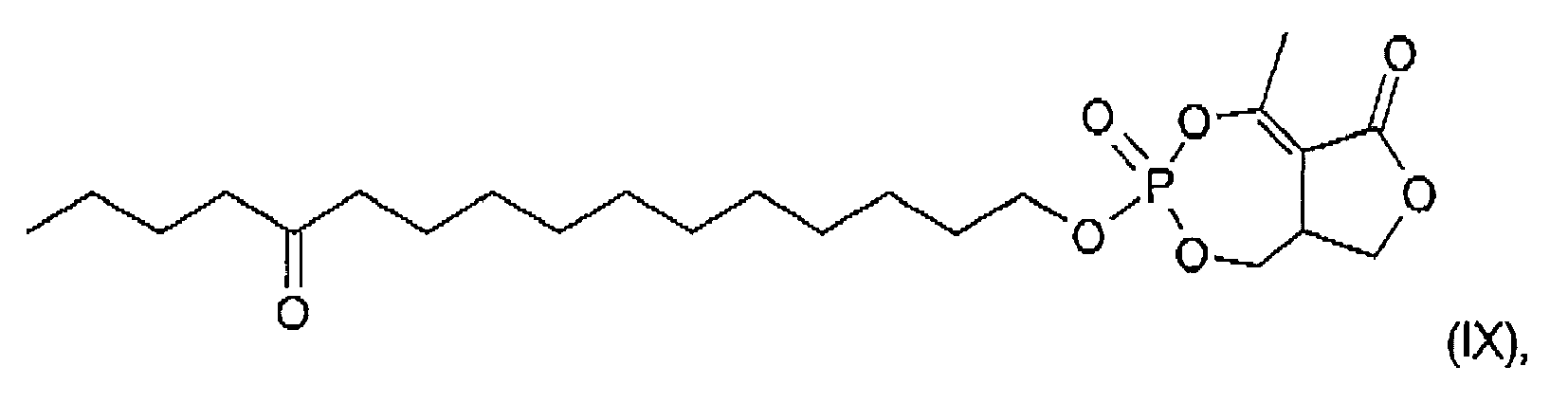


Cyclipostin T2 of the formula (XV-A)
- Use of a compound of the formula (I) according to either of claims 1, 2 or 3, wherein the compound of the formula (I) is selected from the group Cyclipostin P, Cyclipostin R, Cyclipostin T and Cyclipostin T2.
- Use of a compound of the formula (I) according to either of claim 1, 2, 3 or 4 for the treatment of tuberculosis, leprosy, nocardiosis, diphtheria, pulmonary mycobacterial infection, cutaneous mycobacterial infection, atypical mycobacterial infection and mycobacteriosis.
- Use of a compound of the formula (I) according to either of claim 1, 2, 3 or 4 for the preparation of a medicament for the treatment of bacterial infections caused by mycobacteria and related microorganisms selected from the group Mycobacterium smegmatis, Mycobacterium phlei, Nocardia brasiliensis, Nocardia abscessus and Corynobacterium diphteriae.
- Use of a compound of the formula (I) according to either of claim 1, 2, 3 or 4 for the preparation of a medicament for the treatment of infectious diseases, such as tuberculosis, leprosy, nocardiosis, diphtheria, pulmonary mycobacterial infection, cutaneous mycobacterial infection, atypical mycobacterial infection and mycobacteriosis.
Priority Applications (16)
| Application Number | Priority Date | Filing Date | Title |
|---|---|---|---|
| EP06017963A EP1894601A1 (en) | 2006-08-29 | 2006-08-29 | Treating mycobacterial infections with cyclipostins |
| BRPI0715758-4A BRPI0715758A2 (en) | 2006-08-29 | 2007-08-14 | treatment for mycobacterial infections with cyclipostine |
| PCT/EP2007/007159 WO2008025449A1 (en) | 2006-08-29 | 2007-08-14 | Treating mycobacterial infections with cyclipostins |
| MX2009001408A MX2009001408A (en) | 2006-08-29 | 2007-08-14 | Treating mycobacterial infections with cyclipostins. |
| AU2007291601A AU2007291601A1 (en) | 2006-08-29 | 2007-08-14 | Treating mycobacterial infections with cyclipostins |
| RU2009111262/15A RU2009111262A (en) | 2006-08-29 | 2007-08-14 | TREATMENT OF MYCOBACTERIAL INFECTIONS BY CYCLIPOSTINES |
| CNA200780032215XA CN101511431A (en) | 2006-08-29 | 2007-08-14 | Treating mycobacterial infections with Cyclipostins |
| DE602007013772T DE602007013772D1 (en) | 2006-08-29 | 2007-08-14 | TREATMENT OF MYCOBACTERIAL INFECTIONS WITH CYCLIPOSTINS |
| JP2009525947A JP5337696B2 (en) | 2006-08-29 | 2007-08-14 | Use of cyclipostine in the manufacture of medicaments for the treatment of mycobacterial infections |
| AT07801640T ATE504333T1 (en) | 2006-08-29 | 2007-08-14 | TREATMENT OF MYCOBACTERIAL INFECTIONS WITH CYCLIPOSTINS |
| EP07801640A EP2059304B1 (en) | 2006-08-29 | 2007-08-14 | Treating mycobacterial infections with cyclipostins |
| CA002661590A CA2661590A1 (en) | 2006-08-29 | 2007-08-14 | Treating mycobacterial infections with cyclipostins |
| KR1020097004151A KR20090045291A (en) | 2006-08-29 | 2007-08-14 | Treatment of Mycobacterial Infection with Cyclopostin |
| US12/366,695 US7923438B2 (en) | 2006-08-29 | 2009-02-06 | Use of cyclipostin derivatives for the treatment of mycobacterial infectious diseases |
| IL197188A IL197188A0 (en) | 2006-08-29 | 2009-02-23 | Treating mycobacterial infections with cyclipostins |
| NO20090927A NO20090927L (en) | 2006-08-29 | 2009-02-27 | Treatment of mycobacterial infections with cyclipostins |
Applications Claiming Priority (1)
| Application Number | Priority Date | Filing Date | Title |
|---|---|---|---|
| EP06017963A EP1894601A1 (en) | 2006-08-29 | 2006-08-29 | Treating mycobacterial infections with cyclipostins |
Publications (1)
| Publication Number | Publication Date |
|---|---|
| EP1894601A1 true EP1894601A1 (en) | 2008-03-05 |
Family
ID=37507603
Family Applications (2)
| Application Number | Title | Priority Date | Filing Date |
|---|---|---|---|
| EP06017963A Withdrawn EP1894601A1 (en) | 2006-08-29 | 2006-08-29 | Treating mycobacterial infections with cyclipostins |
| EP07801640A Not-in-force EP2059304B1 (en) | 2006-08-29 | 2007-08-14 | Treating mycobacterial infections with cyclipostins |
Family Applications After (1)
| Application Number | Title | Priority Date | Filing Date |
|---|---|---|---|
| EP07801640A Not-in-force EP2059304B1 (en) | 2006-08-29 | 2007-08-14 | Treating mycobacterial infections with cyclipostins |
Country Status (15)
| Country | Link |
|---|---|
| US (1) | US7923438B2 (en) |
| EP (2) | EP1894601A1 (en) |
| JP (1) | JP5337696B2 (en) |
| KR (1) | KR20090045291A (en) |
| CN (1) | CN101511431A (en) |
| AT (1) | ATE504333T1 (en) |
| AU (1) | AU2007291601A1 (en) |
| BR (1) | BRPI0715758A2 (en) |
| CA (1) | CA2661590A1 (en) |
| DE (1) | DE602007013772D1 (en) |
| IL (1) | IL197188A0 (en) |
| MX (1) | MX2009001408A (en) |
| NO (1) | NO20090927L (en) |
| RU (1) | RU2009111262A (en) |
| WO (1) | WO2008025449A1 (en) |
Families Citing this family (6)
| Publication number | Priority date | Publication date | Assignee | Title |
|---|---|---|---|---|
| US3349962A (en) * | 1966-01-27 | 1967-10-31 | Desoto Inc | Automatic paint colorant dispensers |
| CN101851663A (en) * | 2009-04-01 | 2010-10-06 | 湖南省天骑医学新技术有限公司 | Drug sensitivity testing method for bacteria and cells and drug sensitivity testing device |
| CN102010886B (en) * | 2010-06-02 | 2016-08-17 | 湖南省天骑医学新技术股份有限公司 | Mycobacterium tuberculosis drug susceptibility test method and application of indicator and solid medium |
| WO2013007570A1 (en) | 2011-07-12 | 2013-01-17 | Centre National De La Recherche Scientifique | Method for the high-speed screening of lipase activity and/or lipase inhibitors in biological samples and in culture media |
| WO2015127381A1 (en) | 2014-02-21 | 2015-08-27 | The Curators Of The University Of Missouri | Fluorescent labeled inhibitors |
| KR102462751B1 (en) * | 2021-10-20 | 2022-11-03 | 순천향대학교 산학협력단 | Novel Pediococcus strain and composition for preventing, treating, or improving tuberculosis comprising the same |
Citations (3)
| Publication number | Priority date | Publication date | Assignee | Title |
|---|---|---|---|---|
| JPH04145089A (en) * | 1990-10-05 | 1992-05-19 | Nippon Kayaku Co Ltd | Antibiotic nk901093, production thereof and insecticide and acaricide comprising the same antibiotic as active ingredient |
| JPH0656859A (en) * | 1991-07-25 | 1994-03-01 | Nippon Kayaku Co Ltd | Antibiotic nk901093a, its production and pesticidal and miticidal agent containing the same compound as active component |
| WO2001083947A1 (en) * | 2000-05-04 | 2001-11-08 | Navion Asa | Method and system for sea-based handling of hydrocarbons |
Family Cites Families (4)
| Publication number | Priority date | Publication date | Assignee | Title |
|---|---|---|---|---|
| US6756402B2 (en) * | 2000-05-04 | 2004-06-29 | Aventis Pharma Deutschland Gmbh | Cyclipostins, process for their preparation and use thereof |
| DE10021731B4 (en) | 2000-05-04 | 2005-12-08 | Aventis Pharma Deutschland Gmbh | Cyclipostins, process for their preparation and pharmaceutical preparation thereof |
| JP4145089B2 (en) | 2002-07-22 | 2008-09-03 | ケミカルグラウト株式会社 | Methane gas sampling method |
| DE102004046142B4 (en) | 2004-09-21 | 2006-08-24 | Hans-Knöll-Institut für Naturstoff-Forschung e.V. | New selective active substances for the treatment of diseases caused by mycobacteria, process for their preparation and their use |
-
2006
- 2006-08-29 EP EP06017963A patent/EP1894601A1/en not_active Withdrawn
-
2007
- 2007-08-14 RU RU2009111262/15A patent/RU2009111262A/en not_active Application Discontinuation
- 2007-08-14 BR BRPI0715758-4A patent/BRPI0715758A2/en not_active IP Right Cessation
- 2007-08-14 JP JP2009525947A patent/JP5337696B2/en not_active Expired - Fee Related
- 2007-08-14 WO PCT/EP2007/007159 patent/WO2008025449A1/en not_active Ceased
- 2007-08-14 AT AT07801640T patent/ATE504333T1/en not_active IP Right Cessation
- 2007-08-14 EP EP07801640A patent/EP2059304B1/en not_active Not-in-force
- 2007-08-14 CN CNA200780032215XA patent/CN101511431A/en active Pending
- 2007-08-14 CA CA002661590A patent/CA2661590A1/en not_active Abandoned
- 2007-08-14 MX MX2009001408A patent/MX2009001408A/en not_active Application Discontinuation
- 2007-08-14 KR KR1020097004151A patent/KR20090045291A/en not_active Withdrawn
- 2007-08-14 DE DE602007013772T patent/DE602007013772D1/en active Active
- 2007-08-14 AU AU2007291601A patent/AU2007291601A1/en not_active Abandoned
-
2009
- 2009-02-06 US US12/366,695 patent/US7923438B2/en not_active Expired - Fee Related
- 2009-02-23 IL IL197188A patent/IL197188A0/en unknown
- 2009-02-27 NO NO20090927A patent/NO20090927L/en not_active Application Discontinuation
Patent Citations (3)
| Publication number | Priority date | Publication date | Assignee | Title |
|---|---|---|---|---|
| JPH04145089A (en) * | 1990-10-05 | 1992-05-19 | Nippon Kayaku Co Ltd | Antibiotic nk901093, production thereof and insecticide and acaricide comprising the same antibiotic as active ingredient |
| JPH0656859A (en) * | 1991-07-25 | 1994-03-01 | Nippon Kayaku Co Ltd | Antibiotic nk901093a, its production and pesticidal and miticidal agent containing the same compound as active component |
| WO2001083947A1 (en) * | 2000-05-04 | 2001-11-08 | Navion Asa | Method and system for sea-based handling of hydrocarbons |
Non-Patent Citations (4)
| Title |
|---|
| DATABASE CA CHEMICAL ABSTRACTS SERVICE, COLUMBUS, OHIO, US; 1992, XP002412081, Database accession no. 118:2472 * |
| DATABASE CA CHEMICAL ABSTRACTS SERVICE, COLUMBUS, OHIO, US; 1994, XP002412082, Database accession no. 121:81134 * |
| DATABASE WPI Week 199226, Derwent World Patents Index; AN 1992-214297, XP002412085 * |
| DATABASE WPI Week 199414, Derwent World Patents Index; AN 1994-111988, XP002412086 * |
Also Published As
| Publication number | Publication date |
|---|---|
| MX2009001408A (en) | 2009-02-17 |
| EP2059304B1 (en) | 2011-04-06 |
| EP2059304A1 (en) | 2009-05-20 |
| WO2008025449A1 (en) | 2008-03-06 |
| IL197188A0 (en) | 2009-12-24 |
| JP5337696B2 (en) | 2013-11-06 |
| AU2007291601A1 (en) | 2008-03-06 |
| JP2010501603A (en) | 2010-01-21 |
| BRPI0715758A2 (en) | 2013-07-16 |
| KR20090045291A (en) | 2009-05-07 |
| CN101511431A (en) | 2009-08-19 |
| DE602007013772D1 (en) | 2011-05-19 |
| US7923438B2 (en) | 2011-04-12 |
| NO20090927L (en) | 2009-03-25 |
| US20090233884A1 (en) | 2009-09-17 |
| CA2661590A1 (en) | 2008-03-06 |
| ATE504333T1 (en) | 2011-04-15 |
| RU2009111262A (en) | 2010-10-10 |
Similar Documents
| Publication | Publication Date | Title |
|---|---|---|
| EP2059304B1 (en) | Treating mycobacterial infections with cyclipostins | |
| EP1994930A1 (en) | Triazol compounds for treating biofilm formation | |
| US6486161B1 (en) | Use of rifamycin derivative for treating mastitis in a domestic animal | |
| US5721242A (en) | Antibiotic combination | |
| WO1993011777A1 (en) | Amphotericin b composition with enhanced antifungal activity | |
| US7001922B2 (en) | Peptide deformylase activated prodrugs | |
| HK1137373A (en) | Treating mycobacterial infections with cyclipostins | |
| DK163566B (en) | USE OF HYGROMYCINE AND EPIHYGROMYCINE FOR THE PREPARATION OF A MEDICINE FOR THE TREATMENT OF PIG DYSENTRY | |
| AU756367B2 (en) | Use of rifamycin derivative for treating mastitis in a domestic animal | |
| US20220081470A1 (en) | Thiazolyl peptides for the treatment nontuberculous mycobacterial infections | |
| DE10021731A1 (en) | Cyclipostins, process for their manufacture and use thereof | |
| CN120284984B (en) | A compound for resisting mycobacterium tuberculosis infection and its application | |
| EP1941877B1 (en) | Pharmaceutical compositions containing nitrovinylfuran derivatives for the treatment of leishmaniasis and trypanosomiasis | |
| US20100240612A1 (en) | Prenylated Bisphosphonates as Anti-tuberculosis Agents | |
| CN120661516A (en) | Application of pilin or derivative thereof in preparation of medicines | |
| DE102004010219B4 (en) | HKI10311129, new antibiotic, process for its preparation and pharmaceutical compositions containing HKI10311129 | |
| RU2702364C2 (en) | Hybrid antibacterial agents oxazolidinone-quinolone intended for parenteral administration for treatment or prevention of bacterial diseases | |
| KR20260041840A (en) | Combination products of at least three antibiotics including bedaquiline, pretomanid or delamanid, and a cytochrome BC1 inhibitor, and their use in the treatment of mycobacterial infections | |
| US6268383B1 (en) | Substituted aromatic compounds for treatment of antibiotic-resistant infections | |
| AU2017235711B2 (en) | Enhanced tulathromycin | |
| Meyers et al. | Biological characterization of diumycin, a phosphorus-containing glycolipid antibiotic | |
| CN1113647C (en) | Polyether medicine used for antituberculosis and antileprosy | |
| WO2001023342A1 (en) | Phloroglucinol compounds | |
| DE2632136A1 (en) | ASYMMETRIC CIS-1,2-EPOXY-PROPYLPHOSPHONIC ACID DERIVATIVES, THE METHOD OF MANUFACTURING THEM AND THE MEDICINAL PRODUCTS CONTAINING THEY | |
| PH26569A (en) | Veterinary treatment |
Legal Events
| Date | Code | Title | Description |
|---|---|---|---|
| PUAI | Public reference made under article 153(3) epc to a published international application that has entered the european phase |
Free format text: ORIGINAL CODE: 0009012 |
|
| AK | Designated contracting states |
Kind code of ref document: A1 Designated state(s): AT BE BG CH CY CZ DE DK EE ES FI FR GB GR HU IE IS IT LI LT LU LV MC NL PL PT RO SE SI SK TR |
|
| AX | Request for extension of the european patent |
Extension state: AL BA HR MK YU |
|
| STAA | Information on the status of an ep patent application or granted ep patent |
Free format text: STATUS: THE APPLICATION HAS BEEN WITHDRAWN |
|
| 18W | Application withdrawn |
Effective date: 20080320 |