EP1894568A1 - Pharmaceutical compositions for the treatment of inflammatory or obstructive airway diseases - Google Patents
Pharmaceutical compositions for the treatment of inflammatory or obstructive airway diseases Download PDFInfo
- Publication number
- EP1894568A1 EP1894568A1 EP06119917A EP06119917A EP1894568A1 EP 1894568 A1 EP1894568 A1 EP 1894568A1 EP 06119917 A EP06119917 A EP 06119917A EP 06119917 A EP06119917 A EP 06119917A EP 1894568 A1 EP1894568 A1 EP 1894568A1
- Authority
- EP
- European Patent Office
- Prior art keywords
- group
- carbocyclic group
- alkyl
- nitrogen
- aromatic carbocyclic
- Prior art date
- Legal status (The legal status is an assumption and is not a legal conclusion. Google has not performed a legal analysis and makes no representation as to the accuracy of the status listed.)
- Ceased
Links
- 238000011282 treatment Methods 0.000 title claims abstract description 34
- 230000002757 inflammatory effect Effects 0.000 title claims abstract description 30
- 239000008194 pharmaceutical composition Substances 0.000 title claims description 10
- 230000000414 obstructive effect Effects 0.000 title description 7
- 208000023504 respiratory system disease Diseases 0.000 title description 2
- 239000003814 drug Substances 0.000 claims abstract description 63
- 239000003246 corticosteroid Substances 0.000 claims abstract description 24
- 208000027771 Obstructive airways disease Diseases 0.000 claims abstract description 23
- 208000027866 inflammatory disease Diseases 0.000 claims abstract description 21
- 229940121786 Beta 2 adrenoreceptor agonist Drugs 0.000 claims abstract 3
- -1 cyano, amino Chemical group 0.000 claims description 69
- 150000001875 compounds Chemical class 0.000 claims description 67
- 125000002837 carbocyclic group Chemical group 0.000 claims description 59
- 125000000623 heterocyclic group Chemical group 0.000 claims description 47
- 239000000843 powder Substances 0.000 claims description 46
- 239000000203 mixture Substances 0.000 claims description 44
- IJGRMHOSHXDMSA-UHFFFAOYSA-N nitrogen Substances N#N IJGRMHOSHXDMSA-UHFFFAOYSA-N 0.000 claims description 43
- 229910052757 nitrogen Inorganic materials 0.000 claims description 42
- 229910052760 oxygen Inorganic materials 0.000 claims description 40
- 239000001301 oxygen Chemical group 0.000 claims description 40
- NINIDFKCEFEMDL-UHFFFAOYSA-N Sulfur Chemical group [S] NINIDFKCEFEMDL-UHFFFAOYSA-N 0.000 claims description 39
- QVGXLLKOCUKJST-UHFFFAOYSA-N atomic oxygen Chemical group [O] QVGXLLKOCUKJST-UHFFFAOYSA-N 0.000 claims description 39
- 125000005842 heteroatom Chemical group 0.000 claims description 38
- 239000005864 Sulphur Chemical group 0.000 claims description 37
- QJGQUHMNIGDVPM-UHFFFAOYSA-N nitrogen group Chemical group [N] QJGQUHMNIGDVPM-UHFFFAOYSA-N 0.000 claims description 37
- 125000004209 (C1-C8) alkyl group Chemical group 0.000 claims description 36
- 150000003839 salts Chemical class 0.000 claims description 32
- 239000000443 aerosol Substances 0.000 claims description 31
- 239000001257 hydrogen Substances 0.000 claims description 23
- 229910052739 hydrogen Inorganic materials 0.000 claims description 23
- 208000006673 asthma Diseases 0.000 claims description 22
- 125000005843 halogen group Chemical group 0.000 claims description 22
- 125000004435 hydrogen atom Chemical group [H]* 0.000 claims description 22
- 239000006185 dispersion Substances 0.000 claims description 21
- 239000003380 propellant Substances 0.000 claims description 20
- GIIZNNXWQWCKIB-UHFFFAOYSA-N Serevent Chemical compound C1=C(O)C(CO)=CC(C(O)CNCCCCCCOCCCCC=2C=CC=CC=2)=C1 GIIZNNXWQWCKIB-UHFFFAOYSA-N 0.000 claims description 16
- 239000002775 capsule Substances 0.000 claims description 16
- 239000002245 particle Substances 0.000 claims description 16
- 229960004017 salmeterol Drugs 0.000 claims description 15
- 125000004178 (C1-C4) alkyl group Chemical group 0.000 claims description 14
- WOFMFGQZHJDGCX-ZULDAHANSA-N mometasone furoate Chemical compound O([C@]1([C@@]2(C)C[C@H](O)[C@]3(Cl)[C@@]4(C)C=CC(=O)C=C4CC[C@H]3[C@@H]2C[C@H]1C)C(=O)CCl)C(=O)C1=CC=CO1 WOFMFGQZHJDGCX-ZULDAHANSA-N 0.000 claims description 14
- 229960002744 mometasone furoate Drugs 0.000 claims description 13
- ANGKOCUUWGHLCE-HKUYNNGSSA-N [(3s)-1,1-dimethylpyrrolidin-1-ium-3-yl] (2r)-2-cyclopentyl-2-hydroxy-2-phenylacetate Chemical class C1[N+](C)(C)CC[C@@H]1OC(=O)[C@](O)(C=1C=CC=CC=1)C1CCCC1 ANGKOCUUWGHLCE-HKUYNNGSSA-N 0.000 claims description 12
- 125000002496 methyl group Chemical group [H]C([H])([H])* 0.000 claims description 12
- 239000000048 adrenergic agonist Substances 0.000 claims description 11
- 102000014974 beta2-adrenergic receptor activity proteins Human genes 0.000 claims description 11
- 108040006828 beta2-adrenergic receptor activity proteins Proteins 0.000 claims description 11
- BPZSYCZIITTYBL-UHFFFAOYSA-N formoterol Chemical compound C1=CC(OC)=CC=C1CC(C)NCC(O)C1=CC=C(O)C(NC=O)=C1 BPZSYCZIITTYBL-UHFFFAOYSA-N 0.000 claims description 11
- 229960002848 formoterol Drugs 0.000 claims description 11
- 238000002648 combination therapy Methods 0.000 claims description 10
- 125000001495 ethyl group Chemical group [H]C([H])([H])C([H])([H])* 0.000 claims description 10
- 125000001246 bromo group Chemical group Br* 0.000 claims description 9
- 125000001309 chloro group Chemical group Cl* 0.000 claims description 9
- 125000004122 cyclic group Chemical group 0.000 claims description 9
- 125000001153 fluoro group Chemical group F* 0.000 claims description 9
- WMWTYOKRWGGJOA-CENSZEJFSA-N fluticasone propionate Chemical compound C1([C@@H](F)C2)=CC(=O)C=C[C@]1(C)[C@]1(F)[C@@H]2[C@@H]2C[C@@H](C)[C@@](C(=O)SCF)(OC(=O)CC)[C@@]2(C)C[C@@H]1O WMWTYOKRWGGJOA-CENSZEJFSA-N 0.000 claims description 9
- 229960002462 glycopyrronium bromide Drugs 0.000 claims description 9
- 125000002887 hydroxy group Chemical group [H]O* 0.000 claims description 9
- LMBFAGIMSUYTBN-MPZNNTNKSA-N teixobactin Chemical compound C([C@H](C(=O)N[C@@H]([C@@H](C)CC)C(=O)N[C@@H](CO)C(=O)N[C@H](CCC(N)=O)C(=O)N[C@H]([C@@H](C)CC)C(=O)N[C@@H]([C@@H](C)CC)C(=O)N[C@@H](CO)C(=O)N[C@H]1C(N[C@@H](C)C(=O)N[C@@H](C[C@@H]2NC(=N)NC2)C(=O)N[C@H](C(=O)O[C@H]1C)[C@@H](C)CC)=O)NC)C1=CC=CC=C1 LMBFAGIMSUYTBN-MPZNNTNKSA-N 0.000 claims description 9
- 229910006074 SO2NH2 Inorganic materials 0.000 claims description 8
- 239000003937 drug carrier Substances 0.000 claims description 8
- 229910052736 halogen Inorganic materials 0.000 claims description 8
- HQKMJHAJHXVSDF-UHFFFAOYSA-L magnesium stearate Chemical compound [Mg+2].CCCCCCCCCCCCCCCCCC([O-])=O.CCCCCCCCCCCCCCCCCC([O-])=O HQKMJHAJHXVSDF-UHFFFAOYSA-L 0.000 claims description 8
- 125000002924 primary amino group Chemical group [H]N([H])* 0.000 claims description 8
- 125000001424 substituent group Chemical group 0.000 claims description 8
- 239000002253 acid Substances 0.000 claims description 7
- 125000006615 aromatic heterocyclic group Chemical group 0.000 claims description 7
- 229960000289 fluticasone propionate Drugs 0.000 claims description 7
- 150000002367 halogens Chemical class 0.000 claims description 7
- VOVIALXJUBGFJZ-KWVAZRHASA-N Budesonide Chemical compound C1CC2=CC(=O)C=C[C@]2(C)[C@@H]2[C@@H]1[C@@H]1C[C@H]3OC(CCC)O[C@@]3(C(=O)CO)[C@@]1(C)C[C@@H]2O VOVIALXJUBGFJZ-KWVAZRHASA-N 0.000 claims description 6
- BDOZRVOIIAVPMG-GXVQUIFISA-N [(3r)-1-[2-(1,2-oxazol-3-ylamino)-2-oxoethyl]-1-azoniabicyclo[2.2.2]octan-3-yl] 2-hydroxy-2,2-diphenylacetate;bromide Chemical compound [Br-].C([C@@H](C(CC1)CC2)OC(=O)C(O)(C=3C=CC=CC=3)C=3C=CC=CC=3)[N+]21CC(=O)NC=1C=CON=1 BDOZRVOIIAVPMG-GXVQUIFISA-N 0.000 claims description 6
- 229960004436 budesonide Drugs 0.000 claims description 6
- 125000001559 cyclopropyl group Chemical group [H]C1([H])C([H])([H])C1([H])* 0.000 claims description 6
- 229940071648 metered dose inhaler Drugs 0.000 claims description 6
- 125000004433 nitrogen atom Chemical group N* 0.000 claims description 6
- 125000001997 phenyl group Chemical group [H]C1=C([H])C([H])=C(*)C([H])=C1[H] 0.000 claims description 6
- 239000004094 surface-active agent Substances 0.000 claims description 6
- ZGWGSEUMABQEMD-UHFFFAOYSA-N 4-methyl-1,3-thiazole-5-carboxylic acid Chemical compound CC=1N=CSC=1C(O)=O ZGWGSEUMABQEMD-UHFFFAOYSA-N 0.000 claims description 5
- 125000004648 C2-C8 alkenyl group Chemical group 0.000 claims description 5
- XTULMSXFIHGYFS-KIFIMYBHSA-N [(6s,9r,10s,11s,13s,16r,17r)-6,9-difluoro-17-(fluoromethylsulfanylcarbonyl)-11-hydroxy-10,13,16-trimethyl-3-oxo-6,7,8,11,12,14,15,16-octahydrocyclopenta[a]phenanthren-17-yl] furan-2-carboxylate Chemical compound O([C@]1([C@@]2(C)C[C@H](O)[C@]3(F)[C@@]4(C)C=CC(=O)C=C4[C@@H](F)CC3C2C[C@H]1C)C(=O)SCF)C(=O)C1=CC=CO1 XTULMSXFIHGYFS-KIFIMYBHSA-N 0.000 claims description 5
- 238000002360 preparation method Methods 0.000 claims description 5
- SBYHFKPVCBCYGV-UHFFFAOYSA-N quinuclidine Chemical compound C1CC2CCN1CC2 SBYHFKPVCBCYGV-UHFFFAOYSA-N 0.000 claims description 5
- 239000012453 solvate Chemical group 0.000 claims description 5
- 125000005865 C2-C10alkynyl group Chemical group 0.000 claims description 4
- 125000004429 atom Chemical group 0.000 claims description 4
- 239000004067 bulking agent Substances 0.000 claims description 4
- 235000019359 magnesium stearate Nutrition 0.000 claims description 4
- 125000000962 organic group Chemical group 0.000 claims description 4
- 239000006184 cosolvent Substances 0.000 claims description 3
- 125000002941 2-furyl group Chemical group O1C([*])=C([H])C([H])=C1[H] 0.000 claims description 2
- 125000004105 2-pyridyl group Chemical group N1=C([*])C([H])=C([H])C([H])=C1[H] 0.000 claims description 2
- 125000004860 4-ethylphenyl group Chemical group [H]C1=C([H])C(=C([H])C([H])=C1*)C([H])([H])C([H])([H])[H] 0.000 claims description 2
- 125000000590 4-methylphenyl group Chemical group [H]C1=C([H])C(=C([H])C([H])=C1*)C([H])([H])[H] 0.000 claims description 2
- 125000004070 6 membered heterocyclic group Chemical group 0.000 claims description 2
- 208000006545 Chronic Obstructive Pulmonary Disease Diseases 0.000 claims description 2
- 239000002552 dosage form Substances 0.000 claims description 2
- ANGKOCUUWGHLCE-UHFFFAOYSA-N 2-cyclopentyl-2-hydroxy-2-phenylacetic acid (1,1-dimethyl-3-pyrrolidin-1-iumyl) ester Chemical group C1[N+](C)(C)CCC1OC(=O)C(O)(C=1C=CC=CC=1)C1CCCC1 ANGKOCUUWGHLCE-UHFFFAOYSA-N 0.000 claims 1
- 125000003282 alkyl amino group Chemical group 0.000 claims 1
- 239000003149 muscarinic antagonist Substances 0.000 abstract description 5
- 235000013350 formula milk Nutrition 0.000 description 26
- 229940008126 aerosol Drugs 0.000 description 25
- VPNYRYCIDCJBOM-UHFFFAOYSA-M Glycopyrronium bromide Chemical compound [Br-].C1[N+](C)(C)CCC1OC(=O)C(O)(C=1C=CC=CC=1)C1CCCC1 VPNYRYCIDCJBOM-UHFFFAOYSA-M 0.000 description 15
- 239000004480 active ingredient Substances 0.000 description 14
- LFQSCWFLJHTTHZ-UHFFFAOYSA-N Ethanol Chemical compound CCO LFQSCWFLJHTTHZ-UHFFFAOYSA-N 0.000 description 12
- 238000000034 method Methods 0.000 description 11
- GUBGYTABKSRVRQ-QKKXKWKRSA-N Lactose Natural products OC[C@H]1O[C@@H](O[C@H]2[C@H](O)[C@@H](O)C(O)O[C@@H]2CO)[C@H](O)[C@@H](O)[C@H]1O GUBGYTABKSRVRQ-QKKXKWKRSA-N 0.000 description 10
- GUBGYTABKSRVRQ-XLOQQCSPSA-N Alpha-Lactose Chemical compound O[C@@H]1[C@@H](O)[C@@H](O)[C@@H](CO)O[C@H]1O[C@@H]1[C@@H](CO)O[C@H](O)[C@H](O)[C@H]1O GUBGYTABKSRVRQ-XLOQQCSPSA-N 0.000 description 9
- 230000003110 anti-inflammatory effect Effects 0.000 description 9
- 201000010099 disease Diseases 0.000 description 9
- 208000037265 diseases, disorders, signs and symptoms Diseases 0.000 description 9
- 230000000694 effects Effects 0.000 description 9
- 229960001375 lactose Drugs 0.000 description 9
- 239000008101 lactose Substances 0.000 description 9
- 125000004432 carbon atom Chemical group C* 0.000 description 8
- IFLKEBSJTZGCJG-UHFFFAOYSA-N 3-methylthiophene-2-carboxylic acid Chemical compound CC=1C=CSC=1C(O)=O IFLKEBSJTZGCJG-UHFFFAOYSA-N 0.000 description 6
- QTBSBXVTEAMEQO-UHFFFAOYSA-N Acetic acid Chemical compound CC(O)=O QTBSBXVTEAMEQO-UHFFFAOYSA-N 0.000 description 6
- WSVLPVUVIUVCRA-KPKNDVKVSA-N Alpha-lactose monohydrate Chemical compound O.O[C@@H]1[C@@H](O)[C@@H](O)[C@@H](CO)O[C@H]1O[C@@H]1[C@@H](CO)O[C@H](O)[C@H](O)[C@H]1O WSVLPVUVIUVCRA-KPKNDVKVSA-N 0.000 description 6
- 230000009471 action Effects 0.000 description 6
- KRKNYBCHXYNGOX-UHFFFAOYSA-N citric acid Chemical compound OC(=O)CC(O)(C(O)=O)CC(O)=O KRKNYBCHXYNGOX-UHFFFAOYSA-N 0.000 description 6
- 229940015042 glycopyrrolate Drugs 0.000 description 6
- 150000002430 hydrocarbons Chemical group 0.000 description 6
- 229960001021 lactose monohydrate Drugs 0.000 description 6
- 239000006199 nebulizer Substances 0.000 description 6
- 239000000243 solution Substances 0.000 description 6
- RATSWNOMCHFQGJ-TUYNVFRMSA-N (e)-but-2-enedioic acid;n-[2-hydroxy-5-[(1s)-1-hydroxy-2-[[(2s)-1-(4-methoxyphenyl)propan-2-yl]amino]ethyl]phenyl]formamide;dihydrate Chemical compound O.O.OC(=O)\C=C\C(O)=O.C1=CC(OC)=CC=C1C[C@H](C)NC[C@@H](O)C1=CC=C(O)C(NC=O)=C1.C1=CC(OC)=CC=C1C[C@H](C)NC[C@@H](O)C1=CC=C(O)C(NC=O)=C1 RATSWNOMCHFQGJ-TUYNVFRMSA-N 0.000 description 5
- FERIUCNNQQJTOY-UHFFFAOYSA-N Butyric acid Chemical compound CCCC(O)=O FERIUCNNQQJTOY-UHFFFAOYSA-N 0.000 description 5
- ZAMOUSCENKQFHK-UHFFFAOYSA-N Chlorine atom Chemical compound [Cl] ZAMOUSCENKQFHK-UHFFFAOYSA-N 0.000 description 5
- AFVFQIVMOAPDHO-UHFFFAOYSA-N Methanesulfonic acid Chemical compound CS(O)(=O)=O AFVFQIVMOAPDHO-UHFFFAOYSA-N 0.000 description 5
- WPYMKLBDIGXBTP-UHFFFAOYSA-N benzoic acid Chemical compound OC(=O)C1=CC=CC=C1 WPYMKLBDIGXBTP-UHFFFAOYSA-N 0.000 description 5
- 239000000460 chlorine Substances 0.000 description 5
- 229910052801 chlorine Inorganic materials 0.000 description 5
- 125000000842 isoxazolyl group Chemical group 0.000 description 5
- 238000002156 mixing Methods 0.000 description 5
- 125000000229 (C1-C4)alkoxy group Chemical group 0.000 description 4
- FJKROLUGYXJWQN-UHFFFAOYSA-N 4-hydroxybenzoic acid Chemical compound OC(=O)C1=CC=C(O)C=C1 FJKROLUGYXJWQN-UHFFFAOYSA-N 0.000 description 4
- KRHYYFGTRYWZRS-UHFFFAOYSA-N Fluorane Chemical compound F KRHYYFGTRYWZRS-UHFFFAOYSA-N 0.000 description 4
- VEXZGXHMUGYJMC-UHFFFAOYSA-N Hydrochloric acid Chemical compound Cl VEXZGXHMUGYJMC-UHFFFAOYSA-N 0.000 description 4
- NBIIXXVUZAFLBC-UHFFFAOYSA-N Phosphoric acid Chemical compound OP(O)(O)=O NBIIXXVUZAFLBC-UHFFFAOYSA-N 0.000 description 4
- QAOWNCQODCNURD-UHFFFAOYSA-N Sulfuric acid Chemical compound OS(O)(=O)=O QAOWNCQODCNURD-UHFFFAOYSA-N 0.000 description 4
- XJQRRXDTQMFSPX-POXKQJJMSA-O [(3r)-1-[2-(1,2-oxazol-3-ylamino)-2-oxoethyl]-1-azoniabicyclo[2.2.2]octan-3-yl] (2r)-2-cyclohexyl-2-hydroxy-2-phenylacetate Chemical compound C1([C@](O)(C(=O)O[C@@H]2C3CC[N+](CC3)(CC(=O)NC3=NOC=C3)C2)C=2C=CC=CC=2)CCCCC1 XJQRRXDTQMFSPX-POXKQJJMSA-O 0.000 description 4
- 125000004093 cyano group Chemical group *C#N 0.000 description 4
- PXBRQCKWGAHEHS-UHFFFAOYSA-N dichlorodifluoromethane Chemical compound FC(F)(Cl)Cl PXBRQCKWGAHEHS-UHFFFAOYSA-N 0.000 description 4
- XBDQKXXYIPTUBI-UHFFFAOYSA-N dimethylselenoniopropionate Natural products CCC(O)=O XBDQKXXYIPTUBI-UHFFFAOYSA-N 0.000 description 4
- 229940112141 dry powder inhaler Drugs 0.000 description 4
- 229960000193 formoterol fumarate Drugs 0.000 description 4
- 238000009472 formulation Methods 0.000 description 4
- 229930195733 hydrocarbon Natural products 0.000 description 4
- JVTAAEKCZFNVCJ-UHFFFAOYSA-N lactic acid Chemical compound CC(O)C(O)=O JVTAAEKCZFNVCJ-UHFFFAOYSA-N 0.000 description 4
- BDAGIHXWWSANSR-UHFFFAOYSA-N methanoic acid Natural products OC=O BDAGIHXWWSANSR-UHFFFAOYSA-N 0.000 description 4
- 125000004076 pyridyl group Chemical group 0.000 description 4
- 125000000714 pyrimidinyl group Chemical group 0.000 description 4
- YGSDEFSMJLZEOE-UHFFFAOYSA-N salicylic acid Chemical compound OC(=O)C1=CC=CC=C1O YGSDEFSMJLZEOE-UHFFFAOYSA-N 0.000 description 4
- 230000001225 therapeutic effect Effects 0.000 description 4
- 125000000335 thiazolyl group Chemical group 0.000 description 4
- VZCYOOQTPOCHFL-UHFFFAOYSA-N trans-butenedioic acid Natural products OC(=O)C=CC(O)=O VZCYOOQTPOCHFL-UHFFFAOYSA-N 0.000 description 4
- 125000006552 (C3-C8) cycloalkyl group Chemical group 0.000 description 3
- YFMFNYKEUDLDTL-UHFFFAOYSA-N 1,1,1,2,3,3,3-heptafluoropropane Chemical compound FC(F)(F)C(F)C(F)(F)F YFMFNYKEUDLDTL-UHFFFAOYSA-N 0.000 description 3
- SJJCQDRGABAVBB-UHFFFAOYSA-N 1-hydroxy-2-naphthoic acid Chemical compound C1=CC=CC2=C(O)C(C(=O)O)=CC=C21 SJJCQDRGABAVBB-UHFFFAOYSA-N 0.000 description 3
- DCYGAPKNVCQNOE-UHFFFAOYSA-N 2,2,2-triphenylacetic acid Chemical compound C=1C=CC=CC=1C(C=1C=CC=CC=1)(C(=O)O)C1=CC=CC=C1 DCYGAPKNVCQNOE-UHFFFAOYSA-N 0.000 description 3
- WKBOTKDWSSQWDR-UHFFFAOYSA-N Bromine atom Chemical compound [Br] WKBOTKDWSSQWDR-UHFFFAOYSA-N 0.000 description 3
- FEWJPZIEWOKRBE-JCYAYHJZSA-N Dextrotartaric acid Chemical compound OC(=O)[C@H](O)[C@@H](O)C(O)=O FEWJPZIEWOKRBE-JCYAYHJZSA-N 0.000 description 3
- ATUOYWHBWRKTHZ-UHFFFAOYSA-N Propane Chemical compound CCC ATUOYWHBWRKTHZ-UHFFFAOYSA-N 0.000 description 3
- 206010047924 Wheezing Diseases 0.000 description 3
- BJEPYKJPYRNKOW-UHFFFAOYSA-N alpha-hydroxysuccinic acid Natural products OC(=O)C(O)CC(O)=O BJEPYKJPYRNKOW-UHFFFAOYSA-N 0.000 description 3
- 125000004397 aminosulfonyl group Chemical group NS(=O)(=O)* 0.000 description 3
- 230000008901 benefit Effects 0.000 description 3
- 125000004196 benzothienyl group Chemical group S1C(=CC2=C1C=CC=C2)* 0.000 description 3
- GDTBXPJZTBHREO-UHFFFAOYSA-N bromine Substances BrBr GDTBXPJZTBHREO-UHFFFAOYSA-N 0.000 description 3
- 229910052794 bromium Inorganic materials 0.000 description 3
- 230000005713 exacerbation Effects 0.000 description 3
- 125000002541 furyl group Chemical group 0.000 description 3
- XMBWDFGMSWQBCA-UHFFFAOYSA-N hydrogen iodide Chemical compound I XMBWDFGMSWQBCA-UHFFFAOYSA-N 0.000 description 3
- RAXXELZNTBOGNW-UHFFFAOYSA-N imidazole Natural products C1=CNC=N1 RAXXELZNTBOGNW-UHFFFAOYSA-N 0.000 description 3
- 230000006872 improvement Effects 0.000 description 3
- 239000000314 lubricant Substances 0.000 description 3
- 230000004199 lung function Effects 0.000 description 3
- VZCYOOQTPOCHFL-UPHRSURJSA-N maleic acid Chemical compound OC(=O)\C=C/C(O)=O VZCYOOQTPOCHFL-UPHRSURJSA-N 0.000 description 3
- 125000003373 pyrazinyl group Chemical group 0.000 description 3
- 125000003226 pyrazolyl group Chemical group 0.000 description 3
- 125000000168 pyrrolyl group Chemical group 0.000 description 3
- 229920006395 saturated elastomer Polymers 0.000 description 3
- 150000003431 steroids Chemical class 0.000 description 3
- 229910052717 sulfur Inorganic materials 0.000 description 3
- 238000002560 therapeutic procedure Methods 0.000 description 3
- 125000001113 thiadiazolyl group Chemical group 0.000 description 3
- 125000001544 thienyl group Chemical group 0.000 description 3
- XWTYSIMOBUGWOL-UHFFFAOYSA-N (+-)-Terbutaline Chemical compound CC(C)(C)NCC(O)C1=CC(O)=CC(O)=C1 XWTYSIMOBUGWOL-UHFFFAOYSA-N 0.000 description 2
- BJEPYKJPYRNKOW-REOHCLBHSA-N (S)-malic acid Chemical compound OC(=O)[C@@H](O)CC(O)=O BJEPYKJPYRNKOW-REOHCLBHSA-N 0.000 description 2
- LVGUZGTVOIAKKC-UHFFFAOYSA-N 1,1,1,2-tetrafluoroethane Chemical compound FCC(F)(F)F LVGUZGTVOIAKKC-UHFFFAOYSA-N 0.000 description 2
- DDMOUSALMHHKOS-UHFFFAOYSA-N 1,2-dichloro-1,1,2,2-tetrafluoroethane Chemical compound FC(F)(Cl)C(F)(F)Cl DDMOUSALMHHKOS-UHFFFAOYSA-N 0.000 description 2
- WBJWXIQDBDZMAW-UHFFFAOYSA-N 2-hydroxynaphthalene-1-carbonyl chloride Chemical compound C1=CC=CC2=C(C(Cl)=O)C(O)=CC=C21 WBJWXIQDBDZMAW-UHFFFAOYSA-N 0.000 description 2
- ALKYHXVLJMQRLQ-UHFFFAOYSA-N 3-Hydroxy-2-naphthoate Chemical compound C1=CC=C2C=C(O)C(C(=O)O)=CC2=C1 ALKYHXVLJMQRLQ-UHFFFAOYSA-N 0.000 description 2
- BMYNFMYTOJXKLE-UHFFFAOYSA-N 3-azaniumyl-2-hydroxypropanoate Chemical compound NCC(O)C(O)=O BMYNFMYTOJXKLE-UHFFFAOYSA-N 0.000 description 2
- OSWFIVFLDKOXQC-UHFFFAOYSA-N 4-(3-methoxyphenyl)aniline Chemical compound COC1=CC=CC(C=2C=CC(N)=CC=2)=C1 OSWFIVFLDKOXQC-UHFFFAOYSA-N 0.000 description 2
- XRHGYUZYPHTUJZ-UHFFFAOYSA-N 4-chlorobenzoic acid Chemical compound OC(=O)C1=CC=C(Cl)C=C1 XRHGYUZYPHTUJZ-UHFFFAOYSA-N 0.000 description 2
- 229940090248 4-hydroxybenzoic acid Drugs 0.000 description 2
- HBAQYPYDRFILMT-UHFFFAOYSA-N 8-[3-(1-cyclopropylpyrazol-4-yl)-1H-pyrazolo[4,3-d]pyrimidin-5-yl]-3-methyl-3,8-diazabicyclo[3.2.1]octan-2-one Chemical class C1(CC1)N1N=CC(=C1)C1=NNC2=C1N=C(N=C2)N1C2C(N(CC1CC2)C)=O HBAQYPYDRFILMT-UHFFFAOYSA-N 0.000 description 2
- 206010001052 Acute respiratory distress syndrome Diseases 0.000 description 2
- 239000005711 Benzoic acid Substances 0.000 description 2
- VOPWNXZWBYDODV-UHFFFAOYSA-N Chlorodifluoromethane Chemical compound FC(F)Cl VOPWNXZWBYDODV-UHFFFAOYSA-N 0.000 description 2
- FBPFZTCFMRRESA-FSIIMWSLSA-N D-Glucitol Natural products OC[C@H](O)[C@H](O)[C@@H](O)[C@H](O)CO FBPFZTCFMRRESA-FSIIMWSLSA-N 0.000 description 2
- FBPFZTCFMRRESA-KVTDHHQDSA-N D-Mannitol Chemical compound OC[C@@H](O)[C@@H](O)[C@H](O)[C@H](O)CO FBPFZTCFMRRESA-KVTDHHQDSA-N 0.000 description 2
- FBPFZTCFMRRESA-JGWLITMVSA-N D-glucitol Chemical compound OC[C@H](O)[C@@H](O)[C@H](O)[C@H](O)CO FBPFZTCFMRRESA-JGWLITMVSA-N 0.000 description 2
- PXGOKWXKJXAPGV-UHFFFAOYSA-N Fluorine Chemical compound FF PXGOKWXKJXAPGV-UHFFFAOYSA-N 0.000 description 2
- VZCYOOQTPOCHFL-OWOJBTEDSA-N Fumaric acid Chemical compound OC(=O)\C=C\C(O)=O VZCYOOQTPOCHFL-OWOJBTEDSA-N 0.000 description 2
- YLQBMQCUIZJEEH-UHFFFAOYSA-N Furan Chemical compound C=1C=COC=1 YLQBMQCUIZJEEH-UHFFFAOYSA-N 0.000 description 2
- WQZGKKKJIJFFOK-GASJEMHNSA-N Glucose Natural products OC[C@H]1OC(O)[C@H](O)[C@@H](O)[C@@H]1O WQZGKKKJIJFFOK-GASJEMHNSA-N 0.000 description 2
- 229930195725 Mannitol Natural products 0.000 description 2
- GRYLNZFGIOXLOG-UHFFFAOYSA-N Nitric acid Chemical compound O[N+]([O-])=O GRYLNZFGIOXLOG-UHFFFAOYSA-N 0.000 description 2
- OFOBLEOULBTSOW-UHFFFAOYSA-N Propanedioic acid Natural products OC(=O)CC(O)=O OFOBLEOULBTSOW-UHFFFAOYSA-N 0.000 description 2
- KYQCOXFCLRTKLS-UHFFFAOYSA-N Pyrazine Chemical compound C1=CN=CC=N1 KYQCOXFCLRTKLS-UHFFFAOYSA-N 0.000 description 2
- JUJWROOIHBZHMG-UHFFFAOYSA-N Pyridine Chemical compound C1=CC=NC=C1 JUJWROOIHBZHMG-UHFFFAOYSA-N 0.000 description 2
- KAESVJOAVNADME-UHFFFAOYSA-N Pyrrole Chemical compound C=1C=CNC=1 KAESVJOAVNADME-UHFFFAOYSA-N 0.000 description 2
- KDYFGRWQOYBRFD-UHFFFAOYSA-N Succinic acid Natural products OC(=O)CCC(O)=O KDYFGRWQOYBRFD-UHFFFAOYSA-N 0.000 description 2
- CZMRCDWAGMRECN-UGDNZRGBSA-N Sucrose Chemical compound O[C@H]1[C@H](O)[C@@H](CO)O[C@@]1(CO)O[C@@H]1[C@H](O)[C@@H](O)[C@H](O)[C@@H](CO)O1 CZMRCDWAGMRECN-UGDNZRGBSA-N 0.000 description 2
- 229930006000 Sucrose Natural products 0.000 description 2
- FEWJPZIEWOKRBE-UHFFFAOYSA-N Tartaric acid Natural products [H+].[H+].[O-]C(=O)C(O)C(O)C([O-])=O FEWJPZIEWOKRBE-UHFFFAOYSA-N 0.000 description 2
- YTPLMLYBLZKORZ-UHFFFAOYSA-N Thiophene Chemical compound C=1C=CSC=1 YTPLMLYBLZKORZ-UHFFFAOYSA-N 0.000 description 2
- 235000011054 acetic acid Nutrition 0.000 description 2
- OIPILFWXSMYKGL-UHFFFAOYSA-N acetylcholine Chemical compound CC(=O)OCC[N+](C)(C)C OIPILFWXSMYKGL-UHFFFAOYSA-N 0.000 description 2
- 229960004373 acetylcholine Drugs 0.000 description 2
- 150000007513 acids Chemical class 0.000 description 2
- 230000001154 acute effect Effects 0.000 description 2
- 206010069351 acute lung injury Diseases 0.000 description 2
- NDAUXUAQIAJITI-UHFFFAOYSA-N albuterol Chemical compound CC(C)(C)NCC(O)C1=CC=C(O)C(CO)=C1 NDAUXUAQIAJITI-UHFFFAOYSA-N 0.000 description 2
- 230000000172 allergic effect Effects 0.000 description 2
- PYHXGXCGESYPCW-UHFFFAOYSA-N alpha-phenylbenzeneacetic acid Natural products C=1C=CC=CC=1C(C(=O)O)C1=CC=CC=C1 PYHXGXCGESYPCW-UHFFFAOYSA-N 0.000 description 2
- 229910000147 aluminium phosphate Inorganic materials 0.000 description 2
- 208000010668 atopic eczema Diseases 0.000 description 2
- 125000002393 azetidinyl group Chemical group 0.000 description 2
- SRSXLGNVWSONIS-UHFFFAOYSA-N benzenesulfonic acid Chemical compound OS(=O)(=O)C1=CC=CC=C1 SRSXLGNVWSONIS-UHFFFAOYSA-N 0.000 description 2
- 229940092714 benzenesulfonic acid Drugs 0.000 description 2
- 125000003785 benzimidazolyl group Chemical group N1=C(NC2=C1C=CC=C2)* 0.000 description 2
- 125000000928 benzodioxinyl group Chemical group O1C(=COC2=C1C=CC=C2)* 0.000 description 2
- 235000010233 benzoic acid Nutrition 0.000 description 2
- 125000001164 benzothiazolyl group Chemical group S1C(=NC2=C1C=CC=C2)* 0.000 description 2
- WQZGKKKJIJFFOK-VFUOTHLCSA-N beta-D-glucose Chemical compound OC[C@H]1O[C@@H](O)[C@H](O)[C@@H](O)[C@@H]1O WQZGKKKJIJFFOK-VFUOTHLCSA-N 0.000 description 2
- 230000003182 bronchodilatating effect Effects 0.000 description 2
- 125000003917 carbamoyl group Chemical group [H]N([H])C(*)=O 0.000 description 2
- 239000011203 carbon fibre reinforced carbon Substances 0.000 description 2
- 125000002915 carbonyl group Chemical group [*:2]C([*:1])=O 0.000 description 2
- 230000001684 chronic effect Effects 0.000 description 2
- 235000015165 citric acid Nutrition 0.000 description 2
- 238000002425 crystallisation Methods 0.000 description 2
- 125000001995 cyclobutyl group Chemical group [H]C1([H])C([H])([H])C([H])(*)C1([H])[H] 0.000 description 2
- 125000000113 cyclohexyl group Chemical group [H]C1([H])C([H])([H])C([H])([H])C([H])(*)C([H])([H])C1([H])[H] 0.000 description 2
- 150000001991 dicarboxylic acids Chemical class 0.000 description 2
- 235000019404 dichlorodifluoromethane Nutrition 0.000 description 2
- 238000007598 dipping method Methods 0.000 description 2
- 238000002651 drug therapy Methods 0.000 description 2
- 230000001747 exhibiting effect Effects 0.000 description 2
- 229910052731 fluorine Inorganic materials 0.000 description 2
- 239000011737 fluorine Substances 0.000 description 2
- 235000019253 formic acid Nutrition 0.000 description 2
- 229940021593 formoterol and fluticasone Drugs 0.000 description 2
- 150000004677 hydrates Chemical class 0.000 description 2
- 229940071870 hydroiodic acid Drugs 0.000 description 2
- 230000035874 hyperreactivity Effects 0.000 description 2
- 125000002883 imidazolyl group Chemical group 0.000 description 2
- 125000004857 imidazopyridinyl group Chemical group N1C(=NC2=C1C=CC=N2)* 0.000 description 2
- 125000003453 indazolyl group Chemical group N1N=C(C2=C1C=CC=C2)* 0.000 description 2
- 230000002401 inhibitory effect Effects 0.000 description 2
- 229910052740 iodine Inorganic materials 0.000 description 2
- 150000002500 ions Chemical class 0.000 description 2
- NNPPMTNAJDCUHE-UHFFFAOYSA-N isobutane Chemical compound CC(C)C NNPPMTNAJDCUHE-UHFFFAOYSA-N 0.000 description 2
- 239000004310 lactic acid Substances 0.000 description 2
- 235000014655 lactic acid Nutrition 0.000 description 2
- 239000011976 maleic acid Substances 0.000 description 2
- 239000001630 malic acid Substances 0.000 description 2
- 235000011090 malic acid Nutrition 0.000 description 2
- 239000000594 mannitol Substances 0.000 description 2
- 235000010355 mannitol Nutrition 0.000 description 2
- 239000000463 material Substances 0.000 description 2
- 229940098779 methanesulfonic acid Drugs 0.000 description 2
- 150000007522 mineralic acids Chemical class 0.000 description 2
- IJDNQMDRQITEOD-UHFFFAOYSA-N n-butane Chemical compound CCCC IJDNQMDRQITEOD-UHFFFAOYSA-N 0.000 description 2
- 125000004593 naphthyridinyl group Chemical group N1=C(C=CC2=CC=CN=C12)* 0.000 description 2
- 229910017604 nitric acid Inorganic materials 0.000 description 2
- 150000007524 organic acids Chemical class 0.000 description 2
- 235000005985 organic acids Nutrition 0.000 description 2
- 125000002971 oxazolyl group Chemical group 0.000 description 2
- 125000004043 oxo group Chemical group O=* 0.000 description 2
- 125000003386 piperidinyl group Chemical group 0.000 description 2
- 239000004033 plastic Substances 0.000 description 2
- 206010035653 pneumoconiosis Diseases 0.000 description 2
- 230000000069 prophylactic effect Effects 0.000 description 2
- 235000019260 propionic acid Nutrition 0.000 description 2
- 230000002685 pulmonary effect Effects 0.000 description 2
- IUVKMZGDUIUOCP-BTNSXGMBSA-N quinbolone Chemical compound O([C@H]1CC[C@H]2[C@H]3[C@@H]([C@]4(C=CC(=O)C=C4CC3)C)CC[C@@]21C)C1=CCCC1 IUVKMZGDUIUOCP-BTNSXGMBSA-N 0.000 description 2
- 230000009467 reduction Effects 0.000 description 2
- 229960002052 salbutamol Drugs 0.000 description 2
- 229940021615 salmeterol and budesonide Drugs 0.000 description 2
- 239000002904 solvent Substances 0.000 description 2
- 239000000600 sorbitol Substances 0.000 description 2
- 239000005720 sucrose Substances 0.000 description 2
- 150000003460 sulfonic acids Chemical class 0.000 description 2
- 239000011593 sulfur Substances 0.000 description 2
- 208000011580 syndromic disease Diseases 0.000 description 2
- 239000011975 tartaric acid Substances 0.000 description 2
- 235000002906 tartaric acid Nutrition 0.000 description 2
- 229960000195 terbutaline Drugs 0.000 description 2
- 125000003718 tetrahydrofuranyl group Chemical group 0.000 description 2
- 125000001412 tetrahydropyranyl group Chemical group 0.000 description 2
- 125000004587 thienothienyl group Chemical group S1C(=CC2=C1C=CS2)* 0.000 description 2
- 125000001425 triazolyl group Chemical group 0.000 description 2
- CYRMSUTZVYGINF-UHFFFAOYSA-N trichlorofluoromethane Chemical compound FC(Cl)(Cl)Cl CYRMSUTZVYGINF-UHFFFAOYSA-N 0.000 description 2
- 125000002023 trifluoromethyl group Chemical group FC(F)(F)* 0.000 description 2
- HDTRYLNUVZCQOY-UHFFFAOYSA-N α-D-glucopyranosyl-α-D-glucopyranoside Natural products OC1C(O)C(O)C(CO)OC1OC1C(O)C(O)C(O)C(CO)O1 HDTRYLNUVZCQOY-UHFFFAOYSA-N 0.000 description 1
- 125000004769 (C1-C4) alkylsulfonyl group Chemical group 0.000 description 1
- 125000004767 (C1-C4) haloalkoxy group Chemical group 0.000 description 1
- 125000004765 (C1-C4) haloalkyl group Chemical group 0.000 description 1
- 125000006656 (C2-C4) alkenyl group Chemical group 0.000 description 1
- 125000005913 (C3-C6) cycloalkyl group Chemical group 0.000 description 1
- WRIDQFICGBMAFQ-UHFFFAOYSA-N (E)-8-Octadecenoic acid Natural products CCCCCCCCCC=CCCCCCCC(O)=O WRIDQFICGBMAFQ-UHFFFAOYSA-N 0.000 description 1
- UGUHFDPGDQDVGX-UHFFFAOYSA-N 1,2,3-thiadiazole Chemical group C1=CSN=N1 UGUHFDPGDQDVGX-UHFFFAOYSA-N 0.000 description 1
- OWEGMIWEEQEYGQ-UHFFFAOYSA-N 100676-05-9 Natural products OC1C(O)C(O)C(CO)OC1OCC1C(O)C(O)C(O)C(OC2C(OC(O)C(O)C2O)CO)O1 OWEGMIWEEQEYGQ-UHFFFAOYSA-N 0.000 description 1
- YBYIRNPNPLQARY-UHFFFAOYSA-N 1H-indene Natural products C1=CC=C2CC=CC2=C1 YBYIRNPNPLQARY-UHFFFAOYSA-N 0.000 description 1
- PYHXGXCGESYPCW-UHFFFAOYSA-M 2,2-diphenylacetate Chemical compound C=1C=CC=CC=1C(C(=O)[O-])C1=CC=CC=C1 PYHXGXCGESYPCW-UHFFFAOYSA-M 0.000 description 1
- LQJBNNIYVWPHFW-UHFFFAOYSA-N 20:1omega9c fatty acid Natural products CCCCCCCCCCC=CCCCCCCCC(O)=O LQJBNNIYVWPHFW-UHFFFAOYSA-N 0.000 description 1
- ALKYHXVLJMQRLQ-UHFFFAOYSA-M 3-carboxynaphthalen-2-olate Chemical compound C1=CC=C2C=C(C([O-])=O)C(O)=CC2=C1 ALKYHXVLJMQRLQ-UHFFFAOYSA-M 0.000 description 1
- XRHGYUZYPHTUJZ-UHFFFAOYSA-M 4-chlorobenzoate Chemical compound [O-]C(=O)C1=CC=C(Cl)C=C1 XRHGYUZYPHTUJZ-UHFFFAOYSA-M 0.000 description 1
- FJKROLUGYXJWQN-UHFFFAOYSA-M 4-hydroxybenzoate Chemical compound OC1=CC=C(C([O-])=O)C=C1 FJKROLUGYXJWQN-UHFFFAOYSA-M 0.000 description 1
- 125000002373 5 membered heterocyclic group Chemical group 0.000 description 1
- ZCYVEMRRCGMTRW-UHFFFAOYSA-N 7553-56-2 Chemical compound [I] ZCYVEMRRCGMTRW-UHFFFAOYSA-N 0.000 description 1
- QSBYPNXLFMSGKH-UHFFFAOYSA-N 9-Heptadecensaeure Natural products CCCCCCCC=CCCCCCCCC(O)=O QSBYPNXLFMSGKH-UHFFFAOYSA-N 0.000 description 1
- QTBSBXVTEAMEQO-UHFFFAOYSA-M Acetate Chemical compound CC([O-])=O QTBSBXVTEAMEQO-UHFFFAOYSA-M 0.000 description 1
- 206010002091 Anaesthesia Diseases 0.000 description 1
- 208000033116 Asbestos intoxication Diseases 0.000 description 1
- 206010003557 Asthma exercise induced Diseases 0.000 description 1
- 208000035143 Bacterial infection Diseases 0.000 description 1
- CPELXLSAUQHCOX-UHFFFAOYSA-M Bromide Chemical compound [Br-] CPELXLSAUQHCOX-UHFFFAOYSA-M 0.000 description 1
- 206010006458 Bronchitis chronic Diseases 0.000 description 1
- 206010006482 Bronchospasm Diseases 0.000 description 1
- FERIUCNNQQJTOY-UHFFFAOYSA-M Butyrate Chemical compound CCCC([O-])=O FERIUCNNQQJTOY-UHFFFAOYSA-M 0.000 description 1
- 208000007596 Byssinosis Diseases 0.000 description 1
- 125000004649 C2-C8 alkynyl group Chemical group 0.000 description 1
- 0 CC(CC(C(CC1F)C(C(C2)O)C(C)(C=C3)C1=CC3=O)C21S2CF)C1(*C(c1ccc[o]1)=O)C2=O Chemical compound CC(CC(C(CC1F)C(C(C2)O)C(C)(C=C3)C1=CC3=O)C21S2CF)C1(*C(c1ccc[o]1)=O)C2=O 0.000 description 1
- LERNTVKEWCAPOY-VOGVJGKGSA-N C[N+]1(C)[C@H]2C[C@H](C[C@@H]1[C@H]1O[C@@H]21)OC(=O)C(O)(c1cccs1)c1cccs1 Chemical compound C[N+]1(C)[C@H]2C[C@H](C[C@@H]1[C@H]1O[C@@H]21)OC(=O)C(O)(c1cccs1)c1cccs1 LERNTVKEWCAPOY-VOGVJGKGSA-N 0.000 description 1
- VEXZGXHMUGYJMC-UHFFFAOYSA-M Chloride anion Chemical compound [Cl-] VEXZGXHMUGYJMC-UHFFFAOYSA-M 0.000 description 1
- KRKNYBCHXYNGOX-UHFFFAOYSA-K Citrate Chemical compound [O-]C(=O)CC(O)(CC([O-])=O)C([O-])=O KRKNYBCHXYNGOX-UHFFFAOYSA-K 0.000 description 1
- WQZGKKKJIJFFOK-QTVWNMPRSA-N D-mannopyranose Chemical compound OC[C@H]1OC(O)[C@@H](O)[C@@H](O)[C@@H]1O WQZGKKKJIJFFOK-QTVWNMPRSA-N 0.000 description 1
- HMFHBZSHGGEWLO-SOOFDHNKSA-N D-ribofuranose Chemical compound OC[C@H]1OC(O)[C@H](O)[C@@H]1O HMFHBZSHGGEWLO-SOOFDHNKSA-N 0.000 description 1
- 229920002307 Dextran Polymers 0.000 description 1
- 239000004338 Dichlorodifluoromethane Substances 0.000 description 1
- MYMOFIZGZYHOMD-UHFFFAOYSA-N Dioxygen Chemical compound O=O MYMOFIZGZYHOMD-UHFFFAOYSA-N 0.000 description 1
- 206010014561 Emphysema Diseases 0.000 description 1
- OTMSDBZUPAUEDD-UHFFFAOYSA-N Ethane Chemical class CC OTMSDBZUPAUEDD-UHFFFAOYSA-N 0.000 description 1
- 208000004657 Exercise-Induced Asthma Diseases 0.000 description 1
- KRHYYFGTRYWZRS-UHFFFAOYSA-M Fluoride anion Chemical compound [F-] KRHYYFGTRYWZRS-UHFFFAOYSA-M 0.000 description 1
- BDAGIHXWWSANSR-UHFFFAOYSA-M Formate Chemical compound [O-]C=O BDAGIHXWWSANSR-UHFFFAOYSA-M 0.000 description 1
- 229930091371 Fructose Natural products 0.000 description 1
- 239000005715 Fructose Substances 0.000 description 1
- RFSUNEUAIZKAJO-ARQDHWQXSA-N Fructose Chemical compound OC[C@H]1O[C@](O)(CO)[C@@H](O)[C@@H]1O RFSUNEUAIZKAJO-ARQDHWQXSA-N 0.000 description 1
- 108010010803 Gelatin Proteins 0.000 description 1
- UFHFLCQGNIYNRP-UHFFFAOYSA-N Hydrogen Chemical compound [H][H] UFHFLCQGNIYNRP-UHFFFAOYSA-N 0.000 description 1
- 206010020751 Hypersensitivity Diseases 0.000 description 1
- JVTAAEKCZFNVCJ-UHFFFAOYSA-M Lactate Chemical compound CC(O)C([O-])=O JVTAAEKCZFNVCJ-UHFFFAOYSA-M 0.000 description 1
- 208000019693 Lung disease Diseases 0.000 description 1
- GUBGYTABKSRVRQ-PICCSMPSSA-N Maltose Natural products O[C@@H]1[C@@H](O)[C@H](O)[C@@H](CO)O[C@@H]1O[C@@H]1[C@@H](CO)OC(O)[C@H](O)[C@H]1O GUBGYTABKSRVRQ-PICCSMPSSA-N 0.000 description 1
- 229940122694 Muscarinic M3 receptor antagonist Drugs 0.000 description 1
- 102000014415 Muscarinic acetylcholine receptor Human genes 0.000 description 1
- 108050003473 Muscarinic acetylcholine receptor Proteins 0.000 description 1
- 229940121948 Muscarinic receptor antagonist Drugs 0.000 description 1
- 229910002651 NO3 Inorganic materials 0.000 description 1
- NHNBFGGVMKEFGY-UHFFFAOYSA-N Nitrate Chemical compound [O-][N+]([O-])=O NHNBFGGVMKEFGY-UHFFFAOYSA-N 0.000 description 1
- 239000005642 Oleic acid Substances 0.000 description 1
- ZQPPMHVWECSIRJ-UHFFFAOYSA-N Oleic acid Natural products CCCCCCCCC=CCCCCCCCC(O)=O ZQPPMHVWECSIRJ-UHFFFAOYSA-N 0.000 description 1
- ZCQWOFVYLHDMMC-UHFFFAOYSA-N Oxazole Chemical compound C1=COC=N1 ZCQWOFVYLHDMMC-UHFFFAOYSA-N 0.000 description 1
- 229910019142 PO4 Inorganic materials 0.000 description 1
- PCNDJXKNXGMECE-UHFFFAOYSA-N Phenazine Natural products C1=CC=CC2=NC3=CC=CC=C3N=C21 PCNDJXKNXGMECE-UHFFFAOYSA-N 0.000 description 1
- XBDQKXXYIPTUBI-UHFFFAOYSA-M Propionate Chemical compound CCC([O-])=O XBDQKXXYIPTUBI-UHFFFAOYSA-M 0.000 description 1
- WTKZEGDFNFYCGP-UHFFFAOYSA-N Pyrazole Chemical compound C=1C=NNC=1 WTKZEGDFNFYCGP-UHFFFAOYSA-N 0.000 description 1
- CZPWVGJYEJSRLH-UHFFFAOYSA-N Pyrimidine Chemical compound C1=CN=CN=C1 CZPWVGJYEJSRLH-UHFFFAOYSA-N 0.000 description 1
- 208000013616 Respiratory Distress Syndrome Diseases 0.000 description 1
- 208000037656 Respiratory Sounds Diseases 0.000 description 1
- PYMYPHUHKUWMLA-LMVFSUKVSA-N Ribose Natural products OC[C@@H](O)[C@@H](O)[C@@H](O)C=O PYMYPHUHKUWMLA-LMVFSUKVSA-N 0.000 description 1
- 201000010001 Silicosis Diseases 0.000 description 1
- 229920002472 Starch Polymers 0.000 description 1
- 208000007107 Stomach Ulcer Diseases 0.000 description 1
- QAOWNCQODCNURD-UHFFFAOYSA-L Sulfate Chemical compound [O-]S([O-])(=O)=O QAOWNCQODCNURD-UHFFFAOYSA-L 0.000 description 1
- FZWLAAWBMGSTSO-UHFFFAOYSA-N Thiazole Chemical compound C1=CSC=N1 FZWLAAWBMGSTSO-UHFFFAOYSA-N 0.000 description 1
- HDTRYLNUVZCQOY-WSWWMNSNSA-N Trehalose Natural products O[C@@H]1[C@@H](O)[C@@H](O)[C@@H](CO)O[C@@H]1O[C@@H]1[C@H](O)[C@@H](O)[C@@H](O)[C@@H](CO)O1 HDTRYLNUVZCQOY-WSWWMNSNSA-N 0.000 description 1
- DTQVDTLACAAQTR-UHFFFAOYSA-M Trifluoroacetate Chemical compound [O-]C(=O)C(F)(F)F DTQVDTLACAAQTR-UHFFFAOYSA-M 0.000 description 1
- YAJCHEVQCOHZDC-QMMNLEPNSA-N actrapid Chemical compound C([C@@H](C(=O)N[C@@H](CC(C)C)C(=O)N[C@H]1CSSC[C@H]2C(=O)N[C@H](C(=O)N[C@@H](CO)C(=O)N[C@H](C(=O)N[C@@H](C(N[C@@H](CO)C(=O)N[C@@H](CC(C)C)C(=O)N[C@@H](CC=3C=CC(O)=CC=3)C(=O)N[C@@H](CCC(N)=O)C(=O)N[C@@H](CC(C)C)C(=O)N[C@@H](CCC(O)=O)C(=O)N[C@@H](CC(N)=O)C(=O)N[C@@H](CC=3C=CC(O)=CC=3)C(=O)N[C@@H](CSSC[C@H](NC(=O)[C@H](C(C)C)NC(=O)[C@H](CC(C)C)NC(=O)[C@H](CC=3C=CC(O)=CC=3)NC(=O)[C@H](CC(C)C)NC(=O)[C@H](C)NC(=O)[C@H](CCC(O)=O)NC(=O)[C@H](C(C)C)NC(=O)[C@H](CC(C)C)NC(=O)[C@H](CC=3N=CNC=3)NC(=O)[C@H](CO)NC(=O)CNC1=O)C(=O)NCC(=O)N[C@@H](CCC(O)=O)C(=O)N[C@@H](CCCNC(N)=N)C(=O)NCC(=O)N[C@@H](CC=1C=CC=CC=1)C(=O)N[C@@H](CC=1C=CC=CC=1)C(=O)N[C@@H](CC=1C=CC(O)=CC=1)C(=O)N[C@@H]([C@H](C)O)C(=O)N1[C@@H](CCC1)C(=O)N[C@@H](CCCCN)C(=O)N[C@@H]([C@H](C)O)C(O)=O)C(=O)N[C@@H](CC(N)=O)C(O)=O)=O)CSSC[C@@H](C(N2)=O)NC(=O)[C@H](CCC(N)=O)NC(=O)[C@H](CCC(O)=O)NC(=O)[C@H](C(C)C)NC(=O)[C@@H](NC(=O)CN)[C@H](C)CC)[C@H](C)CC)[C@H](C)O)NC(=O)[C@H](CCC(N)=O)NC(=O)[C@@H](NC(=O)[C@@H](NC(=O)[C@@H](N)CC=1C=CC=CC=1)C(C)C)C(N)=O)C1=CNC=N1 YAJCHEVQCOHZDC-QMMNLEPNSA-N 0.000 description 1
- 208000011341 adult acute respiratory distress syndrome Diseases 0.000 description 1
- 201000000028 adult respiratory distress syndrome Diseases 0.000 description 1
- 125000003545 alkoxy group Chemical group 0.000 description 1
- 125000000217 alkyl group Chemical group 0.000 description 1
- 125000002947 alkylene group Chemical group 0.000 description 1
- 208000026935 allergic disease Diseases 0.000 description 1
- 230000007815 allergy Effects 0.000 description 1
- HDTRYLNUVZCQOY-LIZSDCNHSA-N alpha,alpha-trehalose Chemical compound O[C@@H]1[C@@H](O)[C@H](O)[C@@H](CO)O[C@@H]1O[C@@H]1[C@H](O)[C@@H](O)[C@H](O)[C@@H](CO)O1 HDTRYLNUVZCQOY-LIZSDCNHSA-N 0.000 description 1
- HMFHBZSHGGEWLO-UHFFFAOYSA-N alpha-D-Furanose-Ribose Natural products OCC1OC(O)C(O)C1O HMFHBZSHGGEWLO-UHFFFAOYSA-N 0.000 description 1
- 239000004411 aluminium Substances 0.000 description 1
- XAGFODPZIPBFFR-UHFFFAOYSA-N aluminium Chemical compound [Al] XAGFODPZIPBFFR-UHFFFAOYSA-N 0.000 description 1
- 229910052782 aluminium Inorganic materials 0.000 description 1
- 208000028462 aluminosis Diseases 0.000 description 1
- 238000001949 anaesthesia Methods 0.000 description 1
- 230000037005 anaesthesia Effects 0.000 description 1
- 229960004977 anhydrous lactose Drugs 0.000 description 1
- 125000004653 anthracenylene group Chemical group 0.000 description 1
- 208000010123 anthracosis Diseases 0.000 description 1
- PYMYPHUHKUWMLA-WDCZJNDASA-N arabinose Chemical compound OC[C@@H](O)[C@@H](O)[C@H](O)C=O PYMYPHUHKUWMLA-WDCZJNDASA-N 0.000 description 1
- PYMYPHUHKUWMLA-UHFFFAOYSA-N arabinose Natural products OCC(O)C(O)C(O)C=O PYMYPHUHKUWMLA-UHFFFAOYSA-N 0.000 description 1
- 125000003118 aryl group Chemical group 0.000 description 1
- 206010003441 asbestosis Diseases 0.000 description 1
- 238000011914 asymmetric synthesis Methods 0.000 description 1
- 208000022362 bacterial infectious disease Diseases 0.000 description 1
- 229940077388 benzenesulfonate Drugs 0.000 description 1
- SRSXLGNVWSONIS-UHFFFAOYSA-M benzenesulfonate Chemical compound [O-]S(=O)(=O)C1=CC=CC=C1 SRSXLGNVWSONIS-UHFFFAOYSA-M 0.000 description 1
- 125000004601 benzofurazanyl group Chemical group N1=C2C(=NO1)C(=CC=C2)* 0.000 description 1
- 125000004618 benzofuryl group Chemical group O1C(=CC2=C1C=CC=C2)* 0.000 description 1
- SRBFZHDQGSBBOR-UHFFFAOYSA-N beta-D-Pyranose-Lyxose Natural products OC1COC(O)C(O)C1O SRBFZHDQGSBBOR-UHFFFAOYSA-N 0.000 description 1
- GUBGYTABKSRVRQ-QUYVBRFLSA-N beta-maltose Chemical compound OC[C@H]1O[C@H](O[C@H]2[C@H](O)[C@@H](O)[C@H](O)O[C@@H]2CO)[C@H](O)[C@@H](O)[C@@H]1O GUBGYTABKSRVRQ-QUYVBRFLSA-N 0.000 description 1
- 125000002619 bicyclic group Chemical group 0.000 description 1
- 150000005350 bicyclononyls Chemical group 0.000 description 1
- 150000003842 bromide salts Chemical class 0.000 description 1
- 201000009267 bronchiectasis Diseases 0.000 description 1
- 206010006451 bronchitis Diseases 0.000 description 1
- 239000004044 bronchoconstricting agent Substances 0.000 description 1
- 230000007885 bronchoconstriction Effects 0.000 description 1
- 230000003435 bronchoconstrictive effect Effects 0.000 description 1
- 230000007883 bronchodilation Effects 0.000 description 1
- 235000013844 butane Nutrition 0.000 description 1
- KDYFGRWQOYBRFD-NUQCWPJISA-N butanedioic acid Chemical compound O[14C](=O)CC[14C](O)=O KDYFGRWQOYBRFD-NUQCWPJISA-N 0.000 description 1
- 150000001720 carbohydrates Chemical class 0.000 description 1
- 239000000969 carrier Substances 0.000 description 1
- 208000007451 chronic bronchitis Diseases 0.000 description 1
- 229940001468 citrate Drugs 0.000 description 1
- 230000008602 contraction Effects 0.000 description 1
- 238000013270 controlled release Methods 0.000 description 1
- 238000007796 conventional method Methods 0.000 description 1
- 229960001334 corticosteroids Drugs 0.000 description 1
- 125000000753 cycloalkyl group Chemical group 0.000 description 1
- 125000000582 cycloheptyl group Chemical group [H]C1([H])C([H])([H])C([H])([H])C([H])([H])C([H])(*)C([H])([H])C1([H])[H] 0.000 description 1
- 125000000640 cyclooctyl group Chemical group [H]C1([H])C([H])([H])C([H])([H])C([H])([H])C([H])(*)C([H])([H])C([H])([H])C1([H])[H] 0.000 description 1
- NLUNLVTVUDIHFE-UHFFFAOYSA-N cyclooctylcyclooctane Chemical group C1CCCCCCC1C1CCCCCCC1 NLUNLVTVUDIHFE-UHFFFAOYSA-N 0.000 description 1
- 125000001511 cyclopentyl group Chemical group [H]C1([H])C([H])([H])C([H])([H])C([H])(*)C1([H])[H] 0.000 description 1
- 230000006866 deterioration Effects 0.000 description 1
- 239000008121 dextrose Substances 0.000 description 1
- 239000003085 diluting agent Substances 0.000 description 1
- 150000002016 disaccharides Chemical class 0.000 description 1
- 230000007717 exclusion Effects 0.000 description 1
- 208000024695 exercise-induced bronchoconstriction Diseases 0.000 description 1
- 229960003610 formoterol fumarate dihydrate Drugs 0.000 description 1
- 238000001640 fractional crystallisation Methods 0.000 description 1
- 238000004108 freeze drying Methods 0.000 description 1
- 239000001530 fumaric acid Substances 0.000 description 1
- JKFAIQOWCVVSKC-UHFFFAOYSA-N furazan Chemical compound C=1C=NON=1 JKFAIQOWCVVSKC-UHFFFAOYSA-N 0.000 description 1
- 210000001035 gastrointestinal tract Anatomy 0.000 description 1
- 239000008273 gelatin Substances 0.000 description 1
- 229920000159 gelatin Polymers 0.000 description 1
- 239000007903 gelatin capsule Substances 0.000 description 1
- 235000019322 gelatine Nutrition 0.000 description 1
- 235000011852 gelatine desserts Nutrition 0.000 description 1
- 239000008103 glucose Substances 0.000 description 1
- 150000004676 glycans Chemical class 0.000 description 1
- 238000000227 grinding Methods 0.000 description 1
- 125000004029 hydroxymethyl group Chemical group [H]OC([H])([H])* 0.000 description 1
- 125000003392 indanyl group Chemical group C1(CCC2=CC=CC=C12)* 0.000 description 1
- 125000003454 indenyl group Chemical group C1(C=CC2=CC=CC=C12)* 0.000 description 1
- 238000002664 inhalation therapy Methods 0.000 description 1
- 238000002347 injection Methods 0.000 description 1
- 239000007924 injection Substances 0.000 description 1
- 239000011630 iodine Substances 0.000 description 1
- 239000001282 iso-butane Substances 0.000 description 1
- FZWBNHMXJMCXLU-BLAUPYHCSA-N isomaltotriose Chemical compound O[C@@H]1[C@@H](O)[C@H](O)[C@@H](CO)O[C@@H]1OC[C@@H]1[C@@H](O)[C@H](O)[C@@H](O)[C@@H](OC[C@@H](O)[C@@H](O)[C@H](O)[C@@H](O)C=O)O1 FZWBNHMXJMCXLU-BLAUPYHCSA-N 0.000 description 1
- QXJSBBXBKPUZAA-UHFFFAOYSA-N isooleic acid Natural products CCCCCCCC=CCCCCCCCCC(O)=O QXJSBBXBKPUZAA-UHFFFAOYSA-N 0.000 description 1
- 125000001786 isothiazolyl group Chemical group 0.000 description 1
- CTAPFRYPJLPFDF-UHFFFAOYSA-N isoxazole Chemical compound C=1C=NOC=1 CTAPFRYPJLPFDF-UHFFFAOYSA-N 0.000 description 1
- 229940001447 lactate Drugs 0.000 description 1
- 210000004072 lung Anatomy 0.000 description 1
- 229940049920 malate Drugs 0.000 description 1
- 125000000956 methoxy group Chemical group [H]C([H])([H])O* 0.000 description 1
- 125000002816 methylsulfanyl group Chemical group [H]C([H])([H])S[*] 0.000 description 1
- 239000003595 mist Substances 0.000 description 1
- 150000002772 monosaccharides Chemical class 0.000 description 1
- 125000002757 morpholinyl group Chemical group 0.000 description 1
- 239000003681 muscarinic M3 receptor antagonist Substances 0.000 description 1
- 125000004108 n-butyl group Chemical group [H]C([H])([H])C([H])([H])C([H])([H])C([H])([H])* 0.000 description 1
- 125000001624 naphthyl group Chemical group 0.000 description 1
- 125000004957 naphthylene group Chemical group 0.000 description 1
- 125000000449 nitro group Chemical group [O-][N+](*)=O 0.000 description 1
- 208000007892 occupational asthma Diseases 0.000 description 1
- ZQPPMHVWECSIRJ-KTKRTIGZSA-N oleic acid Chemical compound CCCCCCCC\C=C/CCCCCCCC(O)=O ZQPPMHVWECSIRJ-KTKRTIGZSA-N 0.000 description 1
- 150000002894 organic compounds Chemical class 0.000 description 1
- 125000001715 oxadiazolyl group Chemical group 0.000 description 1
- 230000000737 periodic effect Effects 0.000 description 1
- 239000000825 pharmaceutical preparation Substances 0.000 description 1
- 229940127557 pharmaceutical product Drugs 0.000 description 1
- 230000000144 pharmacologic effect Effects 0.000 description 1
- NBIIXXVUZAFLBC-UHFFFAOYSA-K phosphate Chemical compound [O-]P([O-])([O-])=O NBIIXXVUZAFLBC-UHFFFAOYSA-K 0.000 description 1
- 239000010452 phosphate Substances 0.000 description 1
- 230000000704 physical effect Effects 0.000 description 1
- 125000004193 piperazinyl group Chemical group 0.000 description 1
- 229920001282 polysaccharide Polymers 0.000 description 1
- 239000005017 polysaccharide Substances 0.000 description 1
- 230000002035 prolonged effect Effects 0.000 description 1
- 235000013849 propane Nutrition 0.000 description 1
- 238000011321 prophylaxis Methods 0.000 description 1
- PBMFSQRYOILNGV-UHFFFAOYSA-N pyridazine Chemical group C1=CC=NN=C1 PBMFSQRYOILNGV-UHFFFAOYSA-N 0.000 description 1
- 125000002098 pyridazinyl group Chemical group 0.000 description 1
- UMJSCPRVCHMLSP-UHFFFAOYSA-N pyridine Natural products COC1=CC=CN=C1 UMJSCPRVCHMLSP-UHFFFAOYSA-N 0.000 description 1
- 125000000719 pyrrolidinyl group Chemical group 0.000 description 1
- 150000003242 quaternary ammonium salts Chemical class 0.000 description 1
- 150000003254 radicals Chemical class 0.000 description 1
- 239000011541 reaction mixture Substances 0.000 description 1
- 210000002345 respiratory system Anatomy 0.000 description 1
- 125000006413 ring segment Chemical group 0.000 description 1
- YGSDEFSMJLZEOE-UHFFFAOYSA-M salicylate Chemical compound OC1=CC=CC=C1C([O-])=O YGSDEFSMJLZEOE-UHFFFAOYSA-M 0.000 description 1
- 229940021597 salmeterol and fluticasone Drugs 0.000 description 1
- 238000007789 sealing Methods 0.000 description 1
- 230000028327 secretion Effects 0.000 description 1
- 208000004003 siderosis Diseases 0.000 description 1
- 238000007873 sieving Methods 0.000 description 1
- 210000002460 smooth muscle Anatomy 0.000 description 1
- 239000007787 solid Substances 0.000 description 1
- 239000007921 spray Substances 0.000 description 1
- 238000001694 spray drying Methods 0.000 description 1
- 235000019698 starch Nutrition 0.000 description 1
- 239000007858 starting material Substances 0.000 description 1
- 230000004936 stimulating effect Effects 0.000 description 1
- 239000000126 substance Substances 0.000 description 1
- KDYFGRWQOYBRFD-UHFFFAOYSA-L succinate(2-) Chemical compound [O-]C(=O)CCC([O-])=O KDYFGRWQOYBRFD-UHFFFAOYSA-L 0.000 description 1
- 150000005846 sugar alcohols Chemical class 0.000 description 1
- 125000004434 sulfur atom Chemical group 0.000 description 1
- 239000000725 suspension Substances 0.000 description 1
- 208000024891 symptom Diseases 0.000 description 1
- 238000002636 symptomatic treatment Methods 0.000 description 1
- 230000002195 synergetic effect Effects 0.000 description 1
- 230000009885 systemic effect Effects 0.000 description 1
- 229940095064 tartrate Drugs 0.000 description 1
- 125000003831 tetrazolyl group Chemical group 0.000 description 1
- 229930192474 thiophene Natural products 0.000 description 1
- 229960000257 tiotropium bromide Drugs 0.000 description 1
- JOXIMZWYDAKGHI-UHFFFAOYSA-N toluene-4-sulfonic acid Chemical compound CC1=CC=C(S(O)(=O)=O)C=C1 JOXIMZWYDAKGHI-UHFFFAOYSA-N 0.000 description 1
- 230000000699 topical effect Effects 0.000 description 1
- 125000004306 triazinyl group Chemical group 0.000 description 1
- 229940029284 trichlorofluoromethane Drugs 0.000 description 1
- 230000002485 urinary effect Effects 0.000 description 1
Classifications
-
- A—HUMAN NECESSITIES
- A61—MEDICAL OR VETERINARY SCIENCE; HYGIENE
- A61K—PREPARATIONS FOR MEDICAL, DENTAL OR TOILETRY PURPOSES
- A61K31/00—Medicinal preparations containing organic active ingredients
- A61K31/33—Heterocyclic compounds
- A61K31/395—Heterocyclic compounds having nitrogen as a ring hetero atom, e.g. guanethidine or rifamycins
- A61K31/40—Heterocyclic compounds having nitrogen as a ring hetero atom, e.g. guanethidine or rifamycins having five-membered rings with one nitrogen as the only ring hetero atom, e.g. sulpiride, succinimide, tolmetin, buflomedil
-
- A—HUMAN NECESSITIES
- A61—MEDICAL OR VETERINARY SCIENCE; HYGIENE
- A61K—PREPARATIONS FOR MEDICAL, DENTAL OR TOILETRY PURPOSES
- A61K31/00—Medicinal preparations containing organic active ingredients
- A61K31/13—Amines
- A61K31/135—Amines having aromatic rings, e.g. ketamine, nortriptyline
- A61K31/137—Arylalkylamines, e.g. amphetamine, epinephrine, salbutamol, ephedrine or methadone
-
- A—HUMAN NECESSITIES
- A61—MEDICAL OR VETERINARY SCIENCE; HYGIENE
- A61K—PREPARATIONS FOR MEDICAL, DENTAL OR TOILETRY PURPOSES
- A61K31/00—Medicinal preparations containing organic active ingredients
- A61K31/16—Amides, e.g. hydroxamic acids
- A61K31/165—Amides, e.g. hydroxamic acids having aromatic rings, e.g. colchicine, atenolol, progabide
- A61K31/167—Amides, e.g. hydroxamic acids having aromatic rings, e.g. colchicine, atenolol, progabide having the nitrogen of a carboxamide group directly attached to the aromatic ring, e.g. lidocaine, paracetamol
-
- A—HUMAN NECESSITIES
- A61—MEDICAL OR VETERINARY SCIENCE; HYGIENE
- A61K—PREPARATIONS FOR MEDICAL, DENTAL OR TOILETRY PURPOSES
- A61K31/00—Medicinal preparations containing organic active ingredients
- A61K31/56—Compounds containing cyclopenta[a]hydrophenanthrene ring systems; Derivatives thereof, e.g. steroids
- A61K31/58—Compounds containing cyclopenta[a]hydrophenanthrene ring systems; Derivatives thereof, e.g. steroids containing heterocyclic rings, e.g. danazol, stanozolol, pancuronium or digitogenin
-
- A—HUMAN NECESSITIES
- A61—MEDICAL OR VETERINARY SCIENCE; HYGIENE
- A61P—SPECIFIC THERAPEUTIC ACTIVITY OF CHEMICAL COMPOUNDS OR MEDICINAL PREPARATIONS
- A61P11/00—Drugs for disorders of the respiratory system
-
- A—HUMAN NECESSITIES
- A61—MEDICAL OR VETERINARY SCIENCE; HYGIENE
- A61P—SPECIFIC THERAPEUTIC ACTIVITY OF CHEMICAL COMPOUNDS OR MEDICINAL PREPARATIONS
- A61P11/00—Drugs for disorders of the respiratory system
- A61P11/06—Antiasthmatics
-
- A—HUMAN NECESSITIES
- A61—MEDICAL OR VETERINARY SCIENCE; HYGIENE
- A61P—SPECIFIC THERAPEUTIC ACTIVITY OF CHEMICAL COMPOUNDS OR MEDICINAL PREPARATIONS
- A61P11/00—Drugs for disorders of the respiratory system
- A61P11/08—Bronchodilators
-
- A—HUMAN NECESSITIES
- A61—MEDICAL OR VETERINARY SCIENCE; HYGIENE
- A61P—SPECIFIC THERAPEUTIC ACTIVITY OF CHEMICAL COMPOUNDS OR MEDICINAL PREPARATIONS
- A61P29/00—Non-central analgesic, antipyretic or antiinflammatory agents, e.g. antirheumatic agents; Non-steroidal antiinflammatory drugs [NSAID]
-
- A—HUMAN NECESSITIES
- A61—MEDICAL OR VETERINARY SCIENCE; HYGIENE
- A61P—SPECIFIC THERAPEUTIC ACTIVITY OF CHEMICAL COMPOUNDS OR MEDICINAL PREPARATIONS
- A61P43/00—Drugs for specific purposes, not provided for in groups A61P1/00-A61P41/00
Definitions
- This invention relates to organic compounds and their use as pharmaceuticals, in particular for the treatment of inflammatory or obstructive airways diseases.
- the present invention provides a medicament, (Group I), comprising, separately or together
- a glycopyrronium salt includes glycopyrronium bromide, or glycopyrrolate, and is an antimuscarinic agent that is currently administered by injection to reduce secretions during anaesthesia and or taken orally to treat gastric ulcers.
- Schroeckenstein et al J. Allergy Clin. Immunol. 1998; 82(1): 115-119 discloses the use of glycopyrrolate in an aerosol formulation for treating asthma where a single administration of a metered dose achieved bronchodilation for up to 12 hours. More recently international patent application WO 2001/76575 discloses glycopyrrolate can be formulated for pulmonary delivery in controlled release formulation that permits the antimuscarinic agent to exert its pharmacological effect over a period greater than 12 hours.
- Salmeterol or a pharmaceutically acceptable salt form thereof possess beta-2 adrenoceptor agonist activity as described in as described in U.S. Pat. Nos. 4,992,474 , 5,126,375 , and 5,225,445 . They commonly have a rapid onset of action and have a prolonged stimulating action on the ⁇ 2 -adrenoceptor, for example up 24 hours or longer. They may be prepared by using the procedures described in U.S. Pat. Nos. 4,992,474 , 5,126,375 , and 5,225,445 .
- Formoterol or a pharmaceutically acceptable salt thereof possess beta-2 adrenoceptor agonist activity as described in as described in U.S. Pat. No. 3,994,974 or U.S. Pat. No. 5,684,199 .
- Fluticasone propionate is an anti-inflammatory corticosteroid and is described in U.S. Pat. No. 4,335,121 .
- Budesonide is an anti-inflammatory corticosteroid and is described in U.S. Pat. No. 3,929,768 .
- a medicament (Group II), comprising, separately or together
- the present invention provides a medicament, (Group III), comprising, separately or together
- a glycopyrronium salt is as defined in Group I.
- Mometasone furoate (11 ⁇ , 16a)-9,21-dichloro -17-[(2-furanylcarbonyl)oxy]-11-hydroxy-16-methylpregna-1, 4-diene-3,20-dione, alternatively designated 9 ⁇ ,21-dichloro-16 ⁇ -methyl-1,4-pregnadiene-11 ⁇ ,17 ⁇ -diol-3,20-dione 17-(2'-furoate), is an anti-inflammatory corticosteroid that is described in United States patent specification U.S. Pat. No. 4,472,393 .
- the present invention provides a medicament, (Group IV), comprising, separately or together
- Mometasone furoate is as defined in (Group III).
- the amount of fluticasone propionate needed for a given anti-inflammatory effect may be significantly reduced when used in admixture with glycopyrronium bromide and salmeterol or a pharmaceutically acceptable salt form, or a compound of formula I and salmeterol or a pharmaceutically acceptable salt form, thereby reducing the risk of undesirable side effects from the repeated exposure to the steroid involved in the treatment of inflammatory or obstructive airways diseases.
- the amount of mometasone furoate needed for a given-inflammatory effect may be significantly reduced when used in admixture with glycopyrronium bromide and salmeterol or a pharmaceutically acceptable salt form, or a compound of formula I and salmeterol or a pharmaceutically acceptable salt form, thereby reducing the risk of undesirable side effects from the repeated exposure to the steroid involved in the treatment of inflammatory or obstructive airways diseases.
- compositions containing glycopyrronium bromide, salmeterol or formoterol and fluticasone propionate, glycopyrronium bromide, salmeterol and budesonide (R)-3-(2-Hydroxy-2,2-diphenyl-acetoxy)-1-(isoxazol-3-ylcarbamoyl-methyl)-1-azonia-bicyclo-[2.2.2]octanebromide (aquinuclidine), ((R)-3-((R)-2-cyclohexyl-2-hydroxy-2-phenylacetoxy)-1-(isoxazol-3-ylcarbamoylmethyl)-1-azoniabicyclo[2.2.2]octane or any of the examples in WO 2004/096800 and WO 2006/048225 , salmeterolor formoterol and fluticasone propionate, or (R)-3-(2-Hydroxy
- medicaments which result in a significant improvement in lung function may be prepared.
- medicaments which provide improved control of obstructive or inflammatory airways diseases, or a reduction in exacerbations of such diseases may be prepared.
- medicaments which can be used on demand in rescue treatment of obstructive or inflammatory airways diseases, or which reduce or eliminate the need for treatment with short-acting rescue medicaments such as salbutamol or terbutaline may be prepared; thus medicaments based on compositions of the invention facilitate the treatment of an obstructive or inflammatory airways disease with a single medicament.
- corticosteroid s that can be used in either of the combinations of (Group I) and (Group II) respectively can be selected from any described in WO 02/100879 , WO 2002012265 , WO 2002012266 , WO 2002088167 WO 03/035668 , WO 03/048181 , WO 03/062259 , WO 03/064445 , WO 03/072592 , WO 2003042229 , WO 2003042230 , WO 2003048181 , WO 2005005451 , WO 2005005452 , WO 2005028495 , WO 2006072600 , WO 2006072599 .
- the corticosteroids can be selected from 4-Methyl-thiazole-5-carboxylic acid (6S,9R,10S,11S,13S,16R,17R)-6,9-difluoro-17 fluoromethylsulfanylcarbonyl-11-hydroxy-10,13,16-trimethyl-3-oxo-6,7,8,9,10,11,12,13,14,15,16,17-dodecahydro-3H-cyclopenta[a]phenanthren-17-yl ester and Furan-2-carboxylic acid (6S,9R,10S,11S, 13S, 16R,17R)-6,9-difluoro-17-fluoromethylsulfanylcarbonyl-11-hydroxy-10,13, 16-trimethyl-3-oxo-6,7,8,9, 10,11, 12, 13, 14, 15,16,17-dodecahydro-3H-cyclopenta[a]phenanthren-17-yl ester.
- the present invention provides a pharmaceutical composition
- a pharmaceutical composition comprising a mixture of effective amounts of (A), (B) and (C) of either (Group I), (Group II), (Group III), or (Group IV) respectively, as hereinbefore defined, optionally together with at least one pharmaceutically acceptable carrier.
- the present invention provides a method of treating an inflammatory or obstructive airways disease which comprises administering to a subject in need of such treatment effective amounts of (A), (B) and (C) of either (Group I), (Group II), (Group III), or (Group IV) respectively, as hereinbefore defined.
- the invention further provides the use of compounds (A), (B) and (C) of either (Group I), (Group II), (Group III), or (Group IV) respectively, as hereinbefore defined in the preparation of a medicament for combination therapy by simultaneous, sequential or separate administration of either (Group I), (Group II), (Group III), or (Group IV) respectively, in the treatment of an inflammatory or obstructive airways disease.
- R 1 and R 3 are each independently suitably a C 6 -C 15 -aromatic carbocyclic group or a 4- to 12-membered heterocyclic group having at least one ringheteroatom selected from nitrogen, oxygen and sulphur;
- R 2 is halo or hydroxyl;
- R 4 is C 1 -C 8 -alkyl substituted by -NHR 5 , -NR 5 -CO-R 6 , -NR 5 -CO-NH-R 7 , -NR 5 -SO 2 -R 8 , -CO-NR 9 R 10 , -O-CO-NH-R 12 , -O-CO-R 13 or -CO-O-R 14 , or
- R 4 is C 3 -C 8 -alkynyl optionally substituted by a C 3 -C 15 -carbocyclic group, C 6 -C 15 -aromatic carbocyclic
- R 1 and R 3 are each independently a C 3 -C 15 -carbocyclic group, C 6 -C 15 -aromatic carbocyclic group, or a 4-to 12-membered heterocyclic group having at least one ring heteroatom selected from nitrogen, oxygen and sulphur.
- R 1 is a C 6 -aromatic carbocyclic group such as phenyl and R 3 is preferably either phenyl or a C 6 -carbocyclic group such as cyclohexyl.
- R 2 is suitably hydroxyl.
- R 4 is suitably C 1 -C 8 -alkyl substituted by -CO-NR 9 R 10 , where R 9 is suitably hydrogen or C 1 -C 4 -alkyl.
- R 9 is hydrogen.
- R 10 is suitably a 4- to 12-membered heterocyclic group having at least one ring heteroatom selected from nitrogen, oxygen and sulphur.
- R 10 is an isoxazole group. More preferably R 10 is a 3-linked isoxazole group.
- the present invention provides a medicament comprising, separately or together, the compounds (A), (B) and (C) of either (Group I), (Group II), (Group III), or (Group IV) respectively, for simultaneous, sequential or separate administration in the treatment of an inflammatory or obstructive airways disease.
- Compounds of formula (I) in free or salt or solvate form act as muscarinic antagonists, particularly muscarinic M3 receptor antagonists, thereby inhibiting acetylcholine-induced contraction of smooth muscle in e.g. respiratory tract, digestive tract and urinary systems as described in WO 2004/096800 and WO 2006/048225 .
- Compounds of formula (I) in free form may be converted into salt form, and vice versa, in a conventional manner.
- the compounds in free or salt form can be obtained in the form of hydrates or solvates containing a solvent used for crystallisation.
- Compounds of formula I can be recovered from reaction mixtures and purified in a conventional manner.
- Isomers, such as enantiomers may be obtained in a conventional manner, e.g. by fractional crystallisation or asymmetric synthesis from correspondingly asymmetrically substituted, e.g. optically active, starting materials.
- Pharmaceutically acceptable salts of the compound of formula I may be acid addition salts, including those of inorganic acids, for example hydrohalic acids such as hydrofluoric acid, hydrochloric acid, hydrobromic acid or hydroiodic acid, nitric acid, sulfuric acid, phosphoric acid; and organic acids such as formic acid, acetic acid, propionic acid, butyric acid, benzoic acid, o-hydroxybenzoic acid, p-hydroxybenzoic acid, p-chlorobenzoic acid, diphenylacetic acid, triphenylacetic acid, 1-hydroxynaphthalene-2-carboxylic acid, 3-hydroxynaphthalene-2-carboxylic acid, aliphatic hydroxy acids such as lactic acid, citric acid, tartaric acid or malic acid, dicarboxylic acids such as fumaric acid, maleic acid or succinic acid, and sulfonic acids such as methanesulfonic acid, 4-methylbenzenesulfonic acid or benzen
- Glycopyrronium salts include glycopyrronium bromide, also known as glycopyrrolate, which is known to be an effective antimuscarinic agent. More specifically it inhibits acetyl choline binding to M3 muscarinic receptors thereby inhibiting bronchoconstriction.
- Glycopyrrolate is a quaternary ammonium salt.
- Suitable counter ions are pharmaceutically acceptable counter ions including, for example, fluoride, chloride, bromide, iodide, nitrate, sulfate, phosphate, formate, acetate, trifluoroacetate, propionate, butyrate, lactate, citrate, tartrate, malate, maleate, succinate, benzoate, p-chlorobenzoate, diphenyl-acetate or triphenylacetate, o-hydroxybenzoate, p-hydroxybenzoate, 1-hydroxynaphthalene-2-carboxylate, 3-hydroxynaphthalene-2-carboxylate, methanesulfonate and benzenesulfonate.
- bromide salt namely 3-[(cyclopentyl-hydroxyphenylacetyl)oxy]-1,1-dimethylpyrrolidinium bromide, has the following structural formula and can be prepared using the procedures described in United States patent US 2956062 .
- Glycopyrrolate has two stereogenic centres and hence exists in four isomeric forms, namely (3R,2'R)-, (3S,2'R)-, (3R,2'S)-and (3S,2'S)-3-[(cyclopentyl-hydroxyphenylacetyl)oxy]-1,1-dimethylpyrrolidinium bromide, as described in United States patent specifications US 6307060 and US 6,613,795 . The contents of these patent specifications are incorporated herein by reference.
- the present invention embraces using one or more of these isomeric forms, especially the 35,2'R isomer, the 3R,2'R isomer or the 3R,2'S isomer, thus including single enantiomers, mixtures of diastereomers, or racemates, especially (35,2'R/3R,2'S)-3-[(cyclopentyl-hydroxyphenylacetyl)oxy]-1,1-dimethylpyrrolidinium bromide.
- Mometasone furoate (11 ⁇ ,16 ⁇ )-9,21-dichloro-17-[(2-furanylcarbonyl)oxy]-11-hydroxy-16-methylpregna-1, 4-diene-3,20-dione, alternatively designated 9 ⁇ ,21-dichloro-16 ⁇ -methyl-1,4-pregnadiene-11 ⁇ ,17 ⁇ -diol-3,20-dione 17-(2'-furoate), is a topical anti-inflammatory corticosteroid that has the following chemical structure:
- Mometasone furoate and its preparation are described in US 4472393 . It use in the treatment of asthma is described in US 5889015 . It use in the treatment of other respiratory diseases is described in US 5889015 , US 6057307 , US 6057581 , US 6677322 , US 6677323 and US 6365581 .
- T is a heterocyclic aromatic group having a 5-membered heterocyclic ring with one, two or three ring hetero atoms selected from nitrogen, oxygen and sulfur, the heterocyclic ring being unsubstituted or substituted by one or two substituents selected from halogen, C 1 -C 4 -alkyl, halo-C 1 -C 4 -alkyl, C 1 -C 4 -alkoxy, C 1 -C 4 -alkyl-thio, cyano or hydroxy-C 1 -C 4 -alkyl and the heterocyclic ring being optionally fused to a benzene ring.
- heterocyclic aromatic groups include those in which the heterocyclic ring has one nitrogen, oxygen or sulfur atom in the ring or one oxygen and one or two nitrogen atoms in the ring, or one sulfur and one or two nitrogen atoms in the ring, especially a pyrrole, furan, thiophene, oxazole, isoxazole, imidazole, pyrazole, furazan, thiazole or thiadiazole ring.
- Especially preferred heterocyclic aromatic groups are pyrrolyl, furyl and thienyl groups optionally substituted by one or two substituents selected from halogen (particularly chlorine or bromine), C 1 -C 4 -alkyl (particularly methyl or ethyl), halo-C 1 -C 4 -alkyl (particularly trifluoro-methyl), Ci-C 4 -alkoxy (particularly methoxy), C 1 -C 4 -alkylthio (particularly methylthio), cyano or hydroxy C 1 -C 4 -alkyl (particularly hydroxymethyl); isoxazolyl, imidazolyl, pyrazolyl, thiazolyl or thiadiazolyl groups optionally substituted by one or two C 1 -C 4 -alkyl groups; and benzofuryl, benzothienyl and benzofurazanyl groups.
- substituents selected from halogen (particularly chlorine or bromine), C 1 -C 4 -alky
- T is a heterocyclic aromatic group having a 6-membered heterocyclic ring with one, two or three ring heteroatoms, preferably nitrogen, the heterocyclic ring being unsubstituted or substituted by one or more, preferably one, two or three, substituents selected from halogen, cyano, hydroxyl, C 1 -C 4 -acyloxy, amino, C 1 -C 4 -alkyl-amino, di-(C 1 -C 4 -alkyl)amino, C 1 -C 4 -alkyl, hydroxy-C 1 -C 4 -alkyl, halo-C 1 -C 4 -alkyl, C 1 -C 4 -alkoxy, or C 1 -C 4 -alkylthio, and the heterocyclic ring being optionally fused to a benzene ring.
- Preferred such heterocyclic aromatic groups include those in which the heterocyclic group has one or two nitrogen atoms in the hetero
- heterocyclic aromatic groups are pyridyl, pyrimidinyl and pyrazinyl groups, optionally substituted by one or two substituents selected from halogen (particularly chlorine) or C 1 -C 4 -alkyl (especially methyl or n-butyl).
- the indicated methyl group in the 16 position of the corticosteroid ring system may be in the alpha or beta conformation. 16- ⁇ -methyl compounds are preferred.
- Especially preferred compounds of formula II are those where the indicated 16-methyl group has the alpha conformation and T is 5-methyl-2-thienyl, N-methyl-2-pyrrolyl, cyclopropyl, 2-furyl, 3-methyl-2-furyl, 3-methyl-2-thienyl, 5-methyl-3-isoxazolyl, 3,5 climethyl-2-thienyl, 2,5-dimethyl-3-furyl, 4-methyl-2-furyl, 4-(dimethylamino)phenyl, 4-methylphenyl, 4-ethylphenyl, 2-pyridyl, 4 pyrimidyl or 5-methyl-2-pyrazinyl or the indicated 16-methyl group has the beta conformation and R is cyclopropyl.
- a particularly preferred compound of formula II is 3-methyl-thiophene-2-carboxylic acid (6S,9R,10S,11S,13S,16R,17R)-9-chloro-6-fluoro-11-hydroxy-17-methoxycarbonyl-10,13,16-trimethyl-3-oxo-6,7,8,9,10,11,12,13,14,15,16,17-dodecahydro-3H-cyclopenta-[a]phenanthren-17-yl ester, which has the formula
- compositions of formula II in which T contains a basic group are capable of forming acid addition salts, particularly pharmaceutically acceptable acid addition salts.
- Pharmaceutically acceptable acid addition salts of the compound of formula I include those of inorganic acids, for example, hyd rohalic acids such as hydrofluoric acid, hydrochloric acid, hydrobromic acid or hydroiodic acid, nitric acid, sulfuric acid, phosphoric acid; and organic acids, for example aliphatic monocarboxylic acids such as formic acid, acetic acid, trifluoroacetic add, propionic acid and butyric acid, aliphatic hydroxy acids such as lactic acid, citric acid, tartaric acid or malic acid, dicarboxylic acids such as maleic acid or succinic acid, aromatic carboxylic acids such as benzoic acid, p-chlorobenzoic acid, diphenylacetic acid or triphenylacetic acid, aromatic hydroxy acids such as o-hydroxybenzoic acid, p-hydroxybenzo
- Administration of the medicament or pharmaceutical composition as hereinbefore described, i.e. with (A), (B) and (C) of either (Group I), (Group II), (Group III), or (Group IV) respectively, in admixture or separate, is preferably by inhalation, i.e. (A), (B) and (C) of either Group I, Group II, Group III, or Group IV respectively, or the mixture thereof are in inhalable form.
- the inhalable form of the medicament may be, for example, an atomizable composition such as an aerosol comprising the active ingredients, i.e. (A), (B) and (C) of either (Group I), (Group II), (Group III), or (Group IV) respectively, separately or in admixture, in solution or dispersion in a propellant, or a nebulisable composition comprising a solution or dispersion of the active ingredient in an aqueous, organic or aqueous/organic medium.
- an atomizable composition such as an aerosol comprising the active ingredients, i.e. (A), (B) and (C) of either (Group I), (Group II), (Group III), or (Group IV) respectively, separately or in admixture, in solution or dispersion in a propellant, or a nebulisable composition comprising a solution or dispersion of the active ingredient in an aqueous, organic or aqueous/organic medium.
- the inhalable form of the medicament may be an aerosol comprising a mixture of (A), (B) and (C) of either (Group I), (Group II), (Group III), or (Group IV) respectively, in solution or dispersion in a propellant, or a combination of an aerosol containing (A) and (B) of either (Group I), (Group II), (Group III), or (Group IV) respectively, in solution or dispersion in a propellant with an aerosol containing (C) of either (Group I), (Group II), (Group III), or (Group IV) respectively, in solution or dispersion in a propellant.
- the inhalable form is a nebulizable composition
- An aerosol composition suitable for use as the inhalable form of the medicament may comprise the active ingredient in solution or dispersion in a propellant, which may be chosen from any of the propellants known in the art.
- propellants include hydrocarbons such as n-propane, n-butane or isobutane or mixtures of two or more such hydrocarbons, and halogen-substituted hydrocarbons, for example chlorine and/or fluorine-substituted methanes, ethanes, propanes, butanes, cyclopropanes or cyclobutanes, such as dichlorodifluoromethane (CFC-12), trichlorofluoromethane (CFC-11), 1,2-dichloro -1,1,2,2 -tetrafluoroethane (CFC-114) or, particularly, 1,1,1,2-tetrafluoroethane (HFA-134a), 1,1,1,2,3,3,3 -heptafluoropropane
- the aerosol composition may also contain a lubricant and a surfactant, which may be chosen from those lubricants and surfactants known in the art.
- a surfactant which may be chosen from those lubricants and surfactants known in the art.
- suitable aerosol compositions include surfactant-free or substantially surfactant-free aerosol compositions.
- the aerosol composition may contain up to about 5% by weight, for example 0.0001 to 5 % , 0.001 to 5 % , 0.001 to 3 % , 0.001 to 2% , 0.001 to 1 % , 0.001 to 0.1 % , or 0.001 to 0.01 % , but preferably 0.01 to 0.5 % by weight of the active ingredient, based on the weight of the propellant.
- the lubricant and surfactant may be in an amount up to 5% and 0.5 % respectively by weight of the aerosol composition.
- the aerosol composition may also contain a co -solvent such as ethanol in an amount up to 30% by weight of the composition, particularly for administration from a pressurised metered dose inhalation device.
- the aerosol composition may further contain a bulking agent, for example a sugar such as lactose, sucrose, dextrose, mannitol or sorbitol, in an amount, for example, of up to 20% , usually 0.001 to 1 % , by weight of the composition.
- a bulking agent for example a sugar such as lactose, sucrose, dextrose, mannitol or sorbitol, in an amount, for example, of up to 20% , usually 0.001 to 1 % , by weight of the composition.
- the inhalable form of the medicament is a dry powder, i.e. (A), (B) and (C)of either (Group I), (Group II), (Group III), or (Group IV) respectively, are present in a dry powder comprising finely divided (A), (B) and (C) of either (Group I), (Group II), (Group III), or (Group IV) respectively, optionally together with at least one particulate pharmaceutically acceptable carrier, which maybe one or more materials known as pharmaceutically acceptable carriers, preferably chosen from materials known as carriers in dry powder inhalation compositions, for example saccharides, including monosaccharides, disaccharides, polysaccharides and sugar alcohols such as arabinose, glucose, fructose, ribose, mannose, sucrose, trehalose, lactose, maltose, starches, dextran, mannitol or sorbitol.
- a dry powder i.e. (A), (B) and (C)of either (Group I), (Group II
- the dry powder may be contained as unit doses in capsules of, for example, gelatin or plastic, or in blisters (e.g. of aluminium or plastic), for use in a dry powder inhalation device, which may be a single dose or multiple dose device, preferably in dosage units of (A), (B) and/or (C) of either (Group I), (Group II), (Group III), or (Group IV) respectively, together with the carrier in amounts to bring the total weight of powder per capsule or suitable pre-metered dose unit such as blister to from 5 mg to 50 mg.
- the dry powder may be contained in a reservoir in a multi-dose dry powder inhalation (MDDPI) device adapted to deliver, for example, 1-25 mg of dry powder per actuation.
- MDDPI multi-dose dry powder inhalation
- the active ingredient may have an average particle diameter of up to about 10 ⁇ m, for example 0.1 to 5 ⁇ m, preferably 1 to 5 ⁇ m.
- the particulate carrier where present, generally has a maximum particle diameter up to 5 00 ⁇ m, preferably up to 400 ⁇ m, and conveniently has a mean particle diameter of 40 to 300 ⁇ m, e.g. 50 to 250 ⁇ m.
- the particle size of the active ingredient, and that of a particulate carrier where present in dry powder compositions, can be reduced to the desired level by conventional methods, for example by grinding in an air-jet mill, ball mill or vibrator mill, sieving, microprecipitation, spray-drying, lyophilisation or controlled crystallisation from conventional solvents or from supercritical media.
- the inhalable medicament may be administered using an inhalation device suitable for the inhalable form, such devices being well known in the art.
- the invention also provides a pharmaceutical product comprising a medicament or pharmaceutical composition as hereinbefore described in inhalable form as hereinbefore described in association with one or more inhalation devices.
- the invention provides an inhalation device, or a pack of two or more inhalation devices, containing a medicament or pharmaceutical composition as hereinbefore described in inhalable form as hereinbefore described.
- the inhalation device may be an aerosol vial provided with a valve adapted to deliver a metered dose, such as 10 to 100 ⁇ l, e.g. 25 to 50 ⁇ l, of the composition, i.e. a device known as a metered dose inhaler.
- a metered dose such as 10 to 100 ⁇ l, e.g. 25 to 50 ⁇ l
- Suitable such aerosol vials and procedures for containing within them aerosol compositions under pressure are well known to those skilled in the art of inhalation therapy.
- an aerosol composition may be administered from a coated can, for example as described in EP-A-0642992 .
- the inhalation device may be a known nebulizer, for example a conventional pneumatic nebulizer such as an airjet nebulizer, or an ultrasonic nebulizer, which may contain, for example, from 1 to 50 ml, commonly 1 to 10 ml, of the dispersion; or a handheld nebulizer, sometimes referred to as a soft mist or soft spray inhaler, for example an electronically controlled device such as an AERx (Aradigm, US) or Aerodose (Aerogen), or a mechanical device such as a RESPIMAT (Boehringer Ingelheim) nebulizer which allows much smaller nebulised volumes, e.g. 10 to 100 ⁇ l, than conventional nebulisers.
- a conventional pneumatic nebulizer such as an airjet nebulizer, or an ultrasonic nebulizer, which may contain, for example, from 1 to 50 ml, commonly 1 to 10 ml, of the disper
- the inhalation device may be, for example, a dry powder inhalation device adapted to deliver dry powder from a capsule or blister containing a dry powder comprising a dosage unit of (A) and/or (B) of either (Group I), (Group II), (Group III), or (Group IV), respectively, or a multi-dose dry powder inhalation (MDDPI) device adapted to deliver, for example, 3-25 mg of dry powder comprising a dosage unit of (A) and/or (B) of either (Group I), (Group II), (Group III), or (Group IV) respectively, per actuation.
- MDDPI multi-dose dry powder inhalation
- the dry powder composition preferably contains a diluent or carrier, such as lactose, and a compound that helps to protect against product performance deterioration due to moisture and / or improve physical properties (such as flow, dispersion) of the dry powder, e.g. magnesium stearate, typically 0.05-2.0% .
- a diluent or carrier such as lactose
- a compound that helps to protect against product performance deterioration due to moisture and / or improve physical properties (such as flow, dispersion) of the dry powder e.g. magnesium stearate, typically 0.05-2.0% .
- suitable such dry powder inhalation devices are well known.
- a suitable device for delivery of dry powder in encapsulated form is that described in US 3991761
- suitable MDD PI devices include those described in WO 97/20589 , WO 97/30743 and WO 05/37353 .
- the medicament of the invention is preferably a pharmaceutical composition comprising a mixture of (A) as hereinbefore defined, (B) as hereinbefore defined, and (C) as hereinbefore defined of either (Group I), (Group II), (Group III), or (Group IV) respectively, preferably together with at least one pharmaceutically acceptable carrier as hereinbefore described.
- a suitable daily dose of the compound (A) of either (Group I), (Group II), (Group III), or (Group IV) respectively, for inhalation may be from 20 ⁇ g to 2000 ⁇ g, for example from 20 to 1500 ⁇ g, from 20 to 1000 ⁇ g, preferably from 50 to 800 ⁇ g, e.g. from 100 to 600 ⁇ g or from 100 to 500 ⁇ g.
- a suitable daily dose of the compound (B) of either (Group I), (Group II), (Group III), or (Group IV) respectively, for inhalation may be from 10 ⁇ g to 2000 ⁇ g, preferably from 20 to 1000 ⁇ g, and especially from 20 to 800 ⁇ g, e.g. from 100 to 500 ⁇ g.
- a suitable daily dose of the compound (C), of either (Group I), (Group II), (Group III), or (Group IV) respectively, for inhalation may be from 50 to 2000 ⁇ g, for example from 100 to 2000 ⁇ g, from 100 to 1600 ⁇ g, from 100 to 1000 ⁇ g, or from 100 to 800 ⁇ g, preferably from 200 to 500 ⁇ g, for instance from 200 to 400 ⁇ g.
- a suitable unit dose of the compound (A), of either (Group I), (Group II), (Group III), or (Group IV) respectively, for inhalation may be from 10 ⁇ g to 2000 ⁇ g, preferably from 20 to 1000 ⁇ g, and especially from 20 to 800 ⁇ g, e.g. from 100 to 500 ⁇ g.
- a suitable unit dose of the compound (B), of either (Group I), (Group II), (Group III), or (Group IV) respectively, for inhalation may be from 20 ⁇ g to 2000 ⁇ g, for example from 20 to 1500 ⁇ g, from 20 to 1000 ⁇ g, preferably from 50 to 800 ⁇ g, e.g. from 100 to 600 ⁇ g or from 100 to 500 ⁇ g.
- a suitable unit dose of the compound (C), of either (Group I), (Group II), (Group III), or (Group IV) respectively, for inhalation may be from 50 to 2000 ⁇ g, for example from 100 to 2000 ⁇ g, from 100 to 1 600 ⁇ g, from 100 to 1000 ⁇ g, or from 100 to 800 ⁇ g, preferably from 200 to 500 ⁇ g, for instance from 200 to 400 ⁇ g.
- These unit doses may be administered once or twice daily in accordance with the daily doses mentioned hereinbefore.
- a single dose is preferred as this is convenient for the patient and encourages compliance.
- the precise doses of (A), (B) and (C)of either (Group I), (Group II), (Group III), or (Group IV) respectivelyused will of course depend on the condition to be treated, the patient, the formulation and the efficiency of the inhalation device.
- the medicament of the invention is a pharmaceutical composition which is a dry powder in a capsule containing unit doses of (A), (B) and (C) of either (Group I), (Group II), (Group III), or (Group IV) respectively, for example for inhalation from a single capsule inhaler, the capsule suitably containing a unit dose of (A) e.g. as hereinbefore described, a unit dose of (B), e.g. as herein before described, and a unit dose of (C), e.g.
- the medicament of the invention is a pharmaceutical composition which is a dry powder for administration from a reservoir of a multi-dose dry powder inhaler adapted to deliver, for example, 3 mg to 25 mg of powder containing a unit dose of (A), (B) and (C) of either (Group I), (Group II), (Group III), or (Group IV) respectively, per actuation.
- the medicament of the invention is a pharmaceutical composition which is an aerosol comprising (A), (B) and (C) of either (Group I), (Group II), (Group III), or (Group IV)respectively, as hereinbefore described in a propellant as hereinbefore described, optionally together with a surfactant and/or a bulking agent and/or a co-solvent such as ethanol as hereinbefore described, for administration from a metered dose inhaler adapted to deliver an amount of aerosol containing a unit dose of (A), a unit dose of (B), a unit dose of (C), of either (Group I), (Group II), (Group III), or (Group IV) respectively, or a known fraction of a unit dose of (A), a known fraction of a unit dose of (B), and a known fraction of a unit dose of (C) per actuation of either (Group I), (Group II), (Group III), or (Group IV) respectively.
- a metered dose inhaler adapted to deliver an amount of aerosol
- the inhaler delivers half of the unit doses of (A), (B) and (C) of either (Group I), (Group II), (Group III), or (Group IV), respectively per actuation
- the unit doses can be administered by two actuations of the inhaler.
- the invention also provides a pharmaceutical kit comprising (A), (B) and (C) of either (Group I), (Group II), (Group III), or (Group IV) respectively, as hereinbefore defined in separate unit dosage forms, said forms being suitable for administration of (A), (B) and (C) of either (Group I), (Group II), (Group III), or (Group IV) respectively, in effective amounts.
- a kit suitably further comprises one or more inhalation devices for administration of (A), (B) and (C) of either (Group I), (Group II), (Group III), or (Group IV) respectively.
- the kit may comprise one or more dry powder inhalation devices adapted to deliver dry powder from a capsule, together with capsules containing a dry powder comprising a dosage unit of (A), capsules containing a dry powder comprising a dosage unit of (B) and capsules containing a dry powder comprising a dosage unit of (C) of either (Group I), (Group II), (Group III), or (Group IV) respectively.
- the kit may comprise a multi-dose dry powder inhalation device containing in the reservoir thereof a dry powder comprising (A), a multi-do se dry powder inhalation device containing in the reservoir thereof a dry powder comprising (B) and a multi-dose dry powder inhalation device containing in the reservoir thereof a dry powder comprising (C)of either (Group I), (Group II), (Group III), or (Group IV) respectively.
- the kit may comprise a multi-dose dry powder inhalation device containing in the reservoir thereof a dry powder comprising (B) and a multi-dose dry powder inhalation device containing in the reservoir thereof a dry powder comprising a mixture of (A) and (C) of either (Group I), (Group II), (Group III), or (Group IV) respectively.
- the kit may comprise a metered dose inhaler containing an aerosol comprising (A) in a propellant, a metered dose inhaler containing an aerosol comprising (B) in a propellant, and a metered dose inhaler containing an aerosol comprising (C) in a propellant of either (Group I), (Group II), (Group III), or (Group IV) respectively.
- Medicaments of the invention are advantageous in the treatment of inflammatory or obstructive airways disease, exhibiting highly effective bronchodilatory and anti-inflammatory properties. For instance, it is possible using the combination therapy of the invention to reduce the dosages of corticosteroid required for a given therapeutic effect compared with those required using treatment with a corticosteroid alone, thereby minimising possibly undesirable side effects.
- these combinations particularly where (A), (B) and (C) of either (Group I), (Group II), (Group III), or (Group IV) respectively, are in the same composition, facilitate achievement of a high anti-inflammatory effect, such that the amount of corticosteroid needed for a given anti-inflammatory effect may be reduced when used in admixture with (A) and (B) of either (Group I), (Group II), (Group III), or (Group IV) respectively, thereby reducing the risk of undesirable side effects from the repeated exposure to the steroid involved in the treatment of inflammatory orobstructive airways diseases.
- compositions containing (A), (B) and (C) of either (Group I), (Group II), (Group III), or (Group IV) respectively medicaments which have a rapid onset of action and a long duration of action may be prepared.
- medicaments which result in a significant improvement in lung function may be prepared.
- medicaments which provide effective control of obstructive or inflammatory airways diseases, or a reduction in exacerbations of such diseases may be prepared.
- compositions of the invention containing (A), (B) and (C) of either (Group I), (Group II), (Group III), or (Group IV) respectively, medicaments which reduce or eliminate the need for treatment with short-acting rescue medicaments such as salbutamol or terbutaline, may be prepared; thus compositions of the invention containing (A), (B) and (C) of either (Group I), (Group II), (Group III), or (Group IV) respectively, facilitate the treatment of an obstructive or inflammatory airways disease with a single medicament.
- Treatment of inflammatory or obstructive airways diseases in accordance with the invention may be symptomatic or prophylactic treatment.
- Inflammatory or obstructive airways diseases to which the present invention is applicable include asthma of whatever type or genesis including both intrinsic (non-allergic) asthma and extrinsic (allergic) asthma, mild asthma, moderate asthma, severe asthma, bronchitic asthma, exercise-induced asthma, occupational asthma and asthma induced following bacterial infection.
- Treatment of asthma is also to be understood as embracing treatment of subjects, e.g. of less than 4 or 5 years of age, exhibiting wheezing symptoms and diagnosed or diagnosable as "whez infants", an established patient category of major medical concern and now often identified as incipient or early-phase asthmatics. (For convenience this particular asthmatic condition is referred to as "whez-infant syndrome”.)
- Prophylactic efficacy in the treatment of asthma will be evidenced by reduced frequency or severity of symptomatic attack, e.g. of acute asthmatic or bronchoconstrictor attack, improvement in lung function or improved airways hyperreactivity. It may further be evidenced by reduced requirement for other, symptomatic therapy, i.e. therapy for or intended to restrict or abort symptomatic attack when it occurs, for example anti-inflammatory (e.g. corticosteroid) or bronchodilatory.
- Prophylactic benefit in asthma may in particular be apparent in subjects prone to "morning dipping". "Morning dipping" is a recognised asthmatic syndrome, common to a substantial percentage of asthmatics and characterised by asthma attack, e.g. between the hours of about 4 to 6 am, i.e. at a time normally substantially distant form any previously administered symptomatic asthma therapy.
- inflammatory or obstructive airways diseases and conditions to which the present invention is applicable include acute lung injury (ALI), adult or acute respiratory distress syndrome (ARDS), chronic obstructive pulmonary, airways or lung disease (COPD, CO AD or COLD), including chronic bronchitis and emphysema, bronchiectasis and exacerbation of airways hyperreactivity consequent to other drug therapy, in particular other inhaled drug therapy.
- ALI acute lung injury
- ARDS adult or acute respiratory distress syndrome
- CO AD chronic obstructive pulmonary, airways or lung disease
- CO AD chronic obstructive pulmonary, airways or lung disease
- chronic bronchitis and emphysema bronchiectasis and exacerbation of airways hyperreactivity consequent to other drug therapy, in particular other inhaled drug therapy.
- pneumoconiosis an inflammatory, commonly occupational, disease of the lungs, frequently accompanied by airways obstruction, whether chronic or acute, and occasioned by repeated inhalation of dusts
- pneumoconiosis an inflammatory, commonly occupational, disease of the lungs, frequently accompanied by airways obstruction, whether chronic or acute, and occasioned by repeated inhalation of dusts
- aluminosis an inflammatory, commonly occupational, disease of the lungs, frequently accompanied by airways obstruction, whether chronic or acute, and occasioned by repeated inhalation of dusts
- aluminosis anthracosis
- asbestosis chalicosis
- ptilosis ptilosis
- siderosis silicosis
- tobacosis and byssinosis.
- This compound is prepared using the procedures described in US 4472393 .
- Gelatin capsules suitable for use in a capsule inhaler such as that described in US 3991761 and EP 1270034 are prepared, each capsule containing a dry powder obtained by mixing Compound A1, Compound B1 and Compound C1, which have been milled to a mean particle diameter of 1 to 5 ⁇ m and lactose monohydrate having a particle diameter below 300 ⁇ m, the amounts being as shown in the Table 1 below: TABLE 1
- a dry powder suitable for delivery from the reservoir of the multi-dose dry powder inhaler described in WO 97/20589 is prepared by mixing Compound A1, Compound B1 and Compound C1, which have been milled to a mean particle diameter of 1-5 ⁇ m and lactose monohydrate having a particle diameter below 300 ⁇ m, the amounts being as shown in the Table 2 below: TABLE 2
- Example Compound A1 (Parts) Compound B1 (Parts) Compound C1 (Parts) Lactose (Parts) 57 50 10 20 4920 58 50 10 40 4900 59 50 10 80 4860 60 50 10 100 4840 61 50 10 120 4820 62 50 10 140 4800 63 50 10 160 4780 64 50 10 180 4760 65 50 10 200 4740 66 50 10 220 4720 67 50 10 240 4700 68 50 10 300 4640 69 50 10 500 4440 70 50 10 1000 3940 71 100 10 20 9870 72 100 10 40 9850 73 100 10 80 9810 74 100 10 100
- a dry powder suitable for delivery from the pre-metered dose unit or blister of the multi-dose dry powder inhaler described in WO 05/37353 is prepared by mixing Compound A1, Compound B1 and Compound C1, which have been milled to a mean particle diameter of 1-5 ⁇ m and lactose monohydrate having a particle diameter below 300 ⁇ m, the amounts being as shown in the Table 3 below: TABLE 3
- a dry powder suitable for delivery from the reservoir of the multi-dose dry powder inhaler described in WO 97/20589 is prepared by mixing Compound A1, Compound B1 and Compound C1, which have been milled to a mean particle diameter of 1-5 ⁇ m and lactose monohydrate having a particle diameter below 300 ⁇ m, the amounts being as shown in the Table 2 but also containing 0.5% magnesium stearate by weight.
- a dry powder suitable for delivery from the reservoir of the multi-dose inhaler described in W0 97/205 89 is prepared by mixing Compound A1, Compound B1 and Compound C1, which have been milled to a mean particle diameter of 1-5 ⁇ m and lactose monohydrate having a particle diameter below 300 ⁇ m, the amounts being as shown in the Table 3 but also containing 1 % magnesium stearate by weight.
- Aero sol formulations are prepared by dispensing micronised active ingredients, Compound A1, Compound B1 and Compound C1, and if required, lactose as bulking agent into a vial, sealing the vial with a metering valve, injecting the premixed ethanol/propellant and optional surfactant into the vial through the valve and subjecting the vial to ultrasonic energy to disperse the solid particles.
- the components and amounts used are shown in Table 4 below, where OA means oleic acid: TABLE 4 Ex.
Landscapes
- Health & Medical Sciences (AREA)
- General Health & Medical Sciences (AREA)
- Life Sciences & Earth Sciences (AREA)
- Chemical & Material Sciences (AREA)
- Veterinary Medicine (AREA)
- Medicinal Chemistry (AREA)
- Animal Behavior & Ethology (AREA)
- Public Health (AREA)
- Pharmacology & Pharmacy (AREA)
- Epidemiology (AREA)
- Nuclear Medicine, Radiotherapy & Molecular Imaging (AREA)
- General Chemical & Material Sciences (AREA)
- Chemical Kinetics & Catalysis (AREA)
- Organic Chemistry (AREA)
- Pulmonology (AREA)
- Pain & Pain Management (AREA)
- Bioinformatics & Cheminformatics (AREA)
- Engineering & Computer Science (AREA)
- Emergency Medicine (AREA)
- Rheumatology (AREA)
- Pharmaceuticals Containing Other Organic And Inorganic Compounds (AREA)
- Acyclic And Carbocyclic Compounds In Medicinal Compositions (AREA)
- Medicinal Preparation (AREA)
- Medicines That Contain Protein Lipid Enzymes And Other Medicines (AREA)
Abstract
Medicaments comprising (A) an antimuscarinic agent, (B) a beta-2 adrenoreceptor agonist and (C) a corticosteroid for the treatment of inflammatory or obstructive airways diseases.
Description
- This invention relates to organic compounds and their use as pharmaceuticals, in particular for the treatment of inflammatory or obstructive airways diseases.
- In one aspect, the present invention provides a medicament, (Group I), comprising, separately or together
- (A) a glycopyrronium salt;
- (B) a beta-2 adrenoceptor agonist selected from salmeterol and formoterol, or pharmaceutically acceptable salts thereof and
- (C) a corticosteroid selected from fluticasone propionate, 4-Methyl-thiazole-5-carboxylic acid (6S,9R,10S,11S,13S,16R,17R)-6,9-difluoro-17 fluoromethylsulfanylcarbonyl-11-hydroxy-10,13,16-trimethyl-3-oxo-6,7,8,9,10,11,12,13,14,15,16,17-dodecahydro-3H-cyclopenta[a]phenanthren-17-yl ester, Furan-2-carboxylic acid (6S,9R,10S,11S,13S,16R,17R)-6,9-difluoro-17-fluoromethylsulfanylcarbonyl-11-hydroxy-10,13,16-trimethyl-3-oxo-6,7,8,9,10,11,12,13,14,15,16,17-dodecahydro-3H-cyclopenta[a]phenanthren-17-yl ester, and budesonide;
- A glycopyrronium salt includes glycopyrronium bromide, or glycopyrrolate, and is an antimuscarinic agent that is currently administered by injection to reduce secretions during anaesthesia and or taken orally to treat gastric ulcers. Schroeckenstein et al J. Allergy Clin. Immunol. 1998; 82(1): 115-119 discloses the use of glycopyrrolate in an aerosol formulation for treating asthma where a single administration of a metered dose achieved bronchodilation for up to 12 hours. More recently international patent application
WO 2001/76575 - Salmeterol or a pharmaceutically acceptable salt form thereof possess beta-2 adrenoceptor agonist activity as described in as described in
U.S. Pat. Nos. 4,992,474 ,5,126,375 , and5,225,445 . They commonly have a rapid onset of action and have a prolonged stimulating action on the β2-adrenoceptor, for example up 24 hours or longer. They may be prepared by using the procedures described inU.S. Pat. Nos. 4,992,474 ,5,126,375 , and5,225,445 . - Formoterol or a pharmaceutically acceptable salt thereof, possess beta-2 adrenoceptor agonist activity as described in as described in
U.S. Pat. No. 3,994,974 orU.S. Pat. No. 5,684,199 . - Fluticasone propionate is an anti-inflammatory corticosteroid and is described in
U.S. Pat. No. 4,335,121 . - Budesonide is an anti-inflammatory corticosteroid and is described in
U.S. Pat. No. 3,929,768 . - In another aspect of the invention provides a medicament, (Group II), comprising, separately or together
- (A) compounds of form ula I

R1 and R3 are each independently a C3-C15-carbocyclic group, C6-C15-aromatic carbocyclic group, or a 4- to 12 -membered heterocyclic group having at least one ring heteroatom selected from nitrogen, oxygen and sulphur,
or -CR1R2R3 together form a group of formula
R2 is hydrogen, halo, hydroxy, C1-C8-alkoxy or C1-C8-alkyl optionally substituted by hydroxy; R4 is C1C8-alkyl substituted by NHR5, -NR5-CO-R6, -NR5-CO-NH-R7, -NR5-SO2-R8 -CONR9R10, -OR11, -O-CO-NHR12, -O-CO-R13 or -CO-O-R14, or R4 is C3-C10-alkynyl optionally substituted by a C3-C15-carbocyclic group, C6-C15-aromatic carbocyclic group, or a 4- to 12-membered heterocyclic group having at least one ring heteroatom selected from nitrogen, oxygen and sulphur;
R5 is hydrogen or C1-C8-alkyl;
R6 is C1-C8-alkyl, C2-C8-alkenyl, C2-C10-alkynyl or C1-C8-alkoxy in each case optionally substituted by a C3-C15-carbocyclic group, C6-C15-aromatic carbocyclic group, or a 4- to 12-membered heterocyclic group having at least one ring heteroatom selected from nitrogen, oxygen and sulphur, or R6 is a C3-C15-carbocyclic group, C6-C15-aromatic carbocyclic group, or a 4- to 12-membered heterocyclic group having at least one ring heteroatom selected from nitrogen, oxygen and sulphur;
R7 is a C3-C15-carbocyclic group or C6-C15-aromatic carbocyclic group;
R8 is a C3-C15-carbocylic group or C6-C15-aromatic carbocyclic group;
R9 is hydrogen or C1C8-alkyl;
R10 is hydrogen, C1-C8-alkyl optionally substituted by cyano, amino, nitro, carboxy, C1-C8-alkoxy, a C3-C15-carbocyclic group, C6-C15-aromatic carbocyclic group, or by a 4- to 12-membered heterocyclic group having at least one ring heteroatom selected from nitrogen, oxygen and sulphur, or R10 is a C3-C15-carbocyclic group, C6-C15-aromatic carbocyclic group, or a 4- to 12-membered heterocyclic group having at least one ring heteroatom selected from nitrogen, oxygen and sulphur;
R11 is hydrogen, C1-C8-alkyl, C1-C8-alkyl-C1-C8-alkoxy or C1-C8-alkyl-O-R15;
R12 is a C3-C15-carbocyclic group or C6-C15-aromatic carbocyclic group;
R13 is C1-C8-alkyl or a C3-C15-carbocyclic group or C6-C15-aromatic carbocyclic group;
R14 is hydrogen, a C3-C15-carbocylic group, C6-C15-aromatic carbocyclic group, C1-C8-alkenyl, or C1-C8-alkyl optionally substituted by a C3-C15-carbocylic group or C6-C15-aromatic carbocyclic group;
R15 is a C3-C15-carbocyclic group or C6-C15-aromatic carbocyclic group; and
where each C3-C15-carbocyclic group is optionally substituted by halo (e.g. fluoro, chloro or bromo), cyano, hydroxy, amino, nitro, carboxy, C1-C8-alkyl (e.g. methyl or ethyl), halo -C1-C8-alkyl, C1-C8-alkoxy, C1-C8-alkylcarbonyl, C1-C8-alkylsulfonyl, -SO2NH2, a C3-C15-carbocyclic group and a 4 - to 12-membered heterocyclic group having at least one ring heteroatom selected from nitrogen, oxygen and sulphur and each C6-C15-aromatic carbocyclic group is optionally substituted by halo (e.g. fluoro, chloro or bromo), cyano, hydroxy, amino, nitro, carboxy, C1-C8-alkyl (e.g. methyl or ethyl), halo-C1-C8-alkyl, C1-C8-alkoxy, C1-C8-alkylcarbonyl, C1-C8-alkylsulfonyl, -SO2NH2,a C3-C15-carbocyclic group and a 4-to 12-membered heterocyclic group having at least one ring heteroatom selected from nitrogen, oxygen and sulphur, - (B) a beta-2 adrenoceptor agonist selected from salmeterol and formoterol, or pharmaceutically acceptable salts thereof; and
- (C) a corticosteroid selected from fluticasone propionate, 4-Methyl-thiazole-5-carboxylic acid (6S,9R,10S,11S,13S,16R,17R)-6,9-difluoro-17 fluoromethylsulfanylcarbonyl-11-hydroxy-10,13,16-trimethy]-3-oxo-6,7,8,9,10,11,12,13,14,15,16,17-dodecahydro-3H-cyclopenta[a]phenanthren-17-yl ester, Furan-2-carboxylic acid (6S,9R,10S,11S,13S,16R,17R)-6,9-difluoro-17-fluoromethylsulfanylcarbonyl-11-hydroxy-10,13,16-trimethyl-3-oxo-6,7,8,9,10,11,12,13,14,15,16,17-dodecahydro-3H-cyclopenta[a]phenanthren-17-yl ester, and budesonide; for simultaneous, sequential or separate administration in the treatment of an inflammatory or obstructive airways disease.
- In another aspect, the present invention provides a medicament, (Group III), comprising, separately or together
- (A) a glycopyrronium salt;
- (B) a beta-2 adrenoceptor agonist selected from salmeterol and formoterol, or pharmaceutically acceptable salts thereof; and
- (C) a corticosteroid selected from mometasone furoate and a compound of formula II

- A glycopyrronium salt is as defined in Group I.
- Mometasone furoate, (11β, 16a)-9,21-dichloro -17-[(2-furanylcarbonyl)oxy]-11-hydroxy-16-methylpregna-1, 4-diene-3,20-dione, alternatively designated 9α,21-dichloro-16α-methyl-1,4-pregnadiene-11β,17α-diol-3,20-dione 17-(2'-furoate), is an anti-inflammatory corticosteroid that is described in
United States patent specification U.S. Pat. No. 4,472,393 . - Compounds of formula II are disclosed, together with procedures for their preparation in
international patent application WO 02/00679 - In another aspect, the present invention provides a medicament, (Group IV), comprising, separately or together
- (A) compounds of formula I, as defined in Group II,
- (B) a beta-2 adrenoceptor agonist selected from salmeterol and formoterol, or pharmaceutically acceptable salts thereof; and
- (C) a corticosteroid selected from mometasone furoate and a compound of formula II
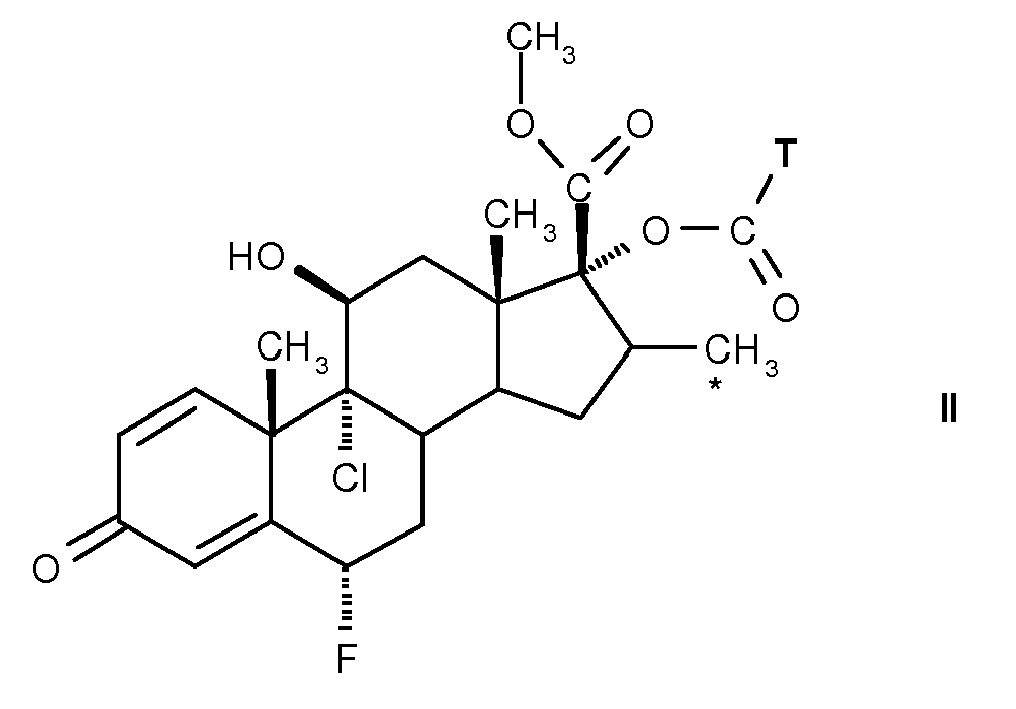
- Compounds of formula I are as defined in (Group II).
- Formoterol or a pharmaceutically acceptable salt thereof, as described in (Group III).
- Mometasone furoate is as defined in (Group III).
- Compounds of formula II are as defined in (Group III).
- Terms used in the specification have the following meanings:
- "Optionally substituted" means the group referred to can be substituted at one or more positions, e.g. 1, 2 or 3 positions, by any one or any combination of the radicals described.
- "C1-C8-alkyl" as used herein denotes straight chain or branched alkyl having 1 to 8 carbon atoms. Preferably, C1-C8-alkyl is C1-C4-alkyl.
- "C1-C8-alkylene" as used herein denotes straight chain or branched alkylene that contains 1 to 8 carbon atoms. Preferably, C1-C8-alkylene is C1-C4-alkylene.
- "C2-C8-alkenyl" as used herein denotes straight chain or branched hydrocarbon chains that contain two to eight carbon atoms and one or more carbon-carbon double bonds. Preferably "C2-C8-alkenyl" is "C2-C4-alkenyl".
- " C2-C10-alkynyl" as used herein denotes straight chain or branched hydrocarbon chains that contain two to ten carbon atoms and one or more carbon -carbon triple bonds. Preferably "C2-Cio-alkynyl" is "C3-C8-alkynyl".
- "C3-C15-Carbocyclic group", as used herein, denotes a carbocyclic group having 3- to 15-ring carbon atoms that is saturated or partially saturated, such as a C3-C8-cycloalkyl. Examples of C3-C15-Carbocyclic groups include but are not limited to cyclopropyl, cyclobutyl, cyclopentyl, cyclohexyl, cycloheptyl or cyclooctyl or a bicyclic group, such as bicyclooctyl, bicyclononyl including indanyl and indenyl, and bicyclodecyl.
- "C6-C15-aromatic carbocyclic group", as used herein, denotes an aromatic group having 6- to 15-ring carbon atoms. Examples of C6-C15-aromatic carbocyclic groups include but are not limited to phenyl, phenylene, benzenetriyl, naphthyl, naphthylene, naphthalenetriyl or anthrylene.
- " C3-C8-cycloalkyl" as used herein denotes cycloalkyl having 3 to 8 carbon atoms.
Preferably "C3-C8-cycloalkyl" is "C3-C6-cycloalkyl". - " C1-C8-haloalkyl" as used herein denotes C1-C8-alkyl as hereinbefore defined substituted by one or more halogen atoms, preferably one, two or three halogen atoms. Preferably "C1-C8-haloalkyl" is "C1-C4-haloalkyl".
- " C1-C8-alkylcarbonyl" as used herein denotes C1-C8-alkyl as hereinbefore defined linked to a carbonyl group. Preferably "C1-C8-alkylcarbonyl" is "C1-C4-alkylcarbonyl".
- "C1-C8-alkylthio" as used herein denotes C1-C8-alkyl as hereinbefore defined linked to -S-. Preferably "C1-C8-alkylthio" is "C1-C4-alkylthio".
- " C1-C8-alkylsulfonyl" as used herein denotes C1-C8-alkyl as hereinbefore defined linked to-SO2-. Preferably " C1-C8-alkylsulfonyl" is "C1-C4-alkylsulfonyl".
- "C1-C8-alkoxy" as used herein denotes straight chain or branched alkoxy having 1 to 8 carbon atoms. Preferably, C1-C8-alkoxy is C1-C4-alkoxy.
- "C1-C8-haloalkoxy" as used herein denotes C1-C8-alkoxy as hereinbefore defined substituted by one or more halogen atoms, preferably one, two or three halogen atoms. Preferably "C1-C8-haloalkoxy" is "C1-C4-haloalkoxy".
"di(C1-C8-alkyl)sulfamoyl" as used herein denotes -SO2-NH2 where the nitrogen atom is substituted at two positions by C1-C8-alkyl as hereinbefore defined, which may be the same or different. Preferably di(C1-C8-alkyl)sulfamoyl is -SO2-N(CH3)2 - "Halo" or "halogen" as used herein denotes a element belonging to group 17 (formerly group VII) of the Periodic Table of Elements, which may be, for example, fluorine, chlorine, bromine or iodine. Preferably halo or halogen is fluorine, chlorine or bromine.
- "Aminocarbonyl" as used herein denotes amino attached through the nitrogen atom to a carbonyl group.
- " 4- to 12-membered heterocyclic group containing at least one ring heteroatom selected from nitrogen, oxygen and sulphur" as used herein denotes a monoheterocyclic, biheterocyclic or triheterocyclic group, which may be saturated or unsaturated, that has 4 to 12 ring atoms. Monoheterocyclic groups include azetidinyl, tetrahydrofuranyl, furyl, pyrrolyl, pyrrolidinyl, pyrazolyl, imidazolyl, triazolyl, tetrazolyl, thienyl, thiazolyl, thiadiazolyl, isothiazolyl, oxadiazolyl, pyridinyl, oxazolyl, isoxazolyl, piperidinyl, pyridinyl, pyrazinyl, pyridazinyl, pyrimidinyl, piperazinyl, morpholinyl, triazinyl, oxazinyl, thiazolyl or tetrahydropyranyl. Biheterocyclic groups include thienothienyl, benzazolyl, benzothienyl, benzimidazolyl, benzodioxinyl, indazolyl, benzothiazolyl, imidazopyridinyl and naphthyridinyl. Preferred 4-to 12-membered heterocyclic groups in clude azetidinyl, tetrahydrofuranyl, furyl, pyrrolyl, pyrazolyl, triazolyl, thienyl, thiazolyl, thiadiazolyl, oxazolyl, isoxazolyl, tetrahydropyranyl, piperidinyl, pyridinyl, pyrazinyl, pyrimidinyl, thienothienyl, benzazolyl, benzothienyl, benzimidazolyl, benzodioxinyl, indazolyl and benzothiazolyl, imidazopyridinyl, naphthyridinyl. The 4- to 12-membered heterocyclic group can be unsubstituted or substituted at one or more positions, e.g. 1, 2 or 3 positions, by any one or any combination of substituents. Preferred substituents include halo (e.g. fluoro, chloro or bromo), cyano, oxo, hydroxy, carboxy, nitro, C1-C8-alkyl (e.g. methyl or ethyl), halo-C1-C8-alkyl (e.g. trifluoromethyl), C1-C8-alkylcarbonyl, di(C1C8-alkyl)sulfamoyl and C1-C8-alkoxy optionally substituted by aminocarbonyl.
Especially preferred substituents include halo, oxo, C1-C4-alkyl and C1-C4-alkylcarbonyl. - Throughout this specification and in the claims that follow, unless the context requires otherwise, the word "comprise", or variations such as "comprises" or "comprising", will be understood to imply the inclusion of a stated integer or step or group of integers or steps but not the exclusion of any other integer or step or group of integers or steps.
- Triple combinations comprising novel beta-2 adrenoceptor agonist s are described in patent applications
GB 0523655.9 GB 0523656.7 - It has now surprisingly been found that a significant unexpected therapeutic benefit, particularly a synergistic therapeutic benefit, in the treatment of inflammatory or obstructive airways diseases can be obtained by combination therapy using the compounds of (A), (B), and (C) of either (Group I), (Group II), (Group III) and (Group IV) respectively. For instance, it is possible using th ese combination therapies to reduce the dosages of one or more of the three active ingredients required for a given therapeutic effect considerably compared with those required using treatment with the active ingredients alone, thereby minimising possibly undesirable side effects. In particular, the amount of fluticasone propionate needed for a given anti-inflammatory effect may be significantly reduced when used in admixture with glycopyrronium bromide and salmeterol or a pharmaceutically acceptable salt form, or a compound of formula I and salmeterol or a pharmaceutically acceptable salt form, thereby reducing the risk of undesirable side effects from the repeated exposure to the steroid involved in the treatment of inflammatory or obstructive airways diseases.
- Similarly, the amount of mometasone furoate needed for a given-inflammatory effect may be significantly reduced when used in admixture with glycopyrronium bromide and salmeterol or a pharmaceutically acceptable salt form, or a compound of formula I and salmeterol or a pharmaceutically acceptable salt form, thereby reducing the risk of undesirable side effects from the repeated exposure to the steroid involved in the treatment of inflammatory or obstructive airways diseases.
- Furthermore, using the combination therapy of the invention, particularly using compositions containing glycopyrronium bromide, salmeterol or formoterol and fluticasone propionate, glycopyrronium bromide, salmeterol and budesonide, (R)-3-(2-Hydroxy-2,2-diphenyl-acetoxy)-1-(isoxazol-3-ylcarbamoyl-methyl)-1-azonia-bicyclo-[2.2.2]octanebromide (aquinuclidine), ((R)-3-((R)-2-cyclohexyl-2-hydroxy-2-phenylacetoxy)-1-(isoxazol-3-ylcarbamoylmethyl)-1-azoniabicyclo[2.2.2]octane or any of the examples in
WO 2004/096800 andWO 2006/048225 , salmeterolor formoterol and fluticasone propionate, or (R)-3-(2-Hydroxy-2,2-diphenyl-acetoxy)-1-(isoxazol-3-ylcarbamoyl-methyl)-1-azonia-bicyclo-[2.2.2]octane bromide (a quinuclidine), ((R)-3-((R)-2-cyclohexyl-2-hydroxy-2-phenylacetoxy)-1-(isoxazol-3-ylcarbamoylmethyl)-1-azoniabicyclo[2.2.2]octane or any of the examples inWO 2004/096800 andWO 2006/048225 , salmeterol and budesonide, or glycopyrronium bromide, sameterol or formoterol fumarate, and mometasone furoate, glycopyrronium bromide, salmeterol or formoterol fumarate, and 3 Methyl-thiophene-2-carboxylic acid (6S,9R,10S,11S,13S,16R, 17R)-9-chloro-6-fluoro-11-hydroxy-17-methoxycarbonyl-10,13,16-trimethyl-3-oxo-6,7,8,9,10,11,12,13,14,15,16,17-dodeca-hydro 3H-cyclopenta[a]phenanthren-17-yl ester or any of the examples inWO 02/00679 WO 2004/096800 andWO 2006/048225 , salmeterolor formoterol fumarate and mometasone furoate, or (R)-3-(2-Hydroxy-2,2-diphenyl-acetoxy)-1-(isoxazol-3 -ylcarbamoyl-methyl)-1-azonia-bicyclo-[2.2.2]octane bromide (a quinuclidine) or ((R)-3-((R)-2-cyclohexyl-2-hydroxy-2-phenylacetoxy)-1-(isoxazol-3 -ylcarbamoylmethyl)-1-azoniabicyclo[2.2.2]octane, formoterol fumarate and 3-Methyl-thiophene-2-carboxylic acid (6S,9R,10S,11S,13S,16R,17R)-9-chloro -6-fluoro-11-hydroxy-17-methoxycarbonyl-10,13,16-trimethyl-3-oxo-6,7,8,9,10,11,12,13,14,15,16,17-dodeca-hydro -3H-cyclopenta[a]phenanthren-17-yl ester or any of the examples inWO 02/00679 - Further examples of corticosteroid s that can be used in either of the combinations of (Group I) and (Group II) respectively can be selected from any described in
WO 02/100879 WO 2002012265 ,WO 2002012266 ,WO 2002088167
WO 03/035668 WO 03/048181 WO 03/062259 WO 03/064445 WO 03/072592 WO 2003042229 ,WO 2003042230 ,WO 2003048181 ,WO 2005005451 ,WO 2005005452 ,WO 2005028495 ,WO 2006072600 ,WO 2006072599 . In particular, the corticosteroids can be selected from

- In another aspect, the present invention provides a pharmaceutical composition comprising a mixture of effective amounts of (A), (B) and (C) of either (Group I), (Group II), (Group III), or (Group IV) respectively, as hereinbefore defined, optionally together with at least one pharmaceutically acceptable carrier.
- In a nother aspect, the present invention provides a method of treating an inflammatory or obstructive airways disease which comprises administering to a subject in need of such treatment effective amounts of (A), (B) and (C) of either (Group I), (Group II), (Group III), or (Group IV) respectively, as hereinbefore defined.
- The invention further provides the use of compounds (A), (B) and (C) of either (Group I), (Group II), (Group III), or (Group IV) respectively, as hereinbefore defined in the preparation of a medicament for combination therapy by simultaneous, sequential or separate administration of either (Group I), (Group II), (Group III), or (Group IV) respectively, in the treatment of an inflammatory or obstructive airways disease.
- Another aspect of the invention provides compounds of formula (I) of (Group II) and (Group IV),
where
R1 and R3 are each independently suitably a C6-C15-aromatic carbocyclic group or a 4- to 12-membered heterocyclic group having at least one ringheteroatom selected from nitrogen, oxygen and sulphur;
R2 is halo or hydroxyl;
R4 is C1-C8-alkyl substituted by -NHR5, -NR5-CO-R6, -NR5-CO-NH-R7, -NR5-SO2-R8, -CO-NR9R10, -O-CO-NH-R12, -O-CO-R13 or -CO-O-R14,
or R4 is C3-C8-alkynyl optionally substituted by a C3-C15-carbocyclic group, C6-C15-aromatic carbocyclic group, or a 4- to 12-membered heterocyclic group having at least one ring heteroatom selected from nitrogen, oxygen and sulphur;
R5 is hydrogen or C1-C4-alkyl;
R6 is C1-C4-alkyl, C2-C8-alkynyl or C1-C4-alkoxy in each case optionally substituted by a C3-C15-carbocyclic group, C6-C15-aromatic carbocyclic group, or a 4- to 12-membered heterocyclic group having at least one ring heteroatom selected from nitrogen, oxygen and sulphur,
or R6 is a C3-C15-carbocyclic group, C6-C15-aromatic carbocyclic group, or a 4- to 10-membered heterocyclic group having at least one ring heteroatom selected from nitrogen, oxygen and sulphur;
R7 is a C3-C15-carbocyclic group or C6-C15-aromatic carbocyclic group;
R8 is a C3-C15-carbocyclic group or C6-C15-aromatic carbocyclic group;
R9 is hydrogen or C1-C4-alkyl;
R10 is C1-C4-alkyl optionally substituted by cyano, C1C4-alkoxy, a C3-C15-carbocyclic group, C6-C15-aromatic carbocyclic group, or by a 4-to 12-membered heterocyclic group having at least one ring heteroatom selected from nitrogen, oxygen and sulphur,
or R10 is a C3-C15-carbocyclic group, C6-C15-aromatic carbocyclic group, or a 4- to 12-membered heterocyclic group having at least one ring heteroatom selected from nitrogen, oxygen and sulphur;
R12 is a C3-C15-carbocyclic group or C6-C15-aromatic carbocyclic;
R13 is C1-C4-alkyl; and
R14 is hydrogen, a C3-C15-carbocyclic group, C6-C15-aromatic carbocyclic group, or C1C4-alkyl optionally substituted by a C3-C15-carbocylic group or C6-C15-aromatic carbocyclic group. - According to compounds of formula (I) of (Group II) and (Group IV), R1 and R3 are each independently a C3-C15-carbocyclic group, C6-C15-aromatic carbocyclic group, or a 4-to 12-membered heterocyclic group having at least one ring heteroatom selected from nitrogen, oxygen and sulphur. Preferably, R1 is a C6-aromatic carbocyclic group such as phenyl and R3 is preferably either phenyl or a C6-carbocyclic group such as cyclohexyl.
- According to formula (I), R2 is suitably hydroxyl.
- According to formula (I), R4 is suitably C1-C8-alkyl substituted by -CO-NR9R10, where R9 is suitably hydrogen or C1-C4-alkyl. Preferably R9 is hydrogen.
R10 is suitably a 4- to 12-membered heterocyclic group having at least one ring heteroatom selected from nitrogen, oxygen and sulphur. Preferably R10 is an isoxazole group. More preferably R10 is a 3-linked isoxazole group. - In one aspect, the present invention provides a medicament comprising, separately or together, the compounds (A), (B) and (C) of either (Group I), (Group II), (Group III), or (Group IV) respectively, for simultaneous, sequential or separate administration in the treatment of an inflammatory or obstructive airways disease.
- Compounds of formula (I) in free or salt or solvate form act as muscarinic antagonists, particularly muscarinic M3 receptor antagonists, thereby inhibiting acetylcholine-induced contraction of smooth muscle in e.g. respiratory tract, digestive tract and urinary systems as described in
WO 2004/096800 andWO 2006/048225 . - Compounds of formula I in free or salt or solvate form may be prepared by using the procedures described in
WO 2004/096800 andWO 2006/048225 . - Compounds of formula (I) in free form may be converted into salt form, and vice versa, in a conventional manner. The compounds in free or salt form can be obtained in the form of hydrates or solvates containing a solvent used for crystallisation. Compounds of formula I can be recovered from reaction mixtures and purified in a conventional manner. Isomers, such as enantiomers, may be obtained in a conventional manner, e.g. by fractional crystallisation or asymmetric synthesis from correspondingly asymmetrically substituted, e.g. optically active, starting materials.
- Pharmaceutically acceptable salts of the compound of formula I may be acid addition salts, including those of inorganic acids, for example hydrohalic acids such as hydrofluoric acid, hydrochloric acid, hydrobromic acid or hydroiodic acid, nitric acid, sulfuric acid, phosphoric acid; and organic acids such as formic acid, acetic acid, propionic acid, butyric acid, benzoic acid, o-hydroxybenzoic acid, p-hydroxybenzoic acid, p-chlorobenzoic acid, diphenylacetic acid, triphenylacetic acid, 1-hydroxynaphthalene-2-carboxylic acid, 3-hydroxynaphthalene-2-carboxylic acid, aliphatic hydroxy acids such as lactic acid, citric acid, tartaric acid or malic acid, dicarboxylic acids such as fumaric acid, maleic acid or succinic acid, and sulfonic acids such as methanesulfonic acid, 4-methylbenzenesulfonic acid or benzenesulfonic acid. These salts may be prepared from compounds of formula I by known salt-forming procedures. Pharmaceutically acceptable solvates are generally hydrates.
- Glycopyrronium salts include glycopyrronium bromide, also known as glycopyrrolate, which is known to be an effective antimuscarinic agent. More specifically it inhibits acetyl choline binding to M3 muscarinic receptors thereby inhibiting bronchoconstriction.
- Glycopyrrolate is a quaternary ammonium salt. Suitable counter ions are pharmaceutically acceptable counter ions including, for example, fluoride, chloride, bromide, iodide, nitrate, sulfate, phosphate, formate, acetate, trifluoroacetate, propionate, butyrate, lactate, citrate, tartrate, malate, maleate, succinate, benzoate, p-chlorobenzoate, diphenyl-acetate or triphenylacetate, o-hydroxybenzoate, p-hydroxybenzoate, 1-hydroxynaphthalene-2-carboxylate, 3-hydroxynaphthalene-2-carboxylate, methanesulfonate and benzenesulfonate. Its bromide salt, namely 3-[(cyclopentyl-hydroxyphenylacetyl)oxy]-1,1-dimethylpyrrolidinium bromide, has the following structural formula

United States patent US 2956062 . - Glycopyrrolate has two stereogenic centres and hence exists in four isomeric forms, namely (3R,2'R)-, (3S,2'R)-, (3R,2'S)-and (3S,2'S)-3-[(cyclopentyl-hydroxyphenylacetyl)oxy]-1,1-dimethylpyrrolidinium bromide, as described in
United States patent specifications US 6307060 andUS 6,613,795 . The contents of these patent specifications are incorporated herein by reference. The present invention embraces using one or more of these isomeric forms, especially the 35,2'R isomer, the 3R,2'R isomer or the 3R,2'S isomer, thus including single enantiomers, mixtures of diastereomers, or racemates, especially (35,2'R/3R,2'S)-3-[(cyclopentyl-hydroxyphenylacetyl)oxy]-1,1-dimethylpyrrolidinium bromide. - Mometasone furoate, (11β,16α)-9,21-dichloro-17-[(2-furanylcarbonyl)oxy]-11-hydroxy-16-methylpregna-1, 4-diene-3,20-dione, alternatively designated 9α,21-dichloro-16α-methyl-1,4-pregnadiene-11β,17α-diol-3,20-dione 17-(2'-furoate), is a topical anti-inflammatory corticosteroid that has the following chemical structure:

- Mometasone furoate and its preparation are described in
US 4472393 . It use in the treatment of asthma is described inUS 5889015 . It use in the treatment of other respiratory diseases is described inUS 5889015 ,US 6057307 ,US 6057581 ,US 6677322 ,US 6677323 andUS 6365581 . - Compounds of formula II are disclosed, together with procedures for their preparation in
international patent application WO 02/00679 - In one embodiment, T is a heterocyclic aromatic group having a 5-membered heterocyclic ring with one, two or three ring hetero atoms selected from nitrogen, oxygen and sulfur, the heterocyclic ring being unsubstituted or substituted by one or two substituents selected from halogen, C1-C4-alkyl, halo-C1-C4-alkyl, C1-C4-alkoxy, C1-C4-alkyl-thio, cyano or hydroxy-C1-C4-alkyl and the heterocyclic ring being optionally fused to a benzene ring. Preferred such heterocyclic aromatic groups include those in which the heterocyclic ring has one nitrogen, oxygen or sulfur atom in the ring or one oxygen and one or two nitrogen atoms in the ring, or one sulfur and one or two nitrogen atoms in the ring, especially a pyrrole, furan, thiophene, oxazole, isoxazole, imidazole, pyrazole, furazan, thiazole or thiadiazole ring. Especially preferred heterocyclic aromatic groups are pyrrolyl, furyl and thienyl groups optionally substituted by one or two substituents selected from halogen (particularly chlorine or bromine), C1-C4-alkyl (particularly methyl or ethyl), halo-C1-C4-alkyl (particularly trifluoro-methyl), Ci-C4-alkoxy (particularly methoxy), C1-C4-alkylthio (particularly methylthio), cyano or hydroxy C1-C4-alkyl (particularly hydroxymethyl); isoxazolyl, imidazolyl, pyrazolyl, thiazolyl or thiadiazolyl groups optionally substituted by one or two C1-C4-alkyl groups; and benzofuryl, benzothienyl and benzofurazanyl groups.
- In another embodiment, T is a heterocyclic aromatic group having a 6-membered heterocyclic ring with one, two or three ring heteroatoms, preferably nitrogen, the heterocyclic ring being unsubstituted or substituted by one or more, preferably one, two or three, substituents selected from halogen, cyano, hydroxyl, C1-C4-acyloxy, amino, C1-C4-alkyl-amino, di-(C1-C4-alkyl)amino, C1-C4-alkyl, hydroxy-C1-C4-alkyl, halo-C1-C4-alkyl, C1-C4-alkoxy, or C1-C4-alkylthio, and the heterocyclic ring being optionally fused to a benzene ring. Preferred such heterocyclic aromatic groups include those in which the heterocyclic group has one or two nitrogen atoms in the ring, especially a pyridine, pyrimidine, pyrazine or pyridazine ring.
- Especially preferred heterocyclic aromatic groups are pyridyl, pyrimidinyl and pyrazinyl groups, optionally substituted by one or two substituents selected from halogen (particularly chlorine) or C1-C4-alkyl (especially methyl or n-butyl).
- In compounds of formula II, the indicated methyl group in the 16 position of the corticosteroid ring system may be in the alpha or beta conformation. 16-α-methyl compounds are preferred.
- Especially preferred compounds of formula II are those where the indicated 16-methyl group has the alpha conformation and T is 5-methyl-2-thienyl, N-methyl-2-pyrrolyl, cyclopropyl, 2-furyl, 3-methyl-2-furyl, 3-methyl-2-thienyl, 5-methyl-3-isoxazolyl, 3,5 climethyl-2-thienyl, 2,5-dimethyl-3-furyl, 4-methyl-2-furyl, 4-(dimethylamino)phenyl, 4-methylphenyl, 4-ethylphenyl, 2-pyridyl, 4 pyrimidyl or 5-methyl-2-pyrazinyl or the indicated 16-methyl group has the beta conformation and R is cyclopropyl.
- A particularly preferred compound of formula II is 3-methyl-thiophene-2-carboxylic acid (6S,9R,10S,11S,13S,16R,17R)-9-chloro-6-fluoro-11-hydroxy-17-methoxycarbonyl-10,13,16-trimethyl-3-oxo-6,7,8,9,10,11,12,13,14,15,16,17-dodecahydro-3H-cyclopenta-[a]phenanthren-17-yl ester, which has the formula

- Compounds of formula II in which T contains a basic group are capable of forming acid addition salts, particularly pharmaceutically acceptable acid addition salts. Pharmaceutically acceptable acid addition salts of the compound of formula I include those of inorganic acids, for example, hyd rohalic acids such as hydrofluoric acid, hydrochloric acid, hydrobromic acid or hydroiodic acid, nitric acid, sulfuric acid, phosphoric acid; and organic acids, for example aliphatic monocarboxylic acids such as formic acid, acetic acid, trifluoroacetic add, propionic acid and butyric acid, aliphatic hydroxy acids such as lactic acid, citric acid, tartaric acid or malic acid, dicarboxylic acids such as maleic acid or succinic acid, aromatic carboxylic acids such as benzoic acid, p-chlorobenzoic acid, diphenylacetic acid or triphenylacetic acid, aromatic hydroxy acids such as o-hydroxybenzoic acid, p-hydroxybenzoic acid, 1-hydroxynaphthalene-2-carboxylic acid or 3-hydroxynaphthalene-2-carboxylic acid, and sulfonic acids such as methanesulfonic acid or benzenesulfonic acid. These salts may be prepared from compounds of formula II by known salt-forming procedures.
- Administration of the medicament or pharmaceutical composition as hereinbefore described, i.e. with (A), (B) and (C) of either (Group I), (Group II), (Group III), or (Group IV) respectively, in admixture or separate, is preferably by inhalation, i.e. (A), (B) and (C) of either Group I, Group II, Group III, or Group IV respectively, or the mixture thereof are in inhalable form.
- The inhalable form of the medicament may be, for example, an atomizable composition such as an aerosol comprising the active ingredients, i.e. (A), (B) and (C) of either (Group I), (Group II), (Group III), or (Group IV) respectively, separately or in admixture, in solution or dispersion in a propellant, or a nebulisable composition comprising a solution or dispersion of the active ingredient in an aqueous, organic or aqueous/organic medium. For example, the inhalable form of the medicament may be an aerosol comprising a mixture of (A), (B) and (C) of either (Group I), (Group II), (Group III), or (Group IV) respectively, in solution or dispersion in a propellant, or a combination of an aerosol containing (A) and (B) of either (Group I), (Group II), (Group III), or (Group IV) respectively, in solution or dispersion in a propellant with an aerosol containing (C) of either (Group I), (Group II), (Group III), or (Group IV) respectively, in solution or dispersion in a propellant. In another example, the inhalable form is a nebulizable composition comprising a dispersion of (A), (B) and (C) of either (Group I), (Group II), (Group III), or (Group IV) respectively, in an aqueous, organic or aqueous/organic medium, or a combination of a dispersion of (A) of either (Group I), (Group II), (Group III), or (Group IV) respectively, in such a medium with a dispersion of (B) of either (Group I), (Group II), (Group III), or (Group IV) respectively, in such a medium and a dispersion of (C)of either (Group I), (Group II), (Group III), or (Group IV) respectively, in such a medium.
- An aerosol composition suitable for use as the inhalable form of the medicament may comprise the active ingredient in solution or dispersion in a propellant, which may be chosen from any of the propellants known in the art. Suitable such propellants include hydrocarbons such as n-propane, n-butane or isobutane or mixtures of two or more such hydrocarbons, and halogen-substituted hydrocarbons, for example chlorine and/or fluorine-substituted methanes, ethanes, propanes, butanes, cyclopropanes or cyclobutanes, such as dichlorodifluoromethane (CFC-12), trichlorofluoromethane (CFC-11), 1,2-dichloro -1,1,2,2 -tetrafluoroethane (CFC-114) or, particularly, 1,1,1,2-tetrafluoroethane (HFA-134a), 1,1,1,2,3,3,3 -heptafluoropropane (HFA-227), difluorochloromethane (HCFC-22) or mixtures of two or more such halogen -substituted hydrocarbons.
- Where the active ingredient is present in suspension in the propellant, i.e. where it is present in particulate form dispersed in the propellant, the aerosol composition may also contain a lubricant and a surfactant, which may be chosen from those lubricants and surfactants known in the art. Other suitable aerosol compositions include surfactant-free or substantially surfactant-free aerosol compositions. The aerosol composition may contain up to about 5% by weight, for example 0.0001 to 5 % , 0.001 to 5 % , 0.001 to 3 % , 0.001 to 2% , 0.001 to 1 % , 0.001 to 0.1 % , or 0.001 to 0.01 % , but preferably 0.01 to 0.5 % by weight of the active ingredient, based on the weight of the propellant. Where present, the lubricant and surfactant may be in an amount up to 5% and 0.5 % respectively by weight of the aerosol composition. The aerosol composition may also contain a co -solvent such as ethanol in an amount up to 30% by weight of the composition, particularly for administration from a pressurised metered dose inhalation device. The aerosol composition may further contain a bulking agent, for example a sugar such as lactose, sucrose, dextrose, mannitol or sorbitol, in an amount, for example, of up to 20% , usually 0.001 to 1 % , by weight of the composition.
- In another embodiment of the invention, the inhalable form of the medicament is a dry powder, i.e. (A), (B) and (C)of either (Group I), (Group II), (Group III), or (Group IV) respectively, are present in a dry powder comprising finely divided (A), (B) and (C) of either (Group I), (Group II), (Group III), or (Group IV) respectively, optionally together with at least one particulate pharmaceutically acceptable carrier, which maybe one or more materials known as pharmaceutically acceptable carriers, preferably chosen from materials known as carriers in dry powder inhalation compositions, for example saccharides, including monosaccharides, disaccharides, polysaccharides and sugar alcohols such as arabinose, glucose, fructose, ribose, mannose, sucrose, trehalose, lactose, maltose, starches, dextran, mannitol or sorbitol. An especially preferred carrier is lactose, for example lactose monohydrate or anhydrous lactose. The dry powder may be contained as unit doses in capsules of, for example, gelatin or plastic, or in blisters (e.g. of aluminium or plastic), for use in a dry powder inhalation device, which may be a single dose or multiple dose device, preferably in dosage units of (A), (B) and/or (C) of either (Group I), (Group II), (Group III), or (Group IV) respectively, together with the carrier in amounts to bring the total weight of powder per capsule or suitable pre-metered dose unit such as blister to from 5 mg to 50 mg. Alternatively, the dry powder may be contained in a reservoir in a multi-dose dry powder inhalation (MDDPI) device adapted to deliver, for example, 1-25 mg of dry powder per actuation.
- In the finely divided particulate form of the medicament, and in the aerosol composition where at least one of the active ingredients are present in particulate form, the active ingredient may have an average particle diameter of up to about 10 µm, for example 0.1 to 5 µm, preferably 1 to 5 µm. The particulate carrier, where present, generally has a maximum particle diameter up to 5 00 µm, preferably up to 400 µm, and conveniently has a mean particle diameter of 40 to 300 µm, e.g. 50 to 250 µm. The particle size of the active ingredient, and that of a particulate carrier where present in dry powder compositions, can be reduced to the desired level by conventional methods, for example by grinding in an air-jet mill, ball mill or vibrator mill, sieving, microprecipitation, spray-drying, lyophilisation or controlled crystallisation from conventional solvents or from supercritical media.
- The inhalable medicament may be administered using an inhalation device suitable for the inhalable form, such devices being well known in the art. Accordingly, the invention also provides a pharmaceutical product comprising a medicament or pharmaceutical composition as hereinbefore described in inhalable form as hereinbefore described in association with one or more inhalation devices. In a further aspect, the invention provides an inhalation device, or a pack of two or more inhalation devices, containing a medicament or pharmaceutical composition as hereinbefore described in inhalable form as hereinbefore described.
- Where the inhalable form of the active ingredient is an aerosol composition, the inhalation device may be an aerosol vial provided with a valve adapted to deliver a metered dose, such as 10 to 100 µl, e.g. 25 to 50 µl, of the composition, i.e. a device known as a metered dose inhaler. Suitable such aerosol vials and procedures for containing within them aerosol compositions under pressure are well known to those skilled in the art of inhalation therapy. For example, an aerosol composition may be administered from a coated can, for example as described in
EP-A-0642992 .
Where the inhalable form of the active ingredient is a nebulizable aqueous, organic or aqueous/organic dispersion, the inhalation device may be a known nebulizer, for example a conventional pneumatic nebulizer such as an airjet nebulizer, or an ultrasonic nebulizer, which may contain, for example, from 1 to 50 ml, commonly 1 to 10 ml, of the dispersion; or a handheld nebulizer, sometimes referred to as a soft mist or soft spray inhaler, for example an electronically controlled device such as an AERx (Aradigm, US) or Aerodose (Aerogen), or a mechanical device such as a RESPIMAT (Boehringer Ingelheim) nebulizer which allows much smaller nebulised volumes, e.g. 10 to 100 µl, than conventional nebulisers. - Where the inhalable form of the active ingredient is the finely divided particulate form, the inhalation device may be, for example, a dry powder inhalation device adapted to deliver dry powder from a capsule or blister containing a dry powder comprising a dosage unit of (A) and/or (B) of either (Group I), (Group II), (Group III), or (Group IV), respectively, or a multi-dose dry powder inhalation (MDDPI) device adapted to deliver, for example, 3-25 mg of dry powder comprising a dosage unit of (A) and/or (B) of either (Group I), (Group II), (Group III), or (Group IV) respectively, per actuation. The dry powder composition preferably contains a diluent or carrier, such as lactose, and a compound that helps to protect against product performance deterioration due to moisture and / or improve physical properties (such as flow, dispersion) of the dry powder, e.g. magnesium stearate, typically 0.05-2.0% . Suitable such dry powder inhalation devices are well known. For example, a suitable device for delivery of dry powder in encapsulated form is that described in
US 3991761 , while suitable MDD PI devices include those described inWO 97/20589 WO 97/30743 WO 05/37353 - The medicament of the invention is preferably a pharmaceutical composition comprising a mixture of (A) as hereinbefore defined, (B) as hereinbefore defined, and (C) as hereinbefore defined of either (Group I), (Group II), (Group III), or (Group IV) respectively, preferably together with at least one pharmaceutically acceptable carrier as hereinbefore described.
- A suitable daily dose of the compound (A) of either (Group I), (Group II), (Group III), or (Group IV) respectively, for inhalation may be from 20µg to 2000 µg, for example from 20 to 1500 µg, from 20 to 1000 µg, preferably from 50 to 800 µg, e.g. from 100 to 600 µg or from 100 to 500 µg.
- A suitable daily dose of the compound (B) of either (Group I), (Group II), (Group III), or (Group IV) respectively, for inhalation may be from 10µg to 2000 µg, preferably from 20 to 1000 µg, and especially from 20 to 800 µg, e.g. from 100 to 500 µg.
- A suitable daily dose of the compound (C), of either (Group I), (Group II), (Group III), or (Group IV) respectively, for inhalation may be from 50 to 2000 µg, for example from 100 to 2000 µg, from 100 to 1600 µg, from 100 to 1000 µg, or from 100 to 800 µg, preferably from 200 to 500 µg, for instance from 200 to 400 µg.
- A suitable unit dose of the compound (A), of either (Group I), (Group II), (Group III), or (Group IV) respectively, for inhalation may be from 10µg to 2000 µg, preferably from 20 to 1000 µg, and especially from 20 to 800 µg, e.g. from 100 to 500 µg.
- A suitable unit dose of the compound (B), of either (Group I), (Group II), (Group III), or (Group IV) respectively, for inhalation may be from 20 µg to 2000 µg, for example from 20 to 1500 µg, from 20 to 1000 µg, preferably from 50 to 800 µg, e.g. from 100 to 600 µg or from 100 to 500 µg.
- A suitable unit dose of the compound (C), of either (Group I), (Group II), (Group III), or (Group IV) respectively, for inhalation may be from 50 to 2000 µg, for example from 100 to 2000 µg, from 100 to 1 600 µg, from 100 to 1000 µg, or from 100 to 800 µg, preferably from 200 to 500 µg, for instance from 200 to 400 µg.
- These unit doses may be administered once or twice daily in accordance with the daily doses mentioned hereinbefore. A single dose is preferred as this is convenient for the patient and encourages compliance. The precise doses of (A), (B) and (C)of either (Group I), (Group II), (Group III), or (Group IV) respectivelyused will of course depend on the condition to be treated, the patient, the formulation and the efficiency of the inhalation device.
- In one preferred embodiment of the invention, the medicament of the invention is a pharmaceutical composition which is a dry powder in a capsule containing unit doses of (A), (B) and (C) of either (Group I), (Group II), (Group III), or (Group IV) respectively, for example for inhalation from a single capsule inhaler, the capsule suitably containing a unit dose of (A) e.g. as hereinbefore described, a unit dose of (B), e.g. as herein before described, and a unit dose of (C), e.g. as hereinbefore described, of either (Group I), (Group II), (Group III), or (Group IV) respectively, together with a pharmaceutically acceptable carrier as hereinbefore described in an amount to bring the total weight of dry powder per capsule to between 5 mg and 50 mg, for example 5 mg, 10 mg, 15 mg, 20 mg, 25 mg, 30 mg, 35 mg, 40 mg, 45 mg or 50 mg.
- In another preferred embodiment of the invention, the medicament of the invention is a pharmaceutical composition which is a dry powder for administration from a reservoir of a multi-dose dry powder inhaler adapted to deliver, for example, 3 mg to 25 mg of powder containing a unit dose of (A), (B) and (C) of either (Group I), (Group II), (Group III), or (Group IV) respectively, per actuation.
- In a further preferred embodiment of the invention, the medicament of the invention is a pharmaceutical composition which is an aerosol comprising (A), (B) and (C) of either (Group I), (Group II), (Group III), or (Group IV)respectively, as hereinbefore described in a propellant as hereinbefore described, optionally together with a surfactant and/or a bulking agent and/or a co-solvent such as ethanol as hereinbefore described, for administration from a metered dose inhaler adapted to deliver an amount of aerosol containing a unit dose of (A), a unit dose of (B), a unit dose of (C), of either (Group I), (Group II), (Group III), or (Group IV) respectively, or a known fraction of a unit dose of (A), a known fraction of a unit dose of (B), and a known fraction of a unit dose of (C) per actuation of either (Group I), (Group II), (Group III), or (Group IV) respectively. Thus if, for example, the inhaler delivers half of the unit doses of (A), (B) and (C) of either (Group I), (Group II), (Group III), or (Group IV), respectively per actuation, the unit doses can be administered by two actuations of the inhaler.
- In accordance with the above, the invention also provides a pharmaceutical kit comprising (A), (B) and (C) of either (Group I), (Group II), (Group III), or (Group IV) respectively, as hereinbefore defined in separate unit dosage forms, said forms being suitable for administration of (A), (B) and (C) of either (Group I), (Group II), (Group III), or (Group IV) respectively, in effective amounts. Such a kit suitably further comprises one or more inhalation devices for administration of (A), (B) and (C) of either (Group I), (Group II), (Group III), or (Group IV) respectively. For example, the kit may comprise one or more dry powder inhalation devices adapted to deliver dry powder from a capsule, together with capsules containing a dry powder comprising a dosage unit of (A), capsules containing a dry powder comprising a dosage unit of (B) and capsules containing a dry powder comprising a dosage unit of (C) of either (Group I), (Group II), (Group III), or (Group IV) respectively. In another example, the kit may comprise a multi-dose dry powder inhalation device containing in the reservoir thereof a dry powder comprising (A), a multi-do se dry powder inhalation device containing in the reservoir thereof a dry powder comprising (B) and a multi-dose dry powder inhalation device containing in the reservoir thereof a dry powder comprising (C)of either (Group I), (Group II), (Group III), or (Group IV) respectively. In another example, the kit may comprise a multi-dose dry powder inhalation device containing in the reservoir thereof a dry powder comprising (B) and a multi-dose dry powder inhalation device containing in the reservoir thereof a dry powder comprising a mixture of (A) and (C) of either (Group I), (Group II), (Group III), or (Group IV) respectively. In a yet further example, the kit may comprise a metered dose inhaler containing an aerosol comprising (A) in a propellant, a metered dose inhaler containing an aerosol comprising (B) in a propellant, and a metered dose inhaler containing an aerosol comprising (C) in a propellant of either (Group I), (Group II), (Group III), or (Group IV) respectively.
- Medicaments of the invention are advantageous in the treatment of inflammatory or obstructive airways disease, exhibiting highly effective bronchodilatory and anti-inflammatory properties. For instance, it is possible using the combination therapy of the invention to reduce the dosages of corticosteroid required for a given therapeutic effect compared with those required using treatment with a corticosteroid alone, thereby minimising possibly undesirable side effects. In particular, these combinations, particularly where (A), (B) and (C) of either (Group I), (Group II), (Group III), or (Group IV) respectively, are in the same composition, facilitate achievement of a high anti-inflammatory effect, such that the amount of corticosteroid needed for a given anti-inflammatory effect may be reduced when used in admixture with (A) and (B) of either (Group I), (Group II), (Group III), or (Group IV) respectively, thereby reducing the risk of undesirable side effects from the repeated exposure to the steroid involved in the treatment of inflammatory orobstructive airways diseases. Furthermore, using the combinations of the invention, particularly using compositions containing (A), (B) and (C) of either (Group I), (Group II), (Group III), or (Group IV) respectively, medicaments which have a rapid onset of action and a long duration of action may be prepared. Moreover, using such combination therapy, medicaments which result in a significant improvement in lung function may be prepared. In another aspect, using the combination therapy of the invention, medicaments which provide effective control of obstructive or inflammatory airways diseases, or a reduction in exacerbations of such diseases, may be prepared. In a further aspect, using compositions of the invention containing (A), (B) and (C) of either (Group I), (Group II), (Group III), or (Group IV) respectively, medicaments which reduce or eliminate the need for treatment with short-acting rescue medicaments such as salbutamol or terbutaline, may be prepared; thus compositions of the invention containing (A), (B) and (C) of either (Group I), (Group II), (Group III), or (Group IV) respectively, facilitate the treatment of an obstructive or inflammatory airways disease with a single medicament.
- Treatment of inflammatory or obstructive airways diseases in accordance with the invention may be symptomatic or prophylactic treatment. Inflammatory or obstructive airways diseases to which the present invention is applicable include asthma of whatever type or genesis including both intrinsic (non-allergic) asthma and extrinsic (allergic) asthma, mild asthma, moderate asthma, severe asthma, bronchitic asthma, exercise-induced asthma, occupational asthma and asthma induced following bacterial infection. Treatment of asthma is also to be understood as embracing treatment of subjects, e.g. of less than 4 or 5 years of age, exhibiting wheezing symptoms and diagnosed or diagnosable as "wheezy infants", an established patient category of major medical concern and now often identified as incipient or early-phase asthmatics. (For convenience this particular asthmatic condition is referred to as "wheezy-infant syndrome".)
- Prophylactic efficacy in the treatment of asthma will be evidenced by reduced frequency or severity of symptomatic attack, e.g. of acute asthmatic or bronchoconstrictor attack, improvement in lung function or improved airways hyperreactivity. It may further be evidenced by reduced requirement for other, symptomatic therapy, i.e. therapy for or intended to restrict or abort symptomatic attack when it occurs, for example anti-inflammatory (e.g. corticosteroid) or bronchodilatory. Prophylactic benefit in asthma may in particular be apparent in subjects prone to "morning dipping". "Morning dipping" is a recognised asthmatic syndrome, common to a substantial percentage of asthmatics and characterised by asthma attack, e.g. between the hours of about 4 to 6 am, i.e. at a time normally substantially distant form any previously administered symptomatic asthma therapy.
- Other inflammatory or obstructive airways diseases and conditions to which the present invention is applicable include acute lung injury (ALI), adult or acute respiratory distress syndrome (ARDS), chronic obstructive pulmonary, airways or lung disease (COPD, CO AD or COLD), including chronic bronchitis and emphysema, bronchiectasis and exacerbation of airways hyperreactivity consequent to other drug therapy, in particular other inhaled drug therapy. Further inflammatory or obstructive airways diseases to which the present invention is applicable include pneumoconiosis (an inflammatory, commonly occupational, disease of the lungs, frequently accompanied by airways obstruction, whether chronic or acute, and occasioned by repeated inhalation of dusts) of whatever type or genesis, including, for example, aluminosis, anthracosis, asbestosis, chalicosis, ptilosis, siderosis, silicosis, tobacosis and byssinosis.
- The invention is illustrated by the following Examples.
- (R)-3-(2-Hydroxy-2,2-diphenyl-acetoxy)-1-(isoxazol-3-ylcarbamoyl-methyl)-1-azonia-bicyclo-[2.2.2]octane bromide (a quinuclidine) or ((R)-3-((R)-2-cyclohexyl-2-hydroxy-2-phenylacetoxy)-1-(isoxazol-3-ylcarbamoylmethyl)-1-azoniabicyclo[2.2.2]octane as described or is prepared using the procedures described in
WO 2004/096800 andWO 2006/048225 . - Formoterol fumarate dihydrate as described in
U.S. Pat. No. 3,994,974 orU.S. Pat. No. 5,684,199 . - This compound is prepared using the procedures described in
US 4472393 . - Gelatin capsules suitable for use in a capsule inhaler such as that described in
US 3991761 andEP 1270034 are prepared, each capsule containing a dry powder obtained by mixing Compound A1, Compound B1 and Compound C1, which have been milled to a mean particle diameter of 1 to 5 µm and lactose monohydrate having a particle diameter below 300 µm, the amounts being as shown in the Table 1 below:TABLE 1 Example Compound A1 (Parts) Compound B1 (Parts) Compound C1 (Parts) Lactose (Parts) 1 50 10 20 19930 2 50 10 40 199100 3 50 10 80 19860 4 50 10 100 19840 5 50 10 120 19820 6 50 10 140 19800 7 50 10 160 19780 8 50 10 180 19760 9 50 10 200 19740 10 50 10 220 19720 11 50 10 240 19700 12 50 10 300 19640 13 50 10 500 19440 14 50 10 1000 18940 15 50 10 20 24920 16 50 10 40 24900 17 50 10 80 24860 18 50 10 100 24840 19 50 10 120 24820 20 50 10 140 24800 21 50 10 160 24780 22 50 10 180 24760 23 50 10 200 24740 24 50 10 220 24720 25 50 10 240 24700 26 50 10 300 24640 27 50 10 500 24440 28 50 10 1000 23940 29 100 10 20 14870 30 100 10 40 14850 31 100 10 80 14810 32 100 10 100 14790 33 100 10 120 14770 34 100 10 140 14750 35 100 10 160 14730 36 100 10 180 14710 37 100 10 200 14690 38 100 10 220 14670 39 100 10 240 14650 40 100 10 300 14590 41 100 10 500 14390 42 100 10 1000 13890 43 100 10 20 24870 44 100 10 40 24850 45 100 10 80 24890 46 100 10 100 24790 47 100 10 120 24770 48 100 10 140 24750 49 100 10 160 24730 50 100 10 180 24710 51 100 10 200 24690 52 100 10 220 24670 53 100 10 240 24650 54 100 10 300 24590 55 100 10 500 24390 56 100 10 1000 23890 - A dry powder suitable for delivery from the reservoir of the multi-dose dry powder inhaler described in
WO 97/20589 TABLE 2 Example Compound A1 (Parts) Compound B1 (Parts) Compound C1 (Parts) Lactose (Parts) 57 50 10 20 4920 58 50 10 40 4900 59 50 10 80 4860 60 50 10 100 4840 61 50 10 120 4820 62 50 10 140 4800 63 50 10 160 4780 64 50 10 180 4760 65 50 10 200 4740 66 50 10 220 4720 67 50 10 240 4700 68 50 10 300 4640 69 50 10 500 4440 70 50 10 1000 3940 71 100 10 20 9870 72 100 10 40 9850 73 100 10 80 9810 74 100 10 100 9790 75 100 10 120 9770 76 100 10 140 9750 77 100 10 160 9730 78 100 10 180 9710 79 100 10 200 9690 80 100 10 220 9670 81 100 10 240 9650 82 100 10 300 9590 83 100 10 500 9390 84 100 10 1000 8890 85 150 10 20 14820 86 150 10 40 14800 87 150 10 80 14760 88 150 10 100 14740 89 150 10 120 14720 90 150 10 140 14700 91 150 10 160 14680 92 150 10 180 14660 93 150 10 200 14640 94 150 10 220 14620 95 150 10 240 14600 96 150 10 300 14540 97 150 10 500 14340 98 150 10 1000 13840 - A dry powder suitable for delivery from the pre-metered dose unit or blister of the multi-dose dry powder inhaler described in
WO 05/37353 TABLE 3 Example Compound A1 (Parts) Compound B1 (Parts) Compound C1 (Parts) Lactose (Parts) 99 100 10 50 9840 100 100 10 100 9790 101 100 10 150 9740 102 100 10 200 9690 103 100 10 250 9640 104 100 10 300 9590 105 100 10 350 9540 106 100 20 50 9830 107 100 20 100 9780 108 100 20 150 9730 109 100 20 200 9680 110 100 20 250 9630 111 100 20 300 9580 112 100 20 350 9530 113 150 10 50 14790 114 150 10 100 14740 115 150 10 200 14640 116 150 10 400 14440 117 150 10 600 14240 118 150 10 800 14040 119 150 10 1000 13840 120 150 20 50 14780 121 150 20 100 14730 122 150 20 200 14630 123 150 20 400 14430 124 150 20 600 14230 125 150 20 800 14030 126 150 20 1000 13830 - A dry powder suitable for delivery from the reservoir of the multi-dose dry powder inhaler described in
WO 97/20589 - A dry powder suitable for delivery from the reservoir of the multi-dose inhaler described in
W0 97/205 89 - Aero sol formulations are prepared by dispensing micronised active ingredients, Compound A1, Compound B1 and Compound C1, and if required, lactose as bulking agent into a vial, sealing the vial with a metering valve, injecting the premixed ethanol/propellant and optional surfactant into the vial through the valve and subjecting the vial to ultrasonic energy to disperse the solid particles. The components and amounts used are shown in Table 4 below, where OA means oleic acid:
TABLE 4 Ex. Cpd.A1 (Parts) Cpd.B1 (Parts) Cpd.C1 (Parts) HFA134a (Parts) HFA227 (Parts) Ethanol (Parts) OA (Parts) Lactose (Parts) 202 50 2 100 36500 60750 2500 - 70 203 50 2 100 97000 - 2500 - 90 204 50 2 100 30500 67000 2500 0.5 100 205 20 2 100 98000 - 2500 1 - 206 20 2 100 - 98000 2000 1 - 207 20 2 100 30000 67000 2250 0.2 90 208 20 2 100 30000 60000 2000 0.8 - 209 20 2 100 30000 67000 2250 0.2 90 210 20 2 50 - 98000 2000 1 -
Claims (30)
- A medicament comprising, separately or together(A) a glycopyrronium salt;(B) a beta-2 adrenoceptor agonist selected from salmeterol and formoterol, or pharmaceutically acceptable salts thereof; and(C) a corticosteroid selected from fluticasone propionate, 4-Methyl-thiazole-5-carboxylic acid (6S,9R,10S,11S,13S,16R,17R)-6,9-difluoro-17fluoromethylsulfanylcarbonyl-11-hydroxy-10,13,16-trimethyl-3-oxo-6,7,8,9,10,11,12,13,14,15,16,17-dodecahydro-3H-cyclopenta[a]phenanthren-17-yl ester, Furan-2-carboxylic acid (6S,9R,10S,11S,13S,16R,17R)-6,9-difluoro-17-fluoromethylsulfanylcarbonyl-11-hydroxy-10,13,16-trimethyl-3-oxo-6,7,8,9,10,11,12,13,14,15,16,17-dodecahydro-3H-cyclopenta[a]phenanthren-17-yl ester, and budesonide;for simultaneous, sequential or separate administration in the treatment of an inflammatory or obstructive airways disease.
- A medicament comprising, separately or together(A) compounds of formula I
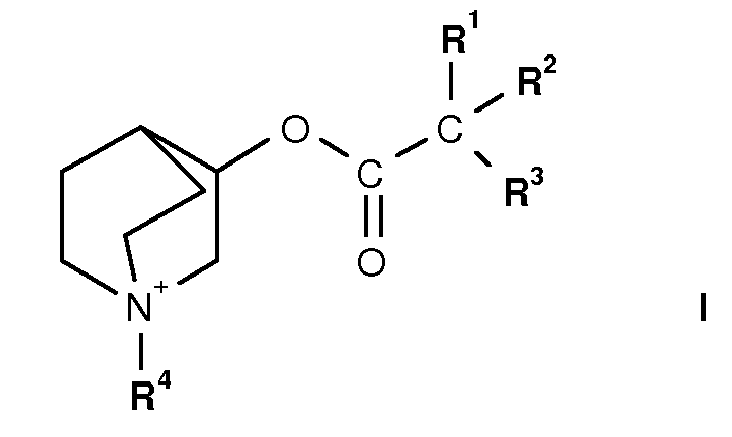
R1 and R3 are each independently a C3-C15-carbocyclic group, C6-C15-aromatic carbocyclic group, or a 4- to 12-membered heterocyclic group having at least one ring heteroatom selected from nitrogen, oxygen and sulphur,
or -CR1R2R3 together form a group of formula
R2 is h ydrogen, halo, hydroxy, C1-C8-alkoxy or C1-C8-alkyl optionally substituted by hydroxy; R4 is C1-C8-alkyl substituted by NHR5, -NR5-CO-R6, -NR5-CO-NH-R7, -NR5-SO2-R8 , -CO-NR9R10, -OR11, -O-CO-NHR12, -O-CO-R13 or -CO-O-R14,
or R4 is C3-C10-alkynyl optionally substituted by a C3-C15-carbocyclic group, C6-C15-aromatic carbocyclic group, or a 4- to 12-membered heterocyclic group having at least one ring heteroatom selected from nitrogen, oxygen and sulphur;
R5 is hydrogen or C1C8-alkyl;
R6 is C1-C8-alkyl, C2-C8-alkenyl, C2-C10-alkynyl or C1C8-alkoxy in each case optionally substituted by a C3-C15-carbocyclic group, C6-C15-aromatic carbocyclic group, or a 4- to 12-membered heterocyclic group having at least one ring heteroatom selected from nitrogen, oxygen and sulphur,
or R6 is a C3-C15 is-carbocyclic group, C6-C15-aromatic carbocyclic group, or a 4- to 12-membered heterocyclic group having at least one ring heteroatom selected from nitrogen, oxygen and sulphur;
R7 is a C3-C15-carbocyclic group or C6-C15-aromatic carbocyclic group;
R8 is a C3-C15-carbocyclic group or C6-C15-aromatic carbocyclic group;
R9 is hydrogen or C1C8-alkyl;
R10 is hydrogen, C1-C8-alkyl optionally substituted by cyano, amino, nitro, carboxy, C1-C8-alkoxy, a C3-C15-carbocyclic group, C6-C15-aromatic carbocyclic group, or by a 4- to 12-membered heterocyclic group having at least one ring heteroatom selected from nitrogen, oxygen and sulphur,
or R10 is a C3-C15-carbocyclic group, C6-C15-aromatic carbocyclic group, or a 4- to 12-membered heterocyclic group having at least one ring heteroatom selected from nitrogen, oxygen and sulphur;
R11 is hydrogen, C1-C8-alkyl, C1-C8-alkyl-C1-C8-alkoxy or C1-C8-alkyl-O-R15;
R12 is a C3-C15-carbocyclic group or C6-C15-aromatic carbocyclic group;
R13 is C1-C8-alkyl or a C3-C15-carbocyclic group or C6-C15-aromatic carbocyclic group;
R14 is hydrogen, a C3-C15-carbocyclic group, C6-C15-aromatic carbocyclic group, C1-C8-alkenyl, or C1-C8- alkyl optionally substituted by a C3-C15-carbocyclic group or C6-C15-aromatic carbocyclic group;
R15 is a C3-C15-carbocyclic group or C6-C15-aromatic carbocyclic group; and
where each C3-C15-carbocyclic group is optionally substituted by halo (e.g. fluoro, chloro or bromo), cyano, hydroxy, amino, nitro, carboxy, C1-C8-alkyl (e.g. methyl or ethyl), halo-C1-C8-alkyl, C1-C8-alkoxy, C1-C8-alkylcarbonyl, C1-C8-alkylsulfonyl, -SO2NH2, a C3-C15-carbocyclic group and a 4- to 12-membered heterocyclic group having at least one ring heteroatom selected from nitrogen, oxygen and sulphur and each C6-C15-aromatic carbocyclic group is optionally substituted by halo (e.g. fluoro, chloro or bromo), cyano, hydroxy, amino, nitro, carboxy, C1-C8-alkyl (e.g. methyl or ethyl), halo-C1-C8-alkyl, C1-C8-alkoxy, C1C8-alkylcarbonyl, C1-C8-alkylsulfonyl, -SO2NH2, a C3-C15-carbocyclic group and a 4-to 12-membered heterocyclic group having at least one ring heteroatom selected from nitrogen, oxygen and sulphur;(B) a beta-2 adrenoceptor agonist selected from salmeterol and formoterol, or pharmaceutically acceptable salts thereof; and(C) a corticosteroid selected from fluticasone propionate, 4-Methyl-thiazole-5-carboxylic acid (6S,9R,10S,11S,13S,16R,17R)-6,9-difluoro-17fluoromethylsulfanylcarbonyl-11-hydroxy-10,13,16-trimethyl-3-oxo-6,7,8,9,10,11,12,13,14,15,16,17-dodecahydro-3H-cyclopenta[a]phenanthren-17-yl ester,Furan-2-carboxylic acid (6S,9R,10S,11S,13S,16R,17R)-6,9-difluoro-17-fluoromethylsulfanylcarbonyl-11-hydroxy-10,13,16-trimethyl-3-oxo-6,7,8,9,10,11,12,13,14,15,16,17-dodecahydro-3H-cyclopenta[a]phenanthren-17-yl ester, and budesonide;for simultaneous, sequential or separate administration in the treatment of an inflammatory or obstructive airways disease. - A medicament comprising, separately or together(A) a glycopyrronium salt;(B) a beta-2 adrenoceptor agonist selected from salmeterol and formoterol, or pharmaceutically acceptable salts thereof; and(C) a corticosteroid selected from mometasone furoate and a compound of formula IIfor simultaneous, sequential or separate administration in the treatment of an inflammatory or obstructive airways disease.

- A medicament comprising, separately or together(A) compounds of formula I

R1 and R3 are each independently a C3-C15-carbocyclic group, C6-C15-aromatic carbocyclic group, or a 4- to 12 -membered heterocyclic group having at least one ring heteroatom selected from nitrogen, oxygen and sulphur,
or -CR1R2R3 together form a group of formula
R2 is hydrogen, halo, hydroxy, C1-C8-alkoxy or C1-C8-alkyl optionally substituted by hydroxy; R4 is C1C8-alkyl substituted by NHR5, -NR5-CO-R6, -NR5-CO-NH-R7, -NR5-SO2-R8 -CO-NR9R10, -OR11, -O-CO-NHR12, -O-CO-R13 or -CO-O-R14,
or R4is C3-C10-alkynyl optionally substituted by a C3-C15-carbocyclic group, C6-C15-aromatic carbocyclic group, or a 4- to 12-membered heterocyclic group having at least one ring heteroatom selected from nitrogen, oxygen and sulphur;
R5 is hydrogen or C1C8-alkyl;
R6 is C1-C8-alkyl, C2-C8-alkenyl, C2C10-alkynyl or C1-C8-alkoxy in each case optionally substituted by a C3-C15-carbocyclic group, C6-C15-aromatic carbocyclic group, or a 4- to 12-membered heterocyclic group having at least one ring heteroatom selected from nitrogen, oxygen and sulphur,
or R6 is a C3-C15-carbocyclic group, C6-C15-aromatic carbocyclic group, or a 4- to 12-membered heterocyclic group having at least one ring heteroatom selected from nitrogen, oxygen and sulphur;
R7 is a C3-C15-carbocyclic group or C6-C15-aromatic carbocyclic group;
R8 is a C3-C15-carbocyclic group or C6-C15-aromatic carbocyclic group;
R9 is hydrogen or C1-C8-alkyl;
R10 is hydrogen, C1-C8-alkyl optionally substituted by cyano, amino, nitro, carboxy, C1-C8-alkoxy, a C3-C15-carbocyclic group, C6-C15-aromatic carbocyclic group, or by a 4- to 12-membered heterocyclic group having at least one ring heteroatom selected from nitrogen, oxygen and sulphur,
or R10 is a C3-C15-carbocyclic group, C6-C15-aromatic carbocyclic group, or a 4- to 12-membered heterocyclic group having at least one ring heteroatom selected from nitrogen, oxygen and sulphur;
R11 is hydrogen, C1-C8-alkyl, C1-C8-alkyl-C1-C8-alkoxy or C1-C8-alkyl-O-R15;
R12 is a C3-C15-carbocyclic group or C6-C16-aromatic carbocyclic group;
R13 is C1C8-alkyl or a C3-C15-carbocyclic group or C6-C15-aromatic carbocyclic group;
R14 is hydrogen, a C3-C15-carbocyclic group, C6-C15-aromatic carbocyclic group, C1-C8-alkenyl, or C1-C8-alkyl optionally substituted by a C3-C15-carbocylic group or C6-C15-aromatic carbocyclic group;
R15 is a C3-C15-carbocyclic group or C6-C15-aromatic carbocyclic group; and
where each C3-C15-carbocyclic group is optionally substituted by halo (e.g. fluoro, chloro or bromo), cyano, hydroxy, amino, nitro, carboxy, C1-C8-alkyl (e.g. methyl or ethyl), halo-C1-C8-alkyl, C1-C8-alkoxy, C1-C8-alkylcarbonyl, C1-C8-alkylsulfonyl, -SO2NH2, a C3-C15-carbocyclic group and a 4- to 12-membered heterocyclic group having at least one ring heteroatom selected from nitrogen, oxygen and sulphur and each C6-C15-aromatic carbocyclic group is optionally substituted by halo (e.g. fluoro, chloro or bromo), cyano, hydroxy, amino, nitro, carboxy, C1-C8-alkyl (e.g. methyl or ethyl), halo-C1-C8-alkyl, C1-C8-alkoxy, C1C8-alkylcarbonyl, C1-C8-alkylsulfonyl, -SO2NH2, a C3-C15-carbocyclic group and a 4-to 12-membered heterocyclic group having at least one ring heteroatom selected from nitrogen, oxygen and sulphur;(B) a beta-2 adrenoceptor agonist selected from salmeterol and formoterol, or pharmaceutically acceptable salts thereof; and(C) a corticosteroid selected from mometasone furoate and a compound of formula IIfor simultaneous, sequential or separate administration in the treatment of an inflammatory or obstructive airways disease.
- A medicament according to claim 1 or 2 where said corticosteroid is fluticasone propionate.
- A medicament according to claim 1 or 2 where said corticosteroid is budesonide.
- A medicament according to claim 3 or 4 where said corticosteroid is mometasone furoate.
- A medicament according to claim 3 or 4 where said corticosteroid is a compound of formula II.
- A medicament according to claim 8, wherein said compound of formula II comprises T is a heterocyclic aromatic group having a 6 membered heterocyclic ring with one or two ring nitrogen atoms, the heterocyclic ring being unsubstituted or substituted by one or two substituents selected from halogen, cyano, hydroxyl, C1-C4-acyloxy, amino, C1-C4 alkylamino, di-(C1-C4-alkyl)amino, C1-C4-alkyl, hydroxy-C1-C4-alkyl, halo-C1-C4-alkyl C1-C4-alkoxy, or C1-C4-alkylthio and the heterocyclic ring being optionally fused to a benzene ring.
- A medicament according to claim 9 wherein said compound of formula II comprises T is 5-methyl-2-thienyl, N-methyl-2-pyrrolyl, cyclopropyl, 2 -furyl, 3-methyl-2-furyl, 3-methyl-2 -thienyl, 5-methyl-3-isoxazolyl, 3,5 -dimethyl-2-thienyl, 2,5 -dimethyl-3 -furyl, 4-methyl-2-furyl, 4-(dimethylamino)phenyl, 4-methylphenyl, 4-ethyl-phenyl, 2-pyridyl, 4-pyrimidyl or 5-methyl 2-pyrazinyl or the indicated 16-methyl group has the beta conformation and R is cyclopropyl.
- A medicament according to claim 10, wherein said compound of formula II is 3-methyl-thiophene-2-arboxylic acid (6S,9R,10S,11S,13S,16R,17R)-9-chloro-6-fluoro-11-hydroxy-17-methoxycarbonyl-10,13,16-trimethyl-3-oxo-6,7,8,9,10,11,12,13,14,15,16,17-dodecahydro-3H-cyclopenta-[a]phenanthren-17 -yl ester.
- A medicament according to either claim 1, 2, 3 or 4, which is a pharmaceutical composition comprising a mixture of effective amounts of (A), (B) and (C) optionally together with at least one pharmaceutically acceptable carrier.
- A medicament according to claim 2 or 4, in which (A) is a compound of formula I in free or salt or solvate form
where, R1 and R3 are each independently a C3-C15-carbocyclic group, C6-C15-aromatic carbocyclic group, or a 4- to 12-membered heterocyclic group having at least one ring heteroatom selected from nitrogen, oxygen and sulphur;
R2 is hydroxyl;
R4 is C1C8-alkyl substituted by -CO-NR9R10;
R9 is hydrogen or C1C4-alkyl; and
R10 is a 4- to 12-membered heterocyclic group having at least one ring heteroatom selected from nitrogen, oxygen and sulphur;
where each C3-C15-carbocyclic group is optionally substituted by halo (e.g. fluoro, chloro or bromo), cyano, hydroxy, amino, nitro, carboxy, C1-C8-alkyl (e.g. methyl or ethyl), halo-C1-C8-alkyl, C1-C8-alkoxy, C1-C8-alkylcarbonyl, C1-C8-alkylsulfonyl, -SO2NH2, a C3-C15-carbocyclic group and a 4- to 12-membered heterocyclic group having at least one ring heteroatom selected from nitrogen, oxygen and sulphur and each C6-C15-aromatic carbocyclic group is optionally substituted by halo (e.g. fluoro, chloro or bromo), cyano, hydroxy, amino, nitro, carboxy, Ci-C8-alkyl (e.g. methyl or ethyl), halo-C1-C8-alkyl, C1-C8-alkoxy, C1-C8-alkylcarbonyl, C1-C8-alkylsulfonyl, -SO2NH2,a a C3-C15-carbocyclic group and a 4-to 12-membered heterocyclic group having at least one ring heteroatom selected from nitrogen, oxygen and sulphur. - A medicament according to claim 2 or 4, in which (A) is (R)-3-(2-Hydroxy-2,2-diphenyl-acetoxy)-1-(isoxazol-3-ylcarbamoyl-methyl)-1-azonia-bicyclo-[2.2.2]octane bromide (a quinuclidine) or ((R)3-((R)-2-cylohexyl-2-hydroxy-2-phenylacetoxy)-1-(isoxazol-3-ylcarbamoylmethyl)-1-azoniabicyclo[2.2.2]octane.
- A medicament according to claims 1 or 3 wherein the glycopyrronium salt is a racemate or a mixture of diastereomers.
- A medicament according to any one of claims 15 wherein the glycopyrronium salt is a single enantiomer.
- A medicament according to claim 16 wherein the glycopyrronium salt is glycopyrronium bromide.
- A medicament according to claim 17 wherein the glycopyrronium salt is (3S,2'R)-3-[(cyclopentyl-hydroxyphenylacetyl)oxy]-1,1-dimethylpyrrolidinium bromide or (3R,2'R)-3-[(cyclopentyl-hydroxyphenylacetyl)oxy]-1,1-dimethylpyrrolidinium bromide.
- A medicament according to claim 18 wherein the glycopyrronium salt is (35,2'R/3R,2'S)-3-[(cyclopentyl-hydroxyphenylacetyl)oxy]-1,1-dimethylpyrrolidinium bromide
- A medicament according to any preceding claim, which is in inhalable form and is(i) an aerosol comprising a mixture of (A), (B) and (C) in solution or dispersion in a propellant;(ii) a combination of an aerosol containing (A) in solution or dispersion in a propellant, with an aerosol containing (B) in solution or dispersion in a propellant and an aerosol containing (C) in solution or dispersion in a propellant;(iii) a nebulizable composition comprising a dispersion of (A), (B) and (C) in an aqueous, organic or aqueous/organic medium; or(iv) a combination of a dispersion of (A) in an aqueous, organic or aqueous/organic medium with a dispersion of (B) in an aqueous, organic or aqueous/organic medium and a dispersion of (C) in an aqueous, organic or aqueous/organic medium.
- A medicament according to any one of claims 1 to 19, in which (A), (B) and (C) are present in inhalable form as a dry powder comprising fin ely divided (A), (B) and (C) optionally together with at least one particulate pharmaceutically acceptable carrier.
- A medicament according to claim 20 or 21, in which (A), (B) and (C) have an average particle diameter up to 10 µm.
- A medicament according to any one of claims 1 to 19, which is
a dry powder in a capsule, the capsule containing a unit dose of (A), a unit dose of (B), a unit dose of (C) and a pharmaceutically acceptable carrier in an amount to bring the total weight of dry powder per capsule to between 5 mg and 50 mg; or
an aerosol comprising (A), (B) and (C) in a propellant, optionally together with a surfactant and/or a bulking agent and/or a co -solvent suitable for administration from a metered dose inhaler adapted to deliver an amount of aerosol containing a unit dose of (A), a unit dose of (B) and a unit dose of (C), or a known fraction of a unit dose of (A), a known fraction of a unit dose of (B) and a known fraction of a unit dose of (C), per actuation. - The use of (A), (B) and (C) as defined in any one of claims 1 to 19 in the preparation of a medicament for combination therapy by simultaneous, sequential or separate administration of (A), (B) and (C) in the treatment of an inflammatory or obstructive airways disease.
- The use of (A), (B) and(C)as defined in any one of claims 1 to 19 in the treatment of asthma or chronic obstructive pulmonary disease.
- A pharmaceutical kit comprising (A), (B) and (C)as defined in any one of claims 1 to 19 in separate unit dosage forms, said forms being suitable for administration of (A), (B) and (C) in effective amounts, together with one or more inhalation devices for administration of (A), (B) and (C).
- A medicament comprising, separately or together, (A), (B) and (C) as defined in claims 1, 2, 3 or 4 for simultaneous, sequential or separate administration in the treatment of an inflammatory or obstructive airways disease, substantially as herein described with reference to any one of the Examples.
- A medicament according to claim 12 further comprising magnesium stearate
- A medicament according to claim 1, 2, 3, or 4 wherein said beta-2 adrenoreceptor agonist is salmeterol or a pharmaceutically acceptable salt thereof.
- A medicament according to claim 1, 2, 3, or 4 wherein said beta-2 adrenoreceptor agonist is formoterol or a pharmaceutically acceptable salt thereof.
Priority Applications (16)
| Application Number | Priority Date | Filing Date | Title |
|---|---|---|---|
| EP06119917A EP1894568A1 (en) | 2006-08-31 | 2006-08-31 | Pharmaceutical compositions for the treatment of inflammatory or obstructive airway diseases |
| PCT/EP2007/058972 WO2008025787A2 (en) | 2006-08-31 | 2007-08-29 | Pharmaceutical compositions for the treatment of inflammatory or obstructive airway diseases |
| CA002659339A CA2659339A1 (en) | 2006-08-31 | 2007-08-29 | Organic compounds |
| US12/377,630 US20100166671A1 (en) | 2006-08-31 | 2007-08-29 | Organic compounds |
| KR1020097004156A KR20090043540A (en) | 2006-08-31 | 2007-08-29 | Pharmaceutical compositions for the treatment of inflammatory or obstructive airway disease |
| CNA2007800303799A CN101505761A (en) | 2006-08-31 | 2007-08-29 | Pharmaceutical compositions for the treatment of inflammatory or obstructive airway diseases |
| ARP070103833A AR062584A1 (en) | 2006-08-31 | 2007-08-29 | MEDICATIONS TO TREAT RESPIRATORY ROAD DISEASES |
| BRPI0716215-4A BRPI0716215A2 (en) | 2006-08-31 | 2007-08-29 | ORGANIC COMPOUNDS. |
| AU2007291241A AU2007291241A1 (en) | 2006-08-31 | 2007-08-29 | Pharmaceutical compositions for the treatment of inflammatory or obstructive airway diseases |
| RU2009111388/15A RU2009111388A (en) | 2006-08-31 | 2007-08-29 | ORGANIC COMPOUNDS |
| MX2009002307A MX2009002307A (en) | 2006-08-31 | 2007-08-29 | Organic compounds. |
| PE2007001172A PE20080924A1 (en) | 2006-08-31 | 2007-08-29 | MEDICINAL PRODUCT INCLUDING, SEPARATELY OR TOGETHER, A GLYCOPYRONIUM SALT, A BETA-2 ADRENE RECEPTOR AGONIST AND A CORTICOSTEROID |
| EP07802989A EP2059249A2 (en) | 2006-08-31 | 2007-08-29 | Pharmaceutical compositions for the treatment of inflammatory or obstructive airway diseases |
| JP2009526092A JP2010501627A (en) | 2006-08-31 | 2007-08-29 | Pharmaceutical composition for the treatment of inflammatory or obstructive airway diseases |
| CL200702526A CL2007002526A1 (en) | 2006-08-31 | 2007-08-30 | A MEDICINAL PRODUCT THAT INCLUDES, SEPARATE OR TOGETHER: A) A GLYCOPIRRON SALT; B) A BETA-2 ADRENO-RECEIVER AGONIST SELECTED FROM SALMETEROL AND FORMOTEROL; AND C) A CORTICOSTEROID; PHARMACEUTICAL KIT; AND USE IN THE TREATMENT OF AN INFL DISEASE |
| TW096132312A TW200816993A (en) | 2006-08-31 | 2007-08-30 | Organic compounds |
Applications Claiming Priority (1)
| Application Number | Priority Date | Filing Date | Title |
|---|---|---|---|
| EP06119917A EP1894568A1 (en) | 2006-08-31 | 2006-08-31 | Pharmaceutical compositions for the treatment of inflammatory or obstructive airway diseases |
Publications (1)
| Publication Number | Publication Date |
|---|---|
| EP1894568A1 true EP1894568A1 (en) | 2008-03-05 |
Family
ID=37728252
Family Applications (2)
| Application Number | Title | Priority Date | Filing Date |
|---|---|---|---|
| EP06119917A Ceased EP1894568A1 (en) | 2006-08-31 | 2006-08-31 | Pharmaceutical compositions for the treatment of inflammatory or obstructive airway diseases |
| EP07802989A Withdrawn EP2059249A2 (en) | 2006-08-31 | 2007-08-29 | Pharmaceutical compositions for the treatment of inflammatory or obstructive airway diseases |
Family Applications After (1)
| Application Number | Title | Priority Date | Filing Date |
|---|---|---|---|
| EP07802989A Withdrawn EP2059249A2 (en) | 2006-08-31 | 2007-08-29 | Pharmaceutical compositions for the treatment of inflammatory or obstructive airway diseases |
Country Status (15)
| Country | Link |
|---|---|
| US (1) | US20100166671A1 (en) |
| EP (2) | EP1894568A1 (en) |
| JP (1) | JP2010501627A (en) |
| KR (1) | KR20090043540A (en) |
| CN (1) | CN101505761A (en) |
| AR (1) | AR062584A1 (en) |
| AU (1) | AU2007291241A1 (en) |
| BR (1) | BRPI0716215A2 (en) |
| CA (1) | CA2659339A1 (en) |
| CL (1) | CL2007002526A1 (en) |
| MX (1) | MX2009002307A (en) |
| PE (1) | PE20080924A1 (en) |
| RU (1) | RU2009111388A (en) |
| TW (1) | TW200816993A (en) |
| WO (1) | WO2008025787A2 (en) |
Cited By (32)
| Publication number | Priority date | Publication date | Assignee | Title |
|---|---|---|---|---|
| WO2009139709A1 (en) * | 2008-05-13 | 2009-11-19 | Astrazeneca Ab | Quinuclidine derivatives and their use as muscarinic receptor antagonists for the treatment of asthma and chronic obstructive pulmonary disease (copd) |
| AU2009100698B4 (en) * | 2009-07-17 | 2010-04-15 | Astrazeneca Ab | Combination |
| WO2010138862A3 (en) * | 2009-05-29 | 2011-04-14 | Pearl Therapeutics, Inc. | Compositions for respiratory delivery of active agents and associated methods and systems |
| WO2011081937A1 (en) * | 2009-12-15 | 2011-07-07 | Gilead Sciences, Inc. | Corticosteroid-beta-agonist-muscarinic antagonist compounds for use in therapy |
| WO2011076841A3 (en) * | 2009-12-23 | 2011-11-24 | Chiesi Farmaceutici S.P.A. | Combination therapy for copd |
| US8207193B2 (en) | 2006-11-14 | 2012-06-26 | Astrazeneca Ab | Quiniclidine derivatives of (hetero) arylcycloheptanecarboxylic acid as muscarinic receptor antagonists |
| US8324266B2 (en) | 2009-05-29 | 2012-12-04 | Pearl Therapeutics, Inc. | Compositions, methods and systems for respiratory delivery of two or more active agents |
| US8329729B2 (en) | 2008-05-13 | 2012-12-11 | Astrazeneca Ab | Quinuclidine derivatives as muscarinic M3 receptor antagonists |
| US8367829B2 (en) | 2010-05-10 | 2013-02-05 | Gilead Sciences, Inc. | Bi-functional pyrazolopyridine compounds |
| EP2682099A1 (en) * | 2012-07-05 | 2014-01-08 | Arven Ilac Sanayi Ve Ticaret A.S. | Dry Powder Inhaler Compositions Comprising Long Acting Muscorinic Antagonists |
| WO2014007766A1 (en) * | 2012-07-05 | 2014-01-09 | Sanovel Ilac Sanayi Ve Ticaret Anonim Sirketi | Dry powder inhalers comprising a carrier other than lactose |
| EP2682108A3 (en) * | 2012-07-05 | 2014-04-09 | Arven Ilac Sanayi Ve Ticaret A.S. | Dry Powder Inhalers Comprising a Carrier Other Than Lactose and a Ternary Component |
| EP2749280A3 (en) * | 2011-02-17 | 2014-08-20 | Cipla Limited | Combination of glycopyrronium and formoterol |
| WO2015011245A1 (en) * | 2013-07-25 | 2015-01-29 | Almirall, S.A. | Combinations comprising maba compounds and corticosteroids |
| CN105106200A (en) * | 2011-05-17 | 2015-12-02 | 珍珠治疗公司 | Compositions, methods and systems for respiratory delivery of two or more active agents |
| RU2574893C2 (en) * | 2009-05-29 | 2016-02-10 | Перл Терапьютикс, Инк. | COMPOSITIONS FOR PULMONARY DELIVERY OF LONG-ACTING MUSCARINIC ANTAGONISTS AND LONG-ACTING β2-ADRENERGIC RECEPTOR AGONISTS AND RELATED METHODS AND SYSTEMS |
| US9518050B2 (en) | 2012-12-18 | 2016-12-13 | Almirall, S.A. | Cyclohexyl and quinuclidinyl carbamate derivatives having β2 adrenergic agonist and M3 muscarinic antagonist activity |
| US9549934B2 (en) | 2011-11-11 | 2017-01-24 | Almirall, S.A. | Cyclohexylamine derivatives having β2 adrenergic agonist and M3 muscarinic antagonist activities |
| US9562039B2 (en) | 2013-02-27 | 2017-02-07 | Almirall, S.A. | Salts of 2-amino-1-hydroxyethyl-8-hydroxyquinolin-2(1H)-one derivatives having both β2 adrenergic receptor agonist and M3 muscarinic receptor antagonist activities |
| US9579316B2 (en) | 2013-07-25 | 2017-02-28 | Almirall, S.A. | Salts of 2-amino-1-hydroxyethyl-8-hydroxyquinolin-2(1H)-one derivatives having both muscarinic receptor antagonist and β2 adrenergic receptor agonist activities |
| US9643961B2 (en) | 2010-05-13 | 2017-05-09 | Almirall, S.A. | Cyclohexylamine derivatives having β2 adrenergic antagonist and M3 muscarinic antagonist activities |
| US9682038B2 (en) | 2013-01-31 | 2017-06-20 | Prosonix Limited | Pharmaceutical compositions comprising multi-component crystalline particles suitable for use in inhalation therapy |
| US10005771B2 (en) | 2014-09-26 | 2018-06-26 | Almirall, S.A. | Bicyclic derivatives having β2 adrenergic agonist and M3 muscarinic antagonist activities |
| US10105316B2 (en) | 2012-07-05 | 2018-10-23 | Arven llac Sanayi Ve Ticaret A.S. | Inhalation compositions comprising muscarinic receptor antagonist |
| US10111957B2 (en) | 2012-07-05 | 2018-10-30 | Arven Ilac Snayi ve Ticaret A.S. | Inhalation compositions comprising glucose anhydrous |
| US10159645B2 (en) | 2009-12-23 | 2018-12-25 | Chiesi Farmaceutici S.P.A. | Combination therapy for COPD |
| WO2019098969A3 (en) * | 2017-08-21 | 2019-08-08 | Arven Ilac Sanayi Ve Ticaret Anonim Sirketi | Dry powder compositions for inhalation |
| US10806701B2 (en) | 2009-12-23 | 2020-10-20 | Chiesi Farmaceutici S.P.A. | Aerosol formulation for COPD |
| WO2020229966A1 (en) * | 2019-05-10 | 2020-11-19 | Glenmark Pharmaceutical Limited | Stable aerosol composition for inhalation comprising glycopyrronium |
| AU2020210160B2 (en) * | 2009-05-29 | 2022-06-30 | Pearl Therapeutics, Inc. | Compositions, methods & systems for respiratory delivery of two or more active agents |
| US11471468B2 (en) | 2013-03-15 | 2022-10-18 | Pearl Therapeutics, Inc. | Methods and systems for conditioning of particulate crystalline materials |
| AU2020203531B2 (en) * | 2009-05-29 | 2023-04-27 | Pearl Therapeutics, Inc. | Compositions for pulmonary delivery of long-acting muscarinic antagonists and long-acting b2 adrenergic receptor agonists and associated methods and systems |
Families Citing this family (10)
| Publication number | Priority date | Publication date | Assignee | Title |
|---|---|---|---|---|
| WO2007071313A2 (en) * | 2005-12-21 | 2007-06-28 | Meda Pharma Gmbh & Co Kg | Combination of anticholinergics, glucocorticoids, beta2-ag0nists, pde4 inhibitor and antileukotriene for the treatment of inflammatory diseases |
| WO2010144628A2 (en) * | 2009-06-09 | 2010-12-16 | Elevation Pharmaceuticals, Inc. | Treatment of chronic obstructive pulmonary disease with nebulized beta 2-agonist or combined nebulized beta 2-agonist and anticholinergic administration |
| ES2528957T3 (en) * | 2010-06-14 | 2015-02-13 | Chiesi Farmaceutici S.P.A. | Crystalline form of glycopyrronium chloride |
| JO3510B1 (en) | 2011-03-04 | 2020-07-05 | Heptares Therapeutics Ltd | Use of glycopyrrolate for treating tachycardia |
| RU2494730C1 (en) * | 2012-03-27 | 2013-10-10 | Шолекс Девелопмент Гмбх | Inhalation preparation for treating respiratory diseases containing micronised salmeterol xinafoate and micronised fluticasone propionate as active substances and method for preparing it |
| ES2699257T3 (en) | 2013-02-28 | 2019-02-08 | Dermira Inc | Salts of glycopyrrolate |
| US8558008B2 (en) | 2013-02-28 | 2013-10-15 | Dermira, Inc. | Crystalline glycopyrrolate tosylate |
| US9006462B2 (en) | 2013-02-28 | 2015-04-14 | Dermira, Inc. | Glycopyrrolate salts |
| SG11201700536XA (en) | 2014-09-09 | 2017-02-27 | Vectura Ltd | Formulation comprising glycopyrrolate, method and apparatus |
| CN117679423A (en) | 2022-09-05 | 2024-03-12 | 立生医药(苏州)有限公司 | Inhaled pharmaceutical compositions for preventing or treating respiratory diseases |
Citations (5)
| Publication number | Priority date | Publication date | Assignee | Title |
|---|---|---|---|---|
| WO2002083113A2 (en) * | 2001-04-17 | 2002-10-24 | Dey, L.P. | Aerosol compositions containing formoterol and a steroid such as e.g. budesonide or fluticasone for delivery into the lungs via nebulization |
| WO2003033000A1 (en) * | 2001-10-12 | 2003-04-24 | Glaxo Group Limited | Pharmaceutical combinations comprising salmeterol and fluticasone proprionate for the treatment of asthma |
| WO2005065649A1 (en) * | 2003-12-31 | 2005-07-21 | Cydex, Inc. | Inhalant formulation containing sulfoalkyl ether ϝ-cyclodextrin and corticosteroid |
| WO2006008437A1 (en) * | 2004-07-15 | 2006-01-26 | Astrazeneca Ab | Combinations of stattins with bronchodilators |
| US20060257324A1 (en) * | 2000-05-22 | 2006-11-16 | Chiesi Farmaceutici S.P.A. | Pharmaceutical solution formulations for pressurised metered dose inhalers |
Family Cites Families (8)
| Publication number | Priority date | Publication date | Assignee | Title |
|---|---|---|---|---|
| GB0015876D0 (en) * | 2000-06-28 | 2000-08-23 | Novartis Ag | Organic compounds |
| GB0207906D0 (en) * | 2002-04-05 | 2002-05-15 | 3M Innovative Properties Co | Formoterol and mometasone aerosol formulations |
| AR044134A1 (en) * | 2003-05-02 | 2005-08-24 | Novartis Ag | DERIVATIVES OF QUINUCLIDINE, PREPARATION METHOD AND PHARMACEUTICAL COMPOSITIONS. |
| PL1713471T3 (en) * | 2004-02-06 | 2012-06-29 | Meda Pharma Gmbh & Co Kg | Combination of anticholinergics and inhibitors of phosphodiesterase type 4 for the treatment of respiratory diseases |
| GB0424284D0 (en) * | 2004-11-02 | 2004-12-01 | Novartis Ag | Organic compounds |
| DE102004056579A1 (en) * | 2004-11-23 | 2006-05-24 | Boehringer Ingelheim Pharma Gmbh & Co. Kg | Inhaled drugs containing a new anticholinergic, salmeterol and a steroid |
| US20070098644A1 (en) * | 2005-10-31 | 2007-05-03 | Richie's Pharmacy And Medical Supply, Incorporated | Delivery of a combination therapy for asthma and chronic obstructive pulmonary disease |
| WO2007071313A2 (en) * | 2005-12-21 | 2007-06-28 | Meda Pharma Gmbh & Co Kg | Combination of anticholinergics, glucocorticoids, beta2-ag0nists, pde4 inhibitor and antileukotriene for the treatment of inflammatory diseases |
-
2006
- 2006-08-31 EP EP06119917A patent/EP1894568A1/en not_active Ceased
-
2007
- 2007-08-29 KR KR1020097004156A patent/KR20090043540A/en not_active Withdrawn
- 2007-08-29 AR ARP070103833A patent/AR062584A1/en unknown
- 2007-08-29 CN CNA2007800303799A patent/CN101505761A/en active Pending
- 2007-08-29 JP JP2009526092A patent/JP2010501627A/en active Pending
- 2007-08-29 MX MX2009002307A patent/MX2009002307A/en not_active Application Discontinuation
- 2007-08-29 US US12/377,630 patent/US20100166671A1/en not_active Abandoned
- 2007-08-29 CA CA002659339A patent/CA2659339A1/en not_active Abandoned
- 2007-08-29 BR BRPI0716215-4A patent/BRPI0716215A2/en not_active Application Discontinuation
- 2007-08-29 EP EP07802989A patent/EP2059249A2/en not_active Withdrawn
- 2007-08-29 WO PCT/EP2007/058972 patent/WO2008025787A2/en not_active Ceased
- 2007-08-29 AU AU2007291241A patent/AU2007291241A1/en not_active Abandoned
- 2007-08-29 PE PE2007001172A patent/PE20080924A1/en not_active Application Discontinuation
- 2007-08-29 RU RU2009111388/15A patent/RU2009111388A/en unknown
- 2007-08-30 TW TW096132312A patent/TW200816993A/en unknown
- 2007-08-30 CL CL200702526A patent/CL2007002526A1/en unknown
Patent Citations (5)
| Publication number | Priority date | Publication date | Assignee | Title |
|---|---|---|---|---|
| US20060257324A1 (en) * | 2000-05-22 | 2006-11-16 | Chiesi Farmaceutici S.P.A. | Pharmaceutical solution formulations for pressurised metered dose inhalers |
| WO2002083113A2 (en) * | 2001-04-17 | 2002-10-24 | Dey, L.P. | Aerosol compositions containing formoterol and a steroid such as e.g. budesonide or fluticasone for delivery into the lungs via nebulization |
| WO2003033000A1 (en) * | 2001-10-12 | 2003-04-24 | Glaxo Group Limited | Pharmaceutical combinations comprising salmeterol and fluticasone proprionate for the treatment of asthma |
| WO2005065649A1 (en) * | 2003-12-31 | 2005-07-21 | Cydex, Inc. | Inhalant formulation containing sulfoalkyl ether ϝ-cyclodextrin and corticosteroid |
| WO2006008437A1 (en) * | 2004-07-15 | 2006-01-26 | Astrazeneca Ab | Combinations of stattins with bronchodilators |
Non-Patent Citations (1)
| Title |
|---|
| GUERRA A ET AL: "GLYCOPYRROLATE COMBINATIONS FOR THE TREATMENT OF RESPIRATORY DISEASES", EXPERT OPINION ON THERAPEUTIC PATENTS, ASHLEY PUBLICATIONS, GB, vol. 16, no. 5, 2006, pages 723 - 728, XP008065556, ISSN: 1354-3776 * |
Cited By (68)
| Publication number | Priority date | Publication date | Assignee | Title |
|---|---|---|---|---|
| US8207193B2 (en) | 2006-11-14 | 2012-06-26 | Astrazeneca Ab | Quiniclidine derivatives of (hetero) arylcycloheptanecarboxylic acid as muscarinic receptor antagonists |
| WO2009139709A1 (en) * | 2008-05-13 | 2009-11-19 | Astrazeneca Ab | Quinuclidine derivatives and their use as muscarinic receptor antagonists for the treatment of asthma and chronic obstructive pulmonary disease (copd) |
| US8329729B2 (en) | 2008-05-13 | 2012-12-11 | Astrazeneca Ab | Quinuclidine derivatives as muscarinic M3 receptor antagonists |
| AU2020210160B2 (en) * | 2009-05-29 | 2022-06-30 | Pearl Therapeutics, Inc. | Compositions, methods & systems for respiratory delivery of two or more active agents |
| RU2713404C2 (en) * | 2009-05-29 | 2020-02-05 | Перл Терапьютикс, Инк. | Compositions for pulmonary delivery of long-acting muscarinic receptor antagonists and long-acting b2-adrenergic receptor agonists and methods and systems associated therewith |
| US20110135737A1 (en) * | 2009-05-29 | 2011-06-09 | Pearl Therapeutics, Inc. | Compositions for respiratory delivery of active agents and associated methods and systems |
| US20110132356A1 (en) * | 2009-05-29 | 2011-06-09 | Pearl Therapeutics, Inc. | Compositions for pulmonary delivery of long-acting b2 adrenergic receptor agonists and associated methods and systems |
| RU2574893C2 (en) * | 2009-05-29 | 2016-02-10 | Перл Терапьютикс, Инк. | COMPOSITIONS FOR PULMONARY DELIVERY OF LONG-ACTING MUSCARINIC ANTAGONISTS AND LONG-ACTING β2-ADRENERGIC RECEPTOR AGONISTS AND RELATED METHODS AND SYSTEMS |
| AU2020203531B2 (en) * | 2009-05-29 | 2023-04-27 | Pearl Therapeutics, Inc. | Compositions for pulmonary delivery of long-acting muscarinic antagonists and long-acting b2 adrenergic receptor agonists and associated methods and systems |
| KR20120026075A (en) * | 2009-05-29 | 2012-03-16 | 펄 테라퓨틱스 인코포레이티드 | Respiratory delivery of active agents |
| CN102458364A (en) * | 2009-05-29 | 2012-05-16 | 珍珠治疗公司 | Compositions and related methods and systems for pulmonary delivery of long-acting muscarinic antagonists and long-acting beta2-adrenoceptor agonists |
| WO2010138884A3 (en) * | 2009-05-29 | 2011-04-21 | Pearl Therapeutics, Inc. | Respiratory delivery of active agents |
| CN102596176A (en) * | 2009-05-29 | 2012-07-18 | 珍珠治疗公司 | Compositions and Related Methods and Systems for Respiratory Delivery of Active Agents |
| CN102753152A (en) * | 2009-05-29 | 2012-10-24 | 珍珠治疗公司 | Respiratory Delivery of Active Agents |
| US8324266B2 (en) | 2009-05-29 | 2012-12-04 | Pearl Therapeutics, Inc. | Compositions, methods and systems for respiratory delivery of two or more active agents |
| WO2010138862A3 (en) * | 2009-05-29 | 2011-04-14 | Pearl Therapeutics, Inc. | Compositions for respiratory delivery of active agents and associated methods and systems |
| RU2586297C2 (en) * | 2009-05-29 | 2016-06-10 | Перл Терапьютикс, Инк. | Compositions, methods and systems for respiratory delivery of two or more active agents |
| WO2010138868A3 (en) * | 2009-05-29 | 2011-04-28 | Pearl Therapeutics, Inc. | Compositions for pulmonary delivery of long-acting muscarinic antagonists and long-acting b2 adrenergic receptor agonists and associated methods and systems |
| RU2751771C2 (en) * | 2009-05-29 | 2021-07-16 | Перл Терапьютикс, Инк. | Compositions for respiratory delivery of active substances and methods and systems associated therewith |
| US8703806B2 (en) | 2009-05-29 | 2014-04-22 | Pearl Therapeutics, Inc. | Compositions, methods and propellant-based systems for respiratory delivery of glycopyrrolate and one or more active agents |
| CN105193773A (en) * | 2009-05-29 | 2015-12-30 | 珍珠治疗公司 | Respiratory delivery of active agents |
| US10716753B2 (en) | 2009-05-29 | 2020-07-21 | Pearl Therapeutics, Inc. | Compositions for pulmonary delivery of long-acting muscarinic antagonists or long-acting B2 adrenergic receptor agonists and associated methods and systems |
| US8808713B2 (en) * | 2009-05-29 | 2014-08-19 | Pearl Thereapeutics, Inc. | Compositions for pulmonary delivery of long-acting β2 adrenergic receptor agonists and associated methods and systems |
| CN105193773B (en) * | 2009-05-29 | 2018-12-11 | 珍珠治疗公司 | The breathing of activating agent delivers |
| US8815258B2 (en) | 2009-05-29 | 2014-08-26 | Pearl Therapeutics, Inc. | Compositions, methods and systems for respiratory delivery of two or more active agents |
| AU2010253770B2 (en) * | 2009-05-29 | 2014-12-11 | Pearl Therapeutics, Inc. | Compositions for respiratory delivery of active agents and associated methods and systems |
| US20150017247A1 (en) * | 2009-05-29 | 2015-01-15 | Pearl Therapeutics, Inc. | Compositions for pulmonary delivery of long-acting b2 adrenergic receptor agonists and associated methods and systems |
| AU2010253776B2 (en) * | 2009-05-29 | 2015-01-22 | Pearl Therapeutics, Inc. | Compositions for pulmonary delivery of long-acting muscarinic antagonists and long-acting B2 adrenergic receptor agonists and associated methods and systems |
| CN102458364B (en) * | 2009-05-29 | 2016-11-02 | 珍珠治疗公司 | Compositions and related methods and systems for pulmonary delivery of long-acting muscarinic antagonists and long-acting beta2-adrenoceptor agonists |
| US9463161B2 (en) | 2009-05-29 | 2016-10-11 | Pearl Therapeutics, Inc. | Compositions for pulmonary delivery of long-acting muscarinic antagonists and associated methods and systems |
| CN102753152B (en) * | 2009-05-29 | 2015-09-23 | 珍珠治疗公司 | Respiratory Delivery of Active Agents |
| US9415009B2 (en) | 2009-05-29 | 2016-08-16 | Pearl Therapeutics, Inc. | Compositions, methods and systems for respiratory delivery of two or more active agents |
| AU2009100698B4 (en) * | 2009-07-17 | 2010-04-15 | Astrazeneca Ab | Combination |
| WO2011081937A1 (en) * | 2009-12-15 | 2011-07-07 | Gilead Sciences, Inc. | Corticosteroid-beta-agonist-muscarinic antagonist compounds for use in therapy |
| US10159645B2 (en) | 2009-12-23 | 2018-12-25 | Chiesi Farmaceutici S.P.A. | Combination therapy for COPD |
| US12357568B2 (en) | 2009-12-23 | 2025-07-15 | Chiesi Farmaceutici S.P.A. | Aerosol formulation for COPD |
| WO2011076841A3 (en) * | 2009-12-23 | 2011-11-24 | Chiesi Farmaceutici S.P.A. | Combination therapy for copd |
| US11590074B2 (en) | 2009-12-23 | 2023-02-28 | Chiesi Farmaceutici S.P.A. | Aerosol formulation for COPD |
| RU2561052C2 (en) * | 2009-12-23 | 2015-08-20 | КЬЕЗИ ФАРМАЧЕУТИЧИ С.п.А. | Combination treatment of chronic obstructive pulmonary disease |
| US11389401B2 (en) | 2009-12-23 | 2022-07-19 | Chiesi Farmaceutici S.P.A. | Combination therapy for COPD |
| US10806701B2 (en) | 2009-12-23 | 2020-10-20 | Chiesi Farmaceutici S.P.A. | Aerosol formulation for COPD |
| US8367829B2 (en) | 2010-05-10 | 2013-02-05 | Gilead Sciences, Inc. | Bi-functional pyrazolopyridine compounds |
| US9643961B2 (en) | 2010-05-13 | 2017-05-09 | Almirall, S.A. | Cyclohexylamine derivatives having β2 adrenergic antagonist and M3 muscarinic antagonist activities |
| EP2749280A3 (en) * | 2011-02-17 | 2014-08-20 | Cipla Limited | Combination of glycopyrronium and formoterol |
| CN105106200A (en) * | 2011-05-17 | 2015-12-02 | 珍珠治疗公司 | Compositions, methods and systems for respiratory delivery of two or more active agents |
| US10300072B2 (en) | 2011-11-11 | 2019-05-28 | Almirall, S.A. | Cyclohexylamine derivatives having β2 adrenergic agonist and M3 muscarinic antagonist activities |
| US9549934B2 (en) | 2011-11-11 | 2017-01-24 | Almirall, S.A. | Cyclohexylamine derivatives having β2 adrenergic agonist and M3 muscarinic antagonist activities |
| US9757383B2 (en) | 2011-11-11 | 2017-09-12 | Almirall, S.A. | Cyclohexylamine derivatives having β2 adrenergic agonist and M3 muscarinic antagonist activities |
| WO2014007768A1 (en) * | 2012-07-05 | 2014-01-09 | Sanovel Ilac Sanayi Ve Ticaret Anonim Sirketi | Dry powder inhaler compositions comprising long acting muscorinic antagonists |
| EP2682099A1 (en) * | 2012-07-05 | 2014-01-08 | Arven Ilac Sanayi Ve Ticaret A.S. | Dry Powder Inhaler Compositions Comprising Long Acting Muscorinic Antagonists |
| US10111957B2 (en) | 2012-07-05 | 2018-10-30 | Arven Ilac Snayi ve Ticaret A.S. | Inhalation compositions comprising glucose anhydrous |
| EP2682097B1 (en) | 2012-07-05 | 2016-10-05 | Arven Ilac Sanayi Ve Ticaret A.S. | Dry Powder Inhalers Comprising A Carrier Other Than Lactose |
| EP2682108A3 (en) * | 2012-07-05 | 2014-04-09 | Arven Ilac Sanayi Ve Ticaret A.S. | Dry Powder Inhalers Comprising a Carrier Other Than Lactose and a Ternary Component |
| EP2682108B1 (en) | 2012-07-05 | 2016-10-05 | Arven Ilac Sanayi Ve Ticaret A.S. | Dry Powder Inhalers Comprising a Carrier Other Than Lactose and a Ternary Component |
| US10105316B2 (en) | 2012-07-05 | 2018-10-23 | Arven llac Sanayi Ve Ticaret A.S. | Inhalation compositions comprising muscarinic receptor antagonist |
| EA036153B1 (en) * | 2012-07-05 | 2020-10-06 | Арвен Айлак Санайи Ве Тиджарет А.С. | Pharmaceutical composition for inhalation, packed dosage form, capsule, method of treating obstructive airway diseases and pharmaceutical kit |
| WO2014007766A1 (en) * | 2012-07-05 | 2014-01-09 | Sanovel Ilac Sanayi Ve Ticaret Anonim Sirketi | Dry powder inhalers comprising a carrier other than lactose |
| US9518050B2 (en) | 2012-12-18 | 2016-12-13 | Almirall, S.A. | Cyclohexyl and quinuclidinyl carbamate derivatives having β2 adrenergic agonist and M3 muscarinic antagonist activity |
| US9682038B2 (en) | 2013-01-31 | 2017-06-20 | Prosonix Limited | Pharmaceutical compositions comprising multi-component crystalline particles suitable for use in inhalation therapy |
| US9562039B2 (en) | 2013-02-27 | 2017-02-07 | Almirall, S.A. | Salts of 2-amino-1-hydroxyethyl-8-hydroxyquinolin-2(1H)-one derivatives having both β2 adrenergic receptor agonist and M3 muscarinic receptor antagonist activities |
| US11471468B2 (en) | 2013-03-15 | 2022-10-18 | Pearl Therapeutics, Inc. | Methods and systems for conditioning of particulate crystalline materials |
| US9579316B2 (en) | 2013-07-25 | 2017-02-28 | Almirall, S.A. | Salts of 2-amino-1-hydroxyethyl-8-hydroxyquinolin-2(1H)-one derivatives having both muscarinic receptor antagonist and β2 adrenergic receptor agonist activities |
| US10456390B2 (en) | 2013-07-25 | 2019-10-29 | Almirall, S.A. | Combinations comprising MABA compounds and corticosteroids |
| WO2015011245A1 (en) * | 2013-07-25 | 2015-01-29 | Almirall, S.A. | Combinations comprising maba compounds and corticosteroids |
| CN105407890A (en) * | 2013-07-25 | 2016-03-16 | 阿尔米雷尔有限公司 | Combinations comprising MABA compounds and corticosteroids |
| US10005771B2 (en) | 2014-09-26 | 2018-06-26 | Almirall, S.A. | Bicyclic derivatives having β2 adrenergic agonist and M3 muscarinic antagonist activities |
| WO2019098969A3 (en) * | 2017-08-21 | 2019-08-08 | Arven Ilac Sanayi Ve Ticaret Anonim Sirketi | Dry powder compositions for inhalation |
| WO2020229966A1 (en) * | 2019-05-10 | 2020-11-19 | Glenmark Pharmaceutical Limited | Stable aerosol composition for inhalation comprising glycopyrronium |
Also Published As
| Publication number | Publication date |
|---|---|
| MX2009002307A (en) | 2009-03-20 |
| TW200816993A (en) | 2008-04-16 |
| PE20080924A1 (en) | 2008-08-29 |
| EP2059249A2 (en) | 2009-05-20 |
| WO2008025787A2 (en) | 2008-03-06 |
| CN101505761A (en) | 2009-08-12 |
| KR20090043540A (en) | 2009-05-06 |
| US20100166671A1 (en) | 2010-07-01 |
| RU2009111388A (en) | 2010-10-10 |
| AR062584A1 (en) | 2008-11-19 |
| CL2007002526A1 (en) | 2008-07-11 |
| AU2007291241A1 (en) | 2008-03-06 |
| BRPI0716215A2 (en) | 2013-10-15 |
| JP2010501627A (en) | 2010-01-21 |
| WO2008025787A3 (en) | 2008-08-21 |
| CA2659339A1 (en) | 2008-03-06 |
Similar Documents
| Publication | Publication Date | Title |
|---|---|---|
| US20100166671A1 (en) | Organic compounds | |
| KR100523541B1 (en) | Organic compounds | |
| AU758999B2 (en) | Combinations of formoterol and fluticasone propionate for asthma | |
| AU770739B2 (en) | Combinations of formoterol and mometasone furoate for asthma | |
| US20080286363A1 (en) | Pharmaceutical Compositions for the Treatment of Inflammatory and Obstructive Airways Diseases | |
| US20080274189A1 (en) | Organic Compounds Comprising a Glycopyrr Onium Salt | |
| HK1059564B (en) | Indanylderivatives for treating airway diseases | |
| JP2009527519A (en) | Combination of steroid and methylxanthine compound | |
| HK1108364A (en) | Organic compounds |
Legal Events
| Date | Code | Title | Description |
|---|---|---|---|
| PUAI | Public reference made under article 153(3) epc to a published international application that has entered the european phase |
Free format text: ORIGINAL CODE: 0009012 |
|
| AK | Designated contracting states |
Kind code of ref document: A1 Designated state(s): AT BE BG CH CY CZ DE DK EE ES FI FR GB GR HU IE IS IT LI LT LU LV MC NL PL PT RO SE SI SK TR |
|
| AX | Request for extension of the european patent |
Extension state: AL BA HR MK YU |
|
| STAA | Information on the status of an ep patent application or granted ep patent |
Free format text: STATUS: THE APPLICATION HAS BEEN REFUSED |
|
| 18R | Application refused |
Effective date: 20080421 |