EP1893722B1 - Process for increasing production of benzene from hydrocarbon mixture - Google Patents
Process for increasing production of benzene from hydrocarbon mixture Download PDFInfo
- Publication number
- EP1893722B1 EP1893722B1 EP05780594.7A EP05780594A EP1893722B1 EP 1893722 B1 EP1893722 B1 EP 1893722B1 EP 05780594 A EP05780594 A EP 05780594A EP 1893722 B1 EP1893722 B1 EP 1893722B1
- Authority
- EP
- European Patent Office
- Prior art keywords
- benzene
- aromatic
- hydrocarbons
- hydrocarbon
- mixture
- Prior art date
- Legal status (The legal status is an assumption and is not a legal conclusion. Google has not performed a legal analysis and makes no representation as to the accuracy of the status listed.)
- Expired - Lifetime
Links
Images

Classifications
-
- C—CHEMISTRY; METALLURGY
- C10—PETROLEUM, GAS OR COKE INDUSTRIES; TECHNICAL GASES CONTAINING CARBON MONOXIDE; FUELS; LUBRICANTS; PEAT
- C10G—CRACKING HYDROCARBON OILS; PRODUCTION OF LIQUID HYDROCARBON MIXTURES, e.g. BY DESTRUCTIVE HYDROGENATION, OLIGOMERISATION, POLYMERISATION; RECOVERY OF HYDROCARBON OILS FROM OIL-SHALE, OIL-SAND, OR GASES; REFINING MIXTURES MAINLY CONSISTING OF HYDROCARBONS; REFORMING OF NAPHTHA; MINERAL WAXES
- C10G7/00—Distillation of hydrocarbon oils
- C10G7/08—Azeotropic or extractive distillation
-
- C—CHEMISTRY; METALLURGY
- C07—ORGANIC CHEMISTRY
- C07C—ACYCLIC OR CARBOCYCLIC COMPOUNDS
- C07C7/00—Purification; Separation; Use of additives
- C07C7/10—Purification; Separation; Use of additives by extraction, i.e. purification or separation of liquid hydrocarbons with the aid of liquids
-
- C—CHEMISTRY; METALLURGY
- C10—PETROLEUM, GAS OR COKE INDUSTRIES; TECHNICAL GASES CONTAINING CARBON MONOXIDE; FUELS; LUBRICANTS; PEAT
- C10G—CRACKING HYDROCARBON OILS; PRODUCTION OF LIQUID HYDROCARBON MIXTURES, e.g. BY DESTRUCTIVE HYDROGENATION, OLIGOMERISATION, POLYMERISATION; RECOVERY OF HYDROCARBON OILS FROM OIL-SHALE, OIL-SAND, OR GASES; REFINING MIXTURES MAINLY CONSISTING OF HYDROCARBONS; REFORMING OF NAPHTHA; MINERAL WAXES
- C10G21/00—Refining of hydrocarbon oils, in the absence of hydrogen, by extraction with selective solvents
-
- C—CHEMISTRY; METALLURGY
- C10—PETROLEUM, GAS OR COKE INDUSTRIES; TECHNICAL GASES CONTAINING CARBON MONOXIDE; FUELS; LUBRICANTS; PEAT
- C10G—CRACKING HYDROCARBON OILS; PRODUCTION OF LIQUID HYDROCARBON MIXTURES, e.g. BY DESTRUCTIVE HYDROGENATION, OLIGOMERISATION, POLYMERISATION; RECOVERY OF HYDROCARBON OILS FROM OIL-SHALE, OIL-SAND, OR GASES; REFINING MIXTURES MAINLY CONSISTING OF HYDROCARBONS; REFORMING OF NAPHTHA; MINERAL WAXES
- C10G21/00—Refining of hydrocarbon oils, in the absence of hydrogen, by extraction with selective solvents
- C10G21/06—Refining of hydrocarbon oils, in the absence of hydrogen, by extraction with selective solvents characterised by the solvent used
- C10G21/12—Organic compounds only
- C10G21/27—Organic compounds not provided for in a single one of groups C10G21/14 - C10G21/26
-
- C—CHEMISTRY; METALLURGY
- C10—PETROLEUM, GAS OR COKE INDUSTRIES; TECHNICAL GASES CONTAINING CARBON MONOXIDE; FUELS; LUBRICANTS; PEAT
- C10G—CRACKING HYDROCARBON OILS; PRODUCTION OF LIQUID HYDROCARBON MIXTURES, e.g. BY DESTRUCTIVE HYDROGENATION, OLIGOMERISATION, POLYMERISATION; RECOVERY OF HYDROCARBON OILS FROM OIL-SHALE, OIL-SAND, OR GASES; REFINING MIXTURES MAINLY CONSISTING OF HYDROCARBONS; REFORMING OF NAPHTHA; MINERAL WAXES
- C10G35/00—Reforming naphtha
- C10G35/04—Catalytic reforming
- C10G35/06—Catalytic reforming characterised by the catalyst used
- C10G35/095—Catalytic reforming characterised by the catalyst used containing crystalline alumino-silicates, e.g. molecular sieves
-
- C—CHEMISTRY; METALLURGY
- C10—PETROLEUM, GAS OR COKE INDUSTRIES; TECHNICAL GASES CONTAINING CARBON MONOXIDE; FUELS; LUBRICANTS; PEAT
- C10G—CRACKING HYDROCARBON OILS; PRODUCTION OF LIQUID HYDROCARBON MIXTURES, e.g. BY DESTRUCTIVE HYDROGENATION, OLIGOMERISATION, POLYMERISATION; RECOVERY OF HYDROCARBON OILS FROM OIL-SHALE, OIL-SAND, OR GASES; REFINING MIXTURES MAINLY CONSISTING OF HYDROCARBONS; REFORMING OF NAPHTHA; MINERAL WAXES
- C10G45/00—Refining of hydrocarbon oils using hydrogen or hydrogen-generating compounds
- C10G45/58—Refining of hydrocarbon oils using hydrogen or hydrogen-generating compounds to change the structural skeleton of some of the hydrocarbon content without cracking the other hydrocarbons present, e.g. lowering pour point; Selective hydrocracking of normal paraffins
-
- C—CHEMISTRY; METALLURGY
- C10—PETROLEUM, GAS OR COKE INDUSTRIES; TECHNICAL GASES CONTAINING CARBON MONOXIDE; FUELS; LUBRICANTS; PEAT
- C10G—CRACKING HYDROCARBON OILS; PRODUCTION OF LIQUID HYDROCARBON MIXTURES, e.g. BY DESTRUCTIVE HYDROGENATION, OLIGOMERISATION, POLYMERISATION; RECOVERY OF HYDROCARBON OILS FROM OIL-SHALE, OIL-SAND, OR GASES; REFINING MIXTURES MAINLY CONSISTING OF HYDROCARBONS; REFORMING OF NAPHTHA; MINERAL WAXES
- C10G45/00—Refining of hydrocarbon oils using hydrogen or hydrogen-generating compounds
- C10G45/58—Refining of hydrocarbon oils using hydrogen or hydrogen-generating compounds to change the structural skeleton of some of the hydrocarbon content without cracking the other hydrocarbons present, e.g. lowering pour point; Selective hydrocracking of normal paraffins
- C10G45/60—Refining of hydrocarbon oils using hydrogen or hydrogen-generating compounds to change the structural skeleton of some of the hydrocarbon content without cracking the other hydrocarbons present, e.g. lowering pour point; Selective hydrocracking of normal paraffins characterised by the catalyst used
- C10G45/64—Refining of hydrocarbon oils using hydrogen or hydrogen-generating compounds to change the structural skeleton of some of the hydrocarbon content without cracking the other hydrocarbons present, e.g. lowering pour point; Selective hydrocracking of normal paraffins characterised by the catalyst used containing crystalline alumino-silicates, e.g. molecular sieves
-
- C—CHEMISTRY; METALLURGY
- C10—PETROLEUM, GAS OR COKE INDUSTRIES; TECHNICAL GASES CONTAINING CARBON MONOXIDE; FUELS; LUBRICANTS; PEAT
- C10G—CRACKING HYDROCARBON OILS; PRODUCTION OF LIQUID HYDROCARBON MIXTURES, e.g. BY DESTRUCTIVE HYDROGENATION, OLIGOMERISATION, POLYMERISATION; RECOVERY OF HYDROCARBON OILS FROM OIL-SHALE, OIL-SAND, OR GASES; REFINING MIXTURES MAINLY CONSISTING OF HYDROCARBONS; REFORMING OF NAPHTHA; MINERAL WAXES
- C10G45/00—Refining of hydrocarbon oils using hydrogen or hydrogen-generating compounds
- C10G45/58—Refining of hydrocarbon oils using hydrogen or hydrogen-generating compounds to change the structural skeleton of some of the hydrocarbon content without cracking the other hydrocarbons present, e.g. lowering pour point; Selective hydrocracking of normal paraffins
- C10G45/68—Aromatisation of hydrocarbon oil fractions
-
- C—CHEMISTRY; METALLURGY
- C10—PETROLEUM, GAS OR COKE INDUSTRIES; TECHNICAL GASES CONTAINING CARBON MONOXIDE; FUELS; LUBRICANTS; PEAT
- C10G—CRACKING HYDROCARBON OILS; PRODUCTION OF LIQUID HYDROCARBON MIXTURES, e.g. BY DESTRUCTIVE HYDROGENATION, OLIGOMERISATION, POLYMERISATION; RECOVERY OF HYDROCARBON OILS FROM OIL-SHALE, OIL-SAND, OR GASES; REFINING MIXTURES MAINLY CONSISTING OF HYDROCARBONS; REFORMING OF NAPHTHA; MINERAL WAXES
- C10G47/00—Cracking of hydrocarbon oils, in the presence of hydrogen or hydrogen- generating compounds, to obtain lower boiling fractions
-
- C—CHEMISTRY; METALLURGY
- C10—PETROLEUM, GAS OR COKE INDUSTRIES; TECHNICAL GASES CONTAINING CARBON MONOXIDE; FUELS; LUBRICANTS; PEAT
- C10G—CRACKING HYDROCARBON OILS; PRODUCTION OF LIQUID HYDROCARBON MIXTURES, e.g. BY DESTRUCTIVE HYDROGENATION, OLIGOMERISATION, POLYMERISATION; RECOVERY OF HYDROCARBON OILS FROM OIL-SHALE, OIL-SAND, OR GASES; REFINING MIXTURES MAINLY CONSISTING OF HYDROCARBONS; REFORMING OF NAPHTHA; MINERAL WAXES
- C10G47/00—Cracking of hydrocarbon oils, in the presence of hydrogen or hydrogen- generating compounds, to obtain lower boiling fractions
- C10G47/02—Cracking of hydrocarbon oils, in the presence of hydrogen or hydrogen- generating compounds, to obtain lower boiling fractions characterised by the catalyst used
- C10G47/10—Cracking of hydrocarbon oils, in the presence of hydrogen or hydrogen- generating compounds, to obtain lower boiling fractions characterised by the catalyst used with catalysts deposited on a carrier
- C10G47/12—Inorganic carriers
- C10G47/16—Crystalline alumino-silicate carriers
- C10G47/18—Crystalline alumino-silicate carriers the catalyst containing platinum group metals or compounds thereof
-
- C—CHEMISTRY; METALLURGY
- C10—PETROLEUM, GAS OR COKE INDUSTRIES; TECHNICAL GASES CONTAINING CARBON MONOXIDE; FUELS; LUBRICANTS; PEAT
- C10G—CRACKING HYDROCARBON OILS; PRODUCTION OF LIQUID HYDROCARBON MIXTURES, e.g. BY DESTRUCTIVE HYDROGENATION, OLIGOMERISATION, POLYMERISATION; RECOVERY OF HYDROCARBON OILS FROM OIL-SHALE, OIL-SAND, OR GASES; REFINING MIXTURES MAINLY CONSISTING OF HYDROCARBONS; REFORMING OF NAPHTHA; MINERAL WAXES
- C10G61/00—Treatment of naphtha by at least one reforming process and at least one process of refining in the absence of hydrogen
- C10G61/08—Treatment of naphtha by at least one reforming process and at least one process of refining in the absence of hydrogen plural parallel stages only
-
- C—CHEMISTRY; METALLURGY
- C10—PETROLEUM, GAS OR COKE INDUSTRIES; TECHNICAL GASES CONTAINING CARBON MONOXIDE; FUELS; LUBRICANTS; PEAT
- C10G—CRACKING HYDROCARBON OILS; PRODUCTION OF LIQUID HYDROCARBON MIXTURES, e.g. BY DESTRUCTIVE HYDROGENATION, OLIGOMERISATION, POLYMERISATION; RECOVERY OF HYDROCARBON OILS FROM OIL-SHALE, OIL-SAND, OR GASES; REFINING MIXTURES MAINLY CONSISTING OF HYDROCARBONS; REFORMING OF NAPHTHA; MINERAL WAXES
- C10G67/00—Treatment of hydrocarbon oils by at least one hydrotreatment process and at least one process for refining in the absence of hydrogen only
- C10G67/16—Treatment of hydrocarbon oils by at least one hydrotreatment process and at least one process for refining in the absence of hydrogen only plural parallel stages only
-
- C—CHEMISTRY; METALLURGY
- C10—PETROLEUM, GAS OR COKE INDUSTRIES; TECHNICAL GASES CONTAINING CARBON MONOXIDE; FUELS; LUBRICANTS; PEAT
- C10G—CRACKING HYDROCARBON OILS; PRODUCTION OF LIQUID HYDROCARBON MIXTURES, e.g. BY DESTRUCTIVE HYDROGENATION, OLIGOMERISATION, POLYMERISATION; RECOVERY OF HYDROCARBON OILS FROM OIL-SHALE, OIL-SAND, OR GASES; REFINING MIXTURES MAINLY CONSISTING OF HYDROCARBONS; REFORMING OF NAPHTHA; MINERAL WAXES
- C10G2400/00—Products obtained by processes covered by groups C10G9/00 - C10G69/14
- C10G2400/28—Propane and butane
-
- C—CHEMISTRY; METALLURGY
- C10—PETROLEUM, GAS OR COKE INDUSTRIES; TECHNICAL GASES CONTAINING CARBON MONOXIDE; FUELS; LUBRICANTS; PEAT
- C10G—CRACKING HYDROCARBON OILS; PRODUCTION OF LIQUID HYDROCARBON MIXTURES, e.g. BY DESTRUCTIVE HYDROGENATION, OLIGOMERISATION, POLYMERISATION; RECOVERY OF HYDROCARBON OILS FROM OIL-SHALE, OIL-SAND, OR GASES; REFINING MIXTURES MAINLY CONSISTING OF HYDROCARBONS; REFORMING OF NAPHTHA; MINERAL WAXES
- C10G2400/00—Products obtained by processes covered by groups C10G9/00 - C10G69/14
- C10G2400/30—Aromatics
Definitions
- the present invention relates to a process for increasing the production of benzene from a hydrocarbon mixture. More particularly, the present invention pertains to a process for increasing the production of benzene by integrating a process for producing an aromatic hydrocarbon mixture and liquefied petroleum gas (LPG) from a hydrocarbon mixture with a solvent extraction process for separating and recovering polar hydrocarbons from the hydrocarbon mixture.
- LPG liquefied petroleum gas
- aromatic hydrocarbons are obtained by separating a feedstock fraction, which is rich in aromatic compounds, such as reformates produced through a catalytic reforming process and pyrolysis gasolines produced through a naphtha cracking process, from non-aromatic hydrocarbons using a solvent extraction process.
- the aromatic hydrocarbon mixture thus obtained is separated into benzene, toluene, xylene, and C9+ aromatic compounds using a difference in boiling point to use them as basic petrochemical materials, and the non-aromatic hydrocarbons are used as a feedstock or a fuel for the naphtha cracking process.
- U.S. Patent No. 4,058,454 discloses a solvent extraction process for separating and recovering polar hydrocarbons from a hydrocarbon mixture containing the polar hydrocarbons and nonpolar hydrocarbons.
- Most solvent extraction processes, as well as the above patent, take advantage of the fact that all aromatic hydrocarbons are polar. That is to say, if a solvent capable of dissolving polar material, such as sulfolane, therein is added to a hydrocarbon mixture, polar aromatic hydrocarbons are selectively dissolved and thus separated from nonpolar non-aromatic hydrocarbons.
- This process has an advantage in that it is possible to produce a highly pure aromatic hydrocarbon mixture, but is disadvantageous in that an additional solvent extraction device is necessary and a solvent must be continuously supplied during operation. Accordingly, there remains a need for a process for separating aromatic hydrocarbons and non-aromatic hydrocarbons from feedstock oil without an additional solvent extraction step.
- U.S. Patent No. 2002/0092797 discloses a process for converting aromatic compounds in hydrocarbon feedstock to oil components including BTX through dealkylation and/or transalkylation and for converting non-aromatic compounds to LPG-rich gaseous components through hydrocracking; in the presence of a catalyst.
- the hydrocarbon feedstock is reformate, pyrolysis gasoline, C9 or higher aromatic components-containing mixture, naphtha and mixture thereof.
- the catalyst comprises platinum/tin or platinum/lead and a mixture support consisting of 10-95 wt% of zeolite having a molar ratio of silica/alumina of 200 or less and 5-90 wt% of inorganic binder, said zeolite being selected from the group consisting of mordenite, beta type zeolite, ZSM-5 type zeolite.
- steps (c) and (g) be simultaneously conducted using a same device or be independently conducted using separately provided devices.
- the process may further comprise recovering the liquefied petroleum gas from the overhead stream.
- 10-95 wt% zeolite which is at least one selected from a group consisting of mordenite, a beta type of zeolite, and a ZSM-5 type of zeolite, and which has a silica/alumina molar ratio of 200 or less, is mixed with 5-90 wt% inorganic binder to produce a support, and platinum/tin or platinum/lead is supported on the mixture support to produce the catalyst of step (e).
- the hydrocarbon feedstock be selected from a group consisting of reformate, pyrolysis gasoline, desulfurized/denitrified fluidized catalytic cracking gasoline, C9+ aromatic-containing mixture, naphtha, and a mixture thereof.
- hydrocarbons in which the number of carbon atoms is 7 or higher are used as a feedstock of a process for producing an aromatic hydrocarbon mixture and LPG, and hydrocarbons in which the number of carbon atoms is 6 or lower are fed as a feedstock of a solvent extraction process.
- the mixture converted through the catalytic reaction, and the fraction which is separated through the extraction and is rich in benzene, toluene, and xylene, are separated into benzene, toluene, xylene, and C9+ aromatic compounds using a difference in boiling point and a separation device which includes a distillation column, resulting in the improved production of benzene.
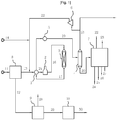
- FIGS. 1 and 2 illustrate procedures of increasing the production of benzene from a hydrocarbon mixture, according to preferred embodiments of the present invention.
- a hydrocarbon feedstock 11 as feedstock oil of a process according to the present invention is separated into a fraction 12 in which the number of carbon atoms is 6 or lower and a fraction 13 in which the number of carbon atoms is 7 or higher in a fractionation unit 8.
- the fraction 12 in which the number of carbon atoms is 6 or lower is fed as a feedstock for a solvent extraction process 9, and the fraction 13 in which the number of carbon atoms is 7 or higher is fed as a feedstock for a process of producing aromatic hydrocarbons and LPG from a hydrocarbon mixture.
- the hydrocarbon feedstock used in the present invention preferably includes hydrocarbons having a boiling point of 30-250°C, and may be selected from the group consisting of reformate, pyrolysis gasoline, desulfurized/denitrified fluidized catalytic cracking gasoline, C9+ aromatic-containing mixture, naphtha, and a mixture thereof.
- a separate heater 2 is provided in order to increase the temperature of the hydrogen/feedstock mixture to a reaction temperature.
- the hydrogen/feedstock mixture is heated to some extent 15 through heat exchange with reaction products 17 which are discharged from the reactor 3 and then fed into a heat exchanger 1, and is then fed into the heater 2.
- the hydrogen/feedstock mixture 16 which is fed into the reactor 3 is subjected to dealkylation, transalkylation, and hydrogenation reactions in the presence of a catalyst.
- a hydrocracking reaction of non-aromatic hydrocarbon compounds and the dealkylation and transalkylation reactions of aromatic hydrocarbon compounds are simultaneously carried out in the reactor 3 to produce main basic petrochemical materials, such as benzene, toluene, and xylene, and byproducts, such as LPG and non-aromatic compounds.
- a catalyst which is packed in the reactor 3 to cause the dealkylation, transalkylation, and hydrogenation reactions, is not limited as long as it is known to those skilled in the art, and, preferably, may be a catalyst disclosed in U.S. Patent No. 6,635,792 .
- 10-95 wt% zeolite which is at least one selected from the group consisting of mordenite, a beta type of zeolite, and a ZSM-5 type of zeolite and which has a silica/alumina molar ratio of 200 or less, is mixed with 5-90 wt% inorganic binder to produce a support, and platinum/tin or platinum/lead is supported on the mixture support, thereby the catalyst is created.
- the products 17 are present in a gaseous form at a relatively high temperature after the reactions are finished, are circulated into the heat exchanger 1 before they are fed into a gas-liquid separator 4, emit heat to the hydrogen/feedstock mixture therein, and are fed into a cooler 5.
- a product stream 19 passing through the cooler 5 is fed into the gas-liquid separator 4 at about 30-50°C, and is then separated into a gaseous component and a liquid component.
- the gaseous component is discharged in an overhead stream 21 from the gas-liquid separator 4, and the liquid component is discharged in a bottom stream 20 therefrom.
- the gaseous component 21 includes about 60-75 mol% hydrogen and 25-40 mol% hydrocarbon components, and the hydrocarbon components include methane, ethane, and LPG which have relatively small numbers of carbon atoms.
- the hydrogen component is compressed by a compressor 6, mixed with highly pure hydrogen 14 which is fed to control the purity of hydrogen, and is fed in conjunction with the feedstock 13 into a reaction area. Methane, ethane, and the LPG which are contained in the overhead stream 21 may selectively be recovered using an additional distillation process.
- the bottom stream 20 consists mostly of aromatic components, and also includes residual hydrogen and light non-aromatic components in a small amount. Accordingly, the liquid component is additionally subjected to a separation and purification process, and is separated into residual hydrogen 22, a non-aromatic component 23, and benzene 24, toluene 25, xylene 26, and C9+ aromatic compounds 27, which have purity of 99 % or more, using a difference in boiling point in a fractionation unit 7.
- the hydrocarbon mixture in which the number of carbon atoms is 7 or higher, is subjected to dealkylation, transalkylation, and hydrogenation reactions in the presence of the catalyst, thereby C9, C10, and C11 aromatic compounds are converted into benzene, toluene, and xylene.
- the fraction 12 which is separated by the fractionation unit 8 and is then fed as a feedstock of a solvent extraction process 9 and in which the number of carbon atoms is 6 or lower, is separated into non-aromatic hydrocarbons 28 which are nonpolar hydrocarbons and aromatic hydrocarbons 29 which are polar hydrocarbons.
- the aromatic hydrocarbons 29, which are the polar hydrocarbons are fed into a fractionation unit 10 at a rear stage to produce benzene 30, or, as shown in FIG. 2 , they are fed into the fractionation unit 7 of the process using the C7 or higher hydrocarbon mixture as a feedstock to produce benzene 24, toluene 25, and xylene 26 using a difference in boiling point.
- the two separate processes are integrated, the hydrocarbon mixture is separated into the fraction in which the number of carbon atoms is 6 or lower and the fraction in which the number of carbon atoms is 7 or higher, and they are, respectively, used as a feedstock in the two processes. That is to say, the hydrocarbons in which the number of carbon atoms is 7 or higher are used as the feedstock of the process for producing the aromatic hydrocarbon mixture and the LPG, and the hydrocarbons in which the number of carbon atoms is 6 or lower are used as the feedstock of the solvent extraction process for separating and recovering the polar hydrocarbons from the hydrocarbons containing the polar hydrocarbons and the nonpolar hydrocarbons.
- the mixture converted through the catalytic reaction, and the fraction which is separated through extraction and is rich in benzene, toluene, and xylene are separated into benzene, toluene, xylene, and C9+ aromatic compounds, respectively using a difference in boiling point through a separation device which includes a distillation column, resulting in the improved production of benzene.
Landscapes
- Chemical & Material Sciences (AREA)
- Oil, Petroleum & Natural Gas (AREA)
- Organic Chemistry (AREA)
- Engineering & Computer Science (AREA)
- Chemical Kinetics & Catalysis (AREA)
- General Chemical & Material Sciences (AREA)
- Crystallography & Structural Chemistry (AREA)
- Inorganic Chemistry (AREA)
- Water Supply & Treatment (AREA)
- Analytical Chemistry (AREA)
- Organic Low-Molecular-Weight Compounds And Preparation Thereof (AREA)
- Production Of Liquid Hydrocarbon Mixture For Refining Petroleum (AREA)
- Low-Molecular Organic Synthesis Reactions Using Catalysts (AREA)
Description
- The present invention relates to a process for increasing the production of benzene from a hydrocarbon mixture. More particularly, the present invention pertains to a process for increasing the production of benzene by integrating a process for producing an aromatic hydrocarbon mixture and liquefied petroleum gas (LPG) from a hydrocarbon mixture with a solvent extraction process for separating and recovering polar hydrocarbons from the hydrocarbon mixture.
- Generally, aromatic hydrocarbons are obtained by separating a feedstock fraction, which is rich in aromatic compounds, such as reformates produced through a catalytic reforming process and pyrolysis gasolines produced through a naphtha cracking process, from non-aromatic hydrocarbons using a solvent extraction process. The aromatic hydrocarbon mixture thus obtained is separated into benzene, toluene, xylene, and C9+ aromatic compounds using a difference in boiling point to use them as basic petrochemical materials, and the non-aromatic hydrocarbons are used as a feedstock or a fuel for the naphtha cracking process.
- With respect to this,
U.S. Patent No. 4,058,454 discloses a solvent extraction process for separating and recovering polar hydrocarbons from a hydrocarbon mixture containing the polar hydrocarbons and nonpolar hydrocarbons. Most solvent extraction processes, as well as the above patent, take advantage of the fact that all aromatic hydrocarbons are polar. That is to say, if a solvent capable of dissolving polar material, such as sulfolane, therein is added to a hydrocarbon mixture, polar aromatic hydrocarbons are selectively dissolved and thus separated from nonpolar non-aromatic hydrocarbons. This process has an advantage in that it is possible to produce a highly pure aromatic hydrocarbon mixture, but is disadvantageous in that an additional solvent extraction device is necessary and a solvent must be continuously supplied during operation. Accordingly, there remains a need for a process for separating aromatic hydrocarbons and non-aromatic hydrocarbons from feedstock oil without an additional solvent extraction step. - In connection with this, effort has been made to employ another reaction system instead of a solvent extraction process in order to separate aromatic compounds from non-aromatic compounds. The non-aromatic compounds which are mixed with the aromatic compounds are converted into gaseous hydrocarbons through a hydrocracking reaction using a catalyst, and the aromatic compounds and the non-aromatic compounds are separated from each other using a gas-liquid separator at a rear part of a reactor. This technology has been developed from
U.S. Patent No. 3,729,409 . - Furthermore, a process for producing aromatic hydrocarbons and LPG from a hydrocarbon mixture, in which aromatic compounds of the hydrocarbon mixture are converted into a fraction including benzene, toluene, xylene and the like through dealkylation and/or transalkylation reactions, and non-aromatic compounds are converted into gaseous material that is rich in LPG through a hydrocracking reaction, has been studied.
-
U.S. Patent No. 2002/0092797 discloses a process for converting aromatic compounds in hydrocarbon feedstock to oil components including BTX through dealkylation and/or transalkylation and for converting non-aromatic compounds to LPG-rich gaseous components through hydrocracking; in the presence of a catalyst. The hydrocarbon feedstock is reformate, pyrolysis gasoline, C9 or higher aromatic components-containing mixture, naphtha and mixture thereof. The catalyst comprises platinum/tin or platinum/lead and a mixture support consisting of 10-95 wt% of zeolite having a molar ratio of silica/alumina of 200 or less and 5-90 wt% of inorganic binder, said zeolite being selected from the group consisting of mordenite, beta type zeolite, ZSM-5 type zeolite. - The above-mentioned processes, respectively, which have the common object of producing aromatic hydrocarbon products, such as benzene, toluene, or xylene, have been independently developed as competitive, or complementary/substitution technologies. However, a process for improving productivity of aromatic hydrocarbons, particularly, benzene, by integrating competing processes has not yet been suggested.
- Leading to the present invention, the intensive and thorough research on production of benzene, carried out by the present inventors aiming to avoid the problems encountered in the prior arts, resulting in the finding that, when a process for producing an aromatic hydrocarbon mixture and LPG from a hydrocarbon mixture and a solvent extraction process for separating and recovering polar hydrocarbons from a hydrocarbon mixture are integrated, it is possible to improve the productivity and efficiency of each process or of the integrated process, thereby accomplishing the present invention.
- Therefore, it is an object of the present invention to provide a process for increasing the productivity of products by integrating two processes which have different functions and compete with or complement each other.
- It is another object of the present invention to provide a process for increasing the production of benzene from a hydrocarbon mixture so as to improve productivity.
- In order to accomplish the above objects, there is provided a process, as described in
claim 1, for increasing the production of benzene from a hydrocarbon mixture, comprising the following steps of: - (a) separating a hydrocarbon feedstock into a C6 or lower hydrocarbon stream and a C7 or higher hydrocarbon stream;
- (b) separating the C6 or lower hydrocarbons into a non-aromatic hydrocarbon stream and an aromatic hydrocarbon stream through a solvent extraction process;
- (c) recovering benzene from the aromatic hydrocarbon stream;
- (d) feeding the C7 or higher hydrocarbons and hydrogen into at least one reaction area;
- (e) converting the C7 or higher hydrocarbons in presence of a catalyst in the reaction area into (i) aromatic hydrocarbons which are rich in benzene, toluene, and xylene through dealkylation/transalkylation reactions, and (ii) non-aromatic hydrocarbons which are rich in liquefied petroleum gas through a hydrocracking reaction;
- (f) separating reaction products of step (e) into an overhead stream, which contains hydrogen, methane, ethane, and the liquefied petroleum gas, and a bottom stream, which contains the aromatic hydrocarbons, and a small amount of hydrogen and non-aromatic hydrocarbons, using a gas-liquid separation process; and
- (g) recovering benzene, toluene, xylene, and C9 or higher aromatic compounds, respectively from the bottom stream.
- It is preferable that steps (c) and (g) be simultaneously conducted using a same device or be independently conducted using separately provided devices.
- The process may further comprise recovering the liquefied petroleum gas from the overhead stream.
- Preferably, 10-95 wt% zeolite, which is at least one selected from a group consisting of mordenite, a beta type of zeolite, and a ZSM-5 type of zeolite, and which has a silica/alumina molar ratio of 200 or less, is mixed with 5-90 wt% inorganic binder to produce a support, and platinum/tin or platinum/lead is supported on the mixture support to produce the catalyst of step (e).
- Meanwhile, it is preferable that the hydrocarbon feedstock be selected from a group consisting of reformate, pyrolysis gasoline, desulfurized/denitrified fluidized catalytic cracking gasoline, C9+ aromatic-containing mixture, naphtha, and a mixture thereof.
- In the present invention, after a hydrocarbon mixture is separated into a fraction in which the number of carbon atoms is 6 or lower and a residual fraction, hydrocarbons in which the number of carbon atoms is 7 or higher are used as a feedstock of a process for producing an aromatic hydrocarbon mixture and LPG, and hydrocarbons in which the number of carbon atoms is 6 or lower are fed as a feedstock of a solvent extraction process. Thereby, the mixture converted through the catalytic reaction, and the fraction which is separated through the extraction and is rich in benzene, toluene, and xylene, are separated into benzene, toluene, xylene, and C9+ aromatic compounds using a difference in boiling point and a separation device which includes a distillation column, resulting in the improved production of benzene.
- Therefore, when the process for producing the highly pure aromatic hydrocarbon mixture, the LPG, and the non-aromatic hydrocarbons from the hydrocarbon feedstock, and the solvent extraction process for separating and recovering polar hydrocarbons from the hydrocarbon feedstock containing the polar hydrocarbons and nonpolar hydrocarbons are integrated according to the process of the present invention, it is possible to significantly improve the productivity of products in comparison with the separate use of each process.
- The above and other objects, features and advantages of the present invention will be more clearly understood from the following detailed description taken in conjunction with the accompanying drawings, in which:
-
FIG. 1 illustrates one embodiment of a procedure of increasing the production of benzene from a hydrocarbon mixture, according to the present invention; and -
FIG. 2 illustrates another embodiment of a procedure of increasing the production of benzene from a hydrocarbon mixture, according to the present invention. - Hereinafter, a detailed description will be given of the present invention, referring to the drawings.
-
FIGS. 1 and2 illustrate procedures of increasing the production of benzene from a hydrocarbon mixture, according to preferred embodiments of the present invention. - With reference to
FIGS. 1 and2 , ahydrocarbon feedstock 11 as feedstock oil of a process according to the present invention is separated into afraction 12 in which the number of carbon atoms is 6 or lower and afraction 13 in which the number of carbon atoms is 7 or higher in afractionation unit 8. Thefraction 12 in which the number of carbon atoms is 6 or lower is fed as a feedstock for asolvent extraction process 9, and thefraction 13 in which the number of carbon atoms is 7 or higher is fed as a feedstock for a process of producing aromatic hydrocarbons and LPG from a hydrocarbon mixture. - The hydrocarbon feedstock used in the present invention preferably includes hydrocarbons having a boiling point of 30-250°C, and may be selected from the group consisting of reformate, pyrolysis gasoline, desulfurized/denitrified fluidized catalytic cracking gasoline, C9+ aromatic-containing mixture, naphtha, and a mixture thereof.
- The
fraction 13, in which the number of carbon atoms is 7 or higher and which is fed as the feedstock for the process of producing the aromatic hydrocarbons and the LPG from the hydrocarbon mixture, is mixed with circulatinghydrogen 22 and highlypure hydrogen 14, and is then fed in a hydrogen/feedstock mixture form 15 into areactor 3. - In connection with this, a
separate heater 2 is provided in order to increase the temperature of the hydrogen/feedstock mixture to a reaction temperature. The hydrogen/feedstock mixture is heated to someextent 15 through heat exchange withreaction products 17 which are discharged from thereactor 3 and then fed into aheat exchanger 1, and is then fed into theheater 2. - The hydrogen/
feedstock mixture 16 which is fed into thereactor 3 is subjected to dealkylation, transalkylation, and hydrogenation reactions in the presence of a catalyst. - That is to say, a hydrocracking reaction of non-aromatic hydrocarbon compounds, and the dealkylation and transalkylation reactions of aromatic hydrocarbon compounds are simultaneously carried out in the
reactor 3 to produce main basic petrochemical materials, such as benzene, toluene, and xylene, and byproducts, such as LPG and non-aromatic compounds. - In connection with this, a catalyst, which is packed in the
reactor 3 to cause the dealkylation, transalkylation, and hydrogenation reactions, is not limited as long as it is known to those skilled in the art, and, preferably, may be a catalyst disclosed inU.S. Patent No. 6,635,792 . - That is to say, 10-95 wt% zeolite, which is at least one selected from the group consisting of mordenite, a beta type of zeolite, and a ZSM-5 type of zeolite and which has a silica/alumina molar ratio of 200 or less, is mixed with 5-90 wt% inorganic binder to produce a support, and platinum/tin or platinum/lead is supported on the mixture support, thereby the catalyst is created.
- Meanwhile, the
products 17 are present in a gaseous form at a relatively high temperature after the reactions are finished, are circulated into theheat exchanger 1 before they are fed into a gas-liquid separator 4, emit heat to the hydrogen/feedstock mixture therein, and are fed into acooler 5. - A
product stream 19 passing through thecooler 5 is fed into the gas-liquid separator 4 at about 30-50°C, and is then separated into a gaseous component and a liquid component. - The gaseous component is discharged in an
overhead stream 21 from the gas-liquid separator 4, and the liquid component is discharged in abottom stream 20 therefrom. In connection with this, thegaseous component 21 includes about 60-75 mol% hydrogen and 25-40 mol% hydrocarbon components, and the hydrocarbon components include methane, ethane, and LPG which have relatively small numbers of carbon atoms. The hydrogen component is compressed by acompressor 6, mixed with highlypure hydrogen 14 which is fed to control the purity of hydrogen, and is fed in conjunction with thefeedstock 13 into a reaction area. Methane, ethane, and the LPG which are contained in theoverhead stream 21 may selectively be recovered using an additional distillation process. - Meanwhile, the
bottom stream 20 consists mostly of aromatic components, and also includes residual hydrogen and light non-aromatic components in a small amount. Accordingly, the liquid component is additionally subjected to a separation and purification process, and is separated intoresidual hydrogen 22, anon-aromatic component 23, andbenzene 24,toluene 25,xylene 26, and C9+aromatic compounds 27, which have purity of 99 % or more, using a difference in boiling point in afractionation unit 7. - In summary, the hydrocarbon mixture, in which the number of carbon atoms is 7 or higher, is subjected to dealkylation, transalkylation, and hydrogenation reactions in the presence of the catalyst, thereby C9, C10, and C11 aromatic compounds are converted into benzene, toluene, and xylene.
- Meanwhile, the
fraction 12, which is separated by thefractionation unit 8 and is then fed as a feedstock of asolvent extraction process 9 and in which the number of carbon atoms is 6 or lower, is separated intonon-aromatic hydrocarbons 28 which are nonpolar hydrocarbons andaromatic hydrocarbons 29 which are polar hydrocarbons. - As shown in
FIG. 1 , thearomatic hydrocarbons 29, which are the polar hydrocarbons, are fed into afractionation unit 10 at a rear stage to producebenzene 30, or, as shown inFIG. 2 , they are fed into thefractionation unit 7 of the process using the C7 or higher hydrocarbon mixture as a feedstock to producebenzene 24,toluene 25, andxylene 26 using a difference in boiling point. - As described above, separate processes which are integrated in the present invention have the common object of producing aromatic hydrocarbon products, such as benzene, toluene, and xylene. However, they are different from each other in that, in one process, the contents of benzene, toluene, and xylene in feedstock oil are changed through dealkylation and transalkylation reactions using the catalyst, while, in the other process, the contents of benzene, toluene, and xylene in feedstock oil are not changed.
- In the present invention, the two separate processes are integrated, the hydrocarbon mixture is separated into the fraction in which the number of carbon atoms is 6 or lower and the fraction in which the number of carbon atoms is 7 or higher, and they are, respectively, used as a feedstock in the two processes. That is to say, the hydrocarbons in which the number of carbon atoms is 7 or higher are used as the feedstock of the process for producing the aromatic hydrocarbon mixture and the LPG, and the hydrocarbons in which the number of carbon atoms is 6 or lower are used as the feedstock of the solvent extraction process for separating and recovering the polar hydrocarbons from the hydrocarbons containing the polar hydrocarbons and the nonpolar hydrocarbons. Thereby, the mixture converted through the catalytic reaction, and the fraction which is separated through extraction and is rich in benzene, toluene, and xylene are separated into benzene, toluene, xylene, and C9+ aromatic compounds, respectively using a difference in boiling point through a separation device which includes a distillation column, resulting in the improved production of benzene.
- Therefore, when the process for producing the highly pure aromatic hydrocarbon mixture, the LPG, and the non-aromatic hydrocarbons from the hydrocarbon feedstock, and the solvent extraction process for separating and recovering the polar hydrocarbons from the hydrocarbon feedstock containing the polar hydrocarbons and the nonpolar hydrocarbons are integrated according to the method of the present invention, it is possible to significantly improve the productivity of products in comparison with the separate use of each process.
- A better understanding of the present invention may be obtained through the following examples and comparative examples which are set forth to illustrate, but are not to be construed as the limit of the present invention.
- It is necessary to confirm the productivities of separate processes and the integrated process according to the process of the present invention, therefore tests were conducted to achieve the confirmation in the following examples.
- The productivity of products in a solvent extraction process using pyrolysis gasolines as a feedstock was confirmed, and the results are described in the following Table 1.
Table 1 Feedstock Operation conditions Result Flow rate Composition (wt%) Temp. Press. Ratio Product (kg/hr) Extract composition (wt%) Raffinate composition (wt%) 10 kg/hr C6 paraffin 4.48 90°C 7kg/cm2g 2 Benzene 4.22 C10+ paraffin 0.002 C6 paraffin 25.421 C7 paraffin 2.58 Toluene 2.07 C8 naphthene 0.001 C7 paraffin 14.640 C8 paraffin 0.9 Xylene 0.67 Benzene 51.466 C8 paraffin 5.106 C9 paraffin 0.27 Total 6.96 Toluene 25.260 C9 paraffin 1.531 C10+ paraffin 1.85 Ethyl benzene 8.198 C10+ paraffin 10.487 C5 naphthene 2Xylene 8.684 C5 naphthene 11.349 C6 naphthene 4.16 C9+ aromatics 6.388 C6 naphthene 23.605 C7 naphthene 0.61 C7 naphthene 3.461 C8 naphthene 0.47 C8 naphthene 2.664 Benzene 42.4 Benzene 0.024 Toluene 20.85 Toluene 0.237 Ethyl benzene 6.76 Ethyl benzene 0.038 Xylene 7.3 Xylene 0.828 C9+ aromatics 5.37 C9+ aromatics 0.609 - Temp.: Extraction temperature
- Press.: Extraction pressure
- Ratio: Solvent/H.C. volume Ratio
- The productivity of a process for producing aromatic hydrocarbons and LPG from a hydrocarbon mixture using pyrolysis gasolines as a feedstock was confirmed, and the results are described in the following Table 2.
Table 2 Feedstock Operation conditions Result Flow rate Composition (wt%) Reaction Temp. Reaction pressure H2/H.C. molar ratio Product (kg/hr) Composition (wt%) 10 kg/hr C6 paraffin 4.48 340°C 30kg/cm2g 4 Benzene 1.93 C1 paraffin 0.47 C7 paraffin 2.58 Toluene 3.71 C2 paraffin 7.37 C8 paraffin 0.9 Xylene 2.18 C3 paraffin 6.23 C9 paraffin 0.27 Total 7.82 C4 paraffin 3.04 C10+ paraffin 1.85 C5 paraffin 0.85 C5 naphthene 2C6 paraffin 0.11 C6 naphthene 4.16 C7 paraffin 0.02 C7 naphthene 0.61 C8 paraffin 0.02 C8 naphthene 0.47 C9 paraffin 0.02 Benzene 42.4 C6 naphthene 0.02 Toluene 20.85 C7 naphthene 0.03 Ethyl benzene 6.76 Benzene 19.31 Xylene 7.3 Toluene 37.05 C9+ aromatics 5.37 Xylene 21.84 C9+ aromatic 5.64 - The productivity of the integrated process shown in
FIG. 1 using pyrolysis gasolines as a feedstock was confirmed, and the results are described in the following Table 3.Table 3 Solvent extraction Catalystic reaction Integration result Feedstock (wt%) 4.94kg/hr 5.06kg/hr C6 paraffin 9.07 C7 paraffin 0.12 C7 paraffin 4.29 C8 paraffin 2.03 Benzene 85.80 C9 paraffin 0.6 Toluene 0.84 C10+ paraffin 4.15 C6 naphthene 0.07 C7 naphthene 0.68 C8 naphthene 1.07 Benzene 0.8 Toluene 46.8 Ethyl benzene 15.2 Xylene 16.4 C9+ aromatics 12.08 Operation conditions Extraction temp. 90°C Reaction temp. 340°C Extraction press. 7kg/cm2g Reaction press. 30kg/cm2g Solvent/H.C. volume ratio 2 H2/H.C. molar ratio 4 Result Benzene 4.15kg/hr Benzene 0.97kg/hr Benzene 5.12kg/hr Toluene 0.04kg/hr Toluene 1.86kg/hr Toluene 1.90kg/hr Total 4.19kg/hr Xylene 1.09kg/hr Xylene 1.09kg/hr Total 3.92kg/hr Total 8.11kg/hr - The present invention has been described in an illustrative manner, and it is to be understood that the terminology used is intended to be in the nature of description rather than of limitation. Many modifications and variations of the present invention are possible in light of the above teachings. Therefore, it is to be understood that within the scope of the appended claims, the invention may be practiced otherwise than as specifically described.
Claims (5)
- A process for increasing production of benzene from a hydrocarbon mixture, comprising:(a) separating the hydrocarbon feedstock into a C6 or lower hydrocarbon stream and a C7 or higher hydrocarbon stream;(b) separating the C6 or lower hydrocarbons, coming from step (a) into a non-aromatic hydrocarbon stream and an aromatic hydrocarbon stream through a solvent extraction process;(c) recovering benzene from the aromatic hydrocarbon stream;(d) feeding the C7 or higher hydrocarbons and hydrogen into at least one reaction area;(e) converting the C7 or higher hydrocarbons coming from step (a) in presence of a catalyst in the reaction area into (i) aromatic hydrocarbons, which are rich in benzene, toluene, and xylene employing dealkylation/transalkylation reactions, and (ii) non-aromatic hydrocarbons which are rich in liquefied petroleum gas through a hydrocracking reaction;(f) separating reaction products of step (e) into an overhead stream, which contains hydrogen, methane, ethane, and the liquefied petroleum gas, and a bottom stream, which contains the aromatic hydrocarbons, and a small amount of hydrogen and non-aromatic hydrocarbons, using a gas-liquid separation process; and(g) recovering benzene, toluene, xylene, and C9 or higher aromatic compounds from the bottom stream.
- The process as set forth in claim 1, wherein steps (c) and (g) are simultaneously conducted using a same device or are independently conducted using separately provided devices.
- The process as set forth in claim 1, further comprising recovering the liquefied petroleum gas from the overhead stream.
- The process as set forth in claim 1, wherein 10 - 95 wt% zeolite, which is at least one selected from a group consisting of mordenite, a beta type of zeolite, and a ZSM-5 type of zeolite, and which has a silica/alumina molar ratio of 200 or less, is mixed with 5 - 90 wt% inorganic binder to produce a support, and platinum/tin or platinum/lead is supported on the mixture support to produce the catalyst of step (e).
- The process as set forth in claim 1, wherein the hydrocarbon feedstock is selected from a group consisting of reformate, pyrolysis gasoline , desulfurized/denitrified fluidized catalytic cracking gasoline, a C9+ aromatic-containing mixture, naphtha, and a mixture thereof.
Applications Claiming Priority (2)
| Application Number | Priority Date | Filing Date | Title |
|---|---|---|---|
| KR1020050053619A KR100645659B1 (en) | 2005-06-21 | 2005-06-21 | How to Evaporate Benzene from Hydrocarbon Mixtures |
| PCT/KR2005/002708 WO2006137616A1 (en) | 2005-06-21 | 2005-08-17 | Process for increasing production of benzene from hydrocarbon mixture |
Publications (3)
| Publication Number | Publication Date |
|---|---|
| EP1893722A1 EP1893722A1 (en) | 2008-03-05 |
| EP1893722A4 EP1893722A4 (en) | 2015-03-25 |
| EP1893722B1 true EP1893722B1 (en) | 2017-05-10 |
Family
ID=37570611
Family Applications (1)
| Application Number | Title | Priority Date | Filing Date |
|---|---|---|---|
| EP05780594.7A Expired - Lifetime EP1893722B1 (en) | 2005-06-21 | 2005-08-17 | Process for increasing production of benzene from hydrocarbon mixture |
Country Status (6)
| Country | Link |
|---|---|
| US (1) | US7304195B2 (en) |
| EP (1) | EP1893722B1 (en) |
| JP (1) | JP2008543930A (en) |
| KR (1) | KR100645659B1 (en) |
| CN (1) | CN101208409A (en) |
| WO (1) | WO2006137616A1 (en) |
Families Citing this family (29)
| Publication number | Priority date | Publication date | Assignee | Title |
|---|---|---|---|---|
| WO2009076393A2 (en) * | 2007-12-12 | 2009-06-18 | Shell Oil Company | Process for the conversion of ethane or mixed lower alkanes to aromatic hydrocarbons |
| UA98537C2 (en) * | 2008-02-18 | 2012-05-25 | Шелл Интернационале Рисерч Маатшаппидж Б.В. | Process for producing aromatic hydrocarbons |
| UA98538C2 (en) | 2008-02-18 | 2012-05-25 | Шелл Интернационале Рисерч Маатшаппидж Б.В. | Process and catalyst for producing aromatic hydrocarbons |
| US8809608B2 (en) * | 2008-02-18 | 2014-08-19 | Shell Oil Company | Process for the conversion of lower alkanes to aromatic hydrocarbons |
| EA201070974A1 (en) | 2008-02-20 | 2011-02-28 | Шелл Интернэшнл Рисерч Маатсхаппий Б.В. | METHOD OF CONVERSION OF ETHANE IN AROMATIC HYDROCARBONS |
| WO2010061986A1 (en) * | 2008-11-26 | 2010-06-03 | Sk Energy Co., Ltd. | Process for the preparation of clean fuel and aromatics from hydrocarbon mixtures catalytic cracked on fluid bed |
| US8246811B2 (en) | 2009-05-26 | 2012-08-21 | IFP Energies Nouvelles | Process for the production of a hydrocarbon fraction with a high octane number and a low sulfur content |
| EA022457B1 (en) | 2009-11-02 | 2016-01-29 | Шелл Интернэшнл Рисерч Маатсхаппий Б.В. | Process for the conversion of mixed lower alkanes to aromatic hydrocarbons |
| US8766026B2 (en) | 2010-05-12 | 2014-07-01 | Shell Oil Company | Process for the conversion of lower alkanes to aromatic hydrocarbons |
| CN102372583B (en) * | 2010-08-23 | 2014-03-26 | 中国石油化工股份有限公司 | Fluidized catalytic method for preparing p-xylene by alkylating toluene |
| CN102372586B (en) * | 2010-08-23 | 2014-03-26 | 中国石油化工股份有限公司 | Fluidized catalytic method of p-xylene by methylation of aromatic hydrocarbon |
| CN103249699B (en) * | 2010-10-22 | 2015-04-01 | Sk新技术株式会社 | Process for the preparation of valuable aromatics and light paraffins from hydrocarbon oils derived from oilseeds, coal or wood |
| US8766028B2 (en) * | 2011-11-04 | 2014-07-01 | Amt International Inc. | Separating styrene from C6-C8 aromatic hydrocarbons |
| US9150467B2 (en) * | 2013-07-23 | 2015-10-06 | Uop Llc | Processes and apparatuses for preparing aromatic compounds |
| US20150166435A1 (en) * | 2013-12-13 | 2015-06-18 | Uop Llc | Methods and apparatuses for processing hydrocarbons |
| US9284237B2 (en) | 2013-12-13 | 2016-03-15 | Uop Llc | Methods and apparatuses for processing hydrocarbons |
| RU2544017C1 (en) * | 2014-01-28 | 2015-03-10 | Ольга Васильевна Малова | Catalyst and method for aromatisation of c3-c4 gases, light hydrocarbon fractions of aliphatic alcohols, as well as mixtures thereof |
| EA201790012A1 (en) * | 2014-06-13 | 2017-06-30 | Сабик Глоубл Текнолоджиз Б.В. | METHOD FOR OBTAINING BENZENE FROM MIXTURE C5-C12 HYDROCARBONS |
| US10793491B2 (en) * | 2014-06-13 | 2020-10-06 | Sabic Global Technologies B.V. | Process for producing benzene from C5-C12 hydrocarbon mixture |
| US10053403B2 (en) | 2015-02-04 | 2018-08-21 | Exxonmobil Chemical Patents Inc. | Catalyst compositions and their use in transalkylation of heavy aromatics to xylenes |
| US10118165B2 (en) | 2015-02-04 | 2018-11-06 | Exxonmobil Chemical Patents Inc. | Catalyst compositions and use in heavy aromatics conversion processes |
| US10501388B2 (en) | 2015-08-21 | 2019-12-10 | Sabic Global Technologies B.V. | Process for producing BTX from a C5—C12 hydrocarbon mixture |
| KR101674655B1 (en) * | 2015-12-01 | 2016-11-09 | 동아대학교 산학협력단 | Benzene Removal Equipment and Removal Method in Gasoline Blend from Fluidized Catalytic Cracker Reformate |
| KR101674660B1 (en) * | 2015-12-07 | 2016-11-09 | 동아대학교 산학협력단 | Aromatic compounds separation equipment and separation method with reduced extraction load |
| EP3523398B1 (en) | 2016-09-12 | 2021-03-03 | SABIC Global Technologies B.V. | Hydrocracking process |
| SG11201903253SA (en) | 2016-10-17 | 2019-05-30 | Sabic Global Technologies Bv | Process for producing btx from a c5-c12 hydrocarbon mixture |
| KR102804771B1 (en) * | 2019-08-21 | 2025-05-07 | 주식회사 엘지화학 | Method for preparing styrene and benzene |
| KR102464478B1 (en) | 2020-06-16 | 2022-11-07 | 주식회사 엘지화학 | Apparatus for preparing aromatic hydrocarbon |
| KR102583535B1 (en) * | 2020-06-16 | 2023-09-27 | 주식회사 엘지화학 | Method for preparing aromatic hydrocarbon |
Family Cites Families (16)
| Publication number | Priority date | Publication date | Assignee | Title |
|---|---|---|---|---|
| NO129751B (en) * | 1970-04-13 | 1974-05-20 | Mobil Oil Corp | |
| US3729409A (en) * | 1970-12-24 | 1973-04-24 | Mobil Oil Corp | Hydrocarbon conversion |
| US3702293A (en) * | 1971-12-30 | 1972-11-07 | Universal Oil Prod Co | Hydrocarbon conversion process with a bimetallic catalyst |
| US3928174A (en) * | 1975-01-02 | 1975-12-23 | Mobil Oil Corp | Combination process for producing LPG and aromatic rich material from naphtha |
| US4058454A (en) * | 1976-04-22 | 1977-11-15 | Uop Inc. | Aromatic hydrocarbon separation via solvent extraction |
| US4053388A (en) * | 1976-12-06 | 1977-10-11 | Moore-Mccormack Energy, Inc. | Process for preparing aromatics from naphtha |
| US4167533A (en) * | 1978-04-07 | 1979-09-11 | Uop Inc. | Co-production of ethylene and benzene |
| US4594145A (en) * | 1984-12-07 | 1986-06-10 | Exxon Research & Engineering Co. | Reforming process for enhanced benzene yield |
| WO1994009878A1 (en) * | 1992-10-28 | 1994-05-11 | Chevron Chemical Company | High purity benzene production using extractive distillation |
| US5278344A (en) * | 1992-12-14 | 1994-01-11 | Uop | Integrated catalytic reforming and hydrodealkylation process for maximum recovery of benzene |
| JPH08119882A (en) * | 1994-10-07 | 1996-05-14 | Chevron Usa Inc | Production of highly pure benzene and predominantly para xylenol by combination of aromatization and selective disproportionation of impure toluene |
| US6258989B1 (en) | 1999-09-30 | 2001-07-10 | Phillips Petroleum Company | Hydrocarbon upgrading process |
| KR100557558B1 (en) | 2000-11-30 | 2006-03-03 | 에스케이 주식회사 | Process for producing aromatic hydrocarbons and liquefied petroleum gas from hydrocarbon mixtures |
| US6677496B2 (en) | 2001-08-29 | 2004-01-13 | David Netzer | Process for the coproduction of benzene from refinery sources and ethylene by steam cracking |
| CN1164541C (en) * | 2001-10-22 | 2004-09-01 | 中国石油化工股份有限公司 | Selective disproportionation of toluene and disproportionation and transalkylation of toluene with carbon nine and above aromatics |
| US6740788B1 (en) * | 2002-12-19 | 2004-05-25 | Uop Llc | Integrated process for aromatics production |
-
2005
- 2005-06-21 KR KR1020050053619A patent/KR100645659B1/en not_active Expired - Fee Related
- 2005-08-17 JP JP2008518007A patent/JP2008543930A/en active Pending
- 2005-08-17 CN CNA2005800502187A patent/CN101208409A/en active Pending
- 2005-08-17 WO PCT/KR2005/002708 patent/WO2006137616A1/en not_active Ceased
- 2005-08-17 EP EP05780594.7A patent/EP1893722B1/en not_active Expired - Lifetime
- 2005-09-13 US US11/226,674 patent/US7304195B2/en not_active Expired - Lifetime
Also Published As
| Publication number | Publication date |
|---|---|
| JP2008543930A (en) | 2008-12-04 |
| EP1893722A4 (en) | 2015-03-25 |
| KR100645659B1 (en) | 2006-11-14 |
| US20060287564A1 (en) | 2006-12-21 |
| US7304195B2 (en) | 2007-12-04 |
| CN101208409A (en) | 2008-06-25 |
| WO2006137616A1 (en) | 2006-12-28 |
| EP1893722A1 (en) | 2008-03-05 |
Similar Documents
| Publication | Publication Date | Title |
|---|---|---|
| US7304195B2 (en) | Process for increasing production of benzene from hydrocarbon mixture | |
| EP1893726B1 (en) | Process for increasing production of light olefin hydrocarbon from hydrocarbon feedstock | |
| CN102037102B (en) | Novel system for optimising the production of high octane gasoline and the coproduction of aromatic bases | |
| US8933283B2 (en) | Process for the preparation of clean fuel and aromatics from hydrocarbon mixtures catalytic cracked on fluid bed | |
| US4229602A (en) | Dehydrocyclization process | |
| US20120024752A1 (en) | Multi-Stage Hydroprocessing for the Production of High Octane Naphtha | |
| US11268037B2 (en) | Process and system for hydrodearylation and hydrogenation of aromatic complex bottoms | |
| KR20160026918A (en) | Process for the production of light olefins and aromatics from a hydrocarbon feedstock | |
| KR101882958B1 (en) | A process for catalytically reforming naphtha | |
| WO2021162898A1 (en) | Process and system for hydrogenation of aromatic complex bottoms | |
| US20230392086A1 (en) | Method and system for treating hydrocarbon-containing mixture | |
| CN112313193B (en) | Methods and systems for producing paraxylene | |
| US11820949B2 (en) | Apparatus and process for the enhanced production of aromatic compounds | |
| IL35865A (en) | High octane gasoline production | |
| CN110382450B (en) | Treatment of a C8-C10 aromatic feed stream to produce and recover trimethylated benzenes | |
| KR20020050756A (en) | Multi-stage reforming process using rhenium-containing catalyst in the final stage | |
| CN119931717B (en) | A method for hydrocracking | |
| JP7829569B2 (en) | Method and system for processing gasoline components | |
| CN119161229A (en) | A method for producing toluene without a toluene tower based on a single benzene extraction device | |
| CN121450357A (en) | Catalytic reforming method for naphtha | |
| HU194525B (en) | Process for the production of extra-clean normal hexan and aroma-free special petrol | |
| JP2019206714A (en) | Method for producing reformed gasoline |
Legal Events
| Date | Code | Title | Description |
|---|---|---|---|
| PUAI | Public reference made under article 153(3) epc to a published international application that has entered the european phase |
Free format text: ORIGINAL CODE: 0009012 |
|
| 17P | Request for examination filed |
Effective date: 20071212 |
|
| AK | Designated contracting states |
Kind code of ref document: A1 Designated state(s): AT BE BG CH CY CZ DE DK EE ES FI FR GB GR HU IE IS IT LI LT LU LV MC NL PL PT RO SE SI SK TR |
|
| RIN1 | Information on inventor provided before grant (corrected) |
Inventor name: KIM, YONG SEUNG Inventor name: LIM, BYEUNG SOO Inventor name: SUNG, KYOUNG HAK Inventor name: LEE, JONG HYUNG Inventor name: KANG, SIN CHOEL Inventor name: CHOI, SUN Inventor name: CHANG, BYOUNG MU Inventor name: OH, SEUNG HOON |
|
| RIN1 | Information on inventor provided before grant (corrected) |
Inventor name: OH, SEUNG HOON Inventor name: KANG, SIN CHOEL Inventor name: LIM, BYEUNG SOO Inventor name: SUNG, KYOUNG HAK Inventor name: LEE, JONG HYUNG Inventor name: CHANG, BYOUNG MU Inventor name: CHOI, SUN Inventor name: KIM, YONG SEUNG |
|
| RIN1 | Information on inventor provided before grant (corrected) |
Inventor name: CHANG, BYOUNG MU Inventor name: SUNG, KYOUNG HAK Inventor name: LEE, JONG HYUNG Inventor name: KANG, SIN CHOEL Inventor name: CHOI, SUN Inventor name: LIM, BYEUNG SOO Inventor name: KIM, YONG SEUNG Inventor name: OH, SEUNG HOON |
|
| DAX | Request for extension of the european patent (deleted) | ||
| RAP1 | Party data changed (applicant data changed or rights of an application transferred) |
Owner name: SK INNOVATION CO., LTD. |
|
| A4 | Supplementary search report drawn up and despatched |
Effective date: 20150224 |
|
| RIC1 | Information provided on ipc code assigned before grant |
Ipc: C10G 21/27 20060101ALI20150218BHEP Ipc: C10G 45/58 20060101ALI20150218BHEP Ipc: C10G 47/00 20060101ALI20150218BHEP Ipc: C10G 7/08 20060101AFI20150218BHEP Ipc: C10G 61/08 20060101ALI20150218BHEP Ipc: C10G 45/64 20060101ALI20150218BHEP |
|
| GRAP | Despatch of communication of intention to grant a patent |
Free format text: ORIGINAL CODE: EPIDOSNIGR1 |
|
| STAA | Information on the status of an ep patent application or granted ep patent |
Free format text: STATUS: GRANT OF PATENT IS INTENDED |
|
| INTG | Intention to grant announced |
Effective date: 20161201 |
|
| RIN1 | Information on inventor provided before grant (corrected) |
Inventor name: SUNG, KYOUNG HAK Inventor name: LEE, JONG HYUNG Inventor name: LIM, BYEUNG SOO Inventor name: CHOI, SUN Inventor name: KANG, SIN CHOEL Inventor name: CHANG, BYOUNG MU Inventor name: OH, SEUNG HOON Inventor name: KIM, YONG SEUNG |
|
| GRAS | Grant fee paid |
Free format text: ORIGINAL CODE: EPIDOSNIGR3 |
|
| GRAA | (expected) grant |
Free format text: ORIGINAL CODE: 0009210 |
|
| STAA | Information on the status of an ep patent application or granted ep patent |
Free format text: STATUS: THE PATENT HAS BEEN GRANTED |
|
| AK | Designated contracting states |
Kind code of ref document: B1 Designated state(s): AT BE BG CH CY CZ DE DK EE ES FI FR GB GR HU IE IS IT LI LT LU LV MC NL PL PT RO SE SI SK TR |
|
| REG | Reference to a national code |
Ref country code: GB Ref legal event code: FG4D |
|
| REG | Reference to a national code |
Ref country code: AT Ref legal event code: REF Ref document number: 892325 Country of ref document: AT Kind code of ref document: T Effective date: 20170515 Ref country code: CH Ref legal event code: EP |
|
| REG | Reference to a national code |
Ref country code: IE Ref legal event code: FG4D |
|
| REG | Reference to a national code |
Ref country code: DE Ref legal event code: R096 Ref document number: 602005051929 Country of ref document: DE |
|
| REG | Reference to a national code |
Ref country code: FR Ref legal event code: PLFP Year of fee payment: 13 |
|
| REG | Reference to a national code |
Ref country code: NL Ref legal event code: FP |
|
| REG | Reference to a national code |
Ref country code: LT Ref legal event code: MG4D |
|
| REG | Reference to a national code |
Ref country code: AT Ref legal event code: MK05 Ref document number: 892325 Country of ref document: AT Kind code of ref document: T Effective date: 20170510 |
|
| PG25 | Lapsed in a contracting state [announced via postgrant information from national office to epo] |
Ref country code: ES Free format text: LAPSE BECAUSE OF FAILURE TO SUBMIT A TRANSLATION OF THE DESCRIPTION OR TO PAY THE FEE WITHIN THE PRESCRIBED TIME-LIMIT Effective date: 20170510 Ref country code: GR Free format text: LAPSE BECAUSE OF FAILURE TO SUBMIT A TRANSLATION OF THE DESCRIPTION OR TO PAY THE FEE WITHIN THE PRESCRIBED TIME-LIMIT Effective date: 20170811 Ref country code: AT Free format text: LAPSE BECAUSE OF FAILURE TO SUBMIT A TRANSLATION OF THE DESCRIPTION OR TO PAY THE FEE WITHIN THE PRESCRIBED TIME-LIMIT Effective date: 20170510 Ref country code: FI Free format text: LAPSE BECAUSE OF FAILURE TO SUBMIT A TRANSLATION OF THE DESCRIPTION OR TO PAY THE FEE WITHIN THE PRESCRIBED TIME-LIMIT Effective date: 20170510 Ref country code: LT Free format text: LAPSE BECAUSE OF FAILURE TO SUBMIT A TRANSLATION OF THE DESCRIPTION OR TO PAY THE FEE WITHIN THE PRESCRIBED TIME-LIMIT Effective date: 20170510 |
|
| PG25 | Lapsed in a contracting state [announced via postgrant information from national office to epo] |
Ref country code: IS Free format text: LAPSE BECAUSE OF FAILURE TO SUBMIT A TRANSLATION OF THE DESCRIPTION OR TO PAY THE FEE WITHIN THE PRESCRIBED TIME-LIMIT Effective date: 20170910 Ref country code: SE Free format text: LAPSE BECAUSE OF FAILURE TO SUBMIT A TRANSLATION OF THE DESCRIPTION OR TO PAY THE FEE WITHIN THE PRESCRIBED TIME-LIMIT Effective date: 20170510 Ref country code: LV Free format text: LAPSE BECAUSE OF FAILURE TO SUBMIT A TRANSLATION OF THE DESCRIPTION OR TO PAY THE FEE WITHIN THE PRESCRIBED TIME-LIMIT Effective date: 20170510 Ref country code: BG Free format text: LAPSE BECAUSE OF FAILURE TO SUBMIT A TRANSLATION OF THE DESCRIPTION OR TO PAY THE FEE WITHIN THE PRESCRIBED TIME-LIMIT Effective date: 20170810 Ref country code: PL Free format text: LAPSE BECAUSE OF FAILURE TO SUBMIT A TRANSLATION OF THE DESCRIPTION OR TO PAY THE FEE WITHIN THE PRESCRIBED TIME-LIMIT Effective date: 20170510 |
|
| PG25 | Lapsed in a contracting state [announced via postgrant information from national office to epo] |
Ref country code: EE Free format text: LAPSE BECAUSE OF FAILURE TO SUBMIT A TRANSLATION OF THE DESCRIPTION OR TO PAY THE FEE WITHIN THE PRESCRIBED TIME-LIMIT Effective date: 20170510 Ref country code: DK Free format text: LAPSE BECAUSE OF FAILURE TO SUBMIT A TRANSLATION OF THE DESCRIPTION OR TO PAY THE FEE WITHIN THE PRESCRIBED TIME-LIMIT Effective date: 20170510 Ref country code: CZ Free format text: LAPSE BECAUSE OF FAILURE TO SUBMIT A TRANSLATION OF THE DESCRIPTION OR TO PAY THE FEE WITHIN THE PRESCRIBED TIME-LIMIT Effective date: 20170510 Ref country code: SK Free format text: LAPSE BECAUSE OF FAILURE TO SUBMIT A TRANSLATION OF THE DESCRIPTION OR TO PAY THE FEE WITHIN THE PRESCRIBED TIME-LIMIT Effective date: 20170510 Ref country code: RO Free format text: LAPSE BECAUSE OF FAILURE TO SUBMIT A TRANSLATION OF THE DESCRIPTION OR TO PAY THE FEE WITHIN THE PRESCRIBED TIME-LIMIT Effective date: 20170510 |
|
| REG | Reference to a national code |
Ref country code: DE Ref legal event code: R097 Ref document number: 602005051929 Country of ref document: DE |
|
| PG25 | Lapsed in a contracting state [announced via postgrant information from national office to epo] |
Ref country code: IT Free format text: LAPSE BECAUSE OF FAILURE TO SUBMIT A TRANSLATION OF THE DESCRIPTION OR TO PAY THE FEE WITHIN THE PRESCRIBED TIME-LIMIT Effective date: 20170510 |
|
| PLBE | No opposition filed within time limit |
Free format text: ORIGINAL CODE: 0009261 |
|
| STAA | Information on the status of an ep patent application or granted ep patent |
Free format text: STATUS: NO OPPOSITION FILED WITHIN TIME LIMIT |
|
| REG | Reference to a national code |
Ref country code: CH Ref legal event code: PL |
|
| PG25 | Lapsed in a contracting state [announced via postgrant information from national office to epo] |
Ref country code: MC Free format text: LAPSE BECAUSE OF FAILURE TO SUBMIT A TRANSLATION OF THE DESCRIPTION OR TO PAY THE FEE WITHIN THE PRESCRIBED TIME-LIMIT Effective date: 20170510 |
|
| 26N | No opposition filed |
Effective date: 20180213 |
|
| PG25 | Lapsed in a contracting state [announced via postgrant information from national office to epo] |
Ref country code: CH Free format text: LAPSE BECAUSE OF NON-PAYMENT OF DUE FEES Effective date: 20170831 Ref country code: LI Free format text: LAPSE BECAUSE OF NON-PAYMENT OF DUE FEES Effective date: 20170831 |
|
| REG | Reference to a national code |
Ref country code: IE Ref legal event code: MM4A |
|
| PG25 | Lapsed in a contracting state [announced via postgrant information from national office to epo] |
Ref country code: SI Free format text: LAPSE BECAUSE OF FAILURE TO SUBMIT A TRANSLATION OF THE DESCRIPTION OR TO PAY THE FEE WITHIN THE PRESCRIBED TIME-LIMIT Effective date: 20170510 |
|
| REG | Reference to a national code |
Ref country code: BE Ref legal event code: MM Effective date: 20170831 |
|
| PG25 | Lapsed in a contracting state [announced via postgrant information from national office to epo] |
Ref country code: LU Free format text: LAPSE BECAUSE OF NON-PAYMENT OF DUE FEES Effective date: 20170817 |
|
| REG | Reference to a national code |
Ref country code: FR Ref legal event code: PLFP Year of fee payment: 14 |
|
| PG25 | Lapsed in a contracting state [announced via postgrant information from national office to epo] |
Ref country code: IE Free format text: LAPSE BECAUSE OF NON-PAYMENT OF DUE FEES Effective date: 20170817 |
|
| PG25 | Lapsed in a contracting state [announced via postgrant information from national office to epo] |
Ref country code: BE Free format text: LAPSE BECAUSE OF NON-PAYMENT OF DUE FEES Effective date: 20170831 |
|
| PG25 | Lapsed in a contracting state [announced via postgrant information from national office to epo] |
Ref country code: HU Free format text: LAPSE BECAUSE OF FAILURE TO SUBMIT A TRANSLATION OF THE DESCRIPTION OR TO PAY THE FEE WITHIN THE PRESCRIBED TIME-LIMIT; INVALID AB INITIO Effective date: 20050817 |
|
| REG | Reference to a national code |
Ref country code: DE Ref legal event code: R082 Ref document number: 602005051929 Country of ref document: DE Representative=s name: MATHYS & SQUIRE EUROPE LLP, DE Ref country code: DE Ref legal event code: R082 Ref document number: 602005051929 Country of ref document: DE Representative=s name: MATHYS & SQUIRE GBR, DE Ref country code: DE Ref legal event code: R082 Ref document number: 602005051929 Country of ref document: DE Representative=s name: MATHYS & SQUIRE EUROPE PATENTANWAELTE PARTNERS, DE |
|
| PG25 | Lapsed in a contracting state [announced via postgrant information from national office to epo] |
Ref country code: CY Free format text: LAPSE BECAUSE OF NON-PAYMENT OF DUE FEES Effective date: 20170510 |
|
| PG25 | Lapsed in a contracting state [announced via postgrant information from national office to epo] |
Ref country code: TR Free format text: LAPSE BECAUSE OF FAILURE TO SUBMIT A TRANSLATION OF THE DESCRIPTION OR TO PAY THE FEE WITHIN THE PRESCRIBED TIME-LIMIT Effective date: 20170510 |
|
| PG25 | Lapsed in a contracting state [announced via postgrant information from national office to epo] |
Ref country code: PT Free format text: LAPSE BECAUSE OF FAILURE TO SUBMIT A TRANSLATION OF THE DESCRIPTION OR TO PAY THE FEE WITHIN THE PRESCRIBED TIME-LIMIT Effective date: 20170510 |
|
| REG | Reference to a national code |
Ref country code: DE Ref legal event code: R082 Ref document number: 602005051929 Country of ref document: DE Representative=s name: MATHYS & SQUIRE GBR, DE Ref country code: DE Ref legal event code: R082 Ref document number: 602005051929 Country of ref document: DE Representative=s name: MATHYS & SQUIRE EUROPE PATENTANWAELTE PARTNERS, DE |
|
| P01 | Opt-out of the competence of the unified patent court (upc) registered |
Effective date: 20230622 |
|
| PGFP | Annual fee paid to national office [announced via postgrant information from national office to epo] |
Ref country code: GB Payment date: 20240620 Year of fee payment: 20 |
|
| PGFP | Annual fee paid to national office [announced via postgrant information from national office to epo] |
Ref country code: NL Payment date: 20240620 Year of fee payment: 20 |
|
| PGFP | Annual fee paid to national office [announced via postgrant information from national office to epo] |
Ref country code: FR Payment date: 20240624 Year of fee payment: 20 |
|
| PGFP | Annual fee paid to national office [announced via postgrant information from national office to epo] |
Ref country code: DE Payment date: 20240620 Year of fee payment: 20 |
|
| REG | Reference to a national code |
Ref country code: DE Ref legal event code: R071 Ref document number: 602005051929 Country of ref document: DE |
|
| REG | Reference to a national code |
Ref country code: NL Ref legal event code: MK Effective date: 20250816 |
|
| REG | Reference to a national code |
Ref country code: GB Ref legal event code: PE20 Expiry date: 20250816 |