EP1892238A1 - 1, 2-di(cyclic group)substituted benzene derivative - Google Patents
1, 2-di(cyclic group)substituted benzene derivative Download PDFInfo
- Publication number
- EP1892238A1 EP1892238A1 EP06766669A EP06766669A EP1892238A1 EP 1892238 A1 EP1892238 A1 EP 1892238A1 EP 06766669 A EP06766669 A EP 06766669A EP 06766669 A EP06766669 A EP 06766669A EP 1892238 A1 EP1892238 A1 EP 1892238A1
- Authority
- EP
- European Patent Office
- Prior art keywords
- group
- optionally substituted
- alkyl
- substituent selected
- compound
- Prior art date
- Legal status (The legal status is an assumption and is not a legal conclusion. Google has not performed a legal analysis and makes no representation as to the accuracy of the status listed.)
- Withdrawn
Links
- 125000001997 phenyl group Chemical class [H]C1=C([H])C([H])=C(*)C([H])=C1[H] 0.000 title claims description 30
- 150000001875 compounds Chemical class 0.000 claims abstract description 549
- -1 R 21 Chemical compound 0.000 claims abstract description 402
- 150000003839 salts Chemical class 0.000 claims abstract description 115
- 239000001257 hydrogen Substances 0.000 claims abstract description 71
- 229910052739 hydrogen Inorganic materials 0.000 claims abstract description 71
- 125000000753 cycloalkyl group Chemical group 0.000 claims abstract description 66
- UFHFLCQGNIYNRP-UHFFFAOYSA-N Hydrogen Chemical compound [H][H] UFHFLCQGNIYNRP-UHFFFAOYSA-N 0.000 claims abstract description 45
- 125000002887 hydroxy group Chemical group [H]O* 0.000 claims abstract description 39
- IJGRMHOSHXDMSA-UHFFFAOYSA-N Atomic nitrogen Chemical compound N#N IJGRMHOSHXDMSA-UHFFFAOYSA-N 0.000 claims abstract description 37
- 229910052757 nitrogen Inorganic materials 0.000 claims abstract description 24
- 230000008595 infiltration Effects 0.000 claims abstract description 23
- 238000001764 infiltration Methods 0.000 claims abstract description 23
- 230000021164 cell adhesion Effects 0.000 claims abstract description 12
- 125000000008 (C1-C10) alkyl group Chemical group 0.000 claims abstract description 4
- 125000001424 substituent group Chemical group 0.000 claims description 180
- 125000004169 (C1-C6) alkyl group Chemical group 0.000 claims description 124
- 125000004191 (C1-C6) alkoxy group Chemical group 0.000 claims description 56
- 125000004183 alkoxy alkyl group Chemical group 0.000 claims description 48
- 125000004453 alkoxycarbonyl group Chemical group 0.000 claims description 47
- 125000005330 8 membered heterocyclic group Chemical group 0.000 claims description 45
- 125000000392 cycloalkenyl group Chemical group 0.000 claims description 41
- 229910052736 halogen Inorganic materials 0.000 claims description 39
- 125000003917 carbamoyl group Chemical group [H]N([H])C(*)=O 0.000 claims description 37
- 150000002367 halogens Chemical class 0.000 claims description 37
- 239000003795 chemical substances by application Substances 0.000 claims description 35
- 150000002431 hydrogen Chemical class 0.000 claims description 26
- 230000000069 prophylactic effect Effects 0.000 claims description 25
- 230000001225 therapeutic effect Effects 0.000 claims description 25
- 125000003118 aryl group Chemical group 0.000 claims description 24
- 125000001313 C5-C10 heteroaryl group Chemical group 0.000 claims description 23
- 125000002496 methyl group Chemical group [H]C([H])([H])* 0.000 claims description 23
- 125000004448 alkyl carbonyl group Chemical group 0.000 claims description 21
- 125000002915 carbonyl group Chemical group [*:2]C([*:1])=O 0.000 claims description 21
- 229910052799 carbon Inorganic materials 0.000 claims description 19
- 125000003178 carboxy group Chemical group [H]OC(*)=O 0.000 claims description 19
- 125000003342 alkenyl group Chemical group 0.000 claims description 17
- 125000000304 alkynyl group Chemical group 0.000 claims description 17
- 125000001797 benzyl group Chemical group [H]C1=C([H])C([H])=C(C([H])=C1[H])C([H])([H])* 0.000 claims description 17
- QJGQUHMNIGDVPM-UHFFFAOYSA-N nitrogen group Chemical group [N] QJGQUHMNIGDVPM-UHFFFAOYSA-N 0.000 claims description 16
- 125000004093 cyano group Chemical group *C#N 0.000 claims description 15
- 125000000113 cyclohexyl group Chemical group [H]C1([H])C([H])([H])C([H])([H])C([H])(*)C([H])([H])C1([H])[H] 0.000 claims description 14
- PXGOKWXKJXAPGV-UHFFFAOYSA-N Fluorine Chemical compound FF PXGOKWXKJXAPGV-UHFFFAOYSA-N 0.000 claims description 13
- 125000002947 alkylene group Chemical group 0.000 claims description 13
- 239000011737 fluorine Substances 0.000 claims description 13
- 229910052731 fluorine Inorganic materials 0.000 claims description 13
- 125000000171 (C1-C6) haloalkyl group Chemical group 0.000 claims description 12
- 125000000217 alkyl group Chemical group 0.000 claims description 12
- 125000006700 (C1-C6) alkylthio group Chemical group 0.000 claims description 11
- 208000022559 Inflammatory bowel disease Diseases 0.000 claims description 11
- 206010009900 Colitis ulcerative Diseases 0.000 claims description 10
- 208000011231 Crohn disease Diseases 0.000 claims description 10
- 201000004681 Psoriasis Diseases 0.000 claims description 10
- 201000006704 Ulcerative Colitis Diseases 0.000 claims description 10
- 208000006673 asthma Diseases 0.000 claims description 10
- 125000001511 cyclopentyl group Chemical group [H]C1([H])C([H])([H])C([H])([H])C([H])(*)C1([H])[H] 0.000 claims description 10
- 125000000951 phenoxy group Chemical group [H]C1=C([H])C([H])=C(O*)C([H])=C1[H] 0.000 claims description 10
- 206010039073 rheumatoid arthritis Diseases 0.000 claims description 10
- 208000023275 Autoimmune disease Diseases 0.000 claims description 9
- 208000027866 inflammatory disease Diseases 0.000 claims description 9
- 208000002551 irritable bowel syndrome Diseases 0.000 claims description 9
- 201000006417 multiple sclerosis Diseases 0.000 claims description 9
- 125000003003 spiro group Chemical group 0.000 claims description 9
- 206010012438 Dermatitis atopic Diseases 0.000 claims description 8
- 201000008937 atopic dermatitis Diseases 0.000 claims description 8
- 239000003112 inhibitor Substances 0.000 claims description 8
- 125000001570 methylene group Chemical group [H]C([H])([*:1])[*:2] 0.000 claims description 8
- 125000004043 oxo group Chemical group O=* 0.000 claims description 8
- RGSFGYAAUTVSQA-UHFFFAOYSA-N pentamethylene Chemical group C1CCCC1 RGSFGYAAUTVSQA-UHFFFAOYSA-N 0.000 claims description 8
- 125000004817 pentamethylene group Chemical group [H]C([H])([*:2])C([H])([H])C([H])([H])C([H])([H])C([H])([H])[*:1] 0.000 claims description 8
- 125000000587 piperidin-1-yl group Chemical group [H]C1([H])N(*)C([H])([H])C([H])([H])C([H])([H])C1([H])[H] 0.000 claims description 8
- 125000004214 1-pyrrolidinyl group Chemical group [H]C1([H])N(*)C([H])([H])C([H])([H])C1([H])[H] 0.000 claims description 7
- 125000004739 (C1-C6) alkylsulfonyl group Chemical group 0.000 claims description 6
- 125000000582 cycloheptyl group Chemical group [H]C1([H])C([H])([H])C([H])([H])C([H])([H])C([H])(*)C([H])([H])C1([H])[H] 0.000 claims description 6
- 125000000959 isobutyl group Chemical group [H]C([H])([H])C([H])(C([H])([H])[H])C([H])([H])* 0.000 claims description 6
- 125000004573 morpholin-4-yl group Chemical group N1(CCOCC1)* 0.000 claims description 6
- 125000004108 n-butyl group Chemical group [H]C([H])([H])C([H])([H])C([H])([H])C([H])([H])* 0.000 claims description 6
- 125000004432 carbon atom Chemical group C* 0.000 claims description 5
- 125000000640 cyclooctyl group Chemical group [H]C1([H])C([H])([H])C([H])([H])C([H])([H])C([H])(*)C([H])([H])C([H])([H])C1([H])[H] 0.000 claims description 5
- 125000004123 n-propyl group Chemical group [H]C([H])([H])C([H])([H])C([H])([H])* 0.000 claims description 5
- 125000002924 primary amino group Chemical group [H]N([H])* 0.000 claims description 5
- 125000006619 (C1-C6) dialkylamino group Chemical group 0.000 claims description 4
- PRDHHOYRFMTLDT-UHFFFAOYSA-N 4-[5-[[2-[4-(3-carboxypropanoyloxymethyl)piperidin-1-yl]phenyl]methylsulfamoyl]-2,4-dimethoxyanilino]-4-oxobutanoic acid Chemical compound C1=C(NC(=O)CCC(O)=O)C(OC)=CC(OC)=C1S(=O)(=O)NCC1=CC=CC=C1N1CCC(COC(=O)CCC(O)=O)CC1 PRDHHOYRFMTLDT-UHFFFAOYSA-N 0.000 claims description 4
- 229910006069 SO3H Inorganic materials 0.000 claims description 4
- 125000004738 (C1-C6) alkyl sulfinyl group Chemical group 0.000 claims description 3
- 125000006163 5-membered heteroaryl group Chemical group 0.000 claims description 3
- 125000003545 alkoxy group Chemical group 0.000 claims description 3
- 125000003806 alkyl carbonyl amino group Chemical group 0.000 claims description 3
- 125000004966 cyanoalkyl group Chemical group 0.000 claims description 3
- 239000003814 drug Substances 0.000 claims description 3
- 125000005448 ethoxyethyl group Chemical group [H]C([H])([H])C([H])([H])OC([H])([H])C([H])([H])* 0.000 claims description 3
- WCESRWVTCVMYMU-GFCCVEGCSA-N n-[2,4-dimethoxy-5-[[(2r)-2-methyl-2,3-dihydroindol-1-yl]sulfonyl]phenyl]acetamide Chemical compound C1=C(NC(C)=O)C(OC)=CC(OC)=C1S(=O)(=O)N1C2=CC=CC=C2C[C@H]1C WCESRWVTCVMYMU-GFCCVEGCSA-N 0.000 claims description 3
- 125000000740 n-pentyl group Chemical group [H]C([H])([H])C([H])([H])C([H])([H])C([H])([H])C([H])([H])* 0.000 claims description 3
- 125000005947 C1-C6 alkylsulfonyloxy group Chemical group 0.000 claims description 2
- 125000004186 cyclopropylmethyl group Chemical group [H]C([H])(*)C1([H])C([H])([H])C1([H])[H] 0.000 claims description 2
- LDJDHSINBFNMFS-UHFFFAOYSA-N n-[2,4-dimethoxy-5-[(2-piperidin-1-ylphenyl)methylsulfamoyl]phenyl]acetamide Chemical compound C1=C(NC(C)=O)C(OC)=CC(OC)=C1S(=O)(=O)NCC1=CC=CC=C1N1CCCCC1 LDJDHSINBFNMFS-UHFFFAOYSA-N 0.000 claims description 2
- 125000000449 nitro group Chemical group [O-][N+](*)=O 0.000 claims description 2
- YMWUJEATGCHHMB-UHFFFAOYSA-N Dichloromethane Chemical compound ClCCl YMWUJEATGCHHMB-UHFFFAOYSA-N 0.000 abstract description 82
- HEDRZPFGACZZDS-UHFFFAOYSA-N Chloroform Chemical compound ClC(Cl)Cl HEDRZPFGACZZDS-UHFFFAOYSA-N 0.000 abstract description 43
- 230000002401 inhibitory effect Effects 0.000 abstract description 13
- 238000000034 method Methods 0.000 description 311
- 238000006243 chemical reaction Methods 0.000 description 199
- RTZKZFJDLAIYFH-UHFFFAOYSA-N Diethyl ether Chemical compound CCOCC RTZKZFJDLAIYFH-UHFFFAOYSA-N 0.000 description 149
- 239000002904 solvent Substances 0.000 description 138
- WYURNTSHIVDZCO-UHFFFAOYSA-N Tetrahydrofuran Chemical group C1CCOC1 WYURNTSHIVDZCO-UHFFFAOYSA-N 0.000 description 130
- 239000007858 starting material Substances 0.000 description 109
- 239000003153 chemical reaction reagent Substances 0.000 description 92
- OKKJLVBELUTLKV-UHFFFAOYSA-N Methanol Chemical compound OC OKKJLVBELUTLKV-UHFFFAOYSA-N 0.000 description 84
- YXFVVABEGXRONW-UHFFFAOYSA-N Toluene Chemical compound CC1=CC=CC=C1 YXFVVABEGXRONW-UHFFFAOYSA-N 0.000 description 84
- LFQSCWFLJHTTHZ-UHFFFAOYSA-N Ethanol Chemical compound CCO LFQSCWFLJHTTHZ-UHFFFAOYSA-N 0.000 description 82
- ZMXDDKWLCZADIW-UHFFFAOYSA-N N,N-Dimethylformamide Chemical compound CN(C)C=O ZMXDDKWLCZADIW-UHFFFAOYSA-N 0.000 description 81
- YLQBMQCUIZJEEH-UHFFFAOYSA-N Furan Chemical group C=1C=COC=1 YLQBMQCUIZJEEH-UHFFFAOYSA-N 0.000 description 66
- 239000012442 inert solvent Substances 0.000 description 64
- UHOVQNZJYSORNB-UHFFFAOYSA-N Benzene Chemical compound C1=CC=CC=C1 UHOVQNZJYSORNB-UHFFFAOYSA-N 0.000 description 63
- 239000002253 acid Substances 0.000 description 59
- 238000005984 hydrogenation reaction Methods 0.000 description 57
- 235000019441 ethanol Nutrition 0.000 description 56
- 230000035484 reaction time Effects 0.000 description 56
- 239000003054 catalyst Substances 0.000 description 53
- QTBSBXVTEAMEQO-UHFFFAOYSA-N Acetic acid Chemical compound CC(O)=O QTBSBXVTEAMEQO-UHFFFAOYSA-N 0.000 description 51
- MTHSVFCYNBDYFN-UHFFFAOYSA-N diethylene glycol Chemical compound OCCOCCO MTHSVFCYNBDYFN-UHFFFAOYSA-N 0.000 description 51
- KDLHZDBZIXYQEI-UHFFFAOYSA-N Palladium Chemical compound [Pd] KDLHZDBZIXYQEI-UHFFFAOYSA-N 0.000 description 50
- 239000006227 byproduct Substances 0.000 description 50
- 150000002170 ethers Chemical class 0.000 description 48
- RYHBNJHYFVUHQT-UHFFFAOYSA-N 1,4-Dioxane Chemical compound C1COCCO1 RYHBNJHYFVUHQT-UHFFFAOYSA-N 0.000 description 47
- VZGDMQKNWNREIO-UHFFFAOYSA-N tetrachloromethane Chemical compound ClC(Cl)(Cl)Cl VZGDMQKNWNREIO-UHFFFAOYSA-N 0.000 description 40
- XTHFKEDIFFGKHM-UHFFFAOYSA-N Dimethoxyethane Chemical compound COCCOC XTHFKEDIFFGKHM-UHFFFAOYSA-N 0.000 description 39
- XLYOFNOQVPJJNP-UHFFFAOYSA-N water Substances O XLYOFNOQVPJJNP-UHFFFAOYSA-N 0.000 description 37
- KFZMGEQAYNKOFK-UHFFFAOYSA-N Isopropanol Chemical compound CC(C)O KFZMGEQAYNKOFK-UHFFFAOYSA-N 0.000 description 36
- ZMANZCXQSJIPKH-UHFFFAOYSA-N Triethylamine Chemical compound CCN(CC)CC ZMANZCXQSJIPKH-UHFFFAOYSA-N 0.000 description 36
- SBZXBUIDTXKZTM-UHFFFAOYSA-N diglyme Chemical compound COCCOCCOC SBZXBUIDTXKZTM-UHFFFAOYSA-N 0.000 description 35
- 239000002585 base Substances 0.000 description 34
- 125000006239 protecting group Chemical group 0.000 description 34
- ZAFNJMIOTHYJRJ-UHFFFAOYSA-N Diisopropyl ether Chemical compound CC(C)OC(C)C ZAFNJMIOTHYJRJ-UHFFFAOYSA-N 0.000 description 33
- LRHPLDYGYMQRHN-UHFFFAOYSA-N N-Butanol Chemical compound CCCCO LRHPLDYGYMQRHN-UHFFFAOYSA-N 0.000 description 32
- BDERNNFJNOPAEC-UHFFFAOYSA-N propan-1-ol Chemical compound CCCO BDERNNFJNOPAEC-UHFFFAOYSA-N 0.000 description 32
- 239000000203 mixture Substances 0.000 description 31
- WEVYAHXRMPXWCK-UHFFFAOYSA-N Acetonitrile Chemical compound CC#N WEVYAHXRMPXWCK-UHFFFAOYSA-N 0.000 description 30
- ZHNUHDYFZUAESO-UHFFFAOYSA-N Formamide Chemical compound NC=O ZHNUHDYFZUAESO-UHFFFAOYSA-N 0.000 description 30
- PEDCQBHIVMGVHV-UHFFFAOYSA-N Glycerine Chemical compound OCC(O)CO PEDCQBHIVMGVHV-UHFFFAOYSA-N 0.000 description 30
- DKGAVHZHDRPRBM-UHFFFAOYSA-N Tert-Butanol Chemical compound CC(C)(C)O DKGAVHZHDRPRBM-UHFFFAOYSA-N 0.000 description 30
- 239000000654 additive Substances 0.000 description 30
- PHTQWCKDNZKARW-UHFFFAOYSA-N isoamylol Chemical compound CC(C)CCO PHTQWCKDNZKARW-UHFFFAOYSA-N 0.000 description 30
- ZXEKIIBDNHEJCQ-UHFFFAOYSA-N isobutanol Chemical compound CC(C)CO ZXEKIIBDNHEJCQ-UHFFFAOYSA-N 0.000 description 30
- 239000011541 reaction mixture Substances 0.000 description 30
- 230000000996 additive effect Effects 0.000 description 29
- 239000011261 inert gas Substances 0.000 description 29
- KBPLFHHGFOOTCA-UHFFFAOYSA-N 1-Octanol Chemical compound CCCCCCCCO KBPLFHHGFOOTCA-UHFFFAOYSA-N 0.000 description 28
- VEXZGXHMUGYJMC-UHFFFAOYSA-N Hydrochloric acid Chemical compound Cl VEXZGXHMUGYJMC-UHFFFAOYSA-N 0.000 description 28
- BWHMMNNQKKPAPP-UHFFFAOYSA-L potassium carbonate Chemical compound [K+].[K+].[O-]C([O-])=O BWHMMNNQKKPAPP-UHFFFAOYSA-L 0.000 description 28
- XEKOWRVHYACXOJ-UHFFFAOYSA-N Ethyl acetate Chemical compound CCOC(C)=O XEKOWRVHYACXOJ-UHFFFAOYSA-N 0.000 description 27
- JUJWROOIHBZHMG-UHFFFAOYSA-N Pyridine Chemical group C1=CC=NC=C1 JUJWROOIHBZHMG-UHFFFAOYSA-N 0.000 description 26
- CTQNGGLPUBDAKN-UHFFFAOYSA-N O-Xylene Chemical compound CC1=CC=CC=C1C CTQNGGLPUBDAKN-UHFFFAOYSA-N 0.000 description 24
- HEMHJVSKTPXQMS-UHFFFAOYSA-M Sodium hydroxide Chemical compound [OH-].[Na+] HEMHJVSKTPXQMS-UHFFFAOYSA-M 0.000 description 24
- DTQVDTLACAAQTR-UHFFFAOYSA-N Trifluoroacetic acid Chemical compound OC(=O)C(F)(F)F DTQVDTLACAAQTR-UHFFFAOYSA-N 0.000 description 24
- 150000001298 alcohols Chemical class 0.000 description 24
- 150000008282 halocarbons Chemical class 0.000 description 24
- GNOIPBMMFNIUFM-UHFFFAOYSA-N hexamethylphosphoric triamide Chemical compound CN(C)P(=O)(N(C)C)N(C)C GNOIPBMMFNIUFM-UHFFFAOYSA-N 0.000 description 24
- VLKZOEOYAKHREP-UHFFFAOYSA-N n-Hexane Chemical compound CCCCCC VLKZOEOYAKHREP-UHFFFAOYSA-N 0.000 description 24
- 239000008096 xylene Substances 0.000 description 24
- 150000004945 aromatic hydrocarbons Chemical group 0.000 description 23
- 239000000460 chlorine Substances 0.000 description 23
- 238000004519 manufacturing process Methods 0.000 description 23
- 229910052751 metal Inorganic materials 0.000 description 23
- 239000002184 metal Substances 0.000 description 23
- 229910052801 chlorine Inorganic materials 0.000 description 22
- 239000012298 atmosphere Substances 0.000 description 21
- CDBYLPFSWZWCQE-UHFFFAOYSA-L Sodium Carbonate Chemical compound [Na+].[Na+].[O-]C([O-])=O CDBYLPFSWZWCQE-UHFFFAOYSA-L 0.000 description 20
- 150000001408 amides Chemical class 0.000 description 20
- 238000007796 conventional method Methods 0.000 description 20
- 150000004795 grignard reagents Chemical class 0.000 description 20
- 150000007524 organic acids Chemical class 0.000 description 20
- ZAMOUSCENKQFHK-UHFFFAOYSA-N Chlorine atom Chemical compound [Cl] ZAMOUSCENKQFHK-UHFFFAOYSA-N 0.000 description 19
- FXHOOIRPVKKKFG-UHFFFAOYSA-N N,N-Dimethylacetamide Chemical compound CN(C)C(C)=O FXHOOIRPVKKKFG-UHFFFAOYSA-N 0.000 description 19
- 235000011054 acetic acid Nutrition 0.000 description 19
- CSCPPACGZOOCGX-UHFFFAOYSA-N Acetone Chemical compound CC(C)=O CSCPPACGZOOCGX-UHFFFAOYSA-N 0.000 description 18
- XKRFYHLGVUSROY-UHFFFAOYSA-N Argon Chemical compound [Ar] XKRFYHLGVUSROY-UHFFFAOYSA-N 0.000 description 18
- KWYUFKZDYYNOTN-UHFFFAOYSA-M Potassium hydroxide Chemical compound [OH-].[K+] KWYUFKZDYYNOTN-UHFFFAOYSA-M 0.000 description 18
- GDTBXPJZTBHREO-UHFFFAOYSA-N bromine Substances BrBr GDTBXPJZTBHREO-UHFFFAOYSA-N 0.000 description 18
- WKBOTKDWSSQWDR-UHFFFAOYSA-N Bromine atom Chemical compound [Br] WKBOTKDWSSQWDR-UHFFFAOYSA-N 0.000 description 17
- 229910052794 bromium Inorganic materials 0.000 description 17
- OKTJSMMVPCPJKN-UHFFFAOYSA-N Carbon Chemical compound [C] OKTJSMMVPCPJKN-UHFFFAOYSA-N 0.000 description 16
- IMNFDUFMRHMDMM-UHFFFAOYSA-N N-Heptane Chemical compound CCCCCCC IMNFDUFMRHMDMM-UHFFFAOYSA-N 0.000 description 16
- WSLDOOZREJYCGB-UHFFFAOYSA-N 1,2-Dichloroethane Chemical compound ClCCCl WSLDOOZREJYCGB-UHFFFAOYSA-N 0.000 description 15
- 235000011187 glycerol Nutrition 0.000 description 15
- JOXIMZWYDAKGHI-UHFFFAOYSA-N toluene-4-sulfonic acid Chemical compound CC1=CC=C(S(O)(=O)=O)C=C1 JOXIMZWYDAKGHI-UHFFFAOYSA-N 0.000 description 15
- IAZDPXIOMUYVGZ-UHFFFAOYSA-N Dimethylsulphoxide Chemical compound CS(C)=O IAZDPXIOMUYVGZ-UHFFFAOYSA-N 0.000 description 14
- QAOWNCQODCNURD-UHFFFAOYSA-N Sulfuric acid Chemical compound OS(O)(=O)=O QAOWNCQODCNURD-UHFFFAOYSA-N 0.000 description 14
- HPXRVTGHNJAIIH-UHFFFAOYSA-N cyclohexanol Chemical compound OC1CCCCC1 HPXRVTGHNJAIIH-UHFFFAOYSA-N 0.000 description 14
- 239000007800 oxidant agent Substances 0.000 description 14
- 229910000027 potassium carbonate Inorganic materials 0.000 description 14
- 235000011181 potassium carbonates Nutrition 0.000 description 14
- 229910052721 tungsten Inorganic materials 0.000 description 14
- XNWFRZJHXBZDAG-UHFFFAOYSA-N 2-METHOXYETHANOL Chemical compound COCCO XNWFRZJHXBZDAG-UHFFFAOYSA-N 0.000 description 13
- AFVFQIVMOAPDHO-UHFFFAOYSA-N Methanesulfonic acid Chemical compound CS(O)(=O)=O AFVFQIVMOAPDHO-UHFFFAOYSA-N 0.000 description 13
- SECXISVLQFMRJM-UHFFFAOYSA-N N-Methylpyrrolidone Chemical compound CN1CCCC1=O SECXISVLQFMRJM-UHFFFAOYSA-N 0.000 description 13
- GQHTUMJGOHRCHB-UHFFFAOYSA-N 2,3,4,6,7,8,9,10-octahydropyrimido[1,2-a]azepine Chemical compound C1CCCCN2CCCN=C21 GQHTUMJGOHRCHB-UHFFFAOYSA-N 0.000 description 12
- MUBZPKHOEPUJKR-UHFFFAOYSA-N Oxalic acid Chemical compound OC(=O)C(O)=O MUBZPKHOEPUJKR-UHFFFAOYSA-N 0.000 description 12
- NBIIXXVUZAFLBC-UHFFFAOYSA-N Phosphoric acid Chemical compound OP(O)(O)=O NBIIXXVUZAFLBC-UHFFFAOYSA-N 0.000 description 12
- UIIMBOGNXHQVGW-UHFFFAOYSA-M Sodium bicarbonate Chemical compound [Na+].OC([O-])=O UIIMBOGNXHQVGW-UHFFFAOYSA-M 0.000 description 12
- 125000002252 acyl group Chemical group 0.000 description 12
- WTEOIRVLGSZEPR-UHFFFAOYSA-N boron trifluoride Chemical compound FB(F)F WTEOIRVLGSZEPR-UHFFFAOYSA-N 0.000 description 12
- 229940093915 gynecological organic acid Drugs 0.000 description 12
- BDAGIHXWWSANSR-UHFFFAOYSA-N methanoic acid Natural products OC=O BDAGIHXWWSANSR-UHFFFAOYSA-N 0.000 description 12
- 235000005985 organic acids Nutrition 0.000 description 12
- QGZKDVFQNNGYKY-UHFFFAOYSA-N Ammonia Chemical compound N QGZKDVFQNNGYKY-UHFFFAOYSA-N 0.000 description 11
- 125000003710 aryl alkyl group Chemical group 0.000 description 11
- 210000004027 cell Anatomy 0.000 description 11
- 239000003638 chemical reducing agent Substances 0.000 description 11
- 125000003754 ethoxycarbonyl group Chemical group C(=O)(OCC)* 0.000 description 11
- 210000000265 leukocyte Anatomy 0.000 description 11
- 150000007522 mineralic acids Chemical class 0.000 description 11
- 150000007530 organic bases Chemical class 0.000 description 11
- UMJSCPRVCHMLSP-UHFFFAOYSA-N pyridine Natural products COC1=CC=CN=C1 UMJSCPRVCHMLSP-UHFFFAOYSA-N 0.000 description 11
- 239000000126 substance Substances 0.000 description 11
- VYPSYNLAJGMNEJ-UHFFFAOYSA-N Silicium dioxide Chemical compound O=[Si]=O VYPSYNLAJGMNEJ-UHFFFAOYSA-N 0.000 description 10
- 125000001931 aliphatic group Chemical group 0.000 description 10
- NFHFRUOZVGFOOS-UHFFFAOYSA-N palladium;triphenylphosphane Chemical compound [Pd].C1=CC=CC=C1P(C=1C=CC=CC=1)C1=CC=CC=C1.C1=CC=CC=C1P(C=1C=CC=CC=1)C1=CC=CC=C1.C1=CC=CC=C1P(C=1C=CC=CC=1)C1=CC=CC=C1.C1=CC=CC=C1P(C=1C=CC=CC=1)C1=CC=CC=C1 NFHFRUOZVGFOOS-UHFFFAOYSA-N 0.000 description 10
- VLTRZXGMWDSKGL-UHFFFAOYSA-N perchloric acid Chemical compound OCl(=O)(=O)=O VLTRZXGMWDSKGL-UHFFFAOYSA-N 0.000 description 10
- SCVFZCLFOSHCOH-UHFFFAOYSA-M potassium acetate Chemical compound [K+].CC([O-])=O SCVFZCLFOSHCOH-UHFFFAOYSA-M 0.000 description 10
- NROKBHXJSPEDAR-UHFFFAOYSA-M potassium fluoride Chemical compound [F-].[K+] NROKBHXJSPEDAR-UHFFFAOYSA-M 0.000 description 10
- 229910000029 sodium carbonate Inorganic materials 0.000 description 10
- 235000017550 sodium carbonate Nutrition 0.000 description 10
- MFRIHAYPQRLWNB-UHFFFAOYSA-N sodium tert-butoxide Chemical compound [Na+].CC(C)(C)[O-] MFRIHAYPQRLWNB-UHFFFAOYSA-N 0.000 description 10
- LWIHDJKSTIGBAC-UHFFFAOYSA-K tripotassium phosphate Chemical compound [K+].[K+].[K+].[O-]P([O-])([O-])=O LWIHDJKSTIGBAC-UHFFFAOYSA-K 0.000 description 10
- JIAARYAFYJHUJI-UHFFFAOYSA-L zinc dichloride Chemical compound [Cl-].[Cl-].[Zn+2] JIAARYAFYJHUJI-UHFFFAOYSA-L 0.000 description 10
- ZCYVEMRRCGMTRW-UHFFFAOYSA-N 7553-56-2 Chemical compound [I] ZCYVEMRRCGMTRW-UHFFFAOYSA-N 0.000 description 9
- RYGMFSIKBFXOCR-UHFFFAOYSA-N Copper Chemical compound [Cu] RYGMFSIKBFXOCR-UHFFFAOYSA-N 0.000 description 9
- 239000007818 Grignard reagent Substances 0.000 description 9
- WMFOQBRAJBCJND-UHFFFAOYSA-M Lithium hydroxide Chemical compound [Li+].[OH-] WMFOQBRAJBCJND-UHFFFAOYSA-M 0.000 description 9
- 229910052786 argon Inorganic materials 0.000 description 9
- 239000010949 copper Substances 0.000 description 9
- 229910052802 copper Inorganic materials 0.000 description 9
- 125000001495 ethyl group Chemical group [H]C([H])([H])C([H])([H])* 0.000 description 9
- 150000002366 halogen compounds Chemical class 0.000 description 9
- 239000011630 iodine Substances 0.000 description 9
- 229910052740 iodine Inorganic materials 0.000 description 9
- 239000007788 liquid Substances 0.000 description 9
- 125000001160 methoxycarbonyl group Chemical group [H]C([H])([H])OC(*)=O 0.000 description 9
- 150000002825 nitriles Chemical class 0.000 description 9
- 229910052763 palladium Inorganic materials 0.000 description 9
- 238000006722 reduction reaction Methods 0.000 description 9
- HZNVUJQVZSTENZ-UHFFFAOYSA-N 2,3-dichloro-5,6-dicyano-1,4-benzoquinone Chemical compound ClC1=C(Cl)C(=O)C(C#N)=C(C#N)C1=O HZNVUJQVZSTENZ-UHFFFAOYSA-N 0.000 description 8
- 239000002841 Lewis acid Substances 0.000 description 8
- WQDUMFSSJAZKTM-UHFFFAOYSA-N Sodium methoxide Chemical compound [Na+].[O-]C WQDUMFSSJAZKTM-UHFFFAOYSA-N 0.000 description 8
- ATJFFYVFTNAWJD-UHFFFAOYSA-N Tin Chemical compound [Sn] ATJFFYVFTNAWJD-UHFFFAOYSA-N 0.000 description 8
- 150000001338 aliphatic hydrocarbons Chemical class 0.000 description 8
- 238000010531 catalytic reduction reaction Methods 0.000 description 8
- MVPPADPHJFYWMZ-UHFFFAOYSA-N chlorobenzene Chemical compound ClC1=CC=CC=C1 MVPPADPHJFYWMZ-UHFFFAOYSA-N 0.000 description 8
- 125000001559 cyclopropyl group Chemical group [H]C1([H])C([H])([H])C1([H])* 0.000 description 8
- 230000002140 halogenating effect Effects 0.000 description 8
- 150000007517 lewis acids Chemical class 0.000 description 8
- 239000003446 ligand Substances 0.000 description 8
- 229910052744 lithium Inorganic materials 0.000 description 8
- 125000000956 methoxy group Chemical group [H]C([H])([H])O* 0.000 description 8
- 239000003208 petroleum Substances 0.000 description 8
- FPGGTKZVZWFYPV-UHFFFAOYSA-M tetrabutylammonium fluoride Chemical compound [F-].CCCC[N+](CCCC)(CCCC)CCCC FPGGTKZVZWFYPV-UHFFFAOYSA-M 0.000 description 8
- RIOQSEWOXXDEQQ-UHFFFAOYSA-N triphenylphosphine Chemical compound C1=CC=CC=C1P(C=1C=CC=CC=1)C1=CC=CC=C1 RIOQSEWOXXDEQQ-UHFFFAOYSA-N 0.000 description 8
- BMYNFMYTOJXKLE-UHFFFAOYSA-N 3-azaniumyl-2-hydroxypropanoate Chemical compound NCC(O)C(O)=O BMYNFMYTOJXKLE-UHFFFAOYSA-N 0.000 description 7
- WHXSMMKQMYFTQS-UHFFFAOYSA-N Lithium Chemical compound [Li] WHXSMMKQMYFTQS-UHFFFAOYSA-N 0.000 description 7
- PXHVJJICTQNCMI-UHFFFAOYSA-N Nickel Chemical compound [Ni] PXHVJJICTQNCMI-UHFFFAOYSA-N 0.000 description 7
- 229910052783 alkali metal Inorganic materials 0.000 description 7
- 239000002168 alkylating agent Substances 0.000 description 7
- 229940100198 alkylating agent Drugs 0.000 description 7
- NXQGGXCHGDYOHB-UHFFFAOYSA-L cyclopenta-1,4-dien-1-yl(diphenyl)phosphane;dichloropalladium;iron(2+) Chemical compound [Fe+2].Cl[Pd]Cl.[CH-]1C=CC(P(C=2C=CC=CC=2)C=2C=CC=CC=2)=C1.[CH-]1C=CC(P(C=2C=CC=CC=2)C=2C=CC=CC=2)=C1 NXQGGXCHGDYOHB-UHFFFAOYSA-L 0.000 description 7
- 150000002148 esters Chemical class 0.000 description 7
- 150000004677 hydrates Chemical class 0.000 description 7
- 150000003462 sulfoxides Chemical class 0.000 description 7
- RFFLAFLAYFXFSW-UHFFFAOYSA-N 1,2-dichlorobenzene Chemical compound ClC1=CC=CC=C1Cl RFFLAFLAYFXFSW-UHFFFAOYSA-N 0.000 description 6
- OSWFIVFLDKOXQC-UHFFFAOYSA-N 4-(3-methoxyphenyl)aniline Chemical compound COC1=CC=CC(C=2C=CC(N)=CC=2)=C1 OSWFIVFLDKOXQC-UHFFFAOYSA-N 0.000 description 6
- 229910015900 BF3 Inorganic materials 0.000 description 6
- DKPFZGUDAPQIHT-UHFFFAOYSA-N Butyl acetate Natural products CCCCOC(C)=O DKPFZGUDAPQIHT-UHFFFAOYSA-N 0.000 description 6
- OIFBSDVPJOWBCH-UHFFFAOYSA-N Diethyl carbonate Chemical compound CCOC(=O)OCC OIFBSDVPJOWBCH-UHFFFAOYSA-N 0.000 description 6
- LYCAIKOWRPUZTN-UHFFFAOYSA-N Ethylene glycol Chemical compound OCCO LYCAIKOWRPUZTN-UHFFFAOYSA-N 0.000 description 6
- SJRJJKPEHAURKC-UHFFFAOYSA-N N-Methylmorpholine Chemical compound CN1CCOCC1 SJRJJKPEHAURKC-UHFFFAOYSA-N 0.000 description 6
- XBDQKXXYIPTUBI-UHFFFAOYSA-M Propionate Chemical compound CCC([O-])=O XBDQKXXYIPTUBI-UHFFFAOYSA-M 0.000 description 6
- 125000002777 acetyl group Chemical group [H]C([H])([H])C(*)=O 0.000 description 6
- 150000008044 alkali metal hydroxides Chemical class 0.000 description 6
- 150000004703 alkoxides Chemical class 0.000 description 6
- 229910000147 aluminium phosphate Inorganic materials 0.000 description 6
- ILAHWRKJUDSMFH-UHFFFAOYSA-N boron tribromide Chemical compound BrB(Br)Br ILAHWRKJUDSMFH-UHFFFAOYSA-N 0.000 description 6
- FJDQFPXHSGXQBY-UHFFFAOYSA-L caesium carbonate Chemical compound [Cs+].[Cs+].[O-]C([O-])=O FJDQFPXHSGXQBY-UHFFFAOYSA-L 0.000 description 6
- 229910000024 caesium carbonate Inorganic materials 0.000 description 6
- XJHCXCQVJFPJIK-UHFFFAOYSA-M caesium fluoride Chemical compound [F-].[Cs+] XJHCXCQVJFPJIK-UHFFFAOYSA-M 0.000 description 6
- OPQARKPSCNTWTJ-UHFFFAOYSA-L copper(ii) acetate Chemical compound [Cu+2].CC([O-])=O.CC([O-])=O OPQARKPSCNTWTJ-UHFFFAOYSA-L 0.000 description 6
- 125000004122 cyclic group Chemical group 0.000 description 6
- 125000001995 cyclobutyl group Chemical group [H]C1([H])C([H])([H])C([H])(*)C1([H])[H] 0.000 description 6
- 235000019253 formic acid Nutrition 0.000 description 6
- FUZZWVXGSFPDMH-UHFFFAOYSA-N hexanoic acid Chemical compound CCCCCC(O)=O FUZZWVXGSFPDMH-UHFFFAOYSA-N 0.000 description 6
- 150000007529 inorganic bases Chemical class 0.000 description 6
- LRDFRRGEGBBSRN-UHFFFAOYSA-N isobutyronitrile Chemical compound CC(C)C#N LRDFRRGEGBBSRN-UHFFFAOYSA-N 0.000 description 6
- 125000004491 isohexyl group Chemical group C(CCC(C)C)* 0.000 description 6
- 239000010410 layer Substances 0.000 description 6
- AMXOYNBUYSYVKV-UHFFFAOYSA-M lithium bromide Chemical compound [Li+].[Br-] AMXOYNBUYSYVKV-UHFFFAOYSA-M 0.000 description 6
- KWGKDLIKAYFUFQ-UHFFFAOYSA-M lithium chloride Chemical compound [Li+].[Cl-] KWGKDLIKAYFUFQ-UHFFFAOYSA-M 0.000 description 6
- 229940098779 methanesulfonic acid Drugs 0.000 description 6
- 239000002808 molecular sieve Substances 0.000 description 6
- YKYONYBAUNKHLG-UHFFFAOYSA-N n-Propyl acetate Natural products CCCOC(C)=O YKYONYBAUNKHLG-UHFFFAOYSA-N 0.000 description 6
- 150000002940 palladium Chemical class 0.000 description 6
- BASFCYQUMIYNBI-UHFFFAOYSA-N platinum Chemical compound [Pt] BASFCYQUMIYNBI-UHFFFAOYSA-N 0.000 description 6
- NLKNQRATVPKPDG-UHFFFAOYSA-M potassium iodide Chemical compound [K+].[I-] NLKNQRATVPKPDG-UHFFFAOYSA-M 0.000 description 6
- LPNYRYFBWFDTMA-UHFFFAOYSA-N potassium tert-butoxide Chemical compound [K+].CC(C)(C)[O-] LPNYRYFBWFDTMA-UHFFFAOYSA-N 0.000 description 6
- 239000002243 precursor Substances 0.000 description 6
- 229940090181 propyl acetate Drugs 0.000 description 6
- 230000009467 reduction Effects 0.000 description 6
- URGAHOPLAPQHLN-UHFFFAOYSA-N sodium aluminosilicate Chemical compound [Na+].[Al+3].[O-][Si]([O-])=O.[O-][Si]([O-])=O URGAHOPLAPQHLN-UHFFFAOYSA-N 0.000 description 6
- 229910000030 sodium bicarbonate Inorganic materials 0.000 description 6
- 235000017557 sodium bicarbonate Nutrition 0.000 description 6
- JHJLBTNAGRQEKS-UHFFFAOYSA-M sodium bromide Chemical compound [Na+].[Br-] JHJLBTNAGRQEKS-UHFFFAOYSA-M 0.000 description 6
- FVAUCKIRQBBSSJ-UHFFFAOYSA-M sodium iodide Chemical compound [Na+].[I-] FVAUCKIRQBBSSJ-UHFFFAOYSA-M 0.000 description 6
- 239000007787 solid Substances 0.000 description 6
- 125000000472 sulfonyl group Chemical group *S(*)(=O)=O 0.000 description 6
- 238000003786 synthesis reaction Methods 0.000 description 6
- ITMCEJHCFYSIIV-UHFFFAOYSA-N triflic acid Chemical compound OS(=O)(=O)C(F)(F)F ITMCEJHCFYSIIV-UHFFFAOYSA-N 0.000 description 6
- BWHDROKFUHTORW-UHFFFAOYSA-N tritert-butylphosphane Chemical compound CC(C)(C)P(C(C)(C)C)C(C)(C)C BWHDROKFUHTORW-UHFFFAOYSA-N 0.000 description 6
- NQPDZGIKBAWPEJ-UHFFFAOYSA-N valeric acid Chemical compound CCCCC(O)=O NQPDZGIKBAWPEJ-UHFFFAOYSA-N 0.000 description 6
- CYPYTURSJDMMMP-WVCUSYJESA-N (1e,4e)-1,5-diphenylpenta-1,4-dien-3-one;palladium Chemical compound [Pd].[Pd].C=1C=CC=CC=1\C=C\C(=O)\C=C\C1=CC=CC=C1.C=1C=CC=CC=1\C=C\C(=O)\C=C\C1=CC=CC=C1.C=1C=CC=CC=1\C=C\C(=O)\C=C\C1=CC=CC=C1 CYPYTURSJDMMMP-WVCUSYJESA-N 0.000 description 5
- MIOPJNTWMNEORI-GMSGAONNSA-N (S)-camphorsulfonic acid Chemical compound C1C[C@@]2(CS(O)(=O)=O)C(=O)C[C@@H]1C2(C)C MIOPJNTWMNEORI-GMSGAONNSA-N 0.000 description 5
- VHYFNPMBLIVWCW-UHFFFAOYSA-N 4-Dimethylaminopyridine Chemical compound CN(C)C1=CC=NC=C1 VHYFNPMBLIVWCW-UHFFFAOYSA-N 0.000 description 5
- ZOXJGFHDIHLPTG-UHFFFAOYSA-N Boron Chemical compound [B] ZOXJGFHDIHLPTG-UHFFFAOYSA-N 0.000 description 5
- 239000007848 Bronsted acid Substances 0.000 description 5
- YNAVUWVOSKDBBP-UHFFFAOYSA-N Morpholine Chemical group C1COCCN1 YNAVUWVOSKDBBP-UHFFFAOYSA-N 0.000 description 5
- VMHLLURERBWHNL-UHFFFAOYSA-M Sodium acetate Chemical compound [Na+].CC([O-])=O VMHLLURERBWHNL-UHFFFAOYSA-M 0.000 description 5
- KXKVLQRXCPHEJC-UHFFFAOYSA-N acetic acid trimethyl ester Natural products COC(C)=O KXKVLQRXCPHEJC-UHFFFAOYSA-N 0.000 description 5
- 230000002378 acidificating effect Effects 0.000 description 5
- 125000004429 atom Chemical group 0.000 description 5
- 230000015572 biosynthetic process Effects 0.000 description 5
- 229910052796 boron Inorganic materials 0.000 description 5
- 150000001721 carbon Chemical group 0.000 description 5
- 125000000596 cyclohexenyl group Chemical group C1(=CCCCC1)* 0.000 description 5
- 229910001873 dinitrogen Inorganic materials 0.000 description 5
- 150000002009 diols Chemical class 0.000 description 5
- 201000010099 disease Diseases 0.000 description 5
- 208000037265 diseases, disorders, signs and symptoms Diseases 0.000 description 5
- 239000003960 organic solvent Substances 0.000 description 5
- YJVFFLUZDVXJQI-UHFFFAOYSA-L palladium(ii) acetate Chemical compound [Pd+2].CC([O-])=O.CC([O-])=O YJVFFLUZDVXJQI-UHFFFAOYSA-L 0.000 description 5
- 125000003386 piperidinyl group Chemical group 0.000 description 5
- 235000011056 potassium acetate Nutrition 0.000 description 5
- 239000011736 potassium bicarbonate Substances 0.000 description 5
- 235000015497 potassium bicarbonate Nutrition 0.000 description 5
- 229910000028 potassium bicarbonate Inorganic materials 0.000 description 5
- 239000011698 potassium fluoride Substances 0.000 description 5
- 235000003270 potassium fluoride Nutrition 0.000 description 5
- TYJJADVDDVDEDZ-UHFFFAOYSA-M potassium hydrogencarbonate Chemical compound [K+].OC([O-])=O TYJJADVDDVDEDZ-UHFFFAOYSA-M 0.000 description 5
- 229940086066 potassium hydrogencarbonate Drugs 0.000 description 5
- 239000001632 sodium acetate Substances 0.000 description 5
- 235000017281 sodium acetate Nutrition 0.000 description 5
- 239000000243 solution Substances 0.000 description 5
- 125000000999 tert-butyl group Chemical group [H]C([H])([H])C(*)(C([H])([H])[H])C([H])([H])[H] 0.000 description 5
- 150000003527 tetrahydropyrans Chemical group 0.000 description 5
- 239000011592 zinc chloride Substances 0.000 description 5
- 235000005074 zinc chloride Nutrition 0.000 description 5
- UGUHFDPGDQDVGX-UHFFFAOYSA-N 1,2,3-thiadiazole Chemical group C1=CSN=N1 UGUHFDPGDQDVGX-UHFFFAOYSA-N 0.000 description 4
- 125000004493 2-methylbut-1-yl group Chemical group CC(C*)CC 0.000 description 4
- 125000004217 4-methoxybenzyl group Chemical group [H]C1=C([H])C(=C([H])C([H])=C1OC([H])([H])[H])C([H])([H])* 0.000 description 4
- QPLDLSVMHZLSFG-UHFFFAOYSA-N Copper oxide Chemical compound [Cu]=O QPLDLSVMHZLSFG-UHFFFAOYSA-N 0.000 description 4
- 102000004190 Enzymes Human genes 0.000 description 4
- 108090000790 Enzymes Proteins 0.000 description 4
- KRHYYFGTRYWZRS-UHFFFAOYSA-N Fluorane Chemical compound F KRHYYFGTRYWZRS-UHFFFAOYSA-N 0.000 description 4
- CPELXLSAUQHCOX-UHFFFAOYSA-N Hydrogen bromide Chemical compound Br CPELXLSAUQHCOX-UHFFFAOYSA-N 0.000 description 4
- ZWEHNKRNPOVVGH-UHFFFAOYSA-N Methyl ethyl ketone Natural products CCC(C)=O ZWEHNKRNPOVVGH-UHFFFAOYSA-N 0.000 description 4
- JGFZNNIVVJXRND-UHFFFAOYSA-N N,N-Diisopropylethylamine (DIPEA) Chemical compound CCN(C(C)C)C(C)C JGFZNNIVVJXRND-UHFFFAOYSA-N 0.000 description 4
- MZRVEZGGRBJDDB-UHFFFAOYSA-N N-Butyllithium Chemical compound [Li]CCCC MZRVEZGGRBJDDB-UHFFFAOYSA-N 0.000 description 4
- JRNVZBWKYDBUCA-UHFFFAOYSA-N N-chlorosuccinimide Chemical compound ClN1C(=O)CCC1=O JRNVZBWKYDBUCA-UHFFFAOYSA-N 0.000 description 4
- LQZMLBORDGWNPD-UHFFFAOYSA-N N-iodosuccinimide Chemical compound IN1C(=O)CCC1=O LQZMLBORDGWNPD-UHFFFAOYSA-N 0.000 description 4
- GLUUGHFHXGJENI-UHFFFAOYSA-N Piperazine Chemical compound C1CNCCN1 GLUUGHFHXGJENI-UHFFFAOYSA-N 0.000 description 4
- NQRYJNQNLNOLGT-UHFFFAOYSA-N Piperidine Chemical compound C1CCNCC1 NQRYJNQNLNOLGT-UHFFFAOYSA-N 0.000 description 4
- RWRDLPDLKQPQOW-UHFFFAOYSA-N Pyrrolidine Chemical group C1CCNC1 RWRDLPDLKQPQOW-UHFFFAOYSA-N 0.000 description 4
- SMWDFEZZVXVKRB-UHFFFAOYSA-N Quinoline Chemical compound N1=CC=CC2=CC=CC=C21 SMWDFEZZVXVKRB-UHFFFAOYSA-N 0.000 description 4
- 239000002262 Schiff base Substances 0.000 description 4
- 150000004753 Schiff bases Chemical class 0.000 description 4
- FAPWRFPIFSIZLT-UHFFFAOYSA-M Sodium chloride Chemical compound [Na+].[Cl-] FAPWRFPIFSIZLT-UHFFFAOYSA-M 0.000 description 4
- FZWLAAWBMGSTSO-UHFFFAOYSA-N Thiazole Chemical group C1=CSC=N1 FZWLAAWBMGSTSO-UHFFFAOYSA-N 0.000 description 4
- YTPLMLYBLZKORZ-UHFFFAOYSA-N Thiophene Chemical group C=1C=CSC=1 YTPLMLYBLZKORZ-UHFFFAOYSA-N 0.000 description 4
- 125000002015 acyclic group Chemical group 0.000 description 4
- 125000005092 alkenyloxycarbonyl group Chemical group 0.000 description 4
- 125000003277 amino group Chemical group 0.000 description 4
- 229910021529 ammonia Inorganic materials 0.000 description 4
- 125000005098 aryl alkoxy carbonyl group Chemical group 0.000 description 4
- CBHOOMGKXCMKIR-UHFFFAOYSA-N azane;methanol Chemical compound N.OC CBHOOMGKXCMKIR-UHFFFAOYSA-N 0.000 description 4
- HKVFISRIUUGTIB-UHFFFAOYSA-O azanium;cerium;nitrate Chemical compound [NH4+].[Ce].[O-][N+]([O-])=O HKVFISRIUUGTIB-UHFFFAOYSA-O 0.000 description 4
- 150000001555 benzenes Chemical class 0.000 description 4
- 125000003236 benzoyl group Chemical group [H]C1=C([H])C([H])=C(C([H])=C1[H])C(*)=O 0.000 description 4
- 238000006664 bond formation reaction Methods 0.000 description 4
- ZADPBFCGQRWHPN-UHFFFAOYSA-N boronic acid Chemical class OBO ZADPBFCGQRWHPN-UHFFFAOYSA-N 0.000 description 4
- 125000002433 cyclopentenyl group Chemical group C1(=CCCC1)* 0.000 description 4
- 125000006260 ethylaminocarbonyl group Chemical group [H]N(C(*)=O)C([H])([H])C([H])([H])[H] 0.000 description 4
- 125000002541 furyl group Chemical group 0.000 description 4
- 238000002955 isolation Methods 0.000 description 4
- 125000001449 isopropyl group Chemical group [H]C([H])([H])C([H])(*)C([H])([H])[H] 0.000 description 4
- 125000000842 isoxazolyl group Chemical group 0.000 description 4
- 150000002576 ketones Chemical class 0.000 description 4
- ZCSHNCUQKCANBX-UHFFFAOYSA-N lithium diisopropylamide Chemical compound [Li+].CC(C)[N-]C(C)C ZCSHNCUQKCANBX-UHFFFAOYSA-N 0.000 description 4
- AUHZEENZYGFFBQ-UHFFFAOYSA-N mesitylene Substances CC1=CC(C)=CC(C)=C1 AUHZEENZYGFFBQ-UHFFFAOYSA-N 0.000 description 4
- 125000001827 mesitylenyl group Chemical group [H]C1=C(C(*)=C(C([H])=C1C([H])([H])[H])C([H])([H])[H])C([H])([H])[H] 0.000 description 4
- UKVIEHSSVKSQBA-UHFFFAOYSA-N methane;palladium Chemical compound C.[Pd] UKVIEHSSVKSQBA-UHFFFAOYSA-N 0.000 description 4
- 125000004458 methylaminocarbonyl group Chemical group [H]N(C(*)=O)C([H])([H])[H] 0.000 description 4
- 235000006408 oxalic acid Nutrition 0.000 description 4
- 230000003647 oxidation Effects 0.000 description 4
- 238000007254 oxidation reaction Methods 0.000 description 4
- MUMZUERVLWJKNR-UHFFFAOYSA-N oxoplatinum Chemical compound [Pt]=O MUMZUERVLWJKNR-UHFFFAOYSA-N 0.000 description 4
- 125000006503 p-nitrobenzyl group Chemical group [H]C1=C([H])C(=C([H])C([H])=C1[N+]([O-])=O)C([H])([H])* 0.000 description 4
- PTMHPRAIXMAOOB-UHFFFAOYSA-N phosphoramidic acid Chemical class NP(O)(O)=O PTMHPRAIXMAOOB-UHFFFAOYSA-N 0.000 description 4
- 229910003446 platinum oxide Inorganic materials 0.000 description 4
- LEHBURLTIWGHEM-UHFFFAOYSA-N pyridinium chlorochromate Chemical compound [O-][Cr](Cl)(=O)=O.C1=CC=[NH+]C=C1 LEHBURLTIWGHEM-UHFFFAOYSA-N 0.000 description 4
- 238000001953 recrystallisation Methods 0.000 description 4
- 229920006395 saturated elastomer Polymers 0.000 description 4
- 125000003808 silyl group Chemical group [H][Si]([H])([H])[*] 0.000 description 4
- QDRKDTQENPPHOJ-UHFFFAOYSA-N sodium ethoxide Chemical compound [Na+].CC[O-] QDRKDTQENPPHOJ-UHFFFAOYSA-N 0.000 description 4
- 125000003831 tetrazolyl group Chemical group 0.000 description 4
- 125000001544 thienyl group Chemical group 0.000 description 4
- FYSNRJHAOHDILO-UHFFFAOYSA-N thionyl chloride Chemical compound ClS(Cl)=O FYSNRJHAOHDILO-UHFFFAOYSA-N 0.000 description 4
- 125000005951 trifluoromethanesulfonyloxy group Chemical group 0.000 description 4
- 235000019798 tripotassium phosphate Nutrition 0.000 description 4
- 229910000404 tripotassium phosphate Inorganic materials 0.000 description 4
- UKSZBOKPHAQOMP-SVLSSHOZSA-N (1e,4e)-1,5-diphenylpenta-1,4-dien-3-one;palladium Chemical compound [Pd].C=1C=CC=CC=1\C=C\C(=O)\C=C\C1=CC=CC=C1.C=1C=CC=CC=1\C=C\C(=O)\C=C\C1=CC=CC=C1 UKSZBOKPHAQOMP-SVLSSHOZSA-N 0.000 description 3
- KZPYGQFFRCFCPP-UHFFFAOYSA-N 1,1'-bis(diphenylphosphino)ferrocene Chemical compound [Fe+2].C1=CC=C[C-]1P(C=1C=CC=CC=1)C1=CC=CC=C1.C1=CC=C[C-]1P(C=1C=CC=CC=1)C1=CC=CC=C1 KZPYGQFFRCFCPP-UHFFFAOYSA-N 0.000 description 3
- NWUYHJFMYQTDRP-UHFFFAOYSA-N 1,2-bis(ethenyl)benzene;1-ethenyl-2-ethylbenzene;styrene Chemical compound C=CC1=CC=CC=C1.CCC1=CC=CC=C1C=C.C=CC1=CC=CC=C1C=C NWUYHJFMYQTDRP-UHFFFAOYSA-N 0.000 description 3
- 125000005918 1,2-dimethylbutyl group Chemical group 0.000 description 3
- 125000006218 1-ethylbutyl group Chemical group [H]C([H])([H])C([H])([H])C([H])([H])C([H])(*)C([H])([H])C([H])([H])[H] 0.000 description 3
- 125000001637 1-naphthyl group Chemical group [H]C1=C([H])C([H])=C2C(*)=C([H])C([H])=C([H])C2=C1[H] 0.000 description 3
- 125000000530 1-propynyl group Chemical group [H]C([H])([H])C#C* 0.000 description 3
- OISVCGZHLKNMSJ-UHFFFAOYSA-N 2,6-dimethylpyridine Chemical compound CC1=CC=CC(C)=N1 OISVCGZHLKNMSJ-UHFFFAOYSA-N 0.000 description 3
- 125000000069 2-butynyl group Chemical group [H]C([H])([H])C#CC([H])([H])* 0.000 description 3
- 125000006176 2-ethylbutyl group Chemical group [H]C([H])([H])C([H])([H])C([H])(C([H])([H])*)C([H])([H])C([H])([H])[H] 0.000 description 3
- 125000006022 2-methyl-2-propenyl group Chemical group 0.000 description 3
- 125000005916 2-methylpentyl group Chemical group 0.000 description 3
- 125000001622 2-naphthyl group Chemical group [H]C1=C([H])C([H])=C2C([H])=C(*)C([H])=C([H])C2=C1[H] 0.000 description 3
- 125000003903 2-propenyl group Chemical group [H]C([*])([H])C([H])=C([H])[H] 0.000 description 3
- 125000001494 2-propynyl group Chemical group [H]C#CC([H])([H])* 0.000 description 3
- 125000005917 3-methylpentyl group Chemical group 0.000 description 3
- VHUUQVKOLVNVRT-UHFFFAOYSA-N Ammonium hydroxide Chemical compound [NH4+].[OH-] VHUUQVKOLVNVRT-UHFFFAOYSA-N 0.000 description 3
- KRHYYFGTRYWZRS-UHFFFAOYSA-M Fluoride anion Chemical compound [F-] KRHYYFGTRYWZRS-UHFFFAOYSA-M 0.000 description 3
- CSNNHWWHGAXBCP-UHFFFAOYSA-L Magnesium sulfate Chemical compound [Mg+2].[O-][S+2]([O-])([O-])[O-] CSNNHWWHGAXBCP-UHFFFAOYSA-L 0.000 description 3
- PCLIMKBDDGJMGD-UHFFFAOYSA-N N-bromosuccinimide Chemical compound BrN1C(=O)CCC1=O PCLIMKBDDGJMGD-UHFFFAOYSA-N 0.000 description 3
- 239000007868 Raney catalyst Substances 0.000 description 3
- 229910000564 Raney nickel Inorganic materials 0.000 description 3
- 238000006619 Stille reaction Methods 0.000 description 3
- 238000006069 Suzuki reaction reaction Methods 0.000 description 3
- 229910021627 Tin(IV) chloride Inorganic materials 0.000 description 3
- 239000012445 acidic reagent Substances 0.000 description 3
- HSFWRNGVRCDJHI-UHFFFAOYSA-N alpha-acetylene Natural products C#C HSFWRNGVRCDJHI-UHFFFAOYSA-N 0.000 description 3
- 229940024606 amino acid Drugs 0.000 description 3
- 235000011114 ammonium hydroxide Nutrition 0.000 description 3
- 239000012435 aralkylating agent Substances 0.000 description 3
- 125000001584 benzyloxycarbonyl group Chemical group C(=O)(OCC1=CC=CC=C1)* 0.000 description 3
- MUALRAIOVNYAIW-UHFFFAOYSA-N binap Chemical group C1=CC=CC=C1P(C=1C(=C2C=CC=CC2=CC=1)C=1C2=CC=CC=C2C=CC=1P(C=1C=CC=CC=1)C=1C=CC=CC=1)C1=CC=CC=C1 MUALRAIOVNYAIW-UHFFFAOYSA-N 0.000 description 3
- 238000009835 boiling Methods 0.000 description 3
- 125000001309 chloro group Chemical group Cl* 0.000 description 3
- 238000004587 chromatography analysis Methods 0.000 description 3
- ORTQZVOHEJQUHG-UHFFFAOYSA-L copper(II) chloride Chemical compound Cl[Cu]Cl ORTQZVOHEJQUHG-UHFFFAOYSA-L 0.000 description 3
- 125000001162 cycloheptenyl group Chemical group C1(=CCCCCC1)* 0.000 description 3
- 125000000522 cyclooctenyl group Chemical group C1(=CCCCCCC1)* 0.000 description 3
- LCSNDSFWVKMJCT-UHFFFAOYSA-N dicyclohexyl-(2-phenylphenyl)phosphane Chemical group C1CCCCC1P(C=1C(=CC=CC=1)C=1C=CC=CC=1)C1CCCCC1 LCSNDSFWVKMJCT-UHFFFAOYSA-N 0.000 description 3
- UAOMVDZJSHZZME-UHFFFAOYSA-N diisopropylamine Chemical compound CC(C)NC(C)C UAOMVDZJSHZZME-UHFFFAOYSA-N 0.000 description 3
- 238000004821 distillation Methods 0.000 description 3
- CNXMDTWQWLGCPE-UHFFFAOYSA-N ditert-butyl-(2-phenylphenyl)phosphane Chemical group CC(C)(C)P(C(C)(C)C)C1=CC=CC=C1C1=CC=CC=C1 CNXMDTWQWLGCPE-UHFFFAOYSA-N 0.000 description 3
- 125000001301 ethoxy group Chemical group [H]C([H])([H])C([H])([H])O* 0.000 description 3
- 125000004672 ethylcarbonyl group Chemical group [H]C([H])([H])C([H])([H])C(*)=O 0.000 description 3
- 125000002534 ethynyl group Chemical group [H]C#C* 0.000 description 3
- 238000006460 hydrolysis reaction Methods 0.000 description 3
- 125000002883 imidazolyl group Chemical group 0.000 description 3
- 239000003456 ion exchange resin Substances 0.000 description 3
- 229920003303 ion-exchange polymer Polymers 0.000 description 3
- 125000005929 isobutyloxycarbonyl group Chemical group [H]C([H])([H])C([H])(C([H])([H])[H])C([H])([H])OC(*)=O 0.000 description 3
- 125000001972 isopentyl group Chemical group [H]C([H])([H])C([H])(C([H])([H])[H])C([H])([H])C([H])([H])* 0.000 description 3
- XGZVUEUWXADBQD-UHFFFAOYSA-L lithium carbonate Chemical compound [Li+].[Li+].[O-]C([O-])=O XGZVUEUWXADBQD-UHFFFAOYSA-L 0.000 description 3
- 229910052808 lithium carbonate Inorganic materials 0.000 description 3
- JILPJDVXYVTZDQ-UHFFFAOYSA-N lithium methoxide Chemical compound [Li+].[O-]C JILPJDVXYVTZDQ-UHFFFAOYSA-N 0.000 description 3
- 210000004698 lymphocyte Anatomy 0.000 description 3
- 125000004184 methoxymethyl group Chemical group [H]C([H])([H])OC([H])([H])* 0.000 description 3
- 239000012046 mixed solvent Substances 0.000 description 3
- 125000001971 neopentyl group Chemical group [H]C([*])([H])C(C([H])([H])[H])(C([H])([H])[H])C([H])([H])[H] 0.000 description 3
- WCPAKWJPBJAGKN-UHFFFAOYSA-N oxadiazole Chemical group C1=CON=N1 WCPAKWJPBJAGKN-UHFFFAOYSA-N 0.000 description 3
- 125000002971 oxazolyl group Chemical group 0.000 description 3
- 150000002941 palladium compounds Chemical class 0.000 description 3
- OTYPIDNRISCWQY-UHFFFAOYSA-L palladium(2+);tris(2-methylphenyl)phosphane;dichloride Chemical compound Cl[Pd]Cl.CC1=CC=CC=C1P(C=1C(=CC=CC=1)C)C1=CC=CC=C1C.CC1=CC=CC=C1P(C=1C(=CC=CC=1)C)C1=CC=CC=C1C OTYPIDNRISCWQY-UHFFFAOYSA-L 0.000 description 3
- MXQOYLRVSVOCQT-UHFFFAOYSA-N palladium;tritert-butylphosphane Chemical compound [Pd].CC(C)(C)P(C(C)(C)C)C(C)(C)C.CC(C)(C)P(C(C)(C)C)C(C)(C)C MXQOYLRVSVOCQT-UHFFFAOYSA-N 0.000 description 3
- 125000003538 pentan-3-yl group Chemical group [H]C([H])([H])C([H])([H])C([H])(*)C([H])([H])C([H])([H])[H] 0.000 description 3
- 125000001147 pentyl group Chemical group C(CCCC)* 0.000 description 3
- ISWSIDIOOBJBQZ-UHFFFAOYSA-N phenol group Chemical group C1(=CC=CC=C1)O ISWSIDIOOBJBQZ-UHFFFAOYSA-N 0.000 description 3
- UYWQUFXKFGHYNT-UHFFFAOYSA-N phenylmethyl ester of formic acid Natural products O=COCC1=CC=CC=C1 UYWQUFXKFGHYNT-UHFFFAOYSA-N 0.000 description 3
- 239000002244 precipitate Substances 0.000 description 3
- 125000003226 pyrazolyl group Chemical group 0.000 description 3
- 125000000714 pyrimidinyl group Chemical group 0.000 description 3
- 125000000168 pyrrolyl group Chemical group 0.000 description 3
- 125000002914 sec-butyl group Chemical group [H]C([H])([H])C([H])([H])C([H])(*)C([H])([H])[H] 0.000 description 3
- 239000000741 silica gel Substances 0.000 description 3
- 229910002027 silica gel Inorganic materials 0.000 description 3
- 239000000377 silicon dioxide Substances 0.000 description 3
- 239000001488 sodium phosphate Substances 0.000 description 3
- HXJUTPCZVOIRIF-UHFFFAOYSA-N sulfolane Chemical compound O=S1(=O)CCCC1 HXJUTPCZVOIRIF-UHFFFAOYSA-N 0.000 description 3
- 230000006103 sulfonylation Effects 0.000 description 3
- 238000005694 sulfonylation reaction Methods 0.000 description 3
- HPGGPRDJHPYFRM-UHFFFAOYSA-J tin(iv) chloride Chemical compound Cl[Sn](Cl)(Cl)Cl HPGGPRDJHPYFRM-UHFFFAOYSA-J 0.000 description 3
- 229910052723 transition metal Inorganic materials 0.000 description 3
- 150000003624 transition metals Chemical class 0.000 description 3
- 125000001425 triazolyl group Chemical group 0.000 description 3
- FAQYAMRNWDIXMY-UHFFFAOYSA-N trichloroborane Chemical compound ClB(Cl)Cl FAQYAMRNWDIXMY-UHFFFAOYSA-N 0.000 description 3
- WLPUWLXVBWGYMZ-UHFFFAOYSA-N tricyclohexylphosphine Chemical compound C1CCCCC1P(C1CCCCC1)C1CCCCC1 WLPUWLXVBWGYMZ-UHFFFAOYSA-N 0.000 description 3
- IMNIMPAHZVJRPE-UHFFFAOYSA-N triethylenediamine Chemical compound C1CN2CCN1CC2 IMNIMPAHZVJRPE-UHFFFAOYSA-N 0.000 description 3
- 125000001889 triflyl group Chemical group FC(F)(F)S(*)(=O)=O 0.000 description 3
- 125000000026 trimethylsilyl group Chemical group [H]C([H])([H])[Si]([*])(C([H])([H])[H])C([H])([H])[H] 0.000 description 3
- WXAZIUYTQHYBFW-UHFFFAOYSA-N tris(4-methylphenyl)phosphane Chemical compound C1=CC(C)=CC=C1P(C=1C=CC(C)=CC=1)C1=CC=C(C)C=C1 WXAZIUYTQHYBFW-UHFFFAOYSA-N 0.000 description 3
- RYFMWSXOAZQYPI-UHFFFAOYSA-K trisodium phosphate Chemical compound [Na+].[Na+].[Na+].[O-]P([O-])([O-])=O RYFMWSXOAZQYPI-UHFFFAOYSA-K 0.000 description 3
- 229910000406 trisodium phosphate Inorganic materials 0.000 description 3
- 235000019801 trisodium phosphate Nutrition 0.000 description 3
- 210000003556 vascular endothelial cell Anatomy 0.000 description 3
- 125000000391 vinyl group Chemical group [H]C([*])=C([H])[H] 0.000 description 3
- CXNIUSPIQKWYAI-UHFFFAOYSA-N xantphos Chemical compound C=12OC3=C(P(C=4C=CC=CC=4)C=4C=CC=CC=4)C=CC=C3C(C)(C)C2=CC=CC=1P(C=1C=CC=CC=1)C1=CC=CC=C1 CXNIUSPIQKWYAI-UHFFFAOYSA-N 0.000 description 3
- 125000004178 (C1-C4) alkyl group Chemical group 0.000 description 2
- SCYULBFZEHDVBN-UHFFFAOYSA-N 1,1-Dichloroethane Chemical compound CC(Cl)Cl SCYULBFZEHDVBN-UHFFFAOYSA-N 0.000 description 2
- FNQJDLTXOVEEFB-UHFFFAOYSA-N 1,2,3-benzothiadiazole Chemical group C1=CC=C2SN=NC2=C1 FNQJDLTXOVEEFB-UHFFFAOYSA-N 0.000 description 2
- JYEUMXHLPRZUAT-UHFFFAOYSA-N 1,2,3-triazine Chemical group C1=CN=NN=C1 JYEUMXHLPRZUAT-UHFFFAOYSA-N 0.000 description 2
- 125000000355 1,3-benzoxazolyl group Chemical group O1C(=NC2=C1C=CC=C2)* 0.000 description 2
- IANQTJSKSUMEQM-UHFFFAOYSA-N 1-benzofuran Chemical group C1=CC=C2OC=CC2=C1 IANQTJSKSUMEQM-UHFFFAOYSA-N 0.000 description 2
- FCEHBMOGCRZNNI-UHFFFAOYSA-N 1-benzothiophene Chemical group C1=CC=C2SC=CC2=C1 FCEHBMOGCRZNNI-UHFFFAOYSA-N 0.000 description 2
- 125000004973 1-butenyl group Chemical group C(=CCC)* 0.000 description 2
- 125000004972 1-butynyl group Chemical group [H]C([H])([H])C([H])([H])C#C* 0.000 description 2
- 125000006039 1-hexenyl group Chemical group 0.000 description 2
- PAMIQIKDUOTOBW-UHFFFAOYSA-N 1-methylpiperidine Chemical compound CN1CCCCC1 PAMIQIKDUOTOBW-UHFFFAOYSA-N 0.000 description 2
- KJCVRFUGPWSIIH-UHFFFAOYSA-N 1-naphthol Chemical compound C1=CC=C2C(O)=CC=CC2=C1 KJCVRFUGPWSIIH-UHFFFAOYSA-N 0.000 description 2
- 125000001088 1-naphthoyl group Chemical group C1(=CC=CC2=CC=CC=C12)C(=O)* 0.000 description 2
- 125000006023 1-pentenyl group Chemical group 0.000 description 2
- 125000006017 1-propenyl group Chemical group 0.000 description 2
- VFTFKUDGYRBSAL-UHFFFAOYSA-N 15-crown-5 Chemical compound C1COCCOCCOCCOCCO1 VFTFKUDGYRBSAL-UHFFFAOYSA-N 0.000 description 2
- XEZNGIUYQVAUSS-UHFFFAOYSA-N 18-crown-6 Chemical compound C1COCCOCCOCCOCCOCCO1 XEZNGIUYQVAUSS-UHFFFAOYSA-N 0.000 description 2
- YBYIRNPNPLQARY-UHFFFAOYSA-N 1H-indene Natural products C1=CC=C2CC=CC2=C1 YBYIRNPNPLQARY-UHFFFAOYSA-N 0.000 description 2
- XWIYUCRMWCHYJR-UHFFFAOYSA-N 1h-pyrrolo[3,2-b]pyridine Chemical group C1=CC=C2NC=CC2=N1 XWIYUCRMWCHYJR-UHFFFAOYSA-N 0.000 description 2
- HGHQKMMFDKKDBN-UHFFFAOYSA-N 2,2,2-tribromo-1,3,2$l^{5}-benzodioxaphosphole Chemical compound C1=CC=C2OP(Br)(Br)(Br)OC2=C1 HGHQKMMFDKKDBN-UHFFFAOYSA-N 0.000 description 2
- HBEDSQVIWPRPAY-UHFFFAOYSA-N 2,3-dihydrobenzofuran Chemical group C1=CC=C2OCCC2=C1 HBEDSQVIWPRPAY-UHFFFAOYSA-N 0.000 description 2
- NXXYKOUNUYWIHA-UHFFFAOYSA-N 2,6-Dimethylphenol Chemical compound CC1=CC=CC(C)=C1O NXXYKOUNUYWIHA-UHFFFAOYSA-N 0.000 description 2
- HVHZEKKZMFRULH-UHFFFAOYSA-N 2,6-ditert-butyl-4-methylpyridine Chemical compound CC1=CC(C(C)(C)C)=NC(C(C)(C)C)=C1 HVHZEKKZMFRULH-UHFFFAOYSA-N 0.000 description 2
- LCPVQAHEFVXVKT-UHFFFAOYSA-N 2-(2,4-difluorophenoxy)pyridin-3-amine Chemical compound NC1=CC=CN=C1OC1=CC=C(F)C=C1F LCPVQAHEFVXVKT-UHFFFAOYSA-N 0.000 description 2
- 125000004974 2-butenyl group Chemical group C(C=CC)* 0.000 description 2
- 125000004732 2-ethylbutylthio group Chemical group C(C)C(CS*)CC 0.000 description 2
- 125000006020 2-methyl-1-propenyl group Chemical group 0.000 description 2
- JWAZRIHNYRIHIV-UHFFFAOYSA-N 2-naphthol Chemical compound C1=CC=CC2=CC(O)=CC=C21 JWAZRIHNYRIHIV-UHFFFAOYSA-N 0.000 description 2
- 125000001216 2-naphthoyl group Chemical group C1=C(C=CC2=CC=CC=C12)C(=O)* 0.000 description 2
- VSWICNJIUPRZIK-UHFFFAOYSA-N 2-piperideine Chemical compound C1CNC=CC1 VSWICNJIUPRZIK-UHFFFAOYSA-N 0.000 description 2
- UMZCLZPXPCNKML-UHFFFAOYSA-N 2h-imidazo[4,5-d][1,3]thiazole Chemical group C1=NC2=NCSC2=N1 UMZCLZPXPCNKML-UHFFFAOYSA-N 0.000 description 2
- 125000002774 3,4-dimethoxybenzyl group Chemical group [H]C1=C([H])C(=C([H])C(OC([H])([H])[H])=C1OC([H])([H])[H])C([H])([H])* 0.000 description 2
- 125000004975 3-butenyl group Chemical group C(CC=C)* 0.000 description 2
- 125000000474 3-butynyl group Chemical group [H]C#CC([H])([H])C([H])([H])* 0.000 description 2
- KDCGOANMDULRCW-UHFFFAOYSA-N 7H-purine Chemical group N1=CNC2=NC=NC2=C1 KDCGOANMDULRCW-UHFFFAOYSA-N 0.000 description 2
- QTBSBXVTEAMEQO-UHFFFAOYSA-M Acetate Chemical compound CC([O-])=O QTBSBXVTEAMEQO-UHFFFAOYSA-M 0.000 description 2
- NLXLAEXVIDQMFP-UHFFFAOYSA-N Ammonia chloride Chemical compound [NH4+].[Cl-] NLXLAEXVIDQMFP-UHFFFAOYSA-N 0.000 description 2
- BTBUEUYNUDRHOZ-UHFFFAOYSA-N Borate Chemical compound [O-]B([O-])[O-] BTBUEUYNUDRHOZ-UHFFFAOYSA-N 0.000 description 2
- 229910021591 Copper(I) chloride Inorganic materials 0.000 description 2
- 229910021595 Copper(I) iodide Inorganic materials 0.000 description 2
- 108090000695 Cytokines Proteins 0.000 description 2
- 102000004127 Cytokines Human genes 0.000 description 2
- PIICEJLVQHRZGT-UHFFFAOYSA-N Ethylenediamine Chemical compound NCCN PIICEJLVQHRZGT-UHFFFAOYSA-N 0.000 description 2
- WSFSSNUMVMOOMR-UHFFFAOYSA-N Formaldehyde Chemical compound O=C WSFSSNUMVMOOMR-UHFFFAOYSA-N 0.000 description 2
- 206010061218 Inflammation Diseases 0.000 description 2
- FYYHWMGAXLPEAU-UHFFFAOYSA-N Magnesium Chemical compound [Mg] FYYHWMGAXLPEAU-UHFFFAOYSA-N 0.000 description 2
- LSDPWZHWYPCBBB-UHFFFAOYSA-N Methanethiol Chemical compound SC LSDPWZHWYPCBBB-UHFFFAOYSA-N 0.000 description 2
- JLTDJTHDQAWBAV-UHFFFAOYSA-N N,N-dimethylaniline Chemical compound CN(C)C1=CC=CC=C1 JLTDJTHDQAWBAV-UHFFFAOYSA-N 0.000 description 2
- PHSPJQZRQAJPPF-UHFFFAOYSA-N N-alpha-Methylhistamine Chemical compound CNCCC1=CN=CN1 PHSPJQZRQAJPPF-UHFFFAOYSA-N 0.000 description 2
- KCTZOTUQSGYWLV-UHFFFAOYSA-N N1C=NC=C2N=CC=C21 Chemical group N1C=NC=C2N=CC=C21 KCTZOTUQSGYWLV-UHFFFAOYSA-N 0.000 description 2
- GRYLNZFGIOXLOG-UHFFFAOYSA-N Nitric acid Chemical compound O[N+]([O-])=O GRYLNZFGIOXLOG-UHFFFAOYSA-N 0.000 description 2
- KEAYESYHFKHZAL-UHFFFAOYSA-N Sodium Chemical compound [Na] KEAYESYHFKHZAL-UHFFFAOYSA-N 0.000 description 2
- YPWFISCTZQNZAU-UHFFFAOYSA-N Thiane Chemical group C1CCSCC1 YPWFISCTZQNZAU-UHFFFAOYSA-N 0.000 description 2
- GCTFWCDSFPMHHS-UHFFFAOYSA-M Tributyltin chloride Chemical compound CCCC[Sn](Cl)(CCCC)CCCC GCTFWCDSFPMHHS-UHFFFAOYSA-M 0.000 description 2
- 235000010724 Wisteria floribunda Nutrition 0.000 description 2
- 150000001243 acetic acids Chemical class 0.000 description 2
- 150000008065 acid anhydrides Chemical class 0.000 description 2
- 150000001299 aldehydes Chemical class 0.000 description 2
- 239000003513 alkali Substances 0.000 description 2
- 229910000288 alkali metal carbonate Inorganic materials 0.000 description 2
- 150000008041 alkali metal carbonates Chemical class 0.000 description 2
- PNEYBMLMFCGWSK-UHFFFAOYSA-N aluminium oxide Inorganic materials [O-2].[O-2].[O-2].[Al+3].[Al+3] PNEYBMLMFCGWSK-UHFFFAOYSA-N 0.000 description 2
- VOZYXUHNEBULJT-UHFFFAOYSA-N aluminum oxygen(2-) rhodium(3+) Chemical compound [O--].[O--].[O--].[Al+3].[Rh+3] VOZYXUHNEBULJT-UHFFFAOYSA-N 0.000 description 2
- 230000009435 amidation Effects 0.000 description 2
- 238000007112 amidation reaction Methods 0.000 description 2
- 238000005576 amination reaction Methods 0.000 description 2
- 230000003110 anti-inflammatory effect Effects 0.000 description 2
- 125000003828 azulenyl group Chemical group 0.000 description 2
- TZCXTZWJZNENPQ-UHFFFAOYSA-L barium sulfate Inorganic materials [Ba+2].[O-]S([O-])(=O)=O TZCXTZWJZNENPQ-UHFFFAOYSA-L 0.000 description 2
- 125000003785 benzimidazolyl group Chemical group N1=C(NC2=C1C=CC=C2)* 0.000 description 2
- IOJUPLGTWVMSFF-UHFFFAOYSA-N benzothiazole Chemical group C1=CC=C2SC=NC2=C1 IOJUPLGTWVMSFF-UHFFFAOYSA-N 0.000 description 2
- 125000004744 butyloxycarbonyl group Chemical group 0.000 description 2
- ZMCUDHNSHCRDBT-UHFFFAOYSA-M caesium bicarbonate Chemical compound [Cs+].OC([O-])=O ZMCUDHNSHCRDBT-UHFFFAOYSA-M 0.000 description 2
- 125000002837 carbocyclic group Chemical group 0.000 description 2
- 150000001728 carbonyl compounds Chemical class 0.000 description 2
- 230000006315 carbonylation Effects 0.000 description 2
- 238000005810 carbonylation reaction Methods 0.000 description 2
- 230000003197 catalytic effect Effects 0.000 description 2
- 125000003016 chromanyl group Chemical group O1C(CCC2=CC=CC=C12)* 0.000 description 2
- QZHPTGXQGDFGEN-UHFFFAOYSA-N chromene Chemical group C1=CC=C2C=C[CH]OC2=C1 QZHPTGXQGDFGEN-UHFFFAOYSA-N 0.000 description 2
- 125000000259 cinnolinyl group Chemical group N1=NC(=CC2=CC=CC=C12)* 0.000 description 2
- OXBLHERUFWYNTN-UHFFFAOYSA-M copper(I) chloride Chemical compound [Cu]Cl OXBLHERUFWYNTN-UHFFFAOYSA-M 0.000 description 2
- LSXDOTMGLUJQCM-UHFFFAOYSA-M copper(i) iodide Chemical compound I[Cu] LSXDOTMGLUJQCM-UHFFFAOYSA-M 0.000 description 2
- BERDEBHAJNAUOM-UHFFFAOYSA-N copper(i) oxide Chemical compound [Cu]O[Cu] BERDEBHAJNAUOM-UHFFFAOYSA-N 0.000 description 2
- DMEGYFMYUHOHGS-UHFFFAOYSA-N cycloheptane Chemical group C1CCCCCC1 DMEGYFMYUHOHGS-UHFFFAOYSA-N 0.000 description 2
- JHIVVAPYMSGYDF-UHFFFAOYSA-N cyclohexanone Chemical compound O=C1CCCCC1 JHIVVAPYMSGYDF-UHFFFAOYSA-N 0.000 description 2
- GGSUCNLOZRCGPQ-UHFFFAOYSA-N diethylaniline Chemical compound CCN(CC)C1=CC=CC=C1 GGSUCNLOZRCGPQ-UHFFFAOYSA-N 0.000 description 2
- XBDQKXXYIPTUBI-UHFFFAOYSA-N dimethylselenoniopropionate Natural products CCC(O)=O XBDQKXXYIPTUBI-UHFFFAOYSA-N 0.000 description 2
- DNJIEGIFACGWOD-UHFFFAOYSA-N ethanethiol Chemical compound CCS DNJIEGIFACGWOD-UHFFFAOYSA-N 0.000 description 2
- 125000006125 ethylsulfonyl group Chemical group 0.000 description 2
- 238000001914 filtration Methods 0.000 description 2
- JKFAIQOWCVVSKC-UHFFFAOYSA-N furazan Chemical group C=1C=NON=1 JKFAIQOWCVVSKC-UHFFFAOYSA-N 0.000 description 2
- 239000000499 gel Substances 0.000 description 2
- 125000005843 halogen group Chemical group 0.000 description 2
- 238000010438 heat treatment Methods 0.000 description 2
- 125000002192 heptalenyl group Chemical group 0.000 description 2
- 125000005842 heteroatom Chemical group 0.000 description 2
- 125000000623 heterocyclic group Chemical group 0.000 description 2
- 125000004051 hexyl group Chemical group [H]C([H])([H])C([H])([H])C([H])([H])C([H])([H])C([H])([H])C([H])([H])* 0.000 description 2
- 125000005935 hexyloxycarbonyl group Chemical group 0.000 description 2
- 230000007062 hydrolysis Effects 0.000 description 2
- RCBVKBFIWMOMHF-UHFFFAOYSA-L hydroxy-(hydroxy(dioxo)chromio)oxy-dioxochromium;pyridine Chemical compound C1=CC=NC=C1.C1=CC=NC=C1.O[Cr](=O)(=O)O[Cr](O)(=O)=O RCBVKBFIWMOMHF-UHFFFAOYSA-L 0.000 description 2
- 125000004857 imidazopyridinyl group Chemical group N1C(=NC2=C1C=CC=N2)* 0.000 description 2
- 238000001727 in vivo Methods 0.000 description 2
- 125000003392 indanyl group Chemical group C1(CCC2=CC=CC=C12)* 0.000 description 2
- 125000003453 indazolyl group Chemical group N1N=C(C2=C1C=CC=C2)* 0.000 description 2
- 125000003454 indenyl group Chemical group C1(C=CC2=CC=CC=C12)* 0.000 description 2
- 125000003387 indolinyl group Chemical group N1(CCC2=CC=CC=C12)* 0.000 description 2
- 125000001041 indolyl group Chemical group 0.000 description 2
- 230000004054 inflammatory process Effects 0.000 description 2
- 230000005764 inhibitory process Effects 0.000 description 2
- 229910001867 inorganic solvent Inorganic materials 0.000 description 2
- 239000003049 inorganic solvent Substances 0.000 description 2
- PNDPGZBMCMUPRI-UHFFFAOYSA-N iodine Chemical group II PNDPGZBMCMUPRI-UHFFFAOYSA-N 0.000 description 2
- 125000003384 isochromanyl group Chemical group C1(OCCC2=CC=CC=C12)* 0.000 description 2
- GWVMLCQWXVFZCN-UHFFFAOYSA-N isoindoline Chemical group C1=CC=C2CNCC2=C1 GWVMLCQWXVFZCN-UHFFFAOYSA-N 0.000 description 2
- 125000000904 isoindolyl group Chemical group C=1(NC=C2C=CC=CC12)* 0.000 description 2
- 125000005932 isopentyloxycarbonyl group Chemical group 0.000 description 2
- HJOVHMDZYOCNQW-UHFFFAOYSA-N isophorone Chemical compound CC1=CC(=O)CC(C)(C)C1 HJOVHMDZYOCNQW-UHFFFAOYSA-N 0.000 description 2
- 125000005928 isopropyloxycarbonyl group Chemical group [H]C([H])([H])C([H])(OC(*)=O)C([H])([H])[H] 0.000 description 2
- 125000002183 isoquinolinyl group Chemical group C1(=NC=CC2=CC=CC=C12)* 0.000 description 2
- ZLTPDFXIESTBQG-UHFFFAOYSA-N isothiazole Chemical group C=1C=NSC=1 ZLTPDFXIESTBQG-UHFFFAOYSA-N 0.000 description 2
- 230000023404 leukocyte cell-cell adhesion Effects 0.000 description 2
- YNESATAKKCNGOF-UHFFFAOYSA-N lithium bis(trimethylsilyl)amide Chemical compound [Li+].C[Si](C)(C)[N-][Si](C)(C)C YNESATAKKCNGOF-UHFFFAOYSA-N 0.000 description 2
- PQXKHYXIUOZZFA-UHFFFAOYSA-M lithium fluoride Chemical compound [Li+].[F-] PQXKHYXIUOZZFA-UHFFFAOYSA-M 0.000 description 2
- 229910052749 magnesium Inorganic materials 0.000 description 2
- 239000011777 magnesium Substances 0.000 description 2
- 125000000250 methylamino group Chemical group [H]N(*)C([H])([H])[H] 0.000 description 2
- 125000002816 methylsulfanyl group Chemical group [H]C([H])([H])S[*] 0.000 description 2
- 125000006216 methylsulfinyl group Chemical group [H]C([H])([H])S(*)=O 0.000 description 2
- BDGDWWGTAFXEEW-UHFFFAOYSA-N methylsulfinylmethane;oxalyl dichloride Chemical compound CS(C)=O.ClC(=O)C(Cl)=O BDGDWWGTAFXEEW-UHFFFAOYSA-N 0.000 description 2
- 125000004170 methylsulfonyl group Chemical group [H]C([H])([H])S(*)(=O)=O 0.000 description 2
- 239000012452 mother liquor Substances 0.000 description 2
- 125000005933 neopentyloxycarbonyl group Chemical group 0.000 description 2
- 210000000440 neutrophil Anatomy 0.000 description 2
- 229910052759 nickel Inorganic materials 0.000 description 2
- 229910017604 nitric acid Inorganic materials 0.000 description 2
- LQNUZADURLCDLV-UHFFFAOYSA-N nitrobenzene Chemical compound [O-][N+](=O)C1=CC=CC=C1 LQNUZADURLCDLV-UHFFFAOYSA-N 0.000 description 2
- 230000003287 optical effect Effects 0.000 description 2
- LXNAVEXFUKBNMK-UHFFFAOYSA-N palladium(II) acetate Substances [Pd].CC(O)=O.CC(O)=O LXNAVEXFUKBNMK-UHFFFAOYSA-N 0.000 description 2
- UQPUONNXJVWHRM-UHFFFAOYSA-N palladium;triphenylphosphane Chemical compound [Pd].C1=CC=CC=C1P(C=1C=CC=CC=1)C1=CC=CC=C1 UQPUONNXJVWHRM-UHFFFAOYSA-N 0.000 description 2
- 230000036961 partial effect Effects 0.000 description 2
- 125000001148 pentyloxycarbonyl group Chemical group 0.000 description 2
- FAIAAWCVCHQXDN-UHFFFAOYSA-N phosphorus trichloride Chemical compound ClP(Cl)Cl FAIAAWCVCHQXDN-UHFFFAOYSA-N 0.000 description 2
- PZHNNJXWQYFUTD-UHFFFAOYSA-N phosphorus triiodide Chemical compound IP(I)I PZHNNJXWQYFUTD-UHFFFAOYSA-N 0.000 description 2
- XHXFXVLFKHQFAL-UHFFFAOYSA-N phosphoryl trichloride Chemical compound ClP(Cl)(Cl)=O XHXFXVLFKHQFAL-UHFFFAOYSA-N 0.000 description 2
- LFSXCDWNBUNEEM-UHFFFAOYSA-N phthalazine Chemical group C1=NN=CC2=CC=CC=C21 LFSXCDWNBUNEEM-UHFFFAOYSA-N 0.000 description 2
- 125000004194 piperazin-1-yl group Chemical group [H]N1C([H])([H])C([H])([H])N(*)C([H])([H])C1([H])[H] 0.000 description 2
- 229910052697 platinum Inorganic materials 0.000 description 2
- USHAGKDGDHPEEY-UHFFFAOYSA-L potassium persulfate Chemical group [K+].[K+].[O-]S(=O)(=O)OOS([O-])(=O)=O USHAGKDGDHPEEY-UHFFFAOYSA-L 0.000 description 2
- 239000000843 powder Substances 0.000 description 2
- 239000000047 product Substances 0.000 description 2
- 125000001436 propyl group Chemical group [H]C([*])([H])C([H])([H])C([H])([H])[H] 0.000 description 2
- WGYKZJWCGVVSQN-UHFFFAOYSA-N propylamine Chemical compound CCCN WGYKZJWCGVVSQN-UHFFFAOYSA-N 0.000 description 2
- 125000004742 propyloxycarbonyl group Chemical group 0.000 description 2
- CPNGPNLZQNNVQM-UHFFFAOYSA-N pteridine Chemical group N1=CN=CC2=NC=CN=C21 CPNGPNLZQNNVQM-UHFFFAOYSA-N 0.000 description 2
- 125000003373 pyrazinyl group Chemical group 0.000 description 2
- PBMFSQRYOILNGV-UHFFFAOYSA-N pyridazine Chemical group C1=CC=NN=C1 PBMFSQRYOILNGV-UHFFFAOYSA-N 0.000 description 2
- GRJJQCWNZGRKAU-UHFFFAOYSA-N pyridin-1-ium;fluoride Chemical compound F.C1=CC=NC=C1 GRJJQCWNZGRKAU-UHFFFAOYSA-N 0.000 description 2
- BWESROVQGZSBRX-UHFFFAOYSA-N pyrido[3,2-d]pyrimidine Chemical group C1=NC=NC2=CC=CN=C21 BWESROVQGZSBRX-UHFFFAOYSA-N 0.000 description 2
- 125000004076 pyridyl group Chemical group 0.000 description 2
- 125000002294 quinazolinyl group Chemical group N1=C(N=CC2=CC=CC=C12)* 0.000 description 2
- 125000002943 quinolinyl group Chemical group N1=C(C=CC2=CC=CC=C12)* 0.000 description 2
- 125000001567 quinoxalinyl group Chemical group N1=C(C=NC2=CC=CC=C12)* 0.000 description 2
- 238000011084 recovery Methods 0.000 description 2
- 230000002829 reductive effect Effects 0.000 description 2
- 238000007086 side reaction Methods 0.000 description 2
- SQGYOTSLMSWVJD-UHFFFAOYSA-N silver(1+) nitrate Chemical compound [Ag+].[O-]N(=O)=O SQGYOTSLMSWVJD-UHFFFAOYSA-N 0.000 description 2
- 239000011780 sodium chloride Substances 0.000 description 2
- PUZPDOWCWNUUKD-UHFFFAOYSA-M sodium fluoride Chemical compound [F-].[Na+] PUZPDOWCWNUUKD-UHFFFAOYSA-M 0.000 description 2
- 235000009518 sodium iodide Nutrition 0.000 description 2
- CHQMHPLRPQMAMX-UHFFFAOYSA-L sodium persulfate Substances [Na+].[Na+].[O-]S(=O)(=O)OOS([O-])(=O)=O CHQMHPLRPQMAMX-UHFFFAOYSA-L 0.000 description 2
- 239000012321 sodium triacetoxyborohydride Substances 0.000 description 2
- 238000001179 sorption measurement Methods 0.000 description 2
- 125000005017 substituted alkenyl group Chemical group 0.000 description 2
- 125000000547 substituted alkyl group Chemical group 0.000 description 2
- ILMRJRBKQSSXGY-UHFFFAOYSA-N tert-butyl(dimethyl)silicon Chemical group C[Si](C)C(C)(C)C ILMRJRBKQSSXGY-UHFFFAOYSA-N 0.000 description 2
- 125000001973 tert-pentyl group Chemical group [H]C([H])([H])C([H])([H])C(*)(C([H])([H])[H])C([H])([H])[H] 0.000 description 2
- JRMUNVKIHCOMHV-UHFFFAOYSA-M tetrabutylammonium bromide Chemical compound [Br-].CCCC[N+](CCCC)(CCCC)CCCC JRMUNVKIHCOMHV-UHFFFAOYSA-M 0.000 description 2
- ONCNIMLKGZSAJT-UHFFFAOYSA-N thieno[3,2-b]furan Chemical group S1C=CC2=C1C=CO2 ONCNIMLKGZSAJT-UHFFFAOYSA-N 0.000 description 2
- 125000004149 thio group Chemical group *S* 0.000 description 2
- 150000003573 thiols Chemical class 0.000 description 2
- 125000004571 thiomorpholin-4-yl group Chemical group N1(CCSCC1)* 0.000 description 2
- VXUYXOFXAQZZMF-UHFFFAOYSA-N titanium(IV) isopropoxide Chemical compound CC(C)O[Ti](OC(C)C)(OC(C)C)OC(C)C VXUYXOFXAQZZMF-UHFFFAOYSA-N 0.000 description 2
- VZCYOOQTPOCHFL-UHFFFAOYSA-N trans-butenedioic acid Natural products OC(=O)C=CC(O)=O VZCYOOQTPOCHFL-UHFFFAOYSA-N 0.000 description 2
- FEQPHYCEZKWPNE-UHFFFAOYSA-K trichlororhodium;triphenylphosphane Chemical compound Cl[Rh](Cl)Cl.C1=CC=CC=C1P(C=1C=CC=CC=1)C1=CC=CC=C1 FEQPHYCEZKWPNE-UHFFFAOYSA-K 0.000 description 2
- AQRLNPVMDITEJU-UHFFFAOYSA-N triethylsilane Chemical compound CC[SiH](CC)CC AQRLNPVMDITEJU-UHFFFAOYSA-N 0.000 description 2
- WJKHJLXJJJATHN-UHFFFAOYSA-N triflic anhydride Chemical compound FC(F)(F)S(=O)(=O)OS(=O)(=O)C(F)(F)F WJKHJLXJJJATHN-UHFFFAOYSA-N 0.000 description 2
- 125000000025 triisopropylsilyl group Chemical group C(C)(C)[Si](C(C)C)(C(C)C)* 0.000 description 2
- CSRZQMIRAZTJOY-UHFFFAOYSA-N trimethylsilyl iodide Chemical compound C[Si](C)(C)I CSRZQMIRAZTJOY-UHFFFAOYSA-N 0.000 description 2
- CCRMAATUKBYMPA-UHFFFAOYSA-N trimethyltin Chemical compound C[Sn](C)C.C[Sn](C)C CCRMAATUKBYMPA-UHFFFAOYSA-N 0.000 description 2
- BPLUKJNHPBNVQL-UHFFFAOYSA-N triphenylarsine Chemical compound C1=CC=CC=C1[As](C=1C=CC=CC=1)C1=CC=CC=C1 BPLUKJNHPBNVQL-UHFFFAOYSA-N 0.000 description 2
- NHDIQVFFNDKAQU-UHFFFAOYSA-N tripropan-2-yl borate Chemical compound CC(C)OB(OC(C)C)OC(C)C NHDIQVFFNDKAQU-UHFFFAOYSA-N 0.000 description 2
- DLQYXUGCCKQSRJ-UHFFFAOYSA-N tris(furan-2-yl)phosphane Chemical compound C1=COC(P(C=2OC=CC=2)C=2OC=CC=2)=C1 DLQYXUGCCKQSRJ-UHFFFAOYSA-N 0.000 description 2
- 125000006112 1, 1-dimethylbutyl sulfinyl group Chemical group 0.000 description 1
- DIOHEXPTUTVCNX-UHFFFAOYSA-N 1,1,1-trifluoro-n-phenyl-n-(trifluoromethylsulfonyl)methanesulfonamide Chemical group FC(F)(F)S(=O)(=O)N(S(=O)(=O)C(F)(F)F)C1=CC=CC=C1 DIOHEXPTUTVCNX-UHFFFAOYSA-N 0.000 description 1
- APQIUTYORBAGEZ-UHFFFAOYSA-N 1,1-dibromoethane Chemical compound CC(Br)Br APQIUTYORBAGEZ-UHFFFAOYSA-N 0.000 description 1
- 125000006142 1,1-dimethylbutyl sulfonyl group Chemical group 0.000 description 1
- 125000004876 1,1-dimethylbutylcarbonyl group Chemical group CC(CCC)(C(=O)*)C 0.000 description 1
- 125000006113 1,2-dimethylbutyl sulfinyl group Chemical group 0.000 description 1
- 125000006143 1,2-dimethylbutyl sulfonyl group Chemical group 0.000 description 1
- 125000004877 1,2-dimethylbutylcarbonyl group Chemical group CC(C(CC)C)C(=O)* 0.000 description 1
- CXWGKAYMVASWDQ-UHFFFAOYSA-N 1,2-dithiane Chemical group C1CCSSC1 CXWGKAYMVASWDQ-UHFFFAOYSA-N 0.000 description 1
- 125000006114 1,3-dimethylbutyl sulfinyl group Chemical group 0.000 description 1
- 125000006144 1,3-dimethylbutyl sulfonyl group Chemical group 0.000 description 1
- 125000004878 1,3-dimethylbutylcarbonyl group Chemical group CC(CC(C)C)C(=O)* 0.000 description 1
- 125000006091 1,3-dioxolane group Chemical group 0.000 description 1
- OCJBOOLMMGQPQU-UHFFFAOYSA-N 1,4-dichlorobenzene Chemical compound ClC1=CC=C(Cl)C=C1 OCJBOOLMMGQPQU-UHFFFAOYSA-N 0.000 description 1
- VYXHVRARDIDEHS-UHFFFAOYSA-N 1,5-cyclooctadiene Chemical compound C1CC=CCCC=C1 VYXHVRARDIDEHS-UHFFFAOYSA-N 0.000 description 1
- 239000004912 1,5-cyclooctadiene Substances 0.000 description 1
- SGUVLZREKBPKCE-UHFFFAOYSA-N 1,5-diazabicyclo[4.3.0]-non-5-ene Chemical compound C1CCN=C2CCCN21 SGUVLZREKBPKCE-UHFFFAOYSA-N 0.000 description 1
- GJFNRSDCSTVPCJ-UHFFFAOYSA-N 1,8-bis(dimethylamino)naphthalene Chemical compound C1=CC(N(C)C)=C2C(N(C)C)=CC=CC2=C1 GJFNRSDCSTVPCJ-UHFFFAOYSA-N 0.000 description 1
- JTBWUGVWWCPUTG-UHFFFAOYSA-N 1-(2-ethoxyethyl)-4-[2-(3,3,5,5-tetramethylcyclohexyl)phenyl]piperazine Chemical compound C1CN(CCOCC)CCN1C1=CC=CC=C1C1CC(C)(C)CC(C)(C)C1 JTBWUGVWWCPUTG-UHFFFAOYSA-N 0.000 description 1
- HOYBHVWVMVJQPF-UHFFFAOYSA-N 1-(2-methoxyethyl)-4-[2-(3,3,5,5-tetramethylcyclohexen-1-yl)phenyl]piperazine Chemical compound C1CN(CCOC)CCN1C1=CC=CC=C1C1=CC(C)(C)CC(C)(C)C1 HOYBHVWVMVJQPF-UHFFFAOYSA-N 0.000 description 1
- CJHYRYAZABWZIP-UHFFFAOYSA-N 1-(2-methoxyethyl)-4-[2-(3,3,5,5-tetramethylcyclohexyl)phenyl]piperazine Chemical compound C1CN(CCOC)CCN1C1=CC=CC=C1C1CC(C)(C)CC(C)(C)C1 CJHYRYAZABWZIP-UHFFFAOYSA-N 0.000 description 1
- GLTMLLUJVOFWSK-UHFFFAOYSA-N 1-(2-methylpropyl)-4-[2-(3,3,4,4-tetramethylcyclopenten-1-yl)phenyl]piperazine Chemical compound C1CN(CC(C)C)CCN1C1=CC=CC=C1C1=CC(C)(C)C(C)(C)C1 GLTMLLUJVOFWSK-UHFFFAOYSA-N 0.000 description 1
- WCGFKKCGLJQZBD-UHFFFAOYSA-N 1-(cyclopropylmethyl)-4-[2-(3,3,5,5-tetramethylcyclohexen-1-yl)phenyl]piperazine Chemical compound CC1(C)CC(C)(C)CC(C=2C(=CC=CC=2)N2CCN(CC3CC3)CC2)=C1 WCGFKKCGLJQZBD-UHFFFAOYSA-N 0.000 description 1
- KEMHBYJYLZCGQI-UHFFFAOYSA-N 1-(cyclopropylmethyl)-4-[2-(3,3,5,5-tetramethylcyclohexyl)phenyl]-3,6-dihydro-2h-pyridine Chemical compound C1C(C)(C)CC(C)(C)CC1C1=CC=CC=C1C(CC1)=CCN1CC1CC1 KEMHBYJYLZCGQI-UHFFFAOYSA-N 0.000 description 1
- PGWIKFFLIJECAM-UHFFFAOYSA-N 1-(cyclopropylmethyl)-4-[2-(3,3,5,5-tetramethylcyclohexyl)phenyl]piperazine Chemical compound C1C(C)(C)CC(C)(C)CC1C1=CC=CC=C1N1CCN(CC2CC2)CC1 PGWIKFFLIJECAM-UHFFFAOYSA-N 0.000 description 1
- LVYLHIYSARDAGE-UHFFFAOYSA-N 1-(cyclopropylmethyl)-4-[2-(4,4-diethylcyclohexyl)-4-(4-methoxypiperidin-1-yl)phenyl]piperazine Chemical compound C1CC(CC)(CC)CCC1C1=CC(N2CCC(CC2)OC)=CC=C1N1CCN(CC2CC2)CC1 LVYLHIYSARDAGE-UHFFFAOYSA-N 0.000 description 1
- QWLNQKHRJPFMJA-UHFFFAOYSA-N 1-(oxan-4-ylmethyl)-4-[2-(3,3,5,5-tetramethylcyclohexen-1-yl)phenyl]piperazine Chemical compound CC1(C)CC(C)(C)CC(C=2C(=CC=CC=2)N2CCN(CC3CCOCC3)CC2)=C1 QWLNQKHRJPFMJA-UHFFFAOYSA-N 0.000 description 1
- DUFYVDZMZGDPJC-UHFFFAOYSA-N 1-[2-(4,4-diethylcyclohexyl)phenyl]-4-(oxan-4-ylmethyl)piperazine Chemical compound C1CC(CC)(CC)CCC1C1=CC=CC=C1N1CCN(CC2CCOCC2)CC1 DUFYVDZMZGDPJC-UHFFFAOYSA-N 0.000 description 1
- LEFHJDQKNQKBEV-UHFFFAOYSA-N 1-[2-(4,4-dimethylcyclohexen-1-yl)phenyl]-4-(2-methylpropyl)piperazine Chemical compound C1CN(CC(C)C)CCN1C1=CC=CC=C1C1=CCC(C)(C)CC1 LEFHJDQKNQKBEV-UHFFFAOYSA-N 0.000 description 1
- DBDPEKKTGJJJDU-UHFFFAOYSA-N 1-[2-(4,4-dimethylcyclohexyl)-5-methoxyphenyl]-4-pentylpiperazine Chemical compound C1CN(CCCCC)CCN1C1=CC(OC)=CC=C1C1CCC(C)(C)CC1 DBDPEKKTGJJJDU-UHFFFAOYSA-N 0.000 description 1
- IEBIFZUAVUUQJK-UHFFFAOYSA-N 1-[2-(4-tert-butylcyclohexen-1-yl)-4-(4-methoxypiperidin-1-yl)phenyl]-4-(cyclopropylmethyl)piperazine Chemical compound C1CC(OC)CCN1C(C=C1C=2CCC(CC=2)C(C)(C)C)=CC=C1N1CCN(CC2CC2)CC1 IEBIFZUAVUUQJK-UHFFFAOYSA-N 0.000 description 1
- VHSDIZRKQHKBTO-UHFFFAOYSA-N 1-[2-(4-tert-butylcyclohexyl)phenyl]-4-(2-methoxyethyl)piperazine Chemical compound C1CN(CCOC)CCN1C1=CC=CC=C1C1CCC(C(C)(C)C)CC1 VHSDIZRKQHKBTO-UHFFFAOYSA-N 0.000 description 1
- XNCBKDRRONLKIO-UHFFFAOYSA-N 1-[2-[4-(cyclopropylmethyl)piperazin-1-yl]phenyl]-3,3,5,5-tetramethylcyclohexan-1-ol Chemical compound C1C(C)(C)CC(C)(C)CC1(O)C1=CC=CC=C1N1CCN(CC2CC2)CC1 XNCBKDRRONLKIO-UHFFFAOYSA-N 0.000 description 1
- VDUGDKWVQPXYBD-UHFFFAOYSA-N 1-[3-fluoro-2-(3,3,5,5-tetramethylcyclohexen-1-yl)phenyl]-4-propylpiperazine Chemical compound C1CN(CCC)CCN1C1=CC=CC(F)=C1C1=CC(C)(C)CC(C)(C)C1 VDUGDKWVQPXYBD-UHFFFAOYSA-N 0.000 description 1
- AFFVVWVPXJOCDO-UHFFFAOYSA-N 1-[4-(4-ethoxypiperidin-1-yl)-2-(3,3,5,5-tetramethylcyclohexyl)phenyl]-4-propylpiperazine Chemical compound C1CN(CCC)CCN1C1=CC=C(N2CCC(CC2)OCC)C=C1C1CC(C)(C)CC(C)(C)C1 AFFVVWVPXJOCDO-UHFFFAOYSA-N 0.000 description 1
- NTHGYSTUMPKFJQ-UHFFFAOYSA-N 1-[4-[2-(3,3,5,5-tetramethylcyclohexyl)phenyl]piperazin-1-yl]butan-2-one Chemical compound C1CN(CC(=O)CC)CCN1C1=CC=CC=C1C1CC(C)(C)CC(C)(C)C1 NTHGYSTUMPKFJQ-UHFFFAOYSA-N 0.000 description 1
- QVSUKABRSDIORZ-UHFFFAOYSA-N 1-[4-[2-(4,4-diethylcyclohexen-1-yl)-4-morpholin-4-ylphenyl]piperazin-1-yl]butan-2-one Chemical compound C1CN(CC(=O)CC)CCN1C1=CC=C(N2CCOCC2)C=C1C1=CCC(CC)(CC)CC1 QVSUKABRSDIORZ-UHFFFAOYSA-N 0.000 description 1
- SJKLPGCLPBFXKS-UHFFFAOYSA-N 1-[4-[2-(4,4-dimethylcyclohexyl)phenyl]piperazin-1-yl]butan-2-one Chemical compound C1CN(CC(=O)CC)CCN1C1=CC=CC=C1C1CCC(C)(C)CC1 SJKLPGCLPBFXKS-UHFFFAOYSA-N 0.000 description 1
- WLLADGWCAZNONQ-UHFFFAOYSA-N 1-[4-methoxy-2-(3,3,5,5-tetramethylcyclohexyl)phenyl]-4-(oxan-4-ylmethyl)piperazine Chemical compound C1C(C)(C)CC(C)(C)CC1C1=CC(OC)=CC=C1N(CC1)CCN1CC1CCOCC1 WLLADGWCAZNONQ-UHFFFAOYSA-N 0.000 description 1
- JZORCOKCMFWOPZ-UHFFFAOYSA-N 1-[4-methyl-2-(3,3,5,5-tetramethylcyclohexyl)phenyl]-4-propylpiperazine Chemical compound C1CN(CCC)CCN1C1=CC=C(C)C=C1C1CC(C)(C)CC(C)(C)C1 JZORCOKCMFWOPZ-UHFFFAOYSA-N 0.000 description 1
- PJWUSMHAZLXTNN-UHFFFAOYSA-N 1-butyl-4-(2-cyclohexylphenyl)piperazine Chemical compound C1CN(CCCC)CCN1C1=CC=CC=C1C1CCCCC1 PJWUSMHAZLXTNN-UHFFFAOYSA-N 0.000 description 1
- IVXVNFMSXOZPLU-UHFFFAOYSA-N 1-butyl-4-(2-spiro[4.5]decan-8-ylphenyl)piperazine Chemical compound C1CN(CCCC)CCN1C1=CC=CC=C1C1CCC2(CCCC2)CC1 IVXVNFMSXOZPLU-UHFFFAOYSA-N 0.000 description 1
- QWIMDAGMZAEYEM-UHFFFAOYSA-N 1-butyl-4-[2-(3,3,4,4-tetramethylcyclopentyl)phenyl]piperazine Chemical compound C1CN(CCCC)CCN1C1=CC=CC=C1C1CC(C)(C)C(C)(C)C1 QWIMDAGMZAEYEM-UHFFFAOYSA-N 0.000 description 1
- LAFRGQRNJBLVLY-UHFFFAOYSA-N 1-butyl-4-[2-(3,3,5,5-tetramethylcyclohexen-1-yl)phenyl]piperazine Chemical compound C1CN(CCCC)CCN1C1=CC=CC=C1C1=CC(C)(C)CC(C)(C)C1 LAFRGQRNJBLVLY-UHFFFAOYSA-N 0.000 description 1
- YKSFGEHLHRMTEO-UHFFFAOYSA-N 1-butyl-4-[2-(3,3,5,5-tetramethylcyclohexyl)phenyl]piperazine Chemical compound C1CN(CCCC)CCN1C1=CC=CC=C1C1CC(C)(C)CC(C)(C)C1 YKSFGEHLHRMTEO-UHFFFAOYSA-N 0.000 description 1
- LISVIHIEIWWALC-UHFFFAOYSA-N 1-butyl-4-[2-(3,3,5,5-tetramethylcyclohexyl)phenyl]piperidine Chemical compound C1CN(CCCC)CCC1C1=CC=CC=C1C1CC(C)(C)CC(C)(C)C1 LISVIHIEIWWALC-UHFFFAOYSA-N 0.000 description 1
- AOJHIQXKBUYEEG-UHFFFAOYSA-N 1-butyl-4-[2-(3,5-dimethylcyclohexyl)phenyl]piperazine Chemical compound C1CN(CCCC)CCN1C1=CC=CC=C1C1CC(C)CC(C)C1 AOJHIQXKBUYEEG-UHFFFAOYSA-N 0.000 description 1
- BQSVFLZPVQGGGS-AREMUKBSSA-N 1-butyl-4-[2-(4,4-diethylcyclohexyl)-4-[(3r)-3-methoxypyrrolidin-1-yl]phenyl]piperazine Chemical compound C1CN(CCCC)CCN1C1=CC=C(N2C[C@@H](CC2)OC)C=C1C1CCC(CC)(CC)CC1 BQSVFLZPVQGGGS-AREMUKBSSA-N 0.000 description 1
- XLBFXIPYDZGXIQ-UHFFFAOYSA-N 1-butyl-4-[2-(4,4-dimethylcyclohexyl)-4-(4-ethoxypiperidin-1-yl)phenyl]piperazine Chemical compound C1CN(CCCC)CCN1C1=CC=C(N2CCC(CC2)OCC)C=C1C1CCC(C)(C)CC1 XLBFXIPYDZGXIQ-UHFFFAOYSA-N 0.000 description 1
- LFYRTHYPJGRRLT-UHFFFAOYSA-N 1-butyl-4-[2-(4-tert-butylcyclohexen-1-yl)-4-(4-methoxypiperidin-1-yl)phenyl]piperazine Chemical compound C1CN(CCCC)CCN1C1=CC=C(N2CCC(CC2)OC)C=C1C1=CCC(C(C)(C)C)CC1 LFYRTHYPJGRRLT-UHFFFAOYSA-N 0.000 description 1
- KVUCTIUCRQOZAR-UHFFFAOYSA-N 1-butyl-4-[2-(4-tert-butylcyclohexyl)phenyl]piperazine Chemical compound C1CN(CCCC)CCN1C1=CC=CC=C1C1CCC(C(C)(C)C)CC1 KVUCTIUCRQOZAR-UHFFFAOYSA-N 0.000 description 1
- IXCMVIYZMHRIIU-UHFFFAOYSA-N 1-butyl-4-[4-(4-methoxypiperidin-1-yl)-2-(3,3,5,5-tetramethylcyclohexyl)phenyl]piperazine Chemical compound C1CN(CCCC)CCN1C1=CC=C(N2CCC(CC2)OC)C=C1C1CC(C)(C)CC(C)(C)C1 IXCMVIYZMHRIIU-UHFFFAOYSA-N 0.000 description 1
- 125000006118 1-ethylbutyl sulfinyl group Chemical group 0.000 description 1
- 125000006148 1-ethylbutyl sulfonyl group Chemical group 0.000 description 1
- 125000004882 1-ethylbutylcarbonyl group Chemical group C(C)C(CCC)C(=O)* 0.000 description 1
- 125000006106 1-ethylpropyl sulfinyl group Chemical group 0.000 description 1
- 125000006136 1-ethylpropyl sulfonyl group Chemical group 0.000 description 1
- 125000004870 1-ethylpropylcarbonyl group Chemical group C(C)C(CC)C(=O)* 0.000 description 1
- 125000006108 1-methylpentyl sulfinyl group Chemical group 0.000 description 1
- 125000006138 1-methylpentyl sulfonyl group Chemical group 0.000 description 1
- 125000004872 1-methylpentylcarbonyl group Chemical group CC(CCCC)C(=O)* 0.000 description 1
- GAKUHUDQOSTXGQ-UHFFFAOYSA-N 1-propyl-4-[2-(3,3,5,5-tetramethylcyclohexyl)phenyl]piperazine Chemical compound C1CN(CCC)CCN1C1=CC=CC=C1C1CC(C)(C)CC(C)(C)C1 GAKUHUDQOSTXGQ-UHFFFAOYSA-N 0.000 description 1
- 125000006115 2,2-dimethylbutyl sulfinyl group Chemical group 0.000 description 1
- 125000006145 2,2-dimethylbutyl sulfonyl group Chemical group 0.000 description 1
- 125000004879 2,2-dimethylbutylcarbonyl group Chemical group CC(CC(=O)*)(CC)C 0.000 description 1
- 125000006116 2,3-dimethylbutyl sulfinyl group Chemical group 0.000 description 1
- 125000006146 2,3-dimethylbutyl sulfonyl group Chemical group 0.000 description 1
- 125000004880 2,3-dimethylbutylcarbonyl group Chemical group CC(CC(=O)*)C(C)C 0.000 description 1
- ZEMZPXWZVTUONV-UHFFFAOYSA-N 2-(2-dicyclohexylphosphanylphenyl)-n,n-dimethylaniline Chemical group CN(C)C1=CC=CC=C1C1=CC=CC=C1P(C1CCCCC1)C1CCCCC1 ZEMZPXWZVTUONV-UHFFFAOYSA-N 0.000 description 1
- MMACDGZXXKLCEH-UHFFFAOYSA-N 2-(4-pyridin-2-ylpiperazin-1-ylmethyl)-1h-benzimidazole Chemical compound N=1C2=CC=C[CH]C2=NC=1CN(CC1)CCN1C1=CC=CC=N1 MMACDGZXXKLCEH-UHFFFAOYSA-N 0.000 description 1
- LBLYYCQCTBFVLH-UHFFFAOYSA-N 2-Methylbenzenesulfonic acid Chemical compound CC1=CC=CC=C1S(O)(=O)=O LBLYYCQCTBFVLH-UHFFFAOYSA-N 0.000 description 1
- ODIIYPUCOXOKFW-UHFFFAOYSA-N 2-[4-[2-(3,3,5,5-tetramethylcyclohexyl)phenyl]piperazin-1-yl]acetonitrile Chemical compound C1C(C)(C)CC(C)(C)CC1C1=CC=CC=C1N1CCN(CC#N)CC1 ODIIYPUCOXOKFW-UHFFFAOYSA-N 0.000 description 1
- UMSVQRZMSKSNJJ-UHFFFAOYSA-N 2-[4-[2-(4-tert-butylcyclohexyl)phenyl]piperazin-1-yl]-n-ethylacetamide Chemical compound C1CN(CC(=O)NCC)CCN1C1=CC=CC=C1C1CCC(C(C)(C)C)CC1 UMSVQRZMSKSNJJ-UHFFFAOYSA-N 0.000 description 1
- FRPJGTNLZNXQEX-UHFFFAOYSA-N 2-[[4-(2-pyridinyl)-1-piperazinyl]methyl]-1H-benzimidazole Chemical compound N=1C2=CC=CC=C2NC=1CN(CC1)CCN1C1=CC=CC=N1 FRPJGTNLZNXQEX-UHFFFAOYSA-N 0.000 description 1
- 125000006119 2-ethylbutyl sulfinyl group Chemical group 0.000 description 1
- 125000006149 2-ethylbutyl sulfonyl group Chemical group 0.000 description 1
- 125000004913 2-ethylbutylamino group Chemical group C(C)C(CN*)CC 0.000 description 1
- 125000004883 2-ethylbutylcarbonyl group Chemical group C(C)C(CC(=O)*)CC 0.000 description 1
- XWKFPIODWVPXLX-UHFFFAOYSA-N 2-methyl-5-methylpyridine Natural products CC1=CC=C(C)N=C1 XWKFPIODWVPXLX-UHFFFAOYSA-N 0.000 description 1
- 125000006101 2-methylbutyl sulfinyl group Chemical group 0.000 description 1
- 125000006131 2-methylbutyl sulfonyl group Chemical group 0.000 description 1
- 125000004680 2-methylbutylcarbonyl group Chemical group CC(CC(=O)*)CC 0.000 description 1
- 125000006109 2-methylpentyl sulfinyl group Chemical group 0.000 description 1
- 125000006139 2-methylpentyl sulfonyl group Chemical group 0.000 description 1
- 125000004873 2-methylpentylcarbonyl group Chemical group CC(CC(=O)*)CCC 0.000 description 1
- QTWJRLJHJPIABL-UHFFFAOYSA-N 2-methylphenol;3-methylphenol;4-methylphenol Chemical compound CC1=CC=C(O)C=C1.CC1=CC=CC(O)=C1.CC1=CC=CC=C1O QTWJRLJHJPIABL-UHFFFAOYSA-N 0.000 description 1
- BSKHPKMHTQYZBB-UHFFFAOYSA-N 2-methylpyridine Chemical compound CC1=CC=CC=N1 BSKHPKMHTQYZBB-UHFFFAOYSA-N 0.000 description 1
- 125000003504 2-oxazolinyl group Chemical group O1C(=NCC1)* 0.000 description 1
- 125000006117 3,3-dimethylbutyl sulfinyl group Chemical group 0.000 description 1
- 125000006147 3,3-dimethylbutyl sulfonyl group Chemical group 0.000 description 1
- 125000004881 3,3-dimethylbutylcarbonyl group Chemical group CC(CCC(=O)*)(C)C 0.000 description 1
- 125000003542 3-methylbutan-2-yl group Chemical group [H]C([H])([H])C([H])(*)C([H])(C([H])([H])[H])C([H])([H])[H] 0.000 description 1
- 125000003469 3-methylhexyl group Chemical group [H]C([H])([H])C([H])([H])C([H])([H])C([H])(C([H])([H])[H])C([H])([H])C([H])([H])* 0.000 description 1
- 125000006110 3-methylpentyl sulfinyl group Chemical group 0.000 description 1
- 125000006140 3-methylpentyl sulfonyl group Chemical group 0.000 description 1
- 125000004874 3-methylpentylcarbonyl group Chemical group CC(CCC(=O)*)CC 0.000 description 1
- NYNAKYWHFZMOAU-UHFFFAOYSA-N 4-[3-(4,4-dimethylcyclohexyl)-4-[4-(2-methylpropyl)piperazin-1-yl]phenyl]morpholine Chemical compound C1CN(CC(C)C)CCN1C1=CC=C(N2CCOCC2)C=C1C1CCC(C)(C)CC1 NYNAKYWHFZMOAU-UHFFFAOYSA-N 0.000 description 1
- FBUDGODWNHGBJP-UHFFFAOYSA-N 4-[3-(4-tert-butylcyclohexen-1-yl)-4-(4-butylpiperazin-1-yl)phenyl]morpholine Chemical compound C1CN(CCCC)CCN1C1=CC=C(N2CCOCC2)C=C1C1=CCC(C(C)(C)C)CC1 FBUDGODWNHGBJP-UHFFFAOYSA-N 0.000 description 1
- ANARMLVIGFNRCE-UHFFFAOYSA-N 4-[4-(4-butylpiperazin-1-yl)-3-(3,3,5,5-tetramethylcyclohexen-1-yl)phenyl]morpholine Chemical compound C1CN(CCCC)CCN1C1=CC=C(N2CCOCC2)C=C1C1=CC(C)(C)CC(C)(C)C1 ANARMLVIGFNRCE-UHFFFAOYSA-N 0.000 description 1
- GLKGEWXTMVDPCC-UHFFFAOYSA-N 4-[4-(4-butylpiperazin-1-yl)-3-(3,3,5,5-tetramethylcyclohexyl)phenyl]morpholine Chemical compound C1CN(CCCC)CCN1C1=CC=C(N2CCOCC2)C=C1C1CC(C)(C)CC(C)(C)C1 GLKGEWXTMVDPCC-UHFFFAOYSA-N 0.000 description 1
- WWQXERYPMSAJLA-UHFFFAOYSA-N 4-[4-(4-butylpiperazin-1-yl)-5-(4,4-diethylcyclohexyl)-2-methoxyphenyl]morpholine Chemical compound C1CN(CCCC)CCN1C1=CC(OC)=C(N2CCOCC2)C=C1C1CCC(CC)(CC)CC1 WWQXERYPMSAJLA-UHFFFAOYSA-N 0.000 description 1
- WJHFAUFQDAALGZ-UHFFFAOYSA-N 4-[4-(4-pentylpiperazin-1-yl)-3-spiro[2.5]octan-6-ylphenyl]morpholine Chemical compound C1CN(CCCCC)CCN1C1=CC=C(N2CCOCC2)C=C1C1CCC2(CC2)CC1 WJHFAUFQDAALGZ-UHFFFAOYSA-N 0.000 description 1
- GJVTVWAPHHBLFR-UHFFFAOYSA-N 4-[4-(4-propylpiperazin-1-yl)-3-(3,3,5,5-tetramethylcyclohexen-1-yl)phenyl]morpholine Chemical compound C1CN(CCC)CCN1C1=CC=C(N2CCOCC2)C=C1C1=CC(C)(C)CC(C)(C)C1 GJVTVWAPHHBLFR-UHFFFAOYSA-N 0.000 description 1
- 125000006111 4-methylpentyl sulfinyl group Chemical group 0.000 description 1
- 125000006141 4-methylpentyl sulfonyl group Chemical group 0.000 description 1
- 125000004875 4-methylpentylcarbonyl group Chemical group CC(CCCC(=O)*)C 0.000 description 1
- RGUKYNXWOWSRET-UHFFFAOYSA-N 4-pyrrolidin-1-ylpyridine Chemical compound C1CCCN1C1=CC=NC=C1 RGUKYNXWOWSRET-UHFFFAOYSA-N 0.000 description 1
- BVKZGUZCCUSVTD-UHFFFAOYSA-M Bicarbonate Chemical compound OC([O-])=O BVKZGUZCCUSVTD-UHFFFAOYSA-M 0.000 description 1
- SSUFDOMYCBCHML-UHFFFAOYSA-N CCCCC[S](=O)=O Chemical group CCCCC[S](=O)=O SSUFDOMYCBCHML-UHFFFAOYSA-N 0.000 description 1
- RLIXDVDSOGSEMG-HZCBDIJESA-N CCCCN1CCN(CC1)c1cc(ccc1[C@H]1CC[C@@H](CC1)C(C)(C)C)C#N Chemical compound CCCCN1CCN(CC1)c1cc(ccc1[C@H]1CC[C@@H](CC1)C(C)(C)C)C#N RLIXDVDSOGSEMG-HZCBDIJESA-N 0.000 description 1
- OYPRJOBELJOOCE-UHFFFAOYSA-N Calcium Chemical compound [Ca] OYPRJOBELJOOCE-UHFFFAOYSA-N 0.000 description 1
- 102000019034 Chemokines Human genes 0.000 description 1
- 108010012236 Chemokines Proteins 0.000 description 1
- KZBUYRJDOAKODT-UHFFFAOYSA-N Chlorine Chemical compound ClCl KZBUYRJDOAKODT-UHFFFAOYSA-N 0.000 description 1
- KRKNYBCHXYNGOX-UHFFFAOYSA-K Citrate Chemical compound [O-]C(=O)CC(O)(CC([O-])=O)C([O-])=O KRKNYBCHXYNGOX-UHFFFAOYSA-K 0.000 description 1
- 239000005751 Copper oxide Substances 0.000 description 1
- 229910021592 Copper(II) chloride Inorganic materials 0.000 description 1
- 238000010485 C−C bond formation reaction Methods 0.000 description 1
- FEWJPZIEWOKRBE-JCYAYHJZSA-N Dextrotartaric acid Chemical compound OC(=O)[C@H](O)[C@@H](O)C(O)=O FEWJPZIEWOKRBE-JCYAYHJZSA-N 0.000 description 1
- XBPCUCUWBYBCDP-UHFFFAOYSA-N Dicyclohexylamine Chemical compound C1CCCCC1NC1CCCCC1 XBPCUCUWBYBCDP-UHFFFAOYSA-N 0.000 description 1
- BUDQDWGNQVEFAC-UHFFFAOYSA-N Dihydropyran Chemical group C1COC=CC1 BUDQDWGNQVEFAC-UHFFFAOYSA-N 0.000 description 1
- 208000010228 Erectile Dysfunction Diseases 0.000 description 1
- 108090000371 Esterases Proteins 0.000 description 1
- VZCYOOQTPOCHFL-OWOJBTEDSA-N Fumaric acid Chemical compound OC(=O)\C=C\C(O)=O VZCYOOQTPOCHFL-OWOJBTEDSA-N 0.000 description 1
- 206010020751 Hypersensitivity Diseases 0.000 description 1
- WRYCSMQKUKOKBP-UHFFFAOYSA-N Imidazolidine Chemical group C1CNCN1 WRYCSMQKUKOKBP-UHFFFAOYSA-N 0.000 description 1
- 108010002352 Interleukin-1 Proteins 0.000 description 1
- QZRGKCOWNLSUDK-UHFFFAOYSA-N Iodochlorine Chemical compound ICl QZRGKCOWNLSUDK-UHFFFAOYSA-N 0.000 description 1
- AHLPHDHHMVZTML-BYPYZUCNSA-N L-Ornithine Chemical class NCCC[C@H](N)C(O)=O AHLPHDHHMVZTML-BYPYZUCNSA-N 0.000 description 1
- CKLJMWTZIZZHCS-REOHCLBHSA-N L-aspartic acid Chemical compound OC(=O)[C@@H](N)CC(O)=O CKLJMWTZIZZHCS-REOHCLBHSA-N 0.000 description 1
- WHUUTDBJXJRKMK-VKHMYHEASA-N L-glutamic acid Chemical compound OC(=O)[C@@H](N)CCC(O)=O WHUUTDBJXJRKMK-VKHMYHEASA-N 0.000 description 1
- KDXKERNSBIXSRK-YFKPBYRVSA-N L-lysine Chemical class NCCCC[C@H](N)C(O)=O KDXKERNSBIXSRK-YFKPBYRVSA-N 0.000 description 1
- JVTAAEKCZFNVCJ-UHFFFAOYSA-M Lactate Chemical compound CC(O)C([O-])=O JVTAAEKCZFNVCJ-UHFFFAOYSA-M 0.000 description 1
- 239000004367 Lipase Substances 0.000 description 1
- 108090001060 Lipase Proteins 0.000 description 1
- 102000004882 Lipase Human genes 0.000 description 1
- 102000004378 Melanocortin Receptors Human genes 0.000 description 1
- 108090000950 Melanocortin Receptors Proteins 0.000 description 1
- NTIZESTWPVYFNL-UHFFFAOYSA-N Methyl isobutyl ketone Chemical compound CC(C)CC(C)=O NTIZESTWPVYFNL-UHFFFAOYSA-N 0.000 description 1
- UIHCLUNTQKBZGK-UHFFFAOYSA-N Methyl isobutyl ketone Natural products CCC(C)C(C)=O UIHCLUNTQKBZGK-UHFFFAOYSA-N 0.000 description 1
- 238000006845 Michael addition reaction Methods 0.000 description 1
- 101100189356 Mus musculus Papolb gene Proteins 0.000 description 1
- MBBZMMPHUWSWHV-BDVNFPICSA-N N-methylglucamine Chemical class CNC[C@H](O)[C@@H](O)[C@H](O)[C@H](O)CO MBBZMMPHUWSWHV-BDVNFPICSA-N 0.000 description 1
- LFTLOKWAGJYHHR-UHFFFAOYSA-N N-methylmorpholine N-oxide Chemical compound CN1(=O)CCOCC1 LFTLOKWAGJYHHR-UHFFFAOYSA-N 0.000 description 1
- 229910002651 NO3 Inorganic materials 0.000 description 1
- NHNBFGGVMKEFGY-UHFFFAOYSA-N Nitrate Chemical compound [O-][N+]([O-])=O NHNBFGGVMKEFGY-UHFFFAOYSA-N 0.000 description 1
- 229910019142 PO4 Inorganic materials 0.000 description 1
- ONIBWKKTOPOVIA-UHFFFAOYSA-N Proline Chemical compound OC(=O)C1CCCN1 ONIBWKKTOPOVIA-UHFFFAOYSA-N 0.000 description 1
- KJTLSVCANCCWHF-UHFFFAOYSA-N Ruthenium Chemical compound [Ru] KJTLSVCANCCWHF-UHFFFAOYSA-N 0.000 description 1
- PMZURENOXWZQFD-UHFFFAOYSA-L Sodium Sulfate Chemical compound [Na+].[Na+].[O-]S([O-])(=O)=O PMZURENOXWZQFD-UHFFFAOYSA-L 0.000 description 1
- QAOWNCQODCNURD-UHFFFAOYSA-L Sulfate Chemical compound [O-]S([O-])(=O)=O QAOWNCQODCNURD-UHFFFAOYSA-L 0.000 description 1
- 210000001744 T-lymphocyte Anatomy 0.000 description 1
- 108060008682 Tumor Necrosis Factor Proteins 0.000 description 1
- 102000000852 Tumor Necrosis Factor-alpha Human genes 0.000 description 1
- 229910021536 Zeolite Inorganic materials 0.000 description 1
- HCHKCACWOHOZIP-UHFFFAOYSA-N Zinc Chemical compound [Zn] HCHKCACWOHOZIP-UHFFFAOYSA-N 0.000 description 1
- QCWXUUIWCKQGHC-UHFFFAOYSA-N Zirconium Chemical compound [Zr] QCWXUUIWCKQGHC-UHFFFAOYSA-N 0.000 description 1
- 125000000738 acetamido group Chemical group [H]C([H])([H])C(=O)N([H])[*] 0.000 description 1
- DBJUEJCZPKMDPA-UHFFFAOYSA-N acetic acid;zinc Chemical compound [Zn].CC(O)=O DBJUEJCZPKMDPA-UHFFFAOYSA-N 0.000 description 1
- RBYGDVHOECIAFC-UHFFFAOYSA-L acetonitrile;palladium(2+);dichloride Chemical compound [Cl-].[Cl-].[Pd+2].CC#N.CC#N RBYGDVHOECIAFC-UHFFFAOYSA-L 0.000 description 1
- 230000009471 action Effects 0.000 description 1
- 230000003213 activating effect Effects 0.000 description 1
- 230000004913 activation Effects 0.000 description 1
- 229940124384 agent for atopic dermatitis Drugs 0.000 description 1
- 229940124415 agent for irritable bowel syndrome Drugs 0.000 description 1
- 229940124364 agent for multiple sclerosis Drugs 0.000 description 1
- 230000001270 agonistic effect Effects 0.000 description 1
- 229910001516 alkali metal iodide Inorganic materials 0.000 description 1
- 229910052977 alkali metal sulfide Inorganic materials 0.000 description 1
- 150000001340 alkali metals Chemical class 0.000 description 1
- 229910052784 alkaline earth metal Inorganic materials 0.000 description 1
- 125000004849 alkoxymethyl group Chemical group 0.000 description 1
- 125000005103 alkyl silyl group Chemical group 0.000 description 1
- 230000029936 alkylation Effects 0.000 description 1
- 238000005804 alkylation reaction Methods 0.000 description 1
- 208000026935 allergic disease Diseases 0.000 description 1
- 230000007815 allergy Effects 0.000 description 1
- AZDRQVAHHNSJOQ-UHFFFAOYSA-N alumane Chemical class [AlH3] AZDRQVAHHNSJOQ-UHFFFAOYSA-N 0.000 description 1
- 235000019270 ammonium chloride Nutrition 0.000 description 1
- 150000003863 ammonium salts Chemical class 0.000 description 1
- 150000008064 anhydrides Chemical class 0.000 description 1
- 229940121363 anti-inflammatory agent Drugs 0.000 description 1
- 239000002260 anti-inflammatory agent Substances 0.000 description 1
- 239000000883 anti-obesity agent Substances 0.000 description 1
- 229940125710 antiobesity agent Drugs 0.000 description 1
- 238000002617 apheresis Methods 0.000 description 1
- 239000003125 aqueous solvent Substances 0.000 description 1
- 125000000637 arginyl group Chemical class N[C@@H](CCCNC(N)=N)C(=O)* 0.000 description 1
- 125000005279 aryl sulfonyloxy group Chemical group 0.000 description 1
- 229940009098 aspartate Drugs 0.000 description 1
- QVGXLLKOCUKJST-UHFFFAOYSA-N atomic oxygen Chemical compound [O] QVGXLLKOCUKJST-UHFFFAOYSA-N 0.000 description 1
- 125000003725 azepanyl group Chemical group 0.000 description 1
- 125000004566 azetidin-1-yl group Chemical group N1(CCC1)* 0.000 description 1
- 125000002393 azetidinyl group Chemical group 0.000 description 1
- QXNDZONIWRINJR-UHFFFAOYSA-N azocane Chemical group C1CCCNCCC1 QXNDZONIWRINJR-UHFFFAOYSA-N 0.000 description 1
- RQPZNWPYLFFXCP-UHFFFAOYSA-L barium dihydroxide Chemical compound [OH-].[OH-].[Ba+2] RQPZNWPYLFFXCP-UHFFFAOYSA-L 0.000 description 1
- 229910001863 barium hydroxide Inorganic materials 0.000 description 1
- JUHORIMYRDESRB-UHFFFAOYSA-N benzathine Chemical class C=1C=CC=CC=1CNCCNCC1=CC=CC=C1 JUHORIMYRDESRB-UHFFFAOYSA-N 0.000 description 1
- 229940077388 benzenesulfonate Drugs 0.000 description 1
- SRSXLGNVWSONIS-UHFFFAOYSA-M benzenesulfonate Chemical compound [O-]S(=O)(=O)C1=CC=CC=C1 SRSXLGNVWSONIS-UHFFFAOYSA-M 0.000 description 1
- WPYMKLBDIGXBTP-UHFFFAOYSA-N benzoic acid Chemical compound OC(=O)C1=CC=CC=C1 WPYMKLBDIGXBTP-UHFFFAOYSA-N 0.000 description 1
- 229950011260 betanaphthol Drugs 0.000 description 1
- NNTOJPXOCKCMKR-UHFFFAOYSA-N boron;pyridine Chemical compound [B].C1=CC=NC=C1 NNTOJPXOCKCMKR-UHFFFAOYSA-N 0.000 description 1
- 125000000484 butyl group Chemical group [H]C([*])([H])C([H])([H])C([H])([H])C([H])([H])[H] 0.000 description 1
- ZOAIGCHJWKDIPJ-UHFFFAOYSA-M caesium acetate Chemical compound [Cs+].CC([O-])=O ZOAIGCHJWKDIPJ-UHFFFAOYSA-M 0.000 description 1
- 239000011575 calcium Substances 0.000 description 1
- 229910052791 calcium Inorganic materials 0.000 description 1
- QGJOPFRUJISHPQ-NJFSPNSNSA-N carbon disulfide-14c Chemical compound S=[14C]=S QGJOPFRUJISHPQ-NJFSPNSNSA-N 0.000 description 1
- 239000003729 cation exchange resin Substances 0.000 description 1
- 229940023913 cation exchange resins Drugs 0.000 description 1
- KWTSZCJMWHGPOS-UHFFFAOYSA-M chloro(trimethyl)stannane Chemical compound C[Sn](C)(C)Cl KWTSZCJMWHGPOS-UHFFFAOYSA-M 0.000 description 1
- 125000004218 chloromethyl group Chemical group [H]C([H])(Cl)* 0.000 description 1
- KRVSOGSZCMJSLX-UHFFFAOYSA-L chromic acid Chemical class O[Cr](O)(=O)=O KRVSOGSZCMJSLX-UHFFFAOYSA-L 0.000 description 1
- 239000011248 coating agent Substances 0.000 description 1
- 238000000576 coating method Methods 0.000 description 1
- 238000004440 column chromatography Methods 0.000 description 1
- 230000000295 complement effect Effects 0.000 description 1
- 230000021615 conjugation Effects 0.000 description 1
- 150000004696 coordination complex Chemical class 0.000 description 1
- 229910000431 copper oxide Inorganic materials 0.000 description 1
- RFKZUAOAYVHBOY-UHFFFAOYSA-M copper(1+);acetate Chemical compound [Cu+].CC([O-])=O RFKZUAOAYVHBOY-UHFFFAOYSA-M 0.000 description 1
- PDZKZMQQDCHTNF-UHFFFAOYSA-M copper(1+);thiocyanate Chemical compound [Cu+].[S-]C#N PDZKZMQQDCHTNF-UHFFFAOYSA-M 0.000 description 1
- JZCCFEFSEZPSOG-UHFFFAOYSA-L copper(II) sulfate pentahydrate Chemical compound O.O.O.O.O.[Cu+2].[O-]S([O-])(=O)=O JZCCFEFSEZPSOG-UHFFFAOYSA-L 0.000 description 1
- SBTSVTLGWRLWOD-UHFFFAOYSA-L copper(ii) triflate Chemical compound [Cu+2].[O-]S(=O)(=O)C(F)(F)F.[O-]S(=O)(=O)C(F)(F)F SBTSVTLGWRLWOD-UHFFFAOYSA-L 0.000 description 1
- ZKXWKVVCCTZOLD-FDGPNNRMSA-N copper;(z)-4-hydroxypent-3-en-2-one Chemical compound [Cu].C\C(O)=C\C(C)=O.C\C(O)=C\C(C)=O ZKXWKVVCCTZOLD-FDGPNNRMSA-N 0.000 description 1
- KOKFUFYHQQCNNJ-UHFFFAOYSA-L copper;2-methylpropanoate Chemical compound [Cu+2].CC(C)C([O-])=O.CC(C)C([O-])=O KOKFUFYHQQCNNJ-UHFFFAOYSA-L 0.000 description 1
- GBRBMTNGQBKBQE-UHFFFAOYSA-L copper;diiodide Chemical compound I[Cu]I GBRBMTNGQBKBQE-UHFFFAOYSA-L 0.000 description 1
- 229930003836 cresol Natural products 0.000 description 1
- 238000006880 cross-coupling reaction Methods 0.000 description 1
- 238000002425 crystallisation Methods 0.000 description 1
- 230000008025 crystallization Effects 0.000 description 1
- 125000004090 cyclononenyl group Chemical group C1(=CCCCCCCC1)* 0.000 description 1
- 125000006547 cyclononyl group Chemical group [H]C1([H])C([H])([H])C([H])([H])C([H])([H])C([H])([H])C([H])(*)C([H])([H])C([H])([H])C1([H])[H] 0.000 description 1
- 238000000354 decomposition reaction Methods 0.000 description 1
- 125000002704 decyl group Chemical group [H]C([H])([H])C([H])([H])C([H])([H])C([H])([H])C([H])([H])C([H])([H])C([H])([H])C([H])([H])C([H])([H])C([H])([H])* 0.000 description 1
- 239000002274 desiccant Substances 0.000 description 1
- NKLCNNUWBJBICK-UHFFFAOYSA-N dess–martin periodinane Chemical compound C1=CC=C2I(OC(=O)C)(OC(C)=O)(OC(C)=O)OC(=O)C2=C1 NKLCNNUWBJBICK-UHFFFAOYSA-N 0.000 description 1
- 206010012601 diabetes mellitus Diseases 0.000 description 1
- 239000012973 diazabicyclooctane Substances 0.000 description 1
- QPMLSUSACCOBDK-UHFFFAOYSA-N diazepane Chemical group C1CCNNCC1 QPMLSUSACCOBDK-UHFFFAOYSA-N 0.000 description 1
- 229940117389 dichlorobenzene Drugs 0.000 description 1
- ZBCBWPMODOFKDW-UHFFFAOYSA-N diethanolamine Chemical class OCCNCCO ZBCBWPMODOFKDW-UHFFFAOYSA-N 0.000 description 1
- 150000005332 diethylamines Chemical class 0.000 description 1
- 125000001664 diethylamino group Chemical group [H]C([H])([H])C([H])([H])N(*)C([H])([H])C([H])([H])[H] 0.000 description 1
- 125000004925 dihydropyridyl group Chemical group N1(CC=CC=C1)* 0.000 description 1
- IJKVHSBPTUYDLN-UHFFFAOYSA-N dihydroxy(oxo)silane Chemical compound O[Si](O)=O IJKVHSBPTUYDLN-UHFFFAOYSA-N 0.000 description 1
- 229940043279 diisopropylamine Drugs 0.000 description 1
- 125000002147 dimethylamino group Chemical group [H]C([H])([H])N(*)C([H])([H])[H] 0.000 description 1
- 125000000532 dioxanyl group Chemical group 0.000 description 1
- HNPSIPDUKPIQMN-UHFFFAOYSA-N dioxosilane;oxo(oxoalumanyloxy)alumane Chemical compound O=[Si]=O.O=[Al]O[Al]=O HNPSIPDUKPIQMN-UHFFFAOYSA-N 0.000 description 1
- 239000003136 dopamine receptor stimulating agent Substances 0.000 description 1
- 229940005501 dopaminergic agent Drugs 0.000 description 1
- 230000000694 effects Effects 0.000 description 1
- 238000010828 elution Methods 0.000 description 1
- CCIVGXIOQKPBKL-UHFFFAOYSA-M ethanesulfonate Chemical compound CCS([O-])(=O)=O CCIVGXIOQKPBKL-UHFFFAOYSA-M 0.000 description 1
- 125000005949 ethanesulfonyloxy group Chemical group 0.000 description 1
- 125000000031 ethylamino group Chemical group [H]C([H])([H])C([H])([H])N([H])[*] 0.000 description 1
- 125000004705 ethylthio group Chemical group C(C)S* 0.000 description 1
- 125000004216 fluoromethyl group Chemical group [H]C([H])(F)* 0.000 description 1
- WBJINCZRORDGAQ-UHFFFAOYSA-N formic acid ethyl ester Natural products CCOC=O WBJINCZRORDGAQ-UHFFFAOYSA-N 0.000 description 1
- 125000002485 formyl group Chemical group [H]C(*)=O 0.000 description 1
- 238000005194 fractionation Methods 0.000 description 1
- 125000003838 furazanyl group Chemical group 0.000 description 1
- 238000004817 gas chromatography Methods 0.000 description 1
- 210000001035 gastrointestinal tract Anatomy 0.000 description 1
- 229930195712 glutamate Natural products 0.000 description 1
- 210000003714 granulocyte Anatomy 0.000 description 1
- 125000003187 heptyl group Chemical group [H]C([*])([H])C([H])([H])C([H])([H])C([H])([H])C([H])([H])C([H])([H])C([H])([H])[H] 0.000 description 1
- 125000004871 hexylcarbonyl group Chemical group C(CCCCC)C(=O)* 0.000 description 1
- 229910000042 hydrogen bromide Inorganic materials 0.000 description 1
- IXCSERBJSXMMFS-UHFFFAOYSA-N hydrogen chloride Substances Cl.Cl IXCSERBJSXMMFS-UHFFFAOYSA-N 0.000 description 1
- 229910000041 hydrogen chloride Inorganic materials 0.000 description 1
- JCYWCSGERIELPG-UHFFFAOYSA-N imes Chemical group CC1=CC(C)=CC(C)=C1N1C=CN(C=2C(=CC(C)=CC=2C)C)[C]1 JCYWCSGERIELPG-UHFFFAOYSA-N 0.000 description 1
- 125000002636 imidazolinyl group Chemical group 0.000 description 1
- 201000001881 impotence Diseases 0.000 description 1
- 229940125700 inflammatory bowel disease agent Drugs 0.000 description 1
- 230000002757 inflammatory effect Effects 0.000 description 1
- 230000000977 initiatory effect Effects 0.000 description 1
- 229910052741 iridium Inorganic materials 0.000 description 1
- GKOZUEZYRPOHIO-UHFFFAOYSA-N iridium atom Chemical compound [Ir] GKOZUEZYRPOHIO-UHFFFAOYSA-N 0.000 description 1
- 125000006328 iso-butylcarbonyl group Chemical group [H]C([H])([H])C([H])(C(*)=O)C([H])([H])[H] 0.000 description 1
- 239000012948 isocyanate Substances 0.000 description 1
- 238000006317 isomerization reaction Methods 0.000 description 1
- 125000003253 isopropoxy group Chemical group [H]C([H])([H])C([H])(O*)C([H])([H])[H] 0.000 description 1
- 125000001786 isothiazolyl group Chemical group 0.000 description 1
- 125000003965 isoxazolidinyl group Chemical group 0.000 description 1
- 235000019421 lipase Nutrition 0.000 description 1
- 150000002632 lipids Chemical class 0.000 description 1
- 229910000032 lithium hydrogen carbonate Inorganic materials 0.000 description 1
- UBJFKNSINUCEAL-UHFFFAOYSA-N lithium;2-methylpropane Chemical compound [Li+].C[C-](C)C UBJFKNSINUCEAL-UHFFFAOYSA-N 0.000 description 1
- WGOPGODQLGJZGL-UHFFFAOYSA-N lithium;butane Chemical compound [Li+].CC[CH-]C WGOPGODQLGJZGL-UHFFFAOYSA-N 0.000 description 1
- HQRPHMAXFVUBJX-UHFFFAOYSA-M lithium;hydrogen carbonate Chemical compound [Li+].OC([O-])=O HQRPHMAXFVUBJX-UHFFFAOYSA-M 0.000 description 1
- 150000002681 magnesium compounds Chemical class 0.000 description 1
- 159000000003 magnesium salts Chemical class 0.000 description 1
- 229910052943 magnesium sulfate Inorganic materials 0.000 description 1
- 235000019341 magnesium sulphate Nutrition 0.000 description 1
- LVKCSZQWLOVUGB-UHFFFAOYSA-M magnesium;propane;bromide Chemical compound [Mg+2].[Br-].C[CH-]C LVKCSZQWLOVUGB-UHFFFAOYSA-M 0.000 description 1
- VZCYOOQTPOCHFL-UPHRSURJSA-N maleic acid Chemical compound OC(=O)\C=C/C(O)=O VZCYOOQTPOCHFL-UPHRSURJSA-N 0.000 description 1
- 239000002207 metabolite Substances 0.000 description 1
- 150000002739 metals Chemical class 0.000 description 1
- VUZPPFZMUPKLLV-UHFFFAOYSA-N methane;hydrate Chemical compound C.O VUZPPFZMUPKLLV-UHFFFAOYSA-N 0.000 description 1
- 125000005948 methanesulfonyloxy group Chemical group 0.000 description 1
- UJNZOIKQAUQOCN-UHFFFAOYSA-N methyl(diphenyl)phosphane Chemical compound C=1C=CC=CC=1P(C)C1=CC=CC=C1 UJNZOIKQAUQOCN-UHFFFAOYSA-N 0.000 description 1
- 230000005012 migration Effects 0.000 description 1
- 238000013508 migration Methods 0.000 description 1
- KVKFRMCSXWQSNT-UHFFFAOYSA-N n,n'-dimethylethane-1,2-diamine Chemical compound CNCCNC KVKFRMCSXWQSNT-UHFFFAOYSA-N 0.000 description 1
- 125000001280 n-hexyl group Chemical group C(CCCCC)* 0.000 description 1
- 125000006252 n-propylcarbonyl group Chemical group [H]C([H])([H])C([H])([H])C([H])([H])C(*)=O 0.000 description 1
- 229960005027 natalizumab Drugs 0.000 description 1
- 238000006386 neutralization reaction Methods 0.000 description 1
- 125000006574 non-aromatic ring group Chemical group 0.000 description 1
- 125000001400 nonyl group Chemical group [H]C([*])([H])C([H])([H])C([H])([H])C([H])([H])C([H])([H])C([H])([H])C([H])([H])C([H])([H])C([H])([H])[H] 0.000 description 1
- QIQXTHQIDYTFRH-UHFFFAOYSA-N octadecanoic acid Chemical compound CCCCCCCCCCCCCCCCCC(O)=O QIQXTHQIDYTFRH-UHFFFAOYSA-N 0.000 description 1
- 125000002347 octyl group Chemical group [H]C([*])([H])C([H])([H])C([H])([H])C([H])([H])C([H])([H])C([H])([H])C([H])([H])C([H])([H])[H] 0.000 description 1
- 239000012044 organic layer Substances 0.000 description 1
- 150000002905 orthoesters Chemical class 0.000 description 1
- 125000001715 oxadiazolyl group Chemical group 0.000 description 1
- CTSLXHKWHWQRSH-UHFFFAOYSA-N oxalyl chloride Chemical compound ClC(=O)C(Cl)=O CTSLXHKWHWQRSH-UHFFFAOYSA-N 0.000 description 1
- JAZLVNXWYDFQFE-UHFFFAOYSA-N oxalyl dibromide Chemical compound BrC(=O)C(Br)=O JAZLVNXWYDFQFE-UHFFFAOYSA-N 0.000 description 1
- IVMHDOBGNQOUHO-UHFFFAOYSA-N oxathiane Chemical group C1CCSOC1 IVMHDOBGNQOUHO-UHFFFAOYSA-N 0.000 description 1
- 230000001590 oxidative effect Effects 0.000 description 1
- 239000001301 oxygen Substances 0.000 description 1
- 229910052760 oxygen Inorganic materials 0.000 description 1
- NXJCBFBQEVOTOW-UHFFFAOYSA-L palladium(2+);dihydroxide Chemical compound O[Pd]O NXJCBFBQEVOTOW-UHFFFAOYSA-L 0.000 description 1
- 230000008506 pathogenesis Effects 0.000 description 1
- 125000004675 pentylcarbonyl group Chemical group C(CCCC)C(=O)* 0.000 description 1
- NBIIXXVUZAFLBC-UHFFFAOYSA-K phosphate Chemical compound [O-]P([O-])([O-])=O NBIIXXVUZAFLBC-UHFFFAOYSA-K 0.000 description 1
- 239000010452 phosphate Substances 0.000 description 1
- 150000003003 phosphines Chemical class 0.000 description 1
- UHZYTMXLRWXGPK-UHFFFAOYSA-N phosphorus pentachloride Chemical compound ClP(Cl)(Cl)(Cl)Cl UHZYTMXLRWXGPK-UHFFFAOYSA-N 0.000 description 1
- 125000004193 piperazinyl group Chemical group 0.000 description 1
- 239000002798 polar solvent Substances 0.000 description 1
- 229920001467 poly(styrenesulfonates) Polymers 0.000 description 1
- IUBQJLUDMLPAGT-UHFFFAOYSA-N potassium bis(trimethylsilyl)amide Chemical compound C[Si](C)(C)N([K])[Si](C)(C)C IUBQJLUDMLPAGT-UHFFFAOYSA-N 0.000 description 1
- 229910000160 potassium phosphate Inorganic materials 0.000 description 1
- 235000011009 potassium phosphates Nutrition 0.000 description 1
- 159000000001 potassium salts Chemical class 0.000 description 1
- DPLVEEXVKBWGHE-UHFFFAOYSA-N potassium sulfide Chemical compound [S-2].[K+].[K+] DPLVEEXVKBWGHE-UHFFFAOYSA-N 0.000 description 1
- ZGJADVGJIVEEGF-UHFFFAOYSA-M potassium;phenoxide Chemical compound [K+].[O-]C1=CC=CC=C1 ZGJADVGJIVEEGF-UHFFFAOYSA-M 0.000 description 1
- 229940002612 prodrug Drugs 0.000 description 1
- 239000000651 prodrug Substances 0.000 description 1
- NCNISYUOWMIOPI-UHFFFAOYSA-N propane-1,1-dithiol Chemical compound CCC(S)S NCNISYUOWMIOPI-UHFFFAOYSA-N 0.000 description 1
- 235000019260 propionic acid Nutrition 0.000 description 1
- 125000002572 propoxy group Chemical group [*]OC([H])([H])C(C([H])([H])[H])([H])[H] 0.000 description 1
- 125000006225 propoxyethyl group Chemical group [H]C([H])([H])C([H])([H])C([H])([H])OC([H])([H])C([H])([H])* 0.000 description 1
- 125000004673 propylcarbonyl group Chemical group 0.000 description 1
- 125000004309 pyranyl group Chemical group O1C(C=CC=C1)* 0.000 description 1
- 125000003072 pyrazolidinyl group Chemical group 0.000 description 1
- 125000002755 pyrazolinyl group Chemical group 0.000 description 1
- 125000005412 pyrazyl group Chemical group 0.000 description 1
- 125000002098 pyridazinyl group Chemical group 0.000 description 1
- ILVXOBCQQYKLDS-UHFFFAOYSA-N pyridine N-oxide Chemical compound [O-][N+]1=CC=CC=C1 ILVXOBCQQYKLDS-UHFFFAOYSA-N 0.000 description 1
- 125000001422 pyrrolinyl group Chemical group 0.000 description 1
- IUVKMZGDUIUOCP-BTNSXGMBSA-N quinbolone Chemical compound O([C@H]1CC[C@H]2[C@H]3[C@@H]([C@]4(C=CC(=O)C=C4CC3)C)CC[C@@]21C)C1=CCCC1 IUVKMZGDUIUOCP-BTNSXGMBSA-N 0.000 description 1
- 230000007115 recruitment Effects 0.000 description 1
- 238000011160 research Methods 0.000 description 1
- 229910052703 rhodium Inorganic materials 0.000 description 1
- 239000010948 rhodium Substances 0.000 description 1
- MHOVAHRLVXNVSD-UHFFFAOYSA-N rhodium atom Chemical compound [Rh] MHOVAHRLVXNVSD-UHFFFAOYSA-N 0.000 description 1
- QBERHIJABFXGRZ-UHFFFAOYSA-M rhodium;triphenylphosphane;chloride Chemical compound [Cl-].[Rh].C1=CC=CC=C1P(C=1C=CC=CC=1)C1=CC=CC=C1.C1=CC=CC=C1P(C=1C=CC=CC=1)C1=CC=CC=C1.C1=CC=CC=C1P(C=1C=CC=CC=1)C1=CC=CC=C1 QBERHIJABFXGRZ-UHFFFAOYSA-M 0.000 description 1
- 238000005096 rolling process Methods 0.000 description 1
- 229910052707 ruthenium Inorganic materials 0.000 description 1
- 125000003548 sec-pentyl group Chemical group [H]C([H])([H])C([H])([H])C([H])([H])C([H])(*)C([H])([H])[H] 0.000 description 1
- 238000000926 separation method Methods 0.000 description 1
- 229910001961 silver nitrate Inorganic materials 0.000 description 1
- WRIKHQLVHPKCJU-UHFFFAOYSA-N sodium bis(trimethylsilyl)amide Chemical compound C[Si](C)(C)N([Na])[Si](C)(C)C WRIKHQLVHPKCJU-UHFFFAOYSA-N 0.000 description 1
- BEOOHQFXGBMRKU-UHFFFAOYSA-N sodium cyanoborohydride Chemical compound [Na+].[B-]C#N BEOOHQFXGBMRKU-UHFFFAOYSA-N 0.000 description 1
- 239000011775 sodium fluoride Substances 0.000 description 1
- 235000013024 sodium fluoride Nutrition 0.000 description 1
- 239000012312 sodium hydride Substances 0.000 description 1
- 229910000104 sodium hydride Inorganic materials 0.000 description 1
- 159000000000 sodium salts Chemical class 0.000 description 1
- 229910052979 sodium sulfide Inorganic materials 0.000 description 1
- GRVFOGOEDUUMBP-UHFFFAOYSA-N sodium sulfide (anhydrous) Chemical compound [Na+].[Na+].[S-2] GRVFOGOEDUUMBP-UHFFFAOYSA-N 0.000 description 1
- UOSKWYONTYQYHE-UHFFFAOYSA-J sodium trichloroalumane iodide Chemical compound [Na+].[I-].Cl[Al](Cl)Cl UOSKWYONTYQYHE-UHFFFAOYSA-J 0.000 description 1
- 239000012453 solvate Substances 0.000 description 1
- KDYFGRWQOYBRFD-UHFFFAOYSA-L succinate(2-) Chemical compound [O-]C(=O)CCC([O-])=O KDYFGRWQOYBRFD-UHFFFAOYSA-L 0.000 description 1
- 125000000475 sulfinyl group Chemical group [*:2]S([*:1])=O 0.000 description 1
- 150000003460 sulfonic acids Chemical class 0.000 description 1
- 239000006228 supernatant Substances 0.000 description 1
- 125000006253 t-butylcarbonyl group Chemical group [H]C([H])([H])C(C(*)=O)(C([H])([H])[H])C([H])([H])[H] 0.000 description 1
- 125000003718 tetrahydrofuranyl group Chemical group 0.000 description 1
- 125000001412 tetrahydropyranyl group Chemical group 0.000 description 1
- 125000004632 tetrahydrothiopyranyl group Chemical group S1C(CCCC1)* 0.000 description 1
- OSBSFAARYOCBHB-UHFFFAOYSA-N tetrapropylammonium Chemical compound CCC[N+](CCC)(CCC)CCC OSBSFAARYOCBHB-UHFFFAOYSA-N 0.000 description 1
- 238000002560 therapeutic procedure Methods 0.000 description 1
- 125000001113 thiadiazolyl group Chemical group 0.000 description 1
- 125000001984 thiazolidinyl group Chemical group 0.000 description 1
- 125000002769 thiazolinyl group Chemical group 0.000 description 1
- 125000000335 thiazolyl group Chemical group 0.000 description 1
- 238000004809 thin layer chromatography Methods 0.000 description 1
- BRNULMACUQOKMR-UHFFFAOYSA-N thiomorpholine Chemical group C1CSCCN1 BRNULMACUQOKMR-UHFFFAOYSA-N 0.000 description 1
- HFRXJVQOXRXOPP-UHFFFAOYSA-N thionyl bromide Chemical compound BrS(Br)=O HFRXJVQOXRXOPP-UHFFFAOYSA-N 0.000 description 1
- IMFACGCPASFAPR-UHFFFAOYSA-N tributylamine Chemical compound CCCCN(CCCC)CCCC IMFACGCPASFAPR-UHFFFAOYSA-N 0.000 description 1
- REDSKZBUUUQMSK-UHFFFAOYSA-N tributyltin Chemical compound CCCC[Sn](CCCC)CCCC.CCCC[Sn](CCCC)CCCC REDSKZBUUUQMSK-UHFFFAOYSA-N 0.000 description 1
- 125000002023 trifluoromethyl group Chemical group FC(F)(F)* 0.000 description 1
- WRECIMRULFAWHA-UHFFFAOYSA-N trimethyl borate Chemical compound COB(OC)OC WRECIMRULFAWHA-UHFFFAOYSA-N 0.000 description 1
- UAPQJVJCJITJET-UHFFFAOYSA-N triphenyltin Chemical compound C1=CC=CC=C1[Sn](C=1C=CC=CC=1)C1=CC=CC=C1.C1=CC=CC=C1[Sn](C=1C=CC=CC=1)C1=CC=CC=C1 UAPQJVJCJITJET-UHFFFAOYSA-N 0.000 description 1
- YFTHZRPMJXBUME-UHFFFAOYSA-N tripropylamine Chemical compound CCCN(CCC)CCC YFTHZRPMJXBUME-UHFFFAOYSA-N 0.000 description 1
- 239000010457 zeolite Substances 0.000 description 1
- 229910052725 zinc Inorganic materials 0.000 description 1
- 239000011701 zinc Substances 0.000 description 1
- 229910052726 zirconium Inorganic materials 0.000 description 1
Classifications
-
- C—CHEMISTRY; METALLURGY
- C07—ORGANIC CHEMISTRY
- C07D—HETEROCYCLIC COMPOUNDS
- C07D211/00—Heterocyclic compounds containing hydrogenated pyridine rings, not condensed with other rings
- C07D211/04—Heterocyclic compounds containing hydrogenated pyridine rings, not condensed with other rings with only hydrogen or carbon atoms directly attached to the ring nitrogen atom
- C07D211/06—Heterocyclic compounds containing hydrogenated pyridine rings, not condensed with other rings with only hydrogen or carbon atoms directly attached to the ring nitrogen atom having no double bonds between ring members or between ring members and non-ring members
- C07D211/08—Heterocyclic compounds containing hydrogenated pyridine rings, not condensed with other rings with only hydrogen or carbon atoms directly attached to the ring nitrogen atom having no double bonds between ring members or between ring members and non-ring members with hydrocarbon or substituted hydrocarbon radicals directly attached to ring carbon atoms
- C07D211/18—Heterocyclic compounds containing hydrogenated pyridine rings, not condensed with other rings with only hydrogen or carbon atoms directly attached to the ring nitrogen atom having no double bonds between ring members or between ring members and non-ring members with hydrocarbon or substituted hydrocarbon radicals directly attached to ring carbon atoms with substituted hydrocarbon radicals attached to ring carbon atoms
- C07D211/20—Heterocyclic compounds containing hydrogenated pyridine rings, not condensed with other rings with only hydrogen or carbon atoms directly attached to the ring nitrogen atom having no double bonds between ring members or between ring members and non-ring members with hydrocarbon or substituted hydrocarbon radicals directly attached to ring carbon atoms with substituted hydrocarbon radicals attached to ring carbon atoms with hydrocarbon radicals, substituted by singly bound oxygen or sulphur atoms
- C07D211/22—Heterocyclic compounds containing hydrogenated pyridine rings, not condensed with other rings with only hydrogen or carbon atoms directly attached to the ring nitrogen atom having no double bonds between ring members or between ring members and non-ring members with hydrocarbon or substituted hydrocarbon radicals directly attached to ring carbon atoms with substituted hydrocarbon radicals attached to ring carbon atoms with hydrocarbon radicals, substituted by singly bound oxygen or sulphur atoms by oxygen atoms
-
- C—CHEMISTRY; METALLURGY
- C07—ORGANIC CHEMISTRY
- C07D—HETEROCYCLIC COMPOUNDS
- C07D295/00—Heterocyclic compounds containing polymethylene-imine rings with at least five ring members, 3-azabicyclo [3.2.2] nonane, piperazine, morpholine or thiomorpholine rings, having only hydrogen atoms directly attached to the ring carbon atoms
- C07D295/04—Heterocyclic compounds containing polymethylene-imine rings with at least five ring members, 3-azabicyclo [3.2.2] nonane, piperazine, morpholine or thiomorpholine rings, having only hydrogen atoms directly attached to the ring carbon atoms with substituted hydrocarbon radicals attached to ring nitrogen atoms
- C07D295/10—Heterocyclic compounds containing polymethylene-imine rings with at least five ring members, 3-azabicyclo [3.2.2] nonane, piperazine, morpholine or thiomorpholine rings, having only hydrogen atoms directly attached to the ring carbon atoms with substituted hydrocarbon radicals attached to ring nitrogen atoms substituted by doubly bound oxygen or sulphur atoms
- C07D295/112—Heterocyclic compounds containing polymethylene-imine rings with at least five ring members, 3-azabicyclo [3.2.2] nonane, piperazine, morpholine or thiomorpholine rings, having only hydrogen atoms directly attached to the ring carbon atoms with substituted hydrocarbon radicals attached to ring nitrogen atoms substituted by doubly bound oxygen or sulphur atoms with the ring nitrogen atoms and the doubly bound oxygen or sulfur atoms separated by carbocyclic rings or by carbon chains interrupted by carbocyclic rings
-
- A—HUMAN NECESSITIES
- A61—MEDICAL OR VETERINARY SCIENCE; HYGIENE
- A61P—SPECIFIC THERAPEUTIC ACTIVITY OF CHEMICAL COMPOUNDS OR MEDICINAL PREPARATIONS
- A61P1/00—Drugs for disorders of the alimentary tract or the digestive system
-
- A—HUMAN NECESSITIES
- A61—MEDICAL OR VETERINARY SCIENCE; HYGIENE
- A61P—SPECIFIC THERAPEUTIC ACTIVITY OF CHEMICAL COMPOUNDS OR MEDICINAL PREPARATIONS
- A61P1/00—Drugs for disorders of the alimentary tract or the digestive system
- A61P1/04—Drugs for disorders of the alimentary tract or the digestive system for ulcers, gastritis or reflux esophagitis, e.g. antacids, inhibitors of acid secretion, mucosal protectants
-
- A—HUMAN NECESSITIES
- A61—MEDICAL OR VETERINARY SCIENCE; HYGIENE
- A61P—SPECIFIC THERAPEUTIC ACTIVITY OF CHEMICAL COMPOUNDS OR MEDICINAL PREPARATIONS
- A61P1/00—Drugs for disorders of the alimentary tract or the digestive system
- A61P1/06—Anti-spasmodics, e.g. drugs for colics, esophagic dyskinesia
-
- A—HUMAN NECESSITIES
- A61—MEDICAL OR VETERINARY SCIENCE; HYGIENE
- A61P—SPECIFIC THERAPEUTIC ACTIVITY OF CHEMICAL COMPOUNDS OR MEDICINAL PREPARATIONS
- A61P11/00—Drugs for disorders of the respiratory system
- A61P11/06—Antiasthmatics
-
- A—HUMAN NECESSITIES
- A61—MEDICAL OR VETERINARY SCIENCE; HYGIENE
- A61P—SPECIFIC THERAPEUTIC ACTIVITY OF CHEMICAL COMPOUNDS OR MEDICINAL PREPARATIONS
- A61P17/00—Drugs for dermatological disorders
- A61P17/04—Antipruritics
-
- A—HUMAN NECESSITIES
- A61—MEDICAL OR VETERINARY SCIENCE; HYGIENE
- A61P—SPECIFIC THERAPEUTIC ACTIVITY OF CHEMICAL COMPOUNDS OR MEDICINAL PREPARATIONS
- A61P17/00—Drugs for dermatological disorders
- A61P17/06—Antipsoriatics
-
- A—HUMAN NECESSITIES
- A61—MEDICAL OR VETERINARY SCIENCE; HYGIENE
- A61P—SPECIFIC THERAPEUTIC ACTIVITY OF CHEMICAL COMPOUNDS OR MEDICINAL PREPARATIONS
- A61P19/00—Drugs for skeletal disorders
- A61P19/02—Drugs for skeletal disorders for joint disorders, e.g. arthritis, arthrosis
-
- A—HUMAN NECESSITIES
- A61—MEDICAL OR VETERINARY SCIENCE; HYGIENE
- A61P—SPECIFIC THERAPEUTIC ACTIVITY OF CHEMICAL COMPOUNDS OR MEDICINAL PREPARATIONS
- A61P25/00—Drugs for disorders of the nervous system
-
- A—HUMAN NECESSITIES
- A61—MEDICAL OR VETERINARY SCIENCE; HYGIENE
- A61P—SPECIFIC THERAPEUTIC ACTIVITY OF CHEMICAL COMPOUNDS OR MEDICINAL PREPARATIONS
- A61P25/00—Drugs for disorders of the nervous system
- A61P25/28—Drugs for disorders of the nervous system for treating neurodegenerative disorders of the central nervous system, e.g. nootropic agents, cognition enhancers, drugs for treating Alzheimer's disease or other forms of dementia
-
- A—HUMAN NECESSITIES
- A61—MEDICAL OR VETERINARY SCIENCE; HYGIENE
- A61P—SPECIFIC THERAPEUTIC ACTIVITY OF CHEMICAL COMPOUNDS OR MEDICINAL PREPARATIONS
- A61P29/00—Non-central analgesic, antipyretic or antiinflammatory agents, e.g. antirheumatic agents; Non-steroidal antiinflammatory drugs [NSAID]
-
- A—HUMAN NECESSITIES
- A61—MEDICAL OR VETERINARY SCIENCE; HYGIENE
- A61P—SPECIFIC THERAPEUTIC ACTIVITY OF CHEMICAL COMPOUNDS OR MEDICINAL PREPARATIONS
- A61P37/00—Drugs for immunological or allergic disorders
- A61P37/02—Immunomodulators
-
- A—HUMAN NECESSITIES
- A61—MEDICAL OR VETERINARY SCIENCE; HYGIENE
- A61P—SPECIFIC THERAPEUTIC ACTIVITY OF CHEMICAL COMPOUNDS OR MEDICINAL PREPARATIONS
- A61P37/00—Drugs for immunological or allergic disorders
- A61P37/02—Immunomodulators
- A61P37/06—Immunosuppressants, e.g. drugs for graft rejection
-
- A—HUMAN NECESSITIES
- A61—MEDICAL OR VETERINARY SCIENCE; HYGIENE
- A61P—SPECIFIC THERAPEUTIC ACTIVITY OF CHEMICAL COMPOUNDS OR MEDICINAL PREPARATIONS
- A61P37/00—Drugs for immunological or allergic disorders
- A61P37/08—Antiallergic agents
-
- A—HUMAN NECESSITIES
- A61—MEDICAL OR VETERINARY SCIENCE; HYGIENE
- A61P—SPECIFIC THERAPEUTIC ACTIVITY OF CHEMICAL COMPOUNDS OR MEDICINAL PREPARATIONS
- A61P43/00—Drugs for specific purposes, not provided for in groups A61P1/00-A61P41/00
-
- C—CHEMISTRY; METALLURGY
- C07—ORGANIC CHEMISTRY
- C07D—HETEROCYCLIC COMPOUNDS
- C07D207/00—Heterocyclic compounds containing five-membered rings not condensed with other rings, with one nitrogen atom as the only ring hetero atom
- C07D207/02—Heterocyclic compounds containing five-membered rings not condensed with other rings, with one nitrogen atom as the only ring hetero atom with only hydrogen or carbon atoms directly attached to the ring nitrogen atom
- C07D207/04—Heterocyclic compounds containing five-membered rings not condensed with other rings, with one nitrogen atom as the only ring hetero atom with only hydrogen or carbon atoms directly attached to the ring nitrogen atom having no double bonds between ring members or between ring members and non-ring members
- C07D207/08—Heterocyclic compounds containing five-membered rings not condensed with other rings, with one nitrogen atom as the only ring hetero atom with only hydrogen or carbon atoms directly attached to the ring nitrogen atom having no double bonds between ring members or between ring members and non-ring members with hydrocarbon radicals, substituted by hetero atoms, attached to ring carbon atoms
-
- C—CHEMISTRY; METALLURGY
- C07—ORGANIC CHEMISTRY
- C07D—HETEROCYCLIC COMPOUNDS
- C07D207/00—Heterocyclic compounds containing five-membered rings not condensed with other rings, with one nitrogen atom as the only ring hetero atom
- C07D207/02—Heterocyclic compounds containing five-membered rings not condensed with other rings, with one nitrogen atom as the only ring hetero atom with only hydrogen or carbon atoms directly attached to the ring nitrogen atom
- C07D207/18—Heterocyclic compounds containing five-membered rings not condensed with other rings, with one nitrogen atom as the only ring hetero atom with only hydrogen or carbon atoms directly attached to the ring nitrogen atom having one double bond between ring members or between a ring member and a non-ring member
- C07D207/22—Heterocyclic compounds containing five-membered rings not condensed with other rings, with one nitrogen atom as the only ring hetero atom with only hydrogen or carbon atoms directly attached to the ring nitrogen atom having one double bond between ring members or between a ring member and a non-ring member with hetero atoms or with carbon atoms having three bonds to hetero atoms with at the most one bond to halogen, e.g. ester or nitrile radicals, directly attached to ring carbon atoms
- C07D207/24—Oxygen or sulfur atoms
- C07D207/26—2-Pyrrolidones
- C07D207/263—2-Pyrrolidones with only hydrogen atoms or radicals containing only hydrogen and carbon atoms directly attached to other ring carbon atoms
- C07D207/27—2-Pyrrolidones with only hydrogen atoms or radicals containing only hydrogen and carbon atoms directly attached to other ring carbon atoms with substituted hydrocarbon radicals directly attached to the ring nitrogen atom
-
- C—CHEMISTRY; METALLURGY
- C07—ORGANIC CHEMISTRY
- C07D—HETEROCYCLIC COMPOUNDS
- C07D207/00—Heterocyclic compounds containing five-membered rings not condensed with other rings, with one nitrogen atom as the only ring hetero atom
- C07D207/02—Heterocyclic compounds containing five-membered rings not condensed with other rings, with one nitrogen atom as the only ring hetero atom with only hydrogen or carbon atoms directly attached to the ring nitrogen atom
- C07D207/30—Heterocyclic compounds containing five-membered rings not condensed with other rings, with one nitrogen atom as the only ring hetero atom with only hydrogen or carbon atoms directly attached to the ring nitrogen atom having two double bonds between ring members or between ring members and non-ring members
- C07D207/34—Heterocyclic compounds containing five-membered rings not condensed with other rings, with one nitrogen atom as the only ring hetero atom with only hydrogen or carbon atoms directly attached to the ring nitrogen atom having two double bonds between ring members or between ring members and non-ring members with hetero atoms or with carbon atoms having three bonds to hetero atoms with at the most one bond to halogen, e.g. ester or nitrile radicals, directly attached to ring carbon atoms
- C07D207/36—Oxygen or sulfur atoms
- C07D207/40—2,5-Pyrrolidine-diones
- C07D207/404—2,5-Pyrrolidine-diones with only hydrogen atoms or radicals containing only hydrogen and carbon atoms directly attached to other ring carbon atoms, e.g. succinimide
- C07D207/408—Radicals containing only hydrogen and carbon atoms attached to ring carbon atoms
-
- C—CHEMISTRY; METALLURGY
- C07—ORGANIC CHEMISTRY
- C07D—HETEROCYCLIC COMPOUNDS
- C07D211/00—Heterocyclic compounds containing hydrogenated pyridine rings, not condensed with other rings
- C07D211/04—Heterocyclic compounds containing hydrogenated pyridine rings, not condensed with other rings with only hydrogen or carbon atoms directly attached to the ring nitrogen atom
- C07D211/06—Heterocyclic compounds containing hydrogenated pyridine rings, not condensed with other rings with only hydrogen or carbon atoms directly attached to the ring nitrogen atom having no double bonds between ring members or between ring members and non-ring members
- C07D211/36—Heterocyclic compounds containing hydrogenated pyridine rings, not condensed with other rings with only hydrogen or carbon atoms directly attached to the ring nitrogen atom having no double bonds between ring members or between ring members and non-ring members with hetero atoms or with carbon atoms having three bonds to hetero atoms with at the most one bond to halogen, e.g. ester or nitrile radicals, directly attached to ring carbon atoms
- C07D211/40—Oxygen atoms
- C07D211/44—Oxygen atoms attached in position 4
- C07D211/46—Oxygen atoms attached in position 4 having a hydrogen atom as the second substituent in position 4
-
- C—CHEMISTRY; METALLURGY
- C07—ORGANIC CHEMISTRY
- C07D—HETEROCYCLIC COMPOUNDS
- C07D211/00—Heterocyclic compounds containing hydrogenated pyridine rings, not condensed with other rings
- C07D211/04—Heterocyclic compounds containing hydrogenated pyridine rings, not condensed with other rings with only hydrogen or carbon atoms directly attached to the ring nitrogen atom
- C07D211/06—Heterocyclic compounds containing hydrogenated pyridine rings, not condensed with other rings with only hydrogen or carbon atoms directly attached to the ring nitrogen atom having no double bonds between ring members or between ring members and non-ring members
- C07D211/36—Heterocyclic compounds containing hydrogenated pyridine rings, not condensed with other rings with only hydrogen or carbon atoms directly attached to the ring nitrogen atom having no double bonds between ring members or between ring members and non-ring members with hetero atoms or with carbon atoms having three bonds to hetero atoms with at the most one bond to halogen, e.g. ester or nitrile radicals, directly attached to ring carbon atoms
- C07D211/56—Nitrogen atoms
- C07D211/58—Nitrogen atoms attached in position 4
-
- C—CHEMISTRY; METALLURGY
- C07—ORGANIC CHEMISTRY
- C07D—HETEROCYCLIC COMPOUNDS
- C07D211/00—Heterocyclic compounds containing hydrogenated pyridine rings, not condensed with other rings
- C07D211/04—Heterocyclic compounds containing hydrogenated pyridine rings, not condensed with other rings with only hydrogen or carbon atoms directly attached to the ring nitrogen atom
- C07D211/06—Heterocyclic compounds containing hydrogenated pyridine rings, not condensed with other rings with only hydrogen or carbon atoms directly attached to the ring nitrogen atom having no double bonds between ring members or between ring members and non-ring members
- C07D211/36—Heterocyclic compounds containing hydrogenated pyridine rings, not condensed with other rings with only hydrogen or carbon atoms directly attached to the ring nitrogen atom having no double bonds between ring members or between ring members and non-ring members with hetero atoms or with carbon atoms having three bonds to hetero atoms with at the most one bond to halogen, e.g. ester or nitrile radicals, directly attached to ring carbon atoms
- C07D211/60—Carbon atoms having three bonds to hetero atoms with at the most one bond to halogen, e.g. ester or nitrile radicals
- C07D211/62—Carbon atoms having three bonds to hetero atoms with at the most one bond to halogen, e.g. ester or nitrile radicals attached in position 4
-
- C—CHEMISTRY; METALLURGY
- C07—ORGANIC CHEMISTRY
- C07D—HETEROCYCLIC COMPOUNDS
- C07D211/00—Heterocyclic compounds containing hydrogenated pyridine rings, not condensed with other rings
- C07D211/04—Heterocyclic compounds containing hydrogenated pyridine rings, not condensed with other rings with only hydrogen or carbon atoms directly attached to the ring nitrogen atom
- C07D211/68—Heterocyclic compounds containing hydrogenated pyridine rings, not condensed with other rings with only hydrogen or carbon atoms directly attached to the ring nitrogen atom having one double bond between ring members or between a ring member and a non-ring member
- C07D211/72—Heterocyclic compounds containing hydrogenated pyridine rings, not condensed with other rings with only hydrogen or carbon atoms directly attached to the ring nitrogen atom having one double bond between ring members or between a ring member and a non-ring member with hetero atoms or with carbon atoms having three bonds to hetero atoms, with at the most one bond to halogen, directly attached to ring carbon atoms
- C07D211/74—Oxygen atoms
-
- C—CHEMISTRY; METALLURGY
- C07—ORGANIC CHEMISTRY
- C07D—HETEROCYCLIC COMPOUNDS
- C07D211/00—Heterocyclic compounds containing hydrogenated pyridine rings, not condensed with other rings
- C07D211/04—Heterocyclic compounds containing hydrogenated pyridine rings, not condensed with other rings with only hydrogen or carbon atoms directly attached to the ring nitrogen atom
- C07D211/68—Heterocyclic compounds containing hydrogenated pyridine rings, not condensed with other rings with only hydrogen or carbon atoms directly attached to the ring nitrogen atom having one double bond between ring members or between a ring member and a non-ring member
- C07D211/72—Heterocyclic compounds containing hydrogenated pyridine rings, not condensed with other rings with only hydrogen or carbon atoms directly attached to the ring nitrogen atom having one double bond between ring members or between a ring member and a non-ring member with hetero atoms or with carbon atoms having three bonds to hetero atoms, with at the most one bond to halogen, directly attached to ring carbon atoms
- C07D211/74—Oxygen atoms
- C07D211/76—Oxygen atoms attached in position 2 or 6
-
- C—CHEMISTRY; METALLURGY
- C07—ORGANIC CHEMISTRY
- C07D—HETEROCYCLIC COMPOUNDS
- C07D211/00—Heterocyclic compounds containing hydrogenated pyridine rings, not condensed with other rings
- C07D211/04—Heterocyclic compounds containing hydrogenated pyridine rings, not condensed with other rings with only hydrogen or carbon atoms directly attached to the ring nitrogen atom
- C07D211/80—Heterocyclic compounds containing hydrogenated pyridine rings, not condensed with other rings with only hydrogen or carbon atoms directly attached to the ring nitrogen atom having two double bonds between ring members or between ring members and non-ring members
- C07D211/84—Heterocyclic compounds containing hydrogenated pyridine rings, not condensed with other rings with only hydrogen or carbon atoms directly attached to the ring nitrogen atom having two double bonds between ring members or between ring members and non-ring members with hetero atoms or with carbon atoms having three bonds to hetero atoms, with at the most one bond to halogen directly attached to ring carbon atoms
- C07D211/86—Oxygen atoms
- C07D211/88—Oxygen atoms attached in positions 2 and 6, e.g. glutarimide
-
- C—CHEMISTRY; METALLURGY
- C07—ORGANIC CHEMISTRY
- C07D—HETEROCYCLIC COMPOUNDS
- C07D213/00—Heterocyclic compounds containing six-membered rings, not condensed with other rings, with one nitrogen atom as the only ring hetero atom and three or more double bonds between ring members or between ring members and non-ring members
- C07D213/02—Heterocyclic compounds containing six-membered rings, not condensed with other rings, with one nitrogen atom as the only ring hetero atom and three or more double bonds between ring members or between ring members and non-ring members having three double bonds between ring members or between ring members and non-ring members
- C07D213/04—Heterocyclic compounds containing six-membered rings, not condensed with other rings, with one nitrogen atom as the only ring hetero atom and three or more double bonds between ring members or between ring members and non-ring members having three double bonds between ring members or between ring members and non-ring members having no bond between the ring nitrogen atom and a non-ring member or having only hydrogen or carbon atoms directly attached to the ring nitrogen atom
- C07D213/60—Heterocyclic compounds containing six-membered rings, not condensed with other rings, with one nitrogen atom as the only ring hetero atom and three or more double bonds between ring members or between ring members and non-ring members having three double bonds between ring members or between ring members and non-ring members having no bond between the ring nitrogen atom and a non-ring member or having only hydrogen or carbon atoms directly attached to the ring nitrogen atom with hetero atoms or with carbon atoms having three bonds to hetero atoms with at the most one bond to halogen, e.g. ester or nitrile radicals, directly attached to ring carbon atoms
- C07D213/62—Oxygen or sulfur atoms
- C07D213/63—One oxygen atom
- C07D213/64—One oxygen atom attached in position 2 or 6
- C07D213/643—2-Phenoxypyridines; Derivatives thereof
-
- C—CHEMISTRY; METALLURGY
- C07—ORGANIC CHEMISTRY
- C07D—HETEROCYCLIC COMPOUNDS
- C07D263/00—Heterocyclic compounds containing 1,3-oxazole or hydrogenated 1,3-oxazole rings
- C07D263/52—Heterocyclic compounds containing 1,3-oxazole or hydrogenated 1,3-oxazole rings condensed with carbocyclic rings or ring systems
- C07D263/54—Benzoxazoles; Hydrogenated benzoxazoles
- C07D263/56—Benzoxazoles; Hydrogenated benzoxazoles with only hydrogen atoms, hydrocarbon or substituted hydrocarbon radicals, directly attached in position 2
-
- C—CHEMISTRY; METALLURGY
- C07—ORGANIC CHEMISTRY
- C07D—HETEROCYCLIC COMPOUNDS
- C07D265/00—Heterocyclic compounds containing six-membered rings having one nitrogen atom and one oxygen atom as the only ring hetero atoms
- C07D265/28—1,4-Oxazines; Hydrogenated 1,4-oxazines
- C07D265/34—1,4-Oxazines; Hydrogenated 1,4-oxazines condensed with carbocyclic rings
- C07D265/36—1,4-Oxazines; Hydrogenated 1,4-oxazines condensed with carbocyclic rings condensed with one six-membered ring
-
- C—CHEMISTRY; METALLURGY
- C07—ORGANIC CHEMISTRY
- C07D—HETEROCYCLIC COMPOUNDS
- C07D277/00—Heterocyclic compounds containing 1,3-thiazole or hydrogenated 1,3-thiazole rings
- C07D277/60—Heterocyclic compounds containing 1,3-thiazole or hydrogenated 1,3-thiazole rings condensed with carbocyclic rings or ring systems
- C07D277/62—Benzothiazoles
- C07D277/64—Benzothiazoles with only hydrocarbon or substituted hydrocarbon radicals attached in position 2
-
- C—CHEMISTRY; METALLURGY
- C07—ORGANIC CHEMISTRY
- C07D—HETEROCYCLIC COMPOUNDS
- C07D295/00—Heterocyclic compounds containing polymethylene-imine rings with at least five ring members, 3-azabicyclo [3.2.2] nonane, piperazine, morpholine or thiomorpholine rings, having only hydrogen atoms directly attached to the ring carbon atoms
- C07D295/02—Heterocyclic compounds containing polymethylene-imine rings with at least five ring members, 3-azabicyclo [3.2.2] nonane, piperazine, morpholine or thiomorpholine rings, having only hydrogen atoms directly attached to the ring carbon atoms containing only hydrogen and carbon atoms in addition to the ring hetero elements
- C07D295/027—Heterocyclic compounds containing polymethylene-imine rings with at least five ring members, 3-azabicyclo [3.2.2] nonane, piperazine, morpholine or thiomorpholine rings, having only hydrogen atoms directly attached to the ring carbon atoms containing only hydrogen and carbon atoms in addition to the ring hetero elements containing only one hetero ring
- C07D295/033—Heterocyclic compounds containing polymethylene-imine rings with at least five ring members, 3-azabicyclo [3.2.2] nonane, piperazine, morpholine or thiomorpholine rings, having only hydrogen atoms directly attached to the ring carbon atoms containing only hydrogen and carbon atoms in addition to the ring hetero elements containing only one hetero ring with the ring nitrogen atoms directly attached to carbocyclic rings
-
- C—CHEMISTRY; METALLURGY
- C07—ORGANIC CHEMISTRY
- C07D—HETEROCYCLIC COMPOUNDS
- C07D295/00—Heterocyclic compounds containing polymethylene-imine rings with at least five ring members, 3-azabicyclo [3.2.2] nonane, piperazine, morpholine or thiomorpholine rings, having only hydrogen atoms directly attached to the ring carbon atoms
- C07D295/04—Heterocyclic compounds containing polymethylene-imine rings with at least five ring members, 3-azabicyclo [3.2.2] nonane, piperazine, morpholine or thiomorpholine rings, having only hydrogen atoms directly attached to the ring carbon atoms with substituted hydrocarbon radicals attached to ring nitrogen atoms
- C07D295/08—Heterocyclic compounds containing polymethylene-imine rings with at least five ring members, 3-azabicyclo [3.2.2] nonane, piperazine, morpholine or thiomorpholine rings, having only hydrogen atoms directly attached to the ring carbon atoms with substituted hydrocarbon radicals attached to ring nitrogen atoms substituted by singly bound oxygen or sulfur atoms
- C07D295/096—Heterocyclic compounds containing polymethylene-imine rings with at least five ring members, 3-azabicyclo [3.2.2] nonane, piperazine, morpholine or thiomorpholine rings, having only hydrogen atoms directly attached to the ring carbon atoms with substituted hydrocarbon radicals attached to ring nitrogen atoms substituted by singly bound oxygen or sulfur atoms with the ring nitrogen atoms and the oxygen or sulfur atoms separated by carbocyclic rings or by carbon chains interrupted by carbocyclic rings
-
- C—CHEMISTRY; METALLURGY
- C07—ORGANIC CHEMISTRY
- C07D—HETEROCYCLIC COMPOUNDS
- C07D295/00—Heterocyclic compounds containing polymethylene-imine rings with at least five ring members, 3-azabicyclo [3.2.2] nonane, piperazine, morpholine or thiomorpholine rings, having only hydrogen atoms directly attached to the ring carbon atoms
- C07D295/04—Heterocyclic compounds containing polymethylene-imine rings with at least five ring members, 3-azabicyclo [3.2.2] nonane, piperazine, morpholine or thiomorpholine rings, having only hydrogen atoms directly attached to the ring carbon atoms with substituted hydrocarbon radicals attached to ring nitrogen atoms
- C07D295/10—Heterocyclic compounds containing polymethylene-imine rings with at least five ring members, 3-azabicyclo [3.2.2] nonane, piperazine, morpholine or thiomorpholine rings, having only hydrogen atoms directly attached to the ring carbon atoms with substituted hydrocarbon radicals attached to ring nitrogen atoms substituted by doubly bound oxygen or sulphur atoms
- C07D295/112—Heterocyclic compounds containing polymethylene-imine rings with at least five ring members, 3-azabicyclo [3.2.2] nonane, piperazine, morpholine or thiomorpholine rings, having only hydrogen atoms directly attached to the ring carbon atoms with substituted hydrocarbon radicals attached to ring nitrogen atoms substituted by doubly bound oxygen or sulphur atoms with the ring nitrogen atoms and the doubly bound oxygen or sulfur atoms separated by carbocyclic rings or by carbon chains interrupted by carbocyclic rings
- C07D295/116—Heterocyclic compounds containing polymethylene-imine rings with at least five ring members, 3-azabicyclo [3.2.2] nonane, piperazine, morpholine or thiomorpholine rings, having only hydrogen atoms directly attached to the ring carbon atoms with substituted hydrocarbon radicals attached to ring nitrogen atoms substituted by doubly bound oxygen or sulphur atoms with the ring nitrogen atoms and the doubly bound oxygen or sulfur atoms separated by carbocyclic rings or by carbon chains interrupted by carbocyclic rings with the doubly bound oxygen or sulfur atoms directly attached to a carbocyclic ring
-
- C—CHEMISTRY; METALLURGY
- C07—ORGANIC CHEMISTRY
- C07D—HETEROCYCLIC COMPOUNDS
- C07D295/00—Heterocyclic compounds containing polymethylene-imine rings with at least five ring members, 3-azabicyclo [3.2.2] nonane, piperazine, morpholine or thiomorpholine rings, having only hydrogen atoms directly attached to the ring carbon atoms
- C07D295/04—Heterocyclic compounds containing polymethylene-imine rings with at least five ring members, 3-azabicyclo [3.2.2] nonane, piperazine, morpholine or thiomorpholine rings, having only hydrogen atoms directly attached to the ring carbon atoms with substituted hydrocarbon radicals attached to ring nitrogen atoms
- C07D295/12—Heterocyclic compounds containing polymethylene-imine rings with at least five ring members, 3-azabicyclo [3.2.2] nonane, piperazine, morpholine or thiomorpholine rings, having only hydrogen atoms directly attached to the ring carbon atoms with substituted hydrocarbon radicals attached to ring nitrogen atoms substituted by singly or doubly bound nitrogen atoms
- C07D295/135—Heterocyclic compounds containing polymethylene-imine rings with at least five ring members, 3-azabicyclo [3.2.2] nonane, piperazine, morpholine or thiomorpholine rings, having only hydrogen atoms directly attached to the ring carbon atoms with substituted hydrocarbon radicals attached to ring nitrogen atoms substituted by singly or doubly bound nitrogen atoms with the ring nitrogen atoms and the substituent nitrogen atoms separated by carbocyclic rings or by carbon chains interrupted by carbocyclic rings
-
- C—CHEMISTRY; METALLURGY
- C07—ORGANIC CHEMISTRY
- C07D—HETEROCYCLIC COMPOUNDS
- C07D295/00—Heterocyclic compounds containing polymethylene-imine rings with at least five ring members, 3-azabicyclo [3.2.2] nonane, piperazine, morpholine or thiomorpholine rings, having only hydrogen atoms directly attached to the ring carbon atoms
- C07D295/04—Heterocyclic compounds containing polymethylene-imine rings with at least five ring members, 3-azabicyclo [3.2.2] nonane, piperazine, morpholine or thiomorpholine rings, having only hydrogen atoms directly attached to the ring carbon atoms with substituted hydrocarbon radicals attached to ring nitrogen atoms
- C07D295/14—Heterocyclic compounds containing polymethylene-imine rings with at least five ring members, 3-azabicyclo [3.2.2] nonane, piperazine, morpholine or thiomorpholine rings, having only hydrogen atoms directly attached to the ring carbon atoms with substituted hydrocarbon radicals attached to ring nitrogen atoms substituted by carbon atoms having three bonds to hetero atoms with at the most one bond to halogen, e.g. ester or nitrile radicals
- C07D295/155—Heterocyclic compounds containing polymethylene-imine rings with at least five ring members, 3-azabicyclo [3.2.2] nonane, piperazine, morpholine or thiomorpholine rings, having only hydrogen atoms directly attached to the ring carbon atoms with substituted hydrocarbon radicals attached to ring nitrogen atoms substituted by carbon atoms having three bonds to hetero atoms with at the most one bond to halogen, e.g. ester or nitrile radicals with the ring nitrogen atoms and the carbon atoms with three bonds to hetero atoms separated by carbocyclic rings or by carbon chains interrupted by carbocyclic rings
-
- C—CHEMISTRY; METALLURGY
- C07—ORGANIC CHEMISTRY
- C07D—HETEROCYCLIC COMPOUNDS
- C07D295/00—Heterocyclic compounds containing polymethylene-imine rings with at least five ring members, 3-azabicyclo [3.2.2] nonane, piperazine, morpholine or thiomorpholine rings, having only hydrogen atoms directly attached to the ring carbon atoms
- C07D295/16—Heterocyclic compounds containing polymethylene-imine rings with at least five ring members, 3-azabicyclo [3.2.2] nonane, piperazine, morpholine or thiomorpholine rings, having only hydrogen atoms directly attached to the ring carbon atoms acylated on ring nitrogen atoms
- C07D295/20—Heterocyclic compounds containing polymethylene-imine rings with at least five ring members, 3-azabicyclo [3.2.2] nonane, piperazine, morpholine or thiomorpholine rings, having only hydrogen atoms directly attached to the ring carbon atoms acylated on ring nitrogen atoms by radicals derived from carbonic acid, or sulfur or nitrogen analogues thereof
- C07D295/215—Radicals derived from nitrogen analogues of carbonic acid
-
- C—CHEMISTRY; METALLURGY
- C07—ORGANIC CHEMISTRY
- C07D—HETEROCYCLIC COMPOUNDS
- C07D295/00—Heterocyclic compounds containing polymethylene-imine rings with at least five ring members, 3-azabicyclo [3.2.2] nonane, piperazine, morpholine or thiomorpholine rings, having only hydrogen atoms directly attached to the ring carbon atoms
- C07D295/22—Heterocyclic compounds containing polymethylene-imine rings with at least five ring members, 3-azabicyclo [3.2.2] nonane, piperazine, morpholine or thiomorpholine rings, having only hydrogen atoms directly attached to the ring carbon atoms with hetero atoms directly attached to ring nitrogen atoms
- C07D295/24—Oxygen atoms
-
- C—CHEMISTRY; METALLURGY
- C07—ORGANIC CHEMISTRY
- C07D—HETEROCYCLIC COMPOUNDS
- C07D309/00—Heterocyclic compounds containing six-membered rings having one oxygen atom as the only ring hetero atom, not condensed with other rings
- C07D309/02—Heterocyclic compounds containing six-membered rings having one oxygen atom as the only ring hetero atom, not condensed with other rings having no double bonds between ring members or between ring members and non-ring members
- C07D309/04—Heterocyclic compounds containing six-membered rings having one oxygen atom as the only ring hetero atom, not condensed with other rings having no double bonds between ring members or between ring members and non-ring members with only hydrogen atoms, hydrocarbon or substituted hydrocarbon radicals, directly attached to ring carbon atoms
-
- C—CHEMISTRY; METALLURGY
- C07—ORGANIC CHEMISTRY
- C07D—HETEROCYCLIC COMPOUNDS
- C07D309/00—Heterocyclic compounds containing six-membered rings having one oxygen atom as the only ring hetero atom, not condensed with other rings
- C07D309/02—Heterocyclic compounds containing six-membered rings having one oxygen atom as the only ring hetero atom, not condensed with other rings having no double bonds between ring members or between ring members and non-ring members
- C07D309/08—Heterocyclic compounds containing six-membered rings having one oxygen atom as the only ring hetero atom, not condensed with other rings having no double bonds between ring members or between ring members and non-ring members with hetero atoms or with carbon atoms having three bonds to hetero atoms with at the most one bond to halogen, e.g. ester or nitrile radicals, directly attached to ring carbon atoms
- C07D309/14—Nitrogen atoms not forming part of a nitro radical
-
- C—CHEMISTRY; METALLURGY
- C07—ORGANIC CHEMISTRY
- C07D—HETEROCYCLIC COMPOUNDS
- C07D317/00—Heterocyclic compounds containing five-membered rings having two oxygen atoms as the only ring hetero atoms
- C07D317/08—Heterocyclic compounds containing five-membered rings having two oxygen atoms as the only ring hetero atoms having the hetero atoms in positions 1 and 3
- C07D317/44—Heterocyclic compounds containing five-membered rings having two oxygen atoms as the only ring hetero atoms having the hetero atoms in positions 1 and 3 ortho- or peri-condensed with carbocyclic rings or ring systems
- C07D317/46—Heterocyclic compounds containing five-membered rings having two oxygen atoms as the only ring hetero atoms having the hetero atoms in positions 1 and 3 ortho- or peri-condensed with carbocyclic rings or ring systems condensed with one six-membered ring
- C07D317/48—Methylenedioxybenzenes or hydrogenated methylenedioxybenzenes, unsubstituted on the hetero ring
-
- C—CHEMISTRY; METALLURGY
- C07—ORGANIC CHEMISTRY
- C07D—HETEROCYCLIC COMPOUNDS
- C07D319/00—Heterocyclic compounds containing six-membered rings having two oxygen atoms as the only ring hetero atoms
- C07D319/10—1,4-Dioxanes; Hydrogenated 1,4-dioxanes
- C07D319/14—1,4-Dioxanes; Hydrogenated 1,4-dioxanes condensed with carbocyclic rings or ring systems
- C07D319/16—1,4-Dioxanes; Hydrogenated 1,4-dioxanes condensed with carbocyclic rings or ring systems condensed with one six-membered ring
- C07D319/18—Ethylenedioxybenzenes, not substituted on the hetero ring
-
- C—CHEMISTRY; METALLURGY
- C07—ORGANIC CHEMISTRY
- C07D—HETEROCYCLIC COMPOUNDS
- C07D491/00—Heterocyclic compounds containing in the condensed ring system both one or more rings having oxygen atoms as the only ring hetero atoms and one or more rings having nitrogen atoms as the only ring hetero atoms, not provided for by groups C07D451/00 - C07D459/00, C07D463/00, C07D477/00 or C07D489/00
- C07D491/02—Heterocyclic compounds containing in the condensed ring system both one or more rings having oxygen atoms as the only ring hetero atoms and one or more rings having nitrogen atoms as the only ring hetero atoms, not provided for by groups C07D451/00 - C07D459/00, C07D463/00, C07D477/00 or C07D489/00 in which the condensed system contains two hetero rings
- C07D491/10—Spiro-condensed systems
- C07D491/113—Spiro-condensed systems with two or more oxygen atoms as ring hetero atoms in the oxygen-containing ring
Definitions
- the present invention relates to 1,2-di(cyclic)substituted benzene derivatives which are useful as cell adhesion inhibitors or cell infiltration inhibitors, as well as to their salts and to hydrates of the foregoing.
- the present invention relates to 1,2-di(cyclic)substituted benzene derivatives which are useful as therapeutic or prophylactic agents for inflammatory diseases and autoimmune diseases, as well as to their salts and to hydrates of the foregoing.
- the invention further relates to 1,2-di(cyclic)substituted benzene derivatives which are useful as therapeutic or prophylactic agents for various diseases associated with adhesion and infiltration of leukocyte, such as inflammatory bowel disease (particularly ulcerative colitis or Crohn's disease), irritable bowel syndrome, rheumatoid arthritis, psoriasis, multiple sclerosis, asthma and atopic dermatitis, as well as to their salts and to hydrates of the foregoing.
- inflammatory bowel disease particularly ulcerative colitis or Crohn's disease
- irritable bowel syndrome rheumatoid arthritis
- psoriasis psoriasis
- multiple sclerosis multiple sclerosis
- asthma atopic dermatitis
- Inflammatory reaction is accompanied by infiltration of leukocytes, typically neutrophils and lymphocytes, into inflammatory sites.
- Infiltration of leukocytes is defined as migration of leukocytes such as neutrophils and lymphocytes out of vessels and into the surrounding tissues as a consequence of initiation and activation by cytokines, chemokines, lipids and complement to interact called “rolling” or “tethering” with vascular endothelial cells activated by cytokines such as IL-1 or TNF ⁇ , followed by adhesion to the vascular endothelial cells.
- substances which inhibit cell adhesion or cell infiltration are expected to be useful as therapeutic or prophylactic agents for inflammatory diseases and autoimmune diseases and as therapeutic or prophylactic agents for various diseases associated with adhesion and infiltration of leukocytes, such as inflammatory bowel disease (particularly ulcerative colitis or Crohn's disease), irritable bowel syndrome, rheumatoid arthritis, psoriasis, multiple sclerosis, asthma and atopic dermatitis.
- inflammatory diseases and autoimmune diseases and as therapeutic or prophylactic agents for various diseases associated with adhesion and infiltration of leukocytes, such as inflammatory bowel disease (particularly ulcerative colitis or Crohn's disease), irritable bowel syndrome, rheumatoid arthritis, psoriasis, multiple sclerosis, asthma and atopic dermatitis.
- Compounds which have anti-inflammatory action based on inhibition of adhesion of leukocyte and vascular endothelial cell, or anti-inflammatory action based on inhibition of leukocyte infiltration (these will hereinafter be referred to as cell adhesion inhibitors and cell infiltration inhibitors, respectively), such as the following compound:
- the compounds represented by general formula (1) or general formula (100) according to the present invention are characterized by including a partial chemical structure such as piperazine, piperidine or tetrahydropyridine at the ortho position of a benzene ring bonded to an aliphatic carbocyclic group such as cyclohexyl, therefore differ in their structures from the aforementioned cell adhesion inhibitors or cell infiltration inhibitors.
- the known compound comprising a partial chemical structure such as having piperazine, piperidine or tetrahydropyridine at the ortho position of a benzene ring bonded to an aliphatic carbocyclic group such as cyclohexyl, as a chemical structural feature of the compounds represented by general formula (1) or general formula (100) according to the present invention, is the compound represented by the following formula:
- inflammatory diseases and autoimmune diseases associated with adhesion and infiltration of leukocytes such as inflammatory bowel disease (particularly ulcerative colitis or Crohn's disease), irritable bowel syndrome, rheumatoid arthritis, psoriasis, multiple sclerosis, asthma and atopic dermatitis.
- 1,2-di(cyclic)-substituted benzene derivatives having a specific chemical structure exhibit excellent cell adhesion inhibitory action or cell infiltration inhibitory action, and are particularly useful as therapeutic or prophylactic agents for various inflammatory diseases and autoimmune diseases associated with adhesion and infiltration of leukocytes, such as inflammatory bowel disease (particularly ulcerative colitis or Crohn's disease), irritable bowel syndrome, rheumatoid arthritis, psoriasis, multiple sclerosis, asthma and atopic dermatitis, and the present invention was completed on the basis of this discovery.
- inflammatory diseases and autoimmune diseases associated with adhesion and infiltration of leukocytes such as inflammatory bowel disease (particularly ulcerative colitis or Crohn's disease), irritable bowel syndrome, rheumatoid arthritis, psoriasis, multiple sclerosis, asthma and atopic dermatitis, and the present invention was completed on the basis of this discovery.
- the invention is a compound according to the following [1] or [2], a salt thereof or a hydrate of the foregoing.
- R 10 represents 5- to 10-membered cycloalkyl optionally substituted with a substituent selected from Group A1 or 5- to 10-membered cycloalkenyl optionally substituted with a substituent selected from Group A1
- R 40 represents C 1-10 alkyl optionally substituted with a substituent selected from Group D1, 3- to 8-membered cycloalkyl optionally substituted with a substituent selected from Group E1, a 4- to 8
- R 1Z represents hydrogen, C1-6 alkyl or benzyl, with the proviso that a compound represented by the following formula: is excepted.
- R 10 , R 20 , R 21 , R 22 , R 23 , R 30 , R 31 , R 32 , R 40 and n have the same respective definitions as R 10 , R 20 , R 21 , R 22 , R 23 , R 30 , R 31 , R 32 , R 40 and n in [1] above.
- cyclopentyl examples of the "5- to 10-membered cycloalkyl" of the "5- to 10-membered cycloalkyl optionally substituted with a substituent selected from Group A1" for R 10 , there may be mentioned cyclopentyl, cyclohexyl, cycloheptyl, cyclooctyl, cyclononyl or cyclodecyl, among which cyclopentyl, cyclohexyl, cycloheptyl or cyclooctyl is preferred, and cyclohexyl is particularly preferred.
- the "5- to 10-membered cycloalkenyl" of the "5- to 10-membered cycloalkenyl optionally substituted with a substituent selected from Group A1" for R 10 may have multiple double bonds, and as examples there may be mentioned cyclopentenyl (1-cyclopentenyl, 2-cyclopentenyl or 3-cyclopentenyl), cyclohexenyl (1-cyclohexenyl, 2-cyclohexenyl or 3-cyclohexenyl), cycloheptenyl (1-cycloheptenyl, 2-cycloheptenyl, 3-cycloheptenyl or 4-cycloheptenyl), cyclooctenyl (1-cyclooctenyl, 2-cyclooctenyl, 3-cyclooctenyl or 4-cyclooctenyl), cyclononenyl (1-cyclononenyl, 2-cyclononenyl, 3-cyclononenyl, 4-cyclon
- halogen for R 20 , R 21 , R 22 and R 23 , there may be mentioned fluorine, chlorine, bromine, iodine or the like, among which bromine, fluorine or chlorine is preferred.
- the "C1-6 alkylthio" of the "C1-6 alkylthio optionally substituted with a substituent selected from Group F1" for R 20 , R 21 R 22 and R 23 is a thio group having the "C1-6 alkyl" described below bonded thereto, and as examples there may be mentioned straight-chain or branched-chain groups such as methylthio, ethylthio, propylthio, isopropylthio, carbonylbutylthio, isobutylthio, s-butylthio, t-butylthio, pentylthio, isopentylthio, 2-methylbutylthio, neopentylthio, 1-ethylpropylthio, hexylthio, isohexylthio, 4-methylpentylthio, 3-methylpentylthio, 2-methylpentylthio, 1-methylpentylthio, 3,3-dimethyl
- the "C2-7 alkoxycarbonyl" for R 20 , R 21 , R 22 and R 23 is a carbonyl group having the "C1-6 alkoxy” described below bonded thereto, and as examples there may be mentioned straight-chain or branched-chain groups such as methoxycarbonyl, ethoxycarbonyl, propoxycarbonyl, isopropoxycarbonyl, butoxycarbonyl, isobutoxycarbonyl, s-butoxycarbonyl, t-butoxycarbonyl, pentoxycarbonyl, isopentoxycarbonyl, 2-methylbutoxycarbonyl, neopentoxycarbonyl, hexyloxycarbonyl, 4-methylpentoxycarbonyl, 3-methylpentoxycarbonyl, 2-methylpentoxycarbonyl, 3,3-dimethylbutoxycarbonyl, 2,2-dimethylbutoxycarbonyl, 1,1-dimethylbutoxycarbonyl, 1,2-dimethylbutoxycarbonyl, 1,3-dimethylbutoxycarbon
- C1-6 alkyl of the "C1-6 alkyl optionally substituted with a substituent selected from Group W1" for R 20 , R 21 , R 22 and R 23 there may be mentioned straight-chain or branched-chain groups such as methyl, ethyl, n-propyl, isopropyl, n-butyl, isobutyl, s-butyl, t-butyl, n-pentyl, isopentyl, s-pentyl, t-pentyl, 2-methylbutyl, 1-methylbutyl, 2-methylbutyl, neopentyl, 1,1-dimethylpropyl, 1,2-dimethylpropyl, 1-ethylpropyl, n-hexyl, isohexyl, 4-methylpentyl, 3-methylpentyl, 2-methylpentyl, 1-methylpentyl, 3,3-dimethylbutyl, 2,2-dimethyl
- C1-6 alkyl of the "C1-6 alkyl optionally substituted with a substituent selected from Group K1" for R 20 , R 21 , R 22 and R 23 there may be mentioned the same ones listed above, among which C1-4 groups are preferred, and methyl is particularly preferred.
- C1-6 alkoxy of the "C1-6 alkoxy optionally substituted with a substituent selected from Group W1" for R 20 , R 21 , R 22 and R 23 there may be mentioned straight-chain or branched-chain groups such as methoxy, ethoxy, propoxy, isopropoxy, butoxy, isobutoxy, s-butoxy, t-butoxy, pentoxy, isopentoxy, 2-methylbutoxy, neopentoxy, hexyloxy, 4-methylpentoxy, 3-methylpentoxy, 2-methylpentoxy, 3,3-dimethylbutoxy, 2,2-dimethylbutoxy, 1,1-dimethylbutoxy, 1,2-dimethylbutoxy, 1,3-dimethylbutoxy or 2,3-dimethylbutoxy, among which methoxy, ethoxy, propoxy or isopropoxy is preferred, methoxy or ethoxy is more preferred, and methoxy is most preferred.
- the "4- to 8-membered heterocyclic group" of the "4- to 8-membered heterocyclic group optionally substituted with a substituent selected from Group W1" for R 20 , R 21 , R 22 and R 23 is a monovalent group obtained by removing one hydrogen from any desired position of a "4- to 8-membered heterocycle" as described below.
- the "4- to 8-membered heterocycle” is a non-aromatic ring (either a completely saturated ring or a partially unsaturated ring) having 4-8 atoms forming the ring and containing one or more heteroatoms among the atoms forming the ring, and as example there may be mentioned azetidine ring, a pyrrolidine ring, a piperidine ring, an azepane ring, an azocane ring, a tetrahydrofuran ring, a tetrahydropyran ring, a tetrahydrothiopyran ring, a morpholine ring, a thiomorpholine ring, a piperazine ring, a diazepane ring, a thiazolidine ring, an isoxazolidine ring, an imidazolidine ring, a pyrazolidine ring, a dioxane ring, a 1,3
- 4- to 8-membered heterocyclic groups are completely saturated 4- to 8-membered heterocyclic groups, completely saturated 4- to 8-membered heterocyclic group derived by eliminating one hydrogen linked to nitrogen constituting the ring are more preferred, piperazin-1-yl, pyrrolidin-1-yl, azetidin-1-yl, thiomorpholin-4-yl, piperidin-1-yl or morpholin-4-yl is further preferred, and pyrrolidin-1-yl, piperidin-1-yl or morpholin-4-yl is most preferred.
- the "4- to 8-membered heterocyclic group" of the "4- to 8-membered heterocyclic group optionally substituted with a substituent selected from Group V1" for R 20 , R 21 , R 22 and R 23 there may be mentioned the same ones listed above, among which pyrrolidine ring, piperidine ring, thiomorpholin-4-yl or 1,6-dihydropyridin-2-yl is preferred, pyrrolidin-1-yl or piperidin-1-yl is more preferred, and piperidin-1-yl is most preferred.
- the "4- to 8-membered heterocyclic group optionally substituted with a substituent selected from Group V1" for R 20 , R 21 , R 22 and R 23 is not particularly restricted so long as it is the aforementioned "4- to 8-membered heterocyclic group" optionally substituted with a substituent selected from Group V1, but it is preferably a group represented by the following formula:
- the "5- to 10-membered heteroaryl ring group" of the "5- to 10-membered heteroaryl ring group optionally substituted with a substituent selected from Group W1" for R 20 , R 21 , R 22 and R 23 is a monovalent group obtained by eliminating one hydrogen from any desired position of a "5- to 10-membered heteroaryl ring" as described below.
- the "5- to 10-membered heteroaryl ring” is an aromatic ring having 5-10 atoms forming the ring and containing one or more heteroatoms among the atoms forming the ring (with regard to fused rings, at least one of the rings are aromatic), and as examples there may be mentioned a pyridine ring, a thiophene ring, a furan ring, a pyrrole ring, an oxazole ring, an isoxazole ring, a thiazole ring, a thiadiazole ring, an isothiazole ring, an imidazole ring, a triazole ring, a tetrazole ring, a pyrazole ring, a furazan ring, a thiadiazole ring, an oxadiazole ring, a pyridazine ring, a pyrimidine ring, a pyrazine ring, a triazin
- Preferable "5- to 10-membered heteroaryl ring” is a 5-to 6-membered ring, an isoxazole ring, an oxadiazole ring, a tetrazole ring, a pyridine ring, a thiazole ring or a thiophene ring is more preferred, and a pyridine ring, a thiazole ring, a thiophene ring or a tetrazole ring is most preferred.
- the "6- to 10-membered aryl ring group" of the "6- to 10-membered aryl ring group optionally substituted with a substituent selected from Group W1" for R 20 , R 21 , R 22 and R 23 is an aromatic hydrocarbon ring group of 6 to 10 carbon (with regard to fused rings, at lease one of the rings are aromatic), as examples there may be mentioned phenyl, 1-naphthyl, 2-naphthyl, indenyl, indanyl, azulenyl or heptalenyl, among which phenyl is preferred.
- the "C2-7 alkenyl" of the "C2-7 alkenyl optionally substituted with a substituent selected from Group W1" for R 20 , R 21 , R 22 and R 23 is straight-chain or branched-chain alkenyl groups of 2 to 7 carbon which may contain 1 or 2 double bonds, and as examples there may be mentioned ethenyl, 1-propenyl, 2-propenyl, 1-butenyl, 2-butenyl, 3-butenyl, 2-methyl-1-propenyl, 2-methyl-2-propenyl, 1-pentenyl, 1-hexenyl, 1,6-hexanedienyl or 1-heptenyl, among which C2-5 groups containing one double bond are preferred, and ethenyl is particularly preferred.
- the "C2-7 alkynyl" of the "C2-7 alkynyl optionally substituted with a substituent selected from Group W1" for R 20 , R 21 , R 22 and R 23 is straight-chain or branched-chain alkynyl groups of 2 to 7 carbon which may contain 1 or 2 triple bonds, and as examples there may be mentioned ethynyl, 1-propynyl, 2-propynyl, 1-butynyl, 2-butynyl, 3-butynyl, 1-pentynyl, 1-hexynyl, 1,6-hexanediynyl or 1-heptynyl, among which C2-5 groups containing one triple bond are preferred, and ethynyl or 1-propynyl are particularly preferred.
- the "3- to 8-membered cycloalkyl" of the "3- to 8-membered cycloalkyl optionally substituted with a substituent selected from Group W1" for R 20 , R 21 , R 22 and R 23 there may be mentioned the same ones listed below, among which cyclopropyl, cyclobutyl, cyclopentyl or cyclohexyl is preferred, and cyclopropyl, cyclopentyl or cyclohexyl is particularly preferred.
- the "5- to 8-membered cycloalkenyl" of the "5- to 8-membered cycloalkenyl optionally substituted with a substituent selected from Group W1" for R 20 , R 21 , R 22 and R 23 may have multiple double bonds, and as examples there may be mentioned cyclopentenyl (1-cyclopentenyl, 2-cyclopentenyl or 3-cyclopentenyl), cyclohexenyl (1-cyclohexenyl, 2-cyclohexenyl or 3-cyclohexenyl), cycloheptenyl (1-cycloheptenyl, 2-cycloheptenyl, 3-cycloheptenyl or 4-cycloheptenyl) and cyclooctenyl (1-cyclooctenyl, 2-cyclooctenyl, 3-cyclooctenyl or 4-cyclooctenyl), among which cyclopentenyl or cyclohexenyl is preferred, and
- R 1X and R 2X there may be mentioned the same ones listed above, among which completely saturated 4- to 8-membered heterocyclic groups are preferred, a tetrahydropyran ring group, a morpholine ring group, a piperidine ring group or a pyrrolidine ring group is more preferred, and tetrahydropyran-4-yl or morpholin-4-yl is most preferred.
- C1-6 alkyl of the "C1-6 alkyl optionally substituted with a substituent selected from Group F1" for R 3X there may be mentioned the same ones listed above, among which C1-4 groups are preferred, and methyl or ethyl is particularly preferred.
- "-NR 1X R 2X " for R 20 , R 21 , R 22 and R 23 is an amino group (-NH 2 ) having two hydrogen replaced with R 1X and R 2X .
- "-NR 1x R 2x " is preferably methylamino, ethylamino, dimethylamino, methylethylamino, diethylamino, (methoxyethyl)amino, di(methoxyethyl)amino or methyl (methoxyethyl)amino.
- R 20 , R 21 , R 22 and R 23 is a carbonyl group having R 1X bonded thereto, and morpholin-4-ylcarbonyl, methoxyethylcarbonyl, ethylcarbonyl or acetyl is preferred.
- R 20 , R 21 , R 22 and R 23 is an amino group (-NH 2 ) having two hydrogen replaced with "a carbonyl group having R 2X bonded thereto" and R 1X .
- halogen for R 30 , R 31 and R 32 there may be mentioned the same ones listed above, among which fluorine or chlorine is preferred.
- C1-6 alkyl for R 30 , R 31 and R 32 there may be mentioned the same ones listed above, among which C1-4 groups are preferred, and methyl is particularly preferred.
- the "C2-7 alkoxycarbonyl" for R 30 , R 31 and R 32 is a carbonyl group having the aforementioned "C1-6 alkoxy” bonded thereto, and as examples there may be mentioned straight-chain or branched-chain groups such as methoxycarbonyl, ethoxycarbonyl, propoxycarbonyl, isopropoxycarbonyl, butoxycarbonyl, isobutoxycarbonyl, s-butoxycarbonyl, t-butoxycarbonyl, pentoxycarbonyl, isopentoxycarbonyl, 2-methylbutoxycarbonyl, neopentoxycarbonyl, hexyloxycarbonyl, 4-methylpentoxycarbonyl, 3-methylpentoxycarbonyl, 2-methylpentoxycarbonyl, 3,3-dimethylbutoxycarbonyl, 2,2-dimethylbutoxycarbonyl, 1,1-dimethylbutoxycarbonyl, 1,2-dimethylbutoxycarbonyl, 1,3-dimethylbutoxycarbonyl or
- R 30 , R 31 and R 32 bonds together to form methylene (-CH 2 -)" means that two of R 30 , R 31 and R 32 bond to different carbon atoms to form a methylene group.
- C1-10 alkyl of the “C1-10 alkyl optionally substituted with a substituent selected from Group D1" for R 40
- substituent selected from Group D1" for R 40 there may be mentioned the same examples as listed for "C1-6 alkyl” above, as well as C7-10 straight-chain or branched-chain alkyl groups such as heptyl, 3-methylhexyl, octyl, nonyl or decyl, among which C1-6 groups are preferred, and methyl, ethyl, propyl, isopropyl, isobutyl, butyl or pentyl is particularly preferred.
- cyclopropyl cyclobutyl, cyclopentyl, cyclohexyl, cycloheptyl or cyclooctyl, among which cyclopropyl, cyclobutyl, cyclopentyl, cyclohexyl or cycloheptyl is preferred, and cyclobutyl, cyclopentyl or cyclohexyl is particularly preferred.
- the "4- to 8-membered heterocyclic group" of the "4- to 8-membered heterocyclic group optionally substituted with a substituent selected from Group E1" for R 40 may be mentioned the same ones listed above, among which a pyrrolidine ring group, a piperidine ring group, a tetrahydrothiopyran ring group or a tetrahydropyran ring group is preferred.
- the "C2-7 alkenyl" of the "C2-7 alkenyl optionally substituted with a substituent selected from Group F1" for R 40 is straight-chain or branched-chain alkenyl groups of 2 to 7 carbon which may contain 1 or 2 double bonds, and as examples there may be mentioned ethenyl, 1-propenyl, 2-propenyl, 1-butenyl, 2-butenyl, 3-butenyl, 2-methyl-1-propenyl, 2-methyl-2-propenyl, 1-pentenyl, 1-hexenyl, 1,6-hexanedienyl or 1-heptenyl, among which C2-5 groups are preferred, and 2-propenyl or 2-methyl-2-propenyl is particularly preferred.
- the "C2-7 alkynyl" of the "C2-7 alkynyl optionally substituted with a substituent selected from Group F1" for R 40 is straight-chain or branched-chain alkynyl groups of 2 to 7 carbon which may contain 1 or 2 triple bonds, and as examples there may be mentioned ethynyl, 1-propynyl, 2-propynyl, 1-butynyl, 2-butynyl, 3-butynyl, 1-pentynyl, 1-hexynyl, 1,6-hexanediynyl or 1-heptynyl, among which C2-5 groups are preferred, and 2-butynyl or 2-propynyl is particularly preferred.
- the "C2-7 alkylcarbonyl group" of the "C2-7 alkylcarbonyl group optionally substituted with a substituent selected from Group G1" for R 40 is a carbonyl having the aforementioned "C1-6 alkyl” bonded thereto, and as examples there may be mentioned straight-chain or branched-chain groups such as acetyl, ethylcarbonyl, n-propylcarbonyl, isopropylcarbonyl, n-butylcarbonyl, isobutylcarbonyl, s-butylcarbonyl, t-butylcarbonyl, pentylcarbonyl, isopentylcarbonyl, 2-methylbutylcarbonyl, neopentylcarbonyl, 1-ethylpropylcarbonyl, hexylcarbonyl, isohexylcarbonyl, 4-methylpentylcarbonyl, 3-methylpentylcarbonyl, 2-methylpentylcarbon
- the "mono(C1-6 alkyl)aminocarbonyl” for R 40 is a carbonyl group having "mono(C1-6 alkyl)amino" bonded thereto, and as examples there may be mentioned straight-chain or branched-chain groups such as methylaminocarbonyl, ethylaminocarbonyl, propylaminocarbonyl, isopropylaminocarbonyl, butylaminocarbonyl, isobutylaminocarbonyl, s-butylaminocarbonyl, t-butylaminocarbonyl, pentylaminocarbonyl, isopentylaminocarbonyl, 2-methylbutylaminocarbonyl, neopentylaminocarbonyl, 1-ethylpropylaminocarbonyl, hexylaminocarbonyl, isohexylaminocarbonyl, 4-methylpentylaminocarbonyl, 3-methylpentylaminocarbon
- the "4- to 8-membered heterocyclic carbonyl" for R 40 is a carbonyl group having the aforementioned "4- to 8-membered heterocyclic group" bonded thereto, among which piperidin-1-ylcarbonyl or morpholin-4-ylcarbonyl is preferred.
- C2-7 alkoxycarbonyl for R 40 there may be mentioned the same ones listed above, among which methoxycarbonyl or ethoxycarbonyl is preferred.
- the "C1-6 alkylsulfonyl” for R 40 is a sulfonyl group having the aforementioned "C1-6 alkyl” bonded thereto, as examples there may be mentioned straight-chain or branched-chain groups such as methylsulfonyl, ethylsulfonyl, propylsulfonyl, isopropylsulfonyl, carbonylbutylsulfonyl, isobutylsulfonyl, s-butylsulfonyl, t-butylsulfonyl, pentylsulfonyl, isopentylsulfonyl, 2-methylbutylsulfonyl, neopentylsulfonyl, 1-ethylpropylsulfonyl, hexylsulfonyl, isohexylsulfonyl, 4-methylpentylsul
- C1-6 alkoxy of Group A1 there may be mentioned the same ones listed above, among which C1-4 groups are preferred, and methoxy is particularly preferred.
- C1-6 alkyl of Group A1 and Group A2 (mentioned below) may be mentioned the same ones listed above, among which C1-4 groups are preferred, and methyl, ethyl, n-butyl or t-butyl is particularly preferred.
- C1-6 haloalkyl of Group A1 and Group A2 (mentioned below) is aforementioned "C1-6 alkyl” having 1-6 aforementioned “halogen” bonded thereto, as examples there may be mentioned straight-chain or branched-chain alkyl groups such as methyl, ethyl, n-propyl, isopropyl, n-butyl, isobutyl, s-butyl, t-butyl, pentyl, isopentyl, 2-methylbutyl, neopentyl, 1-ethylpropyl, hexyl, isohexyl, 4-methylpentyl, 3-methylpentyl, 2-methylpentyl, 1-methylpentyl, 3,3-dimethylbutyl, 2,2-dimethylbutyl, 1,1-dimethylbutyl, 1,2-dimethylbutyl, 1,3-dimethylbutyl, 2,3-dimethylbutyl, 2,3
- C2-7 alkylene where C2-7 alkylene is permissible only in the case that a spiro union is formed together with the substituted 5- to 10-membered cycloalkyl or the substituted 5- to 10-membered cycloalkenyl, of Group A1 and Group A2 (mentioned below), there may be mentioned straight-chain or branched-chain groups such as 1,2-ethylene, trimethylene, propylene, ethylethylene, tetramethylene, pentamethylene, hexamethylene or heptamethylene, among which 1,2-ethylene, trimethylene, tetramethylene or pentamethylene is preferred, and 1,2-ethylene, tetramethylene or pentamethylene is particularly preferred.
- straight-chain or branched-chain groups such as 1,2-ethylene, trimethylene, propylene, ethylethylene, tetramethylene, pentamethylene, hexamethylene or heptamethylene, among which 1,2-ethylene, trimethylene, tetramethylene or
- halogen of Group W1 there may be mentioned the same ones listed above, among which fluorine or chlorine is preferred.
- C1-6 alkyl of Group W1 there may be mentioned the same ones listed above, among which C1-4 groups are preferred, and methyl or ethyl is particularly preferred.
- the "C2-7 alkoxyalkyl" of Group W1 is aforementioned "C1-6 alkyl” having the aforementioned “C1-6 alkoxy” bonded thereto, of 2 to 7 carbon (total number of carbon), and as examples there may be mentioned methoxymethyl, methoxyethyl, ethoxyethyl, methoxypropyl or propoxyethyl, among which methoxymethyl is preferred.
- C1-6 alkoxy of the "C1-6 alkoxy optionally substituted with a substituent selected from Group T1" of Group W 1 there may be mentioned the same ones listed above, among which C1-4 groups are preferred, and methoxy, ethoxy, isopropoxy or propoxy is particularly preferred.
- C2-7 alkylcarbonyl of Group W1 there may be mentioned the same ones listed above, among which C2-5 groups are preferred, and acetyl is particularly preferred.
- halogen of Group Cl there may be mentioned the same ones listed above, among which bromine, fluorine or chlorine is preferred.
- C1-6 alkyl of Group C1 there may be mentioned the same ones listed above, among which C1-4 groups are preferred, and methyl is particularly preferred.
- C1-6 alkoxy of Group C 1 there may be mentioned the same ones listed above, among which C1-4 groups are preferred, and methoxy or ethoxy is particularly preferred.
- halogen of Group D1 and Group D2 (mentioned below) there may be mentioned the same ones listed above, among which fluorine or chlorine is preferred.
- C1-6 alkoxy of Group D1 and Group D2 (mentioned below) there may be mentioned the same ones listed above, among which C1-4 groups are preferred, and methoxy or ethoxy is particularly preferred.
- the "C1-6 alkylthio" of Group D1 is a thio group having the aforementioned "C1-6 alkyl” bonded thereto, and as examples there may be mentioned straight-chain or branched-chain groups such as methylthio, ethylthio, propylthio, isopropylthio, carbonylbutylthio, isobutylthio, s-butylthio, t-butylthio, pentylthio, isopentylthio, 2-methylbutylthio, neopentylthio, 1-ethylpropylthio, hexylthio, isohexylthio, 4-methylpentylthio, 3-methylpentylthio, 2-methylpentylthio, 1-methylpentylthio, 3,3-dimethylbutylthio, 2,2-dimethylbutylthio, 1,1-dimethylbutylthio, 1,2-d
- C1-6 alkylsulfonyl of Group D1 there may be mentioned the same ones listed above, among which C1-4 groups are preferred, and methylsulfonyl or ethylsulfonyl is particularly preferred.
- the "C1-6 alkylsulfinyl” of Group D1 is a sulfinyl group having the aforementioned "C1-6 alkyl” bonded thereto, as examples there may be mentioned straight-chain or branched-chain groups such as methylsulfinyl, ethylsulfinyl, propylsulfinyl, isopropylsulfinyl, carbonylbutylsulfinyl, isobutylsulfinyl, s-butylsulfinyl, t-butylsulfinyl, pentylsulfinyl, isopentylsulfinyl, 2-methylbutylsulfinyl, neopentylsulfinyl, 1-ethylpropylsulfinyl, hexylsulfinyl, isohexylsulfinyl, 4-methylpentyls
- the "mono(C1-6 alkyl)amino" of Group D1 there may be mentioned straight-chain or branched-chain groups such as methylamino, ethylamino, propylamino, isopropylamino, butylamino, isobutylamino, s-butylamino, t-butylamino, pentylamino, isopentylamino, 2-methylbutylamino, neopentylamino, 1-ethylpropylamino, hexylamino, isohexylamino, 4-methylpentylamino, 3-methylpentylamino, 2-methylpentylamino, 1-methylpentylamino, 3,3-dimethylbutylamino, 2,2-dimethylbutylamino, 1,1-dimethylbutylamino, 1,2-dimethylbutylamino, 1,3-dimethylbutylamino, 2,3
- the "di(C1-6 alkyl)amino" of Group D1 may be either symmetric or asymmetric, and as examples there may be mentioned straight-chain or branched-chain groups such as dimethylamino, methylethylamino, diethylamino, methylpropylamino, ethylpropylamino, dipropylamino, diisopropylamino, dibutylamino, diisobutylamino, di(s-butyl)amino, di(t-butyl)amino, methylpentylamino, dipentylamino, diisopentylamino, di(2-methylbutyl)amino, di(neopentyl)amino, di(1-ethylpropyl)amino, dihexylamino, methylisohexylamino, diisohexylamino, di(4-methylpentyl)amino,
- the "C2-7 alkylcarbonylamino" of Group D1 is an amino group having the aforementioned "C2-7 alkylcarbonyl” bonded thereto, and as examples there may be mentioned straight-chain or branched-chain groups such as acetylamino, ethylcarbonylamino, n-propylcarbonylamino, isopropylcarbonylamino, n-butylcarbonylamino, isobutylcarbonylamino, s-butylcarbonylamino, t-butylcarbonylamino, pentylcarbonylamino, isopentylcarbonylamino, 2-methylbutylcarbonylamino, neopentylcarbonylamino, 1-ethylpropylcarbonylamino, hexylcarbonviamino, isohexylcarbonylamino, 4-methylpentylcarbonylamino, 3-methylpentylcarbonylamin
- the "3- to 8-membered cycloalkyl" of the "3- to 8-membered cycloalkyl optionally substituted with a substituent selected from Group H1" of Group D1 and the "3- to 8-membered cycloalkyl" of Group D2 there may be mentioned the same ones listed above, among which cyclopropyl, cyclobutyl, cyclopentyl or cyclohexyl is preferred, cyclopropyl or cyclobutyl is more preferred, and cyclopropyl is most preferred.
- the "6- to 10-membered aryl ring group" of Group D1 is an aromatic hydrocarbon ring group of 6 to 10 carbon (with regard to fused rings, at least one of the rings are aromatic), as examples there may be mentioned phenyl, 1-naphthyl, 2-naphthyl, indenyl, indanyl, azulenyl or heptalenyl, among which phenyl, 1-naphthyl or 2-naphthyl is preferred, and phenyl is particularly preferred.
- C2-7 alkylcarbonyl of Group D1 and Group D2 (mentioned below) there may be mentioned the same ones listed above, among which C2-5 groups are preferred, and acetyl or ethylcarbonyl is particularly preferred.
- the "6- to 10-membered aryl ring carbonyl group" of Group D1 is a carbonyl group having the aforementioned "6- to 10-membered aryl ring group" bonded thereto, as examples there may be mentioned benzoyl, 1-naphthoyl. 2-naphthoyl, indenylcarbonyl, indanylcarbonyl, azulenylcarbonyl or heptalenylcarbonyl, among which benzoyl, 1-naphthoyl or 2-naphthoyl is preferred, and benzoyl is particularly preferred.
- cyclopropylaminocarbonyl examples of the "mono(3- to 8-membered cycloalkyl)aminocarbonyl" of Group D1
- cyclopropylaminocarbonyl examples of the "mono(3- to 8-membered cycloalkyl)aminocarbonyl" of Group D1
- cyclopropylaminocarbonyl examples of the "mono(3- to 8-membered cycloalkyl)aminocarbonyl" of Group D1
- cyclopropylaminocarbonyl examples of the "mono(3- to 8-membered cycloalkyl)aminocarbonyl" of Group D1
- cyclopropylaminocarbonyl examples of the "mono(3- to 8-membered cycloalkyl)aminocarbonyl" of Group D1
- cyclopropylaminocarbonyl examples of the "mono(3- to 8-member
- the "mono(C2-7 alkoxyalkyl)aminocarbonyl" of Group D1 is an aminocarbonyl group having "C2-7 alkoxyalkyl" bonded thereto, where "C2-7 alkoxyalkyl” is aforementioned “C1-6 alkyl” having the aforementioned “C1-6 alkoxy” bonded thereto, of 2 to 7 carbon (total number of carbon).
- the "mono(C2-7 alkoxyalkyl)aminocarbonyl” there may be mentioned methoxymethylaminocarbonyl, methoxyethylaminocarbonyl, ethoxyethylaminocarbonyl, methoxypropylaminocarbonyl or propoxyethylaminocarbonyl, among which methoxyethylaminocarbonyl is preferred.
- the "di(C1-6 alkyl)aminocarbonyl" of Group D1 and Group D2 is a carbonyl group having the aforementioned "di(C1-6 alkyl)amino" bonded thereto, and as preferred examples there may be mentioned straight-chain or branched-chain groups such as dimethylaminocarbonyl, methylethylaminocarbonyl, diethylaminocarbonyl, methylpropylaminocarbonyl, ethylpropylaminocarbonyl, dipropylaminocarbonyl, diisopropylaminocarbonyl, dibutylaminocarbonyl, diisobutylaminocarbonyl, di(s-butyl)aminocarbonyl, di(t-butyl)aminocarbonyl, methylpentylaminocarbonyl, dipentylaminocarbonyl, diisopentylaminocarbonyl, di(2-methylbutyl
- the "mono(5- to 10-membered heteroaryl ring)aminocarbonyl" of Group D1 is an aminocarbonyl group (carbamoyl) having one hydrogen replaced with the aforementioned "5- to 10-membered heteroaryl ring", and as examples of the "5- to 10-membered heteroaryl ring" there may be mentioned a pyridine ring, a thiophene ring, a furan ring, a pyrrole ring, an oxazole ring, an isoxazole ring, a thiazole ring, a thiadiazole ring, an isothiazole ring, an imidazole ring, a triazole ring, a tetrazole ring, a pyrazole ring, a furazan ring, a thiadiazole ring, an oxadiazole ring, a pyridazine ring, a pyrimidine ring
- the "4- to 8-membered heterocyclic carbonyl" of the "4- to 8-membered heterocyclic carbonyl optionally substituted with C1-6 alkyl" of Group D1 and the "4- to 8-membered heterocyclic carbonyl" of Group D2 there may be mentioned the same ones listed above, among which pyrrolidin-1-ylcarbonyl, azepan-1-ylcarbonyl, azocan-1-ylcarbonyl, piperidin-1-ylcarbonyl or morpholin-4-ylcarbonyl is preferred, and pyrrolidin-1-ylcarbonyl, piperidin-1-ylcarbonyl or morpholin-4-ylcarbonyl is particularly preferred.
- the "5- to 10-membered heteroaryl ring carbonyl" of Group D1 is a carbonyl group having the aforementioned "5- to 10-membered heteroaryl ring group" bonded thereto.
- the "5-membered heteroaryl ring group" of Group D2 is a group, the number of atoms constituting the ring is 5 in the aforementioned "5- to 10-membered heteroaryl ring group" of Group D1, and as examples there may be mentioned thienyl, furyl, pyrrolyl, oxazolyl, isoxazolyl, thiazolyl, thiadiazolyl, isothiazolyl, imidazolyl, triazolyl, pyrazolyl, furazanyl or oxadiazolyl, among which thienyl or furyl is preferred.
- halogen of Group E1 there may be mentioned the same ones listed above, among which bromine, fluorine or chlorine is preferred.
- C1-6 alkoxy of Group E1 there may be mentioned the same ones listed above, among which C1-4 groups are preferred, and methoxy is particularly preferred.
- C1-6 alkyl of Group E1 there may be mentioned the same ones listed above, among which C1-4 groups are preferred, and methyl is particularly preferred.
- halogen of Group F1 there may be mentioned the same ones listed above, among which fluorine or chlorine is preferred.
- C1-6 alkoxy of Group F1 there may be mentioned the same ones listed above, among which C1-4 groups are preferred, and methoxy is particularly preferred.
- C1-6 haloalkyl of Group H1 there may be mentioned the same ones listed above, among which chloromethyl or fluoromethyl is particularly preferred.
- C1-6 alkyl of Group H1 there may be mentioned the same ones listed above, among which C1-4 groups are preferred, and methyl is particularly preferred.
- di(C1-6 alkyl)aminocarbonyl''' of Group H1 there may be mentioned the same ones listed above, among which dimethylaminocarbonyl or diethylaminocarbonyl is preferred, and dimethylaminocarbonyl is particularly preferred.
- C2-7 alkoxycarbonyl of Group H1 there may be mentioned the same ones listed above, among which methoxycarbonyl or ethoxycarbonyl is preferred.
- C2-7 cyanoalkyl of Group H1 is aforementioned "C1-6 alkyl” having a cyano group bonded thereto, as examples there may be mentioned straight-chain or branched-chain alkyl groups such as methyl, ethyl, n-propyl, isopropyl, n-butyl, isobutyl, s-butyl, t-butyl, pentyl, isopentyl, 2-methylbutyl, neopentyl, 1-ethylpropyl, hexyl, isohexyl, 4-methylpentyl, 3-methylpentyl, 2-methylpentyl, 1-methylpentyl, 3,3-dimethylbutyl, 2,2-dimethylbutyl, 1,1-dimethylbutyl, 1,2-dimethylbutyl, 1,3-dimethylbutyl, 2,3-dimethylbutyl, 1-ethylbutyl or 2-ethyl groups
- C1-6 alkyl for R 1Z there may be mentioned the same ones listed above, among which C1-4 groups are preferred, and methyl is particularly preferred.
- the invention also encompasses anhydrides and hydrates of the compounds of the invention and their salts. Also encompassed within the scope of the invention are metabolites of the compounds of general formulas (1) and (100) of the invention, produced by decomposition of the compounds in vivo. In addition, the invention further encompasses compounds which are metabolized in vivo by oxidation, reduction, hydrolysis, conjugation or the like to produce the compounds of general formulas (1) and (100) of the invention (i.e., "prodrugs").
- salt as used herein is not particularly restricted so long as a salt is formed with a compound of the invention, and the salt is pharmacologically acceptable, and as examples there may be mentioned inorganic acid salts, organic acid salts, inorganic base salts, organic base salts, and acidic or basic amino acid salts.
- inorganic acid salts there may be mentioned hydrochloride, hydrobromide, sulfate, nitrate and phosphate
- organic acid salts there may be mentioned acetate, succinate, fumarate, maleate, tartarate, citrate, lactate, stearate, benzoate, methanesulfonate, ethanesulfonate, benzenesulfonate and p-toluenesulfonate.
- inorganic base salts there may be mentioned alkali metal salts (sodium salts and potassium salts, etc.), alkaline earth metal salts (calcium and magnesium salts, etc.), aluminum salts and ammonium salts, and as preferred examples of organic base salts there may be mentioned diethylamine salts, diethanolamine salts, meglumine salts and N,N'-dibenzylethylenediamine salts.
- organic base salts there may be mentioned diethylamine salts, diethanolamine salts, meglumine salts and N,N'-dibenzylethylenediamine salts.
- acidic amino acid salts there may be mentioned aspartate and glutamate
- basic amino acid salts there may be mentioned arginine salts, lysine salts and ornithine salts.
- s is an integer of 0, 1, 2 or 3.
- R 40 is C1-6 alkyl optionally substituted with a substituent selected from Group D2.
- Group D2 consists of hydroxyl, halogen, cyano, C1-6 alkoxy, 3- to 8-membered cycloalkyl, a 4- to 8-membered heterocyclic group, mono(C1-6 alkyl)aminocarbonyl, di(C1-6 alkyl)aminocarbonyl, C2-7 alkylcarbonyl, a 5-membered heteroaryl ring group, 4- to 8-membered heterocyclic carbonyl and phenyl.
- R 1Z represents hydrogen, C1-6 alkyl or benzyl, and the carbon atom indicated by "*" is the carbon atom on benzene ring to which R 22 is bonded.
- R 80 represents hydrogen, C1-6 alkyl, C2-7 alkoxyalkyl or tetrahydropyran-4-yl
- R 81 represents C2-7 alkoxyalkyl or tetrahydropyran-4-yl
- R 82 represents C2-7 alkoxyalkyl or morpholin-4-yl
- R 83 and R 84 may be the same or different and each represents hydrogen, C1-6 alkyl, tetrahydropyran-4-yl or C2-7 alkoxyalkyl
- R 85 represents hydrogen or C1-6 alkyl
- R 86 represents C1-6 alkyl, wherein Group P consists of carboxyl, C2-7 alkoxycarbonyl, C2-7 alkoxyalkyl, C 1-6 alkoxy and cyano, and Group Q consists of carboxyl, C2-7 alkoxycarbonyl
- R 90 represents hydrogen, C1-6 alkyl, C2-7 alkoxyalkyl or tetrahydropyran-4-yl
- R 91 represents C2-7 alkoxyalkyl or tetrahydropyran-4-yl
- R 92 represents C2-7 alkoxyalkyl
- R 93 and R 94 may be the same or different and each represents hydrogen or C1-6 alkyl, wherein Group R consists of C1-6 alkoxy-C1-6 alkoxy and C2-7 alkoxyalkyl.
- inflammatory diseases and autoimmune diseases and particularly for various diseases associated with adhesion and infiltration of leukocytes, such as inflammatory bowel disease (especially ulcerative colitis or Crohn's disease), irritable bowel syndrome, rheumatoid arthritis, psoriasis, multiple sclerosis, asthma and atopic dermatitis.
- the invention also provides the following [24] to [29].
- the compounds of the invention have excellent cell adhesion inhibitory action or cell infiltration inhibitory action, and are therefore useful as therapeutic or prophylactic agents for inflammatory diseases and autoimmune diseases, particularly as therapeutic or prophylactic agents for various diseases associated with adhesion and infiltration of leukocytes, such as inflammatory bowel disease (particularly ulcerative colitis or Crohn's disease), irritable bowel syndrome, rheumatoid arthritis, psoriasis, multiple sclerosis, asthma and atopic dermatitis.
- inflammatory diseases and autoimmune diseases particularly as therapeutic or prophylactic agents for various diseases associated with adhesion and infiltration of leukocytes, such as inflammatory bowel disease (particularly ulcerative colitis or Crohn's disease), irritable bowel syndrome, rheumatoid arthritis, psoriasis, multiple sclerosis, asthma and atopic dermatitis.
- Compounds (1) and (100) of the invention may be produced by the methods described below. However, it is to be understood that the production methods for the compounds of the invention are not limited to those described below.
- Compound (1) of the invention may be produced by the following Method A, Method B, Method C, Method D, Method E, Method N, Method P or Method V.
- Compound (1A) of the invention (the compound (1) wherein X 1 is nitrogen) may be produced by the following Method F, Method G, Method H, Method K, Method M, Method Q or Method R.
- Compound (1B) of the invention (the compound (1) wherein X 1 is CH) and compound (100) of the invention may be produced by the following Method A, Method B, Method C, Method D, Method E, Method K, Method M, Method S, Method T or Method U.
- Method A is a method of producing compound (1) of the invention by reacting compound (2) with an alkylating agent (3), carbonylating agent (3) or sulfonylating agent (3) in an inert solvent, in the presence or in the absence of a base, in the presence or in the absence of an additive, and optionally removing any protecting groups on the resultant compound, or a method of producing compound (100) of the invention by reacting compound (200) in a similar manner.
- R 10 , R 20 , R 21 , R 22 , R 23 , R 30 , R 31 , R 32 , R 40 , X 1 and n have the same definitions as above.
- R 10a , R 20a , R 21a , R 22a , R 23a , R 30a , R 31a , R 32a and R 40a have the same definitions as the corresponding R 10 , R 20 , R 21 , R 22 , R 23 , R 30 , R 31 , R 32 and R 40 , or are the corresponding groups R 10 , R 20 , R 21 , R 22 , R 23 , R 30 , R 31 , R 32 and R 40 with the respective substituents on the groups protected, and W 1 represents a leaving group which is chlorine, bromine or iodine, alkylsulfonyloxy such as methanesulfonyloxy or ethanesulfonyloxy, haloalkanesulfonyloxy such as trifluoromethanesulfonyloxy or nonafluorobutanesulfonyloxy, or arylsulfonyloxy such as benzenes
- amides such as formamide, dimethylformamide, dimethylacetamide, hexamethylphosphoric triamide and N-methylpyrrolidone, nitriles such as acetonitrile and isobutyronitrile, aromatic hydrocarbons such as toluene, benzene and xylene, ethers such as diethyl ether, diisopropyl ether, tetrahydrofuran, dioxane, dimethoxyethane and diethyleneglycol dimethyl ether or sulfoxides such as dimethyl sulfoxide, as well as mixtures of these solvents, among which dimethylformamide, acetonitrile, toluene or tetrahydrofuran is preferred.
- the base used there are no particular restrictions on the base used so long as it can yield the target compound and does not produce any unseparable by-products, and specifically there may be mentioned organic bases such as triethylamine and pyridine or inorganic bases such as potassium carbonate, sodium carbonate, potassium hydrogencarbonate, sodium hydrogencarbonate and cesium carbonate, among which potassium carbonate or triethylamine is preferred.
- organic bases such as triethylamine and pyridine
- inorganic bases such as potassium carbonate, sodium carbonate, potassium hydrogencarbonate, sodium hydrogencarbonate and cesium carbonate, among which potassium carbonate or triethylamine is preferred.
- Sodium iodide or potassium iodide is used as an additive to accelerate the reaction if necessary.
- the reaction temperature will differ depending on the starting materials, solvent and reagents, but will usually be between -30°C and 180°C, and is preferably between 0°C and 120°C.
- the reaction time will differ depending on the starting materials, solvent.
- halogenated hydrocarbons such as chloroform, dichloromethane, 1,2-dichloroethane and carbon tetrachloride
- ethers such as diethyl ether, diisopropyl ether, tetrahydrofuran, dioxane, dimethoxyethane and diethyleneglycol dimethyl ether
- amides such as formamide, dimethylformamide, dimethylacetamide, hexamethylphosphoric triamide and N-methylpyrrolidone
- organic bases such as pyridine, or water, as well as mixtures of these solvents, among which dichloromethane, tetrahydrofuran, dioxane, dimethylformamide, pyridine, water, and mixtures thereof are preferred.
- organic bases such as triethylamine and pyridine
- inorganic bases such as potassium carbonate, sodium carbonate, potassium hydrogencarbonate, sodium hydrogencarbonate, cesium carbonate and sodium hydroxide, among which potassium carbonate or triethylamine is preferred.
- 4-Dimethylaminopyridine is used as an additive to accelerate the reaction if necessary.
- the reaction temperature will differ depending on the starting materials, solvent and reagents, but will usually be between -70°C and 120°C, and is preferably between -70°C and 60°C.
- the reaction time will differ depending on the starting materials, solvent, reagents and reaction temperature, but will usually be 0.5 to 48 hours, and is preferably 0.5 to 12 hours.
- Compounds (1) and (100) of the invention may be isolated or purified from the reaction mixture obtained above, by the method described below.
- R 10 of the resultant compound (1) or (100) is optionally substituted 5-to 10-membered cycloalkenyl, it may be subjected to hydrogenation to yield compound (1) of the invention or compound (1B) of the invention (the compound (1) wherein X 1 is CH), wherein R 10 is 5- to 10-membered cycloalkyl optionally substituted with the corresponding substituent.
- R 10 of the resultant compound (100) is optionally substituted 5- to 10-membered cycloalkyl, it may be subjected to hydrogenation to yield compound (1B) of the invention (the compound (1) wherein X 1 is CH).
- the hydrogenation may be carried out as follows.
- hydrogenation reaction may be carried out using a metal catalyst in an inert solvent, under a hydrogen atmosphere or in the presence of hydrogen-donating reagent, in the presence or in the absence of an acid.
- solvent used so long as it dissolves the starting compound to some extent and does not inhibit the reaction of this step, and specifically there may be mentioned water, alcohols such as methanol and ethanol, ethers such as diethyl ether, diisopropyl ether, tetrahydrofuran, dioxane, dimethoxyethane and diethyleneglycol dimethyl ether, esters such as methyl acetate, ethyl acetate, propyl acetate, butyl acetate and diethyl carbonate, amides such as formamide, dimethylformamide, dimethylacetamide, hexamethylphosphoric triamide and N-methylpyrrolidone, aliphatic hydrocarbons such as hexane, heptane, l
- heterogeneous rare metal catalysts such as palladium, palladium hydroxide, platinum, platinum oxide, rhodium, ruthenium and nickel (preferably supported on a carrier such as activated carbon, alumina, silica or zeolite) and homogeneous metal complex catalysts such as chlorotris(triphenylphosphine) rhodium(I) (Wilkinson's complex), among which heterogeneous rare metal catalysts (especially 5 to 10% palladium-activated carbon or platinum oxide, optionally wetted with water) are preferred.
- heterogeneous rare metal catalysts such as palladium, palladium hydroxide, platinum, platinum oxide, rhodium, ruthenium and nickel (preferably supported on a carrier such as activated carbon, alumina, silica or zeolite) and homogeneous metal complex catalysts such as chlorotris(triphenylphosphine) rhodium(I) (Wilkinson's complex), among which hetero
- the number of equivalents of the metal catalyst used (including the carrier) will differ depending on the starting materials, solvent and reagents, but will usually be a proportion of 0.05 to 10 and preferably 0.05 to 3, in terms of the weight ratio with respect to the starting material.
- the acid used so long as it can yield the target compound and does not produce any unseparable by-products, and specifically there may be mentioned organic acids such as methanesulfonic acid, trifluoromethanesulfonic acid, acetic acid and trifluoroacetic acid, or inorganic acids such as hydrochloric acid and hydrobromic acid.
- the reaction temperature will differ depending on the starting materials, solvent and reagents, but will usually be between -10°C and 80°C, and is preferably between 0°C and 50°C.
- the reaction pressure of the hydrogen will also differ depending on the starting materials, solvent and reagents, but will usually be between I and 100 atmospheres, and preferably between 1 and 5 atmospheres.
- the reaction time will differ depending on the starting materials, solvent, reagents and reaction temperature, but will usually be 0.5 to 200 hours, and is preferably 0.5 to 100 hours.
- the resultant compound is to be converted to an acid salt, this may be accomplished by a conventional method.
- the step of producing the salt and the step of hydrogenation described above may be carried out in a different order where appropriate.
- Method B is a method of producing compound (1) of the invention by reacting compound (2) with an acid anhydride (4) in an inert solvent, in the presence or in the absence of a base, and optionally removing any protecting groups on the resultant compound, or a method of producing compound (100) of the invention by reacting compound (200) in a similar manner.
- R 10 , R 20 , R 21 , R 22 , R 23 , R 30 , R 31 , R 32 , R 40 , X 1 , n, R 10a , R 20a , R 21a , R 22a , R 23a , R 30a , R 31a and R 32a have the same definitions as above.
- R 40b is a group comprising carbonyl or sulfonyl, which is suitable for obtaining R 40 and can form an acid anhydride. Substituents on R 40b may also be protected. This method may also be carried out in a manner similar to the carbonylation or sulfonylation step of Method A above.
- Compounds (1) and (100) of the invention may be isolated or purified from the reaction mixture obtained above, by the method described below.
- R 10 of the resultant compound (1) or (100) is optionally substituted 5-to 10-membered cycloalkenyl, it may be subjected to the hydrogenation described for Method A above to yield compound (1) of the invention or compound (1B) of the invention (the compound (1) wherein X 1 is CH), wherein R 10 is 5- to 10-membered cycloalkyl optionally substituted with the corresponding substituent.
- R 10 of the resultant compound (100) is optionally substituted 5- to 10-membered cycloalkyl, it may be subjected to hydrogenation to yield compound (1B) of the invention (the compound (1) wherein X 1 is CH).
- the resultant compound is to be converted to an acid salt, this may be carried out by a conventional method.
- the step of producing the salt and the step of hydrogenation described above may be carried out in a different order where appropriate.
- Method C is a method of producing compound (1) of the invention by reacting compound (2) with an aldehyde (5) or ketone (5) in an inert solvent, in the presence of a reducing agent, in the presence or in the absence of an acid, in the presence or in the absence of an additive, and optionally removing any protecting groups on the resultant compound, or a method of producing compound (100) of the invention by reacting compound (200) in a similar manner.
- R 10 , R 20 , R 21 , R 22 , R 23 , R 30 , R 31 , R 32 , R 40 , X 1 , n, R 10a , R 20a , R 21a , R 22 a, R 23a , R 30a , R 31a and R 32a have the same definitions as above.
- a 1 and A 2 are groups suitable for obtaining R 40 . Substituents on A 1 or A 2 may also be protected.
- ethers such as diethyl ether, diisopropyl ether, tetrahydrofuran, dioxane, dimethoxyethane and diethyleneglycol dimethyl ether, halogenated hydrocarbons such as chloroform, dichloromethane, 1,2-dichloroethane and carbon tetrachloride, nitriles such as acetonitrile and isobutyronitrile, aromatic hydrocarbons such as toluene, benzene and chlorobenzene or alcohols such as methanol and ethanol, among which ethers (particularly tetrahydrofuran) and halogenated hydrocarbons (particularly dichloroethane) are preferred.
- ethers such as diethyl ether, diisopropyl ether, tetrahydrofuran, dioxane, dimethoxyethane and diethyleneglycol dimethyl ether
- halogenated hydrocarbons such as chloroform,
- boron reducing agents such as sodium triacetoxyborohydride, sodium cyanoborohydride and borane-pyridine, and metal catalyst-hydrogen gas, among which sodium triacetoxyborohydride is preferred.
- acid used so long as it can yield the target compound and does not produce any unseparable by-products, and specifically there may be mentioned organic acids such as acetic acid and trifluoroacetic acid or Lewis acids such as titanium tetraisopropoxide and zinc chloride, among which organic acids (particularly acetic acid) are preferred.
- the reaction temperature will differ depending on the starting materials, solvent and reagents, but will usually be between -70°C and 120°C, and is preferably between 0°C and 50°C.
- the reaction time will differ depending on the starting materials, solvent, reagents and reaction temperature, but will usually be 0.1 to 200 hours, and is preferably 0.1 to 24 hours.
- Ahmed F. Abdel-Magid et al., J. Org. Chem. (1996), 61, 3849 .
- Compounds (1) and (100) of the invention may be isolated or purified from the reaction mixture obtained above, by the method described below.
- R 10 of the resultant compound (1) or (100) is optionally substituted 5-to 10-membered cycloalkenyl, it may be subjected to the hydrogenation described for Method A above to yield compound (1) of the invention or compound (1B) of the invention (the compound (1) wherein X 1 is CH), wherein R 10 is 5- to 10-membered cycloalkyl optionally substituted with the corresponding substituent.
- R 10 of the resultant compound (100) is optionally substituted 5- to 10-membered cycloalkyl, it may be subjected to hydrogenation to yield compound (1B) of the invention (the compound (1) wherein X 1 is CH).
- the resultant compound is to be converted to an acid salt, this may be carried out by a conventional method.
- the step of producing the salt and the step of hydrogenation described above may be carried out in a different order where appropriate.
- Method D is a method of producing compound (1) of the invention by reacting compound (2) with a conjugated carbonyl compound (6) by Michael addition reaction in an inert solvent, and optionally removing protecting groups on the resultant compound, or a method of producing compound (100) of the invention by reacting compound (200) in a similar manner.
- R 10 , R 20 , R 21 , R 22 , R 23 , R 30 R 31 , R 32 , R 40 X 1 , n, R 10a , R 20a , R 21a , R 22a , R 23a , R 30a , R 31a and R 32a have the same definitions as above.
- Z 1 , Z 2 , Z 3 and Z 4 are groups suitable for obtaining R 40 . Substituents on Z 1 , Z 2 , Z 3 and Z 4 may also be protected.
- alcohols such as methanol, ethanol, n-propanol, isopropanol, n-butanol, isobutanol, t-butanol, isoamyl alcohol, diethylene glycol and glycerin, halogenated hydrocarbons such as chloroform, dichloromethane, 1,2-dichloroethane and carbon tetrachloride, ethers such as diethyl ether, diisopropyl ether, tetrahydrofuran, dioxane, dimethoxyethane and diethyleneglycol dimethyl ether, amides such as formamide, dimethylformamide, dimethylacetamide, hexamethylphosphoric triamide and N-methylpyrrolidone, and aromatic hydrocarbons such as benzene, toluene and xylene, benzene, toluene and xylene, n-propanol, isopropanol, n-
- the reaction temperature will differ depending on the starting materials, solvent and reagents, but will usually be between -30°C and 150°C, and is preferably between 0°C and 120°C.
- the reaction time will differ depending on the starting materials, solvent, reagents and reaction temperature, but will usually be 0.5 to 48 hours, and is preferably 0.5 to 24 hours.
- Compounds (1) and (100) of the invention may be isolated or purified from the reaction mixture obtained above, by the method described below.
- R 10 of the resultant compound (1) or (100) is optionally substituted 5-to 10-membered cycloalkenyl, it may be subjected to the hydrogenation described for Method A above to yield compound (1) of the invention or compound (1B) of the invention (the compound (1) wherein X 1 is CH), wherein R 10 is 5- to 10-membered cycloalkyl optionally substituted with the corresponding substituent.
- R 10 of the resultant compound (100) is optionally substituted 5- to 10-membered cycloalkyl, it may be subjected to hydrogenation to yield compound (1B) of the invention (the compound (1) wherein X 1 is CH).
- the resultant compound is to be converted to an acid salt, this may be carried out by a conventional method.
- the step of producing the salt and the step of hydrogenation described above may be carried out in a different order where appropriate.
- Method E is a method of producing compound (1) of the invention by reacting compound (2) with an isocyanate compound (7) or a substituted aminocarbonylchloride compound (7) in an inert solvent, in the presence or in the absence of a base, and optionally removing protecting groups on the resultant compound, or a method of producing compound (100) of the invention by reacting compound (200) in a similar manner.
- R 10 , R 20 , R 21 , R 22 , R 23 , R 30 , R 31 , R 32 , R 40 , X 1 , n, R 10a , R 20a , R 21a , R 22a , R 23a , R 30a , R 31a and R 32a have the same definitions as above.
- a 3 , A 4 and A 5 are groups suitable for obtaining R 40 , Substituents on A 3 , A 4 and A 5 may also be protected.
- halogenated hydrocarbons such as chloroform, dichloromethane, 1,2-dichloroethane and carbon tetrachloride, aromatic hydrocarbons such as benzene, toluene and chlorobenzene, and ethers such as diethyl ether, diisopropyl ether, tetrahydrofuran, dioxane, dimethoxyethane and diethyleneglycol dimethyl ether, among which dichloromethane or tetrahydrofuran is preferred.
- halogenated hydrocarbons such as chloroform, dichloromethane, 1,2-dichloroethane and carbon tetrachloride
- aromatic hydrocarbons such as benzene, toluene and chlorobenzene
- ethers such as diethyl ether, diisopropyl ether, tetrahydrofuran, dioxane, dimethoxyethane and diethyleneglycol dimethyl ether,
- organic bases such as N-methylmorpholine, triethylamine, tripropylamine, tributylamine, diisopropylethylamine, dicyclohexylamine, N-methylpiperidine, pyridine, 4-pyrrolidinopyridine, picoline, 4-(N,N-dimethylamino)pyridine, 2,6-di(t-butyl)-4-methylpyridine, quinoline, N,N-dimethylaniline, N,N-diethylaniline, 1,5-diazabicyclo[4.3.0]non-5-ene (DBN), 1,4-diazabicyclo[2.2.2]octane (DABCO) and 1,8-diazabicyclo[5.4.0]undec-7-ene (DBU), among which triethylamine or pyridine
- organic bases such as N-methylmorpholine, triethylamine, tripropylamine, tributylamine, diisoprop
- Compounds (1) and (100) of the invention may be isolated or purified from the reaction mixture obtained above, by the method described below.
- R 10 of the resultant compound (1) or (100) is optionally substituted 5-to 10-membered cycloalkenyl, it may be subjected to the hydrogenation described for Method A above to yield compound (1) of the invention or compound (1B) of the invention (the compound (1) wherein X 1 is CH), wherein R 10 is 5- to 10-membered cycloalkyl optionally substituted with the corresponding substituent.
- R 10 of the resultant compound (100) is optionally substituted 5- to 10-membered cycloalkyl, it may be subjected to hydrogenation to yield compound (1B) of the invention (the compound (1) wherein X 1 is CH).
- the resultant compound is to be converted to an acid salt, this may be carried out by a conventional method.
- the step of producing the salt and the step of hydrogenation described above may be carried out in a different order where appropriate.
- Method F is a method of producing compound (1A) of the invention (the compound (1) wherein X 1 is nitrogen) by reacting compound (8) with compound (9) (amination or amidation) in an inert solvent, in the presence of a palladium(0) catalyst or copper catalyst, in the presence or in the absence of a base, in the presence or in the absence of an additive, under or not under an inert gas atmosphere, and optionally removing protecting groups on the resultant compound.
- R 10 , R 20 , R 21 , R 22 , R 23 , R 30 , R 31 , R 32 , R 40 , n, R 10a , R 20a , R 21a , R 22a , R 23a , R 30a , R 31a and R 32a have the same definitions as above.
- W 1a represents chlorine, bromine or iodine, or a trifluoromethanesulfonyloxy group.
- amides such as dimethylformamide, dimethylacetamide, hexamethylphosphoric triamide and N-methylpyrrolidone
- aromatic hydrocarbons such as toluene, benzene, xylene and mesitylene
- ethers such as diethyl ether, diisopropyl ether, tetrahydrofuran, dioxane, dimethoxyethane and diethyleneglycol dimethyl ether
- alcohols such as methanol, ethanol, n-propanol, isopropanol, n-butanol, isobutanol, t-butanol, isoamyl alcohol, diethylene glycol, glycerin, octanol and cyclohexanol, nitriles such as acetonitrile and isobuty
- the palladium(0) catalyst used so long as it can yield the target compound and does not produce any unseparable by-products, and specifically there may be mentioned tetrakis(triphenylphosphine)palladium, tris(dibenzylideneacetone)dipalladium, bis(dibenzylideneacetone)palladium, bis(tri-t-butylphosphine)palladium and palladium black, or palladium(0) catalysts produced in the reaction system by combination of the palladium complexes which can be palladium(0) precursors mentioned below and various ligands mentioned below.
- palladium complexes which can be used as palladium(0) precursors, so long as they can yield the target compound without producing any unseparable by-products, and specifically there may be mentioned palladium acetate, [1,1'-bis(diphenylphosphino)ferrocene] dichloropalladium, dichlorobis(tri-o-tolylphosphine)palladium. dichlorobis(triscyclohexylphosphine)palladium, and the like.
- ligands used so long as they can yield the target compound without producing any unseparable by-products, and specifically there may be mentioned 2,2'-bis(diphenylphosphino)-1,1'-binaphthyl (BINAP), 9,9-dimethyl-4,5-bis(diphenylphosphino)xanthene (Xantphos), tri-t-butylphosphine, tri(4-methylphenyl)phosphine, tri-2-furylphosphine, 2-(di-t-butylphosphino)biphenyl, 2-(dicyclohexylphosphino)biphenyl, tricyclohexylphosphine, 2-dicyclohexylphosphino-2'-(N,N-dimethylamino)biphenyl, 1,1'-bis(diphenylphosphino)ferrocene, di-t-butylphosphonium t
- inorganic bases such as sodium t-butoxide, potassium t-butoxide, tripotassium phosphate, trisodium phosphate, cesium carbonate, potassium carbonate, sodium carbonate, cesium bicarbonate, potassium hydrogencarbonate, sodium hydrogencarbonate, sodium acetate, potassium acetate, cesium acetate, potassium fluoride, cesium fluoride, sodium hydroxide and potassium hydroxide, or organic bases such as triethylamine, 1,8-bis(dimethylamino)naphthalene, 1,4-diazabicyclo[2.2.2]octane (DABCO) and 1,8-diazabicyclo[5.4.0]undec-7-ene (DBU).
- inorganic bases such as sodium t-butoxide, potassium t-butoxide, tripotassium phosphate, trisodium phosphate, cesium carbonate, potassium carbonate, sodium carbonate, cesium bicarbonate, potassium hydrogencarbonate, sodium hydrogencarbonate, sodium
- lithium fluoride sodium fluoride, lithium chloride, sodium chloride, lithium bromide, sodium bromide, 1,4,7,10,13,16-hexaoxacyclooctadecane(18-Crown-6), 1,4,7,10,13-pentaoxacyclopentadecane(15-Crown-5), tetrabutylammonium fluoride and tetrabutylammonium bromide.
- the reaction temperature will differ depending on the starting materials, solvent and reagents, but will usually be between 0°C and 150°C, and is preferably between 20°C and 110°C.
- the reaction time will differ depending on the starting materials, solvent, reagents and reaction temperature, but will usually be 0.1 to 100 hours, and is preferably 0.5 to 48 hours.
- the inert gas is not particularly restricted so long as it does not inhibit the reaction of this step, and specifically it may be argon or nitrogen gas.
- supplementary literature to be used as reference for carrying out this method there may be mentioned, but not limited to: D. Prim et al., Tetrahedron (2002), 58, 2041 ; and L. Buchwald et al., J. Organomet. Chem. (1999), 576, 125 .
- amides such as formamide, dimethylformamide, dimethylacetamide, hexamethylphosphoric triamide and N-methylpyrrolidone
- aromatic hydrocarbons such as toluene, benzene, xylene, mesitylene and nitrobenzene
- ethers such as diethyl ether, diisopropyl ether, tetrahydrofuran, dioxane, dimethoxyethane and diethyleneglycol dimethyl ether
- alcohols such as methanol, ethanol, n-propanol, isopropanol, n-butanol, isobutanol, t-butanol, isoamyl alcohol, diethylene glycol, glycerin, octanol, cyclohexanol and methyl cellosolve, or mixture
- copper catalyst there are no particular restrictions on the copper catalyst used so long as it can yield the target compound and does not produce any unseparable by-products, and specifically there may be mentioned copper (powder), copper(I) chloride, copper(II) chloride, copper(I) iodide, copper(I) oxide, copper(II) oxide, copper(II) acetate, copper(II) sulfate pentahydrate, copper(II) acetylacetonate, copper(I) thiocyanate and the like, among which copper (powder), copper(I) iodide and copper(I) chloride are preferred.
- ethylene glycol diethylene glycol, cresol, 2,6-dimethylphenol, 1-naphthol, 2-naphthol, ethylenediamine, N,N'- dimethylethylenediamine and diisopropylamine, among which ethylene glycol and ethylenediamine are preferred.
- the base used there are no particular restrictions on the base used so long as it can yield the target compound and does not produce any unseparable by-products, and specifically there may be mentioned inorganic bases such as sodium t-butoxide, potassium t-butoxide, tripotassium phosphate, trisodium phosphate, cesium carbonate, potassium carbonate, sodium carbonate and sodium hydride, or organic bases such as potassium bis(trimethylsilyl)amide, among which potassium carbonate and tripotassium phosphate are preferred.
- the reaction temperature will differ depending on the starting materials, solvent and reagents, but will usually be between 0°C and 250°C, and is preferably between 80°C and 150°C.
- the reaction time will differ depending on the starting materials, solvent, reagents and reaction temperature, but will usually be 0.1 to 100 hours, and is preferably 0.5 to 48 hours.
- the inert gas is not particularly restricted so long as it does not inhibit the reaction of this step, and specifically it may be argon or nitrogen gas.
- supplementary literature to be used as reference for carrying out this method there may be mentioned, but not limited to, L. Buchwald et al., Org. Lett. (2002), 4, 581 .
- Compound (1A) of the invention may be isolated or purified from the reaction mixture obtained above, by the method described below.
- R 10 of the resultant compound (1A) is optionally substituted 5- to 10-membered cycloalkenyl, it may be subjected to the hydrogenation described for Method A above to yield compound (1A) of the invention wherein R 10 is 5- to 10-membered cycloalkyl optionally substituted with the corresponding substituent.
- the resultant compound is to be converted to an acid salt, this may be carried out by a conventional method.
- the step of producing the salt and the step of hydrogenation described above may be carried out in a different order where appropriate.
- Method G is a method of producing compound (1 A) of the invention (the compound (1) wherein X 1 is nitrogen) by reacting compound (8) with compound (10) in an inert solvent, in the presence of a copper catalyst, in the presence of a base, in the presence or in the absence of oxygen, and optionally removing protecting groups on the resultant compound.
- R 10 , R 20 R 21 , R 22 , R 23 , R 30 , R 31 , R 32 , R 40 , n, R 10a , R 20a , R 21a , R 22a , R 23a , R 30a , R 31a , R 32a and R 40a have the same definitions as above.
- M 1a is a group represented by the formula -B(OH) 2 .
- amides such as formamide, dimethylformamide, dimethylacetamide, hexamethylphosphoric triamide and N-methylpyrrolidone
- halogenated hydrocarbons such as chloroform, dichloromethane, 1,2-dichloroethane and carbon tetrachloride
- aromatic hydrocarbons such as toluene, benzene and xylene or ethers
- diethyl ether, diisopropyl ether, tetrahydrofuran, dioxane, dimethoxyethane and diethyleneglycol dimethyl ether or mixtures of these solvents, among which halogenated hydrocarbons (particularly dichloromethane) are preferred.
- copper(II) acetate copper(I) acetate, copper(II) trifluoromethanesulfonate and copper(II) isobutyrate, among which copper(II) acetate is preferred.
- organic bases such as triethylamine, pyridine, 2,6-lutidine, N-methylmorpholine and 1,8-diazabicyclo[5.4.0]undec-7-ene, among which triethylamine or pyridine is preferred.
- additive used to accelerate the reaction so long as it can yield the target compound and does not produce any unseparable by-products, and specifically there may be mentioned molecular sieve, pyridine-N-oxide and 2,2,6,6-tetramethylpiperidinooxy, among which molecular sieve (particularly 4 ⁇ ) is preferred.
- the reaction temperature will differ depending on the starting materials, solvent and reagents, but will usually be between 0°C and 80°C, and is preferably between 10°C and 50°C.
- the reaction time will differ depending on the starting materials, solvent, reagents and reaction temperature, but will usually be 1 to 100 hours, and is preferably 24 to 48 hours.
- Compound (1A) of the invention may be isolated or purified from the reaction mixture obtained in the manner described above, by the following method.
- R 10 of the resultant compound (1A) is optionally substituted 5- to 10-membered cycloalkenyl, it may be subjected to the hydrogenation described for Method A above to yield compound (1A) of the invention wherein R 10 is 5- to 10-membered cycloalkyl optionally substituted with the corresponding substituent.
- the resultant compound is to be converted to an acid salt, this may be carried out by a conventional method.
- the step of producing the salt and the step of hydrogenation described above may be carried out in a different order where appropriate.
- Method H is a method of producing compound (1A) of the invention (the compound (1) wherein X 1 is nitrogen) by reacting compound (11) with compound (12) in an inert solvent or in the absence of a solvent, under or not under an inert gas atmosphere, in the presence or in the absence of a base, in the presence or in the absence of an additive, and optionally removing protecting groups on the resultant compound.
- R 10 , R 20 , R 21 , R 22 , R 23 , R 30 , R 31 , R 32 , R 40 , n, W 1 , R 10a , R 20a , R 21a , R 22a , R 23a , R 30a , R 31a , R 32a and R 40a have the same definitions as above.
- alcohols such as methanol, ethanol, n-propanol, isopropanol, n-butanol, isobutanol, t-butanol, isoamyl alcohol, diethylene glycol, glycerin, octanol, cyclohexanol and methyl cellosolve, aromatic hydrocarbons such as benzene, chlorobenzene, 1,2-dichlorobenzene, toluene and xylene, ethers such as diethyl ether, diisopropyl ether, tetrahydrofuran, dioxane, dimethoxyethane and diethyleneglycol dimethyl ether, and amides such as dimethylformamide, dimethylacetamide, hexamethylphosphoric triamide and N-methylpyrrolidone
- alcohols such as methanol, ethanol, n-propanol, isopropanol, n-butanol,
- the reaction may be carried out using a microwave reactor or with alumina or silica gel as a carrier.
- an inert gas there are no particular restrictions on the inert gas so long as it does not inhibit the reaction of this step, and specifically there may be mentioned argon or nitrogen gas.
- the base used so long as it can yield the target compound and does not produce any unseparable by-products, and specifically there may be mentioned organic bases such as triethylamine, pyridine, diisopropylethylamine, 4-dimethylaminopyridine, DBU and DABCO, or inorganic bases such as potassium carbonate, sodium carbonate and sodium hydrogencarbonate.
- reaction temperature will differ depending on the starting materials, solvent and reagents, but will usually be between 0°C and 270°C.
- reaction time will differ depending on the starting materials, solvent, reagents and reaction temperature, but will usually be 0.5 to 100 hours.
- Compound (1A) of the invention may be isolated or purified from the reaction mixture obtained above, by the method described below.
- R 10 of the resultant compound (1A) is optionally substituted 5- to 10-membered cycloalkenyl, it may be subjected to the hydrogenation described for Method A above to yield compound (1A) of the invention wherein R 10 is 5- to 10-membered cycloalkyl optionally substituted with the corresponding substituent.
- the resultant compound is to be converted to an acid salt, this may be carried out by a conventional method.
- the step of producing the salt and the step of hydrogenation described above may be carried out in a different order where appropriate.
- Method K is a method of producing compound (1A) of the invention (the compound (1) wherein X 1 is nitrogen) by reacting compound (13) with a boron metal reagent (14) or a tin metal reagent (14) (Suzuki reaction or Stille reaction) in an inert solvent, in the presence of a palladium(0) catalyst, under or not under an inert gas atmosphere, in the presence or in the absence of a base, in the presence or in the absence of an additive, and optionally removing protecting groups on the resultant compound, or a method of producing compound (100) of the invention by reacting compound (190) in a similar manner.
- R 10 , R 20 , R 21 , R 22 , R 23 , R 30 , R 31 , R 32 , R 40 , n, W 1a , R 20a , R 21a , R 22a , R 23a , R 30a , R 31a , R 32a and R 40a have the same definitions as above.
- R 10b represents optionally substituted 5- to 10-membered cycloalkenyl, where the substituent has the same definition as the substituent of the "optionally substituted 5- to 10-membered cycloalkenyl" for R 10 , with the proviso that this substituent may be protected.
- M 1b represents B(OE 10c ) 2 or Sn(E 10b ) 3 , wherein E 10c represents C1-6 alkyl or the two of E 10c bond together to form C2-3 alkylene optionally substituted with methyl, and E 10b represents C1-6 alkyl. This method will differ depending on the nature of M 1b .
- This method is a method of producing compound (1A) of the invention (the compound (1) wherein X 1 is nitrogen) by reacting compound (13) with compound (14) in an inert solvent, in the presence of a palladium(0) catalyst, in the presence of a base, in the presence or in the absence of an additive, under or not under an inert gas atmosphere, and optionally removing protecting groups on the resultant compound, or a method of producing compound (100) of the invention by reacting compound (190) in a similar manner.
- amides such as formamide, dimethylformamide, dimethylacetamide, hexamethylphosphoric triamide and N-methylpyrrolidone
- aromatic hydrocarbons such as toluene, benzene, xylene and mesitylene
- ethers such as diethyl ether, diisopropyl ether, tetrahydrofuran, dioxane, dimethoxyethane and diethyleneglycol dimethyl ether
- alcohols such as methanol, ethanol, n-propanol, isopropanol, n-butanol, isobutanol, t-butanol, isoamyl alcohol, diethylene glycol, glycerin, octanol, cyclohexanol and methyl cellosolve, nitriles such as
- the palladium(0) catalyst used so long as it can yield the target compound and does not produce any unseparable by-products, and specifically there may be mentioned tetrakis(triphenylphosphine)palladium, tris(dibenzylideneacetone)dipalladium, bis(dibenzylideneacetone)palladium, bis(tri-t-butylphosphine)palladium, palladium black and the like, or palladium(0) catalysts produced in the reaction system by combination of the palladium complexes which can be palladium(0) precursors mentioned below and various ligands mentioned below.
- palladium acetate [1,1'-bis(diphenylphosphino)ferrocene] dichloropalladium, dichlorobis(tri-o-tolylphosphine)palladium, dichlorobis(triscyclohexylphosphine)palladium, and the like.
- ligands used so long as they can yield the target compound without producing any unseparable by-products, and specifically there may be mentioned triphenylphosphine, tri-t-butylphosphine, tri(4-methylphenyl)phosphine, 2-(di-t-butylphosphino)biphenyl, 2-(dicyclohexylphosphino)biphenyl, tricyclohexylphosphine, 1,1'-bis(diphenylphosphino)ferrocene and di-t-butylphosphonium tetrafluoroborate.
- inorganic bases such as tripotassium phosphate, trisodium phosphate, cesium carbonate, potassium carbonate, sodium carbonate, cesium bicarbonate, potassium hydrogencarbonate, sodium hydrogencarbonate, sodium acetate, barium hydroxide, potassium hydroxide, potassium fluoride and cesium fluoride, metal alkoxides such as sodium ethoxide and sodium-t-butoxide, alkali metal acetate such as sodium acetate or potassium acetate, or organic bases such as triethylamine.
- inorganic bases such as tripotassium phosphate, trisodium phosphate, cesium carbonate, potassium carbonate, sodium carbonate, cesium bicarbonate, potassium hydrogencarbonate, sodium hydrogencarbonate, sodium acetate, barium hydroxide, potassium hydroxide, potassium fluoride and cesium fluoride, metal alkoxides such as sodium ethoxide and sodium-t-butoxide, alkali metal acetate such as sodium acetate or potassium a
- the additive used there are no particular restrictions on the additive used so long as it can yield the target compound and does not produce any unseparable by-products, and specifically there may be mentioned lithium chloride, sodium chloride, lithium bromide, sodium bromide and tetrabutylammonium bromide.
- the reaction temperature will differ depending on the starting materials, solvent and reagents, but will usually be between 0°C and 150°C, and is preferably between 20°C and 120°C.
- the reaction time will differ depending on the starting materials, solvent, reagents and reaction temperature, but will usually be 0.5 to 100 hours, and is preferably 0.5 to 48 hours.
- the inert gas is not particularly restricted so long as it does not inhibit the reaction of this step, and specifically it may be argon or nitrogen gas.
- the inert gas may be argon or nitrogen gas.
- This method is a method of producing compound (1A) of the invention (the compound (1) wherein X 1 is nitrogen) by reacting compound (13) with compound (14) in an inert solvent, in the presence of a palladium(0) catalyst, in the presence or in the absence of an additive, under or not under an inert gas atmosphere, and optionally removing protecting groups on the resultant compound, or a method of producing compound (100) of the invention by reacting compound (190) in a similar manner.
- amides such as dimethylformamide, dimethylacetamide, hexamethylphosphoric triamide and N-methylpyrrolidone
- aromatic hydrocarbons such as toluene, benzene, xylene and mesitylene
- ethers such as diethyl ether, diisopropyl ether, tetrahydrofuran, dioxane, dimethoxyethane and diethyleneglycol dimethyl ether, or mixtures of these solvents, among which dimethylformamide, toluene, xylene, tetrahydrofuran, dioxane and dimethoxyethane are preferred.
- the palladium(0) catalyst used so long as it can yield the target compound and does not produce any unseparable by-products, and specifically there may be mentioned tetrakis(triphenylphosphine)palladium, tris(dibenzylideneacetone)dipalladium, bis(dibenzylideneacetone)palladium, bis(tri-t-butylphosphine)palladium, palladium black and the like, or palladium(0) catalysts produced in the reaction system by combination of the palladium complexes which can be palladium(0) precursors mentioned below and various ligands mentioned below.
- palladium acetate [1,1'-bis(diphenylphosphino)ferrocene] dichloropalladium, dichlorobis(tri-o-tolylphosphine)palladium, dichlorobis(acetonitrile)palladium and dichlorobis(triscyclohexylphosphine)palladium.
- ligands used so long as they can yield the target compound without producing any unseparable by-products, and specifically there may be mentioned triphenylphosphine, tri-t-butylphosphine, tri(4-methylphenyl)phosphine, 2-(di-t-butylphosphino)biphenyl, 2-(dicyclohexylphosphino)biphenyl, tricyclohexylphosphine, tri-2-furylphosphine, 1,1'-bis(diphenylphosphino)ferrocene, di-t-butylphosphonium tetrafluoroborate and triphenylarsine.
- triphenylphosphine tri-t-butylphosphine, tri(4-methylphenyl)phosphine, 2-(di-t-butylphosphino)biphenyl, 2-(dicyclohexylphosphino)biphenyl
- the additive used there are no particular restrictions on the additive used so long as it can yield the target compound and does not produce any unseparable by-products, and specifically there may be mentioned cesium fluoride, potassium fluoride, lithium chloride, lithium bromide, sodium bromide, tetrabutylammonium fluoride, copper iodide, copper oxide and zinc chloride.
- the reaction temperature will differ depending on the starting materials, solvent and reagents, but will usually be between 0°C and 150°C, and is preferably between 20°C and 110°C.
- the reaction time will differ depending on the starting materials, solvent, reagents and reaction temperature, but will usually be 0.1 to 100 hours, and is preferably 0.5 to 48 hours.
- the inert gas is not particularly restricted so long as it does not inhibit the reaction of this step, and specifically it may be argon or nitrogen gas.
- the inert gas may be argon or nitrogen gas.
- Compounds (1A) and (100) of the invention may be isolated or purified from the reaction mixture obtained above, by the method described below.
- R 10 of the resultant compound (1A) or (100) is optionally substituted 5- to 10-membered cycloalkenyl, it may be subjected to the hydrogenation described for Method A above to yield compound (1A) of the invention or compound (1B) of the invention (the compound (1) wherein X 1 is CH), wherein R 10 is 5- to 10-membered cycloalkyl optionally substituted with the corresponding substituent.
- R 10 of the resultant compound (100) When R 10 of the resultant compound (100) is optionally substituted 5- to 10-membered cycloalkyl, it may be subjected to hydrogenation to yield compound (1B) of the invention (the compound (1) wherein X 1 is CH).
- compound (1B) of the invention the compound (1) wherein X 1 is CH.
- the resultant compound is to be converted to an acid salt, this may be carried out by a conventional method.
- the step of producing the salt and the step of hydrogenation described above may be carried out in a different order where appropriate.
- Method M is a method of producing compound (1A) of the invention (the compound (1) wherein X 1 is nitrogen) by reacting compound (16) with a boron metal reagent (15) or tin metal reagent (15) (Suzuki reaction or Stille reaction) in an inert solvent, in the presence of a palladium(0) catalyst, under or not under an inert gas atmosphere, in the presence or in the absence of a base, in the presence or in the absence of an additive, and optionally removing protecting groups on the resultant compound, or a method of producing compound (100) of the invention by reacting compound (180) in a similar manner.
- R 10 , R 20 , R 21 , R 22 , R 23 , R 30 , R 31 , R 32 , R 40 , n, W 1a , R 20a , R 21a , R 22a , R 23a , R 30a , R 31a , R 32a and R 40a have the same definitions as above.
- R 10b also has the same definition as above.
- M 1 represents B(OE 10a ) 2 or Sn(E 10b ) 3 , wherein E 10a represents hydrogen, C1-6 alkyl or the two of E 10a bond together to form C2-3 alkylene optionally substituted with methyl, and E 10b represents C 1-6 alkyl. This method may be carried out in a manner similar to Method K above.
- Compounds (1A) and (100) of the invention may be isolated or purified from the reaction mixture obtained above, by the method described below.
- R 10 of the resultant compound (1A) or (100) is optionally substituted 5- to 10-membered cycloalkenyl, it may be subjected to the hydrogenation described for Method A above to yield compound (1A) of the invention or compound (1B) of the invention (the compound (1) wherein X 1 is CH), wherein R 10 is 5- to 10-membered cycloalkyl optionally substituted with the corresponding substituent.
- R 10 of the resultant compound (100) When R 10 of the resultant compound (100) is optionally substituted 5- to 10-membered cycloalkyl, it may be subjected to hydrogenation to yield compound (1B) of the invention (the compound (1) wherein X 1 is CH).
- compound (1B) of the invention the compound (1) wherein X 1 is CH.
- the resultant compound is to be converted to an acid salt, this may be carried out by a conventional method.
- the step of producing the salt and the step of hydrogenation described above may be carried out in a different order where appropriate.
- Method N is a method of producing compound (1) of the invention by reacting compound (17) with a halogenating reagent in an inert solvent, in the presence or in the absence of an additive, in the presence or in the absence of an inert gas, to yield a compound halogenated on the benzene ring to which R 10a is bonded (Step N-1-1), and optionally removing protecting groups on the resultant compound.
- Step N-1-1 may be followed by reaction of the halogenated compound with a compound which can introduce a desired substituent, or a reactive derivative thereof, in the presence of a transition metal catalyst, in an inert solvent, in the presence or in the absence of an additive, in the presence or in the absence of an inert gas (Step N-1-2), and optionally removing any protecting groups on the resultant compound, to produce compound (1) of the invention.
- R 10 , R 20 , R 21 , R 22 , R 23 , R 30 , R 31 , R 32 , R 40 , n, X 1 , R 10a , R 30a , R 31a , R 32a and R 40a have the same definitions as above.
- at least one of R 20b , R 21b , R 22b and R 23b is hydrogen, and the remaining groups each have the same definition as the corresponding group of R 20a , R 21a , R 22a and R 23a .
- the solvent used so long as it dissolves the starting compound to some extent and does not inhibit the reaction of this step, and specifically there may be mentioned alcohols such as methanol, ethanol, n-propanol, isopropanol, n-butanol, isobutanol, t-butanol, isoamyl alcohol, diethylene glycol, glycerin, octanol, cyclohexanol and methyl cellosolve, aliphatic hydrocarbons such as hexane, heptane, ligroin and petroleum ether, ethers such as dioxane, dimethoxyethane and diethyleneglycol dimethyl ether, halogenated hydrocarbons such as chloroform, dichloromethane, 1,2-dichloroethane and carbon tetrachloride, ethers such as diethyl ether, diisopropyl ether, diis
- halogenating agent used so long as it can yield the target compound and does not produce any unseparable by-products, and specifically there may be mentioned chlorine (Cl 2 ), bromine (Br 2 ), iodine (I 2 ), N-chlorosuccinimide, bromosuccinimide, N-iodosuccinimide, iodine monochloride and thionyl chloride, among which chlorine, bromine and iodine are preferred.
- alkali metal acetate such as sodium acetate and potassium acetate, among which sodium acetate is preferred.
- the reaction temperature will differ depending on the starting materials, solvent and reagents, but will usually be between -20°C and 100°C, and is preferably between 20°C and 50°C.
- the reaction time will differ depending on the starting materials, solvent, reagents and reaction temperature, but will usually be 0.25 to 48 hours, and is preferably 12 to 24 hours.
- Compound (1) of the invention may be isolated or purified from the reaction mixture obtained above, by the method described below.
- R 10 of the resultant compound (1) is optionally substituted 5- to 10-membered cycloalkenyl
- the hydrogenation described for Method A above may be carried out by selecting the reaction conditions so as to avoid reducing the introduced halogen, to yield compound (1) of the invention wherein R 10 is 5- to 10-membered cycloalkyl optionally substituted with the corresponding substituent.
- the resultant compound is to be converted to an acid salt, this may be carried out by a conventional method.
- the step of producing the salt and the step of hydrogenation described above may be carried out in a different order where appropriate.
- the halogenated compound obtained in Step N-1-1 is converted to a compound having a desired substituent in the presence of a transition metal catalyst, and protecting groups on the resultant compound are optionally removed by the method described below, to produce compound (1) of the invention.
- the aryl halide compound obtained in Step N-1-1 may then be subjected to cross coupling reaction with a compound which can introduce a desired substituent or a reactive derivative thereof, in the presence of a transition metal such as palladium, copper, nickel, zinc or zirconium, or a catalyst produced by combination of any of these metals with a ligand.
- the bond formation reaction type may be carbon-carbon bond formation, carbon-nitrogen bond formation or carbon-oxygen bond formation. Method F and Method K are examples of these reactions.
- aromatic hydrocarbons such as benzene, toluene and xylene
- ethers such as dioxane, dimethoxyethane and tetrahydrofuran
- amides such as dimethylformamide, among which xylene is preferred.
- the additive used there are no particular restrictions on the additive used so long as it can yield the target compound and does not produce any unseparable by-products, and it may be an appropriate combination of palladium catalysts such as palladium(II) acetate, bases such as potassium t-butoxide, sodium t-butoxide and cesium carbonate, and phosphines such as 2,2'-bis(diphenylphosphino)-1,1'-binaphthyl and tri-t-butylphosphonium tetrafluoroborate, among which a combination of palladium(II) acetate, sodium t-butoxide and tri-t-butylphosphonium tetrafluoroborate is preferred.
- palladium catalysts such as palladium(II) acetate
- bases such as potassium t-butoxide, sodium t-butoxide and cesium carbonate
- phosphines such as 2,2'-bis(diphenylphosphin
- the reaction temperature will differ depending on the starting materials, solvent and reagents, but will usually be between 50°C and 200°C, and is preferably between 70°C and 150°C.
- the reaction time will differ depending on the starting materials, solvent, reagents and reaction temperature, but will usually be 0.5 to 72 hours, and is preferably 2 to 24 hours.
- Compound (1) of the invention may be isolated or purified from the reaction mixture obtained above, by the following method.
- R 10 of the resultant compound (1) When R 10 of the resultant compound (1) is optionally substituted 5- to 10-membered cycloalkenyl, it may be subjected to the hydrogenation described for Method A above to yield compound (1) of the invention wherein R 10 is 5- to 10-membered cycloalkyl optionally substituted with the corresponding substituent.
- the resultant compound is to be converted to an acid salt, this may be carried out by a conventional method.
- the step of producing the salt and the step of hydrogenation described above may be carried out in a different order where appropriate.
- Method P is a method of producing compound (1) of the invention by reacting compound (18) with a trifluoromethanesulfonylating agent in an inert solvent, to yield a compound wherein the phenolic hydroxyl has been trifluoromethanesulfonylated (Step P-1-1), and optionally removing protecting groups on the resultant compound.
- Step P-1-1 may be followed by reaction with a compound which can introduce a desired substituent into the phenyltriflate compound, or a reactive derivative thereof (Step P-1-2), and optionally removal of protecting groups on the resultant compound, to produce compound (1) of the invention.
- This method may be carried out when a phenolic hydroxyl group is present on the benzene ring to which R 10a is bonded.
- R 10a , R 30a , R 31a , R 32a and R 40a have the same definitions as above.
- one of R 20c , R 21c , R 22c and R 23c is a phenolic hydroxyl group, and the remaining groups each have the same definition as the corresponding group of R 20a , R 21a , R 22a and R 23a .
- This step may be carried out in a manner similar to the sulfonylation described for Method A or Method B above. Trifluoromethanesulfonylation may be replaced by nonafluorobutanesulfonylation or toluenesulfonylation.
- Compound (1) of the invention may be isolated or purified from the reaction mixture obtained above, by the method described below.
- R 10 of the resultant compound (1) When R 10 of the resultant compound (1) is optionally substituted 5- to 10-membered cycloalkenyl, it may be subjected to the hydrogenation described for Method A above to yield compound (1) of the invention wherein R 10 is 5- to 10-membered cycloalkyl optionally substituted with the corresponding substituent.
- the resultant compound is to be converted to an acid salt, this may be carried out by a conventional method.
- the step of producing the salt and the step of hydrogenation described above may be carried out in a different order where appropriate.
- This step may be carried out in a manner similar to Method N-1-2 above.
- supplementary literature to be used as reference for carrying out this method there may be mentioned, but not limited to, Kurt Ritter, Synthesis, (1993), 735 .
- Compound (1) of the invention may be isolated or purified from the reaction mixture obtained above, by the method described below.
- R 10 of the resultant compound (1) When R 10 of the resultant compound (1) is optionally substituted 5- to 10-membered cycloalkenyl, it may be subjected to the hydrogenation described for Method A above to yield compound (1) of the invention wherein R 10 is 5- to 10-membered cycloalkyl optionally substituted with the corresponding substituent.
- the resultant compound is to be converted to an acid salt, this may be carried out by a conventional method.
- the step of producing the salt and the step of hydrogenation described above may be carried out in a different order where appropriate.
- Method Q is a method of producing compound (1A) of the invention (the compound (1) wherein X 1 is nitrogen) by reacting compound (19) with compound (20) in an inert solvent, in the presence of a reducing agent, in the presence or in the absence of an acid, in the presence of an additive, and optionally removing protecting groups on the resultant compound.
- R 10 , R 20 , R 21 , R 22 , R 23 , R 30 , R 31 , R 32 , R 40 , n, W 1 , R 10a , R 20a , R 21a , R 22a , R 23a and R 40a have the same definitions as above.
- E 1 , E 2 and E 3 are groups suitable for obtaining the desired group of the formula:
- Compound (1A) of the invention may be isolated or purified from the reaction mixture obtained above, by the method described below.
- R 10 of the resultant compound (1A) is optionally substituted 5- to 10-membered cycloalkenyl, it may be subjected to the hydrogenation described for Method A above to yield compound (1A) of the invention wherein R 10 is 5- to 10-membered cycloalkyl optionally substituted with the corresponding substituent.
- the resultant compound is to be converted to an acid salt, this may be carried out by a conventional method.
- the step of producing the salt and the step of hydrogenation described above may be carried out in a different order where appropriate.
- Method R is a method of producing compound (1A) of the invention (the compound (1) wherein X 1 is nitrogen) by reacting compound (21) with a base in an inert solvent, and optionally removing protecting groups on the resultant compound.
- R 10 , R 20 , R 21 , R 22 , R 23 , R 30 , R 31 , R 32 , R 40 , n, W 1 , R 10a R 20a , R 21a , R 22a , R 23a and R 40a have the same definitions as above.
- E 4 , E 5 and E 6 are groups suitable for obtaining the desired group of the formula:
- Compound (1A) of the invention may be isolated or purified from the reaction mixture obtained above, by the method described below.
- R 10 of the resultant compound (1A) is optionally substituted 5- to 10-membered cycloalkenyl, it may be subjected to the hydrogenation described for Method A above to yield compound (1A) of the invention wherein R 10 is 5- to 10-membered cycloalkyl optionally substituted with the corresponding substituent.
- the resultant compound is to be converted to an acid salt, this may be carried out by a conventional method.
- the step of producing the salt and the step of hydrogenation described above may be carried out in a different order where appropriate.
- Method S is a method of producing compound (1B) of the invention (the compound (1) wherein X 1 is CH) by reacting compound (22) with compound (9) in an inert solvent, in the presence of a palladium(0) catalyst, and then hydrogenating the product and optionally removing protecting groups on the compound (Method S-1), or a method of producing compound (100) of the invention by reacting compound (22) with compound (9) in the same manner and optionally removing protecting groups on the resultant compound (Method S-2), and if necessary, further leading it to compound (1B) of the invention by hydrogenation (Method S-3).
- R 10 , R 20 , R 21 , R 22 , R 23 , R 30 , R 31 , R 32 , R 40 , n, W 1a , M 1b , R 10a , R 20a , R 21a , R 22a , R 23a , R 30a , R 31a , R 32a and R 40a have the same definitions as above.
- This method may be carried out in a manner similar to a combination of Method K above and the hydrogenation reaction in Method A above.
- Compounds (1B) and (100) of the invention may be isolated or purified from the reaction mixture obtained above, by the method described below. When the resultant compound is to be converted to an acid salt, this may be carried out by a conventional method. The step of producing the salt and the step of hydrogenation after reaction between compound (22) and compound (9) may be carried out in a different order where appropriate.
- Method T is a method of producing compound (1B) of the invention (the compound (1) wherein X 1 is CH) by reacting compound (24) with compound (25) in an inert solvent, in the presence of a palladium(0) catalyst, and then hydrogenating the product and optionally removing protecting groups on the resultant compound (Method T-1), or a method of producing compound (100) of the invention by reacting compound (24) with compound (25) in the same manner and optionally removing protecting groups on the resultant compound (Method T-2), and if necessary, further leading it to compound (1B) of the invention by hydrogenation (Method T-3).
- R 10 , R 20 , R 21 , R 22 , R 23 , R 30 , R 31 , R 32 , R 40 , n, W 1a , M 1 , R 10b R 20a , R 21a , R 22a R 23a , R 30a , R 31a , R 32a and R 40a have the same definitions as above.
- This method may be carried out in a manner similar to Method K above and the hydrogenation reaction in Method A above.
- Compounds (1B) and (100) of the invention may be isolated or purified from the reaction mixture obtained above, by the method described below. When the resultant compound is to be converted to an acid salt, this may be carried out by a conventional method. The step of producing the salt and the step of hydrogenation after reaction between compound (24) and compound (25) may be carried out in a different order where appropriate.
- Method U is a method of producing compound (1B) of the invention (the compound (1) wherein X 1 is CH) by reacting compound (26) with compound (27) (i.e., a lithium reagent or Grignard reagent) in an inert solvent to yield an adduct (170) (Step U-1-1), and then reducing the hydroxyl at the benzyl position of the resultant adduct (170) (Step U-1-2), and further optionally removing protecting groups, or a method of producing compound (100) of the invention by the reaction in the same manner to yield an adduct (170) (Step U-1-1), then dehydrating the hydroxyl of the adduct (170) in the presence of or in the absence of acid (Step U-1-3), and optionally removing protecting groups.
- compound (26) i.e., a lithium reagent or Grignard reagent
- R 10 , R 20 , R 21 R 22 , R 23 , R 30 , R 31 , R 32 , R 40 , n, R 10b , R 20a , R 21a , R 22a , R 23a , R 30a , R 31a , R 32a and R 40a have the same definitions as above.
- M 2 is a lithium or magnesium halide.
- ethers such as diethyl ether, diisopropyl ether, tetrahydrofuran, dioxane, dimethoxyethane and diethyleneglycol dimethyl ether, among which tetrahydrofuran is preferred.
- the reaction temperature will differ depending on the starting materials, solvent and reagents, but will usually be between -80°C and 30°C.
- the reaction time will differ depending on the starting materials, solvent, reagents and reaction temperature, but will usually be 0.25 to 6 hours.
- This step may be carried out by reduction in a manner similar to the hydrogenation method described for Method A above, or by reduction using a trialkylsilyl hydride described below, although there is no limitation to these methods.
- the solvent used so long as it dissolves the starting compound to some extent and does not inhibit the reaction of this step, and specifically there may be mentioned, in the case of reduction reaction using a trialkylsilyl hydride, halogenated hydrocarbons such as chloroform, dichloromethane, 1,2-dichloroethane and carbon tetrachloride (particularly dichloromethane).
- reducing agents used so long as it can yield the target compound and does not produce any unseparable by-products
- trialkylsilyl hydrides such as triethylsilyl hydride and triisopropylsilyl hydride, among which triethylsilyl hydride is preferred.
- additive used so long as it can yield the target compound and does not produce any unseparable by-products, and specifically there may be mentioned halo-substituted acetic acids such as trifluoroacetic acid, and Lewis acids such as boron trifluoride.
- the reaction temperature will differ depending on the starting materials, solvent and reagents, but will usually be between -70°C and 50°C.
- the reaction time will differ depending on the starting materials, solvent, reagents and reaction temperature, but will usually be 0.5 to 48 hours.
- ethers such as diethyl ether, tetrahydrofuran, dioxane, dimethoxyethane and diethyleneglycol dimethylether, aromatic hydrocarbons such as toluene, benzene and xylene, halogenated hydrocarbons such as chloroform, dichloromethane, 1,2-dichloroethane and carbon tetrachloride, water, and the mixed solvent thereof, among which tetrahydrofuran, toluene, dichloromethane, chloroform or water is preferred.
- This step may be carried out without solvent.
- the acid additive used so long as it can yield the target compound and does not produce any unseparable by-products, and specifically there may be mentioned halo-substituted acetic acids such as trifluoroacetic acid, Lewis acids such as boron trifluoride, organic sulfonic acids such as toluenesulfonic acid and camphor sulfonic acid, and inorganic acids such as hydrochloric acid and hydrogen bromide.
- the reaction temperature will differ depending on the starting materials, solvent and reagents, but will usually be between -80°C and 180°C.
- the reaction time will differ depending on the starting materials, solvent, reagents and reaction temperature, but will usually be 0.25 to 24 hours.
- Compounds (1B) and (100) of the invention may be isolated or purified from the reaction mixture obtained above, by the method described below.
- R 10 of the resultant compound (1B) is optionally substituted 5- to 10-membered cycloalkenyl, it may be subjected to the hydrogenation described for Method A above to yield compound (1B) of the invention wherein R 10 is 5- to 10-membered cycloalkyl optionally substituted with the corresponding substituent.
- the resultant compound is to be converted to an acid salt, this may be carried out by a conventional method.
- the step of producing the salt and the step of hydrogenation described above may be carried out in a different order where appropriate.
- Method V is a method of producing compound (1) of the invention by reacting compound (53) with compound (150) (i.e., a lithium reagent or Grignard reagent) in an inert solvent to yield an adduct (140) (Step V-1-1), and then, if necessary, reducing or dehydrating the hydroxyl at the benzyl position of the resultant adduct (140) (Step V-1-2), and optionally removing protecting groups, or a method of producing compound (2) by the reaction in the same manner to yield an adduct (140) (Step V-1-1), then, if necessary, reducing or dehydrating the hydroxyl at the benzyl position of the adduct (140) (Step V-1-3), and further removing protecting groups.
- compound (150) i.e., a lithium reagent or Grignard reagent
- R 10 , R 20 , R 21 , R 22 , R 23 , R 30 , R 31 , R 32 , R 40 , X 1 , n, R 10a , R 20a , R 21a , R 22a , R 23a , R 30a , R 31a and R 32a have the same definitions as above.
- M 2 is a lithium or magnesium halide.
- R 200 is a substituent in Group A1, or a substituent in Group A1, which is protected.
- u is an integer of 0, 1, 2, 3, 4 or 5.
- k is an integer of 0, 1, 2, 3, 4 or 5.
- PR 40a has the same definition as R 40a above or represents protecting group for amino (preferably, t-butoxycarbonyl or benzyl). This method may be performed in a manner similar to Method U above and the hydrogenation reaction in Method A above.
- Compounds (1) and (2) of the invention may be isolated or purified from the reaction mixture obtained above, by the method described below.
- R 10 of the resultant compound (1) When R 10 of the resultant compound (1) is optionally substituted 5- to 10-membered cycloalkenyl, it may be subjected to the hydrogenation described for Method A above to yield compound (1) of the invention wherein R 10 is 5- to 10-membered cycloalkyl optionally substituted with the corresponding substituent.
- the resultant compound is to be converted to an acid salt, this may be carried out by a conventional method.
- the step of producing the salt and the step of hydrogenation described above may be carried out in a different order where appropriate.
- Removal of the protecting group(s) will differ depending on their types, and it may be carried out in the following manner, according to protocols commonly known in the field of synthetic organic chemistry such as the protocol described in, for example: T.W. Greene, (Protective Groups in Organic Synthesis) John Wiley & Sons ; or J.F.W. McOmis, (Protective Groups in Organic Chemistry), Plenum Press .
- amino-protecting group is an optionally substituted silyl group such as trimethylsilyl, triethylsilyl, triisopropylsilyl, t-butyldimethylsilyl or t-butyldiphenylsilyl
- a fluoride anion-generating compound such as tetrabutylammonium fluoride, hydrofluoric acid, hydrofluoric acid-pyridine or potassium fluoride.
- the inert solvent used for the reaction is not particularly restricted so long as it does not inhibit the reaction, and for example, ethers such as diethyl ether, diisopropyl ether, tetrahydrofuran, dioxane, dimethoxyethane and diethyleneglycol dimethyl ether are preferred.
- ethers such as diethyl ether, diisopropyl ether, tetrahydrofuran, dioxane, dimethoxyethane and diethyleneglycol dimethyl ether are preferred.
- the reaction temperature and reaction time normally the reaction temperature will be between 0°C and 50°C, and the reaction time will be between 10 to 18 hours.
- amino-protecting group is an optionally substituted aliphatic acyl group, an optionally substituted aromatic acyl group, an optionally substituted alkoxycarbonyl group or a substituted methylene group which forms a Schiff base, it may be removed by treatment with an acid or base in the presence of an aqueous solvent.
- the acid used for this reaction is not particularly restricted so long as it is an acid which is ordinarily used for removal of the amino-protecting group, and for example, it may be an inorganic acid such as hydrobromic acid, hydrochloric acid, sulfuric acid, perchloric acid, phosphoric acid or nitric acid, or an organic acid such as trifluoroacetic acid and trifluoromethanesulfonic acid, among which hydrochloric acid or trifluoroacetic acid is preferred.
- an inorganic acid such as hydrobromic acid, hydrochloric acid, sulfuric acid, perchloric acid, phosphoric acid or nitric acid
- organic acid such as trifluoroacetic acid and trifluoromethanesulfonic acid, among which hydrochloric acid or trifluoroacetic acid is preferred.
- the base used for this reaction is not particularly restricted so long as it is a base which is ordinarily used for removal of the amino-protecting group, but there are preferably used alkali metal carbonic acid salts such as lithium carbonate, sodium carbonate and potassium carbonate; alkali metal hydroxides such as lithium hydroxide, sodium hydroxide and potassium hydroxide; metal alkoxides such as lithium methoxide, sodium methoxide, sodium ethoxide and potassium-t-butoxide; and ammonia mixtures such as ammonia water and concentrated ammonia-methanol.
- alkali metal carbonic acid salts such as lithium carbonate, sodium carbonate and potassium carbonate
- alkali metal hydroxides such as lithium hydroxide, sodium hydroxide and potassium hydroxide
- metal alkoxides such as lithium methoxide, sodium methoxide, sodium ethoxide and potassium-t-butoxide
- ammonia mixtures such as ammonia water and concentrated ammonia-methanol.
- the solvent used for the reaction may be, for example, an alcohol such as methanol, ethanol, n-propanol, isopropanol, n-butanol, isobutanol, t-butanol, isoamyl alcohol, diethylene glycol, glycerin, octanol, cyclohexanol or methyl cellosolve; an ether such as diethyl ether, diisopropyl ether, tetrahydrofuran, dioxane, dimethoxyethane or diethyleneglycol dimethyl ether; water; or a mixture of water and any of the aforementioned solvents, among which alcohols (most preferably ethanol) are preferred.
- an alcohol such as methanol, ethanol, n-propanol, isopropanol, n-butanol, isobutanol, t-butanol, isoamyl alcohol, diethylene glycol, g
- reaction temperature and the reaction time will differ depending on the starting compounds, the solvent and the acid or base used and are not particularly restricted, but in order to inhibit by-products, the reaction temperature will usually be between 0°C and 150°C and the reaction time will usually be 1 to 10 hours.
- amino-protecting group is an optionally substituted aralkyl group or an optionally substituted aralkyloxycarbonyl group
- a method of contact with a reducing agent in an inert solvent preferably catalytic reduction at ordinary temperature in the presence of a catalyst
- a method of removal by oxidation is generally preferred.
- the inert solvent used for removal by catalytic reduction is not particularly restricted so long as it is inert to the reaction, and for example, it may be an aliphatic hydrocarbon such as hexane, heptane, ligroin or petroleum ether; an aromatic hydrocarbon such as toluene, benzene or xylene; an ester such as methyl acetate, ethyl acetate, propyl acetate, butyl acetate or diethyl carbonate; an ether such as diethyl ether, diisopropyl ether, tetrahydrofuran, dioxane, dimethoxyethane or diethyleneglycol dimethyl ether; an alcohol such as methanol, ethanol, n-propanol, isopropanol, n-butanol, isobutanol, t-butanol, isoamyl alcohol, diethylene glycol, glycerin, oc
- the catalyst used for removal by catalytic reduction is preferably palladium-carbon, Raney nickel, platinum oxide, platinum-black, rhodium-aluminum oxide, triphenylphosphine-rhodium chloride or palladium-barium sulfate.
- the pressure there are no particular restrictions on the pressure, but it will ordinarily be from 1 to 10 atmospheres.
- the reaction temperature and the reaction time will differ depending on the starting materials, catalyst and insert solvent, but usually the reaction temperature will be between 0°C and 100°C, and the reaction time will be between 5 minutes and 72 hours.
- the inert solvent used for removal by oxidation is not particularly restricted so long as it does not participate in the reaction, but water-containing organic solvents are preferred.
- organic solvents include, for example, halogenated hydrocarbons such as chloroform, dichloromethane, 1,2-dichloroethane and carbon tetrachloride; nitriles such as acetonitrile; ethers such as diethyl ether, diisopropyl ether, tetrahydrofuran, dioxane, dimethoxyethane and diethyleneglycol dimethyl ether; ketones such as acetone; amides such as formamide, dimethylformamide, dimethylacetamide and hexamethylphosphoric triamide; and sulfoxides such as dimethylsulfoxide and sulfolane, among which halogenated hydrocarbons, ethers or sulfoxides (most preferably halogenated hydrocarbons and sulfoxides) are preferred.
- the oxidizing agent used for this reaction is not particularly restricted so long as it is an oxidizing agent used for removal of the amino-protecting group, but it is preferably potassium persulfate, sodium persulfate, ammonium cerium nitrate (CAN) or 2,3-dichloro-5,6-dicyano-p-benzoquinone (DDQ).
- the reaction temperature and the reaction time will differ depending on the starting compounds, oxidizing agent and solvent, but usually the reaction temperature will be between 0°C and 150°C, and the reaction time will be between 10 minutes and 24 hours.
- the protecting group may be removed using an acid or base.
- the acid used for this reaction is not particularly restricted so long as it is an acid used for removal of the optionally substituted aralkyl group as the amino-protecting group, and for example, it may be a Bronsted acid, e.g.
- an inorganic acid such as hydrochloric acid, hydrobromic acid, sulfuric acid, perchloric acid or phosphoric acid, or an organic acid such as acetic acid, formic acid, oxalic acid, methanesulfonic acid, p-toluenesulfonic acid, camphor sulfonic acid, trifluoroacetic acid or trifluoromethanesulfonic acid; a Lewis acid such as zinc chloride, tin tetrachloride, boron trichloride, boron trifluoride or boron tribromide; or an acidic ion-exchange resin, among which inorganic acids and organic acids (most preferably hydrochloric acid, acetic acid and trifluoroacetic acid) are preferred.
- inorganic acid such as hydrochloric acid, hydrobromic acid, sulfuric acid, perchloric acid or phosphoric acid
- an organic acid such as acetic acid, formic acid, oxalic
- the base used for the reaction is not particularly restricted so long as it is a base ordinarily used for removal of the optionally substituted aralkyl group as the amino-protecting group, but it is preferably an alkali metal carbonate such as lithium carbonate, sodium carbonate or potassium carbonate; an alkali metal hydroxide such as lithium hydroxide, sodium hydroxide or potassium hydroxide; a metal alkoxide such as lithium methoxide, sodium methoxide, sodium ethoxide or potassium-t-butoxide; or an ammonia mixture such as aqueous ammonia or concentrated ammonia-methanol.
- an alkali metal carbonate such as lithium carbonate, sodium carbonate or potassium carbonate
- an alkali metal hydroxide such as lithium hydroxide, sodium hydroxide or potassium hydroxide
- a metal alkoxide such as lithium methoxide, sodium methoxide, sodium ethoxide or potassium-t-butoxide
- an ammonia mixture such as aqueous am
- the inert solvent used for the first stage of the reaction is not particularly restricted so long as it is inert to the reaction, and as examples there may be mentioned aliphatic hydrocarbons such as hexane, heptane, ligroin and petroleum ether; aromatic hydrocarbons such as benzene, toluene and xylene; halogenated hydrocarbons such as chloroform, dichloromethane, 1,2-dichloroethane and carbon tetrachloride; esters such as methyl acetate, ethyl acetate, propyl acetate, butyl acetate and diethyl carbonate; ethers such as diethyl ether, diisopropyl ether, tetrahydrofuran, dioxane, dimethoxyethane and diethyleneglycol dimethyl ether; alcohols such as methanol, ethanol, n-propanol, isopropanol, n-butanol
- the reaction temperature will differ depending on the starting compounds and the acid and solvent used, but will ordinarily be between -20°C and the boiling temperature (preferably between 0°C and 100°C).
- the reaction time will differ depending on the starting compounds, the acid and inert solvent used and the reaction temperature, but will ordinarily be between 15 minutes and 48 hours (preferably between 30 minutes and 20 hours).
- the removal may be accomplished by treatment with an acid or base, under the same conditions as removal reaction when the amino-protecting group is an optionally substituted aliphatic acyl group, an optionally substituted aromatic acyl group, an optionally substituted alkoxycarbonyl group or a substituted methylene group which forms a Schiff base.
- an allyloxycarbonyl group it is particularly convenient to employ a method of removal using palladium and triphenylphosphine or nickel-tetracarbonyl, as the removal can be carried out with few side reactions.
- the removal may be accomplished by treatment with an acid or base, under the same conditions as removal reaction when the amino-protecting group is an aliphatic acyl group, an aromatic acyl group, an alkoxycarbonyl group or a substituted methylene group which forms a Schiff base.
- the hydroxyl-protecting group is, for example, an optionally substituted silyl group such as trimethylsilyl, triethylsilyl, triisopropylsilyl, t-butyldimethylsilyl or t-butyldiphenylsilyl
- a fluoride anion-generating compound such as tetrabutylammonium fluoride, hydrofluoric acid, hydrofluoric acid-pyridine or potassium fluoride
- an inorganic acid such as hydrochloric acid, hydrobromic acid, sulfuric acid, perchloric acid or phosphoric acid
- an organic acid such as acetic acid, formic acid, oxalic acid, methanesulfonic acid, p-toluenesulfonic acid, camphor sulfonic acid, trifluoroacetic acid or trifluoromethanesulfonic acid.
- an organic acid such as formic acid, acetic acid or propionic acid may be added to accelerate the reaction.
- the inert solvent used for the reaction is not particularly restricted so long as it is inert to the reaction, but it is preferably an ether such as diethyl ether, diisopropyl ether, tetrahydrofuran, dioxane, dimethoxyethane or diethyleneglycol dimethyl ether; a nitrile such as acetonitrile or isobutyronitrile; an organic acid such as acetic acid; water; or a mixture of these solvents.
- the reaction temperature and the reaction time will differ depending on the starting compounds, catalyst and inert solvent used, but ordinarily the reaction temperature will be between 0°C and 100°C (preferably between 10°C and 50°C), and the reaction time will be 1 to 24 hours.
- hydroxyl-protecting group is an optionally substituted aralkyl group or an optionally substituted aralkyloxycarbonyl group
- a method of contact with a reducing agent in an inert solvent preferably catalytic reduction at ordinary temperature in the presence of a catalyst
- a method of removal using an oxidizing agent is generally preferred.
- the inert solvent used for removal by catalytic reduction is not particularly restricted so long as it does not participate in the reaction, and as examples there may be mentioned aliphatic hydrocarbons such as hexane, heptane, ligroin and petroleum ether; aromatic hydrocarbons such as toluene, benzene and xylene; esters such as ethyl acetate and propyl .acetate; ethers such as diethyl ether, diisopropyl ether, tetrahydrofuran, dioxane, dimethoxyethane and diethyleneglycol dimethyl ether; alcohols such as methanol, ethanol, n-propanol, isopropanol, n-butanol, isobutanol, t-butanol, isoamyl alcohol, diethylene glycol, glycerin, octanol, cyclohexanol and methyl cellosolve;
- the catalyst used for removal by catalytic reduction so long as it is one commonly used for removal of the hydroxyl-protecting group by catalytic reduction, and as examples there may be mentioned palladium-carbon, palladium black, Raney nickel, platinum oxide, platinum black, rhodium-aluminum oxide, triphenylphosphine-rhodium chloride or palladium-barium sulfate, among which palladium-carbon is preferred.
- the pressure but it will ordinarily be from I to 10 atmospheres.
- reaction temperature and the reaction time will differ depending on the starting compounds, catalyst and insert solvent, but usually the reaction temperature will be between 0°C and 100°C (preferably between 20°C and 70°C), and the reaction time will be between 5 minutes and 48 hours (preferably between 1 hour and 24 hours).
- the inert solvent used for removal by oxidation is not particularly restricted so long as it does not participate in the reaction, but it is preferably a water-containing solvent, and there may be mentioned as examples ketones such as acetone; halogenated hydrocarbons such as methylene chloride, chloroform and carbon tetrachloride; nitriles such as acetonitrile; ethers such as diethyl ether, tetrahydrofuran and dioxane; amides such as dimethylformamide, dimethylacetamide and hexamethylphosphoric triamide; and sulfoxides such as dimethylsulfoxide.
- ketones such as acetone
- halogenated hydrocarbons such as methylene chloride, chloroform and carbon tetrachloride
- nitriles such as acetonitrile
- ethers such as diethyl ether, tetrahydrofuran and dioxane
- amides such as dimethyl
- the oxidizing agent used for this reaction is not particularly restricted so long as it is an oxidizing agent used for removal of the hydroxyl-protecting group, but it is preferably potassium persulfate, sodium persulfate, ammonium cerium nitrate (CAN) or 2,3-dichloro-5,6-dicyano-p-benzoquinone (DDQ).
- the reaction temperature and the reaction time will differ depending on the starting compounds, oxidizing agent and inert solvent, but usually the reaction temperature will be between 0°C and 150°C, and the reaction time will be between 10 minutes and 24 hours.
- the removal can also be accomplished by reaction with an alkali metal such as lithium metal or sodium metal in liquid ammonia or an alcohol such as methanol, ethanol, n-propanol, isopropanol, n-butanol, isobutanol, t-butanol, isoamyl alcohol, diethylene glycol, glycerin, octanol, cyclohexanol or methyl cellosolve, at a temperature of between -78°C and 0°C.
- an alkali metal such as lithium metal or sodium metal in liquid ammonia
- an alcohol such as methanol, ethanol, n-propanol, isopropanol, n-butanol, isobutanol, t-butanol, isoamyl alcohol, diethylene glycol, glycerin, octanol, cyclohexanol or methyl cellosolve
- the removal can also be accomplished using aluminum chloride-sodium iodide or an alkylsilyl iodide such as trimethylsilyl iodide, in an inert solvent.
- the inert solvent used in this reaction is not particularly restricted so long as it does not participate in the reaction, but it is preferably a halogenated hydrocarbon such as methylene chloride, chloroform or carbon tetrachloride; a nitrile such as acetonitrile; or a mixture of these solvents.
- the reaction temperature and the reaction time will differ depending on the starting compounds and the inert solvent, but usually the reaction temperature will be between 0°C and 50°C, and the reaction time will be between 5 minutes and 72 hours.
- the hydroxyl-protecting group When the hydroxyl-protecting group is an aliphatic acyl group, an aromatic acyl group or an optionally substituted alkoxycarbonyl group, it may be removed by treatment with a base in an inert solvent.
- a base there are no particular restrictions on the base used for this reaction so long as it is a base ordinarily used for removal of the hydroxyl-protecting group, and for example, it may be an alkali metal carbonic acid salt such as lithium carbonate, sodium carbonate or potassium carbonate; an alkali hydrogencarbonate such as lithium hydrogencarbonate, sodium hydrogencarbonate or potassium hydrogencarbonate; an alkali metal hydroxide such as lithium hydroxide, sodium hydroxide or potassium hydroxide; a metal alkoxide such as lithium methoxide, sodium methoxide, sodium ethoxide or potassium-t-butoxide; or an ammonia mixture such as aqueous ammonia or concentrated ammonia-methanol, among which alkali metal hydroxides
- the inert solvent used for this reaction is not particularly restricted so long as it is ordinarily used for hydrolysis reaction, but it is preferably an ether such as diethyl ether, diisopropyl ether, tetrahydrofuran, dioxane, dimethoxyethane or diethyleneglycol dimethyl ether; an alcohol such as methanol, ethanol, n-propanol, isopropanol, n-butanol, isobutanol, t-butanol, isoamyl alcohol, diethylene glycol, glycerin, octanol, cyclohexanol or methyl cellosolve; water; or a mixture of these solvents.
- the reaction temperature and the reaction time will differ depending on the starting compounds and the base and inert solvent used, but in order to inhibit by-products, the reaction temperature will usually be between -20°C and 150°C, and the reaction time will usually be 1-10 hours.
- the hydroxyl-protecting group is optionally substituted alkoxymethyl, optionally substituted alkylthiomethyl, tetrahydropyranyl, tetrahydrothiopyranyl, tetrahydrofuranyl, tetrahydrothiofuranyl or optionally substituted ethyl such as 1-ethoxyethyl, it will usually be removed by treatment with an acid in an inert solvent.
- Bronsted acids including hydrogen chloride; inorganic acids such as hydrochloric acid, sulfuric acid and nitric acid; and organic acids such as acetic acid, trifluoroacetic acid, methanesulfonic acid and p-toluenesulfonic acid; or Lewis acids such as boron trifluoride, while strong acid cation exchange resins such as DOWEX 50W may also be used.
- inert solvent used for this reaction there are no particular restrictions on the inert solvent used for this reaction so long as it is inert to the reaction, and for example, there may be mentioned aliphatic hydrocarbons such as hexane, heptane, ligroin and petroleum ether; aromatic hydrocarbons such as benzene, toluene and xylene; halogenated hydrocarbons such as methylene chloride, chloroform, carbon tetrachloride, dichloroethane, chlorobenzene and dichlorobenzene; esters such as ethyl formate, ethyl acetate, propyl acetate, butyl acetate and diethyl carbonate; ethers such as diethyl ether, diisopropyl ether, tetrahydrofuran, dioxane, dimethoxyethane and diethyleneglycol dimethyl ether; alcohols such as methanol, ethanol, n-
- ethers and alcohols most preferably tetrahydrofuran and methanol
- reaction temperature and the reaction time will differ depending on the starting compound and the acid and inert solvent used, but usually the reaction temperature will be between -10°C and 200°C (preferably between 0°C and 150°C), and the reaction time will be between 5 minutes and 48 hours (preferably between 30 minutes and 10 hours).
- the removal may be accomplished by treatment with a base, under the same conditions as removal reaction when the hydroxyl-protecting group is the aforementioned optionally substituted aliphatic acyl group, optionally substituted aromatic acyl group or optionally substituted alkoxycarbonyl group.
- the carboxyl-protecting group is a lower alkyl group, a lower alkenyl group or a lower alkynyl group, or an optionally substituted silyl group, or when the compound has been converted to an ortho ester for the purpose of protection, a method of removal by treatment with an acid or base, or using an enzyme, is preferred.
- the acid used for this reaction so long as it is used for removal of the carboxyl-protecting group, and for example, it may be hydrochloric acid, sulfuric acid, phosphoric acid or hydrobromic acid.
- the base used for this reaction may be an alkali metal carbonate such as sodium carbonate or potassium carbonate; an alkali metal hydroxide such as sodium hydroxide or potassium hydroxide; or concentrated ammonia-methanol solution, among which sodium hydroxide is preferred. Isomerization may occur with hydrolysis using a base.
- the enzyme used for the reaction so long as it is an enzyme used for removal of the carboxyl-protecting group, and for example, it may be a lipase or an esterase.
- the solvent used for this reaction may be, for example, water, an alcohol such as methanol, ethanol or n-propanol; an ether such as tetrahydrofuran or dioxane; or a mixture of any of these solvents with water, among which an alcohol (most preferably methanol) is preferred.
- the reaction temperature and the reaction time will differ depending on the starting compounds, the solvent and the reagents used and are not particularly restricted, but in order to inhibit by-products, the reaction temperature will usually be between 0°C and 220°C, and the reaction time will usually be between 30 minutes and 10 hours.
- the reduction method is preferably a method by chemical reduction with zinc-acetic acid when the carboxyl-protecting group is a halogeno lower alkyl group, and when it is an optionally substituted aralkyl group, the method may be one of catalytic reduction using a catalyst such as palladium-carbon or platinum, or a method of chemical reduction using an alkali metal sulfide such as potassium sulfide or sodium sulfide.
- the solvent used is not particularly restricted so long as it does not participate in the reaction, but there are preferred alcohols such as methanol and ethanol; ethers such as tetrahydrofuran and dioxane; aliphatic acids such as acetic acid; and mixtures of these solvents with water.
- the reaction temperature and the reaction time will differ depending on the starting compounds, the solvent and the reduction method, but usually the reaction temperature will be between 0°C and approximately room temperature and the reaction time will be between 5 minutes and 12 hours.
- an acid may be used for reconversion to a carbonyl group.
- the acid used for this reaction is not particularly restricted so long as it is an acid ordinarily used for reconversion to a carbonyl group from a cyclic or acyclic ketal formed for the purpose of protecting the carbonyl group, and for example, it may be a Bronsted acid, e.g.
- an inorganic acid such as hydrochloric acid, hydrobromic acid, sulfuric acid, perchloric acid or phosphoric acid, or an organic acid such as acetic acid, formic acid, oxalic acid, methanesulfonic acid, p-toluenesulfonic acid, camphor sulfonic acid, trifluoroacetic acid or trifluoromethanesulfonic acid; a Lewis acid such as zinc chloride, tin tetrachloride, boron trichloride, boron trifluoride or boron tribromide; or an acidic ion exchange resin, among which inorganic acids and organic acids (most preferably hydrochloric acid and p-toluenesulfonic acid) are preferred.
- inorganic acid such as hydrochloric acid, hydrobromic acid, sulfuric acid, perchloric acid or phosphoric acid
- an organic acid such as acetic acid, formic acid, oxalic acid
- inert solvent used for the first stage of the reaction there are no particular restrictions on the inert solvent used for the first stage of the reaction so long as it is inert to the reaction, and as examples there may be mentioned aliphatic hydrocarbons such as hexane, heptane, ligroin and petroleum ether; aromatic hydrocarbons such as benzene, toluene and xylene; halogenated hydrocarbons such as chloroform, dichloromethane, 1,2-dichloroethane and carbon tetrachloride; esters such as methyl acetate, ethyl acetate, propyl acetate, butyl acetate and diethyl carbonate; ethers such as diethyl ether, diisopropyl ether, tetrahydrofuran, dioxane, dimethoxyethane and diethyleneglycol dimethyl ether; alcohols such as methanol, ethanol, n-propanol,
- the reaction temperature will differ depending on the starting compounds and the acid and solvent used, but usually it will be between -20°C and the boiling point (preferably between 0°C and 100°C).
- the reaction time will differ depending on the starting compounds, the acid and inert solvent used and the reaction temperature, but usually it will be between 5 minutes and 48 hours, (preferably between 10 minutes and 24 hours).
- a cyclic or acyclic ketal formed using a thiol it is particularly convenient to employ a method of removal using a substance such as Raney nickel or silver nitrate.
- an acid may be used for reconversion to the diol.
- the acid used for this reaction is not particularly restricted so long as it is an acid ordinarily used for reconversion to a diol from a cyclic or acyclic ketal formed for the purpose of protecting the diol, and for example, it may be a Bronsted acid, e.g.
- an inorganic acid such as hydrochloric acid, hydrobromic acid, sulfuric acid, perchloric acid or phosphoric acid, or an organic acid such as acetic acid, formic acid, oxalic acid, methanesulfonic acid, p-toluenesulfonic acid, camphor sulfonic acid, trifluoroacetic acid or trifluoromethanesulfonic acid; a Lewis acid such as zinc chloride, tin tetrachloride, boron trichloride, boron trifluoride or boron tribromide; or an acidic ion exchange resin, among which inorganic acids and organic acids (most preferably hydrochloric acid and p-toluenesulfonic acid) are preferred.
- inorganic acid such as hydrochloric acid, hydrobromic acid, sulfuric acid, perchloric acid or phosphoric acid
- an organic acid such as acetic acid, formic acid, oxalic acid
- inert solvent used for the first stage of the reaction there are no particular restrictions on the inert solvent used for the first stage of the reaction so long as it is inert to the reaction, and as examples there may be mentioned aliphatic hydrocarbons such as hexane, heptane, ligroin and petroleum ether; aromatic hydrocarbons such as benzene, toluene and xylene; halogenated hydrocarbons such as chloroform, dichloromethane, 1,2-dichloroethane and carbon tetrachloride; esters such as methyl acetate, ethyl acetate, propyl acetate, butyl acetate and diethyl carbonate; ethers such as diethyl ether, diisopropyl ether, tetrahydrofuran, dioxane, dimethoxyethane and diethyleneglycol dimethyl ether; alcohols such as methanol, ethanol, n-propanol,
- the reaction temperature will differ depending on the starting compounds and the acid and solvent used, but usually it will be between -20°C and the boiling point (preferably between 0°C and 100°C).
- the reaction time will differ depending on the starting compounds, the acid and inert solvent used and the reaction temperature, but usually it will be between 5 minutes and 48 hours (preferably between 10 minutes and 24 hours).
- Removal of the protecting groups for amino, hydroxyl, carbonyl or carboxyl groups, or a diol, may be carried out in an appropriate order.
- the target compound of each step may be recovered from the reaction mixture according to conventional procedures.
- the entire reaction mixture when it is a liquid, it may be returned to room temperature if necessary, or cooled on ice, then allowed to neutralization of an acid, an alkali, an oxidizing agent or a reducing agent if necessary, and then water and an organic solvent such as ethyl acetate which is immiscible with water and which does not react with the target compound may be added, and the layer containing the target compound is separated. Next, there may be added a solvent which is immiscible with the resultant layer and which does not react with the target compound, and the layer containing the target compound may be washed and separated.
- an organic solvent such as ethyl acetate which is immiscible with water and which does not react with the target compound
- the layer is an organic layer, it may be dried using a desiccant such as anhydrous magnesium sulfate or anhydrous sodium sulfate, the solvent may be distilled off to recover the target compound. If the layer is an aqueous layer, it may be electrically desalted and then lyophilized to recover the target compound. When the entire reaction mixture is a liquid, in some cases, the substances other than the target compound (for example, solvents, reagents, etc.) may be simply distilled off at atmospheric pressure or under reduced pressure to recover the target compound.
- a desiccant such as anhydrous magnesium sulfate or anhydrous sodium sulfate
- the target compound When the target compound alone precipitates as a solid, or when the entire reaction mixture is a liquid and the target compound alone precipitates as a solid during the recovery procedure, the target compound may be first filtered by a filtration method and the filtered target compound washed with a suitable organic or inorganic solvent and dried to allow treatment of the mother liquor in the same manner as when the entire reaction mixture is a liquid, in order to recover the target compound.
- the reagent or catalyst may be first filtered by a filtration method and the filtered reagent or catalyst washed with a suitable organic or inorganic solvent, and then the obtained wash liquids combined as the mother liquor and the obtained mixture treated in the same manner as when the entire reaction mixture is a liquid, in order to recover the target compound.
- the reaction mixture may be used directly for the subsequent step without isolation of the target compound.
- the purity of the target compound recovered by the method described above may be improved by appropriately employing a recrystallization method, chromatography method or distillation method.
- a recrystallization method a single solvent which do not react with the target compound or a mixture of multiple solvents which do not react with the target compound may be used.
- the target compound is first dissolved in the single or multiple solvents which do not react therewith, either at room temperature or with heating.
- the resulting solution is either cooled on ice or allowed to stand at room temperature to crystallization of the target compound from the solution.
- the purity of the target compound may be improved by any of various chromatography methods.
- a weak acid silica gel such as Silica Gel 60 (340-400 mesh) by Merck Co. or BW-300 (300 mesh) by Fuji Silysia Chemical Ltd. may be used in most cases.
- Propylamine Coating Silica Gel 200-300 mesh) by Fuji Silysia Chemical Ltd. or the like may be used.
- the target compound is dipolar or must be eluted with a polar solvent such as methanol, NAM-200H or NAM-300H by Nam Research Co. may be used.
- silica gels may be used for elution of the target compound with a single solvent or multiple solvents which do not react with the target compound, followed by distilling off of the solvent, to yield the target compound with improved purity.
- the recovered target compound is a liquid, its purity may be improved by a distillation method.
- distillation the target compound is subjected to reduced pressure at room temperature or with heating to distill off the target compound.
- compound (1) or (100) of the invention When compound (1) or (100) of the invention is obtained in the free form, a conventional procedure may be carried out to convert it to a salt or hydrate which compound (1) or (100) may form.
- compound (1) or (100) of the invention When compound (1) or (100) of the invention is obtained as a salt of compound (1) or (100), or a hydrate of compound (1) or (100), it may be converted to the free form of compound (1) or (100) according to a conventional procedure.
- the various isomers obtained for compound (1) or (100) according to the invention may be purified and isolated using ordinary separation means such as recrystallization, diastereomer salt methods, enzyme fractionation methods, and various chromatography (for example, thin-layer chromatography, column chromatography, gas chromatography and the like).
- Method A, Method B, Method C, Method D, Method E, Method F, Method G, Method H, Method K, Method M, Method N, Method P, Method Q, Method R, Method S, Method T, Method U and Method V described above may be commercially available compounds, or they may be easily produced from commercially available compounds by methods which are well known in the field. They may also be produced by the following methods.
- This method is a method of producing compound (2A) (the compound (2) wherein X 1 is nitrogen) by reacting compound (28) with compound (9) (amination or amidation) in an inert solvent, in the presence of a palladium(0) catalyst or copper catalyst, in the presence or in the absence of a base, in the presence or in the absence of an additive, under or not under an inert gas atmosphere, and then removing the protecting group Pro 1 .
- compound (2A) the compound (2) wherein X 1 is nitrogen
- compound (28) with compound (9) (amination or amidation) in an inert solvent, in the presence of a palladium(0) catalyst or copper catalyst, in the presence or in the absence of a base, in the presence or in the absence of an additive, under or not under an inert gas atmosphere, and then removing the protecting group Pro 1 .
- n, W 1a , R 10a , R 20a , R 21a , R 22a , R 23a , R 30a , R 31a and R 32a
- Pro 1 is an amino-protecting group, and for example, it may be an optionally substituted silyl group such as trimethylsilyl, triethylsilyl or t-butyldiphenylsilyl, an optionally substituted aliphatic acyl group such as formyl or acetyl, an optionally substituted aromatic acyl group such as benzoyl, an optionally substituted alkoxycarbonyl group such as ethoxycarbonyl or t-butoxycarbonyl, a substituted methylene group which forms a Schiff base, an optionally substituted aralkyl group such as benzyl, 4-methoxybenzyl or 4-nitrobenzyl, an optionally substituted aralkyloxycarbonyl group such as benzyloxycarbonyl, 4-methoxybenzyloxycarbonyl or 4-nitrobenzyloxycarbonyl, an optionally substituted alkenyloxycarbonyl group such as vinyloxycarbonyl or allyloxycarbonyl
- This method is a method of producing compound (2A) (the compound (2) wherein X 1 is nitrogen) by reacting compound (29) with compound (12) in an inert solvent or without a solvent, under or not under an inert gas atmosphere, in the presence or in the absence of a base, in the presence or in the absence of an additive to yield compound (2A), and afterwards removing the protecting group Pro 1 .
- n, W 1 , R 10a , R 20a , R 21a , R 22a , R 23a , R 30a , R 31a and R 32a have the same definitions as above.
- HPro 1 is hydrogen or has the same definition as Pro 1 above. This method may be carried out in a manner similar to Method H above.
- This method is a method of producing compound (2C) (the compound (2) wherein R 10a is R 10b ) by reacting compound (30) with compound (14) in an inert solvent, in the presence of a palladium(0) catalyst, under or not under an inert gas atmosphere, in the presence or in the absence of a base, in the presence or in the absence of an additive, and then removing the protecting group Pro 1 .
- X 1 , n, W 1a , M 1b , Pro 1 , R 10b , R 20a , R 21a , R 22a , R 23a , R 30a , R 31a and R 32a have the same definitions as above.
- This method may be carried out in a manner similar to Method K described above.
- This method is a method of producing compound (2c) (the compound (2) wherein R 10a is R 10b ) by reacting compound (31) with compound (16) in an inert solvent, in the presence of a palladium(0) catalyst, under or not under an inert gas atmosphere, in the presence or in the absence of a base, in the presence or in the absence of an additive, and then removing the protecting group Pro 1 .
- X 1 , n, W 1a , M 1 , Pro 1 , R 10b , R 20a , R 21a , R 22a , R 23a , R 30a , R 31a and R 32a have the same definitions as above.
- This method may be carried out in a manner similar to Method K described above.
- This method is a method of producing compound (2A) (the compound (2) wherein X 1 is nitrogen) by reacting compound (19) with compound (33) in an inert solvent, in the presence of a reducing agent, in the presence or in the absence of an acid, in the presence or in the absence of an additive, to yield compound (2A), and afterward removing the protecting group Pro 1a by the method described above.
- n, W 1 , E 1 , E 2 , E 3 , R 10a , R 20a , R 21a , R 22a , R 23a , R 30a , R 31a and R 32a have the same definitions as above.
- HPro 1a is hydrogen or a group represented by Pro 1a below.
- Group Pro 1a is an optionally substituted aralkyl group such as benzyl, 4-methoxybenzyl, 3,4-dimethoxybenzyl, 2-nitrobenzyl or 4-nitrobenzyl, and is preferably benzyl. This method may be carried out in a manner similar to Method C described above.
- This method is a method of producing compound (2A) (the compound (2) wherein X 1 is nitrogen) by reacting a base with compound (34) in an inert solvent, and then removing the protecting group Pro 1 by the method described above.
- n, W 1 , Pro 1 , E 4 , E 5 , E 6 , R 10a , R 20a , R 21a , R 22a , R 23a , R 30a , R 31a and R 32a have the same definitions as above.
- This method may be carried out in a manner similar to Method A described above.
- This method is a method of producing compound (2B) (the compound (2) wherein X 1 is CH) by reacting compound (35) with compound (9) in an inert solvent, in the presence of a palladium(0) catalyst, subjecting it to hydrogenation reaction, and then removing the protecting group Pro 1 (Method 1-7-1), or a method of producing compound (200) by reacting compound (35) with compound (9) in the same manner, then removing the protecting group Pro 1 (Method 1-7-2).
- W 1a , M 1 , Pro 1 , R 10a , R 20a , R 21a , R 22a , R 23a , R 30a , R 31a and R 32a have the same definitions as above.
- This method may be carried out in a manner similar to Method K described above and the hydrogenation reaction in Method A above.
- This method is a method of producing compound (2B) (the compound (2) wherein X 1 is CH) by reacting compound (36) with compound (25) in an inert solvent, in the presence of a palladium(0) catalyst, subjecting it to hydrogenation reaction, and then removing the protecting group Pro 1 (Method 1-8-1), or a method of producing compound (200C) (the compound (200) wherein R 10a is R 10b ) by reacting compound (36) with compound (25) in the same manner, then removing the protecting group Pro 1 (Method 1-8-2).
- n, W 1a , M 1 , Pro 1 , R 10a , R 10b , R 20a , R 21a , R 22a , R 23a , R 30a , R 31a and R 32a have the same definitions as above.
- This method may be carried out in a manner similar to Method K described above and the hydrogenation reaction in Method A above.
- This method is a method of producing compound (2B) (the compound (2) wherein X 1 is CH) by reacting compound (37) with compound (27) (i.e., a lithium reagent or Grignard reagent) in an inert solvent, in the presence of an inert gas to yield an adduct (160) (Step 1-9-1), and then reducing hydroxyl at the benzyl position of the resultant adduct (160) (Step 1-9-2), and removing the protecting group Pro 1 , or a method of producing compound (200C) (the compound (200) wherein R 10a is R 10b ) by reacting in the same manner to yield an adduct (160) (Step 1-9-1), then dehydrating hydroxyl at the benzyl position of the resultant adduct (160) in the presence of or in the absence of acid (Step 1-9-3), and further removing the protecting group Pro 1 .
- compound (2B) the compound (2) wherein X 1 is CH
- n, M 2 , Pro 1 , R 10a , R 10b , R 20a , R 21a , R 22a , R 23a , R 30a , R 31a and R 32a have the same definitions as above. This method may be carried out in a manner similar to Method U described above.
- This method is a method of producing compound (19) by reacting an N-alkylating agent with compound (12) in an inert solvent to yield compound (38) (Step 2-1), and then reacting an N-alkylating agent or N-carbonylating agent with compound (38) to yield compound (39) (Step 2-2), and reacting an oxidizing agent with compound (39) in the presence or in the absence of an additive (Step 2-3).
- W 1 , E 1 , E 2 , E 3 , R 10a , R 20a , R 21a , R 22a and R 23a have the same definitions as above.
- E 7 is a group suitable for obtaining the desired group of the formula E 2 (CO)E 1 -.
- Step 2-1 and Step 2-2 may be carried out in a manner similar to Method A described above.
- halogenated hydrocarbons such as chloroform, dichloromethane, 1,2-dichloroethane and carbon tetrachloride, and nitriles such as acetonitrile and isobutyronitrile, among which halogenated hydrocarbons (particularly dichloromethane) are preferred.
- chromic acids such as pyridinium chlorochromate (PCC) and pyridinium dichromate (PDC), Dess-Martin reagent ( Dess D. B., Martin J. C., J. Am. Chem. Soc. (1991), 113, 7277 ), or catalytic amounts of dimethylsulfoxide oxidizing agents such as tetrapropylammonium perruthenate(VII) ( TPAP; Ley S. V.
- the reaction temperature will differ depending on the starting materials, solvent and reagents, but will usually be between -80°C and 60°C, and is preferably between -80°C and 40°C.
- the reaction time will differ depending on the starting materials, solvent, reagents and reaction temperature, but will usually be 0.1 to 100 hours, and is preferably 1 to 12 hours.
- Compound (38), (39) or (19) may be isolated or purified from the reaction mixtures obtained above, by the methods described above.
- This method is a method of producing compound (21) or (34) by reacting an N-alkylating agent or N-carbonylating agent with compound (40) in an inert solvent to yield compound (41) (Step 3-1), and then oxidizing compound (41) to yield compound (42) (Step 3-2), and reacting compound (42) with compound (12) (Step 3-3).
- W 1 , E 4 , E 5 , E 6 , R 10a , R 20a , R 21a , R 22a and R 23a have the same definitions as above.
- E 8 is a group suitable for obtaining the desired group of the formula E 4 (CO)E 5 -.
- PR 40a has the same definition as R 40a above, or is an amino-protecting group (preferably t-butoxycarbonyl or benzyl).
- Step 3-1 in this method may be carried out in a manner similar to Method A above
- Step 3-2 may be carried out in a manner similar to Method 2 above (Step 2-3)
- Step 3-3 may be carried out in a manner similar to Method C above.
- This method is a method of introducing a trifluoromethanesulfonyl group into compound (43) in an inert solvent under an inert gas atmosphere to yield compound (24A) or (36A) (Step 4-1), and then reacting compound (24A) or (36A) with boron metal reagent or tin metal reagent in the presence of a palladium(0) catalyst to yield compound (22) or (35) (Step 4-2), and reacting compound (22) or (35) with a halogenating reagent, in the presence or in the absence of a base, to yield compound (24B) or (36B) (Step 4-3).
- Compound (43) may also be directly reacted with a halogenating agent to produce compound (24B) or (36B) (Step 4-4).
- n, R 30a , R 31a , R 32a and PR 40a have the same definitions as above.
- Hal represents chlorine, bromine or iodine.
- M 1b is a group of the formula B(OE 10c ) 2 or Sn(E 10b ) 3 (wherein E 10c represents C1-6 alkyl or the two of E 10c bond together to form C2-3 alkylene optionally substituted with methyl, and E 10b represents C1-6 alkyl).
- Tf is trifluoromethanesulfonyl.
- This step is preferably carried out under a dried inert gas atmosphere.
- the inert gas is preferably argon or nitrogen.
- alkali metal amides such as lithium bis(trimethylsilyl)amide, sodium bis(trimethylsilyl)amide and lithium diisopropylamide, among which lithium bis(trimethylsilyl)amide or lithium diisopropylamide is preferred.
- the trifluoromethanesulfonylating reagent used so long as it can yield the target compound and does not produce any unseparable by-products, but it is preferably N-phenyl bis(trifluoromethanesulfonimide).
- the reaction temperature for enolation will differ depending on the starting materials, solvent and reagents, but will usually be between -100 and 20°C, and is preferably between -80 and -30°C.
- the reaction temperature for conversion to a leaving group will differ depending on the starting materials, solvent and reagents, but will usually be between -100°C and 50°C, and is preferably between -80°C and 30°C.
- the reaction time for enolation will differ depending on the starting materials, solvent, reagents and reaction temperature, but will usually be 0.1 to 5 hours, and is preferably 0.1 to 3 hours.
- reaction time for conversion to a leaving group will differ depending on the starting materials, solvent, reagents and reaction temperature, but will usually be 0.1 to 24 hours, and is preferably 0.5 to 12 hours.
- compound (44) may be produced by reacting a ketone compound (43) with trifluoromethanesulfonic anhydride in an inert solvent such as dichloromethane, in the presence of an organic base such as 2,6-di-t-butyl-4-methylpyridine, as described in David Crich ct al., Synthesis (2001), 2, 323 , for example.
- amides such as formamide, dimethylformamide, dimethylacetamide and hexamethylphosphoric triamide
- sulfoxides such as dimethylsulfoxide and sulfolane
- ethers such as diethyl ether, diisopropyl ether, tetrahydrofuran, dioxane, dimethoxyethane and diethyleneglycol dimethyl ether
- aromatic hydrocarbons such as benzene, toluene and xylene, among which dimethylsulfoxide and dioxane are preferred.
- the metal catalyst used so long as it can yield the target compound and does not produce any unseparable by-products, and specifically there may be mentioned divalent palladium compounds such as [1,1'-bis(diphenylphosphino)ferrocene]dichloropalladium(II), and 0-valent palladium compounds such as tetrakis(triphenylphosphine)palladium, among which [1,1'-bis(diphenylphosphino)ferrocene]dichloropalladium(II) is preferred.
- bases to be used there may be mentioned potassium phenoxide, triethylamine, potassium phosphate, potassium carbonate and potassium acetate, among which potassium acetate is preferred.
- the catalyst used may be triphenylarsine.
- the reaction temperature will differ depending on the starting materials, solvent and reagents, but will usually be between 50°C and 80°C.
- the reaction time will differ depending on the starting materials, solvent, reagents and reaction temperature, but will usually be 1 to 6 hours, and is preferably 2 to 3 hours.
- amides such as formamide, dimethylformamide, dimethylacetamide and hexamethylphosphoric triamide
- ethers such as diethyl ether, diisopropyl ether, tetrahydrofuran, dioxane, dimethoxyethane and diethyleneglycol dimethyl ether, among which ethers (particularly tetrahydrofuran) are preferred.
- the metal catalyst used there are no particular restrictions on the metal catalyst used so long as it can yield the target compound and does not produce any unseparable by-products, and specifically there may be mentioned 0-valent palladium compounds such as tetrakis(triphenylphosphine)palladium(0) and tris(dibenzylideneacetone)dipalladium(0).
- 0-valent palladium compounds such as tetrakis(triphenylphosphine)palladium(0) and tris(dibenzylideneacetone)dipalladium(0).
- tin reagents to be used there may be mentioned hexamethylditin(IV), hexabutylditin(IV) and hexaphenylditin(IV), among which hexamethylditin(IV) is preferred.
- the reaction temperature will differ depending on the starting materials, solvent and reagents, but will usually be between -70°C and 80°C, and is preferably between 50°C and 80°C.
- the reaction time will differ depending on the starting materials, solvent, reagents and reaction temperature, but will usually be 1 to 8 hours, and is preferably 2 to 4 hours.
- Kurt Ritter et al. Synthesis 1993; 735-762 .
- halogenated hydrocarbons such as chloroform, dichloromethane, 1,2-dichloroethane and carbon tetrachloride
- ethers such as diethyl ether, diisopropyl ether, tetrahydrofuran, dioxane, dimethoxyethane and diethyleneglycol dimethyl ether, among which dichloromethane, carbon tetrachloride, diethyl ether and tetrahydrofuran are preferred.
- halogenating reagent used so long as it can yield the target compound and does not produce any unseparable by-products, and specifically there may be mentioned chlorine, bromine, iodine, N-chlorosuccinimide, N-bromosuccinimide, N-iodosuccinimide and copper chloride, among which chlorine, bromine and iodine are preferred.
- bases to be used there may be mentioned sodium hydroxide, pyridine and sodium methoxide.
- the reaction temperature will differ depending on the starting materials, solvent and reagents, but will usually be between -78°C and 25°C, and is preferably between 0°C and 25°C.
- the reaction time will differ depending on the starting materials, solvent, reagents and reaction temperature, but will usually be 1 to 24 hours, and is preferably 1 to 6 hours.
- halogenated hydrocarbons such as chloroform, dichloromethane, 1,2-dichloroethane and carbon tetrachloride, and aromatic hydrocarbons such as benzene, toluene and xylene, among which chloroform, dichloromethane and carbon tetrachloride are preferred.
- halogenating agent used so long as it can yield the target compound and does not produce any unseparable by-products, and specifically there may be mentioned halogenating agents such as chlorine, oxalic chloride, thionyl chloride, phosphorus oxychloride, phosphorus trichloride, phosphorus pentachloride, bromine, oxalic bromide, thionyl bromide, phosphorus tribromide, 2,2,2-tribromo-1,3,2-benzodioxaphosphol, iodine and phosphorus triiodide, among which phosphorus trichloride, phosphorus tribromide, 2,2,2-tribromo-1,3,2-benzodioxaphosphol and phosphorus triiodide are preferred.
- the reaction temperature will differ depending on the starting materials, solvent and reagents, but will usually be between 0°C and 70°C.
- the reaction time will differ depending on the starting materials, solvent, solvent,
- compound (45) is reacted with compound (14) in an inert solvent in the presence of a palladium(0) catalyst to yield compound (9A) (Step 5-1), and then compound (9A) is reacted with a lithiating agent or Grignard reagent-producing agent to yield compound (27) (Step 5-2) and compound (27) is reacted with a boron metal reagent or tin metal reagent to produce compound (25) (Step 5-3).
- M 1 , M 1b , M 2 , R 10b , R 20a , R 21a , R 22a and R 23a have the same definitions as above.
- Hal 1 is chlorine or bromine
- Hal 2 is iodine when Hal 1 is bromine
- Step 5-1 of this method may be carried out in a manner similar to Method K above.
- This step will differ depending on the nature of M 2 .
- compound (9A) is directly reacted with magnesium metal in an inert solvent (direct method), or magnesium-halogen exchange reaction is carried out between compound (9A) and another Grignard reagent (indirect method) to produce compound (27) (i.e., a Grignard reagent).
- ethers such as diethyl ether, diisopropyl ether, tetrahydrofuran, dioxane, dimethoxyethane and diethyleneglycol dimethyl ether, and phosphoric amides such as hexamethylphosphoric triamide, among which ethers (particularly diethyl ether and tetrahydrofuran) are preferred.
- the reaction method may be conducted according to a common procedure, and specifically magnesium metal is suspended in the solvent under an atmosphere of an inert gas such as nitrogen or argon, in the presence or in the absence of a catalytic amount of iodine or dibromoethane as an activating agent, and compound (9A) is slowly added to the reaction system. Upon completion of the reaction, compound (27) is produced in the supernatant, and it is usually used for the next step without isolation.
- the reaction temperature will differ depending on the starting materials, solvent and reagents, but will usually be between -20°C and 150°C, and is preferably between 0°C and 100°C.
- the reaction time will differ depending on the starting materials, solvent, reagents and reaction temperature, but will usually be 1 to 10 hours.
- reaction temperature is the same as for the direct method.
- reaction method may be carried out according to a common procedure, but compound (27) (i.e., an organic magnesium compound) may also be produced by reacting the halogen compound (9A) with isopropylmagnesium bromide or the like under an atmosphere of an inert gas such as nitrogen or argon.
- an inert gas such as nitrogen or argon.
- the resultant compound (27) is usually used for the next step without isolation.
- lithium-halogen exchange reaction is carried out between the halogen compound (9A) and another alkyllithium reagent in an inert solvent, under an atmosphere of an inert gas such as nitrogen or argon, to produce an aryllithium reagent (27).
- ethers such as diethyl ether, diisopropyl ether, tetrahydrofuran, dioxane, dimethoxyethane and diethyleneglycol dimethyl ether, and phosphoric amides such as hexamethylphosphoric triamide, among which ethers (particularly diethyl ether and tetrahydrofuran) are preferred.
- alkyllithium reagent used so long as it can yield the target compound and does not produce any unseparable by-products, and specifically there may be mentioned alkyllithium compounds such as n-butyllithium, sec-butyllithium and t-butyllithium, among which n-butyllithium is preferred.
- the reaction temperature will differ depending on the starting materials, solvent and reagents, but will usually be between -100°C and 0°C.
- the reaction time will differ depending on the starting materials, solvent, reagents and reaction temperature, but will usually be between 10 minutes and 2 hours.
- the resultant compound (27) is usually used for the next step without isolation.
- This step will differ depending on the nature of M 1 .
- the lithium agent or Grignard reagent (27) produced in Step 5-2 is reacted with a borate reagent mentioned below to produce a boronic acid reagent compound (25).
- a borate reagent mentioned below there are no particular restrictions on the solvent used so long as it dissolves the starting compound to some extent and does not inhibit the reaction of this step, and specifically there may be mentioned ethers such as diethyl ether, diisopropyl ether, tetrahydrofuran, dioxane, dimethoxyethane and diethyleneglycol dimethyl ether, and phosphoric amides such as hexamethylphosphoric triamide, among which ethers (particularly diethyl ether and tetrahydrofuran) are preferred.
- ethers such as diethyl ether, diisopropyl ether, tetrahydrofuran, dioxane, dimethoxyethane and diethyleneglycol dimethyl ether
- borate reagent used so long as it can yield the target compound and does not produce any unseparable by-products, and specifically there may be mentioned trialkylborates such as triisopropylborate and trimethylborate, among which triisopropylborate are preferred.
- the trialkylborate obtained may be easily hydrolyzed in water or aqueous ammonium chloride to produce a boronic acid reagent compound (25).
- the reaction temperature will differ depending on the starting materials, solvent and reagents, but will usually be between -80°C and 50°C, and is preferably between -80°C and 30°C.
- the reaction time will differ depending on the starting materials, solvent, reagents and reaction temperature, but will usually be 1 to 10 hours, and is preferably 2 to 6 hours.
- the lithium agent or Grignard reagent (27) produced in Step 5-2 is reacted with the halogenated trialkyltin reagent mentioned below to produce a tin reagent compound (25).
- the solvent used so long as it dissolves the starting compound to some extent and does not inhibit the reaction of this step, and specifically there may be mentioned ethers such as diethyl ether, diisopropyl ether, tetrahydrofuran, dioxane, dimethoxyethane and diethyleneglycol dimethyl ether, and phosphoric amides such as hexamethylphosphoric triamide, among which ethers (particularly diethyl ether and tetrahydrofuran) are preferred.
- halogenated trialkyltin reagent used so long as it can yield the target compound and does not produce any unseparable by-products, and specifically there may be mentioned halogenated trialkyltin compounds such as tributyltin chloride and trimethyltin chloride, among which tributyltin chloride is preferred.
- the reaction temperature will differ depending on the starting materials, solvent and reagents, but will usually be between -80°C and 50°C, and is preferably between -80°C and 30°C.
- the reaction time will differ depending on the starting materials, solvent, reagents and reaction temperature, but will usually be 1 to 10 hours, and is preferably 1 to 6 hours.
- Step 6-1 compound (46) is reacted with compound (14) in an inert solvent in the presence of a palladium(0) catalyst, to yield compound (47) (Step 6-1), and then compound (47) is reacted with a de-alkylating agent or de-aralkylating agent to yield compound (48) (Step 6-2), and a trifluoromethanesulfonyl group is introduced at the phenolic hydroxyl group of compound (48) to produce compound (9B) (Step 6-3).
- Tf, M 1b , Hal, R 10a , R 10b , R 20a , R 21a , R 22a and R 23a have the same definitions as above.
- R 100 represents C1-6 alkyl or optionally substituted aralkyl, and is preferably methyl or benzyl. Step 6-1 of this method may be carried out in a manner similar to Method K above.
- alcohols such as methanol, ethanol and isopropanol
- ethers such as diethyl ether, diisopropyl ether, tetrahydrofuran, dioxane, dimethoxyethane and diethyleneglycol dimethyl ether
- aromatic hydrocarbons such as benzene, toluene and xylene
- organic acids such as carbon disulfide, acetic acid and hydrogen bromide in acetic acid solution
- organic bases such as quinoline and pyridine, and water.
- de-alkylating agent or de-aralkylating agent used as appropriate for the de-alkylating agent or de-aralkylating agent used.
- Lewis acids such as boron tribromide, boron trichloride, boron triiodide and aluminum chloride, Bronsted acids such as hydrobromic acid, hydrochloric acid and hydrogen bromide in acetic acid solution, metal salts such as lithium iodide, and halogenated silanes such as trimethylsilane iodide.
- the reaction temperature will differ depending on the starting materials, solvent and reagents, but will usually be between -80°C and 250°C.
- the reaction time will differ depending on the starting materials, solvent, reagents and reaction temperature, but will usually be 0.1 to 100 hours.
- the de-aralkylating step may be carried out according to the hydrogenation method described for Method A above.
- the conditions may be selected as suitable for the starting materials, in order to allow selective deprotection.
- Step 6-3 may be carried out in a manner similar to Method A or Method B above.
- compound (9C) is reacted with a boron metal reagent or tin metal reagent in an inert solvent in the presence of a palladium(0) catalyst, to produce compound (25A).
- M 1b , Hal, R 10a , R 20a , R 21a , R 22a and R 23a have the same definitions as above.
- This method may be carried out in a manner similar to Step 4-2 of Method 4.
- compound (49) is reacted with compound (8) (amination or amidation), in an inert solvent in the presence of a palladium(0) catalyst or copper catalyst, in the presence or in the absence of a base, in the presence or in the absence of an additive, under or not under an inert gas atmosphere, to yield compound (50) (Step 8-1), and then compound (50) is reacted with a de-alkylating agent or de-aralkylating agent to yield compound (51) (Step 8-2), and a trifluoromethanesulfonyl group is introduced at the phenolic hydroxyl of compound (51) to produce compound (13A) (Step 8-3).
- Step 8-1 of this method may be carried out in a manner similar to Method F or Method G described above, Step 8-2 may be carried out in a manner similar to Step 6-2 described above, and Step 8-3 may be carried out in a manner similar to Method A or Method B described above.
- compound (77) is reacted with compound (8), in an inert solvent, in the presence of a palladium(0) catalyst or copper catalyst, in the presence or in the absence of a base, in the presence or in the absence of an additive, under or not under an inert gas atmosphere, to yield compound (13B) (Step 9-1), and then compound (13B) is reacted with a metal reagent to produce compound (15) (Step 9-2).
- n, M 1 , R 20a , R 21a , R 22a , R 23a , R 30a , R 31a , R 32a and R 40a have the same definitions as above.
- Hal 4 is chlorine or bromine
- Hal 3 is iodine when Hal 4 is bromine, and bromine or iodine when Hal 4 is chlorine.
- Step 9-1 of this method may be carried out in a manner similar to Method F above
- Step 9-2 may be carried out in a manner similar to Step 5-2 and Step 5-3, or Method 7, above.
- a leaving group is introduced into compound (53), in an inert solvent, under or not under inert gas atmosphere, to yield compound (16A) (Step 10-1), and then compound (16A) is reacted with a boron metal reagent or tin metal reagent in the presence of a palladium(0) catalyst to yield compound (14) (Step 10-2), and compound (14) is reacted with a halogenating reagent to produce compound (16B) (Step 10-3).
- compound (53) is reacted directly with a halogenating agent to produce compound (16B) (Step 10-4).
- Tf, R 10b , M 1b and Hal have the same definitions as above.
- R 200 is a substituent in Group A1, or a substituent in Group A1, which is protected.
- u is an integer of 0, 1, 2, 3, 4 or 5.
- k is an integer of 0, 1, 2, 3, 4 or 5.
- Step 10-1 of this method may be carried out in a manner similar to Method 4-1 above
- Step 10-2 may be carried out in a manner similar to Step 4-2 above
- Step 10-3 may be carried out in a manner similar to Step 4-3 above
- Step 10-4 may be carried out in a manner similar to Step 4-4 above.
- Step 11-1 compound (54) is reacted with a nitrating reagent to yield compound (55) (Step 11-1), and then a metal or metal salt is used in the presence of an acid for reduction of compound (55) to produce compound (12) (Step 11-2).
- R 10a , R 20a , R 21a , R 22a and R 23a have the same definitions as above.
- the solvent used so long as it dissolves the starting compounds to some extent and does not inhibit the reaction of this step, and specifically there may be mentioned a sulfuric acid and nitric acid mixture or an acetic acid and nitric acid mixture, where the nitric acid solvent reacts as a nitrating agent.
- the reaction temperature will differ depending on the starting materials, solvent and reagents, but will usually be between -20°C and 150°C, and is preferably between 0°C and 80°C.
- the reaction time will differ depending on the starting materials, solvent, reagents and reaction temperature, but will usually be 0.5 to 48 hours, and is preferably 1 to 12 hours.
- the solvent used so long as it dissolves the starting compounds to some extent and does not inhibit the reaction of this step, and specifically there may be mentioned alcohols such as methanol and ethanol, amides such as formamide, dimethylformamide, dimethylacetamide and hexamethylphosphoric triamide, organic acids such as acetic acid, water, and mixtures of these solvents, among which a mixed solvent of ethanol and water, a mixed solvent of ethanol dimethylformamide and water, or acetic acid is preferred.
- alcohols such as methanol and ethanol
- amides such as formamide, dimethylformamide, dimethylacetamide and hexamethylphosphoric triamide
- organic acids such as acetic acid, water, and mixtures of these solvents, among which a mixed solvent of ethanol and water, a mixed solvent of ethanol dimethylformamide and water, or acetic acid is preferred.
- metal or metal salt used so long as it can yield the target compound and does not produce any unseparable by-products there are no particular restrictions on the metal or metal salt used so long as it can yield the target compound and does not produce any unseparable by-products, and specifically there may be mentioned metals such as iron powder, tin powder and zinc powder, and metal salts such as tin(II) chloride, among which a metal (particularly iron powder) is preferred.
- acid used so long as it can yield the target compound and does not produce any unseparable by-products, and specifically there may be mentioned organic acids such as acetic acid, and inorganic acids such as hydrochloric acid and ammonium chloride, among which ammonium chloride is preferred.
- the equivalents of the metal or metal salt used will differ depending on the starting materials, solvent and reagents, but will usually be a proportion of 2-15 and preferably 3-6, in terms of the molar ratio with respect to the starting material.
- the reaction temperature will differ depending on the starting materials, solvent and reagents, but will usually be between 0°C and 150°C, and is preferably between 0°C and 100°C.
- the reaction time will differ depending on the starting materials, solvent, reagents and reaction temperature, but will usually be 0.5 to 48 hours, and is preferably 1 to 12 hours.
- Compound (55) or (12) may be isolated or purified from the reaction mixture obtained above, by the method described above.
- compound (56) is reacted with compound (16) above to produce compound (55A) (Method 12-1), or compound (57) is reacted with compound (14) above to produce compound (55A) (Method 12-2), in an inert solvent, in the presence of a palladium(0) catalyst, under or not under an inert gas atmosphere, in the presence or in the absence of a base, in the presence or in the absence of an additive.
- W 1a , M 1 , M 1b , R 10b , R 20a , R 21a , R 22a and R 23a have the same definitions as above.
- Method 12-1 of this method may be carried out in a manner similar to Method K above, and Method 12-2 may be carried out in a manner similar to Method K described above.
- the starting compounds or intermediates for each of the steps in the general production methods described above for obtaining compound (1) or (100) may be purchased as commercial products, or can be obtained as starting compounds or intermediates having various substituents introduced at the R 20 to R 23 positions from commercially available compounds by well-known methods (substituent conversion, substituent introduction, protecting group introduction, deprotection, etc.) which are ordinarily carried out by those skilled in the art.
- the compound of the present invention When the compound of the present invention is to be used as a medicament, it will normally be mixed with appropriate additives for use as a formulation. However, this does not preclude the use of the compound of the invention by itself as a medicament.
- Such additives may include excipients, binders, lubricants, disintegrators, coloring agents, taste correctives, emulsifiers, surfactants, dissolving aids, suspending agents, isotonizing agents, buffering agents, antiseptics, antioxidants, stabilizers, absorption accelerators and the like which are commonly used in pharmaceuticals, and they may be added in appropriate combinations as desired.
- excipients there may be mentioned lactose, white soft sugar, glucose, corn starch, mannitol, sorbitol, starch, alpha starch, dextrin, crystalline cellulose, soft silicic anhydride, aluminum silicate, calcium silicate, magnesium aluminometasilicate, calcium hydrogenphosphate, and the like.
- binders there may be mentioned polyvinyl alcohol, methylcellulose, ethylcellulose, gum Arabic, tragacanth, gelatin, shellac, hydroxypropylmethylcellulose, hydroxypropylcellulose, carboxymethylcellulose sodium, polyvinylpyrrolidone, macrogol, and the like.
- lubricants there may be mentioned magnesium stearate, calcium stearate, sodium stearyl fumarate, talc, polyethylene glycol, colloidal silica, and the like.
- disintegrators there may be mentioned crystalline cellulose, agar, gelatin, calcium carbonate, sodium hydrogencarbonate, calcium citrate, dextrin, pectin, low-substituted hydroxypropylcellulose, carboxymethylcellulose, carboxymethylcellulose calcium, croscarmellose sodium, carboxymethyl starch, carboxymethyl starch sodium, and the like.
- coloring agents there may be mentioned those approved for addition to pharmaceuticals, such as iron sesquioxide, yellow iron sesquioxide, carmine, caramel, ⁇ -carotene, titanium oxide, talc, riboflavin sodium phosphate, yellow aluminum lake, and the like.
- taste correctives there may be mentioned cocoa powder, menthol, aromatic powders, mentha oil, borneol, powdered cinnamon bark, and the like.
- emulsifiers or surfactants there may be mentioned stearyl triethanolamine, sodium lauryl sulfate, lauryl aminopropionic acid, lecithin, glycerin monostearate, sucrose fatty acid esters, glycerin fatty acid esters, and the like.
- dissolving aids there may be mentioned polyethylene glycol, propylene glycol, benzyl benzoate, ethanol, cholesterol, triethanolamine, sodium carbonate, sodium citrate, polysorbate 80, nicotinamide, and the like.
- suspending agents there may be mentioned the surfactants referred to above, as well as hydrophilic polymers such as polyvinyl alcohol, polyvinylpyrrolidone, methylcellulose, hydroxymethylcellulose, hydroxyethylcellulose, hydroxypropylcellulose, and the like.
- isotonizing agents there may be mentioned glucose, sodium chloride, mannitol, sorbitol, and the like.
- buffering agents there may be mentioned buffering solutions of phosphate, acetate, carbonate, citrate and the like.
- antiseptics there may be mentioned methylparaben, propylparaben, chlorobutanol, benzyl alcohol, phenethyl alcohol, dehydroacetic acid, sorbic acid, and the like.
- antioxidants there may be mentioned sulfite, ascorbic acid, ⁇ -tocopherol, and the like.
- stabilizers there may be mentioned those commonly used in pharmaceuticals.
- absorption accelerators there may also be mentioned those commonly used in pharmaceuticals.
- the formulation may be in an oral form such as tablets, powders, granules, capsules, syrups, lozenges or inhalanst, an external application form such as suppository, ointment, eye salve, tape, eye drop, nasal drop, ear drop, pap or lotion, or an injection.
- An oral formulation will be formulated using an appropriate combination of additives among those mentioned above.
- the surface thereof may also be coated if necessary.
- An external application will be formulated using an appropriate combination of additives among those mentioned above, and particularly excipients, binders, taste correctives, emulsifiers, surfactants, dissolving aids, suspending agents, isotonizing agents, antiseptics, antioxidants, stabilizers and absorption accelerators.
- An injection will be formulated using an appropriate combination of additives among those mentioned above, and particularly emulsifiers, surfactants, dissolving aids, suspending agents, isotonizing agents, buffering agents, antiseptics, antioxidants, stabilizers and absorption accelerators.
- the dosage thereof will differ depending on the symptoms and age of the patient, but it will ordinarily be 0.15 to 5000 mg (preferably 0.5 to 1500 mg) in the case of an oral formulation, 0.5 to 1500 mg (preferably 1.5 to 500 mg) in the case of an external application, and 0.3 to 5000 mg (preferably 1 to 500 mg) in the case of an injection, per day; administered at once or divided over 2 to 6 times.
- this represents the actually administered dose, while for an external application this represents the actually absorbed dose.
- silica gel mentioned throughout the examples is Silica Gel 60 by Merck & Co. or BW300 by Fuji Silysia Chemical Ltd.
- the NH silica gel is propylamine-coated Chromatorex-NH silica gel by Fuji Silysia Chemical Ltd.
- the silica gel is Silica Gel 60 by Merck & Co.
- the NH is a propylamine-coated NH silica gel plate by Fuji Silysia Chemical Ltd.
- N-phenyl bis(trifluoromethanesulfonimide) (54 g, 150 mmol) was added to the reaction mixture, and stirring was continued for 16 hours while slowly warmed to room temperature.
- Saturated aqueous ammonium chloride was added to the reaction mixture to quench the reaction.
- Hexane and water were added to the mixture, and the organic layer and aqueous layer were separated.
- the organic layer was washed with brine and then dried over anhydrous magnesium sulfate.
- the aqueous layer was re-extracted with hexane and treated in the same manner as the organic layer.
- Tetrakis(triphenylphosphine)palladium(0) (1.74 g, 1.5 mmol) was added to the mixture. The mixture was then stirred at an external temperature of 85°C for 2 hours and 20 minutes. Ethyl acetate and water were added to the reaction mixture and then this was passed through Celite and filtered. The organic extract from the filtrate was dried over anhydrous sodium sulfate. The desiccant was filtered off and the filtrate was concentrated under reduced pressure. The resultant residue was purified by silica gel column chromatography (ethyl acetate/hexane) to give 5.78 g of the title compound as a light yellow oil.
- Trifluoromethanesulfonic acid 4.4-diethylcyclohex-1-enyl ester
- the desiccant was filtered off and the filtrate was concentrated under reduced pressure.
- the resultant residue was purified by NH silica gel column chromatography (ethyl acetate/hexane) to give 1.4 g of the title compound as a yellow oil.
- 4-hydroxypiperidine-1-carboxylic acid t-butyl ester (25.5 g, 127 mmol) was added to a mixed solution of anhydrous tetrahydrofuran (100 mL) and dimethylformamide (40 mL). The solution was cooled to 0°C in an ice bath with stirring. Sodium hydride (60% dispersion in oil, 7.6 g, 190 mmol) was gradually added over 3 minutes. The reaction mixture was warmed to room temperature, stirred for 70 minutes, and cooled to 0°C again.
- reaction mixture was air-cooled to room temperature, ethyl acetate and water were added to the reaction mixture and the organic layer was separated off. The obtained organic layer was again washed with water, and dried over anhydrous magnesium sulfate. The desiccant was filtered off and the filtrate was concentrated under reduced pressure. The resultant residue was purified by silica gel column chromatography (ethyl acetate/hexane) to give 38.97 g of the title compound as a light yellow solid, in racemic form at the position of t-butyl.
- the desiccant was filtered off and the filtrate was concentrated under reduced pressure.
- the resultant residue was purified by NH silica gel column chromatography (ethyl acetate/hexane) to give 901 mg of the title compound as a yellow oil.
- reaction mixture was warmed to room temperature and stirred for 20 hours and 25 minutes.
- reaction mixture to the reaction mixture were added ice and diethyl ether, then sodium chloride, and extraction was performed with diethyl ether.
- the organic layer was dried over anhydrous sodium sulfate.
- the desiccant was filtered off and the filtrate was concentrated under reduced pressure to give a crude product of 4-methoxymethylpiperidine-1-carboxylic acid t-butyl ester.
- Ethyl acetate (2 mL) was added to the crude product, and the mixture was cooled to 0°C and stirred.
- the desiccant was filtered off and the filtrate was concentrated under reduced pressure.
- the resultant residue was purified by NH silica gel column chromatography (ethyl acetate/heptane) to give 155 mg of the title compound as a white oil.
- reaction mixture was purified by NH silica gel column chromatography (ethyl acetate/hexane) to give 34 mg of [4-(4-butylpiperazin-1-yl)-3-(4,4-dimethylcyclohexyl)phenyl]bis(2-methoxyethyl)amine as a light yellow oil.
- the desiccant was filtered off and the filtrate was concentrated under reduced pressure.
- the resultant residue was purified by NH silica gel column chromatography (ethyl acetate/hexane) to give 3.88 g of the title compound as a yellow oil.
- Tetrakis(triphenylphosphine)palladium(0) (840 mg, 0.73 mmol) was added to the mixture. Next, the mixture was stirred at an external temperature of 85°C for 3 hours. Ethyl acetate was added to the reaction mixture, which was then filtered. Water was added to the filtrate and extraction was performed with ethyl acetate. The collected organic layer was washed with brine and then dried over anhydrous sodium sulfate. The desiccant was filtered off and the filtrate was concentrated under reduced pressure.
Landscapes
- Chemical & Material Sciences (AREA)
- Organic Chemistry (AREA)
- Health & Medical Sciences (AREA)
- Engineering & Computer Science (AREA)
- Bioinformatics & Cheminformatics (AREA)
- Life Sciences & Earth Sciences (AREA)
- Chemical Kinetics & Catalysis (AREA)
- General Chemical & Material Sciences (AREA)
- Medicinal Chemistry (AREA)
- Nuclear Medicine, Radiotherapy & Molecular Imaging (AREA)
- Pharmacology & Pharmacy (AREA)
- Veterinary Medicine (AREA)
- Animal Behavior & Ethology (AREA)
- General Health & Medical Sciences (AREA)
- Public Health (AREA)
- Immunology (AREA)
- Biomedical Technology (AREA)
- Neurosurgery (AREA)
- Pulmonology (AREA)
- Neurology (AREA)
- Dermatology (AREA)
- Rheumatology (AREA)
- Hospice & Palliative Care (AREA)
- Psychiatry (AREA)
- Orthopedic Medicine & Surgery (AREA)
- Physical Education & Sports Medicine (AREA)
- Transplantation (AREA)
- Pain & Pain Management (AREA)
- Pharmaceuticals Containing Other Organic And Inorganic Compounds (AREA)
- Plural Heterocyclic Compounds (AREA)
- Hydrogenated Pyridines (AREA)
- Heterocyclic Compounds That Contain Two Or More Ring Oxygen Atoms (AREA)
- Nitrogen Condensed Heterocyclic Rings (AREA)
- Pyridine Compounds (AREA)
- Heterocyclic Carbon Compounds Containing A Hetero Ring Having Nitrogen And Oxygen As The Only Ring Hetero Atoms (AREA)
- Pyrane Compounds (AREA)
- Pyrrole Compounds (AREA)
Abstract
Description
- The present invention relates to 1,2-di(cyclic)substituted benzene derivatives which are useful as cell adhesion inhibitors or cell infiltration inhibitors, as well as to their salts and to hydrates of the foregoing.
The present invention relates to 1,2-di(cyclic)substituted benzene derivatives which are useful as therapeutic or prophylactic agents for inflammatory diseases and autoimmune diseases, as well as to their salts and to hydrates of the foregoing.
The invention further relates to 1,2-di(cyclic)substituted benzene derivatives which are useful as therapeutic or prophylactic agents for various diseases associated with adhesion and infiltration of leukocyte, such as inflammatory bowel disease (particularly ulcerative colitis or Crohn's disease), irritable bowel syndrome, rheumatoid arthritis, psoriasis, multiple sclerosis, asthma and atopic dermatitis, as well as to their salts and to hydrates of the foregoing. - Inflammatory reaction is accompanied by infiltration of leukocytes, typically neutrophils and lymphocytes, into inflammatory sites.
Infiltration of leukocytes is defined as migration of leukocytes such as neutrophils and lymphocytes out of vessels and into the surrounding tissues as a consequence of initiation and activation by cytokines, chemokines, lipids and complement to interact called "rolling" or "tethering" with vascular endothelial cells activated by cytokines such as IL-1 or TNFα, followed by adhesion to the vascular endothelial cells. - As explained below, relationship between leukocyte adhesion or infiltration and various inflammatory diseases and autoimmune diseases was reported. Such reports have raised the possibility that compounds having cell adhesion inhibitory action or cell infiltration inhibitory action may serve as therapeutic or prophylactic agents for such diseases.
- (1) Therapeutic or prophylactic agents for inflammatory bowel disease (ulcerative colitis, Crohn's disease and the like) (see Non-patent documents 1, 2 and 3)
- (2) Therapeutic or prophylactic agents for irritable bowel syndrome (see Non-patent document 4)
- (3) Therapeutic or prophylactic agents for rheumatoid arthritis (see Non-patent document 5)
- (4) Therapeutic or prophylactic agents for psoriasis (see Non-patent document 6)
- (5) Therapeutic or prophylactic agents for multiple sclerosis (see Non-patent document 7)
- (6) Therapeutic or prophylactic agents for asthma (see Non-patent document 8)
- (7) Therapeutic or prophylactic agents for atopic dermatitis (see Non-patent document 9)
- Thus, substances which inhibit cell adhesion or cell infiltration are expected to be useful as therapeutic or prophylactic agents for inflammatory diseases and autoimmune diseases and as therapeutic or prophylactic agents for various diseases associated with adhesion and infiltration of leukocytes, such as inflammatory bowel disease (particularly ulcerative colitis or Crohn's disease), irritable bowel syndrome, rheumatoid arthritis, psoriasis, multiple sclerosis, asthma and atopic dermatitis.
- Compounds are also known which have anti-inflammatory action based on inhibition of adhesion of leukocyte and vascular endothelial cell, or anti-inflammatory action based on inhibition of leukocyte infiltration (these will hereinafter be referred to as cell adhesion inhibitors and cell infiltration inhibitors, respectively), such as the following compound:
-

- However, the compounds represented by general formula (1) or general formula (100) according to the present invention are characterized by including a partial chemical structure such as piperazine, piperidine or tetrahydropyridine at the ortho position of a benzene ring bonded to an aliphatic carbocyclic group such as cyclohexyl, therefore differ in their structures from the aforementioned cell adhesion inhibitors or cell infiltration inhibitors.
- The known compound comprising a partial chemical structure such as having piperazine, piperidine or tetrahydropyridine at the ortho position of a benzene ring bonded to an aliphatic carbocyclic group such as cyclohexyl, as a chemical structural feature of the compounds represented by general formula (1) or general formula (100) according to the present invention, is the compound represented by the following formula:
-

However, the patent application discloses only its use as an anti-obesity agent and diabetes treatment based on the melanocortin receptor agonistic activity of the compound, while it neither discloses nor suggests its use as an anti-inflammatory agent based on inhibitory action of leukocyte adhesion or infiltration.
Other than the above compound, the compound represented by the following formula: -


-
- [Patent document 1]
WO 2002/018320 - [Patent document 2]
WO 2002/059108 - [Non-patent document 1] Inflammatory Bowel Disease (N. Engl. J. Med., 347:417-429(2002))
- [Non-patent document 2] Natalizumab for active Crohn's disease (N. Engl. J. Med., 348:24-32(2003))
- [Non-patent document 3] Granulocyte adsorption therapy in active period of ulcerative colitis (Japanese Journal of Apheresis 18:117-131 (1999))
- [Non-patent document 4] A role for inflammation in irritable bowel syndrome (Gut., 51: i41-i44 (2002))
- [Non-patent document 5] Rheumatoid arthritis (Int. J. Biochem. Cell Biol., 36:372-378(2004))
- [Non-patent document 6] Psoriasis (Lancet, 361:1197-1204(2003))
- [Non-patent document 7] New and emerging treatment options for multiple sclerosis (Lancet Neurology, 2:563-566(2003))
- [Non-patent document 8] The role of T lymphocytes in the pathogenesis of asthma (J. Allergy Clin. Immunol., 111:450-463(2003)
- [Non-patent document 9] The molecular basis of lymphocyte recruitment to the skin (J. Invest. Dermatol., 121:951-962(2003))
- [Non-patent document 10] Discovery of 2-(4-pyridin-2-ylpiperazin-1-ylmethyl)-1H-benzimidazole (ABT-724), a dopaminergic agent with a novel mode of action for the potential treatment of erectile dysfunction (J. Med. Chem., 47: 3853-3864(2004))
- It is an object of the present invention to provide novel compounds having excellent cell adhesion inhibitory action and cell infiltration inhibitory action, which are useful as therapeutic or prophylactic agents for various inflammatory diseases and autoimmune diseases associated with adhesion and infiltration of leukocytes, such as inflammatory bowel disease (particularly ulcerative colitis or Crohn's disease), irritable bowel syndrome, rheumatoid arthritis, psoriasis, multiple sclerosis, asthma and atopic dermatitis.
- As a result of intensive research, the present inventors have discovered that 1,2-di(cyclic)-substituted benzene derivatives having a specific chemical structure exhibit excellent cell adhesion inhibitory action or cell infiltration inhibitory action, and are particularly useful as therapeutic or prophylactic agents for various inflammatory diseases and autoimmune diseases associated with adhesion and infiltration of leukocytes, such as inflammatory bowel disease (particularly ulcerative colitis or Crohn's disease), irritable bowel syndrome, rheumatoid arthritis, psoriasis, multiple sclerosis, asthma and atopic dermatitis, and the present invention was completed on the basis of this discovery.
- Specifically, the invention is a compound according to the following [1] or [2], a salt thereof or a hydrate of the foregoing.
-

R30, R31 and R32 may be the same or different and each represents hydrogen, hydroxyl, halogen, cyano, carboxyl, C1-6 alkyl, C1-6 alkoxy or C2-7 alkoxycarbonyl, or
two of R30, R31 and R32 bond together to form oxo (=O) or methylene (-CH2-) and the other represents hydrogen, hydroxyl, halogen, cyano, carboxyl, C 1-6 alkyl, C 1-6 alkoxy or C2-7 alkoxycarbonyl,
R 40 represents C 1-10 alkyl optionally substituted with a substituent selected from Group D1, 3- to 8-membered cycloalkyl optionally substituted with a substituent selected from Group E1, a 4- to 8-membered heterocyclic group optionally substituted with a substituent selected from Group E1, C2-7 alkenyl optionally substituted with a substituent selected from Group F1, C2-7 alkynyl optionally substituted with a substituent selected from Group F1, C2-7 alkylcarbonyl optionally substituted with a substituent selected from Group G1, mono(C1-6 alkyl)aminocarbonyl, 4- to 8-membered heterocyclic carbonyl, C2-7 alkoxycarbonyl or C1-6 alkylsulfonyl,
n represents an integer of 0, 1 or 2,
X1 represents CH or nitrogen, and
R20, R21, R22 and R23 may be the same or different and each represents hydrogen, hydroxyl, halogen, nitro, cyano, carboxyl, C1-6 alkylthio optionally substituted with a substituent selected from Group F1, C2-7 alkoxycarbonyl, phenoxy, -SO3H, C1-6 alkyl optionally substituted with a substituent selected from Group W1, C1-6 alkyl optionally substituted with a substituent selected from Group K1, C1-6 alkoxy optionally substituted with a substituent selected from Group W1, a 4- to 8-membered heterocyclic group optionally substituted with a substituent selected from Group W1, a 4- to 8-membered heterocyclic group optionally substituted with a substituent selected from Group V1, a 5- to 10-membered heteroaryl ring group optionally substituted with a substituent selected from Group W1, a 6- to 10-membered aryl ring group optionally substituted with a substituent selected from Group W1, C2-7 alkenyl optionally substituted with a substituent selected from Group W1, C2-7 alkynyl optionally substituted with a substituent selected from Group W1, 3- to 8-membered cycloalkyl optionally substituted with a substituent selected from Group W1, 5- to 8-membered cycloalkenyl optionally substituted with a substituent selected from Group W1, -NR1XR2X, -CO-R1X, -CO-NR1XR2X, -NR1X-CO-R2X, -SO2-R3X or -O-SO2-R3X,
wherein R1X and R2X may be the same or different and each represents hydrogen, C1-6 alkyl optionally substituted with a substituent selected from Group U1 or a 4- to 8-membered heterocyclic group, and
R3X represents C1-6 alkyl optionally substituted with a substituent selected from Group F1; or
(i) R20 and R21, (ii) R21 and R22 or (iii) R22 and R23 bond together to form a ring selected from Group Z1,
wherein Group A1 consists of hydroxyl, halogen, cyano, C1-6 alkoxy, phenyl optionally substituted with a substituent selected from Group C1, C1-6 alkyl, C1-6 haloalkyl and C2-7 alkylene where C2-7 alkylene is permissible only in the case that a spiro union is formed together with the substituted 5- to 10-membered cycloalkyl or the substituted 5- to 10-membered cycloalkenyl,
Group C1 consists of cyano, halogen, C1-6 alkyl and C1-6 alkoxy,
Group D1 consists of hydroxyl, halogen, cyano, C1-6 alkoxy, C1-6 alkylthio, C1-6 alkylsulfonyl, C1-6 alkylsulfinyl, mono(C1-6 alkyl)amino, di(C1-6 alkyl)amino, C2-7 alkylcarbonylamino, 3- to 8-membered cycloalkyl optionally substituted with a substituent selected from Group H1, C2-7 alkoxycarbonyl, carboxyl, a 4- to 8-membered heterocyclic group, a 5- to 10-membered heteroaryl ring group, a 6- to 10-membered aryl ring group, C2-7 alkylcarbonyl, 6- to 10-membered aryl ring carbonyl, aminocarbonyl, mono(C1-6 alkyl)aminocarbonyl optionally substituted with halogen, mono(3- to 8-membered cycloalkyl)aminocarbonyl, mono(C2-7 alkoxyalkyl)aminocarbonyl, di(C1-6 alkyl)aminocarbonyl, mono(5- to 10-membered heteroaryl ring)aminocarbonyl, 4-to 8-membered heterocyclic carbonyl optionally substituted with C1-6 alkyl, and 5-to 10-membered heteroaryl ring carbonyl,
Group E 1 consists of halogen, C1-6 alkoxy, oxo (=O) and C1-6 alkyl,
Group F 1 consists of halogen and C1-6 alkoxy,
Group G1 consists of 3- to 8-membered cycloalkyl,
Group H1 consists of hydroxyl, C1-6 haloalkyl, C1-6 alkyl, C2-7 alkoxyalkyl, mono(C1-6 alkyl)aminocarbonyl, di(C1-6 alkyl)aminocarbonyl, C2-7 alkoxycarbonyl, carboxyl and C2-7 cyanoalkyl,
Group W1 consists of halogen, hydroxyl, cyano, carboxyl, C1-6 alkyl, C2-7 alkoxyalkyl, C1-6 alkoxy optionally substituted with a substituent selected from Group T1, phenoxy, C2-7 alkoxycarbonyl, C2-7 alkylcarbonyl, -NR6XR7X and -CO-NR6XR7X wherein R6X and R7X may be the same or different and each represents hydrogen or C1-6 alkyl,
Group T1 consists of C1-6 alkoxy, carboxyl, C2-7 alkoxycarbonyl and -CONR4XR5X wherein R4X and R5X may be the same or different and each represents hydrogen or C1-6 alkyl,
Group V1 consists of oxo (=O) and ethylenedioxy (-O-CH2CH2-O-) where ethylenedioxy is permissible only in the case that a spiro union is formed together with the substituted 4- to 8-membered heterocyclic group,
Group K1 consists of a 4- to 8-membered heterocyclic group,
Group U1 consists of carboxyl, C1-6 alkoxy, C2-7 alkoxycarbonyl, halogen, a 6- to 10-membered aryl ring group and -CO-NR8xR9x wherein R8x and R9x may be the same or different and each represents hydrogen or C1-6 alkyl, and
Group Z1 consists of -


with the proviso that a compound represented by the following formula:
-


- As examples of the "5- to 10-membered cycloalkyl" of the "5- to 10-membered cycloalkyl optionally substituted with a substituent selected from Group A1" for R10, there may be mentioned cyclopentyl, cyclohexyl, cycloheptyl, cyclooctyl, cyclononyl or cyclodecyl, among which cyclopentyl, cyclohexyl, cycloheptyl or cyclooctyl is preferred, and cyclohexyl is particularly preferred.
- The "5- to 10-membered cycloalkenyl" of the "5- to 10-membered cycloalkenyl optionally substituted with a substituent selected from Group A1" for R10 may have multiple double bonds, and as examples there may be mentioned cyclopentenyl (1-cyclopentenyl, 2-cyclopentenyl or 3-cyclopentenyl), cyclohexenyl (1-cyclohexenyl, 2-cyclohexenyl or 3-cyclohexenyl), cycloheptenyl (1-cycloheptenyl, 2-cycloheptenyl, 3-cycloheptenyl or 4-cycloheptenyl), cyclooctenyl (1-cyclooctenyl, 2-cyclooctenyl, 3-cyclooctenyl or 4-cyclooctenyl), cyclononenyl (1-cyclononenyl, 2-cyclononenyl, 3-cyclononenyl, 4-cyclononenyl or 5-cyclononenyl) or cyclodecenyl (1-cyclodecenyl, 2-cyclodecenyl, 3-cyclodecenyl, 4-cyclodecenyl or 5-cyclodecenyl), among which cyclopentenyl, cyclohexenyl, cycloheptenyl or cyclooctenyl is preferred, cyclohexenyl is more preferred, and 1-cyclohexenyl is most preferred.
- As examples of the "halogen" for R20, R21, R22 and R23, there may be mentioned fluorine, chlorine, bromine, iodine or the like, among which bromine, fluorine or chlorine is preferred.
- The "C1-6 alkylthio" of the "C1-6 alkylthio optionally substituted with a substituent selected from Group F1" for R20, R21 R22 and R23 is a thio group having the "C1-6 alkyl" described below bonded thereto, and as examples there may be mentioned straight-chain or branched-chain groups such as methylthio, ethylthio, propylthio, isopropylthio, carbonylbutylthio, isobutylthio, s-butylthio, t-butylthio, pentylthio, isopentylthio, 2-methylbutylthio, neopentylthio, 1-ethylpropylthio, hexylthio, isohexylthio, 4-methylpentylthio, 3-methylpentylthio, 2-methylpentylthio, 1-methylpentylthio, 3,3-dimethylbutylthio, 2,2-dimethylbutylthio, 1,1-dimethylbutylthio, 1,2-dimethylbutylthio, 1,3-dimethylbutylthio, 2,3-dimethylbutylthio, 1-ethylbutylthio or 2-ethylbutylthio, among which C1-4 groups are preferred, and methylthio is particularly preferred.
- The "C2-7 alkoxycarbonyl" for R20, R21, R22 and R23 is a carbonyl group having the "C1-6 alkoxy" described below bonded thereto, and as examples there may be mentioned straight-chain or branched-chain groups such as methoxycarbonyl, ethoxycarbonyl, propoxycarbonyl, isopropoxycarbonyl, butoxycarbonyl, isobutoxycarbonyl, s-butoxycarbonyl, t-butoxycarbonyl, pentoxycarbonyl, isopentoxycarbonyl, 2-methylbutoxycarbonyl, neopentoxycarbonyl, hexyloxycarbonyl, 4-methylpentoxycarbonyl, 3-methylpentoxycarbonyl, 2-methylpentoxycarbonyl, 3,3-dimethylbutoxycarbonyl, 2,2-dimethylbutoxycarbonyl, 1,1-dimethylbutoxycarbonyl, 1,2-dimethylbutoxycarbonyl, 1,3-dimethylbutoxycarbonyl or 2,3-dimethylbutoxycarbonyl, among which methoxycarbonyl or ethoxycarbonyl is preferred.
- As examples of the "C1-6 alkyl" of the "C1-6 alkyl optionally substituted with a substituent selected from Group W1" for R20 , R21, R22 and R23 there may be mentioned straight-chain or branched-chain groups such as methyl, ethyl, n-propyl, isopropyl, n-butyl, isobutyl, s-butyl, t-butyl, n-pentyl, isopentyl, s-pentyl, t-pentyl, 2-methylbutyl, 1-methylbutyl, 2-methylbutyl, neopentyl, 1,1-dimethylpropyl, 1,2-dimethylpropyl, 1-ethylpropyl, n-hexyl, isohexyl, 4-methylpentyl, 3-methylpentyl, 2-methylpentyl, 1-methylpentyl, 3,3-dimethylbutyl, 2,2-dimethylbutyl, 1,1-dimethylbutyl, 1,2-dimethylbutyl, 1,3-dimethylbutyl, 2,3-dimethylbutyl, 1-ethylbutyl, 2-ethylbutyl, 1,1,2-trimethylpropyl, 1,2,2,-trimethylpropyl, 1-ethyl-1-methylpropyl or 1-ethyl-2-methylpropyl, among which C1-4 groups are preferred, methyl, ethyl or t-butyl is more preferred, and methyl is most preferred.
- As examples of the "C1-6 alkyl" of the "C1-6 alkyl optionally substituted with a substituent selected from Group K1" for R20, R21, R22 and R23 there may be mentioned the same ones listed above, among which C1-4 groups are preferred, and methyl is particularly preferred.
- As examples of the "C1-6 alkoxy" of the "C1-6 alkoxy optionally substituted with a substituent selected from Group W1" for R20, R21, R22 and R23 there may be mentioned straight-chain or branched-chain groups such as methoxy, ethoxy, propoxy, isopropoxy, butoxy, isobutoxy, s-butoxy, t-butoxy, pentoxy, isopentoxy, 2-methylbutoxy, neopentoxy, hexyloxy, 4-methylpentoxy, 3-methylpentoxy, 2-methylpentoxy, 3,3-dimethylbutoxy, 2,2-dimethylbutoxy, 1,1-dimethylbutoxy, 1,2-dimethylbutoxy, 1,3-dimethylbutoxy or 2,3-dimethylbutoxy, among which methoxy, ethoxy, propoxy or isopropoxy is preferred, methoxy or ethoxy is more preferred, and methoxy is most preferred.
- The "4- to 8-membered heterocyclic group" of the "4- to 8-membered heterocyclic group optionally substituted with a substituent selected from Group W1" for R20, R21, R22 and R23 is a monovalent group obtained by removing one hydrogen from any desired position of a "4- to 8-membered heterocycle" as described below.
The "4- to 8-membered heterocycle" is a non-aromatic ring (either a completely saturated ring or a partially unsaturated ring) having 4-8 atoms forming the ring and containing one or more heteroatoms among the atoms forming the ring, and as example there may be mentioned azetidine ring, a pyrrolidine ring, a piperidine ring, an azepane ring, an azocane ring, a tetrahydrofuran ring, a tetrahydropyran ring, a tetrahydrothiopyran ring, a morpholine ring, a thiomorpholine ring, a piperazine ring, a diazepane ring, a thiazolidine ring, an isoxazolidine ring, an imidazolidine ring, a pyrazolidine ring, a dioxane ring, a 1,3-dioxolane ring, an oxathiane ring, a dithiane ring, a pyran ring, a dihydropyran ring, a pyrroline ring, a dihydropyridine ring, a pyrazoline ring, an oxazoline ring, an imidazoline ring or a thiazoline ring. Preferable "4- to 8-membered heterocyclic groups" are completely saturated 4- to 8-membered heterocyclic groups, completely saturated 4- to 8-membered heterocyclic group derived by eliminating one hydrogen linked to nitrogen constituting the ring are more preferred, piperazin-1-yl, pyrrolidin-1-yl, azetidin-1-yl, thiomorpholin-4-yl, piperidin-1-yl or morpholin-4-yl is further preferred, and pyrrolidin-1-yl, piperidin-1-yl or morpholin-4-yl is most preferred. - As examples of the "4- to 8-membered heterocyclic group" of the "4- to 8-membered heterocyclic group optionally substituted with a substituent selected from Group V1" for R20, R21, R22 and R23 there may be mentioned the same ones listed above, among which pyrrolidine ring, piperidine ring, thiomorpholin-4-yl or 1,6-dihydropyridin-2-yl is preferred, pyrrolidin-1-yl or piperidin-1-yl is more preferred, and piperidin-1-yl is most preferred.
The "4- to 8-membered heterocyclic group optionally substituted with a substituent selected from Group V1" for R20, R21, R22 and R23 is not particularly restricted so long as it is the aforementioned "4- to 8-membered heterocyclic group" optionally substituted with a substituent selected from Group V1, but it is preferably a group represented by the following formula: -

- The "5- to 10-membered heteroaryl ring group" of the "5- to 10-membered heteroaryl ring group optionally substituted with a substituent selected from Group W1" for R20, R21, R22 and R23 is a monovalent group obtained by eliminating one hydrogen from any desired position of a "5- to 10-membered heteroaryl ring" as described below.
The "5- to 10-membered heteroaryl ring" is an aromatic ring having 5-10 atoms forming the ring and containing one or more heteroatoms among the atoms forming the ring (with regard to fused rings, at least one of the rings are aromatic), and as examples there may be mentioned a pyridine ring, a thiophene ring, a furan ring, a pyrrole ring, an oxazole ring, an isoxazole ring, a thiazole ring, a thiadiazole ring, an isothiazole ring, an imidazole ring, a triazole ring, a tetrazole ring, a pyrazole ring, a furazan ring, a thiadiazole ring, an oxadiazole ring, a pyridazine ring, a pyrimidine ring, a pyrazine ring, a triazine ring, an indole ring, an isoindole ring, an indazole ring, a quinoline ring, an isoquinoline ring, a cinnoline ring, a quinazoline ring, a quinoxaline ring, a naphthylidine ring, a phthalazine ring, a purine ring, a pteridine ring, a thienofuran ring, an imidazothiazole ring, a benzofuran ring, a benzothiophene ring, a benzoxazole ring, a benzothiazole ring, a benzothiadiazole ring, a benzimidazole ring, an imidazopyridine ring, a pyrrolopyridine ring, a pyrrolopyrimidine ring, a pyridopyrimidine ring, a coumaran ring, a chromene ring, a chromane ring, an isochromane ring, an indoline ring or an isoindoline ring. Preferable "5- to 10-membered heteroaryl ring" is a 5-to 6-membered ring, an isoxazole ring, an oxadiazole ring, a tetrazole ring, a pyridine ring, a thiazole ring or a thiophene ring is more preferred, and a pyridine ring, a thiazole ring, a thiophene ring or a tetrazole ring is most preferred. - The "6- to 10-membered aryl ring group" of the "6- to 10-membered aryl ring group optionally substituted with a substituent selected from Group W1" for R20, R21, R22 and R23 is an aromatic hydrocarbon ring group of 6 to 10 carbon (with regard to fused rings, at lease one of the rings are aromatic), as examples there may be mentioned phenyl, 1-naphthyl, 2-naphthyl, indenyl, indanyl, azulenyl or heptalenyl, among which phenyl is preferred.
- The "C2-7 alkenyl" of the "C2-7 alkenyl optionally substituted with a substituent selected from Group W1" for R20, R21, R22 and R23 is straight-chain or branched-chain alkenyl groups of 2 to 7 carbon which may contain 1 or 2 double bonds, and as examples there may be mentioned ethenyl, 1-propenyl, 2-propenyl, 1-butenyl, 2-butenyl, 3-butenyl, 2-methyl-1-propenyl, 2-methyl-2-propenyl, 1-pentenyl, 1-hexenyl, 1,6-hexanedienyl or 1-heptenyl, among which C2-5 groups containing one double bond are preferred, and ethenyl is particularly preferred.
- The "C2-7 alkynyl" of the "C2-7 alkynyl optionally substituted with a substituent selected from Group W1" for R20, R21, R22 and R23 is straight-chain or branched-chain alkynyl groups of 2 to 7 carbon which may contain 1 or 2 triple bonds, and as examples there may be mentioned ethynyl, 1-propynyl, 2-propynyl, 1-butynyl, 2-butynyl, 3-butynyl, 1-pentynyl, 1-hexynyl, 1,6-hexanediynyl or 1-heptynyl, among which C2-5 groups containing one triple bond are preferred, and ethynyl or 1-propynyl are particularly preferred.
- As examples of the "3- to 8-membered cycloalkyl" of the "3- to 8-membered cycloalkyl optionally substituted with a substituent selected from Group W1" for R20, R21, R22 and R23, there may be mentioned the same ones listed below, among which cyclopropyl, cyclobutyl, cyclopentyl or cyclohexyl is preferred, and cyclopropyl, cyclopentyl or cyclohexyl is particularly preferred.
- The "5- to 8-membered cycloalkenyl" of the "5- to 8-membered cycloalkenyl optionally substituted with a substituent selected from Group W1" for R20, R21, R22 and R23 may have multiple double bonds, and as examples there may be mentioned cyclopentenyl (1-cyclopentenyl, 2-cyclopentenyl or 3-cyclopentenyl), cyclohexenyl (1-cyclohexenyl, 2-cyclohexenyl or 3-cyclohexenyl), cycloheptenyl (1-cycloheptenyl, 2-cycloheptenyl, 3-cycloheptenyl or 4-cycloheptenyl) and cyclooctenyl (1-cyclooctenyl, 2-cyclooctenyl, 3-cyclooctenyl or 4-cyclooctenyl), among which cyclopentenyl or cyclohexenyl is preferred, and 1-cyclopentenyl or 1-cyclohexenyl is particularly preferred.
- As examples of the "C1-6 alkyl" of the "C1-6 alkyl optionally substituted with a substituent selected from Group U1" for R1X and R2X there may be mentioned the same ones listed above.
- As examples of the "4- to 8-membered heterocyclic group" for R1X and R2X there may be mentioned the same ones listed above, among which completely saturated 4- to 8-membered heterocyclic groups are preferred, a tetrahydropyran ring group, a morpholine ring group, a piperidine ring group or a pyrrolidine ring group is more preferred, and tetrahydropyran-4-yl or morpholin-4-yl is most preferred.
- As examples of the "C1-6 alkyl" of the "C1-6 alkyl optionally substituted with a substituent selected from Group F1" for R3X there may be mentioned the same ones listed above, among which C1-4 groups are preferred, and methyl or ethyl is particularly preferred.
- "-NR1XR2X" for R20, R21, R22 and R23 is an amino group (-NH2) having two hydrogen replaced with R1X and R2X.
When neither R1X nor R2X of "-NR1XR2X" for R20, R21, R22 and R23 is a 4- to 8-membered heterocyclic group, then "-NR1xR2x" is preferably methylamino, ethylamino, dimethylamino, methylethylamino, diethylamino, (methoxyethyl)amino, di(methoxyethyl)amino or methyl (methoxyethyl)amino. - "-CO-R1X" for R20, R21, R22 and R23 is a carbonyl group having R1X bonded thereto, and morpholin-4-ylcarbonyl, methoxyethylcarbonyl, ethylcarbonyl or acetyl is preferred.
- "-CO-NR1XR2X " for R20, R21, R22 and R23 is a carbonyl group having -NR1XR2X bonded thereto.
- "-NR1X-CO-R2X" for R20, R21, R22 and R23 is an amino group (-NH2) having two hydrogen replaced with "a carbonyl group having R2X bonded thereto" and R1X.
- "-SO2-R3X" for R20, R21, R22 and R23 is a sulfonyl group having R3X bonded thereto.
- "-O-SO2-R3X" for R20, R21, R22 and R23 is a sulfonyloxy group having R3X bonded thereto.
- As examples of the "halogen" for R30, R31 and R32 there may be mentioned the same ones listed above, among which fluorine or chlorine is preferred.
- As examples of the "C1-6 alkyl" for R30, R31 and R32 there may be mentioned the same ones listed above, among which C1-4 groups are preferred, and methyl is particularly preferred.
- As examples of the "C1-6 alkoxy" for R30, R31 and R32 there may be mentioned the same ones listed above, among which C1-4 groups are preferred, and methoxy is particularly preferred.
- The "C2-7 alkoxycarbonyl" for R30, R31 and R32 is a carbonyl group having the aforementioned "C1-6 alkoxy" bonded thereto, and as examples there may be mentioned straight-chain or branched-chain groups such as methoxycarbonyl, ethoxycarbonyl, propoxycarbonyl, isopropoxycarbonyl, butoxycarbonyl, isobutoxycarbonyl, s-butoxycarbonyl, t-butoxycarbonyl, pentoxycarbonyl, isopentoxycarbonyl, 2-methylbutoxycarbonyl, neopentoxycarbonyl, hexyloxycarbonyl, 4-methylpentoxycarbonyl, 3-methylpentoxycarbonyl, 2-methylpentoxycarbonyl, 3,3-dimethylbutoxycarbonyl, 2,2-dimethylbutoxycarbonyl, 1,1-dimethylbutoxycarbonyl, 1,2-dimethylbutoxycarbonyl, 1,3-dimethylbutoxycarbonyl or 2,3-dimethylbutoxycarbonyl, among which methoxycarbonyl or ethoxycarbonyl is preferred.
- Two of R30, R31 and R32 "bond together to form oxo (=O)" means that two of R30, R31 and R32 bond to the same carbon atom to form an oxo group.
- Two of R30, R31 and R32 "bond together to form methylene (-CH2-)" means that two of R30, R31 and R32 bond to different carbon atoms to form a methylene group.
- As examples of the "C1-10 alkyl" of the "C1-10 alkyl optionally substituted with a substituent selected from Group D1" for R40 there may be mentioned the same examples as listed for "C1-6 alkyl" above, as well as C7-10 straight-chain or branched-chain alkyl groups such as heptyl, 3-methylhexyl, octyl, nonyl or decyl, among which C1-6 groups are preferred, and methyl, ethyl, propyl, isopropyl, isobutyl, butyl or pentyl is particularly preferred.
- As examples of the "3- to 8-membered cycloalkyl" of the "3- to 8-membered cycloalkyl substituted with a substituent selected from Group E1" for R40 there may be mentioned cyclopropyl, cyclobutyl, cyclopentyl, cyclohexyl, cycloheptyl or cyclooctyl, among which cyclopropyl, cyclobutyl, cyclopentyl, cyclohexyl or cycloheptyl is preferred, and cyclobutyl, cyclopentyl or cyclohexyl is particularly preferred.
- As exampled of the "4- to 8-membered heterocyclic group" of the "4- to 8-membered heterocyclic group optionally substituted with a substituent selected from Group E1" for R40 may be mentioned the same ones listed above, among which a pyrrolidine ring group, a piperidine ring group, a tetrahydrothiopyran ring group or a tetrahydropyran ring group is preferred.
- The "C2-7 alkenyl" of the "C2-7 alkenyl optionally substituted with a substituent selected from Group F1" for R40 is straight-chain or branched-chain alkenyl groups of 2 to 7 carbon which may contain 1 or 2 double bonds, and as examples there may be mentioned ethenyl, 1-propenyl, 2-propenyl, 1-butenyl, 2-butenyl, 3-butenyl, 2-methyl-1-propenyl, 2-methyl-2-propenyl, 1-pentenyl, 1-hexenyl, 1,6-hexanedienyl or 1-heptenyl, among which C2-5 groups are preferred, and 2-propenyl or 2-methyl-2-propenyl is particularly preferred.
- The "C2-7 alkynyl" of the "C2-7 alkynyl optionally substituted with a substituent selected from Group F1" for R40 is straight-chain or branched-chain alkynyl groups of 2 to 7 carbon which may contain 1 or 2 triple bonds, and as examples there may be mentioned ethynyl, 1-propynyl, 2-propynyl, 1-butynyl, 2-butynyl, 3-butynyl, 1-pentynyl, 1-hexynyl, 1,6-hexanediynyl or 1-heptynyl, among which C2-5 groups are preferred, and 2-butynyl or 2-propynyl is particularly preferred.
- The "C2-7 alkylcarbonyl group" of the "C2-7 alkylcarbonyl group optionally substituted with a substituent selected from Group G1" for R40 is a carbonyl having the aforementioned "C1-6 alkyl" bonded thereto, and as examples there may be mentioned straight-chain or branched-chain groups such as acetyl, ethylcarbonyl, n-propylcarbonyl, isopropylcarbonyl, n-butylcarbonyl, isobutylcarbonyl, s-butylcarbonyl, t-butylcarbonyl, pentylcarbonyl, isopentylcarbonyl, 2-methylbutylcarbonyl, neopentylcarbonyl, 1-ethylpropylcarbonyl, hexylcarbonyl, isohexylcarbonyl, 4-methylpentylcarbonyl, 3-methylpentylcarbonyl, 2-methylpentylcarbonyl, 1-methylpentylcarbonyl, 3,3-dimethylbutylcarbonyl, 2,2-dimethylbutylcarbonyl, 1,1-dimethylbutylcarbonyl, 1,2-dimethylbutylcarbonyl, 1,3-dimethylbutylcarbonyl, 2,3-dimethylbutylcarbonyl, 1-ethylbutylcarbonyl or 2-ethylbutylcarbonyl, among which C2-5 groups are preferred, and acetyl or propylcarbonyl is particularly preferred.
- The "mono(C1-6 alkyl)aminocarbonyl" for R40 is a carbonyl group having "mono(C1-6 alkyl)amino" bonded thereto, and as examples there may be mentioned straight-chain or branched-chain groups such as methylaminocarbonyl, ethylaminocarbonyl, propylaminocarbonyl, isopropylaminocarbonyl, butylaminocarbonyl, isobutylaminocarbonyl, s-butylaminocarbonyl, t-butylaminocarbonyl, pentylaminocarbonyl, isopentylaminocarbonyl, 2-methylbutylaminocarbonyl, neopentylaminocarbonyl, 1-ethylpropylaminocarbonyl, hexylaminocarbonyl, isohexylaminocarbonyl, 4-methylpentylaminocarbonyl, 3-methylpentylaminocarbonyl, 2-methylpentylaminocarbonyl, 1-methylpentylaminocarbonyl, 3,3-dimethylbutylaminocarbonyl, 2,2-dimethylbutylaminocarbonyl, 1,1-dimethylbutylaminocarbonyl, 1,2-dimethylbutylaminocarbonyl, 1,3-dimethylbutylaminocarbonyl, 2,3-dimethylbutylaminocarbonyl, 1-ethylbutylaminocarbonyl or 2-ethylbutylaminocarbonyl, among which C2-5 (total number of carbon) groups are preferred, and ethylaminocarbonyl is particularly preferred.
- The "4- to 8-membered heterocyclic carbonyl" for R40 is a carbonyl group having the aforementioned "4- to 8-membered heterocyclic group" bonded thereto, among which piperidin-1-ylcarbonyl or morpholin-4-ylcarbonyl is preferred.
- As examples of the "C2-7 alkoxycarbonyl" for R40 there may be mentioned the same ones listed above, among which methoxycarbonyl or ethoxycarbonyl is preferred.
- The "C1-6 alkylsulfonyl" for R40 is a sulfonyl group having the aforementioned "C1-6 alkyl" bonded thereto, as examples there may be mentioned straight-chain or branched-chain groups such as methylsulfonyl, ethylsulfonyl, propylsulfonyl, isopropylsulfonyl, carbonylbutylsulfonyl, isobutylsulfonyl, s-butylsulfonyl, t-butylsulfonyl, pentylsulfonyl, isopentylsulfonyl, 2-methylbutylsulfonyl, neopentylsulfonyl, 1-ethylpropylsulfonyl, hexylsulfonyl, isohexylsulfonyl, 4-methylpentylsulfonyl, 3-methylpentylsulfonyl, 2-methylpentylsulfonyl, 1-methylpentylsulfonyl, 3,3-dimethylbutylsulfonyl, 2,2-dimethylbutylsulfonyl, 1,1-dimethylbutylsulfonyl, 1,2-dimethylbutylsulfonyl, 1,3-dimethylbutylsulfonyl, 2,3-dimethylbutylsulfonyl, 1-ethylbutylsulfonyl or 2-ethylbutylsulfonyl, among which propylsulfonyl is preferred.
- As examples of the "halogen" for Group A1 may be mentioned the same ones listed above, among which bromine, fluorine or chlorine is preferred.
- As examples of the "C1-6 alkoxy" of Group A1 there may be mentioned the same ones listed above, among which C1-4 groups are preferred, and methoxy is particularly preferred.
- As examples of the "C1-6 alkyl" of Group A1 and Group A2 (mentioned below) may be mentioned the same ones listed above, among which C1-4 groups are preferred, and methyl, ethyl, n-butyl or t-butyl is particularly preferred.
- The "C1-6 haloalkyl" of Group A1 and Group A2 (mentioned below) is aforementioned "C1-6 alkyl" having 1-6 aforementioned "halogen" bonded thereto, as examples there may be mentioned straight-chain or branched-chain alkyl groups such as methyl, ethyl, n-propyl, isopropyl, n-butyl, isobutyl, s-butyl, t-butyl, pentyl, isopentyl, 2-methylbutyl, neopentyl, 1-ethylpropyl, hexyl, isohexyl, 4-methylpentyl, 3-methylpentyl, 2-methylpentyl, 1-methylpentyl, 3,3-dimethylbutyl, 2,2-dimethylbutyl, 1,1-dimethylbutyl, 1,2-dimethylbutyl, 1,3-dimethylbutyl, 2,3-dimethylbutyl, 1-ethylbutyl or 2-ethylbutyl, having fluorine or chlorine bonded thereto, among which C1-4 alkyl having 1 to 3 fluorine or chlorine bonded thereto is preferred, and trifluoromethyl is particularly preferred.
- As examples of the "C2-7 alkylene", where C2-7 alkylene is permissible only in the case that a spiro union is formed together with the substituted 5- to 10-membered cycloalkyl or the substituted 5- to 10-membered cycloalkenyl, of Group A1 and Group A2 (mentioned below), there may be mentioned straight-chain or branched-chain groups such as 1,2-ethylene, trimethylene, propylene, ethylethylene, tetramethylene, pentamethylene, hexamethylene or heptamethylene, among which 1,2-ethylene, trimethylene, tetramethylene or pentamethylene is preferred, and 1,2-ethylene, tetramethylene or pentamethylene is particularly preferred.
- As examples of the "halogen" of Group W1 there may be mentioned the same ones listed above, among which fluorine or chlorine is preferred.
- As examples of the "C1-6 alkyl" of Group W1 there may be mentioned the same ones listed above, among which C1-4 groups are preferred, and methyl or ethyl is particularly preferred.
- The "C2-7 alkoxyalkyl" of Group W1 is aforementioned "C1-6 alkyl" having the aforementioned "C1-6 alkoxy" bonded thereto, of 2 to 7 carbon (total number of carbon), and as examples there may be mentioned methoxymethyl, methoxyethyl, ethoxyethyl, methoxypropyl or propoxyethyl, among which methoxymethyl is preferred.
- As examples of the "C1-6 alkoxy" of the "C1-6 alkoxy optionally substituted with a substituent selected from Group T1" of Group W 1 there may be mentioned the same ones listed above, among which C1-4 groups are preferred, and methoxy, ethoxy, isopropoxy or propoxy is particularly preferred.
- As examples of the "C2-7 alkoxycarbonyl" of Group W1 there may be mentioned the same ones listed above, among which methoxycarbonyl or ethoxycarbonyl is preferred.
- As examples of the "C2-7 alkylcarbonyl" of Group W1 there may be mentioned the same ones listed above, among which C2-5 groups are preferred, and acetyl is particularly preferred.
- As examples of the "C1-6 alkyl" for R6X and R7X there may be mentioned the same ones listed above.
- As examples of the "halogen" of Group Cl there may be mentioned the same ones listed above, among which bromine, fluorine or chlorine is preferred.
- As examples of the "C1-6 alkyl" of Group C1 there may be mentioned the same ones listed above, among which C1-4 groups are preferred, and methyl is particularly preferred.
- As examples of the "C1-6 alkoxy" of Group C 1 there may be mentioned the same ones listed above, among which C1-4 groups are preferred, and methoxy or ethoxy is particularly preferred.
- As examples of the "halogen" of Group D1 and Group D2 (mentioned below) there may be mentioned the same ones listed above, among which fluorine or chlorine is preferred.
- As examples of the "C1-6 alkoxy" of Group D1 and Group D2 (mentioned below) there may be mentioned the same ones listed above, among which C1-4 groups are preferred, and methoxy or ethoxy is particularly preferred.
- The "C1-6 alkylthio" of Group D1 is a thio group having the aforementioned "C1-6 alkyl" bonded thereto, and as examples there may be mentioned straight-chain or branched-chain groups such as methylthio, ethylthio, propylthio, isopropylthio, carbonylbutylthio, isobutylthio, s-butylthio, t-butylthio, pentylthio, isopentylthio, 2-methylbutylthio, neopentylthio, 1-ethylpropylthio, hexylthio, isohexylthio, 4-methylpentylthio, 3-methylpentylthio, 2-methylpentylthio, 1-methylpentylthio, 3,3-dimethylbutylthio, 2,2-dimethylbutylthio, 1,1-dimethylbutylthio, 1,2-dimethylbutylthio, 1,3-dimethylbutylthio, 2,3-dimethylbutylthio, 1-ethylbutylthio or 2-ethylbutylthio, among which C1-4 groups are preferred, and methylthio or ethylthio is particularly preferred.
- As examples of the "C1-6 alkylsulfonyl" of Group D1 there may be mentioned the same ones listed above, among which C1-4 groups are preferred, and methylsulfonyl or ethylsulfonyl is particularly preferred.
- The "C1-6 alkylsulfinyl" of Group D1 is a sulfinyl group having the aforementioned "C1-6 alkyl" bonded thereto, as examples there may be mentioned straight-chain or branched-chain groups such as methylsulfinyl, ethylsulfinyl, propylsulfinyl, isopropylsulfinyl, carbonylbutylsulfinyl, isobutylsulfinyl, s-butylsulfinyl, t-butylsulfinyl, pentylsulfinyl, isopentylsulfinyl, 2-methylbutylsulfinyl, neopentylsulfinyl, 1-ethylpropylsulfinyl, hexylsulfinyl, isohexylsulfinyl, 4-methylpentylsulfinyl, 3-methylpentylsulfinyl, 2-methylpentylsulfinyl, 1-methylpentylsulfinyl, 3,3-dimethylbutylsulfinyl, 2,2-dimethylbutylsulfinyl, 1,1-dimethylbutylsulfinyl, 1,2-dimethylbutylsulfinyl, 1,3-dimethylbutylsulfinyl, 2,3-dimethylbutylsulfinyl, 1-ethylbutylsulfinyl or 2-ethylbutylsulfinyl, among which C1-4 groups are preferred, and methylsulfinyl or ethylsulfinyl is particularly preferred.
- As examples of the "mono(C1-6 alkyl)amino" of Group D1 there may be mentioned straight-chain or branched-chain groups such as methylamino, ethylamino, propylamino, isopropylamino, butylamino, isobutylamino, s-butylamino, t-butylamino, pentylamino, isopentylamino, 2-methylbutylamino, neopentylamino, 1-ethylpropylamino, hexylamino, isohexylamino, 4-methylpentylamino, 3-methylpentylamino, 2-methylpentylamino, 1-methylpentylamino, 3,3-dimethylbutylamino, 2,2-dimethylbutylamino, 1,1-dimethylbutylamino, 1,2-dimethylbutylamino, 1,3-dimethylbutylamino, 2,3-dimethylbutylamino, 1-ethylbutylamino or 2-ethylbutylamino, among which methylamino or ethylamino is preferred, and methylamino is particularly preferred.
- The "di(C1-6 alkyl)amino" of Group D1 may be either symmetric or asymmetric, and as examples there may be mentioned straight-chain or branched-chain groups such as dimethylamino, methylethylamino, diethylamino, methylpropylamino, ethylpropylamino, dipropylamino, diisopropylamino, dibutylamino, diisobutylamino, di(s-butyl)amino, di(t-butyl)amino, methylpentylamino, dipentylamino, diisopentylamino, di(2-methylbutyl)amino, di(neopentyl)amino, di(1-ethylpropyl)amino, dihexylamino, methylisohexylamino, diisohexylamino, di(4-methylpentyl)amino, di(3-methylpentyl)amino, di(2-methylpentyl)amino, di(1-methylpentyl)amino, di(3,3-dimethylbutyl)amino, di(2,2-dimethylbutyl)amino, di(1,1-dimethylbutyl)amino, di(1,2-dimethylbutyl)amino, di(1,3-dimethylbutyl)amino, di(2,3-dimethylbutyl)amino, di(1-ethylbutyl)amino or di(2-ethylbutyl)amino, among which dimethylamino, methylethylamino or diethylamino is preferred, and dimethylamino is particularly preferred.
- The "C2-7 alkylcarbonylamino" of Group D1 is an amino group having the aforementioned "C2-7 alkylcarbonyl" bonded thereto, and as examples there may be mentioned straight-chain or branched-chain groups such as acetylamino, ethylcarbonylamino, n-propylcarbonylamino, isopropylcarbonylamino, n-butylcarbonylamino, isobutylcarbonylamino, s-butylcarbonylamino, t-butylcarbonylamino, pentylcarbonylamino, isopentylcarbonylamino, 2-methylbutylcarbonylamino, neopentylcarbonylamino, 1-ethylpropylcarbonylamino, hexylcarbonviamino, isohexylcarbonylamino, 4-methylpentylcarbonylamino, 3-methylpentylcarbonylamino, 2-methylpentylcarbonylamino, 1-methylpentylcarbonylamino, 3,3-dimethylbutylcarbonylamino, 2,2-dimethylbutylcarbonylamino, 1,1-dimethylbutylcarbonylamino, 1,2-dimethylbutylcarbonylamino, 1,3-dimethylbutylcarbonylamino, 2,3-dimethylbutylcarbonylamino, 1-ethylbutylcarbonylamino or 2-ethylbutylcarbonylamino, among which amino groups having C2-5 alkylcarbonyl bonded thereto are preferred, and acetylamino or ethylcarbonylamino is particularly preferred.
- As examples of the "3- to 8-membered cycloalkyl" of the "3- to 8-membered cycloalkyl optionally substituted with a substituent selected from Group H1" of Group D1 and the "3- to 8-membered cycloalkyl" of Group D2 (mentioned below) there may be mentioned the same ones listed above, among which cyclopropyl, cyclobutyl, cyclopentyl or cyclohexyl is preferred, cyclopropyl or cyclobutyl is more preferred, and cyclopropyl is most preferred.
- As exampled of the "C2-7 alkoxycarbonyl" of Group D1 there may be mentioned the same ones listed above, among which methoxycarbonyl or ethoxycarbonyl is preferred.
- As examples of the "4- to 8-membered heterocyclic group" of Group D1 and Group D2 (mentioned below) there may be mentioned the same ones listed above, among which a tetrahydropyran ring group or a tetrahydrofuran ring group is preferred, and tetrahydropyran-4-yl is particularly preferred.
- As examples of the "5- to 10-membered heteroaryl ring group" of Group D1 there may be mentioned the same ones listed above, among which furyl, thienyl, pyridyl, pyrazyl, pyrimidinyl or pyridazinyl is preferred, and furyl, thienyl or pyridyl is particularly preferred.
- The "6- to 10-membered aryl ring group" of Group D1 is an aromatic hydrocarbon ring group of 6 to 10 carbon (with regard to fused rings, at least one of the rings are aromatic), as examples there may be mentioned phenyl, 1-naphthyl, 2-naphthyl, indenyl, indanyl, azulenyl or heptalenyl, among which phenyl, 1-naphthyl or 2-naphthyl is preferred, and phenyl is particularly preferred.
- As examples of the "C2-7 alkylcarbonyl" of Group D1 and Group D2 (mentioned below) there may be mentioned the same ones listed above, among which C2-5 groups are preferred, and acetyl or ethylcarbonyl is particularly preferred.
- The "6- to 10-membered aryl ring carbonyl group" of Group D1 is a carbonyl group having the aforementioned "6- to 10-membered aryl ring group" bonded thereto, as examples there may be mentioned benzoyl, 1-naphthoyl. 2-naphthoyl, indenylcarbonyl, indanylcarbonyl, azulenylcarbonyl or heptalenylcarbonyl, among which benzoyl, 1-naphthoyl or 2-naphthoyl is preferred, and benzoyl is particularly preferred.
- As examples of the "mono(C1-6 alkyl)aminocarbonyl" of the "mono(C1-6 alkyl)aminocarbonyl optionally substituted with halogen" of Group D1 and the "mono(C1-6 alkyl)aminocarbonyl" of Group D2 (mentioned below) there may be mentioned the same ones listed above, among which C2-5 (total number of carbon) groups are preferred, methylaminocarbonyl, ethylaminocarbonyl, propylaminocarbonyl, isopropylaminocarbonyl or butylaminocarbonyl is more preferred, and methylaminocarbonyl, ethylaminocarbonyl, propylaminocarbonyl or isopropylaminocarbonyl is most preferred.
- As examples of the "mono(3- to 8-membered cycloalkyl)aminocarbonyl" of Group D1, there may be mentioned cyclopropylaminocarbonyl, cyclobutylaminocarbonyl, cyclopentylaminocarbonyl, cyclohexylaminocarbonyl, cycloheptylaminocarbonyl or cyclooctylaminocarbonyl, among which cyclopropylaminocarbonyl, cyclobutylaminocarbonyl, cyclopentylaminocarbonyl or cyclohexylaminocarbonyl is preferred, and cyclopropylaminocarbonyl is particularly preferred.
- The "mono(C2-7 alkoxyalkyl)aminocarbonyl" of Group D1 is an aminocarbonyl group having "C2-7 alkoxyalkyl" bonded thereto, where "C2-7 alkoxyalkyl" is aforementioned "C1-6 alkyl" having the aforementioned "C1-6 alkoxy" bonded thereto, of 2 to 7 carbon (total number of carbon). As examples of the "mono(C2-7 alkoxyalkyl)aminocarbonyl" there may be mentioned methoxymethylaminocarbonyl, methoxyethylaminocarbonyl, ethoxyethylaminocarbonyl, methoxypropylaminocarbonyl or propoxyethylaminocarbonyl, among which methoxyethylaminocarbonyl is preferred.
- The "di(C1-6 alkyl)aminocarbonyl" of Group D1 and Group D2 (mentioned below) is a carbonyl group having the aforementioned "di(C1-6 alkyl)amino" bonded thereto, and as preferred examples there may be mentioned straight-chain or branched-chain groups such as dimethylaminocarbonyl, methylethylaminocarbonyl, diethylaminocarbonyl, methylpropylaminocarbonyl, ethylpropylaminocarbonyl, dipropylaminocarbonyl, diisopropylaminocarbonyl, dibutylaminocarbonyl, diisobutylaminocarbonyl, di(s-butyl)aminocarbonyl, di(t-butyl)aminocarbonyl, methylpentylaminocarbonyl, dipentylaminocarbonyl, diisopentylaminocarbonyl, di(2-methylbutyl)aminocarbonyl, di(neopentyl)aminocarbonyl, di(1-ethylpropyl)aminocarbonyl, dihexylaminocarbonyl, methylisohexylaminocarbonyl, diisohexylaminocarbonyl, di(4-methylpentyl)aminocarbonyl, di(3-methylpentyl)aminocarbonyl, di(2-methylpentyl)aminocarbonyl, di(1-methylpentyl)aminocarbonyl, di(3,3-dimethylbutyl)aminocarbonyl, di(2,2-dimethylbutyl)aminocarbonyl, di(1,1-dimethylbutyl)aminocarbonyl, di(1,2-dimethylbutyl)aminocarbonyl, di(1,3-dimethylbutyl)aminocarbonyl, di(2,3-dimethylbutyl)aminocarbonyl, di(1-ethylbutyl)aminocarbonyl or di(2-ethylbutyl)aminocarbonyl, among which dimethylaminocarbonyl, methylethylaminocarbonyl or diethylaminocarbonyl is preferred, and dimethylaminocarbonyl is particularly preferred.
- The "mono(5- to 10-membered heteroaryl ring)aminocarbonyl" of Group D1 is an aminocarbonyl group (carbamoyl) having one hydrogen replaced with the aforementioned "5- to 10-membered heteroaryl ring", and as examples of the "5- to 10-membered heteroaryl ring" there may be mentioned a pyridine ring, a thiophene ring, a furan ring, a pyrrole ring, an oxazole ring, an isoxazole ring, a thiazole ring, a thiadiazole ring, an isothiazole ring, an imidazole ring, a triazole ring, a tetrazole ring, a pyrazole ring, a furazan ring, a thiadiazole ring, an oxadiazole ring, a pyridazine ring, a pyrimidine ring, a pyrazine ring, a triazine ring, an indole ring, an isoindole ring, an indazole ring, a quinoline ring, an isoquinoline ring, a cinnoline ring, a quinazoline ring, a quinoxaline ring, a naphthylidine ring, a phthalazine ring, a purine ring, a pteridine ring, a thienofuran ring, an imidazothiazole ring, a benzofuran ring, a benzothiophene ring, a benzoxazole ring, a benzothiazole ring, a benzothiadiazole ring, a benzimidazole ring, an imidazopyridine ring, a pyrrolopyridine ring, a pyrrolopyrimidine ring, a pyridopyrimidine ring, a coumaran ring, a chromene ring, a chromane ring, an isochromane ring, an indoline ring or an isoindoline ring. Preferable mono(5- to 10-membered heteroaryl ring)aminocarbonyl group is pyridin-2-ylaminocarbonyl.
- As examples of the "4- to 8-membered heterocyclic carbonyl" of the "4- to 8-membered heterocyclic carbonyl optionally substituted with C1-6 alkyl" of Group D1 and the "4- to 8-membered heterocyclic carbonyl" of Group D2 (mentioned below) there may be mentioned the same ones listed above, among which pyrrolidin-1-ylcarbonyl, azepan-1-ylcarbonyl, azocan-1-ylcarbonyl, piperidin-1-ylcarbonyl or morpholin-4-ylcarbonyl is preferred, and pyrrolidin-1-ylcarbonyl, piperidin-1-ylcarbonyl or morpholin-4-ylcarbonyl is particularly preferred.
- The "5- to 10-membered heteroaryl ring carbonyl" of Group D1 is a carbonyl group having the aforementioned "5- to 10-membered heteroaryl ring group" bonded thereto.
- The "5-membered heteroaryl ring group" of Group D2 (mentioned below) is a group, the number of atoms constituting the ring is 5 in the aforementioned "5- to 10-membered heteroaryl ring group" of Group D1, and as examples there may be mentioned thienyl, furyl, pyrrolyl, oxazolyl, isoxazolyl, thiazolyl, thiadiazolyl, isothiazolyl, imidazolyl, triazolyl, pyrazolyl, furazanyl or oxadiazolyl, among which thienyl or furyl is preferred.
- As examples of the "halogen" of Group E1 there may be mentioned the same ones listed above, among which bromine, fluorine or chlorine is preferred.
- As examples of the "C1-6 alkoxy" of Group E1 there may be mentioned the same ones listed above, among which C1-4 groups are preferred, and methoxy is particularly preferred.
- As examples of the "C1-6 alkyl" of Group E1 there may be mentioned the same ones listed above, among which C1-4 groups are preferred, and methyl is particularly preferred.
- As examples of the "halogen" of Group F1 there may be mentioned the same ones listed above, among which fluorine or chlorine is preferred.
- As examples of the "C1-6 alkoxy" of Group F1 there may be mentioned the same ones listed above, among which C1-4 groups are preferred, and methoxy is particularly preferred.
- As examples of the "3- to 8-membered cycloalkyl" of Group G1 there may be mentioned the same ones listed above, among which cyclohexyl or cyclopropyl is particularly preferred.
- As examples of the "C1-6 haloalkyl" of Group H1 there may be mentioned the same ones listed above, among which chloromethyl or fluoromethyl is particularly preferred.
- As examples of the "C1-6 alkyl" of Group H1 there may be mentioned the same ones listed above, among which C1-4 groups are preferred, and methyl is particularly preferred.
- As examples of the "C2-7 alkoxyalkyl" of Group H1 there may be mentioned the same ones listed above, among which methoxymethyl is preferred.
- As examples of the "mono(C1-6 alkyl)aminocarbonyl" of Group H1 there may be mentioned the same ones listed above, among which methylaminocarbonyl is preferred.
- As examples of the "di(C1-6 alkyl)aminocarbonyl''' of Group H1 there may be mentioned the same ones listed above, among which dimethylaminocarbonyl or diethylaminocarbonyl is preferred, and dimethylaminocarbonyl is particularly preferred.
- As examples of the "C2-7 alkoxycarbonyl" of Group H1 there may be mentioned the same ones listed above, among which methoxycarbonyl or ethoxycarbonyl is preferred.
- The "C2-7 cyanoalkyl" of Group H1 is aforementioned "C1-6 alkyl" having a cyano group bonded thereto, as examples there may be mentioned straight-chain or branched-chain alkyl groups such as methyl, ethyl, n-propyl, isopropyl, n-butyl, isobutyl, s-butyl, t-butyl, pentyl, isopentyl, 2-methylbutyl, neopentyl, 1-ethylpropyl, hexyl, isohexyl, 4-methylpentyl, 3-methylpentyl, 2-methylpentyl, 1-methylpentyl, 3,3-dimethylbutyl, 2,2-dimethylbutyl, 1,1-dimethylbutyl, 1,2-dimethylbutyl, 1,3-dimethylbutyl, 2,3-dimethylbutyl, 1-ethylbutyl or 2-ethylbutyl, having cyano groups bonded thereto, among which C1-4 alkyl having cyano group bonded thereto is preferred, and cyanomethyl is particularly preferred.
- As examples of the "C1-6 alkoxy" of Group T1 there may be mentioned the same ones listed above.
- As examples of the "C2-7 alkoxycarbonyl" of Group T1 there may be mentioned the same ones listed above.
- As examples of the "C1-6 alkyl" for R4X and R5X there may be mentioned the same ones listed above.
- As examples of the "4- to 8-membered heterocyclic group" of Group K1 there may be mentioned the same ones listed above, among which a piperidine ring group, a tetrahydropyran ring group or a morpholine ring group is preferred, and tetrahydropyran-4-yl or morpholin-4-yl is particularly preferred.
- As examples of the "C1-6 alkoxy" of Group U 1 there may be mentioned the same ones listed above.
- As examples of the "C2-7 alkoxycarbonyl" of Group U1 there may be mentioned the same ones listed above.
- As examples of the "halogen" of Group U1 there may be mentioned the same ones listed above.
- As examples of the "6- to 10-membered aryl ring group" of Group U1 there may be mentioned the same ones listed above.
- As examples of the "C1-6 alkyl" for R8X and R9X there may be mentioned the same ones listed above.
- As examples of the "C1-6 alkyl" for R1Z there may be mentioned the same ones listed above, among which C1-4 groups are preferred, and methyl is particularly preferred.
- The term "optionally substituted with a substituent" as used herein has the same meaning as "optionally substituted with 1-6 substituents of 1 or 2 or more kinds at any desired combination at substitutable positions", so long as the number and kind of substituents is not particularly restricted.
- Several of the structural formulas for the compounds throughout the present specification represent only one isomeric form for convenience, but the invention encompasses any and all of the geometric isomers as well as optical isomers based on asymmetric carbons, stereoisomers and tautomers, and mixtures of those isomers, which are implied by the structures of the compounds, without being limited to any of the structural formulas, and they may be in the form of one of the isomers or a mixture thereof. The compounds of the invention therefore include all those having asymmetric carbons in the molecule and existing in optically active or racemic form. Some of the compounds may exist in polymorphic crystalline forms, and the compounds may be in one crystalline form or a mixture of different crystalline forms. The invention also encompasses anhydrides and hydrates of the compounds of the invention and their salts. Also encompassed within the scope of the invention are metabolites of the compounds of general formulas (1) and (100) of the invention, produced by decomposition of the compounds in vivo. In addition, the invention further encompasses compounds which are metabolized in vivo by oxidation, reduction, hydrolysis, conjugation or the like to produce the compounds of general formulas (1) and (100) of the invention (i.e., "prodrugs").
- The term "salt" as used herein is not particularly restricted so long as a salt is formed with a compound of the invention, and the salt is pharmacologically acceptable, and as examples there may be mentioned inorganic acid salts, organic acid salts, inorganic base salts, organic base salts, and acidic or basic amino acid salts.
As preferred examples of inorganic acid salts there may be mentioned hydrochloride, hydrobromide, sulfate, nitrate and phosphate, and as preferred examples of organic acid salts there may be mentioned acetate, succinate, fumarate, maleate, tartarate, citrate, lactate, stearate, benzoate, methanesulfonate, ethanesulfonate, benzenesulfonate and p-toluenesulfonate.
As preferred examples of inorganic base salts there may be mentioned alkali metal salts (sodium salts and potassium salts, etc.), alkaline earth metal salts (calcium and magnesium salts, etc.), aluminum salts and ammonium salts, and as preferred examples of organic base salts there may be mentioned diethylamine salts, diethanolamine salts, meglumine salts and N,N'-dibenzylethylenediamine salts.
As preferred examples of acidic amino acid salts there may be mentioned aspartate and glutamate, and as preferred examples of basic amino acid salts there may be mentioned arginine salts, lysine salts and ornithine salts. - As preferred aspects of the compound of [1] or [2] above, the salt thereof or the hydrate of the foregoing, there may be mentioned compounds according to the following [2-2] and [3]-[23], as well as the salts thereof and the hydrates of the foregoing.
- [2-2] The compound according to [1] or [2], the salt thereof or the hydrate of the foregoing, with the exception of compounds wherein R20, R21, R22 and R23 are all hydrogen.
- [3] The compound according to [1] or [2], the salt thereof or the hydrate of the foregoing, wherein R10 is 5- to 10-membered cycloalkyl optionally substituted with a substituent from Group A2. or 5- to 10-membered cycloalkenyl optionally substituted with a substituent from Group A2,
wherein Group A2 consists of hydroxyl, phenyl, C1-6 alkyl, C1-6 haloalkyl and C2-7 alkylene where C2-7 alkylene is permissible only in the case that a spiro union is formed together with the substituted 5- to 10-membered cycloalkyl or the substituted 5- to 10-membered cycloalkenyl. - [4] The compound according to [1] or [2], the salt thereof or the hydrate of the foregoing, wherein R10 is 5- to 10-membered cycloalkyl optionally substituted with hydroxyl, phenyl, C1-6 alkyl, C1-6 haloalkyl, 1,2-ethylene, trimethylene, tetramethylene or pentamethylene, or 5- to 10-membered cycloalkenyl optionally substituted with hydroxyl, phenyl, C1-6 alkyl, C1-6 haloalkyl, 1,2-ethylene, trimethylene, tetramethylene or pentamethylene, where 1,2-ethylene, trimethylene, tetramethylene or pentamethylene is permissible only in the case that a spiro union is formed together with the 5- to 10-membered cycloalkyl or 5- to 10-membered cycloalkenyl.
- [5] The compound according to [1] or [2], the salt thereof or the hydrate of the foregoing, wherein R10 is cyclohexyl, 4-t-butylcyclohexyl, 4,4-dimethylcyclohexyl, 4,4-diethylcyclohexyl, 3,3,5,5-tetramethylcyclohexyl, 3,5-dimethylcyclohexyl, 4-phenylcyclohexyl, 4-trifluoromethylcyclohexyl, 4-n-butylcyclohexyl, cyclopentyl, 3,3,4,4-tetramethylcyclopentyl, cycloheptyl, cyclooctyl, or a group represented by the following formula:
-


- [6] The compound according to any one of [1] to [5], the salt thereof or the hydrate of the foregoing, wherein R30, R31 and R32 may be the same or different and each represents hydrogen or C1-6 alkyl, or R30 and R31 bond together to form oxo (=O) and R32 is hydrogen or C 1-6 alkyl.
- [7] The compound according to any one of [1] to [5], the salt thereof or the hydrate of the foregoing, wherein R30, R31 and R32 may be the same or different and each represents hydrogen or methyl, or R30 and R31 bond together to form oxo (=O) and R32 is hydrogen or methyl.
- [8] The compound according to any one of [1] to [5], the salt thereof or the hydrate of the foregoing, wherein R30, R31 and R32 are all hydrogen.
- [9] The compound according to any one of [1] to [8], the salt thereof or the hydrate of the foregoing, wherein R40 is C1-6 alkyl optionally substituted with a substituent selected from Group D1, 3- to 8-membered cycloalkyl optionally substituted with a substituent selected from Group E1, C2-7 alkenyl, C2-7 alkynyl or C2-7 alkylcarbonyl wherein Group D1 and Group E1 have the same respective definitions as Group D1 and Group E1 in [1].
- [10] The compound according to any one of [1] to [8], the salt thereof or the hydrate of the foregoing, wherein R40 is C1-6 alkyl optionally substituted with a substituent selected from Group D2.
wherein Group D2 consists of hydroxyl, halogen, cyano, C1-6 alkoxy, 3- to 8-membered cycloalkyl, a 4- to 8-membered heterocyclic group, mono(C1-6 alkyl)aminocarbonyl, di(C1-6 alkyl)aminocarbonyl, C2-7 alkylcarbonyl, a 5-membered heteroaryl ring group, 4- to 8-membered heterocyclic carbonyl and phenyl. - [11] The compound according to any one of [1] to [8], the salt thereof or the hydrate of the foregoing, wherein R40 is n-propyl, n-butyl, n-pentyl, isobutyl, ethylcarbonylmethyl, methoxyethyl, ethoxyethyl, cyclopropylmethyl or tetrahydropyran-4-ylmethyl.
- [12] The compound according to any one of [1] to [11], the salt thereof or the hydrate of the foregoing, wherein n is an integer of 1.
- [13] The compound according to any one of [1] and [3] to [12], the salt thereof or the hydrate of the foregoing, wherein X1 is nitrogen.
- [14] The compound according to any one of [1] to [13], the salt thereof or the hydrate of the foregoing, wherein (i) R20 and R21, (ii) R21 and R22 or (iii) R22 and R23 bond together to form a ring selected from Group Z1 wherein Group Z1 has the same definition as Group Z1 in [1].
- [15] The compound according to any one of [1] to [13], the salt thereof or the hydrate of the foregoing, wherein (i) R21 and R22 or (ii) R22 and R23 bond together to form a ring selected from Group Z2,
wherein Group Z2 consists of -


- [16] The compound according to any one of [1] to [13], the salt thereof or the hydrate of the foregoing, wherein (i) R21 and R22 or (ii) R22 and R23 bond together to form a ring selected from Group Z3,
wherein Group Z3 consists of -

- [17] The compound according to any one of [14] to [16], the salt thereof or the hydrate of the foregoing, wherein R20 and R23 are hydrogen.
- [18] The compound according to any one of [1] to [13], the salt thereof or the hydrate of the foregoing, wherein at least one of R20, R21, R22 and R23 is carboxyl, C 1-6 alkylthio optionally substituted with a substituent selected from Group F1, C2-7 alkoxycarbonyl, phenoxy, -SO3H, C1-6 alkyl substituted with a substituent selected from Group W2, C1-6 alkyl substituted with a substituent selected from Group K1, C1-6 alkoxy substituted with a substituent selected from Group W2, a 4- to 8-membered heterocyclic group substituted with a substituent selected from Group W3, a 4- to 8-membered heterocyclic group substituted with a substituent selected from Group V1, a 5- to 10-membered heteroaryl ring group substituted with a substituent selected from Group W3, a 6- to 10-membered aryl ring group optionally substituted with a substituent selected from Group W1; C2-7 alkenyl optionally substituted with substituent selected from Group W1, C2-7 alkynyl optionally substituted with a substituent selected from Group W1, 3- to 8-membered cycloalkyl optionally substituted with a substituent selected from Group W1, 5- to 8-membered cycloalkenyl optionally substituted with a substituent selected from Group W1, -NR10XR2X, -CO-R11X, -CO-NR1XR2X,
- NR1X-CO-R2X, -SO2-R3X or -O-SO2-R3X,
R1X and R2X may be the same or different and each represents hydrogen, C1-6 alkyl optionally substituted with a substituent selected from Group U1 or a 4-to 8-membered heterocyclic group,
R3X represents C1-6 alkyl optionally substituted with a substituent selected from Group F1,
R10X is C1-6 alkyl substituted with a substituent selected from Group U1, or a 4- to 8-membered heterocyclic group, and
R11X is hydrogen, C1-6 alkyl substituted with a substituent selected from Group U1, or a 4- to 8-membered heterocyclic group, - [19] The compound according to any one of [1] to [13], the salt thereof or the hydrate of the foregoing, wherein one of R20, R21, R22 and R23 represents phenyl optionally substituted with one substituent selected from Group P, C2-7 alkenyl optionally substituted with one substituent selected from Group P, C2-7 alkynyl optionally substituted with one substituent selected from Group P, carboxyl, C1-6 alkylsulfonyloxy optionally having 1-3 fluorine, C1-6 alkylthio, C2-7 alkoxycarbonyl, C1-6 alkoxy-C1-6 alkoxy, C2-7 alkoxyalkyl, morpholin-4-yl-C1-6 alkyl, pyrrolidin-1-yl optionally substituted with one substituent selected from Group Q, piperidin-1-yl optionally substituted with one substituent selected from Group Q, a group represented by the following formula:
-
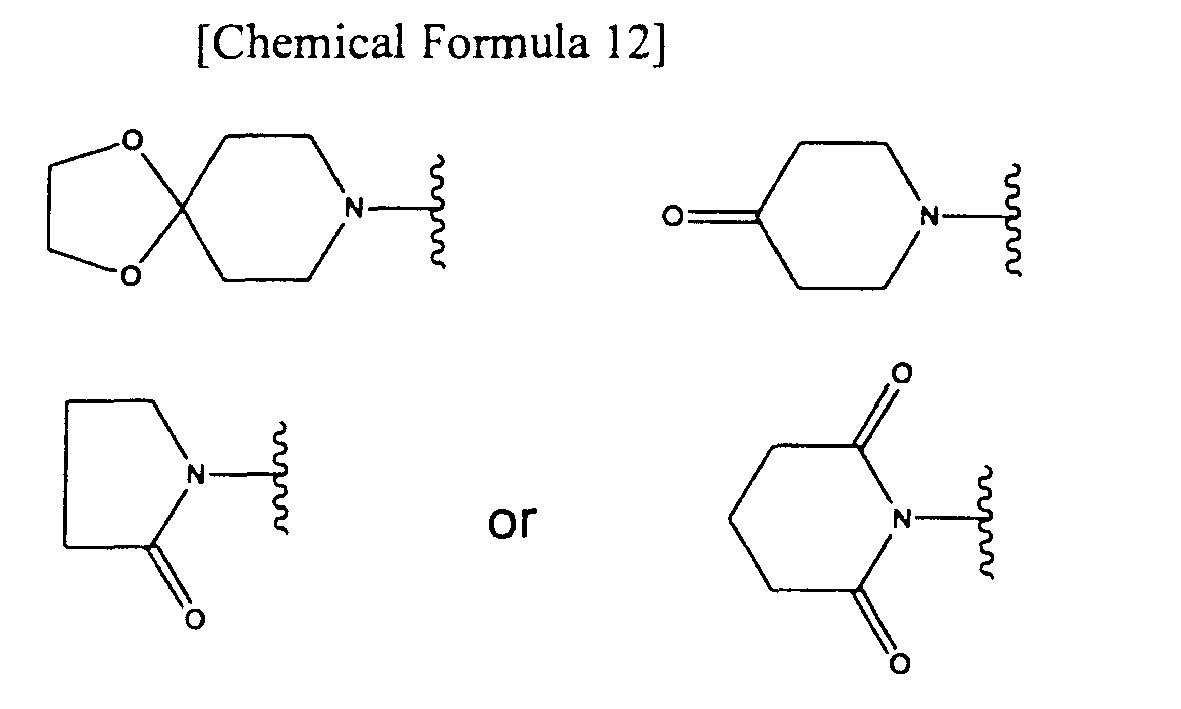
wherein R80 represents hydrogen, C1-6 alkyl, C2-7 alkoxyalkyl or tetrahydropyran-4-yl,
R81 represents C2-7 alkoxyalkyl or tetrahydropyran-4-yl,
R82 represents C2-7 alkoxyalkyl or morpholin-4-yl,
R83 and R84 may be the same or different and each represents hydrogen, C1-6 alkyl, tetrahydropyran-4-yl or C2-7 alkoxyalkyl,
R85 represents hydrogen or C1-6 alkyl, and
R86 represents C1-6 alkyl,
wherein Group P consists of carboxyl, C2-7 alkoxycarbonyl, C2-7 alkoxyalkyl, C 1-6 alkoxy and cyano, and
Group Q consists of carboxyl, C2-7 alkoxycarbonyl, C1-6 alkoxy-C1-6 alkoxy, carboxyl-C1-6 alkoxy, C2-7 alkoxyalkyl and hydroxyl. - [20] The compound according to any one of [1] to [13], the salt thereof or the hydrate of the foregoing, wherein one of R20, R21, R22 and R23 represents phenyl, C2-7 alkoxycarbonyl, C1-6 alkoxy-C1-6 alkoxy, C2-7 alkoxyalkyl, morpholin-4-yl-C1-6 alkyl, pyrrolidin-1-yl optionally having one substituent selected from Group R, piperidin-1-yl optionally having one substituent selected from Group R, a group represented by the following formula:
-

wherein R90 represents hydrogen, C1-6 alkyl, C2-7 alkoxyalkyl or tetrahydropyran-4-yl,
R91 represents C2-7 alkoxyalkyl or tetrahydropyran-4-yl,
R92 represents C2-7 alkoxyalkyl, and
R93 and R94 may be the same or different and each represents hydrogen or C1-6 alkyl,
wherein Group R consists of C1-6 alkoxy-C1-6 alkoxy and C2-7 alkoxyalkyl. - [21] The compound according to any one of [18] to [20], the salt thereof or the hydrate of the foregoing, wherein R20 is hydrogen.
- [22] The compound according to any one of [18] to [20], the salt thereof or the hydrate of the foregoing, wherein two of R20, R21, R22 and R23 are hydrogen, and one of the other two is hydrogen or C1-6 alkoxy.
- [23] The compound according to any one of [18] to [20], the salt thereof or the hydrate of the foregoing, wherein three of R20, R21, R22 and R23 are hydrogen.
- The "C1-6 alkyl" of Group W2, the "C2-7 alkylcarbonyl" of Group W2 and Group W3, the "C2-7 alkoxycarbonyl" of Group W3, Group P and Group Q and the "C2-7 alkoxyalkyl" of Group W2, Group W3, Group P, Group Q and Group R all have the same definitions as in Group W1.
- The "C1-6 alkoxy" of the "C1-6 alkoxy optionally substituted with a substituent selected from Group T1" of Group W2, the "C1-6 alkoxy" of the "C1-6 alkoxy optionally substituted with a substituent selected from Group T1" of Group W3, the "C1-6 alkoxy" of Group P, the "C1-6 alkoxy" of the "C1-6 alkoxy-C1-6 alkoxy" and "carboxyl-C1-6 alkoxy" of Group Q, and the "C1-6 alkoxy" of the "C1-6 alkoxy-C1-6 alkoxy" of Group R, have the same definitions as the "C1-6 alkoxy" of the "C1-6 alkoxy optionally substituted with a substituent selected from Group T1" in Group W1.
- As examples of the "C1-6 alkyl" of the "C1-6 alkyl optionally substituted with a substituent selected from Group U1" for R10X there may be mentioned the same ones listed above.
- As examples of the "4- to 8-membered heterocyclic group" for R10X there may be mentioned the same ones listed above.
- As examples of the "C1-6 alkyl" of the "C1-6 alkyl optionally substituted with a substituent selected from Group U1" for R11X there may be mentioned the same ones listed above.
- As examples of the "4- to 8-membered heterocyclic group" for R11X there may be mentioned the same ones listed above.
- As examples of the "C1-6 alkyl" for R80 there may be mentioned the same ones listed above.
- As examples of the "C2-7 alkoxyalkyl" for R80 there may be mentioned the same ones listed above.
- As examples of the "C2-7 alkoxyalkyl" for R81 there may be mentioned the same ones listed above.
- As examples of the "C2-7 alkoxyalkyl" for R82 there may be mentioned the same ones listed above.
- As examples of the "C1-6 alkyl" for R83 and R84 there may be mentioned the same ones listed above.
- As examples of the "C2-7 alkoxyalkyl" for R83 and R84 there may be mentioned the same ones listed above.
- As examples of the "C1-6 alkyl" for R85 there may be mentioned the same ones listed above.
- As examples of the "C1-6 alkyl" for R86 there may be mentioned the same ones listed above.
- As examples of the "C1-6 alkyl" for R90 there may be mentioned the same ones listed above.
- As examples of the "C2-7 alkoxyalkyl" for R90 there may be mentioned the same ones listed above.
- As examples of the "C2-7 alkoxyalkyl" for R91 there may be mentioned the same ones listed above.
- As examples of the "C2-7 alkoxyalkyl" for R92 there may be mentioned the same ones listed above.
- As examples of the "C1-6 alkyl" for R93 and R94 there may be mentioned the same ones listed above.
- As preferred examples of compounds for the invention there may be mentioned the following:
- 1-[2-(4,4-dimethylcyclohexyl)-5-methoxyphenyl]-4-pentylpiperazine,
- 1-butyl-4-[2-(4-t-butylcyclohex-1-enyl)-4-(4-methoxypiperidin-1-yl)phenyl]piperazine,
- 1-butyl-4-[2-(3,3,5,5-tetramethylcyclohexyl)phenyl]piperazine,
- 1-cyclopropylmethyl-4-[2-(3,3,5,5-tetramethylcyclohexyl)phenyl]piperazine,
- 2-{4-[2-(4-t-butylcyclohexyl)phenyl]piperazin-1-yl}-N-ethylacetamide,
- cis-4-(4-t-butylcyclohexyl)-3-(4-butylpiperazin-1-yl)benzonitrile,
- trans-4-(4-t-butylcyclohexyl)-3-(4-butylpiperazin-1-yl)benzonitrile,
- 1-butyl-4-(2-cyclohexylphenyl)piperazine,
- 1-butyl-4-[2-(4-t-butylcyclohexyl)phenyl]piperazine,
- 1-{4-[2-(4,4-dimethylcyclohexyl)phenyl]piperazin-1-yl}butan-2-one,
- 4-[3-(4-t-butylcyclohex-1-enyl)-4-(4-butylpiperazin-1-yl)phenyl]morpholine,
- 1-[2-(4-t-butylcyclohexyl)phenyl]-4-(2-methoxyethyl)piperazine,
- 1-[2-(4-t-butylcyclohex-1-enyl)-4-(4-methoxypiperidin-1-yl)phenyl]-4-cyclopropylmethylpiperazine,
- 1-(tetrahydropyran-4-ylmethyl)-4-[2-(3,3,5,5-tetramethylcyclohex-1-enyl)phenyl]piperazine,
- 4-[4-(4-propylpiperazin-1-yl)-3-(3,3,5,5-tetramethylcyclohex-1-enyl)phenyl]morpholine,
- 1-{4-[2-(4,4-diethylcyclohex-1-enyl)-4-morpholin-4-ylphenyl]piperazin-1-yl}butan-2-one,
- 1-propyl-4-[2-(3,3,5,5-tetramethylcyclohexyl)phenyl]piperazine,
- 1-butyl-4-[4-(4-methoxypiperidin-1-yl)-2-(3,3,5,5-tetramethylcyclohexyl)phenyl]piperazine,
- 1-butyl-4-[2-(3,5-dimethylcyclohexyl)phenyl]piperazine,
- 1-[2-(4,4-diethylcyclohexyl)phenyl]-4-(tetrahydropyran-4-ylmethyl)piperazine,
- 4-[4-(4-butylpiperazin-1-yl)-3-(3,3,5,5-tetramethylcyclohex-1-enyl)phenyl]morpholine,
- 4-[4-(4-butylpiperazin-1-yl)-3-(3,3,5,5-tetramethylcyclohexyl)phenyl]morpholine,
- 1-[4-(4-ethoxypiperidin-1-yl)-2-(3,3,5,5-tetramethylcyclohexyl)phenyl]-4-propylpiperazine,
- cis-4-[4-(4-butylpiperazin-1-yl)-3-(4,4-dimethylcyclohexyl)phenyl]-2,6-dimethylmorpholine,
- 4-{4-(4-pentylpiperazin-1-yl)-3-spiro[2.5]oct-6-ylphenyl}morpholine,
- 1-[3-fluoro-2-(3,3,5,5-tetramethylcyclohex-1-enyl)phenyl]-4-propylpiperazine,
- 1-cyclopropylmethyl-4-[2-(3,3,5,5-tetramethylcyclohexyl)phenyl]-1,2,3,6-tetrahydropyridine,
- 1-butyl-4-{2-(3,3,4,4-tetramethylcyclopentyl)phenyl}piperazine,
- 1-butyl-4-[2-(4,4-dimethylcyclohexyl)-4-(4-ethoxypiperidin-1-yl)phenyl]piperazine,
- 1-butyl-4-[2-(3,3,5,5-tetramethylcyclohex-1-enyl)phenyl]piperazine,
- 1-cyclopropylmethyl-4-[2-(3,3,5,5-tetramethylcyclohex-1-enyl)phenyl]piperazine,
- 1- {4-[2-(3,3,5,5-tetramethy)cyclohex-1-enyl)phenyl]piperazin-1-yl} butan-2-one,
- 1-(2-methoxyethyl)-4-[2-(3,3,5,5-tetramethylcyclohex-1-enyl)phenyl]piperazine,
- 1- {4-[2-(3,3,5,5-tetramethylcyclohexyl)phenyl]piperazin-l-yl}butan-2-one,
- 1-(2-methoxyethyl)-4-[2-(3,3,5,5-tetramethylcyclohexyl)phenyl]piperazine,
- 4-[4-(4-butylpiperazin-1-yl)-5-(4,4-diethylcyclohexyl)-2-methoxyphenyl]-morpholine,
- 1-butyl-4-(2-spiro[4.5]dec-8-ylphenyl)piperazine,
- 1-[2-(4,4-dimethylcyclohex-1-enyl)phenyl]-4-isobutylpiperazine,
- 1-cyclopropylmethyl-4-[2-(4,4-diethylcyclohexyl)-4-(4-methoxypiperidin-1-yl)phenyl]piperazine,
- 4-[3-(4,4-dimethylcyclohexyl)-4-(4-isobutylpiperazin-1-yl)phenyl]morpholine,
- {4-[2-(3,3,5,5-tetramethylcyclohexyl)phenyl]piperazin-1-yl}acetonitrile,
- 1-(2-ethoxyethyl)-4-[2-(3,3,5,5-tetramethylcyclohexyl)phenyl]piperazine,
- (R)-1-butyl-4-[2-(4,4-diethylcyclohexyl)-4-(3-methoxypyrrolidin-1-yl)phenyl]piperazine,
- 1-[4-methyl-2-(3,3,5,5-tetramethylcyclohexyl)phenyl]-4-propylpiperazine,
- 1-[4-methoxy-2-(3,3,5,5-tetramethylcyclohexyl)phenyl]-4-(tetrahydropyran-4-ylmethyl)piperazine,
- 1-butyl-4-[2-(3,3,5,5-tetramethylcyclohexyl)phenyl]piperidine,
- 1-isobutyl-4-[2-(3,3,4,4-tetramethylcyclopent-1-enyl)phenyl]piperazine, and
- 1-[2-(4-cyclopropylmethylpiperazin-1-yl)phenyl]-3,3,5,5-tetramethylcyclohexanol.
- The compounds according to [1] to [23] above, or the salts thereof, or the hydrates of the foregoing, exhibit excellent cell adhesion inhibitory action or cell infiltration inhibitory action, and can be utilized as medicaments. More specifically, they can be utilized as therapeutic or prophylactic agents for inflammatory diseases and autoimmune diseases, and particularly for various diseases associated with adhesion and infiltration of leukocytes, such as inflammatory bowel disease (especially ulcerative colitis or Crohn's disease), irritable bowel syndrome, rheumatoid arthritis, psoriasis, multiple sclerosis, asthma and atopic dermatitis.
- In other words, the invention also provides the following [24] to [29].
- [24] A medicament comprising the compound according to any one of [1] to [23], the salt thereof or the hydrate of the foregoing.
- [25] A cell adhesion or cell infiltration inhibitor comprising the compound according to any one of [1] to [23], the salt thereof or the hydrate of the foregoing.
- [26] A therapeutic or prophylactic agent for an inflammatory disease or an autoimmune disease, comprising the compound according to any one of [1] to [23], the salt thereof or the hydrate of the foregoing.
- [27] A therapeutic or prophylactic agent for an inflammatory bowel disease, irritable bowel syndrome, rheumatoid arthritis, psoriasis, multiple sclerosis, asthma or atopic dermatitis, comprising the compound according to any one of [1] to [23], the salt thereof or the hydrate of the foregoing.
- [28] A therapeutic or prophylactic agent for an inflammatory bowel disease, comprising the compound according to any one of [1] to [23], the salt thereof or the hydrate of the foregoing.
- [29] A therapeutic or prophylactic agent for ulcerative colitis or Crohn's disease, comprising the compound according to any one of [1] to [23], the salt thereof or the hydrate of the foregoing.
- The compounds of the invention have excellent cell adhesion inhibitory action or cell infiltration inhibitory action, and are therefore useful as therapeutic or prophylactic agents for inflammatory diseases and autoimmune diseases, particularly as therapeutic or prophylactic agents for various diseases associated with adhesion and infiltration of leukocytes, such as inflammatory bowel disease (particularly ulcerative colitis or Crohn's disease), irritable bowel syndrome, rheumatoid arthritis, psoriasis, multiple sclerosis, asthma and atopic dermatitis.
- Compounds (1) and (100) of the invention may be produced by the methods described below. However, it is to be understood that the production methods for the compounds of the invention are not limited to those described below.
- Compound (1) of the invention may be produced by the following Method A, Method B, Method C, Method D, Method E, Method N, Method P or Method V.
Compound (1A) of the invention (the compound (1) wherein X1 is nitrogen) may be produced by the following Method F, Method G, Method H, Method K, Method M, Method Q or Method R.
Compound (1B) of the invention (the compound (1) wherein X1 is CH) and compound (100) of the invention may be produced by the following Method A, Method B, Method C, Method D, Method E, Method K, Method M, Method S, Method T or Method U.
Each of these methods will now be explained in detail. -


- Method A is a method of producing compound (1) of the invention by reacting compound (2) with an alkylating agent (3), carbonylating agent (3) or sulfonylating agent (3) in an inert solvent, in the presence or in the absence of a base, in the presence or in the absence of an additive, and optionally removing any protecting groups on the resultant compound, or a method of producing compound (100) of the invention by reacting compound (200) in a similar manner.
In this scheme, R10, R20, R21, R22, R23, R30, R31, R32, R40, X1 and n have the same definitions as above. R10a, R20a, R21a, R22a, R23a, R30a, R31a, R32a and R40a have the same definitions as the corresponding R10, R20, R21, R22, R23, R30, R31, R32 and R40, or are the corresponding groups R10, R20, R21, R22, R23, R30, R31, R32 and R40 with the respective substituents on the groups protected, and W1 represents a leaving group which is chlorine, bromine or iodine, alkylsulfonyloxy such as methanesulfonyloxy or ethanesulfonyloxy, haloalkanesulfonyloxy such as trifluoromethanesulfonyloxy or nonafluorobutanesulfonyloxy, or arylsulfonyloxy such as benzenesulfonyloxy or p-toluenesulfonyloxy, among which chlorine, bromine, iodine, methanesulfonyloxy, p-toluenesulfonyloxy, nonafluorobutanesulfonyloxy or trifluoromethanesulfonyloxy is preferred. - There are no particular restrictions on the solvent used so long as it dissolves the starting compound to some extent and does not inhibit the reaction of this step, and specifically there may be mentioned amides such as formamide, dimethylformamide, dimethylacetamide, hexamethylphosphoric triamide and N-methylpyrrolidone, nitriles such as acetonitrile and isobutyronitrile, aromatic hydrocarbons such as toluene, benzene and xylene, ethers such as diethyl ether, diisopropyl ether, tetrahydrofuran, dioxane, dimethoxyethane and diethyleneglycol dimethyl ether or sulfoxides such as dimethyl sulfoxide, as well as mixtures of these solvents, among which dimethylformamide, acetonitrile, toluene or tetrahydrofuran is preferred.
There are no particular restrictions on the base used so long as it can yield the target compound and does not produce any unseparable by-products, and specifically there may be mentioned organic bases such as triethylamine and pyridine or inorganic bases such as potassium carbonate, sodium carbonate, potassium hydrogencarbonate, sodium hydrogencarbonate and cesium carbonate, among which potassium carbonate or triethylamine is preferred.
Sodium iodide or potassium iodide is used as an additive to accelerate the reaction if necessary.
The reaction temperature will differ depending on the starting materials, solvent and reagents, but will usually be between -30°C and 180°C, and is preferably between 0°C and 120°C.
The reaction time will differ depending on the starting materials, solvent. reagents and reaction temperature, but will usually be 0.5 to 100 hours, and is preferably 0.5 to 24 hours. - There are no particular restrictions on the solvent used so long as it dissolves the starting compound to some extent and does not inhibit the reaction of this step, and specifically there may be mentioned halogenated hydrocarbons such as chloroform, dichloromethane, 1,2-dichloroethane and carbon tetrachloride, ethers such as diethyl ether, diisopropyl ether, tetrahydrofuran, dioxane, dimethoxyethane and diethyleneglycol dimethyl ether, amides such as formamide, dimethylformamide, dimethylacetamide, hexamethylphosphoric triamide and N-methylpyrrolidone, organic bases such as pyridine, or water, as well as mixtures of these solvents, among which dichloromethane, tetrahydrofuran, dioxane, dimethylformamide, pyridine, water, and mixtures thereof are preferred.
There are no particular restrictions on the base used so long as it can yield the target compound and does not produce any unseparable by-products, and specifically there may be mentioned organic bases such as triethylamine and pyridine or inorganic bases such as potassium carbonate, sodium carbonate, potassium hydrogencarbonate, sodium hydrogencarbonate, cesium carbonate and sodium hydroxide, among which potassium carbonate or triethylamine is preferred.
4-Dimethylaminopyridine is used as an additive to accelerate the reaction if necessary.
The reaction temperature will differ depending on the starting materials, solvent and reagents, but will usually be between -70°C and 120°C, and is preferably between -70°C and 60°C.
The reaction time will differ depending on the starting materials, solvent, reagents and reaction temperature, but will usually be 0.5 to 48 hours, and is preferably 0.5 to 12 hours. - Compounds (1) and (100) of the invention may be isolated or purified from the reaction mixture obtained above, by the method described below.
When R10 of the resultant compound (1) or (100) is optionally substituted 5-to 10-membered cycloalkenyl, it may be subjected to hydrogenation to yield compound (1) of the invention or compound (1B) of the invention (the compound (1) wherein X1 is CH), wherein R10 is 5- to 10-membered cycloalkyl optionally substituted with the corresponding substituent.
When R10 of the resultant compound (100) is optionally substituted 5- to 10-membered cycloalkyl, it may be subjected to hydrogenation to yield compound (1B) of the invention (the compound (1) wherein X1 is CH). - Specifically, hydrogenation reaction may be carried out using a metal catalyst in an inert solvent, under a hydrogen atmosphere or in the presence of hydrogen-donating reagent, in the presence or in the absence of an acid.
There are no particular restrictions on the solvent used so long as it dissolves the starting compound to some extent and does not inhibit the reaction of this step, and specifically there may be mentioned water, alcohols such as methanol and ethanol, ethers such as diethyl ether, diisopropyl ether, tetrahydrofuran, dioxane, dimethoxyethane and diethyleneglycol dimethyl ether, esters such as methyl acetate, ethyl acetate, propyl acetate, butyl acetate and diethyl carbonate, amides such as formamide, dimethylformamide, dimethylacetamide, hexamethylphosphoric triamide and N-methylpyrrolidone, aliphatic hydrocarbons such as hexane, heptane, ligroin and petroleum ether or organic acids such as acetic acid, or mixtures of these solvents, among which methanol, ethanol, ethyl acetate, tetrahydrofuran, a mixed solvent of methanol and tetrahydrofuran, or a mixed solvent of ethanol and tetrahydrofuran is preferred.
There are no particular restrictions on the metal catalyst used so long as it can yield the target compound and does not produce any unseparable by-products, and specifically there may be mentioned heterogeneous rare metal catalysts such as palladium, palladium hydroxide, platinum, platinum oxide, rhodium, ruthenium and nickel (preferably supported on a carrier such as activated carbon, alumina, silica or zeolite) and homogeneous metal complex catalysts such as chlorotris(triphenylphosphine) rhodium(I) (Wilkinson's complex), among which heterogeneous rare metal catalysts (especially 5 to 10% palladium-activated carbon or platinum oxide, optionally wetted with water) are preferred.
The number of equivalents of the metal catalyst used (including the carrier) will differ depending on the starting materials, solvent and reagents, but will usually be a proportion of 0.05 to 10 and preferably 0.05 to 3, in terms of the weight ratio with respect to the starting material.
There are no particular restrictions on the acid used so long as it can yield the target compound and does not produce any unseparable by-products, and specifically there may be mentioned organic acids such as methanesulfonic acid, trifluoromethanesulfonic acid, acetic acid and trifluoroacetic acid, or inorganic acids such as hydrochloric acid and hydrobromic acid.
The reaction temperature will differ depending on the starting materials, solvent and reagents, but will usually be between -10°C and 80°C, and is preferably between 0°C and 50°C.
The reaction pressure of the hydrogen will also differ depending on the starting materials, solvent and reagents, but will usually be between I and 100 atmospheres, and preferably between 1 and 5 atmospheres.
The reaction time will differ depending on the starting materials, solvent, reagents and reaction temperature, but will usually be 0.5 to 200 hours, and is preferably 0.5 to 100 hours. - When the resultant compound is to be converted to an acid salt, this may be accomplished by a conventional method. The step of producing the salt and the step of hydrogenation described above may be carried out in a different order where appropriate.
-


- Method B is a method of producing compound (1) of the invention by reacting compound (2) with an acid anhydride (4) in an inert solvent, in the presence or in the absence of a base, and optionally removing any protecting groups on the resultant compound, or a method of producing compound (100) of the invention by reacting compound (200) in a similar manner.
In this scheme, R10, R20, R21, R22, R23, R30, R31, R32, R40, X1, n, R10a, R20a, R21a, R22a, R23a, R30a, R31a and R32a have the same definitions as above. Also, R40b is a group comprising carbonyl or sulfonyl, which is suitable for obtaining R40 and can form an acid anhydride. Substituents on R40b may also be protected.
This method may also be carried out in a manner similar to the carbonylation or sulfonylation step of Method A above. - Compounds (1) and (100) of the invention may be isolated or purified from the reaction mixture obtained above, by the method described below.
When R10 of the resultant compound (1) or (100) is optionally substituted 5-to 10-membered cycloalkenyl, it may be subjected to the hydrogenation described for Method A above to yield compound (1) of the invention or compound (1B) of the invention (the compound (1) wherein X1 is CH), wherein R10 is 5- to 10-membered cycloalkyl optionally substituted with the corresponding substituent.
When R10 of the resultant compound (100) is optionally substituted 5- to 10-membered cycloalkyl, it may be subjected to hydrogenation to yield compound (1B) of the invention (the compound (1) wherein X1 is CH).
When the resultant compound is to be converted to an acid salt, this may be carried out by a conventional method. The step of producing the salt and the step of hydrogenation described above may be carried out in a different order where appropriate. -


- Method C is a method of producing compound (1) of the invention by reacting compound (2) with an aldehyde (5) or ketone (5) in an inert solvent, in the presence of a reducing agent, in the presence or in the absence of an acid, in the presence or in the absence of an additive, and optionally removing any protecting groups on the resultant compound, or a method of producing compound (100) of the invention by reacting compound (200) in a similar manner.
In this scheme, R10, R20, R21, R22, R23, R30, R31, R32, R40, X1, n, R10a, R20a, R21a, R22a, R23a, R30a, R31a and R32a have the same definitions as above. Also, A1 and A2 are groups suitable for obtaining R40. Substituents on A1 or A2 may also be protected. - There are no particular restrictions on the solvent used so long as it dissolves the starting compound to some extent and does not inhibit the reaction of this step, and specifically there may be mentioned ethers such as diethyl ether, diisopropyl ether, tetrahydrofuran, dioxane, dimethoxyethane and diethyleneglycol dimethyl ether, halogenated hydrocarbons such as chloroform, dichloromethane, 1,2-dichloroethane and carbon tetrachloride, nitriles such as acetonitrile and isobutyronitrile, aromatic hydrocarbons such as toluene, benzene and chlorobenzene or alcohols such as methanol and ethanol, among which ethers (particularly tetrahydrofuran) and halogenated hydrocarbons (particularly dichloroethane) are preferred.
There are no particular restrictions on the reducing agent used so long as it can yield the target compound and does not produce any unseparable by-products, and specifically there may be mentioned boron reducing agents such as sodium triacetoxyborohydride, sodium cyanoborohydride and borane-pyridine, and metal catalyst-hydrogen gas, among which sodium triacetoxyborohydride is preferred.
There are no particular restrictions on the acid used so long as it can yield the target compound and does not produce any unseparable by-products, and specifically there may be mentioned organic acids such as acetic acid and trifluoroacetic acid or Lewis acids such as titanium tetraisopropoxide and zinc chloride, among which organic acids (particularly acetic acid) are preferred.
There are no particular restrictions on the use of an additive so long as it can yield the target compound and does not produce any unseparable by-products, and specifically there may be mentioned molecular sieve or magnesium sulfate, among which Molecular Sieve 4Å is preferred.
The reaction temperature will differ depending on the starting materials, solvent and reagents, but will usually be between -70°C and 120°C, and is preferably between 0°C and 50°C.
The reaction time will differ depending on the starting materials, solvent, reagents and reaction temperature, but will usually be 0.1 to 200 hours, and is preferably 0.1 to 24 hours.
As supplementary literature to be used as reference for carrying out this method, there may be mentioned, but not limited to, Ahmed F. Abdel-Magid et al., J. Org. Chem. (1996), 61, 3849. - Compounds (1) and (100) of the invention may be isolated or purified from the reaction mixture obtained above, by the method described below.
When R10 of the resultant compound (1) or (100) is optionally substituted 5-to 10-membered cycloalkenyl, it may be subjected to the hydrogenation described for Method A above to yield compound (1) of the invention or compound (1B) of the invention (the compound (1) wherein X1 is CH), wherein R10 is 5- to 10-membered cycloalkyl optionally substituted with the corresponding substituent.
When R10 of the resultant compound (100) is optionally substituted 5- to 10-membered cycloalkyl, it may be subjected to hydrogenation to yield compound (1B) of the invention (the compound (1) wherein X1 is CH).
When the resultant compound is to be converted to an acid salt, this may be carried out by a conventional method. The step of producing the salt and the step of hydrogenation described above may be carried out in a different order where appropriate. -


- Method D is a method of producing compound (1) of the invention by reacting compound (2) with a conjugated carbonyl compound (6) by Michael addition reaction in an inert solvent, and optionally removing protecting groups on the resultant compound, or a method of producing compound (100) of the invention by reacting compound (200) in a similar manner.
In this scheme. R10, R20, R21, R22, R23, R30 R31, R32, R40 X1, n, R10a, R20a, R21a, R22a, R23a, R30a, R31a and R32a have the same definitions as above. Also, Z1, Z2, Z3 and Z4 are groups suitable for obtaining R40. Substituents on Z1, Z2, Z3 and Z4 may also be protected. - There are no particular restrictions on the solvent used so long as it dissolves the starting compound to some extent and does not inhibit the reaction of this step, and specifically there may be mentioned alcohols such as methanol, ethanol, n-propanol, isopropanol, n-butanol, isobutanol, t-butanol, isoamyl alcohol, diethylene glycol and glycerin, halogenated hydrocarbons such as chloroform, dichloromethane, 1,2-dichloroethane and carbon tetrachloride, ethers such as diethyl ether, diisopropyl ether, tetrahydrofuran, dioxane, dimethoxyethane and diethyleneglycol dimethyl ether, amides such as formamide, dimethylformamide, dimethylacetamide, hexamethylphosphoric triamide and N-methylpyrrolidone, and aromatic hydrocarbons such as benzene, toluene and xylene, among which halogenated hydrocarbons (particularly chloroform) or ethers (particularly tetrahydrofuran) are preferred.
The reaction temperature will differ depending on the starting materials, solvent and reagents, but will usually be between -30°C and 150°C, and is preferably between 0°C and 120°C.
The reaction time will differ depending on the starting materials, solvent, reagents and reaction temperature, but will usually be 0.5 to 48 hours, and is preferably 0.5 to 24 hours. - Compounds (1) and (100) of the invention may be isolated or purified from the reaction mixture obtained above, by the method described below.
When R10 of the resultant compound (1) or (100) is optionally substituted 5-to 10-membered cycloalkenyl, it may be subjected to the hydrogenation described for Method A above to yield compound (1) of the invention or compound (1B) of the invention (the compound (1) wherein X1 is CH), wherein R10 is 5- to 10-membered cycloalkyl optionally substituted with the corresponding substituent.
When R10 of the resultant compound (100) is optionally substituted 5- to 10-membered cycloalkyl, it may be subjected to hydrogenation to yield compound (1B) of the invention (the compound (1) wherein X1 is CH).
When the resultant compound is to be converted to an acid salt, this may be carried out by a conventional method. The step of producing the salt and the step of hydrogenation described above may be carried out in a different order where appropriate. -


- Method E is a method of producing compound (1) of the invention by reacting compound (2) with an isocyanate compound (7) or a substituted aminocarbonylchloride compound (7) in an inert solvent, in the presence or in the absence of a base, and optionally removing protecting groups on the resultant compound, or a method of producing compound (100) of the invention by reacting compound (200) in a similar manner.
In this scheme, R10, R20, R21, R22, R23, R30, R31, R32, R40, X1, n, R10a, R20a, R21a, R22a, R23a, R30a, R31a and R32a have the same definitions as above. Also, A3, A4 and A5 are groups suitable for obtaining R40, Substituents on A3, A4 and A5 may also be protected. - There are no particular restrictions on the solvent used so long as it dissolves the starting compound to some extent and does not inhibit the reaction of this step, and specifically there may be mentioned halogenated hydrocarbons such as chloroform, dichloromethane, 1,2-dichloroethane and carbon tetrachloride, aromatic hydrocarbons such as benzene, toluene and chlorobenzene, and ethers such as diethyl ether, diisopropyl ether, tetrahydrofuran, dioxane, dimethoxyethane and diethyleneglycol dimethyl ether, among which dichloromethane or tetrahydrofuran is preferred.
There are no particular restrictions on the base used so long as it can yield the target compound and does not produce any unseparable by-products, and specifically there may be mentioned organic bases such as N-methylmorpholine, triethylamine, tripropylamine, tributylamine, diisopropylethylamine, dicyclohexylamine, N-methylpiperidine, pyridine, 4-pyrrolidinopyridine, picoline, 4-(N,N-dimethylamino)pyridine, 2,6-di(t-butyl)-4-methylpyridine, quinoline, N,N-dimethylaniline, N,N-diethylaniline, 1,5-diazabicyclo[4.3.0]non-5-ene (DBN), 1,4-diazabicyclo[2.2.2]octane (DABCO) and 1,8-diazabicyclo[5.4.0]undec-7-ene (DBU), among which triethylamine or pyridine is preferred.
The reaction temperature will differ depending on the starting materials, solvent and reagents, but will usually be between -70°C and 100°C.
The reaction time will differ depending on the starting materials, solvent, reagents and reaction temperature, but will usually be 1 to 24 hours. - Compounds (1) and (100) of the invention may be isolated or purified from the reaction mixture obtained above, by the method described below.
When R10 of the resultant compound (1) or (100) is optionally substituted 5-to 10-membered cycloalkenyl, it may be subjected to the hydrogenation described for Method A above to yield compound (1) of the invention or compound (1B) of the invention (the compound (1) wherein X1 is CH), wherein R10 is 5- to 10-membered cycloalkyl optionally substituted with the corresponding substituent.
When R10 of the resultant compound (100) is optionally substituted 5- to 10-membered cycloalkyl, it may be subjected to hydrogenation to yield compound (1B) of the invention (the compound (1) wherein X1 is CH).
When the resultant compound is to be converted to an acid salt, this may be carried out by a conventional method. The step of producing the salt and the step of hydrogenation described above may be carried out in a different order where appropriate. -

- Method F is a method of producing compound (1A) of the invention (the compound (1) wherein X1 is nitrogen) by reacting compound (8) with compound (9) (amination or amidation) in an inert solvent, in the presence of a palladium(0) catalyst or copper catalyst, in the presence or in the absence of a base, in the presence or in the absence of an additive, under or not under an inert gas atmosphere, and optionally removing protecting groups on the resultant compound.
In this scheme, R10, R20, R21, R22, R23, R30, R31, R32, R40, n, R10a, R20a, R21a, R22a, R23a, R30a, R31a and R32a have the same definitions as above. Also, W1a represents chlorine, bromine or iodine, or a trifluoromethanesulfonyloxy group. - There are no particular restrictions on the solvent used so long as it dissolves the starting compound to some extent and does not inhibit the reaction of this step, and specifically there may be mentioned amides such as dimethylformamide, dimethylacetamide, hexamethylphosphoric triamide and N-methylpyrrolidone, aromatic hydrocarbons such as toluene, benzene, xylene and mesitylene, ethers such as diethyl ether, diisopropyl ether, tetrahydrofuran, dioxane, dimethoxyethane and diethyleneglycol dimethyl ether, alcohols such as methanol, ethanol, n-propanol, isopropanol, n-butanol, isobutanol, t-butanol, isoamyl alcohol, diethylene glycol, glycerin, octanol and cyclohexanol, nitriles such as acetonitrile and isobutyronitrile, or mixtures of these solvents, among which dimethylformamide, toluene, xylene, tetrahydrofuran, dioxane or dimethoxyethane is preferred.
There are no particular restrictions on the palladium(0) catalyst used so long as it can yield the target compound and does not produce any unseparable by-products, and specifically there may be mentioned tetrakis(triphenylphosphine)palladium, tris(dibenzylideneacetone)dipalladium, bis(dibenzylideneacetone)palladium, bis(tri-t-butylphosphine)palladium and palladium black, or palladium(0) catalysts produced in the reaction system by combination of the palladium complexes which can be palladium(0) precursors mentioned below and various ligands mentioned below.
There are no particular restrictions on various palladium complexes which can be used as palladium(0) precursors, so long as they can yield the target compound without producing any unseparable by-products, and specifically there may be mentioned palladium acetate, [1,1'-bis(diphenylphosphino)ferrocene] dichloropalladium, dichlorobis(tri-o-tolylphosphine)palladium. dichlorobis(triscyclohexylphosphine)palladium, and the like. There are no particular restrictions on ligands used so long as they can yield the target compound without producing any unseparable by-products, and specifically there may be mentioned 2,2'-bis(diphenylphosphino)-1,1'-binaphthyl (BINAP), 9,9-dimethyl-4,5-bis(diphenylphosphino)xanthene (Xantphos), tri-t-butylphosphine, tri(4-methylphenyl)phosphine, tri-2-furylphosphine, 2-(di-t-butylphosphino)biphenyl, 2-(dicyclohexylphosphino)biphenyl, tricyclohexylphosphine, 2-dicyclohexylphosphino-2'-(N,N-dimethylamino)biphenyl, 1,1'-bis(diphenylphosphino)ferrocene, di-t-butylphosphonium tetrafluoroborate and 1,3-bis(2,4,6-trimethylphenyl)imidazol-2-ylidene.
There are no particular restrictions on the base used so long as it can yield the target compound and does not produce any unseparable by-products, and specifically there may be mentioned inorganic bases such as sodium t-butoxide, potassium t-butoxide, tripotassium phosphate, trisodium phosphate, cesium carbonate, potassium carbonate, sodium carbonate, cesium bicarbonate, potassium hydrogencarbonate, sodium hydrogencarbonate, sodium acetate, potassium acetate, cesium acetate, potassium fluoride, cesium fluoride, sodium hydroxide and potassium hydroxide, or organic bases such as triethylamine, 1,8-bis(dimethylamino)naphthalene, 1,4-diazabicyclo[2.2.2]octane (DABCO) and 1,8-diazabicyclo[5.4.0]undec-7-ene (DBU).
There are no particular restrictions on the additive used so long as it can yield the target compound and does not produce any unseparable by-products, and specifically there may be mentioned lithium fluoride, sodium fluoride, lithium chloride, sodium chloride, lithium bromide, sodium bromide, 1,4,7,10,13,16-hexaoxacyclooctadecane(18-Crown-6), 1,4,7,10,13-pentaoxacyclopentadecane(15-Crown-5), tetrabutylammonium fluoride and tetrabutylammonium bromide.
The reaction temperature will differ depending on the starting materials, solvent and reagents, but will usually be between 0°C and 150°C, and is preferably between 20°C and 110°C.
The reaction time will differ depending on the starting materials, solvent, reagents and reaction temperature, but will usually be 0.1 to 100 hours, and is preferably 0.5 to 48 hours.
When the reaction is carried out in an inert gas atmosphere, the inert gas is not particularly restricted so long as it does not inhibit the reaction of this step, and specifically it may be argon or nitrogen gas.
As supplementary literature to be used as reference for carrying out this method, there may be mentioned, but not limited to: D. Prim et al., Tetrahedron (2002), 58, 2041; and L. Buchwald et al., J. Organomet. Chem. (1999), 576, 125. - There are no particular restrictions on the solvent used so long as it dissolves the starting compound to some extent and does not inhibit the reaction of this step, and specifically there may be mentioned amides such as formamide, dimethylformamide, dimethylacetamide, hexamethylphosphoric triamide and N-methylpyrrolidone, aromatic hydrocarbons such as toluene, benzene, xylene, mesitylene and nitrobenzene, ethers such as diethyl ether, diisopropyl ether, tetrahydrofuran, dioxane, dimethoxyethane and diethyleneglycol dimethyl ether, alcohols such as methanol, ethanol, n-propanol, isopropanol, n-butanol, isobutanol, t-butanol, isoamyl alcohol, diethylene glycol, glycerin, octanol, cyclohexanol and methyl cellosolve, or mixtures of these solvents, among which isopropanol, N-methylpyrrolidone, toluene and dimethylformamide are preferred.
There are no particular restrictions on the copper catalyst used so long as it can yield the target compound and does not produce any unseparable by-products, and specifically there may be mentioned copper (powder), copper(I) chloride, copper(II) chloride, copper(I) iodide, copper(I) oxide, copper(II) oxide, copper(II) acetate, copper(II) sulfate pentahydrate, copper(II) acetylacetonate, copper(I) thiocyanate and the like, among which copper (powder), copper(I) iodide and copper(I) chloride are preferred.
There are no particular restrictions on the ligand used so long as it can yield the target compound and does not produce any unseparable by-products, and specifically there may be mentioned ethylene glycol, diethylene glycol, cresol, 2,6-dimethylphenol, 1-naphthol, 2-naphthol, ethylenediamine, N,N'-dimethylethylenediamine and diisopropylamine, among which ethylene glycol and ethylenediamine are preferred.
There are no particular restrictions on the base used so long as it can yield the target compound and does not produce any unseparable by-products, and specifically there may be mentioned inorganic bases such as sodium t-butoxide, potassium t-butoxide, tripotassium phosphate, trisodium phosphate, cesium carbonate, potassium carbonate, sodium carbonate and sodium hydride, or organic bases such as potassium bis(trimethylsilyl)amide, among which potassium carbonate and tripotassium phosphate are preferred.
The reaction temperature will differ depending on the starting materials, solvent and reagents, but will usually be between 0°C and 250°C, and is preferably between 80°C and 150°C.
The reaction time will differ depending on the starting materials, solvent, reagents and reaction temperature, but will usually be 0.1 to 100 hours, and is preferably 0.5 to 48 hours.
When the reaction is carried out in an inert gas atmosphere, the inert gas is not particularly restricted so long as it does not inhibit the reaction of this step, and specifically it may be argon or nitrogen gas.
As supplementary literature to be used as reference for carrying out this method, there may be mentioned, but not limited to, L. Buchwald et al., Org. Lett. (2002), 4, 581. - Compound (1A) of the invention may be isolated or purified from the reaction mixture obtained above, by the method described below.
When R10 of the resultant compound (1A) is optionally substituted 5- to 10-membered cycloalkenyl, it may be subjected to the hydrogenation described for Method A above to yield compound (1A) of the invention wherein R10 is 5- to 10-membered cycloalkyl optionally substituted with the corresponding substituent.
When the resultant compound is to be converted to an acid salt, this may be carried out by a conventional method. The step of producing the salt and the step of hydrogenation described above may be carried out in a different order where appropriate. -


- Method G is a method of producing compound (1 A) of the invention (the compound (1) wherein X1 is nitrogen) by reacting compound (8) with compound (10) in an inert solvent, in the presence of a copper catalyst, in the presence of a base, in the presence or in the absence of oxygen, and optionally removing protecting groups on the resultant compound.
In this scheme, R10, R20 R21, R22, R23, R30, R31, R32, R40, n, R10a, R20a, R21a, R22a, R23a, R30a, R31a, R32a and R40a have the same definitions as above. M1a is a group represented by the formula -B(OH)2. - There are no particular restrictions on the solvent used so long as it dissolves the starting compound to some extent and does not inhibit the reaction of this step, and specifically there may be mentioned amides such as formamide, dimethylformamide, dimethylacetamide, hexamethylphosphoric triamide and N-methylpyrrolidone, halogenated hydrocarbons such as chloroform, dichloromethane, 1,2-dichloroethane and carbon tetrachloride, aromatic hydrocarbons such as toluene, benzene and xylene or ethers such as diethyl ether, diisopropyl ether, tetrahydrofuran, dioxane, dimethoxyethane and diethyleneglycol dimethyl ether, or mixtures of these solvents, among which halogenated hydrocarbons (particularly dichloromethane) are preferred.
There are no particular restrictions on the copper catalyst used so long as it can yield the target compound and does not produce any unseparable by-products, and specifically there may be mentioned copper(II) acetate, copper(I) acetate, copper(II) trifluoromethanesulfonate and copper(II) isobutyrate, among which copper(II) acetate is preferred.
There are no particular restrictions on the base used so long as it can yield the target compound and does not produce any unseparable by-products, and specifically there may be mentioned organic bases such as triethylamine, pyridine, 2,6-lutidine, N-methylmorpholine and 1,8-diazabicyclo[5.4.0]undec-7-ene, among which triethylamine or pyridine is preferred.
There are no particular restrictions on the additive used to accelerate the reaction so long as it can yield the target compound and does not produce any unseparable by-products, and specifically there may be mentioned molecular sieve, pyridine-N-oxide and 2,2,6,6-tetramethylpiperidinooxy, among which molecular sieve (particularly 4Å) is preferred.
The reaction temperature will differ depending on the starting materials, solvent and reagents, but will usually be between 0°C and 80°C, and is preferably between 10°C and 50°C.
The reaction time will differ depending on the starting materials, solvent, reagents and reaction temperature, but will usually be 1 to 100 hours, and is preferably 24 to 48 hours. - Compound (1A) of the invention may be isolated or purified from the reaction mixture obtained in the manner described above, by the following method.
When R10 of the resultant compound (1A) is optionally substituted 5- to 10-membered cycloalkenyl, it may be subjected to the hydrogenation described for Method A above to yield compound (1A) of the invention wherein R10 is 5- to 10-membered cycloalkyl optionally substituted with the corresponding substituent.
When the resultant compound is to be converted to an acid salt, this may be carried out by a conventional method. The step of producing the salt and the step of hydrogenation described above may be carried out in a different order where appropriate. -

- Method H is a method of producing compound (1A) of the invention (the compound (1) wherein X1 is nitrogen) by reacting compound (11) with compound (12) in an inert solvent or in the absence of a solvent, under or not under an inert gas atmosphere, in the presence or in the absence of a base, in the presence or in the absence of an additive, and optionally removing protecting groups on the resultant compound.
In this scheme, R10, R20, R21, R22, R23, R30, R31, R32, R40, n, W1, R10a, R20a, R21a, R22a, R23a, R30a, R31a, R32a and R40a have the same definitions as above. - There are no particular restrictions on the solvent used so long as it dissolves the starting compound to some extent and does not inhibit the reaction of this step, and specifically there may be mentioned alcohols such as methanol, ethanol, n-propanol, isopropanol, n-butanol, isobutanol, t-butanol, isoamyl alcohol, diethylene glycol, glycerin, octanol, cyclohexanol and methyl cellosolve, aromatic hydrocarbons such as benzene, chlorobenzene, 1,2-dichlorobenzene, toluene and xylene, ethers such as diethyl ether, diisopropyl ether, tetrahydrofuran, dioxane, dimethoxyethane and diethyleneglycol dimethyl ether, and amides such as dimethylformamide, dimethylacetamide, hexamethylphosphoric triamide and N-methylpyrrolidone, among which butanol, 1,2-dichlorobenzene, toluene, xylene, tetrahydrofuran, dioxane, dimethylformamide or hexamethylphosphoric triamide is preferred.
When no solvent is used, the reaction may be carried out using a microwave reactor or with alumina or silica gel as a carrier.
When the reaction is carried out under an atmosphere of an inert gas, there are no particular restrictions on the inert gas so long as it does not inhibit the reaction of this step, and specifically there may be mentioned argon or nitrogen gas.
There are no particular restrictions on the base used so long as it can yield the target compound and does not produce any unseparable by-products, and specifically there may be mentioned organic bases such as triethylamine, pyridine, diisopropylethylamine, 4-dimethylaminopyridine, DBU and DABCO, or inorganic bases such as potassium carbonate, sodium carbonate and sodium hydrogencarbonate.
There are no particular restrictions on the additive used to accelerate the reaction so long as it can yield the target compound and does not produce any unseparable by-products, and specifically there may be mentioned alkali metal iodides such as sodium iodide and potassium iodide.
The reaction temperature will differ depending on the starting materials, solvent and reagents, but will usually be between 0°C and 270°C.
The reaction time will differ depending on the starting materials, solvent, reagents and reaction temperature, but will usually be 0.5 to 100 hours. - Compound (1A) of the invention may be isolated or purified from the reaction mixture obtained above, by the method described below.
When R10 of the resultant compound (1A) is optionally substituted 5- to 10-membered cycloalkenyl, it may be subjected to the hydrogenation described for Method A above to yield compound (1A) of the invention wherein R10 is 5- to 10-membered cycloalkyl optionally substituted with the corresponding substituent.
When the resultant compound is to be converted to an acid salt, this may be carried out by a conventional method. The step of producing the salt and the step of hydrogenation described above may be carried out in a different order where appropriate. -


- Method K is a method of producing compound (1A) of the invention (the compound (1) wherein X1 is nitrogen) by reacting compound (13) with a boron metal reagent (14) or a tin metal reagent (14) (Suzuki reaction or Stille reaction) in an inert solvent, in the presence of a palladium(0) catalyst, under or not under an inert gas atmosphere, in the presence or in the absence of a base, in the presence or in the absence of an additive, and optionally removing protecting groups on the resultant compound, or a method of producing compound (100) of the invention by reacting compound (190) in a similar manner.
In this scheme, R10, R20, R21, R22, R23, R30, R31, R32, R40, n, W1a, R20a, R21a, R22a, R23a, R30a, R31a, R32a and R40a have the same definitions as above. R10b represents optionally substituted 5- to 10-membered cycloalkenyl, where the substituent has the same definition as the substituent of the "optionally substituted 5- to 10-membered cycloalkenyl" for R10, with the proviso that this substituent may be protected.
Also, M1b represents B(OE10c)2 or Sn(E10b)3, wherein E10c represents C1-6 alkyl or the two of E10c bond together to form C2-3 alkylene optionally substituted with methyl, and E10b represents C1-6 alkyl.
This method will differ depending on the nature of M1b. - This method is a method of producing compound (1A) of the invention (the compound (1) wherein X1 is nitrogen) by reacting compound (13) with compound (14) in an inert solvent, in the presence of a palladium(0) catalyst, in the presence of a base, in the presence or in the absence of an additive, under or not under an inert gas atmosphere, and optionally removing protecting groups on the resultant compound, or a method of producing compound (100) of the invention by reacting compound (190) in a similar manner.
There are no particular restrictions on the solvent used so long as it dissolves the starting compound to some extent and does not inhibit the reaction of this step, and specifically there may be mentioned amides such as formamide, dimethylformamide, dimethylacetamide, hexamethylphosphoric triamide and N-methylpyrrolidone, aromatic hydrocarbons such as toluene, benzene, xylene and mesitylene, ethers such as diethyl ether, diisopropyl ether, tetrahydrofuran, dioxane, dimethoxyethane and diethyleneglycol dimethyl ether, alcohols such as methanol, ethanol, n-propanol, isopropanol, n-butanol, isobutanol, t-butanol, isoamyl alcohol, diethylene glycol, glycerin, octanol, cyclohexanol and methyl cellosolve, nitriles such as acetonitrile and isobutyronitrile, sulfoxides such as dimethylsulfoxide and sulfolane, or water, or mixtures of these solvents, among which dimethylformamide, toluene, xylene, tetrahydrofuran, dioxane, dimethoxyethane or water, or mixtures of these solvents, are preferred.
There are no particular restrictions on the palladium(0) catalyst used so long as it can yield the target compound and does not produce any unseparable by-products, and specifically there may be mentioned tetrakis(triphenylphosphine)palladium, tris(dibenzylideneacetone)dipalladium, bis(dibenzylideneacetone)palladium, bis(tri-t-butylphosphine)palladium, palladium black and the like, or palladium(0) catalysts produced in the reaction system by combination of the palladium complexes which can be palladium(0) precursors mentioned below and various ligands mentioned below.
There are no particular restrictions on various palladium complexes which can be used as palladium(0) precursor, so long as they can yield the target compound without producing any unseparable by-products, and specifically there may be mentioned palladium acetate, [1,1'-bis(diphenylphosphino)ferrocene] dichloropalladium, dichlorobis(tri-o-tolylphosphine)palladium, dichlorobis(triscyclohexylphosphine)palladium, and the like.
There are no particular restrictions on ligands used so long as they can yield the target compound without producing any unseparable by-products, and specifically there may be mentioned triphenylphosphine, tri-t-butylphosphine, tri(4-methylphenyl)phosphine, 2-(di-t-butylphosphino)biphenyl, 2-(dicyclohexylphosphino)biphenyl, tricyclohexylphosphine, 1,1'-bis(diphenylphosphino)ferrocene and di-t-butylphosphonium tetrafluoroborate.
There are no particular restrictions on the base used so long as it can yield the target compound and does not produce any unseparable by-products, and specifically there may be mentioned inorganic bases such as tripotassium phosphate, trisodium phosphate, cesium carbonate, potassium carbonate, sodium carbonate, cesium bicarbonate, potassium hydrogencarbonate, sodium hydrogencarbonate, sodium acetate, barium hydroxide, potassium hydroxide, potassium fluoride and cesium fluoride, metal alkoxides such as sodium ethoxide and sodium-t-butoxide, alkali metal acetate such as sodium acetate or potassium acetate, or organic bases such as triethylamine.
There are no particular restrictions on the additive used so long as it can yield the target compound and does not produce any unseparable by-products, and specifically there may be mentioned lithium chloride, sodium chloride, lithium bromide, sodium bromide and tetrabutylammonium bromide.
The reaction temperature will differ depending on the starting materials, solvent and reagents, but will usually be between 0°C and 150°C, and is preferably between 20°C and 120°C.
The reaction time will differ depending on the starting materials, solvent, reagents and reaction temperature, but will usually be 0.5 to 100 hours, and is preferably 0.5 to 48 hours.
When the reaction is carried out in an inert gas atmosphere, the inert gas is not particularly restricted so long as it does not inhibit the reaction of this step, and specifically it may be argon or nitrogen gas.
As supplementary literature to be used as reference for carrying out this method, there may be mentioned, but not limited to: S. P. Stanforth, Tetrahedron (1998), 54, 263; and N. Miyaura, A. Suzuki, Chem. Rev. (1995), 95, 2457. - This method is a method of producing compound (1A) of the invention (the compound (1) wherein X1 is nitrogen) by reacting compound (13) with compound (14) in an inert solvent, in the presence of a palladium(0) catalyst, in the presence or in the absence of an additive, under or not under an inert gas atmosphere, and optionally removing protecting groups on the resultant compound, or a method of producing compound (100) of the invention by reacting compound (190) in a similar manner.
There are no particular restrictions on the solvent used so long as it dissolves the starting compound to some extent and does not inhibit the reaction of this step, and specifically there may be mentioned amides such as dimethylformamide, dimethylacetamide, hexamethylphosphoric triamide and N-methylpyrrolidone, aromatic hydrocarbons such as toluene, benzene, xylene and mesitylene, ethers such as diethyl ether, diisopropyl ether, tetrahydrofuran, dioxane, dimethoxyethane and diethyleneglycol dimethyl ether, or mixtures of these solvents, among which dimethylformamide, toluene, xylene, tetrahydrofuran, dioxane and dimethoxyethane are preferred.
There are no particular restrictions on the palladium(0) catalyst used so long as it can yield the target compound and does not produce any unseparable by-products, and specifically there may be mentioned tetrakis(triphenylphosphine)palladium, tris(dibenzylideneacetone)dipalladium, bis(dibenzylideneacetone)palladium, bis(tri-t-butylphosphine)palladium, palladium black and the like, or palladium(0) catalysts produced in the reaction system by combination of the palladium complexes which can be palladium(0) precursors mentioned below and various ligands mentioned below.
There are no particular restrictions on various palladium complexes which can be used as palladium(0) precursors, so long as they can yield the target compound without producing any unseparable by-products, and specifically there may be mentioned palladium acetate, [1,1'-bis(diphenylphosphino)ferrocene] dichloropalladium, dichlorobis(tri-o-tolylphosphine)palladium, dichlorobis(acetonitrile)palladium and dichlorobis(triscyclohexylphosphine)palladium. There are no particular restrictions on ligands used so long as they can yield the target compound without producing any unseparable by-products, and specifically there may be mentioned triphenylphosphine, tri-t-butylphosphine, tri(4-methylphenyl)phosphine, 2-(di-t-butylphosphino)biphenyl, 2-(dicyclohexylphosphino)biphenyl, tricyclohexylphosphine, tri-2-furylphosphine, 1,1'-bis(diphenylphosphino)ferrocene, di-t-butylphosphonium tetrafluoroborate and triphenylarsine.
There are no particular restrictions on the additive used so long as it can yield the target compound and does not produce any unseparable by-products, and specifically there may be mentioned cesium fluoride, potassium fluoride, lithium chloride, lithium bromide, sodium bromide, tetrabutylammonium fluoride, copper iodide, copper oxide and zinc chloride.
The reaction temperature will differ depending on the starting materials, solvent and reagents, but will usually be between 0°C and 150°C, and is preferably between 20°C and 110°C.
The reaction time will differ depending on the starting materials, solvent, reagents and reaction temperature, but will usually be 0.1 to 100 hours, and is preferably 0.5 to 48 hours.
When the reaction is carried out in an inert gas atmosphere, the inert gas is not particularly restricted so long as it does not inhibit the reaction of this step, and specifically it may be argon or nitrogen gas.
As supplementary literature to be used as reference for carrying out this method, there may be mentioned, but not limited to: S .P. Stanforth, Tetrahedron (1998), 54, 263; and J.K. Stille, Angew. Chem. Int. Ed. Engl. (1986), 25, 508. - Compounds (1A) and (100) of the invention may be isolated or purified from the reaction mixture obtained above, by the method described below. When R10 of the resultant compound (1A) or (100) is optionally substituted 5- to 10-membered cycloalkenyl, it may be subjected to the hydrogenation described for Method A above to yield compound (1A) of the invention or compound (1B) of the invention (the compound (1) wherein X1 is CH), wherein R10 is 5- to 10-membered cycloalkyl optionally substituted with the corresponding substituent.
When R10 of the resultant compound (100) is optionally substituted 5- to 10-membered cycloalkyl, it may be subjected to hydrogenation to yield compound (1B) of the invention (the compound (1) wherein X1 is CH).
When the resultant compound is to be converted to an acid salt, this may be carried out by a conventional method. The step of producing the salt and the step of hydrogenation described above may be carried out in a different order where appropriate. -


- Method M is a method of producing compound (1A) of the invention (the compound (1) wherein X1 is nitrogen) by reacting compound (16) with a boron metal reagent (15) or tin metal reagent (15) (Suzuki reaction or Stille reaction) in an inert solvent, in the presence of a palladium(0) catalyst, under or not under an inert gas atmosphere, in the presence or in the absence of a base, in the presence or in the absence of an additive, and optionally removing protecting groups on the resultant compound, or a method of producing compound (100) of the invention by reacting compound (180) in a similar manner.
In this scheme, R10, R20, R21, R22, R23, R30, R31, R32, R40, n, W1a, R20a, R21a, R22a, R23a, R30a, R31a, R32a and R40a have the same definitions as above. R10b also has the same definition as above.
M1 represents B(OE10a)2 or Sn(E10b)3, wherein E10a represents hydrogen, C1-6 alkyl or the two of E10a bond together to form C2-3 alkylene optionally substituted with methyl, and E10b represents C 1-6 alkyl.
This method may be carried out in a manner similar to Method K above. - Compounds (1A) and (100) of the invention may be isolated or purified from the reaction mixture obtained above, by the method described below.
When R10 of the resultant compound (1A) or (100) is optionally substituted 5- to 10-membered cycloalkenyl, it may be subjected to the hydrogenation described for Method A above to yield compound (1A) of the invention or compound (1B) of the invention (the compound (1) wherein X1 is CH), wherein R10 is 5- to 10-membered cycloalkyl optionally substituted with the corresponding substituent.
When R10 of the resultant compound (100) is optionally substituted 5- to 10-membered cycloalkyl, it may be subjected to hydrogenation to yield compound (1B) of the invention (the compound (1) wherein X1 is CH).
When the resultant compound is to be converted to an acid salt, this may be carried out by a conventional method. The step of producing the salt and the step of hydrogenation described above may be carried out in a different order where appropriate. -


- Method N is a method of producing compound (1) of the invention by reacting compound (17) with a halogenating reagent in an inert solvent, in the presence or in the absence of an additive, in the presence or in the absence of an inert gas, to yield a compound halogenated on the benzene ring to which R10a is bonded (Step N-1-1), and optionally removing protecting groups on the resultant compound. Alternatively, Step N-1-1 may be followed by reaction of the halogenated compound with a compound which can introduce a desired substituent, or a reactive derivative thereof, in the presence of a transition metal catalyst, in an inert solvent, in the presence or in the absence of an additive, in the presence or in the absence of an inert gas (Step N-1-2), and optionally removing any protecting groups on the resultant compound, to produce compound (1) of the invention.
In this scheme, R10, R20, R21, R22, R23, R30, R31, R32, R40, n, X1, R10a, R30a, R31a, R32a and R40a have the same definitions as above. Also, at least one of R20b, R21b, R22b and R23b is hydrogen, and the remaining groups each have the same definition as the corresponding group of R20a, R21a, R22a and R23a. - This is a halogenating step.
There are no particular restrictions on the solvent used so long as it dissolves the starting compound to some extent and does not inhibit the reaction of this step, and specifically there may be mentioned alcohols such as methanol, ethanol, n-propanol, isopropanol, n-butanol, isobutanol, t-butanol, isoamyl alcohol, diethylene glycol, glycerin, octanol, cyclohexanol and methyl cellosolve, aliphatic hydrocarbons such as hexane, heptane, ligroin and petroleum ether, ethers such as dioxane, dimethoxyethane and diethyleneglycol dimethyl ether, halogenated hydrocarbons such as chloroform, dichloromethane, 1,2-dichloroethane and carbon tetrachloride, ethers such as diethyl ether, diisopropyl ether, tetrahydrofuran, dioxane, dimethoxyethane and diethyleneglycol dimethyl ether, amides such as formamide, dimethylformamide, dimethylacetamide and hexamethylphosphoric triamide, and organic acids such as acetic acid, among which alcohols (particularly methanol) are preferred.
There are no particular restrictions on the halogenating agent used so long as it can yield the target compound and does not produce any unseparable by-products, and specifically there may be mentioned chlorine (Cl2), bromine (Br2), iodine (I2), N-chlorosuccinimide, bromosuccinimide, N-iodosuccinimide, iodine monochloride and thionyl chloride, among which chlorine, bromine and iodine are preferred.
As additives to be used there may be mentioned alkali metal acetate such as sodium acetate and potassium acetate, among which sodium acetate is preferred.
The reaction temperature will differ depending on the starting materials, solvent and reagents, but will usually be between -20°C and 100°C, and is preferably between 20°C and 50°C.
The reaction time will differ depending on the starting materials, solvent, reagents and reaction temperature, but will usually be 0.25 to 48 hours, and is preferably 12 to 24 hours. - Compound (1) of the invention may be isolated or purified from the reaction mixture obtained above, by the method described below.
When R10 of the resultant compound (1) is optionally substituted 5- to 10-membered cycloalkenyl, the hydrogenation described for Method A above may be carried out by selecting the reaction conditions so as to avoid reducing the introduced halogen, to yield compound (1) of the invention wherein R10 is 5- to 10-membered cycloalkyl optionally substituted with the corresponding substituent.
When the resultant compound is to be converted to an acid salt, this may be carried out by a conventional method. The step of producing the salt and the step of hydrogenation described above may be carried out in a different order where appropriate. - In this step, the halogenated compound obtained in Step N-1-1 is converted to a compound having a desired substituent in the presence of a transition metal catalyst, and protecting groups on the resultant compound are optionally removed by the method described below, to produce compound (1) of the invention.
The aryl halide compound obtained in Step N-1-1 may then be subjected to cross coupling reaction with a compound which can introduce a desired substituent or a reactive derivative thereof, in the presence of a transition metal such as palladium, copper, nickel, zinc or zirconium, or a catalyst produced by combination of any of these metals with a ligand. The bond formation reaction type may be carbon-carbon bond formation, carbon-nitrogen bond formation or carbon-oxygen bond formation. Method F and Method K are examples of these reactions.
As supplementary literature to be used as reference for carrying out this step there may be mentioned, but not limited to: John F. Hartwig, Angew. Chem. Int. Ed., (1998), 37, 2046; Steven P. Nolan, et al., Org. Lett. (2001), 3, 10, 1511; Stephen L. Buchwald and Gregory C. Fu, et al., Org. Lett. (2000), 2, 12, 1729; Stephen P. Stanforth, Tetrahedron (1998), 54, 263; Karen, E. et. al., J.A.C.S. (2001), 123, 10770; Stephen L. Buchwald, et. al., J.A.C.S. (1999), 121, 4369; D. M. Tschaen and R. Desmond, et al., Synth. Comm. (1994), 24, 6, 887; John F. Hartwig, et. al., J.A.C.S. (2001), 123. 8410; Gregory C. Fu, et al., Org. Lett. (2001), 3, 26, 4295; and Damien Prim, et al., Tetrahedron (2002), 58, 2041.
For example, introduction of morpholine as a substituent in a carbon-nitrogen bond formation reaction may be carried out in the following manner.
There are no particular restrictions on the solvent used so long as it dissolves the starting compound to some extent and does not inhibit the reaction of this step, and specifically there may be mentioned aromatic hydrocarbons such as benzene, toluene and xylene, ethers such as dioxane, dimethoxyethane and tetrahydrofuran, and amides such as dimethylformamide, among which xylene is preferred.
There are no particular restrictions on the additive used so long as it can yield the target compound and does not produce any unseparable by-products, and it may be an appropriate combination of palladium catalysts such as palladium(II) acetate, bases such as potassium t-butoxide, sodium t-butoxide and cesium carbonate, and phosphines such as 2,2'-bis(diphenylphosphino)-1,1'-binaphthyl and tri-t-butylphosphonium tetrafluoroborate, among which a combination of palladium(II) acetate, sodium t-butoxide and tri-t-butylphosphonium tetrafluoroborate is preferred.
The reaction temperature will differ depending on the starting materials, solvent and reagents, but will usually be between 50°C and 200°C, and is preferably between 70°C and 150°C.
The reaction time will differ depending on the starting materials, solvent, reagents and reaction temperature, but will usually be 0.5 to 72 hours, and is preferably 2 to 24 hours. - Compound (1) of the invention may be isolated or purified from the reaction mixture obtained above, by the following method.
When R10 of the resultant compound (1) is optionally substituted 5- to 10-membered cycloalkenyl, it may be subjected to the hydrogenation described for Method A above to yield compound (1) of the invention wherein R10 is 5- to 10-membered cycloalkyl optionally substituted with the corresponding substituent.
When the resultant compound is to be converted to an acid salt, this may be carried out by a conventional method. The step of producing the salt and the step of hydrogenation described above may be carried out in a different order where appropriate. -

- Method P is a method of producing compound (1) of the invention by reacting compound (18) with a trifluoromethanesulfonylating agent in an inert solvent, to yield a compound wherein the phenolic hydroxyl has been trifluoromethanesulfonylated (Step P-1-1), and optionally removing protecting groups on the resultant compound. Alternatively. Step P-1-1 may be followed by reaction with a compound which can introduce a desired substituent into the phenyltriflate compound, or a reactive derivative thereof (Step P-1-2), and optionally removal of protecting groups on the resultant compound, to produce compound (1) of the invention.
This method may be carried out when a phenolic hydroxyl group is present on the benzene ring to which R10a is bonded.
In this scheme, R10, R20, R21, R22, R23, R30, R31, R32, R40 n, X1. R10a, R30a, R31a, R32a and R40a have the same definitions as above. Also, one of R20c, R21c, R22c and R23c is a phenolic hydroxyl group, and the remaining groups each have the same definition as the corresponding group of R20a, R21a, R22a and R23a. - This step may be carried out in a manner similar to the sulfonylation described for Method A or Method B above. Trifluoromethanesulfonylation may be replaced by nonafluorobutanesulfonylation or toluenesulfonylation.
- Compound (1) of the invention may be isolated or purified from the reaction mixture obtained above, by the method described below.
When R10 of the resultant compound (1) is optionally substituted 5- to 10-membered cycloalkenyl, it may be subjected to the hydrogenation described for Method A above to yield compound (1) of the invention wherein R10 is 5- to 10-membered cycloalkyl optionally substituted with the corresponding substituent.
When the resultant compound is to be converted to an acid salt, this may be carried out by a conventional method. The step of producing the salt and the step of hydrogenation described above may be carried out in a different order where appropriate. - This is a step of converting the trifluoromethanesulfonyloxy group of the compound obtained in Step P-1-1 to a desired substituent.
This step may be carried out in a manner similar to Method N-1-2 above. As supplementary literature to be used as reference for carrying out this method, there may be mentioned, but not limited to, Kurt Ritter, Synthesis, (1993), 735. - Compound (1) of the invention may be isolated or purified from the reaction mixture obtained above, by the method described below.
When R10 of the resultant compound (1) is optionally substituted 5- to 10-membered cycloalkenyl, it may be subjected to the hydrogenation described for Method A above to yield compound (1) of the invention wherein R10 is 5- to 10-membered cycloalkyl optionally substituted with the corresponding substituent.
When the resultant compound is to be converted to an acid salt, this may be carried out by a conventional method. The step of producing the salt and the step of hydrogenation described above may be carried out in a different order where appropriate. -

- Method Q is a method of producing compound (1A) of the invention (the compound (1) wherein X1 is nitrogen) by reacting compound (19) with compound (20) in an inert solvent, in the presence of a reducing agent, in the presence or in the absence of an acid, in the presence of an additive, and optionally removing protecting groups on the resultant compound.
In this scheme, R10, R20, R21, R22, R23, R30, R31, R32, R40, n, W1, R10a, R20a, R21a, R22a, R23a and R40a have the same definitions as above. Also, E1, E2 and E3 are groups suitable for obtaining the desired group of the formula: -

This method may be carried out in a manner similar to Method C above. - Compound (1A) of the invention may be isolated or purified from the reaction mixture obtained above, by the method described below.
When R10 of the resultant compound (1A) is optionally substituted 5- to 10-membered cycloalkenyl, it may be subjected to the hydrogenation described for Method A above to yield compound (1A) of the invention wherein R10 is 5- to 10-membered cycloalkyl optionally substituted with the corresponding substituent.
When the resultant compound is to be converted to an acid salt, this may be carried out by a conventional method. The step of producing the salt and the step of hydrogenation described above may be carried out in a different order where appropriate. -


- Method R is a method of producing compound (1A) of the invention (the compound (1) wherein X1 is nitrogen) by reacting compound (21) with a base in an inert solvent, and optionally removing protecting groups on the resultant compound.
In this scheme, R10, R20, R21, R22, R23, R30, R31, R32, R40, n, W1, R10a R20a, R21a, R22a, R23a and R40a have the same definitions as above. Also, E4, E5 and E6 are groups suitable for obtaining the desired group of the formula: -

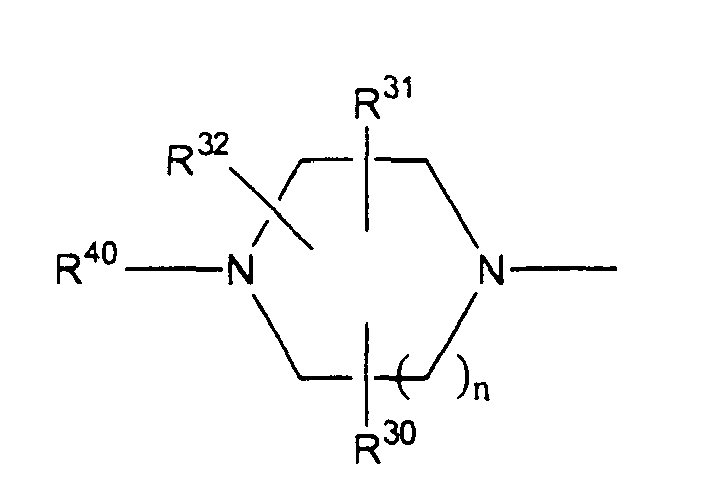
This method may be carried out in a manner similar to Method A above. - Compound (1A) of the invention may be isolated or purified from the reaction mixture obtained above, by the method described below.
When R10 of the resultant compound (1A) is optionally substituted 5- to 10-membered cycloalkenyl, it may be subjected to the hydrogenation described for Method A above to yield compound (1A) of the invention wherein R10 is 5- to 10-membered cycloalkyl optionally substituted with the corresponding substituent.
When the resultant compound is to be converted to an acid salt, this may be carried out by a conventional method. The step of producing the salt and the step of hydrogenation described above may be carried out in a different order where appropriate. -


- Method S is a method of producing compound (1B) of the invention (the compound (1) wherein X1 is CH) by reacting compound (22) with compound (9) in an inert solvent, in the presence of a palladium(0) catalyst, and then hydrogenating the product and optionally removing protecting groups on the compound (Method S-1), or a method of producing compound (100) of the invention by reacting compound (22) with compound (9) in the same manner and optionally removing protecting groups on the resultant compound (Method S-2), and if necessary, further leading it to compound (1B) of the invention by hydrogenation (Method S-3).
In this scheme, R10, R20, R21, R22, R23, R30, R31, R32, R40, n, W1a, M1b, R10a, R20a, R21a, R22a, R23a, R30a, R31a, R32a and R40a have the same definitions as above.
This method may be carried out in a manner similar to a combination of Method K above and the hydrogenation reaction in Method A above. - Compounds (1B) and (100) of the invention may be isolated or purified from the reaction mixture obtained above, by the method described below.
When the resultant compound is to be converted to an acid salt, this may be carried out by a conventional method. The step of producing the salt and the step of hydrogenation after reaction between compound (22) and compound (9) may be carried out in a different order where appropriate. -

- Method T is a method of producing compound (1B) of the invention (the compound (1) wherein X1 is CH) by reacting compound (24) with compound (25) in an inert solvent, in the presence of a palladium(0) catalyst, and then hydrogenating the product and optionally removing protecting groups on the resultant compound (Method T-1), or a method of producing compound (100) of the invention by reacting compound (24) with compound (25) in the same manner and optionally removing protecting groups on the resultant compound (Method T-2), and if necessary, further leading it to compound (1B) of the invention by hydrogenation (Method T-3).
In this scheme, R10, R20, R21, R22, R23, R30, R31, R32, R40, n, W1a, M1, R10b R20a, R21a, R22a R23a, R30a, R31a, R32a and R40a have the same definitions as above.
This method may be carried out in a manner similar to Method K above and the hydrogenation reaction in Method A above. - Compounds (1B) and (100) of the invention may be isolated or purified from the reaction mixture obtained above, by the method described below.
When the resultant compound is to be converted to an acid salt, this may be carried out by a conventional method. The step of producing the salt and the step of hydrogenation after reaction between compound (24) and compound (25) may be carried out in a different order where appropriate. -


- Method U is a method of producing compound (1B) of the invention (the compound (1) wherein X1 is CH) by reacting compound (26) with compound (27) (i.e., a lithium reagent or Grignard reagent) in an inert solvent to yield an adduct (170) (Step U-1-1), and then reducing the hydroxyl at the benzyl position of the resultant adduct (170) (Step U-1-2), and further optionally removing protecting groups, or a method of producing compound (100) of the invention by the reaction in the same manner to yield an adduct (170) (Step U-1-1), then dehydrating the hydroxyl of the adduct (170) in the presence of or in the absence of acid (Step U-1-3), and optionally removing protecting groups.
In this scheme, R10, R20, R21 R22, R23, R30, R31, R32, R40, n, R10b, R20a, R21a, R22a, R23a, R30a, R31a, R32a and R40a have the same definitions as above. M2 is a lithium or magnesium halide. - There are no particular restrictions on the solvent used so long as it dissolves the starting compound to some extent and does not inhibit the reaction of this step, and specifically there may be mentioned ethers such as diethyl ether, diisopropyl ether, tetrahydrofuran, dioxane, dimethoxyethane and diethyleneglycol dimethyl ether, among which tetrahydrofuran is preferred.
The reaction temperature will differ depending on the starting materials, solvent and reagents, but will usually be between -80°C and 30°C.
The reaction time will differ depending on the starting materials, solvent, reagents and reaction temperature, but will usually be 0.25 to 6 hours. - This step may be carried out by reduction in a manner similar to the hydrogenation method described for Method A above, or by reduction using a trialkylsilyl hydride described below, although there is no limitation to these methods.
There are no particular restrictions on the solvent used so long as it dissolves the starting compound to some extent and does not inhibit the reaction of this step, and specifically there may be mentioned, in the case of reduction reaction using a trialkylsilyl hydride, halogenated hydrocarbons such as chloroform, dichloromethane, 1,2-dichloroethane and carbon tetrachloride (particularly dichloromethane).
There are no particular restrictions on the reducing agents used so long as it can yield the target compound and does not produce any unseparable by-products, and specifically there may be mentioned trialkylsilyl hydrides such as triethylsilyl hydride and triisopropylsilyl hydride, among which triethylsilyl hydride is preferred.
There are no particular restrictions on the additive used so long as it can yield the target compound and does not produce any unseparable by-products, and specifically there may be mentioned halo-substituted acetic acids such as trifluoroacetic acid, and Lewis acids such as boron trifluoride.
The reaction temperature will differ depending on the starting materials, solvent and reagents, but will usually be between -70°C and 50°C.
The reaction time will differ depending on the starting materials, solvent, reagents and reaction temperature, but will usually be 0.5 to 48 hours. - There are no particular restrictions on the solvent used so long as it dissolves the starting compound to some extent and does not inhibit the reaction of this step, and specifically there may be mentioned, ethers such as diethyl ether, tetrahydrofuran, dioxane, dimethoxyethane and diethyleneglycol dimethylether, aromatic hydrocarbons such as toluene, benzene and xylene, halogenated hydrocarbons such as chloroform, dichloromethane, 1,2-dichloroethane and carbon tetrachloride, water, and the mixed solvent thereof, among which tetrahydrofuran, toluene, dichloromethane, chloroform or water is preferred. This step may be carried out without solvent.
There are no particular restrictions on the acid additive used so long as it can yield the target compound and does not produce any unseparable by-products, and specifically there may be mentioned halo-substituted acetic acids such as trifluoroacetic acid, Lewis acids such as boron trifluoride, organic sulfonic acids such as toluenesulfonic acid and camphor sulfonic acid, and inorganic acids such as hydrochloric acid and hydrogen bromide.
The reaction temperature will differ depending on the starting materials, solvent and reagents, but will usually be between -80°C and 180°C.
The reaction time will differ depending on the starting materials, solvent, reagents and reaction temperature, but will usually be 0.25 to 24 hours. - Compounds (1B) and (100) of the invention may be isolated or purified from the reaction mixture obtained above, by the method described below.
When R10 of the resultant compound (1B) is optionally substituted 5- to 10-membered cycloalkenyl, it may be subjected to the hydrogenation described for Method A above to yield compound (1B) of the invention wherein R10 is 5- to 10-membered cycloalkyl optionally substituted with the corresponding substituent.
When the resultant compound is to be converted to an acid salt, this may be carried out by a conventional method. The step of producing the salt and the step of hydrogenation described above may be carried out in a different order where appropriate. -


- Method V is a method of producing compound (1) of the invention by reacting compound (53) with compound (150) (i.e., a lithium reagent or Grignard reagent) in an inert solvent to yield an adduct (140) (Step V-1-1), and then, if necessary, reducing or dehydrating the hydroxyl at the benzyl position of the resultant adduct (140) (Step V-1-2), and optionally removing protecting groups, or a method of producing compound (2) by the reaction in the same manner to yield an adduct (140) (Step V-1-1), then, if necessary, reducing or dehydrating the hydroxyl at the benzyl position of the adduct (140) (Step V-1-3), and further removing protecting groups.
In this scheme, R10, R20, R21, R22, R23, R30, R31, R32, R40, X1, n, R10a, R20a, R21a, R22a, R23a, R30a, R31a and R32a have the same definitions as above. M2 is a lithium or magnesium halide. R200 is a substituent in Group A1, or a substituent in Group A1, which is protected. u is an integer of 0, 1, 2, 3, 4 or 5. k is an integer of 0, 1, 2, 3, 4 or 5. PR40a has the same definition as R40a above or represents protecting group for amino (preferably, t-butoxycarbonyl or benzyl).
This method may be performed in a manner similar to Method U above and the hydrogenation reaction in Method A above. - Compounds (1) and (2) of the invention may be isolated or purified from the reaction mixture obtained above, by the method described below.
When R10 of the resultant compound (1) is optionally substituted 5- to 10-membered cycloalkenyl, it may be subjected to the hydrogenation described for Method A above to yield compound (1) of the invention wherein R10 is 5- to 10-membered cycloalkyl optionally substituted with the corresponding substituent.
When the resultant compound is to be converted to an acid salt, this may be carried out by a conventional method. The step of producing the salt and the step of hydrogenation described above may be carried out in a different order where appropriate. - Removal of the protecting group(s) will differ depending on their types, and it may be carried out in the following manner, according to protocols commonly known in the field of synthetic organic chemistry such as the protocol described in, for example: T.W. Greene, (Protective Groups in Organic Synthesis) John Wiley & Sons; or J.F.W. McOmis, (Protective Groups in Organic Chemistry), Plenum Press.
- When the amino-protecting group is an optionally substituted silyl group such as trimethylsilyl, triethylsilyl, triisopropylsilyl, t-butyldimethylsilyl or t-butyldiphenylsilyl, it will usually be removed by treatment with a fluoride anion-generating compound such as tetrabutylammonium fluoride, hydrofluoric acid, hydrofluoric acid-pyridine or potassium fluoride.
The inert solvent used for the reaction is not particularly restricted so long as it does not inhibit the reaction, and for example, ethers such as diethyl ether, diisopropyl ether, tetrahydrofuran, dioxane, dimethoxyethane and diethyleneglycol dimethyl ether are preferred.
There are no particular restrictions on the reaction temperature and reaction time, but normally the reaction temperature will be between 0°C and 50°C, and the reaction time will be between 10 to 18 hours. - When the amino-protecting group is an optionally substituted aliphatic acyl group, an optionally substituted aromatic acyl group, an optionally substituted alkoxycarbonyl group or a substituted methylene group which forms a Schiff base, it may be removed by treatment with an acid or base in the presence of an aqueous solvent.
The acid used for this reaction is not particularly restricted so long as it is an acid which is ordinarily used for removal of the amino-protecting group, and for example, it may be an inorganic acid such as hydrobromic acid, hydrochloric acid, sulfuric acid, perchloric acid, phosphoric acid or nitric acid, or an organic acid such as trifluoroacetic acid and trifluoromethanesulfonic acid, among which hydrochloric acid or trifluoroacetic acid is preferred.
The base used for this reaction is not particularly restricted so long as it is a base which is ordinarily used for removal of the amino-protecting group, but there are preferably used alkali metal carbonic acid salts such as lithium carbonate, sodium carbonate and potassium carbonate; alkali metal hydroxides such as lithium hydroxide, sodium hydroxide and potassium hydroxide; metal alkoxides such as lithium methoxide, sodium methoxide, sodium ethoxide and potassium-t-butoxide; and ammonia mixtures such as ammonia water and concentrated ammonia-methanol.
The solvent used for the reaction may be, for example, an alcohol such as methanol, ethanol, n-propanol, isopropanol, n-butanol, isobutanol, t-butanol, isoamyl alcohol, diethylene glycol, glycerin, octanol, cyclohexanol or methyl cellosolve; an ether such as diethyl ether, diisopropyl ether, tetrahydrofuran, dioxane, dimethoxyethane or diethyleneglycol dimethyl ether; water; or a mixture of water and any of the aforementioned solvents, among which alcohols (most preferably ethanol) are preferred.
The reaction temperature and the reaction time will differ depending on the starting compounds, the solvent and the acid or base used and are not particularly restricted, but in order to inhibit by-products, the reaction temperature will usually be between 0°C and 150°C and the reaction time will usually be 1 to 10 hours. - When the amino-protecting group is an optionally substituted aralkyl group or an optionally substituted aralkyloxycarbonyl group, a method of contact with a reducing agent in an inert solvent (preferably catalytic reduction at ordinary temperature in the presence of a catalyst) or a method of removal by oxidation is generally preferred.
- The inert solvent used for removal by catalytic reduction is not particularly restricted so long as it is inert to the reaction, and for example, it may be an aliphatic hydrocarbon such as hexane, heptane, ligroin or petroleum ether; an aromatic hydrocarbon such as toluene, benzene or xylene; an ester such as methyl acetate, ethyl acetate, propyl acetate, butyl acetate or diethyl carbonate; an ether such as diethyl ether, diisopropyl ether, tetrahydrofuran, dioxane, dimethoxyethane or diethyleneglycol dimethyl ether; an alcohol such as methanol, ethanol, n-propanol, isopropanol, n-butanol, isobutanol, t-butanol, isoamyl alcohol, diethylene glycol, glycerin, octanol, cyclohexanol or methylcellosolve; an organic acid such as acetic acid; water; or a mixture of any of these solvents with water, among which alcohols, ethers, organic acids and water (most preferably alcohols and organic acids) are preferred.
The catalyst used for removal by catalytic reduction is preferably palladium-carbon, Raney nickel, platinum oxide, platinum-black, rhodium-aluminum oxide, triphenylphosphine-rhodium chloride or palladium-barium sulfate.
There are no particular restrictions on the pressure, but it will ordinarily be from 1 to 10 atmospheres.
The reaction temperature and the reaction time will differ depending on the starting materials, catalyst and insert solvent, but usually the reaction temperature will be between 0°C and 100°C, and the reaction time will be between 5 minutes and 72 hours. - The inert solvent used for removal by oxidation is not particularly restricted so long as it does not participate in the reaction, but water-containing organic solvents are preferred. Such organic solvents include, for example, halogenated hydrocarbons such as chloroform, dichloromethane, 1,2-dichloroethane and carbon tetrachloride; nitriles such as acetonitrile; ethers such as diethyl ether, diisopropyl ether, tetrahydrofuran, dioxane, dimethoxyethane and diethyleneglycol dimethyl ether; ketones such as acetone; amides such as formamide, dimethylformamide, dimethylacetamide and hexamethylphosphoric triamide; and sulfoxides such as dimethylsulfoxide and sulfolane, among which halogenated hydrocarbons, ethers or sulfoxides (most preferably halogenated hydrocarbons and sulfoxides) are preferred.
The oxidizing agent used for this reaction is not particularly restricted so long as it is an oxidizing agent used for removal of the amino-protecting group, but it is preferably potassium persulfate, sodium persulfate, ammonium cerium nitrate (CAN) or 2,3-dichloro-5,6-dicyano-p-benzoquinone (DDQ).
The reaction temperature and the reaction time will differ depending on the starting compounds, oxidizing agent and solvent, but usually the reaction temperature will be between 0°C and 150°C, and the reaction time will be between 10 minutes and 24 hours. - When the amino-protecting group is an optionally substituted aralkyl group, the protecting group may be removed using an acid or base.
The acid used for this reaction is not particularly restricted so long as it is an acid used for removal of the optionally substituted aralkyl group as the amino-protecting group, and for example, it may be a Bronsted acid, e.g. an inorganic acid such as hydrochloric acid, hydrobromic acid, sulfuric acid, perchloric acid or phosphoric acid, or an organic acid such as acetic acid, formic acid, oxalic acid, methanesulfonic acid, p-toluenesulfonic acid, camphor sulfonic acid, trifluoroacetic acid or trifluoromethanesulfonic acid; a Lewis acid such as zinc chloride, tin tetrachloride, boron trichloride, boron trifluoride or boron tribromide; or an acidic ion-exchange resin, among which inorganic acids and organic acids (most preferably hydrochloric acid, acetic acid and trifluoroacetic acid) are preferred.
The base used for the reaction is not particularly restricted so long as it is a base ordinarily used for removal of the optionally substituted aralkyl group as the amino-protecting group, but it is preferably an alkali metal carbonate such as lithium carbonate, sodium carbonate or potassium carbonate; an alkali metal hydroxide such as lithium hydroxide, sodium hydroxide or potassium hydroxide; a metal alkoxide such as lithium methoxide, sodium methoxide, sodium ethoxide or potassium-t-butoxide; or an ammonia mixture such as aqueous ammonia or concentrated ammonia-methanol.
The inert solvent used for the first stage of the reaction is not particularly restricted so long as it is inert to the reaction, and as examples there may be mentioned aliphatic hydrocarbons such as hexane, heptane, ligroin and petroleum ether; aromatic hydrocarbons such as benzene, toluene and xylene; halogenated hydrocarbons such as chloroform, dichloromethane, 1,2-dichloroethane and carbon tetrachloride; esters such as methyl acetate, ethyl acetate, propyl acetate, butyl acetate and diethyl carbonate; ethers such as diethyl ether, diisopropyl ether, tetrahydrofuran, dioxane, dimethoxyethane and diethyleneglycol dimethyl ether; alcohols such as methanol, ethanol, n-propanol, isopropanol, n-butanol, isobutanol, t-butanol, isoamyl alcohol, diethylene glycol, glycerin, octanol, cyclohexanol and methyl cellosolve; amides such as formamide, dimethylformamide, dimethylacetamide and hexamethylphosphoric triamide; water; and mixtures of the aforementioned solvents, among which ethers, alcohols and water (most preferably dioxane, tetrahydrofuran, ethanol or water) are preferred.
The reaction temperature will differ depending on the starting compounds and the acid and solvent used, but will ordinarily be between -20°C and the boiling temperature (preferably between 0°C and 100°C).
The reaction time will differ depending on the starting compounds, the acid and inert solvent used and the reaction temperature, but will ordinarily be between 15 minutes and 48 hours (preferably between 30 minutes and 20 hours). - When the amino-protecting group is an optionally substituted alkenyloxycarbonyl group, usually the removal may be accomplished by treatment with an acid or base, under the same conditions as removal reaction when the amino-protecting group is an optionally substituted aliphatic acyl group, an optionally substituted aromatic acyl group, an optionally substituted alkoxycarbonyl group or a substituted methylene group which forms a Schiff base.
In the case of an allyloxycarbonyl group, it is particularly convenient to employ a method of removal using palladium and triphenylphosphine or nickel-tetracarbonyl, as the removal can be carried out with few side reactions. - When the amino-protecting group is an optionally substituted alkyl group, optionally substituted alkenyl group or optionally substituted sulfonyl group, usually the removal may be accomplished by treatment with an acid or base, under the same conditions as removal reaction when the amino-protecting group is an aliphatic acyl group, an aromatic acyl group, an alkoxycarbonyl group or a substituted methylene group which forms a Schiff base.
- When the hydroxyl-protecting group is, for example, an optionally substituted silyl group such as trimethylsilyl, triethylsilyl, triisopropylsilyl, t-butyldimethylsilyl or t-butyldiphenylsilyl, it will usually be removed by treatment with a fluoride anion-generating compound such as tetrabutylammonium fluoride, hydrofluoric acid, hydrofluoric acid-pyridine or potassium fluoride, or with an inorganic acid such as hydrochloric acid, hydrobromic acid, sulfuric acid, perchloric acid or phosphoric acid, or an organic acid such as acetic acid, formic acid, oxalic acid, methanesulfonic acid, p-toluenesulfonic acid, camphor sulfonic acid, trifluoroacetic acid or trifluoromethanesulfonic acid.
For removal with fluoride anion, an organic acid such as formic acid, acetic acid or propionic acid may be added to accelerate the reaction.
The inert solvent used for the reaction is not particularly restricted so long as it is inert to the reaction, but it is preferably an ether such as diethyl ether, diisopropyl ether, tetrahydrofuran, dioxane, dimethoxyethane or diethyleneglycol dimethyl ether; a nitrile such as acetonitrile or isobutyronitrile; an organic acid such as acetic acid; water; or a mixture of these solvents.
The reaction temperature and the reaction time will differ depending on the starting compounds, catalyst and inert solvent used, but ordinarily the reaction temperature will be between 0°C and 100°C (preferably between 10°C and 50°C), and the reaction time will be 1 to 24 hours. - When the hydroxyl-protecting group is an optionally substituted aralkyl group or an optionally substituted aralkyloxycarbonyl group, a method of contact with a reducing agent in an inert solvent (preferably catalytic reduction at ordinary temperature in the presence of a catalyst) or a method of removal using an oxidizing agent is generally preferred.
- The inert solvent used for removal by catalytic reduction is not particularly restricted so long as it does not participate in the reaction, and as examples there may be mentioned aliphatic hydrocarbons such as hexane, heptane, ligroin and petroleum ether; aromatic hydrocarbons such as toluene, benzene and xylene; esters such as ethyl acetate and propyl .acetate; ethers such as diethyl ether, diisopropyl ether, tetrahydrofuran, dioxane, dimethoxyethane and diethyleneglycol dimethyl ether; alcohols such as methanol, ethanol, n-propanol, isopropanol, n-butanol, isobutanol, t-butanol, isoamyl alcohol, diethylene glycol, glycerin, octanol, cyclohexanol and methyl cellosolve; amides such as formamide, dimethylformamide, dimethylacetamide, N-methyl-2-pyrrolidone and hexamethylphosphoric triamide; aliphatic acids such as formic acid and acetic acid; water; and mixtures of these solvents, among which alcohols (most preferably methanol and ethanol) are preferred.
There are no particular restrictions on the catalyst used for removal by catalytic reduction so long as it is one commonly used for removal of the hydroxyl-protecting group by catalytic reduction, and as examples there may be mentioned palladium-carbon, palladium black, Raney nickel, platinum oxide, platinum black, rhodium-aluminum oxide, triphenylphosphine-rhodium chloride or palladium-barium sulfate, among which palladium-carbon is preferred.
There are no particular restrictions on the pressure, but it will ordinarily be from I to 10 atmospheres.
The reaction temperature and the reaction time will differ depending on the starting compounds, catalyst and insert solvent, but usually the reaction temperature will be between 0°C and 100°C (preferably between 20°C and 70°C), and the reaction time will be between 5 minutes and 48 hours (preferably between 1 hour and 24 hours). - The inert solvent used for removal by oxidation is not particularly restricted so long as it does not participate in the reaction, but it is preferably a water-containing solvent, and there may be mentioned as examples ketones such as acetone; halogenated hydrocarbons such as methylene chloride, chloroform and carbon tetrachloride; nitriles such as acetonitrile; ethers such as diethyl ether, tetrahydrofuran and dioxane; amides such as dimethylformamide, dimethylacetamide and hexamethylphosphoric triamide; and sulfoxides such as dimethylsulfoxide.
The oxidizing agent used for this reaction is not particularly restricted so long as it is an oxidizing agent used for removal of the hydroxyl-protecting group, but it is preferably potassium persulfate, sodium persulfate, ammonium cerium nitrate (CAN) or 2,3-dichloro-5,6-dicyano-p-benzoquinone (DDQ).
The reaction temperature and the reaction time will differ depending on the starting compounds, oxidizing agent and inert solvent, but usually the reaction temperature will be between 0°C and 150°C, and the reaction time will be between 10 minutes and 24 hours. - The removal can also be accomplished by reaction with an alkali metal such as lithium metal or sodium metal in liquid ammonia or an alcohol such as methanol, ethanol, n-propanol, isopropanol, n-butanol, isobutanol, t-butanol, isoamyl alcohol, diethylene glycol, glycerin, octanol, cyclohexanol or methyl cellosolve, at a temperature of between -78°C and 0°C.
- The removal can also be accomplished using aluminum chloride-sodium iodide or an alkylsilyl iodide such as trimethylsilyl iodide, in an inert solvent.
The inert solvent used in this reaction is not particularly restricted so long as it does not participate in the reaction, but it is preferably a halogenated hydrocarbon such as methylene chloride, chloroform or carbon tetrachloride; a nitrile such as acetonitrile; or a mixture of these solvents.
The reaction temperature and the reaction time will differ depending on the starting compounds and the inert solvent, but usually the reaction temperature will be between 0°C and 50°C, and the reaction time will be between 5 minutes and 72 hours. - When the hydroxyl-protecting group is an aliphatic acyl group, an aromatic acyl group or an optionally substituted alkoxycarbonyl group, it may be removed by treatment with a base in an inert solvent.
There are no particular restrictions on the base used for this reaction so long as it is a base ordinarily used for removal of the hydroxyl-protecting group, and for example, it may be an alkali metal carbonic acid salt such as lithium carbonate, sodium carbonate or potassium carbonate; an alkali hydrogencarbonate such as lithium hydrogencarbonate, sodium hydrogencarbonate or potassium hydrogencarbonate; an alkali metal hydroxide such as lithium hydroxide, sodium hydroxide or potassium hydroxide; a metal alkoxide such as lithium methoxide, sodium methoxide, sodium ethoxide or potassium-t-butoxide; or an ammonia mixture such as aqueous ammonia or concentrated ammonia-methanol, among which alkali metal hydroxides, metal alkoxides and ammonia mixtures (most preferably alkali metal hydroxides and metal alkoxides) are preferred.
The inert solvent used for this reaction is not particularly restricted so long as it is ordinarily used for hydrolysis reaction, but it is preferably an ether such as diethyl ether, diisopropyl ether, tetrahydrofuran, dioxane, dimethoxyethane or diethyleneglycol dimethyl ether; an alcohol such as methanol, ethanol, n-propanol, isopropanol, n-butanol, isobutanol, t-butanol, isoamyl alcohol, diethylene glycol, glycerin, octanol, cyclohexanol or methyl cellosolve; water; or a mixture of these solvents.
The reaction temperature and the reaction time will differ depending on the starting compounds and the base and inert solvent used, but in order to inhibit by-products, the reaction temperature will usually be between -20°C and 150°C, and the reaction time will usually be 1-10 hours. - When the hydroxyl-protecting group is optionally substituted alkoxymethyl, optionally substituted alkylthiomethyl, tetrahydropyranyl, tetrahydrothiopyranyl, tetrahydrofuranyl, tetrahydrothiofuranyl or optionally substituted ethyl such as 1-ethoxyethyl, it will usually be removed by treatment with an acid in an inert solvent.
There are no particular restrictions on the acid used for this reaction so long as it is an acid used for removal of the hydroxyl-protecting group, but usually compounds ordinarily used as Bronsted acids or Lewis acids may be mentioned, and preferred are Bronsted acids including hydrogen chloride; inorganic acids such as hydrochloric acid, sulfuric acid and nitric acid; and organic acids such as acetic acid, trifluoroacetic acid, methanesulfonic acid and p-toluenesulfonic acid; or Lewis acids such as boron trifluoride, while strong acid cation exchange resins such as DOWEX 50W may also be used.
There are no particular restrictions on the inert solvent used for this reaction so long as it is inert to the reaction, and for example, there may be mentioned aliphatic hydrocarbons such as hexane, heptane, ligroin and petroleum ether; aromatic hydrocarbons such as benzene, toluene and xylene; halogenated hydrocarbons such as methylene chloride, chloroform, carbon tetrachloride, dichloroethane, chlorobenzene and dichlorobenzene; esters such as ethyl formate, ethyl acetate, propyl acetate, butyl acetate and diethyl carbonate; ethers such as diethyl ether, diisopropyl ether, tetrahydrofuran, dioxane, dimethoxyethane and diethyleneglycol dimethyl ether; alcohols such as methanol, ethanol, n-propanol, isopropanol. n-butanol, isobutanol, t-butanol, isoamyl alcohol, diethylene glycol, glycerin, octanol, cyclohexanol and methyl cellosolve; ketones such as acetone, methyl ethyl ketone, methyl isobutyl ketone, isophorone and cyclohexanone; water; and mixtures of these solvents, among which ethers and alcohols (most preferably tetrahydrofuran and methanol) are preferred.
The reaction temperature and the reaction time will differ depending on the starting compound and the acid and inert solvent used, but usually the reaction temperature will be between -10°C and 200°C (preferably between 0°C and 150°C), and the reaction time will be between 5 minutes and 48 hours (preferably between 30 minutes and 10 hours). - When the hydroxyl-protecting group is an optionally substituted alkenyloxycarbonyl group or optionally substituted sulfonyl group, usually the removal may be accomplished by treatment with a base, under the same conditions as removal reaction when the hydroxyl-protecting group is the aforementioned optionally substituted aliphatic acyl group, optionally substituted aromatic acyl group or optionally substituted alkoxycarbonyl group.
In the case of an allyloxycarbonyl group, it is particularly convenient to employ a method of removal using palladium and triphenylphosphine or bis(methyldiphenylphosphine)(1,5-cyclooctadiene)iridium (I) hexafluorophosphate, as the removal can be carried out with few side reactions. - When the carboxyl-protecting group is a lower alkyl group, a lower alkenyl group or a lower alkynyl group, or an optionally substituted silyl group, or when the compound has been converted to an ortho ester for the purpose of protection, a method of removal by treatment with an acid or base, or using an enzyme, is preferred.
There are no particular restrictions on the acid used for this reaction so long as it is used for removal of the carboxyl-protecting group, and for example, it may be hydrochloric acid, sulfuric acid, phosphoric acid or hydrobromic acid.
There are no particular restrictions on the base used for this reaction so long as it is used for removal of the carboxyl-protecting group, and for example, it may be an alkali metal carbonate such as sodium carbonate or potassium carbonate; an alkali metal hydroxide such as sodium hydroxide or potassium hydroxide; or concentrated ammonia-methanol solution, among which sodium hydroxide is preferred.
Isomerization may occur with hydrolysis using a base.
There are no particular restrictions on the enzyme used for the reaction so long as it is an enzyme used for removal of the carboxyl-protecting group, and for example, it may be a lipase or an esterase.
The solvent used for this reaction may be, for example, water, an alcohol such as methanol, ethanol or n-propanol; an ether such as tetrahydrofuran or dioxane; or a mixture of any of these solvents with water, among which an alcohol (most preferably methanol) is preferred.
The reaction temperature and the reaction time will differ depending on the starting compounds, the solvent and the reagents used and are not particularly restricted, but in order to inhibit by-products, the reaction temperature will usually be between 0°C and 220°C, and the reaction time will usually be between 30 minutes and 10 hours. - When the carboxyl-protecting group is an optionally substituted aralkyl group or halogeno lower alkyl group, it will usually be removed by reduction in a solvent.
The reduction method is preferably a method by chemical reduction with zinc-acetic acid when the carboxyl-protecting group is a halogeno lower alkyl group, and when it is an optionally substituted aralkyl group, the method may be one of catalytic reduction using a catalyst such as palladium-carbon or platinum, or a method of chemical reduction using an alkali metal sulfide such as potassium sulfide or sodium sulfide.
The solvent used is not particularly restricted so long as it does not participate in the reaction, but there are preferred alcohols such as methanol and ethanol; ethers such as tetrahydrofuran and dioxane; aliphatic acids such as acetic acid; and mixtures of these solvents with water.
The reaction temperature and the reaction time will differ depending on the starting compounds, the solvent and the reduction method, but usually the reaction temperature will be between 0°C and approximately room temperature and the reaction time will be between 5 minutes and 12 hours. - If the carbonyl group has been protected by conversion to a cyclic or acyclic ketal formed using, for example, an alcohol such as methanol, isopropanol or diethylene glycol or a thiol such as methanethiol, ethanethiol or propanedithiol, an acid may be used for reconversion to a carbonyl group.
The acid used for this reaction is not particularly restricted so long as it is an acid ordinarily used for reconversion to a carbonyl group from a cyclic or acyclic ketal formed for the purpose of protecting the carbonyl group, and for example, it may be a Bronsted acid, e.g. an inorganic acid such as hydrochloric acid, hydrobromic acid, sulfuric acid, perchloric acid or phosphoric acid, or an organic acid such as acetic acid, formic acid, oxalic acid, methanesulfonic acid, p-toluenesulfonic acid, camphor sulfonic acid, trifluoroacetic acid or trifluoromethanesulfonic acid; a Lewis acid such as zinc chloride, tin tetrachloride, boron trichloride, boron trifluoride or boron tribromide; or an acidic ion exchange resin, among which inorganic acids and organic acids (most preferably hydrochloric acid and p-toluenesulfonic acid) are preferred.
There are no particular restrictions on the inert solvent used for the first stage of the reaction so long as it is inert to the reaction, and as examples there may be mentioned aliphatic hydrocarbons such as hexane, heptane, ligroin and petroleum ether; aromatic hydrocarbons such as benzene, toluene and xylene; halogenated hydrocarbons such as chloroform, dichloromethane, 1,2-dichloroethane and carbon tetrachloride; esters such as methyl acetate, ethyl acetate, propyl acetate, butyl acetate and diethyl carbonate; ethers such as diethyl ether, diisopropyl ether, tetrahydrofuran, dioxane, dimethoxyethane and diethyleneglycol dimethyl ether; alcohols such as methanol, ethanol, n-propanol, isopropanol, n-butanol, isobutanol, t-butanol, isoamyl alcohol, diethylene glycol, glycerin, octanol, cyclohexanol and methyl cellosolve; amides such as formamide, dimethylformamide, dimethylacetamide and hexamethylphosphoric triamide; water; and mixtures of these solvents, among which ethers, alcohols and water (most preferably acetone, tetrahydrofuran and water) are preferred.
The reaction temperature will differ depending on the starting compounds and the acid and solvent used, but usually it will be between -20°C and the boiling point (preferably between 0°C and 100°C).
The reaction time will differ depending on the starting compounds, the acid and inert solvent used and the reaction temperature, but usually it will be between 5 minutes and 48 hours, (preferably between 10 minutes and 24 hours).
In the case of a cyclic or acyclic ketal formed using a thiol, it is particularly convenient to employ a method of removal using a substance such as Raney nickel or silver nitrate. - In the case of conversion to a cyclic ketal using, for example, formalin or acetone as protection of a diol, an acid may be used for reconversion to the diol.
The acid used for this reaction is not particularly restricted so long as it is an acid ordinarily used for reconversion to a diol from a cyclic or acyclic ketal formed for the purpose of protecting the diol, and for example, it may be a Bronsted acid, e.g. an inorganic acid such as hydrochloric acid, hydrobromic acid, sulfuric acid, perchloric acid or phosphoric acid, or an organic acid such as acetic acid, formic acid, oxalic acid, methanesulfonic acid, p-toluenesulfonic acid, camphor sulfonic acid, trifluoroacetic acid or trifluoromethanesulfonic acid; a Lewis acid such as zinc chloride, tin tetrachloride, boron trichloride, boron trifluoride or boron tribromide; or an acidic ion exchange resin, among which inorganic acids and organic acids (most preferably hydrochloric acid and p-toluenesulfonic acid) are preferred.
There are no particular restrictions on the inert solvent used for the first stage of the reaction so long as it is inert to the reaction, and as examples there may be mentioned aliphatic hydrocarbons such as hexane, heptane, ligroin and petroleum ether; aromatic hydrocarbons such as benzene, toluene and xylene; halogenated hydrocarbons such as chloroform, dichloromethane, 1,2-dichloroethane and carbon tetrachloride; esters such as methyl acetate, ethyl acetate, propyl acetate, butyl acetate and diethyl carbonate; ethers such as diethyl ether, diisopropyl ether, tetrahydrofuran, dioxane, dimethoxyethane and diethyleneglycol dimethyl ether; alcohols such as methanol, ethanol, n-propanol, isopropanol, n-butanol, isobutanol, t-butanol, isoamyl alcohol, diethylene glycol, glycerin, octanol, cyclohexanol and methyl cellosolve; amides such as formamide, dimethylformamide, dimethylacetamide and hexamethylphosphoric triamide; water; and mixtures of these solvents, among which ethers, alcohols and water (most preferably acetone, tetrahydrofuran and water) are preferred.
The reaction temperature will differ depending on the starting compounds and the acid and solvent used, but usually it will be between -20°C and the boiling point (preferably between 0°C and 100°C).
The reaction time will differ depending on the starting compounds, the acid and inert solvent used and the reaction temperature, but usually it will be between 5 minutes and 48 hours (preferably between 10 minutes and 24 hours). - Removal of the protecting groups for amino, hydroxyl, carbonyl or carboxyl groups, or a diol, may be carried out in an appropriate order.
- After completion of the reactions of each of the methods and steps described above, the target compound of each step may be recovered from the reaction mixture according to conventional procedures.
- For example, when the entire reaction mixture is a liquid, it may be returned to room temperature if necessary, or cooled on ice, then allowed to neutralization of an acid, an alkali, an oxidizing agent or a reducing agent if necessary, and then water and an organic solvent such as ethyl acetate which is immiscible with water and which does not react with the target compound may be added, and the layer containing the target compound is separated. Next, there may be added a solvent which is immiscible with the resultant layer and which does not react with the target compound, and the layer containing the target compound may be washed and separated. If the layer is an organic layer, it may be dried using a desiccant such as anhydrous magnesium sulfate or anhydrous sodium sulfate, the solvent may be distilled off to recover the target compound. If the layer is an aqueous layer, it may be electrically desalted and then lyophilized to recover the target compound.
When the entire reaction mixture is a liquid, in some cases, the substances other than the target compound (for example, solvents, reagents, etc.) may be simply distilled off at atmospheric pressure or under reduced pressure to recover the target compound.
When the target compound alone precipitates as a solid, or when the entire reaction mixture is a liquid and the target compound alone precipitates as a solid during the recovery procedure, the target compound may be first filtered by a filtration method and the filtered target compound washed with a suitable organic or inorganic solvent and dried to allow treatment of the mother liquor in the same manner as when the entire reaction mixture is a liquid, in order to recover the target compound.
When only the reagent or catalyst is present in solid form, or when the entire reaction mixture is a liquid and the reagent or catalyst alone precipitates as a solid during the recovery procedure, with the target compound dissolved in the solution, the reagent or catalyst may be first filtered by a filtration method and the filtered reagent or catalyst washed with a suitable organic or inorganic solvent, and then the obtained wash liquids combined as the mother liquor and the obtained mixture treated in the same manner as when the entire reaction mixture is a liquid, in order to recover the target compound. - Particularly when substances other than the target compound in the reaction mixture do not inhibit the reaction of the subsequent step, the reaction mixture may be used directly for the subsequent step without isolation of the target compound.
- The purity of the target compound recovered by the method described above may be improved by appropriately employing a recrystallization method, chromatography method or distillation method.
When the recovered target compound is a solid, it will usually be possible to improve the purity of the target compound by recrystallization. For recrystallization, a single solvent which do not react with the target compound or a mixture of multiple solvents which do not react with the target compound may be used. Specifically, the target compound is first dissolved in the single or multiple solvents which do not react therewith, either at room temperature or with heating. The resulting solution is either cooled on ice or allowed to stand at room temperature to crystallization of the target compound from the solution.
When the recovered target compound is a liquid or a solid, the purity of the target compound may be improved by any of various chromatography methods. A weak acid silica gel such as Silica Gel 60 (340-400 mesh) by Merck Co. or BW-300 (300 mesh) by Fuji Silysia Chemical Ltd. may be used in most cases. When the target compound is basic and adsorption is too strong on the aforementioned silica gels, Propylamine Coating Silica Gel (200-300 mesh) by Fuji Silysia Chemical Ltd. or the like may be used. When the target compound is dipolar or must be eluted with a polar solvent such as methanol, NAM-200H or NAM-300H by Nam Research Co. may be used. These silica gels may be used for elution of the target compound with a single solvent or multiple solvents which do not react with the target compound, followed by distilling off of the solvent, to yield the target compound with improved purity.
When the recovered target compound is a liquid, its purity may be improved by a distillation method. For distillation, the target compound is subjected to reduced pressure at room temperature or with heating to distill off the target compound. - Representative examples of production methods for compounds (1) and (100) according to the present invention have been described above, but the starting compounds and reagents used for production of the compounds of the invention may also form salts or solvates (hydrates, etc.), which will differ depending on the starting materials and solvents used, and are not particularly restricted so long as they do not inhibit the reaction. The solvents used will also differ depending on the starting materials and reagents, but of course they are not particularly restricted so long as they dissolve the starting materials to some extent and do not inhibit the reaction.
- When compound (1) or (100) of the invention is obtained in the free form, a conventional procedure may be carried out to convert it to a salt or hydrate which compound (1) or (100) may form.
When compound (1) or (100) of the invention is obtained as a salt of compound (1) or (100), or a hydrate of compound (1) or (100), it may be converted to the free form of compound (1) or (100) according to a conventional procedure. - Also, the various isomers obtained for compound (1) or (100) according to the invention (for example, geometric isomers, optical isomers based on asymmetric carbons, rotational isomers, stereoisomers and tautomers, etc.) may be purified and isolated using ordinary separation means such as recrystallization, diastereomer salt methods, enzyme fractionation methods, and various chromatography (for example, thin-layer chromatography, column chromatography, gas chromatography and the like).
- The starting compounds for Method A, Method B, Method C, Method D, Method E, Method F, Method G, Method H, Method K, Method M, Method N, Method P, Method Q, Method R, Method S, Method T, Method U and Method V described above may be commercially available compounds, or they may be easily produced from commercially available compounds by methods which are well known in the field. They may also be produced by the following methods.
- (Production method for compound (2A)) (Method 1-1)
-

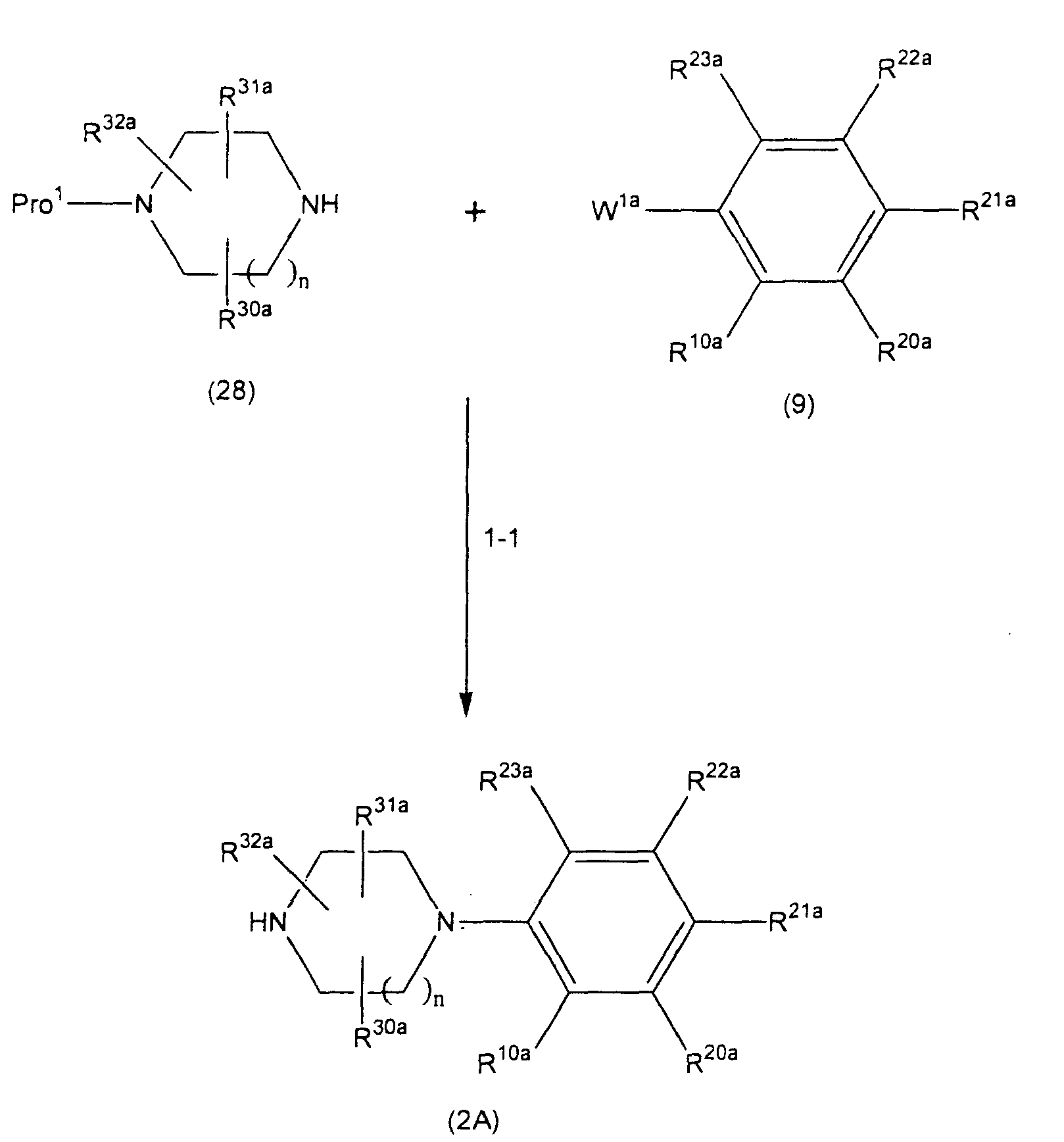
- This method is a method of producing compound (2A) (the compound (2)
wherein X1 is nitrogen) by reacting compound (28) with compound (9) (amination or amidation) in an inert solvent, in the presence of a palladium(0) catalyst or copper catalyst, in the presence or in the absence of a base, in the presence or in the absence of an additive, under or not under an inert gas atmosphere, and then removing the protecting group Pro1.
In this scheme, n, W1a, R10a, R20a, R21a, R22a, R23a, R30a, R31a and R32a have the same definitions as above. Also, Pro1 is an amino-protecting group, and for example, it may be an optionally substituted silyl group such as trimethylsilyl, triethylsilyl or t-butyldiphenylsilyl, an optionally substituted aliphatic acyl group such as formyl or acetyl, an optionally substituted aromatic acyl group such as benzoyl, an optionally substituted alkoxycarbonyl group such as ethoxycarbonyl or t-butoxycarbonyl, a substituted methylene group which forms a Schiff base, an optionally substituted aralkyl group such as benzyl, 4-methoxybenzyl or 4-nitrobenzyl, an optionally substituted aralkyloxycarbonyl group such as benzyloxycarbonyl, 4-methoxybenzyloxycarbonyl or 4-nitrobenzyloxycarbonyl, an optionally substituted alkenyloxycarbonyl group such as vinyloxycarbonyl or allyloxycarbonyl, an optionally substituted alkyl group, an optionally substituted alkenyl group or an optionally substituted sulfonyl group, preferably a lower alkoxycarbonyl group such as methoxycarbonyl, ethoxycarbonyl, t-butoxycarbonyl or isobutoxycarbonyl, a lower alkoxycarbonyl group substituted with halogen or tri lower alkyl silyl, such as 2,2,2-trichloroethoxycarbonyl or 2-trimethylsilylethoxycarbonyl, an alkenyloxycarbonyl group such as vinyloxycarbonyl or allyloxycarbonyl, an optionally substituted aralkyloxycarbonyl group such as benzyloxycarbonyl, 4-methoxybenzyloxycarbonyl, 3,4-dimethoxybenzyloxycarbonyl, 2-nitrobenzyloxycarbonyl or 4-nitrobenzyloxycarbonyl, or an optionally substituted aralkyl group such as benzyl, 4-methoxybenzyl, 3,4-dimethoxybenzyl, 2-nitrobenzyl or 4-nitrobenzyl, and more preferably benzyl, 4-methoxybenzyl, 4-nitrobenzyl, ethoxycarbonyl, t-butoxycarbonyl or benzyloxycarbonyl.
The method may be carried out in a manner similar to Method F above. - (Production method for compound (2A)) (Method 1-2)


- This method is a method of producing compound (2A) (the compound (2)
wherein X1 is nitrogen) by reacting compound (29) with compound (12) in an inert solvent or without a solvent, under or not under an inert gas atmosphere, in the presence or in the absence of a base, in the presence or in the absence of an additive to yield compound (2A), and afterwards removing the protecting group Pro1.
In this scheme, n, W1, R10a, R20a, R21a, R22a, R23a, R30a, R31a and R32a have the same definitions as above.
HPro1 is hydrogen or has the same definition as Pro1 above.
This method may be carried out in a manner similar to Method H above. - (Production method for compound (2C)) (Method 1-3)


- This method is a method of producing compound (2C) (the compound (2)
wherein R10a is R10b) by reacting compound (30) with compound (14) in an inert solvent, in the presence of a palladium(0) catalyst, under or not under an inert gas atmosphere, in the presence or in the absence of a base, in the presence or in the absence of an additive, and then removing the protecting group Pro1.
In this scheme, X1, n, W1a, M1b, Pro1, R10b, R20a, R21a, R22a, R23a, R30a, R31a and R32a have the same definitions as above.
This method may be carried out in a manner similar to Method K described above. - (Production method for compound (2C)) (Method 1-4)

- This method is a method of producing compound (2c) (the compound (2)
wherein R10a is R10b) by reacting compound (31) with compound (16) in an inert solvent, in the presence of a palladium(0) catalyst, under or not under an inert gas atmosphere, in the presence or in the absence of a base, in the presence or in the absence of an additive, and then removing the protecting group Pro1.
In this scheme, X1, n, W1a, M1, Pro1, R10b, R20a, R21a, R22a, R23a, R30a, R31a and R32a have the same definitions as above.
This method may be carried out in a manner similar to Method K described above. - (Production method for compound (2A)) (Method 1-5)

- This method is a method of producing compound (2A) (the compound (2)
wherein X1 is nitrogen) by reacting compound (19) with compound (33) in an inert solvent, in the presence of a reducing agent, in the presence or in the absence of an acid, in the presence or in the absence of an additive, to yield compound (2A), and afterward removing the protecting group Pro1a by the method described above.
In this scheme, n, W1, E1, E2, E3, R10a, R20a, R21a, R22a, R23a, R30a, R31a and R32a have the same definitions as above.
Also, HPro1a is hydrogen or a group represented by Pro1a below.
Group Pro1a is an optionally substituted aralkyl group such as benzyl, 4-methoxybenzyl, 3,4-dimethoxybenzyl, 2-nitrobenzyl or 4-nitrobenzyl, and is preferably benzyl.
This method may be carried out in a manner similar to Method C described above. - (Production method for compound (2A)) (Method 1-6)

- This method is a method of producing compound (2A) (the compound (2)
wherein X1 is nitrogen) by reacting a base with compound (34) in an inert solvent, and then removing the protecting group Pro1 by the method described above.
In this scheme, n, W1, Pro1, E4, E5, E6, R10a, R20a, R21a, R22a, R23a, R30a, R31a and R32a have the same definitions as above.
This method may be carried out in a manner similar to Method A described above. - (Production method for compounds (2B) and (200)) (Method 1-7)

- This method is a method of producing compound (2B) (the compound (2)
wherein X1 is CH) by reacting compound (35) with compound (9) in an inert solvent, in the presence of a palladium(0) catalyst, subjecting it to hydrogenation reaction, and then removing the protecting group Pro1 (Method 1-7-1), or a method of producing compound (200) by reacting compound (35) with compound (9) in the same manner, then removing the protecting group Pro1 (Method 1-7-2).
In this scheme. n. W1a, M1, Pro1, R10a, R20a, R21a, R22a, R23a, R30a, R31a and R32a have the same definitions as above.
This method may be carried out in a manner similar to Method K described above and the hydrogenation reaction in Method A above. - (Production method for compounds (2B) and (200C)) (Method 1 -8)
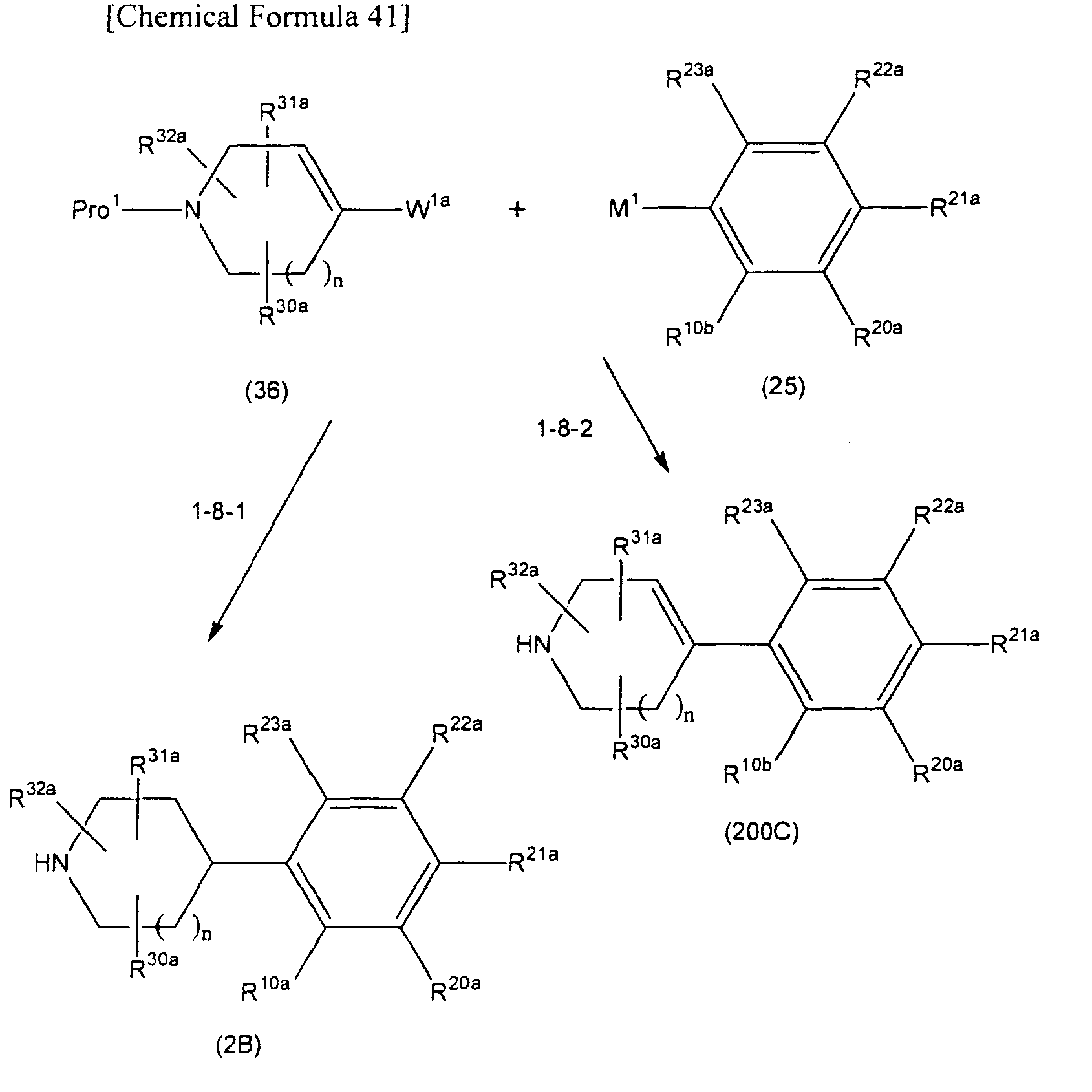
- This method is a method of producing compound (2B) (the compound (2)
wherein X1 is CH) by reacting compound (36) with compound (25) in an inert solvent, in the presence of a palladium(0) catalyst, subjecting it to hydrogenation reaction, and then removing the protecting group Pro1 (Method 1-8-1), or a method of producing compound (200C) (the compound (200) wherein R10a is R10b) by reacting compound (36) with compound (25) in the same manner, then removing the protecting group Pro1 (Method 1-8-2).
In this scheme, n, W1a, M1, Pro1, R10a, R10b, R20a, R21a, R22a, R23a, R30a, R31a and R32a have the same definitions as above.
This method may be carried out in a manner similar to Method K described above and the hydrogenation reaction in Method A above. - (Production method for compounds (2B) and (200C)) (Method 1-9)

- This method is a method of producing compound (2B) (the compound (2)
wherein X1 is CH) by reacting compound (37) with compound (27) (i.e., a lithium reagent or Grignard reagent) in an inert solvent, in the presence of an inert gas to yield an adduct (160) (Step 1-9-1), and then reducing hydroxyl at the benzyl position of the resultant adduct (160) (Step 1-9-2), and removing the protecting group Pro1, or a method of producing compound (200C) (the compound (200)
wherein R10a is R10b) by reacting in the same manner to yield an adduct (160) (Step 1-9-1), then dehydrating hydroxyl at the benzyl position of the resultant adduct (160) in the presence of or in the absence of acid (Step 1-9-3), and further removing the protecting group Pro1.
In this scheme, n, M2, Pro1, R10a, R10b, R20a, R21a, R22a, R23a, R30a, R31a and R32a have the same definitions as above.
This method may be carried out in a manner similar to Method U described above. - (Production method for compound (19)) (Method 2)

- This method is a method of producing compound (19) by reacting an N-alkylating agent with compound (12) in an inert solvent to yield compound (38) (Step 2-1), and then reacting an N-alkylating agent or N-carbonylating agent with compound (38) to yield compound (39) (Step 2-2), and reacting an oxidizing agent with compound (39) in the presence or in the absence of an additive (Step 2-3).
In this scheme, W1, E1, E2, E3, R10a, R20a, R21a, R22a and R23a have the same definitions as above. Also, E7 is a group suitable for obtaining the desired group of the formula E2(CO)E1-.
Step 2-1 and Step 2-2 may be carried out in a manner similar to Method A described above. - There are no particular restrictions on the solvent used so long as it dissolves the starting compound to some extent and does not inhibit the reaction of this step, and specifically there may be mentioned halogenated hydrocarbons such as chloroform, dichloromethane, 1,2-dichloroethane and carbon tetrachloride, and nitriles such as acetonitrile and isobutyronitrile, among which halogenated hydrocarbons (particularly dichloromethane) are preferred.
There are no particular restrictions on the oxidizing agent used so long as it can yield the target compound and does not produce any unseparable by-products, and specifically there may be mentioned chromic acids such as pyridinium chlorochromate (PCC) and pyridinium dichromate (PDC), Dess-Martin reagent (Dess D. B., Martin J. C., J. Am. Chem. Soc. (1991), 113, 7277), or catalytic amounts of dimethylsulfoxide oxidizing agents such as tetrapropylammonium perruthenate(VII) (TPAP; Ley S. V. et al., Synthesis (1994), 639) and dimethylsulfoxide-oxalyl chloride (Swern oxidizing agent; D. Swern et al., Synthesis (1981), 165), in the presence ofN-methylmorpholine-N-oxide (NMO) as an auxiliary oxidizing agent, among which dimethylsulfoxide-oxalyl chloride (Swern oxidizing agent) is preferred.
There are no particular restrictions on the additive used so long as it can yield the target compound and does not produce any unseparable by-products, and specifically there may be mentioned Celite and molecular sieve, among which molecular sieve is preferred.
The reaction temperature will differ depending on the starting materials, solvent and reagents, but will usually be between -80°C and 60°C, and is preferably between -80°C and 40°C.
The reaction time will differ depending on the starting materials, solvent, reagents and reaction temperature, but will usually be 0.1 to 100 hours, and is preferably 1 to 12 hours.
Compound (38), (39) or (19) may be isolated or purified from the reaction mixtures obtained above, by the methods described above. - (Production method for compounds (21) and (34)) (Method 3)

- This method is a method of producing compound (21) or (34) by reacting an N-alkylating agent or N-carbonylating agent with compound (40) in an inert solvent to yield compound (41) (Step 3-1), and then oxidizing compound (41) to yield compound (42) (Step 3-2), and reacting compound (42) with compound (12) (Step 3-3).
In this scheme, W1, E4, E5, E6, R10a, R20a, R21a, R22a and R23a have the same definitions as above. Also, E8 is a group suitable for obtaining the desired group of the formula E4(CO)E5-. PR40a has the same definition as R40a above, or is an amino-protecting group (preferably t-butoxycarbonyl or benzyl).
Step 3-1 in this method may be carried out in a manner similar to Method A above, Step 3-2 may be carried out in a manner similar to Method 2 above (Step 2-3), and Step 3-3 may be carried out in a manner similar to Method C above. - (Production method for compounds (24A), (36A), (22), (35), (24B) and (36B)) (Method 4)
-

- This method is a method of introducing a trifluoromethanesulfonyl group into compound (43) in an inert solvent under an inert gas atmosphere to yield compound (24A) or (36A) (Step 4-1), and then reacting compound (24A) or (36A) with boron metal reagent or tin metal reagent in the presence of a palladium(0) catalyst to yield compound (22) or (35) (Step 4-2), and reacting compound (22) or (35) with a halogenating reagent, in the presence or in the absence of a base, to yield compound (24B) or (36B) (Step 4-3). Compound (43) may also be directly reacted with a halogenating agent to produce compound (24B) or (36B) (Step 4-4).
In this scheme, n, R30a, R31a, R32a and PR40a have the same definitions as above.
Also, Hal represents chlorine, bromine or iodine.
M1b is a group of the formula B(OE10c)2 or Sn(E10b)3 (wherein E10c represents C1-6 alkyl or the two of E10c bond together to form C2-3 alkylene optionally substituted with methyl, and E10b represents C1-6 alkyl).
Tf is trifluoromethanesulfonyl. - There are no particular restrictions on the solvent used so long as it dissolves the starting compound to some extent and does not inhibit the reaction of this step, and specifically there may be mentioned ethers such as diethyl ether, tetrahydrofuran and dioxane, among which tetrahydrofuran is preferred.
This step is preferably carried out under a dried inert gas atmosphere. The inert gas is preferably argon or nitrogen.
There are no particular restrictions on the base used so long as it can yield the target compound and does not produce any unseparable by-products, and specifically there may be mentioned alkali metal amides such as lithium bis(trimethylsilyl)amide, sodium bis(trimethylsilyl)amide and lithium diisopropylamide, among which lithium bis(trimethylsilyl)amide or lithium diisopropylamide is preferred.
There are no particular restrictions on the trifluoromethanesulfonylating reagent used so long as it can yield the target compound and does not produce any unseparable by-products, but it is preferably N-phenyl bis(trifluoromethanesulfonimide).
The reaction temperature for enolation will differ depending on the starting materials, solvent and reagents, but will usually be between -100 and 20°C, and is preferably between -80 and -30°C.
The reaction temperature for conversion to a leaving group will differ depending on the starting materials, solvent and reagents, but will usually be between -100°C and 50°C, and is preferably between -80°C and 30°C.
The reaction time for enolation will differ depending on the starting materials, solvent, reagents and reaction temperature, but will usually be 0.1 to 5 hours, and is preferably 0.1 to 3 hours.
The reaction time for conversion to a leaving group will differ depending on the starting materials, solvent, reagents and reaction temperature, but will usually be 0.1 to 24 hours, and is preferably 0.5 to 12 hours.
In addition to the method described above, compound (44) may be produced by reacting a ketone compound (43) with trifluoromethanesulfonic anhydride in an inert solvent such as dichloromethane, in the presence of an organic base such as 2,6-di-t-butyl-4-methylpyridine, as described in David Crich ct al., Synthesis (2001), 2, 323, for example. - There are no particular restrictions on the solvent used so long as it dissolves the starting compound to some extent and does not inhibit the reaction of this step, and specifically there may be mentioned amides such as formamide, dimethylformamide, dimethylacetamide and hexamethylphosphoric triamide, sulfoxides such as dimethylsulfoxide and sulfolane, ethers such as diethyl ether, diisopropyl ether, tetrahydrofuran, dioxane, dimethoxyethane and diethyleneglycol dimethyl ether, and aromatic hydrocarbons such as benzene, toluene and xylene, among which dimethylsulfoxide and dioxane are preferred.
There are no particular restrictions on the metal catalyst used so long as it can yield the target compound and does not produce any unseparable by-products, and specifically there may be mentioned divalent palladium compounds such as [1,1'-bis(diphenylphosphino)ferrocene]dichloropalladium(II), and 0-valent palladium compounds such as tetrakis(triphenylphosphine)palladium, among which [1,1'-bis(diphenylphosphino)ferrocene]dichloropalladium(II) is preferred.
As bases to be used there may be mentioned potassium phenoxide, triethylamine, potassium phosphate, potassium carbonate and potassium acetate, among which potassium acetate is preferred.
The catalyst used may be triphenylarsine.
The reaction temperature will differ depending on the starting materials, solvent and reagents, but will usually be between 50°C and 80°C.
The reaction time will differ depending on the starting materials, solvent, reagents and reaction temperature, but will usually be 1 to 6 hours, and is preferably 2 to 3 hours. - There are no particular restrictions on the solvent used so long as it dissolves the starting compound to some extent and does not inhibit the reaction of this step, and specifically there may be mentioned amides such as formamide, dimethylformamide, dimethylacetamide and hexamethylphosphoric triamide, and ethers such as diethyl ether, diisopropyl ether, tetrahydrofuran, dioxane, dimethoxyethane and diethyleneglycol dimethyl ether, among which ethers (particularly tetrahydrofuran) are preferred.
There are no particular restrictions on the metal catalyst used so long as it can yield the target compound and does not produce any unseparable by-products, and specifically there may be mentioned 0-valent palladium compounds such as tetrakis(triphenylphosphine)palladium(0) and tris(dibenzylideneacetone)dipalladium(0).
As tin reagents to be used there may be mentioned hexamethylditin(IV), hexabutylditin(IV) and hexaphenylditin(IV), among which hexamethylditin(IV) is preferred.
The reaction temperature will differ depending on the starting materials, solvent and reagents, but will usually be between -70°C and 80°C, and is preferably between 50°C and 80°C.
The reaction time will differ depending on the starting materials, solvent, reagents and reaction temperature, but will usually be 1 to 8 hours, and is preferably 2 to 4 hours.
As supplementary literature to be used as reference for carrying out this method, there may be mentioned Kurt Ritter et al., Synthesis 1993; 735-762. - There are no particular restrictions on the solvent used so long as it dissolves the starting compound to some extent and does not inhibit the reaction of this step, and specifically there may be mentioned halogenated hydrocarbons such as chloroform, dichloromethane, 1,2-dichloroethane and carbon tetrachloride, and ethers such as diethyl ether, diisopropyl ether, tetrahydrofuran, dioxane, dimethoxyethane and diethyleneglycol dimethyl ether, among which dichloromethane, carbon tetrachloride, diethyl ether and tetrahydrofuran are preferred.
There are no particular restrictions on the halogenating reagent used so long as it can yield the target compound and does not produce any unseparable by-products, and specifically there may be mentioned chlorine, bromine, iodine, N-chlorosuccinimide, N-bromosuccinimide, N-iodosuccinimide and copper chloride, among which chlorine, bromine and iodine are preferred.
As bases to be used there may be mentioned sodium hydroxide, pyridine and sodium methoxide.
The reaction temperature will differ depending on the starting materials, solvent and reagents, but will usually be between -78°C and 25°C, and is preferably between 0°C and 25°C.
The reaction time will differ depending on the starting materials, solvent, reagents and reaction temperature, but will usually be 1 to 24 hours, and is preferably 1 to 6 hours. - There are no particular restrictions on the solvent used so long as it dissolves the starting compounds to some extent and does not inhibit the reaction of this step, and specifically there may be mentioned halogenated hydrocarbons such as chloroform, dichloromethane, 1,2-dichloroethane and carbon tetrachloride, and aromatic hydrocarbons such as benzene, toluene and xylene, among which chloroform, dichloromethane and carbon tetrachloride are preferred.
There are no particular restrictions on the halogenating agent used so long as it can yield the target compound and does not produce any unseparable by-products, and specifically there may be mentioned halogenating agents such as chlorine, oxalic chloride, thionyl chloride, phosphorus oxychloride, phosphorus trichloride, phosphorus pentachloride, bromine, oxalic bromide, thionyl bromide, phosphorus tribromide, 2,2,2-tribromo-1,3,2-benzodioxaphosphol, iodine and phosphorus triiodide, among which phosphorus trichloride, phosphorus tribromide, 2,2,2-tribromo-1,3,2-benzodioxaphosphol and phosphorus triiodide are preferred.
The reaction temperature will differ depending on the starting materials, solvent and reagents, but will usually be between 0°C and 70°C.
The reaction time will differ depending on the starting materials, solvent, reagents and reaction temperature, but will usually be 1 to 24 hours. - (Production method for compounds (25), (27) and (9A)) (Method 5)

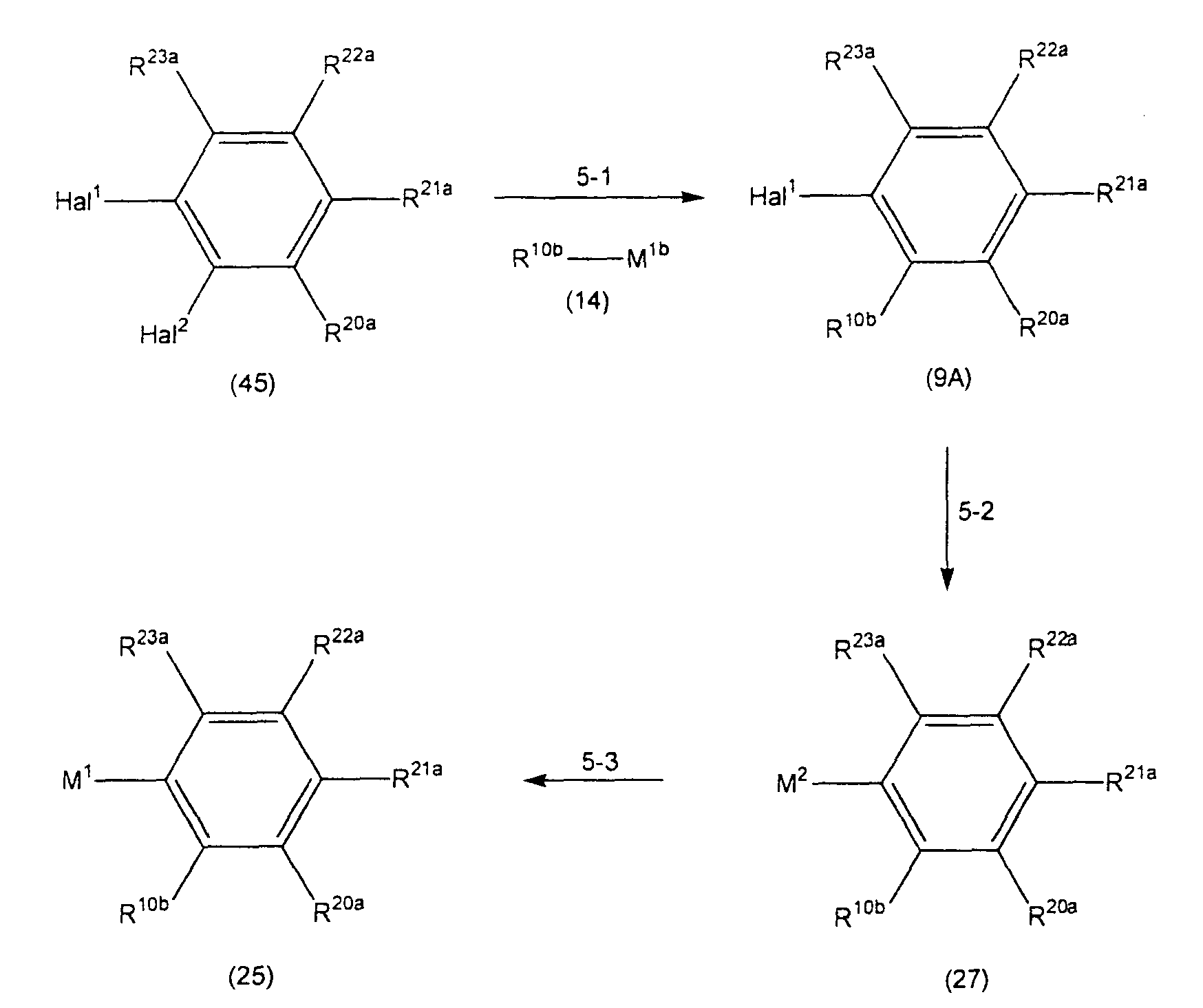
- In this method, compound (45) is reacted with compound (14) in an inert solvent in the presence of a palladium(0) catalyst to yield compound (9A) (Step 5-1), and then compound (9A) is reacted with a lithiating agent or Grignard reagent-producing agent to yield compound (27) (Step 5-2) and compound (27) is reacted with a boron metal reagent or tin metal reagent to produce compound (25) (Step 5-3).
In this scheme, M1, M1b, M2, R10b, R20a, R21a, R22a and R23a have the same definitions as above.
Hal1 is chlorine or bromine, and Hal2 is iodine when Hal1 is bromine, and bromine or iodine when Hal1 is chlorine.
Step 5-1 of this method may be carried out in a manner similar to Method K above. - This step will differ depending on the nature of M2.
- In this step, compound (9A) is directly reacted with magnesium metal in an inert solvent (direct method), or magnesium-halogen exchange reaction is carried out between compound (9A) and another Grignard reagent (indirect method) to produce compound (27) (i.e., a Grignard reagent).
- There are no particular restrictions on the solvent used so long as it dissolves the starting compound to some extent and does not inhibit the reaction of this step, and specifically there may be mentioned ethers such as diethyl ether, diisopropyl ether, tetrahydrofuran, dioxane, dimethoxyethane and diethyleneglycol dimethyl ether, and phosphoric amides such as hexamethylphosphoric triamide, among which ethers (particularly diethyl ether and tetrahydrofuran) are preferred.
The reaction method may be conducted according to a common procedure, and specifically magnesium metal is suspended in the solvent under an atmosphere of an inert gas such as nitrogen or argon, in the presence or in the absence of a catalytic amount of iodine or dibromoethane as an activating agent, and compound (9A) is slowly added to the reaction system. Upon completion of the reaction, compound (27) is produced in the supernatant, and it is usually used for the next step without isolation.
The reaction temperature will differ depending on the starting materials, solvent and reagents, but will usually be between -20°C and 150°C, and is preferably between 0°C and 100°C.
The reaction time will differ depending on the starting materials, solvent, reagents and reaction temperature, but will usually be 1 to 10 hours. - The solvent used, the reaction temperature and the reaction time are the same as for the direct method.
The reaction method may be carried out according to a common procedure, but compound (27) (i.e., an organic magnesium compound) may also be produced by reacting the halogen compound (9A) with isopropylmagnesium bromide or the like under an atmosphere of an inert gas such as nitrogen or argon. The resultant compound (27) is usually used for the next step without isolation. - In this step. lithium-halogen exchange reaction is carried out between the halogen compound (9A) and another alkyllithium reagent in an inert solvent, under an atmosphere of an inert gas such as nitrogen or argon, to produce an aryllithium reagent (27).
There are no particular restrictions on the solvent used so long as it dissolves the starting compound to some extent and does not inhibit the reaction of this step, and specifically there may be mentioned ethers such as diethyl ether, diisopropyl ether, tetrahydrofuran, dioxane, dimethoxyethane and diethyleneglycol dimethyl ether, and phosphoric amides such as hexamethylphosphoric triamide, among which ethers (particularly diethyl ether and tetrahydrofuran) are preferred.
There are no particular restrictions on the alkyllithium reagent used so long as it can yield the target compound and does not produce any unseparable by-products, and specifically there may be mentioned alkyllithium compounds such as n-butyllithium, sec-butyllithium and t-butyllithium, among which n-butyllithium is preferred.
The reaction temperature will differ depending on the starting materials, solvent and reagents, but will usually be between -100°C and 0°C.
The reaction time will differ depending on the starting materials, solvent, reagents and reaction temperature, but will usually be between 10 minutes and 2 hours.
The resultant compound (27) is usually used for the next step without isolation. - This step will differ depending on the nature of M1.
- In this step, the lithium agent or Grignard reagent (27) produced in Step 5-2 is reacted with a borate reagent mentioned below to produce a boronic acid reagent compound (25).
There are no particular restrictions on the solvent used so long as it dissolves the starting compound to some extent and does not inhibit the reaction of this step, and specifically there may be mentioned ethers such as diethyl ether, diisopropyl ether, tetrahydrofuran, dioxane, dimethoxyethane and diethyleneglycol dimethyl ether, and phosphoric amides such as hexamethylphosphoric triamide, among which ethers (particularly diethyl ether and tetrahydrofuran) are preferred.
There are no particular restrictions on the borate reagent used so long as it can yield the target compound and does not produce any unseparable by-products, and specifically there may be mentioned trialkylborates such as triisopropylborate and trimethylborate, among which triisopropylborate are preferred.
The trialkylborate obtained may be easily hydrolyzed in water or aqueous ammonium chloride to produce a boronic acid reagent compound (25).
The reaction temperature will differ depending on the starting materials, solvent and reagents, but will usually be between -80°C and 50°C, and is preferably between -80°C and 30°C.
The reaction time will differ depending on the starting materials, solvent, reagents and reaction temperature, but will usually be 1 to 10 hours, and is preferably 2 to 6 hours. - In this step, the lithium agent or Grignard reagent (27) produced in Step 5-2 is reacted with the halogenated trialkyltin reagent mentioned below to produce a tin reagent compound (25).
There are no particular restrictions on the solvent used so long as it dissolves the starting compound to some extent and does not inhibit the reaction of this step, and specifically there may be mentioned ethers such as diethyl ether, diisopropyl ether, tetrahydrofuran, dioxane, dimethoxyethane and diethyleneglycol dimethyl ether, and phosphoric amides such as hexamethylphosphoric triamide, among which ethers (particularly diethyl ether and tetrahydrofuran) are preferred.
There are no particular restrictions on the halogenated trialkyltin reagent used so long as it can yield the target compound and does not produce any unseparable by-products, and specifically there may be mentioned halogenated trialkyltin compounds such as tributyltin chloride and trimethyltin chloride, among which tributyltin chloride is preferred.
The reaction temperature will differ depending on the starting materials, solvent and reagents, but will usually be between -80°C and 50°C, and is preferably between -80°C and 30°C.
The reaction time will differ depending on the starting materials, solvent, reagents and reaction temperature, but will usually be 1 to 10 hours, and is preferably 1 to 6 hours. - (Production method for compound (9B)) (Method 6)

- In this step, compound (46) is reacted with compound (14) in an inert solvent in the presence of a palladium(0) catalyst, to yield compound (47) (Step 6-1), and then compound (47) is reacted with a de-alkylating agent or de-aralkylating agent to yield compound (48) (Step 6-2), and a trifluoromethanesulfonyl group is introduced at the phenolic hydroxyl group of compound (48) to produce compound (9B) (Step 6-3).
In this scheme, Tf, M1b, Hal, R10a, R10b, R20a, R21a, R22a and R23a have the same definitions as above. Also, R100 represents C1-6 alkyl or optionally substituted aralkyl, and is preferably methyl or benzyl.
Step 6-1 of this method may be carried out in a manner similar to Method K above. - There are no particular restrictions on the solvent used so long as it dissolves the starting compounds to some extent and does not inhibit the reaction of this step, and specifically there may be mentioned alcohols such as methanol, ethanol and isopropanol, ethers such as diethyl ether, diisopropyl ether, tetrahydrofuran, dioxane, dimethoxyethane and diethyleneglycol dimethyl ether, aromatic hydrocarbons such as benzene, toluene and xylene, organic acids such as carbon disulfide, acetic acid and hydrogen bromide in acetic acid solution, organic bases such as quinoline and pyridine, and water. These may be selected as appropriate for the de-alkylating agent or de-aralkylating agent used.
There are no particular restrictions on the de-alkylating agent or de-aralkylating agent used so long as it can yield the target compound and does not produce any unseparable by-products, and specifically there may be mentioned Lewis acids such as boron tribromide, boron trichloride, boron triiodide and aluminum chloride, Bronsted acids such as hydrobromic acid, hydrochloric acid and hydrogen bromide in acetic acid solution, metal salts such as lithium iodide, and halogenated silanes such as trimethylsilane iodide.
The reaction temperature will differ depending on the starting materials, solvent and reagents, but will usually be between -80°C and 250°C.
The reaction time will differ depending on the starting materials, solvent, reagents and reaction temperature, but will usually be 0.1 to 100 hours.
When R100 is an optionally substituted aralkyl group, the de-aralkylating step may be carried out according to the hydrogenation method described for Method A above.
The conditions may be selected as suitable for the starting materials, in order to allow selective deprotection.
As supplementary literature to be used as reference for carrying out this method, there may be mentioned: M. Vivekananda Bhatt, Surendra U. Kulkarni et al., "Cleavage of Ethers" Synthesis (1983), 249; T.W. Greene, (Protective Groups in Organic Synthesis), John Wiley & Sons; and J.F.W. McOmis, (Protective Groups in Organic Chemistry), Plenum Press.
Step 6-3 may be carried out in a manner similar to Method A or Method B above. - (Production method for compound (25A)) (Method 7)


- In this method, compound (9C) is reacted with a boron metal reagent or tin metal reagent in an inert solvent in the presence of a palladium(0) catalyst, to produce compound (25A).
In this scheme, M1b, Hal, R10a, R20a, R21a, R22a and R23a have the same definitions as above.
This method may be carried out in a manner similar to Step 4-2 of Method 4. - (Production method for compound (13A)) (Method 8)


- In this method, compound (49) is reacted with compound (8) (amination or amidation), in an inert solvent in the presence of a palladium(0) catalyst or copper catalyst, in the presence or in the absence of a base, in the presence or in the absence of an additive, under or not under an inert gas atmosphere, to yield compound (50) (Step 8-1), and then compound (50) is reacted with a de-alkylating agent or de-aralkylating agent to yield compound (51) (Step 8-2), and a trifluoromethanesulfonyl group is introduced at the phenolic hydroxyl of compound (51) to produce compound (13A) (Step 8-3).
In this scheme, Tf, n, R20a, R21a, R22a, R23a, R30a, R31a, R32a, R40a and R100 have the same definitions as above. Also, MW1a has the same definition as M1a or W1a above.
Step 8-1 of this method may be carried out in a manner similar to Method F or Method G described above, Step 8-2 may be carried out in a manner similar to Step 6-2 described above, and Step 8-3 may be carried out in a manner similar to Method A or Method B described above. - (Production method for compounds (15) and (13B)) (Method 9)


- In this method, compound (77) is reacted with compound (8), in an inert solvent, in the presence of a palladium(0) catalyst or copper catalyst, in the presence or in the absence of a base, in the presence or in the absence of an additive, under or not under an inert gas atmosphere, to yield compound (13B) (Step 9-1), and then compound (13B) is reacted with a metal reagent to produce compound (15) (Step 9-2).
In this scheme, n, M1, R20a, R21a, R22a, R23a, R30a, R31a, R32a and R40a have the same definitions as above.
Hal4 is chlorine or bromine, and Hal3 is iodine when Hal4 is bromine, and bromine or iodine when Hal4 is chlorine.
Step 9-1 of this method may be carried out in a manner similar to Method F above, and Step 9-2 may be carried out in a manner similar to Step 5-2 and Step 5-3, or Method 7, above. - (Production method for compounds (16A), (14) and (16B)) (Method 10)

- In this method, a leaving group is introduced into compound (53), in an inert solvent, under or not under inert gas atmosphere, to yield compound (16A) (Step 10-1), and then compound (16A) is reacted with a boron metal reagent or tin metal reagent in the presence of a palladium(0) catalyst to yield compound (14) (Step 10-2), and compound (14) is reacted with a halogenating reagent to produce compound (16B) (Step 10-3).
Alternatively, compound (53) is reacted directly with a halogenating agent to produce compound (16B) (Step 10-4).
In this scheme, Tf, R10b, M1b and Hal have the same definitions as above. Also, R200 is a substituent in Group A1, or a substituent in Group A1, which is protected. u is an integer of 0, 1, 2, 3, 4 or 5. k is an integer of 0, 1, 2, 3, 4 or 5.
Step 10-1 of this method may be carried out in a manner similar to Method 4-1 above, Step 10-2 may be carried out in a manner similar to Step 4-2 above, and Step 10-3 may be carried out in a manner similar to Step 4-3 above. Step 10-4 may be carried out in a manner similar to Step 4-4 above. - (Production method for compound (12)) (Method 11)

- In this step, compound (54) is reacted with a nitrating reagent to yield compound (55) (Step 11-1), and then a metal or metal salt is used in the presence of an acid for reduction of compound (55) to produce compound (12) (Step 11-2).
In this scheme, R10a, R20a, R21a, R22a and R23a have the same definitions as above. - There are no particular restrictions on the solvent used so long as it dissolves the starting compounds to some extent and does not inhibit the reaction of this step, and specifically there may be mentioned a sulfuric acid and nitric acid mixture or an acetic acid and nitric acid mixture, where the nitric acid solvent reacts as a nitrating agent.
The reaction temperature will differ depending on the starting materials, solvent and reagents, but will usually be between -20°C and 150°C, and is preferably between 0°C and 80°C.
The reaction time will differ depending on the starting materials, solvent, reagents and reaction temperature, but will usually be 0.5 to 48 hours, and is preferably 1 to 12 hours. - There are no particular restrictions on the solvent used so long as it dissolves the starting compounds to some extent and does not inhibit the reaction of this step, and specifically there may be mentioned alcohols such as methanol and ethanol, amides such as formamide, dimethylformamide, dimethylacetamide and hexamethylphosphoric triamide, organic acids such as acetic acid, water, and mixtures of these solvents, among which a mixed solvent of ethanol and water, a mixed solvent of ethanol dimethylformamide and water, or acetic acid is preferred.
There are no particular restrictions on the metal or metal salt used so long as it can yield the target compound and does not produce any unseparable by-products, and specifically there may be mentioned metals such as iron powder, tin powder and zinc powder, and metal salts such as tin(II) chloride, among which a metal (particularly iron powder) is preferred.
There are no particular restrictions on the acid used so long as it can yield the target compound and does not produce any unseparable by-products, and specifically there may be mentioned organic acids such as acetic acid, and inorganic acids such as hydrochloric acid and ammonium chloride, among which ammonium chloride is preferred.
The equivalents of the metal or metal salt used will differ depending on the starting materials, solvent and reagents, but will usually be a proportion of 2-15 and preferably 3-6, in terms of the molar ratio with respect to the starting material.
The reaction temperature will differ depending on the starting materials, solvent and reagents, but will usually be between 0°C and 150°C, and is preferably between 0°C and 100°C.
The reaction time will differ depending on the starting materials, solvent, reagents and reaction temperature, but will usually be 0.5 to 48 hours, and is preferably 1 to 12 hours.
Compound (55) or (12) may be isolated or purified from the reaction mixture obtained above, by the method described above. - (Production method for compound (55A)) (Method 12)

- In this method, compound (56) is reacted with compound (16) above to produce compound (55A) (Method 12-1), or compound (57) is reacted with compound (14) above to produce compound (55A) (Method 12-2), in an inert solvent, in the presence of a palladium(0) catalyst, under or not under an inert gas atmosphere, in the presence or in the absence of a base, in the presence or in the absence of an additive.
In this scheme, W1a, M1, M1b, R10b, R20a, R21a, R22a and R23a have the same definitions as above.
Method 12-1 of this method may be carried out in a manner similar to Method K above, and Method 12-2 may be carried out in a manner similar to Method K described above. - The starting compounds or intermediates for each of the steps in the general production methods described above for obtaining compound (1) or (100) may be purchased as commercial products, or can be obtained as starting compounds or intermediates having various substituents introduced at the R20 to R23 positions from commercially available compounds by well-known methods (substituent conversion, substituent introduction, protecting group introduction, deprotection, etc.) which are ordinarily carried out by those skilled in the art.
By using such starting compounds or intermediates with various substituents introduced at the R20 to R23 positions for the general production methods described above, it is possible to produce compound (1) or (100) having various R20 to R23 substituents introduced therein.
When the compound of the present invention is to be used as a medicament, it will normally be mixed with appropriate additives for use as a formulation. However, this does not preclude the use of the compound of the invention by itself as a medicament. - Such additives may include excipients, binders, lubricants, disintegrators, coloring agents, taste correctives, emulsifiers, surfactants, dissolving aids, suspending agents, isotonizing agents, buffering agents, antiseptics, antioxidants, stabilizers, absorption accelerators and the like which are commonly used in pharmaceuticals, and they may be added in appropriate combinations as desired.
As examples of such excipients there may be mentioned lactose, white soft sugar, glucose, corn starch, mannitol, sorbitol, starch, alpha starch, dextrin, crystalline cellulose, soft silicic anhydride, aluminum silicate, calcium silicate, magnesium aluminometasilicate, calcium hydrogenphosphate, and the like.
As examples of binders there may be mentioned polyvinyl alcohol, methylcellulose, ethylcellulose, gum Arabic, tragacanth, gelatin, shellac, hydroxypropylmethylcellulose, hydroxypropylcellulose, carboxymethylcellulose sodium, polyvinylpyrrolidone, macrogol, and the like.
As examples of lubricants there may be mentioned magnesium stearate, calcium stearate, sodium stearyl fumarate, talc, polyethylene glycol, colloidal silica, and the like.
As examples of disintegrators, there may be mentioned crystalline cellulose, agar, gelatin, calcium carbonate, sodium hydrogencarbonate, calcium citrate, dextrin, pectin, low-substituted hydroxypropylcellulose, carboxymethylcellulose, carboxymethylcellulose calcium, croscarmellose sodium, carboxymethyl starch, carboxymethyl starch sodium, and the like.
As coloring agents there may be mentioned those approved for addition to pharmaceuticals, such as iron sesquioxide, yellow iron sesquioxide, carmine, caramel, β-carotene, titanium oxide, talc, riboflavin sodium phosphate, yellow aluminum lake, and the like.
As taste correctives there may be mentioned cocoa powder, menthol, aromatic powders, mentha oil, borneol, powdered cinnamon bark, and the like.
As emulsifiers or surfactants there may be mentioned stearyl triethanolamine, sodium lauryl sulfate, lauryl aminopropionic acid, lecithin, glycerin monostearate, sucrose fatty acid esters, glycerin fatty acid esters, and the like.
As dissolving aids there may be mentioned polyethylene glycol, propylene glycol, benzyl benzoate, ethanol, cholesterol, triethanolamine, sodium carbonate, sodium citrate, polysorbate 80, nicotinamide, and the like.
As suspending agents there may be mentioned the surfactants referred to above, as well as hydrophilic polymers such as polyvinyl alcohol, polyvinylpyrrolidone, methylcellulose, hydroxymethylcellulose, hydroxyethylcellulose, hydroxypropylcellulose, and the like.
As isotonizing agents there may be mentioned glucose, sodium chloride, mannitol, sorbitol, and the like.
As buffering agents there may be mentioned buffering solutions of phosphate, acetate, carbonate, citrate and the like.
As antiseptics there may be mentioned methylparaben, propylparaben, chlorobutanol, benzyl alcohol, phenethyl alcohol, dehydroacetic acid, sorbic acid, and the like.
As antioxidants there may be mentioned sulfite, ascorbic acid, α-tocopherol, and the like.
As stabilizers there may be mentioned those commonly used in pharmaceuticals.
As absorption accelerators there may also be mentioned those commonly used in pharmaceuticals. - The formulation may be in an oral form such as tablets, powders, granules, capsules, syrups, lozenges or inhalanst, an external application form such as suppository, ointment, eye salve, tape, eye drop, nasal drop, ear drop, pap or lotion, or an injection.
An oral formulation will be formulated using an appropriate combination of additives among those mentioned above. The surface thereof may also be coated if necessary.
An external application will be formulated using an appropriate combination of additives among those mentioned above, and particularly excipients, binders, taste correctives, emulsifiers, surfactants, dissolving aids, suspending agents, isotonizing agents, antiseptics, antioxidants, stabilizers and absorption accelerators.
An injection will be formulated using an appropriate combination of additives among those mentioned above, and particularly emulsifiers, surfactants, dissolving aids, suspending agents, isotonizing agents, buffering agents, antiseptics, antioxidants, stabilizers and absorption accelerators. - When the compound of the invention is to be used as a drug, the dosage thereof will differ depending on the symptoms and age of the patient, but it will ordinarily be 0.15 to 5000 mg (preferably 0.5 to 1500 mg) in the case of an oral formulation, 0.5 to 1500 mg (preferably 1.5 to 500 mg) in the case of an external application, and 0.3 to 5000 mg (preferably 1 to 500 mg) in the case of an injection, per day; administered at once or divided over 2 to 6 times. For an oral formulation or injection, this represents the actually administered dose, while for an external application this represents the actually absorbed dose.
- Compounds (1) and (100) according to the invention may be produced, for example, by the process described in the following examples. It is to be understood, however, that these examples merely serves as illustration and are not intended to restrict the compounds of the invention under any circumstances.
Also, unless otherwise specified, the silica gel mentioned throughout the examples is Silica Gel 60 by Merck & Co. or BW300 by Fuji Silysia Chemical Ltd., and the NH silica gel is propylamine-coated Chromatorex-NH silica gel by Fuji Silysia Chemical Ltd.
In the TLC analysis as well, unless otherwise specified, the silica gel is Silica Gel 60 by Merck & Co. and the NH is a propylamine-coated NH silica gel plate by Fuji Silysia Chemical Ltd. -

Saturated aqueous ammonium chloride was added to the reaction mixture to quench the reaction. Hexane and water were added to the mixture, and the organic layer and aqueous layer were separated. The organic layer was washed with brine and then dried over anhydrous magnesium sulfate. The aqueous layer was re-extracted with hexane and treated in the same manner as the organic layer. The two organic layers were combined, the desiccant was filtered off and the filtrate was concentrated under reduced pressure. The residue was purified by silica gel column chromatography (ethyl acetate/hexane) to give 26.8 g of the title compound as a light yellow oil.
1H-NMR (400MHz, CDCl3)
δ: 0.97 (s, 6H), 1.54 (t, J= 6.4Hz, 2H), 1.96-1.98 (m, 2H), 2.31-2.36 (m, 2H), 5.66-5.69 (m, 1H). -

- To a solution of 2-nitrophenylboronic acid (14.2 g, 85.19 mmol) in toluene (250 mL)-ethanol(125 mL) were added trifluoromethanesulfonic acid 4,4-dimethylcyclohex-1-enyl ester (20 g, 77.44 mmol) prepared in Example (1a), tetrakis(triphenylphosphine)palladium(0) (4.5 g, 3.87 mmol) and 2N aqueous sodium carbonate (128 mL, 256 mmol). The mixture was stirred at an external temperature of 100°C for 1 hour and 45 minutes under a nitrogen atmosphere.
After air-cooling the reaction mixture to room temperature, it was passed through Celite and insoluble matters were filtered off. Ethyl acetate and water were added to the resultant filtrate and the filtrate was extracted with ethyl acetate. The collected organic layer was washed with water and brine in that order and then dried over anhydrous magnesium sulfate. The desiccant was filtered off, and the filtrate was concentrated under reduced pressure. The resultant residue was purified by silica gel column chromatography (ethyl acetate/hexane) to give 16.3 g of the title compound as a brown oil.
1H-NMR (400MHz, CDCl3)
δ: 1.00 (s, 6H), 1.51 (t, J= 6.4Hz, 2H), 1.92-1.94 (m, 2H), 2.24-2.29 (m, 2H), 5.55-5.57 (m, 1H), 7.27 (dd, J= 7.6, 1.6Hz, 1H), 7.34 (ddd, J= 7.6, 7.6, 1.6Hz, 1 H), 7.50 (ddd, J= 7.6, 7.6, 1.6Hz, 1H), 7.77 (dd, J= 7.6, 1.6Hz, 1H). -


- A mixture of 1-(4,4-dimethylcyclohex-1-enyl)-2-nitrobenzene (16.3 g, 70.5 mmol), 10% palladium on carbon (1 g, wet) and ethyl acetate (100 mL) was stirred for 14 hours and 30 minutes under a hydrogen atmosphere at atmospheric pressure and room temperature.
The reaction mixture was filtered and the filtrate was concentrated under reduced pressure. A mixture of the resultant residue, 10% palladium on carbon (3 g, wet) and ethyl alcohol (200 mL) was stirred for 30 hours and 30 minutes under a hydrogen atmosphere at atmospheric pressure and room temperature.
After the reaction completed, the reaction mixture was filtered and the filtrate was concentrated under reduced pressure. The resultant residue was purified by silica gel column chromatography (ethyl acetate/hexane) to give 11.79 g of the title compound as a light yellow solid.
1H-NMR (400MHz, CDCl3)
δ: 0.97 (s, 3H), 0.99 (s, 3H), 1.36 (td, J= 13.2, 4.0Hz, 2H), 1.47-1.73 (m, 6H), 2.38 (tt, J= 11.6, 3.6Hz, 1H), 3.63 (brs, 2H), 6.68 (dd, J= 7.6, 1.6Hz, 1H), 6.77 (ddd, J= 7.6, 7.6, 1.6Hz, 1H), 7.01 (ddd, J= 7.6, 7.6, 1.6Hz, 1H), 7.14 (dd, J= 7.6, 1.6Hz, 1H). -

- To a solution of 2-(4,4-dimethylcyclohexyl)phenylamine (11.79 g, 57.98 mmol) in 1,2-dichlorobenzene (30 mL) was added bis(2-chloroethyl)amine hydrochloride (12.42 g, 69.58 mmol), and the mixture was stirred at an external temperature of 200°C for 2 hours and 30 minutes under a nitrogen atmosphere. During the reaction, nitrogen was passed through the reactor several times to remove the hydrogen chloride gas.
After air-cooling the reaction mixture to room temperature, ethyl acetate and saturated aqueous sodium hydrogencarbonate were added and the mixture was extracted with ethyl acetate. The collected organic layer was washed with water and brine in that order and then dried over anhydrous sodium sulfate. The desiccant was filtered off, and the filtrate was concentrated under reduced pressure. The resultant residue was purified by NH silica gel column chromatography (ethyl acetate/hexane) to give 12.15 g of the title compound as a brown oil.
1H-NMR (400MHz, CDCl3)
δ: 0.97 (s, 3H), 1.01 (s, 3H), 1.34 (td, J= 12.8, 4.4Hz, 2H), 1.48-1.68 (m, 6H), 2.82-2.84 (m, 4H), 2.95-3.03 (m, 5H), 7.05-7.27 (m, 4H).
The 1H of NH could not be identified. -

- A mixture of 1-[2-(4,4-dimethylcyclohexyl)phenyl]piperazine (11 g. 40.4 mmol), triethylamine (6.2 mL, 44.4 mmol), 4-dimethylaminopyridine (247 mg, 2.02 mmol) and dichloromethane (180 mL) was stirred at an external temperature of 0°C under a nitrogen atmosphere. A mixture of di-t-butyl dicarbonate (9.7 g, 44.4 mmol) and dichloromethane (20 mL) was added thereto.
After stirring for 2 hours and 50 minutes under the same conditions, saturated aqueous sodium hydrogencarbonate was added to the reaction mixture and the mixture was extracted with dichloromethane. The collected organic layer was washed with brine and then dried over anhydrous sodium sulfate. The desiccant was filtered off and the filtrate was concentrated under reduced pressure. The resultant residue was purified by silica gel column chromatography (ethyl acetate/hexane) to give 14.89 g of the title compound as a light yellow oil.
1H-NMR (400MHz, CDCl3)
δ: 0.96 (s, 3H), 1.01 (s, 3H), 1.31 (td, J= 12.8, 4.4Hz, 2H), 1.49 (s, 9H), 1.49-1.69 (m, 6H), 2.81 (brs, 4H), 2.95-3.02 (m, 1H), 3.57 (brs, 4H), 7.06 (dd, J= 7.6, 1.6Hz, 1H), 7.10 (ddd, J= 7.6, 7.6, 1.6Hz, 1H), 7.16 (ddd, J= 7.6, 7.6, 2.0Hz, 1H), 7.28 (dd, J= 7.6, 2.0Hz, 1H). -

- A mixture of 4-[2-(4,4-dimethylcyclohexyl)phenyl]piperazine-1-carboxylic acid t-butyl ester (8 g, 21.5 mmol), sodium acetate (17.6 g, 215 mmol) and methanol (300 mL) was stirred at an external temperature of room temperature under a nitrogen atmosphere. Bromine (1.1 mL, 21.5 mmol) was added dropwise thereto over 20 minutes, and the mixture was stirred for 17 hours under the same conditions. Sodium acetate (8.8 g, 107.5 mmol) was added thereto, and then bromine (0.4 mL, 7.8 mmol) was added dropwise and the mixture was stirred for 1 hour under the same conditions.
A saturated aqueous solution of sodium sulfite was added to the reaction mixture and the mixture was extracted with ethyl acetate. The collected organic layer was washed with brine and then dried over anhydrous magnesium sulfate. The desiccant was filtered off and the filtrate was concentrated under reduced pressure. The resultant residue was purified by silica gel column chromatography (ethyl acetate/hexane) to give 7.97 g of the title compound as a light yellow solid. 1H-NMR (400MHz, CDCl3)
δ: 0.96 (s, 3H), 1.01 (s, 3H), 1.24-1.34 (m, 2H), 1.41-1.64 (m, 6H), 1.49 (s, 9H), 2.77 (brs. 4H), 2.89-2.97 (m, 1H), 3.55 (brs, 4H), 6.92 (d, J= 8.4Hz, 1H), 7.25 (dd, J= 8.4, 2.4Hz, 1H), 7.35 (d, J= 2.4Hz, 1H). -

- A solution of 3,3,5,5-tetramethylcyclohexanone (12.8 g, 82.98 mmol) in anhydrous tetrahydrofuran (300 mL) was cooled to below -70°C in a dry ice-acetone bath under a nitrogen atmosphere. To the stirred solution was gradually added dropwise lithium bis(trimethylsilyl)amide (1M solution in tetrahydrofuran, 100 mL, 100 mmol) over 15 minutes. After stirring for 40 minutes under the same conditions, a solution of N-phenyl bis(trifluoromethanesulfonimide) (32.51 g, 91 mmol) in anhydrous tetrahydrofuran (150 mL) was added to the reaction mixture, and stirring was continued for 13 hours and 30 minutes with slowly warmed to room temperature.
Ethyl acetate and brine were added to the reaction mixture and the mixture was extracted with ethyl acetate. The collected organic layer was dried over anhydrous sodium sulfate. The desiccant was filtered off and the filtrate was concentrated under reduced pressure. The resultant residue was purified by silica gel column chromatography (ethyl acetate/hexane) to give 23.65 g of the title compound as a colorless oil.
1H-NMR (400MHz, CDCl3)
δ: 1.04 (s, 6H), 1.09 (s, 6H), 1.35 (s, 2H), 2.08 (s, 2H), 5.51 (s, 1H). -

- To a solution of trifluoromethanesulfonic acid 3,3,5,5-tetramethylcyclohex-1-enyl ester (45.94 g, 0.16 mol) in dioxane (500 mL) were added bis(pinacolato)diboron (44.9 g, 0.177 mol), [1,1'-bis(diphenylphosphino)ferrocene]dichloropalladium(II) dichloromethane complex (4 g, 4.9 mmol) and potassium acetate (47.3 g, 0.482 mol), and the mixture was stirred at an external temperature of 80°C for 16 hours and 30 minutes.
Ethyl acetate, water and brine were added to the reaction mixture and the mixture was extracted with ethyl acetate. The collected organic layer was dried over anhydrous sodium sulfate. The desiccant was filtered off and the filtrate was concentrated under reduced pressure. The resultant residue was purified by silica gel column chromatography (ethyl acetate/hexane) to give 39.27 g of the title compound as a light yellow solid.
1H-NMR (400MHz, CDCl3)
δ: 0.92 (s, 6H), 1.01 (s, 6H), 1.27 (s, 12H), 1.31 (s, 2H), 1.84 (d, J= 1.6Hz, 2H), 6.26 (t, J= 1.6Hz, 1H). -

- A suspension of 2-(1-piperazino)phenol (3.56 g, 20 mmol) in acetonitrile (15 mL) was stirred at room temperature. A solution of di-t-butyl dicarbonate (4.8 g, 22 mmol) in acetonitrile (15 mL) was added thereto.
After stirring for 1 hour, insoluble matters were filtered out and the filtrate was concentrated. Hexane was added to the residue prior to sonication. The resultant solid was filtered and dried under reduced pressure to give a crude product of the title compound (5.35 g) as a light brown solid.
1H-NMR (400MHz, CDCl3)
δ: 1.49 (s, 9H), 2.82 (t, J= 4.8Hz, 4H), 3.59 (t, J= 4.8Hz, 4H), 6.87 (td, J= 7.6, 1.2Hz, 1H), 6.96 (dd, J= 8.0, 1.2Hz, 1H), 7.07-7.14 (m, 2H).
The 1H of OH could not be identified. -

- A mixture of 4-(2-hydroxyphenyl)piperazine-1-carboxylic acid t-butyl ester (4.61 g, 16.56 mmol), triethylamine (11.5 mL, 82.5 mmol) and dichloromethane (100 mL) was cooled in an ice bath under a nitrogen atmosphere. Trifluoromethanesulfonic anhydride (4 mL, 23.78 mmol) was gradually added dropwise over 40 minutes with stirring the mixture.
After stirring for 17 minutes under the same conditions, saturated aqueous ammonium chloride, ethyl acetate and water were added to the reaction mixture and the mixture was extracted with ethyl acetate. The collected organic layer was washed twice with saturated aqueous ammonium chloride, subsequently washed once with brine, and then dried over anhydrous sodium sulfate. The desiccant was filtered off and the filtrate was concentrated under reduced pressure. The resultant residue was purified by silica gel column chromatography (ethyl acetate/hexane) to give 5.54 g of the title compound as a light yellow solid.
1H-NMR (400MHz, CDCl3)
δ: 1.48 (s, 9H), 2.95 (t, J= 4.8Hz, 4H), 3.62 (t, J= 4.8Hz, 4H), 7.10-7.16 (m, 2H), 7.18 (dd, J= 8.0, 1.6Hz, 1H), 7.33 (ddd, J= 7.2, 7.2, 1.6Hz, 1H). -


- A mixture of 4-(2-trifluoromethanesulfonyloxyphenyl)piperazine-1-carboxylic acid t-butyl ester (6.16 g, 15 mmol), 4,4,5,5-tetramethyl-2-(3,3,5,5-tetramethylcyclohex-1-enyl)-[1,3,2]dioxaborolane (4.6 g, 17.41 mmol), tripotassium phosphate (3.2 g, 15 mmol), 1,2-dimethoxyethane (60 mL) and water (3 mL) was stirred at room temperature under a nitrogen atmosphere. Tetrakis(triphenylphosphine)palladium(0) (1.74 g, 1.5 mmol) was added to the mixture. The mixture was then stirred at an external temperature of 85°C for 2 hours and 20 minutes.
Ethyl acetate and water were added to the reaction mixture and then this was passed through Celite and filtered. The organic extract from the filtrate was dried over anhydrous sodium sulfate. The desiccant was filtered off and the filtrate was concentrated under reduced pressure. The resultant residue was purified by silica gel column chromatography (ethyl acetate/hexane) to give 5.78 g of the title compound as a light yellow oil.
1H-NMR (400MHz, CDCl3) δ: 1.02 (s, 6H), 1.07 (s, 6H), 1.40 (s, 2H), 1.48 (s, 9H), 2.16 (d, J= 1.6Hz, 2H), 2.91 (t, J= 5.2Hz, 4H), 3.51 (t, J= 5.2Hz, 4H), 5.50 (t, J= 1.6Hz, 1H), 6.97 (dd, J= 8.0, 1.2Hz, 1H), 7.01 (ddd, J= 8.0, 8.0, 1.2Hz, 1H), 7.09 (dd, J= 8.0, 1.6Hz, 1H), 7.20 (ddd, J= 8.0,8.0, 1.6Hz, 1H). -

- A mixture of 4,4-diethyl-2-cyclohexenone (1 g, 6.57 mmol) (Reference: Michael E. Flaugh, Thomas A. Crowell, and Diane S. Farlow, J. Org. Chem., 1980, 45, 5399.), 10% palladium on carbon (60 mg, wet) and ethyl acetate (15 mL) was stirred for 26 hours under a hydrogen atmosphere at atmospheric pressure and room temperature.
The reaction mixture was filtered and then the filtrate was concentrated under reduced pressure to give a crude product of the title compound (720 mg) as a brown oil.
1H-NMR (400MHz, CDCl3)
δ : 0.85 (t, J= 7.6Hz, 6H), 1.43 (q, J= 7.6Hz, 4H), 1.65 (dd, J= 7.2, 7.2Hz, 4H), 2.31 (dd, J= 7.2, 7.2Hz, 4H). -
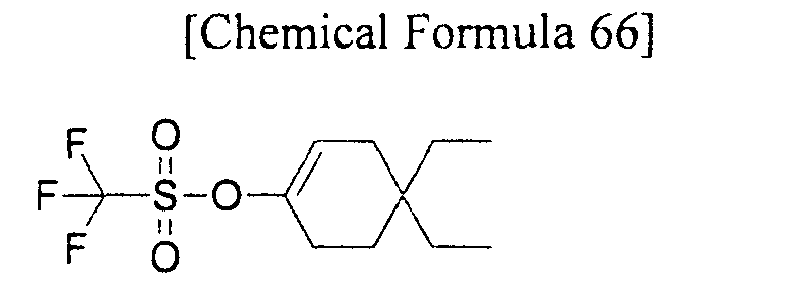
- A solution of 4,4-diethylcyclohexanone (720 mg, 4.67 mmol) in anhydrous tetrahydrofuran (20 mL) was cooled to below -70°C in a dry ice-acetone bath under a nitrogen atmosphere, and then stirred. Lithium bis(trimethylsilyl)amide (1M solution in tetrahydrofuran, 5.6 mL, 5.6 mmol) was gradually added dropwise to this solution. After stirring for 60 minutes under the same conditions, N-phenyl bis(trifluoromethanesulfonimide) (1.75 g, 4.9 mmol) was added to the reaction mixture, and stirring was continued for 27 hours with slowly warming to room temperature.
Saturated aqueous ammonium chloride was added to the reaction mixture. Ethyl acetate and brine were then added to the reaction mixture and the organic layer was separated off. After washing the organic layer with diluted hydrochloric acid and saturated aqueous sodium hydrogencarbonate in that order, it was dried over anhydrous magnesium sulfate. The desiccant was filtered off and the filtrate was concentrated under reduced pressure. The resultant residue was purified by silica gel column chromatography (ethyl acetate/hexane) to give 710 mg of the title compound as a yellow oil.
1H-NMR (400MHz, CDCl3)
δ: 0.80 (t, J= 7.6Hz, 6H), 1.21-1.40 (m, 4H), 1.55 (t, J= 6.6Hz, 2H), 1.95 (dt, J= 4.0, 2.8Hz, 2H), 2.25-2.30 (m, 2H). 5.63-5.66 (m, 1H). -

- To a solution of trifluoromethanesulfonic acid 4,4-diethylcyclohex-1-enyl ester (5.11 g, 17.8 mmol) in dioxane (60 mL) were added bis(pinacolato)diboron (5.2 g, 20.5 mmol), [1,1'-bis(diphenylphosphino)ferrocene]dichloropalladium(II) dichloromethane complex (580 mg, 0.71 mmol) and potassium acetate (5.3 g, 53.5 mmol), and the mixture was stirred at an external temperature of 90°C for 4 hours.
The reaction mixture was air-cooled to room temperature, and insoluble matters were filtered off. Ethyl acetate and water were added to the resultant filtrate and the organic layer was separated off. The organic layer was washed with brine and then dried over anhydrous magnesium sulfate. The desiccant was filtered off and the filtrate was concentrated under reduced pressure. The resultant residue was purified by silica gel column chromatography (ethyl acetate/hexane) to give 4.16 g of the title compound as white crystals.
1H-NMR (400MHz, CDCl3)
δ : 0.76 (t, J= 7.6Hz, 6H), 1.13-1.37 (m, 18H), 1.84-1.86 (m, 2H), 2.05-2.10 (m, 2H), 6.48-6.50 (m, 1H). -

- A mixture of 4-bromo-3-nitroanisole (2 g, 8.62 mmol), 2-(4,4-diethylcyclohex-1-enyl)-4,4,5,5-tetramethyl-[1,3,2]dioxaborolane (2.7 g, 10.3 mmol), tripotassium phosphate (2.7 g, 13.0 mmol) and 1,2-dimethoxyethane (20 mL) was stirred at room temperature under a nitrogen atmosphere, and then tetrakis(triphenylphosphine)palladium(0) (0.5 g, 0.43 mmol) was added. The mixture was then stirred at an external temperature of 80°C for 26 hours.
After cooling the reaction mixture, brine was added and the mixture was extracted with ethyl acetate. The organic layer was dried over anhydrous magnesium sulfate. The desiccant was filtered off and the filtrate was concentrated under reduced pressure. The resultant residue was purified by silica gel column chromatography (ethyl acetate/hexane) to give 2.4 g of the title compound as a light yellow oil.
1H-NMR (400MHz, CDCl3)
δ: 0.82 (t, J= 7.2Hz, 6H), 1.22-1.54 (m, 6H), 1.87-1.94 (m, 2H), 2.14-2.20 (m, 2H), 3.84 (s, 3H), 5.48-5.54 (m, 1H), 7.04 (dd, J= 8.4, 2.8Hz, 1H), 7.16 (d, J= 8.4Hz, 1H), 7.29 (d, J= 2.8 Hz, 1H). -

- To a solution of 1-(4,4-diethylcyclohex-1-enyl)-4-methoxy-2-nitrobenzene (2.4 g, 8.3 mmol) in ethanol (20 mL) were added an aqueous solution (5 mL) of ammonium chloride (2.2 g, 41 mmol) and iron powder (1.2 g, 20.7 mmol), and the mixture was stirred at an external temperature of 90°C for 1 hour
The reaction mixture was passed through Celite for filtration, and then brine was added to the filtrate and the mixture was extracted with ethyl acetate. The organic layer was dried over anhydrous magnesium sulfate, the desiccant was filtered off, and then the filtrate was concentrated under reduced pressure to give 2.6 g of the title compound as a yellow oil.
1H-NMR (400MHz, CDCl3)
δ : 0.82 (t, J= 7.2 Hz, 6H), 1.21-1.56 (m, 6H), 1.92-1.96 (m, 2H), 2.16-2.22 (m, 2H), 3.75 (s, 3H), 5.61-5.65 (m, 1H), 6.24 (d, J= 2.8Hz, 1H), 6.29 (dd, J= 8.4, 2.8Hz, 1H), 6.87 (d, J= 8.4Hz, 1 H).
The 2H of NH2 could not be identified. -

- A solution of 2-(4,4-diethylcyclohex-1-enyl)-5-methoxyphenylamine (2.6 g, 10 mmol) and bis(2-chloroethyl)amine hydrochloride (2.2 g, 12 mmol) in 1,2-dichlorobenzene (10 mL) was stirred at an external temperature of 210°C. Nitrogen gas was blown into the reactor several times during the reaction to remove the excess hydrogen chloride gas in the reactor.
After I hour, the reaction mixture was cooled to room temperature, and then saturated aqueous sodium hydrogencarbonate was added and the mixture was extracted with ethyl acetate. The organic layer was dried over anhydrous magnesium sulfate. The desiccant was filtered off and the filtrate was concentrated under reduced pressure. The resultant residue was purified by NH silica gel column chromatography (ethyl acetate/hexane) to give 1.4 g of the title compound as a yellow oil.
1H-NMR (400MHz, CDCl3)
δ: 0.82 (t, J= 7.2Hz, 6H), 1.22-1.52 (m, 6H), 1.90-1.96 (m, 2H), 2.38-2.46 (m, 2H), 2.78-3.04 (m, 8H), 3.79 (s, 3H), 5.61-5.66 (m,1H), 6.50 (dd, J= 8.4, 2.8Hz, 1H), 6.52 (d, J= 2.8Hz,1H), 6.99 (d, J= 8.4Hz, 1H).
The 1H of NH could not be identified.
MS m/e (ESI) 329(MH+). -

- 4-hydroxypiperidine-1-carboxylic acid t-butyl ester (25.5 g, 127 mmol) was added to a mixed solution of anhydrous tetrahydrofuran (100 mL) and dimethylformamide (40 mL). The solution was cooled to 0°C in an ice bath with stirring. Sodium hydride (60% dispersion in oil, 7.6 g, 190 mmol) was gradually added over 3 minutes. The reaction mixture was warmed to room temperature, stirred for 70 minutes, and cooled to 0°C again. A solution of methyl iodide (9.5 mL, 152 mmol) in anhydrous tetrahydrofuran (20 mL)-dimethylformamide (5 mL) was gradually added to the reaction mixture over 20 minutes. The ice bath was removed, and the reaction mixture was warmed to room temperature and stirred for 1 hour.
After the reaction, water and diethyl ether were added to the reaction mixture and the organic layer was separated off. The organic layer was washed 3 times with water, ant then once with brine, and dried over anhydrous sodium sulfate. The desiccant was filtered off and the filtrate was concentrated under reduced pressure. Ethyl acetate (200 mL) was added to the residue, and the mixture was cooled to 0°C and stirred. A 4N solution of hydrogen chloride in ethyl acetate (100 mL) was then gradually added over 10 minutes, and then the temperature was slowly raised to room temperature.
After stirring for 13 hours, the reaction mixture was concentrated under reduced pressure. The residue was dissolved in a small amount of dichloromethane. An excess of ethyl acetate was then added and the precipitated solid was filtered out and dried under reduced pressure to give 17.0 g of the title compound as colorless crystals.
1H-NMR (400MHz, CDCl3)
δ: 1.95-2.02 (m, 2H), 2.05-2.15 (m, 2H), 3.14-3.30 (m, 4H), 3.32 (s, 3H), 3.52-3.57 (m, 1H).
The 1H ofNH could not be identified. -


- A mixture of 4-methoxypiperidine hydrochloride (9.10 g, 60.01 mmol), 5-fluoro-2-nitrophenol (6.91 g, 43.98 mmol) and dimethylformamide (12 mL) was stirred under a nitrogen atmosphere. Triethylamine (15.24 mL, 109.95 mmol) was added to the reaction mixture and the mixture was stirred at an external temperature of 80°C for 3 hours and 30 minutes.
After the reaction, saturated aqueous ammonium chloride and a mixed solvent of ethyl acetate-diethyl ether were added to the reaction mixture. The organic layer was separated off, and the aqueous layer was extracted with diethyl ether. The obtained organic layers were combined and dried over anhydrous sodium sulfate. The desiccant was filtered off and the filtrate was concentrated under reduced pressure. The resultant residue was purified by silica gel column chromatography (ethyl acetate/hexane) to give 37.36 g of the title compound as orange crystals.
1H-NMR (400MHz, CDCl3)
δ:1.60-1.68 (m, 2H), 1.83-1.90 (m, 2H), 3.26 (ddd, J= 13.2, 8.0, 3.6Hz, 2H), 3.32 (s, 3H), 3.42-3.47(m, 1H), 3.62 (ddd, J= 13.2, 7.6, 3.6Hz, 2H), 6.24 (d, J= 2.8Hz, 1H), 6.36 (dd, J= 10.0, 2.8Hz, 1H), 7.87 (d, J= 10.0Hz, 1H).
The 1H of OH could not be identified. -

- A mixture of 5-(4-methoxypiperidin-1-yl)-2-nitrophenol (2.35 g, 8.16 mmol), triethylamine (5.7 mL, 40.9 mmol) and dichloromethane (50 mL) was stirred while cooling in ice water bath, and then trifluoromethanesulfonic anhydride (2 mL, 12.24 mmol) was gradually added dropwise for 15 minutes, and the mixture was stirred for 10 minutes under the same conditions.
Saturated aqueous ammonium chloride was added to the reaction mixture, and then ethyl acetate and water were added and the organic layer was separated off. The organic layer was dried over anhydrous sodium sulfate. The desiccant was filtered off and the filtrate was concentrated under reduced pressure. The resultant residue was purified by silica gel column chromatography (ethyl acetate/hexane) to give 3.276 g of the title compound as an orange solid.
1H-NMR (400MHz, CDCl3)
δ:1.66-1.74 (m, 2H), 1.84-1.92 (m, 2H), 3.27 (ddd, J= 13.2, 7.6, 3.6Hz, 2H), 3.23 (s, 3H), 3.47 (m, 1H), 3.58 (ddd, J= 12, 8.0, 3.6Hz, 2H), 6.54 (d, J= 2.8Hz, 1H), 6.72 (dd, J= 9.6, 2.8Hz. 1H), 8.07 (d. J= 9.6Hz. 1H). -
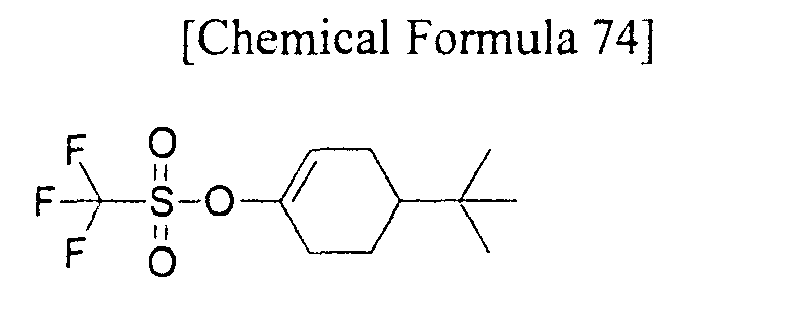
- A solution of diisopropylamine (22 mL, 0.157 mol) in anhydrous tetrahydrofuran (500 mL) was cooled to below -70°C in a dry ice-acetone bath under a nitrogen atmosphere. n-Butyllithium (1.56 M solution in hexane, 100 mL, 0.156 mol) was slowly added dropwise to the stirred solution over 15 minutes. The reaction mixture was then warmed to -10°C and then cooled to below -70°C again. After stirring for 10 minutes, a solution of 4-t-butylcyclohexanone (20.05 g, 0.13 mol) in anhydrous tetrahydrofuran (100 mL) was gradually added dropwise to the reaction mixture for 15 minutes. After stirring for 30 minutes, a solution of N-phenyl bis(trifluoromethanesulfonimide) (51.09 g, 0.143 mol) in anhydrous tetrahydrofuran (200 mL) was gradually added dropwise to the reaction mixture over 15 minutes and the mixture was stirred for 30 minutes. The dry ice bath was then exchanged with an ice bath, and stirring was continued for 30 minutes and then for another 30 minutes at room temperature. Ethyl acetate and brine were added to the reaction mixture and the mixture was extracted with ethyl acetate. The collected organic layer was dried over anhydrous sodium sulfate. The desiccant was filtered off and the filtrate was concentrated under reduced pressure. The resultant residue was purified by silica gel column chromatography (ethyl acetate/hexane) to give 33.1 g of the title compound as a light yellow oil, in racemic form at the position of t-butyl.
1H-NMR (400MHz, CDCl3)
δ: 0.90 (s, 9H), 1.24-1.44 (m, 2H), 1.90-2.00 (m, 2H), 2.16-2.25 (m, 1H), 2.32-2.46 (m, 2H), 5.72-5.76 (m, 1H). -

- To trifluoromethanesulfonic acid 4-t-butylcyclohex-1-enyl ester (55.0 g, 192.1 mmol) were added bis(pinacolato)diboron (56.1 g, 220.9 mmol), [1,1'-bis(diphenylphosphino)ferrocene]dichloropalladium(II) dichloromethane complex (4.88 g, 5.98 mmol), potassium acetate (56.6 g, 576.3 mmol) and dioxane (400 mL), and the mixture was stirred at an external temperature of 80°C for 16 hours.
After the reaction, the reaction mixture was air-cooled to room temperature, ethyl acetate and water were added to the reaction mixture and the organic layer was separated off. The obtained organic layer was again washed with water, and dried over anhydrous magnesium sulfate. The desiccant was filtered off and the filtrate was concentrated under reduced pressure. The resultant residue was purified by silica gel column chromatography (ethyl acetate/hexane) to give 38.97 g of the title compound as a light yellow solid, in racemic form at the position of t-butyl.
1H-NMR (400MHz, CDCl3)
δ: 0.85 (s, 9H), 1.00-1.43 (m, 14H), 1.78-1.90 (m, 2H), 1.98-2.17 (m, 2H), 2.24-2.32 (m, 1H), 6.59 (dd, J= 2.0Hz, 1H). -

- A mixture of 4-[2-(3,3,5,5-tetramethylcyclohex-1-enyl)phenyl]piperazine-1-carboxylic acid t-butyl ester (3.87 g, 9.71 mmol), 10% palladium on carbon (2.3 g, wet), methanol (25 mL) and tetrahydrofuran (25 mL) was stirred for 22 hours and 30 minutes under a hydrogen atmosphere at atmospheric pressure and room temperature.
After filtering the reaction mixture, the filtrate was concentrated. Ethyl acetate was added to the residue, the mixture was filtered again, and the filtrate was concentrated under reduced pressure to give a crude product of the title compound (3.83 g) as a light yellow oil.
1H-NMR (400MHz, CDCl3)
δ: 0.92 (s, 6H), 1.12 (s, 6H), 1.12-1.47 (m, 6H), 1.49 (s, 9H), 2.83 (brs, 4H), 3.59 (tt, J= 12.4, 2.8Hz, 1H), 7.07 (td, J= 7.6, 1.2Hz, 1H), 7.10 (dd, J= 7.6, 1.2Hz, 1H), 7.16 (td, J= 7.6, 2.0Hz, 1H), 7.24 (dd, J= 7.6, 2.0Hz, 1H).
The 4H of the piperazine ring could not be identified.
MS m/e (ESI) 401(MH+). -

- 4,4,5,5-Tetramethyl-2-(3,3,5,5-tetramethylcyclohex-1-enyl)-[1,3,2]dioxaborolane (2.7 g, 10.3 mmol) was used instead of 2-(4,4-diethylcyclohex-1-enyl)-4,4,5,5-tetramethyl-[1,3,2]dioxaborolane for reaction in a manner similar to Production Example 3D, and treated in a similar manner, to give 2.5 g of the title compound as a yellow oil.
-

- 4-Methoxy-2-nitro-1-(3,3,5,5-tetramethylcyclohex-1-enyl)benzene (2.5 g, 8.6 mmol) was reacted and treated in a manner similar to Production Example 3E to give 2.2 g of the title compound as a yellow oil.
-

- 5-Methoxy-2-(3,3,5,5-tetramethylcyclohex-1-enyl)phenylamine (2.2 g, 8.6 mmol) was reacted and treated in a manner similar to Production Example 3F to give 2.0 g of the title compound as a yellow solid.
-

- 4-(2-Trifluoromethanesulfonyloxyphenyl)piperazine-1-carboxylic acid t-butyl ester (4.71 g, 11.5 mmol) was used as the starting material. 2-(4,4-Diethylcyclohex-1-enyl)-4,4,5,5-tetramethyl[1,3,2]dioxaborolane (3.7 g, 14.0 mmol) was used instead of 4,4,5,5-tetramethyl-2-(3,3,5,5-tetramethylcyclohex-1-enyl)[1,3,2]dioxaborolane for reaction in a manner similar to Production Example 2E and treated in a similar manner, to give 3.94 g of the title compound as a brown oil.
-

- 4-[2-(4,4-Diethylcyclohex-1-enyl)phenyl]piperazine-1-carboxylic acid t-butyl ester (3.96 g, 9.93 mmol) was used as the starting material. Methanol was used as the solvent instead of a mixed solvent of tetrahydrofuran-methanol, for reaction in a manner similar to Production Example 5 and treated in a similar manner. The resultant crude product was purified by silica gel column chromatography (ethyl acetate/hexane) to give 3.79 g of the title compound as a yellow oil.
-


- 4-[2-(4,4-Diethylcyclohexyl)phenyl]piperazine-1-carboxylic acid t-butyl ester (3.79 g, 9.46 mmol) was used as the starting material. This was reacted and treated in a manner similar to Production Example 1F, to give 2.75 g of the title compound as a white solid.
-
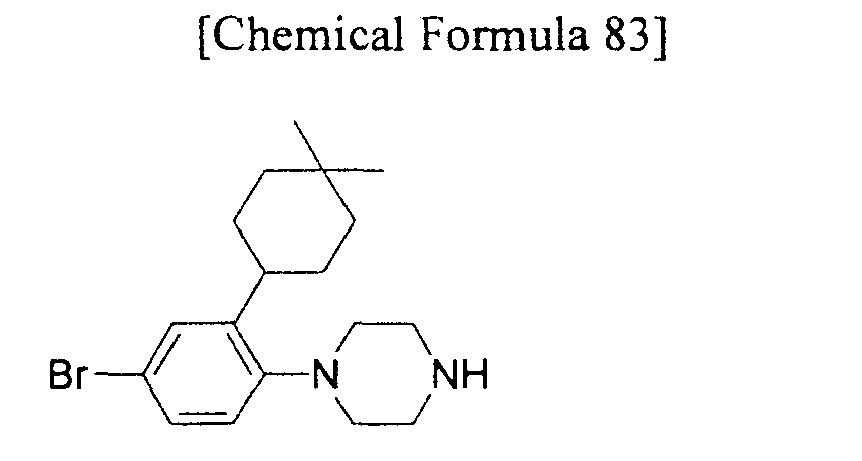
- A mixture of 4-[4-bromo-2-(4,4-dimethylcyclohexyl)phenyl]piperazine-1-carboxylic acid t-butyl ester (1.5 g, 3.32 mmol), trifluoroacetic acid (3 mL, 38.7 mmol) and dichloromethane (6 mL) was stirred for 2 hours and 30 minutes at room temperature.
Saturated aqueous sodium carbonate was added to the reaction mixture and extraction was performed with ethyl acetate. The separated organic layer was washed with water and brine in that order and then dried over anhydrous sodium sulfate. The desiccant was filtered off and the filtrate was concentrated under reduced pressure. The residue was dried under reduced pressure to give 1.21 g of a crude product of the title compound as a brown oil. -

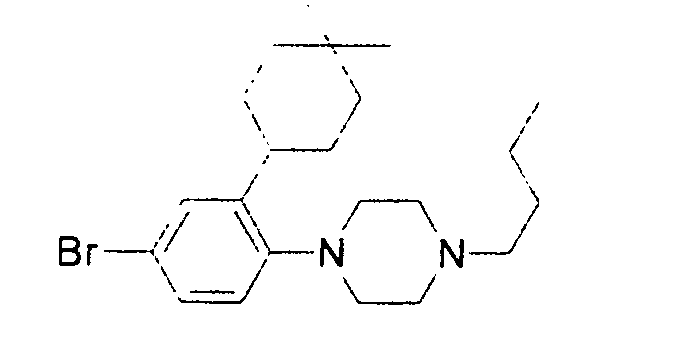
- To a mixture of the crude product of 1-[4-bromo-2-(4,4-dimethylcyclohexyl)phenyl]piperazine (1.21 g), butyraldehyde (0.35 mL, 3.98 mmol), acetic acid (0.1 mL, 3.32 mmol) and tetrahydrofuran (8 mL) was added sodium triacetoxyborohydride (1.1 g, 4.98 mmol), followed by stirring for 2 hours and 10 minutes at room temperature.
Saturated aqueous sodium hydrogencarbonate was added to the reaction mixture and extraction was performed with ethyl acetate. The separated organic layer was washed with water and brine in that order and then dried over anhydrous sodium sulfate. The desiccant was filtered off and the filtrate was concentrated under reduced pressure. The resultant residue was purified by NH silica gel column chromatography (ethyl acetate/hexane) to give 901 mg of the title compound as a yellow oil.
1H-NMR (400MHz, CDCl3)
δ: 0.94 (t, J= 7.2Hz, 3H), 0.97 (s, 3H), 1.01 (s, 3H), 1.24-1.60 (m, 12H), 2.38-2.44 (m, 2H), 2.59 (brs, 4H), 2.82-2.97 (m, 5H), 6.97 (d, J= 8.8Hz, 1H), 7.24 (dd, J= 8.8, 2.4Hz, 1H), 7.33 (d, J= 2.4Hz, 1H). -

- 1-[5-Methoxy-2-(3,3,5,5-tetramethylcyclohex-1-enyl)phenyl]piperazine was used as the starting material for N-butyloxycarbonylation and hydrogenation by conventional methods. A mixture of 4-[5-methoxy-2-[5-methoxy-2-(3,3,5,5-tetramethylcyclohexyl)phenyl]piperazine-1-carboxylic acid t-butyl ester (3,41 g, 7.92 mmol) obtained by the reaction, acetic acid (18 mL, 314 mmol) and 48% hydrobromic acid (36 mL, 318 mmol) was stirred for 8 hours and 20 minutes at an external temperature of 130°C.
The reaction mixture was cooled in an ice water bath and stirred, and then 5N aqueous sodium hydroxide was added dropwise thereto to adjust pH of the mixture to 8-9. The produced solid was filtered to give 2.98 g of a crude product of the title compound as a light red solid.
1H-NMR (400MHz, CD3OD)
δ: 0.94 (s, 6H), 1.54 (s, 6H), 1.17-1.40 (m, 6H), 3.05 (t, J= 4.8Hz, 4H), 3.42 (tt, J= 12.8, 2.8Hz, 1H), 6.55-6.61 (m, 2H), 7.05 (d, J= 8.0Hz, 1H).
The 4H of the piperazine ring and the 2H of NH and OH could not be identified. -

- To a solution of 3-iodo-4-nitroanisole (4.21 g, 15.1 mmol) in 1,2-dimethoxyethane (50 mL) were added 4,4,5,5-tetramethyl-2-(3,3,5,5-tetramethylcyclohex-1-enyl)[1,3,2]dioxaborolane (4.78 g, 18.1 mmol), tripotassium phosphate (4.81 g, 22.7 mmol) and water (3 mL). Then, tetrakis(triphenylphosphine)palladium(0) (870 mg, 0.755 mmol) was added to the mixture while stirring at room temperature under a nitrogen atmosphere. The mixture was then further stirred for 13 hours at an external temperature of 70°C. To the reaction mixture were added tetrakis(triphenylphosphine)palladium(0) (870 mg, 0.755 mmol) and water (3 mL), followed by stirring for 26 hours at an external temperature of 100°C.
The reaction mixture was cooled, and then ethyl acetate was added and the mixture was filtered through Celite. The filtrate was concentrated to give a residue, which was subjected to extraction with ethyl acetate, and the organic layer was washed with brine. The organic layer was dried over anhydrous magnesium sulfate and then the desiccant was filtered off and the filtrate was concentrated under reduced pressure. The resultant residue was purified by silica gel column chromatography (ethyl acetate/heptane) to give 1.5 g of the title compound as a yellow solid.
1H-NMR (400MHz, CDCl3)
δ:1.05 (s, 6H), 1.07 (s, 6H), 1.41 (s, 2H), 1.99 (d, J= 1.6Hz, 2H), 3.88 (s, 3H), 5.35 (m, 1H), 6.68 (d, J= 2.4Hz, 1H), 6.81 (dd, J= 9.2, 2.4Hz, 1H), 7.91 (d, J= 9.2Hz,
1H). -

- A mixture of 4-methoxy-1-nitro-2-(3,3,5,5-tetramethylcyclohex-1-enyl)benzene (1.0 g, 3.46 mmol), 10% palladium on carbon (500 mg, wet), methanol (8 mL) and tetrahydrofuran (2 mL) was stirred overnight at room temperature and atmospheric pressure under a hydrogen atmosphere.
The mixture was filtered through Celite to remove the catalyst, and the filtrate was concentrated. A crude product of the title compound was obtained as a brown oil. The crude product was used without purification for the following reaction. -

- A mixture of the crude product of 4-methoxy-2-(3,3,5,5-tetramethylcyclohexyl)phenylamine, bis(2-chloroethyl)amine hydrochloride (770 mg, 4.33 mmol) and 1.2-dichlorobenzene (10 mL) was stirred for 2 hours at an external temperature of 220°C. During the reaction, the excess hydrogen chloride gas in the reactor was removed several times with nitrogen gas. Bis(2-chloroethyl)amine hydrochloride (180 mg, 1.01 mmol) was further added and the mixture was stirred for 1 hour under the same conditions.
The reaction mixture was cooled to room temperature, saturated aqueous sodium hydrogencarbonate was added and extraction was performed with chloroform. The aqueous layer was again extracted with chloroform, and the organic layers were combined, washed with brine and then dried over anhydrous magnesium sulfate. The desiccant was filtered off and the filtrate was concentrated under reduced pressure. The resultant residue was purified by NH silica gel column chromatography (ethyl acetate/heptane) to give 660 mg of the title compound as a brown solid.
1H-NMR (400MHz, CDCl3)
δ:0.92 (s, 6H), 1.12 (s, 6H), 1.15-1.34 (m, 4H), 1.42-1.45 (m, 2H), 2.78-2.81 (m, 4H), 2.99-3.02 (m, 4H), 3.63 (tt, J= 13, 2.8Hz, 1H), 3.78 (s, 3H), 6.69 (dd, J= 8.8, 2.8Hz, 1H), 6.77 (d, J= 2.8Hz, 1H), 7.07 (d, J= 8.8Hz, 1H). -

-

- After adding a mixed solvent of anhydrous tetrahydrofuran (6.2 mL) and dimethylformamide (2.5 mL) to sodium hydride (60% dispersion in oil, 83.6 mg, 2.09 mmol), the mixture was cooled to 0°C in an ice bath under a nitrogen atmosphere and stirred for 20 minutes. Next, 4-hydroxymethylpiperidine-1-carboxylic acid t-butyl ester (300 mg, 1.39 mmol) was added to the reaction mixture. The reaction mixture was warmed to room temperature, stirred for 65 minutes, and then cooled again to 0°C. Methyl iodide (0.13 mL, 2.09 mmol) was then added to the reaction mixture. Next, the reaction mixture was warmed to room temperature and stirred for 20 hours and 25 minutes.
After the reaction, to the reaction mixture were added ice and diethyl ether, then sodium chloride, and extraction was performed with diethyl ether. The organic layer was dried over anhydrous sodium sulfate. The desiccant was filtered off and the filtrate was concentrated under reduced pressure to give a crude product of 4-methoxymethylpiperidine-1-carboxylic acid t-butyl ester.
Ethyl acetate (2 mL) was added to the crude product, and the mixture was cooled to 0°C and stirred. Next, a 4N solution of hydrogen chloride in ethyl acetate (10.4 mL, 41.7 mmol) was gradually added and the mixture was warmed to room temperature. After stirring the reaction mixture for 4 hours, it was concentrated under reduced pressure. The residue was dissolved in a small amount of dichloromethane. An excess of ethyl acetate was further added, and the precipitated solid was filtered and dried under reduced pressure to give 206 mg of the title compound as colorless crystals.
1H-NMR (400MHz, CDCl3)
δ: 1.61-1.76 (m, 2H), 1.80-2.02 (m, 3H), 2.79-2.97 (m, 2H), 3.26 (d, J= 6.0Hz, 2H), 3.33 (s,3H), 3.42-3.60 (m, 2H).
The 1H of NH could not be identified. -


- 4-[4-Bromo-2-(4,4-diethylcyclohexyl)phenyl]piperazine-1-carboxylic acid t-butyl ester (221 mg, 0.461 mmol) produced in Production Example 7C was dissolved in a mixed solvent of dichloromethane (3 mL)-water (0.3 mL). To the reaction mixture was added dropwise a 4N solution of hydrogen chloride in ethyl acetate (0.710 mL, 9.22 mmol), followed by stirring for 5 hours and 30 minutes under the same conditions.
After the reaction, aqueous potassium carbonate was added to the reaction mixture to make the reaction mixture basic. The reaction mixture was extracted 3 times with ethyl acetate. The collected organic layer was dried over anhydrous sodium sulfate. The desiccant was filtered off and the filtrate was concentrated under reduced pressure. The resultant residue was purified by NH silica gel column chromatography (ethyl acetate/heptane) to give 153 mg of the title compound as a light yellow oil.
1H-NMR (400MHz, CDCl3)
δ: 0.79 (t, J= 7.6Hz, 3H), 0.81 (t, J= 7.6Hz, 3H), 1.14-1.28 (m, 4H), 1.45-1.65 (m, 8H), 2.78-2.80 (m, 4H), 2.83-3.03 (m, 5H), 6.96 (d, J= 8.4Hz, 1H). 7.25 (dd, J= 8.4, 2.4Hz, 1H), 7.33 (d, J= 2.4Hz, 1H).
The 1H ofNH could not be identified. -

- To a solution of 1-[4-bromo-2-(4,4-diethylcyclohexyl)phenyl]piperazine (153 mg, 0.403 mmol) in tetrahydrofuran (5 mL) was added propionaldehyde (0.038 mL, 0.524 mmol), sodium triacetoxyborohydride (111 mg, 0.524 mmol) and acetic acid (0.0438 mL, 0.766 mmol), followed by stirring at room temperature for 13 hours.
After the reaction, saturated aqueous sodium hydrogencarbonate was added to the reaction mixture and extraction was performed 3 times with ethyl acetate. The collected organic layer was dried over anhydrous sodium sulfate. The desiccant was filtered off and the filtrate was concentrated under reduced pressure. The resultant residue was purified by NH silica gel column chromatography (ethyl acetate/heptane) to give 155 mg of the title compound as a white oil.
1H-NMR (400MHz, CDCl3)
δ: 0.79 (t, J= 7.6Hz, 3H), 0.81 (t, J= 7.6Hz, 3H), 0.93 (t, J= 7.6Hz, 3H), 1.13-1.28 (m, 4H), 1.43-1.64 (m, 10H), 2.35-2.40 (m, 2H), 2.59 (brs, 4H), 2.84-2.94 (m, 5H), 6.96 (d, J= 8.4Hz, 1H), 7.22 (dd, J= 8.4, 2.4Hz, 1H), 7.31 (d, J= 2.4Hz, 1H). -
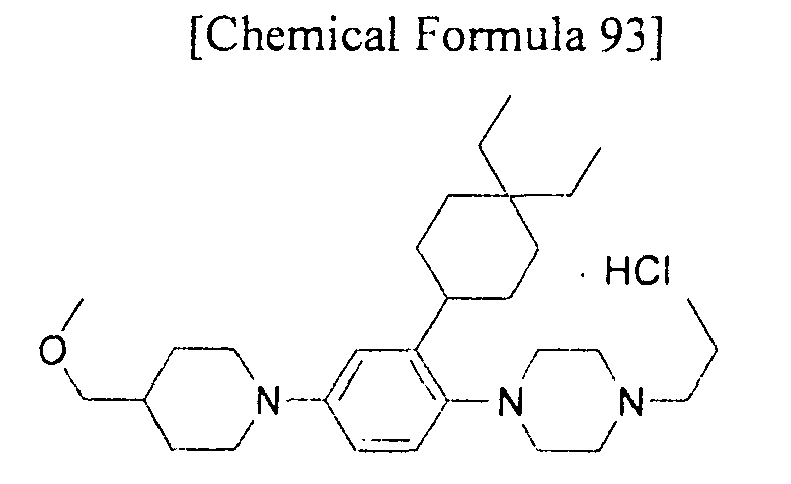
- A mixture of 1-[4-bromo-2-(4,4-diethylcyclohexyl)phenyl]-4-propylpiperazine (155 mg, 0.368 mmol), 4-methoxymethylpiperidine hydrochloride (73.2 mg, 0.442 mmol), sodium t-butoxide (184 mg, 1.91 mmol), palladium(II) acetate (16.5 mg, 0.0736 mmol), tri-t-butylphosphonium tetrafluoroborate (64.1 mg, 0.221 mmol) and xylene (4 mL) was stirred at an external temperature of 100°C for 19 hours and 30 minutes under a nitrogen atmosphere.
After air-cooling the reaction mixture to room temperature, the reaction mixture was concentrated under reduced pressure. The resultant residue was purified by silica gel column chromatography (ethyl acetate/heptane) to give 43 mg of 1-[2-(4,4-diethylcyclohexyl)-4-(4-methoxymethylpiperidin-1-yl)phenyl]-4-propylpiperazine as an orange solid.
1H-NMR (400MHz, CDCl3)
δ: 0.79 (t, J= 8.0 Hz, 3H), 0.81 (t, J= 8.0Hz, 3H), 0.93 (t, J= 7.6Hz, 3H), 1.14-1.88 (m, 19H), 2.35-2.39 (m, 2H), 2.57 (brs, 4H), 2.65 (ddd, J= 12.0, 12.0, 2.4Hz, 2H), 2.82-2.88 (m, 4H), 2.90-2.98 (m, 1H), 3.27 (d, J= 6.8Hz, 2H), 3.36 (s, 3H), 3.56-3.62 (m, 2H), 6.73 (dd, J= 8.4, 2.8Hz, 1H), 6.84 (d, J= 2.8Hz, 1H), 7.06 (d, J= 8.4Hz, 1H).
This compound was dissolved in dichloromethane (1 mL), and a 4N solution of hydrogen chloride in ethyl acetate (0.0458 mL, 0.183 mmol) was added. The solution was concentrated, diethyl ether was added to the resultant residue, and the resulting precipitate was triturated by sonication. After filtering, drying was performed under reduced pressure to give 47 mg of the title compound as a light brown solid.
MS m/e (ESI) 470(MH+). -

- A mixture of 1-[4-bromo-2-(4,4-dimethylcyclohexyl)phenyl]-4-butylpiperazine (50 mg, 0.123 mmol) produced in Production Example 8B, bis(2-methoxyethyl)amine (25 mg, 0.185 mmol), sodium t-butoxide (30 mg, 0.308 mmol), palladium(II) acetate (3 mg, 0.0123 mmol), tri-t-butylphosphonium tetrafluoroborate (11 mg, 0.0369 mmol) and xylene (1 mL) was stirred at an external temperature of 100°C for 1 hour.
The reaction mixture was purified by NH silica gel column chromatography (ethyl acetate/hexane) to give 34 mg of [4-(4-butylpiperazin-1-yl)-3-(4,4-dimethylcyclohexyl)phenyl]bis(2-methoxyethyl)amine as a light yellow oil. 1H-NMR (400MHz, CDCl3)
δ: 0.94 (t, J= 7.2Hz, 3H), 0.97 (s, 3H), 1.00 (s, 3H), 1.30-1.70 (m, 12H), 2.38-2.42 (m, 2H), 2.58 (brs, 4H), 2.34-2.38 (m, 2H), 2.84 (brs, 4H), 2.90-3.00 (m, 1H), 3.36 (s, 6H), 3.50-3.60 (m, 8H), 6.52 (dd, J= 8.8, 3.2Hz, 1H), 6.63 (d, J= 3.2Hz, 1H), 7.05 (d, J= 8.8Hz, 1H).
This compound was dissolved in ethyl acetate, and a 4N solution of hydrogen chloride in ethyl acetate was added. The solution was concentrated under reduced pressure. Hexane was added to the residue, and the resulting precipitate was triturated by sonication. After removing the supernatant, the precipitate was dried to give 33 mg of the title compound as a light yellow solid.
MS m/e (ESI) 460(MH+). -

- A mixture of the 1-[4-bromo-2-(4,4-dimethylcyclohexyl)phenyl]-4-butylpiperazine (50 mg, 0.123 mmol) produced in Production Example 8B, 1-acetylpiperazine (24 mg, 0.185 mmol), sodium t-butoxide (30 mg, 0.308 mmol), palladium(II) acetate (3 mg, 0.0123 mmol), tri-t-butylphosphonium tetrafluoroborate (11 mg, 0.0369 mmol) and xylene (1 mL) was stirred at an external temperature of 100°C for 1 hour.
The reaction mixture was purified by NH silica gel column chromatography (ethyl acetate/hexane) to give 32 mg of 1-{4-[4-(4-butylpiperazin-1-yl)-3-(4,4-dimethylcyclohexyl)phenyl]piperazin-1-yl}ethanone as colorless crystals.
1H-NMR (400MHz, CDCl3)
δ: 0.94 (t, J= 7.6Hz, 3H), 0.97 (s, 3H), 1.02 (s, 3H), 1.28-1.65 (m, 12H), 2.14 (s. 3H), 2.38-2.43 (m, 2H), 2.59 (brs, 4H), 2.78-2.91 (m, 1H), 2.92-3.01 (m, 1H), 3.09 (t, J= 5.2Hz, 2H), 3.12 (t, J= 5.2Hz, 2H), 3.61 (t, J= 5.2Hz, 2H), 3.77 (t, J= 5.2Hz, 2H), 6.72 (dd, J= 8.4, 2.8Hz, 1H), 6.85 (d, J= 2.8Hz, 1H), 7.08 (d, J= 8.4Hz, 1H).
This compound was dissolved in ethyl acetate, and a 4N solution of hydrogen chloride in ethyl acetate was added. The precipitated solid was filtered to give 31 mg of the title compound as a colorless solid.
MS m/e (ESI) 455(MH+). -

-

- To a solution of 1-(2-methoxy-5-nitrophenyl)piperazine (3.08 g, 13 mmol) and butyraldehyde (1.4 mL, 15.73 mmol) in tetrahydrofuran (40 mL) were added sodium triacetoxyborohydride (3.3 g, 15.57 mmol) and acetic acid (0.75 mL, 13.09 mmol) in that order, followed by stirring at room temperature.
After stirring for 30 minutes, ethyl acetate, saturated aqueous sodium hydrogencarbonate and water were added to the reaction mixture and extraction was performed with ethyl acetate. The collected organic layer was washed with brine and then dried over anhydrous sodium sulfate. The desiccant was filtered off and the filtrate was concentrated under reduced pressure. The resultant residue was purified by NH silica gel column chromatography (ethyl acetate/hexane) to give 3.88 g of the title compound as a yellow oil.
1H-NMR (400MHz, CDCl3)
δ: 0.94 (t, J= 7.2Hz, 3H), 1.30-1.42 (m, 2H), 1.48-1.56 (m, 2H), 2.42 (t, J= 7.6Hz, 2H), 2.66 (brs, 4H), 3.15 (brs, 4H), 3.97 (s, 3H), 6.87 (d, J= 9.2Hz, 1H), 7.78 (d, J= 2.4Hz, 1H), 7.93 (dd, J= 9.2, 2.4Hz, 1H). -
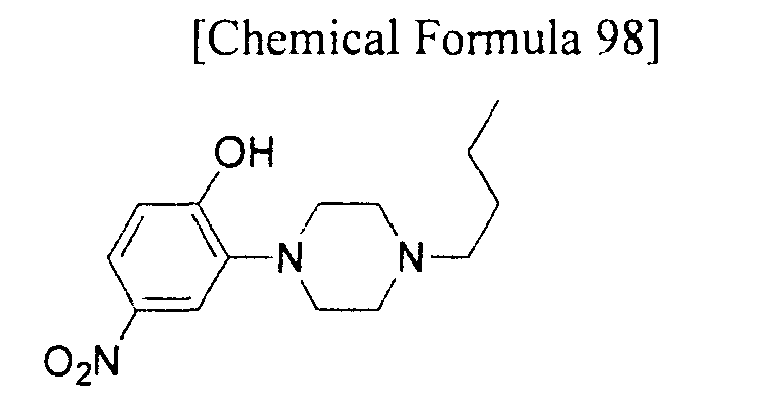
- A mixture of 1-butyl-4-(2-methoxy-5-nitrophenyl)piperazine (3.61 g, 12.3 mmol) and 48% hydrobromic acid (50 mL) was heated to reflux. After 134 hours and 30 minutes, the reaction mixture was poured into ice water and made alkaline with 5N aqueous sodium hydroxide.
Next, saturated aqueous ammonium chloride was added to the mixed solution to make it weakly acidic and extraction was performed with a mixed solvent of ethyl acetate and tetrahydrofuran. The collected organic layer was washed with brine and then dried over anhydrous sodium sulfate. The desiccant was filtered off, and the filtrate was concentrated under reduced pressure to give 2.58 g of a crude product of the title compound as a reddish-brown oil. This was used without purification for the following reaction. -


- A mixture of a crude product of 2-(4-butylpiperazin-1-yl)-4-nitrophenol (2.58 g), triethylamine (6.5 mL, 46.64 mmol) and anhydrous dichloromethane (50 mL) was cooled under a nitrogen atmosphere in an ice-methanol bath. Trifluoromethanesulfonic anhydride (2.3 mL, 13.67 mmol) was gradually added to the solution for 15 minutes.
After stirring for 20 minutes, ethyl acetate, saturated aqueous ammonium chloride and water were added to the reaction mixture and extraction was performed with ethyl acetate. The collected organic layer was washed with brine and then dried over anhydrous sodium sulfate. The desiccant was filtered off and the filtrate was concentrated under reduced pressure. The resultant residue was purified by NH silica gel column chromatography (ethyl acetate/hexane) to give 3.01 g of the title compound as a yellow oil.
1H-NMR (400MHz, CDCl3)
δ: 0.94 (t, J= 7.2Hz, 3H), 1.30-1.42 (m, 2H), 1.46-1.56 (m, 2H), 2.42 (t, J= 7.6Hz, 2H), 2.66 (brs, 4H), 3.14 (t, J= 4.8Hz, 4H), 7.32 (d. J= 8.8Hz, 1H), 7.94 (dd, J= 8.8, 2.8Hz, 1H), 7.98 (d, J= 2.8Hz, 1H). -

- A mixture of 2-(4-t-butylcyclohex-1-enyl)-4,4,5,5-tetramethyl-[1.3.2]dioxaborolane (2.9 g, 10.98 mmol) produced in Production Example 4E, trifluoromethanesulfonic acid 2-(4-butylpiperazin-1-yl)-4-nitrophenyl ester (3 g, 7.29 mmol), tripotassium phosphate (1.55 g, 7.30 mmol), 1,2-dimethoxyethane (40 mL) and water (2 mL) was stirred at room temperature under a nitrogen atmosphere. Tetrakis(triphenylphosphine)palladium(0) (840 mg, 0.73 mmol) was added to the mixture. Next, the mixture was stirred at an external temperature of 85°C for 3 hours.
Ethyl acetate was added to the reaction mixture, which was then filtered. Water was added to the filtrate and extraction was performed with ethyl acetate. The collected organic layer was washed with brine and then dried over anhydrous sodium sulfate. The desiccant was filtered off and the filtrate was concentrated under reduced pressure. The resultant residue was purified by NH silica gel column chromatography (ethyl acetate/hexane) to give 2.88 g of the title compound as a reddish-yellow oil, in racemic form at the position of t-butyl.
1H-NMR (400MHz, CDCl3)
δ: 0.93 (s, 9H), 0.94 (t, J= 7.2Hz, 3H), 1.22-1.40 (m, 4H), 1.48-1.56 (m, 2H), 1.92-2.02 (m, 2H), 2.20-2.42 (m, 4H), 2.52-2.68 (m, 5H), 3.02-3.16 (m, 4H), 5.88 (t, J= 2.8Hz, 1H), 7.18 (dd, J= 8.4Hz, 1H), 7.75 (d, J = 2.4 Hz, 1H), 7.78 (dd, J= 8.4, 2.4Hz, 1H). -
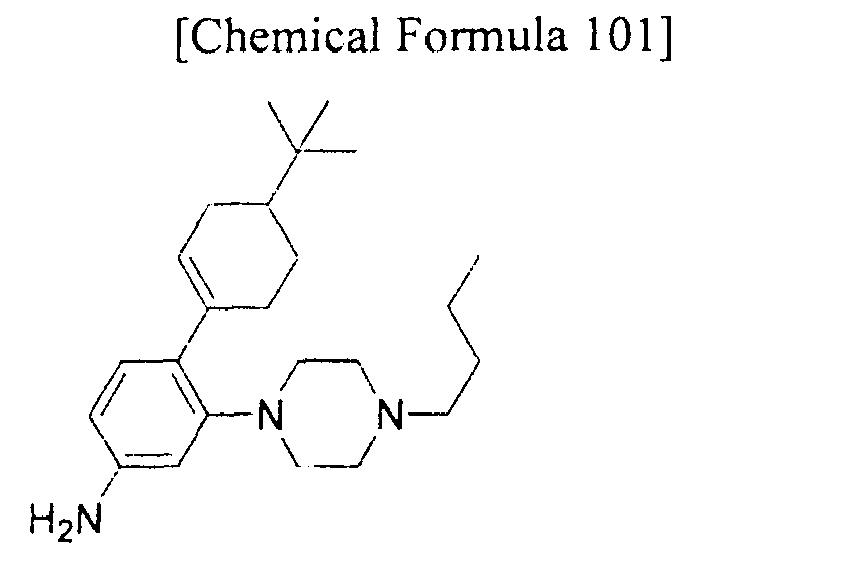
- To a solution of 1-butyl-4-[2-(4-t-butylcyclohex-1-enyl)-5-nitrophenyl]piperazine (1.2 g, 3 mmol) in ethanol (18 mL) were added an aqueous solution (6 mL) of ammonium chloride (54 mg, 1 mmol) and iron powder (590 mg, 10.56 mmol), followed by stirring at an external temperature of 90°C for 3 hours.
The reaction mixture was filtered, the insoluble matters were washed with tetrahydrofuran and then the filtrate was concentrated under reduced pressure. The resultant residue was purified by NH silica gel column chromatography (ethyl acetate/hexane) to give 1.04 g of the title compound as light brown crystals, in racemic form at the position of t-butyl.
1H-NMR (400MHz, CDCl3)
δ: 0.91 (s, 9H), 0.94 (t, J= 7.2Hz, 3H), 1.15-1.40 (m, 4H), 1.46-1.55 (m, 2H), 1.86-1.97 (m, 2H), 2.11-2.40 (m, 4H), 2.53 (brs, 4H), 2.66-2.75 (m, 1H), 2.96 (brs, 2H), 3.07 (brs, 2H), 3.57(brs, 2H), 5.68 (t, J= 2.8Hz, 1H), 6.26-6.32 (m, 2H), 6.86 (d, J= 8.4Hz, 1H). -

- To a mixture of 4-(4-t-butylcyclohex-1-enyl)-3-(4-butylpiperazin-1-yl)phenylamine (80 mg, 0.216 mmol), tetrahydropyran-4-one (0.022 mL, 0.238 mmol), acetic acid (13 mg, 0.216 mmol) and 1,2-dichloroethane (1 mL) was added sodium triacetoxyborohydride (69 mg, 0.325 mmol), followed by stirring at room temperature for 15 hours and 30 minutes.
Saturated aqueous sodium hydrogencarbonate was added to the reaction mixture and extraction was performed with ethyl acetate. The collected organic layer was washed with water and brine in that order and then dried over anhydrous sodium sulfate. The desiccant was filtered off and the filtrate was concentrated under reduced pressure. The resultant residue was purified by NH silica gel column chromatography (ethyl acetate/hexane) to give 98 mg of the title compound as yellow crystals, in racemic form at the position of t-butyl.
1H-NMR (400MHz, CDCl3)
δ: 0.91 (s, 9H), 0.94 (t, J= 7.6Hz, 3H), 1.15-1.60 (m, 10H), 1.87-1.98 (m, 2H), 1.98-2.05 (m, 1H), 2.11-2.43 (m, 4H), 2.54 (brs, 4H), 2.66-2.76 (m, 1H), 2.96 (brs. 2H), 3.07 (brs, 2H), 3.40-3.50 (m, 1H), 3.51 (ddd, J= 11.6. 11.6. 2.0Hz, 2H). 3.90 (ddd. J= 11.6. 3.2, 3.2Hz, 2H). 5.66-5.70 (m. J= 2.4Hz, 1H), 6.15-6.25 (m, 2H). 6.89 (d, J= 7.2Hz, 1 H). -

- To a mixture of [4-(4-t-butylcyclohex-1-enyl)-3-(4-butylpiperazin-1-yl)phenyl](tetrahydropyran-4-yl)amine (15 mg, 0.0331 mmol), 36% formaldehyde (3.2 mg, 0.0397 mmol), acetic acid (2.9 mg, 0.0331 mmol) and 1,2-dichloroethane (1 mL) was added sodium triacetoxyborohydride (11 mg, 0.0497 mmol), followed by stirring at room temperature for 15 hours and 40 minutes.
Saturated aqueous sodium hydrogencarbonate was added to the reaction mixture and extraction was performed with ethyl acetate. The separated organic layer was washed with water and then filtered through Celite. The filtrate was concentrated under reduced pressure. The resultant residue was purified by NH silica gel column chromatography (ethyl acetate/hexane) to give [4-(4-t-butylcyclohex-1-enyl)-3-(4-butylpiperazin-1-yl)phenyl]methyl(tetrahydropyran-4-yl)amine, in racemic form at the position of t-butyl.
This compound was dissolved in ethyl acetate, and a 4N solution of hydrogen chloride in ethyl acetate was added. The solution was concentrated under reduced pressure. Diethyl ether was added to the residue, and the resulting precipitate was triturated by sonication. After removing the supernatant, the precipitate was dried to give 15.3 mg of the title compound as a light yellow solid.
MS m/e (ESI) 468(MH). -

-

- A mixture of 1,2-dichloro-3-nitrobenzene (2 g, 10.4 mmol), piperazine-1-carboxylic acid t-butyl ester (2.91 g, 15.6 mmol), potassium carbonate (2.16 g, 15.6 mmol) and dimethylformamide (10 mL) was stirred at an external temperature of 120°C for 10 hours and 30 minutes.
Water was added to the reaction mixture and extraction was performed with ethyl acetate. The separated organic layer was washed with water and brine in that order and then dried over anhydrous magnesium sulfate. The desiccant was filtered off and the filtrate was concentrated under reduced pressure. The resultant residue was purified by silica gel column chromatography (ethyl acetate/hexane) to give 2.97 g of the title compound as a yellow oil.
1H-NMR (400MHz, CDCl3)
δ:1.48 (s, 9H), 3.06 (brs, 4H), 7.14 (dd, J= 8.0, 8.0Hz, 1H), 7.52 (dd, J= 8.0, 1.6Hz, 1 H), 7.5 6 (dd, J= 8.0, 1.6Hz, 1 H).
The 4H of the piperazine ring could not be identified. -


- A mixture of 4-(2-chloro-6-nitrophenyl)piperazine-1-carboxylic acid t-butyl ester (370 mg, 1.08 mmol), 2-(4-t-butylcyclohex-1-enyl)-4,4,5,5-tetramethyl-[1,3,2]dioxaborolane produced in Production Example 4E (428 mg, 1.62 mmol), palladium(II) acetate (12 mg, 0.054 mmol), 2-(dicyclohexylphosphino)biphenyl (76 mg, 0.216 mmol), tripotassium phosphate (459 mg, 2.16 mmol), xylene (4 mL) and water (0.3 mL) was stirred at an external temperature of 120°C for 13 hours under a nitrogen atmosphere.
Water and ethyl acetate were added to the reaction mixture, which was filtered through Celite. The filtrate was then extracted with ethyl acetate. The collected organic layer was washed with water and brine in that order and then dried over anhydrous sodium sulfate. The desiccant was filtered off and the filtrate was concentrated under reduced pressure. The resultant residue was purified by silica gel column chromatography (ethyl acetate/hexane) to give 275 mg of the title compound as yellow crystals, in racemic form at the position of t-butyl.
1H-NMR (400MHz, CDCl3)
δ: 0.92 (s, 9H), 1.26-1.42 (m, 2H), 1.48 (s, 9H), 1.87-2.01 (m, 2H), 2.14-2.37 (m, 1H), 2.39-2.43 (m, 2H), 3.00 (s, 4H), 3.45 (s, 4H), 5.62-5.69 (m, 1H), 7.11 (dd, J= 8.0, 7.6Hz, 1H), 7.21 (dd, J= 7.6, 2.0Hz, 1H), 7.42 (dd, J= 8.0, 2.0Hz, 1H). -

- A mixture of 4-[2-(4-t-butylcyclohex-1-enyl)-6-nitrophenyl]piperazine-1-carboxylic acid t-butyl ester (275 mg, 0.62 mmol), trifluoroacetic acid (4 mL, 51.6 mmol) and dichloromethane (4 mL) was stirred at room temperature for 1 hour and 30 minutes.
Saturated aqueous sodium carbonate was added to the reaction mixture, and extraction was performed with ethyl acetate. The collected organic layer was dried over anhydrous sodium sulfate. The desiccant was filtered off and the filtrate was concentrated under reduced pressure to give 225 mg of a crude product of the title compound. -

- To a mixture of a crude product of 1-[2-(4-t-butylcyclohex-1-enyl)-6-nitrophenyl]piperazine (225 mg), butyraldehyde (0.061 mL, 0.682 mmol), acetic acid (37 mg, 0.620 mmol) and tetrahydrofuran (2 mL) was added sodium triacetoxyborohydride (25 mg, 0.120 mmol), followed by stirring at room temperature for 50 minutes.
Saturated aqueous sodium hydrogencarbonate was added to the reaction mixture and extraction was performed with ethyl acetate. The collected organic layer was washed with water and brine in that order and then dried over anhydrous sodium sulfate. The desiccant was filtered off and the filtrate was concentrated under reduced pressure. The resultant residue was purified by NH silica gel column chromatography (ethyl acetate/hexane) to give 226 mg of the title compound as a yellow oil, in racemic form at the position of t-butyl.
1H-NMR (400MHz, CDCl3)
δ: 0.89-0.96 (m, 12H), 1.24-1.33 (m, 6H), 1.88-2.00 (m, 2H), 2.15-2.26 (m, 1H), 2,31-2,39 (m, 4H), 2,42-2,50 (m, 4H), 3,01-3,16 (m. 4H), 5.61-5.67 (m, 1H), 7.03 (dd, J= 8.0. 7.6Hz, 1H), 7.17 (dd, J= 7.6, 1.6Hz, 1H), 7.38 (dd, J= 8.0. 1.6Hz, 1H). -

- A mixture of 1-butyl-4-[2-(4-t-butylcyclohex-1-enyl)-6-nitrophenyl]piperazine (226 mg, 0.566 mmol), 10% palladium on carbon (30 mg, wet) and methanol (3 mL) was stirred at ordinary temperature and atmospheric pressure for 12 hours under a hydrogen atmosphere.
The reaction mixture was filtered through Celite. The filtrate was concentrated under reduced pressure to give 204 mg of a crude product of the title compound as a red oil.
1H-NMR (400MHz, CDCl3)
δ: 0.91 (s, 9H), 0.94 (t, J= 7.6Hz, 3H), 1.28-1.42 (m, 4H), 1.46-1.58 (m, 2H), 1.85-2.00 (m, 2H), 2.08-2.44 (m, 7H), 2.78-3.00 (m, 4H), 3.10-3.24 (m, 2H), 4.07 (brs, 2H), 5.50-5.57 (m, 1H), 6.42 (dd, J= 7.6, 1.6Hz, 1H), 6.63 (dd, J= 8.0, 1.6Hz, 1H), 6.87 (dd, J= 8.0, 7.6Hz, 1H). -

- To a mixture of 3-(4-t-butylcyclohex-1-enyl)-2-(4-butylpiperazin-1-yl)phenylamine (56 mg, 0.152 mmol), tetrahydropyran-4-one (0.01 mL, 0.167 mmol), acetic acid (9 mg, 0.152 mmol) and 1,2-dichloroethane (1 mL) was added sodium triacetoxyborohydride (48 mg, 0.228 mmol), followed by stirring at room temperature for 19 hours and 20 minutes.
Saturated aqueous sodium hydrogencarbonate was added to the reaction mixture and extraction was performed with ethyl acetate. The collected organic layer was washed with water and brine in that order and then dried over anhydrous sodium sulfate. The desiccant was filtered off and the filtrate was concentrated under reduced pressure. The resultant residue was purified by NH silica gel column chromatography (ethyl acetate/hexane) to give 43 mg of [3-(4-t-butylcyclohex-1-enyl)-2-(4-butylpiperazin-1-yl)phenyl](tetrahydropyran-4-yl)amine, in racemic form at the position of t-butyl.
The compound was dissolved in ethyl acetate, and a 4N solution of hydrogen chloride in ethyl acetate was added. The mixture was concentrated under reduced pressure to give 45 mg of the title compound as a colorless solid.
MS m/e (ESI) 454(MH+). -

-

- A mixture of 6-chloro-4H-benzo[1,4]oxazin-3-one (5 g, 27.2 mmol) and concentrated sulfuric acid (60 mL) was cooled in an ice bath and stirred. Potassium nitrate (2.89 g, 28.6 mmol) was gradually added to the mixture over 20 minutes, followed by further stirring for 10 minutes.
The reaction mixture was poured into ice water, and the precipitated solid was filtered. A small amount of acetone was added to the resultant solid, and after trituration by sonication, it was filtered. The resultant solid was dried under reduced pressure to give 4.92 g of the title compound as yellow crystals.
1H-NMR (400MHz, DMSO-d6)
δ:4.71 (s, 2H), 7.08(s, 1H), 7.77 (s, 1H), 11.28 (s, 1H). -

- A mixture of 6-chloro-7-nitro-4H-benzo[1,4]oxazin-3-one (1 g, 4.37 mmol), potassium carbonate (1.21 g, 8.74 mmol) and dimethylformamide (10 mL) was stirred at room temperature. Methyl iodide (0.33 mL, 5.25 mmol) was added to the mixture, and the mixture was stirred at room temperature for 4 hours and 30 minutes.
Water was added to the reaction mixture and the precipitated solid was filtered to give 905 mg of the title compound as light yellow crystals.
1H-NMR (400MHz, CDCl3)
δ:3.40 (s, 3H), 4.71 (s, 2H), 7.06 (s, 1H), 7.65 (s, 1H). -

- To a solution of 6-chloro-4-methyl-7-nitro-4H-benzo[1,4]oxazin-3-one (905 mg, 3.73 mmol) in 1,2-dimethoxyethane (20 mL) were added 2-(4-t-butylcyclohex-1-enyl)-4,4,5,5-tetramethyl-[1,3,2]dioxaborolane (1.48 g, 5.60 mmol) produced in Production Example 4E, tetrakis(triphenylphosphine)palladium(0) (216 mg, 0.187 mmol) and tripotassium phosphate (1.58 g, 7.46 mmol), followed by stirring at an external temperature of 85°C for 7 hours under a nitrogen atmosphere.
Brine and ethyl acetate were added to the reaction mixture, which was filtered through Celite. The filtrate was then extracted with ethyl acetate. The collected organic layer was washed with water and brine in that order and then dried over anhydrous magnesium sulfate. The desiccant was filtered off and the filtrate was concentrated under reduced pressure. The resultant residue was purified by silica gel column chromatography (ethyl acetate/hexane) to give 1.02 g of the title compound as yellow crystals, in racemic form at the position of t-butyl. 1H-NMR (400MHz, CDCl3)
δ: 0.91 (s, 9H), 1.32-1.46 (m, 2H), 1.86-1.99 (m, 2H), 2.14-2.24 (m, 2H), 2.25-2.40 (m, 1H), 3.40 (s, 3H), 4.68 (s, 2H), 5.58-5.66 (m, 1H), 6.77 (s, 1H), 7.57 (s, 1H). -

- A mixture of 6-(4-t-butylcyclohex-1-enyl)-4-methyl-7-nitro-4H-benzo[1,4]oxazin-3-one (300 mg, 0.871 mmol), 10% palladium on carbon (300 mg, wet), tetrahydrofuran (3 mL) and methanol (3 mL) was stirred at ordinary temperature and atmospheric pressure for 4 hours under a hydrogen atmosphere.
The reaction mixture was filtered and the filtrate was concentrated under reduced pressure. The resultant residue was purified by silica gel column chromatography (ethyl acetate/hexane) to give 260 mg of the title compound as a colorless solid, as a mixture of diastereomers at the position of t-butylcyclohexyl. 1H-NMR (400MHz, CDCl3)
δ: 0.87 (s, 9H x 0.6), 0.88 (s, 9H x 0.4), 1.09-2.10 (m, 9H), 2.34-2.48 (m, 1H x 0.4), 2.92 (brs, 1H x 0.6), 3.32 (s, 3H x 0.4), 3.33 (s, 3H x 0.6), 4.53 (s, 2H x 0.4), 4.55 (s, 2H x 0.6), 6.30-6.40 (m, 1H), 6.68 (s, 1H x 0.4), 6.96 (s, 1H x 0.6). -

- To a solution of 7-amino-6-(4-t-butylcyclohexyl)-4-methyl-4H-benzo[1,4]oxazin-3-one (260 mg, 0.822 mmol) in 1,2-dichlorobenzene (2.6 mL) was added bis(2-chloroethyl)amine hydrochloride (183 mg, 1.03 mmol), followed by stirring at an external temperature of 200°C for 3 hours under a nitrogen atmosphere. During the reaction, nitrogen gas was passed through the reactor several times to remove the hydrogen chloride gas.
After air-cooling the reaction mixture to room temperature, 1N aqueous sodium hydroxide was added, and extraction was performed with ethyl acetate. The collected organic layer was washed with brine and then dried over anhydrous sodium sulfate. The desiccant was filtered off and the filtrate was concentrated under reduced pressure. The resultant residue was purified by NH silica gel column chromatography (ethyl acetate/hexane) to give 182 mg of the title compound as an orange solid, as a mixture of diastereomers at the position of t-butylcyclohexyl.
1H-NMR (400MHz, CDCl3)
δ: 0.895 (s, 9H x 0.6), 0.902 (s, 9H x 0.4), 1.09-1.96 (m, 9H), 2.72-3.06 (m, 8H + 1H x 0.4), 3.35 (brs, 1H), 3.38-3.46 (s, 1H x 0.6), 4.58 (s, 2H x 0.4), 4.59 (s, 2H x 0.6), 6.76 (s, 1H x 0.4), 6.78 (s, 1H x 0.4), 6.80 (s, 1H x 0.6), 7.06 (s, 1H x 0.6). -


- To a mixture of 6-(4-t-butylcyclohexyl)-4-methyl-7-piperazin-1-yl-4H-benzo[1,4]oxazin-3-one (100 mg, 0.259 mmol), butyraldehyde (0.035 mL, 0.389 mmol), acetic acid (0.015 mg, 0.259 mmol) and tetrahydrofuran (2 mL) was added sodium triacetoxyborohydride (82 mg, 0.389 mmol), followed by stirring at room temperature for 1 hour.
To the reaction mixture was added 1N aqueous sodium hydroxide, and then extraction was performed with ethyl acetate. The collected organic layer was washed with water and brine in that order and then dried over anhydrous sodium sulfate. The desiccant was filtered off and the filtrate was concentrated under reduced pressure. The resultant residue was purified by NH silica gel column chromatography (ethyl acetate/hexane) to give 101 mg of the title compound as colorless crystals, as a mixture of diastereomers at the position of t-butylcyclohexyl. 1H-NMR (400MHz, CDCl3)
δ: 0.89 (s, 9H x 0.6), 0.90 (s, 9H x 0.4), 0.94 (t, J= 7.6Hz, 3H x 0.6), 0.95 (t, J= 7.6Hz, 3H x 0.4), 1.08-1.96 (m, 13H), 2.30-2.94 (m, 10H), 2.98 (tt, J= 12.0, 3.6Hz, 1H x 0.4), 3.34 (s, 3H), 3.36-3.44 (m, 1H x 0.6), 4.57 (s, 2H x 0.4), 4.58 (s, 2H x 0.6), 6.75-6.78 (m, 2H x 0.4), 6.81 (s, 1H x 0.6), 7.04 (s, 1 H x 0.6).
MS m/e (ESI) 442(MH+). -

- To a mixture of 6-(4-t-butylcyclohexyl)-7-(4-butylpiperazin-1-yl)-4-methyl-4H-benzo[1,4]oxazin-3-one (71 mg, 0.161 mmol), aluminum chloride (47 mg, 0.354 mmol) and tetrahydrofuran (3 mL) was added lithium aluminum hydride (7 mg, 0.177 mmol), followed by stirring at room temperature for 3 hours and 10 minutes.
Saturated aqueous sodium hydrogencarbonate was added to the reaction mixture which was filtered through Celite. The resultant filtrate was then extracted with ethyl acetate. The collected organic layer was washed with water and brine in that order and then dried over anhydrous sodium sulfate. The desiccant was filtered off and the filtrate was concentrated under reduced pressure. The resultant residue was purified by NH silica gel column chromatography (ethyl acetate/hexane) to give 73 mg of 6-(4-t-butylcyclohexyl)-7-(4-butylpiperazin-1-yl)-4-methyl-3,4-dihydro-2H-benzo[1,4]oxazine as a colorless oil, as a mixture of diastereomers at the position of t-butylcyclohexyl.
1H-NMR (400MHz, CDCl3)
δ: 0.89 (s, 9H x 0.6), 0.90 (s, 9H x 0.4), 0.93 (t, J= 7.6Hz, 3H x 0.6), 0.94 (t, J= 7.6Hz, 3H x 0.4), 1.07-1.94 (m, 13H), 2.30-2.84 (m, 10H), 2.85 (s, 3H x 0.4), 2.86 (s, 3H x 0.6), 2.96 (tt, J= 12.0, 2.8Hz, 1H x 0.4), 3.18-3.23 (m, 2H), 3.36-3.43 (m, 1H x 0.6), 4.24-4.30 (s, 2H), 6.51 (s, 1H x 0.4), 6.61 (s, 1H x 0.4), 6.65 (s, 1H x 0.6), 6.79 (s, 1H x 0.6).
This compound was dissolved in ethyl acetate, and a 4N solution of hydrogen chloride in ethyl acetate was added. The mixture was concentrated under reduced pressure. Hexane was added to the residue, and the resulting precipitate was triturated by sonication. After removing the supernatant, the precipitate was dried to give 75 mg of the title compound as colorless crystals, as a mixture of diastereomers at the position of t-butylcyclohexyl.
MS m/e (ESI) 428(MH+). -


-

- A mixture of 6-(4-t-butylcyclohex-1-enyl)-4-methyl-7-nitro-4H-benzo[1,4]oxazin-3-one (1.14 g, 3.30 mmol), iron powder (553 mg, 9.91 mmol), ammonium chloride (707 mg, 13.2 mmol), ethanol (15 mL), water (5 mL) and dimethylformamide (3 mL) was stirred at an external temperature of 90°C for 7 hours and 30 minutes under a nitrogen atmosphere.
Ethyl acetate and water were added to the reaction mixture, which was filtered through Celite. The filtrate was then extracted with ethyl acetate. The collected organic layer was washed with water and brine in that order and then dried over anhydrous sodium sulfate. The desiccant was filtered off and the filtrate was concentrated under reduced pressure. The resultant residue was purified by silica gel column chromatography (ethyl acetate/hexane) to give 940 mg of the title compound as a light yellow oil, in racemic form at the position of t-butyl.
1H-NMR (400MHz, CDCl3)
δ: 0.92 (s, 9H), 1.28-1.46 (m, 2H), 1.88-2.03 (m, 2H), 2.15-2.36 (m, 3H), 3.30 (s, 3H), 4.54 (s, 2H), 5.70-5.80 (m, 1H), 6.34 (s, 1H), 6.57 (s, 1H).
The 2H of NH2 could not be identified. -


- To a solution of 7-amino-6-(4-t-butylcyclohex-1-enyl)-4-methyl-4H-benzo[1.4]oxazin-3-one (940 mg, 2.99 mmol) in 1,2-dichlorobenzene (3 mL) was added bis(2-chloroethyl)amine hydrochloride (694 mg, 3.89 mmol), followed by stirring at an external temperature of 220°C for 2 hours and 30 minutes under a nitrogen atmosphere. During the reaction, nitrogen gas was passed through the reactor several times to remove the hydrogen chloride gas.
After air-cooling the reaction mixture to room temperature, saturated aqueous sodium hydrogencarbonate was added and extraction was performed with ethyl acetate. The collected organic layer was dried over anhydrous sodium sulfate. The desiccant was filtered off and the filtrate was concentrated under reduced pressure. The resultant residue was purified by NH silica gel column chromatography (ethyl acetate/hexane) to give 604 mg of the title compound as light yellow crystals, in racemic form at the position of t-butyl.
1H-NMR (400MHz, CDCl3)
δ: 0.92 (s, 9H), 1.20-1.41 (m, 2H), 1.86-2.01 (m, 2H), 2.15-2.27 (m, 1H), 2.31-2.44 (m, 1H), 2.65-2.75 (m, 1H), 2.79-3.06 (m, 8H), 3.34 (s, 3H), 4.59 (s, 2H), 5.65-5.80 (m, 1H), 6.61 (s, 1H), 6.70 (s, 1H). -

- To a mixture of 6-(4-t-butylcyclohex-1-enyl)-4-methyl-7-piperazin-1-yl-4H-benzo[1,4]oxazin-3-one (604 mg, 1.57 mmol), aluminum chloride (840 mg, 6.30 mmol) and tetrahydrofuran (20 mL) was added lithium aluminum hydride (120 mg, 3.15 mmol), followed by stirring at room temperature for 17 hours and 30 minutes.
Diethyl ether, water and 5N aqueous sodium hydroxide were added to the reaction mixture, which was filtered through Celite. The resultant filtrate was then extracted with ethyl acetate. The collected organic layer was washed with water and brine in that order and then dried over anhydrous sodium sulfate. The desiccant was filtered off and the filtrate was concentrated under reduced pressure. The resultant residue was purified by NH silica gel column chromatography (ethyl acetate/hexane) to give 283 mg of the title compound as colorless crystals, in racemic form at the position of t-butyl.
1H-NMR (400MHz, CDCl3)
δ: 0.91 (s, 9H), 1.18-1.40 (m, 2H), 1.86-1.98 (m, 2H), 2.13-2.23 (m, 1H), 2.31-2.47 (m, 1H), 2.66-3.00 (m, 12H), 3.15-3.25 (m, 2H), 4.25-4.35 (m, 2H), 5.65-5.70 (m, 1H), 6.46(s, 1H), 6.48(s, 1H). -

- To a mixture of 6-(4-t-butylcyclohex-1-enyl)-4-methyl-7-piperazin-1-yl-3,4-dihydro-2H-benzo[1,4]oxazine (10 mg, 0.0284 mmol), propionaldehyde (5 mg, 0.0852 mmol) and tetrahydrofuran (1 mL) was added sodium triacetoxyborohydride (30 mg, 0.142 mmol), followed by stirring at room temperature for 18 hours and 30 minutes.
Saturated aqueous sodium hydrogencarbonate was added to the reaction mixture and extraction was performed with ethyl acetate. The collected organic layer was washed with water and then filtered through Celite. The solvent was removed by blowing nitrogen gas to the filtrate. The resultant residue was purified by NH silica gel column chromatography (ethyl acetate/hexane) to give 6-(4-t-butylcyclohex-1-enyl)-4-methyl-7-(4-propylpiperazin-1-yl)-3,4-dihydro-2H-benzo[1,4]oxazine, in racemic form at the position of t-butyl.
This compound was dissolved in ethyl acetate, and a 4N solution of hydrogen chloride in ethyl acetate was added. The solvent was removed by blowing nitrogen gas to this. Hexane was added to the resultant residue, and the resultant precipitate was triturated by sonication. After removing the supernatant, the precipitate was dried to give 2.4 mg of the title compound as a colorless solid, in racemic form at the position of t-butyl.
MS m/e (ESI) 412(MH+). -

-
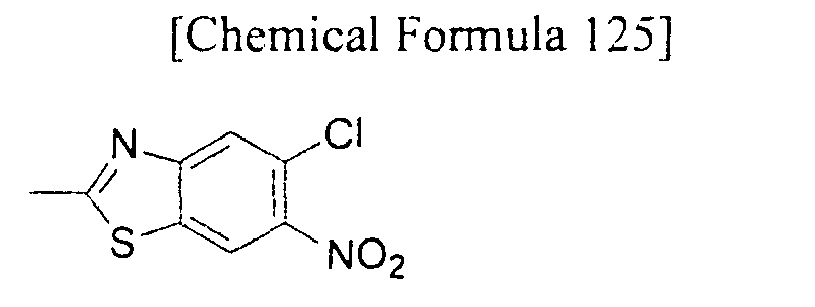
- A mixture of 5-chloro-2-methylbenzothiazole (2.5 g, 13.61 mmol) and concentrated sulfuric acid (50 mL) was cooled in an ice bath and stirred. Potassium nitrate (1.38 g, 13.61 mmol) was gradually added to the mixture, and the mixture was allowed to warm up to room temperature and stirred for 5 hours and 30 minutes.
The reaction mixture was cooled in an ice bath, 5N aqueous sodium hydroxide was added thereto, and the reaction mixture was adjusted to pH 7. The mixture was then extracted with ethyl acetate. The collected organic layer was washed with water and brine in that order and then dried over anhydrous sodium sulfate. The desiccant was filtered off and the filtrate was concentrated under reduced pressure. The resultant residue was purified by silica gel column chromatography (toluene) to give 1.67 g of the title compound as light yellow crystals.
1H-NMR (400MHz, DMSO-d6)
δ:2.88 (s, 2H), 8.32 (s, I H), 8.96 (s, 1H). -

- To a mixture of 5-chloro-2-methyl-6-nitro-benzothiazole (1 g, 4.37 mmol), 1,2-dimethoxyethane (30 mL) and water (5 mL) were added 2-(4-t-butylcyclohex-1-enyl)-4,4,5,5-tetramethyl-[1,3,2]dioxaborolane (1.73 g, 6.56 mmol) produced in Production Example 4E, tetrakis(triphenylphosphine)palladium(0) (253 mg, 0.219 mmol) and tripotassium phosphate (1.86 g, 8.74 mmol), followed by stirring at an external temperature of 80°C for 14 hours and 45 minutes under a nitrogen atmosphere.
Brine was added to the reaction mixture, and extraction was performed with ethyl acetate. The separated organic layer was washed with water and brine in that order and then dried over anhydrous sodium sulfate. The desiccant was filtered off and the filtrate was concentrated under reduced pressure. The resultant residue was purified by silica gel column chromatography (ethyl acetate/hexane) to give 634 mg of the title compound as purple crystals, in racemic form at the position of t-butyl.
1H-NMR (400MHz, CDCl3)
δ: 0.92 (s, 9H), 1.32-1.52 (m, 2H), 1.86-2.46 (m, 6H), 2.89 (s, 3H), 5.68-5.72 (m, 1H), 7.79 (s, 1H), 8.34 (s, 1H). -

- A mixture of 5-(4-t-butylcyclohex-1-enyl)-2-methyl-6-nitro-benzothiazole (634 mg, 2.34 mmol), 10% palladium on carbon (200 mg, wet) and methanol (30 mL) was stirred at ordinary temperature and atmospheric pressure for 12 hours under a hydrogen atmosphere.
The reaction mixture was filtered and the filtrate was concentrated under reduced pressure. To the resultant residue were added 10% palladium on carbon (200 mg, wet) and methanol (30 mL), followed by stirring at ordinary temperature and atmospheric pressure for 8 hours and 30 minutes under a hydrogen atmosphere.
The reaction mixture was filtered, and the filtrate was concentrated under reduced pressure. The resultant residue was dried under reduced pressure to give 542 mg of a crude product of the title compound as a colorless solid, in racemic form at the position of t-butyl. -

- To a solution of a crude product of 5-(4-t-butylcyclohex-1-enyl)-2-methylbenzothiazol-6-ylamine (542 mg) in 1,2-dichlorobenzene (5 mL) was added bis(2-chloroethyl)amine hydrochloride (386 mg, 2.16 mmol), followed by stirring at an external temperature of 200°C for 2 hours and 30 minutes under a nitrogen atmosphere. During the reaction, nitrogen gas was passed through the reactor several times to remove the hydrogen chloride gas.
After air-cooling the reaction mixture to room temperature, saturated aqueous sodium hydrogencarbonate and ethyl acetate were added. The mixture was filtered through Celite, and the filtrate was extracted with ethyl acetate. The collected organic layer was washed with brine and then dried over anhydrous sodium sulfate. The desiccant was filtered off and the filtrate was concentrated under reduced pressure. The resultant residue was purified by NH silica gel column chromatography (ethyl acetate/hexane) to give 188 mg of the title compound as brown crystals, in racemic form at the position of t-butyl.
1H-NMR (400MHz, CDCl3)
δ: 0.93 (s, 9H), 1.26-1.45 (m, 2H), 1.88-2.03 (m, 2H), 2.18-2.29 (m, 1H), 2.39-2.53 (m, 1H), 2.64-2.75 (m, 1H), 2.78 (s, 3H), 2.88-3.08 (m, 8H), 5.79-5.85 (m, 1H), 7.34 (s, 1H), 7.63 (s, 1H). -

- To a mixture of 5-(4-t-butylcyclohex-1-enyl)-2-methyl-6-piperazin-1-ylbenzothiazole (20 mg, 0.0666 mmol), butyraldehyde (5.2 mg, 0.0732 mmol), acetic acid (4 mg, 0.0666 mmol) and tetrahydrofuran (1 mL) was added sodium triacetoxyborohydride (21 mg, 0.100 mmol), followed by stirring at room temperature for 2 hours.
Saturated aqueous sodium hydrogencarbonate was added to the reaction mixture and extraction was performed with ethyl acetate. The collected organic layer was washed with water and brine in that order and then dried over anhydrous sodium sulfate. The desiccant was filtered off and the filtrate was concentrated under reduced pressure. The resultant residue was purified by NH silica gel column chromatography (ethyl acetate/hexane) to give 20 mg of 5-(4-t-butylcyclohex-1-enyl)-6-(4-butylpiperarin-1-yl)-2-methylbenzothiazole as a colorless oil, in racemic form at the position of t-butyl.
1H-NMR (400MHz, CDCl3)
δ: 0.94 (s, 9H), 0.95 (t, J= 7.2Hz, 3H), 1.18-1.60 (m, 6H), 1.88-2.03 (m, 2H), 2.16-2.29 (m, 1H), 2.32-2.76 (m, 8H), 2.78 (s, 3H), 2.90-3.20 (m, 4H), 5.80-5.85 (m, 1H), 7.34 (s, 1H), 7.62 (s, 1H).
This compound was dissolved in ethyl acetate, and a 4N solution of hydrogen chloride in ethyl acetate was added. This was concentrated under reduced pressure. Hexane was added to the resultant residue, and the resultant precipitate was triturated by sonication. After removing the supernatant, the precipitate was dried to give 23 mg of the title compound as colorless crystals, in racemic form at the position of t-butyl.
MS m/e (ESI) 426(MH+). -

-

- 1-[5-Methoxy-2-(3,3,5,5-tetramethylcyclohex-1-enyl)phenyl]piperazine produced in Production Example 6C was used as the starting material for N-t-butyloxycarbonylation and hydrogenation reaction by conventional methods. A mixture of 4-[5-methoxy-2-(3,3,5,5-tetramethylcyclohexyl)phenyl]piperazine-1-carboxylic acid t-butyl ester (3.41 g, 7.92 mmol) obtained in the reaction, acetic acid (18 mL, 314 mmol) and 48% hydrobromic acid (36 mL, 318 mmol) was stirred at an external temperature of 130°C for 8 hours and 20 minutes.
The reaction mixture was cooled in an ice water bath and stirred, and then 5N aqueous sodium hydroxide was added dropwise thereto to adjust the reaction mixture to pH 8-9. The produced solid was filtered to give 2.98 g of a crude product as a light red solid.
1H-NMR (400MHz, CD3OD)
δ: 0.94 (s, 6H), 1.54 (s, 6H), 1.17-1.40 (m, 6H), 3.05 (t, J= 4.8Hz, 4H), 3.42 (tt, J= 12.8, 2.8Hz, 1H), 6.55-6.61 (m, 2H), 7.05 (d, J= 8.0Hz, 1H).
The 4H of the piperazine ring and the 2H of NH and OH could not be identified. -

- A mixture of a crude product of 3-piperazin-1-yl-4-(3,3,5,5-tetramethylcyclohexyl)phenol (2.98 g) produced in Production Example 9A and a mixed solvent (100 mL) of chloroform-methanol was stirred at an external temperature of 0°C. A solution of di-t-butyl dicarbonate (1.81 g, 8.32 mmol) in chloroform was added dropwise to the mixture.
After stirring the reaction mixture for 2 hours and 30 minutes, the reaction mixture was concentrated under reduced pressure. Saturated aqueous sodium carbonate and ethyl acetate were added to the resultant residue and extraction was performed with ethyl acetate. The collected organic layer was washed with water and brine in that order and then dried over anhydrous sodium sulfate. The desiccant was filtered off and the filtrate was concentrated under reduced pressure. The resultant residue was purified by NH silica gel column chromatography (ethyl acetate/heptane) to give 2.95 g of the title compound as a light red solid.
1H-NMR (400MHz, CDCl3)
δ: 0.91 (s, 6H), 1.10 (s, 6H), 1.11-1.43 (m, 6H), 1.49 (s, 9H), 2.80 (brs, 4H), 3.43 (tt, J= 12.4, 2.8Hz, 1H), 3.52 (brs, 4H), 6.55-6.57 (m, 2H), 7.06 (dd, J= 7.2, 1.6Hz, 1H).
The 1H of OH could not be identified. -

- A mixture of 4-[5-hydroxy-2-(3,3,5,5-tetramethylcyclohexyl)phenyl]piperazine-1-carboxylic acid t-butyl ester (200 mg, 0.480 mmol), dimethylformamide (2 mL) and sodium hydride (60% dispersion in oil, 28.8 mg, 0.720 mmol) was stirred at room temperature for 20 minutes under a nitrogen atmosphere. Next, 2-bromoethylmethylether (0.052 mL, 0.528 mmol) was added dropwise to the mixture, followed by stirring for 2 hours and 40 minutes.
Water was added to the reaction mixture and extraction was performed with ethyl acetate. The collected organic layer was washed with water and brine in that order and then dried over anhydrous sodium sulfate. The desiccant was filtered off and the filtrate was concentrated under reduced pressure. The resultant residue was purified by NH silica gel column chromatography (ethyl acetate/heptane) to give 232 mg of the title compound as a colorless oil.
1H-NMR (400MHz, CDCl3)
δ: 0.91 (s, 6H), 1.10 (s, 6H), 1.11-1.45 (m, 6H), 1.49 (s, 9H), 2.79 (brs, 4H), 3.38-3.49 (m, 4H), 3.55 (brs, 4H). 3.73 (d, J= 4.8, 2H), 4.08 (d, J= 4.8, 2H), 6.64 (dd, J= 8.4, 2.4Hz, 1H), 6.66 (d, J= 2.4Hz, 1H), 7.11 (d, J= 8.4Hz, 1H). -

- A mixture of 4-[5-(2-methoxyethoxy)-2-(3,3,5,5-tetramethylcyclohexyl)phenyl]piperazine-1-carboxylic acid t-butyl ester (232 mg, 0.489 mmol), trifluoroacetic acid (1 mL, 12.9 mmol) and dichloromethane (2 mL) was stirred at room temperature for 1 hour.
Saturated aqueous sodium carbonate was added to the reaction mixture and extraction was performed with ethyl acetate. The collected organic layer was washed with water and brine in that order and then dried over anhydrous sodium sulfate. The desiccant was filtered off and the filtrate was concentrated under reduced pressure. The resultant residue was purified by NH silica gel column chromatography (ethyl acetate/heptane) to give 158 mg of the title compound as a colorless solid.
1H-NMR (400MHz, CDCl3)
δ: 0.91 (s, 6H), 1.11 (s, 6H), 1.13-1.46 (m, 6H), 2.82 (brs, 4H), 2.94-3.06 (m, 4H), 3.37-3.51 (m, 4H), 3.74 (d, J= 4.8, 2H), 4.09 (d, J= 4.8, 2H), 6.63 (dd, J= 8.4, 2.4Hz, 1H), 6.71 (d, J= 2.4Hz, 1H), 7.11 (d, J= 8.4Hz, 1H).
The 1H of NH of the piperazine ring could not be identified. -


- To a mixture of 1-[5-(2-methoxyethoxy)-2-(3,3,5,5-tetramethylcyclohexyl)phenyl]piperazine (15 mg, 0.0400 mmol), butyraldehyde (0.0107 mL, 0.120 mmol) and tetrahydrofuran (1 mL) was added sodium triacetoxyborohydride (25 mg, 0.120 mmol), followed by stirring at room temperature for 1 hour.
Saturated aqueous sodium hydrogencarbonate was added to the reaction mixture and extraction was performed with ethyl acetate. The solvent was removed by blowing nitrogen gas to the collected organic layer. The resultant residue was purified by NH silica gel column chromatography (ethyl acetate/hexane) to give 1-butyl-4-[5-(2-methoxyethoxy)-2-(3,3,5,5-tetramethylcyclohexyl)phenyl]piperazine as a colorless solid.
1H-NMR (400MHz, CDCl3) δ: 0.91 (s, 6H), 0.94 (t, J= 7.2Hz, 3H), 1.11 (s, 6H), 1.12-1.57 (m, 10H), 2.34-2.42 (m, 2H), 2.58 (brs, 4H), 2.90 (t, J= 4.4Hz, 4H), 3.36-3.47 (m, 4H), 3.70-3.76 (m, 2H), 4.04-4.11 (m, 2H), 6.61 (dd, J= 8.4, 2.4Hz, 1H), 6.71 (d, J= 2.4Hz, 1H), 7.09 (d, J=8.4Hz, 1H).
This compound was dissolved in dichloromethane, and a 4N solution of hydrogen chloride in ethyl acetate was added. The solvent was removed by blowing nitrogen gas to this. Heptane was added to the resultant residue, and the resultant precipitate was triturated by sonication. After removing the supernatant, the precipitate was dried to give 17.7 mg of the title compound as a colorless solid.
MS m/e (ESI) 431 (MH+). -


-

- 4-[4-Bromo-2-(4,4-diethylcyclohexyl)phenyl]piperazine-1-carboxylic acid t-butyl ester (500 mg, 1.0 mmol) produced in Production Example 7C was dissolved in toluene (10 mL). To the mixture were added (S)-2-(methoxymethyl)pyrrolidine (170 mg, 1.5 mmol), sodium t-butoxide (240 mg, 2.5 mmol), tri-t-butylphosphonium tetrafluoroborate (180 mg, 0.625 mmol) and palladium(II) acetate (56 mg, 0.25 mmol), followed by stirring at an external temperature of 80°C for 15 hours and 30 minutes under a nitrogen atmosphere.
After air-cooling the reaction mixture to room temperature, the insoluble matters were filtered through Celite and the resultant filtrate was concentrated under reduced pressure. The resultant residue was purified by silica gel column chromatography (ethyl acetate/hexane) to give 240 mg of the title compound as a black oil.
1H-NMR (400MHz, CDCl3)
TLC Rf= 0.28 (hexane/AcOET= 5/1, UV 254nm) -


- A mixture of (S)-4-[2-(4,4-diethylcyclohexyl)-4-(2-methoxymethylpyrrolidin-1-yl)phenyl]piperazine-1-carboxylic acid t-butyl ester (240 mg, 0.467 mmol), trifluoroacetic acid (1 mL, 13.0 mmol) and dichloromethane (2 mL) was stirred at 0°C for 4 hours.
The reaction mixture was made basic by addition of potassium carbonate while cooled on ice, and then dichloromethane and water were added and extraction was performed with dichloromethane. The collected organic layer was dried over anhydrous magnesium sulfate, the desiccant was filtered off and the filtrate was concentrated under reduced pressure. The resultant residue was purified by NH silica gel column chromatography (ethyl acetate/hexane) to give 145 mg of the title compound as a black oil.
TLC(NH) Rf= 0-0.30 (tailing) (hexane/AcOEt = 2/1, UV 254nm) -

- To a solution of (S)-1-[2-(4,4-diethylcyclohexyl)-4-(2-methoxymethylpyrrolidin-1-yl)phenyl]piperazine (20 mg, 0.048 mmol) in tetrahydrofuran (1 mL) were added butyraldehyde (5.2 mg, 0.073 mmol), sodium triacetoxyborohydride (20 mg, 0.097 mmol) and acetic acid (2.9 mg, 0.048 mmol) in that order, followed by stirring at room temperature for 30 minutes.
Saturated aqueous sodium hydrogencarbonate was added to the reaction mixture, and then extraction was performed with ethyl acetate and the organic layer was concentrated. The resultant residue was purified by NH silica gel column chromatography (ethyl acetate/heptane) to give (S)-1-butyl-4-[2-(4.4-diethylcyclohexyl)-4-(2-methoxymethylpyrrolidin-1-yl)phenyl]piperazine. 1H-NMR (400MHz, CDCl3) δ:0.76-0.96 (m, 8H), 1.15-1.72 (m, 17H), 1.91-2.04 (m, 4H), 2.37-2.41 (m, 2H), 2.57 (br, 4H), 2.84 (br, 4H), 2.97 (tt, J= 12, 3.6Hz, 1H), 3.06-3.12 (m, 1H), 3.18 (t, J= 9.2Hz, 1H), 3.39 (s, 3H), 3.41-3.45 (m, 1H), 3.51 (dd, J= 9.2, 3.2Hz, 1H), 3.83 (td, J= 8.0, 3.2Hz, 1 H), 6.46 (dd, J= 8.8, 2.8Hz, 1 H), 6.52 (d, J= 2.8Hz, 1 H), 7.08 (d, J= 8.8Hz, 1H).
Thus obtained compound was dissolved in ethyl acetate, and a 4N solution of hydrogen chloride in ethyl acetate was added. The solution was concentrated, hexane was added to the resultant residue, and the resulting precipitate was triturated by sonication. After removing the supernatant, the precipitate was dried to give 22.3 mg of the title compound as a white solid.
MS m/e (ESI) 470(MH+). -
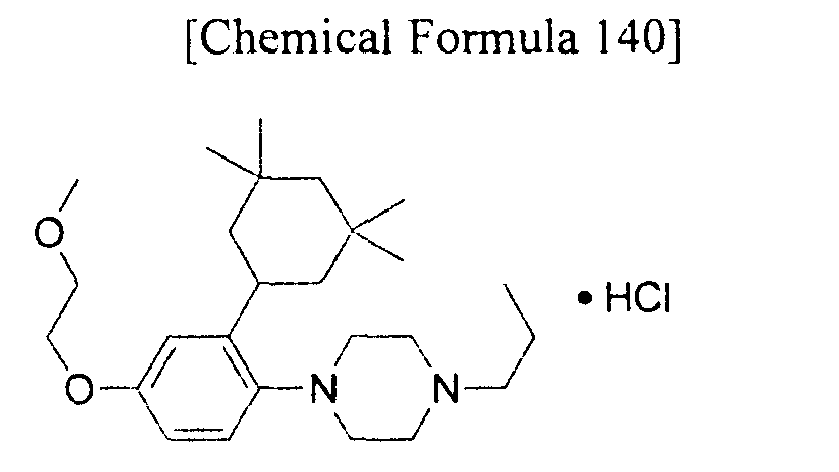
-

- A mixture of 1-[4-methoxy-2-(3,3,5,5-tetramethylcyclohexyl)phenyl]piperazine (450 mg, 1.36 mmol) produced in Production Example 10C, 48% hydrobromic acid (4 mL) and acetic acid (2 mL) was stirred at an external temperature of 130°C for 7 hours and 30 minutes under a nitrogen atmosphere. The reaction mixture was then cooled in an ice water bath and stirred.
The reaction mixture was adjusted to pH 8-9 by addition of 5N aqueous sodium hydroxide. The precipitated solid was filtered and washed with water and then a mixed solvent of methanol, ethyl acetate and dichloromethane was added to the solid. The insoluble matters were filtered off and the filtrate was concentrated under reduced pressure. Diethyl ether was added to the resultant residue for solidification, followed by trituration by sonication. The resultant solid was filtered, washed with heptane and diethyl ether and subjected to through-flow drying to give 460 mg of the title compound as a light red solid. Thus obtained product was used for the following reaction without further purification. -

- To a solution of 4-piperazin-1-yl-3-(3,3,5,5-tetramethylcyclohexyl)phenol (460 mg, 1.45 mmol) in dimethylformamide (5 mL) were added potassium carbonate (188 mg, 1.36 mmol) and 4-dimethylaminopyridine (20 mg, 0.164 mmol), followed by stirring. Di-t-butyl dicarbonate (300 mg, 1.85 mmol) was added to the mixture in an ice bath, while preventing solidification of the solution.
After stirring the reaction mixture at room temperature for 19 hours and 30 minutes, water was added to the reaction mixture and extraction was performed with ethyl acetate. The collected organic layer was washed with water and brine and then dried over anhydrous magnesium sulfate. The desiccant was filtered off and the filtrate was concentrated under reduced pressure. The resultant residue was purified by NH silica gel column chromatography (ethyl acetate/heptane) to give 340 mg of the title compound as a colorless solid.
1H-NMR (400MHz, CDCl3)
δ: 0.86-1.56 (m, 6H), 0.91 (s, 6H), 1.10 (s, 6H), 1.49 (s, 9H), 2.75 (br, 4H), 3.05 (br, 2H), 3.58 (t, J= 12.0Hz, 1H), 4.03 (br, 2H), 5.64 (brs, 1H), 6.62 (d, J= 8.4Hz, 1H), 6.71 (s, 1H), 6.94 (d, J= 8.4Hz, 1H). -

- To a solution of 4-[4-hydroxy-2-(3,3,5,5-tetramethylcyclohexyl)phenyl]piperazine-1-carboxylic acid t-butyl ester (290 mg, 0.696 mmol) in dimethylformamide (3 mL) was added sodium hydride (60% dispersion in oil, 100 mg, 2.5 mmol) while stirring at room temperature. After bubbling ceased, 2-bromoethylmethyl ether (0.15 mL, 1.48 mmol) was further added to the reaction mixture.
The mixture was stirred at room temperature for 1 hour and 10 minutes, and then water was added to the reaction mixture and extraction was performed with ethyl acetate. The collected organic layer was washed with water and then dried over anhydrous magnesium sulfate. The desiccant was filtered off and the filtrate was concentrated under reduced pressure. A crude product of the title compound (340 mg) was obtained. The crude product was used for the following reaction without purification. -


- A solution of 4-[4-(2-methoxyethoxy)-2-(3,3,5,5-tetramethylcyclohexyl)phenyl]piperazine-1-carboxylic acid t-butyl ester (400 mg, 0.82 mmol) in dichloromethane (4 mL) was stirred while cooling in an ice bath, followed by gradually adding trifluoroacetic acid (2 mL) dropwise over 10 minutes. The reaction mixture was warmed to room temperature and stirred for 30 minutes.
The reaction mixture was made basic by addition of saturated aqueous sodium hydrogencarbonate while cooling in ice water, and extraction was performed with ethyl acetate. The collected organic layer was washed with water and then dried over anhydrous magnesium sulfate. The desiccant was filtered off and the filtrate was concentrated under reduced pressure. The resultant residue was purified by NH silica gel column chromatography (ethyl acetate/heptane) to give 296 mg of the title compound as a light yellow solid. -

- To a solution of 1-[4-(2-methoxyethoxy)-2-(3,3,5,5-tetramethylcyclohexyl)phenyl]piperazine (10 mg, 0.027 mmol) in tetrahydrofuran (1 mL) were added propionaldehyde (2.3 mg, 0.040 mmol), sodium triacetoxyborohydride (11 mg, 0.053 mmol) and acetic acid (1.6 mg, 0.027 mmol) in that order, followed by stirring for 30 minutes at room temperature.
Saturated aqueous sodium hydrogencarbonate was added to the reaction mixture, extraction was performed with ethyl acetate, and the organic layer was concentrated. The resultant residue was purified by NH silica gel column chromatography (ethyl acetate/heptane) to give 1-[4-(2-methoxyethoxy)-2-(3,3,5,5-tetramethylcyclohexyl)phenyl]-4-propylpiperazine.
1H-NMR (400MHz, CD3OD)
δ: 0.96 (s, 6H), 1.06 (t, J= 7.2Hz, 3H), 1.18 (s, 6H), 1.18-1.43 (m, 7H), 1.77-1.87 (m, 2H), 3.10-3.22 (m, 8H), 3.42 (s, 3H), 3.57 (tt, J= 12, 2.8Hz, 1H), 3.67 (m, 1H), 3.72-3.74 (m, 2H), 4.07-4.09 (m, 2H), 6.77 (dd, J= 8.8, 3.2Hz, 1H), 6.83 (d, J= 3.2Hz, 1H), 7.14 (d, J= 8.8Hz, 1H).
Thus obtained compound was dissolved in ethyl acetate, and a 4N solution of hydrogen chloride in ethyl acetate was added. The solution was concentrated, hexane was added to the resultant residue, and the resulting precipitate was triturated by sonication. After removing the supernatant, the precipitate was dried to give 6.3 mg of the title compound as a white solid.
MS m/e (ESI) 417(MH+). -
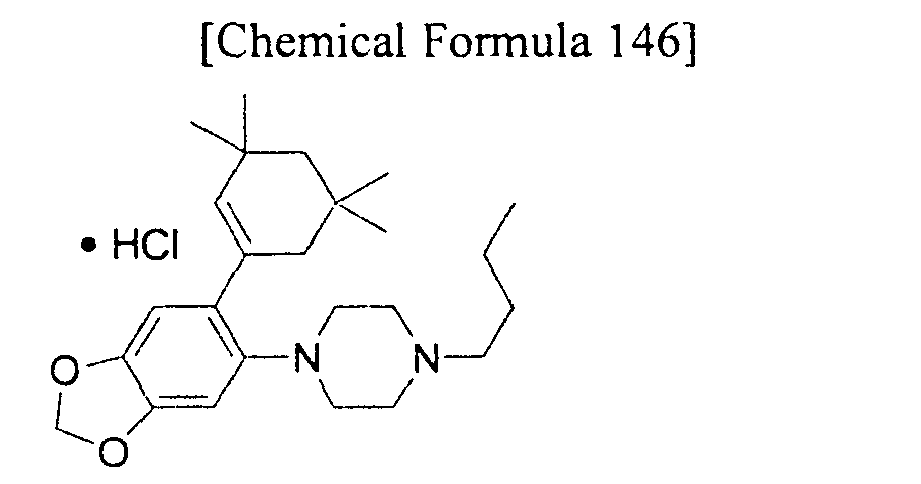
-
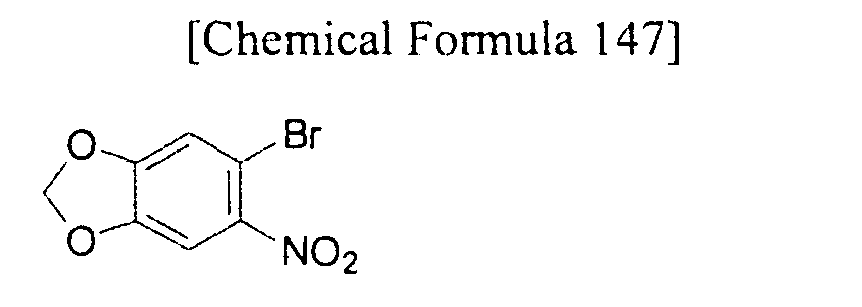
Diethyl ether and water were added to the reaction mixture, and the organic layer was collected. The organic layer was washed with saturated sodium hydrogencarbonate water and potassium carbonate, and then washed with water. The organic layer was dried over anhydrous magnesium sulfate and then the desiccant was filtered off and the filtrate was concentrated under reduced pressure. A crude product of the title compound (3.35 g) was obtained as a light yellow solid. 1H-NMR (400MHz, CDCl3)
δ: 6.15 (s, 2H), 7.12 (s, 1H), 7.45 (s, 1H). -

- To a solution of 5-bromo-6-nitrobenzo[1,3]dioxole (1.5 g, 6.1 mmol) in 1,2-dimethoxyethane (30 mL) were added 4,4,5,5-tetramethyl-2-(3,3,5,5-tetramethylcyclohex-1-enyl)-[1,3,2]dioxaborolane (1.93 g, 7.3 mmol) produced in Production Example 2B, tripotassium phosphate (1.94 g, 9.14 mmol) and water (1.5 mL).
Tetrakis(triphenylphosphine)palladium (352 mg, 0.305 mmol) was added to the mixture under a nitrogen atmosphere, followed by stirring at an external temperature of 80°C for 4 hours. After then further adding tetrakis(triphenylphosphine)palladium(0) (350 mg, 0.305 mmol) and water (1.5 mL) to the reaction mixture, stirring was continued for 2 hours and 55 minutes. Next, tetrakis(triphenylphosphine)palladium (250 mg, 0.305 mmol), water (2 mL) and tripotassium phosphate (820 mg, 3.9 mmol) were added to the reaction mixture, followed by raising the temperature up to an external temperature of 100°C and stirring for 2 hours and 30 minutes. The reaction mixture was then stirred at an external temperature of 80°C for 18 hours and 30 minutes.
Ethyl acetate was added to the reaction mixture which was filtered through Celite. The filtrate was then concentrated, extraction was performed with ethyl acetate, and the organic layer was washed with water and brine. The organic layer was dried over anhydrous magnesium sulfate, after which the desiccant was filtered off and the filtrate was concentrated under reduced pressure. The resultant residue was purified by silica gel column chromatography (ethyl acetate/heptane) to give 1.35 g of the title compound as a light yellow solid.
1H-NMR (400MHz, CDCl3)
δ: 1.04 (s, 12H), 1.39 (s, 2H), 1.97 (d, J= 1.6Hz, 2H), 5.300-5.304 (m, 1H), 6.08 (s, 2H), 6.63 (s, 1H), 7.35 (s, 1H). -
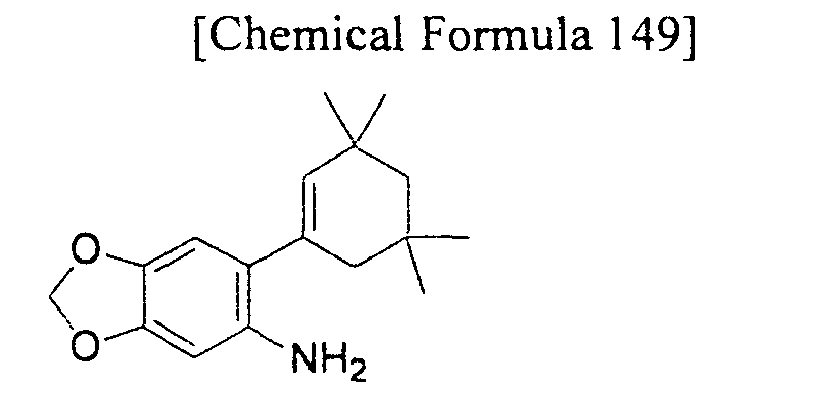
- A mixture of 5-nitro-6-(3,3,5,5-tetramethylcyclohex-1-enyl)benzo[1,3]dioxole (900 mg, 2.97 mmol), 10% palladium on carbon (450 mg, wet), methanol (8 mL) and tetrahydrofuran (6 mL) was stirred at ordinary temperature and atmospheric pressure overnight under a hydrogen atmosphere.
The mixture was filtered through Celite to remove the catalyst, and the filtrate was concentrated. A crude product of the title compound (834 mg) was obtained as a yellow oil. -

- A solution of 6-(3,3,5,5-tetramethylcyclohex-1-enyl)benzo[1,3]dioxol-5-ylamine (834 mg, 3.05 mmol) and bis(2-chloroethyl)amine hydrochloride (680 mg. 3.81 mmol) in 1,2-dichlorobenzene (10 mL) was stirred at an external temperature of 220°C for 7 hours and 35 minutes. The excess hydrogen chloride gas in the reactor was removed several times by nitrogen gas.
After cooling the reaction mixture to room temperature, saturated aqueous sodium hydrogencarbonate was added and extraction was performed with chloroform. The aqueous layer was re-extracted with chloroform, and the organic layers were combined and washed with brine and then dried over anhydrous magnesium sulfate. The desiccant was filtered off and the filtrate was concentrated under reduced pressure. The resultant residue was purified by NH silica gel column chromatography (ethyl acetate/heptane) to give 280 mg of the title compound as a brown oil.
1H-NMR (400MHz, CDCl3)
δ:1.01 (s, 6H), 1.05 (s, 6H), 1.37 (s, 2H), 2.13 (s, 2H), 2.81 (br, 4H), 2.93 (br, 4H), 5.37 (s, I H), 5.89 (s, 2H), 6.58 (s, 1H), 6.65 (s, 1H). -

- To a solution of 1-[6-(3,3,5,5-tetramethylcyclohex-1-enyl)benzo[1,3]dioxol-5-yl]piperazine (30 mg, 0.088 mmol) in tetrahydrofuran (1 mL) were added butyraldehyde (9.5 mg, 0.13 mmol), sodium triacetoxyborohydride (37 mg, 0.18 mmol) and acetic acid (5.3 mg, 0.088 mmol) in that order, followed by stirring at room temperature for 15 minutes.
Saturated aqueous sodium hydrogencarbonate was added to the reaction mixture, and then extraction was performed with ethyl acetate and the organic layer was concentrated. The resultant residue was purified by NH silica gel column chromatography (ethyl acetate/heptane) to give 1-butyl-4-(6-(3,3,5,5-tetramethylcyclohex-1-enyl)benzo[1,3]dioxo)-5-yl]piperazine.
1H-NMR (400MHz, CDCl3)
δ:0.86-0.95 (m, 3H), 1.02 (s, 6H), 1.05 (s, 6H), 1.26-1.37 (m, 4H), 1.43-1.53 (m, 2H), 2.13 (s, 2H), 2.33-2.37 (m, 2H), 2.52 (br, 4H), 2.89 (br, 4H), 5.38 (s, 1H), 5.89 (s, 2H), 6.59 (s, 1H), 6.67 (s, 1H).
Thus obtained compound was dissolved in ethyl acetate, and a 4N solution of hydrogen chloride in ethyl acetate was added. The solution was concentrated, hexane was added to the resultant residue, and the resultant precipitate was triturated by sonication. After removing the supernatant, the precipitate was dried to give 33 mg of the title compound as a white solid.
MS m/e (ESI) 399(MH+). -

- A mixture of 1-butyl-4-[6-(3,3,5,5-tetramethylcyclohex-1-enyl)benzo[1,3]dioxol-5-yl]piperazine hydrochloride (16 mg, 0.037 mmol), 10% palladium on carbon (94 mg, wet), methanol (10 mL) and tetrahydrofuran (5 mL) was stirred at room temperature for 9 hours and 20 minutes under a hydrogen atmosphere at 3 atmospheric pressure.
The mixture was filtered through Celite to remove the catalyst, and the filtrate was concentrated. Hexane was added to the resultant residue, and the resultant precipitate was triturated by sonication. After removing the supernatant, the precipitate was dried to give 10 mg of the title compound as a white solid.
MS m/e (ESI) 401(MH+). -


-
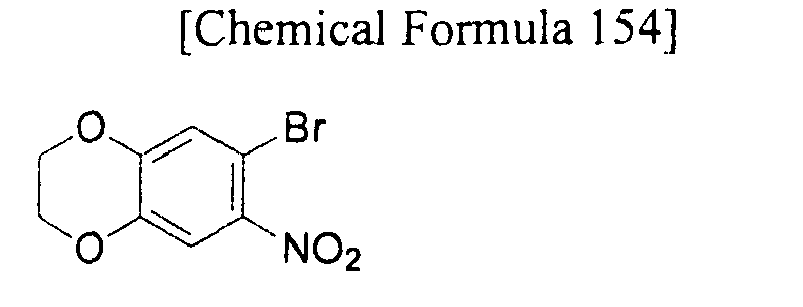
- A solution of 3,4-ethylenedioxybromobenzole (785 mg, 3.54 mmol) in acetic acid (30 mL) was cooled to 10°C, and then concentrated nitric acid (10 mL) was gradually added to the reaction mixture while stirring. The reaction mixture was then further stirred for 60 minutes at room temperature. Next, the reaction mixture was cooled to 0°C and ice water was added while stirring.
Diethyl ether and water were added to the reaction mixture and the organic layer was collected. The organic layer was washed with potassium carbonate and 1N aqueous sodium hydroxide and then washed with water and brine. The organic layer was dried over anhydrous magnesium sulfate, and then the desiccant was filtered off and the filtrate was concentrated under reduced pressure. A crude product of the title compound (870 mg) was obtained as a white solid.
1H-NMR (400MHz, CDCl3)
δ: 4.29-4.35 (m, 4H), 7.21 (s, I H), 7.59 (s, 1H). -

- To a solution of 6-bromo-7-nitro-2,3-dihydrobenzo[1,4]dioxin (870 mg. 3.35 mmol) in 1,2-dimethoxyethane (20 mL) were added 4,4,5,5-tetramethyl-2-(3,3,5,5-tetramethylcyclohex-1-enyl)-[1,3,2]dioxaborolane (1.06 g, 4.02 mmol) produced in Production Example 2B, tripotassium phosphate (1.07 g, 5.03 mmol) and water (1 mL).
To the mixture was added tetrakis(triphenylphosphine)palladium(0) (194 mg, 0.168 mmol) under a nitrogen atmosphere, followed by stirring at an external temperature of 80°C for 2 hours and 30 minutes. To the reaction mixture was added tetrakis(triphenylphosphine)palladium(0) (220 mg, 0.20 mmol), followed by stirring at an external temperature of 90°C for 4 hours and 30 minutes. To the reaction mixture were further added an aqueous solution (1.5 mL) of tetrakis(triphenylphosphine)palladium(0) (195 mg, 0.168 mmol) and tripotassium phosphate (1 g, 5.0 mmol), followed by stirring at an external temperature of 75°C for 10 hours and 30 minutes.
After addition of ethyl acetate, the reaction mixture was filtered through Celite. The filtrate was concentrated, and then extraction was performed with ethyl acetate and the organic layer was washed with brine. The organic layer was dried over anhydrous magnesium sulfate, and then the desiccant was filtered off and the filtrate was concentrated under reduced pressure. The resultant residue was purified by silica gel column chromatography (ethyl acetate/heptane) to give 986 mg of the title compound as a light yellow solid.
1H-NMR (400MHz, CDCl3)
δ:1.03 (s, 6H), 1.05 (s, 6H), 1.39 (s, 2H), 1.95 (d, J= 1.6Hz, 2H), 4.28-4.34 (m, 4H), 5.30 (t, J= 1.6Hz, 1H), 6.69 (s, 1H), 7.48 (s, 1H). -

- A mixture of 6-nitro-7-(3,3,5,5-tetramethylcyclohex-1-enyl)-2,3-dihydrobenzo[1,4]dioxin (986 mg, 3.11 mmol), 10% palladium on carbon (1 g, wet), methanol (10 mL) and tetrahydrofuran (10 mL) was stirred at room temperature for 6 hours and 30 minutes under a hydrogen atmosphere at 3 atmospheric pressure.
The mixture was filtered through Celite to remove the catalyst, and the filtrate was concentrated. A crude product of the title compound (880 mg) was obtained as a light yellow oil. Thus obtained product was used for the following reaction without further purification. -

- A solution of 7-(3,3,5,5-tetramethylcyclohexyl)-2,3-dihydrobenzo[1,4]dioxyin-6-ylamine (880 mg, 3.04 mmol) and bis(2-chloroethyl)amine hydrochloride (678 mg, 3.8 mmol) in 1,2-dichlorobenzene (10 mL) was stirred at an external temperature of 220°C for 6 hours and 20 minutes. The excess hydrogen chloride gas in the reactor was removed several times by nitrogen gas.
The reaction mixture was cooled to room temperature, saturated aqueous sodium hydrogencarbonate was added and extraction was performed with chloroform. The aqueous layer was re-extracted with chloroform, and the organic layers were combined and washed with brine and then dried over anhydrous magnesium sulfate. The desiccant was filtered off and the filtrate was concentrated under reduced pressure. The resultant residue was purified by NH silica gel column chromatography (ethyl acetate/heptane) to give 511 mg of the title compound as a white solid.
1H-NMR (400MHz, CDCl3)
δ: 0.99 (s, 6H), 1.11 (s, 6H), 1.13-1.18 (m, 2H), 1.24-1.32 (m. 2H), 1.39-1.43 (m. 2H), 2.77 (br, 4H), 2.99 (dd. J=4.8, 4.4Hz, 4H), 3.45 (tt. J= 13, 2.8Hz, 1H), 4.22 (s, 4H), 6.65(s, 1H), 6.70 (s, 1H). -

- To a solution of 1-[7-(3,3,5,5-tetramethylcyclohexyl)-2,3-dihydrobenzo[1,4]dioxin-6-yl]piperazine (10 mg, 0.028 mmol) in tetrahydrofuran (1 mL) were added butyraldehyde (3.0 mg, 0.042 mmol), sodium triacetoxyborohydride (12 mg, 0.056 mmol) and acetic acid (2 mg, 0.028 mmol) in that order, followed by stirring at room temperature for 30 minutes.
Saturated aqueous sodium hydrogencarbonate was added to the reaction mixture and then extraction was performed with ethyl acetate and the organic layer was concentrated. The resultant residue was purified by NH silica gel column chromatography (ethyl acetate/heptane) to give 1-butyl-4-[7-(3,3,5,5-tetramethylcyclohexyl)-2,3-dihydrobenzo[1,4]dioxin-6-yl]piperazine as a white solid.
1H-NMR (400MHz, CDCl3)
δ:0.91 (s, 6H), 0.93 (t, J= 7.2Hz, 3H), 1.10 (s, 6H), 1.25-1.55 (m, 9H), 1.70 (br, 1H), 2.35-2.40 (m, 2H), 2.56 (br, 4H), 2.85 (t, J= 4.6Hz, 4H), 3.47 (tt, J= 13, 2.8Hz, 1H), 4.21 (s, 4H), 6.67 (s, 1H), 6.70 (s, 1H).
Thus obtained compound was dissolved in ethyl acetate, and a 4N solution of hydrogen chloride in ethyl acetate was added. The solution was concentrated, hexane was added to the resultant residue, and the resultant precipitate was triturated by sonication. After removing the supernatant, the precipitate was dried to give 12.6 mg of the title compound as a white solid.
MS m/e (ESI) 415(MH+). -

-

- A mixture of 3-bromo-4-fluorobenzoic acid methyl ester (5.1 g, 21.9 mmol), piperazine-1-carboxylic acid t-butyl ester (5.3 g, 28.5 mmol), potassium carbonate (6.05 g, 43.8 mmol) and dimethylsulfoxide (80 mL) was stirred at an external temperature of 130°C.
After stirring the reaction mixture for 5 hours and 30 minutes, ethyl acetate and water were added to the reaction mixture and extraction was performed with ethyl acetate. The collected organic layer was washed twice with water, washed once with brine, and then dried over anhydrous sodium sulfate. The desiccant was filtered off and the filtrate was concentrated under reduced pressure. The resultant residue was purified by silica gel column chromatography (ethyl acetate/hexane) to give 3.12 g of the title compound as a light yellow oil.
1H-NMR (400MHz, CDCl3)
δ: 1.49 (s, 9H), 3.07 (t, J= 4.8Hz, 4H), 3.62 (t, J= 4.8Hz, 4H), 3.90 (s, 3H), 7.01 (d, J= 8.4Hz, 1H), 7.94 (dd, J= 8.4, 2.0Hz, 1H), 8.24 (d, J= 2.0Hz, 1H). -


- A mixture of 4-(2-bromo-4-methoxycarbonylphenyl)piperazine-1-carboxylic acid t-butyl ester (3.12 g, 7.81 mmol). 4,4,5,5-tetramethyl-2-(3,3,5,5-tetramethylcyclohex-1-enyl)[1,3,2]dioxoborolane (3.1 g, 11.73 mmol) produced in Production Example 2B, tripotassium phosphate (3.3 g, 15.55 mmol) and 1,2-dimethoxyethane (30 mL) was stirred at room temperature under a nitrogen atmosphere. Tetrakis(triphenylphosphine)palladium(0) (905 mg, 0.783 mmol) was added to the mixture. Next, the reaction mixture was stirred at an external temperature of 85°C for 18 hours and 10 minutes.
Ethyl acetate and water were added to the reaction mixture, which was then filtered through Celite. The organic layer obtained from the filtrate was washed with brine and then dried over anhydrous sodium sulfate. The desiccant was filtered off and the filtrate was concentrated under reduced pressure. The resultant residue was purified by NH silica gel column chromatography (ethyl acetate/hexane) to give 3.11 g of the title compound as a light yellow oil.
1H-NMR (400MHz, CDCl3)
δ: 1.02 (s, 6H), 1.09 (s, 6H), 1.40 (s, 2H), 1.48 (s, 9H), 2.13 (d, J= 1.2Hz, 2H), 3.01 (t, J= 4.8Hz, 4H), 3.53 (t, J= 4.8Hz, 4H), 3.89 (s, 3H), 5.60 (s, 1H), 6.94 (d, J= 8.4Hz, 1H), 7.73 (d, J= 2.0Hz, 1H), 7.86 (dd, J= 8.4, 2.0Hz, 1H). -

- A mixture of 4-[4-methoxycarbonyl-2-(3,3,5,5-tetramethylcyclohex-1-enyl)phenyl]piperazine-1-carboxylic acid t-butyl ester (800 mg, 1.75 mmol), 10% palladium on carbon (400 mg, wet), methanol (10 mL) and tetrahydrofuran (10 mL) was stirred at ordinary temperature and atmospheric pressure for 40 hours under a hydrogen atmosphere.
The reaction mixture was filtered and then the filtrate was concentrated. Ethyl acetate was added to the residue, and after filtration, the filtrate was concentrated. The resultant residue was purified by NH silica gel column chromatography (ethyl acetate/heptane) to give 740 mg of the title compound as colorless crystals.
1H-NMR (400MHz, CDCl3)
δ: 0.94 (s, 6H), 1.10 (s, 6H), 1.15-1.46 (m, 6H), 1.49 (s, 9H), 2.87 (t, J= 4.8Hz, 4H), 3.48 (tt, J= 12.4, 3.2Hz, 1H), 3.58 (brs, 4H), 3.89 (s, 3H), 7.04 (d, J= 8.4Hz, 1H), 7.82 (dd, J= 8.4, 2.4Hz, 1H), 7.90 (d, J= 2.4Hz, 1H). -

- A mixture of 4-[4-methoxycarbonyl-2-(3,3,5,5-tetramethylcyclohexyl)phenyl]piperazine-1-carboxylic acid t-butyl ester (738 mg, 1.61 mmol), trifluoroacetic acid (2 mL, 25.96 mmol) and dichloromethane (10 mL) was stirred at room temperature for 15 hours.
The reaction mixture was poured into ice water, and saturated aqueous sodium hydrogencarbonate was added to make the mixture basic. Next, ethyl acetate, tetrahydrofuran and water were added to the mixture and the organic layer was collected. The collected organic layer was washed with brine and then dried over anhydrous sodium sulfate. The desiccant was filtered off, and the filtrate was concentrated under reduced pressure to give 538 mg of a crude product of the title compound as a light yellow solid.
1H-NMR (400MHz, CDCl3)
δ: 0.94 (s, 6H), 1.12 (s, 6H), 1.16-1.46 (m, 6H), 2.98 (t, J= 4.8Hz, 4H), 3.13 (t, J= 4.8Hz, 4H), 3.46 (tt, J= 12.4, 3.2Hz, 1H), 3.90 (s, 3H), 7.08 (d, J= 8.4Hz, 1H), 7.83 (dd, J= 8.4, 2.4Hz, 1H), 7.90 (d, J= 2.4Hz, 1H). -

- To a mixture of 4-piperazin-1-yl-3-(3,3,5,5-tetramethylcyclohexyl)benzoic acid methyl ester (178 mg, 0.496 mmol), propionaldehyde (0.07 mL, 0.97 mmol) and tetrahydrofuran (7 mL) were added sodium triacetoxyborohydride (260 mg, 1.227 mmol) and acetic acid (0.03 mL, 0.524 mmol) in that order at room temperature.
After stirring the reaction mixture for 1 hour, ethyl acetate, saturated aqueous sodium hydrogencarbonate and water were added to the reaction mixture and extraction was performed with ethyl acetate. The collected organic layer was washed with brine and then dried over anhydrous sodium sulfate. The desiccant was filtered off and the filtrate was concentrated under reduced pressure. The resultant residue was purified by NH silica gel column chromatography (ethyl acetate/heptane) to give 168 mg of 4-(4-propylpiperazin-1-yl)-3-(3,3,5,5-tetramethylcyclohexyl)benzoic acid methyl ester as a white solid.
1H-NMR (400MHz, CDCl3)
δ: 0.92 (t, J= 8.0Hz, 3H), 0.92 (s, 6H), 1.11 (s, 6H), 1.17-1.46 (m, 6H), 1.51-1.63 (m, 2H), 2.39 (t, J= 8.0Hz, 2H), 2.63 (brs, 4H), 2.98 (t, J= 4.8Hz, 4H), 3.45 (tt, J= 12.4, 2.8Hz, 1H), 3.88 (s, 3H), 7.06 (d, J= 8.4Hz, 1H), 7.80 (dd, J= 8.4, 2.0Hz, 1H), 7.87 (d, J= 2.0Hz, 1H).
This compound was dissolved in ethyl acetate, and a 4N solution of hydrogen chloride in ethyl acetate was added. The solution was concentrated and diethyl ether and hexane were added to the resultant residue. The resultant precipitate was filtered and dried with a vacuum pump to give 124 mg of the title compound as colorless crystals.
MS m/e (ESI) 355(MH+). -
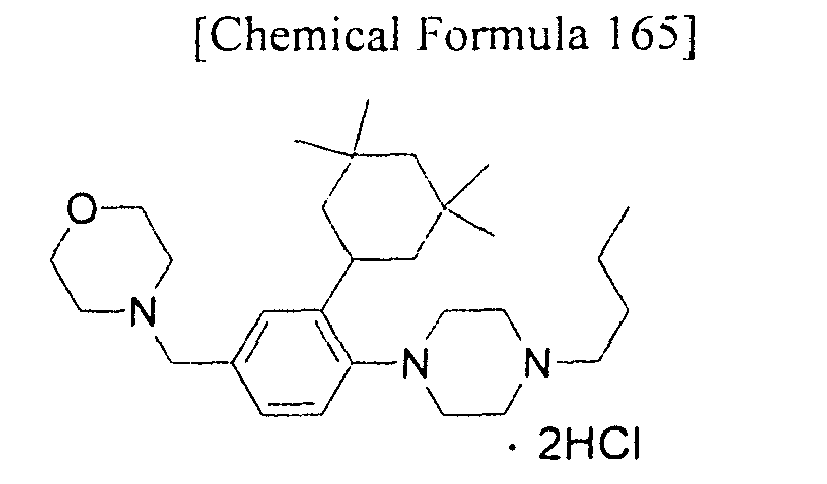
-

- To a mixture of 4-piperazin-1-yl-3-(3,3,5,5-tetramethylcyclohexyl)benzoic acid methyl ester (180 mg, 0.502 mmol), butyraldehyde (0.09 mL, 1.01 mmol) and tetrahydrofuran (7 mL) were added sodium triacetoxyborohydride (265 mg, 1.25 mmol) and acetic acid (0.03 mL, 0.524 mmol) in that order at room temperature.
After stirring the reaction mixture for 1 hour, ethyl acetate, saturated aqueous sodium hydrogencarbonate and water were added to the reaction mixture and extraction was performed with ethyl acetate. The collected organic layer was washed with brine and then dried over anhydrous sodium sulfate. The desiccant was filtered off and the filtrate was concentrated under reduced pressure. The resultant residue was purified by NH silica gel column chromatography (ethyl acetate/heptane) to give 190 mg of the title compound as colorless crystals.
1H-NMR (400MHz, CDCl3)
δ: 0.94 (t, J= 8.0Hz, 3H), 0.94 (s, 6H), 1.11 (s, 6H), 1.16-1.57 (m, 10H), 2.37-2.43 (m, 2H), 2.61 (brs, 4H), 2.96 (t, J= 4.8Hz. 4H), 3.45 (tt, J= 12.4, 3.2Hz, 1H), 3.88 (s, 3H), 7.06 (d, J= 8.4Hz, 1H), 7.80 (dd, J= 8.4, 2.4Hz, 1H), 7.87 (d, J= 2.4Hz,
1H). -

- A mixture of 4-(4-butylpiperazin-1-yl)-3-(3,3,5,5-tetramethylcyclohexyl)benzoic acid methyl ester (158 mg, 0.381 mmol), 1N aqueous sodium hydroxide (0.8 mL) and methanol (3 mL) was heated to reflux for 6 hours and 40 minutes.
Saturated aqueous ammonium chloride, ethyl acetate and water were added to the reaction mixture and extraction was performed with ethyl acetate. The collected organic layer was washed with brine and then dried over anhydrous sodium sulfate. The desiccant was filtered off, and the filtrate was concentrated under reduced pressure to give 145 mg of a crude product of the title compound as colorless crystals.
1H-NMR (400MHz, CDCl3)
δ: 0.89 (s, 6H), 0.94 (t, J= 7.2Hz, 3H), 1.09 (s, 6H), 1.09-1.42 (m, 8H), 1.56-1.66 (m, 2H), 2.51-2.60 (m, 2H), 2.80 (brs, 4H), 3.01 (brs, 4H), 3.40 (tt, J= 12.0, 3.2Hz, 1H), 7.01 (d, J= 8.0Hz, 1H), 7.80 (dd, J= 8.4, 2.0Hz, 1H), 7.91 (d, J= 2.0Hz, 1H). -

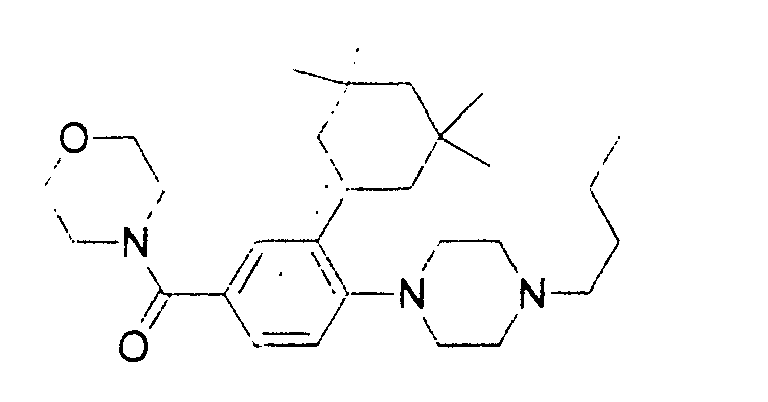
- To a mixture of 4-(4-butylpiperazin-1-yl)-3-(3,3,5,5-tetramethylcyclohexyl)benzoic acid (131 mg, 0.327 mmol) and dimethylformamide (7 mL) were added 1-hydroxybenzotriazole monohydrate (137 mg, 1.01 mmol), morpholine (0.059 mL, 0.677 mmol), 1-ethyl-3-(3-dimethylaminopropyl)carbodiimide hydrochloride (194 mg, 1.01 mmol) and triethylamine (0.159 mL, 1.14 mmol) in that order at room temperature.
After stirring the reaction mixture for 67 hours and 45 minutes, ethyl acetate, saturated aqueous sodium hydrogencarbonate and water were added to the reaction mixture and extraction was performed with ethyl acetate. The collected organic layer was washed twice with water, washed once with brine, and then dried over anhydrous sodium sulfate. The desiccant was filtered off and the filtrate was concentrated under reduced pressure. The resultant residue was purified by NH silica gel column chromatography (ethyl acetate/heptane) to give 132 mg of the title compound as a colorless oil.
1H-NMR (400MHz, CDCl3)
δ: 0.92 (s, 6H), 0.94 (t, J= 7.2Hz, 3H), 1.11 (s, 6H), 1.15-1.56 (m, 10H), 2.36-2.43 (m, 2H), 2.60 (brs, 4H), 2.93 (t, J= 4.8Hz, 4H), 3.51 (tt. J= 12.4, 2.8Hz, 1H), 3.69 (brs, 8H), 7.07 (d, J= 8.0Hz, 1H), 7.17 (dd, J= 8.0, 2.0Hz, 1H), 7.26 (d, J= 2.0Hz,
1H). -


- Lithium aluminum hydride (31 mg, 0.817 mmol) was suspended in anhydrous tetrahydrofuran (5 mL). To the suspension was added a solution of [4-(4-butylpiperazin-1-yl)-3-(3,3,5,5-tetramethylcyclohexyl)phenyl]morpholin-4-ylmethanone (97 mg, 0.206 mmol) in anhydrous tetrahydrofuran (5 mL) at room temperature. Next, the reaction mixture was stirred under a nitrogen atmosphere while heating to reflux for 4 hours and 40 minutes, and then lithium aluminum hydride (31 mg, 0.817 mmol) was added and the mixture was further stirred for 4 hours while heating to reflux.
Sodium fluoride (600 mg) was added to the reaction mixture, and water (0.24 mL) was gradually added while blowing nitrogen gas. After stirring the reaction mixture for 50 minutes, the insoluble matters were filtered off and the filtrate was concentrated under reduced pressure. The resultant residue was purified by NH silica gel column chromatography (ethyl acetate/heptane) to give 23 mg of 4-[4-(4-butylpiperazin-1-yl)-3-(3,3,5,5-tetramethylcyclohexyl)benzyl]morpholine as a colorless oil and 53 mg of [4-(4-butylpiperazin-1-yl)-3-(3,3,5,5-tetramethylcyclohexyl)phenyl]methanol as colorless crystals.
4-[4-(4-butylpiperazin-1-yl)-3-(3,3,5,5-tetramethylcyclohexyl)benzyl]morpholine:
1H-NMR (400MHz, CDCl3)
δ: 0.93 (s, 6H), 0.94 (t, J= 7.2Hz, 3H), 1.09 (s, 6H), 1.13-1.57 (m, 10H), 2.35-2.46 (m, 6H), 2.59 (brs, 4H), 2.91 (t, J= 4.8Hz, 4H), 3.44 (s, 2H), 3.51 1 (tt, J= 12.4, 3.2Hz, 1H), 3.71 (t, J= 4.8Hz, 4H), 7.06 (d, J= 8.0Hz. 1H), 7.07-7.12 (m, 2H).
[4-(4-butylpiperazin-1-yl)-3-(3,3,5,5-tetramethylcyclohexyl)phenyl]methanol:
1H-NMR (400MHz, CDCl3)
δ: 0.93 (s, 6H), 0.95 (t, J= 7.2Hz, 3H), 1.12 (s, 6H), 1.12-1.37 (m, 10H), 2.35-2.43 (m, 2H), 2.60 (brs, 4H), 2.90 (t, J= 4.8Hz, 4H), 3.56 (tt, J= 12.8, 3.2Hz, 1H), 4.63 (s, 2H), 7.10 (d. J= 8.0Hz, 1H), 7.15 (dd. J= 8.0. 1.6Hz. 1H), 7.23 (d. J= 1.6Hz. 1H). -

- After dissolving 4-[4-(4-butylpiperazin-1-yl)-3-(3,3,5,5-tetramethylcyclohexyl)benzyl]morpholine (23 mg, 0.05 mmol) in dichloromethane (2 mL), a 4N solution of hydrogen chloride in ethyl acetate (0.04 mL) was added thereto. The mixture was concentrated by blowing nitrogen gas, and then diethyl ether was added to the resultant residue and the resultant precipitate was triturated by sonication. After removing the supernatant, the precipitate was dried to give 31 mg of the title compound as a colorless solid.
MS m/e (ESI) 442(MH+). -

- Sodium hydride (60% dispersion in oil, 8 mg, 0.2 mmol) was suspended in dimethylformamide (1 mL), Followed by stirring at room temperature under a nitrogen atmosphere. A solution of [4-(4-butylpiperazin-1-yl)-3-(3,3,5,5-tetramethylcyclohexyl)phenyl]methanol (51 mg, 0.132 mmol) in dimethylformamide (2 mL) was added to the suspension. The reaction mixture was stirred for 20 minutes, and then the reaction mixture was cooled in ice water and iodomethane (0.013 mL, 0.2 mmol) was added. Next, the reaction mixture was stirred at room temperature for 3 hours.
The reaction mixture was cooled in ice water, and then water was added. Next, ethyl acetate was added and extraction was performed with ethyl acetate. The collected organic layer was washed twice with water, washed once with brine, and then dried over anhydrous sodium sulfate. The desiccant was filtered off and the filtrate was concentrated under reduced pressure. The resultant residue was purified by NH silica gel column chromatography (ethyl acetate/heptane) to give 30 mg of 1-butyl-4-[4-methoxymethyl-2-(3,3,5,5-tetramethylcyclohexyl)phenyl]piperazine as a colorless oil.
1H-NMR (400MHz, CDCl3)
δ: 0.92 (s, 6H), 0.94 (t, J= 7.2Hz, 3H), 1.12 (s, 6H), 1.12-1.57 (m, 10H), 2.35-2.42 (m, 2H), 2.60 (brs, 4H), 2.91 (t, J= 4.8Hz, 4H), 3.37 (s, 3H), 3.55 (tt, J= 12.4, 2.8Hz, 1H), 4.38 (s, 2H), 7.08 (brs, 2H), 7.17 (brs, 1H).
This compound was dissolved in dichloromethane, and a 4N solution of hydrogen chloride in ethyl acetate was added. The solution was concentrated by blowing nitrogen gas, and then diethyl ether was added to the resultant residue and the resultant precipitate was triturated by sonication. After removing the supernatant, the precipitate was dried to give 33 mg of the title compound as a light brown solid.
MS m/e (ESI) 401(MH+). -

-

- A mixture of 4-[2-(3,3,5,5-tetramethylcyclohexyl)phenyl]piperazine-1-carboxylic acid t-butyl ester (2.93 g, 7.31 mmol) produced in Production Example 5, sodium acetate (6 g, 73.14 mmol) and methanol (50 mL) was stirred at room temperature under a nitrogen atmosphere. Bromine (0.37 mL, 7.22 mmol) was then added to the mixture.
After stirring the reaction mixture for 20 minutes, saturated aqueous sodium thiosulfate, ethyl acetate and water were added to the reaction mixture, and extraction was performed with ethyl acetate. The collected organic layer was washed with brine and then dried over anhydrous sodium sulfate. The desiccant was filtered off and the filtrate was concentrated under reduced pressure. The resultant residue was purified by silica gel column chromatography (ethyl acetate/hexane) to give 2.67 g of the title compound as colorless crystals.
1H-NMR (400MHz, CDCl3)
δ: 0.93 (s, 6H), 1.10 (s, 6H), 1. 12-1.45 (m. 6H), 1.49 (s, 9H), 2.79 (brs, 4H), 3.48 (br, 4H), 3.54 (tt, J= 12.4, 2.8Hz, 1H), 6.93 (d, J= 8.4Hz, 1 H), 7.25 (dd, J= 8.4, 2.4Hz, 1H), 7.32 (d. J= 2.4Hz. 1H). -

- To a mixture of 4-[4-bromo-2-(3,3,5,5-tetramethylcyclohexyl)phenyl]piperazine-1-carboxylic acid t-butyl ester (150 mg, 0.313 mmol), methylpropargyl ether (0.08 mL, 0.947 mmol), copper(I) iodide (5 mg, 0.026 mmol) and triethylamine (3 mL) was added dichlorobis(triphenylphosphine)palladium(II) (11 mg, 0.016 mmol), followed by stirring at an external temperature of 80°C under a nitrogen atmosphere.
After stirring the reaction mixture for 2 hours and 30 minutes, methylpropargyl ether (0.12 mL, 1.42 mmol) and dichlorobis(triphenylphosphine)palladium(II) (15 mg, 0.021 mmol) were further added, followed by stirring for 2 hours and 30 minutes under the same conditions.
Ethyl acetate and water were added to the reaction mixture which was then filtered. To the filtrate was added 5% aqueous potassium hydrogensulfate, and extraction was performed with ethyl acetate. The collected organic layer was washed with 5% aqueous potassium hydrogensulfate, saturated aqueous sodium hydrogencarbonate and brine in that order and then dried over anhydrous sodium sulfate. The desiccant was filtered off and the filtrate was concentrated under reduced pressure. The resultant residue was purified by silica gel column chromatography (ethyl acetate/heptane) to give 106 mg of the title compound as a yellowish-brown solid.
1H-NMR (400MHz, CDCl3)
δ: 0.93 (s, 6H), 1.10 (s, 6H), 1.12-1.45 (m, 6H), 1.49 (s, 9H), 2.82 (brs, 4H), 3.45 (s, 3H), 3.49 (tt, J= 12.8, 2.8Hz, 1H), 3.56 (br, 4H), 4.31 (s, 2H), 6.97 (d, J= 8.4Hz, 1H), 7.24 (dd, J= 8.4, 1.6Hz, 1H), 7.34 (d, J= 1.6Hz, 1H). -

- A mixture of 4-[4-(3-methoxyprop-l-yny!)-2-(3.3.5.5-tetramethylcyclohexyl)phenyl]piperazine-1-carboxylic acid t-butyl ester (104 mg, 0.222 mmol), trifluoroacetic acid (0.5 mL, 3.89 mmol) and dichloromethane (1 mL) was stirred at room temperature for 3 hours and 30 minutes.
The reaction mixture was cooled in ice water, and was made basic with addition of 5N aqueous sodium hydroxide. Next, ethyl acetate and water were added to the reaction mixture and extraction was performed with ethyl acetate. The collected organic layer was washed with water and brine and then dried over anhydrous sodium sulfate. The desiccant was filtered off and the filtrate was concentrated under reduced pressure. The resultant residue was purified by NH silica gel column chromatography (ethyl acetate/heptane) to give 26 mg of 1-[4-(3-methoxyprop-1-ynyl)-2-(3,3,5,5-tetramethylcyclohexyl)phenyl]piperazine as a light brown oil and 31 mg of 3-methoxy-1-[4-piperazin-1-yl-3-(3,3,5,5-tetramethylcyclohexyl)phenyl]propan-1-one as a light yellow oil.
1-[4-(3-methoxyprop-1-ynyl)-2-(3,3,5,5-tetramethylcyclohexyl)phenyl]piperazine:
1H-NMR (400MHz, CDCl3)
δ: 0.92 (s, 6H), 1.11 (s, 6H), 1.12-1.46 (m, 6H), 2.84 (t, J= 4.8Hz, 4H), 3.03 (t, J= 4.8Hz, 4H), 3.45 (s, 3H), 3.50 (tt, J= 12.8, 2.8Hz, 1H), 4.31 (s, 2H), 7.00 (d, J= 8.0Hz, 1H), 7.24 (dd, J= 8.0, 2.0Hz, 1H), 7.32 (d, J= 2.0Hz, 1H).
3-methoxy-1-[4-piperazin-1-yl-3-(3.3,5,5-tetramethylcyclohexyl)phenyl]propan-1-one:
1H-NMR (400MHz, CDCl3)
δ: 0.94 (s, 6H), 1.12 (s, 6H), 1.14-1.45 (m, 6H), 2.91 (t, J= 4.8Hz, 4H), 3.05 (t, J= 4.8Hz, 4H), 3.23 (t, J= 6.8Hz, 2H), 3.39 (s, 3H), 3.47 (tt, J= 12.8, 3.2Hz, 1H), 3.82 (t, J= 6.8Hz, 2H), 7.07 (d, J= 8.4Hz, 1H). 7.76 (dd, J= 8.4, 2.0Hz, 1H), 7.87 (d, J= 2.0Hz, 1H). -


- To a mixture of 3-methoxy-1-[4-piperazin-1-yl-3-(3,3,5,5-tetramethylcyclohexyl)phenyl]propan-1-one (10 mg, 0.026 mmol), butyraldehyde (0.006 mL, 0.067 mmol) and tetrahydrofuran (2 mL) were added sodium triacetoxyborohydride (14 mg, 0.066 mmol) and acetic acid (0.002 mL, 0.035 mmol) in that order at room temperature.
After stirring the reaction mixture for 1 hour, ethyl acetate, saturated aqueous sodium hydrogencarbonate and water were added to the reaction mixture and extraction was performed with ethyl acetate. The collected organic layer was concentrated by blowing nitrogen gas. The resultant residue was purified by NH silica gel column chromatography (ethyl acetate/hexane) to give 1-[4-(4-butylpiperazin-1-yl)-3-(3,3,5,5-tetramethylcyclohexyl)phenyl]-3-methoxypropan-1-one.
1H-NMR (400MHz, CDCl3)
δ: 0.93 (s, 6H), 0.94 (t, J= 7.2Hz, 3H), 1.11 (s, 6H), 1.15-1.56 (m, 10H), 2.36-2.44 (m, 2H), 2.62 (brs, 4H), 2.98 (t, J= 4.8Hz, 4H), 3.22 (t, J= 6.8Hz, 2H), 3.39 (s, 3H), 3.44 (tt, J= 12.8, 3.2Hz, 1H), 3.82 (t, J= 6.8Hz, 2H), 7.08 (d, J= 8.4Hz, 1H), 7.75 (dd, J= 8.4, 2.0Hz, 1H), 7.86 (d, J= 2.0Hz, 1H).
This compound was dissolved in dichloromethane, and a 4N solution of hydrogen chloride in ethyl acetate was added. The solution was concentrated by blowing nitrogen gas, and then diethyl ether was added to the resultant residue and the resultant precipitate was triturated by sonication. After removing the supernatant, the precipitate was dried to give 9 mg of the title compound as a white solid.
MS m/e (ESI) 443(MH+). -


- To a mixture of 1-[4-(3-methoxyprop-1-ynyl)-2-(3,3,5,5-tetramethylcyclohexyl)phenyl]piperazine (8.7 mg, 0.024 mmol), butyraldehyde (0.005 mL, 0.056 mmol) and tetrahydrofuran (2 mL) were added sodium triacetoxyborohydride (13 mg, 0.061 mmol) and acetic acid (0.002 mL, 0.035 mmol) in that order at room temperature.
After stirring for 1 hour, ethyl acetate, saturated aqueous sodium hydrogencarbonate and water were added to the reaction mixture and extraction was performed with ethyl acetate. The collected organic layer was concentrated by blowing nitrogen gas. The resultant residue was purified by NH silica gel column chromatography (ethyl acetate/hexane) to give 1-butyl-4-[4-(3-methoxyprop-1-ynyl)-2-(3,3,5,5-tetramethylcyclohexyl)phenyl]piperazine.
1H-NMR (400MHz, CDCl3)
δ: 0.92 (s, 6H), 0.94 (t, J= 7.2Hz, 3H), 1.11 (s, 6H), 1.13-1.56 (m. 10H), 2.36-2.43 (m, 2H), 2.60 (brs, 4H), 2.92 (t, J= 4.8Hz, 4H), 3.45 (s, 3H), 3.44 (tt, J= 12.4, 3.2Hz, 1H), 4.31 (s, 2H), 7.01 (d, J= 8.4Hz, 1H), 7.23 (dd, J= 8.4, 2.0Hz, 1H), 7.32 (d, J= 2.0Hz, 1H).
This compound was dissolved in dichloromethane, and a 4N solution of hydrogen chloride in ethyl acetate was added. The solution was concentrated by blowing nitrogen gas, and then diethyl ether was added to the resultant residue and the resultant precipitate was triturated by sonication. After removing the supernatant, the precipitate was dried to give 8 mg of the title compound as a white solid.
MS m/e (ESI) 425(MH+). - The following compounds were produced by the general production methods described above, the methods described in the production examples and examples, or combinations of these methods with well-known methods.
-

-

-

-


-

-

-

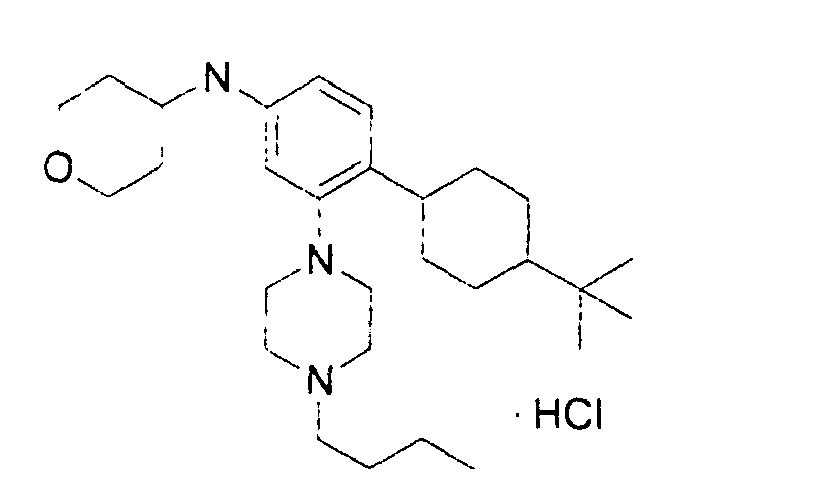
-

-

-


-

-

-


-

-

-


-
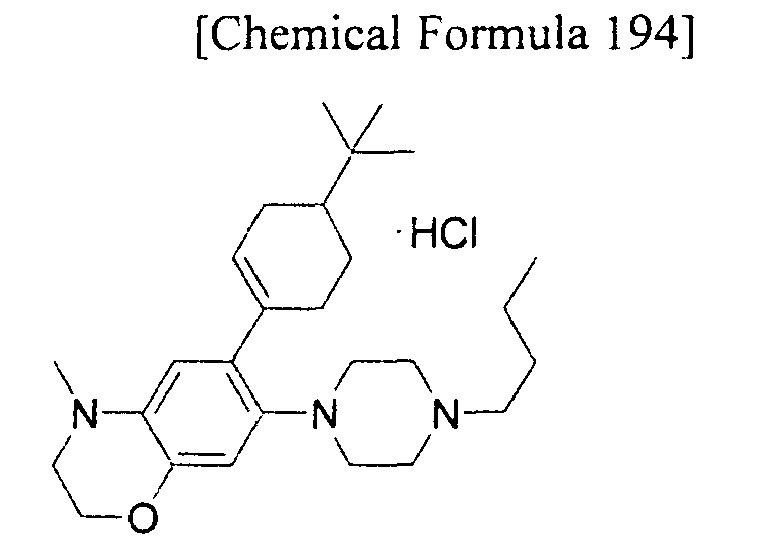
-

-


-

-

-


-

-

-


-

-

-


-

-

-

-

-

-

-


-

-

-


-

-

-


-

-
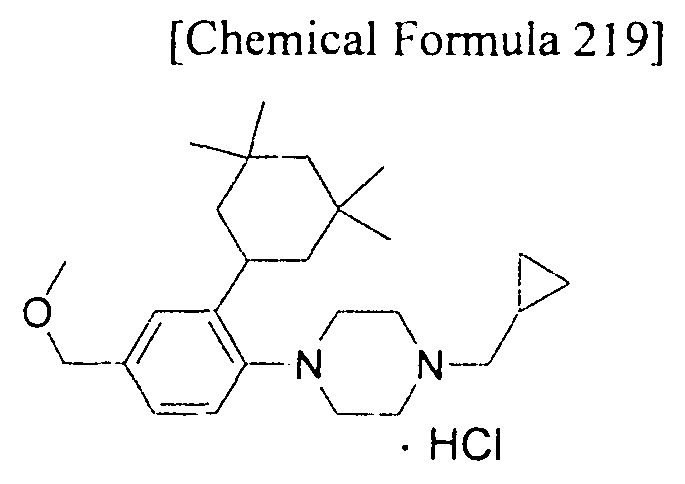
-


-

-

-


-

-

-


-

-

-


-

-

-

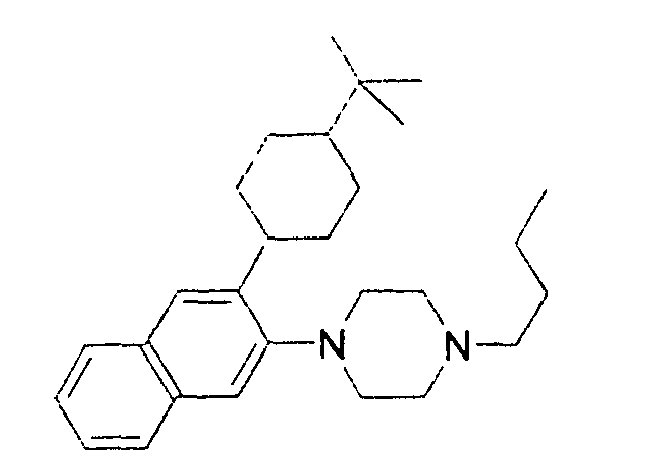
-

-

-


-

-
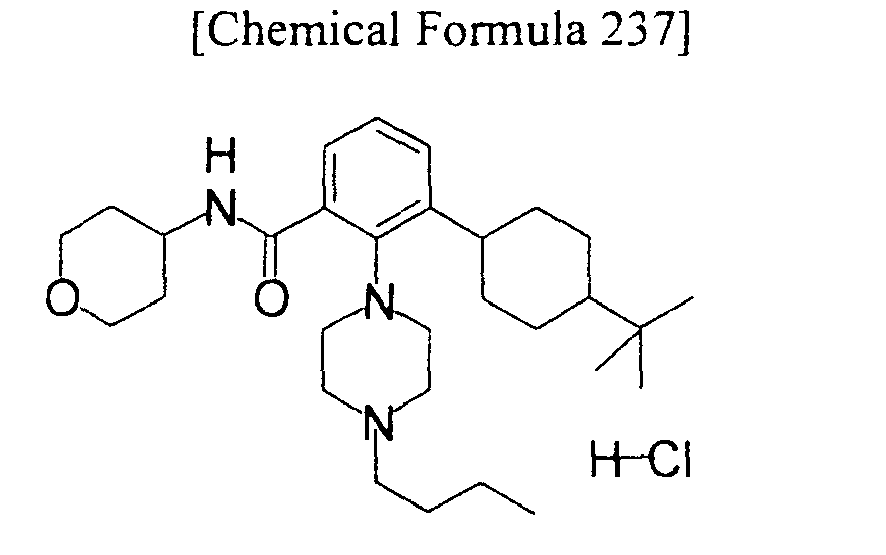
-


-

-

-

-

-

-

-

-

-

-

-

-

-

-

-

-
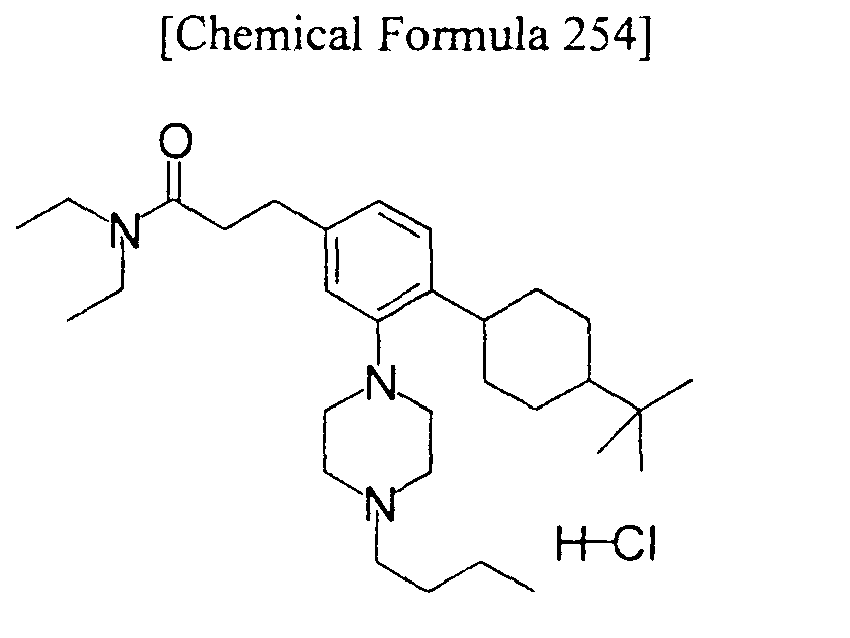
-


-

-

-

-

-

-

-

-

-


-

-

-


-

-

-


-

-

-

-

-

-

-

-

-

-

-


-

-

-

-

-

-

-

-

-

-

-

-

-

-

-


- Free form of the title compound:
1H-NMR (400MHz, CDCl3)
δ: 0.91 (s, 6H), 0.94 (t, J= 7.2Hz, 3H), 1.10 (s, 6H), 1.12-1.5 (m, 10H), 2.34-2.43 (m, 2H), 2.59 (brs, 4H), 2.93 (t, J= 4.0Hz, 4H), 3.35 (s, 3H), 3.36-3.48 (m, 3H), 3.50-3.56 (m, 2H), 6.45 (dd, J= 8.4, 2.8Hz, 1H), 6.52 (d, J= 2.8Hz, 1H), 7.04 (d, J= 8.4Hz, 1H).
The title compound, i.e. hydrochloride form:
MS m/e (ESI) 444(MH+). -

-

-

-

-

-

-

-

- Human fibronectin (Becton Dickinson Biosciences) was diluted with phosphate-buffered saline (hereinafter abbreviated as PBS; Sigma) to 0.1-0.01 µg/mL, and the diluted solution was added to a 96-well plate (Becton Dickinson) at 50 µL/well, and allowed to stand overnight at 4°C. On the following day, the supernatant was removed from the plate, and then PBS containing 1% bovine serum albumin (hereinafter abbreviated as BSA; Sigma) was added thereto at 100 µL/well and incubation was performed at 37°C for 2 hours in a CO2 incubator (Hirasawa).
- The supernatant was removed from each plate and Jurkat cells suspended in RPMI-1640 (Sigma) containing 1 mg/mL BSA were added at 80 µL/well for 2.5 x 10⁵ cells/well. The compound diluted to different concentrations with RPMI-1640 containing 1 mg/mL BSA was immediately added at 10 µL/well, and then 100 nM phorbol myristate acetate (hereinafter abbreviated as PMA; Sigma) in RPMI-1640 containing 1 mg/mL BSA was added at 10 µL/well and the plate was incubated in a CO2 incubator at 37°C for 45-60 minutes. The supernatant was removed from the plate and each well was washed several times with 100 µL/well of RPMI-1640, after which 50 mM citrate buffer (pH 5.0) containing 3.75 mM p-nitrophenol-N-acetyl-β-D-glucosaminide (Sigma) and 0.25% Triton X-100 (Sigma) were added at 60 µL/well, and the mixture was placed in a CO2 incubator and incubated at 37°C for 45 minutes. After incubation, 50 mM glycine buffer (pH 10.4) containing 5 mM EDTA was added at 90 µL/well, and the absorbance at 405 nm was measured with an EL340 Automated Microplate Reader (BIO-TEK) to determine the adhered cell count. The concentration of each compound which inhibited the increase in the number of adhered cells by the PMA-stimulation by 50% is shown as the IC50 (µM) in the table below.
-
[Table 1] Example No. IC50 (µM) 1 6.0 2 16.7 4 3.4 5 2.9 6 2.9 7 4.9 8 3.4 10 3.3 12 14.7 13 3.8 14 7.1 15 4.7 16 5.6 17 1.3 18 2.3 19 4.7 134 4.0 44 2.8 - To a plastic centrifugation tube containing 100 units of heparin sodium (Shimizu Pharmaceutical) was added 25 mL of fresh blood sampled from a healthy human. After adding and mixing therewith 8 mL of physiological saline (Otsuka Pharmaceutical) containing 6% Dextran (Nacalai), the mixture was allowed to stand at room temperature for 45 minutes for sedimentation of the erythrocytes. The resultant supernatant was transferred to another plastic centrifugation tube and combined with an equivalent volume of phosphate-buffered saline (hereinafter abbreviated as PBS; Sigma), and then centrifuged at 1600 rpm for 7 minutes at room temperature. The obtained hematocyte fraction was suspended in 4 mL of PBS, and the suspension was superposed on 4 mL of Ficoll-Paque™ PLUS (Amersham Biosciences). The resultant bilayer liquid was centrifuged at 2000 rpm for 30 minutes at room temperature, after which the supernatant was removed and the precipitate was suspended in 10 mL of PBS and centrifuged at 1200 rpm for 7 minutes, and the supernatant was removed. The resulting precipitate was suspended in 0.5 mL of PBS again, and then 10 mL of distilled water (Otsuka Pharmaceutical) was added, 0.5 mL of an aqueous solution containing 3 M NaCl was immediately added to restore isotonicity, the mixture was centrifuged at 1200 rpm for 7 minutes, and the obtained precipitate was suspended in PBS containing I mg/mL bovine serum albumin (hereinafter abbreviated as BSA; Sigma) again and stored in ice until being used for the experiment.
- The obtained neutrophils were suspended in PBS containing 1 mg/mL BSA at 2 x 10⁷ cells/mL. BCECF-AM (Dojin) was added to a final concentration of 5 µM, and the mixture was incubated at 37°C for 45 minutes. It was then rinsed twice with PBS containing 1 mg/mL BSA by centrifugation, suspended again in PBS containing 1 mg/mL BSA at 5 x 10⁷ cells/mL, and stored in ice until use.
- Human umbilical vein endothelial cells (hereinafter abbreviated as HUVEC) were suspended in MCDB131 medium (Chlorella Industries) containing 10% fetal calf serum and 30 µg/mL endothelial cell growth supplement (Becton Dickinson Bioscience). The suspension was added at 7.5 x 10³ cells/well to a 96-well plate (Iwaki) immobilized with type I collagen, and cultured for 3 days in a CO2 incubator (Hirasawa). Upon confirming confluency of the cells, the supernatant was discarded, the plate was rinsed twice with PBS, and then PBS containing 0.1% glutaraldehyde (Kanto Kagaku) was added at 100 µl/well and the HUVECs were immobilized for 5 minutes. The supernatant was discarded and the plate was washed twice with PBS, and then PBS was added at 100 µL/well and the mixture was stored at 4°C until use.
- To 6.5 mL of RPMI-1640 medium (Sigma) containing 1 mg/mL of BSA were added 0.5 mL of a suspension of BCECF-AM labeled neutrophils at 5 x 10⁷/mL stored in ice, which was mixed, and the mixture was added at 80 µL/well to a HUVEC immobilized plate. To this plate were immediately added 10 µl/well of a solution of the compound diluted at different concentrations with RPMI-1640 containing 1 mg/mL BSA, and 10 µl/well of 100 nM phorbol myristate acetate (hereinafter abbreviated as PMA; Sigma) in RPMI-1640 containing 1 mg/mL BSA, and the mixture was incubated in a CO2 incubator at 37°C for 45 minutes. The supernatant was removed from the plate, which was then washed several times with RPMI-1640 at 100 µl/well, and then PBS containing 0.1% NP-40 (Calbiochem) was added thereto at 100 µl/well and the fluorescent intensity was measured with an ARVOTMSX 1420 multi label counter (Wallac) to determine the number of adhered cells. The concentration of each compound which inhibited the increase in the number of adhered cells by the PMA-stimulation by 50% is shown as the IC50 (µM) in the table below.
-
[Table 2] Example No. IC50 (µM) 1 10.1 2 16.9 4 33.4 5 11.0 6 11.7 7 17.4 8 16.7 10 7.8 12 12.5 13 21.7 14 22.4 15 11.8 16 18.5 17 11.4 18 7.3 19 16.0 134 6.0 44 19.2 - Five- to six-week-old male Balb/c mice (Charles River Japan) were shaven at the abdomen to an approximately 2 cm square area. A 100% ethanol solution containing 3% 4-ethoxymethylene-2-phenyl-2-oxazolin-5-one (hereinafter referred to as "oxazolone"; Sigma) was applied at 150 µL onto the abdomen of each mouse.
- Distilled water (Otsuka Pharmaceutical) was added in an equivalent volume to 100% peanut oil (Kanto Kagaku) containing 1% oxazolone, and the components were vigorously mixed with a glass syringe (Top Co.), to prepare an emulsion containing 0.5% oxazolone.
- The mice were fasted on the 3rd day after oxazolone sensitization, and were challenged with 100 µL of the emulsion containing 0.5% oxazolone prepared in the way described above intrarectally at a site approximately 3 cm from the anus under ether anesthesia on the 4th day.
- Each compound was suspended or dissolved in an aqueous solution containing 0.5% methyl cellulose (Wako), and orally administered at 30 mg/kg 30 minutes prior to the intrarectal challenge of oxazolone emulsion.
Four hours after the intrarectal challenge of oxazolone, mice were sacrificed by cervical dislocation, and colons were extirpated, dissected in the longitudinal direction, washed with physiological saline, and transferred to ice-cooled plastic centrifugation tubes. After adding 1 mL of 50 mM potassium phosphate buffer (hereinafter abbreviated as KPB) (pH 6.0) to the tube, and the tissue were homogenized with PHYSCOTRON (Microtec Nition Co., Ltd.), 2 mL of 50 mM KPB (pH 6.0) was added and the mixture was centrifuged at 3000 rpm, 4°C for 10 minutes and the supernatant was removed. To the resultant precipitate was added 1 mL of 50 mM KPB (pH 6.0) containing 0.5% hexadecyltrimethyl-ammonium bromide (Sigma), and freeze-thawed 3 to 5 times using liquid nitrogen and hot water, centrifuged at 3000 rpm, 4°C for 10 minutes to yield a supernatant.
The myeloperoxidase enzyme activity in the supernatant was assayed in the following manner. Specifically, to 10 µL of the obtained supernatant was added 200 µL of 50 mM KPB (pH6.0) containing 0.017% o-dianisidine (Sigma) and 0.0005% hydrogen peroxide (Wako), incubated at 37°C, and the change in absorbance at 450 nm (the rate of change in absorbance per minute (mO.D./min.)) was continuously measured for 1 minute using an EL340 Automated Microplate Reader (BIO-TEK) in kinetic mode. The myeloperoxidase enzyme activity inhibitory rate (%) in each of the compound-administered groups in relation to the oxazolone control group (the oxazolone emulsion-intrarectally challenged/compound-free group) is shown in the table below. -
[Table 3] Example No. Ihibitory Rate (%) 1 69.0 5 3.0 6 48.0 7 24.0 134 18.0 44 38.0 - A 1-3% solution of dextran sulfate sodium (hereinafter abbreviated as DSS; ICN) in purified water (Otsuka Pharmaceutical) is fed freely to 6- to 7-week-old male Balb/c mice (Charles River Japan) for 5-7 days to induce colitis. Disease Activity Index (hereinafter abbreviated as DAI) scored based on fecal hardness, blood content in feces and body weight change, the number of neutrophils infiltrating the colon and the length of the colon are used as indexes to evaluate compounds. Each compound is suspended or dissolved in an aqueous solution containing 0.5% methyl cellulose (Wako), and orally administered at 30 mg/kg once a day, for 5-7 successive days.
- The compounds of the invention have excellent cell adhesion inhibitory action or cell infiltration inhibitory action, and can therefore serve as pharmaceuticals which are useful as therapeutic or prophylactic agents for various inflammatory diseases and autoimmune diseases associated with adhesion and infiltration of leukocytes, such as inflammatory bowel diseases (particularly ulcerative colitis or Crohn's disease), irritable bowel syndrome, rheumatoid arthritis, psoriasis, multiple sclerosis, asthma and atopic dermatitis.
Group W3 consists of hydroxyl, carboxyl, C2-7 alkoxyalkyl, C1-6 alkoxy substituted with a substituent selected from Group T1, phenoxy, C2-7 alkoxycarbonyl, C2-7 alkylcarbonyl, -NR6XR7X and -CO-NR6XR7X wherein R6X and R7X may be the same or different and each represents hydrogen or C1-6 alkyl. and
Group F1, Group G1, Group H1, Group W1, Group T1, Group V1, Group K1 and Group U1 have the same respective definitions as Group F1, Group G1, Group H1, Group W1, Group T1, Group V1, Group K1 and Group U1 in [1].
Claims (29)
- A compound represented by the following general formula (1), a salt thereof or a hydrate of the foregoing:

R30, R31 and R32 may be the same or different and each represents hydrogen, hydroxyl, halogen, cyano, carboxyl, C1-6 alkyl, C1-6 alkoxy or C2-7 alkoxycarbonyl, or
two of R30, R31 and R32 bond together to form oxo (=O) or methylene (-CH2-) and the other represents hydrogen, hydroxyl, halogen, cyano, carboxyl, C1-6 alkyl, C1-6 alkoxy or C2-7 alkoxycarbonyl,
R40 represents C1-10 alkyl optionally substituted with a substituent selected from Group D1, 3- to 8-membered cycloalkyl optionally substituted with a substituent selected from Group E1, a 4- to 8-membered heterocyclic group optionally substituted with a substituent selected from Group E1, C2-7 alkenyl optionally substituted with a substituent selected from Group F1, C2-7 alkynyl optionally substituted with a substituent selected from Group F1, C2-7 alkylcarbonyl optionally substituted with a substituent selected from Group G1, mono(C1-6 alkyl)aminocarbonyl, 4- to 8-membered heterocyclic carbonyl, C2-7 alkoxycarbonyl or C1-6 alkylsulfonyl,
n represents an integer of 0, 1 or 2,
X1 represents CH or nitrogen, and
R20, R21, R22 and R23 may be the same or different and each represents hydrogen, hydroxyl, halogen, nitro, cyano, carboxyl, C1-6 alkylthio optionally substituted with a substituent selected from Group F1 C2-7 alkoxycarbonyl, phenoxy, -SO3H, C1-6 alkyl optionally substituted with a substituent selected from Group W1, C1-6 alkyl optionally substituted with a substituent selected from Group K1, C1-6 alkoxy optionally substituted with a substituent selected from Group W1, a 4- to 8-membered heterocyclic group optionally substituted with a substituent selected from Group W1, a 4- to 8-membered heterocyclic group optionally substituted with a substituent selected from Group V1, a 5- to 10-membered heteroaryl ring group optionally substituted with a substituent selected from Group W1, a 6- to 10-membered aryl ring group optionally substituted with a substituent selected from Group W1, C2-7 alkenyl optionally substituted with a substituent selected from Group W1, C2-7 alkynyl optionally substituted with a substituent selected from Group W1, 3- to 8-membered cycloalkyl optionally substituted with a substituent selected from Group W1, 5- to 8-membered cycloalkenyl optionally substituted with a substituent selected from Group W1, -NR1XR2X, -CO-R1X, -CO-NR1XR2X, -NR1X-CO-R2X, -SO2-R3X or -O-SO2-R3X,
wherein R1X and R2X may be the same or different and each represents hydrogen, C1-6 alkyl optionally substituted with a substituent selected from Group U1 or a 4- to 8-membered heterocyclic group, and
R3X represents C1-6 alkyl optionally substituted with a substituent selected from Group F1; or
(i) R20 and R21, (ii) R21 and R22 or (iii) R22 and R23 bond together to form a ring selected from Group Z1,
wherein Group A1 consists of hydroxyl, halogen, cyano, C1-6 alkoxy, phenyl optionally substituted with a substituent selected from Group C1, C1-6 alkyl, C1-6 haloalkyl and C2-7 alkylene where C2-7 alkylene is permissible only in the case that a spiro union is formed together with the substituted 5- to 10-membered cycloalkyl or the substituted 5- to 10-membered cycloalkenyl,
Group C 1 consists of cyano, halogen, C1-6 alkyl and C1-6 alkoxy,
Group D1 consists of hydroxyl, halogen, cyano, C1-6 alkoxy, C1-6 alkylthio, C1-6 alkylsulfonyl, C1-6 alkylsulfinyl, mono(C1-6 alkyl)amino, di(C1-6 alkyl)amino, C2-7 alkylcarbonylamino, 3- to 8-membered cycloalkyl optionally substituted with a substituent selected from Group H1, C2-7 alkoxycarbonyl. carboxyl, a 4- to 8-membered heterocyclic group, a 5- to 10-membered heteroaryl ring group, a 6- to 10-membered aryl ring group, C2-7 alkylcarbonyl, 6- to 10-membered aryl ring carbonyl, aminocarbonyl, mono(C1-6 alkyl)aminocarbonyl optionally substituted with halogen, mono(3- to 8-membered cycloalkyl)aminocarbonyl, mono(C2-7 alkoxyalkyl)aminocarbonyl, di(C1-6 alkyl)aminocarbonyl, mono(5- to 10-membered heteroaryl ring)aminocarbonyl, 4-to 8-membered heterocyclic carbonyl optionally substituted with C1-6 alkyl, and 5-to 10-membered heteroaryl ring carbonyl,
Group E1 consists of halogen, C1-6 alkoxy, oxo (=O) and C1-6 alkyl,
Group F1 consists of halogen and C 1-6 alkoxy,
Group G1 consists of 3- to 8-membered cycloalkyl,
Group H 1 consists of hydroxyl, C1-6 haloalkyl, C1-6 alkyl, C2-7 alkoxyalkyl, mono(C1-6 alkyl)aminocarbonyl, di(C1-6 alkyl)aminocarbonyl, C2-7 alkoxycarbonyl, carboxyl and C2-7 cyanoalkyl,
Group W1 consists of halogen, hydroxyl, cyano, carboxyl, C1-6 alkyl, C2-7 alkoxyalkyl, C1-6 alkoxy optionally substituted with a substituent selected from Group T1, phenoxy, C2-7 alkoxycarbonyl, C2-7 alkylcarbonyl, -NR6XR7X and -CO-NR6XR7X wherein R6X and R7X may be the same or different and each represents hydrogen or C 1-6 alkyl,
Group T1 consists of C1-6 alkoxy, carboxyl, C2-7 alkoxycarbonyl and -CONR4XR5X wherein R4X and R5X may be the same or different and each represents hydrogen or C1-6 alkyl,
Group V1 consists of oxo (=O) and ethylenedioxy (-O-CH2CH2-O-) where ethylenedioxy is permissible only in the case that a spiro union is formed together with the substituted 4- to 8-membered heterocyclic group,
Group K1 consists of a 4- to 8-membered heterocyclic group,
Group U1 consists of carboxyl, C1-6 alkoxy, C2-7 alkoxycarbonyl, halogen, a 6- to 10-membered aryl ring group and -CO-NR8xR9x wherein R8x and R9x may be the same or di fferent and each represents hydrogen or C1-6 alkyl, and
Group Z1 consists of


with the proviso that a compound represented by the following formula:
- A compound represented by the following general formula (100), a salt thereof or a hydrate of the foregoing:


- The compound according to claim 1, the salt thereof or the hydrate of the foregoing, wherein R10 is 5- to 10-membered cycloalkyl optionally substituted with a substituent from Group A2, or 5- to 10-membered cycloalkenyl optionally substituted with a substituent from Group A2,
wherein Group A2 consists of hydroxyl, phenyl, C1-6 alkyl, C1-6 haloalkyl and C2-7 alkylene where C2-7 alkylene is permissible only in the case that a spiro union is formed together with the substituted 5- to 10-membered cycloalkyl or the substituted 5- to 10-membered cycloalkenyl. - The compound according to claim 1, the salt thereof or the hydrate of the foregoing, wherein R10 is 5- to 10-membered cycloalkyl optionally substituted with hydroxyl, phenyl, C1-6 alkyl, C1-6 haloalkyl, 1,2-ethylene, trimethylene, tetramethylene or pentamethylene, or 5- to 10-membered cycloalkenyl optionally substituted with hydroxyl, phenyl, C1-6 alkyl, C1-6 haloalkyl, 1,2-ethylene, trimethylene, tetramethylene or pentamethylene, where 1,2-ethylene, trimethylene, tetramethylene or pentamethylene is permissible only in the case that a spiro union is formed together with the 5- to 10-membered cycloalkyl or 5- to 10-membered cycloalkenyl.
- The compound according to claim 1, the salt thereof or the hydrate of the foregoing, wherein R10 is cyclohexyl, 4-t-butylcyclohexyl, 4,4-dimethylcyclohexyl; 4,4-diethylcyclohexyl, 3,3,5,5-tetramethylcyclohexyl, 3,5-dimethylcyclohexyl, 4-phenylcyclohexyl, 4-tritluoromethylcyclohexyl, 4-n-butylcyclohexyl, cyclopentyl, 3,3,4,4-tetramethylcyclopentyl, cycloheptyl, cyclooctyl, or a group represented by the following formula:

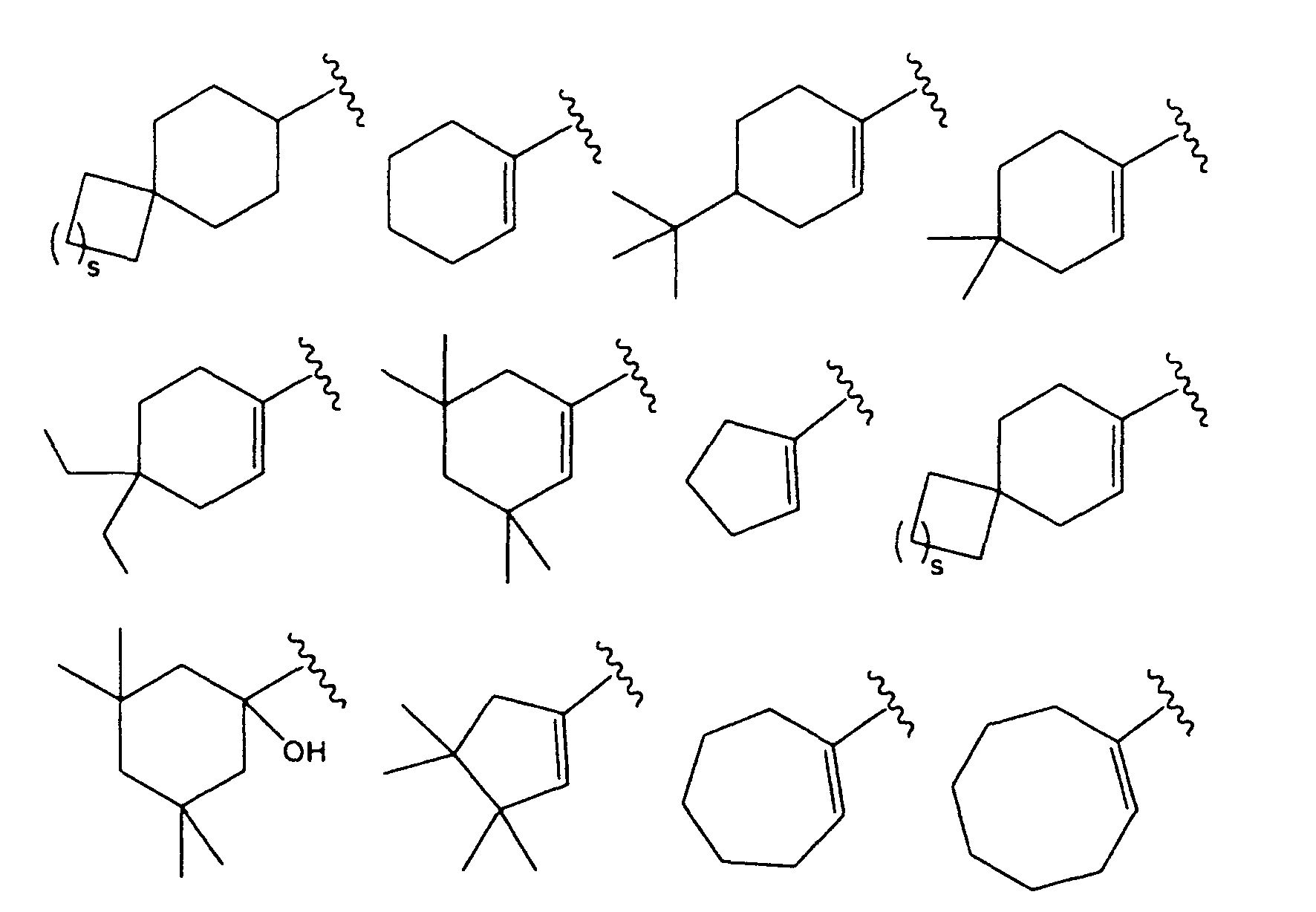
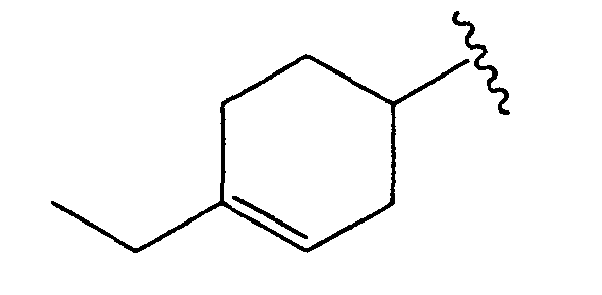
- The compound according to claim 1, the salt thereof or the hydrate of the foregoing, wherein R30, R31 and R32 may be the same or different and each represents hydrogen or C1-6 alkyl, or R30 and R31 bond together to form oxo (=O) and R32 is hydrogen or C1-6 alkyl.
- The compound according to claim 1. the salt thereof or the hydrate of the foregoing, wherein R30, R31 and R32 may be the same or different and each represents hydrogen or methyl, or R30 and R31 bond together to form oxo (=O) and R32 is hydrogen or methyl.
- The compound according to claim 1, the salt thereof or the hydrate of the foregoing, wherein R30, R31 and R32 are all hydrogen.
- The compound according to claim 1, the salt thereof or the hydrate of the foregoing, wherein R40 is C1-6 alkyl optionally substituted with a substituent selected from Group D1, 3- to 8-membered cycloalkyl optionally substituted with a substituent selected from Group E1, C2-7 alkenyl, C2-7 alkynyl or C2-7 alkylcarbonyl wherein Group D1 and Group E1 have the same respective definitions as Group D1 and Group E1 in claim 1.
- The compound according to claim 1. the salt thereof or the hydrate of the foregoing, wherein R40 is C1-6 alkyl optionally substituted with a substituent selected from Group D2.
wherein Group D2 consists of hydroxyl, halogen, cyano, C1-6 alkoxy, 3- to 8-membered cycloalkyl, a 4- to 8-membered heterocyclic group, mono(C1-6 alkyl)aminocarbonyl, di(C1-6 alkyl)aminocarbonyl, C2-7 alkylcarbonyl, a 5-membered heteroaryl ring group, 4- to 8-membered heterocyclic carbonyl and phenyl. - The compound according to claim 1, the salt thereof or the hydrate of the foregoing, wherein R40 is n-propyl, n-butyl, n-pentyl, isobutyl, ethylcarbonylmethyl, methoxyethyl, ethoxyethyl, cyclopropylmethyl or tetrahydropyran-4-ylmethyl.
- The compound according to claim 1, the salt thereof or the hydrate of the foregoing, wherein n is an integer of 1.
- The compound according to claim 1, the salt thereof or the hydrate of the foregoing, wherein X1 is nitrogen.
- The compound according to claim 1, the salt thereof or the hydrate of the foregoing, wherein (i) R20 and R21, (ii) R21 and R22 or (iii) R22 and R23 bond together to form a ring selected from Group Z1 wherein Group Z1 has the same definition as Group Z1 in claim 1.
- The compound according to claim 1, the salt thereof or the hydrate of the foregoing, wherein (i) R21 and R22 or (ii) R22 and R23 bond together to form a ring selected from Group Z2,
wherein Group Z2 consists of

- The compound according to claim 1, the salt thereof or the hydrate of the foregoing, wherein (i) R21 and R22 or (ii) R22 and R23 bond together to form a ring selected from Group Z3,
wherein Group Z3 consists of
- The compound according to claim 14, the salt thereof or the hydrate of the foregoing, wherein R20 and R23 are hydrogen.
- The compound according to claim 1, the salt thereof or the hydrate of the foregoing, wherein at least one of R20, R21, R22 and R23 is carboxyl, C1-6 alkylthio optionally substituted with a substituent selected from Group F1, C2-7 alkoxycarbonyl; phenoxy, -SO3H, C1-6 alkyl substituted with a substituent selected from Group W2, C1-6 alkyl substituted with a substituent selected from Group K1, C1-6 alkoxy substituted with a substituent selected from Group W2, a 4- to 8-membered heterocyclic group substituted with a substituent selected from Group W3, a 4- to 8-membered heterocyclic group substituted with a substituent selected from Group V1, a 5- to 10-membered heteroaryl ring group substituted with a substituent selected from Group W3, a 6- to 10-membered aryl ring group optionally substituted with a substituent selected from Group W1, C2-7 alkenyl optionally substituted with substituent selected from Group W1, C2-7 alkynyl optionally substituted with a substituent selected from Group W1, 3- to 8-membered cycloalkyl optionally substituted with a substituent selected from Group W1, 5- to 8-membered cycloalkenyl optionally substituted with a substituent selected from Group W1, -NR10XR2X, -CO-R11X, -CO-NR1XR2X, -NR1X-CO-R2X, -SO2-R3X or -O-SO2-R3x,
R1X and R2X may be the same or different and each represents hydrogen, C1-6 alkyl optionally substituted with a substituent selected from Group U1 or a 4-to 8-membered heterocyclic group,
R3X represents C1-6 alkyl optionally substituted with a substituent selected from Group F1,
R10X is C1-6 alkyl substituted with a substituent selected from Group U1, or a 4- to 8-membered heterocyclic group, and
R11X is hydrogen, C1-6 alkyl substituted with a substituent selected from Group U1, or a 4- to 8-membered heterocyclic group,
wherein Group W2 consists of hydroxyl, cyano, C1-6 alkyl, C2-7 alkoxyalkyl. C1-6 alkoxy optionally substituted with a substituent selected from Group T1, phenoxy, C2-7 alkylcarbonyl, -NR6XR7X and -CO-NR6XR7X wherein R 6X and R7X may be the same or different and each represents hydrogen or C1-6 alkyl,
Group W3 consists of hydroxyl, carboxyl, C2-7 alkoxyalkyl, C1-6 alkoxy substituted with a substituent selected from Group T1, , phenoxy, C2-7 alkoxycarbonyl, C2-7 alkylcarbonyl, -NR6XR7X and -CO-NR6XR7X wherein R6X and R7X may be the same or different and each represents hydrogen or C1-6 alkyl, and
Group F1, Group G1, Group H1, Group W1, Group T1, Group V1, Group K1 and Group U1 have the same respective definitions as Group F1, Group G1, Group H1, Group W1, Group T1, Group V1, Group K1 and Group U1 in claim 1. - The compound according to claim 1, the salt thereof or the hydrate of the foregoing, wherein one of R20, R21, R22 and R23 represents phenyl optionally substituted with one substituent selected from Group P, C2-7 alkenyl optionally substituted with one substituent selected from Group P, C2-7 alkynyl optionally substituted with one substituent selected from Group P, carboxyl, C1-6 alkylsulfonyloxy optionally having 1-3 fluorine, C1-6 alkylthio, C2-7 alkoxycarbonyl, C1-6 alkoxy-C1-6 alkoxy, C2-7 alkoxyalkyl, morpholin-4-yl-C 1-6 alkyl, pyrrolidin-1-yl optionally substituted with one substituent selected from Group Q, piperidin-1-yl optionally substituted with one substituent selected from Group Q, a group represented by the following formula:

wherein R80 represents hydrogen, C1-6 alkyl, C2-7 alkoxyalkyl or tetrahydropyran-4-yl,
R81 represents C2-7 alkoxyalkyl or tetrahydropyran-4-yl,
R82 represents C2-7 alkoxyalkyl or morpholin-4-yl,
R83 and R84 may be the same or different and each represents hydrogen, C1-6 alkyl, tetrahydropyran-4-yl or C2-7 alkoxyalkyl,
R85 represents hydrogen or C1-6 alkyl, and
R86 represents C1-6 alkyl,
wherein Group P consists of carboxyl, C2-7 alkoxycarbonyl, C2-7 alkoxyalkyl, C1-6 alkoxy and cyano, and
Group Q consists of carboxyl, C2-7 alkoxycarbonyl, C1-6 alkoxy-C1-6 alkoxy, carboxyl-C1-6 alkoxy, C2-7 alkoxyalkyl and hydroxyl. - The compound according to claim 1, the salt thereof or the hydrate of the foregoing, wherein one of R20, R21, R22 and R23 represents phenyl, C2-7 alkoxycarbonyl, C1-6 alkoxy-C1-6 alkoxy, C2-7 alkoxyalkyl, morpholin-4-yl-C1-6 alkyl, pyrrolidin-1-yl optionally having one substituent selected from Group R, piperidin-1-yl optionally having one substituent selected from Group R, a group represented by the following formula:

wherein R90 represents hydrogen, C1-6 alkyl, C2-7 alkoxyalkyl or tetrahydropyran-4-yl,
R91 represents C2-7 alkoxyalkyl or tetrahydropyran-4-yl,
R92 represents C2-7 alkoxyalkyl, and
R93 and R94 may be the same or different and each represents hydrogen or C1-6 alkyl,
wherein Group R consists of C1-6 alkoxy-C1-6 alkoxy and C2-7 alkoxyalkyl. - The compound according to claim 18, the salt thereof or the hydrate of the foregoing, wherein R20 is hydrogen.
- The compound according to claim 18, the salt thereof or the hydrate of the foregoing, wherein two of R20, R21, R22 and R23 are hydrogen, and one of the other two is hydrogen or C1-6 alkoxy.
- The compound according to claim 18, the salt thereof or the hydrate of the foregoing, wherein three of R20, R21, R22 and R23 are hydrogen.
- A medicament comprising the compound according to claim 1, the salt thereof or the hydrate of the foregoing.
- A cell adhesion or cell infiltration inhibitor comprising the compound according to claim 1, the salt thereof or the hydrate of the foregoing.
- A therapeutic or prophylactic agent for an inflammatory disease or an autoimmune disease, comprising the compound according to claim 1, the salt thereof or the hydrate of the foregoing.
- A therapeutic or prophylactic agent for an inflammatory bowel disease, irritable bowel syndrome, rheumatoid arthritis, psoriasis, multiple sclerosis, asthma or atopic dermatitis, comprising the compound according to claim 1, the salt thereof or the hydrate of the foregoing.
- A therapeutic or prophylactic agent for an inflammatory bowel disease, comprising the compound according to claim 1, the salt thereof or the hydrate of the foregoing.
- A therapeutic or prophylactic agent for ulcerative colitis or Crohn's disease, comprising the compound according to claim 1, the salt thereof or the hydrate of the foregoing.
Applications Claiming Priority (2)
| Application Number | Priority Date | Filing Date | Title |
|---|---|---|---|
| JP2005174072 | 2005-06-14 | ||
| PCT/JP2006/311900 WO2006134955A1 (en) | 2005-06-14 | 2006-06-14 | 1, 2-di(cyclic group)substituted benzene derivative |
Publications (2)
| Publication Number | Publication Date |
|---|---|
| EP1892238A1 true EP1892238A1 (en) | 2008-02-27 |
| EP1892238A4 EP1892238A4 (en) | 2011-03-09 |
Family
ID=37524859
Family Applications (1)
| Application Number | Title | Priority Date | Filing Date |
|---|---|---|---|
| EP06766669A Withdrawn EP1892238A4 (en) | 2005-06-14 | 2006-06-14 | 1, 2-di(cyclic group)substituted benzene derivative |
Country Status (14)
| Country | Link |
|---|---|
| US (2) | US20060281747A1 (en) |
| EP (1) | EP1892238A4 (en) |
| JP (1) | JPWO2006134955A1 (en) |
| KR (1) | KR20080016550A (en) |
| CN (2) | CN102040552A (en) |
| AU (1) | AU2006258599A1 (en) |
| BR (1) | BRPI0611635A2 (en) |
| CA (1) | CA2607054A1 (en) |
| IL (1) | IL187915A0 (en) |
| MY (1) | MY144974A (en) |
| NO (1) | NO20076020L (en) |
| NZ (1) | NZ563359A (en) |
| RU (1) | RU2407735C2 (en) |
| WO (1) | WO2006134955A1 (en) |
Families Citing this family (6)
| Publication number | Priority date | Publication date | Assignee | Title |
|---|---|---|---|---|
| US20060217371A1 (en) * | 2003-04-28 | 2006-09-28 | Olivier Bezencon | Diazabicyclononene and tetrahydropyriddine derivatives as renin inhibitors |
| US7410971B2 (en) * | 2003-12-26 | 2008-08-12 | Eisai R&D Management Co., Ltd. | 1,2-di(cyclic)substituted benzene compounds |
| US20060276465A1 (en) * | 2003-12-26 | 2006-12-07 | Eisai R&D Management Co., Ltd. | 1,2-di(cyclic) substituted benzene compounds |
| JP2014156442A (en) * | 2013-02-18 | 2014-08-28 | Nippon Rikagaku Kogyo Kk | Method of producing arylpiperazine derivatives or salts thereof |
| JP6480944B2 (en) * | 2014-01-09 | 2019-03-13 | オリオン コーポレーション | Bicyclic heterocyclic derivatives as bromodomain inhibitors |
| US10323024B2 (en) | 2016-01-15 | 2019-06-18 | Sumitomo Dainippon Pharma Co., Ltd. | Biheterocyclic compound |
Family Cites Families (10)
| Publication number | Priority date | Publication date | Assignee | Title |
|---|---|---|---|---|
| FR2678271B1 (en) * | 1991-06-27 | 1995-01-13 | Synthelabo | PYRIMIDINE-4-CARBOXAMIDE DERIVATIVES, THEIR PREPARATION AND THEIR THERAPEUTIC APPLICATION. |
| NZ240863A (en) * | 1991-09-11 | 1995-04-27 | Mcneilab Inc | Substituted 4-aryl piperidine and 4-aryl piperazine derivatives, preparation and pharmaceutical compositions thereof |
| US6509346B2 (en) * | 1998-01-21 | 2003-01-21 | Millennium Pharmaceuticals, Inc. | Chemokine receptor antagonists and methods of use therefor |
| US7271176B2 (en) * | 1998-09-04 | 2007-09-18 | Millennium Pharmaceuticals, Inc. | Chemokine receptor antagonists and methods of use thereof |
| US20020169155A1 (en) * | 1998-09-04 | 2002-11-14 | Millennium Pharmaceuticals, Inc. | Chemokine receptor anagonists and methods of use therefor |
| EP1370558B1 (en) * | 2001-01-23 | 2005-08-24 | Eli Lilly And Company | Piperazine- and piperidine-derivatives as melanocortin receptor agonists |
| FR2831166B1 (en) * | 2001-10-18 | 2004-02-27 | Sanofi Synthelabo | ARALKYL-TETRAHYDRO-PYRIDINES, THEIR PREPARATION AND PHARMACEUTICAL COMPOSITIONS CONTAINING THEM |
| FR2840896B1 (en) * | 2002-06-18 | 2005-04-08 | Sanofi Synthelabo | PHENYL AND PYRIDYL PIPERAZINES, PROCESS FOR THEIR PREPARATION AND PHARMACEUTICAL COMPOSITIONS CONTAINING SAME |
| US7410971B2 (en) * | 2003-12-26 | 2008-08-12 | Eisai R&D Management Co., Ltd. | 1,2-di(cyclic)substituted benzene compounds |
| MY140489A (en) * | 2003-12-26 | 2009-12-31 | Eisai R&D Man Co Ltd | 1,2-di (cyclic) substituted benzene compounds |
-
2006
- 2006-06-13 MY MYPI20062769A patent/MY144974A/en unknown
- 2006-06-14 CN CN2010105859210A patent/CN102040552A/en active Pending
- 2006-06-14 AU AU2006258599A patent/AU2006258599A1/en not_active Abandoned
- 2006-06-14 US US11/453,194 patent/US20060281747A1/en not_active Abandoned
- 2006-06-14 BR BRPI0611635-3A patent/BRPI0611635A2/en not_active IP Right Cessation
- 2006-06-14 US US11/917,542 patent/US20090156589A1/en not_active Abandoned
- 2006-06-14 RU RU2008101457/04A patent/RU2407735C2/en not_active IP Right Cessation
- 2006-06-14 EP EP06766669A patent/EP1892238A4/en not_active Withdrawn
- 2006-06-14 WO PCT/JP2006/311900 patent/WO2006134955A1/en not_active Ceased
- 2006-06-14 CN CNA2006800164630A patent/CN101175723A/en active Pending
- 2006-06-14 JP JP2007521314A patent/JPWO2006134955A1/en not_active Withdrawn
- 2006-06-14 CA CA002607054A patent/CA2607054A1/en not_active Abandoned
- 2006-06-14 NZ NZ563359A patent/NZ563359A/en not_active IP Right Cessation
- 2006-06-14 KR KR1020077026256A patent/KR20080016550A/en not_active Withdrawn
-
2007
- 2007-11-22 NO NO20076020A patent/NO20076020L/en not_active Application Discontinuation
- 2007-12-05 IL IL187915A patent/IL187915A0/en unknown
Also Published As
| Publication number | Publication date |
|---|---|
| NO20076020L (en) | 2008-03-14 |
| NZ563359A (en) | 2010-03-26 |
| CA2607054A1 (en) | 2006-12-21 |
| US20060281747A1 (en) | 2006-12-14 |
| CN101175723A (en) | 2008-05-07 |
| RU2008101457A (en) | 2009-07-20 |
| WO2006134955A1 (en) | 2006-12-21 |
| IL187915A0 (en) | 2008-03-20 |
| RU2407735C2 (en) | 2010-12-27 |
| CN102040552A (en) | 2011-05-04 |
| JPWO2006134955A1 (en) | 2009-01-08 |
| EP1892238A4 (en) | 2011-03-09 |
| US20090156589A1 (en) | 2009-06-18 |
| KR20080016550A (en) | 2008-02-21 |
| MY144974A (en) | 2011-11-30 |
| BRPI0611635A2 (en) | 2010-09-21 |
| AU2006258599A1 (en) | 2006-12-21 |
Similar Documents
| Publication | Publication Date | Title |
|---|---|---|
| EP1698620B1 (en) | Benzene compounds disubstituted with cyclic groups at the 1- and 2-positions | |
| JP7846113B2 (en) | Substituted piperidino compounds and related therapeutic methods | |
| DE69303191T2 (en) | Naphthalene derivatives, their manufacturing processes and synthetic intermediates therefor | |
| KR20150013215A (en) | Substituted pyrrolidine-2-carboxamides | |
| CA2088490A1 (en) | 3-substituted piperidine derivatives | |
| RU2407735C2 (en) | Benzene derivative substituted with 1,2-di(cyclic group) | |
| DE60006825T2 (en) | SEROTONERGE BENZOFURANE | |
| US20060276465A1 (en) | 1,2-di(cyclic) substituted benzene compounds | |
| US4094987A (en) | 2-(3-m-hydroxy-phenyl-1-substituted-3-pyrrolidinyl)-ethanols | |
| US7410971B2 (en) | 1,2-di(cyclic)substituted benzene compounds | |
| CA1077479A (en) | 1-substituted-3-aminoethoxypyrrolidines | |
| MX2007015506A (en) | 1, 2-di(cyclic group)substituted benzene derivative. | |
| HK1094201B (en) | Benzene compounds disubstituted with cyclic groups at the 1-and 2-positions | |
| HK1094201A (en) | Benzene compounds disubstituted with cyclic groups at the 1-and 2-positions | |
| MXPA02005982A (en) | Inhibitors of interleukin 5 gene expression. | |
| EP0276194A1 (en) | 2,1-Benzothiazepine-2,2-dioxide-5-carboxylic acid derivatives | |
| DE19757627A1 (en) | Azulene derivatives, process for their preparation and pharmaceutical composition containing these compounds |
Legal Events
| Date | Code | Title | Description |
|---|---|---|---|
| PUAI | Public reference made under article 153(3) epc to a published international application that has entered the european phase |
Free format text: ORIGINAL CODE: 0009012 |
|
| 17P | Request for examination filed |
Effective date: 20071122 |
|
| AK | Designated contracting states |
Kind code of ref document: A1 Designated state(s): AT BE BG CH CY CZ DE DK EE ES FI FR GB GR HU IE IS IT LI LT LU LV MC NL PL PT RO SE SI SK TR |
|
| AX | Request for extension of the european patent |
Extension state: AL BA HR MK YU |
|
| RAX | Requested extension states of the european patent have changed |
Extension state: RS Payment date: 20071122 Extension state: MK Payment date: 20071122 Extension state: HR Payment date: 20071122 Extension state: BA Payment date: 20071122 Extension state: AL Payment date: 20071122 |
|
| A4 | Supplementary search report drawn up and despatched |
Effective date: 20110204 |
|
| STAA | Information on the status of an ep patent application or granted ep patent |
Free format text: STATUS: THE APPLICATION HAS BEEN WITHDRAWN |
|
| 18W | Application withdrawn |
Effective date: 20110511 |