EP1892231A1 - A large scale method for the deoxofluorination of ketones - Google Patents
A large scale method for the deoxofluorination of ketones Download PDFInfo
- Publication number
- EP1892231A1 EP1892231A1 EP06076607A EP06076607A EP1892231A1 EP 1892231 A1 EP1892231 A1 EP 1892231A1 EP 06076607 A EP06076607 A EP 06076607A EP 06076607 A EP06076607 A EP 06076607A EP 1892231 A1 EP1892231 A1 EP 1892231A1
- Authority
- EP
- European Patent Office
- Prior art keywords
- reaction
- reaction chamber
- ketone
- mixture
- trifluoride
- Prior art date
- Legal status (The legal status is an assumption and is not a legal conclusion. Google has not performed a legal analysis and makes no representation as to the accuracy of the status listed.)
- Withdrawn
Links
- 238000000034 method Methods 0.000 title claims abstract description 33
- 150000002576 ketones Chemical class 0.000 title claims abstract description 28
- 238000006243 chemical reaction Methods 0.000 claims abstract description 79
- 239000000203 mixture Substances 0.000 claims abstract description 40
- 238000004519 manufacturing process Methods 0.000 claims abstract description 14
- ZQXCQTAELHSNAT-UHFFFAOYSA-N 1-chloro-3-nitro-5-(trifluoromethyl)benzene Chemical compound [O-][N+](=O)C1=CC(Cl)=CC(C(F)(F)F)=C1 ZQXCQTAELHSNAT-UHFFFAOYSA-N 0.000 claims abstract description 13
- 150000001875 compounds Chemical class 0.000 claims abstract description 10
- 239000007864 aqueous solution Substances 0.000 claims abstract description 5
- 238000010791 quenching Methods 0.000 claims abstract description 3
- CSJLBAMHHLJAAS-UHFFFAOYSA-N diethylaminosulfur trifluoride Chemical group CCN(CC)S(F)(F)F CSJLBAMHHLJAAS-UHFFFAOYSA-N 0.000 claims description 58
- YXFVVABEGXRONW-UHFFFAOYSA-N Toluene Chemical compound CC1=CC=CC=C1 YXFVVABEGXRONW-UHFFFAOYSA-N 0.000 claims description 17
- HEMHJVSKTPXQMS-UHFFFAOYSA-M Sodium hydroxide Chemical compound [OH-].[Na+] HEMHJVSKTPXQMS-UHFFFAOYSA-M 0.000 claims description 12
- 239000000243 solution Substances 0.000 claims description 6
- KDPQTPZDVJHMET-UHFFFAOYSA-N 3-acetoxy-1,3,5(10)-estratrien-17-one Natural products C1CC2(C)C(=O)CCC2C2CCC3=CC(OC(=O)C)=CC=C3C21 KDPQTPZDVJHMET-UHFFFAOYSA-N 0.000 claims description 5
- KDPQTPZDVJHMET-XSYGEPLQSA-N [(8r,9s,13s,14s)-13-methyl-17-oxo-7,8,9,11,12,14,15,16-octahydro-6h-cyclopenta[a]phenanthren-3-yl] acetate Chemical compound C1C[C@]2(C)C(=O)CC[C@H]2[C@@H]2CCC3=CC(OC(=O)C)=CC=C3[C@H]21 KDPQTPZDVJHMET-XSYGEPLQSA-N 0.000 claims description 5
- 229960003399 estrone Drugs 0.000 claims description 4
- DNXHEGUUPJUMQT-UHFFFAOYSA-N (+)-estrone Natural products OC1=CC=C2C3CCC(C)(C(CC4)=O)C4C3CCC2=C1 DNXHEGUUPJUMQT-UHFFFAOYSA-N 0.000 claims description 3
- APOYTRAZFJURPB-UHFFFAOYSA-N 2-methoxy-n-(2-methoxyethyl)-n-(trifluoro-$l^{4}-sulfanyl)ethanamine Chemical compound COCCN(S(F)(F)F)CCOC APOYTRAZFJURPB-UHFFFAOYSA-N 0.000 claims description 3
- 150000002148 esters Chemical class 0.000 claims description 3
- 239000003960 organic solvent Substances 0.000 claims description 3
- 239000011541 reaction mixture Substances 0.000 claims description 3
- 238000010438 heat treatment Methods 0.000 claims description 2
- 239000011736 potassium bicarbonate Substances 0.000 claims description 2
- 229910000028 potassium bicarbonate Inorganic materials 0.000 claims description 2
- TYJJADVDDVDEDZ-UHFFFAOYSA-M potassium hydrogencarbonate Chemical compound [K+].OC([O-])=O TYJJADVDDVDEDZ-UHFFFAOYSA-M 0.000 claims description 2
- 230000000171 quenching effect Effects 0.000 claims description 2
- 125000003719 estrone group Chemical group 0.000 claims 2
- 239000000047 product Substances 0.000 description 8
- 239000003153 chemical reaction reagent Substances 0.000 description 7
- 239000012530 fluid Substances 0.000 description 6
- 238000000354 decomposition reaction Methods 0.000 description 5
- 238000003682 fluorination reaction Methods 0.000 description 4
- 230000002349 favourable effect Effects 0.000 description 3
- 125000001153 fluoro group Chemical group F* 0.000 description 3
- 229910001220 stainless steel Inorganic materials 0.000 description 3
- 239000010935 stainless steel Substances 0.000 description 3
- IJGRMHOSHXDMSA-UHFFFAOYSA-N Atomic nitrogen Chemical compound N#N IJGRMHOSHXDMSA-UHFFFAOYSA-N 0.000 description 2
- DNXHEGUUPJUMQT-CBZIJGRNSA-N Estrone Chemical compound OC1=CC=C2[C@H]3CC[C@](C)(C(CC4)=O)[C@@H]4[C@@H]3CCC2=C1 DNXHEGUUPJUMQT-CBZIJGRNSA-N 0.000 description 2
- YCKRFDGAMUMZLT-UHFFFAOYSA-N Fluorine atom Chemical compound [F] YCKRFDGAMUMZLT-UHFFFAOYSA-N 0.000 description 2
- 150000001299 aldehydes Chemical class 0.000 description 2
- 229910052731 fluorine Inorganic materials 0.000 description 2
- 239000011737 fluorine Substances 0.000 description 2
- 150000002243 furanoses Chemical class 0.000 description 2
- 239000000543 intermediate Substances 0.000 description 2
- 239000007788 liquid Substances 0.000 description 2
- 230000001105 regulatory effect Effects 0.000 description 2
- 239000000126 substance Substances 0.000 description 2
- QTBSBXVTEAMEQO-UHFFFAOYSA-M Acetate Chemical compound CC([O-])=O QTBSBXVTEAMEQO-UHFFFAOYSA-M 0.000 description 1
- 229920013685 Estron Polymers 0.000 description 1
- KRHYYFGTRYWZRS-UHFFFAOYSA-N Fluorane Chemical compound F KRHYYFGTRYWZRS-UHFFFAOYSA-N 0.000 description 1
- LFOMGBBERKOUPQ-UHFFFAOYSA-N NS(F)(F)F Chemical class NS(F)(F)F LFOMGBBERKOUPQ-UHFFFAOYSA-N 0.000 description 1
- 239000002253 acid Substances 0.000 description 1
- 150000001260 acyclic compounds Chemical class 0.000 description 1
- 125000003172 aldehyde group Chemical group 0.000 description 1
- 239000003513 alkali Substances 0.000 description 1
- 230000004075 alteration Effects 0.000 description 1
- 150000001491 aromatic compounds Chemical class 0.000 description 1
- 239000006227 byproduct Substances 0.000 description 1
- 239000003795 chemical substances by application Substances 0.000 description 1
- 150000001923 cyclic compounds Chemical class 0.000 description 1
- 238000005796 dehydrofluorination reaction Methods 0.000 description 1
- 238000005474 detonation Methods 0.000 description 1
- 230000008030 elimination Effects 0.000 description 1
- 238000003379 elimination reaction Methods 0.000 description 1
- 239000012467 final product Substances 0.000 description 1
- 239000012025 fluorinating agent Substances 0.000 description 1
- 239000007789 gas Substances 0.000 description 1
- 229910000040 hydrogen fluoride Inorganic materials 0.000 description 1
- 125000002887 hydroxy group Chemical group [H]O* 0.000 description 1
- 239000012535 impurity Substances 0.000 description 1
- 239000011261 inert gas Substances 0.000 description 1
- 229940126601 medicinal product Drugs 0.000 description 1
- 229910052757 nitrogen Inorganic materials 0.000 description 1
- QGZKDVFQNNGYKY-NJFSPNSNSA-N nitrogen-16 Chemical compound [16NH3] QGZKDVFQNNGYKY-NJFSPNSNSA-N 0.000 description 1
- 239000003758 nuclear fuel Substances 0.000 description 1
- 239000011148 porous material Substances 0.000 description 1
- 239000002244 precipitate Substances 0.000 description 1
- 230000035484 reaction time Effects 0.000 description 1
- 239000002904 solvent Substances 0.000 description 1
Images
Classifications
-
- B—PERFORMING OPERATIONS; TRANSPORTING
- B01—PHYSICAL OR CHEMICAL PROCESSES OR APPARATUS IN GENERAL
- B01J—CHEMICAL OR PHYSICAL PROCESSES, e.g. CATALYSIS OR COLLOID CHEMISTRY; THEIR RELEVANT APPARATUS
- B01J19/00—Chemical, physical or physico-chemical processes in general; Their relevant apparatus
- B01J19/24—Stationary reactors without moving elements inside
- B01J19/2415—Tubular reactors
-
- B—PERFORMING OPERATIONS; TRANSPORTING
- B01—PHYSICAL OR CHEMICAL PROCESSES OR APPARATUS IN GENERAL
- B01J—CHEMICAL OR PHYSICAL PROCESSES, e.g. CATALYSIS OR COLLOID CHEMISTRY; THEIR RELEVANT APPARATUS
- B01J14/00—Chemical processes in general for reacting liquids with liquids; Apparatus specially adapted therefor
-
- B—PERFORMING OPERATIONS; TRANSPORTING
- B01—PHYSICAL OR CHEMICAL PROCESSES OR APPARATUS IN GENERAL
- B01J—CHEMICAL OR PHYSICAL PROCESSES, e.g. CATALYSIS OR COLLOID CHEMISTRY; THEIR RELEVANT APPARATUS
- B01J19/00—Chemical, physical or physico-chemical processes in general; Their relevant apparatus
- B01J19/24—Stationary reactors without moving elements inside
- B01J19/2415—Tubular reactors
- B01J19/243—Tubular reactors spirally, concentrically or zigzag wound
-
- C—CHEMISTRY; METALLURGY
- C07—ORGANIC CHEMISTRY
- C07B—GENERAL METHODS OF ORGANIC CHEMISTRY; APPARATUS THEREFOR
- C07B39/00—Halogenation
-
- C—CHEMISTRY; METALLURGY
- C07—ORGANIC CHEMISTRY
- C07C—ACYCLIC OR CARBOCYCLIC COMPOUNDS
- C07C17/00—Preparation of halogenated hydrocarbons
- C07C17/093—Preparation of halogenated hydrocarbons by replacement by halogens
- C07C17/18—Preparation of halogenated hydrocarbons by replacement by halogens of oxygen atoms of carbonyl groups
-
- B—PERFORMING OPERATIONS; TRANSPORTING
- B01—PHYSICAL OR CHEMICAL PROCESSES OR APPARATUS IN GENERAL
- B01J—CHEMICAL OR PHYSICAL PROCESSES, e.g. CATALYSIS OR COLLOID CHEMISTRY; THEIR RELEVANT APPARATUS
- B01J2219/00—Chemical, physical or physico-chemical processes in general; Their relevant apparatus
- B01J2219/00002—Chemical plants
- B01J2219/00004—Scale aspects
- B01J2219/00011—Laboratory-scale plants
- B01J2219/00013—Miniplants
-
- B—PERFORMING OPERATIONS; TRANSPORTING
- B01—PHYSICAL OR CHEMICAL PROCESSES OR APPARATUS IN GENERAL
- B01J—CHEMICAL OR PHYSICAL PROCESSES, e.g. CATALYSIS OR COLLOID CHEMISTRY; THEIR RELEVANT APPARATUS
- B01J2219/00—Chemical, physical or physico-chemical processes in general; Their relevant apparatus
- B01J2219/00002—Chemical plants
- B01J2219/00027—Process aspects
- B01J2219/00038—Processes in parallel
-
- B—PERFORMING OPERATIONS; TRANSPORTING
- B01—PHYSICAL OR CHEMICAL PROCESSES OR APPARATUS IN GENERAL
- B01J—CHEMICAL OR PHYSICAL PROCESSES, e.g. CATALYSIS OR COLLOID CHEMISTRY; THEIR RELEVANT APPARATUS
- B01J2219/00—Chemical, physical or physico-chemical processes in general; Their relevant apparatus
- B01J2219/00049—Controlling or regulating processes
- B01J2219/00164—Controlling or regulating processes controlling the flow
- B01J2219/00166—Controlling or regulating processes controlling the flow controlling the residence time inside the reactor vessel
Definitions
- the present invention refers to a large scale method for making compounds having geminal fluorine atoms, more particularly it refers to a method comprising the use of diethylaminosulfur trifluoride (DAST) and analogues thereof for the deoxofluorination of ketones to obtain geminal difluoride compounds, said method being performed in an industrial scale.
- DAST diethylaminosulfur trifluoride
- the present invention further refers to a reaction system for the production in an industrial scale of a geminal difluoride compound and to the use of said reaction system for the deoxofluorination of a ketone by means of a dialkylaminosulfur trifluoride.
- Fluorination is a common reaction step in which one or more fluorine atoms or fluorinated groups are added to a compound using reagents which act as donors of such fluorine atoms or fluorinated groups.
- fluorinating reagents in the form of a liquid or of a gas are known in the art, for example fluorine in its elementary form, hydrogen fluoride acid, SF 4 , dialkylaminosulfur trifluorides and analogues thereof.
- fluorine in its elementary form hydrogen fluoride acid
- SF 4 dialkylaminosulfur trifluorides
- the most common reaction is monofluorination, not so common is a geminal difluorination and even more unusual a trifluorination.
- the geminal difluoride group can confer to the desired product special properties over those usually offered by a monofluorinated molecule.
- a geminal difluoride group can be advantageously used for further reactions like for example a dehydrofluorination in a intermediate step to the final product.
- Geminal difluorination is usually achieved by means of a deoxoflurination reaction that when performed on a aldehyde group result in a terminal difluoride group; starting from a ketone a difluoride group will be obtained.
- a class of reagent which is commonly used to perform deoxofluorination reactions is the one of the dialkylaminosulfur trifluorides.
- the most common reagent of this class is diethylaminosulfur trifluoride (Et-DAST or simply DAST).
- DAST and DAST analogues have proven to be useful reagents for effecting deoxofluorinations; DAST and DAST analogues are liquids which can be used at atmospheric pressure and at near ambient to relatively low temperature (room temperature or below) for most applications.
- DAST and DAST analogues are normally carried out at room temperature or higher.
- Numerous structurally diverse aldehydes and ketones have been successfully fluorinated with DAST. These include acyclic, cyclic, and aromatic compounds. Elimination does occur to a certain extent when aldehydes and ketones are fluorinated and olefinic byproducts are also observed in these instances.
- DAST compounds can decompose violently, they are known in the art to be unpractical for large scale industrial use in view of security reason.
- EP 1172369 A describes a process for deoxofluorinating a C2-hydroxyl group of a furanose, including: (a) mixing the furanose and a deoxofluorinating agent in a solvent to form a reaction mixture, and (b) heating the reaction mixture to greater than about 50°C, particularly at 90°C for two hours.
- EP 1172369 A describes only the deoxofluorination of a hydroxyl group which requires a very limited amount of DAST.
- the deoxofluorination of a ketone requires a molar ratio of DAST which is usually more than the double in respect to the ketone.
- a method for fluorination reactions is described in EP 1028801 A (BRITISH NUCLEAR FUELS PLC (GB)).
- Said method comprises carrying out a chemical reaction between at least two fluids, by providing respective flow paths for the at least two fluids, said flow paths communicating with each other in a region in which the at least two fluids may contact each other, and flowing the at least two fluids along said flow paths such that in said region the at least two fluids contact each other and a chemical reaction occurs between them, said region having a width perpendicular to the direction of flow in the range 10-10,000 micrometers.
- microreactor that is a reactor having dimensions perpendicular to the flow direction of less than 10,000 micrometers, an improved control over a fluid chemical reaction and better product's yield and/or purity can be obtained.
- a method or a reaction system intended for industrial scale or large scale is a method or reaction system suited for the production of batches of active compound to be used for the manufacture of the final medicinal product.
- the object of the present invention is a method for the deoxofluorination of ketones for the production of geminal difluoride in an industrial scale according to the independent claim 1.
- Claims 2 to 12 refer to particularly favourable forms of embodiment of the method according to the invention.
- a further object of the present invention is a reaction system for the production of a geminal difluoride compound in an industrial scale according to independent claim 13.
- Claims 13 to 19 refer to advantageous forms of embodiment according to the reaction system of claim 13.
- a third object of the present invention is the use of a reaction system according to claims 13-19 for the deoxofluorination of a ketone for the production in an industrial scale of a geminal difluoride product by means of a dialkylaminosulfur trifluoride according to independent claim 20.
- the method and the reaction system according to the present invention allow to perform a deoxofluorination reaction in an industrial scale which under the usual methods and known reaction devices would not be possible due to safety reasons.
- the present method and reaction system can be used in all the fluorination reaction with DAST or DAST-analogues which have to be performed above the handling temperature of DAST or DAST analogues.
- the handling temperature is considered as the temperature at which the use of the reagent can be performed without decomposition and quality alterations and is usually considered around 80 °C under the decomposition temperature of said reagent.
- the method and the reaction system according to the invention are used in the chemical and pharmaceutical industry for the production of compounds or intermediates in an industrial scale.
- fluorination and deoxofluorination reaction with DAST or DAST-Analogues which have to be carried out above the handling temperature can be performed in an industrial scale.
- the method according to the invention comprises the following steps:
- a ketone and a dialkylaminosulfur trifluoride are mixed continuously directly before the reaction chamber to form the educt mixture.
- the dialkylaminosulfur trifluoride used in the educt mixture is preferably diethylaminosulfur trifluoride or bis(2-methoxyethyl)-aminosulfur trifluoride.
- the ketone is preferably estrone or an ester thereof, particularly estrone acetate.
- the educt mixture can further comprise an organic solvent, preferably toluene.
- the educt mixture Before entering in the reaction chamber, the educt mixture is advantageously filtered, this avoids the blockage of the reaction system due to precipitates or impurities in the mixture.
- the educt mixture and the reaction system in use are kept under pressure between 0.05 to 10 bar above ambient pressure, preferably under a pressure between 0.1 to 0.5 bar above ambient pressure to assure a constant flow in the system, this can be achieved by using a pressure valve after the reaction chamber for example or by means of a pump placed before the reaction chamber.
- the length of the reaction chamber is comprised between 1 and 30 meters and the diameter between 1 to 10 mm.
- the total volume of the reaction chamber is advantageously between 0.1 to 10 litres, preferably between 0.2 to 2 litres.
- the reaction chamber is for example a spirally wound stainless steel tube.
- the flow rate of the educt mixture within the reaction chamber can favourably be between 0.1 and 10 litres per hour, preferably between 0.2 to 1 litre per hour, while the residence time of the educt mixture in the reaction chamber can be between 0.1 and 10 hours, preferably between 0.5 and 2 hours.
- reaction system in use is kept advantageously under inert condition by means of an inert gas, for example under nitrogen
- ketones for the production of geminal difluoride in an industrial scale according to the invention can be favourably performed in a system according to Figure 2, having three reaction systems (a), (b) and (c) set in parallel according to a particular form of embodiment of the present invention.
- a reaction system (a) comprises at least one reservoir 1a for the educt mixture or according to a further form of embodiment a reservoir filled with a ketone and a reservoir filled with a diethylaminosulfur trifluoride as such or as a solution in an organic solvent which are mixed continuously to form the educt mixture.
- the reaction system (a) further comprises the reaction chamber 3a which is continuously fed with the educt mixture.
- the flow of the educt mixture is regulated by a pump 2a to the reaction chamber 3a.
- a filter 5a for example a sintered stainless steel filter with pores of 5 to 50 ⁇ m.
- the reaction chambers 3a-c are advantageously made of a stainless steel tube of about 18 m with a volume of about 0.5
- the reaction chamber 3a is kept at a temperature of about 90°C by an oil bath 7a with the temperature monitored and regulated by a thermometer 4a.
- the product mixture in exit of the reaction chamber 3a is monitored by an infrared detector 15 and is finally quenched by an aqueous alkali solution contained in the reservoir 17, for example a KHCO 3 or a NaOH solution, in a cooled reservoir vessel 12 a-b.
- an aqueous alkali solution contained in the reservoir 17 for example a KHCO 3 or a NaOH solution
- the reaction system according to the invention can further comprise an extra toluol reservoir 13 and is preferably kept under nitrogen 16 at a pressure between 0.05 to 10 bar, preferably of 0.2 bar, above ambient pressure.
- At least one valve 18a can be inserted in the reaction system to control the flow and the pressure in the reaction system.
- Each reactor chamber comprises an inside volume of 0.5 litre.
- the system is kept working under a pressure of 0.2 bar above ambient pressure and under inert conditions.
- the obtained difluoride product is purified according procedures well known in art.
- the method and the reaction system according to the invention allows an high productivity of a geminal difluoride derivative due to the round-the-clock operating possibilities and the numbering up of the reaction chambers.
Landscapes
- Chemical & Material Sciences (AREA)
- Organic Chemistry (AREA)
- Chemical Kinetics & Catalysis (AREA)
- Steroid Compounds (AREA)
- Organic Low-Molecular-Weight Compounds And Preparation Thereof (AREA)
Abstract
A method for the deoxofluorination of a ketone for the production of a geminal difluoride compound in an industrial scale comprising the following steps:
- preparing an educt mixture comprising a ketone and a dialkylaminosulfur trifluoride,
- letting flow the educt mixture into a reaction chamber of defined length, diameter and volume, with a flow path having a width perpendicular to the direction of the flow in the range of 1-10 mm, at a temperature of at least 75 °C up to 120 °C, preferably between 80 and 100 °C, to perform the deoxofluorination reaction and obtaining a product mixture
- to quench the product mixture with a basic aqueous solution in a cooled reservoir vessel.
- preparing an educt mixture comprising a ketone and a dialkylaminosulfur trifluoride,
- letting flow the educt mixture into a reaction chamber of defined length, diameter and volume, with a flow path having a width perpendicular to the direction of the flow in the range of 1-10 mm, at a temperature of at least 75 °C up to 120 °C, preferably between 80 and 100 °C, to perform the deoxofluorination reaction and obtaining a product mixture
- to quench the product mixture with a basic aqueous solution in a cooled reservoir vessel.
Description
- The present invention refers to a large scale method for making compounds having geminal fluorine atoms, more particularly it refers to a method comprising the use of diethylaminosulfur trifluoride (DAST) and analogues thereof for the deoxofluorination of ketones to obtain geminal difluoride compounds, said method being performed in an industrial scale.
- The present invention further refers to a reaction system for the production in an industrial scale of a geminal difluoride compound and to the use of said reaction system for the deoxofluorination of a ketone by means of a dialkylaminosulfur trifluoride.
- Fluorination is a common reaction step in which one or more fluorine atoms or fluorinated groups are added to a compound using reagents which act as donors of such fluorine atoms or fluorinated groups.
- Several fluorinating reagents in the form of a liquid or of a gas are known in the art, for example fluorine in its elementary form, hydrogen fluoride acid, SF4, dialkylaminosulfur trifluorides and analogues thereof. The most common reaction is monofluorination, not so common is a geminal difluorination and even more unusual a trifluorination.
- The geminal difluoride group can confer to the desired product special properties over those usually offered by a monofluorinated molecule. For example a geminal difluoride group can be advantageously used for further reactions like for example a dehydrofluorination in a intermediate step to the final product.
- Geminal difluorination is usually achieved by means of a deoxoflurination reaction that when performed on a aldehyde group result in a terminal difluoride group; starting from a ketone a difluoride group will be obtained.
- A class of reagent which is commonly used to perform deoxofluorination reactions is the one of the dialkylaminosulfur trifluorides. The most common reagent of this class is diethylaminosulfur trifluoride (Et-DAST or simply DAST).
- The DAST and DAST analogues have proven to be useful reagents for effecting deoxofluorinations; DAST and DAST analogues are liquids which can be used at atmospheric pressure and at near ambient to relatively low temperature (room temperature or below) for most applications.
- Geminal difluorinations with DAST and DAST analogues are normally carried out at room temperature or higher. Numerous structurally diverse aldehydes and ketones have been successfully fluorinated with DAST. These include acyclic, cyclic, and aromatic compounds. Elimination does occur to a certain extent when aldehydes and ketones are fluorinated and olefinic byproducts are also observed in these instances.
- However, several well-recognized restrictions associated with the use of DAST and DAST analogues limit their versatility in deoxofluorination reactions, particularly in the deoxofluorination of ketones which usually requires drastic conditions with high temperature, excess of the fluorinating agent and longer reaction time.
- Since DAST compounds can decompose violently, they are known in the art to be unpractical for large scale industrial use in view of security reason.
- The instability of DAST and DAST analogues is reported by MESSINA, P.A., et al. Aminosulfur trifluorides: relative thermal stability. Journal of Fluorine Chemistry. 1989, vol.42, p.137-143. Said decomposition occurs in two steps. A first non-energetic step in which an instable difluoride derivative is formed and a second step where said difluoride undergoes a vigorous exothermic decomposition (detonation).
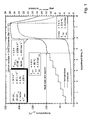
- Similar results were obtained in a test performed in our laboratories were the temperature and pressure profile of a mixture of estrone acetate and DAST in toluene was investigated (Fig. 1). The results show that the thermal potential of decomposition of DAST is extremely high and a fatal "runaway" of the reaction is possible suggesting the use of DAST only in lab scale.
-
EP 1172369 A describes a process for deoxofluorinating a C2-hydroxyl group of a furanose, including: (a) mixing the furanose and a deoxofluorinating agent in a solvent to form a reaction mixture, and (b) heating the reaction mixture to greater than about 50°C, particularly at 90°C for two hours. - However
EP 1172369 A describes only the deoxofluorination of a hydroxyl group which requires a very limited amount of DAST. On the contrary, the deoxofluorination of a ketone requires a molar ratio of DAST which is usually more than the double in respect to the ketone. - A method for fluorination reactions is described in
EP 1028801 A (BRITISH NUCLEAR FUELS PLC (GB)). Said method comprises carrying out a chemical reaction between at least two fluids, by providing respective flow paths for the at least two fluids, said flow paths communicating with each other in a region in which the at least two fluids may contact each other, and flowing the at least two fluids along said flow paths such that in said region the at least two fluids contact each other and a chemical reaction occurs between them, said region having a width perpendicular to the direction of flow in the range 10-10,000 micrometers. According toEP 1028801 A , using a so-called "microreactor", that is a reactor having dimensions perpendicular to the flow direction of less than 10,000 micrometers, an improved control over a fluid chemical reaction and better product's yield and/or purity can be obtained. - None of the previously cited documents describe an effective and safe method for the deoxofluorination of ketones for the production of geminal difluorides in an industrial scale and there is a clear need in the chemical industrial field for such a method.
- A method or a reaction system intended for industrial scale or large scale is a method or reaction system suited for the production of batches of active compound to be used for the manufacture of the final medicinal product.
- The object of the present invention is a method for the deoxofluorination of ketones for the production of geminal difluoride in an industrial scale according to the
independent claim 1. -
Claims 2 to 12 refer to particularly favourable forms of embodiment of the method according to the invention. - A further object of the present invention is a reaction system for the production of a geminal difluoride compound in an industrial scale according to
independent claim 13. -
Claims 13 to 19 refer to advantageous forms of embodiment according to the reaction system ofclaim 13. - A third object of the present invention is the use of a reaction system according to claims 13-19 for the deoxofluorination of a ketone for the production in an industrial scale of a geminal difluoride product by means of a dialkylaminosulfur trifluoride according to
independent claim 20. - The method and the reaction system according to the present invention allow to perform a deoxofluorination reaction in an industrial scale which under the usual methods and known reaction devices would not be possible due to safety reasons.
- Furthermore, the present method and reaction system can be used in all the fluorination reaction with DAST or DAST-analogues which have to be performed above the handling temperature of DAST or DAST analogues.
- The handling temperature is considered as the temperature at which the use of the reagent can be performed without decomposition and quality alterations and is usually considered around 80 °C under the decomposition temperature of said reagent.
- The method and the reaction system according to the invention are used in the chemical and pharmaceutical industry for the production of compounds or intermediates in an industrial scale.
- According to the present invention, fluorination and deoxofluorination reaction with DAST or DAST-Analogues which have to be carried out above the handling temperature can be performed in an industrial scale.
- The method according to the invention comprises the following steps:
- preparing an educt mixture comprising a ketone and a dialkylaminosulfur trifluoride,
- letting flow the educt mixture into a reaction chamber of defined length, diameter and volume, with a flow path having a width perpendicular to the direction of the flow in the range of 1-10 mm, at a temperature of at least 75 °C up to 120°C, preferably between 80 and 100 °C, to perform the deoxofluorination reaction and obtaining a product mixture
- quenching the product mixture with a basic aqueous solution for example a solution of
NaOH 20% w/w in a cooled reservoir vessel. - According to a particularly favourable form of embodiment of the invention, a ketone and a dialkylaminosulfur trifluoride are mixed continuously directly before the reaction chamber to form the educt mixture.
- The dialkylaminosulfur trifluoride used in the educt mixture is preferably diethylaminosulfur trifluoride or bis(2-methoxyethyl)-aminosulfur trifluoride.
- The ketone is preferably estrone or an ester thereof, particularly estrone acetate.
- The educt mixture can further comprise an organic solvent, preferably toluene.
- Before entering in the reaction chamber, the educt mixture is advantageously filtered, this avoids the blockage of the reaction system due to precipitates or impurities in the mixture.
- Furthermore, the educt mixture and the reaction system in use, are kept under pressure between 0.05 to 10 bar above ambient pressure, preferably under a pressure between 0.1 to 0.5 bar above ambient pressure to assure a constant flow in the system, this can be achieved by using a pressure valve after the reaction chamber for example or by means of a pump placed before the reaction chamber.
- The length of the reaction chamber, according to a favourable embodiment of the invention, is comprised between 1 and 30 meters and the diameter between 1 to 10 mm. The total volume of the reaction chamber is advantageously between 0.1 to 10 litres, preferably between 0.2 to 2 litres. The reaction chamber is for example a spirally wound stainless steel tube.
- In a reaction system according to the invention, the flow rate of the educt mixture within the reaction chamber can favourably be between 0.1 and 10 litres per hour, preferably between 0.2 to 1 litre per hour, while the residence time of the educt mixture in the reaction chamber can be between 0.1 and 10 hours, preferably between 0.5 and 2 hours.
- The reaction system in use is kept advantageously under inert condition by means of an inert gas, for example under nitrogen
- Other features and advantages of the invention will become evident on reading the following description of one embodiment of the invention, given as a non-binding example, with the help of the enclosed drawings, in which:
- figure 1 shows the results of a test performed to investigate the temperature and pressure profile of a mixture of estron acetate and DAST in toluene;
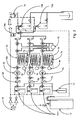
- figure 2 shows a schematic view of three reaction systems set in parallel according to the invention.
- The deoxofluorination of ketones for the production of geminal difluoride in an industrial scale according to the invention can be favourably performed in a system according to Figure 2, having three reaction systems (a), (b) and (c) set in parallel according to a particular form of embodiment of the present invention.
- A reaction system (a) comprises at least one
reservoir 1a for the educt mixture or according to a further form of embodiment a reservoir filled with a ketone and a reservoir filled with a diethylaminosulfur trifluoride as such or as a solution in an organic solvent which are mixed continuously to form the educt mixture. - According to figure 2, the reaction system (a) further comprises the
reaction chamber 3a which is continuously fed with the educt mixture. - The flow of the educt mixture is regulated by a
pump 2a to thereaction chamber 3a. - Before entering the
reaction chambers 3a the educt mixture is advantageously filtered by afilter 5a, for example a sintered stainless steel filter with pores of 5 to 50 µm. - The
reaction chambers 3a-c are advantageously made of a stainless steel tube of about 18 m with a volume of about 0.5 - The
reaction chamber 3a is kept at a temperature of about 90°C by anoil bath 7a with the temperature monitored and regulated by athermometer 4a. - The product mixture in exit of the
reaction chamber 3a is monitored by aninfrared detector 15 and is finally quenched by an aqueous alkali solution contained in thereservoir 17, for example a KHCO3 or a NaOH solution, in a cooledreservoir vessel 12 a-b. - The reaction system according to the invention can further comprise an
extra toluol reservoir 13 and is preferably kept undernitrogen 16 at a pressure between 0.05 to 10 bar, preferably of 0.2 bar, above ambient pressure. - According to a particular form of embodiment of the present invention at least one
valve 18a can be inserted in the reaction system to control the flow and the pressure in the reaction system. - The following is an example of a deoxofluorination of a ketone for the production of geminal difluoride according to the invention:
- 53.1 Kg of Estrone acetate, 85.5 Kg of diethylaminosulfur trifluoride (DAST, 3.1 mol-equivalents) are dissolved in 60.1 Kg of toluene at room temperature forming the educt mixture. The reservoir containing the educt mixture is connected to a reactor system. The educt mixture is filtered and then fed at 0.9 litre/hour in three reactor chambers (0.3 litre/hour/chamber) which are set in parallel at a temperature of 90 °C (Fig.2).
- Each reactor chamber comprises an inside volume of 0.5 litre.
- The system is kept working under a pressure of 0.2 bar above ambient pressure and under inert conditions.
- Finally, the product mixture coming out from the reaction chambers is steadily monitored and quenched with an aqueous solution of
NaOH 20% w/w in a cooled container. - The obtained difluoride product is purified according procedures well known in art.
- The method and the reaction system according to the invention allows an high productivity of a geminal difluoride derivative due to the round-the-clock operating possibilities and the numbering up of the reaction chambers.
- The invention is described above with reference to a preferred embodiment. It is nevertheless clear that the invention is susceptible to numerous variations within the framework of technical equivalents.
Claims (20)
- A method for the deoxofluorination of a ketone for the production of a geminal difluoride compound in an industrial scale comprising the following steps:- preparing an educt mixture comprising a ketone and a dialkylaminosulfur trifluoride,- letting flow the educt mixture into a reaction chamber of defined length, diameter and volume, with a flow path having a width perpendicular to the direction of the flow in the range of 1-10 mm, at a temperature of at least 75 °C up to 120°C, preferably between 80 and 100 °C, to perform the deoxofluorination reaction and obtaining a product mixture- quenching the product mixture with a basic aqueous solution in a cooled reservoir vessel.
- A method according to claim 1
characterized in that
the ketone and the dialkylaminosulfur trifluoride of the educt mixture are mixed continuously directly before entering the reaction chamber. - A method according to claim 1 or 2
characterized in that
the educt mixture further comprises an organic solvent, preferably toluene. - A method according to any one of the claims 1 to 3
characterized in that
the educt mixture is filtered before entering in the reaction chamber. - A method according to any one of the claims 1 to 4
characterized in that
the educt mixture is treated under pressure between 0.05 to 10 bar above ambient pressure, preferably under a pressure between 0.1 to 0.5 bar above ambient pressure. - A method according to any one of the claims 1 to 5
characterized in that
the length of the reaction chamber is comprised between 1 and 30 meters and the diameter between 1 to 10 mm. - A method according to any one of the claims 1 to 6
characterized in that
the total volume of the reaction chamber is between 0.1 to 10 litres, preferably between 0.2 to 2 litres. - A method according to any one of the claims 1 to7
characterized in that
the flow rate of the educt mixture within the reaction chamber is between 0.1 and 10 litres per hour, preferably between 0.2 to 1 litre per hour. - A method according to any one of the claims 1 to 8
characterized in that
the residence time of the educt mixture in the reaction chamber is between 0.1 and 10 hours, preferably between 0.2 and 2 hours. - A method according to any one of the claims 1 to 9
characterized in that
the dialkylaminosulfur trifluoride is diethylaminosulfur trifluoride or bis(2-methoxyethyl)-aminosulfur trifluoride. - A method according to any one of the claims 1 to 10
characterized in that
the ketone is estrone or an ester thereof, particularly estrone acetate. - A method according to any one of the claims 1 to 11
characterized in that
the product mixture is quenched with the a KHCO3 or NaOH aqueous solution. - A reaction system for the production of a geminal difluoride compound in an industrial scale comprising:at least one reservoir filled with a ketone or a solution therof and at least one reservoir filled with a dialkylaminosulfur trifluoride or a solution therof, or at least reservoir for an educt mixture comprising a ketone and a dialkylaminosulfur trifluoride,one or more reaction chambers of defined length, diameter and volume with a flow path having a width perpendicular to the direction of the flow in the range of 1-10 mm,an heating system for the reaction chamber and at least one collector vessel for the reaction mixture in exit from the reaction chamber.
- A reaction system according to claim 13
characterized in that
it comprises a filter before the at least one reaction chamber. - A reaction system according to claim 13 or 14
characterized in that
it comprises a pump before the reaction chamber. - A reaction system according to any one of the claims 13 to 15
characterized in that
the length of the reaction chamber is comprised between 1 and 30 meters and the diameter between 1 to 10 mm. - A reaction system according to any one of the claims 13 to 16
characterized in that
the total volume of the reaction chamber is between 0.1 to 10 litres, preferably between 0.2 to 2 litres. - A reaction system according to any one of the claims 12 to 17
characterized in that
the dialkylaminosulfur trifluoride is diethylaminosulfur trifluoride or bis(2-methoxyethyl)-aminosulfur trifluoride. - A reaction system according to any one of the claims 12 to 18
characterized in that
the ketone is estrone or an ester thereof, particularly estrone acetate. - Use of a reaction system according to claims according to any one of the claims 13 to 19
for the deoxofluorination of a ketone for the production of a geminal difluoride product in an industrial scale by means of a dialkylaminosulfur trifluoride.
Priority Applications (7)
| Application Number | Priority Date | Filing Date | Title |
|---|---|---|---|
| EP06076607A EP1892231A1 (en) | 2006-08-21 | 2006-08-21 | A large scale method for the deoxofluorination of ketones |
| US11/841,202 US20080269512A1 (en) | 2006-08-21 | 2007-08-20 | Large Scale Method for the deoxofluorination of ketones |
| KR1020097003539A KR20090042802A (en) | 2006-08-21 | 2007-08-20 | Large Scale Deoxofluorination of Ketones |
| CA002661528A CA2661528A1 (en) | 2006-08-21 | 2007-08-20 | A large scale method for the deoxofluorination of ketones |
| EP07801853A EP2057111A1 (en) | 2006-08-21 | 2007-08-20 | A large scale method for the deoxofluorination of ketones |
| JP2009524963A JP2010501505A (en) | 2006-08-21 | 2007-08-20 | A large-scale method for the deoxofluorination of ketones. |
| PCT/EP2007/007425 WO2008022791A1 (en) | 2006-08-21 | 2007-08-20 | A large scale method for the deoxofluorination of ketones |
Applications Claiming Priority (1)
| Application Number | Priority Date | Filing Date | Title |
|---|---|---|---|
| EP06076607A EP1892231A1 (en) | 2006-08-21 | 2006-08-21 | A large scale method for the deoxofluorination of ketones |
Publications (1)
| Publication Number | Publication Date |
|---|---|
| EP1892231A1 true EP1892231A1 (en) | 2008-02-27 |
Family
ID=37546662
Family Applications (2)
| Application Number | Title | Priority Date | Filing Date |
|---|---|---|---|
| EP06076607A Withdrawn EP1892231A1 (en) | 2006-08-21 | 2006-08-21 | A large scale method for the deoxofluorination of ketones |
| EP07801853A Withdrawn EP2057111A1 (en) | 2006-08-21 | 2007-08-20 | A large scale method for the deoxofluorination of ketones |
Family Applications After (1)
| Application Number | Title | Priority Date | Filing Date |
|---|---|---|---|
| EP07801853A Withdrawn EP2057111A1 (en) | 2006-08-21 | 2007-08-20 | A large scale method for the deoxofluorination of ketones |
Country Status (5)
| Country | Link |
|---|---|
| US (1) | US20080269512A1 (en) |
| EP (2) | EP1892231A1 (en) |
| KR (1) | KR20090042802A (en) |
| CA (1) | CA2661528A1 (en) |
| WO (1) | WO2008022791A1 (en) |
Families Citing this family (6)
| Publication number | Priority date | Publication date | Assignee | Title |
|---|---|---|---|---|
| US20050143678A1 (en) | 2003-10-14 | 2005-06-30 | Pluromed, Inc. | Confinement of kidney-stone fragments during lithotripsy |
| DK2601972T3 (en) | 2005-05-02 | 2015-02-16 | Genzyme Corp | Kidney stone treatment without lithotripsy |
| US8791254B2 (en) * | 2006-05-19 | 2014-07-29 | 3M Innovative Properties Company | Cyclic hydrofluoroether compounds and processes for their preparation and use |
| US8193397B2 (en) * | 2006-12-06 | 2012-06-05 | 3M Innovative Properties Company | Hydrofluoroether compounds and processes for their preparation and use |
| JP2012530075A (en) * | 2009-06-19 | 2012-11-29 | オメガケム インコーポレイテッド | Disubstituted aminodifluorosulfinium salts, process for their preparation and use as deoxofluorination reagents |
| WO2025196119A1 (en) * | 2024-03-22 | 2025-09-25 | Lonza Ltd | Continuous deoxyfluorination of ketones using in situ formed dast |
Citations (3)
| Publication number | Priority date | Publication date | Assignee | Title |
|---|---|---|---|---|
| US4212815A (en) * | 1978-07-05 | 1980-07-15 | E. I. Du Pont De Nemours And Company | Preparation of vinylene fluorides |
| WO1999022857A1 (en) * | 1997-11-05 | 1999-05-14 | British Nuclear Fuels Plc | A method of performing a chemical reaction |
| EP1275631A2 (en) * | 1997-09-29 | 2003-01-15 | Air Products And Chemicals, Inc. | Fluorination with aminosulfur trifluorides |
Family Cites Families (2)
| Publication number | Priority date | Publication date | Assignee | Title |
|---|---|---|---|---|
| US5470978A (en) * | 1992-11-18 | 1995-11-28 | Eli Lilly And Company | Process and intermediates for the preparation of excitatory amino acid receptor antagonists |
| CN1235887C (en) * | 1998-03-30 | 2006-01-11 | 日本烟草产业株式会社 | Process for preparing oxazolylethanol derivatives |
-
2006
- 2006-08-21 EP EP06076607A patent/EP1892231A1/en not_active Withdrawn
-
2007
- 2007-08-20 US US11/841,202 patent/US20080269512A1/en not_active Abandoned
- 2007-08-20 CA CA002661528A patent/CA2661528A1/en not_active Abandoned
- 2007-08-20 WO PCT/EP2007/007425 patent/WO2008022791A1/en not_active Ceased
- 2007-08-20 EP EP07801853A patent/EP2057111A1/en not_active Withdrawn
- 2007-08-20 KR KR1020097003539A patent/KR20090042802A/en not_active Withdrawn
Patent Citations (3)
| Publication number | Priority date | Publication date | Assignee | Title |
|---|---|---|---|---|
| US4212815A (en) * | 1978-07-05 | 1980-07-15 | E. I. Du Pont De Nemours And Company | Preparation of vinylene fluorides |
| EP1275631A2 (en) * | 1997-09-29 | 2003-01-15 | Air Products And Chemicals, Inc. | Fluorination with aminosulfur trifluorides |
| WO1999022857A1 (en) * | 1997-11-05 | 1999-05-14 | British Nuclear Fuels Plc | A method of performing a chemical reaction |
Non-Patent Citations (1)
| Title |
|---|
| EDSALL, ALLISON B. ET AL: "Effects of Altering the Electronics of 2-Methoxyestradiol on Cell Proliferation, on Cytotoxicity in Human Cancer Cell Cultures, and on Tubulin Polymerization", JOURNAL OF MEDICINAL CHEMISTRY , 47(21), 5126-5139 CODEN: JMCMAR; ISSN: 0022-2623, 2004, XP002413022 * |
Also Published As
| Publication number | Publication date |
|---|---|
| CA2661528A1 (en) | 2008-02-28 |
| KR20090042802A (en) | 2009-04-30 |
| US20080269512A1 (en) | 2008-10-30 |
| WO2008022791A1 (en) | 2008-02-28 |
| EP2057111A1 (en) | 2009-05-13 |
Similar Documents
| Publication | Publication Date | Title |
|---|---|---|
| DE69830331T2 (en) | METHOD FOR CARRYING OUT A CHEMICAL REACTION | |
| US11795138B2 (en) | Process of fluorinating inorganic compounds by direct fluorination | |
| US20080269512A1 (en) | Large Scale Method for the deoxofluorination of ketones | |
| EP3303272B1 (en) | Processes for the synthesis of 1,2,3,4-tetrachloro-hexafluoro-butane | |
| DE102006060354A1 (en) | A process for producing a chemical derivable from an olefin oxide and a reactor suitable for such a process | |
| EP3539943A1 (en) | Process for the preparation of n-alkyl-nitratoethylnitramine | |
| EP1246784B9 (en) | Reaction of carbonyl compounds with organometallic reagents | |
| EP1965901A2 (en) | Method for producing aryl-aryl coupled compounds | |
| DE4323054A1 (en) | Process for the preparation of 2-H-heptafluoropropane | |
| US10562873B1 (en) | Methods of producing glycidyl nitrate | |
| EP3502089B1 (en) | Process for the manufacturing of a 3-halopropionyl halide in a flow reactor | |
| HK1133636A (en) | A large scale method for the deoxofluorination of ketones | |
| CN101506131A (en) | A large scale method for the deoxofluorination of ketones | |
| WO2021031431A1 (en) | Process for preparing fluorobenzene by direct fluorination | |
| JP2010501505A (en) | A large-scale method for the deoxofluorination of ketones. | |
| WO2022233129A1 (en) | New process for the synthesis of 5-fluoro-3- (difuoromethyl) -5-fluoro-1-methyl-1h-pyrazole-4-carboxylic acid derivatives and the free acid thereof | |
| EP3194067A1 (en) | Method for phosgenating compounds containing hydroxyl, thiol, amino and/or formamide groups | |
| EP1268406A1 (en) | Method for oximating organic carbonyl compounds and/or ch-acid compounds | |
| EP1268485A1 (en) | Method for the 1,3 dipolar cycloaddition of organic compounds in a microreactor | |
| WO2022160762A1 (en) | New industrial process for manufacturing of perfluoropentane (pfp) | |
| EP4061793A1 (en) | New industrial process for manufacturing of perfluoropentane (pfp) | |
| EP1284965A1 (en) | Method for producing indols | |
| US20220372000A1 (en) | New Process for the Synthesis of 5-Fluoro-3-(Difuoromethyl)-5-Fluoro-1-Methyl-1H-Pyrazole-4-Carboxylic Acid Derivatives and the Free Acid Thereof | |
| WO2022111033A1 (en) | Industrial process for manufacturing of perfluoro(methyl vinyl ether) (pfmve) and of 1,1,2,2-tetrafluoro-1-(trifluoromethoxy)ethane (tftfme) | |
| WO2002000577A2 (en) | Method for coupling organic compounds |
Legal Events
| Date | Code | Title | Description |
|---|---|---|---|
| PUAI | Public reference made under article 153(3) epc to a published international application that has entered the european phase |
Free format text: ORIGINAL CODE: 0009012 |
|
| AK | Designated contracting states |
Kind code of ref document: A1 Designated state(s): AT BE BG CH CY CZ DE DK EE ES FI FR GB GR HU IE IS IT LI LT LU LV MC NL PL PT RO SE SI SK TR |
|
| AX | Request for extension of the european patent |
Extension state: AL BA HR MK YU |
|
| AKX | Designation fees paid | ||
| STAA | Information on the status of an ep patent application or granted ep patent |
Free format text: STATUS: THE APPLICATION IS DEEMED TO BE WITHDRAWN |
|
| 18D | Application deemed to be withdrawn |
Effective date: 20080828 |
|
| REG | Reference to a national code |
Ref country code: DE Ref legal event code: 8566 |