EP1891253B1 - Natural or synthetic yarns with heat transmission barrier property obtained by aerogel deposition - Google Patents
Natural or synthetic yarns with heat transmission barrier property obtained by aerogel deposition Download PDFInfo
- Publication number
- EP1891253B1 EP1891253B1 EP06745363A EP06745363A EP1891253B1 EP 1891253 B1 EP1891253 B1 EP 1891253B1 EP 06745363 A EP06745363 A EP 06745363A EP 06745363 A EP06745363 A EP 06745363A EP 1891253 B1 EP1891253 B1 EP 1891253B1
- Authority
- EP
- European Patent Office
- Prior art keywords
- aerogel
- sol
- fiber
- rays
- deposition
- Prior art date
- Legal status (The legal status is an assumption and is not a legal conclusion. Google has not performed a legal analysis and makes no representation as to the accuracy of the status listed.)
- Expired - Lifetime
Links
Images


Classifications
-
- D—TEXTILES; PAPER
- D02—YARNS; MECHANICAL FINISHING OF YARNS OR ROPES; WARPING OR BEAMING
- D02G—CRIMPING OR CURLING FIBRES, FILAMENTS, THREADS, OR YARNS; YARNS OR THREADS
- D02G3/00—Yarns or threads, e.g. fancy yarns; Processes or apparatus for the production thereof, not otherwise provided for
- D02G3/22—Yarns or threads characterised by constructional features, e.g. blending, filament/fibre
- D02G3/40—Yarns in which fibres are united by adhesives; Impregnated yarns or threads
- D02G3/404—Yarns or threads coated with polymeric solutions
Definitions
- the present invention relates to natural or synthetic yarns obtained by aerogel deposition.
- aerogel In the field of advanced ceramic material, aerogel is among the most studied materials by researchers. Aerogel is usually called "Frozen smoke", due to its appearance, which is, at a glance, very similar to frozen smoke.
- a siliceous aerogel is normally composed of at least 90% of air and the residual is Silicon Dioxide (SiO 2 ). In some cases its composition reaches 99.9% of air and only 0.1% of SiO 2 .
- aerogel has the lowest density. Its remarkable features are the very low thermal conductivity, a good acoustic and electric insulation and the fire-retardant property. It is very interesting the fact that its preparation, by means of modern techniques, does not generate toxic wastes; aerogel disposal is also simple, by compression until a powder like sand is obtained.
- Aerogel As thermal insulator. Due to its high costs, however aerogel has been utilized only for scientific purposes. For example, in 1997, Mars Rover W.E.B. during the Pathfinder mission to Mars used aerogel as Rover thermal insulator, allowing the electronic components inside the Warm Electronics Box to resist against the low temperature, which is normally -100°C during the Martian nights. Aerogel is also used as catalyst or absorbent to remove or recover pollutants from water or air. Examples are: catalyst for production of catalytic mufflers, emission control in production plants, filters and anti-gas masks production for civil and military applications.
- aerogel production is made by drying a hydrogel under hypercritical conditions.
- the first step of the production process is made of numerous washings of the gel with acetone; the first washings take about fifteen minutes, the remaining one or more hours.
- the gel is solvent exchanged to replace the water and alcohol retained in the gel pores with suitable organic solvent like Acetone, to avoid the presence of water during the next step when the gel is dried by supercritical drying using carbon-dioxide (CO 2 ).
- CO 2 carbon-dioxide
- US 6,378,229 B1 discloses a method for the subcritical drying of lyogels to produce aerogel particles.
- the technical problem is to produce yarns, fabrics and end products (socks or stockings, as an example) having thermal barrier properties and characterized by high comfort under all extreme climatic conditions, both very cold (e.g. mountain climbing) and very hot (e.g. fire-protection application), and having a long lifetime.
- the deposition of aerogel on yarns provides it with thermal insulation properties due to the nature and morphology of the aerogel itself. In fact, this material is characterized by high porosity and a very low thermal coefficient.
- the aerogel is synthesized by a technique, based on the use of non hypercritical fluids.
- the aerogel is synthesized by a technique, based on the use of non-hypercritical fluids.
- a gel immersed in alcoholic solution has been obtained by photo-polymerisation.
- Such gel have been dried under atmospheric pressure and then synthesized forming a micro-porous structure with a porosity of 90%.
- silica aerogel is synthesized. It contains large sterical organic molecules, the 3-(trimethoxysilyl)propylmethacrylate (TMSPMA), which, during drying, are the load bearing structure, that prevents the gel to shrink and break.
- TMSPMA 3-(trimethoxysilyl)propylmethacrylate
- TEOS tetra ethyl ortho-silicate
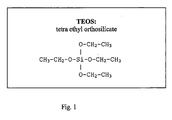
- Fig. 1 the TEOS chemical formula is shown. The used alcohol-oxide and organic concentration has been calculated to obtain a SiO 2 final yield equal to 4%, by assuming, for both TEOS and organic, all precursor moles to be converted in SiO 2 .
- the solution contains the same TEOS and TMSPMA moles number.
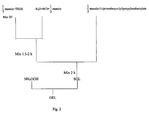
- Fig. 2 shows the flowchart to obtain the gel, as aerogel precursor.
- Fig. 3 (Table 1) shows the molar ratios and the quantities (grams) needed to produce 100g of SiO 2 sol.
- Fig. 4 shows the TMSPMA chemical formula.
- the solutions have been prepared at ambient temperature and homogenized by mechanical mixing: in the first one (soul 1), 1/3 ethanol quantity with TEOS has been added; in the second one (sol 2), 1/3 ethanol quantity, HCl and H 2 O have been added; in the third one (sol 3), the TMSPMA and the remaining 1/3 ethanol have been added. All beakers have been shaken by a magnetic shaker for 20 minutes. Then, sol 1 and sol 2 have been mixed (obtaining sol 4); in these phases, hydrolysis occurs together with heat release and consequent beakers warming-up. Sol 4 is shaken for 1.5-2 hours. Soon after, sol 3 has been added to sol 4 and the obtained solution has been shaken at least 2 hours.
- the 1-Hydroxi-cycle-esil-fenil-cheton is available as powder or grains; therefore, before being added to the solution, it has been finely powdered, to improve its solubility in alcohol. Once in the solution, it has been mixed for 10 minutes by ultrasounds.
- a smoked silica quantity equal to 2 times the silica weight efficiency in the starting solution, is added; the solution is also exposed to ultrasounds until a full homogenization is obtained. Later, the final product is exposed to the UV-rays for about 2 minutes, after that it appears white coloured and without any shrinkage.
- the product has been dried into a furnace at 60°C. After drying, the sample is stabilized in the furnace under atmospheric pressure and temperature of 550°C, to eliminate all organic compounds.
- Fig. 5 Table 2
- the aerogel density values, before and after stabilization are shown. After the treatment at 550°C, only a slight density increase can be observed.
- such process allows to obtain a silica aerogel characterized by high porosity and low thermal conductivity, therefore very suitable as a thermal barrier, which can be integrated in the fabrics, as further described below.
- a further aerogel deposition technique is based on the short fiber impregnation in the sol, then its exposition to the UV-rays and finally the spinning.
- the aerogel contains a very low fraction of solid silica (about 5%, in average): in this case, the solid is connected like a net having some death branches, which further decrease the thermal conductivity.
- the hollow space inside the material are generally filled with air or other gases, which allow the heat propagation, while the open aerogel pores allow the gas flowing through the material, even with difficulties.
- the other heat transmission component is the infrared radiance. Aerogel is transparent to the visible electromagnetic radiation and to infrared one, mostly to the wave lengths between 3 and 5 micron. At low temperature, the radiant component of the thermal transportation is low and therefore negligible, while at high temperatures the radiance contribution is not negligible.
Landscapes
- Engineering & Computer Science (AREA)
- Mechanical Engineering (AREA)
- Textile Engineering (AREA)
- Silicon Compounds (AREA)
- Chemical Or Physical Treatment Of Fibers (AREA)
- Nonwoven Fabrics (AREA)
- Motorcycle And Bicycle Frame (AREA)
Abstract
Description
- The present invention relates to natural or synthetic yarns obtained by aerogel deposition.
- In the field of advanced ceramic material, aerogel is among the most studied materials by researchers. Aerogel is usually called "Frozen smoke", due to its appearance, which is, at a glance, very similar to frozen smoke. A siliceous aerogel is normally composed of at least 90% of air and the residual is Silicon Dioxide (SiO2). In some cases its composition reaches 99.9% of air and only 0.1% of SiO2. Among the known solid materials, aerogel has the lowest density. Its remarkable features are the very low thermal conductivity, a good acoustic and electric insulation and the fire-retardant property. It is very interesting the fact that its preparation, by means of modern techniques, does not generate toxic wastes; aerogel disposal is also simple, by compression until a powder like sand is obtained.
- There are many application of the aerogel as thermal insulator. Due to its high costs, however aerogel has been utilized only for scientific purposes. For example, in 1997, Mars Rover W.E.B. during the Pathfinder mission to Mars used aerogel as Rover thermal insulator, allowing the electronic components inside the Warm Electronics Box to resist against the low temperature, which is normally -100°C during the Martian nights. Aerogel is also used as catalyst or absorbent to remove or recover pollutants from water or air. Examples are: catalyst for production of catalytic mufflers, emission control in production plants, filters and anti-gas masks production for civil and military applications. Further applications of aerogel are thermal insulation of windows glasses; in fact, an aerogel panel has the same insulating capacity of 32 glass sheets; its installation reduces energy consumption (considering that 30% of home energy loss is due to a deficient insulation) and atmospheric pollution as well. In most cases aerogel production is made by drying a hydrogel under hypercritical conditions. The first step of the production process is made of numerous washings of the gel with acetone; the first washings take about fifteen minutes, the remaining one or more hours. The gel is solvent exchanged to replace the water and alcohol retained in the gel pores with suitable organic solvent like Acetone, to avoid the presence of water during the next step when the gel is dried by supercritical drying using carbon-dioxide (CO2). Once the autoclave is switched on, the cooling system and the compressor are activated. When the temperature reaches about 10°C, liquid CO2 is flushed through the vessel at a pressure of about 50 bar. After about 5 minutes, the vessel is emptied and then replenished with fresh CO2. Many (up to 10) washing cycles are performed: the first three take few minutes, the second three 20 minutes, the last cycles 60 minutes. After the washing process, the vessel is filled once more with CO2 and heated at a temperature that reaches 40°C, with 100 bar pressure. Under these conditions, CO2 is a supercritical fluid. The subsequent phase is the vessel depressurisation, by a fluid slow release. It takes about 5 hours; after which the hypercritical aerogel sample is ready and is extracted from the autoclave. The gel drying under hypercritical conditions has many drawbacks due to high temperature and pressure, long process duration, high costs, and the use of very complex tools and processes. This leads to an alternative production technique, which must be cheaper, safer and faster.
-
US 6,378,229 B1 discloses a method for the subcritical drying of lyogels to produce aerogel particles. - At the present, special fabrics based on hypercritical aerogel are available on the market, by ASPEN AEROGELS INC. They are utilized to produce Antarctic, space, marine, military or fire-protection clothing.
US 2004/0142168 B1 discloses fabrics which are impregnated with silica aerogel particles to impart thermal and fire protection. The aerogel particles fill voids in the fibers and/or between the fibers. On the other side, the non-hypercritical synthesized aerogel has not yet been introduced in the textile market; therefore, under extreme climatic conditions the most used materials are the modem synthetic and non synthetic fibers, which can assure thermal insulation without compromising comfort. The drawback is that the known materials cannot be used for a long period of time. - Therefore, the technical problem is to produce yarns, fabrics and end products (socks or stockings, as an example) having thermal barrier properties and characterized by high comfort under all extreme climatic conditions, both very cold (e.g. mountain climbing) and very hot (e.g. fire-protection application), and having a long lifetime.
- The deposition of aerogel on yarns provides it with thermal insulation properties due to the nature and morphology of the aerogel itself. In fact, this material is characterized by high porosity and a very low thermal coefficient. The aerogel is synthesized by a technique, based on the use of non hypercritical fluids.
- By using organic-inorganic hybrid systems, a gel (immersed) in an alcohol solution has been obtained by photo-polymerization. Such gel has been dried under atmospheric pressure and then synthesized; as a result, a micro-porous structure has been obtained, having a porosity equal to 90%.
- These and other advantages will be pointed out in the detailed description of the invention that will refer to the figures of the tables 1/8 - 818. Both are examplifying and not restrictive.
- With reference to the above mentioned tables:
-
Figure 1 is the TEOS chemical formula; -
Figure 2 is the flowchart to obtain the gel, as aerogel precursor; -
Figure 3 (Table 1) shows the molar ratios and the quantities (grams) needed to produce 100g of SiO2 sol; -
Figure 4 is the TMSPMA chemical formula; -
Figure 5 (Table 2) shows the aerogel density values, before and after stabilization; -
Figure 6 (Table 3) shows the thermal conductivity values of three aerogel samples; -
Figure 7 is the regression to evaluate the aerogel thermal conductivity; -
Figure 8 shows the thermal conductivity of the cotton and the aerogel additivated cotton. - The aerogel is synthesized by a technique, based on the use of non-hypercritical fluids. By using organic-inorganic hybrid systems, a gel immersed in alcoholic solution has been obtained by photo-polymerisation. Such gel have been dried under atmospheric pressure and then synthesized forming a micro-porous structure with a porosity of 90%.
- According to the protocol, silica aerogel is synthesized. It contains large sterical organic molecules, the 3-(trimethoxysilyl)propylmethacrylate (TMSPMA), which, during drying, are the load bearing structure, that prevents the gel to shrink and break. As a precursor, the tetra ethyl ortho-silicate (TEOS) 98% by ALDRICH is the chosen alcohol-oxide. In
Fig. 1 , the TEOS chemical formula is shown. The used alcohol-oxide and organic concentration has been calculated to obtain a SiO2 final yield equal to 4%, by assuming, for both TEOS and organic, all precursor moles to be converted in SiO2. The solution contains the same TEOS and TMSPMA moles number. As a catalyst, 37% chloride acid has been used; while as a solvent, ethanol has been added in the solution.Fig. 2 shows the flowchart to obtain the gel, as aerogel precursor.Fig. 3 (Table 1) shows the molar ratios and the quantities (grams) needed to produce 100g of SiO2 sol. - Finally,
Fig. 4 shows the TMSPMA chemical formula. - The solutions have been prepared at ambient temperature and homogenized by mechanical mixing: in the first one (soul 1), 1/3 ethanol quantity with TEOS has been added; in the second one (sol 2), 1/3 ethanol quantity, HCl and H2O have been added; in the third one (sol 3), the TMSPMA and the remaining 1/3 ethanol have been added. All beakers have been shaken by a magnetic shaker for 20 minutes. Then,
sol 1 andsol 2 have been mixed (obtaining sol 4); in these phases, hydrolysis occurs together with heat release and consequent beakers warming-up. Sol 4 is shaken for 1.5-2 hours. Soon after,sol 3 has been added to sol 4 and the obtained solution has been shaken at least 2 hours. After hydrolysis, pH is equal to 2.5; by adding a water-ammonia solution (water to ammonia ratio: 8 to 2), the sol turns to a more basic pH (pH=6÷8). Further, a 1-Hydroxi-cycle-esil-fenil-cheton photo-initiator equal to 4% in weight of the available TMSPMA is added. The 1-Hydroxi-cycle-esil-fenil-cheton is available as powder or grains; therefore, before being added to the solution, it has been finely powdered, to improve its solubility in alcohol. Once in the solution, it has been mixed for 10 minutes by ultrasounds. Then, a smoked silica quantity, equal to 2 times the silica weight efficiency in the starting solution, is added; the solution is also exposed to ultrasounds until a full homogenization is obtained. Later, the final product is exposed to the UV-rays for about 2 minutes, after that it appears white coloured and without any shrinkage. The product has been dried into a furnace at 60°C. After drying, the sample is stabilized in the furnace under atmospheric pressure and temperature of 550°C, to eliminate all organic compounds. InFig. 5 (Table 2), the aerogel density values, before and after stabilization, are shown. After the treatment at 550°C, only a slight density increase can be observed. - In summary, such process allows to obtain a silica aerogel characterized by high porosity and low thermal conductivity, therefore very suitable as a thermal barrier, which can be integrated in the fabrics, as further described below.
- The fiber impregnation process with silica aerogel, obtained in a sub-critical way comprised 4 steps:
- 1. Silica sol preparation
- 2. Fiber impregnation in the sol
- 3. Fiber exposition to the UV-rays
- 4. Fiber drying
- Sintering treatment is not performed, to avoid at 550°C the fiber pyrolysis. The fiber exposition to the UV-rays allows aerogel photo-polymerization directly on the yarn. Washing tests on the yarn or on the end product confirm the good adherence between the silica and the yam.
- An alternative way of aerogel deposition is to start with a bulk aerogel and later, after powdering it, to connect the aerogel with the fiber surface, by means of a polymeric binding. The process to produce the yarn is the following:
- 1. Silica sol preparation
- 2. Sol exposition to UV-Rays
- 3. drying until a bulk is obtained
- 4. Sintering treatment
- 5. Bulk powdering
- 6. Powder deposition on the yarn or end product, by binding utilization
- In this way a fabric having heat transfer barrier feature is obtained, using a yarn with a powder surface coating, which is bonded by means of a polymeric binding.
- A further aerogel deposition technique is based on the short fiber impregnation in the sol, then its exposition to the UV-rays and finally the spinning.
- One of the most important aerogel property is their low thermal conductivity, which becomes even lower in vacuum. Inside an insulating material the heat transmission takes place by three different mechanisms:
- solid state conduction
- gaseous state conduction (including convection)
- radiant transmission (infrared radiance)
- The addition of these three components gives the material thermal conductivity, which is quite high in dense silicates. Instead, the aerogel contains a very low fraction of solid silica (about 5%, in average): in this case, the solid is connected like a net having some death branches, which further decrease the thermal conductivity. The hollow space inside the material are generally filled with air or other gases, which allow the heat propagation, while the open aerogel pores allow the gas flowing through the material, even with difficulties. The other heat transmission component is the infrared radiance. Aerogel is transparent to the visible electromagnetic radiation and to infrared one, mostly to the wave lengths between 3 and 5 micron. At low temperature, the radiant component of the thermal transportation is low and therefore negligible, while at high temperatures the radiance contribution is not negligible. To minimize the heat transmission, such components have been controlled and an excellent material has been obtained, which can be integrated in the fabrics, to assure very high comfort in case of very high or very low temperatures. More precisely, a thermal conductivity calculation for three aerogel samples with different thicknesses has been carried out. Then, the thermal conductivity law has been interpolated. Table 3 shows the results of the measurements. The thermal conductivity behaviour is shown in
Fig. 7 . After the interpolation, the thermal conductivity value is equal to 0.0298 [W/mK] ± σ = 0.00368 [W/mK] (standard deviation). Also the thermal conductivities of the cotton and the aerogel additivated cotton have been evaluated and the results are shown inFig. 8 . the aerogel reduces the thermal conductivity of about 1/3 compared with that of the cotton without aerogel. - Both process and product have many advantages. Concerning the process, a non hypercritical technique to obtain integral and light silica aerogel samples has been developed, avoiding the gel drying in autoclave and, consequently, reducing both costs and preparation duration. Further, the risk of working with high pressure and temperature, and with CO2 and ethanol (completely absent) is reduced. The simple and economic aerogel preparation allows the use of such advanced material in the textile sector; as an example, some activities practised under extreme climate conditions, need specific yarns. Simple natural yarns (cotton, wool) cannot assure a prolonged comfort. By aerogel deposition on yarns, fabrics (starting from both natural or polymeric yarns) or end products (like socks or stockings), new advanced technical products have been realized, such products being characterized by a low thermal conductivity, which are perfect under very cold or very hot conditions.
Claims (6)
- Fiber impregnation process with silica aerogel characterized in that it is obtained in a subcritical way by fiber impregnation in the sol and comprises the following steps:• Silica sol preparation• Fiber impregnation in the sol• Fiber exposition to the UV-rays• Fiber drying
- Fiber deposition process with silica aerogel characterized in that it is obtained in a subcritical way by sintering treatment and comprises the following steps:• Silica sol preparation• Sol exposition to UV -Rays• Drying until a bulk is obtained• Sintering treatment• Bulk powdering• Powder deposition on the end product, by binding utilization
- Process according to claim 1 or 2, wherein said silica aerogel comprises large sterical organic molecules as the 3-(thrimetoxysilyl) propylmethacryle.
- Process according to one of the previous claims wherein said UV-rays have the following ranges: wave length 285- 400nm, power 20÷ 10000 W/m2 , exposure time 5 seconds-30 minutes.
- Process according to one of the previous claims wherein said UV-rays have the following ranges: wave length 360- 370nm, power 500 W/m2, exposure time 1-2 minutes.
- Fabric, yarn, sock or stocking obtained by the process as in one of the previous claims.
Applications Claiming Priority (2)
| Application Number | Priority Date | Filing Date | Title |
|---|---|---|---|
| IT000008A ITLE20050008A1 (en) | 2005-05-24 | 2005-05-24 | YARNS OF NATURAL AND SYNTHETIC ORIGIN WITH BARRIER CHARACTERISTICS OF HEAT TRANSPORT OBTAINED THROUGH THE AEROGEL DEPOSITION. |
| PCT/IT2006/000385 WO2006126232A1 (en) | 2005-05-24 | 2006-05-22 | Natural or synthetic yarns with heat transmission barrier property obtained by aerogel deposition |
Publications (2)
| Publication Number | Publication Date |
|---|---|
| EP1891253A1 EP1891253A1 (en) | 2008-02-27 |
| EP1891253B1 true EP1891253B1 (en) | 2010-08-11 |
Family
ID=36869863
Family Applications (1)
| Application Number | Title | Priority Date | Filing Date |
|---|---|---|---|
| EP06745363A Expired - Lifetime EP1891253B1 (en) | 2005-05-24 | 2006-05-22 | Natural or synthetic yarns with heat transmission barrier property obtained by aerogel deposition |
Country Status (5)
| Country | Link |
|---|---|
| EP (1) | EP1891253B1 (en) |
| AT (1) | ATE477358T1 (en) |
| DE (1) | DE602006016115D1 (en) |
| IT (1) | ITLE20050008A1 (en) |
| WO (1) | WO2006126232A1 (en) |
Families Citing this family (4)
| Publication number | Priority date | Publication date | Assignee | Title |
|---|---|---|---|---|
| US8734931B2 (en) | 2007-07-23 | 2014-05-27 | 3M Innovative Properties Company | Aerogel composites |
| BRPI0922279A2 (en) | 2008-12-18 | 2018-06-05 | 3M Innovative Properties Co | "telequel hybrid hybrids". |
| GB2467532A (en) * | 2009-02-04 | 2010-08-11 | Envirotech Ltd | Roller blind system comprising two blinds with overlapping wound portions |
| US12351696B2 (en) | 2019-05-02 | 2025-07-08 | National Research Council Of Canada | Copolymer-silica hybrid aerogels and methods for the preparation thereof |
Family Cites Families (7)
| Publication number | Priority date | Publication date | Assignee | Title |
|---|---|---|---|---|
| US5565142A (en) * | 1992-04-01 | 1996-10-15 | Deshpande; Ravindra | Preparation of high porosity xerogels by chemical surface modification. |
| DE4316540A1 (en) * | 1993-05-18 | 1994-11-24 | Hoechst Ag | Process for subcritical drying of aerogels |
| DE19541715A1 (en) * | 1995-11-09 | 1997-05-15 | Hoechst Ag | Process for the production of organically modified aerogels, in which the salts formed are precipitated |
| DE19756633A1 (en) * | 1997-12-19 | 1999-06-24 | Hoechst Ag | Lyogels and aerogels subcritically dried in a packed bed with minimal particle breakdown |
| US6555211B2 (en) * | 2001-01-10 | 2003-04-29 | Albany International Techniweave, Inc. | Carbon composites with silicon based resin to inhibit oxidation |
| US6723378B2 (en) * | 2001-10-25 | 2004-04-20 | The Regents Of The University Of California | Fibers and fabrics with insulating, water-proofing, and flame-resistant properties |
| WO2005120646A1 (en) * | 2004-06-14 | 2005-12-22 | De Ball Inc. | Fire insulating barrier material for a firefighter protective garment |
-
2005
- 2005-05-24 IT IT000008A patent/ITLE20050008A1/en unknown
-
2006
- 2006-05-22 AT AT06745363T patent/ATE477358T1/en not_active IP Right Cessation
- 2006-05-22 EP EP06745363A patent/EP1891253B1/en not_active Expired - Lifetime
- 2006-05-22 DE DE602006016115T patent/DE602006016115D1/en not_active Expired - Lifetime
- 2006-05-22 WO PCT/IT2006/000385 patent/WO2006126232A1/en not_active Ceased
Also Published As
| Publication number | Publication date |
|---|---|
| ATE477358T1 (en) | 2010-08-15 |
| ITLE20050008A1 (en) | 2006-11-25 |
| DE602006016115D1 (en) | 2010-09-23 |
| EP1891253A1 (en) | 2008-02-27 |
| WO2006126232A1 (en) | 2006-11-30 |
Similar Documents
| Publication | Publication Date | Title |
|---|---|---|
| CN101468907B (en) | SiO2 nano composite heat preserving and thermal insulating paste and preparing process thereof | |
| EP3375757B1 (en) | Silica aerogel blanket for ultra-high temperature, manufacturing method thereof, and installation method thereof | |
| EP3351293B1 (en) | Low-dust high-thermal insulation aerogel blanket and method for manufacturing same | |
| CN110127705A (en) | A kind of preparation method of graphene oxide modified flame retardant silica airgel | |
| NO312828B1 (en) | Process for the preparation of fiber-reinforcing xerogels and their use | |
| CN102910887A (en) | Inorganic nanometer gas condensation sand insulation material and preparation method thereof | |
| CN115652621B (en) | Silicon dioxide/zeolite imidazole ester skeleton compound/aramid fiber composite non-woven material and preparation method and application thereof | |
| Qi et al. | Advanced Janus coatings for thermal management and synergistic flame retardancy in polyester fabric | |
| CN110282947A (en) | A kind of high-strength composite aeroge thermal insulation material and preparation method thereof | |
| Xue et al. | Flexible fabrication of a novel SiO2/AF/ZIF-L composite embedded with MOF structure and its thermal insulation properties | |
| EP1891253A1 (en) | Natural or synthetic yarns with heat transmission barrier property obtained by aerogel deposition | |
| CN102807326A (en) | Polymer-modified low temperature foaming glass thermal insulation material and preparation method thereof | |
| Shujing et al. | Low temperature carbonization, smoke suppression and durable flame retardancy of cotton fabric spray-assisted coated by phosphorus nitrogen silicon composite system | |
| RU2696638C1 (en) | Method for making heat-insulating material based on airgel | |
| CN113061287B (en) | A kind of preparation method of flame retardant wood-based composite aerogel | |
| CN103570974B (en) | Fire retardant | |
| CN115627007A (en) | High-low temperature resistant vibration-proof heat-proof material and preparation method thereof | |
| JPH01239163A (en) | Production of flame-retardant vegetable fiber material | |
| CN102617100B (en) | Preparation method for building thermal insulation particles | |
| CN111253145A (en) | Fiber-reinforced sound absorption composite material and preparation method thereof | |
| EP1499695A1 (en) | Novel fire retardant materials and method for producing same | |
| JP2002180374A (en) | Method for producing flame-retardant or nonfusible fiber | |
| CN106699022A (en) | Novel inorganic fireproof insulation board | |
| CN120817778B (en) | A low thermal conductivity silica aerogel insulation felt and its preparation method | |
| BR112018069418B1 (en) | DEVICE OPERATING AT HIGH TEMPERATURE COMPRISING AN INSULATING PRODUCT, INSULATING PRODUCT ADAPTED TO SUCH A DEVICE, USE AND PROCESS FOR OBTAINING SUCH INSULATING PRODUCT |
Legal Events
| Date | Code | Title | Description |
|---|---|---|---|
| PUAI | Public reference made under article 153(3) epc to a published international application that has entered the european phase |
Free format text: ORIGINAL CODE: 0009012 |
|
| 17P | Request for examination filed |
Effective date: 20071210 |
|
| AK | Designated contracting states |
Kind code of ref document: A1 Designated state(s): AT BE BG CH CY CZ DE DK EE ES FI FR GB GR HU IE IS IT LI LT LU LV MC NL PL PT RO SE SI SK TR |
|
| 17Q | First examination report despatched |
Effective date: 20080523 |
|
| DAX | Request for extension of the european patent (deleted) | ||
| GRAP | Despatch of communication of intention to grant a patent |
Free format text: ORIGINAL CODE: EPIDOSNIGR1 |
|
| GRAS | Grant fee paid |
Free format text: ORIGINAL CODE: EPIDOSNIGR3 |
|
| GRAA | (expected) grant |
Free format text: ORIGINAL CODE: 0009210 |
|
| AK | Designated contracting states |
Kind code of ref document: B1 Designated state(s): AT BE BG CH CY CZ DE DK EE ES FI FR GB GR HU IE IS IT LI LT LU LV MC NL PL PT RO SE SI SK TR |
|
| REG | Reference to a national code |
Ref country code: GB Ref legal event code: FG4D |
|
| REG | Reference to a national code |
Ref country code: CH Ref legal event code: EP |
|
| REG | Reference to a national code |
Ref country code: IE Ref legal event code: FG4D |
|
| REF | Corresponds to: |
Ref document number: 602006016115 Country of ref document: DE Date of ref document: 20100923 Kind code of ref document: P |
|
| REG | Reference to a national code |
Ref country code: NL Ref legal event code: VDEP Effective date: 20100811 |
|
| LTIE | Lt: invalidation of european patent or patent extension |
Effective date: 20100811 |
|
| PG25 | Lapsed in a contracting state [announced via postgrant information from national office to epo] |
Ref country code: FI Free format text: LAPSE BECAUSE OF FAILURE TO SUBMIT A TRANSLATION OF THE DESCRIPTION OR TO PAY THE FEE WITHIN THE PRESCRIBED TIME-LIMIT Effective date: 20100811 Ref country code: AT Free format text: LAPSE BECAUSE OF FAILURE TO SUBMIT A TRANSLATION OF THE DESCRIPTION OR TO PAY THE FEE WITHIN THE PRESCRIBED TIME-LIMIT Effective date: 20100811 Ref country code: LT Free format text: LAPSE BECAUSE OF FAILURE TO SUBMIT A TRANSLATION OF THE DESCRIPTION OR TO PAY THE FEE WITHIN THE PRESCRIBED TIME-LIMIT Effective date: 20100811 Ref country code: NL Free format text: LAPSE BECAUSE OF FAILURE TO SUBMIT A TRANSLATION OF THE DESCRIPTION OR TO PAY THE FEE WITHIN THE PRESCRIBED TIME-LIMIT Effective date: 20100811 |
|
| PG25 | Lapsed in a contracting state [announced via postgrant information from national office to epo] |
Ref country code: PT Free format text: LAPSE BECAUSE OF FAILURE TO SUBMIT A TRANSLATION OF THE DESCRIPTION OR TO PAY THE FEE WITHIN THE PRESCRIBED TIME-LIMIT Effective date: 20101213 Ref country code: PL Free format text: LAPSE BECAUSE OF FAILURE TO SUBMIT A TRANSLATION OF THE DESCRIPTION OR TO PAY THE FEE WITHIN THE PRESCRIBED TIME-LIMIT Effective date: 20100811 Ref country code: IS Free format text: LAPSE BECAUSE OF FAILURE TO SUBMIT A TRANSLATION OF THE DESCRIPTION OR TO PAY THE FEE WITHIN THE PRESCRIBED TIME-LIMIT Effective date: 20101211 Ref country code: CY Free format text: LAPSE BECAUSE OF FAILURE TO SUBMIT A TRANSLATION OF THE DESCRIPTION OR TO PAY THE FEE WITHIN THE PRESCRIBED TIME-LIMIT Effective date: 20100811 Ref country code: BG Free format text: LAPSE BECAUSE OF FAILURE TO SUBMIT A TRANSLATION OF THE DESCRIPTION OR TO PAY THE FEE WITHIN THE PRESCRIBED TIME-LIMIT Effective date: 20101111 Ref country code: SI Free format text: LAPSE BECAUSE OF FAILURE TO SUBMIT A TRANSLATION OF THE DESCRIPTION OR TO PAY THE FEE WITHIN THE PRESCRIBED TIME-LIMIT Effective date: 20100811 |
|
| PG25 | Lapsed in a contracting state [announced via postgrant information from national office to epo] |
Ref country code: LV Free format text: LAPSE BECAUSE OF FAILURE TO SUBMIT A TRANSLATION OF THE DESCRIPTION OR TO PAY THE FEE WITHIN THE PRESCRIBED TIME-LIMIT Effective date: 20100811 Ref country code: GR Free format text: LAPSE BECAUSE OF FAILURE TO SUBMIT A TRANSLATION OF THE DESCRIPTION OR TO PAY THE FEE WITHIN THE PRESCRIBED TIME-LIMIT Effective date: 20101112 Ref country code: SE Free format text: LAPSE BECAUSE OF FAILURE TO SUBMIT A TRANSLATION OF THE DESCRIPTION OR TO PAY THE FEE WITHIN THE PRESCRIBED TIME-LIMIT Effective date: 20100811 Ref country code: BE Free format text: LAPSE BECAUSE OF FAILURE TO SUBMIT A TRANSLATION OF THE DESCRIPTION OR TO PAY THE FEE WITHIN THE PRESCRIBED TIME-LIMIT Effective date: 20100811 |
|
| PG25 | Lapsed in a contracting state [announced via postgrant information from national office to epo] |
Ref country code: DK Free format text: LAPSE BECAUSE OF FAILURE TO SUBMIT A TRANSLATION OF THE DESCRIPTION OR TO PAY THE FEE WITHIN THE PRESCRIBED TIME-LIMIT Effective date: 20100811 |
|
| PG25 | Lapsed in a contracting state [announced via postgrant information from national office to epo] |
Ref country code: EE Free format text: LAPSE BECAUSE OF FAILURE TO SUBMIT A TRANSLATION OF THE DESCRIPTION OR TO PAY THE FEE WITHIN THE PRESCRIBED TIME-LIMIT Effective date: 20100811 Ref country code: RO Free format text: LAPSE BECAUSE OF FAILURE TO SUBMIT A TRANSLATION OF THE DESCRIPTION OR TO PAY THE FEE WITHIN THE PRESCRIBED TIME-LIMIT Effective date: 20100811 Ref country code: SK Free format text: LAPSE BECAUSE OF FAILURE TO SUBMIT A TRANSLATION OF THE DESCRIPTION OR TO PAY THE FEE WITHIN THE PRESCRIBED TIME-LIMIT Effective date: 20100811 Ref country code: CZ Free format text: LAPSE BECAUSE OF FAILURE TO SUBMIT A TRANSLATION OF THE DESCRIPTION OR TO PAY THE FEE WITHIN THE PRESCRIBED TIME-LIMIT Effective date: 20100811 |
|
| PLBE | No opposition filed within time limit |
Free format text: ORIGINAL CODE: 0009261 |
|
| STAA | Information on the status of an ep patent application or granted ep patent |
Free format text: STATUS: NO OPPOSITION FILED WITHIN TIME LIMIT |
|
| PG25 | Lapsed in a contracting state [announced via postgrant information from national office to epo] |
Ref country code: ES Free format text: LAPSE BECAUSE OF FAILURE TO SUBMIT A TRANSLATION OF THE DESCRIPTION OR TO PAY THE FEE WITHIN THE PRESCRIBED TIME-LIMIT Effective date: 20101122 |
|
| 26N | No opposition filed |
Effective date: 20110512 |
|
| PGFP | Annual fee paid to national office [announced via postgrant information from national office to epo] |
Ref country code: MC Payment date: 20110627 Year of fee payment: 7 Ref country code: LU Payment date: 20110606 Year of fee payment: 6 Ref country code: CH Payment date: 20110603 Year of fee payment: 6 |
|
| PGFP | Annual fee paid to national office [announced via postgrant information from national office to epo] |
Ref country code: GB Payment date: 20110601 Year of fee payment: 6 |
|
| REG | Reference to a national code |
Ref country code: DE Ref legal event code: R097 Ref document number: 602006016115 Country of ref document: DE Effective date: 20110512 |
|
| PGFP | Annual fee paid to national office [announced via postgrant information from national office to epo] |
Ref country code: IT Payment date: 20110527 Year of fee payment: 6 Ref country code: DE Payment date: 20110601 Year of fee payment: 6 |
|
| PGFP | Annual fee paid to national office [announced via postgrant information from national office to epo] |
Ref country code: FR Payment date: 20111017 Year of fee payment: 6 |
|
| REG | Reference to a national code |
Ref country code: IE Ref legal event code: MM4A |
|
| PG25 | Lapsed in a contracting state [announced via postgrant information from national office to epo] |
Ref country code: IE Free format text: LAPSE BECAUSE OF NON-PAYMENT OF DUE FEES Effective date: 20110522 |
|
| REG | Reference to a national code |
Ref country code: CH Ref legal event code: PL |
|
| GBPC | Gb: european patent ceased through non-payment of renewal fee |
Effective date: 20120522 |
|
| PG25 | Lapsed in a contracting state [announced via postgrant information from national office to epo] |
Ref country code: CH Free format text: LAPSE BECAUSE OF NON-PAYMENT OF DUE FEES Effective date: 20120531 Ref country code: LI Free format text: LAPSE BECAUSE OF NON-PAYMENT OF DUE FEES Effective date: 20120531 |
|
| PG25 | Lapsed in a contracting state [announced via postgrant information from national office to epo] |
Ref country code: IT Free format text: LAPSE BECAUSE OF NON-PAYMENT OF DUE FEES Effective date: 20120522 |
|
| REG | Reference to a national code |
Ref country code: FR Ref legal event code: ST Effective date: 20130131 |
|
| REG | Reference to a national code |
Ref country code: DE Ref legal event code: R119 Ref document number: 602006016115 Country of ref document: DE Effective date: 20121201 |
|
| PG25 | Lapsed in a contracting state [announced via postgrant information from national office to epo] |
Ref country code: FR Free format text: LAPSE BECAUSE OF NON-PAYMENT OF DUE FEES Effective date: 20120531 Ref country code: GB Free format text: LAPSE BECAUSE OF NON-PAYMENT OF DUE FEES Effective date: 20120522 |
|
| PG25 | Lapsed in a contracting state [announced via postgrant information from national office to epo] |
Ref country code: DE Free format text: LAPSE BECAUSE OF NON-PAYMENT OF DUE FEES Effective date: 20121201 |
|
| PG25 | Lapsed in a contracting state [announced via postgrant information from national office to epo] |
Ref country code: TR Free format text: LAPSE BECAUSE OF FAILURE TO SUBMIT A TRANSLATION OF THE DESCRIPTION OR TO PAY THE FEE WITHIN THE PRESCRIBED TIME-LIMIT Effective date: 20100811 |
|
| PG25 | Lapsed in a contracting state [announced via postgrant information from national office to epo] |
Ref country code: HU Free format text: LAPSE BECAUSE OF FAILURE TO SUBMIT A TRANSLATION OF THE DESCRIPTION OR TO PAY THE FEE WITHIN THE PRESCRIBED TIME-LIMIT Effective date: 20100811 |
|
| PG25 | Lapsed in a contracting state [announced via postgrant information from national office to epo] |
Ref country code: LU Free format text: LAPSE BECAUSE OF NON-PAYMENT OF DUE FEES Effective date: 20120522 |