EP1885938B1 - Amphoteric stilbene composition - Google Patents
Amphoteric stilbene composition Download PDFInfo
- Publication number
- EP1885938B1 EP1885938B1 EP06752017.1A EP06752017A EP1885938B1 EP 1885938 B1 EP1885938 B1 EP 1885938B1 EP 06752017 A EP06752017 A EP 06752017A EP 1885938 B1 EP1885938 B1 EP 1885938B1
- Authority
- EP
- European Patent Office
- Prior art keywords
- stilbene
- fixing agent
- diamino
- amphoteric
- substrate
- Prior art date
- Legal status (The legal status is an assumption and is not a legal conclusion. Google has not performed a legal analysis and makes no representation as to the accuracy of the status listed.)
- Expired - Lifetime
Links
Images

Classifications
-
- D—TEXTILES; PAPER
- D21—PAPER-MAKING; PRODUCTION OF CELLULOSE
- D21H—PULP COMPOSITIONS; PREPARATION THEREOF NOT COVERED BY SUBCLASSES D21C OR D21D; IMPREGNATING OR COATING OF PAPER; TREATMENT OF FINISHED PAPER NOT COVERED BY CLASS B31 OR SUBCLASS D21G; PAPER NOT OTHERWISE PROVIDED FOR
- D21H21/00—Non-fibrous material added to the pulp, characterised by its function, form or properties; Paper-impregnating or coating material, characterised by its function, form or properties
- D21H21/14—Non-fibrous material added to the pulp, characterised by its function, form or properties; Paper-impregnating or coating material, characterised by its function, form or properties characterised by function or properties in or on the paper
- D21H21/30—Luminescent or fluorescent substances, e.g. for optical bleaching
-
- D—TEXTILES; PAPER
- D06—TREATMENT OF TEXTILES OR THE LIKE; LAUNDERING; FLEXIBLE MATERIALS NOT OTHERWISE PROVIDED FOR
- D06L—DRY-CLEANING, WASHING OR BLEACHING FIBRES, FILAMENTS, THREADS, YARNS, FABRICS, FEATHERS OR MADE-UP FIBROUS GOODS; BLEACHING LEATHER OR FURS
- D06L4/00—Bleaching fibres, filaments, threads, yarns, fabrics, feathers or made-up fibrous goods; Bleaching leather or furs
- D06L4/60—Optical bleaching or brightening
- D06L4/614—Optical bleaching or brightening in aqueous solvents
-
- D—TEXTILES; PAPER
- D21—PAPER-MAKING; PRODUCTION OF CELLULOSE
- D21H—PULP COMPOSITIONS; PREPARATION THEREOF NOT COVERED BY SUBCLASSES D21C OR D21D; IMPREGNATING OR COATING OF PAPER; TREATMENT OF FINISHED PAPER NOT COVERED BY CLASS B31 OR SUBCLASS D21G; PAPER NOT OTHERWISE PROVIDED FOR
- D21H17/00—Non-fibrous material added to the pulp, characterised by its constitution; Paper-impregnating material characterised by its constitution
- D21H17/03—Non-macromolecular organic compounds
- D21H17/05—Non-macromolecular organic compounds containing elements other than carbon and hydrogen only
- D21H17/09—Sulfur-containing compounds
-
- Y—GENERAL TAGGING OF NEW TECHNOLOGICAL DEVELOPMENTS; GENERAL TAGGING OF CROSS-SECTIONAL TECHNOLOGIES SPANNING OVER SEVERAL SECTIONS OF THE IPC; TECHNICAL SUBJECTS COVERED BY FORMER USPC CROSS-REFERENCE ART COLLECTIONS [XRACs] AND DIGESTS
- Y10—TECHNICAL SUBJECTS COVERED BY FORMER USPC
- Y10S—TECHNICAL SUBJECTS COVERED BY FORMER USPC CROSS-REFERENCE ART COLLECTIONS [XRACs] AND DIGESTS
- Y10S8/00—Bleaching and dyeing; fluid treatment and chemical modification of textiles and fibers
- Y10S8/916—Natural fiber dyeing
- Y10S8/919—Paper
-
- Y—GENERAL TAGGING OF NEW TECHNOLOGICAL DEVELOPMENTS; GENERAL TAGGING OF CROSS-SECTIONAL TECHNOLOGIES SPANNING OVER SEVERAL SECTIONS OF THE IPC; TECHNICAL SUBJECTS COVERED BY FORMER USPC CROSS-REFERENCE ART COLLECTIONS [XRACs] AND DIGESTS
- Y10—TECHNICAL SUBJECTS COVERED BY FORMER USPC
- Y10T—TECHNICAL SUBJECTS COVERED BY FORMER US CLASSIFICATION
- Y10T428/00—Stock material or miscellaneous articles
- Y10T428/24—Structurally defined web or sheet [e.g., overall dimension, etc.]
- Y10T428/24802—Discontinuous or differential coating, impregnation or bond [e.g., artwork, printing, retouched photograph, etc.]
-
- Y—GENERAL TAGGING OF NEW TECHNOLOGICAL DEVELOPMENTS; GENERAL TAGGING OF CROSS-SECTIONAL TECHNOLOGIES SPANNING OVER SEVERAL SECTIONS OF THE IPC; TECHNICAL SUBJECTS COVERED BY FORMER USPC CROSS-REFERENCE ART COLLECTIONS [XRACs] AND DIGESTS
- Y10—TECHNICAL SUBJECTS COVERED BY FORMER USPC
- Y10T—TECHNICAL SUBJECTS COVERED BY FORMER US CLASSIFICATION
- Y10T428/00—Stock material or miscellaneous articles
- Y10T428/24—Structurally defined web or sheet [e.g., overall dimension, etc.]
- Y10T428/24802—Discontinuous or differential coating, impregnation or bond [e.g., artwork, printing, retouched photograph, etc.]
- Y10T428/24934—Discontinuous or differential coating, impregnation or bond [e.g., artwork, printing, retouched photograph, etc.] including paper layer
Definitions
- the present disclosure relates generally to amphoteric stilbene compositions.
- Traditional brighteners for example, those used in paper pulp, are generally anionic. Yet in some instances, anionic brighteners may have a tendency to separate or coagulate from solution once a fixing agent is mixed therein.
- Traditional fixing agents are cationic in nature, for example, poly cationic polymers. The anionic brighteners have a tendency to react and combine with these types of fixing agents, and the resulting product may separate or coagulate from the solution mix. As a result, the brightness of the paper may decrease. Further, the manufacturing of such anionic brightener solutions may include extra steps so as to physically separate the anionic brightener from the fixing agent so that instability of the brightener is substantially avoided. However, these extra steps may be costly and time consuming.
- the composition includes a fixing agent mixed with a predetermined amount of 4,4'-diamino-2,2'-stilbene disulfonic acid
- Embodiment(s) of the amphoteric stilbene composition mix an amphoteric stilbene with a fixing agent.
- the amphoteric stilbene is compatible with the fixing agent and as such, is advantageously prevented from separating from the solution. This compatibility allows the solution to be manufactured without having to separate the brightener from the fixing agent. Further, the amphoteric stilbene substantially enhances fluorescence efficiency and remains solubilized in a wide pH range.
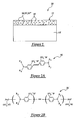
- an embodiment of the system 10 includes a substrate 14 having an embodiment of the amphoteric stilbene composition 12 established thereon.
- the amphoteric stilbene composition 12 is established/dispersed/disposed/printed on a substrate.
- Establishing, dispersing, disposing, or printing on the substrate 14 may be incorporated in the paper making process (for example, at the size press or wet end).
- Non-limitative examples of accomplishing the establishing/dispersing/disposing/printing include firing the solution from an ink jet pen; dip coating; and/or draw coating, and/or combinations thereof.
- Suitable substrates 14 include, but are not limited to papers, polymeric materials, metals, and/or combinations thereof. It is to be understood that any of the substrates 14 may be porous and/or non-porous materials.
- the amphoteric stilbene composition 12 includes a predetermined amount of 4,4'-diamino-2,2'-stilbene disulfonic acid 16.
- Fig. 2A depicts the parent structure of 4,4'-diamino-2,2'-stilbene disulfonic acid 16
- Fig. 2B depicts the parent structure of biarylsulfonate-4,4'-diamino-2,2'-stilbene disulfonic acid 16'
- Fig. 2C depicts the parent structure of biaryldisulfonate-4,4'-diamino-2,2'-stilbene disulfonic acid 16". It is to be understood that M and M' may be the same or different.
- M and M' are H + , Na + , K + , and/or NR 4 + (where R is H, alkyl groups, or aryl groups).
- R 1 , R 2 , R 3 , and R 4 may also be the same of different, and in an embodiment are H, alkyl groups, aryl groups, or heterocyclic rings.
- Non-limitative examples of amphoteric stilbene derivatives of 4,4'-diamino-2,2'-stilbene disulfonic acid 16 include those that are commercially available under the names Fluorescent Brightener 24, Fluorescent Brightener 28, Fluorescent Brightener 71, Fluorescent Brightener 85, Fluorescent Brightener 210, and Fluorescent Brightener 220 from a variety of suppliers. It is to be understood that these brighteners have the parent molecular structure of 4,4'-diamino-2,2'-stilbenedisulfonic acid 16.
- the 4,4'-diamino-2,2'-stilbene disulfonic acid 18 is present in the composition 12 In an amount ranging between about 0.1 grams per square meter (gsm) and about 5 gsm. In a non-limitativve example, 0.98 ⁇ moles/L of 4,4'-diamino-2,2'-stilbene disulfonic acid 18 is present in the composition 12.
- the amphoteric stilbone composition 12 also Includes a fixing agent 18 that is compatible with the 4,4'-diamino-2,2'stilbene disulfonic acid 16, and is poly(hexamethylenebiguanide) hydrochloride (PHMB). It is to be understood that the fixing agent 18 may be present in any desirable amount, and in an embodiment, the amount ranges between about 0.1 gsm and about 10 gsm. In a non-limitative example, 97 ⁇ eq/L, 16 ⁇ M (assuming 6 equivalents per mole) of the fixing agent 18 is used.
- PHMB poly(hexamethylenebiguanide) hydrochloride
- the amphoteric stilbene 16 and the fixing agent 18 may be substantially homogeneously and/or heterogeneously mixed together. Further, the amphoteric stilbene composition 12 may be established on the substrate 14 via any suitable method, such as those previously described.
- Table 1 lists the compositions of the solutions presented to the spectrofluorimeter.
- VANTOCIL IB is a guanidine-based salt that can be used as a PHMB fixing agent.
- Buffers at pH 4, 7, and 10 were made by dissolving 0.01 moles of succinic acid (pH 4) or monobasic sodium phosphate (pH 7) or sodium bicarbonate (pH 10) into about 60 mL of water, adjusting to the appropriate pH by addition of sodium hydroxide against a calibrated pH electrode (calibrated at pH 4, 7, 10) and finally diluting to 100 mL with water.
- pH 4 succinic acid
- pH 7 monobasic sodium phosphate
- sodium bicarbonate pH 10 mL
- pH electrode calibrated at pH electrode
- Table 2 illustrates the preparation of concentrates for the stilbene solutions.
- the stilbene concentrate was diluted into neat IPA and the 4,4'-diaminostilbene dihydrochloride was dissolved in 50/50 v/v IPA.
- the mM concentrations were calculated for the concentrates based on the masses and the labeled purity.
- Table 2 Aliquots of the concentrates (shown in Table 2) were diluted to one liter with water to produce the stilbene working solutions (shown in Table 3).
- Table 3 Working Solutions Stilbene Type mL concentrate Total dilution volume, mL mg/L ⁇ M Stilbene 0.25 1000 0.262 1.39 4,4'-diaminostilbene dihydrochloride 1.6 1000 0.418 1.40 4,4'-diaminostilbene-2,2'-stilbenedisulfonic acid 20 1000 0.710 1.63
- the analyte solutions were made by mixing 15 ml of the stilbene working solutions with 10 mL of the appropriate buffer. This produced the nine analyte solutions at pH 4, 7, and 10 without any fixing agent. A second set of nine solutions was prepared in an identical manner, except 10 ⁇ L of the fixing agent spike solution was added to produce the analyte solutions.
- Table 4 Analyte Solutions Stilbene Type mL Stock mL Buffer ⁇ M Analyte Stilbene 15 10 0.836 4,4'-diaminostilbene dihydrochloride 15 10 0.841 4,4'-diaminostilbene-2,2'-stilbenedisulfonic acid 15 10 0.978
- the two amino stilbene derivatives demonstrated a shift in peak emission wavelength of about 20-30 nm at pH 4. However, this shift in emission wavelength was not observed for stilbene.
- the excitation maxima were independent of pH.
- Fig. 3 shows the fluorescence emission intensities for the 4,4'-diamino-2,2'-stilbene disulfonic acid as a function of pH in the presence and absence of fixing agent.
- the emission intensity was normalized to 1 ⁇ M.
- the fixing agent content was 97 times the stilbene derivative content (on an equivalent not molar basis). Buffer concentrations were 40 mM.
- the protonation of the amino function dramatically decreased the fluorescence.
- the fluorescence intensity of the disulfonate derivative increased to about 80% of the un-sulfonated diaminostilbene.
- the presence of the fixing agent offset the effect of low pH on the fluorescence intensity. It is believed that the effect of the fixing agent may be due, at least in part, to the interaction with the diaminostilbene disulfonate. If the cationic fixing agent wraps around the stilbene derivative and interacts simultaneously with the two sulfonate functions, the stilbene derivative may become a more rigid structure. Rigidity is known to increase fluorescence intensity. Alternatively, the fixing agent may interfere with exchange reactions at the sulfonate site that would otherwise reduce fluorescence.
- Table 6 illustrates the normalized peak fluorescence intensity in arbitrary unit/ ⁇ M for the stilbene solutions with and without fixing agent at different pH.
- Table 6 Stilbene 4,4'-diaminostilbene dihydrochloride 4,4'-diamino-2,2'-stilbenedisulfonic acid w/o fixing agent w/ fixing agent w/o fixing agent w/ fixing agent w/o fixing agent pH 4 75k 90k 75k 80k 50k 205k pH 7 65k 65k 275k 285k 115k 190k pH 10 65k 55k 265k 280k 115k 190k
- the stilbene showed scattered results in the range of 90k to 55k. This may be due, in part, to instrument measurement error and impurity. However, the inert aromatic structure of stilbene should not have any interaction with pH nor with the fixing agent.
- the 4,4'-diaminostilbene dihydrochloride showed substantially no difference in fluorescence intensity with and without the fixing agent. This may be due, at least in part, to the non-interactive nature of two equally charged species, i.e. positive to positive. However, the noted increase in fluorescence intensity at high pH (7 and 10) may be due to the deprotonation of the amino groups. At high pH, the deprotonation of the amino groups of the 4,4'-diaminostilbene dihydrochloride would decrease the solubility of this material due to the lost of the charge that is essential for dissolution in water.
- 4,4'-diamino-2,2'-stilbenedisulfonic acid shows pH dependent fluorescence in the acidic pH range. However, the pH dependency of the fluorescence disappears once the fixing agent is added into the solution. The fluorescence intensity went up about 4 fold at pH 4 and about 2 fold at pH 7 and pH 10.
- 4,4'-diamino-2,2'-stilbenedisulfonic acid is associated with charge at both acidic and basic pHs. This is an advantage over the diamino stilbene that will have no charge at basic pH, potentially resulting in solubility decrease.
- Embodiment(s) of the composition 12, system 10, and method as defined herein include the following advantages.
Landscapes
- Engineering & Computer Science (AREA)
- Textile Engineering (AREA)
- Paper (AREA)
- Inks, Pencil-Leads, Or Crayons (AREA)
- Compositions Of Macromolecular Compounds (AREA)
- Organic Low-Molecular-Weight Compounds And Preparation Thereof (AREA)
Description
- The present disclosure relates generally to amphoteric stilbene compositions.
- Traditional brighteners, for example, those used in paper pulp, are generally anionic. Yet in some instances, anionic brighteners may have a tendency to separate or coagulate from solution once a fixing agent is mixed therein. Traditional fixing agents are cationic in nature, for example, poly cationic polymers. The anionic brighteners have a tendency to react and combine with these types of fixing agents, and the resulting product may separate or coagulate from the solution mix. As a result, the brightness of the paper may decrease. Further, the manufacturing of such anionic brightener solutions may include extra steps so as to physically separate the anionic brightener from the fixing agent so that instability of the brightener is substantially avoided. However, these extra steps may be costly and time consuming.
- As such, it would be desirable to provide a brightener that is compatible with a fixing agent.
- An amphoteric stilbene composition is disclosed. The composition includes a fixing agent mixed with a predetermined amount of 4,4'-diamino-2,2'-stilbene disulfonic acid
- Objects, features and advantages will become apparent by reference to the following detailed description and drawings, in which like reference numerals correspond to similar, though not necessarily identical components. For the sake of brevity, reference numerals having a previously described function may not necessarily be described in connection with subsequent drawings in which they appear.
-
Fig. 1 is a schematic view of a substrate having an embodiment of the amphoteric stilbene composition established thereon; -
Fig. 2A is a generic structure of 4,4'-diamino-2,2'-stilbene disulfonic acid; -
Fig. 2B is a generic structure of biarylsulfonate-4.,4'-diamino-2,2'-stilbene disulfonic acid (comparative); -
Fig. 2C is a generic structure of biaryldisul onate-4,4'-diamino-2,2'-stilbene disulfonic acid (comparative); and -
Fig. 3 is a graph depicting the fluorescence intensity over pH range of 4,4'-diamino-2,2'-stilbene disulfonic acid and a buffer, both with and without a fixing agent. - Embodiment(s) of the amphoteric stilbene composition mix an amphoteric stilbene with a fixing agent. The amphoteric stilbene is compatible with the fixing agent and as such, is advantageously prevented from separating from the solution. This compatibility allows the solution to be manufactured without having to separate the brightener from the fixing agent. Further, the amphoteric stilbene substantially enhances fluorescence efficiency and remains solubilized in a wide pH range.
- Referring now to
Fig. 1 , an embodiment of thesystem 10 includes asubstrate 14 having an embodiment of the amphotericstilbene composition 12 established thereon. In one embodiment of thesystem 10, the amphotericstilbene composition 12 is established/dispersed/disposed/printed on a substrate. Establishing, dispersing, disposing, or printing on thesubstrate 14 may be incorporated in the paper making process (for example, at the size press or wet end). Non-limitative examples of accomplishing the establishing/dispersing/disposing/printing include firing the solution from an ink jet pen; dip coating; and/or draw coating, and/or combinations thereof. -
Suitable substrates 14 include, but are not limited to papers, polymeric materials, metals, and/or combinations thereof. It is to be understood that any of thesubstrates 14 may be porous and/or non-porous materials. - The amphoteric
stilbene composition 12 includes a predetermined amount of 4,4'-diamino-2,2'-stilbenedisulfonic acid 16. -
Fig. 2A depicts the parent structure of 4,4'-diamino-2,2'-stilbenedisulfonic acid 16;Fig. 2B (comparative) depicts the parent structure of biarylsulfonate-4,4'-diamino-2,2'-stilbene disulfonic acid 16'; andFig. 2C (comparative) depicts the parent structure of biaryldisulfonate-4,4'-diamino-2,2'-stilbenedisulfonic acid 16". It is to be understood that M and M' may be the same or different. In an embodiment, M and M' are H+, Na+, K+, and/or NR4 + (where R is H, alkyl groups, or aryl groups). R1, R2, R3, and R4 may also be the same of different, and in an embodiment are H, alkyl groups, aryl groups, or heterocyclic rings. - Non-limitative examples of amphoteric stilbene derivatives of 4,4'-diamino-2,2'-stilbene
disulfonic acid 16 include those that are commercially available under the names Fluorescent Brightener 24, Fluorescent Brightener 28, Fluorescent Brightener 71, Fluorescent Brightener 85, Fluorescent Brightener 210, and Fluorescent Brightener 220 from a variety of suppliers. It is to be understood that these brighteners have the parent molecular structure of 4,4'-diamino-2,2'-stilbenedisulfonic acid 16. - In an embodiment, the 4,4'-diamino-2,2'-stilbene disulfonic acid 18 is present in the
composition 12 In an amount ranging between about 0.1 grams per square meter (gsm) and about 5 gsm. In a non-limitativve example, 0.98 µmoles/L of 4,4'-diamino-2,2'-stilbene disulfonic acid 18 is present in thecomposition 12. - The
amphoteric stilbone composition 12 also Includes a fixing agent 18 that is compatible with the 4,4'-diamino-2,2'stilbenedisulfonic acid 16, and is poly(hexamethylenebiguanide) hydrochloride (PHMB). It is to be understood that the fixing agent 18 may be present in any desirable amount, and in an embodiment, the amount ranges between about 0.1 gsm and about 10 gsm. In a non-limitative example, 97 µeq/L, 16 µM (assuming 6 equivalents per mole) of the fixing agent 18 is used. - Without being bound to any theory, it is believed that the mixing of a PHMB fixing agent 18 with the
amphoteric stilbene 16 advantageously enhances fluorescence due, at least in part, to formation of structural rigidity that restricts twisting about the C=C bond. - In an embodiment of the method, the
amphoteric stilbene 16 and the fixing agent 18 may be substantially homogeneously and/or heterogeneously mixed together. Further, the amphotericstilbene composition 12 may be established on thesubstrate 14 via any suitable method, such as those previously described. - To further illustrate embodiment(s) of the present disclosure, the following examples are given. It is to be understood that these examples are provided for illustrative purposes and are not to be construed as limiting the scope of the disclosed embodiment(s).
- To understand the nature of the 4,4'-diamino-2,2'-stilbenedisulfonic acid, solution phase fluorescence of stilbene, stilbene 4,4'-diaminostilbene dihydrochloride, and 4,4'-diamino-2,2'-stilbenedisulfonic acid were studied at
pH - Table 1 lists the compositions of the solutions presented to the spectrofluorimeter.
Table 1: Solution Compositions Stilbene Derivative Identity & Concentration IPA Co-Solvent Buffer Types & Concentrations Fixing Agent Concentration Stilbene (0.84 µmoles/L) 0.015 vol.% pH 4 = 40 mM succinic acid/succinate97µeq/L, 16 µM* 0 µeq/L PH7 = 40 mM H2PO4/HPO4 97 µeq/L, 16 µM* 0 µeq/ L pH 10 = 40mM HCO3/CO3 87 µeq/L, 18 µM* 0 µeq/ L 4,4-diaminostilbene dihydrochloride (0.84 µmoles/L) 0.048 vol% pH 4 = 40 mM succinic acid/succinate97 µeq/L, 16 µM* 0 µeq/ L pH 7 = 40 mM H2PO4/HPO4 97 µeq/L, 16 µM* 0 µeq/ L pH 10 = 40mM HCO3/CO3 97 µeq/L, 16 µM* 0 µeq/ L 4,4'-diaminostilbene-2,2'-stilbenedisulfonic acid (0.86 µmoles/L) 0.000 vol.% pH 4 = 40 mM succinic acid/succiniate97 µeq/L, 16 µM* 0 µeq/ L pH 7 = 40 mM H2PO4/HPO4 97 µeq/L, 16 µM* 0 µeq/ L pH 10 = 40mM HCO3/CO3 97 µeq/L, 16 µM* 0 µeq/L - Molar concentration assumes 8 equivalents/mole - A 53 g/L working solution of fixing agent was prepared by dissolving VANTOCIL IB In water. VANTOCIL IB is a guanidine-based salt that can be used as a PHMB fixing agent.
- VANTOCIL IB is commercially available from Avecia Ltd. located In Manchester, UK. Assuming the fixing agent has a repeat unit of {(CH2)3NH(C=NH)NH(C=NH)NH(CH2)3,HCl]m-, the equivalent weight of the fixing agent is 219 g/eq, and the normality of the working solution was 0.242 eq/L. When 10 µL of the working solution was spiked into 25 mL of the prepared stilbene solutions, the resulting fixing agent content was 97µeq/L (or 16µM; assuming 6 eq/mole).
- Buffers at
pH pH - Table 2 illustrates the preparation of concentrates for the stilbene solutions. The stilbene concentrate was diluted into neat IPA and the 4,4'-diaminostilbene dihydrochloride was dissolved in 50/50 v/v IPA. The mM concentrations were calculated for the concentrates based on the masses and the labeled purity.
Table 2: Stilbene Concentrates Stilbene Type Reagent Purity mg volume ML IPA co-solvent mM Stilbene 96% 27.7 26.5 26.5 5.575 4,4'-diaminostilbene dihydrochloride 95% 26.1 100 50 0.876 4,4'-diaminostilbene-2,2'-stilbenedisulfonic acid 85% 35.5 1000 0 0.081 - Aliquots of the concentrates (shown in Table 2) were diluted to one liter with water to produce the stilbene working solutions (shown in Table 3).
Table 3: Working Solutions Stilbene Type mL concentrate Total dilution volume, mL mg/L µM Stilbene 0.25 1000 0.262 1.39 4,4'-diaminostilbene dihydrochloride 1.6 1000 0.418 1.40 4,4'-diaminostilbene-2,2'-stilbenedisulfonic acid 20 1000 0.710 1.63 - The analyte solutions were made by mixing 15 ml of the stilbene working solutions with 10 mL of the appropriate buffer. This produced the nine analyte solutions at
pH Table 4: Analyte Solutions Stilbene Type mL Stock mL Buffer µM Analyte Stilbene 15 10 0.836 4,4'-diaminostilbene dihydrochloride 15 10 0.841 4,4'-diaminostilbene-2,2'-stilbenedisulfonic acid 15 10 0.978 - A JY Spex model FL212 dual grating fluorescence spectrophotometer was used for all measurements.
- Initially the excitation and emission spectra were measured in each of the pH buffers to determine the excitation and emission maxima for the system. No
fixing agent was added. The excitation and emission maxima for the stilbenes are compiled below, in Table 5, as a function of pH.Table 5 Stilbene Type pH 4 pH 7pH 10Excitation Emission Excitation Emission Excitation Emission Stilbene 296 353 295 353 300 353 4,4'-diaminostilbene dihydrochloride 307 455 309 428 309 427 4,4'-diamino-2,2'-stilbene disulfonic acid 327 467 328 445 327 445 - Due, in part, to the protonation of the amino function, the two amino stilbene derivatives demonstrated a shift in peak emission wavelength of about 20-30 nm at
pH 4. However, this shift in emission wavelength was not observed for stilbene. The excitation maxima were independent of pH. - Once the peak maxima were identified, the effects of fixing agent and pH were studied.
Fig. 3 shows the fluorescence emission intensities for the 4,4'-diamino-2,2'-stilbene disulfonic acid as a function of pH in the presence and absence of fixing agent. For these results and the subsequent emission spectra, the emission intensity was normalized to 1 µM. When present, the fixing agent content was 97 times the stilbene derivative content (on an equivalent not
molar basis). Buffer concentrations were 40 mM. - As depicted in the chart in
Fig. 3 , in the absence of the fixing agent (buffer plot), the protonation of the amino function dramatically decreased the fluorescence. However, in the presence of the fixing agent atpH 7 andpH 10, the fluorescence intensity of the disulfonate derivative increased to about 80% of the un-sulfonated diaminostilbene. Further, the presence of the fixing agent offset the effect of low pH on the fluorescence intensity. It is believed that the effect of the fixing agent may be due, at least in part, to the interaction with the diaminostilbene disulfonate. If the cationic fixing agent wraps around the stilbene derivative and interacts simultaneously with the two sulfonate functions, the stilbene derivative may become a more rigid structure. Rigidity is known to increase fluorescence intensity. Alternatively, the fixing agent may interfere with exchange reactions at the sulfonate site that would otherwise reduce fluorescence. - Table 6 illustrates the normalized peak fluorescence intensity in arbitrary unit/µM for the stilbene solutions with and without fixing agent at different pH.
Table 6 Stilbene 4,4'- diaminostilbene dihydrochloride 4,4'-diamino-2,2'-stilbenedisulfonic acid w/o fixing agent w/ fixing agent w/o fixing agent w/ fixing agent w/o fixing agent w/ fixing agent pH 4 75k 90k 75k 80k 50k 205k pH 7 65k 65k 275k 285k 115k 190k pH 10 65k 55k 265k 280k 115k 190k - The stilbene showed scattered results in the range of 90k to 55k. This may be due, in part, to instrument measurement error and impurity. However, the inert aromatic structure of stilbene should not have any interaction with pH nor with the fixing agent.
- The 4,4'-diaminostilbene dihydrochloride showed substantially no difference in fluorescence intensity with and without the fixing agent. This may be due, at least in part, to the non-interactive nature of two equally charged species, i.e. positive to positive. However, the noted increase in fluorescence intensity at high pH (7 and 10) may be due to the deprotonation of the amino groups. At high pH, the deprotonation of the amino groups of the 4,4'-diaminostilbene dihydrochloride would decrease the solubility of this material due to the lost of the charge that is essential for dissolution in water.
- Without fixing agent, the behavior of the 4,4'-diamino-2,2'-stilbenedisulfonic acid is similar to the diamino stilbene: it shows pH dependent fluorescence in the acidic pH range. However, the pH dependency of the fluorescence disappears once the fixing agent is added into the solution. The fluorescence
intensity went up about 4 fold atpH 4 and about 2 fold atpH 7 andpH 10. Regarding the solubility in water, 4,4'-diamino-2,2'-stilbenedisulfonic acid is associated with charge at both acidic and basic pHs. This is an advantage over the diamino stilbene that will have no charge at basic pH, potentially resulting in solubility decrease. - Embodiment(s) of the
composition 12,system 10, and method as defined herein include the following advantages. The stilbeneamphoteric composition 12 substantially enhances the fluorescence of thesubstrate 14. Without being bound to any theory, it is believed that this enhanced fluorescence may be a result of, in part, theamphoteric stilbene 16 and fixing agent 18 complex reducing the twisting about the C=C bond. - While several embodiments have been described in detail, it will be apparent to those skilled in the art that the disclosed embodiments may be modified. Therefore, the foregoing description is to be considered exemplary rather than limiting.
Claims (9)
- An amphoteric stilbene composition (12), comprising:a predetermined amount of 4,4'-diamino-2,2'-stilbene disulfonic acid (16), anda fixing agent (18) selected from poly(hexamethylenebiguanide) hydrochloride (PHMB).
- The amphoteric stilbene composition (12) as defined in claim 1 wherein the 4,4'-diamino-2,2'-stilbene disulfonic acid (16), is at least one of substantially homogenously and heterogeneously mixed with the fixing agent (18).
- A substrate having the amphoteric stilbene composition (12) as defined in at least one of claims 1 through 2 established thereon, wherein the predetermined amount of 4,4'-diamino-2,2'-stilbene disulfonic acid (16), ranges from about 0.1 g/m2 to about 5 g/m2 of the substrate.
- A substrate having the amphoteric stilbene composition (12) as defined in at least one of claims 1 through 3 established thereon, wherein the fixing agent (18) is present in an amount ranging from about 0.1 g/m2 to about 10 g/m2 of the substrate.
- A method of making a media substrate (14) having enhanced fluorescence, the method comprising:mixing a predetermined amount of 4,4'-diamino-2,2'-stilbene disulfonic acid (16), with a fixing agent (18) to form a solution the fixing agent selected from poly(hexamethylenebiguanide) hydrochloride (PHMB); andestablishing the solution on the media substrate (14), the solution substantially enhancing the fluorescence of the media substrate (14).
- The method as defined in claim 5 wherein the fluorescence of the media substrate (14) is substantially enhanced at a pH ranging between about 2 and about 13.
- The method as defined in claim 5 wherein the fluorescence of the media substrate is substantially enhanced at one of pH4, pH7 and pH10.
- The method as defined in at least one of 5 through 7 wherein establishing the solution is accomplished by one of firing via an ink jet device, dip coating, draw coating, and combinations thereof.
- A substrate having the amphoteric stilbene composition (12) of claim 1 established thereon.
Applications Claiming Priority (2)
| Application Number | Priority Date | Filing Date | Title |
|---|---|---|---|
| US11/117,823 US20060246383A1 (en) | 2005-04-29 | 2005-04-29 | Amphoteric stilbene composition |
| PCT/US2006/016651 WO2006119201A1 (en) | 2005-04-29 | 2006-04-27 | Amphoteric stilbene composition |
Publications (2)
| Publication Number | Publication Date |
|---|---|
| EP1885938A1 EP1885938A1 (en) | 2008-02-13 |
| EP1885938B1 true EP1885938B1 (en) | 2013-06-26 |
Family
ID=36943988
Family Applications (1)
| Application Number | Title | Priority Date | Filing Date |
|---|---|---|---|
| EP06752017.1A Expired - Lifetime EP1885938B1 (en) | 2005-04-29 | 2006-04-27 | Amphoteric stilbene composition |
Country Status (5)
| Country | Link |
|---|---|
| US (2) | US20060246383A1 (en) |
| EP (1) | EP1885938B1 (en) |
| JP (1) | JP4778041B2 (en) |
| CN (1) | CN101263256B (en) |
| WO (1) | WO2006119201A1 (en) |
Families Citing this family (1)
| Publication number | Priority date | Publication date | Assignee | Title |
|---|---|---|---|---|
| WO2012057790A1 (en) | 2010-10-29 | 2012-05-03 | Hewlett-Packard Development Company, L.P. | Paper enhancement treatment with decreased calcium chloride |
Family Cites Families (16)
| Publication number | Priority date | Publication date | Assignee | Title |
|---|---|---|---|---|
| US3157644A (en) * | 1956-04-04 | 1964-11-17 | Gen Aniline & Film Corp | Brightening agents |
| US3909266A (en) * | 1966-04-14 | 1975-09-30 | Canon Kk | Recording member of photocolor developing and eliminating material and the recording method |
| US3575866A (en) * | 1969-11-19 | 1971-04-20 | Gaf Corp | New brighteners,compositions thereof and processes for using same |
| DE2060762A1 (en) * | 1970-12-10 | 1972-06-22 | Henkel & Cie Gmbh | Preparations for the production of cold bleach liquors, in particular washing liquors with a cold bleaching effect |
| GB8711105D0 (en) * | 1987-05-11 | 1987-06-17 | Ici Plc | Information device |
| GB9412590D0 (en) * | 1994-06-23 | 1994-08-10 | Sandoz Ltd | Organic compounds |
| DE19646759C2 (en) * | 1996-11-04 | 2003-01-09 | Schuelke & Mayr Gmbh | Use of an optical brightener in a disinfectant |
| US6180584B1 (en) * | 1998-02-12 | 2001-01-30 | Surfacine Development Company, Llc | Disinfectant composition providing sustained residual biocidal action |
| US6066673A (en) * | 1998-03-12 | 2000-05-23 | The Procter & Gamble Company | Enzyme inhibitors |
| US20030147925A1 (en) * | 1998-09-11 | 2003-08-07 | Samuel P. Sawan | Topical dermal antimicrobial compositions, methods for generating same, and monitoring methods utilizing same |
| GB9930247D0 (en) * | 1999-12-22 | 2000-02-09 | Clariant Int Ltd | Improvements in or relating to organic compounds |
| JP4179584B2 (en) * | 2001-03-22 | 2008-11-12 | 日本化薬株式会社 | Aqueous liquid composition of fluorescent brightener with excellent dyeing properties |
| DE10149313A1 (en) * | 2001-10-05 | 2003-04-17 | Bayer Ag | Use of aqueous brightener preparations to lighten natural and synthetic materials |
| US7129284B2 (en) * | 2002-12-03 | 2006-10-31 | Hewlett-Packard Development Company, L.P. | Fluorosurfactant packages for use in inkjet printing and methods of controlling puddling in inkjet pens |
| CA2562910A1 (en) * | 2004-05-03 | 2005-11-10 | Ciba Specialty Chemicals Holding Inc. | Optical brighteners for inkjetrinting substrates |
| US9028852B2 (en) * | 2004-09-07 | 2015-05-12 | 3M Innovative Properties Company | Cationic antiseptic compositions and methods of use |
-
2005
- 2005-04-29 US US11/117,823 patent/US20060246383A1/en not_active Abandoned
-
2006
- 2006-04-27 WO PCT/US2006/016651 patent/WO2006119201A1/en not_active Ceased
- 2006-04-27 JP JP2008509230A patent/JP4778041B2/en not_active Expired - Fee Related
- 2006-04-27 CN CN2006800144016A patent/CN101263256B/en not_active Expired - Fee Related
- 2006-04-27 EP EP06752017.1A patent/EP1885938B1/en not_active Expired - Lifetime
-
2008
- 2008-08-05 US US12/186,079 patent/US7789917B2/en not_active Expired - Lifetime
Also Published As
| Publication number | Publication date |
|---|---|
| US7789917B2 (en) | 2010-09-07 |
| EP1885938A1 (en) | 2008-02-13 |
| WO2006119201A1 (en) | 2006-11-09 |
| CN101263256A (en) | 2008-09-10 |
| JP4778041B2 (en) | 2011-09-21 |
| JP2008540700A (en) | 2008-11-20 |
| US20060246383A1 (en) | 2006-11-02 |
| CN101263256B (en) | 2011-07-06 |
| US20080290320A1 (en) | 2008-11-27 |
Similar Documents
| Publication | Publication Date | Title |
|---|---|---|
| Andreiuk et al. | Fighting aggregation‐caused quenching and leakage of dyes in fluorescent polymer nanoparticles: universal role of counterion | |
| TWI484083B (en) | Disulfo-type fluorescent whitening agent compositions | |
| US8221588B2 (en) | Storage stable solutions of optical brighteners | |
| EP3138137A1 (en) | Organic molecules for use in optoelectronic devices | |
| Akanuma et al. | Silver in the Center Enhances Room‐Temperature Phosphorescence of a Platinum Sub‐nanocluster by 18 Times | |
| EP3287450A1 (en) | Organic molecules, in particular for use in organic optoelectronic devices | |
| US8067602B2 (en) | Asymmetric cyanine fluorescent dyes, compositions and their use in staining biological samples | |
| CN103459720B (en) | Compositions of fluorescent whitening agents | |
| Xia et al. | Doping Au 25 nanoparticles using ultrasmall silver or copper nanoparticles as the metal source | |
| US20100294447A1 (en) | Storage stable solutions of optical brighteners | |
| US7789917B2 (en) | Amphoteric stilbene composition | |
| CN109777398A (en) | A kind of nitrogen-doped carbon point coordination rare earth multicolor tunable luminescent composite material and its multicolor light-converting agricultural film | |
| EP3399004B1 (en) | Organic molecules, in particular for use in optoelectronic devices | |
| DE102017102363A1 (en) | Organic molecules, in particular for use in organic optoelectronic devices | |
| EP3580300B1 (en) | Organic molecules, especially for use in organic optoelectronic devices | |
| US20060065381A1 (en) | Alkanolammonium-containing triazinyl flavonate whiteners | |
| CN112940039B (en) | Eutectic compound with solid fluorescence performance and preparation method and application thereof | |
| ITMI20100662A1 (en) | MIXTURE, COMPOSITION AND PROCESS FOR THE SURFACE TREATMENT OF THE PAPER | |
| CN121698815A (en) | Water-soluble blue fluorescent material and application thereof | |
| KR100355097B1 (en) | The stabilizing method of coloring dyes for pulp | |
| Liu | The Response of Fluorescence Emission to the Assembly Complex of an Inorganic-Organic Hybrid | |
| CN101213261A (en) | Disazo dyes and dye compositions for coloring white paper | |
| Choi et al. | Optical Properties of DNA-CTMA and PA-CTMA doped with (E)-2-(2-(4-(diethylamino) styryl)-4H-pyan-4-ylidene) malononitrile (DCM) |
Legal Events
| Date | Code | Title | Description |
|---|---|---|---|
| PUAI | Public reference made under article 153(3) epc to a published international application that has entered the european phase |
Free format text: ORIGINAL CODE: 0009012 |
|
| 17P | Request for examination filed |
Effective date: 20071129 |
|
| AK | Designated contracting states |
Kind code of ref document: A1 Designated state(s): AT BE BG CH CY CZ DE DK EE ES FI FR GB GR HU IE IS IT LI LT LU LV MC NL PL PT RO SE SI SK TR |
|
| DAX | Request for extension of the european patent (deleted) | ||
| 17Q | First examination report despatched |
Effective date: 20110210 |
|
| GRAP | Despatch of communication of intention to grant a patent |
Free format text: ORIGINAL CODE: EPIDOSNIGR1 |
|
| INTG | Intention to grant announced |
Effective date: 20130325 |
|
| GRAS | Grant fee paid |
Free format text: ORIGINAL CODE: EPIDOSNIGR3 |
|
| GRAA | (expected) grant |
Free format text: ORIGINAL CODE: 0009210 |
|
| AK | Designated contracting states |
Kind code of ref document: B1 Designated state(s): AT BE BG CH CY CZ DE DK EE ES FI FR GB GR HU IE IS IT LI LT LU LV MC NL PL PT RO SE SI SK TR |
|
| REG | Reference to a national code |
Ref country code: GB Ref legal event code: FG4D |
|
| REG | Reference to a national code |
Ref country code: CH Ref legal event code: EP |
|
| REG | Reference to a national code |
Ref country code: AT Ref legal event code: REF Ref document number: 618763 Country of ref document: AT Kind code of ref document: T Effective date: 20130715 |
|
| REG | Reference to a national code |
Ref country code: IE Ref legal event code: FG4D |
|
| REG | Reference to a national code |
Ref country code: DE Ref legal event code: R096 Ref document number: 602006037005 Country of ref document: DE Effective date: 20130822 |
|
| PG25 | Lapsed in a contracting state [announced via postgrant information from national office to epo] |
Ref country code: FI Free format text: LAPSE BECAUSE OF FAILURE TO SUBMIT A TRANSLATION OF THE DESCRIPTION OR TO PAY THE FEE WITHIN THE PRESCRIBED TIME-LIMIT Effective date: 20130626 Ref country code: SI Free format text: LAPSE BECAUSE OF FAILURE TO SUBMIT A TRANSLATION OF THE DESCRIPTION OR TO PAY THE FEE WITHIN THE PRESCRIBED TIME-LIMIT Effective date: 20130626 Ref country code: SE Free format text: LAPSE BECAUSE OF FAILURE TO SUBMIT A TRANSLATION OF THE DESCRIPTION OR TO PAY THE FEE WITHIN THE PRESCRIBED TIME-LIMIT Effective date: 20130626 Ref country code: GR Free format text: LAPSE BECAUSE OF FAILURE TO SUBMIT A TRANSLATION OF THE DESCRIPTION OR TO PAY THE FEE WITHIN THE PRESCRIBED TIME-LIMIT Effective date: 20130927 Ref country code: LT Free format text: LAPSE BECAUSE OF FAILURE TO SUBMIT A TRANSLATION OF THE DESCRIPTION OR TO PAY THE FEE WITHIN THE PRESCRIBED TIME-LIMIT Effective date: 20130626 |
|
| REG | Reference to a national code |
Ref country code: AT Ref legal event code: MK05 Ref document number: 618763 Country of ref document: AT Kind code of ref document: T Effective date: 20130626 |
|
| REG | Reference to a national code |
Ref country code: LT Ref legal event code: MG4D |
|
| PG25 | Lapsed in a contracting state [announced via postgrant information from national office to epo] |
Ref country code: BG Free format text: LAPSE BECAUSE OF FAILURE TO SUBMIT A TRANSLATION OF THE DESCRIPTION OR TO PAY THE FEE WITHIN THE PRESCRIBED TIME-LIMIT Effective date: 20130926 |
|
| REG | Reference to a national code |
Ref country code: NL Ref legal event code: VDEP Effective date: 20130626 |
|
| PG25 | Lapsed in a contracting state [announced via postgrant information from national office to epo] |
Ref country code: LV Free format text: LAPSE BECAUSE OF FAILURE TO SUBMIT A TRANSLATION OF THE DESCRIPTION OR TO PAY THE FEE WITHIN THE PRESCRIBED TIME-LIMIT Effective date: 20130626 |
|
| PG25 | Lapsed in a contracting state [announced via postgrant information from national office to epo] |
Ref country code: CY Free format text: LAPSE BECAUSE OF FAILURE TO SUBMIT A TRANSLATION OF THE DESCRIPTION OR TO PAY THE FEE WITHIN THE PRESCRIBED TIME-LIMIT Effective date: 20130703 Ref country code: IS Free format text: LAPSE BECAUSE OF FAILURE TO SUBMIT A TRANSLATION OF THE DESCRIPTION OR TO PAY THE FEE WITHIN THE PRESCRIBED TIME-LIMIT Effective date: 20131026 Ref country code: AT Free format text: LAPSE BECAUSE OF FAILURE TO SUBMIT A TRANSLATION OF THE DESCRIPTION OR TO PAY THE FEE WITHIN THE PRESCRIBED TIME-LIMIT Effective date: 20130626 Ref country code: CZ Free format text: LAPSE BECAUSE OF FAILURE TO SUBMIT A TRANSLATION OF THE DESCRIPTION OR TO PAY THE FEE WITHIN THE PRESCRIBED TIME-LIMIT Effective date: 20130626 Ref country code: PT Free format text: LAPSE BECAUSE OF FAILURE TO SUBMIT A TRANSLATION OF THE DESCRIPTION OR TO PAY THE FEE WITHIN THE PRESCRIBED TIME-LIMIT Effective date: 20131028 Ref country code: SK Free format text: LAPSE BECAUSE OF FAILURE TO SUBMIT A TRANSLATION OF THE DESCRIPTION OR TO PAY THE FEE WITHIN THE PRESCRIBED TIME-LIMIT Effective date: 20130626 Ref country code: EE Free format text: LAPSE BECAUSE OF FAILURE TO SUBMIT A TRANSLATION OF THE DESCRIPTION OR TO PAY THE FEE WITHIN THE PRESCRIBED TIME-LIMIT Effective date: 20130626 Ref country code: BE Free format text: LAPSE BECAUSE OF FAILURE TO SUBMIT A TRANSLATION OF THE DESCRIPTION OR TO PAY THE FEE WITHIN THE PRESCRIBED TIME-LIMIT Effective date: 20130626 |
|
| PG25 | Lapsed in a contracting state [announced via postgrant information from national office to epo] |
Ref country code: PL Free format text: LAPSE BECAUSE OF FAILURE TO SUBMIT A TRANSLATION OF THE DESCRIPTION OR TO PAY THE FEE WITHIN THE PRESCRIBED TIME-LIMIT Effective date: 20130626 Ref country code: ES Free format text: LAPSE BECAUSE OF FAILURE TO SUBMIT A TRANSLATION OF THE DESCRIPTION OR TO PAY THE FEE WITHIN THE PRESCRIBED TIME-LIMIT Effective date: 20131007 Ref country code: RO Free format text: LAPSE BECAUSE OF FAILURE TO SUBMIT A TRANSLATION OF THE DESCRIPTION OR TO PAY THE FEE WITHIN THE PRESCRIBED TIME-LIMIT Effective date: 20130626 Ref country code: NL Free format text: LAPSE BECAUSE OF FAILURE TO SUBMIT A TRANSLATION OF THE DESCRIPTION OR TO PAY THE FEE WITHIN THE PRESCRIBED TIME-LIMIT Effective date: 20130626 |
|
| PG25 | Lapsed in a contracting state [announced via postgrant information from national office to epo] |
Ref country code: CY Free format text: LAPSE BECAUSE OF FAILURE TO SUBMIT A TRANSLATION OF THE DESCRIPTION OR TO PAY THE FEE WITHIN THE PRESCRIBED TIME-LIMIT Effective date: 20130626 |
|
| PG25 | Lapsed in a contracting state [announced via postgrant information from national office to epo] |
Ref country code: DK Free format text: LAPSE BECAUSE OF FAILURE TO SUBMIT A TRANSLATION OF THE DESCRIPTION OR TO PAY THE FEE WITHIN THE PRESCRIBED TIME-LIMIT Effective date: 20130626 |
|
| PLBE | No opposition filed within time limit |
Free format text: ORIGINAL CODE: 0009261 |
|
| STAA | Information on the status of an ep patent application or granted ep patent |
Free format text: STATUS: NO OPPOSITION FILED WITHIN TIME LIMIT |
|
| PG25 | Lapsed in a contracting state [announced via postgrant information from national office to epo] |
Ref country code: IT Free format text: LAPSE BECAUSE OF FAILURE TO SUBMIT A TRANSLATION OF THE DESCRIPTION OR TO PAY THE FEE WITHIN THE PRESCRIBED TIME-LIMIT Effective date: 20130626 |
|
| 26N | No opposition filed |
Effective date: 20140327 |
|
| REG | Reference to a national code |
Ref country code: DE Ref legal event code: R097 Ref document number: 602006037005 Country of ref document: DE Effective date: 20140327 |
|
| PG25 | Lapsed in a contracting state [announced via postgrant information from national office to epo] |
Ref country code: MC Free format text: LAPSE BECAUSE OF FAILURE TO SUBMIT A TRANSLATION OF THE DESCRIPTION OR TO PAY THE FEE WITHIN THE PRESCRIBED TIME-LIMIT Effective date: 20130626 Ref country code: LU Free format text: LAPSE BECAUSE OF FAILURE TO SUBMIT A TRANSLATION OF THE DESCRIPTION OR TO PAY THE FEE WITHIN THE PRESCRIBED TIME-LIMIT Effective date: 20140427 |
|
| REG | Reference to a national code |
Ref country code: CH Ref legal event code: PL |
|
| REG | Reference to a national code |
Ref country code: IE Ref legal event code: MM4A |
|
| PG25 | Lapsed in a contracting state [announced via postgrant information from national office to epo] |
Ref country code: LI Free format text: LAPSE BECAUSE OF NON-PAYMENT OF DUE FEES Effective date: 20140430 Ref country code: CH Free format text: LAPSE BECAUSE OF NON-PAYMENT OF DUE FEES Effective date: 20140430 |
|
| PG25 | Lapsed in a contracting state [announced via postgrant information from national office to epo] |
Ref country code: IE Free format text: LAPSE BECAUSE OF NON-PAYMENT OF DUE FEES Effective date: 20140427 |
|
| REG | Reference to a national code |
Ref country code: FR Ref legal event code: PLFP Year of fee payment: 11 |
|
| PG25 | Lapsed in a contracting state [announced via postgrant information from national office to epo] |
Ref country code: TR Free format text: LAPSE BECAUSE OF FAILURE TO SUBMIT A TRANSLATION OF THE DESCRIPTION OR TO PAY THE FEE WITHIN THE PRESCRIBED TIME-LIMIT Effective date: 20130626 Ref country code: HU Free format text: LAPSE BECAUSE OF FAILURE TO SUBMIT A TRANSLATION OF THE DESCRIPTION OR TO PAY THE FEE WITHIN THE PRESCRIBED TIME-LIMIT; INVALID AB INITIO Effective date: 20060427 |
|
| REG | Reference to a national code |
Ref country code: DE Ref legal event code: R079 Ref document number: 602006037005 Country of ref document: DE Free format text: PREVIOUS MAIN CLASS: D06L0003120000 Ipc: D06L0004600000 |
|
| REG | Reference to a national code |
Ref country code: FR Ref legal event code: PLFP Year of fee payment: 12 |
|
| REG | Reference to a national code |
Ref country code: FR Ref legal event code: PLFP Year of fee payment: 13 |
|
| PGFP | Annual fee paid to national office [announced via postgrant information from national office to epo] |
Ref country code: GB Payment date: 20220323 Year of fee payment: 17 |
|
| PGFP | Annual fee paid to national office [announced via postgrant information from national office to epo] |
Ref country code: FR Payment date: 20220323 Year of fee payment: 17 |
|
| PGFP | Annual fee paid to national office [announced via postgrant information from national office to epo] |
Ref country code: DE Payment date: 20220322 Year of fee payment: 17 |
|
| REG | Reference to a national code |
Ref country code: DE Ref legal event code: R119 Ref document number: 602006037005 Country of ref document: DE |
|
| GBPC | Gb: european patent ceased through non-payment of renewal fee |
Effective date: 20230427 |
|
| PG25 | Lapsed in a contracting state [announced via postgrant information from national office to epo] |
Ref country code: GB Free format text: LAPSE BECAUSE OF NON-PAYMENT OF DUE FEES Effective date: 20230427 |
|
| PG25 | Lapsed in a contracting state [announced via postgrant information from national office to epo] |
Ref country code: GB Free format text: LAPSE BECAUSE OF NON-PAYMENT OF DUE FEES Effective date: 20230427 Ref country code: FR Free format text: LAPSE BECAUSE OF NON-PAYMENT OF DUE FEES Effective date: 20230430 Ref country code: DE Free format text: LAPSE BECAUSE OF NON-PAYMENT OF DUE FEES Effective date: 20231103 |