EP1885735B1 - Molecular transporters based on sugar and its analogues and processes for the preparation thereof - Google Patents
Molecular transporters based on sugar and its analogues and processes for the preparation thereof Download PDFInfo
- Publication number
- EP1885735B1 EP1885735B1 EP05756712.5A EP05756712A EP1885735B1 EP 1885735 B1 EP1885735 B1 EP 1885735B1 EP 05756712 A EP05756712 A EP 05756712A EP 1885735 B1 EP1885735 B1 EP 1885735B1
- Authority
- EP
- European Patent Office
- Prior art keywords
- formula
- groups
- compound
- side chains
- sugar alcohol
- Prior art date
- Legal status (The legal status is an assumption and is not a legal conclusion. Google has not performed a legal analysis and makes no representation as to the accuracy of the status listed.)
- Ceased
Links
- 238000000034 method Methods 0.000 title claims description 34
- 238000002360 preparation method Methods 0.000 title description 57
- 230000008569 process Effects 0.000 title description 5
- 150000001875 compounds Chemical class 0.000 claims description 173
- ZRALSGWEFCBTJO-UHFFFAOYSA-N guanidine group Chemical group NC(=N)N ZRALSGWEFCBTJO-UHFFFAOYSA-N 0.000 claims description 71
- 239000000203 mixture Substances 0.000 claims description 63
- 125000006239 protecting group Chemical group 0.000 claims description 46
- 125000003277 amino group Chemical group 0.000 claims description 32
- 150000005846 sugar alcohols Chemical class 0.000 claims description 29
- 238000005917 acylation reaction Methods 0.000 claims description 26
- CDAISMWEOUEBRE-UHFFFAOYSA-N scyllo-inosotol Natural products OC1C(O)C(O)C(O)C(O)C1O CDAISMWEOUEBRE-UHFFFAOYSA-N 0.000 claims description 25
- 230000010933 acylation Effects 0.000 claims description 23
- CDAISMWEOUEBRE-GPIVLXJGSA-N inositol Chemical class O[C@H]1[C@H](O)[C@@H](O)[C@H](O)[C@H](O)[C@@H]1O CDAISMWEOUEBRE-GPIVLXJGSA-N 0.000 claims description 20
- 239000012528 membrane Substances 0.000 claims description 20
- 150000003839 salts Chemical class 0.000 claims description 19
- 229960000367 inositol Drugs 0.000 claims description 17
- FBPFZTCFMRRESA-FSIIMWSLSA-N D-Glucitol Natural products OC[C@H](O)[C@H](O)[C@@H](O)[C@H](O)CO FBPFZTCFMRRESA-FSIIMWSLSA-N 0.000 claims description 15
- FBPFZTCFMRRESA-JGWLITMVSA-N D-glucitol Chemical class OC[C@H](O)[C@@H](O)[C@H](O)[C@H](O)CO FBPFZTCFMRRESA-JGWLITMVSA-N 0.000 claims description 15
- 125000002887 hydroxy group Chemical group [H]O* 0.000 claims description 13
- 229920001223 polyethylene glycol Polymers 0.000 claims description 13
- 150000002016 disaccharides Chemical class 0.000 claims description 11
- 125000000217 alkyl group Chemical group 0.000 claims description 10
- 125000003710 aryl alkyl group Chemical group 0.000 claims description 10
- 125000000753 cycloalkyl group Chemical group 0.000 claims description 10
- 125000004404 heteroalkyl group Chemical group 0.000 claims description 10
- 239000000600 sorbitol Substances 0.000 claims description 10
- 108090000765 processed proteins & peptides Proteins 0.000 claims description 9
- 229930006000 Sucrose Natural products 0.000 claims description 7
- 239000005720 sucrose Substances 0.000 claims description 7
- GUBGYTABKSRVRQ-XLOQQCSPSA-N Alpha-Lactose Chemical class O[C@@H]1[C@@H](O)[C@@H](O)[C@@H](CO)O[C@H]1O[C@@H]1[C@@H](CO)O[C@H](O)[C@H](O)[C@H]1O GUBGYTABKSRVRQ-XLOQQCSPSA-N 0.000 claims description 6
- CDAISMWEOUEBRE-CDRYSYESSA-N scyllo-inositol Chemical class O[C@H]1[C@H](O)[C@@H](O)[C@H](O)[C@@H](O)[C@@H]1O CDAISMWEOUEBRE-CDRYSYESSA-N 0.000 claims description 6
- 108020004707 nucleic acids Proteins 0.000 claims description 5
- 102000039446 nucleic acids Human genes 0.000 claims description 5
- 150000007523 nucleic acids Chemical class 0.000 claims description 5
- FBPFZTCFMRRESA-KVTDHHQDSA-N D-Mannitol Chemical class OC[C@@H](O)[C@@H](O)[C@H](O)[C@H](O)CO FBPFZTCFMRRESA-KVTDHHQDSA-N 0.000 claims description 4
- 229930195725 Mannitol Chemical class 0.000 claims description 4
- FBPFZTCFMRRESA-GUCUJZIJSA-N galactitol Chemical class OC[C@H](O)[C@@H](O)[C@@H](O)[C@H](O)CO FBPFZTCFMRRESA-GUCUJZIJSA-N 0.000 claims description 4
- 239000000594 mannitol Chemical class 0.000 claims description 4
- 235000010355 mannitol Nutrition 0.000 claims description 4
- SQUHHTBVTRBESD-UHFFFAOYSA-N Hexa-Ac-myo-Inositol Natural products CC(=O)OC1C(OC(C)=O)C(OC(C)=O)C(OC(C)=O)C(OC(C)=O)C1OC(C)=O SQUHHTBVTRBESD-UHFFFAOYSA-N 0.000 claims description 3
- 150000002894 organic compounds Chemical class 0.000 claims description 3
- 229930195727 α-lactose Natural products 0.000 claims description 3
- OWEGMIWEEQEYGQ-UHFFFAOYSA-N 100676-05-9 Chemical class OC1C(O)C(O)C(CO)OC1OCC1C(O)C(O)C(O)C(OC2C(OC(O)C(O)C2O)CO)O1 OWEGMIWEEQEYGQ-UHFFFAOYSA-N 0.000 claims description 2
- GUBGYTABKSRVRQ-DCSYEGIMSA-N Beta-Lactose Chemical class OC[C@H]1O[C@@H](O[C@H]2[C@H](O)[C@@H](O)[C@H](O)O[C@@H]2CO)[C@H](O)[C@@H](O)[C@H]1O GUBGYTABKSRVRQ-DCSYEGIMSA-N 0.000 claims description 2
- GUBGYTABKSRVRQ-PICCSMPSSA-N Maltose Chemical class O[C@@H]1[C@@H](O)[C@H](O)[C@@H](CO)O[C@@H]1O[C@@H]1[C@@H](CO)OC(O)[C@H](O)[C@H]1O GUBGYTABKSRVRQ-PICCSMPSSA-N 0.000 claims description 2
- GUBGYTABKSRVRQ-QUYVBRFLSA-N beta-maltose Chemical class OC[C@H]1O[C@H](O[C@H]2[C@H](O)[C@@H](O)[C@H](O)O[C@@H]2CO)[C@H](O)[C@@H](O)[C@@H]1O GUBGYTABKSRVRQ-QUYVBRFLSA-N 0.000 claims description 2
- 150000003445 sucroses Chemical class 0.000 claims description 2
- 229930195724 β-lactose Chemical class 0.000 claims description 2
- 125000003275 alpha amino acid group Chemical group 0.000 claims 11
- YMWUJEATGCHHMB-UHFFFAOYSA-N Dichloromethane Chemical compound ClCCl YMWUJEATGCHHMB-UHFFFAOYSA-N 0.000 description 99
- XEKOWRVHYACXOJ-UHFFFAOYSA-N Ethyl acetate Chemical compound CCOC(C)=O XEKOWRVHYACXOJ-UHFFFAOYSA-N 0.000 description 99
- OKKJLVBELUTLKV-UHFFFAOYSA-N Methanol Chemical compound OC OKKJLVBELUTLKV-UHFFFAOYSA-N 0.000 description 63
- HEDRZPFGACZZDS-MICDWDOJSA-N Trichloro(2H)methane Chemical compound [2H]C(Cl)(Cl)Cl HEDRZPFGACZZDS-MICDWDOJSA-N 0.000 description 50
- 108010078791 Carrier Proteins Proteins 0.000 description 43
- 238000005160 1H NMR spectroscopy Methods 0.000 description 41
- 239000000543 intermediate Substances 0.000 description 38
- 239000007787 solid Substances 0.000 description 37
- ZMXDDKWLCZADIW-UHFFFAOYSA-N N,N-Dimethylformamide Chemical compound CN(C)C=O ZMXDDKWLCZADIW-UHFFFAOYSA-N 0.000 description 36
- 238000006243 chemical reaction Methods 0.000 description 36
- 239000011541 reaction mixture Substances 0.000 description 36
- OKKJLVBELUTLKV-MZCSYVLQSA-N Deuterated methanol Chemical compound [2H]OC([2H])([2H])[2H] OKKJLVBELUTLKV-MZCSYVLQSA-N 0.000 description 34
- ZMANZCXQSJIPKH-UHFFFAOYSA-N Triethylamine Chemical compound CCN(CC)CC ZMANZCXQSJIPKH-UHFFFAOYSA-N 0.000 description 33
- XLYOFNOQVPJJNP-UHFFFAOYSA-N water Substances O XLYOFNOQVPJJNP-UHFFFAOYSA-N 0.000 description 33
- 210000004027 cell Anatomy 0.000 description 27
- 238000004440 column chromatography Methods 0.000 description 26
- VLKZOEOYAKHREP-UHFFFAOYSA-N n-Hexane Chemical compound CCCCCC VLKZOEOYAKHREP-UHFFFAOYSA-N 0.000 description 26
- 239000011734 sodium Substances 0.000 description 21
- 239000007832 Na2SO4 Substances 0.000 description 20
- PMZURENOXWZQFD-UHFFFAOYSA-L Sodium Sulfate Chemical compound [Na+].[Na+].[O-]S([O-])(=O)=O PMZURENOXWZQFD-UHFFFAOYSA-L 0.000 description 20
- 229910052938 sodium sulfate Inorganic materials 0.000 description 20
- 238000003756 stirring Methods 0.000 description 20
- VHYFNPMBLIVWCW-UHFFFAOYSA-N 4-Dimethylaminopyridine Chemical compound CN(C)C1=CC=NC=C1 VHYFNPMBLIVWCW-UHFFFAOYSA-N 0.000 description 18
- YXFVVABEGXRONW-UHFFFAOYSA-N Toluene Chemical compound CC1=CC=CC=C1 YXFVVABEGXRONW-UHFFFAOYSA-N 0.000 description 18
- 239000012044 organic layer Substances 0.000 description 18
- 238000004992 fast atom bombardment mass spectroscopy Methods 0.000 description 17
- 238000001840 matrix-assisted laser desorption--ionisation time-of-flight mass spectrometry Methods 0.000 description 17
- DTQVDTLACAAQTR-UHFFFAOYSA-N Trifluoroacetic acid Chemical compound OC(=O)C(F)(F)F DTQVDTLACAAQTR-UHFFFAOYSA-N 0.000 description 16
- 150000001413 amino acids Chemical group 0.000 description 15
- 230000035699 permeability Effects 0.000 description 15
- 0 *CC(*C1(C*)O)C(*)C1O Chemical compound *CC(*C1(C*)O)C(*)C1O 0.000 description 14
- UIIMBOGNXHQVGW-UHFFFAOYSA-M Sodium bicarbonate Chemical class [Na+].OC([O-])=O UIIMBOGNXHQVGW-UHFFFAOYSA-M 0.000 description 14
- LFQSCWFLJHTTHZ-UHFFFAOYSA-N Ethanol Chemical compound CCO LFQSCWFLJHTTHZ-UHFFFAOYSA-N 0.000 description 13
- KDLHZDBZIXYQEI-UHFFFAOYSA-N Palladium Chemical compound [Pd] KDLHZDBZIXYQEI-UHFFFAOYSA-N 0.000 description 13
- 229960002920 sorbitol Drugs 0.000 description 13
- 210000000170 cell membrane Anatomy 0.000 description 12
- VPWFNCFRPQFWGS-UHFFFAOYSA-N tert-butyl n-[amino-[(2-methylpropan-2-yl)oxycarbonylamino]methylidene]carbamate Chemical group CC(C)(C)OC(=O)NC(N)=NC(=O)OC(C)(C)C VPWFNCFRPQFWGS-UHFFFAOYSA-N 0.000 description 12
- -1 t-butyldiphenylsilyl (TBDPS) group Chemical group 0.000 description 11
- QTBSBXVTEAMEQO-UHFFFAOYSA-N Acetic acid Chemical compound CC(O)=O QTBSBXVTEAMEQO-UHFFFAOYSA-N 0.000 description 10
- SLXKOJJOQWFEFD-UHFFFAOYSA-N 6-aminohexanoic acid Chemical compound NCCCCCC(O)=O SLXKOJJOQWFEFD-UHFFFAOYSA-N 0.000 description 9
- 125000001584 benzyloxycarbonyl group Chemical group C(=O)(OCC1=CC=CC=C1)* 0.000 description 9
- 239000012267 brine Substances 0.000 description 9
- HPALAKNZSZLMCH-UHFFFAOYSA-M sodium;chloride;hydrate Chemical compound O.[Na+].[Cl-] HPALAKNZSZLMCH-UHFFFAOYSA-M 0.000 description 9
- 239000000126 substance Substances 0.000 description 9
- 238000001704 evaporation Methods 0.000 description 8
- LQLJNIMZZWZZLE-UHFFFAOYSA-N 4-(iminomethylideneamino)-n,n-dimethylpentan-1-amine;hydrochloride Chemical compound Cl.N=C=NC(C)CCCN(C)C LQLJNIMZZWZZLE-UHFFFAOYSA-N 0.000 description 7
- 229960002684 aminocaproic acid Drugs 0.000 description 7
- 239000003054 catalyst Substances 0.000 description 7
- 150000004001 inositols Chemical class 0.000 description 7
- 229910052757 nitrogen Inorganic materials 0.000 description 7
- 108090000623 proteins and genes Proteins 0.000 description 7
- WEVYAHXRMPXWCK-UHFFFAOYSA-N Acetonitrile Chemical compound CC#N WEVYAHXRMPXWCK-UHFFFAOYSA-N 0.000 description 6
- WQZGKKKJIJFFOK-GASJEMHNSA-N Glucose Natural products OC[C@H]1OC(O)[C@H](O)[C@@H](O)[C@@H]1O WQZGKKKJIJFFOK-GASJEMHNSA-N 0.000 description 6
- CSNNHWWHGAXBCP-UHFFFAOYSA-L Magnesium sulfate Chemical compound [Mg+2].[O-][S+2]([O-])([O-])[O-] CSNNHWWHGAXBCP-UHFFFAOYSA-L 0.000 description 6
- 125000000129 anionic group Chemical group 0.000 description 6
- 239000003814 drug Substances 0.000 description 6
- 235000018102 proteins Nutrition 0.000 description 6
- 102000004169 proteins and genes Human genes 0.000 description 6
- 239000000243 solution Substances 0.000 description 6
- RYHBNJHYFVUHQT-UHFFFAOYSA-N 1,4-Dioxane Chemical compound C1COCCO1 RYHBNJHYFVUHQT-UHFFFAOYSA-N 0.000 description 5
- 101710149951 Protein Tat Proteins 0.000 description 5
- CZMRCDWAGMRECN-UGDNZRGBSA-N Sucrose Chemical compound O[C@H]1[C@H](O)[C@@H](CO)O[C@@]1(CO)O[C@@H]1[C@H](O)[C@@H](O)[C@H](O)[C@@H](CO)O1 CZMRCDWAGMRECN-UGDNZRGBSA-N 0.000 description 5
- 235000001014 amino acid Nutrition 0.000 description 5
- 239000012298 atmosphere Substances 0.000 description 5
- 239000003153 chemical reaction reagent Substances 0.000 description 5
- 229940079593 drug Drugs 0.000 description 5
- 210000000633 nuclear envelope Anatomy 0.000 description 5
- 229920006395 saturated elastomer Polymers 0.000 description 5
- 239000004475 Arginine Substances 0.000 description 4
- QWOJMRHUQHTCJG-UHFFFAOYSA-N CC([CH2-])=O Chemical group CC([CH2-])=O QWOJMRHUQHTCJG-UHFFFAOYSA-N 0.000 description 4
- HEDRZPFGACZZDS-UHFFFAOYSA-N Chloroform Chemical compound ClC(Cl)Cl HEDRZPFGACZZDS-UHFFFAOYSA-N 0.000 description 4
- UFHFLCQGNIYNRP-UHFFFAOYSA-N Hydrogen Chemical compound [H][H] UFHFLCQGNIYNRP-UHFFFAOYSA-N 0.000 description 4
- GUBGYTABKSRVRQ-QKKXKWKRSA-N Lactose Natural products OC[C@H]1O[C@@H](O[C@H]2[C@H](O)[C@@H](O)C(O)O[C@@H]2CO)[C@H](O)[C@@H](O)[C@H]1O GUBGYTABKSRVRQ-QKKXKWKRSA-N 0.000 description 4
- BAPJBEWLBFYGME-UHFFFAOYSA-N Methyl acrylate Chemical compound COC(=O)C=C BAPJBEWLBFYGME-UHFFFAOYSA-N 0.000 description 4
- 108010077850 Nuclear Localization Signals Proteins 0.000 description 4
- JUJWROOIHBZHMG-UHFFFAOYSA-N Pyridine Chemical compound C1=CC=NC=C1 JUJWROOIHBZHMG-UHFFFAOYSA-N 0.000 description 4
- 229960000583 acetic acid Drugs 0.000 description 4
- ODKSFYDXXFIFQN-UHFFFAOYSA-N arginine Natural products OC(=O)C(N)CCCNC(N)=N ODKSFYDXXFIFQN-UHFFFAOYSA-N 0.000 description 4
- 235000009697 arginine Nutrition 0.000 description 4
- 230000008878 coupling Effects 0.000 description 4
- 238000010168 coupling process Methods 0.000 description 4
- 238000005859 coupling reaction Methods 0.000 description 4
- 239000001257 hydrogen Substances 0.000 description 4
- 229910052739 hydrogen Inorganic materials 0.000 description 4
- 239000008101 lactose Substances 0.000 description 4
- 210000004940 nucleus Anatomy 0.000 description 4
- 229920000642 polymer Polymers 0.000 description 4
- 125000002924 primary amino group Chemical group [H]N([H])* 0.000 description 4
- 239000012279 sodium borohydride Substances 0.000 description 4
- 229910000033 sodium borohydride Inorganic materials 0.000 description 4
- 239000006188 syrup Substances 0.000 description 4
- 235000020357 syrup Nutrition 0.000 description 4
- CSCPPACGZOOCGX-UHFFFAOYSA-N Acetone Chemical compound CC(C)=O CSCPPACGZOOCGX-UHFFFAOYSA-N 0.000 description 3
- XPDXVDYUQZHFPV-UHFFFAOYSA-N Dansyl Chloride Chemical compound C1=CC=C2C(N(C)C)=CC=CC2=C1S(Cl)(=O)=O XPDXVDYUQZHFPV-UHFFFAOYSA-N 0.000 description 3
- PIICEJLVQHRZGT-UHFFFAOYSA-N Ethylenediamine Chemical compound NCCN PIICEJLVQHRZGT-UHFFFAOYSA-N 0.000 description 3
- 241000713772 Human immunodeficiency virus 1 Species 0.000 description 3
- 108010043958 Peptoids Proteins 0.000 description 3
- VYPSYNLAJGMNEJ-UHFFFAOYSA-N Silicium dioxide Chemical compound O=[Si]=O VYPSYNLAJGMNEJ-UHFFFAOYSA-N 0.000 description 3
- HEMHJVSKTPXQMS-UHFFFAOYSA-M Sodium hydroxide Chemical compound [OH-].[Na+] HEMHJVSKTPXQMS-UHFFFAOYSA-M 0.000 description 3
- 239000002253 acid Substances 0.000 description 3
- WQZGKKKJIJFFOK-DVKNGEFBSA-N alpha-D-glucose Chemical group OC[C@H]1O[C@H](O)[C@H](O)[C@@H](O)[C@@H]1O WQZGKKKJIJFFOK-DVKNGEFBSA-N 0.000 description 3
- HSDAJNMJOMSNEV-UHFFFAOYSA-N benzyl chloroformate Chemical compound ClC(=O)OCC1=CC=CC=C1 HSDAJNMJOMSNEV-UHFFFAOYSA-N 0.000 description 3
- 239000000706 filtrate Substances 0.000 description 3
- 238000001914 filtration Methods 0.000 description 3
- 239000007788 liquid Substances 0.000 description 3
- 229910052943 magnesium sulfate Inorganic materials 0.000 description 3
- 229910000030 sodium bicarbonate Inorganic materials 0.000 description 3
- WBHQBSYUUJJSRZ-UHFFFAOYSA-M sodium bisulfate Chemical compound [Na+].OS([O-])(=O)=O WBHQBSYUUJJSRZ-UHFFFAOYSA-M 0.000 description 3
- 229910000342 sodium bisulfate Inorganic materials 0.000 description 3
- 230000002194 synthesizing effect Effects 0.000 description 3
- 230000032258 transport Effects 0.000 description 3
- SORHJDLFLFRWSO-UHFFFAOYSA-N 2,2,2-trifluoroethyl 3-azidopropanoate Chemical compound FC(F)(F)COC(=O)CCN=[N+]=[N-] SORHJDLFLFRWSO-UHFFFAOYSA-N 0.000 description 2
- RUFDYIJGNPVTAY-UHFFFAOYSA-N 6-[(2-methylpropan-2-yl)oxycarbonylamino]hexanoic acid Chemical compound CC(C)(C)OC(=O)NCCCCCC(O)=O RUFDYIJGNPVTAY-UHFFFAOYSA-N 0.000 description 2
- NLHHRLWOUZZQLW-UHFFFAOYSA-N Acrylonitrile Chemical compound C=CC#N NLHHRLWOUZZQLW-UHFFFAOYSA-N 0.000 description 2
- QGZKDVFQNNGYKY-UHFFFAOYSA-N Ammonia Chemical compound N QGZKDVFQNNGYKY-UHFFFAOYSA-N 0.000 description 2
- NLXLAEXVIDQMFP-UHFFFAOYSA-N Ammonia chloride Chemical class [NH4+].[Cl-] NLXLAEXVIDQMFP-UHFFFAOYSA-N 0.000 description 2
- 108700031308 Antennapedia Homeodomain Proteins 0.000 description 2
- 101150019028 Antp gene Proteins 0.000 description 2
- IJGRMHOSHXDMSA-UHFFFAOYSA-N Atomic nitrogen Chemical compound N#N IJGRMHOSHXDMSA-UHFFFAOYSA-N 0.000 description 2
- 239000006144 Dulbecco’s modified Eagle's medium Substances 0.000 description 2
- 108090000790 Enzymes Proteins 0.000 description 2
- 102000004190 Enzymes Human genes 0.000 description 2
- 108700020121 Human Immunodeficiency Virus-1 rev Proteins 0.000 description 2
- 108010057466 NF-kappa B Proteins 0.000 description 2
- 102000003945 NF-kappa B Human genes 0.000 description 2
- PXHVJJICTQNCMI-UHFFFAOYSA-N Nickel Chemical compound [Ni] PXHVJJICTQNCMI-UHFFFAOYSA-N 0.000 description 2
- 102000002488 Nucleoplasmin Human genes 0.000 description 2
- 102000035195 Peptidases Human genes 0.000 description 2
- 108091005804 Peptidases Proteins 0.000 description 2
- PXIPVTKHYLBLMZ-UHFFFAOYSA-N Sodium azide Chemical compound [Na+].[N-]=[N+]=[N-] PXIPVTKHYLBLMZ-UHFFFAOYSA-N 0.000 description 2
- 101710192266 Tegument protein VP22 Proteins 0.000 description 2
- WYURNTSHIVDZCO-UHFFFAOYSA-N Tetrahydrofuran Chemical compound C1CCOC1 WYURNTSHIVDZCO-UHFFFAOYSA-N 0.000 description 2
- WETWJCDKMRHUPV-UHFFFAOYSA-N acetyl chloride Chemical compound CC(Cl)=O WETWJCDKMRHUPV-UHFFFAOYSA-N 0.000 description 2
- 239000012346 acetyl chloride Substances 0.000 description 2
- 125000000637 arginyl group Chemical group N[C@@H](CCCNC(N)=N)C(=O)* 0.000 description 2
- 125000000852 azido group Chemical group *N=[N+]=[N-] 0.000 description 2
- 230000004888 barrier function Effects 0.000 description 2
- WPYMKLBDIGXBTP-UHFFFAOYSA-N benzoic acid Chemical group OC(=O)C1=CC=CC=C1 WPYMKLBDIGXBTP-UHFFFAOYSA-N 0.000 description 2
- 125000001797 benzyl group Chemical group [H]C1=C([H])C([H])=C(C([H])=C1[H])C([H])([H])* 0.000 description 2
- 230000005540 biological transmission Effects 0.000 description 2
- 230000008499 blood brain barrier function Effects 0.000 description 2
- 210000001218 blood-brain barrier Anatomy 0.000 description 2
- 230000001413 cellular effect Effects 0.000 description 2
- 230000000052 comparative effect Effects 0.000 description 2
- 125000001295 dansyl group Chemical group [H]C1=C([H])C(N(C([H])([H])[H])C([H])([H])[H])=C2C([H])=C([H])C([H])=C(C2=C1[H])S(*)(=O)=O 0.000 description 2
- 238000010511 deprotection reaction Methods 0.000 description 2
- 239000012153 distilled water Substances 0.000 description 2
- 238000004108 freeze drying Methods 0.000 description 2
- 125000000524 functional group Chemical group 0.000 description 2
- 239000012362 glacial acetic acid Substances 0.000 description 2
- 239000012535 impurity Substances 0.000 description 2
- 229920002521 macromolecule Polymers 0.000 description 2
- 238000005259 measurement Methods 0.000 description 2
- 108060005597 nucleoplasmin Proteins 0.000 description 2
- 239000003960 organic solvent Substances 0.000 description 2
- 229910052763 palladium Inorganic materials 0.000 description 2
- 239000008055 phosphate buffer solution Substances 0.000 description 2
- BASFCYQUMIYNBI-UHFFFAOYSA-N platinum Chemical compound [Pt] BASFCYQUMIYNBI-UHFFFAOYSA-N 0.000 description 2
- XJMOSONTPMZWPB-UHFFFAOYSA-M propidium iodide Chemical compound [I-].[I-].C12=CC(N)=CC=C2C2=CC=C(N)C=C2[N+](CCC[N+](C)(CC)CC)=C1C1=CC=CC=C1 XJMOSONTPMZWPB-UHFFFAOYSA-M 0.000 description 2
- 235000019833 protease Nutrition 0.000 description 2
- UMJSCPRVCHMLSP-UHFFFAOYSA-N pyridine Natural products COC1=CC=CN=C1 UMJSCPRVCHMLSP-UHFFFAOYSA-N 0.000 description 2
- 238000006722 reduction reaction Methods 0.000 description 2
- 239000002904 solvent Substances 0.000 description 2
- 239000007858 starting material Substances 0.000 description 2
- 238000003786 synthesis reaction Methods 0.000 description 2
- 230000001988 toxicity Effects 0.000 description 2
- 231100000419 toxicity Toxicity 0.000 description 2
- 125000002221 trityl group Chemical group [H]C1=C([H])C([H])=C([H])C([H])=C1C([*])(C1=C(C(=C(C(=C1[H])[H])[H])[H])[H])C1=C([H])C([H])=C([H])C([H])=C1[H] 0.000 description 2
- ARVWLPWAYBSLCF-UHFFFAOYSA-N 2,2,2-trifluoroethyl 3-bromopropanoate Chemical compound FC(F)(F)COC(=O)CCBr ARVWLPWAYBSLCF-UHFFFAOYSA-N 0.000 description 1
- LDPFQVWIUACVFE-SVIIGIRWSA-N 2,3:5,6-di-o-isopropylidene-myo-inositol Chemical compound OC1[C@@H]2OC(C)(C)O[C@H]2C(O)[C@H]2OC(C)(C)O[C@H]21 LDPFQVWIUACVFE-SVIIGIRWSA-N 0.000 description 1
- YLJYHCUUQOMMKI-UHFFFAOYSA-N 2-(diaminoamino)-2-propylhexanoic acid Chemical class CCCCC(C(O)=O)(N(N)N)CCC YLJYHCUUQOMMKI-UHFFFAOYSA-N 0.000 description 1
- IHBVNSPHKMCPST-UHFFFAOYSA-N 3-bromopropanoyl chloride Chemical compound ClC(=O)CCBr IHBVNSPHKMCPST-UHFFFAOYSA-N 0.000 description 1
- BVKZGUZCCUSVTD-UHFFFAOYSA-M Bicarbonate Chemical compound OC([O-])=O BVKZGUZCCUSVTD-UHFFFAOYSA-M 0.000 description 1
- ODKSFYDXXFIFQN-SCSAIBSYSA-N D-arginine Chemical compound OC(=O)[C@H](N)CCCNC(N)=N ODKSFYDXXFIFQN-SCSAIBSYSA-N 0.000 description 1
- 229930028154 D-arginine Natural products 0.000 description 1
- QOSSAOTZNIDXMA-UHFFFAOYSA-N Dicylcohexylcarbodiimide Chemical compound C1CCCCC1N=C=NC1CCCCC1 QOSSAOTZNIDXMA-UHFFFAOYSA-N 0.000 description 1
- 108010048671 Homeodomain Proteins Proteins 0.000 description 1
- 102000009331 Homeodomain Proteins Human genes 0.000 description 1
- 241000725303 Human immunodeficiency virus Species 0.000 description 1
- VEXZGXHMUGYJMC-UHFFFAOYSA-N Hydrochloric acid Chemical compound Cl VEXZGXHMUGYJMC-UHFFFAOYSA-N 0.000 description 1
- ODKSFYDXXFIFQN-BYPYZUCNSA-N L-arginine Chemical compound OC(=O)[C@@H](N)CCCN=C(N)N ODKSFYDXXFIFQN-BYPYZUCNSA-N 0.000 description 1
- 229930064664 L-arginine Natural products 0.000 description 1
- 235000014852 L-arginine Nutrition 0.000 description 1
- KDXKERNSBIXSRK-UHFFFAOYSA-N Lysine Natural products NCCCCC(N)C(O)=O KDXKERNSBIXSRK-UHFFFAOYSA-N 0.000 description 1
- 239000004472 Lysine Substances 0.000 description 1
- 238000006751 Mitsunobu reaction Methods 0.000 description 1
- ZFKTXNDVGMETCE-UHFFFAOYSA-N NCCCN(CCCCCC(O)=O)CCCN Chemical compound NCCCN(CCCCCC(O)=O)CCCN ZFKTXNDVGMETCE-UHFFFAOYSA-N 0.000 description 1
- KYNIIJHTACNXNG-CCWIZYANSA-N O([C@H]1O[C@@H]([C@H]([C@H](OC(=O)C=2C=CC=CC=2)[C@H]1OC(=O)C=1C=CC=CC=1)O[C@H]1[C@@H]([C@@H](OC(=O)C=2C=CC=CC=2)[C@@H](OC(=O)C=2C=CC=CC=2)[C@@H](COC(=O)C=2C=CC=CC=2)O1)OC(=O)C=1C=CC=CC=1)COC(=O)C=1C=CC=CC=1)C(=O)C1=CC=CC=C1 Chemical compound O([C@H]1O[C@@H]([C@H]([C@H](OC(=O)C=2C=CC=CC=2)[C@H]1OC(=O)C=1C=CC=CC=1)O[C@H]1[C@@H]([C@@H](OC(=O)C=2C=CC=CC=2)[C@@H](OC(=O)C=2C=CC=CC=2)[C@@H](COC(=O)C=2C=CC=CC=2)O1)OC(=O)C=1C=CC=CC=1)COC(=O)C=1C=CC=CC=1)C(=O)C1=CC=CC=C1 KYNIIJHTACNXNG-CCWIZYANSA-N 0.000 description 1
- 108091034117 Oligonucleotide Proteins 0.000 description 1
- 108010038807 Oligopeptides Proteins 0.000 description 1
- 102000015636 Oligopeptides Human genes 0.000 description 1
- 102000006382 Ribonucleases Human genes 0.000 description 1
- 108010083644 Ribonucleases Proteins 0.000 description 1
- FAPWRFPIFSIZLT-UHFFFAOYSA-M Sodium chloride Chemical class [Na+].[Cl-] FAPWRFPIFSIZLT-UHFFFAOYSA-M 0.000 description 1
- RHQDFWAXVIIEBN-UHFFFAOYSA-N Trifluoroethanol Chemical compound OCC(F)(F)F RHQDFWAXVIIEBN-UHFFFAOYSA-N 0.000 description 1
- 229910021529 ammonia Inorganic materials 0.000 description 1
- PASDCCFISLVPSO-UHFFFAOYSA-N benzoyl chloride Chemical compound ClC(=O)C1=CC=CC=C1 PASDCCFISLVPSO-UHFFFAOYSA-N 0.000 description 1
- 125000003236 benzoyl group Chemical group [H]C1=C([H])C([H])=C(C([H])=C1[H])C(*)=O 0.000 description 1
- 238000006480 benzoylation reaction Methods 0.000 description 1
- 230000015572 biosynthetic process Effects 0.000 description 1
- 150000001720 carbohydrates Chemical class 0.000 description 1
- 235000014633 carbohydrates Nutrition 0.000 description 1
- 230000003197 catalytic effect Effects 0.000 description 1
- BHONFOAYRQZPKZ-LCLOTLQISA-N chembl269478 Chemical compound C([C@H](NC(=O)[C@H](CC=1C2=CC=CC=C2NC=1)NC(=O)[C@H]([C@@H](C)CC)NC(=O)[C@H](CCCCN)NC(=O)[C@@H](NC(=O)[C@H](CCC(N)=O)NC(=O)[C@@H](N)CCCNC(N)=N)[C@@H](C)CC)C(=O)N[C@@H](CCC(N)=O)C(=O)N[C@@H](CC(N)=O)C(=O)N[C@@H](CCCNC(N)=N)C(=O)N[C@@H](CCCNC(N)=N)C(=O)N[C@@H](CCSC)C(=O)N[C@@H](CCCCN)C(=O)N[C@@H](CC=1C2=CC=CC=C2NC=1)C(=O)N[C@@H](CCCCN)C(=O)N[C@@H](CCCCN)C(O)=O)C1=CC=CC=C1 BHONFOAYRQZPKZ-LCLOTLQISA-N 0.000 description 1
- 239000003638 chemical reducing agent Substances 0.000 description 1
- 239000003795 chemical substances by application Substances 0.000 description 1
- 239000012230 colorless oil Substances 0.000 description 1
- 239000006059 cover glass Substances 0.000 description 1
- 125000004093 cyano group Chemical group *C#N 0.000 description 1
- 210000000805 cytoplasm Anatomy 0.000 description 1
- 239000000412 dendrimer Substances 0.000 description 1
- 229920000736 dendritic polymer Polymers 0.000 description 1
- 238000003745 diagnosis Methods 0.000 description 1
- 230000002708 enhancing effect Effects 0.000 description 1
- 150000002148 esters Chemical class 0.000 description 1
- 230000008020 evaporation Effects 0.000 description 1
- GNBHRKFJIUUOQI-UHFFFAOYSA-N fluorescein Chemical compound O1C(=O)C2=CC=CC=C2C21C1=CC=C(O)C=C1OC1=CC(O)=CC=C21 GNBHRKFJIUUOQI-UHFFFAOYSA-N 0.000 description 1
- MHMNJMPURVTYEJ-UHFFFAOYSA-N fluorescein-5-isothiocyanate Chemical compound O1C(=O)C2=CC(N=C=S)=CC=C2C21C1=CC=C(O)C=C1OC1=CC(O)=CC=C21 MHMNJMPURVTYEJ-UHFFFAOYSA-N 0.000 description 1
- 238000002073 fluorescence micrograph Methods 0.000 description 1
- 238000001943 fluorescence-activated cell sorting Methods 0.000 description 1
- BTCSSZJGUNDROE-UHFFFAOYSA-N gamma-aminobutyric acid Chemical compound NCCCC(O)=O BTCSSZJGUNDROE-UHFFFAOYSA-N 0.000 description 1
- 230000013595 glycosylation Effects 0.000 description 1
- 238000006206 glycosylation reaction Methods 0.000 description 1
- 150000002433 hydrophilic molecules Chemical class 0.000 description 1
- 238000001727 in vivo Methods 0.000 description 1
- 210000003734 kidney Anatomy 0.000 description 1
- 150000002597 lactoses Chemical class 0.000 description 1
- 239000010410 layer Substances 0.000 description 1
- 150000002632 lipids Chemical class 0.000 description 1
- 210000004185 liver Anatomy 0.000 description 1
- 210000002540 macrophage Anatomy 0.000 description 1
- 239000003550 marker Substances 0.000 description 1
- 230000004060 metabolic process Effects 0.000 description 1
- 229910052759 nickel Inorganic materials 0.000 description 1
- 239000012466 permeate Substances 0.000 description 1
- 150000003904 phospholipids Chemical class 0.000 description 1
- 230000035790 physiological processes and functions Effects 0.000 description 1
- 229910052697 platinum Inorganic materials 0.000 description 1
- 108010011110 polyarginine Proteins 0.000 description 1
- 239000002244 precipitate Substances 0.000 description 1
- 102000004196 processed proteins & peptides Human genes 0.000 description 1
- 239000000047 product Substances 0.000 description 1
- 238000011321 prophylaxis Methods 0.000 description 1
- 108020001580 protein domains Proteins 0.000 description 1
- 230000009467 reduction Effects 0.000 description 1
- 238000010992 reflux Methods 0.000 description 1
- PYWVYCXTNDRMGF-UHFFFAOYSA-N rhodamine B Chemical compound [Cl-].C=12C=CC(=[N+](CC)CC)C=C2OC2=CC(N(CC)CC)=CC=C2C=1C1=CC=CC=C1C(O)=O PYWVYCXTNDRMGF-UHFFFAOYSA-N 0.000 description 1
- 239000012679 serum free medium Substances 0.000 description 1
- 235000017557 sodium bicarbonate Nutrition 0.000 description 1
- 125000000999 tert-butyl group Chemical group [H]C([H])([H])C(*)(C([H])([H])[H])C([H])([H])[H] 0.000 description 1
- UQJXXWHAJKRDKY-UHFFFAOYSA-N tert-butyl n-[[(2-methylpropan-2-yl)oxycarbonylamino]-methylsulfanylmethylidene]carbamate Chemical compound CC(C)(C)OC(=O)NC(SC)=NC(=O)OC(C)(C)C UQJXXWHAJKRDKY-UHFFFAOYSA-N 0.000 description 1
- GOQZIPJCBUYLIR-UHFFFAOYSA-N tert-butyl n-[n-[(2-methylpropan-2-yl)oxycarbonyl]-n'-(trifluoromethylsulfonyl)carbamimidoyl]carbamate Chemical compound CC(C)(C)OC(=O)NC(=NS(=O)(=O)C(F)(F)F)NC(=O)OC(C)(C)C GOQZIPJCBUYLIR-UHFFFAOYSA-N 0.000 description 1
- MHYGQXWCZAYSLJ-UHFFFAOYSA-N tert-butyl-chloro-diphenylsilane Chemical compound C=1C=CC=CC=1[Si](Cl)(C(C)(C)C)C1=CC=CC=C1 MHYGQXWCZAYSLJ-UHFFFAOYSA-N 0.000 description 1
- DPKBAXPHAYBPRL-UHFFFAOYSA-M tetrabutylazanium;iodide Chemical compound [I-].CCCC[N+](CCCC)(CCCC)CCCC DPKBAXPHAYBPRL-UHFFFAOYSA-M 0.000 description 1
- YLQBMQCUIZJEEH-UHFFFAOYSA-N tetrahydrofuran Natural products C=1C=COC=1 YLQBMQCUIZJEEH-UHFFFAOYSA-N 0.000 description 1
- 229940124597 therapeutic agent Drugs 0.000 description 1
- 230000001225 therapeutic effect Effects 0.000 description 1
- 108091006106 transcriptional activators Proteins 0.000 description 1
- 230000026683 transduction Effects 0.000 description 1
- 238000010361 transduction Methods 0.000 description 1
- 238000011282 treatment Methods 0.000 description 1
- JBWKIWSBJXDJDT-UHFFFAOYSA-N triphenylmethyl chloride Chemical compound C=1C=CC=CC=1C(C=1C=CC=CC=1)(Cl)C1=CC=CC=C1 JBWKIWSBJXDJDT-UHFFFAOYSA-N 0.000 description 1
- 241001529453 unidentified herpesvirus Species 0.000 description 1
- 238000005406 washing Methods 0.000 description 1
Images
Classifications
-
- C—CHEMISTRY; METALLURGY
- C07—ORGANIC CHEMISTRY
- C07H—SUGARS; DERIVATIVES THEREOF; NUCLEOSIDES; NUCLEOTIDES; NUCLEIC ACIDS
- C07H15/00—Compounds containing hydrocarbon or substituted hydrocarbon radicals directly attached to hetero atoms of saccharide radicals
- C07H15/02—Acyclic radicals, not substituted by cyclic structures
- C07H15/04—Acyclic radicals, not substituted by cyclic structures attached to an oxygen atom of the saccharide radical
-
- C—CHEMISTRY; METALLURGY
- C07—ORGANIC CHEMISTRY
- C07H—SUGARS; DERIVATIVES THEREOF; NUCLEOSIDES; NUCLEOTIDES; NUCLEIC ACIDS
- C07H1/00—Processes for the preparation of sugar derivatives
-
- C—CHEMISTRY; METALLURGY
- C07—ORGANIC CHEMISTRY
- C07H—SUGARS; DERIVATIVES THEREOF; NUCLEOSIDES; NUCLEOTIDES; NUCLEIC ACIDS
- C07H7/00—Compounds containing non-saccharide radicals linked to saccharide radicals by a carbon-to-carbon bond
- C07H7/02—Acyclic radicals
-
- Y—GENERAL TAGGING OF NEW TECHNOLOGICAL DEVELOPMENTS; GENERAL TAGGING OF CROSS-SECTIONAL TECHNOLOGIES SPANNING OVER SEVERAL SECTIONS OF THE IPC; TECHNICAL SUBJECTS COVERED BY FORMER USPC CROSS-REFERENCE ART COLLECTIONS [XRACs] AND DIGESTS
- Y02—TECHNOLOGIES OR APPLICATIONS FOR MITIGATION OR ADAPTATION AGAINST CLIMATE CHANGE
- Y02P—CLIMATE CHANGE MITIGATION TECHNOLOGIES IN THE PRODUCTION OR PROCESSING OF GOODS
- Y02P20/00—Technologies relating to chemical industry
- Y02P20/50—Improvements relating to the production of bulk chemicals
- Y02P20/55—Design of synthesis routes, e.g. reducing the use of auxiliary or protecting groups
Definitions
- the present invention relates to molecular transporters having improved membrane permeability, which are consisted of multiple residues of guanidine groups and a sugar skeleton or its analogue, and processes for the preparation thereof.
- the plasma membrane of a cell separates the cytoplasm of the cell from the environment, and it is primarily composed of a phospholipid bilayer and proteins embedded within the bilayer or attached to the surface thereof. Normally the plasma membrane functions as a gatekeeper, which controls trafficking of essential substances into and out of the cell. However, the cell plasma membrane also functions as permeability barrier and blocks the passage of many useful therapeutic agents. Generally, hydrophilic molecules, highly charged molecules and macromolecules such as nucleic acid or gene cannot readily cross the cell membranes. Therefore, there is a need for a reliable means of transporting drugs and macromolecules into the cell.
- transporter molecules such as lipids, polymers and dendrimers have been proposed to escort molecules across biological membranes, but often they are not easily water soluble or biodegradable, and hence, precipitate in a cell to illicit toxicity.
- Proteins having a PTD (protein transduction domain) that allows the protein permeation through the plasma membrane include the HIV-1 Tat peptide, Antennapedia (Antp) homeodomain protein, Herpes virus protein VP22, Nuclear localization signal (NLS) sequence, and the like, as shown in Table 1.
- the above protein domains seem to facilitate the permeation across biological membranes without the help of any specific transporter or receptor associated with the cell. Further, they contain a high percentage of basic amino acids such as arginine and lysine.
- the basic region (i.e., 49-57 a.a.) of the Tat protein which is a necessary transacting transcriptional activator of HIV virus reproduction, has been reported to play a critical role in the process of the protein permeation through the plasma membrane.
- a number of studies have reported syntheses of various oligopeptides having a multiple units of arginine and used them as molecular transporters.
- Wender et al. designed peptoid molecular transporters based on the fact that the biological membrane permeability of a peptide largely depends on the number of the guanidine group in the peptide, the length of the linker chain, and chirality, etc. It was found that an L-arginine nonamer is 20-times more effective in the transportation across a biological membrane than Tat protein (49-57 a.a.), and D-arginine nonamer was also significantly more effective in the uptake by Jurkat cells, as was determined using FACS ( P.A. Wender, et al., Proc. Natl. Acad. Sci. U.S.A. 97: 13003, 2000 ).
- polyarginine peptide or related peptoid molecules have problems of rapid metabolism to be eliminated through the liver and kidney as well as their in vivo toxicity liability.
- a peptide or peptoid having a number of guanidine groups can maintain its helical structure only in a basic environment suggests that its membrane permeability depends largely on the positively charged guanidinium groups rather then the secondary or tertiary structure thereof.
- the present inventors have therefore endeavored to develop molecular transporters prepared by introducing positively charged guanidinium groups to sugar or its analogue structure in a linear or branched form with a high density of functionality and found that such molecular transporters significantly enhance the transport of various physiologically active molecules attached thereto either covalently or ionically, across a biological membrane.
- R 1 and R 2 are each independently H, alkyl, arylalkyl, cycloalkyl, heteroalkyl, -(CH 2 ) m NHR', -(CH 2 ) l CO 2 R", -COR'", -SO 2 R"" or a physiologically active molecule;
- R', R", R'" and R" being each independently H, alkyl, arylalkyl, cycloalkyl, heteroalkyl or a physiologically active molecule;
- m an integer in the range of 2 to 5; and 1, an integer in the range of 1 to 5;
- R 3 is or , n being an integer in the range of 1 to 12.
- X is , R 1 being -(CH 2 ) m NHR', in which m is an integer in the range of 2 to 9, and R' is H, alkyl, arylalkyl, cycloalkyl, heteroalkyl or a physiologically active molecule;
- R 2 is , n being an integer in the range of 1 to 12.
- R 1 is , n being an integer in the range of 1 to 12.
- R 1 is , n being an integer in the range of 1 to 12.
- the compounds of formulae 1 and 2 according to the present invention are molecular transporters having eight guanidine groups introduced at the hydroxy terminals of a sugar derivative, which is capable of holding the target functional group in its skeleton at a high density when branched chains are introduced therein.
- the compound of formula 1 includes an alditol derivative and its salt having a skeleton of sorbitol, mannitol or galactitol, which is exemplified by a sorbitol derivative of formula 6.
- the compound of formula 2 includes an inositol derivative and its salt having a skeleton of myo- inositol or scyllo -inositol, which is exemplified by compounds of formulae 7 to 9. wherein, R 1 , R 2 and R 3 are the same as defined in formulae 1 and 2.
- the molecular transporter compound of formula 3 has a disaccharide skeleton having seven guanidine groups in the side chains, and preferred examples thereof are represented by compounds of formulae 10 and 11 and their salts. wherein, R 1 and R 2 are the same as defined in formula 3.
- the compounds of formulae of 10 and 11 are disaccharide derivatives, wherein the compound of formula 10 has a skeleton of sucrose and that of formula 11, ⁇ -lactose, ⁇ -lactose or maltose.
- the compounds of formulae 4 and 5 are the molecular transporters having six guanidine groups attached to sugar derivatives.
- the compounds of formula 4 include an alditol derivative and its salt having a skeleton of sorbitol, mannitol or galactitol, and are exemplified by a sorbitol derivative of formula 12 and its salt.
- the compounds of formula 5 include an inositol derivative and its salt having a skeleton of myo -inositol or scyllo -inositol, and are exemplified by compounds of formulae 13 to 14 and their salts. wherein, R 1 is the same as defined in formulae 4 and 5.
- the molecular transporter compounds of formula 1 to 5, more specifically compounds of formulae 6 to 14, have functional groups capable of coupling to a physiologically active molecule, and therefore, can easily transport the target molecule attached thereto across a biological membrane.
- the physiologically active molecule means a natural, synthetic or genetically engineered chemical or biological compound that is known in the art as having utility for modulating physiological processes in order to afford diagnosis of, prophylaxis against, or treatment of, an undesired existing condition in a living being.
- the physiologically active molecule being delivered into a cell by coupling to the molecular transporter compounds of the present invention includes organic compounds having a molecular weight ranging from 100 to 1,500 g/mol, a polymer such as a peptide and nucleic acid, and a diagnostic reagent.
- the molecular transporter compounds of the present invention have a sugar or sugar analogue skeleton carrying guanidine groups through a linear or branched chain of variable chain lengths, and a therefore, each of them shows a good water-solubility and membrane permeability.
- the molecular transporter compounds in accordance with the present invention can be attached to a physiologically active molecule such as a drug, diagnostic reagent or fluorescent tag through either a covalent bond or an ionic bond so that it can be easily transported across a biological membrane, e.g., plasma membrane, nuclear membrane or blood-brain barrier.
- a physiologically active molecule such as a drug, diagnostic reagent or fluorescent tag
- a biological membrane e.g., plasma membrane, nuclear membrane or blood-brain barrier.
- the present invention provides a method for preparing the molecular transporter compounds in accordance with the present invention, comprising the following steps of:
- steps 1) and 2) in the above method it is also possible to prepare first the terminal amino acid side chains with the protected guanidine groups, and then to introduce the pre-prepared side chains to the hydroxyl groups of the protected skeletal intermediate by acylation.
- the molecular transporter compounds of formulae 1 and 2, preferably formulae 6 to 9, are prepared by the following steps employing the intermediates of formulae 15 to 18 as starting materials, respectively;
- the compound of formula 15, a key intermediate for preparing the compound of formula 6, is an alditol derivative having introduced protecting groups at 1,6-OH positions of D-aldohexose such as D-glucose regioselectively, and can be prepared according to the procedure of Scheme 1:
- a reducing agent such as sodium borohydride (NaBH 4 )
- the intermediate of formula 16 for preparing the compound of formula 7 can be prepared by synthesizing 2,3:5,6-di- O -isopropylidene- myo- inositol from myo -inositol; and introducing different protecting groups, e.g., tert -butyldimethylsilyl (TBDMS) or benzyl (Bn) protecting group, to 1-OH or 4-OH thereof regioselectively.
- TDMS tert -butyldimethylsilyl
- Bn benzyl
- the intermediate of formula 17 for preparing the compound of formula 8 can be prepared by synthesizing 1,6:3,4-di- O -isopropylidene- myo -inositol from myo -inositol; and introducing different protecting groups, e.g., p- methoxybenzyl (PMB) or benzyl (Bn) protecting group, to 2-OH or 5-OH thereof regioselectively.
- PMB p- methoxybenzyl
- Bn benzyl
- the intermediate of formula 18 for preparing the compound of formula 9 can be prepared by inverting the stereochemistry of 2-OH of myo- inositol through Mitsunobu reaction; synthesizing 1,6:2,4-di- O -isopropylene- scyllo -inositol therefrom; and introducing different protecting groups, e.g., PMB, benzoyl (Bz) or Bn protecting group, to 2-OH or 5-OH thereof regioselectively.
- protecting groups e.g., PMB, benzoyl (Bz) or Bn protecting group
- step 1) the amino acid side chains of various lengths are introduced to the protected intermediate by acylation as described above.
- the intermediates of formulae 16 to 18 except the intermediate of formula 15 are subjected to deprotection of the acetonide protecting groups before the acylation reaction.
- the acylation reaction is carried out by reacting each intermediate with the amino acid having variable chain lengths with the protected amino groups as carbobenzyloxy (Cbz) groups, in the presence of a condensing agent such as dicyclohexylcarbodiimide and 1-[3-(dimethylamino)propyl]-ethylcarbodiimide hydrochloride.
- amino acid having variable chain lengths employed in the present invention can be obtained from commercially available ⁇ (omega)-amino acid, and N,N -di-aminopropyl aminocaproic acid derivatives having the protected terminal amino groups with appropriate protecting groups is preferable.
- the above acylation reaction may be conducted using the amino acid having variable chain lengths in an amount ranging from 1.5 to 2.5 equivalents based on 1 equivalent of funtionality of each intermediate at a temperature ranging from 25 to 40°C for 16 to 72 hrs.
- step 2) the amino protecting groups are removed from the terminal amino groups of the side chains.
- the deprotection may be performed by adding a catalyst such as palladium (Pd), nickel and platinum to the compound obtained in step 1), stirring the mixture under a hydrogen atmosphere and filtering.
- a catalyst such as palladium (Pd), nickel and platinum
- step 3 the deprotected amino groups of the compound obtained in step 2) are converted into guanidine groups by reacting the compound with N,N' -di-Boc- N" -triflylguanidine or N,N' -di-Boc- S -methylisothiourea in the presence of a base in an organic solvent ( T.T. Baker, et al., J. Org. Chem. 65: 9054, 2000 ; A.E. Miller and J.J. Bischoff, Synthesis 777, 1986 ).
- the guanidine groups are introduced to the terminal amine resides of the side chains in advance, and then, the pre-prepared side chains having the guanidine groups are directly introduced to the intermediate skeleton by acylation.
- Exemplary organic solvents that may be used in the above step are dichloromethane, N,N- dimethylformamide, chloroform, ethyl acetate, 1,4-dioxane, and the like, and the base may be triethylamine.
- the above reaction may be carried out at a temperature ranging from 25 to 40°C for 16 to 72 hrs.
- step 4 the protecting groups are removed from the compound obtained in step 3), and the exposed hydroxyl groups may be used in coupling to a physiologically active molecule or its derivative. It is also possible to introduce a fluorescent tag such as dansyl (5-dimethylamino-1-naphthalene sulfonyl), FITC (Fluorescein) and Rhodamine to the compound by eliminating one of the protecting groups selectively from the compound having the guanidine groups, and then attaching the fluorescent marker.
- a fluorescent tag such as dansyl (5-dimethylamino-1-naphthalene sulfonyl), FITC (Fluorescein) and Rhodamine
- Scheme 2 illustrates the procedure for preparing the molecular transporter of formula 6 from the intermediate of formula 15.
- the compounds of formulae 10 and 11 used as representative examples of the molecular transporters having a disaccharide skeleton may each be prepared from the intermediates of formulae 19 and 20 according to the same procedure as shown in Scheme 2.
- the intermediates of formulae 19 and 20 may be used for preparing the compounds of formulae 10 and 11 by introducing the side chains to 1'-OH or 1-OH of sucrose and lactose, regioselectively. More specifically, the intermediate of formula 19 is prepared by selectively introducing the preformed side chains to 1'-OH of sucrose by using enzymes such as proteinase N; and the intermediate of formula 20 is prepared by carrying out benzoylation of lactose, selectively removing the benzoate protecting group from the 1-OH position thereof, and then performing a glycosylation of the sugar derivative with the side chain alcohol.
- the compound of formula 10 may be prepared by performing acylation of the intermediate of formula 19 with ⁇ -amino acids having variable chain lengths protected with N -Boc ( N - tert -butyloxycarbonyl) such as 4-aminobutanic acid, 6-aminocaproic acid and 8-aminocaprilic acid; removing the protecting groups from the terminal amine residues thereof; and introducing guanidine groups thereto.
- N -Boc N - tert -butyloxycarbonyl
- the azido functional group of the compound of formula 10 thus prepared is converted by reduction into an amino group in the presence of palladium catalyst and hydrogen atmosphere, it is possible to couple a biologically active molecule such as a drug, a fluorescent tag and a diagnostic reagent to the amino group.
- the compound of formula 11 may be prepared by removing benzoate protecting groups from the intermediate of formula 20; introducing ⁇ -amino acids having variable chain lengths thereto by acylation; removing the protecting groups from the terminal amino residues thereof; and introducing the guanidine groups thereto, according to the same method as described above in the preparation of the compound of formula 10.
- Scheme 3 illustrates the procedure of preparing the compound of formula 10 from the intermediate of formula 19.
- the compounds of formulae 4 and 5 having 6 guanidine groups may be prepared by using alditols including D-sorbitol of formula 21 ( J.S Brimacombe and J.M. Webber in "The Carbohydrate: Chemistry and Biochemistry", Ed. W. Pigman, D. Horton, 2nd Ed. 1A, Academic Press, 1972 ) or any of the stereoisomers of inositol including myo- and scyllo -inositol of formulae 22 and 23 ( Y.U. Kwon, et al., J. Org. Chem. 67: 3327,2002 ) as an intermediate.
- alditols including D-sorbitol of formula 21 ( J.S Brimacombe and J.M. Webber in "The Carbohydrate: Chemistry and Biochemistry", Ed. W. Pigman, D. Horton, 2nd Ed. 1A, Academic Press, 1972 ) or any of the stereoisomers of inositol including
- the amino acid side chains having variable chain lengths protected with N -Boc are introduced to each of all hydroxyl groups of myo -inositol of formula 22 by acylation.
- the N -Boc protecting groups are eliminated and the guanidine groups are introduced thereto, the protecting groups are removed by using TFA (trifluoroacetic acid) or gaseous HCl, to obtain the compound of formula 13.
- TFA trifluoroacetic acid
- gaseous HCl gaseous HCl
- the molecular transporter compounds in accordance with the present invention are sugar or sugar analogue-based derivatives having 6 to 8 guanidine groups, and may be conjugated with biologically active molecules such as a drug, or a diagnostic reagent by way of forming a covalent bond or an ionic bond.
- biologically active molecules such as a drug, or a diagnostic reagent by way of forming a covalent bond or an ionic bond.
- the conjugate thus formed shows a significantly enhanced uptake by the cells, indicating that biological barriers such as a plasma membrane, nuclear membrane and blood-brain barrier have been overcome.
- the molecular transporter compounds of the present invention may be effectively used in delivering polymers such as peptide and nucleic acids as well as various therapeutic molecules such as drugs and diagnostic reagents into cells.
- the present invention provides a composition for delivering a physiologically active molecule into cells across the biological membrane, comprising one of the molecular transporter compounds of formula 1 to 5. Further, the present invention provides a sugar alcohol derivative for use in a method for delivering a physiologically active molecule into a cell across a biological membrane, employing one of the molecular transporter compounds of formula 1 to 5.
- the biologically active molecule which can be attached to the molecular transporters of the present invention and delivered into cells includes an organic compound having a molecular weight ranging from 100 to 1500 g/mol and a polymeric compound such as a peptide and a nucleic acid.
- the molecular transporter compounds of formula 1 to 5 can deliver a biologically active molecule into cells by way of forming an ionic complex through an ionic bond, and the molecular transporter compounds of formula 1 to 3 in particular can each form a conjugate with a biologically active molecule through a covalent bond as well as an ionic bond.
- ⁇ -D-Glucose(10 g, 55.5 mmol) was dissolved in 120 ml of dry pyridine, and triethylamine(38.7 ml, 277.5 mmol) was added thereto. Tritylchloride(18.3 g, 65.5 mmol) was added dropwise to the mixture, and the mixture was stirred for a day. After the reaction was completed, the reaction mixture was diluted with dichloromethane(CH 2 Cl 2 , 250 ml) and washed with saturated NaHCO 3 (300 ml).
- reaction solution was diluted with ethyl acetate(200 ml) and washed successively with water(150 ml) and saturated NaCl(25 ml).
- 6-Aminocaproic acid (0.53 g, 4.08 mmol) was dissolved in 20 ml of dichloromethane, and triethylamine(1.14 ml, 8.16 mmol) and N,N' -di-Boc- N"- triflylguanidine(1.23 g, 3.14 mmol) were added thereto, followed by stirring the mixture at room temperature for 24 hrs. After the reaction mixture was successively washed with 2 M NaHSO 4 and water, the organic layer was dried over Na 2 SO 4 , concentrated under a reduced pressure, and purified by column chromatography to obtain the title compound as a white solid(0.82 g).
- Example ⁇ 1-1> (150 mg, 0.056 mmol) was dissolved in 4 ml of methanol and 100 mg of Pd/C was added thereto. The mixture was stirred at room temperature for 15 hrs under H 2 atmosphere(50 psi), and filtered through celite to remove the Pd/C catalyst. The filtrate thus obtained was concentrated under a reduced pressure to obtain the title compound as a sticky white solid(87 mg).
- Example ⁇ 1-2>(75 mg, 0.0047 mmol) was dissolved in 6 ml of N,N- dimethylformamide, and triethylamine(0.24 ml, 0.166 mmol) and N,N' -di-Boc- N" -triflylguanidine(410 mg, 0.105 mmol) were added thereto, followed by stirring the mixture at room temperature for 2 days. After the reaction was completed, the reaction mixture was diluted with 60 ml of dichloromethane and successively washed with brine and water several times.
- Example ⁇ 1-3>(100 mg, 0.0028 mmol) was dissolved in 5 ml of methanol:dichloromethane mixture(3:1), and a catalytic amount of acetyl chloride was added dropwise thereto, followed by stirring the mixture at room temperature for 4 hrs. After the reaction was completed, 60 mg of NaHCO 3 was added to the reaction mixture to neutralize the remaining acid and stirred for 30 min. The reaction mixture was concentrated, diluted with 30 ml of dichloromethane, and washed several times with water.
- Example ⁇ 1-4>(80 mg, 0.024 mmol) and 4-dimethylaminopyridine(7.5 mg, 0.0061 mmol) were dissolved in 3 ml of acetonitrile, and 5-dimethylamino-1-naphthalenesulfonyl chloride(8.5 mg, 0.0032 mmol) was added thereto, followed by stirring the mixture at room temperature for 15 hrs. After the reaction was completed, the reaction mixture was neutralized by adding thereto 10 ml of saturated NH 4 Cl solution, extracted with ethyl acetate, and washed with brine and water.
- Example ⁇ 1-5> The compound obtained in Example ⁇ 1-5>(55 mg, 0.0015 mmol) was dissolved in 2 ml of a trifluoroacetic acid:dichloromethane mixture(1:1) and stirred at room temperature for 4 hrs. After the reaction was completed, the mixture was subjected to repeated cycles of adding toluene and evaporating under reduced pressure to completely eliminate trifluoroacetic acid(TFA) therefrom.
- Example ⁇ 2-1>(150 mg, 0.0037 mmol) was dissolved in 5 ml of a methanol:dichloromethane mixture(3:1), and a catalystic amount of acetyl chloride was added dropwise thereto, followed by stirring the mixture at room temperature for 4 hrs. NaHCO 3 (70 mg) was added to the mixture to neutralize the remaining acid and stirred for 30 min. The reaction mixture was concentrated, diluted with 30 ml of dichloromethane, and washed with water several times.
- Example ⁇ 2-2>(100 mg, 0.0026 mmol) and 4-dimethylamino pyridine(8.2 mg, 0.0067 mmol) were dissolved in 3 ml of acetonitrile, and 5-dimethylamino-1-naphthalenesulfonyl chloride(9.4 mg, 0.0035 mmol) was added thereto, followed by stirring the mixture at room temperature for 16 hrs. After the reaction was completed, the reaction mixture was neutralized with saturated NH 4 Cl(10 ml), extracted with ethyl acetate, and washed with brine.
- Example ⁇ 2-3> The compound obtained in Example ⁇ 2-3>(50 mg, 0.0012 mmol) was dissolved in 2 ml of a trifluoroacetic acid:dichloromethane mixture(1:1) and stirred at room temperature for 4 hrs. After the reaction was completed, the reaction mixture was subjected to repeated cycles of adding toluene and evaporating under reduced pressure to completely remove trifluoroacetic acid.
- R 1 -(CH 2 ) 2 N 3
- Proteinase N(1.00 g, 5.6 U/mg, Fluka) was dissolved in 200 ml of triply distilled water at a concentration of 5 mg/ml and 0.1 M KOH was added dropwise until pH of the solution became 7.8.
- the enzyme solution was rapidly cooled with liquid nitrogen and freeze-drying for 48 hrs.
- sucrose(4.7 g, 3.73 mmol) was dissolved in 11.6 ml of a N,N- dimethylformamide:water mixture(93:7), and the activated proteinase-N(691 mg) was added thereto.
- the compound obtained in Preparation Example 4(0.90 g, 4.56 mmol) was added to the mixture and stirred at 45 °C for 3 days.
- Example ⁇ 6-1>(200 mg, 0.46 mmol) and 4-dimethylamino pyridine(84 mg, 0.68 mmol) were dissolved in 5 ml of N , N- dimethylformamide, and 6-Boc-aminocaproic acid(2.05 g, 10.1 mmol) and 1-[3-(dimethylamino)propyl]-ethylcarbodiimide hydrochloride(1.75 g, 9.1 mmol) were added thereto, followed by stirring the mixture at room temperature for 3 days. After the reaction was completed, the reaction mixture was extracted with dichloromethane, and the extract was washed several times with saturated NaHCO 3 and water.
- Example ⁇ 6-2>(50.6 mg, 28.98 ⁇ mol) was dissolved in 1.5 ml of ethyl acetate saturated with gaseous HCl and stirred at room temperature for 30 min. The mixture was evaporated under a reduced pressure, to obtain the title compound as a white solid(45 mg).
- Example ⁇ 6-3> The compound obtained in Example ⁇ 6-3>(20 mg, 0.013 mmol) was dissolved in 1.5 ml of N,N -dimethylformamide, and triethylamine(0.056 ml, 0.40 mmol) and N,N' -di-Boc- N" -triflylguanidine(0.11 g, 0.28 mmol) were added thereto, followed by stirring the mixture at room temperature for 3 days.
- Example ⁇ 6-1>(46.9 mg, 0.107 mmol) and 4-dimethylamino pyridine(20 mg, 0.16 mmol) were dissolved in 4 ml of N,N- dimethylformamide, and the compound obtained in Preparation Example 6(0.74 g, 1.98 mmol) and 1-[3-(dimethylamino)propyl]-ethylcarbodiimide hydrochloride(0.41 g, 2.14 mmol) were added thereto, followed by stirring the mixture at room temperature for 3 days.
- Example ⁇ 6-4> or ⁇ 6-5> (39.1 mg, 0.0134 mmol) was dissolved in ethanol, and 60 mg of a Pd/C catalyst was added thereto, followed by stirring the mixture at room temperature for 2 hrs under hydrogen atmosphere 30 psi). After the reaction was completed, the reaction mixture was filtered through celite to remove the Pd/C catalyst, and concentrated under a reduced pressure, to obtain the title compound as a white solid(36.2 mg).
- Example ⁇ 6-6>(13.5 mg, 0.005 mmol) and triethylamine(1.4 ⁇ l , 0.009 mmol) were dissolved in 2 ml of dichloromethane and cooled to 10°C.
- Example ⁇ 6-7>(6.5 mg, 0.0021 mmol) was dissolved in 1.3 ml of dichloromethane, and trifluoroacetic acid was added thereto, followed by stirring the mixture at room temperature for 5 hrs. After the reaction was completed, the reaction mixture was subjected to repeated cycles of adding toluene and evaporating under reduced pressure. The product was dissolved in triply distilled water, filtered and freeze-dried, to obtain the title compound as a white foamy solid(4.7 mg)(Formula 10, sucrose skeleton).
- Example ⁇ 8-1> The compound obtained in Example ⁇ 8-1>(250 mg, 0.171 mmol) was dissolved in 12 ml of ethyl acetate saturated with gaseous HCl, stirred at room temperature for 3 hrs, and the reaction mixture was concentrated under a reduced pressure, to obtain the compound having no N -Boc protecting group at the terminal amino groups at the side chains as a white solid(184 mg).
- Example ⁇ 8-2> The compound obtained in Example ⁇ 8-2>(180 mg, 0.166 mmol) was dissolved in 5 ml of a 1,4-dioxane:water mixture(5:1), and triethylamine(0.42 ml, 3.0 mmol) was added thereto, followed by stirring the mixture for 10 min. N,N' -Di-Boc- N" -triflylguanidine(1.17 g, 3.0 mmol) was added to the mixture and stirred at room temperature for 3 days. The reaction mixture was extracted with ethyl acetate, and the extract was washed with water and brine, and dried over Na 2 SO 4 .
- Example ⁇ 8-3> The compound obtained in Example ⁇ 8-3>(255 mg, 0.110 mmol) was dissolved in 16 ml of ethyl acetate saturated with gaseous HCl and stirred at room temperature for 20 hrs. The reaction mixture was evaporated under a reduced pressure, then dissolved in methanol and evaporated(x3) to obtain the title compound having no N -Boc protecting group at the terminal guanidinium groups thereof as a white foamy solid(146 mg)(Formula 12).
- Example ⁇ 9-1> (150 mg, 0.103 mmol) was dissolved in 7 ml of ethyl acetate saturated with gaseous HCl and stirred at room temperature for 17 hrs. The reaction mixture was evaporated under a reduced pressure, dissolved in toluene and evaporated(x3) to obtain the title compound having no N -Boc protecting group at the terminal amino groups thereof as a light yellow foamy solid(117 mg).
- Example ⁇ 9-2> (99.2 mg, 0.092 mmol) was dissolved in 6 ml of a 1,4-dioxane:water mixture(5:1), and triethylamine(0.237 ml, 1.7 mmol), and N,N' -di-Boc- N" -triflylguanidine(663 mg, 1.7 mmol) were added thereto, followed by stirring the mixture at room temperature for 3 days. The reaction mixture was concentrated under a reduced pressure, diluted with ethyl acetate, and washed with saturated NaHCO 3 .
- Alditol and inositol derivatives having six guanidine groups identical to those of Examples ⁇ 8-3> and ⁇ 9-3> were prepared according to the same method as described in Example ⁇ 6-5> by using the side chain compound described in the Preparation Example 6, except that D-alditol and myo -inositol isomers were used as the intermediate, respectively.
- Test Example 1 Measurement of membrane permeability
- mice macrophage RAW264.7 cells ATCC T1B-71
- the cells were stabilized in DMEM (Dulbecco's modified Eagle's medium) supplemented with 10% FBS for 24 hrs, and then cultured in a serum-free medium for 24 hrs to starve the cells. Thereafter, the cells were treated with d-Arg 9 , the intermediate prepared in Preparation Example ⁇ 1-2> and any one of the transporter compounds prepared in Examples 1, 2 and 6 at a concentration of 7 ⁇ M for 3 min at a constant temperature (23 ⁇ 25°C ).
- the cells were treated with 100 ⁇ g/ml of RNase, and then treated with 2 ⁇ g/ml of propidium iodide at a constant temperature(23 ⁇ 25 °C) for 5 min to dye the nucleus, followed by washing three times with PBS (phosphate buffer solution).
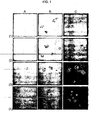
- the cells were fixed with ethanol for a day, and a section of the collected surface was observed with a confocal microscope equipped with Ar laser(wavelength 458 nm) to detect the fluorescent signal at a magnification of X400. The results are shown in Fig. 1 .
- Fig. 1 shows the fluorescent images of RAW264.7 cells treated with d-Arg 9 (1); the intermediate prepared in Preparation Example ⁇ 1-2> having no guanidine group(2); and the compounds of Examples 1 and 6 having 8 and 7 guanidine groups, respectively, in accordance with the present invention (3 and 4).
- the green color of column A shows the intensity of the fluorescence emitted by the transporter compound inside the cells
- the red color of column B shows the dyed nucleus with propidium iodide
- column C shows the merged color between green and red, where the intense yellow color indicates transporter compound present inside the nucleus.
- the compounds of Examples 1 and 6 display better uptake into the nucleus than d-Arg 9 , and the intermediate having no guanidine group fails to permeate into the cell.
- Test Example 2 Measurement of membrane permeability of ionic complex
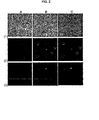
- Fig. 2 shows the fluorescence images of RAW264.7 cells treated with the fluorescence-tagged anionic substance only(1); the ionic complex formed from the fluorescence-tagged anionic substance and the molecular transporter at the charge-based composition ratio of 1:1(2); and the ionic complex formed from the fluorescence-tagged anionic substance and the molecular transporter at the charge-based composition ratio of 1:5(3).
- columns A, B and C are the same as defined for Fig. 1 .
- Fig. 2 shows that the ionic complexes having the charge-based composition ratio of 1:5 between an ionic substance and the compound of Example 9 or 10 show good permeability through cell membrane.
Landscapes
- Chemical & Material Sciences (AREA)
- Organic Chemistry (AREA)
- Biotechnology (AREA)
- Life Sciences & Earth Sciences (AREA)
- Engineering & Computer Science (AREA)
- Biochemistry (AREA)
- Health & Medical Sciences (AREA)
- General Health & Medical Sciences (AREA)
- Genetics & Genomics (AREA)
- Molecular Biology (AREA)
- Crystallography & Structural Chemistry (AREA)
- Organic Low-Molecular-Weight Compounds And Preparation Thereof (AREA)
- Saccharide Compounds (AREA)
- Medicinal Preparation (AREA)
Description
- The present invention relates to molecular transporters having improved membrane permeability, which are consisted of multiple residues of guanidine groups and a sugar skeleton or its analogue, and processes for the preparation thereof.
- The plasma membrane of a cell separates the cytoplasm of the cell from the environment, and it is primarily composed of a phospholipid bilayer and proteins embedded within the bilayer or attached to the surface thereof. Normally the plasma membrane functions as a gatekeeper, which controls trafficking of essential substances into and out of the cell. However, the cell plasma membrane also functions as permeability barrier and blocks the passage of many useful therapeutic agents. Generally, hydrophilic molecules, highly charged molecules and macromolecules such as nucleic acid or gene cannot readily cross the cell membranes. Therefore, there is a need for a reliable means of transporting drugs and macromolecules into the cell.
- Heretofore, a number of transporter molecules such as lipids, polymers and dendrimers have been proposed to escort molecules across biological membranes, but often they are not easily water soluble or biodegradable, and hence, precipitate in a cell to illicit toxicity.
- Proteins having a PTD (protein transduction domain) that allows the protein permeation through the plasma membrane include the HIV-1 Tat peptide, Antennapedia (Antp) homeodomain protein, Herpes virus protein VP22, Nuclear localization signal (NLS) sequence, and the like, as shown in Table 1.
<Table 1> Protein having PTD Amino acid sequence SEQ ID NO: HIV-1 Tat (48-60 a.a.) GRKKRRQRRRPPQ 1 Antp(43-58 a.a.) RQIKIWFQNRRMKWKK 2 VP22 (267-300 a.a.) DAATATRGRSAASRPTERDRAPARSASRPRRPVE 3 SV40-NLS PKKKRKVC 4 Nucleoplasmin KRPAAIKKAGQAKKKKC 5 NF-κB PMLKQRKRQA 6 HIV-1 Rev (34-50 a.a.) RQARRNRRRRWRERQRG 7 FHV Coat (35-49 a.a.) RRRNRTRRNRRRVRRGC 8 - The above protein domains seem to facilitate the permeation across biological membranes without the help of any specific transporter or receptor associated with the cell. Further, they contain a high percentage of basic amino acids such as arginine and lysine. The basic region (i.e., 49-57 a.a.) of the Tat protein, which is a necessary transacting transcriptional activator of HIV virus reproduction, has been reported to play a critical role in the process of the protein permeation through the plasma membrane. A number of studies have reported syntheses of various oligopeptides having a multiple units of arginine and used them as molecular transporters.
- From these studies, it has been found that oligomers having eight to nine arginine residues show the highest permeability and are most effective in enhancing the transportation of molecules attached thereto across a biological membrane, which suggests that the guanidine group of arginine plays an essential role in the transportation of molecules attached thereto across a biological membrane.
- Wender et al. designed peptoid molecular transporters based on the fact that the biological membrane permeability of a peptide largely depends on the number of the guanidine group in the peptide, the length of the linker chain, and chirality, etc. It was found that an L-arginine nonamer is 20-times more effective in the transportation across a biological membrane than Tat protein (49-57 a.a.), and D-arginine nonamer was also significantly more effective in the uptake by Jurkat cells, as was determined using FACS (P.A. Wender, et al., Proc. Natl. Acad. Sci. U.S.A. 97: 13003, 2000). These results suggest that the permeability of peptides having a certain number of guanidine groups is not significantly affected by the chirality of the amino acid (
U.S. Patent No. 6,495,663 ; Korean Patent Laid-Open Publication No.2001-12809 - However, such polyarginine peptide or related peptoid molecules have problems of rapid metabolism to be eliminated through the liver and kidney as well as their in vivo toxicity liability. Further, the fact that a peptide or peptoid having a number of guanidine groups can maintain its helical structure only in a basic environment suggests that its membrane permeability depends largely on the positively charged guanidinium groups rather then the secondary or tertiary structure thereof.
- The present inventors have therefore endeavored to develop molecular transporters prepared by introducing positively charged guanidinium groups to sugar or its analogue structure in a linear or branched form with a high density of functionality and found that such molecular transporters significantly enhance the transport of various physiologically active molecules attached thereto either covalently or ionically, across a biological membrane.
- Accordingly, it is an object of the present invention to provide sugar or its analogue-based molecular transporters having improved permeability, which are effective in the transportation of a physiologically active molecule across a biological membrane and processes for the preparation thereof.
- It is another object of the present invention to provide a composition for delivering a physiologically active molecule into a cell, comprising the sugar or its analogue-based molecular transporter.
- It is a further object of the present invention to provide a sugar alcohol derivative for use in a method for delivering a physiologically active molecule into a cell, employing the sugar or its analogue-based molecular transporter.
- The above and other objects and features of the present invention will become apparent from the following description of the invention, when taken in conjunction with the accompanying drawings, which respectively show:
-
Fig. 1 : comparative degrees of cellular and nuclear membrane transmission of various compounds; dansyl-Arg9 (1); the intermediate prepared in Preparation Example 1 having no guanidine group (2), and the transporter compounds obtained in Examples 1 and 6 having 8 and 7 guanidine residues, respectively in accordance with the present invention (3 and 4); -
Fig. 2 : comparative degrees of cellular and nuclear membrane transmission of various compounds; the fluorescence-tagged anionic cargo substance only (1); the ionic complex of the anionic substance and the transporter compound (charge ration of 1:1, 2); and the ionic complex of the anionic substance and the transporter compound (charge ration of 1:5, 3). - In accordance with one aspect of the present invention, there is provided sugar or sugar analogue-based molecular transporter compounds of
formulae 1 to 5, each of which has a linear or branched form of guanidine groups:

R1 and R2 are each independently H, alkyl, arylalkyl, cycloalkyl, heteroalkyl, -(CH2)mNHR', -(CH2)lCO2R", -COR"', -SO2R"" or a physiologically active molecule; R', R", R"' and R"" being each independently H, alkyl, arylalkyl, cycloalkyl, heteroalkyl or a physiologically active molecule; m, an integer in the range of 2 to 5; and 1, an integer in the range of 1 to 5;
R3 is

R1 and R2 are each independently H, alkyl, arylalkyl, cycloalkyl, heteroalkyl, -(CH2)mNHR', -(CH2)lCO2R", -COR'", -SO2R"" or a physiologically active molecule; R', R", R'" and R"" being each independently H, alkyl, arylalkyl, cycloalkyl, heteroalkyl or a physiologically active molecule; m, an integer in the range of 2 to 5; and 1, an integer in the range of 1 to 5;
R3 is


X is
R2 is
, n being an integer in the range of 1 to 12.
R1 is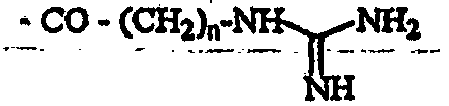

R1 is
- The compounds of
formulae formula 1 includes an alditol derivative and its salt having a skeleton of sorbitol, mannitol or galactitol, which is exemplified by a sorbitol derivative of formula 6. Further, the compound offormula 2 includes an inositol derivative and its salt having a skeleton of myo-inositol or scyllo-inositol, which is exemplified by compounds of formulae 7 to 9.


R1, R2 and R3 are the same as defined informulae - Further, the molecular transporter compound of
formula 3 has a disaccharide skeleton having seven guanidine groups in the side chains, and preferred examples thereof are represented by compounds of formulae 10 and 11 and their salts.

R1 and R2 are the same as defined informula 3. - The compounds of formulae of 10 and 11 are disaccharide derivatives, wherein the compound of formula 10 has a skeleton of sucrose and that of formula 11, α-lactose, β-lactose or maltose.
- The compounds of
formulae 4 and 5 are the molecular transporters having six guanidine groups attached to sugar derivatives. The compounds offormula 4 include an alditol derivative and its salt having a skeleton of sorbitol, mannitol or galactitol, and are exemplified by a sorbitol derivative of formula 12 and its salt. Further, the compounds of formula 5 include an inositol derivative and its salt having a skeleton of myo-inositol or scyllo-inositol, and are exemplified by compounds of formulae 13 to 14 and their salts.


R1 is the same as defined informulae 4 and 5. - The molecular transporter compounds of
formula 1 to 5, more specifically compounds of formulae 6 to 14, have functional groups capable of coupling to a physiologically active molecule, and therefore, can easily transport the target molecule attached thereto across a biological membrane. Here, the physiologically active molecule means a natural, synthetic or genetically engineered chemical or biological compound that is known in the art as having utility for modulating physiological processes in order to afford diagnosis of, prophylaxis against, or treatment of, an undesired existing condition in a living being. Preferably, the physiologically active molecule being delivered into a cell by coupling to the molecular transporter compounds of the present invention includes organic compounds having a molecular weight ranging from 100 to 1,500 g/mol, a polymer such as a peptide and nucleic acid, and a diagnostic reagent. As shown in formulae 6 to 14, the molecular transporter compounds of the present invention have a sugar or sugar analogue skeleton carrying guanidine groups through a linear or branched chain of variable chain lengths, and a therefore, each of them shows a good water-solubility and membrane permeability. Accordingly, the molecular transporter compounds in accordance with the present invention can be attached to a physiologically active molecule such as a drug, diagnostic reagent or fluorescent tag through either a covalent bond or an ionic bond so that it can be easily transported across a biological membrane, e.g., plasma membrane, nuclear membrane or blood-brain barrier. - Further, the present invention provides a method for preparing the molecular transporter compounds in accordance with the present invention, comprising the following steps of:
- 1) introducing amino acid side chains via acylation of the hydroxyl groups to obtain an intermediate compound;
- 2) introducing protected guanidine groups to the terminal amino groups of the amino acid side chains of the compound obtained in step 1); and
- 3) removing the protecting groups from the compound obtained in step 2) to provide the molecular transporter compounds.
- Here, instead of steps 1) and 2) in the above method, it is also possible to prepare first the terminal amino acid side chains with the protected guanidine groups, and then to introduce the pre-prepared side chains to the hydroxyl groups of the protected skeletal intermediate by acylation.
- More specifically, the method for the preparation of the molecular transporters in accordance with the present invention can be explained depending on the kind of sugar or its analogue skeleton, as follows.
- The molecular transporter compounds of
formulae - 1) introducing the amino acid side chains to the hydroxyl groups of the protected intermediate by acylation;
- 2) removing the protecting groups from the terminal amino acid side chains;
- 3) introducing the guanidine groups to the terminal amino groups of the amino acid side chains;
- 4) removing the protecting groups from the hydroxyl groups of the compound obtained in step 3) and coupling it to a physiologically active molecule; and
- 5) removing the amino protecting groups from the guanidine groups of the compound obtained in step 4).


formulae - The compound of formula 15, a key intermediate for preparing the compound of formula 6, is an alditol derivative having introduced protecting groups at 1,6-OH positions of D-aldohexose such as D-glucose regioselectively, and can be prepared according to the procedure of Scheme 1:

- According to
Scheme 1 exemplified with D-glucose as a starting material, the intermediate of formula 15 (R1=TBDPS, R2=Tr) can be prepared by selectively introducing a trityl (Tr) protecting group to 6-OH of D-glucose; performing a reduction reaction by using a reducing agent such as sodium borohydride (NaBH4), to obtain D-sorbitol in a linear form; and selectively introducing t-butyldiphenylsilyl (TBDPS) group to 1-OH thereof. - Further, the intermediate of formula 16 for preparing the compound of formula 7 can be prepared by synthesizing 2,3:5,6-di-O-isopropylidene-myo-inositol from myo-inositol; and introducing different protecting groups, e.g., tert-butyldimethylsilyl (TBDMS) or benzyl (Bn) protecting group, to 1-OH or 4-OH thereof regioselectively.
- The intermediate of formula 17 for preparing the compound of formula 8 can be prepared by synthesizing 1,6:3,4-di-O-isopropylidene-myo-inositol from myo-inositol; and introducing different protecting groups, e.g., p-methoxybenzyl (PMB) or benzyl (Bn) protecting group, to 2-OH or 5-OH thereof regioselectively.
- Further, the intermediate of formula 18 for preparing the compound of formula 9 can be prepared by inverting the stereochemistry of 2-OH of myo-inositol through Mitsunobu reaction; synthesizing 1,6:2,4-di-O-isopropylene-scyllo-inositol therefrom; and introducing different protecting groups, e.g., PMB, benzoyl (Bz) or Bn protecting group, to 2-OH or 5-OH thereof regioselectively.
- In step 1), the amino acid side chains of various lengths are introduced to the protected intermediate by acylation as described above. The intermediates of formulae 16 to 18 except the intermediate of formula 15 are subjected to deprotection of the acetonide protecting groups before the acylation reaction. The acylation reaction is carried out by reacting each intermediate with the amino acid having variable chain lengths with the protected amino groups as carbobenzyloxy (Cbz) groups, in the presence of a condensing agent such as dicyclohexylcarbodiimide and 1-[3-(dimethylamino)propyl]-ethylcarbodiimide hydrochloride. The amino acid having variable chain lengths employed in the present invention can be obtained from commercially available ω (omega)-amino acid, and N,N-di-aminopropyl aminocaproic acid derivatives having the protected terminal amino groups with appropriate protecting groups is preferable.
- The above acylation reaction may be conducted using the amino acid having variable chain lengths in an amount ranging from 1.5 to 2.5 equivalents based on 1 equivalent of funtionality of each intermediate at a temperature ranging from 25 to 40°C for 16 to 72 hrs.
- In step 2), the amino protecting groups are removed from the terminal amino groups of the side chains. The deprotection may be performed by adding a catalyst such as palladium (Pd), nickel and platinum to the compound obtained in step 1), stirring the mixture under a hydrogen atmosphere and filtering.
- In step 3), the deprotected amino groups of the compound obtained in step 2) are converted into guanidine groups by reacting the compound with N,N'-di-Boc-N"-triflylguanidine or N,N'-di-Boc-S-methylisothiourea in the presence of a base in an organic solvent (T.T. Baker, et al., J. Org. Chem. 65: 9054, 2000; A.E. Miller and J.J. Bischoff, Synthesis 777, 1986). Instead, it is possible that the guanidine groups are introduced to the terminal amine resides of the side chains in advance, and then, the pre-prepared side chains having the guanidine groups are directly introduced to the intermediate skeleton by acylation. Exemplary organic solvents that may be used in the above step are dichloromethane, N,N-dimethylformamide, chloroform, ethyl acetate, 1,4-dioxane, and the like, and the base may be triethylamine. The above reaction may be carried out at a temperature ranging from 25 to 40°C for 16 to 72 hrs.
- In step 4), the protecting groups are removed from the compound obtained in step 3), and the exposed hydroxyl groups may be used in coupling to a physiologically active molecule or its derivative. It is also possible to introduce a fluorescent tag such as dansyl (5-dimethylamino-1-naphthalene sulfonyl), FITC (Fluorescein) and Rhodamine to the compound by eliminating one of the protecting groups selectively from the compound having the guanidine groups, and then attaching the fluorescent marker.
- Finally, the protecting groups are eliminated from the guanidine groups of the compound obtained in step 4), to obtain the molecular transporter compounds of formulae 6 to 9 in accordance with the present invention.
-
Scheme 2 illustrates the procedure for preparing the molecular transporter of formula 6 from the intermediate of formula 15.
- Further, the compounds of formulae 10 and 11 used as representative examples of the molecular transporters having a disaccharide skeleton may each be prepared from the intermediates of formulae 19 and 20 according to the same procedure as shown in
Scheme 2.

- The intermediates of formulae 19 and 20 may be used for preparing the compounds of formulae 10 and 11 by introducing the side chains to 1'-OH or 1-OH of sucrose and lactose, regioselectively. More specifically, the intermediate of formula 19 is prepared by selectively introducing the preformed side chains to 1'-OH of sucrose by using enzymes such as proteinase N; and the intermediate of formula 20 is prepared by carrying out benzoylation of lactose, selectively removing the benzoate protecting group from the 1-OH position thereof, and then performing a glycosylation of the sugar derivative with the side chain alcohol.
- The compound of formula 10 may be prepared by performing acylation of the intermediate of formula 19 with ω-amino acids having variable chain lengths protected with N-Boc (N-tert-butyloxycarbonyl) such as 4-aminobutanic acid, 6-aminocaproic acid and 8-aminocaprilic acid; removing the protecting groups from the terminal amine residues thereof; and introducing guanidine groups thereto. After the azido functional group of the compound of formula 10 thus prepared is converted by reduction into an amino group in the presence of palladium catalyst and hydrogen atmosphere, it is possible to couple a biologically active molecule such as a drug, a fluorescent tag and a diagnostic reagent to the amino group.
- The compound of formula 11 may be prepared by removing benzoate protecting groups from the intermediate of formula 20; introducing ω -amino acids having variable chain lengths thereto by acylation; removing the protecting groups from the terminal amino residues thereof; and introducing the guanidine groups thereto, according to the same method as described above in the preparation of the compound of formula 10.
-
Scheme 3 illustrates the procedure of preparing the compound of formula 10 from the intermediate of formula 19.
- Furthermore, the compounds of
formulae 4 and 5 having 6 guanidine groups, more specifically the compounds of formulae 12 to 14, may be prepared by using alditols including D-sorbitol of formula 21 (J.S Brimacombe and J.M. Webber in "The Carbohydrate: Chemistry and Biochemistry", Ed. W. Pigman, D. Horton, 2nd Ed. 1A, Academic Press, 1972) or any of the stereoisomers of inositol including myo- and scyllo-inositol of formulae 22 and 23 (Y.U. Kwon, et al., J. Org. Chem. 67: 3327,2002) as an intermediate.


- As shown in
Scheme 4, the amino acid side chains having variable chain lengths protected with N-Boc are introduced to each of all hydroxyl groups of myo-inositol of formula 22 by acylation. After the N-Boc protecting groups are eliminated and the guanidine groups are introduced thereto, the protecting groups are removed by using TFA (trifluoroacetic acid) or gaseous HCl, to obtain the compound of formula 13. The compounds of formulae 12 and 14 can be prepared from the intermediates of formula 21 and 23, respectively, according to the same method as described above.
- The molecular transporter compounds in accordance with the present invention are sugar or sugar analogue-based derivatives having 6 to 8 guanidine groups, and may be conjugated with biologically active molecules such as a drug, or a diagnostic reagent by way of forming a covalent bond or an ionic bond. The conjugate thus formed shows a significantly enhanced uptake by the cells, indicating that biological barriers such as a plasma membrane, nuclear membrane and blood-brain barrier have been overcome.
- Accordingly, the molecular transporter compounds of the present invention may be effectively used in delivering polymers such as peptide and nucleic acids as well as various therapeutic molecules such as drugs and diagnostic reagents into cells.
- Therefore, the present invention provides a composition for delivering a physiologically active molecule into cells across the biological membrane, comprising one of the molecular transporter compounds of
formula 1 to 5. Further, the present invention provides a sugar alcohol derivative for use in a method for delivering a physiologically active molecule into a cell across a biological membrane, employing one of the molecular transporter compounds offormula 1 to 5. - The biologically active molecule which can be attached to the molecular transporters of the present invention and delivered into cells includes an organic compound having a molecular weight ranging from 100 to 1500 g/mol and a polymeric compound such as a peptide and a nucleic acid. The molecular transporter compounds of
formula 1 to 5 can deliver a biologically active molecule into cells by way of forming an ionic complex through an ionic bond, and the molecular transporter compounds offormula 1 to 3 in particular can each form a conjugate with a biologically active molecule through a covalent bond as well as an ionic bond. - The following Examples are intended to further illustrate the present invention without limiting its scope.
-

- α-D-Glucose(10 g, 55.5 mmol) was dissolved in 120 mℓ of dry pyridine, and triethylamine(38.7 mℓ, 277.5 mmol) was added thereto. Tritylchloride(18.3 g, 65.5 mmol) was added dropwise to the mixture, and the mixture was stirred for a day. After the reaction was completed, the reaction mixture was diluted with dichloromethane(CH2Cl2, 250 mℓ) and washed with saturated NaHCO3 (300 mℓ). The organic layer thus obtained was dried over Na2SO4, concentrated under a reduced pressure, and purified by column chromatography (ethyl acetate:n-hexane=2:3 to 1:1 to 3:2), to obtain the title compound as a light brownish solid(16.87 g).
1H-NMR(CD3OD): δ 3.25-3.38(m, 4H), 3.59(t, J=9.2 Hz, 1H), 3.94(m, 1H), 5.13(d, J=3.7 Hz, 2H), 7.11-7.30(m, 9H), 7.42(d, J=9.4 Hz, 6H)
MS (FAB) m/z 445.22(M++Na) -

- The compound obtained in Preparation Example <1-1>(10 g, 23.66 mmol) was dissolved in methanol(200 mℓ), sodium borohydride (NaBH4)(2.18 g, 59.18 mmol) was added portionwise thereto, and then, the mixture was stirred at room temperature for 7 hrs. The reaction mixture was concentrated under a reduced pressure, and crystallized from a mixture of water and methanol, to obtain the title compound as a white solid(6.68 g).
1H-NMR(CD3OD): δ 3.25-3.33(m, 4H), 3.47-3.51(m, 2H), 3.85-3.87(m, 2H), 7.14-7.26(m, 9H), 7.42(d, J=8.8 Hz, 6H)
MS (FAB) m/z 447.29(M++Na) -

- The compound obtained in Preparation Example <1-2>(5 g, 11.77 mmol), triethylamine(4.9 mℓ, 35.33 mmol) and (4-dimethylamino-pyridine(287.8 mg, 0.235 mmol) were dissolved in N,N-dimethylformamide(50 mℓ). tert-Butylchlorodiphenylsilane(6.12 mℓ, 23.55 mmol) was added dropwise to the above mixture over a period of an hour, and the resulting mixture was stirred for a day at room temperature. After ther reaction was completed, the reaction solution was diluted with ethyl acetate(200 mℓ) and washed successively with water(150 mℓ) and saturated NaCl(25 mℓ). The aqueous layer thus obtained was re-extracted twice with ethyl acetate(50 ml), and the combined organic layer was dried over Na2SO4, concentrated under a reduced pressure, and subjected to column chromatography(ethyl acetate:n-hexane=1:1 to 3:2), to obtain the title compound as a white foamy solid(5.5 g).
1H-NMR(CDCl3): δ 1.06(s, 9H), 2.72(brs, 1H), 3.01(brs, 1H), 3.21(brs, 1H), 3.35(d, J=5.5 Hz, 2H), 3.73-3.83(m, 6H), 7.22-7.65(m, 25H)
MS (FAB) m/z 686.24(M++Na) -

- An excess amount of acrylonitrile(94.1 mℓ, 1.43 mol) and glacial acetic acid(21.8 mℓ, 0.381 mol) were added dropwise to 6-aminocaproic acid(2.5 g, 0.019 mol), and the mixture was refluxed for 30 hrs. The residual acrylonitrile left over from the reaction was removed by evaporating under a reduced pressure, and acetic acid was removed by repeated cycles of adding toluene and evaporating under a reduced pressure. The reaction mixture was diluted with 200 mℓ of ethyl acetate and washed with water several times. The organic layer thus obtained was dried over Na2SO4, concentrated under reduced pressure, and purified by column chromatography (ethyl acetate:n-hexane=4:1), to obtain the title compound as a sticky brownish syrup(3.5 g).
1H-NMR(CDCl3): δ 1.35-1.49(m, 4H), 1.65(t, J=7.5 Hz, 2H), 2.36(t, J=7.3 Hz, 2H), 2.46-2.84(m, 6H), 2.86(t, J=6.7 Hz, 4H), 10.35(br.s, 1H)
MS (FAB) m/z 238.08(M++H) -
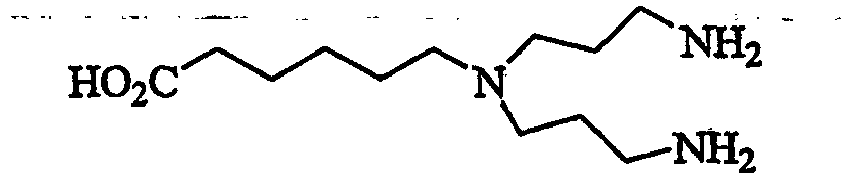
- The compound obtained in Preparation Example <2-1>(2.2 g, 1.05 mmol) was dissolved in 45 mℓ of 95% ethanol, 1 M sodium hydroxide(15 mℓ) and a Raney Nikel catalyst(4 g) were added thereto, and then, the mixture was allowed to react for 24 hrs under hydrogen atmosphere(50 psi). After the reaction was completed, the mixture was filtered through celite to eliminate the catalyst, and washed with 95% ethanol. The filtrate thus obtained was concentrated under a reduced pressure, to obtain the title compound as a sticky white solid(2.25 g).
1H-NMR(CD3OD): δ 1.31-1.68(m, 6H), 1.89(m, 4H), 2.22(t, J=7.2 Hz, 2H), 2.71-2.76(m, 6H), 2.98(t, J=7.5 Hz, 4H)
MS (FAB) m/z 246.15(M++H) -

- The compound obtained in Preparation Example <2-2>(1.1 g, 6.11 mmol) was dissolved in 45 mℓ of a 1,4-dioxane:water (2:1) mixture and sodium bicarbonate(2.56 g, 30.57 mmol) was added thereto, followed by slow addition of carbobenzoxychloride (Cbz-Cl)(2.7 mℓ, 18.34 mmol) to the mixture at 0 °C over 30 min. After stirring at room temperature for 15 hrs, the reaction mixture was concentrated and diluted with 20 mℓ of water. 10% HCl was added thereto dropwise until the pH of the mixture became 2, and then, extracted with ethyl acetate. The organic layer thus obtained was dried over Na2SO4, concentrated under a reduced pressure, and purified by column chromatography (dichloromethane:methanol=9:1), to obtain the title compound as a white foamy solid(1.4 g).
1H-NMR(CDCl3): δ 1.33-1.61(m, 6H), 1.94(brs, 4H), 2.27(t, J=6.8 Hz, 2H), 2.93(br.s, 6H), 3.20-3.22(m, 4H), 5.01(s, 4H), 5.65(br.s, 2H), 7.31(br.s, 10H)
MS (FAB) m/z 514.21(M++H) -

- An excess amount of methyl acrylate(77.3 mℓ, 0.857 mol) and glacial acetic acid(13.1 mℓ, 0.228 mol) were added dropwise to 6-aminocaproic acid(1.5 g, 0.0114 mol), and the mixture was refluxed for 30 hrs. The remaining methyl acrylate and acetic acid after the reaction were removed by evaporating with added toluene under a reduced pressure. The reaction mixture was diluted with 200 mℓ of ethyl acetate and washed several times with water. The organic layer thus obtained was dried over Na2SO4, concentrated under a reduced pressure, and purified by column chromatography (ethyl acetate:n-hexane=4:1), to obtain the tile compound as a viscous brownish syrup(1.85 g).
1H-NMR(CDCl3): δ 1.30-1.62(m, 6H), 2.30(t, J=7.4 Hz, 2H), 2.50(t, J=6.8 Hz, 6H), 2.80-2.86(m, 4H), 3.66(s, 6H)
MS (FAB) m/z 304.18(M++H) -

- The compound obtained in Preparation Example <3-1>(1.2 g, 3.95 mmol) and ethylenediamine(16 mℓ, 237.3 mmol) were dissolved in methanol (20 mℓ) and stirred at room temperature for 72 hrs. The excess amount of ethylenediamine was eliminated by evaporating under a reduced pressure to obtain the title compound as a light brownish syrup(1.4 g).
1H-NMR(CD3OD): δ 1.26-1.64(m, 6H), 2.16-2.22(m, 2H), 2.27-2.56(m, 6H), 2.71-2.88(m, 8H), 3.29-3.31(m, 4H)
MS (FAB) m/z 382.19(M++Na) -

- The compound obtained in Preparation Example <3-2>(930 mg, 2.58 mmol) was dissolved in 20 mℓ of 1,4-dioxane:water mixture(2.5:1), and sadim bicarbonate (1.52 g, 18.11 mmol) was added thereto, followed by slowly adding dropwise 1.4 mℓ of carbobenzoxychloride(10.34 mmol) to the mixture at 0°C over a period of 30 min. After stirring at room temperature for 15 hrs, the reaction mixture was concentrated, diluted with 20 mℓ of water, and 10% HCl was added dropwise to adjust the pH at ∼2, and then, extracted with ethyl acetate. The organic layer thus obtained was dried over Na2SO4, concentrated under a reduced pressure, and purified by column chromatography (dichloromethane:methanol=9:1), to obtain the title compound as a white solid(1.2 g).
1H-NMR(CD3OD): δ 1.23-1.71(m, 6H), 2.13(t, J=6.8 Hz, 2H), 2.30-2.48(m, 6H), 2.69(br.s, 4H), 3.21-3.26(m, 8H), 5.04(s, 4H), 7.31-7.32(m, 10H)
MS (FAB) m/z 650.19(M++Na) -

- The compound obtained in Preparation Example <3-2>(500 mg, 1.39 mmol) was dissolved in 6 mℓ of N,N-dimethylformamide, and triethylamine(0.7 mℓ, 4.86 mmol) and N,N'-di-Boc-N"-triflylguanidine(1.36 g, 3.47 mmol) were added thereto, followed by stirring the mixture at room temperature for 3 days. After the reaction was completed, the reaction mixture was diluted with 100 mℓ of dichloromethane and successively washed several times with brine and water. The organic layer thus obtained was dried over Na2SO4, concentrated under a reduced pressure, and purified by column chromatography (dichloromethane:methanol=9:1), to obtain the title compound as a white foamy solid(800 mg).
1H-NMR(CDCl3): δ 1.45-1.66(m, 42H), 2.41-2.44(m, 6H), 2.84(br.s, 4H), 3.40-3.54(m, 10H), 8.18(br.s, 2H), 8.64(br.s, 2H), 11.44(br.s, 2H)
MS (FAB) m/z 844.33(M++H) -
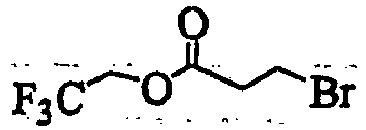
- 2,2,2-Trifluoroethanol(15 mℓ, 0.15 mol) and triethylamine(4.5 mℓ, 32.12 mmol) were added to 30 mℓ of dichloromethane, and cooled to 0°C. After 10 min, 2.94 mℓ of 3-bromopropionyl chloride(29.2 mmol) was added dropwise thereto. The mixture was warmed to room temperature and stirred for 5 hrs. After the reaction was terminated by addition of water, the mixture was extracted with ethyl acetate, and the solvent was evaporated under a reduced pressure. The solid impurities were removed by filtration to obtain the title compound as a liquid (3.53 g).
1H-NMR(CDCl3): δ 3.05(t, J=6.7 Hz, 2H), 3.60(t, J=6.7 Hz, 2H), 4.54(q, J=8.4 Hz, 2H) -

- The compound obtained in Preparation Example <4-1>(3.71 g, 15.8 mmol) was dissolved in 15 mℓ of N,N-dimethylformamide, and sodium azide(2.72 g, 63.2 mmol) and tetrabutylammonium iodide(0.69 g, 3.2 mmol) were added thereto, followed by stirring the mixture for 12 hrs at room temperature. After the reaction was terminated by addition of water thereto, the reaction mixture was washed with brine, and the solvent was evaporated under a reduced pressure. Solid impurities were removed by filtration to obtain the title compound as a yellow liquid(2.76 g).
1H-NMR(CDCl3): δ 2.70(t, J=6.4 Hz, 2H), 3.63(t, J=6.4 Hz, 2H), 4.54(q, J=8.4 Hz, 2H)
MS (FAB) m/z 197.91(M++H) -

- α-Lactose(2.3 g, 6.38 mmol) was dissolved in 30 mℓ of anhydrous pyridine, benzoyl chloride(8.9 mℓ, 76.6 mmol) was added thereto at 0°C, and the mixture was stirred for 8 hrs at room temperature. After the reaction was completed, the reaction mixture was extracted with ethyl acetate, and successively washed with 1N HCl, saturated NaHCO3 and brine. The extract was dried over MgSO4, concentrated under a reduced pressure, and purified by column chromatography (ethyl acetate:n-hexane=1:3), to obtain the title compound as a white solid(7.19 g).
m.p=124∼126°C
[α]D=+113(c 0.8, chloroform)
1H-NMR(CDCl3): δ 3.73-3.86(m, 2H, H-4 & H-5'), 3.94(t, J= 6.7 Hz, 1H, H-5), 4.32-4.47(m, 2H, H-6'), 4.60(s, 2H, H-6), 4.99(d, J=7.9 Hz, 1H, H-1'), 5.42(dd, J=10.3 Hz, 3.3 Hz, 1H, H-3'), 5.66(dd, J=10.3 Hz, 3.7 Hz, 1H, H-2), 5.78-5.84(m, 2H, H-2'& H-4'), 6.25(t, J=9.9 Hz, 1H, H-3), 6.79(d, J=3.7 Hz, 1H, H-1), 7.20-8.16(m, 40H, arom) -

- The compound obtained in Preparation Example <5-1>(1 g, 0.85 mmol) was dissolved in 10 mℓ of a methanol:tetrahydrofuran mixture(3:7), and gaseous ammonia was bubbled thereto at 0 °C for 10 min. The reaction mixture was warmed to room temperature and stirred for 12 hrs. After the reaction was completed, the mixture was concentrated under a reduced pressure, and purified by column chromatography(ethyl acetate:n-hexane=1:1), to obtain the title compound as a white foamy solid(685.8 mg).
1H-NMR(CDCl3): δ 3.73-3.86(m, 2H, H-4 & H-5'), 4.07-4.11(m, H-5' & H-5'), 4.23-4.37(m, H-6'), 4.44-4.56(m, H-6), 4.90(d, J=8.0 Hz, H-1'), 4.94(d, J=7.9 Hz, 1H, H-1'), 5.26(dd, J=10.2 Hz, 3.5 Hz, H-3' & H-3'), 5.34(d, J=1.7 Hz, H-1), 5.41(dd, J=10.3 Hz, 3.1 Hz, H-2 & H-2), 5.64(d, J=2.5 Hz, 1H, H-1), 5.70-5.76(m, H-4' and H-2'), 5.81(t, J=9.0 Hz, H-3), 6.18(t, J=9.5 Hz, 1H, H-3), 7.16-7.98(m, 35H, arom)
MS (FAB) m/z 1093.27(M++Na) -

- 6-Aminocaproic acid(0.53 g, 4.08 mmol) was dissolved in 20 mℓ of dichloromethane, and triethylamine(1.14 mℓ, 8.16 mmol) and N,N'-di-Boc-N"-triflylguanidine(1.23 g, 3.14 mmol) were added thereto, followed by stirring the mixture at room temperature for 24 hrs. After the reaction mixture was successively washed with 2 M NaHSO4 and water, the organic layer was dried over Na2SO4, concentrated under a reduced pressure, and purified by column chromatography to obtain the title compound as a white solid(0.82 g).
1H-NMR(CDCl3): δ 1.48(s, 24H), 2.35(t, J=7.4 Hz, 2H), 3.38(brs, 2H), 8.36(br.s, 1H, NH), 8.6 10.7(br.s, 2H, NH, OH) -

- The sorbitol compound with the 1,6-OH groups protected as obtained in Preparation Example 1(100 mg, 0.15 mmol), the compound obtained in Preparation Example 2(757.5 mg, 1.2 mmol) and 4-dimethylamino pyridine(27.6 mg, 0.226 mmol) were dissolved in 5 mℓ of N,N-dimethylformamide, and 1-[3-(dimethylamino)propyl]-ethylcarbodiimide hydrochloride(231.3 mg, 1.2 mmol) was added thereto, followed by stirring the mixture at room temperature for a day. After the reaction was completed, the reaction mixture was extracted with 50 mℓ of dichloromethane and the extract was successively washed several times with saturated NaHCO3 solution(30 mℓ) and water, dried over Na2SO4, concentrated under a reduced pressure, and purified by column chromatography(dichloromethane:methanol=9:1), to obtain the title compound having introduced four side chains at its skeleton as a white foamy solid(263 mg).
1H-NMR(CDCl3): δ 1.01(s, 9H), 1.17-1.51(m, 40H), 1.86-2.32(m, 32H), 3.31(br.s, 16H), 3.60-3.88(m, 2H), 3.93-4.12(m, 2H), 4.79-4.92(m, 2H), 4.98(s, 16H), 5.59(br.s, 8H), 5.61-5.88(m, 2H), 7.13-7.59(m, 65H)
MS (MALDI-TOF) m/z 2668.40(M++Na) -

- The compound obtained in Example <1-1>(150 mg, 0.056 mmol) was dissolved in 4 mℓ of methanol and 100 mg of Pd/C was added thereto. The mixture was stirred at room temperature for 15 hrs under H2 atmosphere(50 psi), and filtered through celite to remove the Pd/C catalyst. The filtrate thus obtained was concentrated under a reduced pressure to obtain the title compound as a sticky white solid(87 mg).
1H-NMR(CD3OD): δ 1.02(s, 9H), 1.16-1.82(m, 24H), 2.07-2.38(m, 24H), 3.03-3.28(m, 40H), 3.56-3.80(m, 2H), 3.91-4.13(m, 2H), 4.87-5.13(m, 2H, merged with CD3OD peak), 5.88(dd, J=14.2 Hz, 1.9 Hz, 2H), 7.24-7.68(m, 25H) -
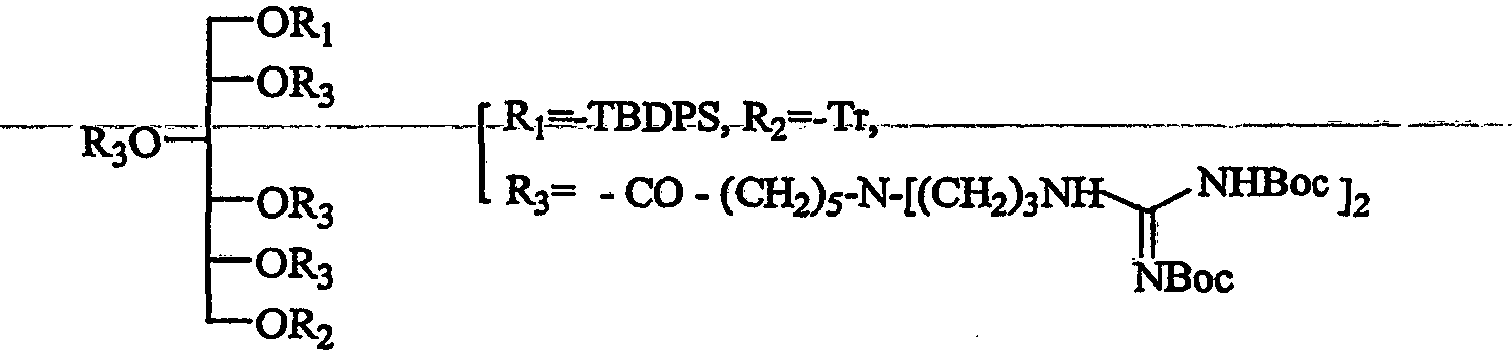
- The compound obtained in Example <1-2>(75 mg, 0.0047 mmol) was dissolved in 6 mℓ of N,N-dimethylformamide, and triethylamine(0.24 mℓ, 0.166 mmol) and N,N'-di-Boc-N"-triflylguanidine(410 mg, 0.105 mmol) were added thereto, followed by stirring the mixture at room temperature for 2 days. After the reaction was completed, the reaction mixture was diluted with 60 mℓ of dichloromethane and successively washed with brine and water several times. The organic layer thus obtained was dried over Na2SO4, concentrated under a reduced pressure, and purified by column chromatography (dichloromethane:methanol=10:1), to obtain the title compound having introduced eight guanidine groups as a white foamy solid(104 mg).
1H-NMR(CDCl3): δ 1.03(s, 9H), 1.18-1.54(m, 168H), 2.28-2.64(m, 24H), 2.78-3.28(m, 24H), 3.59(br.s, 16H), 3.89-4.21(m, 4H), 4.82(br.s, 1H), 5.11(br.s, 1H), 5.63(br.s, 1H), 5.89(br.s 1H), 7.26-7.67(m, 25H), 8.39(br.s, 8H), 11.35(br.s, 8H)
MS (MALDI-TOF) m/z 3533.34(M++Na) -

- The compound obtained in Example <1-3>(100 mg, 0.0028 mmol) was dissolved in 5 mℓ of methanol:dichloromethane mixture(3:1), and a catalytic amount of acetyl chloride was added dropwise thereto, followed by stirring the mixture at room temperature for 4 hrs. After the reaction was completed, 60 mg of NaHCO3 was added to the reaction mixture to neutralize the remaining acid and stirred for 30 min. The reaction mixture was concentrated, diluted with 30 mℓ of dichloromethane, and washed several times with water. The organic layer was dried over Na2SO4, concentrated under a reduced pressure, and the residue was purified by column chromatography (dichloromethane:methanol=9:1), to obtain the title compound as a sticky white solid(80 mg).
1H-NMR(CDCl3): δ 1.01(s, 9H), 1.12-1.59(m, 168H), 2.22-2.60(m, 24H), 2.77-3.33(m, 24H), 3.57(br.s, 16H), 3.88-4.21(m, 4H), 4.80(br.s, 1H), 5.13(br.s, 1H), 5.66(br.s, 1H), 5.88(br.s, 1H), 7.25-7.68(m, 10H), 8.33(br.s, 8H), 11.42(br.s, 8H)
MS (MALDI-TOF) m/z 3291.45(M++Na) -

- The compound obtained in Example <1-4>(80 mg, 0.024 mmol) and 4-dimethylaminopyridine(7.5 mg, 0.0061 mmol) were dissolved in 3 mℓ of acetonitrile, and 5-dimethylamino-1-naphthalenesulfonyl chloride(8.5 mg, 0.0032 mmol) was added thereto, followed by stirring the mixture at room temperature for 15 hrs. After the reaction was completed, the reaction mixture was neutralized by adding thereto 10 mℓ of saturated NH4Cl solution, extracted with ethyl acetate, and washed with brine and water. The organic layer thus obtained was dried over Na2SO4, concentrated under a reduced pressure, and purified by column chromatography(dichloromethane: methanol=15:1 to 10:1) to obtain the title compound having an introduced fluorescent tag as a sticky yellow solid(80 mg).
1H-NMR(CDCl3): δ 1.02(s, 9H), 1.13-1.61(m, 168H), 2.11-2.45(m, 24H), 2.88(br.s, 6H), 3.06-3.36(m, 24H), 3.57(br.s, 16H), 3.88-4.21(m, 4H), 4.80(br.s, 1H), 5.13(br.s, 1H), 5.66(br.s, 1H), 5.80(br.s, 1H), 7.14(d, J=7.4 Hz, 1H), 7.22-7.78(m, 27H), 8.16-8.19(m, 2H), 8.39(br.s, 8H), 11.45(b.rs, 8H)
MS(MALDI-TOF) m/z 3523.44(M++Na) -
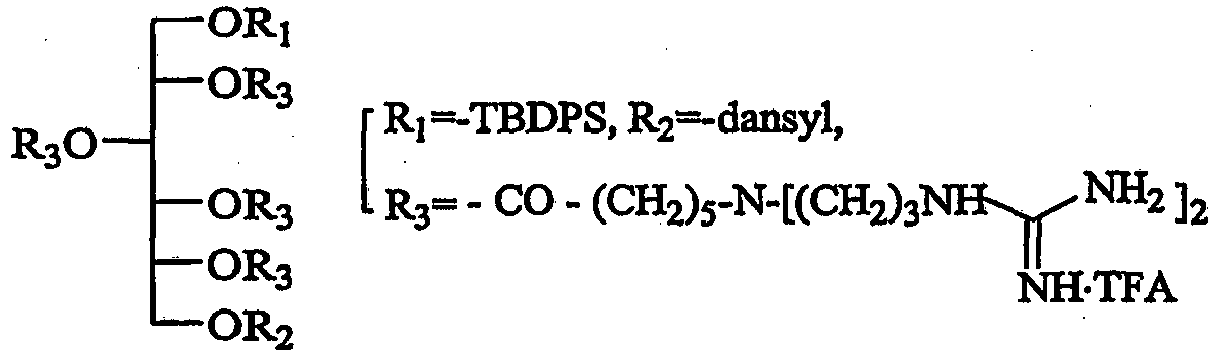
- The compound obtained in Example <1-5>(55 mg, 0.0015 mmol) was dissolved in 2 mℓ of a trifluoroacetic acid:dichloromethane mixture(1:1) and stirred at room temperature for 4 hrs. After the reaction was completed, the mixture was subjected to repeated cycles of adding toluene and evaporating under reduced pressure to completely eliminate trifluoroacetic acid(TFA) therefrom. The reaction mixture was further evaporated under high vacuum for 2 hrs, dissolved in 2 mℓ of water and freeze-dried, to obtain the title compound having no N-Boc protecting group at the terminal guanidinium groups thereof as a white foamy solid(43 mg)

MS (MALDI-TOF) m/z 1922.52(M++Na)
UV λmax(H2O, 25°C) 334 nm -

- The sorbitol compound with 1,6-OH positions protected as obtained in Preparation Example 1(75 mg, 0.113 mmol), the compound obtained in Preparation Example 3(763 mg, 0.905 mmol) and 4-dimethylaminopyridine(20.7 mg, 0.169 mmol) were dissolved in 6 mℓ of N,N-dimethylformamide, and 1-[3-(dimethylamino)propyl]-ethylcarbodiimide hydrochloride(173.5 mg, 0.905 mmol) was added thereto, followed by stirring the mixture at room temperature for a day. After the reaction was completed, the reaction mixture was extracted with 60 mℓ of dichloromethane and washed with saturated NaHCO3 and water several times. The organic layer thus obtained was dried over Na2SO4, concentrated under a reduced pressure, and purified by column chromatography(dichloromethane:methanol=9:1), to obtain the title compound having four introduced side chains at its skeleton as a white foamy solid(278 mg).
1H-NMR(CDCl3): δ 1.01(s, 9H), 1.40-1.53(m, 168H), 2.19-2.27(m, 32H), 2.66(br.s, 16H), 3.31-3758(m, 32H), 3.63-3.92(m, 2H), 4.01 (br.s, 1H), 4.23(br.s, 1H), 4.88-5.12(m, 2H), 5.48(br.s, 1H), 5.73(br.s, 1H), 7.16-7.58(m, 25H), 7.94(br.s, 8H), 8.51(br.s, 8H), 11.35(br.s, 8H)
MS (MALDI-TOF) m/z 3989.84(M++Na) -

- The compound obtained in Example <2-1>(150 mg, 0.0037 mmol) was dissolved in 5 mℓ of a methanol:dichloromethane mixture(3:1), and a catalystic amount of acetyl chloride was added dropwise thereto, followed by stirring the mixture at room temperature for 4 hrs. NaHCO3(70 mg) was added to the mixture to neutralize the remaining acid and stirred for 30 min. The reaction mixture was concentrated, diluted with 30 mℓ of dichloromethane, and washed with water several times. The organic layer was dried over Na2SO4, concentrated under a reduced pressure, and purified by column chromatography(dichloromethane:methanol=9:1), to obtain the title compound as a sticky white solid(107 mg).
1H-NMR(CDCl3): δ 1.02(s, 9H), 1.33-1.55(m, 168H), 2.10-2.23(m, 32H), 2.68(br.s, 16H), 3.28-3.55(m, 32H), 3.60-3.82(m, 2H), 3.97(br.s, 1H), 4.20(br.s, 1H), 4.77-5.09(m, 2H), 5.33(br.s, 1H), 5.78(br.s, 1H), 7.26-7.62(m, 10H), 7.92(br.s, 8H), 8.36(br.s, 8H), 11.45(br.s, 8H) -

- The compound obtained in Example <2-2>(100 mg, 0.0026 mmol) and 4-dimethylamino pyridine(8.2 mg, 0.0067 mmol) were dissolved in 3 mℓ of acetonitrile, and 5-dimethylamino-1-naphthalenesulfonyl chloride(9.4 mg, 0.0035 mmol) was added thereto, followed by stirring the mixture at room temperature for 16 hrs. After the reaction was completed, the reaction mixture was neutralized with saturated NH4Cl(10 mℓ), extracted with ethyl acetate, and washed with brine. The organic layer was dried over Na2SO4, concentrated under a reduced pressure, and purified by column chromatography (dichloromethane:methanol=20:1 to 10:1), to obtain the title compound having an introduced fluorescent tag as a sticky yellow solid(68 mg).
1H-NMR(CDCl3): δ 1.09(s, 9H), 1.44-1.56(m, 168H), 2.23(b.rs, 32H), 2.71(br.s, 16H), 2.86(s, 6H), 3.37-3.52(m, 32H), 3.60-3.84(m, 2H), 4.01(br.s, 1H), 4.23(br.s, 1H), 4.77-5.11(m, 2H), 5.40(br.s, 1H), 5.88(b.s, 1H), 7.15(d, J=7.5 Hz, 1H), 7.22-7.73(m, 12H), 7.89-8.14(m, 10H), 8.36(br.s, 9H), 11.42(br.s, 8H)
MS (MALDI-TOF) m/z 1483.99(M++Na) -

- The compound obtained in Example <2-3>(50 mg, 0.0012 mmol) was dissolved in 2 mℓ of a trifluoroacetic acid:dichloromethane mixture(1:1) and stirred at room temperature for 4 hrs. After the reaction was completed, the reaction mixture was subjected to repeated cycles of adding toluene and evaporating under reduced pressure to completely remove trifluoroacetic acid. After further evaporation under a high vacuum for 2 hrs, the residue was dissolved in 2 mℓ of water and subjected to freeze-drying, to obtain the title compound having no N-Boc protecting group at the terminal guanidine groups thereof as a white foamy solid(41 mg)

MS (MALDI-TOF) m/z 2145.35((M-C12H12NO2S)++Na)
UV λmax(H2O, 25°C) 336 nm - After the acetonide protecting group was removed from the myo-inositol intermediate of formula 16, the deprotected intermediate was subjected to acylation, side chains were introduced thereto, and the amino groups at the introduced side chains were converted into guanidine groups according to the same method as described in Examples <1-1> to <1-6>, to obtain the inositol derivative compound having eight guanidine groups (Formula 7).
- After the acetonide protecting group was removed from the myo-inositol intermediate of formula 17, the deprotected intermediate was subjected to acylation, side chains were introduced thereto, and the amino groups at the introduced side chains were converted into the guanidine groups according to the same method as described in Examples <1-1> to <1-6>, to obtain the inositol derivative compound having eight guanidine groups (Formula 8).
- After the acetonide protecting group was removed from the myo-inositol intermediate of formula 18, the deprotected intermediate was subjected to acyation, side chains were introduced thereto, and the amino groups at the introduced side chains were converted into the guanidine groups according to the same method as described in Examples <1-1> to <1-6>, to obtain the inositol derivative compound having eight guanidine groups (Formula 9).
-

- Proteinase N(1.00 g, 5.6 U/mg, Fluka) was dissolved in 200 mℓ of triply distilled water at a concentration of 5 mg/mℓ and 0.1 M KOH was added dropwise until pH of the solution became 7.8. The enzyme solution was rapidly cooled with liquid nitrogen and freeze-drying for 48 hrs. sucrose(4.7 g, 3.73 mmol) was dissolved in 11.6 mℓ of a N,N-dimethylformamide:water mixture(93:7), and the activated proteinase-N(691 mg) was added thereto. The compound obtained in Preparation Example 4(0.90 g, 4.56 mmol) was added to the mixture and stirred at 45 °C for 3 days. After the reaction was completed, the reaction mixture was washed with N,N-dimethylformamide and filtered. The filtrate thus obtained was evaporated under a reduced pressure and purified by column chromatography(dichloromethane:acetone:methanol:water=14:5:5:1), to obtain the title compound as a yellow foamy solid(1:25 g).
1H-NMR(CD3OD): δ 2.65(t, J=6.3 Hz, 2H, H), 3.30-3.43(m, 2H, H2, H4), 3.59(t, J=6.3 Hz, 2H, H), 3.65-3.83(m, 7H, H5, H6 , H6', H'5, H6 , H3, H6'), 4.02-4.09(m, 2H, H3', H4'), 4.21(d, J=12.0 Hz, 1H, H1'), 4.41(d, J=12.0 Hz, H1'), 5.40(d, J=3.8 Hz, 1H, H1)
MS (FAB) m/z 462.09(M++Na) -

- The compound obtained in Example <6-1>(200 mg, 0.46 mmol) and 4-dimethylamino pyridine(84 mg, 0.68 mmol) were dissolved in 5 mℓ of N,N-dimethylformamide, and 6-Boc-aminocaproic acid(2.05 g, 10.1 mmol) and 1-[3-(dimethylamino)propyl]-ethylcarbodiimide hydrochloride(1.75 g, 9.1 mmol) were added thereto, followed by stirring the mixture at room temperature for 3 days. After the reaction was completed, the reaction mixture was extracted with dichloromethane, and the extract was washed several times with saturated NaHCO3 and water. The organic layer was dried over Na2SO4, concentrated under a reduced pressure, and purified by column chromatography (ethyl acetate:n-hexane=1:1), to obtain the title compound as a colorless foamy solid(459 mg).
1H-NMR(CDCl3): δ 1.43(s, 63H, 7 x t-Bu), 1.72-1.87(m, 14H), 2.28 2.49(m, 14H), 2.66(t, J=6.3 Hz, 2H, H), 3.11-3.15(m, 14H), 3.62(t, J=6.3 Hz, 2H, H), 4.16-4.34(m, 8H), 5.02-5.14(m, 2H), 5.37-5.46(m, 3H), 5.65(brs, 1H)
MS (FAB) m/z 1954.58(M++Na) -

- The compound obtained in Example <6-2>(50.6 mg, 28.98 µmol) was dissolved in 1.5 mℓ of ethyl acetate saturated with gaseous HCl and stirred at room temperature for 30 min. The mixture was evaporated under a reduced pressure, to obtain the title compound as a white solid(45 mg).
1H-NMR(CD3OD): δ 1.44-1.72(m, 42H), 2.44(br.s, 14H), 2.70(br.s, 2H), 2.96(br.s, 14H), 3.62(m, 2H), 4.23-4.33(m, 9H), 5.12(br.s, 1H), 5.38 5.61(m, -3H), 5.72(s, 1H)
MS (FAB) m/z 1231.94(M++H) -

- The compound obtained in Example <6-3>(20 mg, 0.013 mmol) was dissolved in 1.5 mℓ of N,N-dimethylformamide, and triethylamine(0.056 mℓ, 0.40 mmol) and N,N'-di-Boc-N"-triflylguanidine(0.11 g, 0.28 mmol) were added thereto, followed by stirring the mixture at room temperature for 3 days. After the reaction was completed, the reaction mixture was diluted with ethyl acetate, washed with 2M NaHSO4 and brine, dried over Na2SO4, concentrated under a reduced pressure, and purified by column chromatography (ethyl acetate:n-hexane=1:2), to obtain the title compound as a white foamy solid(24.2 mg).
1H-NMR(CDCl3): δ 1.49(m, 168H), 2.23-2.42(m, 14H), 2.63-2.67(t, J=6.4 Hz, 2H), 3.40-3.41(m, 14H), 3.59-3.63(t, J=6.4 Hz, 2H), 4.22-4.33(m, 6H), 4 91(m, 1H), 5.08(m, 1H), 5.33-5.47(m, 3H), 5.62-5.63(m, 1H), 8.31(s, 7H), 11.50(s, 7H)
MS (FAB) m/z 2948.75(M++Na) -

- The compound obtained in Example <6-1>(46.9 mg, 0.107 mmol) and 4-dimethylamino pyridine(20 mg, 0.16 mmol) were dissolved in 4 mℓ of N,N-dimethylformamide, and the compound obtained in Preparation Example 6(0.74 g, 1.98 mmol) and 1-[3-(dimethylamino)propyl]-ethylcarbodiimide hydrochloride(0.41 g, 2.14 mmol) were added thereto, followed by stirring the mixture at room temperature for 3 days. After the reaction was completed, the reaction mixture was extracted with dichloromethane and the extract was washed with 2 N NaHSO4 and brine, dried over Na2SO4, concentrated under a reduced pressure, and purified by column chromatography(ethyl acetate:n-hexane=1:2), to obtain the title compound as a white foamy solid(229.1 mg), which was identical to that of Example <6-4>.
-

- The compound obtained in Example <6-4> or <6-5>(39.1 mg, 0.0134 mmol) was dissolved in ethanol, and 60 mg of a Pd/C catalyst was added thereto, followed by stirring the mixture at room temperature for 2 hrs under hydrogen atmosphere 30 psi). After the reaction was completed, the reaction mixture was filtered through celite to remove the Pd/C catalyst, and concentrated under a reduced pressure, to obtain the title compound as a white solid(36.2 mg).
1H-NMR(CDCl3): δ 1.38-1.70(m, 168H), 2.23-2.36(m, 14H), 2.75-2.89(m, 4H), 3.04(br.s, 2H), 3.40(s, 14H), 4.17-4.32(m, 6H), 4.92(d, 1H), 5.04-5.11(t, J=9.6 Hz, 1H), 5.34-5.46(m, 3H), 5.62(s, 1H), 8.31(s, 7H), 11.50(s, 7H) -

- The compound obtained in Example <6-6>(13.5 mg, 0.005 mmol) and triethylamine(1.4 µℓ, 0.009 mmol) were dissolved in 2 mℓ of dichloromethane and cooled to 10°C. 5-Dimethylamino-1-naphthalenesulfonyl chloride(1.7 mg, 0.006 mmol) was added to the mixture and stirred at 0°C for a day. After the reaction was completed, the reaction mixture was subjected to column chromatography(dichloromethane:methanol=150:1), to obtain the title compound as a yellow syrup(12.8 mg).
1H-NMR(CDCl3): δ 1.45-1.59(m, 168H), 2.29-2.38(m, 14H), 2.60-2.70(br.s, 2H), 2.89(s, 6H), 3.30-3.50(br.s, 14H), 3.60-3.70(br.s, 2H), 4.21-4.31(m, 6H), 5.00-5.15(br.s, 2H), 5.35-5.48(m, 4H), 5.64(s, 1H), 7.18-7.20(d, J=7.0 Hz, 1H), 7.52-7.55(m, 2H), 8.22 8.55(m, 2H), 8.31(s, 7H), 8.53-8.55(d, J=8.1 Hz, 1H), 11.50(s, 7H) -

- The compound obtained in Example <6-7>(6.5 mg, 0.0021 mmol) was dissolved in 1.3 mℓ of dichloromethane, and trifluoroacetic acid was added thereto, followed by stirring the mixture at room temperature for 5 hrs. After the reaction was completed, the reaction mixture was subjected to repeated cycles of adding toluene and evaporating under reduced pressure. The product was dissolved in triply distilled water, filtered and freeze-dried, to obtain the title compound as a white foamy solid(4.7 mg)(Formula 10, sucrose skeleton).
1H-NMR(CD3OD): δ 1.27-1.55(m, 42H), 2.24-2.44(m, 16H), 2.80(s, 6H), 3.07(br.s, 14H), 3.40(br.s, 1H), 3.55(br.s, 2H), 4.12-4.24(m, 6H), 5.31-5.41(m, 3H), 5.58-5.63(m, 1H), 7.18-7.20(d, J=7.6 Hz, 1H), 7.47-7.53(t, J=8.6 Hz, 2H), 8.10-8.13(d, J=7.2 Hz, 1H), 8.19-8.22(d, J=7.2 Hz, 1H), 8.47-8.50(d, J=8.2 Hz, 1H)
MS (FAB) m/z 1733.07(M++H)
UV λmax(H2O, 25°C) 318 nn - Amino acid side chains were introduced to the compound obtained in Preparation Example 5 by acylation, and guanidine groups were introduced to the N-terminal of the side chains according to the same method as described in Example 6, to obtain the disaccharide derivative compound having seven guanidine groups (Formula 11, lactose skeleton)
-

- D-Sorbitol(75 mg, 0.411 mmol), 6-(Boc-amino)caproic acid(952 mg, 4.11 mmol), 4-dimethylamino pyridine(110 mg, 0.905 mmol) and 1-[3-(dimethylamino)propyl]-ethylcarbodiimide hydrochloride(789 mg, 4.11 mmol) were dissolved in 2 mℓ of dichloromethane, and refluxed for 16 hrs. After the reaction was completed, the reaction mixture was diluted with 50 mℓ of CH2Cl2 and washed several times with saturated NaHCO3 solution and water. The organic layer was dried over Na2SO4, concentrated under a reduced pressure, and purified by column chromatography (ethyl acetate:n-hexane=2:3 to 1:1), to obtain the title compound having introduced six side chains at D-sorbitol as a white solid(547 mg).
1H-NMR(CDCl3): δ 1.28-1.60(m, 90H), 2.20-2.32(m, 12H), 3.02(brs, 12H), 4.04-4.11(m, 2H), 4.02(dd, J=14.6 Hz, 2.1 Hz, 1H), 4.34(dd, J=14.8 Hz, 2.0 Hz, 1H), 4.66(br.s, 6H), 4.93(br.s, 1H), 5.16(br.s, 1H), 5.31-5.42(m, 2H)
MS (MALDI-TOF) m/z 1483.99(M++Na) -

- The compound obtained in Example <8-1>(250 mg, 0.171 mmol) was dissolved in 12 mℓ of ethyl acetate saturated with gaseous HCl, stirred at room temperature for 3 hrs, and the reaction mixture was concentrated under a reduced pressure, to obtain the compound having no N-Boc protecting group at the terminal amino groups at the side chains as a white solid(184 mg).
1H-NMR(CD3OD): δ 1.38-1.40(m, 12H), 1.59-1.63(m, 24H), 2.33(br.s, 12H), 2.86(br.s, 12H), 4.02-4.14(m, 2), 4.33-4.48(m, 2H), 5.11(br.s, 1H), 5.23(br.s, 1H), 5.44(br.s, 2H)
MS (MALDI-TOF) m/z 861.80(M++H) -

- The compound obtained in Example <8-2>(180 mg, 0.166 mmol) was dissolved in 5 mℓ of a 1,4-dioxane:water mixture(5:1), and triethylamine(0.42 mℓ, 3.0 mmol) was added thereto, followed by stirring the mixture for 10 min. N,N'-Di-Boc-N"-triflylguanidine(1.17 g, 3.0 mmol) was added to the mixture and stirred at room temperature for 3 days. The reaction mixture was extracted with ethyl acetate, and the extract was washed with water and brine, and dried over Na2SO4. The extract was concentrated under a reduced pressure and purified by column chromatography(ethyl acetate:n-hexane=2:3 to 1:1), to obtain the title compound having introduced six guanidine groups as a white foamy solid(310 mg).
1H-NMR(CDCl3): δ 1.13-1.55(m, 90H), 2.23-2.26(m, 12H), 3.31-3.38(m, 12H), 4.04-4.06(m, 2H), 4.24(dd, J=2.3 Hz, J=14.8 Hz, 2H), 4.95(brs, 1H), 5.15(brs, 1H), 5.33-5.35(m, 2H), 8.26(brs, 6H), 11.45(brs, 6H)
MS (MALDI-TOF) m/z 2336.52(M++Na) -

- The compound obtained in Example <8-3>(255 mg, 0.110 mmol) was dissolved in 16 mℓ of ethyl acetate saturated with gaseous HCl and stirred at room temperature for 20 hrs. The reaction mixture was evaporated under a reduced pressure, then dissolved in methanol and evaporated(x3) to obtain the title compound having no N-Boc protecting group at the terminal guanidinium groups thereof as a white foamy solid(146 mg)(Formula 12).
1H-NMR(CD3OD): δ 1.57(br.s, 36H), 2.26(br.s, 12H), 3.27(br.s, 12H), 4.02-4.34(m, 4H), 5.09-5.33(m, 4H)
MS (MALDI-TOF) m/z 1113.77(M++H) -

- Myo-inositol(33.3 mg, 0.185 mmol), 6-(Boc-amino)caproic acid(362 mg, 1.56 mmol) and 4-dimethylamino pyridine(67.7 mg, 0.554 mmol) were dissolved in 4 mℓ of CH2Cl2, and 1-[3-(dimethylamino)propyl]-ethylcarbodiimide hydrochloride(260.8 mg, 1.36 mmol) was added thereto, followed by refluxing for 21 hrs. The reaction mixture was cooled to room temperature, diluted with ethyl acetate, and washed with saturated NaHCO3. The organic layer was separated, dried over MgSO4, concentrated and purified by column chromatography(ethyl acetate:n-hexane=2:3 to 1:1), to obtain the title compound having introduced six side chains to myo-inositol as a colorless oil(206 mg).
1H-NMR(CDCl3): δ 1.1-1.7(m, 90H), 2.17(app q, J=6.9 Hz, 10H), 2.42(t, J=7.2 Hz, 2H), 3.04(m, 12H), 4.81(br.s, 6H, 6 x NH), 5.08(dd, J=10.4 Hz, 2.5 Hz, 2H), 5.16(t, J=9.7 Hz, 1H), 5.44(t, J=10.1 Hz, 2H), 5.54(t, J=2.4 Hz, 1H)
MS (MALDI-TOF) m/z 1481.98(M++Na) -

- The compound obtained in Example <9-1>(150 mg, 0.103 mmol) was dissolved in 7 mℓ of ethyl acetate saturated with gaseous HCl and stirred at room temperature for 17 hrs. The reaction mixture was evaporated under a reduced pressure, dissolved in toluene and evaporated(x3) to obtain the title compound having no N-Boc protecting group at the terminal amino groups thereof as a light yellow foamy solid(117 mg).
1H-NMR(CD3OD): δ 1.3-1.9(m, 36H), 2.21(br.s, 10H), 2.57(br.s, 2H), 2.94(br.s, 12H), 5.3-5.6(m, 5H), 5.68(s, 1H)
MS (MALDI-TOF) m/z 881.53(M++Na) -

- The compound of Example <9-2>(99.2 mg, 0.092 mmol) was dissolved in 6 mℓ of a 1,4-dioxane:water mixture(5:1), and triethylamine(0.237 mℓ, 1.7 mmol), and N,N'-di-Boc-N"-triflylguanidine(663 mg, 1.7 mmol) were added thereto, followed by stirring the mixture at room temperature for 3 days. The reaction mixture was concentrated under a reduced pressure, diluted with ethyl acetate, and washed with saturated NaHCO3. The organic layer was, dried over MgSO4, concentrated and purified by column chromatography(ethyl acetate:n-hexane=1:4 to 1:1), to obtain the title compound having introduced six guanidine groups to myo-inositol as a foamy solid(158 mg).
1H-NMR(CDCl3): δ 1.1-1.7(m, 144H), 2.21(app.dd, J=11.4, J=6.8 Hz, 10H), 2.48(t, J=7.4 Hz, 2H), 3.04(app.q, J=6.2 Hz, 12H), 5.09(dd, J=10.4, J=2.4 Hz, 2H), 5.18(t, J=9,7 Hz, 1H), 5.47(t, J=10.1 Hz, 2H), 5.57(s, 1H), 8.3(s, 6H, NH), 11.5(s, 6H, NHBoc)
MS (MALDI-TOF) m/z 2312.34(M++H) -

- The compound obtained in Example <9-3>(100 mg) was dissolved in 15 mℓ of ethyl acetate saturated with HCl and stirred at room temperature for 2 days. The reaction mixture was concentrated under a reduced pressure, dissolved in methanol and evaporated(x3), to obtain the title compound having no N-Boc protecting group at the terminal guanidine groups thereof as a white foamy solid(57 mg)(Formula 13).
1H-NMR(CD3OD): δ 1.1-2.8(m, 48H), 3.0(m, 12H), 5.23(m, 6H)
MS (MALDI-TOF) m/z 1111.58(M++H) - Alditol and inositol derivatives having six guanidine groups (Formulae 12 and 13) identical to those of Examples <8-3> and <9-3> were prepared according to the same method as described in Example <6-5> by using the side chain compound described in the Preparation Example 6, except that D-alditol and myo-inositol isomers were used as the intermediate, respectively.
-

- The title compound was prepared as a white solid(45.2 mg)(Formula 14) by employing scyllo-inositol as an intermediate according to the same methods as described in Examples <6-5> and <9-1> to <9-4>.
1H-NMR(CD3OD): δ 1.31-1.56(m, 36H), 2.34(s, 12H), 3.15(s, 12H), 5.62(s, 6H)
MS (MALDI-TOF) m/z 1111.77(M++H) - The permeability through a cell membrane and a nuclear membrane of each of the compounds having dansyl fluorescent tag prepared in the above Examples was measured and compared with that of arginine nonamer(d-Arg9, dansyl-Arg9; Peptron) which is known to efficiently cross biological membranes and also with that of an intermediate having no guanidine group.
- A cover glass was placed on a dish plate and mouse macrophage RAW264.7 cells (ATCC T1B-71) were cultured thereon. The cells were stabilized in DMEM (Dulbecco's modified Eagle's medium) supplemented with 10% FBS for 24 hrs, and then cultured in a serum-free medium for 24 hrs to starve the cells. Thereafter, the cells were treated with d-Arg9, the intermediate prepared in Preparation Example <1-2> and any one of the transporter compounds prepared in Examples 1, 2 and 6 at a concentration of 7 µM for 3 min at a constant temperature (23 ∼ 25°C ). The cells were treated with 100 µg/mℓ of RNase, and then treated with 2 µg/mℓ of propidium iodide at a constant temperature(23 ∼ 25 °C) for 5 min to dye the nucleus, followed by washing three times with PBS (phosphate buffer solution). The cells were fixed with ethanol for a day, and a section of the collected surface was observed with a confocal microscope equipped with Ar laser(wavelength 458 nm) to detect the fluorescent signal at a magnification of X400. The results are shown in
Fig. 1 . -
Fig. 1 shows the fluorescent images of RAW264.7 cells treated with d-Arg9(1); the intermediate prepared in Preparation Example <1-2> having no guanidine group(2); and the compounds of Examples 1 and 6 having 8 and 7 guanidine groups, respectively, in accordance with the present invention (3 and 4). The green color of column A shows the intensity of the fluorescence emitted by the transporter compound inside the cells, the red color of column B shows the dyed nucleus with propidium iodide, and column C shows the merged color between green and red, where the intense yellow color indicates transporter compound present inside the nucleus. - As shown in
Fig. 1 , the compounds of Examples 1 and 6 display better uptake into the nucleus than d-Arg9, and the intermediate having no guanidine group fails to permeate into the cell. - From these results, it is clear that the compounds showing high membrane permeability in accordance with the present invention can be effectively utilized as molecular transporters for delivering biologically active molecules into cells.
- The ionic complex (charge-based composition ratio=1:1 to 10:1) of the compound of Example 9 or 10 and fluorescence-tagged cAMP or oligonucleotide were prepared and their permeability through cell membrane were measured according to the same method as described in Test Example 1. The results are observed with a confocal microscope and shown in
Fig. 2 . -
Fig. 2 shows the fluorescence images of RAW264.7 cells treated with the fluorescence-tagged anionic substance only(1); the ionic complex formed from the fluorescence-tagged anionic substance and the molecular transporter at the charge-based composition ratio of 1:1(2); and the ionic complex formed from the fluorescence-tagged anionic substance and the molecular transporter at the charge-based composition ratio of 1:5(3). The meanings of columns A, B and C are the same as defined forFig. 1 . -
Fig. 2 shows that the ionic complexes having the charge-based composition ratio of 1:5 between an ionic substance and the compound of Example 9 or 10 show good permeability through cell membrane. - These results indicate that the compounds in accordance with the present invention can enhance the permeability through cell membrane in the form of an ionic complex, and accordingly, they can be effectively utilized as molecular transporters for delivering biologically active molecules.
-
- <110> Postech Foundation et al.
- <120> MOLECULAR TRANSPORTERS BASED ON SUGAR OR ITS ANALOGUES AND PROCESSES FOR THE PREPARATION THEREOF
- <130> PCA50423/PSC
- <150>
KR10-2005-35410
<151> 2005-04-28 - <160> 8
- <170> Kopatent In 1.71
- <210> 1
<211> 13
<212> PRT
<213> Artificial Sequence - <220>
<223> a.a. 48 to 60 of HIV-1 Tat protein - <400> 1

- <210> 2
<211> 16
<212> PRT
<213> Artificial Sequence - <220>
<223> a.a. 43 to 58 of Antennapedia homeodomain - <400> 2

- <210> 3
<211> 34
<212> PRT
<213> Artificial Sequence - <220>
<223> a.a. 267 to 300 of VP 22 - <400> 3

- <210> 4
<211> 8
<212> PRT
<213> Artificial Sequence - <220>
<223> SV40 nuclear localization signal - <400> 4

- <210> 5
<211> 17
<212> PRT
<213> Artificial Sequence - <220>
<223> Nucleoplasmin nuclear localization signal - <400> 5

- <210> 6
<211> 10
<212> PRT
<213> Artificial Sequence - <220>
<223> NF-kB - <400> 6

- <210> 7
<211> 17
<212> PRT
<213> Artificial Sequence - <220>
<223> a.a. 34 to 50 of HIV-1 Rev - <400> 7


- <210> 8
<211> 17
<212> PRT
<213> Artificial Sequence - <220>
<223> a.a. 35 to 49 of FHV Coat - <400> 8

Claims (30)
- A sugar alcohol derivative of formula 1:

R1 and R2 are each independently H, alkyl, arylalkyl, cycloalkyl, heteroalkyl, -(CH2)mNHR', -(CH2)1CO2R", -COR'", -SO2R"" or a physiologically active molecule; R', R", R"' and R"" being each independently H, alkyl, arylalkyl, cycloalkyl, heteroalkyl or a physiologically active molecule; m, an integer in the range of 2 to 5; and 1, an integer in the range of 1 to 5;
R3 is
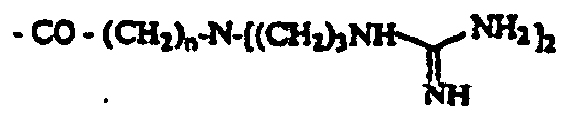
- The sugar alcohol derivative of claim 1, which is an alditol derivative having the skeleton of sorbitol, mannitol or galactitol, and its salt.
- A sugar alcohol derivative of formula 2, and its salt:

R1 and R2 are each independently H, alkyl, arylalkyl, cycloalkyl, heteroalkyl, -(CH2)mNHR', -(CH2)1CO2R", -COR"', -SO2R"" or a physiologically active molecule; R', R", R"' and R"" being each independently H, alkyl, arylalkyl, cycloalkyl, heteroalkyl or a physiologically active molecule; m, an integer in the range of 2 to 5; and 1, an integer in the range of 1 to 5;
R3 is

- The sugar alcohol derivative of claim 3, which is represented by formula 7, 8 or 9, and its salt:
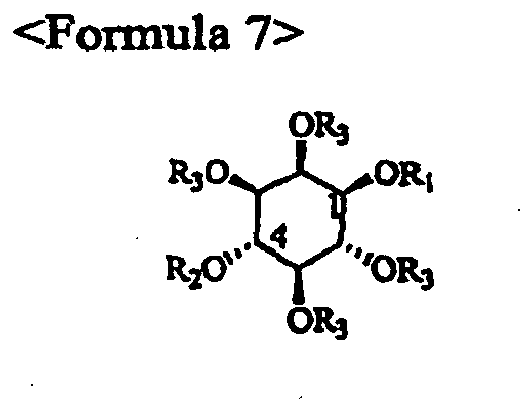


- The sugar alcohol derivative of claim 4, wherein the compounds of formulae 7 to 9 have the skeleton of myo- or scyllo-inositol isomer, and its salt
- A disaccharide derivative of formula 3, and its salt:

X is
R2 is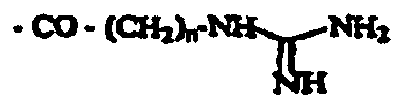
- The disaccharide derivative of claim 6, which is represented by formula 10 or 11, and its salt:


- The disaccharide derivative of claim 7, wherein the compound of formula 10 has the skeleton of sucrose, and its salt.
- The disaccharide derivative of claim 7, wherein the compound of formula 11 has the skeleton of α-lactose, β-lactose or maltose, and its salt.
- A sugar alcohol derivative of formula 4:

R1 is
- The sugar alcohol derivative of claim 10, which is an alditol derivative having the skeleton of sorbitol, mannitol or galactitol, and its salt.
- A sugar alcohol derivative of formula 5, and its salt:


R1 is
- The sugar alcohol derivative of claim 12, which is represented by formula 13 or 14, and its salt:


- The sugar alcohol derivative of claim 13, wherein the compounds of formula 13 or 14 has the skeleton of myo- or scyllo-inositol isomer, and its salt.
- A method for preparing a sugar alcohol derivative of formula 1, comprising the steps of:1) introducing amino acid side chains to the hydroxyl groups of a protected alditiol intermediate by acylation;2) introducing a protected guanidine groups to the terminal amino groups of the amino acid side chains of the compound obtained in step 1); and3) removing the protecting groups from the guanidine groups of the compound obtained in step 2)wherein, R1, R2 and R3 are the same as defined in claim 1.

- The method of claim 15, wherein the intermediate of step 1) is the compound of formula 15:

- A method for preparing a sugar alcohol derivative of formula 2, comprising the steps of:1) introducing amino acid side chains to the hydroxyl groups of a protected inositol intermediate by acylation;2) introducing a protected guanidine groups to the terminal amino groups of the amino acid side chains of the compound obtained in step 1); and3) removing the protecting groups from the guanidine groups of the compound obtained in step 2)wherein, R1, R2 and R3 are the same as defined in claim 3.

- The method of claim 17, wherein the intermediate of step 1) is selected from the group consisting of the compounds of formulae 16 to 18:

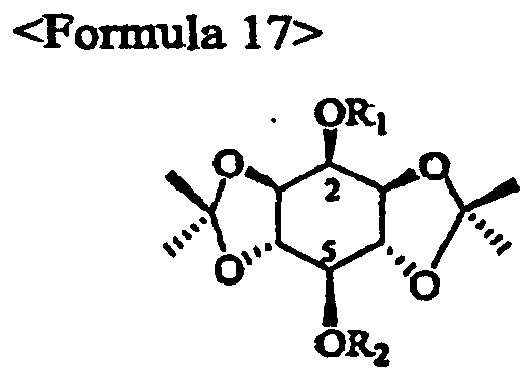

- A method for preparing a sugar alcohol derivative of formula 3, comprising the steps of:1) introducing amino acid side chains to the hydroxyl groups of a protected disaccharide intermediate by acylation;2) introducing a protected guanidine groups to the terminal amino groups of the amino acid side chains of the compound obtained in step 1); and3) removing the protecting groups from the guanidine groups of the compound obtained in step 2)wherein, X and R2 are the same as defined in claim 6.

- The method of claim 19, wherein the intermediate of step 1) is the compound of formula 19 or 20:


- A method for preparing a sugar alcohol derivative of formula 4, comprising the steps of:1) introducing amino acid side chains to the hydroxyl groups of a protected alditol intermediate by acylation;2) introducing a protected guanidine groups to the terminal amino groups of the amino acid side chains of the compound obtained in step 1); and3) removing the protecting groups from the guanidine groups of thewherein, R1 is the same as defined in claim 10.
compound obtained in step 2)
- The method of claim 21, wherein the intermediate of claim 1 is the compound of formula 21:

- A method for preparing a sugar alcohol derivative of formula 5, comprising the steps of:1) introducing amino acid side chains to the hydroxyl groups of a protected inositol intermediate by acylation;2) introducing a protected guanidine groups to the terminal amino groups of the amino acid side chains of the compound obtained in step 1); and3) removing the protecting groups from the guanidine groups of the compound obtained in step 2)wherein, R1 is the same as defined in claim 12.

- The method of claim 23, wherein the intermediate of step 1) is the compound of formula 22 or 23:


- The method of claim 15, 17, 19, 21 or 23, wherein steps 1) and 2) are replaced by the steps of introducing protected guanidine groups to terminal amino acid side chains and introducing the side chains having guanidine groups to the hydroxyl groups of the protected intermediate by acylation.
- A composition for delivering a biologically active molecule across a biological membrane into a cell or a nucleus, comprising the compound selected from the group consisting of formulae 1 to 5:


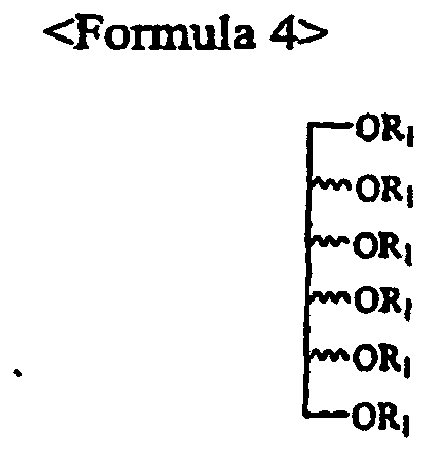
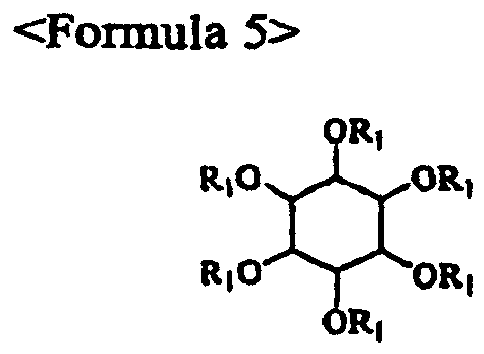
- The composition of claim 26, wherein the biologically active molecule is an organic compound having a molecular weight ranging from 100 to 1500 g/mol.
- The composition of claim 26, wherein the biologically active molecule is a peptide and a nucleic acid.
- The composition of claim 26, wherein the compound of formula 1, 2 or 3 forms a conjugate with the biologically active molecule through a covalent bond.
- The composition of claim 26, wherein the compound of formula 1,2 or 3 forms an ionic complex with the biologically active molecule through ionic bonds.
Applications Claiming Priority (2)
| Application Number | Priority Date | Filing Date | Title |
|---|---|---|---|
| KR1020050035410A KR100699279B1 (en) | 2005-04-28 | 2005-04-28 | Molecular transporters based on sugars or sugar analogs and methods for preparing the same |
| PCT/KR2005/002040 WO2006115312A1 (en) | 2005-04-28 | 2005-06-29 | Molecular transporters based on sugar and its analogues and processes for the preparation thereof |
Publications (3)
| Publication Number | Publication Date |
|---|---|
| EP1885735A1 EP1885735A1 (en) | 2008-02-13 |
| EP1885735A4 EP1885735A4 (en) | 2012-07-25 |
| EP1885735B1 true EP1885735B1 (en) | 2015-08-05 |
Family
ID=37214915
Family Applications (1)
| Application Number | Title | Priority Date | Filing Date |
|---|---|---|---|
| EP05756712.5A Ceased EP1885735B1 (en) | 2005-04-28 | 2005-06-29 | Molecular transporters based on sugar and its analogues and processes for the preparation thereof |
Country Status (5)
| Country | Link |
|---|---|
| US (3) | US7846975B2 (en) |
| EP (1) | EP1885735B1 (en) |
| JP (1) | JP4955659B2 (en) |
| KR (1) | KR100699279B1 (en) |
| WO (1) | WO2006115312A1 (en) |
Families Citing this family (22)
| Publication number | Priority date | Publication date | Assignee | Title |
|---|---|---|---|---|
| US7973084B2 (en) * | 2005-04-28 | 2011-07-05 | Postech Academy-Industrial Foundation | Molecular transporters based on alditol or inositol and processes for the preparation thereof |
| KR100849033B1 (en) * | 2006-09-07 | 2008-07-29 | 포항공과대학교 산학협력단 | Molecular transporters based on alditol or inositol derivatives |
| WO2007108013A2 (en) * | 2006-03-22 | 2007-09-27 | National Institute Of Immunology | Novel bioconjugates as therapeutic agent and synthesis thereof |
| KR101021078B1 (en) | 2008-07-22 | 2011-03-14 | 포항공과대학교 산학협력단 | Inositol or trihalose derivative and pharmaceutical composition for treating neurodegenerative diseases containing the same |
| CN102268108B (en) * | 2011-05-13 | 2013-04-10 | 中科院广州化学有限公司 | Fluorine-containing acrylic ester ATRP (Atom Transfer Radical Polymerization) micro-molecular initiator and preparation method thereof |
| CN107043339B (en) * | 2011-07-19 | 2019-09-06 | 希默赛生物技术有限责任公司 | New cross-linking reagent, macromolecular, treatment conjugate and its synthetic method |
| US9511150B2 (en) | 2011-07-19 | 2016-12-06 | CellMosaic, Inc. | Crosslinking reagents, macromolecules, therapeutic bioconjugates, and synthetic methods thereof |
| KR20160001419A (en) * | 2014-06-27 | 2016-01-06 | 포항공과대학교 산학협력단 | Composition for skin permeation comprising cationic molecular transporters and anionic bioactive substance |
| CZ306254B6 (en) * | 2015-08-30 | 2016-11-02 | University of Jyväskylä, Department of Chemistry | Transporter of nucleotide structures |
| EP3372247B1 (en) * | 2015-11-04 | 2022-01-05 | Postech Academy-Industry Foundation | Composition for skin permeation comprising cationic molecular transporter and protein |
| US12491261B2 (en) | 2016-10-26 | 2025-12-09 | Acuitas Therapeutics, Inc. | Lipid nanoparticle formulations |
| ES2981244T3 (en) * | 2017-04-28 | 2024-10-07 | Acuitas Therapeutics Inc | Novel formulations of lipid carbonyl nanoparticles and lipids for nucleic acid delivery |
| EP4501322A3 (en) | 2017-08-17 | 2025-04-16 | Acuitas Therapeutics, Inc. | Lipids for use in lipid nanoparticle formulations |
| US11542225B2 (en) | 2017-08-17 | 2023-01-03 | Acuitas Therapeutics, Inc. | Lipids for use in lipid nanoparticle formulations |
| WO2019036030A1 (en) | 2017-08-17 | 2019-02-21 | Acuitas Therapeutics, Inc. | Lipids for use in lipid nanoparticle formulations |
| CZ308447B6 (en) * | 2018-07-04 | 2020-08-26 | Vysoká škola chemicko-technologická v Praze | Hydrazone-based nucleotide transporters as a therapeutic tool for drug targeting for tumour immunotherapy |
| US12583816B2 (en) | 2018-10-18 | 2026-03-24 | Acuitas Therapeutics, Inc. | Lipids for lipid nanoparticle delivery of active agents |
| WO2020249801A1 (en) * | 2019-06-12 | 2020-12-17 | Technical University Of Denmark | Dissacharide formulations for controlled drug release |
| JP7798855B2 (en) | 2020-07-16 | 2026-01-14 | アクイタス セラピューティクス インコーポレイテッド | Cationic lipids for use in lipid nanoparticles - Patent Application 20070122999 |
| WO2022173199A1 (en) * | 2021-02-15 | 2022-08-18 | 주식회사 바이오파마 | Vaccine composition for preventing covid-19, comprising ionic complex of cationic molecular transporter and sars-cov-2 mrna |
| CA3242402A1 (en) | 2021-12-16 | 2023-06-22 | Acuitas Therapeutics, Inc. | Lipids for use in lipid nanoparticle formulations |
| WO2024144348A1 (en) * | 2022-12-29 | 2024-07-04 | 주식회사 바이오파마 | Vaccine composition comprising ionic complex of cationic molecular transporter and mrna |
Family Cites Families (11)
| Publication number | Priority date | Publication date | Assignee | Title |
|---|---|---|---|---|
| DE2967069D1 (en) * | 1978-01-16 | 1984-08-02 | Univ Boston | Effecting cellular uptake of molecules |
| US5270181A (en) | 1991-02-06 | 1993-12-14 | Genetics Institute, Inc. | Peptide and protein fusions to thioredoxin and thioredoxin-like molecules |
| EP0903408A3 (en) * | 1992-08-21 | 2005-11-02 | Biogen, Inc. | Tat-derived transport polypeptide |
| AU6045094A (en) * | 1993-02-19 | 1994-09-14 | Nippon Shinyaku Co. Ltd. | Drug composition containing nucleic acid copolymer |
| JPH0726298A (en) * | 1993-07-15 | 1995-01-27 | Lion Corp | Cleaning composition |
| CA2291074C (en) * | 1997-05-21 | 2008-04-01 | The Board Of Trustees Of The Leland Stanford Junior University | Composition and method for enhancing transport across biological membranes |
| FR2763943B1 (en) | 1997-05-28 | 1999-07-09 | Rhone Poulenc Rorer Sa | COMPOUNDS, THEIR PREPARATION AND THEIR USE FOR TRANSFERRING NUCLEIC ACIDS INTO CELLS |
| JP4698843B2 (en) | 1999-05-17 | 2011-06-08 | エーザイ インコーポレイテッド | Improved cellular uptake of bioactive agents |
| KR100374966B1 (en) * | 2000-06-15 | 2003-03-06 | (주) 제삼교육 | A position tracking system, the tracking method and the recordable media |
| KR100578732B1 (en) * | 2004-03-05 | 2006-05-12 | 학교법인 포항공과대학교 | Inositol derivatives as molecular transporters and preparation method thereof |
| KR100849033B1 (en) * | 2006-09-07 | 2008-07-29 | 포항공과대학교 산학협력단 | Molecular transporters based on alditol or inositol derivatives |
-
2005
- 2005-04-28 KR KR1020050035410A patent/KR100699279B1/en not_active Expired - Lifetime
- 2005-06-29 EP EP05756712.5A patent/EP1885735B1/en not_active Ceased
- 2005-06-29 US US11/815,339 patent/US7846975B2/en active Active
- 2005-06-29 WO PCT/KR2005/002040 patent/WO2006115312A1/en not_active Ceased
- 2005-06-29 JP JP2008508732A patent/JP4955659B2/en not_active Expired - Lifetime
-
2010
- 2010-08-20 US US12/860,538 patent/US8058413B2/en not_active Expired - Lifetime
- 2010-08-20 US US12/860,439 patent/US8048996B2/en not_active Expired - Fee Related
Also Published As
| Publication number | Publication date |
|---|---|
| US20080249296A1 (en) | 2008-10-09 |
| EP1885735A1 (en) | 2008-02-13 |
| US8048996B2 (en) | 2011-11-01 |
| US8058413B2 (en) | 2011-11-15 |
| US7846975B2 (en) | 2010-12-07 |
| KR100699279B1 (en) | 2007-03-23 |
| JP2008539226A (en) | 2008-11-13 |
| KR20060112791A (en) | 2006-11-02 |
| EP1885735A4 (en) | 2012-07-25 |
| JP4955659B2 (en) | 2012-06-20 |
| US20100330608A1 (en) | 2010-12-30 |
| US20100330671A1 (en) | 2010-12-30 |
| WO2006115312A1 (en) | 2006-11-02 |
Similar Documents
| Publication | Publication Date | Title |
|---|---|---|
| US8048996B2 (en) | Molecular transporters based on sugar and its analogues and processes for the preparation thereof | |
| US5767254A (en) | Method for making amino acid glycosides and glycopeptides | |
| Hamzavi et al. | Modulation of the pharmacokinetic properties of PNA: preparation of galactosyl, mannosyl, fucosyl, N-acetylgalactosaminyl, and N-acetylglucosaminyl derivatives of aminoethylglycine peptide nucleic acid monomers and their incorporation into PNA oligomers | |
| SK113797A3 (en) | Bioactive compounds conjugated with glycides | |
| Unverzagt et al. | Synthesis of glycopeptides and neoglycoproteins containing the fucosylated linkage region of N-glycoproteins | |
| CN111699007A (en) | Process for preparing GalNAc oligonucleotide conjugates | |
| EP1276760B1 (en) | Polyamide nucleic acid derivatives, agents and methods for producing them | |
| EP0273388A2 (en) | Sialic acid derivatives having active carbonyl group | |
| JP4723526B2 (en) | Molecular transporters based on alditol or inositol derivatives | |
| EP4130016A1 (en) | Sugar compound having polyethylene glycol chain, and precursor of antibody-drug complex | |
| KR100578732B1 (en) | Inositol derivatives as molecular transporters and preparation method thereof | |
| US7973084B2 (en) | Molecular transporters based on alditol or inositol and processes for the preparation thereof | |
| Szabó et al. | Stereoselective synthesis of O-serinyl/threoninyl-2-acetamido-2-deoxy-α-or β-glycosides | |
| EP3972984B1 (en) | Process for the preparation of galnac phosphoramidite epimers | |
| JP2716657B2 (en) | Compound having specific binding ability to adhesion molecule ELAM-1 | |
| Greatrex et al. | The synthesis and immune stimulating action of mannose-capped lysine-based dendrimers | |
| Hamzavi et al. | Synthesis of a C-linked glycosylated thymine-based PNA monomer and its incorporation into a PNA oligomer | |
| DE60222672T2 (en) | PROCESS FOR PREPARING LIPID II | |
| Lee et al. | Mitochondrial affinity of guanidine-rich molecular transporters built on monosaccharide scaffolds: stereochemistry and lipophilicity | |
| Kolganova et al. | Simple and Stereoselective Preparation of an 4‐(Aminomethyl)‐1, 2, 3‐triazolyl Nucleoside Phosphoramidite | |
| EP4520765A1 (en) | Ionizable cationic lipids incorporating silicon | |
| WO2004076476A1 (en) | Glycopeptide and use thereof as proteoglycan initiator | |
| US20230235328A1 (en) | Novel morpholino oligonucleotide derivatives | |
| US20090036658A1 (en) | Highly efficient synthesis of alpha-O-galactosyl ceramides | |
| Simeone et al. | Design, Synthesis and Characterization of novel Guanosine-based Amphiphiles |
Legal Events
| Date | Code | Title | Description |
|---|---|---|---|
| PUAI | Public reference made under article 153(3) epc to a published international application that has entered the european phase |
Free format text: ORIGINAL CODE: 0009012 |
|
| 17P | Request for examination filed |
Effective date: 20071127 |
|
| AK | Designated contracting states |
Kind code of ref document: A1 Designated state(s): CH FR GB GR IT LI |
|
| DAX | Request for extension of the european patent (deleted) | ||
| RBV | Designated contracting states (corrected) |
Designated state(s): CH FR GB GR IT LI |
|
| A4 | Supplementary search report drawn up and despatched |
Effective date: 20120625 |
|
| RIC1 | Information provided on ipc code assigned before grant |
Ipc: C07H 15/04 20060101AFI20120619BHEP |
|
| 17Q | First examination report despatched |
Effective date: 20120919 |
|
| GRAP | Despatch of communication of intention to grant a patent |
Free format text: ORIGINAL CODE: EPIDOSNIGR1 |
|
| INTG | Intention to grant announced |
Effective date: 20150217 |
|
| GRAS | Grant fee paid |
Free format text: ORIGINAL CODE: EPIDOSNIGR3 |
|
| GRAA | (expected) grant |
Free format text: ORIGINAL CODE: 0009210 |
|
| AK | Designated contracting states |
Kind code of ref document: B1 Designated state(s): CH FR GB GR IT LI |
|
| REG | Reference to a national code |
Ref country code: GB Ref legal event code: FG4D |
|
| REG | Reference to a national code |
Ref country code: CH Ref legal event code: EP Ref country code: CH Ref legal event code: NV Representative=s name: ISLER AND PEDRAZZINI AG, CH |
|
| PG25 | Lapsed in a contracting state [announced via postgrant information from national office to epo] |
Ref country code: GR Free format text: LAPSE BECAUSE OF FAILURE TO SUBMIT A TRANSLATION OF THE DESCRIPTION OR TO PAY THE FEE WITHIN THE PRESCRIBED TIME-LIMIT Effective date: 20151106 |
|
| PLBE | No opposition filed within time limit |
Free format text: ORIGINAL CODE: 0009261 |
|
| STAA | Information on the status of an ep patent application or granted ep patent |
Free format text: STATUS: NO OPPOSITION FILED WITHIN TIME LIMIT |
|
| REG | Reference to a national code |
Ref country code: FR Ref legal event code: PLFP Year of fee payment: 12 |
|
| 26N | No opposition filed |
Effective date: 20160509 |
|
| REG | Reference to a national code |
Ref country code: FR Ref legal event code: PLFP Year of fee payment: 13 |
|
| REG | Reference to a national code |
Ref country code: FR Ref legal event code: PLFP Year of fee payment: 14 |
|
| PGFP | Annual fee paid to national office [announced via postgrant information from national office to epo] |
Ref country code: FR Payment date: 20190625 Year of fee payment: 15 |
|
| PGFP | Annual fee paid to national office [announced via postgrant information from national office to epo] |
Ref country code: CH Payment date: 20190627 Year of fee payment: 15 |
|
| PGFP | Annual fee paid to national office [announced via postgrant information from national office to epo] |
Ref country code: IT Payment date: 20190628 Year of fee payment: 15 Ref country code: GB Payment date: 20190627 Year of fee payment: 15 |
|
| REG | Reference to a national code |
Ref country code: CH Ref legal event code: PL |
|
| GBPC | Gb: european patent ceased through non-payment of renewal fee |
Effective date: 20200629 |
|
| PG25 | Lapsed in a contracting state [announced via postgrant information from national office to epo] |
Ref country code: CH Free format text: LAPSE BECAUSE OF NON-PAYMENT OF DUE FEES Effective date: 20200630 Ref country code: LI Free format text: LAPSE BECAUSE OF NON-PAYMENT OF DUE FEES Effective date: 20200630 Ref country code: GB Free format text: LAPSE BECAUSE OF NON-PAYMENT OF DUE FEES Effective date: 20200629 Ref country code: FR Free format text: LAPSE BECAUSE OF NON-PAYMENT OF DUE FEES Effective date: 20200630 |
|
| PG25 | Lapsed in a contracting state [announced via postgrant information from national office to epo] |
Ref country code: IT Free format text: LAPSE BECAUSE OF NON-PAYMENT OF DUE FEES Effective date: 20200629 |