EP1885148A1 - Transmitting/receiving device, commodity service transaction system, transmitter device, and receiver device - Google Patents
Transmitting/receiving device, commodity service transaction system, transmitter device, and receiver device Download PDFInfo
- Publication number
- EP1885148A1 EP1885148A1 EP06746171A EP06746171A EP1885148A1 EP 1885148 A1 EP1885148 A1 EP 1885148A1 EP 06746171 A EP06746171 A EP 06746171A EP 06746171 A EP06746171 A EP 06746171A EP 1885148 A1 EP1885148 A1 EP 1885148A1
- Authority
- EP
- European Patent Office
- Prior art keywords
- data
- transreceiver
- user
- transaction data
- transaction
- Prior art date
- Legal status (The legal status is an assumption and is not a legal conclusion. Google has not performed a legal analysis and makes no representation as to the accuracy of the status listed.)
- Withdrawn
Links
Images



Classifications
-
- G—PHYSICS
- G06—COMPUTING OR CALCULATING; COUNTING
- G06Q—INFORMATION AND COMMUNICATION TECHNOLOGY [ICT] SPECIALLY ADAPTED FOR ADMINISTRATIVE, COMMERCIAL, FINANCIAL, MANAGERIAL OR SUPERVISORY PURPOSES; SYSTEMS OR METHODS SPECIALLY ADAPTED FOR ADMINISTRATIVE, COMMERCIAL, FINANCIAL, MANAGERIAL OR SUPERVISORY PURPOSES, NOT OTHERWISE PROVIDED FOR
- G06Q30/00—Commerce
- G06Q30/06—Buying, selling or leasing transactions
-
- G—PHYSICS
- G06—COMPUTING OR CALCULATING; COUNTING
- G06Q—INFORMATION AND COMMUNICATION TECHNOLOGY [ICT] SPECIALLY ADAPTED FOR ADMINISTRATIVE, COMMERCIAL, FINANCIAL, MANAGERIAL OR SUPERVISORY PURPOSES; SYSTEMS OR METHODS SPECIALLY ADAPTED FOR ADMINISTRATIVE, COMMERCIAL, FINANCIAL, MANAGERIAL OR SUPERVISORY PURPOSES, NOT OTHERWISE PROVIDED FOR
- G06Q40/00—Finance; Insurance; Tax strategies; Processing of corporate or income taxes
- G06Q40/04—Trading; Exchange, e.g. stocks, commodities, derivatives or currency exchange
-
- H—ELECTRICITY
- H04—ELECTRIC COMMUNICATION TECHNIQUE
- H04L—TRANSMISSION OF DIGITAL INFORMATION, e.g. TELEGRAPHIC COMMUNICATION
- H04L69/00—Network arrangements, protocols or services independent of the application payload and not provided for in the other groups of this subclass
- H04L69/18—Multiprotocol handlers, e.g. single devices capable of handling multiple protocols
Definitions
- the present invention relates to a portable transreceiver used in a commodity and service trading system that allows transmission and reception of transaction data regarding trades of commodities and services between multiple transreceivers, as well as to the commodity and service trading system and a transmitter and a receiver used in the commodity and service trading system.
- Patent Document 1 Japanese Patent Laid-Open No. 2003-242383
- the auctioneer and the bidder are respectively required to place the commodity on the auction site and to make a bid for the commodity through the Web server.
- the inexperienced beginner user has difficulty in the rather complicated processing. This may lead to an unsmooth transaction of the commodity. This problem is not characteristic of trading of commodities but is also found in trading of services.
- the transreceiver In the transreceiver, the commodity and service trading system, and the transmitter and the receiver used in the commodity and service trading system, there is accordingly a demand of ensuring smooth trading of a commodity or a service.
- transreceiver for example, a transreceiver, commodity and service trading system, and transmitter and receiver used therein of the invention having the configurations discussed below.
- the present invention is directed to a transreceiver portably used in a commodity and service trading system that allows transmission and reception of transaction data regarding a trade of commodity or service between multiple transreceivers.
- the transreceiver includes: a data storage module that stores data including a transreceiver user's transaction data; a data transmitting and receiving module that utilizes electromagnetic wave in a predetermined frequency band to send and receive data; and a transmit-receive control module that controls the data transmitting and receiving module to enable transmission of the transreceiver user's transaction data stored in the data storage module to another transreceiver, in parallel with reception of another transreceiver user's transaction data that is sent from the another transreceiver and is related to the transreceiver user's transaction data stored in the data storage module.
- the transreceiver stores the data including the transreceiver user's transaction data into the data storage module.
- the transreceiver controls the data transmitting and receiving module that utilizes the electromagnetic wave in the predetermined frequency band to send and receive data.
- Such control enables transmission of the transreceiver user's transaction data stored in the data storage module to another transreceiver, in parallel with reception of the another transreceiver user's transaction data that is sent from the another transreceiver and related to the transreceiver user's transaction data stored in the data storage module.
- This arrangement enables parallel transmission and reception of the relevant transaction data between the multiple transreceivers, thus ensuring smooth trading of a commodity or a service.
- the data storage module stores at least trade option data representing a commodity option or a service option as an object trade and condition data representing transaction conditions required for the object trade, as the transreceiver user's transaction data.
- the transreceiver further has a transaction data registration module that registers the another transreceiver user's transaction data received from the another transreceiver by means of the data transmitting and receiving module, into the data storage module, when any at least partly matching transaction data having identical trade option data and at least partly matching condition data with those of the another transreceiver user's transaction data is present among the transreceiver user's transaction data stored in the data storage module.
- This arrangement enables registration of only the relevant transaction data among the another transreceiver user's transaction data.
- the transaction data registration module upon previous registration of the another transreceiver user's transaction data in the data storage module, the transaction data registration module does not make duplicate registration of the another transreceiver user's transaction data, even when any at least partly matching transaction data having identical trade option data and at least partly matching condition data with those of the another transreceiver user's transaction data is present among the transreceiver user's transaction data stored in the data storage module.
- This arrangement effectively prevents duplicate registry of the same transaction data.
- the transreceiver further has an information module that notifies the transreceiver user of registration of the another transreceiver user's transaction data by the transaction data registration module. The user is thus immediately informed of registry of the received transaction data.
- the information module notifies the transreceiver user of registration of the another transreceiver user's transaction data in a unique notification pattern intrinsically set for each of the transreceiver user's stored transaction data corresponding to the another transreceiver user's transaction data received from the another transreceiver as a registry object or for trade option data of the each stored transaction data. This enables the user to roughly identify the registered transaction data.
- the transreceiver further has a connection module that is connectable with a predetermined portable device to display content of the another transreceiver user's transaction data registered by the transaction data registration module, on a monitor screen of the predetermined portable device.
- the user carrying the predetermined portable device with the transreceiver is immediately informed of the content of the registered transaction data.
- the 'predetermined portable device' may be, for example, a cellular phone or a personal digital assistant.
- the data storage module stores the transreceiver user's transaction data with setting of either a permission or a refusal for data transmission.
- the transmit-receive control module sends only transaction data with the setting of a permission for data transmission among the transreceiver user's transaction data stored in the data storage module. This arrangement effectively prevents transmission of the transaction data to the unspecified number of people against the user's intention.
- the present invention is directed to a commodity and service trading system that allows transmission and reception of transaction data regarding a trade of commodity or service between multiple transreceivers.
- Each of the multiple transreceivers has: a data storage module that stores data including a transreceiver user's transaction data; a data transmitting and receiving module that utilizes electromagnetic wave in a predetermined frequency band to send and receive data; and a transmit-receive control module that controls the data transmitting and receiving module to enable transmission of the transreceiver user's transaction data stored in the data storage module to another transreceiver, in parallel with reception of another transreceiver user's transaction data that is sent from the another transreceiver and is related to the transreceiver user's transaction data stored in the data storage module.
- the commodity and service trading system includes: a server that manages an input form for a user's entry of transaction data; and a client computer that is connected with the server via a network, receives the input form from the server, accepts the user's entry of transaction data on the received input form, and stores the accepted transaction data into the data storage module of the transreceiver.
- the transreceiver stores the transreceiver user's transaction data, which regards a trade of commodity or service and is to be sent and received between the multiple transreceivers, into the data storage module.
- the transreceiver controls the data transmitting and receiving module that utilizes the electromagnetic wave in the predetermined frequency band to send and receive data.
- Such control enables transmission of the transreceiver user's transaction data stored in the data storage module to another transreceiver, in parallel with reception of the another transreceiver user's transaction data that is sent from the another transreceiver and related to the transreceiver user's transaction data stored in the data storage module.
- the client computer receives the input form for the user's entry of transaction data from the server connected via the network, accepts the user's entry of transaction data on the received input form, and stores the accepted transaction data into the data storage module of the transreceiver.
- the use of this input form enables the user's transaction data to be readily stored into the data storage module of the transreceiver.
- the transmission of the transaction data between the multiple transreceivers ensures the smoother trading of a commodity or a service.
- the present invention is directed to a transmitter portably used in a commodity and service trading system that allows transmission and reception of transaction data regarding a trade of commodity or service between the transmitter and a receiver.
- the transmitter has: a data storage module that stores data including a transmitter user's transaction data; a data transmitting module that utilizes electromagnetic wave in a predetermined frequency band to send data; and a transmit control module that controls the data transmitting module to send the transmitter user's transaction data stored in the data storage module to the receiver at a predetermined timing.
- the receiver has: a data storage module that stores data including a receiver user's transaction data; a data receiving module that receives the data sent on the electromagnetic wave in the predetermined frequency band; a receive control module that controls the data receiving module to receive the transmitter user's transaction data sent at the predetermined timing by the transmitter; and a transaction data registration module that registers the transmitter user's received transaction data into the data storage module of the receiver, when the transmitter user's received transaction data is related to any of the receiver user's transaction data stored in the data storage module of the receiver.
- the transmitter controls the data transmitting module to send the transmitter user's transaction data, which is stored in the data storage module, on the electromagnetic wave in the predetermined frequency band to the receiver at the predetermined timing.
- the receiver controls the data receiving module to receive the transmitter user's transaction data sent on the electromagnetic wave in the predetermined frequency band at the predetermined timing by the transmitter.
- the transmitter user' s received transaction data is stored into the data storage module of the receiver, when the transmitter user's received transaction data is related to any of the receiver user's transaction data stored in the data storage module of the receiver.
- the present invention is directed to a receiver portably used in a commodity and service trading system that allows transmission and reception of transaction data regarding a trade of commodity or service between the transmitter and a receiver.
- the transmitter has: a data storage module that stores data including a transmitter user's transaction data; a data transmitting module that utilizes electromagnetic wave in a predetermined frequency band to send data; and a transmit control module that controls the data transmitting module to send the transmitter user's transaction data stored in the data storage module to the receiver at a predetermined timing.
- the receiver has: a data storage module that stores data including a receiver user's transaction data; a data receiving module that receives the data sent on the electromagnetic wave in the predetermined frequency band; a receive control module that controls the data receiving module to receive the transmitter user's transaction data sent at the predetermined timing by the transmitter; and a transaction data registration module that registers the transmitter user's received transaction data into the data storage module of the receiver, when the transmitter user's received transaction data is related to any of the receiver user's transaction data stored in the data storage module of the receiver.
- the receiver controls the data transmitting module to send the transmitter user' s transaction data, which is stored in the data storage module, on the electromagnetic wave in the predetermined frequency band to the receiver at the predetermined timing.
- the receiver controls the data receiving module to receive the transmitter user's transaction data sent on the electromagnetic wave in the predetermined frequency band at the predetermined timing by the transmitter.
- the transmitter user's received transaction data is stored into the data storage module of the receiver, when the transmitter user's received transaction data is related to any of the receiver user's transaction data stored in the data storage module of the receiver.
- Fig. 1 schematically illustrates the configuration of a commodity and service trading system 10 in one embodiment of the invention.
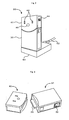
- Fig. 2 is a perspective view showing the appearance of a transreceiver 20 used in the commodity and service trading system 10 of the embodiment.
- Fig. 3 is a perspective view showing the appearance of the transreceiver 20 of Fig. 2 with detachment of an alert device 40 from a transreceiver main body 30.
- the commodity and service trading system 10 of the embodiment is constructed to allow trades of commodities and services between users.
- the commodity and service trading system 10 includes multiple transreceivers 20, 20B, and 20C that are operated to directly send and receive transaction data required for trades of commodities and services, a client computer 60 connected to the transreceiver 20, and a Web server 70 that is connected to the client computer 60 via the Internet 72 and sends Web pages (data input forms) for the user's entries of transaction data in response to requests from the client computer 60.
- the transreceiver 20 is a portable device that is operated to directly send and receive transaction data to and from the similarly constructed other transreceivers 20B and 20C.
- the transreceiver 20 includes a transreceiver main body 30, an alert device 40 that is freely attached to and detached from the transreceiver main body 30 and outputs an alert to inform the user of reception of transaction data from another transreceiver 20B or 20C, and a base stand 50 that is freely attached to and detached from the transreceiver main body 30 and receives supply of electric power through a cable 52 connected to the client computer 60 to charge an internal battery (not shown) of the transreceiver main body 30.
- the transreceiver 20 of this structure may be carried by the user or may be installed at a shop or at a service delivery point.
- the transreceiver main body 30 includes a main controller 31 to control the operations of the respective constituents.
- the transreceiver main body 30 also has a power switch 32 (see Fig. 3) that is provided on a left side face of the transreceiver main body 30, and a memory 33 that stores processing programs and data required for processing (for example, a user data table and a receiving data table described later).
- the transreceiver main body 30 further has a wireless transreceiver module 34 that is provided with an antenna to transmit and receive the low-intensity electromagnetic wave with a coverage of several meters to several tens meters (for example, radio wave in a predetermined frequency band about 315 MHz), and an interface controller 37 that controls inputs and outputs of a connection terminal 35 having a specific connector form connectable with the alert device 40 and with a specified portable information terminal, such as the cellular phone 80 or a PDA (personal digital assistant), and of a USB (universal serial bus) connection terminal 36 connectable with the client computer 60.
- a wireless transreceiver module 34 that is provided with an antenna to transmit and receive the low-intensity electromagnetic wave with a coverage of several meters to several tens meters (for example, radio wave in a predetermined frequency band about 315 MHz)
- an interface controller 37 controls inputs and outputs of a connection terminal 35 having a specific connector form connectable with the alert device 40 and with a specified portable information terminal,
- the alert device 40 has two LEDs 42 on its front face and an alarm 44 on its upper right side face.
- a surrounding area of the alarm 44 on the alert device 40 has multiple through holes provided for clear sound transmission.
- a communication button 46 is located below the two LEDs 42 on the front face of the alert device 40 to establish data communication with the client computer 60 via an infrared communication port (not shown) provided on the top face of the alert device 40.
- the client computer 60 is constructed as a general-purpose computer with a known browser 62 installed therein.
- the client computer 60 accepts the user's entry of transaction data on a data input form, which is sent as a Web page from the Web server 70, and registers the accepted transaction data in the form of a user data table into the memory 33 of the transreceiver 30 via the cable 52.
- Fig. 4 shows one example of the data input form sent from the Web server 70.
- the client computer 60 receives the data input form of Fig. 4 from the Web server 70 and waits for the user's selection of a desired service option and a subsequent click of a 'Next' button.
- the client computer 60 then sends the user's selection of the service option to the Web server 70.
- the Web server 70 receives the user's selection of the service option, generates a data input form in a specific format corresponding to the selected service option, and sends the corresponding data input form to the client computer 60.
- Fig. 5 shows a data input form generated by the Web server 70 and sent to the client computer 60 when the user's selection is a service option 'Home Electric Appliances'.
- the data input form generated in response to the selection of the service option 'Home Electric Appliances' includes, as transaction conditions, a 'commodity option box' for entry of a desired commodity option, for example, television sets, refrigerators, or microwave ovens, a 'trading option box' for selection of either purchase or sale as a desired trading option, a 'maker name box' for entry of a desired maker name of the commodity, a 'desired price box' for entry of a desired price for purchase or sale of the commodity, and a 'delivery permission box' for selection of either a permission or a refusal for delivery of transaction data.
- the client computer 60 receives this data input form of Fig.
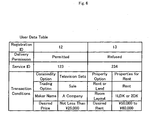
- Fig. 6 shows one example of registry in the user data table.
- Data to be registered in the user data table include a 'registration ID' for identifying each registered transaction data from other transaction data, a 'delivery permission', a 'service ID' for identifying the selected service option and specifying the format for entry of the transaction conditions, and 'transaction conditions'.
- the transaction conditions include the 'commodity option', the 'trading option', the 'maker name', and the 'desired price' as mentioned above.
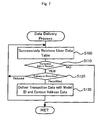
- Fig. 7 is a flowchart showing a data delivery process executed by the main controller 31 of the transreceiver 20.
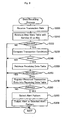
- Fig. 8 is a flowchart showing a data receiving process executed by the main controller 31 of the transreceiver 20.
- the data delivery process is performed repeatedly at preset time intervals, for example, at every several seconds.
- the data receiving process continuously stands by for reception of transaction data and is activated when the wireless transreceiver module 34 receives transaction data delivered from another transreceiver 20B or 20C.
- the data delivery process is thus performed in parallel with the data receiving process that continuously stands by for reception of transaction data.
- the main controller 31 successively retrieves the user data table (step S100) and identifies the presence of any unprocessed transaction data or the user's newly entered transaction data as target transaction data for delivery in the retrieved user data table (step S110).
- step S100 the user data table
- step S110 the user data table
- the main controller 31 refers to the 'delivery permission' item of the transaction data in the user data table and determines whether delivery of the transaction data is permitted or refused (step S120).
- the main controller 31 controls the wireless transreceiver module 34 to deliver the transaction data with a model ID of the transreceiver 20 and the user's contact address data stored in the memory 33 in advance (step S130).
- the processing flow then goes back to step S100 to continue the retrieval of the user data table.
- the user's contact address data may be, for example, the user's telephone number or email address.
- the user's contact address data is entered in an input data form (not shown) on the client computer 60 and is registered into the memory 33 of the transreceiver 20.
- the processing flow goes back to step S100 without delivery of the transaction data to continue the retrieval of the user data table.
- the processing flow repeats the processing of steps S100 to S130 and terminates the data delivery process upon identification of the absence of any unprocessed transaction data in the user data table at step S110.
- This delivery processing allows delivery for only the transaction data with the setting of 'permitted' in the 'delivery permission' item among the transaction data registered in the user data table. This arrangement effectively prevents delivery of transaction data to the unspecified number of people against the user's intention.
- the main controller 31 receives transaction data (step S200) and retrieves the user data table with the service ID included in the received transaction data as a key (step S210) to find any transaction data having the identical service ID with that of the received transaction data in the user data table (step S220).
- step S210 retrieves the user data table with the service ID included in the received transaction data as a key
- step S220 finds any transaction data having the identical service ID with that of the received transaction data in the user data table.
- the user data table has no transaction data with the identical service ID, it is determined that there is no commodity or service suitable for the user's desired transaction. The processing flow thus immediately exits from the data receiving process.
- the main controller 3.1 compares the 'transaction conditions' in the received transaction data with the 'transaction conditions' in the transaction data registered in the user data table (step S230) and specifies the matching of these 'transaction conditions' (step S240).
- the transaction data registered in the user data table has the service ID '123' representing the home electric appliances, and the commodity option 'television sets', the trading option 'sale', the maker name 'A company', and the desired price 'not less than ⁇ 25, 000' as the 'transaction conditions'.
- the received transaction data has the service ID '123' and the commodity option 'television sets', the trading option 'purchase', the maker name 'A company', and the desired price ' ⁇ 29,000' as the 'transaction conditions'.
- the received transaction data and the registered transaction data have the identical service ID '123'.
- An affirmative answer is accordingly given at step S220.
- the 'commodity option' and the 'maker name' are identical as 'television sets' and 'A company'.
- the 'trading option' is 'purchase' in the received transaction data and 'sale' in the registered transaction data, which mean matching.
- the desired price for purchase is ' ⁇ 29,000', which satisfies the desired price for sale of 'not less than ⁇ 25,000'. It is accordingly determined that the transaction conditions of the registered transaction data match with the transaction conditions of the received transaction data. An affirmative answer is accordingly given at step S240.
- the main controller 31 specifies failed trading and exits from the data receiving process.
- the main controller 31 retrieves a receiving data table (step S250) and determines whether any transaction data identical with the received transaction data has already been registered in the receiving data table (step S260).
- step S270 One example of registry in the receiving data table is shown in Fig. 9.
- the transaction data registered in the receiving data table has a 'registration ID' of corresponding transaction data registered in the user data table, a 'sender registration ID' as a registration ID of a sender of the registered transaction data, a 'sender model ID' as a model ID of the sender of the registered transaction data, a 'sender contact address' as a contact address of the sender of the registered transaction data, the 'service ID', and the 'transaction conditions'.
- the main controller 31 determines whether the alert device 40 or the cellular phone 80 is connected with the transreceiver main body 30 (step S280). In the case of connection of either the alert device 40 or the cellular phone 80, the main controller 31 selects an alert pattern (step S290) and outputs an alert in the selected alert pattern (step S300). The processing flow then terminates the data receiving process.
- a lighting pattern of the LEDs 42 of the alert device 40, a sound pattern of the alarm 44 of the alert device 40, or a call out pattern of the cellular phone 80 (for example, an audio pattern, a lighting pattern, or a vibrator pattern) is set as the alert pattern in advance in correlation to the 'registration ID' or the 'service ID'.
- the alert pattern is selectable by specifying the 'registration ID' or the 'service ID'.
- an alert may be output in a unique alert pattern intrinsically set for each 'registration ID' or 'service ID'.
- the cellular phone 80 or the personal digital assistant connecting with the transreceiver main body 30 may be operated to display and check the content of the transaction data registered in the receiving data table on its monitor screen.
- the client computer 60 connecting with the transreceiver main body 30 may also be operated to make access to the memory 33 of the transreceiver main body 30 and check the content of the transaction data registered in the receiving data table.
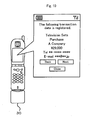
- Fig. 10 shows display of the content of the transaction data on the monitor screen of the cellular phone 80.
- the client computer 60 registers transaction data regarding trades of commodities and services in the form of the user data table into the memory 33 of the transreceiver main body 30.
- the transreceiver 20 delivers transaction data registered in the user data table to the other transreceivers 20B and 20C, in parallel with receiving transaction data delivered from the other transreceivers 20B and 20C.
- the transaction data is registered in the form of the receiving data table into the memory 33 of the transreceiver main body 30.
- This arrangement enables parallel and direct transmission and reception of the relevant transaction data, thus ensuring the smooth trading of a commodity or a service.
- Data delivery is allowed for only the transaction data with the setting of the 'permitted' delivery among the transaction data stored in the user data table.
- This arrangement effectively prevents delivery of the transaction data to the unspecified number of people against the user's intention.
- registry of the received transaction data is omitted.
- This arrangement effectively prevents duplicate registry of the same transaction data in the receiving data table; thus saving the capacity of the memory 33.
- an alert is output to the alert device 40 or the cellular phone 80 connecting with the connection terminal 35 of the transreceiver main body 30.
- This promptly informs the user of registry of the transaction data.
- the alert is output in a unique alert pattern intrinsically set for the registration ID or the service ID of the transaction data that is registered in the user data table and corresponds to the received transaction data. Such alert output enables the user to roughly identify the registered transaction data.
- the memory 33 of the transreceiver 20 storing the user data table and the receiving data table corresponds to the data storage module of the invention.
- the wireless transreceiver module 34 is equivalent to the data transmitting and receiving module of the invention.
- the main controller 31 executing the data delivery process of Fig. 7 and the data receiving process of Fig. 8 corresponds to the transmit-receive control module and the transaction data registration module of the invention.
- the description regards the sales transaction of the 'home electric appliances' as a trade of commodity or service.
- This is, however, not restrictive in any sense, the description is applicable to trades of any commodities and services, for example, sales transactions of automobiles and motorbikes, personal computers, and furniture, rent and sales transactions of real estates, and rent transactions of parking places.
- the client computer 60 receives the data input form from the Web server 70 via the Internet 72, accepts the user's entry of transaction data on the received data input form, and registers the received transaction data in the form of the user data table into the memory 33 of the transreceiver main body 30. Reception of the data input form from the Web server 70 is, however, not essential, but the data input form may be stored in advance in the client computer 60.
- the transaction data with the setting of 'permitted' in the 'delivery permission' item among the transaction data registered in the user data table are specified as the object of data delivery.
- One possible modification may deliver all the transaction data registered in the user data table. In this modification, the 'delivery permission' item is omitted from the user data table.
- the receiving data table In the commodity and service trading system 10 of the embodiment, among the transaction data received from the other transreceivers 20B and 20C, only the transaction data having the 'transaction conditions' perfectly matching with the ' transaction conditions' of the transaction data registered in the user data table is registered in the receiving data table.
- One possible modification may additionally register transaction data having partly mismatching 'transaction conditions', into the receiving data table. For example, transaction data having a little difference in the 'desired price' item may be registered in the receiving data table.
- the alert is output in the unique alert pattern intrinsically set for each 'registration ID' or 'service ID' of the transaction data that is registered in the user data table and corresponds to the transaction data received from another transreceiver20B or 20C.
- One possible modification may output the alert in a fixed alert pattern, regardless of the 'registration ID' or the 'service ID'.
- Another possible modification may select an alert pattern according to a different selection factor other than the 'registration ID' or the 'service ID' and output the alert in the selected alert pattern.
- the description of the embodiment regards the commodity and service trading system 10.
- the technique of the invention is also actualized by the transreceiver 20 used in the commodity and service trading system 10 of the embodiment or by a transmitter specialized in only transmission functions of the transreceiver 20 or a receiver specialized in only receiving functions of the transreceiver 20.
Landscapes
- Business, Economics & Management (AREA)
- Engineering & Computer Science (AREA)
- Accounting & Taxation (AREA)
- Finance (AREA)
- General Business, Economics & Management (AREA)
- Theoretical Computer Science (AREA)
- Strategic Management (AREA)
- Physics & Mathematics (AREA)
- Economics (AREA)
- General Physics & Mathematics (AREA)
- Development Economics (AREA)
- Marketing (AREA)
- Computer Security & Cryptography (AREA)
- Computer Networks & Wireless Communication (AREA)
- Signal Processing (AREA)
- Technology Law (AREA)
- Management, Administration, Business Operations System, And Electronic Commerce (AREA)
- Financial Or Insurance-Related Operations Such As Payment And Settlement (AREA)
- Mobile Radio Communication Systems (AREA)
Abstract
Description
- The present invention relates to a portable transreceiver used in a commodity and service trading system that allows transmission and reception of transaction data regarding trades of commodities and services between multiple transreceivers, as well as to the commodity and service trading system and a transmitter and a receiver used in the commodity and service trading system.
- One typical example of the commodity and service trading system is a net auction system for sales and purchases of commodities on a network (see, for example, Patent Document 1). In the net auction system, each auctioneer posts the auctioneer's information and commodity information in an auction site provided by a Web server and waits for bidding. The highest bidder in a preset bidding time wins the bid for the commodity and makes contact with the auctioneer to perform a transaction.
Patent Document 1:Japanese Patent Laid-Open No. 2003-242383 - In the commodity and service trading system, the auctioneer and the bidder are respectively required to place the commodity on the auction site and to make a bid for the commodity through the Web server. The inexperienced beginner user has difficulty in the rather complicated processing. This may lead to an unsmooth transaction of the commodity. This problem is not characteristic of trading of commodities but is also found in trading of services.
- In the transreceiver, the commodity and service trading system, and the transmitter and the receiver used in the commodity and service trading system, there is accordingly a demand of ensuring smooth trading of a commodity or a service.
- At least part of the above and the other related objects is attained by a transreceiver, commodity and service trading system, and transmitter and receiver used therein of the invention having the configurations discussed below.
- According to one aspect, the present invention is directed to a transreceiver portably used in a commodity and service trading system that allows transmission and reception of transaction data regarding a trade of commodity or service between multiple transreceivers. The transreceiver includes: a data storage module that stores data including a transreceiver user's transaction data; a data transmitting and receiving module that utilizes electromagnetic wave in a predetermined frequency band to send and receive data; and a transmit-receive control module that controls the data transmitting and receiving module to enable transmission of the transreceiver user's transaction data stored in the data storage module to another transreceiver, in parallel with reception of another transreceiver user's transaction data that is sent from the another transreceiver and is related to the transreceiver user's transaction data stored in the data storage module.
- In the commodity and service trading system that allows transmission and reception of transaction data regarding a trade of commodity or service between the multiple transreceivers, the transreceiver according to this aspect of the invention stores the data including the transreceiver user's transaction data into the data storage module. The transreceiver controls the data transmitting and receiving module that utilizes the electromagnetic wave in the predetermined frequency band to send and receive data. Such control enables transmission of the transreceiver user's transaction data stored in the data storage module to another transreceiver, in parallel with reception of the another transreceiver user's transaction data that is sent from the another transreceiver and related to the transreceiver user's transaction data stored in the data storage module. This arrangement enables parallel transmission and reception of the relevant transaction data between the multiple transreceivers, thus ensuring smooth trading of a commodity or a service.
- In one preferable application of the transreceiver according to one aspect of the invention, the data storage module stores at least trade option data representing a commodity option or a service option as an object trade and condition data representing transaction conditions required for the object trade, as the transreceiver user's transaction data. The transreceiver further has a transaction data registration module that registers the another transreceiver user's transaction data received from the another transreceiver by means of the data transmitting and receiving module, into the data storage module, when any at least partly matching transaction data having identical trade option data and at least partly matching condition data with those of the another transreceiver user's transaction data is present among the transreceiver user's transaction data stored in the data storage module. This arrangement enables registration of only the relevant transaction data among the another transreceiver user's transaction data. In the transreceiver of this application, upon previous registration of the another transreceiver user's transaction data in the data storage module, the transaction data registration module does not make duplicate registration of the another transreceiver user's transaction data, even when any at least partly matching transaction data having identical trade option data and at least partly matching condition data with those of the another transreceiver user's transaction data is present among the transreceiver user's transaction data stored in the data storage module. This arrangement effectively prevents duplicate registry of the same transaction data.
- In one preferable embodiment of the transreceiver equipped with the transaction data registration module, the transreceiver further has an information module that notifies the transreceiver user of registration of the another transreceiver user's transaction data by the transaction data registration module. The user is thus immediately informed of registry of the received transaction data. In the transreceiver of this embodiment, it is preferable that the information module notifies the transreceiver user of registration of the another transreceiver user's transaction data in a unique notification pattern intrinsically set for each of the transreceiver user's stored transaction data corresponding to the another transreceiver user's transaction data received from the another transreceiver as a registry object or for trade option data of the each stored transaction data. This enables the user to roughly identify the registered transaction data.
- In another preferable embodiment of the transreceiver equipped with the transaction data registration module, the transreceiver further has a connection module that is connectable with a predetermined portable device to display content of the another transreceiver user's transaction data registered by the transaction data registration module, on a monitor screen of the predetermined portable device. The user carrying the predetermined portable device with the transreceiver is immediately informed of the content of the registered transaction data. The 'predetermined portable device' may be, for example, a cellular phone or a personal digital assistant.
- In another preferable application of the transreceiver according to one aspect of the invention, the data storage module stores the transreceiver user's transaction data with setting of either a permission or a refusal for data transmission. The transmit-receive control module sends only transaction data with the setting of a permission for data transmission among the transreceiver user's transaction data stored in the data storage module. This arrangement effectively prevents transmission of the transaction data to the unspecified number of people against the user's intention.
- According to another aspect, the present invention is directed to a commodity and service trading system that allows transmission and reception of transaction data regarding a trade of commodity or service between multiple transreceivers. Each of the multiple transreceivers has: a data storage module that stores data including a transreceiver user's transaction data; a data transmitting and receiving module that utilizes electromagnetic wave in a predetermined frequency band to send and receive data; and a transmit-receive control module that controls the data transmitting and receiving module to enable transmission of the transreceiver user's transaction data stored in the data storage module to another transreceiver, in parallel with reception of another transreceiver user's transaction data that is sent from the another transreceiver and is related to the transreceiver user's transaction data stored in the data storage module. The commodity and service trading system includes: a server that manages an input form for a user's entry of transaction data; and a client computer that is connected with the server via a network, receives the input form from the server, accepts the user's entry of transaction data on the received input form, and stores the accepted transaction data into the data storage module of the transreceiver.
- In the commodity and service trading system according to this aspect of the invention, the transreceiver stores the transreceiver user's transaction data, which regards a trade of commodity or service and is to be sent and received between the multiple transreceivers, into the data storage module. The transreceiver controls the data transmitting and receiving module that utilizes the electromagnetic wave in the predetermined frequency band to send and receive data. Such control enables transmission of the transreceiver user's transaction data stored in the data storage module to another transreceiver, in parallel with reception of the another transreceiver user's transaction data that is sent from the another transreceiver and related to the transreceiver user's transaction data stored in the data storage module. The client computer receives the input form for the user's entry of transaction data from the server connected via the network, accepts the user's entry of transaction data on the received input form, and stores the accepted transaction data into the data storage module of the transreceiver. The use of this input form enables the user's transaction data to be readily stored into the data storage module of the transreceiver. The transmission of the transaction data between the multiple transreceivers ensures the smoother trading of a commodity or a service.
- According to still another aspect, the present invention is directed to a transmitter portably used in a commodity and service trading system that allows transmission and reception of transaction data regarding a trade of commodity or service between the transmitter and a receiver. The transmitter has: a data storage module that stores data including a transmitter user's transaction data; a data transmitting module that utilizes electromagnetic wave in a predetermined frequency band to send data; and a transmit control module that controls the data transmitting module to send the transmitter user's transaction data stored in the data storage module to the receiver at a predetermined timing. The receiver has: a data storage module that stores data including a receiver user's transaction data; a data receiving module that receives the data sent on the electromagnetic wave in the predetermined frequency band; a receive control module that controls the data receiving module to receive the transmitter user's transaction data sent at the predetermined timing by the transmitter; and a transaction data registration module that registers the transmitter user's received transaction data into the data storage module of the receiver, when the transmitter user's received transaction data is related to any of the receiver user's transaction data stored in the data storage module of the receiver.
- In the commodity and service trading system that allows transmission and reception of transaction data regarding a trade of commodity or service between the transmitter and the receiver, the transmitter controls the data transmitting module to send the transmitter user's transaction data, which is stored in the data storage module, on the electromagnetic wave in the predetermined frequency band to the receiver at the predetermined timing. The receiver controls the data receiving module to receive the transmitter user's transaction data sent on the electromagnetic wave in the predetermined frequency band at the predetermined timing by the transmitter. The transmitter user' s received transaction data is stored into the data storage module of the receiver, when the transmitter user's received transaction data is related to any of the receiver user's transaction data stored in the data storage module of the receiver. This arrangement enables direct transmission of the relevant transaction data between the transmitter and the receiver, thus ensuring the smoother trading of a commodity or a service.
- According to still another aspect, the present invention is directed to a receiver portably used in a commodity and service trading system that allows transmission and reception of transaction data regarding a trade of commodity or service between the transmitter and a receiver. The transmitter has: a data storage module that stores data including a transmitter user's transaction data; a data transmitting module that utilizes electromagnetic wave in a predetermined frequency band to send data; and a transmit control module that controls the data transmitting module to send the transmitter user's transaction data stored in the data storage module to the receiver at a predetermined timing. The receiver has: a data storage module that stores data including a receiver user's transaction data; a data receiving module that receives the data sent on the electromagnetic wave in the predetermined frequency band; a receive control module that controls the data receiving module to receive the transmitter user's transaction data sent at the predetermined timing by the transmitter; and a transaction data registration module that registers the transmitter user's received transaction data into the data storage module of the receiver, when the transmitter user's received transaction data is related to any of the receiver user's transaction data stored in the data storage module of the receiver.
- In the commodity and service trading system that allows transmission and reception of transaction data regarding a trade of commodity or service between the transmitter and the receiver, the receiver controls the data transmitting module to send the transmitter user' s transaction data, which is stored in the data storage module, on the electromagnetic wave in the predetermined frequency band to the receiver at the predetermined timing. The receiver controls the data receiving module to receive the transmitter user's transaction data sent on the electromagnetic wave in the predetermined frequency band at the predetermined timing by the transmitter. The transmitter user's received transaction data is stored into the data storage module of the receiver, when the transmitter user's received transaction data is related to any of the receiver user's transaction data stored in the data storage module of the receiver. This arrangement enables direct transmission of the relevant transaction data between the transmitter and the receiver, thus ensuring the smoother trading of a commodity or a service.
-
- Fig. 1 schematically illustrates the configuration of a commodity and
service trading system 10 in one embodiment of the invention; - Fig. 2 is a perspective view showing the appearance of a
transreceiver 20 used in the commodity andservice trading system 10 of the embodiment; - Fig. 3 is a perspective view showing the appearance of the transreceiver 20 of Fig. 2 with detachment of an
alert device 40 from a transreceivermain body 30; - Fig. 4 shows one example of a data input form;
- Fig. 5 shows one example of a subsequent data input form;
- Fig. 6 shows an example of data registered in a user data table;
- Fig. 7 is a flowchart showing a data delivery process;
- Fig. 8 is a flowchart showing a data receiving process;
- Fig. 9 shows an example of data registered in a receiving data table; and
- Fig. 10 shows display of the content of transaction data registered in the receiving data table on a monitor screen of a
cellular phone 80. - One mode of carrying out the invention is described below as a preferred embodiment with reference to the accompanied drawings.
- Fig. 1 schematically illustrates the configuration of a commodity and
service trading system 10 in one embodiment of the invention. Fig. 2 is a perspective view showing the appearance of atransreceiver 20 used in the commodity andservice trading system 10 of the embodiment. Fig. 3 is a perspective view showing the appearance of thetransreceiver 20 of Fig. 2 with detachment of analert device 40 from a transreceivermain body 30. - The commodity and
service trading system 10 of the embodiment is constructed to allow trades of commodities and services between users. As shown in Fig. 1, the commodity andservice trading system 10 includesmultiple transreceivers client computer 60 connected to thetransreceiver 20, and aWeb server 70 that is connected to theclient computer 60 via theInternet 72 and sends Web pages (data input forms) for the user's entries of transaction data in response to requests from theclient computer 60. - The
transreceiver 20 is a portable device that is operated to directly send and receive transaction data to and from the similarly constructedother transreceivers transreceiver 20 includes a transreceivermain body 30, analert device 40 that is freely attached to and detached from the transreceivermain body 30 and outputs an alert to inform the user of reception of transaction data from anothertransreceiver base stand 50 that is freely attached to and detached from the transreceivermain body 30 and receives supply of electric power through acable 52 connected to theclient computer 60 to charge an internal battery (not shown) of the transreceivermain body 30. Thetransreceiver 20 of this structure may be carried by the user or may be installed at a shop or at a service delivery point. - The transreceiver
main body 30 includes amain controller 31 to control the operations of the respective constituents. The transreceivermain body 30 also has a power switch 32 (see Fig. 3) that is provided on a left side face of the transreceivermain body 30, and amemory 33 that stores processing programs and data required for processing (for example, a user data table and a receiving data table described later). The transreceivermain body 30 further has awireless transreceiver module 34 that is provided with an antenna to transmit and receive the low-intensity electromagnetic wave with a coverage of several meters to several tens meters (for example, radio wave in a predetermined frequency band about 315 MHz), and aninterface controller 37 that controls inputs and outputs of aconnection terminal 35 having a specific connector form connectable with thealert device 40 and with a specified portable information terminal, such as thecellular phone 80 or a PDA (personal digital assistant), and of a USB (universal serial bus)connection terminal 36 connectable with theclient computer 60. - As shown in Figs. 2 and 3, the
alert device 40 has twoLEDs 42 on its front face and analarm 44 on its upper right side face. A surrounding area of thealarm 44 on thealert device 40 has multiple through holes provided for clear sound transmission. Acommunication button 46 is located below the twoLEDs 42 on the front face of thealert device 40 to establish data communication with theclient computer 60 via an infrared communication port (not shown) provided on the top face of thealert device 40. - The
client computer 60 is constructed as a general-purpose computer with a knownbrowser 62 installed therein. Theclient computer 60 accepts the user's entry of transaction data on a data input form, which is sent as a Web page from theWeb server 70, and registers the accepted transaction data in the form of a user data table into thememory 33 of thetransreceiver 30 via thecable 52. Fig. 4 shows one example of the data input form sent from theWeb server 70. Theclient computer 60 receives the data input form of Fig. 4 from theWeb server 70 and waits for the user's selection of a desired service option and a subsequent click of a 'Next' button. Theclient computer 60 then sends the user's selection of the service option to theWeb server 70. TheWeb server 70 receives the user's selection of the service option, generates a data input form in a specific format corresponding to the selected service option, and sends the corresponding data input form to theclient computer 60. Fig. 5 shows a data input form generated by theWeb server 70 and sent to theclient computer 60 when the user's selection is a service option 'Home Electric Appliances'. The data input form generated in response to the selection of the service option 'Home Electric Appliances' includes, as transaction conditions, a 'commodity option box' for entry of a desired commodity option, for example, television sets, refrigerators, or microwave ovens, a 'trading option box' for selection of either purchase or sale as a desired trading option, a 'maker name box' for entry of a desired maker name of the commodity, a 'desired price box' for entry of a desired price for purchase or sale of the commodity, and a 'delivery permission box' for selection of either a permission or a refusal for delivery of transaction data. Theclient computer 60 receives this data input form of Fig. 5 from theWeb server 70 and waits for the user's entries in the respective boxes and a subsequent click of an 'OK' button. Theclient computer 60 then writes the entered data into thememory 33 of thetransreceiver 30 for registry of the transaction data in the user data table. Fig. 6 shows one example of registry in the user data table. Data to be registered in the user data table include a 'registration ID' for identifying each registered transaction data from other transaction data, a 'delivery permission', a 'service ID' for identifying the selected service option and specifying the format for entry of the transaction conditions, and 'transaction conditions'. When the selected service option is 'Home Electric Appliances', the transaction conditions include the 'commodity option', the 'trading option', the 'maker name', and the 'desired price' as mentioned above. - The description regards the operations of the
transreceiver 20 of the embodiment constructed as explained above. Fig. 7 is a flowchart showing a data delivery process executed by themain controller 31 of thetransreceiver 20. Fig. 8 is a flowchart showing a data receiving process executed by themain controller 31 of thetransreceiver 20. The data delivery process is performed repeatedly at preset time intervals, for example, at every several seconds. The data receiving process continuously stands by for reception of transaction data and is activated when thewireless transreceiver module 34 receives transaction data delivered from anothertransreceiver - In the data delivery process of Fig. 7, the
main controller 31 successively retrieves the user data table (step S100) and identifies the presence of any unprocessed transaction data or the user's newly entered transaction data as target transaction data for delivery in the retrieved user data table (step S110). When no unprocessed transaction data is present in the user data table, there is no data to be delivered. The processing flow thus immediately terminates the data delivery process. When any unprocessed transaction data is present as the target transaction data for delivery in the user data table, on the other hand, themain controller 31 refers to the 'delivery permission' item of the transaction data in the user data table and determines whether delivery of the transaction data is permitted or refused (step S120). Upon the permission for delivery of the transaction data, themain controller 31 controls thewireless transreceiver module 34 to deliver the transaction data with a model ID of thetransreceiver 20 and the user's contact address data stored in thememory 33 in advance (step S130). The processing flow then goes back to step S100 to continue the retrieval of the user data table. The user's contact address data may be, for example, the user's telephone number or email address. The user's contact address data is entered in an input data form (not shown) on theclient computer 60 and is registered into thememory 33 of thetransreceiver 20. Upon the refusal for delivery of the transaction data, on the other hand, the processing flow goes back to step S100 without delivery of the transaction data to continue the retrieval of the user data table. The processing flow repeats the processing of steps S100 to S130 and terminates the data delivery process upon identification of the absence of any unprocessed transaction data in the user data table at step S110. This delivery processing allows delivery for only the transaction data with the setting of 'permitted' in the 'delivery permission' item among the transaction data registered in the user data table. This arrangement effectively prevents delivery of transaction data to the unspecified number of people against the user's intention. - In the data receiving process of Fig. 8, the
main controller 31 receives transaction data (step S200) and retrieves the user data table with the service ID included in the received transaction data as a key (step S210) to find any transaction data having the identical service ID with that of the received transaction data in the user data table (step S220). When the user data table has no transaction data with the identical service ID, it is determined that there is no commodity or service suitable for the user's desired transaction. The processing flow thus immediately exits from the data receiving process. When the user data table has any transaction data with the identical service ID, on the other hand, the main controller 3.1 compares the 'transaction conditions' in the received transaction data with the 'transaction conditions' in the transaction data registered in the user data table (step S230) and specifies the matching of these 'transaction conditions' (step S240). In the illustrated example of Fig. 6, the transaction data registered in the user data table has the service ID '123' representing the home electric appliances, and the commodity option 'television sets', the trading option 'sale', the maker name 'A company', and the desired price 'not less than ¥25, 000' as the 'transaction conditions'. It is here assumed that the received transaction data has the service ID '123' and the commodity option 'television sets', the trading option 'purchase', the maker name 'A company', and the desired price '¥29,000' as the 'transaction conditions'. In this case, the received transaction data and the registered transaction data have the identical service ID '123'. An affirmative answer is accordingly given at step S220. According to the comparison between the 'transaction conditions' of the received transaction data and the registered transaction data, the 'commodity option' and the 'maker name' are identical as 'television sets' and 'A company'. The 'trading option' is 'purchase' in the received transaction data and 'sale' in the registered transaction data, which mean matching. The desired price for purchase is '¥29,000', which satisfies the desired price for sale of 'not less than ¥25,000'. It is accordingly determined that the transaction conditions of the registered transaction data match with the transaction conditions of the received transaction data. An affirmative answer is accordingly given at step S240. When the received transaction data mismatches with the transaction data registered in the user data table, themain controller 31 specifies failed trading and exits from the data receiving process. When the received transaction data matches with the transaction data registered in the user data table, on the other hand, themain controller 31 retrieves a receiving data table (step S250) and determines whether any transaction data identical with the received transaction data has already been registered in the receiving data table (step S260). In the presence of the identical transaction data in the receiving data table, duplicate registry of the identical transaction data is unnecessary. The processing flow thus terminates the data receiving process without registry of the received transaction data. In the absence of the identical transaction data in the receiving data table, on the other hand, the received transaction data is registered into the receiving data table (step S270). One example of registry in the receiving data table is shown in Fig. 9. The transaction data registered in the receiving data table has a 'registration ID' of corresponding transaction data registered in the user data table, a 'sender registration ID' as a registration ID of a sender of the registered transaction data, a 'sender model ID' as a model ID of the sender of the registered transaction data, a 'sender contact address' as a contact address of the sender of the registered transaction data, the 'service ID', and the 'transaction conditions'. - After registry of the transaction data into the receiving data table, the
main controller 31 determines whether thealert device 40 or thecellular phone 80 is connected with the transreceiver main body 30 (step S280). In the case of connection of either thealert device 40 or thecellular phone 80, themain controller 31 selects an alert pattern (step S290) and outputs an alert in the selected alert pattern (step S300). The processing flow then terminates the data receiving process. In the course of registry of the transaction data in the form of the user data table into thememory 33 of the transreceivermain body 30 by theclient computer 60, a lighting pattern of theLEDs 42 of thealert device 40, a sound pattern of thealarm 44 of thealert device 40, or a call out pattern of the cellular phone 80 (for example, an audio pattern, a lighting pattern, or a vibrator pattern) is set as the alert pattern in advance in correlation to the 'registration ID' or the 'service ID'. The alert pattern is selectable by specifying the 'registration ID' or the 'service ID'. In the case of connection of thealert device 40 or thecellular phone 80 to theconnection terminal 35 of the transreceivermain body 30, an alert may be output in a unique alert pattern intrinsically set for each 'registration ID' or 'service ID'. - On registry of the transaction data into the receiving data table, the
cellular phone 80 or the personal digital assistant connecting with the transreceivermain body 30 may be operated to display and check the content of the transaction data registered in the receiving data table on its monitor screen. Theclient computer 60 connecting with the transreceivermain body 30 may also be operated to make access to thememory 33 of the transreceivermain body 30 and check the content of the transaction data registered in the receiving data table. Fig. 10 shows display of the content of the transaction data on the monitor screen of thecellular phone 80. - In the commodity and
service trading system 10 of the embodiment described above, theclient computer 60 registers transaction data regarding trades of commodities and services in the form of the user data table into thememory 33 of the transreceivermain body 30. Thetransreceiver 20 delivers transaction data registered in the user data table to theother transreceivers other transreceivers memory 33 of the transreceivermain body 30. This arrangement enables parallel and direct transmission and reception of the relevant transaction data, thus ensuring the smooth trading of a commodity or a service. Data delivery is allowed for only the transaction data with the setting of the 'permitted' delivery among the transaction data stored in the user data table. This arrangement effectively prevents delivery of the transaction data to the unspecified number of people against the user's intention. When the transaction data received from anothertransreceiver memory 33. - In the commodity and
service trading system 10 of the embodiment, in response to registry of the received transaction data into the receiving data table, an alert is output to thealert device 40 or thecellular phone 80 connecting with theconnection terminal 35 of the transreceivermain body 30. This promptly informs the user of registry of the transaction data. The alert is output in a unique alert pattern intrinsically set for the registration ID or the service ID of the transaction data that is registered in the user data table and corresponds to the received transaction data. Such alert output enables the user to roughly identify the registered transaction data. - In the commodity and
service trading system 10 of the embodiment, thememory 33 of thetransreceiver 20 storing the user data table and the receiving data table corresponds to the data storage module of the invention. Thewireless transreceiver module 34 is equivalent to the data transmitting and receiving module of the invention. Themain controller 31 executing the data delivery process of Fig. 7 and the data receiving process of Fig. 8 corresponds to the transmit-receive control module and the transaction data registration module of the invention. - In the commodity and
service trading system 10 of the embodiment, the description regards the sales transaction of the 'home electric appliances' as a trade of commodity or service. This is, however, not restrictive in any sense, the description is applicable to trades of any commodities and services, for example, sales transactions of automobiles and motorbikes, personal computers, and furniture, rent and sales transactions of real estates, and rent transactions of parking places. - In the commodity and
service trading system 10 of the embodiment, theclient computer 60 receives the data input form from theWeb server 70 via theInternet 72, accepts the user's entry of transaction data on the received data input form, and registers the received transaction data in the form of the user data table into thememory 33 of the transreceivermain body 30. Reception of the data input form from theWeb server 70 is, however, not essential, but the data input form may be stored in advance in theclient computer 60. - In the commodity and
service trading system 10 of the embodiment, only the transaction data with the setting of 'permitted' in the 'delivery permission' item among the transaction data registered in the user data table are specified as the object of data delivery. One possible modification may deliver all the transaction data registered in the user data table. In this modification, the 'delivery permission' item is omitted from the user data table. - In the commodity and
service trading system 10 of the embodiment, among the transaction data received from theother transreceivers - In the commodity and
service trading system 10 of the embodiment, the alert is output in the unique alert pattern intrinsically set for each 'registration ID' or 'service ID' of the transaction data that is registered in the user data table and corresponds to the transaction data received from another transreceiver20B or 20C. One possible modification may output the alert in a fixed alert pattern, regardless of the 'registration ID' or the 'service ID'. Another possible modification may select an alert pattern according to a different selection factor other than the 'registration ID' or the 'service ID' and output the alert in the selected alert pattern. - The description of the embodiment regards the commodity and
service trading system 10. The technique of the invention is also actualized by thetransreceiver 20 used in the commodity andservice trading system 10 of the embodiment or by a transmitter specialized in only transmission functions of thetransreceiver 20 or a receiver specialized in only receiving functions of thetransreceiver 20. - The embodiment discussed above is to be considered in all aspects as illustrative and not restrictive. There may be many modifications, changes, and alterations without departing from the scope or spirit of the main characteristics of the present invention. The scope and spirit of the present invention are indicated by the appended claims, rather than by the foregoing description.
Claims (12)
- A transreceiver portably used in a commodity and service trading system that allows transmission and reception of transaction data regarding a trade of commodity or service between multiple transreceivers, the transreceiver comprising:a data storage module that stores data including a transreceiver user's transaction data;a data transmitting and receiving module that utilizes electromagnetic wave in a predetermined frequency band to send and receive data; anda transmit-receive control module that controls the data transmitting and receiving module to enable transmission of the transreceiver user's transaction data stored in the data storage module to another transreceiver, in parallel with reception of another transreceiver user's transaction data that is sent from the another transreceiver and is related to the transreceiver user's transaction data stored in the data storage module.
- The transreceiver in accordance with claim 1, wherein the data storage module stores at least trade option data representing a commodity option or a service option as an object trade and condition data representing transaction conditions required for the object trade, as the transreceiver user's transaction data,
the transreceiver further having:a transaction data registration module that registers the another transreceiver user's transaction data received from the another transreceiver by means of the data transmitting and receiving module, into the data storage module, when any at least partly matching transaction data having identical trade option data and at least partly matching condition data with those of the another transreceiver user's transaction data is present among the transreceiver user's transaction data stored in the data storage module. - The transreceiver in accordance with claim 2, wherein upon previous registration of the another transreceiver user's transaction data in the data storage module, the transaction data registration module does not make duplicate registration of the another transreceiver user' s transaction data, even when any at least partly matching transaction data having identical trade option data and at least partly matching condition data with those of the another transreceiver user' s transaction data is present among the transreceiver user's transaction data stored in the data storage module.
- The transreceiver in accordance with claim 2, the transreceiver further having:an information module that notifies the transreceiver user of registration of the another transreceiver user's transaction data by the transaction data registration module.
- The transreceiver in accordance with claim 4, wherein the information module notifies the transreceiver user of registration of the another transreceiver user's transaction data in a unique notification pattern intrinsically set for each of the transreceiver user's stored transaction data corresponding to the another transreceiver user's transaction data received from the another transreceiver as a registry object or for trade option data of the each stored transaction data.
- The transreceiver in accordance with claim 2, the transreceiver further having:a connection module that is connectable with a predetermined portable device to display content of the another transreceiver user's transaction data registered by the transaction data registration module, on a monitor screen of the predetermined portable device.
- The transreceiver in accordance with claim 1, wherein the data storage module stores the transreceiver user's transaction data with setting of either a permission or a refusal for data transmission, and
the transmit-receive control module sends only transaction data with the setting of a permission for data transmission among the transreceiver user's transaction data stored in the data storage module. - A commodity and service trading system that allows transmission and reception of transaction data regarding a trade of commodity or service between multiple transreceivers,
each of the multiple transreceivers having: a data storage module that stores data including a transreceiver user's transaction data; a data transmitting and receiving module that utilizes electromagnetic wave in a predetermined frequency band to send and receive data; and a transmit-receive control module that controls the data transmitting and receiving module to enable transmission of the transreceiver user's transaction data stored in the data storage module to another transreceiver, in parallel with reception of another transreceiver user's transaction data that is sent from the another transreceiver and is related to the transreceiver user's transaction data stored in the data storage module,
the commodity and service trading system comprising:a server that manages an input form for a user's entry of transaction data; anda client computer that is connected with the server via a network, receives the input form from the server, accepts the user's entry of transaction data on the received input form, and stores the accepted transaction data into the data storage module of the transreceiver. - The commodity and service trading system in accordance with claim 8, wherein the data storage module of the transreceiver stores at least trade option data representing a commodity option or a service option as an object trade and condition data representing transaction conditions required for the object trade, as the transreceiver user's transaction data, and
the transreceiver further has a transaction data registration module that registers the another transreceiver user's transaction data received from the another transreceiver by means of the data transmitting and receiving module, into the data storage module, when any at least partly matching transaction data having identical trade option data and at least partly matching condition data with those of the another transreceiver user's transaction data is present among the transreceiver user's transaction data stored in the data storage module. - The commodity and service trading system in accordance with claim 8, wherein the data storage module of the transreceiver stores the transreceiver user's transaction data with setting of either a permission or a refusal for data transmission, and
the transmit-receive control module of the transreceiver sends only transaction data with the setting of a permission for data transmission among the transreceiver user's transaction data stored in the data storage module. - A transmitter portably used in a commodity and service trading system that allows transmission and reception of transaction data regarding a trade of commodity or service between the transmitter and a receiver,
the transmitter having: a data storage module that stores data including a transmitter user's transaction data; a data transmitting module that utilizes electromagnetic wave in a predetermined frequency band to send data; and a transmit control module that controls the data transmitting module to send the transmitter user's transaction data stored in the data storage module to the receiver at a predetermined timing,
the receiver having: a data storage module that stores data including a receiver user's transaction data; a data receiving module that receives the data sent on the electromagnetic wave in the predetermined frequency band; a receive control module that controls the data receiving module to receive the transmitter user's transaction data sent at the predetermined timing by the transmitter; and a transaction data registration module that registers the transmitter user's received transaction data into the data storage module of the receiver, when the transmitter user's received transaction data is related to any of the receiver user' s transaction data stored in the data storage module of the receiver. - A receiver portably used in a commodity and service trading system that allows transmission and reception of transaction data regarding a trade of commodity or service between the transmitter and a receiver,
the transmitter having: a data storage module that stores data including a transmitter user's transaction data; a data transmitting module that utilizes electromagnetic wave in a predetermined frequency band to send data; and a transmit control module that controls the data transmitting module to send the transmitter user's transaction data stored in the data storage module to the receiver at a predetermined timing,
the receiver having: a data storage module that stores data including a receiver user's transaction data; a data receiving module that receives the data sent on the electromagnetic wave in the predetermined frequency band; a receive control module that controls the data receiving module to receive the transmitter user's transaction data sent at the predetermined timing by the transmitter; and a transaction data registration module that registers the transmitter user's received transaction data into the data storage module of the receiver, when the transmitter user's received transaction data is related to any of the receiver user' s transaction data stored in the data storage module of the receiver.
Applications Claiming Priority (2)
| Application Number | Priority Date | Filing Date | Title |
|---|---|---|---|
| JP2005137126A JP2006318008A (en) | 2005-05-10 | 2005-05-10 | Transmission / reception device, commodity service transaction system, transmission device, and reception device |
| PCT/JP2006/309340 WO2006121053A1 (en) | 2005-05-10 | 2006-05-09 | Transmitting/receiving device, commodity service transaction system, transmitter device, and receiver device |
Publications (2)
| Publication Number | Publication Date |
|---|---|
| EP1885148A1 true EP1885148A1 (en) | 2008-02-06 |
| EP1885148A4 EP1885148A4 (en) | 2011-02-02 |
Family
ID=37396561
Family Applications (1)
| Application Number | Title | Priority Date | Filing Date |
|---|---|---|---|
| EP06746171A Withdrawn EP1885148A4 (en) | 2005-05-10 | 2006-05-09 | TRANSMITTING / RECEIVING DEVICE, TRANSACTION SYSTEM FOR GOODS AND SERVICES, TRANSMITTING DEVICE, AND RECEIVER DEVICE |
Country Status (5)
| Country | Link |
|---|---|
| US (1) | US20100030679A1 (en) |
| EP (1) | EP1885148A4 (en) |
| JP (1) | JP2006318008A (en) |
| CN (1) | CN101171605A (en) |
| WO (1) | WO2006121053A1 (en) |
Families Citing this family (2)
| Publication number | Priority date | Publication date | Assignee | Title |
|---|---|---|---|---|
| WO2009140816A1 (en) * | 2008-05-21 | 2009-11-26 | Yuvad Technologies Co., Ltd. | A method for facilitating the archiving of video content |
| JP2012208844A (en) * | 2011-03-30 | 2012-10-25 | Munehiro Koyama | Matching information providing method and server device for providing matching information |
Family Cites Families (10)
| Publication number | Priority date | Publication date | Assignee | Title |
|---|---|---|---|---|
| US5758328A (en) * | 1996-02-22 | 1998-05-26 | Giovannoli; Joseph | Computerized quotation system and method |
| JP4172037B2 (en) * | 1998-06-30 | 2008-10-29 | 雅信 鯨田 | Device for supporting encounters, exchanges, communications or communications |
| JP4160193B2 (en) * | 1999-01-18 | 2008-10-01 | 横河電機株式会社 | Remote maintenance system |
| US20010049636A1 (en) * | 2000-04-17 | 2001-12-06 | Amir Hudda | System and method for wireless purchases of goods and services |
| US20020116287A1 (en) * | 2000-10-23 | 2002-08-22 | Schubert Timothy D. | Multi-faceted, tier driven electronic commerce facilitator |
| JP2002132893A (en) * | 2000-10-27 | 2002-05-10 | Work Supply:Kk | Real estate information providing system |
| US20040015403A1 (en) * | 2000-12-21 | 2004-01-22 | International Business Machines Corporation | Method, system, and business method for wireless fast business |
| JP4676117B2 (en) * | 2001-09-28 | 2011-04-27 | 株式会社バンダイナムコゲームス | Program, information storage medium, portable terminal device, and server device |
| WO2003050736A1 (en) * | 2001-12-11 | 2003-06-19 | Fujitsu Limited | Transaction mediating method and device, transaction mediating program, and recording medium therefor |
| JP4047036B2 (en) * | 2002-03-01 | 2008-02-13 | キヤノン株式会社 | Portable terminal device, digital camera, control method and program |
-
2005
- 2005-05-10 JP JP2005137126A patent/JP2006318008A/en active Pending
-
2006
- 2006-05-09 US US11/920,112 patent/US20100030679A1/en not_active Abandoned
- 2006-05-09 CN CN200680015455.4A patent/CN101171605A/en active Pending
- 2006-05-09 WO PCT/JP2006/309340 patent/WO2006121053A1/en not_active Ceased
- 2006-05-09 EP EP06746171A patent/EP1885148A4/en not_active Withdrawn
Also Published As
| Publication number | Publication date |
|---|---|
| US20100030679A1 (en) | 2010-02-04 |
| CN101171605A (en) | 2008-04-30 |
| EP1885148A4 (en) | 2011-02-02 |
| JP2006318008A (en) | 2006-11-24 |
| WO2006121053A1 (en) | 2006-11-16 |
Similar Documents
| Publication | Publication Date | Title |
|---|---|---|
| US7724716B2 (en) | Wireless communication system | |
| US8606641B2 (en) | Secure instant message-based sales | |
| CN101444115A (en) | System and method for wireless coupon transactions | |
| US20130110672A1 (en) | Apparatus and method for payment in broadcast receiver using mobile terminal having card reader function | |
| KR101249059B1 (en) | Information exchange apparatus, method and managing system applied thereto | |
| CN111105308B (en) | Asset data processing method, device and equipment | |
| US9830639B2 (en) | Product order service system in the electronic commerce using smart phone and method thereof | |
| KR20100104314A (en) | Method and system for digital contents commerce | |
| CA2933036C (en) | System and method for providing product delivery service in electronic transaction using smartphone | |
| US20100030679A1 (en) | Transreceiver, commodity and service trading system, and transmitter and receiver used therein | |
| JP3507457B2 (en) | Food and drink order reception system | |
| CN106600377A (en) | Order generation method and device | |
| KR102000566B1 (en) | System, server and method for smart electronic commerce | |
| KR20030025045A (en) | System for a credit dealing each a mobile phone equipped blue-tooth module and Method the same | |
| KR20240106527A (en) | Apparatus for order agency | |
| KR20010076045A (en) | on-line auction method and auction system | |
| KR20230022527A (en) | System for reservation ordering and selling sparsity goods and method thereof | |
| CN114119165A (en) | Order processing method and device, computer medium and electronic equipment | |
| KR20070046274A (en) | Method for Providing Goods Information in Mobile Communication Terminal | |
| JPH07319973A (en) | Auction system | |
| JPH1166186A (en) | Combined wireless method and apparatus | |
| KR20040074666A (en) | System for the comparative shopping using wireless telecommunication devices | |
| JP2021149361A (en) | Information providing device, information providing method, and information providing program | |
| CA2304887A1 (en) | Communication system | |
| Sidnal et al. | English auction issues in mobile E-commerce |
Legal Events
| Date | Code | Title | Description |
|---|---|---|---|
| PUAI | Public reference made under article 153(3) epc to a published international application that has entered the european phase |
Free format text: ORIGINAL CODE: 0009012 |
|
| 17P | Request for examination filed |
Effective date: 20071127 |
|
| AK | Designated contracting states |
Kind code of ref document: A1 Designated state(s): AT BE BG CH CY CZ DE DK EE ES FI FR GB GR HU IE IS IT LI LT LU LV MC NL PL PT RO SE SI SK TR |
|
| RIN1 | Information on inventor provided before grant (corrected) |
Inventor name: MORIKAWA, HIROYUKI, THE UNIVERSITY OF TOKYO Inventor name: POUPYREV, PAVEL, THE UNIVERSITY OF TOKYO Inventor name: AOYAMA, TOMONORI, THE UNIVERSITY OF TOKYO Inventor name: SARUWATARI, SHUNSUKE, THE UNIVERSITY OF TOKYO |
|
| RIN1 | Information on inventor provided before grant (corrected) |
Inventor name: AOYAMA, TOMONORIRESEARCH INSTITUTE FOR DIGITAL MED Inventor name: POUPYREV, PAVEL, THE UNIVERSITY OF TOKYO Inventor name: SARUWATARI, SHUNSUKE, THE UNIVERSITY OF TOKYO Inventor name: MORIKAWA, HIROYUKI, THE UNIVERSITY OF TOKYO |
|
| DAX | Request for extension of the european patent (deleted) | ||
| A4 | Supplementary search report drawn up and despatched |
Effective date: 20110105 |
|
| STAA | Information on the status of an ep patent application or granted ep patent |
Free format text: STATUS: THE APPLICATION IS DEEMED TO BE WITHDRAWN |
|
| 18D | Application deemed to be withdrawn |
Effective date: 20110405 |